OSS Project? — Sustaining, Scaling, and Building Contributors 如何養大你自己的開源專案? — 一場關於維持、擴展與培養貢獻者 Masafumi Ohta Rep. of Japanese Raspberry Pi Users Group Ex-core contributor of OpenSolaris Project 2026 Japan Track
welcome — feel free to speak up at any time, even in the middle of the talk • However, negative comments such as disparaging or defamatory remarks are NOT acceptable • This is not a listen-only session — don't hesitate to share your opinions! 2026 Japan Track
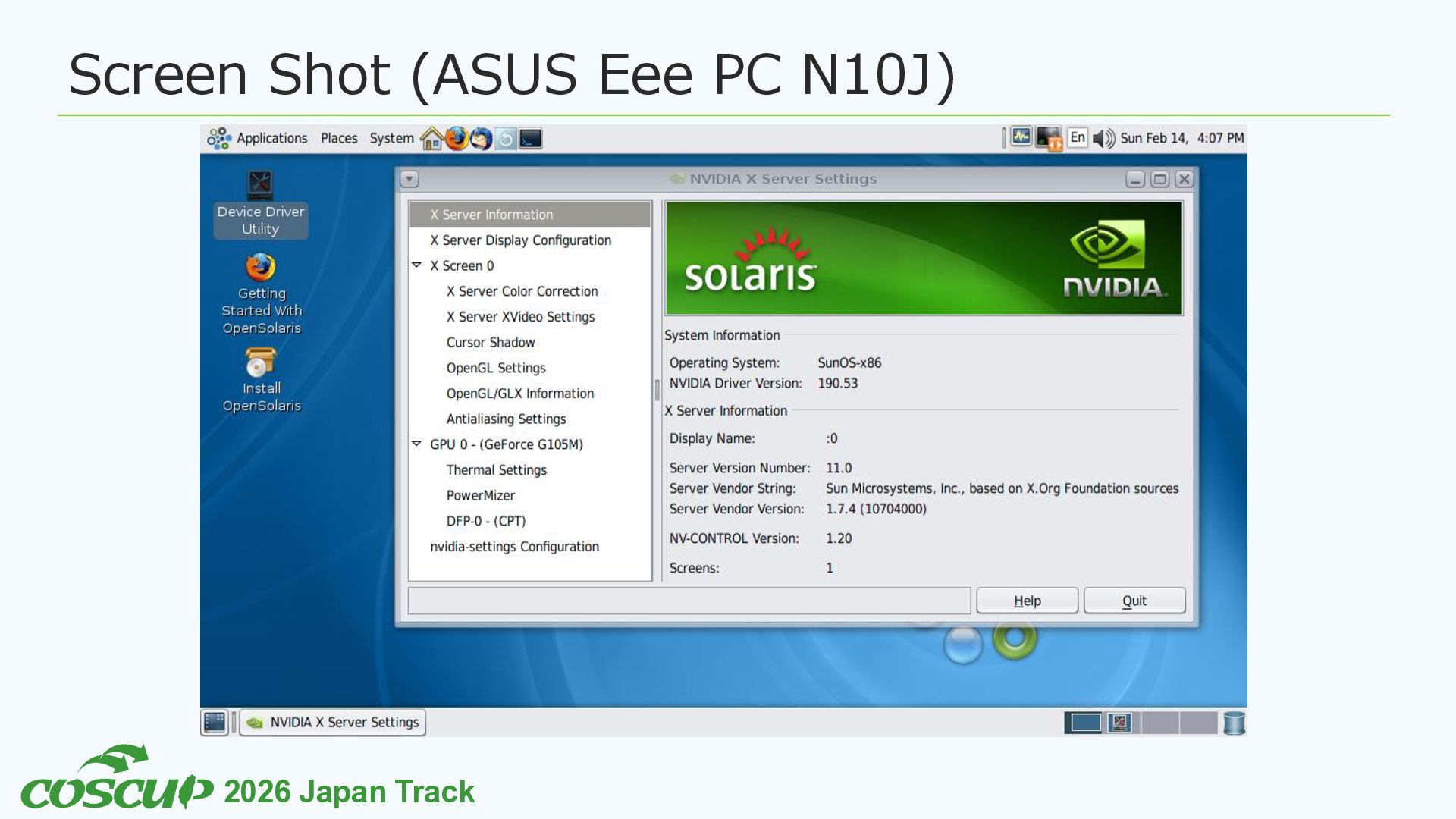
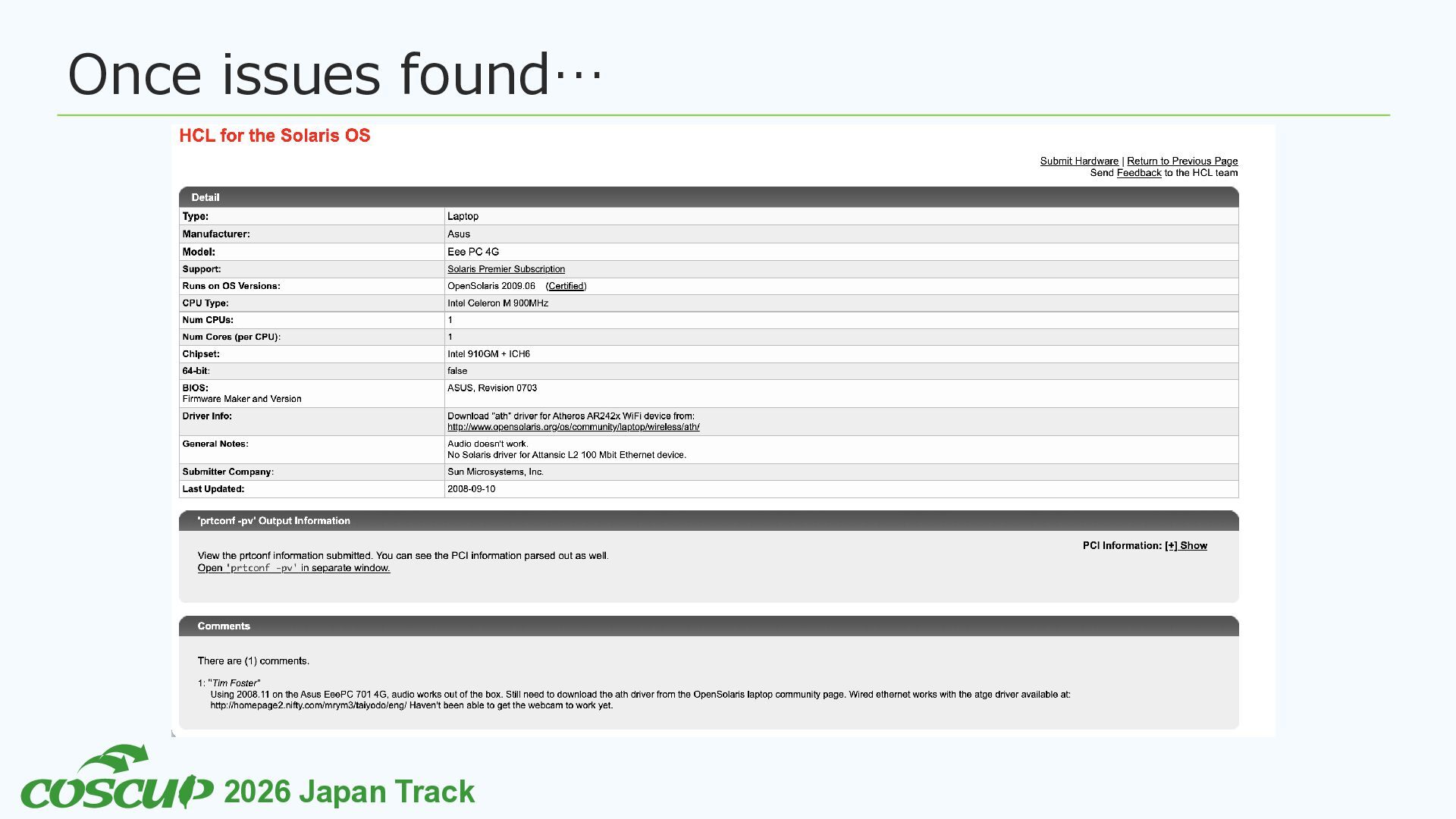
a laptop porting project together with an American and an Australian, as a team of three • Developed and distributed a laptop-focused OpenSolaris distribution — in recognition of this work, I was nominated as a Core Contributor and unanimously approved by the Governance Board • Resigned as a Contributor when the Governance Board was dissolved following Oracle's acquisition of Sun • Later founded the Japanese Raspberry Pi Users Group, applying the community know-how learned from OpenSolaris • Also led an OpenStack GPU-passthrough project — spread the know-how of using GPUs on OpenStack based on a deployment case at a major Japanese automotive company, and was recognized by the OpenStack Foundation 2026 Japan Track
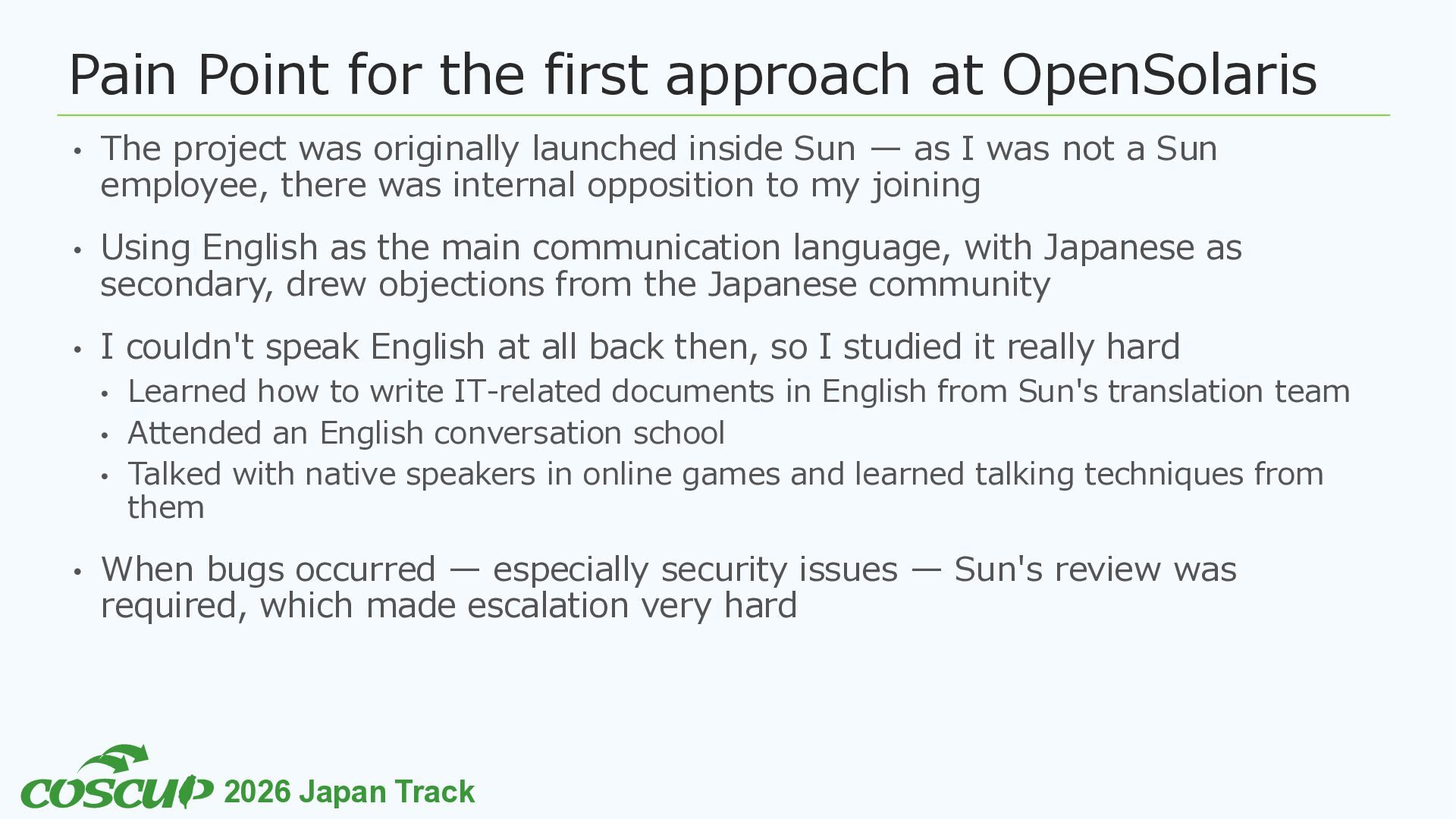
project was originally launched inside Sun — as I was not a Sun employee, there was internal opposition to my joining • Using English as the main communication language, with Japanese as secondary, drew objections from the Japanese community • I couldn't speak English at all back then, so I studied it really hard Learned how to write IT-related documents in English from Sun's translation team • Attended an English conversation school • Talked with native speakers in online games and learned talking techniques from them • • When bugs occurred — especially security issues — Sun's review was required, which made escalation very hard 2026 Japan Track
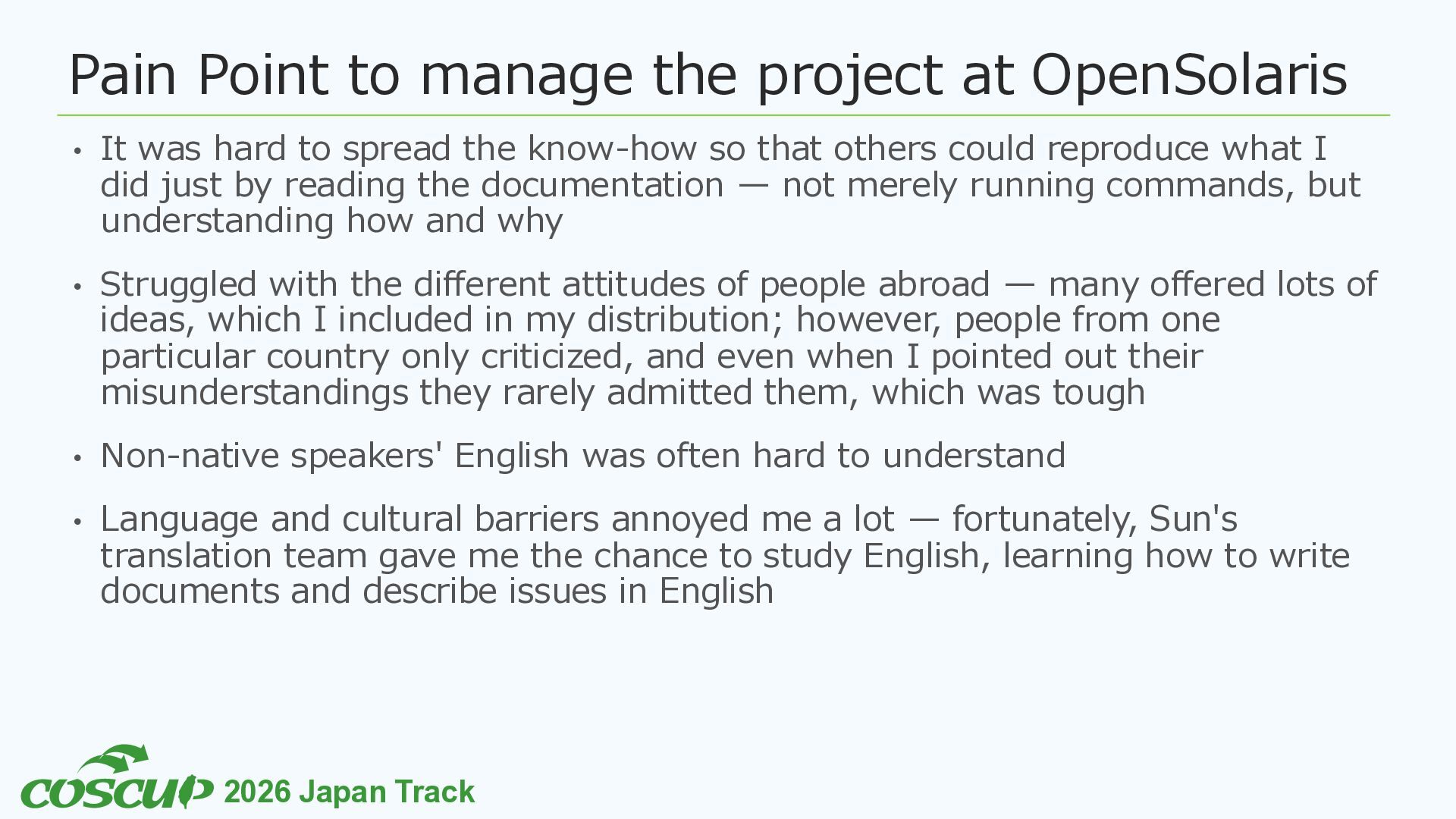
was hard to spread the know-how so that others could reproduce what I did just by reading the documentation — not merely running commands, but understanding how and why • Struggled with the different attitudes of people abroad — many offered lots of ideas, which I included in my distribution; however, people from one particular country only criticized, and even when I pointed out their misunderstandings they rarely admitted them, which was tough • Non-native speakers' English was often hard to understand • Language and cultural barriers annoyed me a lot — fortunately, Sun's translation team gave me the chance to study English, learning how to write documents and describe issues in English 2026 Japan Track
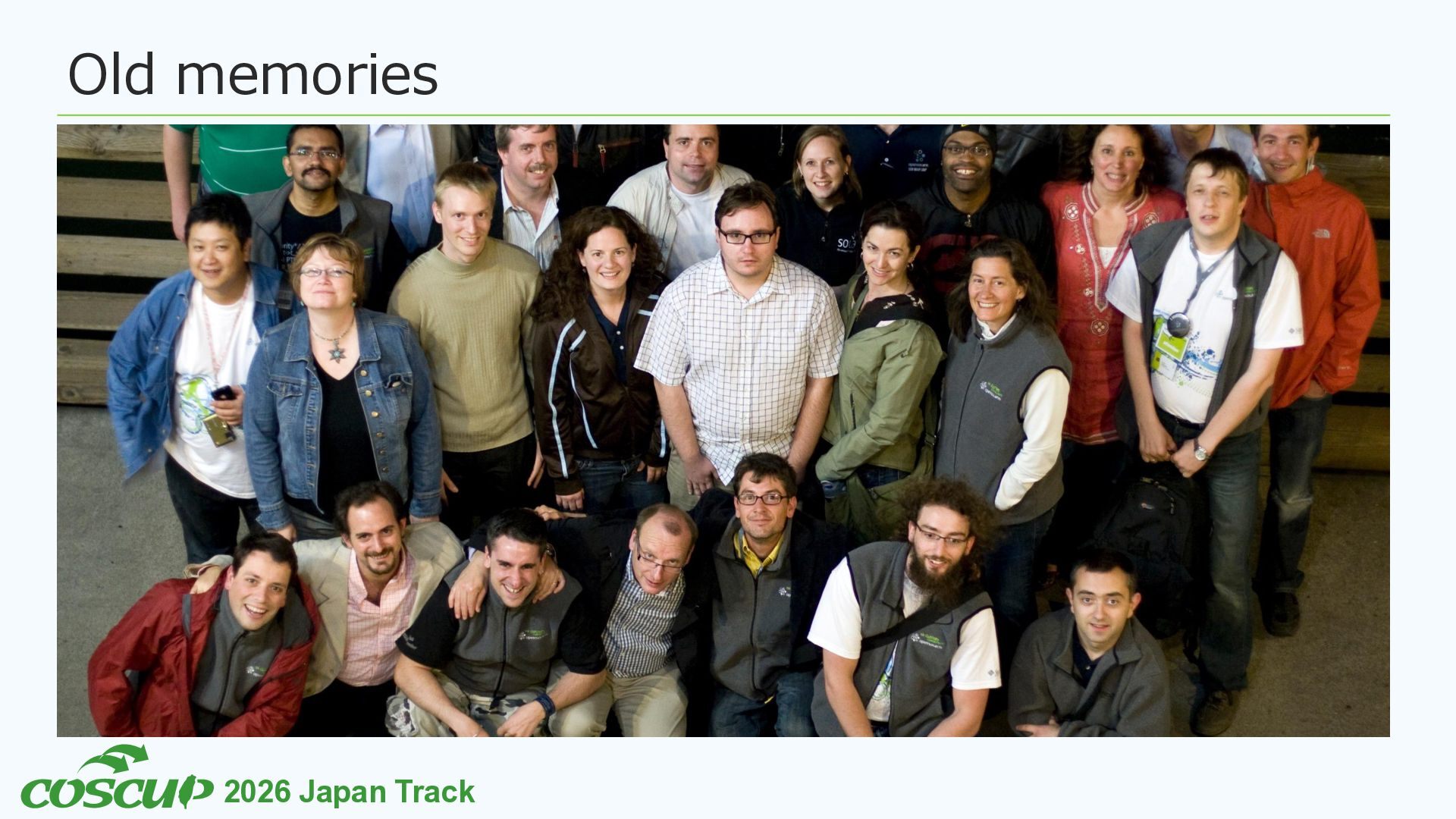
a global project from the very beginning — community leaders from each country held regular meetings, which made it easy to learn each other's cultures and strengthened mutual understanding and solidarity • Even after the acquisition of Sun, I am still in touch with many of the former leaders — proof of how strong our solidarity was back then 2026 Japan Track
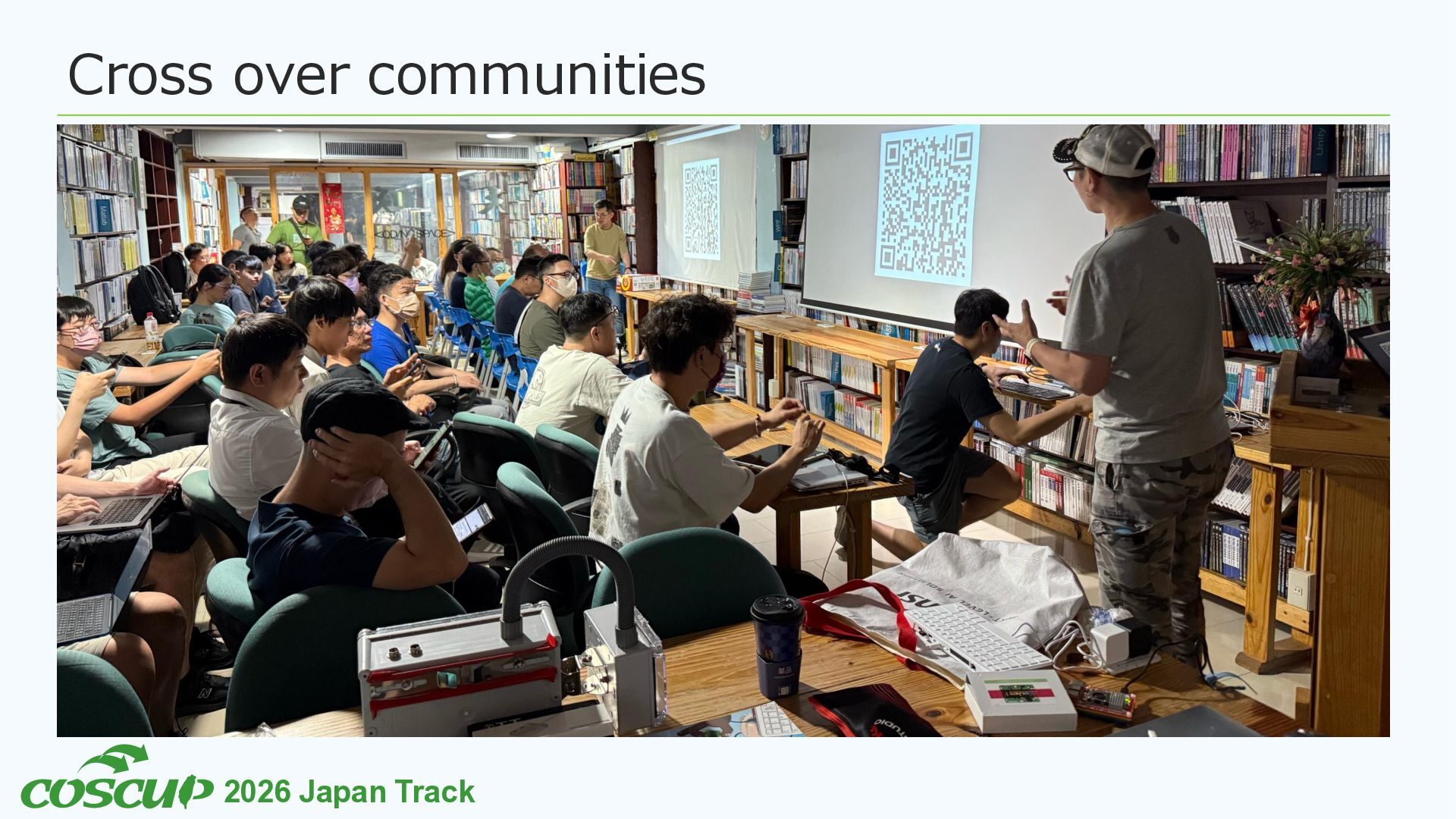
• Aimed to collaborate not only with the community in our own country but also with overseas communities, and to help launch new ones • Kept sending information out — holding events and making use of the official forum • A connection with Raspberry Pi came about by chance, so we made the most of it • Valued gamification • Goods and swag serve as a symbol of community solidarity • Actively participated in global open source events, such as Open Source Summit by the Linux Foundation • Used travel funds whenever events offered them —it is a great help for younger developers to spread their projects 2026 Japan Track
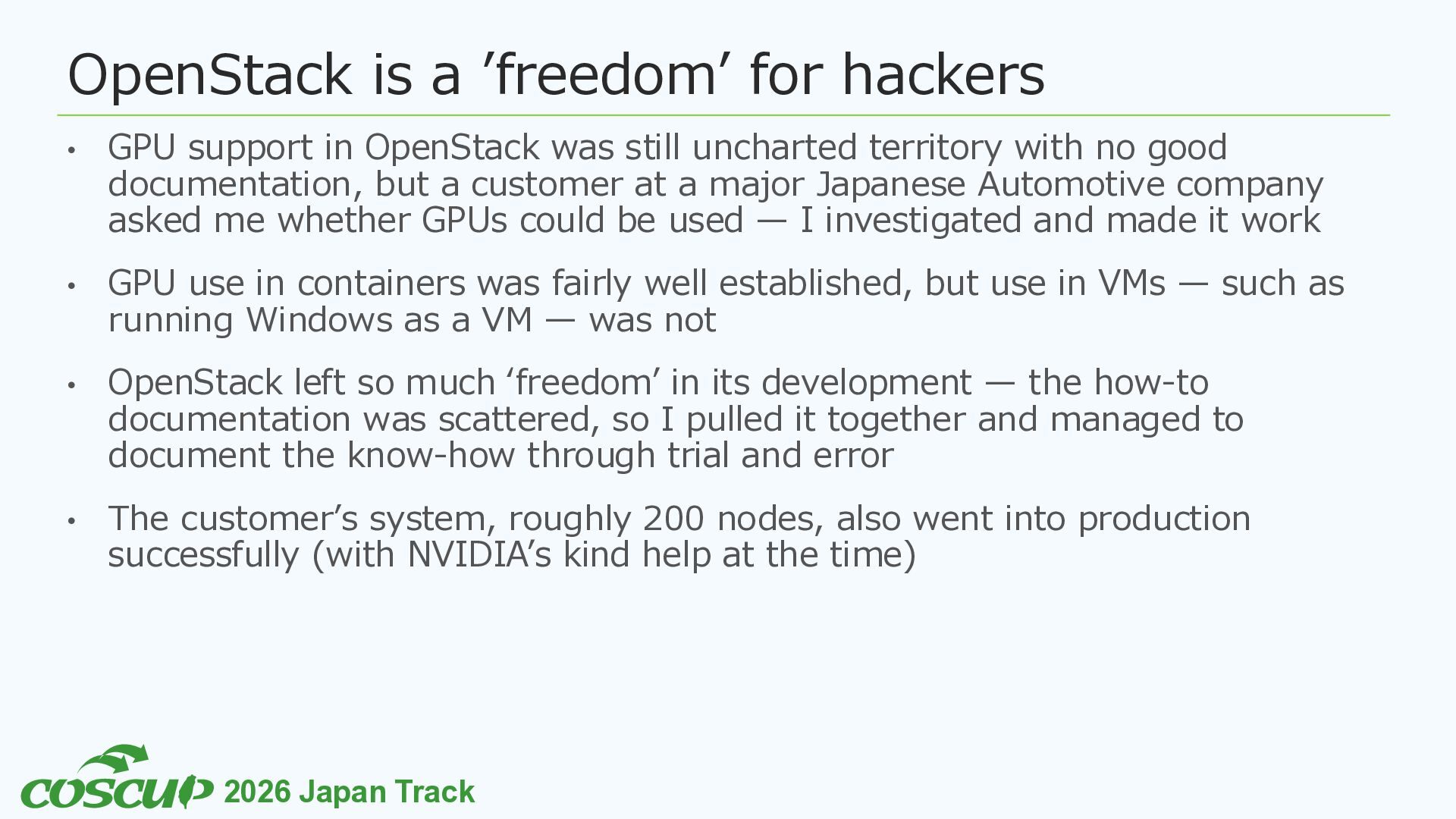
OpenStack was still uncharted territory with no good documentation, but a customer at a major Japanese Automotive company asked me whether GPUs could be used — I investigated and made it work • GPU use in containers was fairly well established, but use in VMs — such as running Windows as a VM — was not • OpenStack left so much ‘freedom’ in its development — the how-to documentation was scattered, so I pulled it together and managed to document the know-how through trial and error • The customer’s system, roughly 200 nodes, also went into production successfully (with NVIDIA’s kind help at the time) 2026 Japan Track
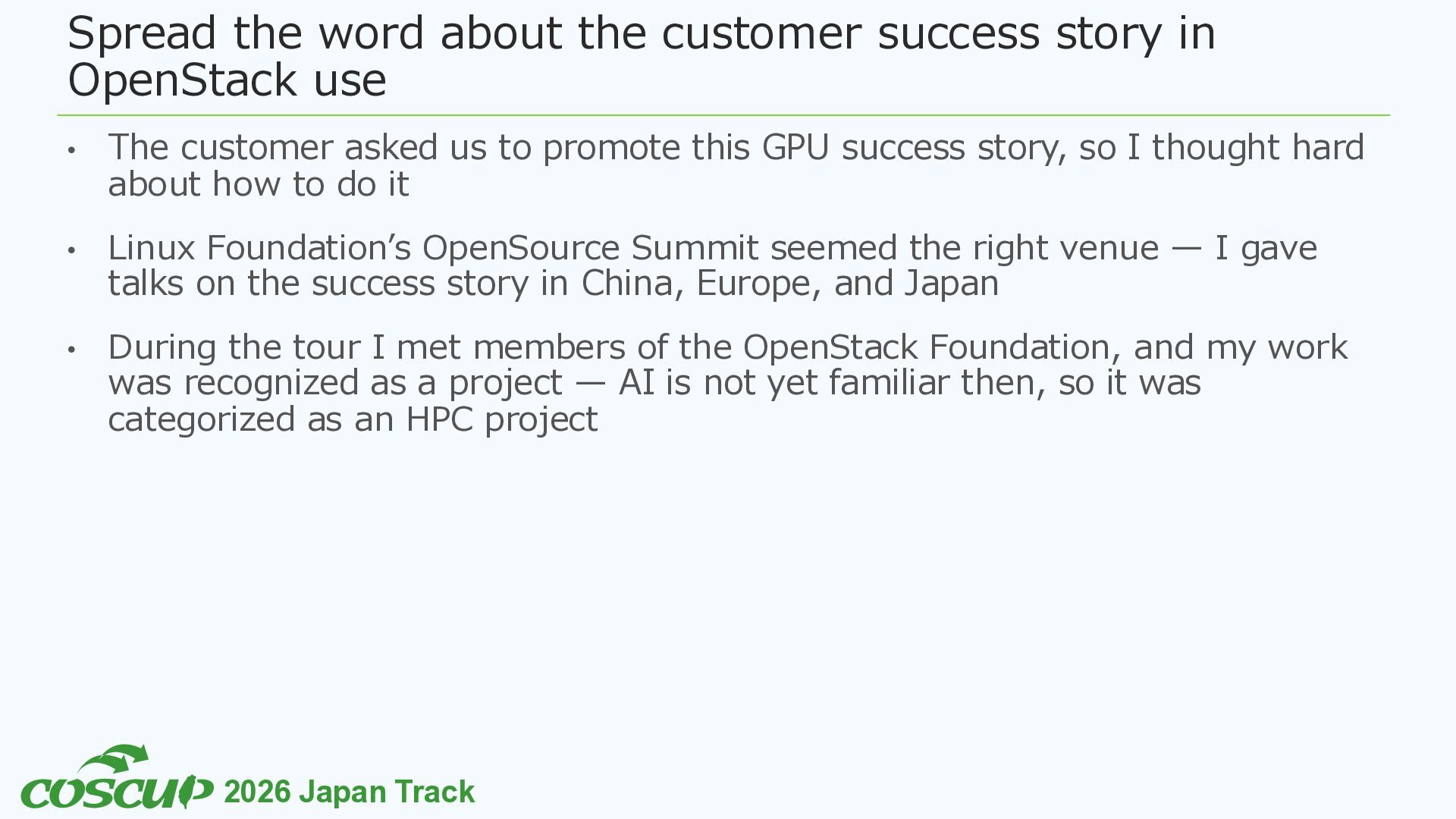
use • The customer asked us to promote this GPU success story, so I thought hard about how to do it • Linux Foundation’s OpenSource Summit seemed the right venue — I gave talks on the success story in China, Europe, and Japan • During the tour I met members of the OpenStack Foundation, and my work was recognized as a project — AI is not yet familiar then, so it was categorized as an HPC project 2026 Japan Track
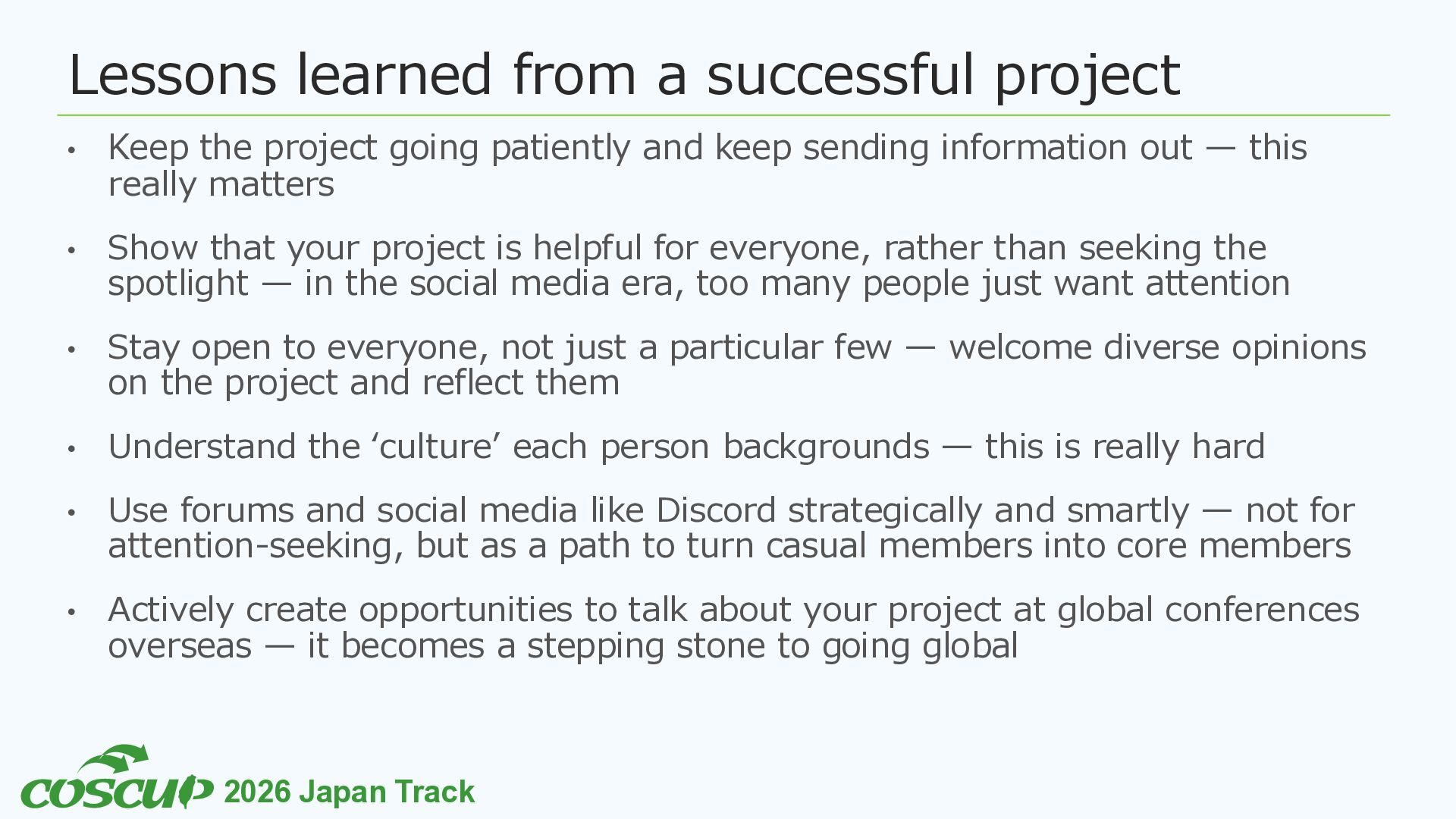
going patiently and keep sending information out — this really matters • Show that your project is helpful for everyone, rather than seeking the spotlight — in the social media era, too many people just want attention • Stay open to everyone, not just a particular few — welcome diverse opinions on the project and reflect them • Understand the ‘culture’ each person backgrounds — this is really hard • Use forums and social media like Discord strategically and smartly — not for attention-seeking, but as a path to turn casual members into core members • Actively create opportunities to talk about your project at global conferences overseas — it becomes a stepping stone to going global 2026 Japan Track


 masafumi_ohta
 takeshisumida_
 uluru_hr
 openwork
 kamadamakoto
 caddireat
 reiwatravel_0405
 hirohasuyoutube
 kazumakitao
 flux
flux
 hiyoriyamakankou
 so_kotani
 roms
roms
 tonyrice
 bluesmoon
 jakevdp
 badams
 lcolladotor
 techseoconnect
 ks91
ks91
 427marketing
 aleyda
 soudai
 retrage
 axbom
axbom
![2026 Japan Track [BoF] How Do You Grow Your Own](https://files.speakerdeck.com/presentations/2b334e1806624f9c94fc7b5a46a8c861/slide_0.jpg)

![2026 Japan Track Thanks, any questions? Masafumi Ohta mailto:[email protected] 2026](https://files.speakerdeck.com/presentations/2b334e1806624f9c94fc7b5a46a8c861/slide_17.jpg)