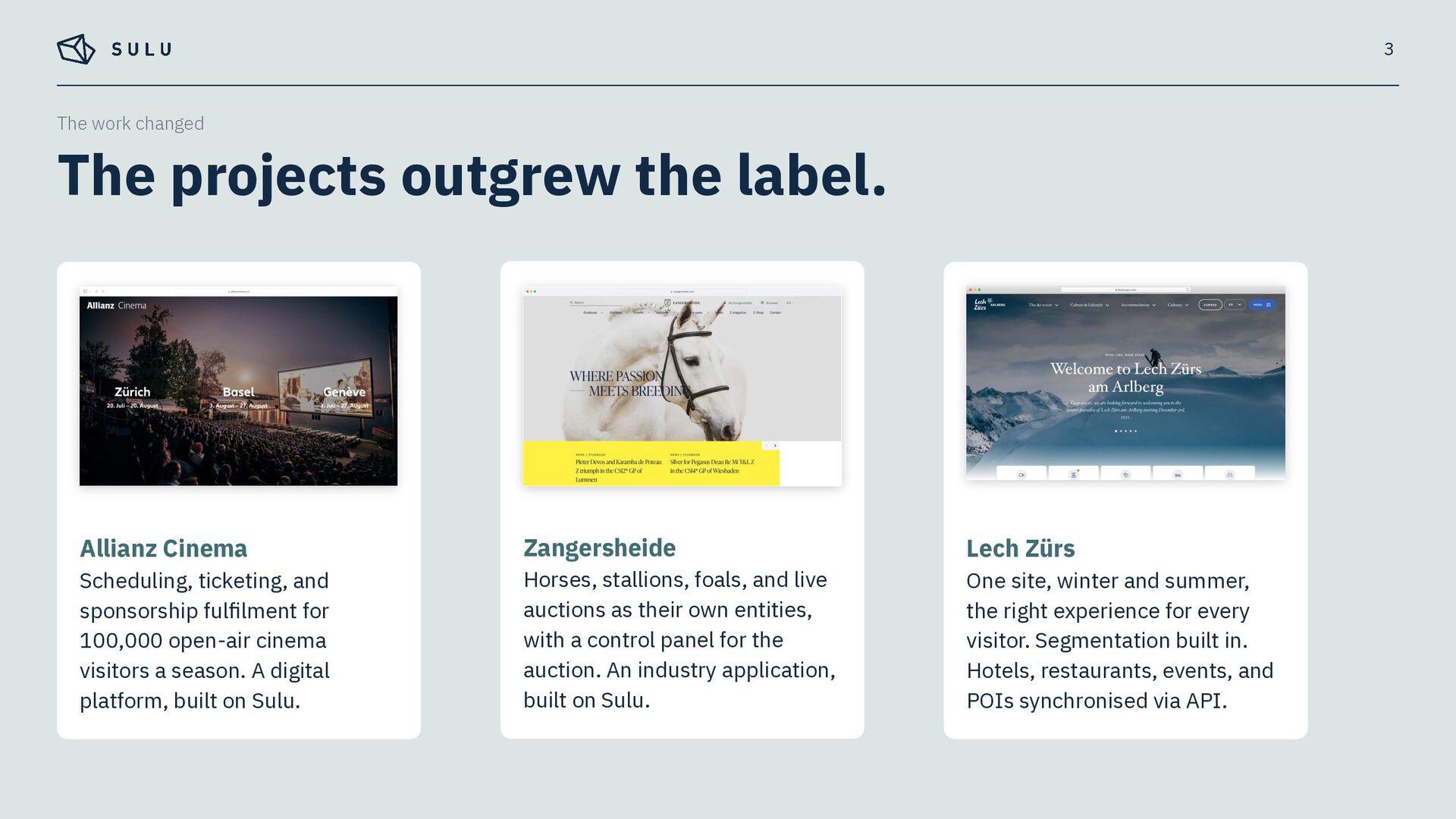
Lech Zürs Scheduling, ticketing, and sponsorship ful lment for 100,000 open-air cinema visitors a season. A digital platform, built on Sulu. Horses, stallions, foals, and live auctions as their own entities, with a control panel for the auction. An industry application, built on Sulu. One site, winter and summer, the right experience for every visitor. Segmentation built in. Hotels, restaurants, events, and POIs synchronised via API. fi Allianz Cinema
the license. The open source options for platforms and product data are disappearing. The gap is opening now, and it’s ours to ll. Pimcore Community Edition from GPLv3 to the proprietary POCL license (2026). Ibexa Left the open-source DXP space earlier. Licensebased, no open-source path. Akeneo fi v7, the last classic Community Edition line, reached end of support on 30 September 2026.
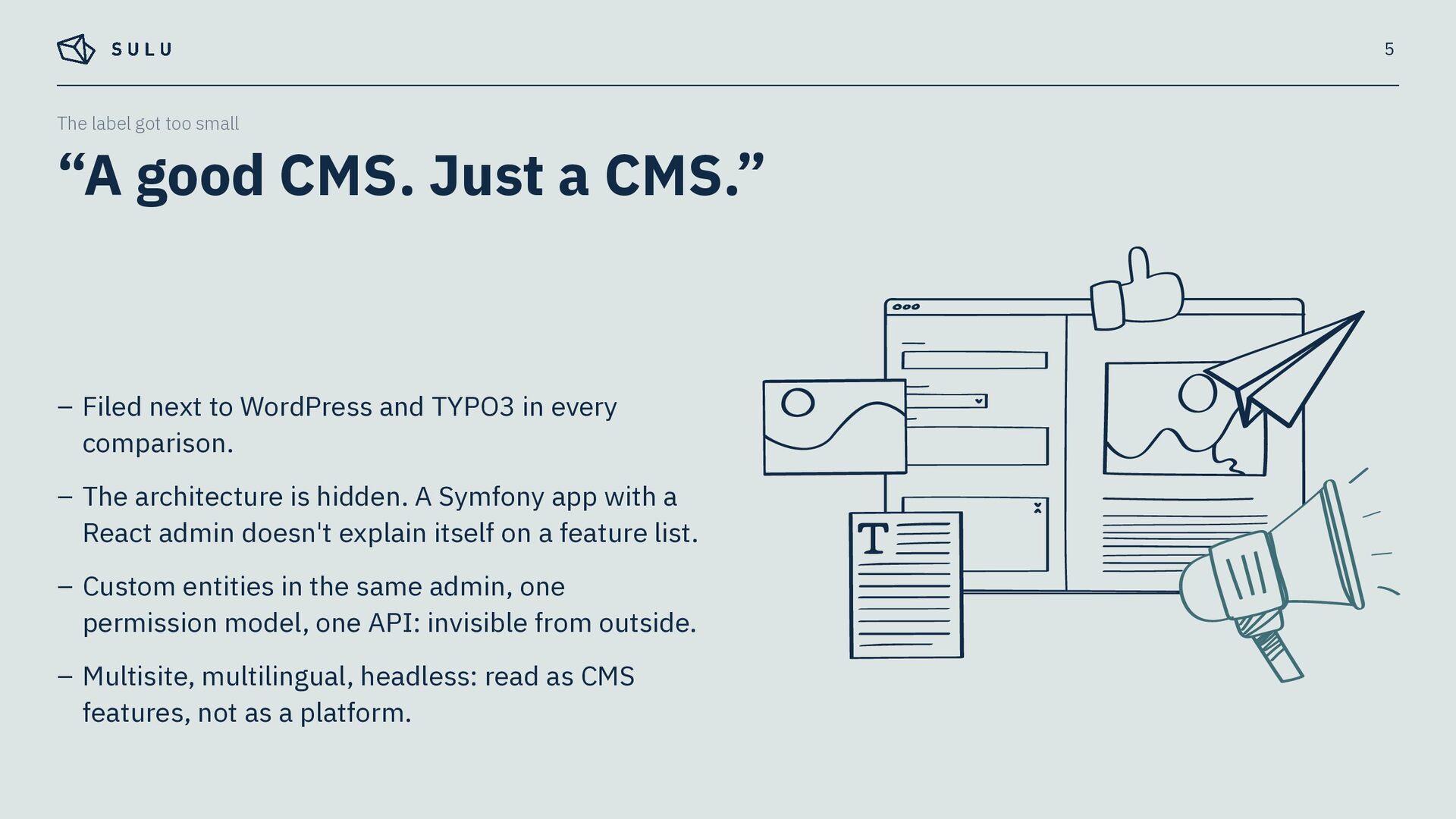
a CMS.” – Filed next to WordPress and TYPO3 in every comparison. – The architecture is hidden. A Symfony app with a React admin doesn't explain itself on a feature list. – Custom entities in the same admin, one permission model, one API: invisible from outside. – Multisite, multilingual, headless: read as CMS features, not as a platform.
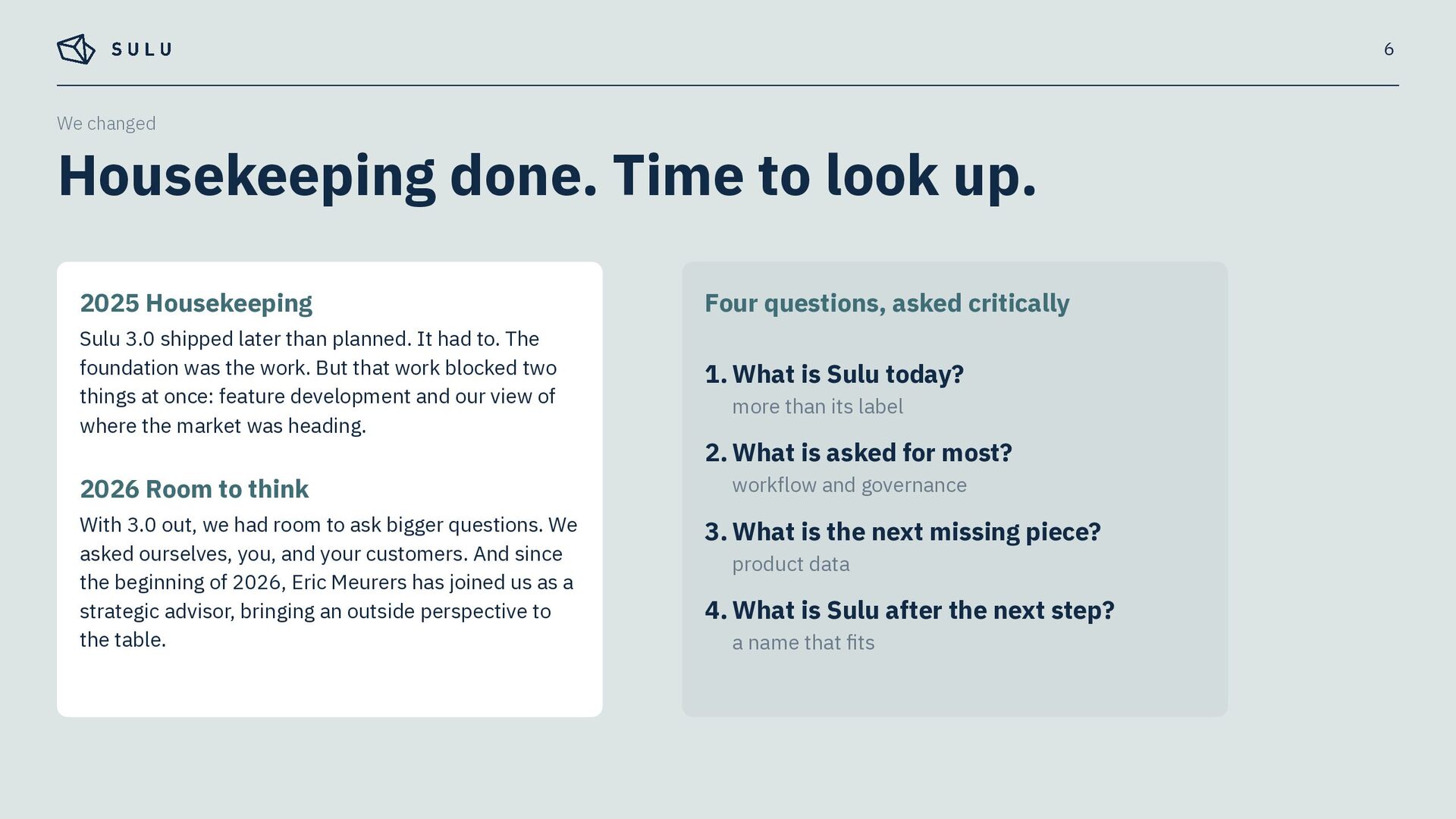
Housekeeping Four questions, asked critically Sulu 3.0 shipped later than planned. It had to. The foundation was the work. But that work blocked two things at once: feature development and our view of where the market was heading. 1. What is Sulu today? 2026 Room to think fi With 3.0 out, we had room to ask bigger questions. We asked ourselves, you, and your customers. And since the beginning of 2026, Eric Meurers has joined us as a strategic advisor, bringing an outside perspective to the table. more than its label 2. What is asked for most? workflow and governance 3. What is the next missing piece? product data 4. What is Sulu after the next step? a name that ts
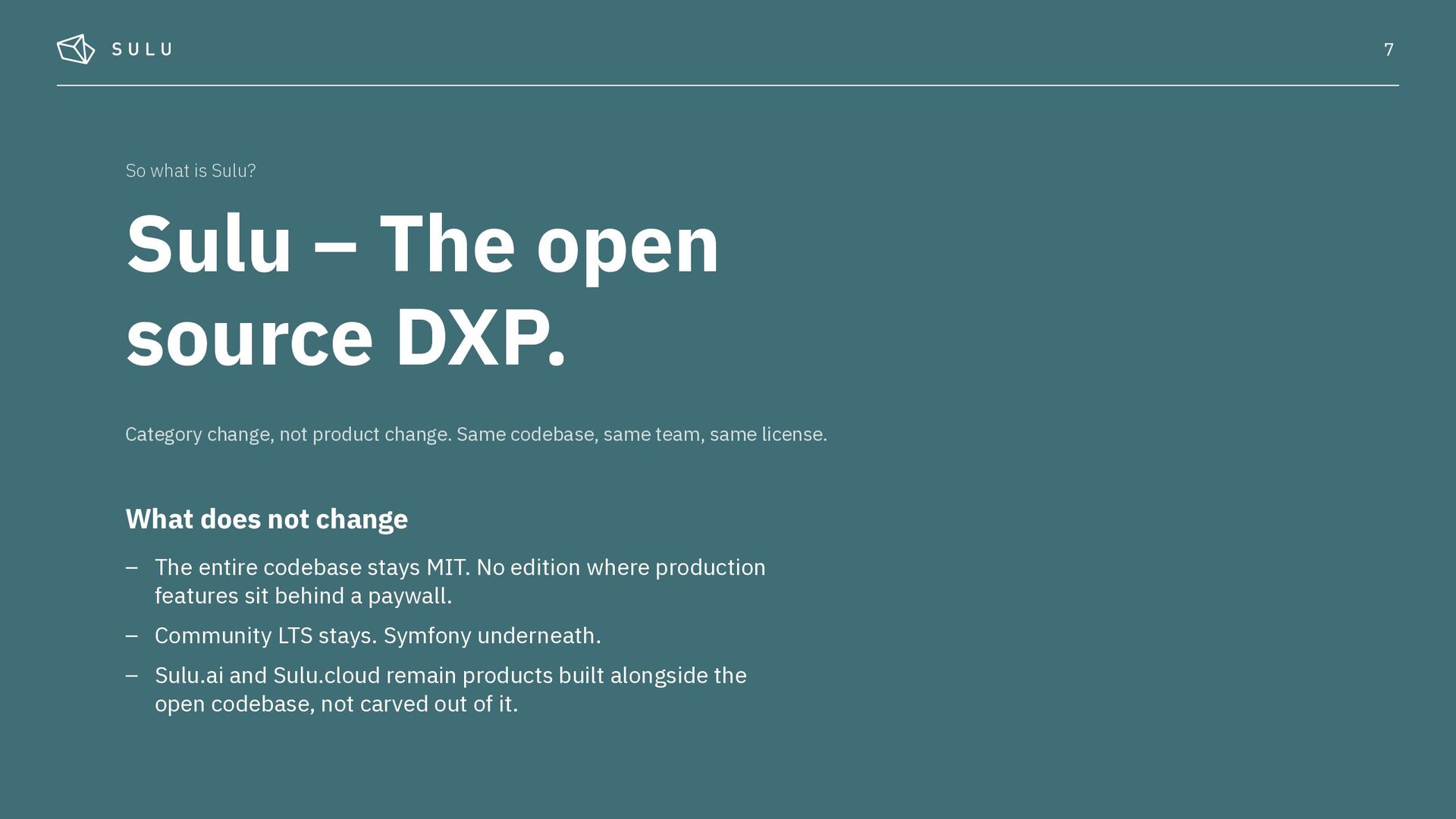
DXP. Category change, not product change. Same codebase, same team, same license. What does not change – The entire codebase stays MIT. No edition where production features sit behind a paywall. – Community LTS stays. Symfony underneath. – Sulu.ai and Sulu.cloud remain products built alongside the open codebase, not carved out of it.
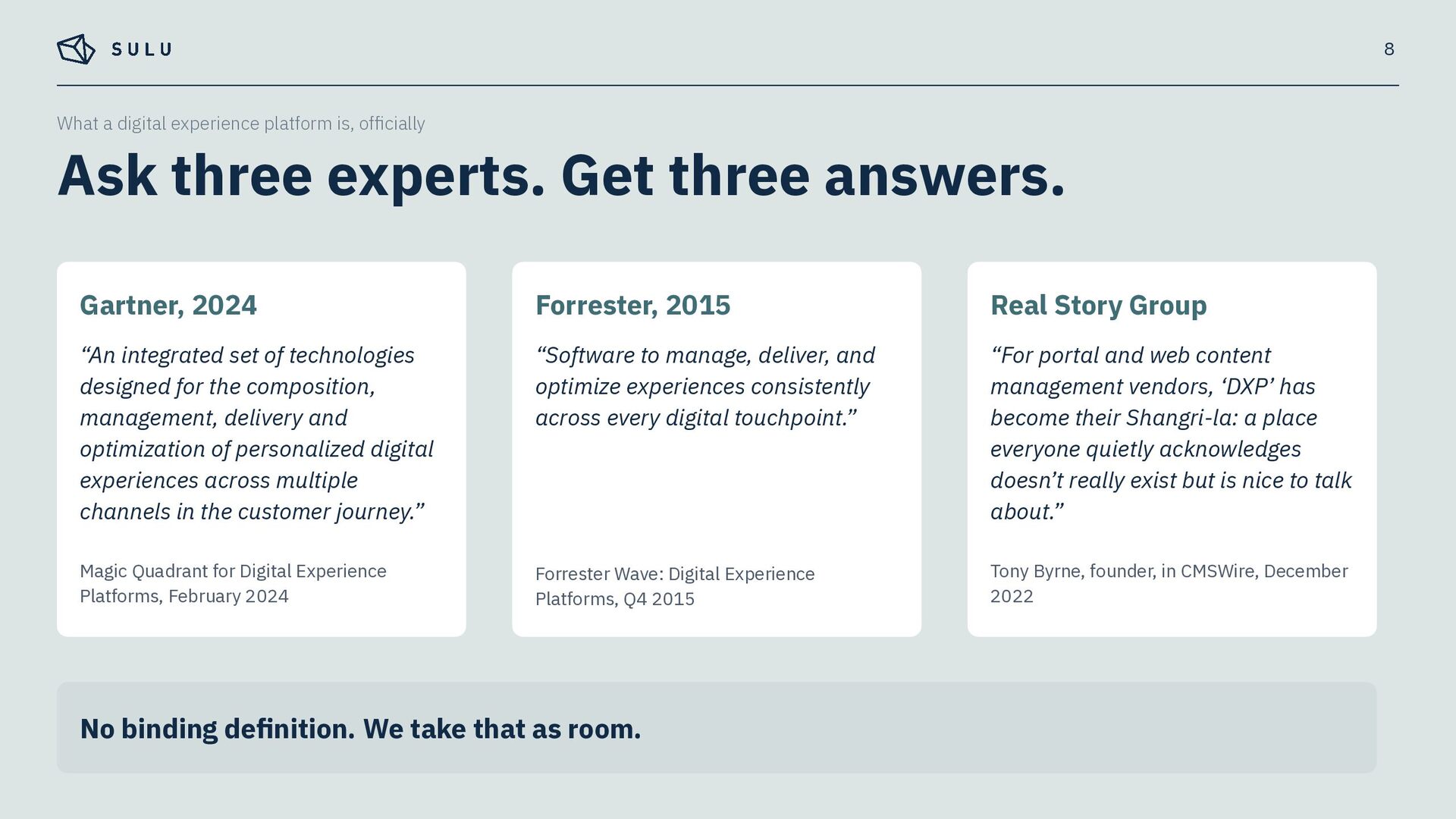
three experts. Get three answers. Gartner, 2024 Forrester, 2015 Real Story Group “An integrated set of technologies designed for the composition, management, delivery and optimization of personalized digital experiences across multiple channels in the customer journey.” “Software to manage, deliver, and optimize experiences consistently across every digital touchpoint.” “For portal and web content management vendors, ‘DXP’ has become their Shangri-la: a place everyone quietly acknowledges doesn’t really exist but is nice to talk about.” Magic Quadrant for Digital Experience Platforms, February 2024 Forrester Wave: Digital Experience Platforms, Q4 2015 Tony Byrne, founder, in CMSWire, December 2022 fi fi No binding de nition. We take that as room.
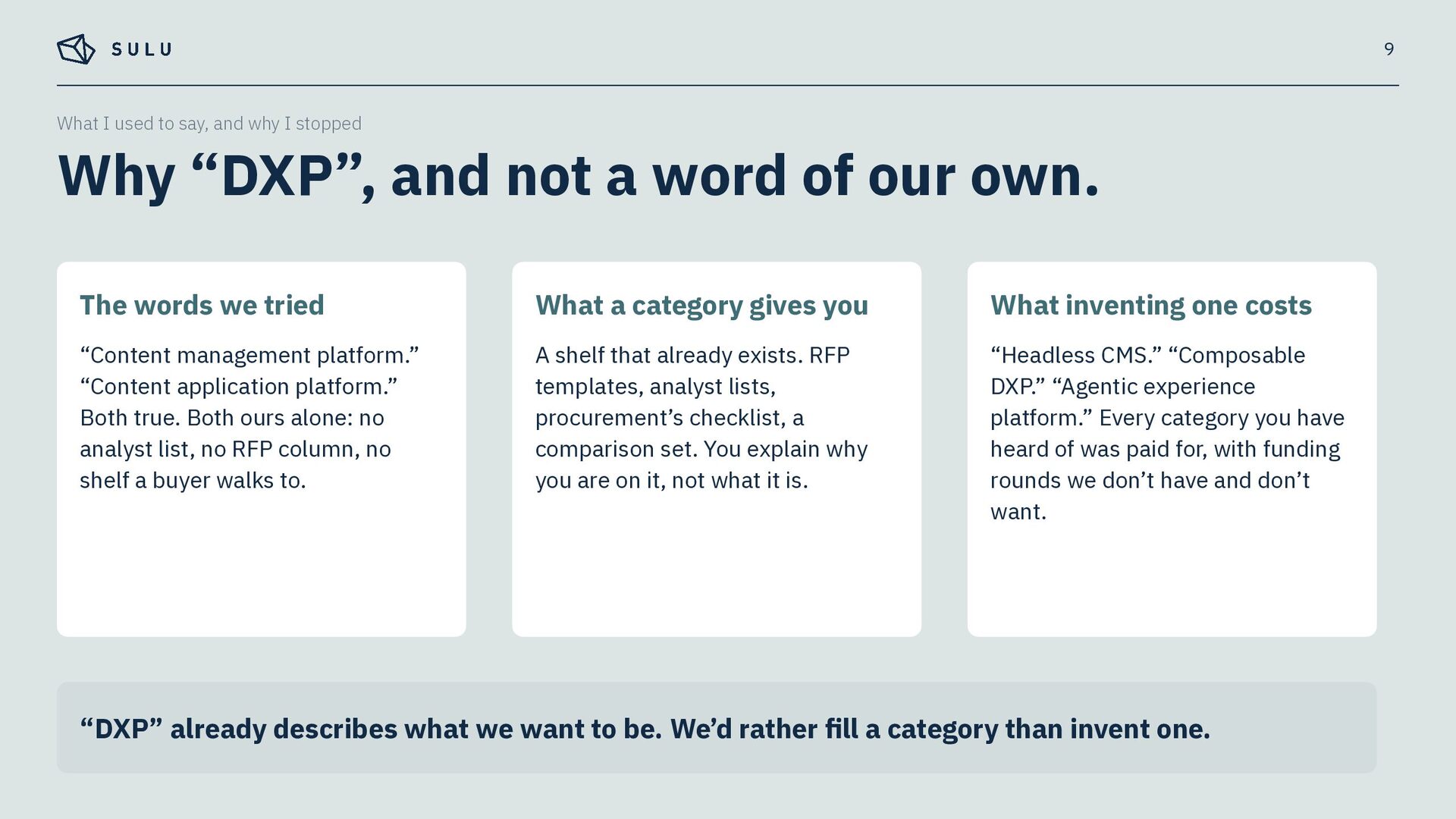
Why “DXP”, and not a word of our own. The words we tried What a category gives you What inventing one costs “Content management platform.” “Content application platform.” Both true. Both ours alone: no analyst list, no RFP column, no shelf a buyer walks to. A shelf that already exists. RFP templates, analyst lists, procurement’s checklist, a comparison set. You explain why you are on it, not what it is. “Headless CMS.” “Composable DXP.” “Agentic experience platform.” Every category you have heard of was paid for, with funding rounds we don’t have and don’t want. fi “DXP” already describes what we want to be. We’d rather ll a category than invent one.
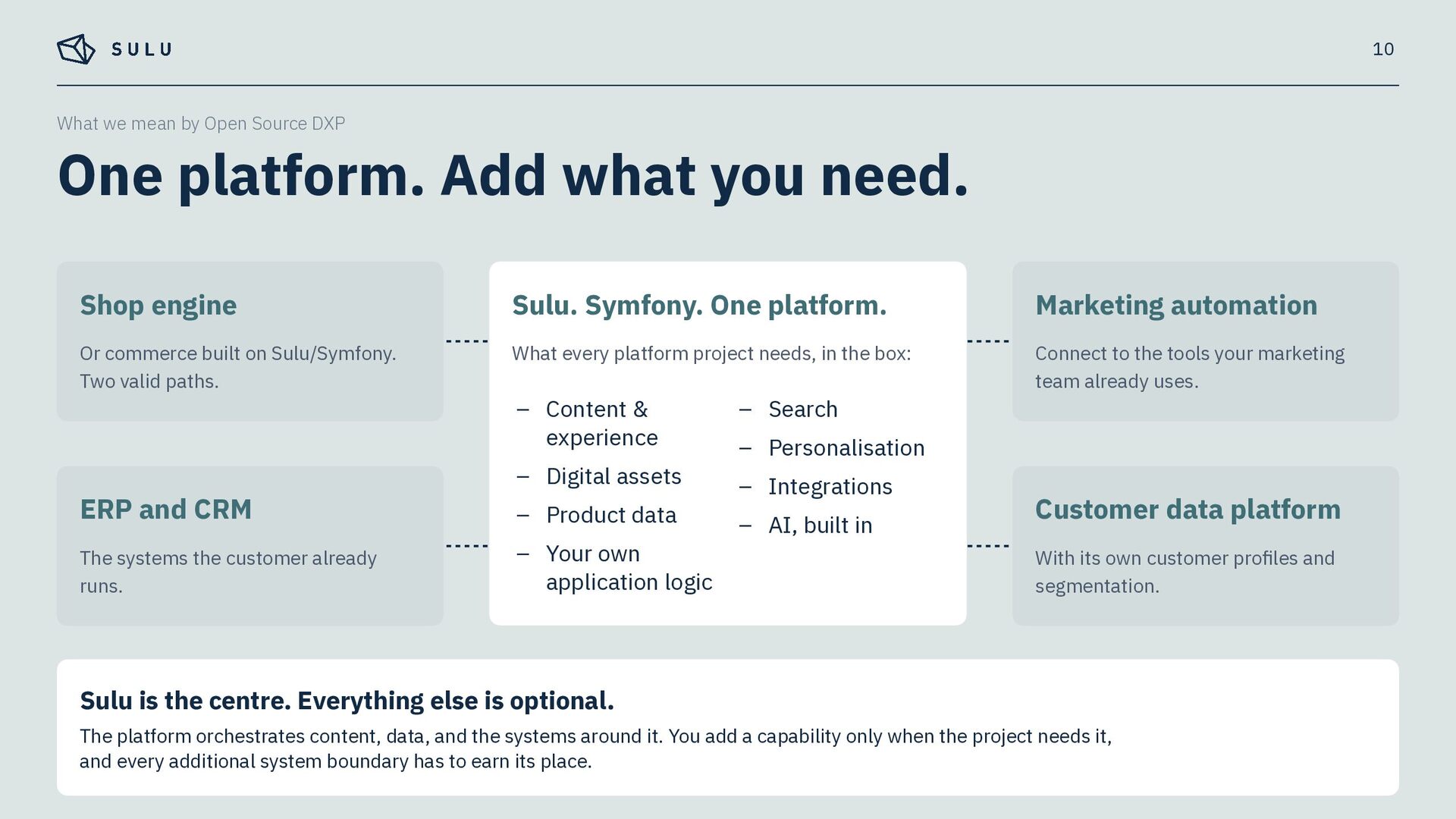
Add what you need. Shop engine Sulu. Symfony. One platform. Marketing automation Or commerce built on Sulu/Symfony. Two valid paths. What every platform project needs, in the box: Connect to the tools your marketing team already uses. – Content & experience – Search – Digital assets – Integrations ERP and CRM – Product data The systems the customer already runs. – Your own application logic – Personalisation – AI, built in Customer data platform With its own customer pro les and segmentation. Sulu is the centre. Everything else is optional. fi The platform orchestrates content, data, and the systems around it. You add a capability only when the project needs it, and every additional system boundary has to earn its place.
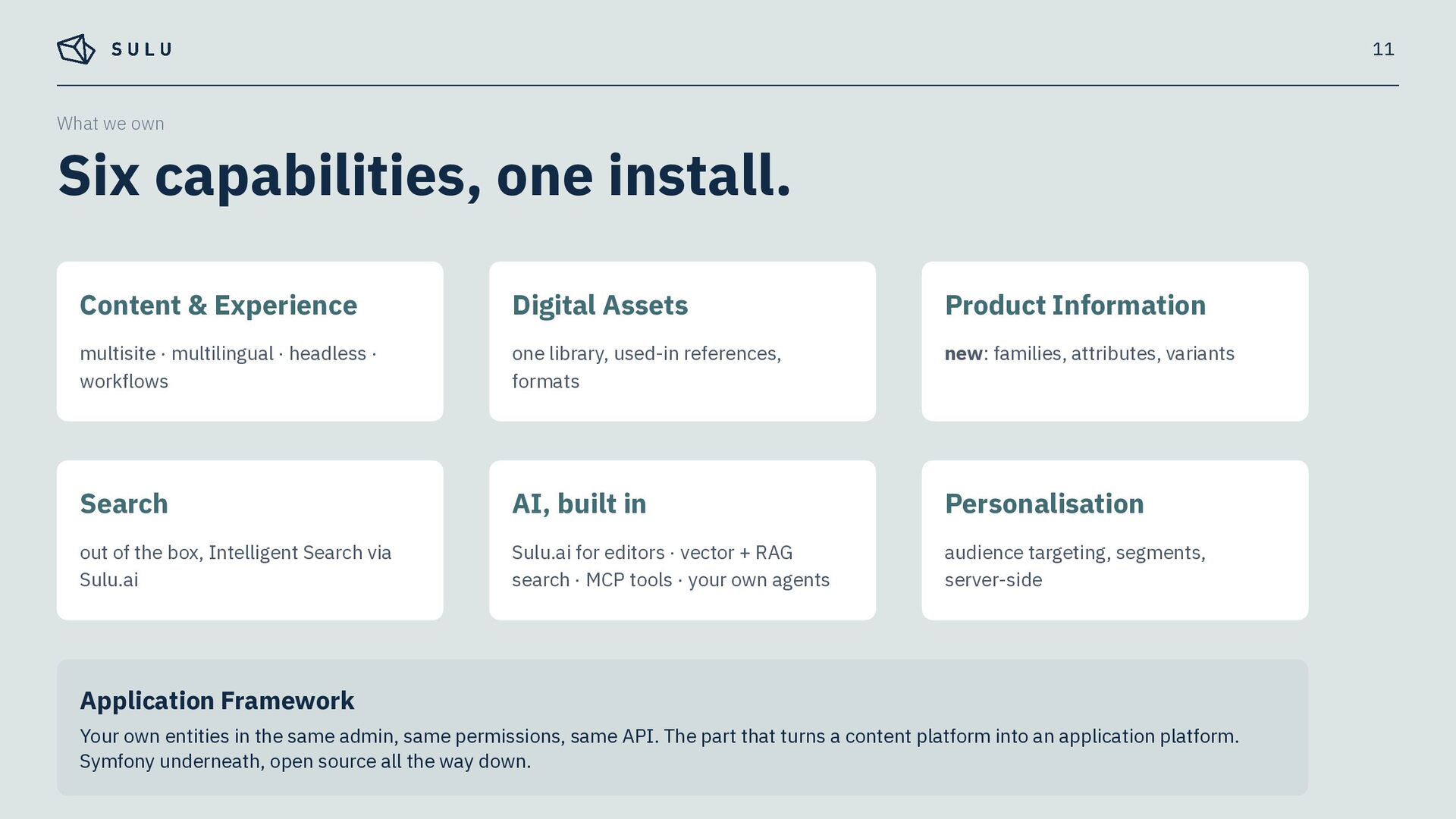
Experience Digital Assets Product Information multisite · multilingual · headless · workflows one library, used-in references, formats new: families, attributes, variants Search AI, built in Personalisation out of the box, Intelligent Search via Sulu.ai Sulu.ai for editors · vector + RAG search · MCP tools · your own agents audience targeting, segments, server-side Application Framework Your own entities in the same admin, same permissions, same API. The part that turns a content platform into an application platform. Symfony underneath, open source all the way down.
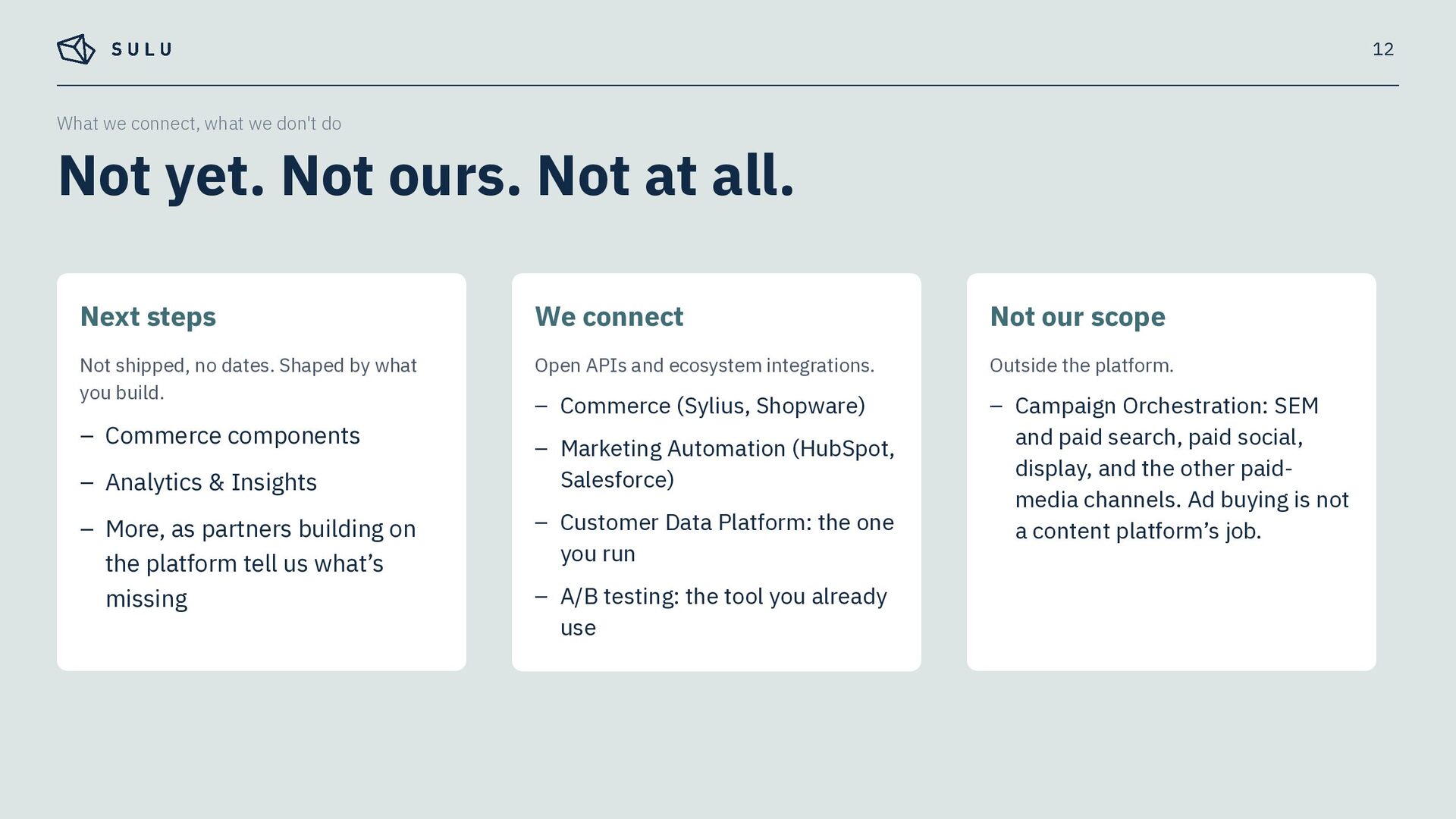
Not ours. Not at all. Next steps We connect Not our scope Not shipped, no dates. Shaped by what you build. Open APIs and ecosystem integrations. Outside the platform. – Commerce (Sylius, Shopware) – Campaign Orchestration: SEM and paid search, paid social, display, and the other paidmedia channels. Ad buying is not a content platform’s job. – Commerce components – Analytics & Insights – More, as partners building on the platform tell us what’s missing – Marketing Automation (HubSpot, Salesforce) – Customer Data Platform: the one you run – A/B testing: the tool you already use
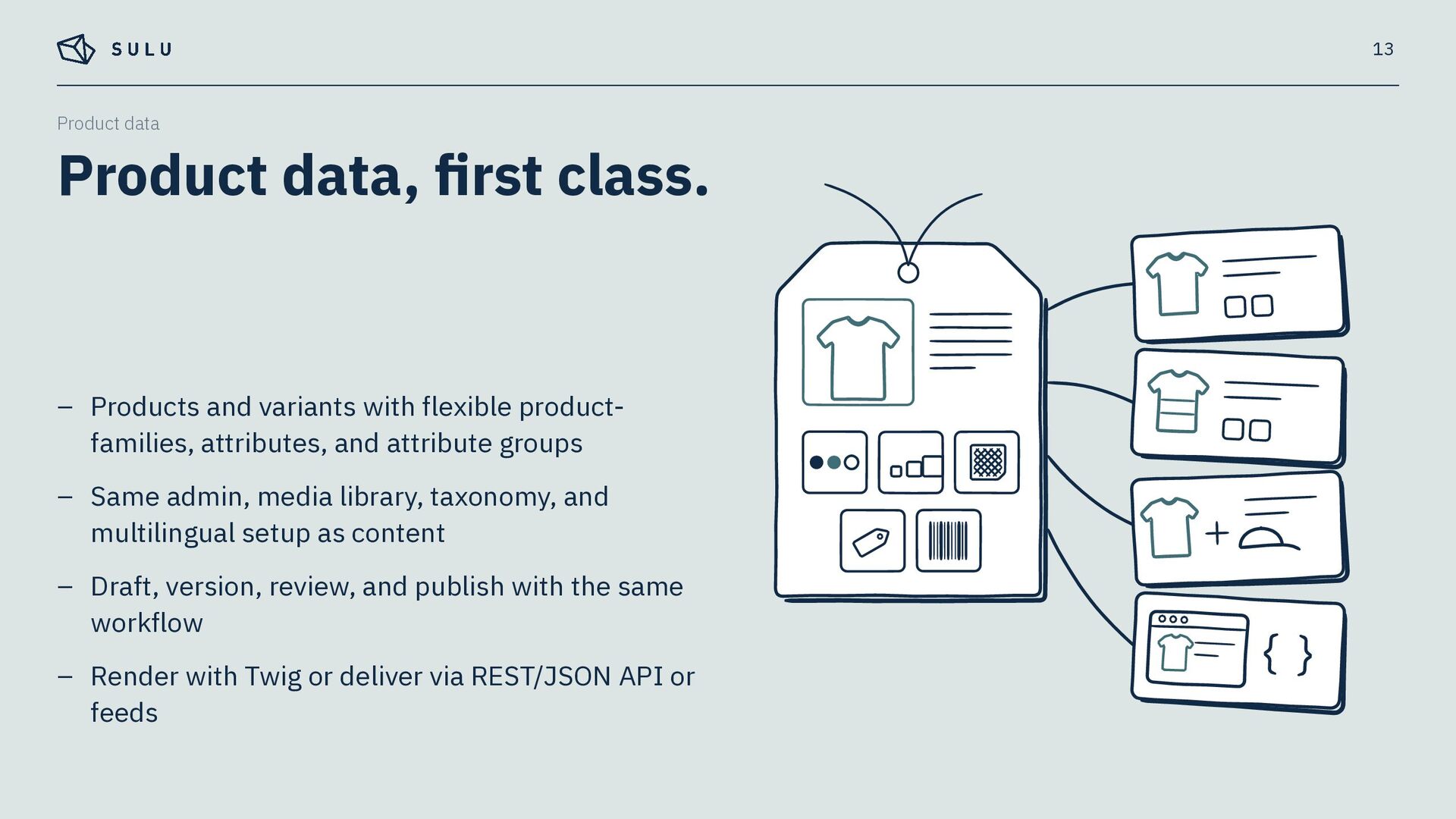
variants with flexible productfamilies, attributes, and attribute groups – Same admin, media library, taxonomy, and multilingual setup as content – Draft, version, review, and publish with the same workflow fi – Render with Twig or deliver via REST/JSON API or feeds
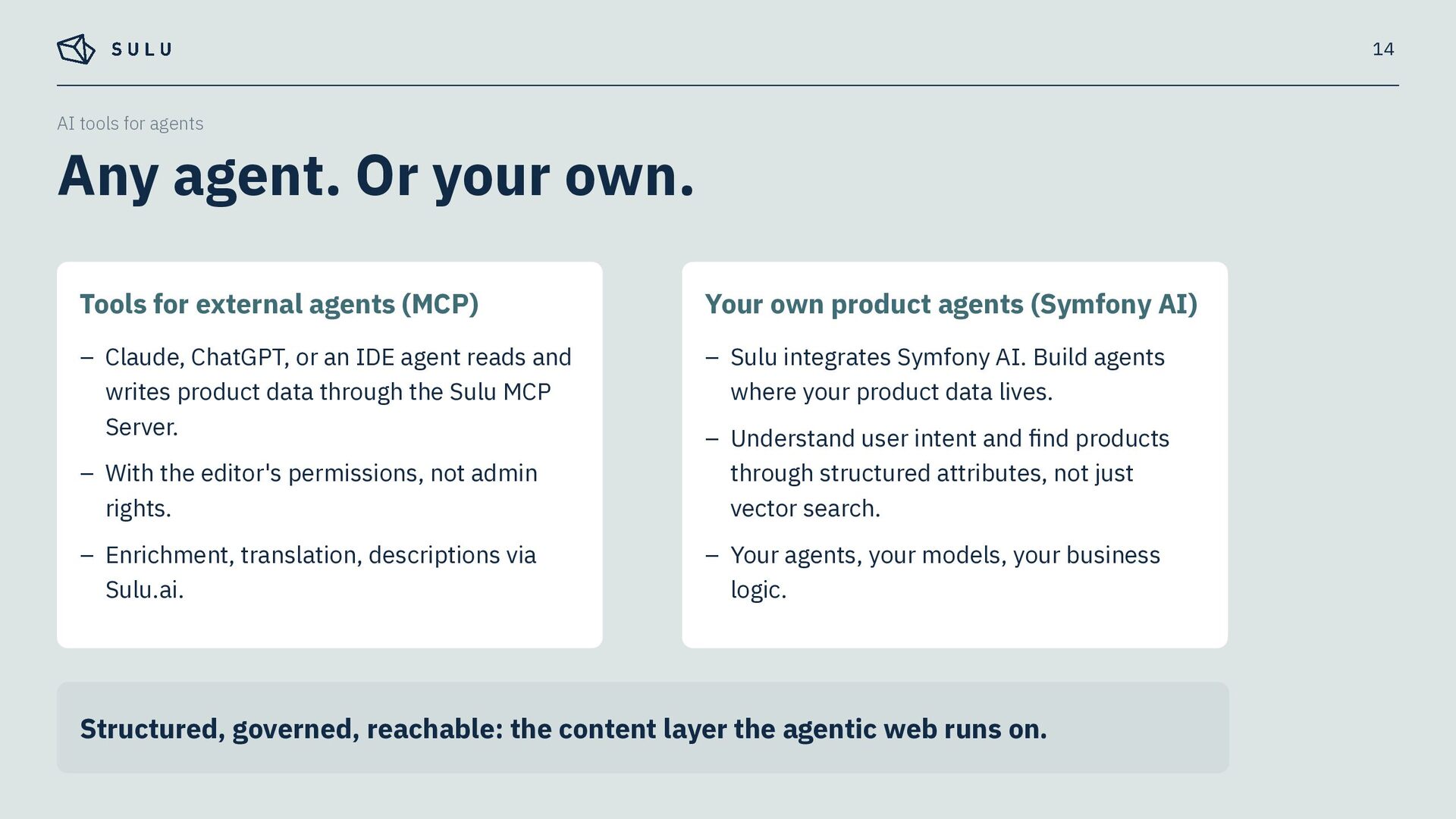
Tools for external agents (MCP) Your own product agents (Symfony AI) – Claude, ChatGPT, or an IDE agent reads and writes product data through the Sulu MCP Server. – Sulu integrates Symfony AI. Build agents where your product data lives. – With the editor's permissions, not admin rights. – Understand user intent and nd products through structured attributes, not just vector search. – Enrichment, translation, descriptions via Sulu.ai. – Your agents, your models, your business logic. fi Structured, governed, reachable: the content layer the agentic web runs on.
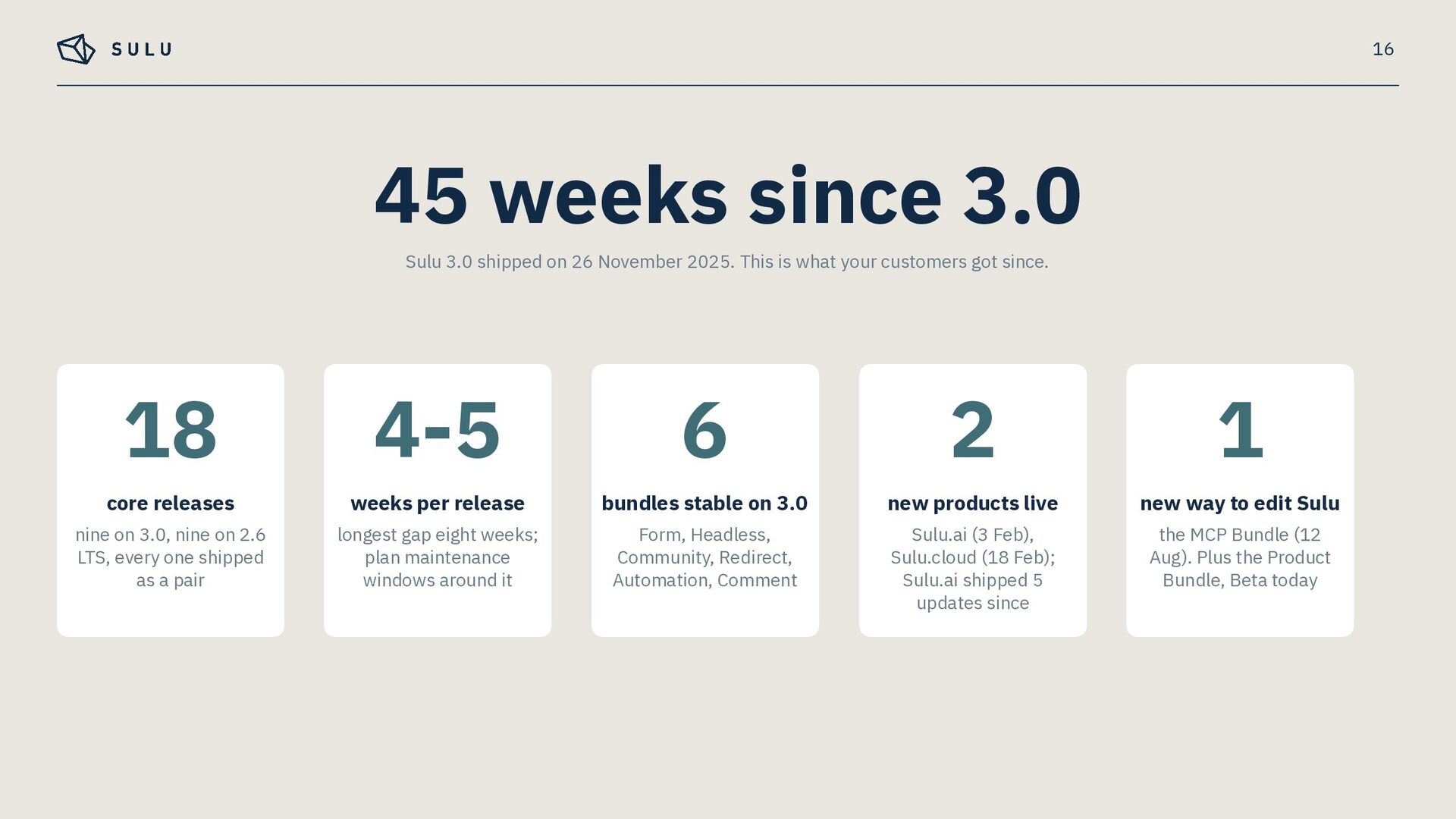
November 2025. This is what your customers got since. 18 4-5 6 2 1 core releases weeks per release bundles stable on 3.0 new products live new way to edit Sulu nine on 3.0, nine on 2.6 LTS, every one shipped as a pair longest gap eight weeks; plan maintenance windows around it Form, Headless, Community, Redirect, Automation, Comment Sulu.ai (3 Feb), Sulu.cloud (18 Feb); Sulu.ai shipped 5 updates since the MCP Bundle (12 Aug). Plus the Product Bundle, Beta today
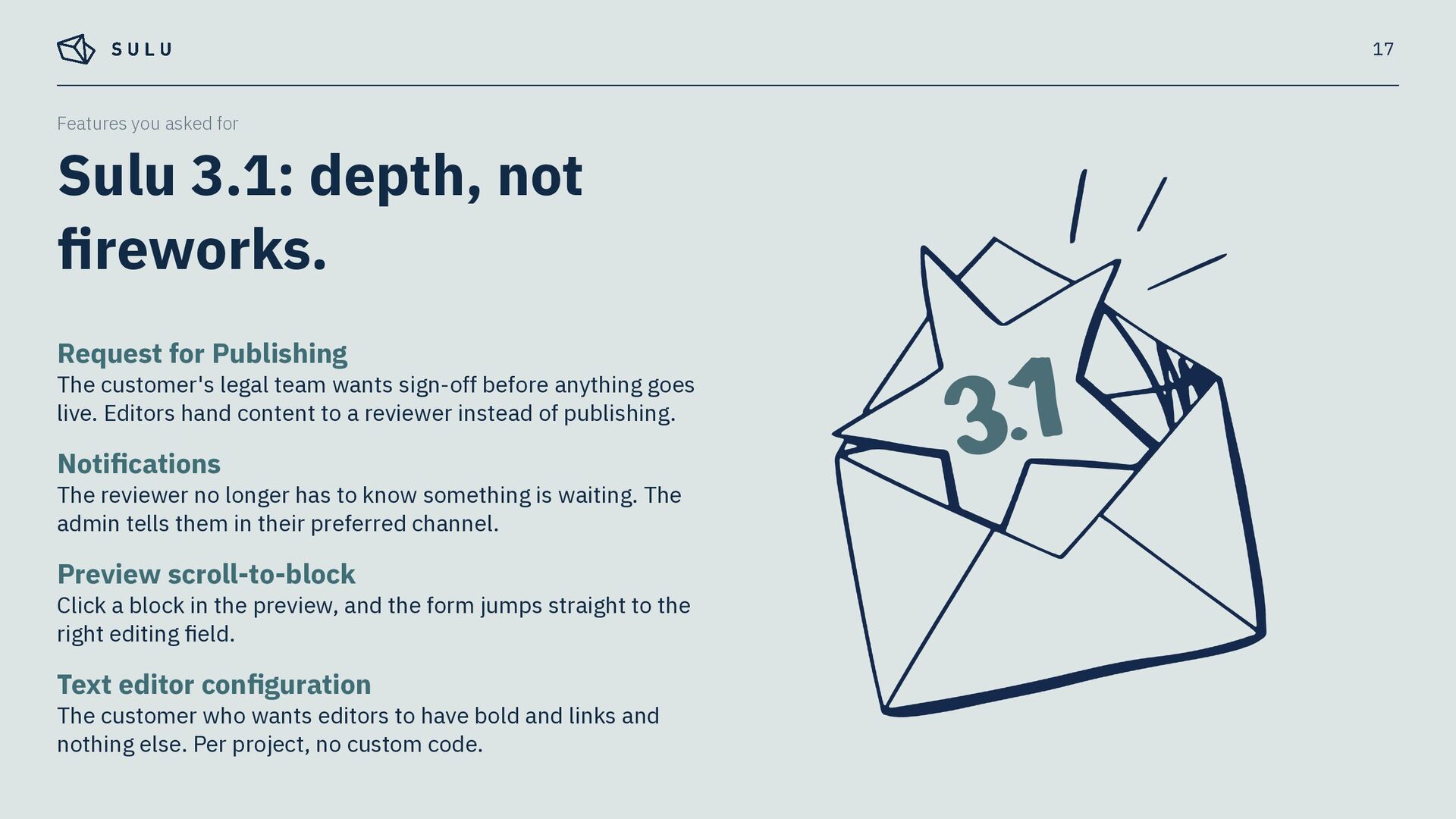
for Publishing The customer's legal team wants sign-off before anything goes live. Editors hand content to a reviewer instead of publishing. Noti cations The reviewer no longer has to know something is waiting. The admin tells them in their preferred channel. Preview scroll-to-block Click a block in the preview, and the form jumps straight to the right editing eld. Text editor con guration fi fi The customer who wants editors to have bold and links and nothing else. Per project, no custom code. fi fi 17
stack. If you build on Sulu If you build Sulu – The name and tagline on sulu.io, new platform landing pages. – Nothing changes in how you contribute: same repo, same review, same LTS policy. – We compare with Pimcore, Ibexa, Adobe, and Sitecore now. Not WordPress and TYPO3. – More bundles, more extension points, a clearer product direction to contribute against. – Product data and application projects are a normal Sulu pitch, not a stretch. – Help us nd the rough edges in the Product Bundle and MCP tools before release. fi – We own content, assets, product data, search, AI, and personalisation. We connect commerce, marketing automation, and CDP.
comes after – Sulu 3.1 release – The missing pieces you uncover while building on the platform – Product Bundle GA – MCP Server hardening – Agentic tooling improvements – Sulu.ai batch processing fi – Sulu.ai agentic run API – What you see in Requests for Proposals and what costs you pitches – The rough edges you nd in the Product Bundle and MCP tools – What your customers and users keep asking for
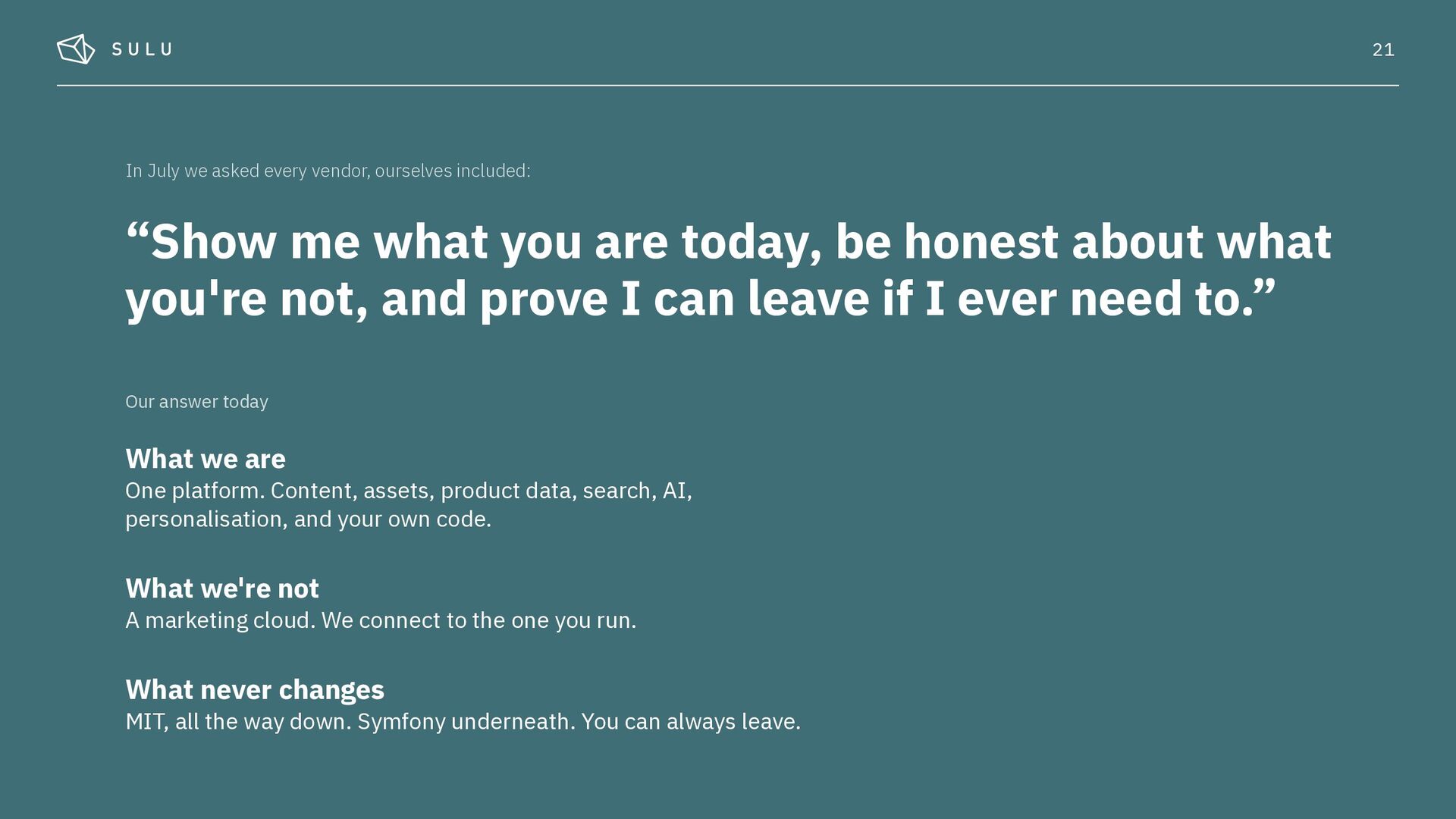
me what you are today, be honest about what you're not, and prove I can leave if I ever need to.” Our answer today What we are One platform. Content, assets, product data, search, AI, personalisation, and your own code. What we're not A marketing cloud. We connect to the one you run. What never changes MIT, all the way down. Symfony underneath. You can always leave.


 chirimoya
 hrm
hrm
 hansodeeeeee
 ggfs
ggfs
 arnekittler
 caitechhr
 hiyoriyamakankou
 hr1nursing
 takemura_yuto
 pokotyamu
 progmat
 nakasonejusetsu
 attelu
 lara
lara
 techseoconnect
 tammyeverts
 ipullrank
 colly
colly
 sferik
 maltzj
.png) helenjbeal
helenjbeal
 marketingsoph
 portentint
 mongodb
 katarinadahlin