Share
Embed
Sustainable Linked Open Data Publishing through Static Site Generation: A Decade of Educational LOD Infrastructure
Masao Takaku, Yuka Egusa
DCMI 2026, Seoul, South Korea
August 7th, 2026
https://www.dublincore.org/conferences/2026/sessions/best-practices/#recxKvmOQQ3kv5GVE
Masao Takaku
August 06, 2026
Transcript
11 slides
-
DCMI 2026, Best Practice Session August 7th, 2026 Sustainable Linked
Open Data Publishing through Static Site Generation A Decade of Educational LOD Infrastructure Masao Takaku, University of Tsukuba Yuka Egusa, National Institute for Educational Policy Research 1 -
Challenges: Linked data publishing is easy to launch, but hard
to sustain • SPARQL endpoint • Custom web applications • Server maintenance / middleware updates / security monitoring • Key questions: How can we design Linked Data services to remain accessible over the long term? Long-term sustainability Even without sufficient funding and/or technical support 2 -
Key idea: Static generation for Linked Data publishing • RDF/Turtle
→ static file generations Generates both human-readable HTML + machineaccessible RDF • The published site mainly consists of static files Fewer server-side components and dependencies Easier for long-term maintainability 3 -
ttl2html: Static site generator for Linked Data dataset • Open
source tool • Generate a HTML page and resolvable representation for each resource URI • Deployable via low resource environment and other popular hosting services, such as GitHub Pages, etc. • Available from GitHub: https://github.com/masao/ttl2html/ 4 -
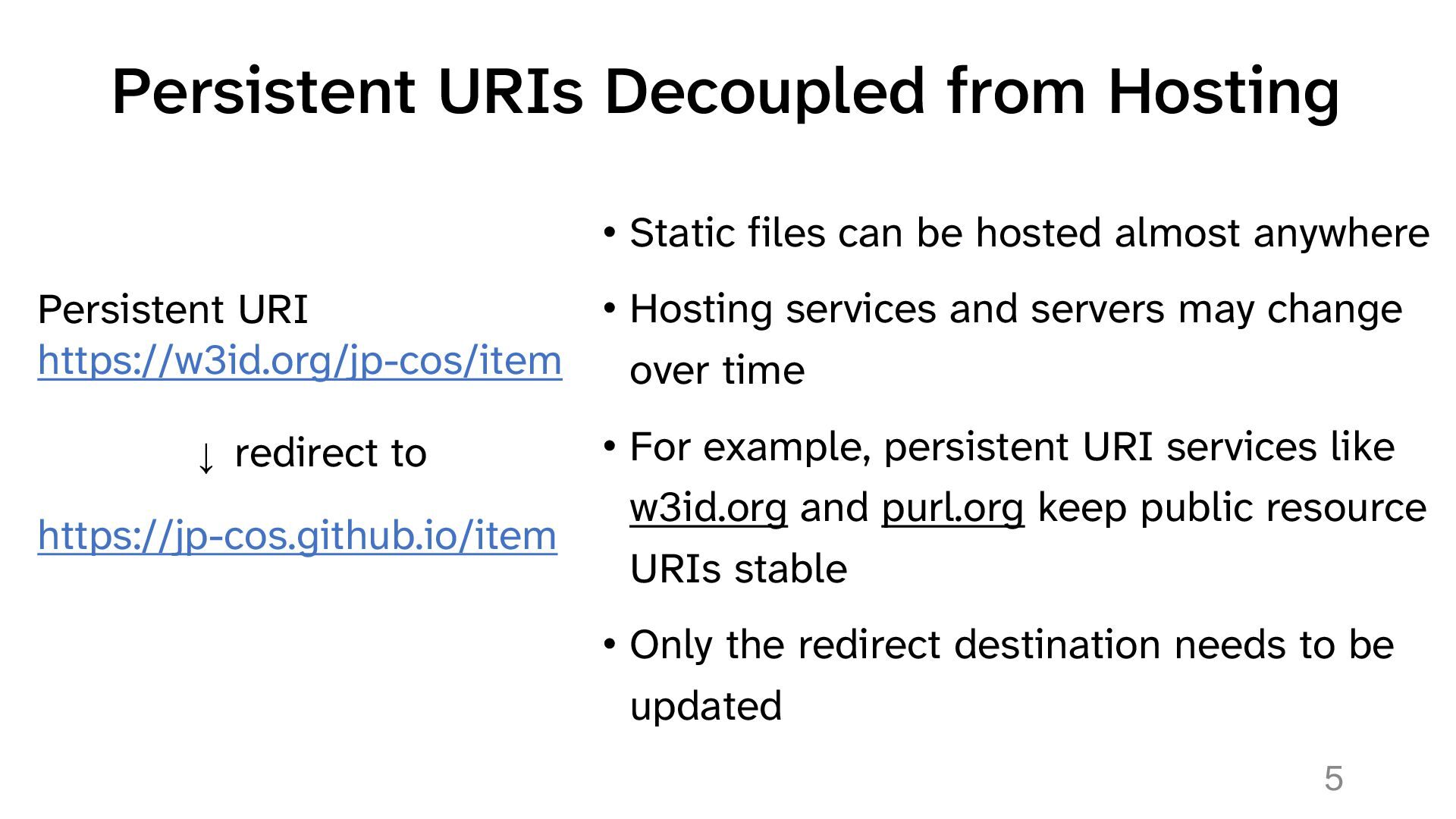
Persistent URIs Decoupled from Hosting • Static files can be
hosted almost anywhere • Hosting services and servers may change Persistent URI https://w3id.org/jp-cos/item over time ↓ redirect to https://jp-cos.github.io/item • For example, persistent URI services like w3id.org and purl.org keep public resource URIs stable • Only the redirect destination needs to be updated 5 -
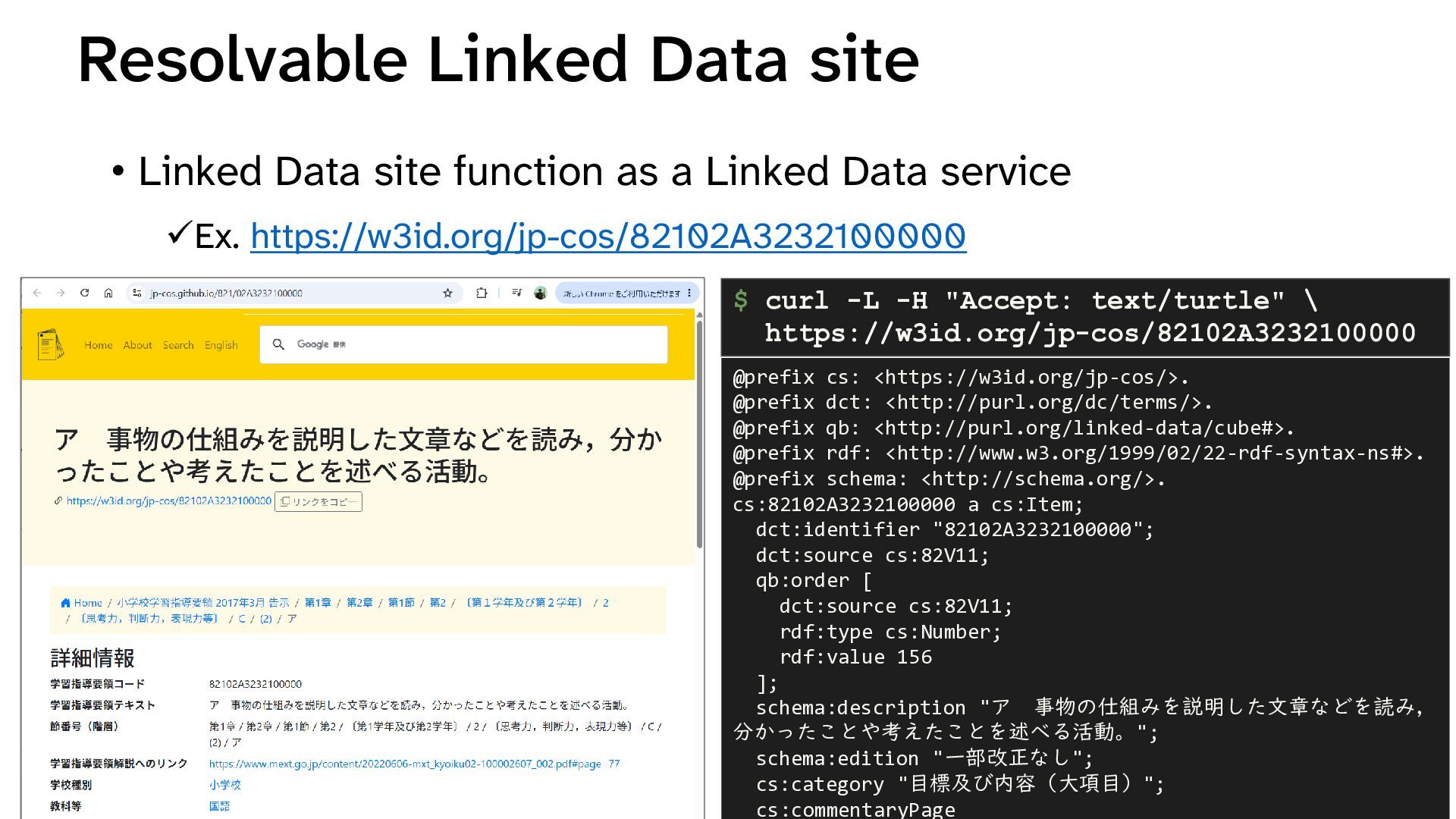
Resolvable Linked Data site • Linked Data site function as
a Linked Data service Ex. https://w3id.org/jp-cos/82102A3232100000 $ curl -L -H "Accept: text/turtle" \ https://w3id.org/jp-cos/82102A3232100000 @prefix cs: <https://w3id.org/jp-cos/>. @prefix dct: <http://purl.org/dc/terms/>. @prefix qb: <http://purl.org/linked-data/cube#>. @prefix rdf: <http://www.w3.org/1999/02/22-rdf-syntax-ns#>. @prefix schema: <http://schema.org/>. cs:82102A3232100000 a cs:Item; dct:identifier "82102A3232100000"; dct:source cs:82V11; qb:order [ dct:source cs:82V11; rdf:type cs:Number; rdf:value 156 ]; schema:description "ア 事物の仕組みを説明した文章などを読み, 分かったことや考えたことを述べる活動。"; schema:edition "一部改正なし"; cs:category "目標及び内容(大項目)"; cs:commentaryPage 6 -
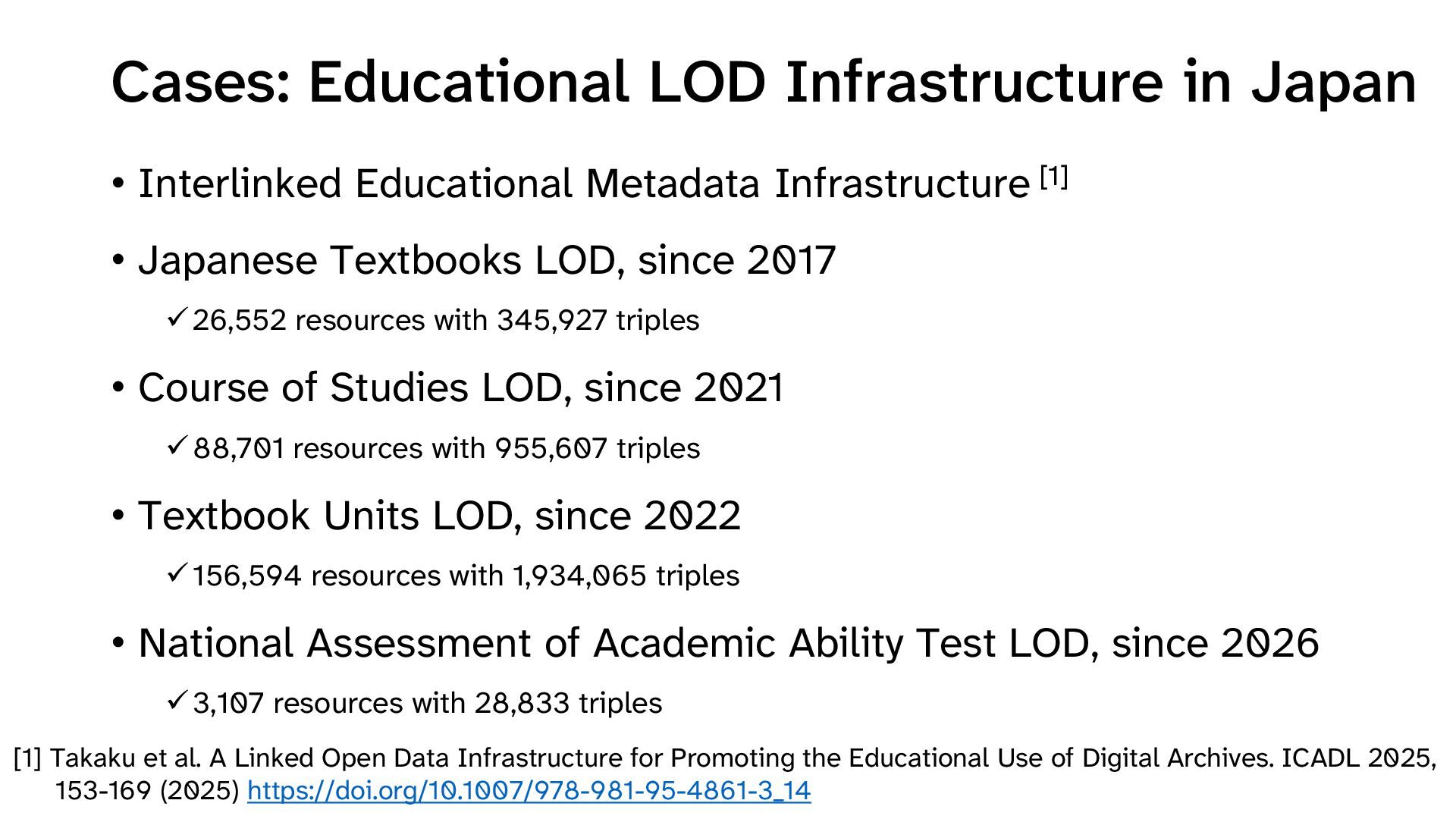
Cases: Educational LOD Infrastructure in Japan • Interlinked Educational Metadata
Infrastructure [1] • Japanese Textbooks LOD, since 2017 26,552 resources with 345,927 triples • Course of Studies LOD, since 2021 88,701 resources with 955,607 triples • Textbook Units LOD, since 2022 156,594 resources with 1,934,065 triples • National Assessment of Academic Ability Test LOD, since 2026 3,107 resources with 28,833 triples [1] Takaku et al. A Linked Open Data Infrastructure for Promoting the Educational Use of Digital Archives. ICADL 2025, 7 153-169 (2025) https://doi.org/10.1007/978-981-95-4861-3_14 -
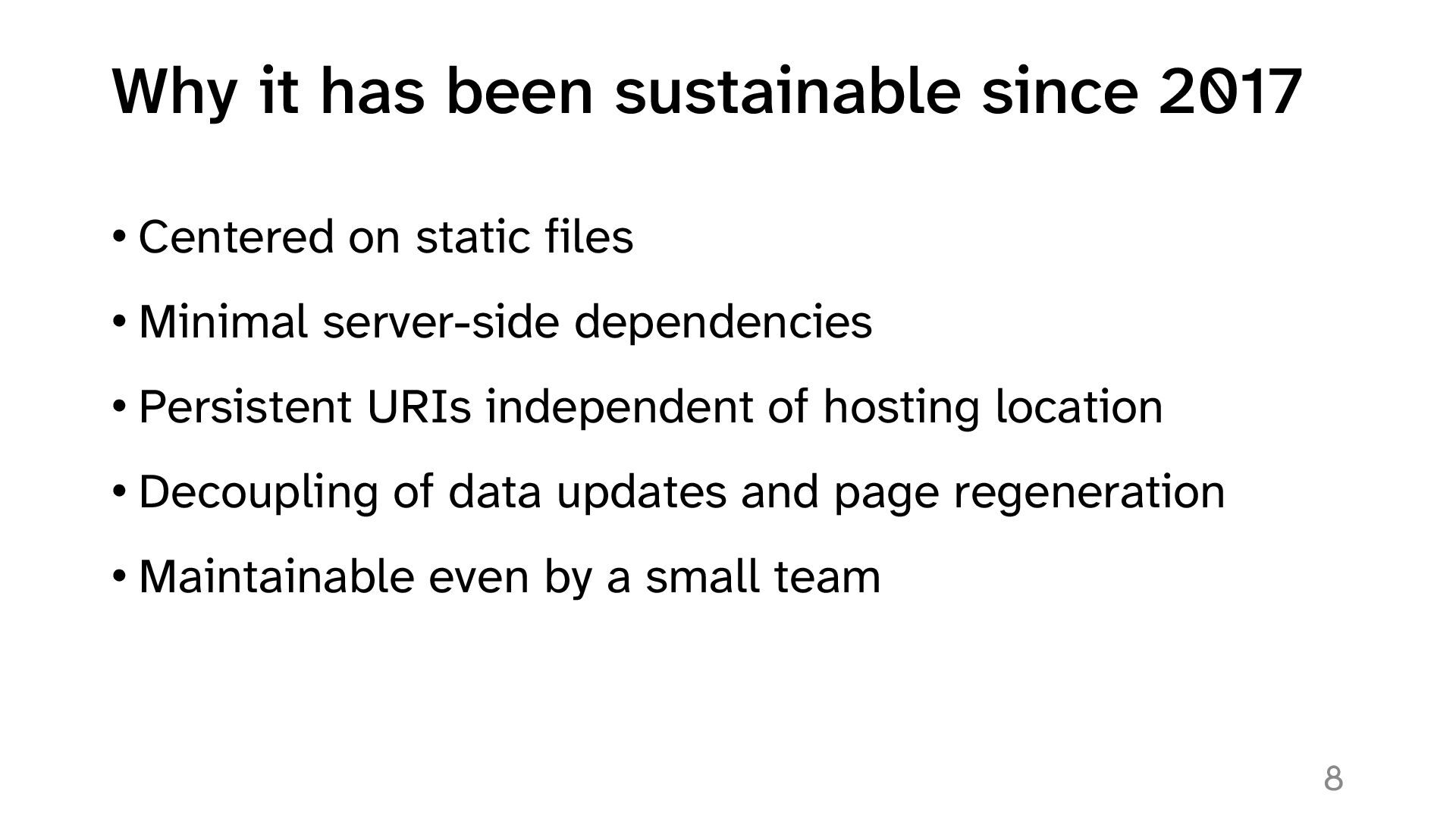
Why it has been sustainable since 2017 • Centered on
static files • Minimal server-side dependencies • Persistent URIs independent of hosting location • Decoupling of data updates and page regeneration • Maintainable even by a small team 8 -
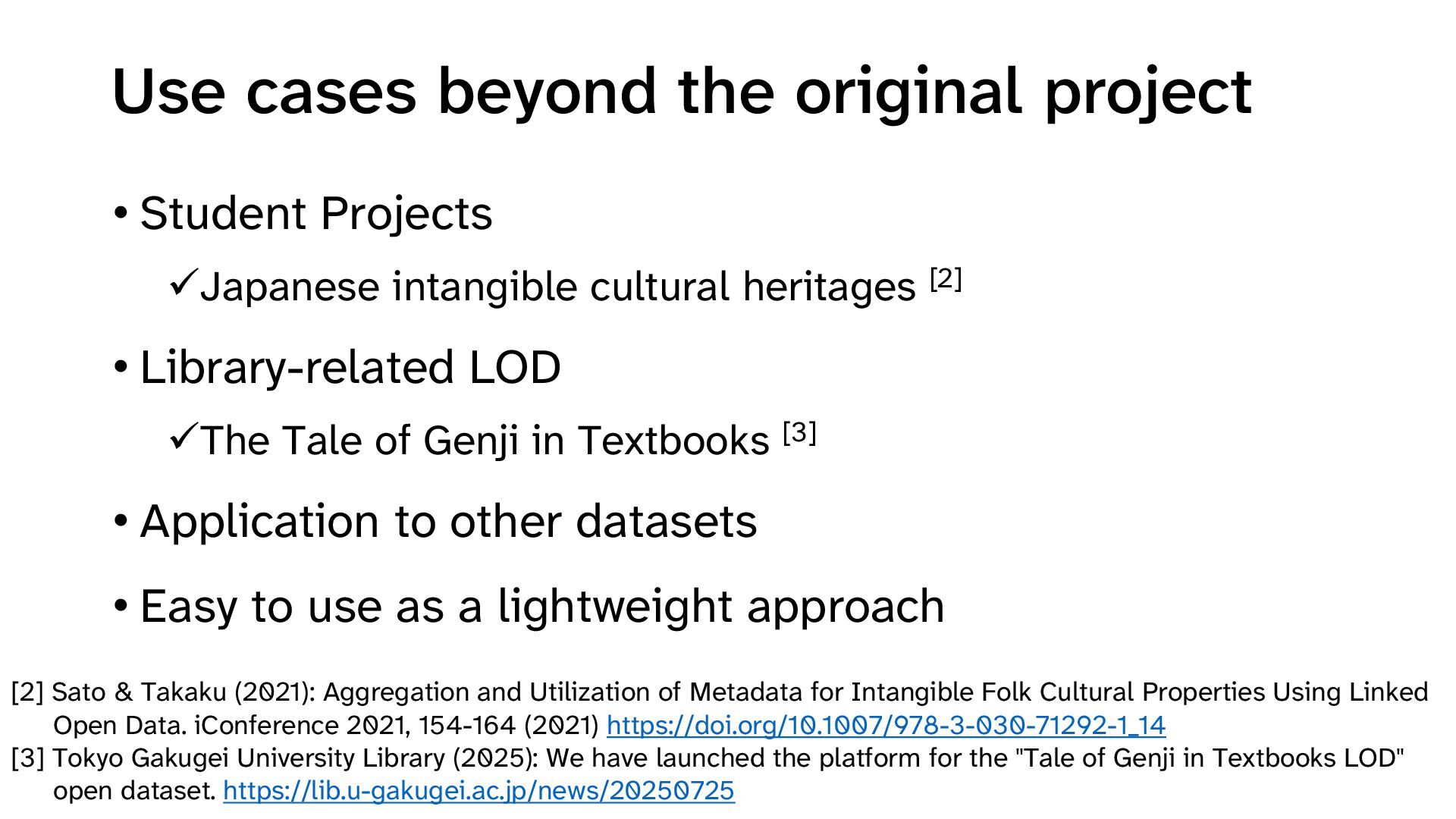
Use cases beyond the original project • Student Projects Japanese
intangible cultural heritages [2] • Library-related LOD The Tale of Genji in Textbooks [3] • Application to other datasets • Easy to use as a lightweight approach [2] Sato & Takaku (2021): Aggregation and Utilization of Metadata for Intangible Folk Cultural Properties Using Linked Open Data. iConference 2021, 154-164 (2021) https://doi.org/10.1007/978-3-030-71292-1_14 [3] Tokyo Gakugei University Library (2025): We have launched the platform for the "Tale of Genji in Textbooks LOD" 9 open dataset. https://lib.u-gakugei.ac.jp/news/20250725 -
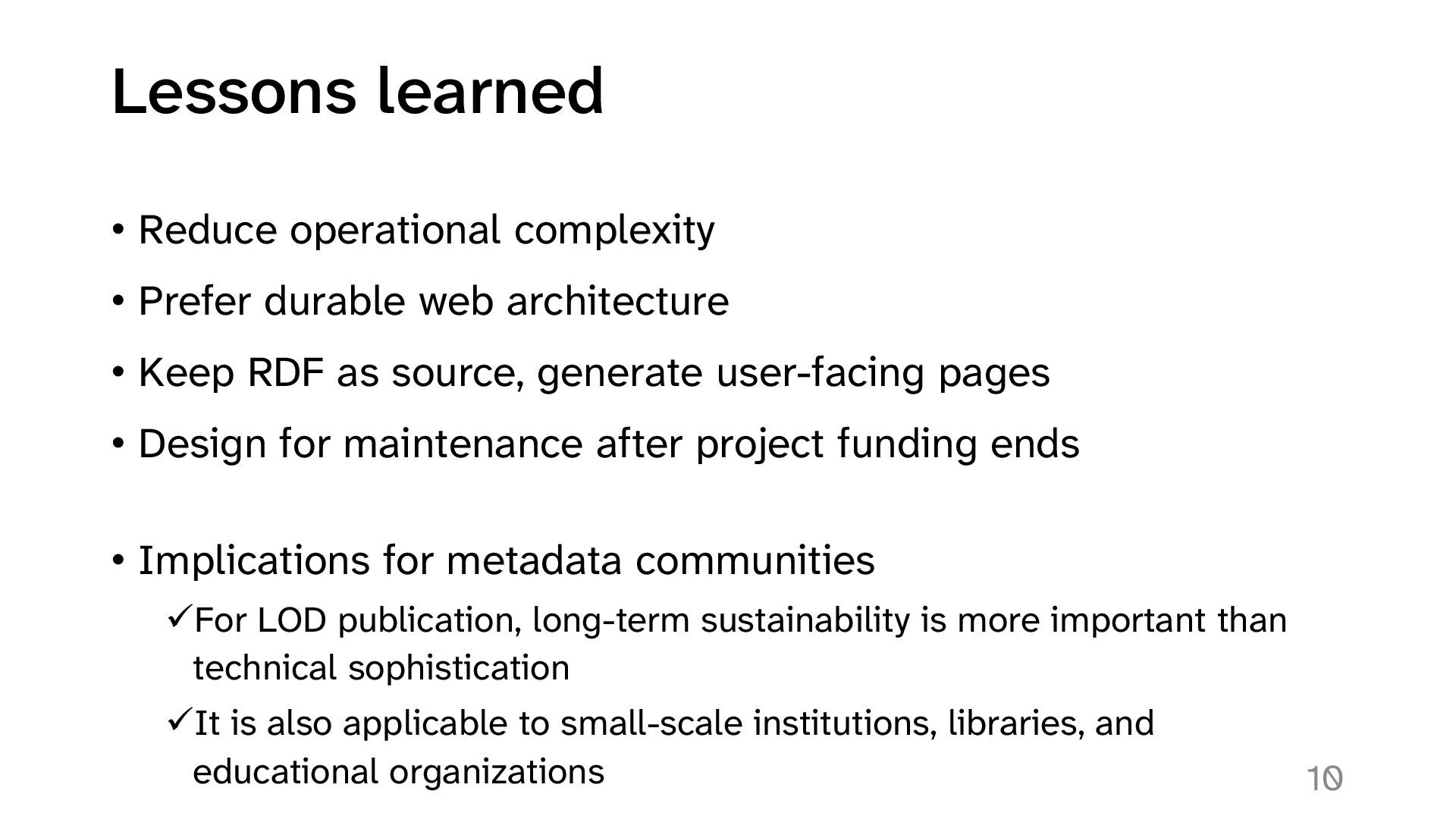
Lessons learned • Reduce operational complexity • Prefer durable web
architecture • Keep RDF as source, generate user-facing pages • Design for maintenance after project funding ends • Implications for metadata communities For LOD publication, long-term sustainability is more important than technical sophistication It is also applicable to small-scale institutions, libraries, and educational organizations 10 -
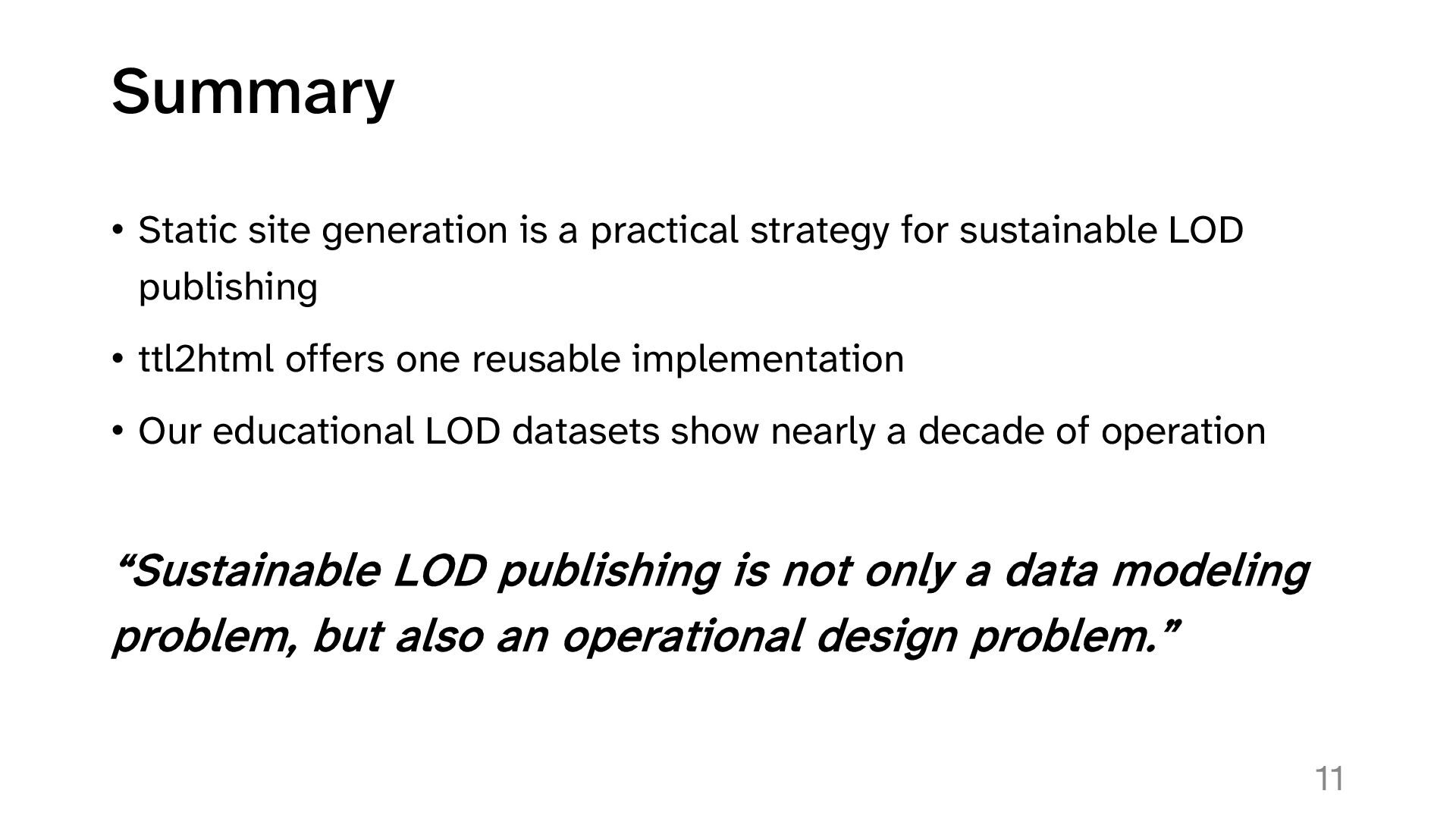
Summary • Static site generation is a practical strategy for
sustainable LOD publishing • ttl2html offers one reusable implementation • Our educational LOD datasets show nearly a decade of operation “Sustainable LOD publishing is not only a data modeling problem, but also an operational design problem.” 11