Share
Embed
CQRS & Event Sourcing
Event Sourcing, Stream processing, CQRS: what are those buzzwords? How my app can benefit from it? This talk aims to clarify these concepts through examples in PHP, and see why this totally changes how to structure the data. We will see how to take full advantage of the philosophy of NoSQL to build a scalable & robust app which is will be easier to maintain.
Matthieu Moquet
November 14, 2015
Transcript
84 slides
-
How can it help to maintain your app? How can
it help to scale horizontally? -
{Disclaimer Oriented for long lived apps. Overkill for RAD /
CRUD / TODO apps. Use those patterns in moderation. There is no silver bullet. This talk aims to open your mind. Think different! -
90% ViewModels / Flexible Eventually consistent 10% Validation / Business
rules Coherence (ACID) Read Write Fast & Scale -
Use case bank accounts Account #1 1337€ Account #2 42€
Account #3 10€ + Transfer money -
// Open new account $account = new Account();
$account-‐>setAmount(0, 'EUR'); $account-‐>setUser($user); $em-‐>persist($account); $em-‐>flush(); // Credit 100 EUR $account-‐>setAmount(100, 'EUR'); $em-‐>flush(); // Debit 20 EUR $account-‐>setAmount(80, 'EUR'); $em-‐>flush(); -
interface BankAccountService { /**
@return int */ public function open(); /** @return Account */ public function get($accountId); /** @return Account[] */ public function findAll($userId); /** @return void */ public function credit($accountId, $balance); /** @return void */ public function debit($accountId, $balance); } -
CQS Command Query Separation }Each operation is either a Command
or a Query, not both -
Commands Queries Change the state of the system. Do not
return anything. Does not change the state of the system. Return data. Write only Read only -
Commands /** @return Account */ public function get($accountId);
/** @return Account[] */ public function findAll($userId); /** @return int */ public function open(); /** @return void */ public function credit($accountId, $balance); /** @return void */ public function debit($accountId, $balance); Should be void Queries -
/** * @param Uuid $accountId *
* @return void */ public function open(Uuid $accountId); Let the client generate the identifier, not the infrastructure (database) -
CQRS Command Query Responsibility Segregation }Like CQS but separate queries
and commands in different classes -
CQRS challenges the assumption that reading and writing are sharing
the same abstractions Databases Models Apps -
Command Facade Query Facade Command Handler Query Repository Command Models
DB Read Models Command DTO Segregation of read and write is a radical form of decoupling -
Now that the workflow of Read & Write has been
separated. We can maintain & optimize each side separately. -
asynchronously Since Command Handlers do NOT return anything, then
do the execution -
$accoundId = AccountId::generate(); $command = new OpenAccount($accountId); if
(/* user is allowed to open account */) { $commandBus-‐>handle($command); return new Response( null, $async ? 202 : 201, // Accepted : Created ['Location' => "/accounts/$accountId"] ); } -
$command = new Debit( $accountId,
new Money(20, 'EUR') ); if (/* account has enough money */) { $commandBus-‐>handle($command); return new Response(null, 204); } -
Command tracking Scale workers Horizontally by instantiating more workers (subscribers)
Generate an identifier per command to let the client tracks its status Rabbitmq, Kafka, Gearman, ……… make your choice on queues.io -
Projections On the Read side you should prepare you data
as it will be requested -
Having only 1 data store for reads & writes does
not scale (well) different usage different needs -
………and use different data stores Denormalize your data... UI View
models Statistic models Search index models API Read models ... Read models are faster than JOIN different usage different needs -
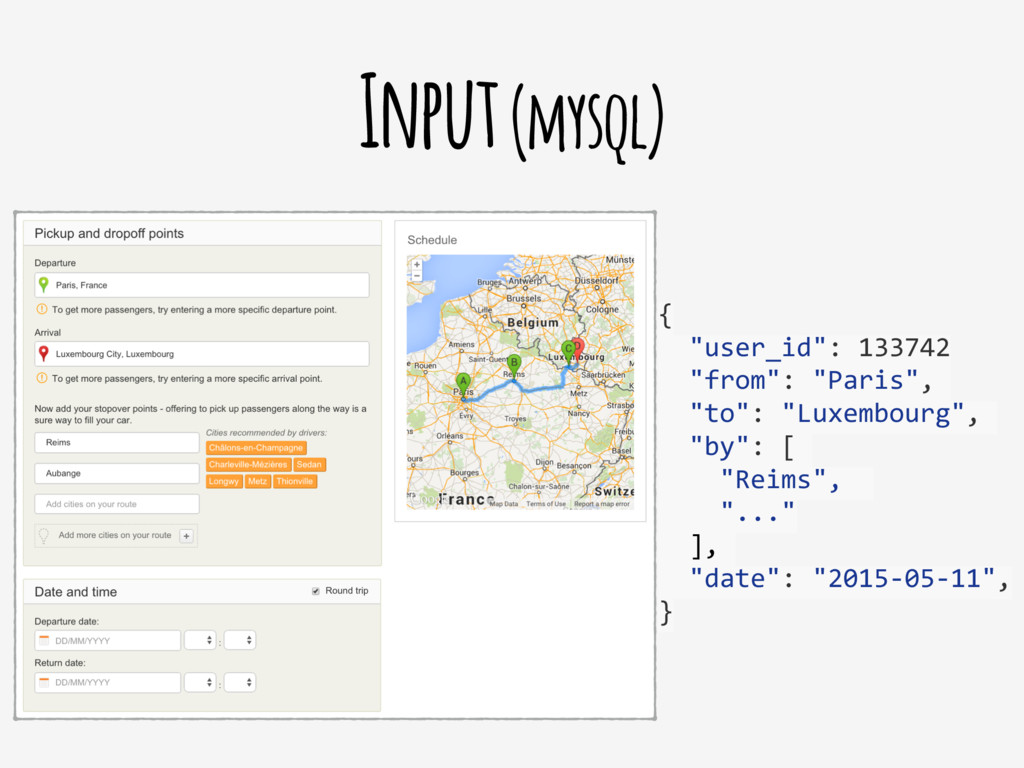
{ "user_id": 133742 "from": "Paris",
"to": "Luxembourg", "by": [ "Reims", "..." ], "date": "2015-‐05-‐11", } Input (mysql) -
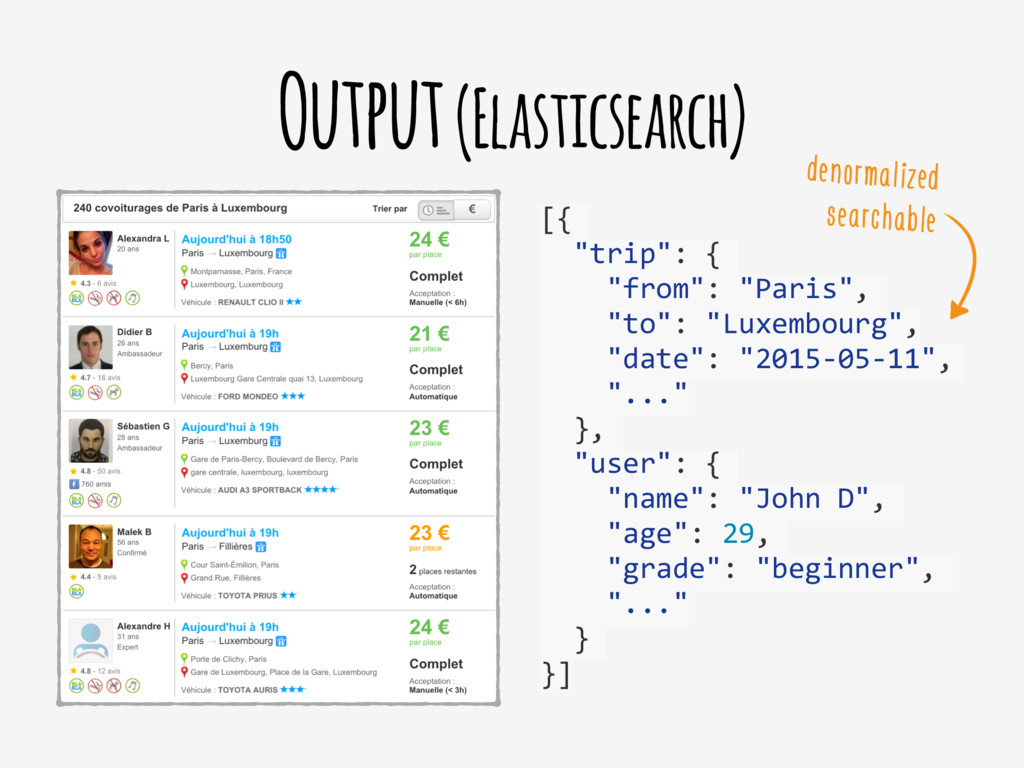
[{ "trip": { "from":
"Paris", "to": "Luxembourg", "date": "2015-‐05-‐11", "..." }, "user": { "name": "John D", "age": 29, "grade": "beginner", "..." } }] Output (Elasticsearch) denormalized searchable -
SELECT tweets.*, users.* FROM tweets JOIN users
ON users.id = tweet.sender_id JOIN follows ON follows.followee_id = user.id WHERE follows.follower_id = $userId ORDER BY tweets.time DESC LIMIT 100 -
Tweets stream DB Aggs Timelines { "user_id": 1234567890
"status": "Hello World" "timestamp": 1430491773 } [{ "tweet_id": 1234567890876543, "username": "MattKetmo", "name": "Matthieu Moquet", "timestamp": 1430491773, "status": "Hello World", }, { "tweet_id": 1234567890886445, ... }] -
SELECT tweets FROM timelines WHERE timeline_id =
$userId LIMIT 500 -
PageViewEvents DB Aggs Increment counters /month Google Analytics /day /hour
total { "eventType": "PageViewEvent" "timestamp": 1430491773, "ipAddress": "12.34.56.78", "sessionId": "abcd1234567890", "pageUrl": "/hello-‐world", "..." } -
Using Cassandra you need to: ‣ know the read requests
before creating your data models ‣ create as many tables (ie. KeySpaces) than you have views ‣ denormalize the data (no join allowed) ’s keypoints -
C* C* C* Primary Data C* Read Data User post
message Endpoint -
Command Command Handler Primary DB Projections View Models Message Bus
Write Read Eventual Consistency {...} {...} {...} {...} -
Event Sourcing Register only a series of events. Reconstitute the
state of current "entity" by reading the past events. If we know the events of the past we can reconstitute the present -
the standard way Something happen State A State B Something
happen (delta) (dropped) (stored) (delta) Time -
the event sourcing way Something happen State A State B
Something happen (stored) (reconstituted) (reconstituted) (stored) Time -
[{ "uuid": "110e8400-‐e29b-‐11d4-‐a716-‐446655440000", "type":
"AccountWasOpen", "recorded_on": "2015-‐05-‐11T13:37:00Z", "payload": {} }, { "uuid": "110e8400-‐e29b-‐11d4-‐a716-‐446655440000", "type": "AccountWasCredited", "recorded_on": "2015-‐05-‐11T14:42:00Z", "payload": { "amount": 100, "currency": "EUR" } }, { "..." }] Event Store -
Aggregates Isolated domain models which run the business logic (via
an ubiquitous language) through events -
// Open a new account $accountId = AccountId::generate();
$account = BankAccount::open($accountId); // Add some money $account-‐>credit(new Money(100, 'EUR')); -
interface AggregateRoot { /**
* @return DomainEventStream */ public function getUncommittedEvents(); /** * @return string */ public function getAggregateRootId(); } -
$accountId = AccountId::generate(); $account = BankAccount::open($accountId); $account-‐>credit(new Money(100,
'EUR')); // Retrieve event stream $events = $account-‐>getUncommittedEvents(); // -‐ AccountWasOpen // -‐ AccountWasCredited -
class BankAccount extends EventSourcedAggregateRoot {
private $accountId; public function getAggregateRootId() { return $this-‐>accountId; } public static function open(AccountId $accountId) { $account = new self(); $account-‐>apply(new AccountWasOpen($accountId)); return $account; } public function credit(Money $balance) { $this-‐>apply(new AccountWasCredited( $this-‐>accountId, $balance-‐>getAmount(), $balance-‐>getCurrency() ); } } -
class BankAccount extends EventSourcedAggregateRoot {
private $amount; // ... protected function applyAccountWasOpen(AccountWasOpen $event) { $this-‐>accountId = $event-‐>getAccountId(); } protected function applyAccountWasCredited(AccountWasCredited $event) { $this-‐>amount += $event-‐>getBalance(); } protected function applyAccountWasDebited(AccountWasDebited $event) { $this-‐>amount -‐= $event-‐>getBalance(); } } -
class BankAccount extends EventSourcedAggregateRoot {
// ... public function debit(Money $balance) { if ($this-‐>amount < $balance-‐>getAmount()) { throw new NotEnoughMoneyException( 'Cannot debit more than current amount' ); } return $this-‐>apply(new AccountWasCredited( $this-‐>accountId, $balance-‐>getAmount(), $balance-‐>getCurrency() )); } } -
Command User intent Events Event Store Apply changes on system
Primary DB Transactional append -
class BankAccountCommandHandler extends CommandHandler {
public function handleOpenAccount(OpenAccount $command) { $account = BankAccount::open($command-‐>getAccountId()); $this-‐>repository-‐>save($account); } public function handleCreditAccount(CreditAccount $command) { $account = $this-‐>repository-‐>load($command-‐>getAccountId()); $account-‐>credit($command-‐>getBalance()); $this-‐>repository-‐>save($account); } } -
class EventSourcingRepository implements RepositoryInterface {
public function save(AggregateRoot $aggregate) { $events = $aggregate-‐>getUncommittedEvents(); $this-‐>eventStore-‐>append( $aggregate-‐>getAggregateRootId(), $events ); } public function load($id) { try { $events = $this-‐>eventStore-‐>load($id); return $this-‐>aggregateFactory-‐>create($events); } catch (EventStreamNotFoundException $e) { throw AggregateNotFoundException::create($id, $e); } } } -
Complete historical data Being able to replay history is a
major benefit both technically and for the business BI team will love it -
Load aggregate from EventStore: 100€ Create AccountWasDebited(100) event Append event
in datastore Example Two debits of 100€ must not be accepted if only 100€ left Load aggregate from EventStore: 100€ Create AccountWasDebited(100) event Append event in datastore Event must NOT be appended twice -
abstract class EventSourcedAggregateRoot implements AggregateRootInterface {
private $uncommittedEvents = array(); private $playhead = -‐1; /** * Applies an event. * The event is added to the list of uncommited events. */ public function apply($event) { $this-‐>playhead++; $this-‐>uncommittedEvents[] = DomainMessage::recordNow( $this-‐>getAggregateRootId(), $this-‐>playhead, new Metadata(array()), $event ); } } -
DBAL EventStore (MySQL) CREATE TABLE EventStore ( `id`
INT(11) AUTO_INCREMENT, `uuid` BINARY(16), `playhead` INT(11), `type` TEXT, `payload` TEXT, `metadata` TEXT, `recorded_on` DATETIME, PRIMARY KEY (`id`), UNIQUE KEY `UNIQ_PLAYHEAD` (`uuid`, `playhead`) ); -
E_TOO_MANY_EVENTS When your Aggregates are "long lived" it may be
slow to read the full history eg. BankAccount -
Snapshotting Store the state of the aggregate and read only
the events created after -
Command Handler Events Event Store Command Auditing Read Model Event
Listener Event Bus Projector Write Read Business rules Historical data Read / search index Side effects User intent View models -
Frameworks C# / Java nCQRS Fohjin NEventStore LiteCQRS Lokad.CQRS Agr.CQRS
Axon Framework JDON PHP Broadway Predaddy Prooph EventCentric.Core litecqrs-php ...?