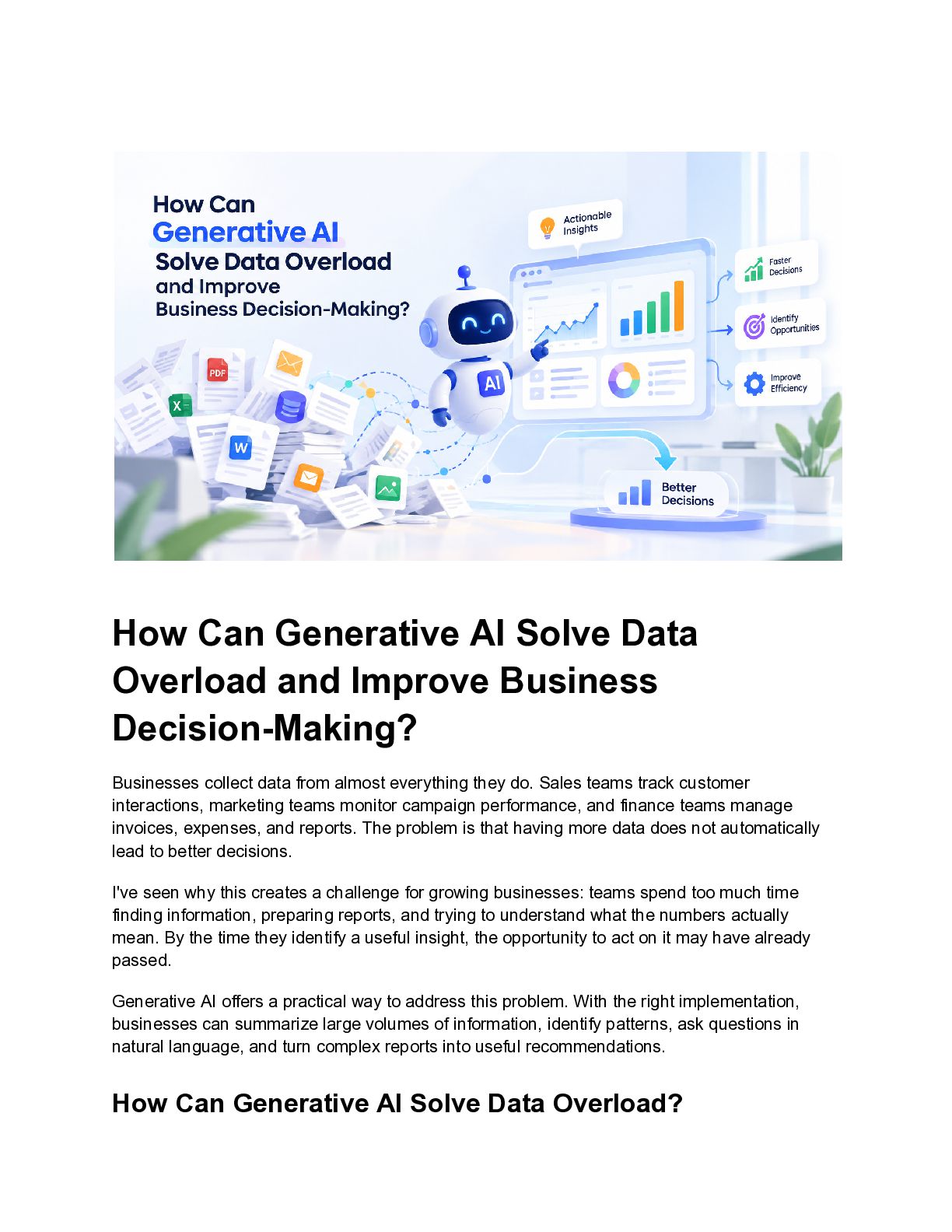
analytical outputs. It may highlight recurring customer concerns, unusual expense categories, or changes in product demand. For example, a subscription business might notice that cancellation requests frequently mention onboarding difficulties. AI can group similar feedback and summarize the issues for the product team. However, generative AI does not automatically provide reliable forecasting simply because it can analyze text. Predictive tasks may require statistical models, machine learning, or dedicated forecasting tools, with generative AI helping explain the results. 5. Turning Insights Into Actionable Reports Identifying a problem is only part of the process. Teams also need to communicate findings and decide what to do next. Generative AI can convert verified findings into management summaries, meeting briefs, comparison reports, and draft action plans. A report might highlight a decline in repeat purchases, summarize the customer feedback associated with it, and suggest investigating delivery experience or product quality. These recommendations should be treated as hypotheses to evaluate, not guaranteed solutions. Human review remains important, especially when decisions involve budgets, customers, or business risk. How Does Custom Generative AI Development Work? Generic AI tools can be useful for everyday tasks, but businesses with specialized workflows or sensitive information may need a tailored solution. A Generative AI Development Company can help design a system around specific business requirements, data sources, permissions, and decision-making processes. A practical implementation typically follows these steps: 1. Identify the business problem: Choose a clear use case, such as reducing the time required to prepare weekly management reports. 2. Assess data readiness: Review data quality, formats, access permissions, and inconsistencies. 3. Connect relevant sources: Integrate approved databases, documents, CRM platforms, or business applications. 4. Select the appropriate architecture: Use retrieval-augmented generation (RAG), suitable AI models, structured data queries, or a combination where appropriate.


 nancywheelerz
 canvasedge
 loglass2019
 m3c
 tsuchihashi
 todatomohiro
 sukatsu1222
 kuradashi
 freee
 so_kotani
 c0rp_mdm
 nakasonejusetsu
 inesmontani
 bkeepers
 gr2m
 kevinliebholz
 quramy
 orderedlist
 lara
 axbom
 aleyda
 soysaucechin
 jonoalderson
 malarkey