University Secondary School for conducting the classroom practice and for her invaluable contribution to data collection. Slides Slides are available from the QR code → RELC 60th International Conference Room 503 3:45PM-4:15 09/03/2026 3
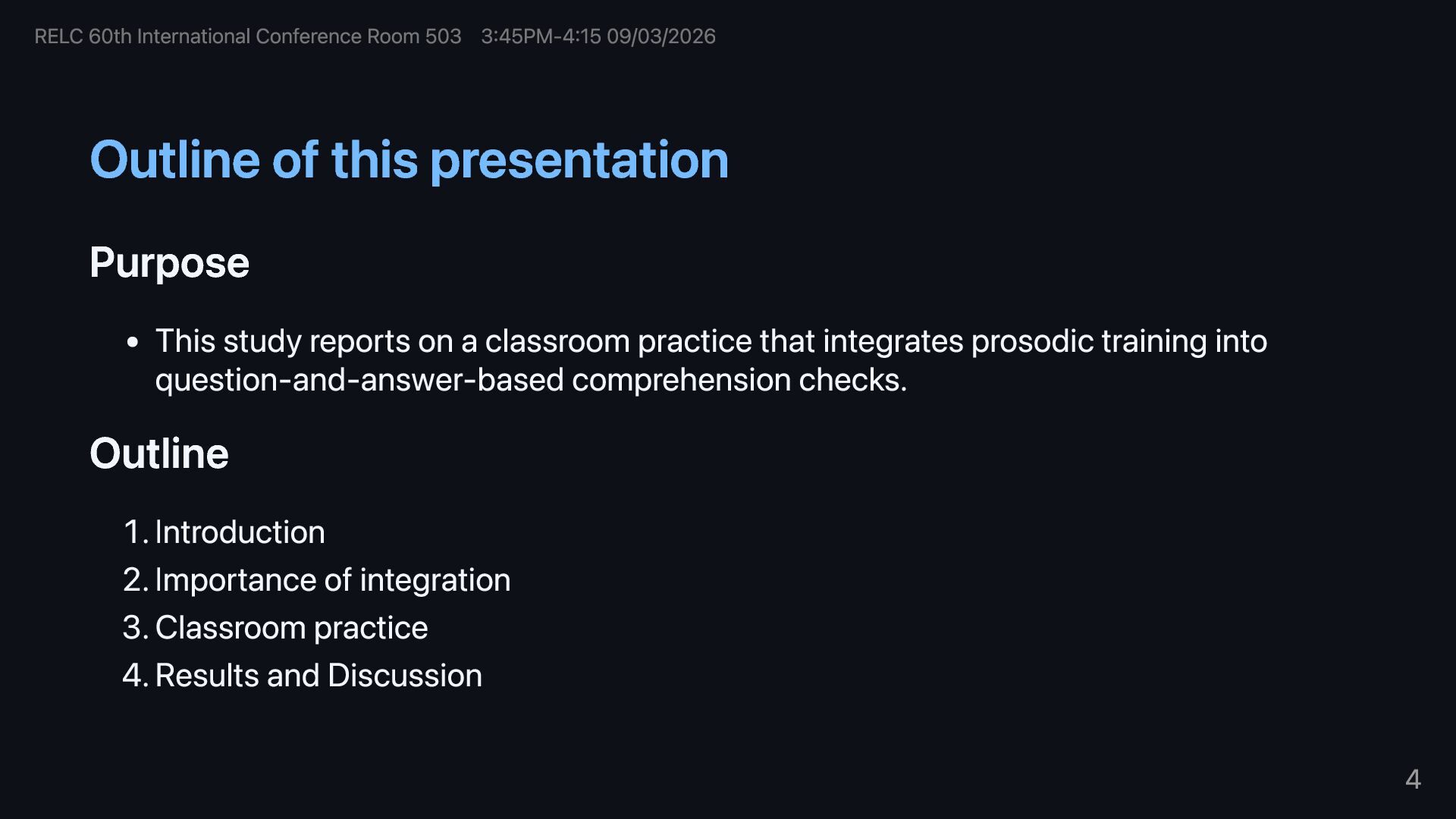
classroom practice that integrates prosodic training into question-and-answer-based comprehension checks. Outline 1. Introduction 2. Importance of integration 3. Classroom practice 4. Results and Discussion RELC 60th International Conference Room 503 3:45PM-4:15 09/03/2026 4
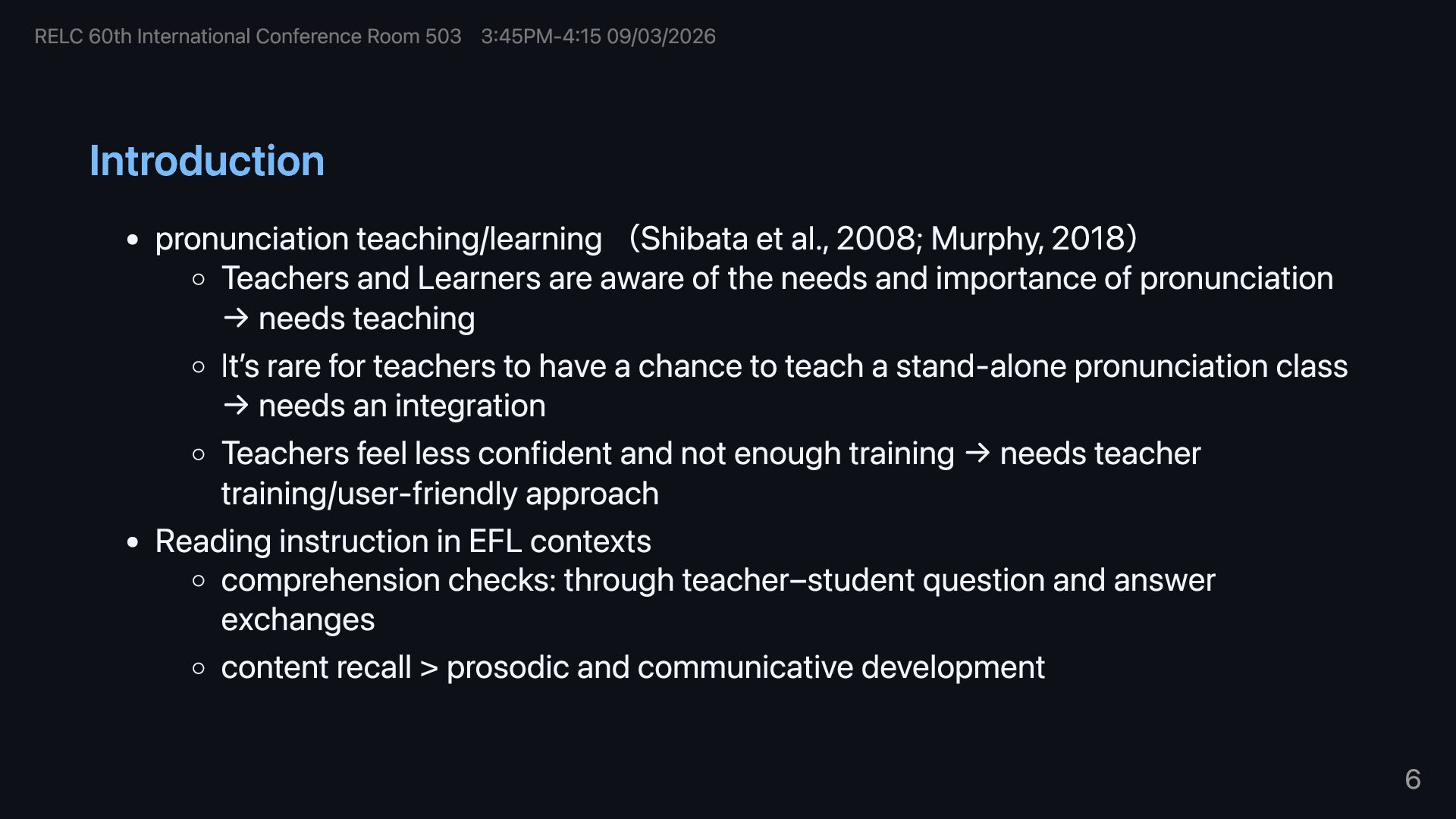
and Learners are aware of the needs and importance of pronunciation → needs teaching It’s rare for teachers to have a chance to teach a stand-alone pronunciation class → needs an integration Teachers feel less confident and not enough training → needs teacher training/user-friendly approach Reading instruction in EFL contexts comprehension checks: through teacher–student question and answer exchanges content recall > prosodic and communicative development RELC 60th International Conference Room 503 3:45PM-4:15 09/03/2026 6
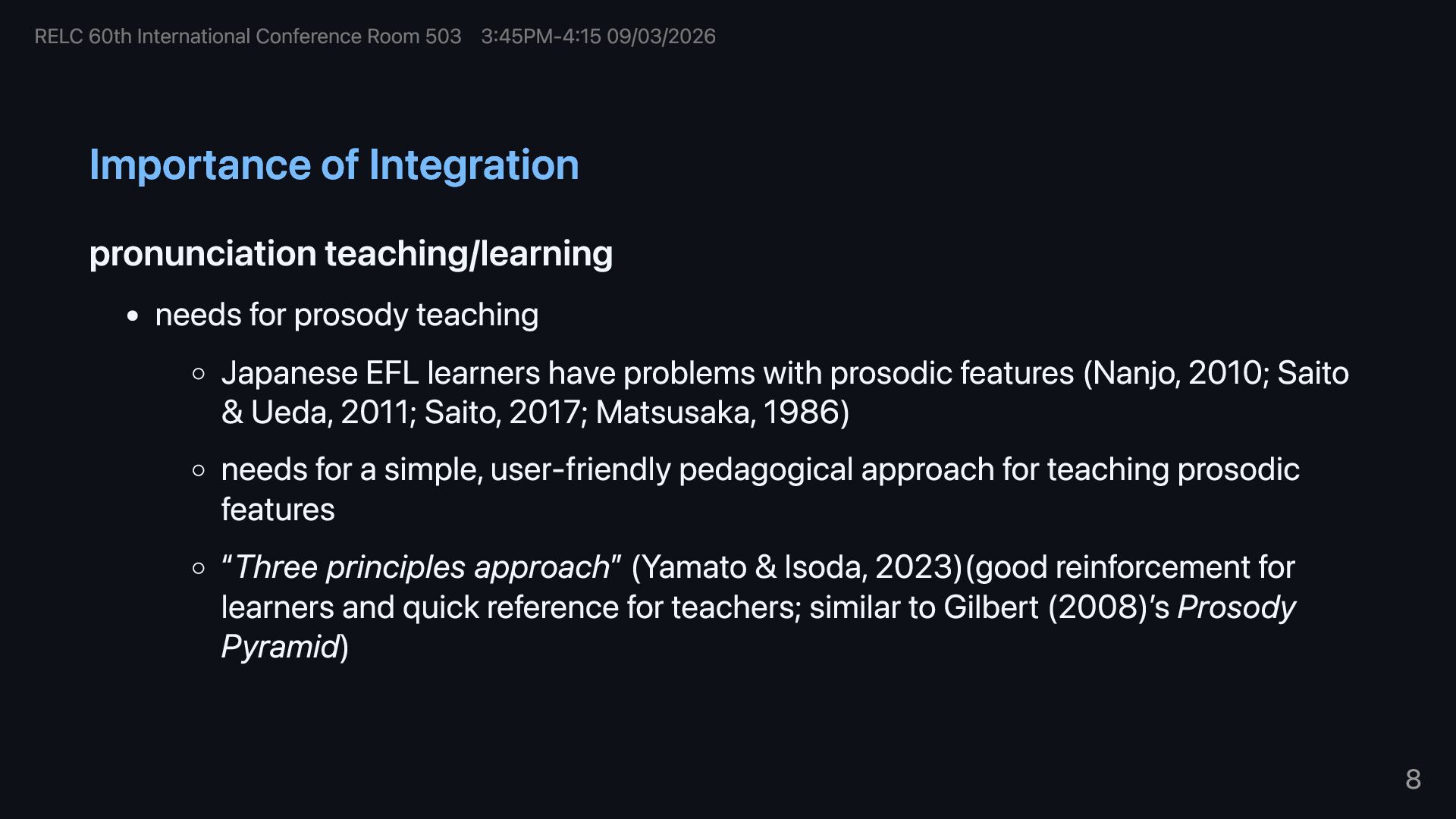
EFL learners have problems with prosodic features (Nanjo, 2010; Saito & Ueda, 2011; Saito, 2017; Matsusaka, 1986) needs for a simple, user-friendly pedagogical approach for teaching prosodic features “Three principles approach” (Yamato & Isoda, 2023)(good reinforcement for learners and quick reference for teachers; similar to Gilbert (2008)’s Prosody Pyramid) RELC 60th International Conference Room 503 3:45PM-4:15 09/03/2026 8
other skills Celce-Murcia et al. (2010) “teachers must balance the needs of their students within a somewhat fixed curriculum. If this is the case, pronunciation is not always explicitly included even in a speaking course, and teachers need to find ways to integrate pronunciation into existing curriculum and textbook materials (p.281).” Sicola & Darcy (2015) “Making pronunciation targets an inherent part of every lesson could represent an effective solution to carryover and automaticity issues (p.427).” Communicative framework for teaching pronunciation (Celce-Murcia et al., 2010) RELC 60th International Conference Room 503 3:45PM-4:15 09/03/2026 9
other skills Levis & Echelberger (2022) “Integration ensures that pronunciation is addressed consistently, and attending to pronunciation’s forms and functions as part of instruction focusing on other skills will not only improve the ways that language learners speak and listen, it will also ensure that they learn oral and written language as complementary representations of communicative ability (p.35).” RELC 60th International Conference Room 503 3:45PM-4:15 09/03/2026 10
reading Why prosody is essential? prosody is an indispensable component alongside accuracy and automaticity prosody helps sequences of words into chunks (even during silent reading) How is it possible to integrate prosody into reading? linking meaning with sound through reading rhythmically → cognitive efficiency utilizing routine comprehension checks as opportunities for prosodic practice help learners to emphasize key content words to demonstrate informational focus RELC 60th International Conference Room 503 3:45PM-4:15 09/03/2026 11
reading Research-Supported Outcomes (Groen et al., 2018;Wolters et al., 2022): Studies show a significant interaction between teaching strategies and learners' pronunciation levels; combining them can maximize reading gains. Integrating prosody prevents "word callers"—students who read accurately but fail to comprehend the message. In Summary By integrating prosody into routine reading tasks (like Q&A), learners can simultaneously internalize the sound, form, meaning, and structure of the target language. RELC 60th International Conference Room 503 3:45PM-4:15 09/03/2026 12
high school students) N=124 (instructor: Ms Karuo (see acknowledement)) Objectives: integrating English prosody with reading comprehension short reading tasks (10-15 minutes on every lesson) Tasks/Activities: reading aloud; reading comprehension (focusing on grammar items) pre-post design to see the improvement on nucleus placement involving reading comprehension RELC 60th International Conference Room 503 3:45PM-4:15 09/03/2026 14
the instructor, whose topics are related to the authorised textbook Schedule: 10-15 mins of regular class (50mins; 3 classes/week) Week 1–4 Reading Material 1 & Recording 1(pre) Week 5–8 Reading Material 2 Week 9–12 Reading Material 3 Week 13 Reading Material 1 & Recording 2(post) RELC 60th International Conference Room 503 3:45PM-4:15 09/03/2026 15
(Pre) Read a short passage on the use of smartphones Q&As: Qs focus on linguistic, semantic, logical features Tasks: reading aloud; completing a summary in Japanese For recording (as a pre-test), mark the prominent part of the sentence and read aloud and record it RELC 60th International Conference Room 503 3:45PM-4:15 09/03/2026 16
3 paragraph each session on the city soundscape Q&As: - Qs focus on linguistic, semantic, logical features Tasks: reading aloud; finding out specific information in the text (e.g. find out what causes noise pollution) RELC 60th International Conference Room 503 3:45PM-4:15 09/03/2026 17
paragraph on the history of newspaper, Q&As Qs focus on linguistic, semantic, logical features Tasks: reading aloud; answering explicit grammar knowledge (e.g. grammatical functions about underlined pronouns) RELC 60th International Conference Room 503 3:45PM-4:15 09/03/2026 18
post- Marking & Sound Marking shifted from used→constantly, suggesting confusion regarding nucleus placement principle In the post-data, the numbers for correct marking and correct production were almost identical. RELC 60th International Conference Room 503 3:45PM-4:15 09/03/2026 21
pronunciation and reading comprehension is a good instructional option However, this also illustrates that: teaching prominence(nuclear placement) is not sufficient learners need explicit practice in discourse-driven nucleus placement (e.g. explicit teaching of 3 principles of prosody; reading practices) RELC 60th International Conference Room 503 3:45PM-4:15 09/03/2026 24
Integrating prosody into reading comprehension: A high school classroom practice. Integrating prosody into routine reading tasks is feasible in regular classrooms. Prosody-focused Q&A can enhance learners’ awareness of prominence in context. However, sentence-level stress awareness does not automatically lead to discourse- appropriate nucleus placement. Explicit training in contrast and information structure is necessary. RELC 60th International Conference Room 503 3:45PM-4:15 09/03/2026 25
(2005). Teaching pronunciation: A course book and reference guide (2nd Ed.). Cambridge University Press. Gilbert, J. B. (2008). Teaching pronunciation: Using the prosody pyramid. NY: Cambridge University Press. Grant, L. (Ed.). (2014). Pronunciation myths: Applying second language research to classroom teaching. Ann Arbor, MH: University of Michigan Press. Groen, M. A., Veenendaal, N., & Verhoeven, L. (2018) The role of prosody in reading comprehension: Evidence from poor comprehenders. Journal of Research in Reading, 42(1), pp.37-57. Han, F. (2016) Chap 11: Integrating pronunciation instruction with passage-level reading instruction. In Jones, T. Pronunciation in the classroom: The overlooked essential. (pp.143-151) TESOL. Jones, T. (Ed.). (2016). Pronunciation in the classroom: The overlooked essential. TESOL Press. RELC 60th International Conference Room 503 3:45PM-4:15 09/03/2026 26
into language instruction. In J. Levis, Derwing, J. M., & Sonsaat-Hegelheimer, S. Second Language Pronunciation: Bridging the Gap Between Research and Teaching (pp.19-41). Wiley Blackwell. Sicola, L., & Darcy, I. (2015). Integrating pronunciation into the language classroom. In Reed, M., & Levis, J. M. (eds.). The handbook of English pronunciation. (pp.471-487). John Wiley & Sons. Thomson, I., & Derwing, T. M. (2014). Effectiveness of L2 pronunciation instruction: A narrative review. Applied Linguistics, 36(3), 326-344. 大和知史・磯田貴道 (2023) 『プロソディを重視した英語音声指導入門:指導の枠組と教科書 の活用法』 溪水社 Wolters, A. P., Kim, Y. G., & Sxura, J. W. (2022) Is reading prosody related to reading comprehension? A meta-analysis. Scientific Studies of Reading, 26(1), 1-20, https://doi.org/10.1080/10888438.2020.1850733 RELC 60th International Conference Room 503 3:45PM-4:15 09/03/2026 27
prosody As a guide for teachers to develop activities utilizing a textbook in hand As a checklist for students RELC 60th International Conference Room 503 3:45PM-4:15 09/03/2026 38


 otamayuzak
 matleenalaakso
 hiola
hiola
 pawan_pharm
 dragon2
 signer
 ainischool
 frievea
 coderdojojapan
 akiraasano
 yasslab
 nwiizo
 jcasabona
 marcduiker
 mclloyd
 jonyablonski
 ipullrank
 tammyeverts
 bluesmoon
 michielstock
 vanstee
 davidcarrasco
 moore
moore