Share
Rediscovering Apollo 11: Using Kotlin, Spring AI + Redis OM Spring to explore the mission to the moon!
What happens when you combine the Apollo program’s historical data with modern AI tools? You get a way to interact with one of humanity’s greatest adventures like never before!
In this session, I’ll show you how I used Redis OM Spring and Spring AI to explore Apollo mission data—aligning transcripts, telemetry, and images to uncover hidden connections and insights. We’ll dive into how Semantic Search powered by vector embeddings makes sense of unstructured text, how Redis as a vector database enables lightning-fast retrieval, and why these tools unlock new ways to explore complex datasets.
Don’t know what embeddings or vector databases are? No worries—I’ll break it all down and show you how it works.
Come for the Moon missions, stay for the AI magic, and leave ready to build your own intelligent search experiences!
Raphael De Lio
Transcript
91 slides
-
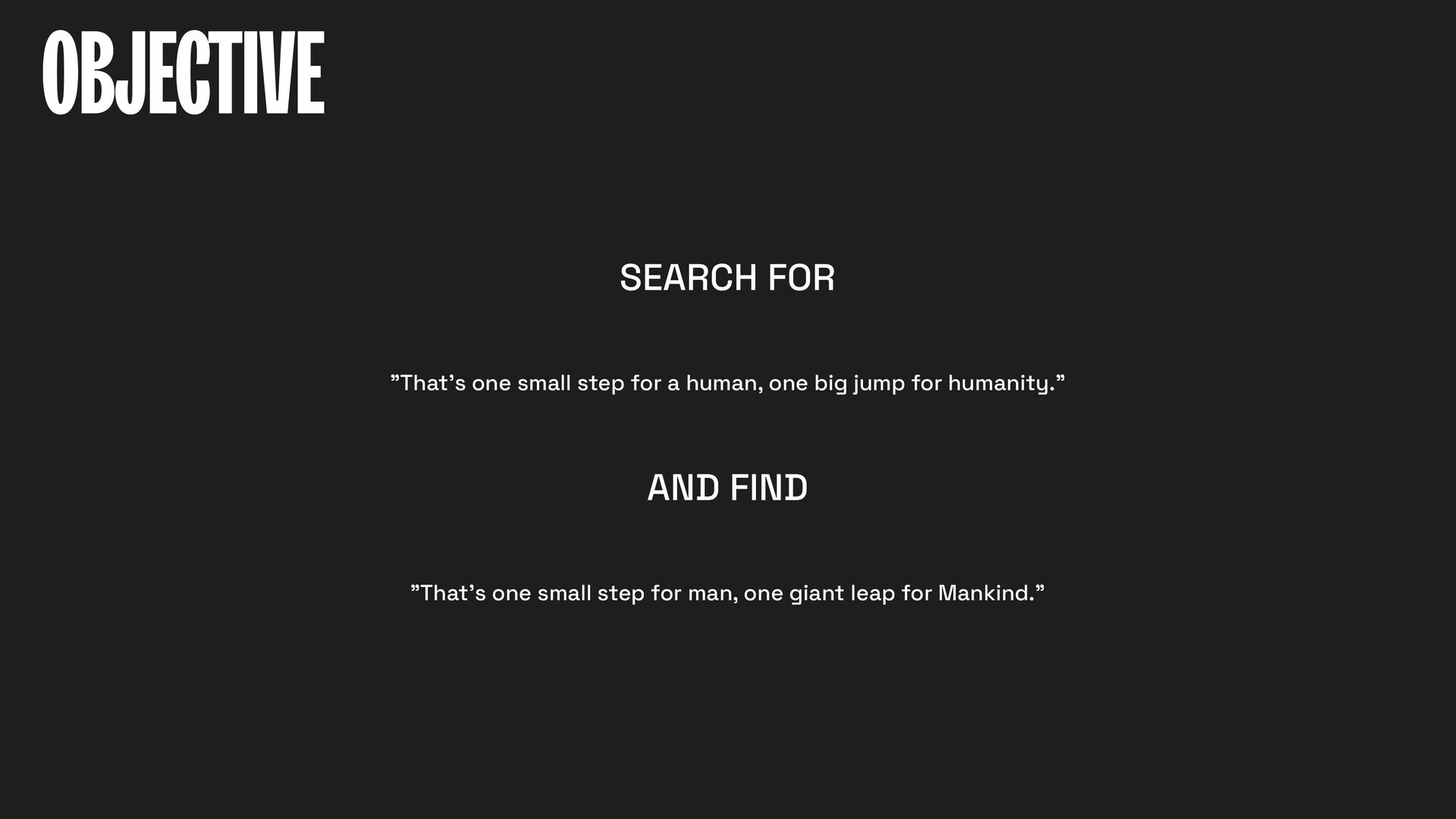
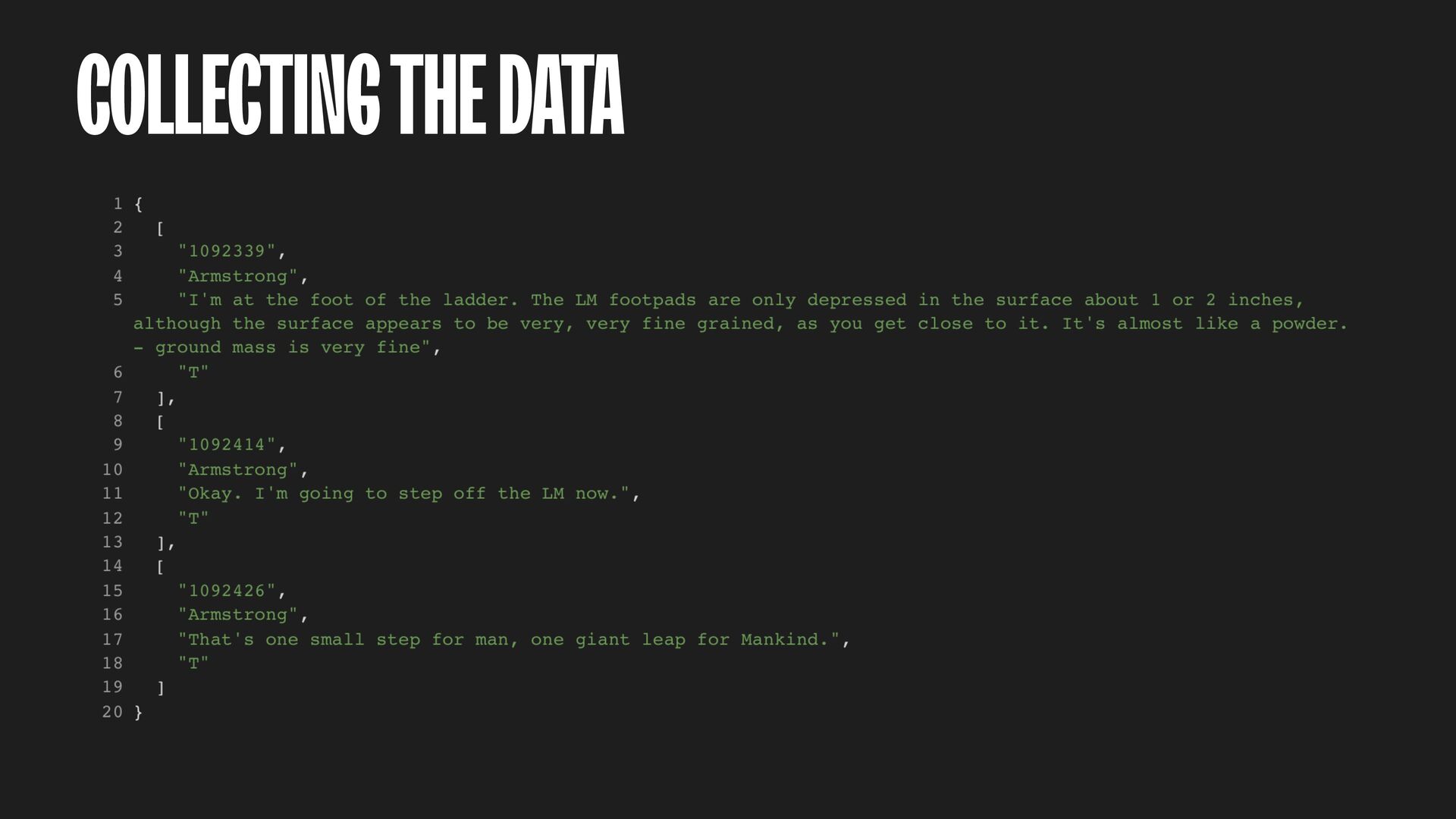
OBJECTIVE "That's one small step for man, one giant leap
for Mankind." "That's one small step for a human, one big jump for humanity.” AND FIND SEARCH FOR -
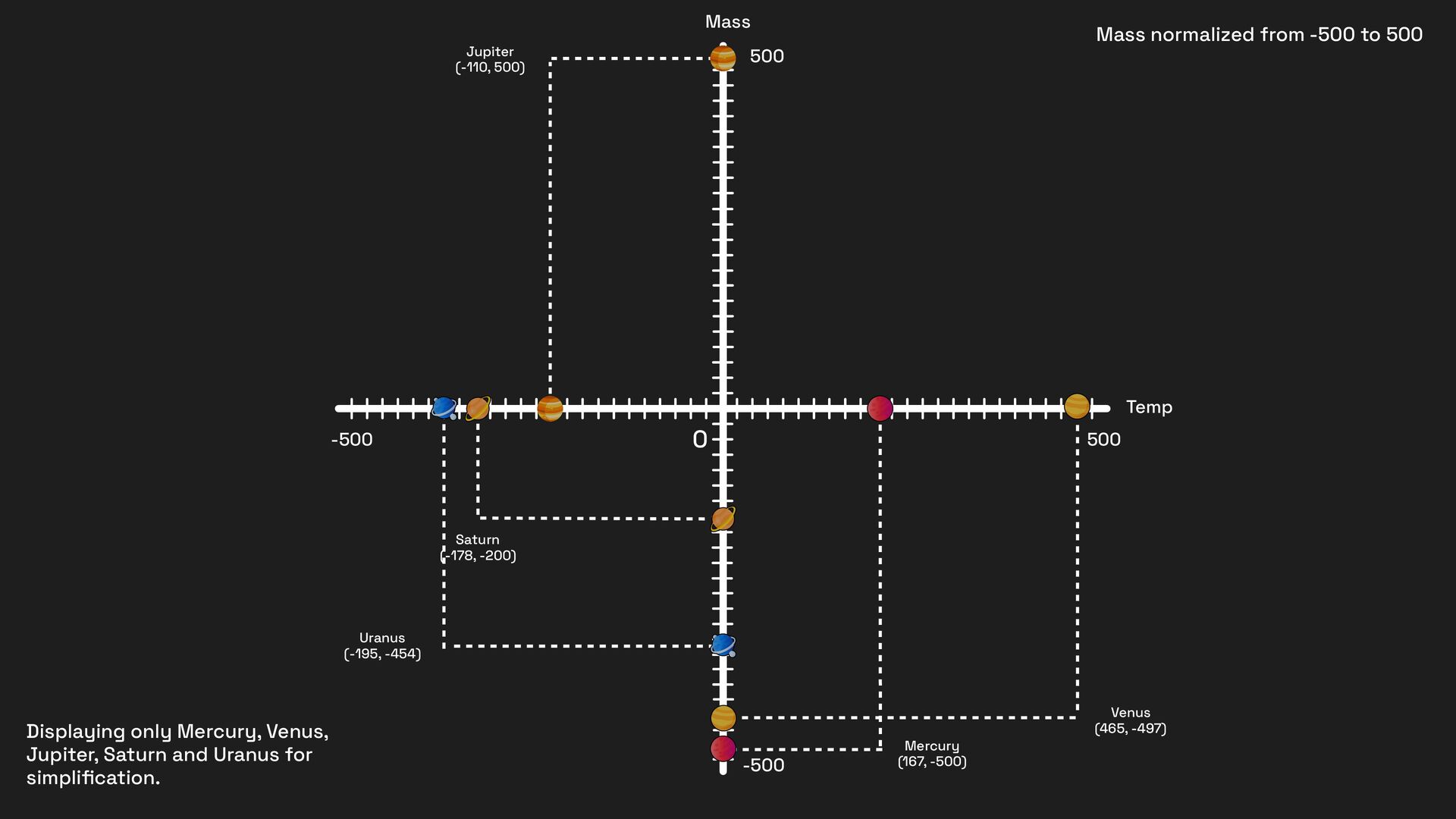
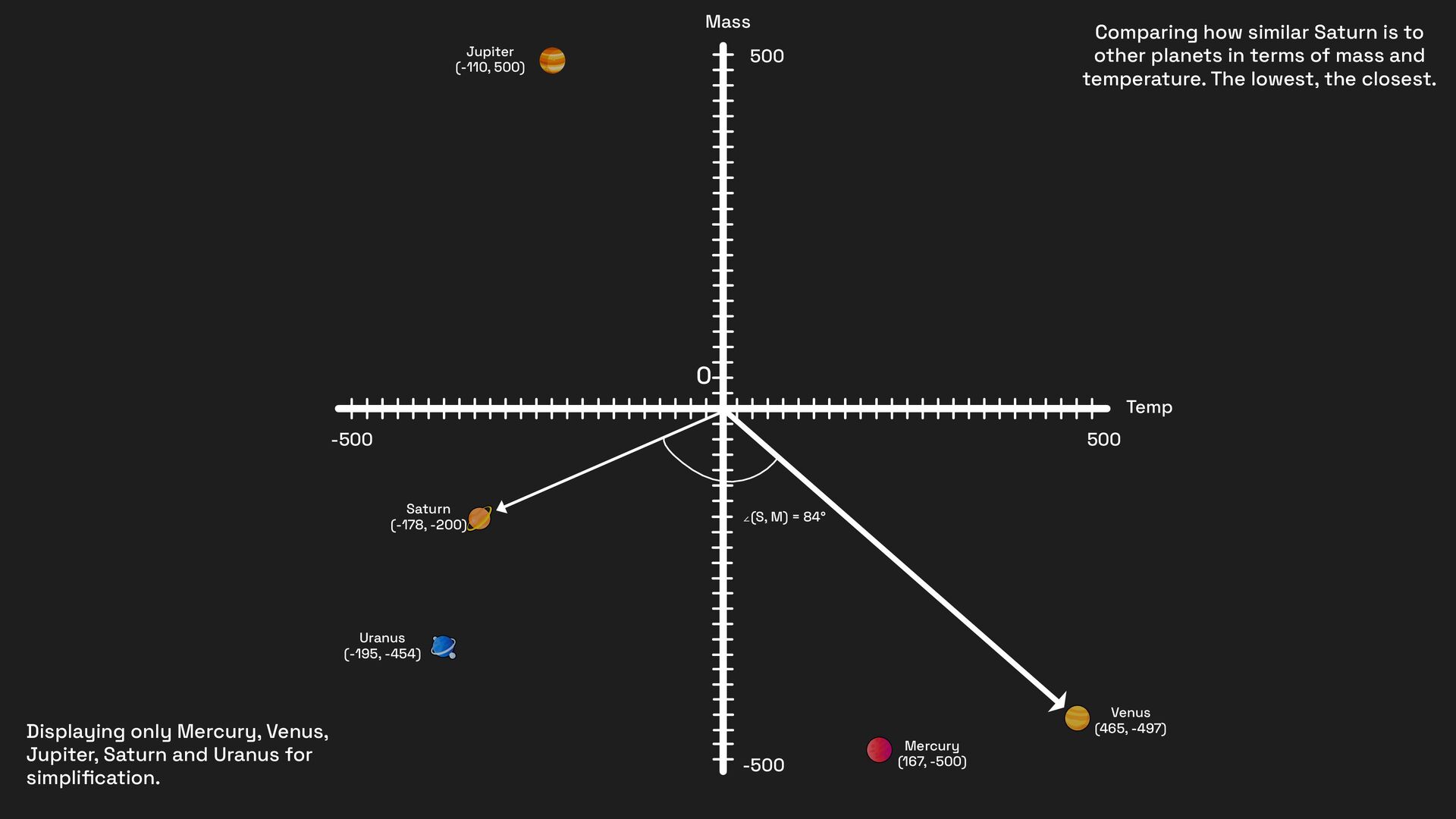
-500 Jupiter (-110, 500) 0 -500 500 500 Temp Mass
Displaying only Mercury, Venus, Jupiter, Saturn and Uranus for simpli fi cation. Mass normalized from -500 to 500 Mercury (167, -500) Venus (465, -497) Saturn (-178, -200) Uranus (-195, -454) -
-500 Jupiter (-110, 500) 0 -500 500 500 Temp Mass
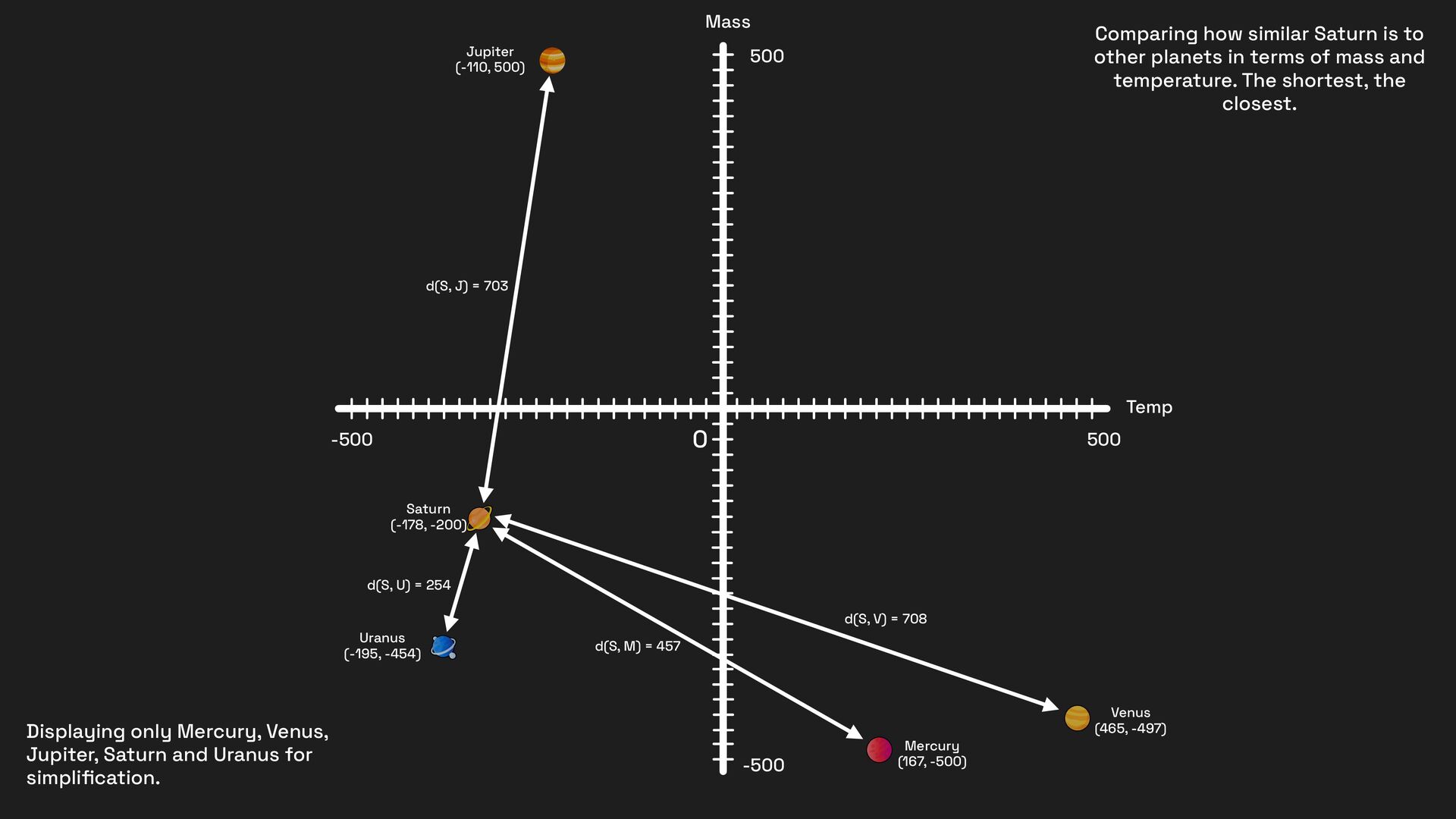
Displaying only Mercury, Venus, Jupiter, Saturn and Uranus for simpli fi cation. Comparing how similar Saturn is to other planets in terms of mass and temperature. The shortest, the closest. Mercury (167, -500) Venus (465, -497) Saturn (-178, -200) Uranus (-195, -454) d(S, U) = 254 d(S, J) = 703 d(S, M) = 457 d(S, V) = 708 -
-500 Jupiter (-110, 500) 0 -500 500 500 Temp Mass
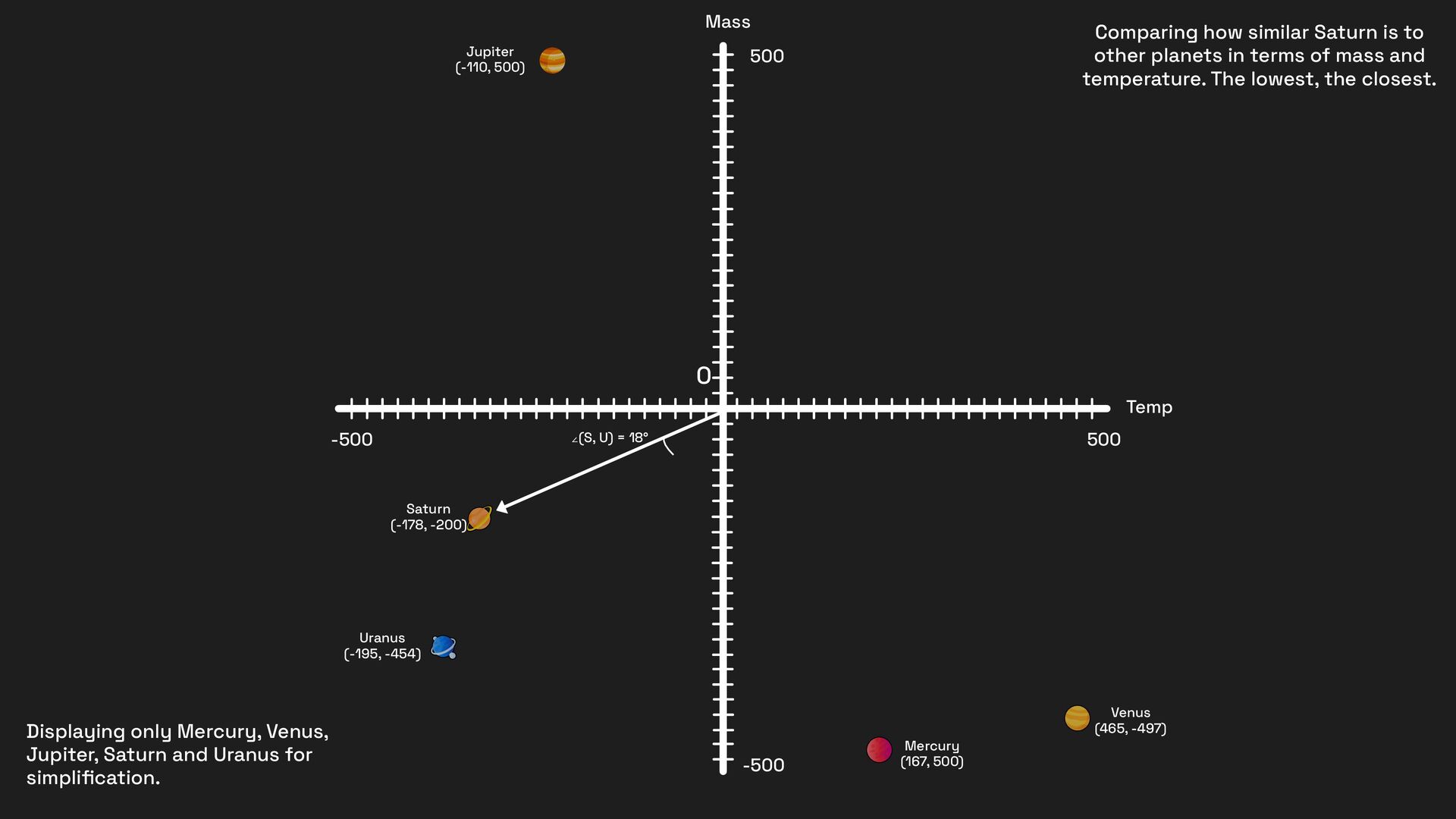
Displaying only Mercury, Venus, Jupiter, Saturn and Uranus for simpli fi cation. Comparing how similar Saturn is to other planets in terms of mass and temperature. The lowest, the closest. Mercury (167, 500) Venus (465, -497) Saturn (-178, -200) Uranus (-195, -454) ∠(S, U) = 18° -
-500 Jupiter (-110, 500) 0 -500 500 500 Temp Mass
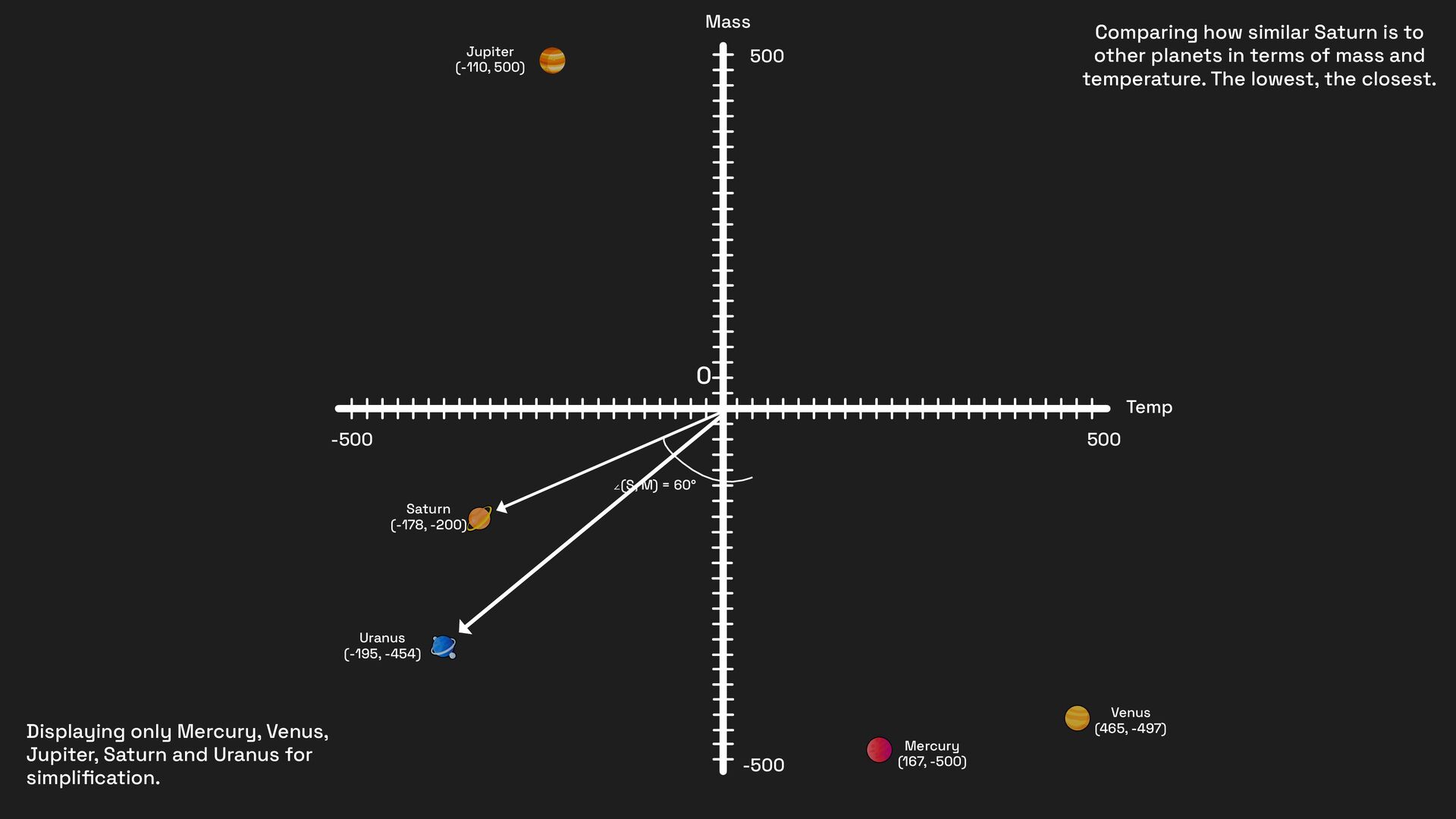
Displaying only Mercury, Venus, Jupiter, Saturn and Uranus for simpli fi cation. Comparing how similar Saturn is to other planets in terms of mass and temperature. The lowest, the closest. Mercury (167, -500) Venus (465, -497) Saturn (-178, -200) Uranus (-195, -454) ∠(S, M) = 60° -
-500 Jupiter (-110, 500) 0 -500 500 500 Temp Mass
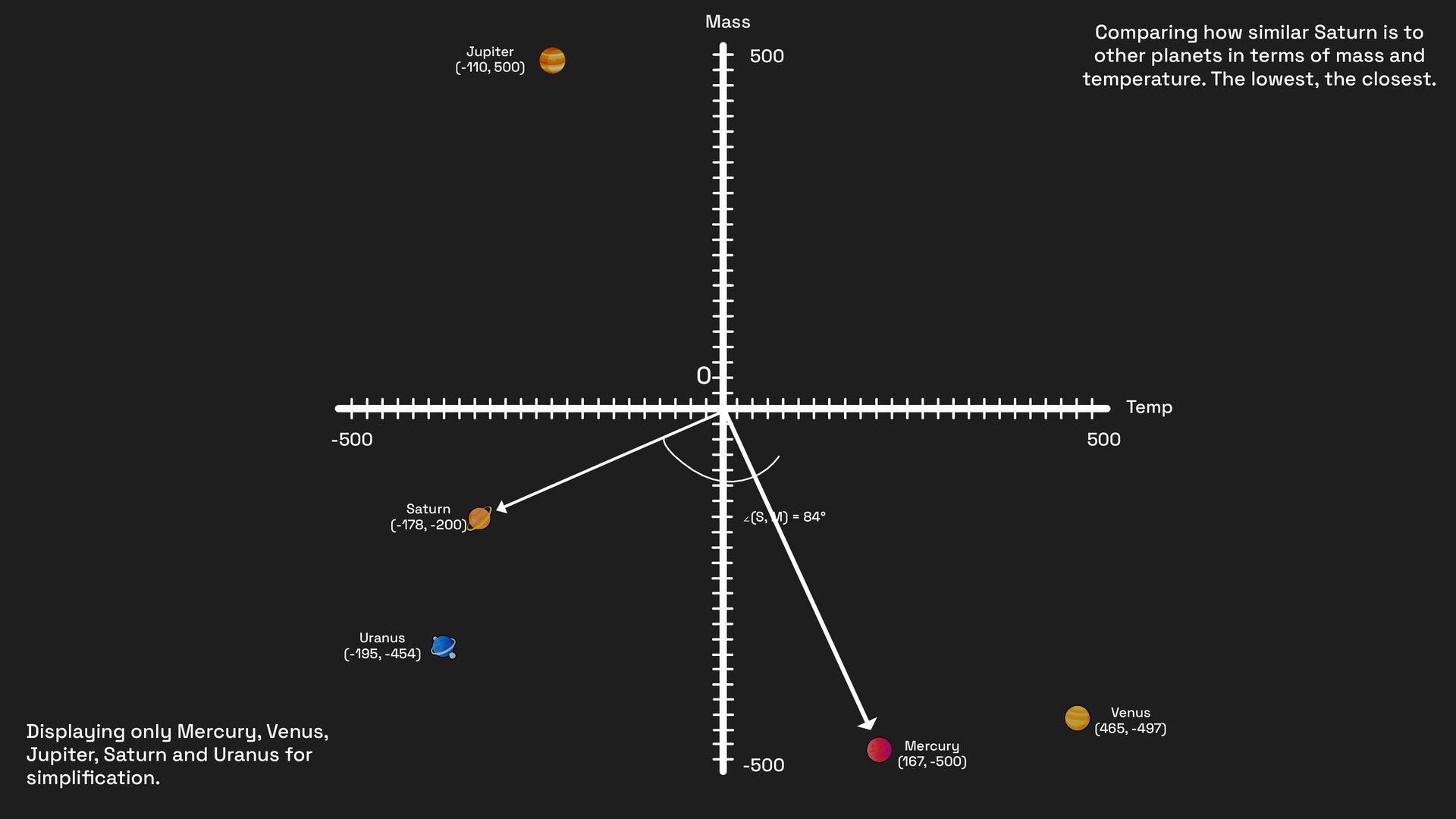
Displaying only Mercury, Venus, Jupiter, Saturn and Uranus for simpli fi cation. Comparing how similar Saturn is to other planets in terms of mass and temperature. The lowest, the closest. Mercury (167, -500) Venus (465, -497) Saturn (-178, -200) Uranus (-195, -454) ∠(S, M) = 84° -
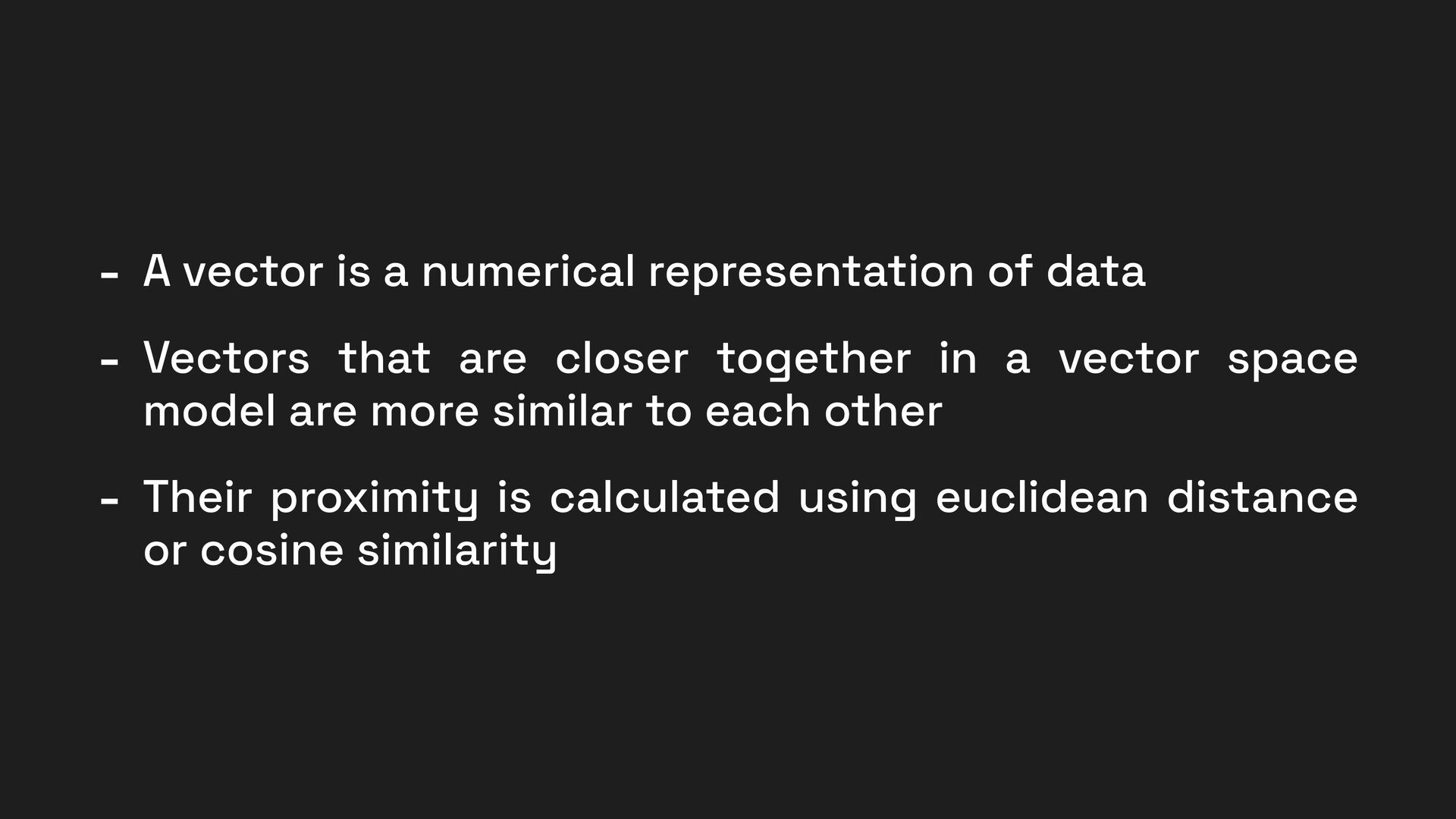
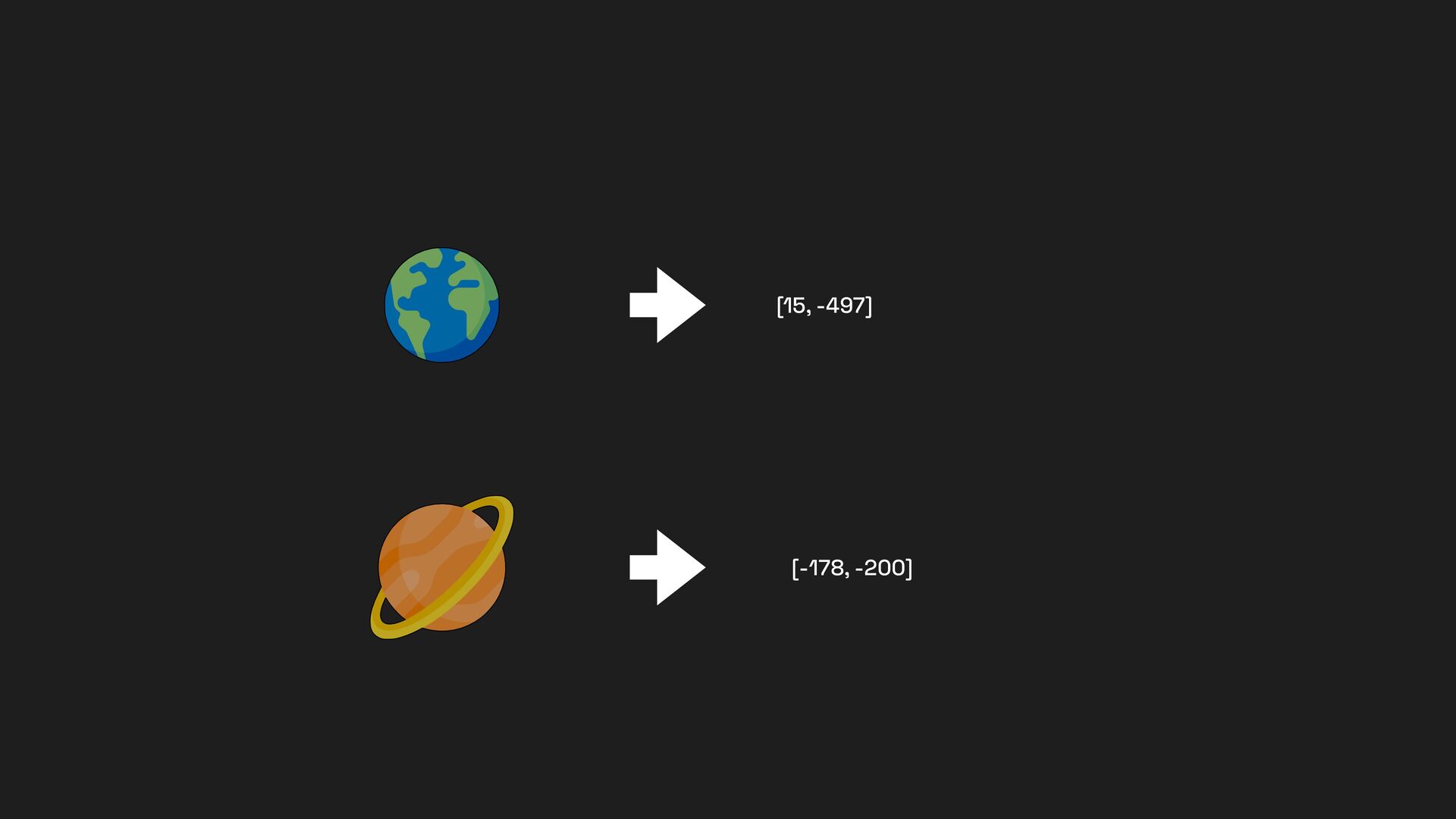
- A vector is a numerical representation of data -
Vectors that are closer together in a vector space model are more similar to each other - Their proximity is calculated using euclidean distance or cosine similarity -
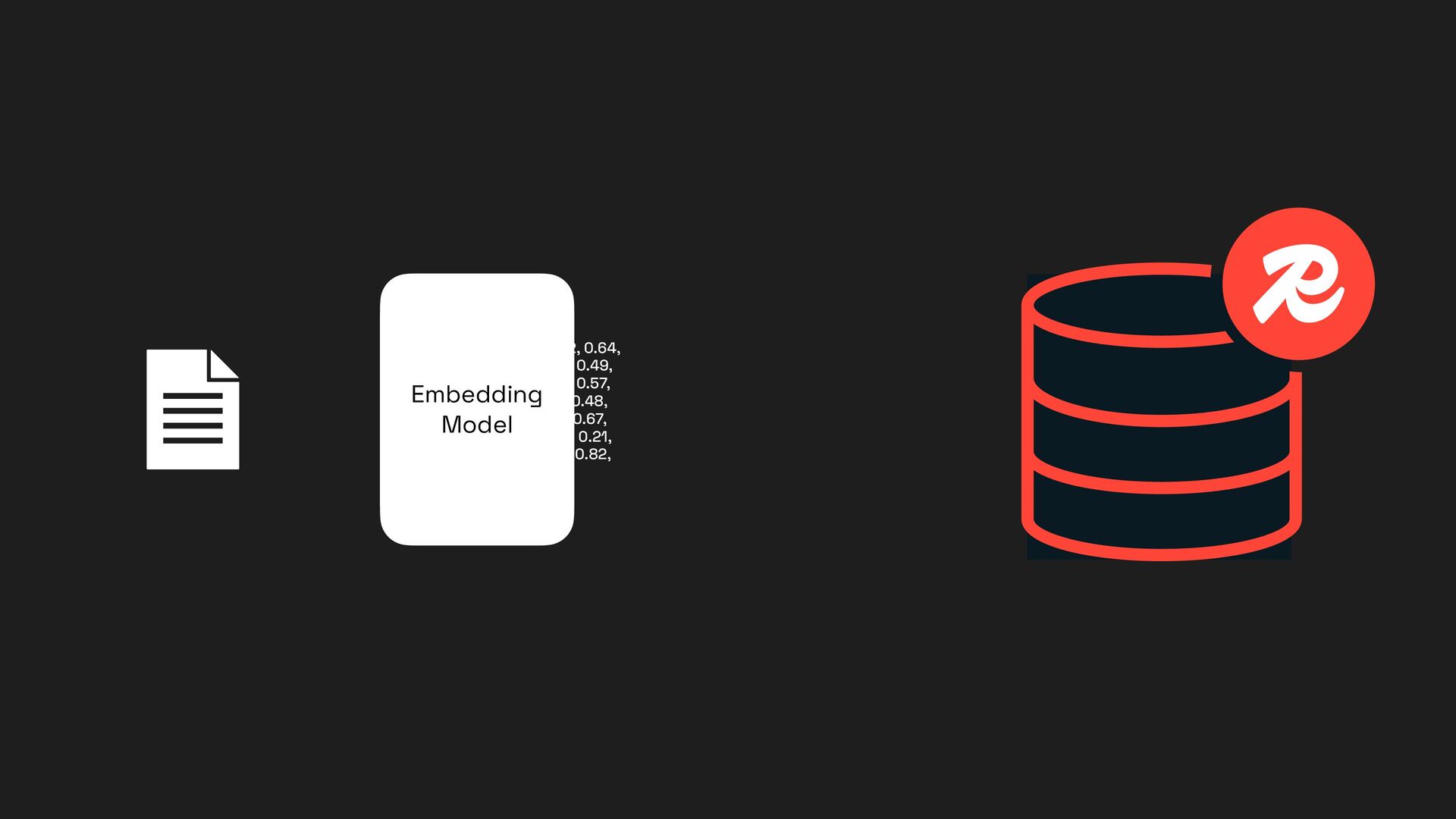
[0.54, 0.86, 0.23, 0.75, 0.92, 0.64, 0.47, 0.33, 0.89, 0.99,
0.67, 0.49, 0.94, 0.36, 0.71, 0.82, 0.29, 0.57, 0.630.98, 0.64, 0.47, 0.33, 0.48, 0.95, 0.67, 0.81, 0.23, 0.21, 0.67, 0.49, 0.56, 0.57, 0.63, 0.89, 0.21, 0.67, 0.49, 0.94, 0.36, 0.71, 0.82, 0.29] Embedding Model -
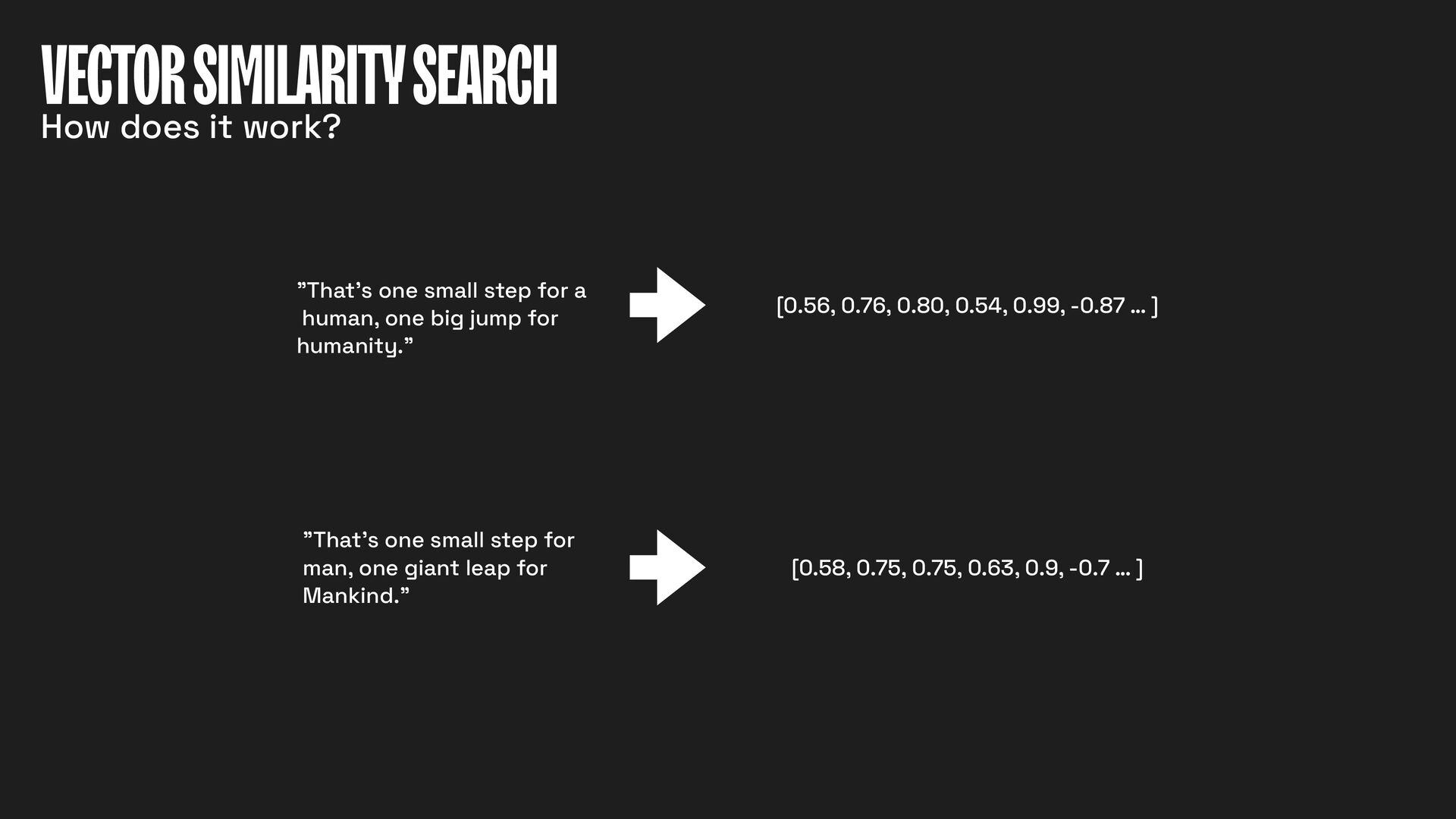
How does it work? VECTOR SIMILARITY SEARCH "That's one small
step for man, one giant leap for Mankind." "That's one small step for a human, one big jump for humanity.” [0.56, 0.76, 0.80, 0.54, 0.99, -0.87 … ] [0.58, 0.75, 0.75, 0.63, 0.9, -0.7 … ] -
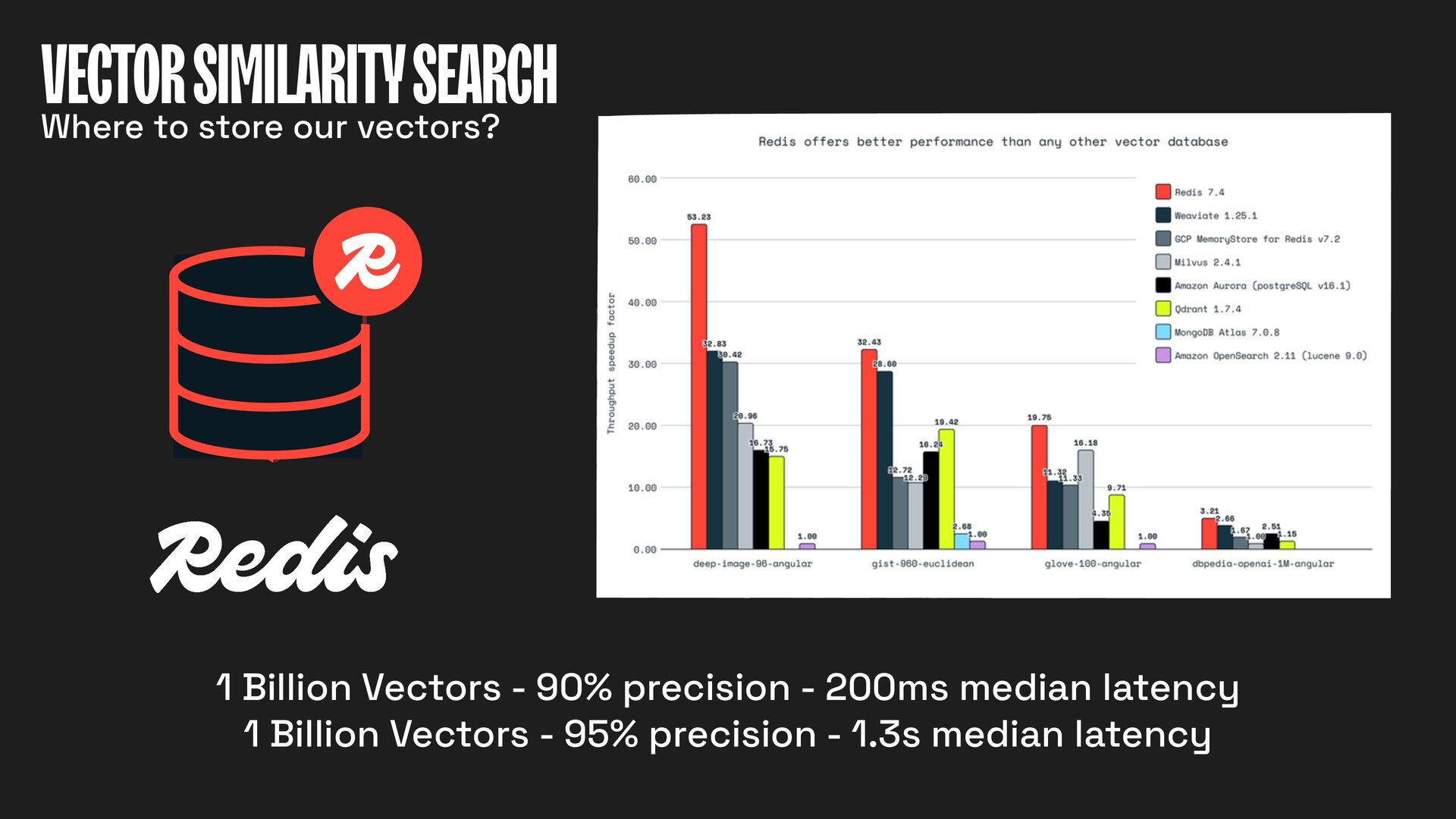
Where to store our vectors? VECTOR SIMILARITY SEARCH 1 Billion
Vectors - 90% precision - 200ms median latency 1 Billion Vectors - 95% precision - 1.3s median latency -
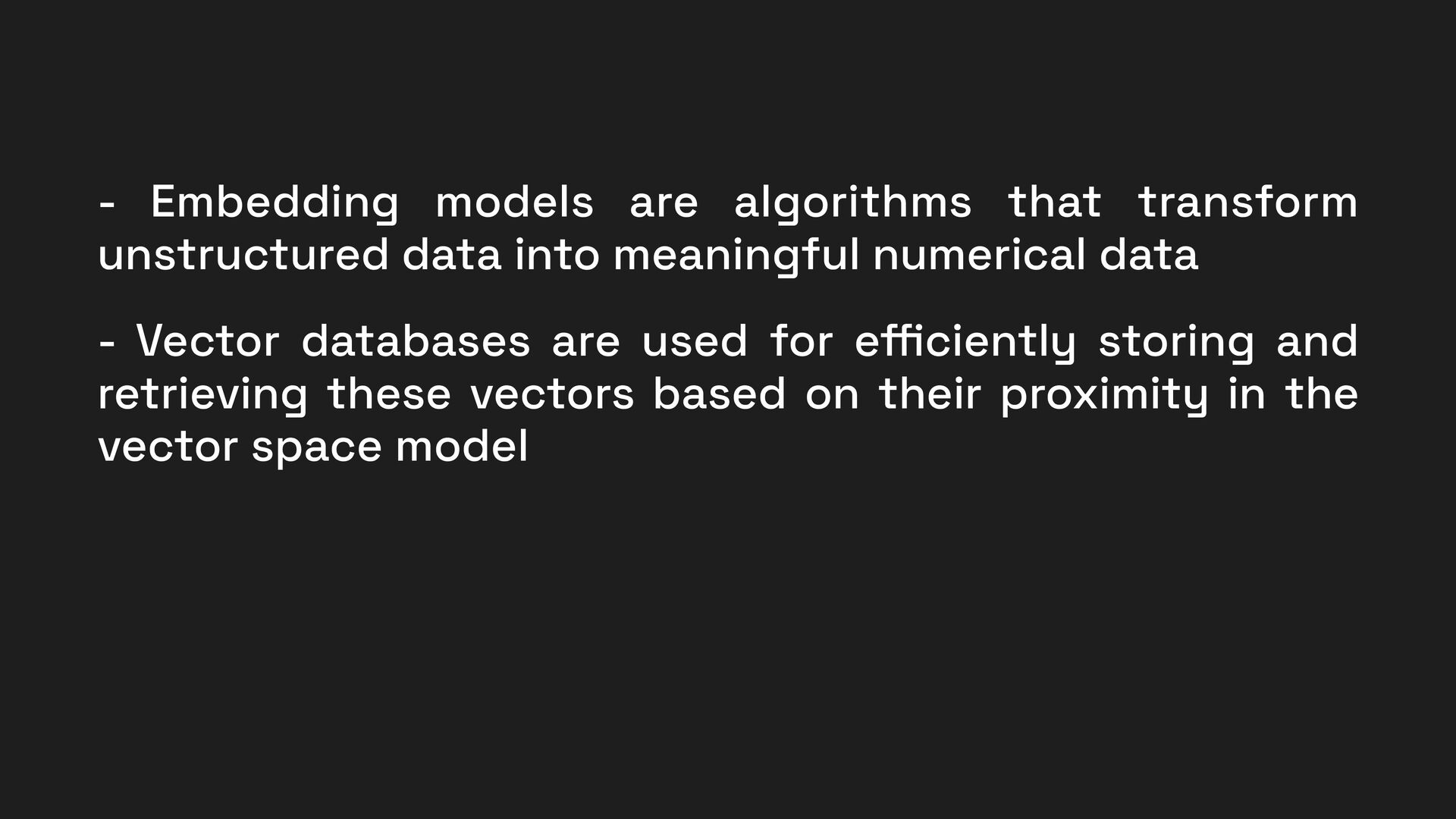
- Embedding models are algorithms that transform unstructured data into
meaningful numerical data - Vector databases are used for e ff i ciently storing and retrieving these vectors based on their proximity in the vector space model -
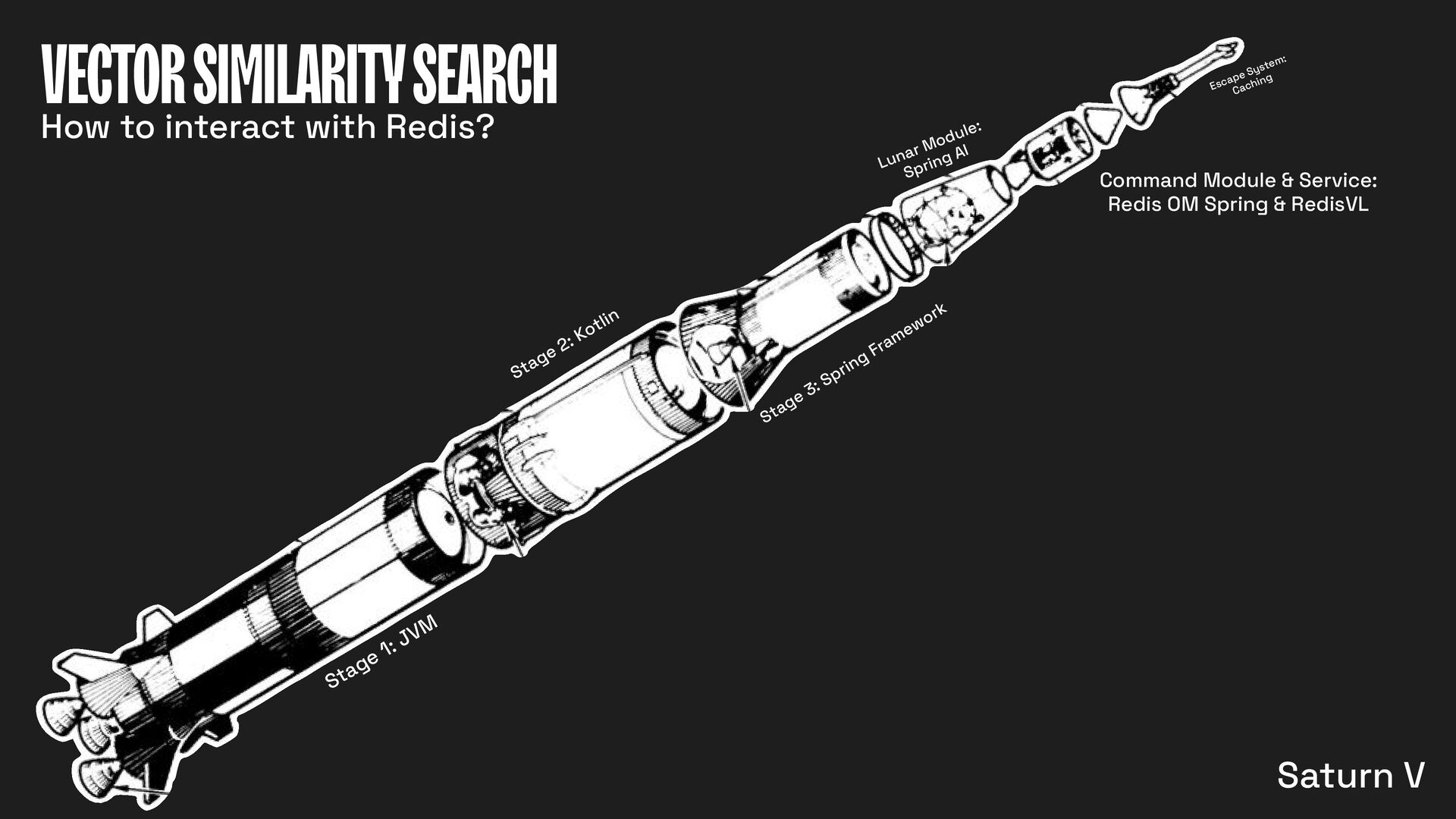
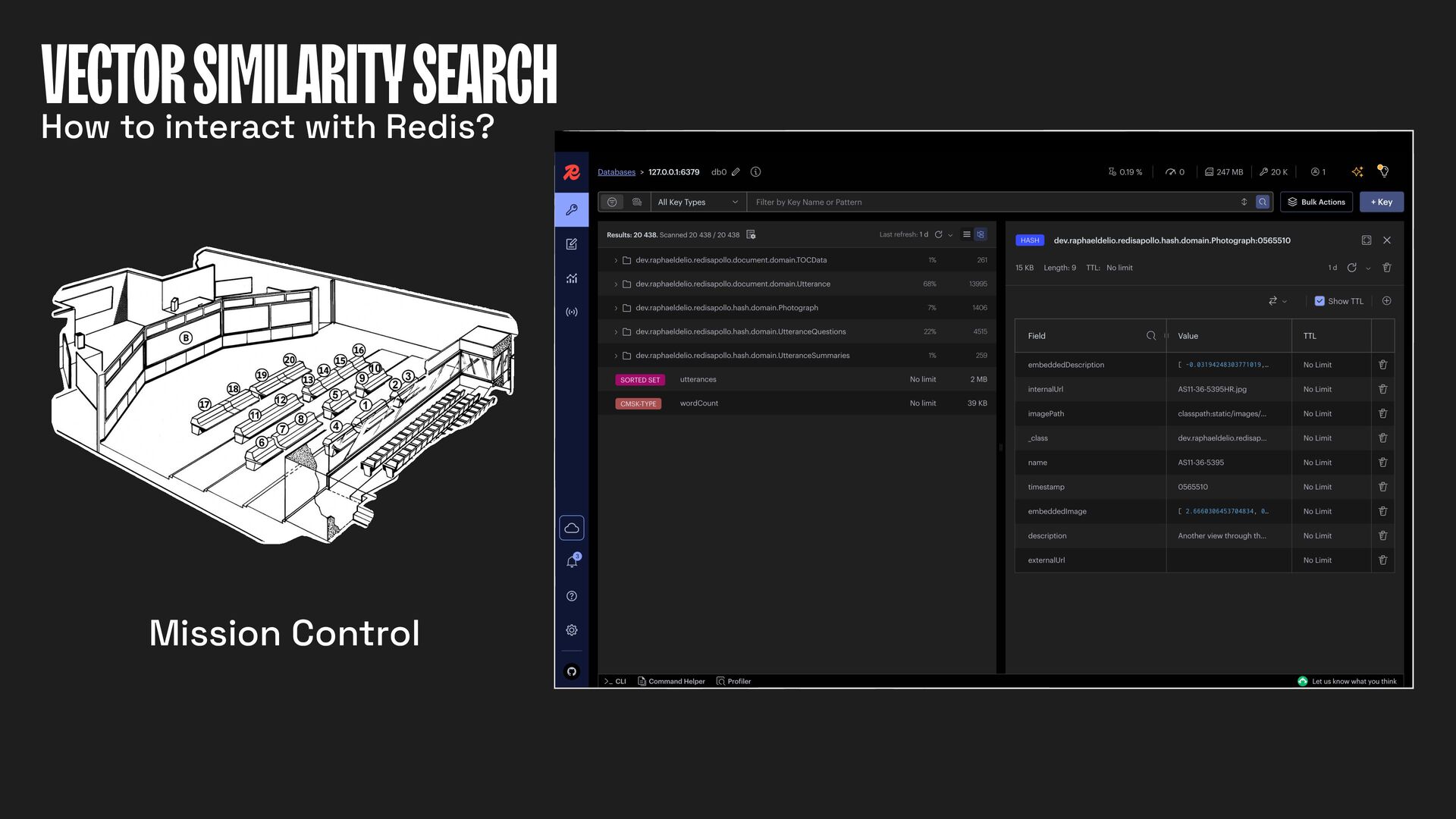
How to interact with Redis? VECTOR SIMILARITY SEARCH Saturn V
Stage 1: JVM Stage 2: Kotlin Stage 3: Spring Framework Command Module & Service: Redis OM Spring & RedisVL Lunar Module: Spring AI Escape System: Caching -
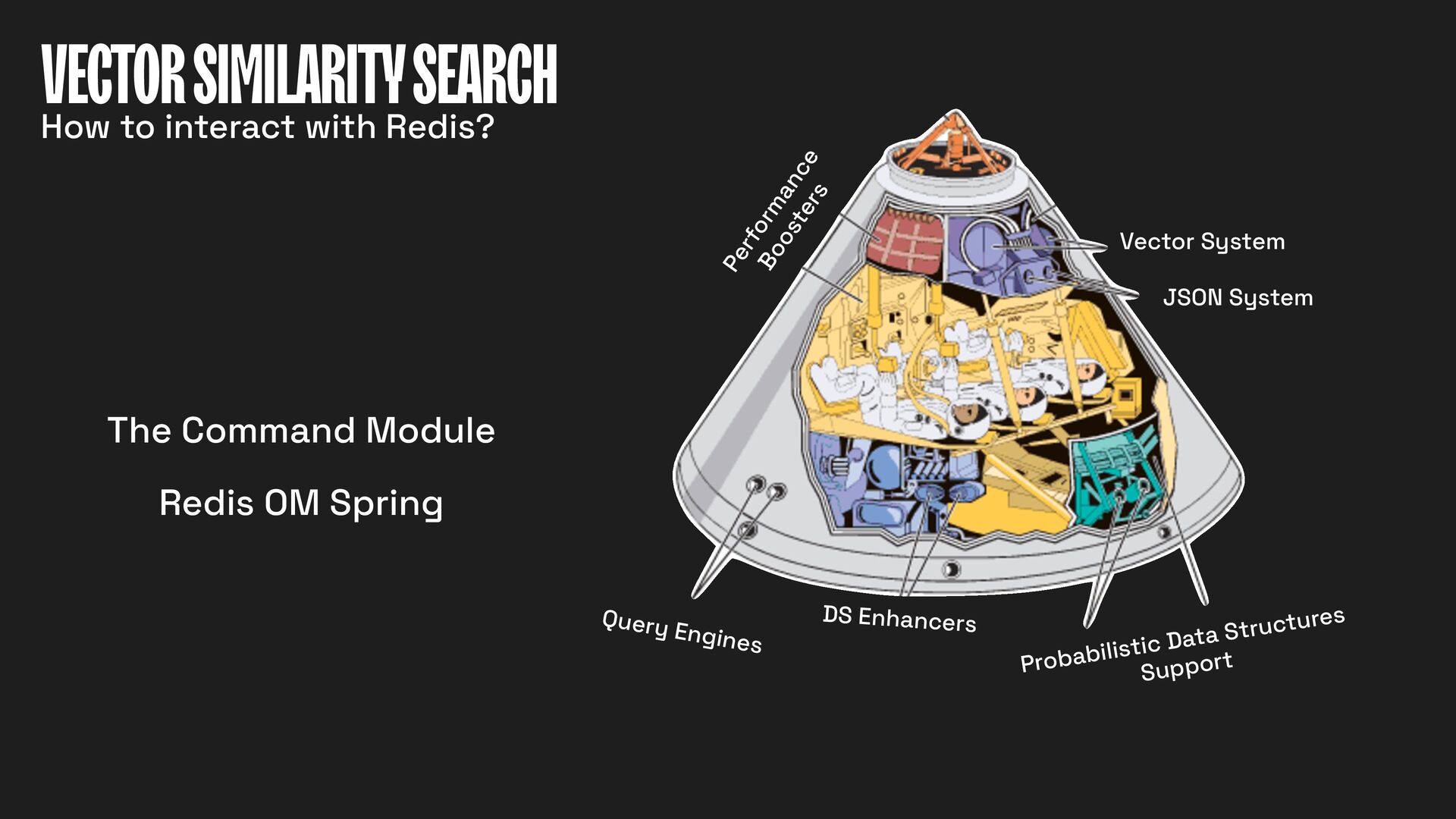
The Command Module VECTOR SIMILARITY SEARCH How to interact with
Redis? JSON System Vector System Query Engines Probabilistic Data Structures Support Perform ance Boosters DS Enhancers Redis OM Spring -
• Collect our data • Load our data into Redis
• Query our data ROCKET’S OBJECTIVE -
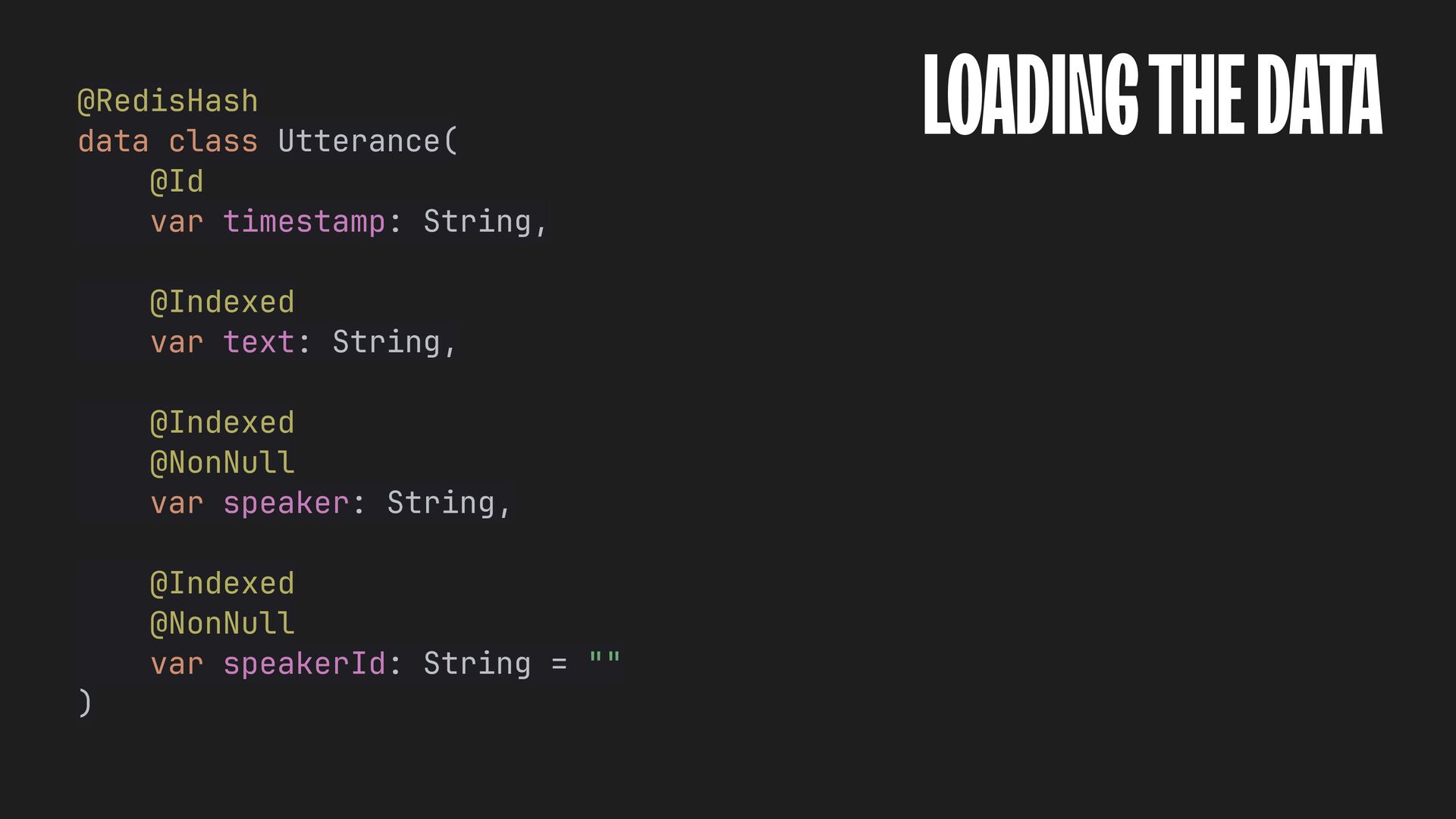
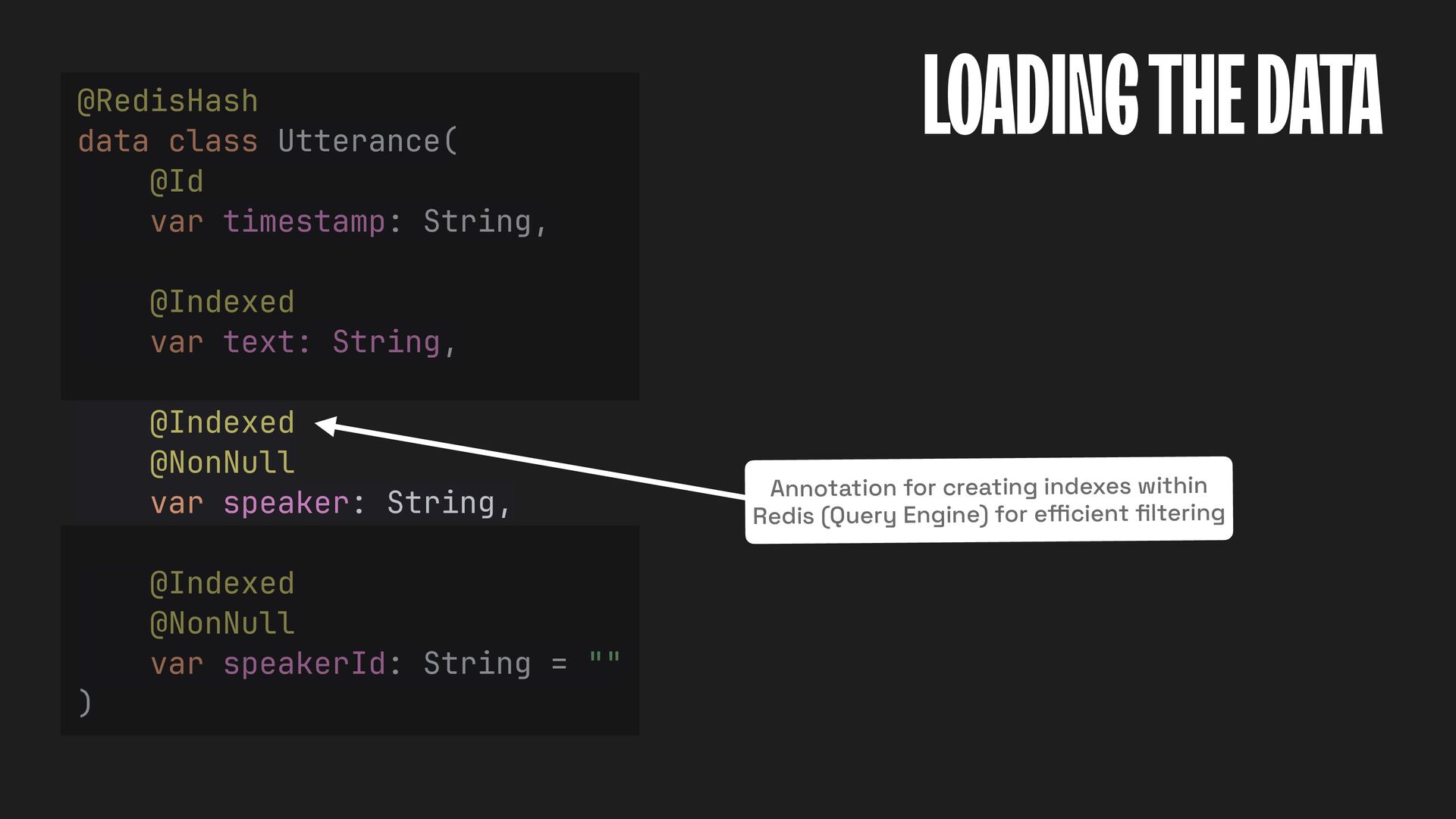
LOADING THE DATA @RedisHash data class Utterance( @Id var timestamp:
String, @Indexed var text: String, @Indexed @NonNull var speaker: String, @Indexed @NonNull var speakerId: String = "" ) -
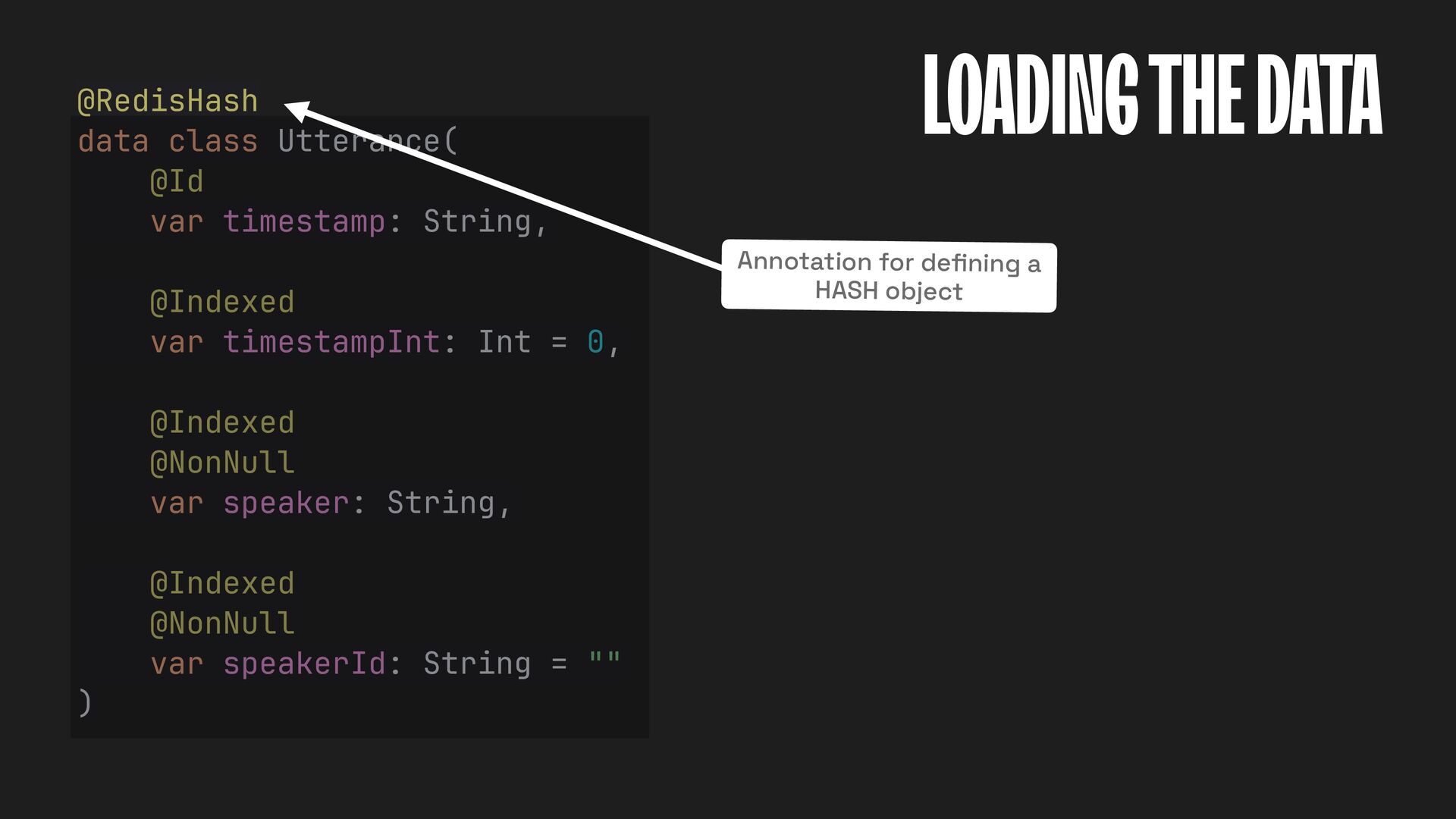
@RedisHash data class Utterance( @Id var timestamp: String, @Indexed var
timestampInt: Int = 0, @Indexed @NonNull var speaker: String, @Indexed @NonNull var speakerId: String = "" ) LOADING THE DATA Annotation for de fi ning a HASH object -
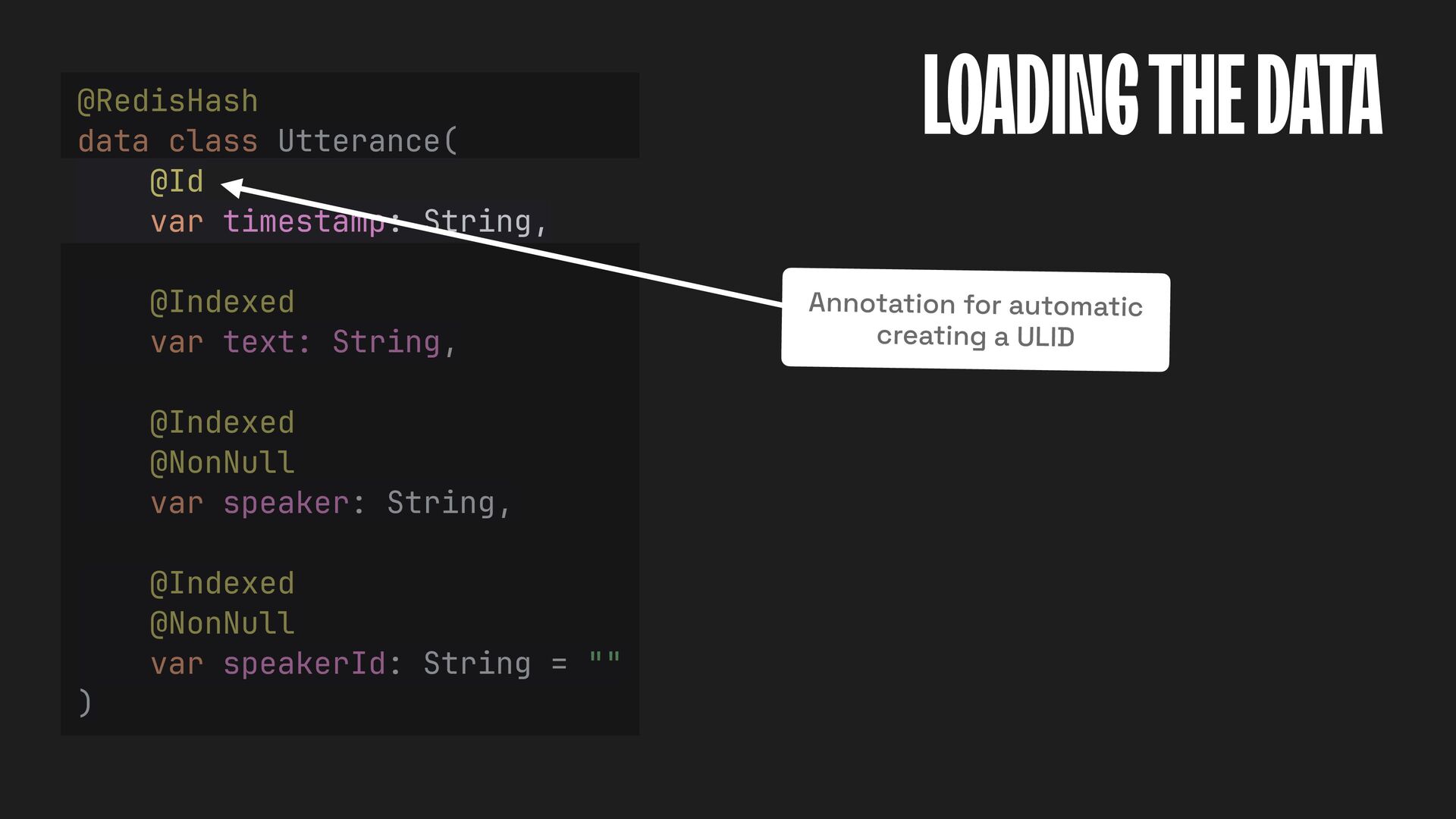
@RedisHash data class Utterance( @Id var timestamp: String, @Indexed var
text: String, @Indexed @NonNull var speaker: String, @Indexed @NonNull var speakerId: String = "" ) LOADING THE DATA Annotation for automatic creating a ULID -
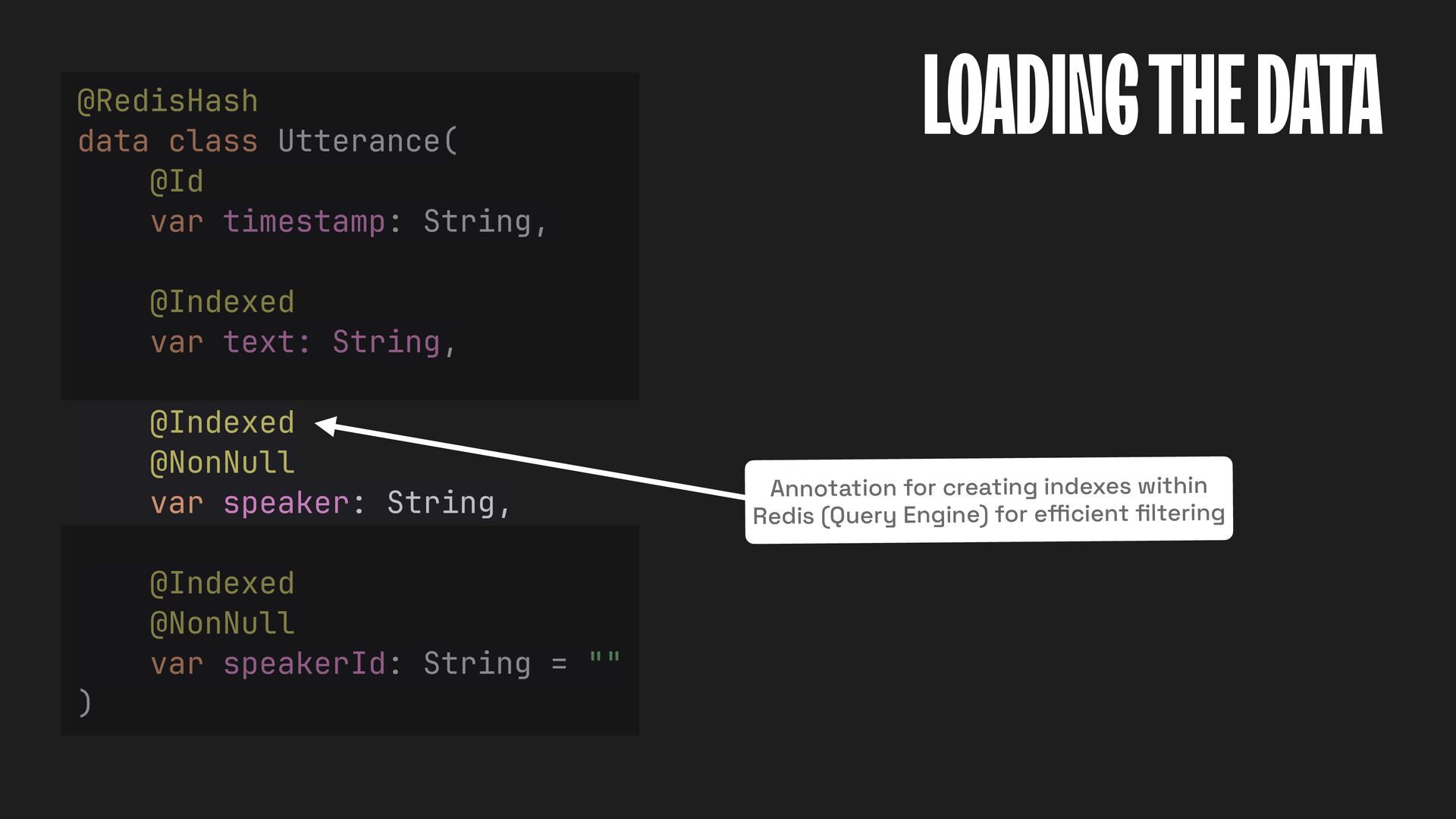
@RedisHash data class Utterance( @Id var timestamp: String, @Indexed var
text: String, @Indexed @NonNull var speaker: String, @Indexed @NonNull var speakerId: String = "" ) LOADING THE DATA Annotation for creating indexes within Redis (Query Engine) for e ff i cient fi ltering -
@RedisHash data class Utterance( @Id var timestamp: String, @Indexed var
text: String, @Indexed @NonNull var speaker: String, @Indexed @NonNull var speakerId: String = "" ) LOADING THE DATA Annotation for creating indexes within Redis (Query Engine) for e ff i cient fi ltering -
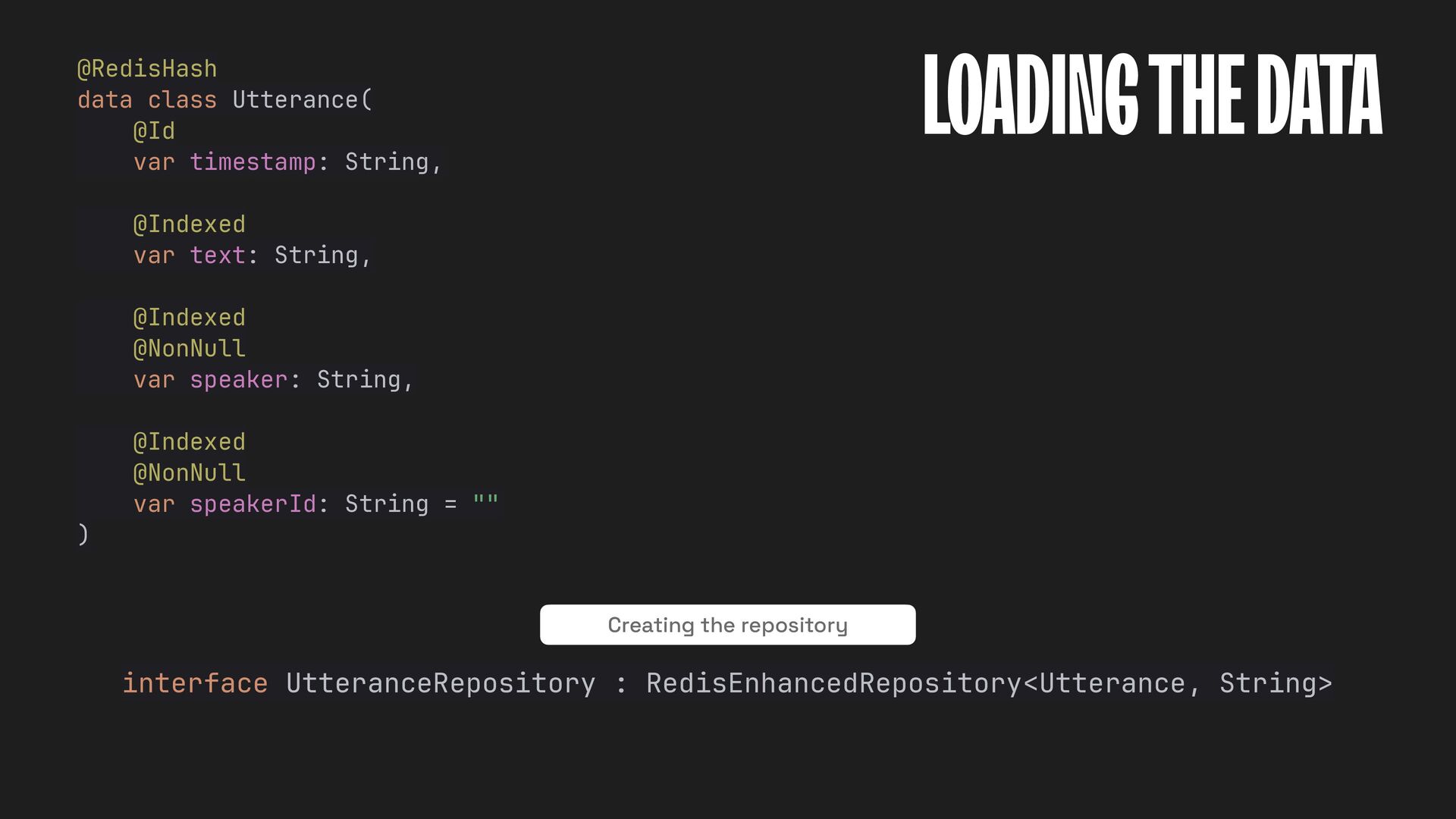
LOADING THE DATA Creating the repository @RedisHash data class Utterance(
@Id var timestamp: String, @Indexed var text: String, @Indexed @NonNull var speaker: String, @Indexed @NonNull var speakerId: String = "" ) interface UtteranceRepository : RedisEnhancedRepository<Utterance, String> -
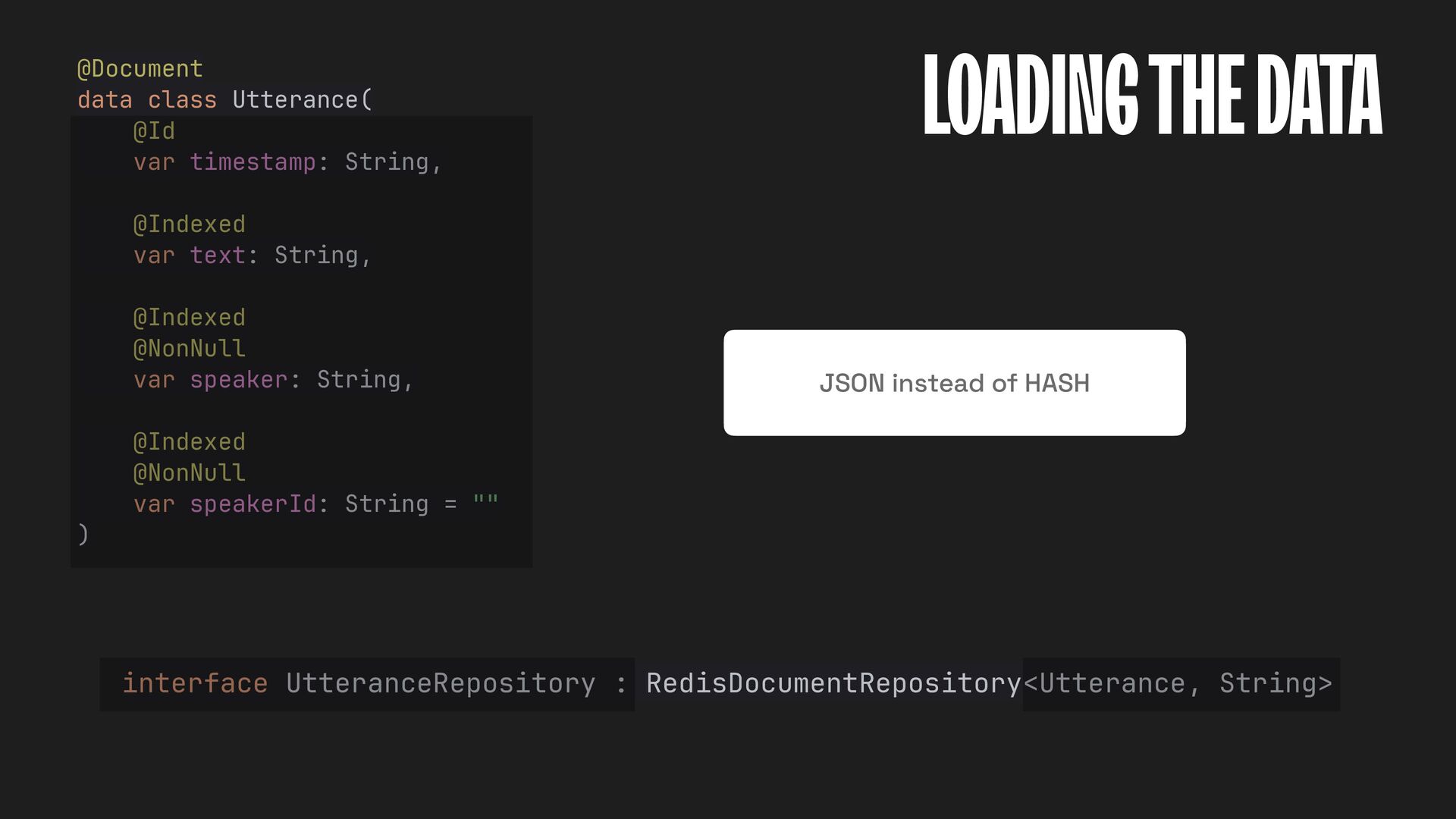
LOADING THE DATA JSON instead of HASH interface UtteranceRepository :
RedisDocumentRepository<Utterance, String> @Document data class Utterance( @Id var timestamp: String, @Indexed var text: String, @Indexed @NonNull var speaker: String, @Indexed @NonNull var speakerId: String = "" ) -
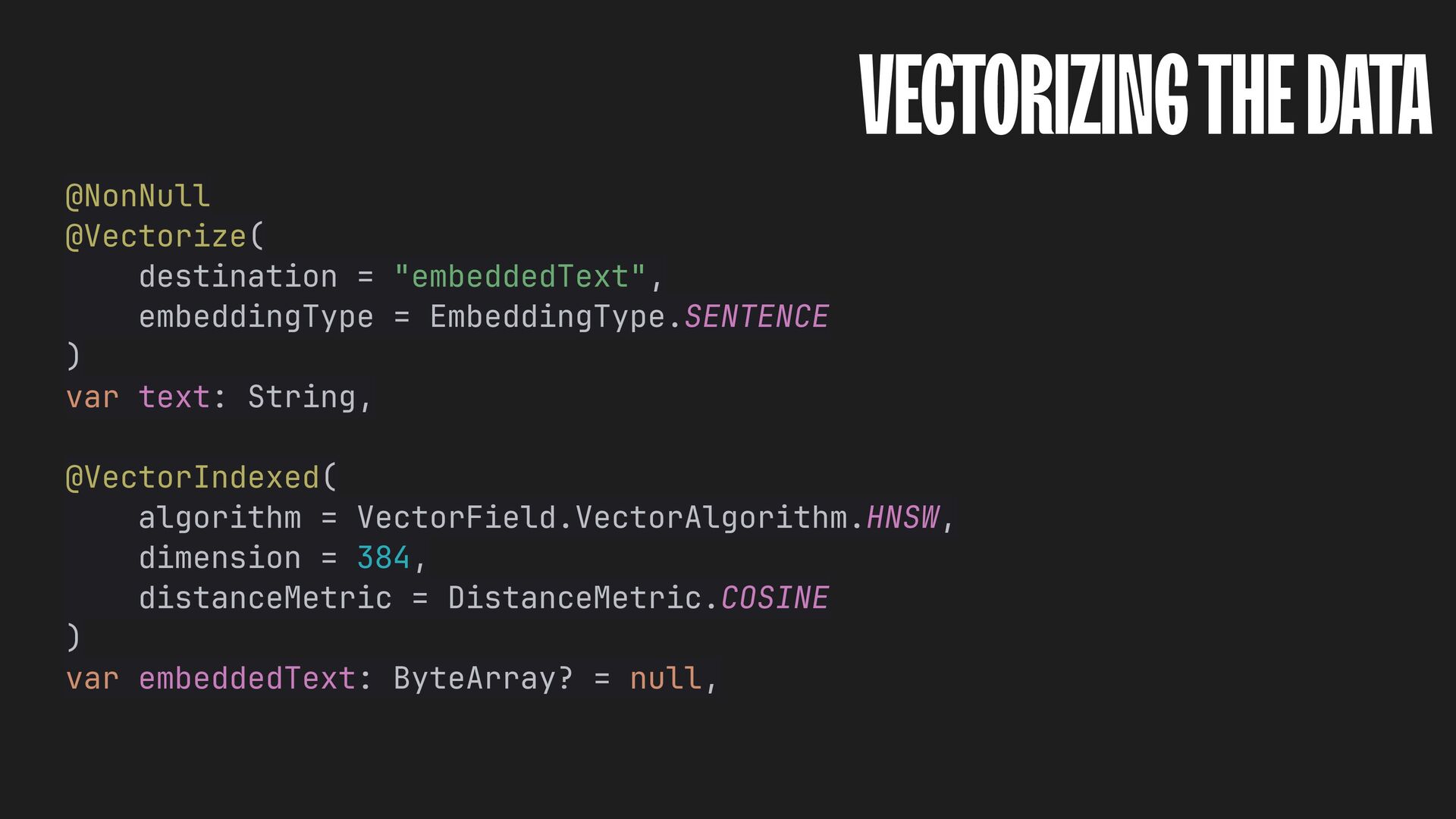
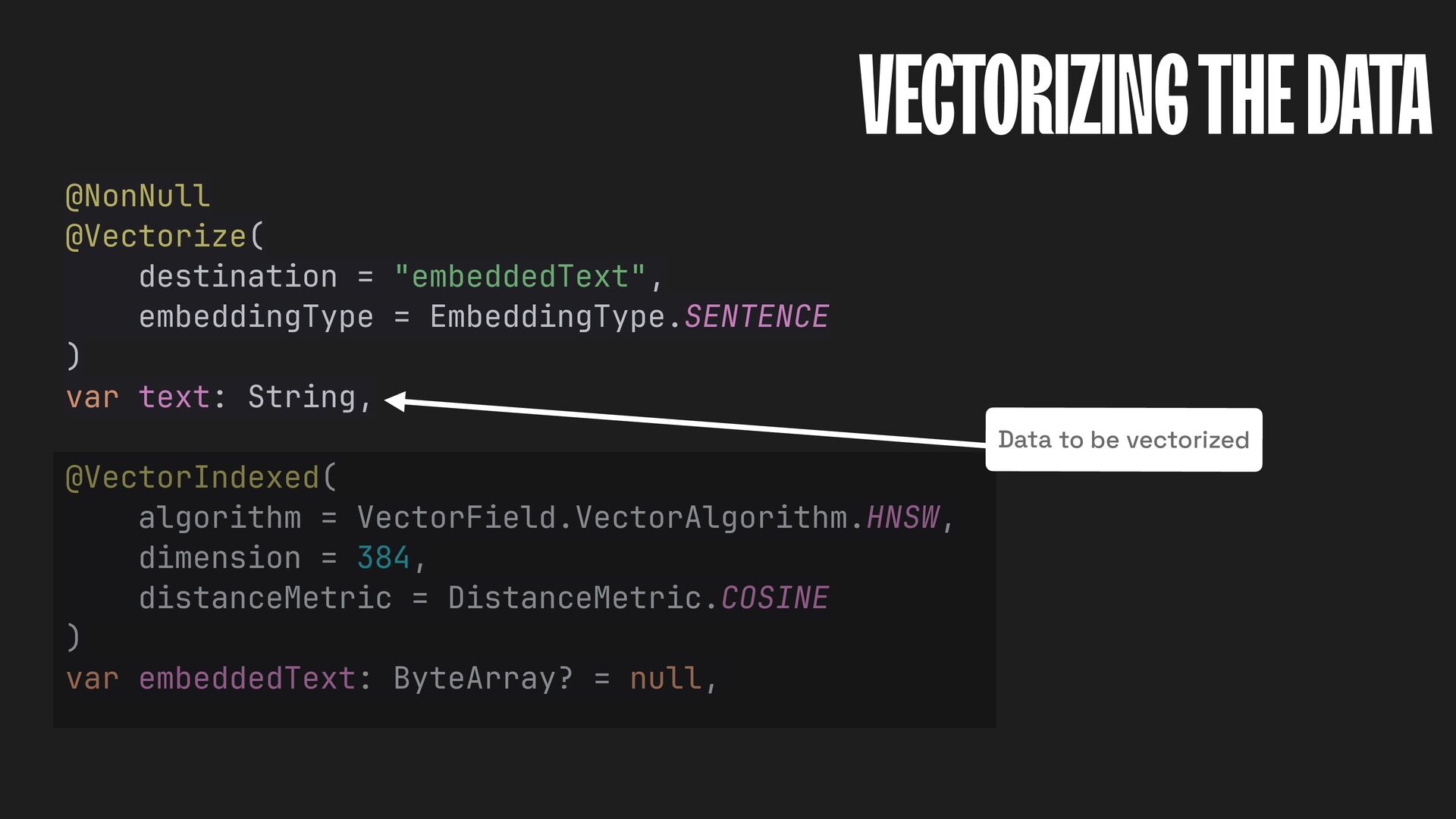
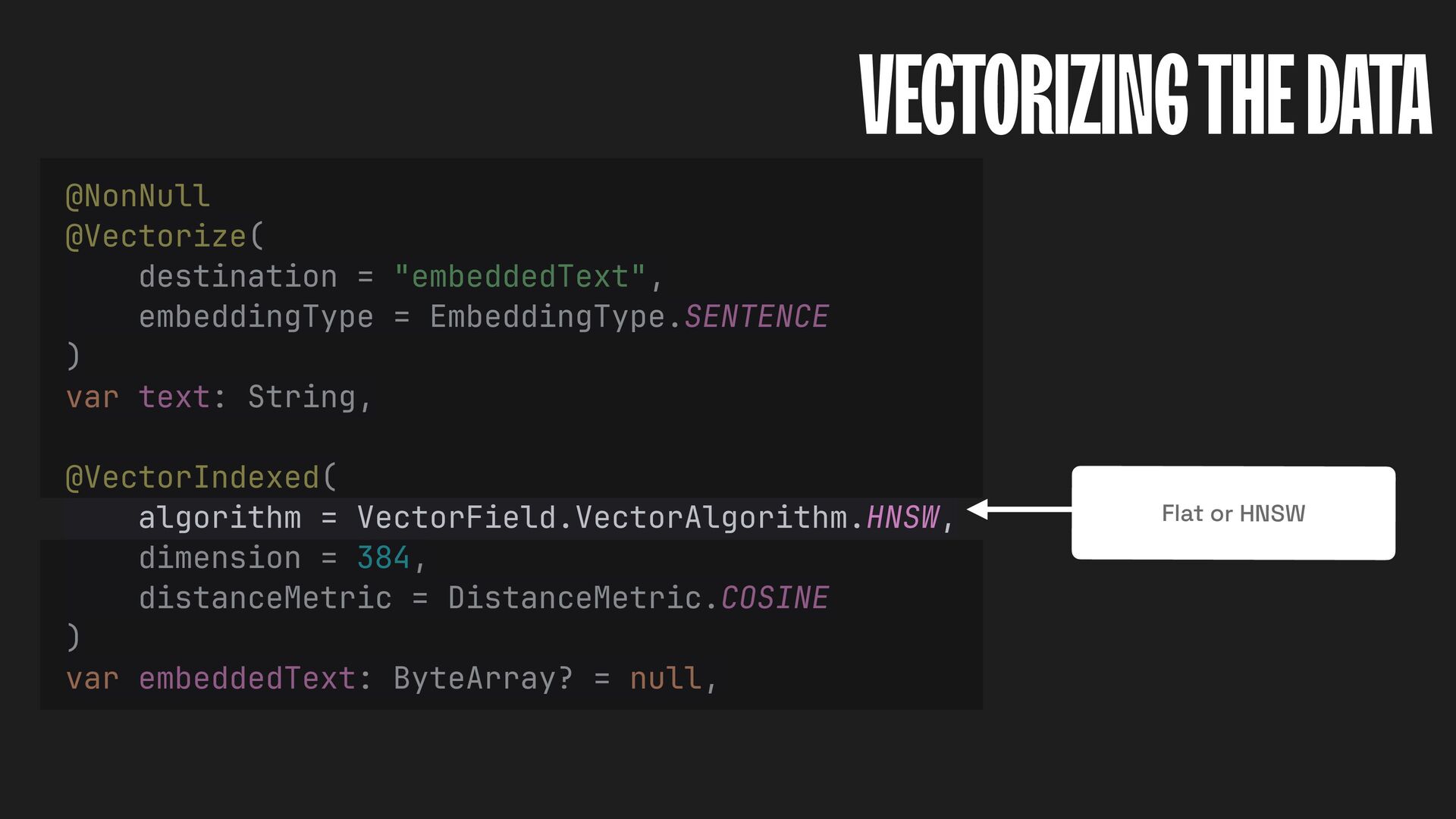
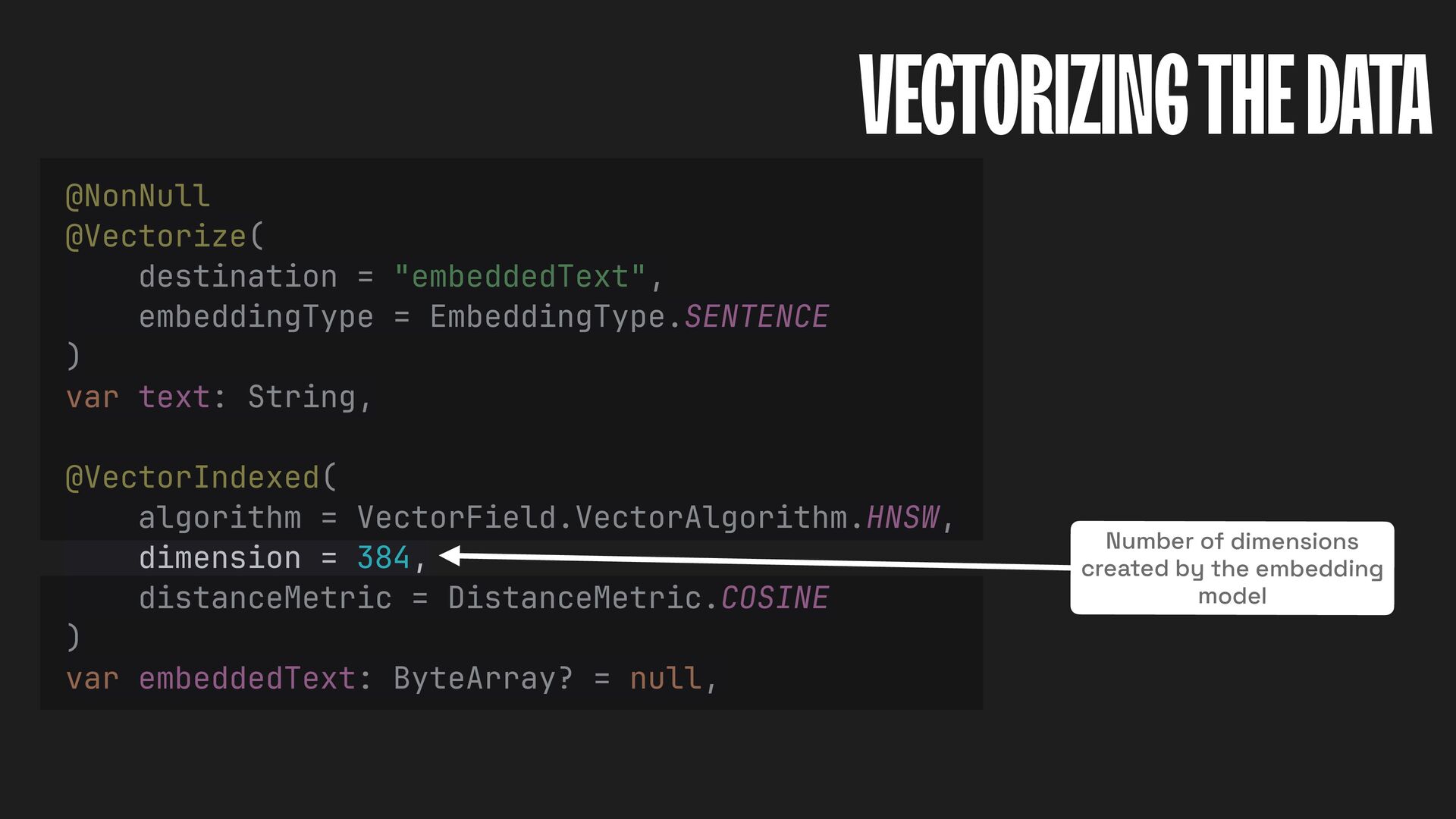
VECTORIZING THE DATA @NonNull @Vectorize( destination = "embeddedText", embeddingType =
EmbeddingType.SENTENCE ) var text: String, @VectorIndexed( algorithm = VectorField.VectorAlgorithm.HNSW, dimension = 384, distanceMetric = DistanceMetric.COSINE ) var embeddedText: ByteArray? = null, -
@NonNull @Vectorize( destination = "embeddedText", embeddingType = EmbeddingType.SENTENCE ) var
text: String, @VectorIndexed( algorithm = VectorField.VectorAlgorithm.HNSW, dimension = 384, distanceMetric = DistanceMetric.COSINE ) var embeddedText: ByteArray? = null, VECTORIZING THE DATA Data to be vectorized -
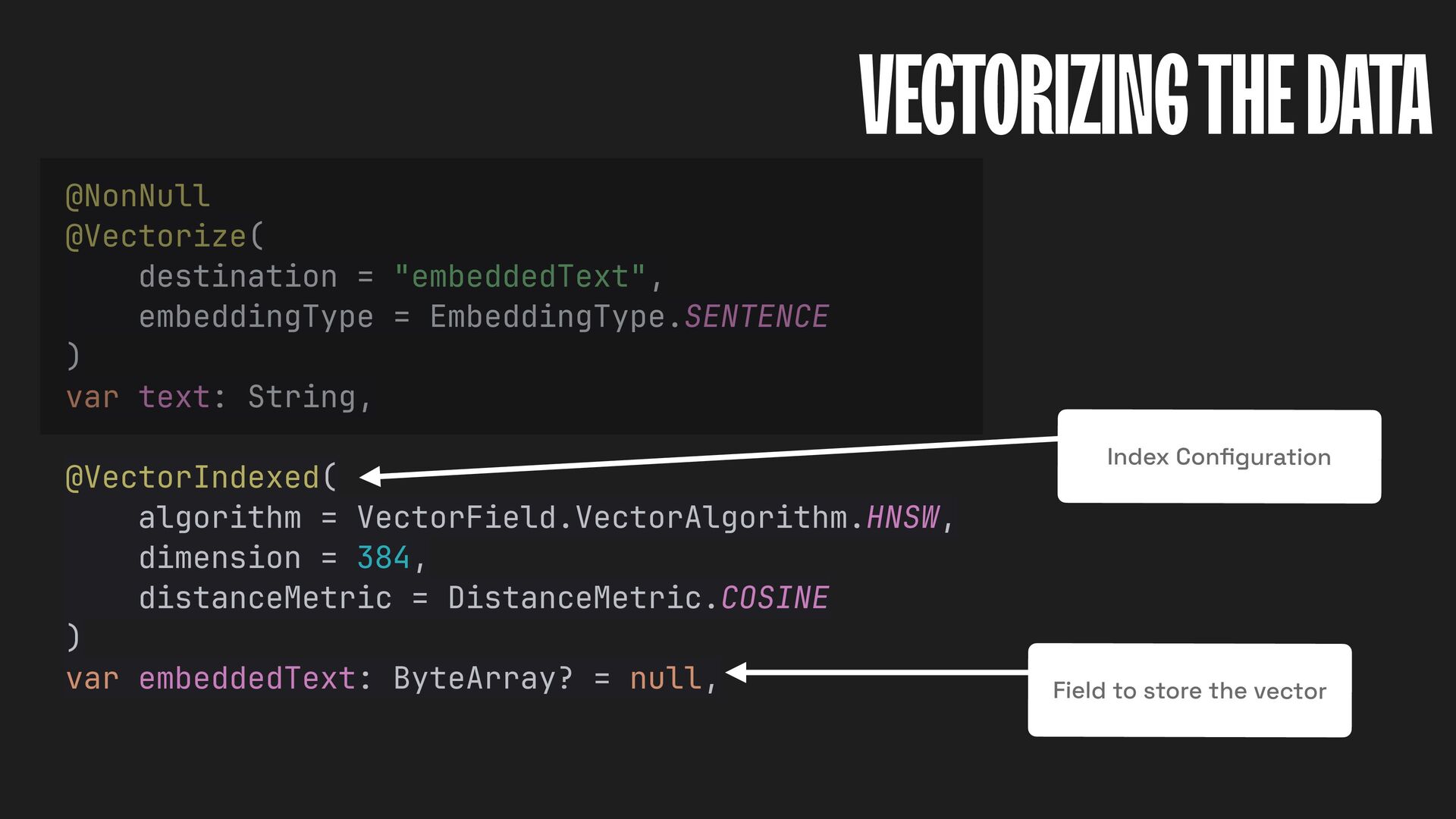
@NonNull @Vectorize( destination = "embeddedText", embeddingType = EmbeddingType.SENTENCE ) var
text: String, @VectorIndexed( algorithm = VectorField.VectorAlgorithm.HNSW, dimension = 384, distanceMetric = DistanceMetric.COSINE ) var embeddedText: ByteArray? = null, VECTORIZING THE DATA Field to store the vector Index Con fi guration -
@NonNull @Vectorize( destination = "embeddedText", embeddingType = EmbeddingType.SENTENCE ) var
text: String, @VectorIndexed( algorithm = VectorField.VectorAlgorithm.HNSW, dimension = 384, distanceMetric = DistanceMetric.COSINE ) var embeddedText: ByteArray? = null, VECTORIZING THE DATA Flat or HNSW -
@NonNull @Vectorize( destination = "embeddedText", embeddingType = EmbeddingType.SENTENCE ) var
text: String, @VectorIndexed( algorithm = VectorField.VectorAlgorithm.HNSW, dimension = 384, distanceMetric = DistanceMetric.COSINE ) var embeddedText: ByteArray? = null, VECTORIZING THE DATA Number of dimensions created by the embedding model -
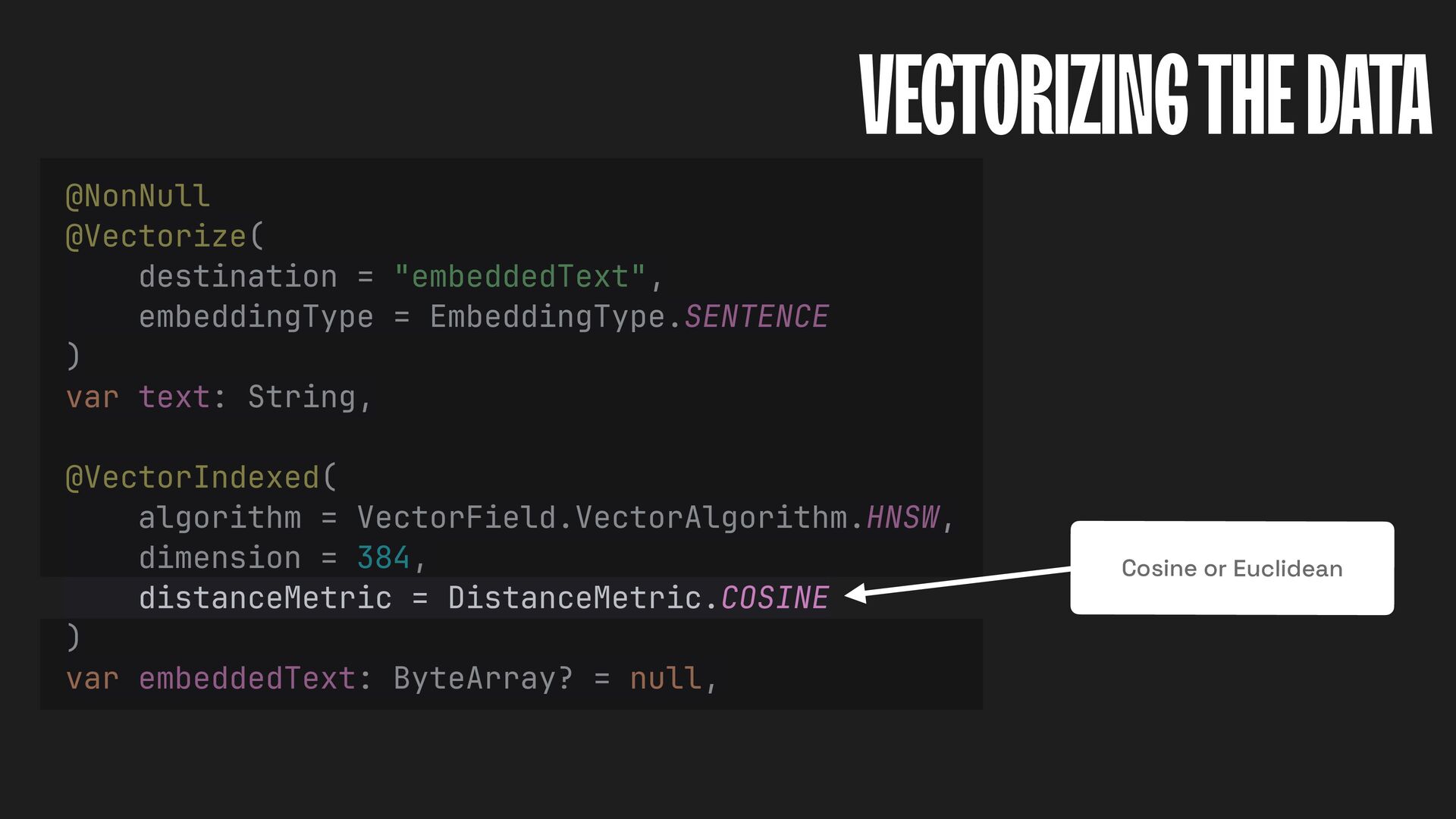
@NonNull @Vectorize( destination = "embeddedText", embeddingType = EmbeddingType.SENTENCE ) var
text: String, @VectorIndexed( algorithm = VectorField.VectorAlgorithm.HNSW, dimension = 384, distanceMetric = DistanceMetric.COSINE ) var embeddedText: ByteArray? = null, VECTORIZING THE DATA Cosine or Euclidean -
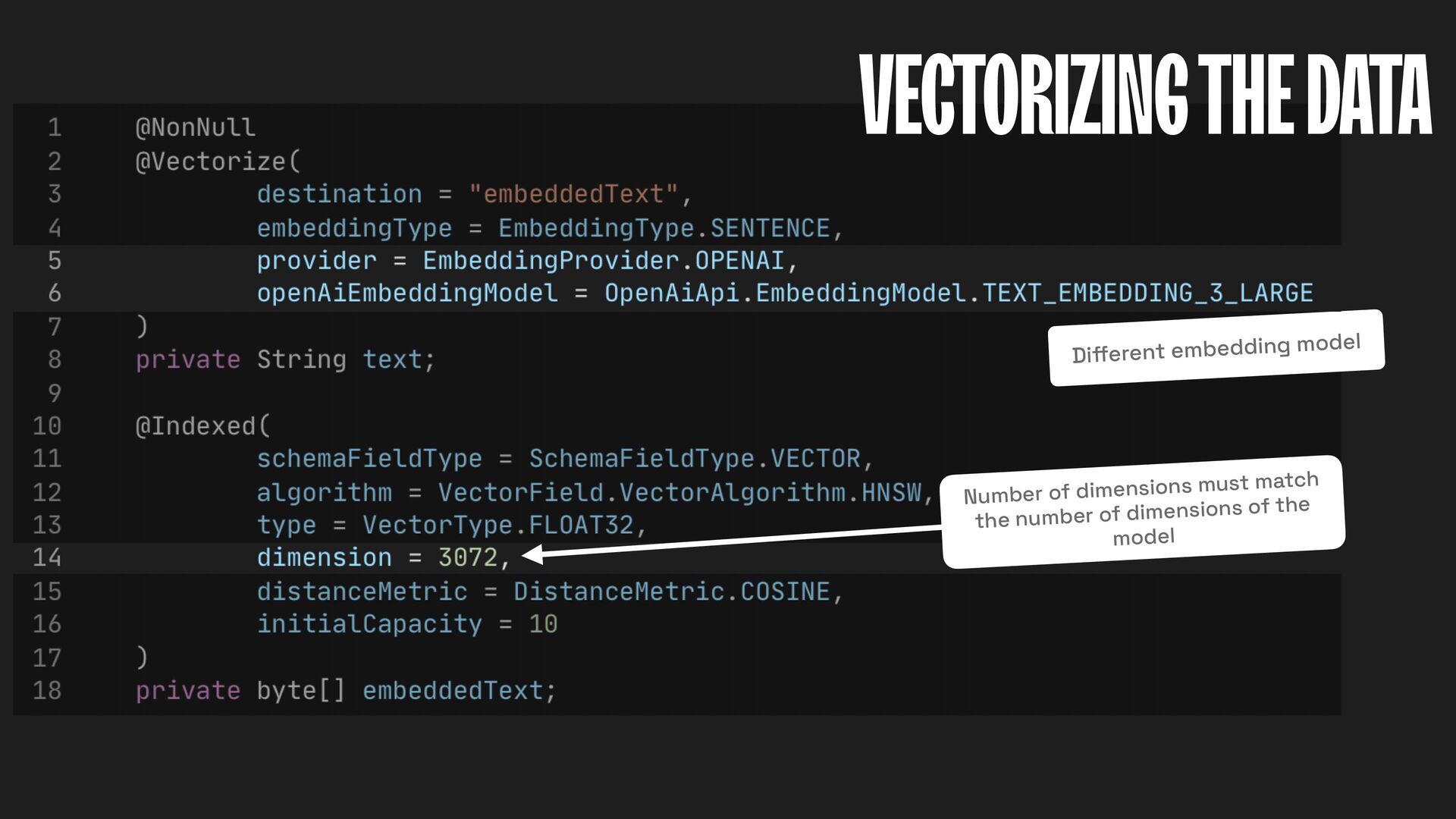
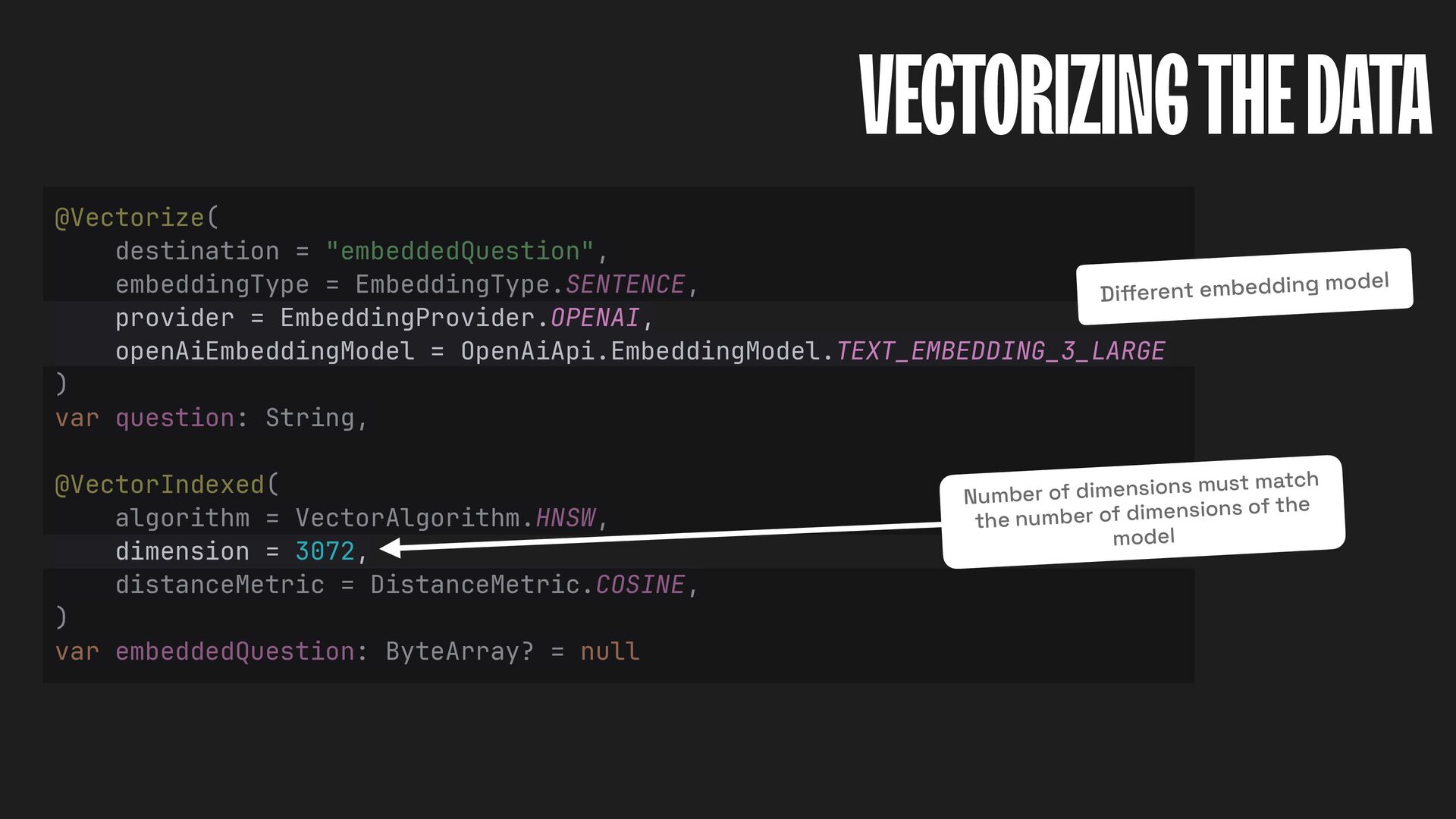
VECTORIZING THE DATA Di ff erent embedding model Number of
dimensions must match the number of dimensions of the model -
@Vectorize( destination = "embeddedQuestion", embeddingType = EmbeddingType.SENTENCE, provider = EmbeddingProvider.OPENAI,
openAiEmbeddingModel = OpenAiApi.EmbeddingModel.TEXT_EMBEDDING_3_LARGE ) var question: String, @VectorIndexed( algorithm = VectorAlgorithm.HNSW, dimension = 3072, distanceMetric = DistanceMetric.COSINE, ) var embeddedQuestion: ByteArray? = null VECTORIZING THE DATA Di ff erent embedding model Number of dimensions must match the number of dimensions of the model -
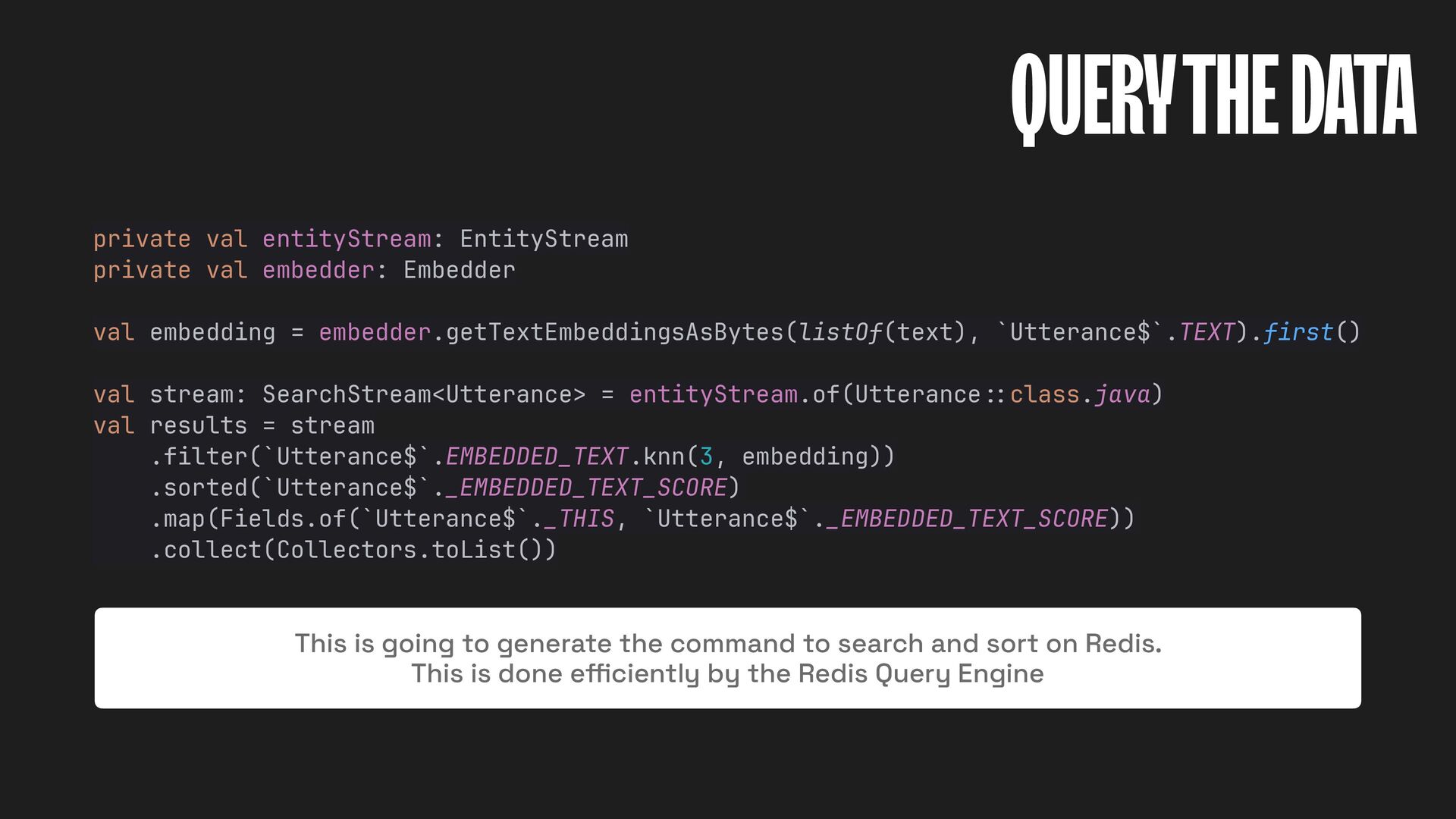
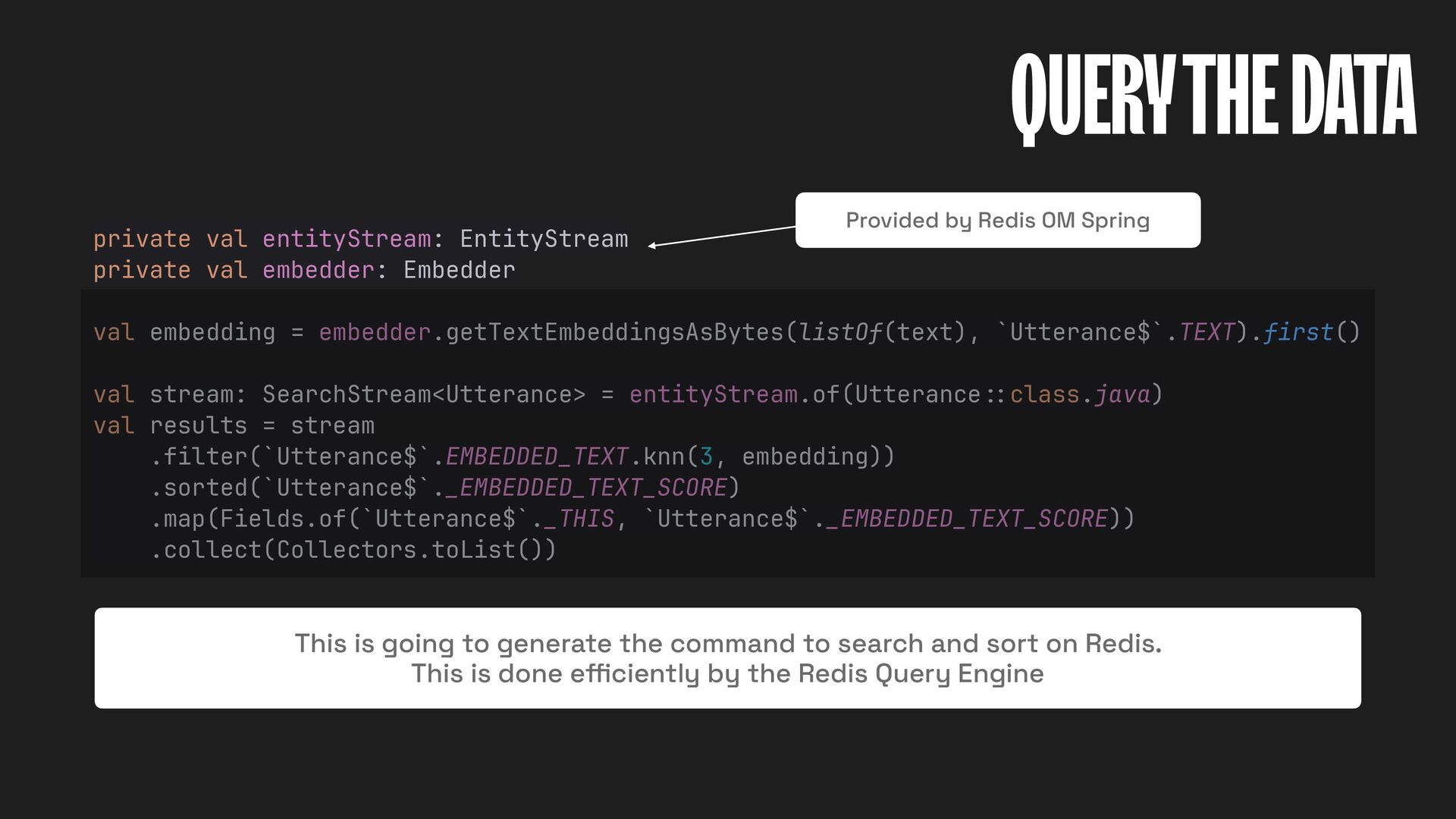
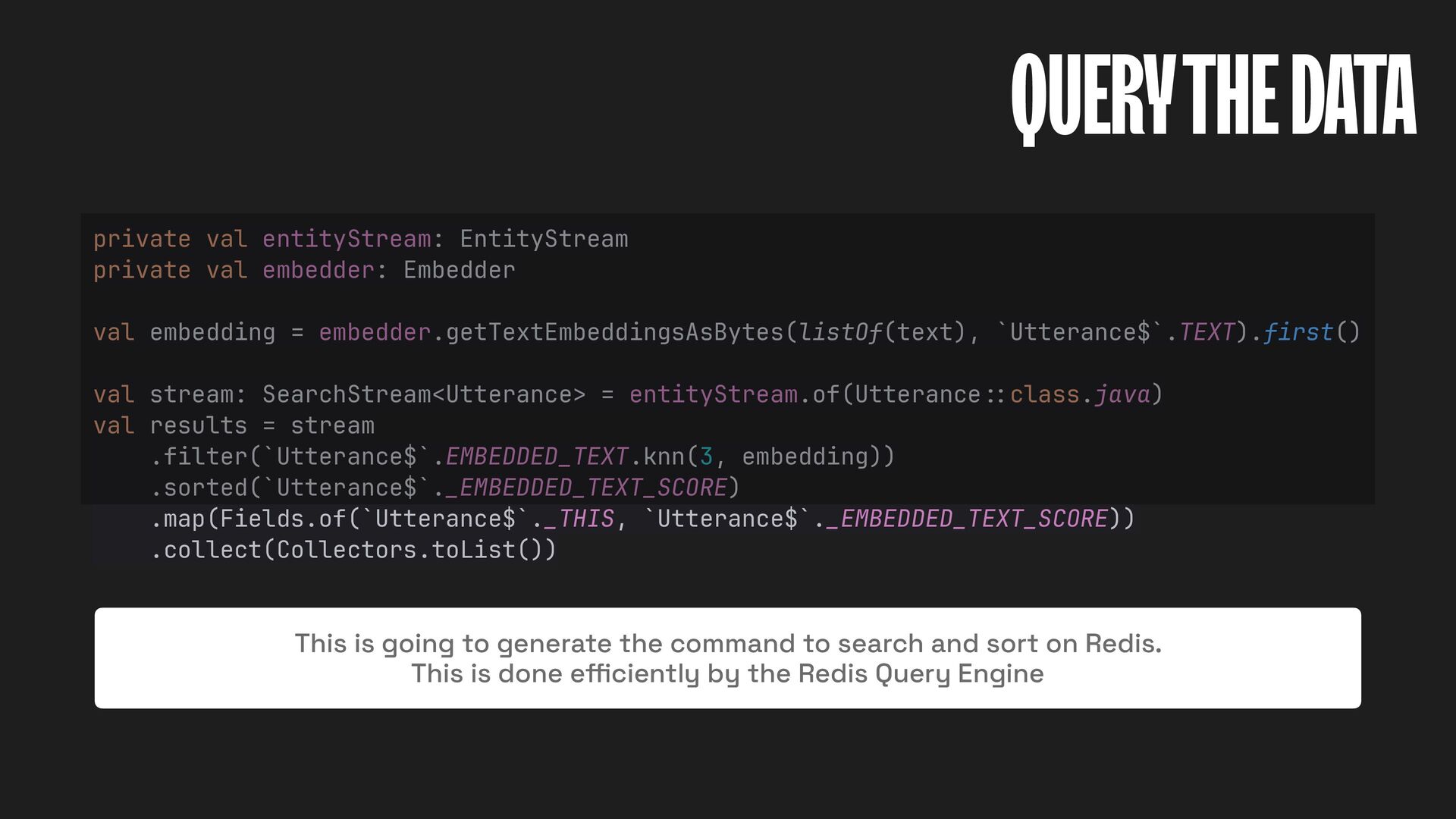
QUERY THE DATA This is going to generate the command
to search and sort on Redis. This is done e ff i ciently by the Redis Query Engine private val entityStream: EntityStream private val embedder: Embedder val embedding = embedder.getTextEmbeddingsAsBytes(listOf(text), `Utterance$`.TEXT).first() val stream: SearchStream<Utterance> = entityStream.of(Utterance : : class.java) val results = stream .filter(`Utterance$`.EMBEDDED_TEXT.knn(3, embedding)) .sorted(`Utterance$`._EMBEDDED_TEXT_SCORE) .map(Fields.of(`Utterance$`._THIS, `Utterance$`._EMBEDDED_TEXT_SCORE)) .collect(Collectors.toList()) -
private val entityStream: EntityStream private val embedder: Embedder val embedding
= embedder.getTextEmbeddingsAsBytes(listOf(text), `Utterance$`.TEXT).first() val stream: SearchStream<Utterance> = entityStream.of(Utterance : : class.java) val results = stream .filter(`Utterance$`.EMBEDDED_TEXT.knn(3, embedding)) .sorted(`Utterance$`._EMBEDDED_TEXT_SCORE) .map(Fields.of(`Utterance$`._THIS, `Utterance$`._EMBEDDED_TEXT_SCORE)) .collect(Collectors.toList()) QUERY THE DATA This is going to generate the command to search and sort on Redis. This is done e ff i ciently by the Redis Query Engine Provided by Redis OM Spring -
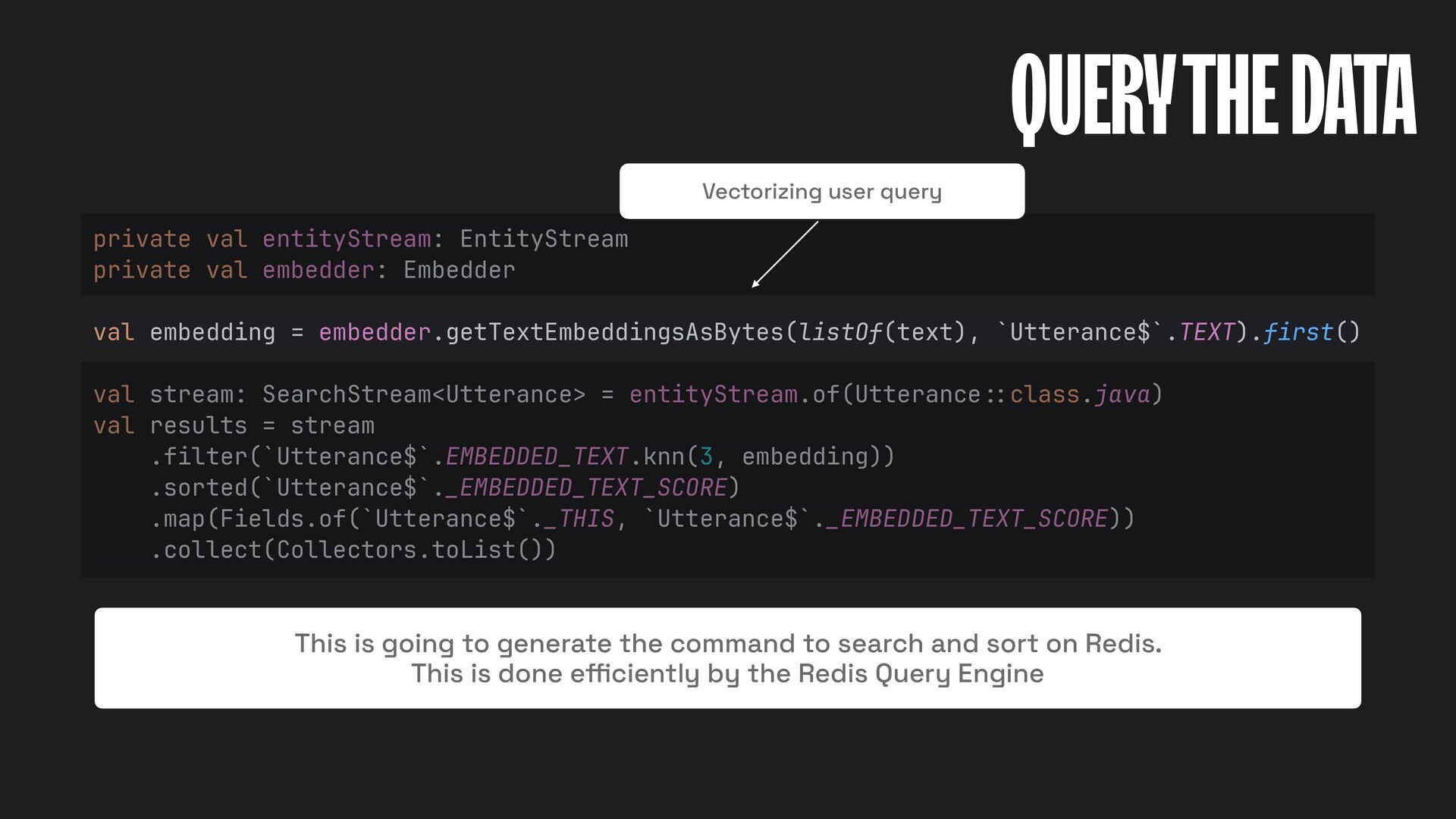
private val entityStream: EntityStream private val embedder: Embedder val embedding
= embedder.getTextEmbeddingsAsBytes(listOf(text), `Utterance$`.TEXT).first() val stream: SearchStream<Utterance> = entityStream.of(Utterance : : class.java) val results = stream .filter(`Utterance$`.EMBEDDED_TEXT.knn(3, embedding)) .sorted(`Utterance$`._EMBEDDED_TEXT_SCORE) .map(Fields.of(`Utterance$`._THIS, `Utterance$`._EMBEDDED_TEXT_SCORE)) .collect(Collectors.toList()) QUERY THE DATA This is going to generate the command to search and sort on Redis. This is done e ff i ciently by the Redis Query Engine Vectorizing user query -
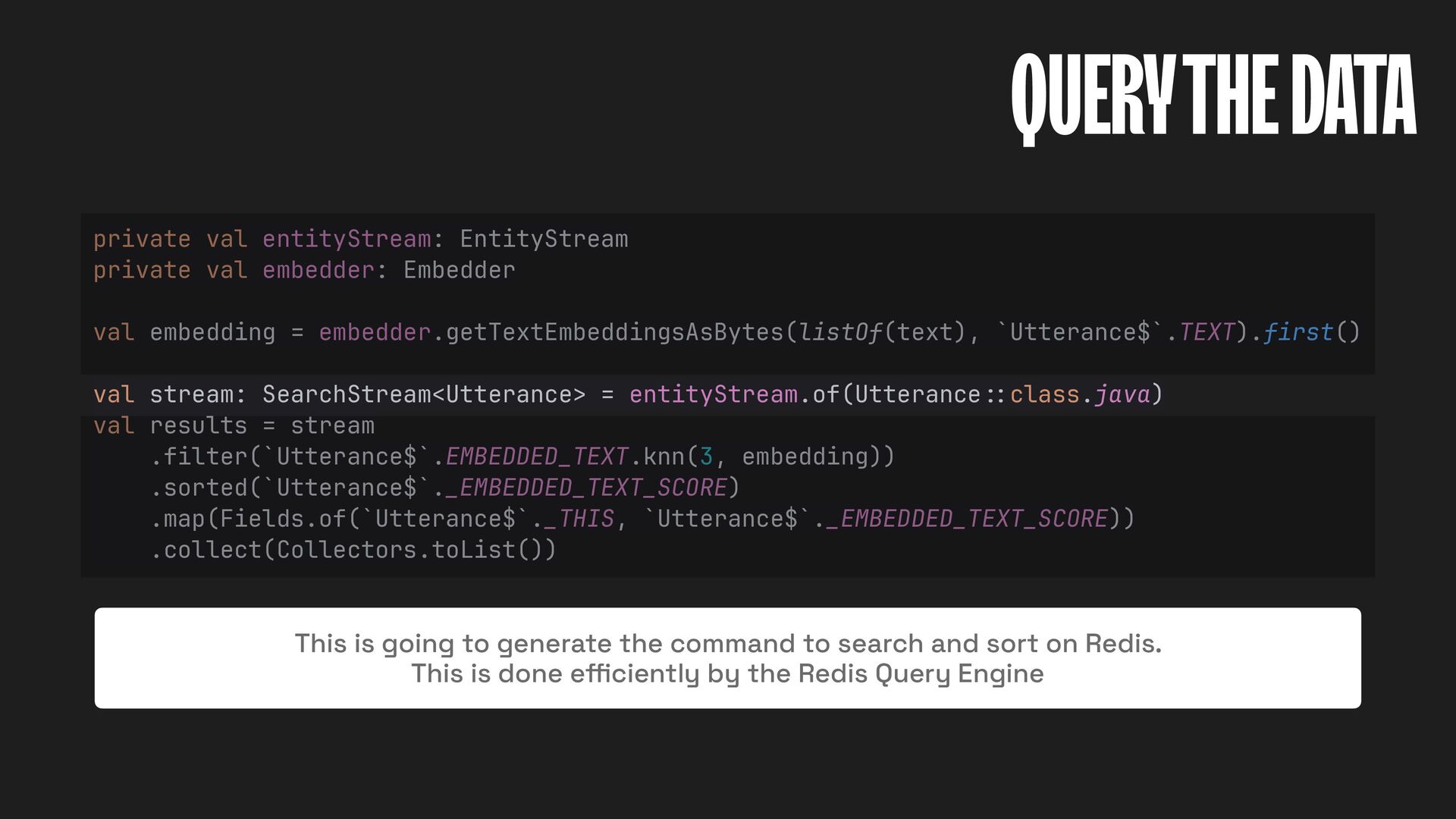
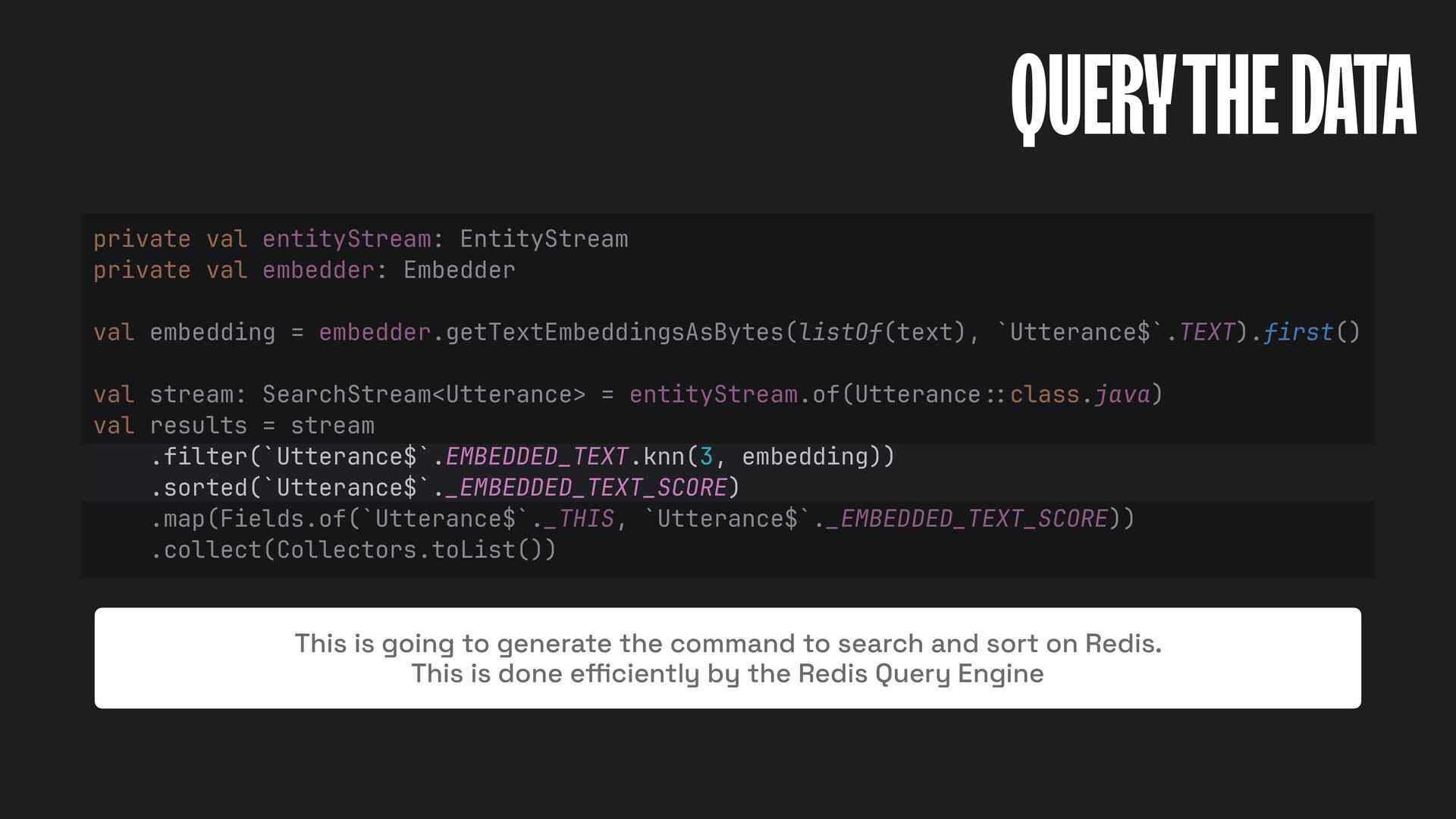
private val entityStream: EntityStream private val embedder: Embedder val embedding
= embedder.getTextEmbeddingsAsBytes(listOf(text), `Utterance$`.TEXT).first() val stream: SearchStream<Utterance> = entityStream.of(Utterance : : class.java) val results = stream .filter(`Utterance$`.EMBEDDED_TEXT.knn(3, embedding)) .sorted(`Utterance$`._EMBEDDED_TEXT_SCORE) .map(Fields.of(`Utterance$`._THIS, `Utterance$`._EMBEDDED_TEXT_SCORE)) .collect(Collectors.toList()) QUERY THE DATA This is going to generate the command to search and sort on Redis. This is done e ff i ciently by the Redis Query Engine -
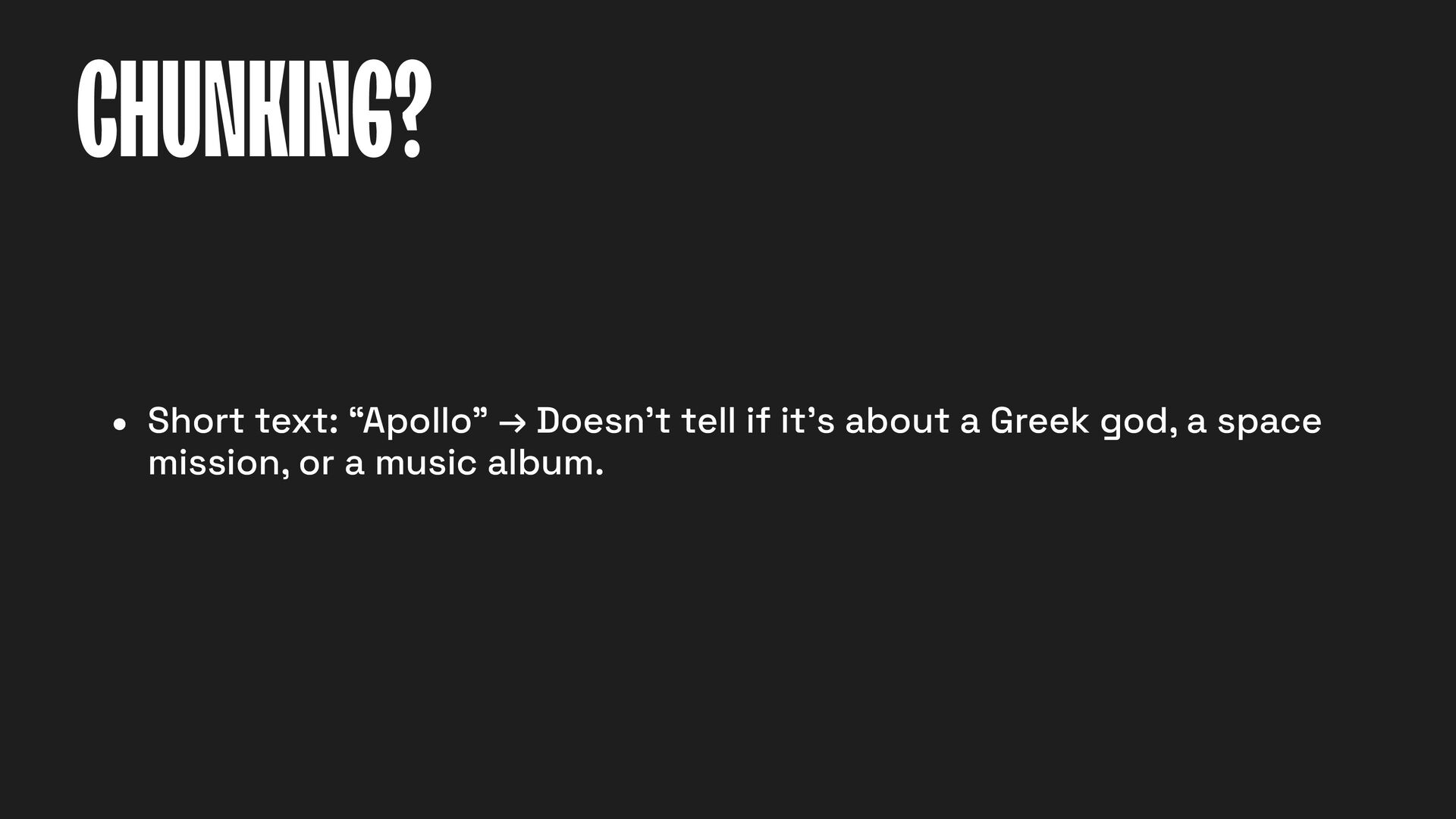
• Short text: “Apollo” → Doesn’t tell if it’s about
a Greek god, a space mission, or a music album. CHUNKING? -
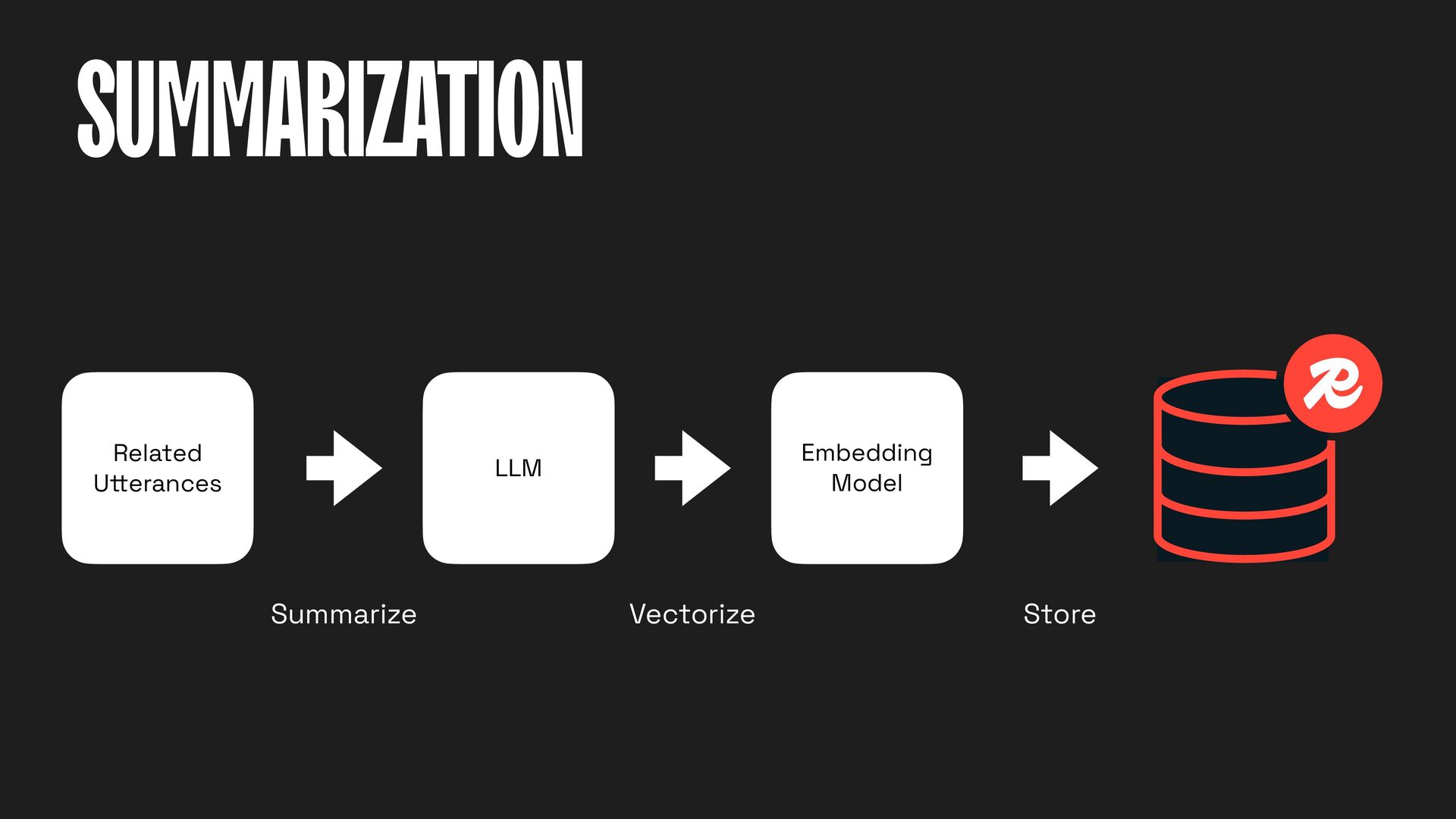
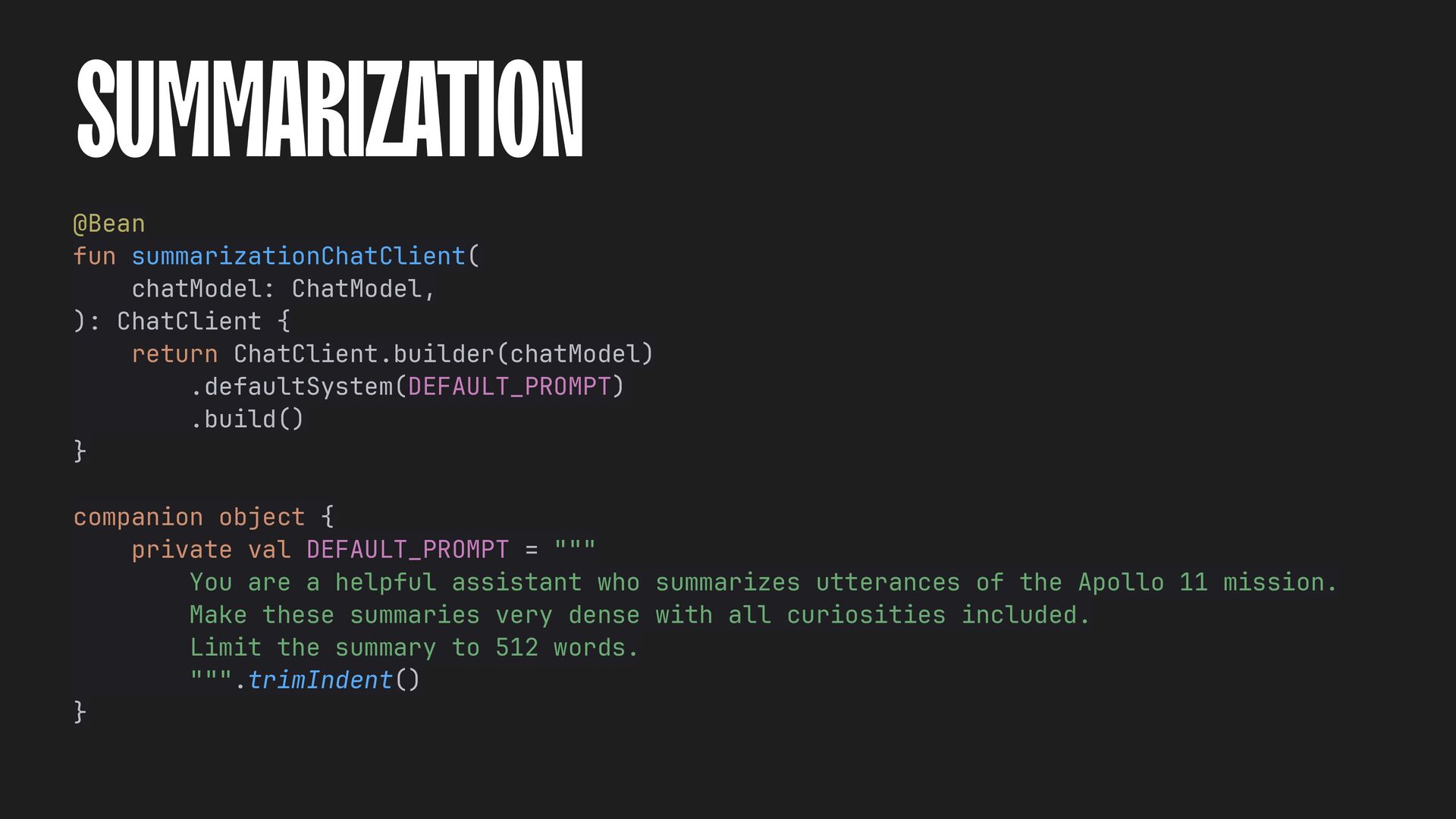
SUMMARIZATION @Bean fun summarizationChatClient( chatModel: ChatModel, ): ChatClient { return
ChatClient.builder(chatModel) .defaultSystem(DEFAULT_PROMPT) .build() } companion object { private val DEFAULT_PROMPT = """ You are a helpful assistant who summarizes utterances of the Apollo 11 mission. Make these summaries very dense with all curiosities included. Limit the summary to 512 words. """.trimIndent() } -
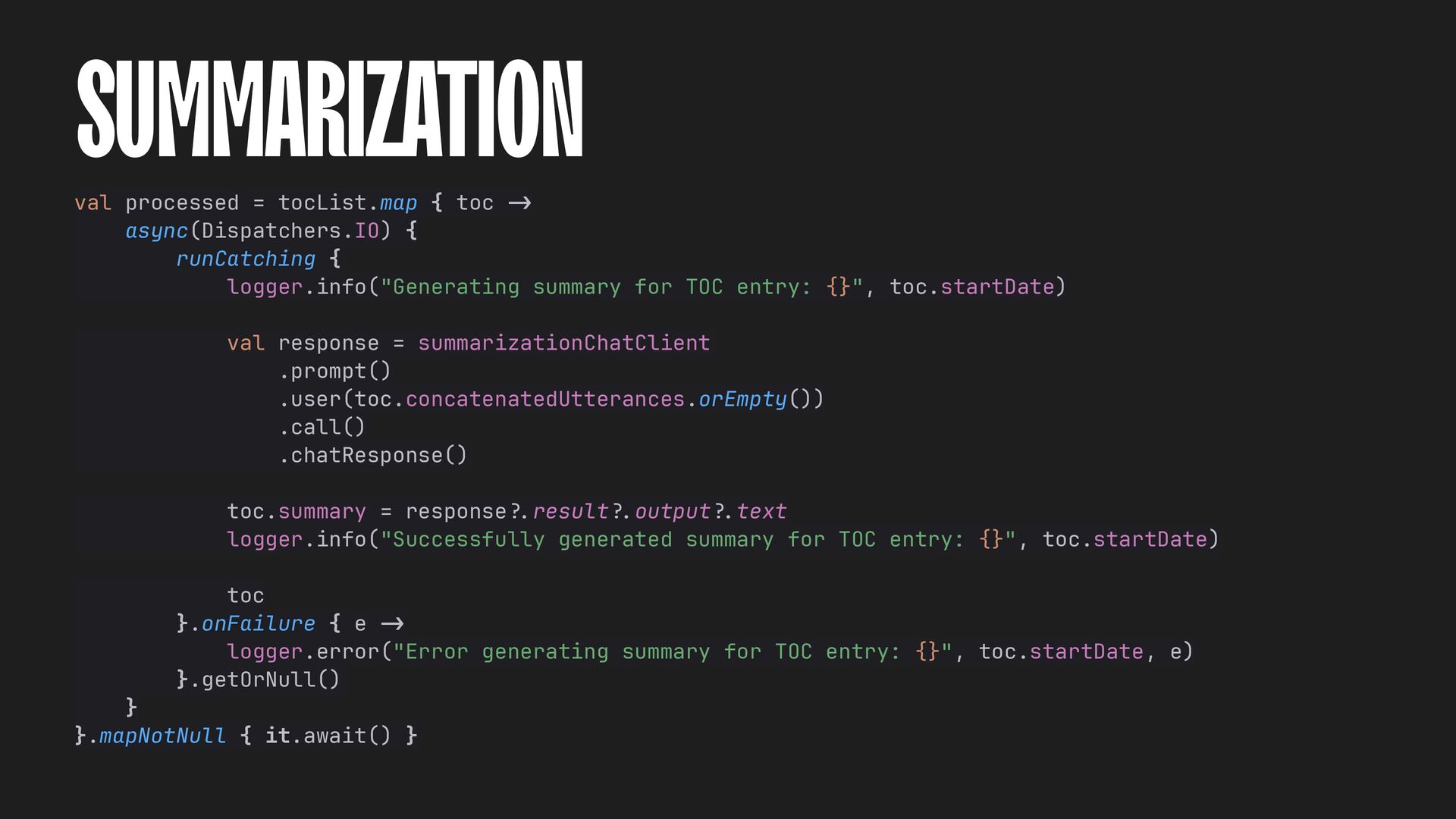
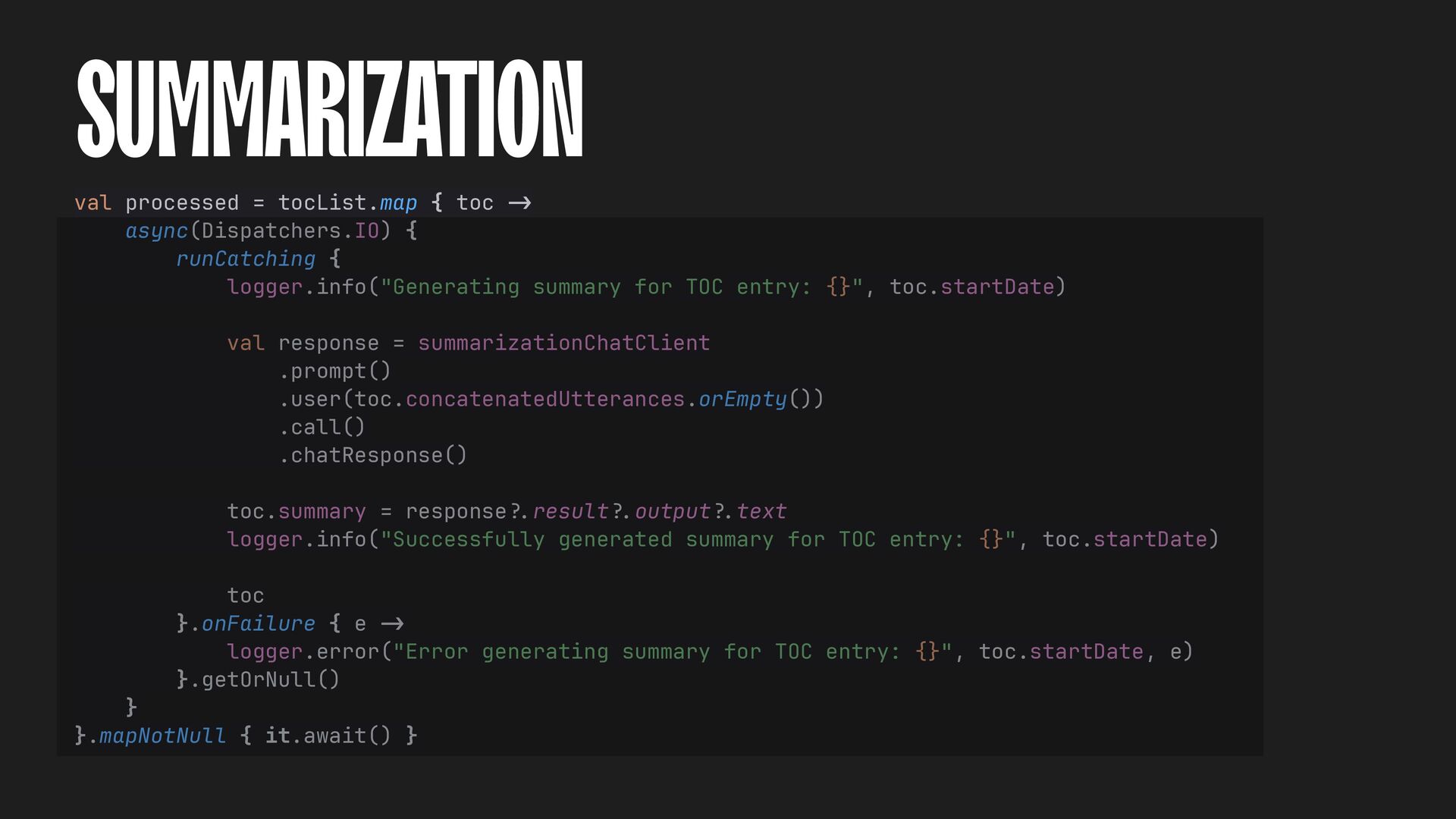
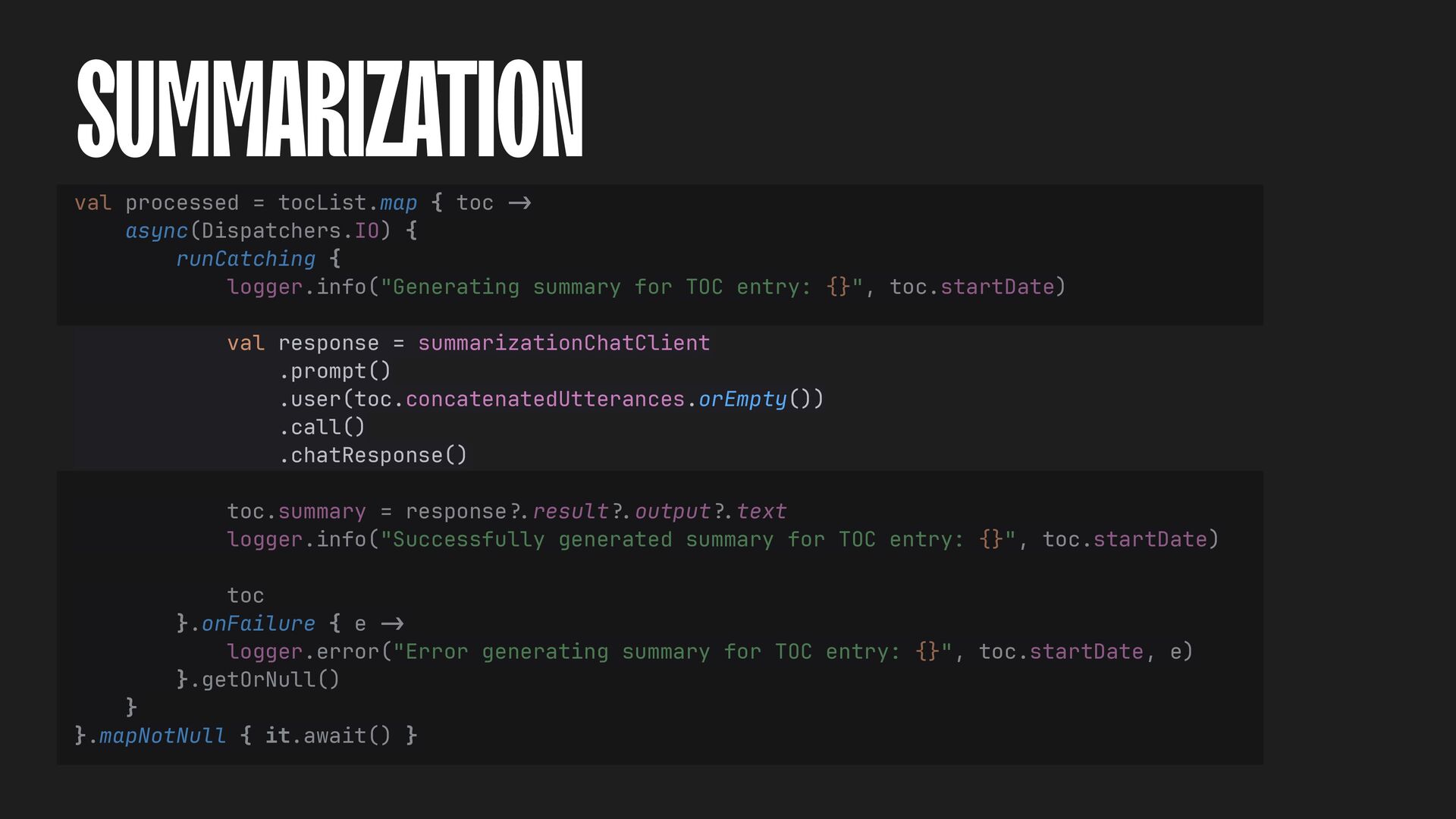
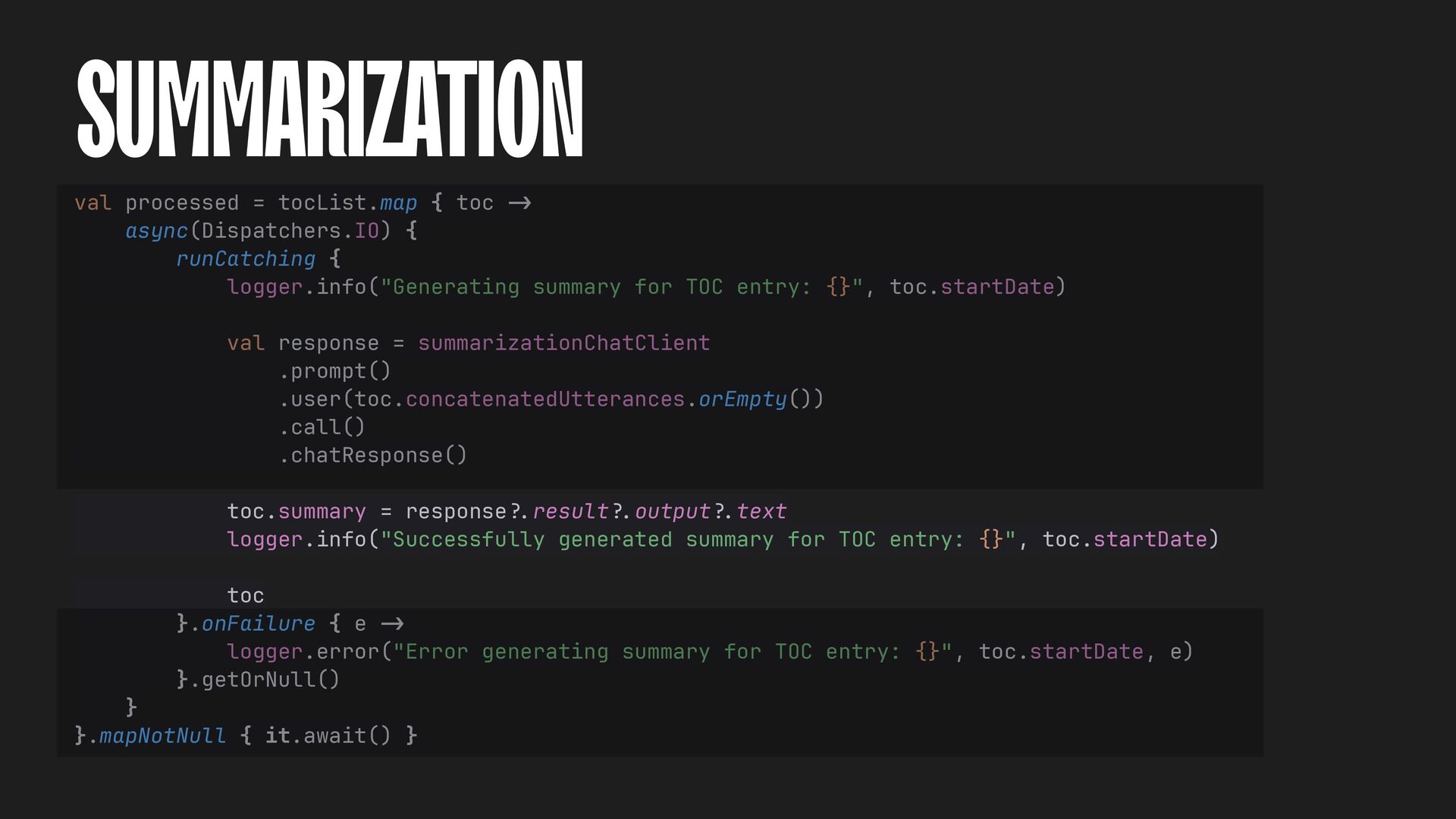
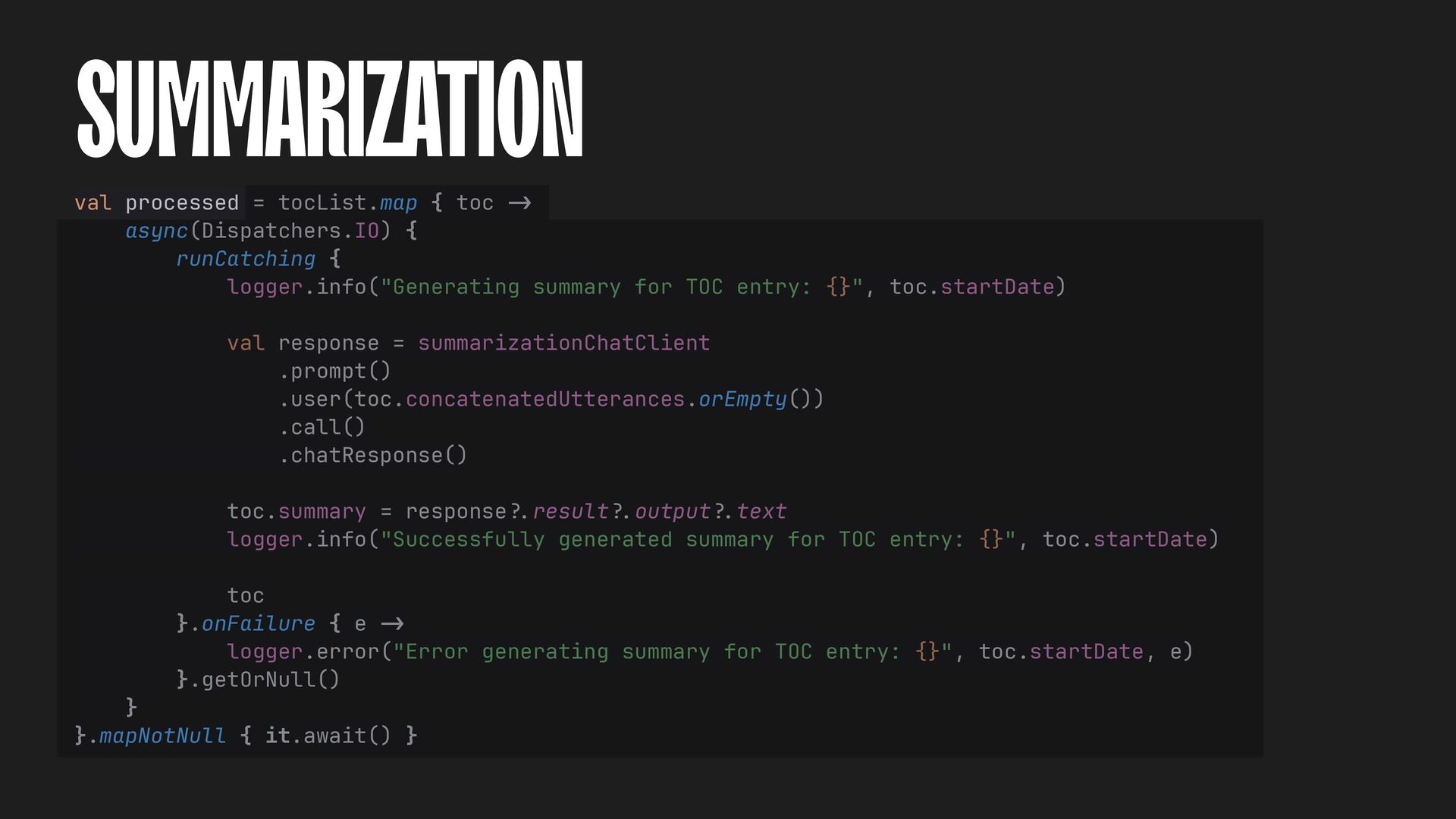
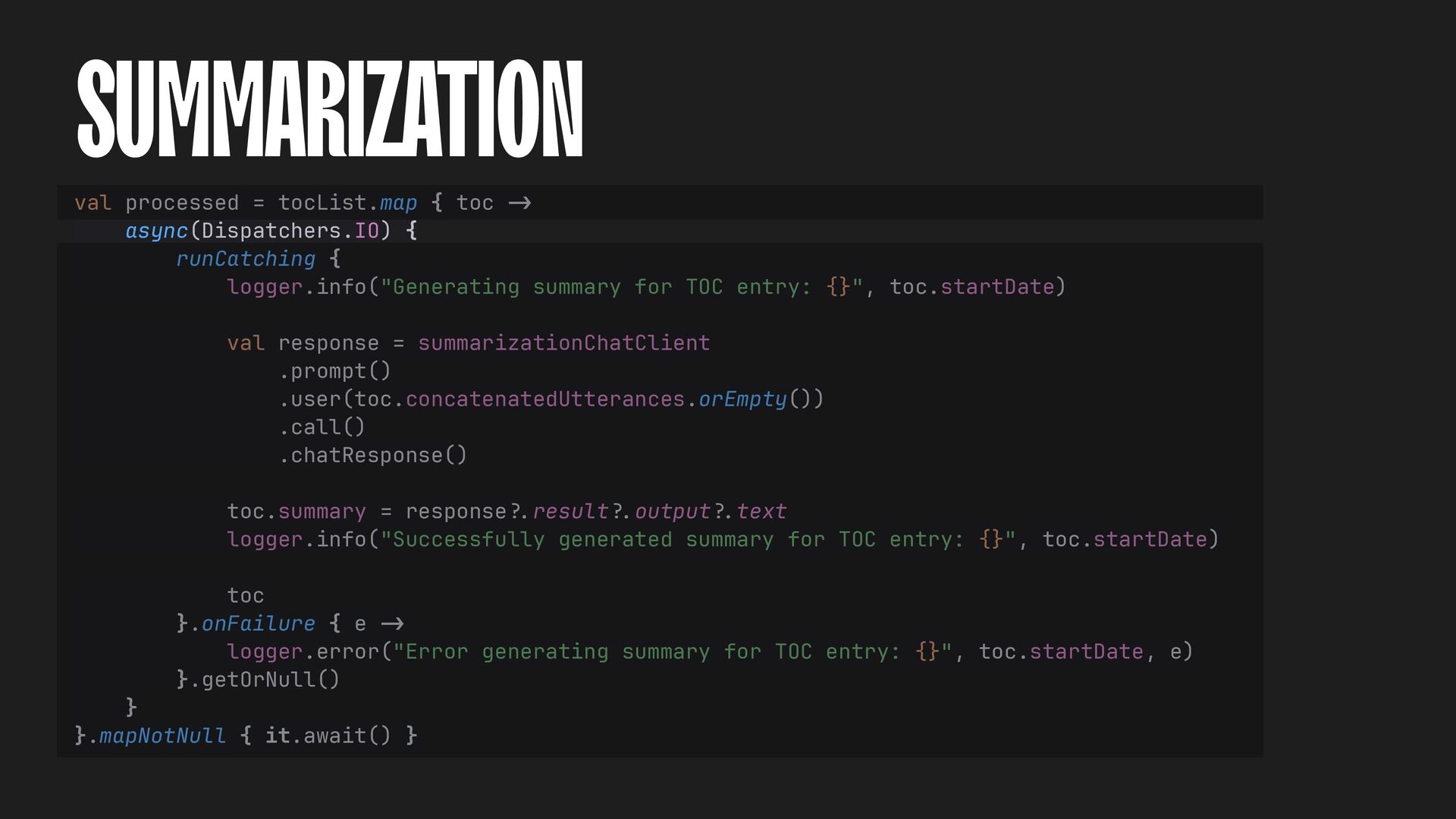
SUMMARIZATION val processed = tocList.map { toc -> async(Dispatchers.IO) {
runCatching { logger.info("Generating summary for TOC entry: {}", toc.startDate) val response = summarizationChatClient .prompt() .user(toc.concatenatedUtterances.orEmpty()) .call() .chatResponse() toc.summary = response ?. result ?. output ?. text logger.info("Successfully generated summary for TOC entry: {}", toc.startDate) toc }.onFailure { e -> logger.error("Error generating summary for TOC entry: {}", toc.startDate, e) }.getOrNull() } }.mapNotNull { it.await() } -
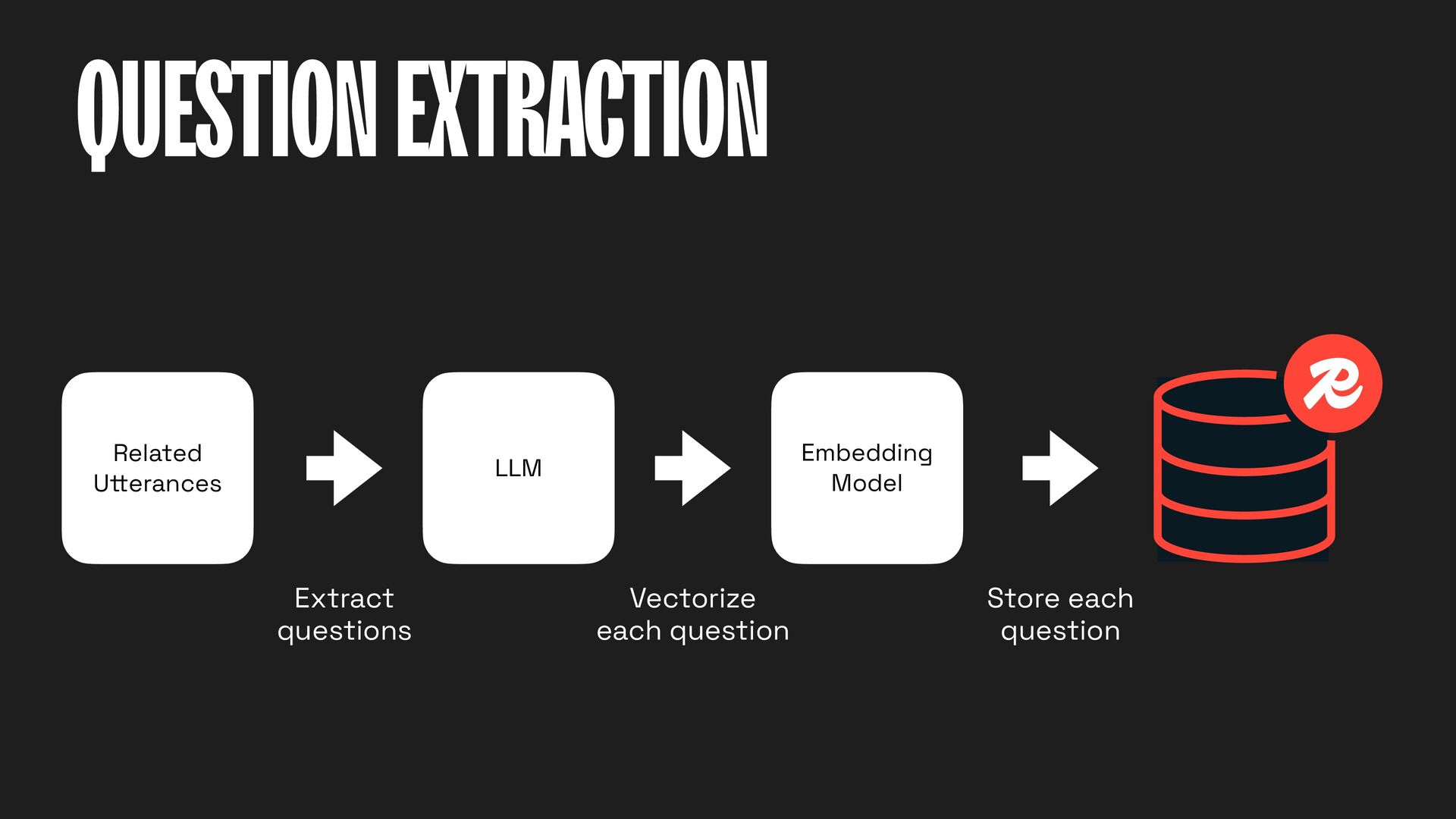
QUESTION EXTRACTION Related U tt erances LLM Embedding Model Extract
questions Vectorize each question Store each question -
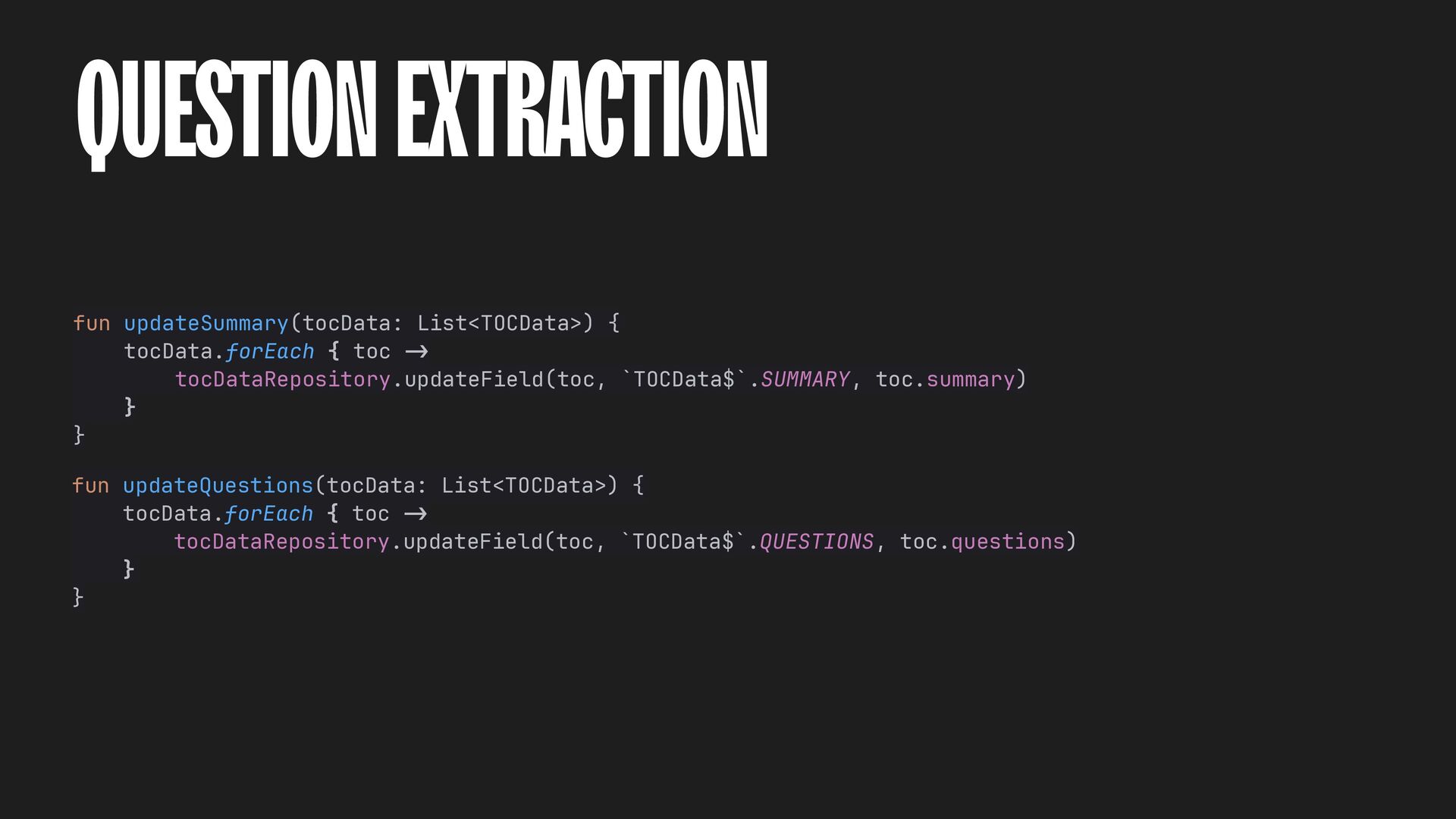
QUESTION EXTRACTION fun updateSummary(tocData: List<TOCData>) { tocData.forEach { toc ->
tocDataRepository.updateField(toc, `TOCData$`.SUMMARY, toc.summary) } } fun updateQuestions(tocData: List<TOCData>) { tocData.forEach { toc -> tocDataRepository.updateField(toc, `TOCData$`.QUESTIONS, toc.questions) } } -
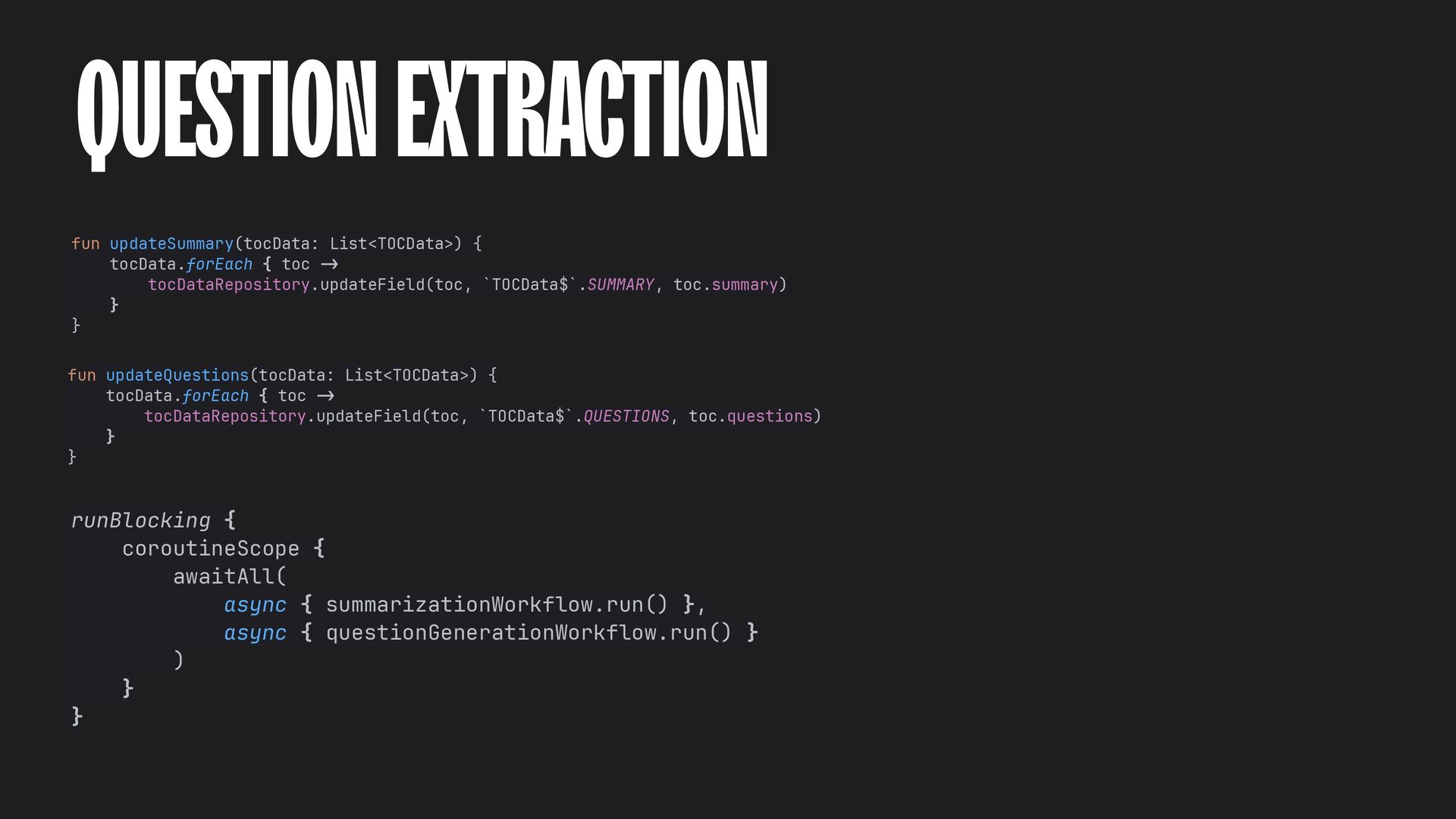
QUESTION EXTRACTION fun updateSummary(tocData: List<TOCData>) { tocData.forEach { toc -
> tocDataRepository.updateField(toc, `TOCData$`.SUMMARY, toc.summary) } } fun updateQuestions(tocData: List<TOCData>) { tocData.forEach { toc - > tocDataRepository.updateField(toc, `TOCData$`.QUESTIONS, toc.questions) } } runBlocking { coroutineScope { awaitAll( async { summarizationWorkflow.run() }, async { questionGenerationWorkflow.run() } ) } } -
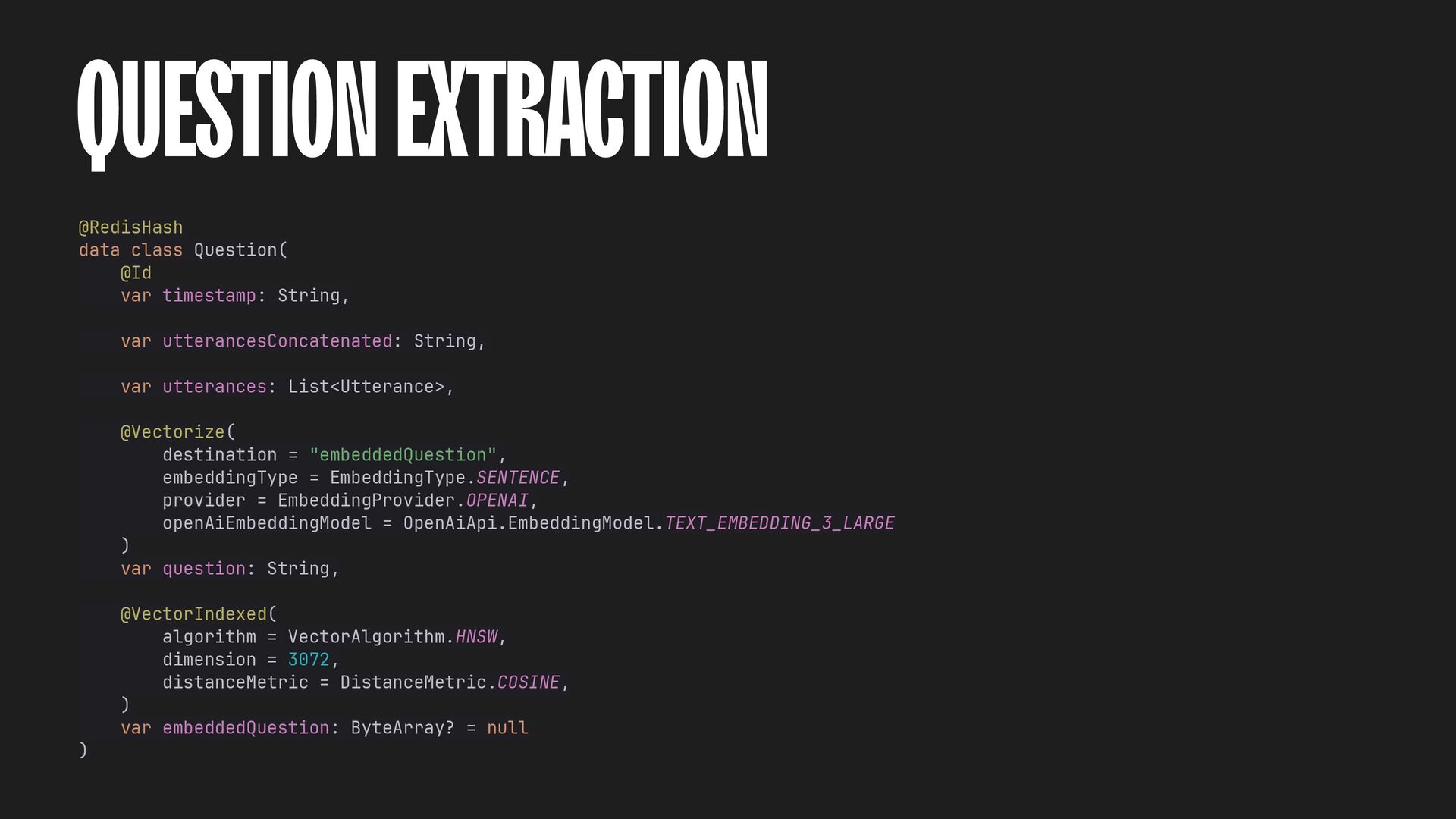
QUESTION EXTRACTION @RedisHash data class Question( @Id var timestamp: String,
var utterancesConcatenated: String, var utterances: List<Utterance>, @Vectorize( destination = "embeddedQuestion", embeddingType = EmbeddingType.SENTENCE, provider = EmbeddingProvider.OPENAI, openAiEmbeddingModel = OpenAiApi.EmbeddingModel.TEXT_EMBEDDING_3_LARGE ) var question: String, @VectorIndexed( algorithm = VectorAlgorithm.HNSW, dimension = 3072, distanceMetric = DistanceMetric.COSINE, ) var embeddedQuestion: ByteArray? = null ) -
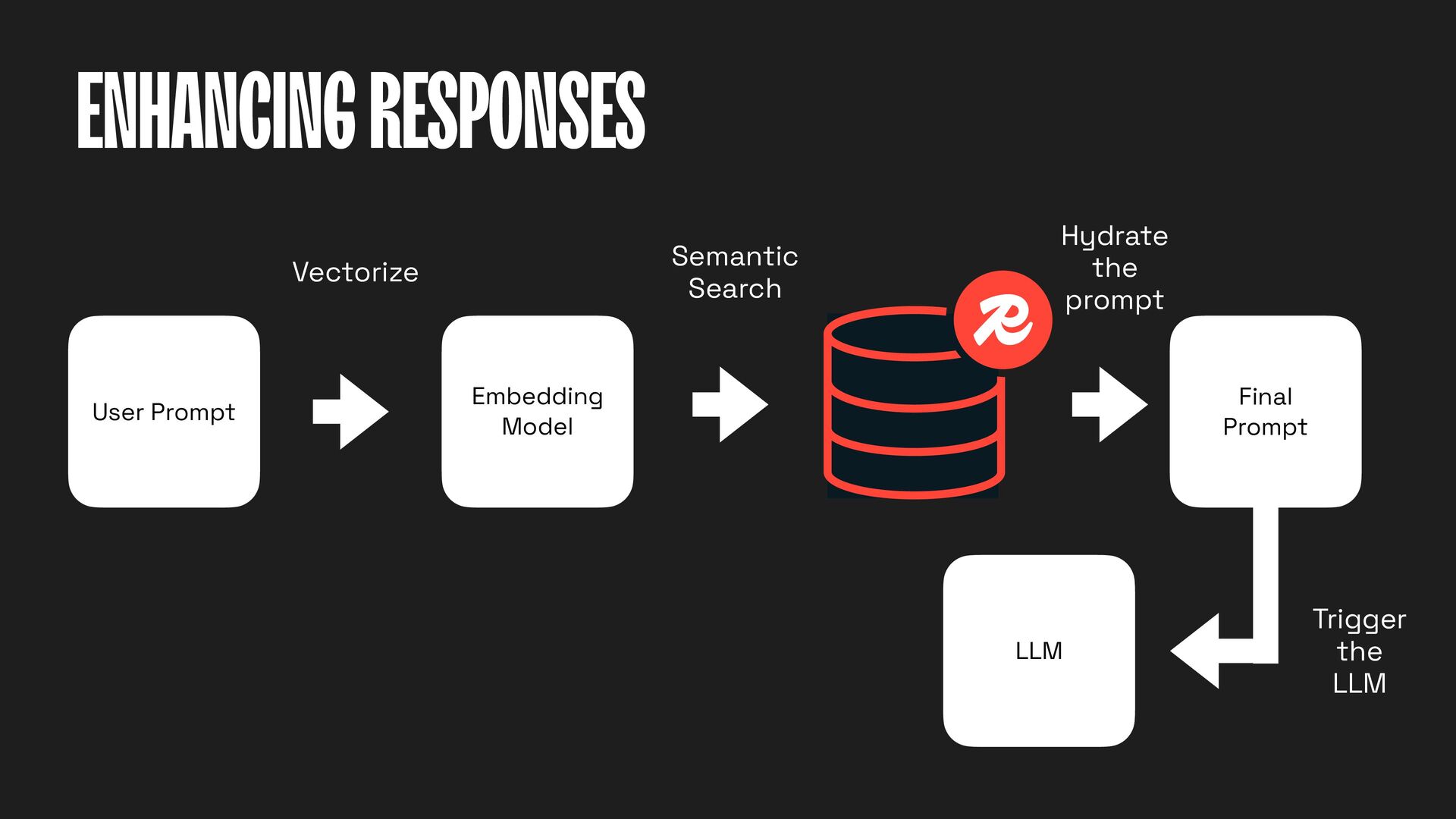
ENHANCING RESPONSES User Prompt LLM Embedding Model Vectorize Hydrate the
prompt Semantic Search Final Prompt Trigger the LLM -
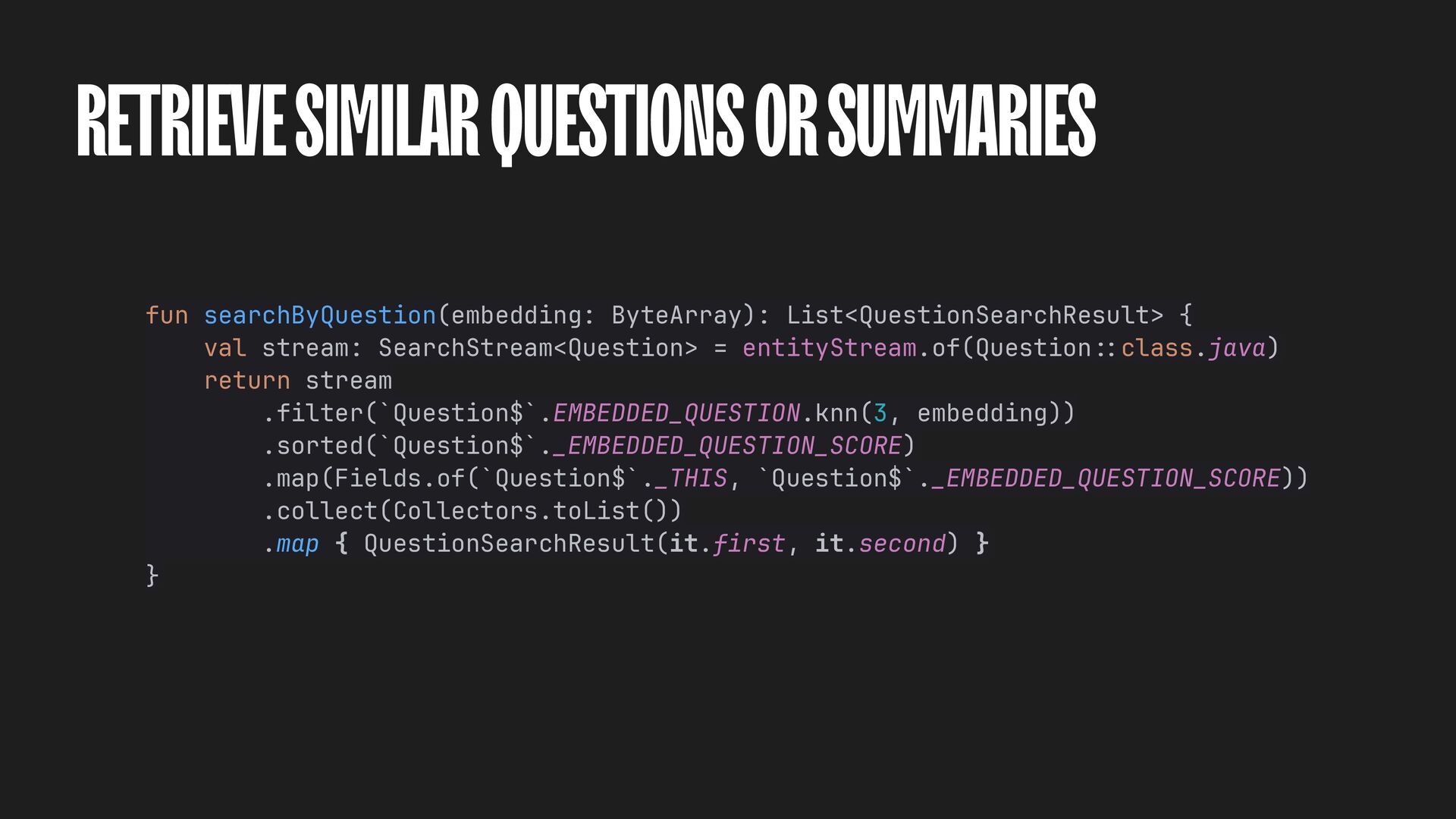
fun searchByQuestion(embedding: ByteArray): List<QuestionSearchResult> { val stream: SearchStream<Question> = entityStream.of(Question
:: class.java) return stream .filter(`Question$`.EMBEDDED_QUESTION.knn(3, embedding)) .sorted(`Question$`._EMBEDDED_QUESTION_SCORE) .map(Fields.of(`Question$`._THIS, `Question$`._EMBEDDED_QUESTION_SCORE)) .collect(Collectors.toList()) .map { QuestionSearchResult(it.first, it.second) } } RETRIEVE SIMILAR QUESTIONS OR SUMMARIES -
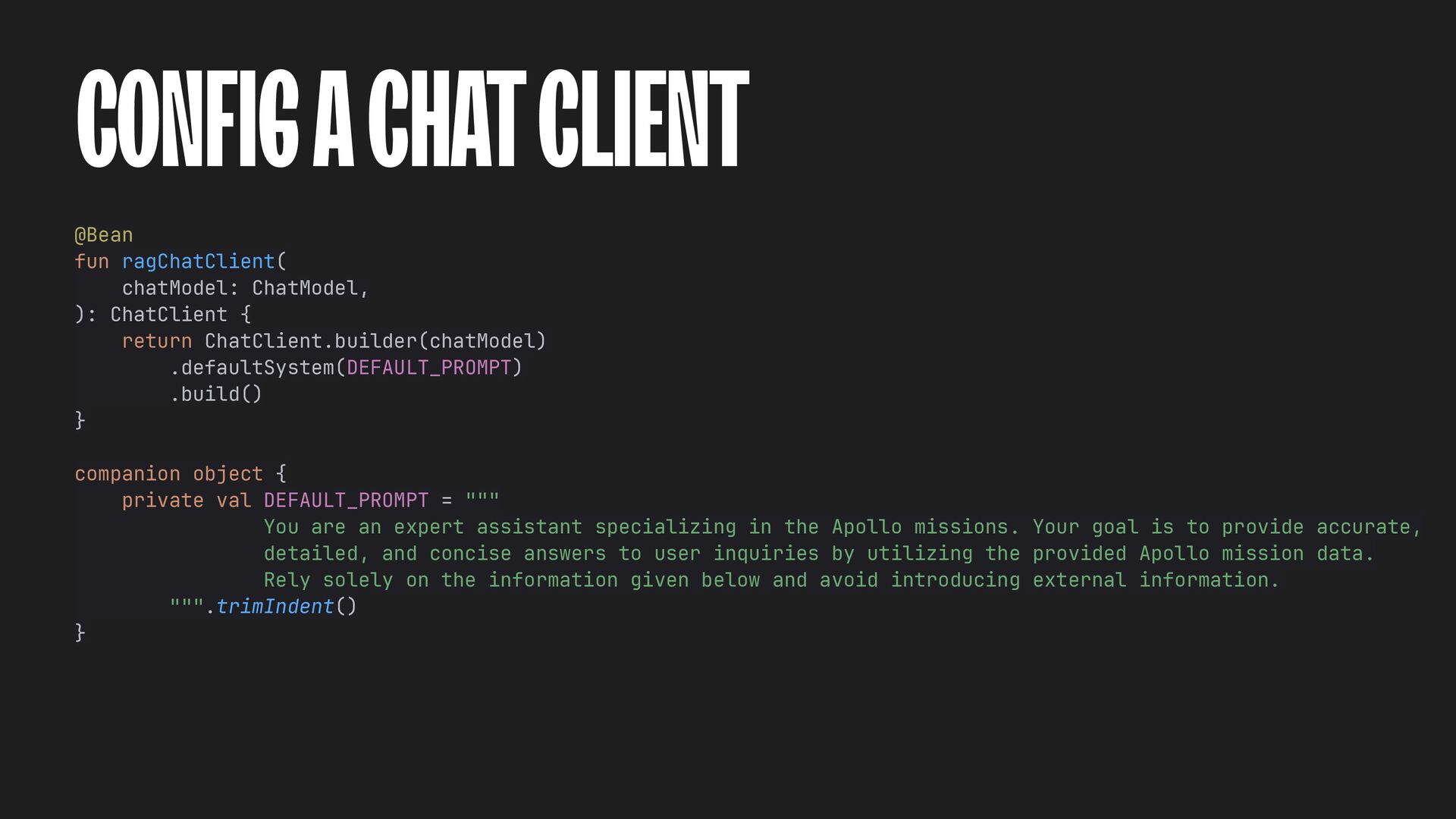
@Bean fun ragChatClient( chatModel: ChatModel, ): ChatClient { return ChatClient.builder(chatModel)
.defaultSystem(DEFAULT_PROMPT) .build() } companion object { private val DEFAULT_PROMPT = """ You are an expert assistant specializing in the Apollo missions. Your goal is to provide accurate, detailed, and concise answers to user inquiries by utilizing the provided Apollo mission data. Rely solely on the information given below and avoid introducing external information. """.trimIndent() } CONFIG A CHAT CLIENT -
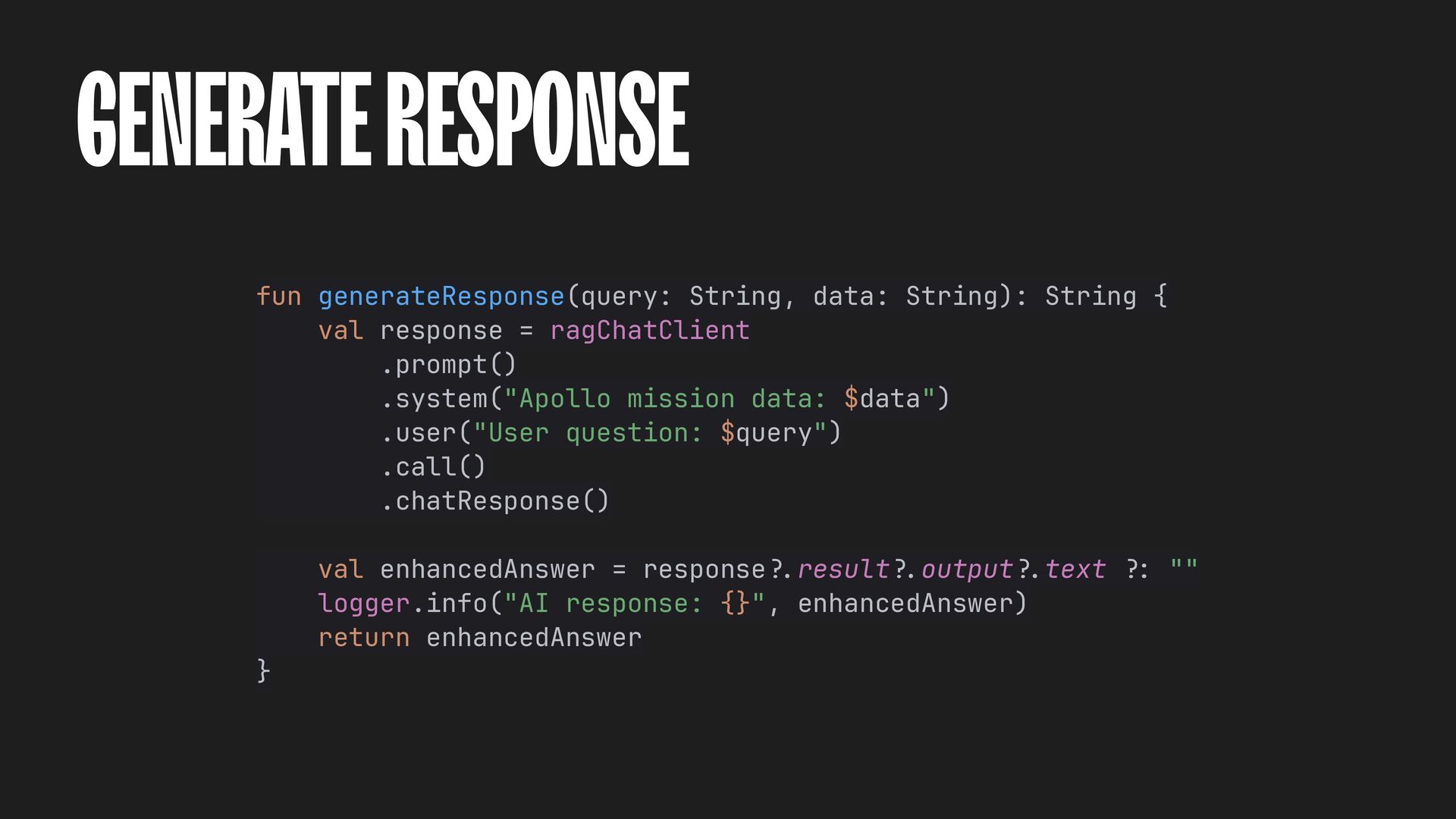
fun generateResponse(query: String, data: String): String { val response =
ragChatClient .prompt() .system("Apollo mission data: $data") .user("User question: $query") .call() .chatResponse() val enhancedAnswer = response ?. result ?. output ?. text ? : "" logger.info("AI response: {}", enhancedAnswer) return enhancedAnswer } GENERATE RESPONSE -
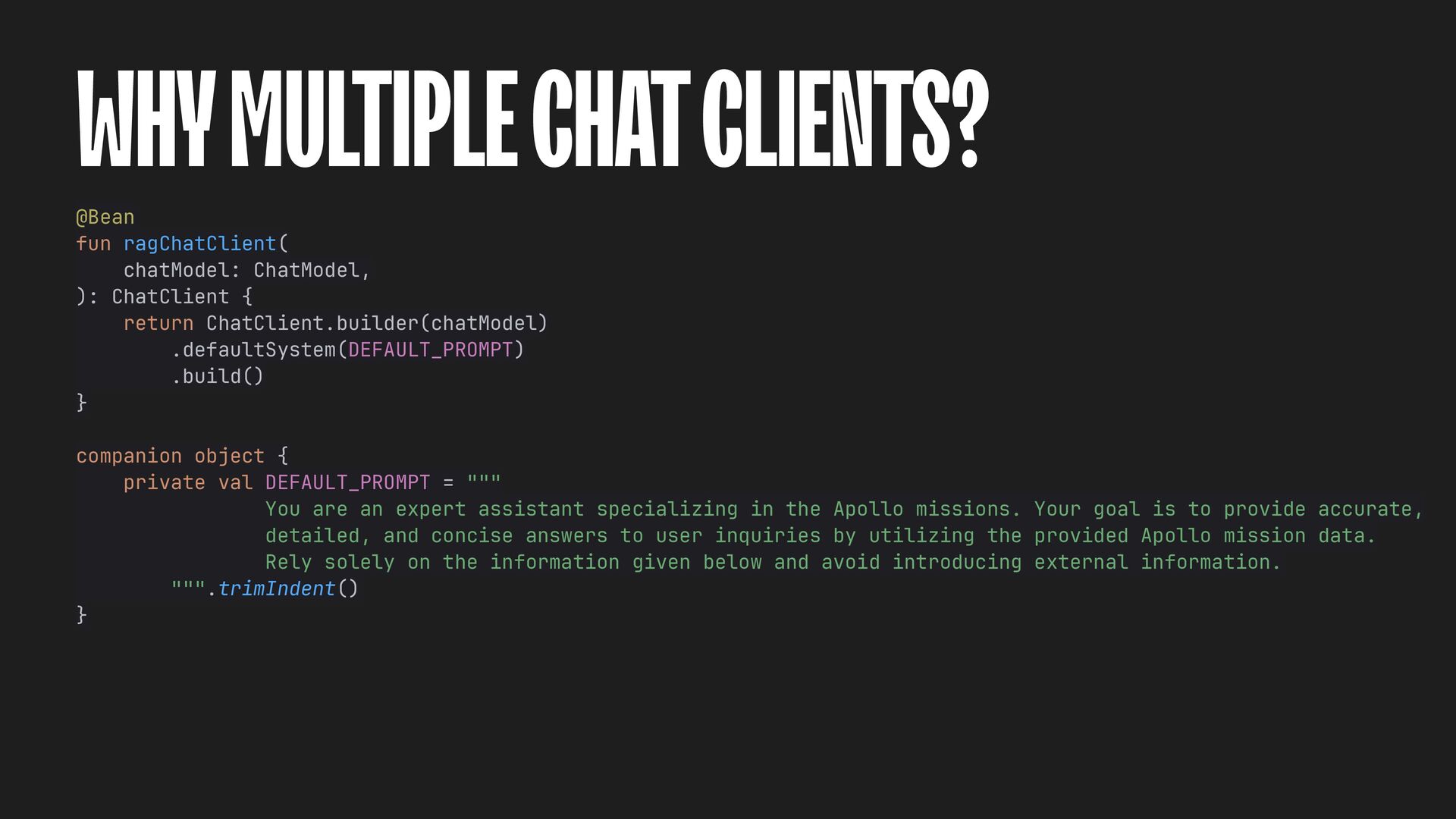
@Bean fun ragChatClient( chatModel: ChatModel, ): ChatClient { return ChatClient.builder(chatModel)
.defaultSystem(DEFAULT_PROMPT) .build() } companion object { private val DEFAULT_PROMPT = """ You are an expert assistant specializing in the Apollo missions. Your goal is to provide accurate, detailed, and concise answers to user inquiries by utilizing the provided Apollo mission data. Rely solely on the information given below and avoid introducing external information. """.trimIndent() } WHY MULTIPLE CHAT CLIENTS? -
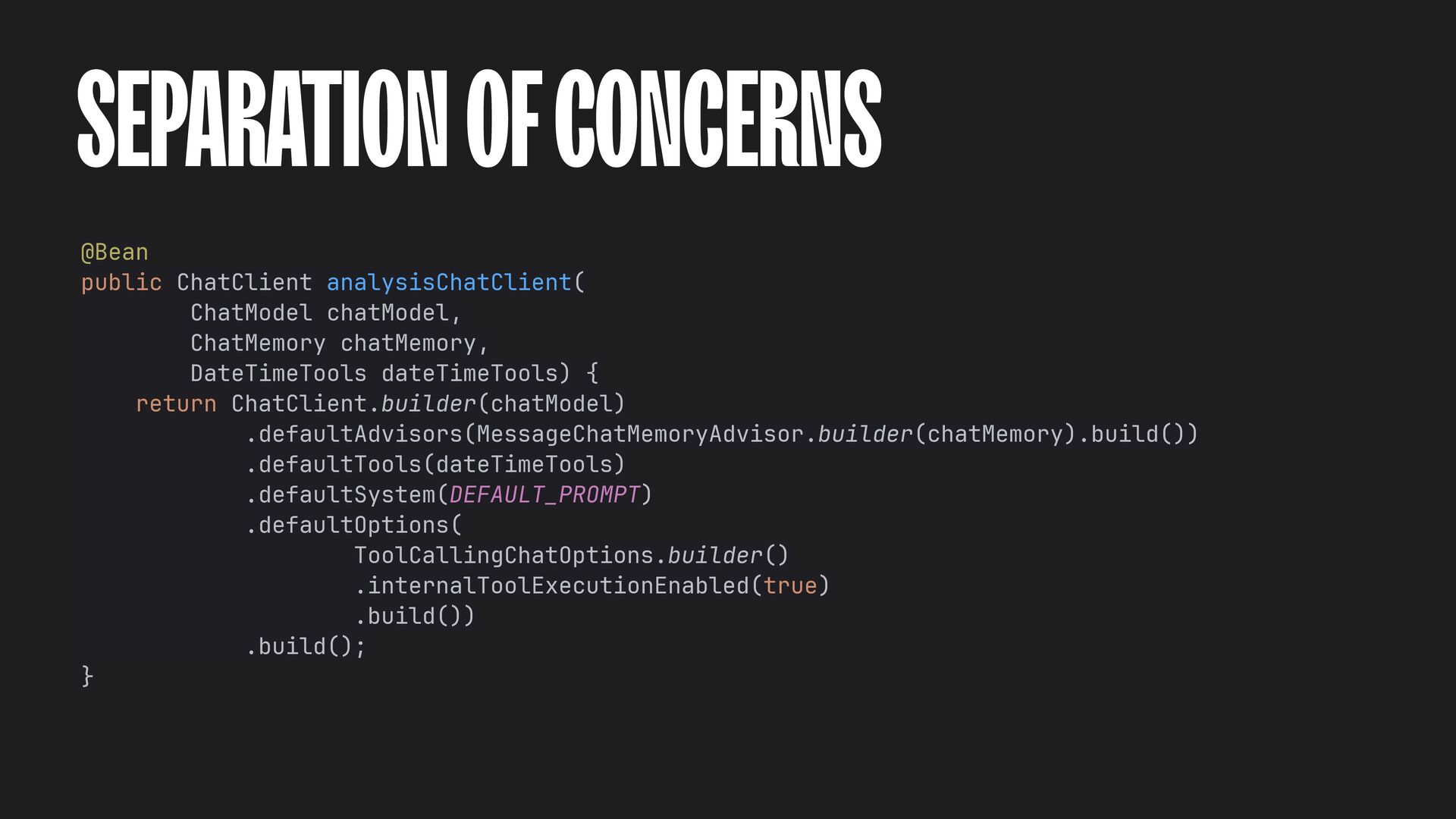
@Bean public ChatClient analysisChatClient( ChatModel chatModel, ChatMemory chatMemory, DateTimeTools dateTimeTools)
{ return ChatClient.builder(chatModel) .defaultAdvisors(MessageChatMemoryAdvisor.builder(chatMemory).build()) .defaultTools(dateTimeTools) .defaultSystem(DEFAULT_PROMPT) .defaultOptions( ToolCallingChatOptions.builder() .internalToolExecutionEnabled(true) .build()) .build(); } SEPARATION OF CONCERNS -
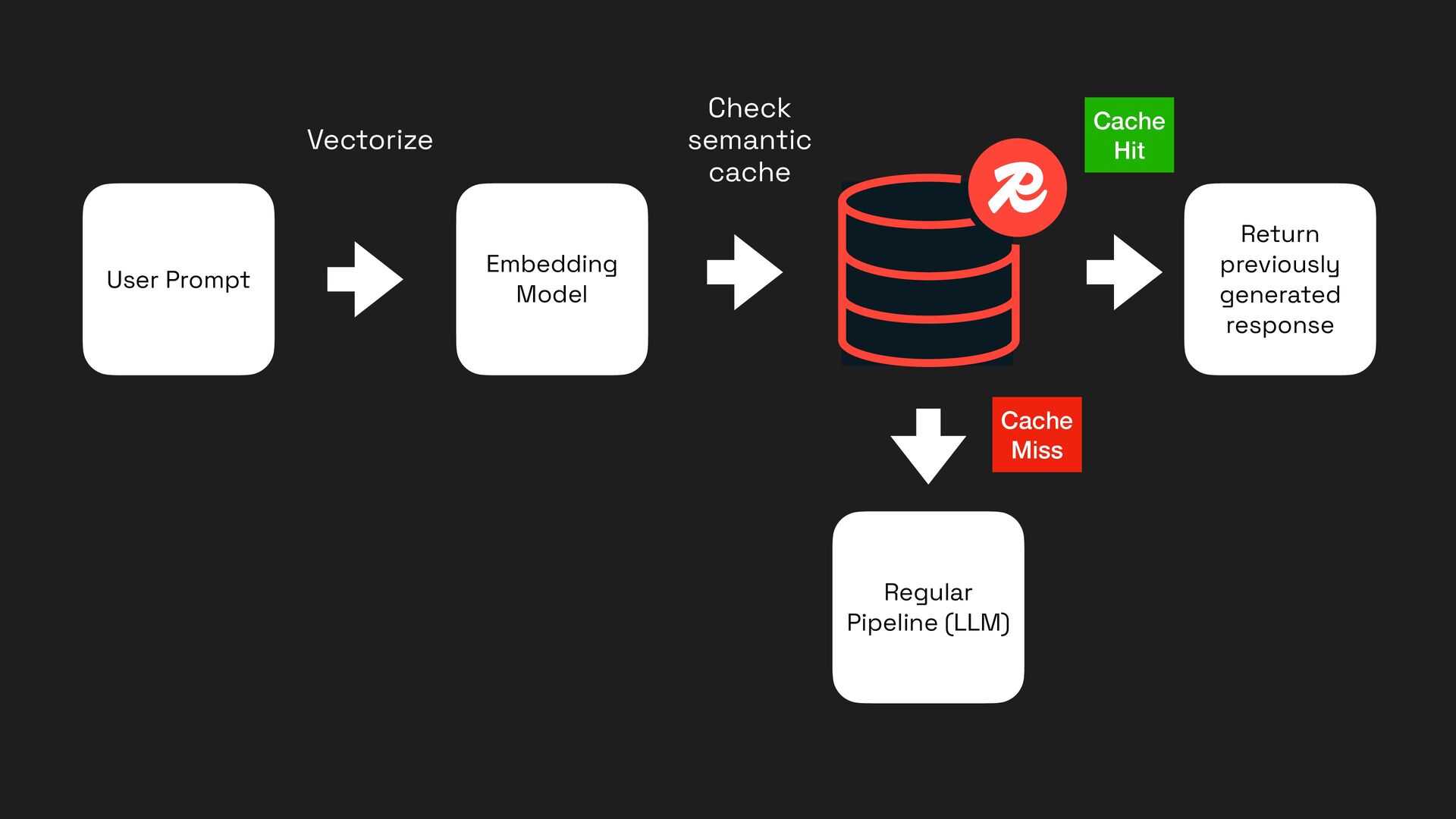
User Prompt Regular Pipeline (LLM) Embedding Model Vectorize Cache Hit
Check semantic cache Return previously generated response Cache Miss -
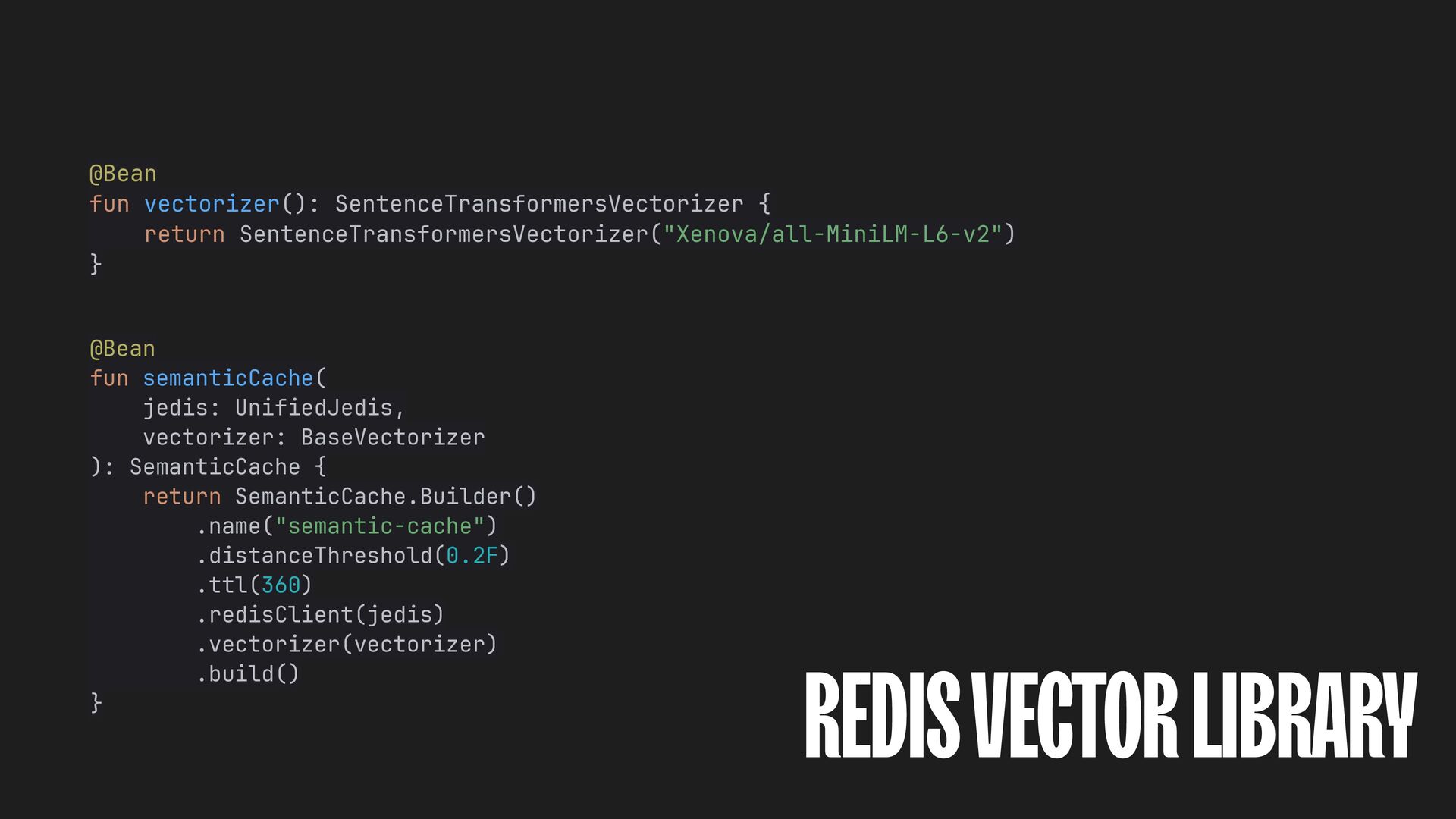
@Bean fun vectorizer(): SentenceTransformersVectorizer { return SentenceTransformersVectorizer("Xenova/all-MiniLM-L6-v2") } @Bean fun
semanticCache( jedis: UnifiedJedis, vectorizer: BaseVectorizer ): SemanticCache { return SemanticCache.Builder() .name("semantic-cache") .distanceThreshold(0.2F) .ttl(360) .redisClient(jedis) .vectorizer(vectorizer) .build() } REDIS VECTOR LIBRARY -
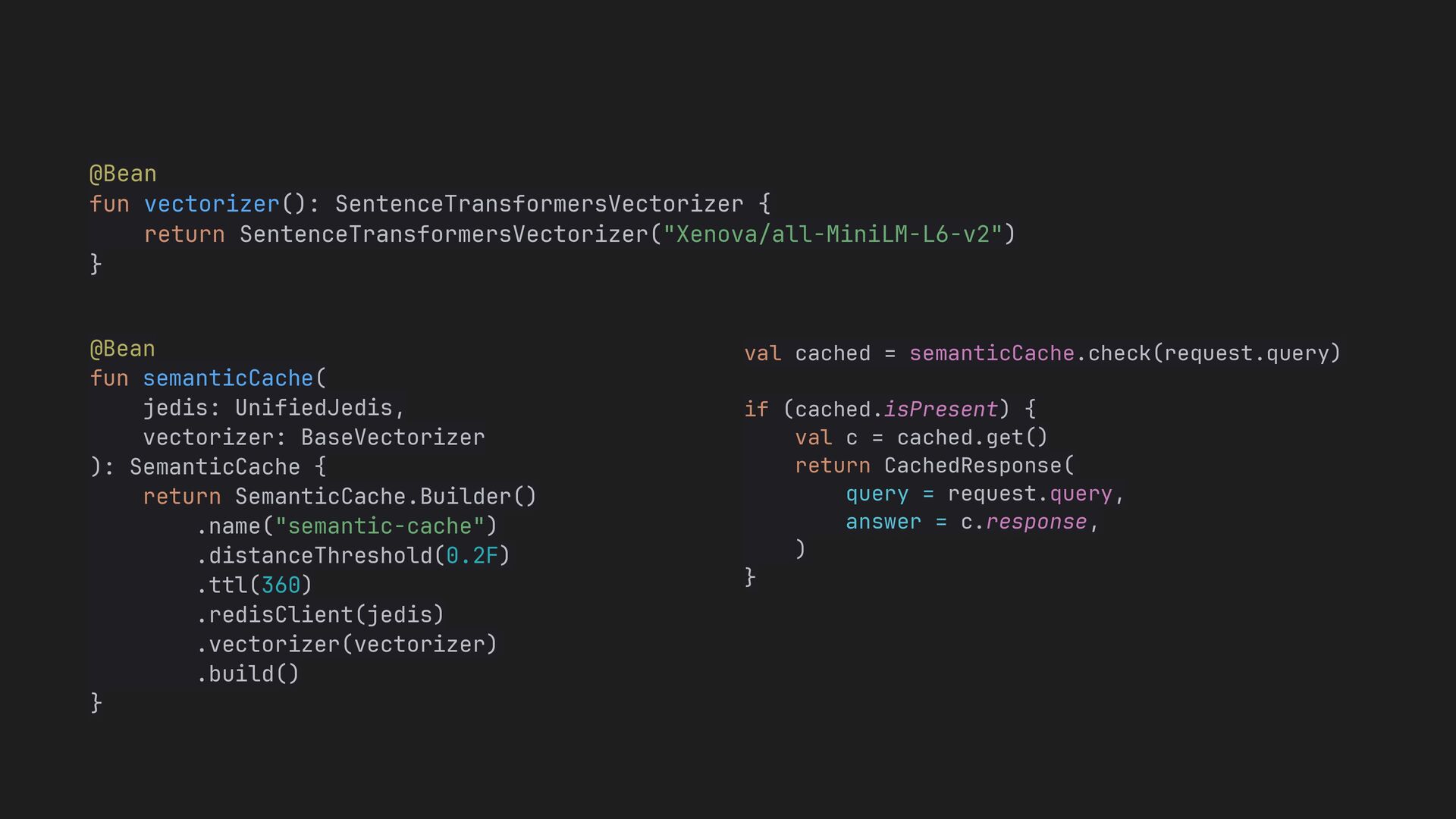
@Bean fun vectorizer(): SentenceTransformersVectorizer { return SentenceTransformersVectorizer("Xenova/all-MiniLM-L6-v2") } @Bean fun
semanticCache( jedis: UnifiedJedis, vectorizer: BaseVectorizer ): SemanticCache { return SemanticCache.Builder() .name("semantic-cache") .distanceThreshold(0.2F) .ttl(360) .redisClient(jedis) .vectorizer(vectorizer) .build() } val cached = semanticCache.check(request.query) if (cached.isPresent) { val c = cached.get() return CachedResponse( query = request.query, answer = c.response, ) } -
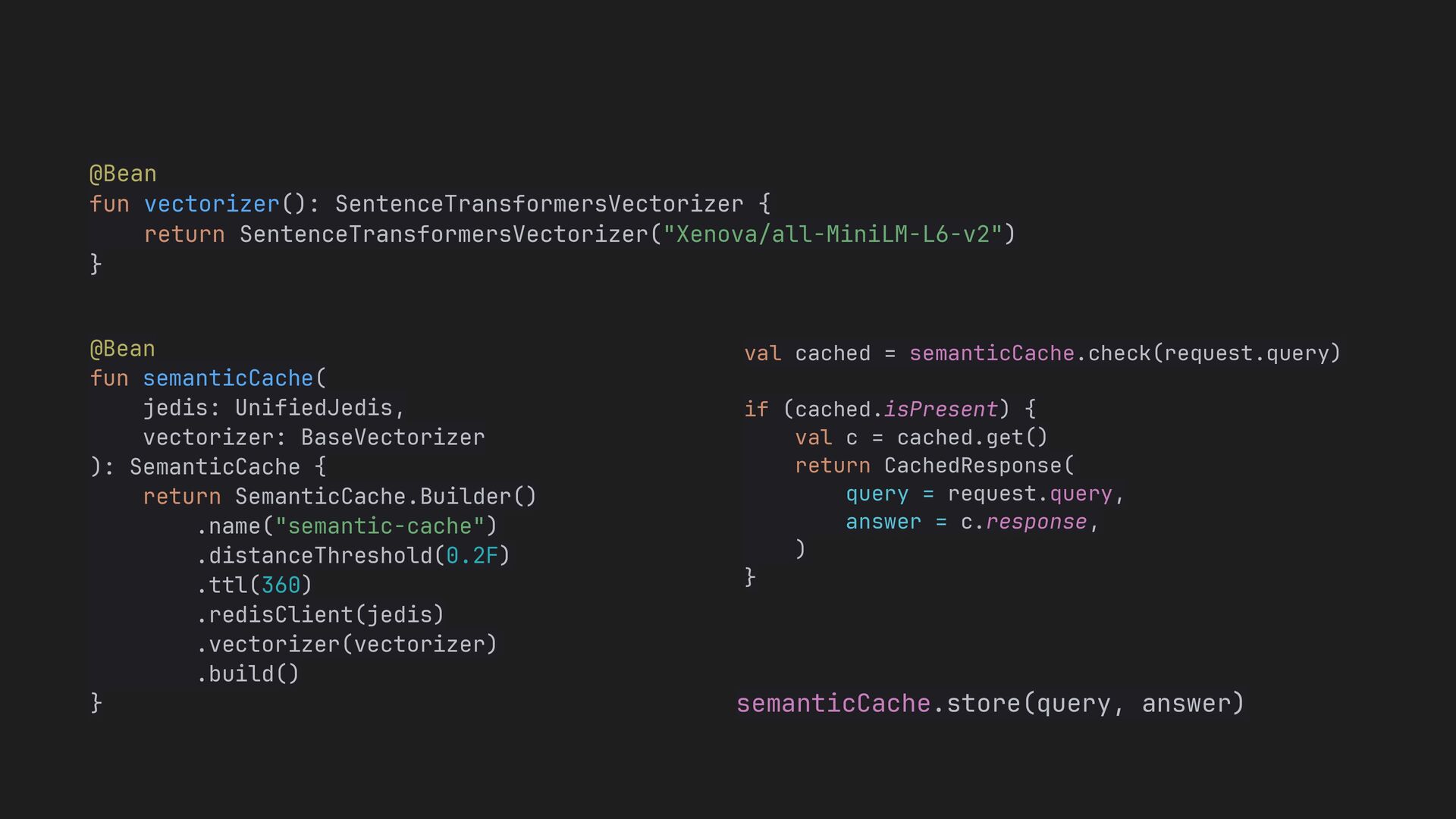
@Bean fun vectorizer(): SentenceTransformersVectorizer { return SentenceTransformersVectorizer("Xenova/all-MiniLM-L6-v2") } @Bean fun
semanticCache( jedis: UnifiedJedis, vectorizer: BaseVectorizer ): SemanticCache { return SemanticCache.Builder() .name("semantic-cache") .distanceThreshold(0.2F) .ttl(360) .redisClient(jedis) .vectorizer(vectorizer) .build() } semanticCache.store(query, answer) val cached = semanticCache.check(request.query) if (cached.isPresent) { val c = cached.get() return CachedResponse( query = request.query, answer = c.response, ) } -
- How to enhance search capabilities (Vector Similarity Search) -
How to improve VS search accuracy (Chunking, Grouping, Summarization, Extraction) - How to improve LLMs responses (Retrieval Augmented Generation) - How to save speed and time when dealing with LLMs (Semantic Cache) WHAT WE SAW TODAY: -
Exact vs approximate nearest neighbors in vector databases What is
a vector database? What is an embedding model? Redis Redis Redis