Vaginismus: Causes, Symptoms & Treatment | Renu...

Share
Embed
Vaginismus: Causes, Symptoms & Treatment | Renu IVF
Vaginismus explained: causes, symptoms and treatment with dilators and counselling. Safe, doctor-led care by Dr. Renu Singh Gahlaut, Renu IVF Kanpur.

Dr. Renu Singh Gahlaut
November 16, 2026
Transcript
8 slides
-
By Dr. Renu Singh Gahlaut, Renu IVF & Test Tube
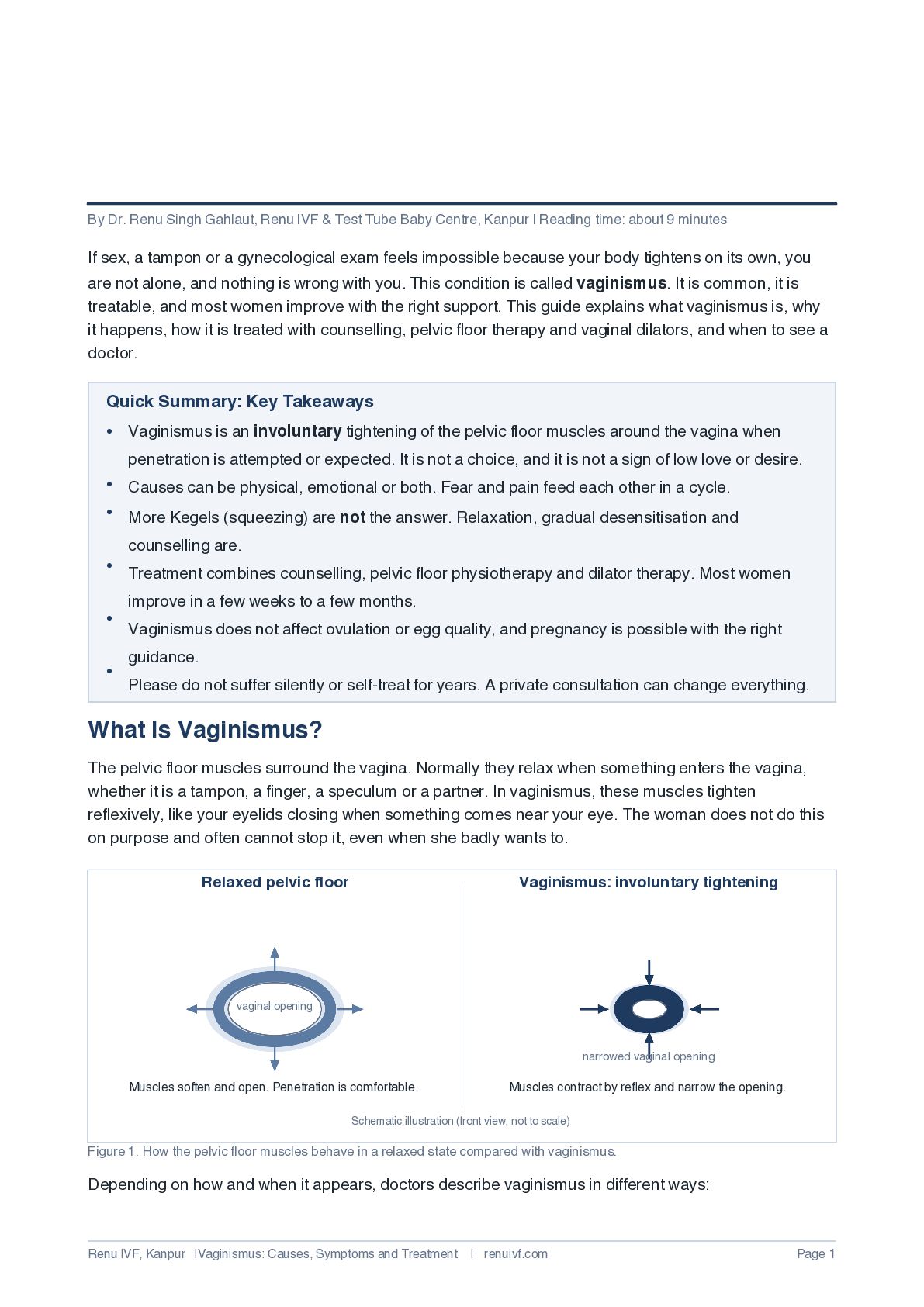
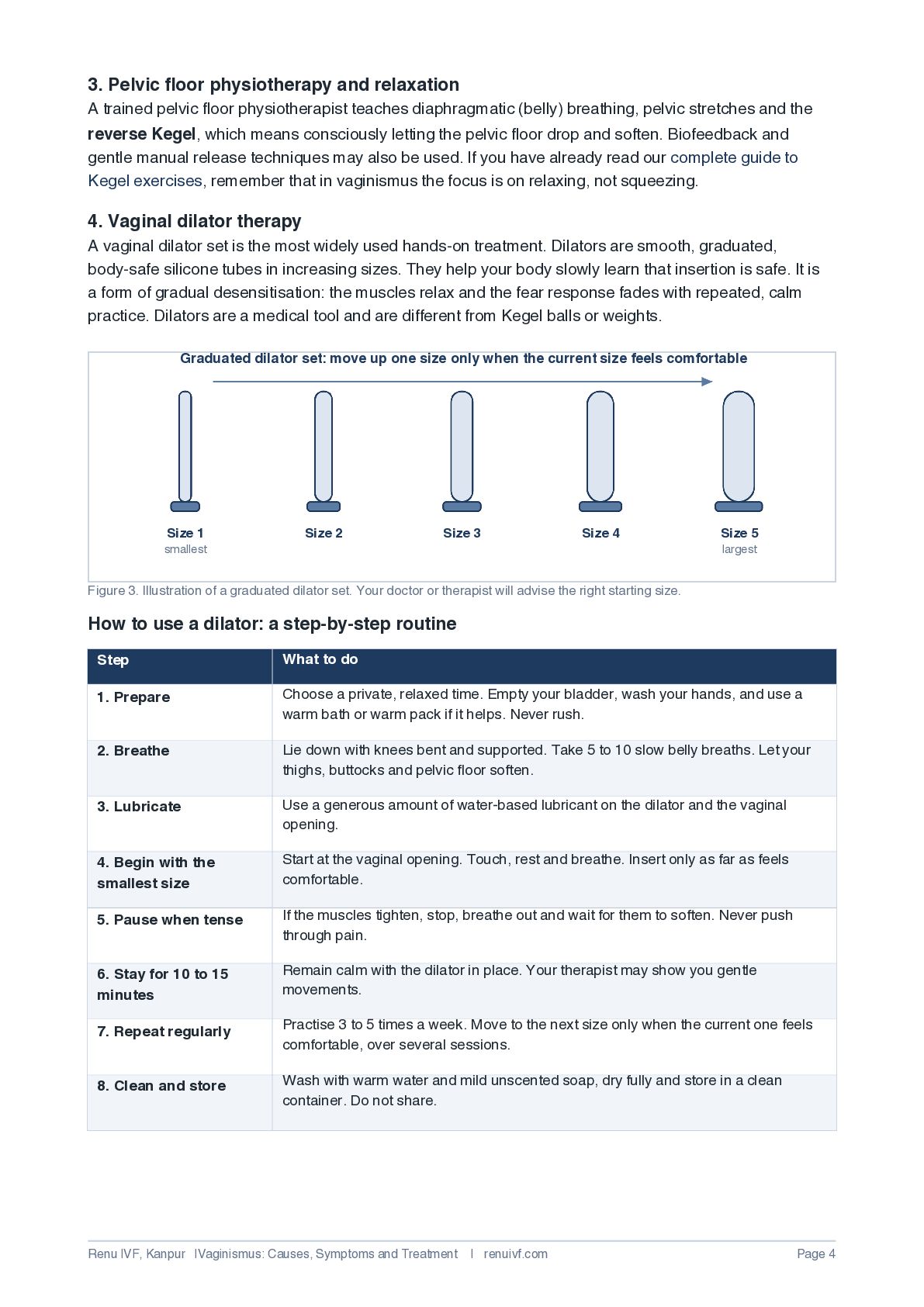
Baby Centre, Kanpur | Reading time: about 9 minutes If sex, a tampon or a gynecological exam feels impossible because your body tightens on its own, you are not alone, and nothing is wrong with you. This condition is called vaginismus. It is common, it is treatable, and most women improve with the right support. This guide explains what vaginismus is, why it happens, how it is treated with counselling, pelvic floor therapy and vaginal dilators, and when to see a doctor. Quick Summary: Key Takeaways • Vaginismus is an involuntary tightening of the pelvic floor muscles around the vagina when penetration is attempted or expected. It is not a choice, and it is not a sign of low love or desire. • Causes can be physical, emotional or both. Fear and pain feed each other in a cycle. • More Kegels (squeezing) are not the answer. Relaxation, gradual desensitisation and counselling are. • • • Treatment combines counselling, pelvic floor physiotherapy and dilator therapy. Most women improve in a few weeks to a few months. Vaginismus does not affect ovulation or egg quality, and pregnancy is possible with the right guidance. Please do not suffer silently or self-treat for years. A private consultation can change everything. What Is Vaginismus? The pelvic floor muscles surround the vagina. Normally they relax when something enters the vagina, whether it is a tampon, a finger, a speculum or a partner. In vaginismus, these muscles tighten reflexively, like your eyelids closing when something comes near your eye. The woman does not do this on purpose and often cannot stop it, even when she badly wants to. Relaxed pelvic floor Vaginismus: involuntary tightening vaginal opening narrowed vaginal opening Muscles soften and open. Penetration is comfortable. Muscles contract by reflex and narrow the opening. Schematic illustration (front view, not to scale) Figure 1. How the pelvic floor muscles behave in a relaxed state compared with vaginismus. Depending on how and when it appears, doctors describe vaginismus in different ways: Renu IVF, Kanpur |Vaginismus: Causes, Symptoms and Treatment | renuivf.com Page 1 -
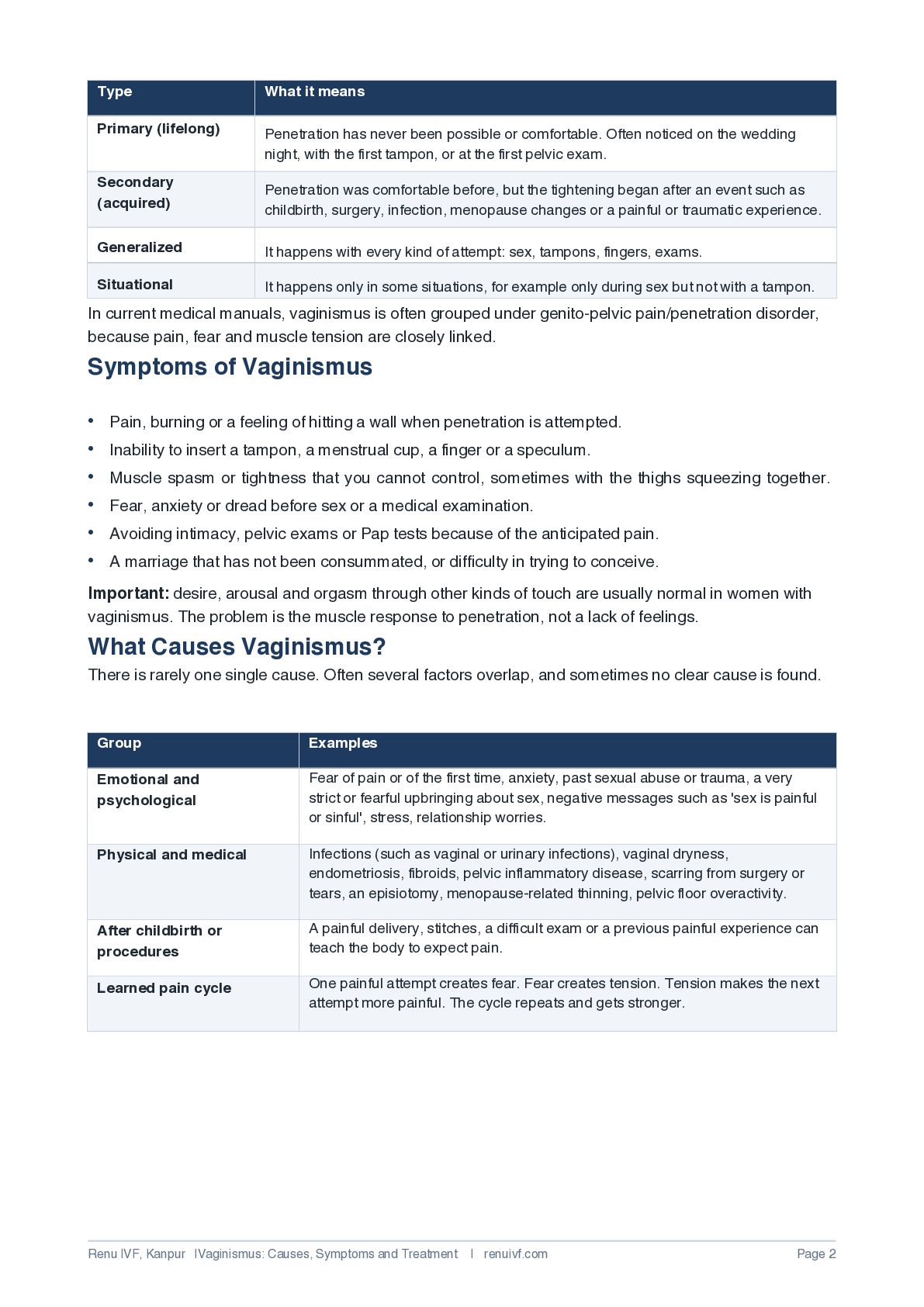
Type Primary (lifelong) What it means Penetration has never been
possible or comfortable. Often noticed on the wedding night, with the first tampon, or at the first pelvic exam. Secondary (acquired) Penetration was comfortable before, but the tightening began after an event such as childbirth, surgery, infection, menopause changes or a painful or traumatic experience. Generalized It happens with every kind of attempt: sex, tampons, fingers, exams. Situational It happens only in some situations, for example only during sex but not with a tampon. In current medical manuals, vaginismus is often grouped under genito-pelvic pain/penetration disorder, because pain, fear and muscle tension are closely linked. Symptoms of Vaginismus • Pain, burning or a feeling of hitting a wall when penetration is attempted. • Inability to insert a tampon, a menstrual cup, a finger or a speculum. • Muscle spasm or tightness that you cannot control, sometimes with the thighs squeezing together. • Fear, anxiety or dread before sex or a medical examination. • Avoiding intimacy, pelvic exams or Pap tests because of the anticipated pain. • A marriage that has not been consummated, or difficulty in trying to conceive. Important: desire, arousal and orgasm through other kinds of touch are usually normal in women with vaginismus. The problem is the muscle response to penetration, not a lack of feelings. What Causes Vaginismus? There is rarely one single cause. Often several factors overlap, and sometimes no clear cause is found. Group Examples Emotional and psychological Fear of pain or of the first time, anxiety, past sexual abuse or trauma, a very strict or fearful upbringing about sex, negative messages such as 'sex is painful or sinful', stress, relationship worries. Physical and medical Infections (such as vaginal or urinary infections), vaginal dryness, endometriosis, fibroids, pelvic inflammatory disease, scarring from surgery or tears, an episiotomy, menopause-related thinning, pelvic floor overactivity. After childbirth or procedures A painful delivery, stitches, a difficult exam or a previous painful experience can teach the body to expect pain. Learned pain cycle One painful attempt creates fear. Fear creates tension. Tension makes the next attempt more painful. The cycle repeats and gets stronger. Renu IVF, Kanpur |Vaginismus: Causes, Symptoms and Treatment | renuivf.com Page 2 -
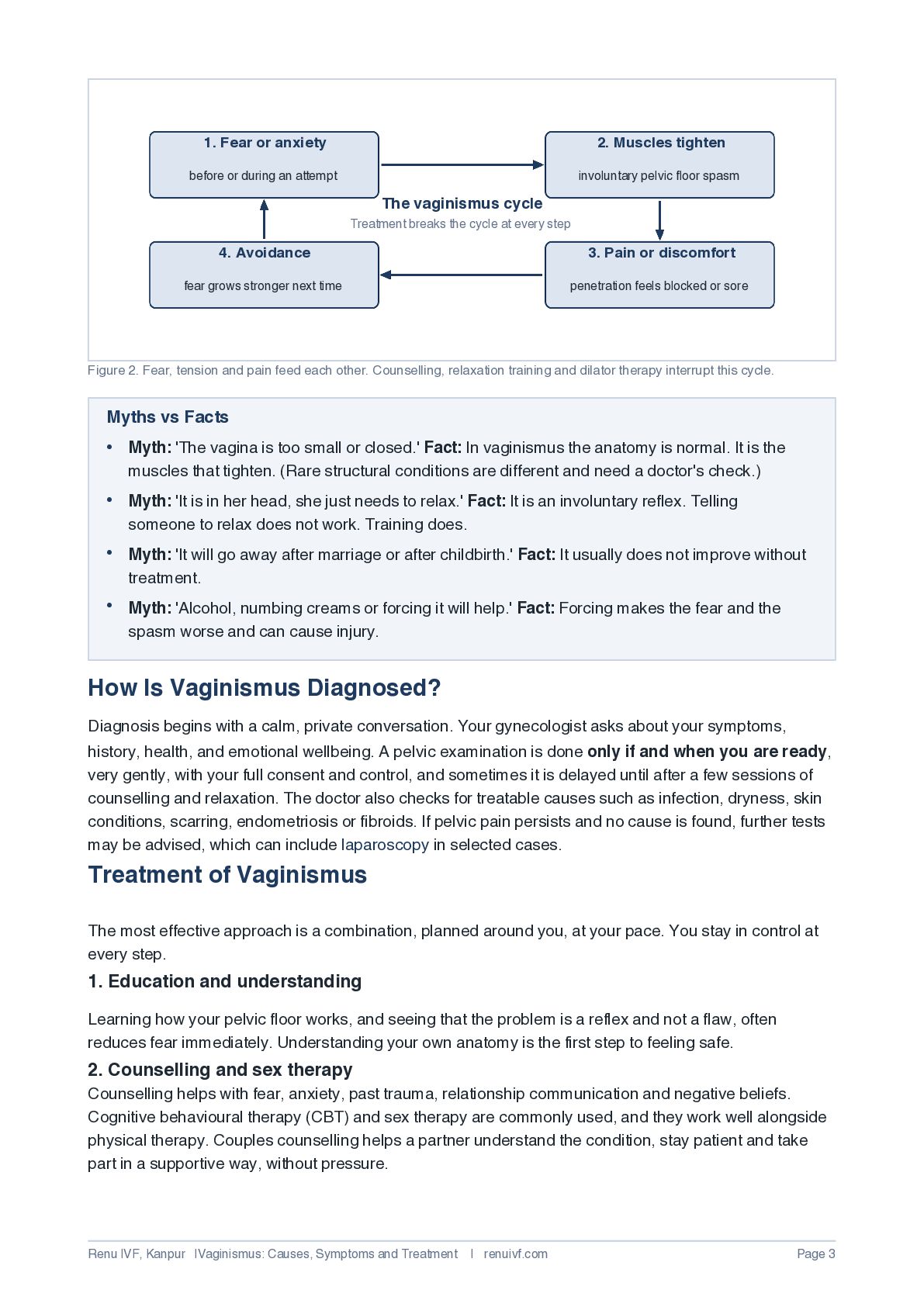
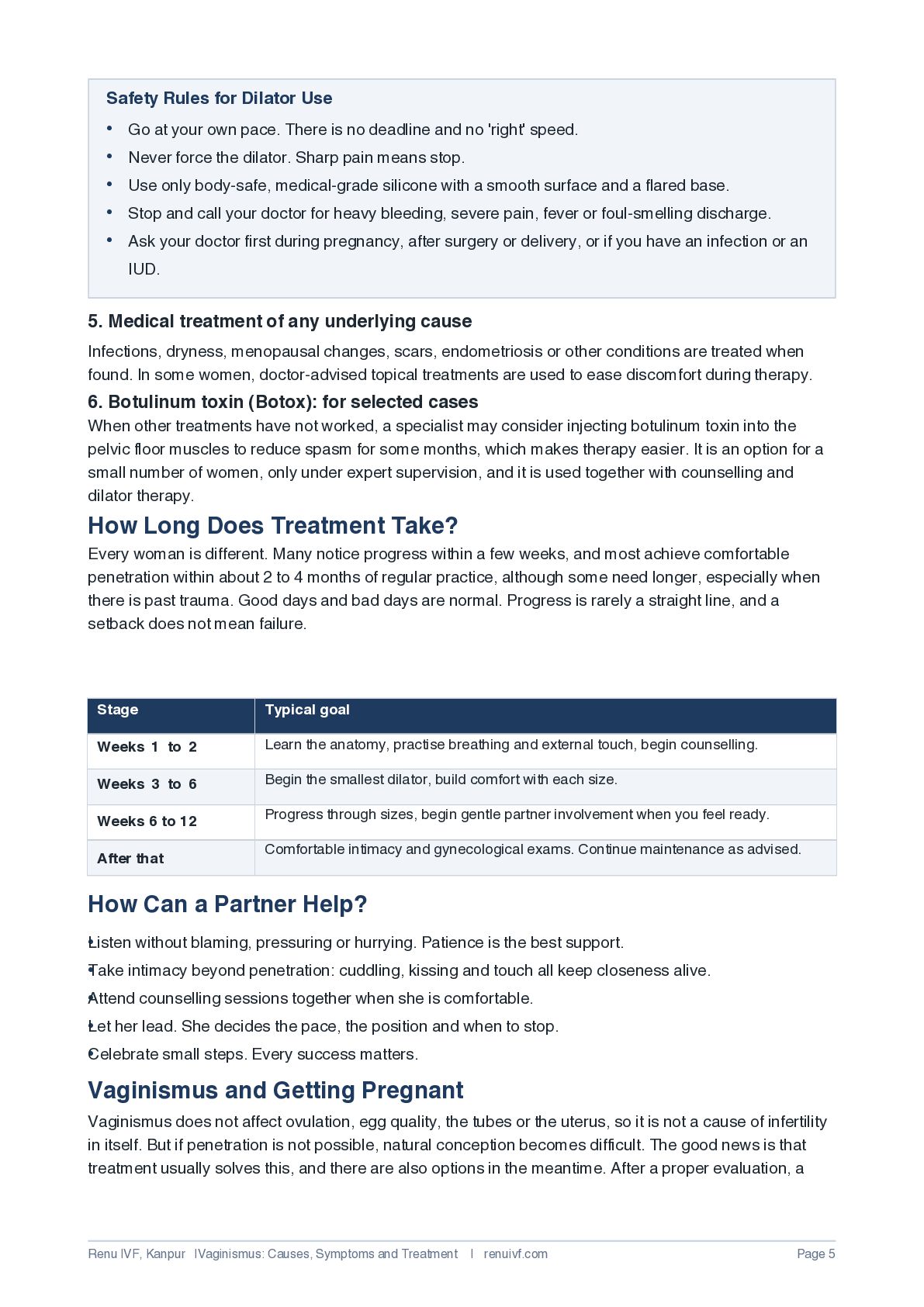
1. Fear or anxiety 2. Muscles tighten before or during
an attempt involuntary pelvic floor spasm The vaginismus cycle Treatment breaks the cycle at every step 4. Avoidance 3. Pain or discomfort fear grows stronger next time penetration feels blocked or sore Figure 2. Fear, tension and pain feed each other. Counselling, relaxation training and dilator therapy interrupt this cycle. Myths vs Facts • Myth: 'The vagina is too small or closed.' Fact: In vaginismus the anatomy is normal. It is the muscles that tighten. (Rare structural conditions are different and need a doctor's check.) • Myth: 'It is in her head, she just needs to relax.' Fact: It is an involuntary reflex. Telling someone to relax does not work. Training does. • Myth: 'It will go away after marriage or after childbirth.' Fact: It usually does not improve without treatment. • Myth: 'Alcohol, numbing creams or forcing it will help.' Fact: Forcing makes the fear and the spasm worse and can cause injury. How Is Vaginismus Diagnosed? Diagnosis begins with a calm, private conversation. Your gynecologist asks about your symptoms, history, health, and emotional wellbeing. A pelvic examination is done only if and when you are ready, very gently, with your full consent and control, and sometimes it is delayed until after a few sessions of counselling and relaxation. The doctor also checks for treatable causes such as infection, dryness, skin conditions, scarring, endometriosis or fibroids. If pelvic pain persists and no cause is found, further tests may be advised, which can include laparoscopy in selected cases. Treatment of Vaginismus The most effective approach is a combination, planned around you, at your pace. You stay in control at every step. 1. Education and understanding Learning how your pelvic floor works, and seeing that the problem is a reflex and not a flaw, often reduces fear immediately. Understanding your own anatomy is the first step to feeling safe. 2. Counselling and sex therapy Counselling helps with fear, anxiety, past trauma, relationship communication and negative beliefs. Cognitive behavioural therapy (CBT) and sex therapy are commonly used, and they work well alongside physical therapy. Couples counselling helps a partner understand the condition, stay patient and take part in a supportive way, without pressure. Renu IVF, Kanpur |Vaginismus: Causes, Symptoms and Treatment | renuivf.com Page 3 -
3. Pelvic floor physiotherapy and relaxation A trained pelvic floor
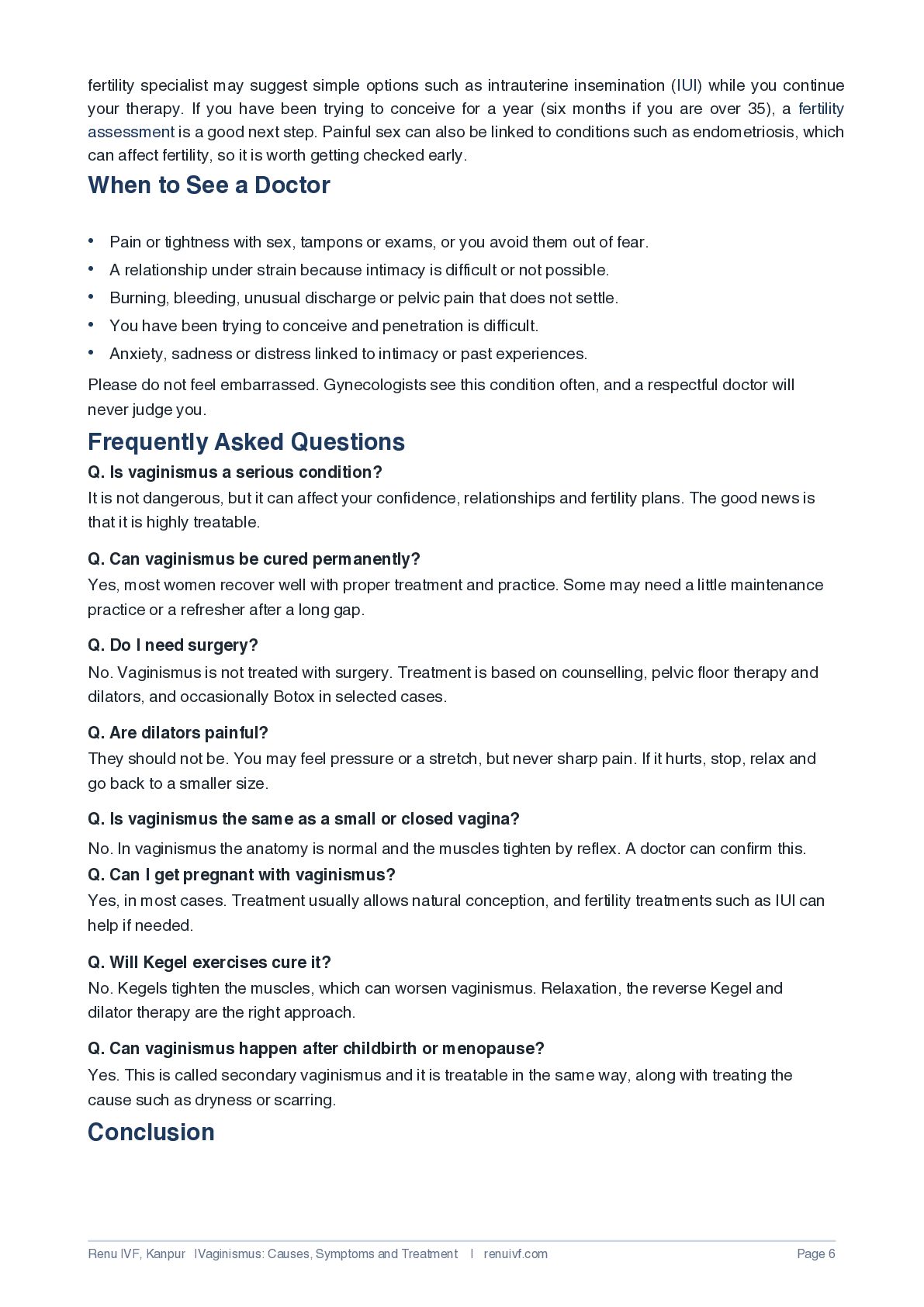
physiotherapist teaches diaphragmatic (belly) breathing, pelvic stretches and the reverse Kegel, which means consciously letting the pelvic floor drop and soften. Biofeedback and gentle manual release techniques may also be used. If you have already read our complete guide to Kegel exercises, remember that in vaginismus the focus is on relaxing, not squeezing. 4. Vaginal dilator therapy A vaginal dilator set is the most widely used hands-on treatment. Dilators are smooth, graduated, body-safe silicone tubes in increasing sizes. They help your body slowly learn that insertion is safe. It is a form of gradual desensitisation: the muscles relax and the fear response fades with repeated, calm practice. Dilators are a medical tool and are different from Kegel balls or weights. Graduated dilator set: move up one size only when the current size feels comfortable Size 1 Size 2 Size 3 Size 4 smallest Size 5 largest Figure 3. Illustration of a graduated dilator set. Your doctor or therapist will advise the right starting size. How to use a dilator: a step-by-step routine Step What to do 1. Prepare Choose a private, relaxed time. Empty your bladder, wash your hands, and use a warm bath or warm pack if it helps. Never rush. 2. Breathe Lie down with knees bent and supported. Take 5 to 10 slow belly breaths. Let your thighs, buttocks and pelvic floor soften. 3. Lubricate Use a generous amount of water-based lubricant on the dilator and the vaginal opening. 4. Begin with the smallest size Start at the vaginal opening. Touch, rest and breathe. Insert only as far as feels comfortable. 5. Pause when tense If the muscles tighten, stop, breathe out and wait for them to soften. Never push through pain. 6. Stay for 10 to 15 minutes Remain calm with the dilator in place. Your therapist may show you gentle movements. 7. Repeat regularly Practise 3 to 5 times a week. Move to the next size only when the current one feels comfortable, over several sessions. 8. Clean and store Wash with warm water and mild unscented soap, dry fully and store in a clean container. Do not share. Renu IVF, Kanpur |Vaginismus: Causes, Symptoms and Treatment | renuivf.com Page 4 -
Safety Rules for Dilator Use • Go at your own
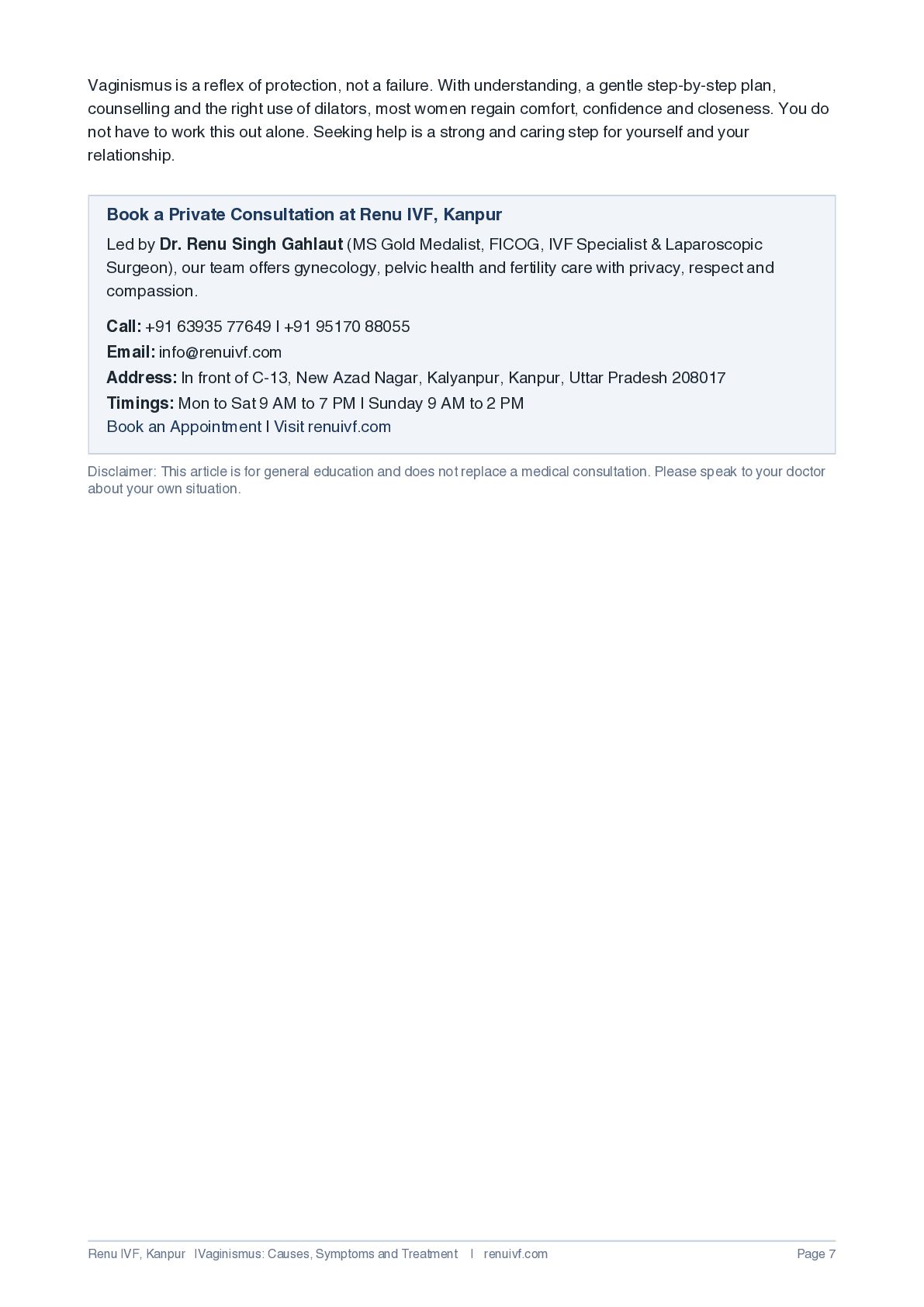
pace. There is no deadline and no 'right' speed. • Never force the dilator. Sharp pain means stop. • Use only body-safe, medical-grade silicone with a smooth surface and a flared base. • Stop and call your doctor for heavy bleeding, severe pain, fever or foul-smelling discharge. • Ask your doctor first during pregnancy, after surgery or delivery, or if you have an infection or an IUD. 5. Medical treatment of any underlying cause Infections, dryness, menopausal changes, scars, endometriosis or other conditions are treated when found. In some women, doctor-advised topical treatments are used to ease discomfort during therapy. 6. Botulinum toxin (Botox): for selected cases When other treatments have not worked, a specialist may consider injecting botulinum toxin into the pelvic floor muscles to reduce spasm for some months, which makes therapy easier. It is an option for a small number of women, only under expert supervision, and it is used together with counselling and dilator therapy. How Long Does Treatment Take? Every woman is different. Many notice progress within a few weeks, and most achieve comfortable penetration within about 2 to 4 months of regular practice, although some need longer, especially when there is past trauma. Good days and bad days are normal. Progress is rarely a straight line, and a setback does not mean failure. Stage Typical goal Weeks 1 to 2 Learn the anatomy, practise breathing and external touch, begin counselling. Weeks 3 to 6 Begin the smallest dilator, build comfort with each size. Weeks 6 to 12 Progress through sizes, begin gentle partner involvement when you feel ready. After that Comfortable intimacy and gynecological exams. Continue maintenance as advised. How Can a Partner Help? • Listen without blaming, pressuring or hurrying. Patience is the best support. • Take intimacy beyond penetration: cuddling, kissing and touch all keep closeness alive. • Attend counselling sessions together when she is comfortable. • her lead. She decides the pace, the position and when to stop. Let • Celebrate small steps. Every success matters. Vaginismus and Getting Pregnant Vaginismus does not affect ovulation, egg quality, the tubes or the uterus, so it is not a cause of infertility in itself. But if penetration is not possible, natural conception becomes difficult. The good news is that treatment usually solves this, and there are also options in the meantime. After a proper evaluation, a Renu IVF, Kanpur |Vaginismus: Causes, Symptoms and Treatment | renuivf.com Page 5 -
fertility specialist may suggest simple options such as intrauterine insemination
(IUI) while you continue your therapy. If you have been trying to conceive for a year (six months if you are over 35), a fertility assessment is a good next step. Painful sex can also be linked to conditions such as endometriosis, which can affect fertility, so it is worth getting checked early. When to See a Doctor • Pain or tightness with sex, tampons or exams, or you avoid them out of fear. • A relationship under strain because intimacy is difficult or not possible. • Burning, bleeding, unusual discharge or pelvic pain that does not settle. • You have been trying to conceive and penetration is difficult. • Anxiety, sadness or distress linked to intimacy or past experiences. Please do not feel embarrassed. Gynecologists see this condition often, and a respectful doctor will never judge you. Frequently Asked Questions Q. Is vaginismus a serious condition? It is not dangerous, but it can affect your confidence, relationships and fertility plans. The good news is that it is highly treatable. Q. Can vaginismus be cured permanently? Yes, most women recover well with proper treatment and practice. Some may need a little maintenance practice or a refresher after a long gap. Q. Do I need surgery? No. Vaginismus is not treated with surgery. Treatment is based on counselling, pelvic floor therapy and dilators, and occasionally Botox in selected cases. Q. Are dilators painful? They should not be. You may feel pressure or a stretch, but never sharp pain. If it hurts, stop, relax and go back to a smaller size. Q. Is vaginismus the same as a small or closed vagina? No. In vaginismus the anatomy is normal and the muscles tighten by reflex. A doctor can confirm this. Q. Can I get pregnant with vaginismus? Yes, in most cases. Treatment usually allows natural conception, and fertility treatments such as IUI can help if needed. Q. Will Kegel exercises cure it? No. Kegels tighten the muscles, which can worsen vaginismus. Relaxation, the reverse Kegel and dilator therapy are the right approach. Q. Can vaginismus happen after childbirth or menopause? Yes. This is called secondary vaginismus and it is treatable in the same way, along with treating the cause such as dryness or scarring. Conclusion Renu IVF, Kanpur |Vaginismus: Causes, Symptoms and Treatment | renuivf.com Page 6 -
Vaginismus is a reflex of protection, not a failure. With
understanding, a gentle step-by-step plan, counselling and the right use of dilators, most women regain comfort, confidence and closeness. You do not have to work this out alone. Seeking help is a strong and caring step for yourself and your relationship. Book a Private Consultation at Renu IVF, Kanpur Led by Dr. Renu Singh Gahlaut (MS Gold Medalist, FICOG, IVF Specialist & Laparoscopic Surgeon), our team offers gynecology, pelvic health and fertility care with privacy, respect and compassion. Call: +91 63935 77649 | +91 95170 88055 Email: [email protected] Address: In front of C-13, New Azad Nagar, Kalyanpur, Kanpur, Uttar Pradesh 208017 Timings: Mon to Sat 9 AM to 7 PM | Sunday 9 AM to 2 PM Book an Appointment | Visit renuivf.com Disclaimer: This article is for general education and does not replace a medical consultation. Please speak to your doctor about your own situation. Renu IVF, Kanpur |Vaginismus: Causes, Symptoms and Treatment | renuivf.com Page 7
 renuivf0756
 baltimoreniso
 pawan_pharm
 cbtlibrary
 akiraasano
 bernhardsvt
 yatabe
 juanmartin2026
 koheihasebe
 aisw77
 akademiya2063
 jnunemaker
 denniskardys
 jonoalderson
 lcolladotor
 sferik
 ryanjones
 tammyeverts
 axbom
 brad_frost
 rakko
 garrettdimon