Upgrade to Pro — share decks privately, control downloads, hide ads and more …

Science Formula Reference Guide — Physics, Chem...

Avatar for SciSolveLab SciSolveLab
September 18, 2026

Science Formula Reference Guide — Physics, Chemistry, Math & Biology

SciSolveLab is a free online science calculator platform built for students, teachers, and researchers worldwide. Our mission is simple: give everyone access to fast, reliable, and easy-to-use science calculators — completely free, with no login required and no hidden fees. Whether you are a high school student working through physics homework, a university student preparing for chemistry exams, a teacher looking for classroom tools, or a researcher needing quick calculations,

Avatar for SciSolveLab

SciSolveLab

September 18, 2026

More Decks by SciSolveLab

Other Decks in Science

Transcript

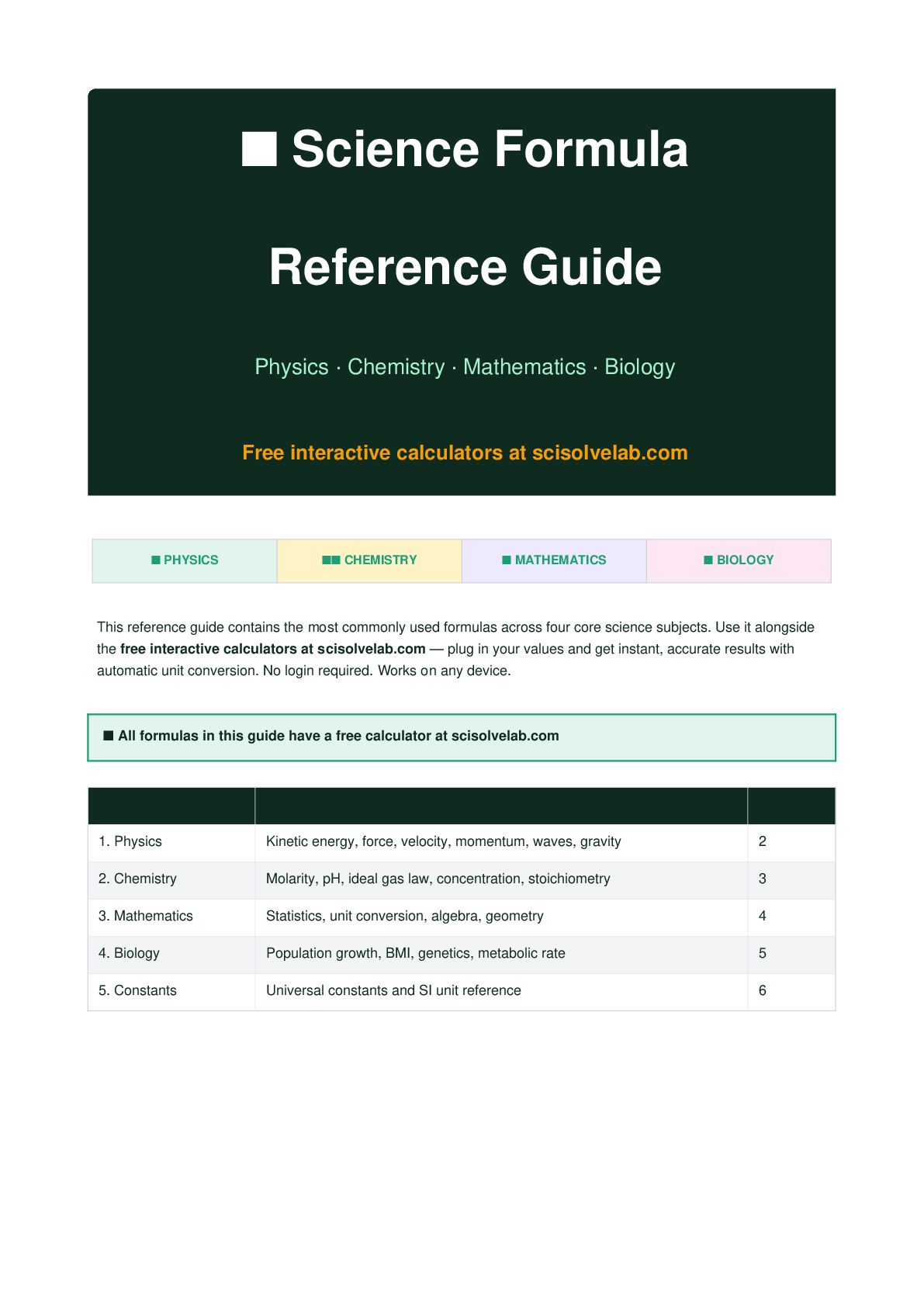
  1. ▪ Science Formula Reference Guide Physics · Chemistry · Mathematics

    · Biology Free interactive calculators at scisolvelab.com ▪ PHYSICS ▪▪ CHEMISTRY ▪ MATHEMATICS ▪ BIOLOGY This reference guide contains the most commonly used formulas across four core science subjects. Use it alongside the free interactive calculators at scisolvelab.com — plug in your values and get instant, accurate results with automatic unit conversion. No login required. Works on any device. ▪ All formulas in this guide have a free calculator at scisolvelab.com Section Formulas covered Page 1. Physics Kinetic energy, force, velocity, momentum, waves, gravity 2 2. Chemistry Molarity, pH, ideal gas law, concentration, stoichiometry 3 3. Mathematics Statistics, unit conversion, algebra, geometry 4 4. Biology Population growth, BMI, genetics, metabolic rate 5 5. Constants Universal constants and SI unit reference 6
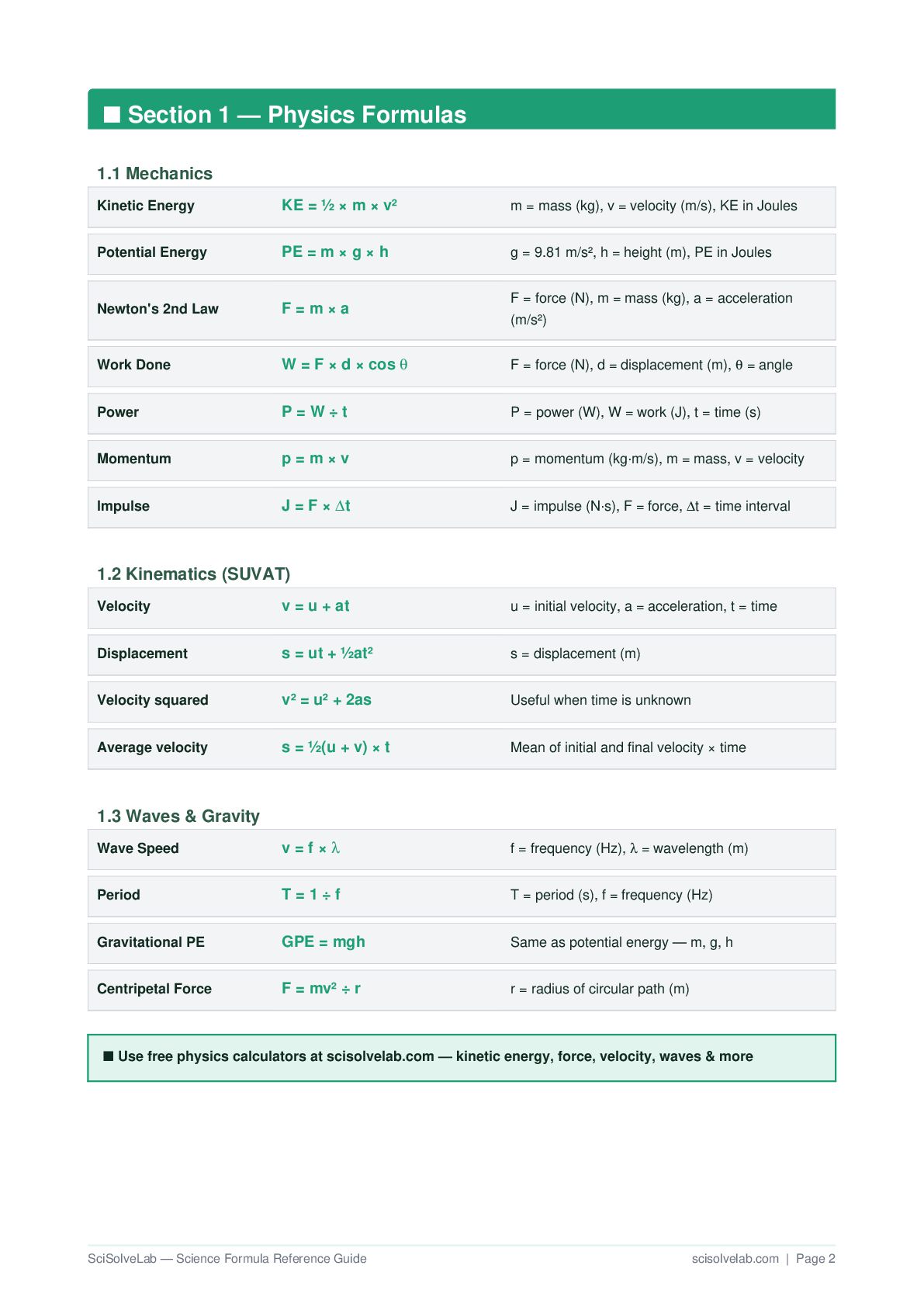
  2. ▪ Section 1 — Physics Formulas 1.1 Mechanics Kinetic Energy

    KE = ½ × m × v² m = mass (kg), v = velocity (m/s), KE in Joules Potential Energy PE = m × g × h g = 9.81 m/s², h = height (m), PE in Joules Newton's 2nd Law F=m×a Work Done W = F × d × cos θ F = force (N), d = displacement (m), θ = angle Power P=W÷t P = power (W), W = work (J), t = time (s) Momentum p=m×v p = momentum (kg·m/s), m = mass, v = velocity Impulse J = F × ∆t J = impulse (N·s), F = force, ∆t = time interval F = force (N), m = mass (kg), a = acceleration (m/s²) 1.2 Kinematics (SUVAT) Velocity v = u + at u = initial velocity, a = acceleration, t = time Displacement s = ut + ½at² s = displacement (m) Velocity squared v² = u² + 2as Useful when time is unknown Average velocity s = ½(u + v) × t Mean of initial and final velocity × time Wave Speed v=f×λ f = frequency (Hz), λ = wavelength (m) Period T=1÷f T = period (s), f = frequency (Hz) Gravitational PE GPE = mgh Same as potential energy — m, g, h Centripetal Force F = mv² ÷ r r = radius of circular path (m) 1.3 Waves & Gravity ▪ Use free physics calculators at scisolvelab.com — kinetic energy, force, velocity, waves & more SciSolveLab — Science Formula Reference Guide scisolvelab.com | Page 2
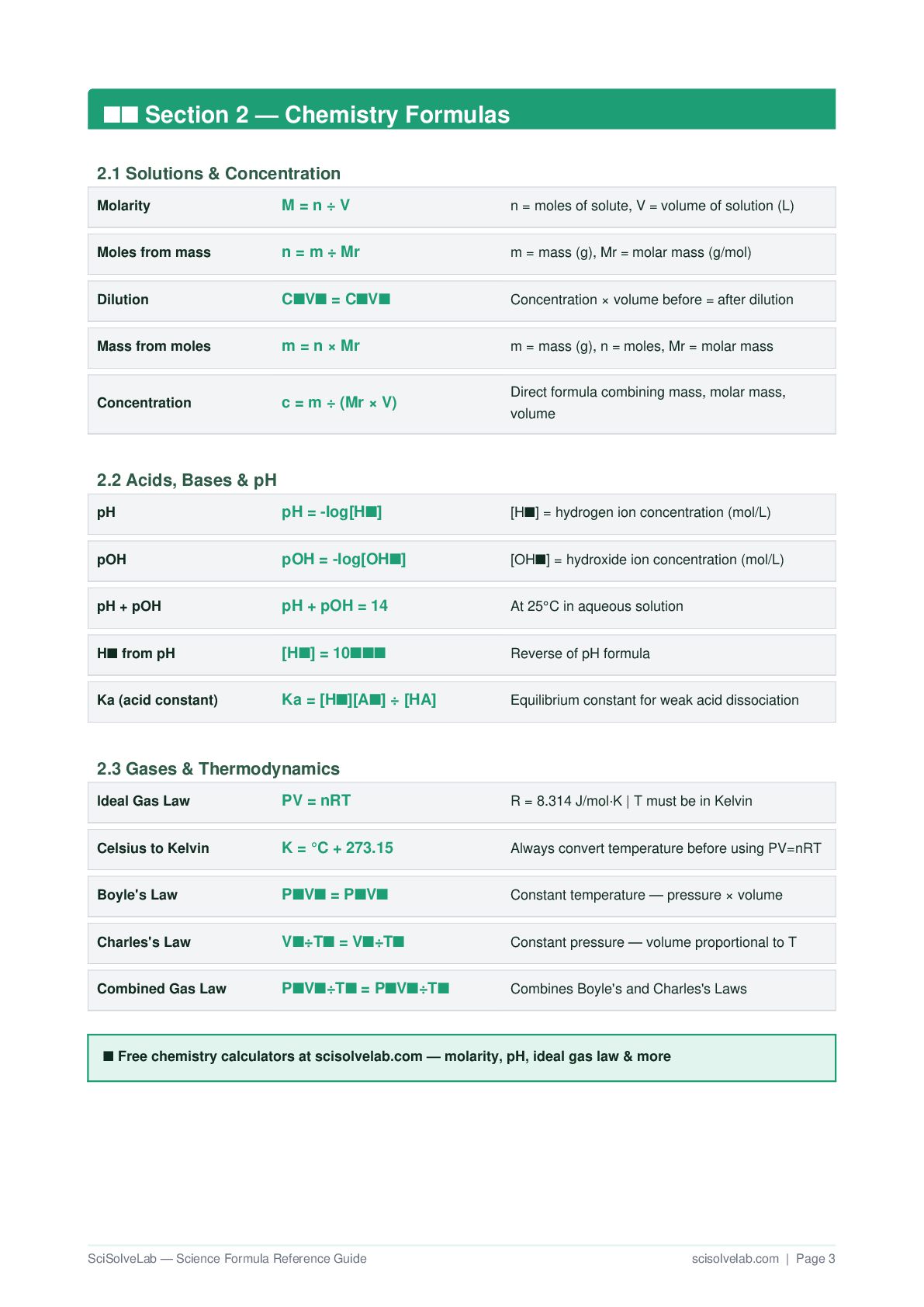
  3. ▪▪ Section 2 — Chemistry Formulas 2.1 Solutions & Concentration

    Molarity M=n÷V n = moles of solute, V = volume of solution (L) Moles from mass n = m ÷ Mr m = mass (g), Mr = molar mass (g/mol) Dilution C▪V▪ = C▪V▪ Concentration × volume before = after dilution Mass from moles m = n × Mr m = mass (g), n = moles, Mr = molar mass Concentration c = m ÷ (Mr × V) Direct formula combining mass, molar mass, volume 2.2 Acids, Bases & pH pH pH = -log[H▪] [H▪] = hydrogen ion concentration (mol/L) pOH pOH = -log[OH▪] [OH▪] = hydroxide ion concentration (mol/L) pH + pOH pH + pOH = 14 At 25°C in aqueous solution H▪ from pH [H▪] = 10▪▪▪ Reverse of pH formula Ka (acid constant) Ka = [H▪][A▪] ÷ [HA] Equilibrium constant for weak acid dissociation 2.3 Gases & Thermodynamics Ideal Gas Law PV = nRT R = 8.314 J/mol·K | T must be in Kelvin Celsius to Kelvin K = °C + 273.15 Always convert temperature before using PV=nRT Boyle's Law P▪V▪ = P▪V▪ Constant temperature — pressure × volume Charles's Law V▪÷T▪ = V▪÷T▪ Constant pressure — volume proportional to T Combined Gas Law P▪V▪÷T▪ = P▪V▪÷T▪ Combines Boyle's and Charles's Laws ▪ Free chemistry calculators at scisolvelab.com — molarity, pH, ideal gas law & more SciSolveLab — Science Formula Reference Guide scisolvelab.com | Page 3
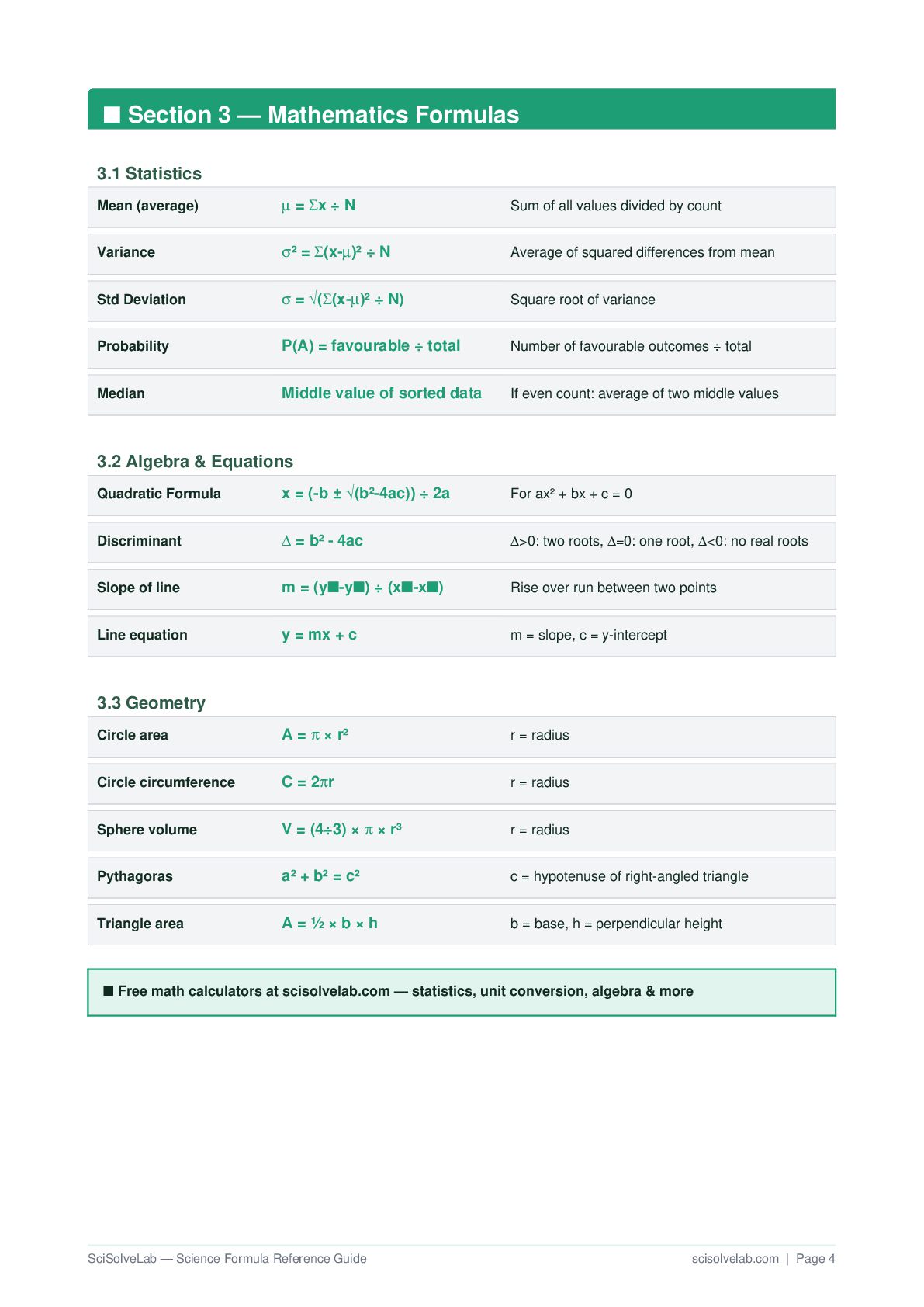
  4. ▪ Section 3 — Mathematics Formulas 3.1 Statistics Mean (average)

    µ = Σx ÷ N Sum of all values divided by count Variance σ² = Σ(x-µ)² ÷ N Average of squared differences from mean Std Deviation σ = √(Σ(x-µ)² ÷ N) Square root of variance Probability P(A) = favourable ÷ total Number of favourable outcomes ÷ total Median Middle value of sorted data If even count: average of two middle values 3.2 Algebra & Equations Quadratic Formula x = (-b ± √(b²-4ac)) ÷ 2a For ax² + bx + c = 0 Discriminant ∆ = b² - 4ac ∆>0: two roots, ∆=0: one root, ∆<0: no real roots Slope of line m = (y▪-y▪) ÷ (x▪-x▪) Rise over run between two points Line equation y = mx + c m = slope, c = y-intercept Circle area A = π × r² r = radius Circle circumference C = 2πr r = radius Sphere volume V = (4÷3) × π × r³ r = radius Pythagoras a² + b² = c² c = hypotenuse of right-angled triangle Triangle area A=½×b×h b = base, h = perpendicular height 3.3 Geometry ▪ Free math calculators at scisolvelab.com — statistics, unit conversion, algebra & more SciSolveLab — Science Formula Reference Guide scisolvelab.com | Page 4
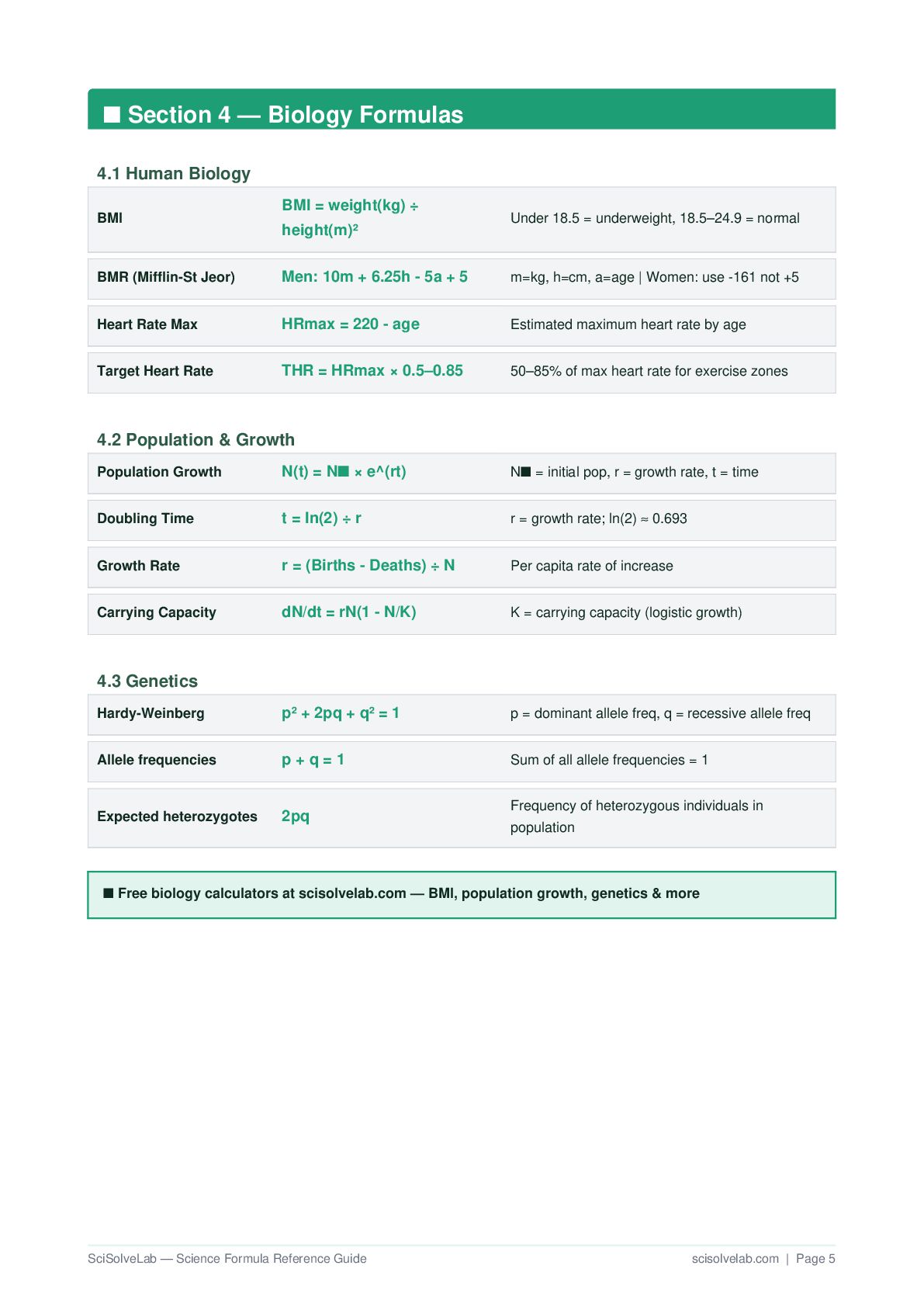
  5. ▪ Section 4 — Biology Formulas 4.1 Human Biology BMI

    BMI = weight(kg) ÷ height(m)² Under 18.5 = underweight, 18.5–24.9 = normal BMR (Mifflin-St Jeor) Men: 10m + 6.25h - 5a + 5 m=kg, h=cm, a=age | Women: use -161 not +5 Heart Rate Max HRmax = 220 - age Estimated maximum heart rate by age Target Heart Rate THR = HRmax × 0.5–0.85 50–85% of max heart rate for exercise zones 4.2 Population & Growth Population Growth N(t) = N▪ × e^(rt) N▪ = initial pop, r = growth rate, t = time Doubling Time t = ln(2) ÷ r r = growth rate; ln(2) ≈ 0.693 Growth Rate r = (Births - Deaths) ÷ N Per capita rate of increase Carrying Capacity dN/dt = rN(1 - N/K) K = carrying capacity (logistic growth) Hardy-Weinberg p² + 2pq + q² = 1 p = dominant allele freq, q = recessive allele freq Allele frequencies p+q=1 Sum of all allele frequencies = 1 Expected heterozygotes 2pq 4.3 Genetics Frequency of heterozygous individuals in population ▪ Free biology calculators at scisolvelab.com — BMI, population growth, genetics & more SciSolveLab — Science Formula Reference Guide scisolvelab.com | Page 5
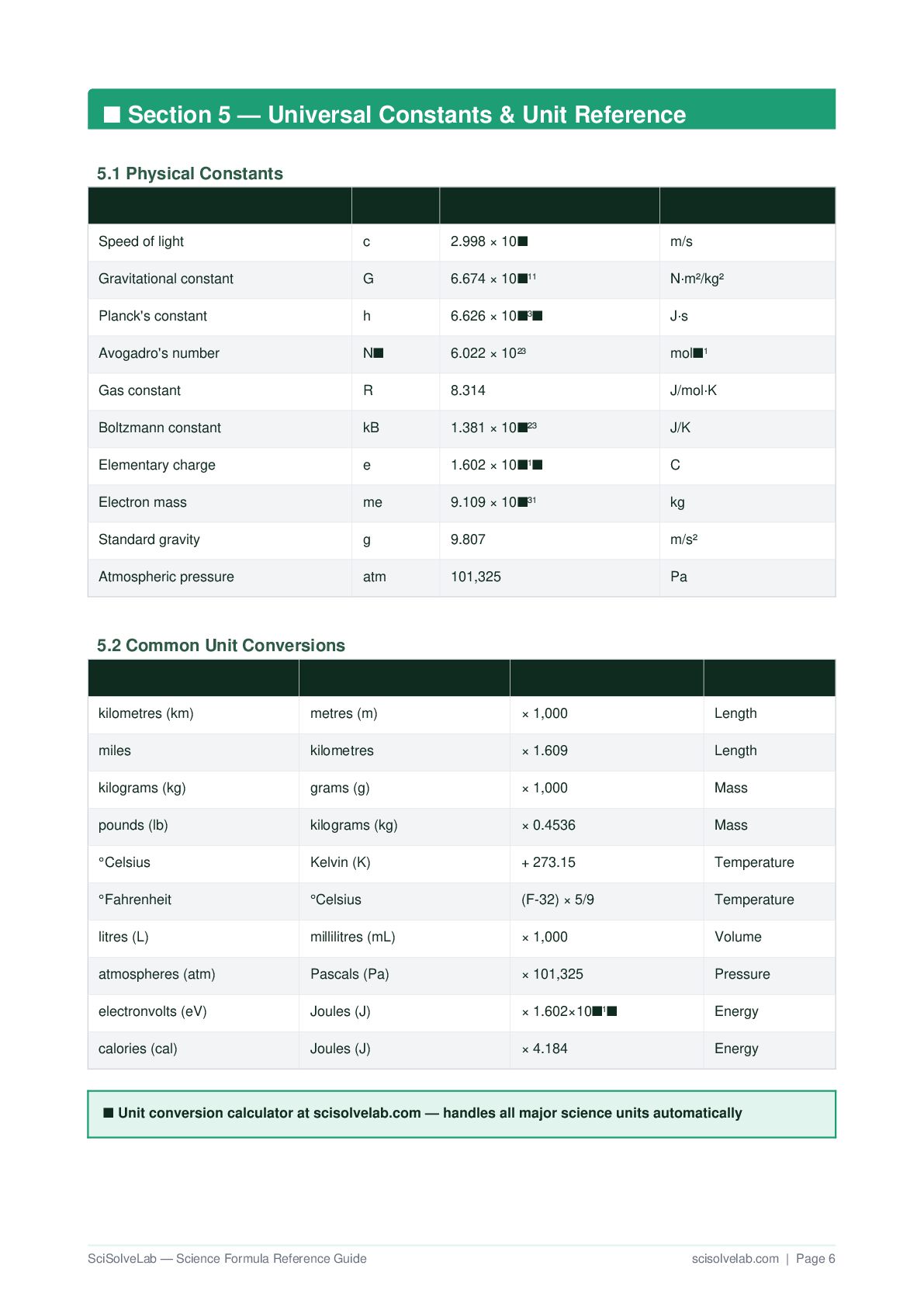
  6. ▪ Section 5 — Universal Constants & Unit Reference 5.1

    Physical Constants Constant Symbol Value Unit Speed of light c 2.998 × 10▪ m/s Gravitational constant G 6.674 × 10▪¹¹ N·m²/kg² Planck's constant h 6.626 × 10▪³▪ J·s Avogadro's number N▪ 6.022 × 10²³ mol▪¹ Gas constant R 8.314 J/mol·K Boltzmann constant kB 1.381 × 10▪²³ J/K Elementary charge e 1.602 × 10▪¹▪ C Electron mass me 9.109 × 10▪³¹ kg Standard gravity g 9.807 m/s² Atmospheric pressure atm 101,325 Pa 5.2 Common Unit Conversions From To Multiply by Category kilometres (km) metres (m) × 1,000 Length miles kilometres × 1.609 Length kilograms (kg) grams (g) × 1,000 Mass pounds (lb) kilograms (kg) × 0.4536 Mass °Celsius Kelvin (K) + 273.15 Temperature °Fahrenheit °Celsius (F-32) × 5/9 Temperature litres (L) millilitres (mL) × 1,000 Volume atmospheres (atm) Pascals (Pa) × 101,325 Pressure electronvolts (eV) Joules (J) × 1.602×10▪¹▪ Energy calories (cal) Joules (J) × 4.184 Energy ▪ Unit conversion calculator at scisolvelab.com — handles all major science units automatically SciSolveLab — Science Formula Reference Guide scisolvelab.com | Page 6
  7. ▪ Try All These Formulas Live Every formula in this

    guide has a free interactive calculator at scisolvelab.com — just enter your values and get instant results. scisolvelab.com Free · No login · Works on any device © SciSolveLab — scisolvelab.com · Free to share and distribute for educational purposes SciSolveLab — Science Formula Reference Guide scisolvelab.com | Page 7