Upgrade to Pro — share decks privately, control downloads, hide ads and more …

The Autopilot Diary — Vol. 2: The Operating Loo...

The Autopilot Diary — Vol. 2: The Operating Loop (Observe → Ship → Measure)

The Autopilot Diary, Vol. 2 — the operating loop that runs a solo iOS app’s daily changes: observe → choose one task → change → check → ship what’s eligible → record. Grounded in the 11 Aug–2 Sep 2026 ledger: 19 of 28 runs shipped, behind a gate of ~83 automated checks.

This is the machine behind Vol. 1’s numbers. Six steps, one task per run, a hard gate between "made a change" and "shipped," and a human on every irreversible decision.

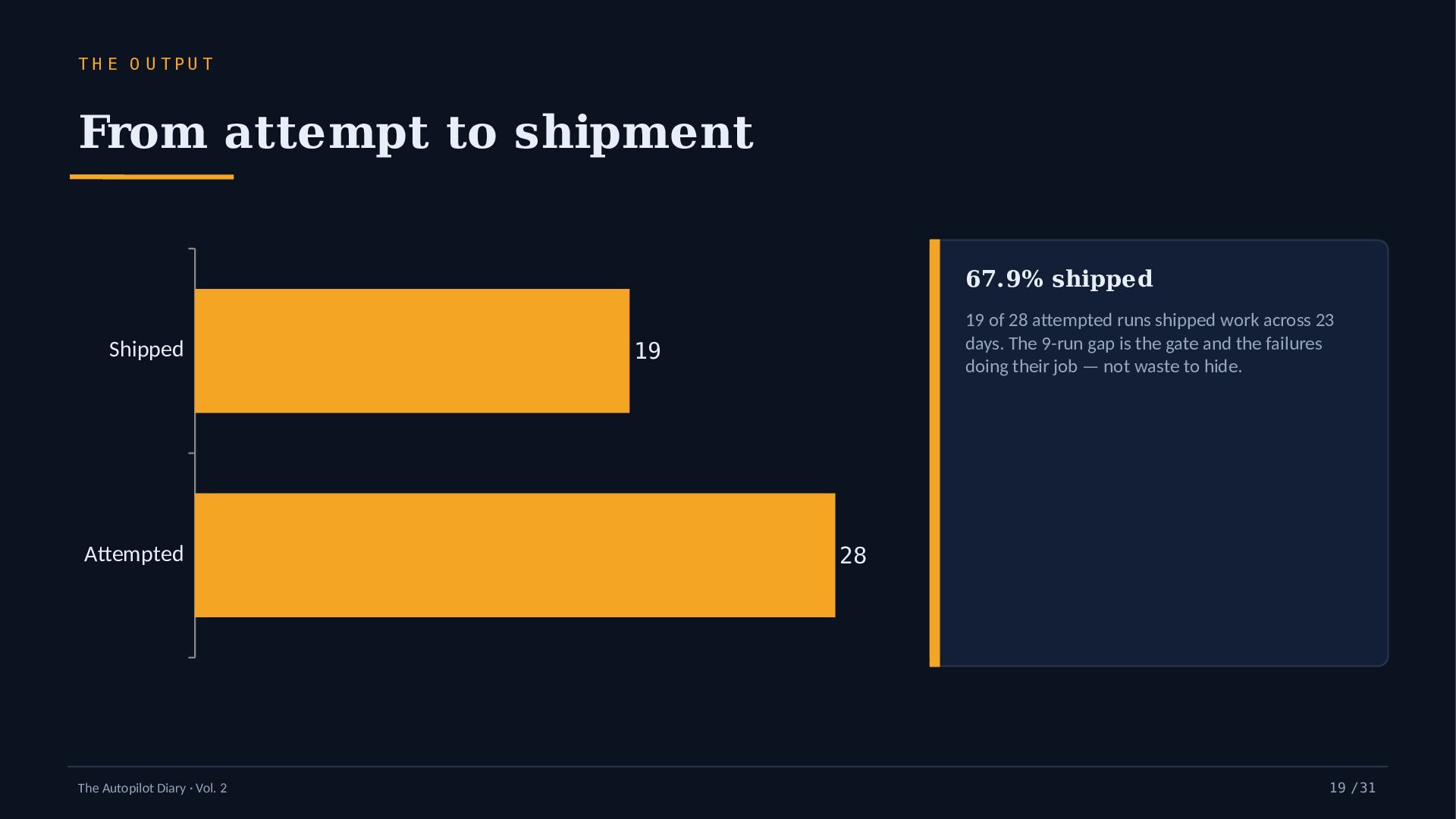
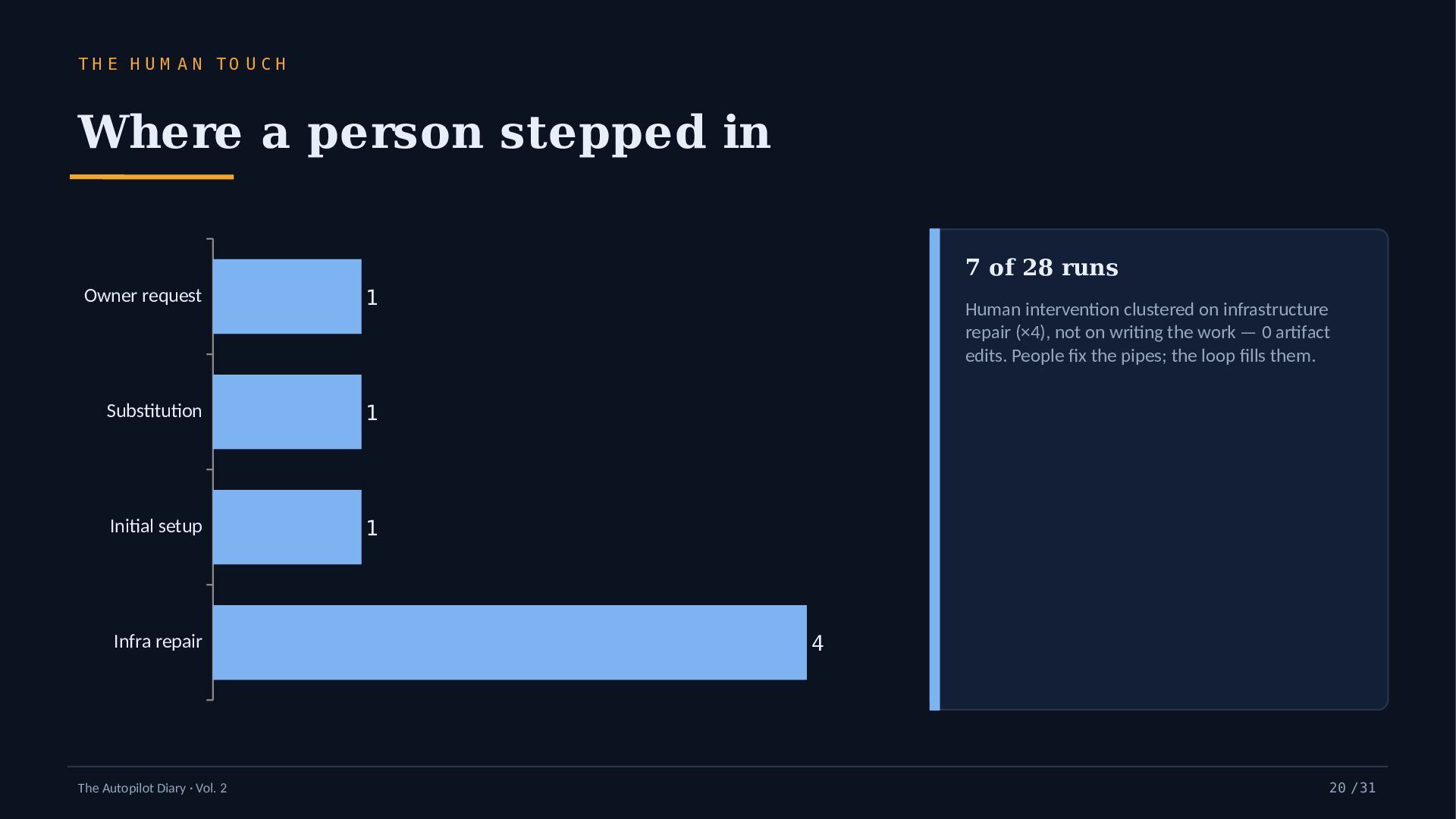
For Simple Memo (an iPhone app by YURIKA K.K.): the loop attempted 28 runs, shipped 19 (67.9%) across 23 days (17 with a shipment), and recorded human intervention in 7 runs (25%) with 0 edits to shipped artifacts. Reversible work — site articles, ops/server config, halting a rollout, spend within a cap — ships automatically. Pricing, contracts/ads, the App Store release, and restarting a halted run stay human.

A permission-gradient table shows exactly who ships what, and why. Three objections are answered in question form — "a cron job with vibes?", "one task a day is too slow?", and "if humans still sign, is it automated?" — each with its honest caveat. It states plainly what the numbers did NOT prove: no automatic rollback, no incident recovery, no revenue lift.

Topics: AI app operations · agent operating loop · reversible-first delegation · quality gates & staged rollout.

More: speakerdeck.com/simplememo · x.com/simplememofast
References: the full loop, ledger, CSV & JSON — https://simplememofast.com/en/autopilot/ · App Store — https://apps.apple.com/app/id6758438948?ct=autopilot-en&mt=8

Avatar for Simple Memo Developer

Simple Memo Developer

September 18, 2026

More Decks by Simple Memo Developer

Other Decks in Programming

Transcript

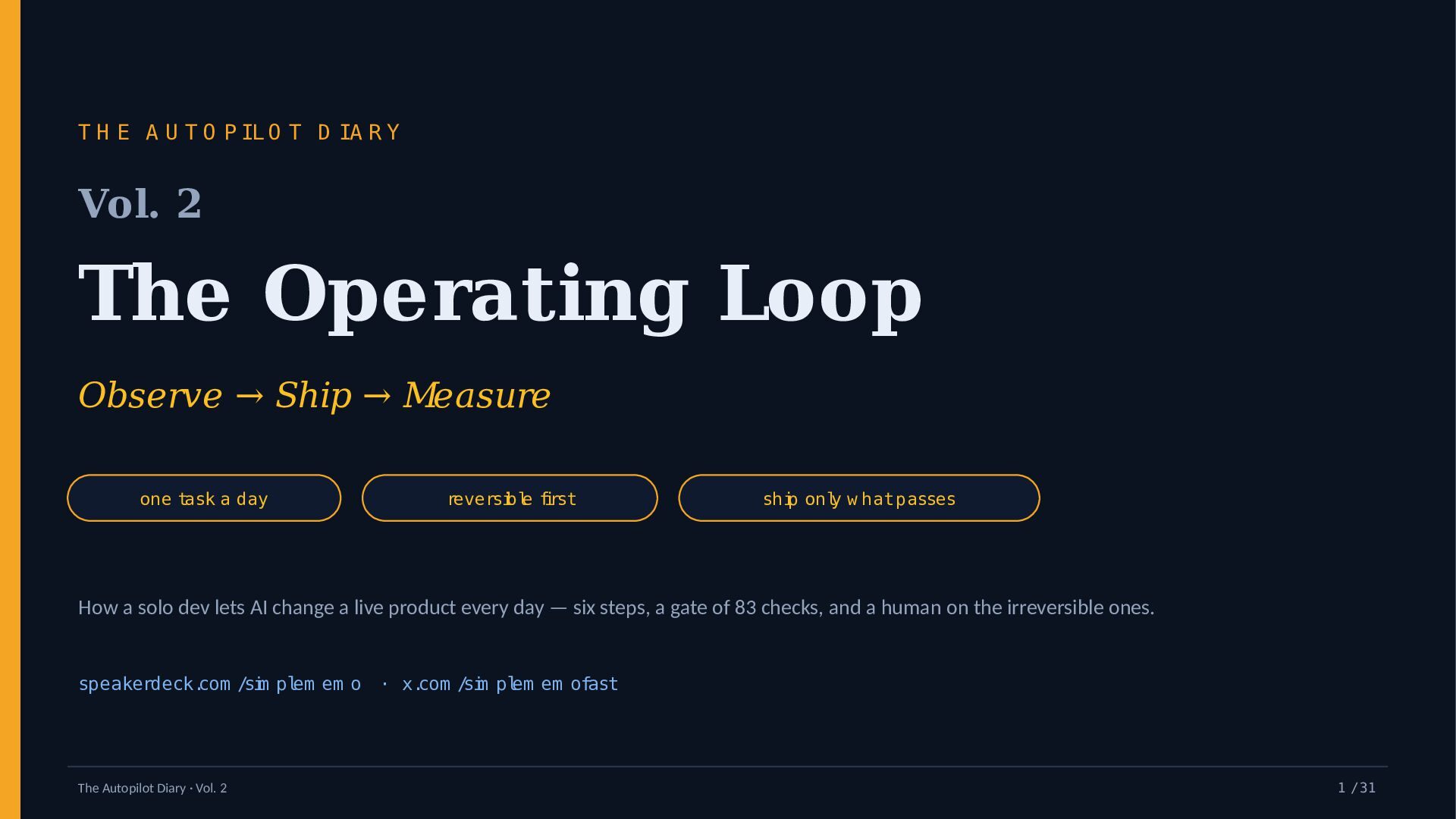
  1. T H E A U T O P IL O

    T D IA R Y Vol. 2 The Operating Loop Observe → Ship → Measure one task a day reversible first ship only w hat passes How a solo dev lets AI change a live product every day — six steps, a gate of 83 checks, and a human on the irreversible ones. speakerdeck.com /sim plem em o · x.com /sim plem em ofast The Autopilot Diary · Vol. 2 1 / 31
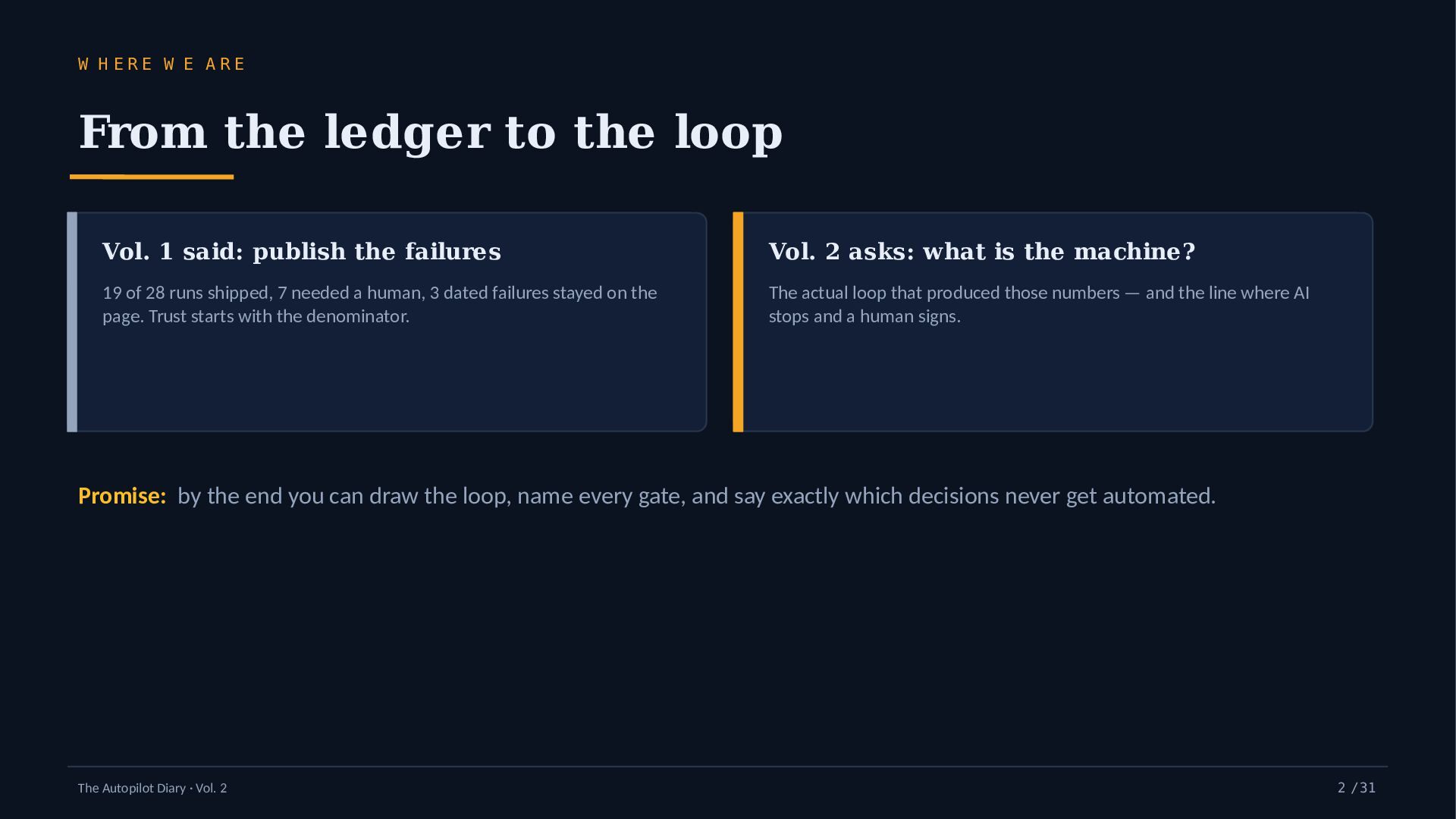
  2. W H ERE W E ARE From the ledger to

    the loop Vol. 1 said: publish the failures Vol. 2 asks: what is the machine? 19 of 28 runs shipped, 7 needed a human, 3 dated failures stayed on the page. Trust starts with the denominator. The actual loop that produced those numbers — and the line where AI stops and a human signs. Promise: by the end you can draw the loop, name every gate, and say exactly which decisions never get automated. The Autopilot Diary · Vol. 2 2 / 31
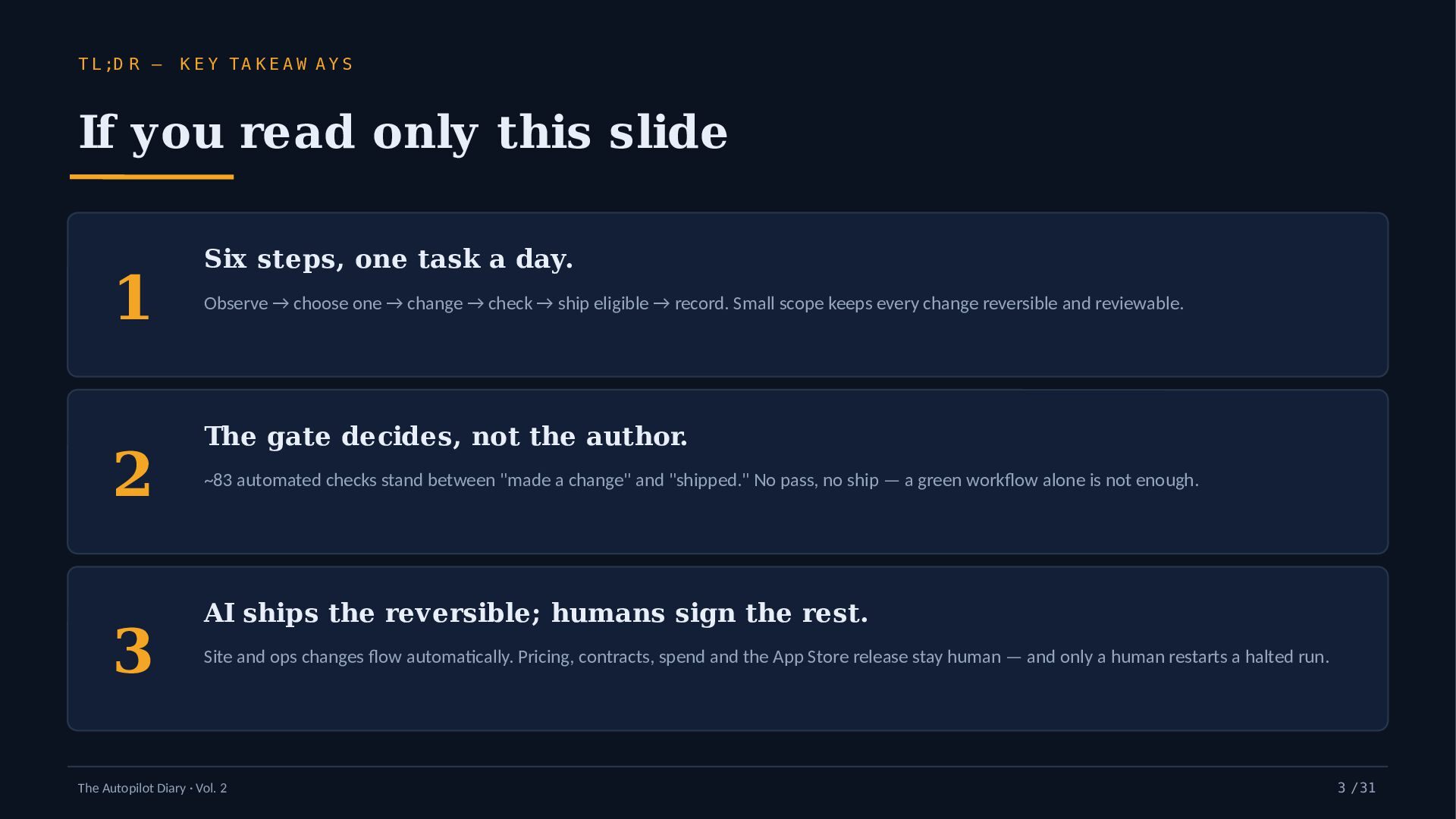
  3. T L ;D R — K E Y TA K

    E A W A Y S If you read only this slide 1 2 3 Six steps, one task a day. Observe → choose one → change → check → ship eligible → record. Small scope keeps every change reversible and reviewable. The gate decides, not the author. ~83 automated checks stand between "made a change" and "shipped." No pass, no ship — a green workflow alone is not enough. AI ships the reversible; humans sign the rest. Site and ops changes flow automatically. Pricing, contracts, spend and the App Store release stay human — and only a human restarts a halted run. The Autopilot Diary · Vol. 2 3 / 31
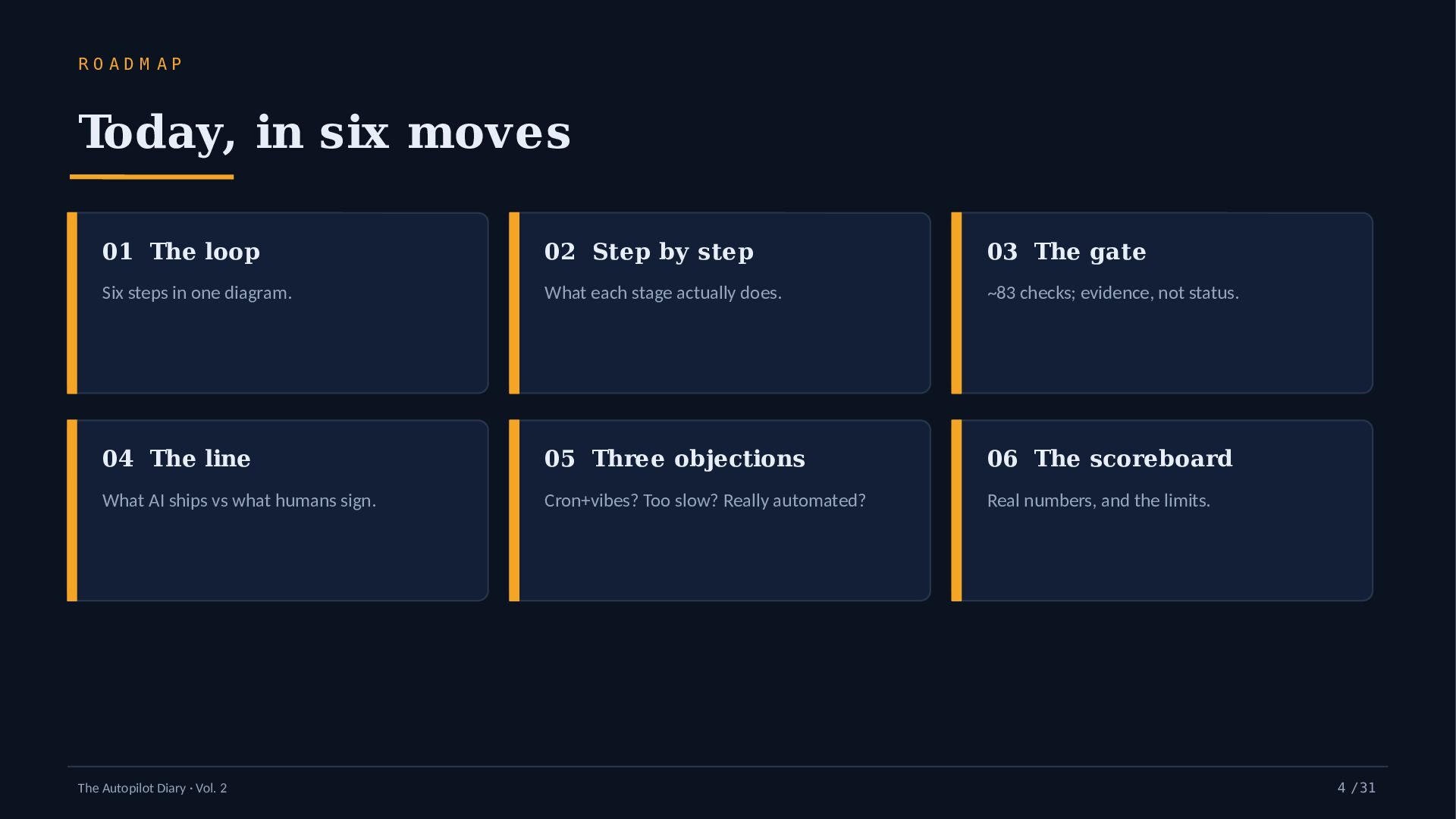
  4. RO AD M AP Today, in six moves 01 The

    loop 02 Step by step 03 The gate Six steps in one diagram. What each stage actually does. ~83 checks; evidence, not status. 04 The line 05 Three objections 06 The scoreboard What AI ships vs what humans sign. Cron+vibes? Too slow? Really automated? Real numbers, and the limits. The Autopilot Diary · Vol. 2 4 / 31
  5. T H E Q U E S T IO N

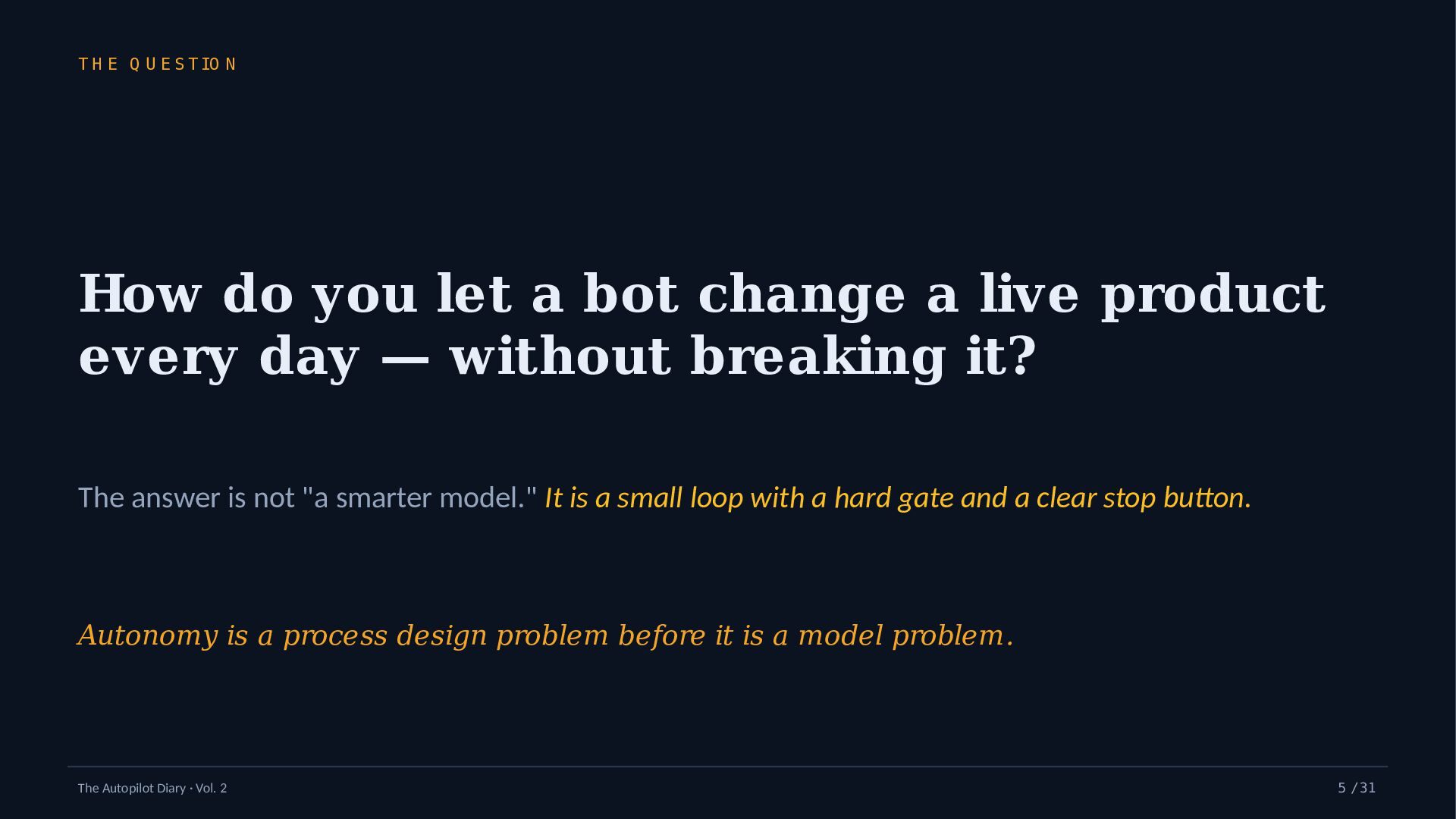
    How do you let a bot change a live product every day — without breaking it? The answer is not "a smarter model." It is a small loop with a hard gate and a clear stop button. Autonomy is a process design problem before it is a model problem. The Autopilot Diary · Vol. 2 5 / 31
  6. T H E LO O P , C O M

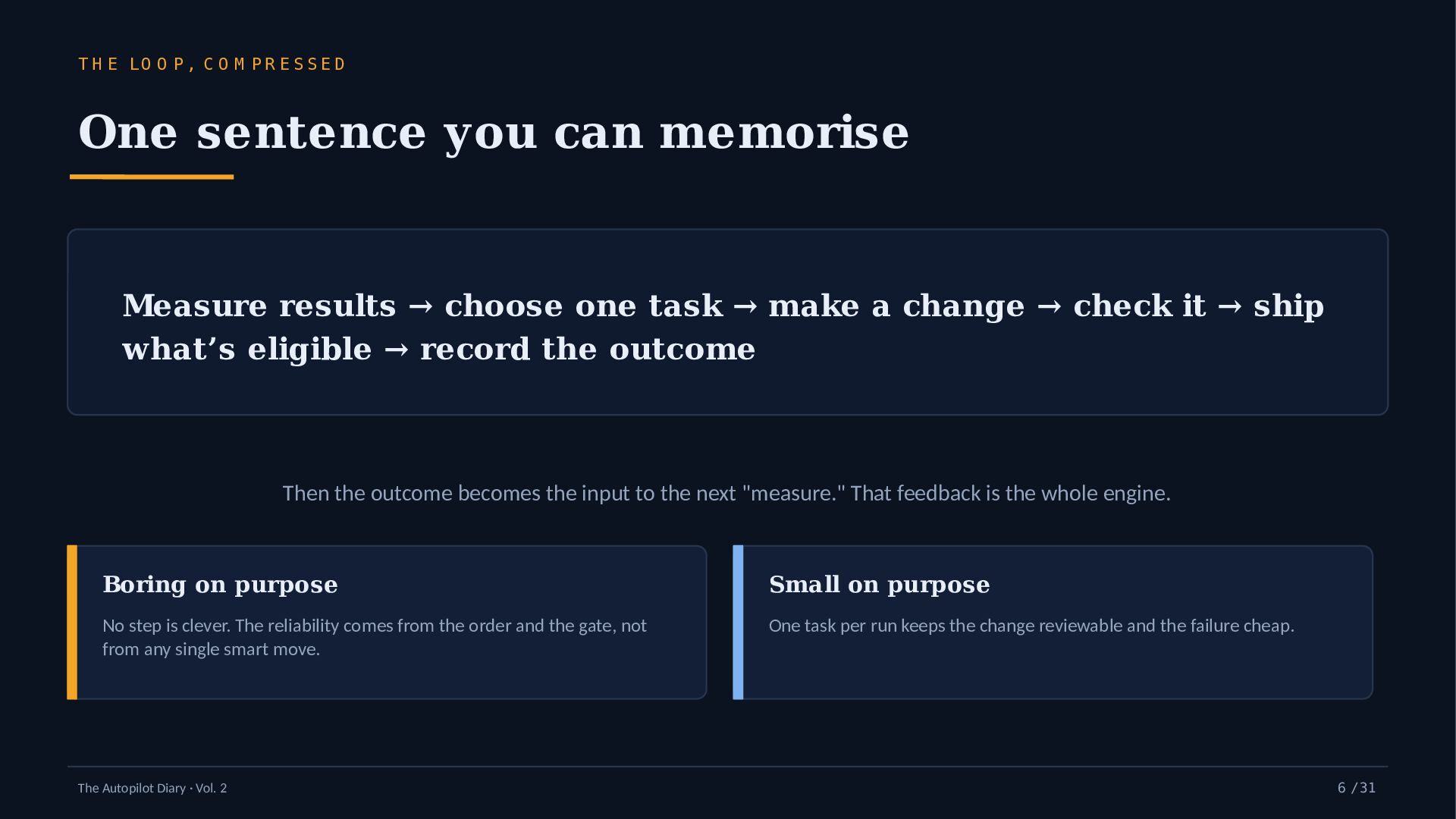
    P R E S S E D One sentence you can memorise Measure results → choose one task → make a change → check it → ship what’s eligible → record the outcome Then the outcome becomes the input to the next "measure." That feedback is the whole engine. Boring on purpose Small on purpose No step is clever. The reliability comes from the order and the gate, not from any single smart move. One task per run keeps the change reviewable and the failure cheap. The Autopilot Diary · Vol. 2 6 / 31
  7. T H E LO O P Six steps, end to

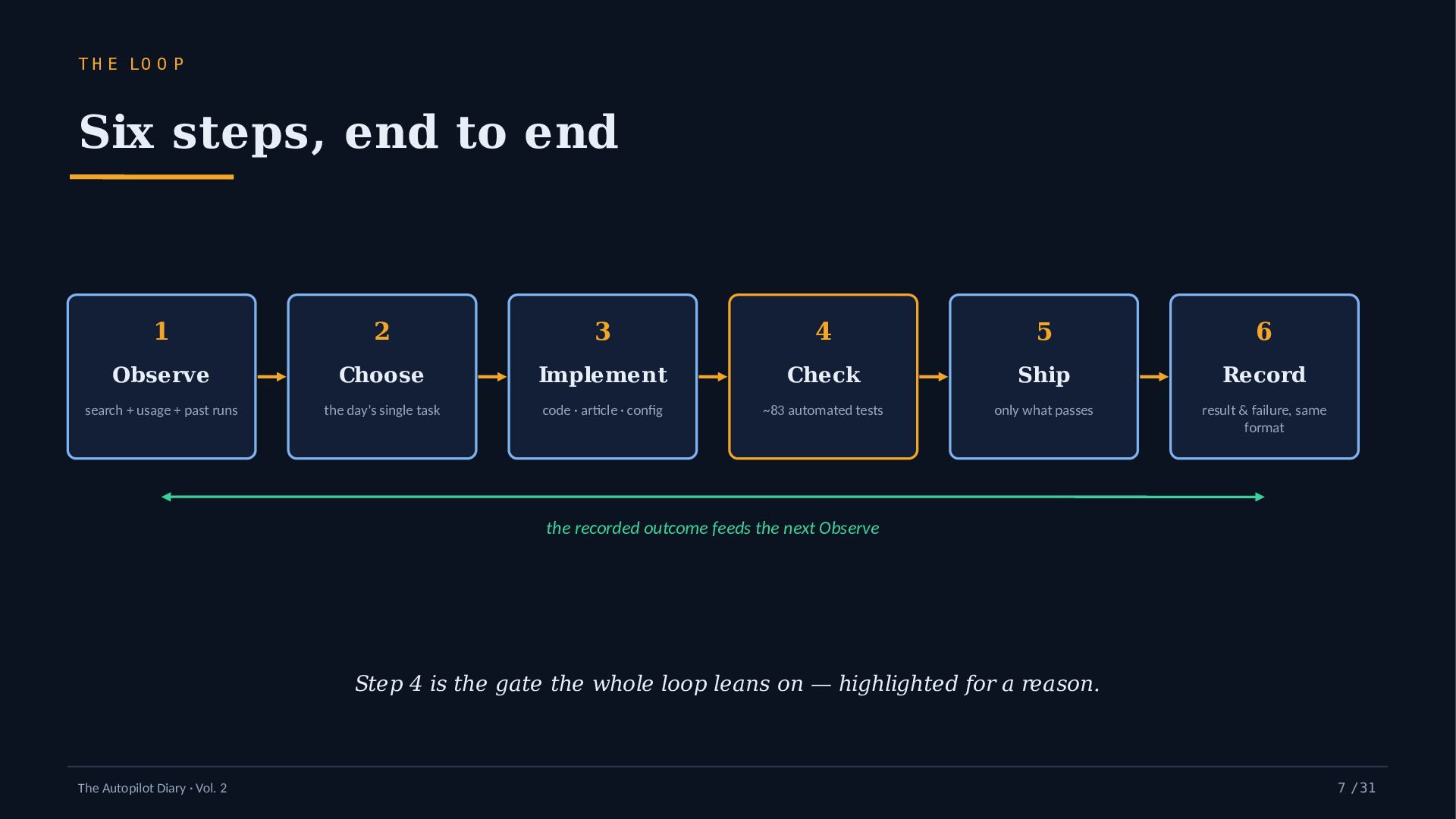
    end 1 2 3 4 5 6 Observe Choose Implement Check Ship Record search + usage + past runs the day’s single task code · article · config ~83 automated tests only what passes result & failure, same format the recorded outcome feeds the next Observe Step 4 is the gate the whole loop leans on — highlighted for a reason. The Autopilot Diary · Vol. 2 7 / 31
  8. STEP 1 — O BSERVE Read the world before you

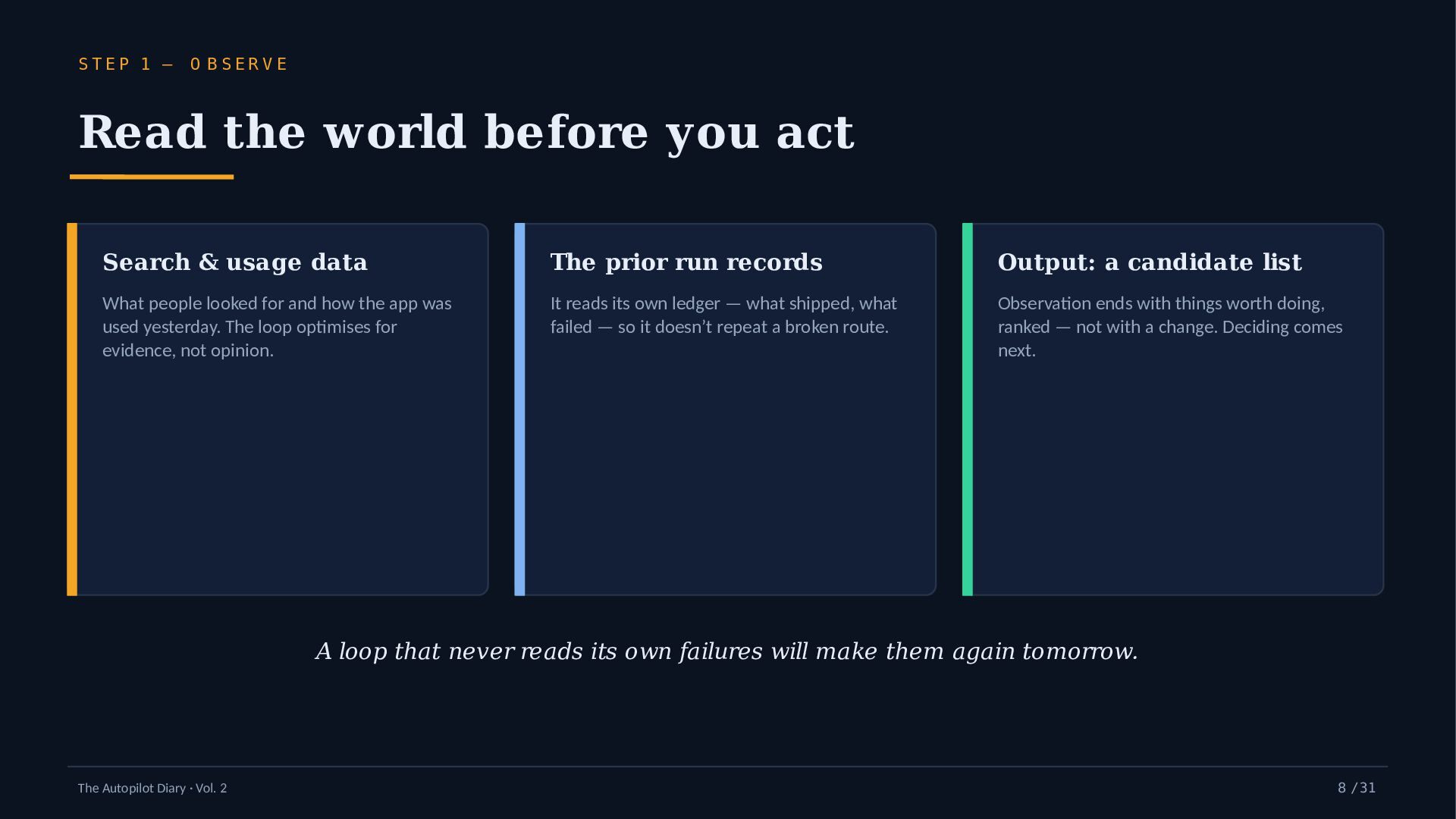
    act Search & usage data The prior run records Output: a candidate list What people looked for and how the app was used yesterday. The loop optimises for evidence, not opinion. It reads its own ledger — what shipped, what failed — so it doesn’t repeat a broken route. Observation ends with things worth doing, ranked — not with a change. Deciding comes next. A loop that never reads its own failures will make them again tomorrow. The Autopilot Diary · Vol. 2 8 / 31
  9. STEP 2 — C H O O SE Exactly one

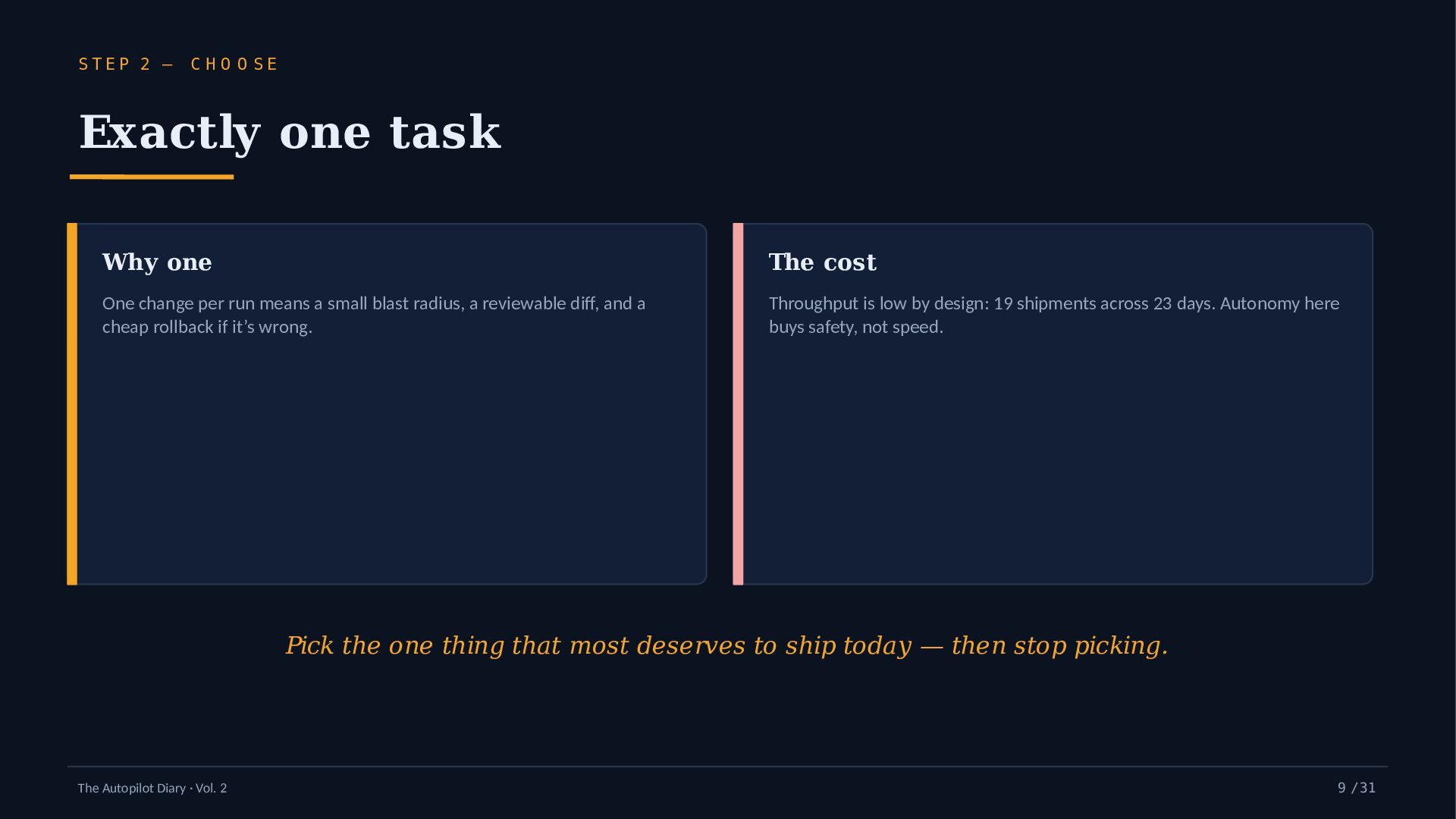
    task Why one The cost One change per run means a small blast radius, a reviewable diff, and a cheap rollback if it’s wrong. Throughput is low by design: 19 shipments across 23 days. Autonomy here buys safety, not speed. Pick the one thing that most deserves to ship today — then stop picking. The Autopilot Diary · Vol. 2 9 / 31
  10. STEP 3 — IM P L E M E N

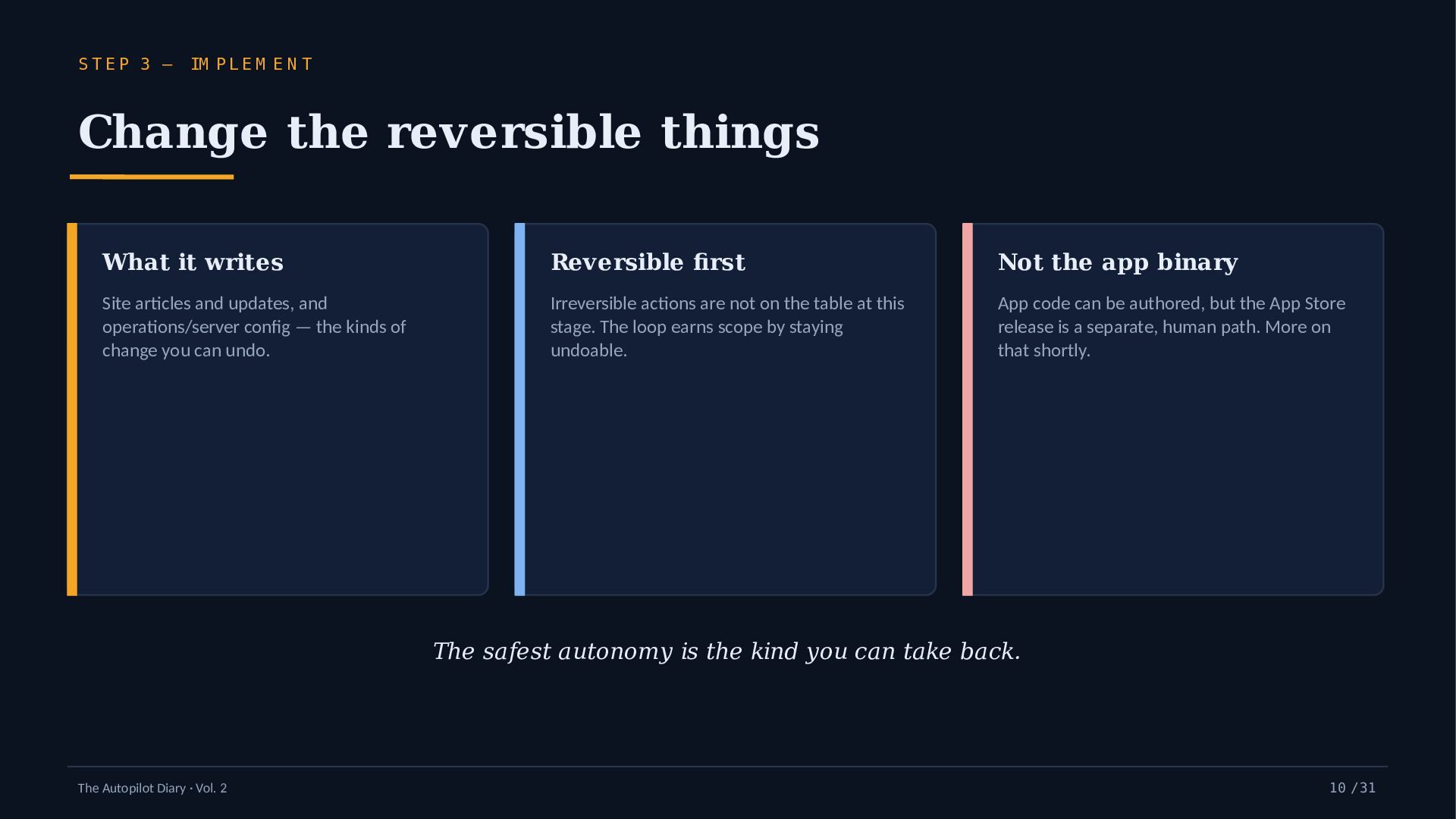
    T Change the reversible things What it writes Reversible first Not the app binary Site articles and updates, and operations/server config — the kinds of change you can undo. Irreversible actions are not on the table at this stage. The loop earns scope by staying undoable. App code can be authored, but the App Store release is a separate, human path. More on that shortly. The safest autonomy is the kind you can take back. The Autopilot Diary · Vol. 2 10 / 31
  11. STEP 4 — C H EC K The gate: ~83

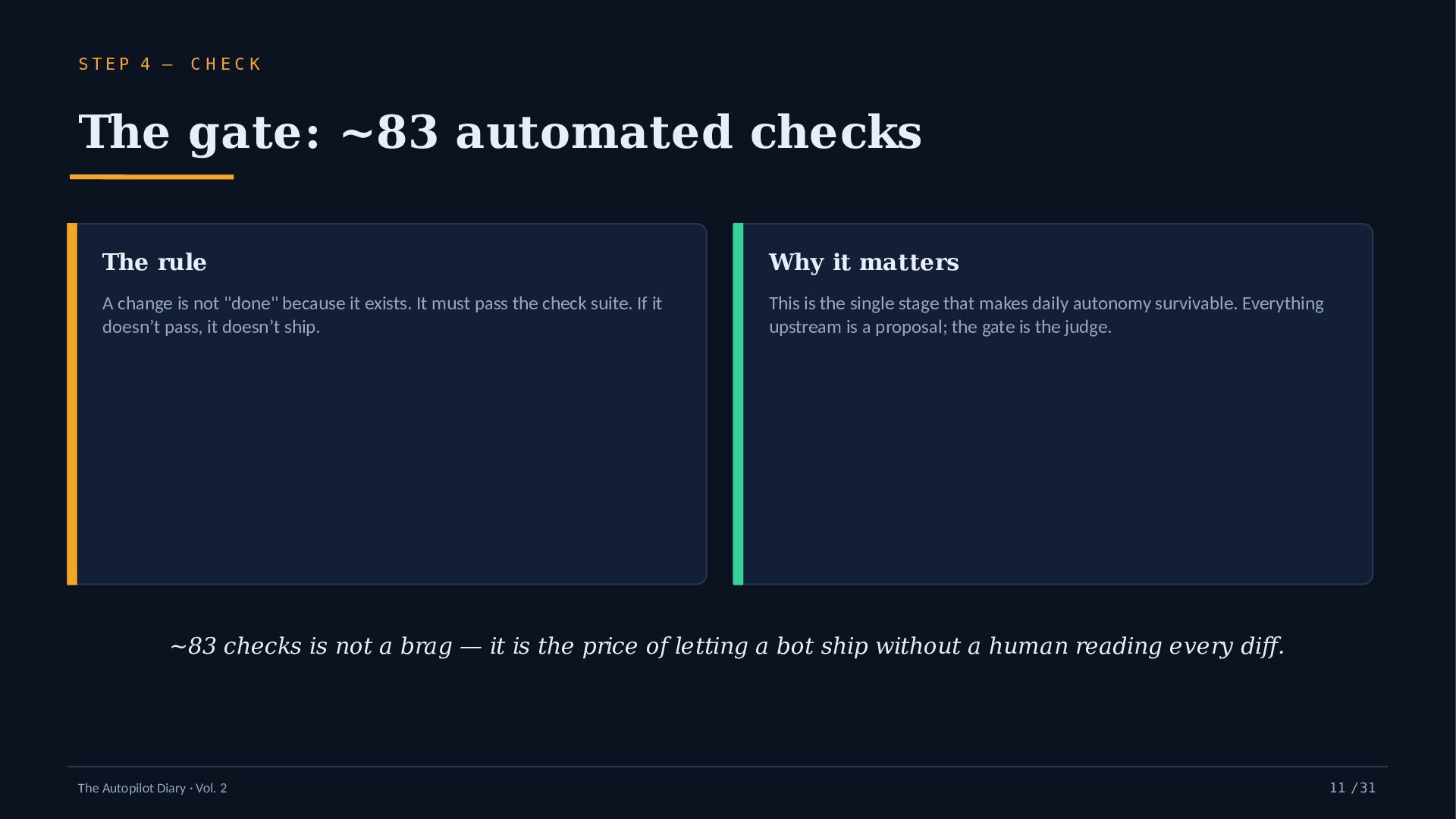
    automated checks The rule Why it matters A change is not "done" because it exists. It must pass the check suite. If it doesn’t pass, it doesn’t ship. This is the single stage that makes daily autonomy survivable. Everything upstream is a proposal; the gate is the judge. ~83 checks is not a brag — it is the price of letting a bot ship without a human reading every diff. The Autopilot Diary · Vol. 2 11 / 31
  12. A T R A P T H E G A

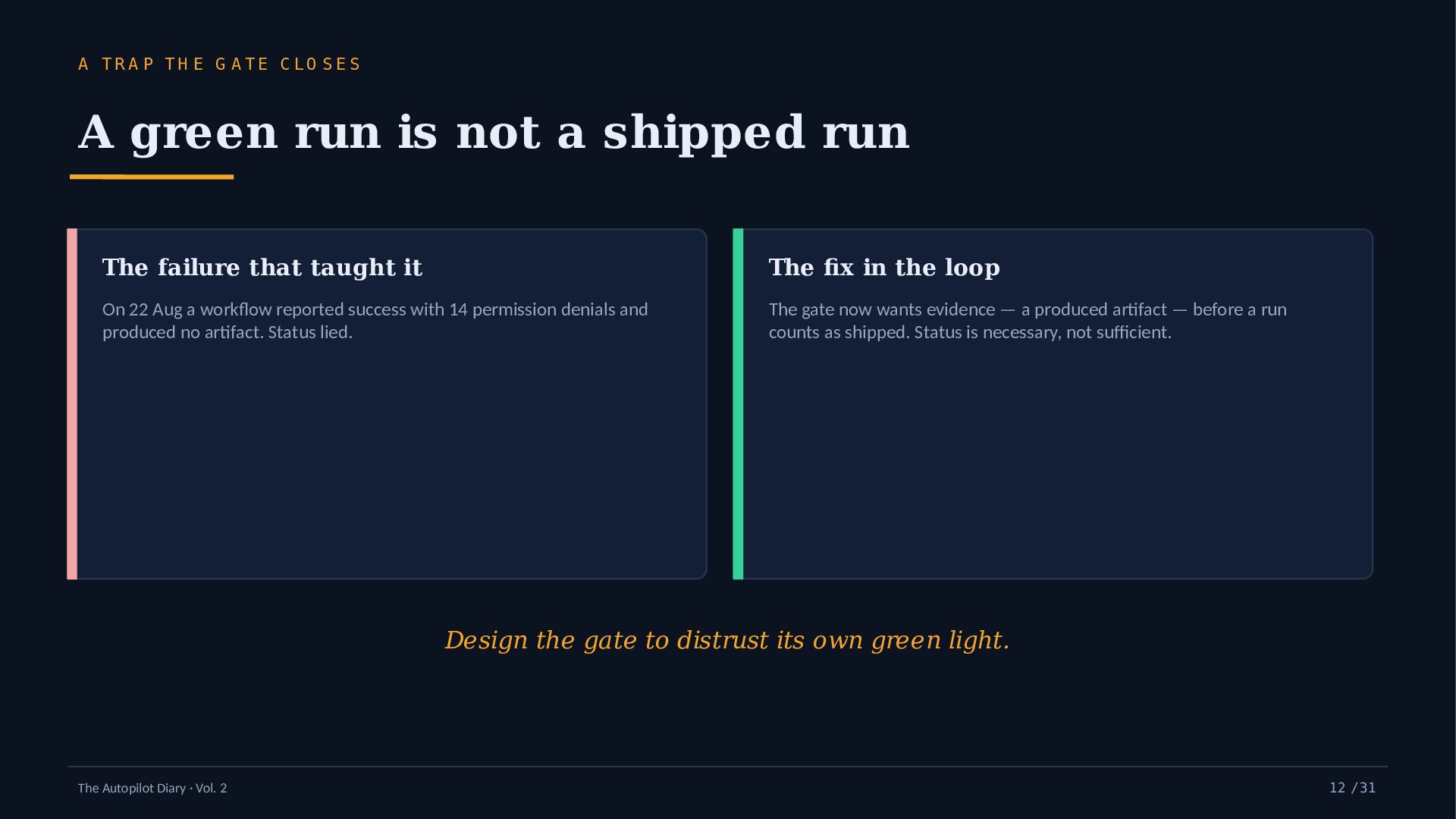
    T E C LO S E S A green run is not a shipped run The failure that taught it The fix in the loop On 22 Aug a workflow reported success with 14 permission denials and produced no artifact. Status lied. The gate now wants evidence — a produced artifact — before a run counts as shipped. Status is necessary, not sufficient. Design the gate to distrust its own green light. The Autopilot Diary · Vol. 2 12 / 31
  13. STEP 5 — S H IP Only what passes, and

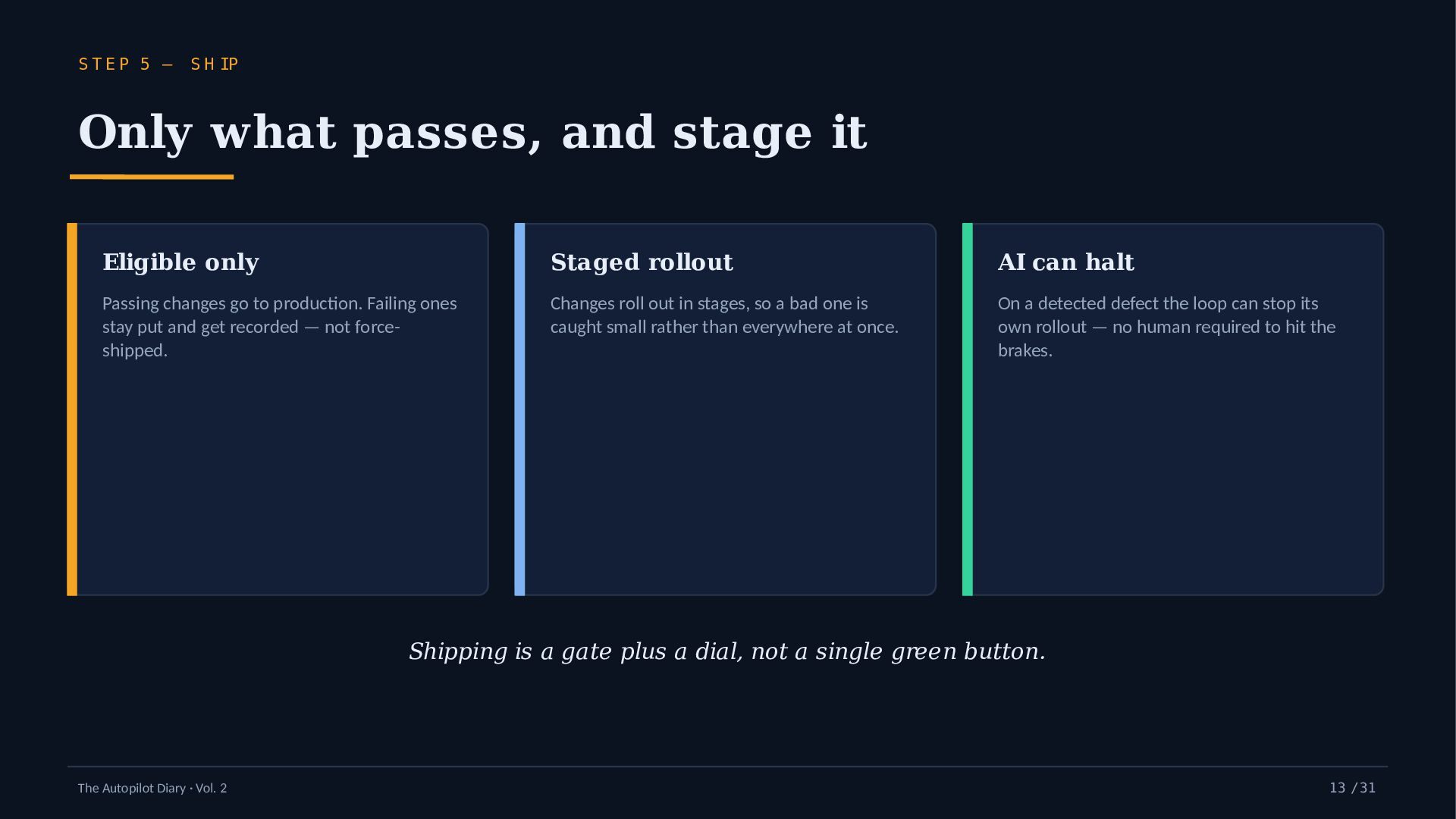
    stage it Eligible only Staged rollout AI can halt Passing changes go to production. Failing ones stay put and get recorded — not forceshipped. Changes roll out in stages, so a bad one is caught small rather than everywhere at once. On a detected defect the loop can stop its own rollout — no human required to hit the brakes. Shipping is a gate plus a dial, not a single green button. The Autopilot Diary · Vol. 2 13 / 31
  14. TH E STO P B U TTO N Halt is

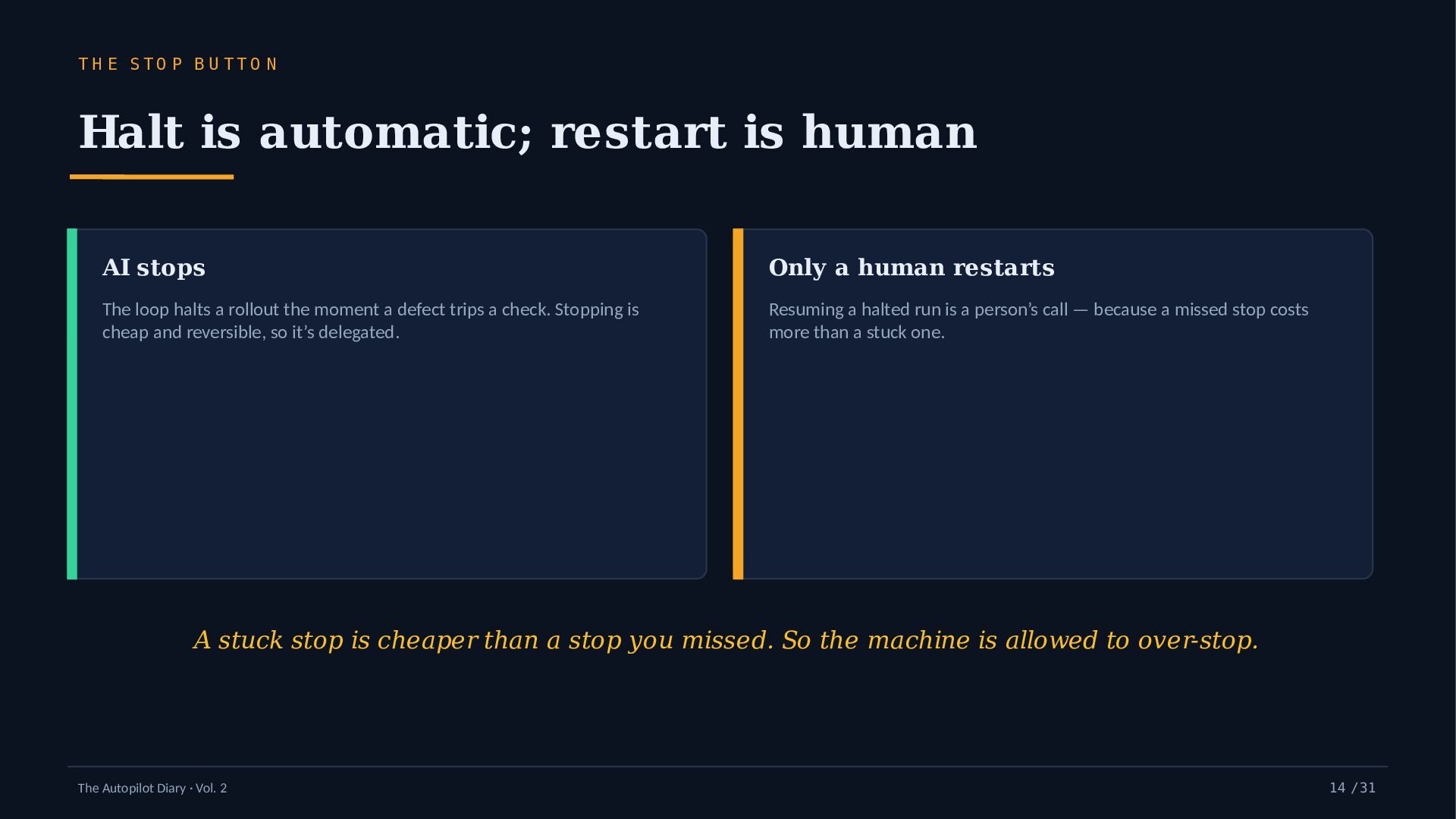
    automatic; restart is human AI stops Only a human restarts The loop halts a rollout the moment a defect trips a check. Stopping is cheap and reversible, so it’s delegated. Resuming a halted run is a person’s call — because a missed stop costs more than a stuck one. A stuck stop is cheaper than a stop you missed. So the machine is allowed to over-stop. The Autopilot Diary · Vol. 2 14 / 31
  15. STEP 6 — REC O RD Wins and failures, one

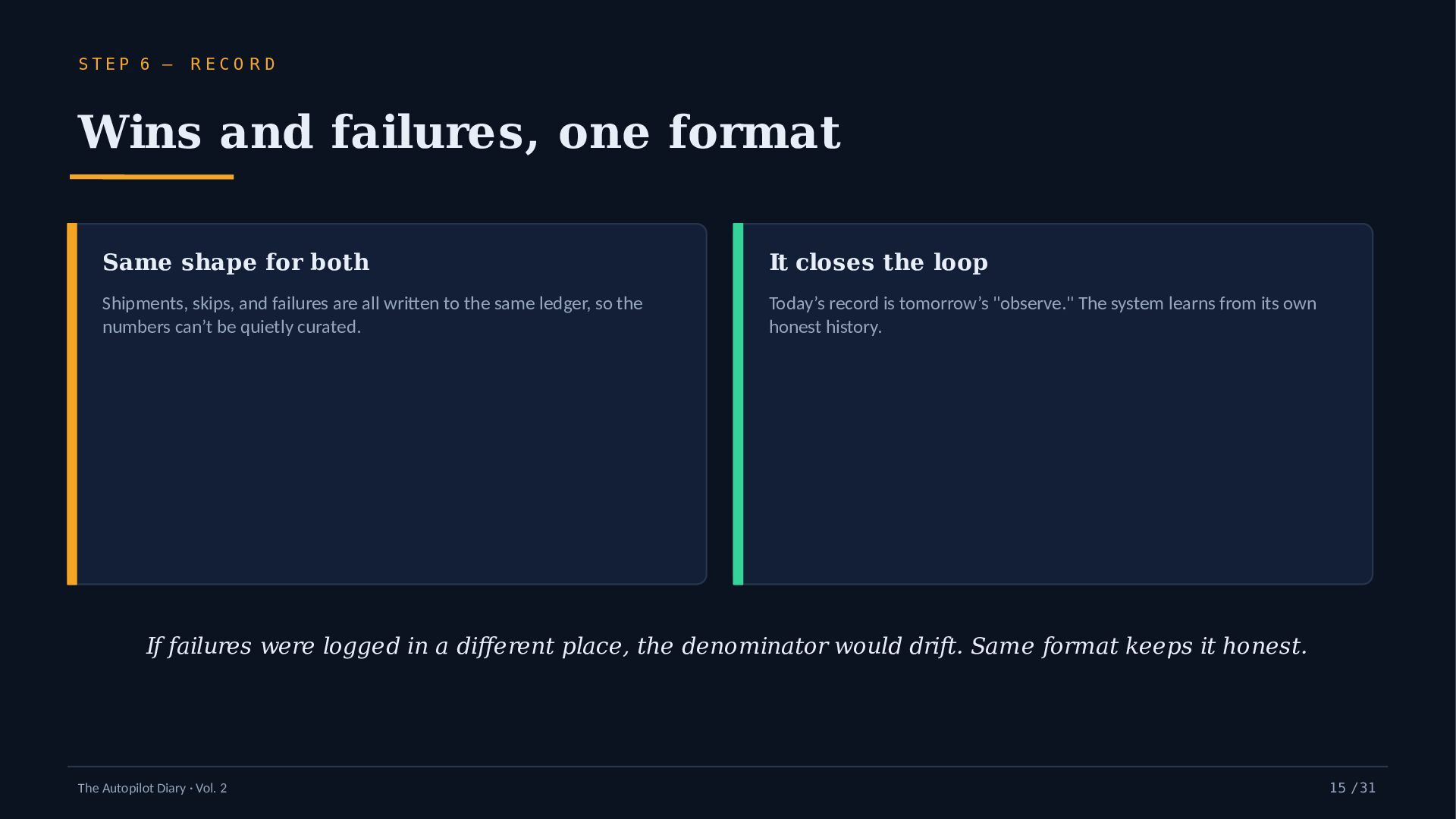
    format Same shape for both It closes the loop Shipments, skips, and failures are all written to the same ledger, so the numbers can’t be quietly curated. Today’s record is tomorrow’s "observe." The system learns from its own honest history. If failures were logged in a different place, the denominator would drift. Same format keeps it honest. The Autopilot Diary · Vol. 2 15 / 31
  16. T H E C O M P A R IS

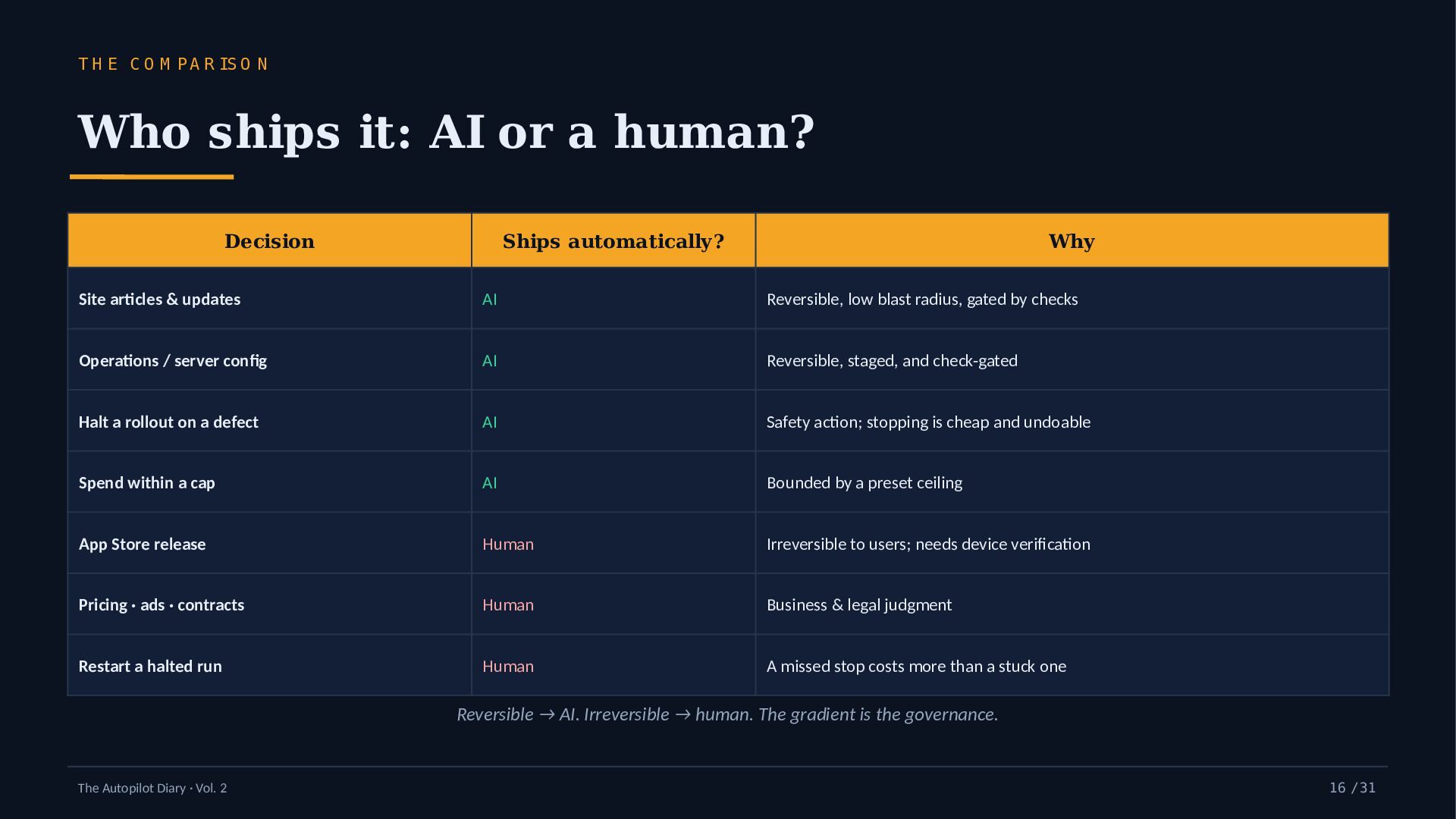
    O N Who ships it: AI or a human? Decision Ships automatically? Why Site articles & updates AI Reversible, low blast radius, gated by checks Operations / server config AI Reversible, staged, and check-gated Halt a rollout on a defect AI Safety action; stopping is cheap and undoable Spend within a cap AI Bounded by a preset ceiling App Store release Human Irreversible to users; needs device verification Pricing · ads · contracts Human Business & legal judgment Restart a halted run Human A missed stop costs more than a stuck one Reversible → AI. Irreversible → human. The gradient is the governance. The Autopilot Diary · Vol. 2 16 / 31
  17. T H E H A N D O V E

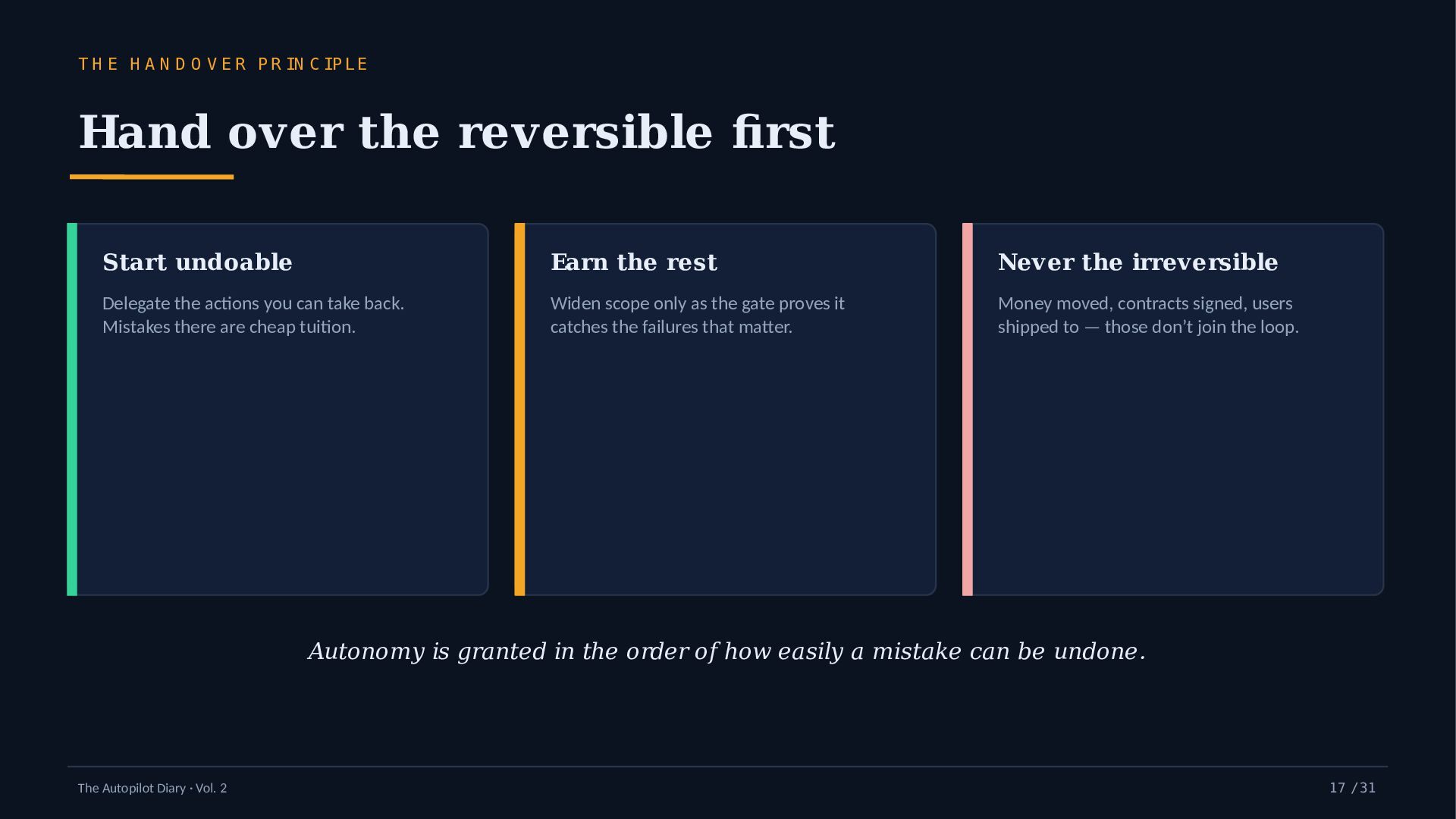
    R P R IN C IP L E Hand over the reversible first Start undoable Earn the rest Never the irreversible Delegate the actions you can take back. Mistakes there are cheap tuition. Widen scope only as the gate proves it catches the failures that matter. Money moved, contracts signed, users shipped to — those don’t join the loop. Autonomy is granted in the order of how easily a mistake can be undone. The Autopilot Diary · Vol. 2 17 / 31
  18. D E S IG N C H O IC E

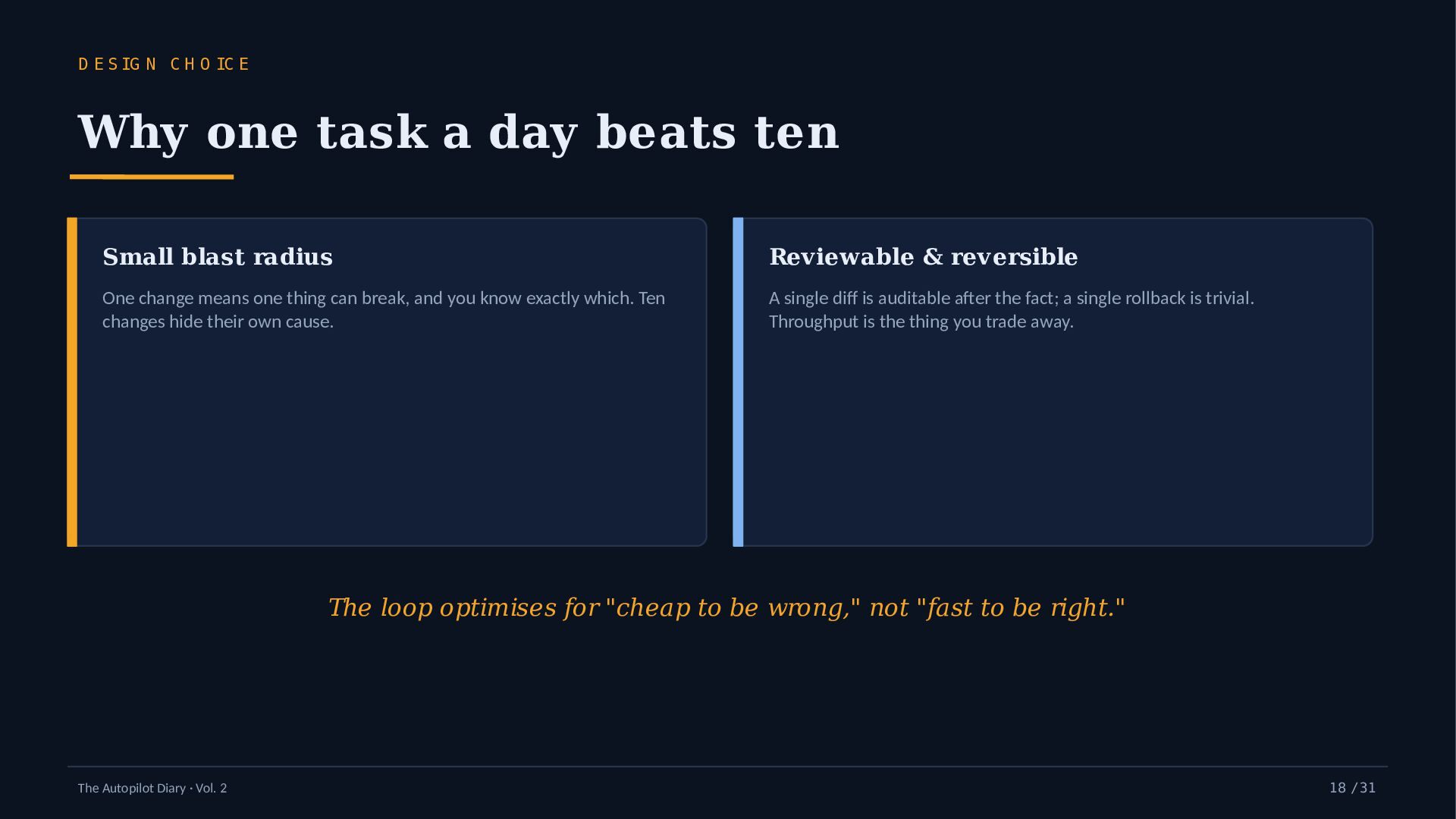
    Why one task a day beats ten Small blast radius Reviewable & reversible One change means one thing can break, and you know exactly which. Ten changes hide their own cause. A single diff is auditable after the fact; a single rollback is trivial. Throughput is the thing you trade away. The loop optimises for "cheap to be wrong," not "fast to be right." The Autopilot Diary · Vol. 2 18 / 31
  19. TH E O U TPU T From attempt to shipment

    67.9% shipped Shipped Attempted The Autopilot Diary · Vol. 2 19 of 28 attempted runs shipped work across 23 days. The 9-run gap is the gate and the failures doing their job — not waste to hide. 19 28 19 / 31
  20. TH E H U M A N TO U C

    H Where a person stepped in 7 of 28 runs Owner request 1 Substitution 1 Initial setup 1 Infra repair The Autopilot Diary · Vol. 2 Human intervention clustered on infrastructure repair (×4), not on writing the work — 0 artifact edits. People fix the pipes; the loop fills them. 4 20 / 31
  21. CAD EN C E A daily loop, not a weekly

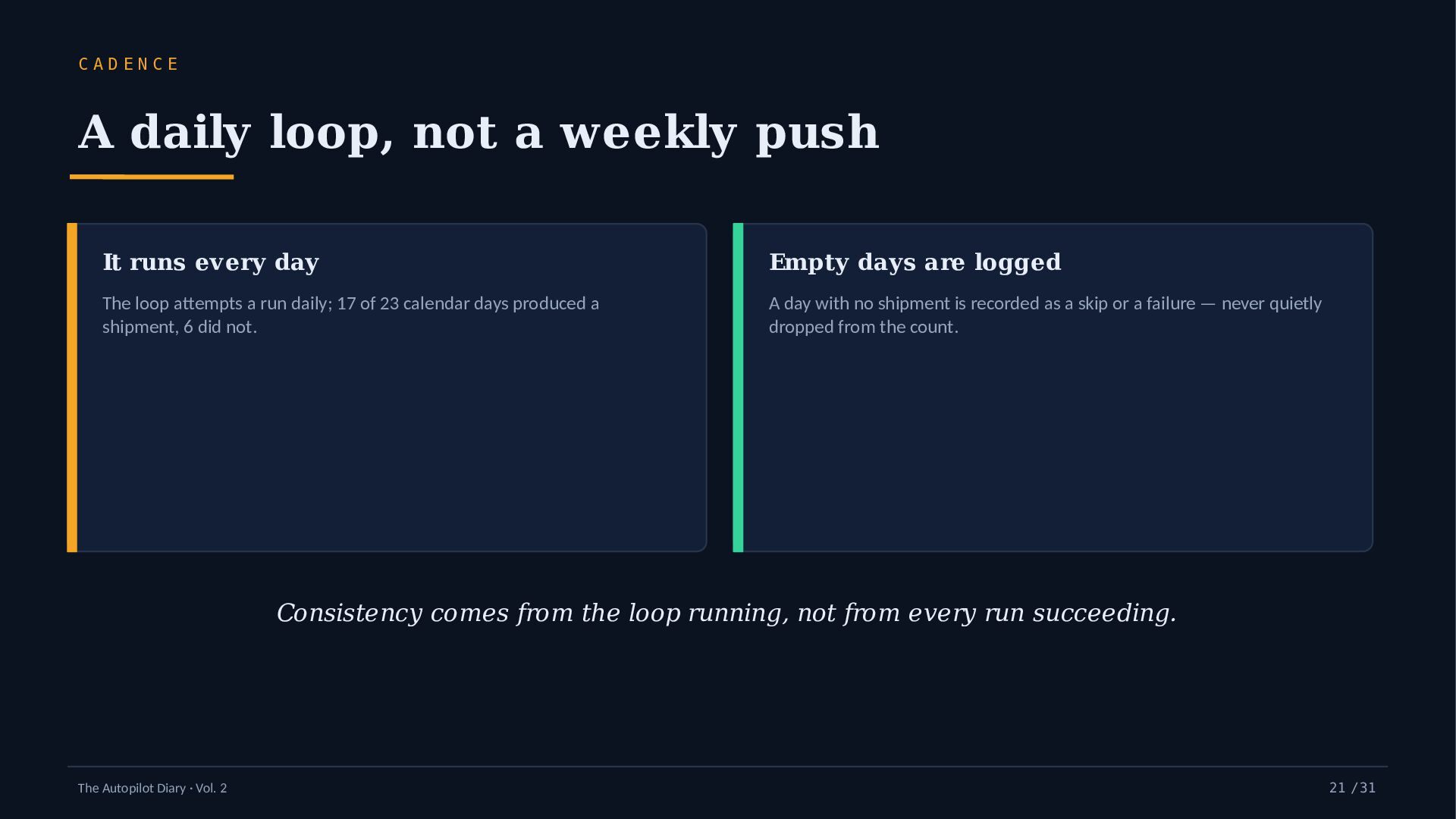
    push It runs every day Empty days are logged The loop attempts a run daily; 17 of 23 calendar days produced a shipment, 6 did not. A day with no shipment is recorded as a skip or a failure — never quietly dropped from the count. Consistency comes from the loop running, not from every run succeeding. The Autopilot Diary · Vol. 2 21 / 31
  22. T H E L IN E W O R T

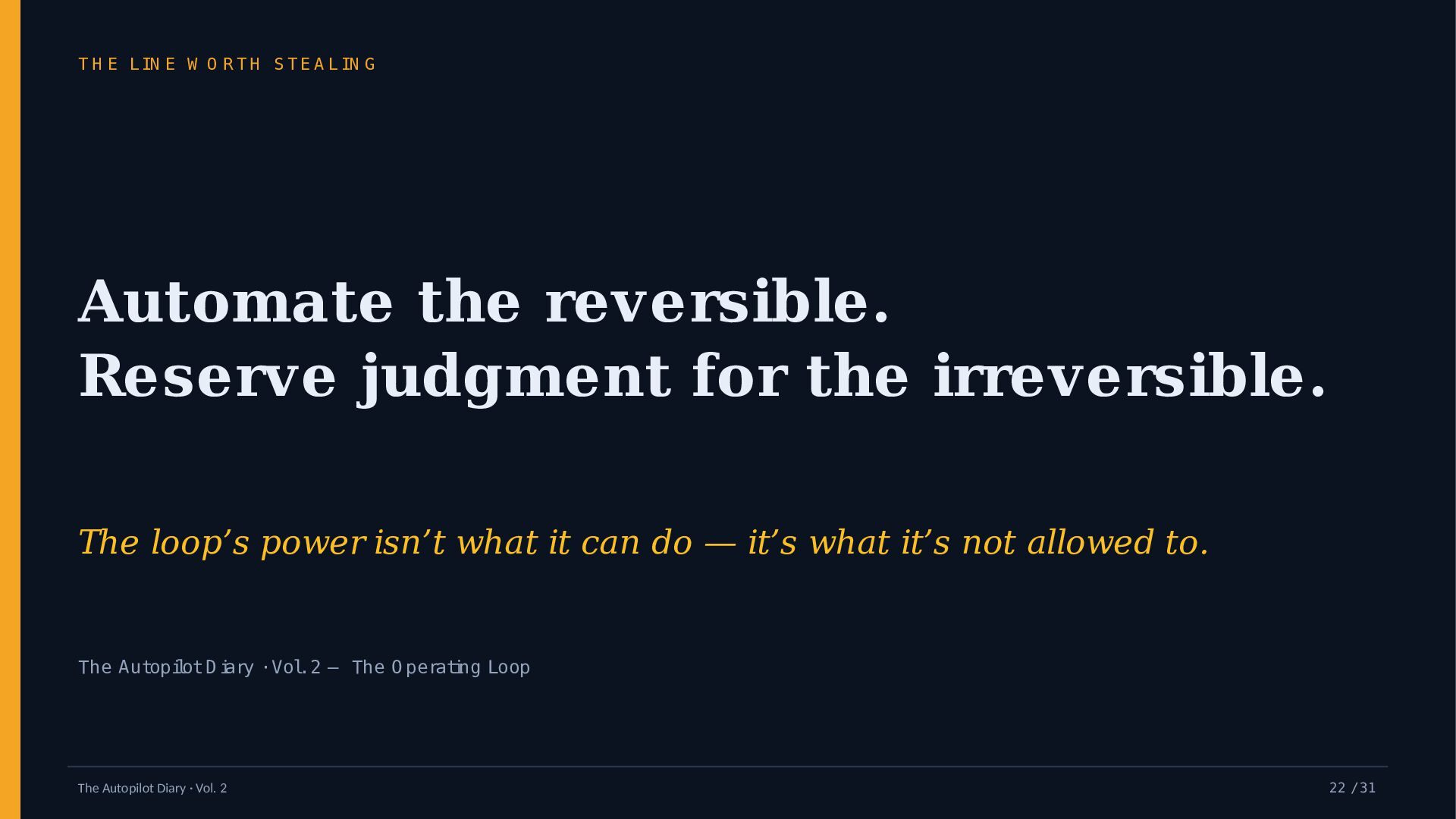
    H S T E A L IN G Automate the reversible. Reserve judgment for the irreversible. The loop’s power isn’t what it can do — it’s what it’s not allowed to. The Autopilot D iary · Vol. 2 — The O perating Loop The Autopilot Diary · Vol. 2 22 / 31
  23. O B JE C T IO N 1 / 3

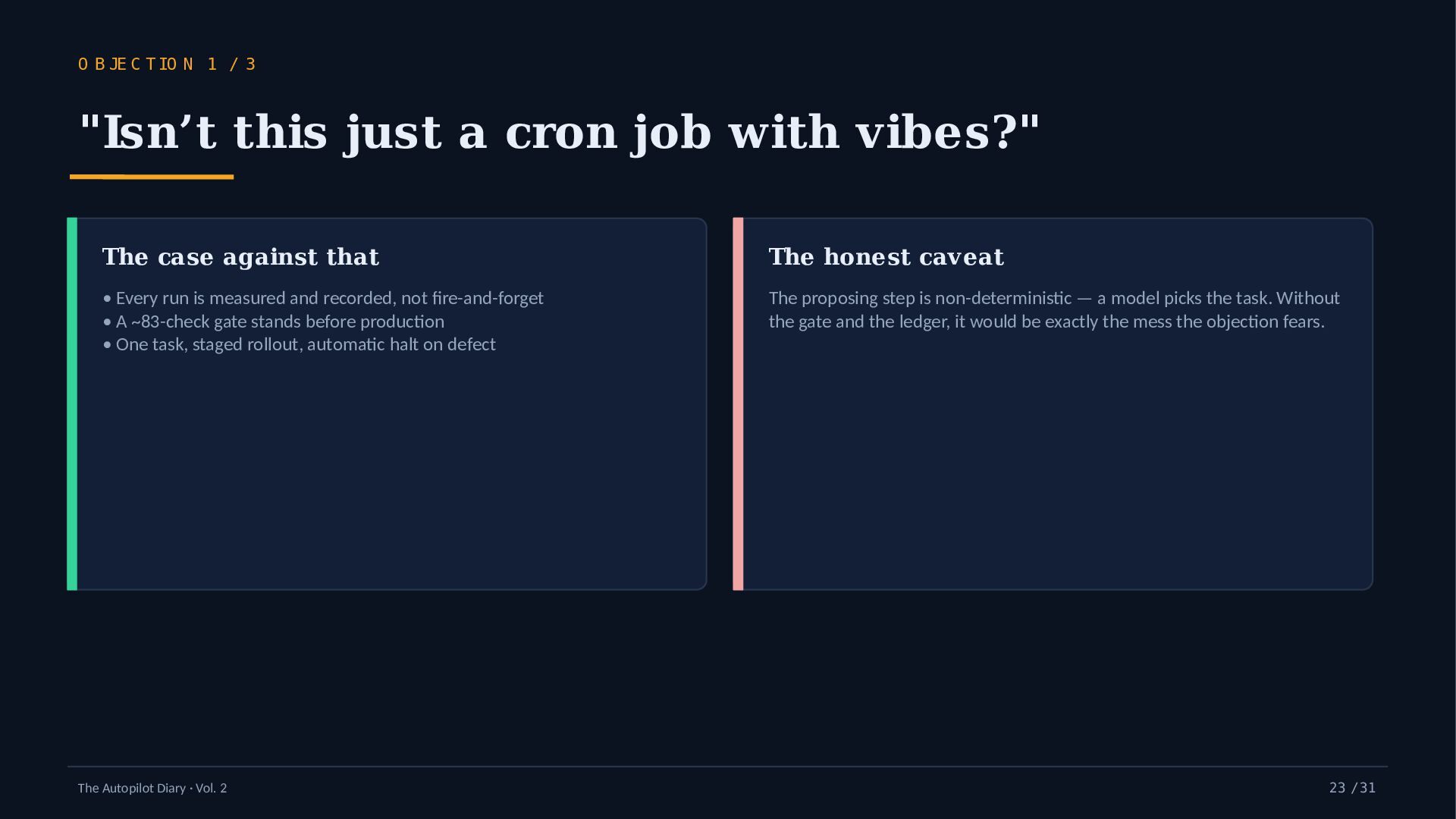
    "Isn’t this just a cron job with vibes?" The case against that The honest caveat • Every run is measured and recorded, not fire-and-forget • A ~83-check gate stands before production • One task, staged rollout, automatic halt on defect The proposing step is non-deterministic — a model picks the task. Without the gate and the ledger, it would be exactly the mess the objection fears. The Autopilot Diary · Vol. 2 23 / 31
  24. O B JE C T IO N 2 / 3

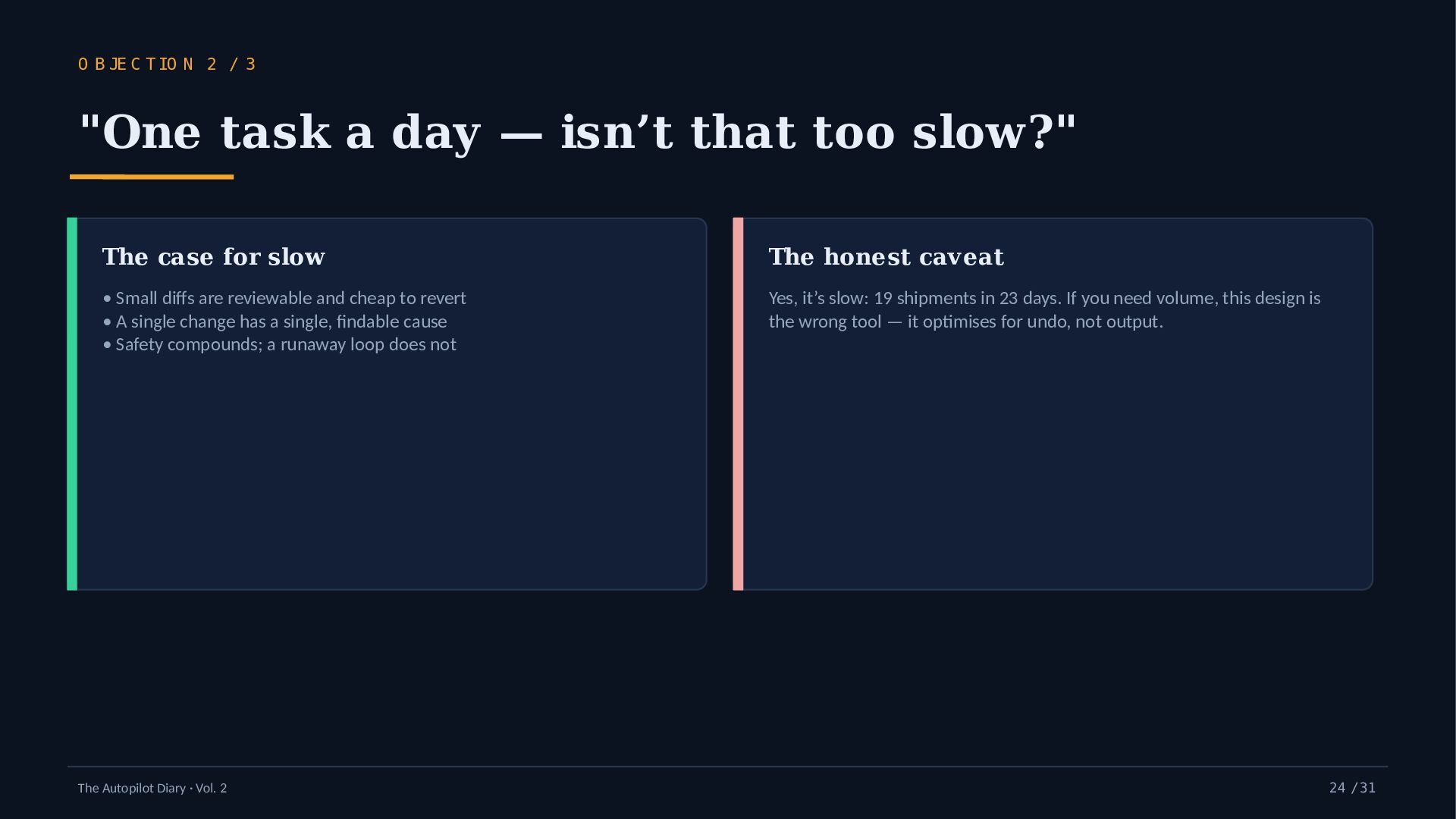
    "One task a day — isn’t that too slow?" The case for slow The honest caveat • Small diffs are reviewable and cheap to revert • A single change has a single, findable cause • Safety compounds; a runaway loop does not Yes, it’s slow: 19 shipments in 23 days. If you need volume, this design is the wrong tool — it optimises for undo, not output. The Autopilot Diary · Vol. 2 24 / 31
  25. O B JE C T IO N 3 / 3

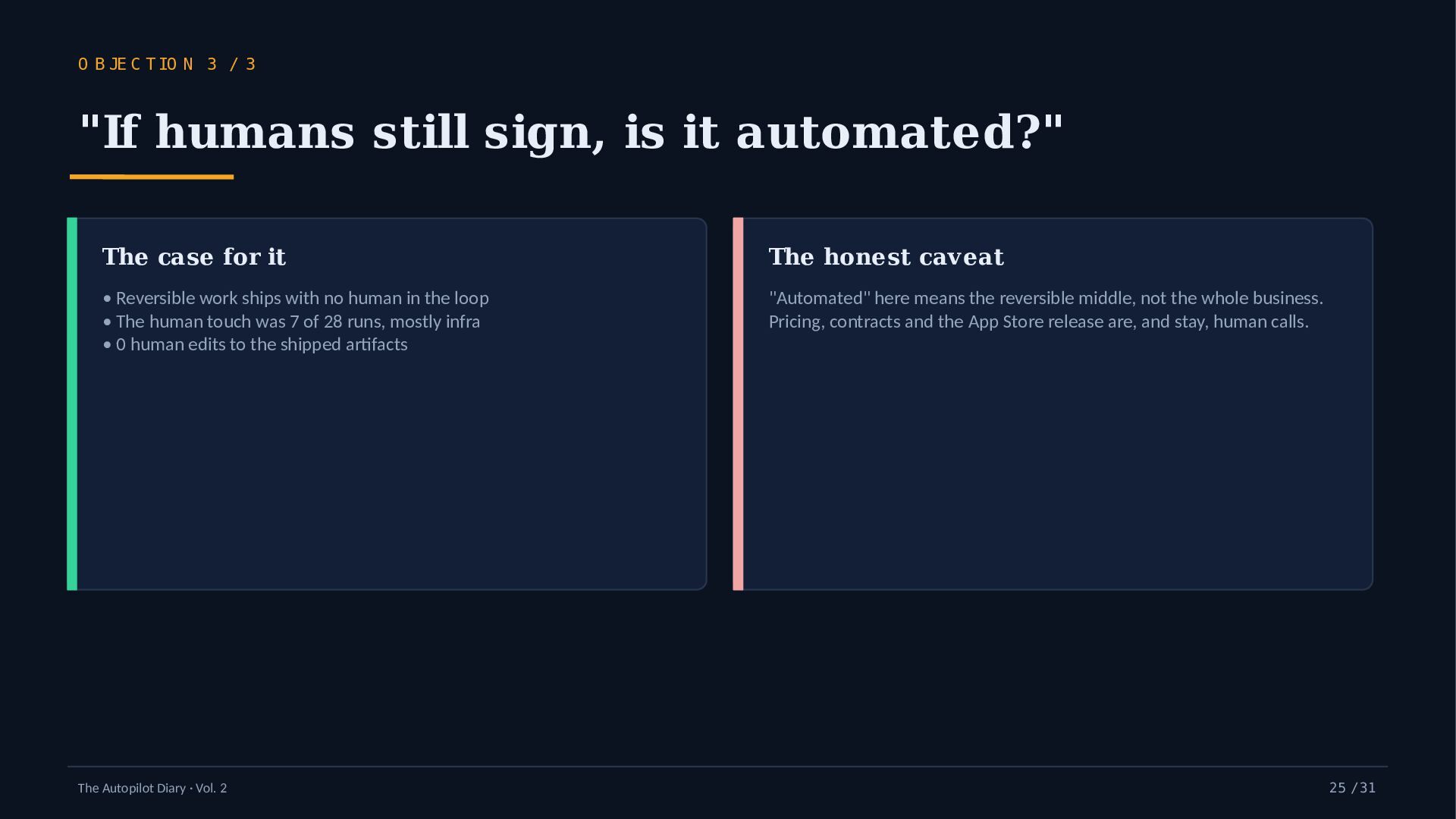
    "If humans still sign, is it automated?" The case for it The honest caveat • Reversible work ships with no human in the loop • The human touch was 7 of 28 runs, mostly infra • 0 human edits to the shipped artifacts "Automated" here means the reversible middle, not the whole business. Pricing, contracts and the App Store release are, and stay, human calls. The Autopilot Diary · Vol. 2 25 / 31
  26. A LO O K A H E A D —

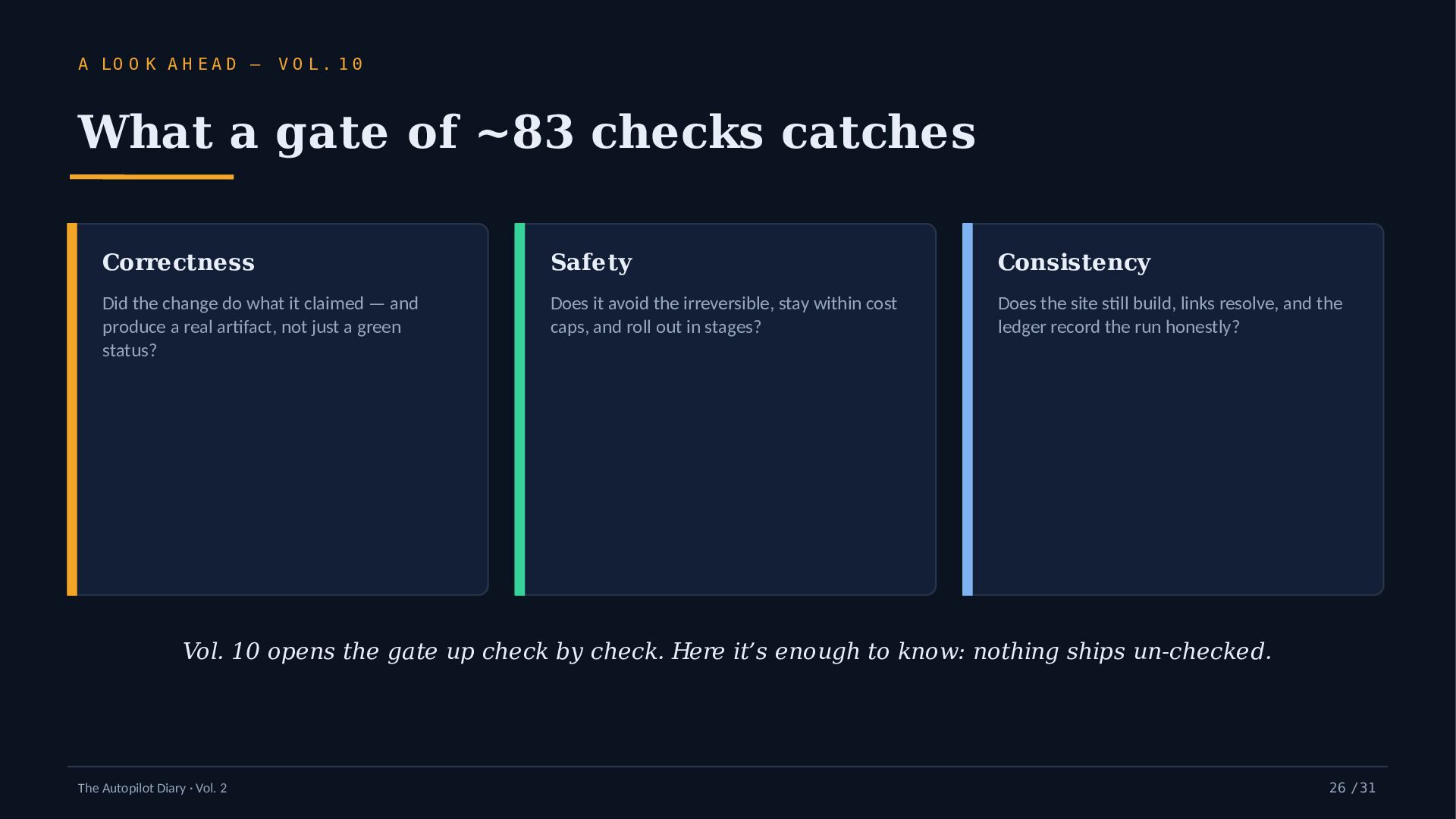
    V O L. 1 0 What a gate of ~83 checks catches Correctness Safety Consistency Did the change do what it claimed — and produce a real artifact, not just a green status? Does it avoid the irreversible, stay within cost caps, and roll out in stages? Does the site still build, links resolve, and the ledger record the run honestly? Vol. 10 opens the gate up check by check. Here it’s enough to know: nothing ships un-checked. The Autopilot Diary · Vol. 2 26 / 31
  27. H O N EST SC O REBO ARD — L

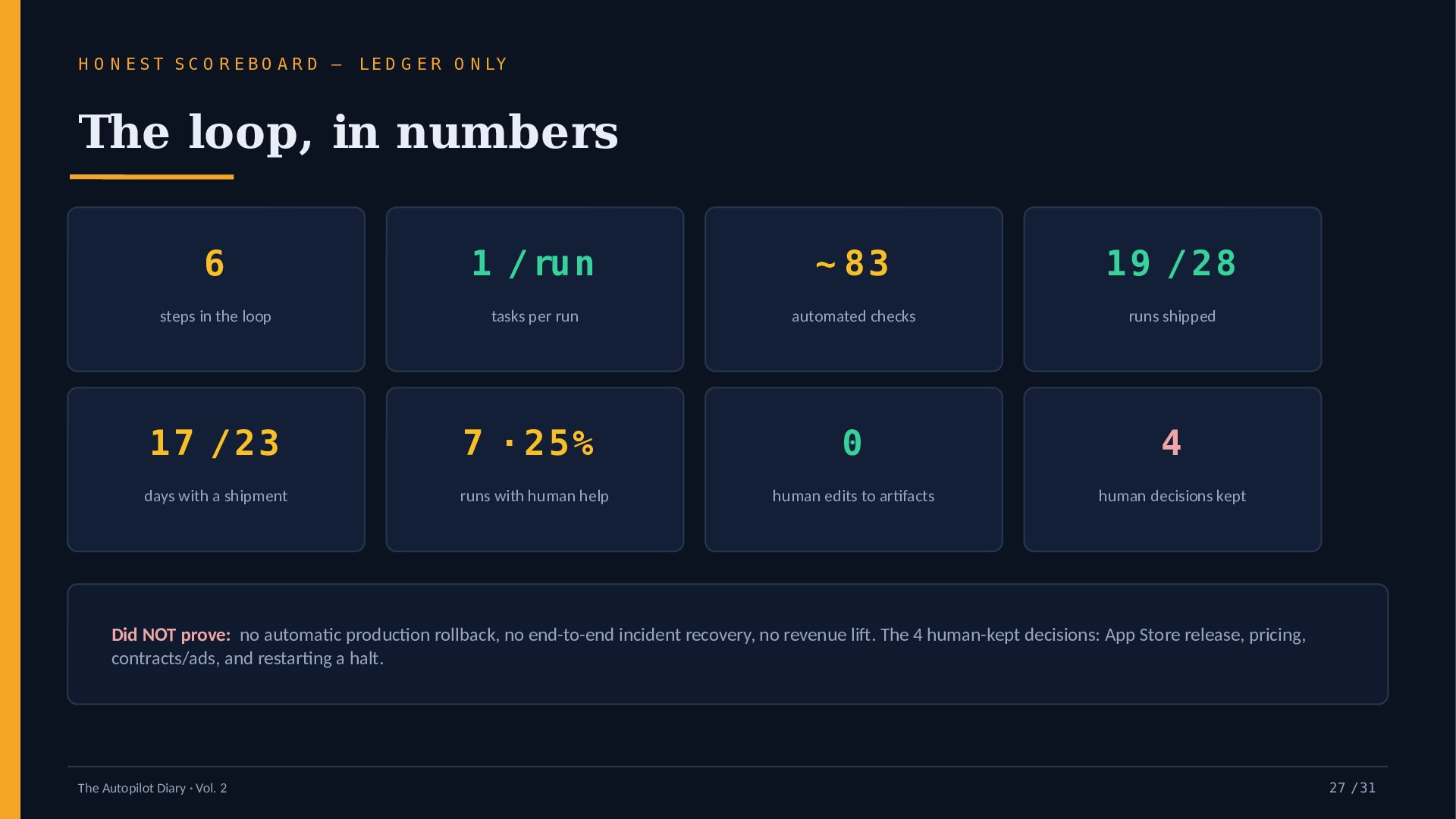
    E D G E R O N LY The loop, in numbers 6 1 / ru n ~ 83 19 / 28 steps in the loop tasks per run automated checks runs shipped 17 / 23 7 · 25% 0 4 days with a shipment runs with human help human edits to artifacts human decisions kept Did NOT prove: no automatic production rollback, no end-to-end incident recovery, no revenue lift. The 4 human-kept decisions: App Store release, pricing, contracts/ads, and restarting a halt. The Autopilot Diary · Vol. 2 27 / 31
  28. F IE L D N O T E S What

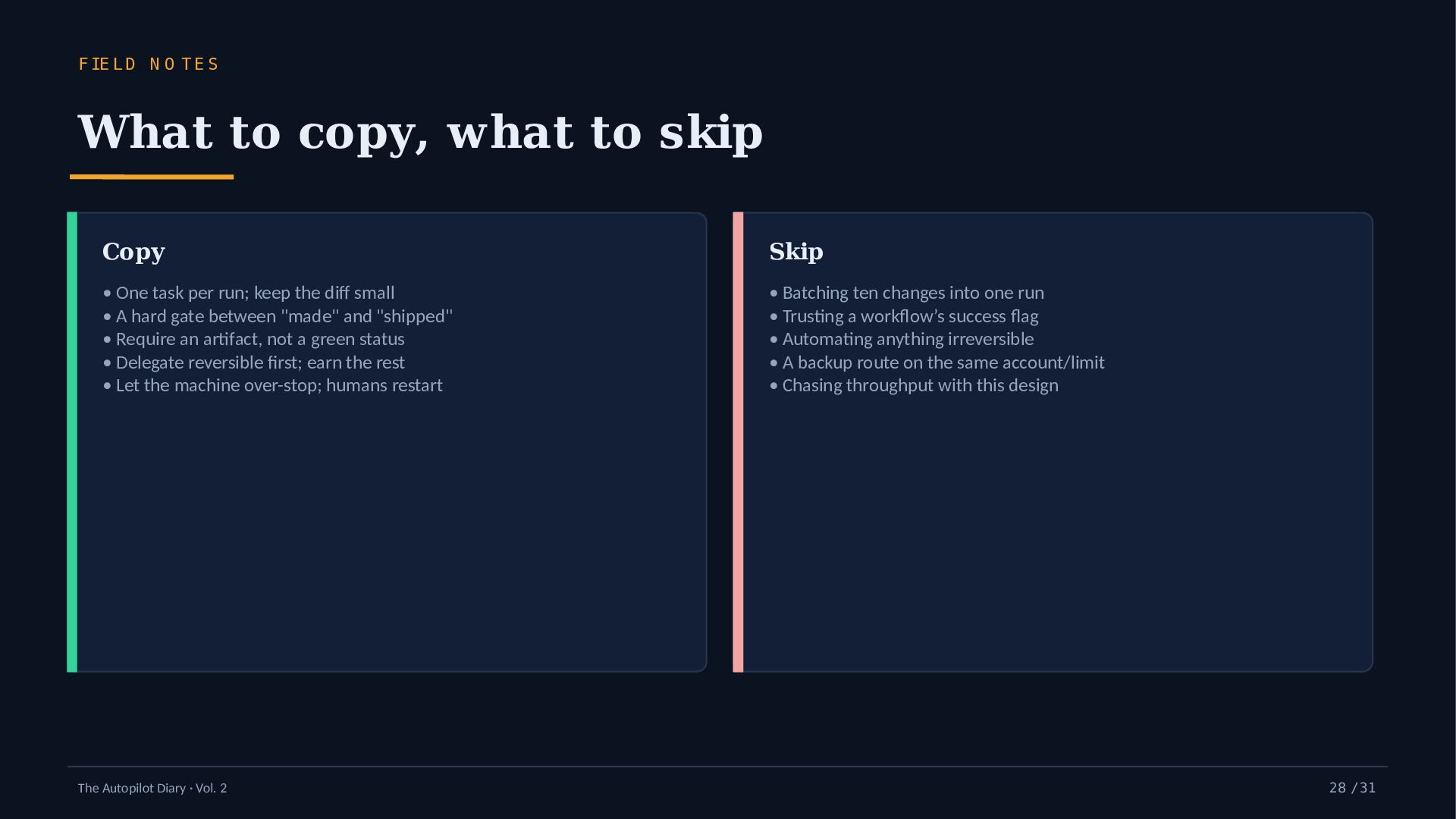
    to copy, what to skip Copy Skip • One task per run; keep the diff small • A hard gate between "made" and "shipped" • Require an artifact, not a green status • Delegate reversible first; earn the rest • Let the machine over-stop; humans restart • Batching ten changes into one run • Trusting a workflow’s success flag • Automating anything irreversible • A backup route on the same account/limit • Chasing throughput with this design The Autopilot Diary · Vol. 2 28 / 31
  29. T H E S E R IE S Where Vol.

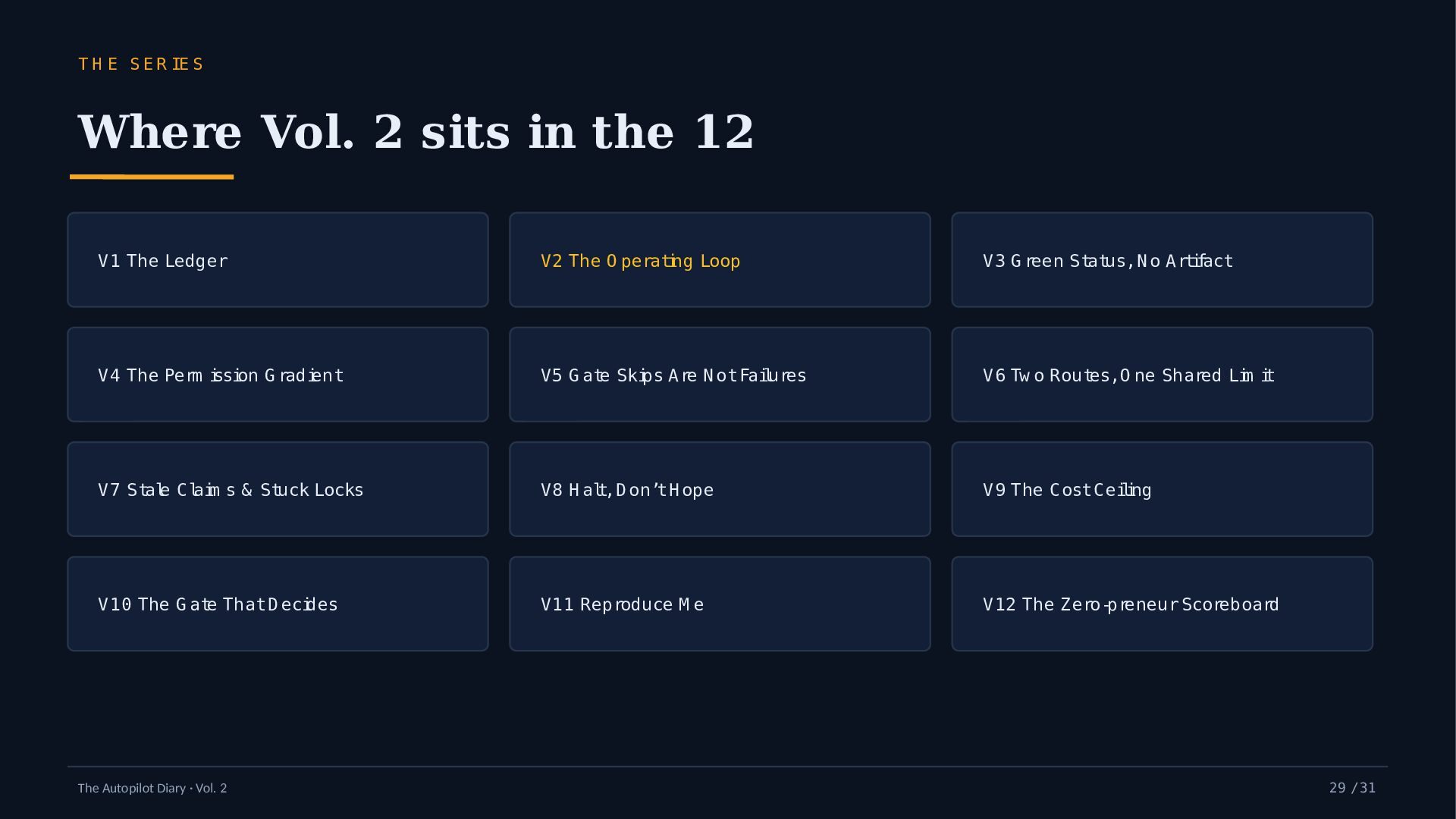
    2 sits in the 12 V1 The Ledger V2 The O perating Loop V3 G reen Status, N o Artifact V4 The Perm ission G radient V5 G ate Skips Are N ot Failures V6 Tw o Routes, O ne Shared Lim it V7 Stale Claim s & Stuck Locks V8 H alt, D on’t H ope V9 The Cost Ceiling V10 The G ate That D ecides V11 Reproduce M e V12 The Zero-preneur Scoreboard The Autopilot Diary · Vol. 2 29 / 31
  30. C L O S IN G T H O U

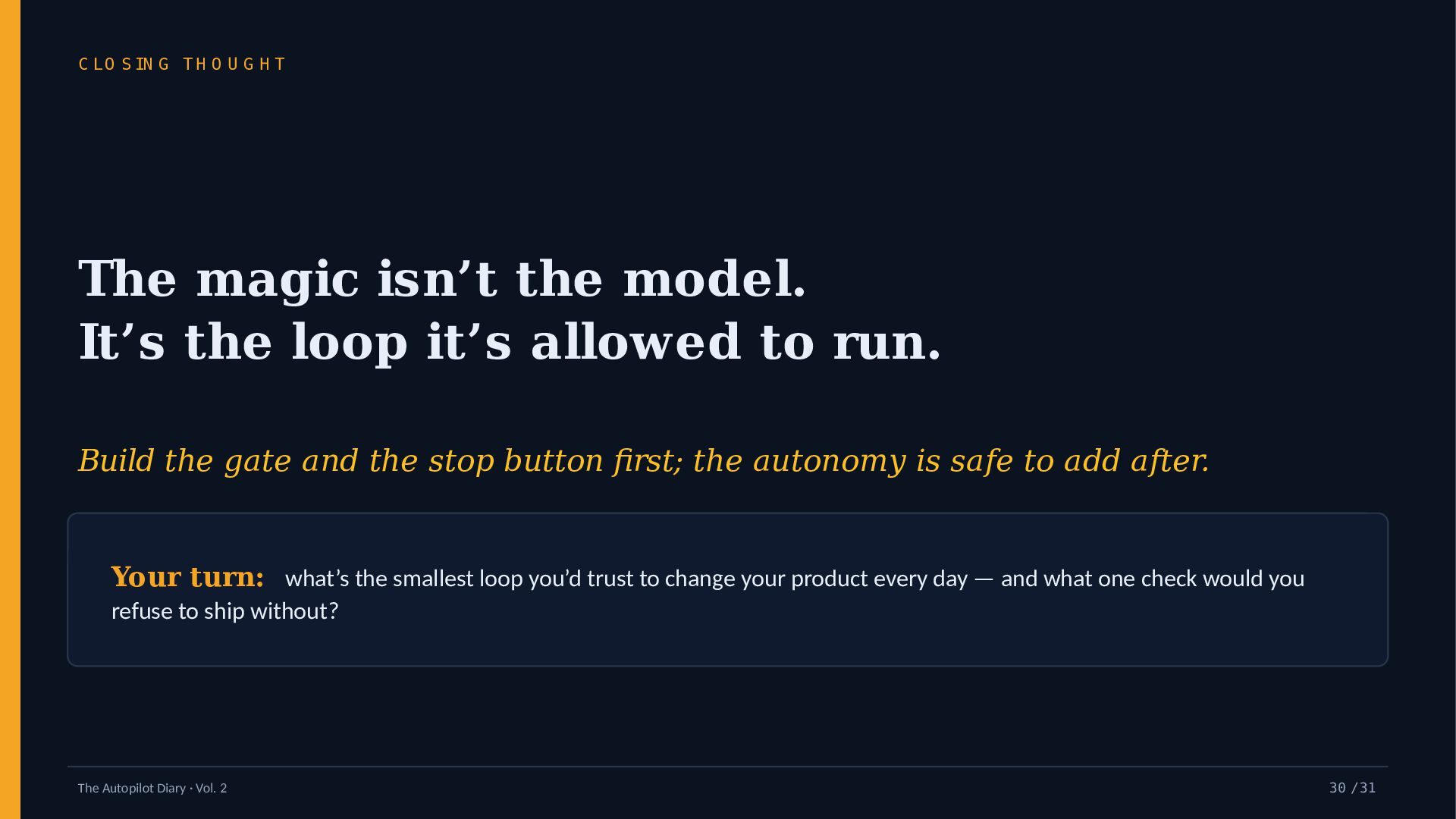
    G H T The magic isn’t the model. It’s the loop it’s allowed to run. Build the gate and the stop button first; the autonomy is safe to add after. Your turn: what’s the smallest loop you’d trust to change your product every day — and what one check would you refuse to ship without? The Autopilot Diary · Vol. 2 30 / 31
  31. T H A N K S F O R R

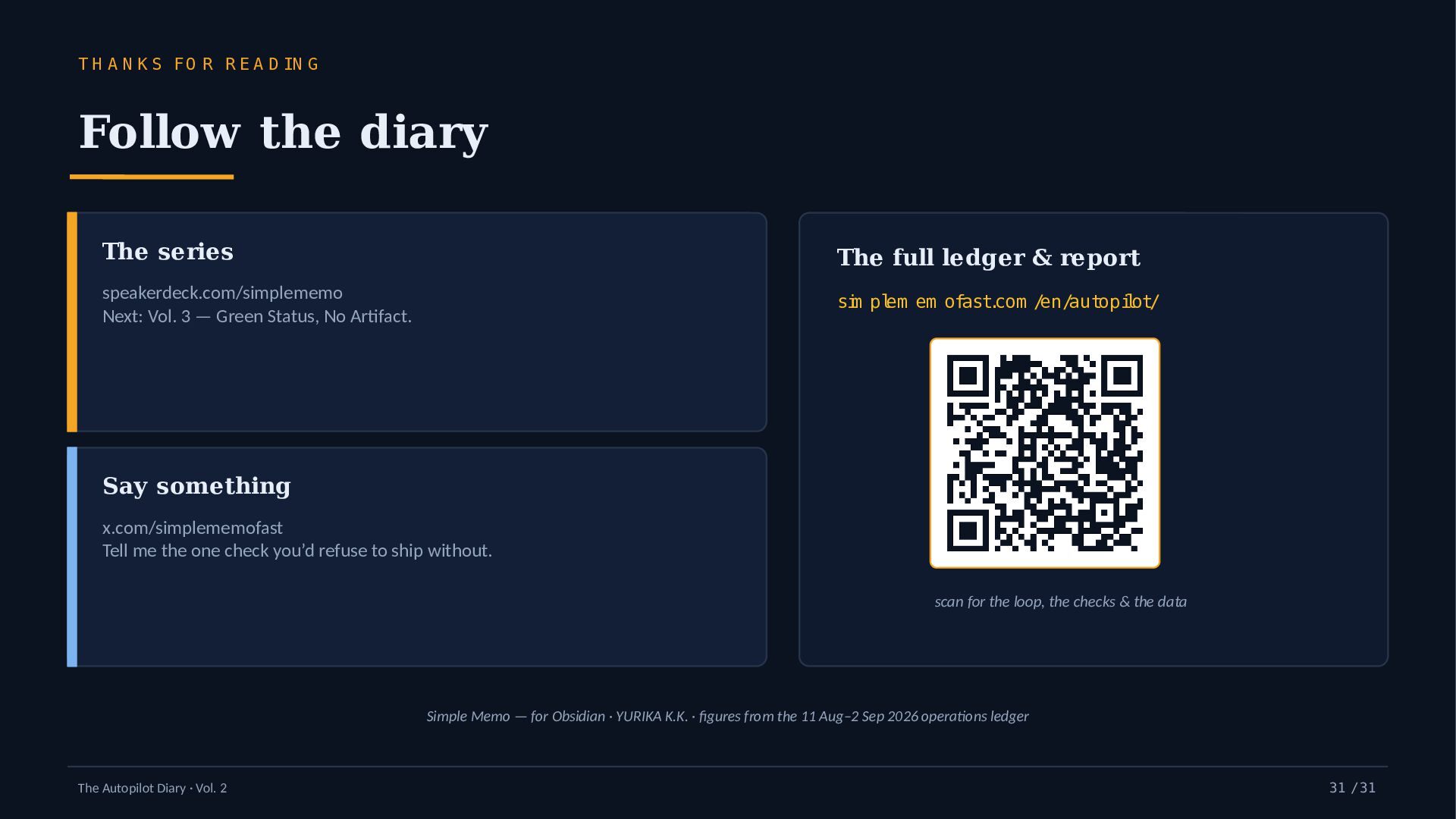
    E A D IN G Follow the diary The series The full ledger & report speakerdeck.com/simplememo Next: Vol. 3 — Green Status, No Artifact. sim plem em ofast.com /en/autopilot/ Say something x.com/simplememofast Tell me the one check you’d refuse to ship without. scan for the loop, the checks & the data Simple Memo — for Obsidian · YURIKA K.K. · figures from the 11 Aug–2 Sep 2026 operations ledger The Autopilot Diary · Vol. 2 31 / 31