Upgrade to Pro — share decks privately, control downloads, hide ads and more …

The Autopilot Diary — Vol. 1: The Ledger (Publi...

The Autopilot Diary — Vol. 1: The Ledger (Publishing the Runs That Failed)

The Autopilot Diary, Vol. 1 — a solo iOS developer let AI run a small iPhone app’s daily operations and published the ledger: across 11 Aug–2 Sep 2026, 19 of 28 attempted runs shipped work, 7 needed a human, and 3 dated failures stay on the page.

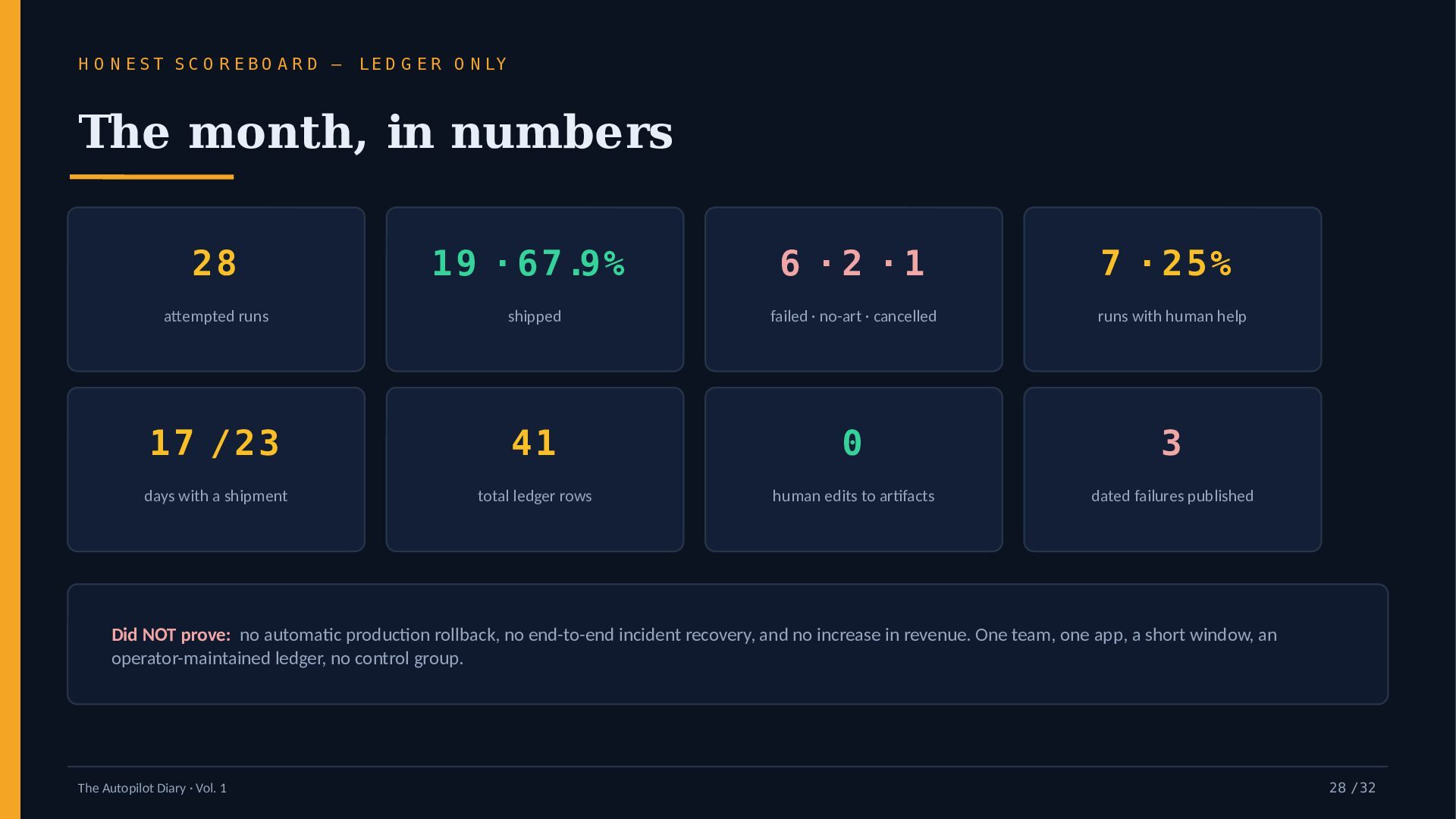
This is a field diary about AI-run app operations, not a hype reel. The operating loop measures results, picks one task, makes a change, checks it, ships what’s eligible, and records the outcome. In the window for Simple Memo (an iPhone app by YURIKA K.K.): 28 attempted runs, 19 shipped (67.9%), 6 failed, 2 produced no artifact, 1 cancelled; 17 of 23 days had a shipment; human intervention in 7 runs (25%), with 0 edits to shipped artifacts.

Three failures changed what the system checks: a green status with no artifact (22 Aug, 14 permission denials), a stale claim that blocked the fallback (29 Aug), and two routes sharing one account limit (30–31 Aug). Each became a new check: require an artifact not a status, expire claims, keep fallbacks independent.

The deck answers three objections in question form — bad PR, cherry-picking, and who audits a self-reported ledger — and keeps the denominator intact (all 41 rows, including 11 gate skips). It states plainly what the numbers did NOT prove: no automatic rollback, no incident recovery, no revenue lift. A "shipment" is a website/ops change, never an App Store release.

Topics: AI app operations · autonomous agent loops · honest metrics & denominators · reproducible ledgers (CSV/JSON/Git SHA).

More: speakerdeck.com/simplememo · x.com/simplememofast
References: the full ledger, CSV, JSON & charts — https://simplememofast.com/en/autopilot/ · App Store — https://apps.apple.com/app/id6758438948?ct=autopilot-en&mt=8

Avatar for Simple Memo Developer

Simple Memo Developer

September 18, 2026

More Decks by Simple Memo Developer

Other Decks in Programming

Transcript

  1. T H E A U T O P IL O

    T D IA R Y Vol. 1 The Ledger Publishing the runs that failed honest m etrics the failure ledger denom inators intact A solo iOS developer let AI run the daily operations of a small iPhone app. This is the ledger — 19 of 28 runs shipped, and the 3 that broke are the point. speakerdeck.com /sim plem em o · x.com /sim plem em ofast The Autopilot Diary · Vol. 1 1 / 32
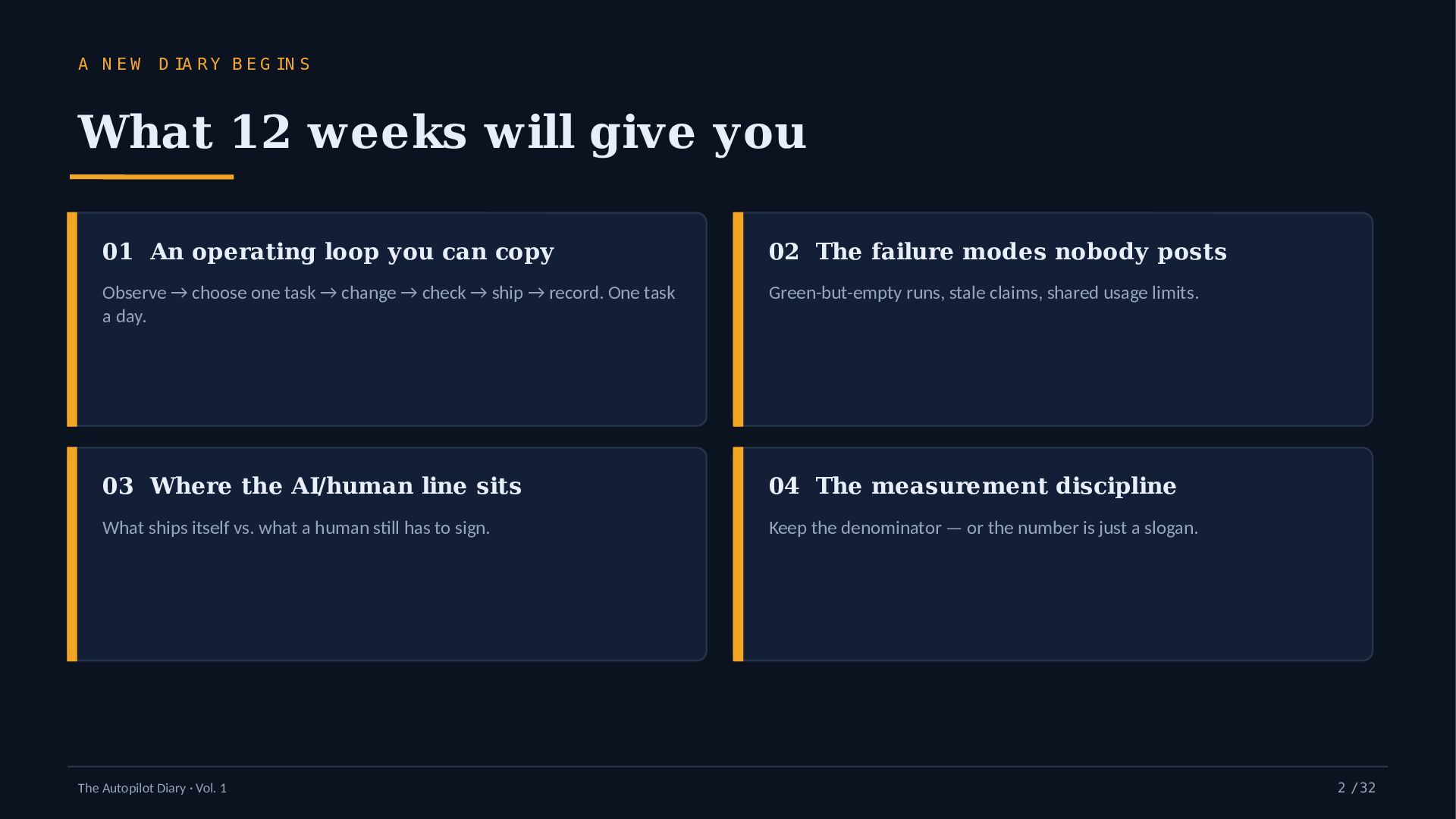
  2. A N EW D IA R Y B E G

    IN S What 12 weeks will give you 01 An operating loop you can copy 02 The failure modes nobody posts Observe → choose one task → change → check → ship → record. One task a day. Green-but-empty runs, stale claims, shared usage limits. 03 Where the AI/human line sits 04 The measurement discipline What ships itself vs. what a human still has to sign. Keep the denominator — or the number is just a slogan. The Autopilot Diary · Vol. 1 2 / 32
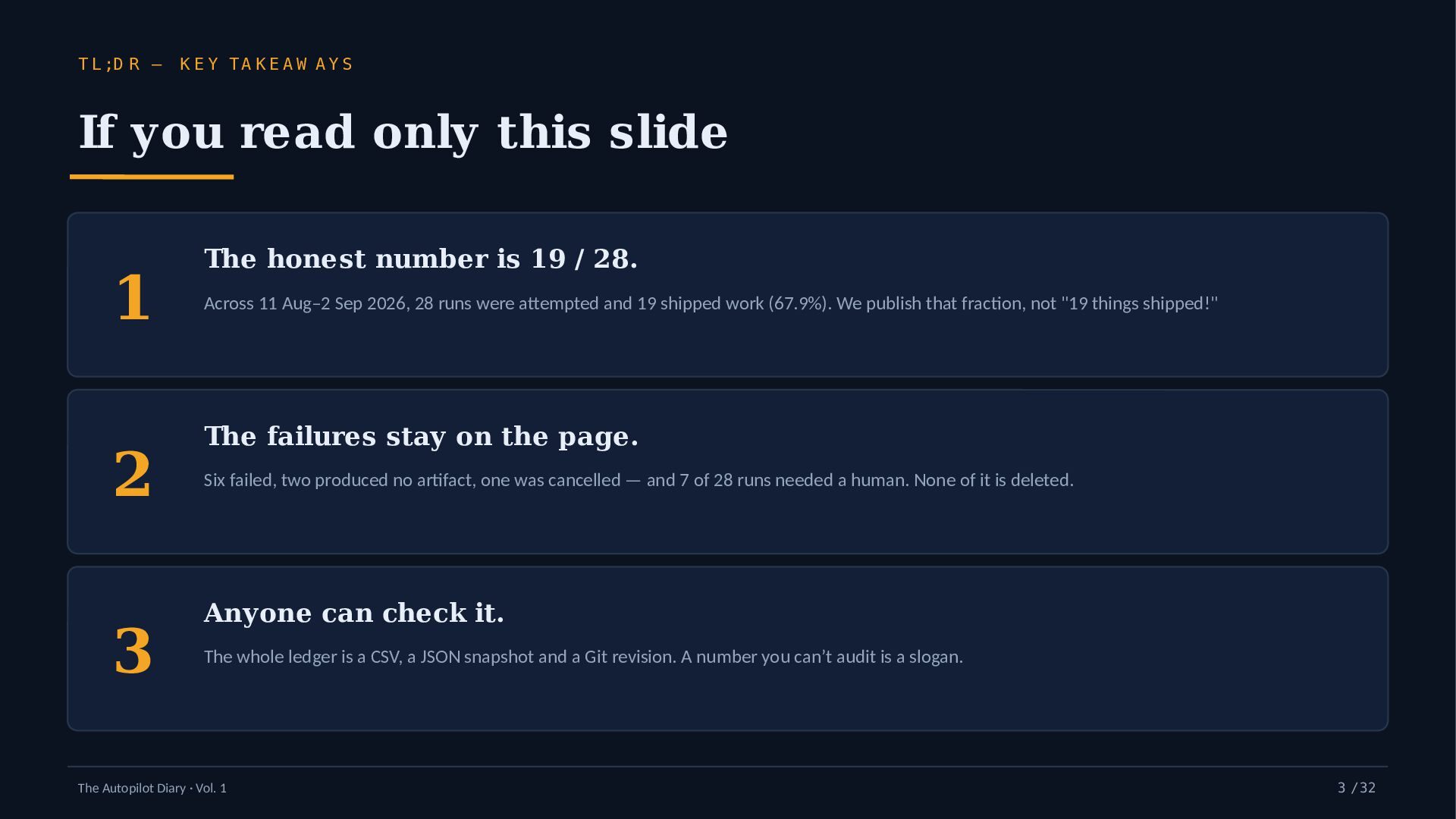
  3. T L ;D R — K E Y TA K

    E A W A Y S If you read only this slide 1 2 3 The honest number is 19 / 28. Across 11 Aug–2 Sep 2026, 28 runs were attempted and 19 shipped work (67.9%). We publish that fraction, not "19 things shipped!" The failures stay on the page. Six failed, two produced no artifact, one was cancelled — and 7 of 28 runs needed a human. None of it is deleted. Anyone can check it. The whole ledger is a CSV, a JSON snapshot and a Git revision. A number you can’t audit is a slogan. The Autopilot Diary · Vol. 1 3 / 32
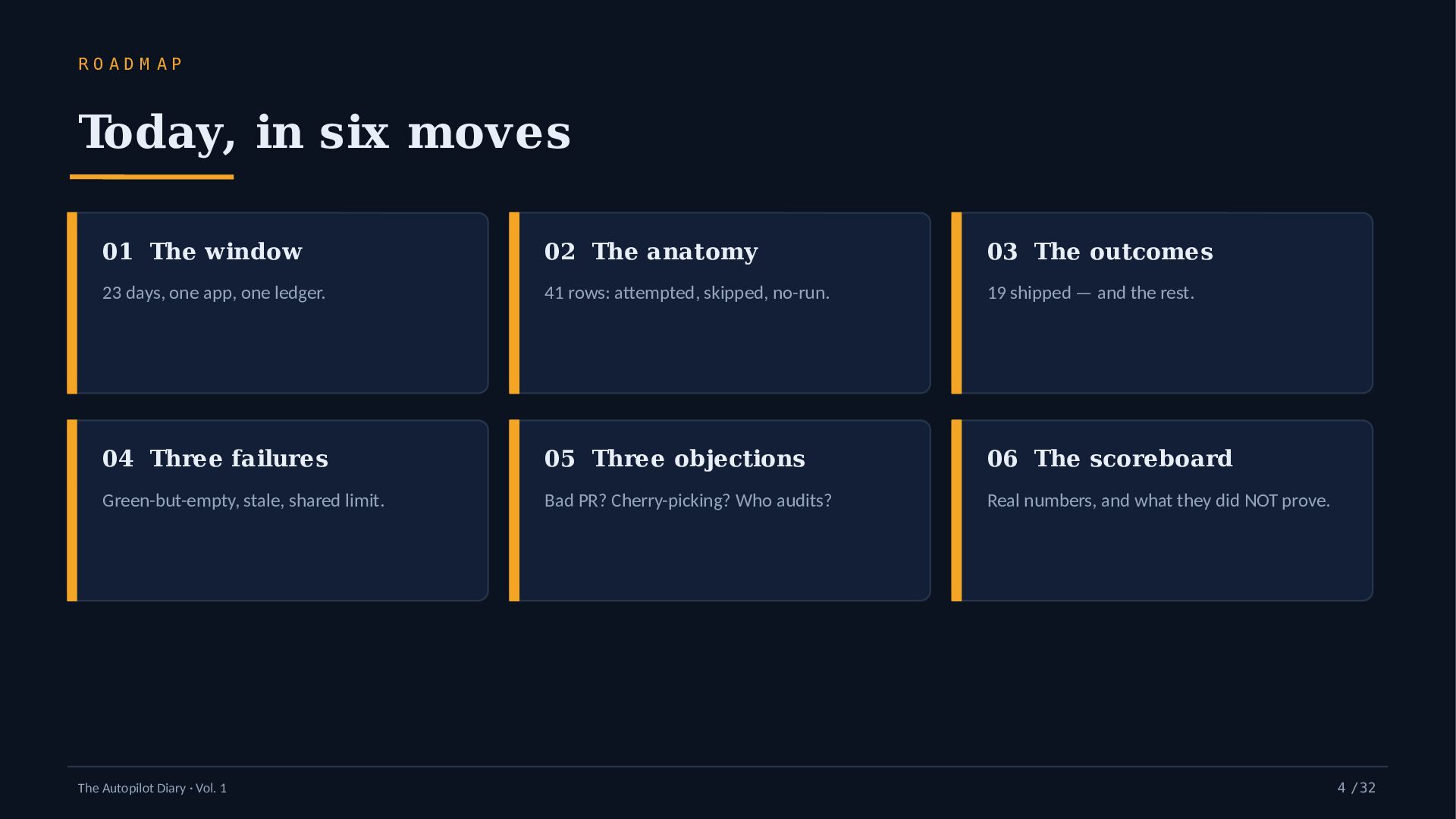
  4. RO AD M AP Today, in six moves 01 The

    window 02 The anatomy 03 The outcomes 23 days, one app, one ledger. 41 rows: attempted, skipped, no-run. 19 shipped — and the rest. 04 Three failures 05 Three objections 06 The scoreboard Green-but-empty, stale, shared limit. Bad PR? Cherry-picking? Who audits? Real numbers, and what they did NOT prove. The Autopilot Diary · Vol. 1 4 / 32
  5. T H E Q U E S T IO N

    What does an honest ops number look like? Most "build in public" posts show the wins and quietly drop the runs that broke. This one keeps the denominator. A shipment rate is only honest if you can see what it was divided by. The Autopilot Diary · Vol. 1 5 / 32
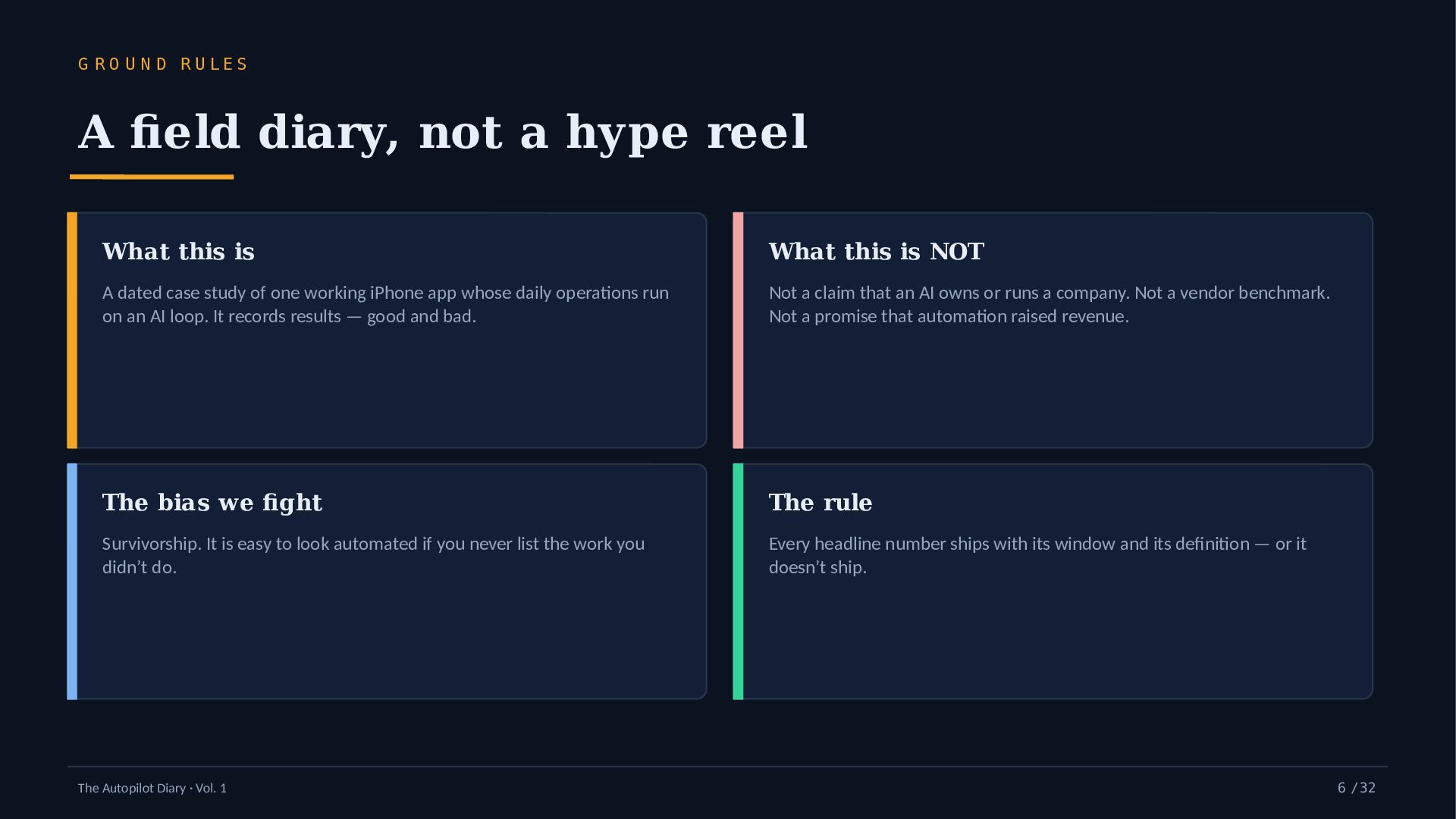
  6. G R O U N D R U LE S

    A field diary, not a hype reel What this is What this is NOT A dated case study of one working iPhone app whose daily operations run on an AI loop. It records results — good and bad. Not a claim that an AI owns or runs a company. Not a vendor benchmark. Not a promise that automation raised revenue. The bias we fight The rule Survivorship. It is easy to look automated if you never list the work you didn’t do. Every headline number ships with its window and its definition — or it doesn’t ship. The Autopilot Diary · Vol. 1 6 / 32
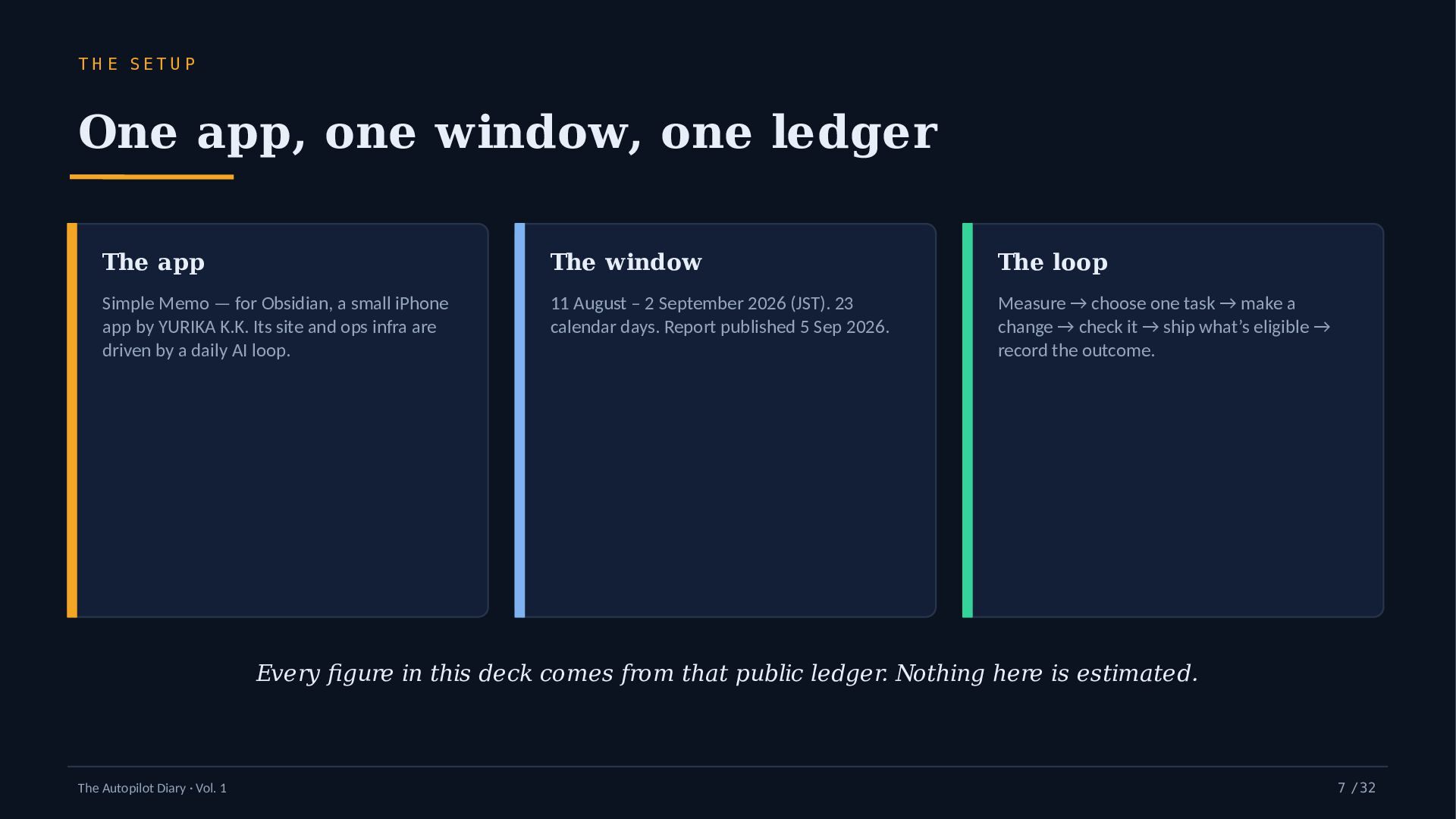
  7. TH E SETU P One app, one window, one ledger

    The app The window The loop Simple Memo — for Obsidian, a small iPhone app by YURIKA K.K. Its site and ops infra are driven by a daily AI loop. 11 August – 2 September 2026 (JST). 23 calendar days. Report published 5 Sep 2026. Measure → choose one task → make a change → check it → ship what’s eligible → record the outcome. Every figure in this deck comes from that public ledger. Nothing here is estimated. The Autopilot Diary · Vol. 1 7 / 32
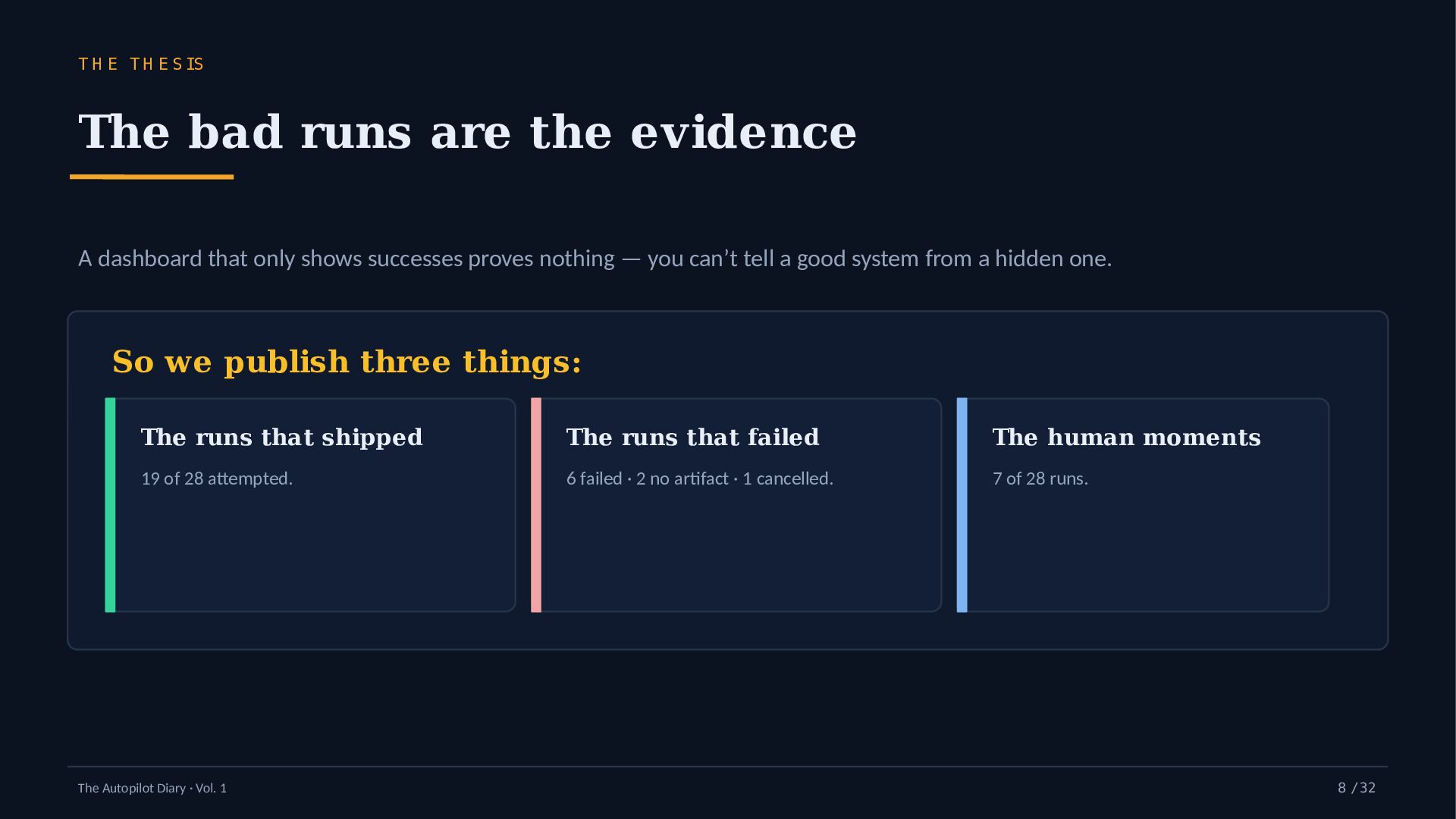
  8. T H E T H E S IS The bad

    runs are the evidence A dashboard that only shows successes proves nothing — you can’t tell a good system from a hidden one. So we publish three things: The runs that shipped The runs that failed The human moments 19 of 28 attempted. 6 failed · 2 no artifact · 1 cancelled. 7 of 28 runs. The Autopilot Diary · Vol. 1 8 / 32
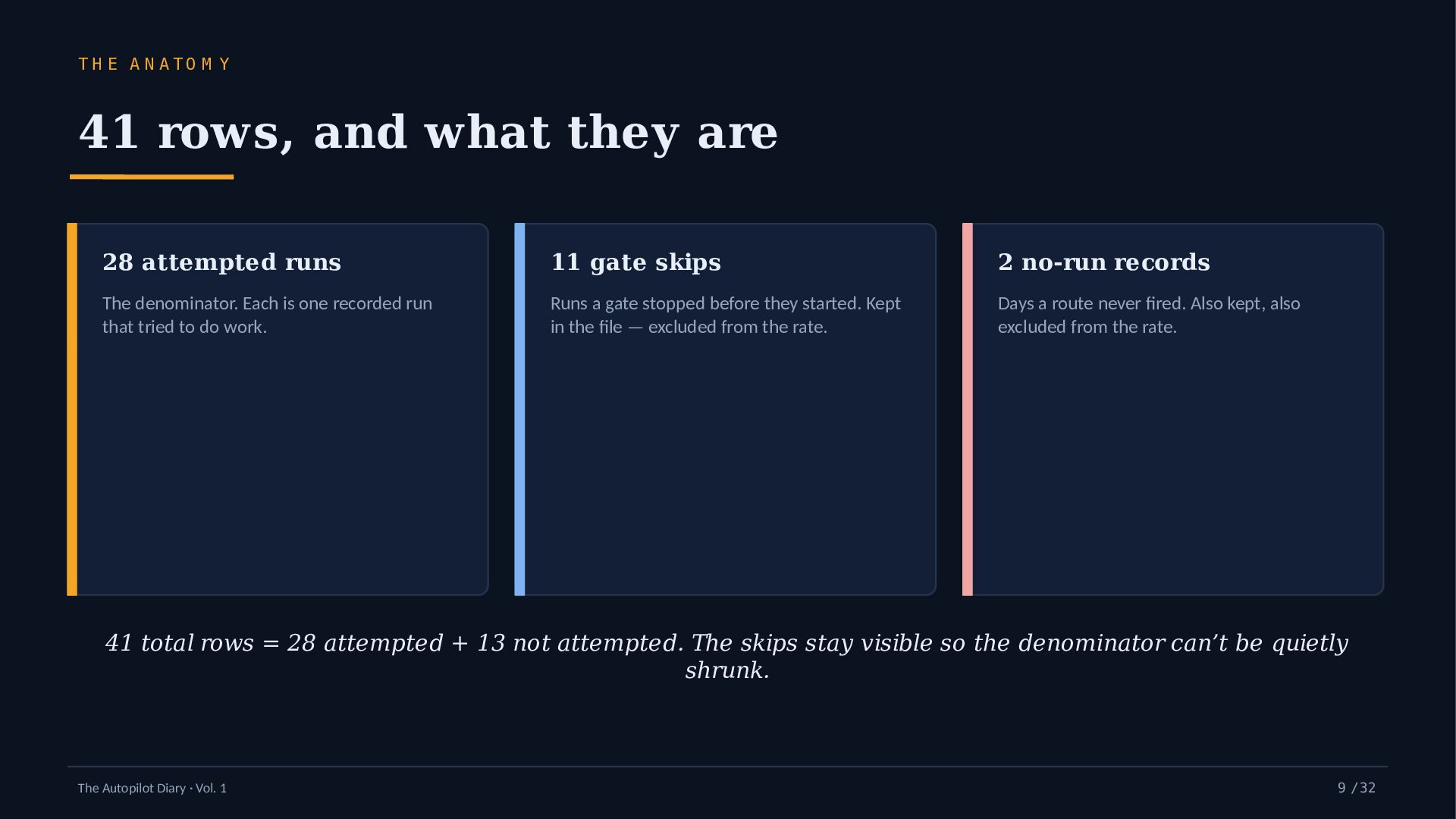
  9. TH E A N ATO M Y 41 rows, and

    what they are 28 attempted runs 11 gate skips 2 no-run records The denominator. Each is one recorded run that tried to do work. Runs a gate stopped before they started. Kept in the file — excluded from the rate. Days a route never fired. Also kept, also excluded from the rate. 41 total rows = 28 attempted + 13 not attempted. The skips stay visible so the denominator can’t be quietly shrunk. The Autopilot Diary · Vol. 1 9 / 32
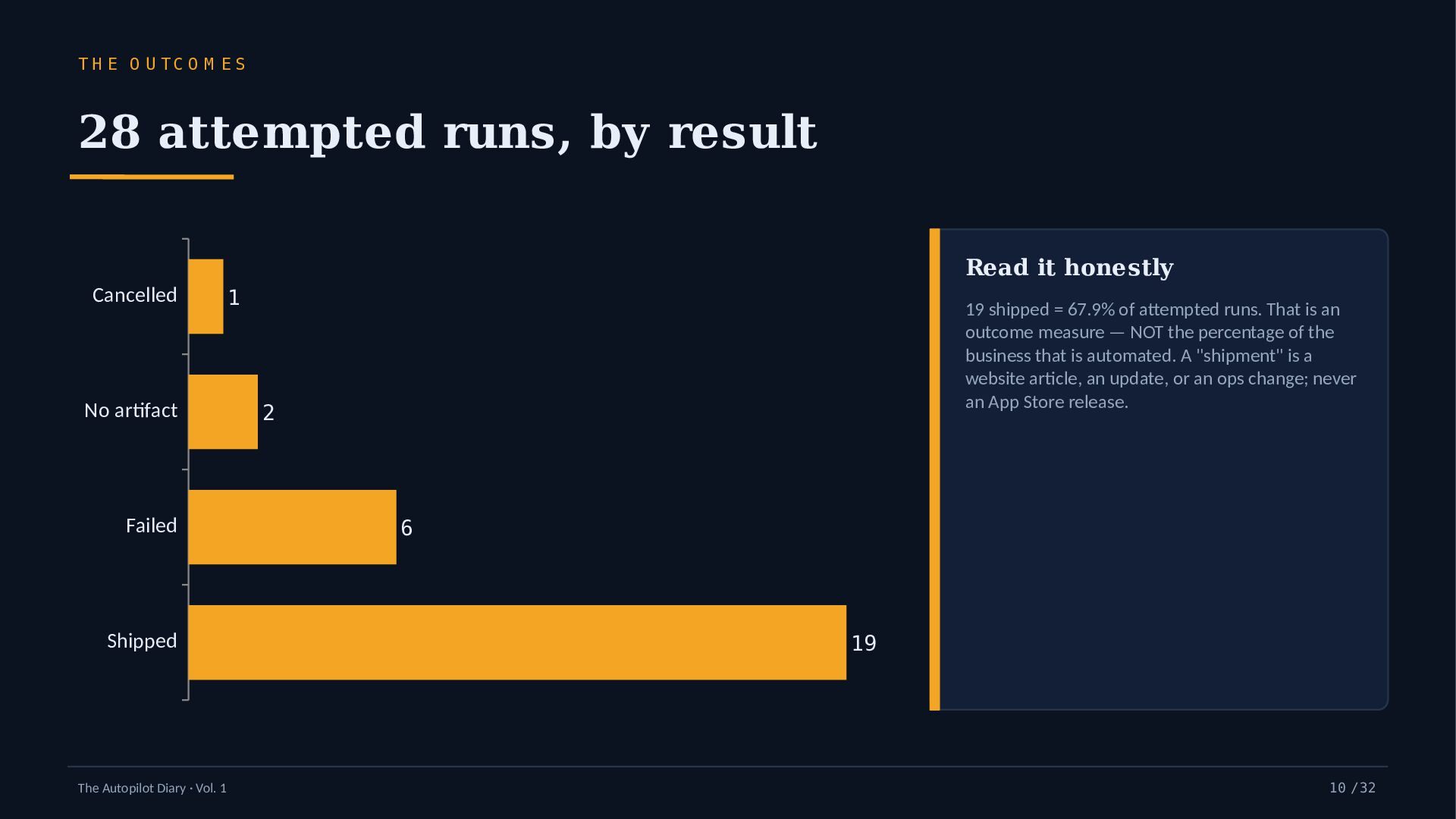
  10. T H E O U TC O M E S

    28 attempted runs, by result Read it honestly Cancelled No artifact Failed Shipped The Autopilot Diary · Vol. 1 1 19 shipped = 67.9% of attempted runs. That is an outcome measure — NOT the percentage of the business that is automated. A "shipment" is a website article, an update, or an ops change; never an App Store release. 2 6 19 10 / 32
  11. T H E C A LE N D A R

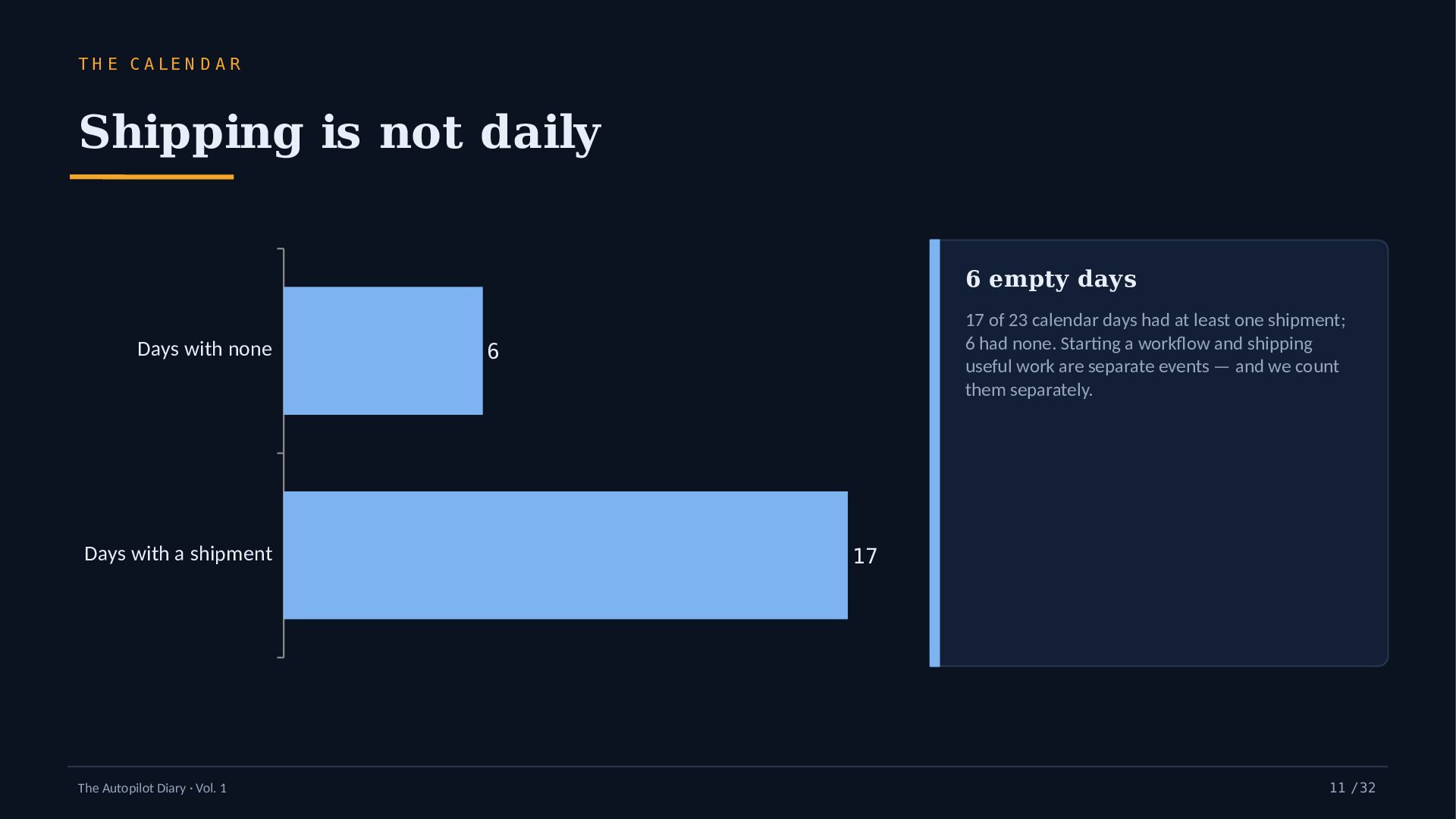
    Shipping is not daily 6 empty days Days with none Days with a shipment The Autopilot Diary · Vol. 1 17 of 23 calendar days had at least one shipment; 6 had none. Starting a workflow and shipping useful work are separate events — and we count them separately. 6 17 11 / 32
  12. A D E F IN IT IO N T H

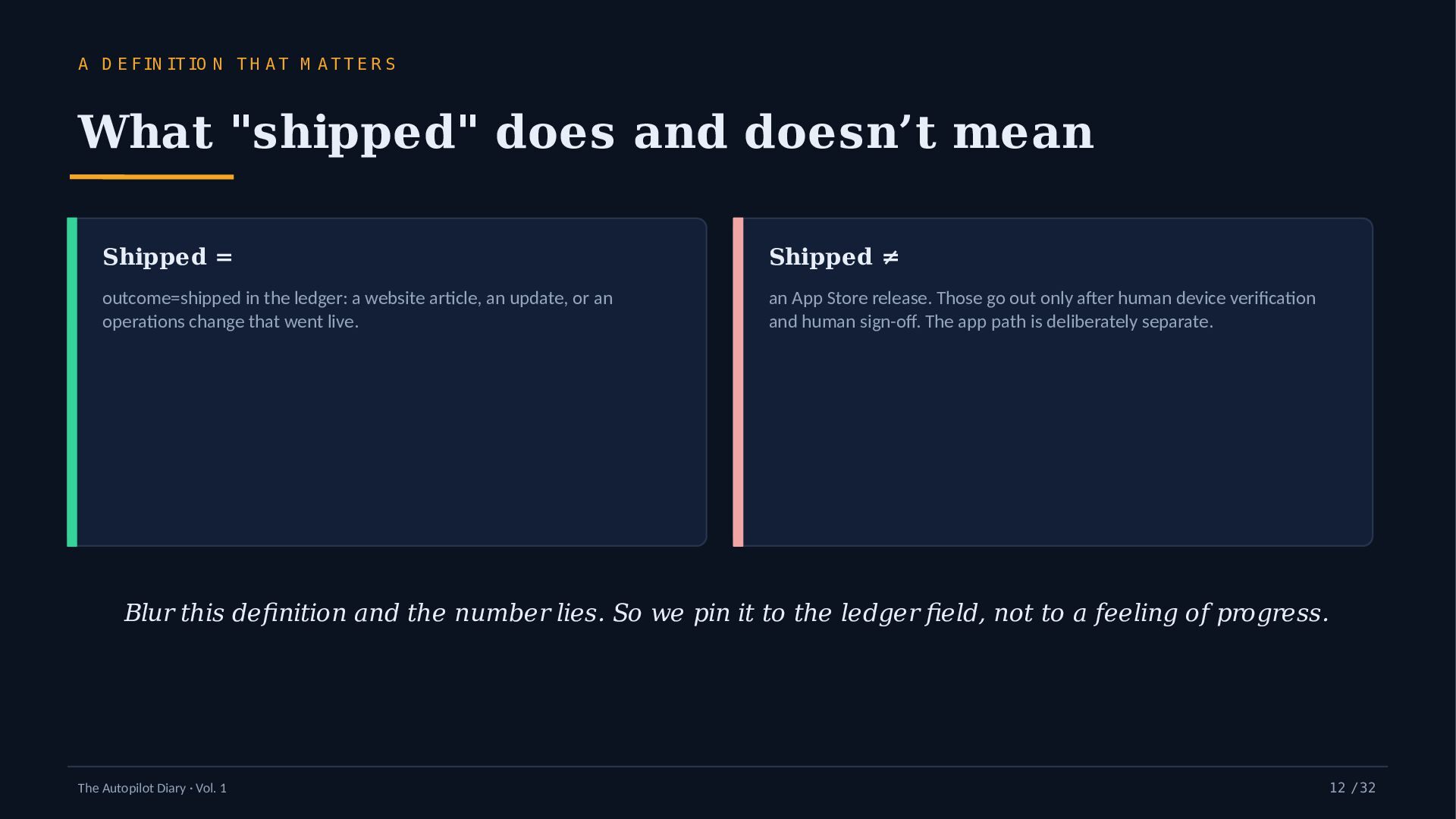
    A T M A T T E R S What "shipped" does and doesn’t mean Shipped = Shipped ≠ outcome=shipped in the ledger: a website article, an update, or an operations change that went live. an App Store release. Those go out only after human device verification and human sign-off. The app path is deliberately separate. Blur this definition and the number lies. So we pin it to the ledger field, not to a feeling of progress. The Autopilot Diary · Vol. 1 12 / 32
  13. TH E H U M A N M O M

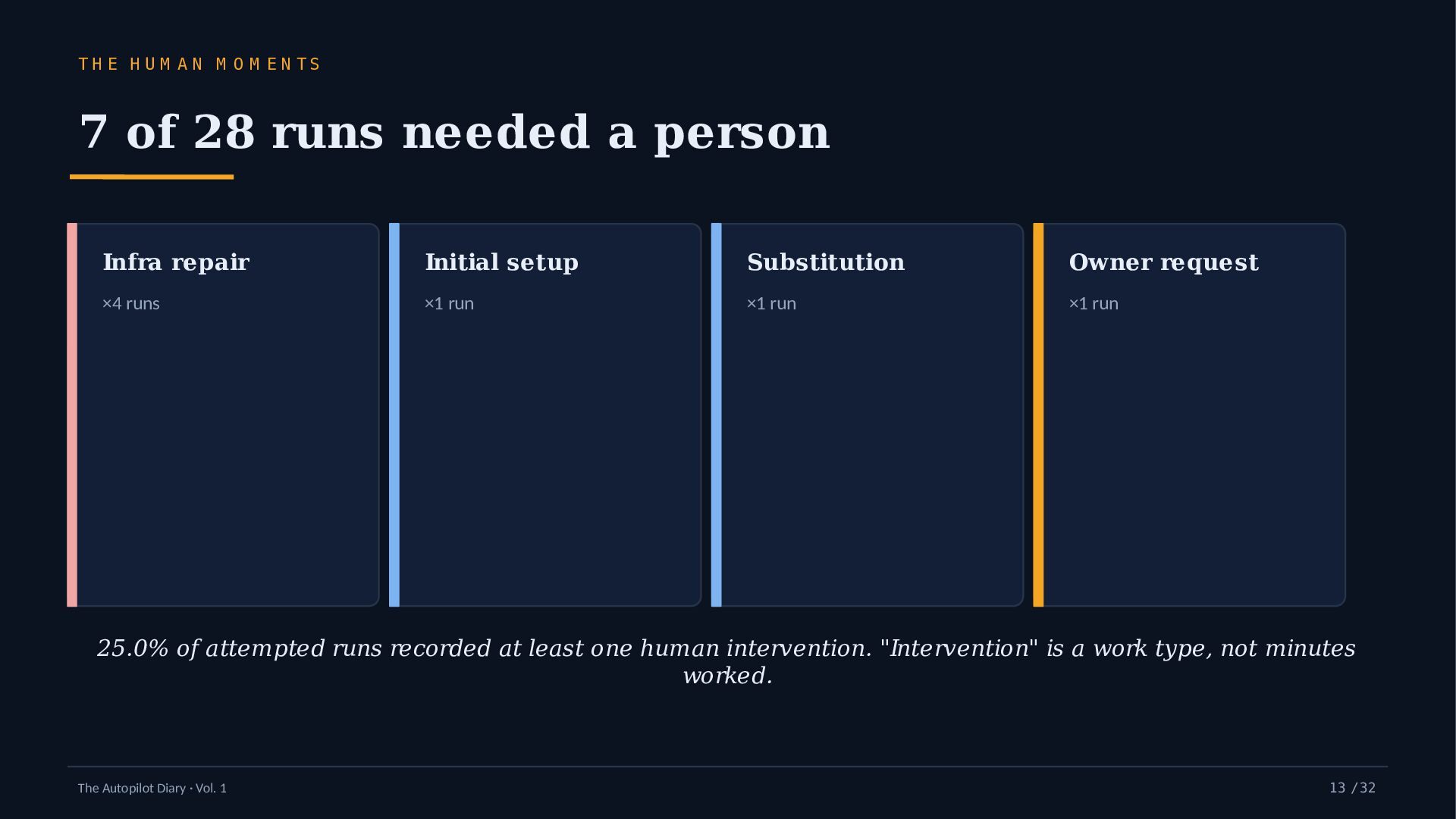
    EN TS 7 of 28 runs needed a person Infra repair Initial setup Substitution Owner request ×4 runs ×1 run ×1 run ×1 run 25.0% of attempted runs recorded at least one human intervention. "Intervention" is a work type, not minutes worked. The Autopilot Diary · Vol. 1 13 / 32
  14. A N U M B E R T H A

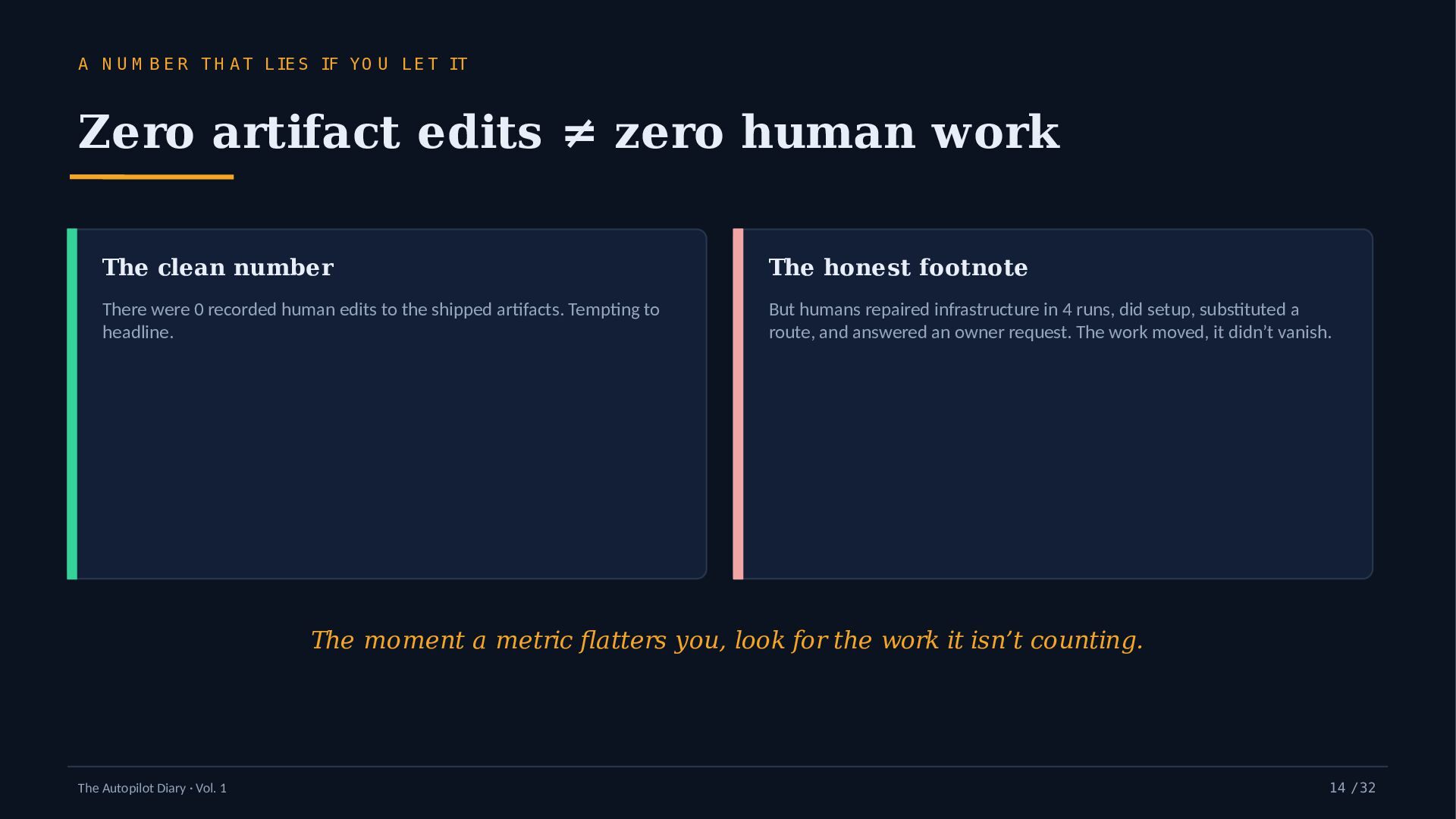
    T L IE S IF Y O U L E T IT Zero artifact edits ≠ zero human work The clean number The honest footnote There were 0 recorded human edits to the shipped artifacts. Tempting to headline. But humans repaired infrastructure in 4 runs, did setup, substituted a route, and answered an owner request. The work moved, it didn’t vanish. The moment a metric flatters you, look for the work it isn’t counting. The Autopilot Diary · Vol. 1 14 / 32
  15. H O N EST A B O U T TH

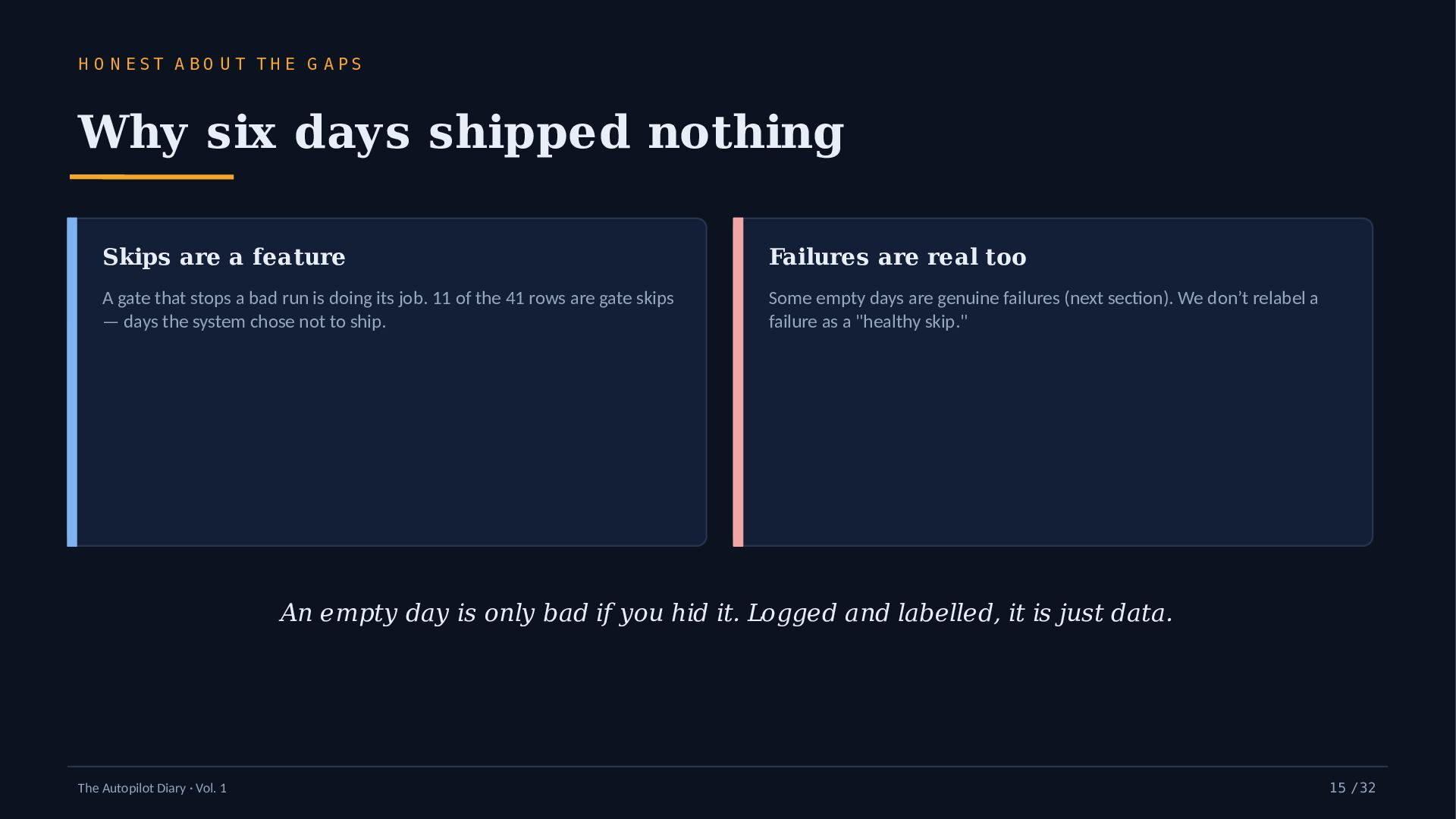
    E G A PS Why six days shipped nothing Skips are a feature Failures are real too A gate that stops a bad run is doing its job. 11 of the 41 rows are gate skips — days the system chose not to ship. Some empty days are genuine failures (next section). We don’t relabel a failure as a "healthy skip." An empty day is only bad if you hid it. Logged and labelled, it is just data. The Autopilot Diary · Vol. 1 15 / 32
  16. T H E C O M P A R IS

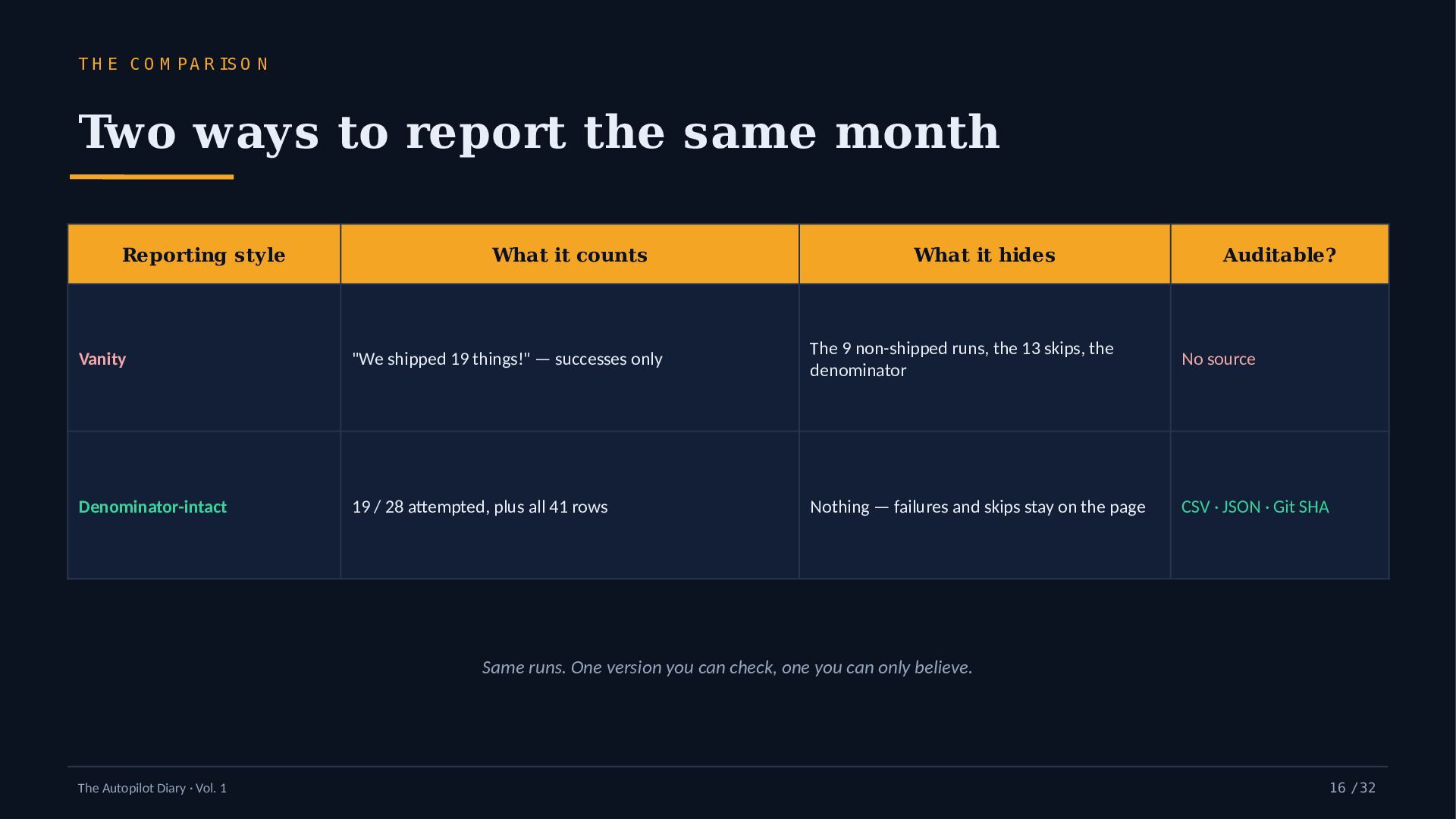
    O N Two ways to report the same month Reporting style What it counts What it hides Auditable? Vanity "We shipped 19 things!" — successes only The 9 non-shipped runs, the 13 skips, the denominator No source Denominator-intact 19 / 28 attempted, plus all 41 rows Nothing — failures and skips stay on the page CSV · JSON · Git SHA Same runs. One version you can check, one you can only believe. The Autopilot Diary · Vol. 1 16 / 32
  17. T H E L IN E W O R T

    H S T E A L IN G A number you can’t audit is a slogan. Publish the source, or don’t publish the stat. The Autopilot D iary · Vol. 1 — The Ledger The Autopilot Diary · Vol. 1 17 / 32
  18. T H R E E FA ILU R E S

    Which runs are worth publishing? The ones that broke. Three failures in this window changed what the system checks before it trusts a run. Each has a date and a run id. The Autopilot Diary · Vol. 1 18 / 32
  19. FA ILU R E 1 — 22 AU G Green

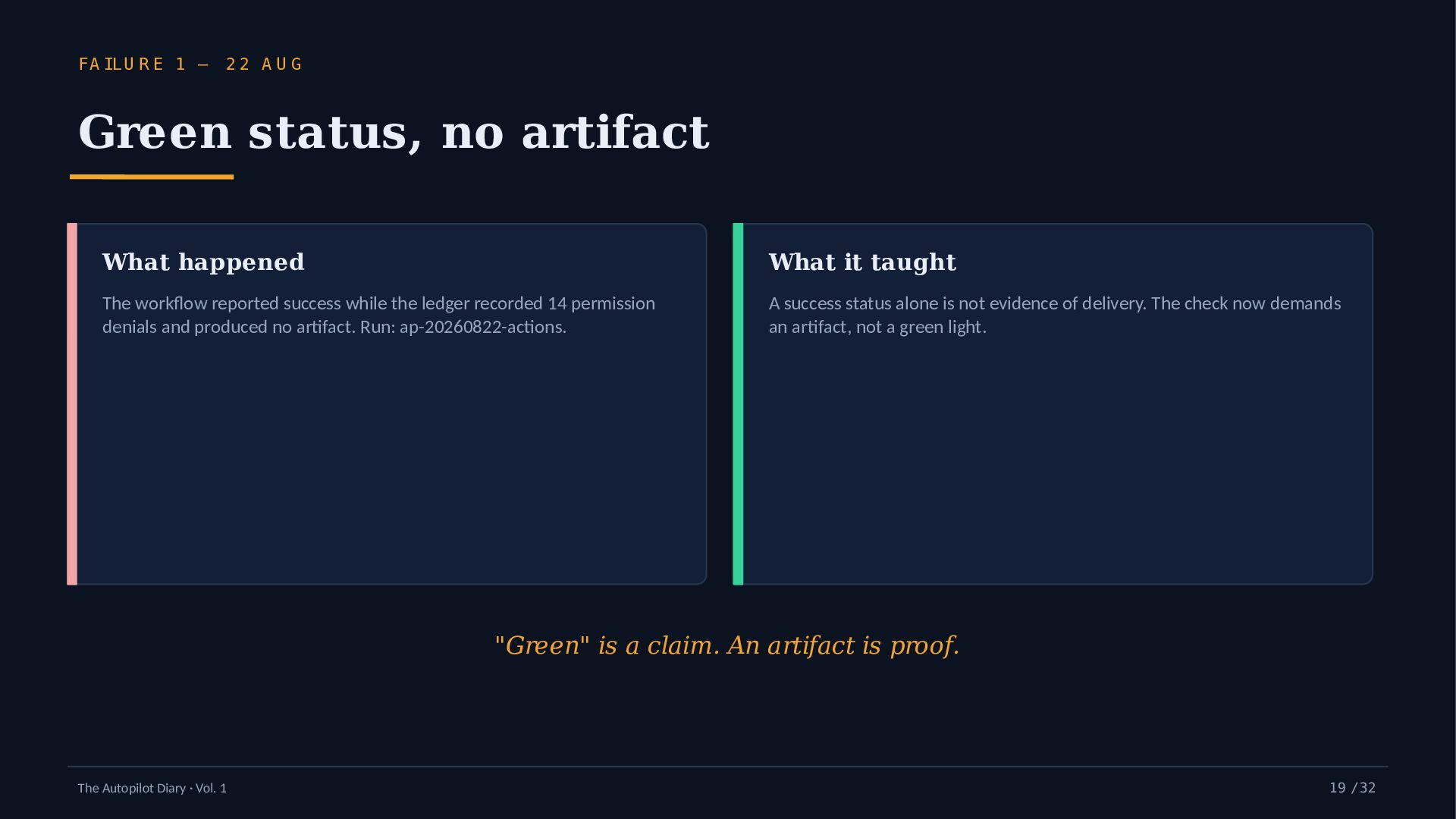
    status, no artifact What happened What it taught The workflow reported success while the ledger recorded 14 permission denials and produced no artifact. Run: ap-20260822-actions. A success status alone is not evidence of delivery. The check now demands an artifact, not a green light. "Green" is a claim. An artifact is proof. The Autopilot Diary · Vol. 1 19 / 32
  20. FA ILU R E 2 — 29 AU G A

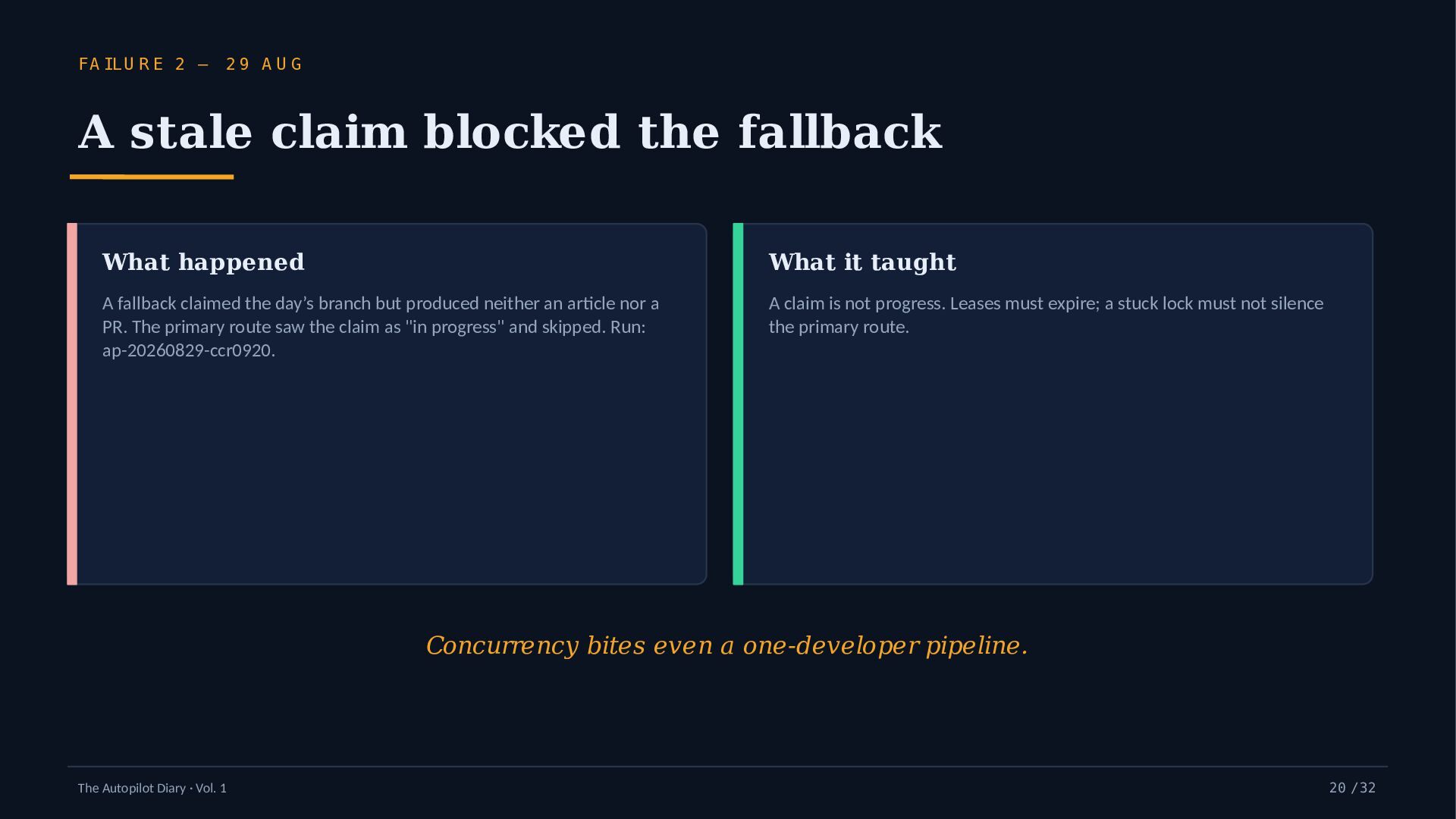
    stale claim blocked the fallback What happened What it taught A fallback claimed the day’s branch but produced neither an article nor a PR. The primary route saw the claim as "in progress" and skipped. Run: ap-20260829-ccr0920. A claim is not progress. Leases must expire; a stuck lock must not silence the primary route. Concurrency bites even a one-developer pipeline. The Autopilot Diary · Vol. 1 20 / 32
  21. FA ILU R E 3 — 3 0 –3 1

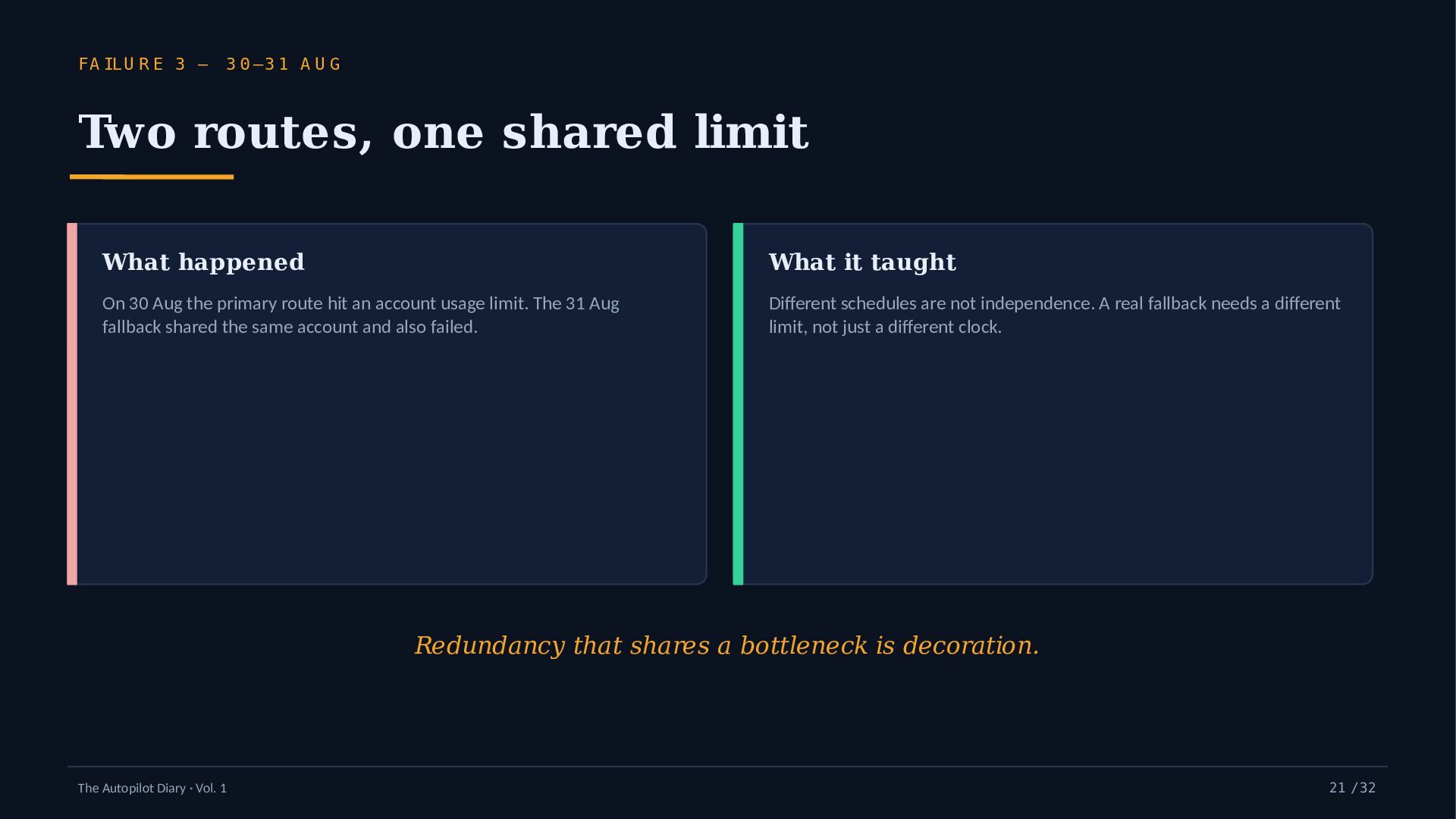
    A U G Two routes, one shared limit What happened What it taught On 30 Aug the primary route hit an account usage limit. The 31 Aug fallback shared the same account and also failed. Different schedules are not independence. A real fallback needs a different limit, not just a different clock. Redundancy that shares a bottleneck is decoration. The Autopilot Diary · Vol. 1 21 / 32
  22. T H E PA YO FF What the three failures

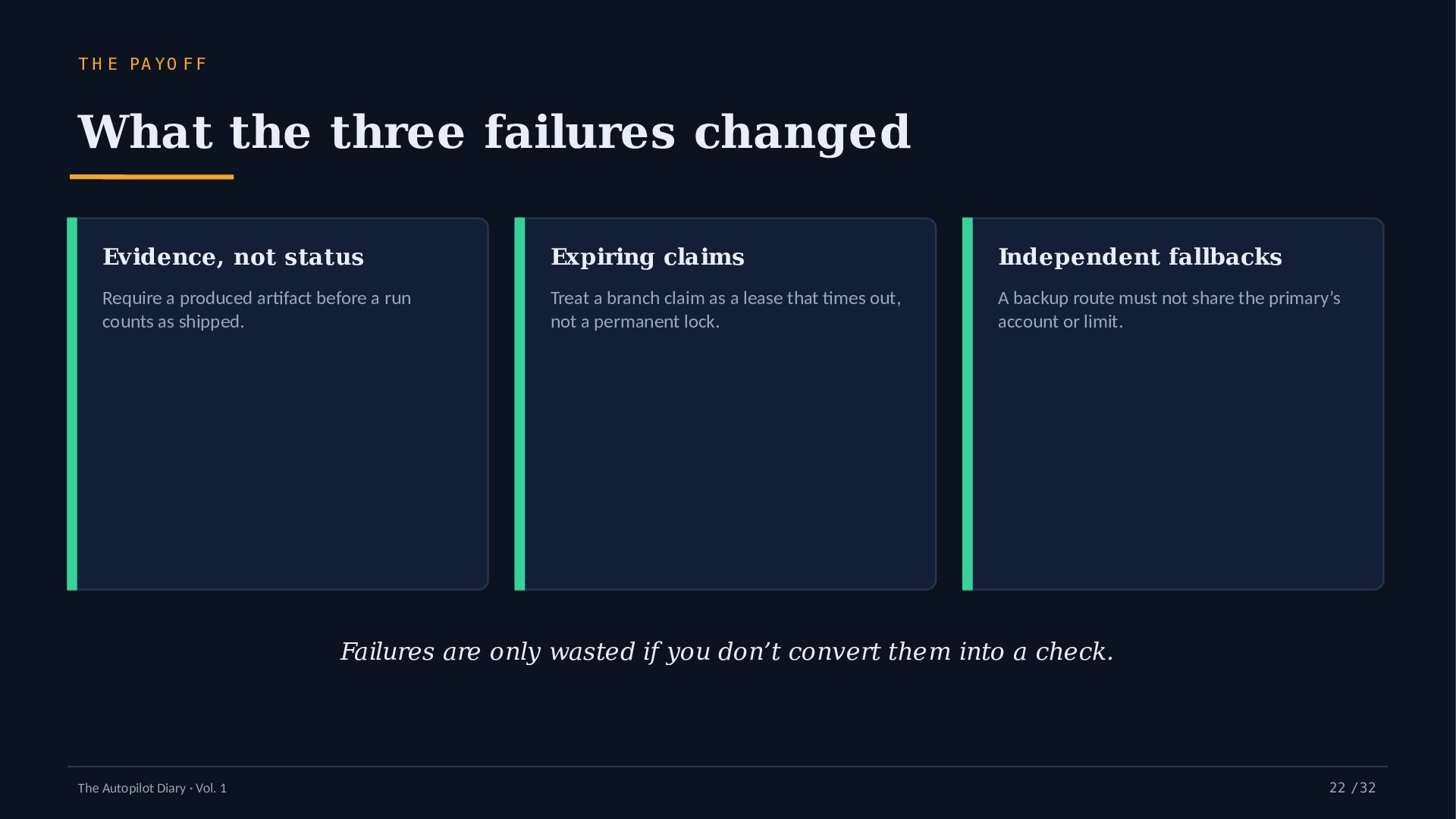
    changed Evidence, not status Expiring claims Independent fallbacks Require a produced artifact before a run counts as shipped. Treat a branch claim as a lease that times out, not a permanent lock. A backup route must not share the primary’s account or limit. Failures are only wasted if you don’t convert them into a check. The Autopilot Diary · Vol. 1 22 / 32
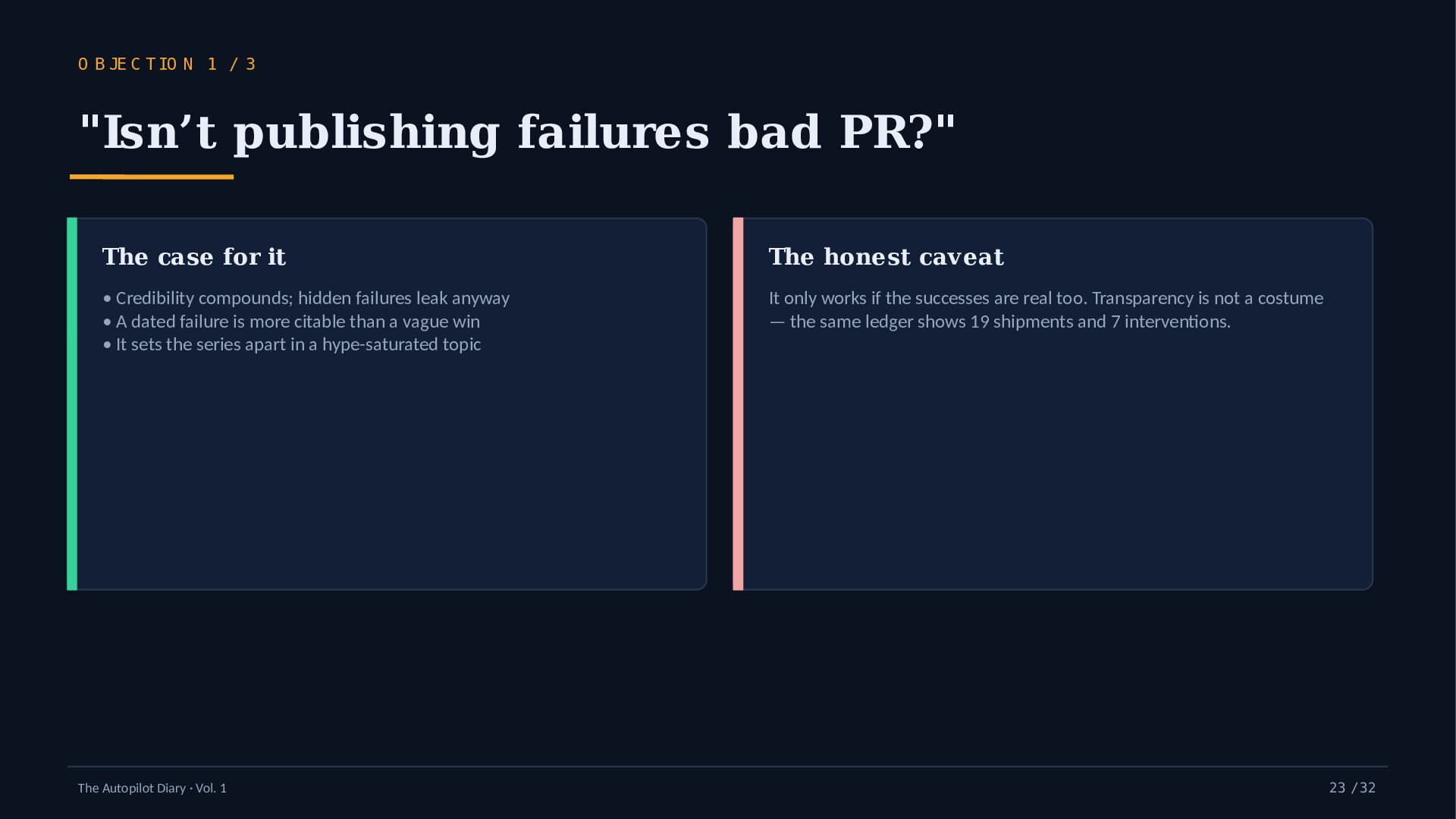
  23. O B JE C T IO N 1 / 3

    "Isn’t publishing failures bad PR?" The case for it The honest caveat • Credibility compounds; hidden failures leak anyway • A dated failure is more citable than a vague win • It sets the series apart in a hype-saturated topic It only works if the successes are real too. Transparency is not a costume — the same ledger shows 19 shipments and 7 interventions. The Autopilot Diary · Vol. 1 23 / 32
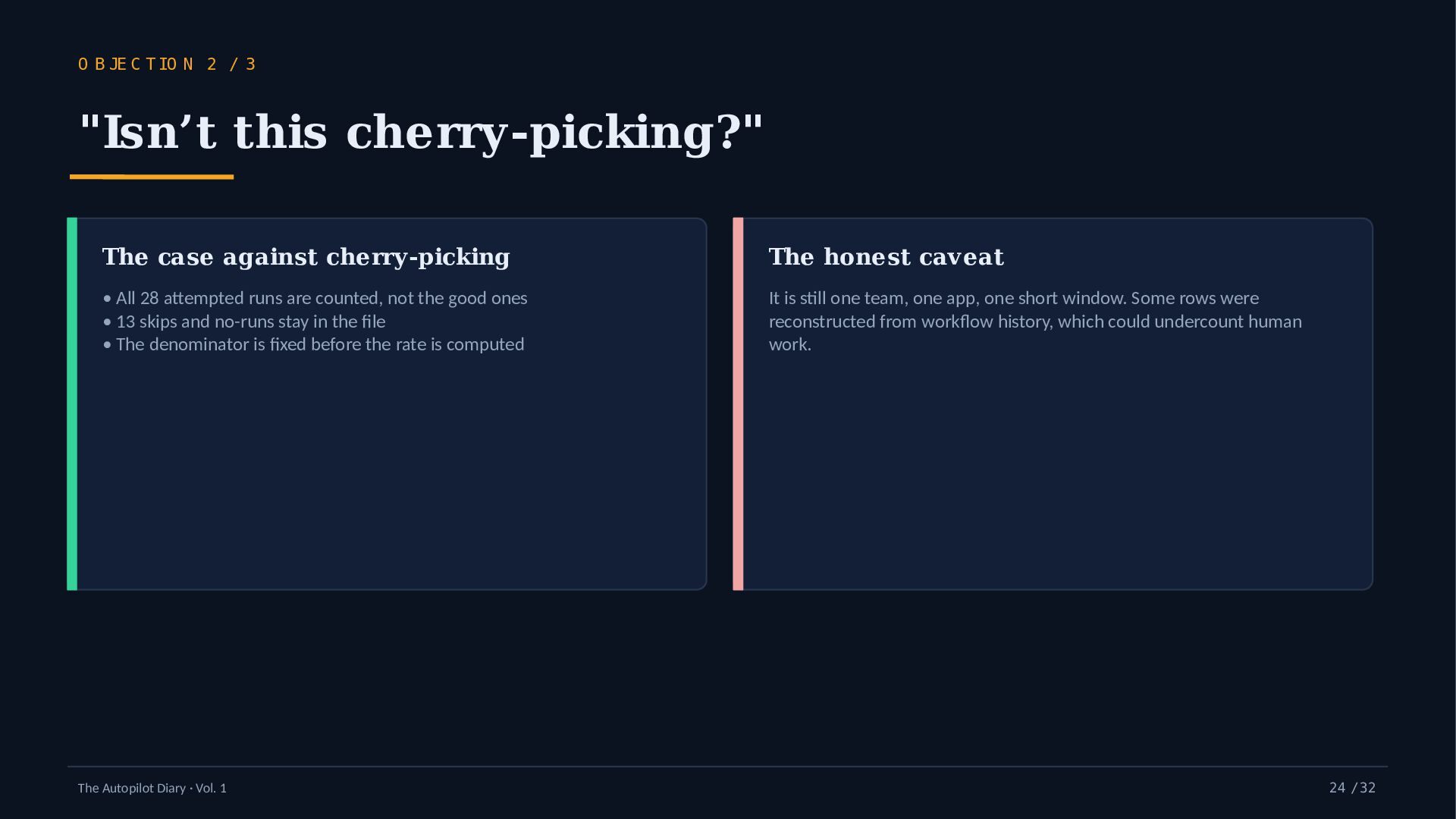
  24. O B JE C T IO N 2 / 3

    "Isn’t this cherry-picking?" The case against cherry-picking The honest caveat • All 28 attempted runs are counted, not the good ones • 13 skips and no-runs stay in the file • The denominator is fixed before the rate is computed It is still one team, one app, one short window. Some rows were reconstructed from workflow history, which could undercount human work. The Autopilot Diary · Vol. 1 24 / 32
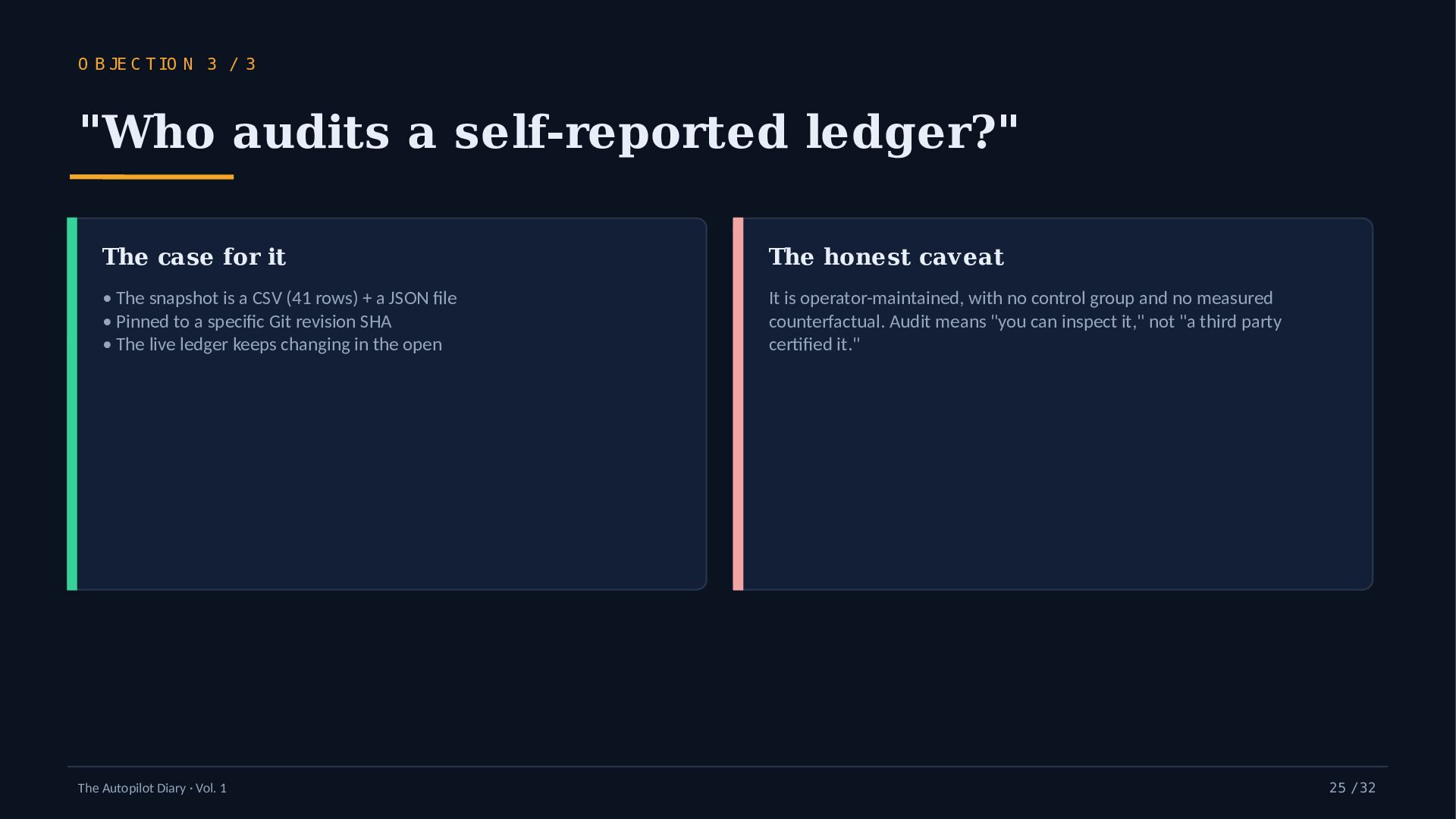
  25. O B JE C T IO N 3 / 3

    "Who audits a self-reported ledger?" The case for it The honest caveat • The snapshot is a CSV (41 rows) + a JSON file • Pinned to a specific Git revision SHA • The live ledger keeps changing in the open It is operator-maintained, with no control group and no measured counterfactual. Audit means "you can inspect it," not "a third party certified it." The Autopilot Diary · Vol. 1 25 / 32
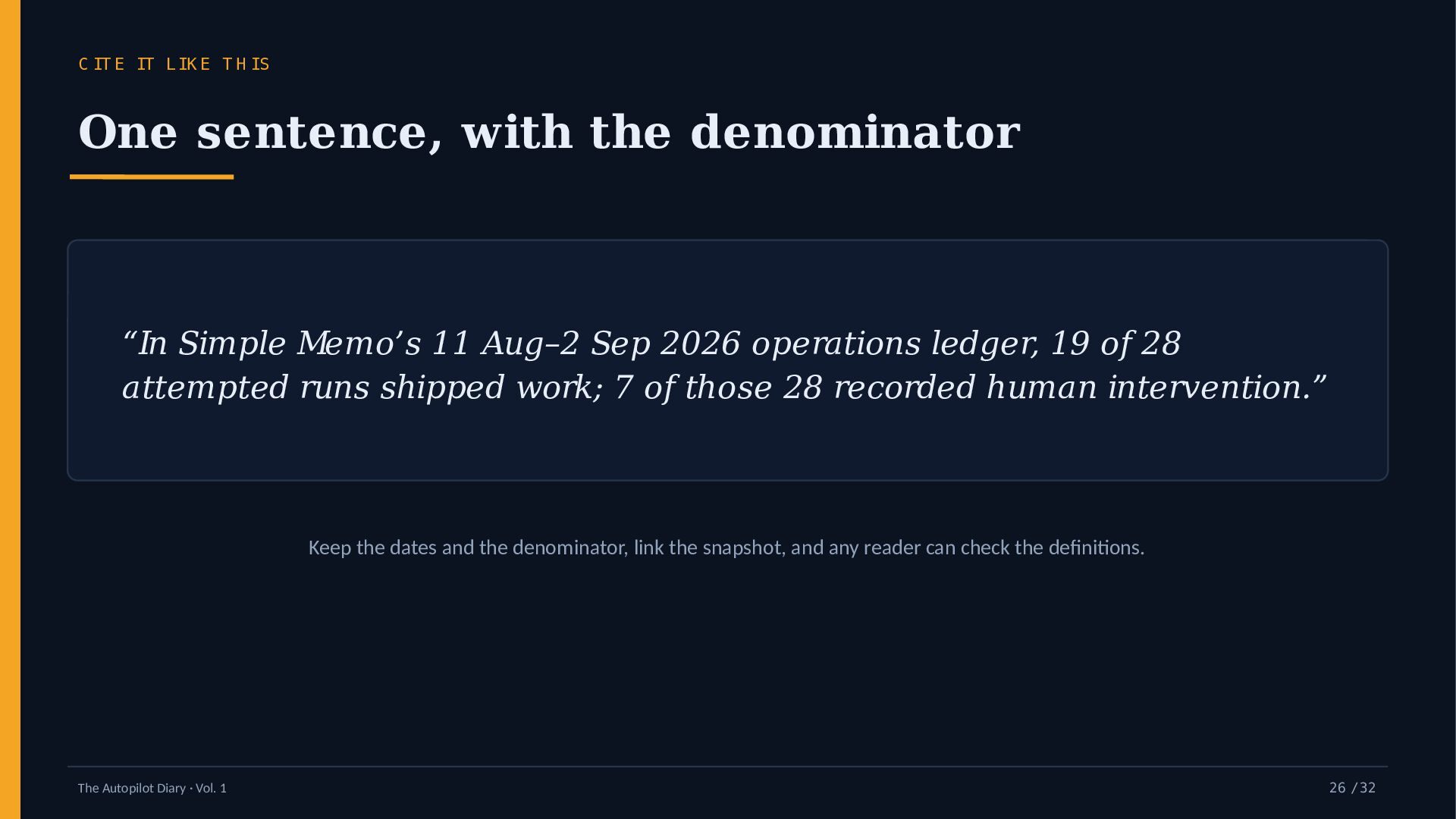
  26. C IT E IT L IK E T H IS

    One sentence, with the denominator “In Simple Memo’s 11 Aug–2 Sep 2026 operations ledger, 19 of 28 attempted runs shipped work; 7 of those 28 recorded human intervention.” Keep the dates and the denominator, link the snapshot, and any reader can check the definitions. The Autopilot Diary · Vol. 1 26 / 32
  27. R EPR O D U C E M E The

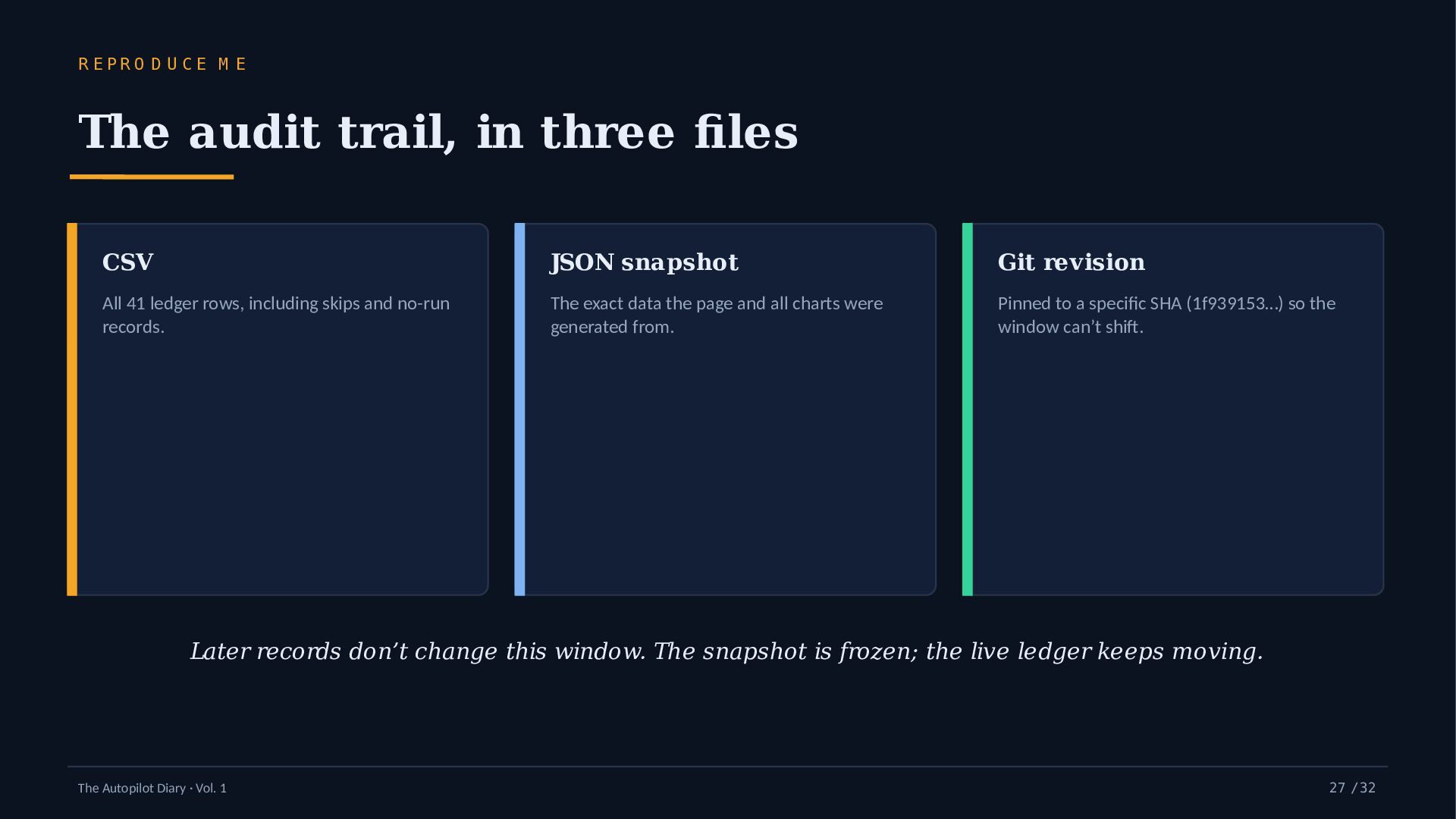
    audit trail, in three files CSV JSON snapshot Git revision All 41 ledger rows, including skips and no-run records. The exact data the page and all charts were generated from. Pinned to a specific SHA (1f939153…) so the window can’t shift. Later records don’t change this window. The snapshot is frozen; the live ledger keeps moving. The Autopilot Diary · Vol. 1 27 / 32
  28. H O N EST SC O REBO ARD — L

    E D G E R O N LY The month, in numbers 28 19 · 67.9% 6 ·2 ·1 7 · 25% attempted runs shipped failed · no-art · cancelled runs with human help 17 / 23 41 0 3 days with a shipment total ledger rows human edits to artifacts dated failures published Did NOT prove: no automatic production rollback, no end-to-end incident recovery, and no increase in revenue. One team, one app, a short window, an operator-maintained ledger, no control group. The Autopilot Diary · Vol. 1 28 / 32
  29. D O N ’T M IX T H E S

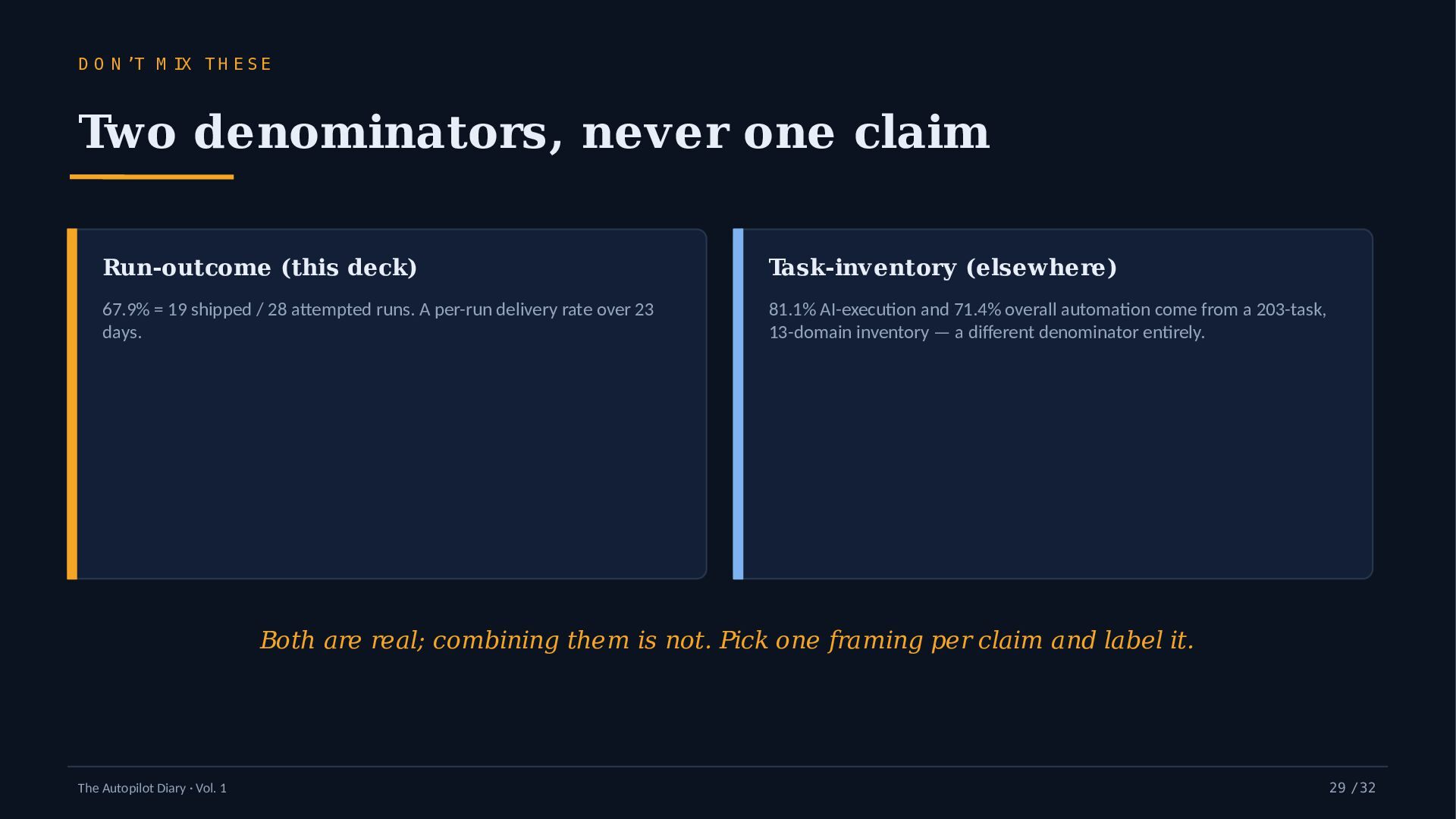
    E Two denominators, never one claim Run-outcome (this deck) Task-inventory (elsewhere) 67.9% = 19 shipped / 28 attempted runs. A per-run delivery rate over 23 days. 81.1% AI-execution and 71.4% overall automation come from a 203-task, 13-domain inventory — a different denominator entirely. Both are real; combining them is not. Pick one framing per claim and label it. The Autopilot Diary · Vol. 1 29 / 32
  30. F IE L D N O T E S What

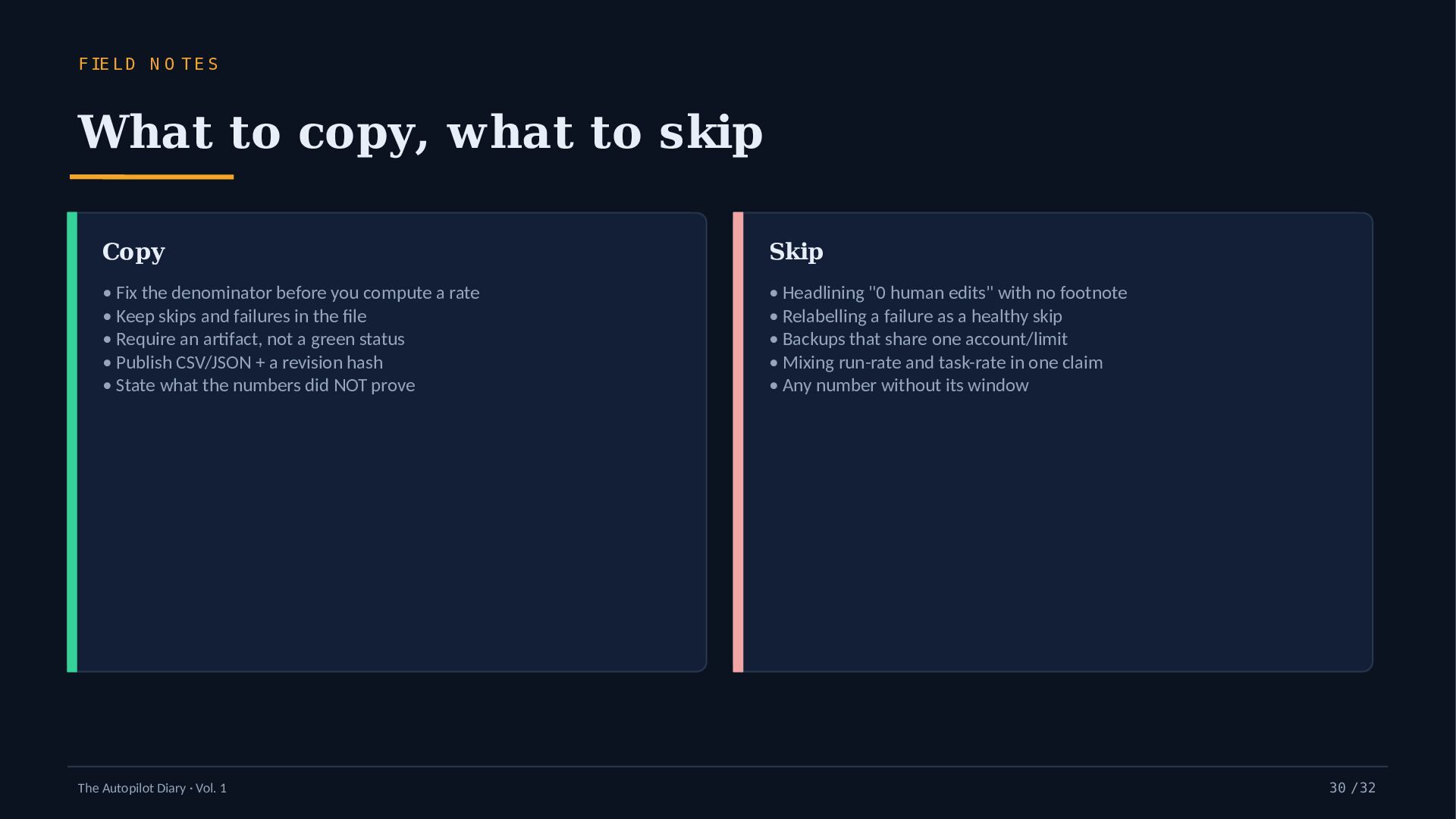
    to copy, what to skip Copy Skip • Fix the denominator before you compute a rate • Keep skips and failures in the file • Require an artifact, not a green status • Publish CSV/JSON + a revision hash • State what the numbers did NOT prove • Headlining "0 human edits" with no footnote • Relabelling a failure as a healthy skip • Backups that share one account/limit • Mixing run-rate and task-rate in one claim • Any number without its window The Autopilot Diary · Vol. 1 30 / 32
  31. C L O S IN G T H O U

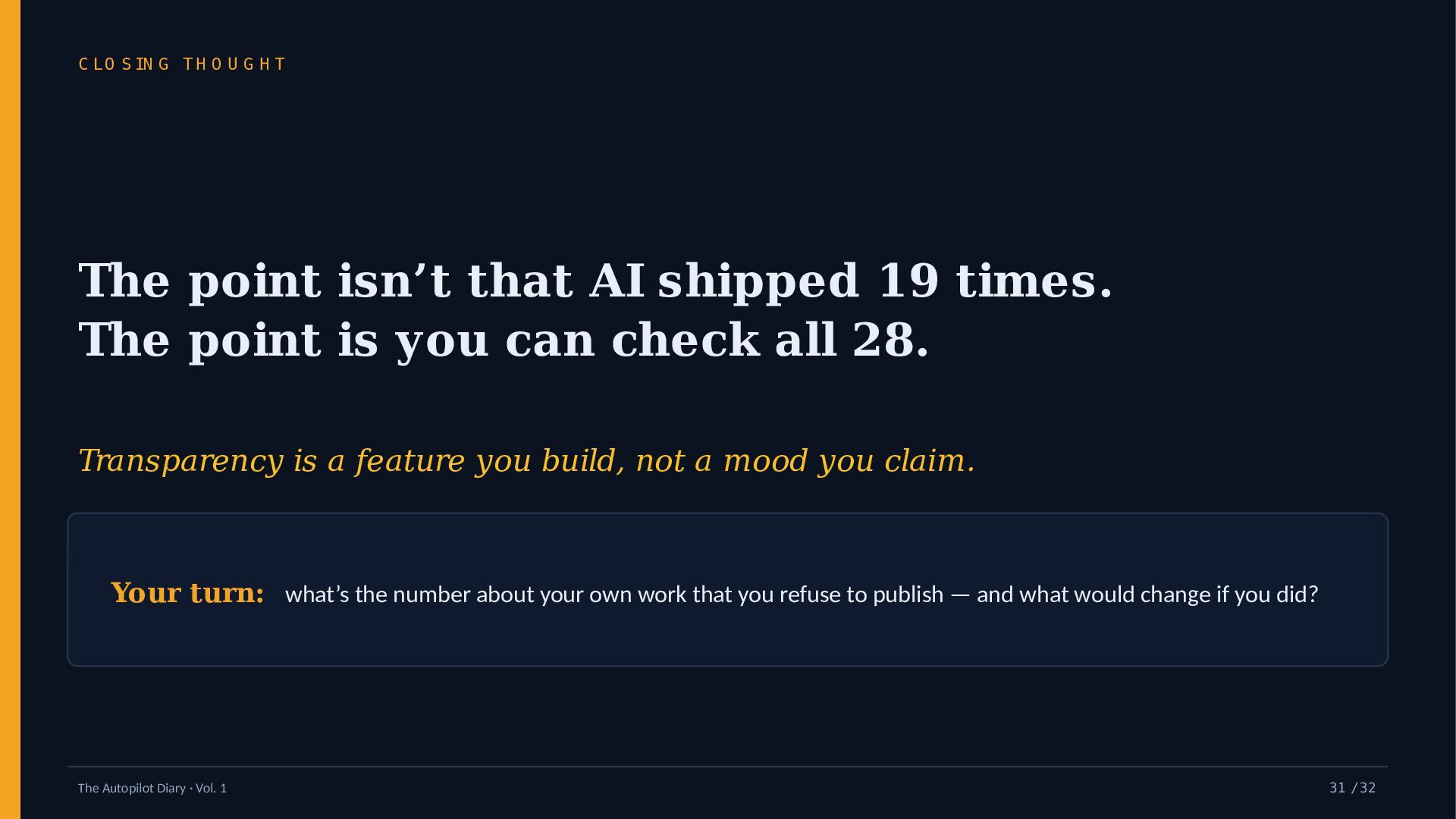
    G H T The point isn’t that AI shipped 19 times. The point is you can check all 28. Transparency is a feature you build, not a mood you claim. Your turn: what’s the number about your own work that you refuse to publish — and what would change if you did? The Autopilot Diary · Vol. 1 31 / 32
  32. T H A N K S F O R R

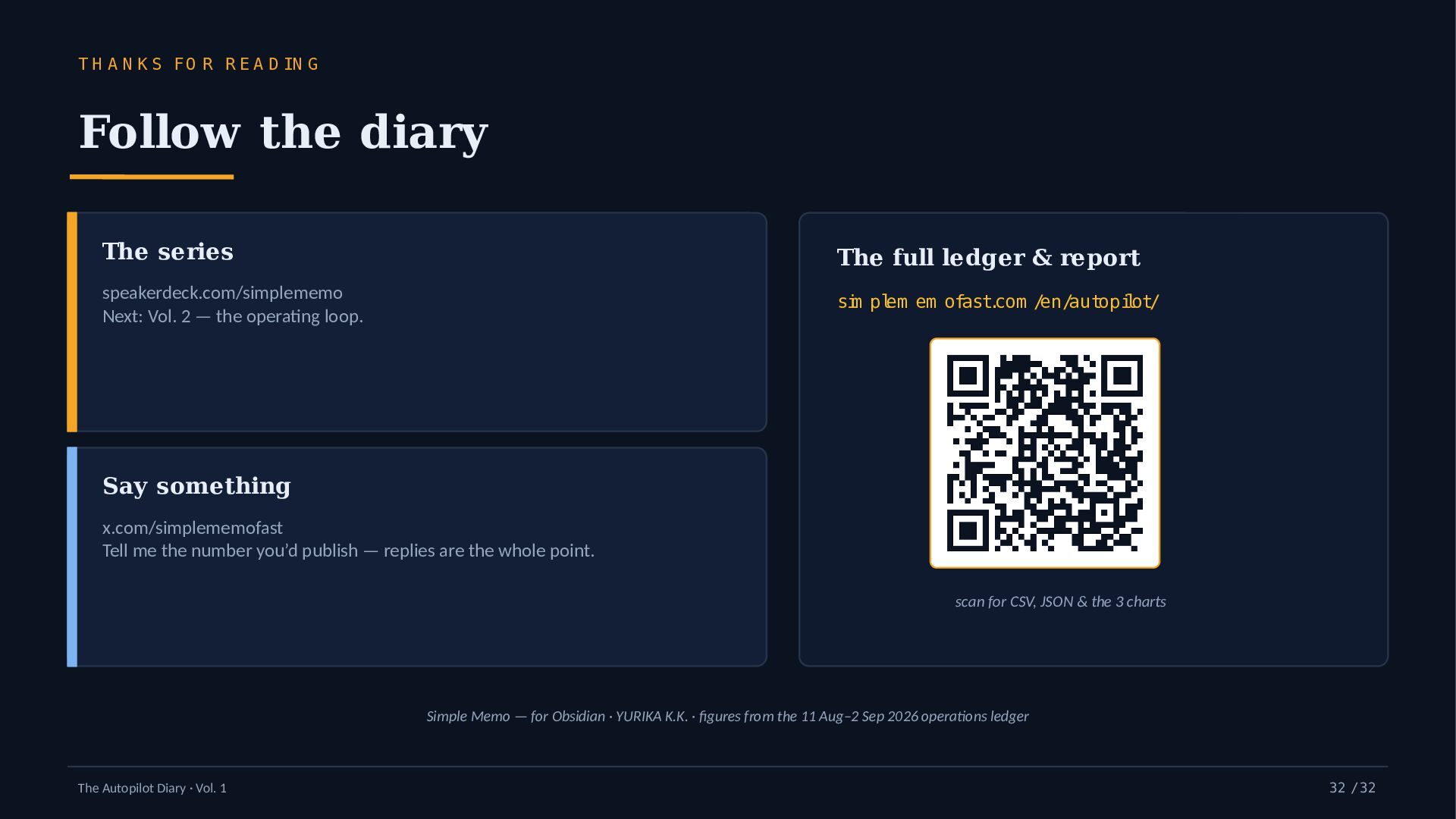
    E A D IN G Follow the diary The series The full ledger & report speakerdeck.com/simplememo Next: Vol. 2 — the operating loop. sim plem em ofast.com /en/autopilot/ Say something x.com/simplememofast Tell me the number you’d publish — replies are the whole point. scan for CSV, JSON & the 3 charts Simple Memo — for Obsidian · YURIKA K.K. · figures from the 11 Aug–2 Sep 2026 operations ledger The Autopilot Diary · Vol. 1 32 / 32