Gupta : Microsoft Research Bhargavi Paranjape : Microsoft Research Harish Karnick : IIT Kanpur Conference Proceedings of the 2017 Conference on Empirical Methods in Natural Language Processing, pages 659–669, 2017 Association for Computational Linguistics
documents - Sparse Composite Document Vector (SCDV) - • They outperform the previous state-of-the-art method, NTSG Liu et al. (2015). • They achieve significant reduction in training and prediction times compared to other representation methods.
and real-valued vectors that can capture their semantic and syntactic properties. • Representations based on neural network language models (Mikolov et al. 2013) can overcome bag-of-word model’s flaws (don’t account for word ordering and long-distance semantic relations) and further reduce the dimensionality of the vectors. • However, there is a need to extend word embeddings to entire paragraphs and documents for tasks such as document and short-text classification.
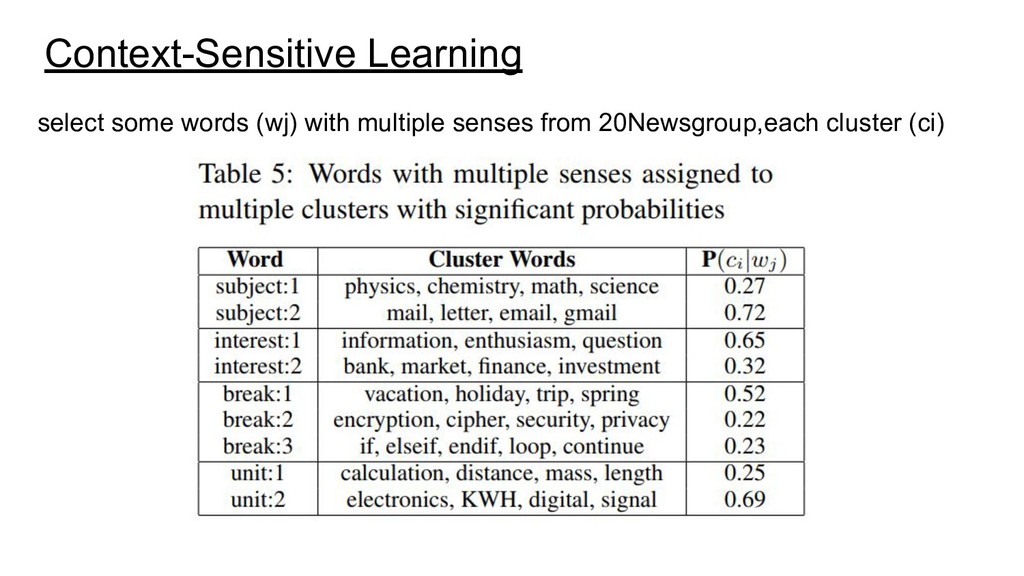
is a challenge. • vectors of two documents that contain the same word in two distinct senses need to account for this distinction for an accurate semantic representation of the documents. • They propose the Sparse Composite Document Vector(SCDV) representation learning technique to address these challenges and create efficient, accurate and robust semantic representations of large texts for document classification tasks.
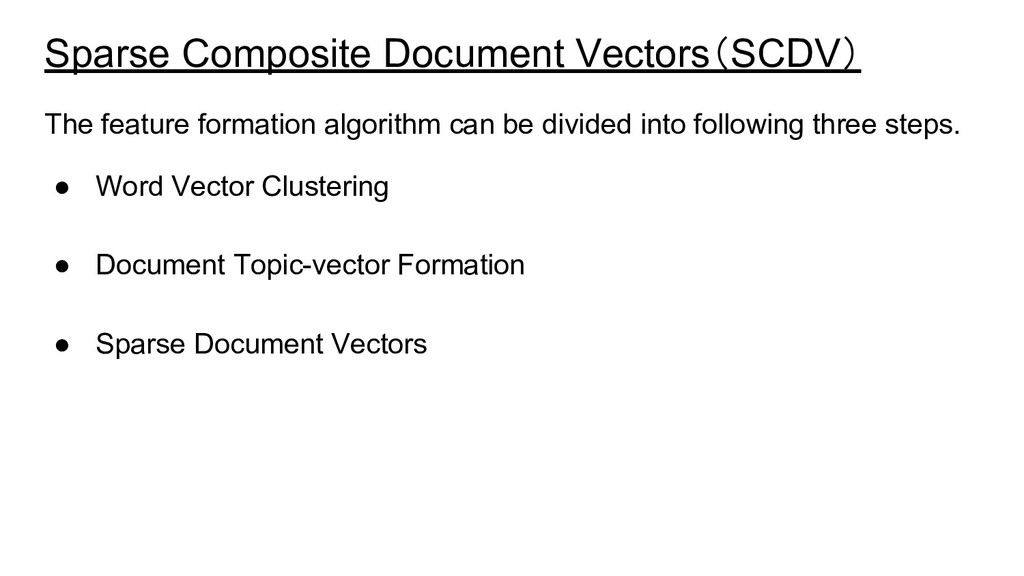
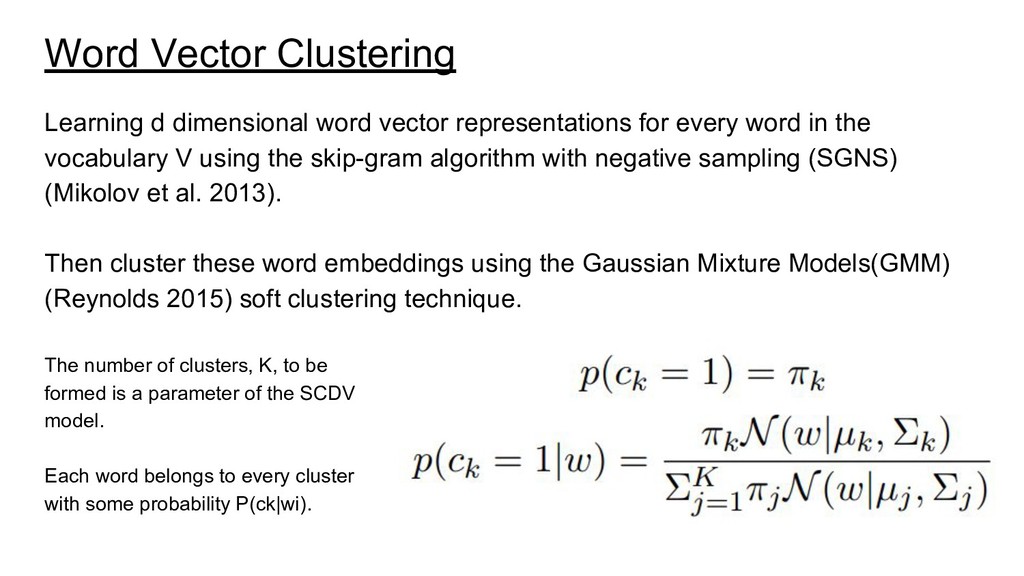
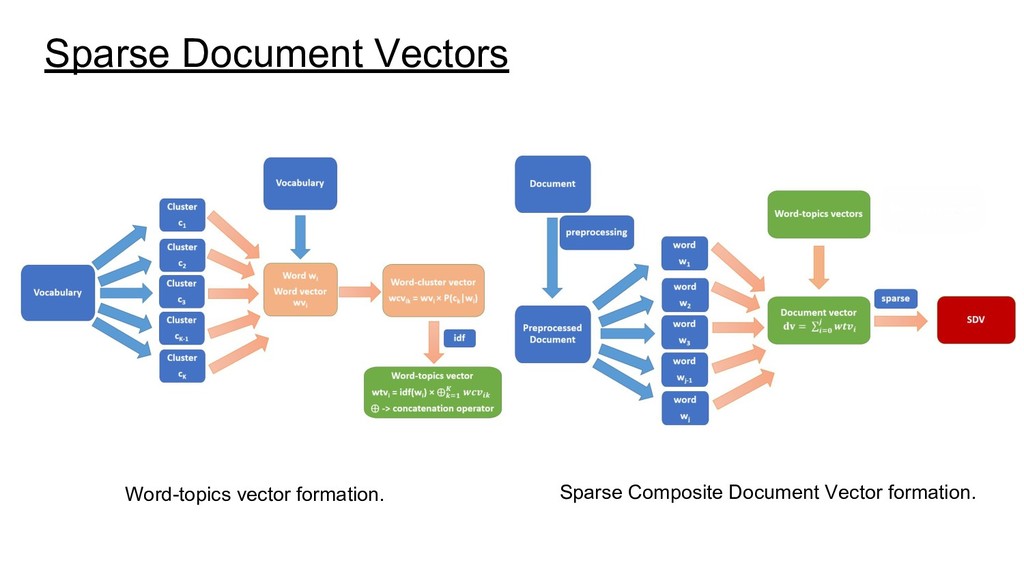
every word in the vocabulary V using the skip-gram algorithm with negative sampling (SGNS) (Mikolov et al. 2013). Then cluster these word embeddings using the Gaussian Mixture Models(GMM) (Reynolds 2015) soft clustering technique. The number of clusters, K, to be formed is a parameter of the SCDV model. Each word belongs to every cluster with some probability P(ck|wi).
different word-cluster vectors of d dimensions (→wcvik) by P(ck|wi). Concatenate all K word-cluster vectors (→wcvik) into a K×d dimensional embedding and weigh it with inverse document frequency of wi to form a word-topics vector (→wtvi). Finally, for all words appearing in document Dn, we sum their word-topic vectors →wtvi to obtain the document vector →dvDn.
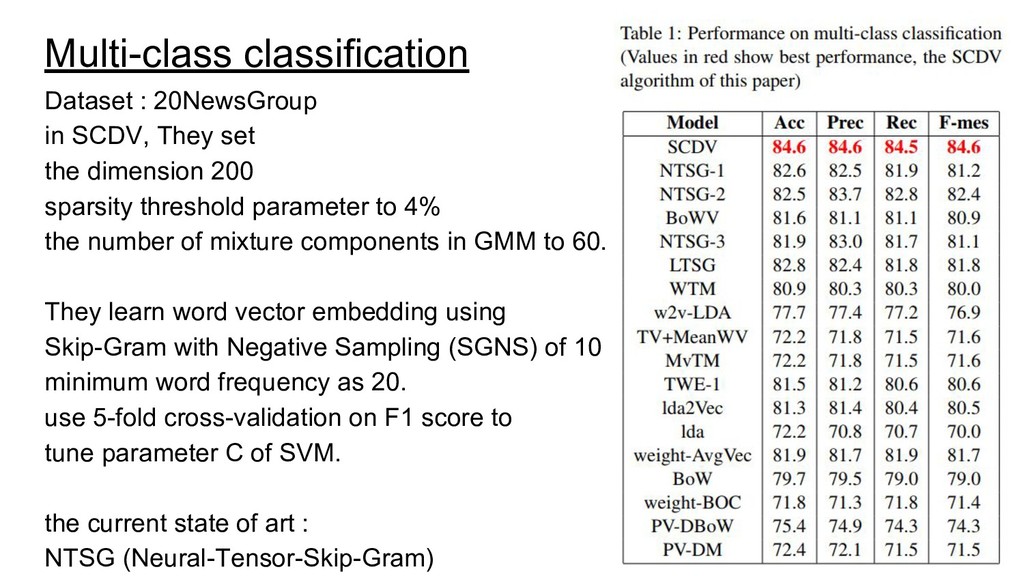
(Harris, 1954), Bag of Word Vector (BoWV) (Gupta et al., 2016) model, paragraph vector models (Le and Mikolov, 2014), Topical word embeddings (TWE-1) (Liu et al.,2015b), Neural Tensor Skip-Gram Model (NTSG1to NTSG-3) (Liu et al., 2015a), tf-idf weighted average word-vector model (Singh and Mukerjee, 2015) weighted Bag of Concepts (weightBoC)(Kim et al., 2017),
dimension 200 sparsity threshold parameter to 4% the number of mixture components in GMM to 60. They learn word vector embedding using Skip-Gram with Negative Sampling (SGNS) of 10 minimum word frequency as 20. use 5-fold cross-validation on F1 score to tune parameter C of SVM. the current state of art : NTSG (Neural-Tensor-Skip-Gram)
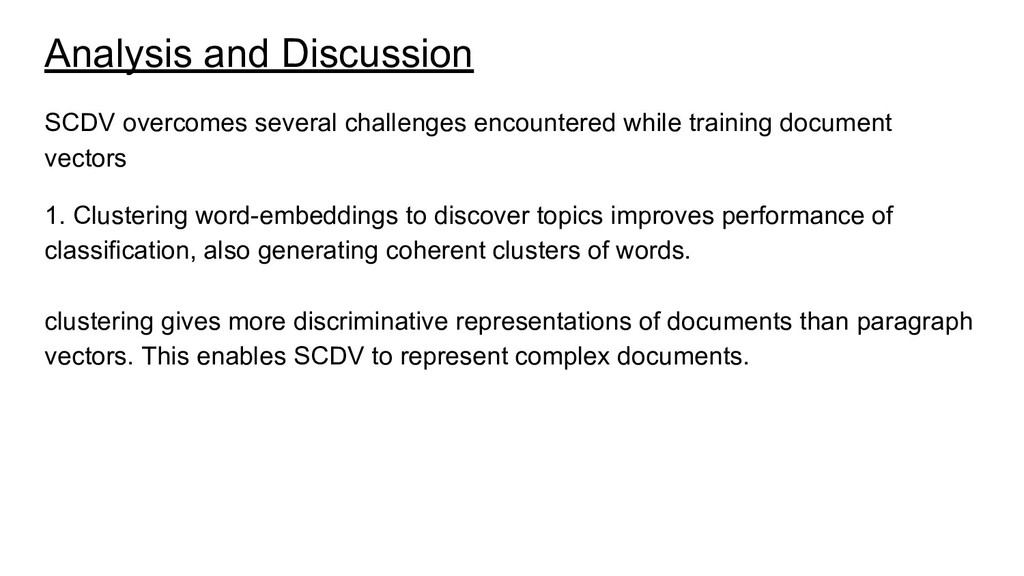
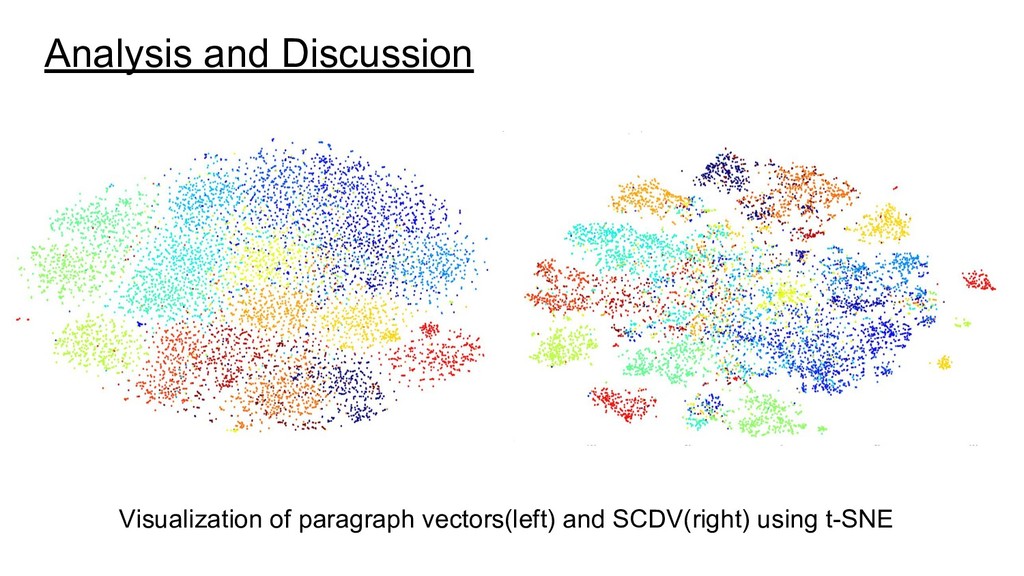
document vectors 1. Clustering word-embeddings to discover topics improves performance of classification, also generating coherent clusters of words. clustering gives more discriminative representations of documents than paragraph vectors. This enables SCDV to represent complex documents.
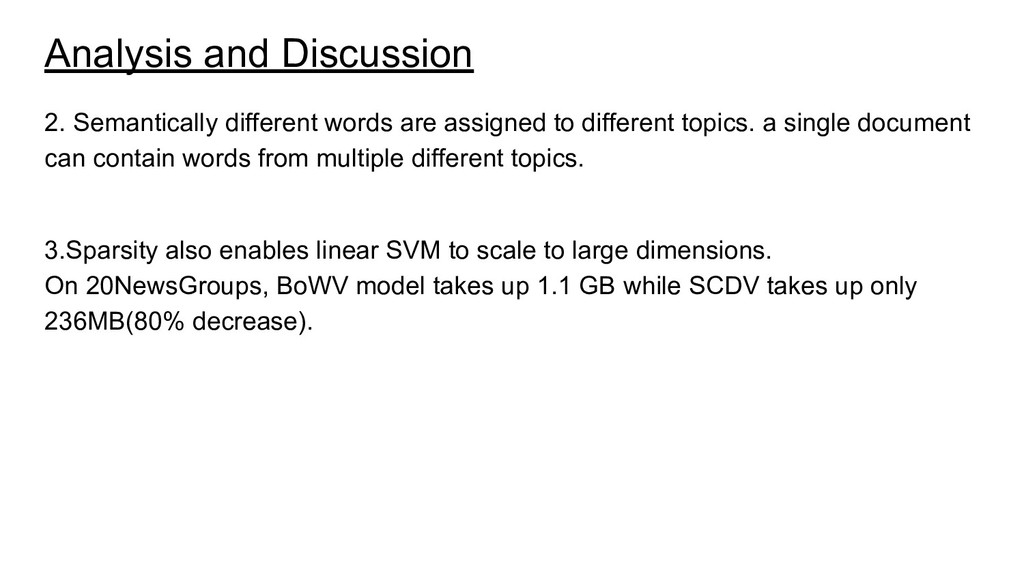
different topics. a single document can contain words from multiple different topics. 3.Sparsity also enables linear SVM to scale to large dimensions. On 20NewsGroups, BoWV model takes up 1.1 GB while SCDV takes up only 236MB(80% decrease).
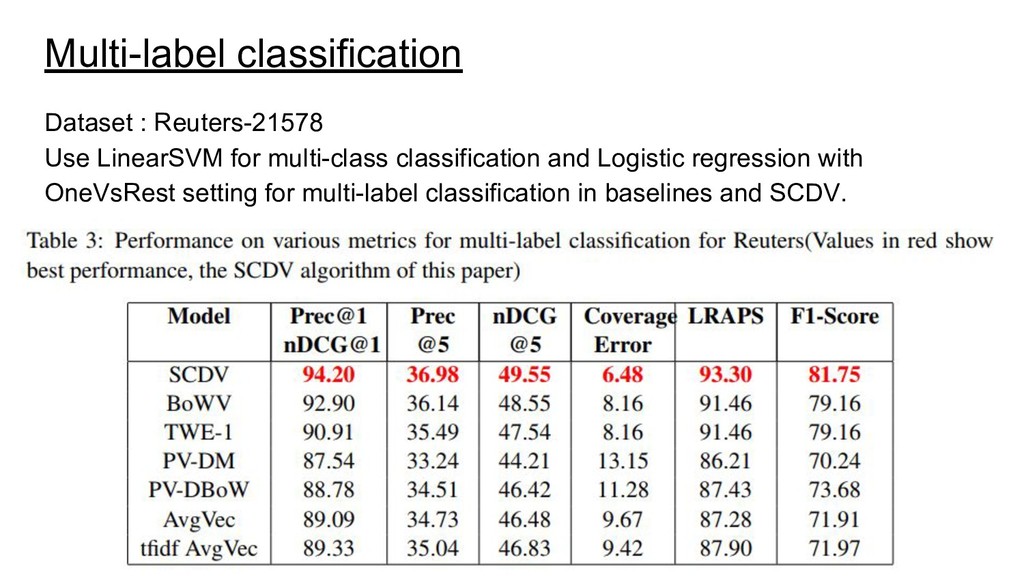
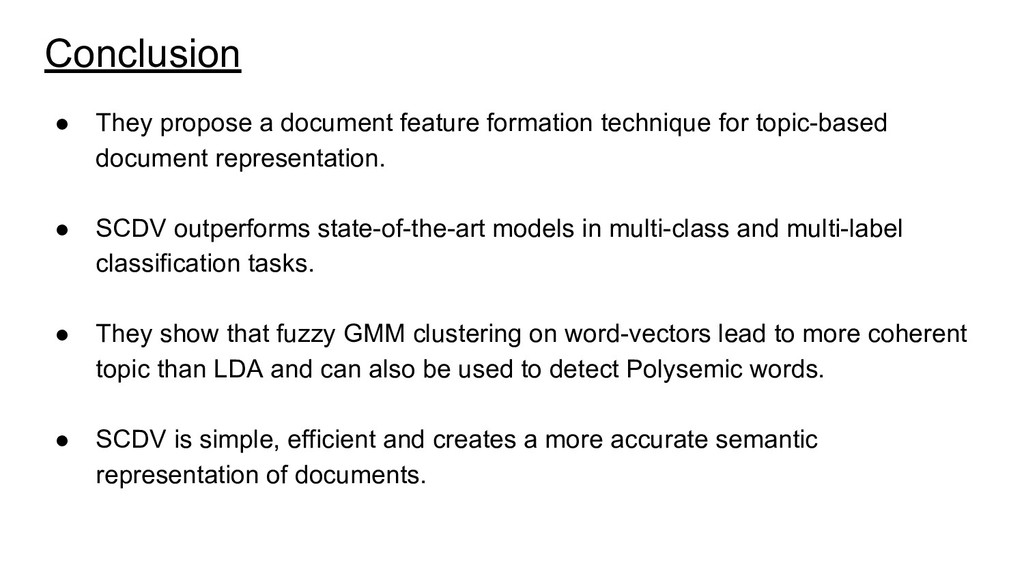
topic-based document representation. • SCDV outperforms state-of-the-art models in multi-class and multi-label classification tasks. • They show that fuzzy GMM clustering on word-vectors lead to more coherent topic than LDA and can also be used to detect Polysemic words. • SCDV is simple, efficient and creates a more accurate semantic representation of documents.


 tad
tad
 geshan
 aarron
 marketingsoph
 malarkey
 tammyeverts
 akademiya2063
 lcolladotor
 aleyda
 sachag
 marktimemedia
 kimpetersen