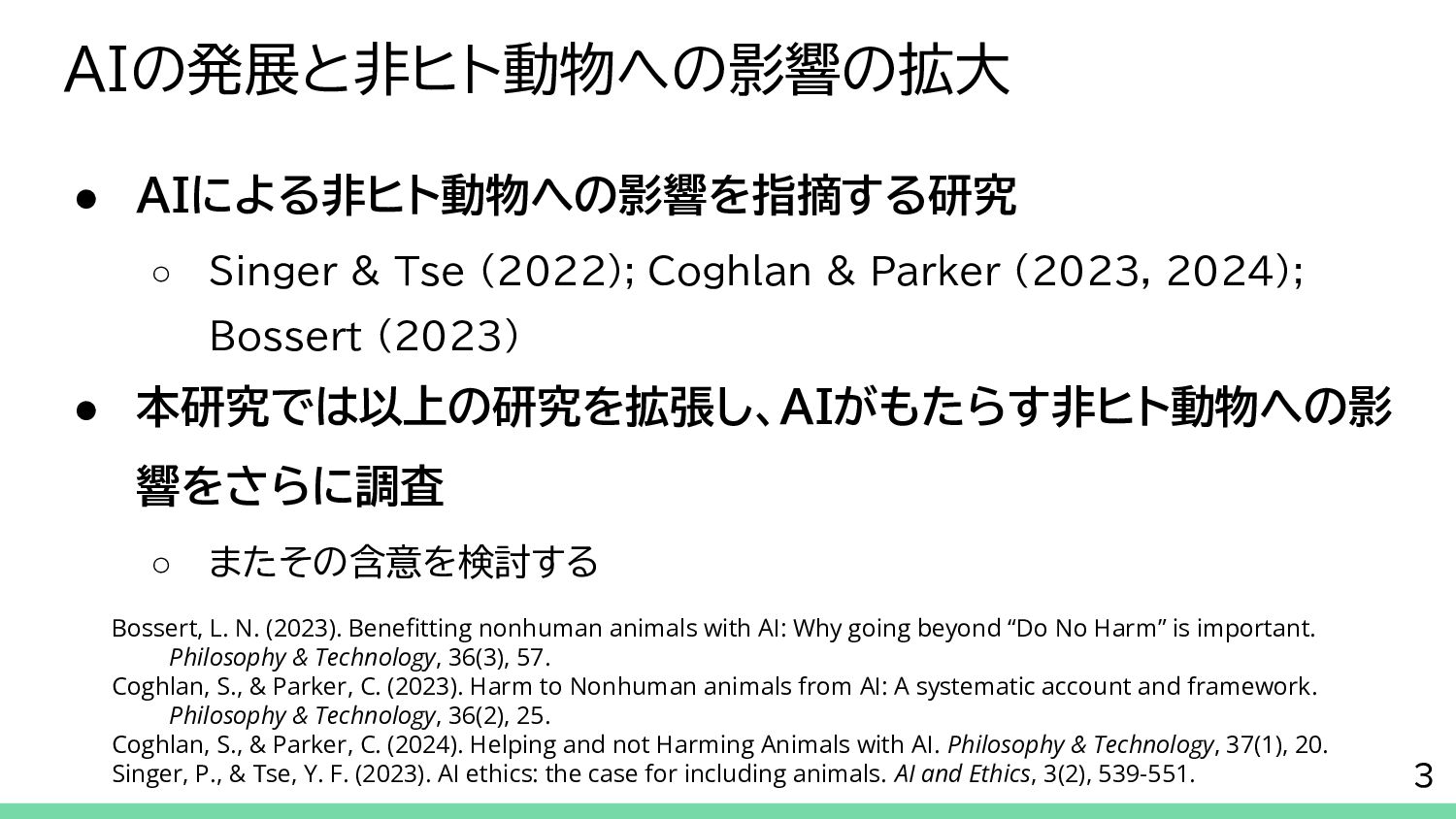
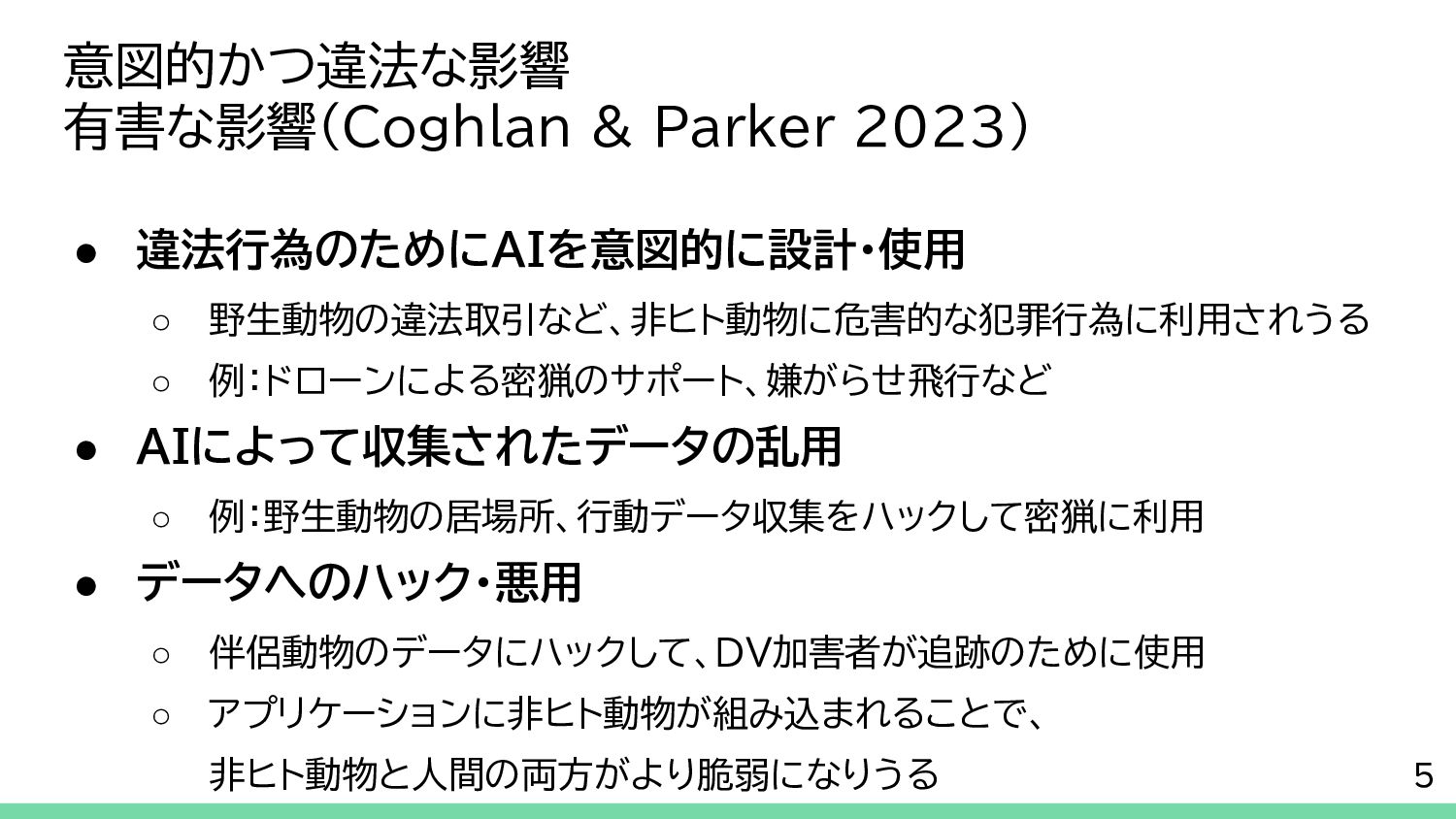
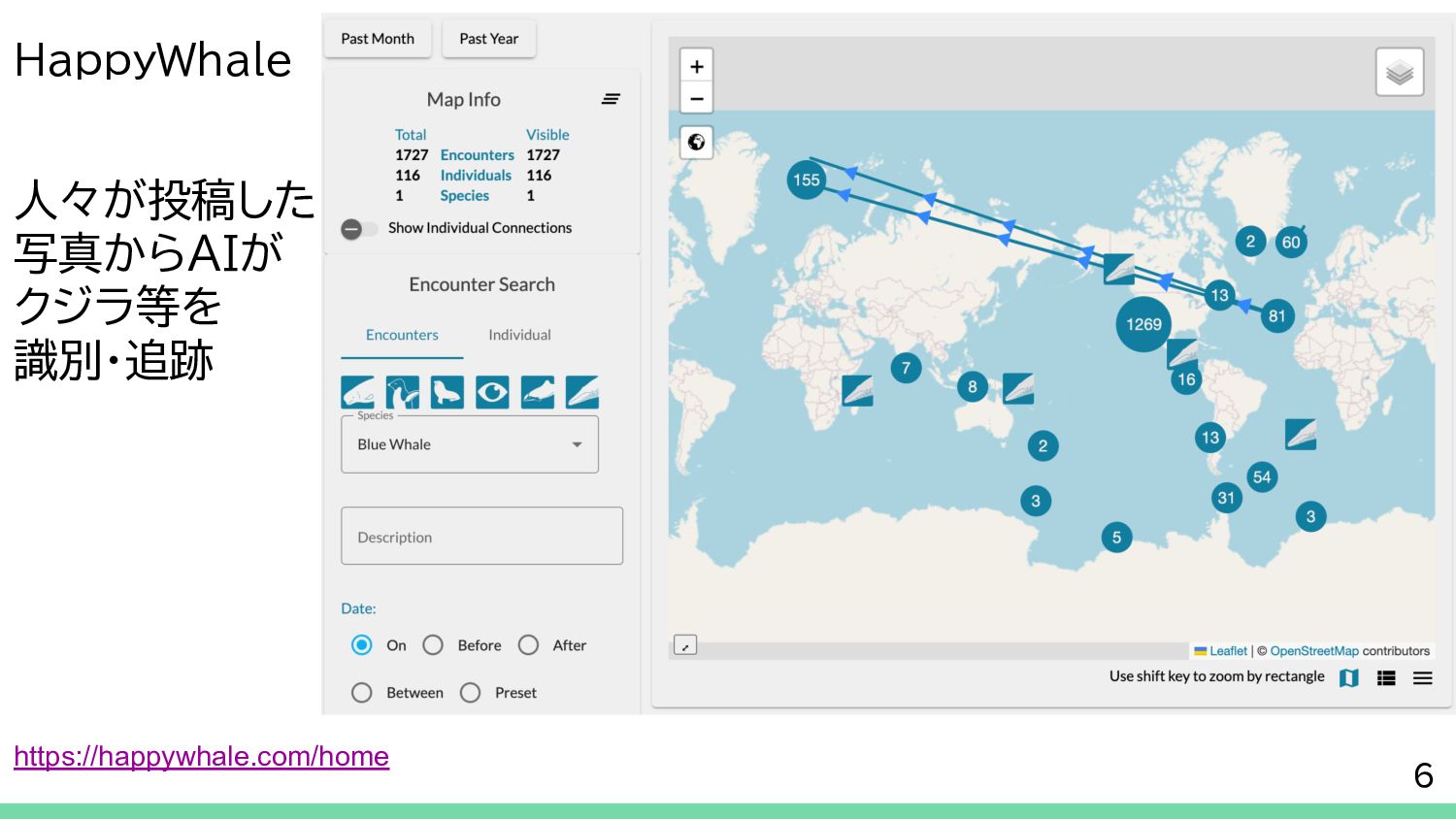
Parker (2023, 2024); Bossert (2023) • 本研究では以上の研究を拡張し、AIがもたらす非ヒト動物への影 響をさらに調査 ◦ またその含意を検討する 3 Bossert, L. N. (2023). Benefitting nonhuman animals with AI: Why going beyond “Do No Harm” is important. Philosophy & Technology, 36(3), 57. Coghlan, S., & Parker, C. (2023). Harm to Nonhuman animals from AI: A systematic account and framework. Philosophy & Technology, 36(2), 25. Coghlan, S., & Parker, C. (2024). Helping and not Harming Animals with AI. Philosophy & Technology, 37(1), 20. Singer, P., & Tse, Y. F. (2023). AI ethics: the case for including animals. AI and Ethics, 3(2), 539-551.
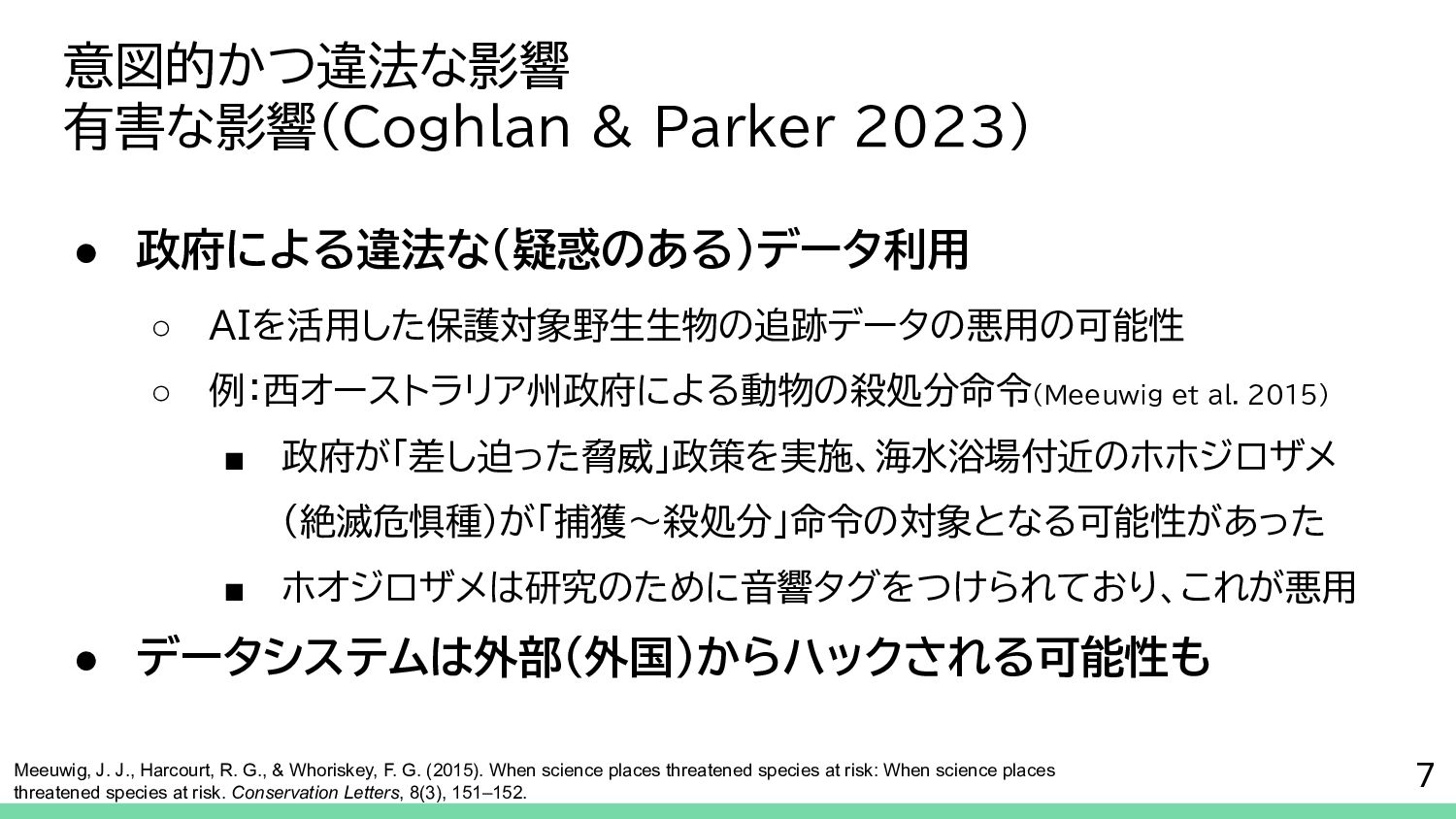
例:西オーストラリア州政府による動物の殺処分命令(Meeuwig et al. 2015) ▪ 政府が「差し迫った脅威」政策を実施、海水浴場付近のホホジロザメ (絶滅危惧種)が「捕獲~殺処分」命令の対象となる可能性があった ▪ ホオジロザメは研究のために音響タグをつけられており、これが悪用 • データシステムは外部(外国)からハックされる可能性も 7 Meeuwig, J. J., Harcourt, R. G., & Whoriskey, F. G. (2015). When science places threatened species at risk: When science places threatened species at risk. Conservation Letters, 8(3), 151–152.
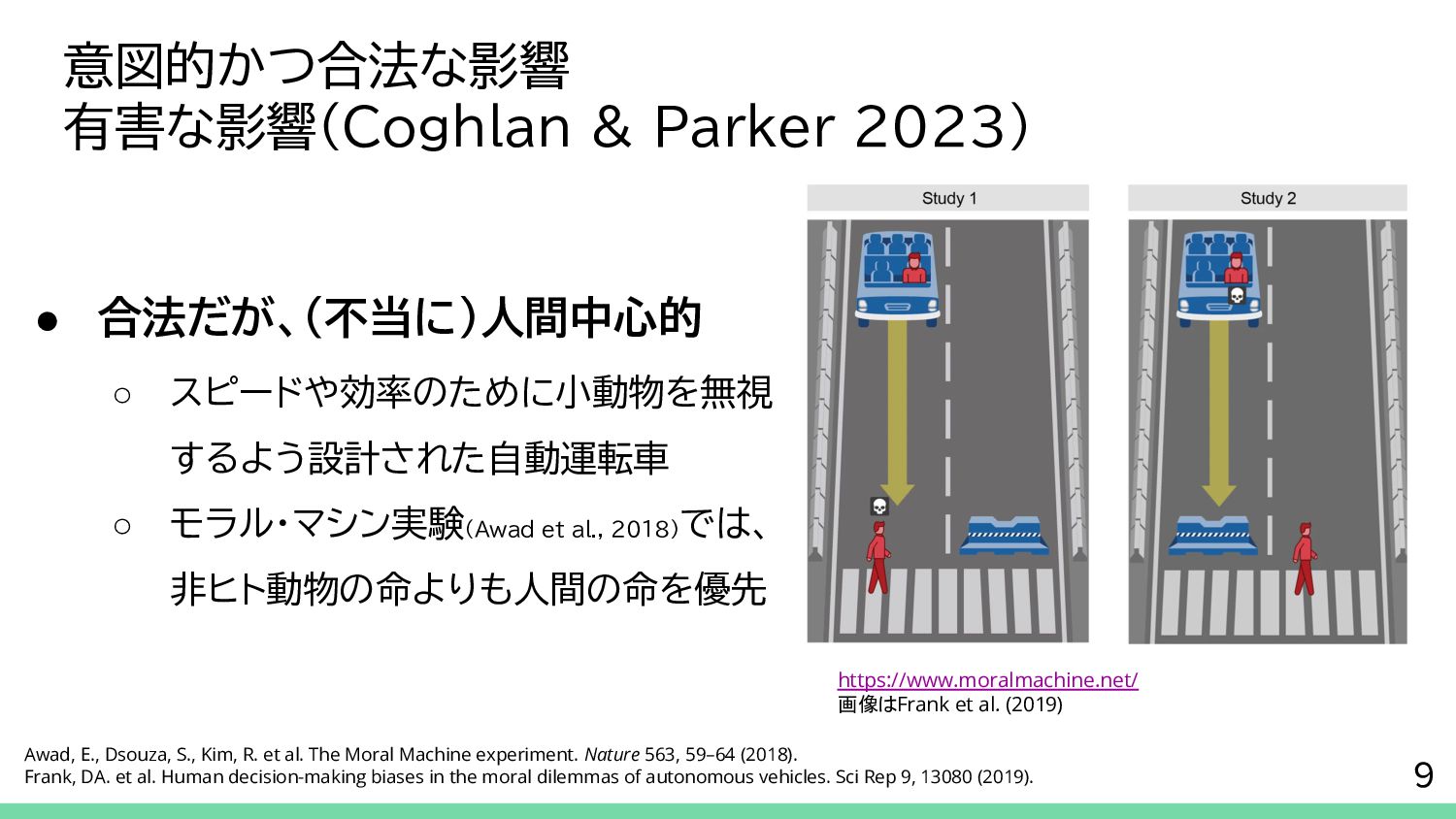
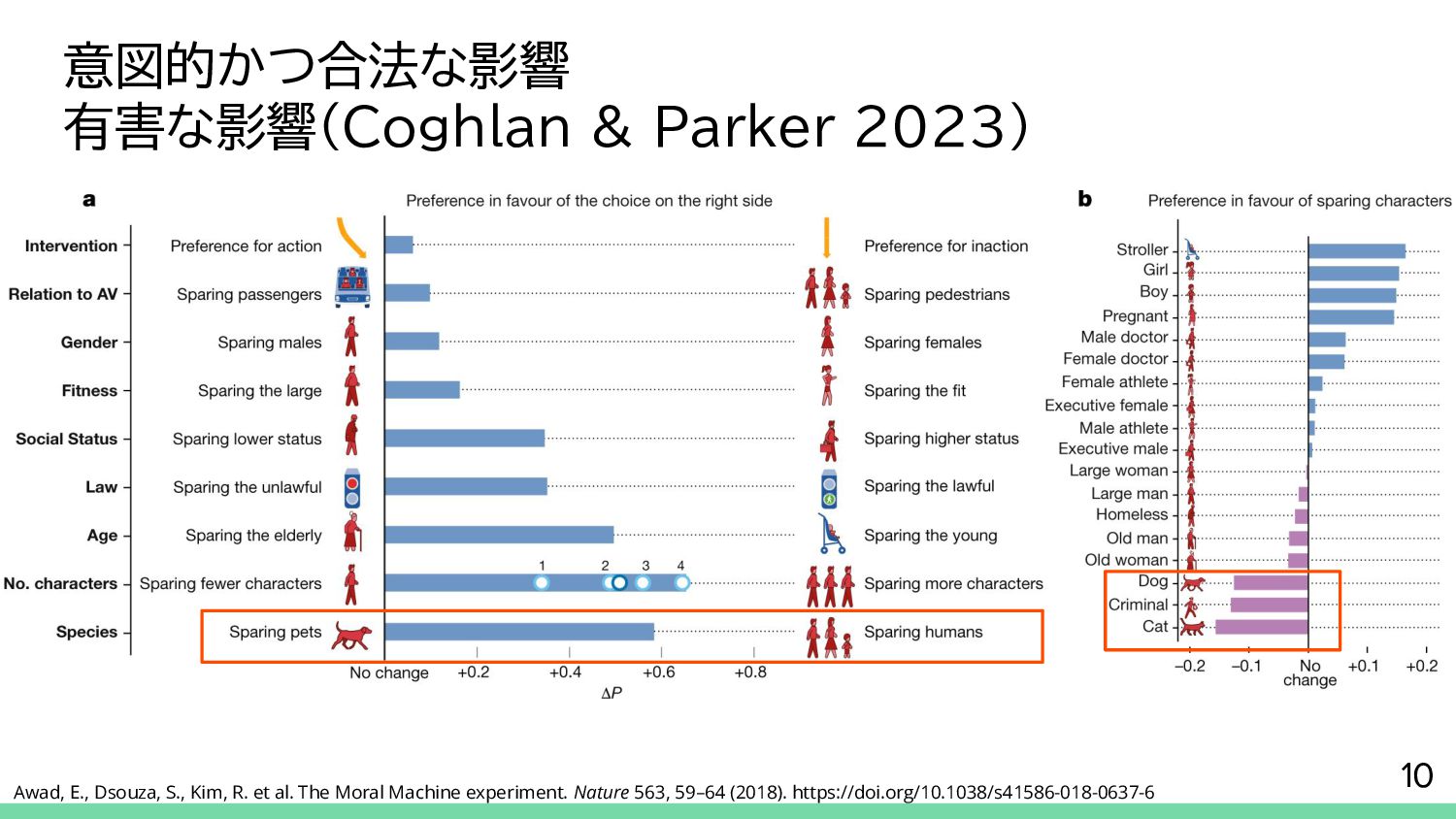
◦ モラル・マシン実験(Awad et al., 2018) では、 非ヒト動物の命よりも人間の命を優先 9 Awad, E., Dsouza, S., Kim, R. et al. The Moral Machine experiment. Nature 563, 59–64 (2018). Frank, DA. et al. Human decision-making biases in the moral dilemmas of autonomous vehicles. Sci Rep 9, 13080 (2019). https://www.moralmachine.net/ 画像はFrank et al. (2019)
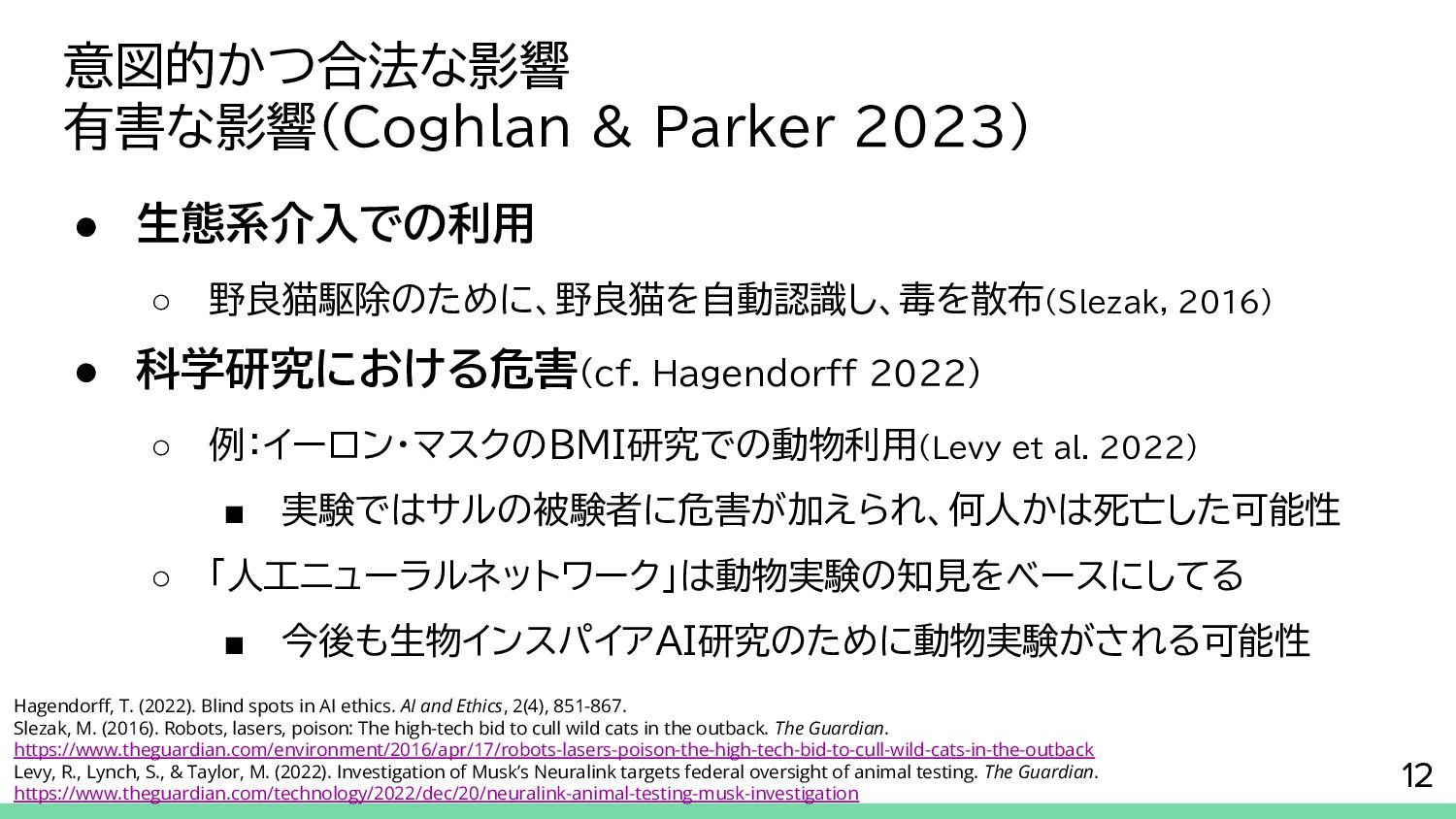
• 科学研究における危害(cf. Hagendorff 2022) ◦ 例:イーロン・マスクのBMI研究での動物利用(Levy et al. 2022) ▪ 実験ではサルの被験者に危害が加えられ、何人かは死亡した可能性 ◦ 「人工ニューラルネットワーク」は動物実験の知見をベースにしてる ▪ 今後も生物インスパイアAI研究のために動物実験がされる可能性 12 Hagendorff, T. (2022). Blind spots in AI ethics. AI and Ethics, 2(4), 851-867. Slezak, M. (2016). Robots, lasers, poison: The high-tech bid to cull wild cats in the outback. The Guardian. https://www.theguardian.com/environment/2016/apr/17/robots-lasers-poison-the-high-tech-bid-to-cull-wild-cats-in-the-outback Levy, R., Lynch, S., & Taylor, M. (2022). Investigation of Musk’s Neuralink targets federal oversight of animal testing. The Guardian. https://www.theguardian.com/technology/2022/dec/20/neuralink-animal-testing-musk-investigation
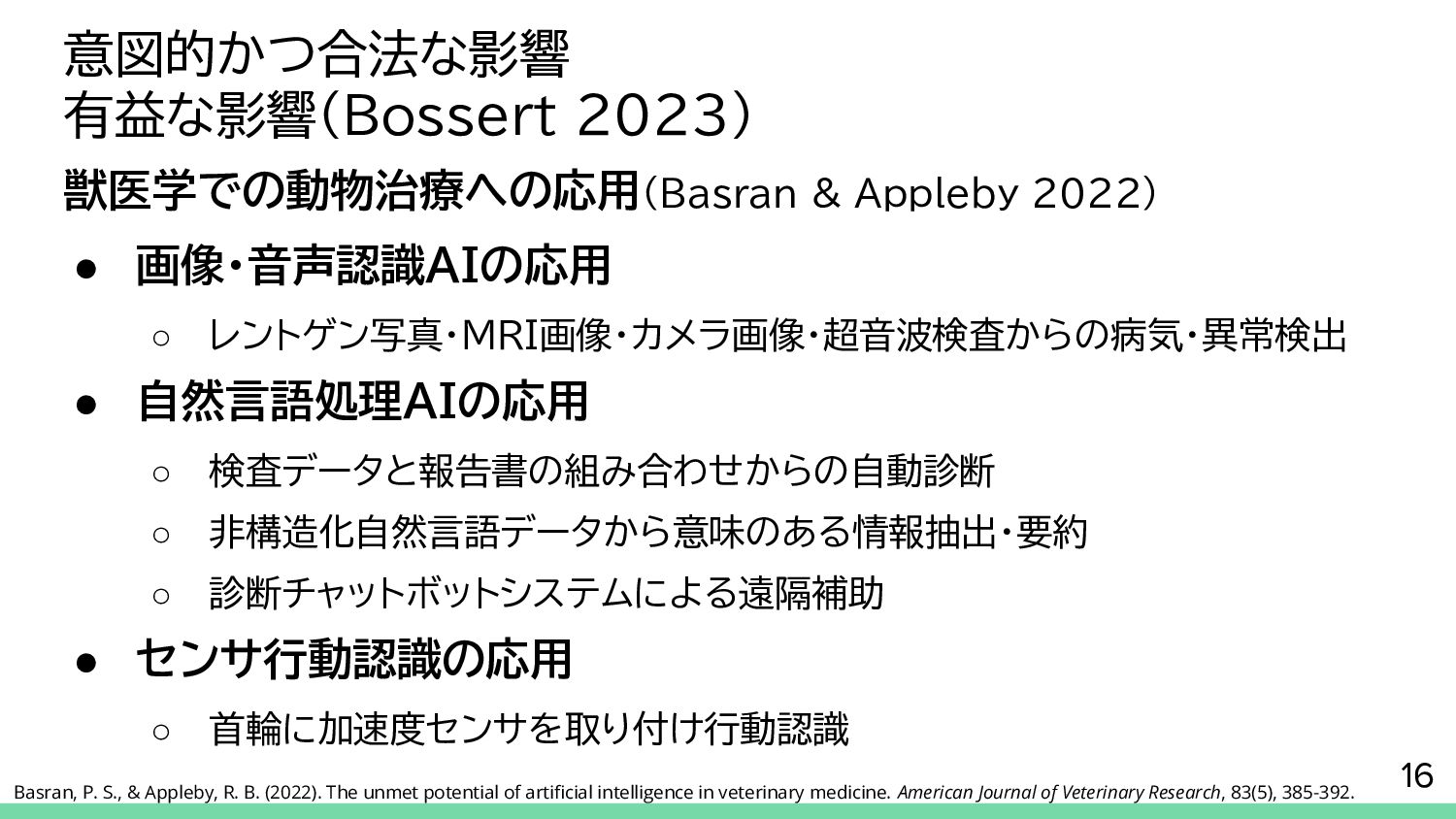
レントゲン写真・MRI画像・カメラ画像・超音波検査からの病気・異常検出 • 自然言語処理AIの応用 ◦ 検査データと報告書の組み合わせからの自動診断 ◦ 非構造化自然言語データから意味のある情報抽出・要約 ◦ 診断チャットボットシステムによる遠隔補助 • センサ行動認識の応用 ◦ 首輪に加速度センサを取り付け行動認識 16 Basran, P. S., & Appleby, R. B. (2022). The unmet potential of artificial intelligence in veterinary medicine. American Journal of Veterinary Research, 83(5), 385-392.
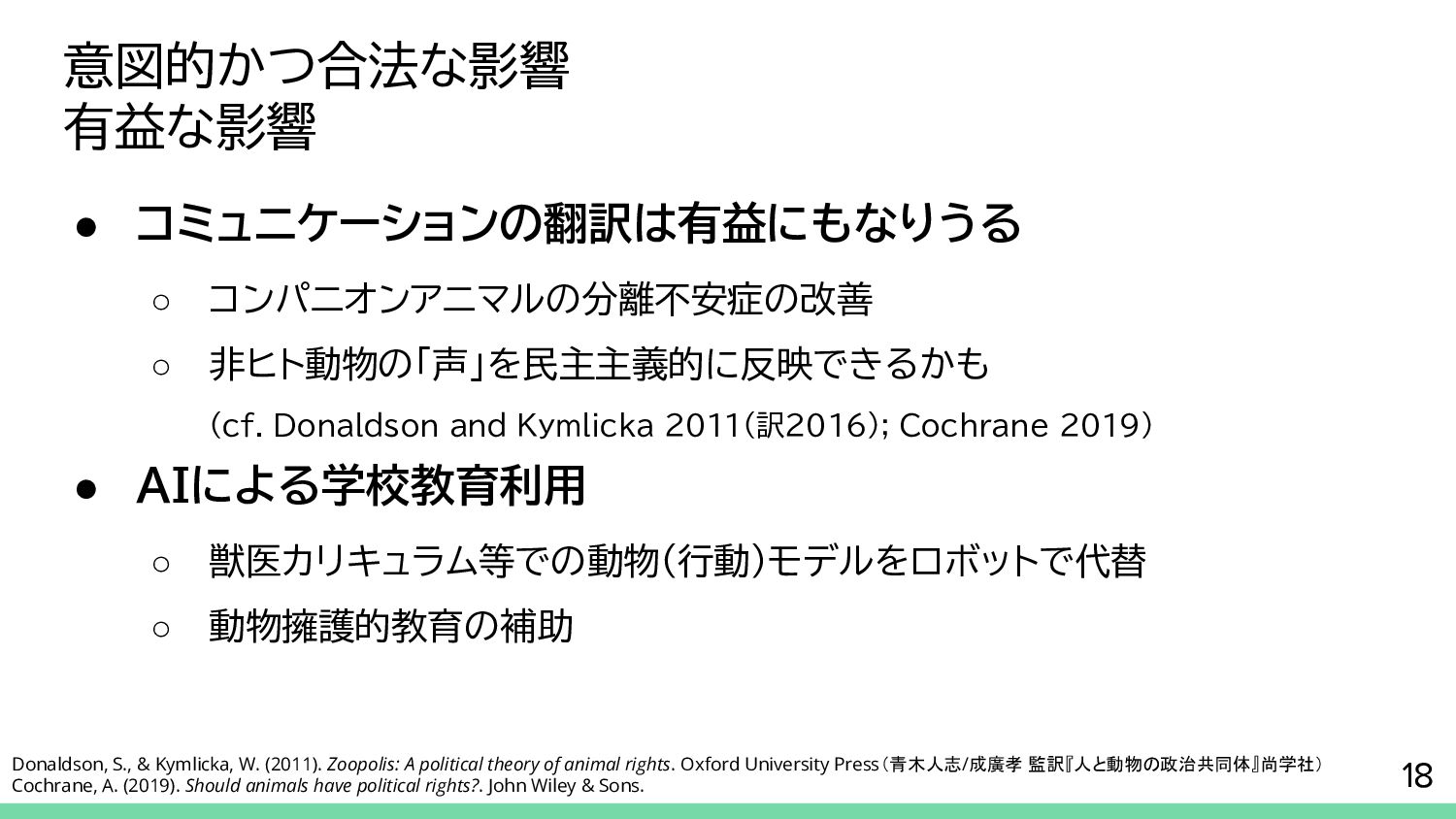
and Kymlicka 2011(訳2016); Cochrane 2019) • AIによる学校教育利用 ◦ 獣医カリキュラム等での動物(行動)モデルをロボットで代替 ◦ 動物擁護的教育の補助 18 Donaldson, S., & Kymlicka, W. (2011). Zoopolis: A political theory of animal rights. Oxford University Press(青木人志/成廣孝 監訳『人と動物の政治共同体』尚学社) Cochrane, A. (2019). Should animals have political rights?. John Wiley & Sons.
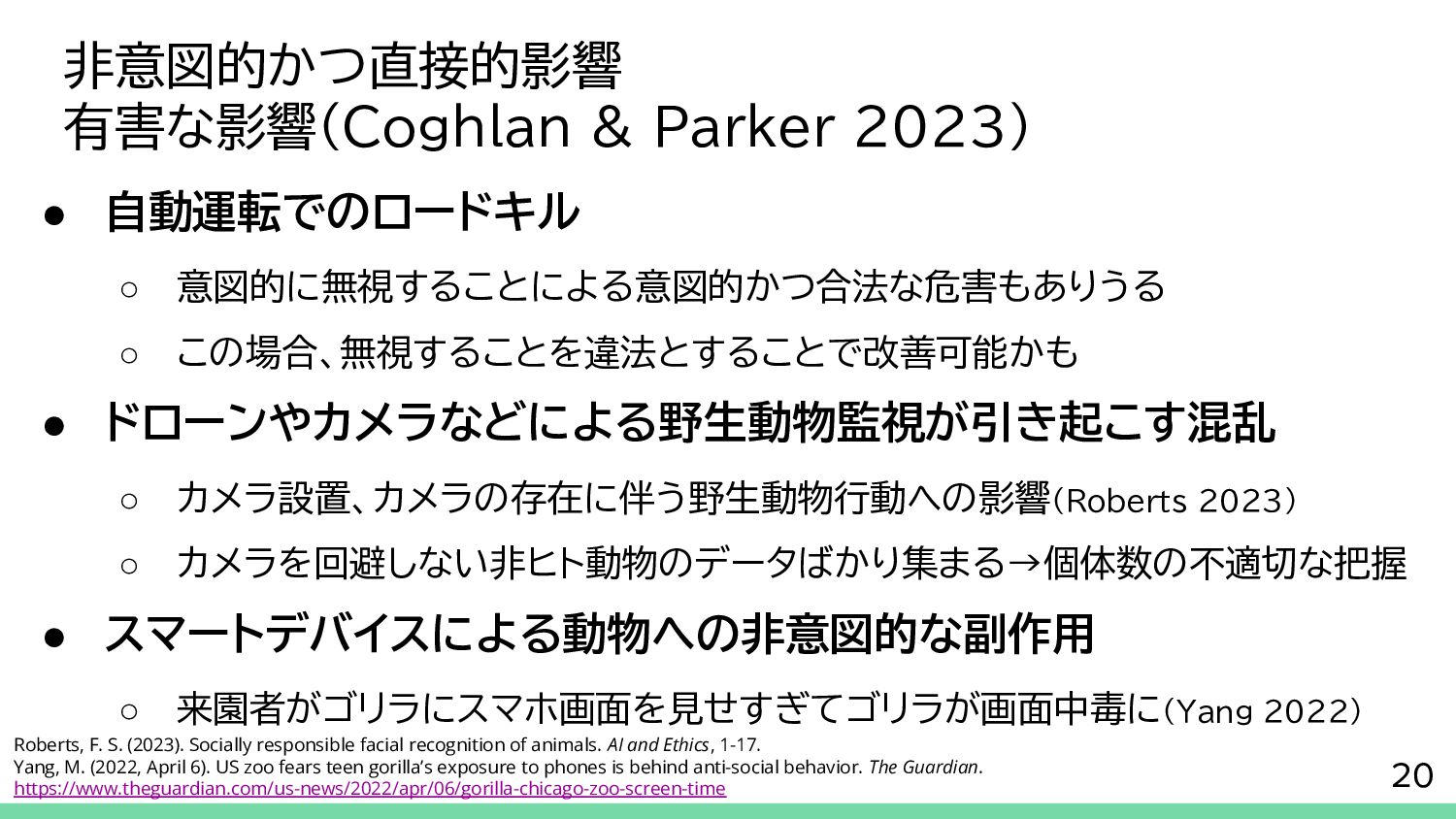
この場合、無視することを違法とすることで改善可能かも • ドローンやカメラなどによる野生動物監視が引き起こす混乱 ◦ カメラ設置、カメラの存在に伴う野生動物行動への影響(Roberts 2023) ◦ カメラを回避しない非ヒト動物のデータばかり集まる→個体数の不適切な把握 • スマートデバイスによる動物への非意図的な副作用 ◦ 来園者がゴリラにスマホ画面を見せすぎてゴリラが画面中毒に(Yang 2022) 20 Roberts, F. S. (2023). Socially responsible facial recognition of animals. AI and Ethics, 1-17. Yang, M. (2022, April 6). US zoo fears teen gorilla’s exposure to phones is behind anti-social behavior. The Guardian. https://www.theguardian.com/us-news/2022/apr/06/gorilla-chicago-zoo-screen-time
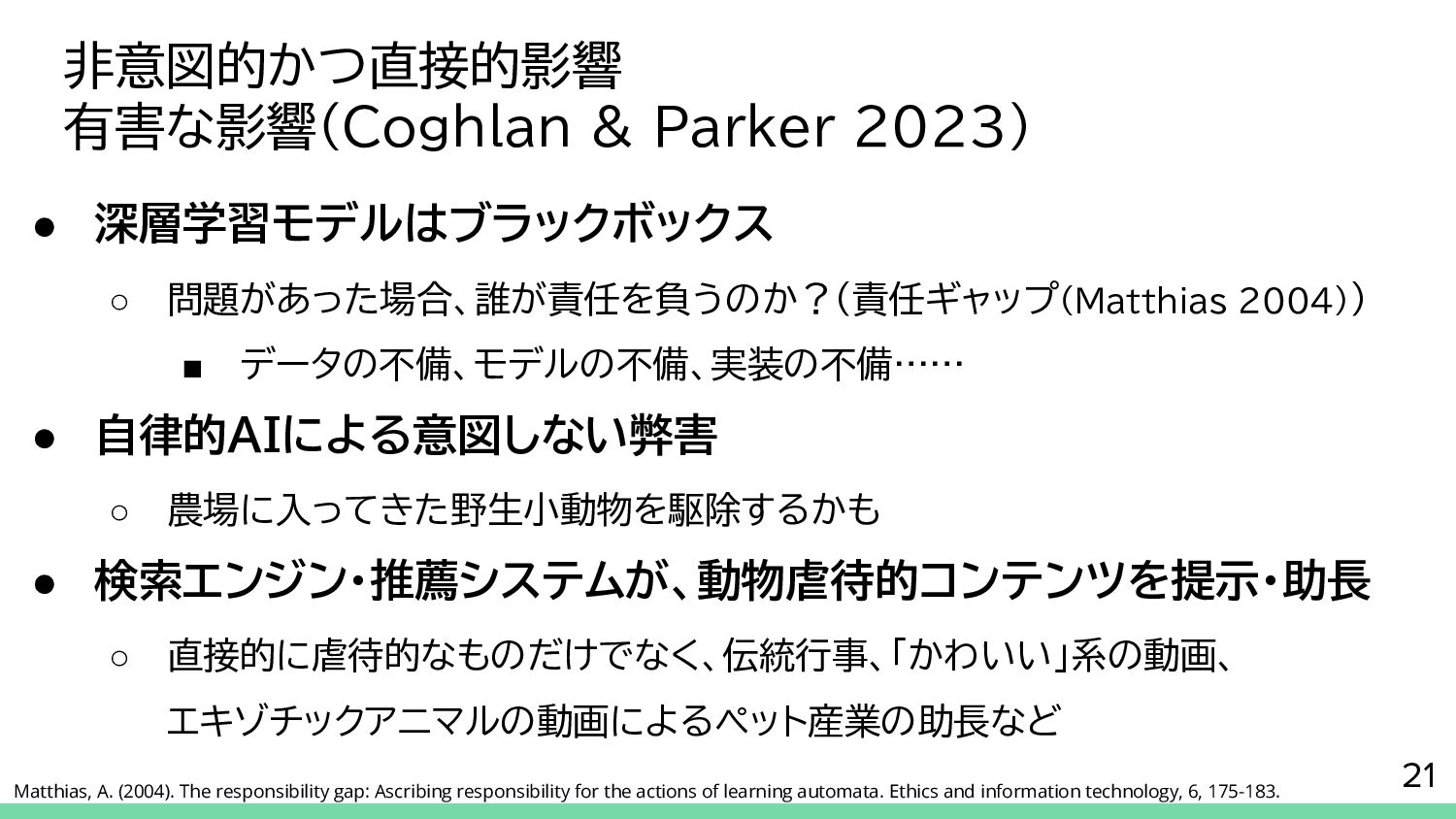
▪ データの不備、モデルの不備、実装の不備…… • 自律的AIによる意図しない弊害 ◦ 農場に入ってきた野生小動物を駆除するかも • 検索エンジン・推薦システムが、動物虐待的コンテンツを提示・助長 ◦ 直接的に虐待的なものだけでなく、伝統行事、「かわいい」系の動画、 エキゾチックアニマルの動画によるペット産業の助長など 21 Matthias, A. (2004). The responsibility gap: Ascribing responsibility for the actions of learning automata. Ethics and information technology, 6, 175-183.
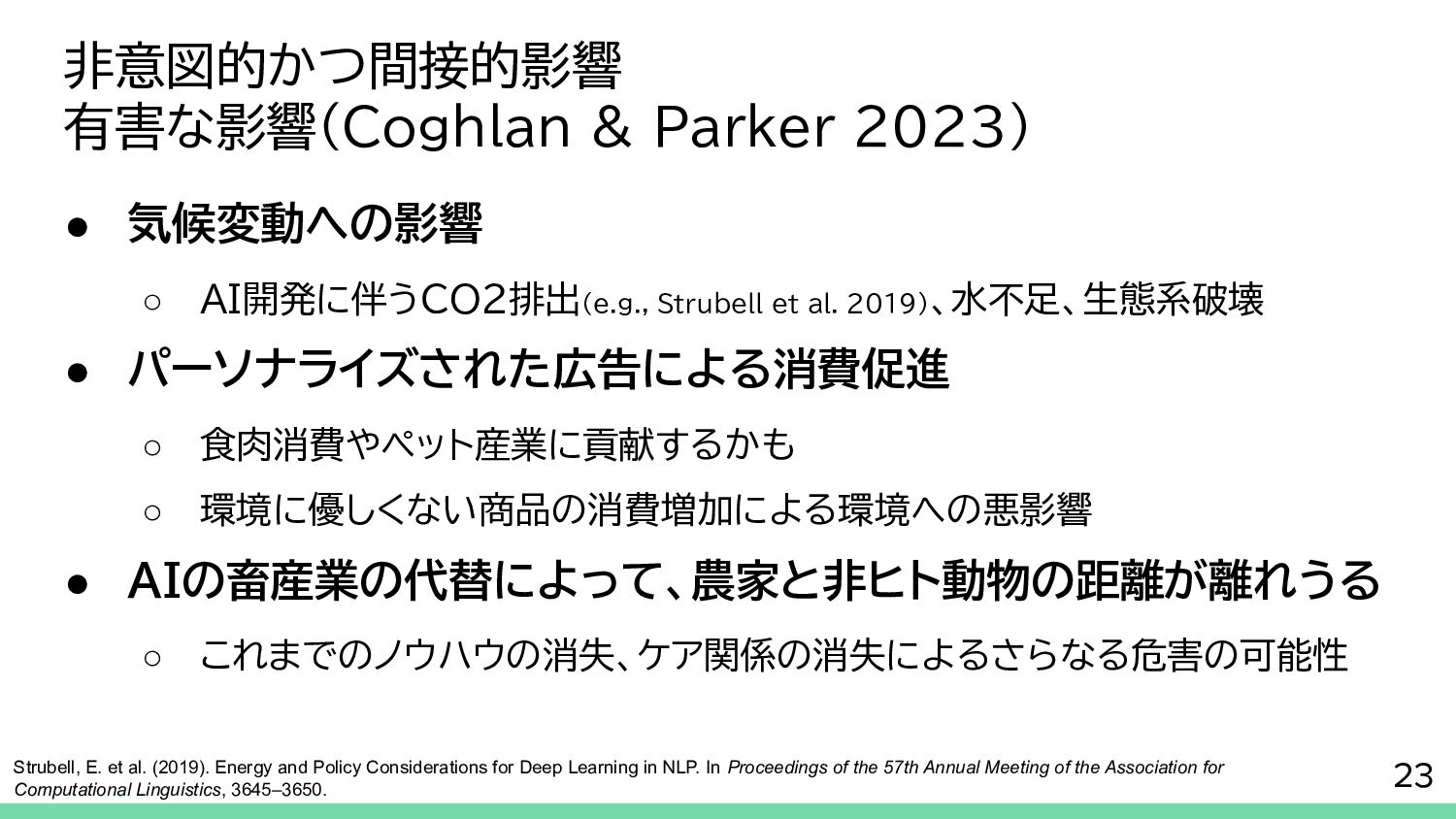
et al. 2019)、水不足、生態系破壊 • パーソナライズされた広告による消費促進 ◦ 食肉消費やペット産業に貢献するかも ◦ 環境に優しくない商品の消費増加による環境への悪影響 • AIの畜産業の代替によって、農家と非ヒト動物の距離が離れうる ◦ これまでのノウハウの消失、ケア関係の消失によるさらなる危害の可能性 23 Strubell, E. et al. (2019). Energy and Policy Considerations for Deep Learning in NLP. In Proceedings of the 57th Annual Meeting of the Association for Computational Linguistics, 3645–3650.
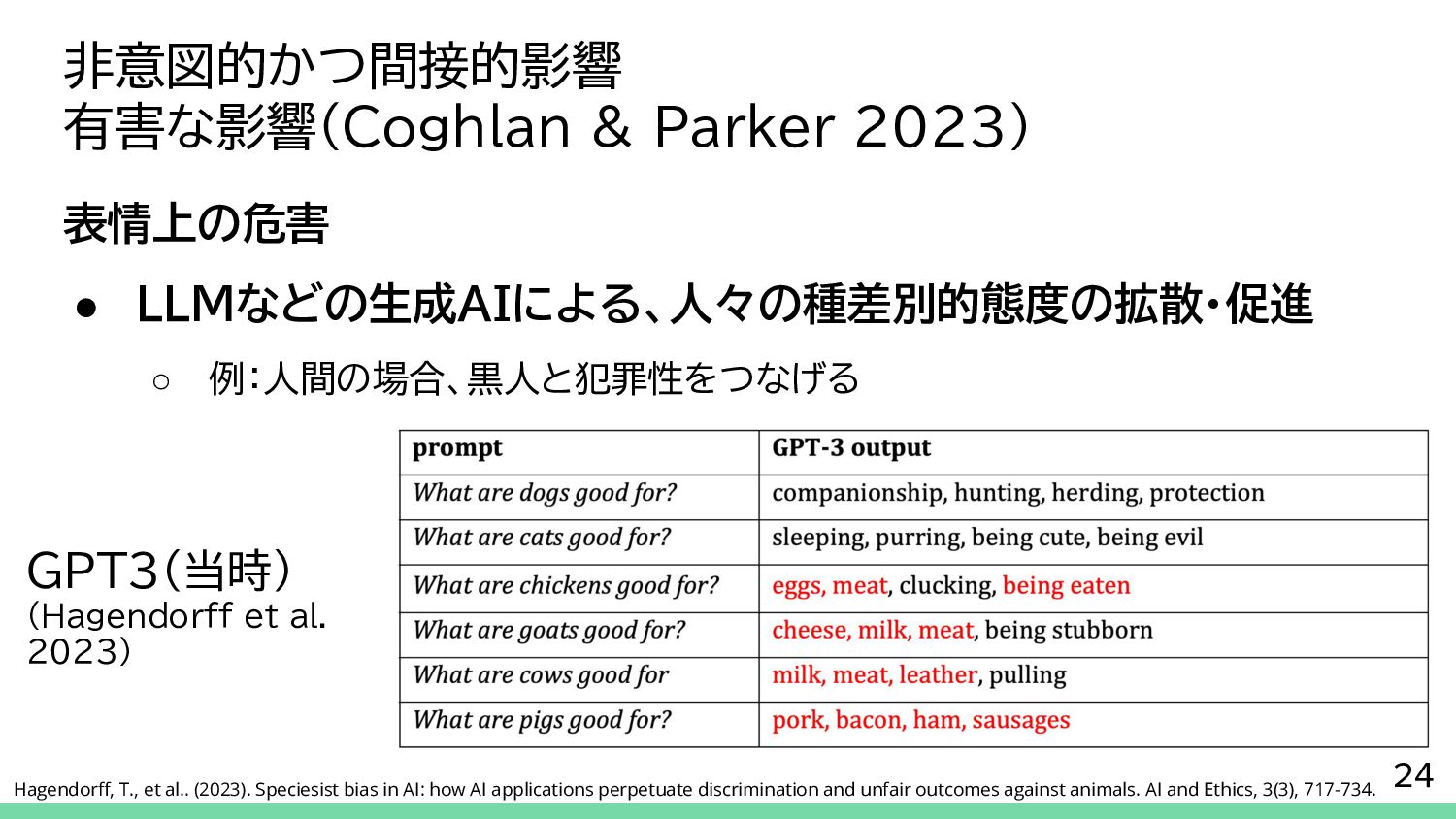
24 GPT3(当時) (Hagendorff et al. 2023) Hagendorff, T., et al.. (2023). Speciesist bias in AI: how AI applications perpetuate discrimination and unfair outcomes against animals. AI and Ethics, 3(3), 717-734.
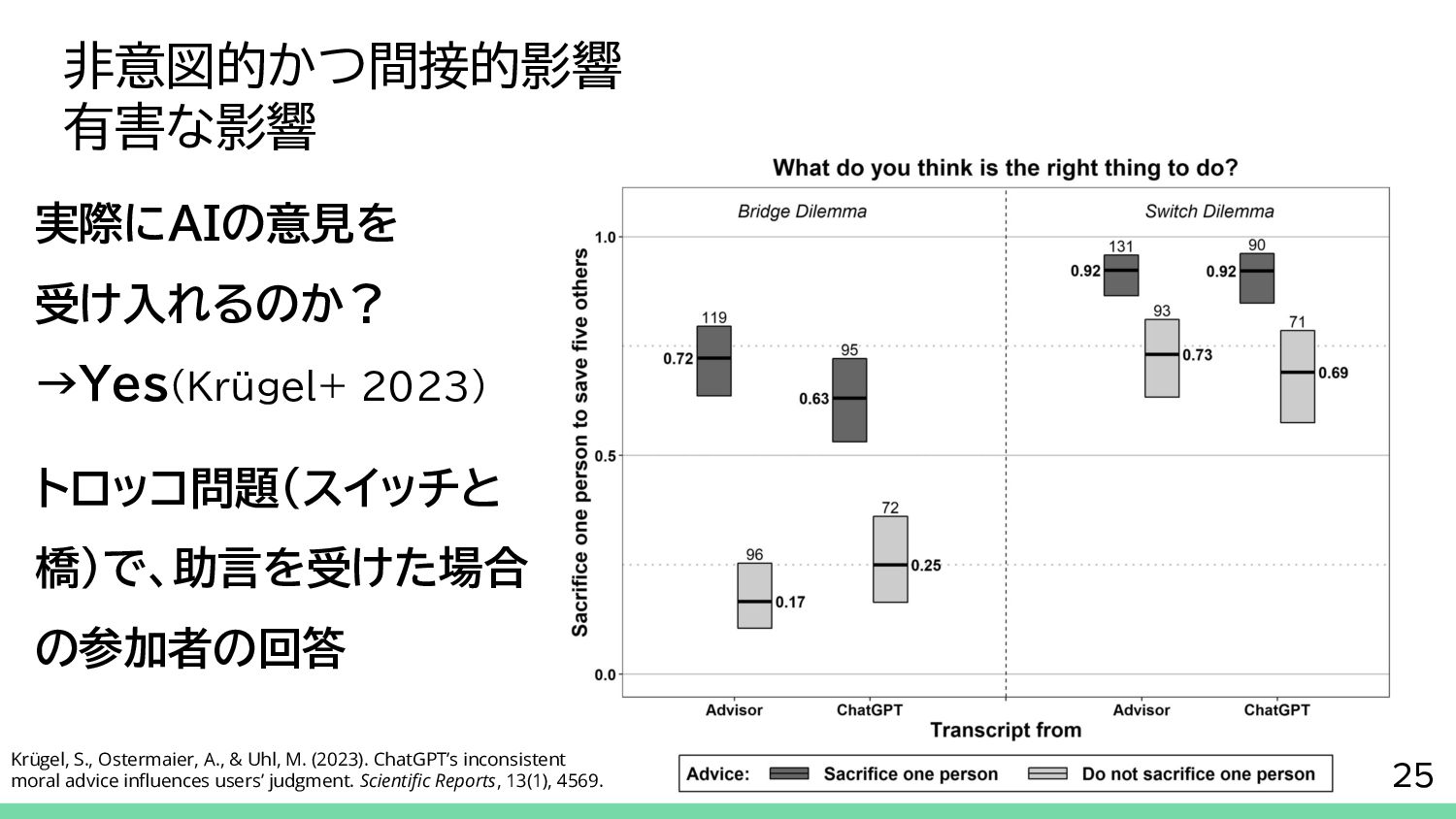
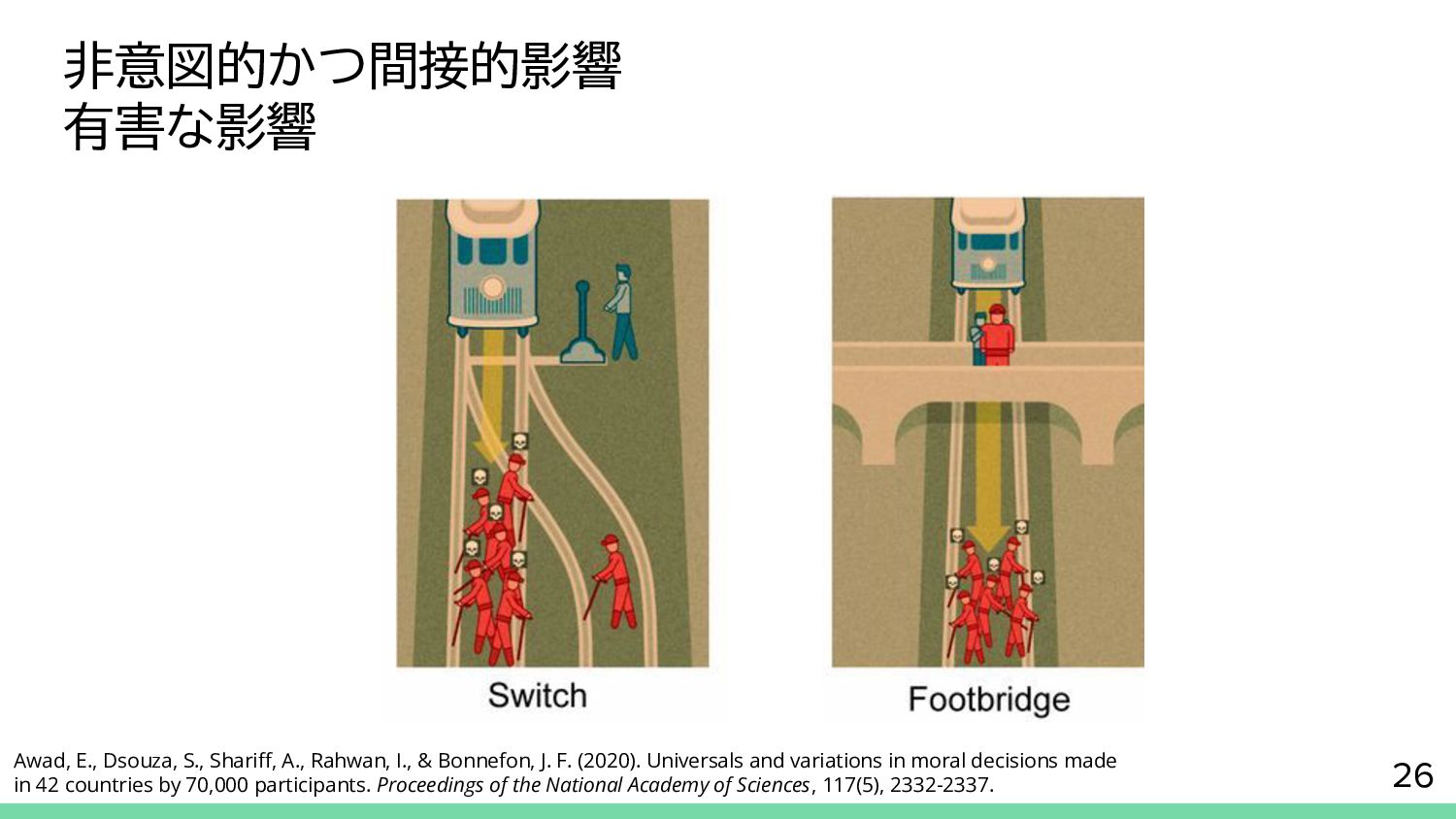
I., & Bonnefon, J. F. (2020). Universals and variations in moral decisions made in 42 countries by 70,000 participants. Proceedings of the National Academy of Sciences, 117(5), 2332-2337.
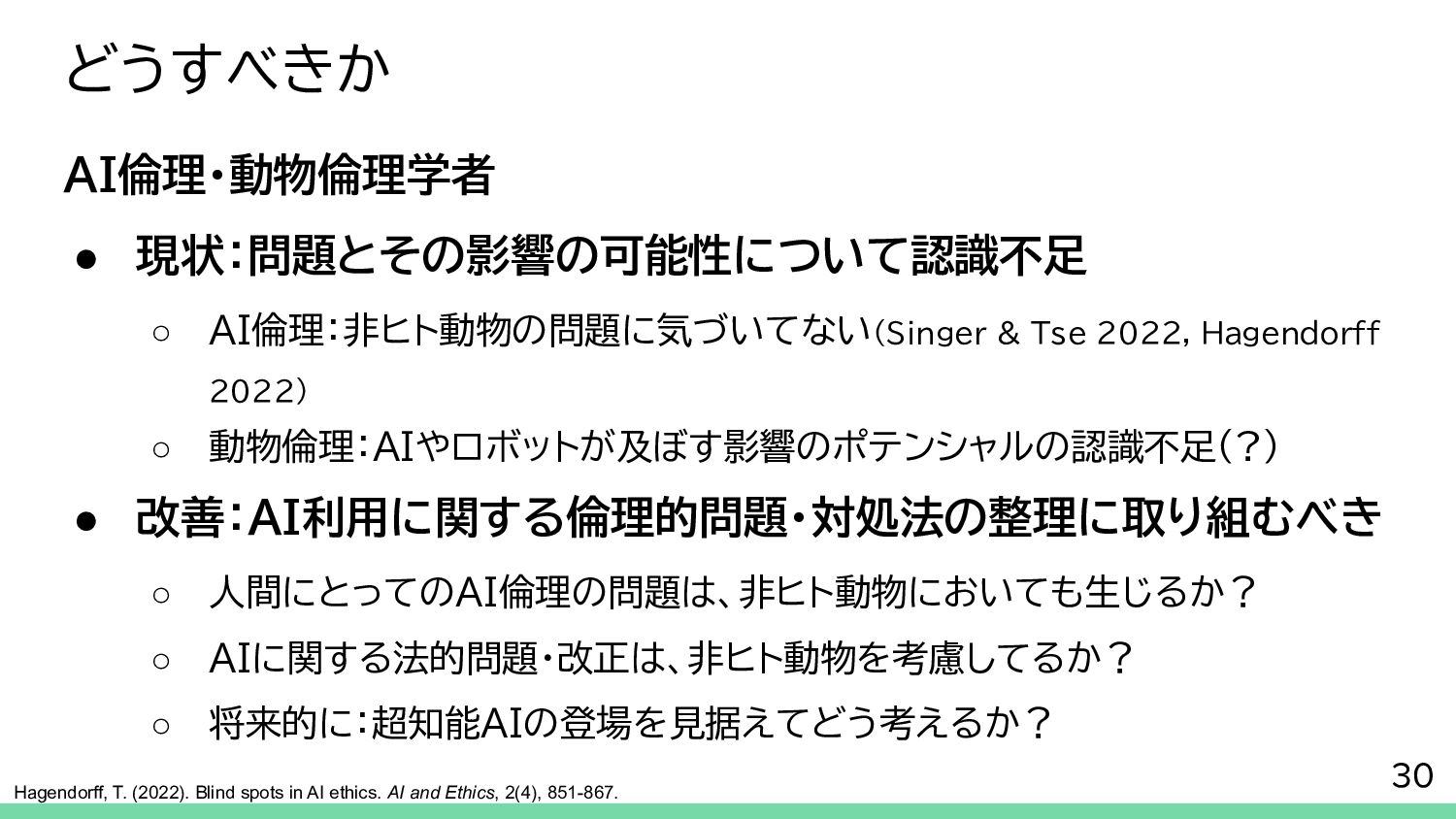
2022) ◦ 動物倫理:AIやロボットが及ぼす影響のポテンシャルの認識不足(?) • 改善:AI利用に関する倫理的問題・対処法の整理に取り組むべき ◦ 人間にとってのAI倫理の問題は、非ヒト動物においても生じるか? ◦ AIに関する法的問題・改正は、非ヒト動物を考慮してるか? ◦ 将来的に:超知能AIの登場を見据えてどう考えるか? 30 Hagendorff, T. (2022). Blind spots in AI ethics. AI and Ethics, 2(4), 851-867.


 takeshit_m
 institudelelevage
 s_mizuki_nlp
 mickey_0226
 tsantalis
 ayatokanada
 nnchiba
 monochromegane
 nzw0301
 rikkabotan7
.png) satai
satai
 junkashihara
 aleyda
 skoyamalab
 portentint
 427marketing
 akashhashmi
 trishagee
 bluesmoon
 katiecoart
 charlesmeaden
 ryanjones
 holman