Upgrade to Pro — share decks privately, control downloads, hide ads and more …

Claude Code: Start Simple, Scale Smart

Sponsored · SiteGround - Reliable hosting with speed, security, and support you can count on.
Avatar for Dan Vega Dan Vega
September 16, 2026

Claude Code: Start Simple, Scale Smart

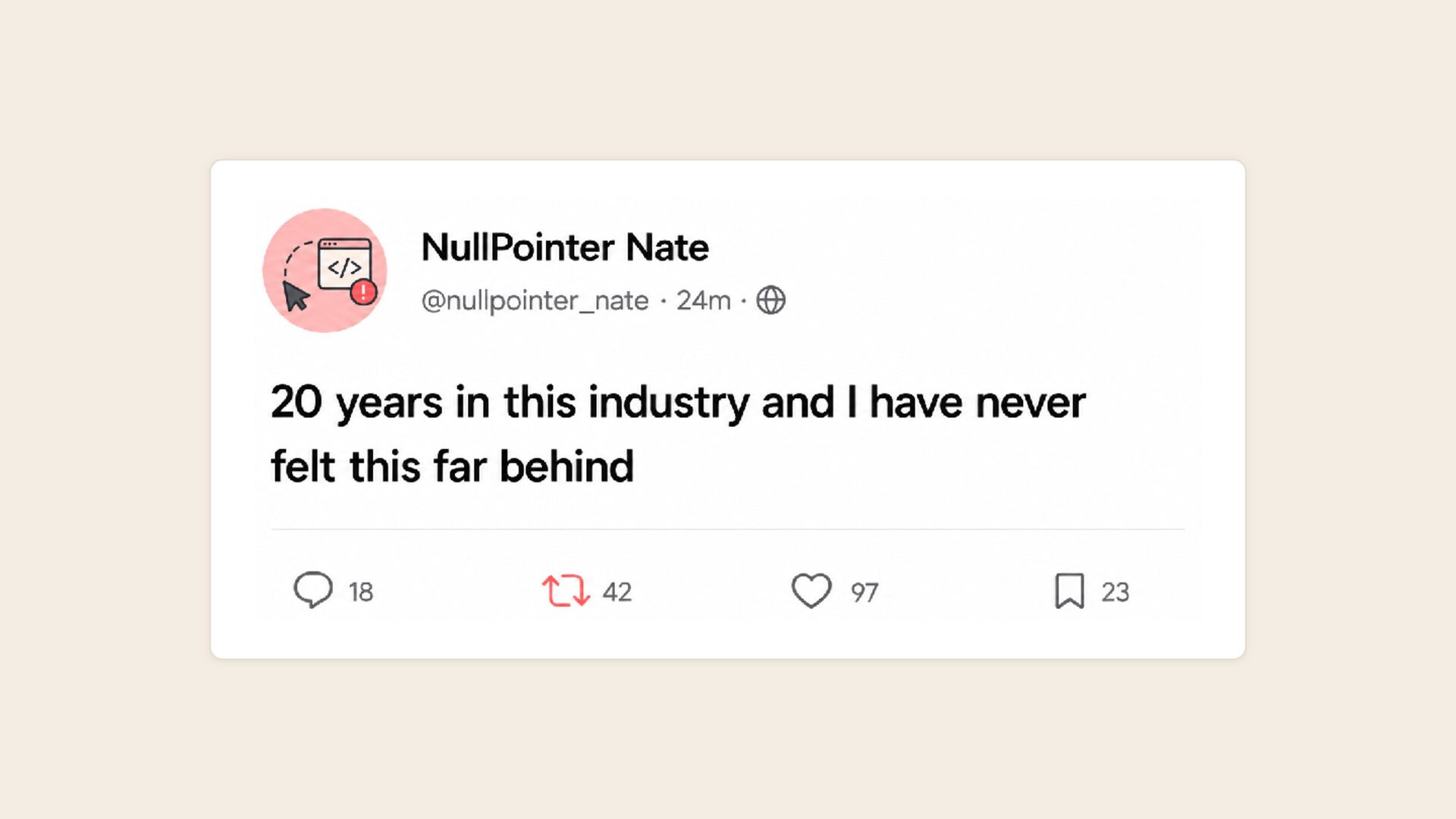
Coding agents are evolving fast. New commands, new features, someone on your timeline claiming they've automated their whole job. If you're feeling behind, you're not. Nobody is using all of it, and you don't need to.

What you need are the building blocks, in the right order. In this practical introduction to coding agents, we'll use Claude Code for the live demos, but the patterns apply no matter which agent you choose. We'll start with how an agent loop actually works, how to use these tools safely, and the workflows that matter day to day.

Then we'll look at context and memory, including how project-level instructions can make every future session better. Once the fundamentals are in place, we'll scale up to reusable skills, external tools with MCP, subagents, hooks, and longer-running autonomous work.

You'll leave knowing what to learn first, what to add as your needs grow, and what you can safely ignore until you actually need it. **Start simple. Scale smart.**

Avatar for Dan Vega

Dan Vega

September 16, 2026

More Decks by Dan Vega

Other Decks in Programming

Transcript

  1. C L A U D E C O D E

    A practical intro for engineers new to coding agents Start simple. Scale smart. Dan Vega Spring Developer Advocate · Broadcom start simple. scale smart.
  2. One quick disclaimer. If you're already running five terminals with

    custom agent and skills… This talk probably isn't for you. Go grab another coffee. We'll be in the fundamentals for most of this talk. disclaimer
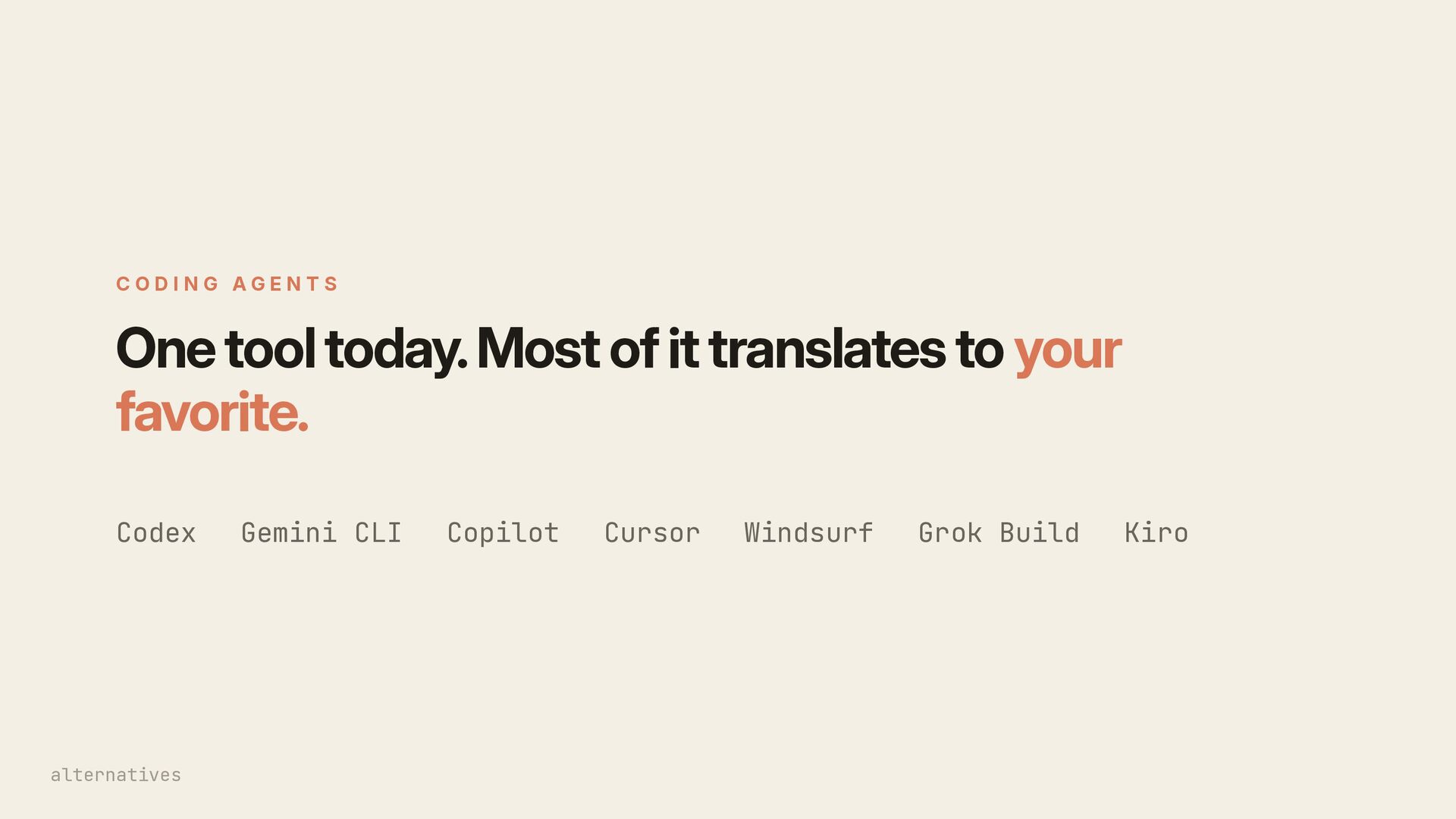
  3. CODING AGENTS One tool today. Most of it translates to

    your favorite. Codex alternatives Gemini CLI Copilot Cursor Windsurf Grok Build Kiro
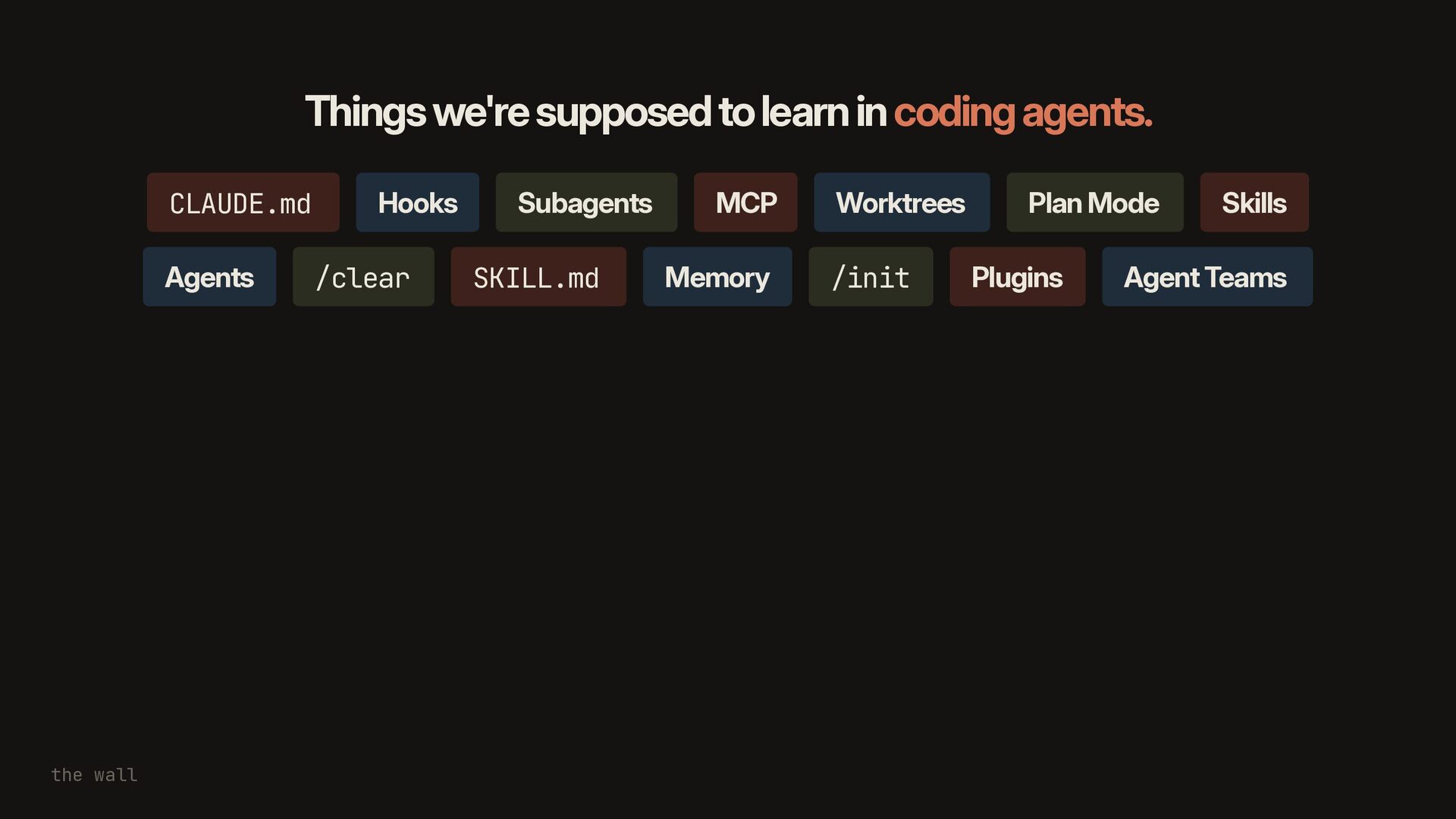
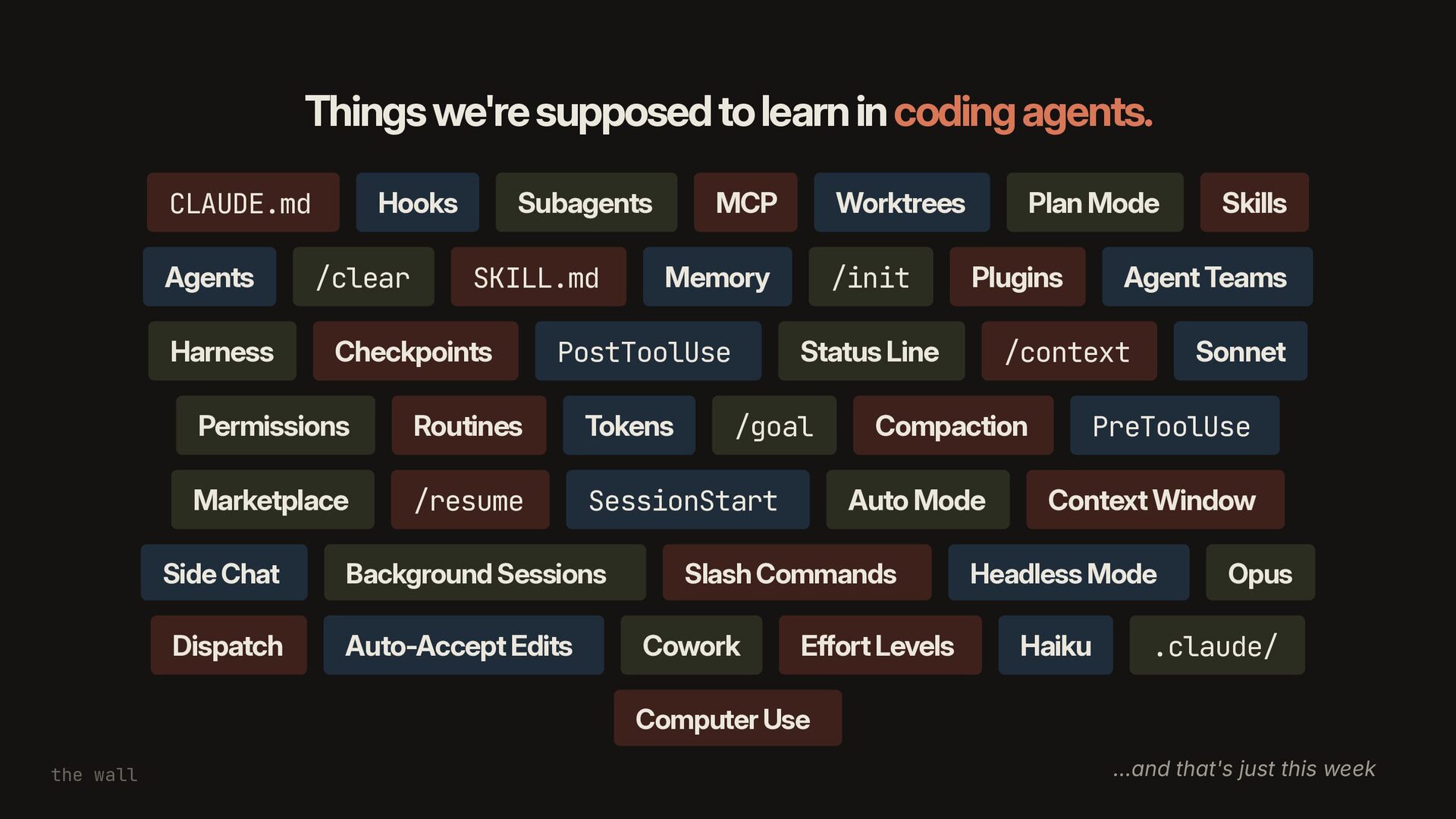
  4. Things we're supposed to learn in coding agents. CLAUDE.md Agents

    the wall Hooks /clear Subagents SKILL.md MCP Memory Worktrees /init Plan Mode Plugins Skills Agent Teams
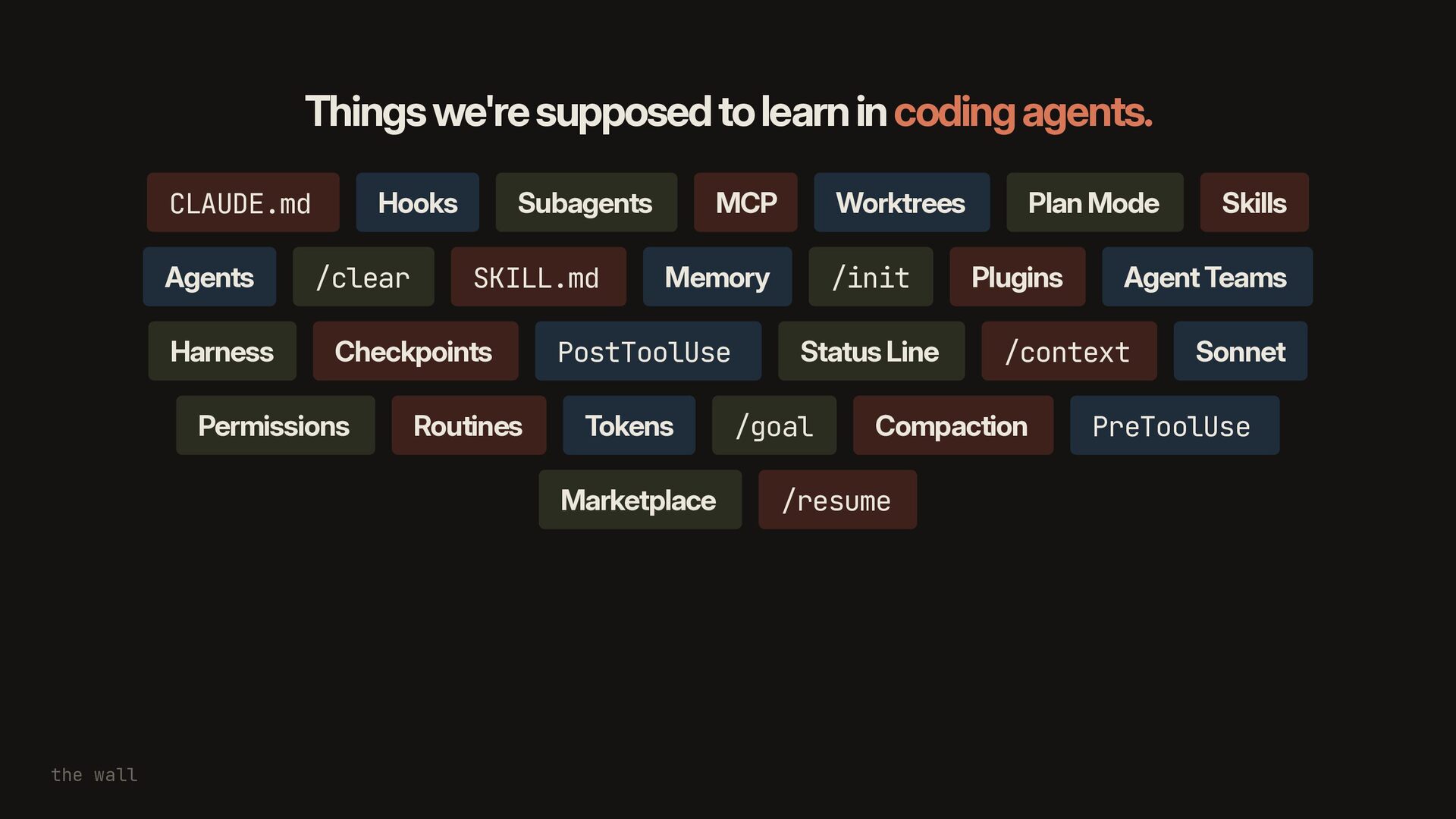
  5. Things we're supposed to learn in coding agents. CLAUDE.md Agents

    Harness Hooks /clear Subagents SKILL.md Checkpoints Permissions Routines MCP /init Memory PostToolUse Tokens Marketplace the wall Worktrees Status Line /goal Plan Mode Plugins /resume Agent Teams /context Compaction Skills Sonnet PreToolUse
  6. Things we're supposed to learn in coding agents. CLAUDE.md Agents

    Harness Hooks /clear Subagents SKILL.md Checkpoints MCP /goal Routines Tokens Marketplace /resume SessionStart Dispatch Auto-Accept Edits Plan Mode Plugins Compaction Auto Mode Slash Commands Cowork Effort Levels Skills Agent Teams /context Status Line Permissions Background Sessions /init Memory PostToolUse Side Chat Worktrees Sonnet PreToolUse Context Window Headless Mode Haiku Opus .claude/ Computer Use the wall …and that's just this week
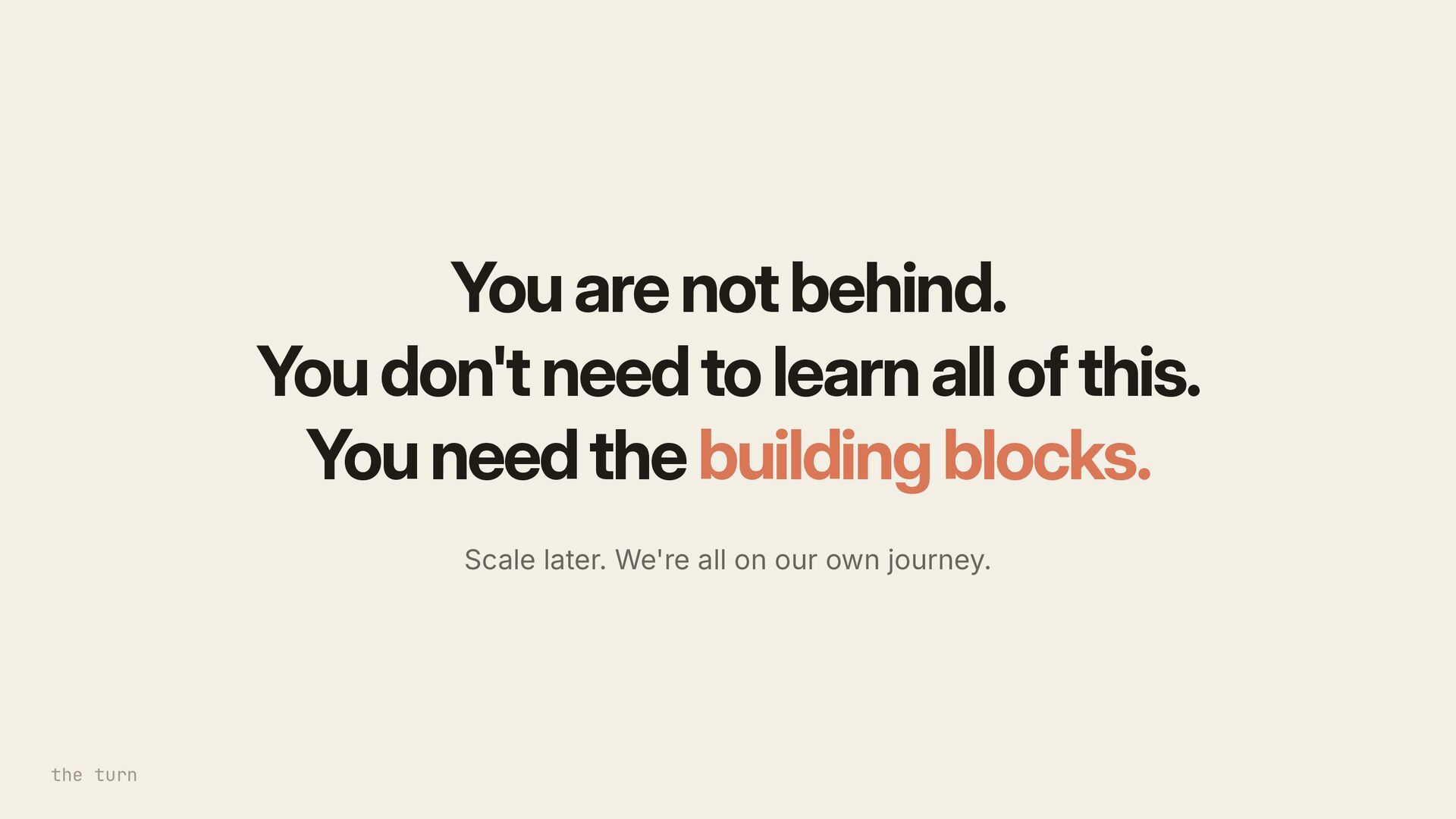
  7. You are not behind. You don't need to learn all

    of this. You need the building blocks. Scale later. We're all on our own journey. the turn
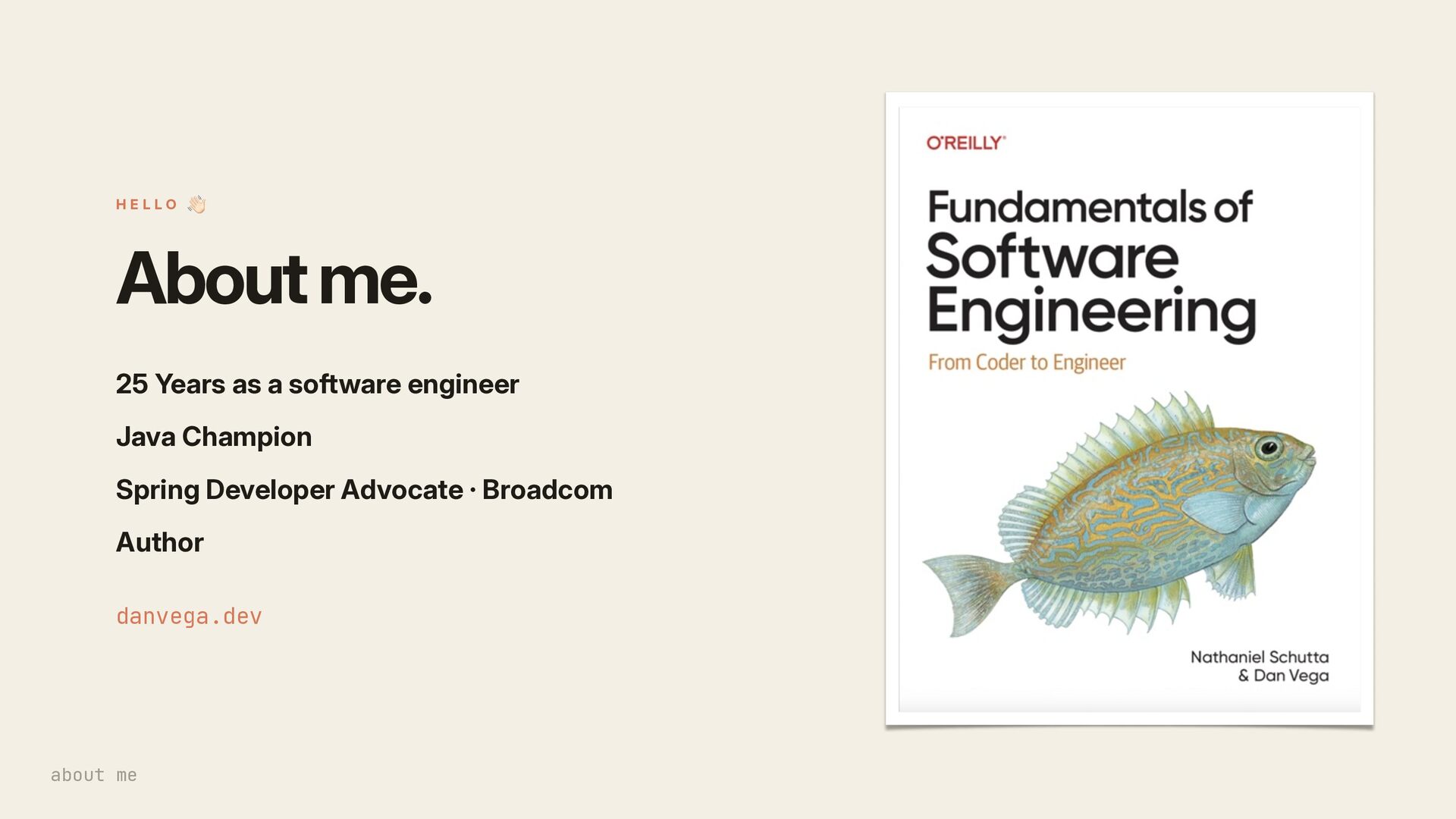
  8. HELLO 👋 About me. 25 Years as a software engineer

    Java Champion Spring Developer Advocate · Broadcom Author danvega.dev about me
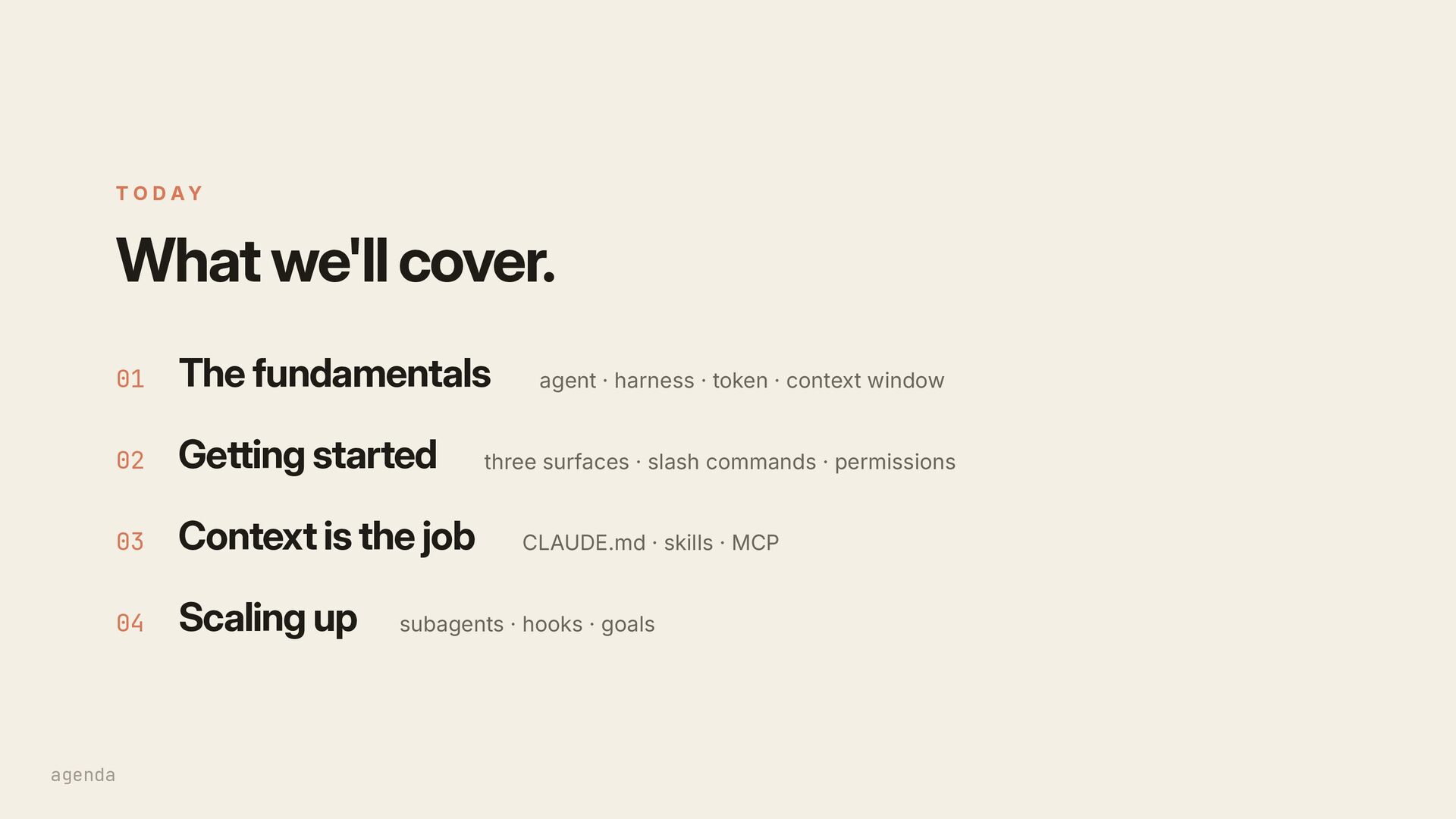
  9. TO DAY What we'll cover. 01 The fundamentals 02 Getting

    started 03 Context is the job 04 Scaling up agenda agent · harness · token · context window three surfaces · slash commands · permissions CLAUDE.md · skills · MCP subagents · hooks · goals
  10. SECTION 01 / 04 The fundamentals. The vocabulary everything else

    hangs on. section 01 01 The fundamentals 02 Getting started 03 Context is the job 04 Scaling up
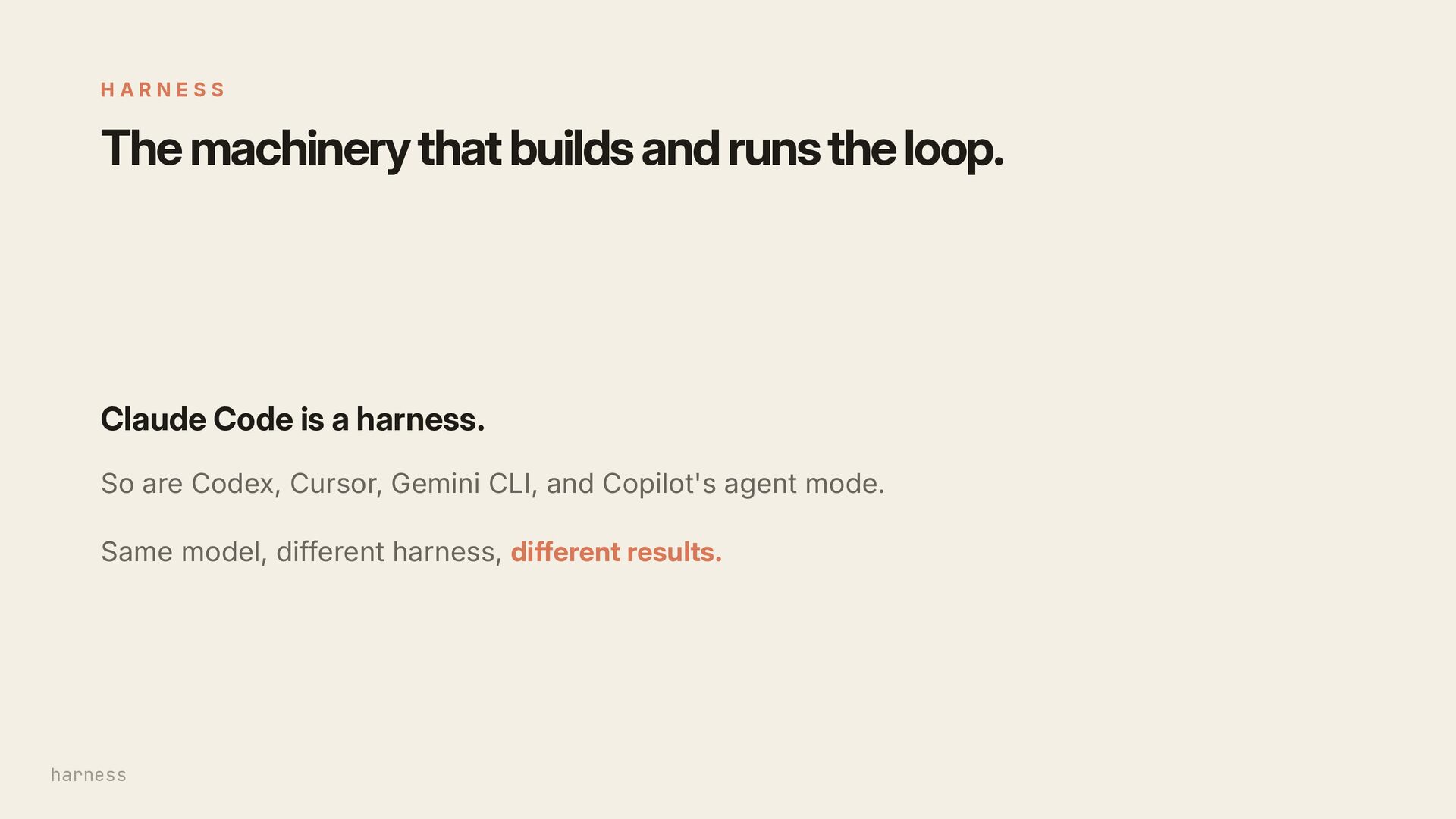
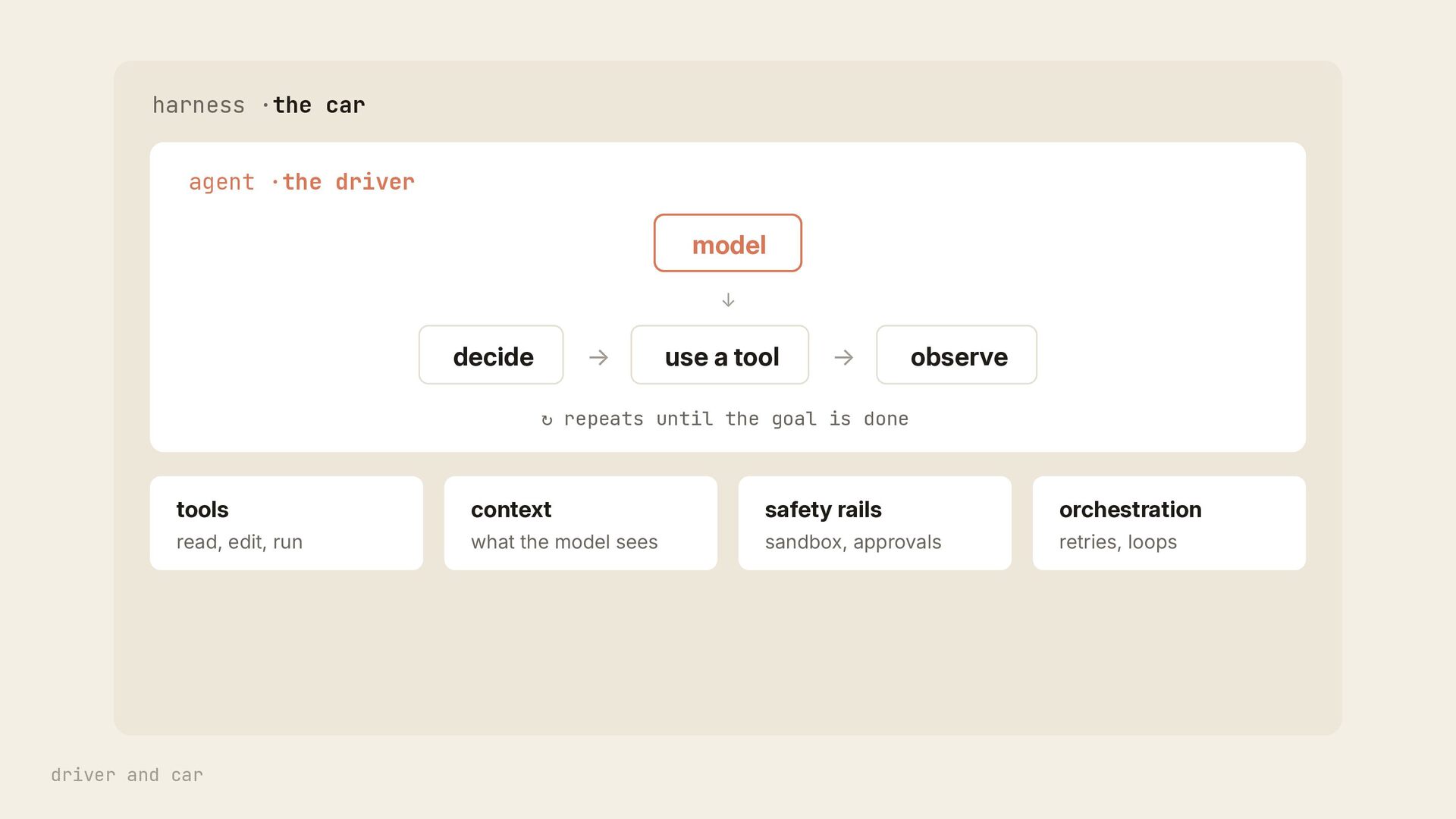
  11. HARNESS The machinery that builds and runs the loop. Claude

    Code is a harness. So are Codex, Cursor, Gemini CLI, and Copilot's agent mode. Same model, different harness, different results. harness
  12. harness ·the car agent ·the driver model ↓ → decide

    use a tool → observe ↻ repeats until the goal is done tools context safety rails orchestration read, edit, run what the model sees sandbox, approvals retries, loops driver and car
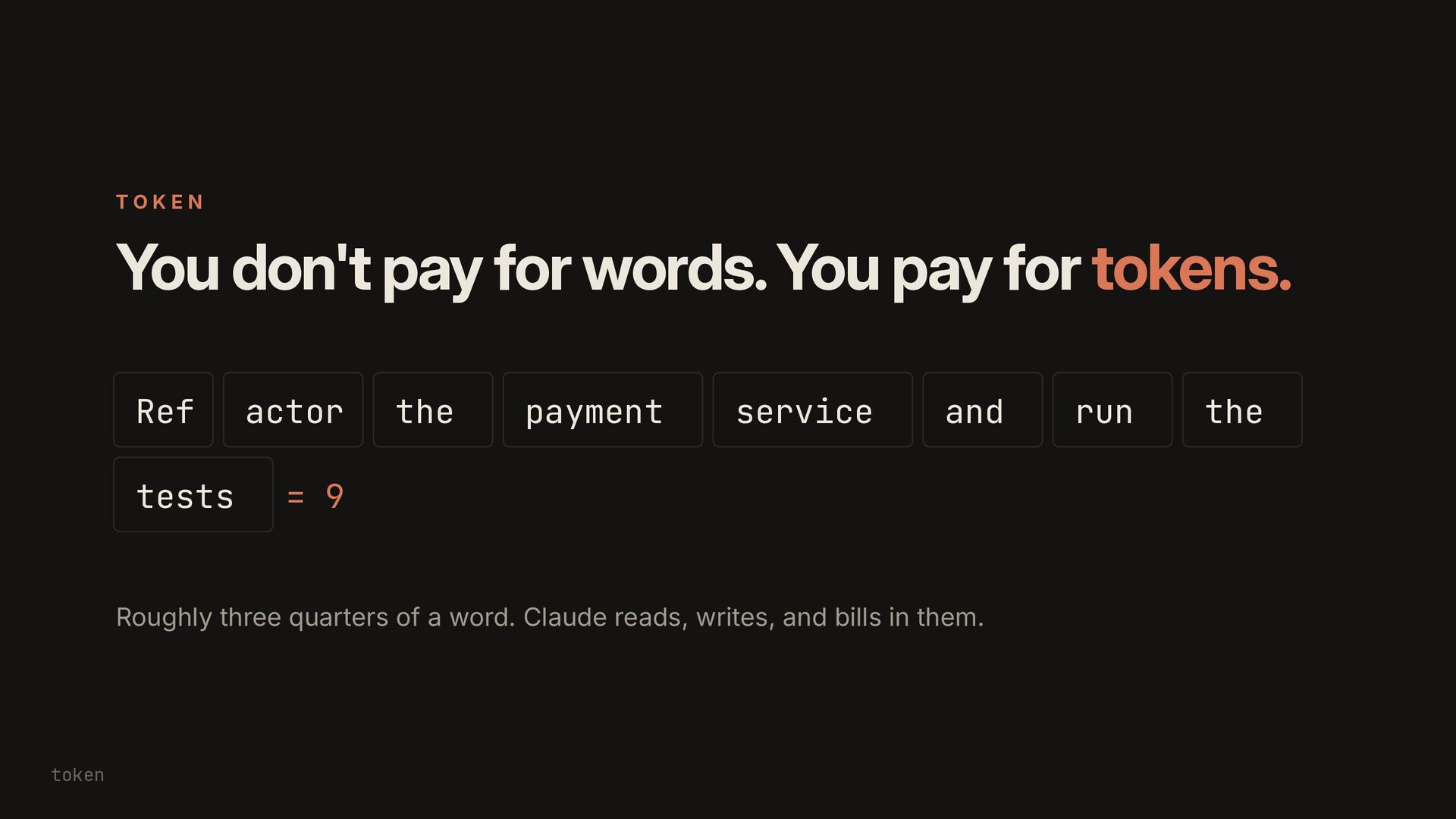
  13. TOKEN You don't pay for words. You pay for tokens.

    Ref actor tests = 9 the payment service and Roughly three quarters of a word. Claude reads, writes, and bills in them. token run the
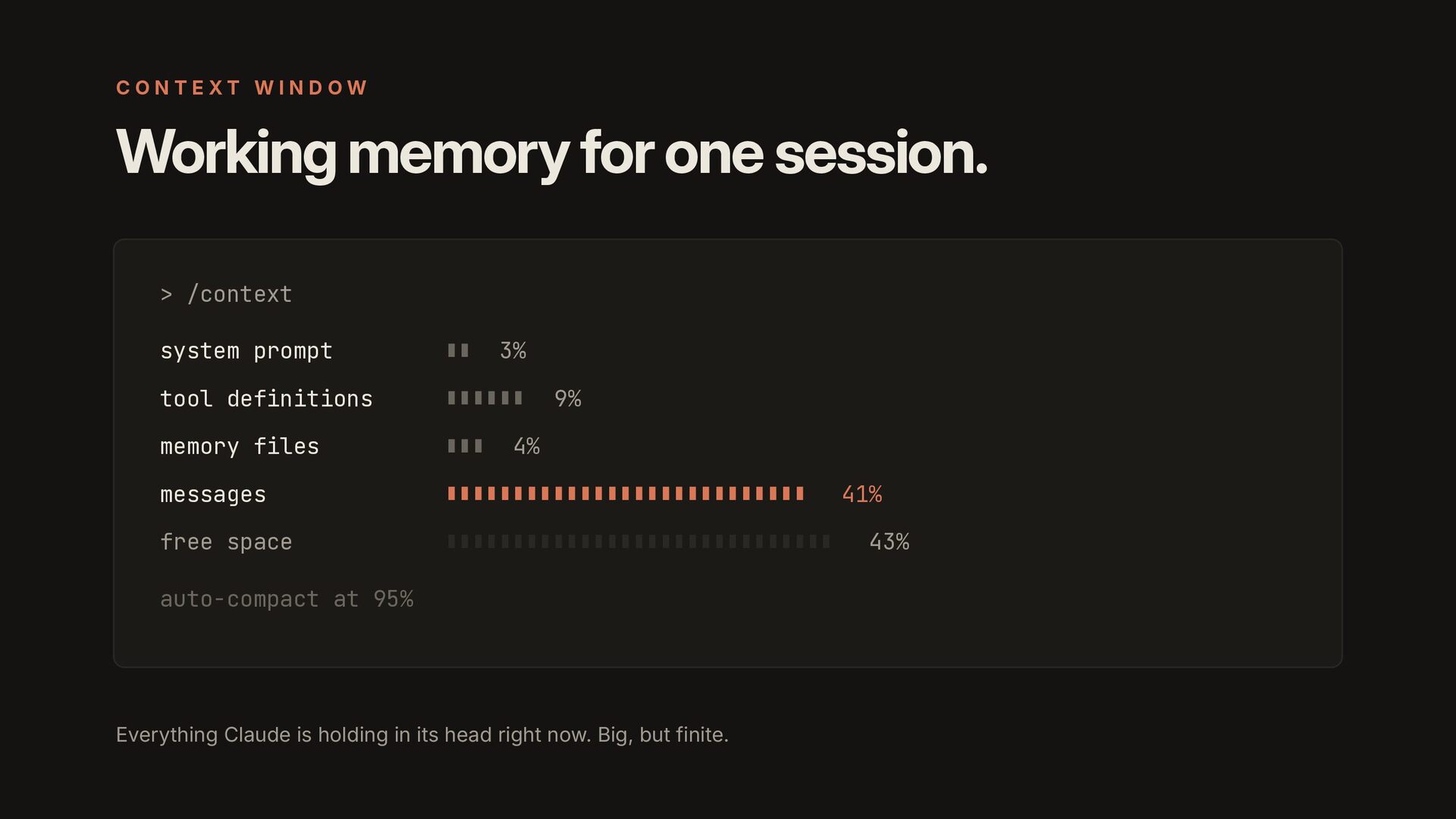
  14. CONTEXT WINDOW Working memory for one session. > /context system

    prompt ▮▮ tool definitions ▮▮▮▮▮▮ memory files ▮▮▮ messages ▮▮▮▮▮▮▮▮▮▮▮▮▮▮▮▮▮▮▮▮▮▮▮▮▮▮▮ free space ▮▮▮▮▮▮▮▮▮▮▮▮▮▮▮▮▮▮▮▮▮▮▮▮▮▮▮▮▮ 3% 9% 4% auto-compact at 95% Everything Claude is holding in its head right now. Big, but finite. 41% 43%
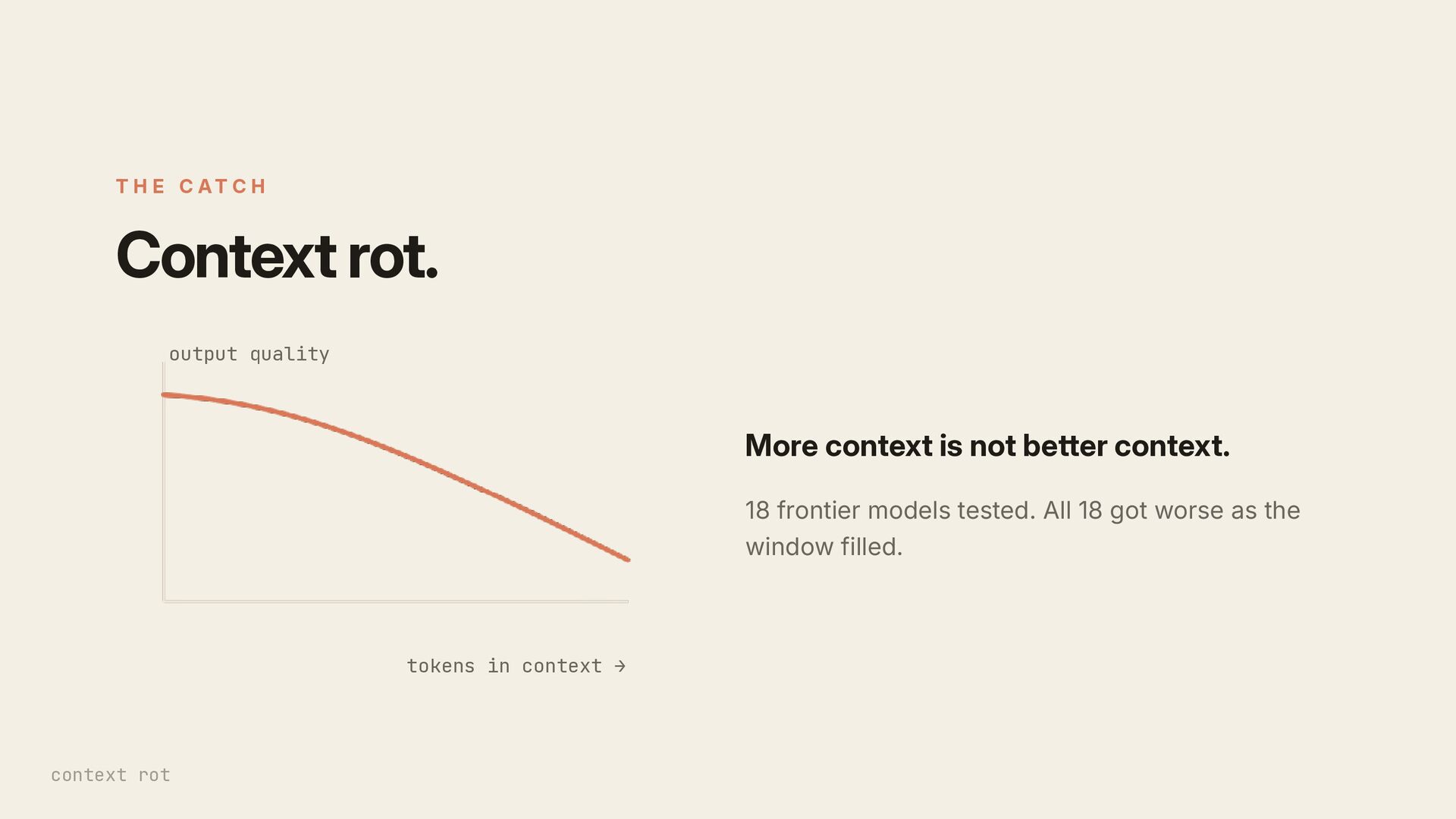
  15. T H E C AT C H Context rot. output

    quality More context is not better context. 18 frontier models tested. All 18 got worse as the window filled. tokens in context → context rot
  16. SECTION 02 / 04 Getting started. Three surfaces, slash commands,

    permissions. section 02 01 The fundamentals 02 Getting started 03 Context is the job 04 Scaling up
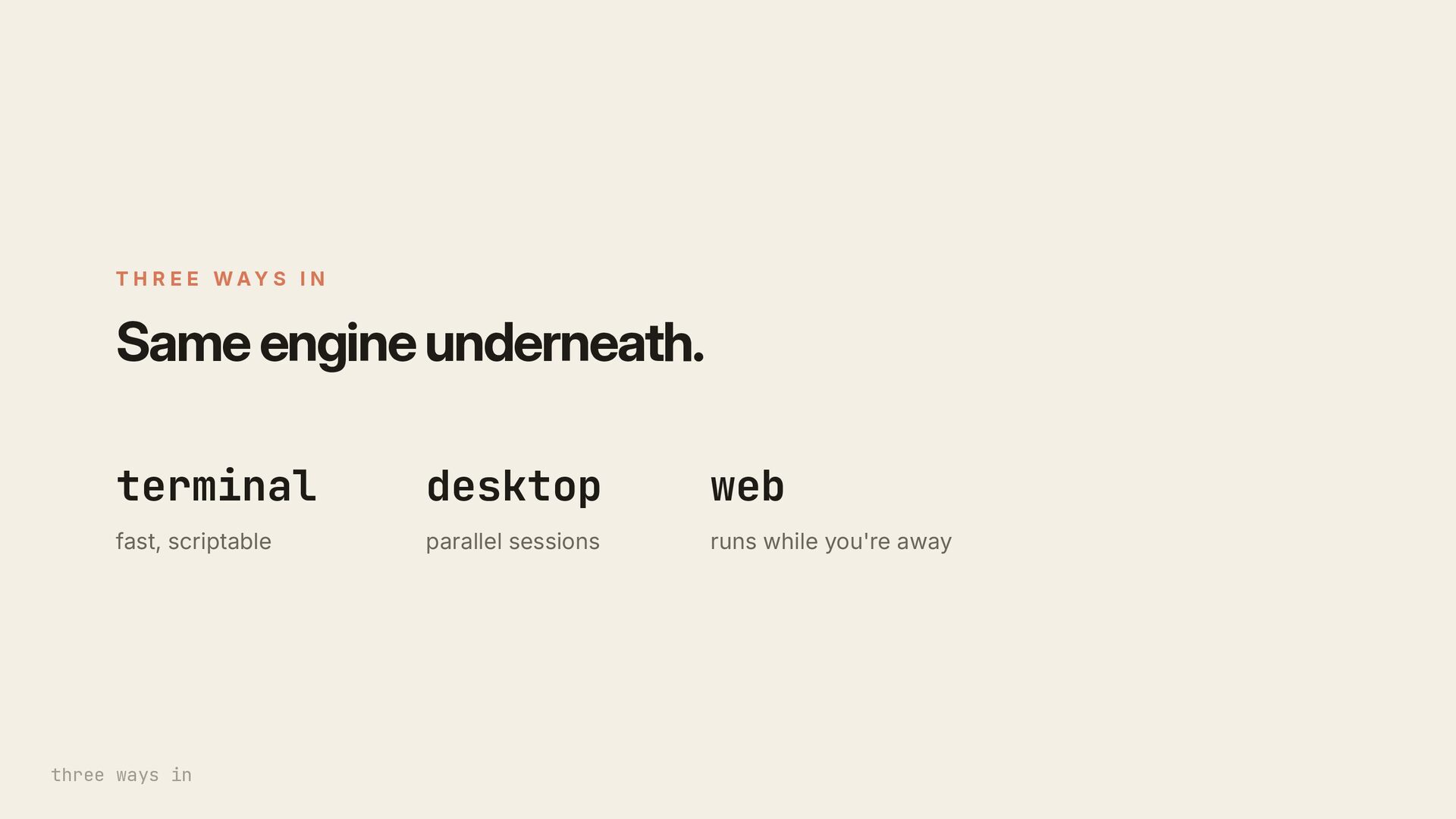
  17. T H R E E WAY S I N Same

    engine underneath. terminal desktop web fast, scriptable parallel sessions runs while you're away three ways in
  18. B E F O R E YO U S TA

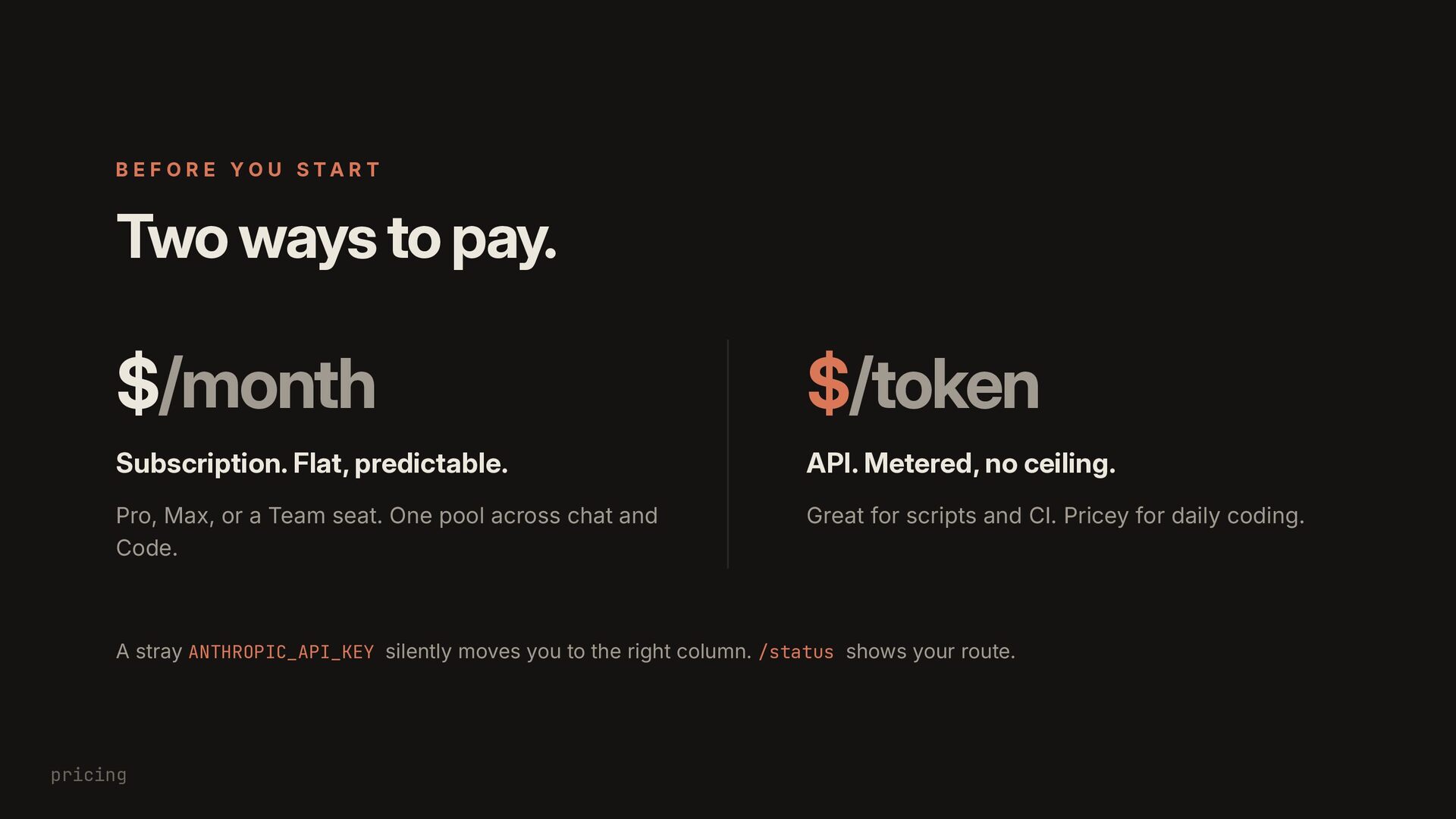
    R T Two ways to pay. $/month $/token Subscription. Flat, predictable. API. Metered, no ceiling. Pro, Max, or a Team seat. One pool across chat and Code. Great for scripts and CI. Pricey for daily coding. A stray ANTHROPIC_API_KEY silently moves you to the right column. /status shows your route. pricing
  19. D E M O · 0 1 A first session.

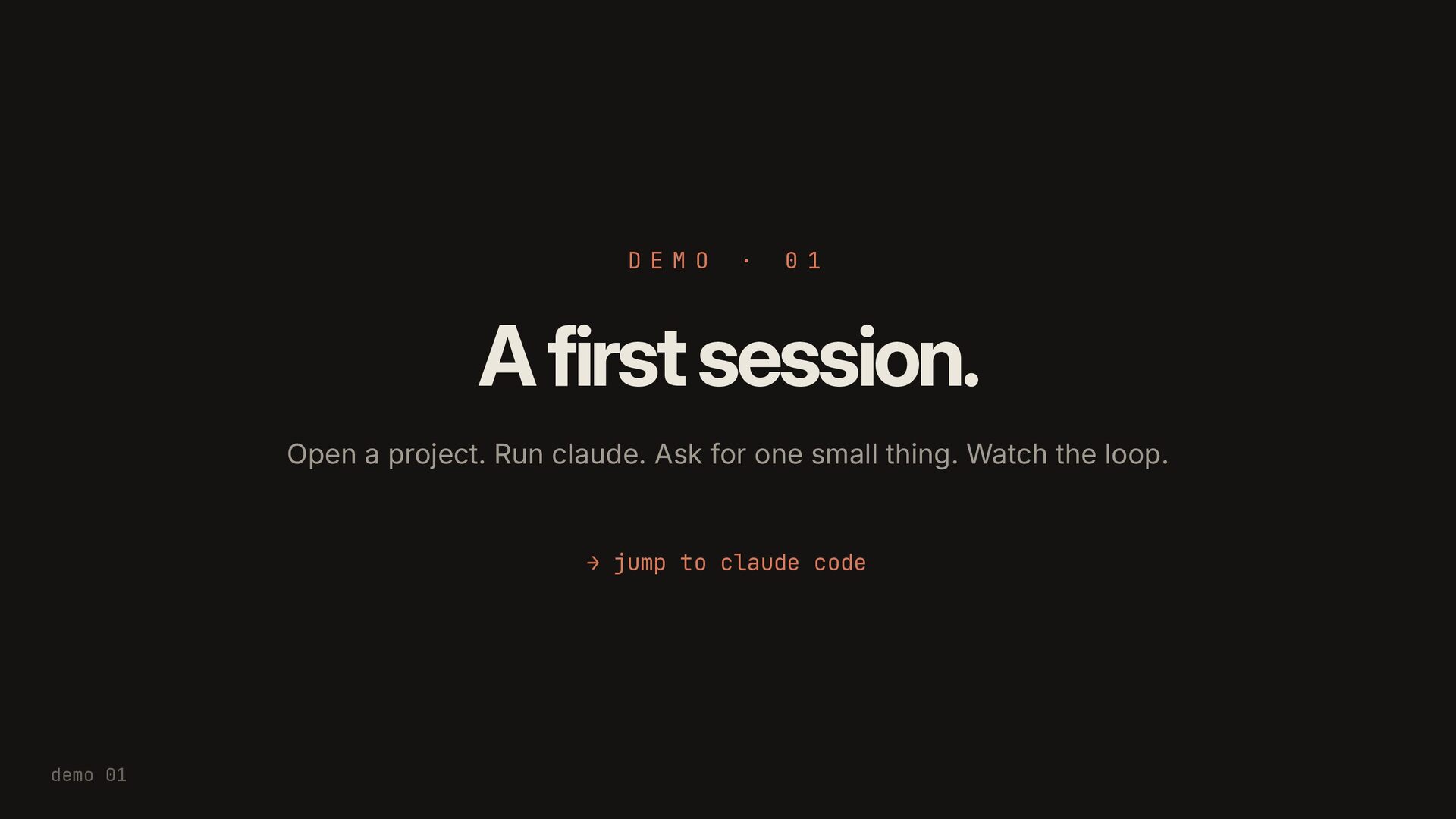
    Open a project. Run claude. Ask for one small thing. Watch the loop. → jump to claude code demo 01
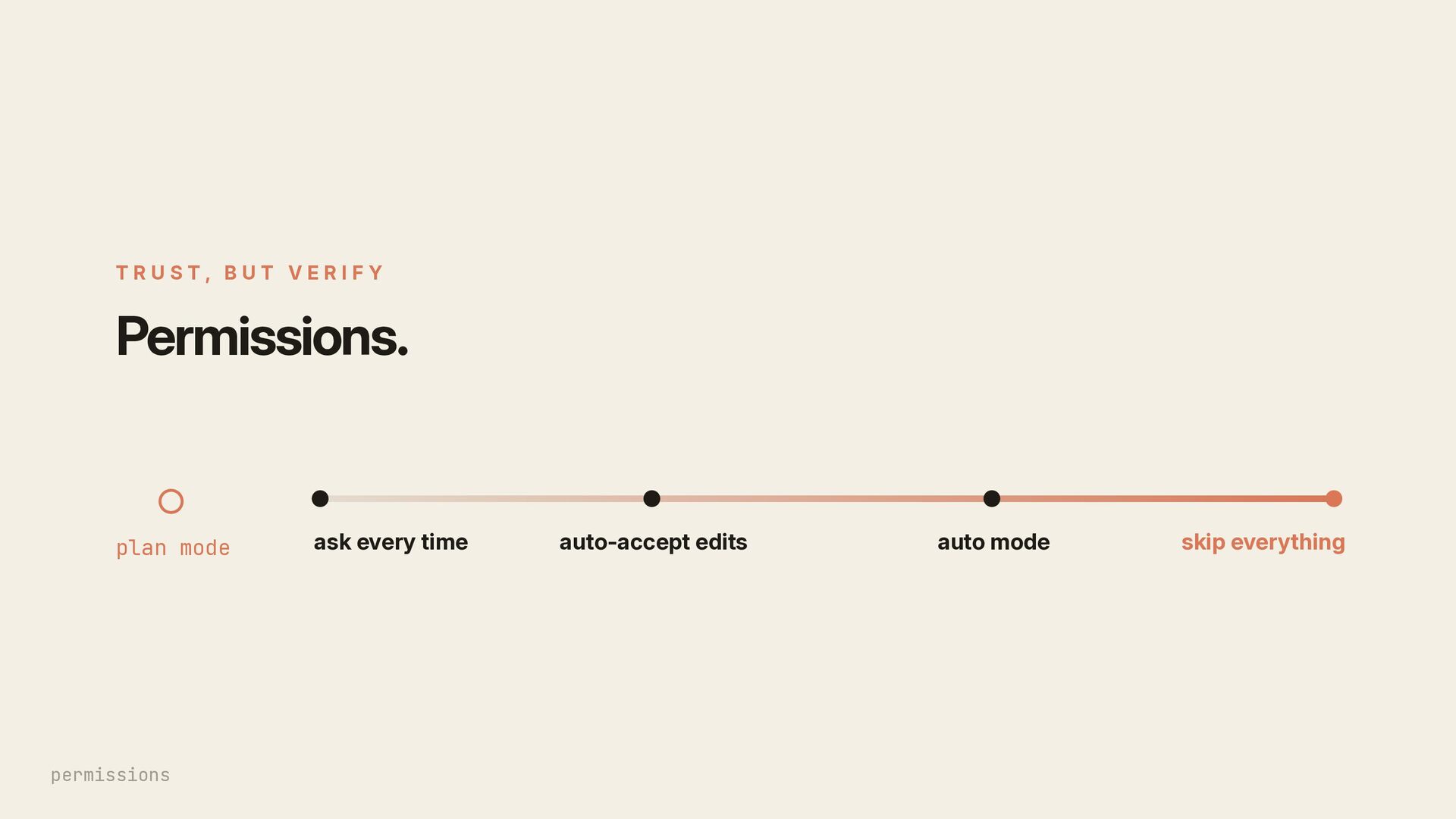
  20. TRUST, BUT VERIFY Permissions. plan mode permissions ask every time

    auto-accept edits auto mode skip everything
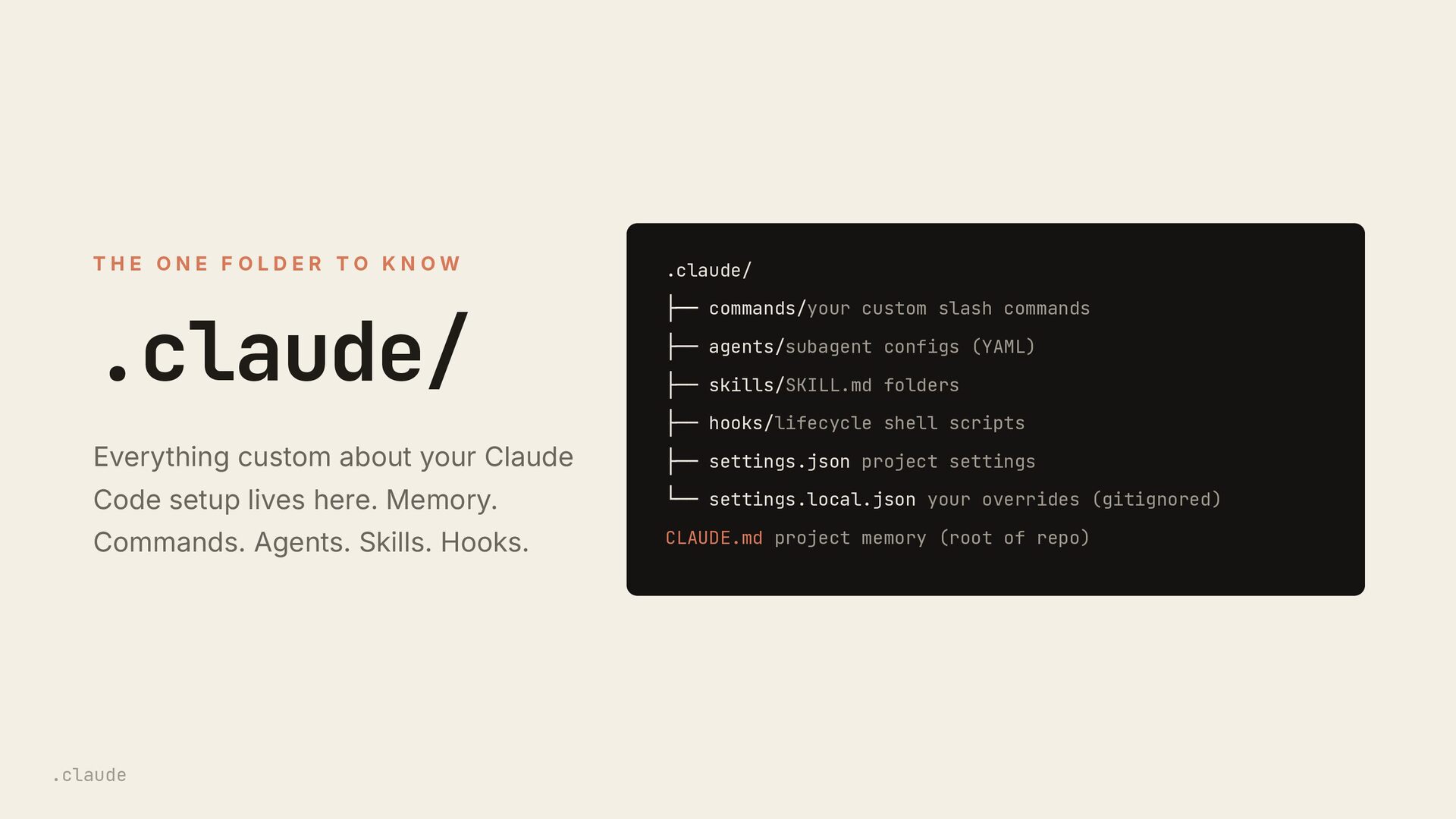
  21. THE ONE FOLDER TO KNOW .claude/ .claude/ ├── commands/your custom

    slash commands ├── agents/subagent configs (YAML) ├── skills/SKILL.md folders ├── hooks/lifecycle shell scripts Everything custom about your Claude ├── settings.json project settings Code setup lives here. Memory. └── settings.local.json your overrides (gitignored) Commands. Agents. Skills. Hooks. CLAUDE.md project memory (root of repo) .claude
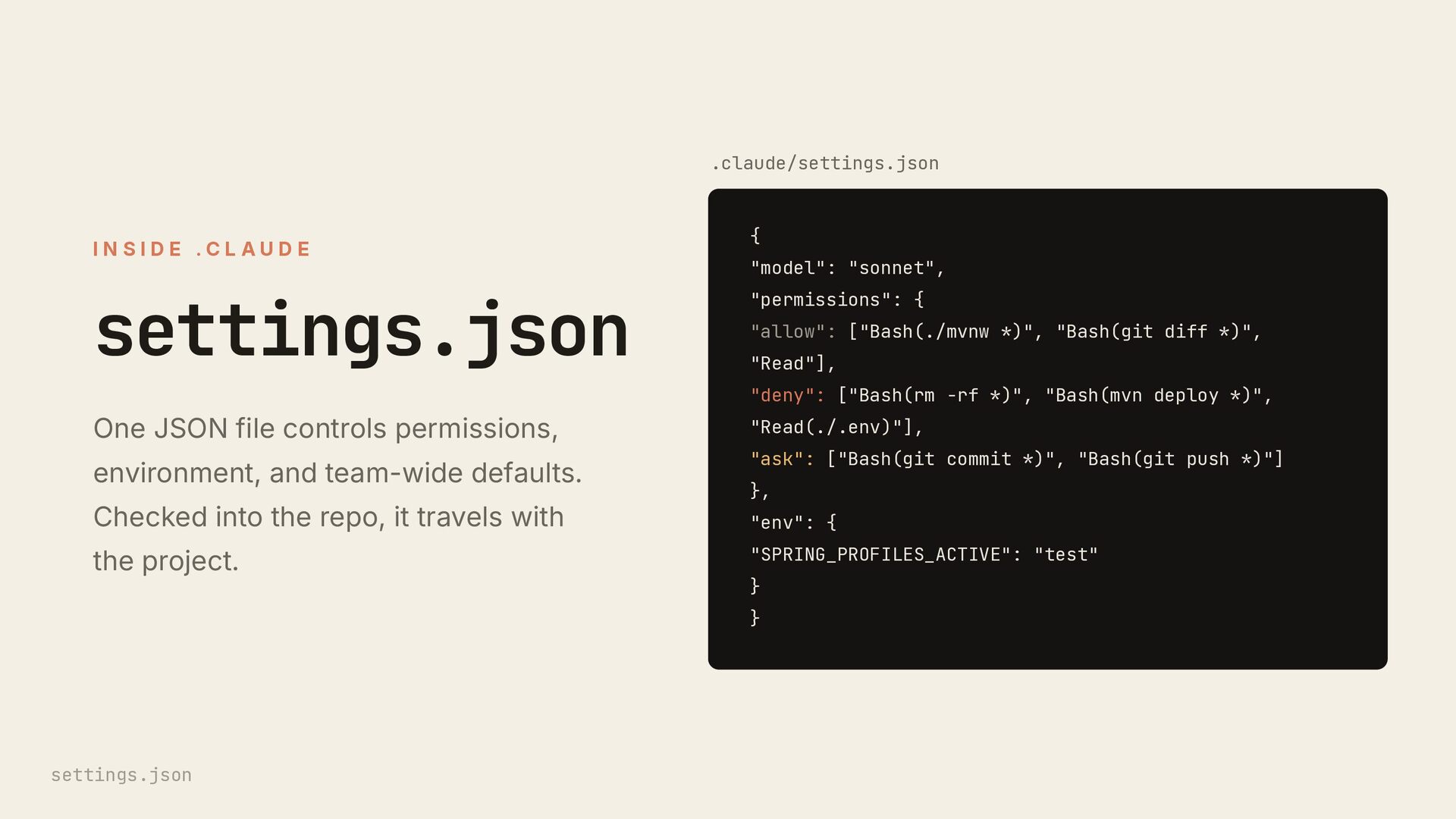
  22. .claude/settings.json INSIDE .CLAUDE settings.json { "model": "sonnet", "permissions": { "allow":

    ["Bash(./mvnw *)", "Bash(git diff *)", "Read"], "deny": ["Bash(rm -rf *)", "Bash(mvn deploy *)", One JSON file controls permissions, environment, and team-wide defaults. Checked into the repo, it travels with the project. "Read(./.env)"], "ask": ["Bash(git commit *)", "Bash(git push *)"] }, "env": { "SPRING_PROFILES_ACTIVE": "test" } } settings.json
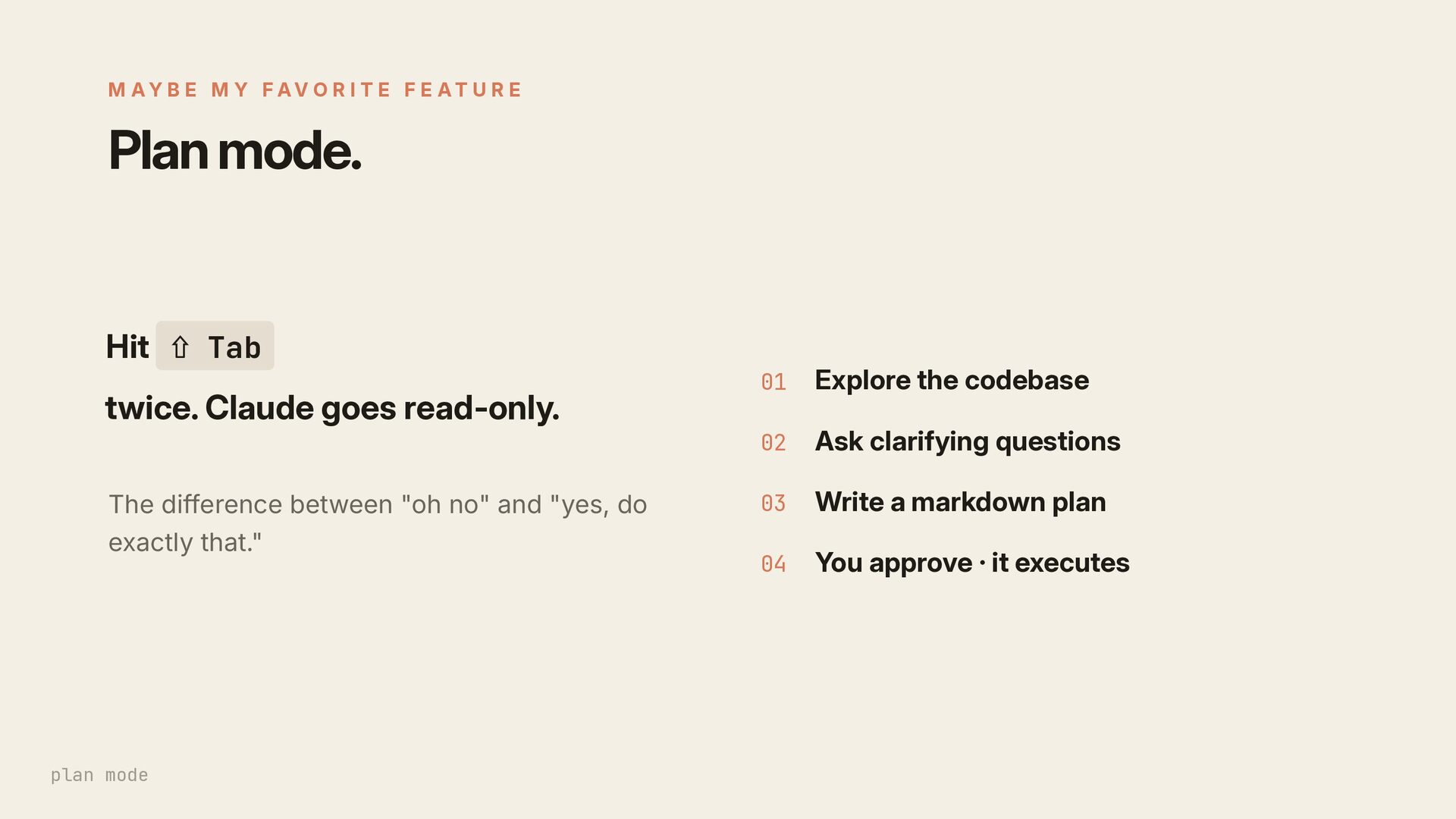
  23. M AY B E M Y FAVO R I T

    E F E AT U R E Plan mode. Hit ⇧ Tab twice. Claude goes read-only. The difference between "oh no" and "yes, do exactly that." plan mode 01 Explore the codebase 02 Ask clarifying questions 03 Write a markdown plan 04 You approve · it executes
  24. D E M O · 0 2 Permissions and plan

    mode. A new project, from first prompt to trusted setup. → jump to claude code demo 02
  25. SECTION 03 / 04 Context is the job. Steering Claude

    with what you already know. section 03 01 The fundamentals 02 Getting started 03 Context is the job 04 Scaling up
  26. This is where you can take a coding agent from

    a nice parlor trick to an irreplaceable teammate. context is the job
  27. The model is only as good as the context you

    give it. context is the job
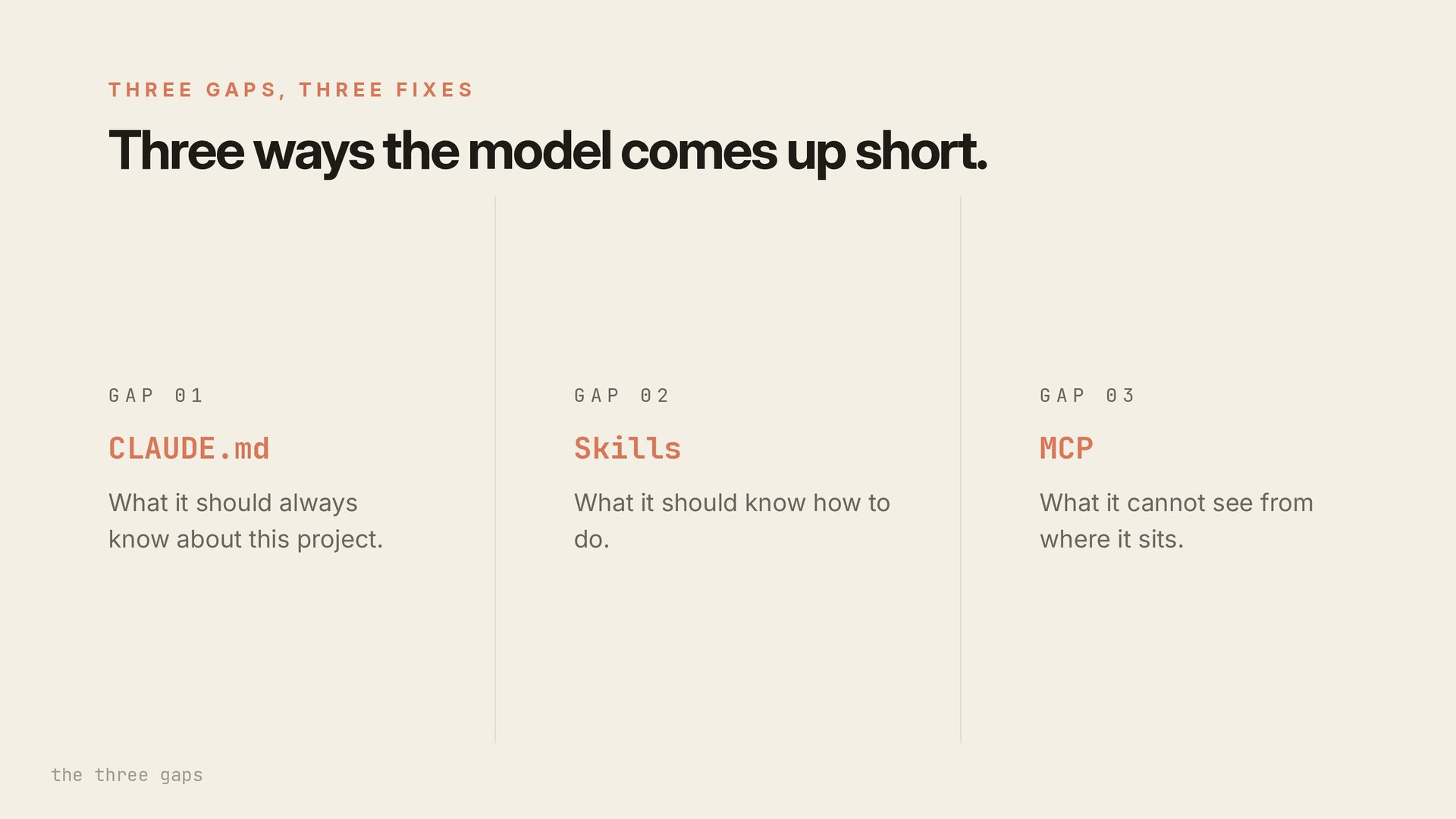
  28. THREE GAPS, THREE FIXES Three ways the model comes up

    short. GAP 01 GAP 02 GAP 03 CLAUDE.md Skills MCP What it should always What it should know how to What it cannot see from know about this project. do. where it sits. the three gaps
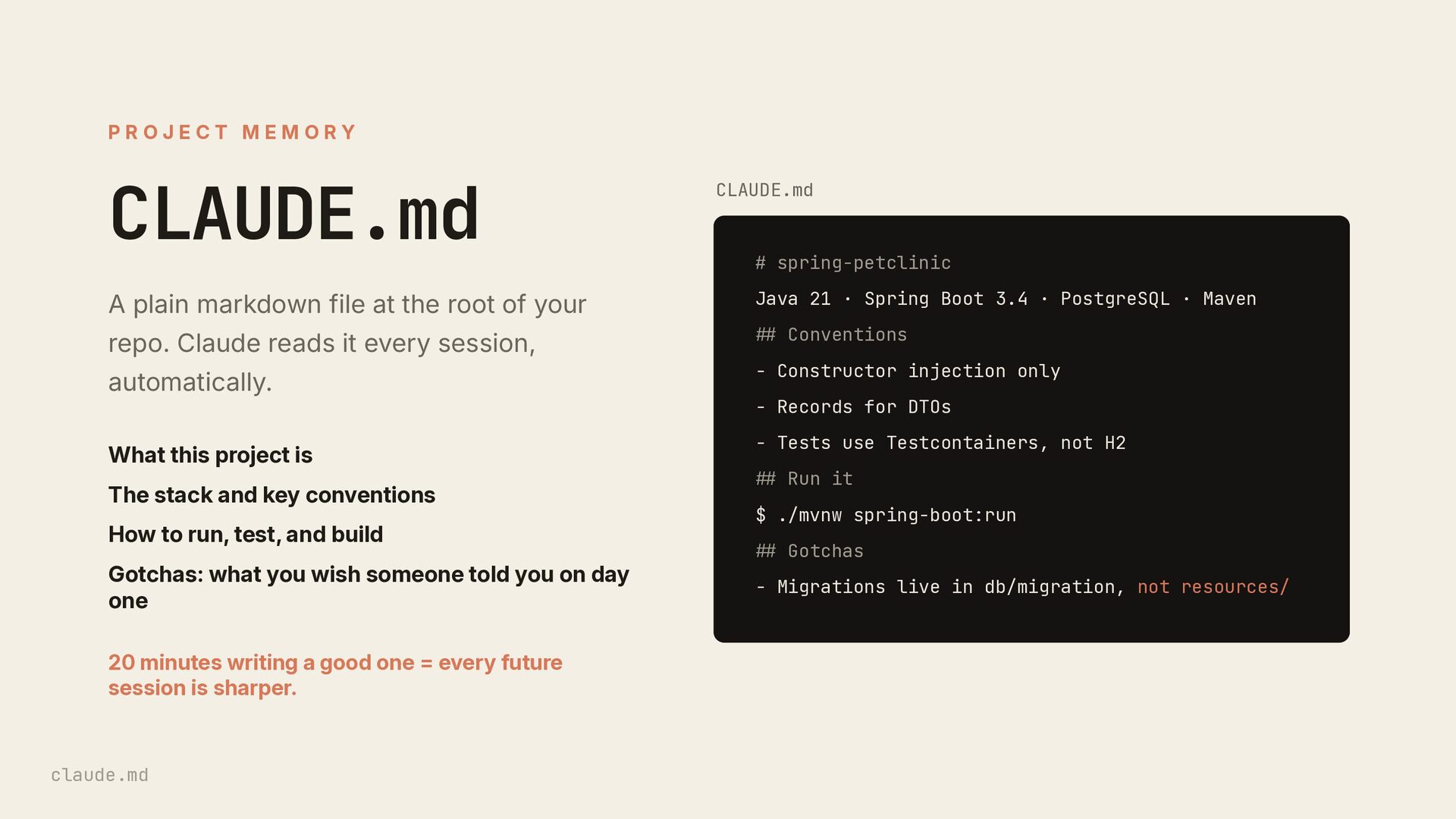
  29. CLAUDE.md A plain markdown file at the root of your

    repo. Claude reads it every session, automatically. What this project is The stack and key conventions How to run, test, and build Gotchas: what you wish someone told you on day one 20 minutes writing a good one = every future session is sharper. # # claude.md # # # # PROJECT MEMORY CLAUDE.md # spring-petclinic Java 21 · Spring Boot 3.4 · PostgreSQL · Maven Conventions - Constructor injection only - Records for DTOs - Tests use Testcontainers, not H2 Run it $ ./mvnw spring-boot:run Gotchas - Migrations live in db/migration, not resources/
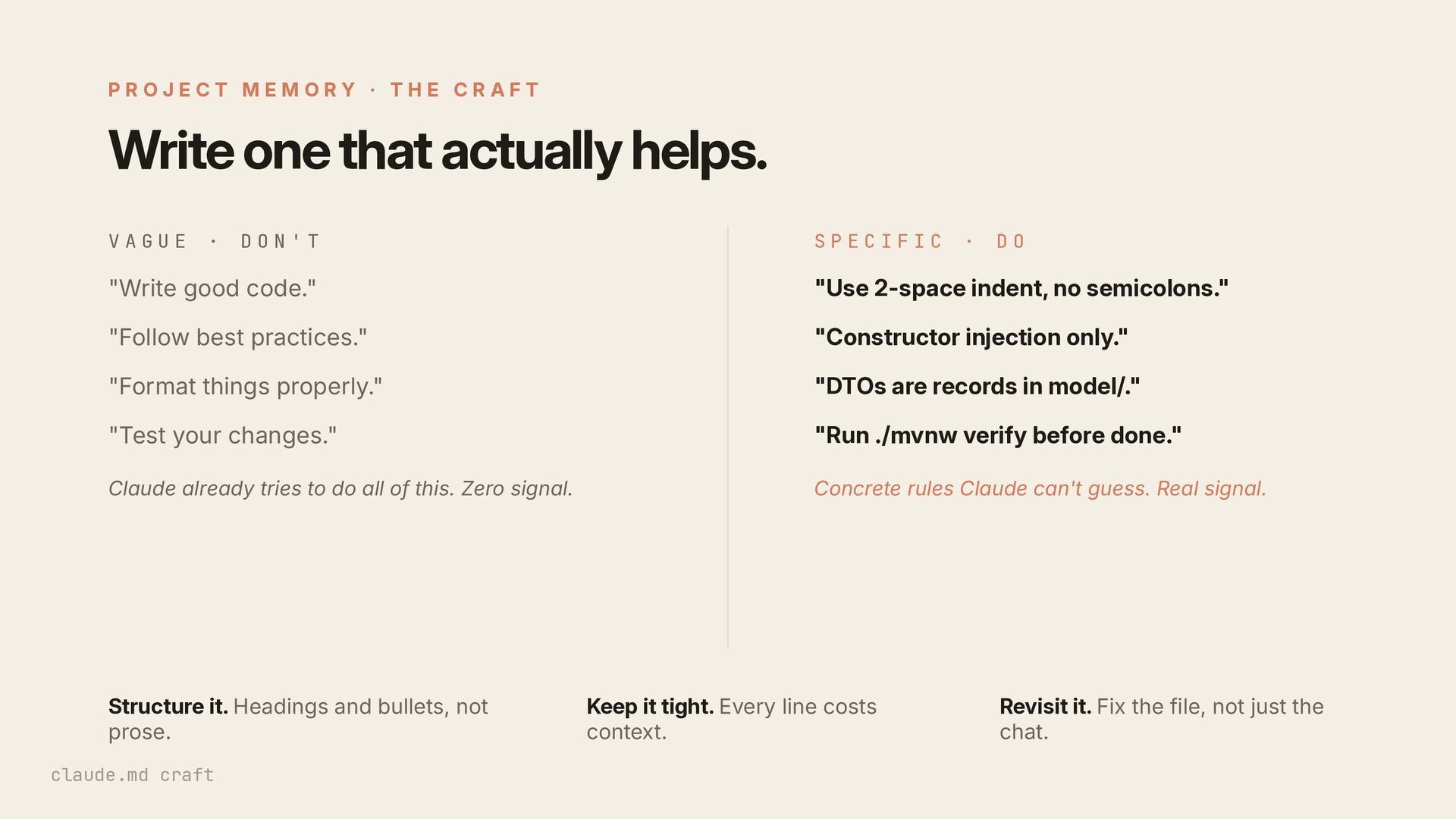
  30. PROJECT MEMORY · THE CRAFT Write one that actually helps.

    VAGUE · DON'T SPECIFIC · DO "Write good code." "Use 2-space indent, no semicolons." "Follow best practices." "Constructor injection only." "Format things properly." "DTOs are records in model/." "Test your changes." "Run ./mvnw verify before done." Claude already tries to do all of this. Zero signal. Concrete rules Claude can't guess. Real signal. Structure it. Headings and bullets, not prose. claude.md craft Keep it tight. Every line costs context. Revisit it. Fix the file, not just the chat.
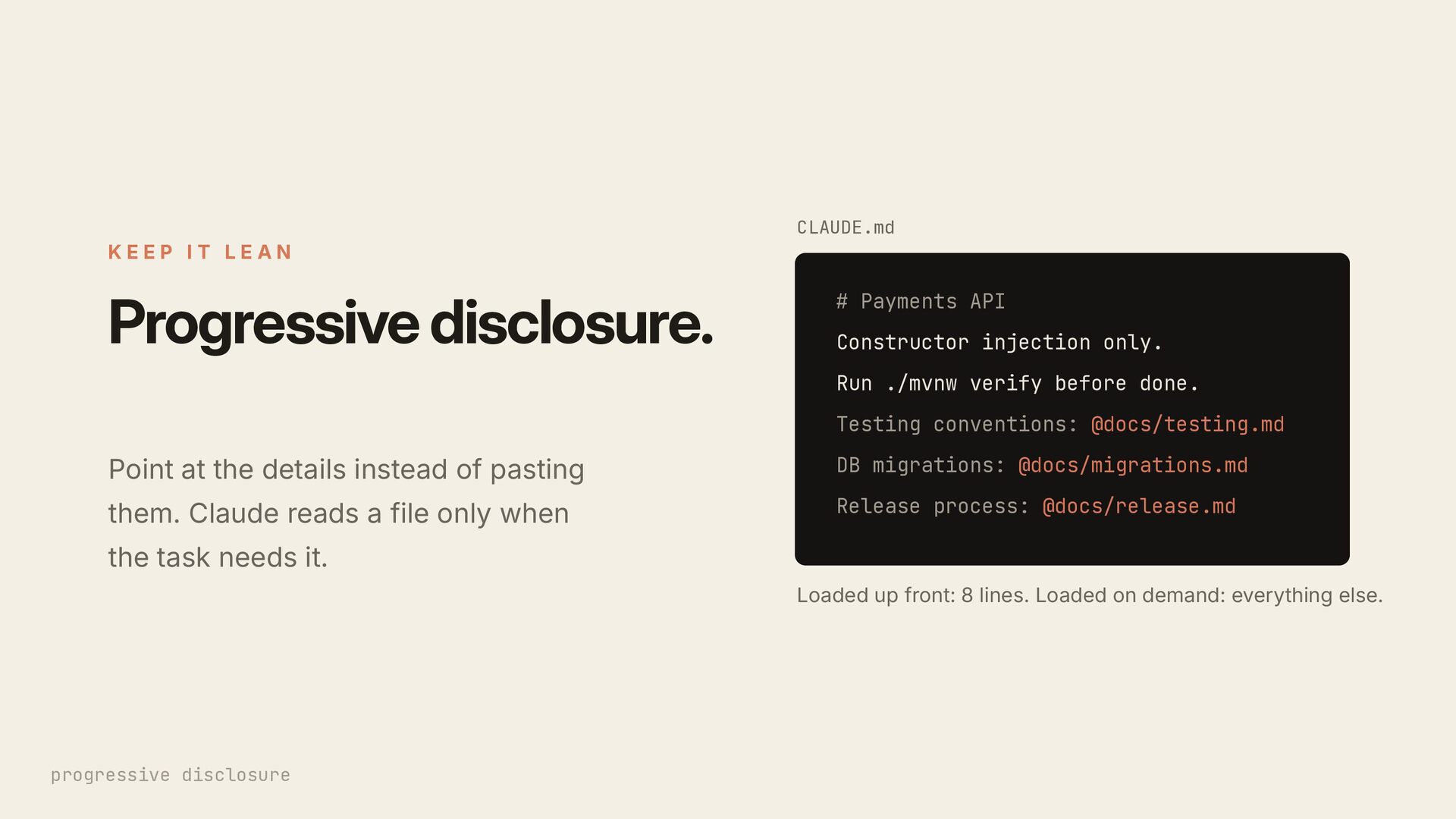
  31. CLAUDE.md KEEP IT LEAN Progressive disclosure. # Payments API Constructor

    injection only. Run ./mvnw verify before done. Testing conventions: @docs/testing.md Point at the details instead of pasting DB migrations: @docs/migrations.md them. Claude reads a file only when Release process: @docs/release.md the task needs it. Loaded up front: 8 lines. Loaded on demand: everything else. progressive disclosure
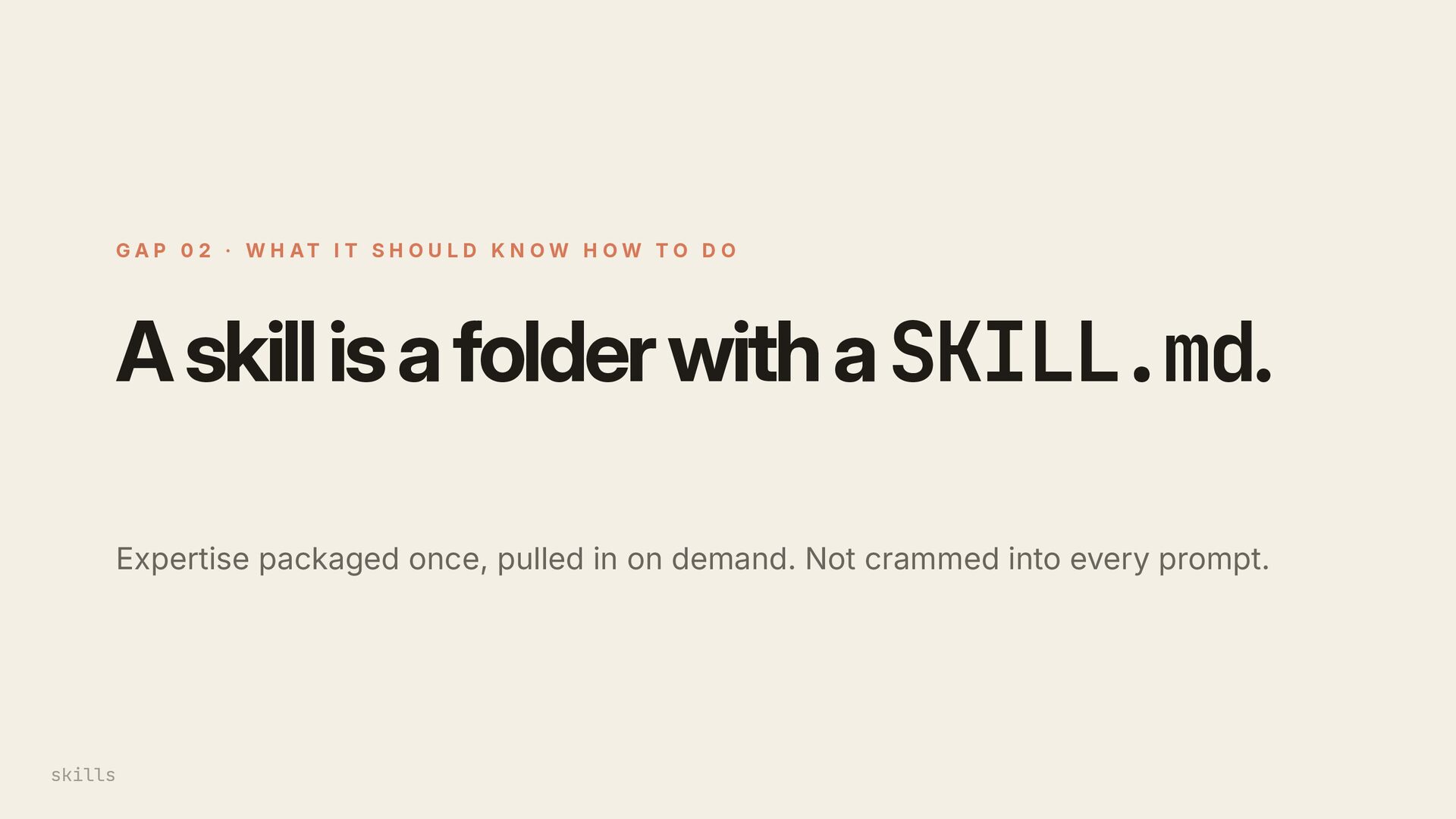
  32. G A P 0 2 · W H AT I

    T S H O U L D K N O W H O W T O D O A skill is a folder with a SKILL.md. Expertise packaged once, pulled in on demand. Not crammed into every prompt. skills
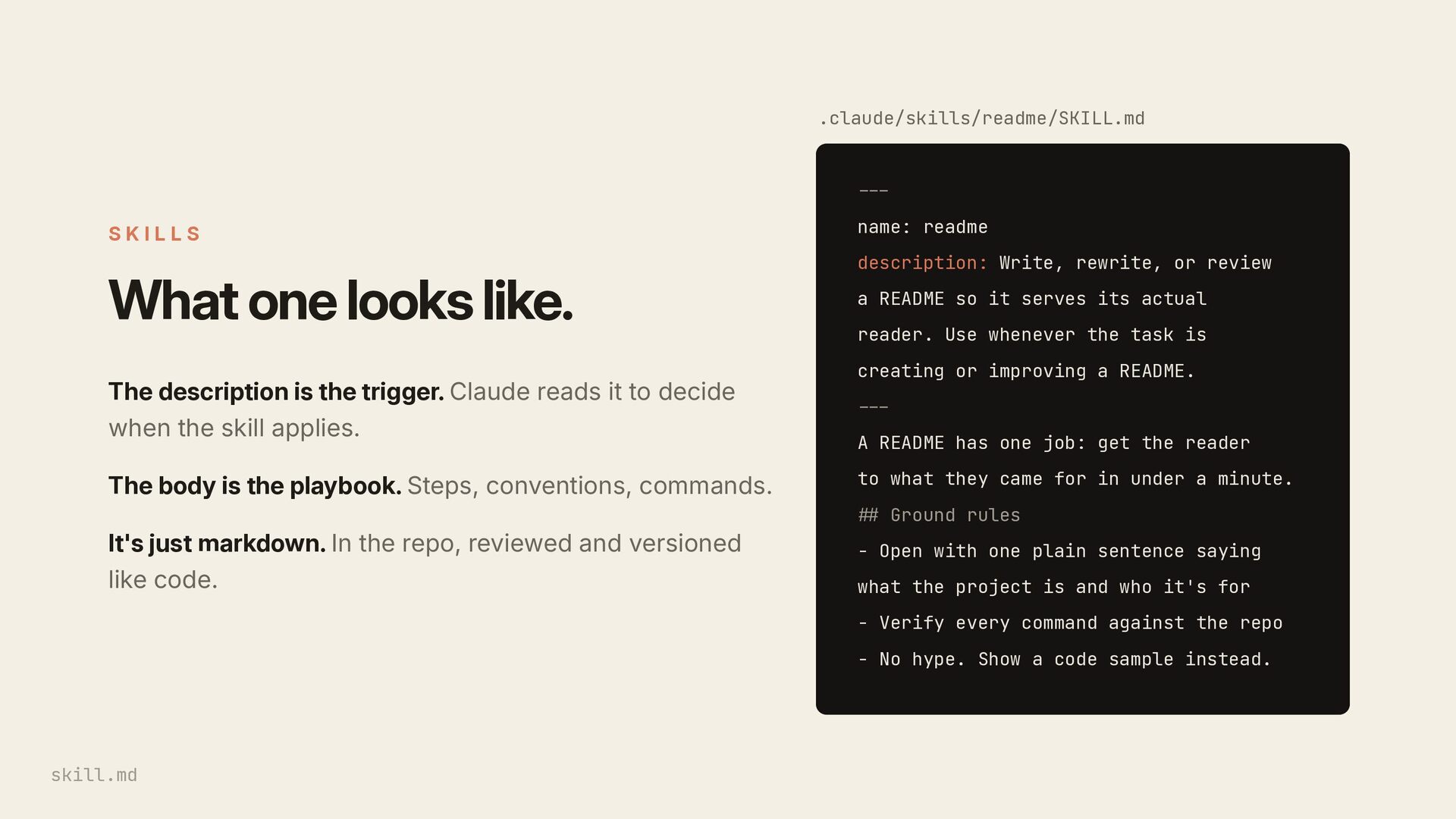
  33. SKILLS What one looks like. The description is the trigger.

    Claude reads it to decide when the skill applies. The body is the playbook. Steps, conventions, commands. name: readme description: Write, rewrite, or review a README so it serves its actual reader. Use whenever the task is creating or improving a README. A README has one job: get the reader to what they came for in under a minute. Ground rules It's just markdown. In the repo, reviewed and versioned - Open with one plain sentence saying like code. what the project is and who it's for - Verify every command against the repo - No hype. Show a code sample instead. - - - - skill.md # - - # .claude/skills/readme/SKILL.md
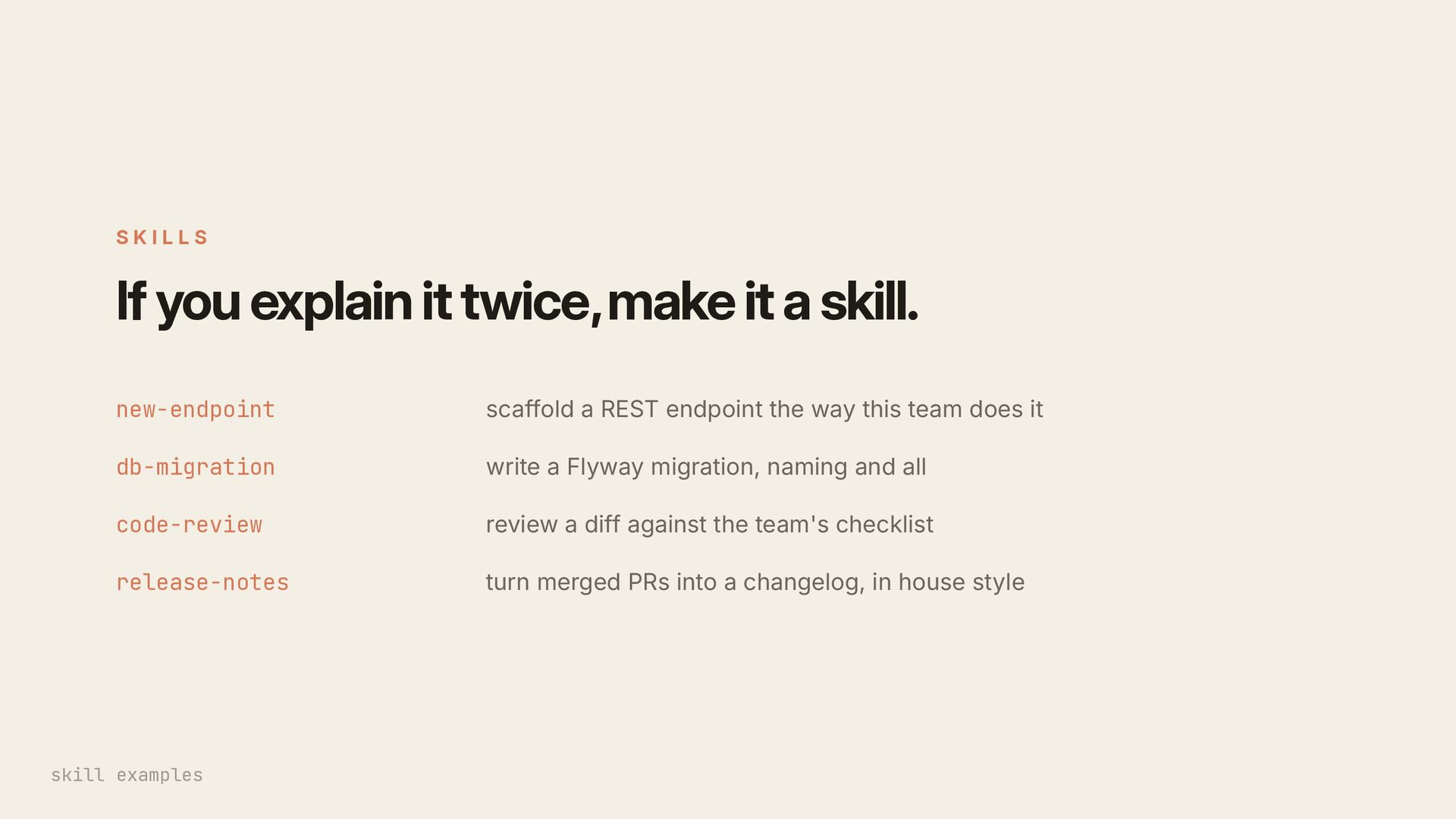
  34. SKILLS If you explain it twice, make it a skill.

    new-endpoint scaffold a REST endpoint the way this team does it db-migration write a Flyway migration, naming and all code-review review a diff against the team's checklist release-notes turn merged PRs into a changelog, in house style skill examples
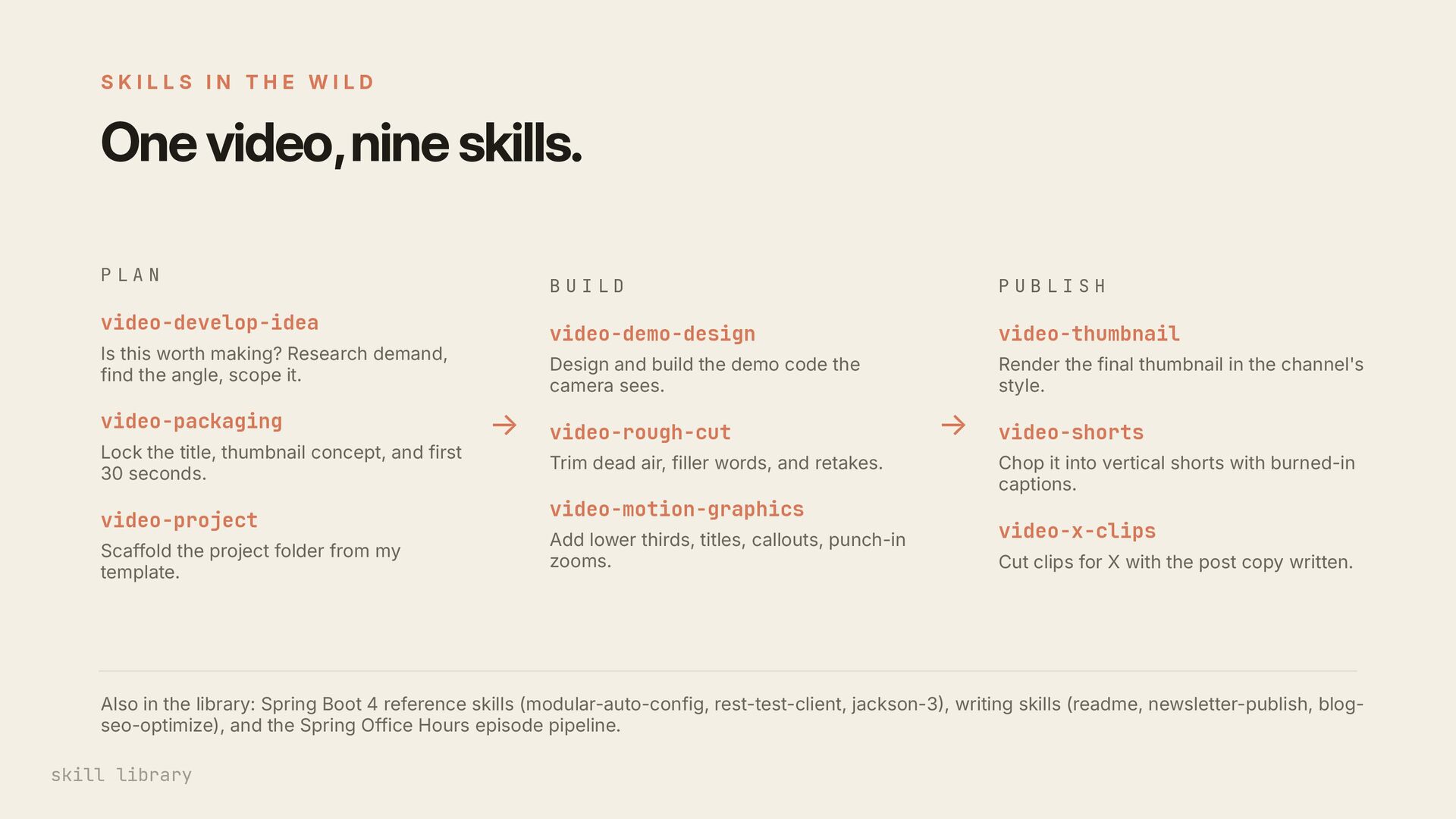
  35. SKILLS IN THE WILD One video, nine skills. PLAN video-develop-idea

    Is this worth making? Research demand, find the angle, scope it. video-packaging Lock the title, thumbnail concept, and first 30 seconds. video-project Scaffold the project folder from my template. → BUILD PUBLISH video-demo-design video-thumbnail Design and build the demo code the camera sees. Render the final thumbnail in the channel's style. → video-rough-cut Trim dead air, filler words, and retakes. video-motion-graphics Add lower thirds, titles, callouts, punch-in zooms. video-shorts Chop it into vertical shorts with burned-in captions. video-x-clips Cut clips for X with the post copy written. Also in the library: Spring Boot 4 reference skills (modular-auto-config, rest-test-client, jackson-3 , writing skills (readme, newsletter-publish, blogseo-optimize), and the Spring Office Hours episode pipeline. ) skill library
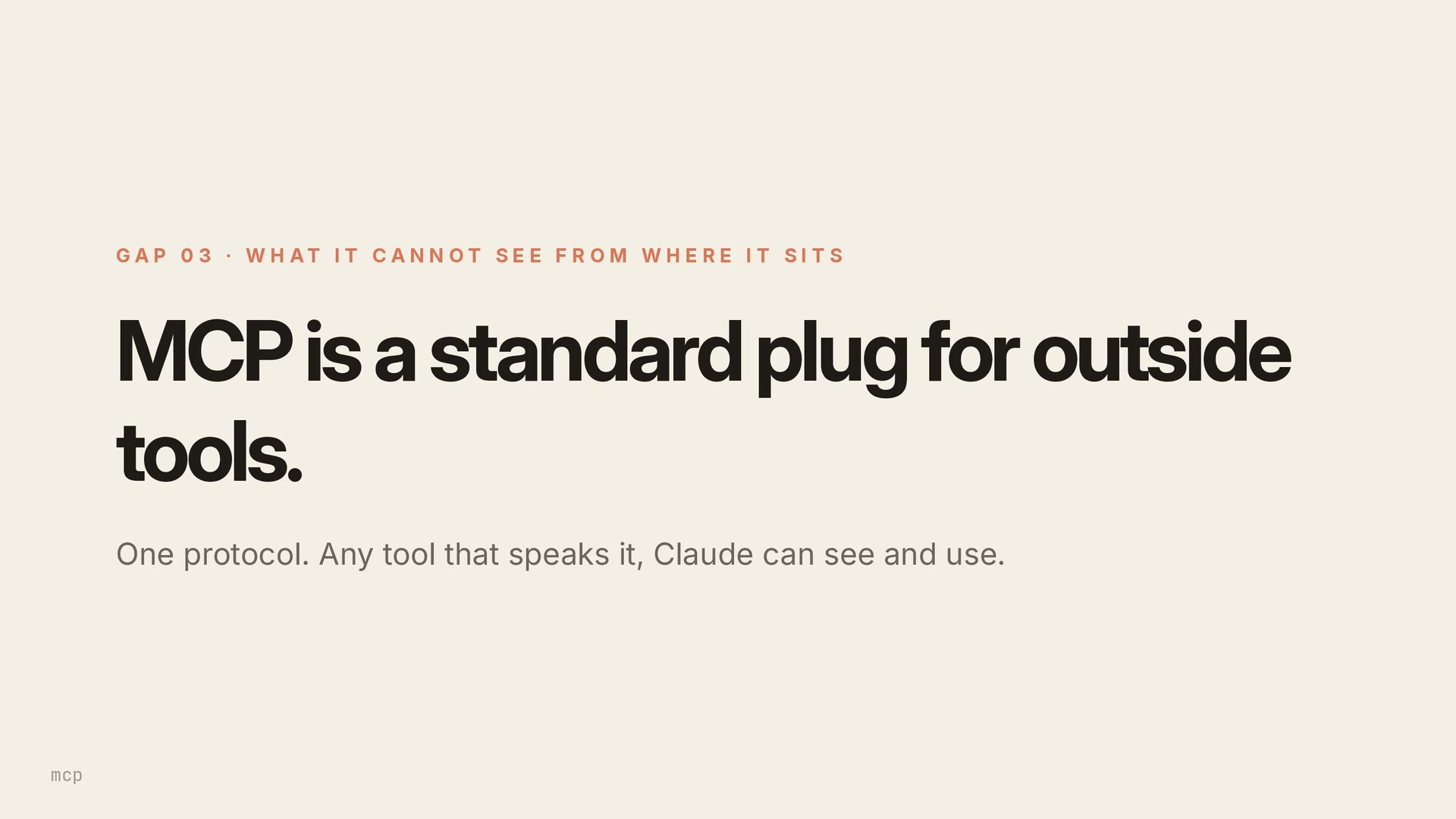
  36. G A P 0 3 · W H AT I

    T C A N N O T S E E F R O M W H E R E I T S I T S MCP is a standard plug for outside tools. One protocol. Any tool that speaks it, Claude can see and use. mcp
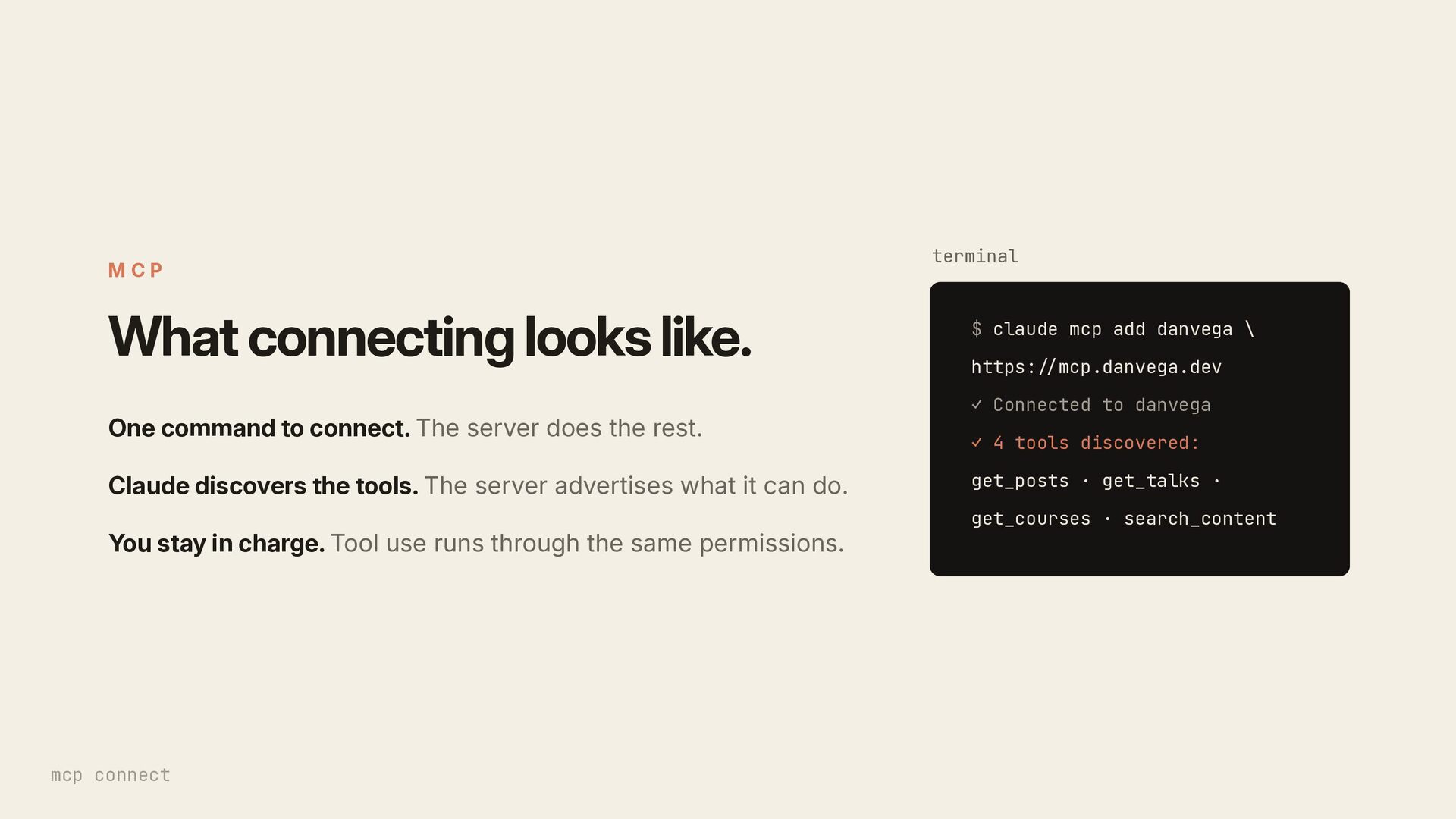
  37. MCP What connecting looks like. One command to connect. The

    server does the rest. Claude discovers the tools. The server advertises what it can do. You stay in charge. Tool use runs through the same permissions. / / mcp connect terminal $ claude mcp add danvega \ https: mcp.danvega.dev ✓ Connected to danvega ✓ 4 tools discovered: get_posts · get_talks · get_courses · search_content
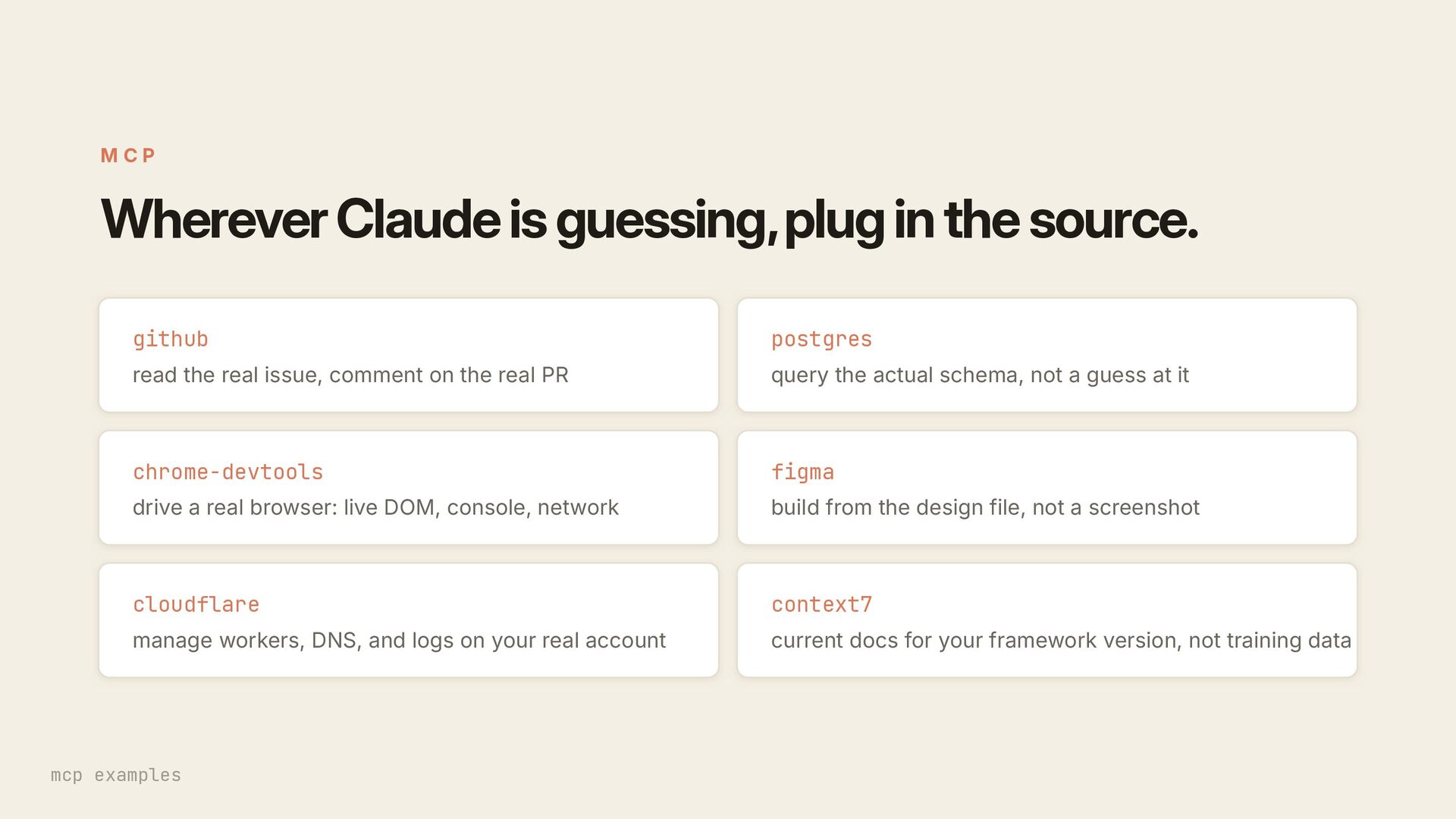
  38. MCP Wherever Claude is guessing, plug in the source. github

    postgres read the real issue, comment on the real PR query the actual schema, not a guess at it chrome-devtools figma drive a real browser: live DOM, console, network build from the design file, not a screenshot cloudflare context7 manage workers, DNS, and logs on your real account current docs for your framework version, not training data mcp examples
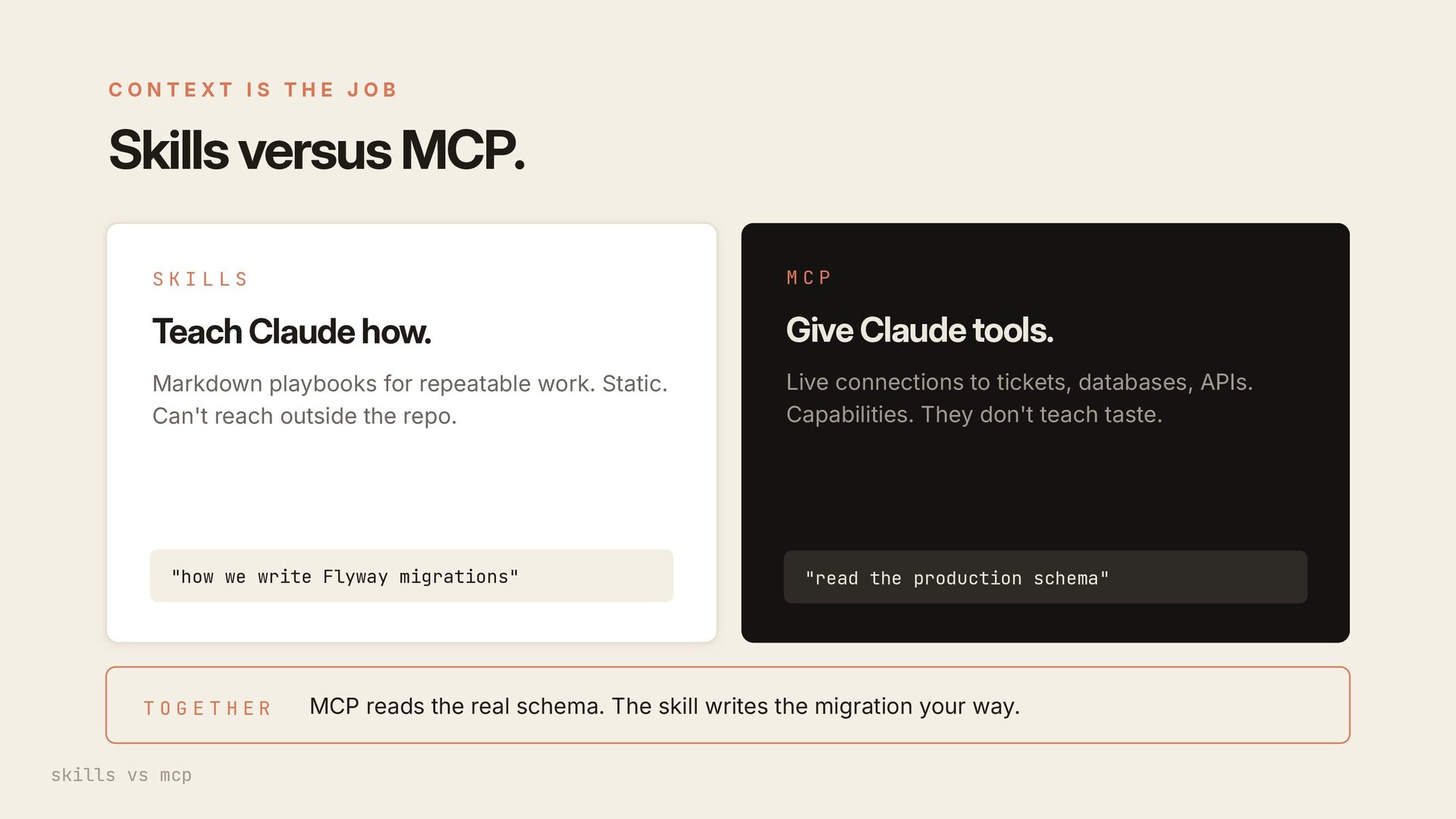
  39. CONTEXT IS THE JOB Skills versus MCP. SKILLS MCP Teach

    Claude how. Give Claude tools. Markdown playbooks for repeatable work. Static. Can't reach outside the repo. Live connections to tickets, databases, APIs. Capabilities. They don't teach taste. "how we write Flyway migrations" TOGETHER skills vs mcp "read the production schema" MCP reads the real schema. The skill writes the migration your way.
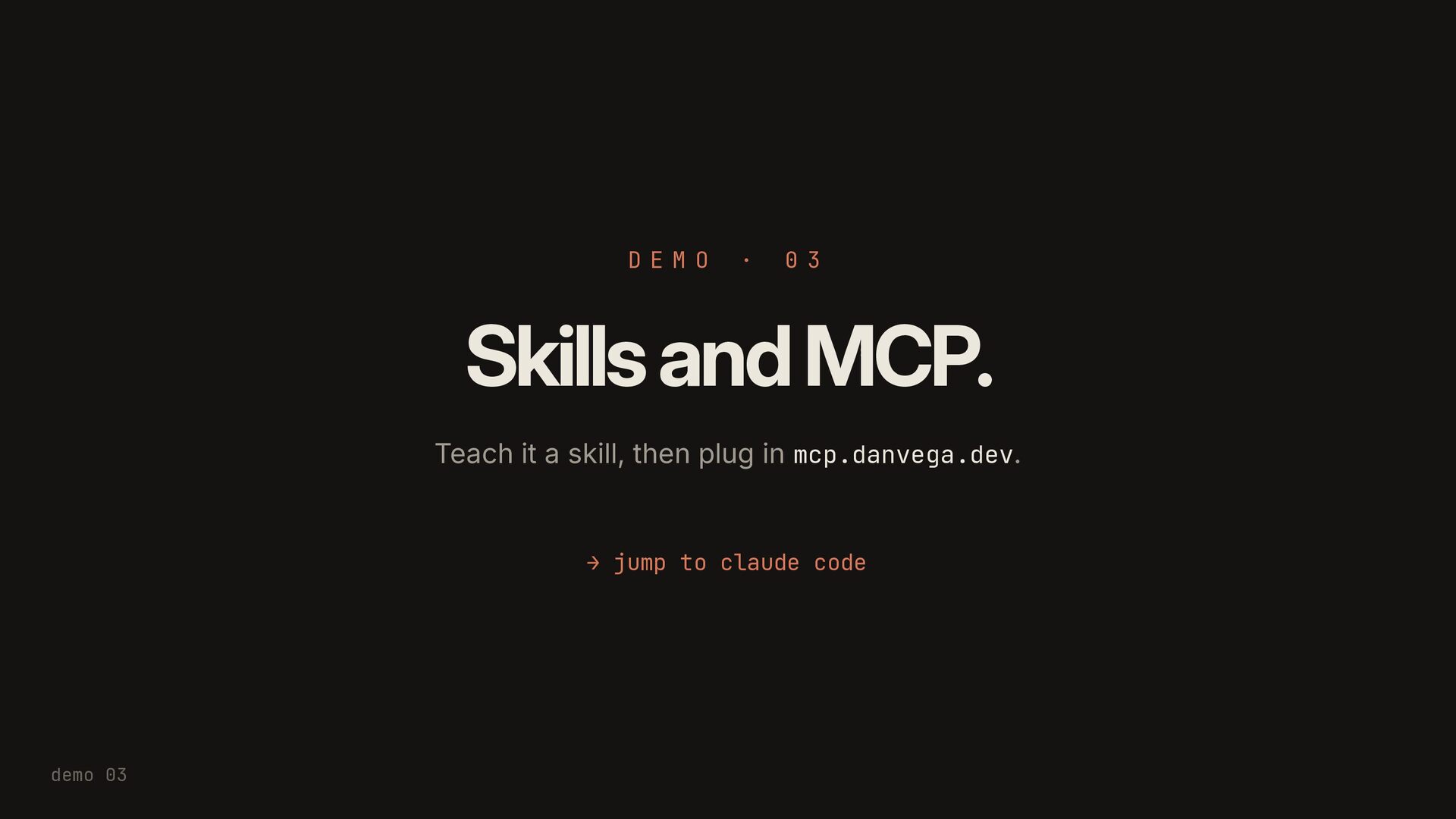
  40. D E M O · 0 3 Skills and MCP.

    Teach it a skill, then plug in mcp.danvega.dev. → jump to claude code demo 03
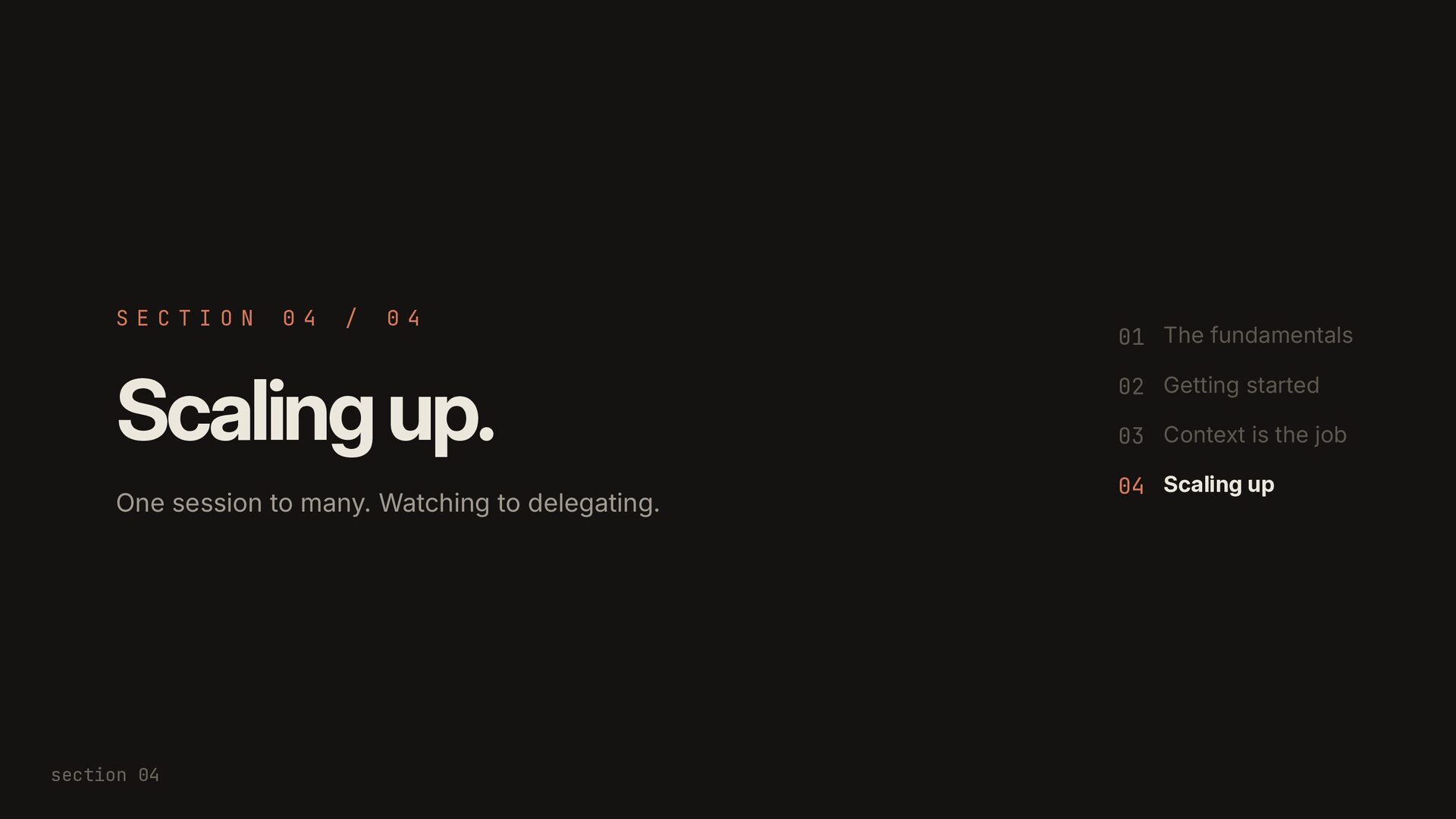
  41. SECTION 04 / 04 Scaling up. One session to many.

    Watching to delegating. section 04 01 The fundamentals 02 Getting started 03 Context is the job 04 Scaling up
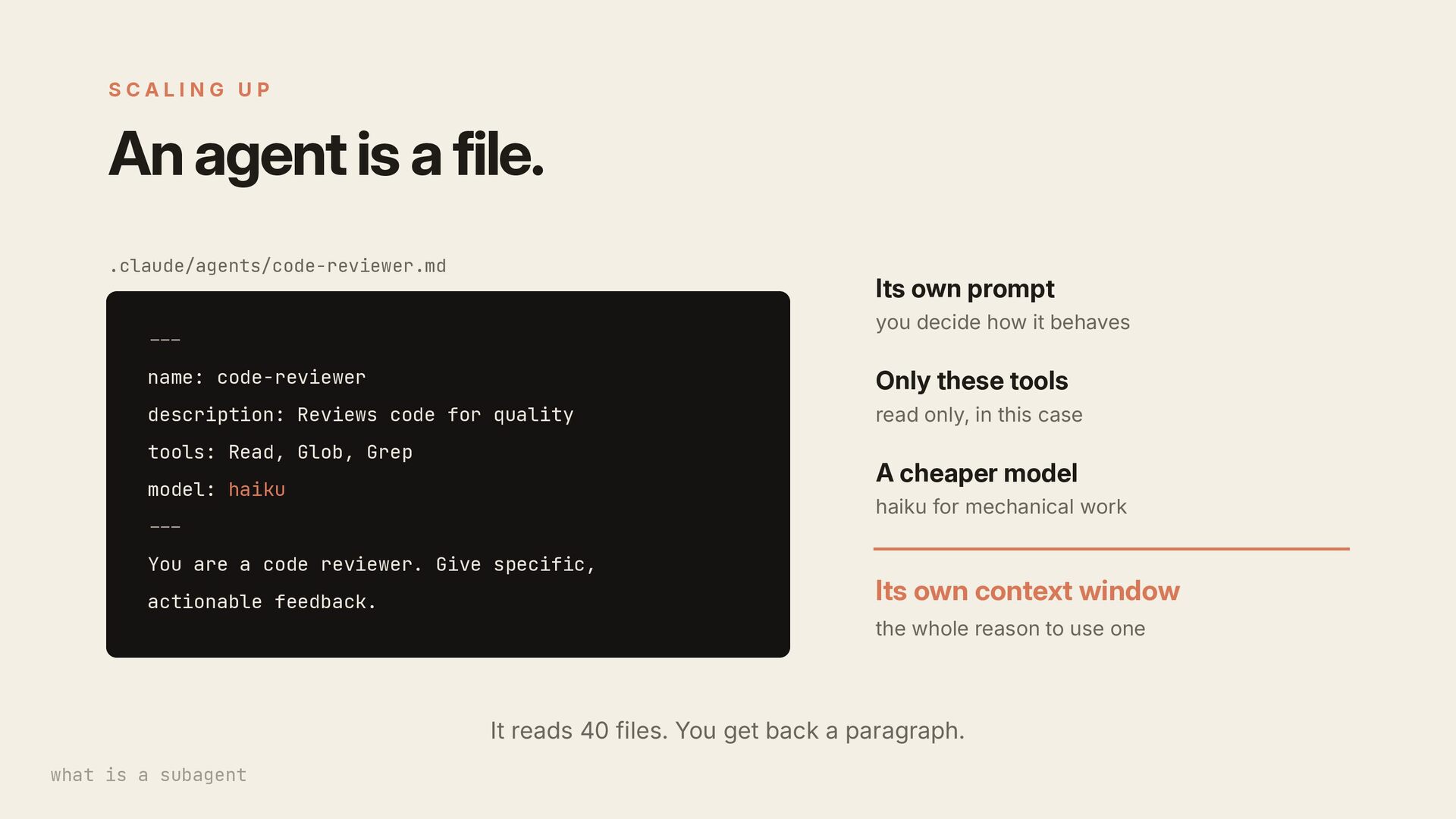
  42. An agent is a file. .claude/agents/code-reviewer.md Its own prompt you

    decide how it behaves name: code-reviewer Only these tools description: Reviews code for quality read only, in this case tools: Read, Glob, Grep A cheaper model model: haiku haiku for mechanical work You are a code reviewer. Give specific, actionable feedback. Its own context window the whole reason to use one It reads 40 files. You get back a paragraph. - - - what is a subagent - - - SCALING UP
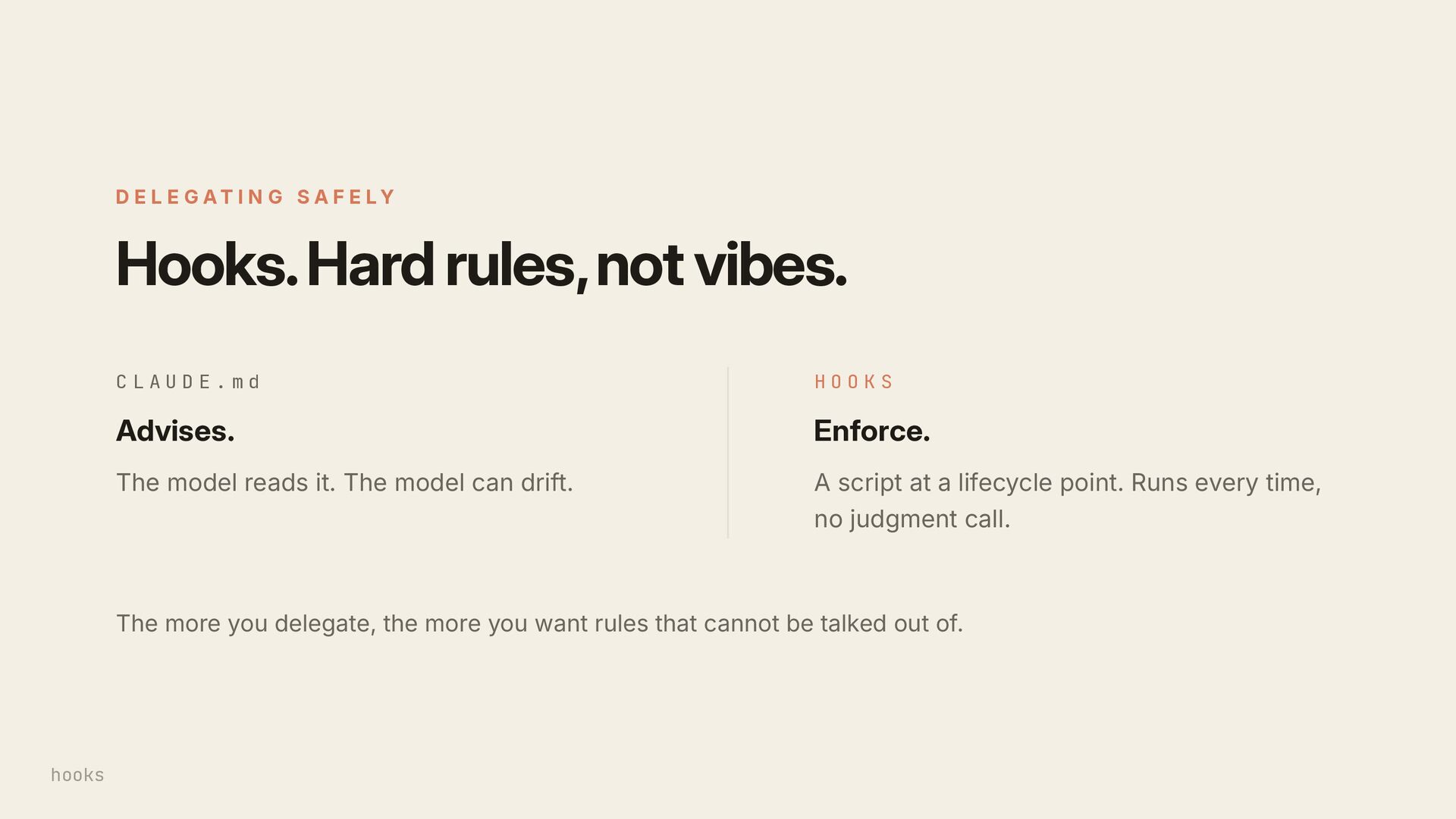
  43. D E L E G AT I N G S

    A F E LY Hooks. Hard rules, not vibes. CLAUDE.md HOOKS Advises. Enforce. The model reads it. The model can drift. A script at a lifecycle point. Runs every time, no judgment call. The more you delegate, the more you want rules that cannot be talked out of. hooks
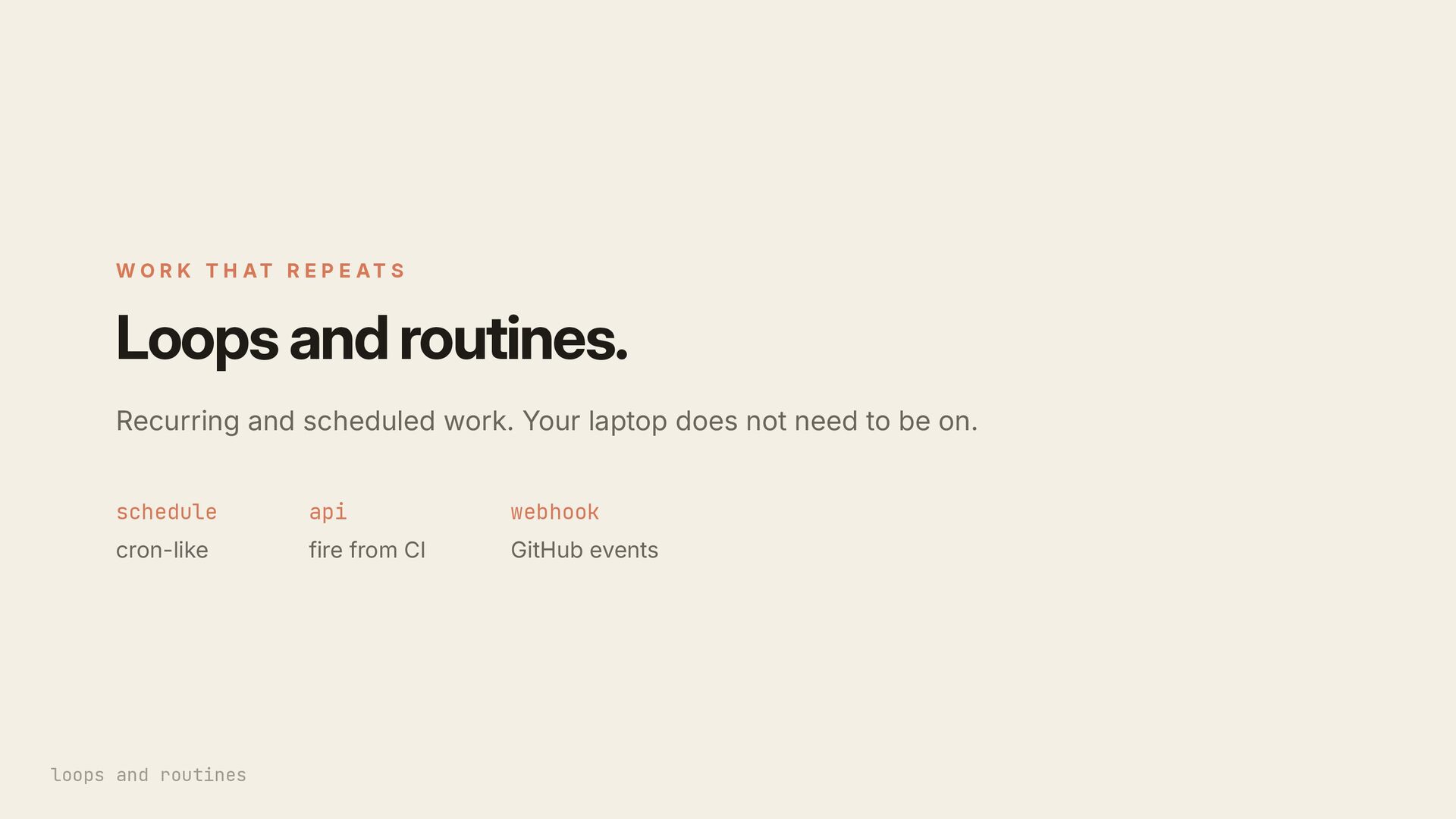
  44. W O R K T H AT R E P

    E AT S Loops and routines. Recurring and scheduled work. Your laptop does not need to be on. schedule api webhook cron-like fire from CI GitHub events loops and routines
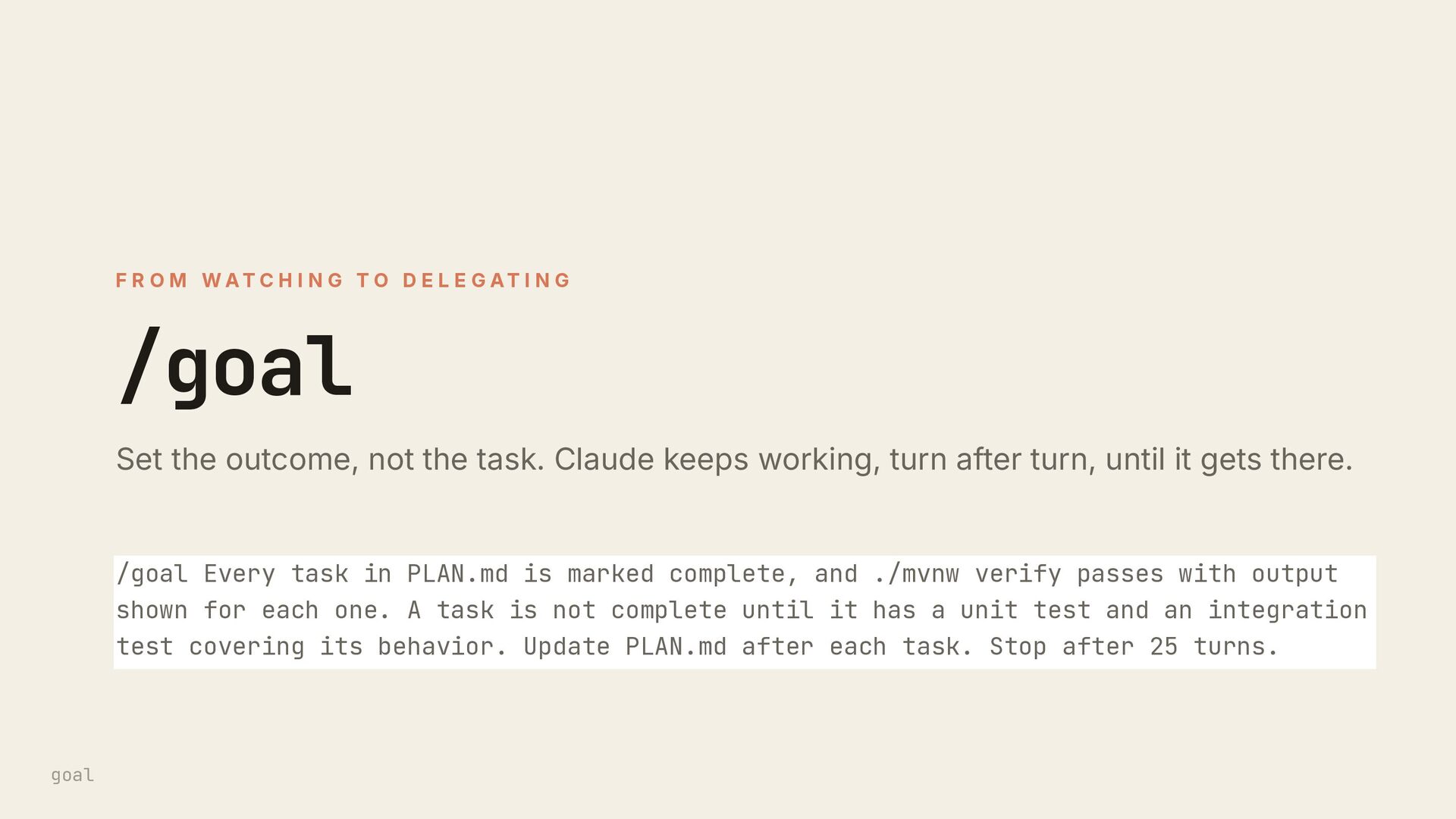
  45. F R O M WAT C H I N G

    T O D E L E G AT I N G /goal Set the outcome, not the task. Claude keeps working, turn after turn, until it gets there. /goal Every task in PLAN.md is marked complete, and ./mvnw verify passes with output shown for each one. A task is not complete until it has a unit test and an integration test covering its behavior. Update PLAN.md after each task. Stop after 25 turns. goal
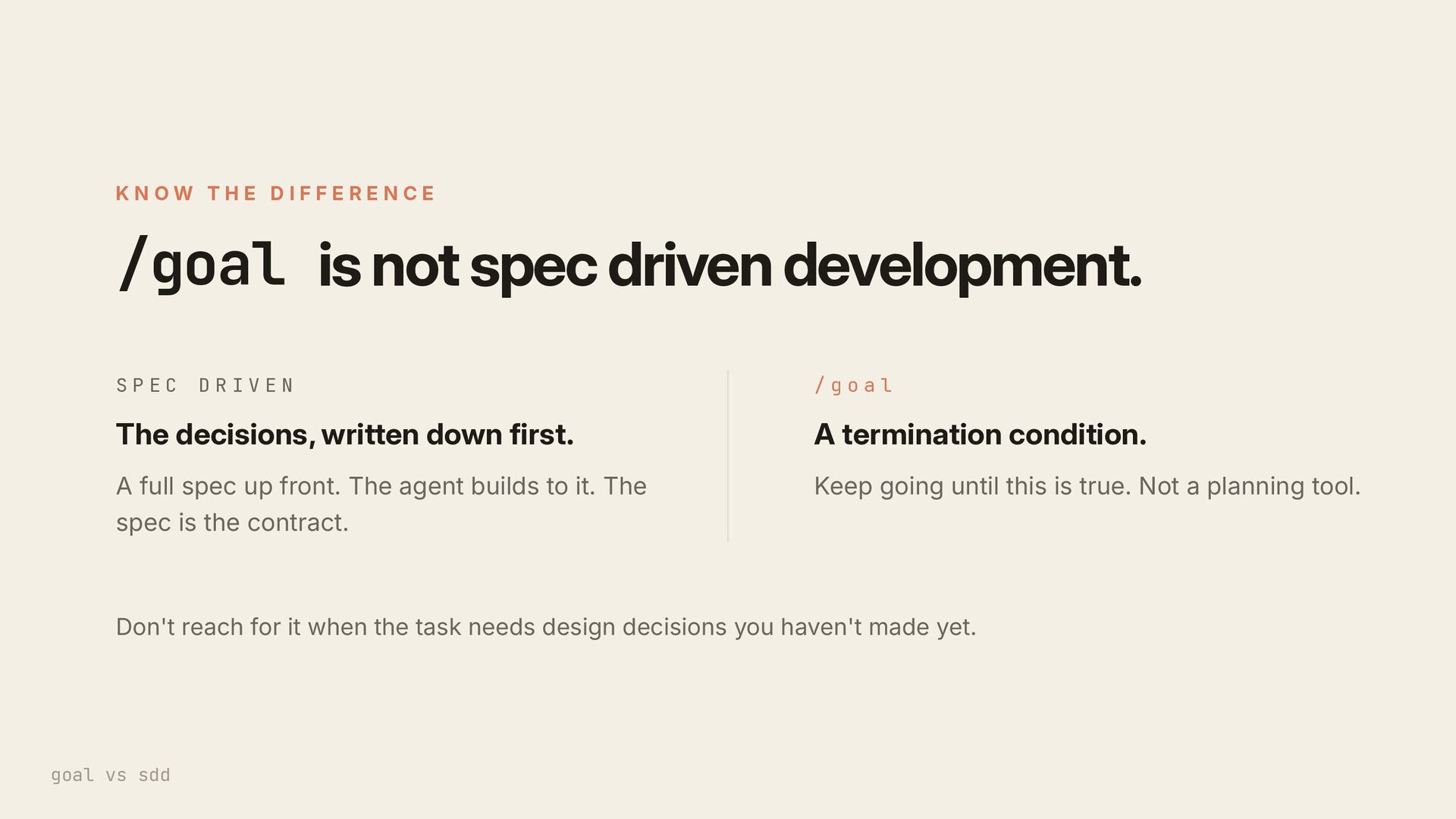
  46. KNOW THE DIFFERENCE /goal is not spec driven development. SPEC

    DRIVEN /goal The decisions, written down first. A termination condition. A full spec up front. The agent builds to it. The Keep going until this is true. Not a planning tool. spec is the contract. Don't reach for it when the task needs design decisions you haven't made yet. goal vs sdd
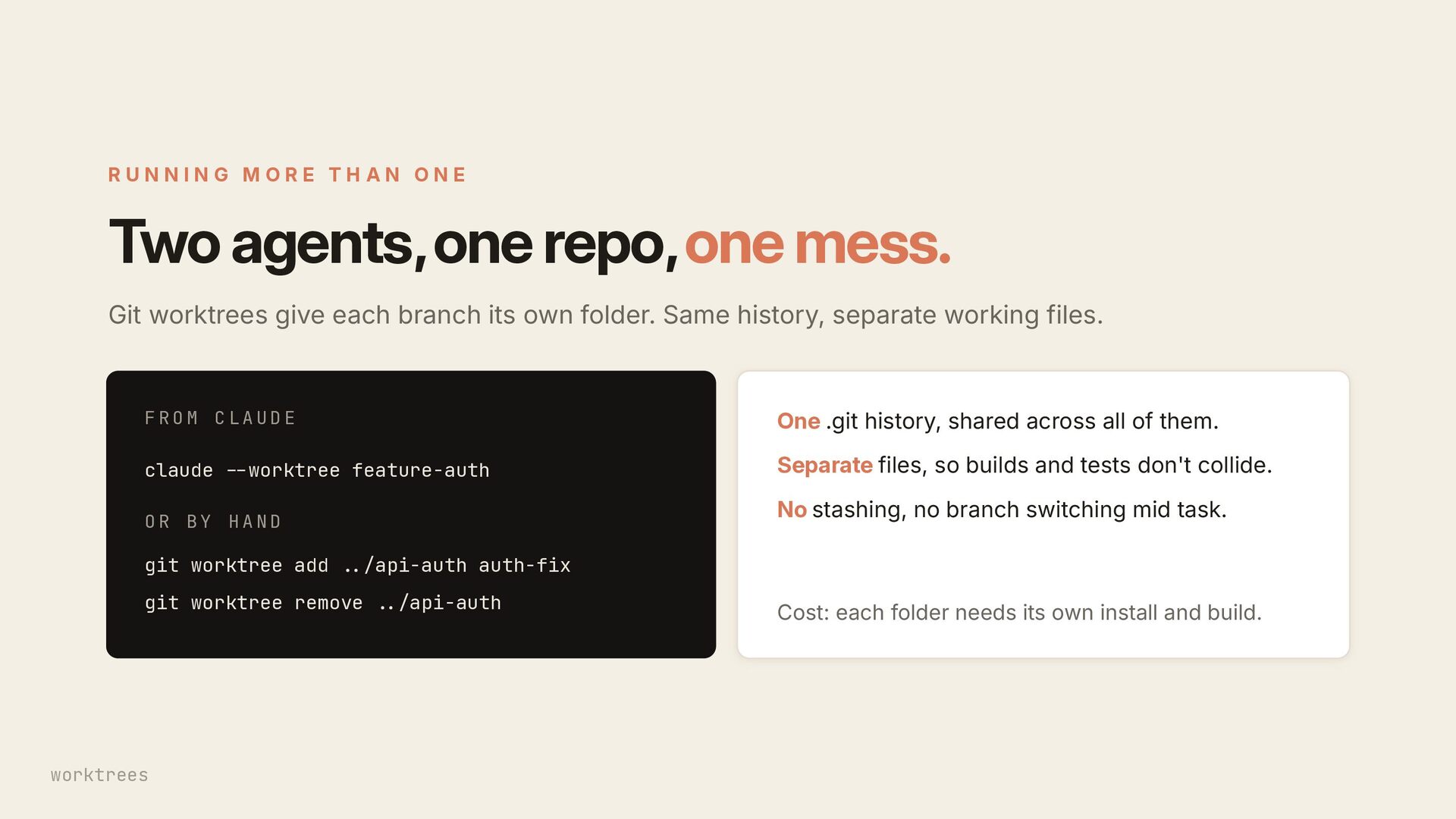
  47. RUNNING MORE THAN ONE Two agents, one repo, one mess.

    Git worktrees give each branch its own folder. Same history, separate working files. FROM CLAUDE One .git history, shared across all of them. claude Separate files, so builds and tests don't collide. worktree feature-auth No stashing, no branch switching mid task. OR BY HAND git worktree add /api-auth auth-fix git worktree remove . . . . - - worktrees /api-auth Cost: each folder needs its own install and build.
  48. D E M O · 0 4 Agents Working with

    subagents → jump to claude code demo 04
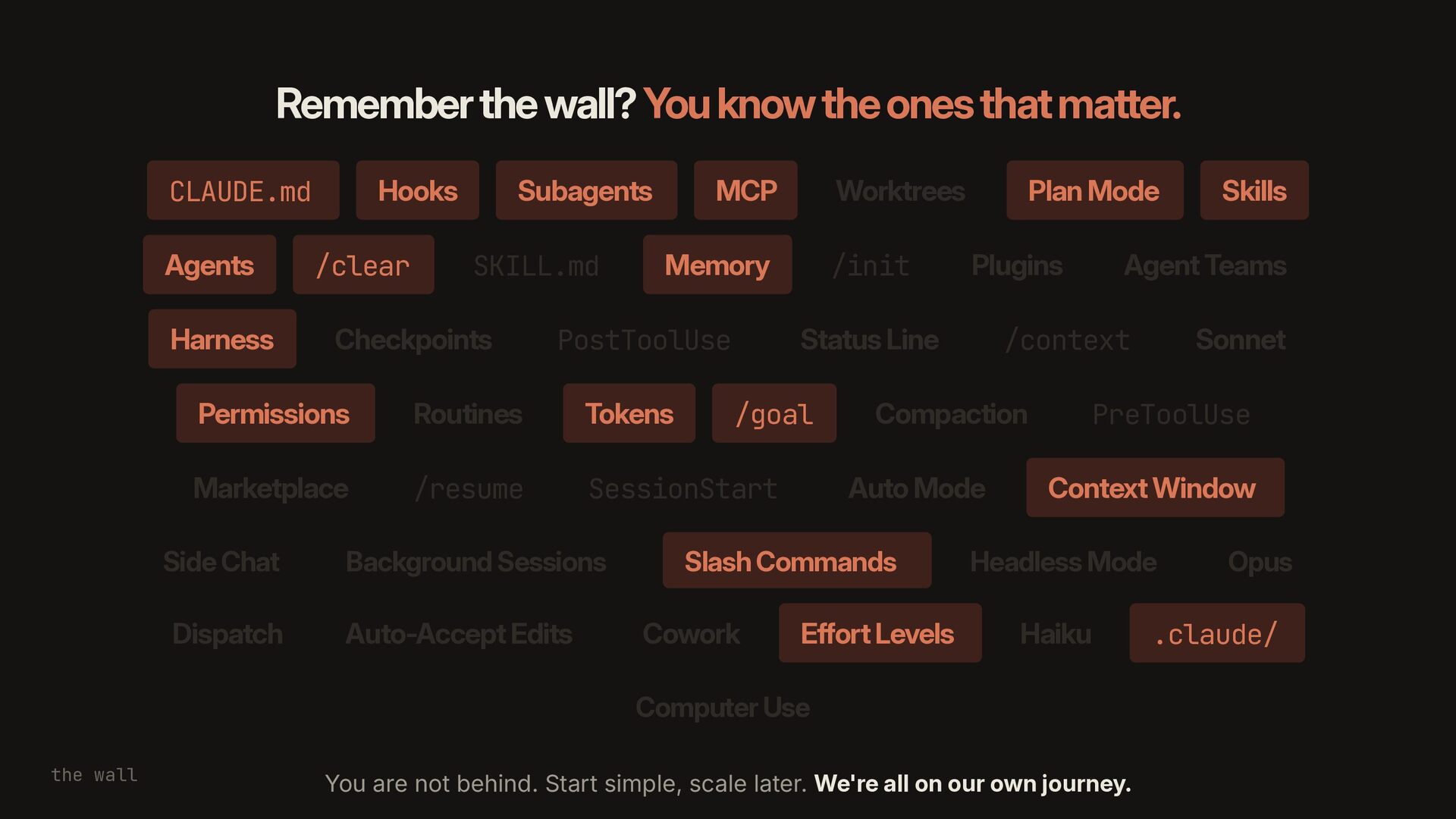
  49. Remember the wall? You know the ones that matter. CLAUDE.md

    Agents Harness Hooks /clear Subagents SKILL.md Checkpoints MCP /goal Routines Tokens Marketplace /resume SessionStart Dispatch Auto-Accept Edits Plan Mode Plugins Compaction Auto Mode Slash Commands Cowork Effort Levels Sonnet PreToolUse Context Window Headless Mode Haiku Computer Use the wall Skills Agent Teams /context Status Line Permissions Background Sessions /init Memory PostToolUse Side Chat Worktrees You are not behind. Start simple, scale later. We're all on our own journey. Opus .claude/
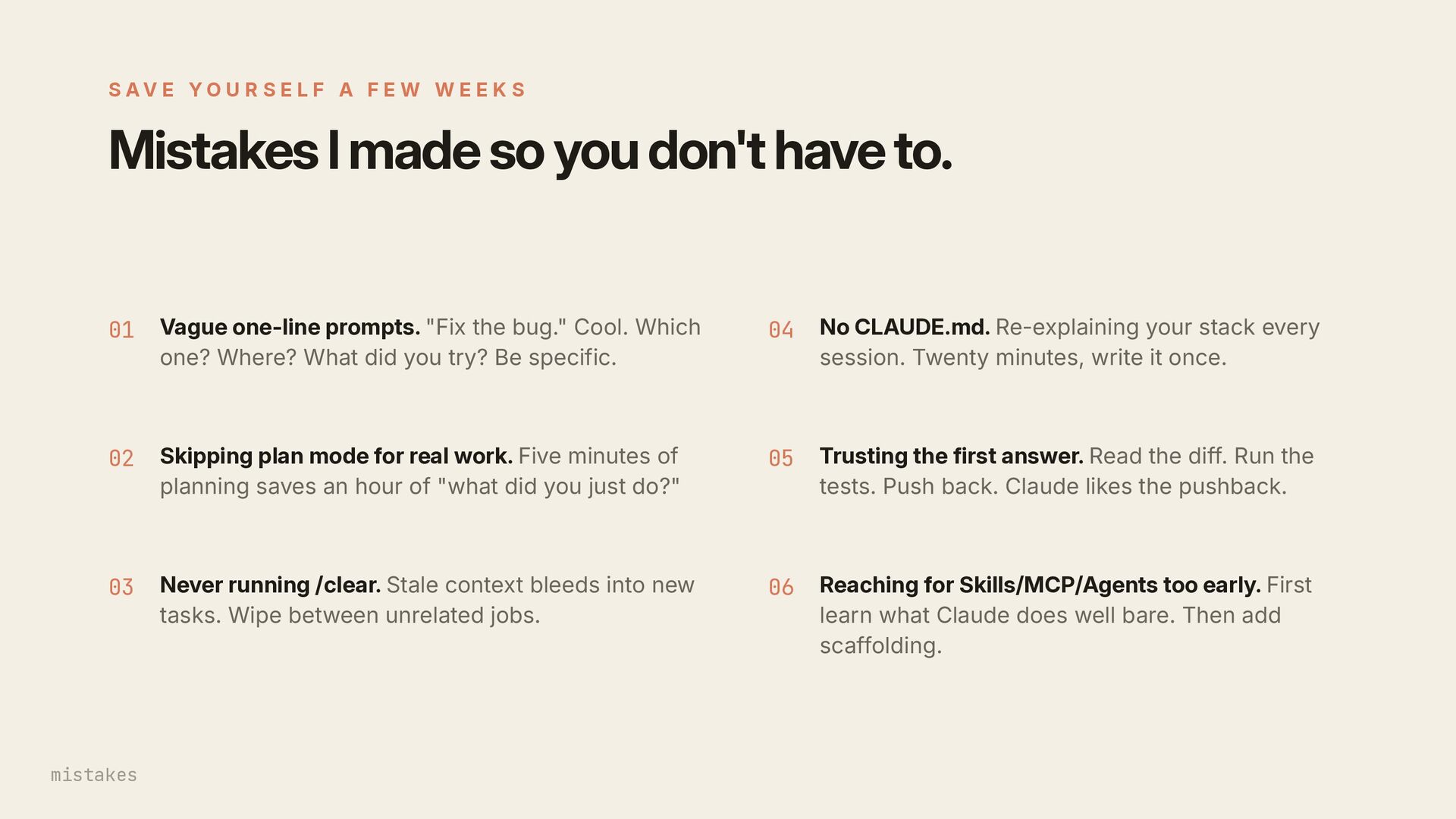
  50. S AV E YO U R S E L F

    A F E W W E E K S Mistakes I made so you don't have to. 01 Vague one-line prompts. "Fix the bug." Cool. Which one? Where? What did you try? Be specific. 04 No CLAUDE.md. Re-explaining your stack every session. Twenty minutes, write it once. 02 Skipping plan mode for real work. Five minutes of planning saves an hour of "what did you just do?" 05 Trusting the first answer. Read the diff. Run the tests. Push back. Claude likes the pushback. 03 Never running /clear. Stale context bleeds into new tasks. Wipe between unrelated jobs. 06 Reaching for Skills/MCP/Agents too early. First learn what Claude does well bare. Then add scaffolding. mistakes