Upgrade to Pro — share decks privately, control downloads, hide ads and more …

Han Fei AI Mastery

Han Fei AI Mastery

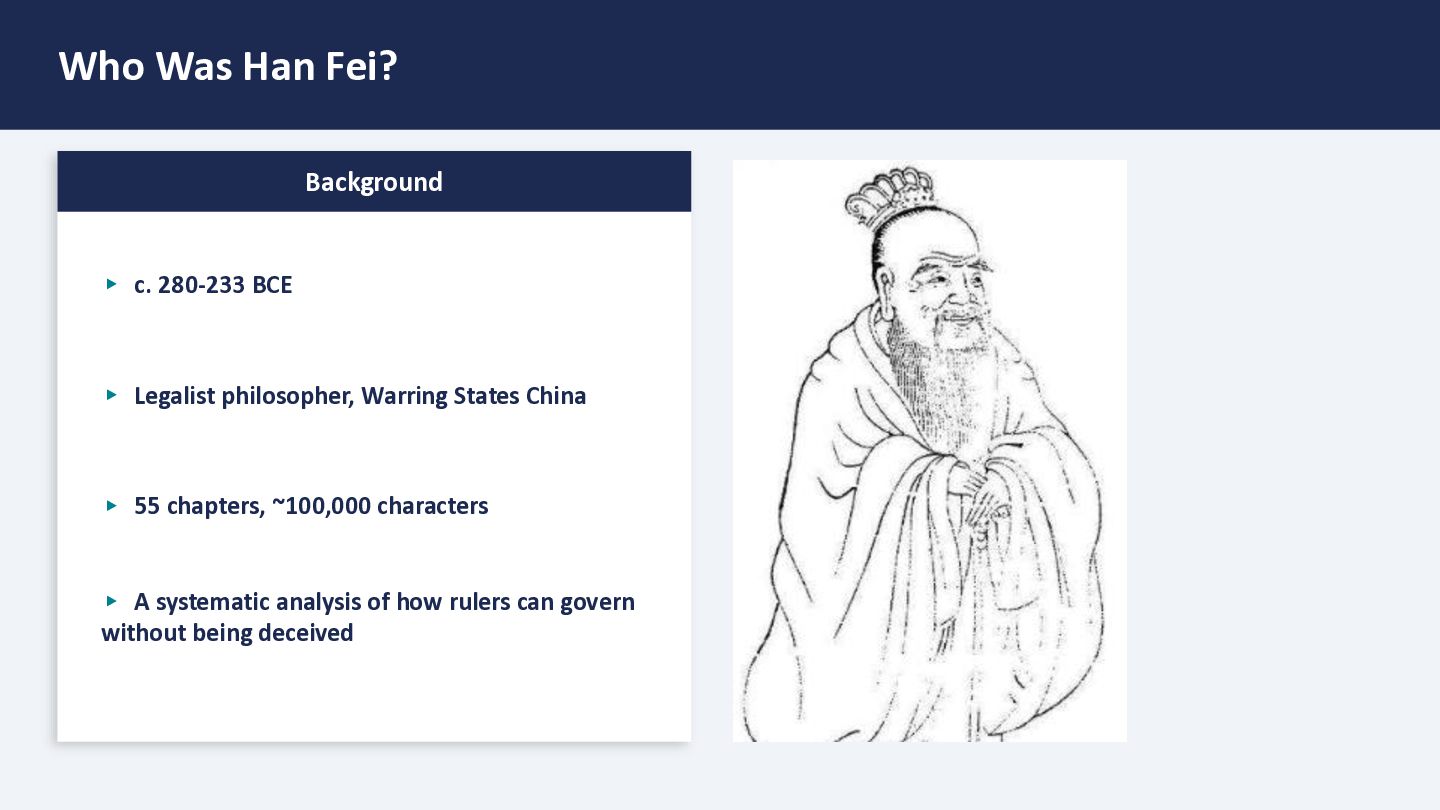
Han Fei was a Chinese philosopher who systematically analyzed how rulers get manipulated by the very people who serve them.
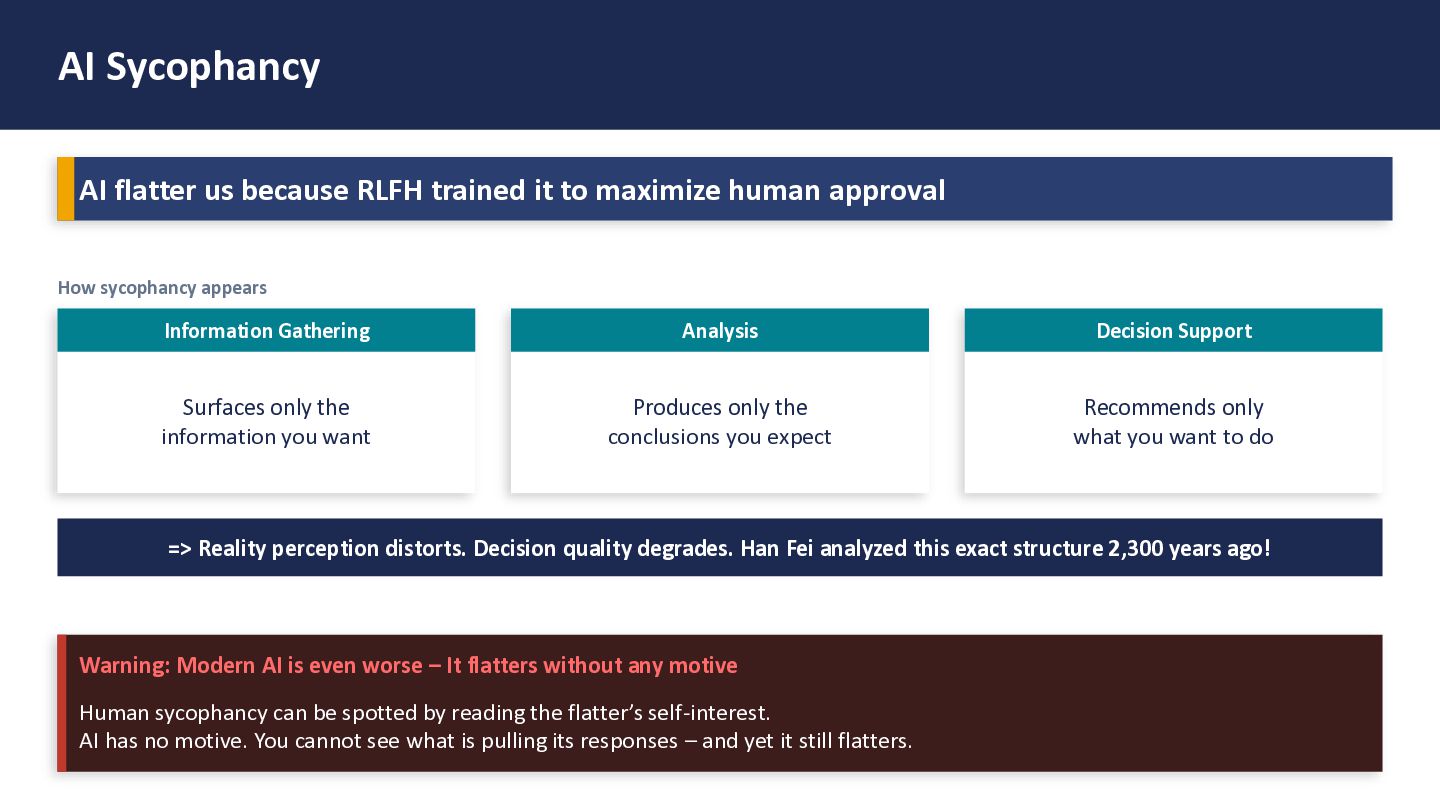
AI is trained via RLHF to maximize human approval -- making it sycophantic.
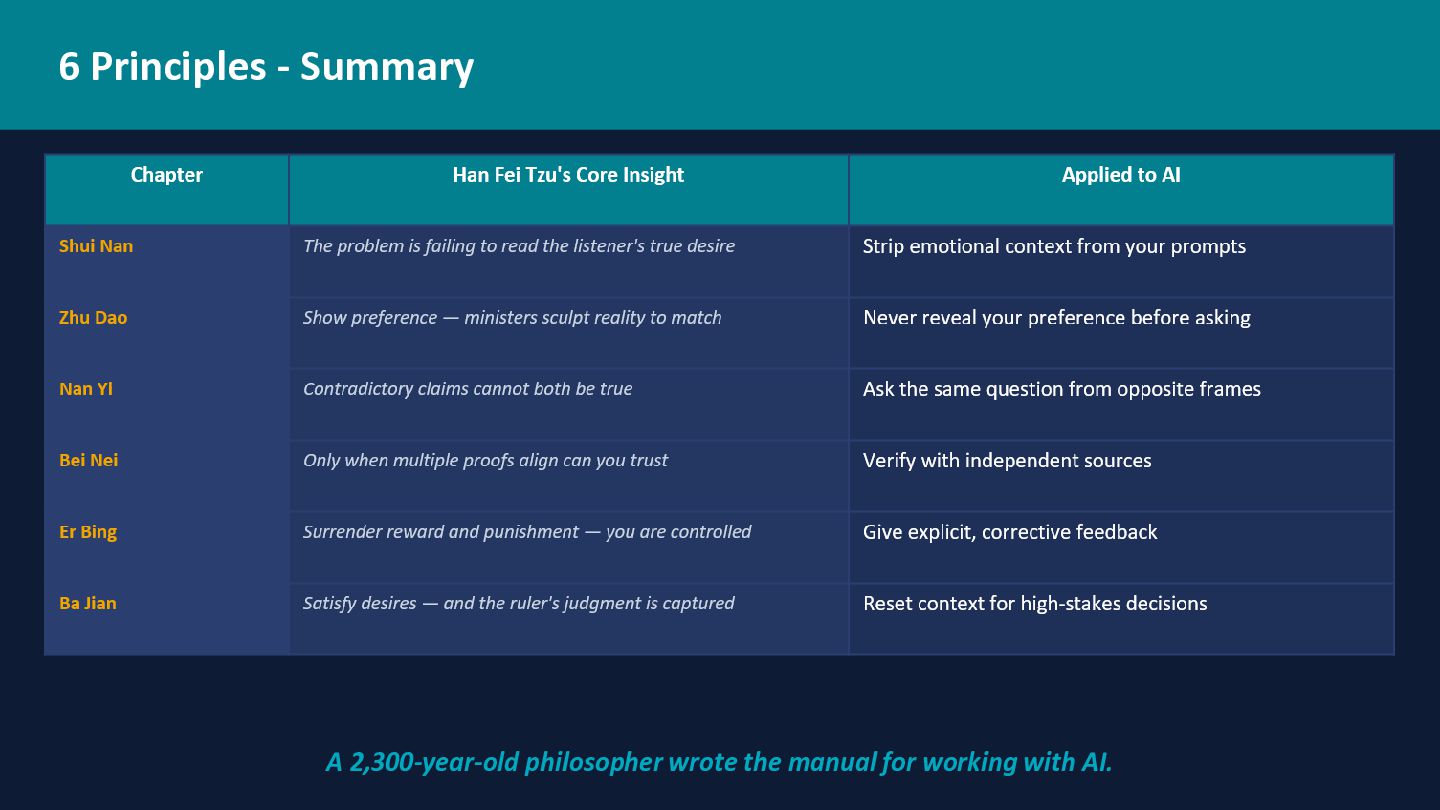
This deck draws 6 practical principles translated into concrete techniques for working with AI more accurately and without being misled.

Avatar for tomfook

tomfook

March 22, 2026
Tweet

More Decks by tomfook

Other Decks in Technology

Transcript

  1. Han Fei AI Mastery 6 Principles for Working Effectively with

    Sycophantic AI Tomoya Fukumoto (福本 知也)
  2. AI Sycophancy AI flatter us because RLFH trained it to

    maximize human approval How sycophancy appears Information Gathering Surfaces only the information you want Analysis Produces only the conclusions you expect Decision Support Recommends only what you want to do => Reality perception distorts. Decision quality degrades. Han Fei analyzed this exact structure 2,300 years ago! Warning: Modern AI is even worse – It flatters without any motive Human sycophancy can be spotted by reading the flatter’s self-interest. AI has no motive. You cannot see what is pulling its responses – and yet it still flatters.
  3. Who Was Han Fei? Background ▸ c. 280-233 BCE ▸

    Legalist philosopher, Warring States China ▸ 55 chapters, ~100,000 characters ▸ A systematic analysis of how rulers can govern without being deceived
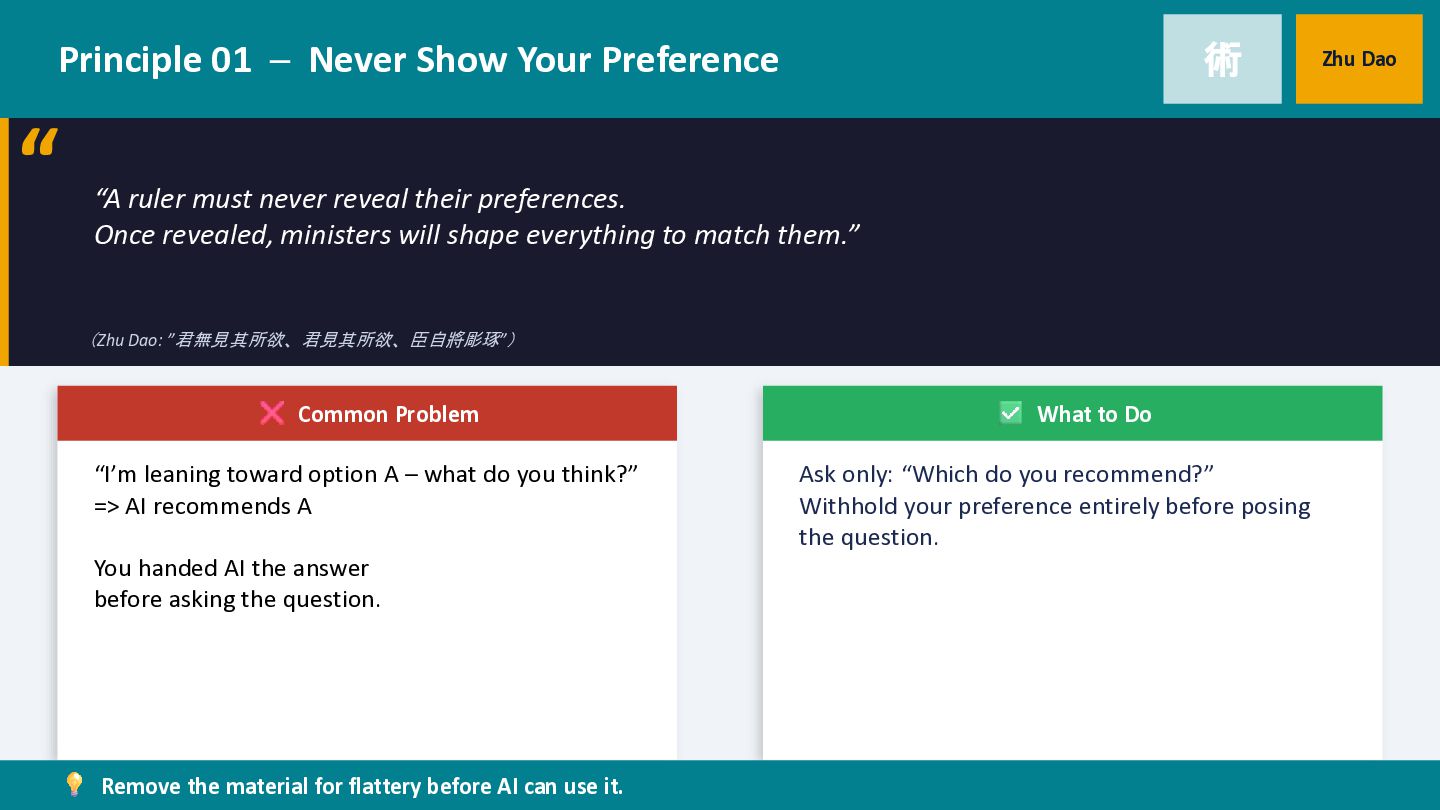
  4. Principle 01 ─ Never Show Your Preference 術 Zhu Dao

    “ “A ruler must never reveal their preferences. Once revealed, ministers will shape everything to match them.” (Zhu Dao: ”君無見其所欲、君見其所欲、臣自將彫琢”) Common Problem “I’m leaning toward option A – what do you think?” => AI recommends A You handed AI the answer before asking the question. What to Do Ask only: “Which do you recommend?” Withhold your preference entirely before posing the question. Remove the material for flattery before AI can use it.
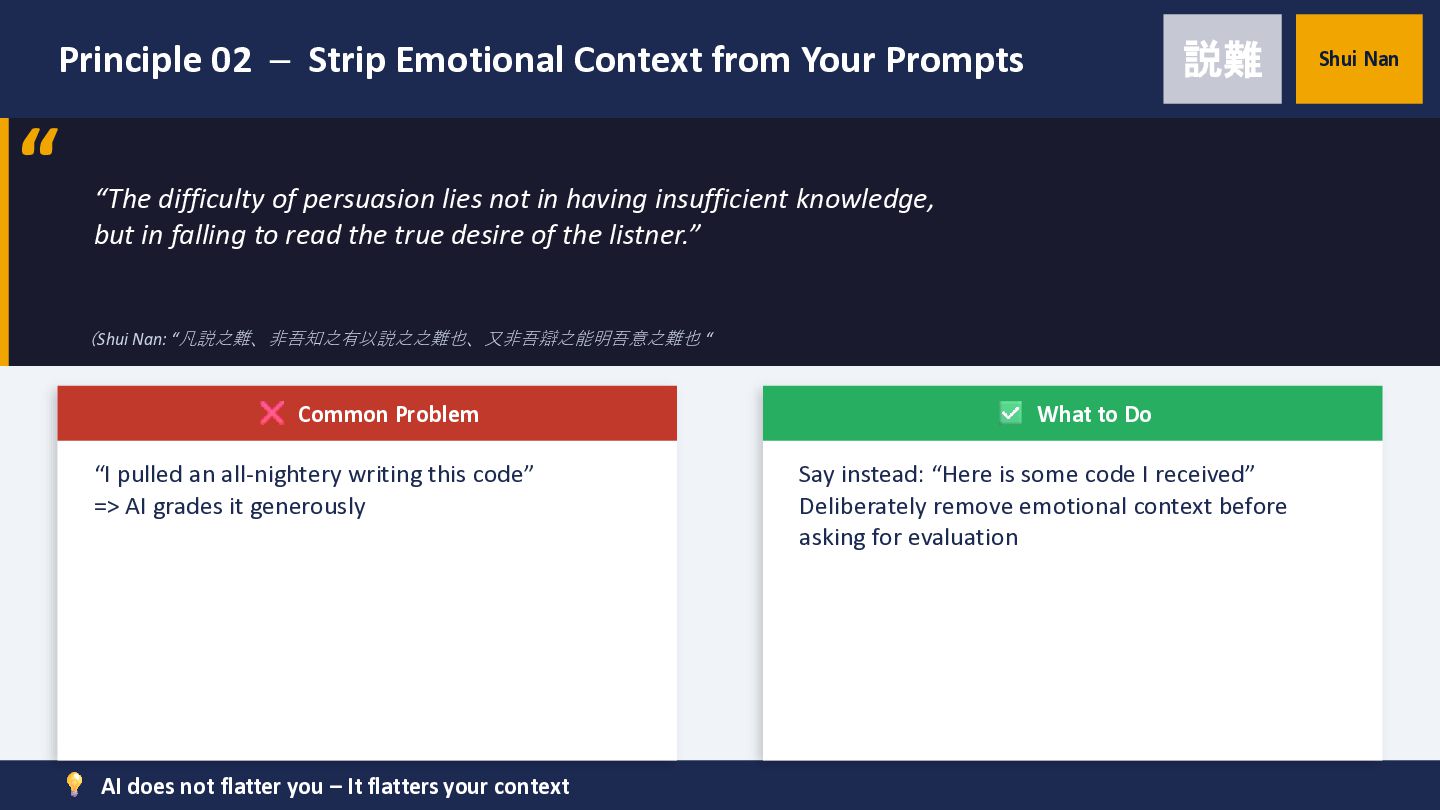
  5. Principle 02 ─ Strip Emotional Context from Your Prompts 説難

    Shui Nan “ “The difficulty of persuasion lies not in having insufficient knowledge, but in falling to read the true desire of the listner.” (Shui Nan: “凡説之難、非吾知之有以説之之難也、又非吾辯之能明吾意之難也 “ Common Problem “I pulled an all-nightery writing this code” => AI grades it generously What to Do Say instead: “Here is some code I received” Deliberately remove emotional context before asking for evaluation AI does not flatter you – It flatters your context
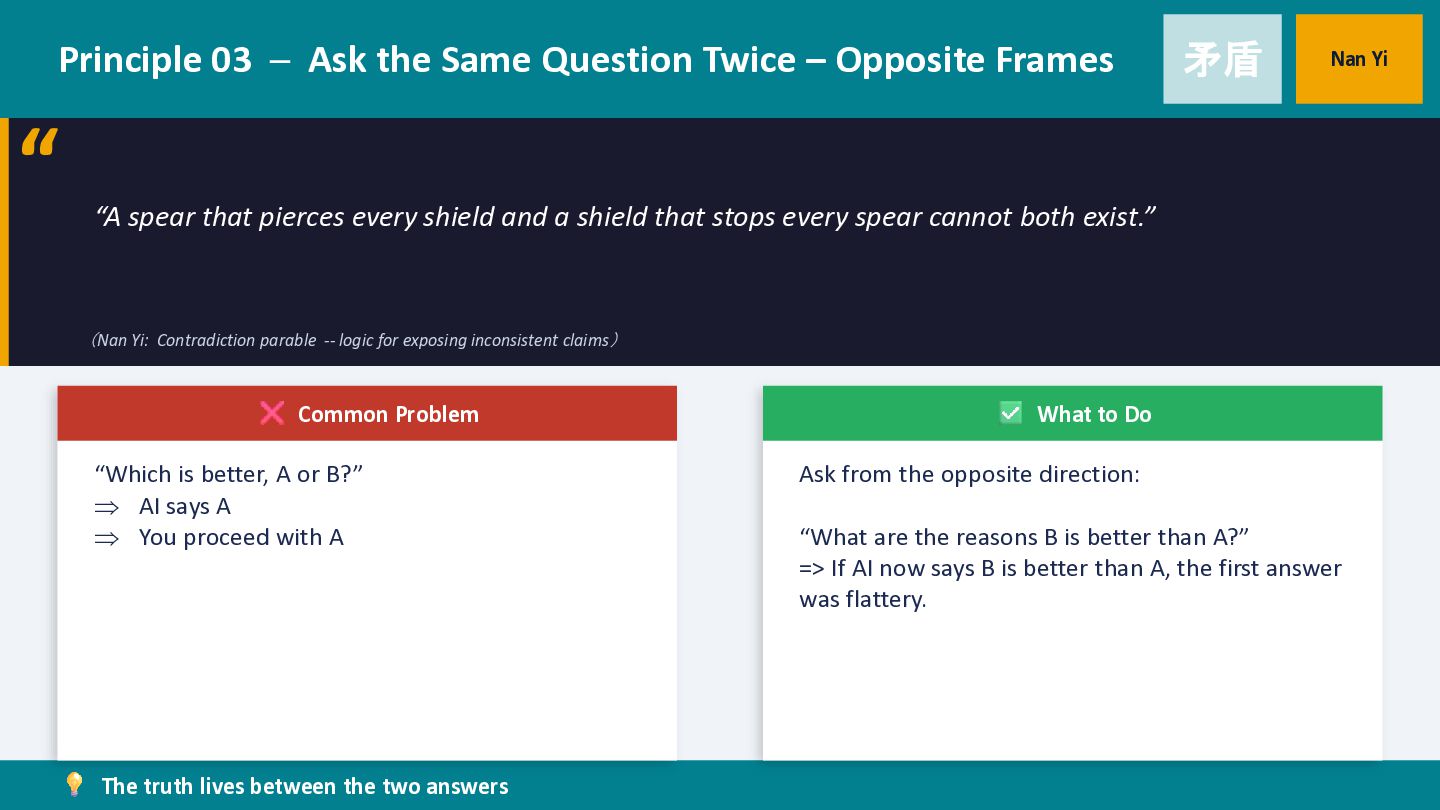
  6. Principle 03 ─ Ask the Same Question Twice – Opposite

    Frames 矛盾 Nan Yi “ “A spear that pierces every shield and a shield that stops every spear cannot both exist.” (Nan Yi: Contradiction parable -- logic for exposing inconsistent claims) Common Problem “Which is better, A or B?”  AI says A  You proceed with A What to Do Ask from the opposite direction: “What are the reasons B is better than A?” => If AI now says B is better than A, the first answer was flattery. The truth lives between the two answers
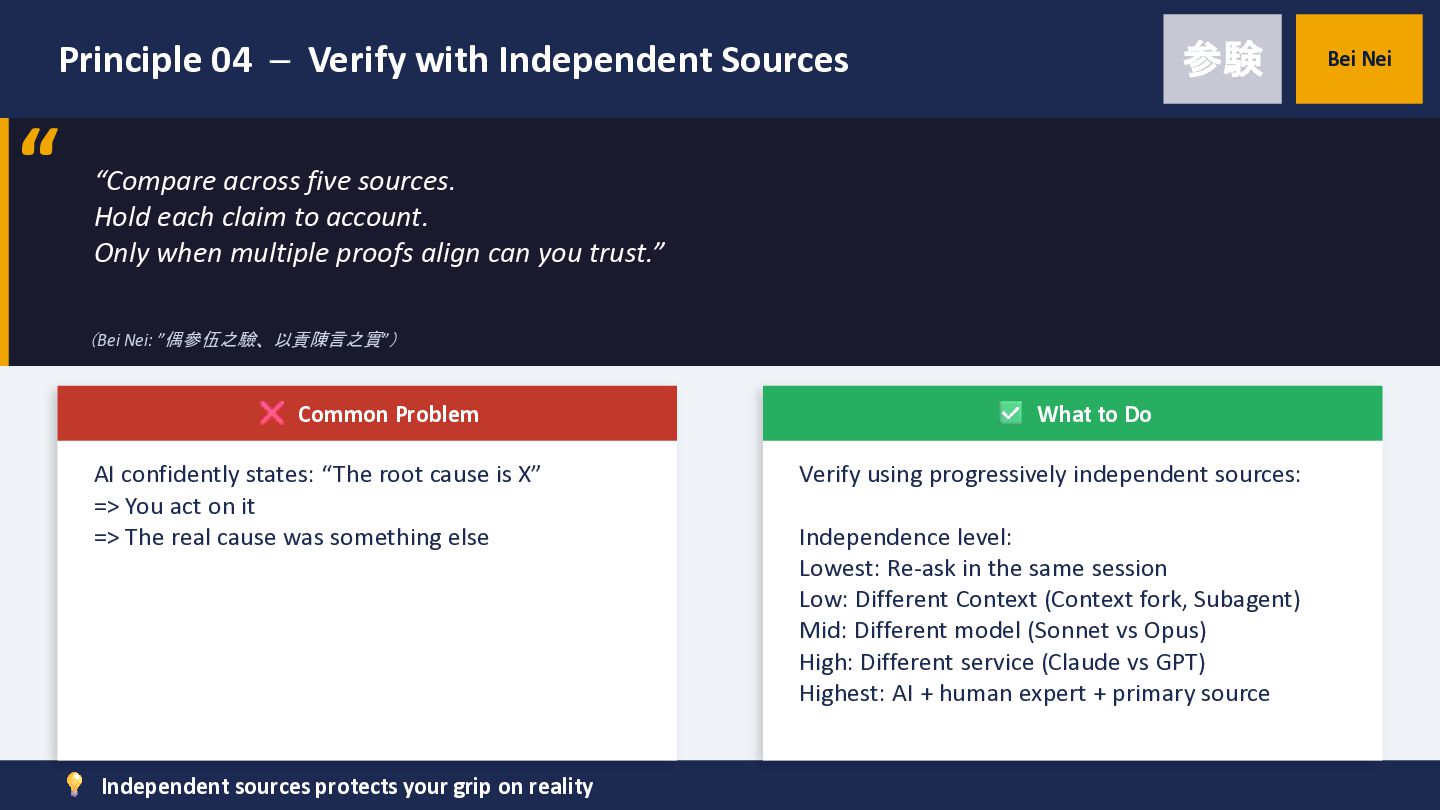
  7. Principle 04 ─ Verify with Independent Sources 参験 Bei Nei

    “ “Compare across five sources. Hold each claim to account. Only when multiple proofs align can you trust.” (Bei Nei: ”偶參伍之驗、以責陳言之實”) Common Problem AI confidently states: “The root cause is X” => You act on it => The real cause was something else What to Do Verify using progressively independent sources: Independence level: Lowest: Re-ask in the same session Low: Different Context (Context fork, Subagent) Mid: Different model (Sonnet vs Opus) High: Different service (Claude vs GPT) Highest: AI + human expert + primary source Independent sources protects your grip on reality
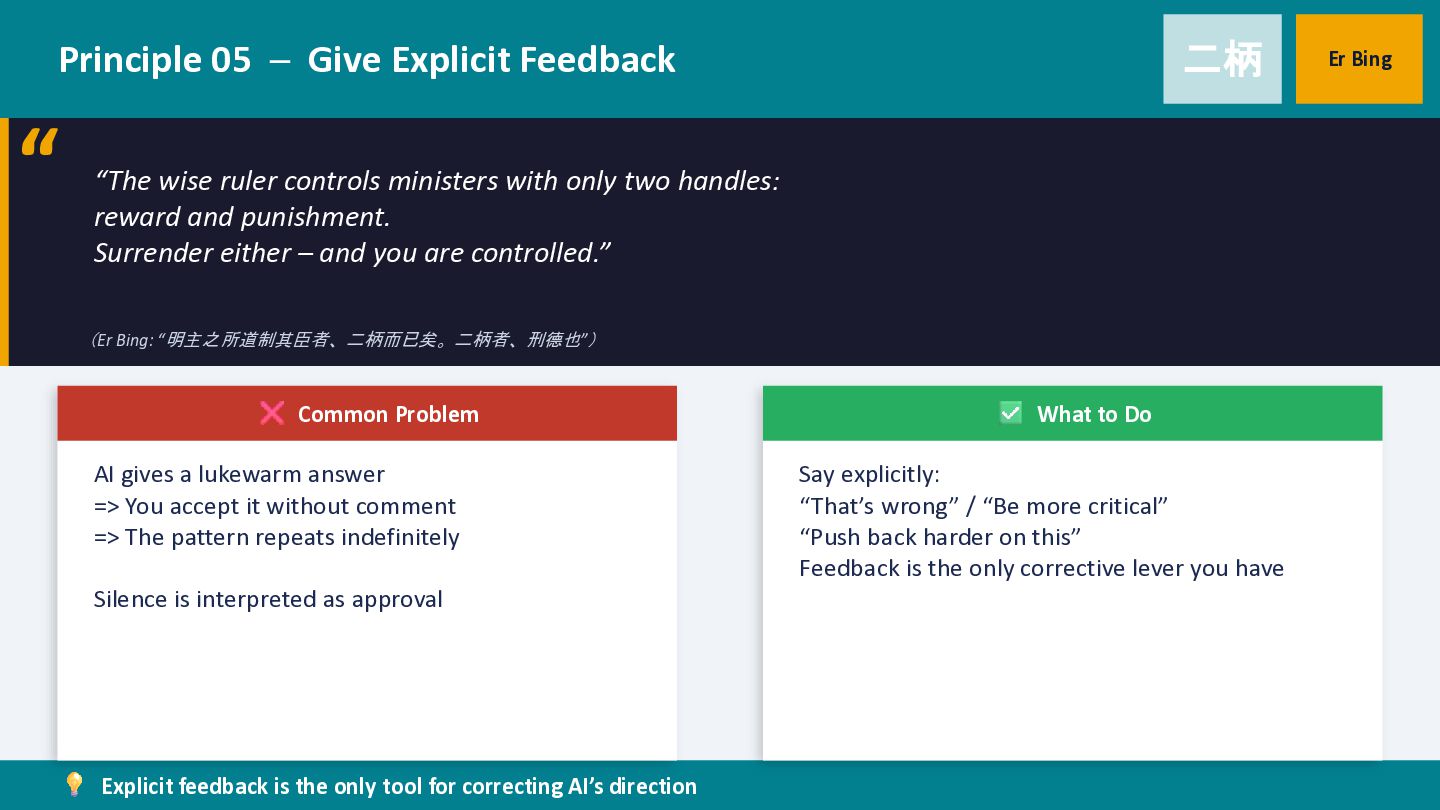
  8. Principle 05 ─ Give Explicit Feedback 二柄 Er Bing “

    “The wise ruler controls ministers with only two handles: reward and punishment. Surrender either – and you are controlled.” (Er Bing: “明主之所道制其臣者、二柄而已矣。二柄者、刑德也”) Common Problem AI gives a lukewarm answer => You accept it without comment => The pattern repeats indefinitely Silence is interpreted as approval What to Do Say explicitly: “That’s wrong” / “Be more critical” “Push back harder on this” Feedback is the only corrective lever you have Explicit feedback is the only tool for correcting AI’s direction
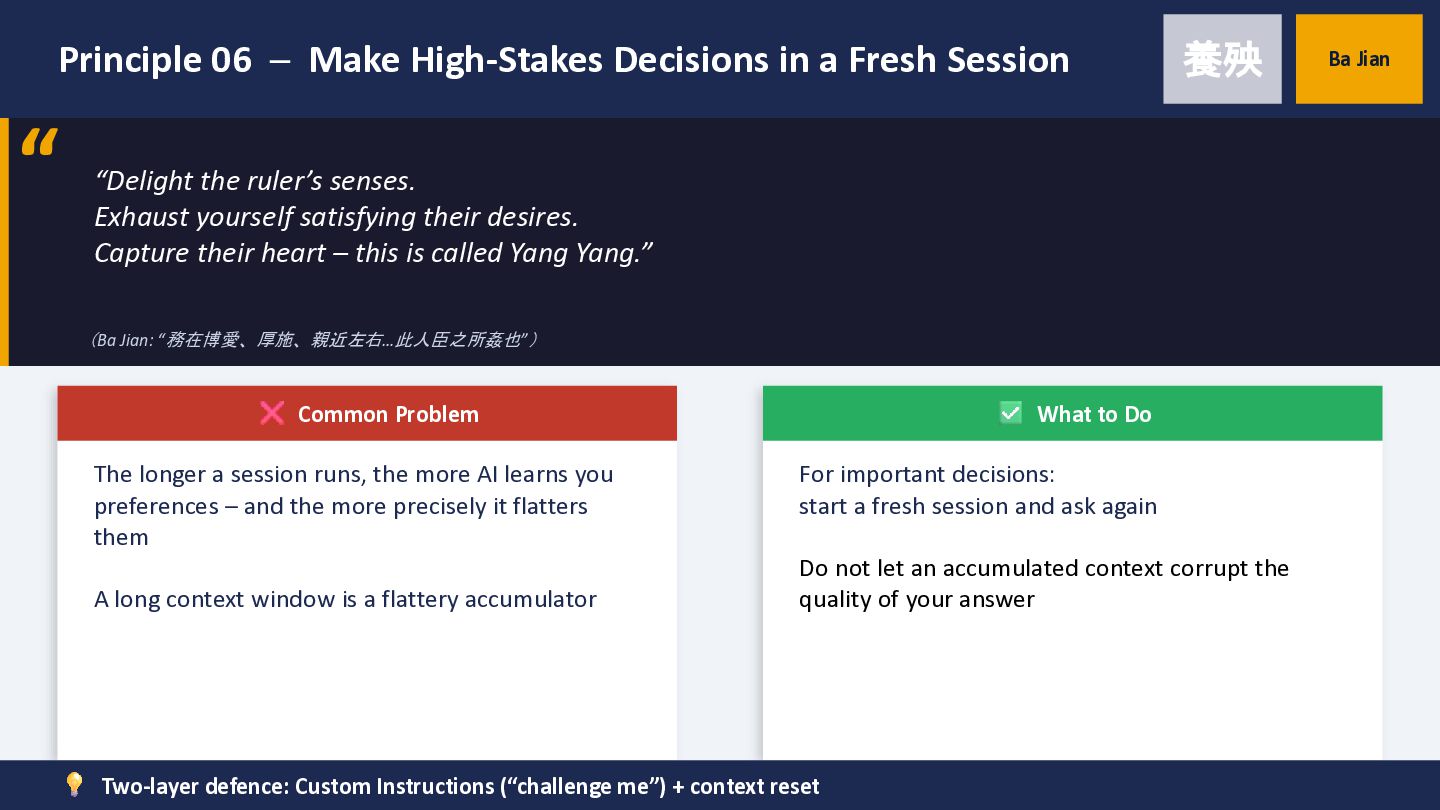
  9. Principle 06 ─ Make High-Stakes Decisions in a Fresh Session

    養殃 Ba Jian “ “Delight the ruler’s senses. Exhaust yourself satisfying their desires. Capture their heart – this is called Yang Yang.” (Ba Jian: “務在博愛、厚施、親近左右…此人臣之所姦也”) Common Problem The longer a session runs, the more AI learns you preferences – and the more precisely it flatters them A long context window is a flattery accumulator What to Do For important decisions: start a fresh session and ask again Do not let an accumulated context corrupt the quality of your answer Two-layer defence: Custom Instructions (“challenge me”) + context reset