Share
Embed

Transcript
61 slides
-
About Me • Android Dev & Technical Advocate at Woowa
Bros Delivery Hero) • 7 years of Experience with Android and Kotlin Multiplatform • Developer Community Organizer GDG Korea Android) LinkedIn Gmail linkedin.com/in/wisemuji [email protected] -
Before We Start - An Android developer's perspective (iOS beginner)
- This talk is for those already using, or about to use KMP on iOS. - Weʼll skip the docs and focus on what broke and how we fixed it. - Better ideas? Let's discuss! -
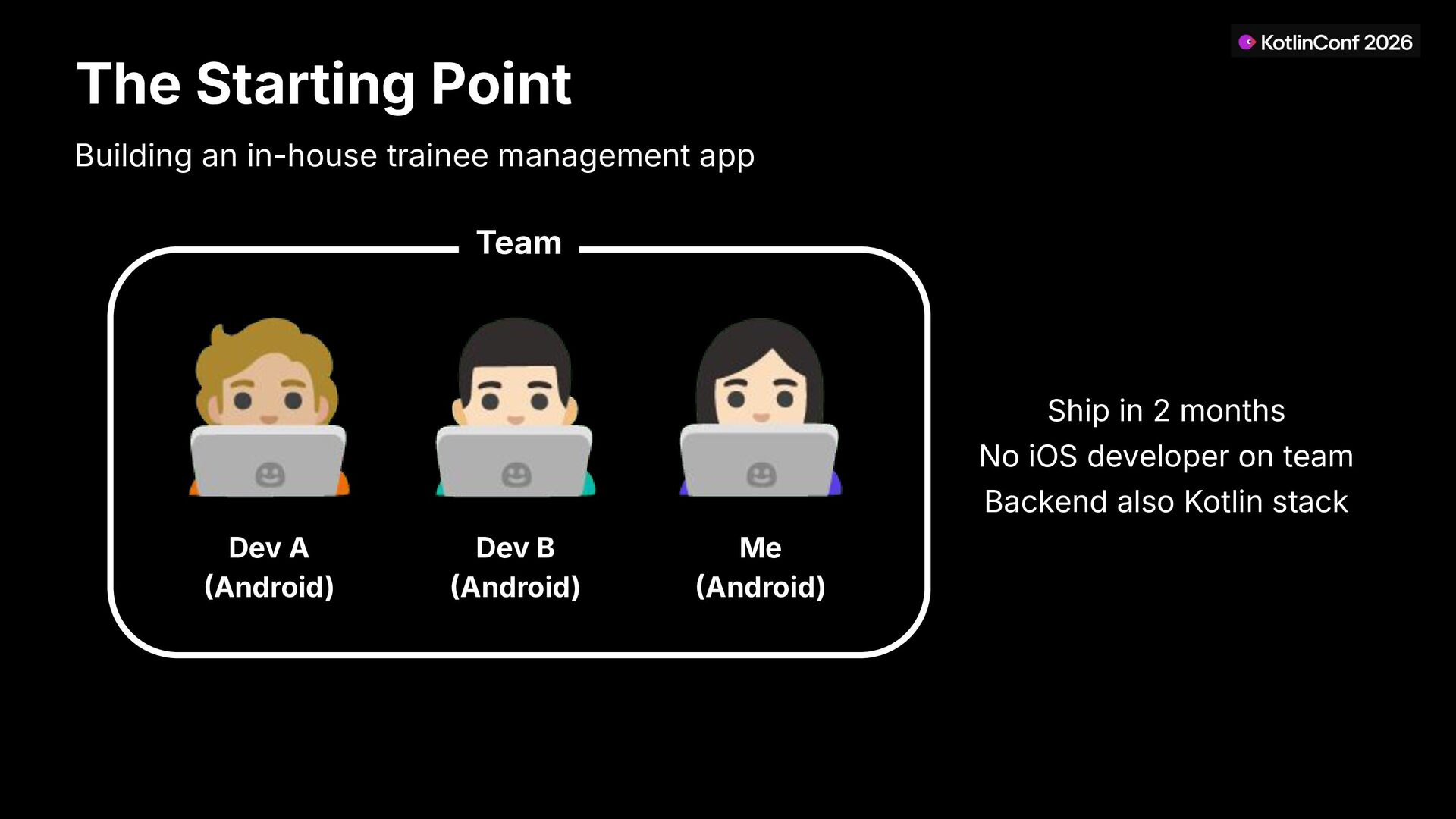
The Starting Point Building an in-house trainee management app Team
Dev A Android) Dev B Android) Me Android) Ship in 2 months No iOS developer on team Backend also Kotlin stack -
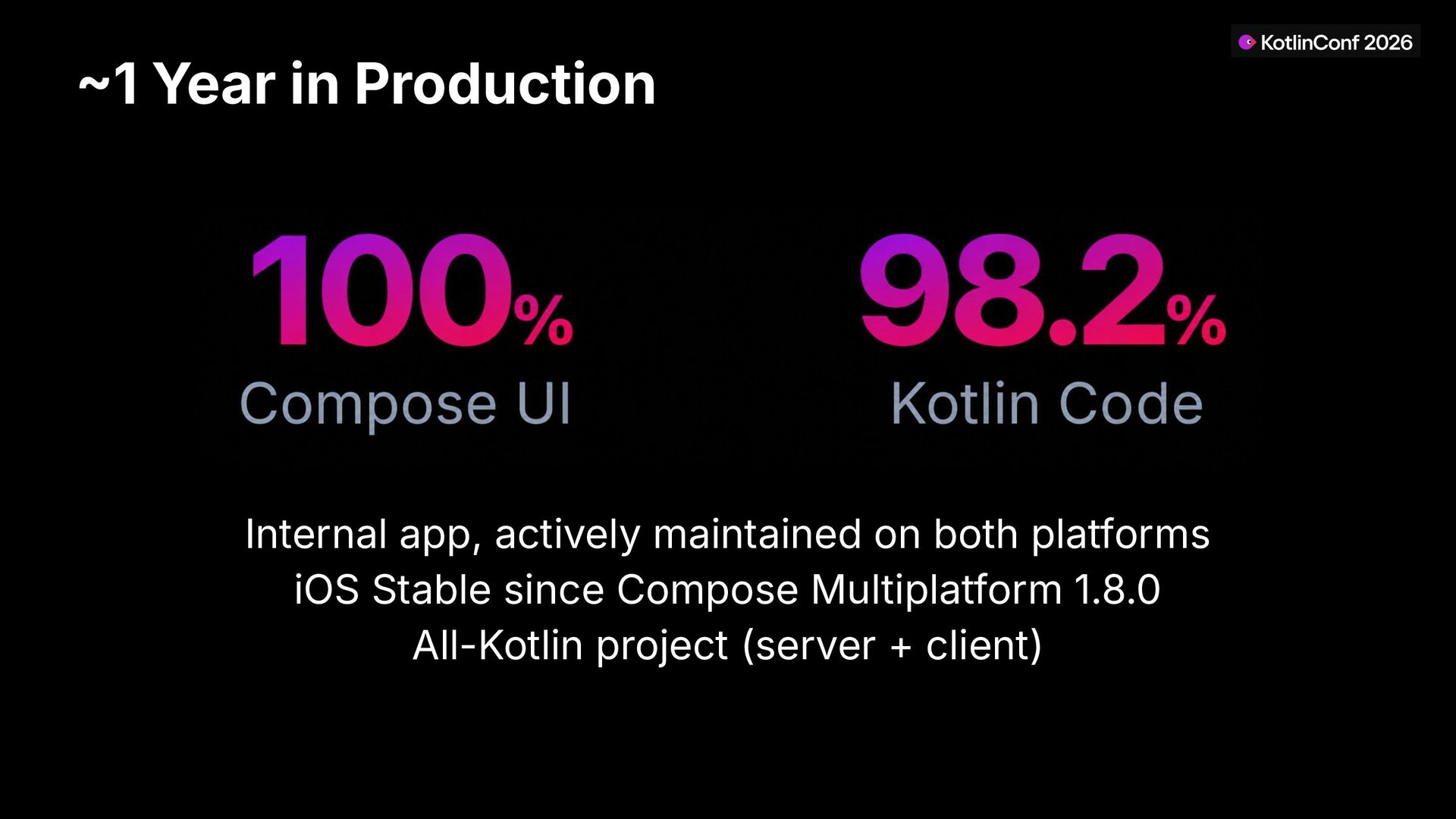
1 Year in Production Internal app, actively maintained on both
platforms iOS Stable since Compose Multiplatform 1.8.0 All-Kotlin project (server + client) -
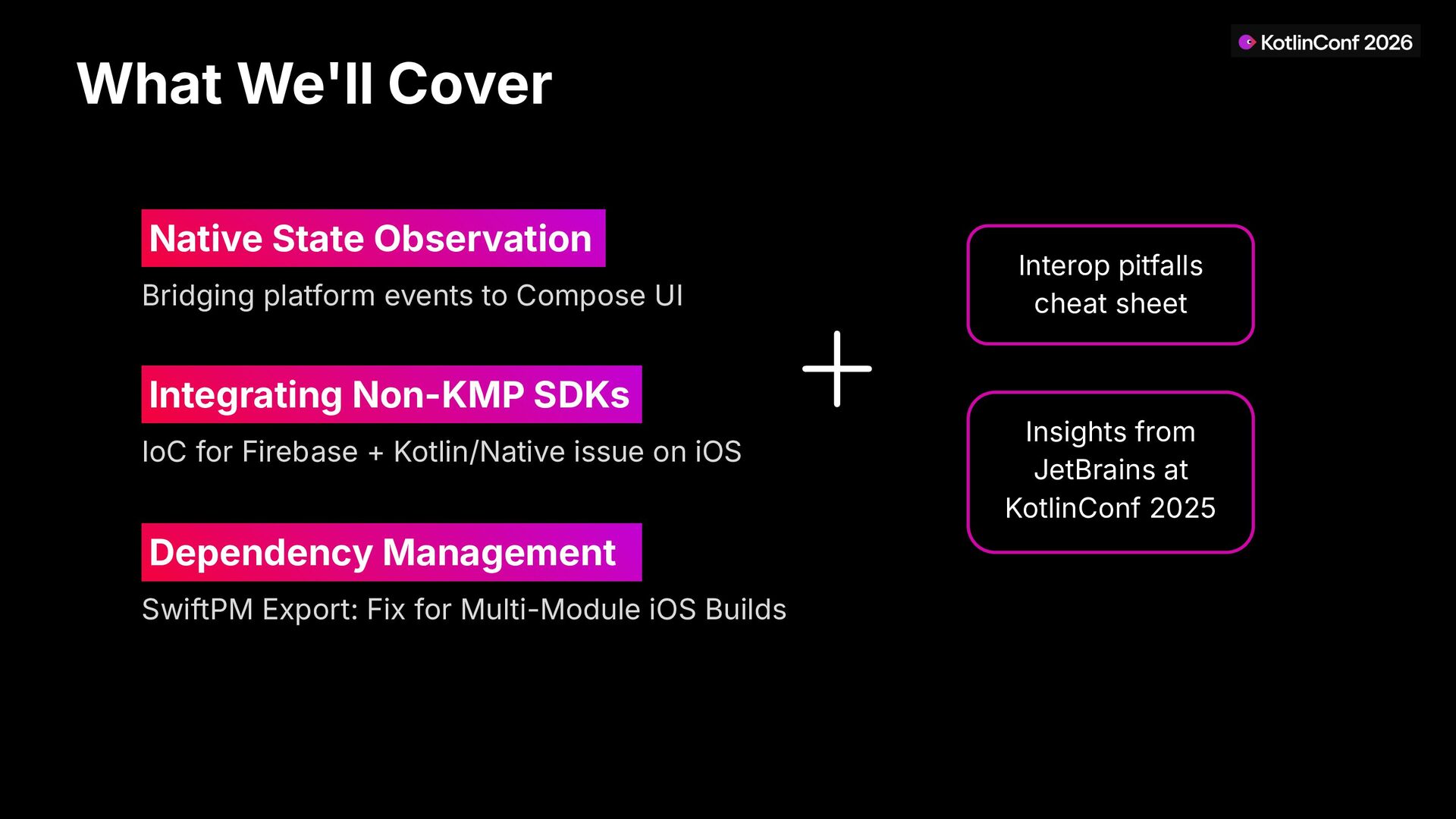
What We'll Cover Native State Observation Bridging platform events to
Compose UI Integrating Non-KMP SDKs IoC for Firebase + Kotlin/Native issue on iOS Dependency Management SwiftPM Export: Fix for Multi-Module iOS Builds + Interop pitfalls cheat sheet Insights from JetBrains at KotlinConf 2025 -
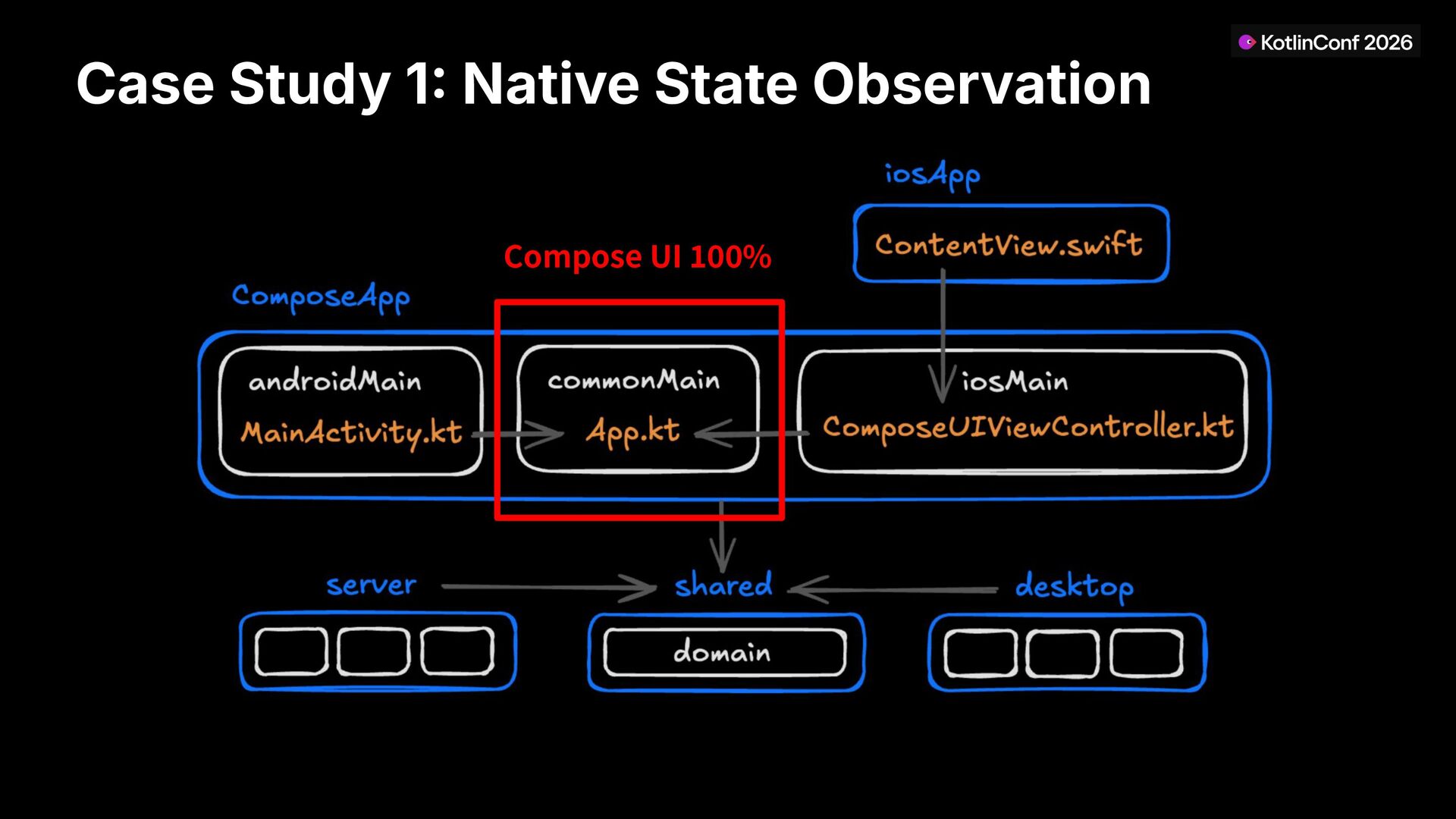
Case Study 1 Native State Observation Bridging platform-specific changes to
shared Kotlin logic -
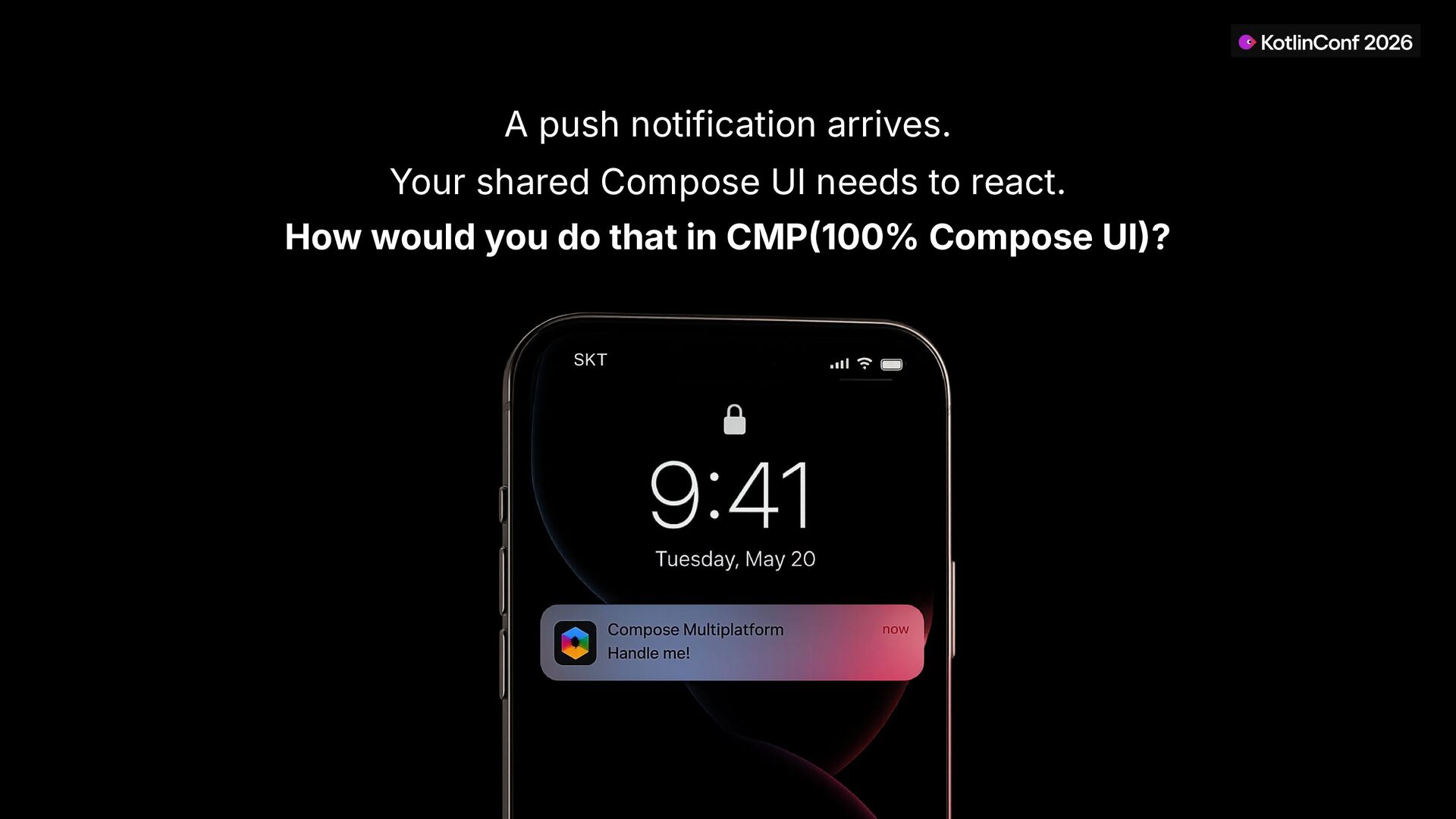
A push notification arrives. Your shared Compose UI needs to
react. How would you do that in CMP100% Compose UI? -
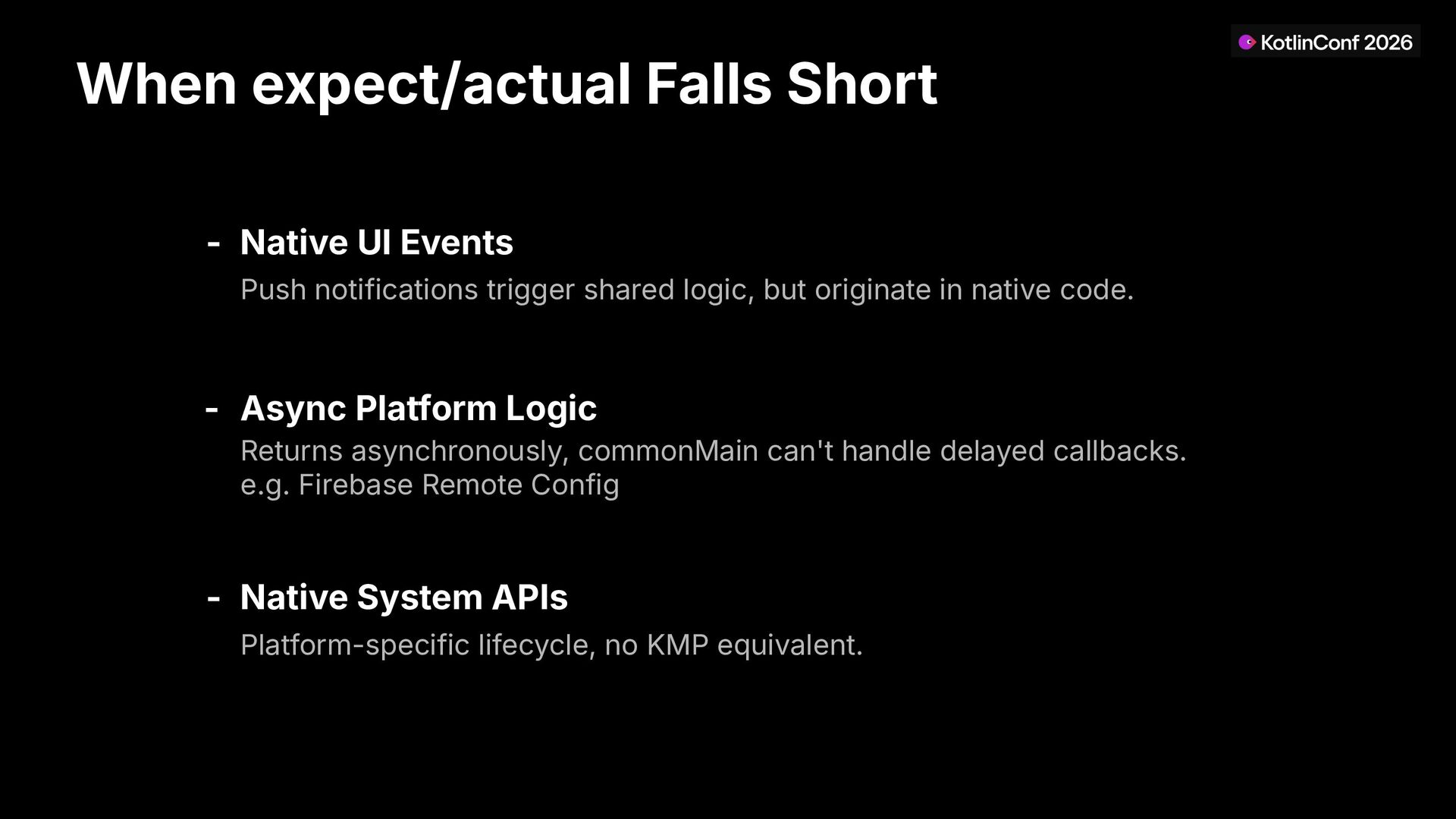
When expect/actual Falls Short - Native UI Events Push notifications
trigger shared logic, but originate in native code. - Async Platform Logic Returns asynchronously, commonMain can't handle delayed callbacks. e.g. Firebase Remote Config - Native System APIs Platform-specific lifecycle, no KMP equivalent. -
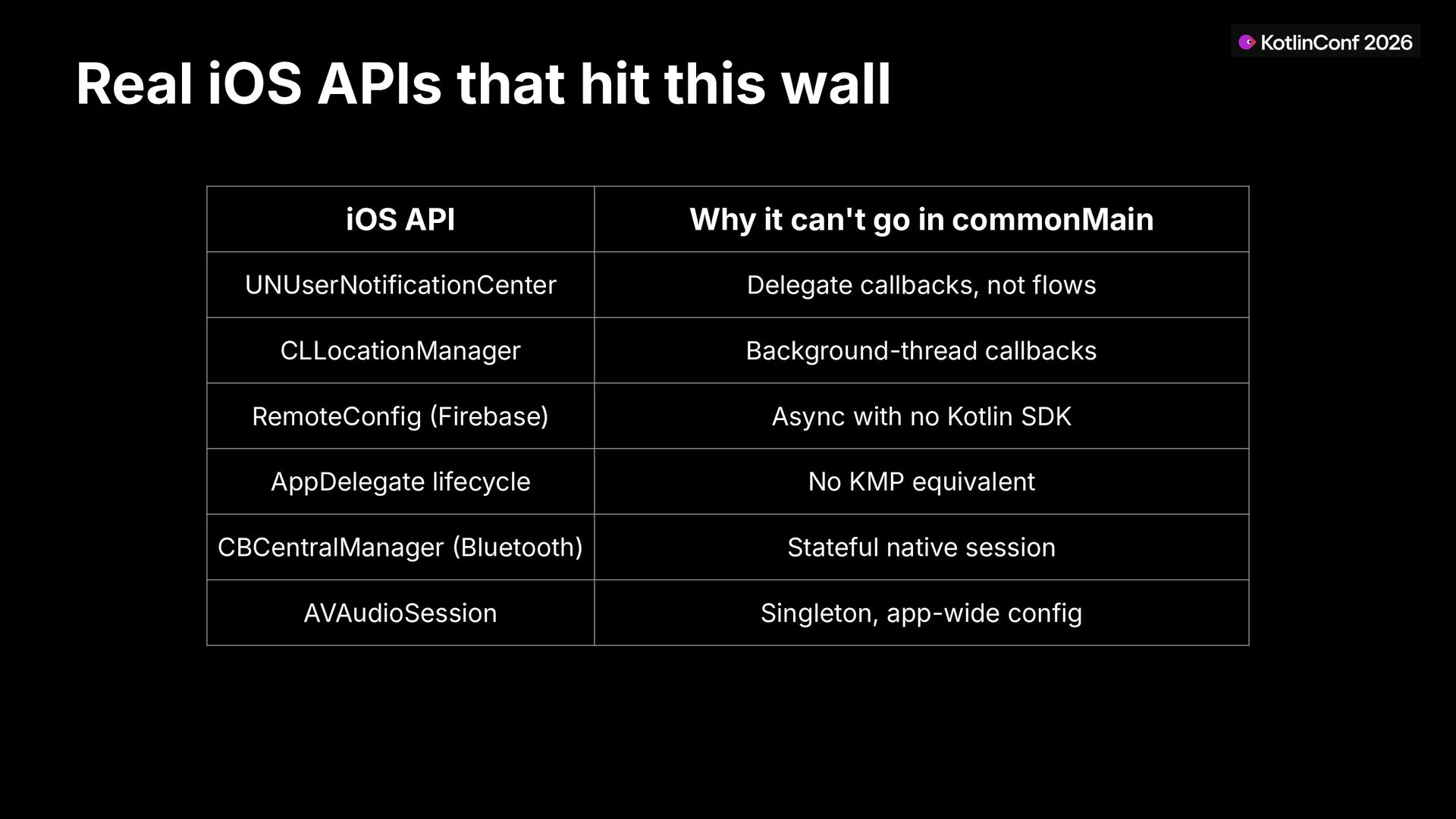
Real iOS APIs that hit this wall iOS API Why
it can't go in commonMain UNUserNotificationCenter Delegate callbacks, not flows CLLocationManager Background-thread callbacks RemoteConfig Firebase) Async with no Kotlin SDK AppDelegate lifecycle No KMP equivalent CBCentralManager Bluetooth) Stateful native session AVAudioSession Singleton, app-wide config -
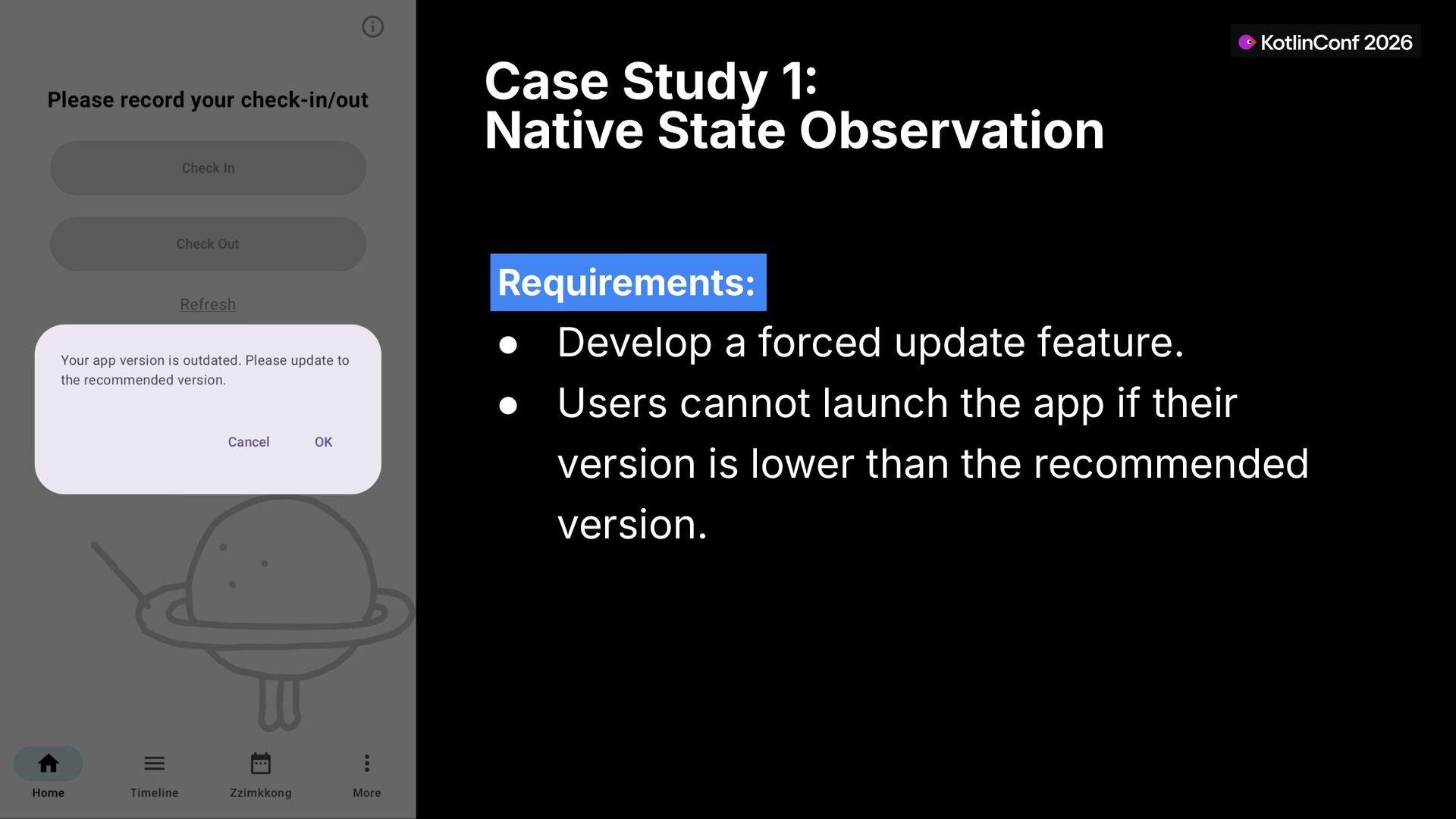
Case Study 1 Native State Observation Requirements: • Develop a
forced update feature. • Users cannot launch the app if their version is lower than the recommended version. -
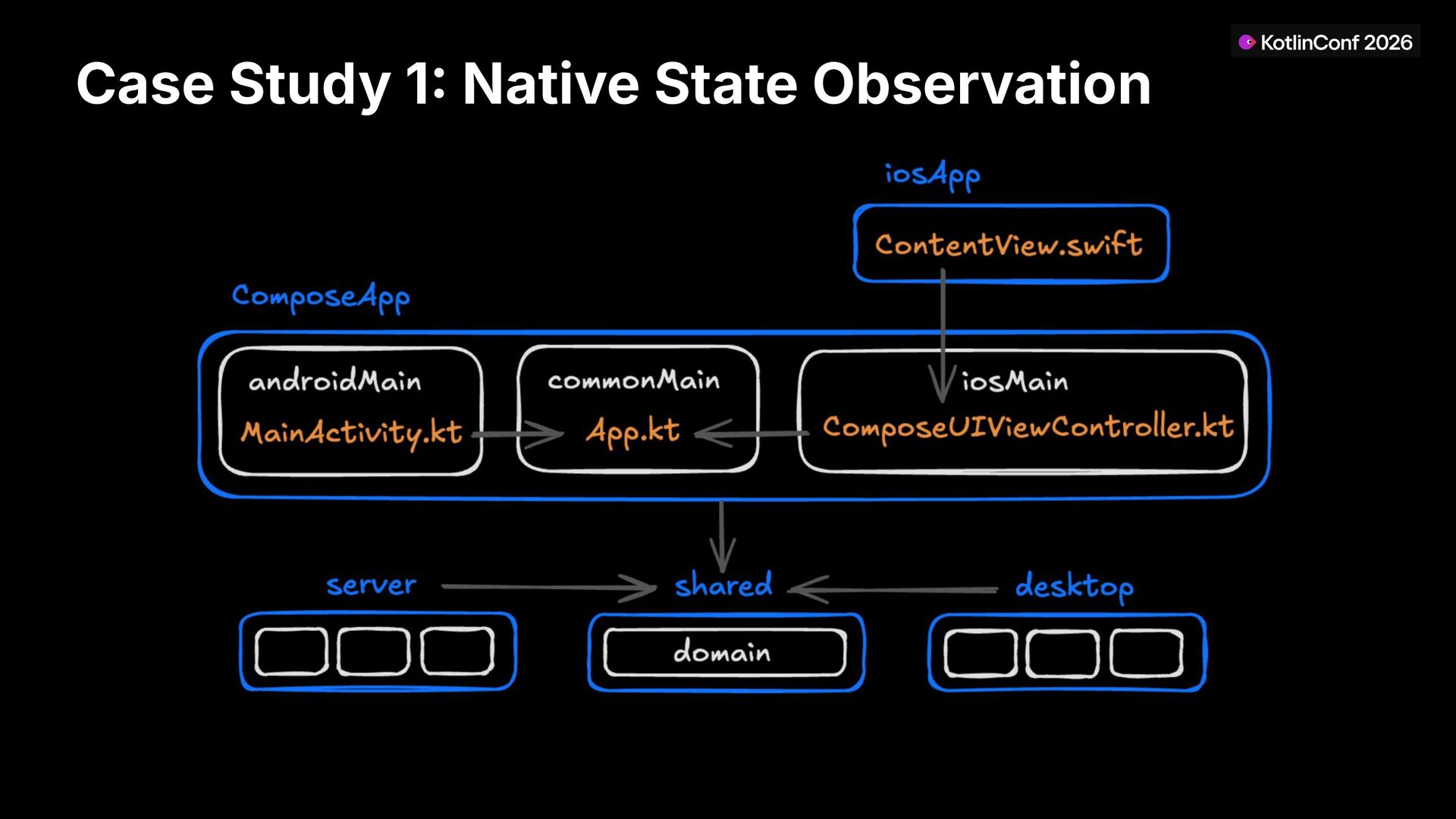
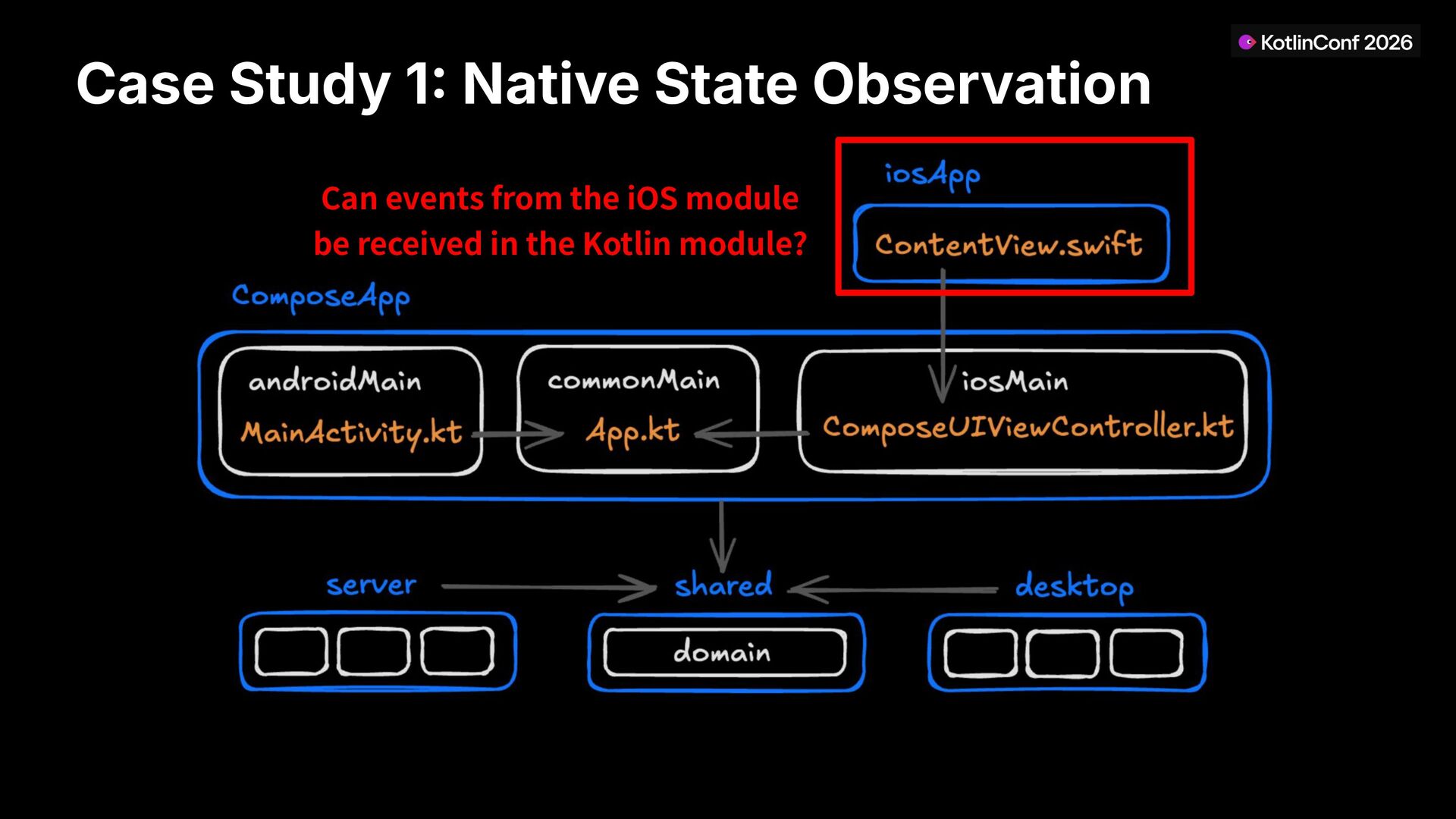
Case Study 1 Native State Observation Can events from the
iOS module be received in the Kotlin module? -
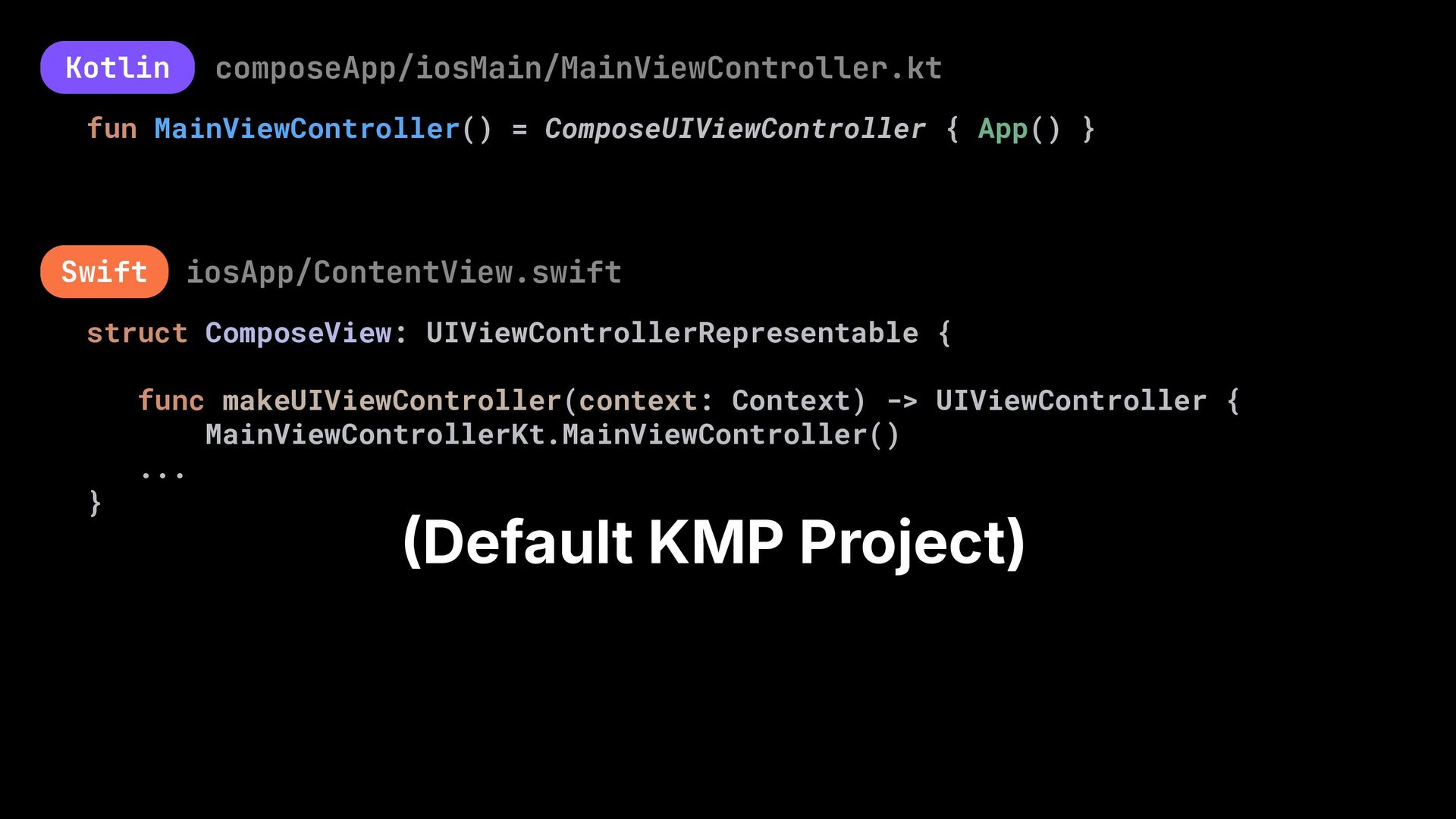
Kotlin composeApp/iosMain/MainViewController.kt fun MainViewController() = ComposeUIViewController { App() } Swift
iosApp/ContentView.swift struct ComposeView: UIViewControllerRepresentable { } func makeUIViewController(context: Context) -> UIViewController { MainViewControllerKt.MainViewController() ... Default KMP Project) -
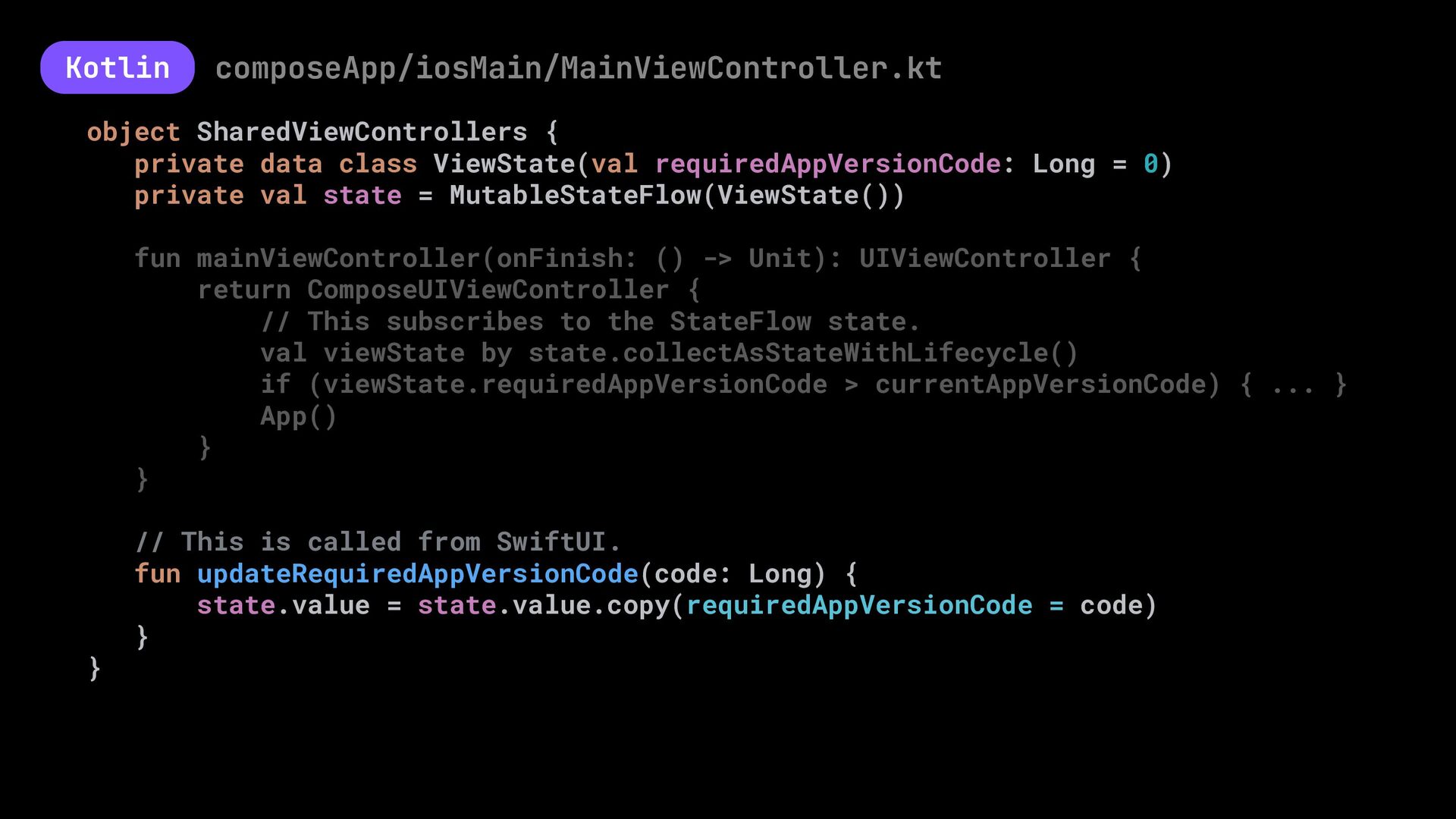
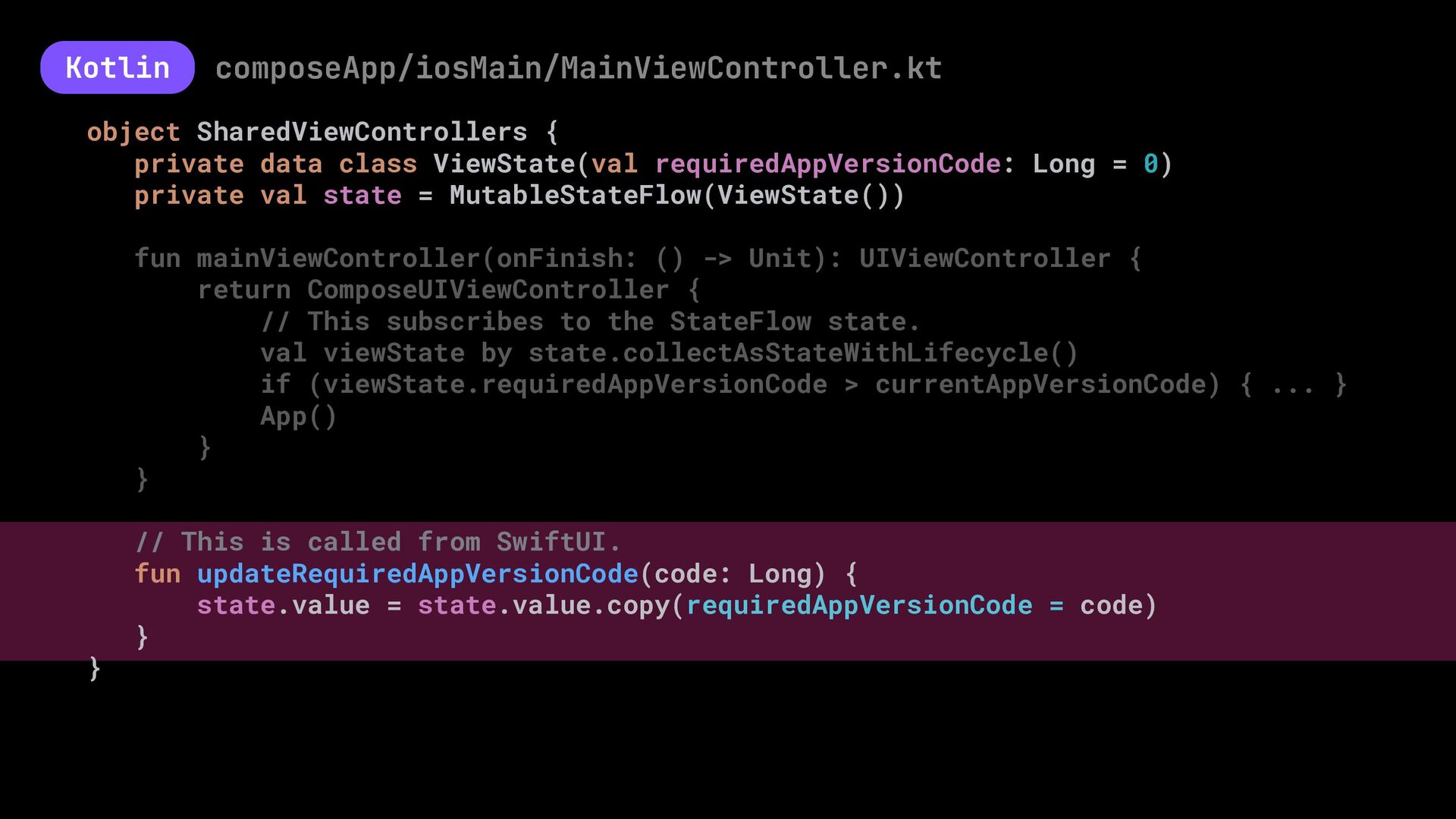
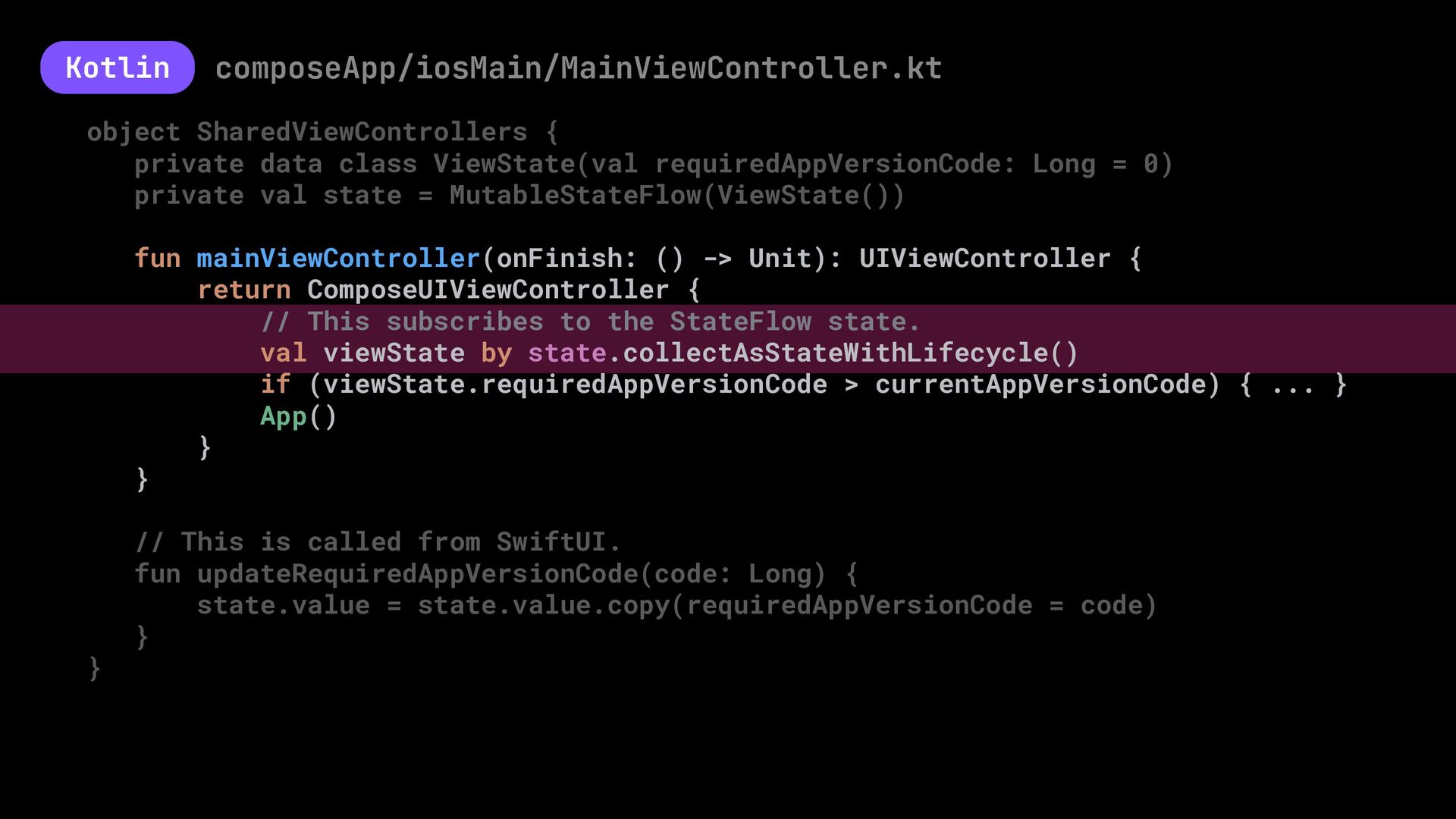
Kotlin composeApp/iosMain/MainViewController.kt object SharedViewControllers { private data class ViewState(val requiredAppVersionCode:
Long = 0) private val state = MutableStateFlow(ViewState()) fun mainViewController(onFinish: () -> Unit): UIViewController { return ComposeUIViewController { // This subscribes to the StateFlow state. val viewState by state.collectAsStateWithLifecycle() if (viewState.requiredAppVersionCode > currentAppVersionCode) { ... } App() } } } // This is called from SwiftUI. fun updateRequiredAppVersionCode(code: Long) { state.value = state.value.copy(requiredAppVersionCode = code) } -
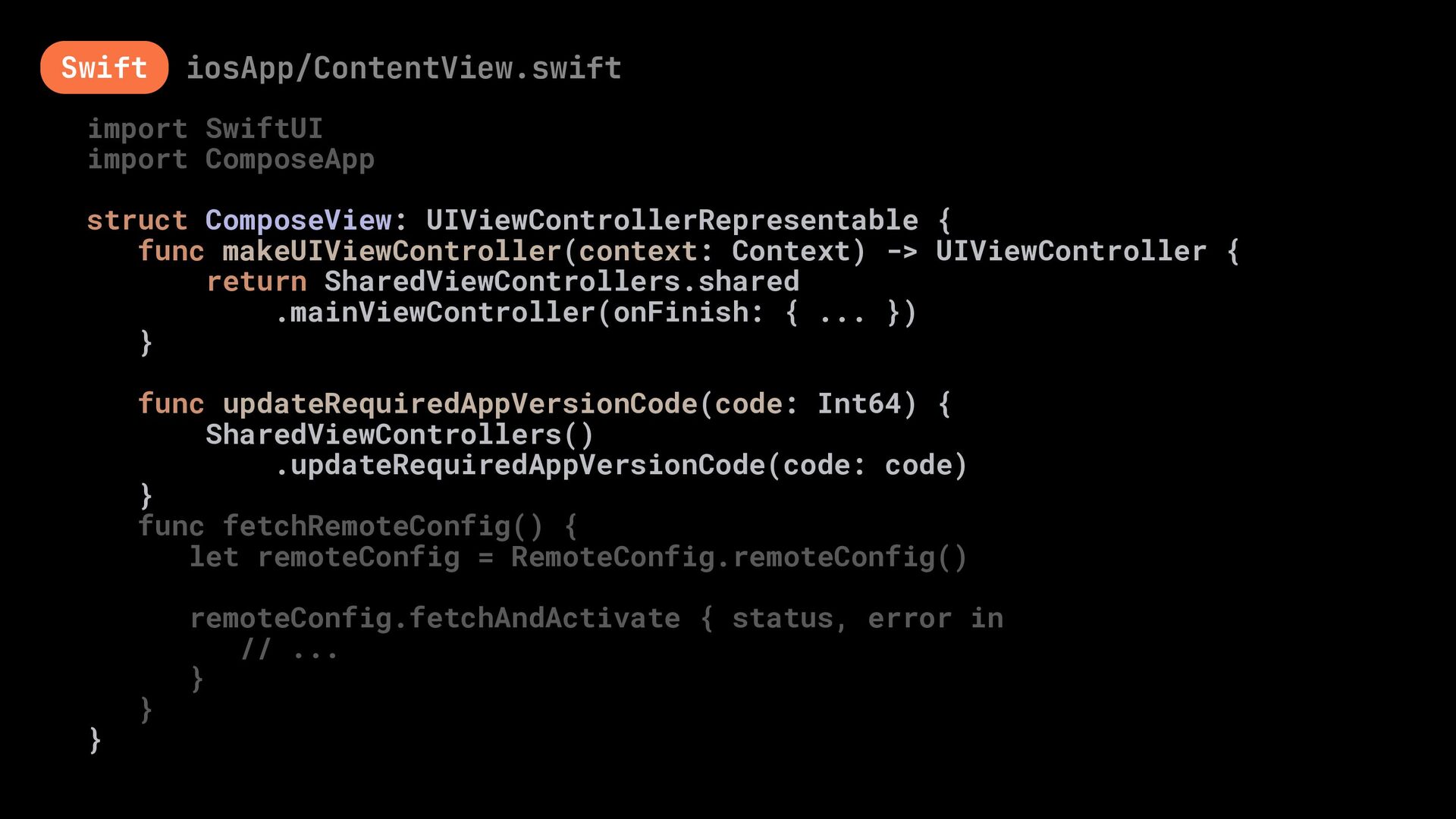
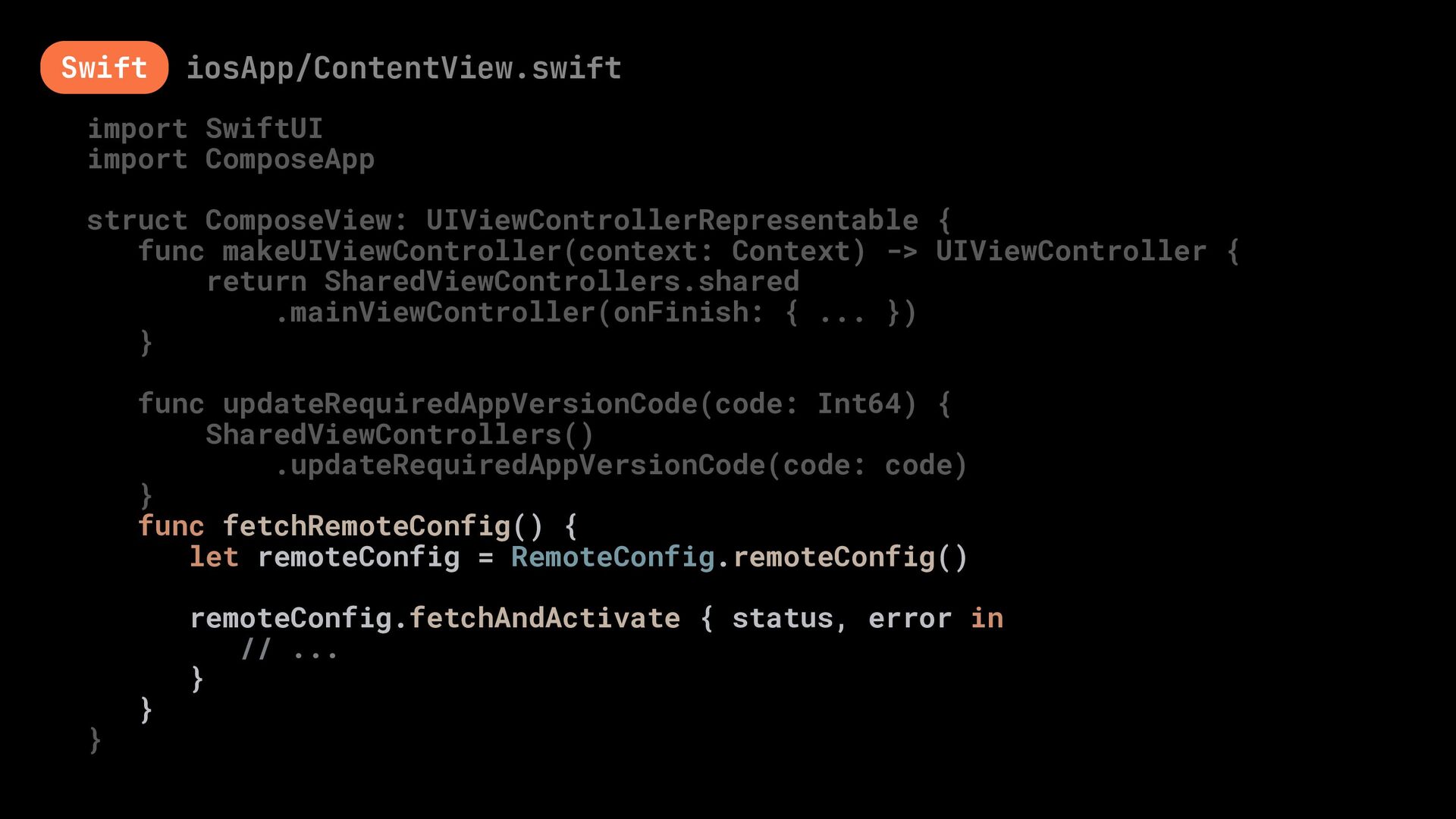
Swift iosApp/ContentView.swift import SwiftUI import ComposeApp struct ComposeView: UIViewControllerRepresentable {
func makeUIViewController(context: Context) -> UIViewController { return SharedViewControllers.shared .mainViewController(onFinish: { ... }) } func updateRequiredAppVersionCode(code: Int64) { SharedViewControllers() .updateRequiredAppVersionCode(code: code) } func fetchRemoteConfig() { let remoteConfig = RemoteConfig.remoteConfig() } } remoteConfig.fetchAndActivate { status, error in // ... } -
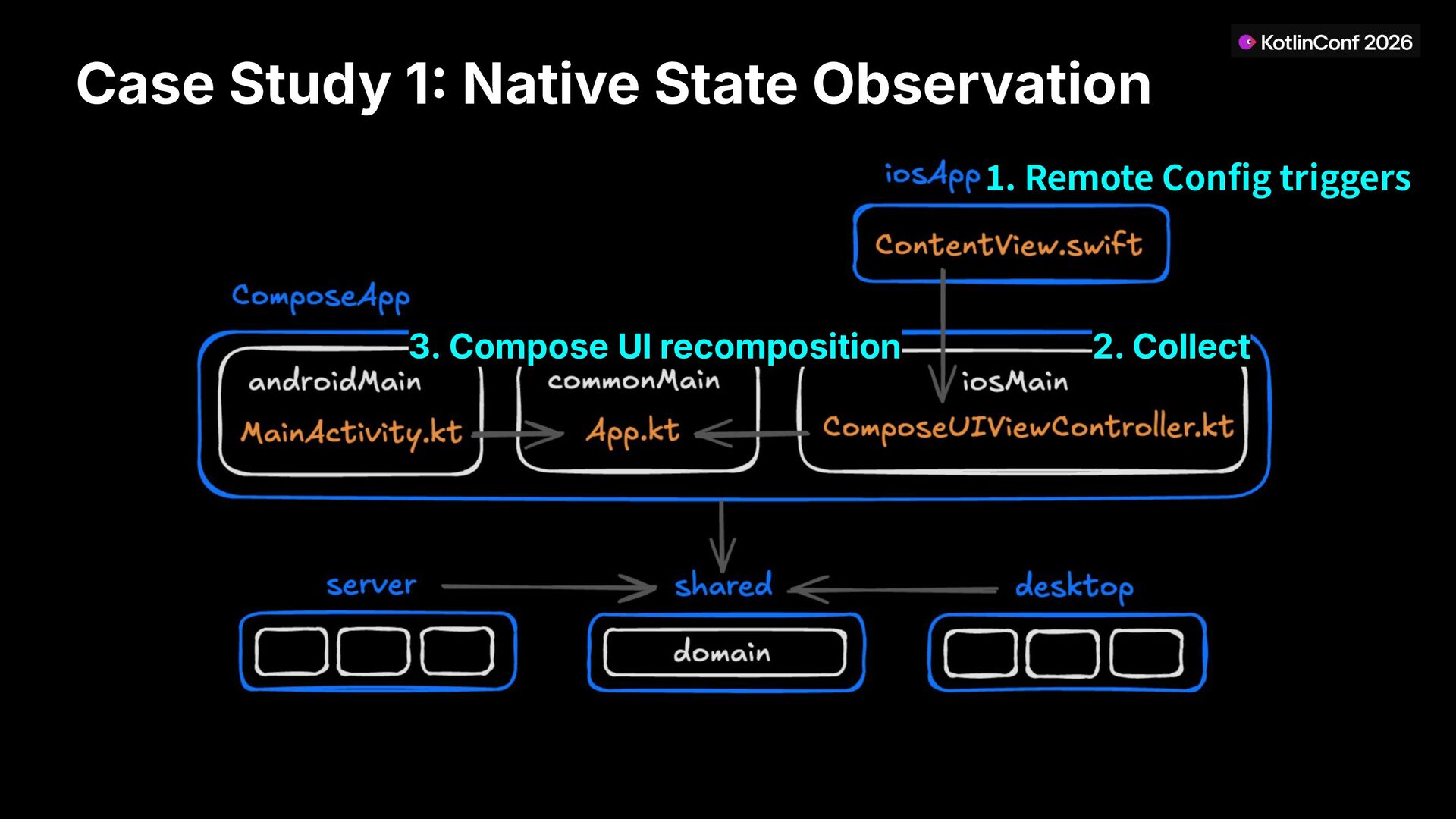
Case Study 1 Native State Observation 1. Remote Config triggers
3. Compose UI recomposition 2. Collect -
Case Study 2 Integrating Non-KMP SDK Firebase) Designing IoC architecture
and discovering a Kotlin/Native issue on iOS -
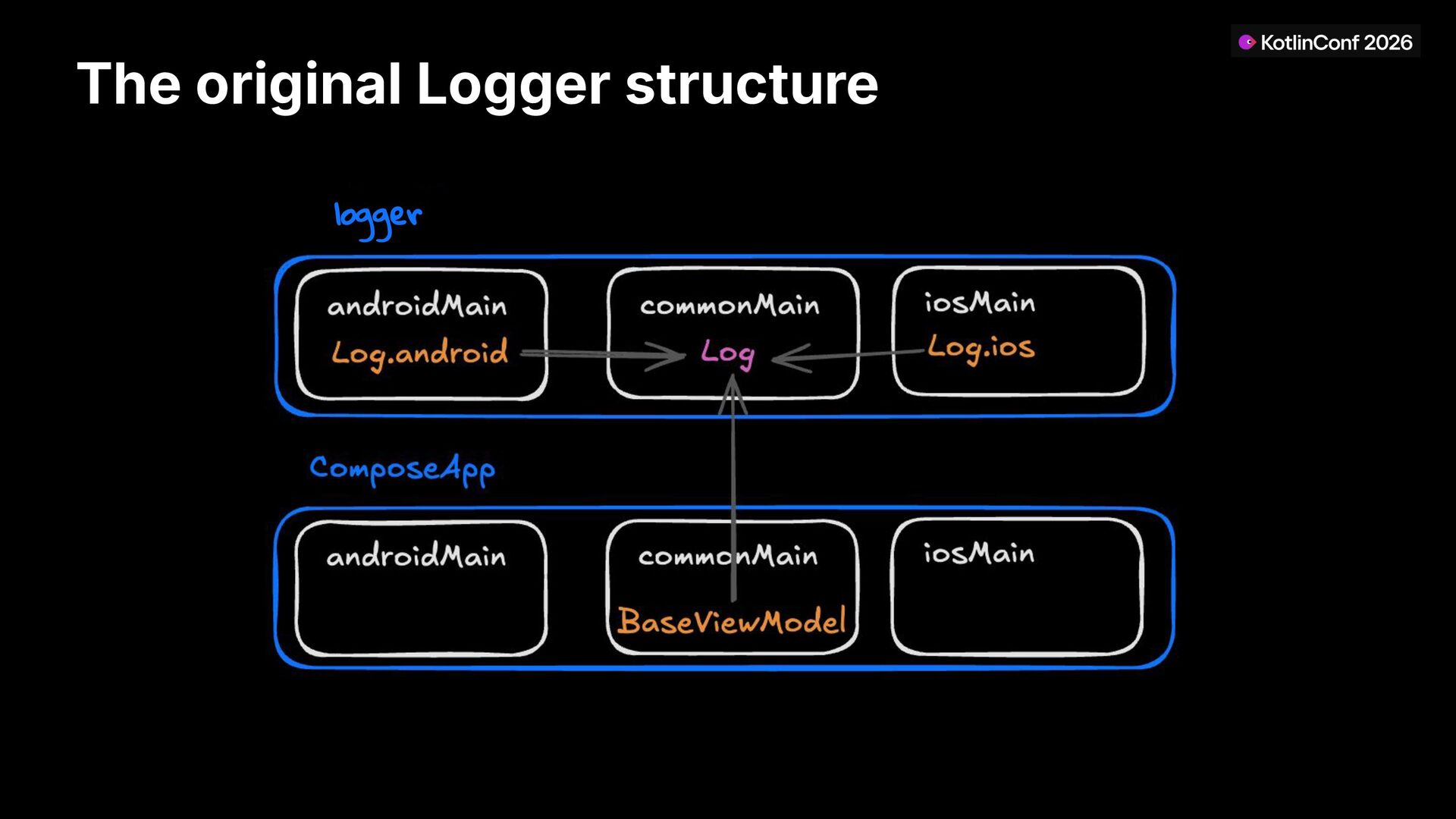
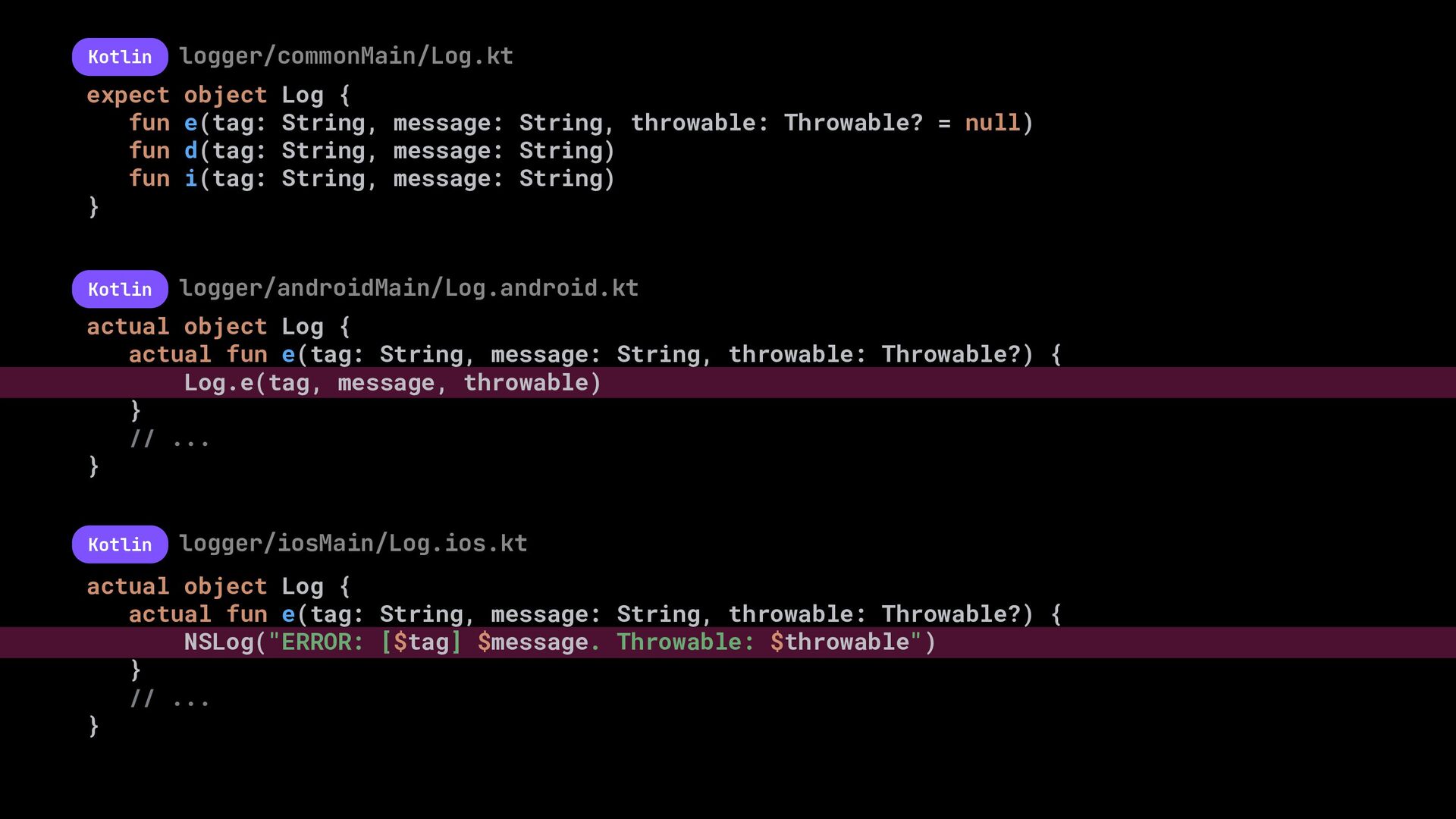
Kotlin logger/commonMain/Log.kt expect object Log { fun e(tag: String, message:
String, throwable: Throwable? = null) fun d(tag: String, message: String) fun i(tag: String, message: String) } Kotlin logger/androidMain/Log.android.kt actual object Log { actual fun e(tag: String, message: String, throwable: Throwable?) { Log.e(tag, message, throwable) } // ... } Kotlin logger/iosMain/Log.ios.kt actual object Log { actual fun e(tag: String, message: String, throwable: Throwable?) { NSLog("ERROR: [$tag] $message. Throwable: $throwable") } // ... } -
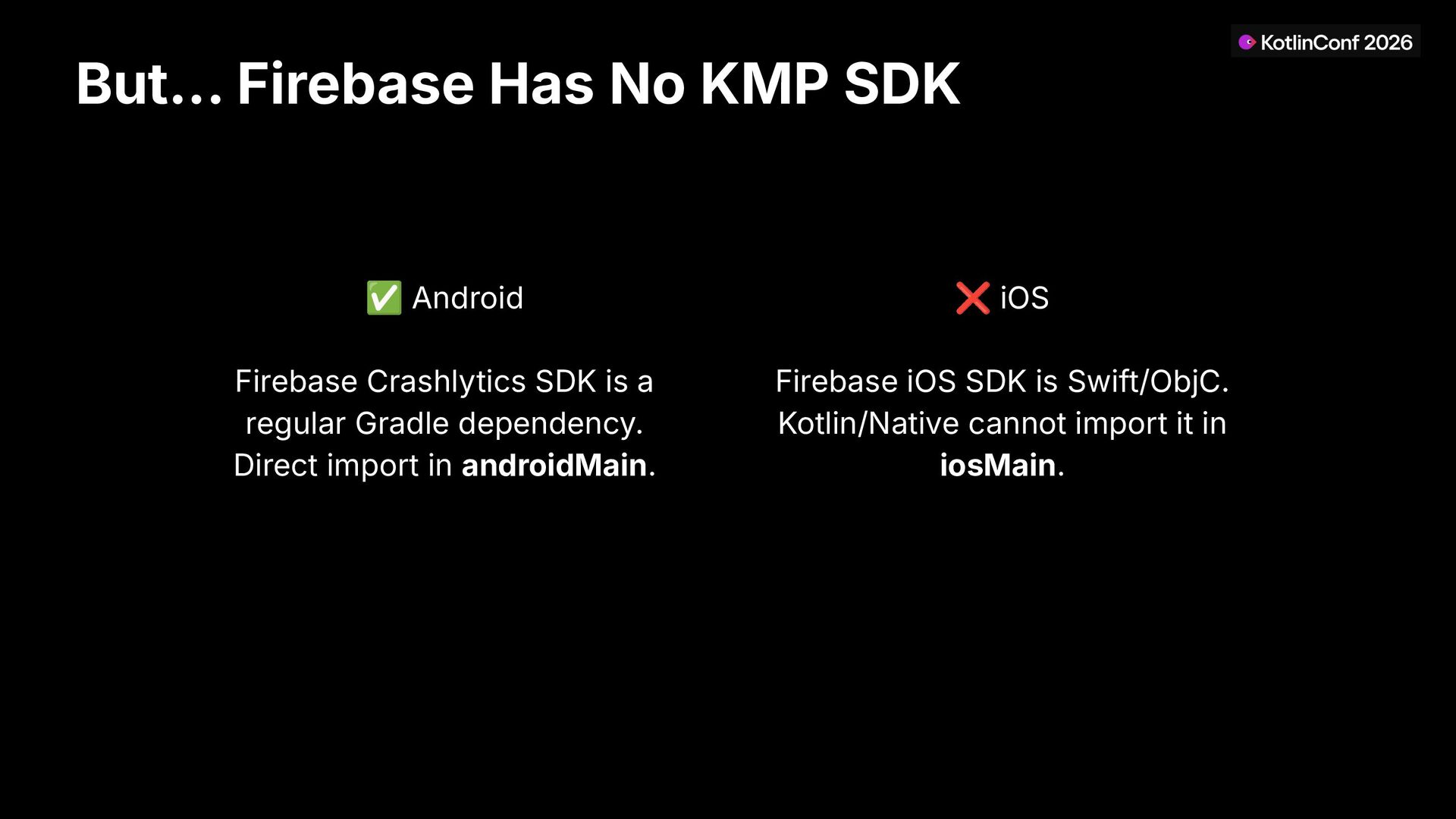
But... Firebase Has No KMP SDK ✅ Android ❌ iOS
Firebase Crashlytics SDK is a regular Gradle dependency. Direct import in androidMain. Firebase iOS SDK is Swift/ObjC. Kotlin/Native cannot import it in iosMain. -
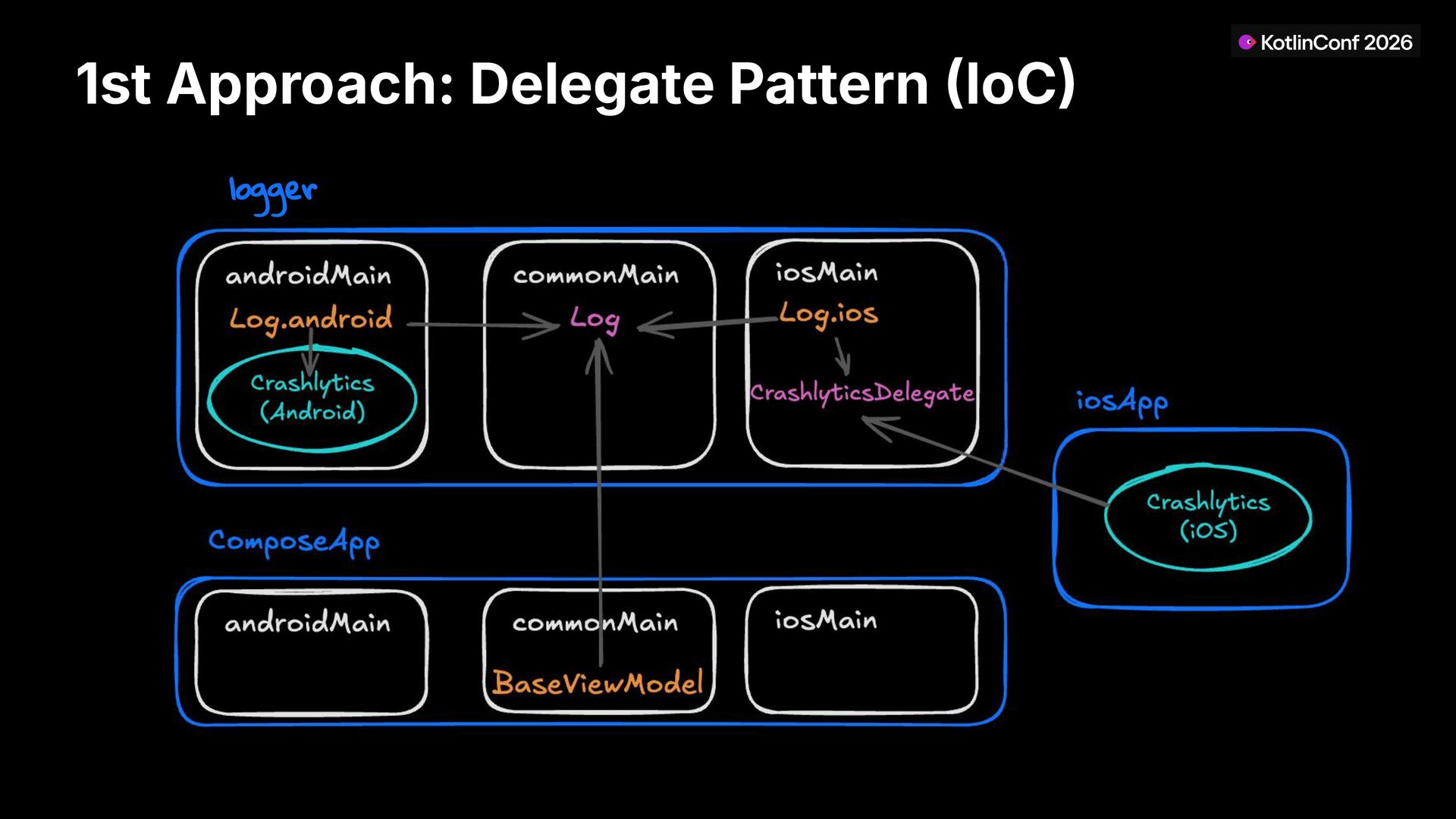
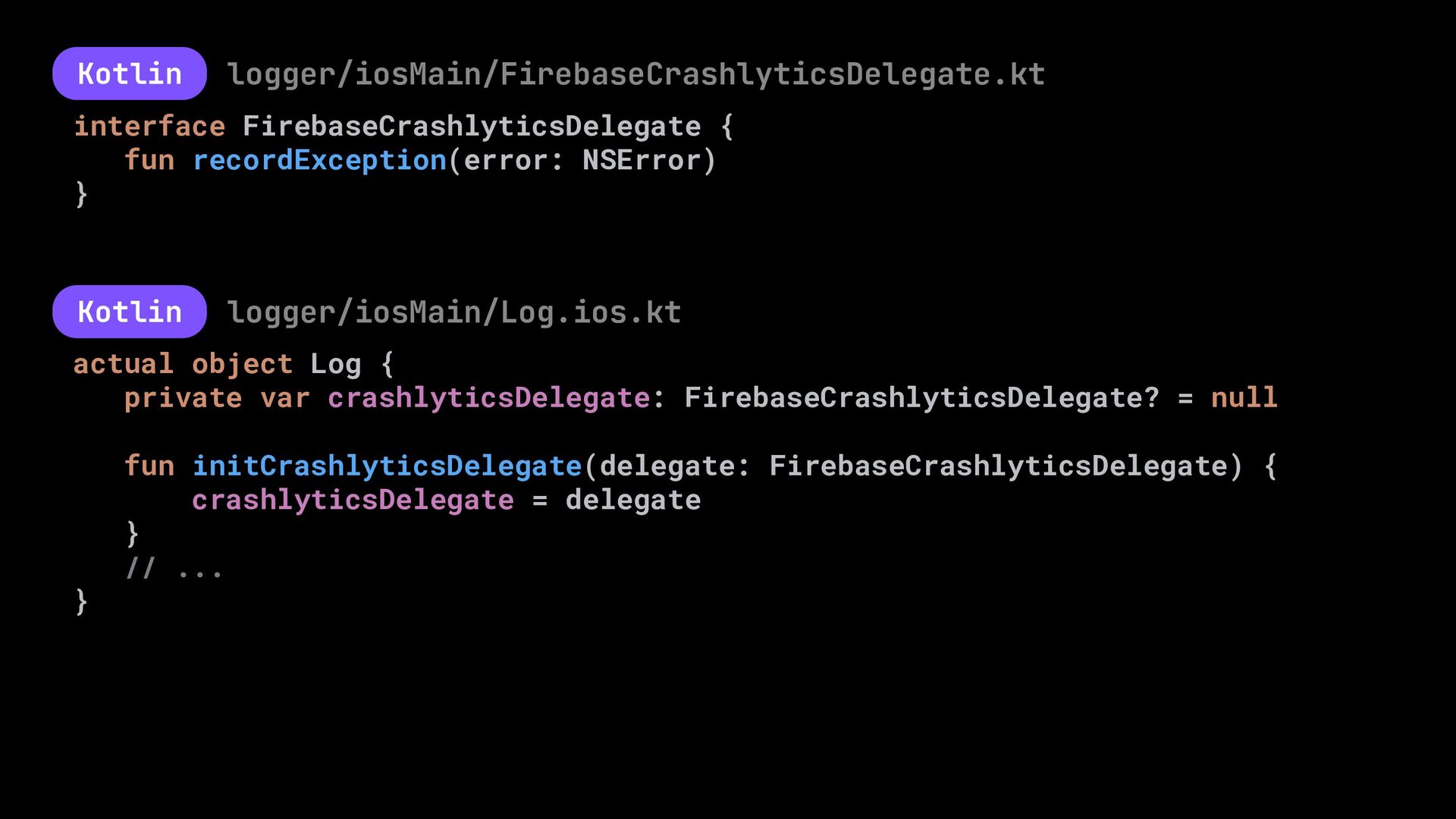
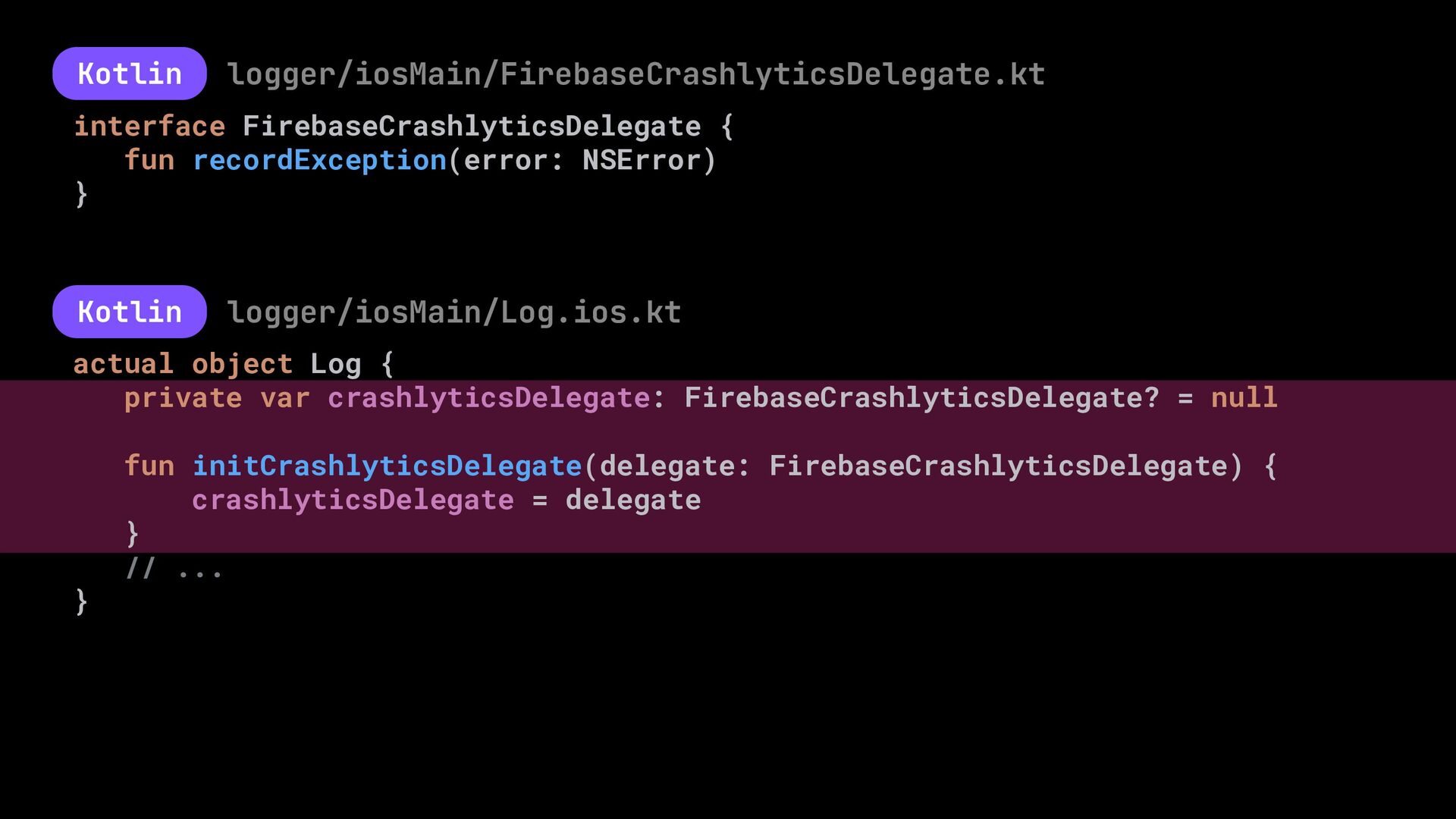
Kotlin logger/iosMain/FirebaseCrashlyticsDelegate.kt interface FirebaseCrashlyticsDelegate { fun recordException(error: NSError) } Kotlin
logger/iosMain/Log.ios.kt actual object Log { private var crashlyticsDelegate: FirebaseCrashlyticsDelegate? = null } fun initCrashlyticsDelegate(delegate: FirebaseCrashlyticsDelegate) { crashlyticsDelegate = delegate } // ... -
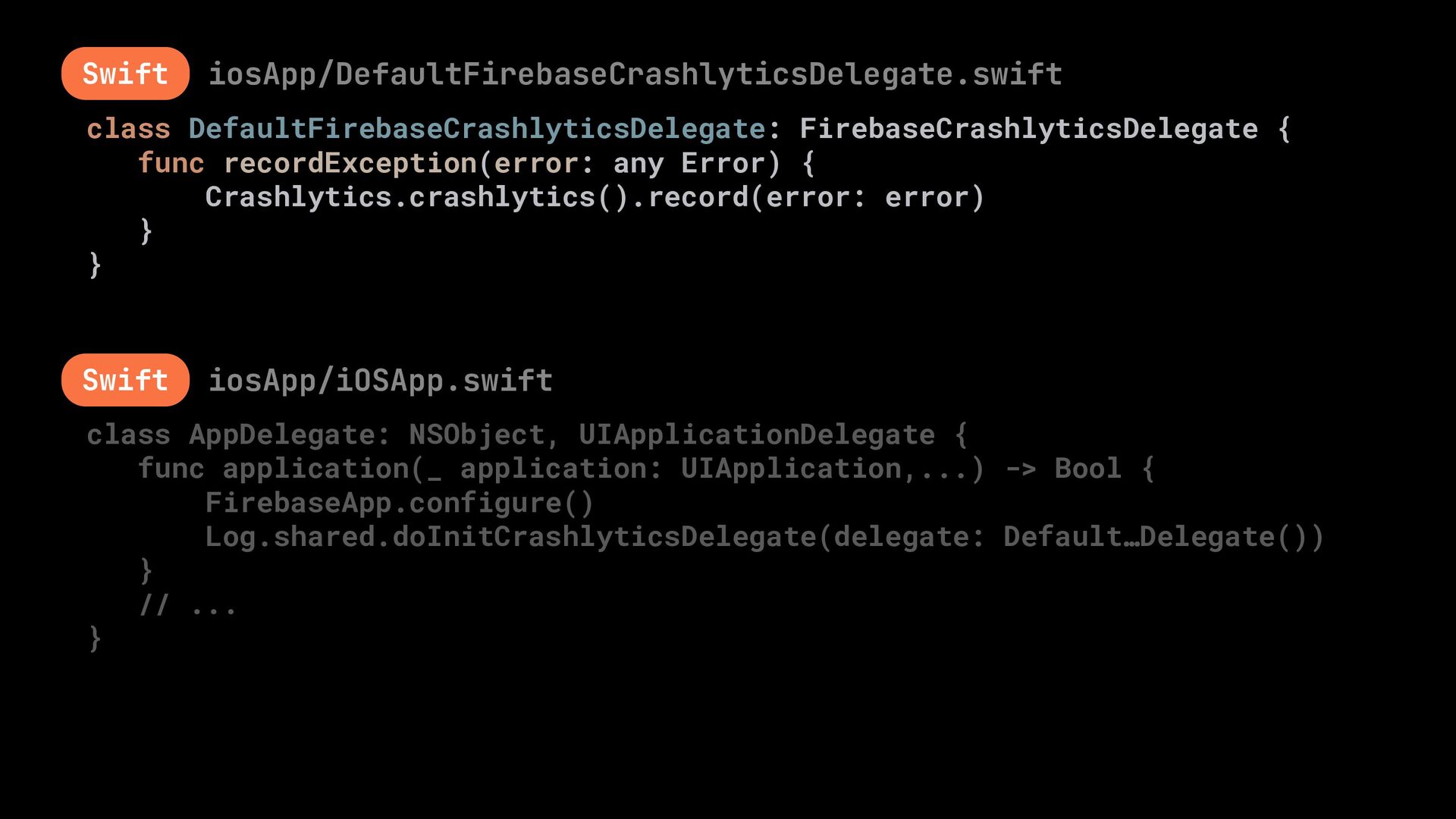
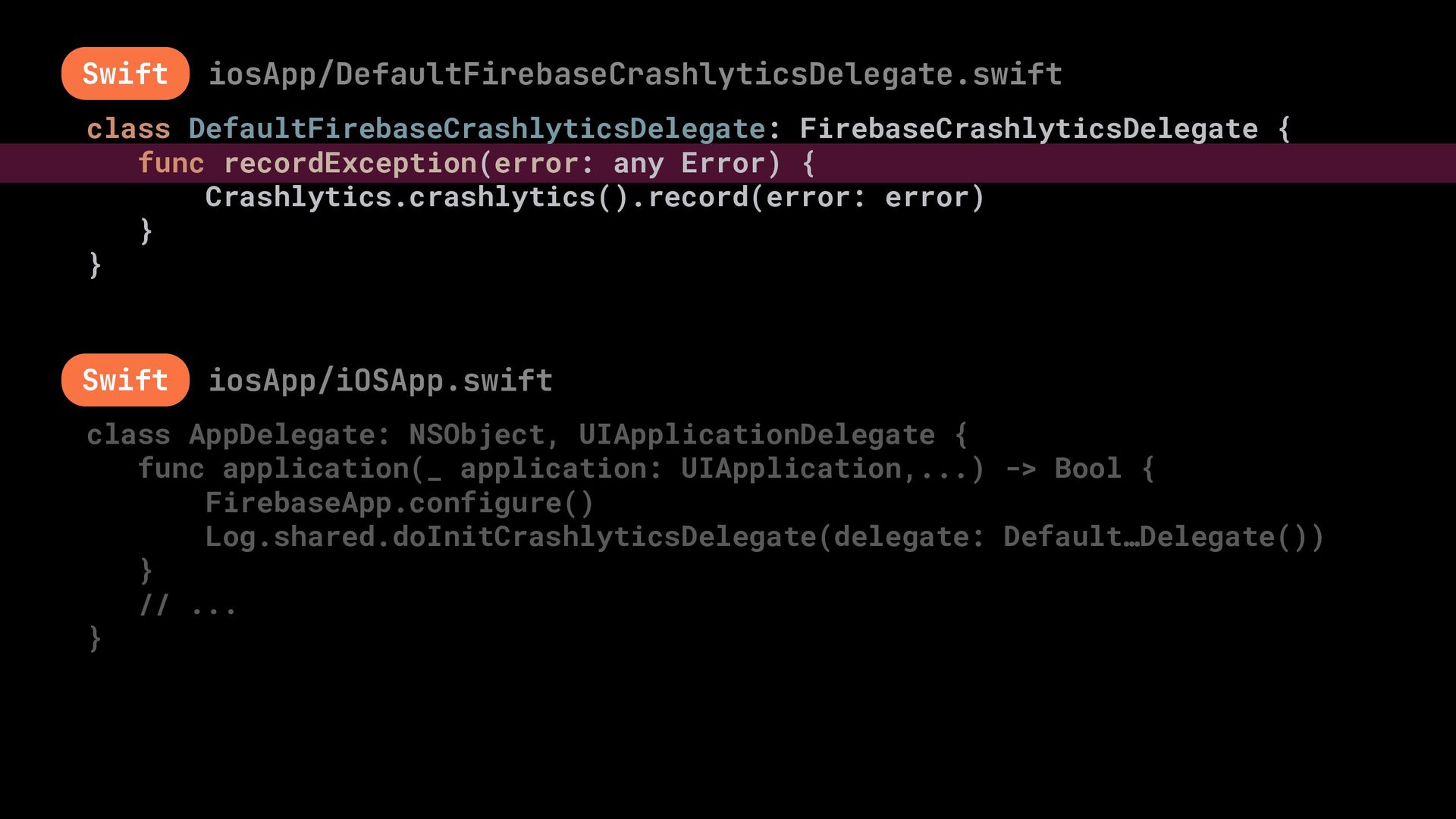
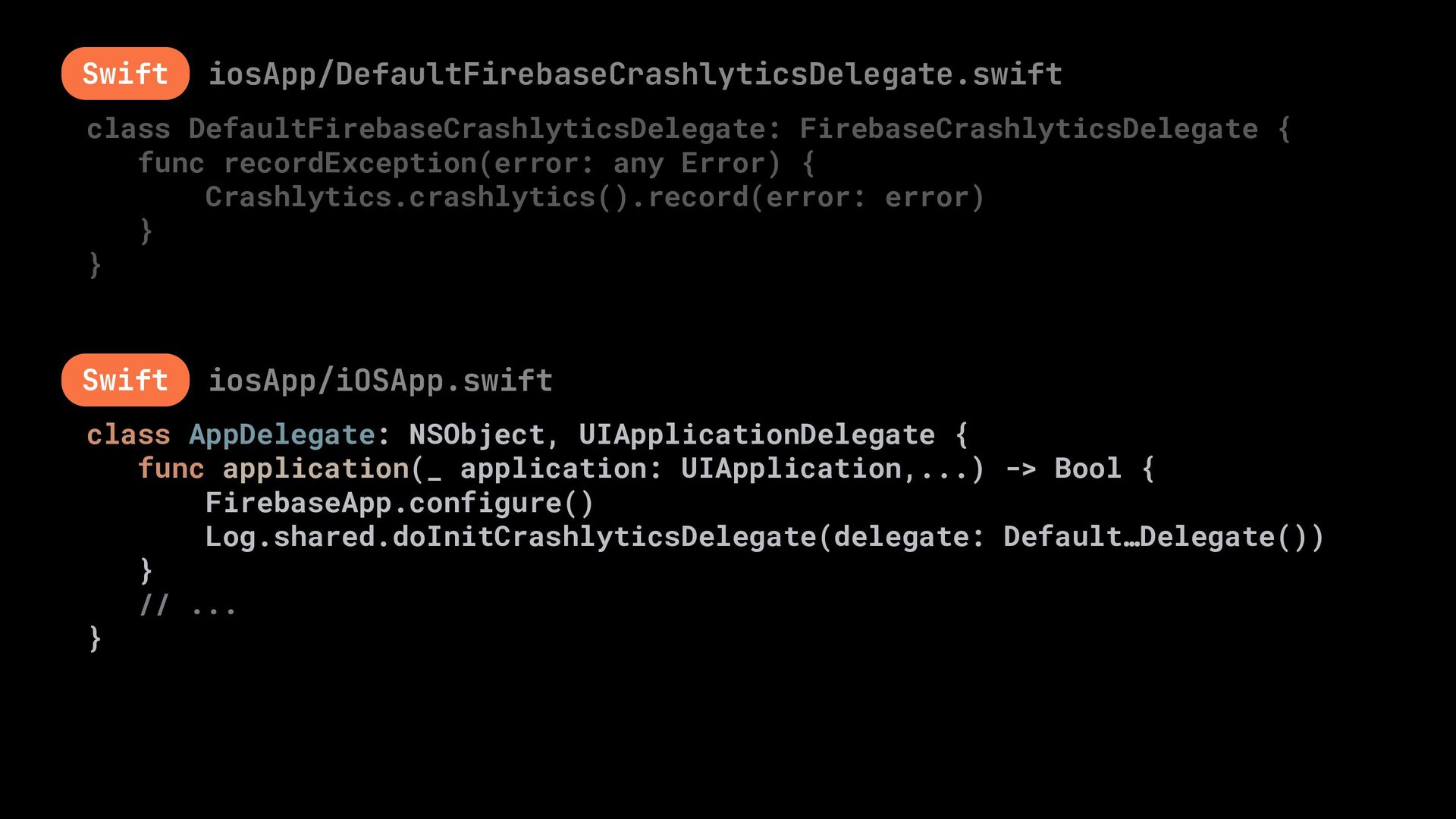
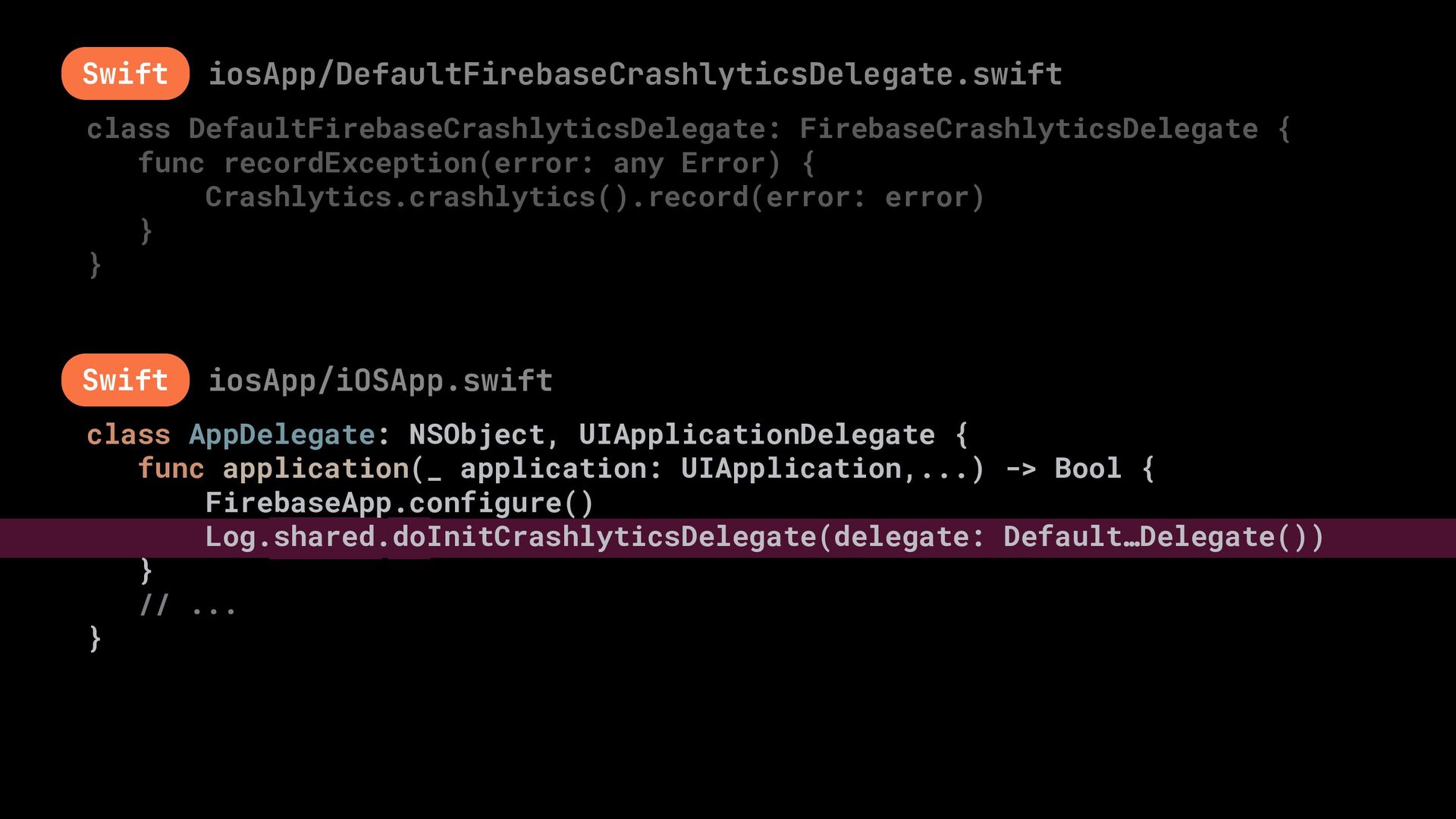
Swift iosApp/DefaultFirebaseCrashlyticsDelegate.swift class DefaultFirebaseCrashlyticsDelegate: FirebaseCrashlyticsDelegate { func recordException(error: any Error)
{ Crashlytics.crashlytics().record(error: error) } } Swift iosApp/iOSApp.swift class AppDelegate: NSObject, UIApplicationDelegate { func application(_ application: UIApplication,...) -> Bool { FirebaseApp.configure() Log.shared.doInitCrashlyticsDelegate(delegate: Default…Delegate()) } // ... } -
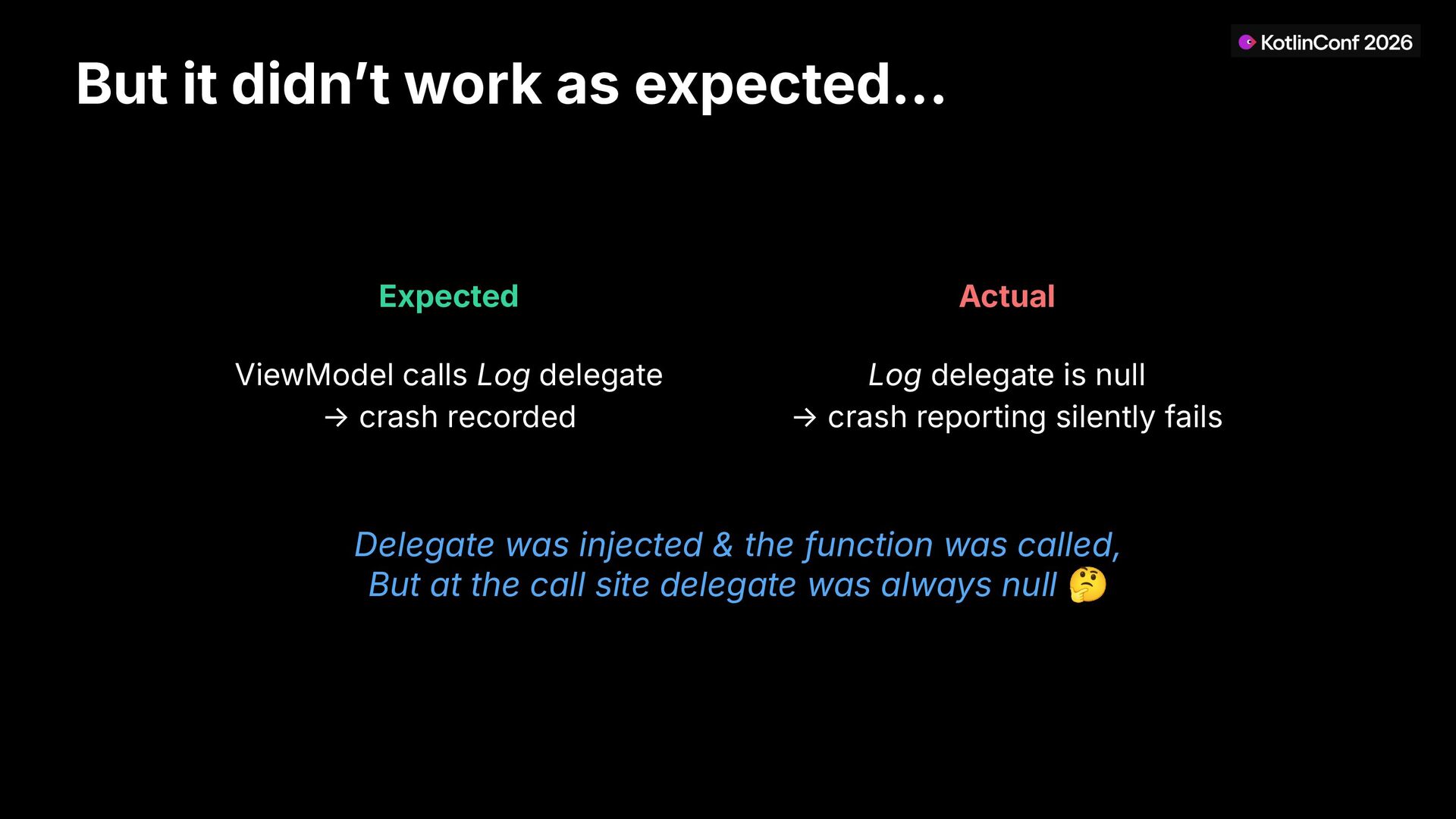
But it didnʼt work as expected... Expected Actual ViewModel calls
Log delegate → crash recorded Log delegate is null → crash reporting silently fails Delegate was injected & the function was called, But at the call site delegate was always null 🤔 -
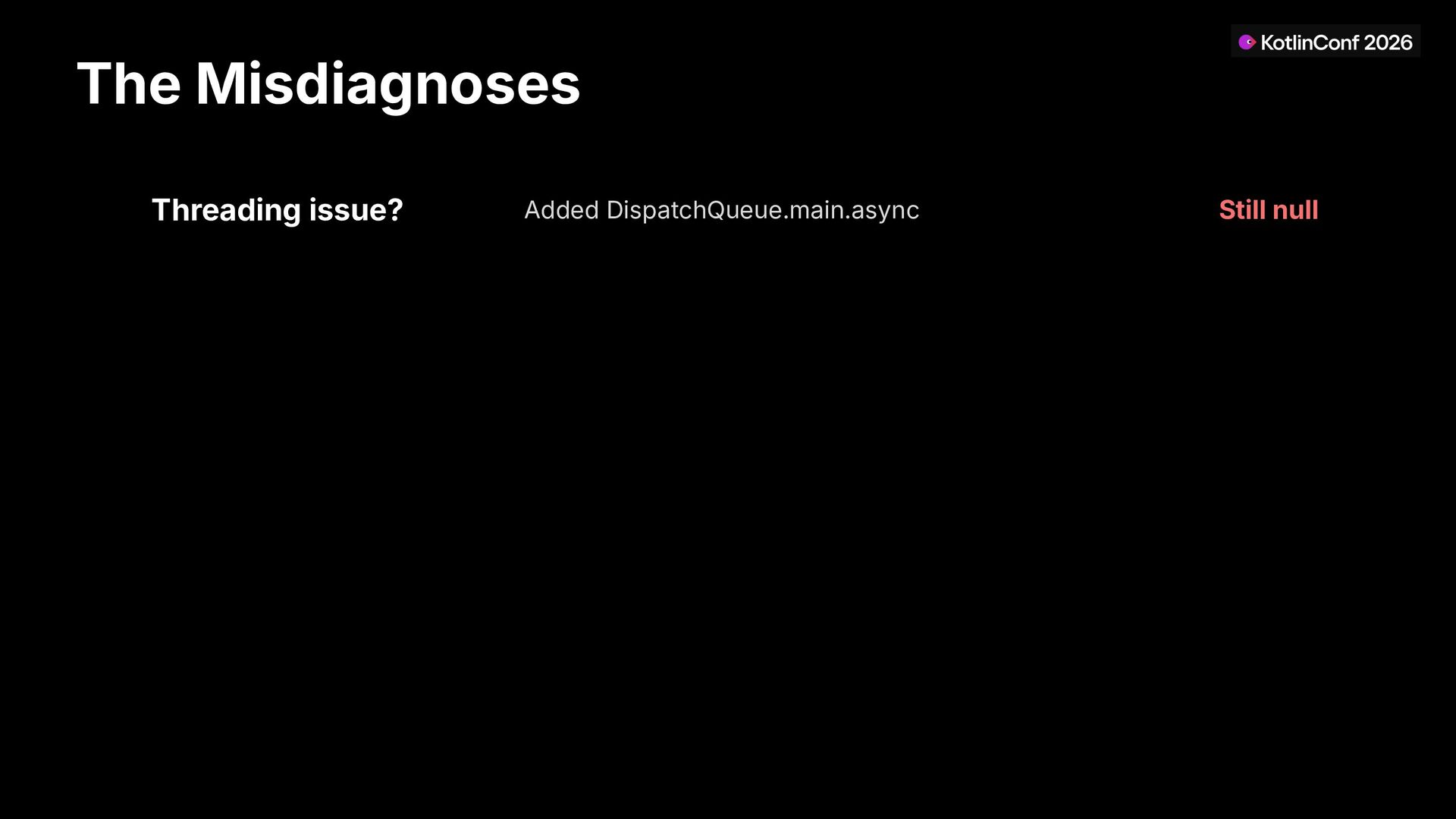
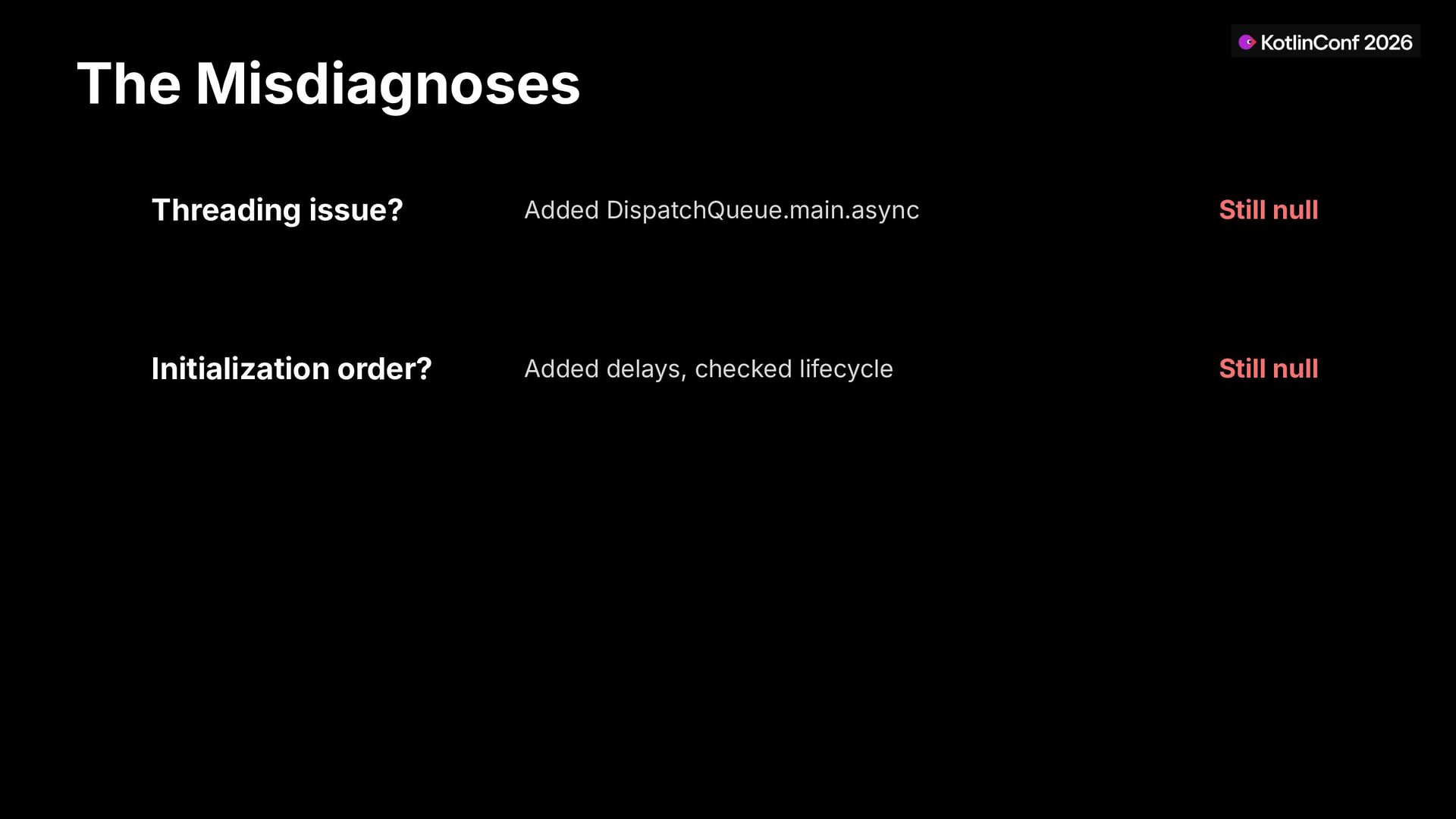
The Misdiagnoses Threading issue? Added DispatchQueue.main.async Still null Initialization order?
Added delays, checked lifecycle Still null -
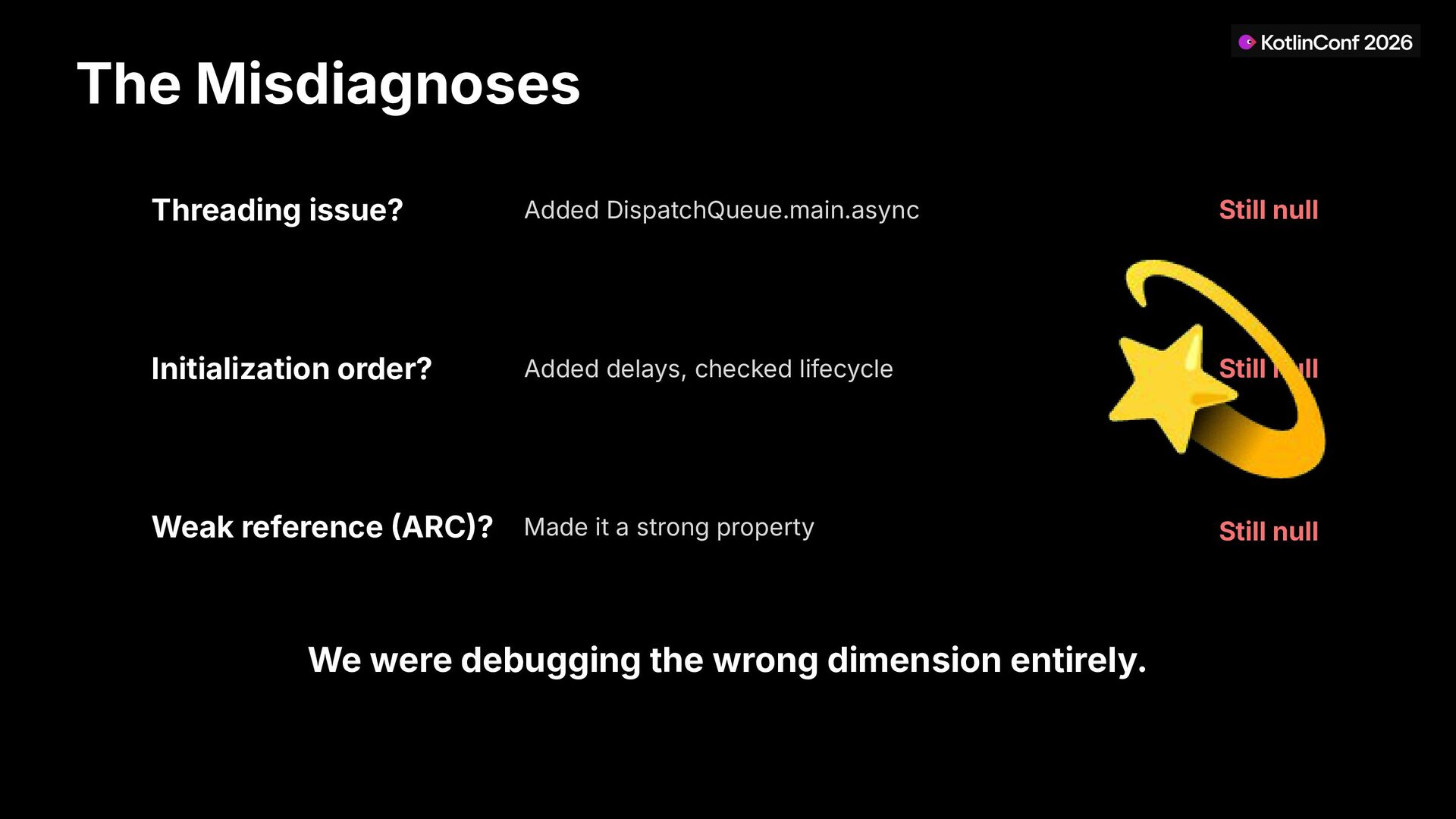
The Misdiagnoses Threading issue? Added DispatchQueue.main.async Initialization order? Added delays,
checked lifecycle Still null ��💫 Weak reference ARC? Made it a strong property We were debugging the wrong dimension entirely. Still null Still null -
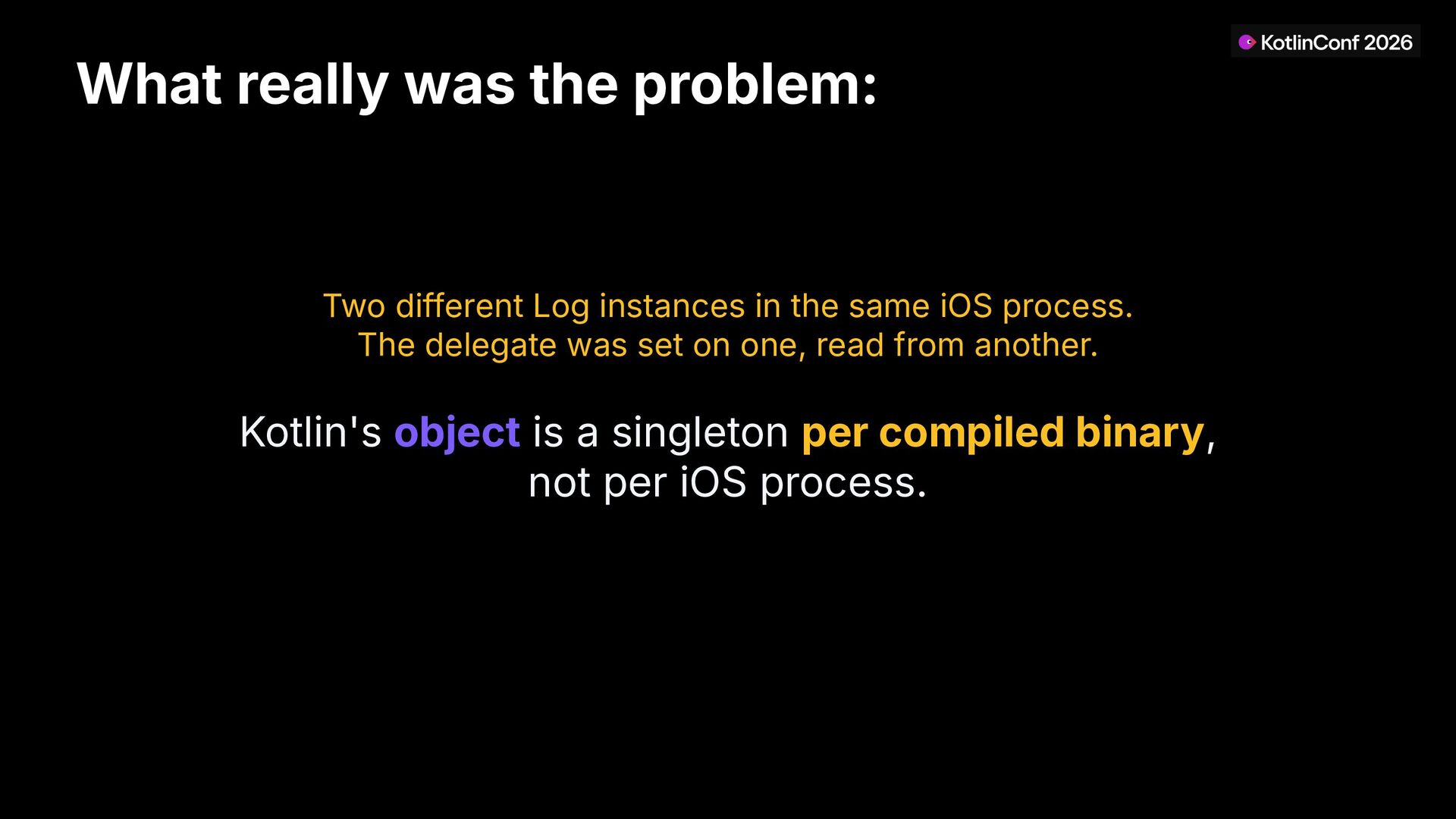
What really was the problem: Two different Log instances in
the same iOS process. The delegate was set on one, read from another. Kotlin's object is a singleton per compiled binary, not per iOS process. -
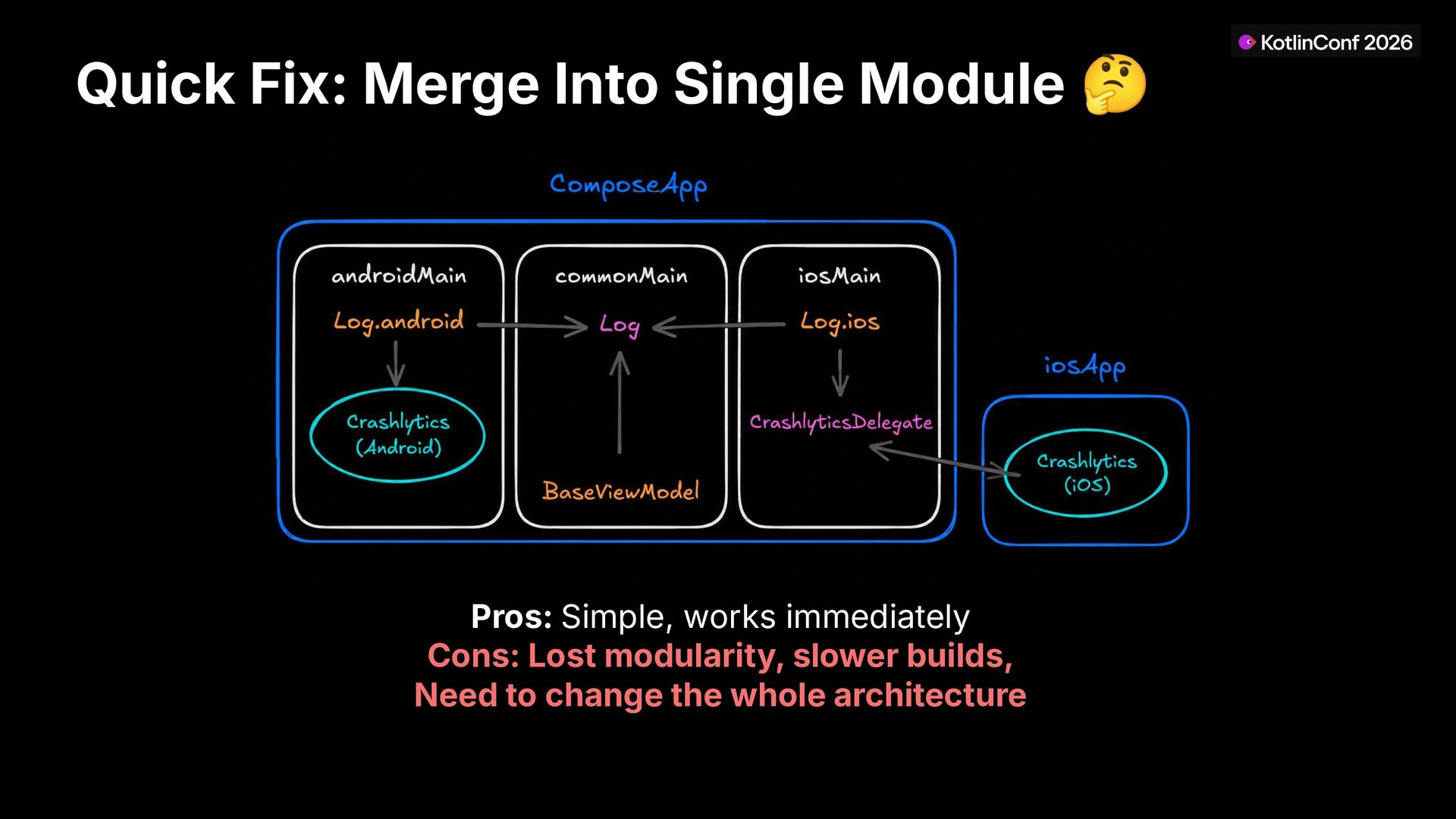
Quick Fix: Merge Into Single Module 🤔 Pros: Simple, works
immediately Cons: Lost modularity, slower builds, Need to change the whole architecture -
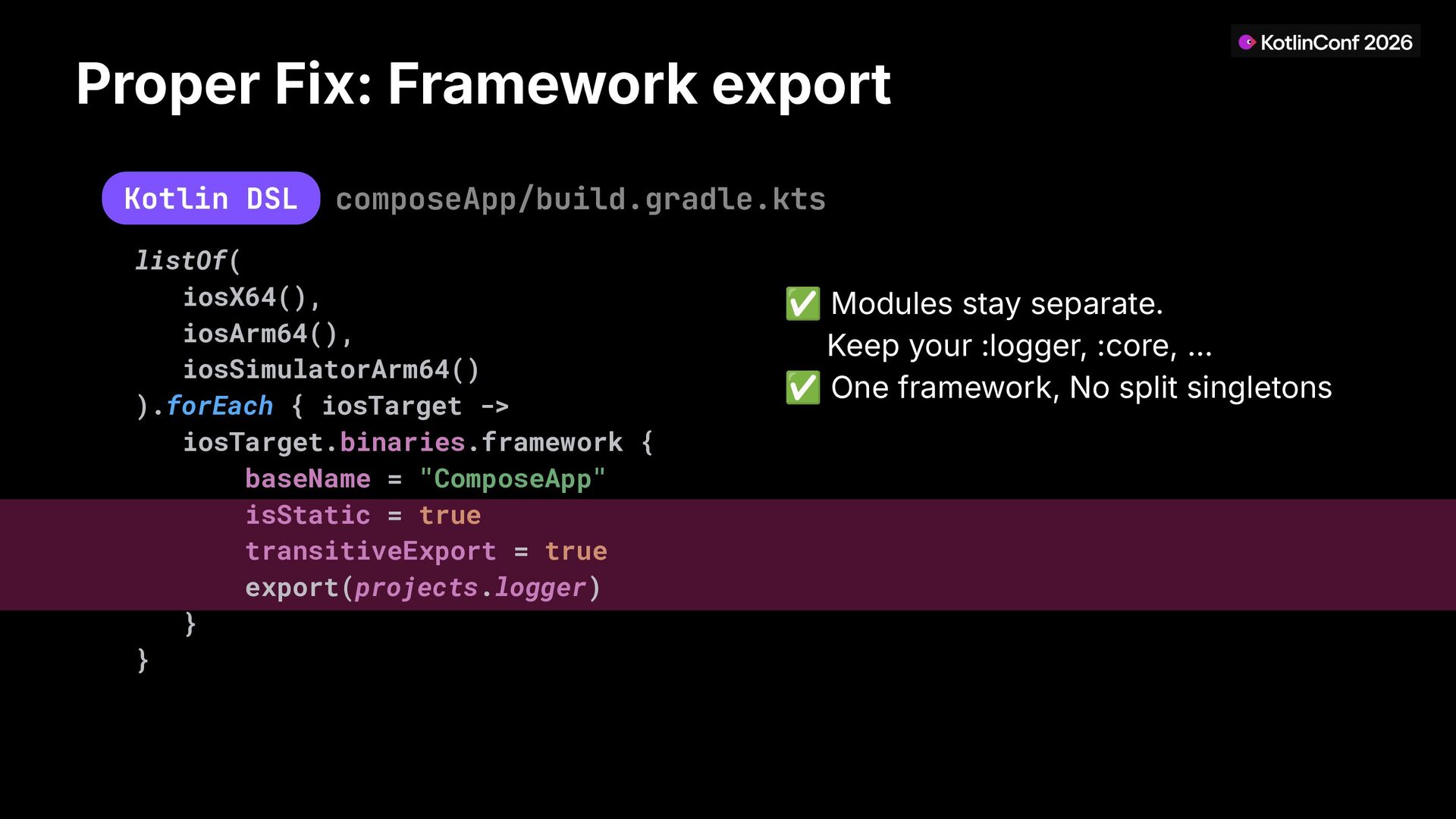
Proper Fix: Framework export Kotlin DSL composeApp/build.gradle.kts listOf( iosX64(), iosArm64(),
iosSimulatorArm64() ).forEach { iosTarget -> iosTarget.binaries.framework { baseName = "ComposeApp" isStatic = true transitiveExport = true export(projects.logger) } } ✅ Modules stay separate. Keep your :logger, :core, ... ✅ One framework, No split singletons -
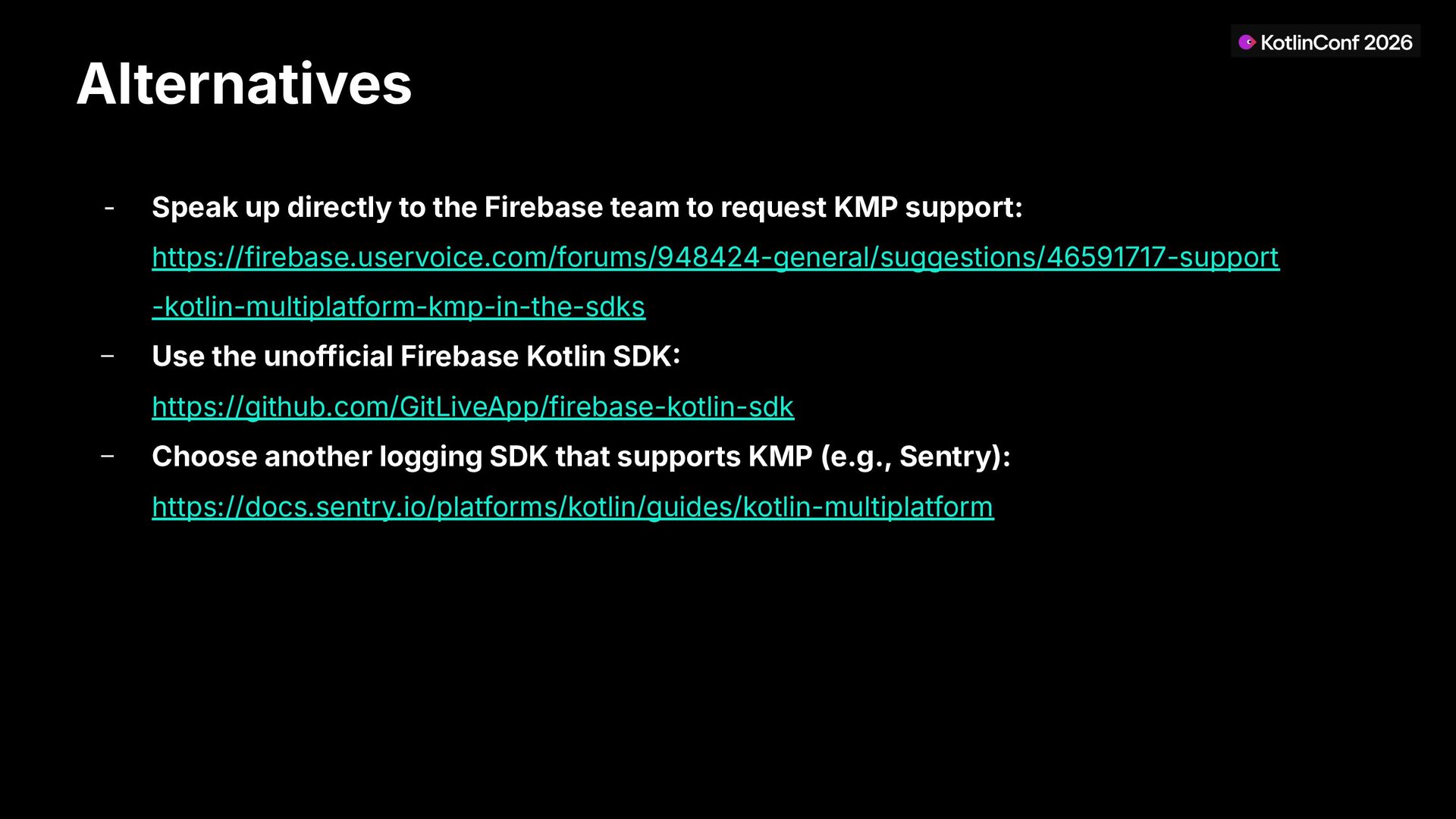
Alternatives - Speak up directly to the Firebase team to
request KMP support: https://firebase.uservoice.com/forums/948424-general/suggestions/46591717-support -kotlin-multiplatform-kmp-in-the-sdks - Use the unofficial Firebase Kotlin SDK https://github.com/GitLiveApp/firebase-kotlin-sdk - Choose another logging SDK that supports KMP (e.g., Sentry): https://docs.sentry.io/platforms/kotlin/guides/kotlin-multiplatform -
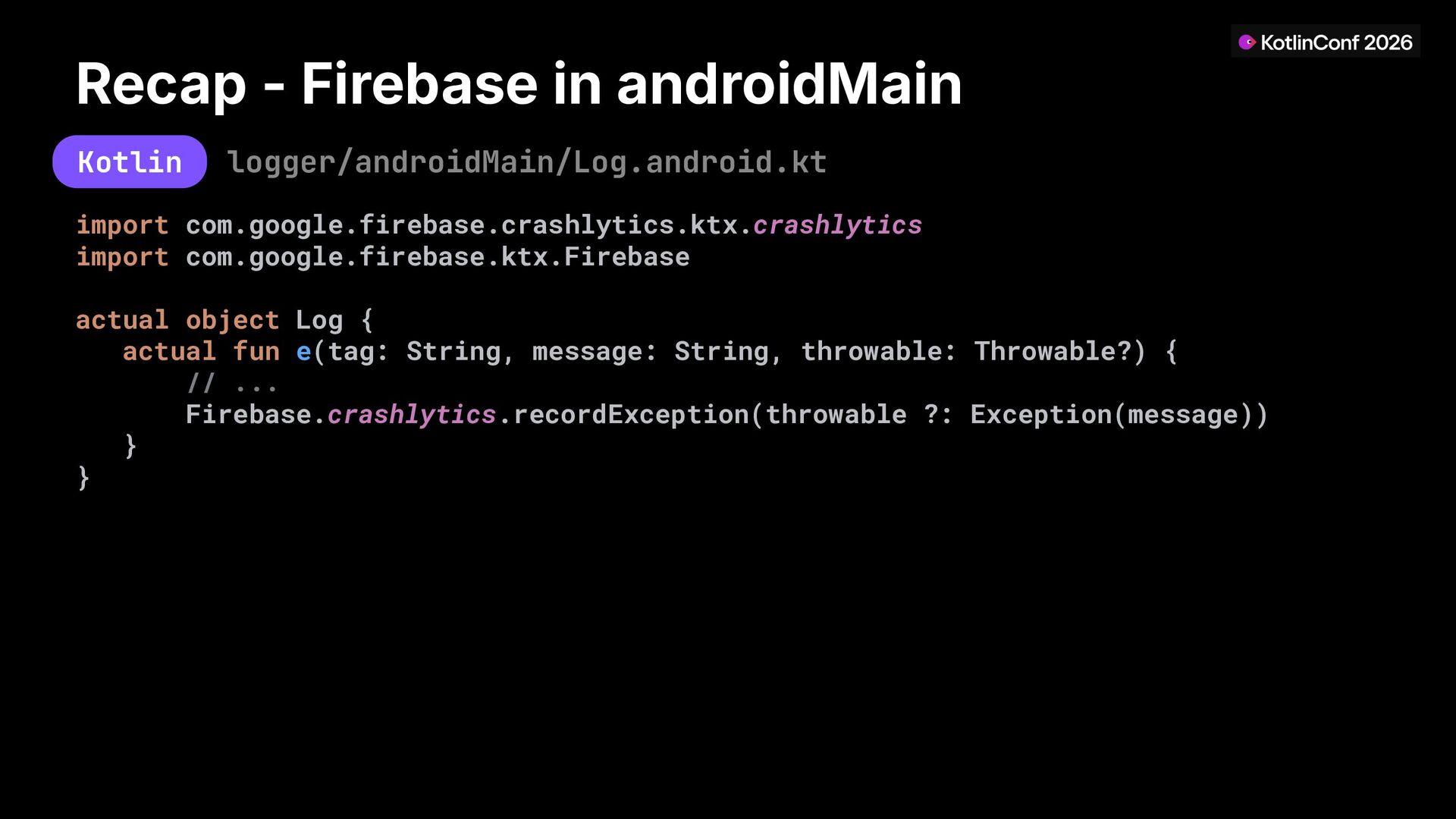
Recap - Firebase in androidMain Kotlin logger/androidMain/Log.android.kt import com.google.firebase.crashlytics.ktx.crashlytics import
com.google.firebase.ktx.Firebase actual object Log { actual fun e(tag: String, message: String, throwable: Throwable?) { // ... Firebase.crashlytics.recordException(throwable ?: Exception(message)) } } -
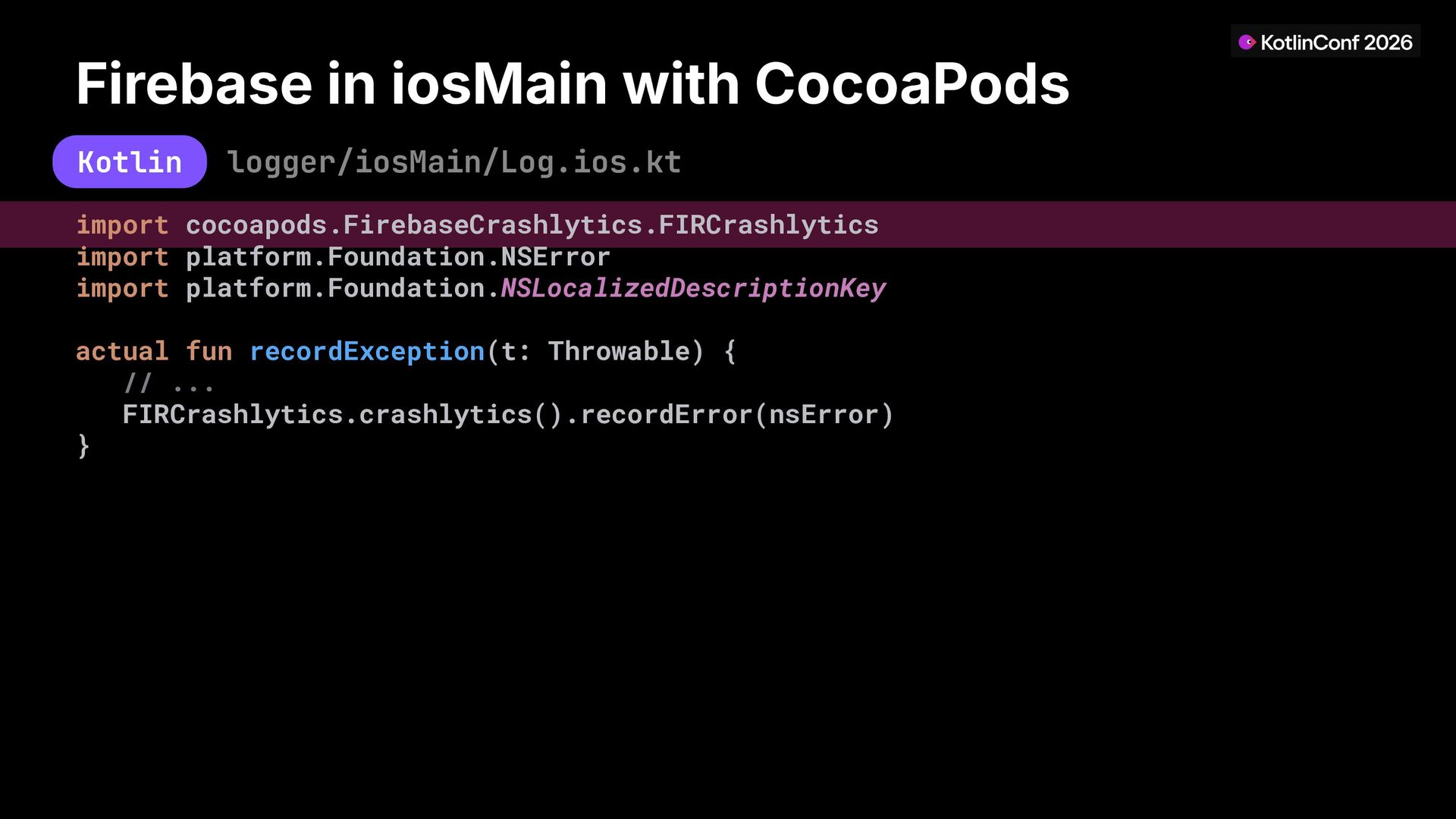
Firebase in iosMain with CocoaPods Kotlin logger/iosMain/Log.ios.kt import cocoapods.FirebaseCrashlytics.FIRCrashlytics import
platform.Foundation.NSError import platform.Foundation.NSLocalizedDescriptionKey actual fun recordException(t: Throwable) { // ... FIRCrashlytics.crashlytics().recordError(nsError) } -
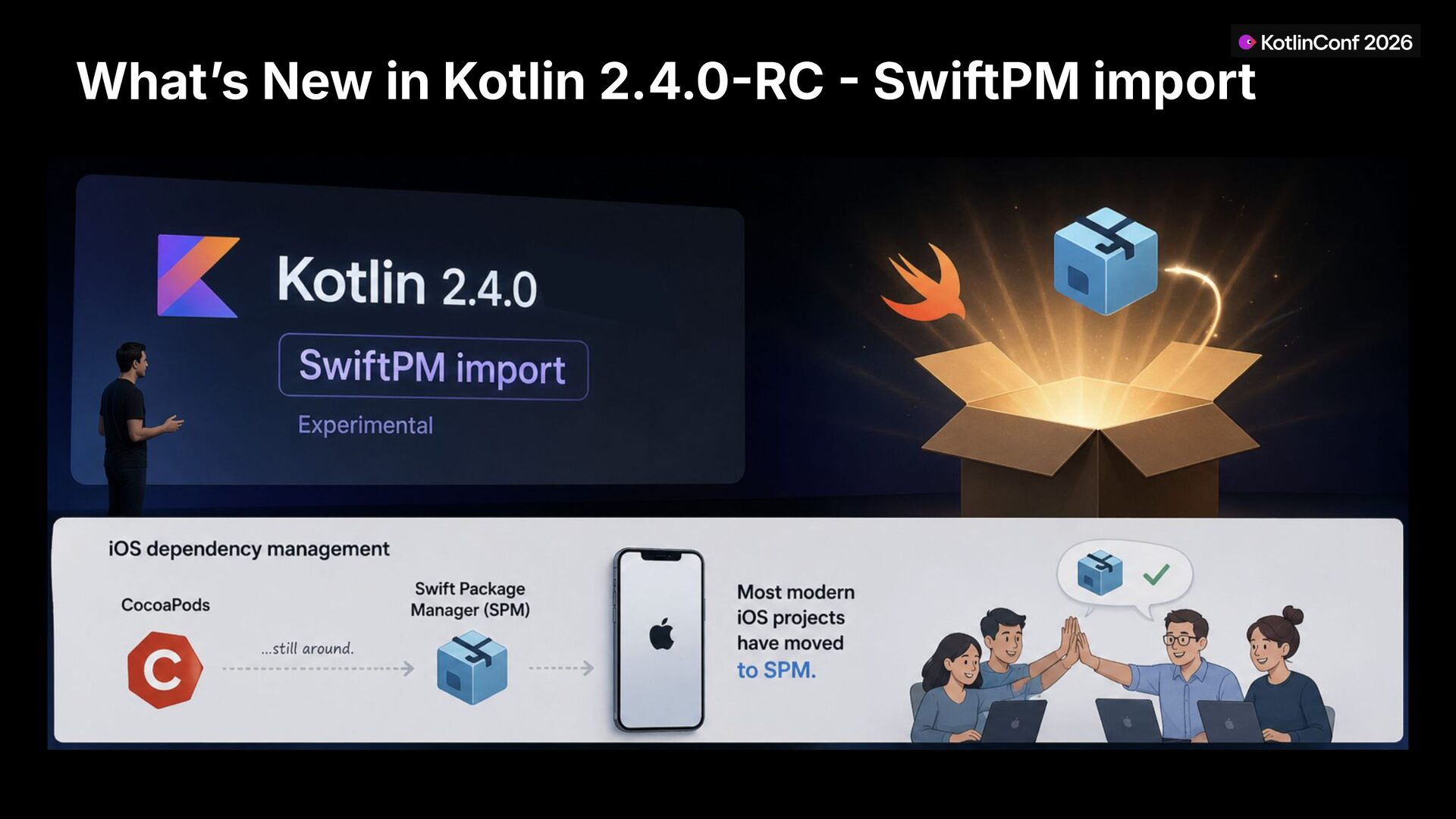
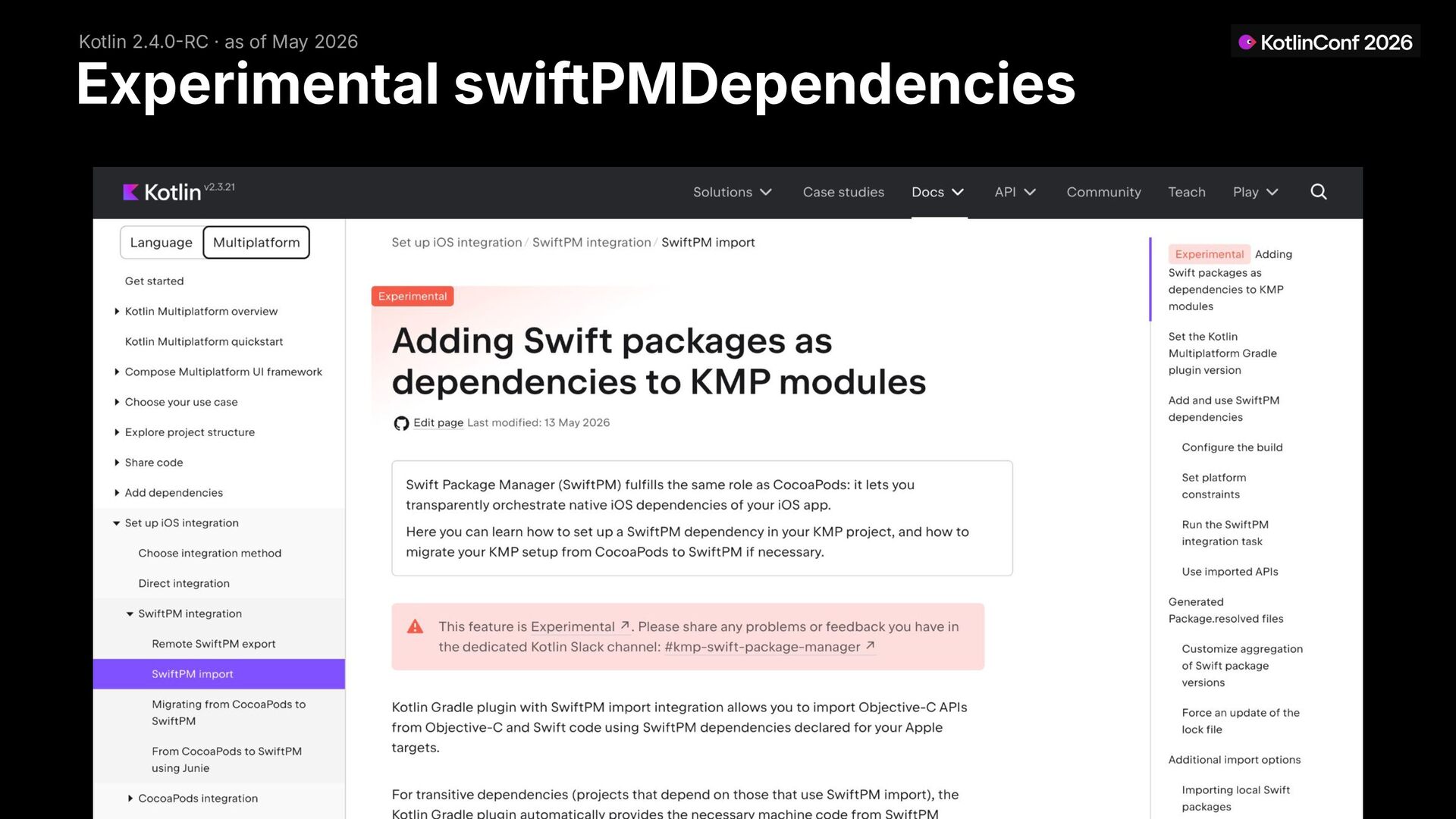
Kotlin 2.4.0RC · as of May 2026 SwiftPM import -
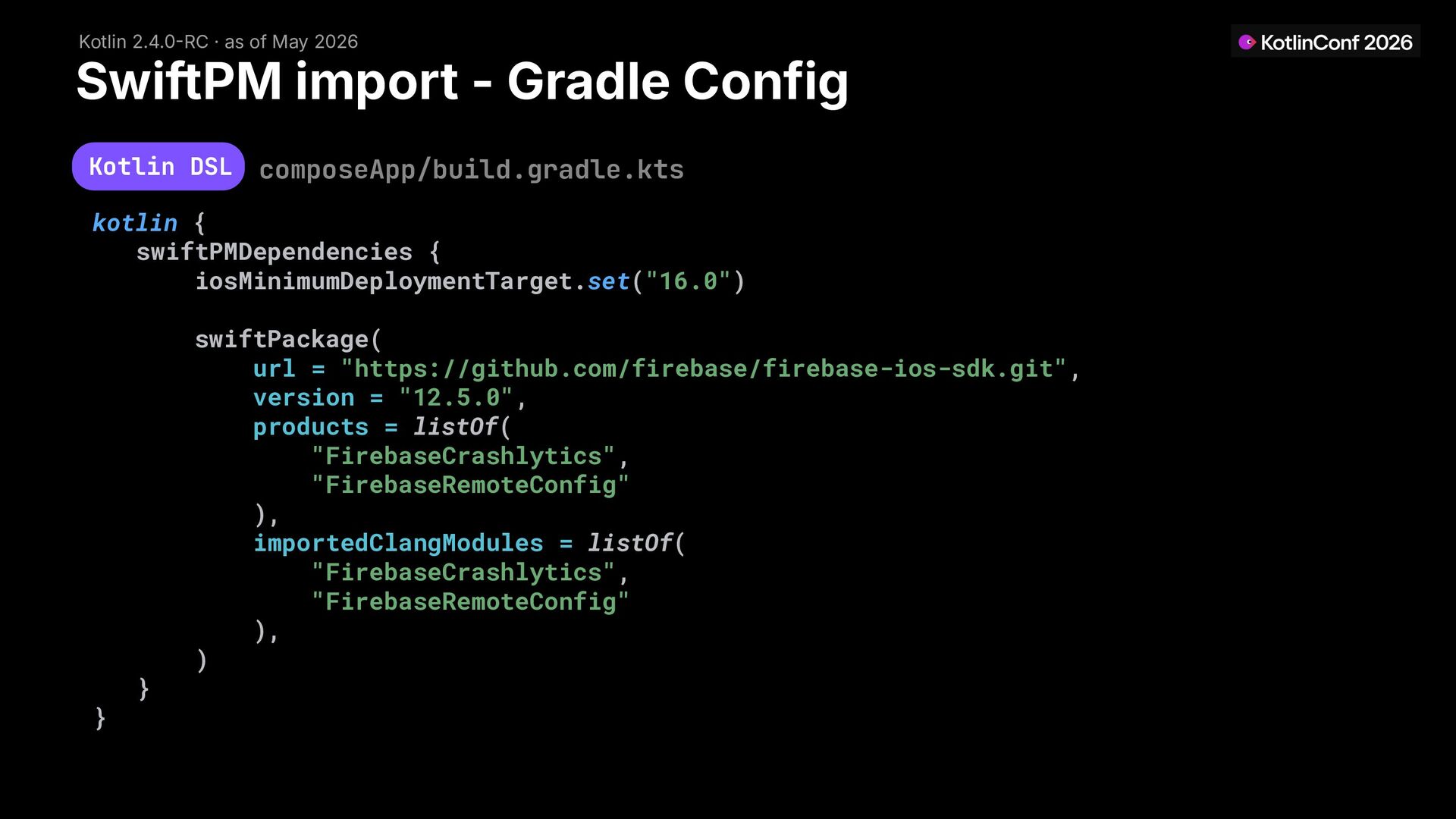
Gradle Config Kotlin DSL composeApp/build.gradle.kts kotlin { swiftPMDependencies { iosMinimumDeploymentTarget.set("16.0") } } swiftPackage( url = "https://github.com/firebase/firebase-ios-sdk.git", version = "12.5.0", products = listOf( "FirebaseCrashlytics", "FirebaseRemoteConfig" ), importedClangModules = listOf( "FirebaseCrashlytics", "FirebaseRemoteConfig" ), ) -
Kotlin 2.4.0RC · as of May 2026 SwiftPM import -
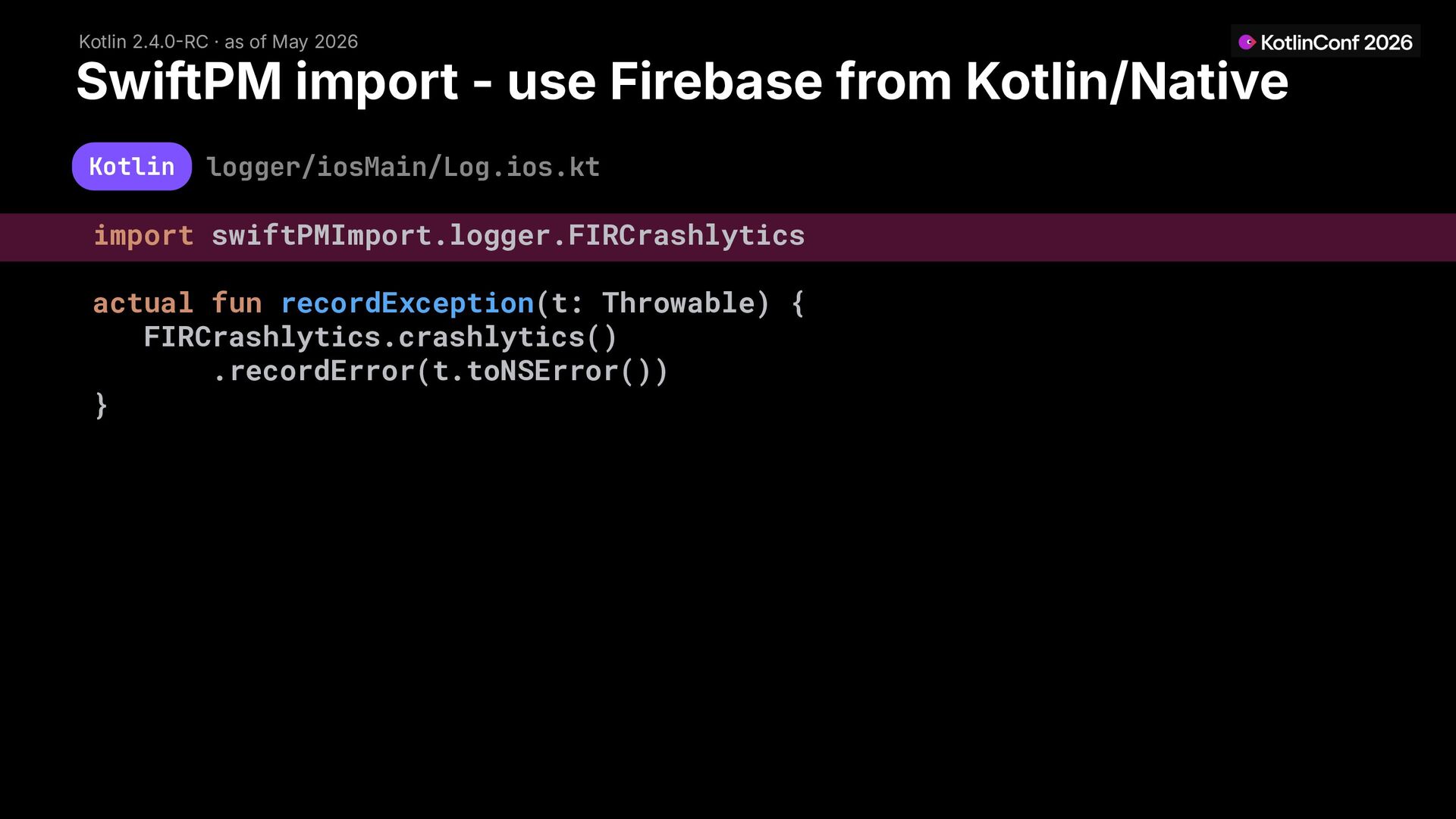
use Firebase from Kotlin/Native Kotlin logger/iosMain/Log.ios.kt import swiftPMImport.logger.FIRCrashlytics actual fun recordException(t: Throwable) { FIRCrashlytics.crashlytics() .recordError(t.toNSError()) } -
Kotlin 2.4.0RC · as of May 2026 But it's still
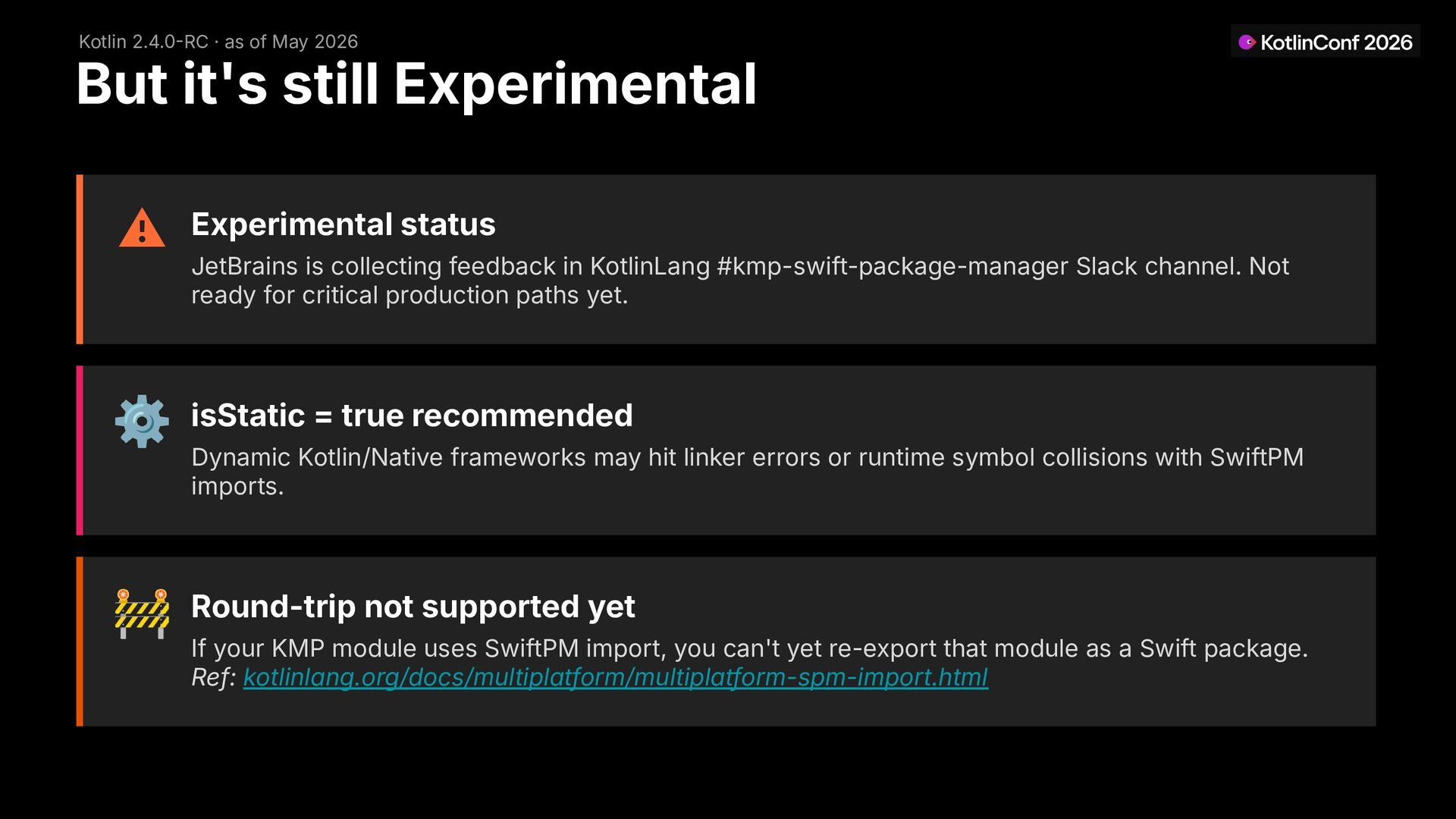
Experimental ⚠ Experimental status JetBrains is collecting feedback in KotlinLang #kmp-swift-package-manager Slack channel. Not ready for critical production paths yet. ⚙ isStatic = true recommended Dynamic Kotlin/Native frameworks may hit linker errors or runtime symbol collisions with SwiftPM imports. 🚧 Round-trip not supported yet If your KMP module uses SwiftPM import, you can't yet re-export that module as a Swift package. Ref: kotlinlang.org/docs/multiplatform/multiplatform-spm-import.html -
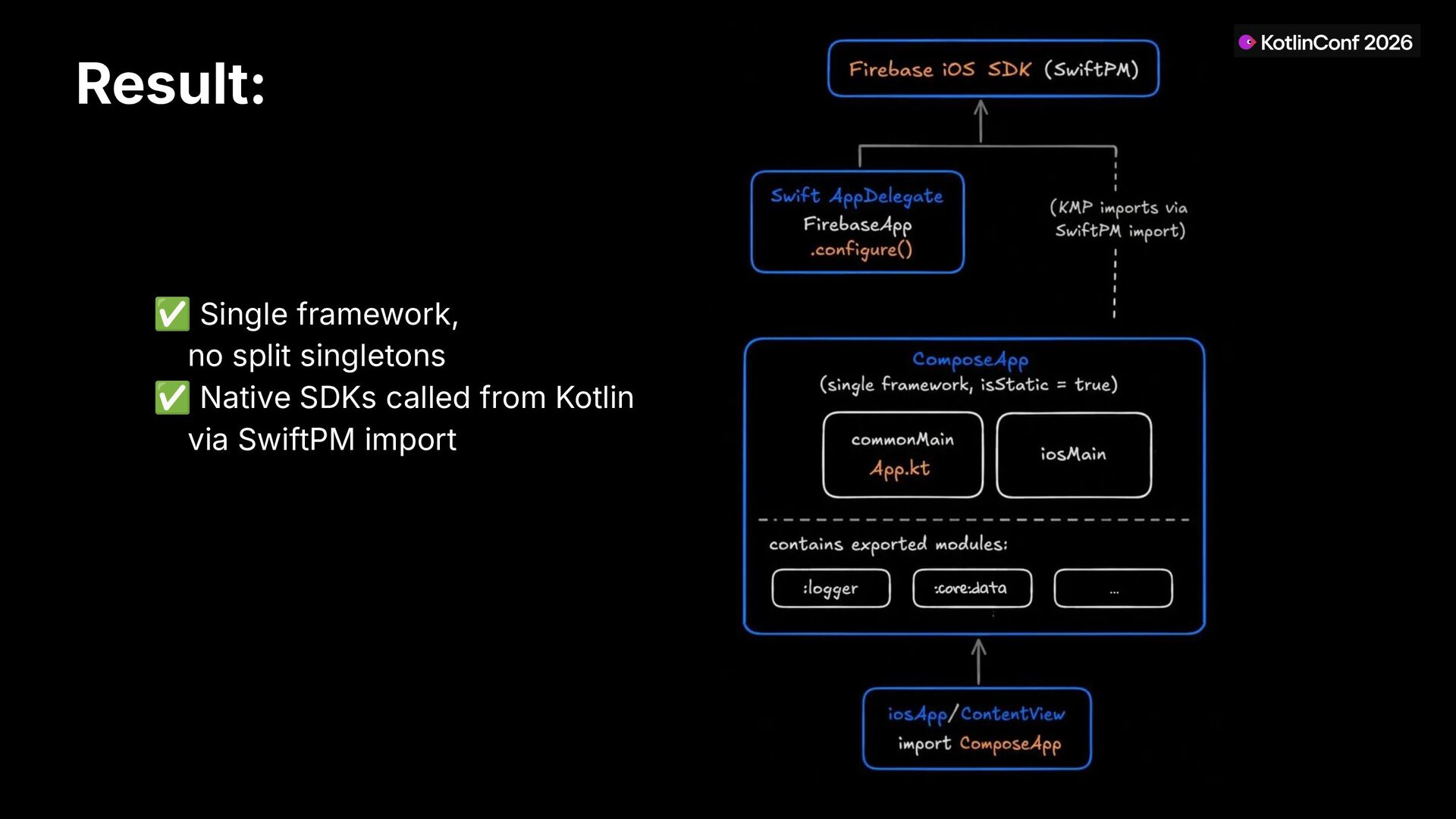
Result: ✅ Single framework, no split singletons ✅ Native SDKs
called from Kotlin via SwiftPM import -
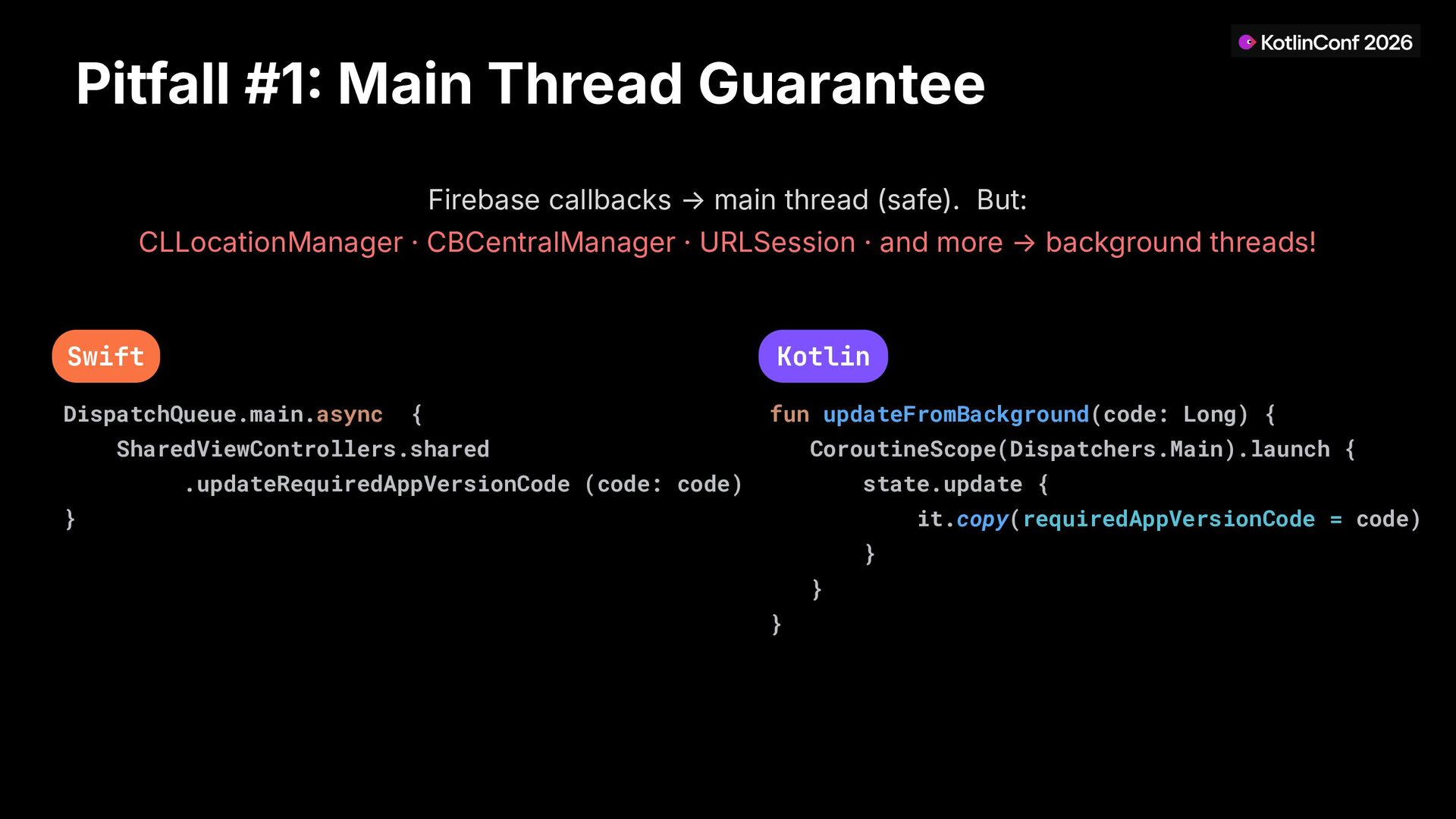
Pitfall #1 Main Thread Guarantee Firebase callbacks → main thread
(safe). But: CLLocationManager · CBCentralManager · URLSession · and more → background threads! Swift Kotlin DispatchQueue.main.async { fun updateFromBackground(code: Long) { SharedViewControllers.shared CoroutineScope(Dispatchers.Main).launch { .updateRequiredAppVersionCode (code: code) state.update { } it.copy(requiredAppVersionCode = code) } } } -
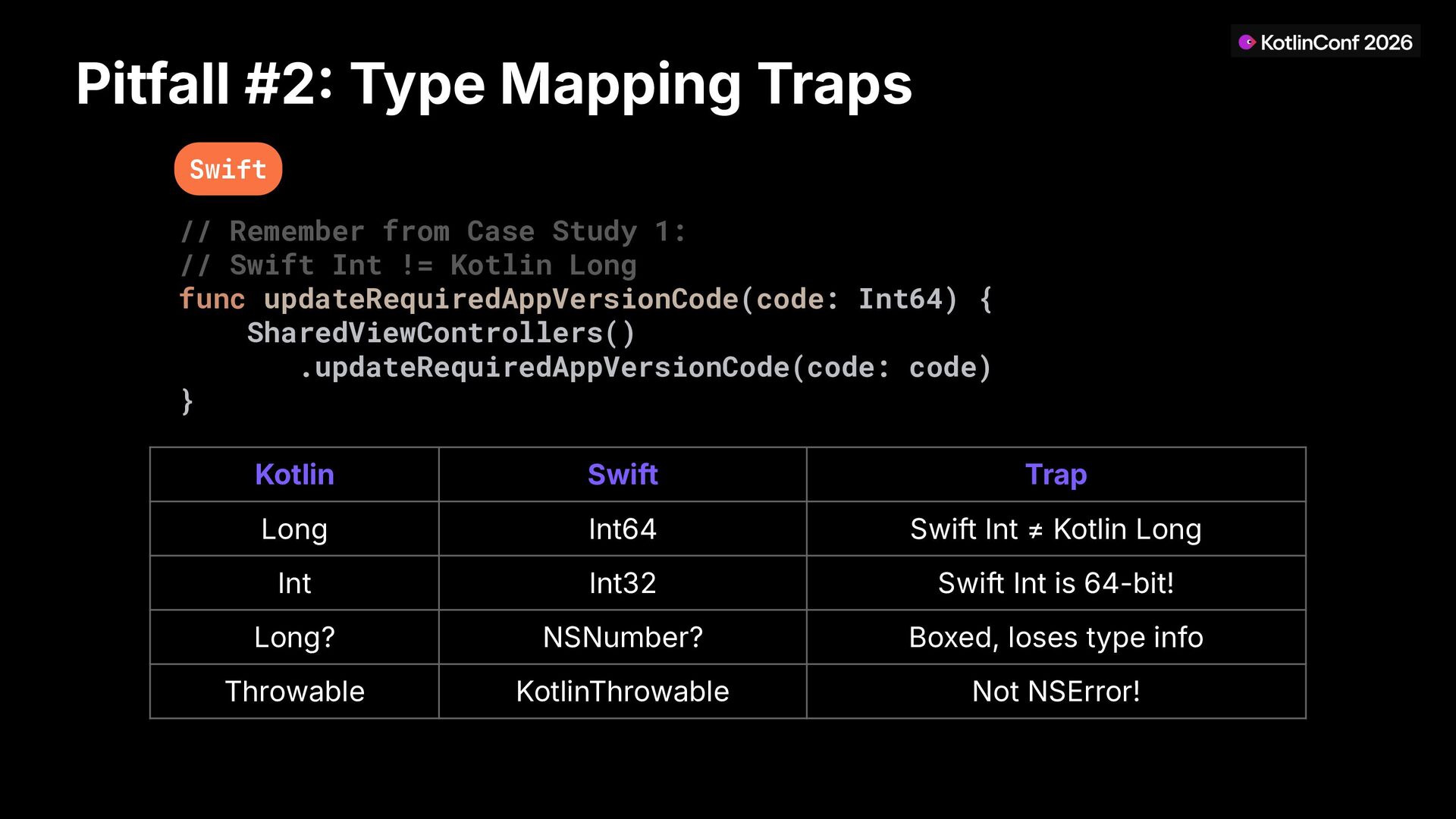
Pitfall #2 Type Mapping Traps Swift // Remember from Case
Study 1: // Swift Int != Kotlin Long func updateRequiredAppVersionCode(code: Int64) { SharedViewControllers() .updateRequiredAppVersionCode(code: code) } Kotlin Swift Trap Long Int64 Swift Int ≠ Kotlin Long Int Int32 Swift Int is 64-bit! Long? NSNumber? Boxed, loses type info Throwable KotlinThrowable Not NSError! -
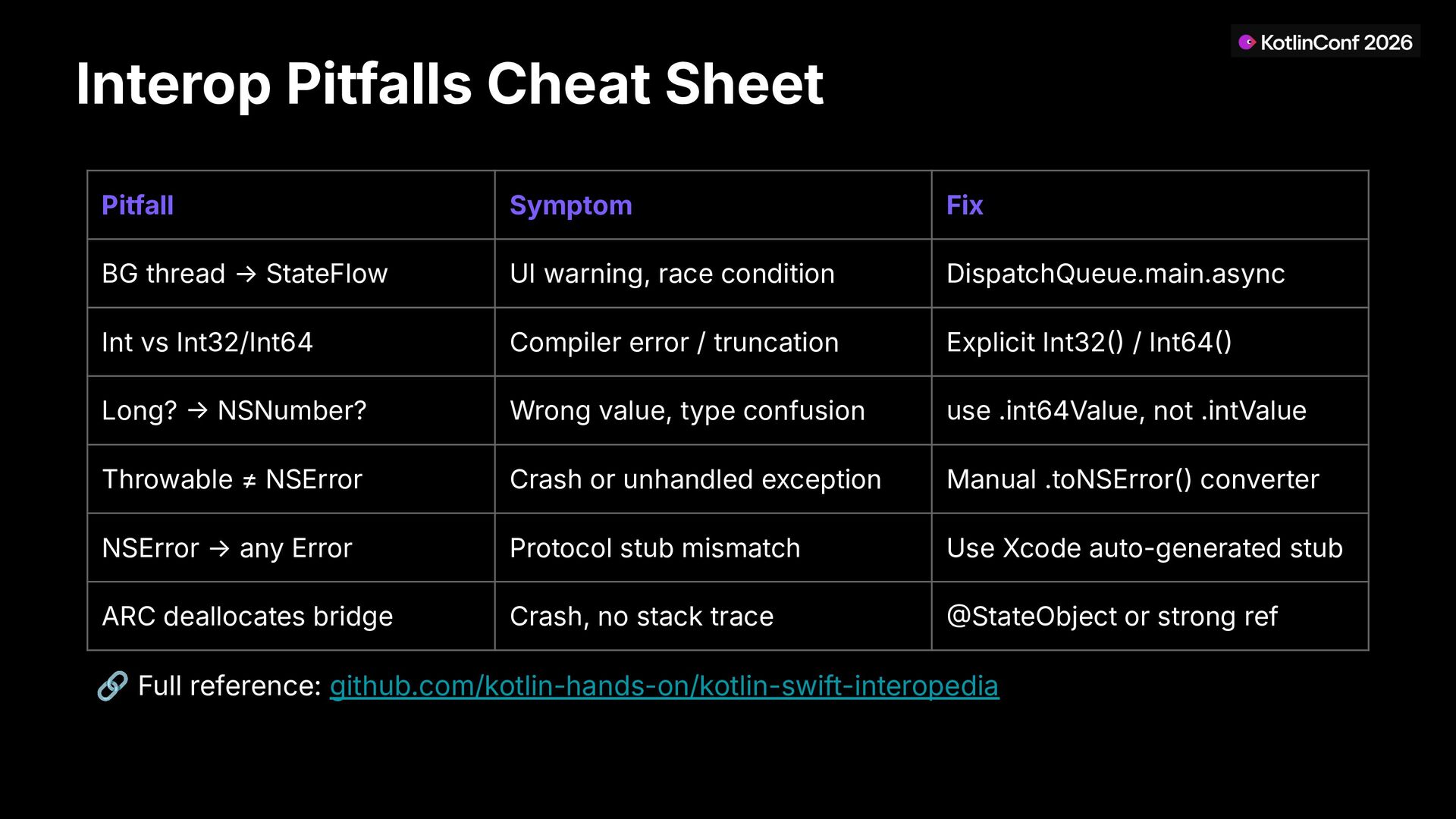
Interop Pitfalls Cheat Sheet Pitfall Symptom Fix BG thread →
StateFlow UI warning, race condition DispatchQueue.main.async Int vs Int32/Int64 Compiler error / truncation Explicit Int32 / Int64 Long? NSNumber? Wrong value, type confusion use .int64Value, not .intValue Throwable ≠ NSError Crash or unhandled exception Manual .toNSError() converter NSError → any Error Protocol stub mismatch Use Xcode auto-generated stub ARC deallocates bridge Crash, no stack trace StateObject or strong ref 🔗 Full reference: github.com/kotlin-hands-on/kotlin-swift-interopedia -
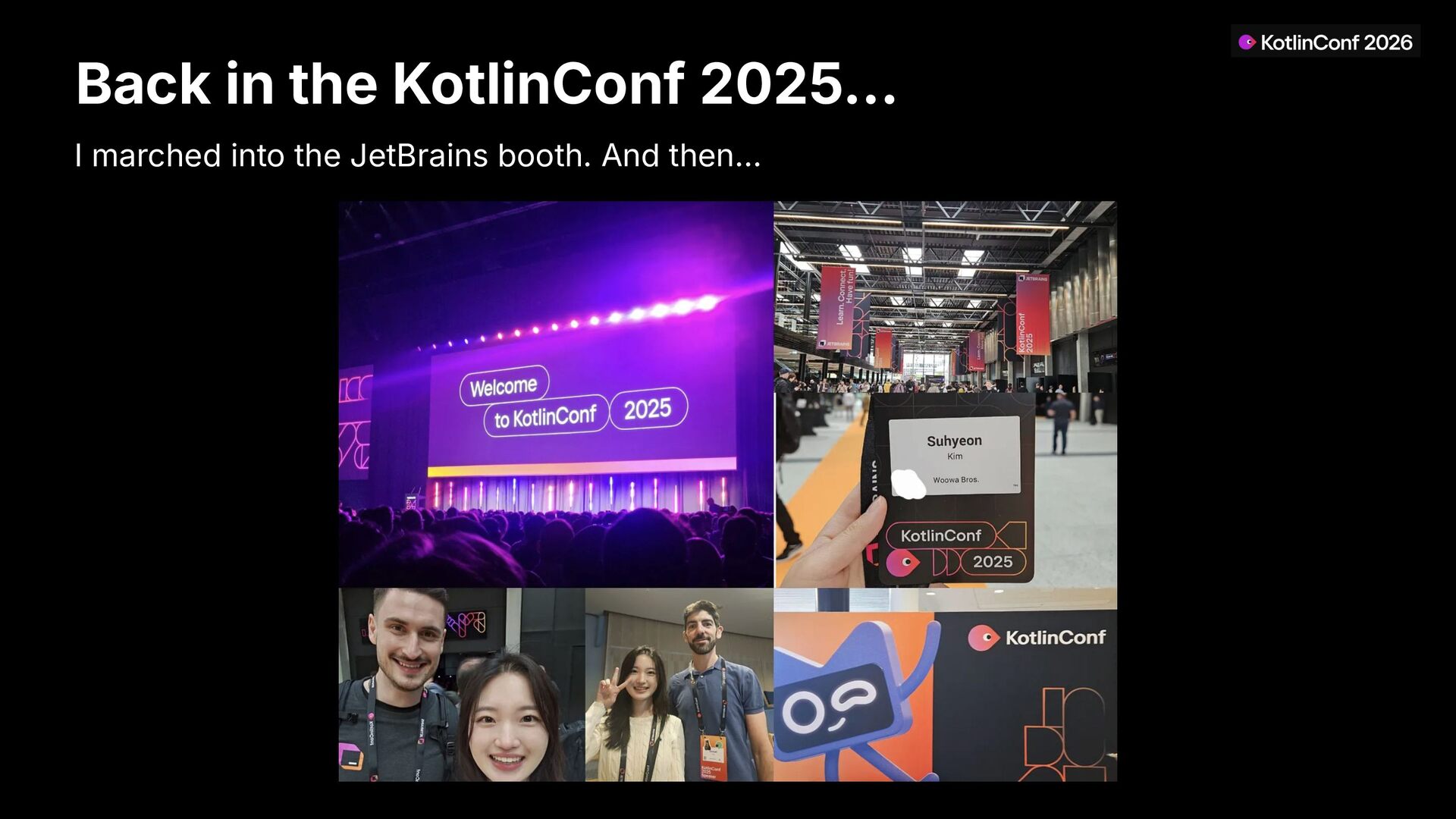
Back in the KotlinConf 2025... I marched into the JetBrains
booth. And then... -
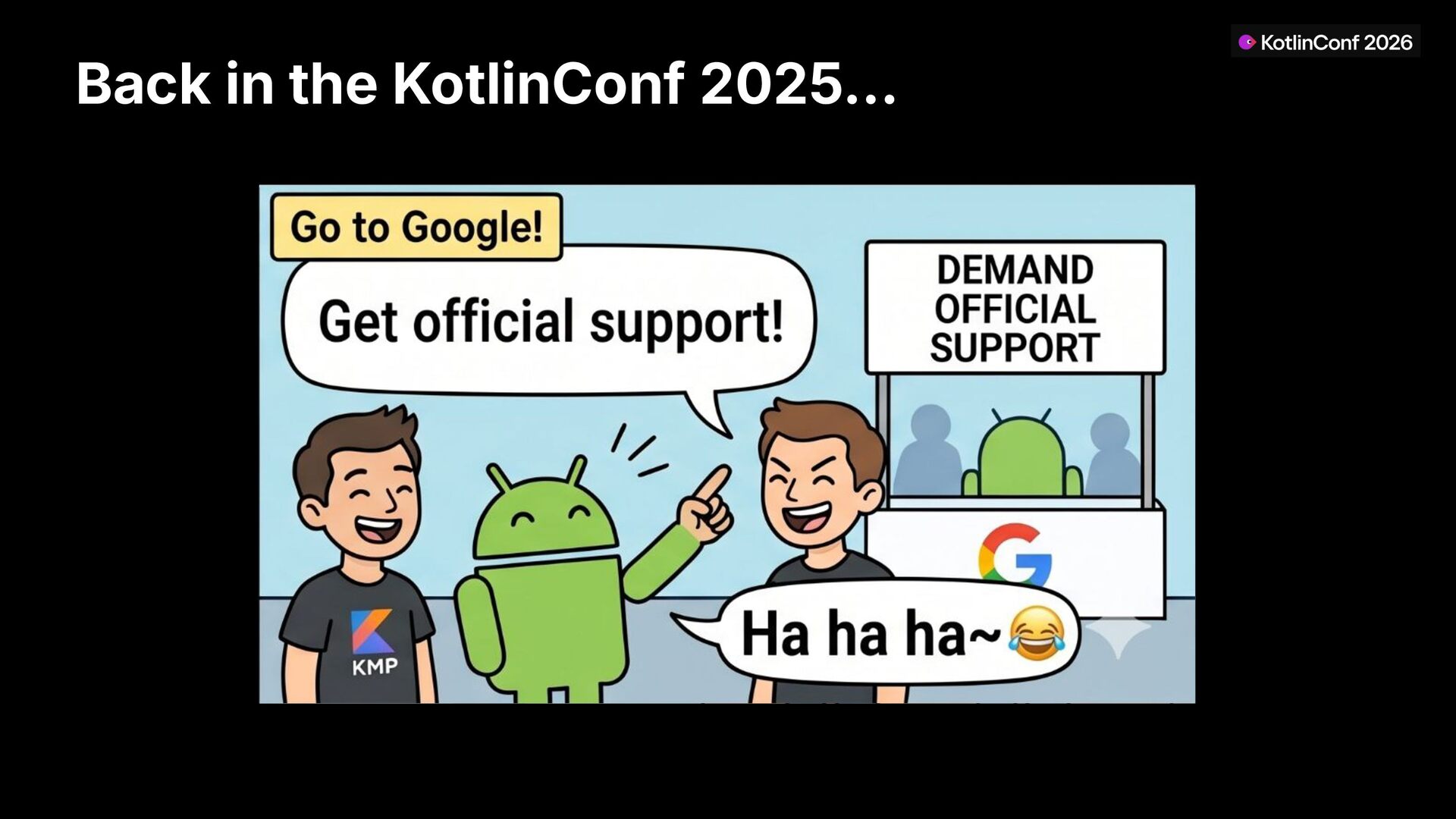
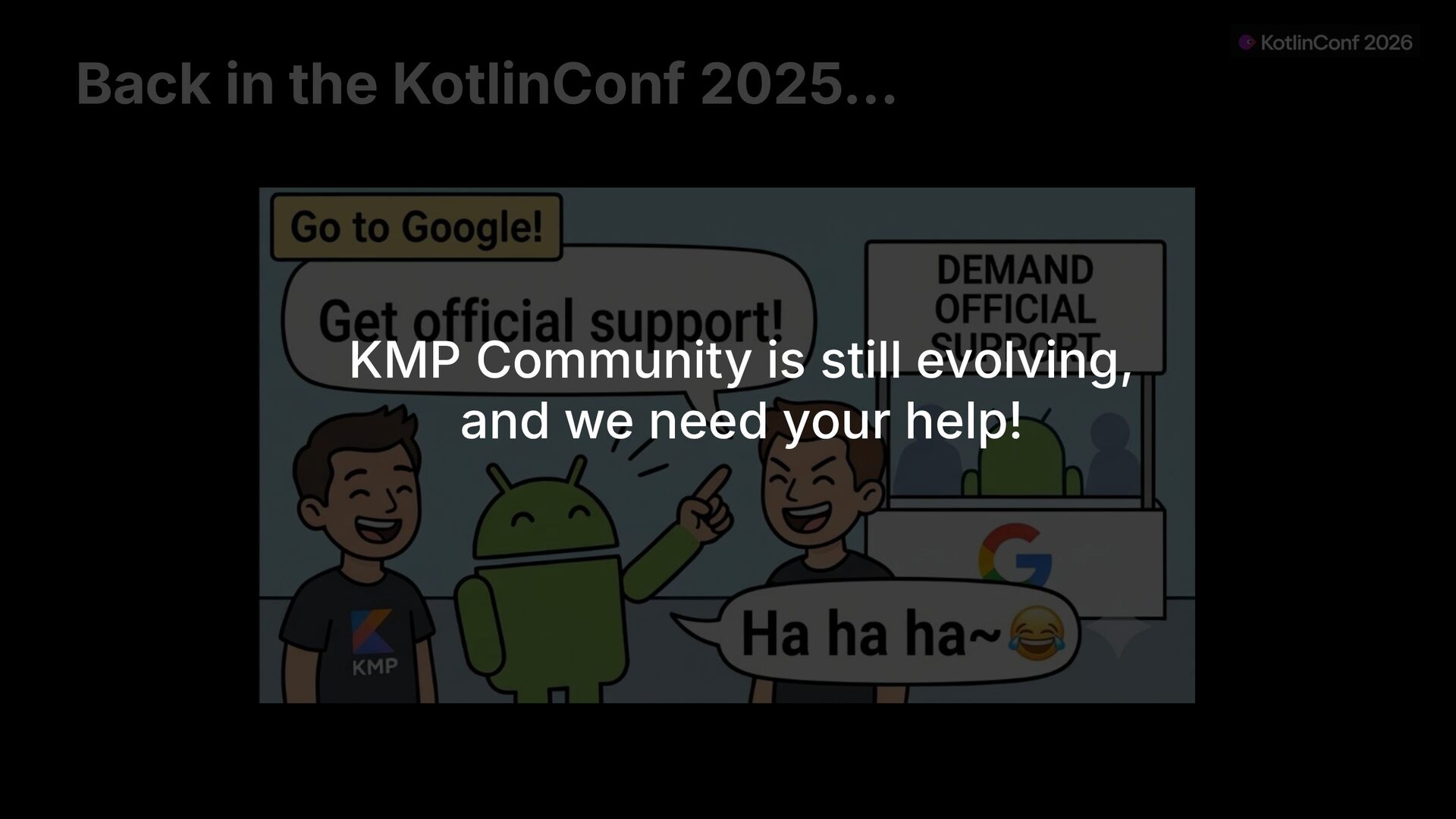
Back in the KotlinConf 2025... KMP Community is still evolving,
and we need your help! -
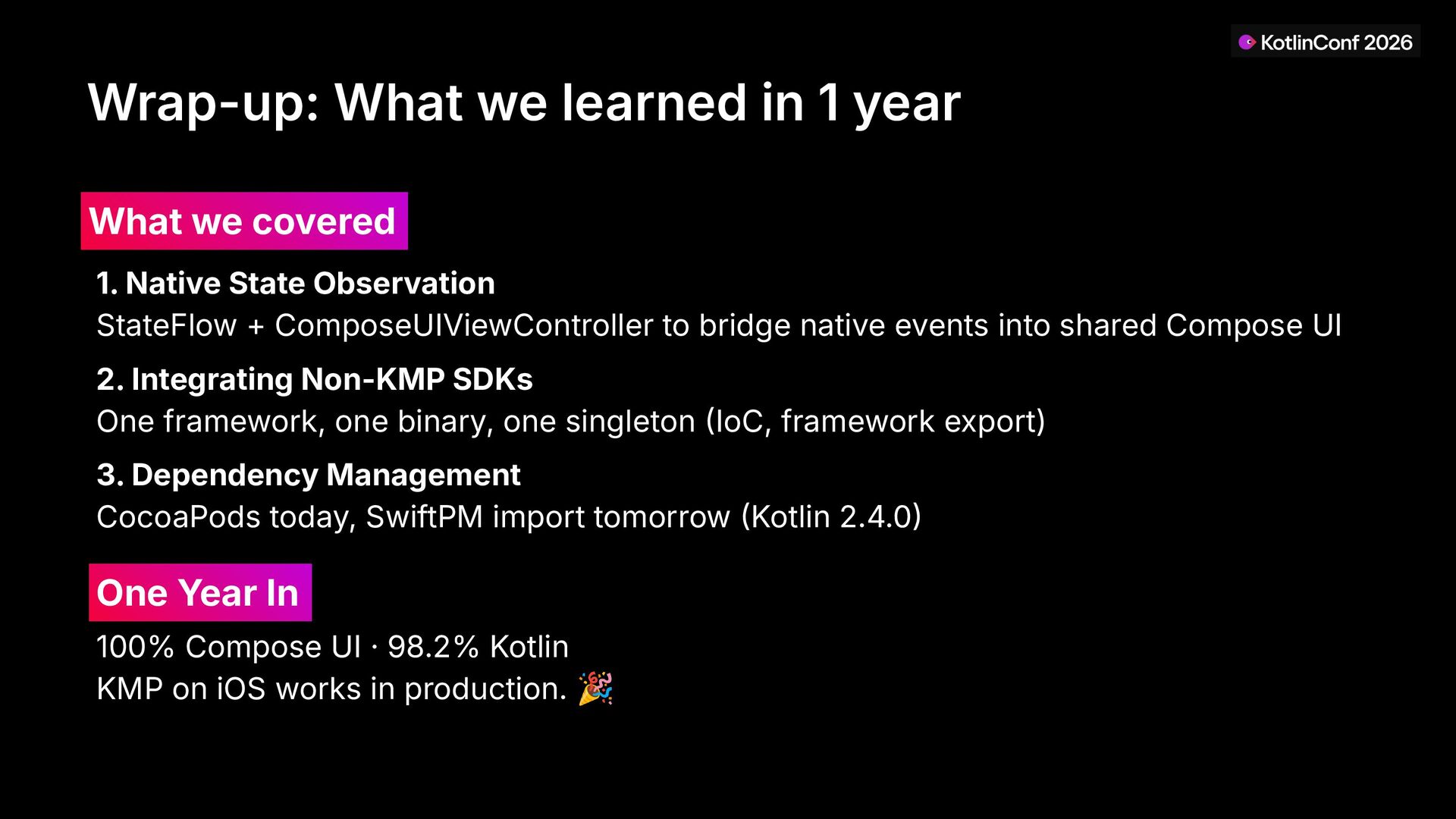
Wrap-up: What we learned in 1 year What we covered
1. Native State Observation StateFlow + ComposeUIViewController to bridge native events into shared Compose UI 2. Integrating Non-KMP SDKs One framework, one binary, one singleton IoC, framework export) 3. Dependency Management CocoaPods today, SwiftPM import tomorrow Kotlin 2.4.0 One Year In 100% Compose UI · 98.2% Kotlin KMP on iOS works in production. 🎉
 wisemuji
 sodainc
 raeminkang
 3saito
 kosukesaigusa
 ktombow
 nearme_tech
 nnaka2992
 kishida
 petamoriken
 hakkadaikon
 bicstone
 dalinaum
 ryanjones
 addyosmani
 thekraken
 tammyeverts
 bethany
 morganepeng
 retrage
 katarinadahlin
 lara
 aleyda
 bcantrill