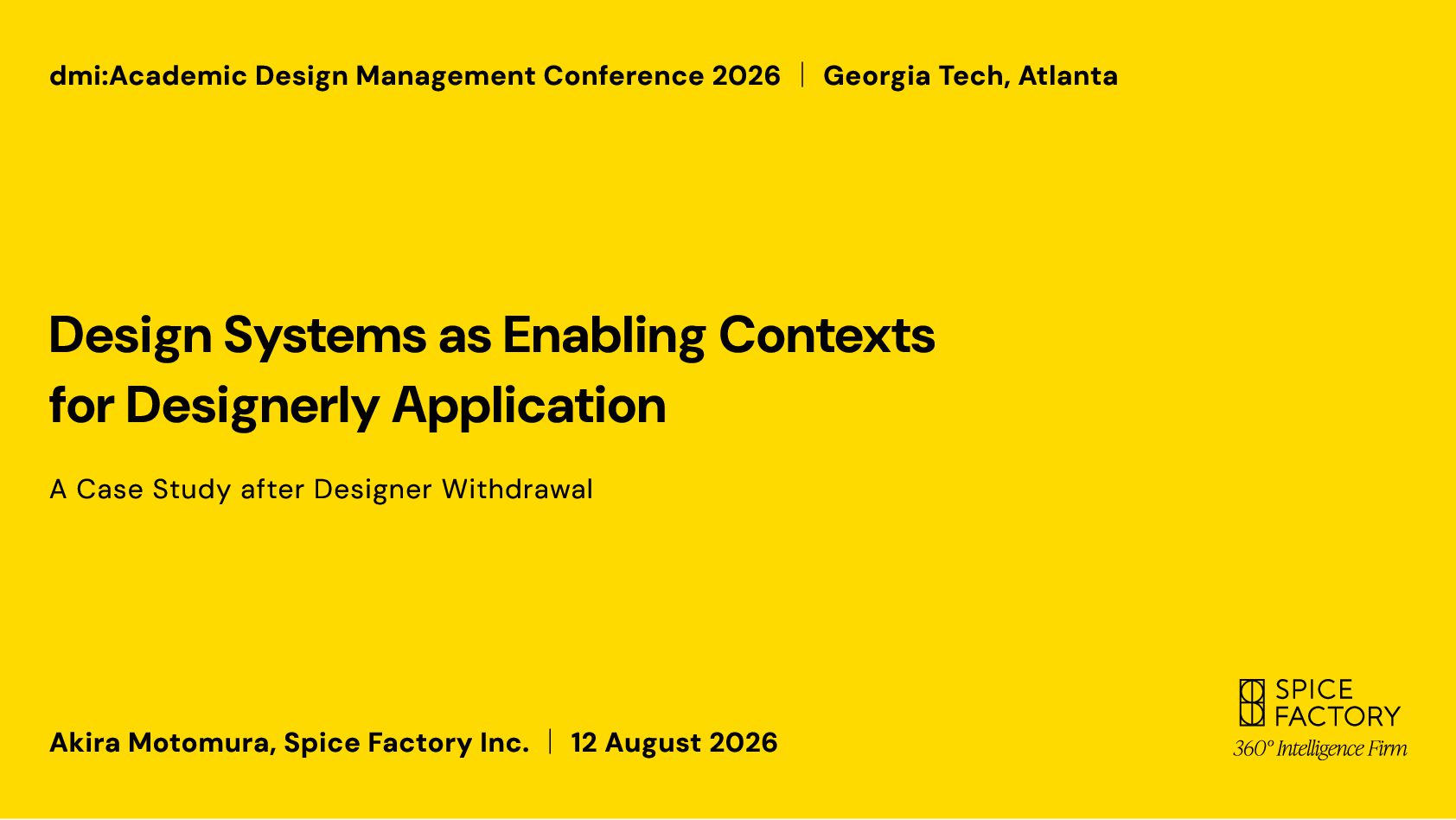
Slides from a 15-minute presentation at dmi:Academic Design Management Conference 2026 (Georgia Tech College of Design, Atlanta, 12 August 2026).
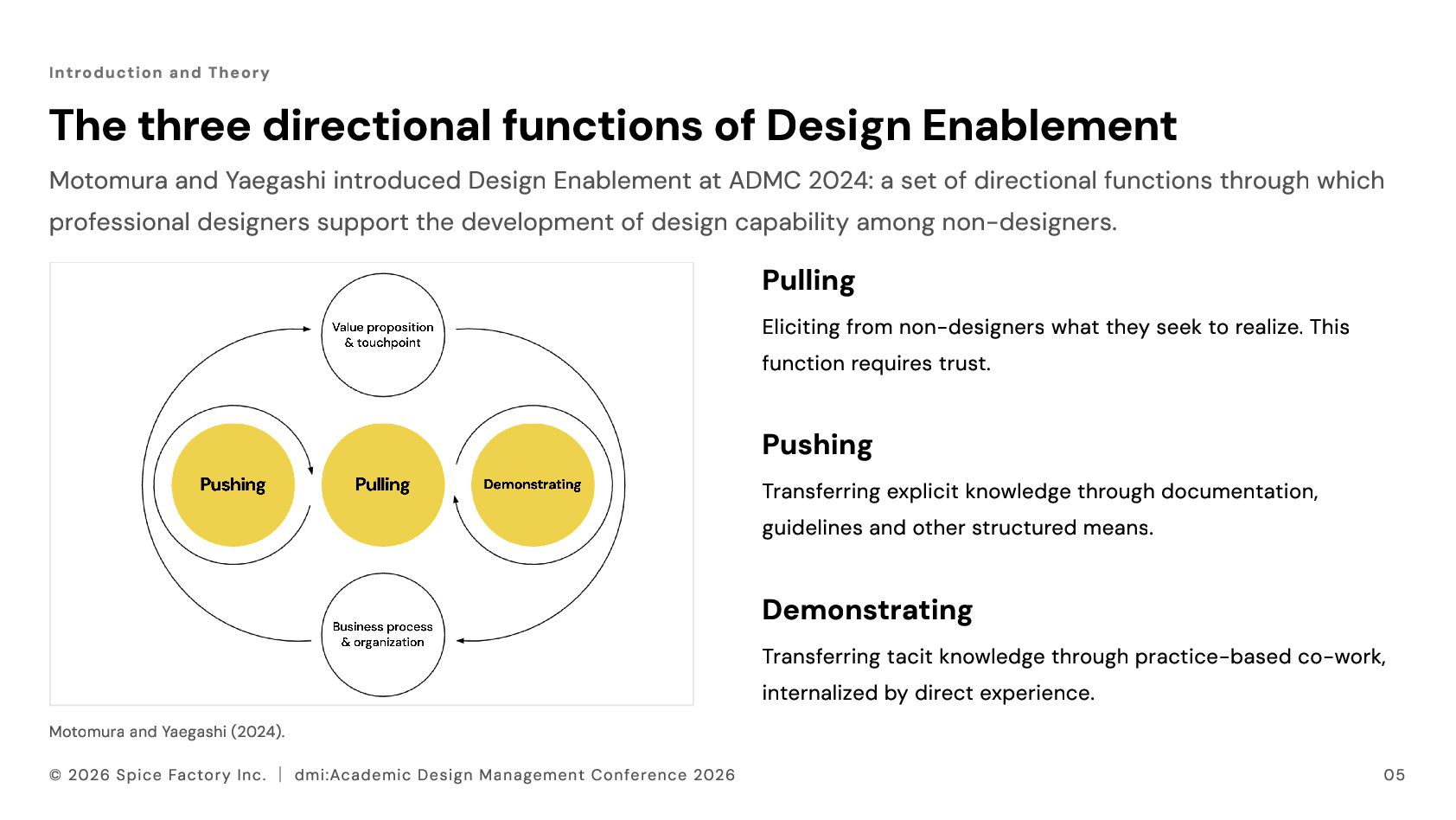
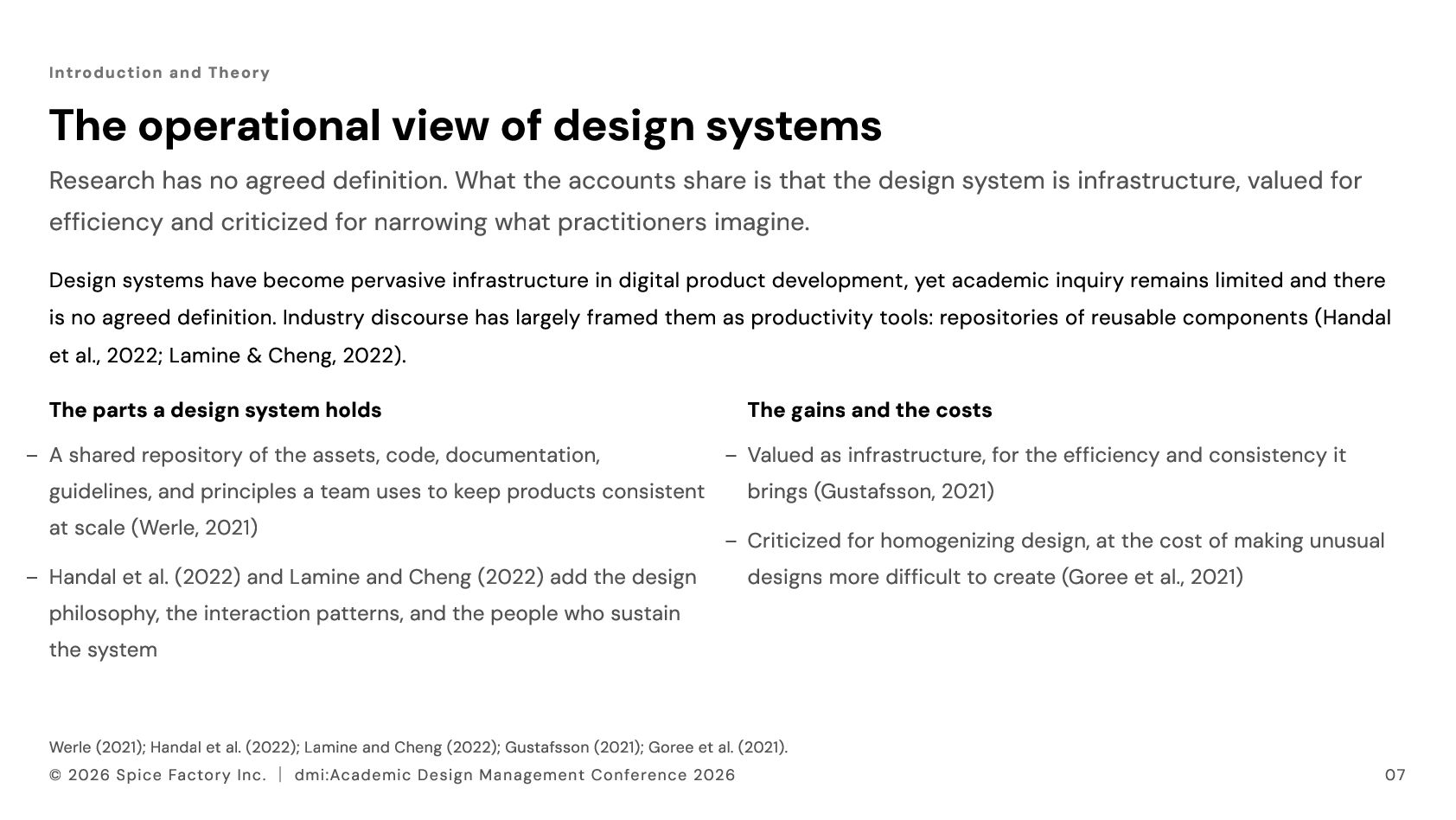
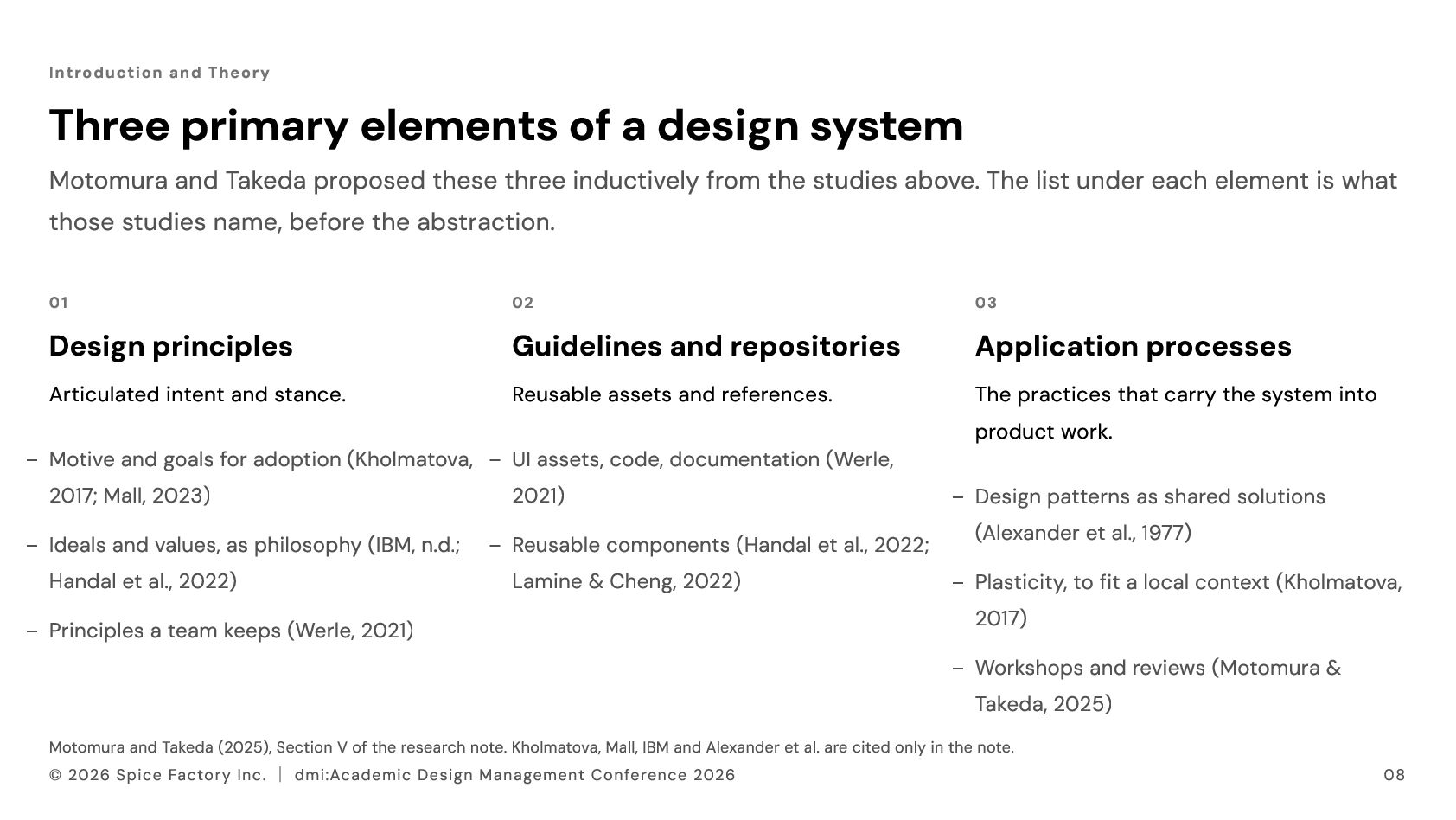
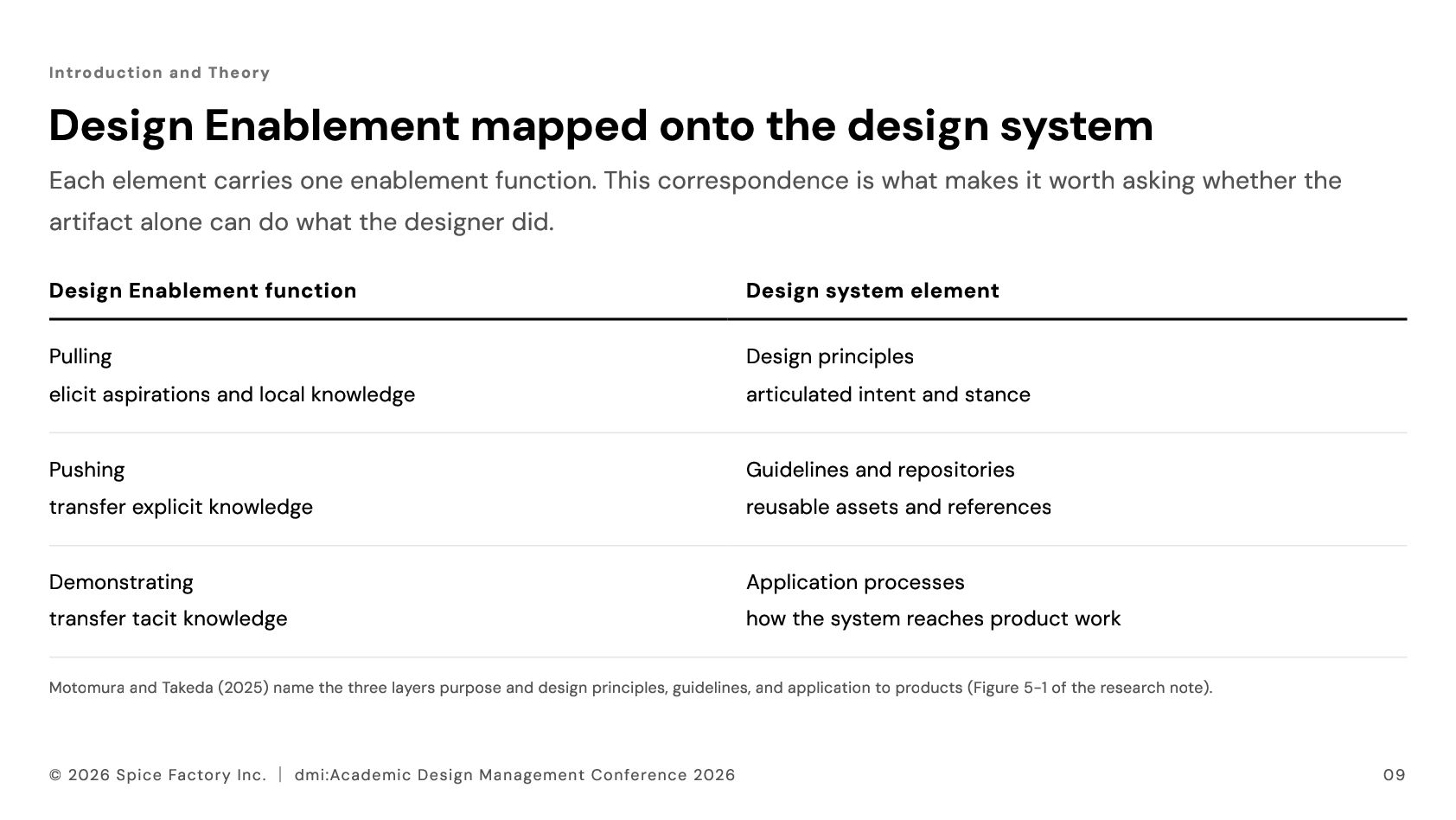
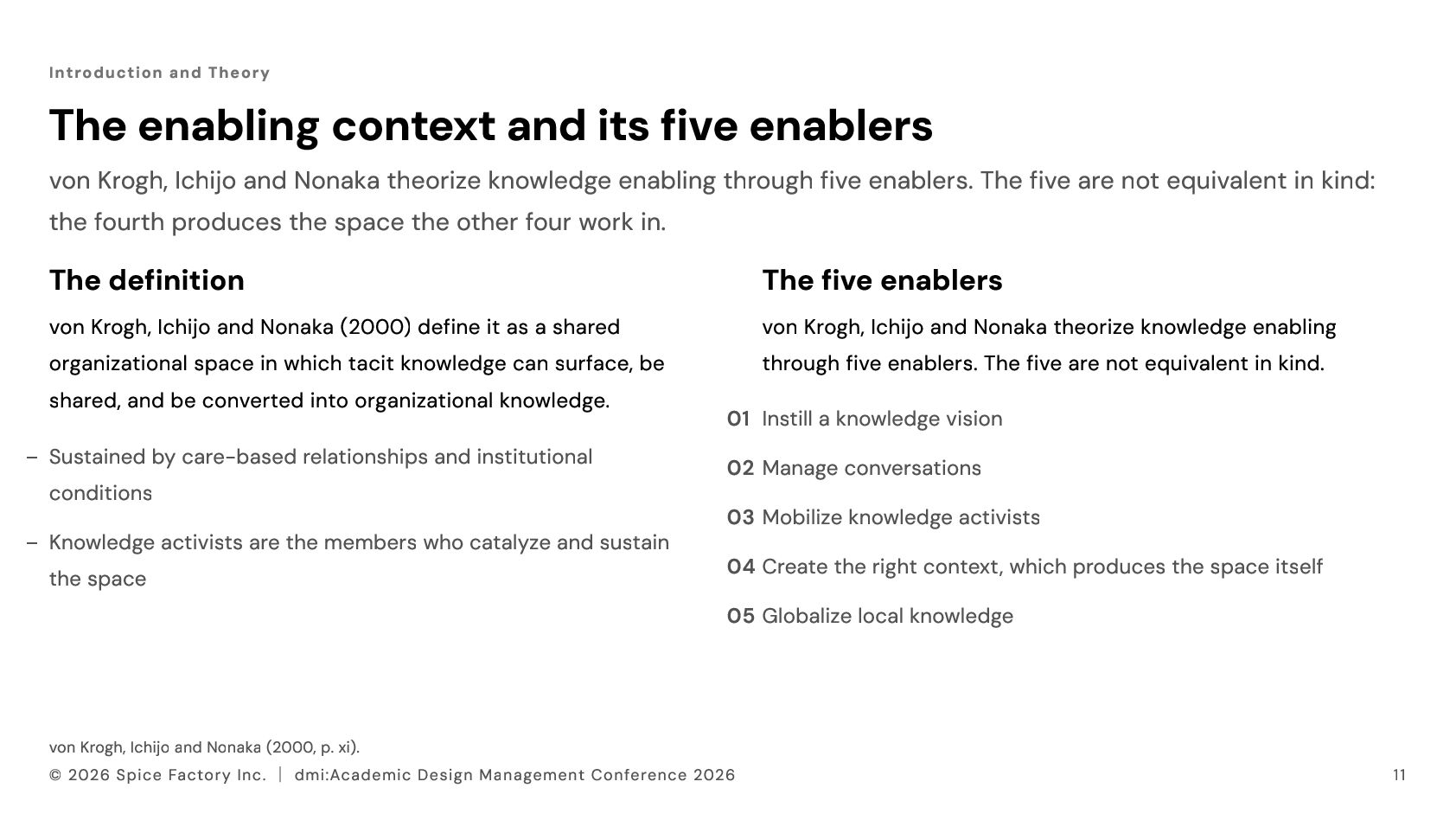
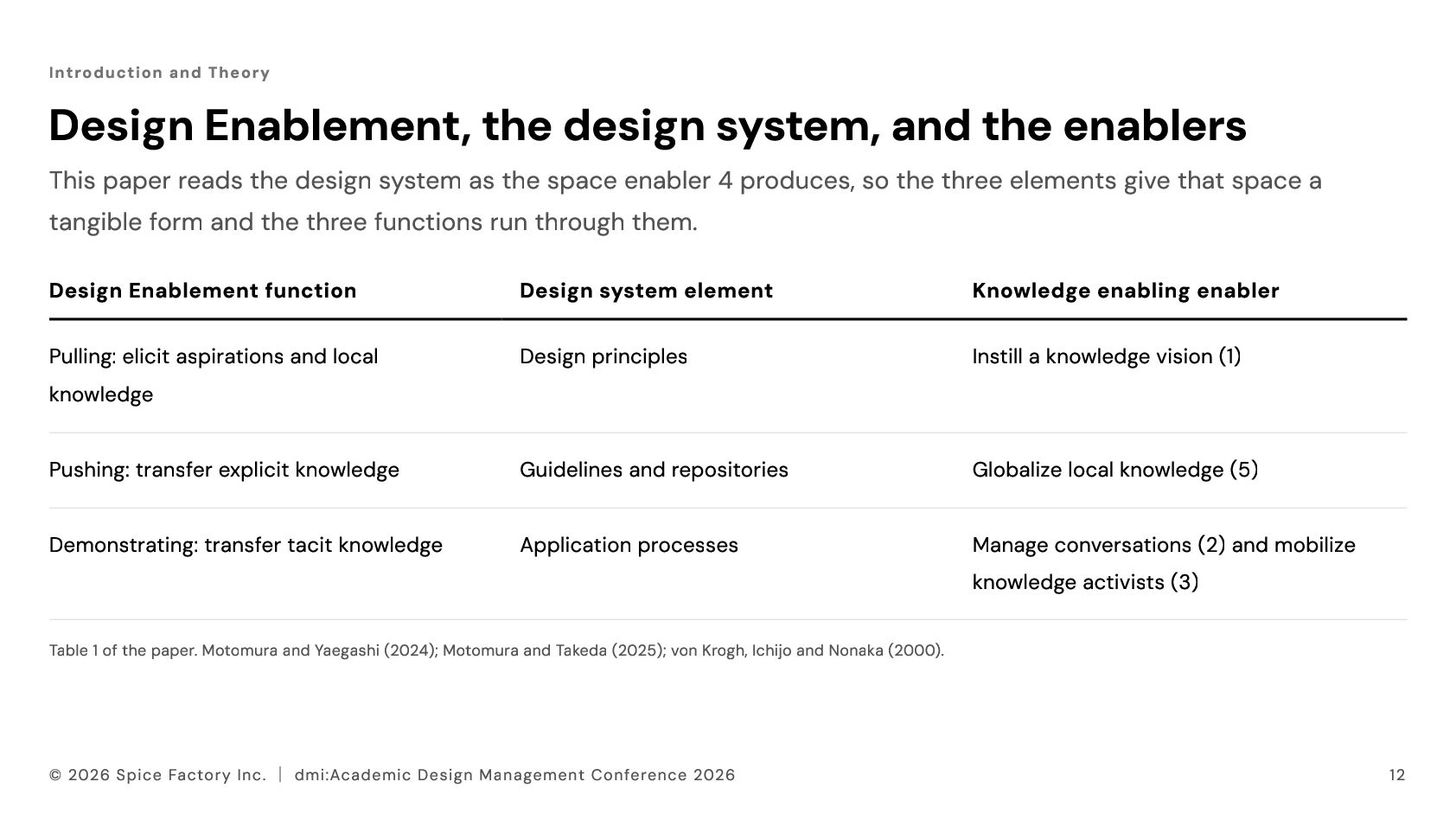
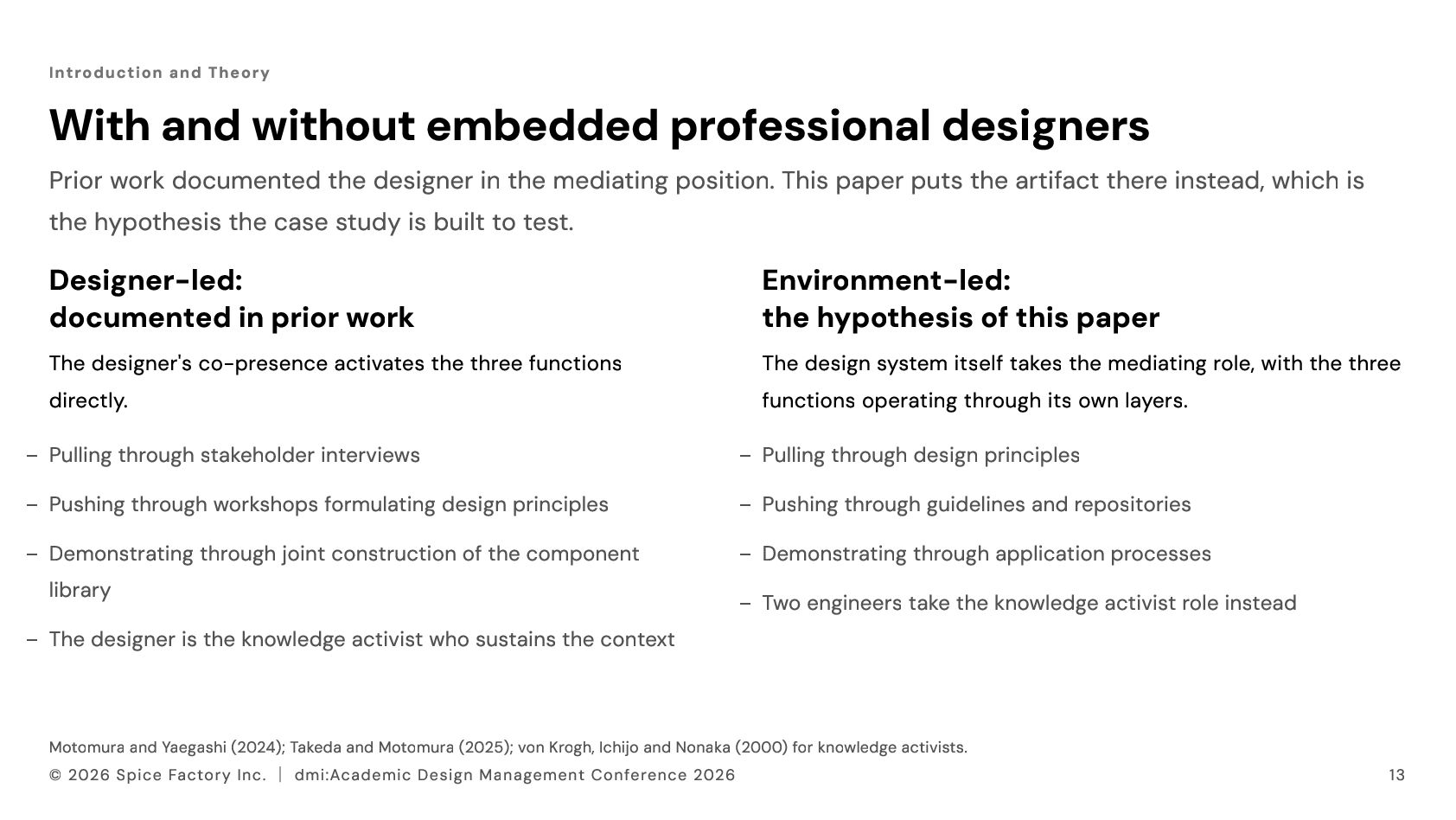
Design Enablement, the cultivation of designerly ways of knowing within organizations, has been theorized through a designer-led pattern: professional designers activate three directional functions (Pulling, Pushing, Demonstrating) among non-designers through co-presence. Whether the design system produced in such an engagement keeps functioning as an enabling context after the designer withdraws has not been examined empirically.
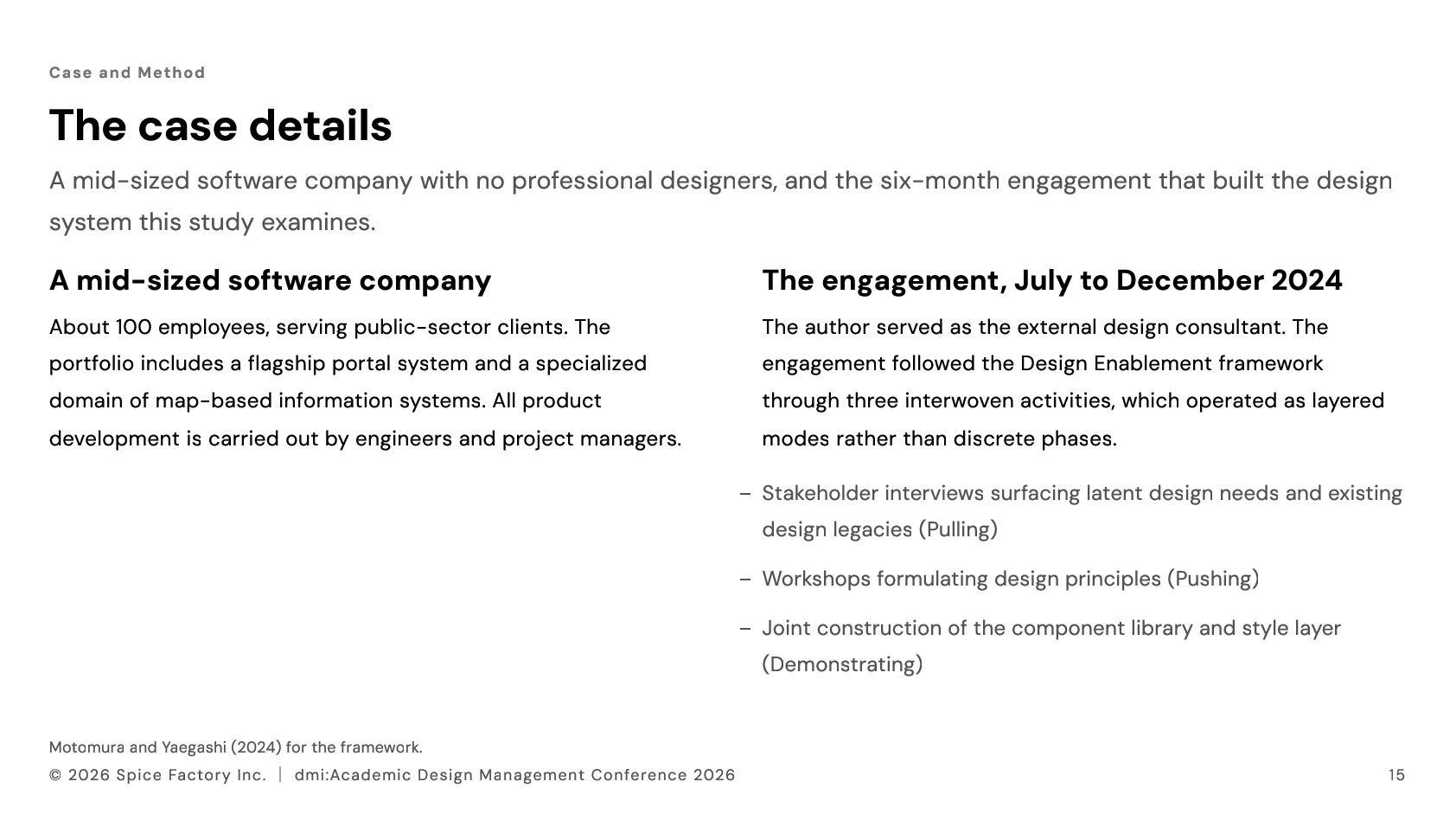
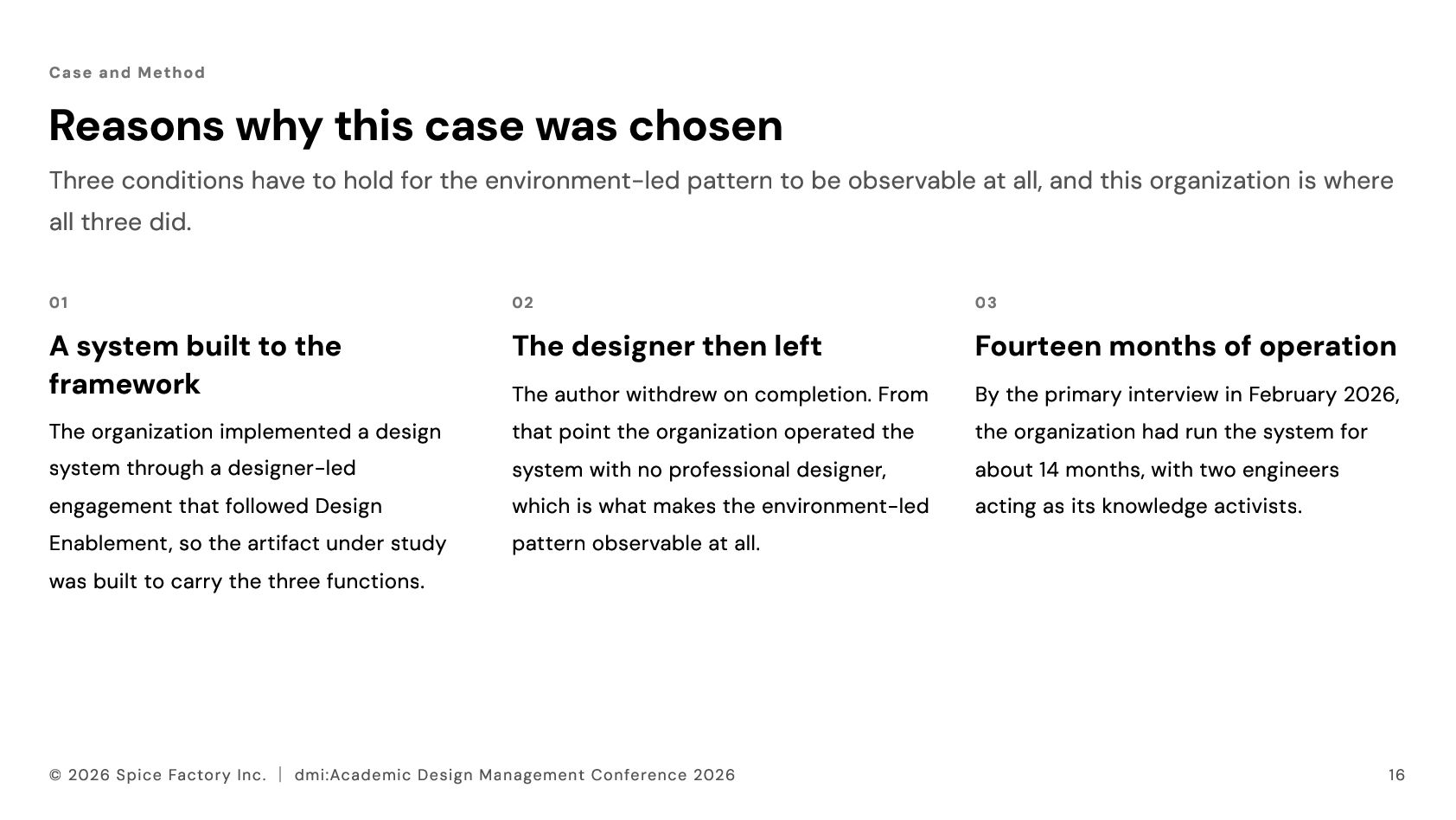
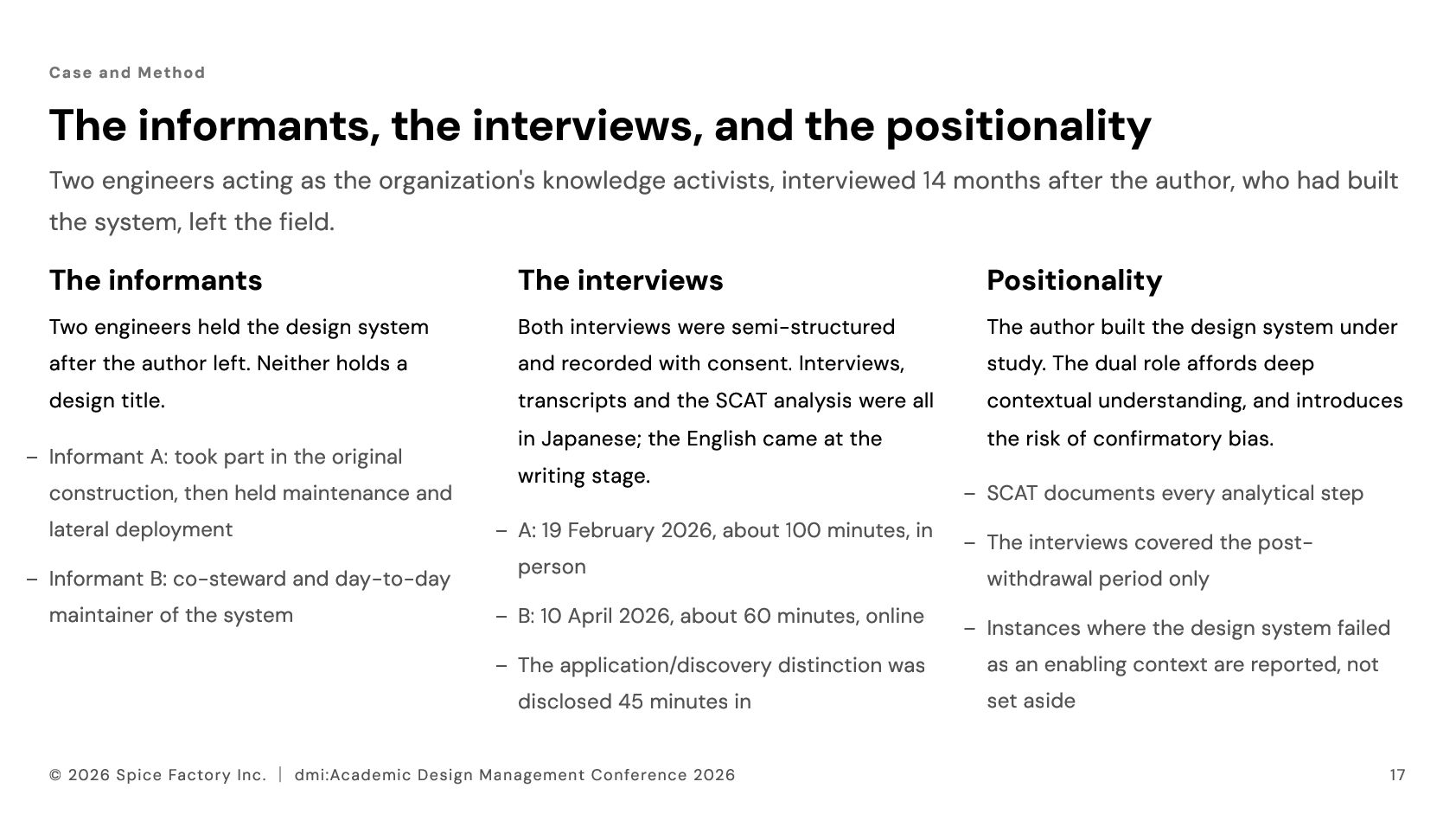
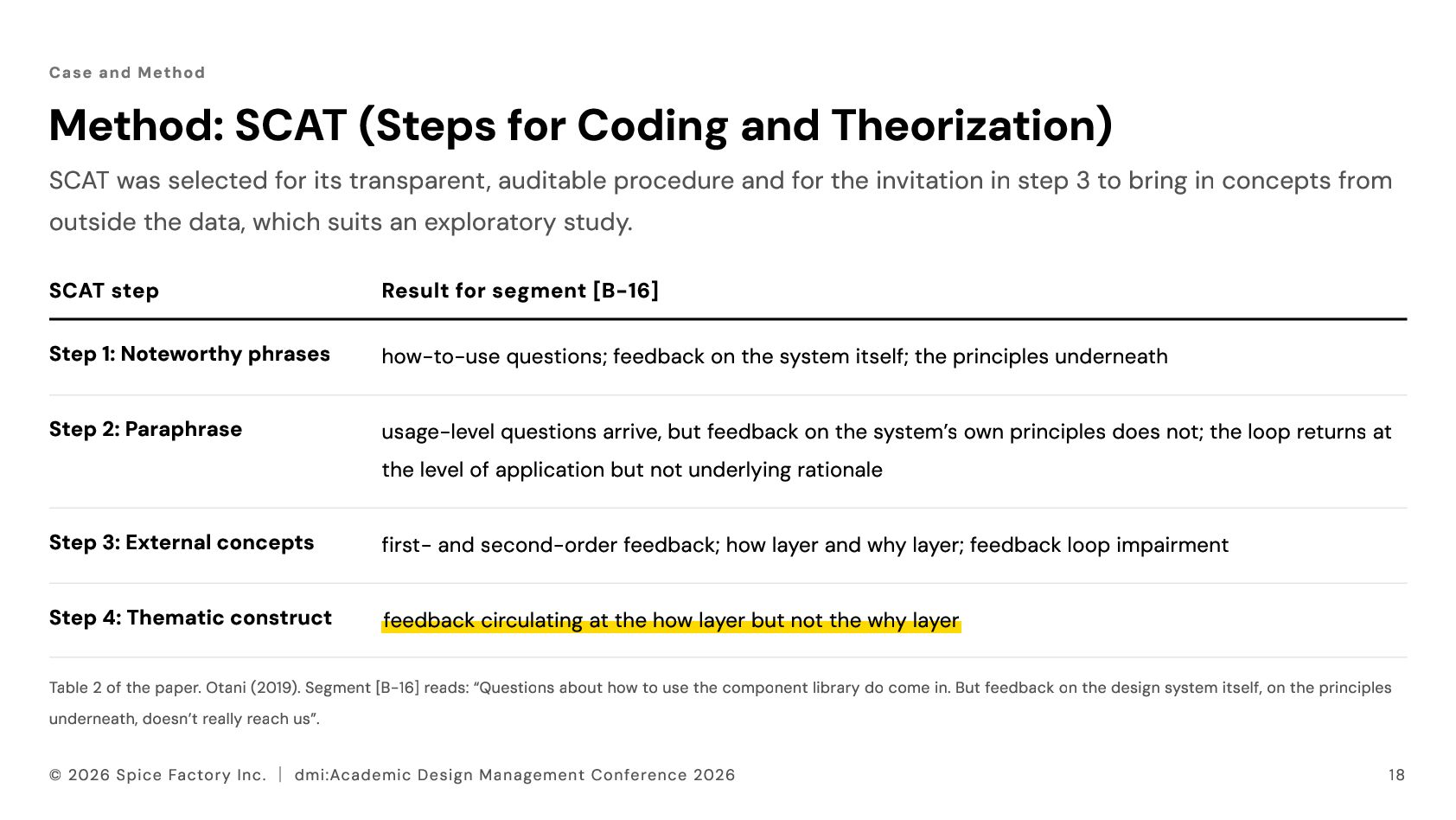
This exploratory case study takes a mid-sized Japanese software company (about 100 employees) with no professional designers, where a design system was built through an external designer engagement in 2024. About 14 months after withdrawal, semi-structured interviews with the design system owner and with an engineer maintaining it were analyzed using SCAT (Steps for Coding and Theorization).
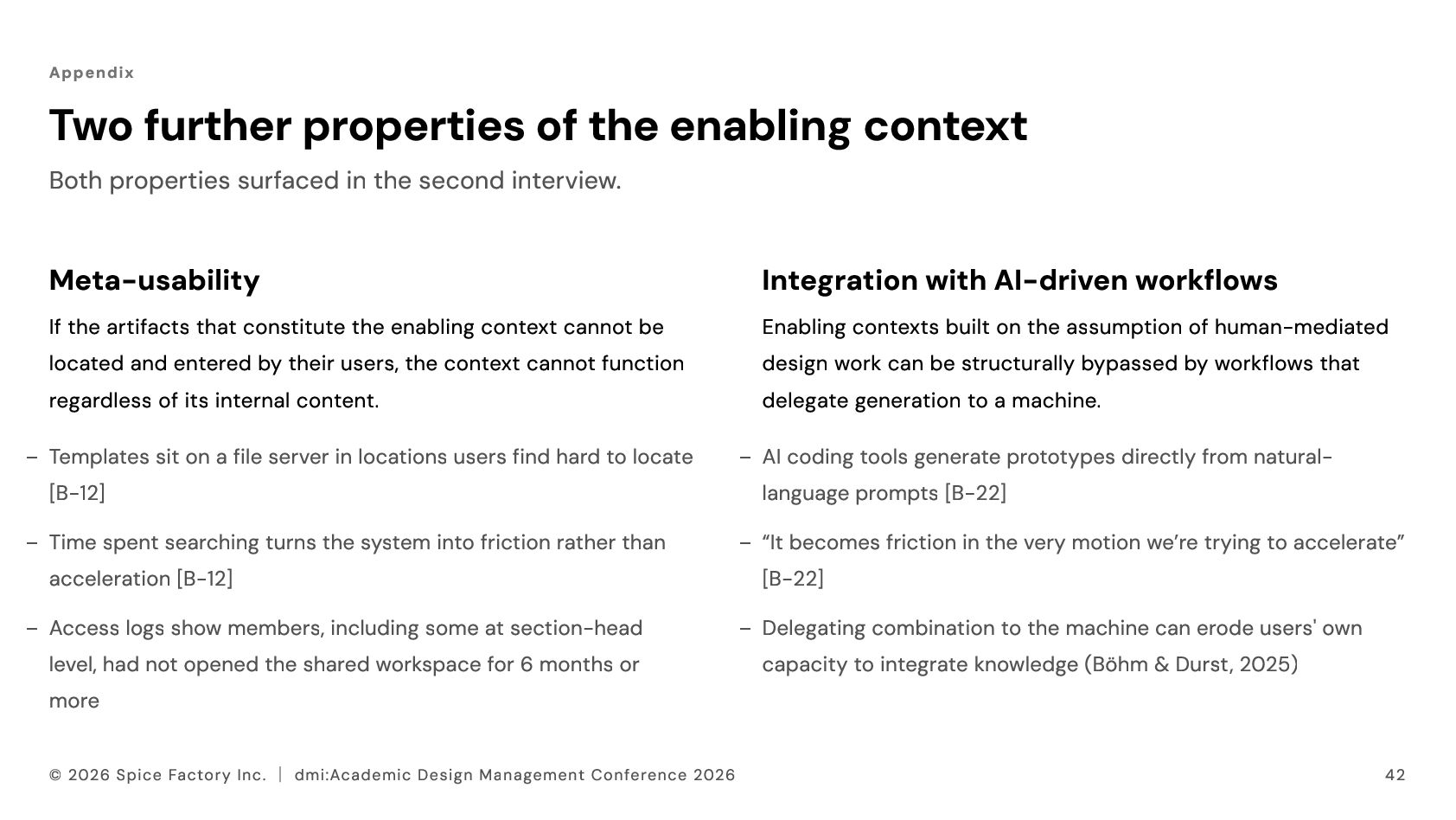
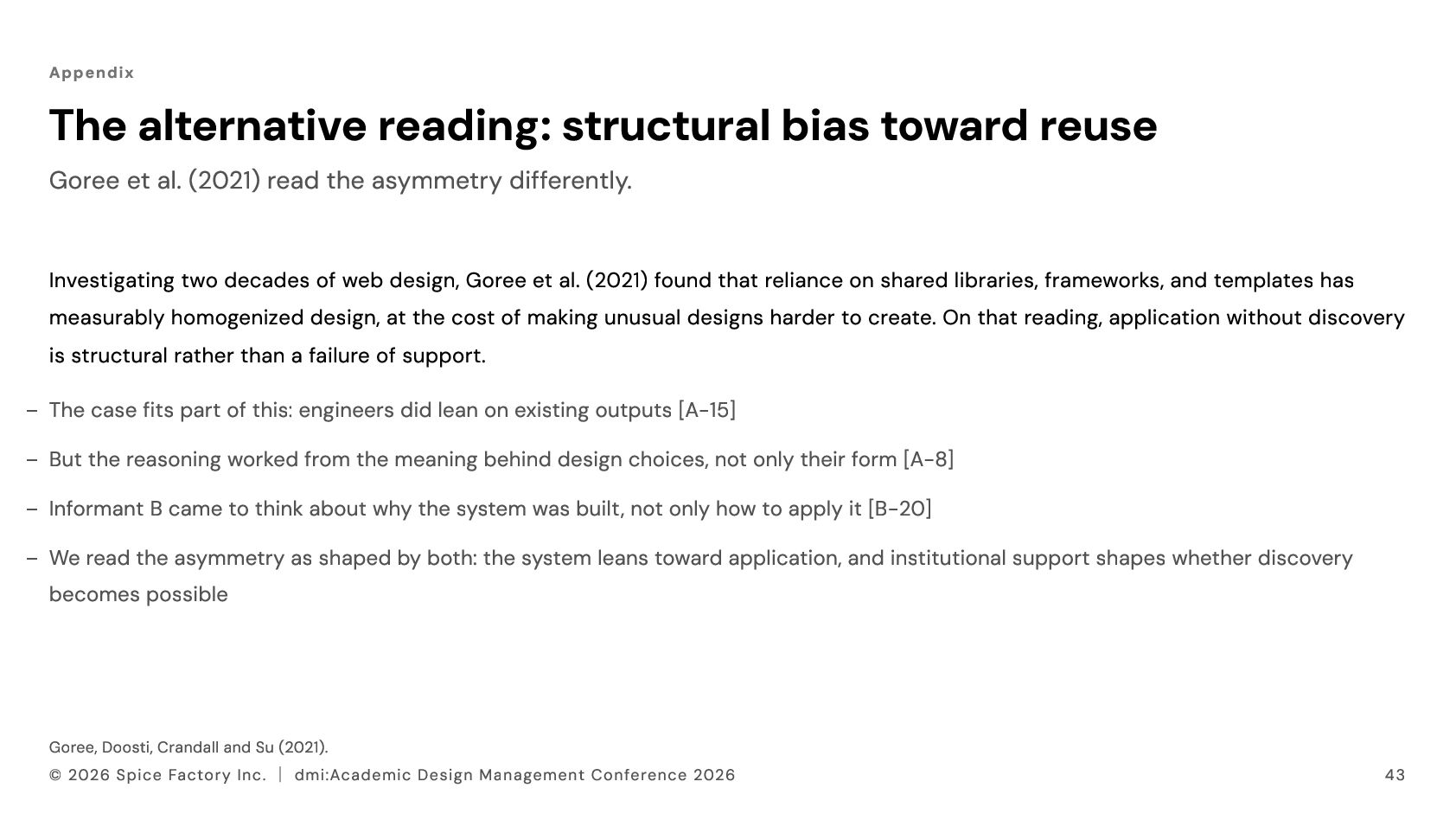
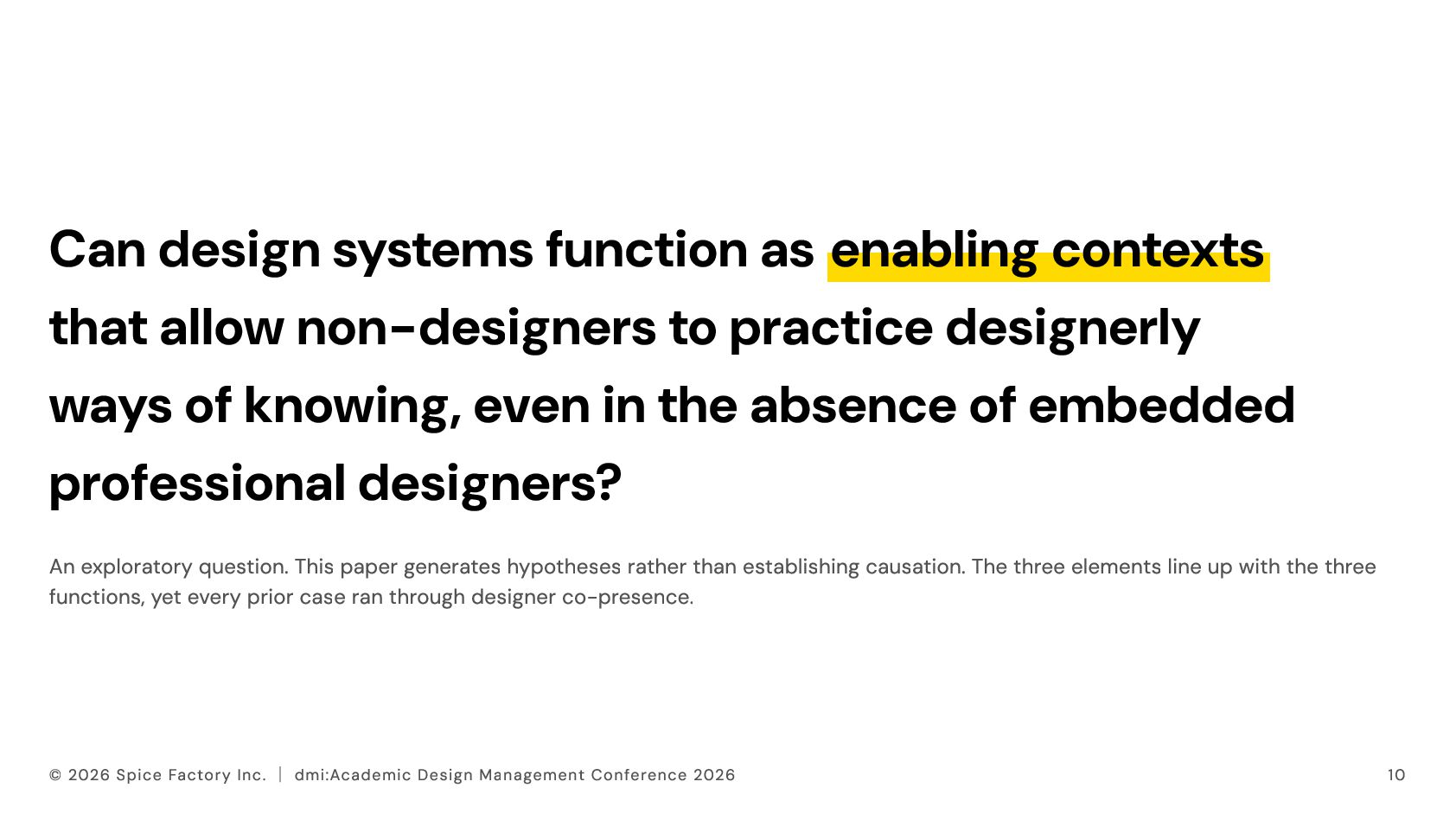
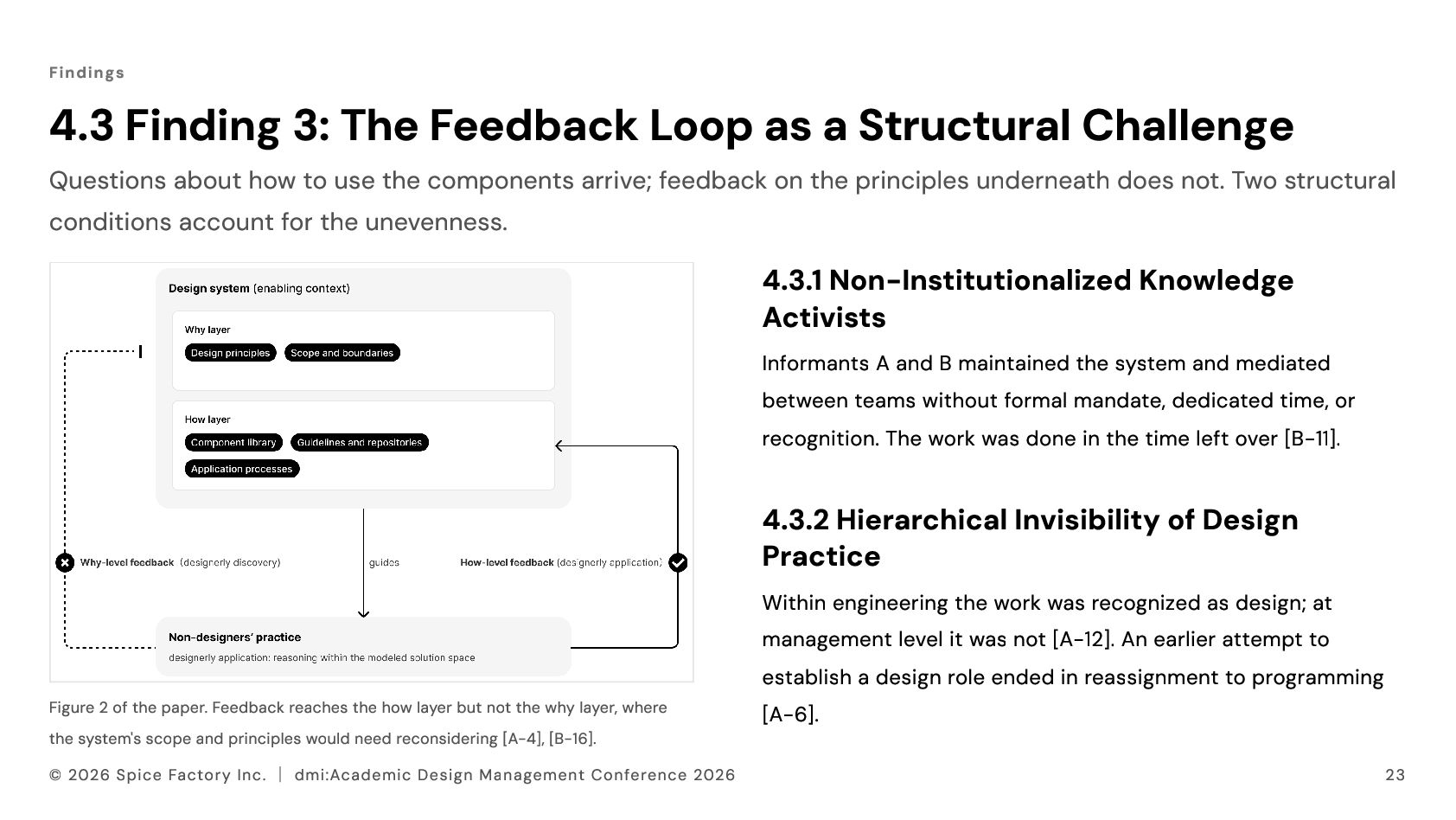
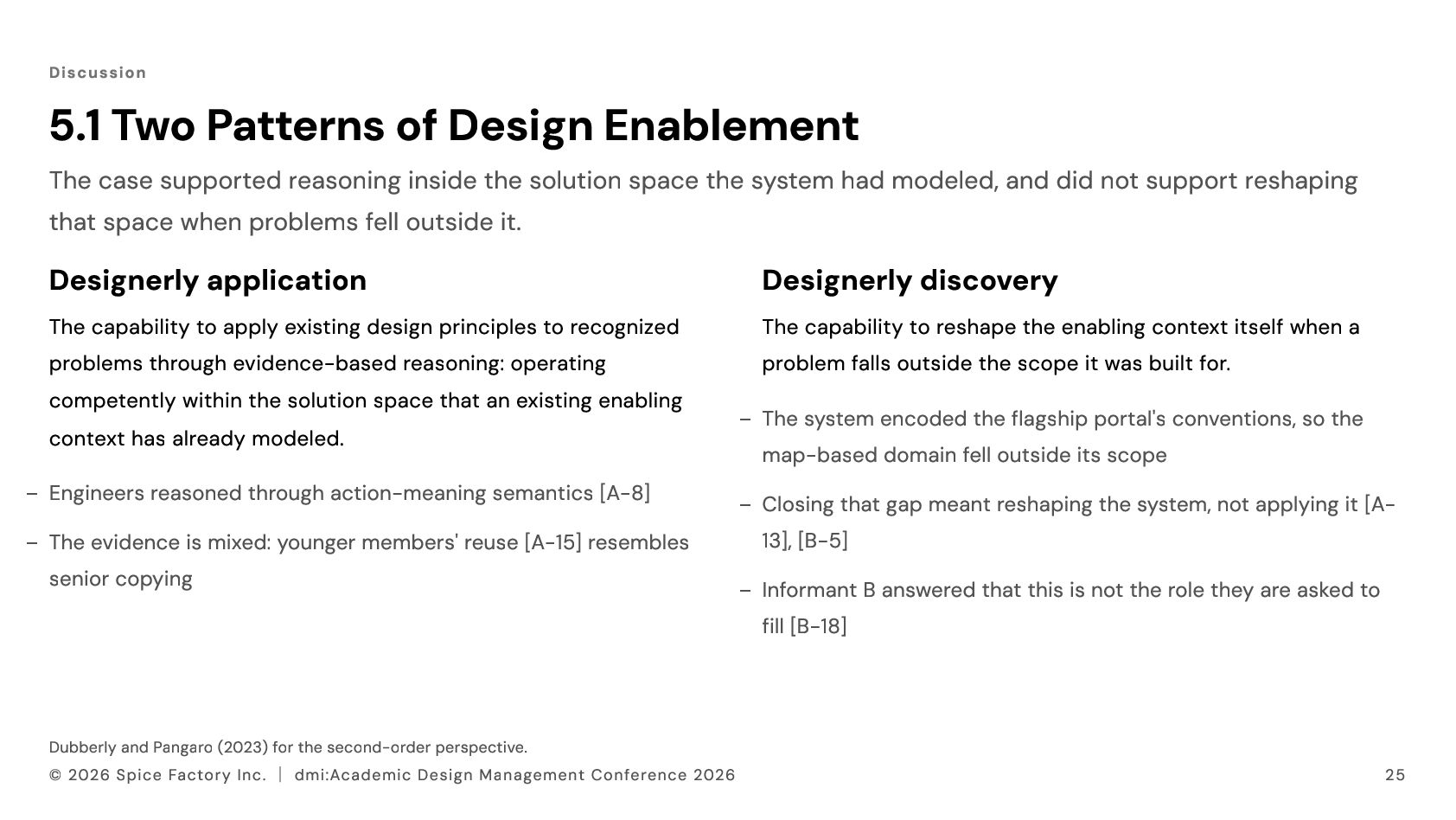
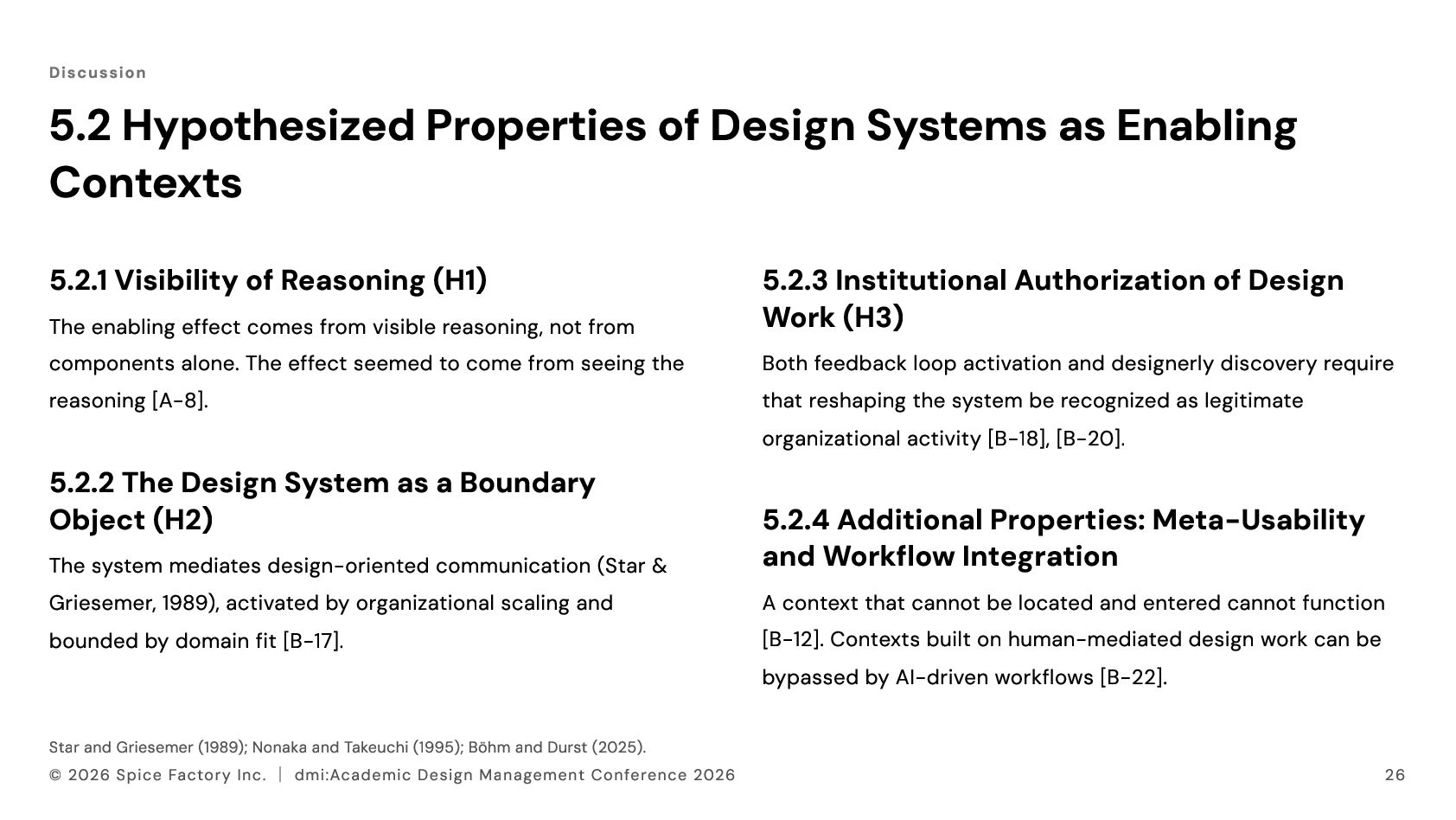
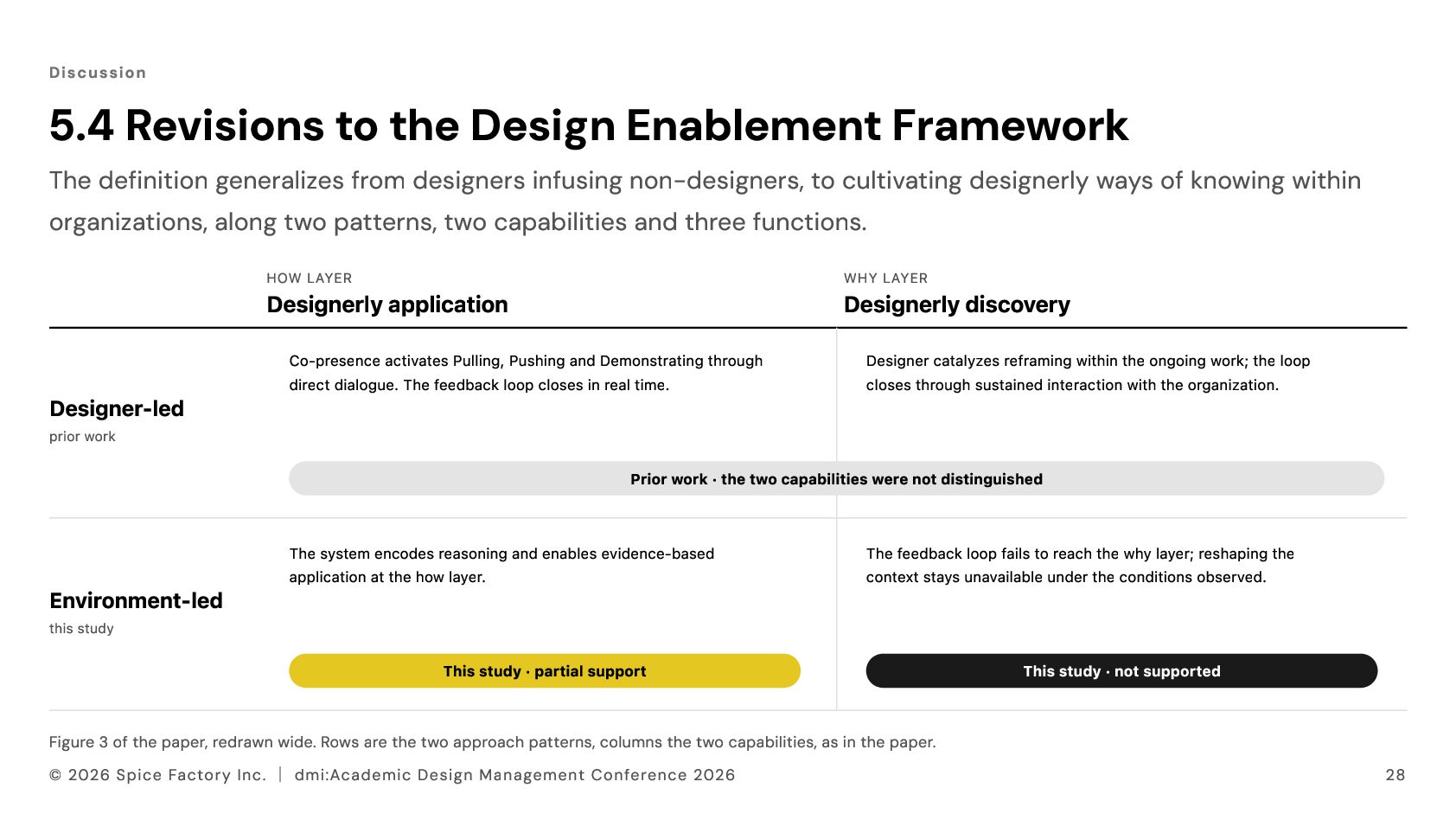
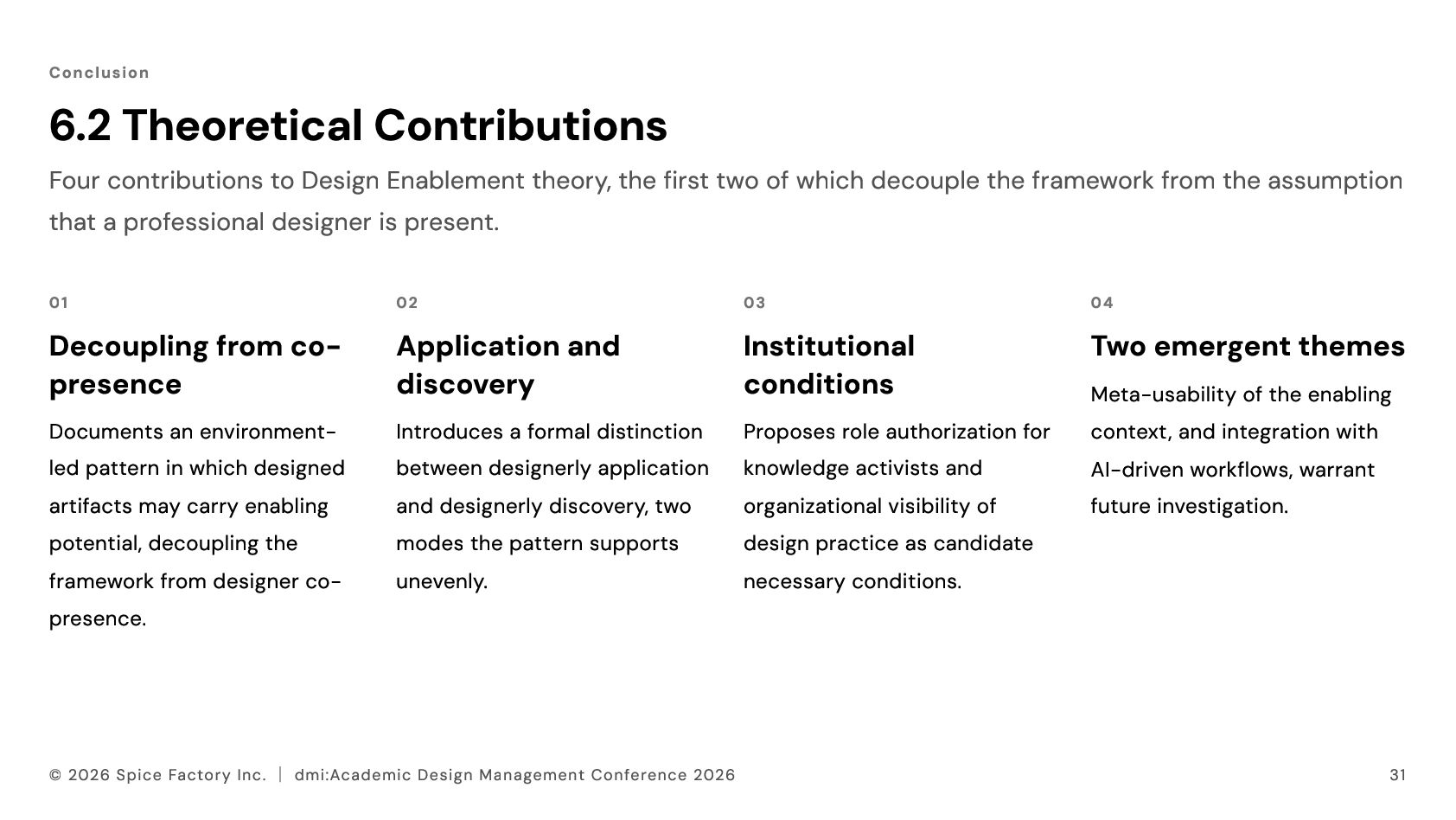
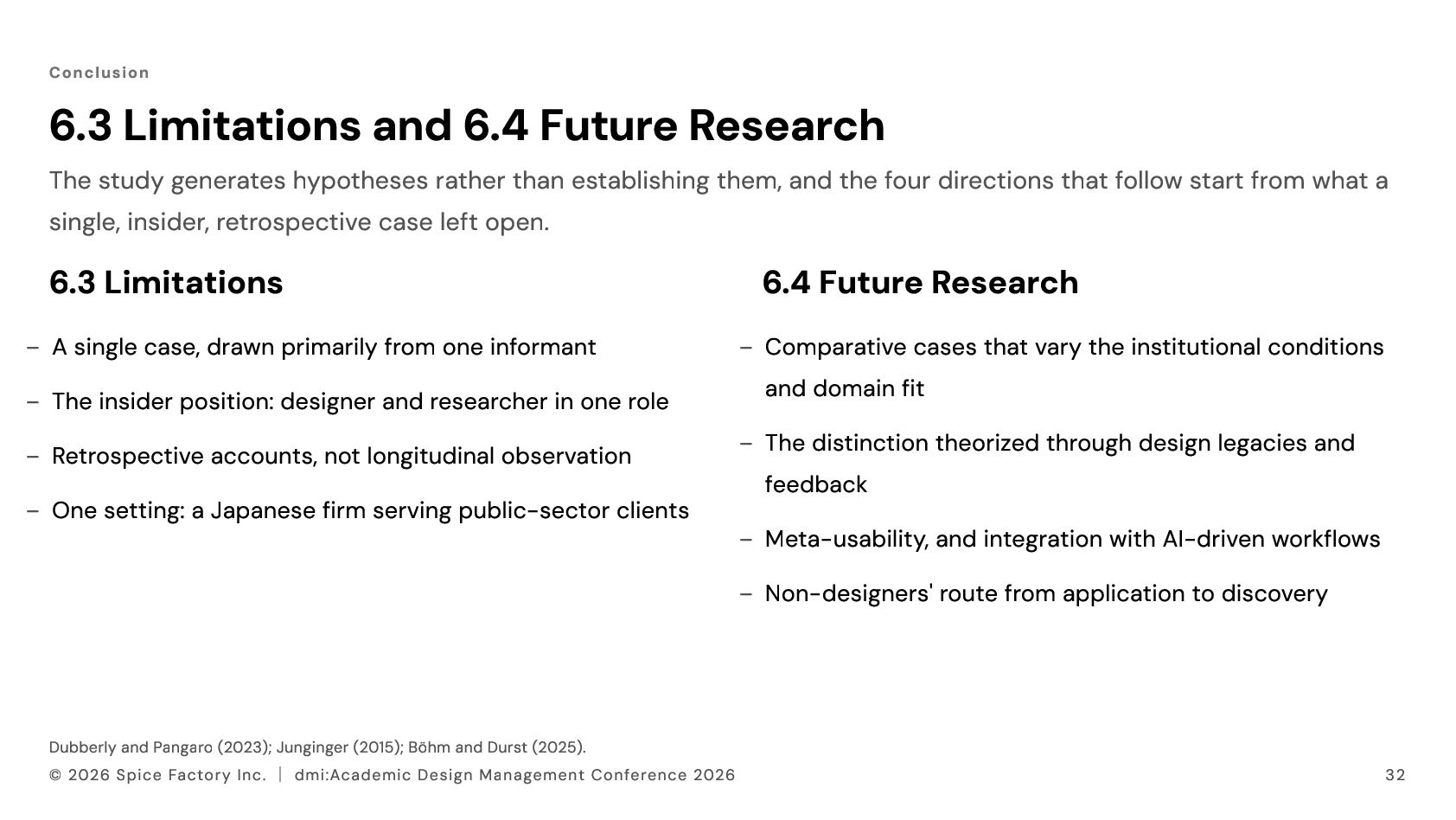
The design system appears to function as an enabling context for designerly application, reasoning competently within the solution space the system has modeled. Under the conditions observed it does not support designerly discovery, reshaping the context itself when problems exceed its scope. The feedback loop circulated at the how layer but not at the why layer. The talk proposes three hypotheses, two further properties of the enabling context, and a revision of Design Enablement that distinguishes two approach patterns (designer-led and environment-led) and two capabilities (designerly application and designerly discovery).
Paper: Akira Motomura, "Design Systems as Enabling Contexts for Designerly Application: A Case Study after Designer Withdrawal," dmi:Academic Design Management Conference 2026.
dmi:Academic Design Management Conference 2026(米国ジョージア工科大学デザイン学部、2026年8月12日)での15分の口頭発表のスライドです。
デザイン・イネーブルメント(組織のなかにデザイナー的な知の様式を育てること)は、専門デザイナーが同じ場にいることを前提に、非デザイナーに対して三方向の機能(Pulling、Pushing、Demonstrating)を働かせる「デザイナー主導のパターン」として理論化されてきました。その関与のなかで作られたデザインシステムが、デザイナーが去ったあともイネーブリング・コンテクストとして機能し続けるのかは、実証的に検討されていません。
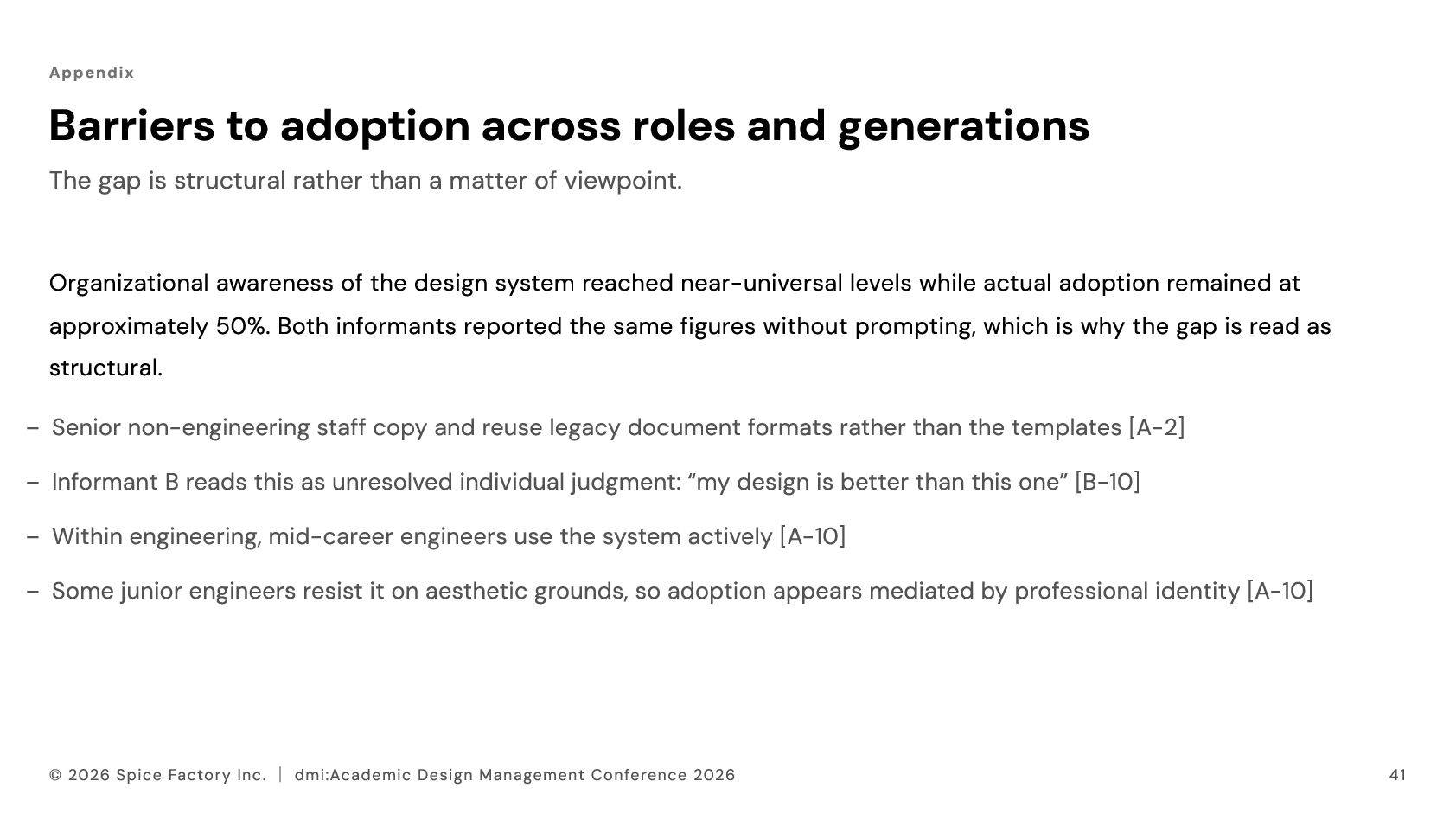
対象は、専門デザイナーを持たない日本の中規模ソフトウェア企業(従業員約100名)で、2024年に外部デザイナーの関与によってデザインシステムを構築した事例です。関与終了から約14か月後に、デザインシステムのオーナーと保守を担うエンジニアへ半構造化インタビューを行い、SCAT(Steps for Coding and Theorization)で分析しました。
デザインシステムは、システムがすでにモデル化した解空間のなかで筋の通った推論を行う「デザイナー的な適用(designerly application)」については、イネーブリング・コンテクストとして機能していると読めます。一方、観察された条件のもとでは、問題がその範囲を超えたときに文脈そのものを組み替える「デザイナー的な発見(designerly discovery)」は支えていませんでした。フィードバックループは how の層では循環していましたが、why の層では循環していませんでした。発表では3つの仮説と、イネーブリング・コンテクストの2つの性質、そして2つのアプローチのパターン(デザイナー主導・環境主導)と2つの能力(適用・発見)を区別するデザイン・イネーブルメントの改訂案を示します。
論文:本村章「Design Systems as Enabling Contexts for Designerly Application: A Case Study after Designer Withdrawal」dmi:Academic Design Management Conference 2026


 akiramotomura
 omy
omy
 tinykitten
 layerx
 aikautau
 harakeishi
 kotasaito_cnt
 ngyenmazt1412
 cygames
 webnaut
 bebe
bebe
 rezaline
 yuichi_hara7
 raygrieselhuber
 jlugia
 lauravandoore
 akademiya2063
 marcduiker
 tammielis
 tenderlove
 aleyda
 csswizardry
 axbom
axbom
 portentint
 rkendrick25
![Thank you Akira Motomura | Spice Factory Inc. | [email protected]](https://files.speakerdeck.com/presentations/4892764d51074fd9bd4e0ffae855a622/slide_32.jpg)
![Appendix Segment [A-8] traced through the four SCAT steps The](https://files.speakerdeck.com/presentations/4892764d51074fd9bd4e0ffae855a622/slide_39.jpg)