student for nine years. • Imam Zuhry (RA) said: “if knowledge of all men and the holy wives of the Prophet (SAW) is brought together, still the knowledge of Aisha (RA) will supersede all.”
of the Messenger of God had any difficulty on a matter, we asked Aishah about it.” “Whenever a report appeared doubtful to us, the Companions of the Prophet SAW, and we asked Aisha about it, we always learned something from her about it.”
about matters related to women, they did it sometimes through the help of young children. Still the problems couldn’t be explained. Therefore, Aisha (RA) told them: “I am your mother, therefore, don’t hesitate and ask from me your queries afterwards, Aisha (RA) used to solve the problems and used to say: “Allah is more respectful, still He has explained the implicit matters. Therefore, you must ask the queries relating to religion more openly”. The result was that the unresolved problems and questions were solved.
first Umayyad caliph, Mu’awiya (r. 661-680) asked a man in his entourage, ‘Who is the most knowledgeable of all people?’ Presumably calculating that giving a forthright answer might not be the most advantageous course of action, the man replied, ‘Prince of the Believers, it is you!’ But when the caliph pressed him for a more honest response, he answered, ‘Well, if you insist – then, it’s ‘A’isha’. Al-Hakim vol 4 page 15 (kitab Ma’rifat al-sahabah)
Abu Bakr and Umar, Uthman and Ali and the Khulafa up to this day, but I have not heard speech more persuasive and more beautiful from the mouth of any person than from the mouth of Aishah."
870) and Muslim (d. 874) undertook to see through the many traditions in circulation by their time – which included some 2,210 attributed to ‘A’isha, the hadiths attributed to her which appear in these two works discuss a wide variety of topics: legal and ritual issues, theological questions, incidents from the life of the early community, and also Quranic exegesis.
people who have transmitted more than two thousand hadiths, the others being Abu Huraira, Abdullah ibn Umar, and Anas ibn Malik RA. • Al-Haakim said in his book, Al- Mustadrak: “One fourth of the rule of Syari’ah was narrated on the authority of Aisha.”
the Muwatta’of Imam Malik (d. 795) a well-known legally oriented compendium, are attributed to early Muslim women transmitters ‘A’isha is the primary source of 83 traditions from or about Muhammad. • These, as well as traditions which credit particular views or practices to her, deal with a wide range of legal topics.
of Fragrance, for every time a beggar knocked on her door, she would touch the money with perfume before giving it to him. When asked why, she explained that the charity would reach Allah before it reached the beggar’s hands, and she wanted the charity to be given to Allah in a fragrant condition.
knocked on the door. She only had one grape, and gave it to him. When asked what the value of a single grape was as a charity, she quoted the following verses from the Qur’an: “So whoever does an atom’s weight of good will see it, And whoever does an atom’s weight of evil will see it.” (Surah Al Zalzalah 7-8) She rationalized – how many atoms are there in a grape?
back in order to find out the truth or make it known, and whenever she beat someone else in argument, the Prophet would smile and say, "She is the daughter of Abu Bakr!” Musa ibn Talha once said, "I have not seen anyone more eloquent than 'A'isha."
in the world?" He did not always give the same answer to this question for he felt great love for many for his daughters and their children, for Abu Bakr, for Ali, for Zayd and his son Usamah. But of his wives the only one he named in this connection was Aishah. She too loved him greatly in return and often would seek reassurance from him that he loved her. Once she asked him: "How is your love for me?“ "Like the rope's knot," he replied meaning that it was strong and secure. And time after time thereafter, she would ask him: "How is the knot?" and he would reply: "Ala haaliha (in the same condition)."
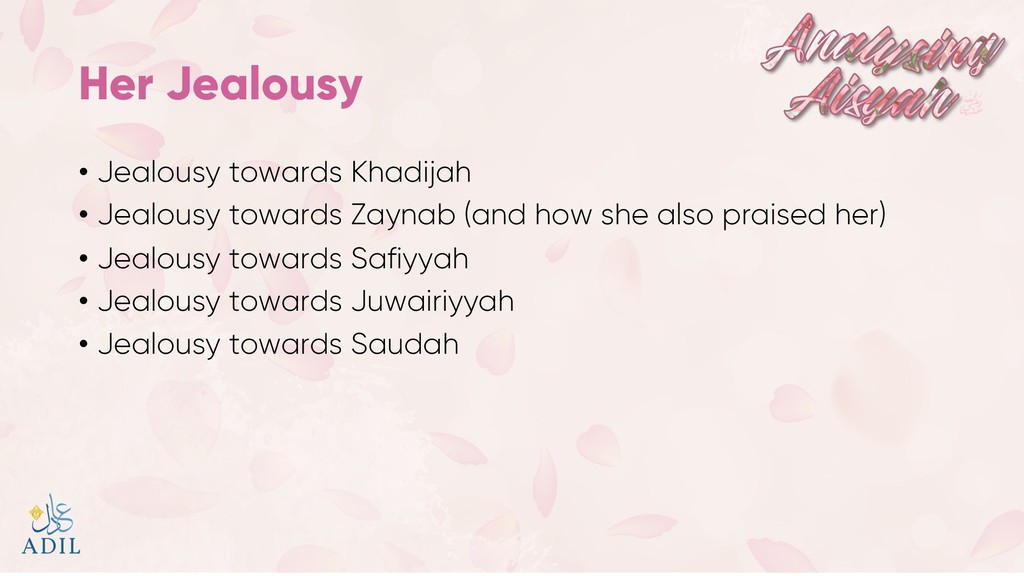
a jealous love and she could not bear the thought that the Prophet's attention should be given to others more than seemed enough to her. She asked him: "O Messenger of God, tell me of yourself. If you were between the two slopes of a valley, one of which had not been grazed whereas the other had been grazed, on which would you pasture your flocks?" "On that which had not been grazed," replied the Prophet. "Even so," she said, "and I am not as any other of your wives. "Everyone of them had a husband before you, except myself." The Prophet smiled and said nothing.
"I was not, jealous of any other wife of the Prophet as I was jealous of Khadijah, because of his constant mentioning of her and because God had commanded him to give her good tidings of a mansion in Paradise of precious stones. And whenever he sacrificed a sheep he would send a fair portion of it to those who had been her intimate friends. Many a time I said to him: "It is as if there had never been any other woman in the world except Khadijah.”
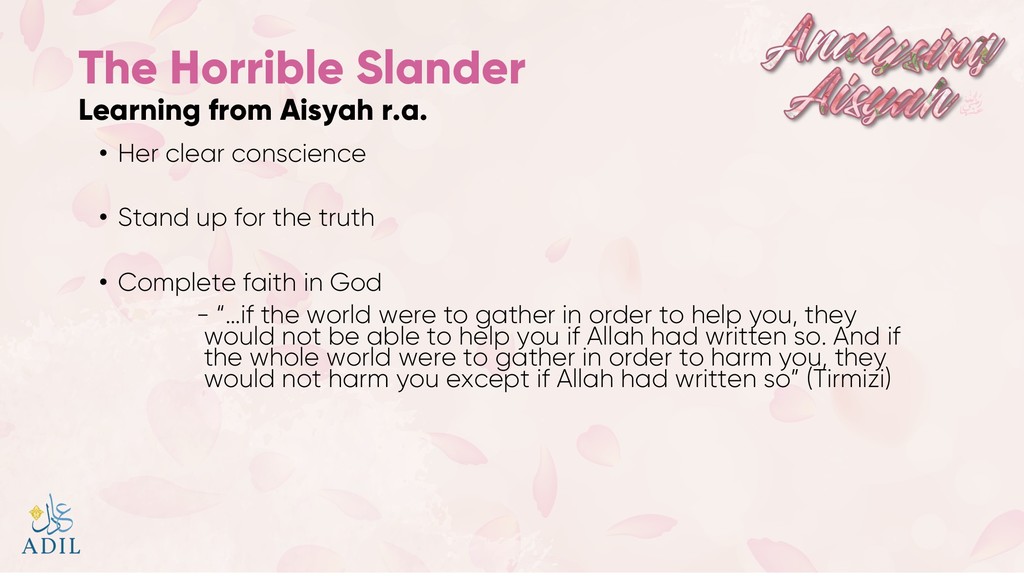
conscience • Stand up for the truth • Complete faith in God - “…if the world were to gather in order to help you, they would not be able to help you if Allah had written so. And if the whole world were to gather in order to harm you, they would not harm you except if Allah had written so” (Tirmizi)
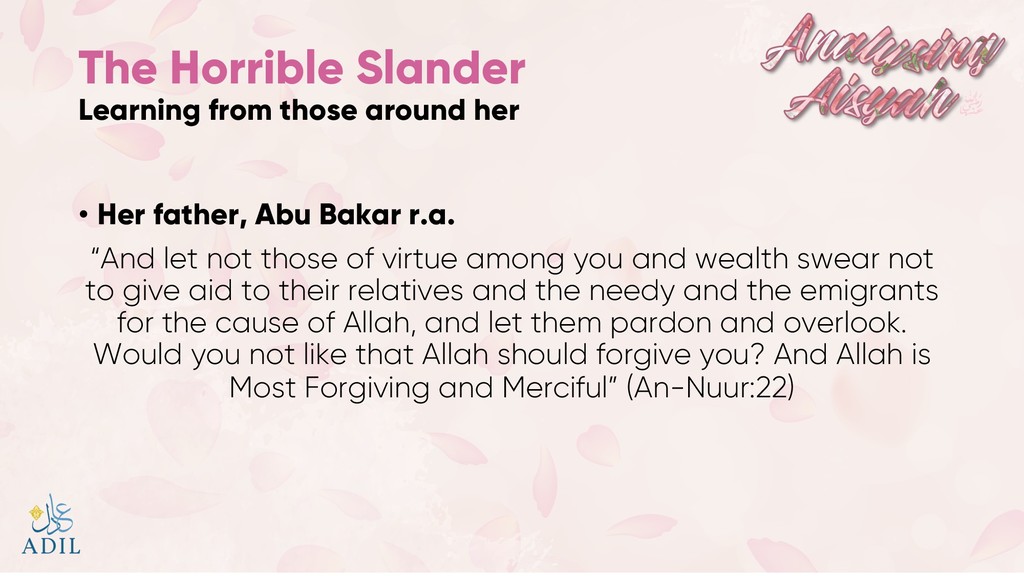
father, Abu Bakar r.a. “And let not those of virtue among you and wealth swear not to give aid to their relatives and the needy and the emigrants for the cause of Allah, and let them pardon and overlook. Would you not like that Allah should forgive you? And Allah is Most Forgiving and Merciful” (An-Nuur:22)
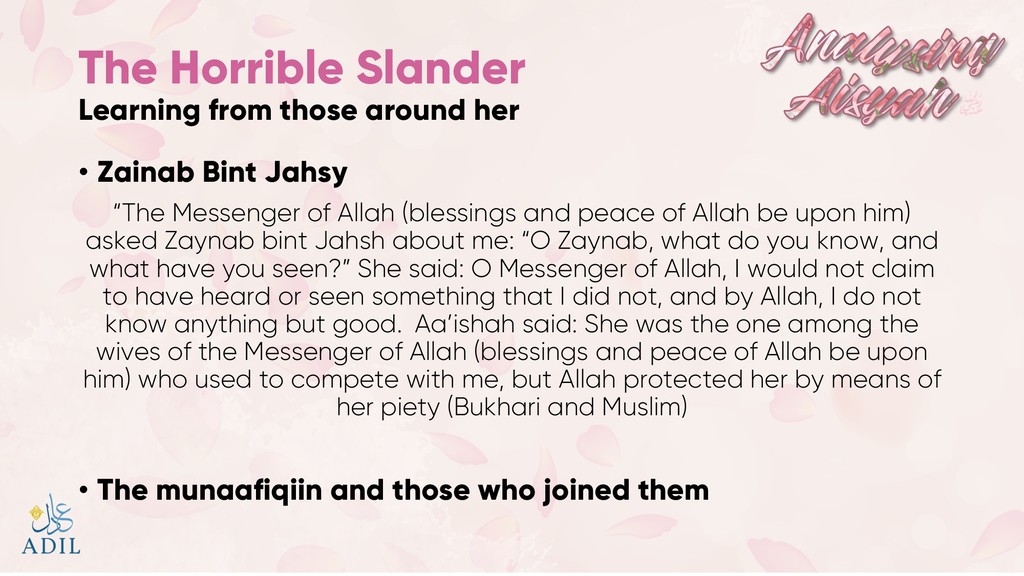
Bint Jahsy “The Messenger of Allah (blessings and peace of Allah be upon him) asked Zaynab bint Jahsh about me: “O Zaynab, what do you know, and what have you seen?” She said: O Messenger of Allah, I would not claim to have heard or seen something that I did not, and by Allah, I do not know anything but good. Aa’ishah said: She was the one among the wives of the Messenger of Allah (blessings and peace of Allah be upon him) who used to compete with me, but Allah protected her by means of her piety (Bukhari and Muslim) • The munaafiqiin and those who joined them
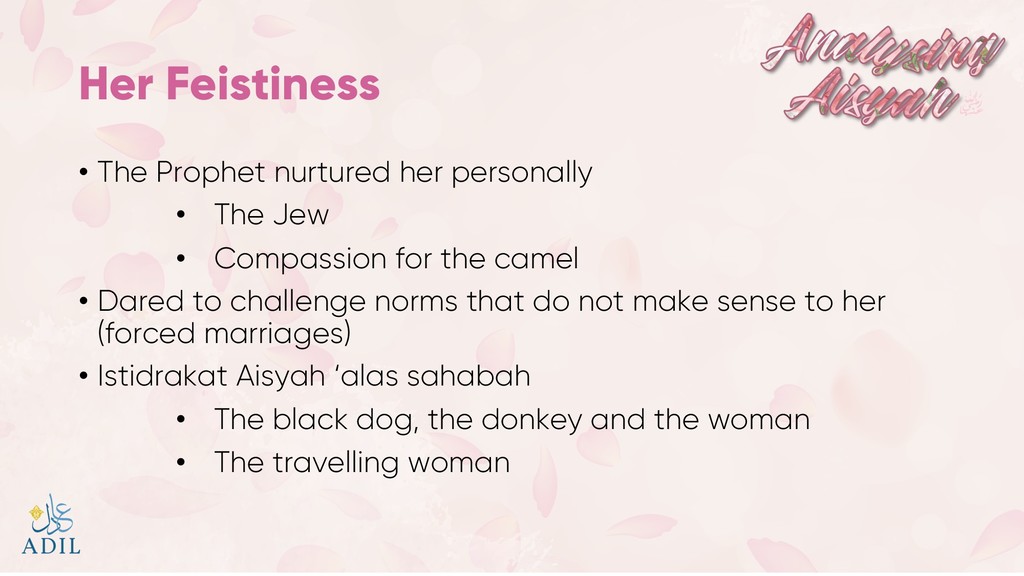
Jew • Compassion for the camel • Dared to challenge norms that do not make sense to her (forced marriages) • Istidrakat Aisyah ‘alas sahabah • The black dog, the donkey and the woman • The travelling woman
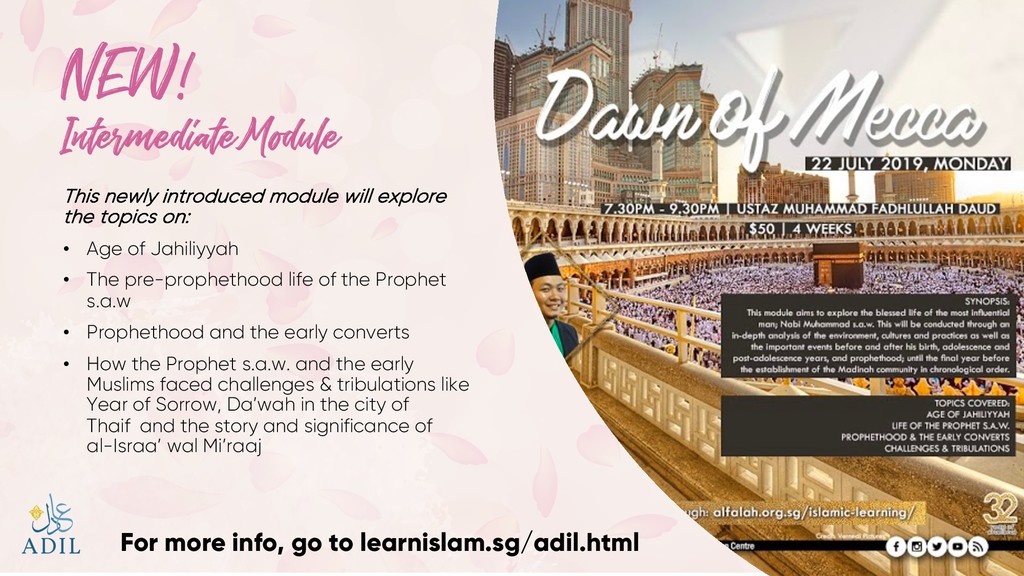
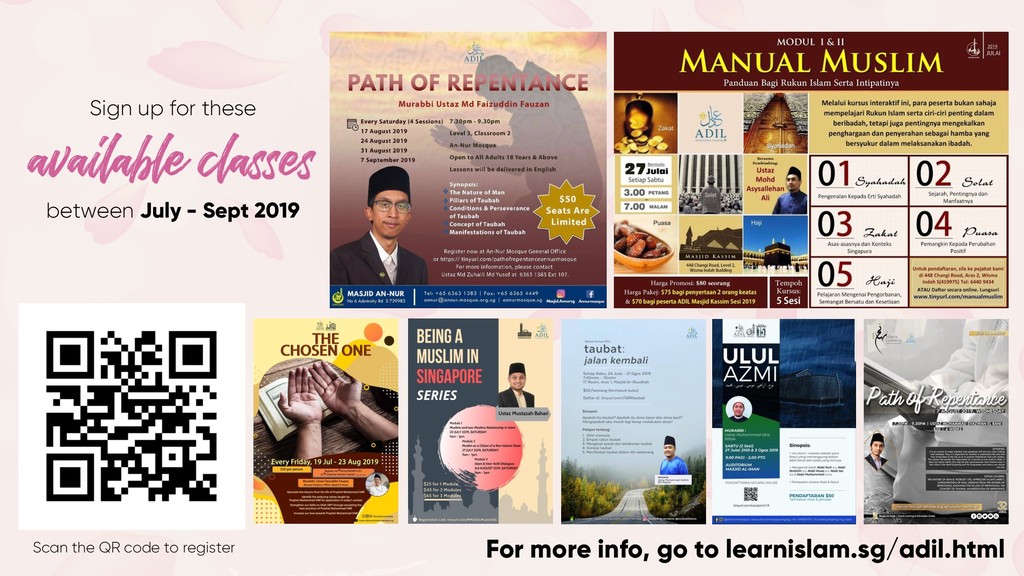
topics on: • Age of Jahiliyyah • The pre-prophethood life of the Prophet s.a.w • Prophethood and the early converts • How the Prophet s.a.w. and the early Muslims faced challenges & tribulations like Year of Sorrow, Da’wah in the city of Thaif and the story and significance of al-Israa’ wal Mi’raaj For more info, go to learnislam.sg/adil.html
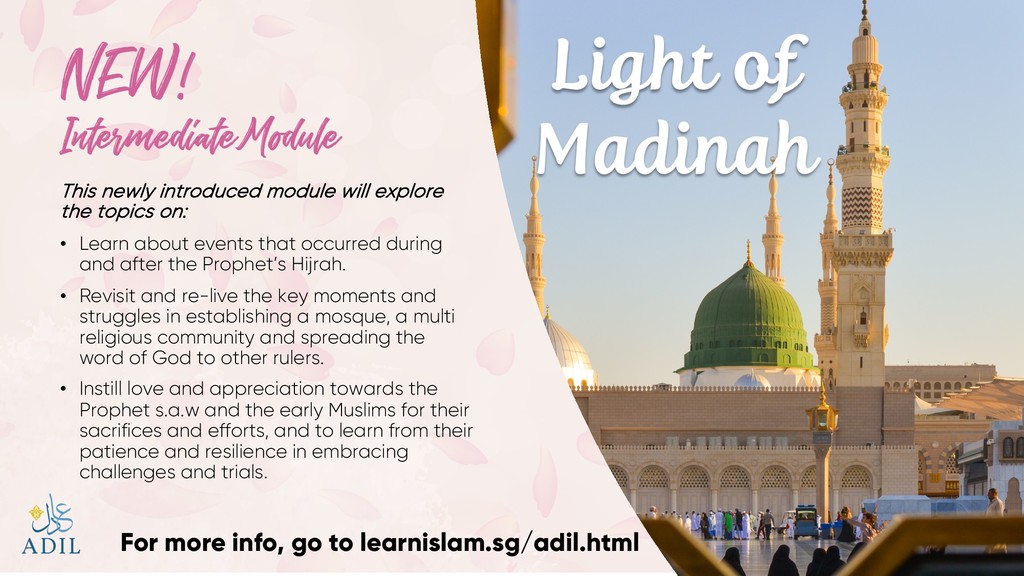
topics on: • Learn about events that occurred during and after the Prophet’s Hijrah. • Revisit and re-live the key moments and struggles in establishing a mosque, a multi religious community and spreading the word of God to other rulers. • Instill love and appreciation towards the Prophet s.a.w and the early Muslims for their sacrifices and efforts, and to learn from their patience and resilience in embracing challenges and trials. For more info, go to learnislam.sg/adil.html Light of Madinah


 akr
akr
 drpoonamkc
 terasawat
 juanmartin2026
 signer
 hiola
hiola
 ainischool
 camel_404
 scottboms
 zakiyama
 csswizardry
 kimpetersen
 reverentgeek
 hannesfritz
 addyosmani
 sabderemane
 aleyda
 codingconduct
 soudai