Share
Embed
Tricky Testing (CodeEurope 2017)
An exploration of odd testing scenarios and how they might be tackled.
Andrew Radev
April 26, 2017
Transcript
73 slides
-
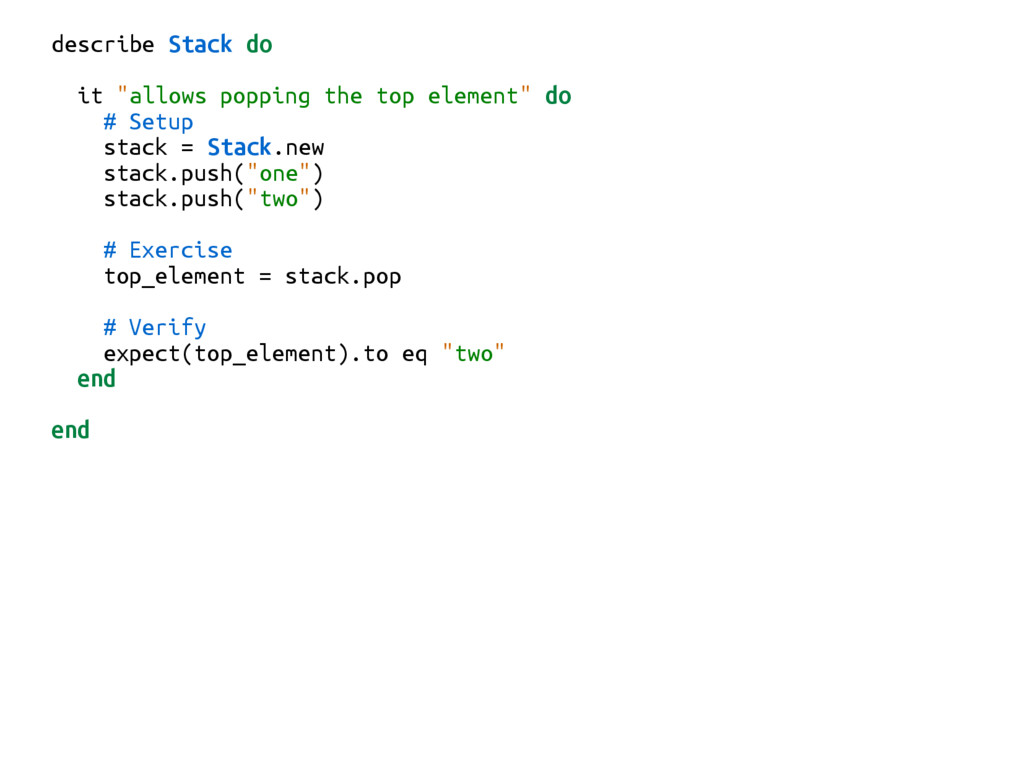
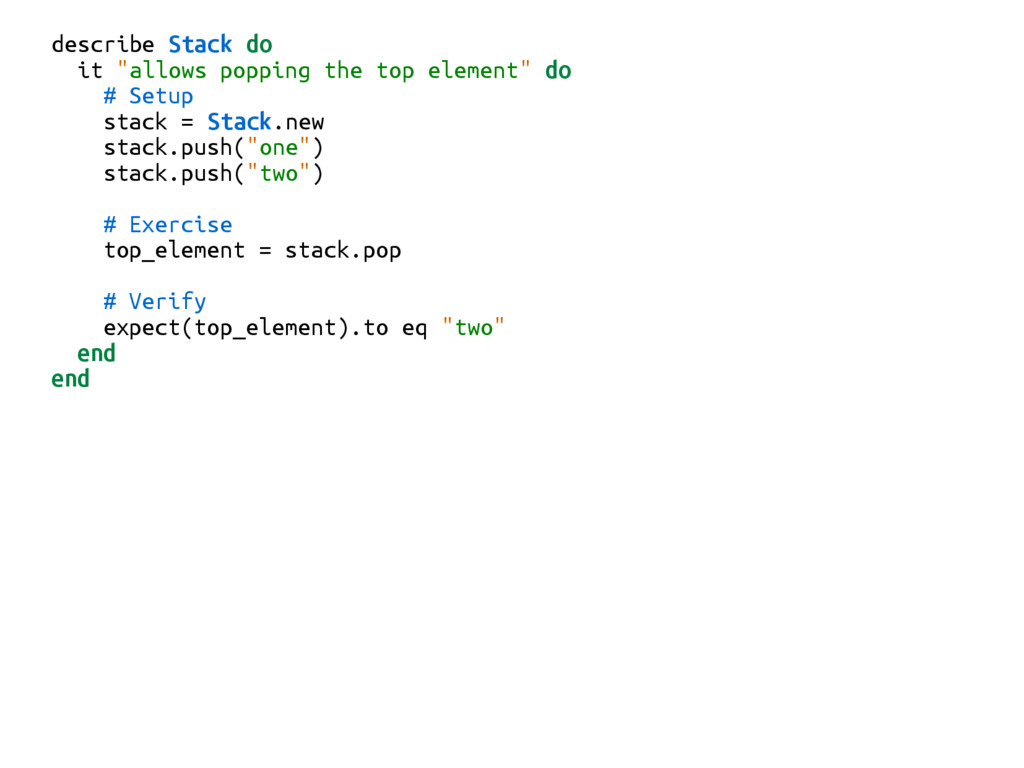
describe Stack do it "allows popping the top element" do
# Setup stack = Stack.new stack.push("one") stack.push("two") # Exercise top_element = stack.pop # Verify expect(top_element).to eq "two" end end -
waiting-on-rails server • Run rails server command • Run music
• Output lines to stdout • When we see “Listening to”, ding! -
module WaitingOnRails class Player def initialize(music_path) @music_path = full_path(music_path) end
private def full_path(path) File.expand_path( "#{File.dirname(__FILE__)}/../../vendor/#{path}" ) end end end -
module WaitingOnRails class Player # ... attr_reader :pid def start
@pid = Kernel.spawn("mplayer #{@music_path}", { out: '/dev/null', err: '/dev/null', }) end def stop return true if @pid.nil? Process.kill(15, @pid) Process.wait(@pid) true rescue Errno::ESRCH, Errno::ECHILD false end # ... end end -
module WaitingOnRails describe Player do let(:player) { Player.new('test.mp3') } it
"spawns an external process" do expect(Kernel).to receive(:spawn) player.start end it "kills itself correctly" do expect(Kernel).to receive(:spawn).and_return(123) player.start expect(Process).to receive(:kill).with(15, 123) expect(Process).to receive(:wait).with(123) player.stop end end end -
module WaitingOnRails class Player # ... attr_reader :pid def start
@pid = spawn("mplayer #{@music_path}", { out: '/dev/null', err: '/dev/null', }) end def stop return true if @pid.nil? Process.kill(9, @pid) Process.wait(@pid) true rescue Errno::ESRCH, Errno::ECHILD false end # ... end end -
module WaitingOnRails describe Player do let(:player) { Player.new('test.mp3') } it
"spawns an external process" do player.start expect(player.pid).to be_a_running_process end it "kills itself correctly" do player.start player.stop expect(player.pid).to_not be_a_running_process end end end -
config.around do |example| original_path = ENV['PATH'] ENV['PATH'] = "#{File.expand_path('spec/support/bin')}:#{original_path}" example.call
ENV['PATH'] = original_path end # ./spec/support/bin/mplayer #!/bin/sh while true; do sleep 1 done -
waiting-on-rails server • Run rails server command • Run music
• Output lines to stdout • When we see “Listening to”, ding! -
module WaitingOnRails class Exit < StandardError; end class Rails def
initialize(music_player, ding_player) @music_player = music_player @ding_player = ding_player end # ... end end -
module WaitingOnRails class Rails # ... def run(args) if not
should_play_music?(args) exec_rails_command(args) end # ... end private def should_play_music?(args) args.find { |arg| ['server', 's'].include? arg } end def exec_rails_command(args) exec 'rails', *args end # ... end end -
module WaitingOnRails class Rails # ... def run(args) if not
should_play_music?(args) exec_rails_command(args) end spawn_rails_subprocess(args) do |output, pid| # ... end end private def spawn_rails_subprocess(args) PTY.spawn('rails', *args) do |output, input, pid| yield output, pid end end # ... end end -
module WaitingOnRails class Rails # ... def run(args) if not
should_play_music?(args) exec_rails_command(args) end spawn_rails_subprocess(args) do |output, pid| @music_player.start # ... end ensure @music_player.stop end private # ... end end -
module WaitingOnRails class Rails # ... def run(args) if not
should_play_music?(args) exec_rails_command(args) end spawn_rails_subprocess(args) do |output, pid| @music_player.start handle_signals(pid, output) end rescue Exit exit(1) ensure @music_player.stop end private # ... end end -
module WaitingOnRails class Rails # ... def run(args) if not
should_play_music?(args) exec_rails_command(args) end spawn_rails_subprocess(args) do |output, pid| @music_player.start handle_signals(pid, output) main_loop(output) end rescue Exit exit(1) ensure @music_player.stop end private # ... end end -
module WaitingOnRails class Rails # ... private def main_loop(io) loop
do begin line = io.readline puts line if matches_server_start?(line) @music_player.stop sleep 0.5 @ding_player.start if @ding_player end rescue EOFError break rescue Errno::EIO raise Exit end end end # ... end end -
# ./spec/support/bin/rails #! /usr/bin/env ruby require 'socket' filename = File.expand_path(
File.dirname(__FILE__) + '/../../../tmp/rails.socket' ) socket = UNIXServer.new(filename).accept begin while line = socket.readline puts line end rescue EOFError end -
module Support class CommandStub def initialize(command) @command = command end
def init return if @socket Timeout.timeout(2) do @socket = UNIXSocket.new(socket_path) end rescue Errno::ENOENT retry end # ... private def socket_path File.expand_path( File.dirname(__FILE__) + "/../../tmp/#{@command}.socket" ) end end end -
module Support class CommandStub # ... def finish if @socket
@socket.close @socket = nil end end # ... end end -
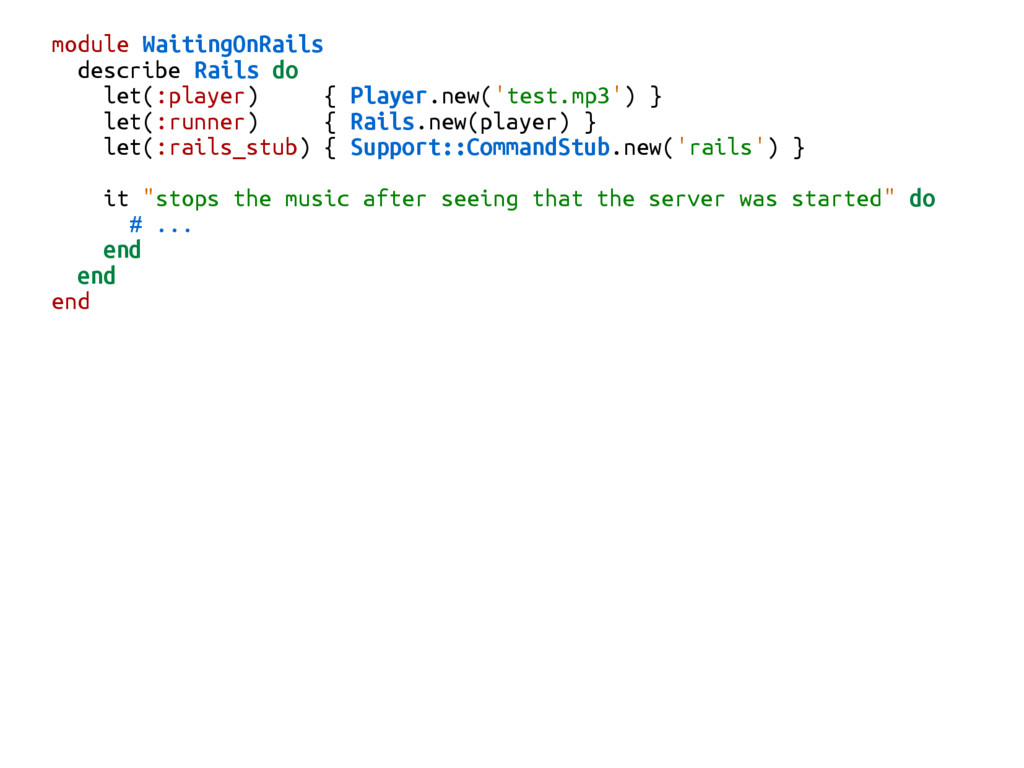
module WaitingOnRails describe Rails do let(:player) { Player.new('test.mp3') } let(:runner)
{ Rails.new(player) } let(:rails_stub) { Support::CommandStub.new('rails') } it "stops the music after seeing that the server was started" do # ... end end end -
module WaitingOnRails describe Rails do # ... it "stops the
music after seeing that the server was started" do thread = Thread.new { runner.run(['server']) } rails_stub.init rails_stub.add_output <<-EOF => Booting Puma => Rails 5.x.x application starting in development ... => Run `rails server -h` for more startup options EOF expect(player.pid).to be_a_running_process # ... end end end -
module WaitingOnRails describe Rails do # ... it "stops the
music after seeing that the server was started" do # ... expect(player.pid).to be_a_running_process rails_stub.add_output <<-EOF Puma starting in single mode... * Version 3.x.x (ruby 2.x.x-pxxx), codename: ... * Min threads: 5, max threads: 5 * Environment: development * Listening on tcp://localhost:3000 Use Ctrl-C to stop EOF sleep 0.5 expect(player.pid).to_not be_a_running_process end end end -
module WaitingOnRails describe Rake do let(:player) { Player.new('test.mp3') } let(:runner)
{ Rake.new(player) } let(:rake_stub) { Support::CommandStub.new('rake') } it "plays music during the entire running of the command" do thread = Thread.new { runner.run(['routes']) } rake_stub.init expect(player.pid).to be_a_running_process rake_stub.finish thread.join expect(player.pid).to_not be_a_running_process end end end -
irb(main):001:0> require 'faker' => true irb(main):002:0> Faker::Lorem.sentence => "Alias tempore
consequuntur laborum repellendus eaque molestias culpa." irb(main):003:0> Faker::PhoneNumber.phone_number => "948-462-8489 x12782" irb(main):004:0> Faker::Address.street_address => "850 Vida Brooks" -
irb(main):002:0> Faker::Hipster.words => ["truffaut", "vegan", "goth"] irb(main):004:0> Faker::Hipster.sentence => "Vinyl
tacos ethical brunch meggings post-ironic fingerstache." irb(main):005:0> Faker::Company.bs => "empower innovative action-items" irb(main):006:0> Faker::Company.bs => "unleash distributed systems" irb(main):007:0> Faker::Hacker.say_something_smart => "We need to navigate the neural RSS circuit!" irb(main):008:0> Faker::Hacker.say_something_smart => "The SQL alarm is down, calculate the online array so we can override the SMTP application!" irb(main):009:0> Faker::Hacker.say_something_smart => "If we calculate the bandwidth, we can get to the SQL program through the online CSS card!" -
class TestFakerHipster < Test::Unit::TestCase def setup @tester = Faker::Hipster end
def test_words_without_spaces @words = @tester.words(1000) @words.each { |w| assert !w.match(/\s/) } end def test_words_with_large_count_params exact = @tester.words(500) range = @tester.words(250..500) array = @tester.words([250, 500]) assert(exact.length == 500) assert(250 <= range.length && range.length <= 500) assert(array.length == 250 || array.length == 500) end end -
describe UrlToken do describe "result of #generate" do it "is
20 characters long" do 1000.times do expect(UrlToken.generate.length).to eq 20 end end it "only includes uppercase chars and numbers" do 1000.times do expect(UrlToken.generate.length).to match /^[A-Z0-9]+$/ end end end end -
describe Dice do describe "result of #roll" do it "is
between 1 and 6" do 10_000.times do expect(Dice.roll).to be_between(1, 6).inclusive end end end end -
module Dice def self.roll # chosen by a fair dice
roll return 4 end end -
Properties of a 6-sided die • Value is 1 to
6 • Mean value is 3.5 -
describe Dice do describe "result of #roll" do it "is
between 1 and 6" do 10_000.times do expect(Dice.roll).to be_between(1, 6).inclusive end end it "returns results with the right mean" do results = 10_000.times.map { Dice.roll } expect(results.mean.round(1)).to eq 3.5 end end end class Array def mean inject(&:+).to_f / size end end -
rand(max) “When max is an Integer, rand returns a random
integer greater than or equal to zero and less than max.” -
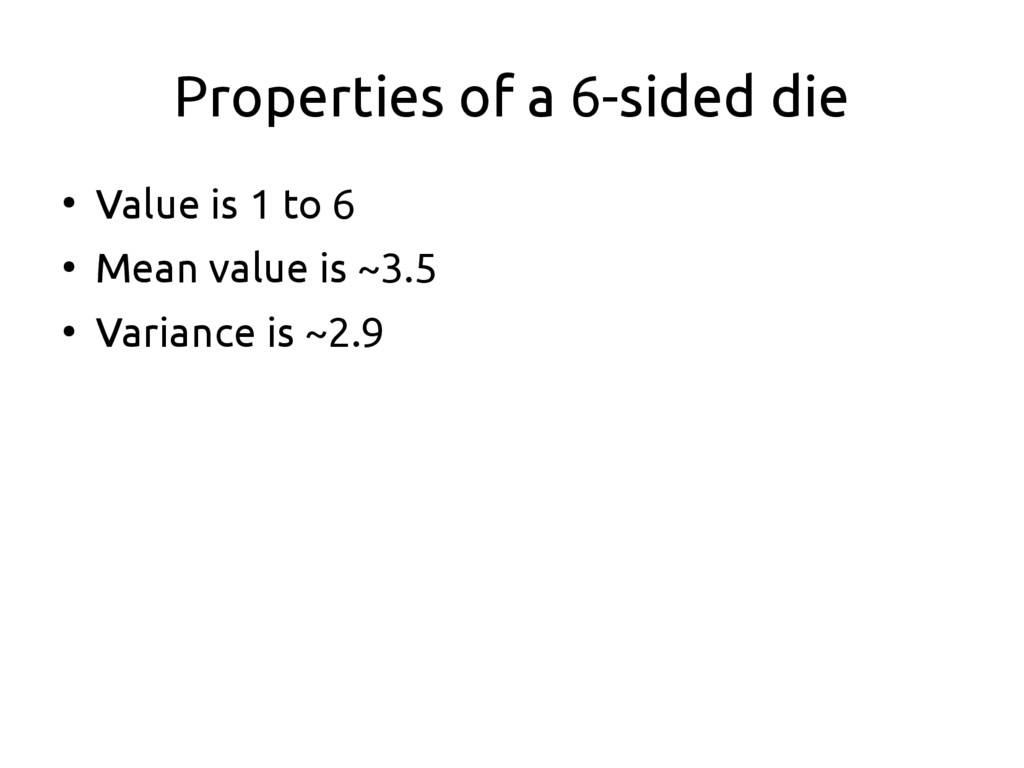
Properties of a 6-sided die • Value is 1 to
6 • Mean value is ~3.5 • Variance is ~2.9 -
describe Dice do describe "result of #roll" do it "returns
results with the right variance" do results = 10_000.times.map { Dice.roll } expect(results.variance.round(1)).to eq 2.9 end end end class Array def variance expected_value = mean map { |value| (value - expected_value) ** 2 }.mean end end -
Beautiful testing “Coding errors are likely to cause the tests
to fail every time, not just a little more often than expected.” – John D. Cook -
- How do you tell someone is a Vim user?
- Don’t worry, they’ll let you know. -
module Vimrunner RSpec.describe Server do let(:server) { Server.new } describe
"#start" do it "starts a vim server process" do begin server.start expect(server.serverlist).to include(server.name) ensure server.kill expect(server.serverlist).to_not include(server.name) end end end end end -
module Vimrunner class Server # ... def start @r, @w,
@pid = PTY.spawn(executable, *%W[ --servername #{name} -u #{vimrc} -U #{gvimrc} ]) end def serverlist execute([executable, "--serverlist"]).split("\n") end # ... end end -
describe "ruby" do let(:filename) { 'test.rb' } specify "if-clauses" do
# Setup set_file_contents <<-EOF return "the answer" if 6 * 9 == 42 EOF # Exercise vim.command 'SplitjoinSplit' vim.write # Verify assert_file_contents <<-EOF if 6 * 9 == 42 return "the answer" end EOF end end -
describe Stack do it "allows popping the top element" do
# Setup stack = Stack.new stack.push("one") stack.push("two") # Exercise top_element = stack.pop # Verify expect(top_element).to eq "two" end end -
describe "ruby" do let(:filename) { 'test.rb' } specify "if-clauses" do
# Setup set_file_contents <<-EOF return "the answer" if 6 * 9 == 42 EOF # Exercise vim.command 'SplitjoinSplit' vim.write # Verify assert_file_contents <<-EOF if 6 * 9 == 42 return "the answer" end EOF end end -
module WaitingOnRails describe Rake do let(:player) { Player.new('test.mp3') } let(:runner)
{ Rake.new(player) } let(:rake_stub) { Support::CommandStub.new('rake') } it "plays music during the entire running of the command" do # Exercise thread = Thread.new { runner.run(['routes']) } # Setup rake_stub.init # Verify expect(player.pid).to be_a_running_process end end end -
Further reading • Beautiful Testing • Beautiful Testing chapter 10
(PDF) • The Architecture of Open Source Applications • The Architecture of Open Source Applications (Selenium Chapt er) • Javascript Testing Recipes