Upgrade to Pro — share decks privately, control downloads, hide ads and more …

65 Situational Interview Questions and Answers

Sponsored · Your Podcast. Everywhere. Effortlessly. Share. Educate. Inspire. Entertain. You do you. We'll handle the rest.
Avatar for Anywherer Anywherer
January 29, 2026

65 Situational Interview Questions and Answers

This PDF is a practical interview guide built around real workplace scenarios. Inside, you’ll find thoughtfully crafted questions along with sample answers that illustrate what strong responses can look like. The situations cover everyday challenges such as managing deadlines, handling conflict, prioritizing tasks, adapting to change, and collaborating with others. This format helps interviewers move beyond theoretical discussions and focus on how candidates are likely to behave on the job. The guide supports more structured, comparable interviews and is suitable for evaluating candidates across different roles, teams, and levels of experience.
See more insights on Anywherer: https://www.anywherer.com/situational-interview-questions/

Avatar for Anywherer

Anywherer

January 29, 2026
Tweet

Other Decks in Research

Transcript

  1. anywherer.com 65 Situational Interview Questions How to Assess Candidates in

    Real-World Scenarios Key interview questions designed to evaluate how candidates perform in real-world scenarios, assessing their problem-solving, adaptability, and decision-making across various situations.
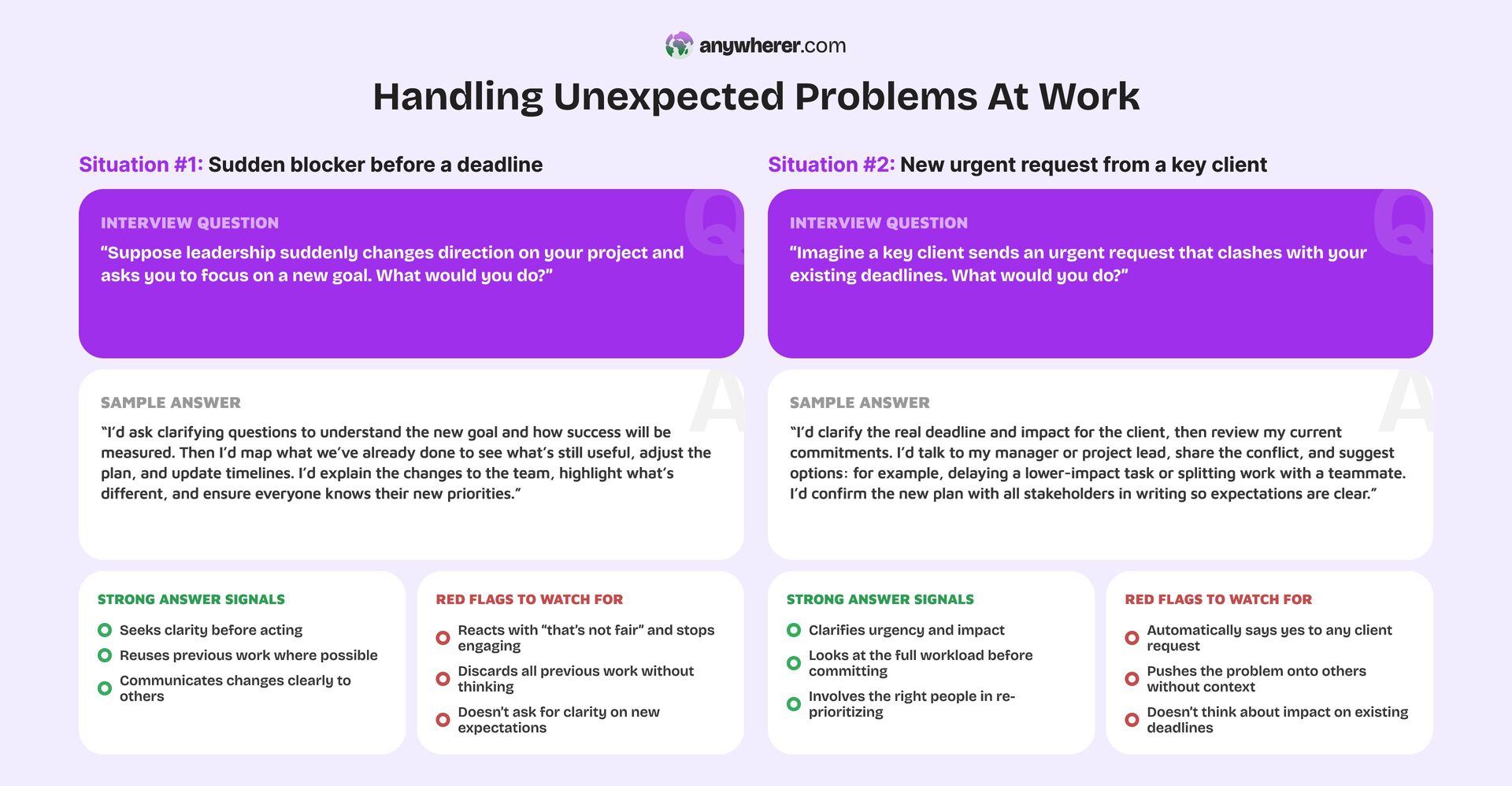
  2. anywherer.com Handling Unexpected Problems at Work Situation #1: Sudden blocker

    before a deadline “Suppose leadership suddenly changes direction on your project and asks you to focus on a new goal. What would you do?” Interview question “I’d ask clarifying questions to understand the new goal and how success will be measured. Then I’d map what we’ve already done to see what’s still useful, adjust the plan, and update timelines. I’d explain the changes to the team, highlight what’s different, and ensure everyone knows their new priorities.” Sample answer Strong answer signals Seeks clarity before acting Reuses previous work where possible Communicates changes clearly to others Red flags to watch for Reacts with “that’s not fair” and stops engaging Discards all previous work without thinking Doesn’t ask for clarity on new expectations Situation #2: New urgent request from a key client “Imagine a key client sends an urgent request that clashes with your existing deadlines. What would you do?” Interview question “I’d clarify the real deadline and impact for the client, then review my current commitments. I’d talk to my manager or project lead, share the conflict, and suggest options: for example, delaying a lower-impact task or splitting work with a teammate. I’d confirm the new plan with all stakeholders in writing so expectations are clear.” Sample answer Strong answer signals Clarifies urgency and impact Looks at the full workload before committing Involves the right people in re- prioritizing Red flags to watch for Automatically says yes to any client request Pushes the problem onto others without context Doesn’t think about impact on existing deadlines
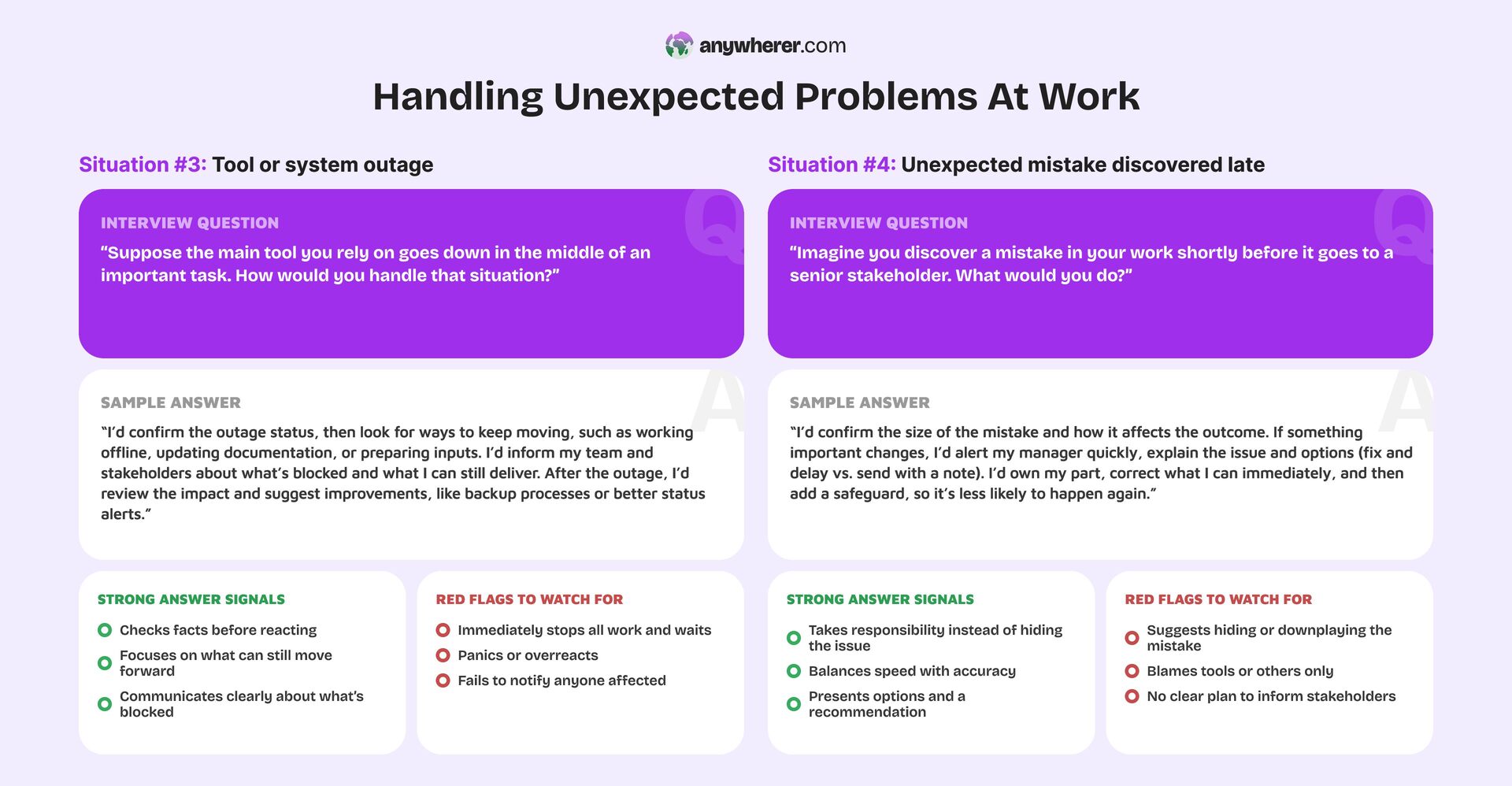
  3. anywherer.com Handling Unexpected Problems at Work Situation #3: Tool or

    system outage “Suppose the main tool you rely on goes down in the middle of an important task. How would you handle that situation?” Interview question “I’d confirm the outage status, then look for ways to keep moving, such as working offline, updating documentation, or preparing inputs. I’d inform my team and stakeholders about what’s blocked and what I can still deliver. After the outage, I’d review the impact and suggest improvements, like backup processes or better status alerts.” Sample answer Strong answer signals Checks facts before reacting Focuses on what can still move forward Communicates clearly about what’s blocked Red flags to watch for Immediately stops all work and waits Panics or overreacts Fails to notify anyone affected Situation #4: Unexpected mistake discovered late “Imagine you discover a mistake in your work shortly before it goes to a senior stakeholder. What would you do?” Interview question “I’d confirm the size of the mistake and how it affects the outcome. If something important changes, I’d alert my manager quickly, explain the issue and options (fix and delay vs. send with a note). I’d own my part, correct what I can immediately, and then add a safeguard, so it’s less likely to happen again.” Sample answer Strong answer signals Takes responsibility instead of hiding the issue Balances speed with accuracy Presents options and a recommendation Red flags to watch for Suggests hiding or downplaying the mistake Blames tools or others only No clear plan to inform stakeholders
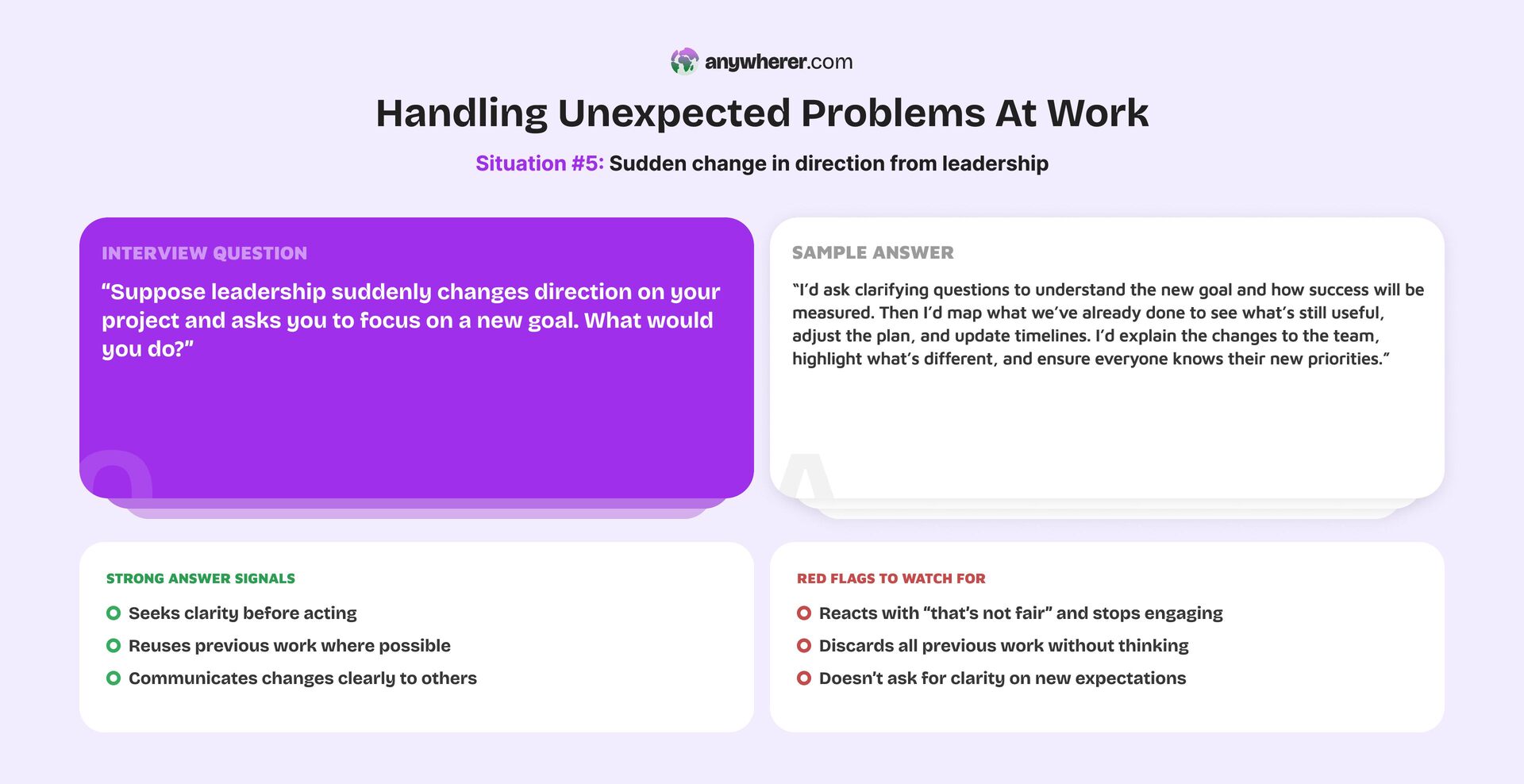
  4. “Suppose leadership suddenly changes direction on your project and asks

    you to focus on a new goal. What would you do?” Interview question “I’d ask clarifying questions to understand the new goal and how success will be measured. Then I’d map what we’ve already done to see what’s still useful, adjust the plan, and update timelines. I’d explain the changes to the team, highlight what’s different, and ensure everyone knows their new priorities.” Sample answer anywherer.com Handling Unexpected Problems at Work Situation #5: Sudden change in direction from leadership Strong answer signals Seeks clarity before acting Reuses previous work where possible Communicates changes clearly to others Red flags to watch for Reacts with “that’s not fair” and stops engaging Discards all previous work without thinking Doesn’t ask for clarity on new expectations
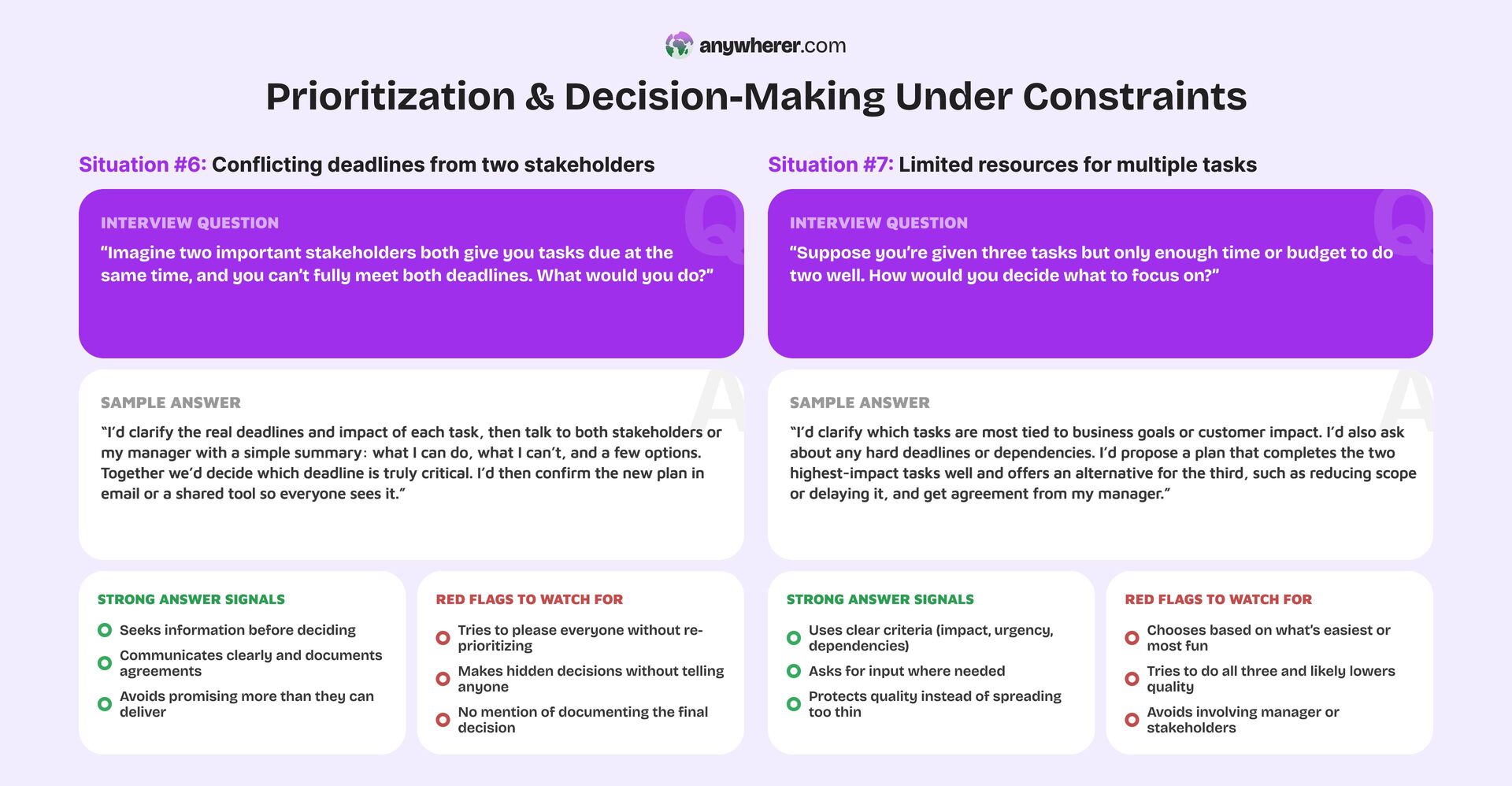
  5. anywherer.com Prioritization & Decision-Making Under Constraints Situation #6:Conflicting deadlines from

    two stakeholders “Imagine two important stakeholders both give you tasks due at the same time, and you can’t fully meet both deadlines. What would you do?” Interview question “I’d clarify the real deadlines and impact of each task, then talk to both stakeholders or my manager with a simple summary: what I can do, what I can’t, and a few options. Together we’d decide which deadline is truly critical. I’d then confirm the new plan in email or a shared tool so everyone sees it.” Sample answer Strong answer signals Seeks information before deciding Communicates clearly and documents agreements Avoids promising more than they can deliver Red flags to watch for Tries to please everyone without re- prioritizing Makes hidden decisions without telling anyone No mention of documenting the final decision Situation #7: Limited resources for multiple tasks “Suppose you’re given three tasks but only enough time or budget to do two well. How would you decide what to focus on?” Interview question “I’d clarify which tasks are most tied to business goals or customer impact. I’d also ask about any hard deadlines or dependencies. I’d propose a plan that completes the two highest-impact tasks well and offers an alternative for the third, such as reducing scope or delaying it, and get agreement from my manager.” Sample answer Strong answer signals Uses clear criteria (impact, urgency, dependencies) Asks for input where needed Protects quality instead of spreading too thin Red flags to watch for Chooses based on what’s easiest or most fun Tries to do all three and likely lowers quality Avoids involving manager or stakeholders
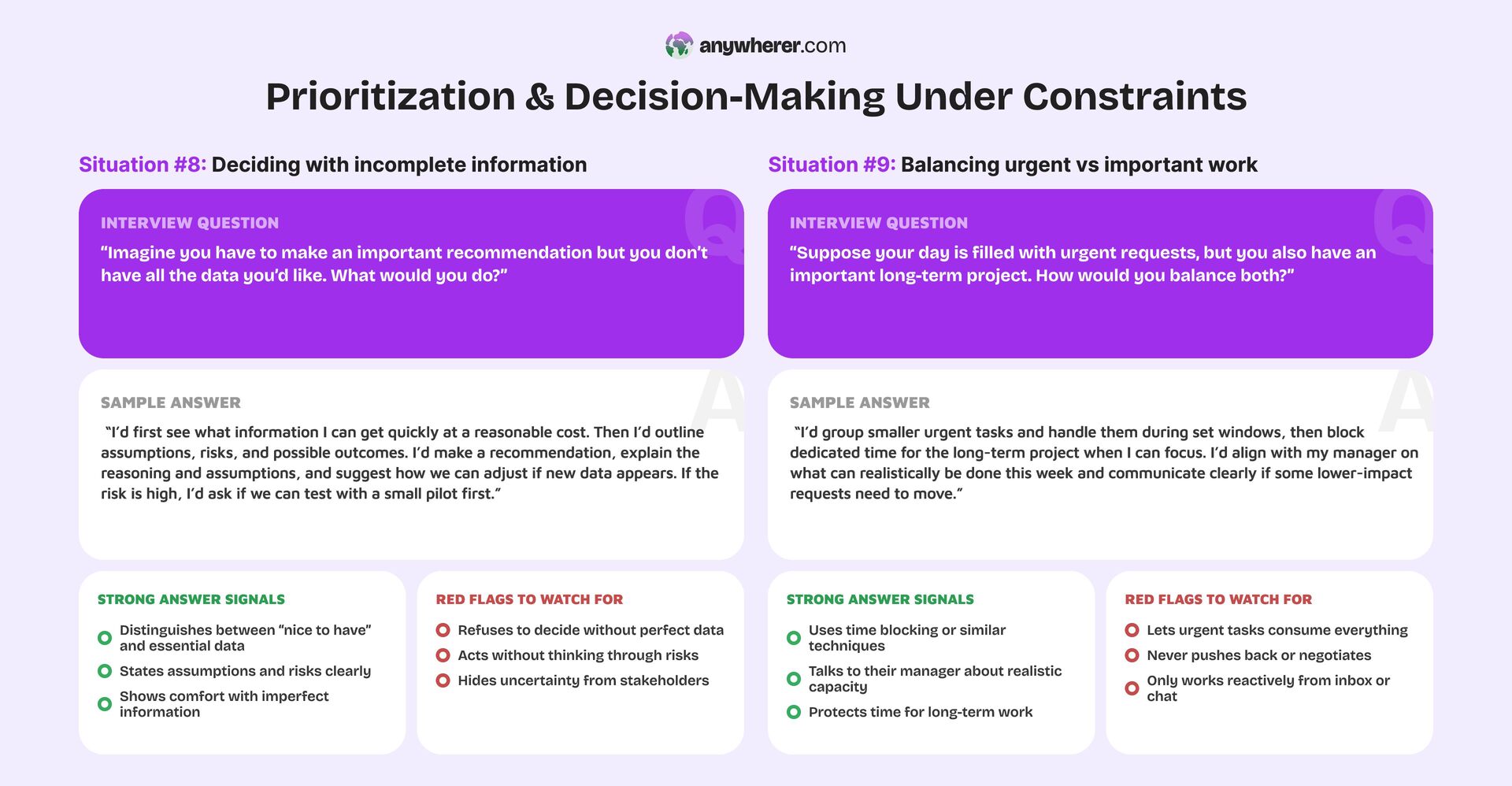
  6. anywherer.com Prioritization & Decision-Making Under Constraints Situation #8:Deciding with incomplete

    information “Imagine you have to make an important recommendation but you don’t have all the data you’d like. What would you do?” Interview question “I’d first see what information I can get quickly at a reasonable cost. Then I’d outline assumptions, risks, and possible outcomes. I’d make a recommendation, explain the reasoning and assumptions, and suggest how we can adjust if new data appears. If the risk is high, I’d ask if we can test with a small pilot first.” Sample answer Strong answer signals Distinguishes between “nice to have” and essential data States assumptions and risks clearly Shows comfort with imperfect information Red flags to watch for Refuses to decide without perfect data A cts without thinking through risks H ides uncertainty from stakeholders Situation #9: Balancing urgent vs important work “S uppose your day is f illed with urgent req uests, but you also have an important long-term proj ect. H ow would you balance both?” Interview question “I’d group smaller urgent tasks and handle them during set windows, then block dedicated time for the long- term project when I can focus. I’d align with my manager on what can realistically be done this week and communicate clearly if some lower- impact requests need to mov e.” Sample answer Strong answer signals U ses time blocking or similar techniq ues T alks to their manager about realistic capacity P rotects time for long- term work Red flags to watch for L ets urgent tasks consume everything N ever pushes back or negotiates O nly works reactively from inbox or chat
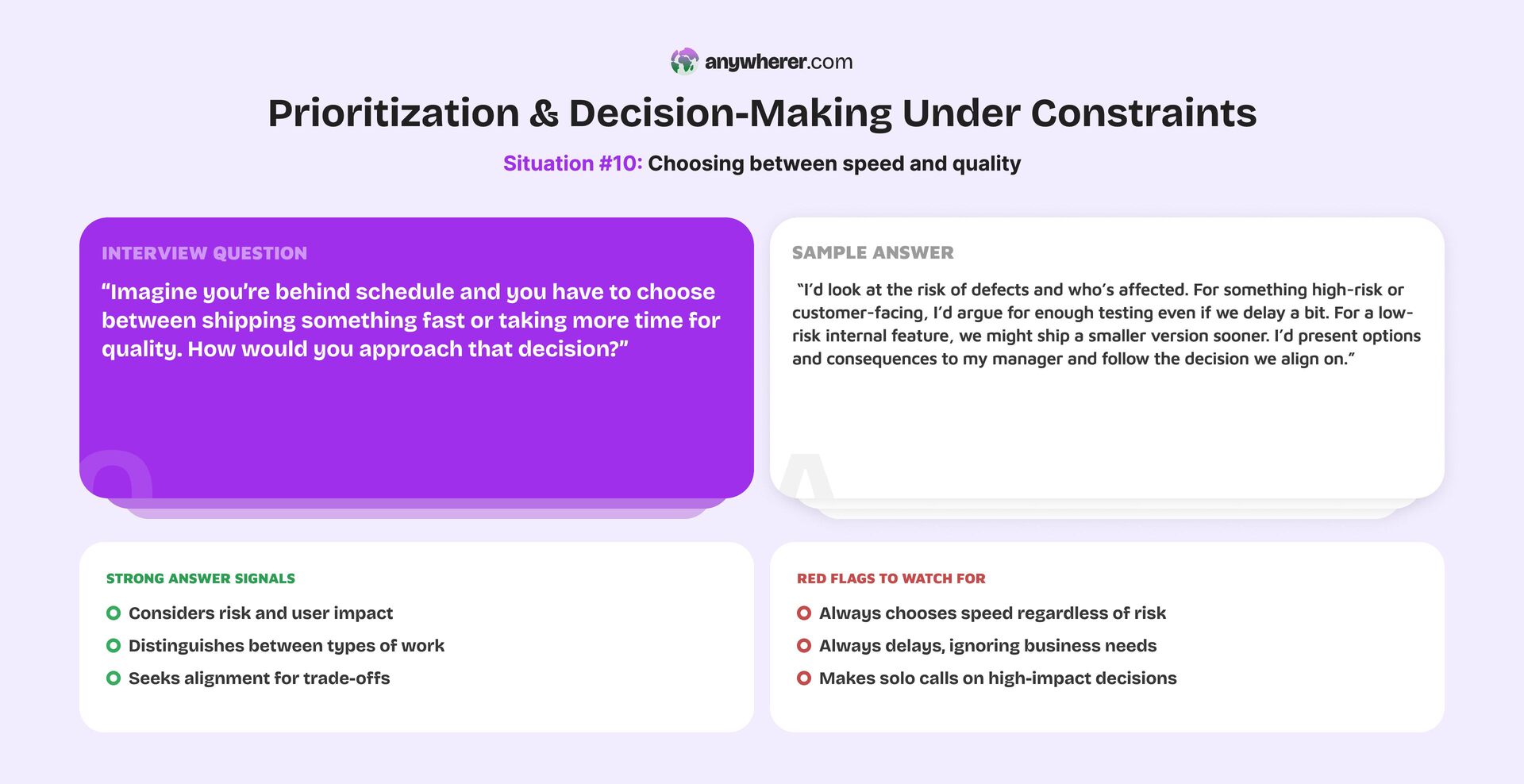
  7. “Imagine you’re behind schedule and you have to choose between

    shipping something fast or taking more time for quality. How would you approach that decision?” Interview question “I’d look at the risk of defects and who’s affected. For something high-risk or customer-facing, I’d argue for enough testing even if we delay a bit. For a low- risk internal feature, we might ship a smaller version sooner. I’d present options and consequences to my manager and follow the decision we align on.” Sample answer anywherer.com Prioritization & Decision-Making Under Constraints Situation #10: Choosing between speed and quality Strong answer signals Considers risk and user impact Distinguishes between types of work Seeks alignment for trade-offs Red flags to watch for Always chooses speed regardless of risk Always delays, ignoring business needs Makes solo calls on high-impact decisions
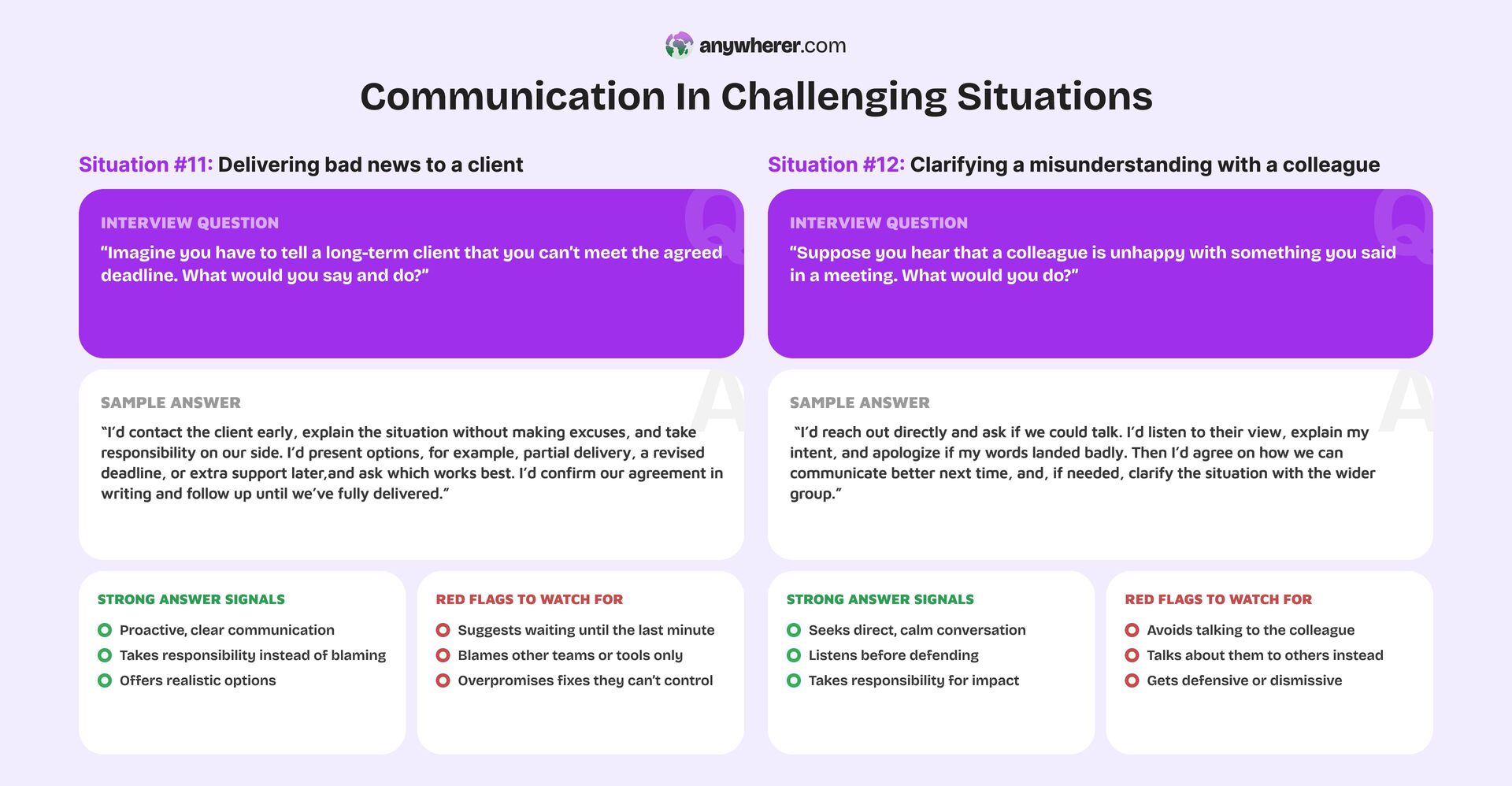
  8. anywherer.com Communication in Challenging Situations Situation #11: Delivering bad news

    to a client “Imagine you have to tell a long-term client that you can’t meet the agreed deadline. What would you say and do?” Interview question “I’d contact the client early, explain the situation without making excuses, and take responsibility on our side. I’d present options, for example, partial delivery, a revised deadline, or extra support later,and ask which works best. I’d confirm our agreement in writing and follow up until we’ve fully delivered.” Sample answer Strong answer signals Proactive, clear communication Takes responsibility instead of blaming Offers realistic options Red flags to watch for Suggests waiting until the last minute Blames other teams or tools only Overpromises fi x es they can ’ t control Situation #1 2 : Clarifying a misunderstanding with a colleague “Su pp ose you hear that a colleague is unha pp y with something you said in a meeting. What would you do? ” Interview question “I’d reach out directly and ask if we could talk. I’d listen to their view, explain my intent, and apologi z e if my words landed badly. T hen I’d agree on how we can communicate better next time, and, if needed, clarify the situation with the wider group.” Sample answer Strong answer signals Seeks direct, calm conversation L istens before defending Takes responsibility for impact Red flags to watch for A voids talking to the colleague Talks about them to others instead G ets defensive or dismissive
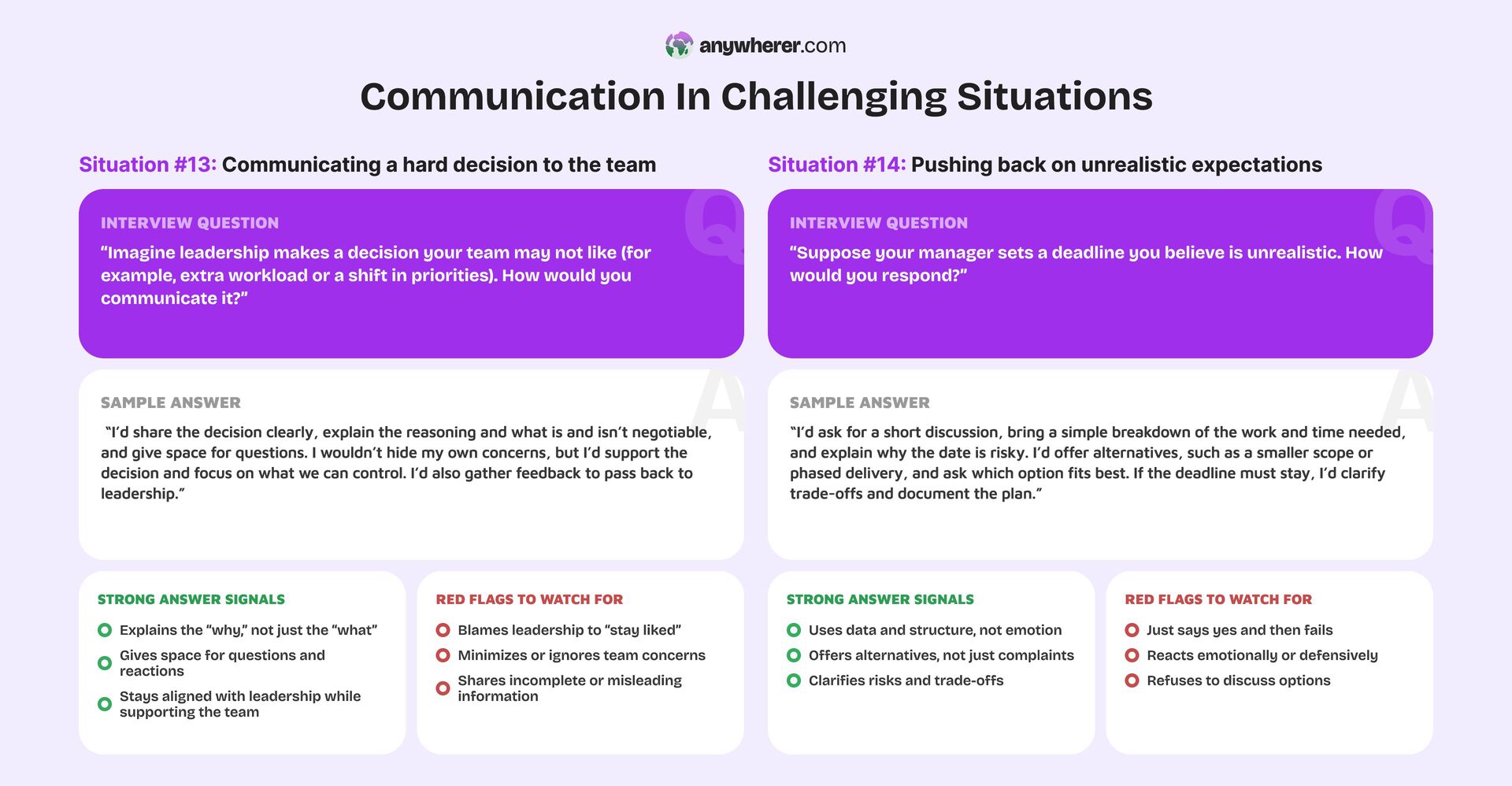
  9. anywherer.com Communication in Challenging Situations Situation #13: Communicating a hard

    decision to the team “Imagine leadership makes a decision your team may not like (for example, extra workload or a shift in priorities). How would you communicate it?” Interview question “I’d share the decision clearly, explain the reasoning and what is and isn’t negotiable, and give space for questions. I wouldn’t hide my own concerns, but I’d support the decision and focus on what we can control. I’d also gather feedback to pass back to leadership.” Sample answer Strong answer signals Explains the “why,” not just the “what” Gives space for questions and reactions Stays aligned with leadership while supporting the team Red flags to watch for Blames leadership to “stay liked” Minimizes or ignores team concerns Shares incomplete or misleading information Situation #14: Pushing back on unrealistic expectations “Suppose your manager sets a deadline you believe is unrealistic. How would you respond?” Interview question “I’d ask for a short discussion, bring a simple breakdown of the work and time needed, and explain why the date is risky. I’d offer alternatives, such as a smaller scope or phased delivery, and ask which option fits best. If the deadline must stay, I’d clarify trade-offs and document the plan.” Sample answer Strong answer signals Uses data and structure, not emotion Offers alternatives, not just complaints Clarifies risks and trade-offs Red flags to watch for Just says yes and then fails Reacts emotionally or defensively Refuses to discuss options
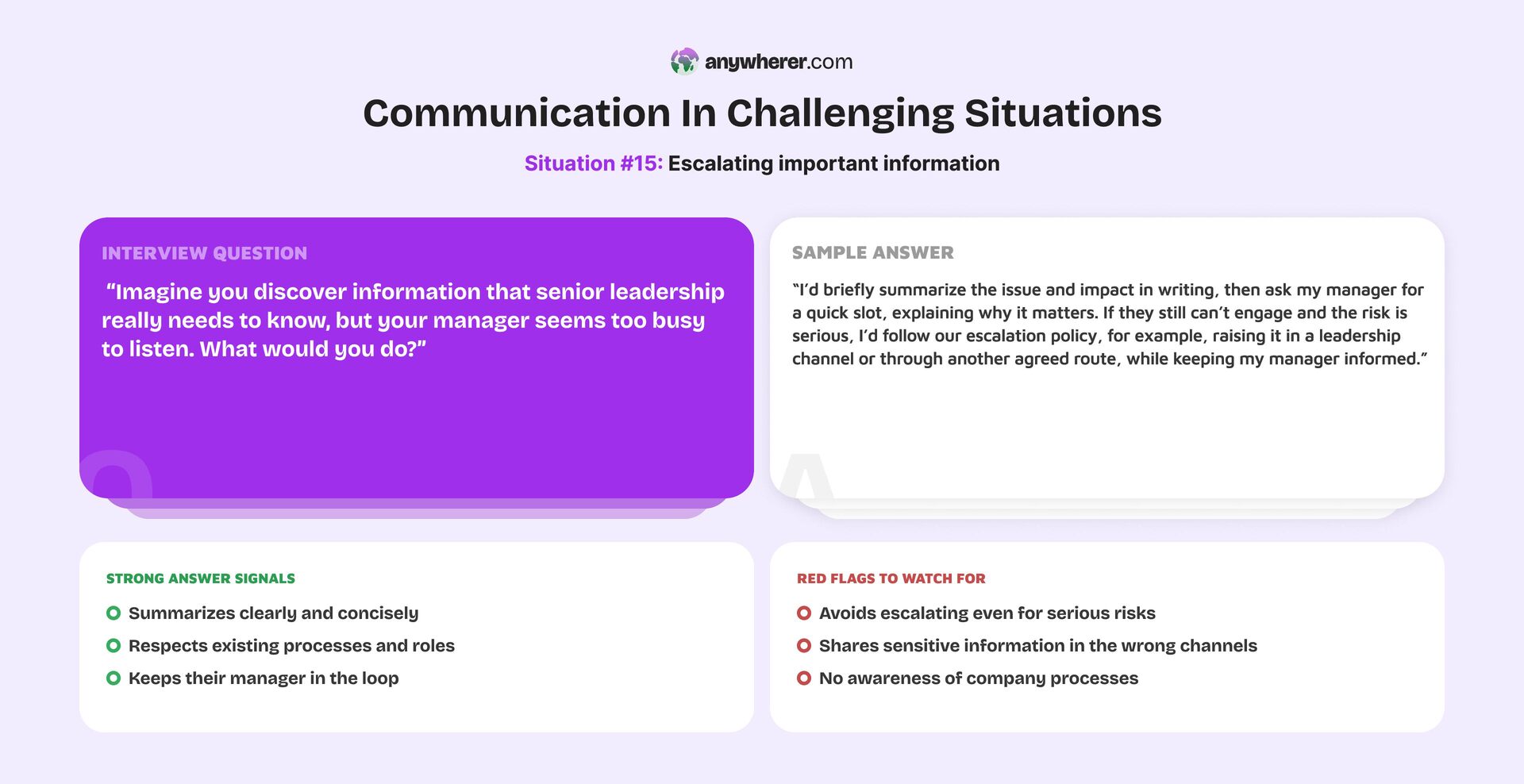
  10. “Imagine you discover information that senior leadership really needs to

    know, but your manager seems too busy to listen. What would you do?” Interview question “I’d briefly summarize the issue and impact in writing, then ask my manager for a quick slot, explaining why it matters. If they still can’t engage and the risk is serious, I’d follow our escalation policy, for example, raising it in a leadership channel or through another agreed route, while keeping my manager informed.” Sample answer anywherer.com Communication in Challenging Situations Situation #15: Escalating important information Strong answer signals Summarizes clearly and concisely Respects existing processes and roles Keeps their manager in the loop Red flags to watch for Avoids escalating even for serious risks Shares sensitive information in the wrong channels No awareness of company processes
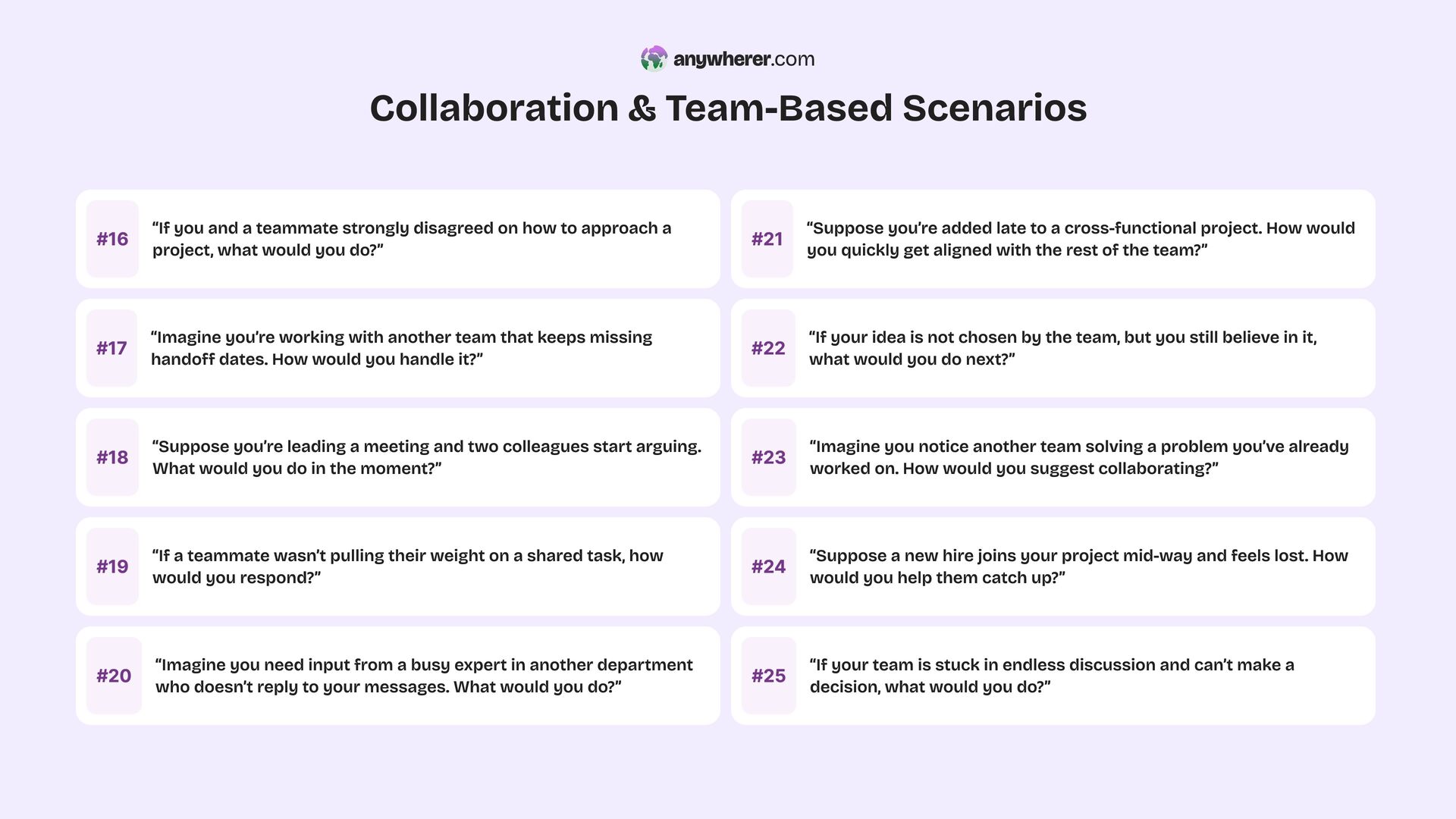
  11. anywherer.com Collaboration & Team-Based Scenarios #16 “If you and a

    teammate strongly disagreed on how to approach a project, what would you do?” #21 “Suppose you’re added late to a cross-functional project. How would you quickly get aligned with the rest of the team?” #17 “Imagine you’re working with another team that keeps missing handoff dates. How would you handle it?” #22 “If your idea is not chosen by the team, but you still believe in it, what would you do next?” #18 “Suppose you’re leading a meeting and two colleagues start arguing. What would you do in the moment?” #23 “Imagine you notice another team solving a problem you’ve already worked on. How would you suggest collaborating?” #19 “If a teammate wasn’t pulling their weight on a shared task, how would you respond?” #24 “Suppose a new hire joins your project mid-way and feels lost. How would you help them catch up?” #20 “Imagine you need input from a busy expert in another department who doesn’t reply to your messages. What would you do?” #25 “If your team is stuck in endless discussion and can’t make a decision, what would you do?”
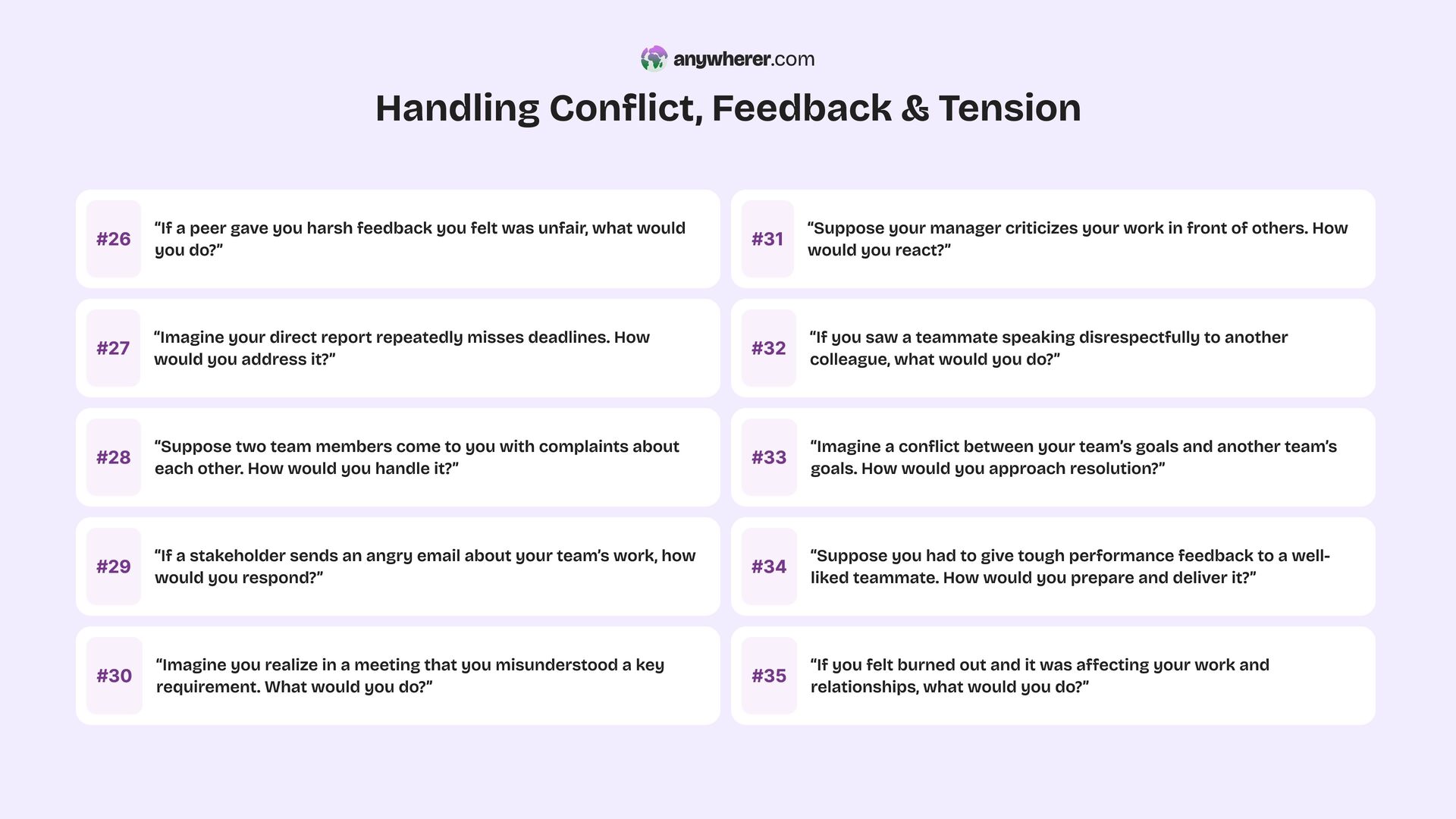
  12. anywherer.com Handling Conflict, Feedback & Tension #26 “If a peer

    gave you harsh feedback you felt was unfair, what would you do?” #31 “Suppose your manager criticizes your work in front of others. How would you react?” #27 “Imagine your direct report repeatedly misses deadlines. How would you address it?” #32 “If you saw a teammate speaking disrespectfully to another colleague, what would you do?” #28 “Suppose two team members come to you with complaints about each other. How would you handle it?” #33 “Imagine a conflict between your team’s goals and another team’s goals. How would you approach resolution?” #29 “If a stakeholder sends an angry email about your team’s work, how would you respond?” #34 “Suppose you had to give tough performance feedback to a well- liked teammate. How would you prepare and deliver it?” #30 “Imagine you realize in a meeting that you misunderstood a key requirement. What would you do?” #35 “If you felt burned out and it was affecting your work and relationships, what would you do?”
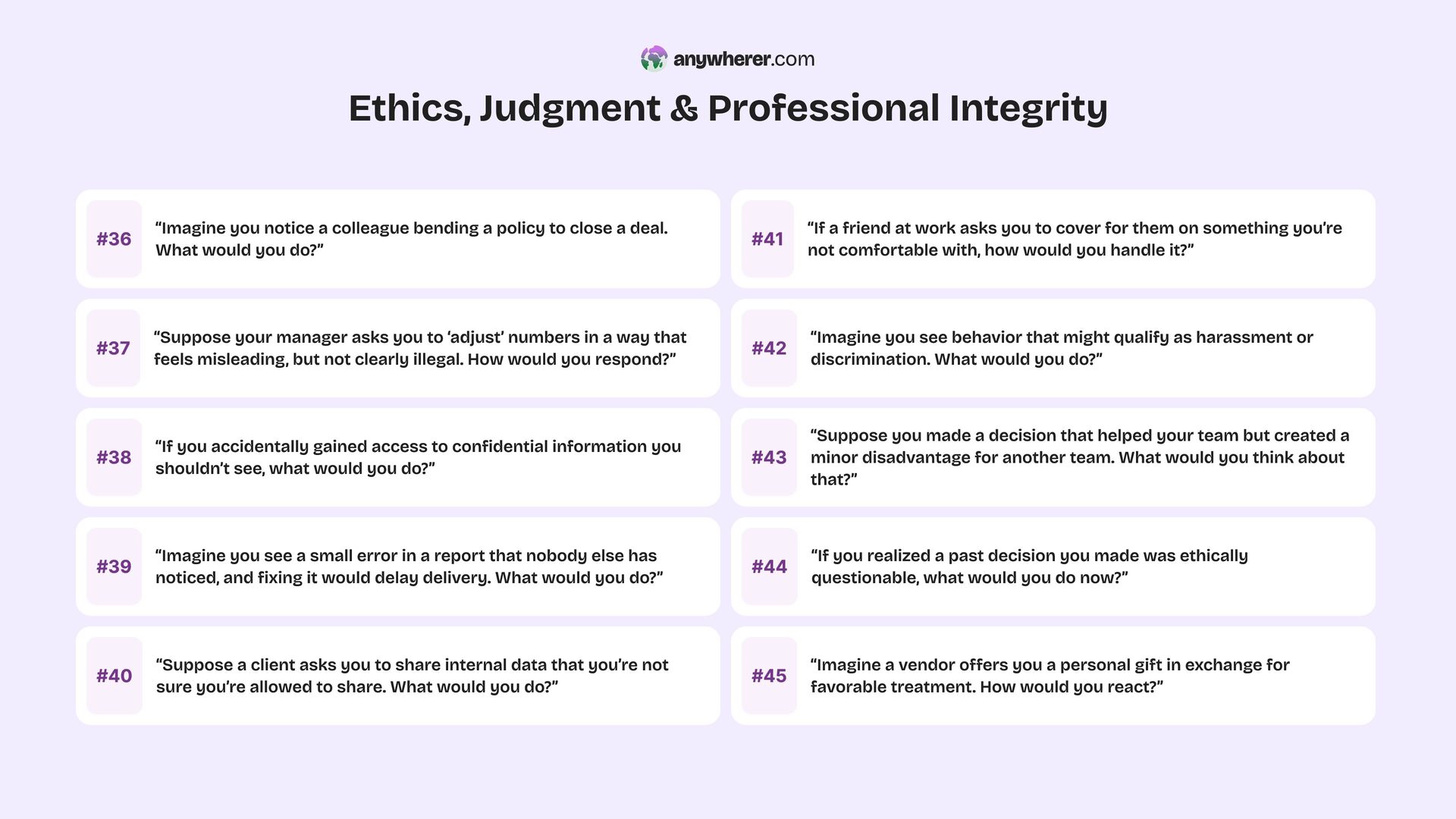
  13. anywherer.com Ethics, Judgment & Professional Integrity #36 “Imagine you notice

    a colleague bending a policy to close a deal. What would you do?” #41 “If a friend at work asks you to cover for them on something you’re not comfortable with, how would you handle it?” #37 “Suppose your manager asks you to ‘adjust’ numbers in a way that feels misleading, but not clearly illegal. How would you respond?” #42 “Imagine you see behavior that might qualify as harassment or discrimination. What would you do?” #38 “If you accidentally gained access to confidential information you shouldn’t see, what would you do?” #43 “Suppose you made a decision that helped your team but created a minor disadvantage for another team. What would you think about that?” #39 “Imagine you see a small error in a report that nobody else has noticed, and fixing it would delay delivery. What would you do?” #44 “If you realized a past decision you made was ethically questionable, what would you do now?” #40 “Suppose a client asks you to share internal data that you’re not sure you’re allowed to share. What would you do?” #45 “Imagine a vendor offers you a personal gift in exchange for favorable treatment. How would you react?”
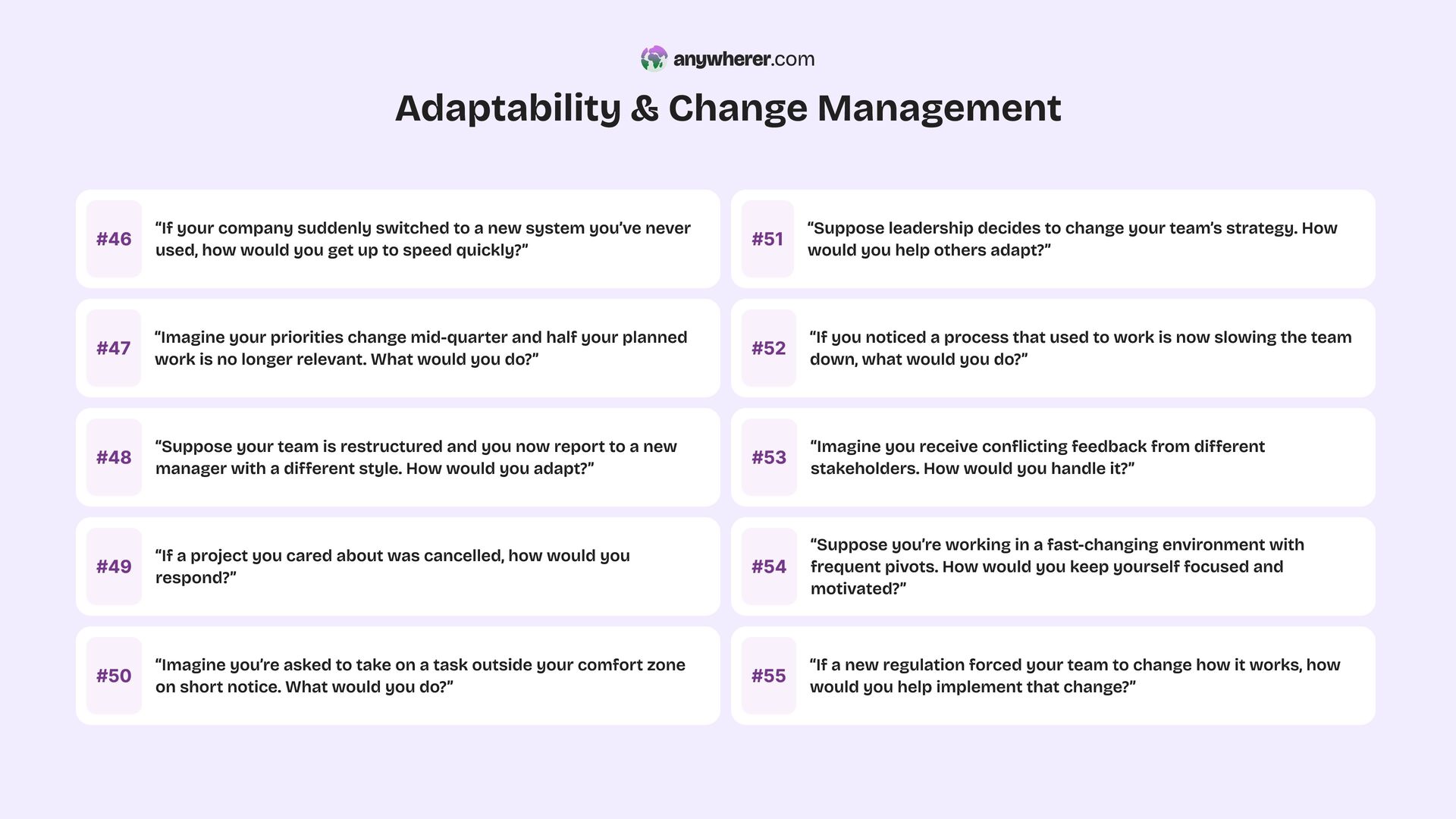
  14. anywherer.com Adaptability & Change Management #46 “If your company suddenly

    switched to a new system you’ve never used, how would you get up to speed quickly?” #51 “Suppose leadership decides to change your team’s strategy. How would you help others adapt?” #47 “Imagine your priorities change mid-quarter and half your planned work is no longer relevant. What would you do?” #52 “If you noticed a process that used to work is now slowing the team down, what would you do?” #48 “Suppose your team is restructured and you now report to a new manager with a different style. How would you adapt?” #53 “Imagine you receive conflicting feedback from different stakeholders. How would you handle it?” #49 “If a project you cared about was cancelled, how would you respond?” #54 “Suppose you’re working in a fast-changing environment with frequent pivots. How would you keep yourself focused and motivated?” #50 “Imagine you’re asked to take on a task outside your comfort zone on short notice. What would you do?” #55 “If a new regulation forced your team to change how it works, how would you help implement that change?”
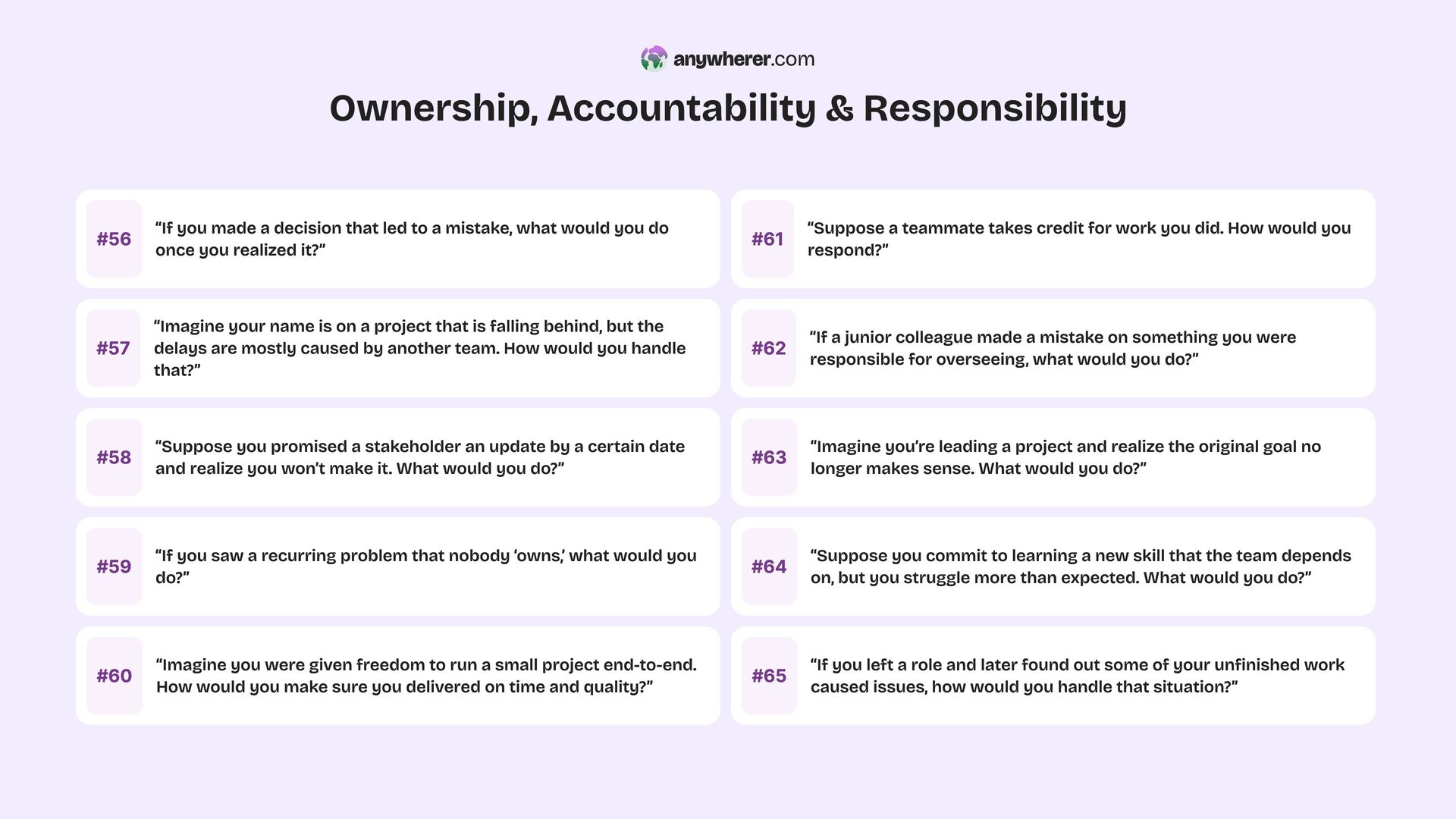
  15. anywherer.com Ownership, Accountability & Responsibility #56 “If you made a

    decision that led to a mistake, what would you do once you realized it?” #61 “Suppose a teammate takes credit for work you did. How would you respond?” #57 “Imagine your name is on a project that is falling behind, but the delays are mostly caused by another team. How would you handle that?” #62 “If a junior colleague made a mistake on something you were responsible for overseeing, what would you do?” #58 “Suppose you promised a stakeholder an update by a certain date and realize you won’t make it. What would you do?” #63 “Imagine you’re leading a project and realize the original goal no longer makes sense. What would you do?” #59 “If you saw a recurring problem that nobody ‘owns,’ what would you do?” #64 “Suppose you commit to learning a new skill that the team depends on, but you struggle more than expected. What would you do?” #60 “Imagine you were given freedom to run a small project end- to- end. How would you make sure you delivered on time and q uality?” #65 “If you left a role and later found out some of your unfinished work caused issues, how would you handle that situation?”