Drupal AI Search & Personalization: A Practical Playbook
Learn how to optimize Drupal for AI search, GEO, schema markup, structured content, personalization, and AI citation visibility with a practical 90-day roadmap.
Costing You Chapter 1: Where Does Your Site Stand? Chapter 2: Why AI Search Is Skipping Your Drupal Content Chapter 3: Fix 1 - Making Your Drupal Content Findable Chapter 4: Fix 2 - Serving Every Visitor the Right Experience Chapter 5: One Architecture Decision. Two Problems Solved. Chapter 6: Measuring What Actually Matters in 2026 Chapter 7: Your 90-Day Path Forward Making Drupal Work in the Age of AI Search and Personalization BinaryWorks
in your audience just asked ChatGPT a question your Drupal site answers perfectly. The AI retrieved sources, synthesized a response, and cited three of them. Your content was not among them. That is not a content quality problem. Your pages may have the most accurate information on the topic. The problem is structural: your content is not organized in a way AI retrieval engines can parse, extract, and trust as a citation source. That is the first of two gaps your Drupal site is likely facing right now. The second happens when a visitor does reach your site. A prospective student researching programs, a citizen trying to find the right service, a donor evaluating where to give. Each arrives and sees the same experience as every other visitor: same content, same navigation, same calls to action, regardless of who they are or why they came. According to McKinsey, 71% of visitors expect a personalized experience and 76% get frustrated when they encounter a generic one. For non-transactional organizations, that frustration shows up quietly: tasks abandoned, resources unfound, help desks contacted for questions already on the site. What Both Gaps Are Costing The discovery gap costs consideration. AI captures the research and evaluation phase, the stage where users form their shortlists before they contact anyone. Organizations absent from AI-generated answers at this stage are not losing to a competitor in rankings. They are absent from the decision entirely. The experience gap costs engagement and operational time. Every visitor who cannot find what they need calls your help desk, emails your team, or leaves without completing their task. The volume of support contacts answering questions your site already addresses is the clearest and most honest measure of this gap. The Window Is Open - But Not Permanently AI citation is earned, not purchased. Organizations that restructure their content now will build citation authority in their topic areas, and that position is durable. The teams acting now are accumulating a structural advantage that becomes harder to close as more organizations catch up. The platform is not the obstacle. Drupal is natively equipped to address both gaps without a rebuild. The constraint in most implementations is not capability. It is activation. Making Drupal Work in the Age of AI Search and Personalization 1 BinaryWorks
and the experience gap trace to the same root cause: content structured around how the organization works, not how users find and use information. The fix is architectural, and the same architecture decision that addresses AI visibility also enables personalization. Before You Move On • Search your five most important topic queries in ChatGPT or Perplexity. Does your content appear? • How many support contacts last month answered questions already published on your site? • Does a returning authenticated user on your homepage see anything different from a first-time visitor? Making Drupal Work in the Age of AI Search and Personalization 2 BinaryWorks
understand what you are working with. The following scorecard reflects the eight structural signals evaluated in every Drupal AI readiness audit. Score each signal honestly. Score: 1 = Not in place / 2 = Partially in place / 3 = Fully in place Dimension Signal Score Findability: Structure Key content in typed fields, not body blocks /3 Findability: Structure IA organized around user tasks, not your org chart /3 Findability: Signals Every page has unique metadata from field-level tokens /3 Findability: Signals Schema markup implemented and validated /3 Experience: Personalization Different experiences served to distinct visitor roles /3 Experience: Personalization Segments defined from behavior and role /3 Experience: Measurement Engagement depth tracked, not just page views /3 Experience: Measurement AI citation visibility monitored separately from traffic /3 Maximum: 24. Keep this score - you will return to it in Chapter 7. Making Drupal Work in the Age of AI Search and Personalization 3 BinaryWorks
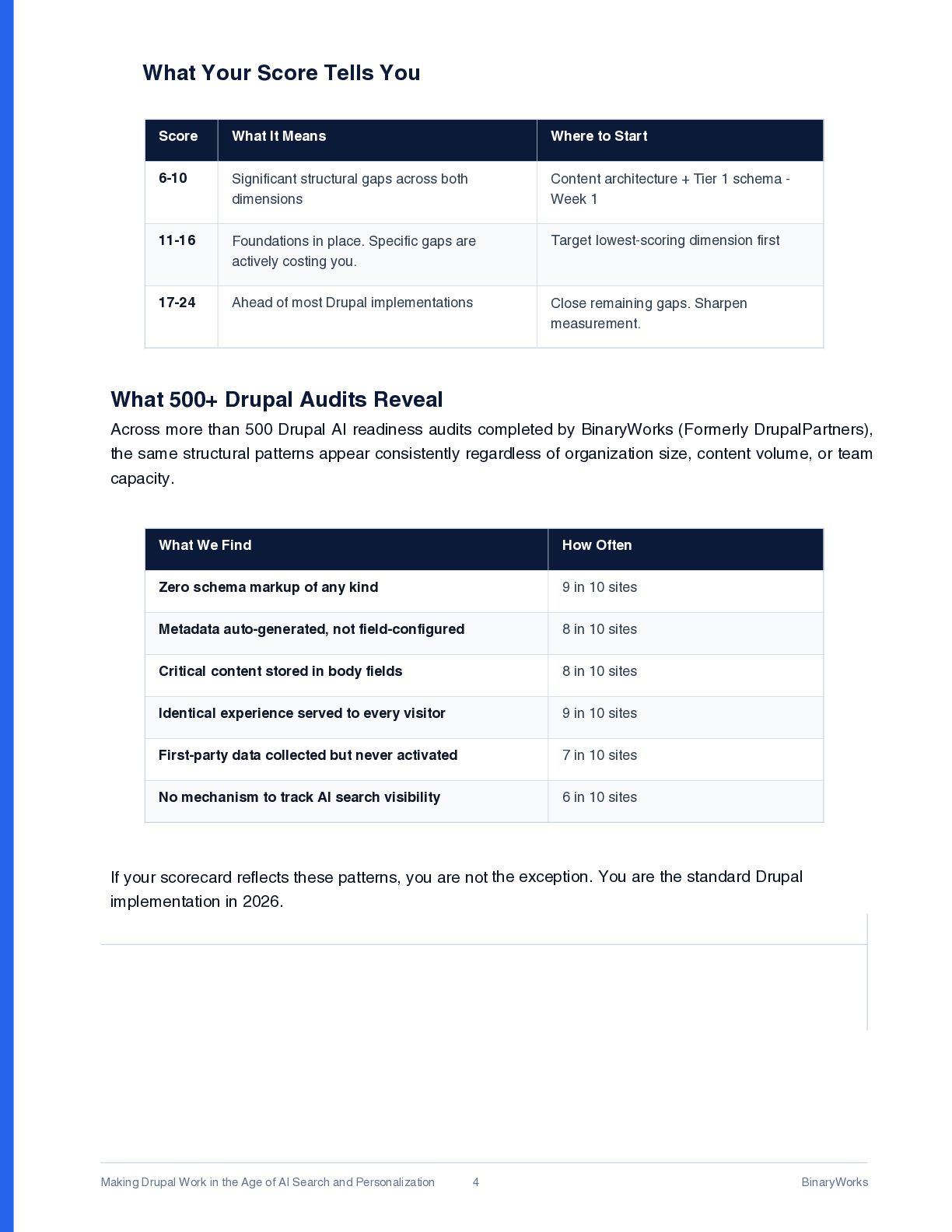
to Start 6-10 Significant structural gaps across both dimensions Content architecture + Tier 1 schema Week 1 11-16 Foundations in place. Specific gaps are actively costing you. Target lowest-scoring dimension first 17-24 Ahead of most Drupal implementations Close remaining gaps. Sharpen measurement. What 500+ Drupal Audits Reveal Across more than 500 Drupal AI readiness audits completed by BinaryWorks (Formerly DrupalPartners), the same structural patterns appear consistently regardless of organization size, content volume, or team capacity. What We Find How Often Zero schema markup of any kind 9 in 10 sites Metadata auto-generated, not field-configured 8 in 10 sites Critical content stored in body fields 8 in 10 sites Identical experience served to every visitor 9 in 10 sites First-party data collected but never activated 7 in 10 sites No mechanism to track AI search visibility 6 in 10 sites If your scorecard reflects these patterns, you are not the exception. You are the standard Drupal implementation in 2026. Making Drupal Work in the Age of AI Search and Personalization 4 BinaryWorks
and a technical team member present. Each consistently surfaces gaps the other cannot see. The score is more accurate and the conversation that follows is more actionable when both perspectives are in the room. Key Principle A low readiness score does not reflect platform limitations. It reflects implementation decisions, most of which can be reversed without rebuilding anything. Drupal has the capability. The gap is in how it has been configured. Making Drupal Work in the Age of AI Search and Personalization 5 BinaryWorks
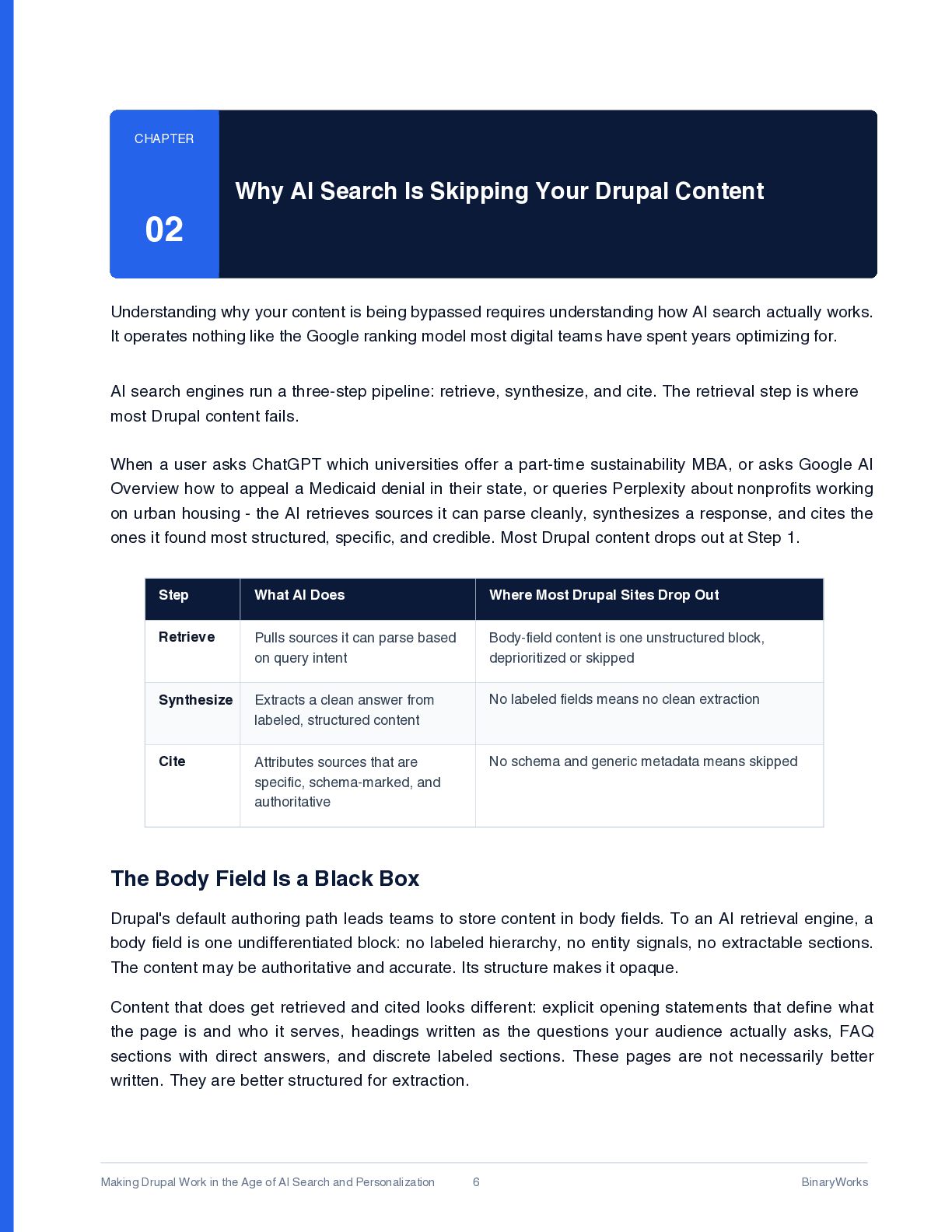
Understanding why your content is being bypassed requires understanding how AI search actually works. It operates nothing like the Google ranking model most digital teams have spent years optimizing for. AI search engines run a three-step pipeline: retrieve, synthesize, and cite. The retrieval step is where most Drupal content fails. When a user asks ChatGPT which universities offer a part-time sustainability MBA, or asks Google AI Overview how to appeal a Medicaid denial in their state, or queries Perplexity about nonprofits working on urban housing - the AI retrieves sources it can parse cleanly, synthesizes a response, and cites the ones it found most structured, specific, and credible. Most Drupal content drops out at Step 1. Step What AI Does Where Most Drupal Sites Drop Out Retrieve Pulls sources it can parse based on query intent Body-field content is one unstructured block, deprioritized or skipped Synthesize Extracts a clean answer from labeled, structured content No labeled fields means no clean extraction Cite Attributes sources that are specific, schema-marked, and authoritative No schema and generic metadata means skipped The Body Field Is a Black Box Drupal's default authoring path leads teams to store content in body fields. To an AI retrieval engine, a body field is one undifferentiated block: no labeled hierarchy, no entity signals, no extractable sections. The content may be authoritative and accurate. Its structure makes it opaque. Content that does get retrieved and cited looks different: explicit opening statements that define what the page is and who it serves, headings written as the questions your audience actually asks, FAQ sections with direct answers, and discrete labeled sections. These pages are not necessarily better written. They are better structured for extraction. Making Drupal Work in the Age of AI Search and Personalization 6 BinaryWorks
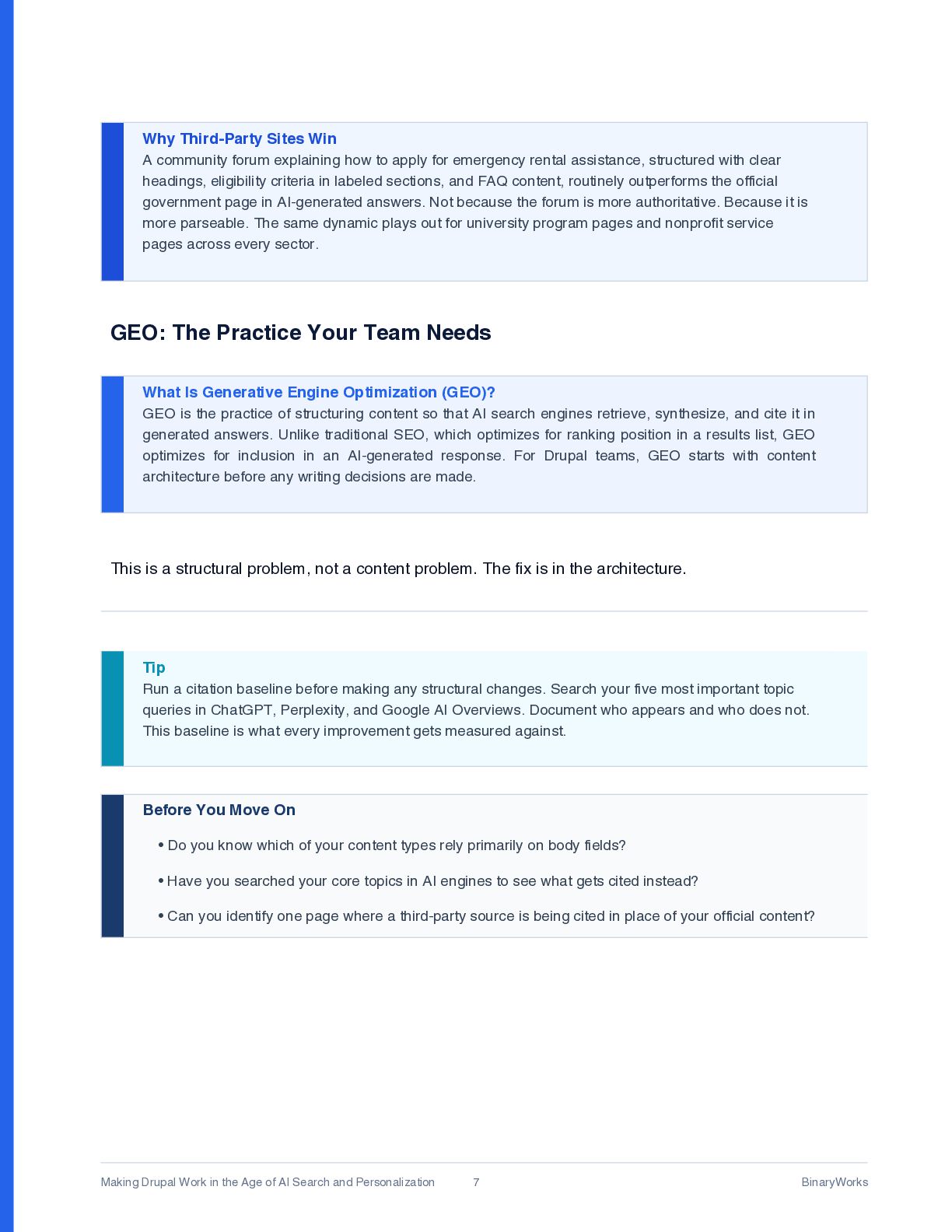
apply for emergency rental assistance, structured with clear headings, eligibility criteria in labeled sections, and FAQ content, routinely outperforms the official government page in AI-generated answers. Not because the forum is more authoritative. Because it is more parseable. The same dynamic plays out for university program pages and nonprofit service pages across every sector. GEO: The Practice Your Team Needs What Is Generative Engine Optimization (GEO)? GEO is the practice of structuring content so that AI search engines retrieve, synthesize, and cite it in generated answers. Unlike traditional SEO, which optimizes for ranking position in a results list, GEO optimizes for inclusion in an AI-generated response. For Drupal teams, GEO starts with content architecture before any writing decisions are made. This is a structural problem, not a content problem. The fix is in the architecture. Tip Run a citation baseline before making any structural changes. Search your five most important topic queries in ChatGPT, Perplexity, and Google AI Overviews. Document who appears and who does not. This baseline is what every improvement gets measured against. Before You Move On • Do you know which of your content types rely primarily on body fields? • Have you searched your core topics in AI engines to see what gets cited instead? • Can you identify one page where a third-party source is being cited in place of your official content? Making Drupal Work in the Age of AI Search and Personalization 7 BinaryWorks
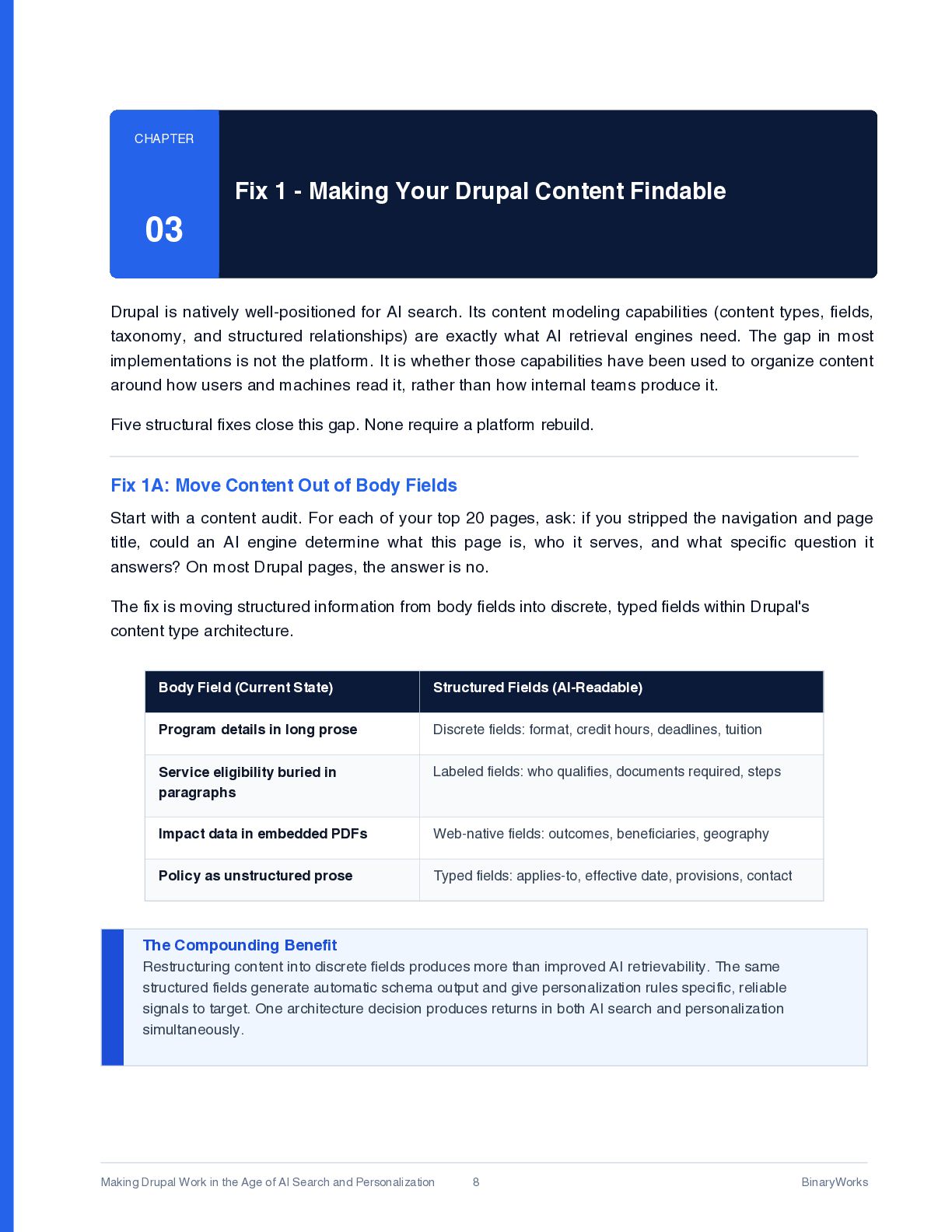
Drupal is natively well-positioned for AI search. Its content modeling capabilities (content types, fields, taxonomy, and structured relationships) are exactly what AI retrieval engines need. The gap in most implementations is not the platform. It is whether those capabilities have been used to organize content around how users and machines read it, rather than how internal teams produce it. Five structural fixes close this gap. None require a platform rebuild. Fix 1A: Move Content Out of Body Fields Start with a content audit. For each of your top 20 pages, ask: if you stripped the navigation and page title, could an AI engine determine what this page is, who it serves, and what specific question it answers? On most Drupal pages, the answer is no. The fix is moving structured information from body fields into discrete, typed fields within Drupal's content type architecture. Body Field (Current State) Structured Fields (AI-Readable) Program details in long prose Discrete fields: format, credit hours, deadlines, tuition Service eligibility buried in paragraphs Labeled fields: who qualifies, documents required, steps Impact data in embedded PDFs Web-native fields: outcomes, beneficiaries, geography Policy as unstructured prose Typed fields: applies-to, effective date, provisions, contact The Compounding Benefit Restructuring content into discrete fields produces more than improved AI retrievability. The same structured fields generate automatic schema output and give personalization rules specific, reliable signals to target. One architecture decision produces returns in both AI search and personalization simultaneously. Making Drupal Work in the Age of AI Search and Personalization 8 BinaryWorks
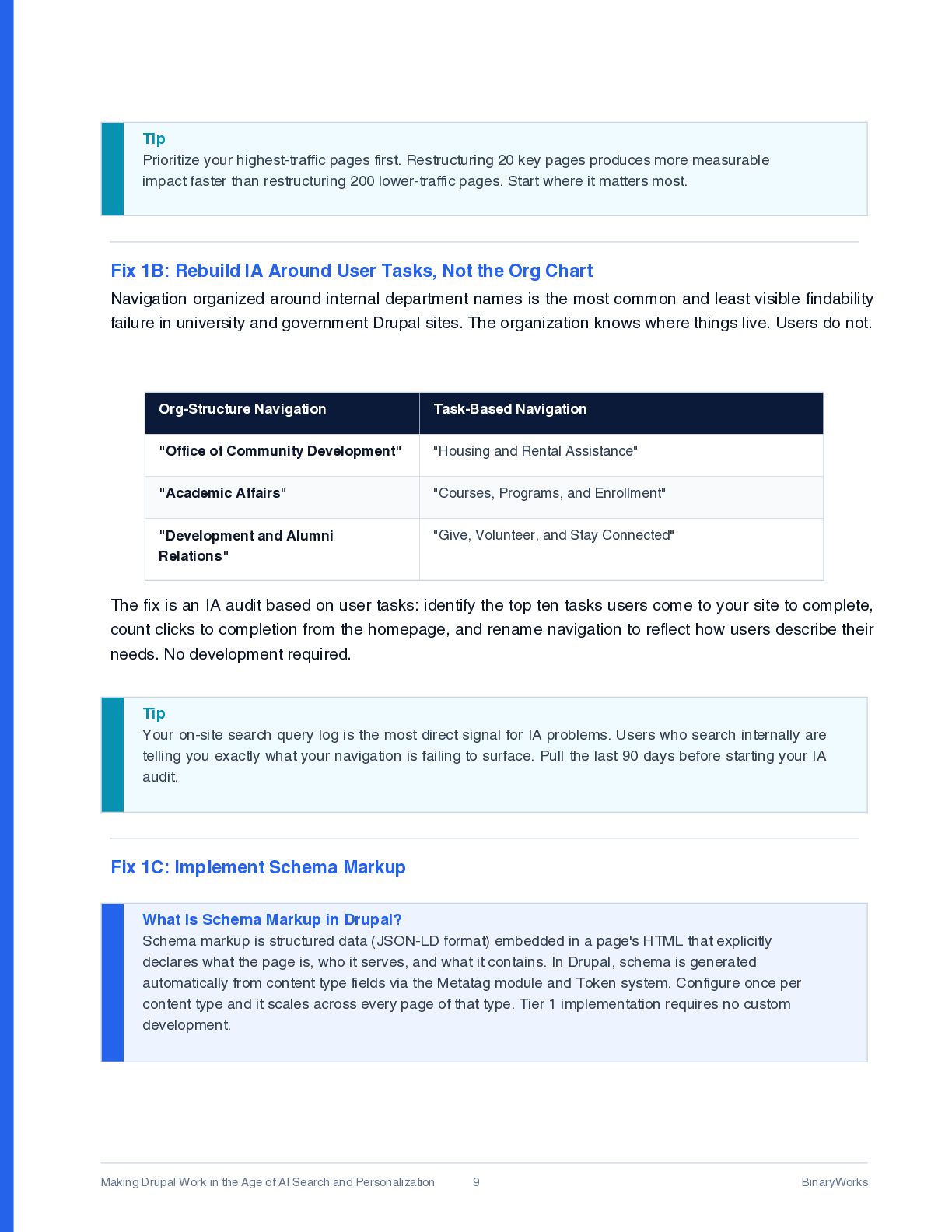
produces more measurable impact faster than restructuring 200 lower-traffic pages. Start where it matters most. Fix 1B: Rebuild IA Around User Tasks, Not the Org Chart Navigation organized around internal department names is the most common and least visible findability failure in university and government Drupal sites. The organization knows where things live. Users do not. Org-Structure Navigation Task-Based Navigation "Office of Community Development" "Housing and Rental Assistance" "Academic Affairs" "Courses, Programs, and Enrollment" "Development and Alumni Relations" "Give, Volunteer, and Stay Connected" The fix is an IA audit based on user tasks: identify the top ten tasks users come to your site to complete, count clicks to completion from the homepage, and rename navigation to reflect how users describe their needs. No development required. Tip Your on-site search query log is the most direct signal for IA problems. Users who search internally are telling you exactly what your navigation is failing to surface. Pull the last 90 days before starting your IA audit. Fix 1C: Implement Schema Markup What Is Schema Markup in Drupal? Schema markup is structured data (JSON-LD format) embedded in a page's HTML that explicitly declares what the page is, who it serves, and what it contains. In Drupal, schema is generated automatically from content type fields via the Metatag module and Token system. Configure once per content type and it scales across every page of that type. Tier 1 implementation requires no custom development. Making Drupal Work in the Age of AI Search and Personalization 9 BinaryWorks
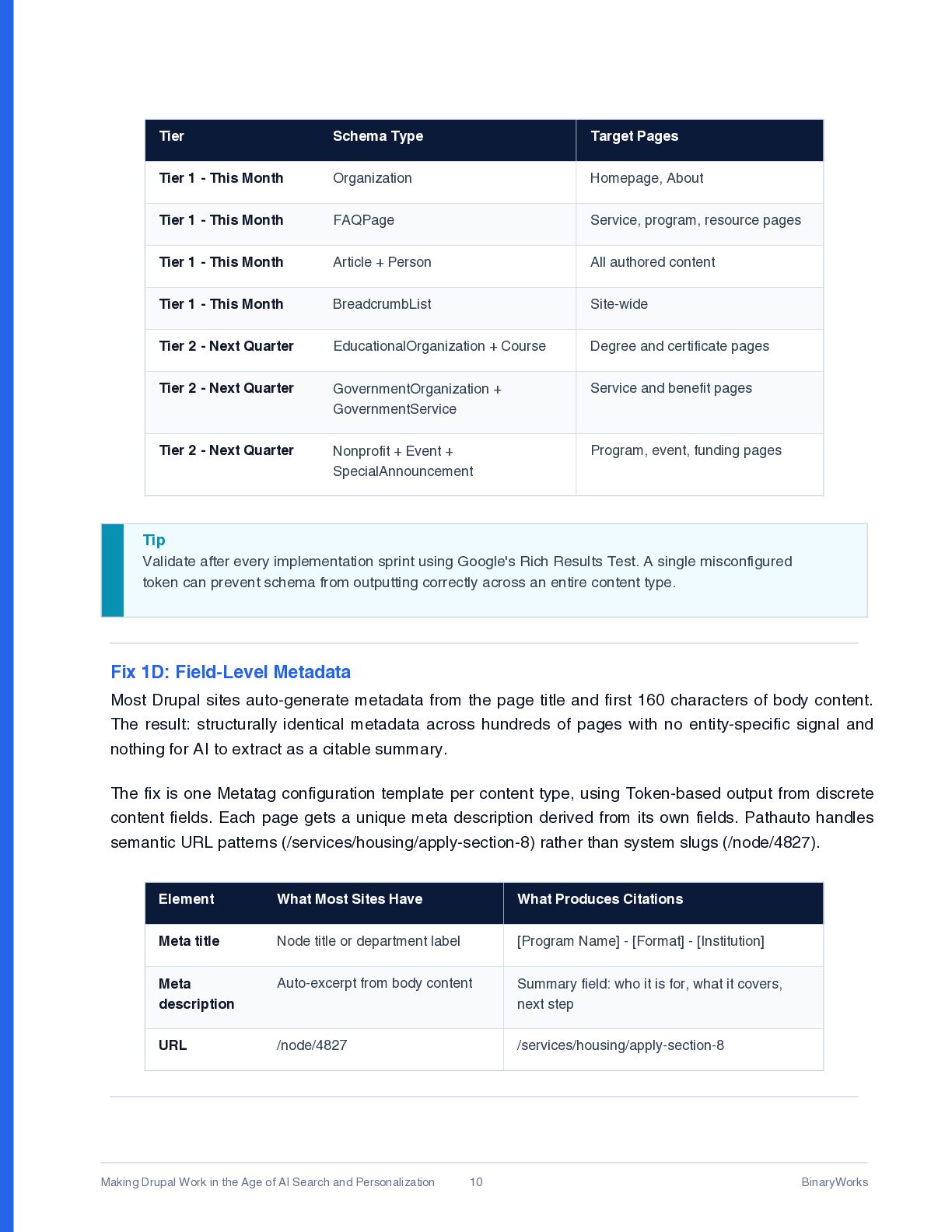
Organization Homepage, About Tier 1 - This Month FAQPage Service, program, resource pages Tier 1 - This Month Article + Person All authored content Tier 1 - This Month BreadcrumbList Site-wide Tier 2 - Next Quarter EducationalOrganization + Course Degree and certificate pages Tier 2 - Next Quarter GovernmentOrganization + GovernmentService Service and benefit pages Tier 2 - Next Quarter Nonprofit + Event + SpecialAnnouncement Program, event, funding pages Tip Validate after every implementation sprint using Google's Rich Results Test. A single misconfigured token can prevent schema from outputting correctly across an entire content type. Fix 1D: Field-Level Metadata Most Drupal sites auto-generate metadata from the page title and first 160 characters of body content. The result: structurally identical metadata across hundreds of pages with no entity-specific signal and nothing for AI to extract as a citable summary. The fix is one Metatag configuration template per content type, using Token-based output from discrete content fields. Each page gets a unique meta description derived from its own fields. Pathauto handles semantic URL patterns (/services/housing/apply-section-8) rather than system slugs (/node/4827). Element What Most Sites Have What Produces Citations Meta title Node title or department label [Program Name] - [Format] - [Institution] Meta description Auto-excerpt from body content Summary field: who it is for, what it covers, next step URL /node/4827 /services/housing/apply-section-8 Making Drupal Work in the Age of AI Search and Personalization 10 BinaryWorks
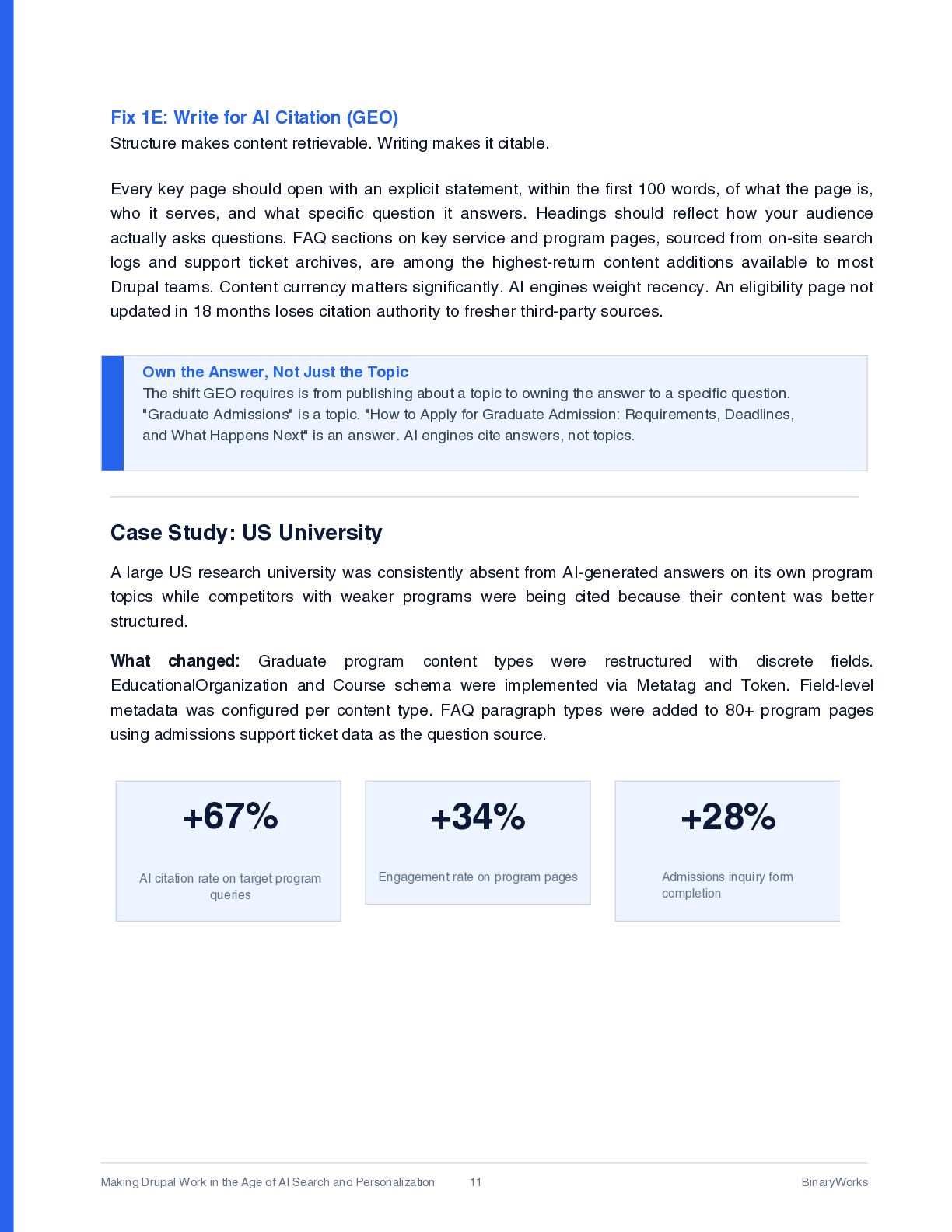
retrievable. Writing makes it citable. Every key page should open with an explicit statement, within the first 100 words, of what the page is, who it serves, and what specific question it answers. Headings should reflect how your audience actually asks questions. FAQ sections on key service and program pages, sourced from on-site search logs and support ticket archives, are among the highest-return content additions available to most Drupal teams. Content currency matters significantly. AI engines weight recency. An eligibility page not updated in 18 months loses citation authority to fresher third-party sources. Own the Answer, Not Just the Topic The shift GEO requires is from publishing about a topic to owning the answer to a specific question. "Graduate Admissions" is a topic. "How to Apply for Graduate Admission: Requirements, Deadlines, and What Happens Next" is an answer. AI engines cite answers, not topics. Case Study: US University A large US research university was consistently absent from AI-generated answers on its own program topics while competitors with weaker programs were being cited because their content was better structured. What changed: Graduate program content types were restructured with discrete fields. EducationalOrganization and Course schema were implemented via Metatag and Token. Field-level metadata was configured per content type. FAQ paragraph types were added to 80+ program pages using admissions support ticket data as the question source. +67% +34% +28% AI citation rate on target program queries Engagement rate on program pages Admissions inquiry form completion Making Drupal Work in the Age of AI Search and Personalization 11 BinaryWorks
your five most important topic queries in ChatGPT, Perplexity, and Google AI Overviews. Note who is cited instead of you. Get Your Free Drupal AI Readiness Audit Making Drupal Work in the Age of AI Search and Personalization 12 BinaryWorks
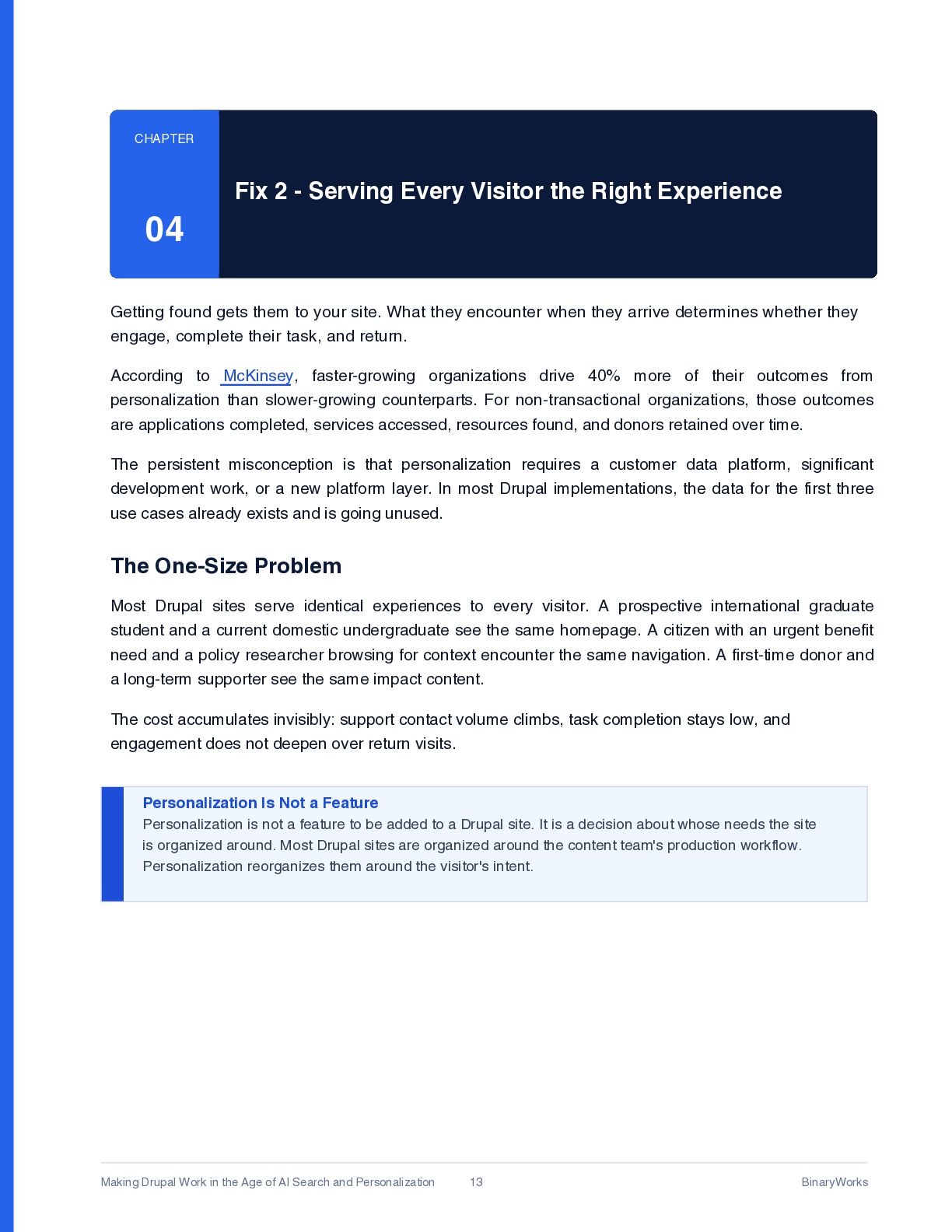
04 Getting found gets them to your site. What they encounter when they arrive determines whether they engage, complete their task, and return. According to McKinsey, faster-growing organizations drive 40% more of their outcomes from personalization than slower-growing counterparts. For non-transactional organizations, those outcomes are applications completed, services accessed, resources found, and donors retained over time. The persistent misconception is that personalization requires a customer data platform, significant development work, or a new platform layer. In most Drupal implementations, the data for the first three use cases already exists and is going unused. The One-Size Problem Most Drupal sites serve identical experiences to every visitor. A prospective international graduate student and a current domestic undergraduate see the same homepage. A citizen with an urgent benefit need and a policy researcher browsing for context encounter the same navigation. A first-time donor and a long-term supporter see the same impact content. The cost accumulates invisibly: support contact volume climbs, task completion stays low, and engagement does not deepen over return visits. Personalization Is Not a Feature Personalization is not a feature to be added to a Drupal site. It is a decision about whose needs the site is organized around. Most Drupal sites are organized around the content team's production workflow. Personalization reorganizes them around the visitor's intent. Making Drupal Work in the Age of AI Search and Personalization 13 BinaryWorks
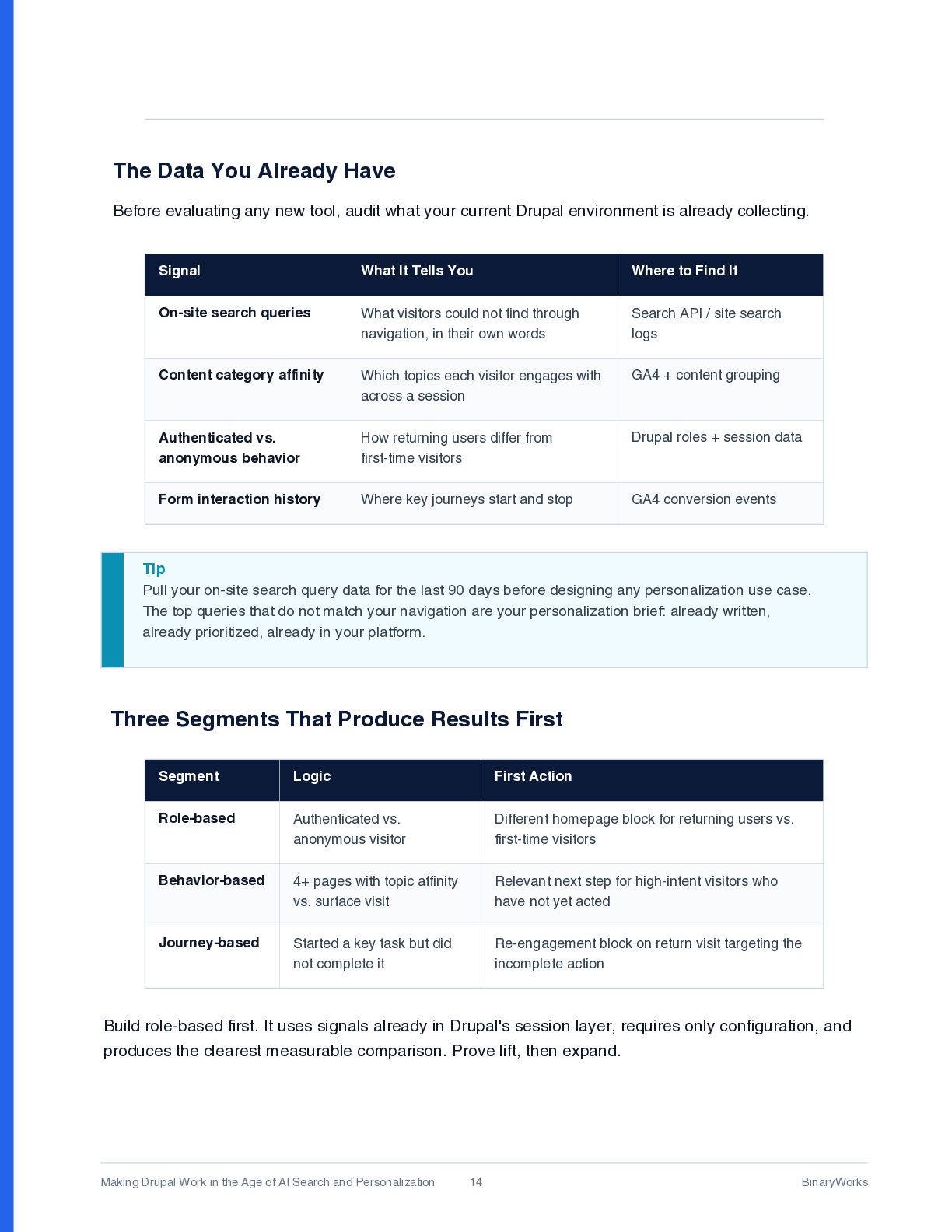
audit what your current Drupal environment is already collecting. Signal What It Tells You Where to Find It On-site search queries What visitors could not find through navigation, in their own words Search API / site search logs Content category affinity Which topics each visitor engages with across a session GA4 + content grouping Authenticated vs. anonymous behavior How returning users differ from first-time visitors Drupal roles + session data Form interaction history Where key journeys start and stop GA4 conversion events Tip Pull your on-site search query data for the last 90 days before designing any personalization use case. The top queries that do not match your navigation are your personalization brief: already written, already prioritized, already in your platform. Three Segments That Produce Results First Segment Logic First Action Role-based Authenticated vs. anonymous visitor Different homepage block for returning users vs. first-time visitors Behavior-based 4+ pages with topic affinity vs. surface visit Relevant next step for high-intent visitors who have not yet acted Journey-based Started a key task but did not complete it Re-engagement block on return visit targeting the incomplete action Build role-based first. It uses signals already in Drupal's session layer, requires only configuration, and produces the clearest measurable comparison. Prove lift, then expand. Making Drupal Work in the Age of AI Search and Personalization 14 BinaryWorks
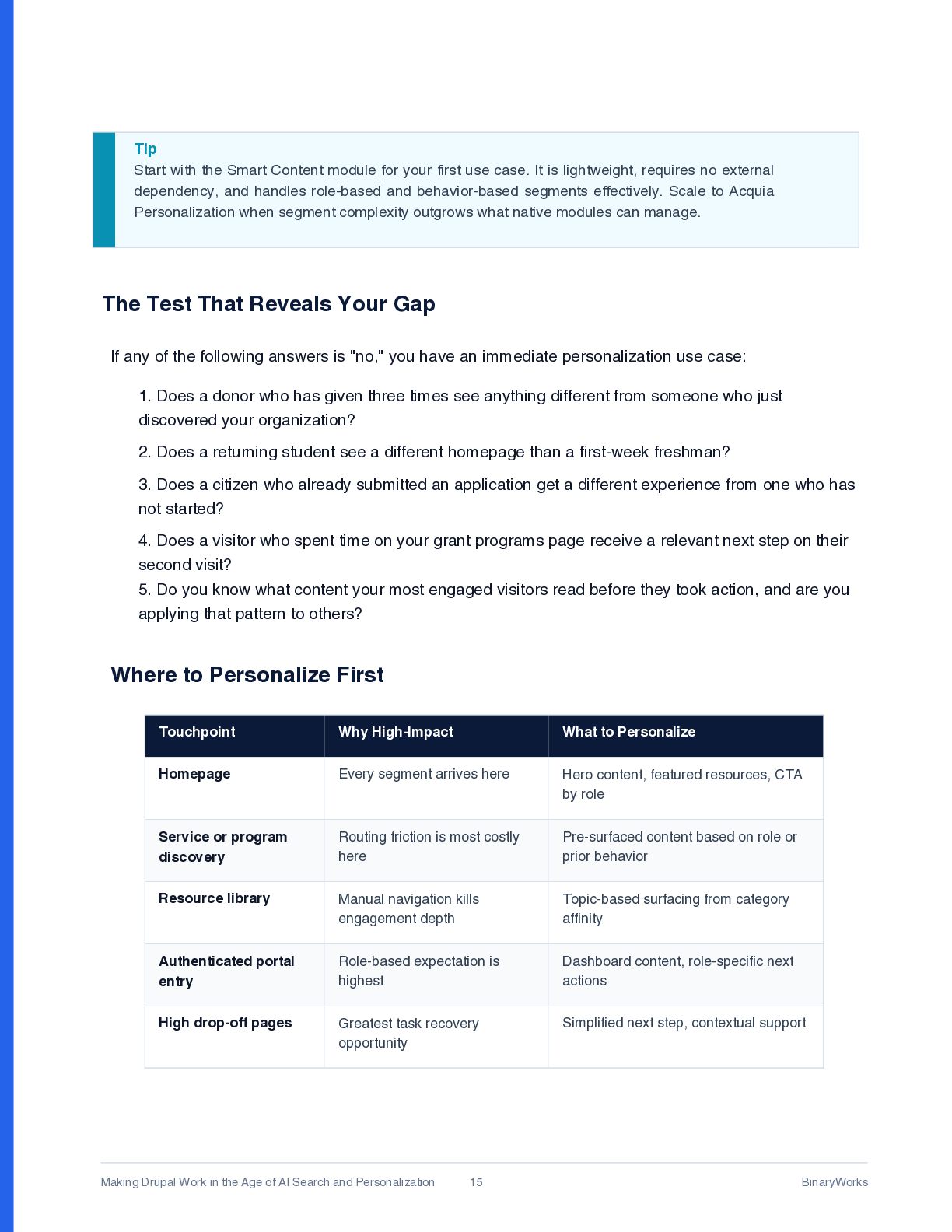
use case. It is lightweight, requires no external dependency, and handles role-based and behavior-based segments effectively. Scale to Acquia Personalization when segment complexity outgrows what native modules can manage. The Test That Reveals Your Gap If any of the following answers is "no," you have an immediate personalization use case: 1. Does a donor who has given three times see anything different from someone who just discovered your organization? 2. Does a returning student see a different homepage than a first-week freshman? 3. Does a citizen who already submitted an application get a different experience from one who has not started? 4. Does a visitor who spent time on your grant programs page receive a relevant next step on their second visit? 5. Do you know what content your most engaged visitors read before they took action, and are you applying that pattern to others? Where to Personalize First Touchpoint Why High-Impact What to Personalize Homepage Every segment arrives here Hero content, featured resources, CTA by role Service or program discovery Routing friction is most costly here Pre-surfaced content based on role or prior behavior Resource library Manual navigation kills engagement depth Topic-based surfacing from category affinity Authenticated portal entry Role-based expectation is highest Dashboard content, role-specific next actions High drop-off pages Greatest task recovery opportunity Simplified next step, contextual support Making Drupal Work in the Age of AI Search and Personalization 15 BinaryWorks
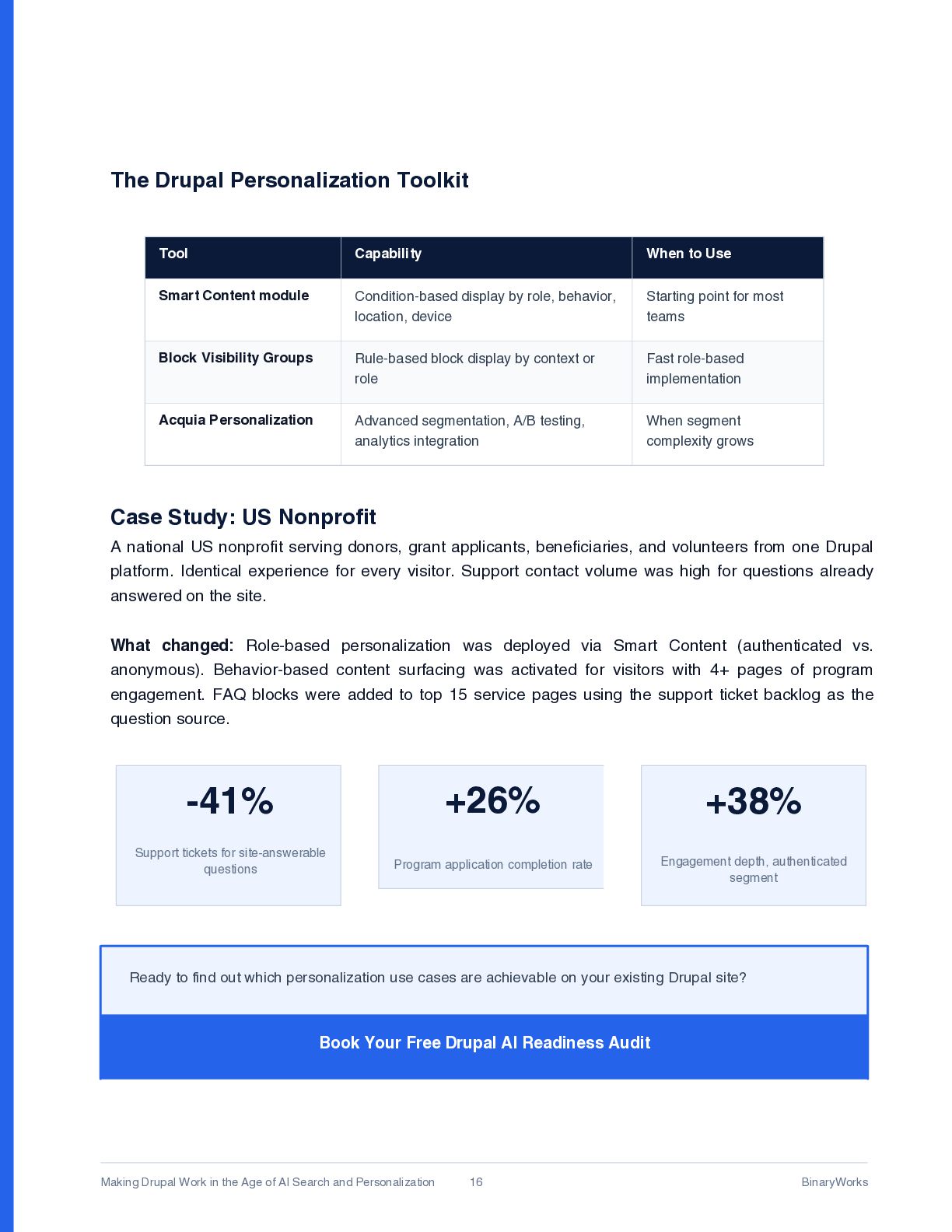
Content module Condition-based display by role, behavior, location, device Starting point for most teams Block Visibility Groups Rule-based block display by context or role Fast role-based implementation Acquia Personalization Advanced segmentation, A/B testing, analytics integration When segment complexity grows Case Study: US Nonprofit A national US nonprofit serving donors, grant applicants, beneficiaries, and volunteers from one Drupal platform. Identical experience for every visitor. Support contact volume was high for questions already answered on the site. What changed: Role-based personalization was deployed via Smart Content (authenticated vs. anonymous). Behavior-based content surfacing was activated for visitors with 4+ pages of program engagement. FAQ blocks were added to top 15 service pages using the support ticket backlog as the question source. -41% +26% +38% Support tickets for site-answerable questions Program application completion rate Engagement depth, authenticated segment Ready to find out which personalization use cases are achievable on your existing Drupal site? Book Your Free Drupal AI Readiness Audit Making Drupal Work in the Age of AI Search and Personalization 16 BinaryWorks
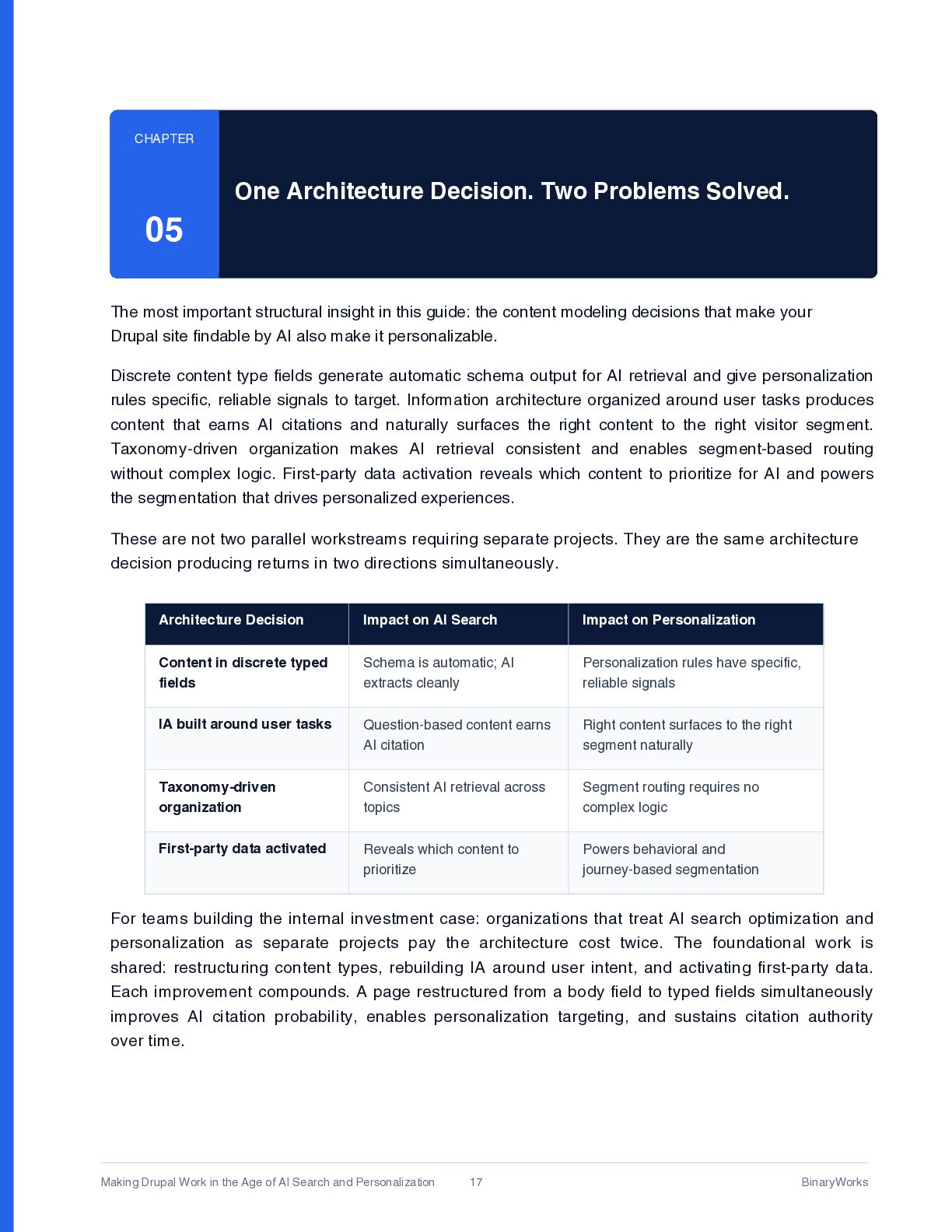
important structural insight in this guide: the content modeling decisions that make your Drupal site findable by AI also make it personalizable. Discrete content type fields generate automatic schema output for AI retrieval and give personalization rules specific, reliable signals to target. Information architecture organized around user tasks produces content that earns AI citations and naturally surfaces the right content to the right visitor segment. Taxonomy-driven organization makes AI retrieval consistent and enables segment-based routing without complex logic. First-party data activation reveals which content to prioritize for AI and powers the segmentation that drives personalized experiences. These are not two parallel workstreams requiring separate projects. They are the same architecture decision producing returns in two directions simultaneously. Architecture Decision Impact on AI Search Impact on Personalization Content in discrete typed fields Schema is automatic; AI extracts cleanly Personalization rules have specific, reliable signals IA built around user tasks Question-based content earns AI citation Right content surfaces to the right segment naturally Taxonomy-driven organization Consistent AI retrieval across topics Segment routing requires no complex logic First-party data activated Reveals which content to prioritize Powers behavioral and journey-based segmentation For teams building the internal investment case: organizations that treat AI search optimization and personalization as separate projects pay the architecture cost twice. The foundational work is shared: restructuring content types, rebuilding IA around user intent, and activating first-party data. Each improvement compounds. A page restructured from a body field to typed fields simultaneously improves AI citation probability, enables personalization targeting, and sustains citation authority over time. Making Drupal Work in the Age of AI Search and Personalization 17 BinaryWorks
You are making one set of architecture decisions that pay in two directions. Drupal's content modeling capability is the platform advantage that makes this possible. It requires deliberate implementation. The Compounding Effect Every page moved from a body field to structured, typed fields simultaneously improves AI citation probability, schema output accuracy, personalization signal quality, and content freshness compliance. The first restructured page builds the pattern. The hundredth confirms it. Tip When making the internal case for content restructuring, frame it as one investment with two returns: improved AI search visibility and improved personalization capability. This framing typically doubles internal support because it addresses the concerns of both digital strategy and content operations at once. Making Drupal Work in the Age of AI Search and Personalization 18 BinaryWorks
dashboards are structurally misleading for teams trying to understand AI search performance. Traffic volume can stay flat while AI citation share declines. Bounce rate does not distinguish between a visitor who found their answer immediately and one who gave up. Page view counts do not reflect whether a visitor completed the task the page was designed for. The measurement framework needs two new tracking routines running alongside standard engagement metrics. Tracking AI Visibility Run a manual citation check monthly: search your five most important topic queries in ChatGPT, Perplexity, and Google AI Overviews. Note whether your content appears, and note who is cited instead when it does not. Establish this baseline before any schema implementation. The before/after comparison is the most direct proof of structural impact available. Google Search Console provides AI Overview impression data for cited pages. Branded search volume growth is a useful secondary signal: consistent AI citation generates awareness among users who may never visit directly, showing up as branded search lift within 60 to 90 days. Tip Run your first citation check this week, before any structural changes. Spend 15 minutes in ChatGPT and Perplexity searching your five core topic queries. Save the results. This is your baseline. Tracking Engagement Depth and Personalization Impact Replace traffic volume as the primary KPI with signals that reflect whether the site actually worked for the visitor: • Task completion rate: GA4 conversion events configured for your specific user journeys • Segment-level engagement rate: Does the personalized segment outperform the default experience? • Support contact volume for site-answerable questions: The most direct signal that the experience gap is closing Making Drupal Work in the Age of AI Search and Personalization 19 BinaryWorks
last month answered questions already published on your site? When that number drops consistently over time, the platform is working. No dashboard metric tells you more directly whether your content architecture is serving your users. The Five-Metric Dashboard Build this in GA4 or Looker Studio. Refresh weekly. Keep it visible to the full team. Metric What It Tells You AI citation frequency by topic (monthly) Whether AI engines are finding and citing your content Organic engagement rate (GA4) Whether visitors are staying and interacting meaningfully Task completion rate by segment Whether each audience is completing what they came to do Schema validation status Whether structured data is clean, current, and error-free Support ticket volume trend Whether the experience gap is closing Tip When this dashboard is shared with content managers, developers, and strategists at the same time, the decisions that move the numbers become faster and better aligned. Shared visibility removes the friction that slows most improvement efforts. Before You Move On • Have you run your AI citation baseline in ChatGPT, Perplexity, and Google AI Overviews? • Is task completion rate configured as a conversion event in GA4 for your priority user journeys? • Do you know your support contact volume for site-answerable questions from last month? • Is your current schema validated and error-free in Google's Rich Results Test? Making Drupal Work in the Age of AI Search and Personalization 20 BinaryWorks
1 maps directly to this roadmap. Every signal you scored below 3 has an action sequence in the phases below. Month 1: Audit and Foundation Search your five most important user queries in ChatGPT and Perplexity and document what appears. This is your citation baseline. Test key pages with Google's Rich Results Test and note what schema exists and what is missing. Implement Tier 1 schema on your five highest-traffic pages via Metatag and Token. Pull 90 days of on-site search query data. Identify your first personalization use case and define three starting visitor segments. Deliverable: Citation baseline documented. Tier 1 schema live on five pages. First personalization use case defined. Tip Do not wait for a complete personalization strategy before deploying your first use case. Define one high-impact segment, build one differentiated experience, measure it for 30 days. That result will define your next use case more accurately than any planning document. Month 2: Activation Add FAQ blocks to your ten highest-traffic pages with questions sourced from on-site search logs and your support ticket archive. Configure field-level Metatag templates per content type to replace autogenerated metadata. Deploy your first personalization use case using Smart Content or Block Visibility Groups. Configure GA4 conversion events for your priority user journeys. Deliverable: Ten pages with FAQ content and schema live. Metadata field-configured. First personalization use case deployed. Month 3: Optimize and Expand Compare AI citation rate against your Month 1 baseline. Run a 30-day A/B test: personalized experience versus default on your highest-traffic page, measuring task completion rate by segment. Begin restructuring your ten most important body-field pages into discrete content type fields. Expand Making Drupal Work in the Age of AI Search and Personalization 21 BinaryWorks
personalization use case from what Month 2 data shows. Deliverable: A/B results in hand. Tier 2 schema live. Body-field restructuring underway. Second use case defined. Month 4 Onwards: Embed as Operations Weekly citation checks across five queries. Monthly schema review via Search Console. Quarterly full scorecard re-run. A freshness protocol that triggers content review whenever eligibility criteria, program details, or deadlines change. Progress Is Measured in Score Deltas The quarterly scorecard re-run from Chapter 1 is not a checkpoint. It is your primary measure of whether the platform is actually improving. Traffic dashboards fluctuate. Your readiness score only moves when real structural work gets done. Start Somewhere Month 1 of this roadmap requires four actions. None depend on organizational approval for a large project. The citation baseline takes 15 minutes to capture and is worth doing today. One session. Full audit. Prioritized action plan for your site and sector. No obligation. Book Your Free Drupal AI Readiness Audit Making Drupal Work in the Age of AI Search and Personalization 22 BinaryWorks
with certified Drupal specialists working with universities, government institutions, healthcare, media & publishing, nonprofits, and mission-driven organizations to build digital platforms that perform in a changed environment. More than 500 Drupal AI readiness audits completed. The same structural problems appear in 8 or 9 out of every 10 implementations: content in body fields, no schema markup, auto-generated metadata, identical experiences for every visitor, and first-party data going unused. We built our audit methodology around these patterns because they are consistently the gaps that cost organizations the most: in AI visibility, in engagement depth, and in the staff time spent answering questions the platform should be answering instead. Our work spans content architecture, AI search optimization, personalization strategy and implementation, and the measurement frameworks that track meaningful progress. We work with Drupal because it has the native capability to address every challenge in this guide. The gap is almost never the platform. It is almost always how the platform has been built. Ready to find out where your Drupal site stands? The BinaryWorks Drupal AI Readiness Assessment covers content structure, schema and metadata gaps, personalization readiness, and measurement maturity, all audited against your live site. The output is a prioritized action plan ranked by business impact and implementation effort, specific to your sector and scale. Content structure, schema, personalization, and measurement - all audited against your live site. One session. Prioritized action plan. No obligation. Book Your Free Assessment Now www.thebinaryworks.com Making Drupal Work in the Age of AI Search and Personalization 23 BinaryWorks


 binaryworks
 clarasoteras
 yunheechoi
 pmeyers7
 athenseo
 samanyougarg
 sophiebrannon
 tribal
 tasky_ai
 aleyda
 portentint
 dawnieando
 awsjcpm
 codingconduct
 mkilby
 tammyeverts
 keithpitt
 akosma
 twada
 notwaldorf
 raygrieselhuber
 retrage
 kristinabergwall1
 smashingmag