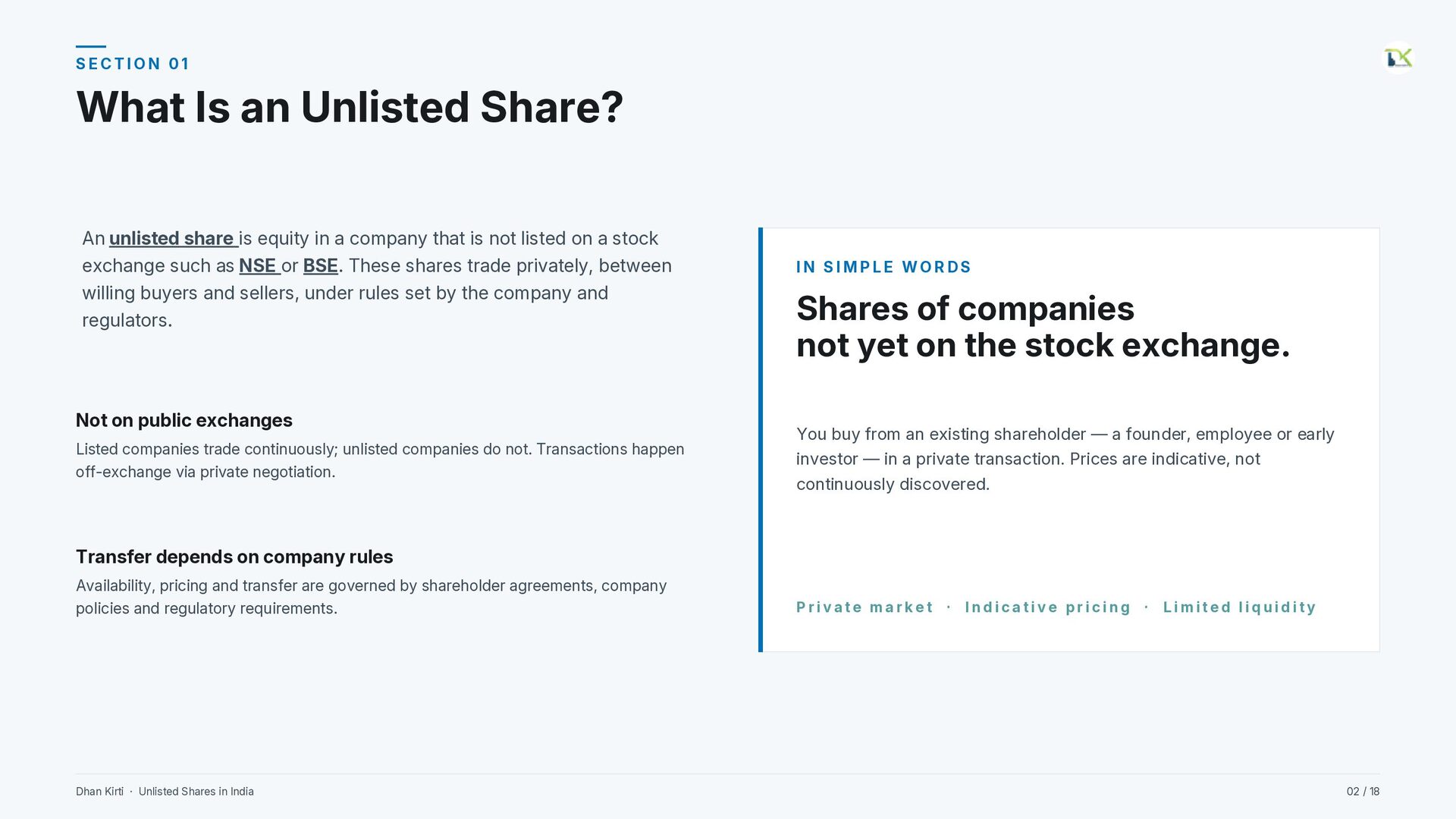
is equity in a company that is not listed on a stock exchange such as NSE or BSE. These shares trade privately, between willing buyers and sellers, under rules set by the company and regulators. Not on public exchanges Listed companies trade continuously; unlisted companies do not. Transactions happen off-exchange via private negotiation. IN SIMPLE WORDS Shares of companies not yet on the stock exchange. You buy from an existing shareholder — a founder, employee or early investor — in a private transaction. Prices are indicative, not continuously discovered. Transfer depends on company rules Availability, pricing and transfer are governed by shareholder agreements, company policies and regulatory requirements. Dhan Kirti · Unlisted Shares in India Private market · Indicative pricing · Limited liquidity 02 / 18
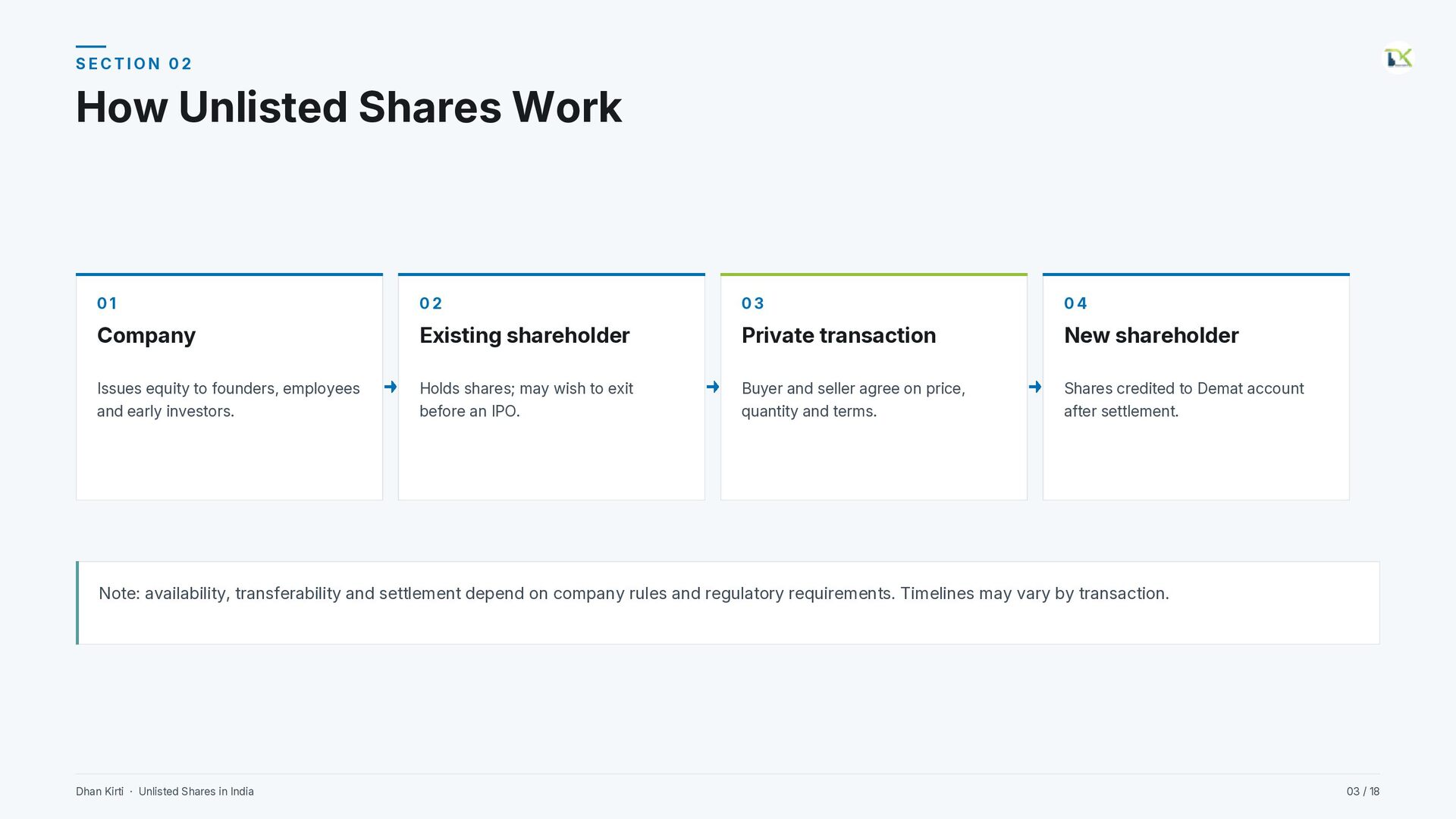
Company Existing shareholder Private transaction New shareholder Issues equity to founders, employees and early investors. Holds shares; may wish to exit before an IPO. Buyer and seller agree on price, quantity and terms. Shares credited to Demat account after settlement. Note: availability, transferability and settlement depend on company rules and regulatory requirements. Timelines may vary by transaction. Dhan Kirti · Unlisted Shares in India 03 / 18
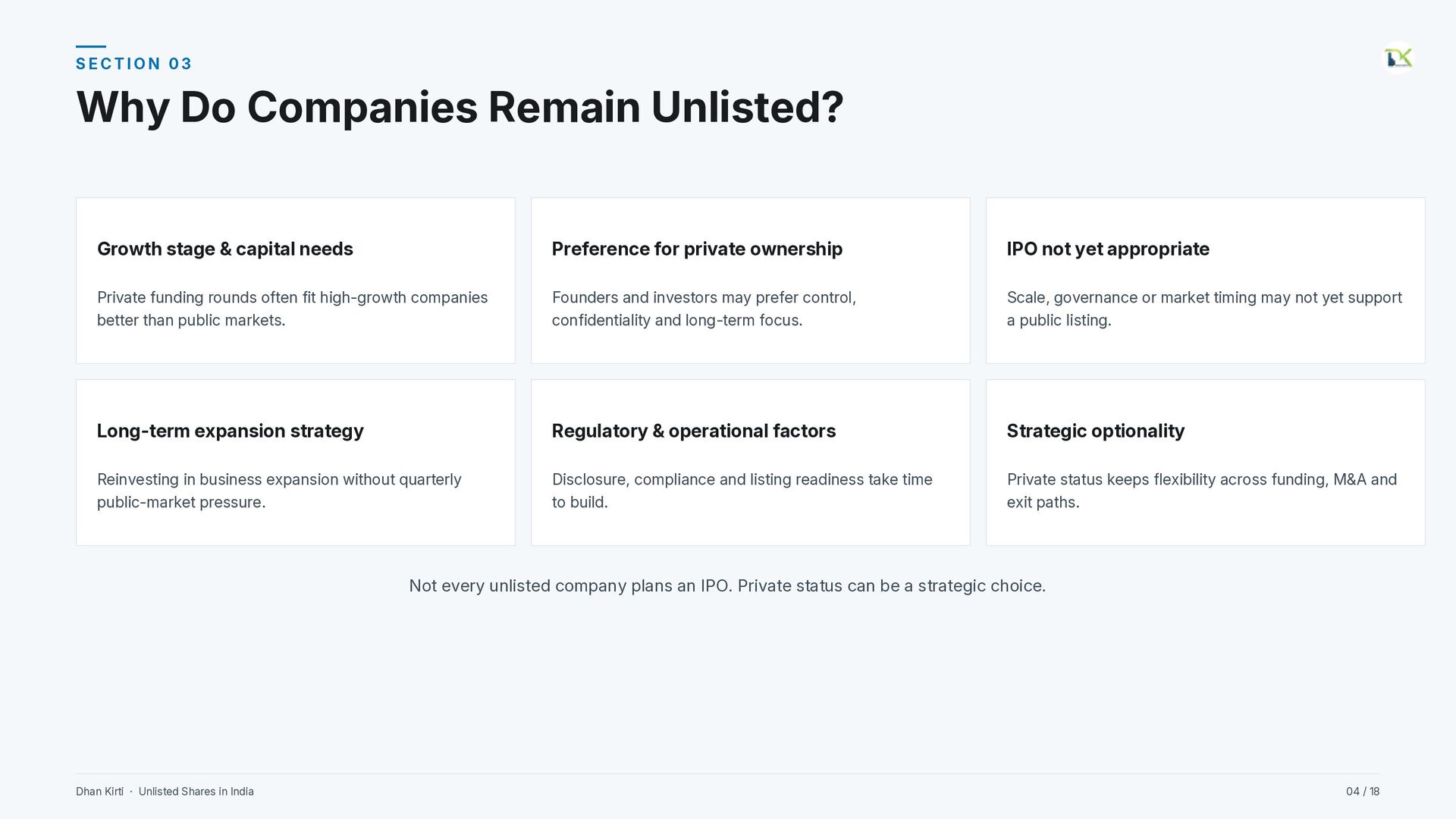
capital needs Preference for private ownership IPO not yet appropriate Private funding rounds often fit high-growth companies better than public markets. Founders and investors may prefer control, confidentiality and long-term focus. Scale, governance or market timing may not yet support a public listing. Long-term expansion strategy Regulatory & operational factors Strategic optionality Reinvesting in business expansion without quarterly public-market pressure. Disclosure, compliance and listing readiness take time to build. Private status keeps flexibility across funding, M&A and exit paths. Not every unlisted company plans an IPO. Private status can be a strategic choice. Dhan Kirti · Unlisted Shares in India 04 / 18
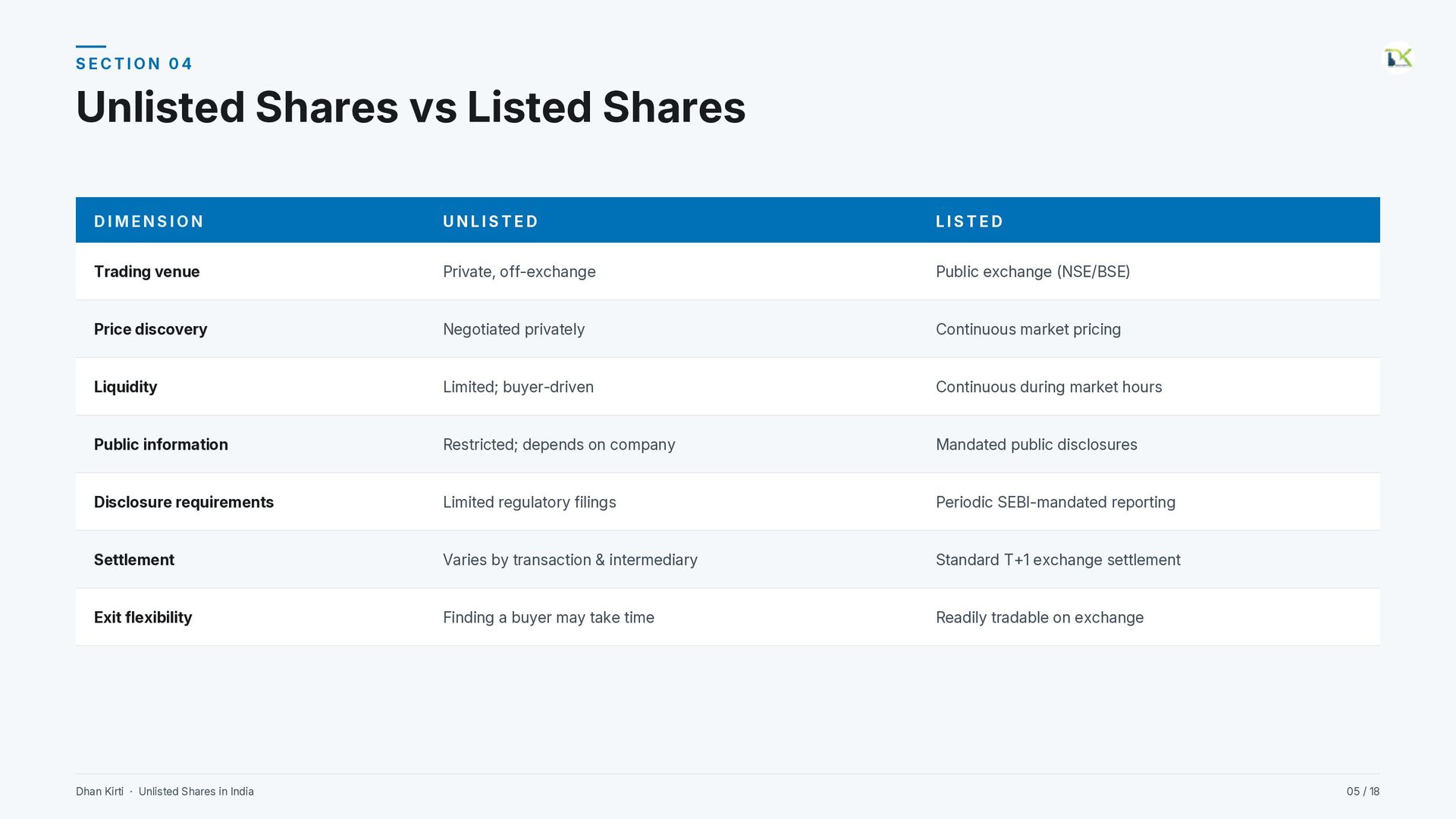
Trading venue Private, off-exchange Public exchange (NSE/BSE) Price discovery Negotiated privately Continuous market pricing Liquidity Limited; buyer-driven Continuous during market hours Public information Restricted; depends on company Mandated public disclosures Disclosure requirements Limited regulatory filings Periodic SEBI-mandated reporting Settlement Varies by transaction & intermediary Standard T+1 exchange settlement Exit flexibility Finding a buyer may take time Readily tradable on exchange Dhan Kirti · Unlisted Shares in India 05 / 18
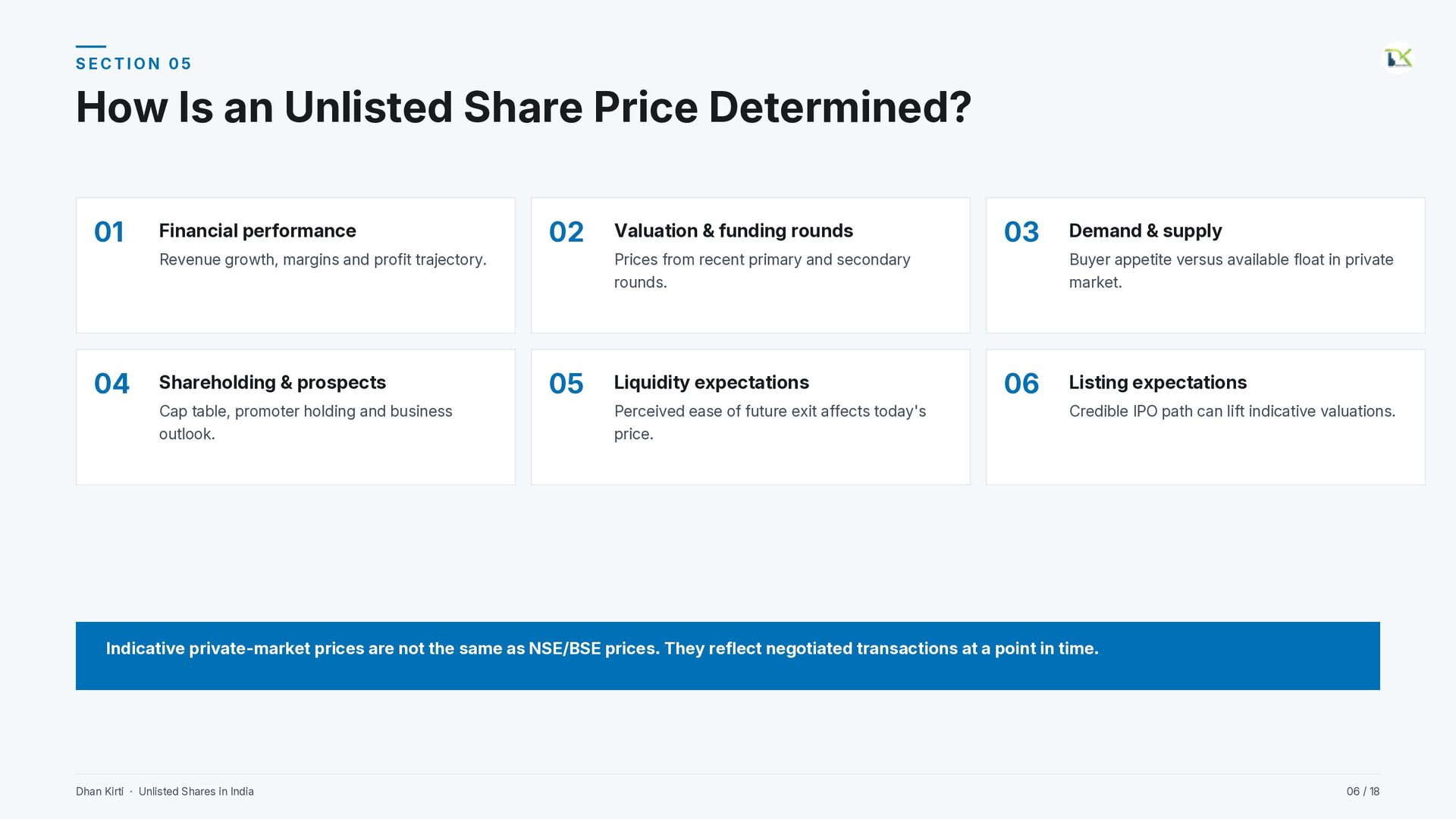
Financial performance 02 Revenue growth, margins and profit trajectory. 04 Shareholding & prospects Cap table, promoter holding and business outlook. Valuation & funding rounds 03 Prices from recent primary and secondary rounds. 05 Liquidity expectations Perceived ease of future exit affects today's price. Demand & supply Buyer appetite versus available float in private market. 06 Listing expectations Credible IPO path can lift indicative valuations. Indicative private-market prices are not the same as NSE/BSE prices. They reflect negotiated transactions at a point in time. Dhan Kirti · Unlisted Shares in India 06 / 18
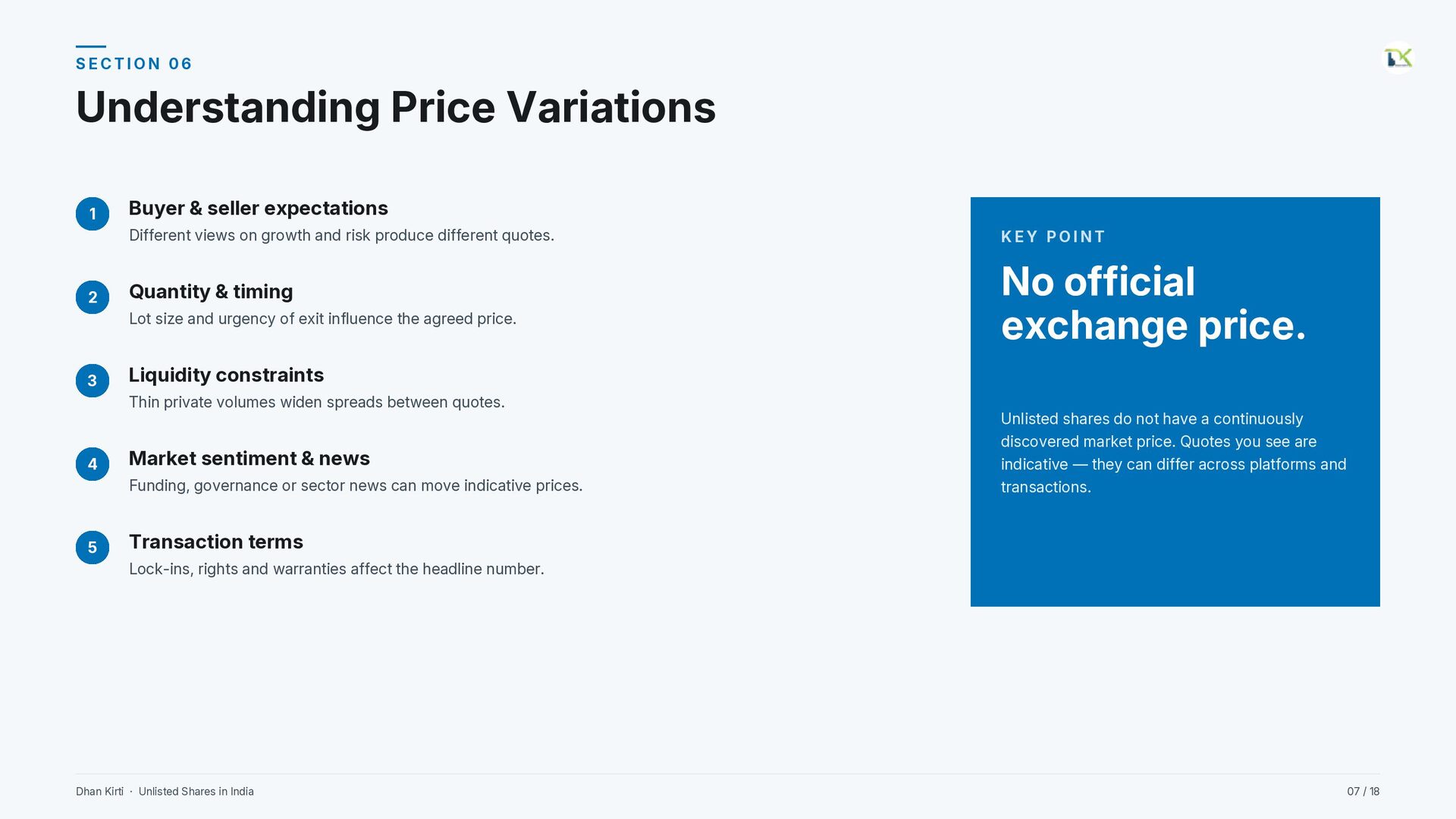
Different views on growth and risk produce different quotes. 2 Quantity & timing Lot size and urgency of exit influence the agreed price. 3 Market sentiment & news Funding, governance or sector news can move indicative prices. 5 No official exchange price. Liquidity constraints Thin private volumes widen spreads between quotes. 4 KEY POINT Unlisted shares do not have a continuously discovered market price. Quotes you see are indicative — they can differ across platforms and transactions. Transaction terms Lock-ins, rights and warranties affect the headline number. Dhan Kirti · Unlisted Shares in India 07 / 18
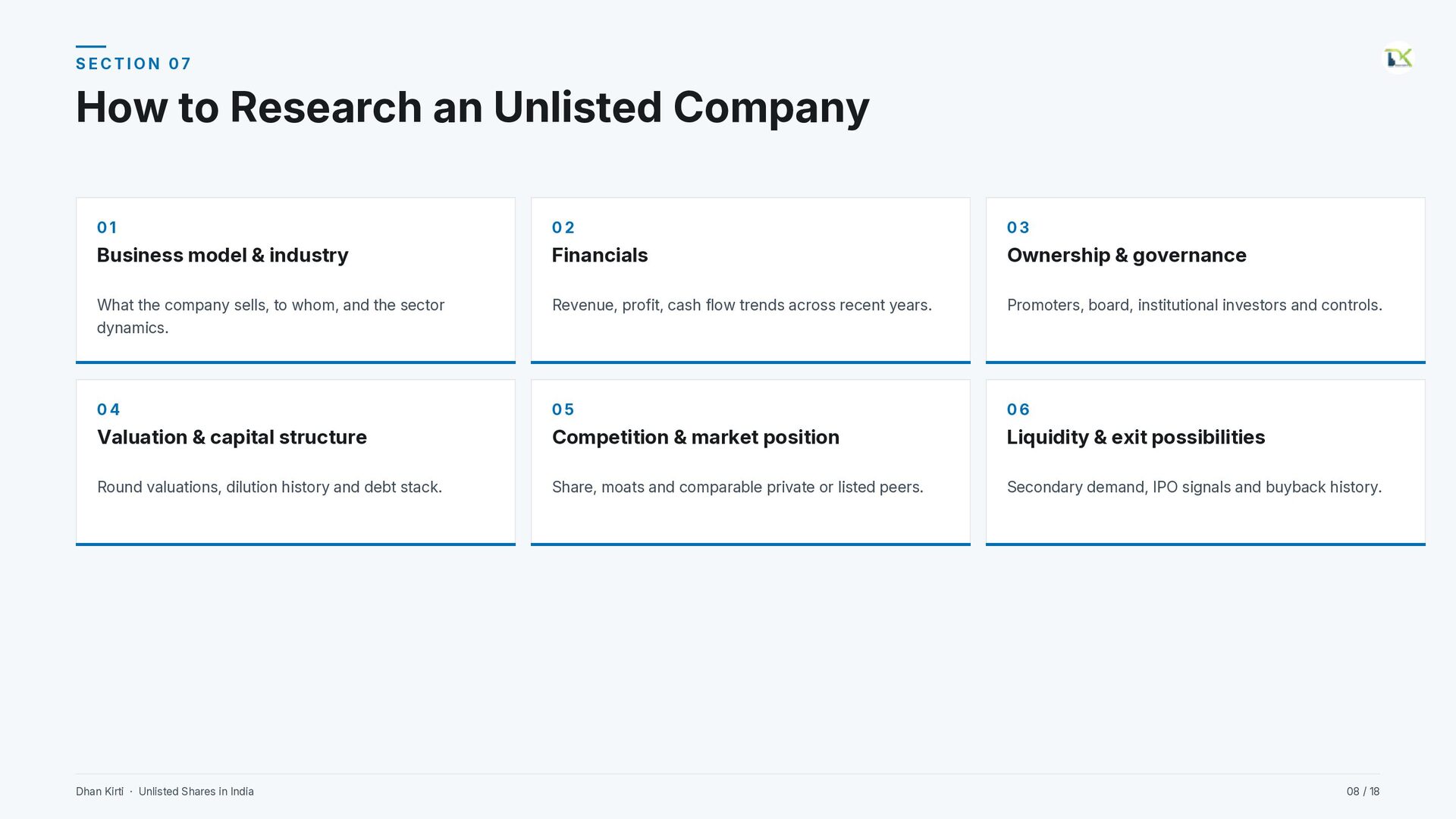
03 Business model & industry Financials Ownership & governance What the company sells, to whom, and the sector dynamics. Revenue, profit, cash flow trends across recent years. Promoters, board, institutional investors and controls. 04 05 06 Valuation & capital structure Competition & market position Liquidity & exit possibilities Round valuations, dilution history and debt stack. Share, moats and comparable private or listed peers. Secondary demand, IPO signals and buyback history. Dhan Kirti · Unlisted Shares in India 08 / 18
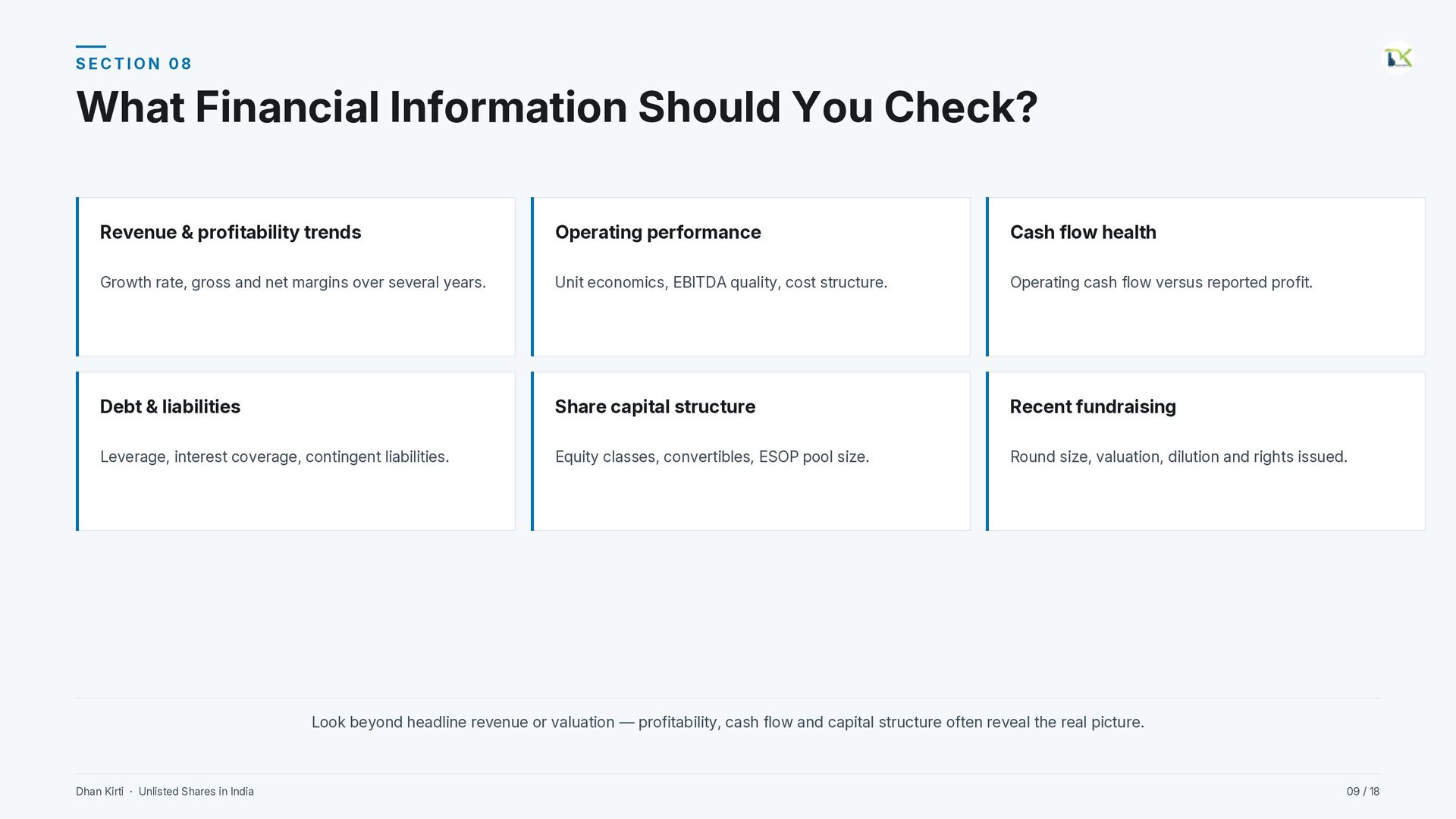
profitability trends Operating performance Cash flow health Growth rate, gross and net margins over several years. Unit economics, EBITDA quality, cost structure. Operating cash flow versus reported profit. Debt & liabilities Share capital structure Recent fundraising Leverage, interest coverage, contingent liabilities. Equity classes, convertibles, ESOP pool size. Round size, valuation, dilution and rights issued. Look beyond headline revenue or valuation — profitability, cash flow and capital structure often reveal the real picture. Dhan Kirti · Unlisted Shares in India 09 / 18
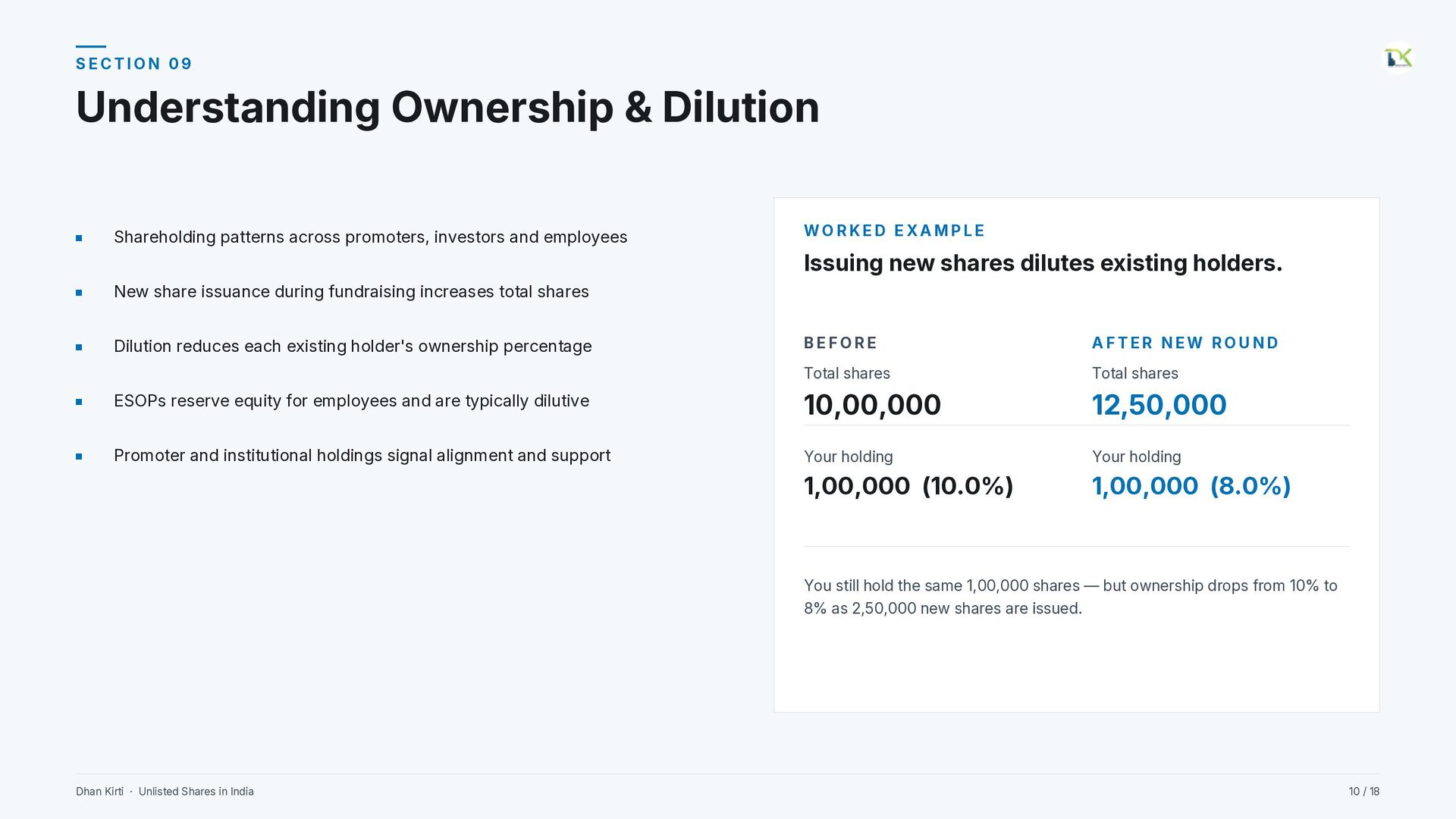
investors and employees WORKED EXAMPLE Issuing new shares dilutes existing holders. New share issuance during fundraising increases total shares BEFORE AFTER NEW ROUND Total shares Total shares ESOPs reserve equity for employees and are typically dilutive 10,00,000 12,50,000 Promoter and institutional holdings signal alignment and support Your holding Your holding 1,00,000 (10.0%) 1,00,000 (8.0%) Dilution reduces each existing holder's ownership percentage You still hold the same 1,00,000 shares — but ownership drops from 10% to 8% as 2,50,000 new shares are issued. Dhan Kirti · Unlisted Shares in India 10 / 18
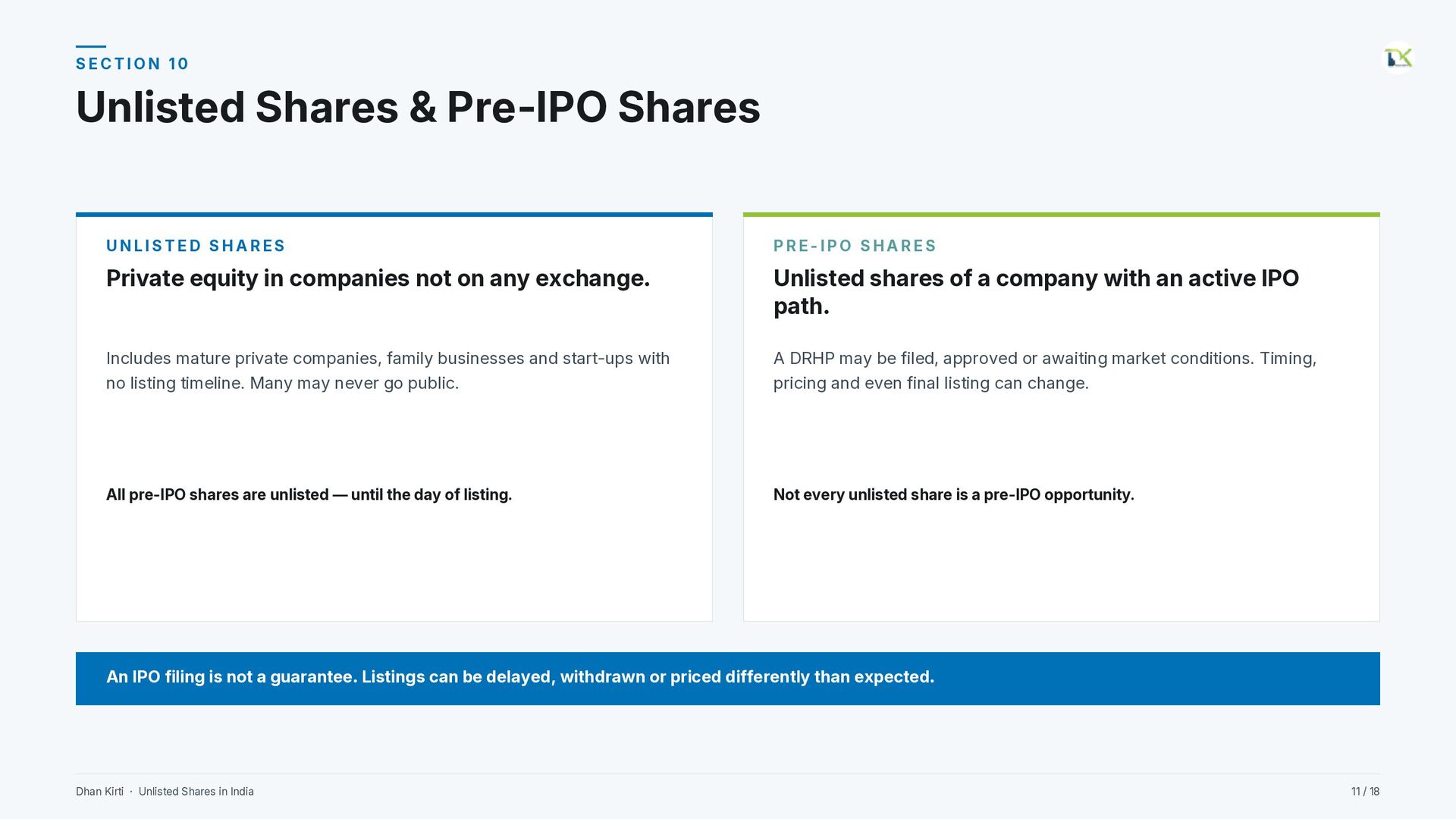
SHARES Private equity in companies not on any exchange. Unlisted shares of a company with an active IPO path. Includes mature private companies, family businesses and start-ups with A DRHP may be filed, approved or awaiting market conditions. Timing, no listing timeline. Many may never go public. pricing and even final listing can change. All pre-IPO shares are unlisted — until the day of listing. Not every unlisted share is a pre-IPO opportunity. An IPO filing is not a guarantee. Listings can be delayed, withdrawn or priced differently than expected. Dhan Kirti · Unlisted Shares in India 11 / 18
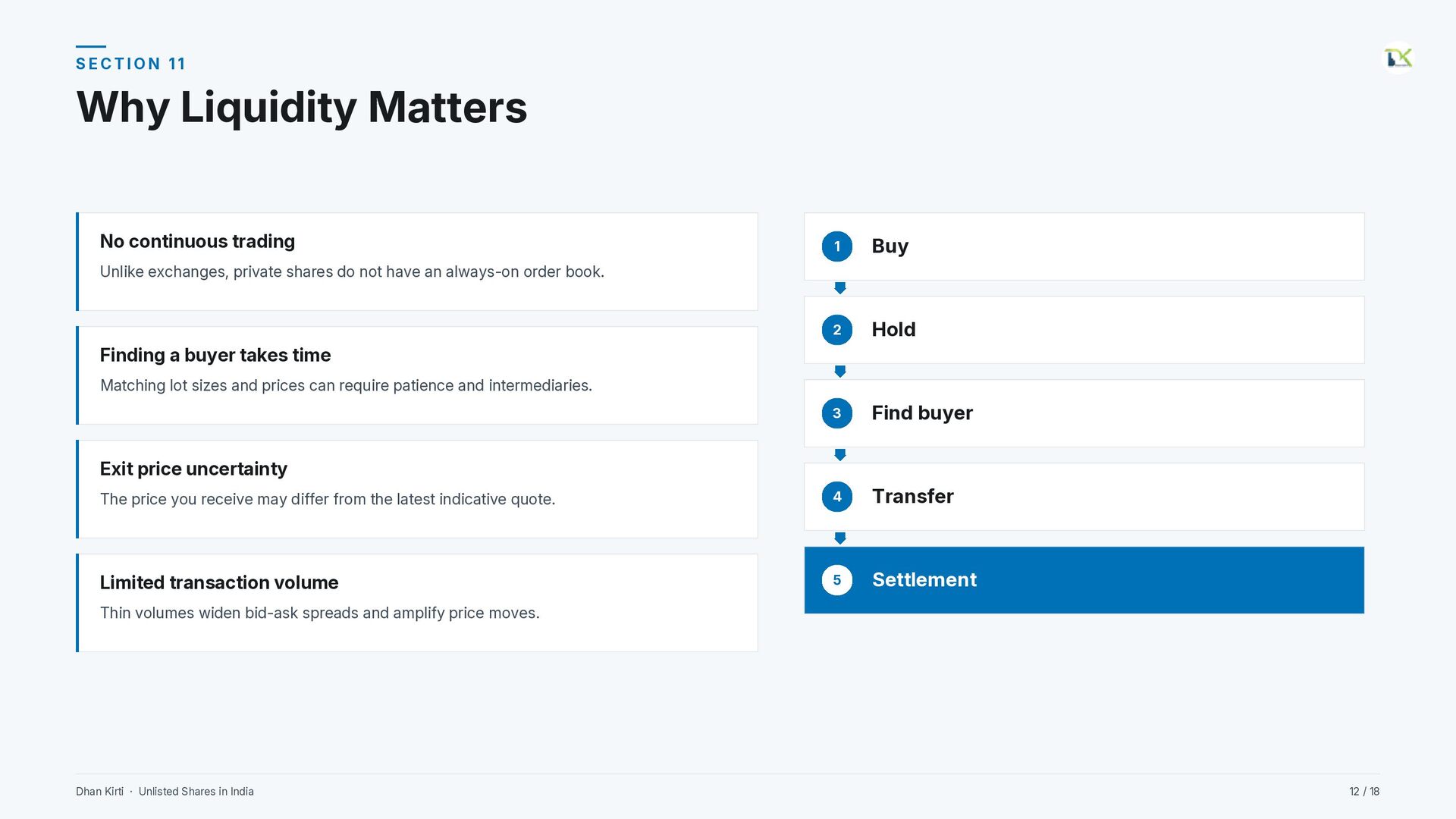
2 Hold 3 Find buyer The price you receive may differ from the latest indicative quote. 4 Transfer Limited transaction volume 5 Settlement Unlike exchanges, private shares do not have an always-on order book. Finding a buyer takes time Matching lot sizes and prices can require patience and intermediaries. Exit price uncertainty Thin volumes widen bid-ask spreads and amplify price moves. Dhan Kirti · Unlisted Shares in India 12 / 18
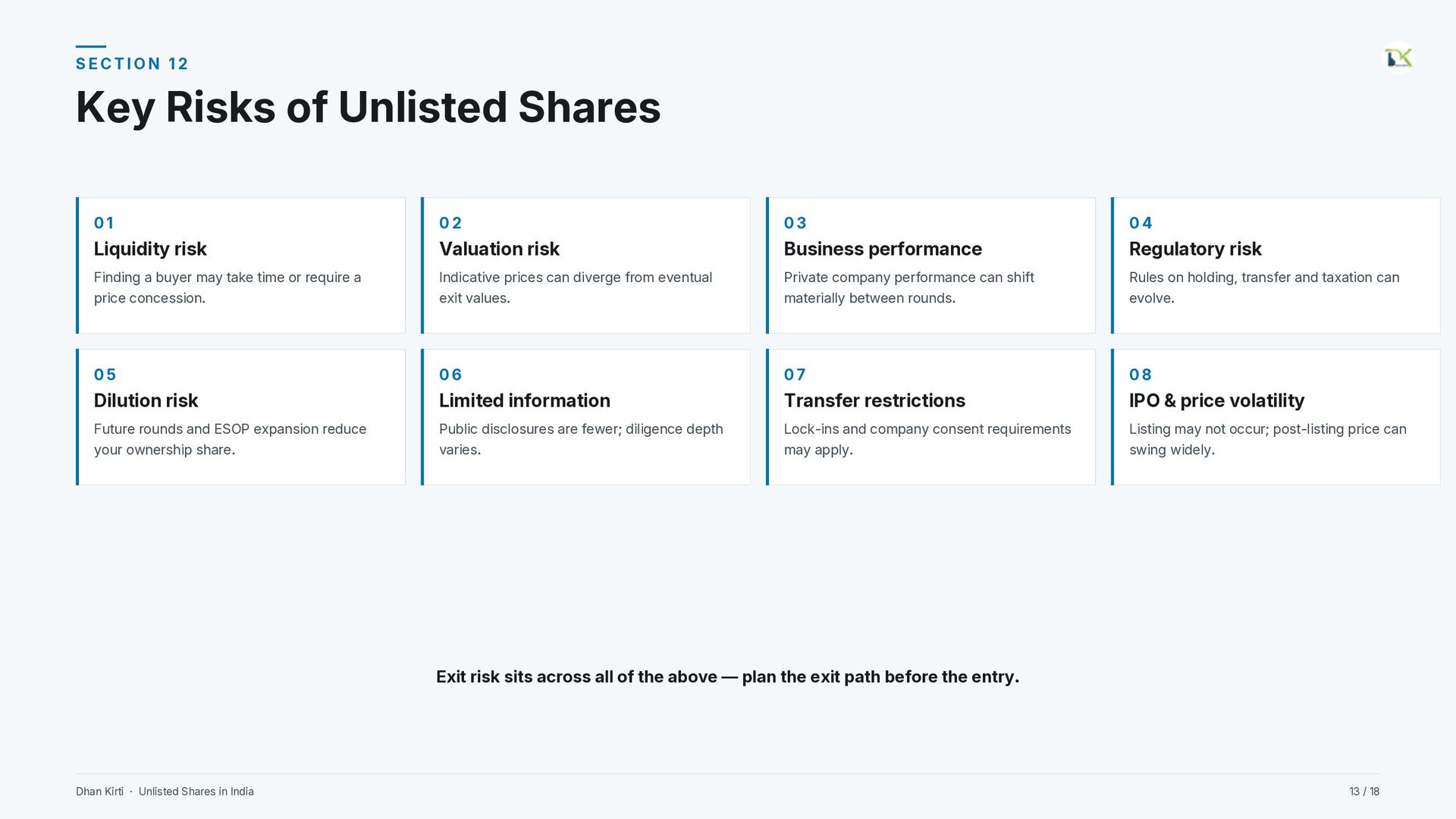
04 Liquidity risk Valuation risk Business performance Regulatory risk Finding a buyer may take time or require a price concession. Indicative prices can diverge from eventual exit values. Private company performance can shift materially between rounds. Rules on holding, transfer and taxation can evolve. 05 06 07 08 Dilution risk Limited information Transfer restrictions IPO & price volatility Future rounds and ESOP expansion reduce your ownership share. Public disclosures are fewer; diligence depth varies. Lock-ins and company consent requirements may apply. Listing may not occur; post-listing price can swing widely. Exit risk sits across all of the above — plan the exit path before the entry. Dhan Kirti · Unlisted Shares in India 13 / 18
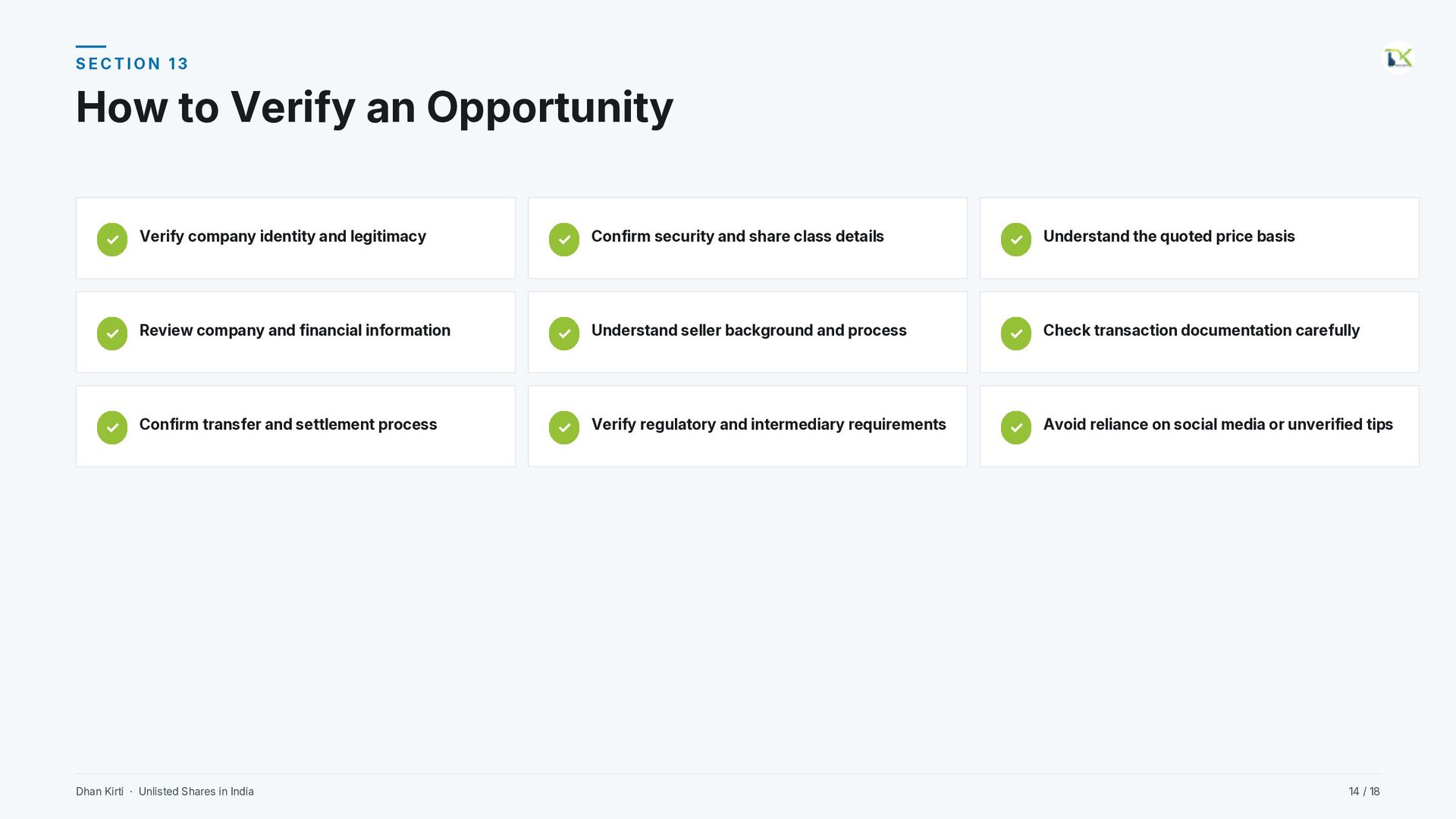
identity and legitimacy ✓ Confirm security and share class details ✓ Understand the quoted price basis ✓ Review company and financial information ✓ Understand seller background and process ✓ Check transaction documentation carefully ✓ Confirm transfer and settlement process ✓ Verify regulatory and intermediary requirements ✓ Avoid reliance on social media or unverified tips Dhan Kirti · Unlisted Shares in India 14 / 18
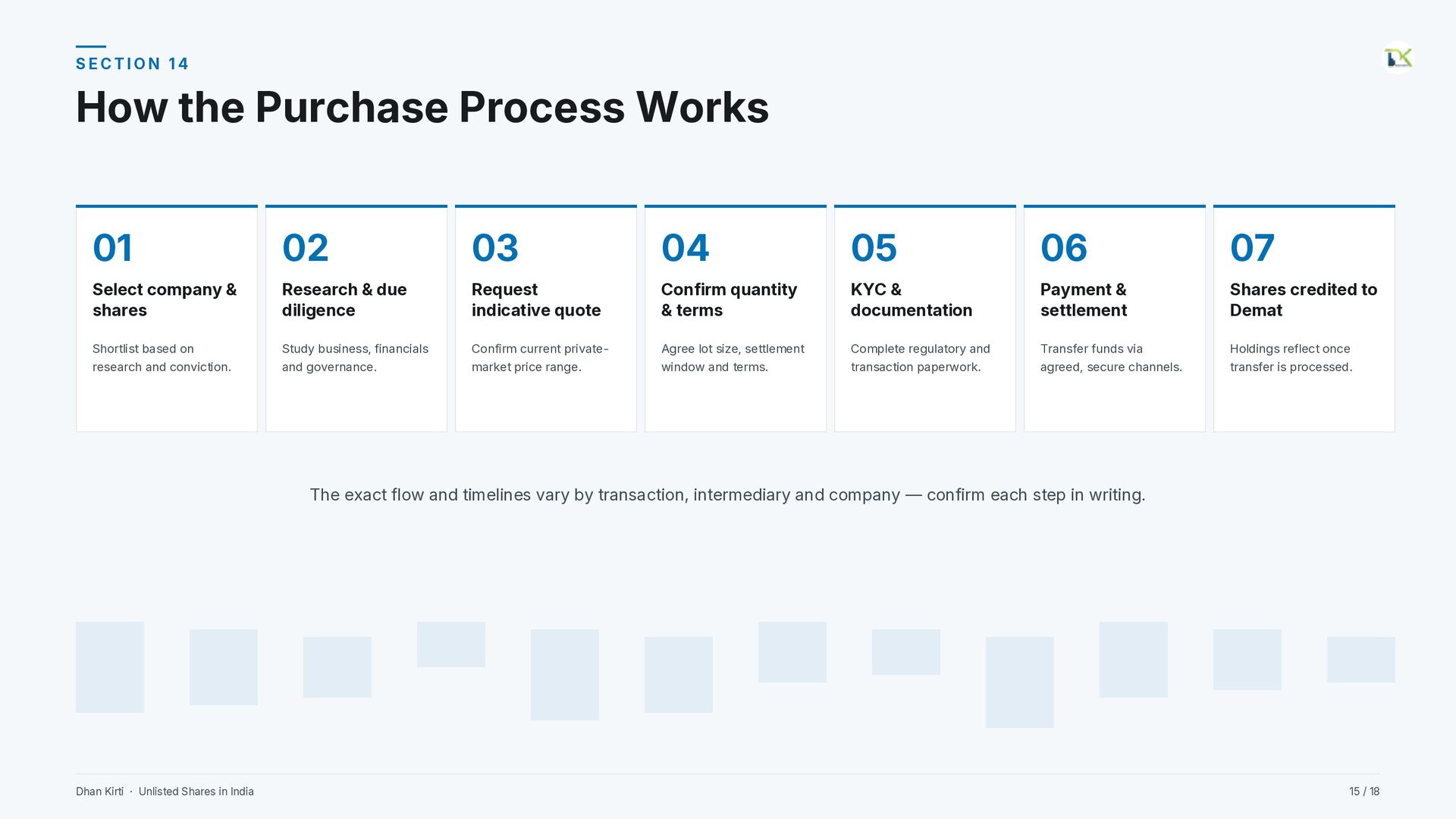
04 05 06 07 Select company & shares Research & due diligence Request indicative quote Confirm quantity & terms KYC & documentation Payment & settlement Shares credited to Demat Shortlist based on research and conviction. Study business, financials and governance. Confirm current privatemarket price range. Agree lot size, settlement window and terms. Complete regulatory and transaction paperwork. Transfer funds via agreed, secure channels. Holdings reflect once transfer is processed. The exact flow and timelines vary by transaction, intermediary and company — confirm each step in writing. Dhan Kirti · Unlisted Shares in India 15 / 18
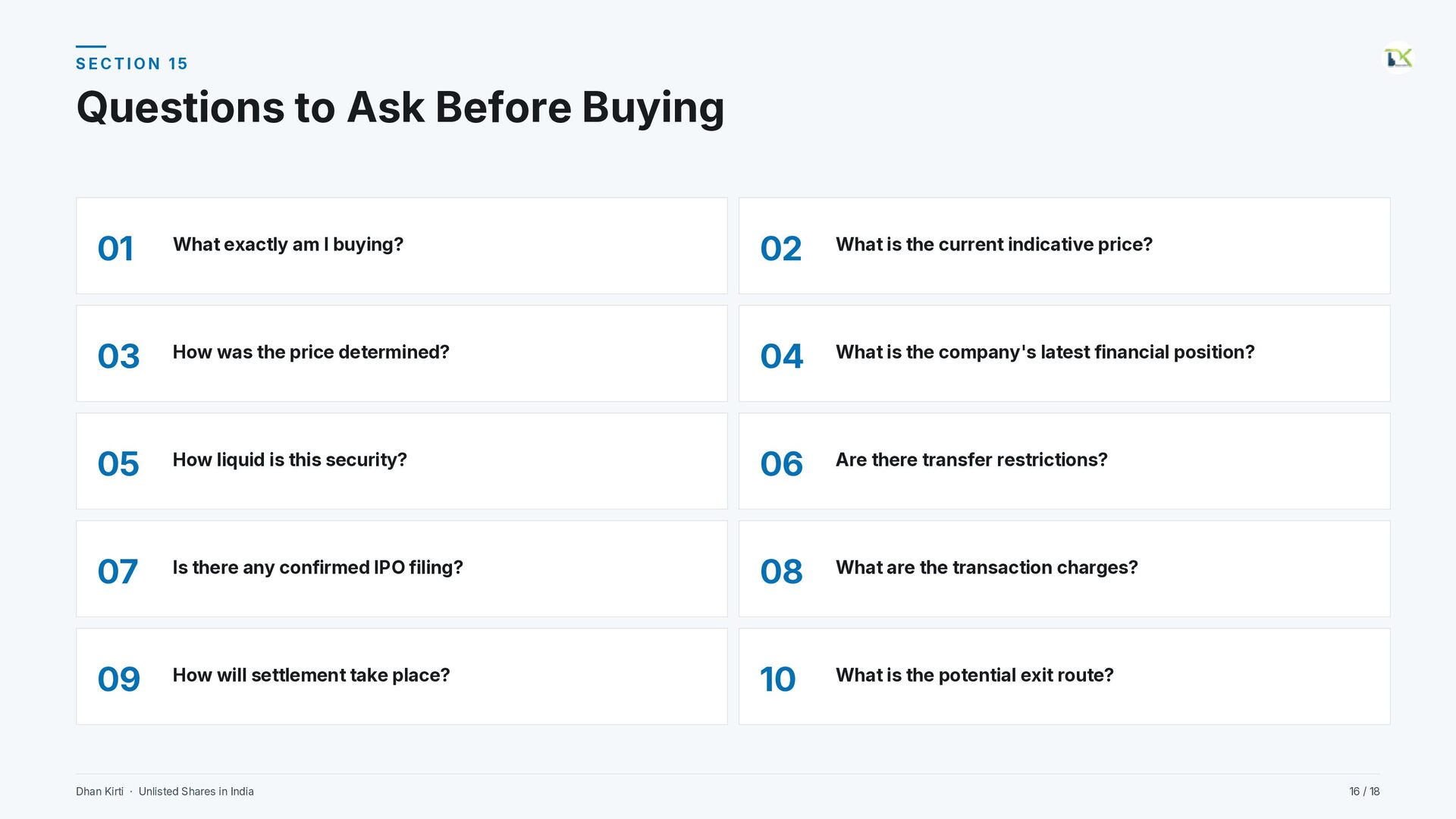
am I buying? 02 What is the current indicative price? 03 How was the price determined? 04 What is the company's latest financial position? 05 How liquid is this security? 06 Are there transfer restrictions? 07 Is there any confirmed IPO filing? 08 What are the transaction charges? 09 How will settlement take place? 10 What is the potential exit route? Dhan Kirti · Unlisted Shares in India 16 / 18
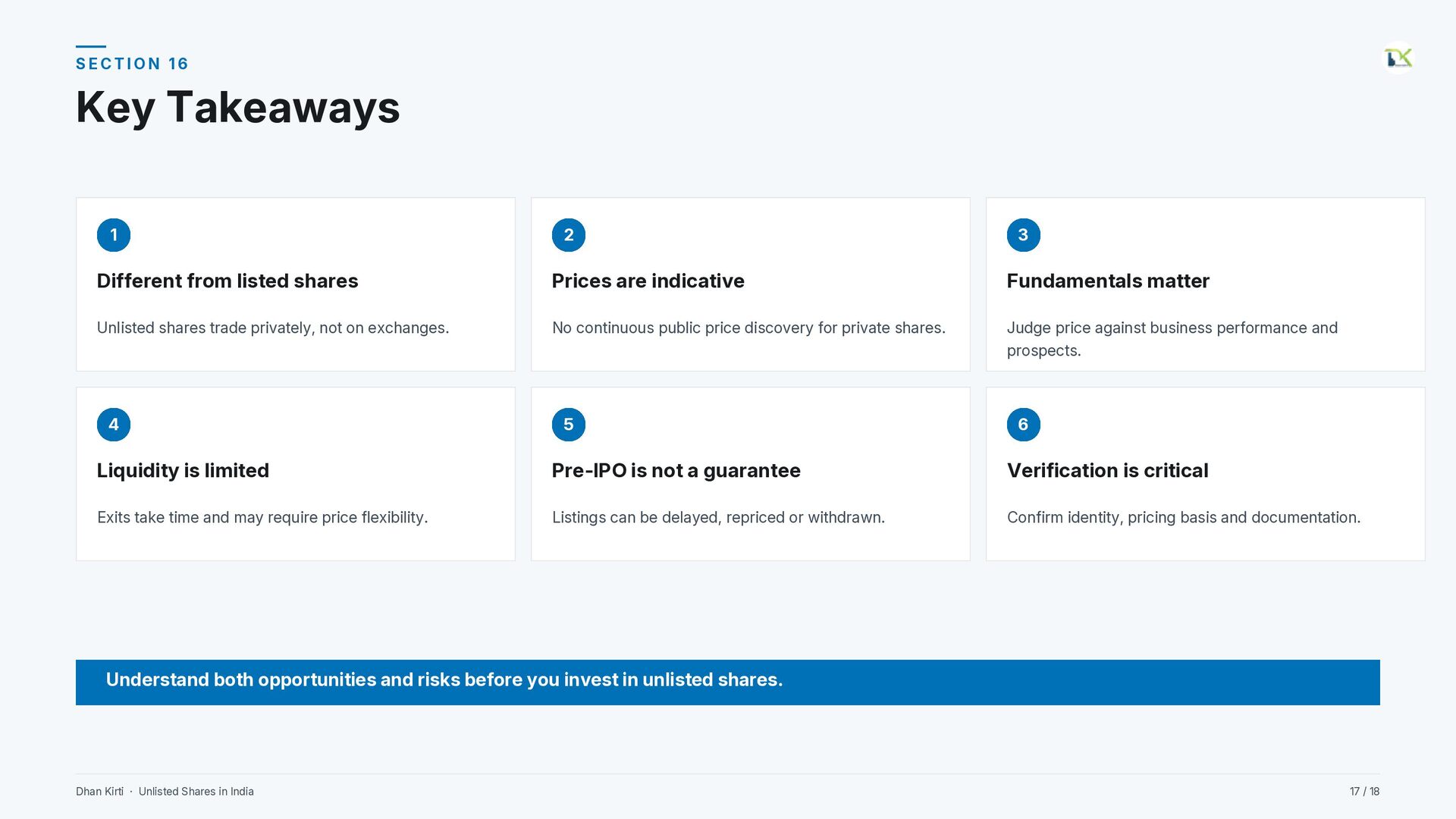
shares Prices are indicative Fundamentals matter Unlisted shares trade privately, not on exchanges. No continuous public price discovery for private shares. Judge price against business performance and prospects. 4 5 6 Liquidity is limited Pre-IPO is not a guarantee Verification is critical Exits take time and may require price flexibility. Listings can be delayed, repriced or withdrawn. Confirm identity, pricing basis and documentation. Understand both opportunities and risks before you invest in unlisted shares. Dhan Kirti · Unlisted Shares in India 17 / 18

 Your Podcast. Everywhere. Effortlessly.


 dhankirti
 progmat
 malna
 ikuodanaka
 arnekittler
 uluru_hr
 yasslab
 hansodeeeeee
 shunsuke_takeuchi
 fullerene_inc
 kuraryu0128
 forest8810
 kazumakitao
 tonyrice
 davidcarrasco
 eileencodes
 codingconduct
 honnibal
 cassininazir
 signer
 dougneiner
 scottboms
 jacobian
 palkan