• Multiple changes in different parts of the code required • Every change requires more changes • Coupling ◦ But: Can we prevent all coupling? @[email protected] - @dtanzer.bsky.social 10
your arm off! • In general, we should treat reversible decisions differently than irreversible decisions --Kent Beck, "Tidy First", p. 75 @[email protected] - @dtanzer.bsky.social 11
◦ First, make the change easy, then make the easy change (Kent Beck) • Implement a decision you might need to change later ◦ Any decision! ◦ Can you make future changes easier? @[email protected] - @dtanzer.bsky.social 13
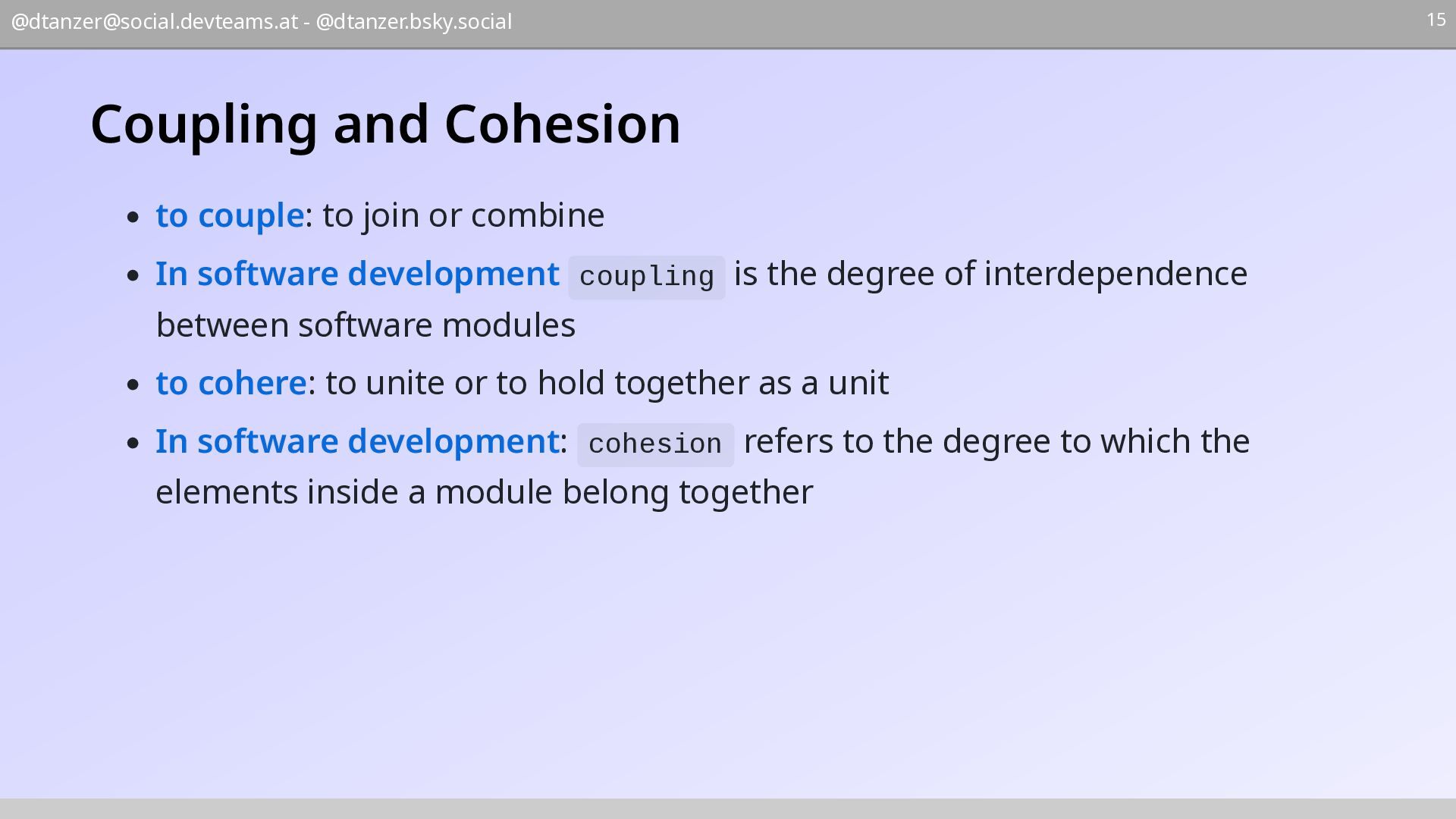
• In software development coupling is the degree of interdependence between software modules • to cohere: to unite or to hold together as a unit • In software development: cohesion refers to the degree to which the elements inside a module belong together @[email protected] - @dtanzer.bsky.social 15
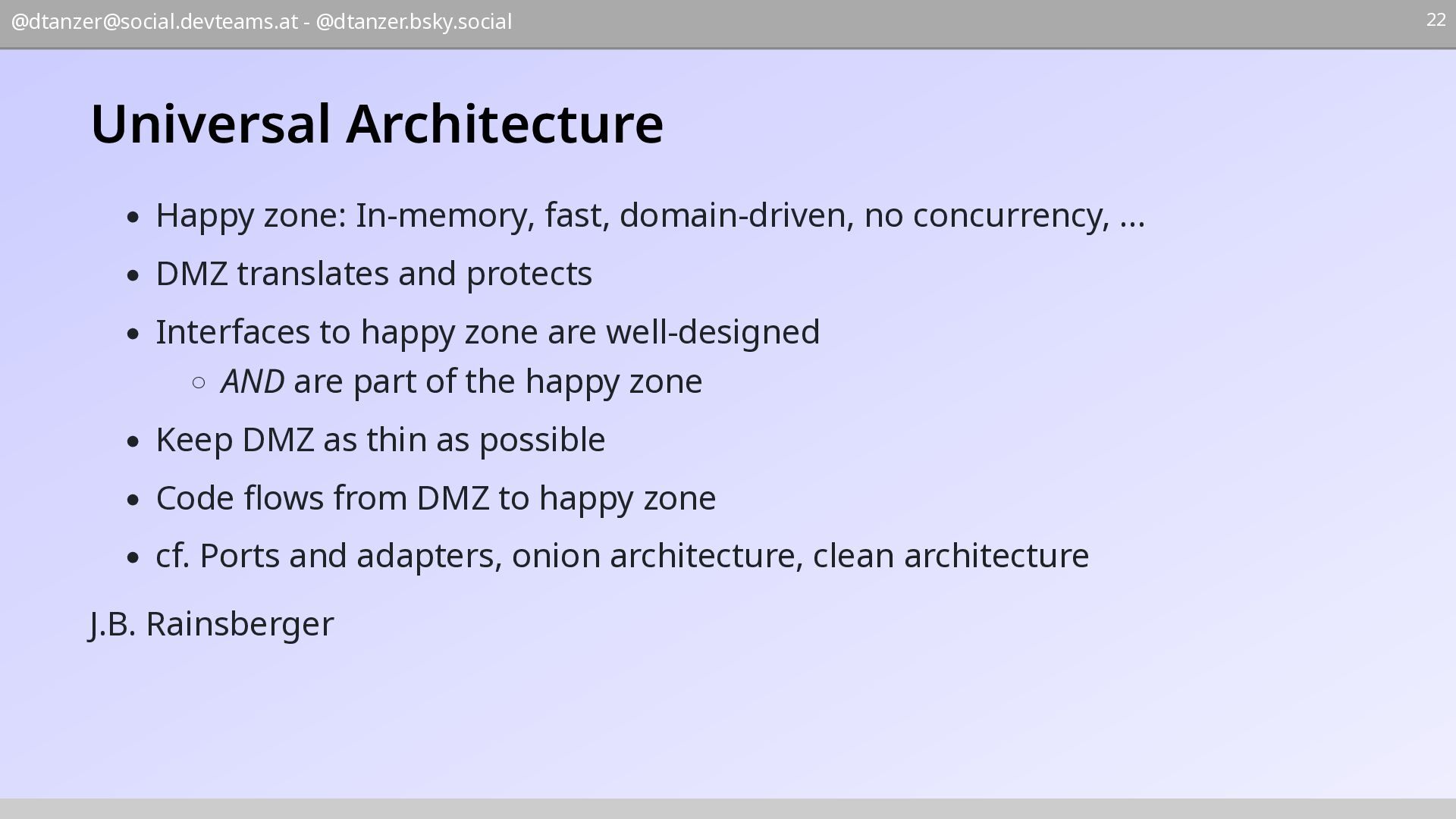
... • DMZ translates and protects • Interfaces to happy zone are well-designed ◦ AND are part of the happy zone • Keep DMZ as thin as possible • Code flows from DMZ to happy zone • cf. Ports and adapters, onion architecture, clean architecture J.B. Rainsberger @[email protected] - @dtanzer.bsky.social 22
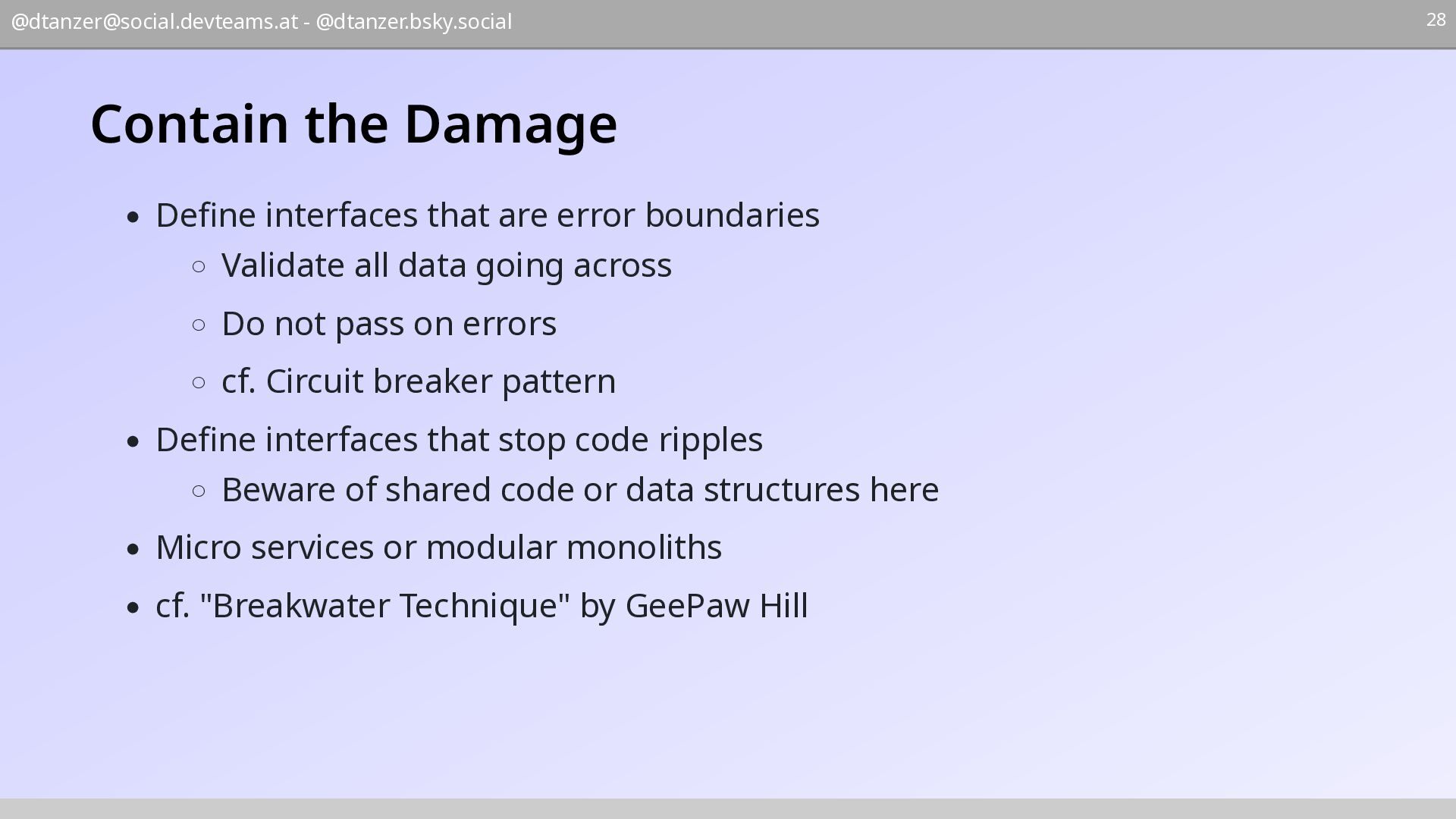
◦ Validate all data going across ◦ Do not pass on errors ◦ cf. Circuit breaker pattern • Define interfaces that stop code ripples ◦ Beware of shared code or data structures here • Micro services or modular monoliths • cf. "Breakwater Technique" by GeePaw Hill @[email protected] - @dtanzer.bsky.social 28
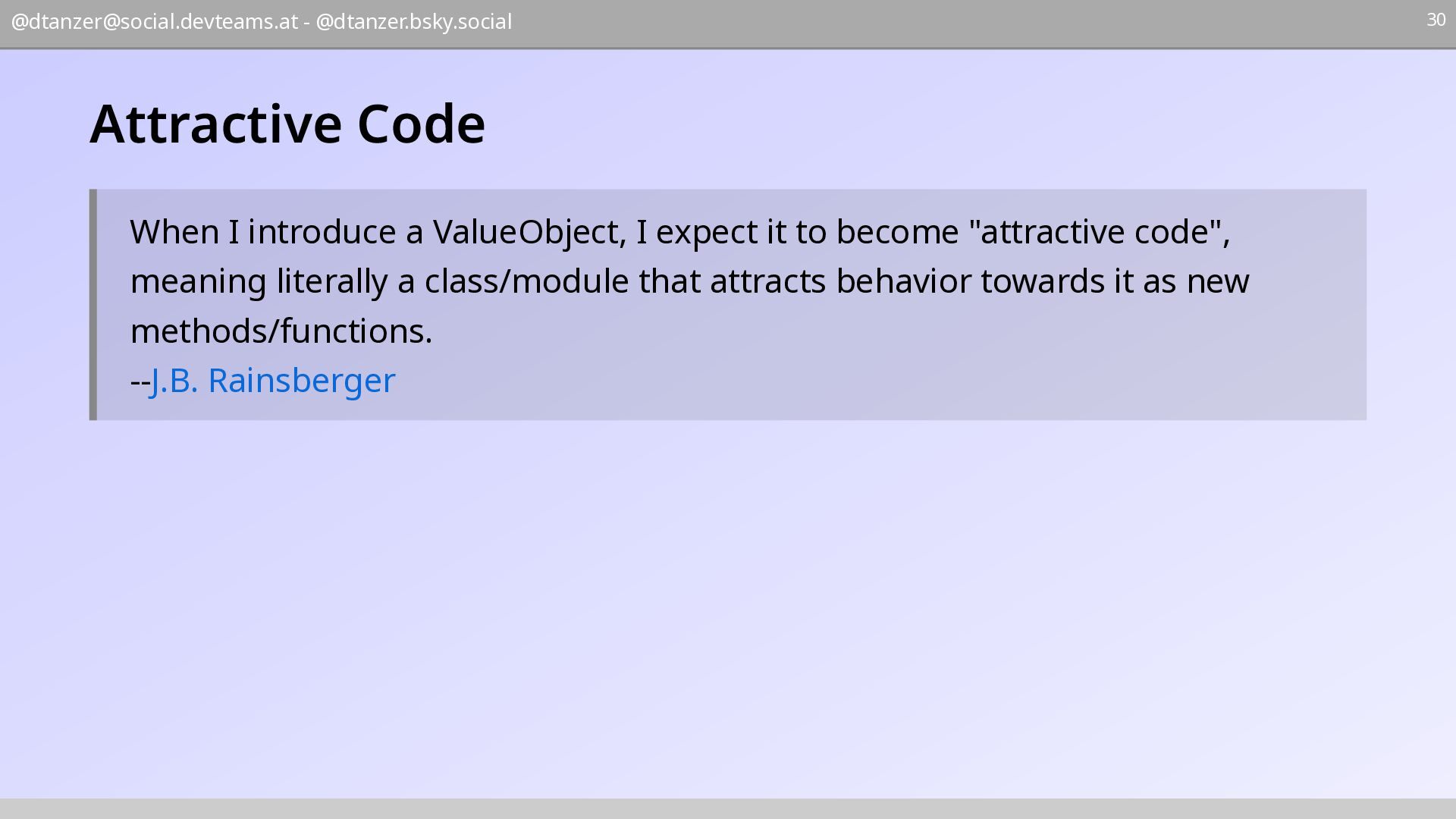
to become "attractive code", meaning literally a class/module that attracts behavior towards it as new methods/functions. --J.B. Rainsberger @[email protected] - @dtanzer.bsky.social 30
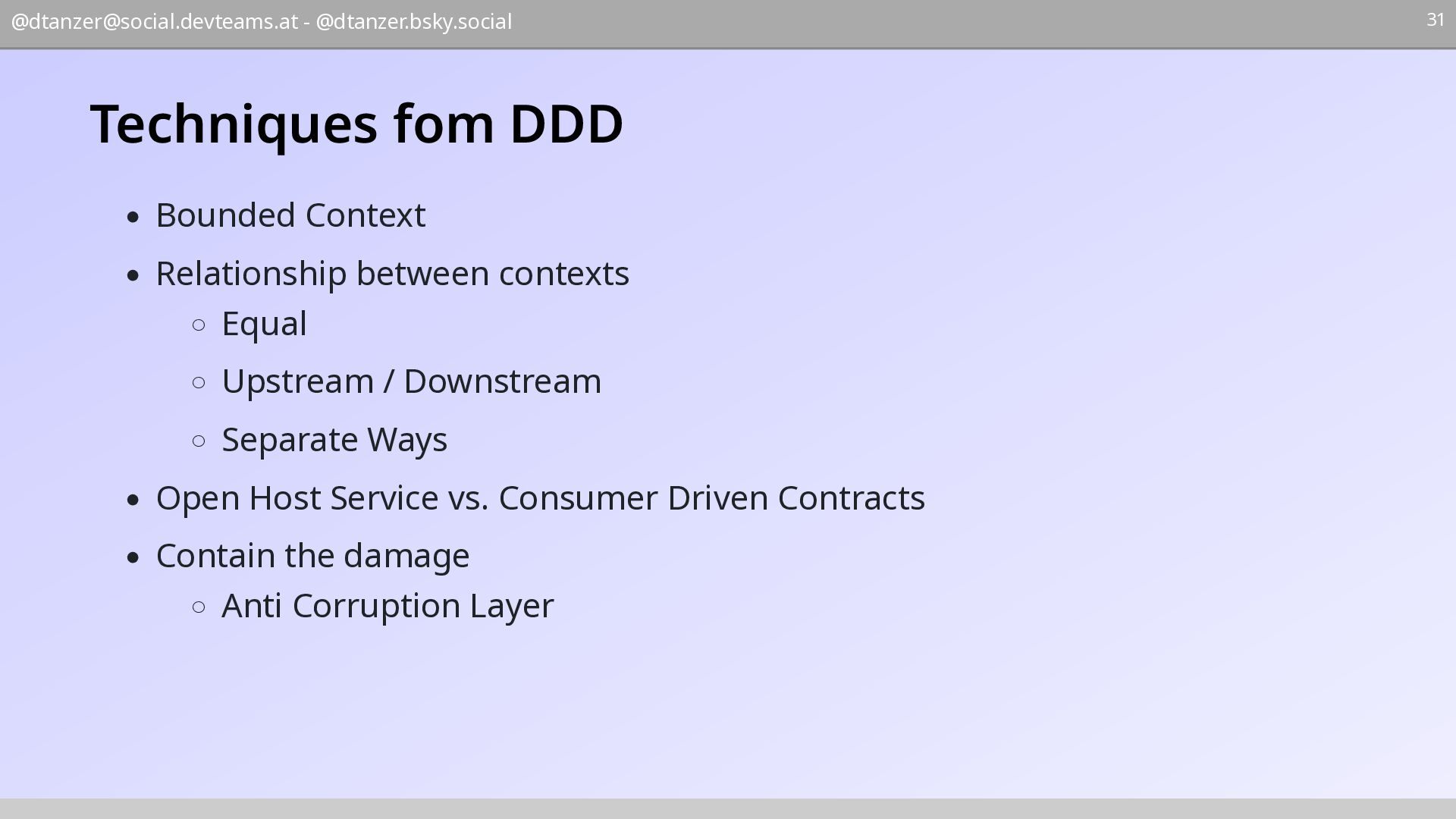
◦ Equal ◦ Upstream / Downstream ◦ Separate Ways • Open Host Service vs. Consumer Driven Contracts • Contain the damage ◦ Anti Corruption Layer @[email protected] - @dtanzer.bsky.social 31
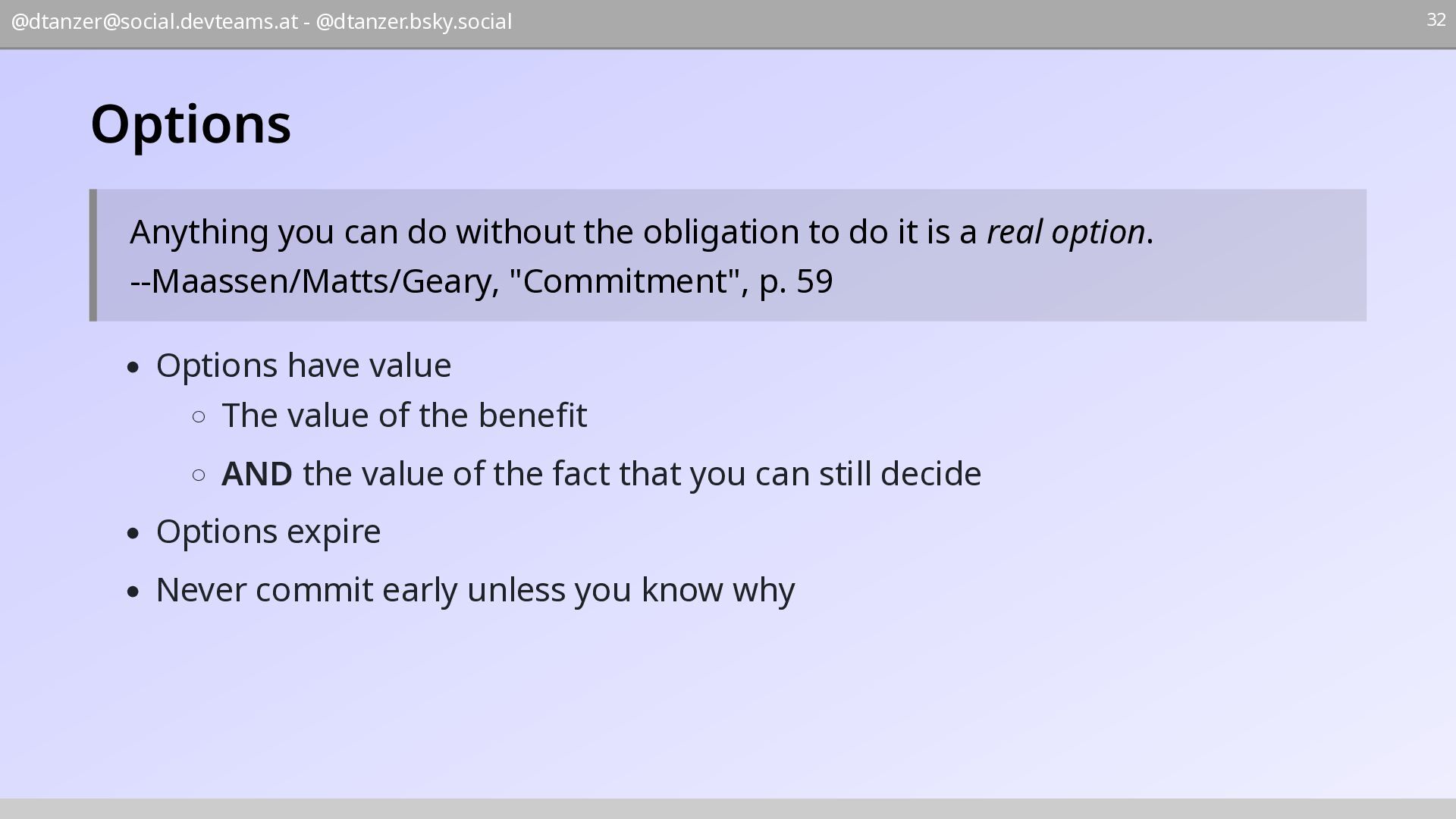
it is a real option. --Maassen/Matts/Geary, "Commitment", p. 59 • Options have value ◦ The value of the benefit ◦ AND the value of the fact that you can still decide • Options expire • Never commit early unless you know why @[email protected] - @dtanzer.bsky.social 32
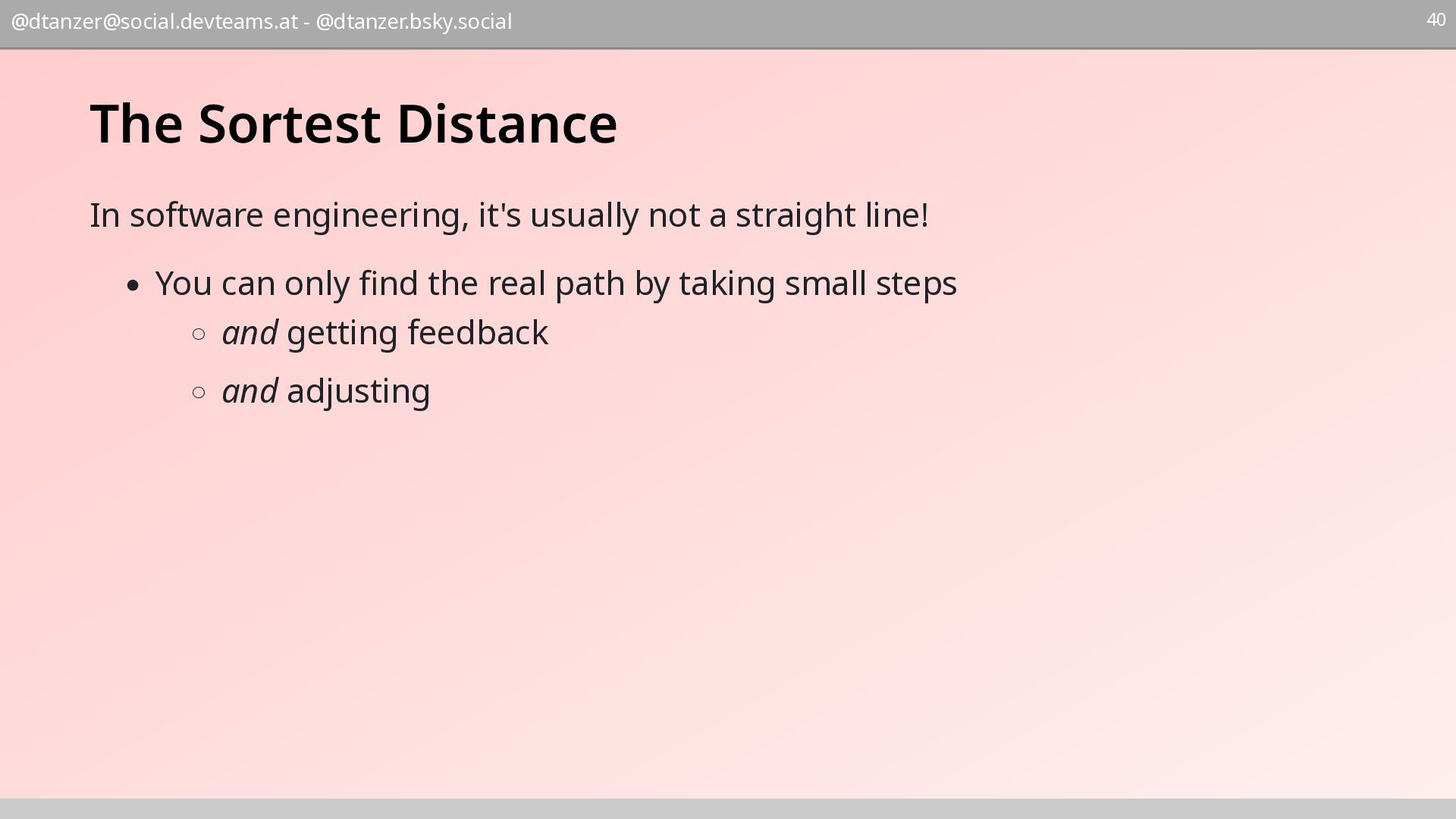
straight line! • You can only find the real path by taking small steps ◦ and getting feedback ◦ and adjusting @[email protected] - @dtanzer.bsky.social 40
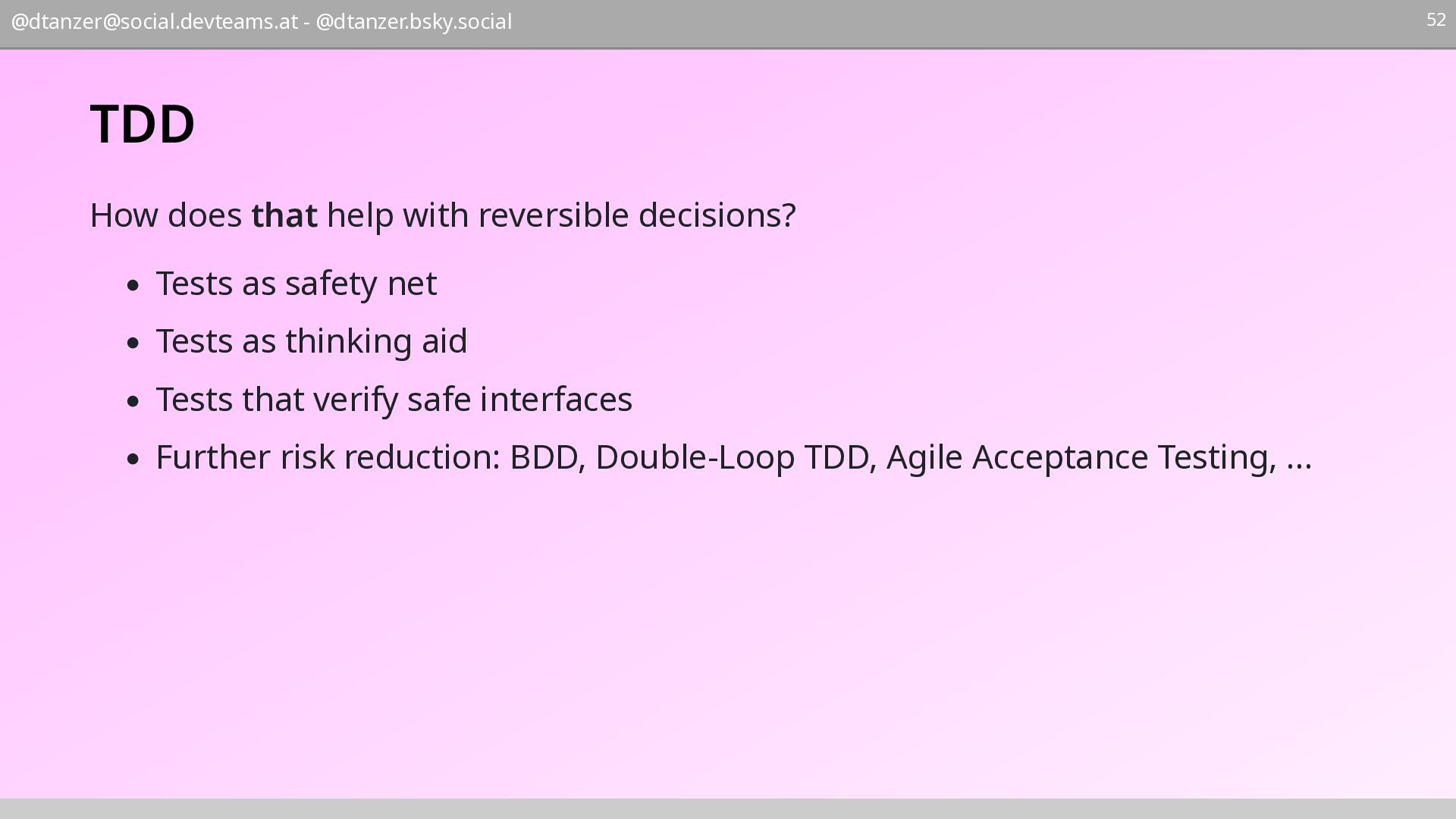
as safety net • Tests as thinking aid • Tests that verify safe interfaces • Further risk reduction: BDD, Double-Loop TDD, Agile Acceptance Testing, ... @[email protected] - @dtanzer.bsky.social 52
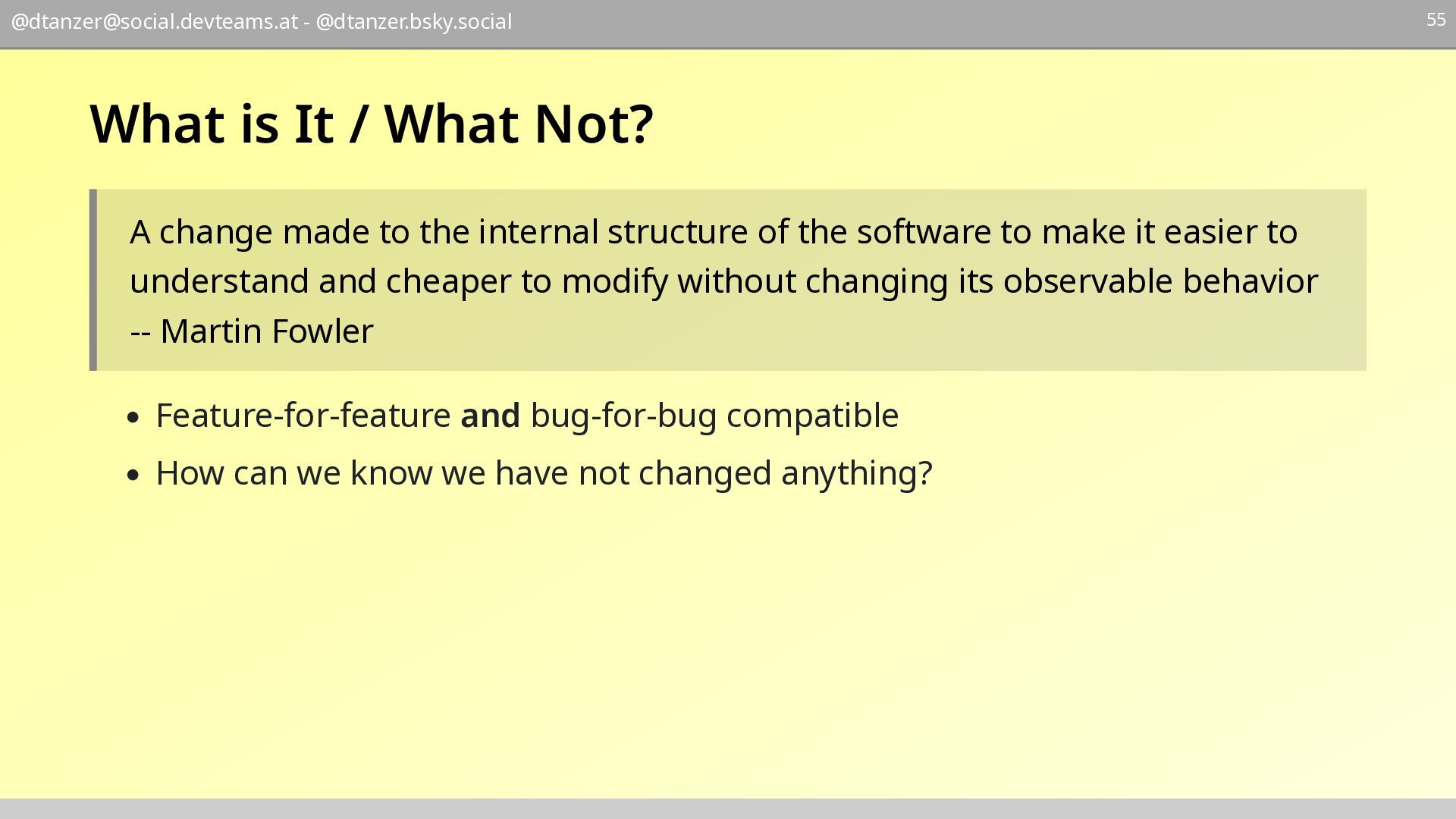
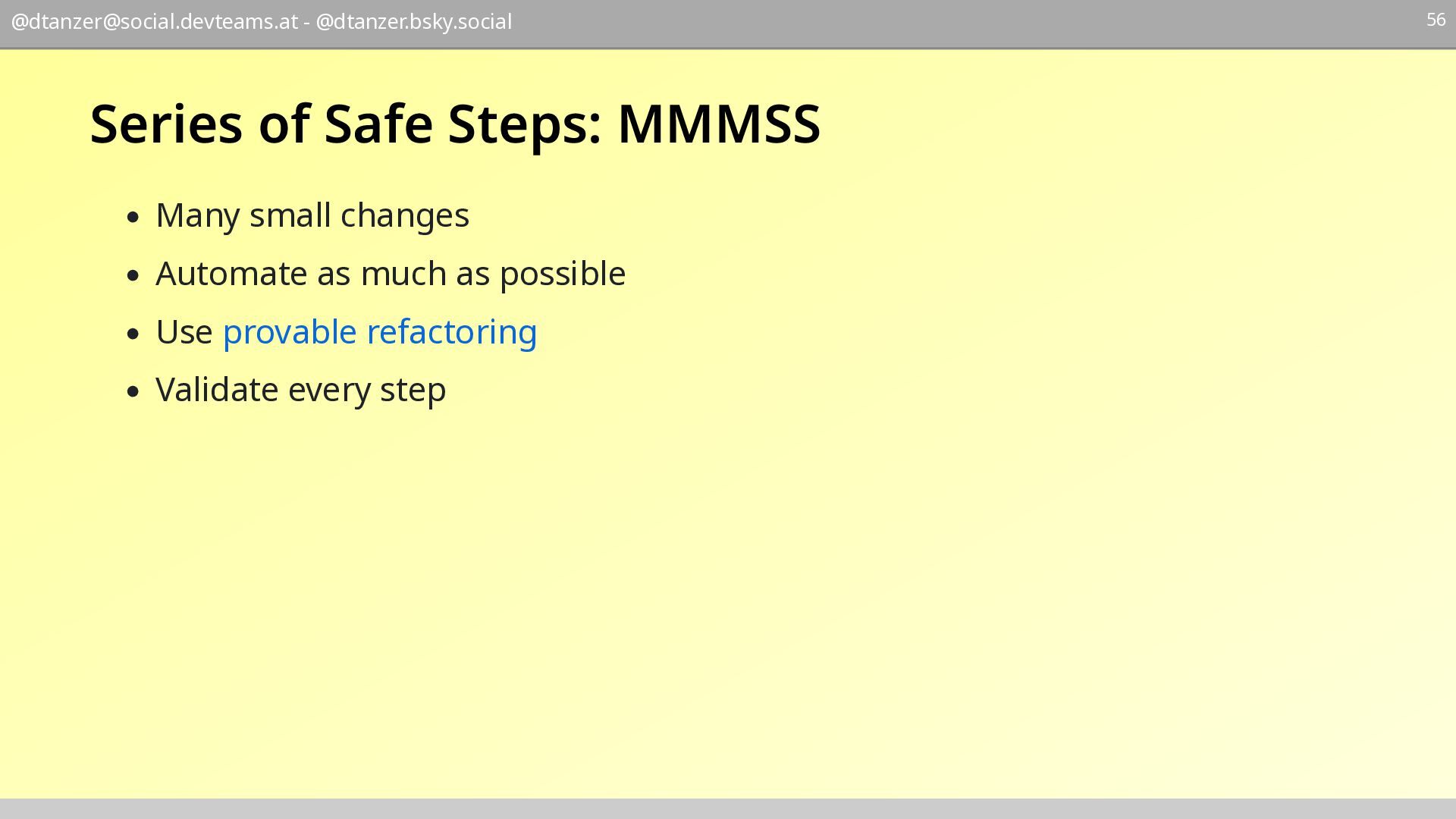
the internal structure of the software to make it easier to understand and cheaper to modify without changing its observable behavior -- Martin Fowler • Feature-for-feature and bug-for-bug compatible • How can we know we have not changed anything? @[email protected] - @dtanzer.bsky.social 55
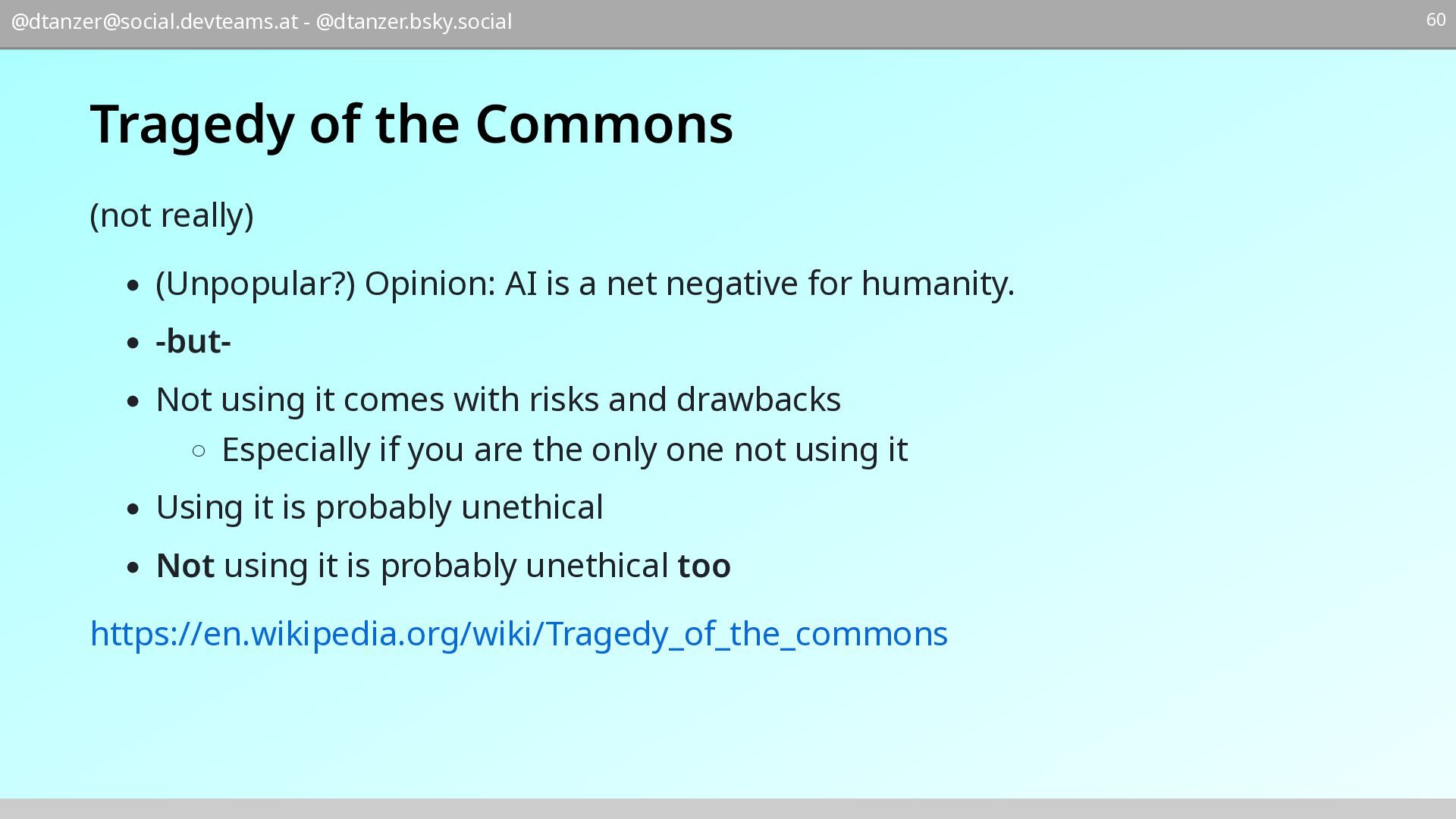
is a net negative for humanity. • -but- • Not using it comes with risks and drawbacks ◦ Especially if you are the only one not using it • Using it is probably unethical • Not using it is probably unethical too https://en.wikipedia.org/wiki/Tragedy_of_the_commons @[email protected] - @dtanzer.bsky.social 60
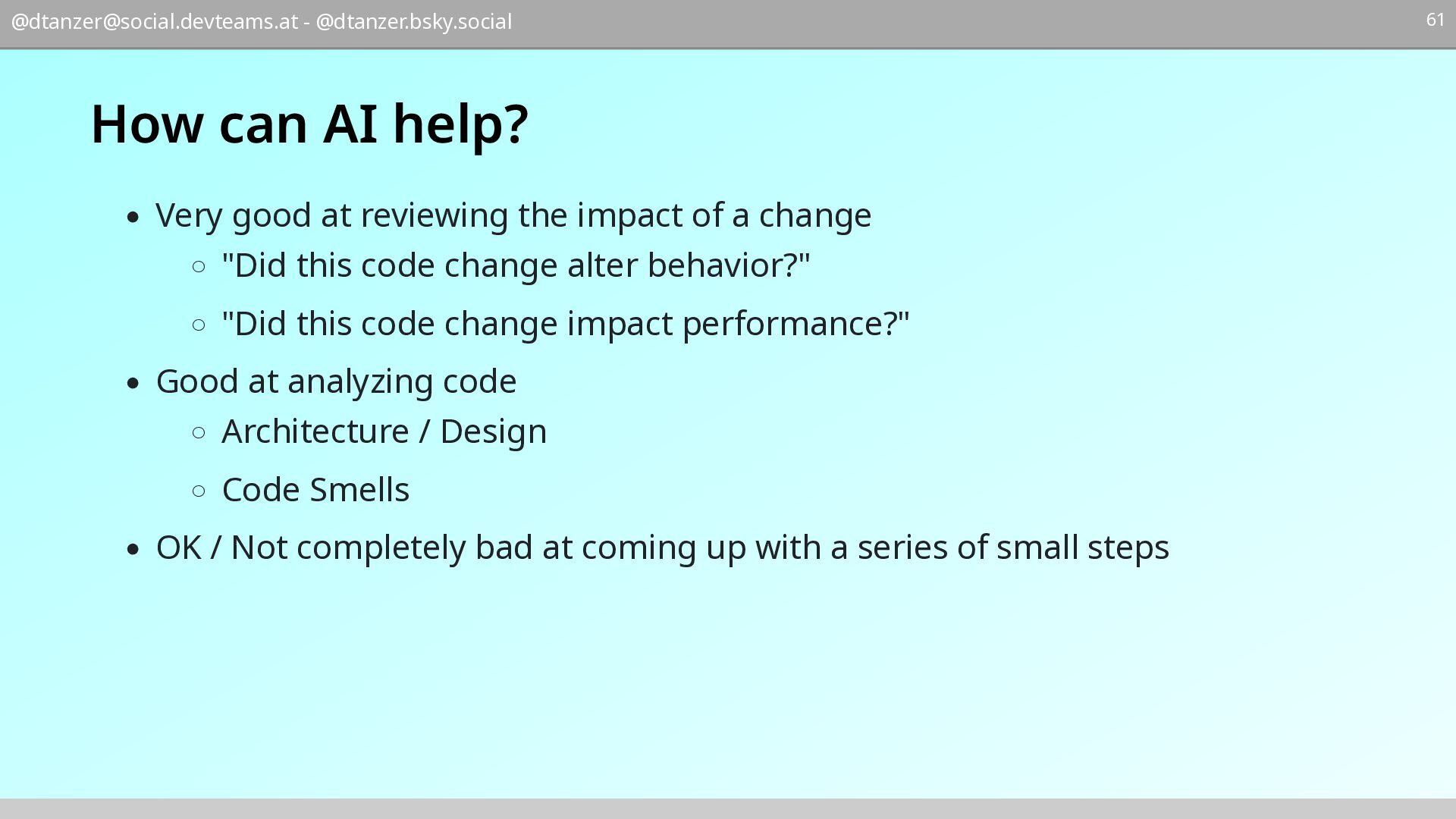
impact of a change ◦ "Did this code change alter behavior?" ◦ "Did this code change impact performance?" • Good at analyzing code ◦ Architecture / Design ◦ Code Smells • OK / Not completely bad at coming up with a series of small steps @[email protected] - @dtanzer.bsky.social 61
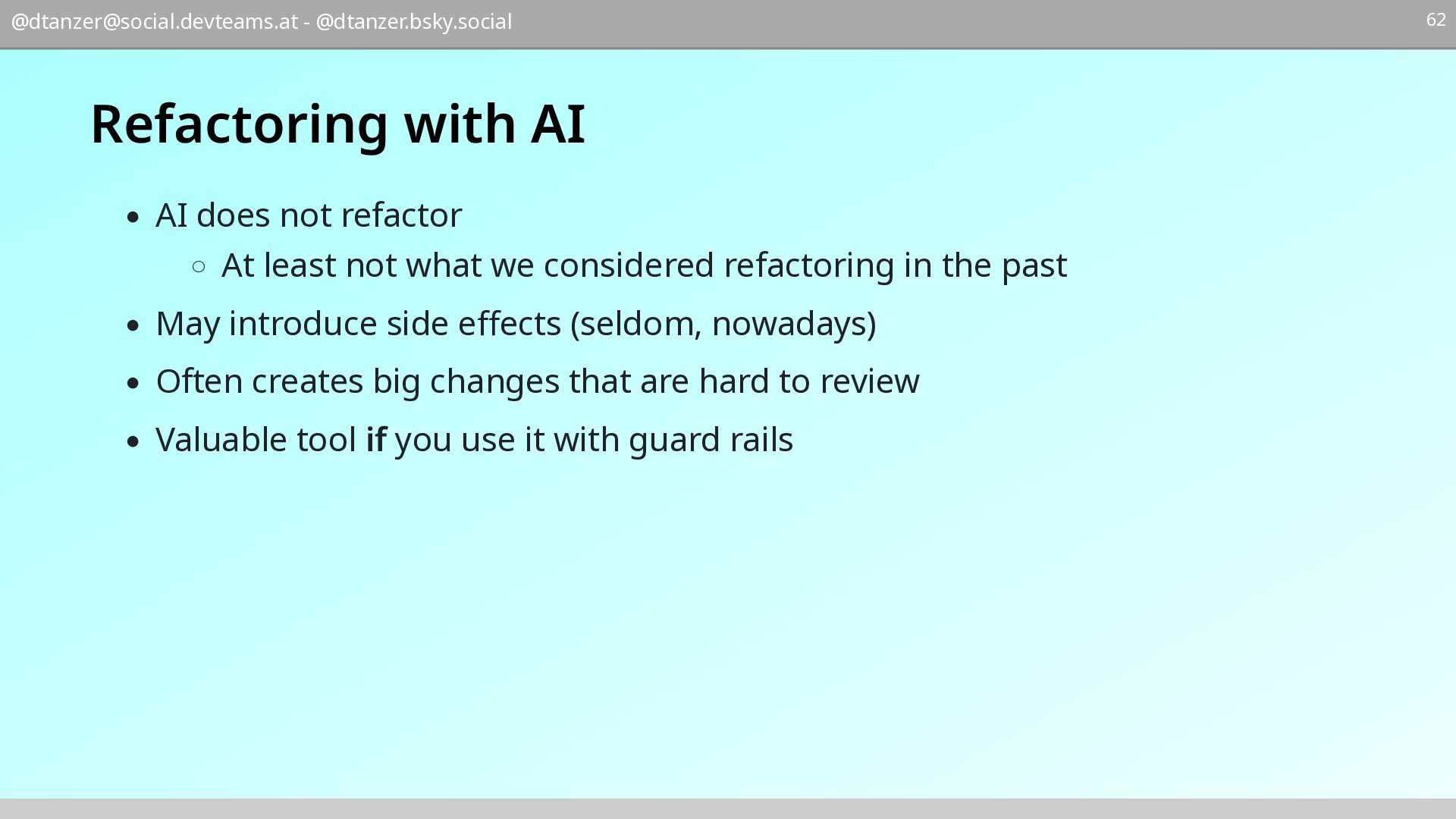
least not what we considered refactoring in the past • May introduce side effects (seldom, nowadays) • Often creates big changes that are hard to review • Valuable tool if you use it with guard rails @[email protected] - @dtanzer.bsky.social 62
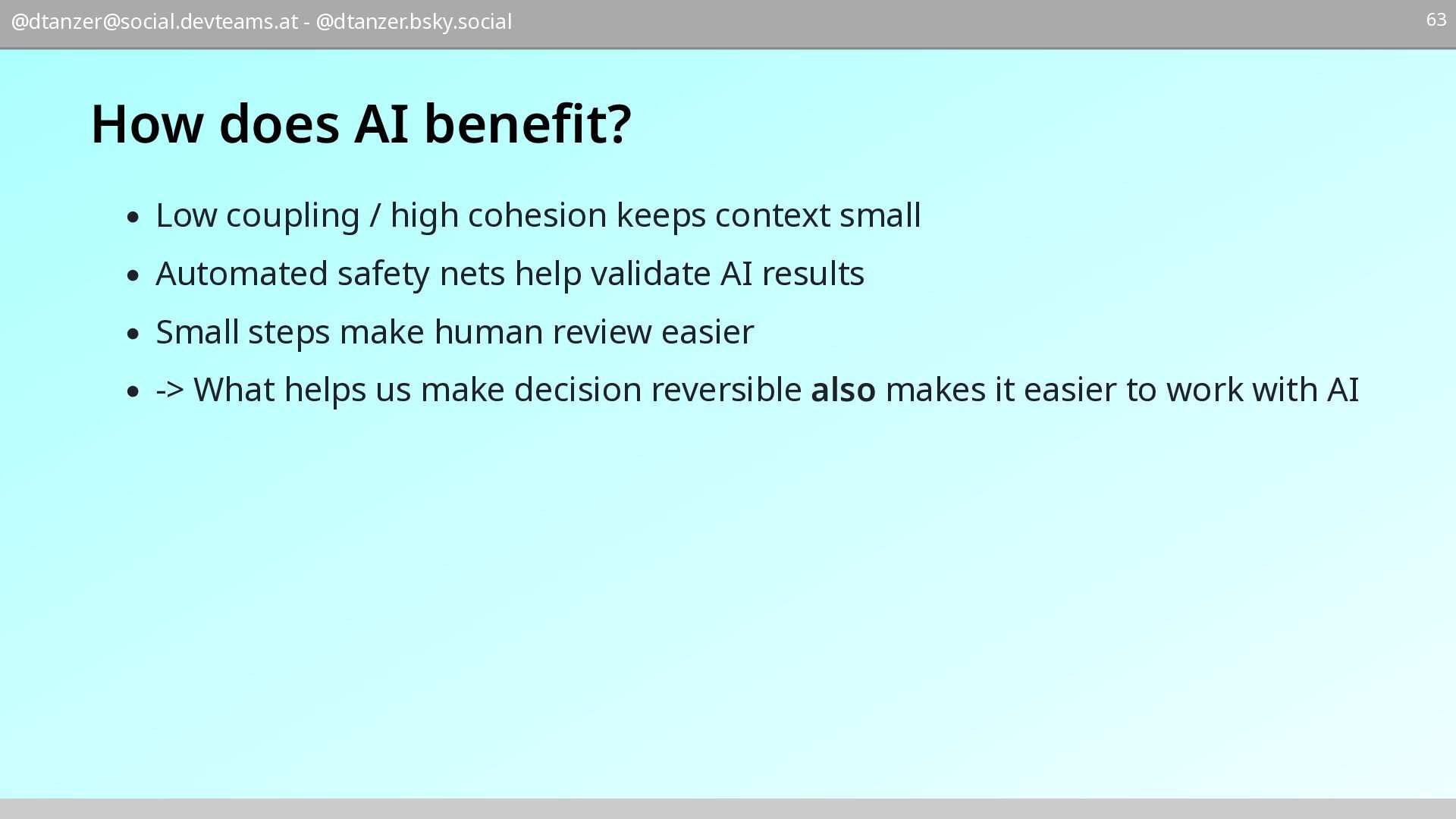
keeps context small • Automated safety nets help validate AI results • Small steps make human review easier • -> What helps us make decision reversible also makes it easier to work with AI @[email protected] - @dtanzer.bsky.social 63
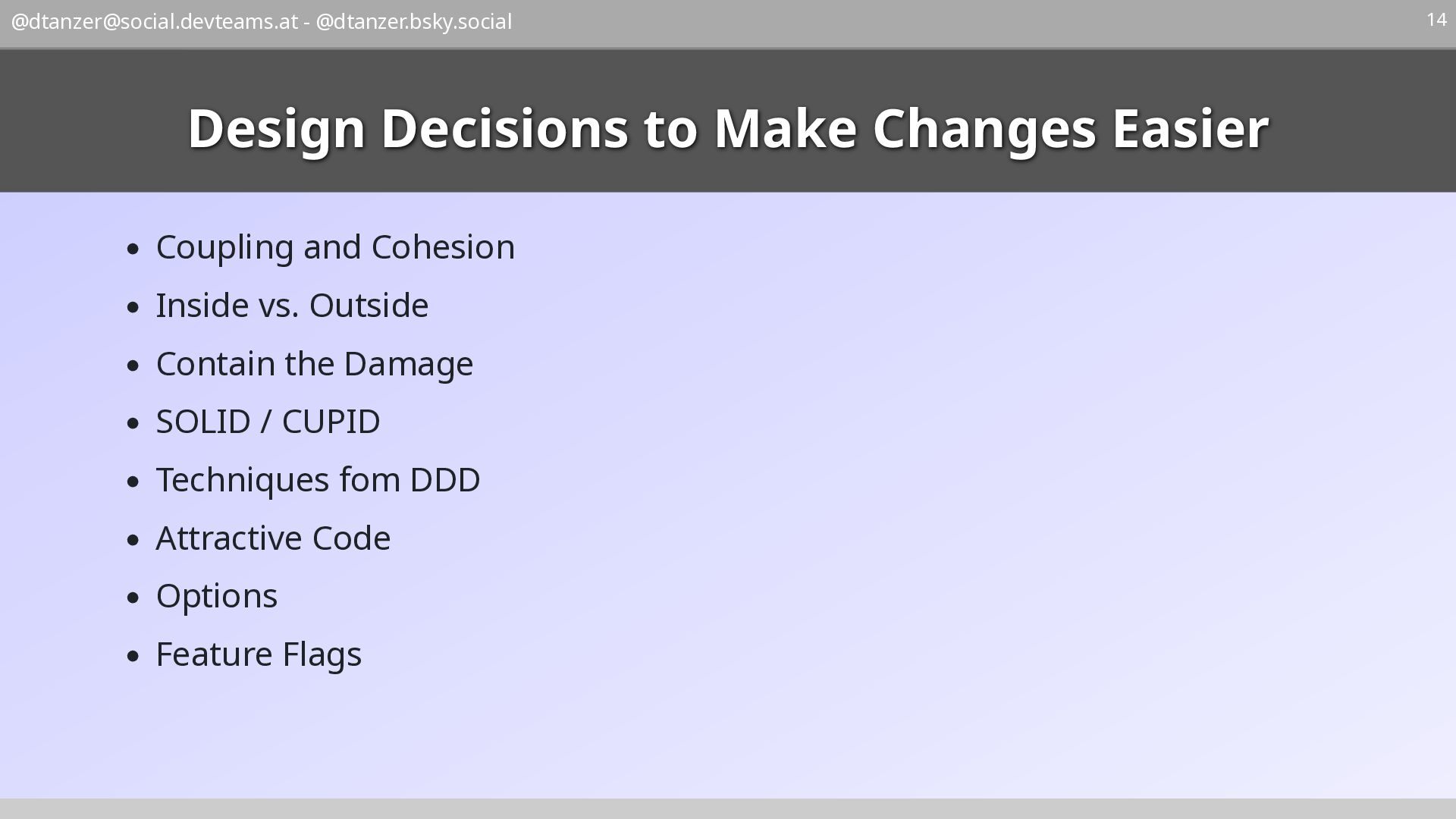
Decisions to Make Changes Easier • MMMSS • Feedback • Practice Refactoring • AI Benefits and Can Help @[email protected] - @dtanzer.bsky.social Conclusions 64


 dtanzer
 teamlab
 gogutan
 nttcom
 shumei_ito
 daidaidai
 odashi
 taketakekaho
 kenichiodo
 kworkdev
 akitoshiga
 yut0naga1_fa
 usanchuu
 seathinner
 kimpetersen
 brettharned
 mfonobong
 madoxten
 szymonslowik
 techseoconnect
 chriscoyier
 apolaine
 greggifford
 frankvandijk
![@[email protected] - @dtanzer.bsky.social Reversible Decisions For Better Software Design David](https://files.speakerdeck.com/presentations/d42c219ead0c4136bd8b93a4e4422f7d/slide_0.jpg)
![A Spectrum of Decisions @[email protected] - @dtanzer.bsky.social 5](https://files.speakerdeck.com/presentations/d42c219ead0c4136bd8b93a4e4422f7d/slide_4.jpg)
![@[email protected] - @dtanzer.bsky.social 6](https://files.speakerdeck.com/presentations/d42c219ead0c4136bd8b93a4e4422f7d/slide_5.jpg)
![@[email protected] - @dtanzer.bsky.social 7](https://files.speakerdeck.com/presentations/d42c219ead0c4136bd8b93a4e4422f7d/slide_6.jpg)
![@[email protected] - @dtanzer.bsky.social 8](https://files.speakerdeck.com/presentations/d42c219ead0c4136bd8b93a4e4422f7d/slide_7.jpg)
![@[email protected] - @dtanzer.bsky.social 9](https://files.speakerdeck.com/presentations/d42c219ead0c4136bd8b93a4e4422f7d/slide_8.jpg)
![Inside vs. Outside @[email protected] - @dtanzer.bsky.social 16](https://files.speakerdeck.com/presentations/d42c219ead0c4136bd8b93a4e4422f7d/slide_15.jpg)
![@[email protected] - @dtanzer.bsky.social 17](https://files.speakerdeck.com/presentations/d42c219ead0c4136bd8b93a4e4422f7d/slide_16.jpg)
![@[email protected] - @dtanzer.bsky.social 18](https://files.speakerdeck.com/presentations/d42c219ead0c4136bd8b93a4e4422f7d/slide_17.jpg)
![@[email protected] - @dtanzer.bsky.social 19](https://files.speakerdeck.com/presentations/d42c219ead0c4136bd8b93a4e4422f7d/slide_18.jpg)
![@[email protected] - @dtanzer.bsky.social 20](https://files.speakerdeck.com/presentations/d42c219ead0c4136bd8b93a4e4422f7d/slide_19.jpg)
![@[email protected] - @dtanzer.bsky.social 21](https://files.speakerdeck.com/presentations/d42c219ead0c4136bd8b93a4e4422f7d/slide_20.jpg)
![Contain the Damage @[email protected] - @dtanzer.bsky.social 23](https://files.speakerdeck.com/presentations/d42c219ead0c4136bd8b93a4e4422f7d/slide_22.jpg)
![@[email protected] - @dtanzer.bsky.social 24](https://files.speakerdeck.com/presentations/d42c219ead0c4136bd8b93a4e4422f7d/slide_23.jpg)
![@[email protected] - @dtanzer.bsky.social 25](https://files.speakerdeck.com/presentations/d42c219ead0c4136bd8b93a4e4422f7d/slide_24.jpg)
![@[email protected] - @dtanzer.bsky.social 26](https://files.speakerdeck.com/presentations/d42c219ead0c4136bd8b93a4e4422f7d/slide_25.jpg)
![@[email protected] - @dtanzer.bsky.social 27](https://files.speakerdeck.com/presentations/d42c219ead0c4136bd8b93a4e4422f7d/slide_26.jpg)
![@[email protected] - @dtanzer.bsky.social 35](https://files.speakerdeck.com/presentations/d42c219ead0c4136bd8b93a4e4422f7d/slide_34.jpg)
![@[email protected] - @dtanzer.bsky.social 36](https://files.speakerdeck.com/presentations/d42c219ead0c4136bd8b93a4e4422f7d/slide_35.jpg)
![@[email protected] - @dtanzer.bsky.social 37](https://files.speakerdeck.com/presentations/d42c219ead0c4136bd8b93a4e4422f7d/slide_36.jpg)
![@[email protected] - @dtanzer.bsky.social 38](https://files.speakerdeck.com/presentations/d42c219ead0c4136bd8b93a4e4422f7d/slide_37.jpg)
![@[email protected] - @dtanzer.bsky.social 39](https://files.speakerdeck.com/presentations/d42c219ead0c4136bd8b93a4e4422f7d/slide_38.jpg)
![Reversibility of a Step vs. the Chain @[email protected] - @dtanzer.bsky.social](https://files.speakerdeck.com/presentations/d42c219ead0c4136bd8b93a4e4422f7d/slide_41.jpg)
![Static Analysis @[email protected] - @dtanzer.bsky.social 47](https://files.speakerdeck.com/presentations/d42c219ead0c4136bd8b93a4e4422f7d/slide_46.jpg)
![TDD @[email protected] - @dtanzer.bsky.social 48](https://files.speakerdeck.com/presentations/d42c219ead0c4136bd8b93a4e4422f7d/slide_47.jpg)
![@[email protected] - @dtanzer.bsky.social 49](https://files.speakerdeck.com/presentations/d42c219ead0c4136bd8b93a4e4422f7d/slide_48.jpg)
![@[email protected] - @dtanzer.bsky.social 50](https://files.speakerdeck.com/presentations/d42c219ead0c4136bd8b93a4e4422f7d/slide_49.jpg)
![@[email protected] - @dtanzer.bsky.social 51](https://files.speakerdeck.com/presentations/d42c219ead0c4136bd8b93a4e4422f7d/slide_50.jpg)
![Confidence: No Behavior Change • Feature-for-feature and bug-for-bug compatible @[email protected]](https://files.speakerdeck.com/presentations/d42c219ead0c4136bd8b93a4e4422f7d/slide_56.jpg)
![A Spectrum of Decisions @[email protected] - @dtanzer.bsky.social 65](https://files.speakerdeck.com/presentations/d42c219ead0c4136bd8b93a4e4422f7d/slide_64.jpg)