Upgrade to Pro — share decks privately, control downloads, hide ads and more …

Social Search in a Professional Context

Social Search in a Professional Context

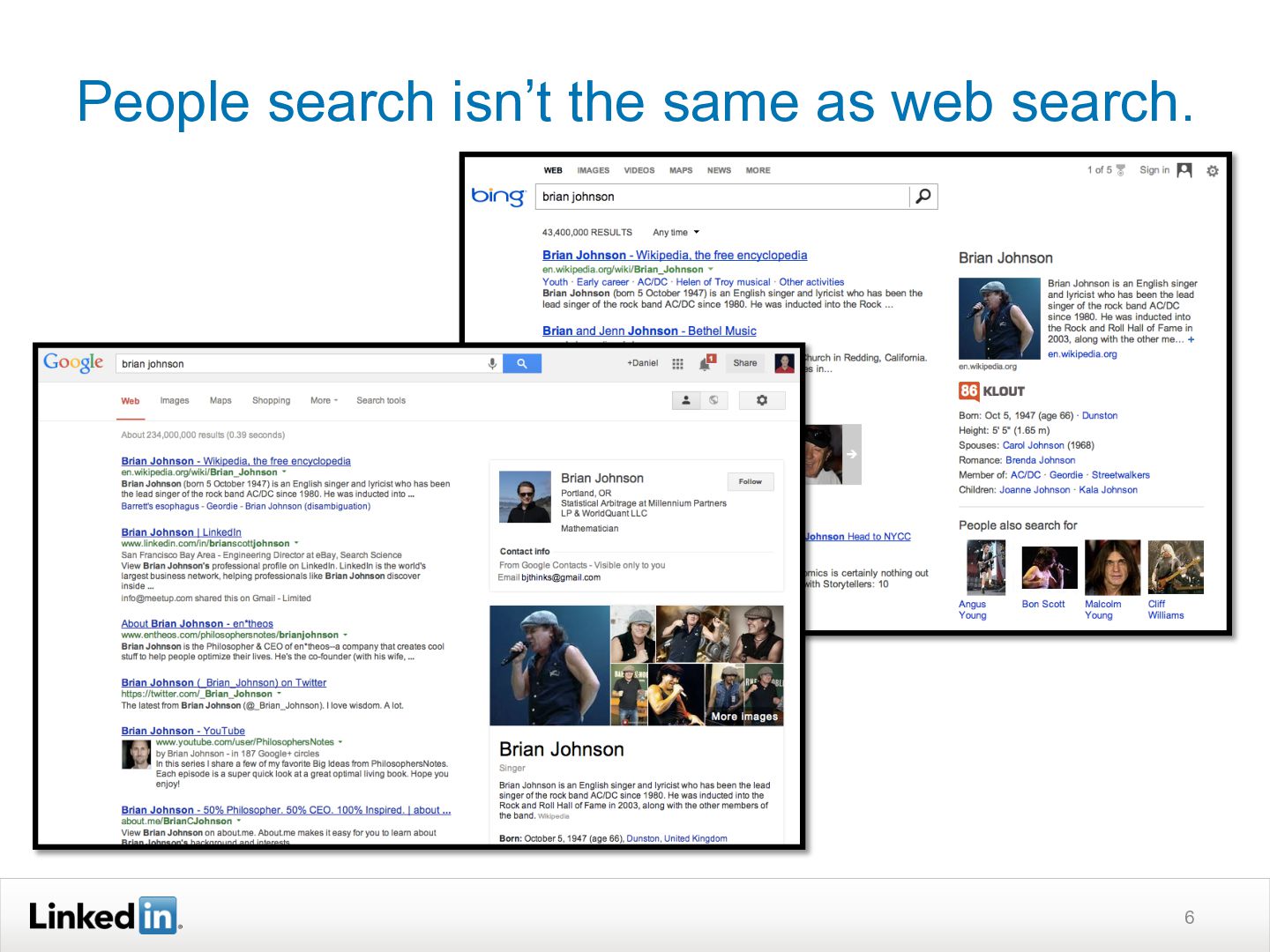
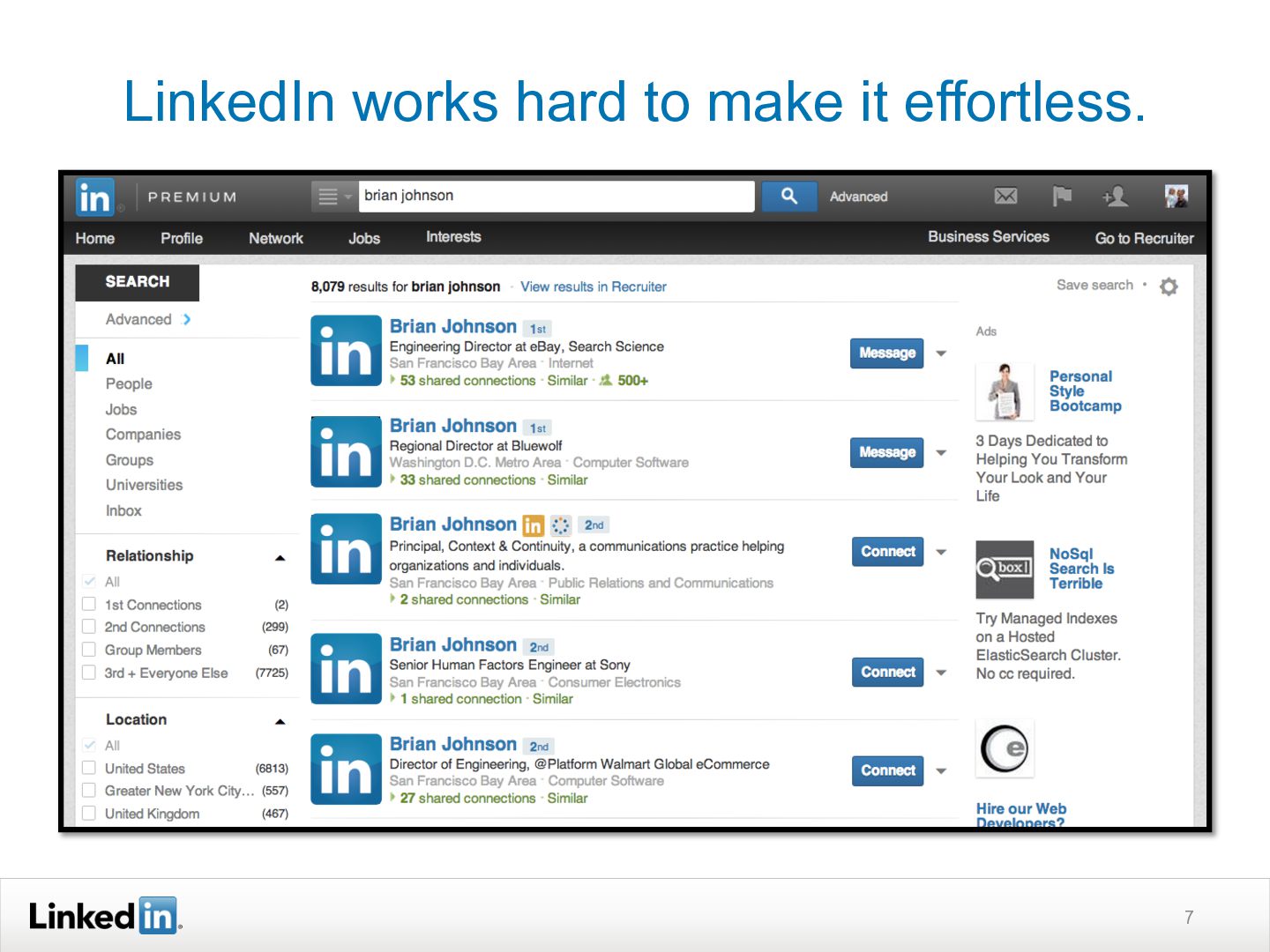
This 2013 ACM Conference on Information and Knowledge Management (CIKM) presentation discusses data-driven user behavior modeling for professional search on LinkedIn. It emphasizes the differences between professional and web search, focusing on entity-oriented search, query tagging, and the importance of user networks in search relevance. It highlights methods for personalizing search results and improving query understanding to better connect talent with opportunities.

Avatar for Daniel Tunkelang

Daniel Tunkelang

May 26, 2026

More Decks by Daniel Tunkelang

Other Decks in Technology

Transcript

  1. Recruiting Solutions Recruiting Solutions Recruiting Solutions Social Search in a

    Professional Context Daniel Tunkelang LinkedIn, Head of Query Understanding 1 Daniel Workshop on Data-driven User Behavioral Modeling and Mining from Social Media
  2. Overview Why do people search in a professional context? How

    do we help people search in a professional context? Next play? 3
  3. 4

  4. 19

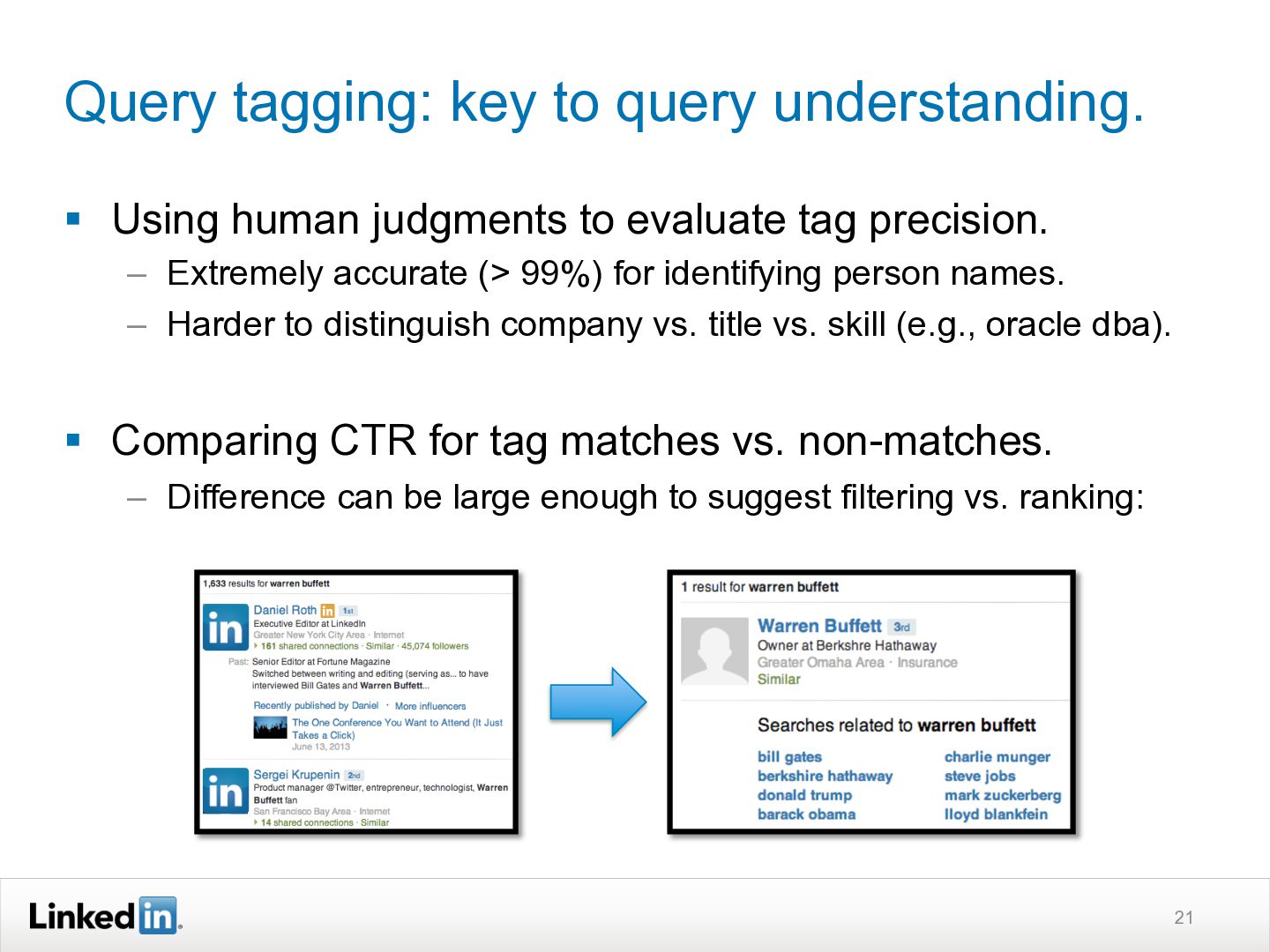
  5. Query tagging: key to query understanding. §  Using human judgments

    to evaluate tag precision. –  Extremely accurate (> 99%) for identifying person names. –  Harder to distinguish company vs. title vs. skill (e.g., oracle dba). §  Comparing CTR for tag matches vs. non-matches. –  Difference can be large enough to suggest filtering vs. ranking: 21
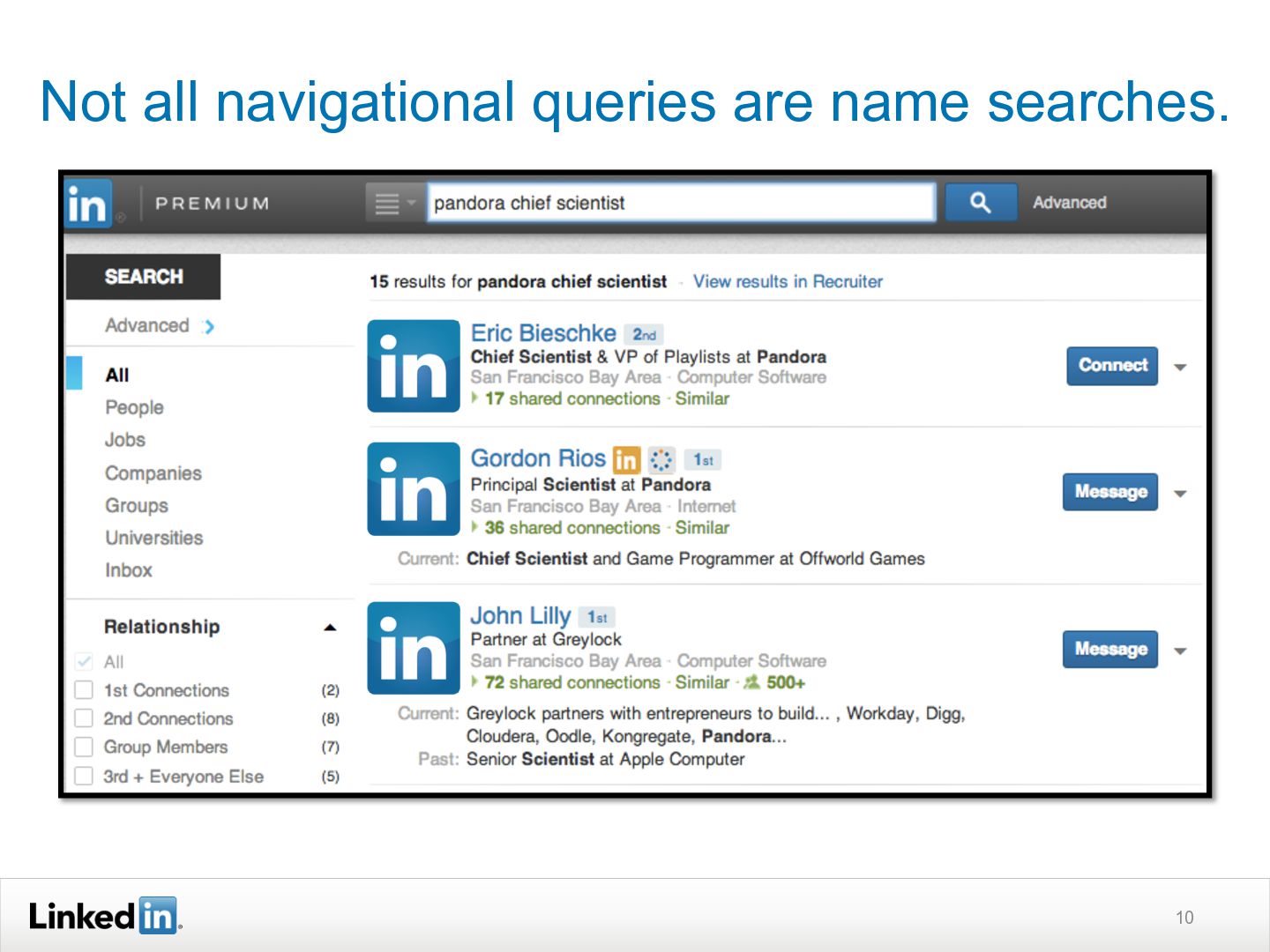
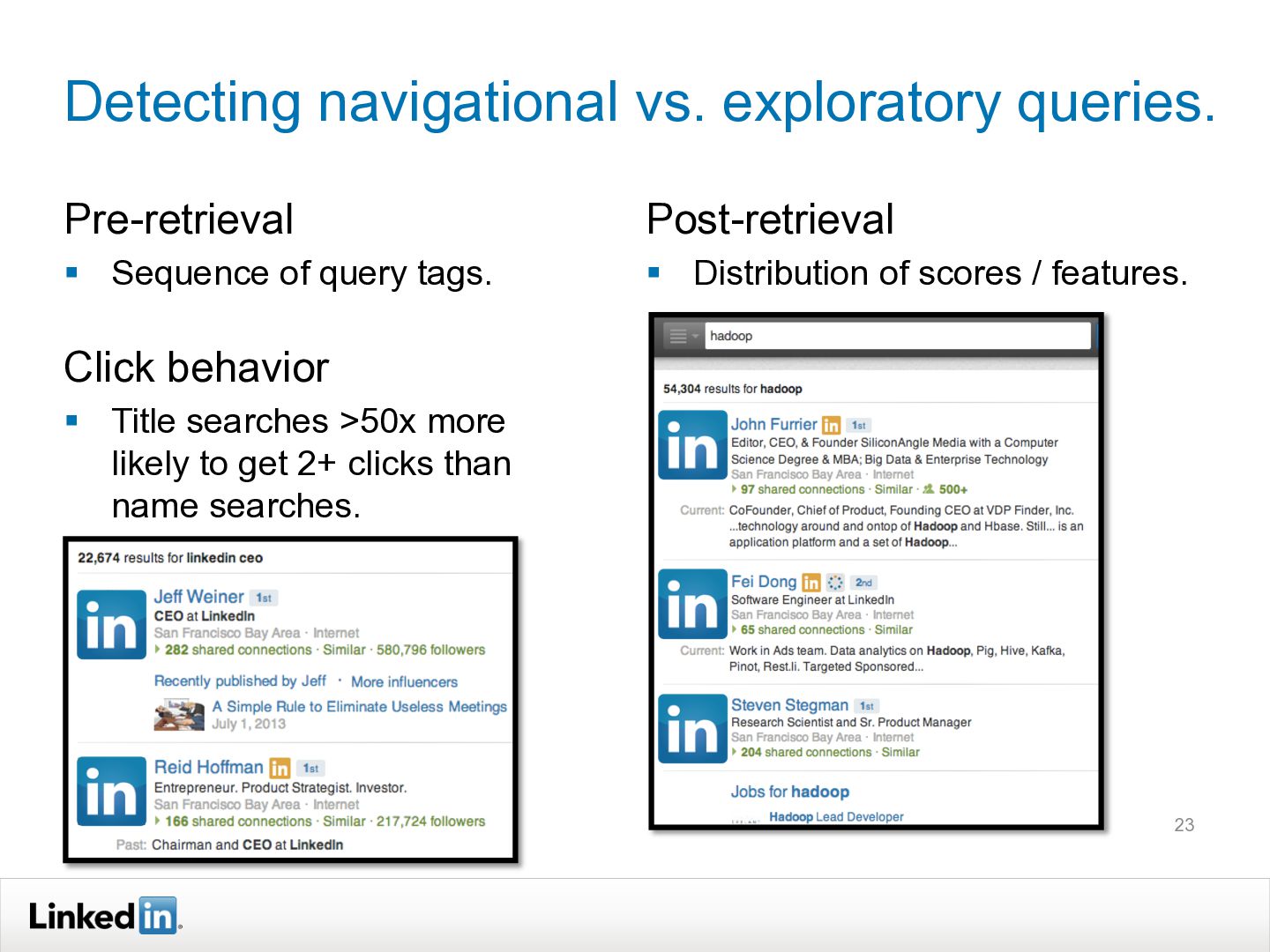
  6. Detecting navigational vs. exploratory queries. Pre-retrieval §  Sequence of query

    tags. Post-retrieval §  Distribution of scores / features. 23 Click behavior §  Title searches >50x more likely to get 2+ clicks than name searches.
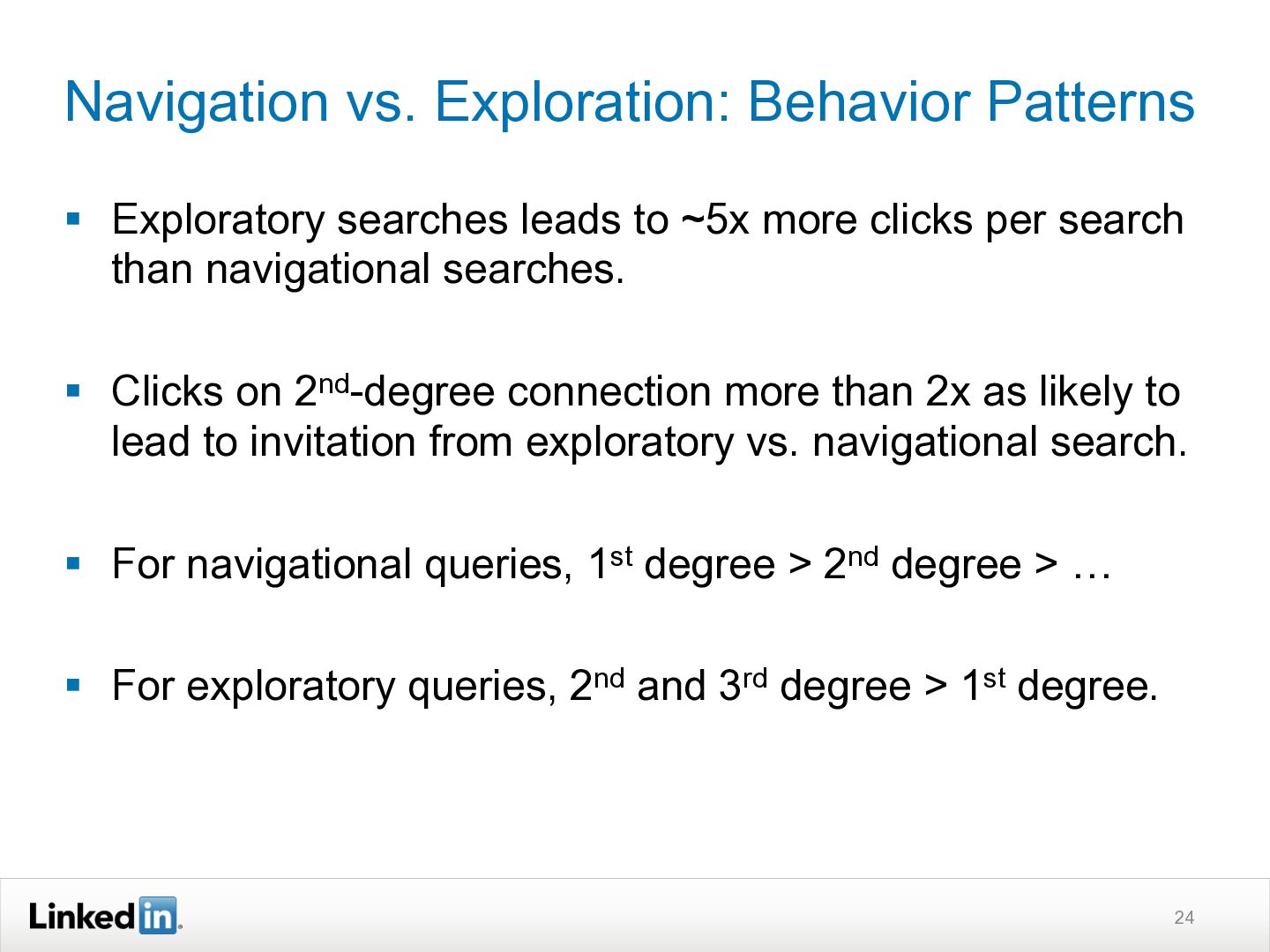
  7. Navigation vs. Exploration: Behavior Patterns §  Exploratory searches leads to

    ~5x more clicks per search than navigational searches. §  Clicks on 2nd-degree connection more than 2x as likely to lead to invitation from exploratory vs. navigational search. §  For navigational queries, 1st degree > 2nd degree > … §  For exploratory queries, 2nd and 3rd degree > 1st degree. 24
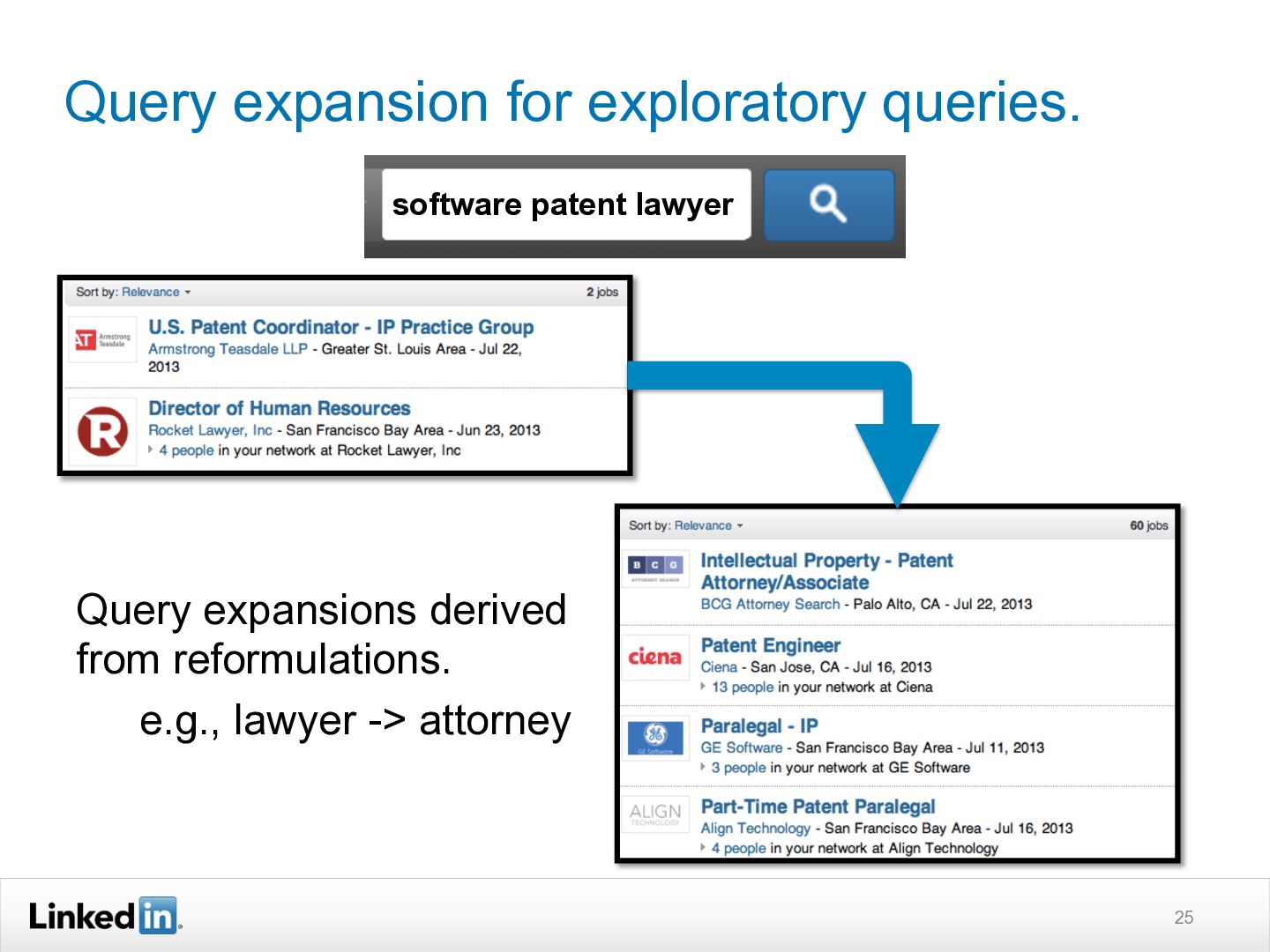
  8. Query expansion for exploratory queries. 25 software patent lawyer Query

    expansions derived from reformulations. e.g., lawyer -> attorney
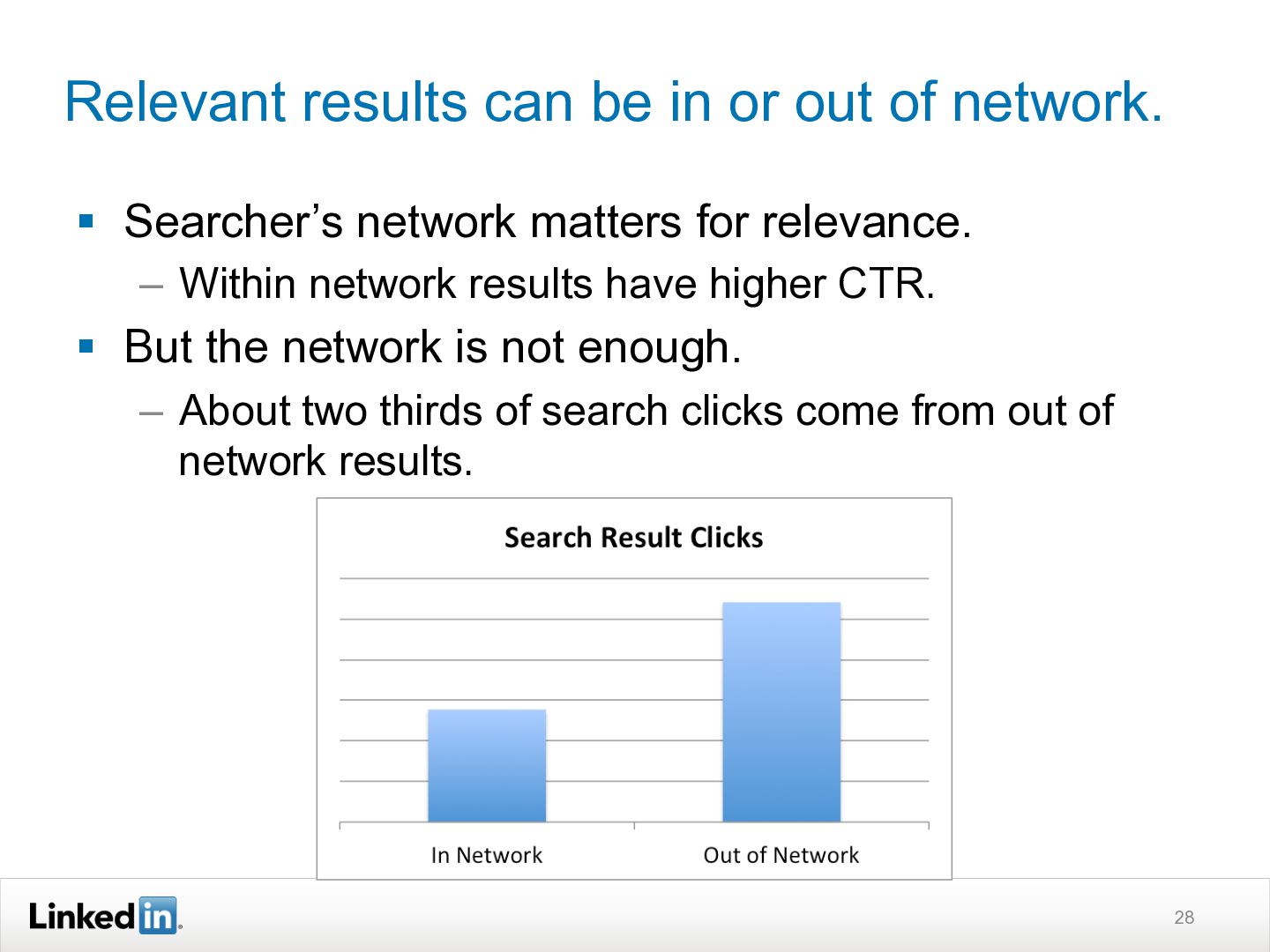
  9. Relevant results can be in or out of network. 28

    §  Searcher’s network matters for relevance. –  Within network results have higher CTR. §  But the network is not enough. –  About two thirds of search clicks come from out of network results.
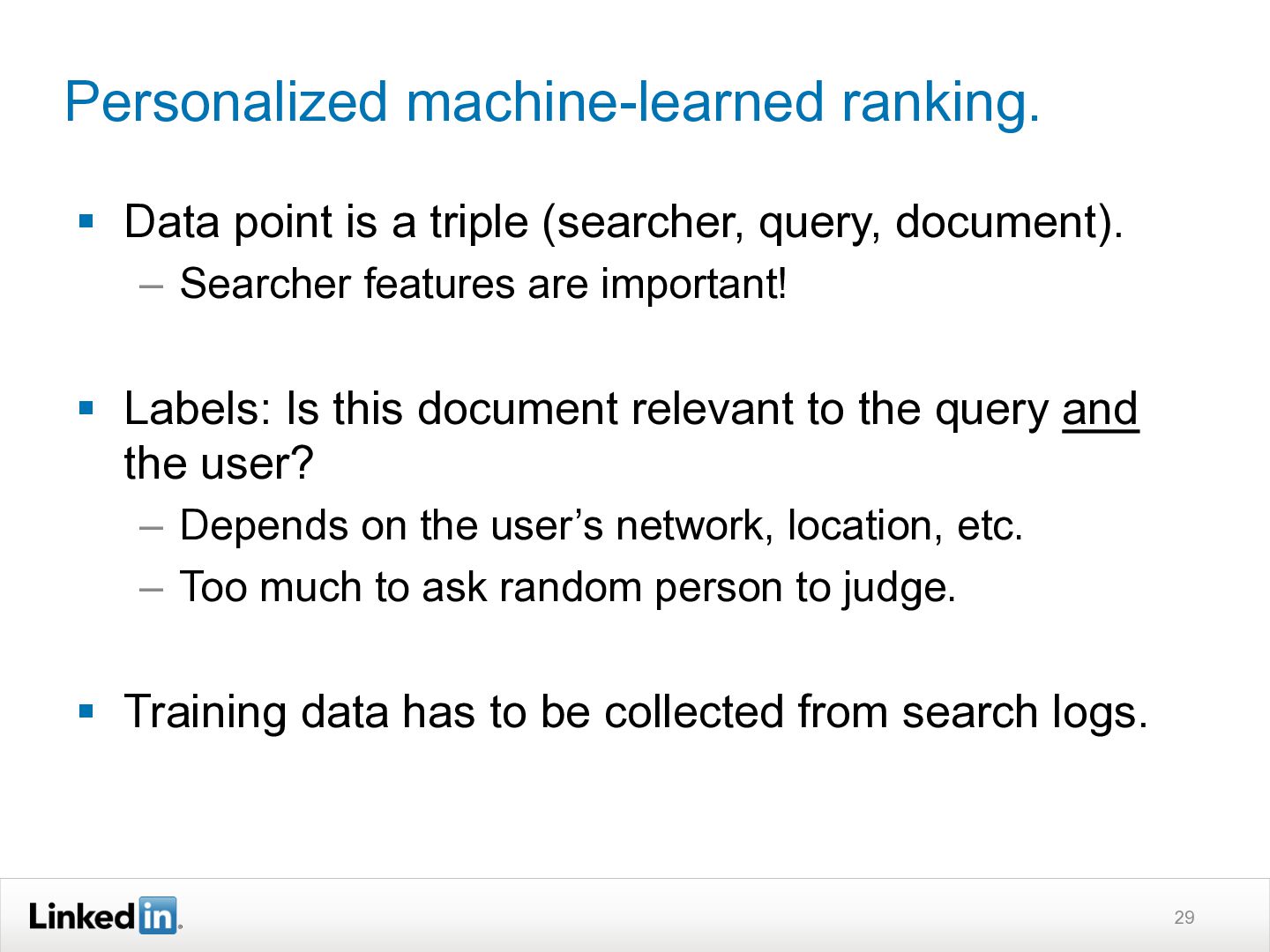
  10. Personalized machine-learned ranking. 29 §  Data point is a triple

    (searcher, query, document). –  Searcher features are important! §  Labels: Is this document relevant to the query and the user? –  Depends on the user’s network, location, etc. –  Too much to ask random person to judge. §  Training data has to be collected from search logs.
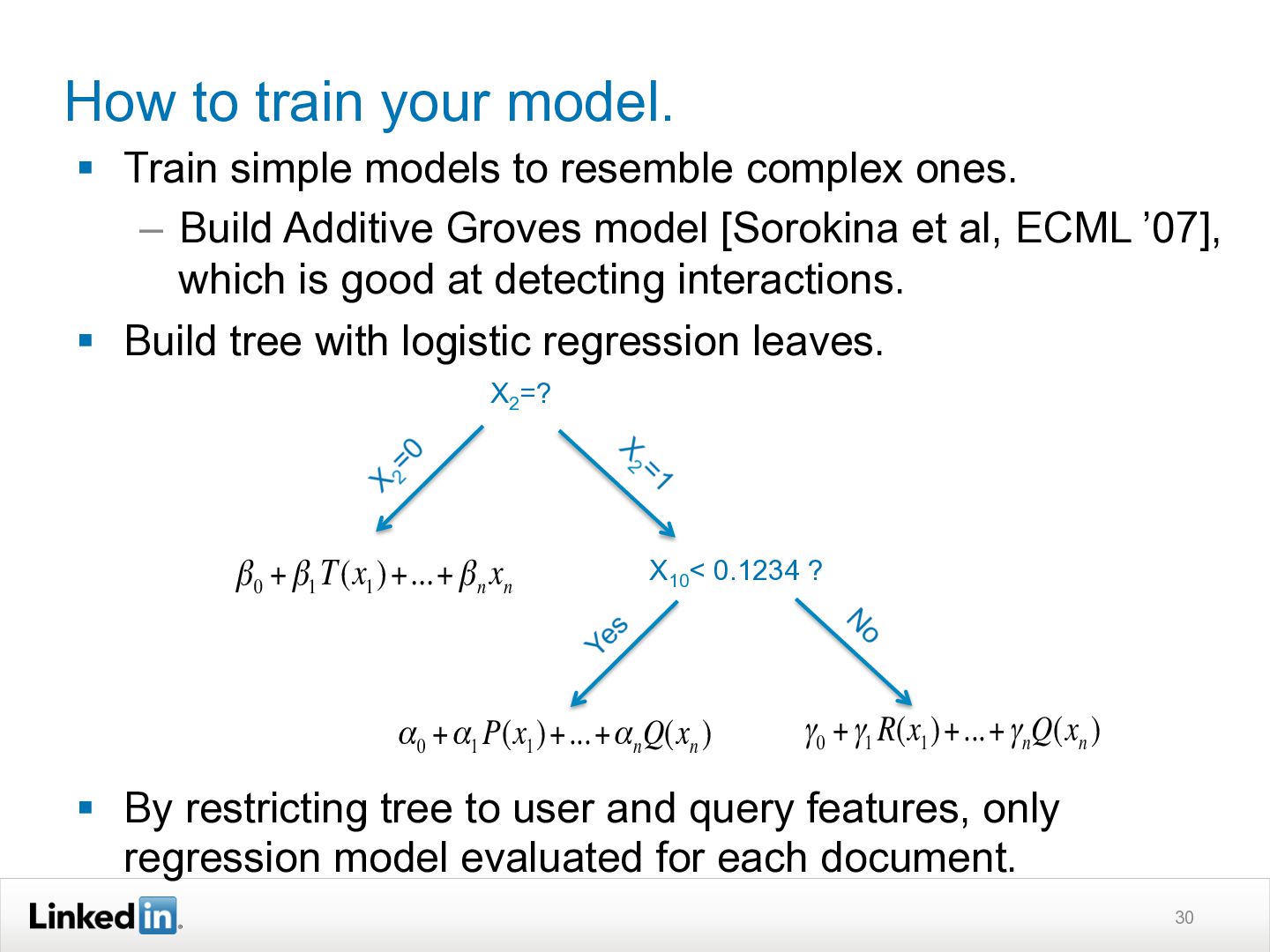
  11. How to train your model. 30 §  Train simple models

    to resemble complex ones. –  Build Additive Groves model [Sorokina et al, ECML ’07], which is good at detecting interactions. §  Build tree with logistic regression leaves. §  By restricting tree to user and query features, only regression model evaluated for each document. β0 +β1 T(x 1 )+...+βn x n α0 +α1 P(x 1 )+...+αn Q(x n ) X2 =? X10 < 0.1234 ? γ0 +γ1 R(x 1 )+...+γn Q(x n )
  12. 31

  13. 32

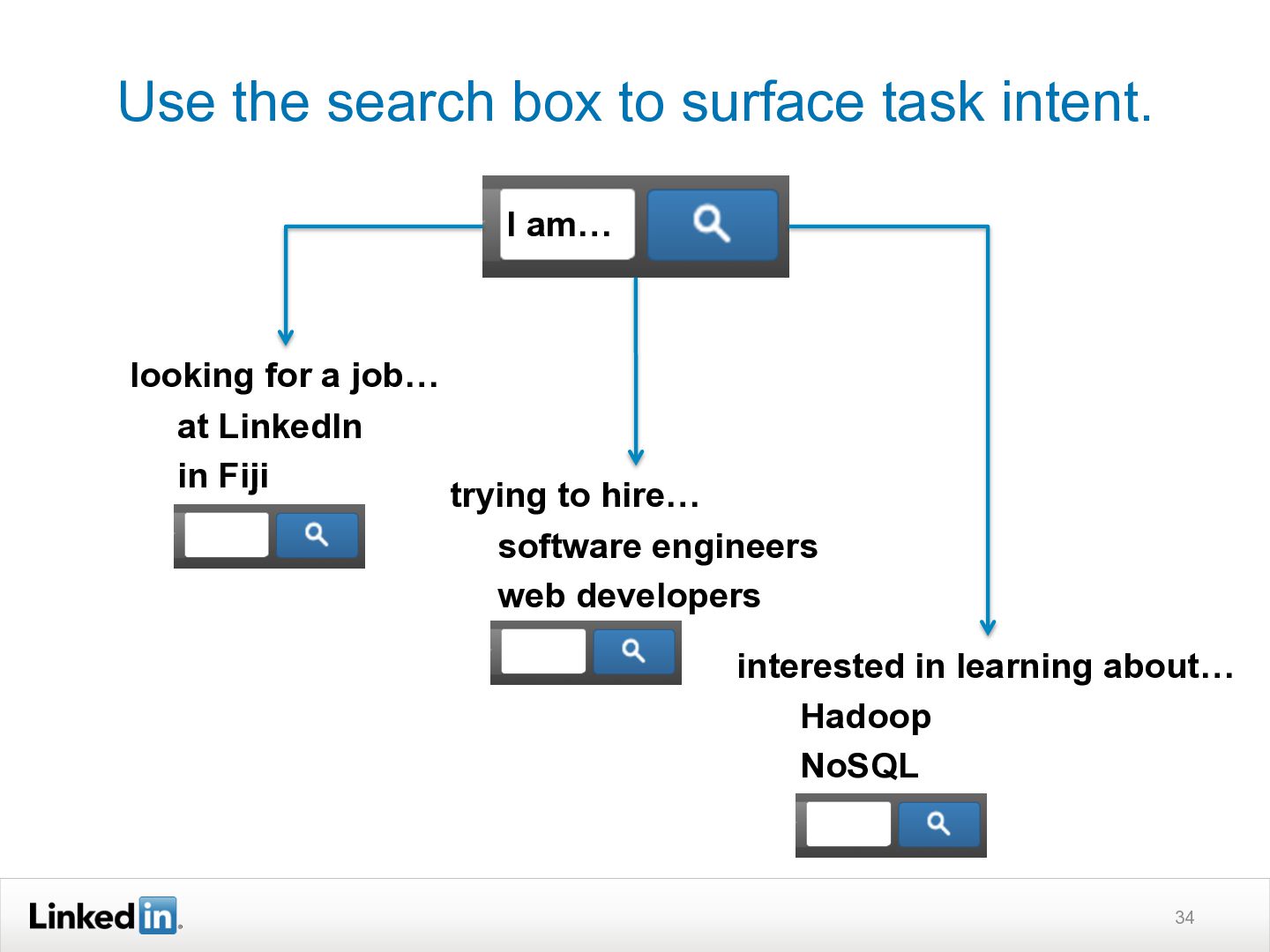
  14. Use the search box to surface task intent. 34 I

    am… looking for a job… at LinkedIn in Fiji trying to hire… software engineers web developers interested in learning about… Hadoop NoSQL
  15. Want to learn more? §  Check out http://data.linkedin.com/search. §  Contact

    me: [email protected] http://linkedin.com/in/dtunkelang §  Did I mention that we’re hiring? J 38