Upgrade to Pro — share decks privately, control downloads, hide ads and more …

Structure, Personalization, Scale: A Deep Dive ...

Sponsored · Ship Features Fearlessly Turn features on and off without deploys. Used by thousands of Ruby developers.

Structure, Personalization, Scale: A Deep Dive into LinkedIn Search

This 2014 QCon New York presentation discusses LinkedIn's search platform. Search at LinkedIn is different. Its corpus is a richly structured professional graph comprised of 300M+ people, 3M+ companies, 2M+ groups, and 1.5M+ publishers. Its members perform billions of searches (over 5.7B in 2012), and each of those searches is highly personalized based on the searcher's identity and relationships with other professional entities in LinkedIn's economic graph. And all this data is in constant flux as LinkedIn adds more than 2 members every second in over 200 countries (2/3 of its members are outside the United States). As a result, it has built a system quite different from those used for other search applications. This talk discusses some of the unique challenges it has faced to deliver highly personalized search over semi-structured data at massive scale.

Avatar for Daniel Tunkelang

Daniel Tunkelang

May 26, 2026

More Decks by Daniel Tunkelang

Other Decks in Technology
Transcript

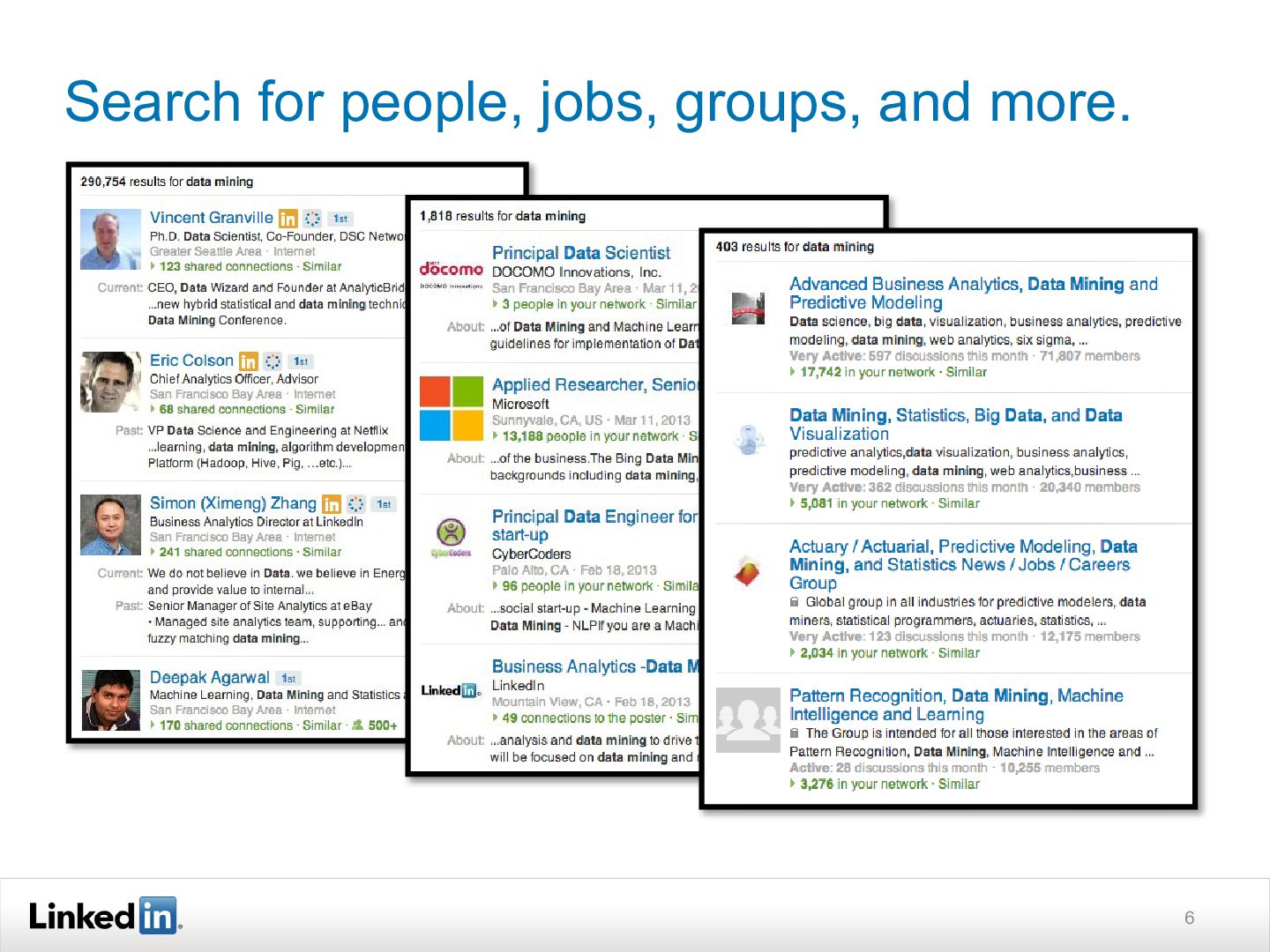
  1. Overview What is LinkedIn search and why should you care?
    What are our systems challenges? What are our relevance challenges? 2
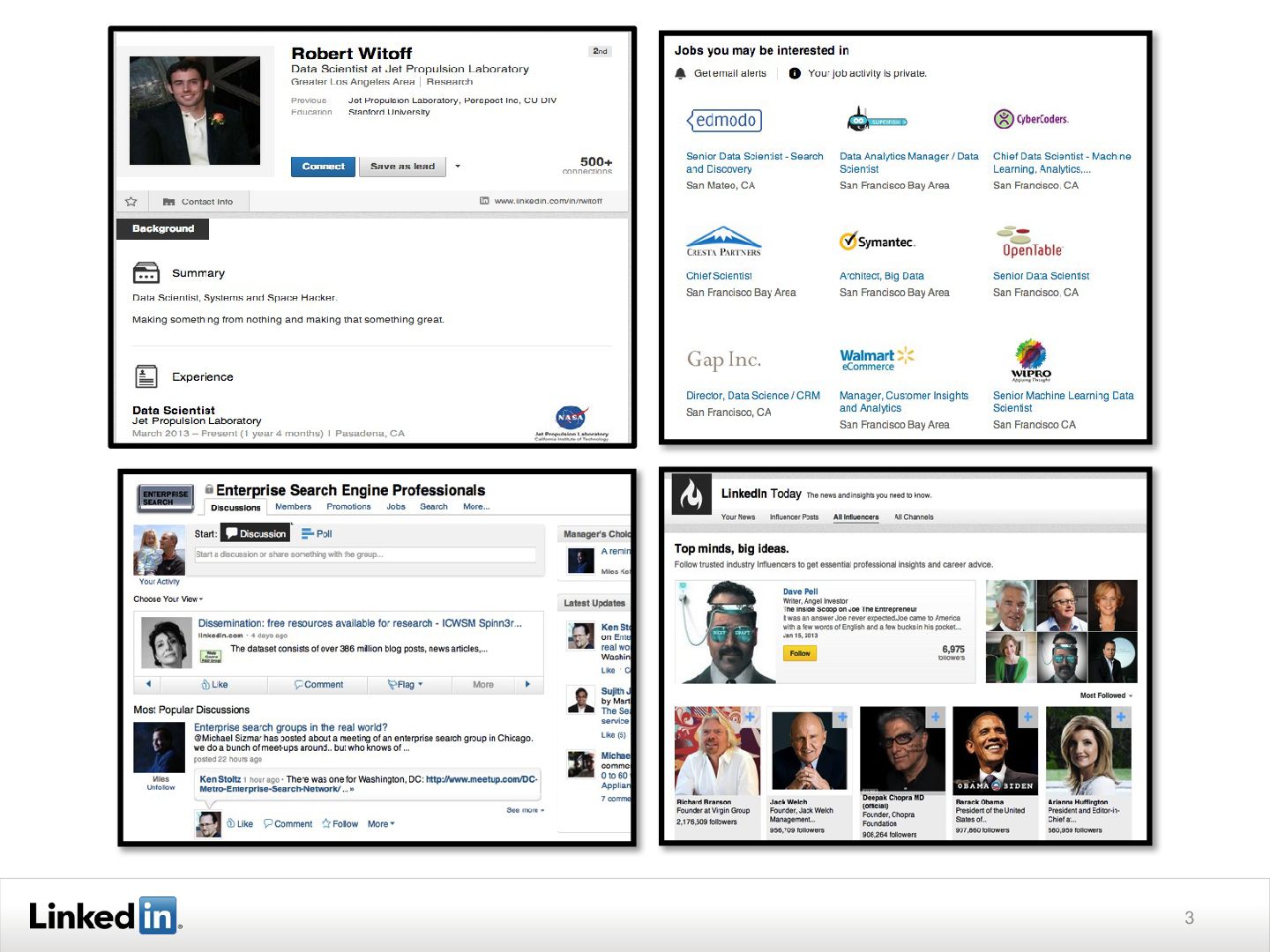
  2. 3

  3. 4

  4. 7

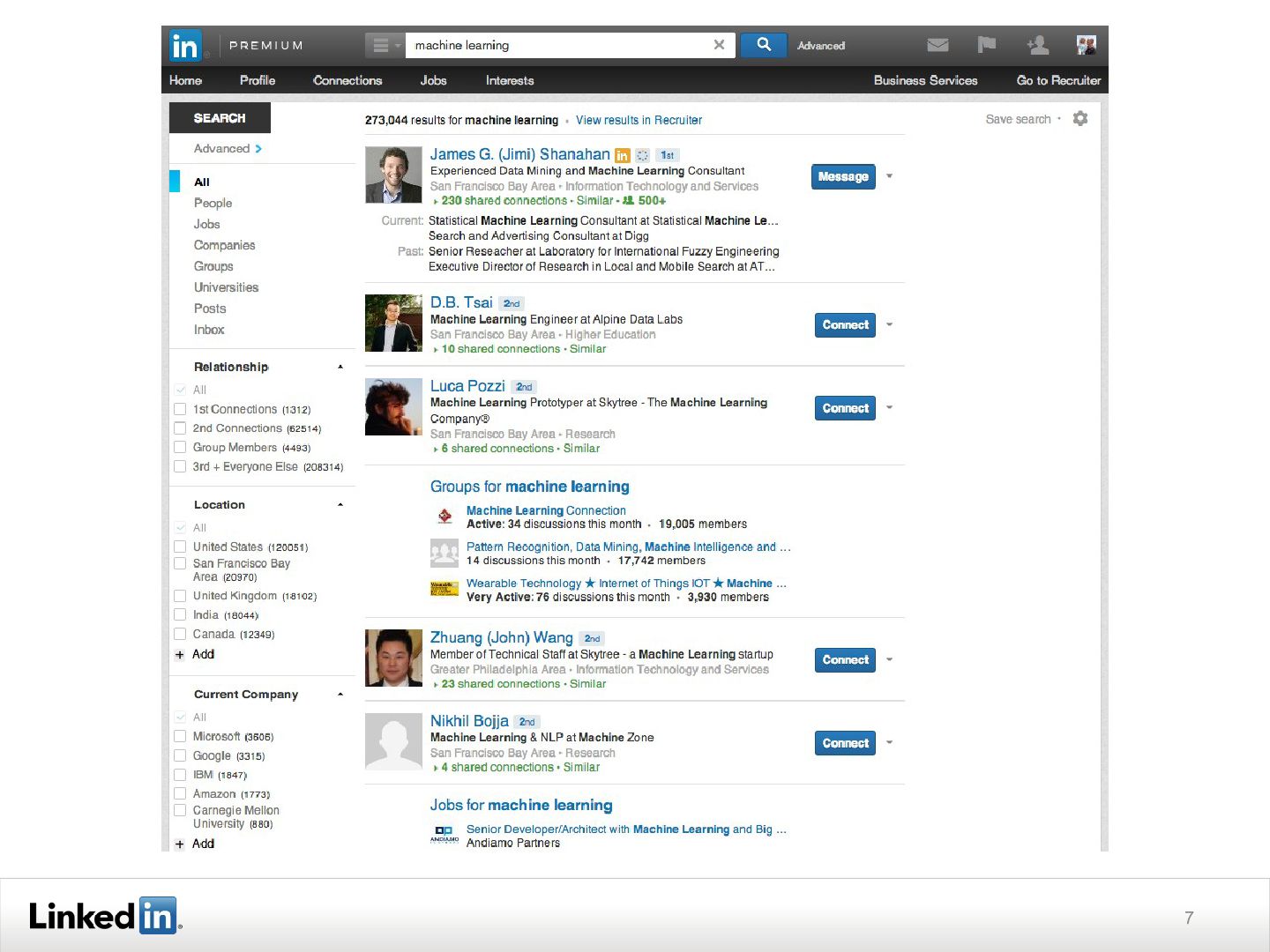
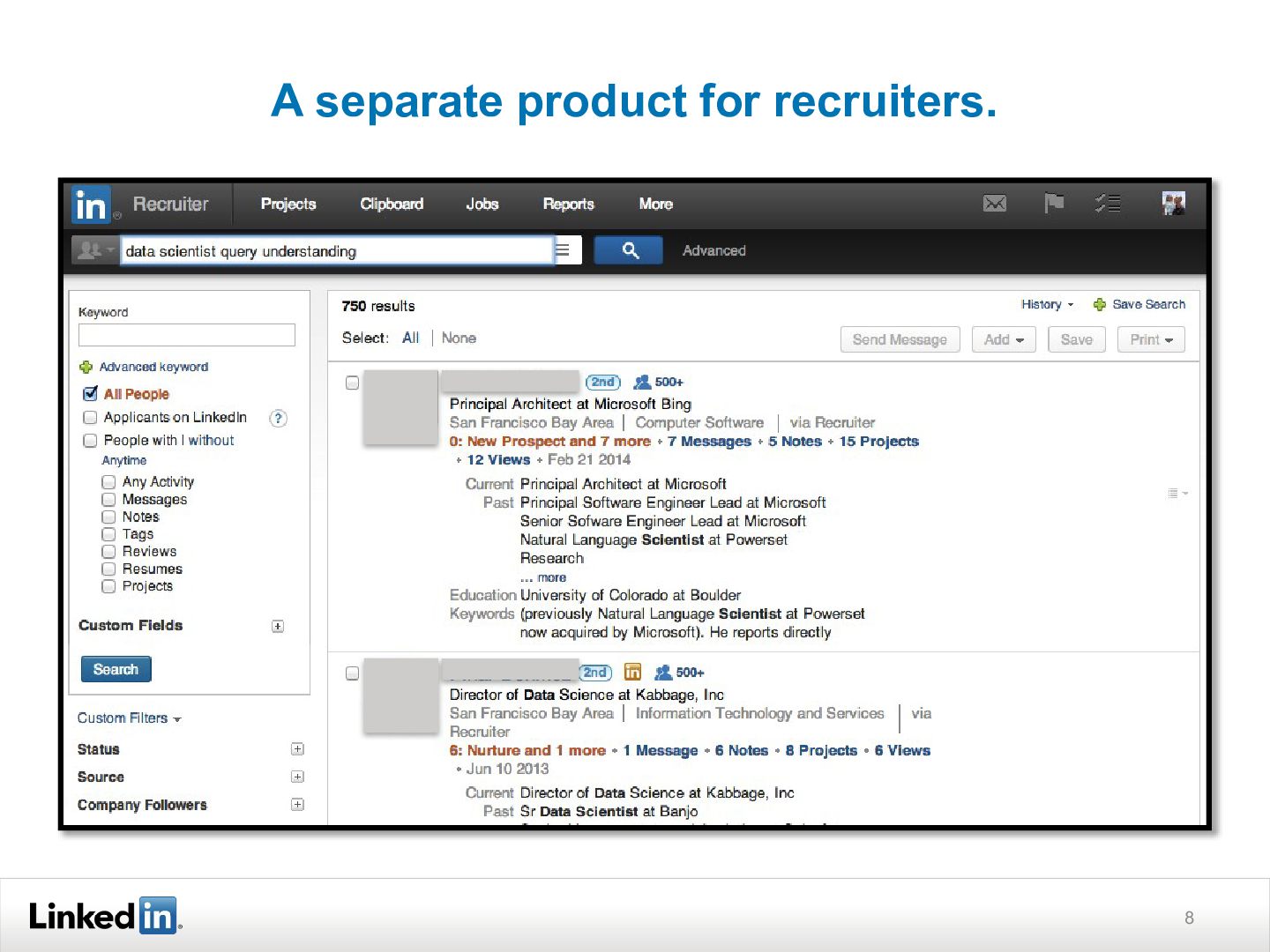
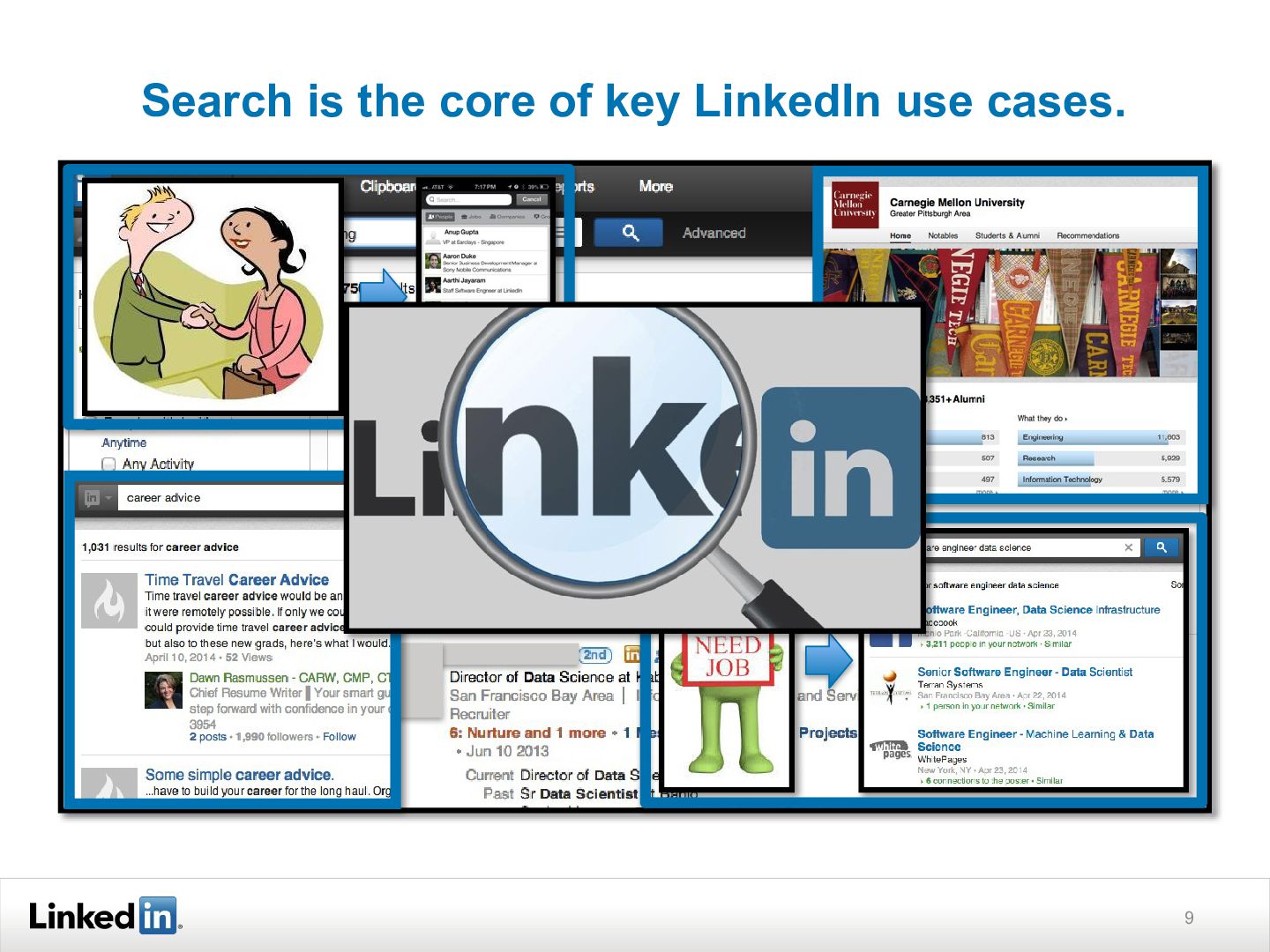
  5. 10 What’s unique  Personalized  Part of a larger

    product experience – Many products – Big part  Task-centric – Find a job, hire top talent, find a person, …
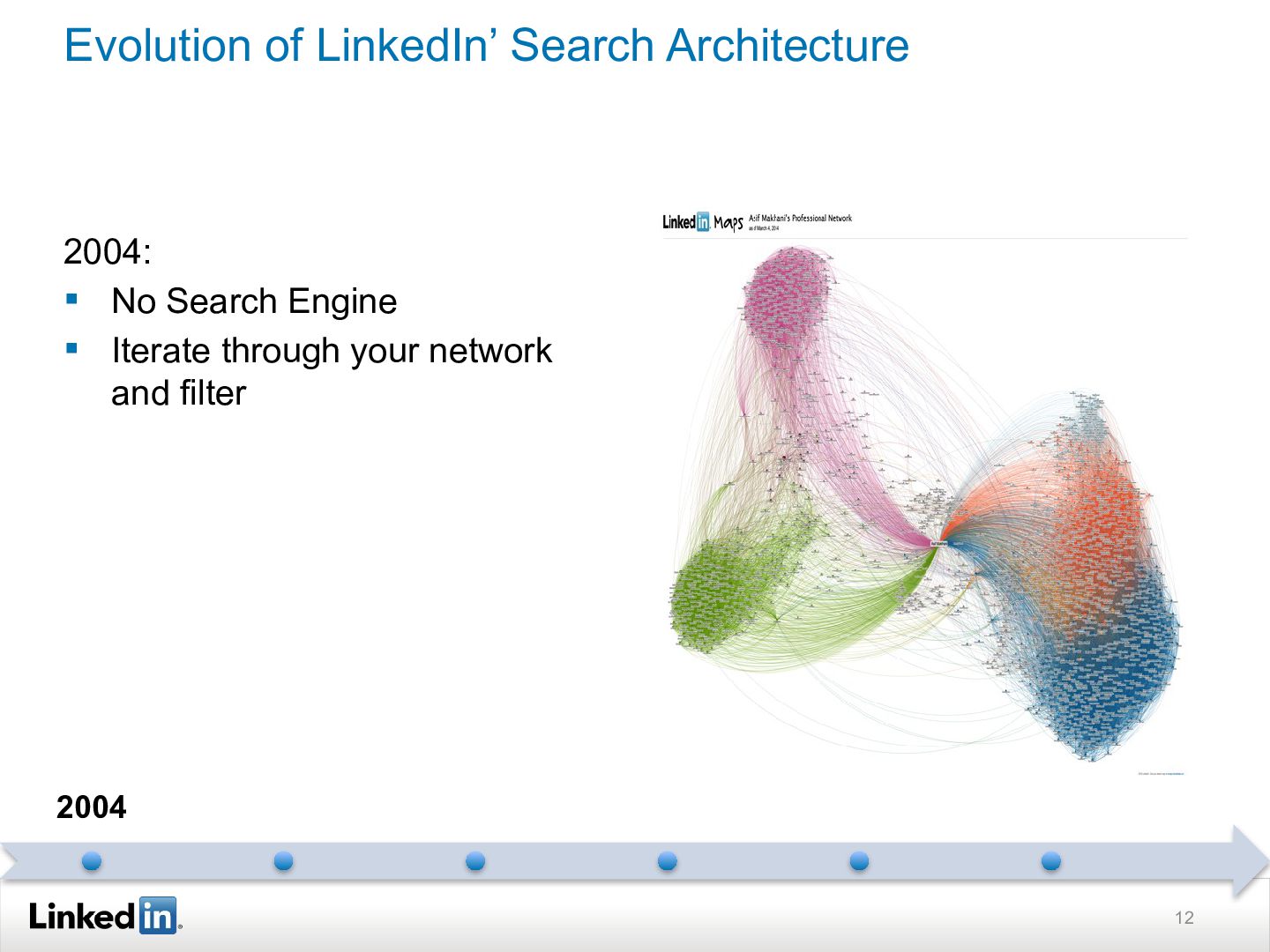
  6. 12 Evolution of LinkedIn’ Search Architecture 2004:  No Search

    Engine  Iterate through your network and filter 2004
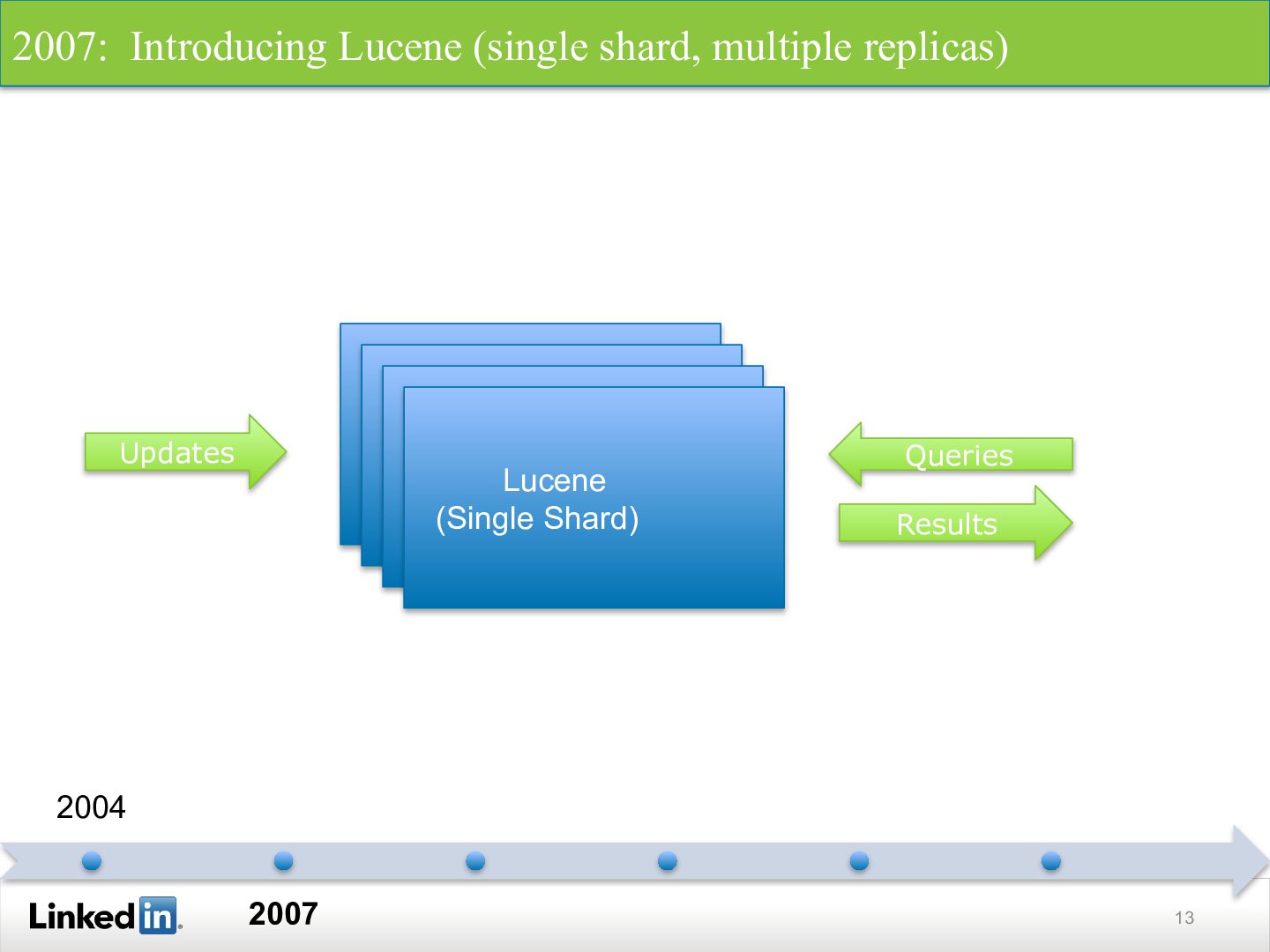
  7. 13 2004 2007 Lucene Lucene Lucene Lucene (Single Shard) Updates

    Queries Results 2007: Introducing Lucene (single shard, multiple replicas)
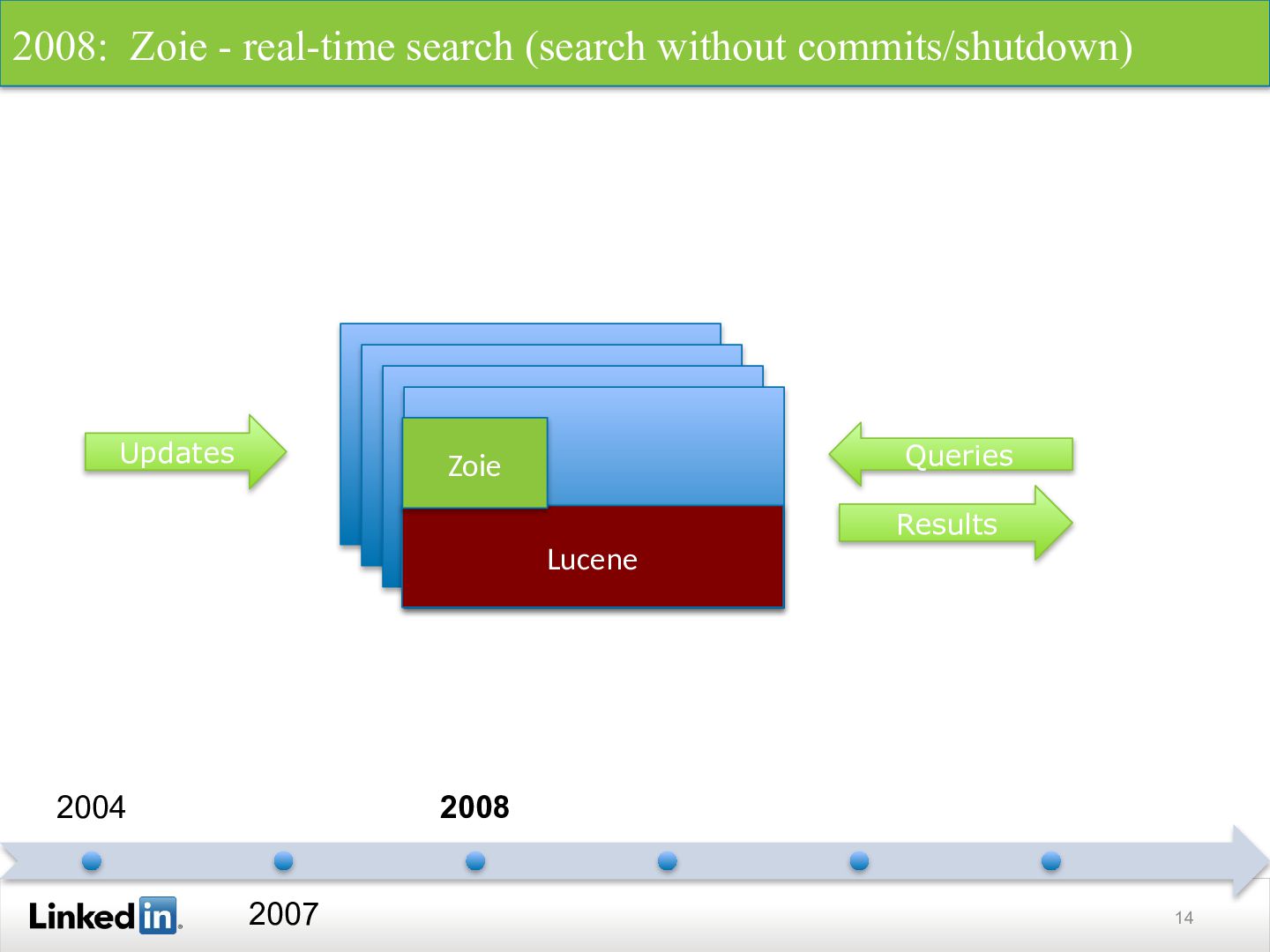
  8. 14 2004 2007 2008 Lucene Lucene Lucene Updates Queries Results

    Lucene Zoie 2008: Zoie - real-time search (search without commits/shutdown)
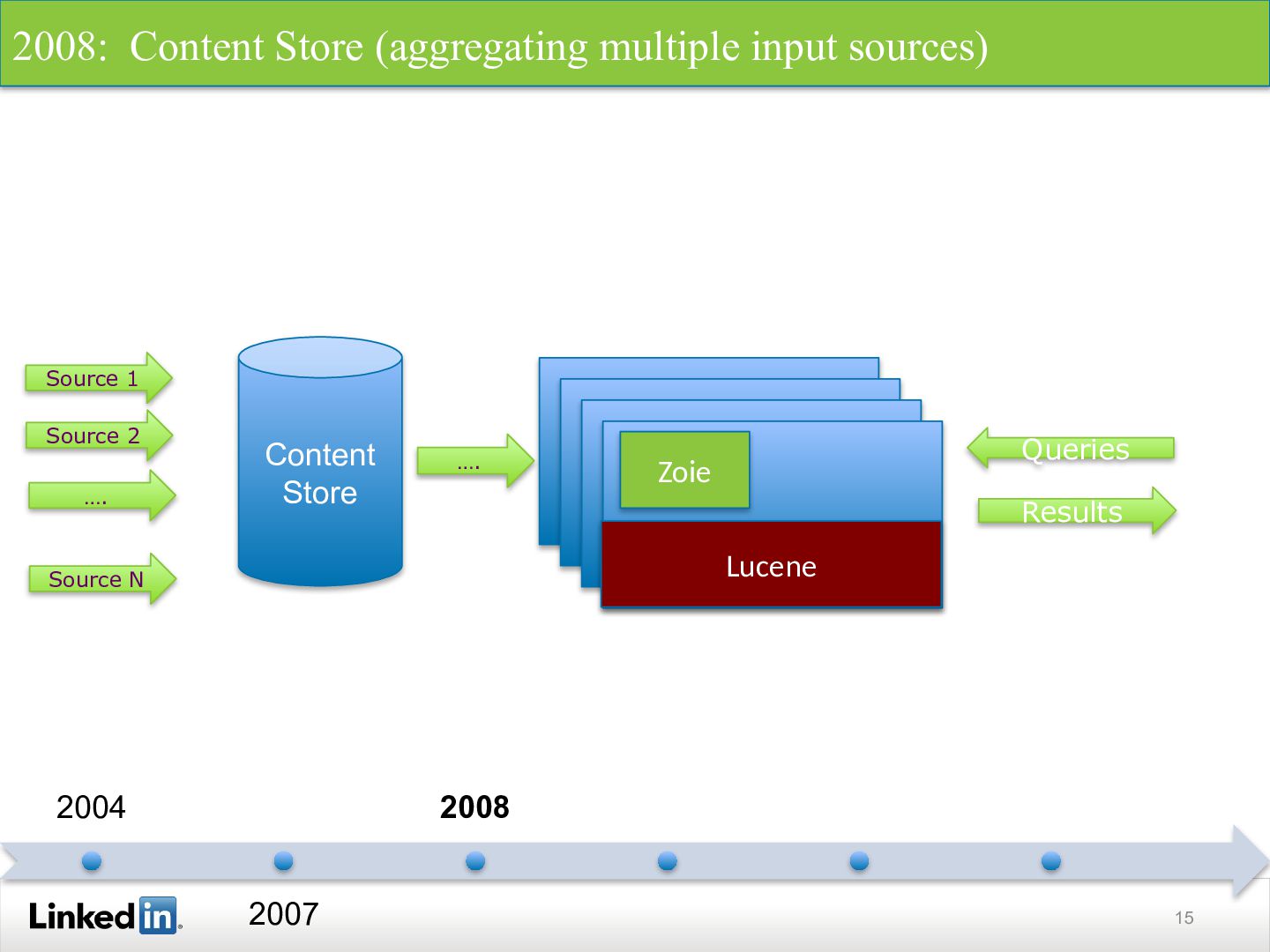
  9. 15 2004 2007 2008 Lucene Lucene Lucene Source 1 Queries

    Results Lucene Zoie Source 2 …. Source N Content Store …. 2008: Content Store (aggregating multiple input sources)
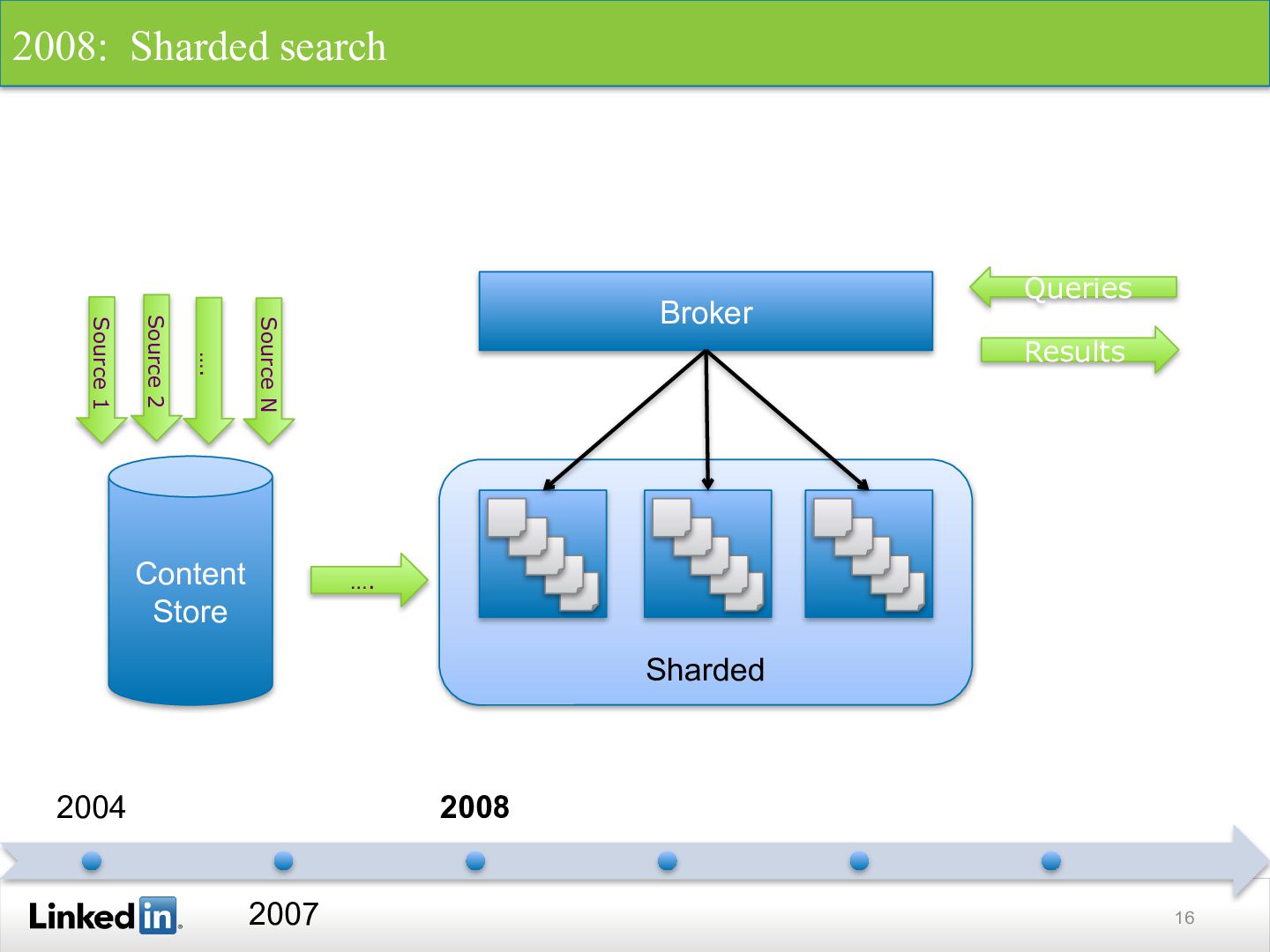
  10. 16 2004 2007 2008 Source 1 Queries Results Source 2

    …. Source N Content Store …. Sharded Broker 2008: Sharded search
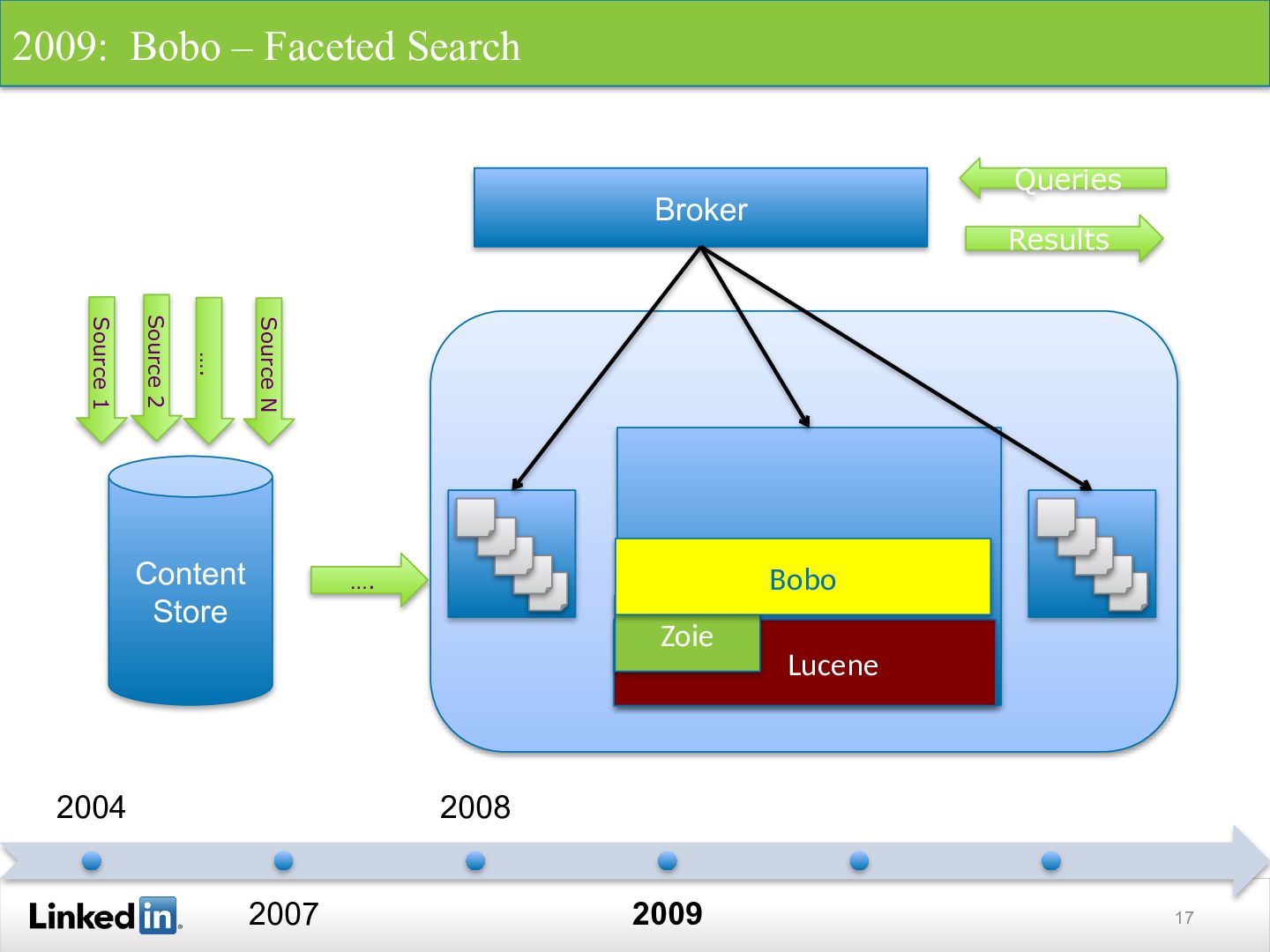
  11. 17 2004 2007 2008 2009 Source 1 Queries Results Source

    2 …. Source N Content Store …. Sensei Broker Lucene Zoie Bobo 2009: Bobo – Faceted Search
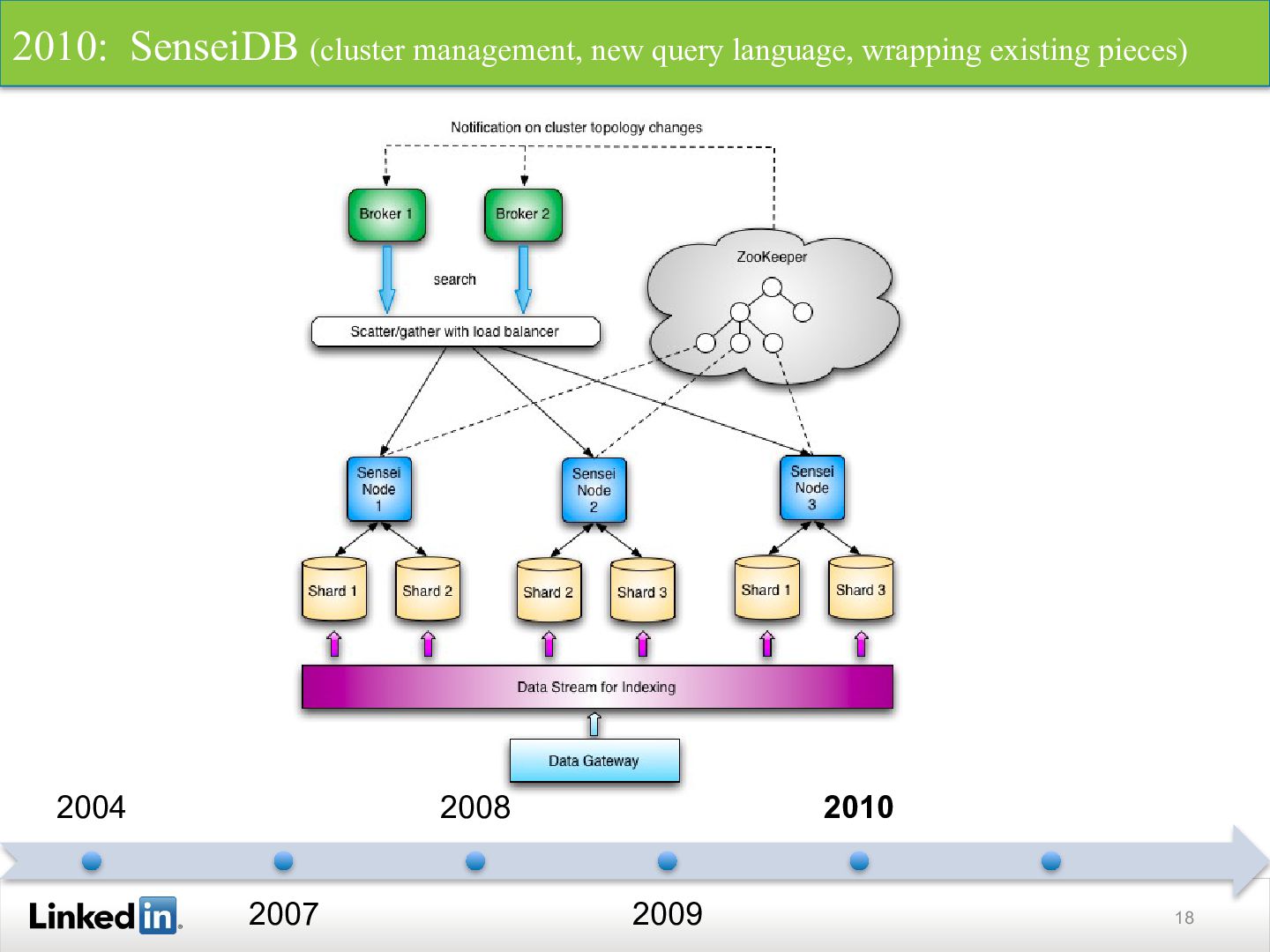
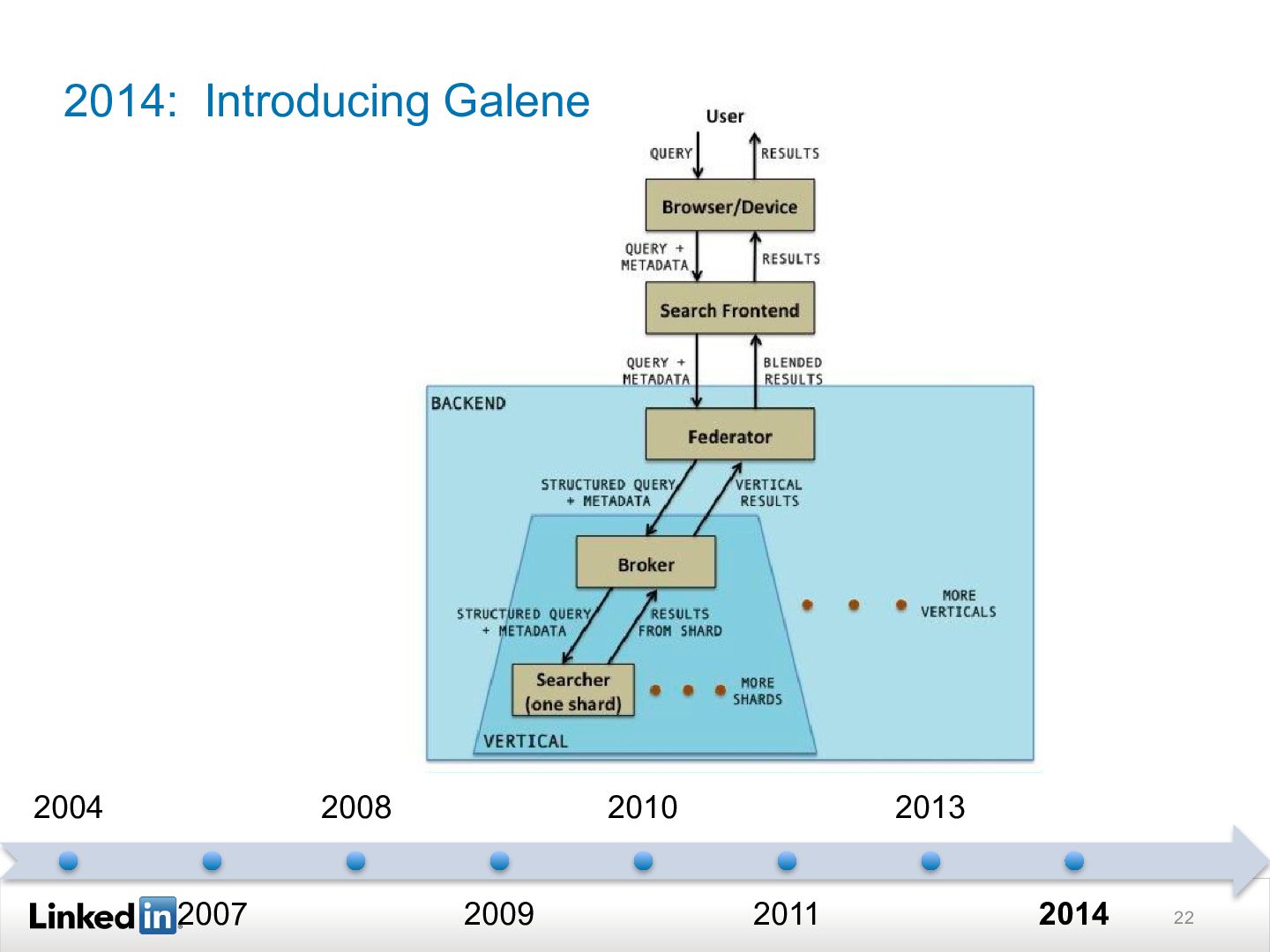
  12. 18 2004 2007 2008 2009 2010 2010: SenseiDB (cluster management,

    new query language, wrapping existing pieces)
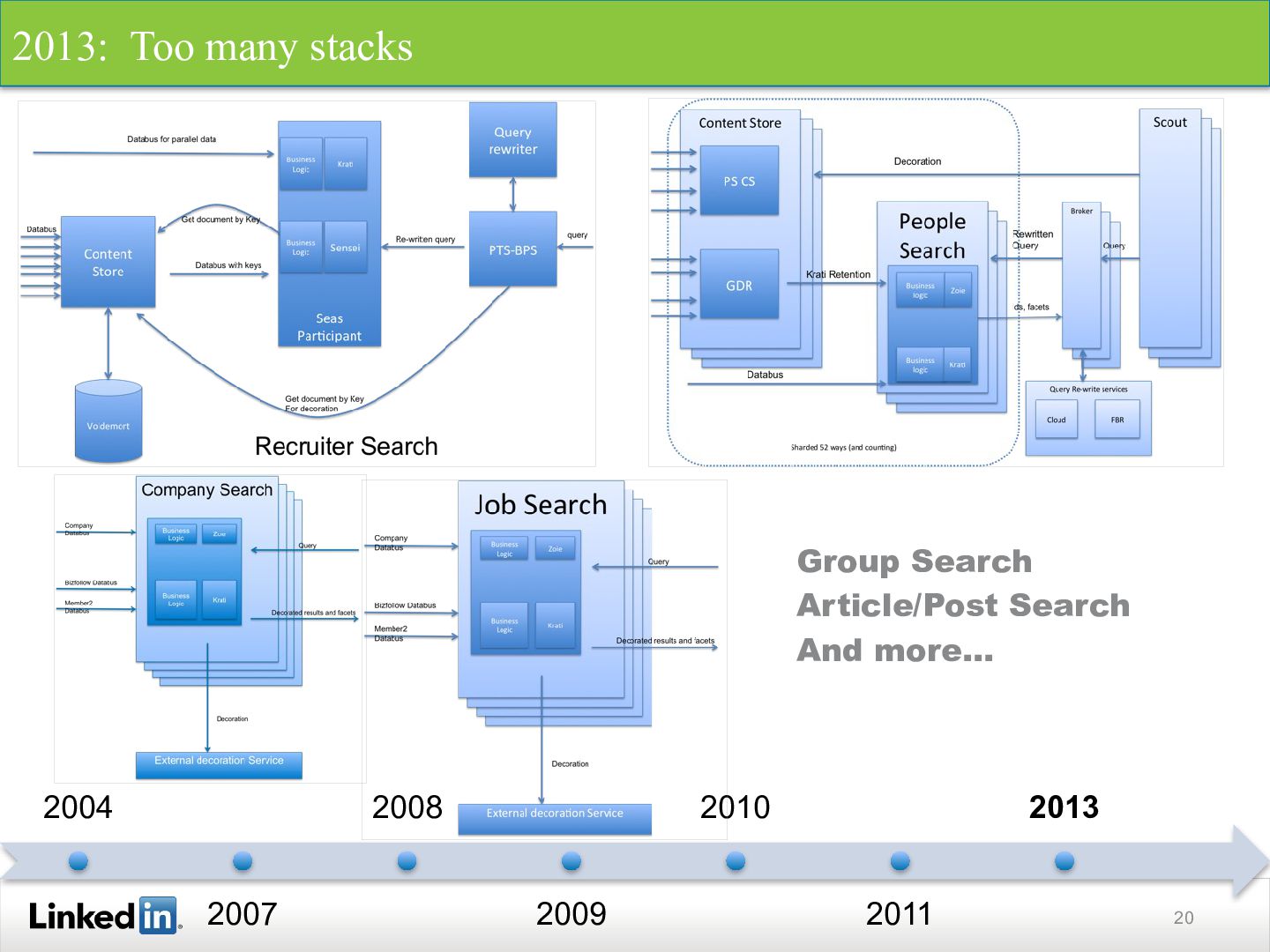
  13. 20 2004 2007 2008 2009 2010 2011 2013 2013: Too

    many stacks Group Search Article/Post Search And more…
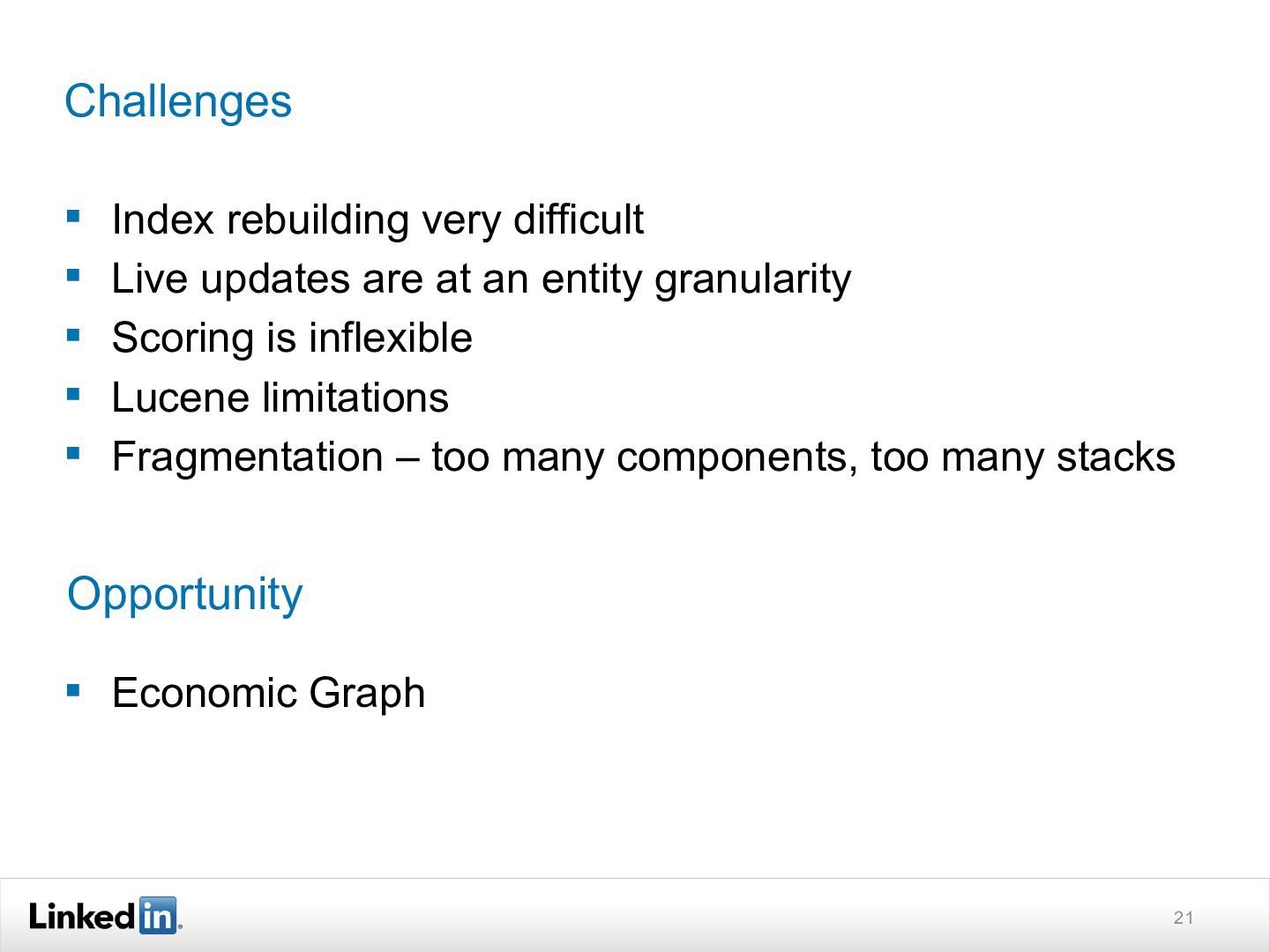
  14. 21 Challenges  Index rebuilding very difficult  Live updates

    are at an entity granularity  Scoring is inflexible  Lucene limitations  Fragmentation – too many components, too many stacks  Economic Graph Opportunity
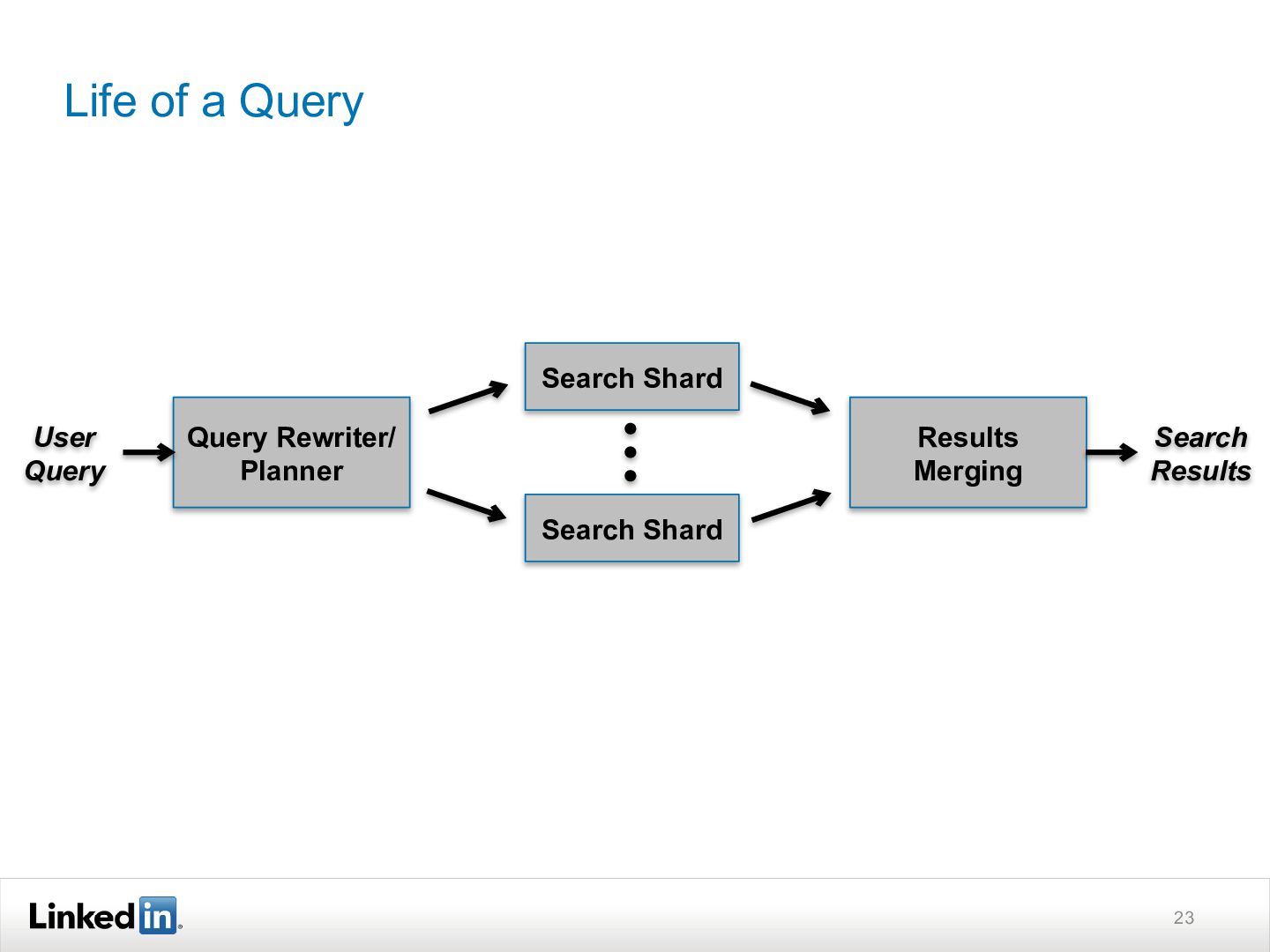
  15. 23 Life of a Query Query Rewriter/ Planner Results Merging

    User Query Search Results Search Shard Search Shard
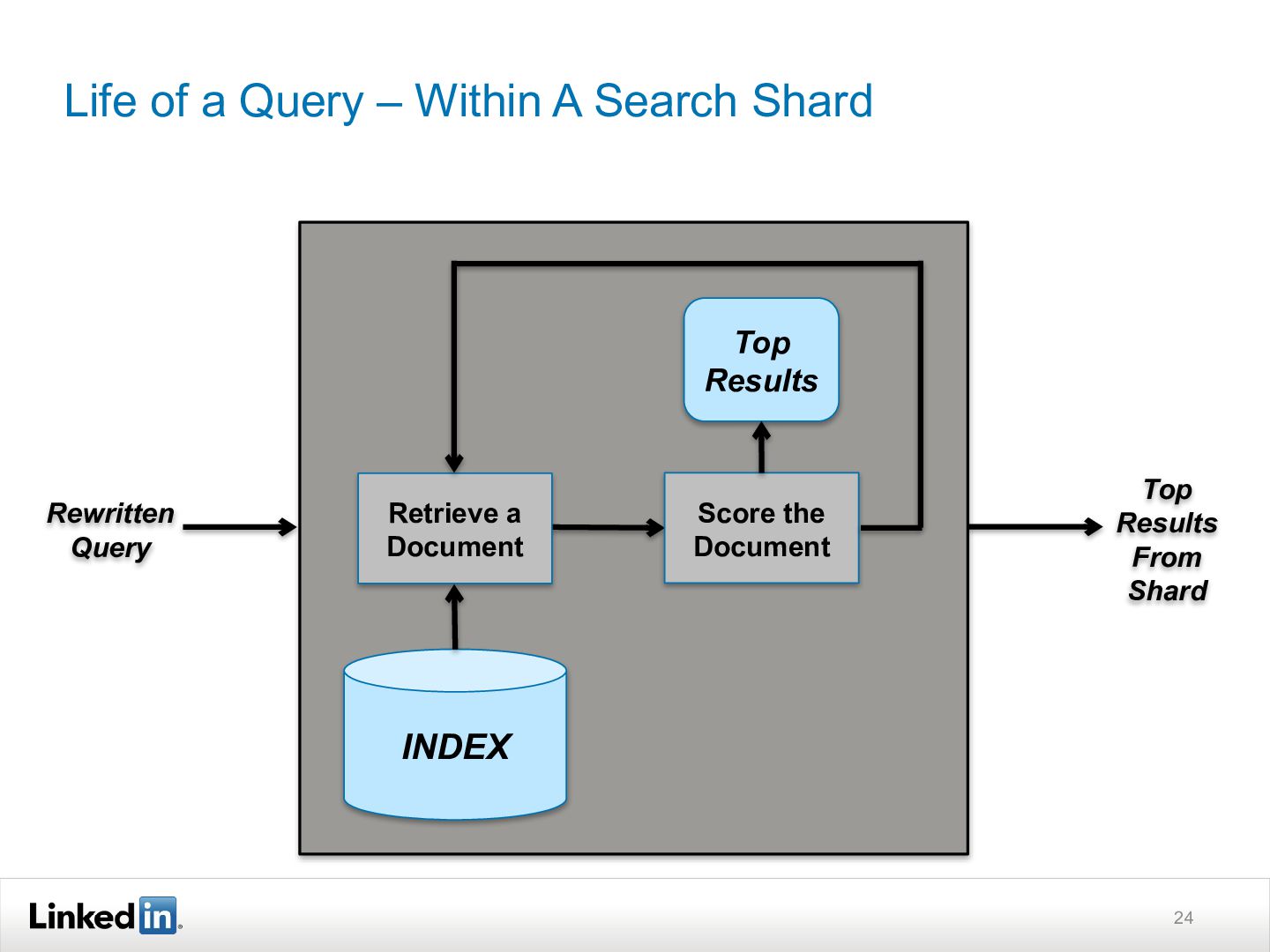
  16. 24 Life of a Query – Within A Search Shard

    Rewritten Query Top Results From Shard INDEX Top Results Retrieve a Document Score the Document
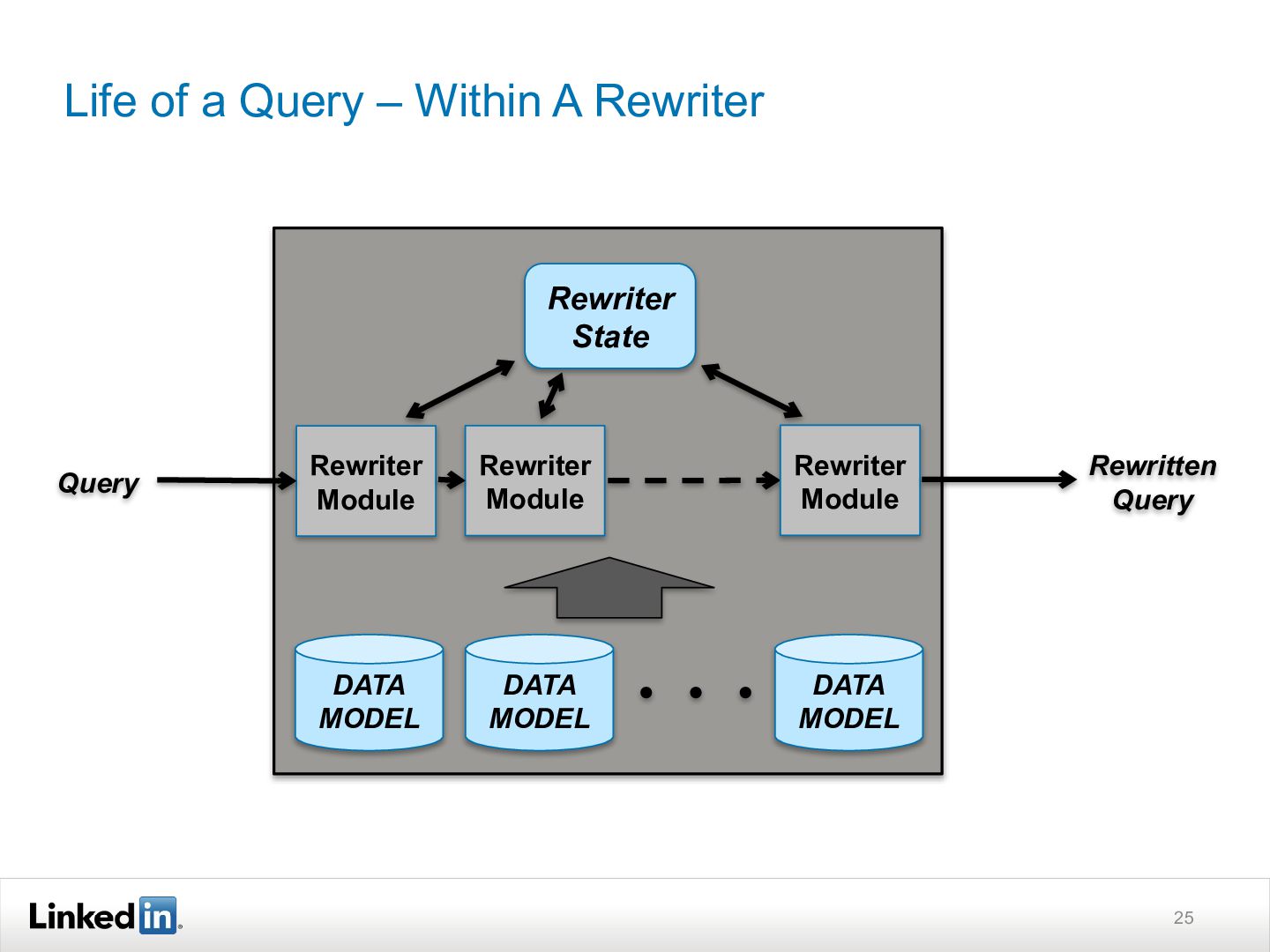
  17. 25 Life of a Query – Within A Rewriter Query

    DATA MODEL Rewriter State Rewriter Module DATA MODEL DATA MODEL Rewritten Query Rewriter Module Rewriter Module
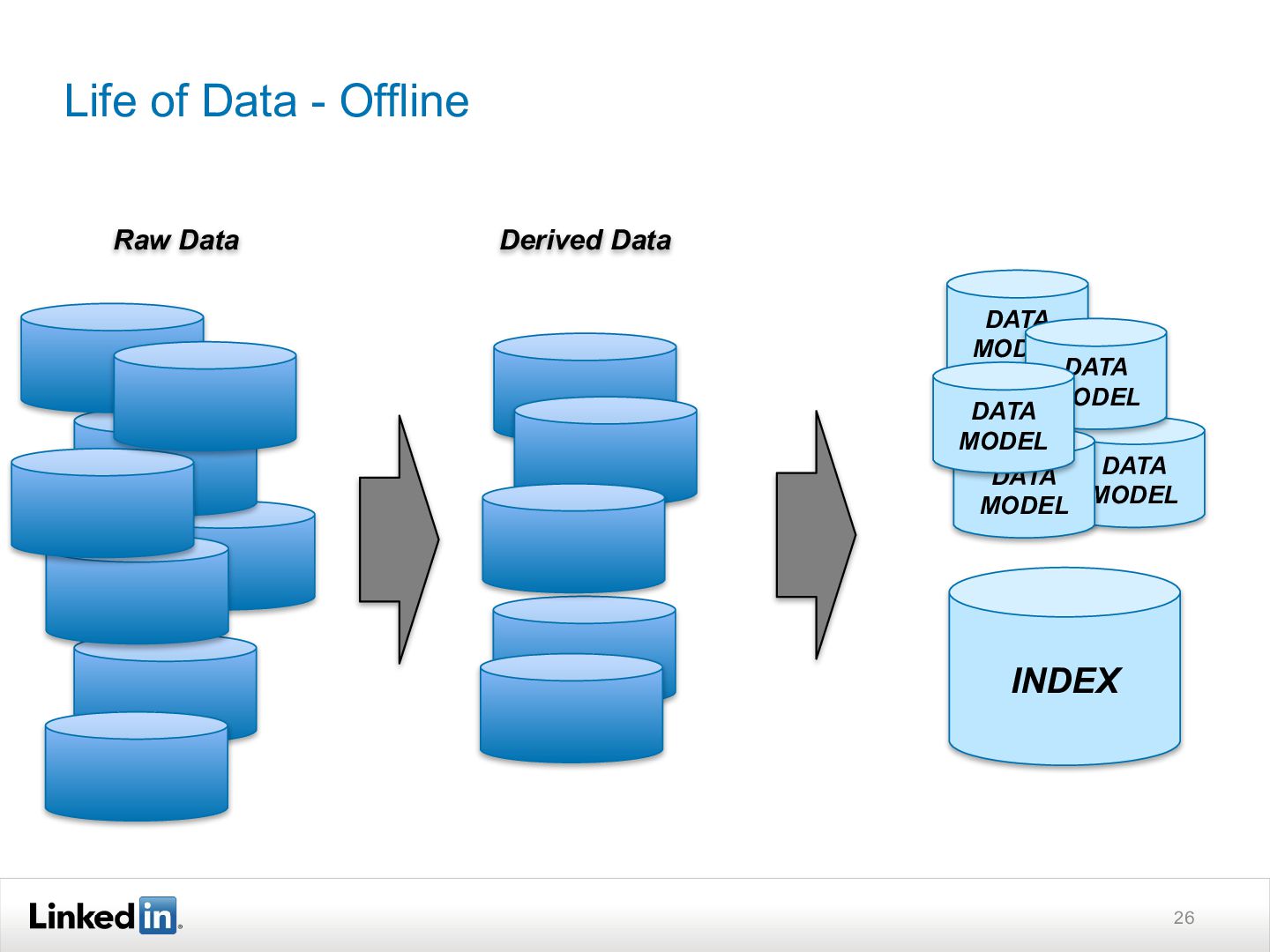
  18. 26 Life of Data - Offline INDEX Derived Data Raw

    Data DATA MODEL DATA MODEL DATA MODEL DATA MODEL DATA MODEL
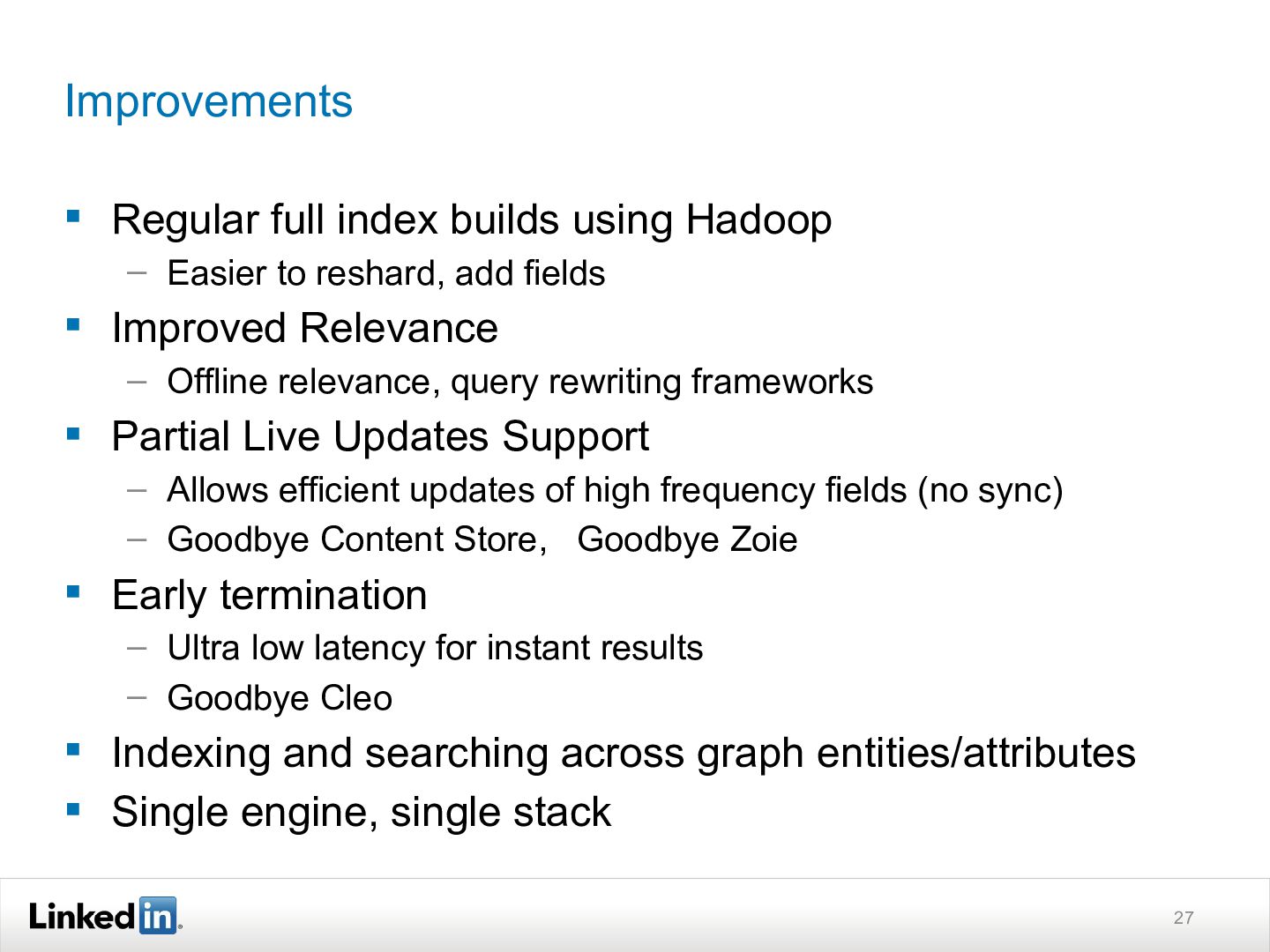
  19. 27 Improvements  Regular full index builds using Hadoop –

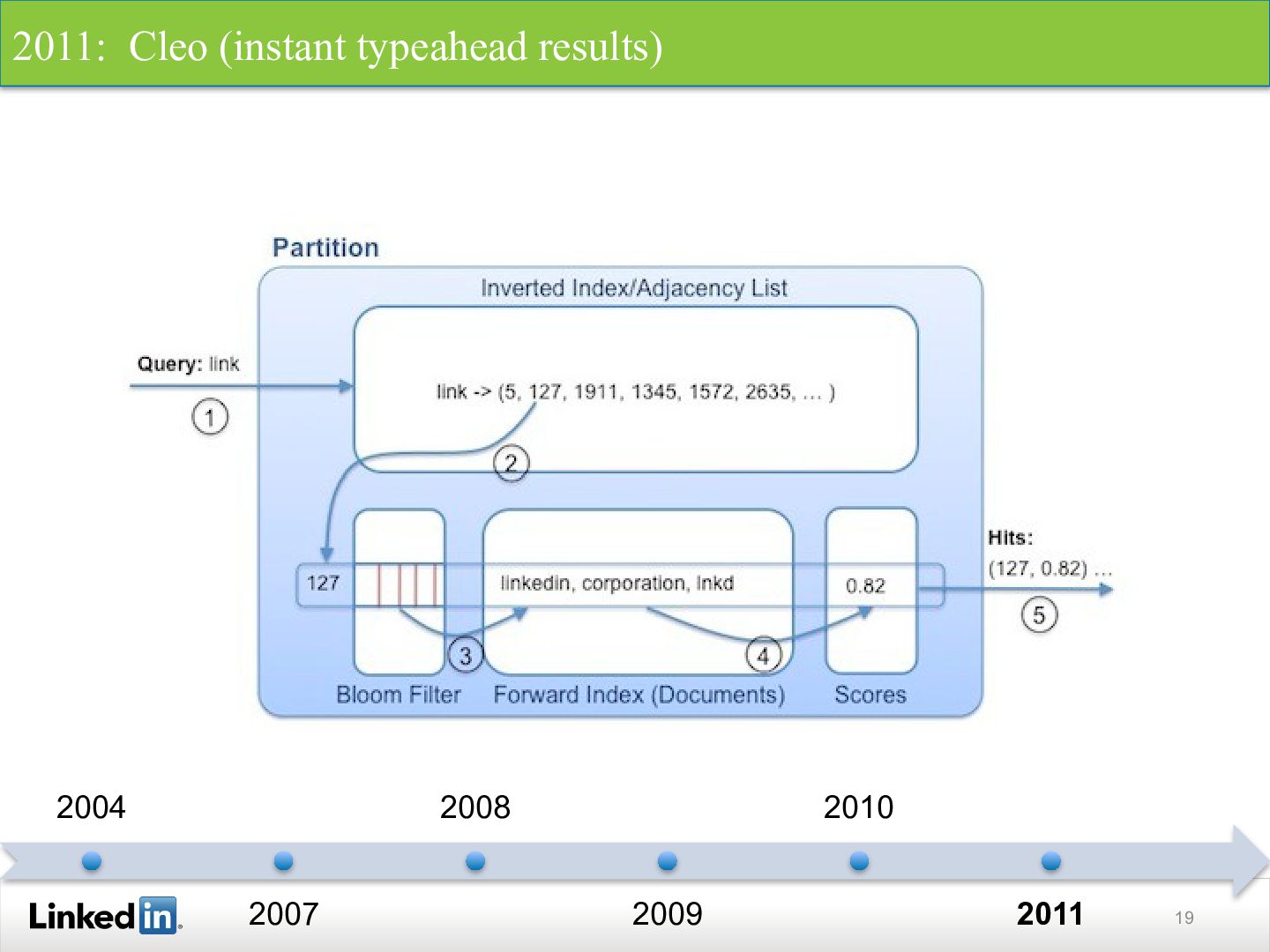
    Easier to reshard, add fields  Improved Relevance – Offline relevance, query rewriting frameworks  Partial Live Updates Support – Allows efficient updates of high frequency fields (no sync) – Goodbye Content Store, Goodbye Zoie  Early termination – Ultra low latency for instant results – Goodbye Cleo  Indexing and searching across graph entities/attributes  Single engine, single stack
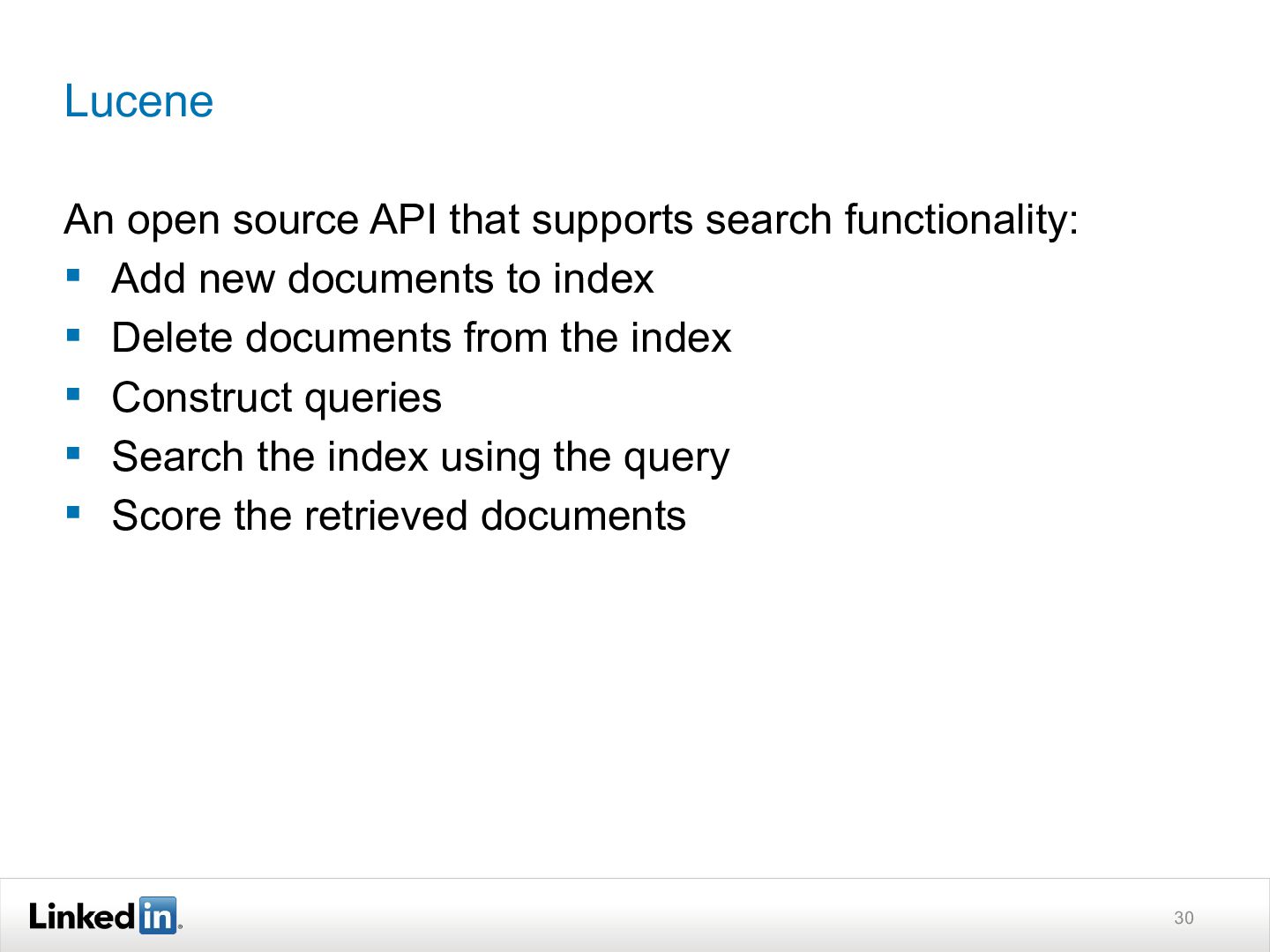
  20. 30 Lucene An open source API that supports search functionality:

     Add new documents to index  Delete documents from the index  Construct queries  Search the index using the query  Score the retrieved documents
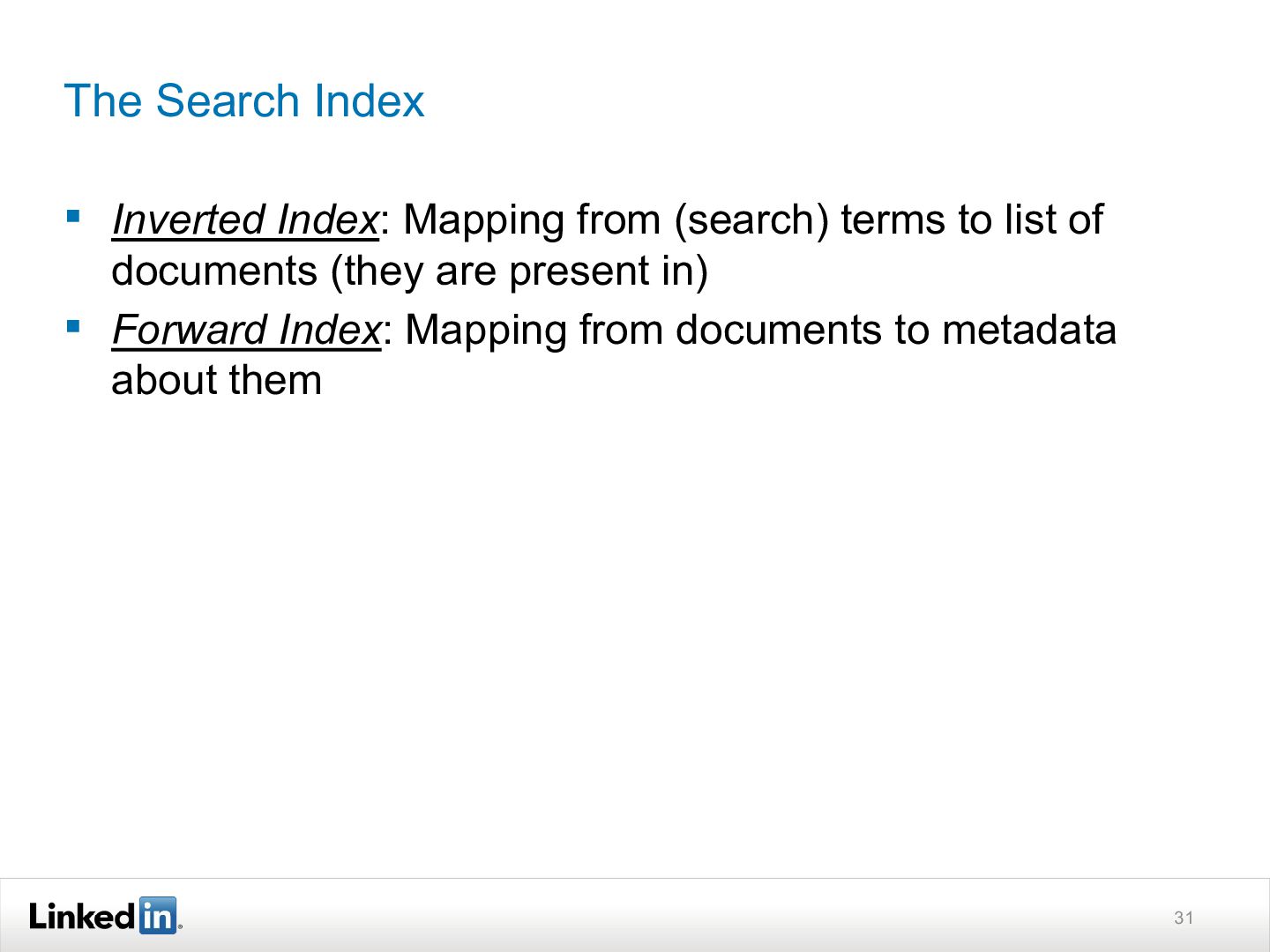
  21. 31 The Search Index  Inverted Index: Mapping from (search)

    terms to list of documents (they are present in)  Forward Index: Mapping from documents to metadata about them
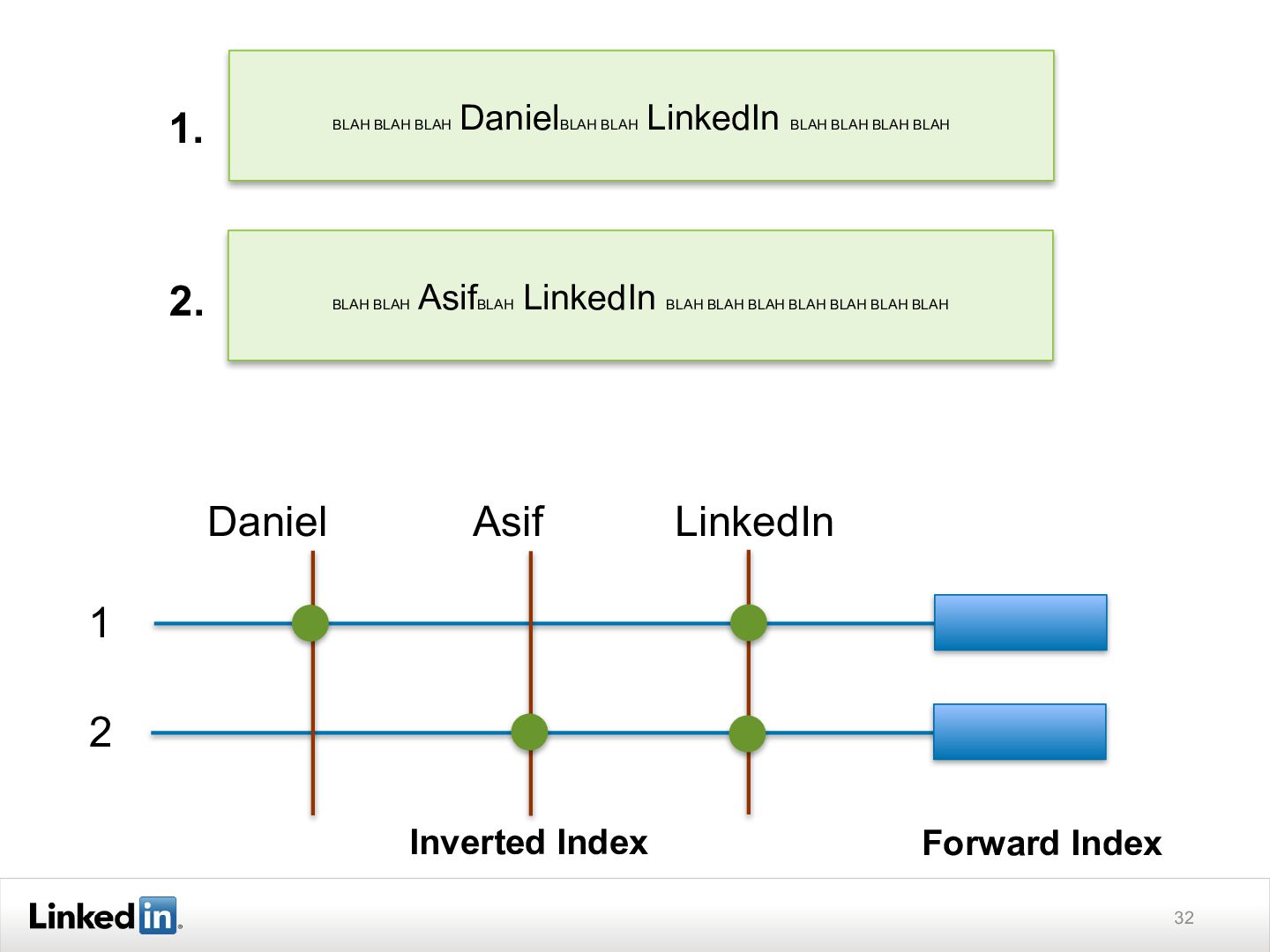
  22. 32 BLAH BLAH BLAH Daniel BLAH BLAH LinkedIn BLAH BLAH

    BLAH BLAH BLAH BLAH Asif BLAH LinkedIn BLAH BLAH BLAH BLAH BLAH BLAH BLAH 2. 1. Daniel Asif LinkedIn 2 1 Inverted Index Forward Index
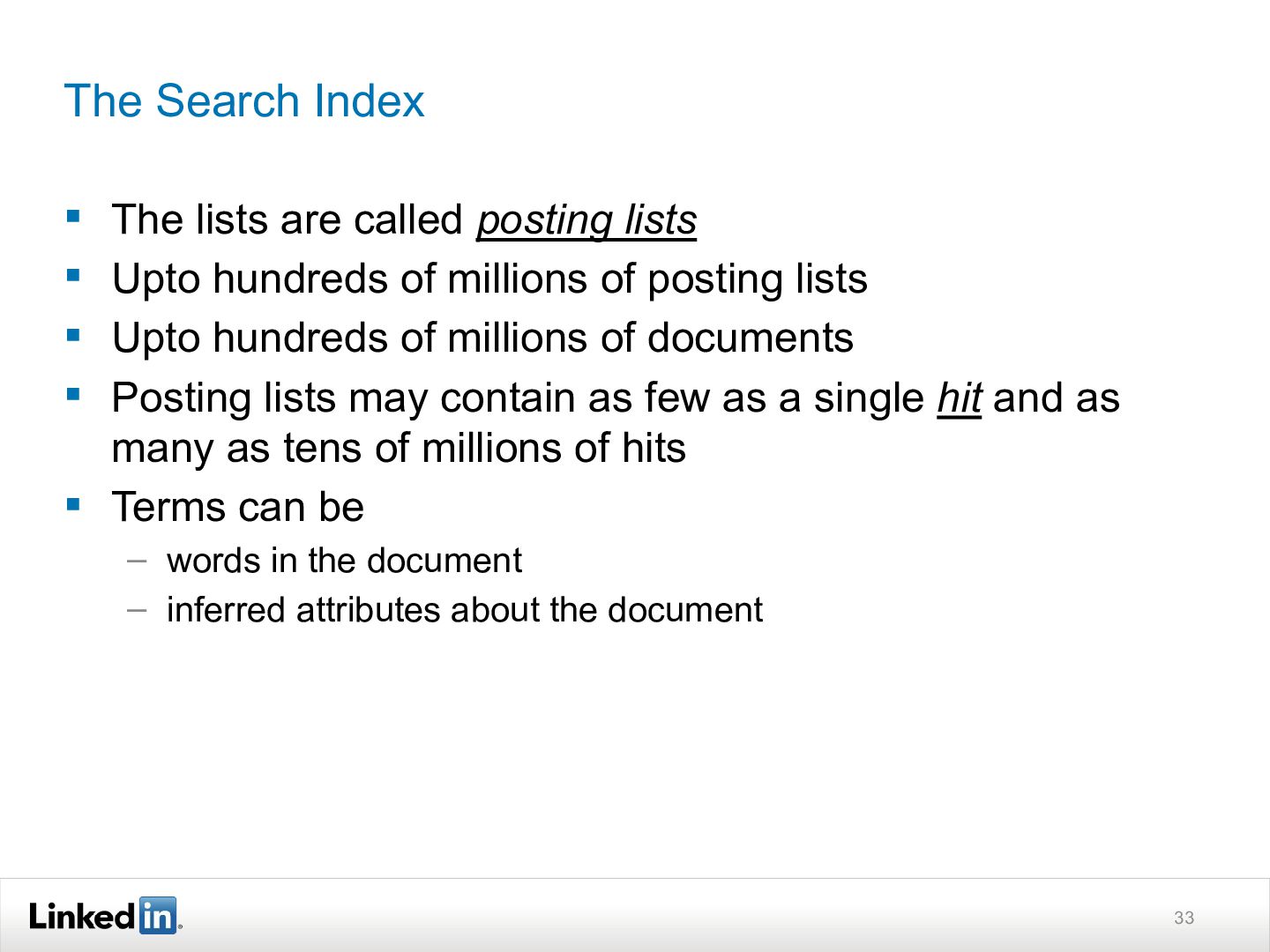
  23. 33 The Search Index  The lists are called posting

    lists  Upto hundreds of millions of posting lists  Upto hundreds of millions of documents  Posting lists may contain as few as a single hit and as many as tens of millions of hits  Terms can be – words in the document – inferred attributes about the document
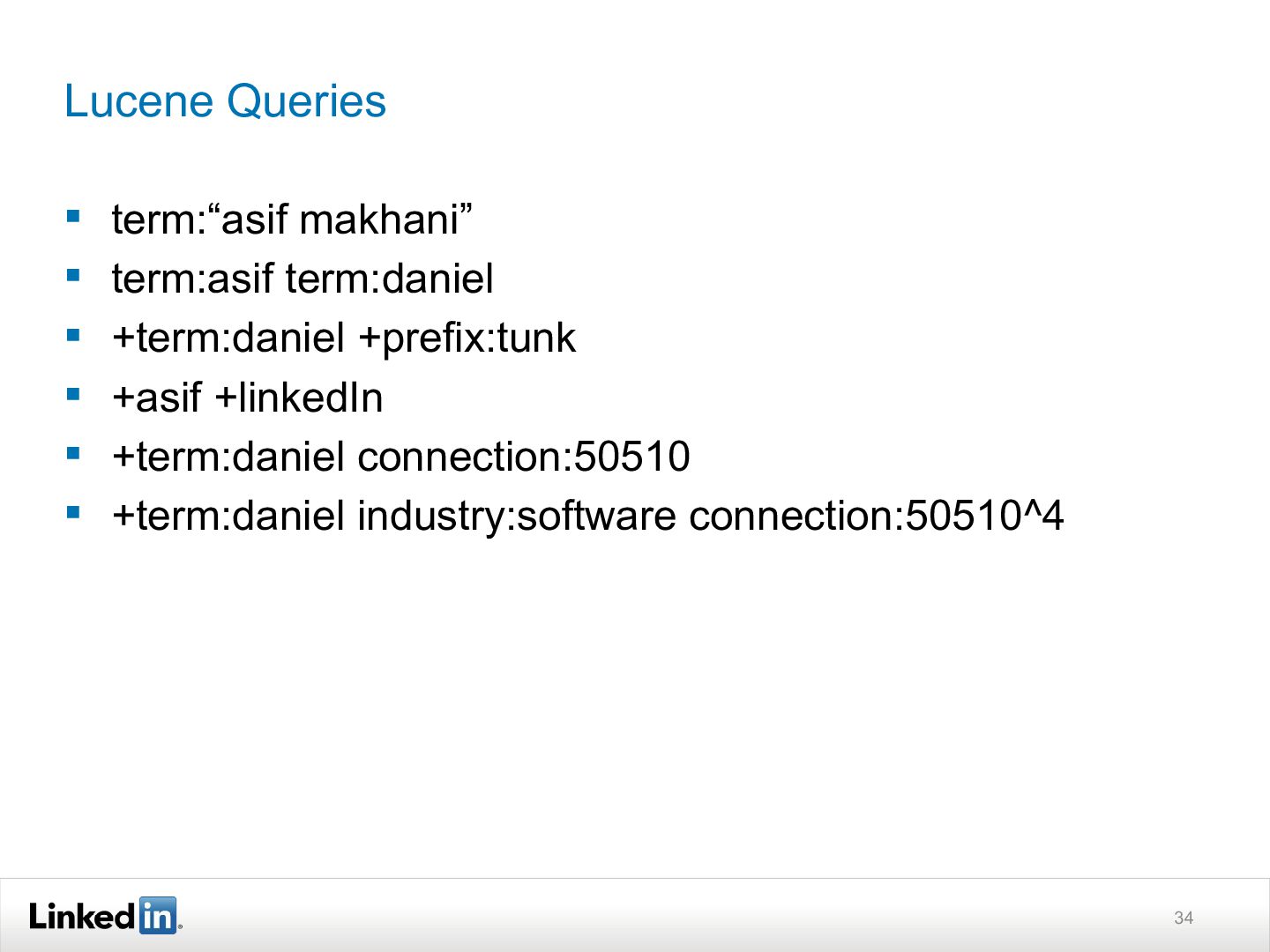
  24. 34 Lucene Queries  term:“asif makhani”  term:asif term:daniel 

    +term:daniel +prefix:tunk  +asif +linkedIn  +term:daniel connection:50510  +term:daniel industry:software connection:50510^4
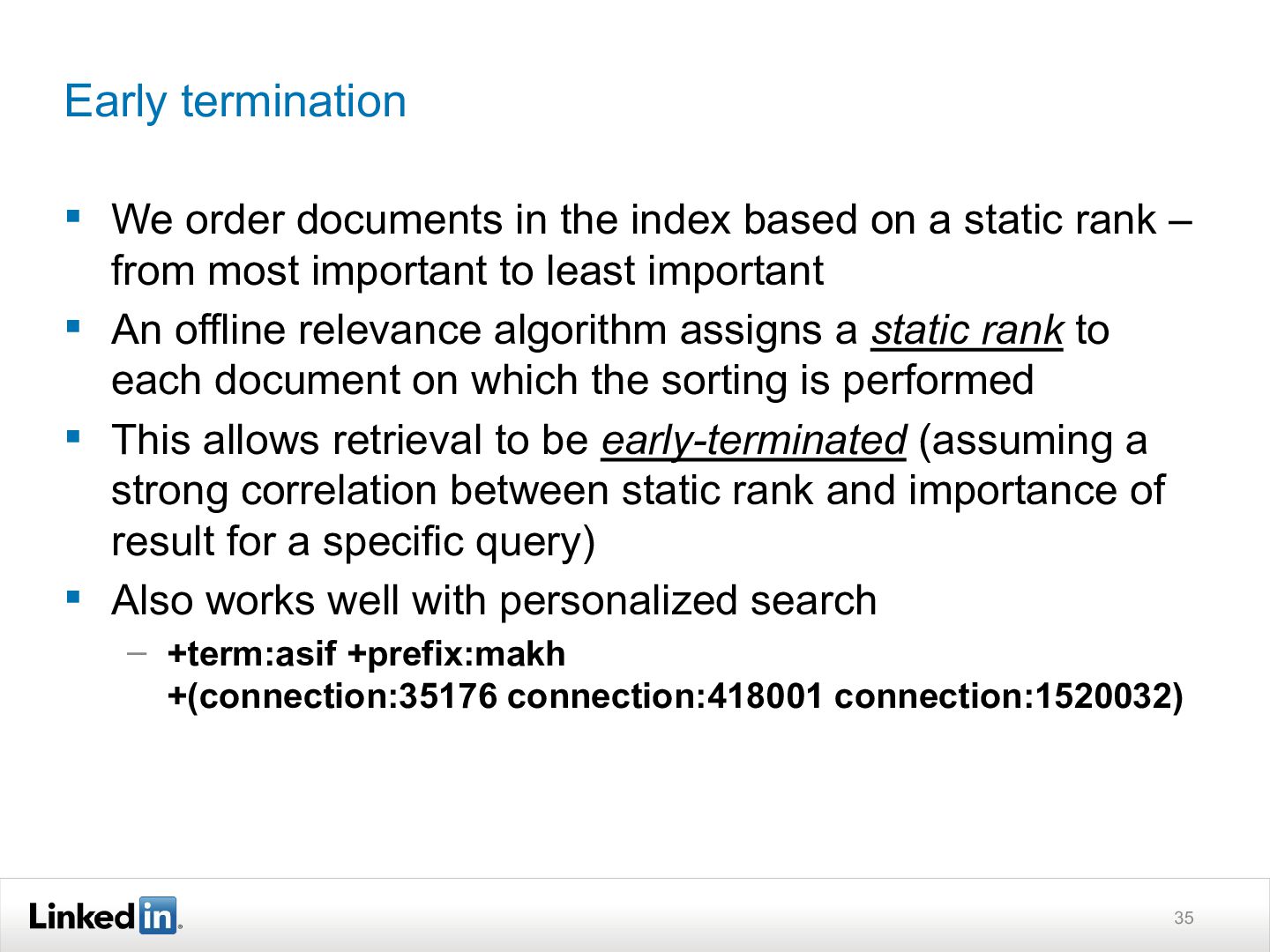
  25. 35 Early termination  We order documents in the index

    based on a static rank – from most important to least important  An offline relevance algorithm assigns a static rank to each document on which the sorting is performed  This allows retrieval to be early-terminated (assuming a strong correlation between static rank and importance of result for a specific query)  Also works well with personalized search – +term:asif +prefix:makh +(connection:35176 connection:418001 connection:1520032)
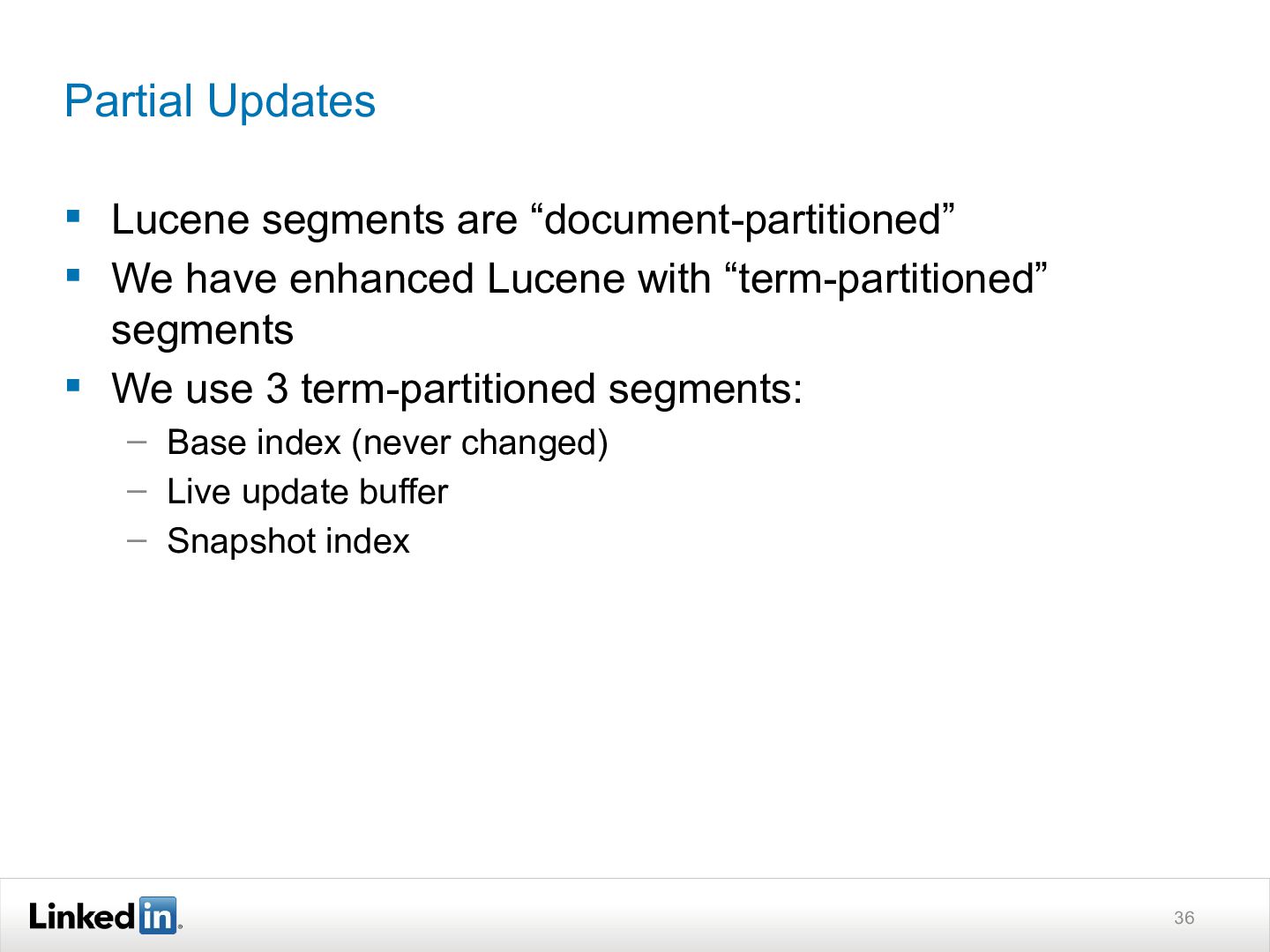
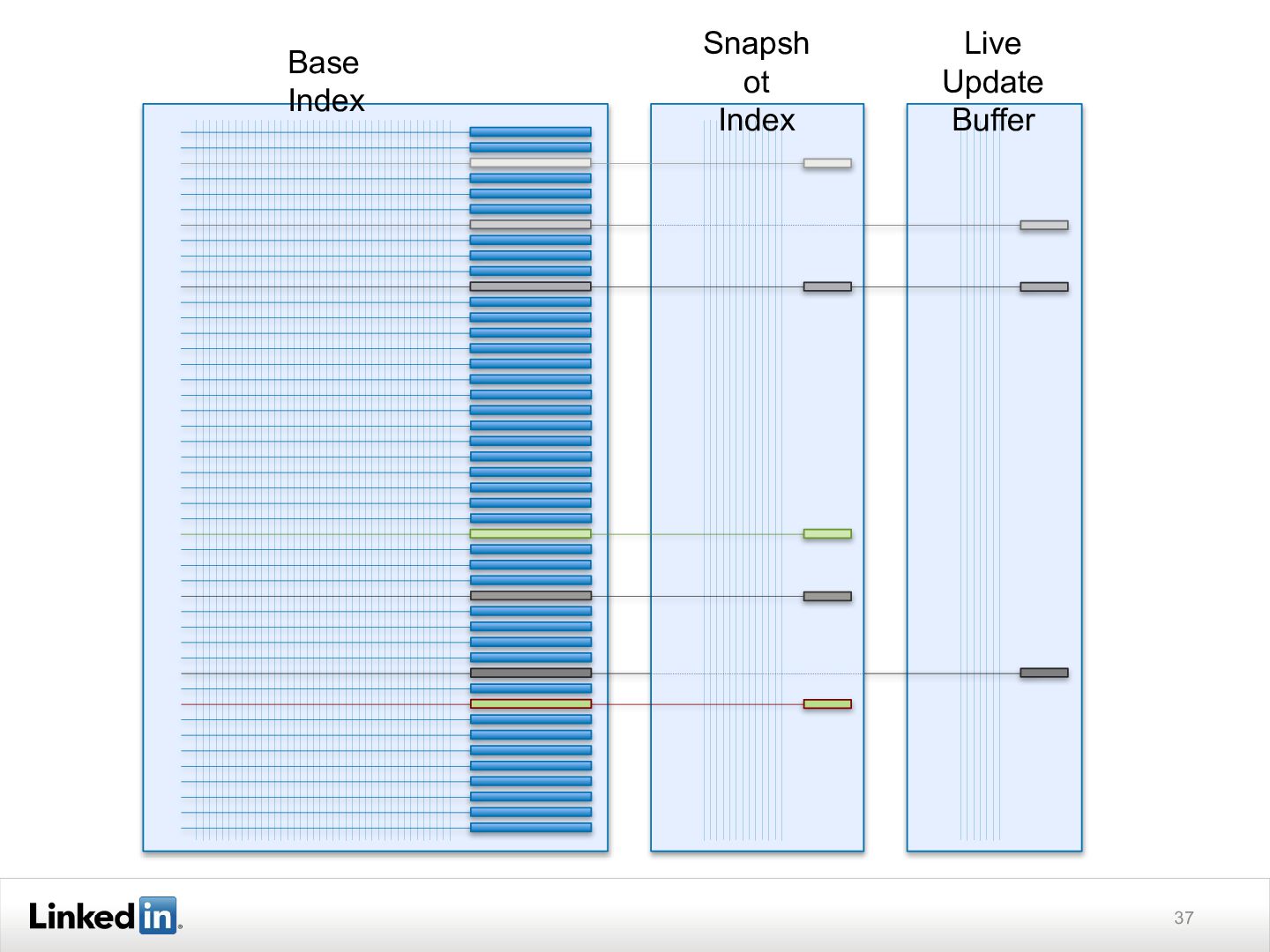
  26. 36 Partial Updates  Lucene segments are “document-partitioned”  We

    have enhanced Lucene with “term-partitioned” segments  We use 3 term-partitioned segments: – Base index (never changed) – Live update buffer – Snapshot index
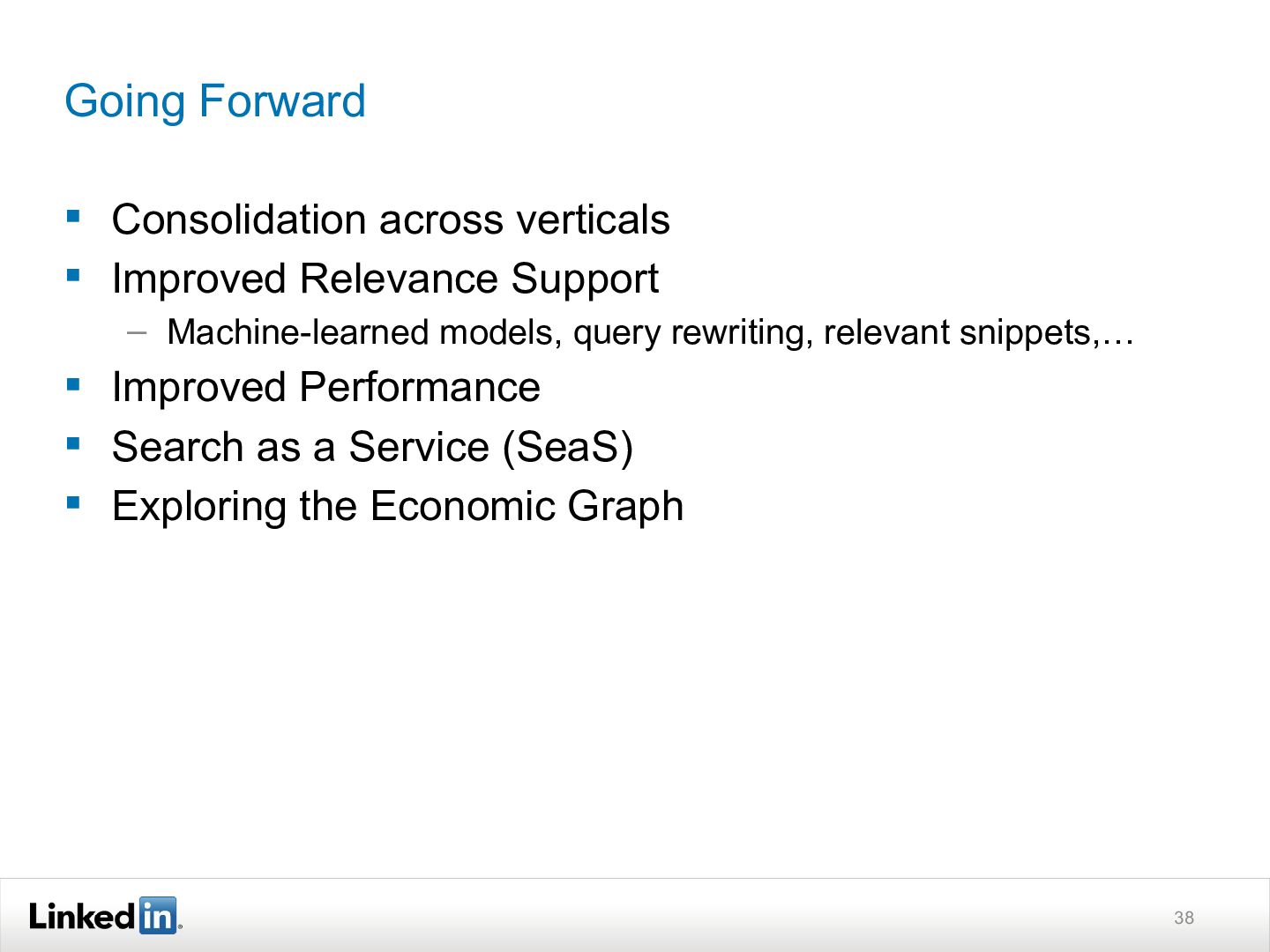
  27. 38 Going Forward  Consolidation across verticals  Improved Relevance

    Support – Machine-learned models, query rewriting, relevant snippets,…  Improved Performance  Search as a Service (SeaS)  Exploring the Economic Graph
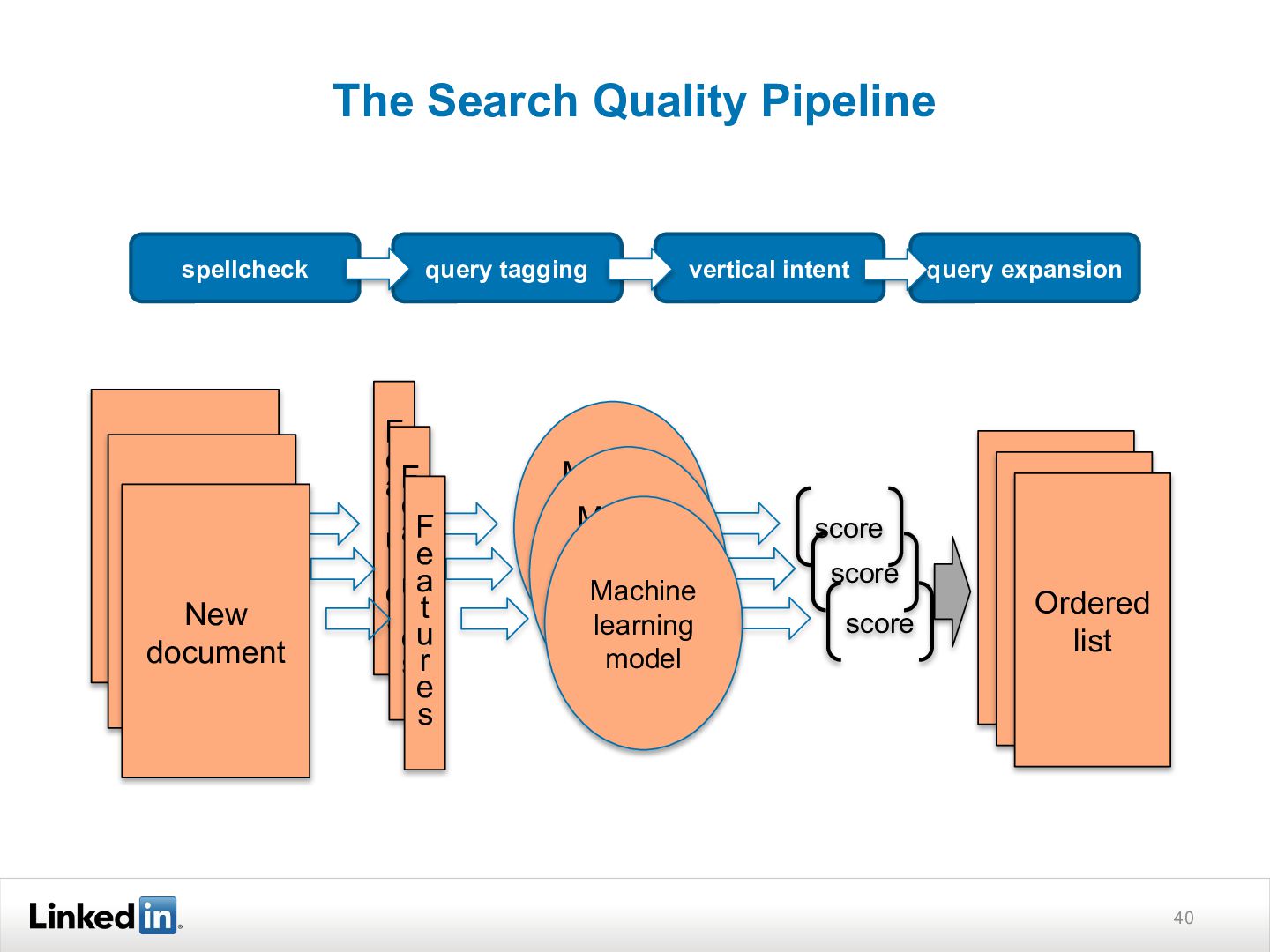
  28. 40 The Search Quality Pipeline New document F e a

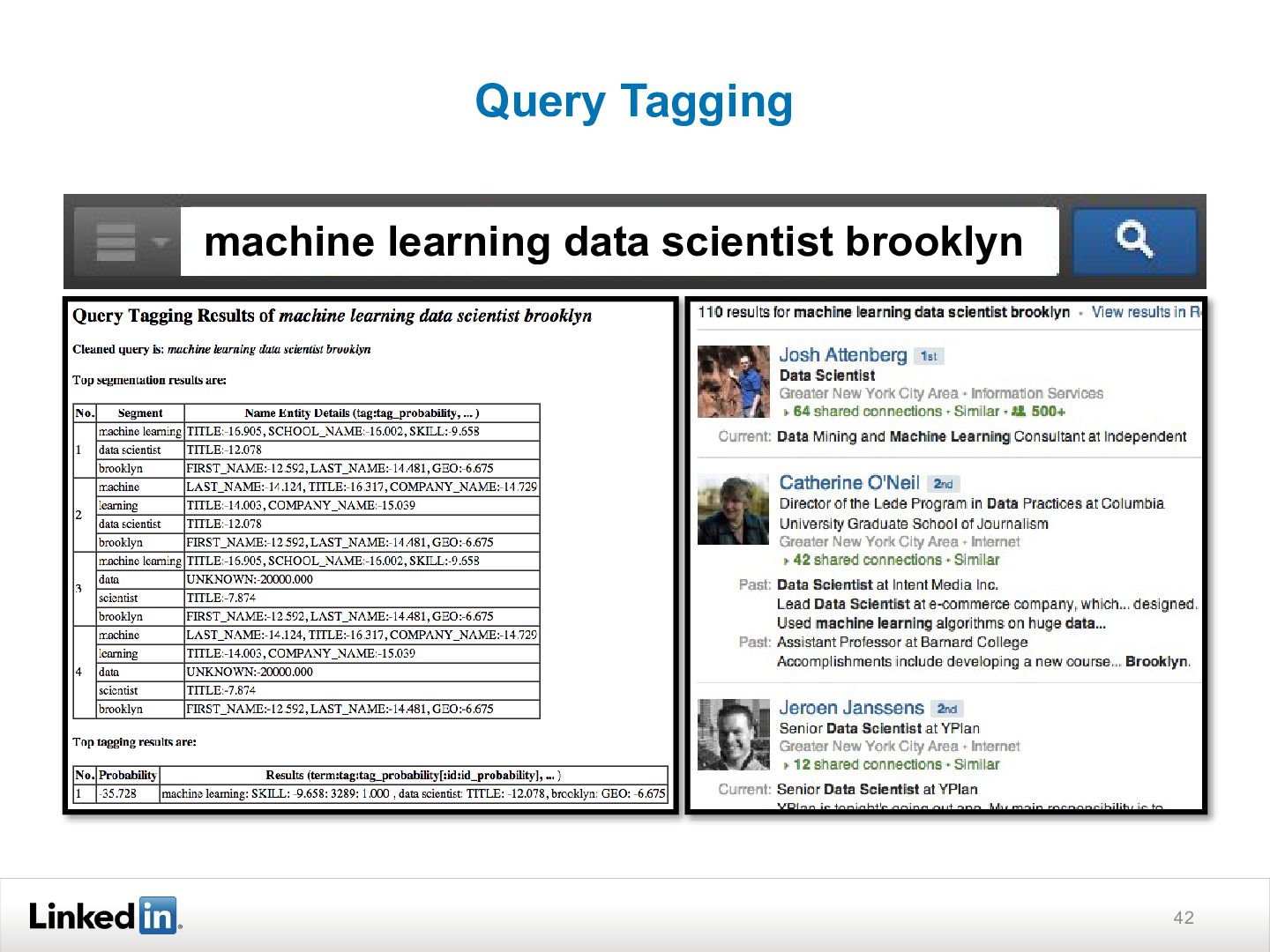
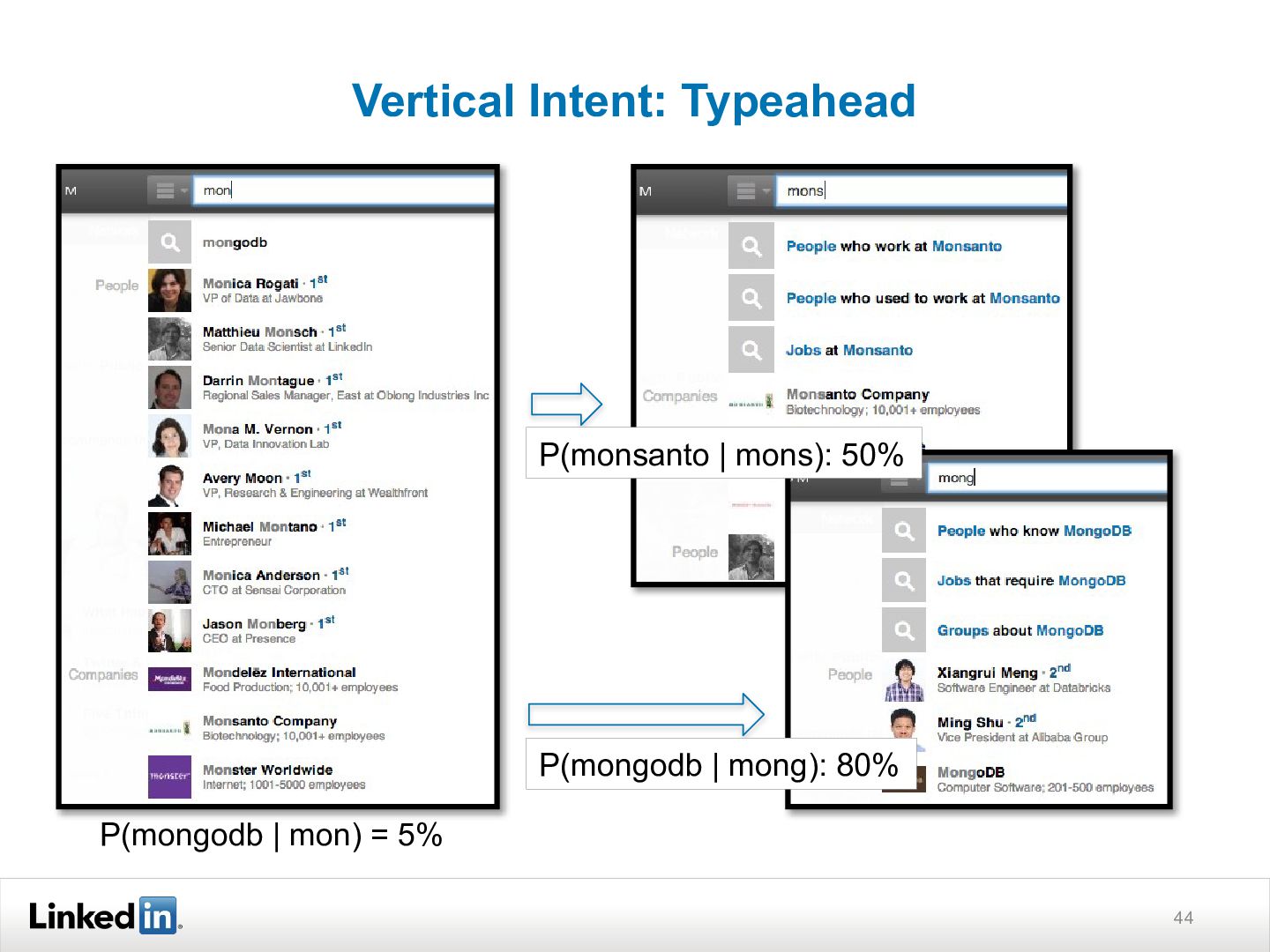
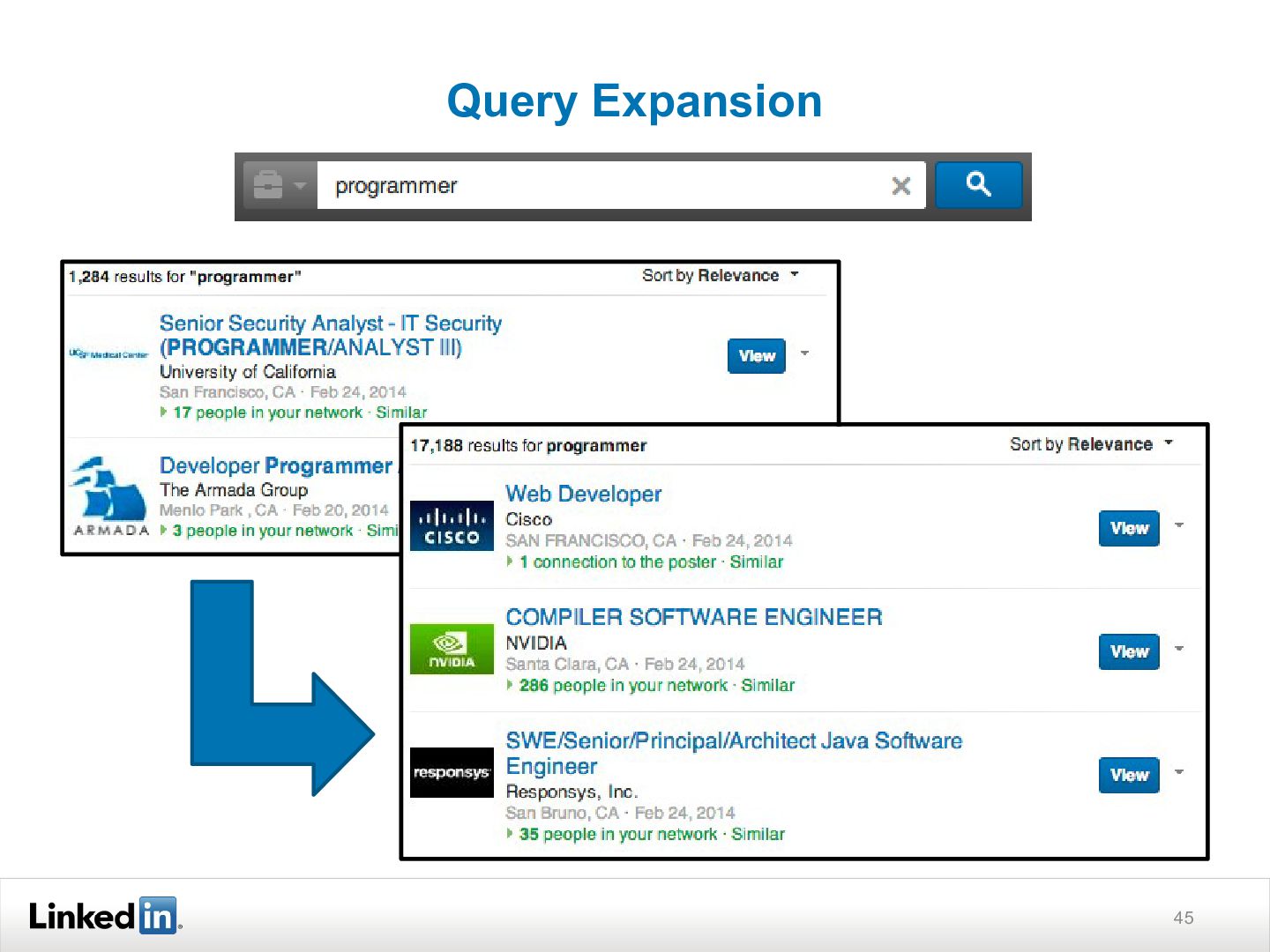
    t u r e s Machin e learning model score New document F e a t u r e s Machin e learning model score New document F e a t u r e s Machine learning model score Ordered list Ordered list Ordered list spellcheck query tagging vertical intent query expansion
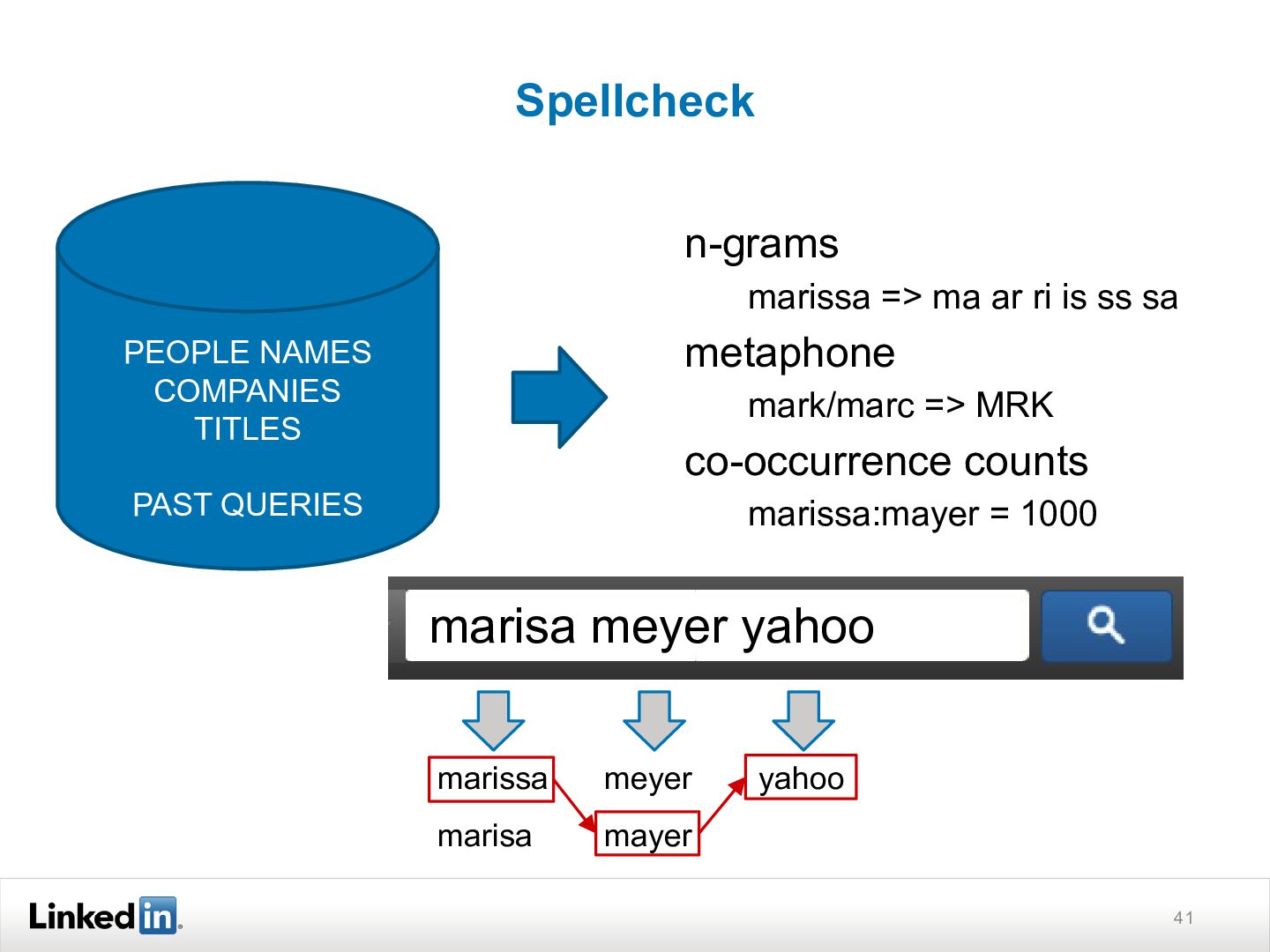
  29. 41 Spellcheck PEOPLE NAMES COMPANIES TITLES PAST QUERIES n-grams marissa

    => ma ar ri is ss sa metaphone mark/marc => MRK co-occurrence counts marissa:mayer = 1000 marisa meyer yahoo marissa marisa meyer mayer yahoo
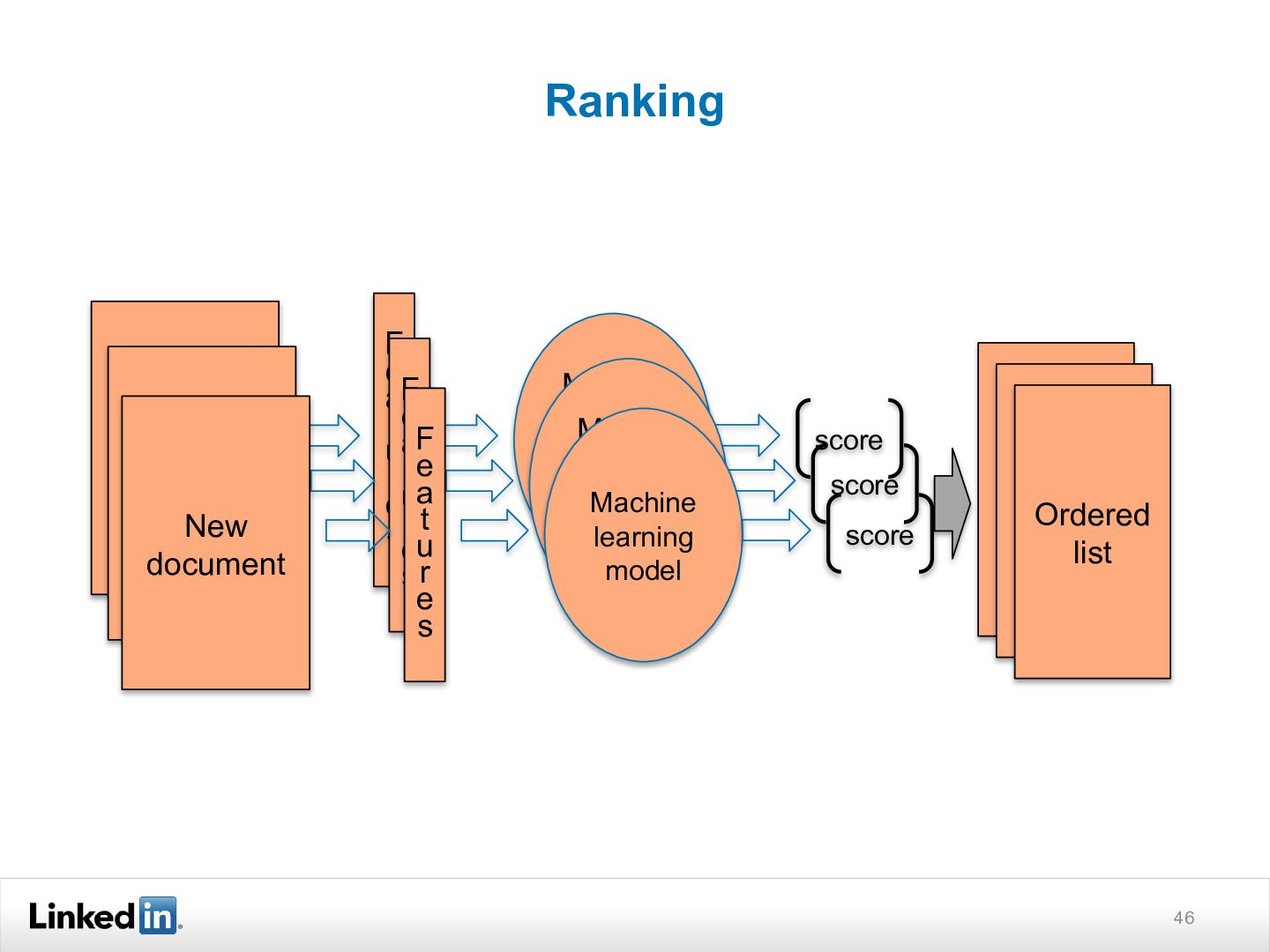
  30. 46 Ranking New document F e a t u r

    e s Machin e learning model score New document F e a t u r e s Machin e learning model score New document F e a t u r e s Machine learning model score Ordered list Ordered list Ordered list
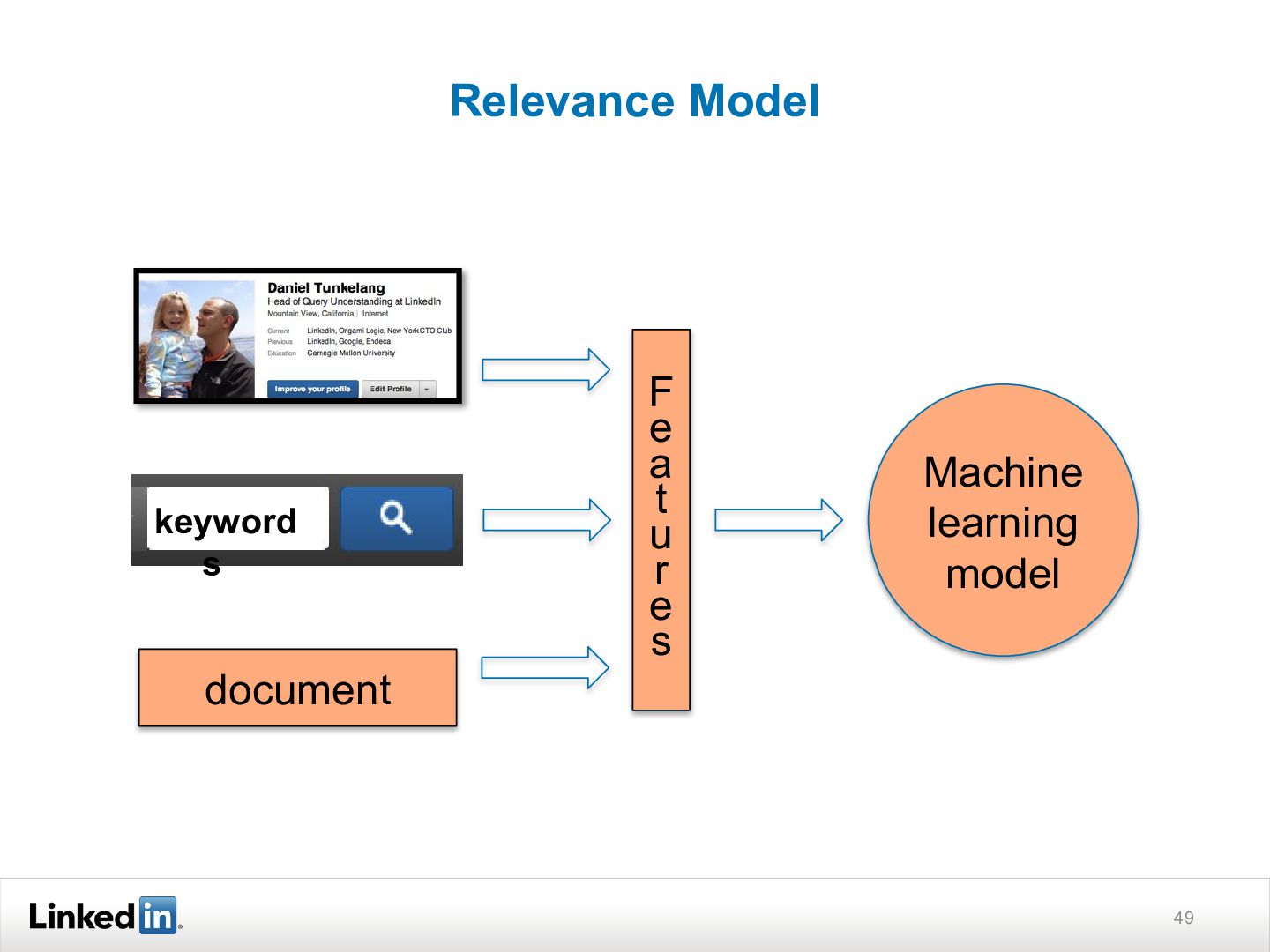
  31. 49 Relevance Model keyword s document F e a t

    u r e s Machine learning model
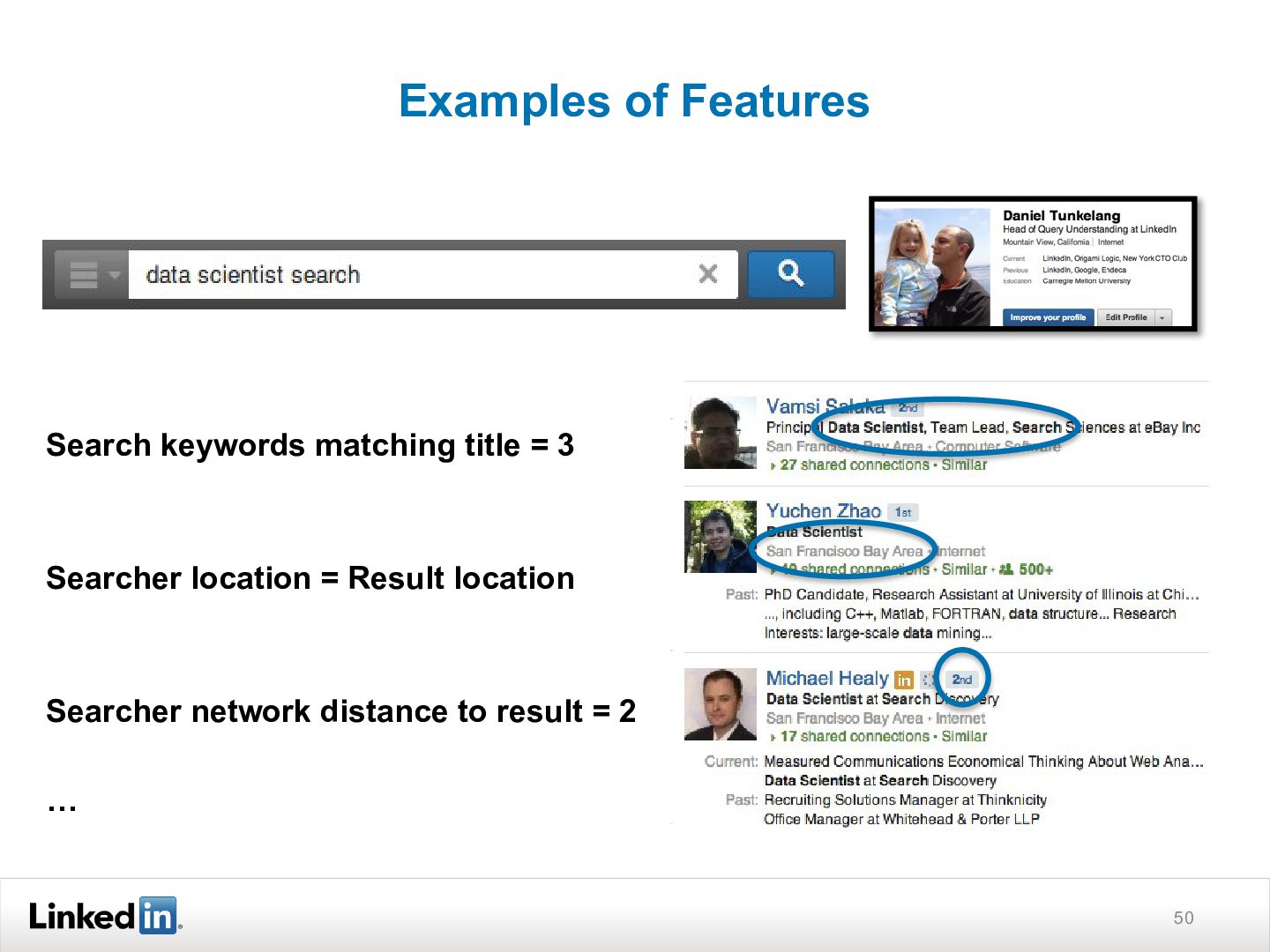
  32. 50 Examples of Features Search keywords matching title = 3

    Searcher location = Result location Searcher network distance to result = 2 …
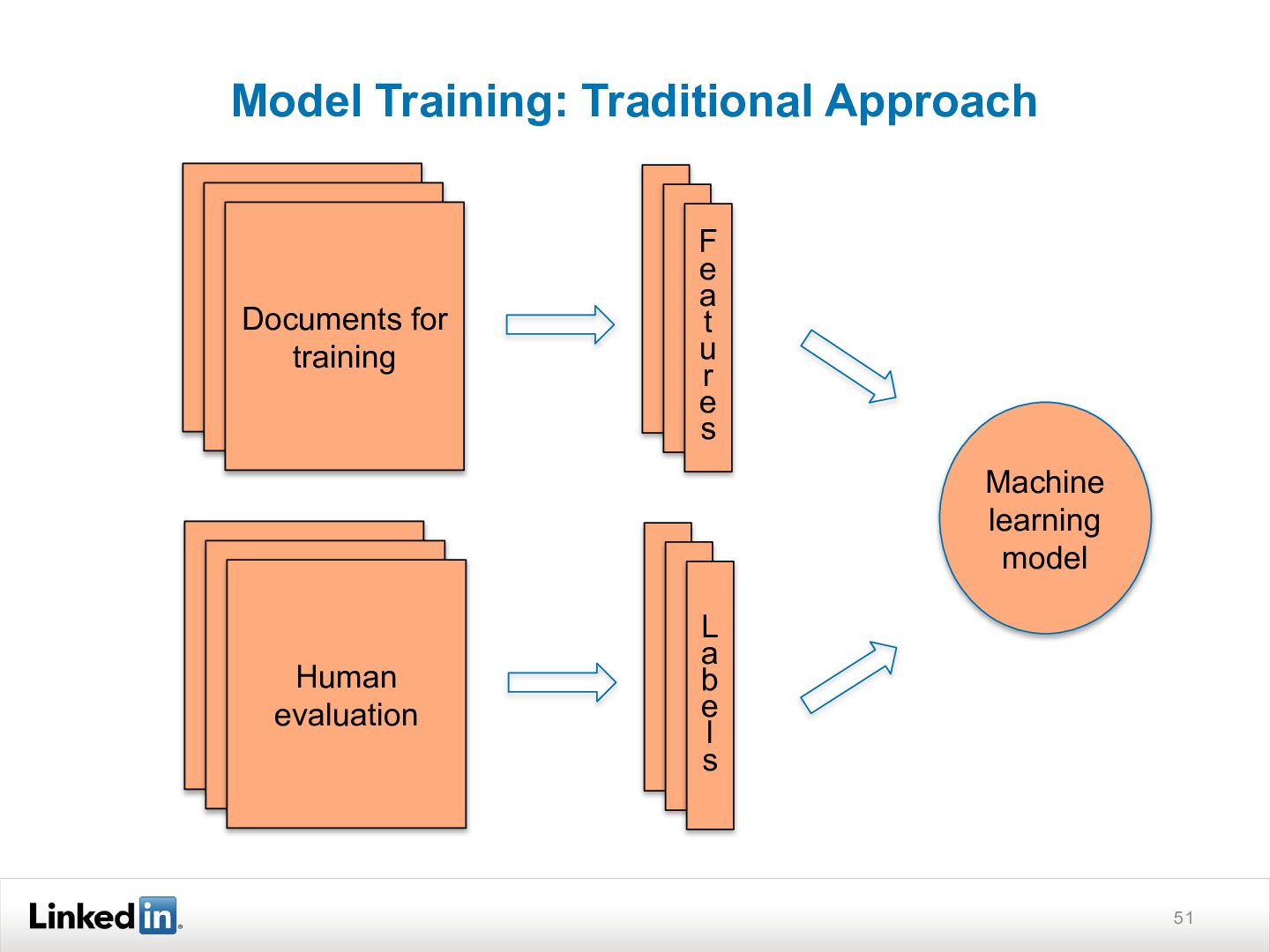
  33. 51 Model Training: Traditional Approach Documents for training F e

    a t u r e s Human evaluation L a b e l s Machine learning model
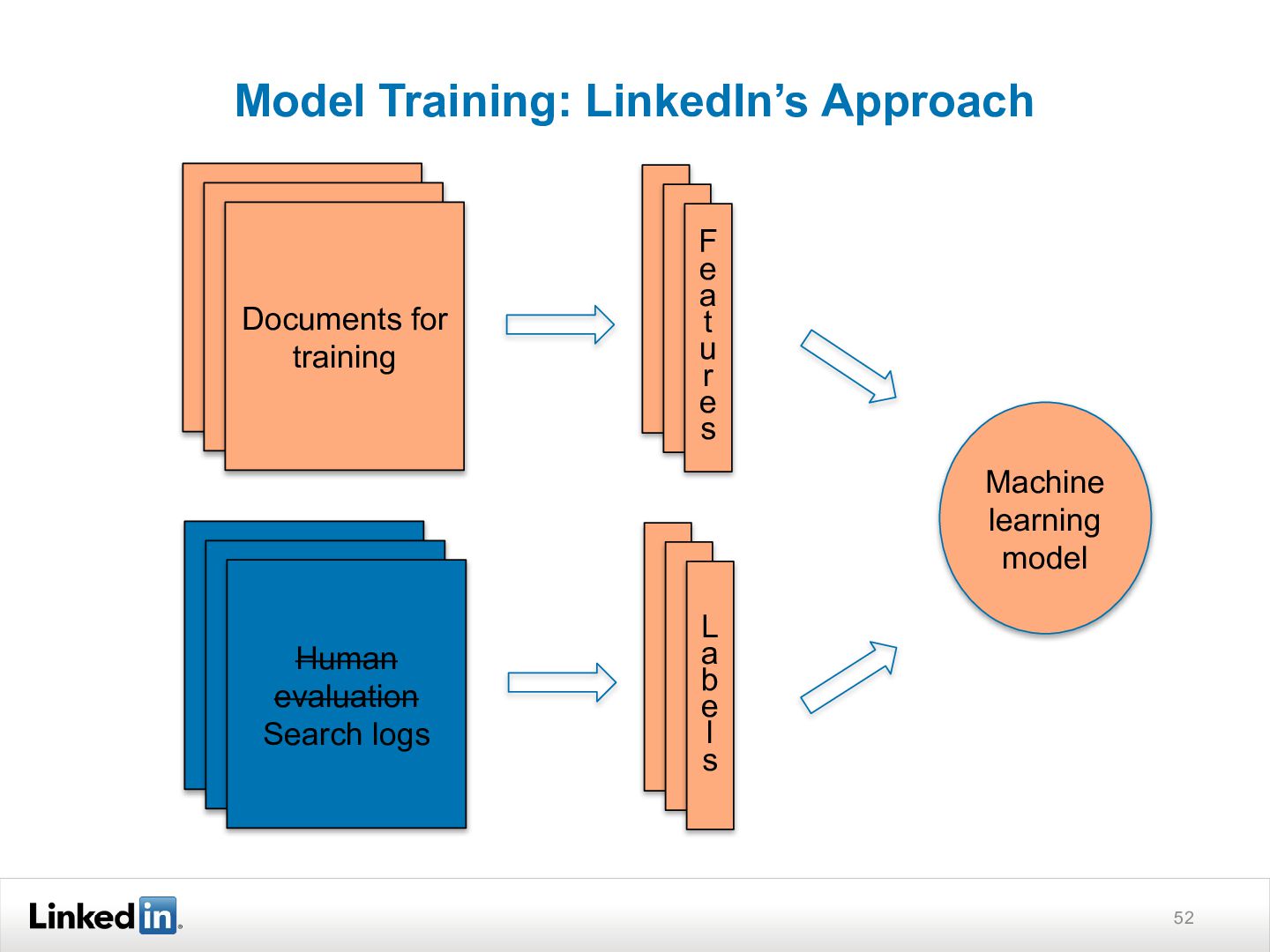
  34. 52 Model Training: LinkedIn’s Approach Documents for training F e

    a t u r e s Human evaluation Search logs L a b e l s Machine learning model
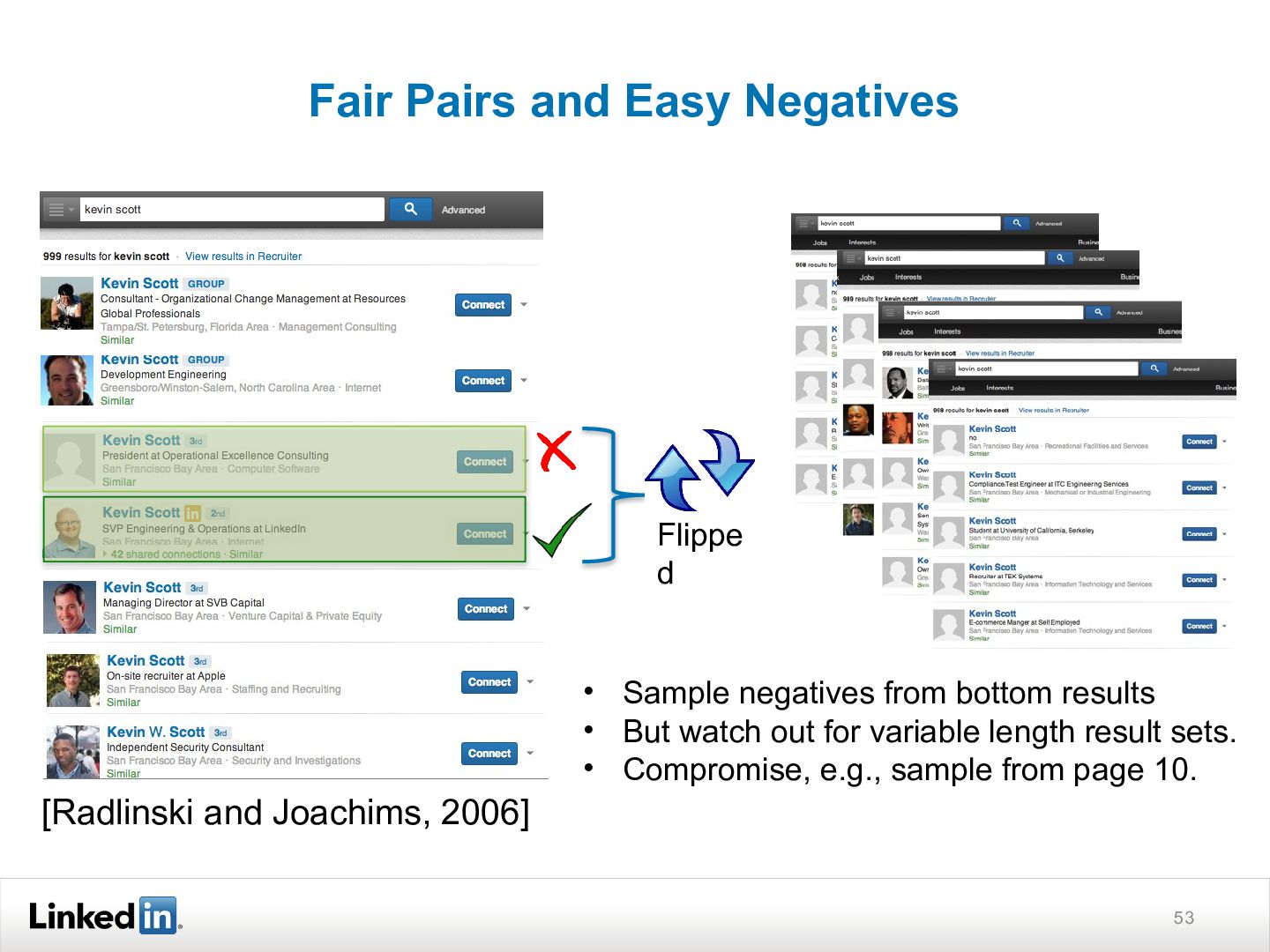
  35. 53 Fair Pairs and Easy Negatives Flippe d [Radlinski and

    Joachims, 2006] • Sample negatives from bottom results • But watch out for variable length result sets. • Compromise, e.g., sample from page 10.
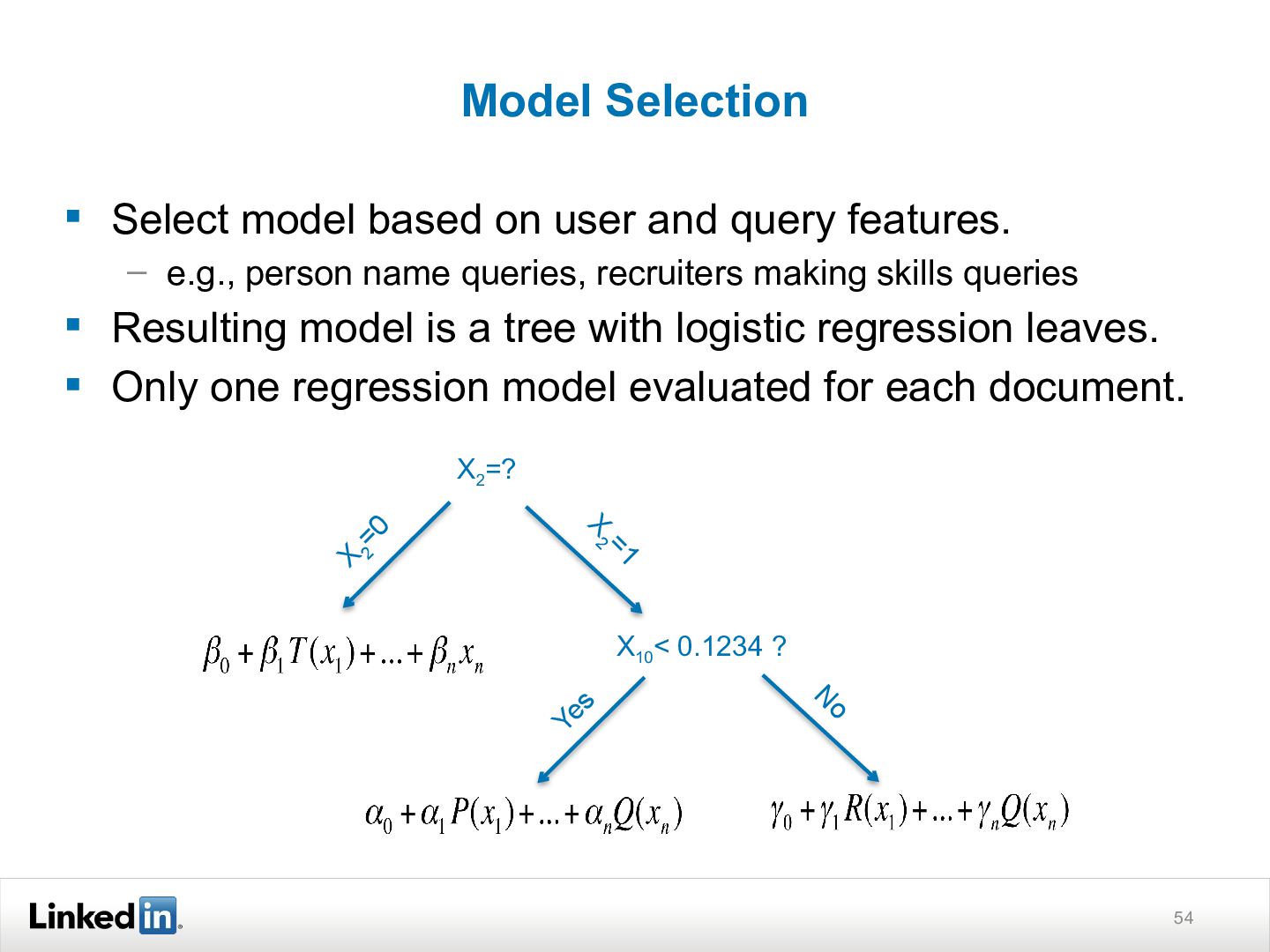
  36. 54 Model Selection  Select model based on user and

    query features. – e.g., person name queries, recruiters making skills queries  Resulting model is a tree with logistic regression leaves.  Only one regression model evaluated for each document. X 2 =0 X 2 =? X 2 =1 X 10 < 0.1234 ? Yes N o
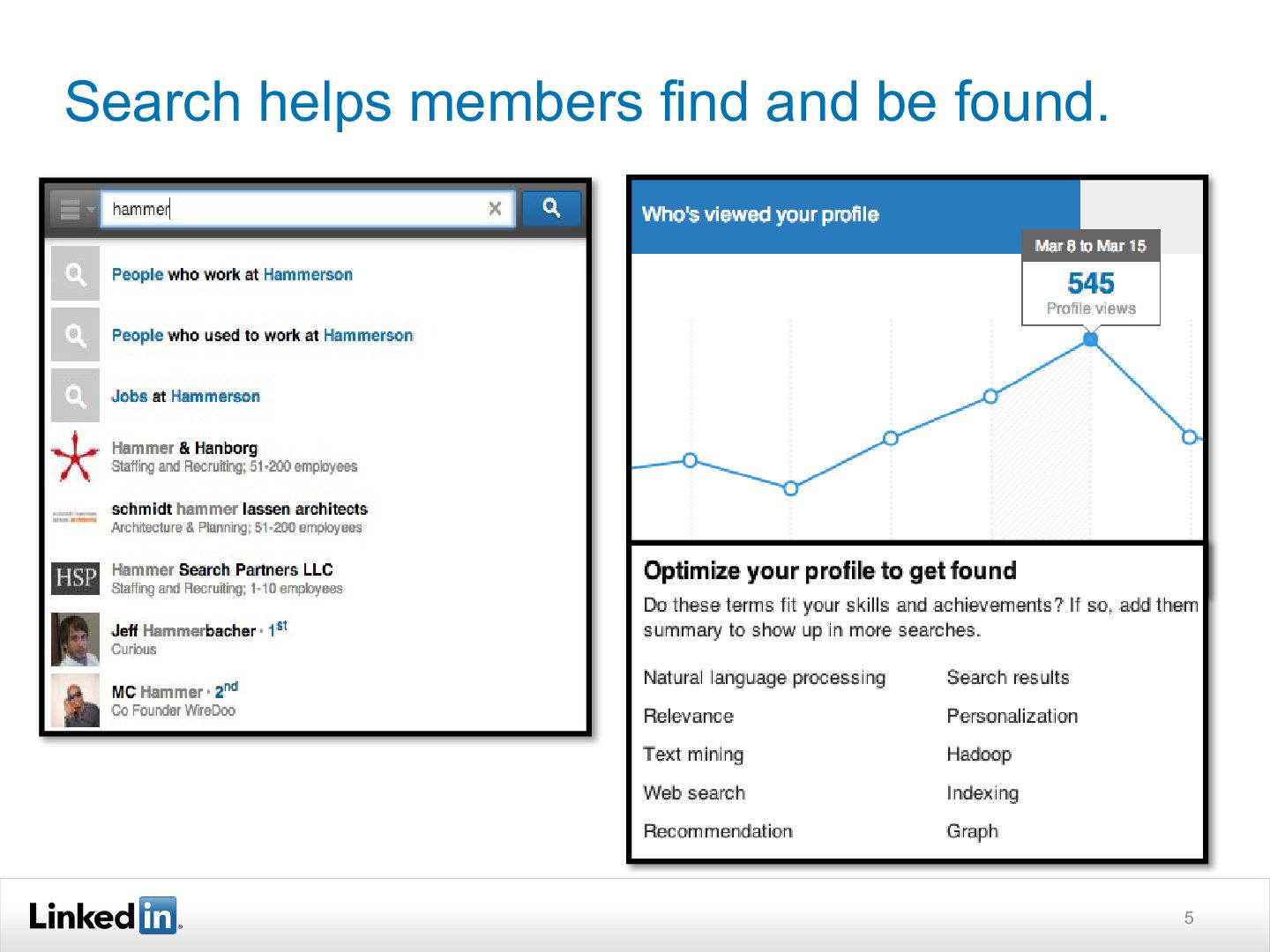
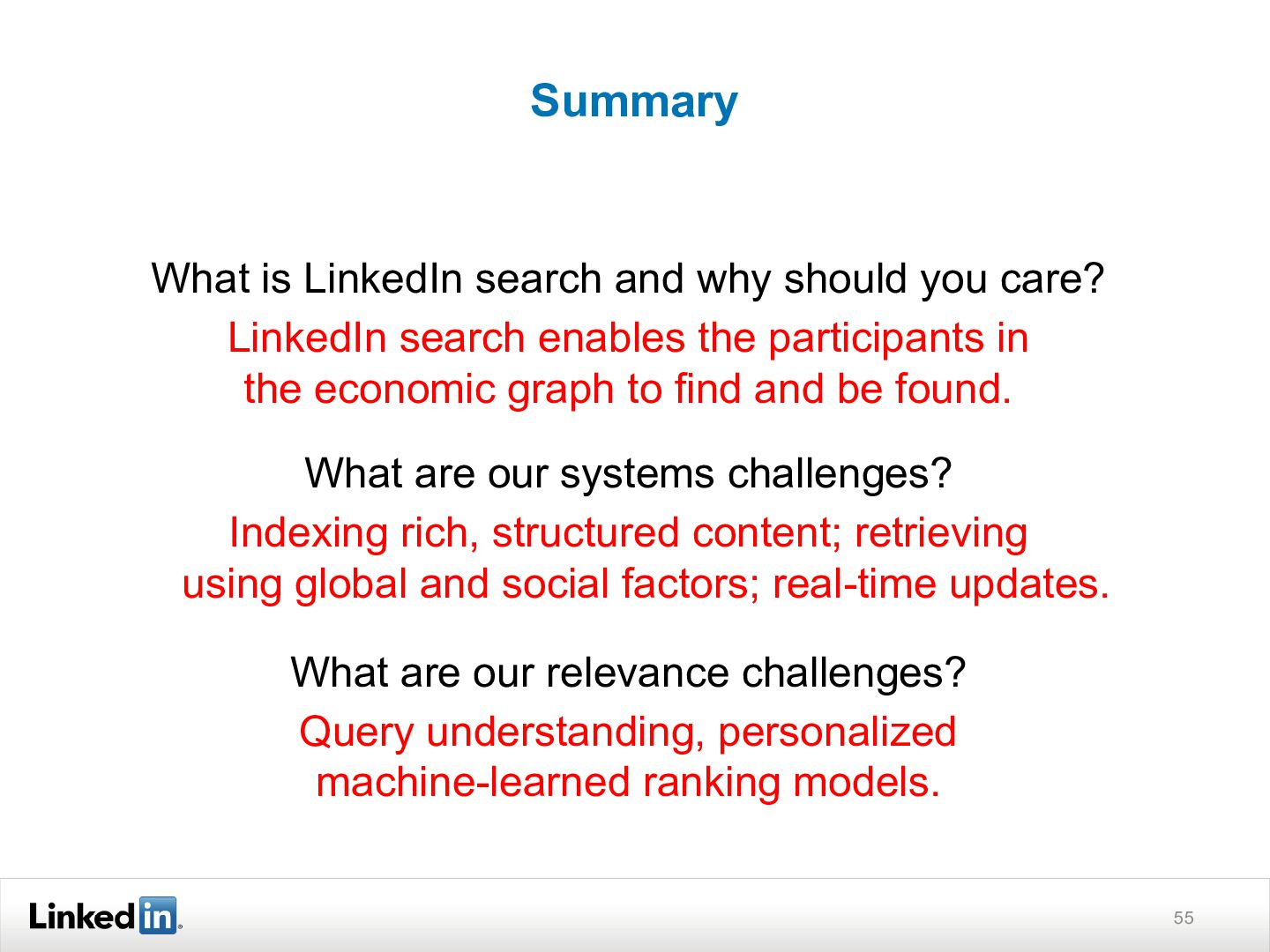
  37. Summary What is LinkedIn search and why should you care?

    LinkedIn search enables the participants in the economic graph to find and be found. What are our systems challenges? Indexing rich, structured content; retrieving using global and social factors; real-time updates. What are our relevance challenges? Query understanding, personalized machine-learned ranking models. 55