Share
Embed
Adversarial Dynamics - Conficker case study
Game theory is too weak a framework to capture the adversarial dynamics of real life where the game is created, the rules evolve, the goals and moves are unknown

Daniyel Yaacov
January 09, 2013
Transcript
39 slides
-
Oscilla'ons through Co-‐evolu'on: A Manifesta'on of Moving Target Defense
Conficker Case Study Daniel Bilar (Siege Technologies) George Cybenko (Dartmouth College) John Murphy (ProQueSys) CSIIRW 8, ONRL (Oak Ridge, TN) January 9, 2013 5/5/14 1 -
Support • Research par'ally supported by DARPA I2O,
DHS, AFRL, DOD, OSD, and AFOSR with UTEP, Ball Aerospace, Pikewerks, Siege – All opinions and results expressed are those of authors and not necessarily those of the funding agencies • Thanks also to V. Berk, I. Gregoriou-‐de Souza, J.T House, D. Sicilia, G. Stocco, P. Sweeney 5/5/14 2 -
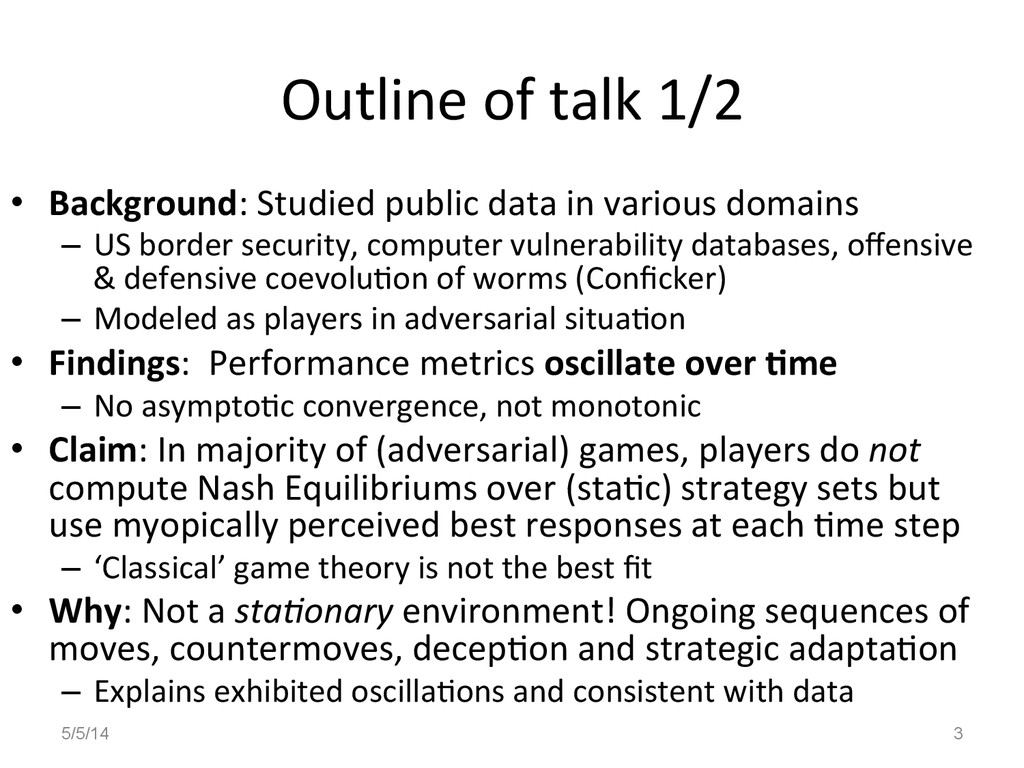
Outline of talk 1/2 • Background: Studied public data
in various domains – US border security, computer vulnerability databases, offensive & defensive coevolu'on of worms (Conficker) – Modeled as players in adversarial situa'on • Findings: Performance metrics oscillate over Bme – No asympto'c convergence, not monotonic • Claim: In majority of (adversarial) games, players do not compute Nash Equilibriums over (sta'c) strategy sets but use myopically perceived best responses at each 'me step – ‘Classical’ game theory is not the best fit • Why: Not a sta'onary environment! Ongoing sequences of moves, countermoves, decep'on and strategic adapta'on – Explains exhibited oscilla'ons and consistent with data 5/5/14 3 -
Outline of talk 2/2 • Problem: Oscilla'ons modeled by
replicator equa'ons – Typically 3rd degree, non-‐linear, analy'cally difficult – Inverse problem of es'ma'ng RE parameters from observa'ons of behavior computa'onally tractable • Claim: Possible to infer players mo'ves, costs and move op'ons by observa'on of oscilla'on – Not discussed in this talk • ContribuBons of authors – Detailed empirical analysis of players Conficker & environment (Bilar & Murphy) – Abstrac'on of game through Quan'ta've Adack Graph (Bilar & Cybenko & Murphy) – “Asympto'c” cut set theorem (Cybenko) for op'mal defense alloca'on 5/5/14 4 -
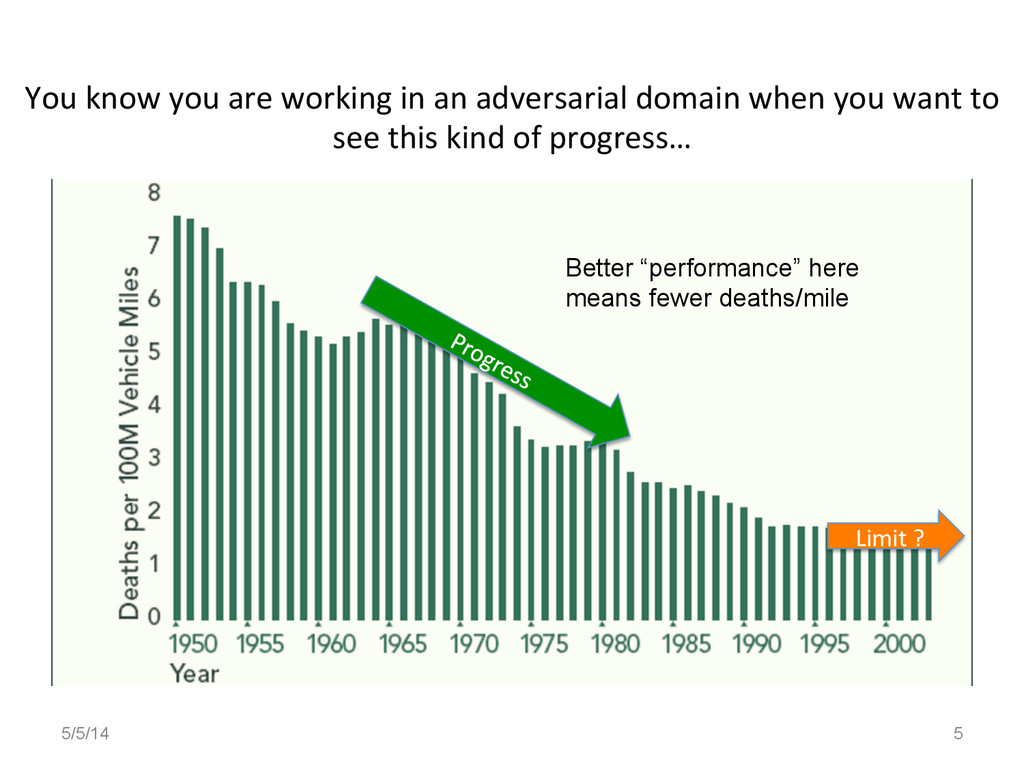
You know you are working in an adversarial domain when
you want to see this kind of progress… Better “performance” here means fewer deaths/mile Limit ? 5/5/14 5 -
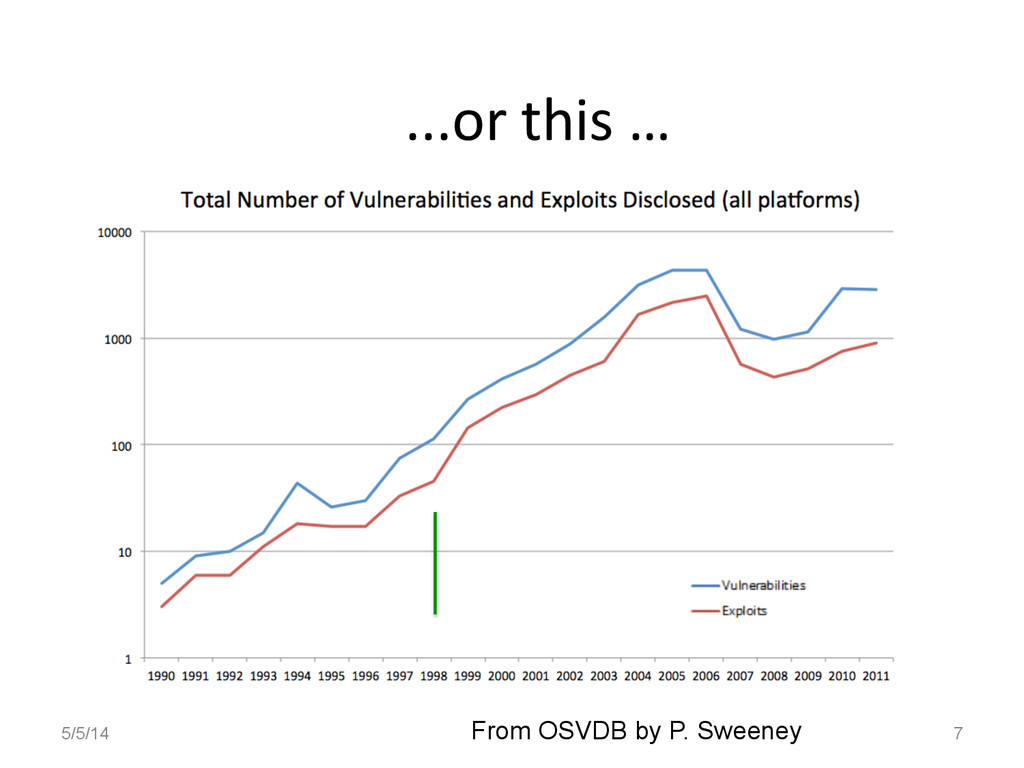
...but instead, you see this … Better “performance” here
means fewer deaths/mile Limit ? Internet Crime Complaint Center, http://www.ic3.gov/default.aspx 5/5/14 6 -
Border security... 1992 1994 1996 1998 2000 2002 2004 2006
2008 2010 Time 0 0.5 1 1.5 2 Human Apprehensions (Entire SWB) x 1,000,000 1992 1994 1996 1998 2000 2002 2004 2006 2008 2010 0 0.5 1 1.5 2 5/5/14 8 -
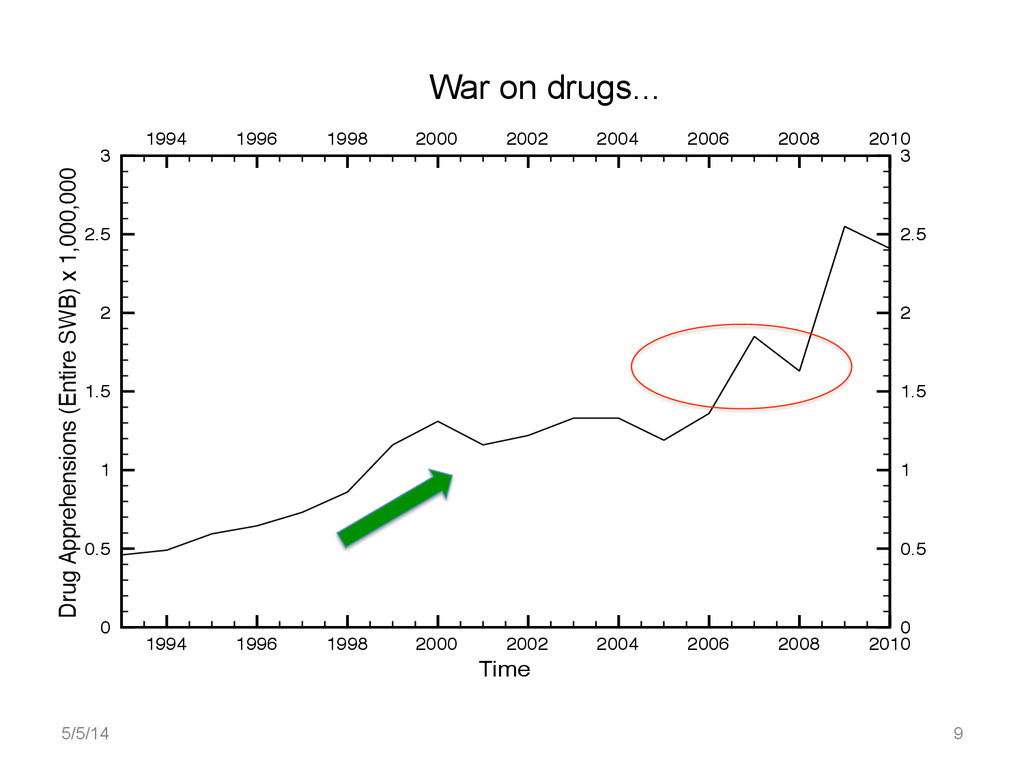
War on drugs... 1994 1996 1998 2000 2002 2004 2006
2008 2010 Time 0 0.5 1 1.5 2 2.5 3 Drug Apprehensions (Entire SWB) x 1,000,000 1994 1996 1998 2000 2002 2004 2006 2008 2010 0 0.5 1 1.5 2 2.5 3 5/5/14 9 -
Comments • “Performance” measures may oscillate (not monotonic)
– Depends partly on normaliza'on of metrics (see Fig 3.1 in BMC (2012)) • Opera'ng against human adversaries is different than opera'ng against nature • Games not defined a priori, game details not known – Players do not know who the other players are, what their possible moves might be and, perhaps most importantly, what their preferred outcomes or objec'ves are • Result: Co-‐evoluBon, adaptaBon as evinced through oscillaBons 5/5/14 10 -
Conficker • AKA Downup, Downadup, Kido • Detected
November 2008 • Largest worm/botnet infec'on since 2003 • Infected million’s of machines • Evolved through 5 versions in several months • Affected military systems in France, UK etc • Used many vulnerabili'es and techniques 5/5/14 11 -
Conficker Versions A-E Host States Adversarial Dynamics: The Conficker Case
Study. Daniel Bilar, George Cybenko and John Murphy In Moving Target Defenses II, edited by S. Jajodia, Springer, 2012 5/5/14 12 -
Abstrac'on of Adack/Defend Game • AMackers aMacks “weakest” paths
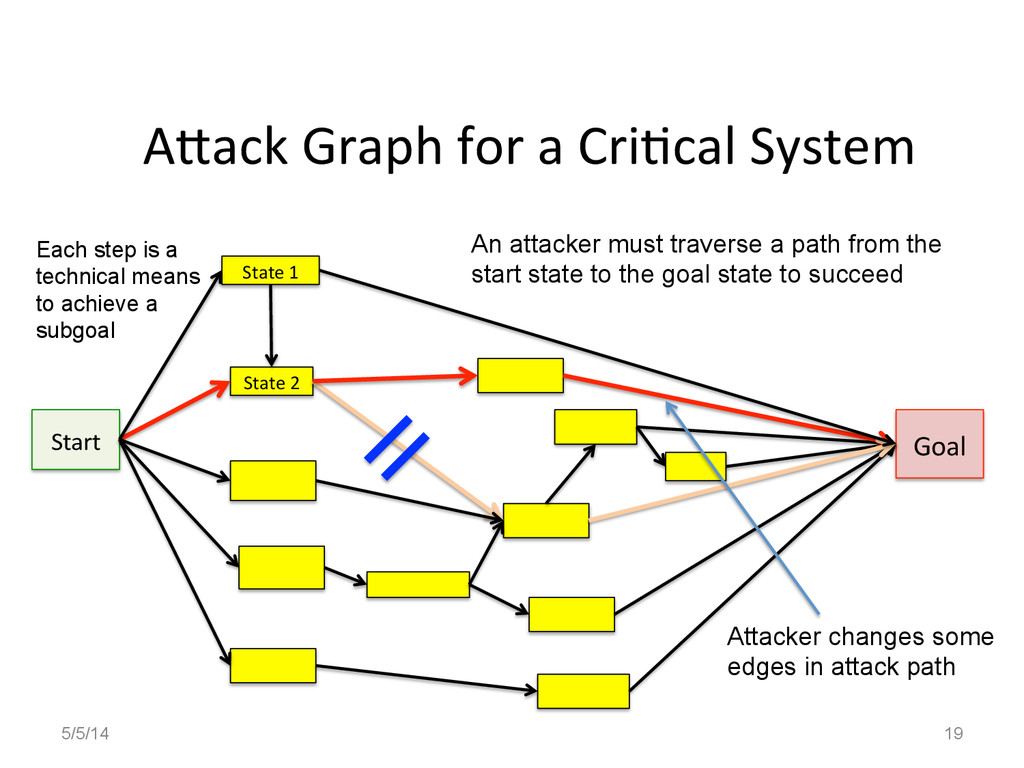
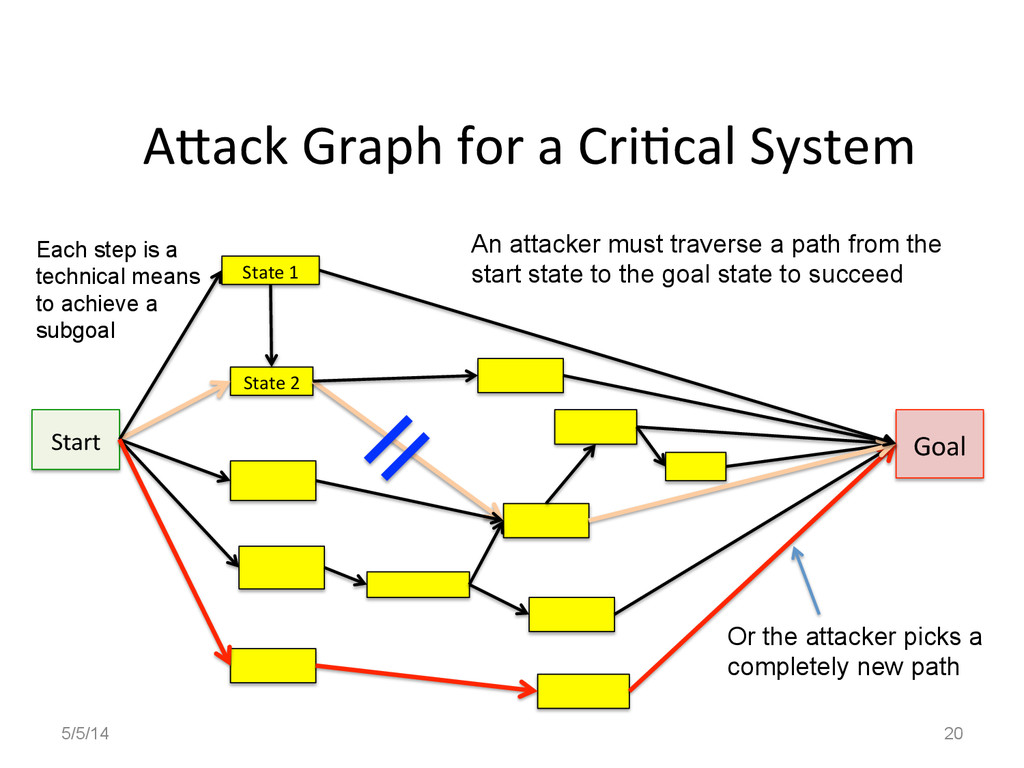
to achieve goals – Weakest according to adackers’ understanding – Paths consist of one or more technical steps – Can create completely new paths and/or steps • Defenders make some step(s) of the most common/ damaging paths harder to traverse – Most common/damaging according to defenders’ understanding – Users/boss want to create new services so new paths emerge • Iterate the above over 'me 5/5/14 15 -
Adack Graph for a Cri'cal System State 1
State 2 Start Goal An attacker must traverse a path from the start state to the goal state to succeed Note: This is an actual attack graph on a real but proprietary system Each step is a technical means to achieve a subgoal 5/5/14 16 -
State 1 State 2 Start Goal
Adack Graph for a Cri'cal System An attacker must traverse a path from the start state to the goal state to succeed Attacker uses his “shortest” path Each step is a technical means to achieve a subgoal 5/5/14 17 -
State 1 State 2 Start Goal
Adack Graph for a Cri'cal System An attacker must traverse a path from the start state to the goal state to succeed Each step is a technical means to achieve a subgoal Attacker uses his “shortest” path Defender protects a step by increasing its cost 5/5/14 18 -
State 1 State 2 Start Goal
Adack Graph for a Cri'cal System An attacker must traverse a path from the start state to the goal state to succeed Attacker changes some edges in attack path Each step is a technical means to achieve a subgoal 5/5/14 19 -
State 1 State 2 Start Goal
Adack Graph for a Cri'cal System An attacker must traverse a path from the start state to the goal state to succeed Each step is a technical means to achieve a subgoal Or the attacker picks a completely new path 5/5/14 20 -
State 1 State 2 Start Goal
Adack Graph for a Cri'cal System An attacker must traverse a path from the start state to the goal state to succeed Each step is a technical means to achieve a subgoal Or the attacker creates a new path 5/5/14 21 -
Comments • Adacks graphs are old technique but hard
to build and quan'fy – State space explosions, how to assign edge costs, blind spots, etc – Maybe like democracy, worst way except for all others • Predic'on markets: QuERIES provides a technique for quan'fying the adack graphs by cost, difficulty, etc • We will adapt, invest and perform beder if we quan'fy – Pursuit-‐evasion – go to where the prey will be – Flu shots an'cipate the flu, not respond to current ones – Wayne Gretzky – “A good hockey player plays where the puck is. A great hockey player plays where the puck is going to be.” 5/5/14 22 -
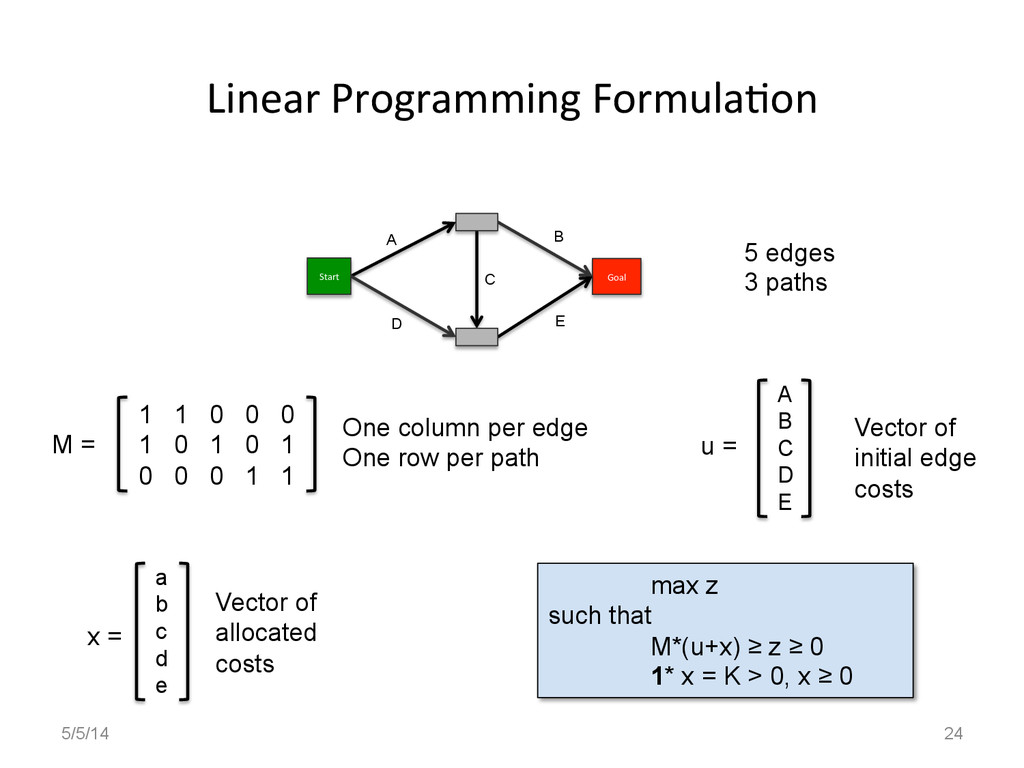
Adack-‐Defend Game • Op'miza'on problem – maximize the cost
of the shortest path from Start to Goal states • Can formulate this as a linear programming problem – solu'on is the investment allocaBon that makes the least cost aMack as expensive as possible § Es'mate costs to adacker of traversing adack graph edges – shortest path is the most adrac've for an adacker to take Start Goal Cost = 2 4 1 5 2 Simple Example – Shortest path in yellow Real Problem – What is/are the shortest path(s)? State 1 State 2 Start Goal 5/5/14 23 -
Linear Programming Formula'on Start Goal A B
C D E 1 1 0 0 0 1 0 1 0 1 0 0 0 1 1 M = 5 edges 3 paths One column per edge One row per path u = A B C D E x = Vector of initial edge costs a b c d e Vector of allocated costs max z such that M*(u+x) ≥ z ≥ 0 1* x = K > 0, x ≥ 0 5/5/14 24 -
Example strategies § Which edges are “best” to invest
in? Suppose budget = 1. § Analysis has shown that op'mal investments are ul'mately in a “cut set” Start Goal Cost = 2 4 1 5 2 Simple Example – Shortest path in yellow Start Goal Cost = 2 4 1+1=2 5 2 “Harden” the weakest link? Start Goal Cost = 2 4 1 5 2 Simple Example – Shortest path in yellow If possible, invest in minimal cut set edges Start Goal 2+1=3 4 1 5 2 “Harden” selected cut set edges cut set 5/5/14 25 -
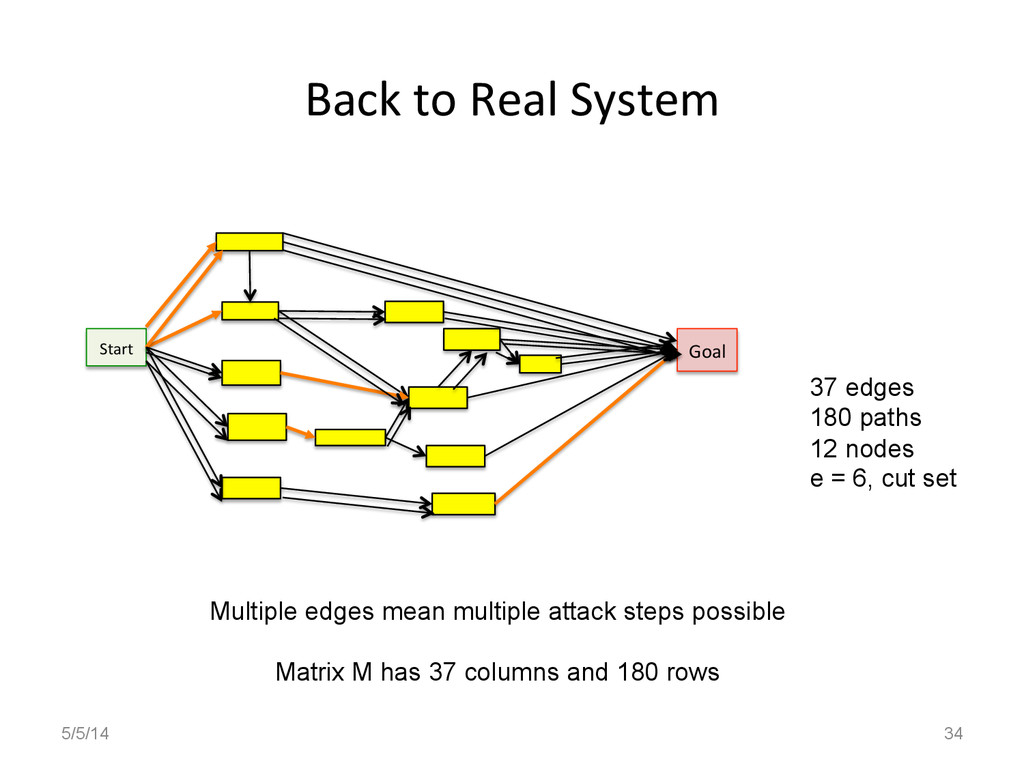
Back to Real System Start Goal 37
edges 180 paths 12 nodes Multiple edges mean multiple attack steps possible Matrix M has 37 columns and 180 rows 5/5/14 26 -
• Result shows benefit from hardening multiple paths according to
iterative algorithm • X-axis shows total budget, Y-axis shows investment in hardening specific paths • As budget increases, the defensive strategy is diversified, but investment into minimal cut edges continues • Once the inputs to state 2 are hardened, investment begins in edges 20 and 37 Edges 1,2 Edges 20,37 Total Defense Investment Start Goal Linear Programming Results Iden'fy High Value Protec'on Paths for Different Investment Levels 5/5/14 27 -
Minimal cost paths for adacker • Graph shows total
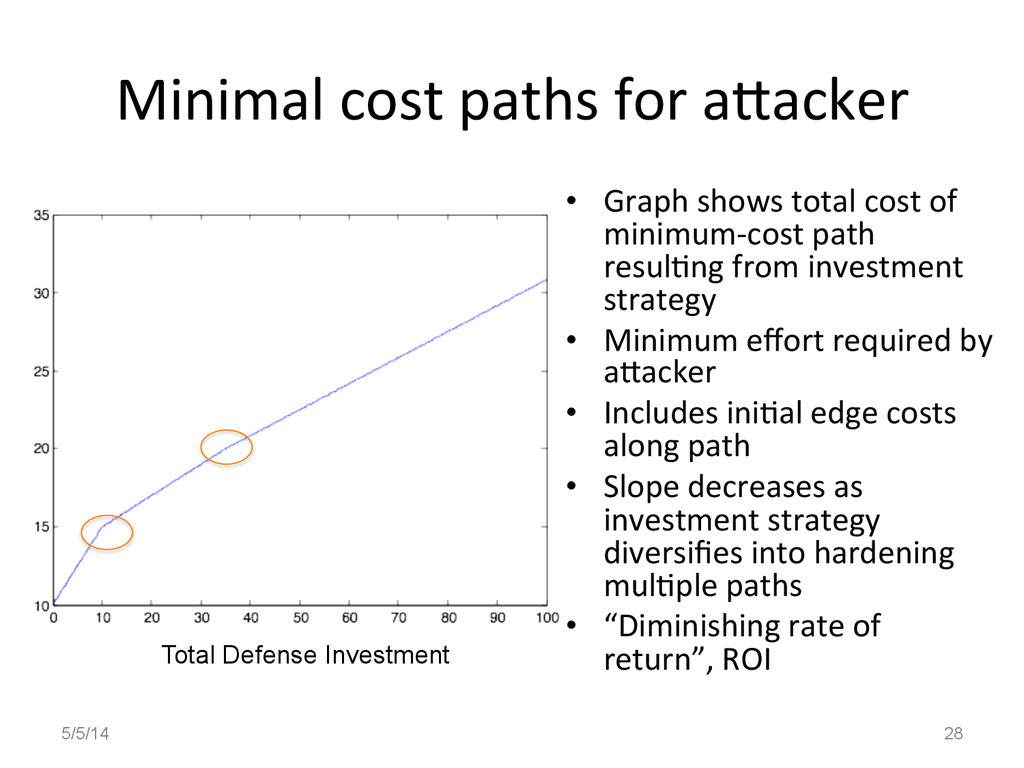
cost of minimum-‐cost path resul'ng from investment strategy • Minimum effort required by adacker • Includes ini'al edge costs along path • Slope decreases as investment strategy diversifies into hardening mul'ple paths • “Diminishing rate of return”, ROI 5/5/14 28 Total Defense Investment -
Role of minimal cut sets Start Goal
Each edge has cost 1 You have a budget of 1 5/5/14 29 -
Role of minimal cut sets Start Goal
Invest that 1 unit here But this is the minimal cut set 5/5/14 30 Each edge has cost 1 You have a budget of 1 -
Role of minimal cut sets Start Goal
Now invest in the minimal cut set 2 5/5/14 31 -
“Asympto'c” Adack Graph Theorem (Cybenko) If we are given
an adack graph with • a minimal cut set that has e edges • a large investment budget, K then • the op'mal budget alloca'on assigns ≈ K/e to each edge in the cut set and; • the minimal cost path grows like c + K/e where c is a constant 5/5/14 32 -
• Theorem states that optimal investment is eventually K/e in
minimal cut set edges • Initially, optimal investments can occur in other edges Edges 1,2 Edges 20,37 Total Defense Investment Linear Programming Results Identify High Value Protection Paths for Different Investment Levels Start Goal 5/5/14 33 -
Back to Real System Start Goal 37
edges 180 paths 12 nodes e = 6, cut set Multiple edges mean multiple attack steps possible Matrix M has 37 columns and 180 rows 5/5/14 34 -
Adversarial Dynamics Takeaways 1/2 • “Big data” needed
– Red and blue forces’ data sets are needed – New, non-‐sta'onary sta's'cs and es'ma'on are key – Adapta'on, not sta'c equilibria, describe “solu'ons” • “Hidden data” needed – Need to capture what players/agents think, not just the outcomes • An'cipa'ng moves is the way to gain advantage – Kasparov who can think 5-‐6 moves ahead 5/5/14 35 -
References 1. Cybenko, Landwehr, “Security Analy'cs and Measurements”,
IEEE S&P , May-‐June 2012 hdp://'nyurl.com/securityanaly'cs 2. Bilar, Murphy, Cybenko, “Conficker Case Study”, in MTD II (ed. Jajodia), 2012 hdp://'nyurl.com/confickerQAG 3. Saltaformaggio, Bilar “ABCD-‐ACP”, ICCC3 NATO CCD COE, 2011 hdp://'nyurl.com/ICCC3 4. Stocco, Cybenko, “Inverse game theory”, SPIE 8359, 2012 hdp://'nyurl.com/inversegame 5. Carin, Cybenko, Hughes, “Queries methodology”, IEEE Computer, 2008 hdp://'nyurl.com/queries2008 6. Ohtsuki, Novaw, “Replicator equa'ons”, Journal of Theore'cal Biology 243 (2006) 86–97 hdp://'nyurl.com/replica'onequ 5/5/14 36 -
Thank you Thank you for the kind considera'on
of these ideas We are happy to answer ques'ons / field comments J Contact: • Daniel Bilar: [email protected] • George Cybenko: [email protected] • John Murphy: [email protected] 5/5/14 37 -
Oscilla'ons as Manifesta'on of Adversarial Dynamics • Evolu'on
is a response to compe''on • Compe''on exists among adversaries • How do you know you are opera'ng in an “adversarial” domain? – Oscilla'ons of performance metrics • Dynamics can be modeled by replicator equa'ons – Typically 3rd order, non-‐linear (analy'cally difficult) • Inverse problem of observing behavior and es'ma'ng parameters of replicator equa'on that guide behavior is tractable • Possible to observe game play and strategy evolu'on and then make inferences about player’s mo'ves, costs and move op'ons 5/5/14 39
 dybilar
 yukiar
 masao
 tomonom
 satai
 anikisencyo
 ishiirikie
 takasehideki
 casualconc
 ftakahashi
 rikkabotan7
 microbaseinc
 ept
 asonas
 aemeredith
 joshbly
 jct
 inesmontani
 bkeepers
 lara
 techseoconnect
 aki_iinuma
 skipperchong
 samtorres
 paigeccino