Upgrade to Pro — share decks privately, control downloads, hide ads and more …

What Can You Do When Kids Keep Asking for Diffi...

What Can You Do When Kids Keep Asking for Difficult Balloon Designs?

Kids often become fascinated with balloon twisting at parties, which quickly turns into requests for increasingly complex designs that are not always realistic in fast-paced event settings. Their imagination takes simple balloon shapes and transforms them into detailed characters, animals, and fantasy objects. Exposure to skilled balloon artists makes children believe that every idea can be recreated instantly in balloon form. Social media videos further amplify this expectation by showcasing highly advanced balloon sculptures that often take much longer than typical party time allows. Peer influence also plays a strong role, as children tend to compete with one another by requesting more impressive and elaborate designs. Balloon artists must constantly balance creativity with practicality while managing long queues of eager children. Time limitations make it difficult to fulfill advanced requests without slowing down the entire event. Safety considerations also matter, since overly complex balloon structures may not hold up in energetic environments. Parents and entertainers often need to step in to manage expectations in a calm and positive way. In structured event setups, services like Wowzers can help organize balloon activities in a way that keeps requests realistic and manageable through guided entertainment options, making it easier to handle large groups of children without chaos or delays. This kind of structure helps reduce pressure on entertainers while still keeping children engaged with exciting but achievable designs. When expectations are clearly shaped early, children are more likely to enjoy the available options without frustration. Offering a clear menu of balloon choices helps eliminate confusion and reduces repeated requests for difficult designs. Tiered options such as simple, medium, and advanced categories allow flexibility while maintaining control over the workflow. Balloon artists can also redirect creativity by offering simplified versions of complex ideas instead of outright saying no. Positive communication plays a key role in keeping children excited even when their original request cannot be fulfilled. Time-based rules ensure that no single balloon takes too long, keeping the event running smoothly for everyone. With experience, balloon artists learn to anticipate common difficult requests and prepare alternatives in advance. Over time, improving core twisting skills expands the range of possible designs without overwhelming the performer. The overall goal is to create a joyful atmosphere where imagination is encouraged within realistic and safe boundaries.

Avatar for Rowena Birchmont

Rowena Birchmont

June 23, 2026

Other Decks in Business

Transcript

  1. What Can You Do When Kids Keep Asking for Difficult

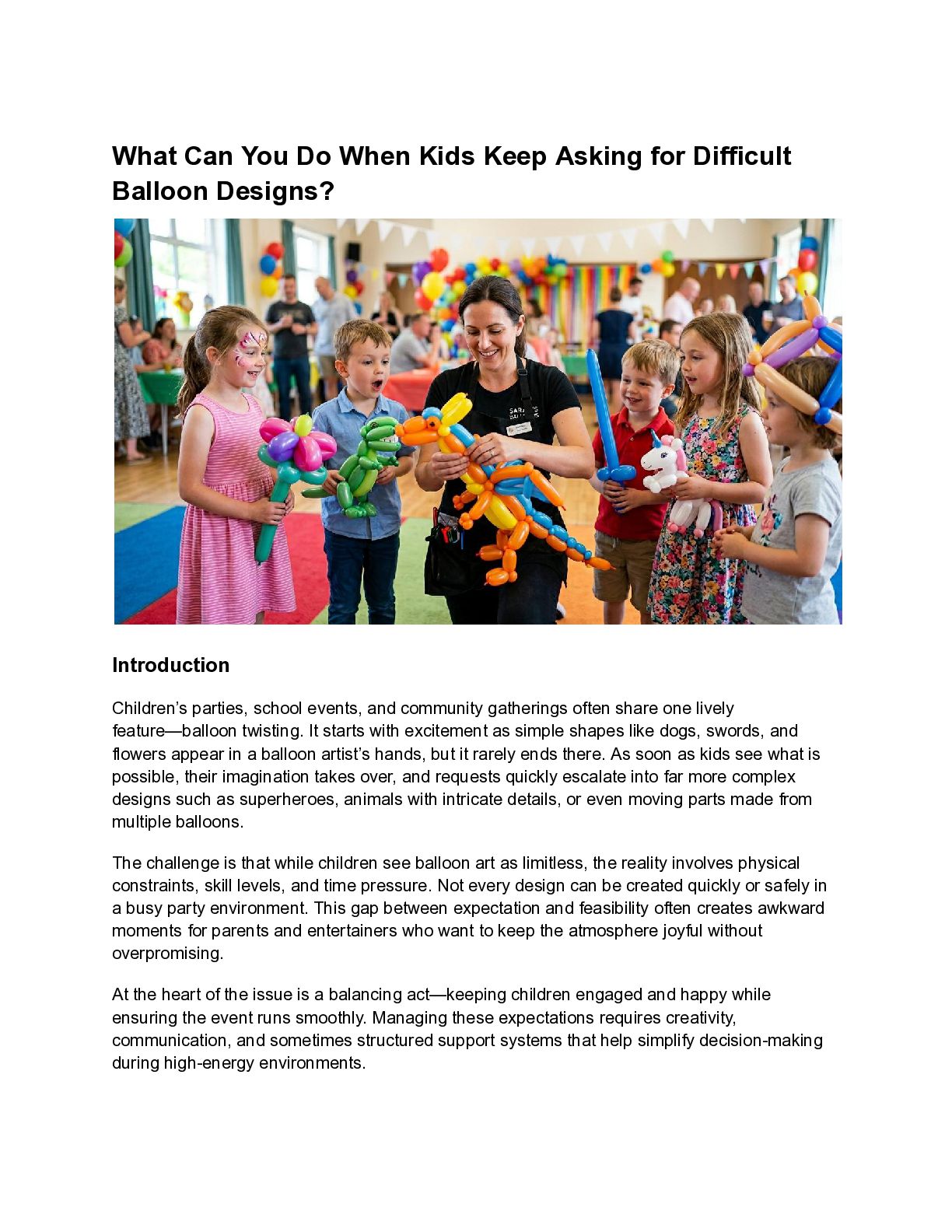
    Balloon Designs? Introduction Children’s parties, school events, and community gatherings often share one lively feature—balloon twisting. It starts with excitement as simple shapes like dogs, swords, and flowers appear in a balloon artist’s hands, but it rarely ends there. As soon as kids see what is possible, their imagination takes over, and requests quickly escalate into far more complex designs such as superheroes, animals with intricate details, or even moving parts made from multiple balloons. The challenge is that while children see balloon art as limitless, the reality involves physical constraints, skill levels, and time pressure. Not every design can be created quickly or safely in a busy party environment. This gap between expectation and feasibility often creates awkward moments for parents and entertainers who want to keep the atmosphere joyful without overpromising. At the heart of the issue is a balancing act—keeping children engaged and happy while ensuring the event runs smoothly. Managing these expectations requires creativity, communication, and sometimes structured support systems that help simplify decision-making during high-energy environments.
  2. In many organized event settings, professional entertainment support services such

    as Wowzers can play a role in streamlining balloon activities. By offering pre-planned entertainment structures and adaptable creative options, they help reduce pressure on both children and performers when complex balloon requests arise, making it easier to maintain a fun and manageable experience for everyone involved. Why Kids Keep Asking for Difficult Balloon Designs Children are naturally imaginative, and balloon twisting feeds directly into that creativity. Once they see a few basic shapes, their minds immediately begin connecting those shapes to more detailed ideas. A simple balloon dog becomes a dragon, a sword becomes a laser weapon, and a flower becomes a full bouquet garden. This leap in imagination is one of the main reasons requests become more complicated over time. Another major influence is exposure. In today’s digital world, children often watch videos of advanced balloon artists creating extremely detailed sculptures. These performances are impressive, but they do not always reflect what is practical in a live party environment. As a result, children develop expectations that are shaped by highlight reels rather than real-time constraints. Peer influence also plays a role. At parties, when one child requests something unusual and receives attention for it, others naturally try to escalate their own requests. This creates a chain reaction where designs become progressively more ambitious as children try to outdo one another. Finally, complexity is often associated with value in a child’s mind. The more elaborate the balloon looks, the more special they believe it is. This perception makes them less satisfied with simple designs, even if those designs are already fun and visually appealing. Common Challenges for Balloon Artists and Parents One of the biggest challenges is time management. During events, a balloon artist may need to serve dozens or even hundreds of children. Complex designs can take several minutes each, which quickly creates long waiting lines and frustration among children who are eager for their turn. Technical difficulty is another factor. Some requested designs require advanced twisting techniques, multiple balloons, or structural stability that is not always possible with standard party materials. Attempting such designs under pressure can lead to mistakes, broken balloons, or unsatisfactory results.
  3. Safety is also an important consideration. Certain intricate balloon structures

    may involve tight twists or fragile connections that are not suitable for energetic environments where children might pull or tug at the balloons. Keeping designs safe and durable is just as important as making them visually appealing. Emotionally, there is the challenge of managing disappointment. When a child’s request cannot be fulfilled exactly as imagined, it must be handled in a way that does not dampen their excitement for the event. A poorly handled refusal can affect the overall mood of the party. Finally, there is the pressure of maintaining flow. Events are dynamic, and interruptions caused by long or difficult balloon requests can disrupt games, performances, or scheduled activities. Keeping everything balanced requires both planning and adaptability. Managing Expectations Through Professional Services In structured event environments, managing balloon-related expectations becomes much easier when there is a system in place to guide interactions. Instead of responding to every individual request from scratch, some organizers rely on pre-designed entertainment frameworks that offer children a selection of achievable and visually engaging options. Within such structured setups, services like Wowzers can help streamline how balloon activities are presented during events. Rather than leaving balloon requests open-ended, these services often organize entertainment into guided formats where children can choose from a curated range of designs that are both fun and realistic to produce within the event timeframe. This reduces the gap between what children imagine and what can actually be delivered, making the experience smoother for both the entertainer and the audience. By having a clear structure in place, the pressure to constantly improvise highly complex designs is reduced. This allows entertainers to focus on consistency and interaction, rather than struggling to fulfill increasingly difficult requests. At the same time, children still feel involved because they are given meaningful choices that keep the experience exciting and engaging. Effective Strategies to Handle Difficult Balloon Requests Set Clear Expectations Early One of the most effective approaches is to communicate boundaries at the beginning of the event. When children understand that certain designs may not be possible, they are less likely to insist on unrealistic requests later. This can be done in a friendly and positive way, such as explaining that some designs take longer or require special materials not available at the moment.
  4. Creating a simple “balloon menu” can also help. By showing

    a list of available options, children can make quick decisions without guessing or imagining something beyond what is feasible. Offer Tiered Balloon Choices A useful strategy is to categorize balloon designs into levels such as simple, moderate, and advanced. This allows children to feel a sense of control while still staying within practical limits. Simple options might include dogs, flowers, and hats, while moderate options could involve more detailed animals or themed shapes. Advanced options, if available, can be reserved for special moments or smaller groups where time allows. Use Visual Balloon Menus Visual aids are extremely effective when working with children. Pictures or sample models help set realistic expectations because they show exactly what is possible. Instead of guessing, children can choose from visible options, which reduces misunderstandings and repeated requests for overly complex designs. Redirect with Creative Alternatives When a child requests something too complex, a helpful technique is to offer a simplified version that captures the essence of the idea. For example, instead of a highly detailed superhero figure, a balloon artist might create a basic character with recognizable colors or symbols. This approach keeps the excitement alive while staying within practical limits. It also teaches children that creativity does not always require complexity. Time-Based Rules for Busy Events In high-energy environments, time management rules can help maintain order. For example, setting a guideline such as “quick balloon builds only” ensures that no single request slows down the entire queue. This keeps the experience fair for all children and prevents long waiting times that can lead to frustration.
  5. Communication Techniques That Work With Children The way balloon artists

    communicate with children has a big impact on how requests are received. Positive framing is one of the most effective methods. Instead of saying something cannot be made, it is better to suggest what can be made in an exciting tone. For example, rather than rejecting a request, an artist might say, “That’s a cool idea! I can make something similar that you’ll love just as much.” This keeps the interaction positive and maintains enthusiasm. Storytelling can also be useful. By turning balloon choices into imaginative stories, children become more engaged with available options instead of focusing on what they cannot have. Managing Pressure at Events During busy events, balloon artists often face continuous demand with little downtime. Managing this pressure requires both physical endurance and mental focus. One helpful approach is to maintain a steady rhythm rather than rushing or overcommitting to complex designs. Fairness is another important aspect. Children pay close attention to how others are treated, so ensuring equal attention and consistent service helps prevent complaints or conflicts. Burnout is also a real concern. Taking short breaks when possible, staying hydrated, and pacing work can help maintain energy throughout long events. Improving Your Balloon Skills Over Time While not every design can be created in a fast-paced environment, improving technical skills over time can expand what is possible. Learning advanced twisting techniques gradually allows artists to expand their repertoire without overwhelming themselves. Starting with foundational shapes is essential. Once basic techniques are mastered, more complex designs become easier to understand and execute. Watching tutorials, practicing regularly, and learning from experienced balloon artists can significantly improve skill levels. However, it is equally important to recognize practical limits and choose designs that fit the event context. Frequently Asked Questions (FAQs)
  6. What if a child insists on a very hard design?​

    The best approach is to acknowledge the request positively and then offer a realistic alternative. Repetition of calm explanations usually helps redirect attention. Should you say no or try anyway?​ It depends on the situation. If time and skill allow, a simplified attempt may work. However, during busy events, it is often better to guide the child toward a manageable option. How do professionals handle complex balloon requests?​ Professionals typically rely on experience, structured menus, and pre-planned designs to avoid improvising overly complex shapes under pressure. Conclusion Dealing with children who request difficult balloon designs is a common challenge in entertainment settings. It requires a thoughtful balance between creativity and practicality. By understanding why children make these requests, setting clear expectations, and using structured approaches, entertainers and parents can maintain a fun and smooth experience. Whether through communication techniques, tiered options, or organized event support systems, the goal remains the same—to keep the excitement of balloon art alive while ensuring it remains enjoyable and manageable for everyone involved.