Upgrade to Pro — share decks privately, control downloads, hide ads and more …

Miniaturizing 3D Printed Microfluidics

Avatar for Greg Nordin Greg Nordin
October 23, 2017

Miniaturizing 3D Printed Microfluidics

Keynote address given at MicroTAS 2017, October 22-26, 2017.

DOI 10.5281/zenodo.1133980

Avatar for Greg Nordin

Greg Nordin

October 23, 2017
Tweet

Other Decks in Research

Transcript

  1. Miniaturizing 3D Printed Microfluidics Gregory P. Nordin1, Hua Gong1, Adam

    T. Woolley2 October 23, 2017 1Electrical & Computer Engineering Department 2Chemistry & Biochemistry Department Brigham Young University [email protected] Copyright © 2017 Gregory P. Nordin Released under CC-BY License
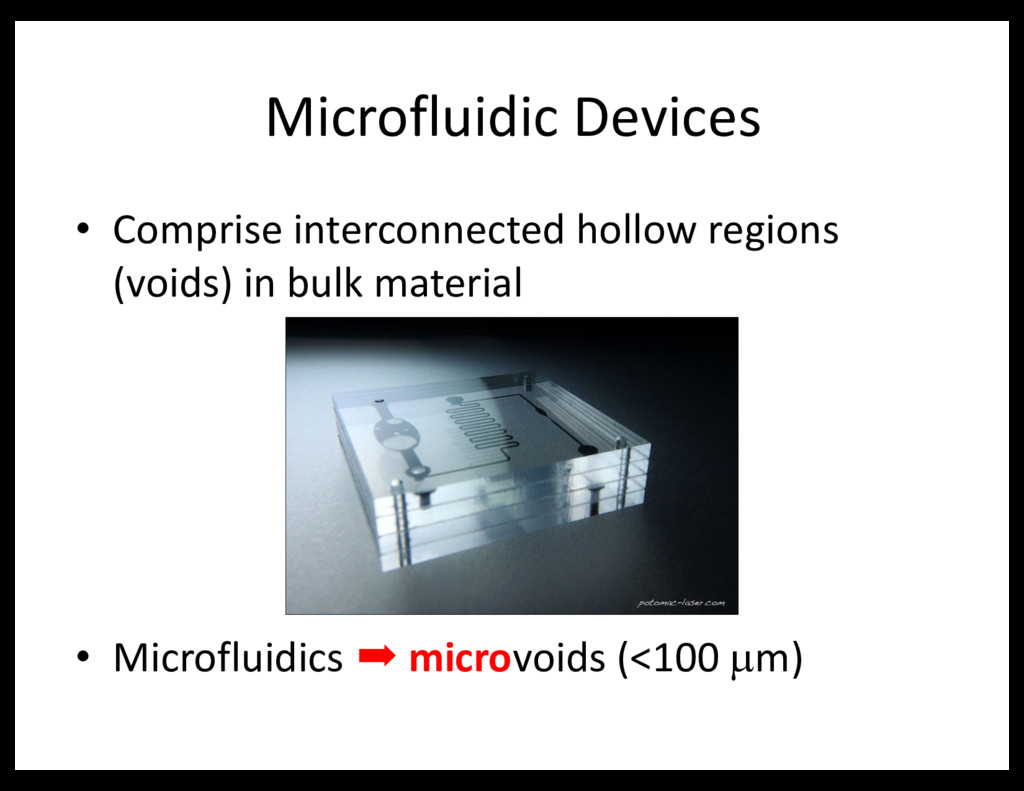
  2. Microfluidic Devices • Comprise interconnected hollow regions (voids) in bulk

    material • Microfluidics ➡ microvoids (<100 µm)
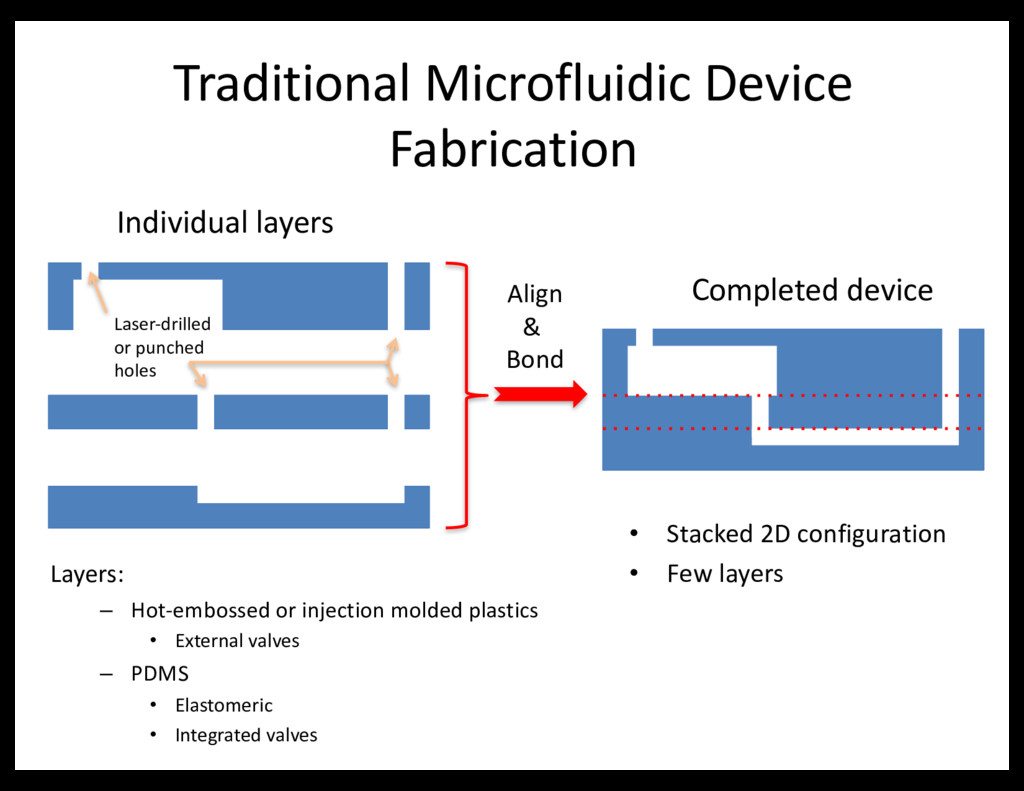
  3. Traditional Microfluidic Device Fabrication Layers: – Hot-embossed or injection molded

    plastics • External valves – PDMS • Elastomeric • Integrated valves Individual layers Align & Bond Completed device Laser-drilled or punched holes • Stacked 2D configuration • Few layers
  4. 3D Printing • Possible approaches: 1. Existing commercial printers and

    materials 2. Existing commercial printers + custom materials 3. New tools + custom materials • Microfluidics ➡ microvoids (<100 µm)
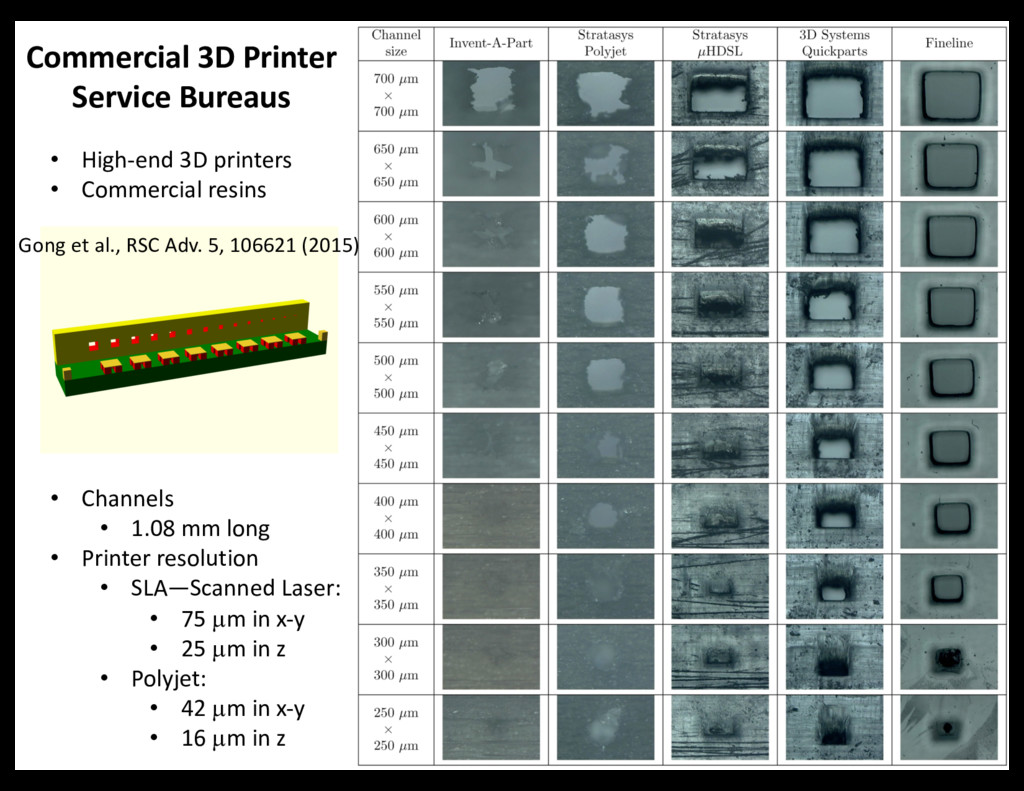
  5. Commercial 3D Printer Service Bureaus • High-end 3D printers •

    Commercial resins • Channels • 1.08 mm long • Printer resolution • SLA—Scanned Laser: • 75 µm in x-y • 25 µm in z • Polyjet: • 42 µm in x-y • 16 µm in z Gong et al., RSC Adv. 5, 106621 (2015)
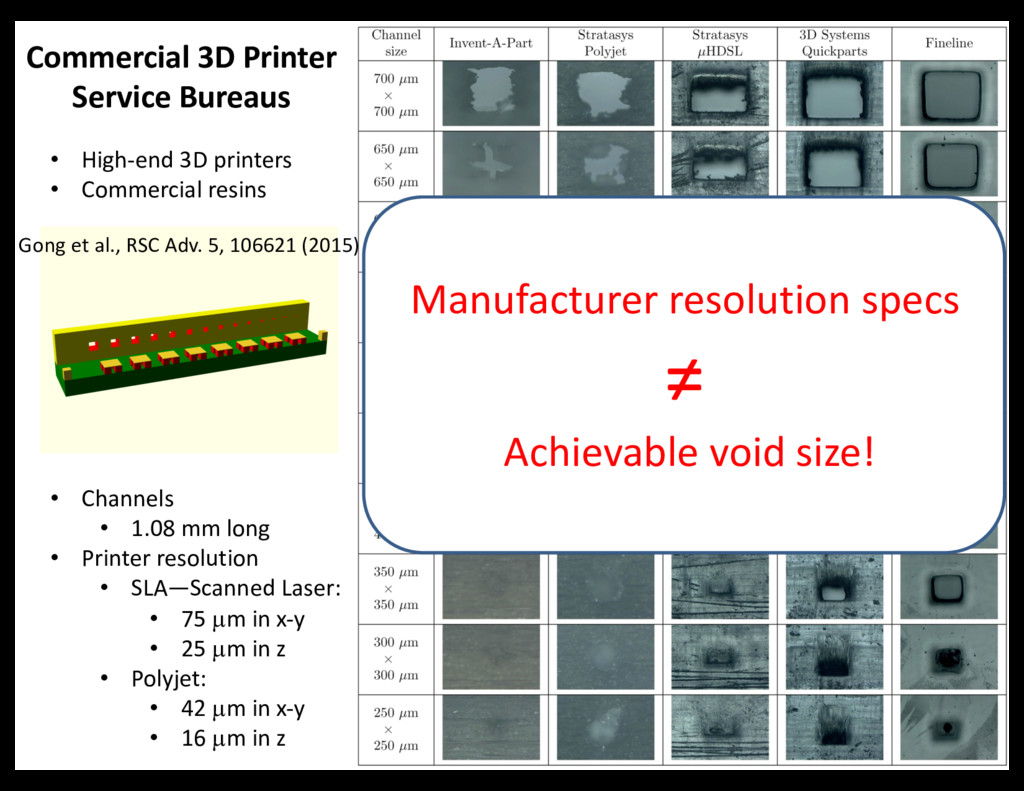
  6. Commercial 3D Printer Service Bureaus • High-end 3D printers •

    Commercial resins • Channels • 1.08 mm long • Printer resolution • SLA—Scanned Laser: • 75 µm in x-y • 25 µm in z • Polyjet: • 42 µm in x-y • 16 µm in z Manufacturer resolution specs ≠ Achievable void size! Gong et al., RSC Adv. 5, 106621 (2015)
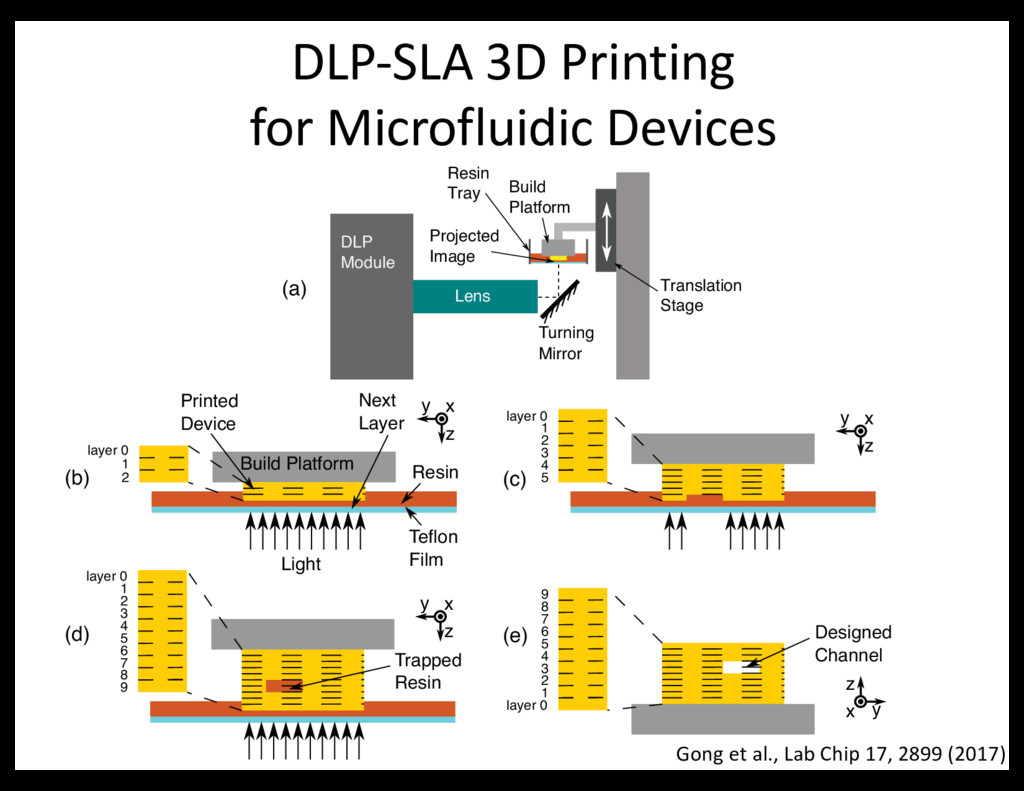
  7. DLP-SLA 3D Printing for Microfluidic Devices DLP Module Lens Turning

    Mirror Resin Tray Build Platform Translation Stage Projected Image Light layer 0 1 2 Build Platform Resin Printed Device Next Layer Teflon Film y z x 9 8 7 6 5 4 3 2 1 layer 0 Designed Channel y z x layer 0 1 2 3 4 5 y z x Trapped Resin layer 0 1 2 3 4 5 6 7 8 9 y z x (a) (b) (d) (c) (e) Gong et al., Lab Chip 17, 2899 (2017)
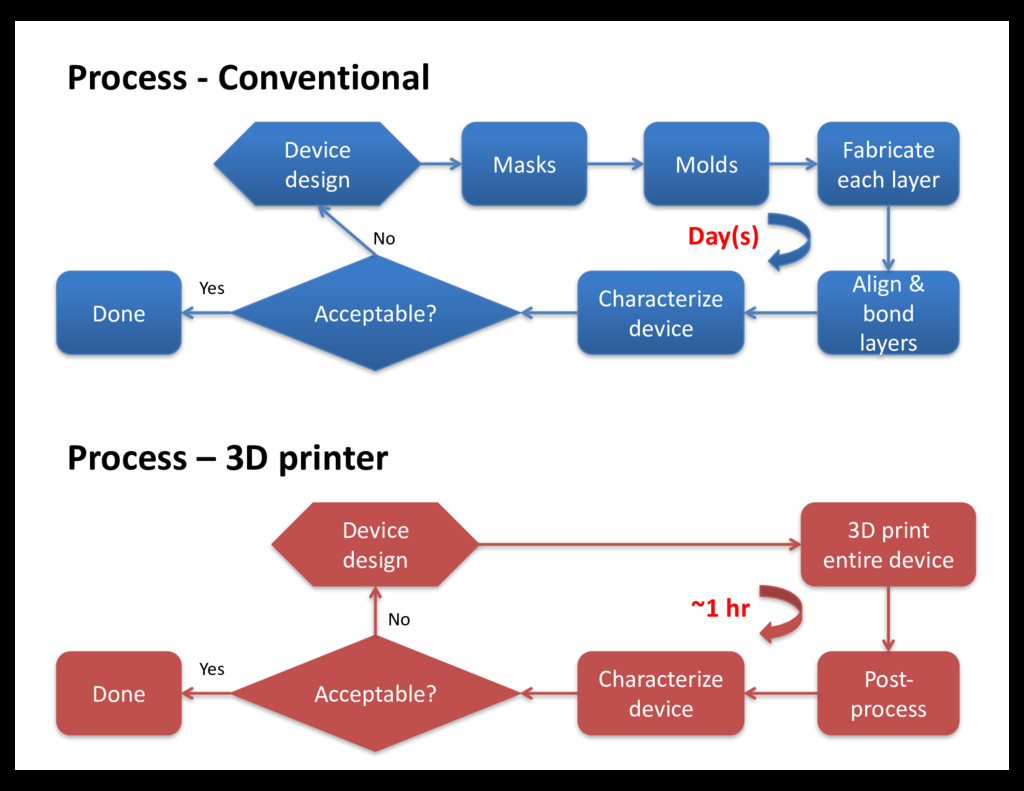
  8. Process - Conventional Device design Masks Molds Fabricate each layer

    Align & bond layers Characterize device Acceptable? Done Yes No ~1 hr Process – 3D printer Device design 3D print entire device Post- process Characterize device Acceptable? Done Yes No Day(s)
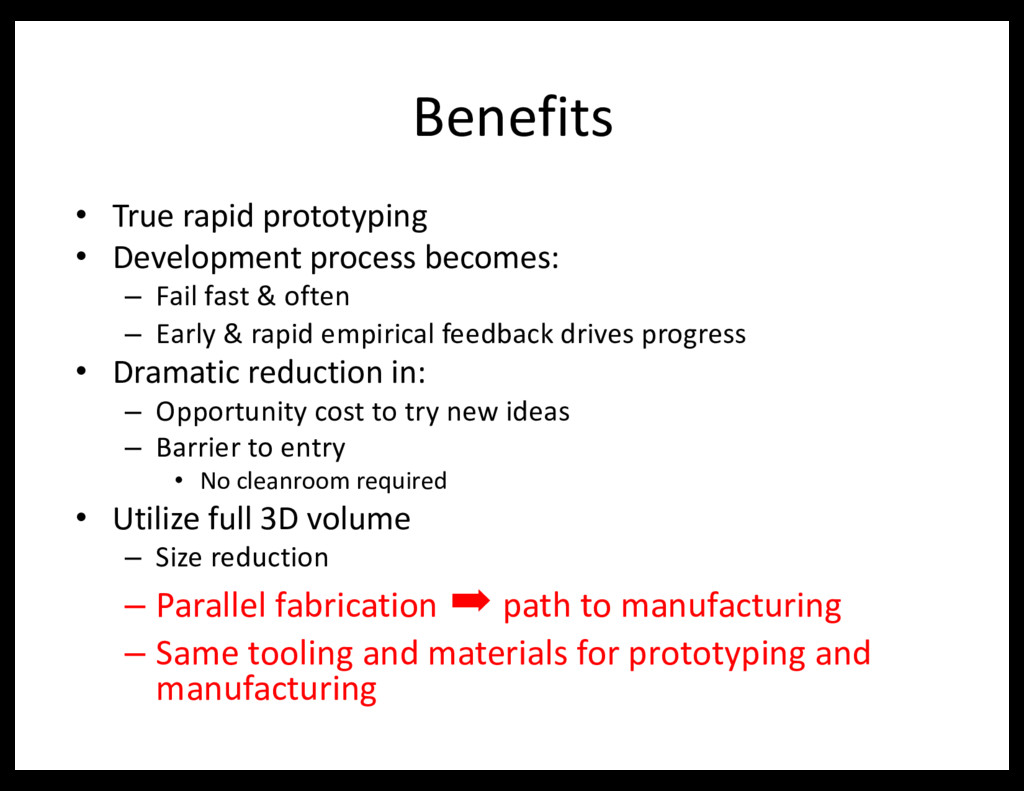
  9. Benefits • True rapid prototyping • Development process becomes: –

    Fail fast & often – Early & rapid empirical feedback drives progress • Dramatic reduction in: – Opportunity cost to try new ideas – Barrier to entry • No cleanroom required • Utilize full 3D volume – Size reduction – Parallel fabrication ➡ path to manufacturing – Same tooling and materials for prototyping and manufacturing
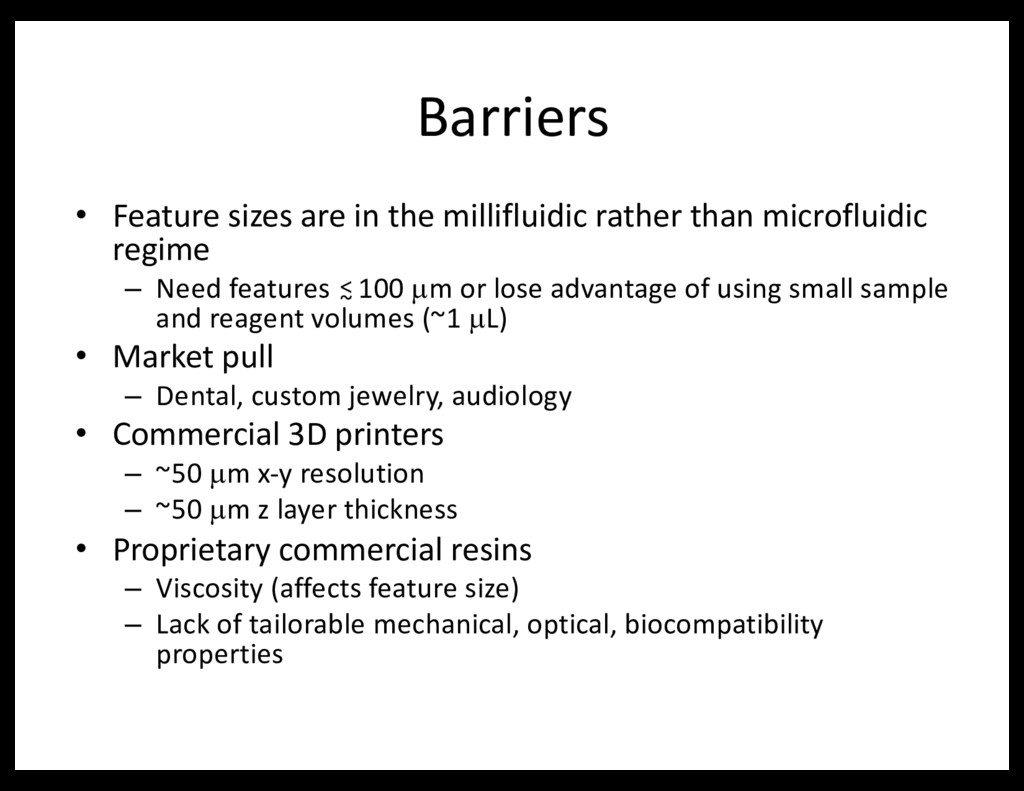
  10. Barriers • Feature sizes are in the millifluidic rather than

    microfluidic regime – Need features 100 µm or lose advantage of using small sample and reagent volumes (~1 µL) • Market pull – Dental, custom jewelry, audiology • Commercial 3D printers – ~50 µm x-y resolution – ~50 µm z layer thickness • Proprietary commercial resins – Viscosity (affects feature size) – Lack of tailorable mechanical, optical, biocompatibility properties < ~
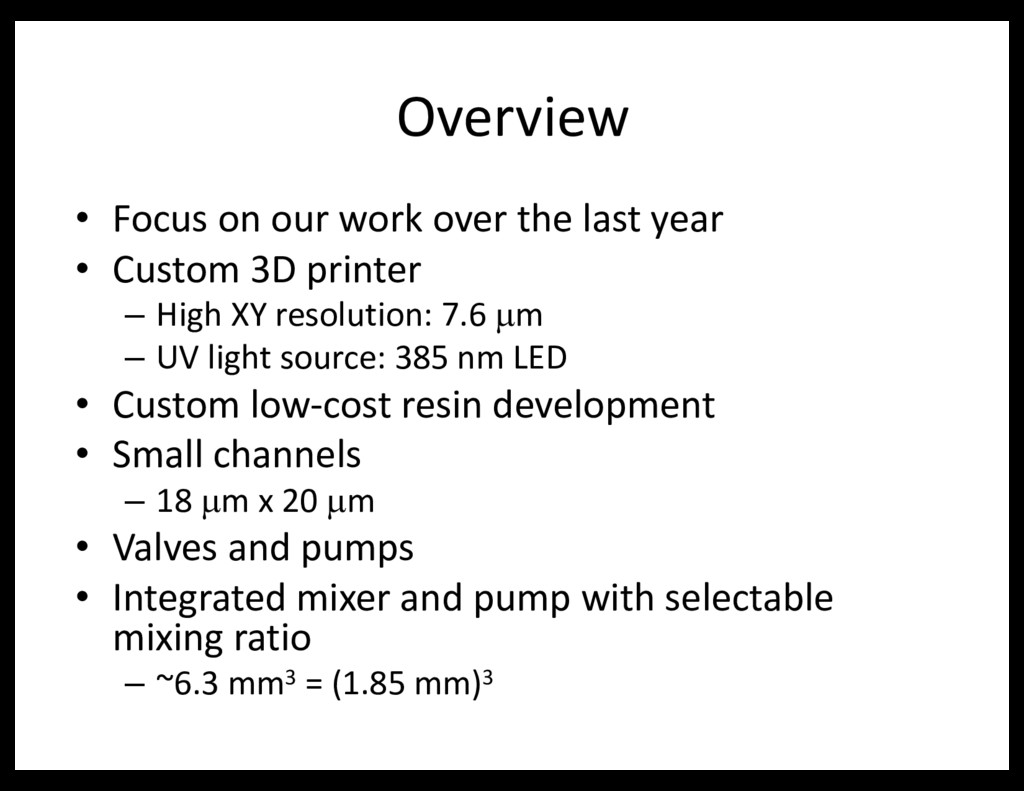
  11. Overview • Focus on our work over the last year

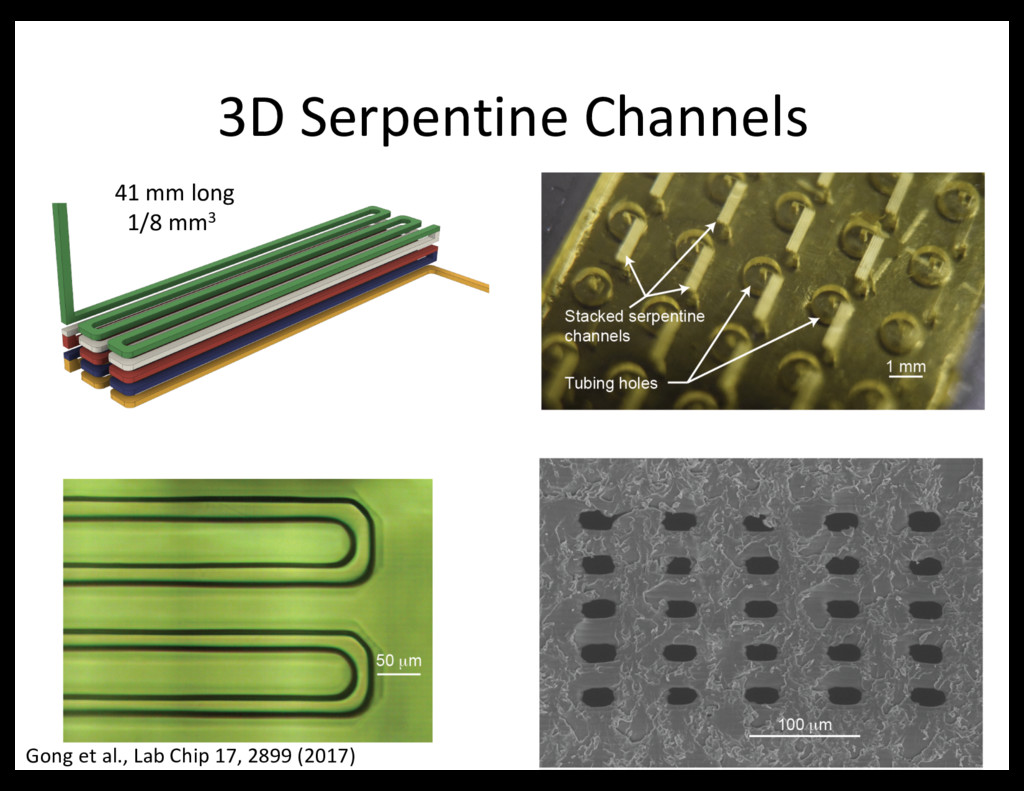
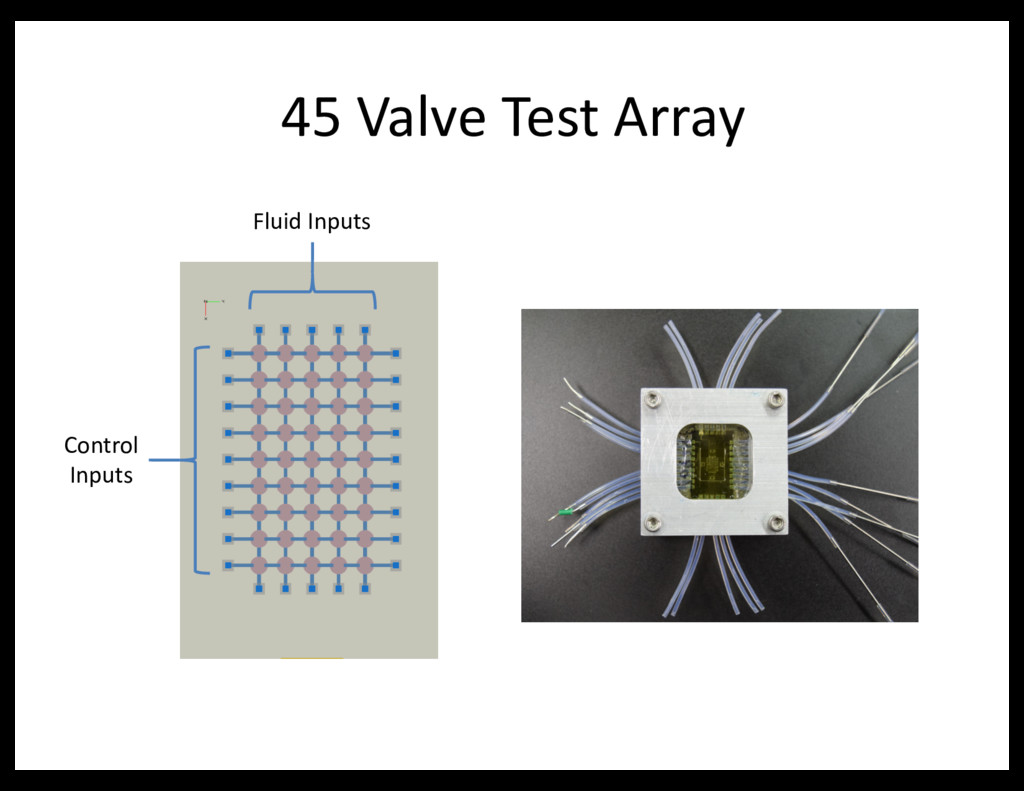
    • Custom 3D printer – High XY resolution: 7.6 µm – UV light source: 385 nm LED • Custom low-cost resin development • Small channels – 18 µm x 20 µm • Valves and pumps • Integrated mixer and pump with selectable mixing ratio – ~6.3 mm3 = (1.85 mm)3
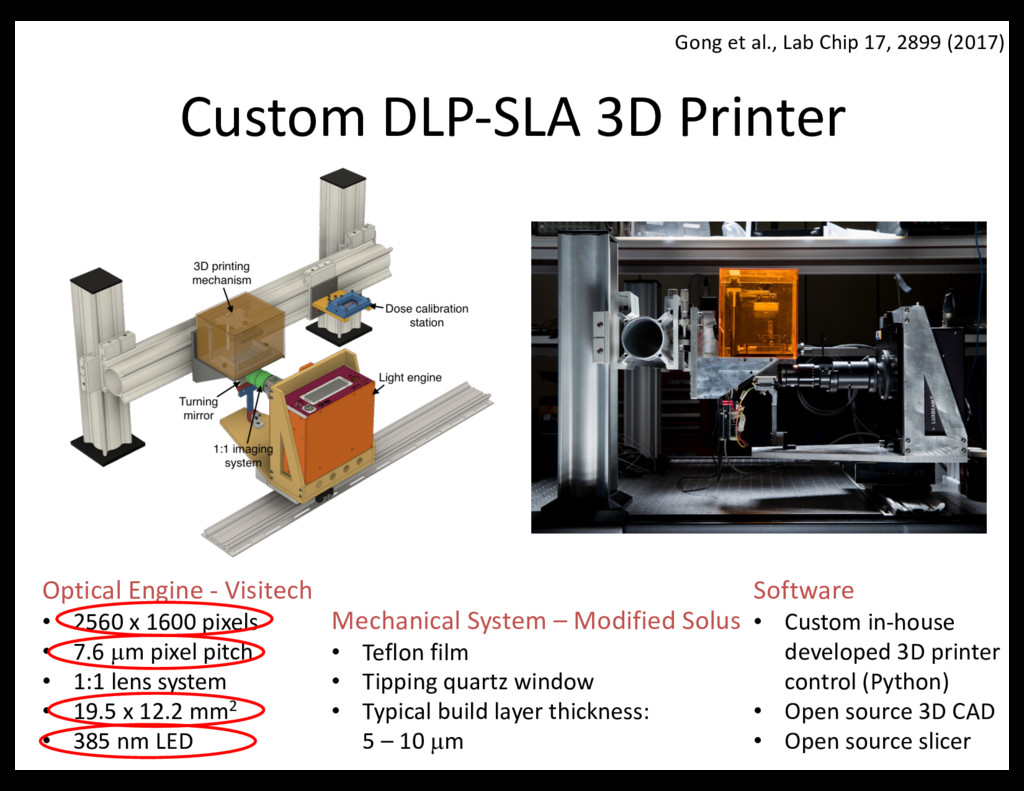
  12. Custom DLP-SLA 3D Printer Optical Engine - Visitech • 2560

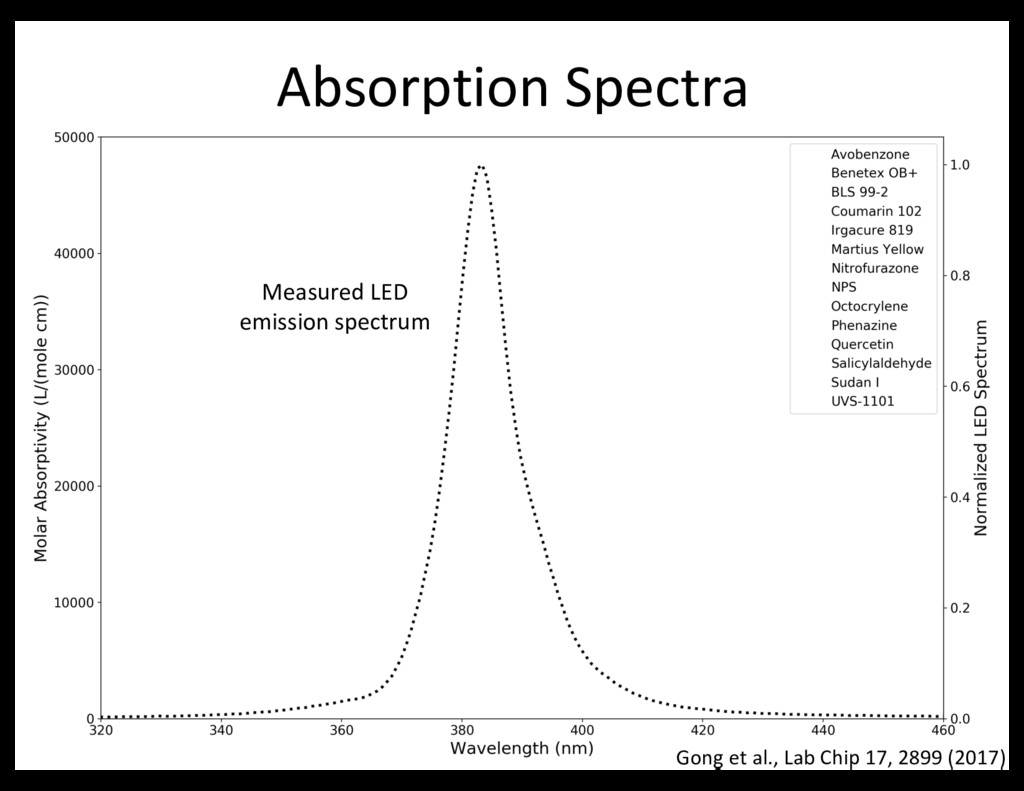
    x 1600 pixels • 7.6 µm pixel pitch • 1:1 lens system • 19.5 x 12.2 mm2 • 385 nm LED Mechanical System – Modified Solus • Teflon film • Tipping quartz window • Typical build layer thickness: 5 – 10 µm Software • Custom in-house developed 3D printer control (Python) • Open source 3D CAD • Open source slicer Gong et al., Lab Chip 17, 2899 (2017)
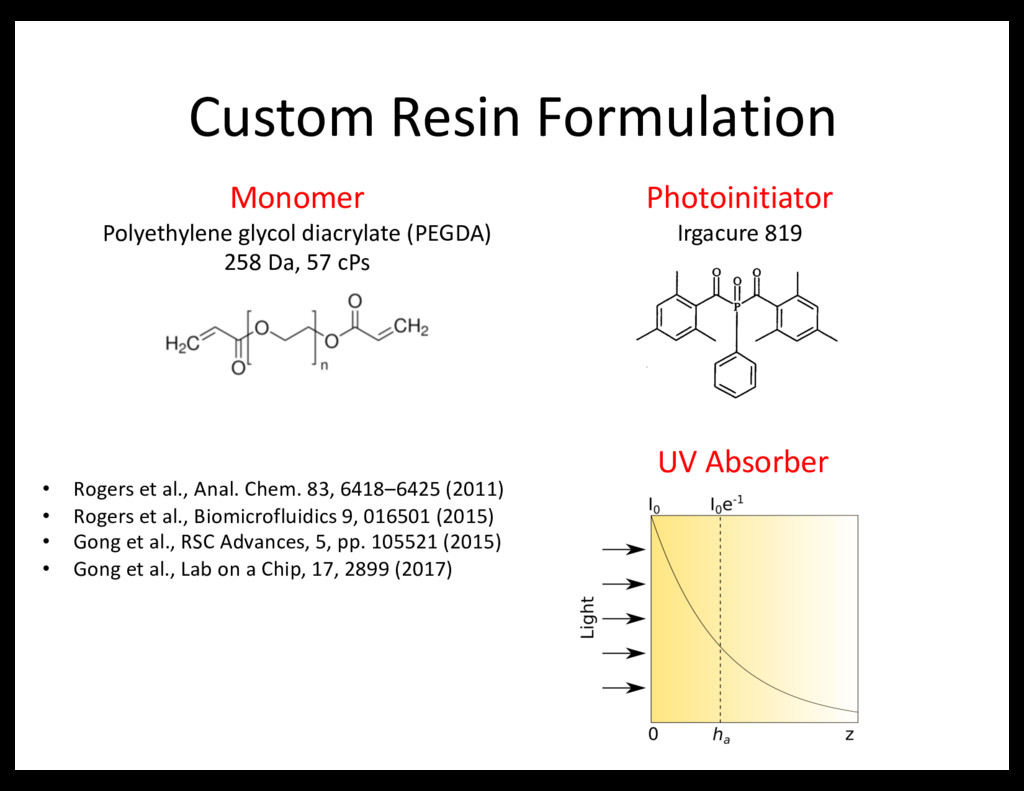
  13. • Rogers et al., Anal. Chem. 83, 6418–6425 (2011) •

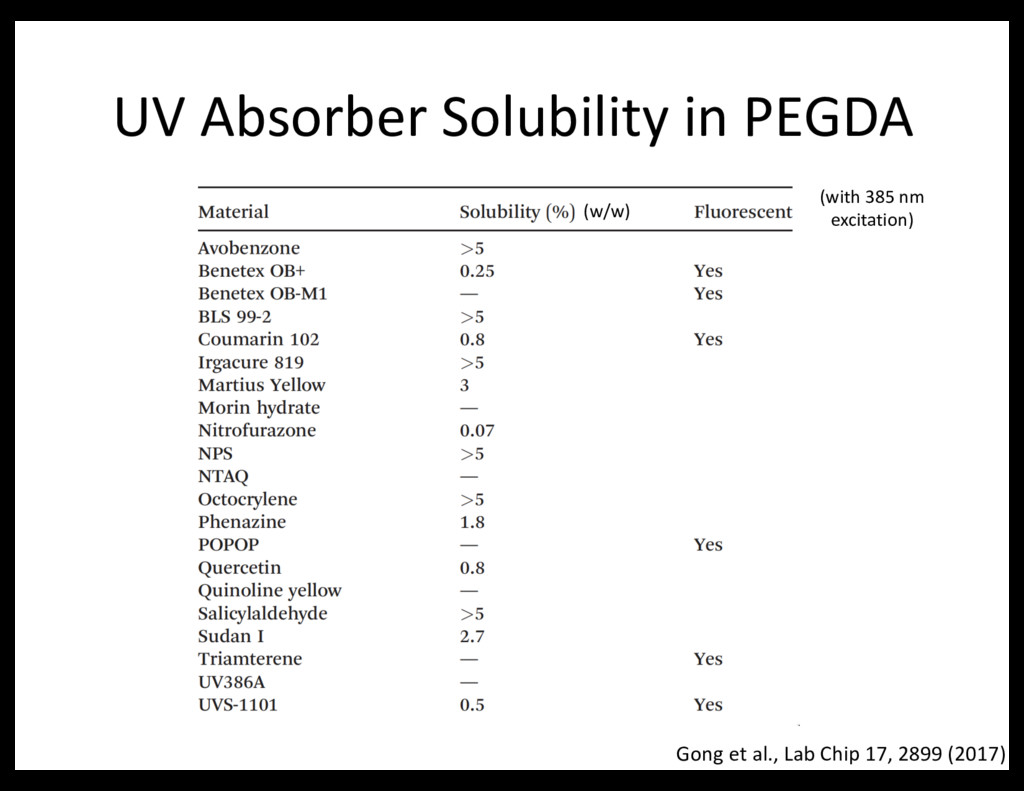
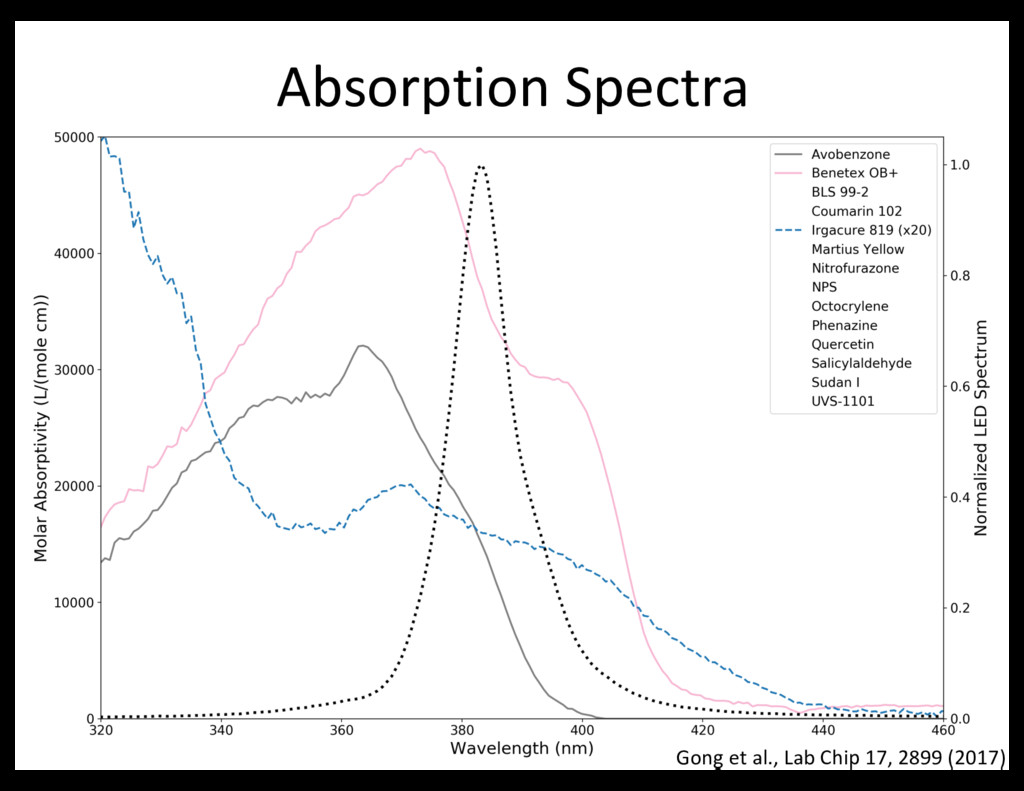
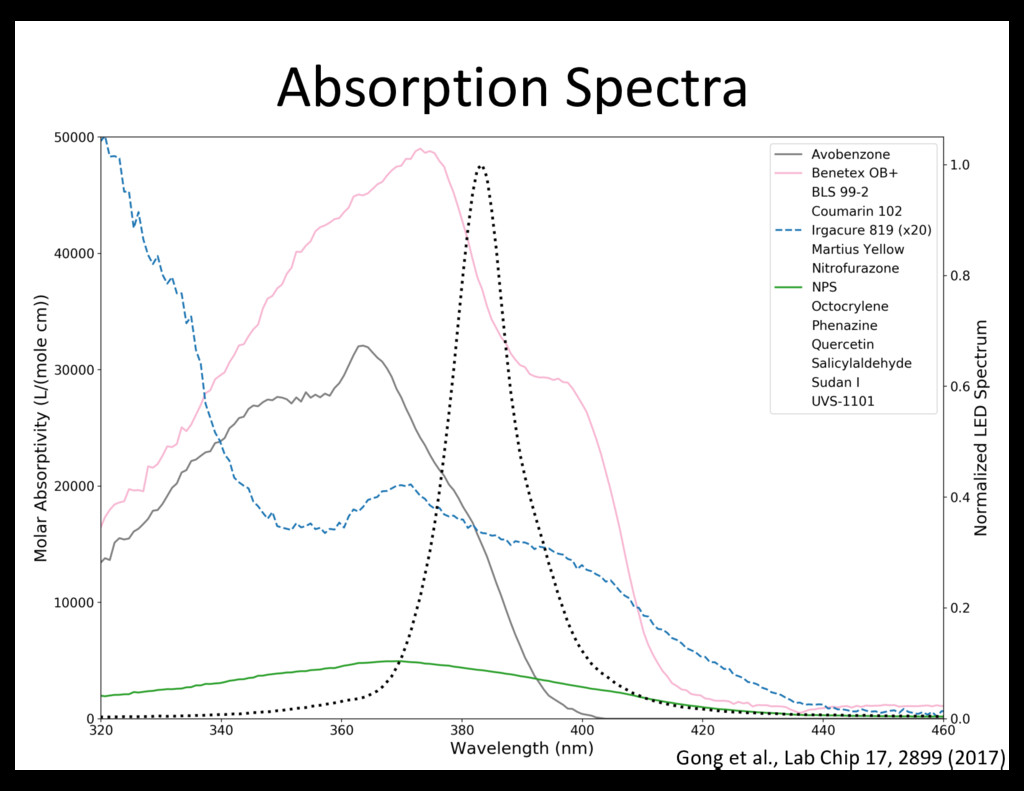
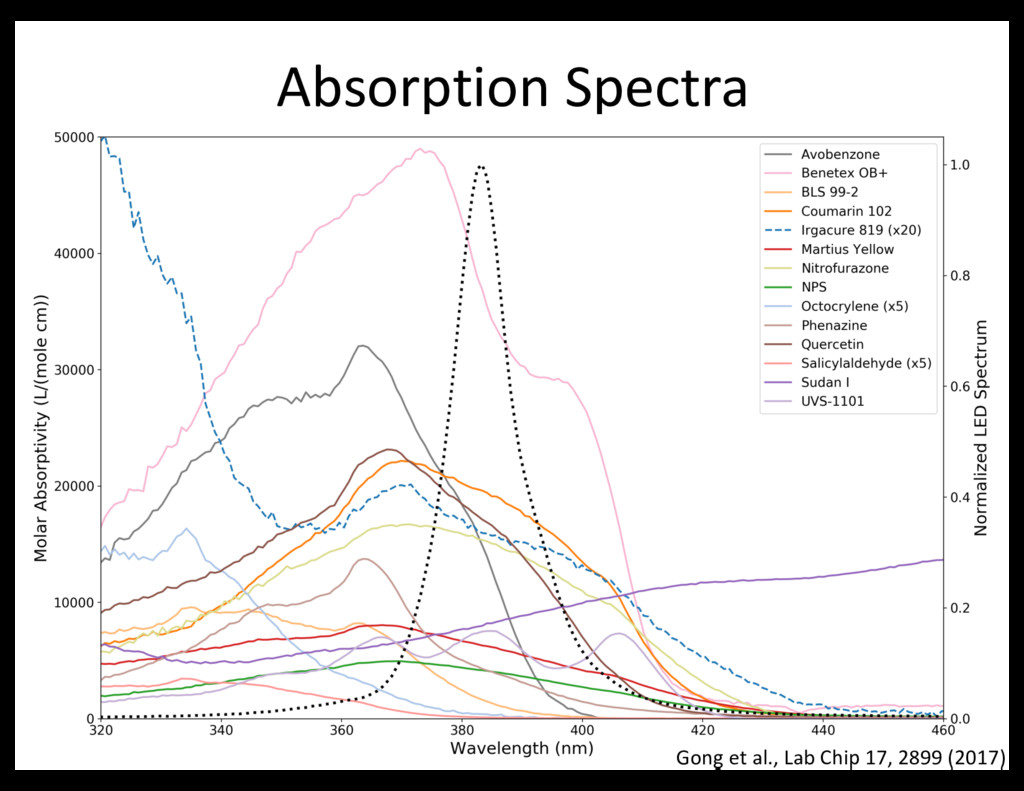
    Rogers et al., Biomicrofluidics 9, 016501 (2015) • Gong et al., RSC Advances, 5, pp. 105521 (2015) • Gong et al., Lab on a Chip, 17, 2899 (2017) Custom Resin Formulation Monomer Polyethylene glycol diacrylate (PEGDA) 258 Da, 57 cPs Photoinitiator Irgacure 819 UV Absorber
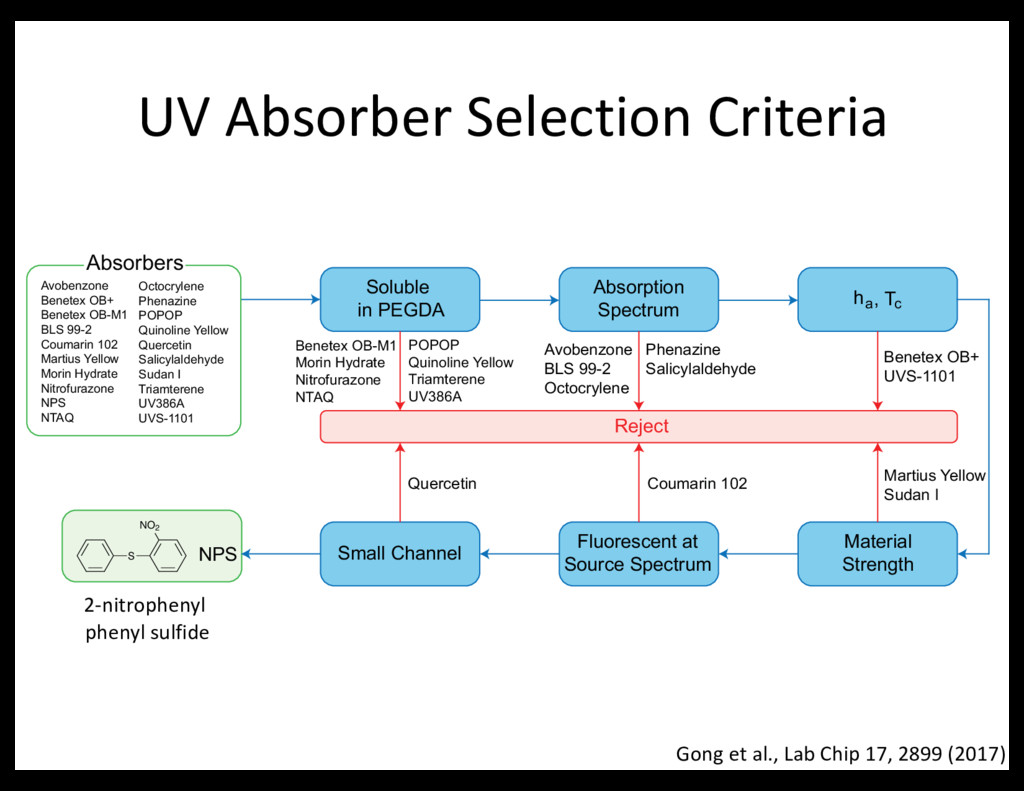
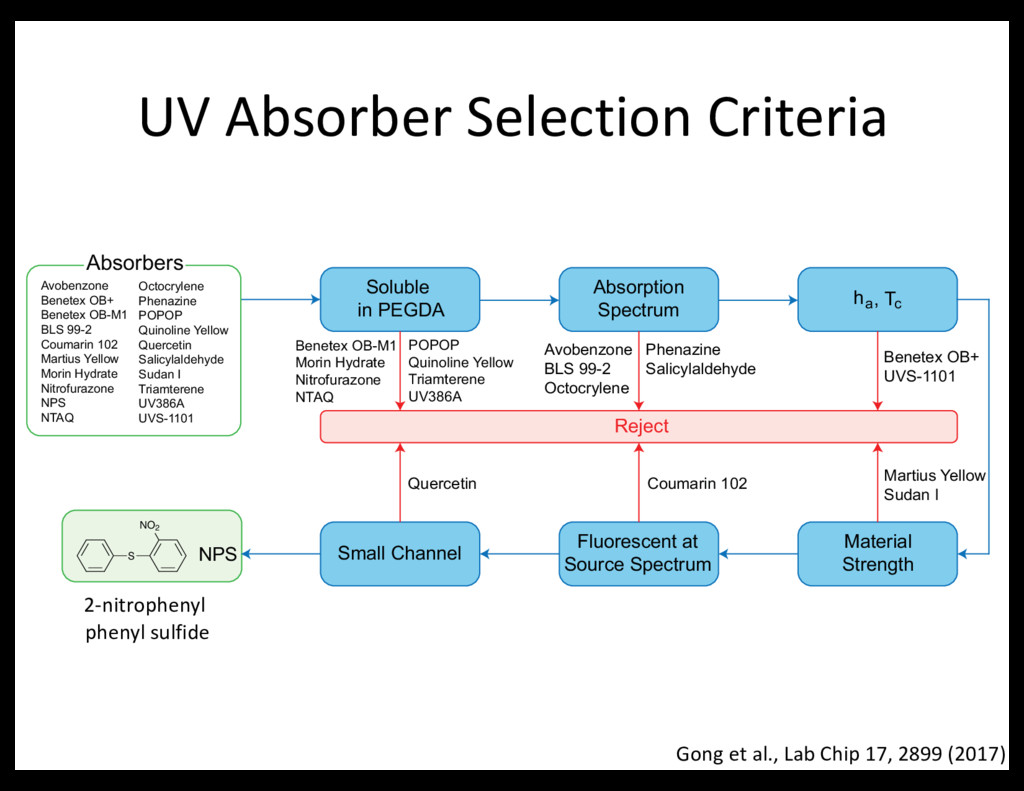
  14. UV Absorber Selection Criteria Soluble in PEGDA Absorption Spectrum Small

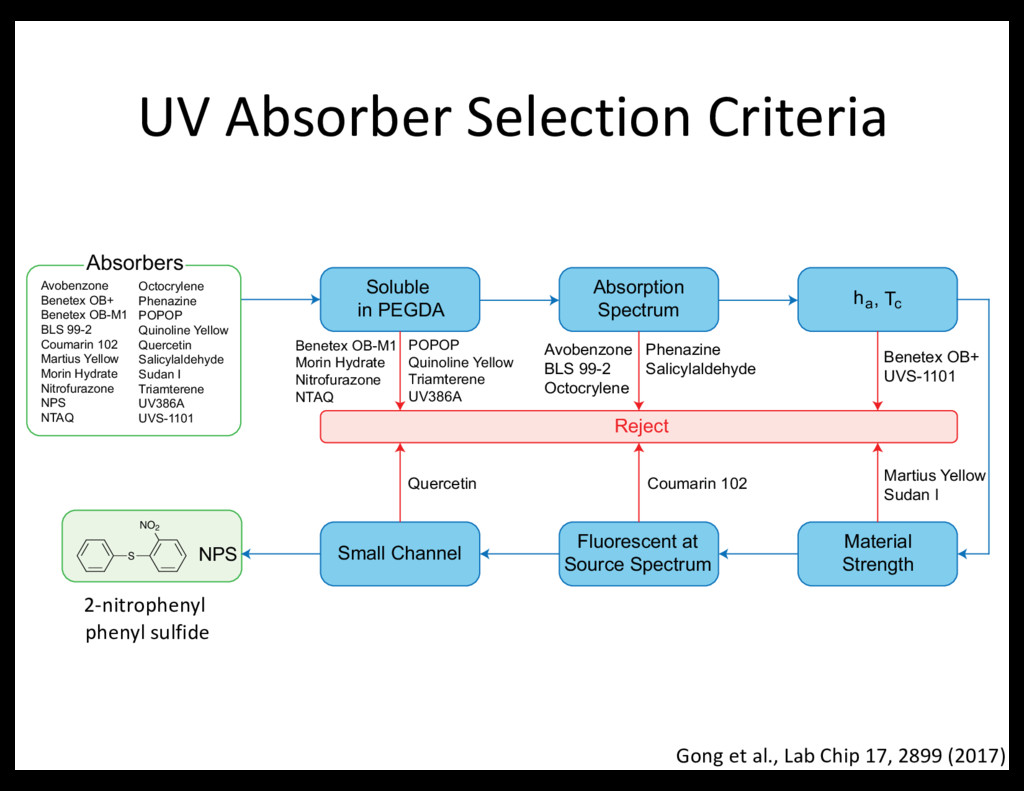
    Channel Fluorescent at Source Spectrum Material Strength Reject Phenazine Salicylaldehyde Benetex OB+ UVS-1101 Martius Yellow Sudan I Coumarin 102 Quercetin NPS Absorbers Avobenzone BLS 99-2 Octocrylene Avobenzone Benetex OB+ Benetex OB-M1 BLS 99-2 Coumarin 102 Martius Yellow Morin Hydrate Nitrofurazone NPS NTAQ Octocrylene Phenazine POPOP Quinoline Yellow Quercetin Salicylaldehyde Sudan I Triamterene UV386A UVS-1101 Benetex OB-M1 Morin Hydrate Nitrofurazone NTAQ POPOP Quinoline Yellow Triamterene UV386A S NO2 ha, Tc 2-nitrophenyl phenyl sulfide Gong et al., Lab Chip 17, 2899 (2017)
  15. UV Absorber Selection Criteria Soluble in PEGDA Absorption Spectrum Small

    Channel Fluorescent at Source Spectrum Material Strength Reject Phenazine Salicylaldehyde Benetex OB+ UVS-1101 Martius Yellow Sudan I Coumarin 102 Quercetin NPS Absorbers Avobenzone BLS 99-2 Octocrylene Avobenzone Benetex OB+ Benetex OB-M1 BLS 99-2 Coumarin 102 Martius Yellow Morin Hydrate Nitrofurazone NPS NTAQ Octocrylene Phenazine POPOP Quinoline Yellow Quercetin Salicylaldehyde Sudan I Triamterene UV386A UVS-1101 Benetex OB-M1 Morin Hydrate Nitrofurazone NTAQ POPOP Quinoline Yellow Triamterene UV386A S NO2 ha, Tc 2-nitrophenyl phenyl sulfide Gong et al., Lab Chip 17, 2899 (2017)
  16. UV Absorber Selection Criteria Soluble in PEGDA Absorption Spectrum Small

    Channel Fluorescent at Source Spectrum Material Strength Reject Phenazine Salicylaldehyde Benetex OB+ UVS-1101 Martius Yellow Sudan I Coumarin 102 Quercetin NPS Absorbers Avobenzone BLS 99-2 Octocrylene Avobenzone Benetex OB+ Benetex OB-M1 BLS 99-2 Coumarin 102 Martius Yellow Morin Hydrate Nitrofurazone NPS NTAQ Octocrylene Phenazine POPOP Quinoline Yellow Quercetin Salicylaldehyde Sudan I Triamterene UV386A UVS-1101 Benetex OB-M1 Morin Hydrate Nitrofurazone NTAQ POPOP Quinoline Yellow Triamterene UV386A S NO2 ha, Tc 2-nitrophenyl phenyl sulfide Gong et al., Lab Chip 17, 2899 (2017)
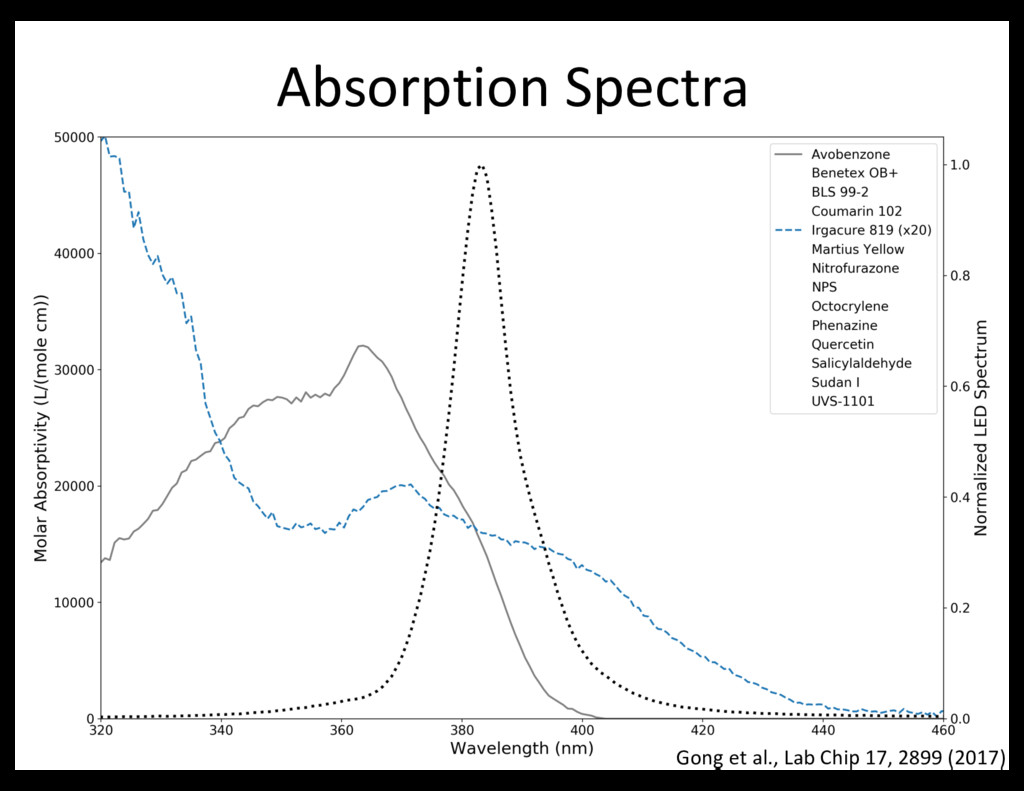
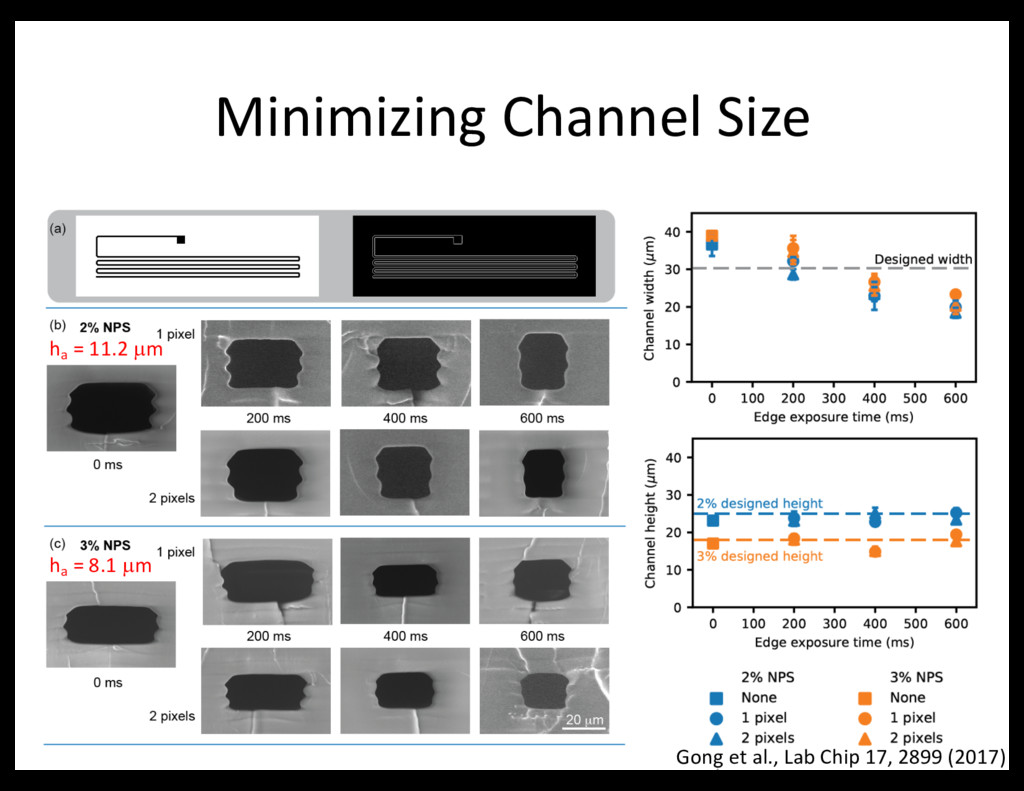
  17. Minimizing Channel Size ha = 11.2 µm ha = 8.1

    µm Gong et al., Lab Chip 17, 2899 (2017)
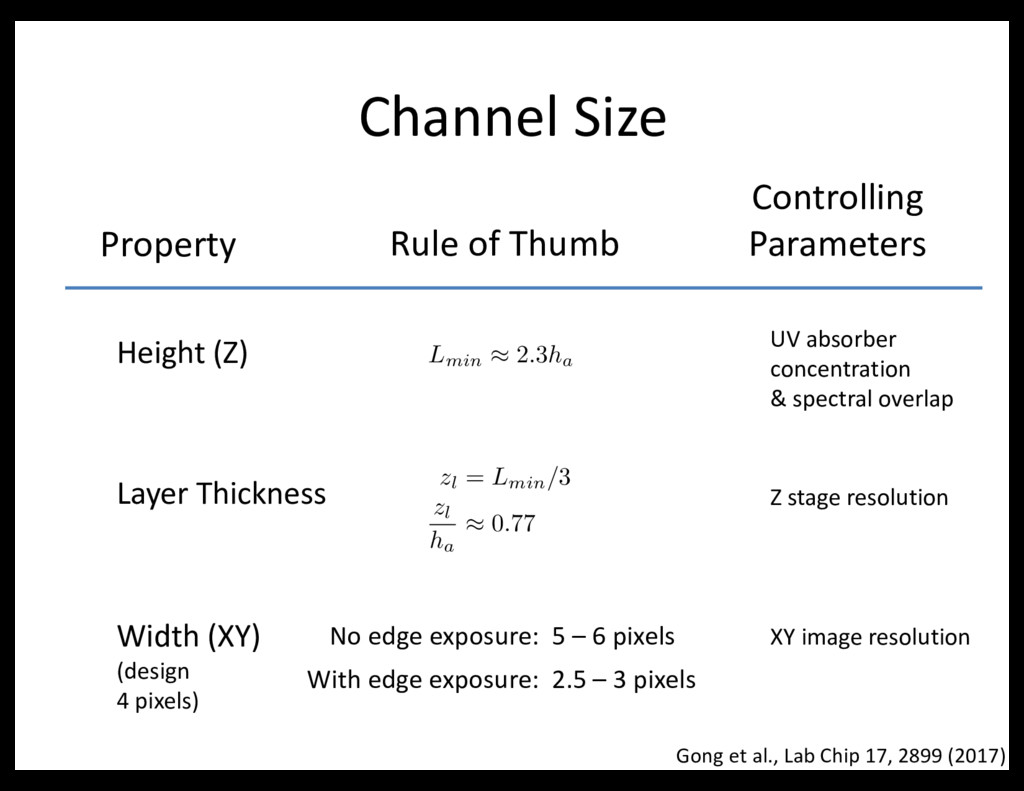
  18. Channel Size Height (Z) Width (XY) (design 4 pixels) No

    edge exposure: 5 – 6 pixels With edge exposure: 2.5 – 3 pixels Lmin ⇡ 2.3ha Layer Thickness zl = Lmin/3 zl ha ⇡ 0.77 UV absorber concentration & spectral overlap Z stage resolution XY image resolution Property Rule of Thumb Controlling Parameters Gong et al., Lab Chip 17, 2899 (2017)
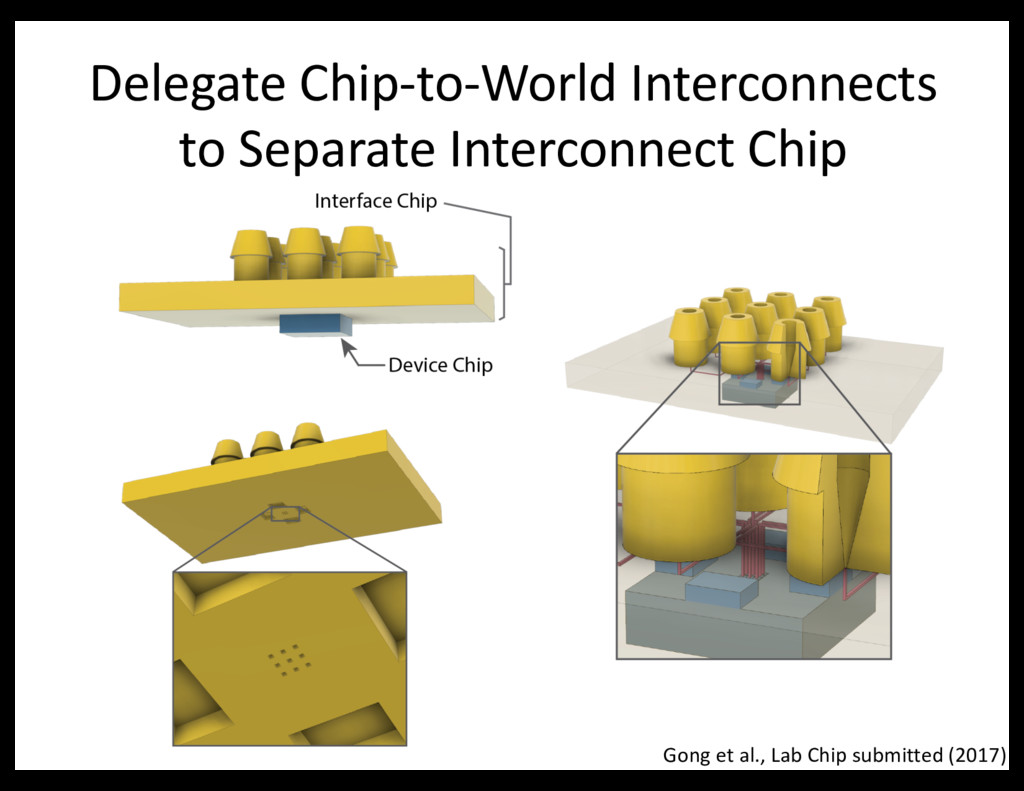
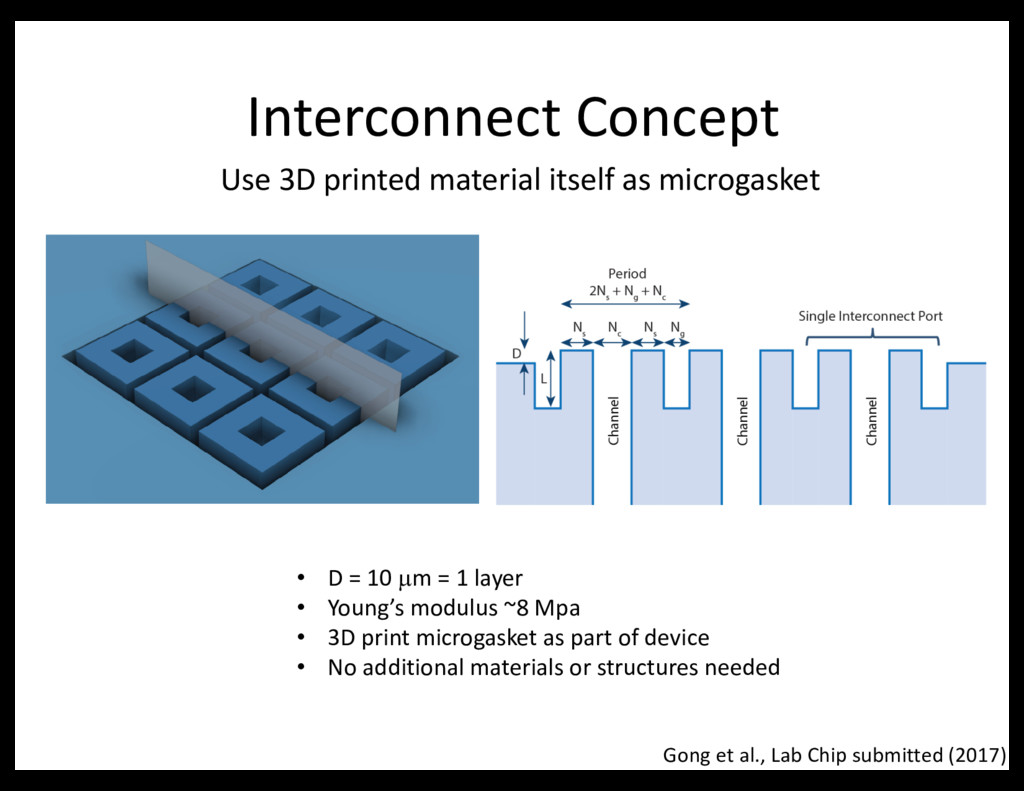
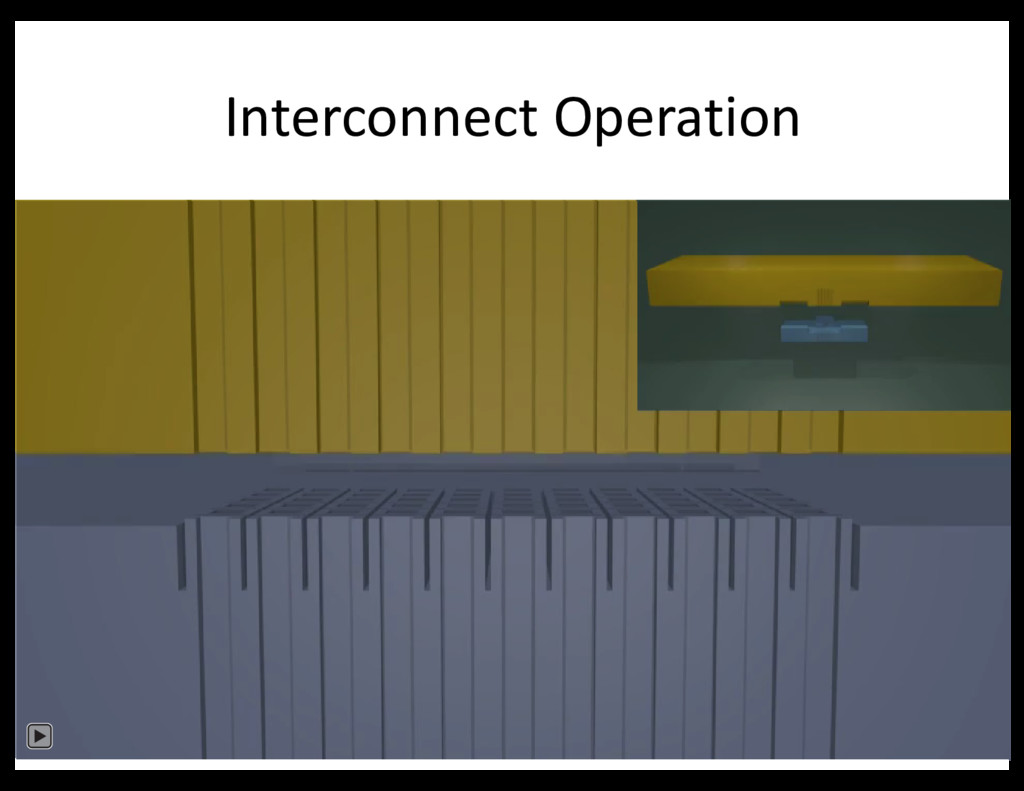
  19. Interconnect Concept • D = 10 µm = 1 layer

    • Young’s modulus ~8 Mpa • 3D print microgasket as part of device • No additional materials or structures needed Use 3D printed material itself as microgasket Gong et al., Lab Chip submitted (2017)
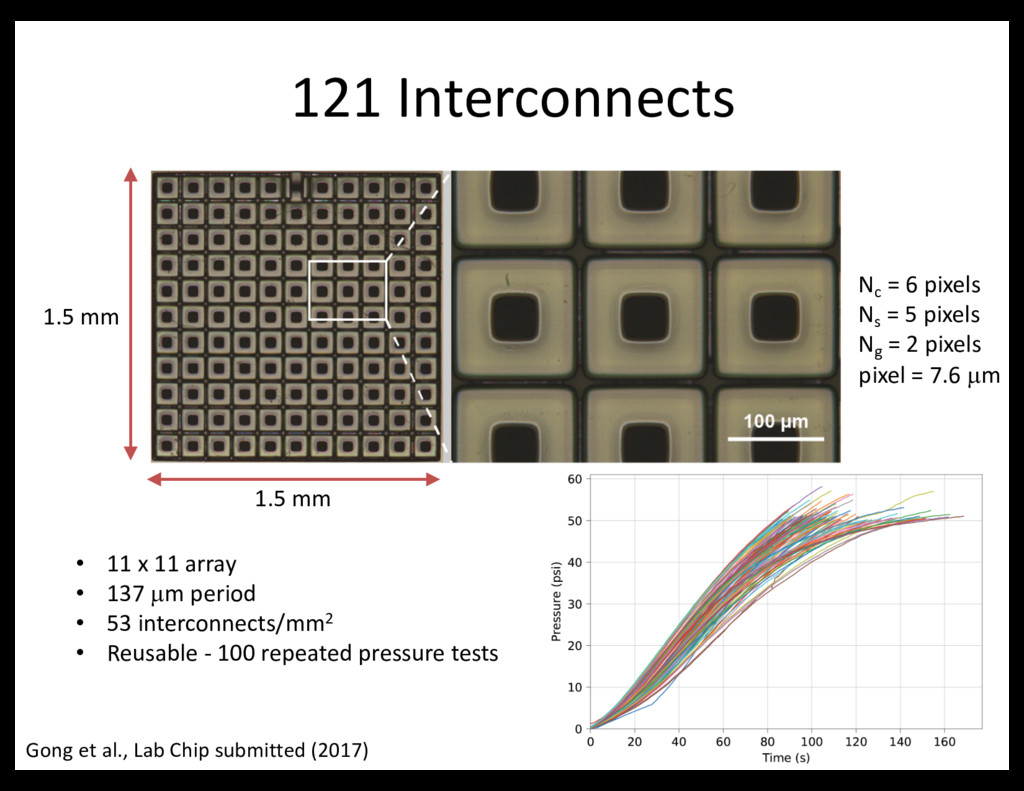
  20. 121 Interconnects • 11 x 11 array • 137 µm

    period • 53 interconnects/mm2 • Reusable - 100 repeated pressure tests 1.5 mm 1.5 mm Nc = 6 pixels Ns = 5 pixels Ng = 2 pixels pixel = 7.6 µm Gong et al., Lab Chip submitted (2017)
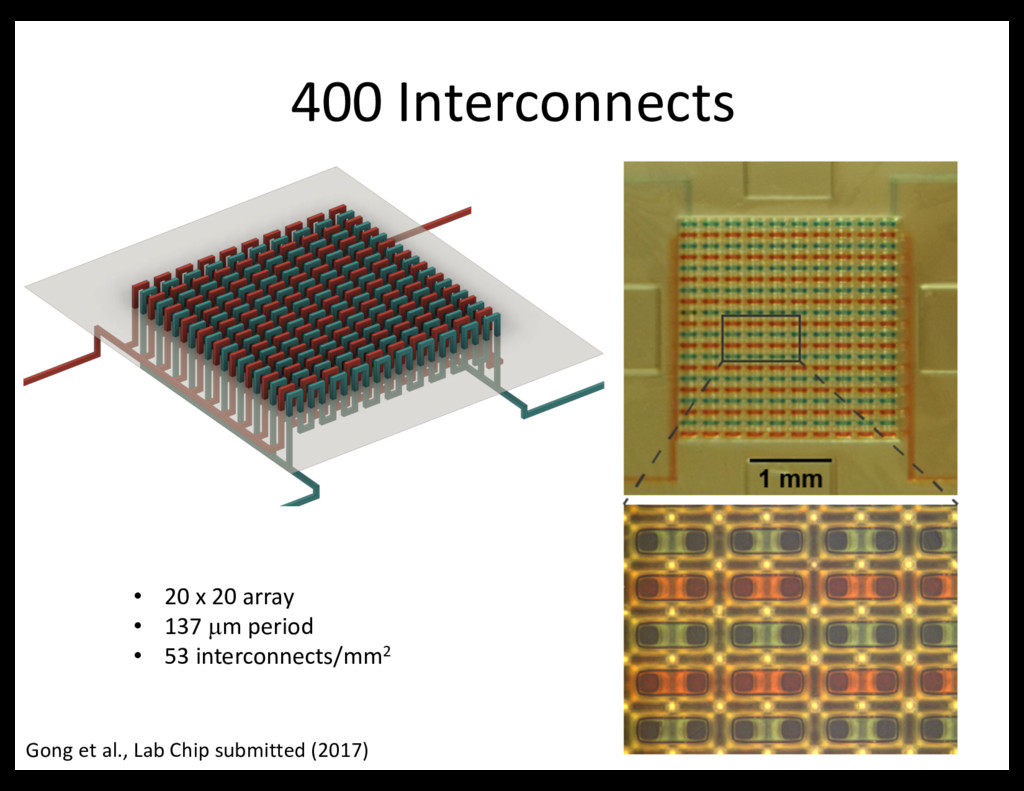
  21. 400 Interconnects • 20 x 20 array • 137 µm

    period • 53 interconnects/mm2 Gong et al., Lab Chip submitted (2017)
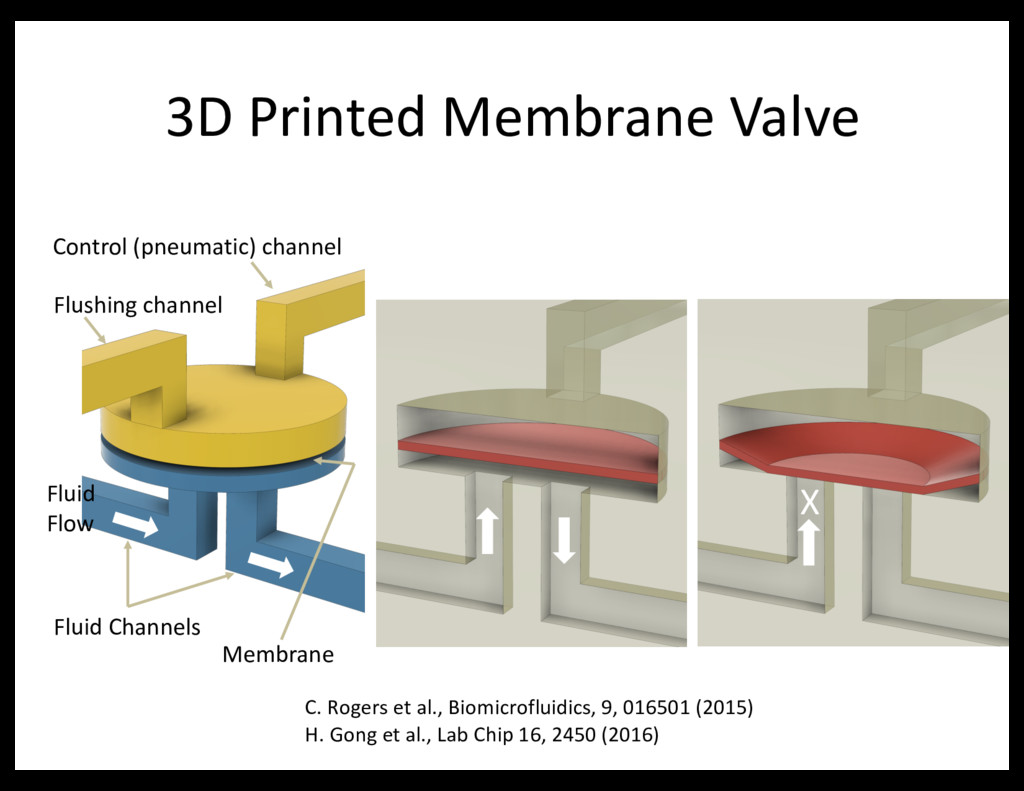
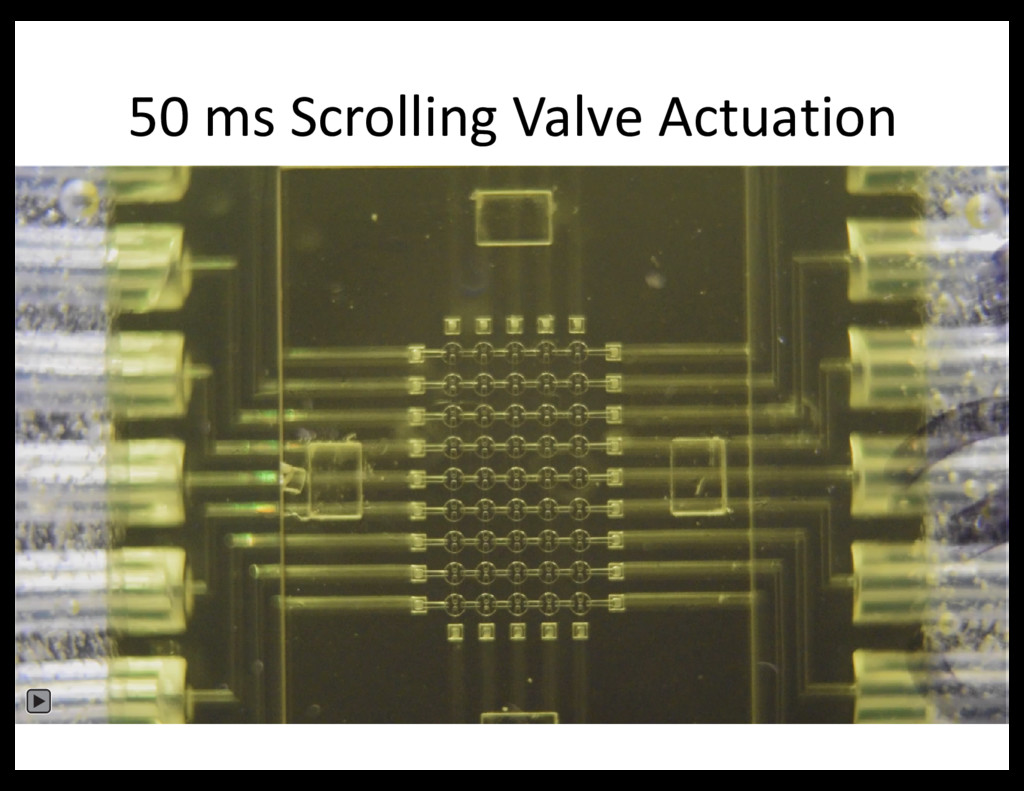
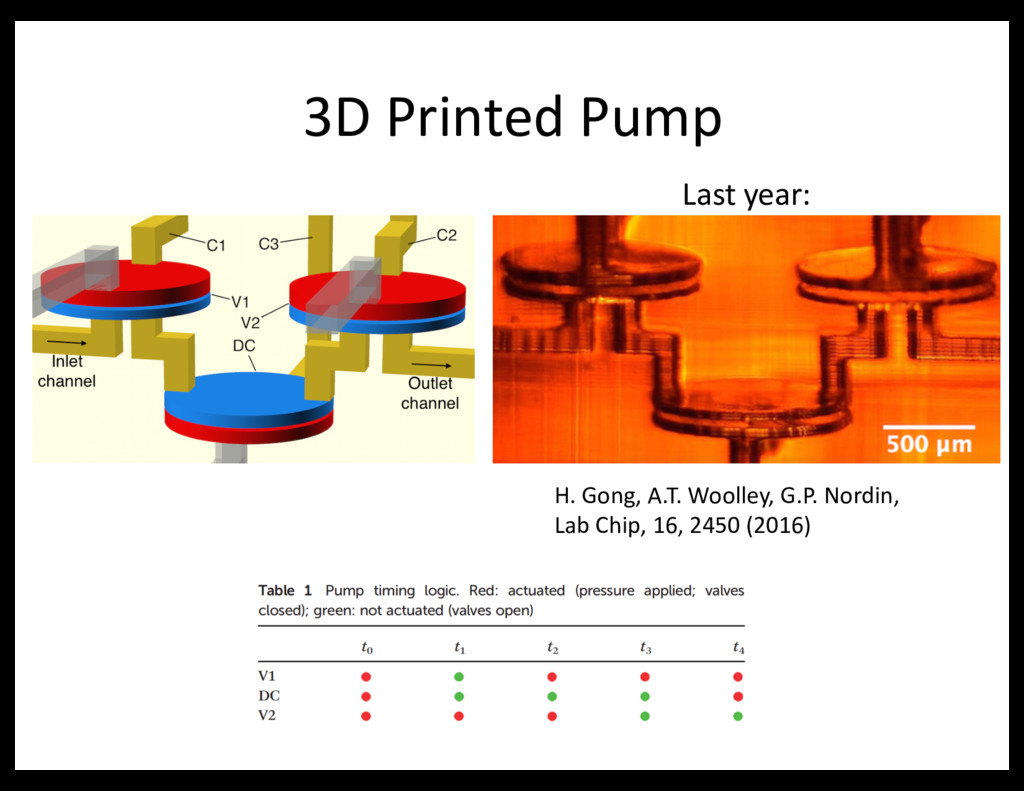
  22. 3D Printed Membrane Valve Fluid Channels Control (pneumatic) channel Flushing

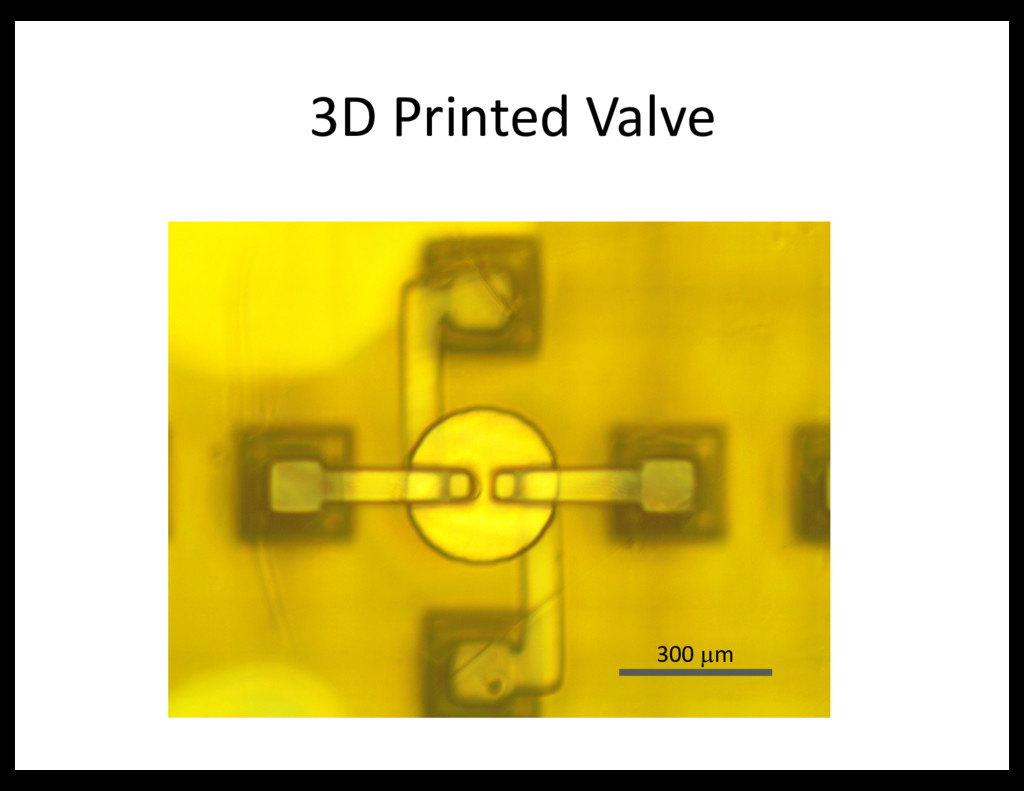
    channel Membrane Fluid Flow C. Rogers et al., Biomicrofluidics, 9, 016501 (2015) H. Gong et al., Lab Chip 16, 2450 (2016) X
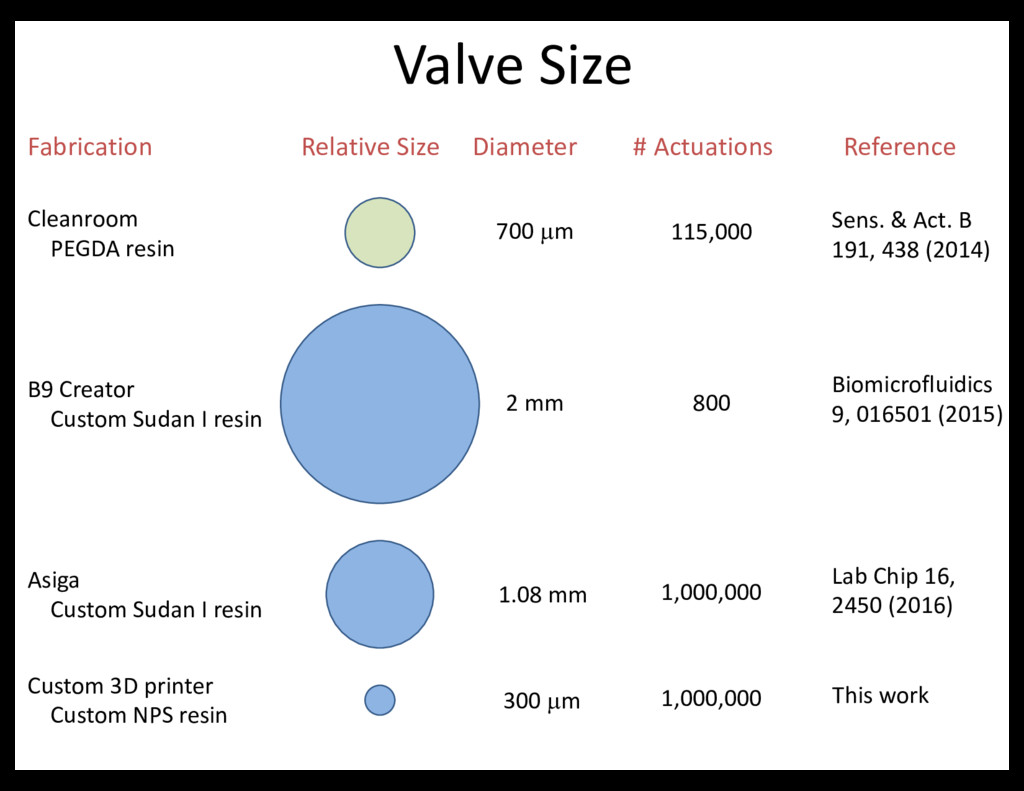
  23. Valve Size Cleanroom PEGDA resin B9 Creator Custom Sudan I

    resin Asiga Custom Sudan I resin Custom 3D printer Custom NPS resin 700 µm 2 mm 1.08 mm 300 µm 115,000 800 1,000,000 1,000,000 Fabrication Diameter # Actuations Reference Sens. & Act. B 191, 438 (2014) Relative Size Biomicrofluidics 9, 016501 (2015) Lab Chip 16, 2450 (2016) This work
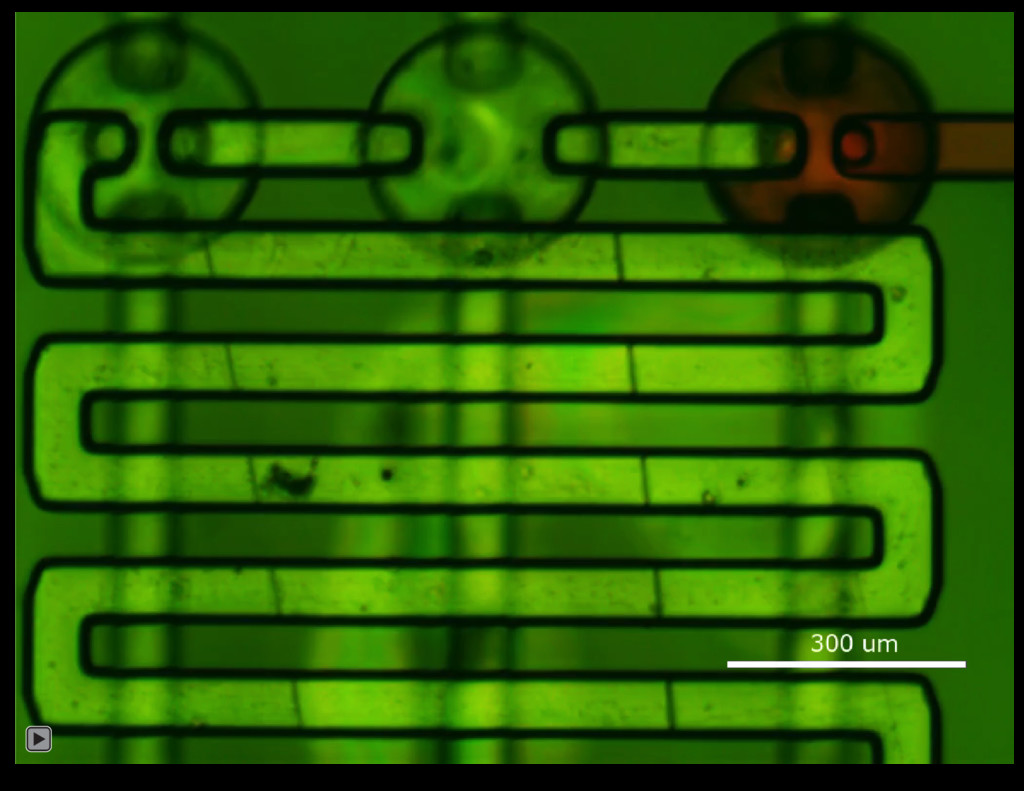
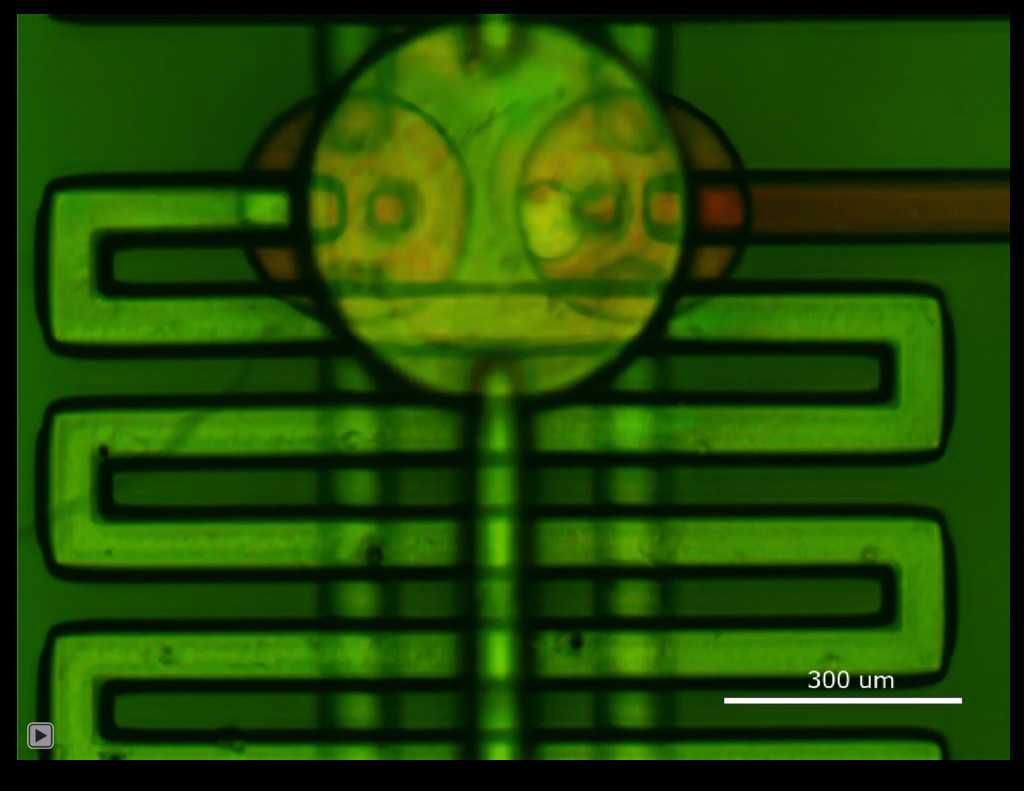
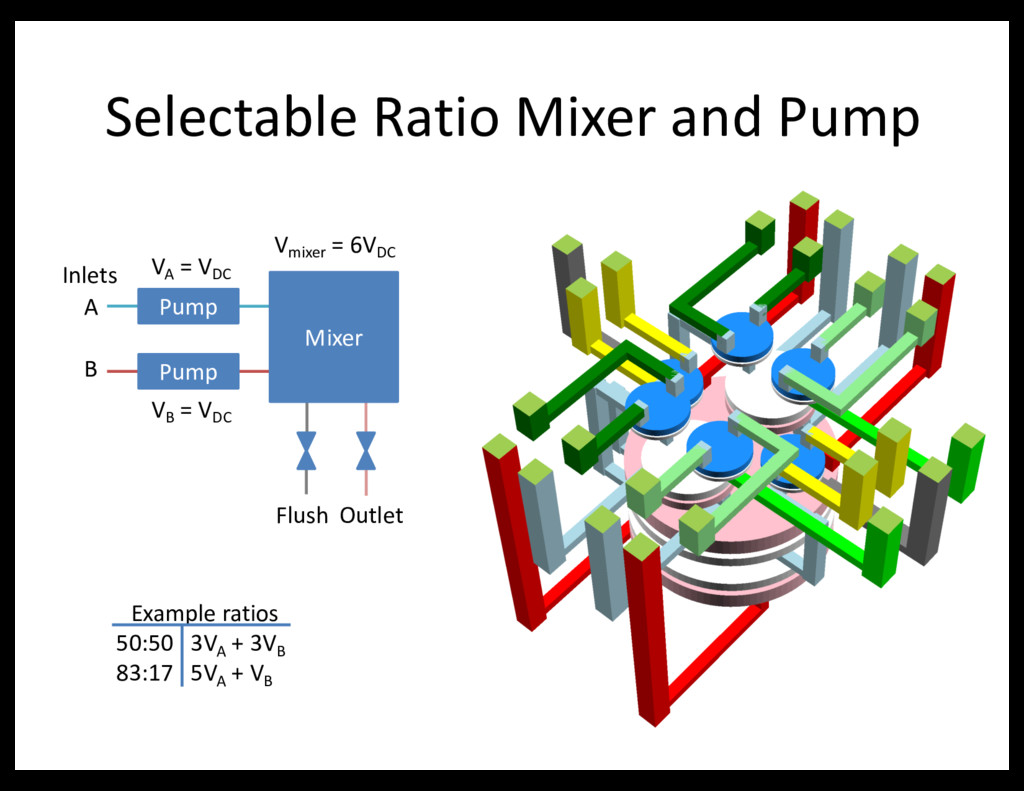
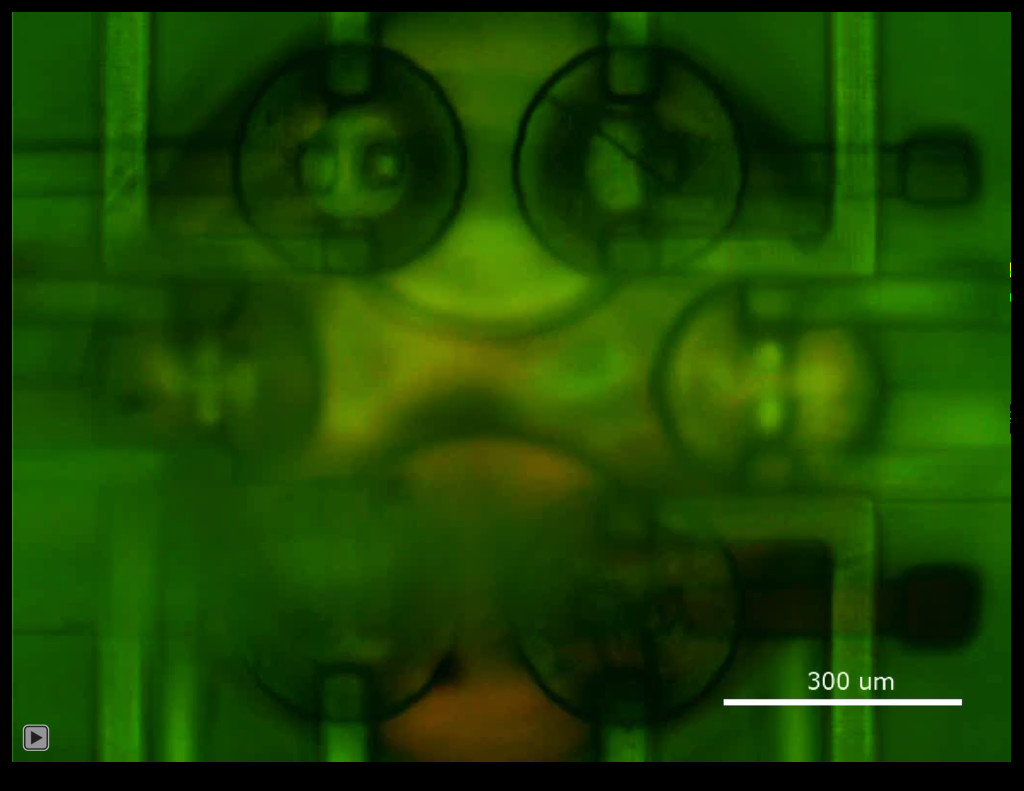
  24. Selectable Ratio Mixer and Pump A B Inlets Flush Outlet

    Pump Pump Mixer VA = VDC VB = VDC Vmixer = 6VDC Example ratios 50:50 3VA + 3VB 83:17 5VA + VB
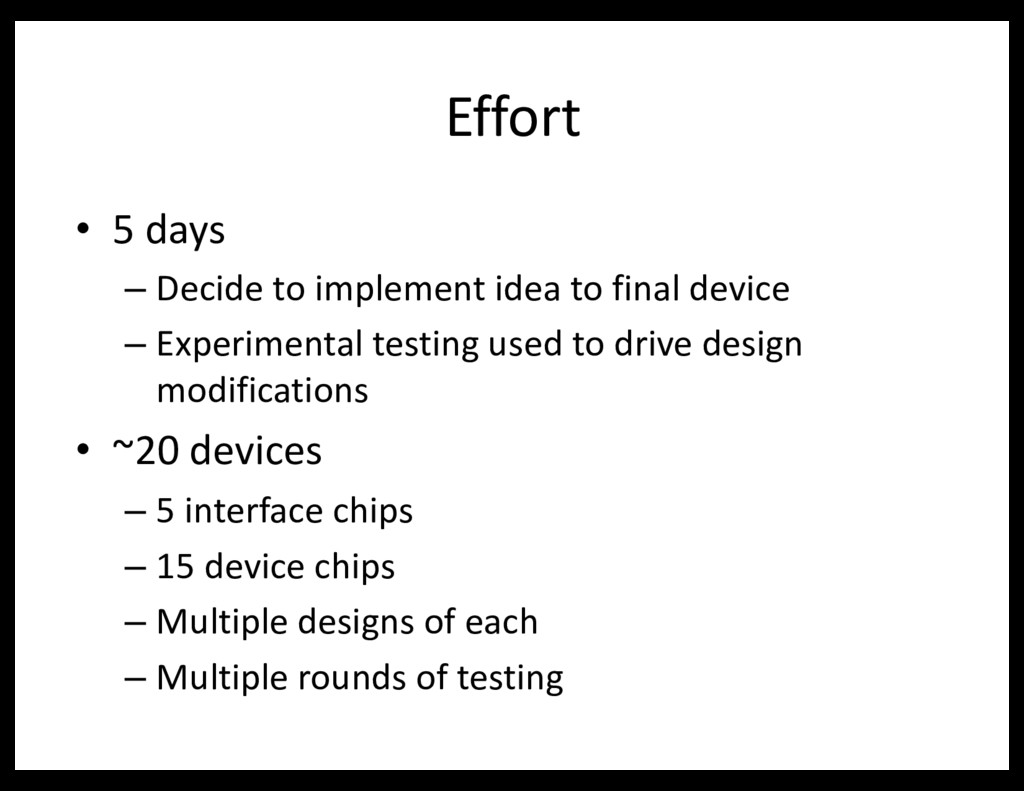
  25. Effort • 5 days – Decide to implement idea to

    final device – Experimental testing used to drive design modifications • ~20 devices – 5 interface chips – 15 device chips – Multiple designs of each – Multiple rounds of testing
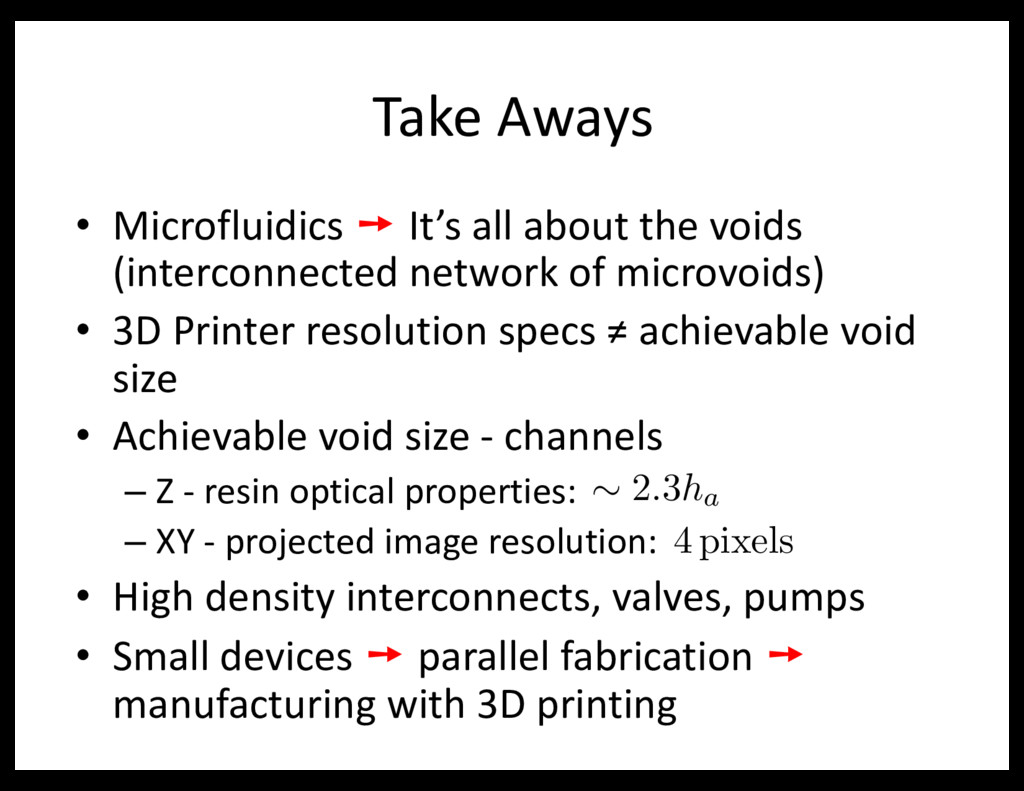
  26. Take Aways • Microfluidics ➙ It’s all about the voids

    (interconnected network of microvoids) • 3D Printer resolution specs ≠ achievable void size • Achievable void size - channels – Z - resin optical properties: – XY - projected image resolution: • High density interconnects, valves, pumps • Small devices ➙ parallel fabrication ➙ manufacturing with 3D printing ⇠ 2.3ha 4 pixels
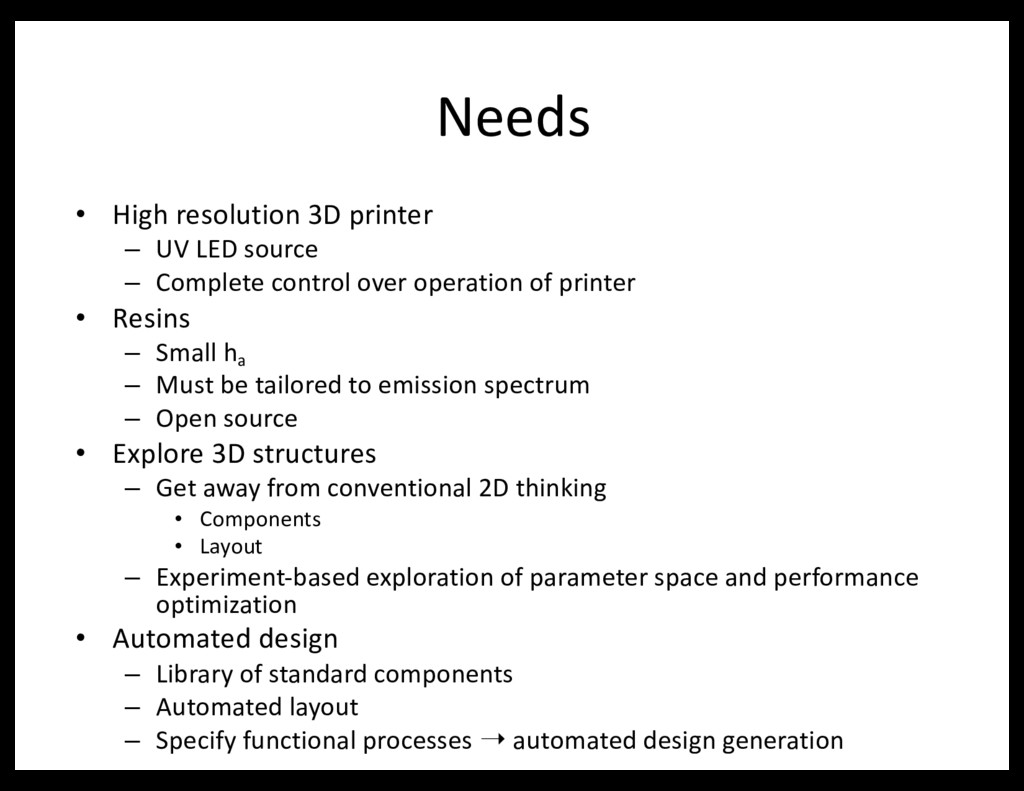
  27. Needs • High resolution 3D printer – UV LED source

    – Complete control over operation of printer • Resins – Small ha – Must be tailored to emission spectrum – Open source • Explore 3D structures – Get away from conventional 2D thinking • Components • Layout – Experiment-based exploration of parameter space and performance optimization • Automated design – Library of standard components – Automated layout – Specify functional processes ➝ automated design generation
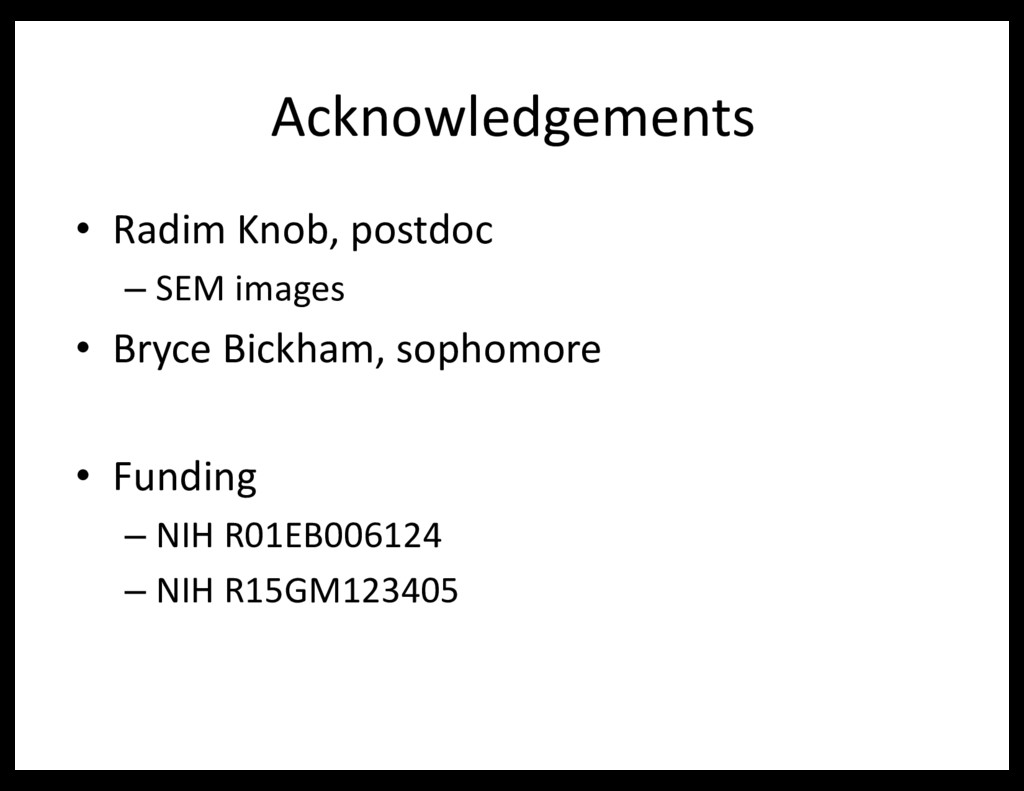
  28. Acknowledgements • Radim Knob, postdoc – SEM images • Bryce

    Bickham, sophomore • Funding – NIH R01EB006124 – NIH R15GM123405
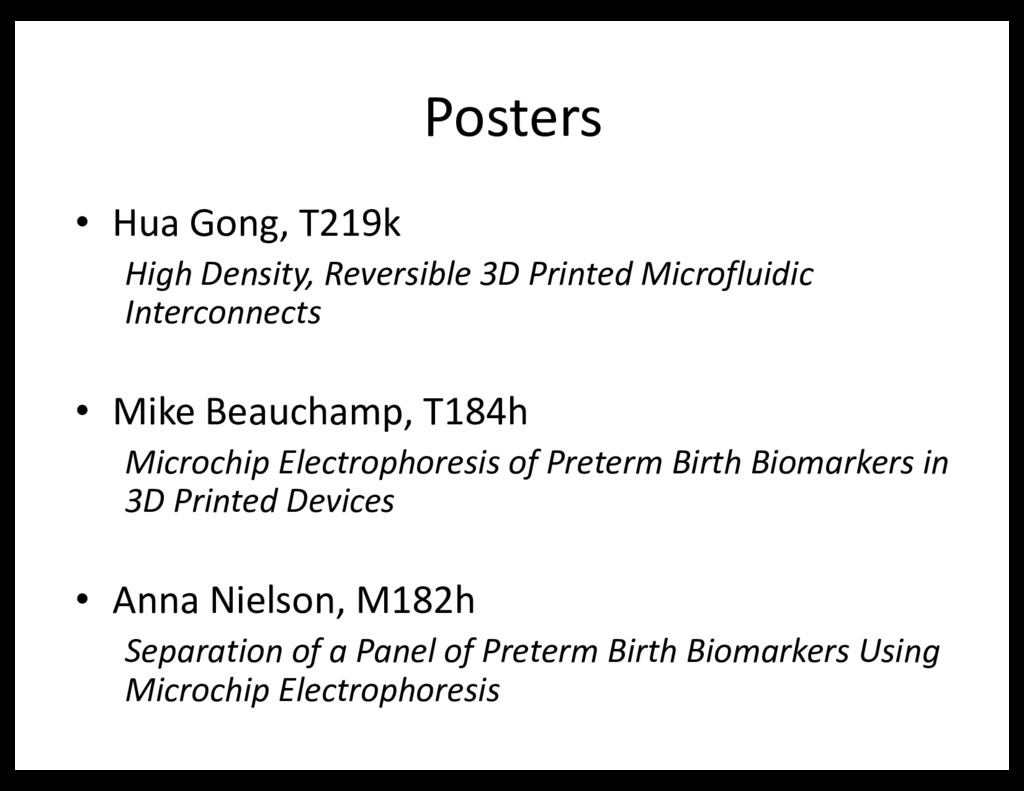
  29. Posters • Hua Gong, T219k High Density, Reversible 3D Printed

    Microfluidic Interconnects • Mike Beauchamp, T184h Microchip Electrophoresis of Preterm Birth Biomarkers in 3D Printed Devices • Anna Nielson, M182h Separation of a Panel of Preterm Birth Biomarkers Using Microchip Electrophoresis