Upgrade to Pro — share decks privately, control downloads, hide ads and more …

Test-Driven Development(TDD) : Practices in the...

Test-Driven Development(TDD) : Practices in the Age of AI and Modern Software Engineering?

In this Knowledge Ketchup Session, Shreaya presented on "Test-Driven Development (TDD): Practices in the Age of AI and Modern Software Engineering," exploring how TDD continues to help teams build reliable, maintainable software while adapting to AI-assisted development workflows.

The session covered core TDD principles, modern best practices, and the evolving role of testing in today's software engineering landscape.

Avatar for Gurzu

Gurzu

June 11, 2026

More Decks by Gurzu

Other Decks in Programming

Transcript

  1. Test-Driven Development (TDD) : Practices in the Age of AI

    and Modern Software Engineering? Presented By : Shreaya Singh Kunwar
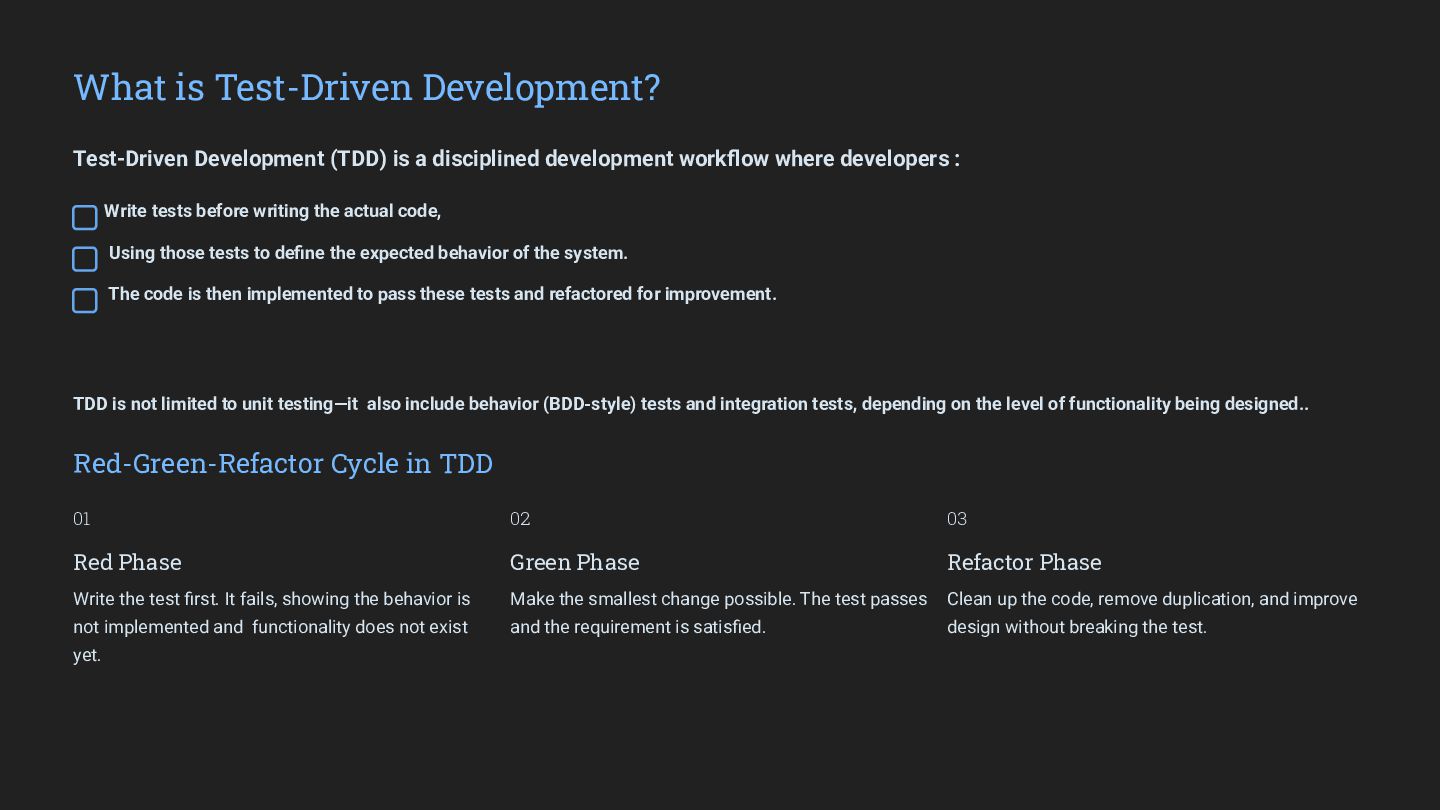
  2. What is Test-Driven Development? Test-Driven Development (TDD) is a disciplined

    development workflow where developers : Write tests before writing the actual code, Using those tests to define the expected behavior of the system. The code is then implemented to pass these tests and refactored for improvement. TDD is not limited to unit testing—it also include behavior (BDD-style) tests and integration tests, depending on the level of functionality being designed.. Red-Green-Refactor Cycle in TDD 01 Red Phase Write the test first. It fails, showing the behavior is not implemented and functionality does not exist yet. 02 Green Phase Make the smallest change possible. The test passes and the requirement is satisfied. 03 Refactor Phase Clean up the code, remove duplication, and improve design without breaking the test.
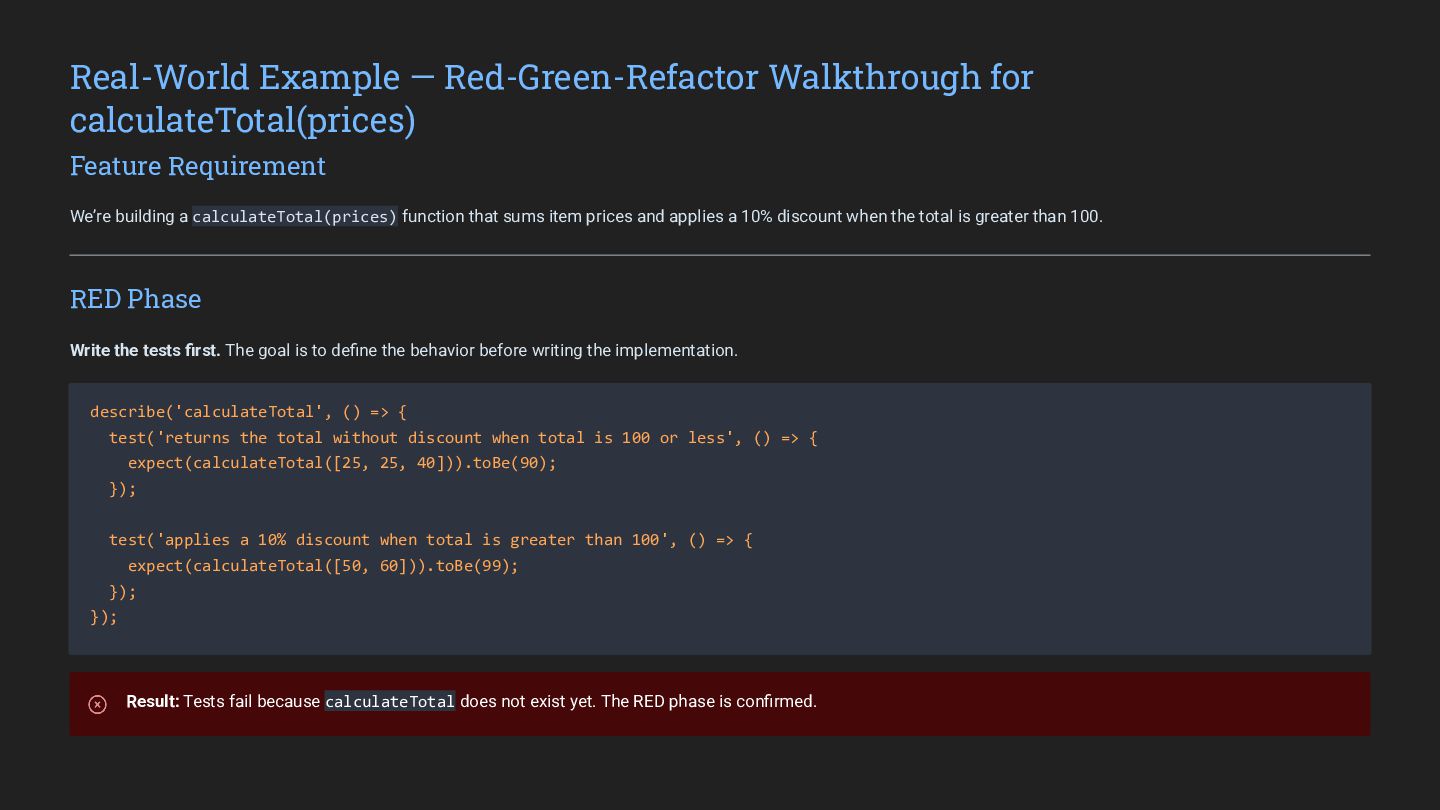
  3. Real-World Example — Red-Green-Refactor Walkthrough for calculateTotal(prices) Feature Requirement We’re

    building a calculateTotal(prices) function that sums item prices and applies a 10% discount when the total is greater than 100. RED Phase Write the tests first. The goal is to define the behavior before writing the implementation. describe('calculateTotal', () => { test('returns the total without discount when total is 100 or less', () => { expect(calculateTotal([25, 25, 40])).toBe(90); }); test('applies a 10% discount when total is greater than 100', () => { expect(calculateTotal([50, 60])).toBe(99); }); }); Result: Tests fail because calculateTotal does not exist yet. The RED phase is confirmed.
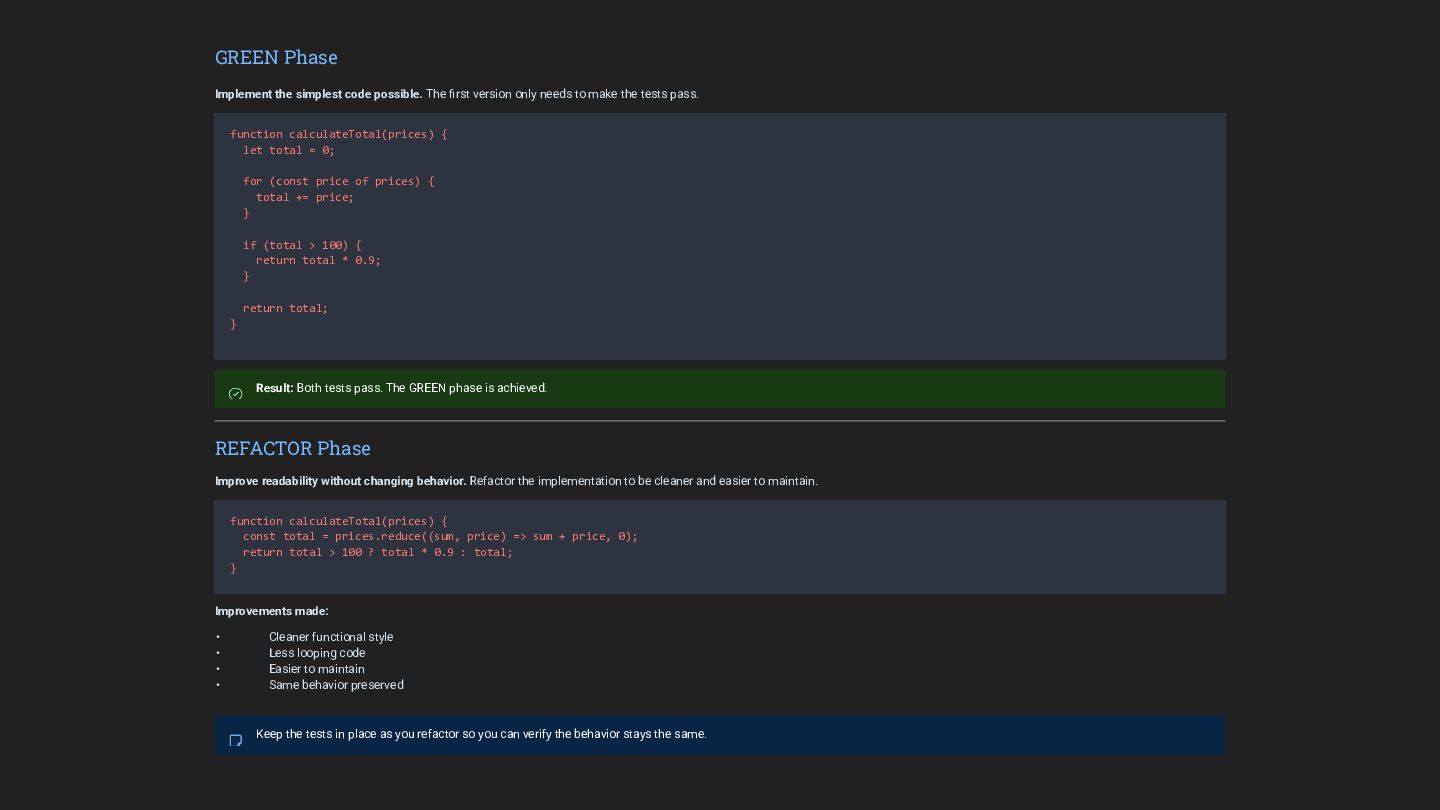
  4. GREEN Phase Implement the simplest code possible. The first version

    only needs to make the tests pass. function calculateTotal(prices) { let total = 0; for (const price of prices) { total += price; } if (total > 100) { return total * 0.9; } return total; } Result: Both tests pass. The GREEN phase is achieved. REFACTOR Phase Improve readability without changing behavior. Refactor the implementation to be cleaner and easier to maintain. function calculateTotal(prices) { const total = prices.reduce((sum, price) => sum + price, 0); return total > 100 ? total * 0.9 : total; } Improvements made: • Cleaner functional style • Less looping code • Easier to maintain • Same behavior preserved Keep the tests in place as you refactor so you can verify the behavior stays the same.
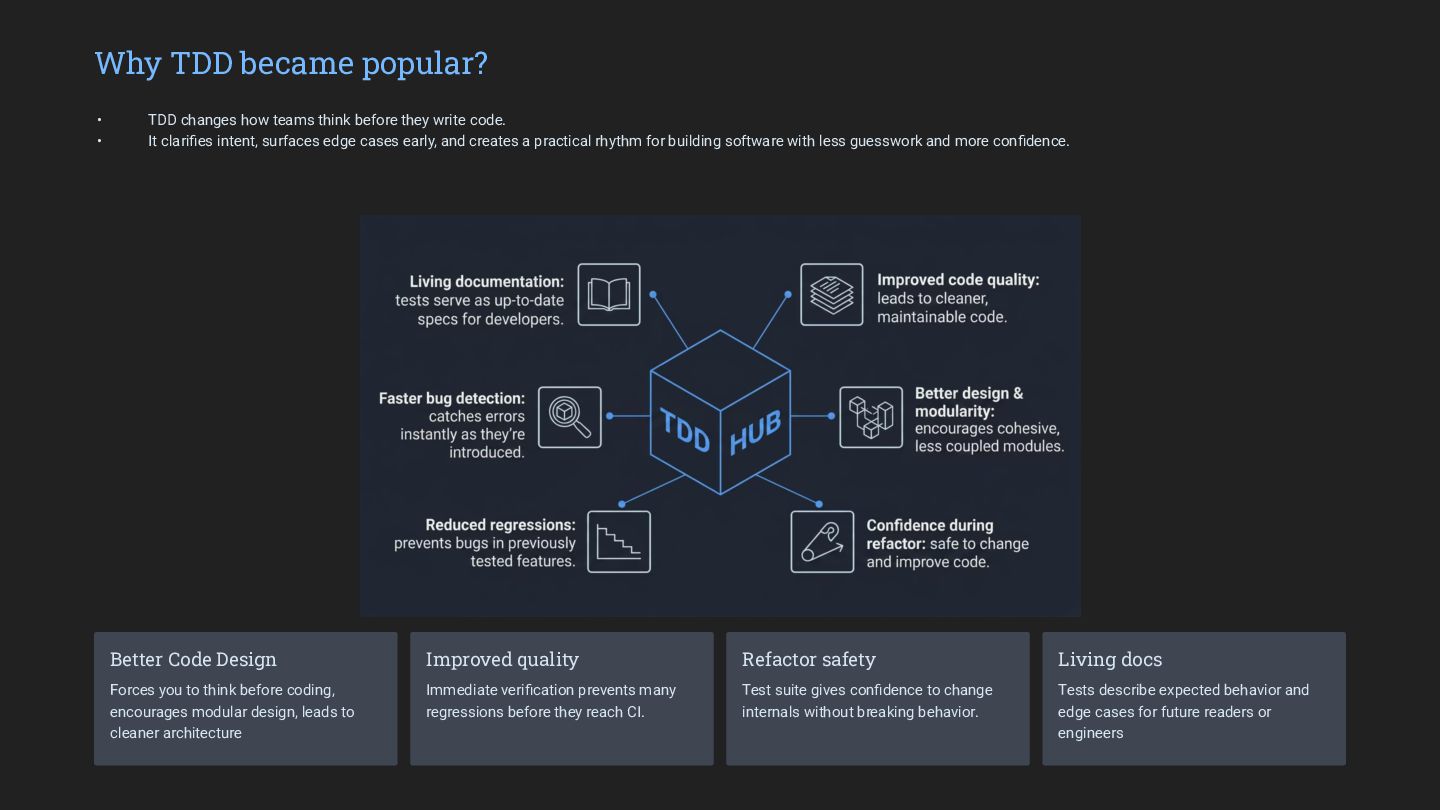
  5. Why TDD became popular? • TDD changes how teams think

    before they write code. • It clarifies intent, surfaces edge cases early, and creates a practical rhythm for building software with less guesswork and more confidence. Better Code Design Forces you to think before coding, encourages modular design, leads to cleaner architecture Improved quality Immediate verification prevents many regressions before they reach CI. Refactor safety Test suite gives confidence to change internals without breaking behavior. Living docs Tests describe expected behavior and edge cases for future readers or engineers
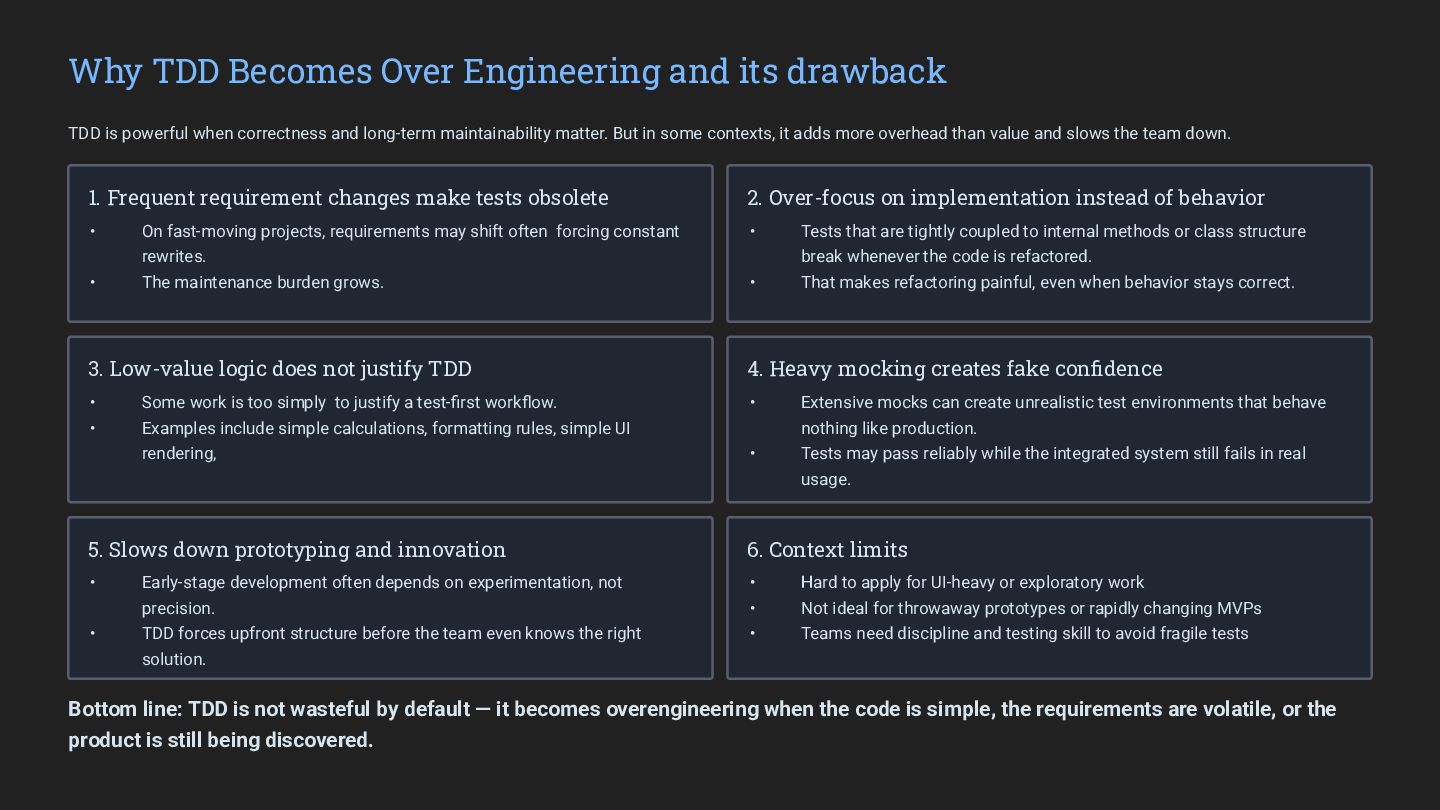
  6. Why TDD Becomes Over Engineering and its drawback TDD is

    powerful when correctness and long-term maintainability matter. But in some contexts, it adds more overhead than value and slows the team down. 1. Frequent requirement changes make tests obsolete • On fast-moving projects, requirements may shift often forcing constant rewrites. • The maintenance burden grows. 2. Over-focus on implementation instead of behavior • Tests that are tightly coupled to internal methods or class structure break whenever the code is refactored. • That makes refactoring painful, even when behavior stays correct. 3. Low-value logic does not justify TDD • Some work is too simply to justify a test-first workflow. • Examples include simple calculations, formatting rules, simple UI rendering, 4. Heavy mocking creates fake confidence • Extensive mocks can create unrealistic test environments that behave nothing like production. • Tests may pass reliably while the integrated system still fails in real usage. 5. Slows down prototyping and innovation • Early-stage development often depends on experimentation, not precision. • TDD forces upfront structure before the team even knows the right solution. 6. Context limits • Hard to apply for UI-heavy or exploratory work • Not ideal for throwaway prototypes or rapidly changing MVPs • Teams need discipline and testing skill to avoid fragile tests Bottom line: TDD is not wasteful by default — it becomes overengineering when the code is simple, the requirements are volatile, or the product is still being discovered.
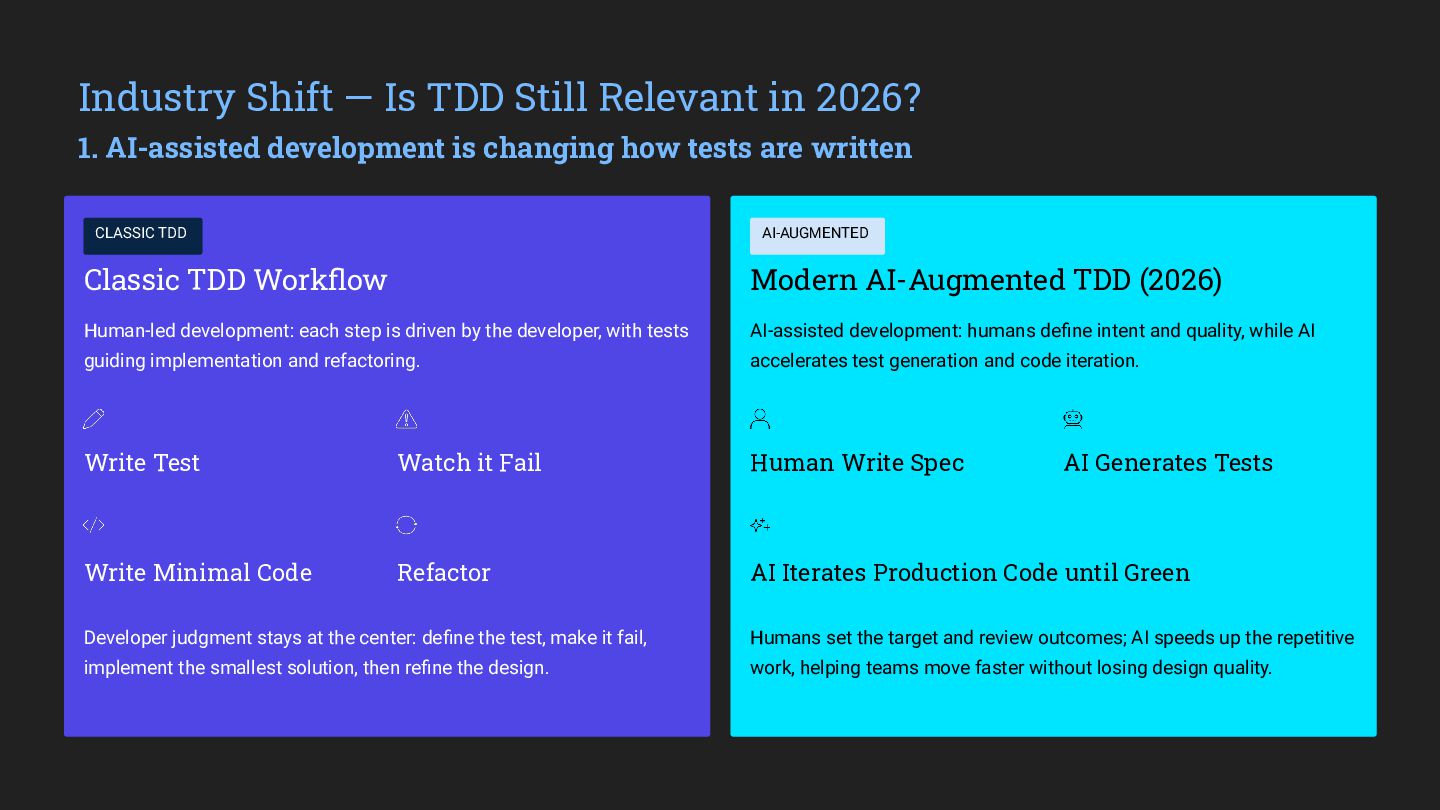
  7. Industry Shift — Is TDD Still Relevant in 2026? 1.

    AI-assisted development is changing how tests are written CLASSIC TDD Classic TDD Workflow Human-led development: each step is driven by the developer, with tests guiding implementation and refactoring. Write Test Watch it Fail Write Minimal Code Refactor Developer judgment stays at the center: define the test, make it fail, implement the smallest solution, then refine the design. AI-AUGMENTED Modern AI-Augmented TDD (2026) AI-assisted development: humans define intent and quality, while AI accelerates test generation and code iteration. Human Write Spec AI Generates Tests AI Iterates Production Code until Green Humans set the target and review outcomes; AI speeds up the repetitive work, helping teams move faster without losing design quality.
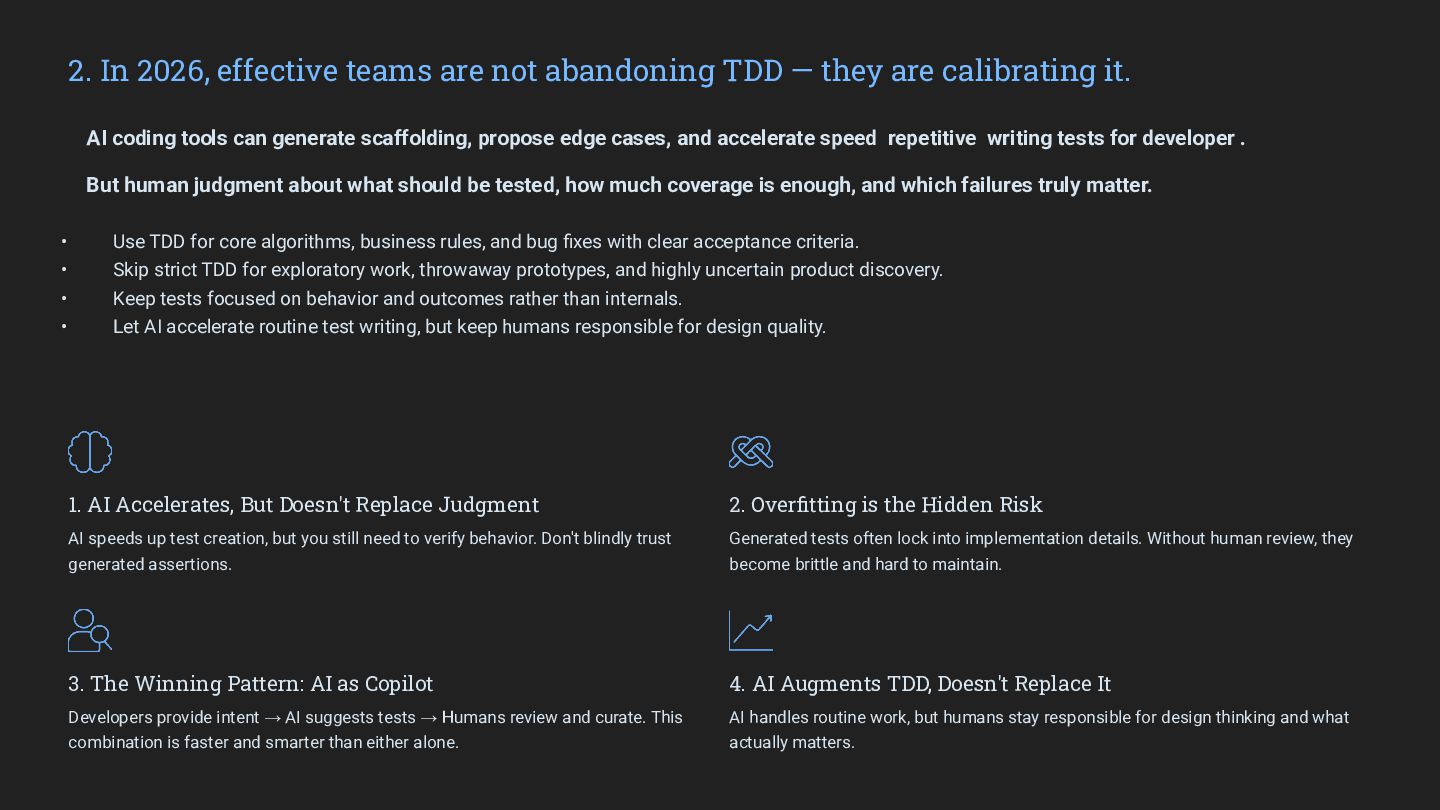
  8. 2. In 2026, effective teams are not abandoning TDD —

    they are calibrating it. AI coding tools can generate scaffolding, propose edge cases, and accelerate speed repetitive writing tests for developer . But human judgment about what should be tested, how much coverage is enough, and which failures truly matter. • Use TDD for core algorithms, business rules, and bug fixes with clear acceptance criteria. • Skip strict TDD for exploratory work, throwaway prototypes, and highly uncertain product discovery. • Keep tests focused on behavior and outcomes rather than internals. • Let AI accelerate routine test writing, but keep humans responsible for design quality. 1. AI Accelerates, But Doesn't Replace Judgment AI speeds up test creation, but you still need to verify behavior. Don't blindly trust generated assertions. 2. Overfitting is the Hidden Risk Generated tests often lock into implementation details. Without human review, they become brittle and hard to maintain. 3. The Winning Pattern: AI as Copilot Developers provide intent → AI suggests tests → Humans review and curate. This combination is faster and smarter than either alone. 4. AI Augments TDD, Doesn't Replace It AI handles routine work, but humans stay responsible for design thinking and what actually matters.
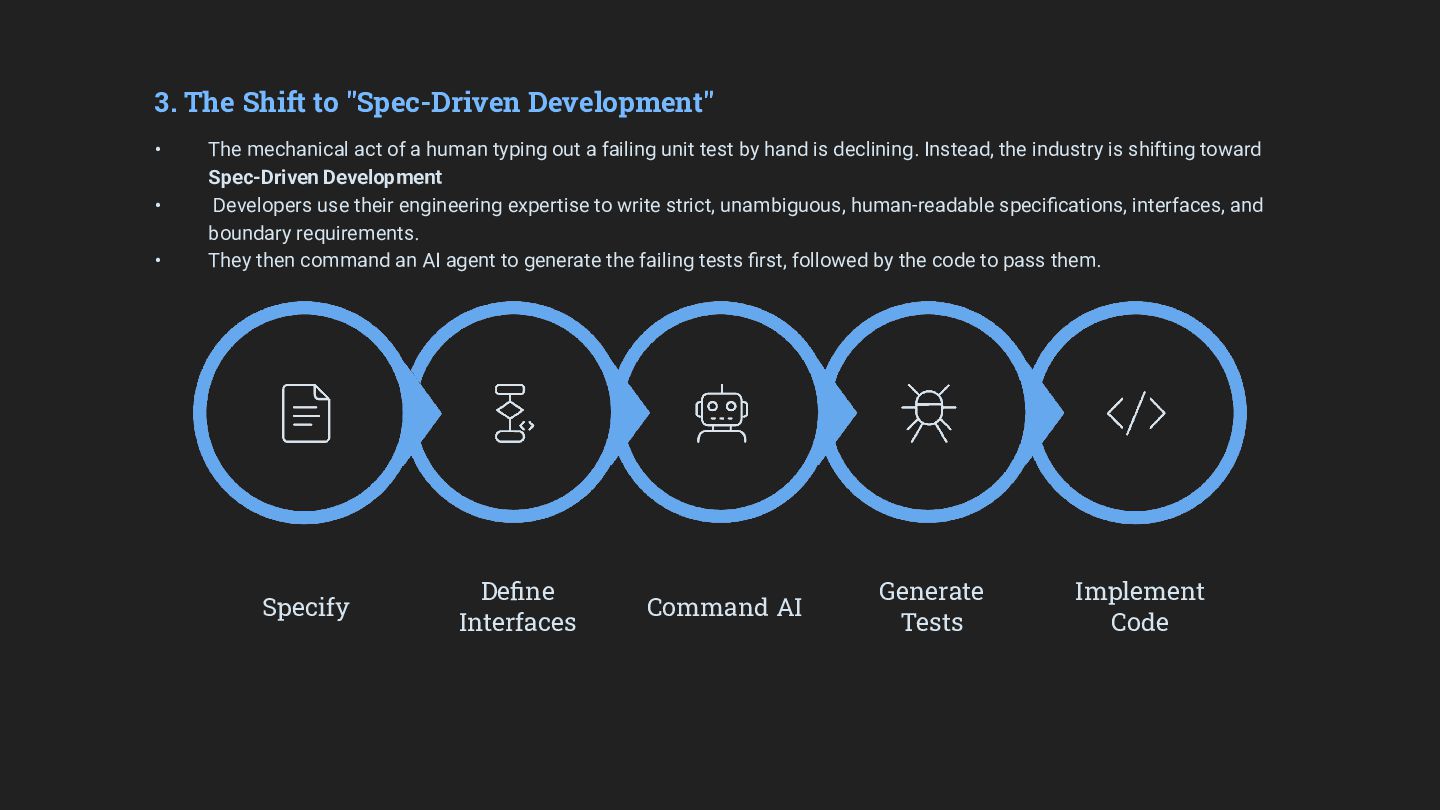
  9. 3. The Shift to "Spec-Driven Development" • The mechanical act

    of a human typing out a failing unit test by hand is declining. Instead, the industry is shifting toward Spec-Driven Development • Developers use their engineering expertise to write strict, unambiguous, human-readable specifications, interfaces, and boundary requirements. • They then command an AI agent to generate the failing tests first, followed by the code to pass them. Implement Code Generate Tests Command AI Define Interfaces Specify
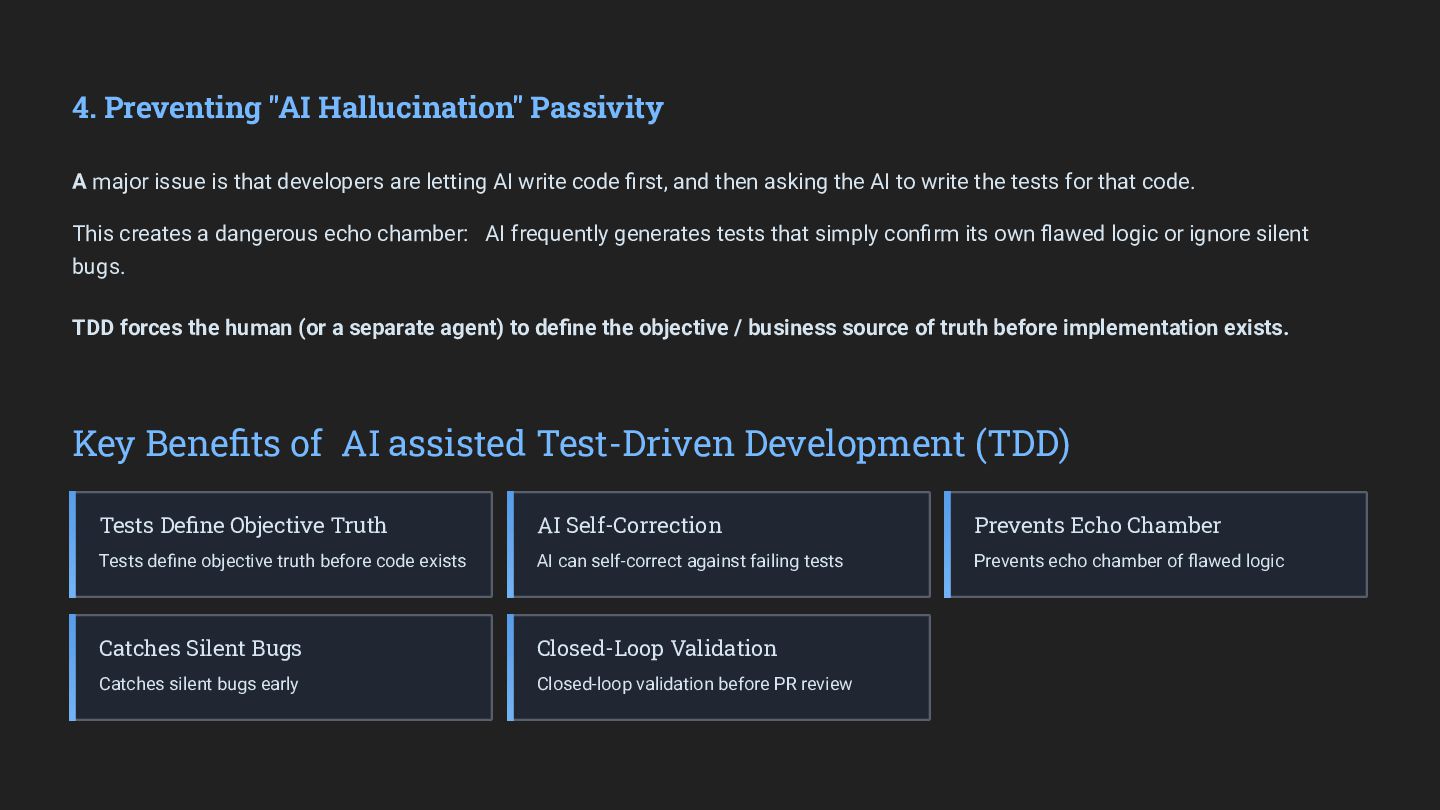
  10. 4. Preventing "AI Hallucination" Passivity A major issue is that

    developers are letting AI write code first, and then asking the AI to write the tests for that code. This creates a dangerous echo chamber: AI frequently generates tests that simply confirm its own flawed logic or ignore silent bugs. TDD forces the human (or a separate agent) to define the objective / business source of truth before implementation exists. Key Benefits of AI assisted Test-Driven Development (TDD) Tests Define Objective Truth Tests define objective truth before code exists AI Self-Correction AI can self-correct against failing tests Prevents Echo Chamber Prevents echo chamber of flawed logic Catches Silent Bugs Catches silent bugs early Closed-Loop Validation Closed-loop validation before PR review
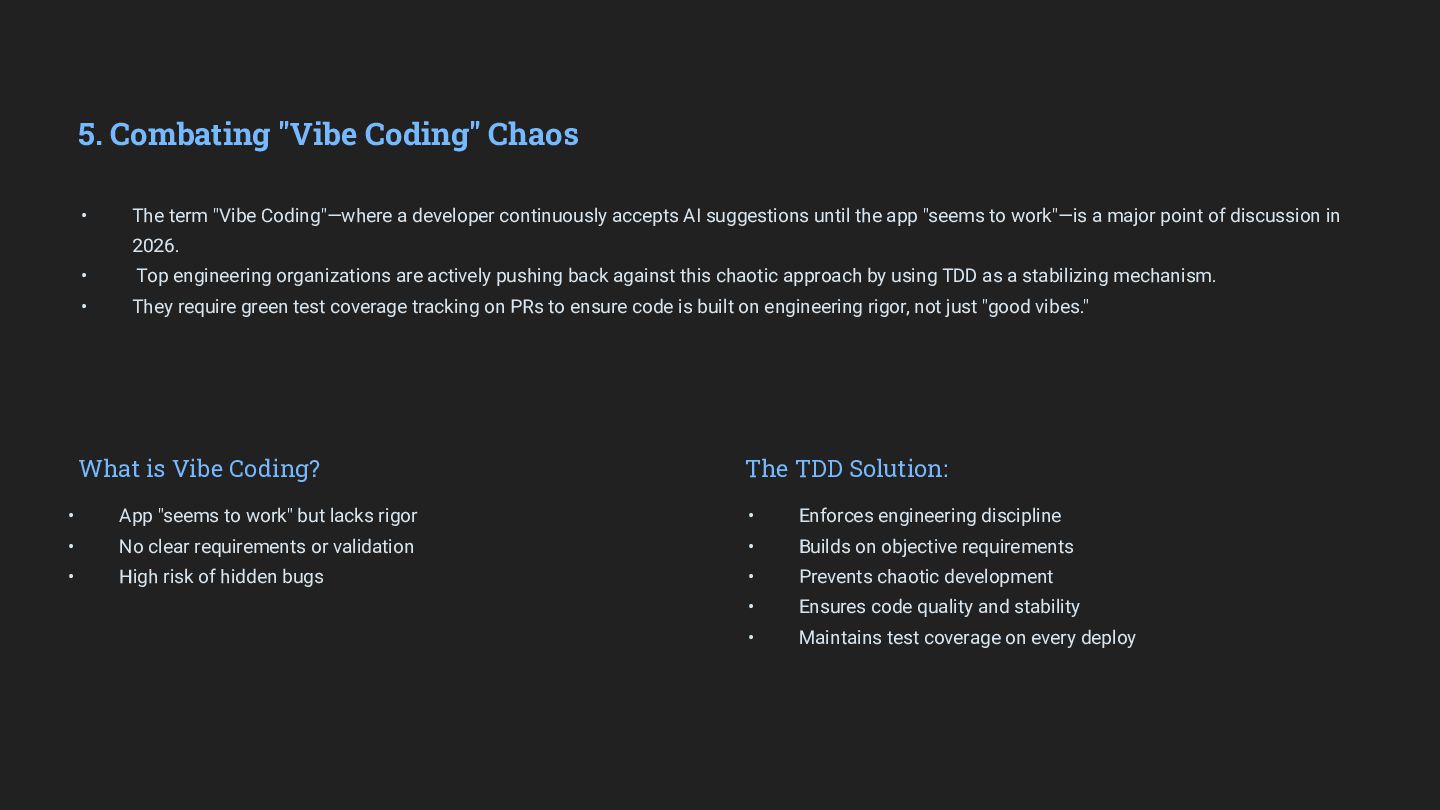
  11. 5. Combating "Vibe Coding" Chaos • The term "Vibe Coding"—where

    a developer continuously accepts AI suggestions until the app "seems to work"—is a major point of discussion in 2026. • Top engineering organizations are actively pushing back against this chaotic approach by using TDD as a stabilizing mechanism. • They require green test coverage tracking on PRs to ensure code is built on engineering rigor, not just "good vibes." What is Vibe Coding? • App "seems to work" but lacks rigor • No clear requirements or validation • High risk of hidden bugs The TDD Solution: • Enforces engineering discipline • Builds on objective requirements • Prevents chaotic development • Ensures code quality and stability • Maintains test coverage on every deploy
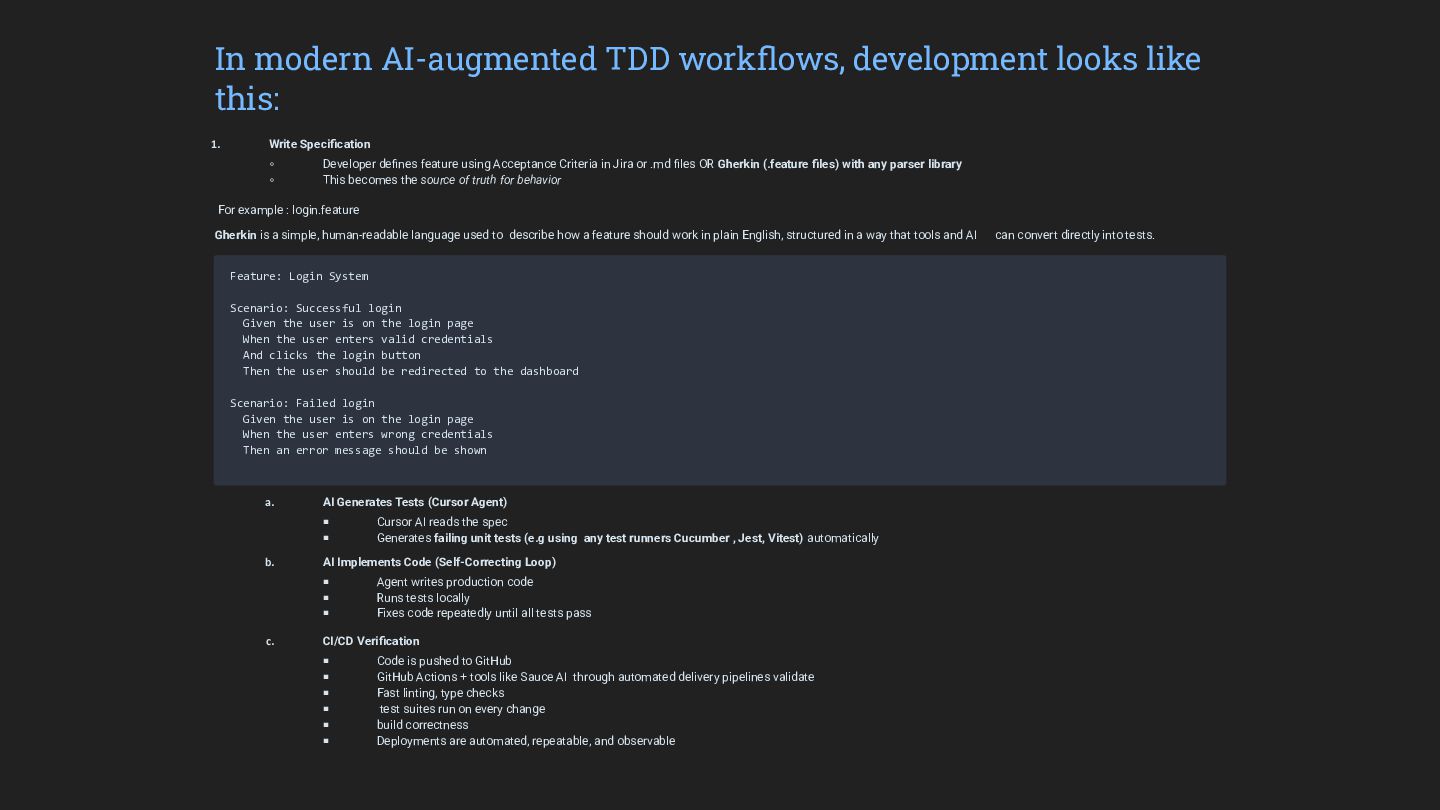
  12. In modern AI-augmented TDD workflows, development looks like this: 1.

    Write Specification ◦ Developer defines feature using Acceptance Criteria in Jira or .md files OR Gherkin (.feature files) with any parser library ◦ This becomes the source of truth for behavior For example : login.feature Gherkin is a simple, human-readable language used to describe how a feature should work in plain English, structured in a way that tools and AI can convert directly into tests. Feature: Login System Scenario: Successful login Given the user is on the login page When the user enters valid credentials And clicks the login button Then the user should be redirected to the dashboard Scenario: Failed login Given the user is on the login page When the user enters wrong credentials Then an error message should be shown a. AI Generates Tests (Cursor Agent) ■ Cursor AI reads the spec ■ Generates failing unit tests (e.g using any test runners Cucumber , Jest, Vitest) automatically b. AI Implements Code (Self-Correcting Loop) ■ Agent writes production code ■ Runs tests locally ■ Fixes code repeatedly until all tests pass c. CI/CD Verification ■ Code is pushed to GitHub ■ GitHub Actions + tools like Sauce AI through automated delivery pipelines validate ■ Fast linting, type checks ■ test suites run on every change ■ build correctness ■ Deployments are automated, repeatable, and observable
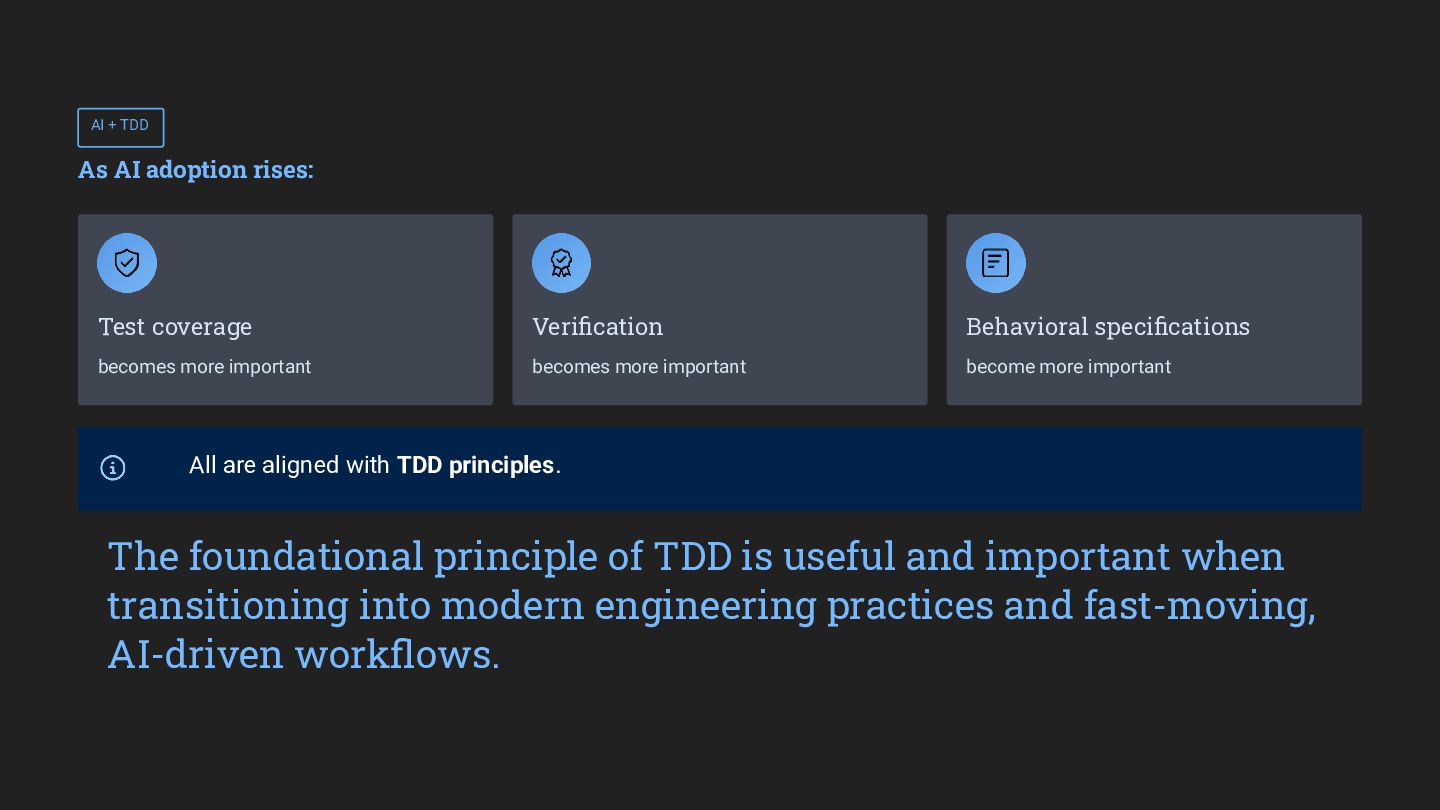
  13. AI + TDD As AI adoption rises: Test coverage becomes

    more important Verification becomes more important Behavioral specifications become more important All are aligned with TDD principles. The foundational principle of TDD is useful and important when transitioning into modern engineering practices and fast-moving, AI-driven workflows.