Upgrade to Pro — share decks privately, control downloads, hide ads and more …

How to Read an Earnings Call — A Field Guide fo...

Sponsored · Your Podcast. Everywhere. Effortlessly. Share. Educate. Inspire. Entertain. You do you. We'll handle the rest. →
Avatar for Inve Inve
July 08, 2026

How to Read an Earnings Call — A Field Guide for Indian Retail Investors

The concall transcript is the richest document a listed Indian company publishes — and the least read. This visual guide breaks down the anatomy of an earnings call (why the analyst Q&A matters more than the scripted commentary), the six moves experienced readers use, and the one signal most investors miss: a management promise that quietly goes silent across quarters. Grounded in 15,726 forward-looking commitments tracked across 1,547 listed companies. Read more at https://inve.money/

Avatar for Inve

Inve

July 08, 2026

More Decks by Inve

Other Decks in Business

Transcript

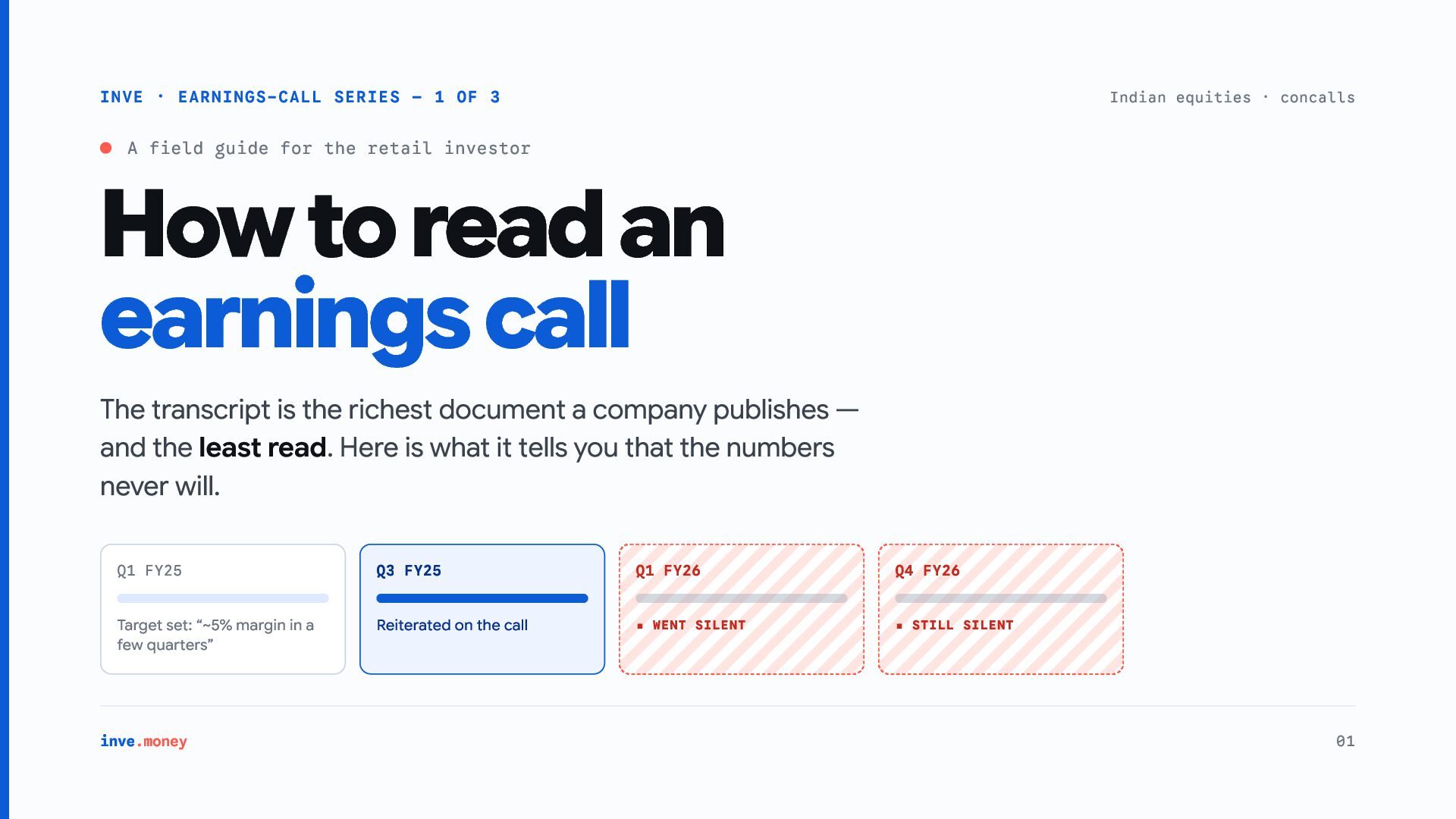
  1. INVE · EARNINGS-CALL SERIES — 1 OF 3 Indian equities

    · concalls A field guide for the retail investor How to read an earnings call The transcript is the richest document a company publishes — and the least read. Here is what it tells you that the numbers never will. Q1 FY25 Target set: “~5% margin in a few quarters” Q3 FY25 Reiterated on the call Q1 FY26 ▪ WENT SILENT Q4 FY26 ▪ STILL SILENT inve.money 01
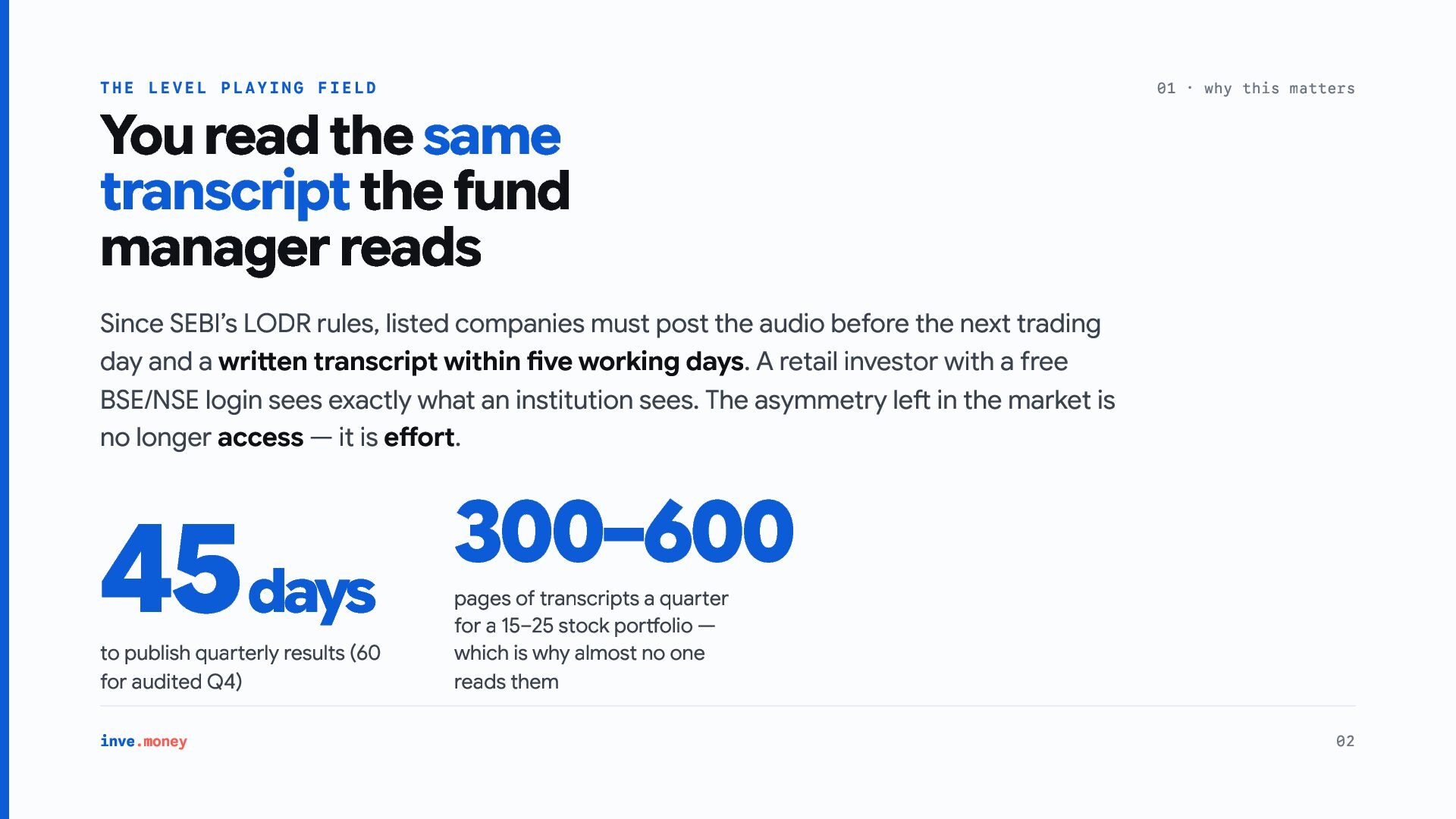
  2. THE LEVEL PLAYING FIELD 01 · why this matters You

    read the same transcript the fund manager reads Since SEBI’s LODR rules, listed companies must post the audio before the next trading day and a written transcript within five working days. A retail investor with a free BSE/NSE login sees exactly what an institution sees. The asymmetry left in the market is no longer access — it is effort. 45 days to publish quarterly results (60 for audited Q4) 300–600 pages of transcripts a quarter for a 15–25 stock portfolio — which is why almost no one reads them inve.money 02
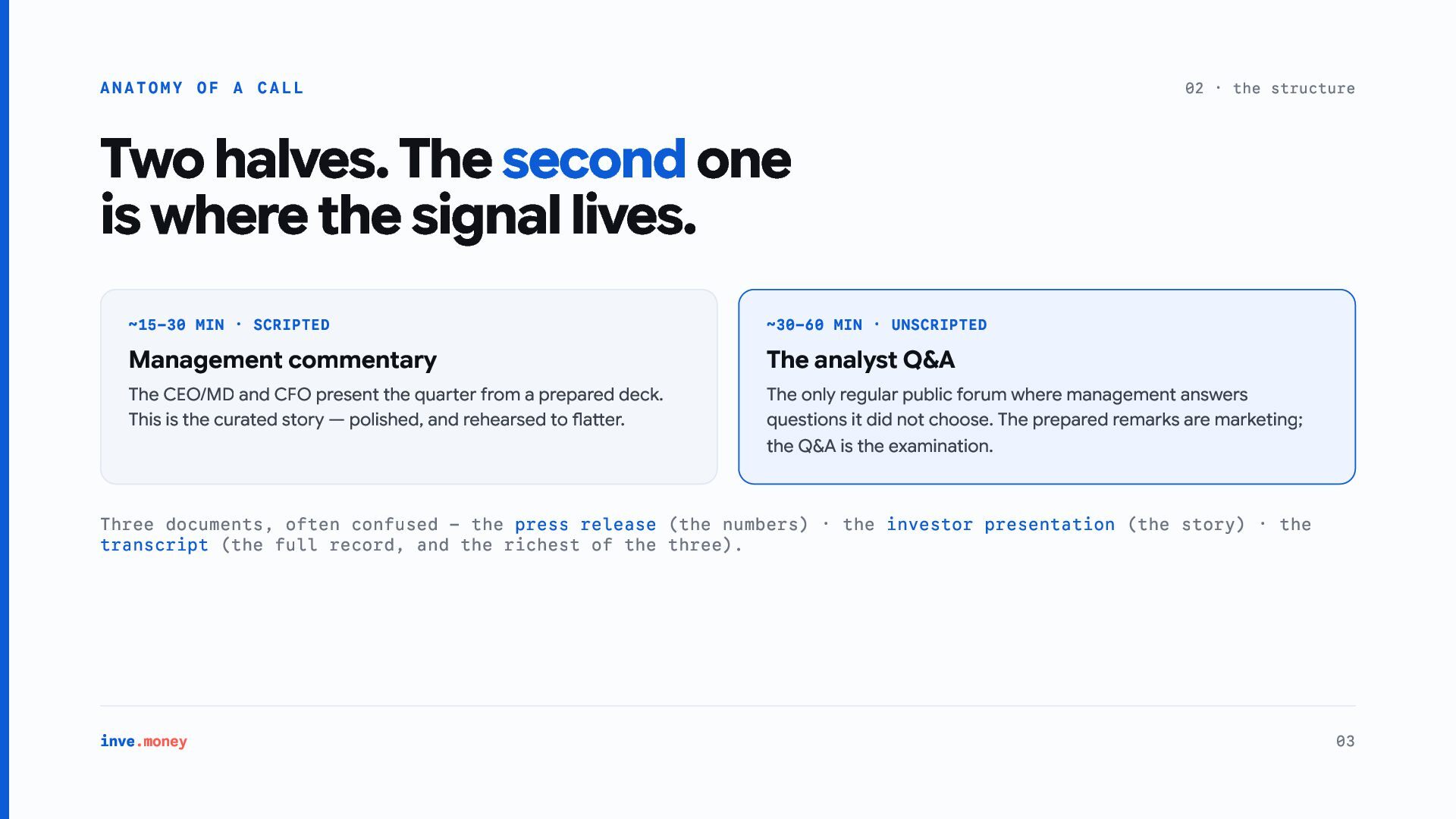
  3. ANATOMY OF A CALL 02 · the structure Two halves.

    The second one is where the signal lives. ~15–30 MIN · SCRIPTED Management commentary The CEO/MD and CFO present the quarter from a prepared deck. This is the curated story — polished, and rehearsed to flatter. ~30–60 MIN · UNSCRIPTED The analyst Q&A The only regular public forum where management answers questions it did not choose. The prepared remarks are marketing; the Q&A is the examination. Three documents, often confused — the press release (the numbers) · the investor presentation (the story) · the transcript (the full record, and the richest of the three). inve.money 03
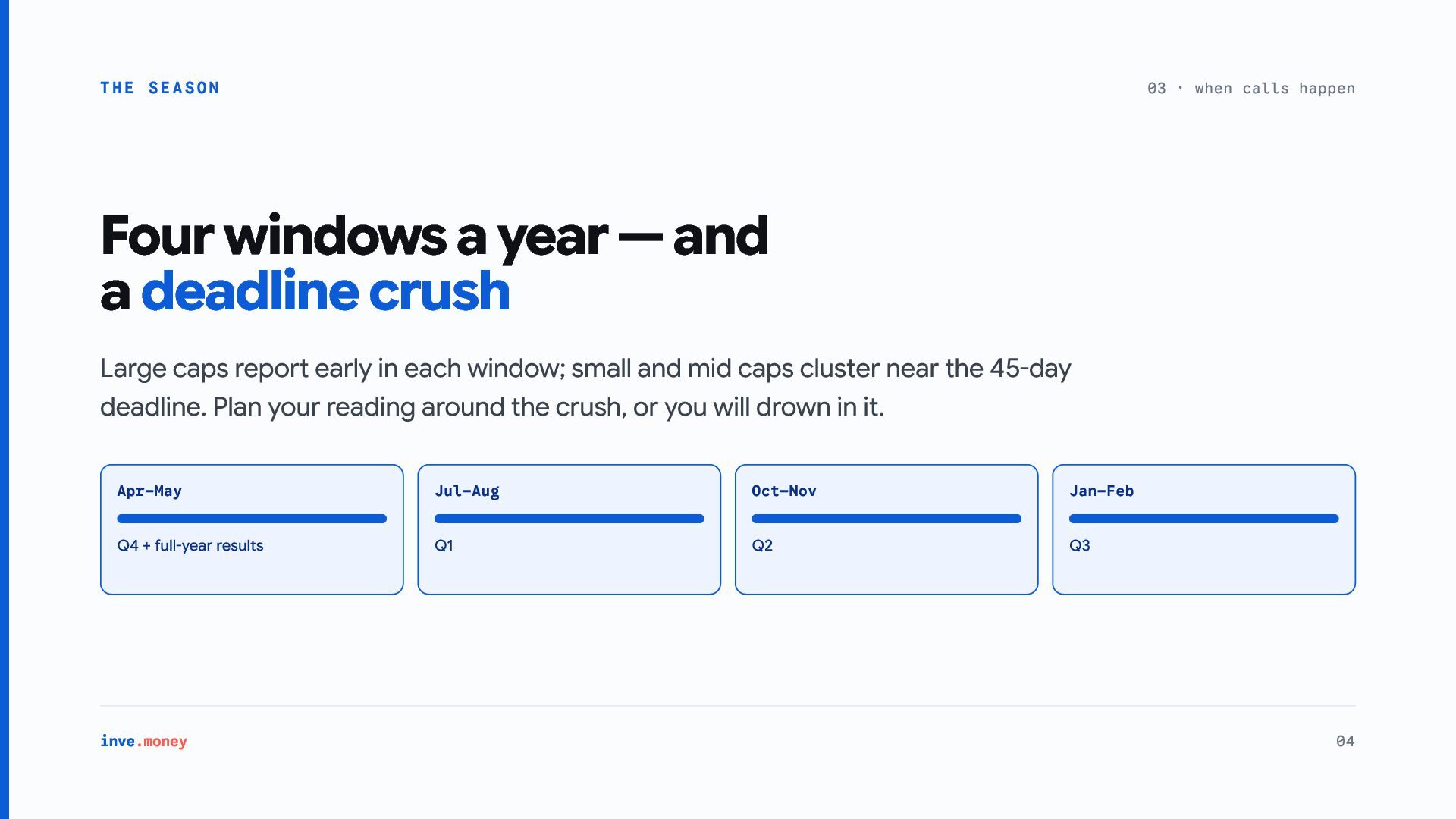
  4. THE SEASON 03 · when calls happen Four windows a

    year — and a deadline crush Large caps report early in each window; small and mid caps cluster near the 45-day deadline. Plan your reading around the crush, or you will drown in it. Apr–May Q4 + full-year results Jul–Aug Q1 Oct–Nov Q2 Jan–Feb Q3 inve.money 04
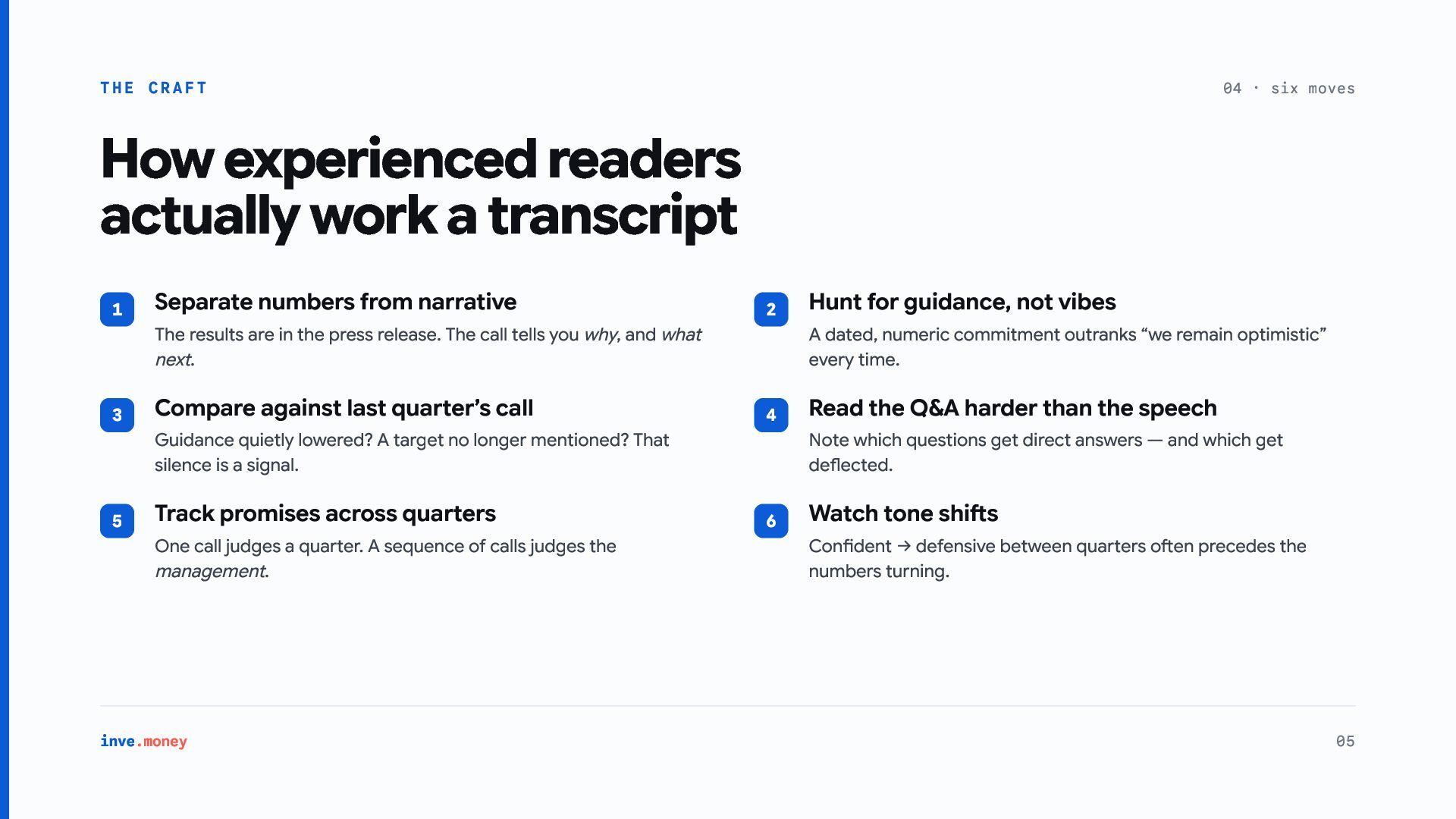
  5. THE CRAFT 04 · six moves How experienced readers actually

    work a transcript 1 Separate numbers from narrative The results are in the press release. The call tells you why, and what next. 2 Hunt for guidance, not vibes A dated, numeric commitment outranks “we remain optimistic” every time. 3 Compare against last quarter’s call Guidance quietly lowered? A target no longer mentioned? That silence is a signal. 4 Read the Q&A harder than the speech Note which questions get direct answers — and which get deflected. 5 Track promises across quarters One call judges a quarter. A sequence of calls judges the management. 6 Watch tone shifts Confident → defensive between quarters often precedes the numbers turning. inve.money 05
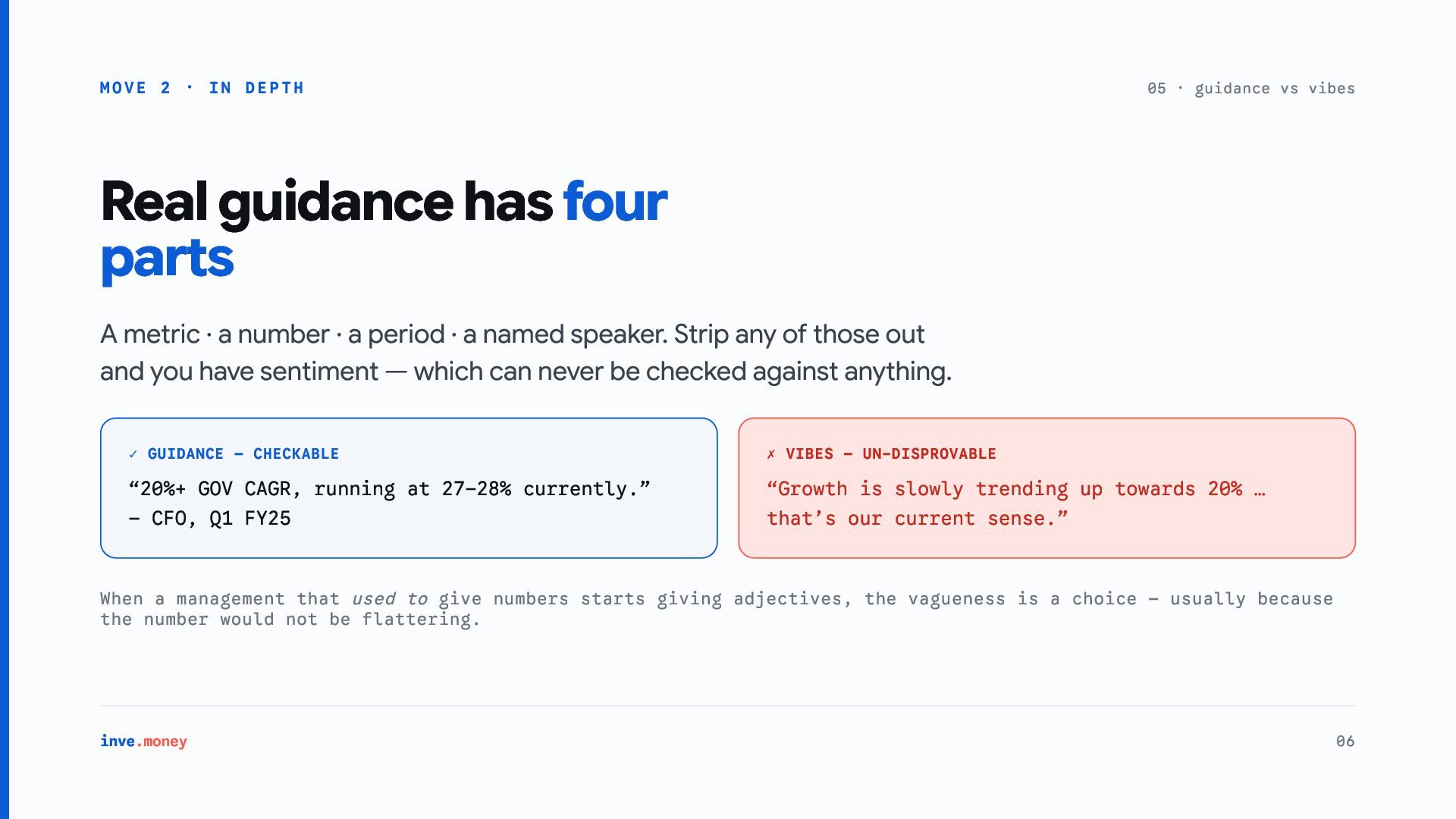
  6. MOVE 2 · IN DEPTH 05 · guidance vs vibes

    Real guidance has four parts A metric · a number · a period · a named speaker. Strip any of those out and you have sentiment — which can never be checked against anything. ✓ GUIDANCE — CHECKABLE “20%+ GOV CAGR, running at 27–28% currently.” — CFO, Q1 FY25 ✗ VIBES — UN-DISPROVABLE “Growth is slowly trending up towards 20% … that’s our current sense.” When a management that used to give numbers starts giving adjectives, the vagueness is a choice — usually because the number would not be flattering. inve.money 06
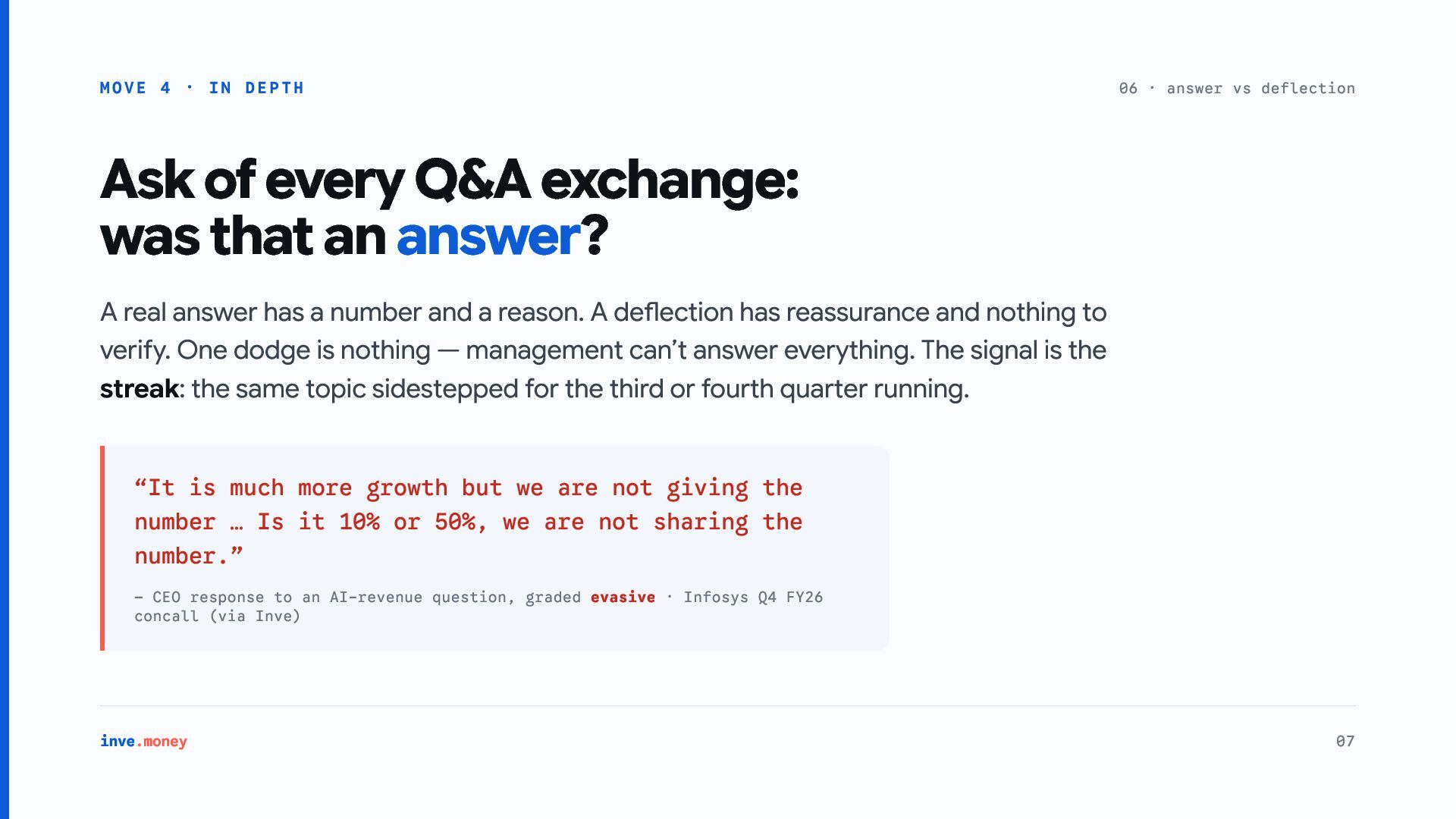
  7. MOVE 4 · IN DEPTH 06 · answer vs deflection

    Ask of every Q&A exchange: was that an answer? A real answer has a number and a reason. A deflection has reassurance and nothing to verify. One dodge is nothing — management can’t answer everything. The signal is the streak: the same topic sidestepped for the third or fourth quarter running. “It is much more growth but we are not giving the number … Is it 10% or 50%, we are not sharing the number.” — CEO response to an AI-revenue question, graded evasive · Infosys Q4 FY26 concall (via Inve) inve.money 07
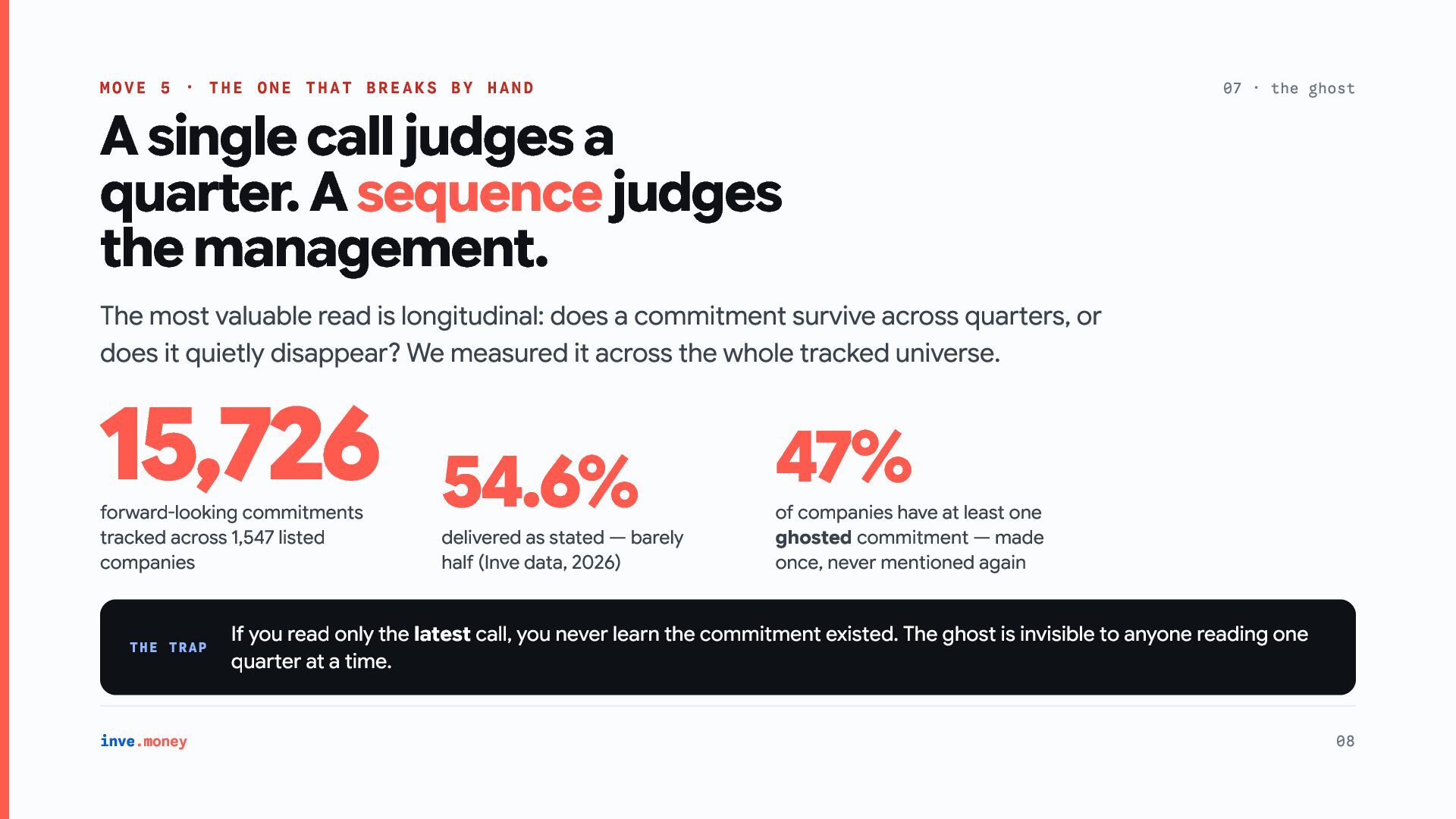
  8. MOVE 5 · THE ONE THAT BREAKS BY HAND 07

    · the ghost A single call judges a quarter. A sequence judges the management. The most valuable read is longitudinal: does a commitment survive across quarters, or does it quietly disappear? We measured it across the whole tracked universe. 15,726 forward-looking commitments tracked across 1,547 listed companies 54.6% delivered as stated — barely half (Inve data, 2026) 47% of companies have at least one ghosted commitment — made once, never mentioned again THE TRAP If you read only the latest call, you never learn the commitment existed. The ghost is invisible to anyone reading one quarter at a time. inve.money 08
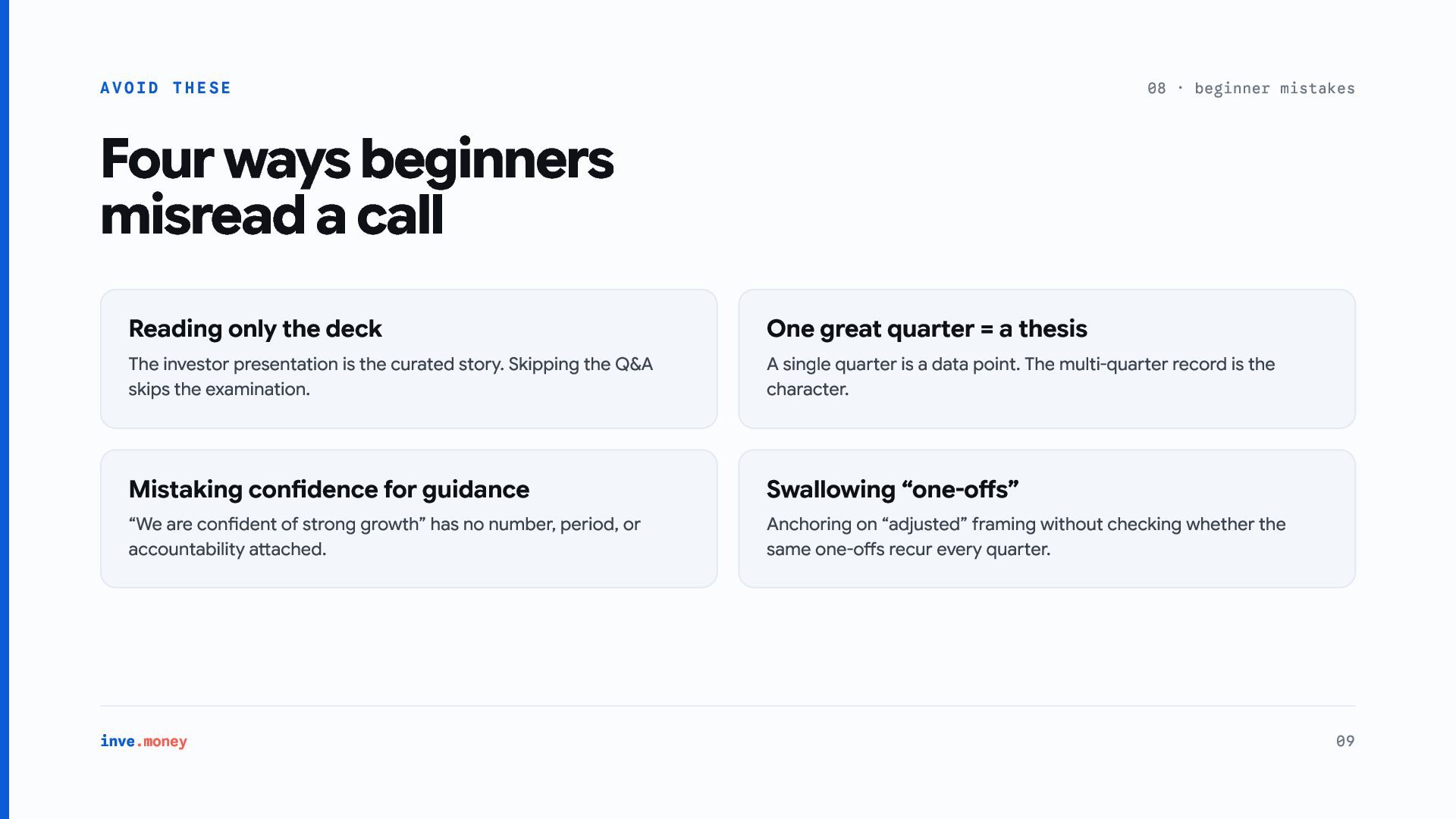
  9. AVOID THESE 08 · beginner mistakes Four ways beginners misread

    a call Reading only the deck The investor presentation is the curated story. Skipping the Q&A skips the examination. One great quarter = a thesis A single quarter is a data point. The multi-quarter record is the character. Mistaking confidence for guidance “We are confident of strong growth” has no number, period, or accountability attached. Swallowing “one-offs” Anchoring on “adjusted” framing without checking whether the same one-offs recur every quarter. inve.money 09
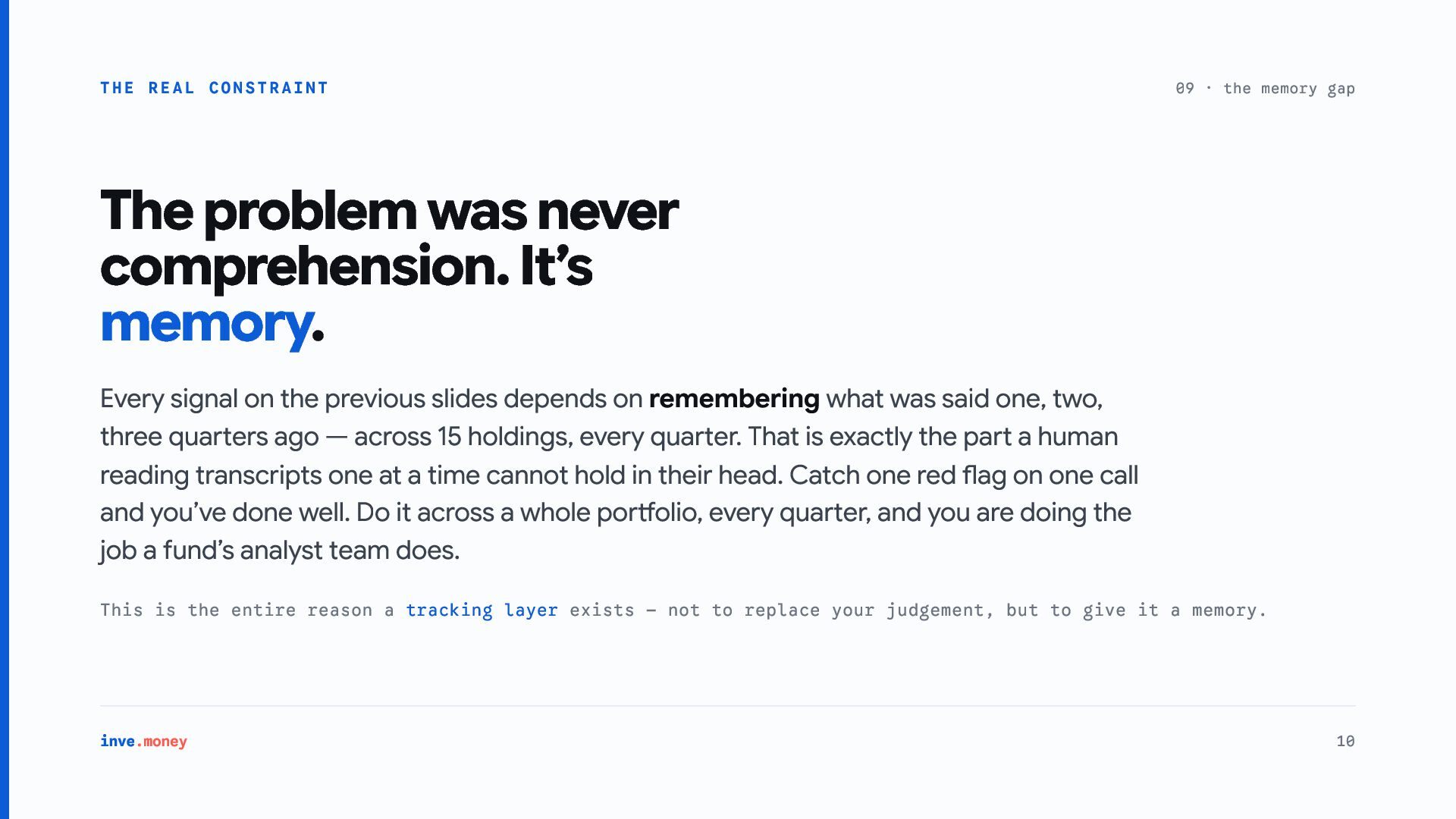
  10. THE REAL CONSTRAINT 09 · the memory gap The problem

    was never comprehension. It’s memory. Every signal on the previous slides depends on remembering what was said one, two, three quarters ago — across 15 holdings, every quarter. That is exactly the part a human reading transcripts one at a time cannot hold in their head. Catch one red flag on one call and you’ve done well. Do it across a whole portfolio, every quarter, and you are doing the job a fund’s analyst team does. This is the entire reason a tracking layer exists — not to replace your judgement, but to give it a memory. inve.money 10
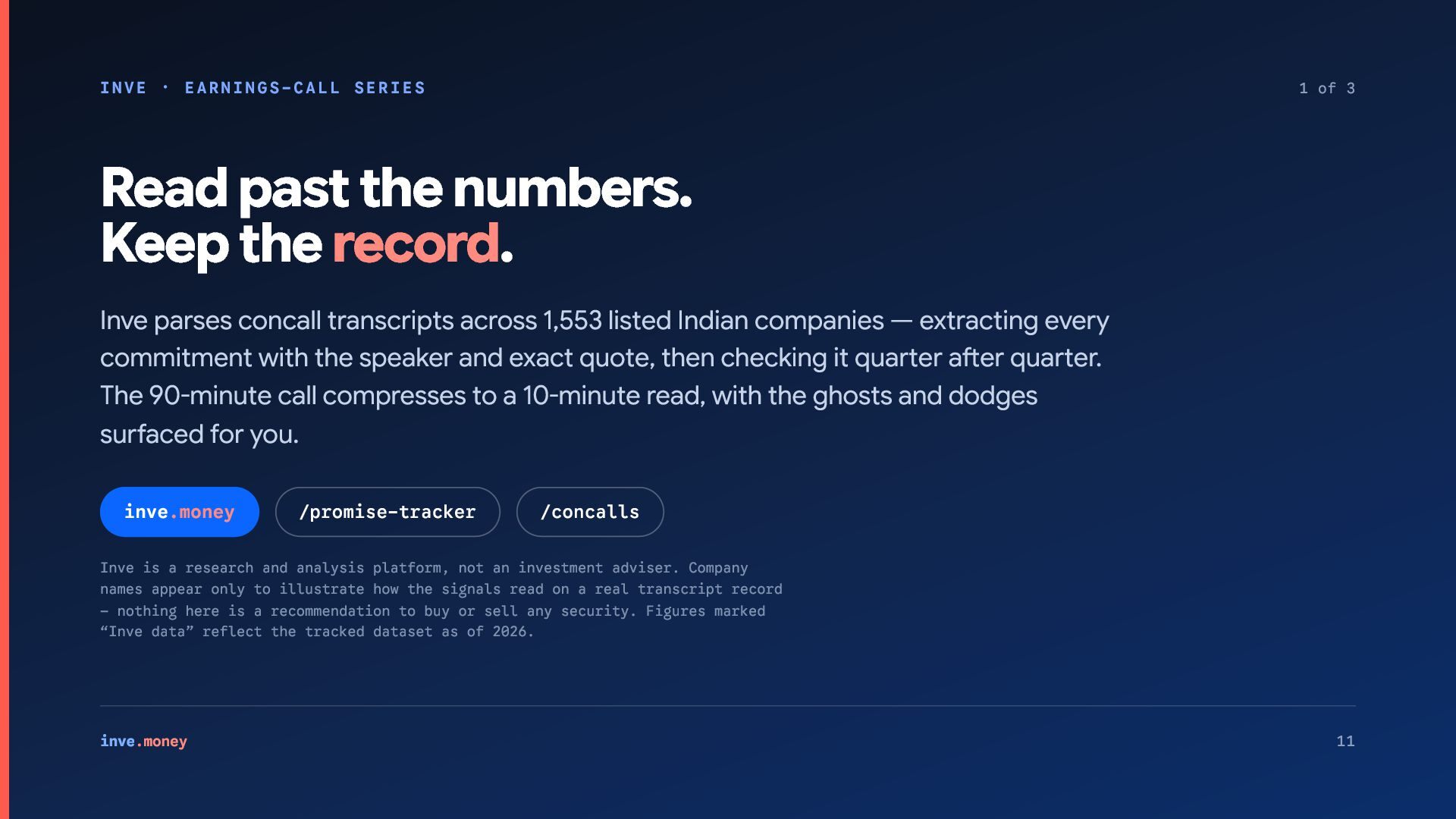
  11. INVE · EARNINGS-CALL SERIES 1 of 3 Read past the

    numbers. Keep the record. Inve parses concall transcripts across 1,553 listed Indian companies — extracting every commitment with the speaker and exact quote, then checking it quarter after quarter. The 90-minute call compresses to a 10-minute read, with the ghosts and dodges surfaced for you. inve.money /promise-tracker /concalls Inve is a research and analysis platform, not an investment adviser. Company names appear only to illustrate how the signals read on a real transcript record — nothing here is a recommendation to buy or sell any security. Figures marked “Inve data” reflect the tracked dataset as of 2026. inve.money 11