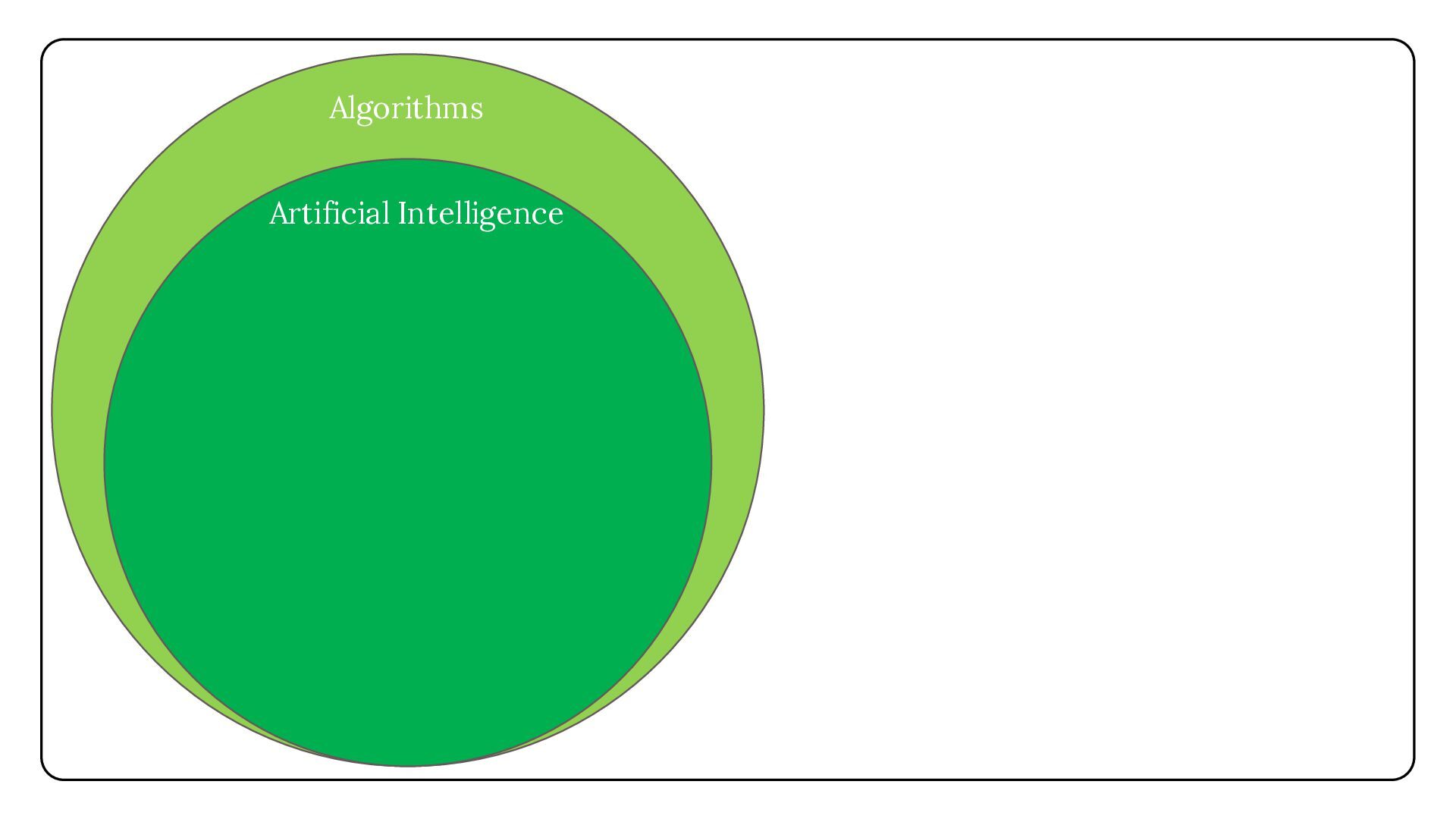
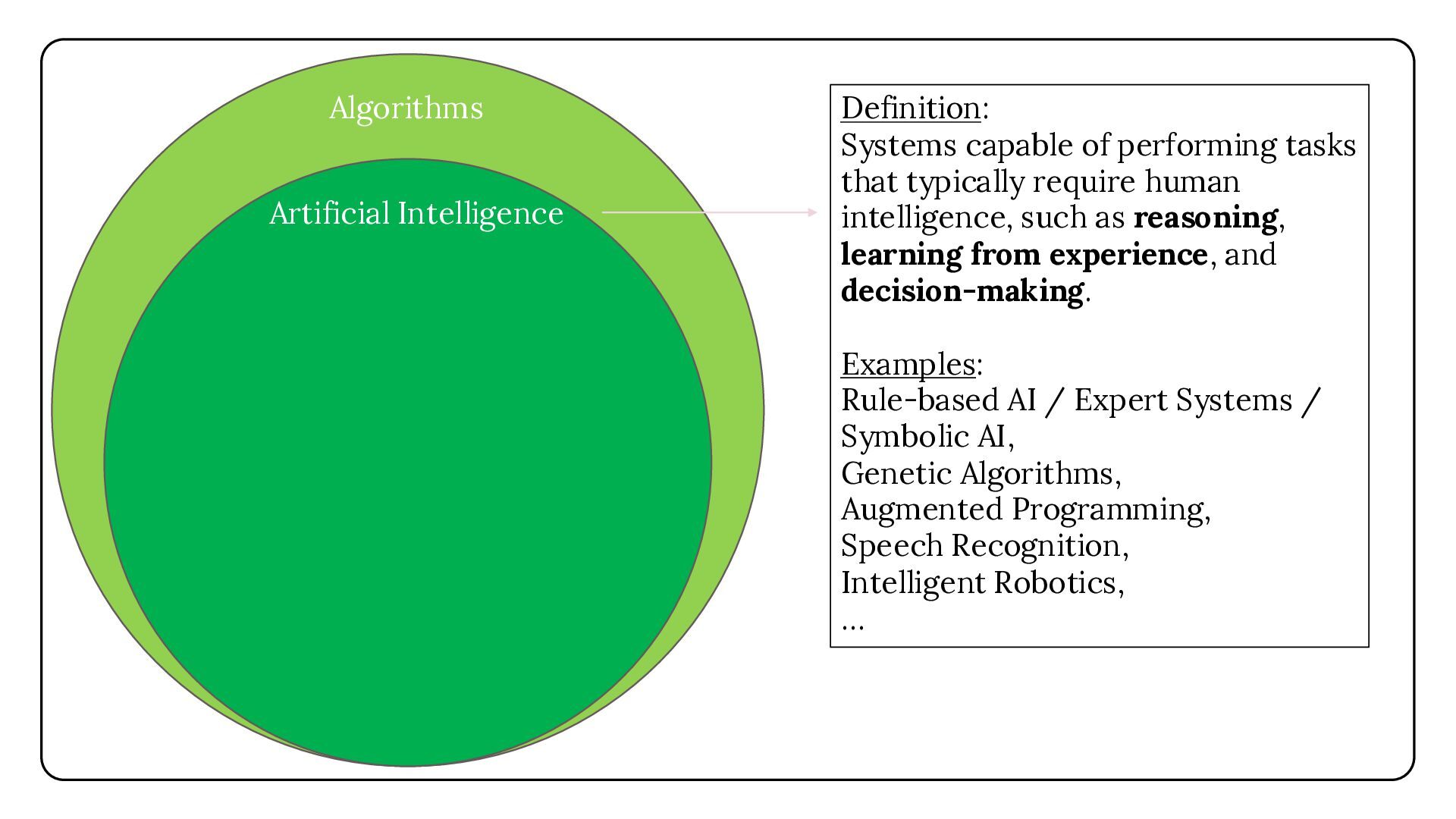
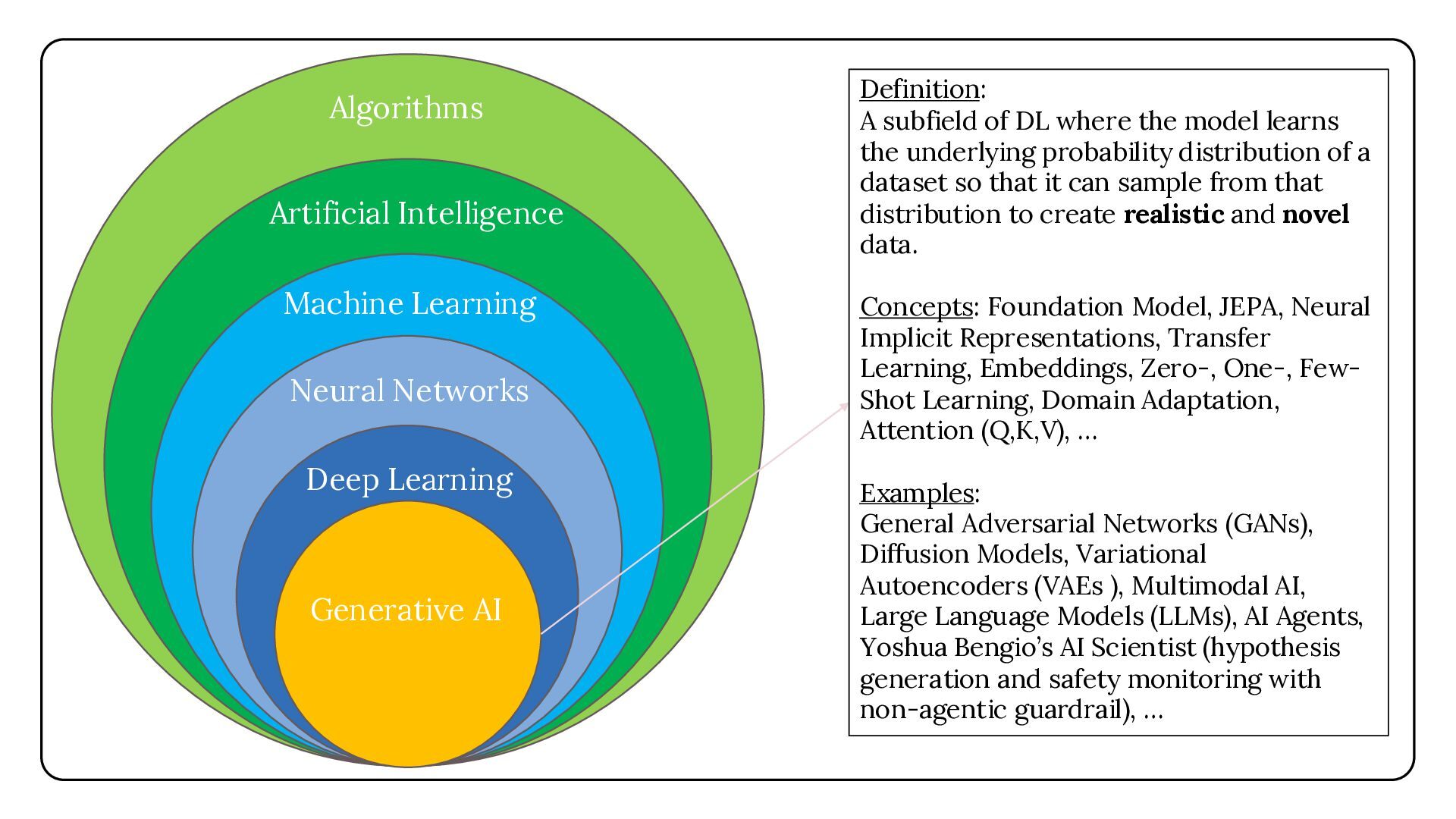
typically require human intelligence, such as reasoning, learning from experience, and decision-making. Examples: Rule-based AI / Expert Systems / Symbolic AI, Genetic Algorithms, Augmented Programming, Speech Recognition, Intelligent Robotics, …
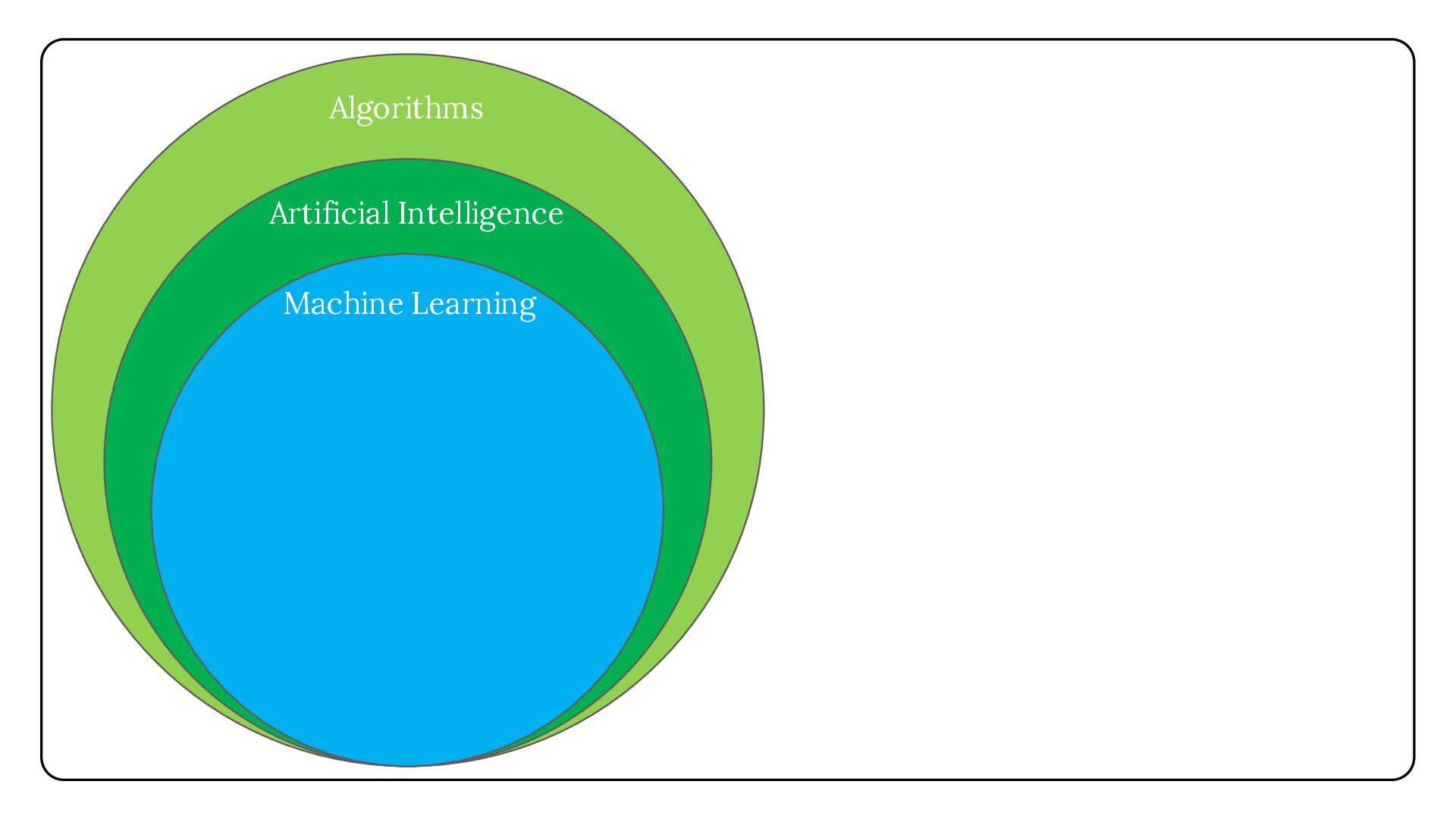
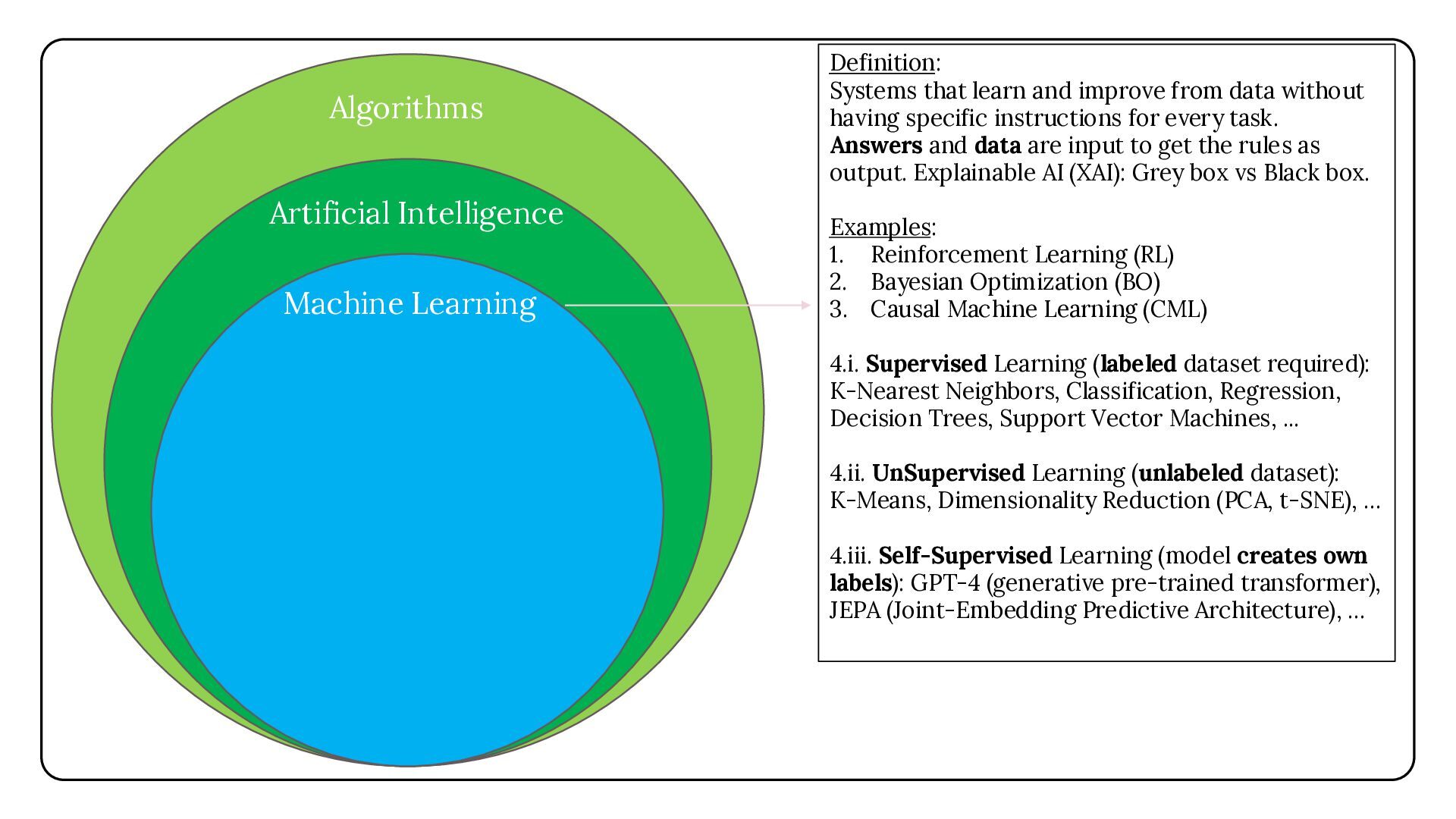
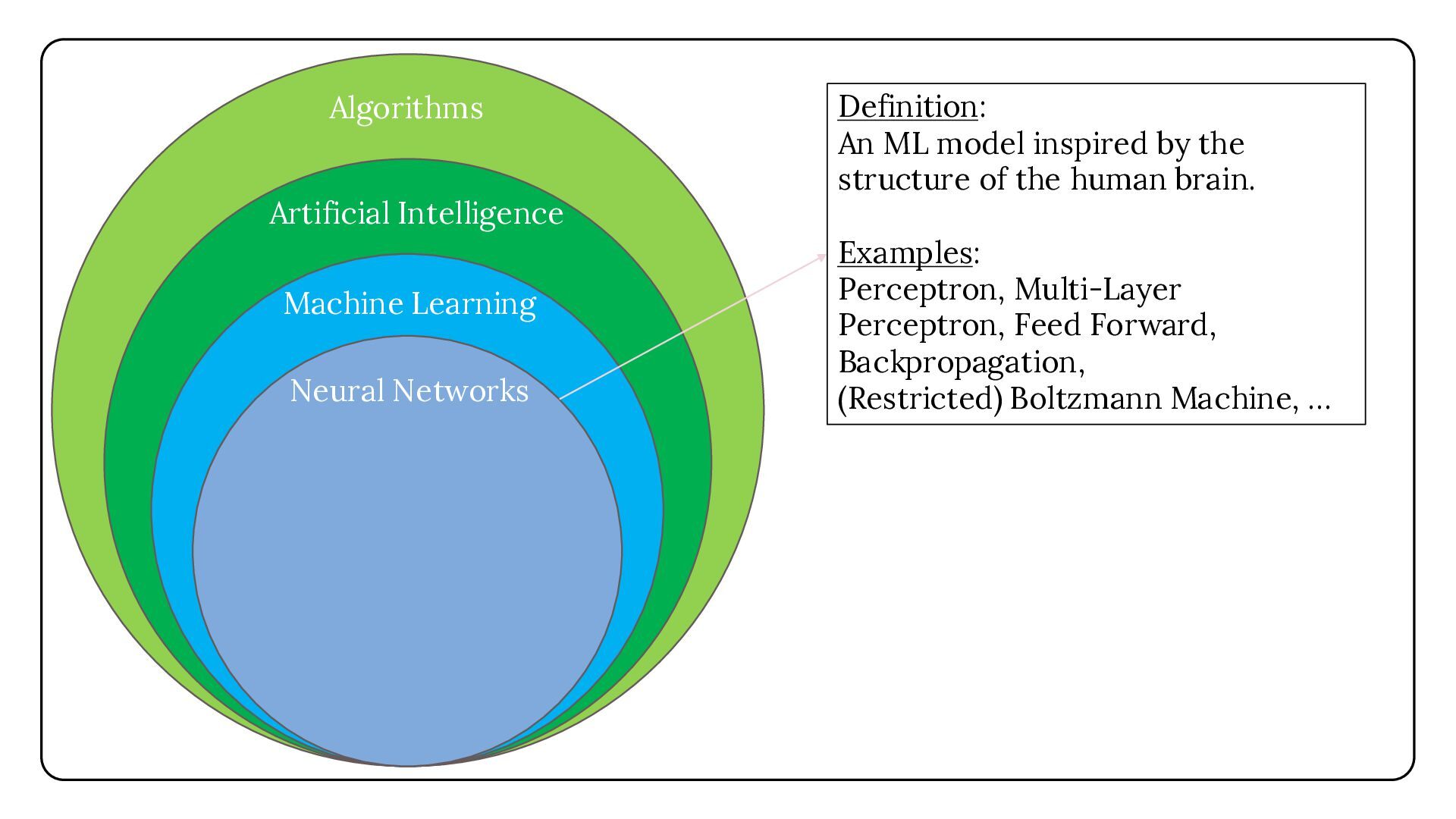
improve from data without having specific instructions for every task. Answers and data are input to get the rules as output. Explainable AI (XAI): Grey box vs Black box. Examples: 1. Reinforcement Learning (RL) 2. Bayesian Optimization (BO) 3. Causal Machine Learning (CML) 4.i. Supervised Learning (labeled dataset required): K-Nearest Neighbors, Classification, Regression, Decision Trees, Support Vector Machines, ... 4.ii. UnSupervised Learning (unlabeled dataset): K-Means, Dimensionality Reduction (PCA, t-SNE), … 4.iii. Self-Supervised Learning (model creates own labels): GPT-4 (generative pre-trained transformer), JEPA (Joint-Embedding Predictive Architecture), …
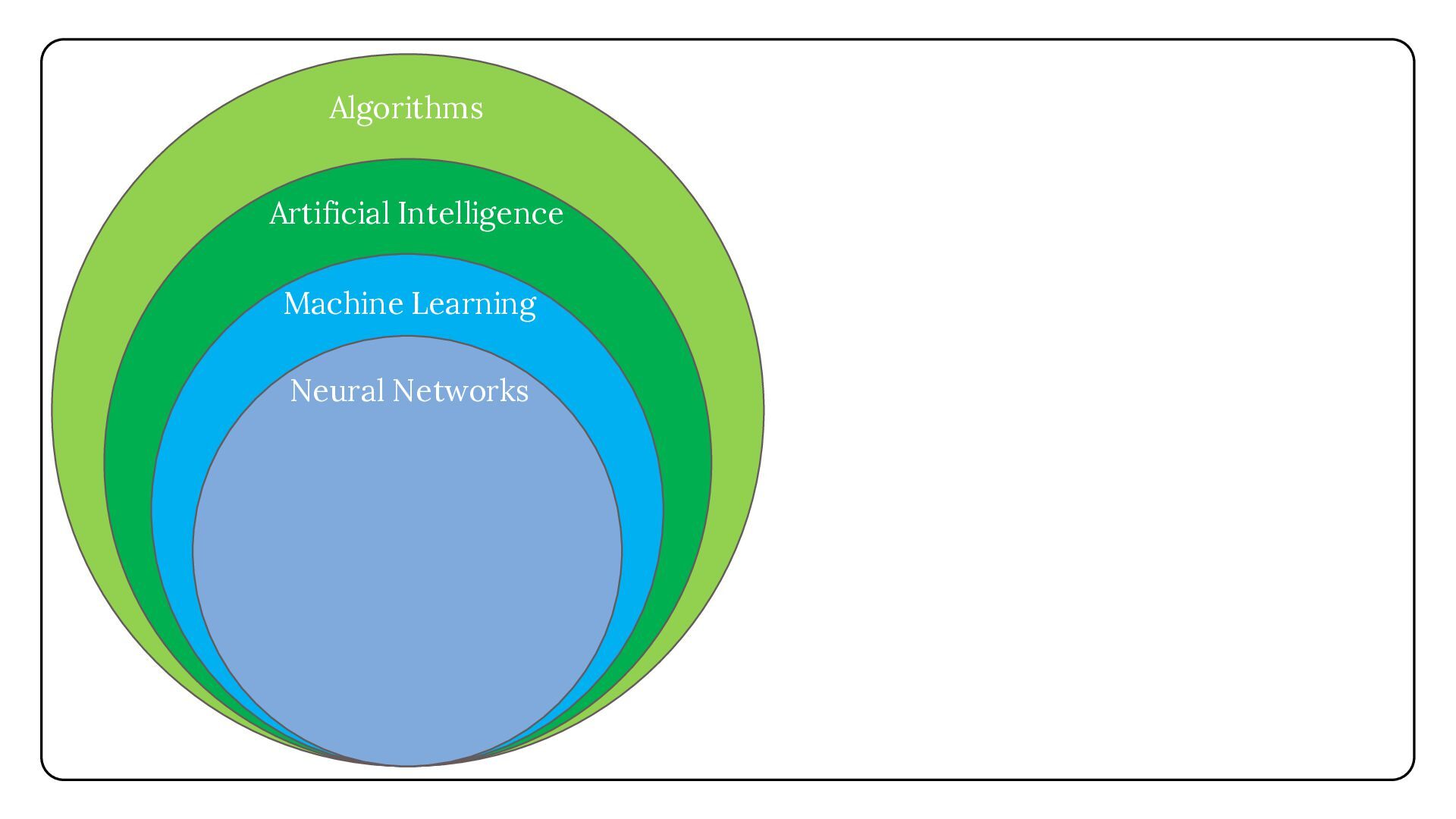
model inspired by the structure of the human brain. Examples: Perceptron, Multi-Layer Perceptron, Feed Forward, Backpropagation, (Restricted) Boltzmann Machine, …
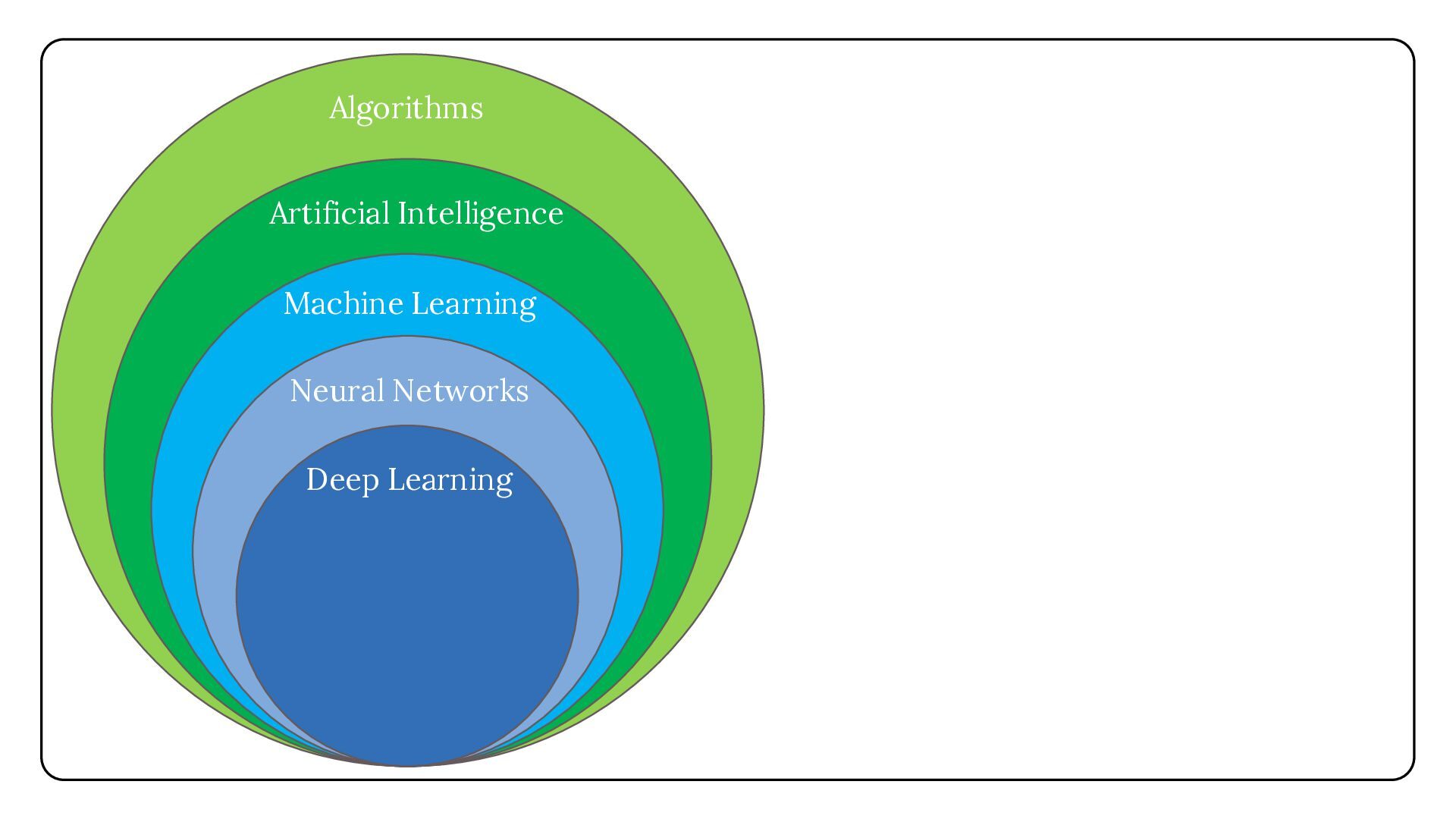
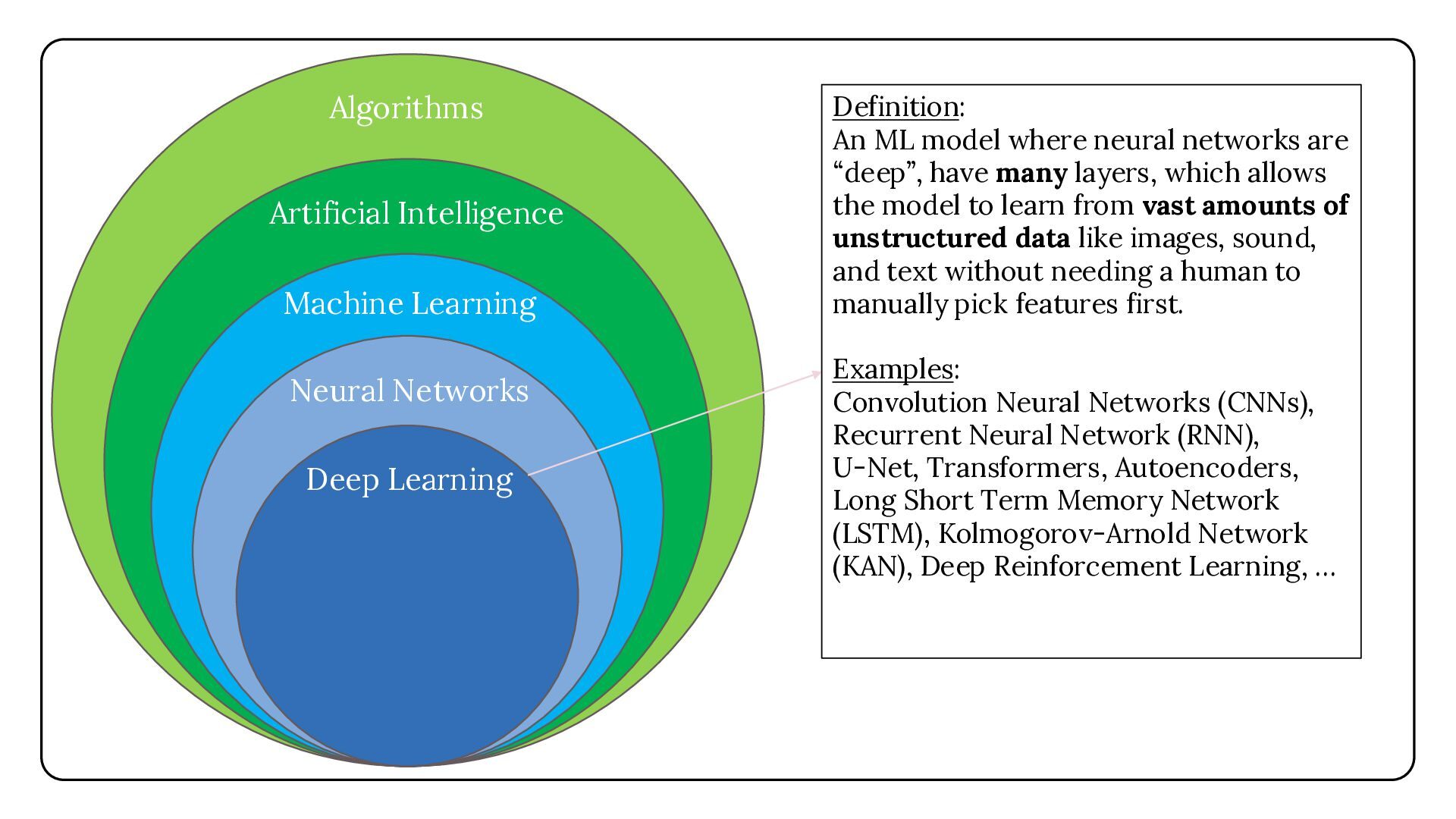
An ML model where neural networks are “deep”, have many layers, which allows the model to learn from vast amounts of unstructured data like images, sound, and text without needing a human to manually pick features first. Examples: Convolution Neural Networks (CNNs), Recurrent Neural Network (RNN), U-Net, Transformers, Autoencoders, Long Short Term Memory Network (LSTM), Kolmogorov-Arnold Network (KAN), Deep Reinforcement Learning, …
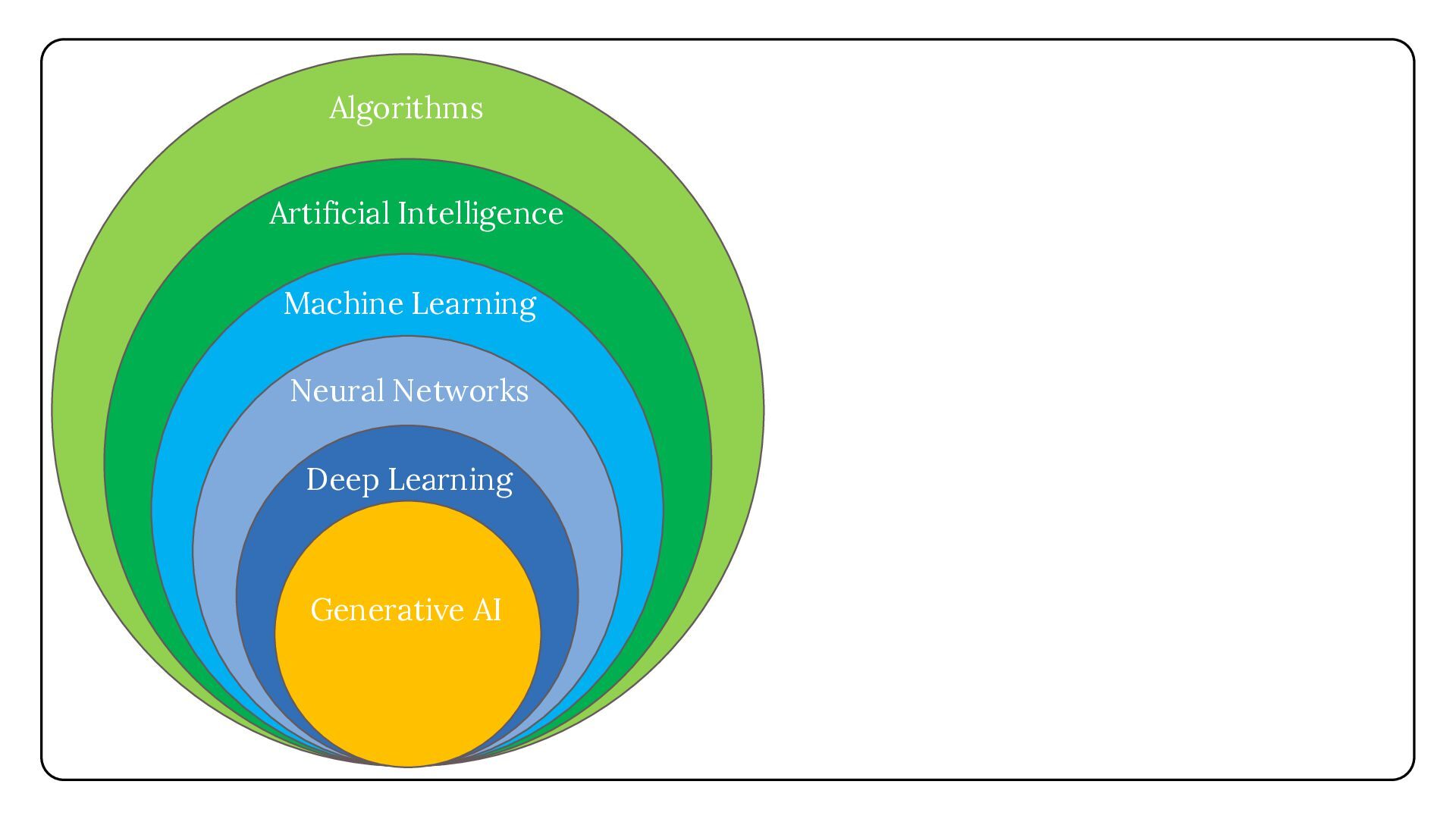
AI Definition: A subfield of DL where the model learns the underlying probability distribution of a dataset so that it can sample from that distribution to create realistic and novel data. Concepts: Foundation Model, JEPA, Neural Implicit Representations, Transfer Learning, Embeddings, Zero-, One-, Few- Shot Learning, Domain Adaptation, Attention (Q,K,V), … Examples: General Adversarial Networks (GANs), Diffusion Models, Variational Autoencoders (VAEs ), Multimodal AI, Large Language Models (LLMs), AI Agents, Yoshua Bengio’s AI Scientist (hypothesis generation and safety monitoring with non-agentic guardrail), …
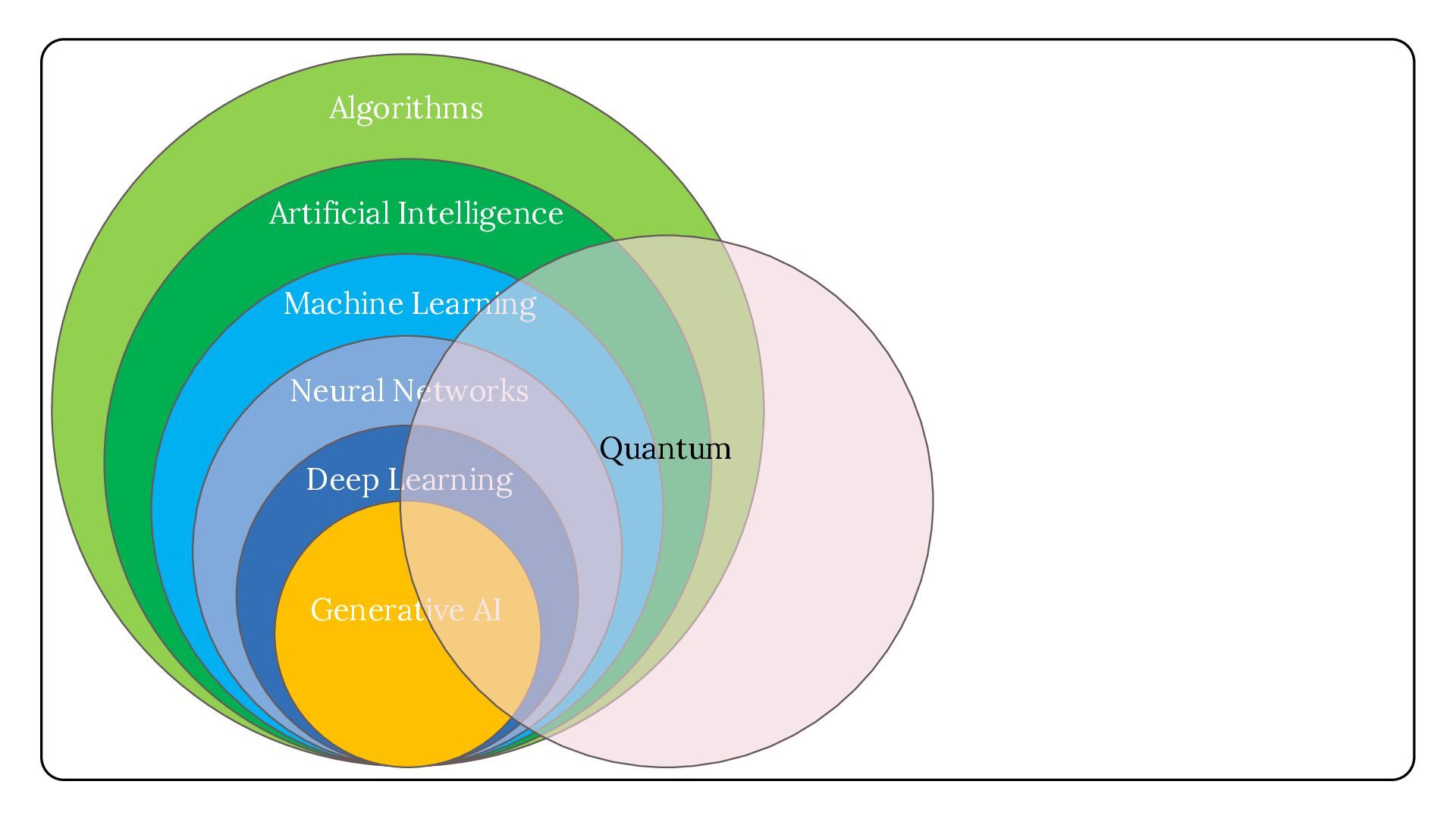
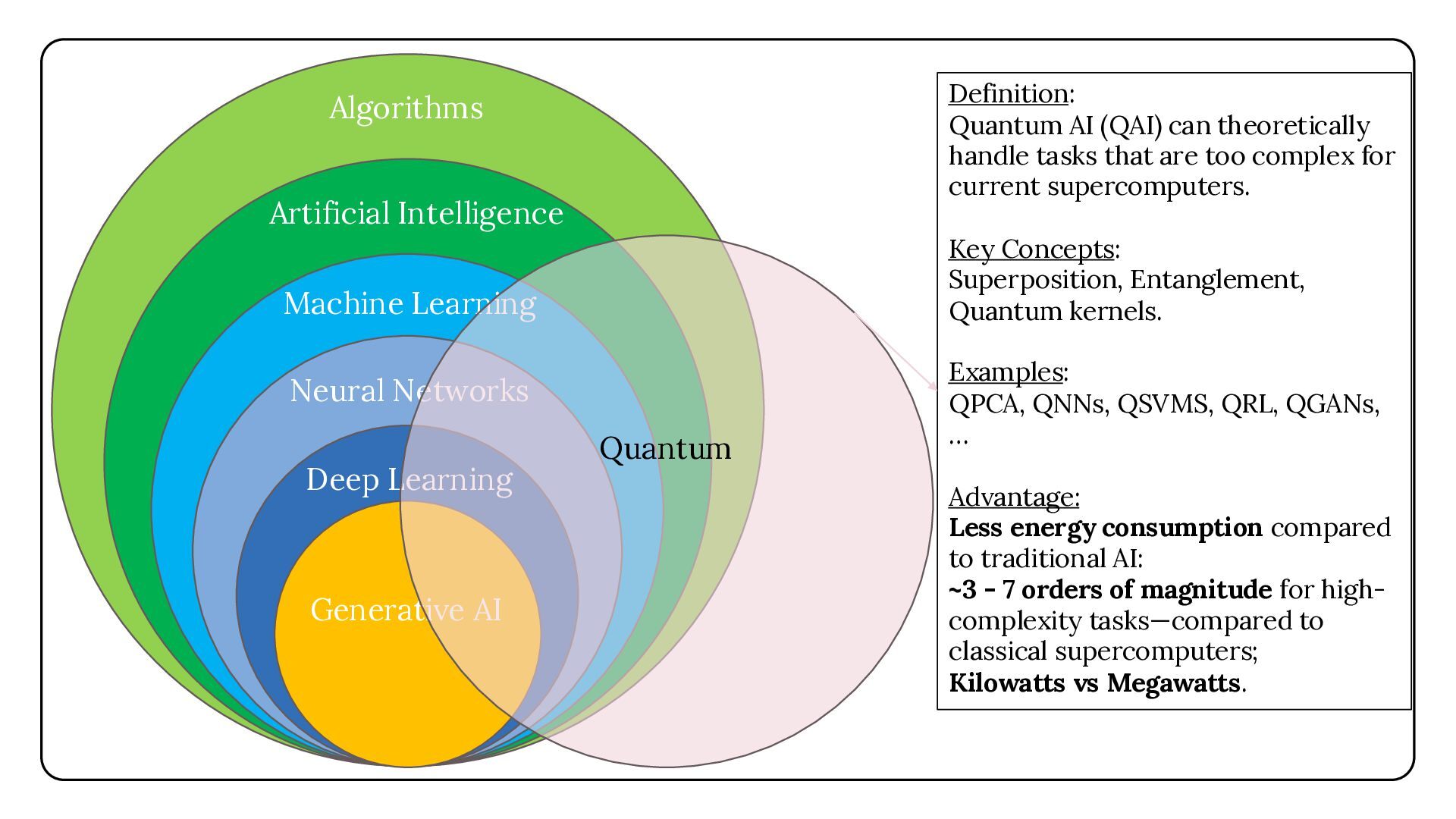
AI Quantum Definition: Quantum AI (QAI) can theoretically handle tasks that are too complex for current supercomputers. Key Concepts: Superposition, Entanglement, Quantum kernels. Examples: QPCA, QNNs, QSVMS, QRL, QGANs, … Advantage: Less energy consumption compared to traditional AI: ~3 - 7 orders of magnitude for high- complexity tasks—compared to classical supercomputers; Kilowatts vs Megawatts.
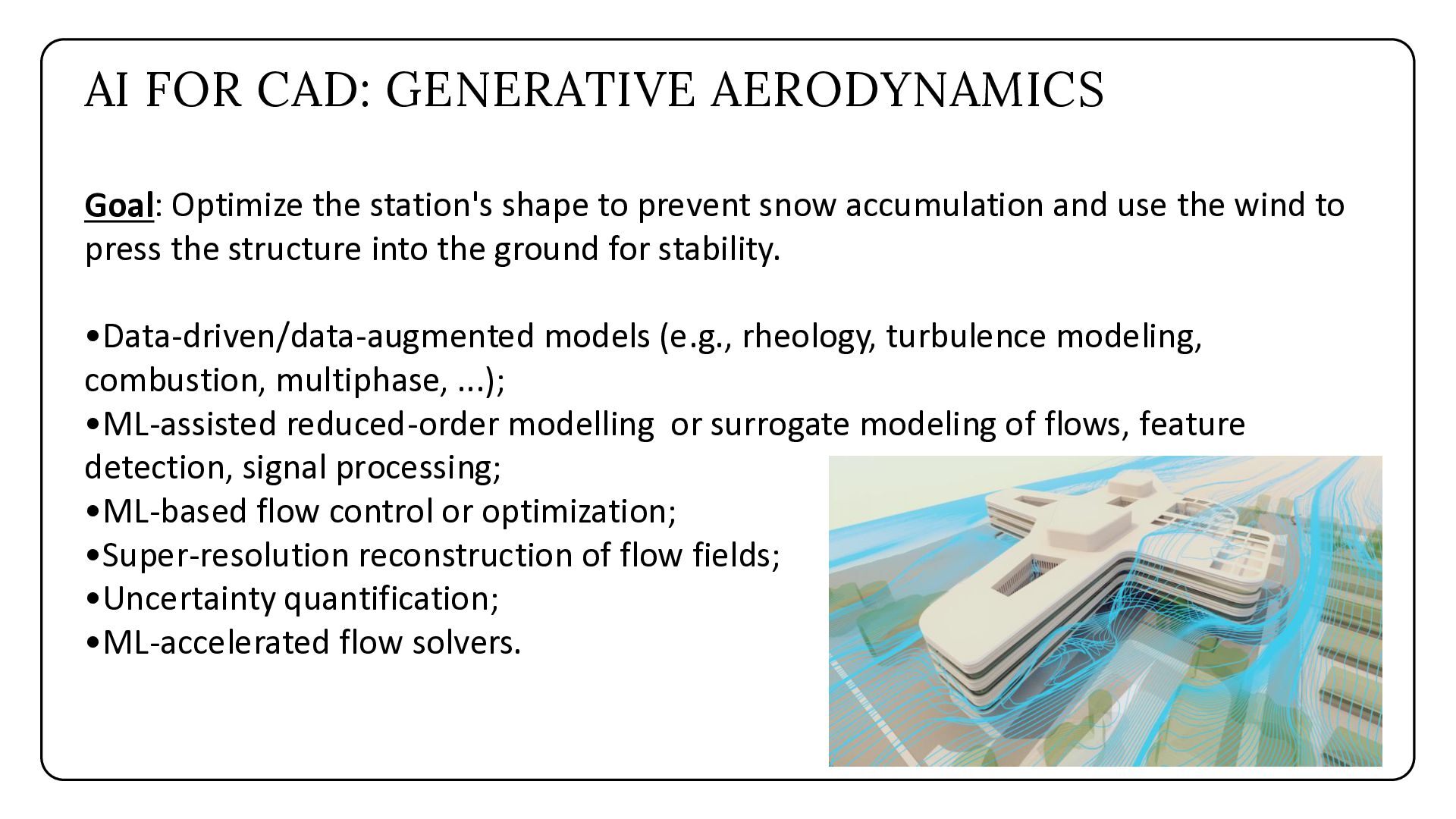
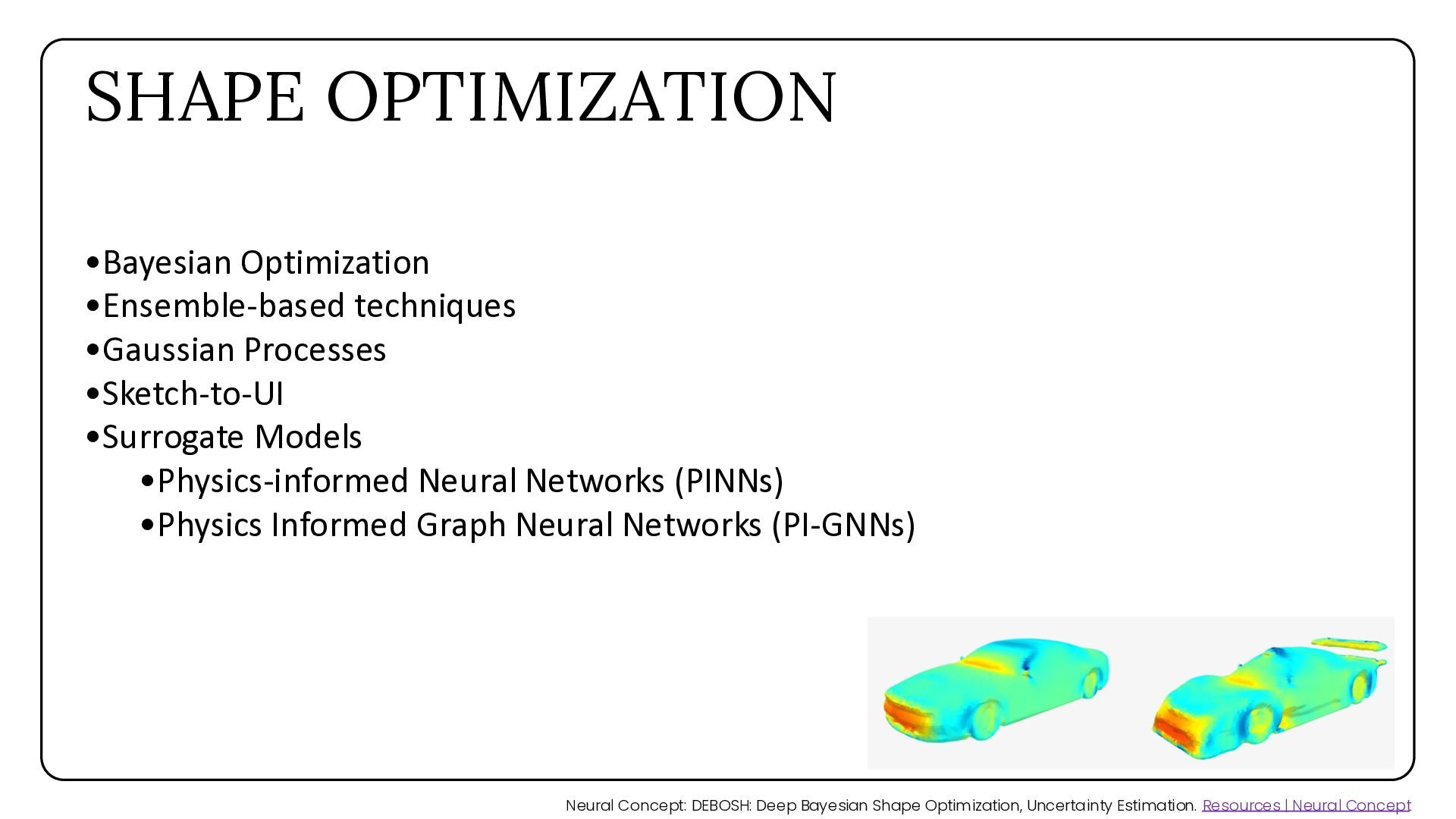
to prevent snow accumulation and use the wind to press the structure into the ground for stability. •Data-driven/data-augmented models (e.g., rheology, turbulence modeling, combustion, multiphase, ...); •ML-assisted reduced-order modelling or surrogate modeling of flows, feature detection, signal processing; •ML-based flow control or optimization; •Super-resolution reconstruction of flow fields; •Uncertainty quantification; •ML-accelerated flow solvers.
Estimation. Resources | Neural Concept •Mirroring (Real-Time Sync): High-frequency data from multimodal sensors (thermal, vibration, air quality, etc) synchronized to digital twin to provide exact "now" state. •Modeling (Physics-Informed AI): Combines traditional physics (e.g., structural heat loss) with data-driven models to predict how station will react to environmental shifts. •Intervention (Predictive Optimization): AI proactively adjusts HVAC or energy loads before an anomaly occurs (e.g., katabatic wind storm). •Autonomous Management: Uses Foundation Models and Intelligent Agents to handle complex decision-making without human input.
Infrastructure (SARI): A Cyber-Physical Framework for Energy Autonomy, Water Circularity and Transport Resilience Under Grid Failure. 10.13140/RG.2.2.21429.64486. **Yang, Z. (2025). Integration of AI with Building Energy Management Systems for Low-Carbon Urban Development. Frontiers in Sustainable Development, 5(10), 104-119. *** El Ouaham, W., Sadik, M., Ennajih, A., Mouzouna, Y., Orchi, H., & Elouaham, S. (2026). Smart Greenhouses in the Era of IoT and AI: A Comprehensive Review of AI Applications, Spectral Sensing, Multimodal Data Fusion, and Intelligent Systems. Agriculture, 16(7), 761. https://doi.org/10.3390/agriculture16070761 •Solar-AI Regenerative Infrastructure (SARI)*: A cyber-physical framework specifically for energy autonomy and water circularity. It ensures that if one sector (e.g., power) faces a disruption, other sectors (e.g., data center cooling) adjust to maintain mission- critical life support. •AI-BEMS (Building Energy Management Systems)**: Reduces carbon emissions by learning from daily occupancy and light cycles to optimize energy usage. •Multimodal Data Fusion***: Used in the station's greenhouses to process high- throughput imagery (RGB + Thermal) for early disease detection and maturity assessment, enabling autonomous climate steering.
storage. •The AI for Materials Lab at Universidad Autónoma de Madrid (UAM) specializes in applying GNNs, RL, and BO to design high-performance sustainable materials and predict molecular behavior. •The Computational Materials Science Laboratory of University of Barcelona (UB) focuses on using ML to identify optimal catalysts and navigate structural optimization problems for energy conversion. •Quantum Machine Learning can accelerate materials science at molecular level.
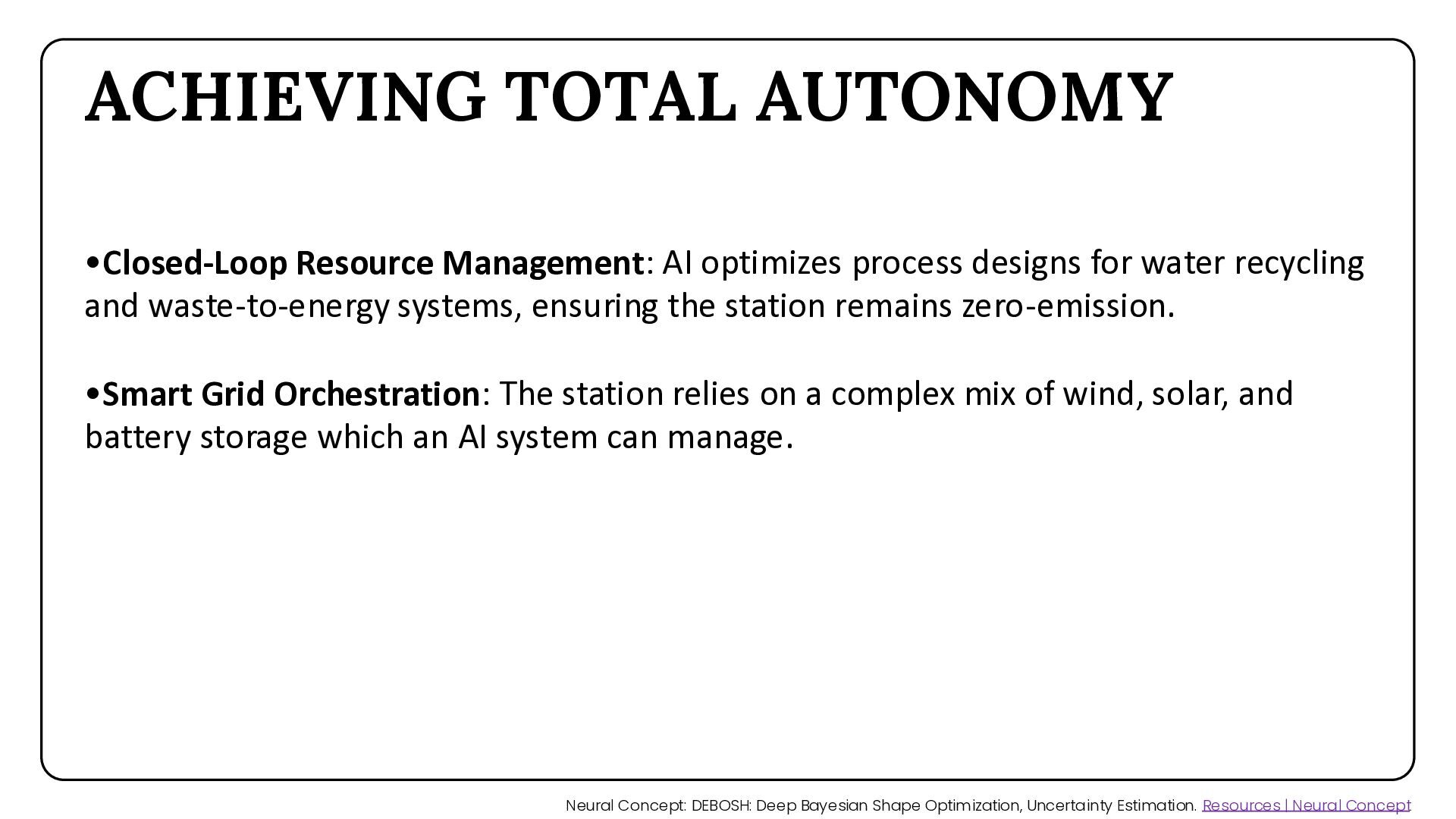
Uncertainty Estimation. Resources | Neural Concept •Closed-Loop Resource Management: AI optimizes process designs for water recycling and waste-to-energy systems, ensuring the station remains zero-emission. •Smart Grid Orchestration: The station relies on a complex mix of wind, solar, and battery storage which an AI system can manage.
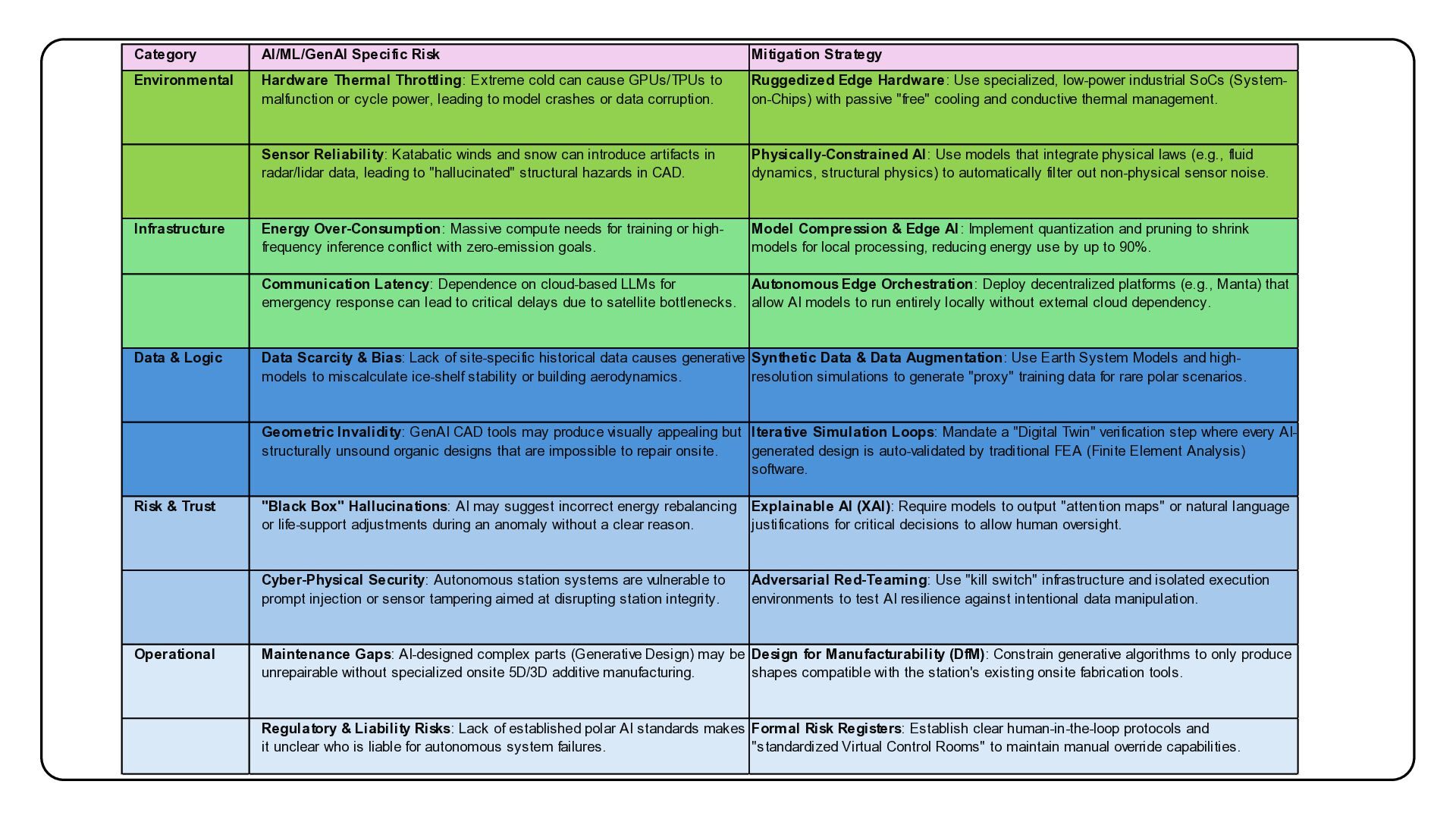
Extreme cold can cause GPUs/TPUs to malfunction or cycle power, leading to model crashes or data corruption. Ruggedized Edge Hardware: Use specialized, low-power industrial SoCs (System- on-Chips) with passive "free" cooling and conductive thermal management. Sensor Reliability: Katabatic winds and snow can introduce artifacts in radar/lidar data, leading to "hallucinated" structural hazards in CAD. Physically-Constrained AI: Use models that integrate physical laws (e.g., fluid dynamics, structural physics) to automatically filter out non-physical sensor noise. Infrastructure Energy Over-Consumption: Massive compute needs for training or high- frequency inference conflict with zero-emission goals. Model Compression & Edge AI: Implement quantization and pruning to shrink models for local processing, reducing energy use by up to 90%. Communication Latency: Dependence on cloud-based LLMs for emergency response can lead to critical delays due to satellite bottlenecks. Autonomous Edge Orchestration: Deploy decentralized platforms (e.g., Manta) that allow AI models to run entirely locally without external cloud dependency. Data & Logic Data Scarcity & Bias: Lack of site-specific historical data causes generative models to miscalculate ice-shelf stability or building aerodynamics. Synthetic Data & Data Augmentation: Use Earth System Models and high- resolution simulations to generate "proxy" training data for rare polar scenarios. Geometric Invalidity: GenAI CAD tools may produce visually appealing but structurally unsound organic designs that are impossible to repair onsite. Iterative Simulation Loops: Mandate a "Digital Twin" verification step where every AI- generated design is auto-validated by traditional FEA (Finite Element Analysis) software. Risk & Trust "Black Box" Hallucinations: AI may suggest incorrect energy rebalancing or life-support adjustments during an anomaly without a clear reason. Explainable AI (XAI): Require models to output "attention maps" or natural language justifications for critical decisions to allow human oversight. Cyber-Physical Security: Autonomous station systems are vulnerable to prompt injection or sensor tampering aimed at disrupting station integrity. Adversarial Red-Teaming: Use "kill switch" infrastructure and isolated execution environments to test AI resilience against intentional data manipulation. Operational Maintenance Gaps: AI-designed complex parts (Generative Design) may be unrepairable without specialized onsite 5D/3D additive manufacturing. Design for Manufacturability (DfM): Constrain generative algorithms to only produce shapes compatible with the station's existing onsite fabrication tools. Regulatory & Liability Risks: Lack of established polar AI standards makes it unclear who is liable for autonomous system failures. Formal Risk Registers: Establish clear human-in-the-loop protocols and "standardized Virtual Control Rooms" to maintain manual override capabilities.

 Your Podcast. Everywhere. Effortlessly.


 ipfevents
 shumpei777
 hiroakihamada
 jarvist
 naokimuroki
 voginip
 neutron63zf
 hayashiyus884
 trycycle
%20square.jpg) baggiponte
baggiponte
.jpg) lychee1223
lychee1223
 salt2
salt2
 syuchimu
 marcoroth
 zakiyama
 aki_iinuma
 sugarenia
 cassininazir
 smashingmag
 rkendrick25
 inesmontani
 holman
 nonsquared
.png) helenjbeal
helenjbeal
 ryanjones