Share
Embed
Anchoring Human-Centeredness in Organizations: A Study on the Current State of UX Vision and UX Strategy
Presentation given at Mensch & Computer 2025 (Chemnitz, Germany) by Björn Rohles & Julia Messerschmidt. In our UX Strategy Working Group by German UPA, we investigated the current state of UX visions and UX strategies in the German-speaking industry.
Björn Rohles
November 02, 2025
Transcript
32 slides
-
Björn Rohles & Julia Messerschmidt, Mensch & Computer 2025 Anchoring
Human-Centeredness in Organizations A Study on the Current State of UX Vision and UX Strategy -
Authors Björn Rohles ([email protected]) UX Training Manager, Team lead, Author
Ph.D. in Human-Computer Interaction Introduction 2 Julia Messerschmidt ([email protected]) Teamlead Onsite Consultants UX Dipl.-Psychologin -
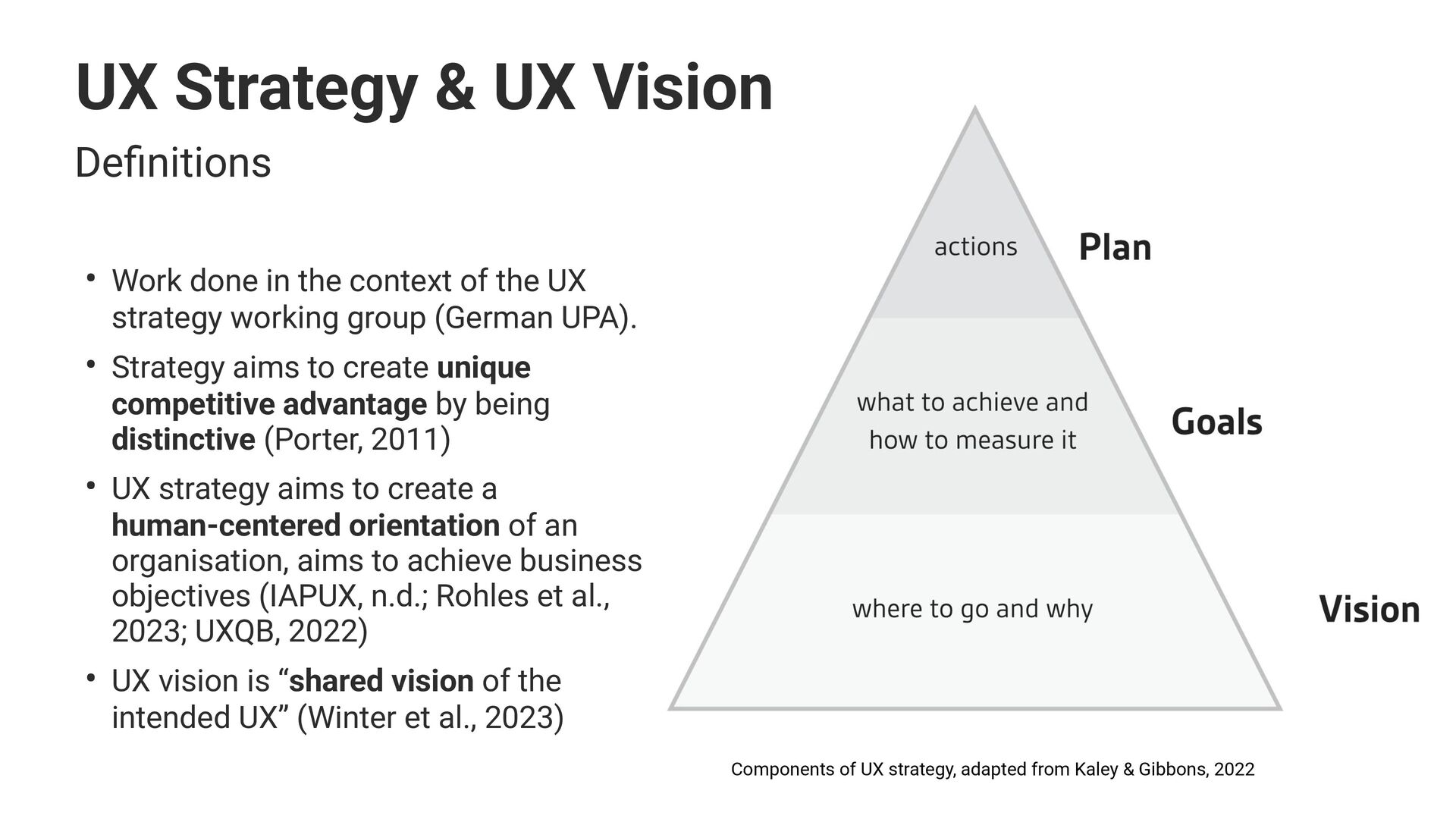
Definitions • Work done in the context of the UX
strategy working group (German UPA). • Strategy aims to create unique competitive advantage by being distinctive (Porter, 2011) • UX strategy aims to create a human-centered orientation of an organisation, aims to achieve business objectives (IAPUX, n.d.; Rohles et al., 2023; UXQB, 2022) • UX vision is “shared vision of the intended UX” (Winter et al., 2023) UX Strategy & UX Vision Components of UX strategy, adapted from Kaley & Gibbons, 2022 -
CX and CX strategy • Substantial research on the related
concepts of customer experience (CX) and CX strategy, for example on successfully implementing CX strategy (Köninger & Goultier, 2024). • CX strategy known to increase customer orientation in organizations (Köninger & Goultier, 2024). • Organizations increasingly implement UX or CX management (Homburg et al., 2017), often including a strategic focus. Related Work Photo by Getty Images, Unsplash+ -
Compared to CX strategy, research on UX strategy is scarce
research. Work done on barriers to integrating UX (Nielsen et al., 2024) and factors impacting UX strategy (Rohles et al., 2023). → Little is known about how established UX strategy is and how it is implemented in practice. Research gap Photo by Brett Jordan on Unsplash -
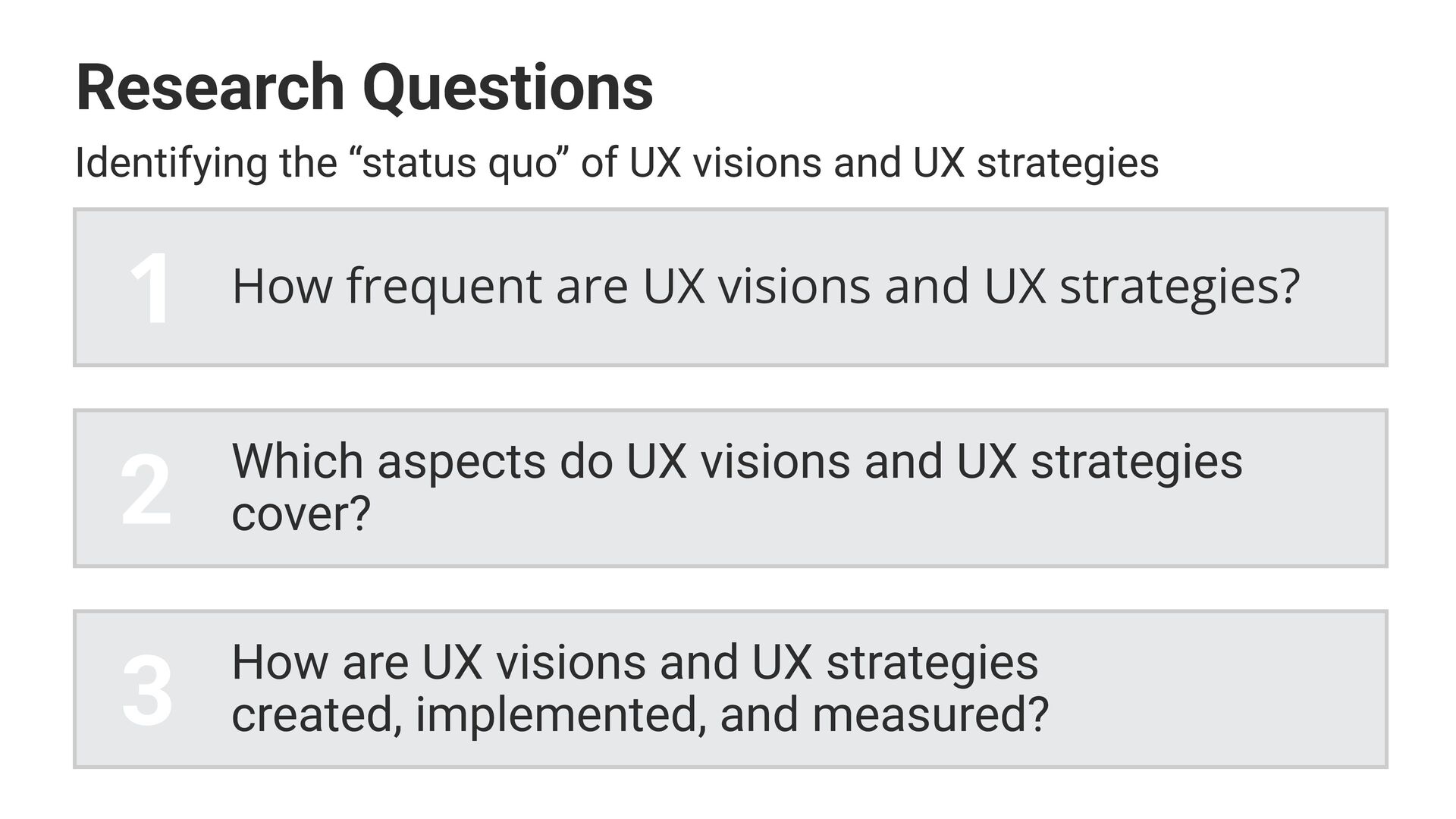
Research Questions Identifying the “status quo” of UX visions and
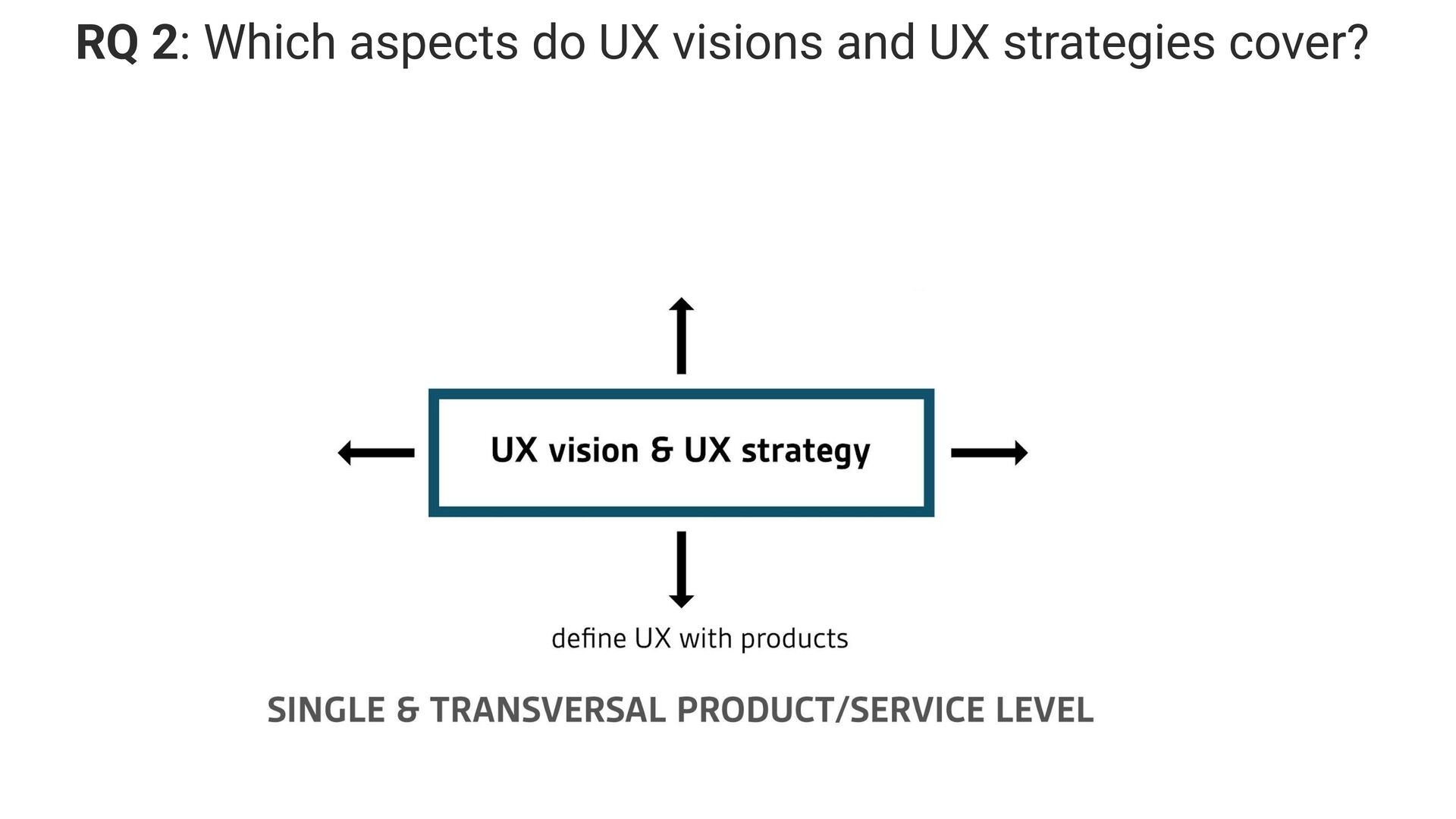
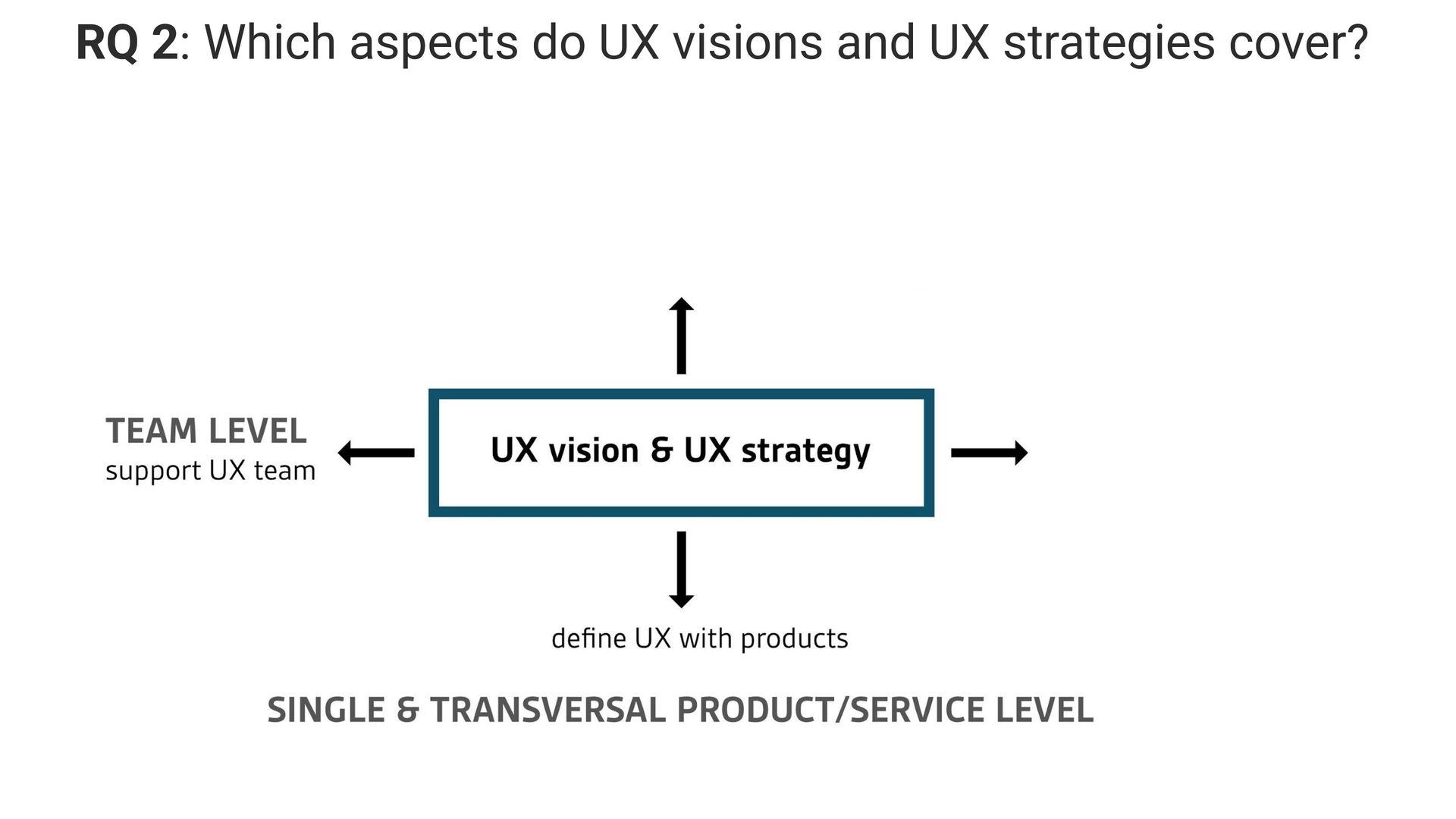
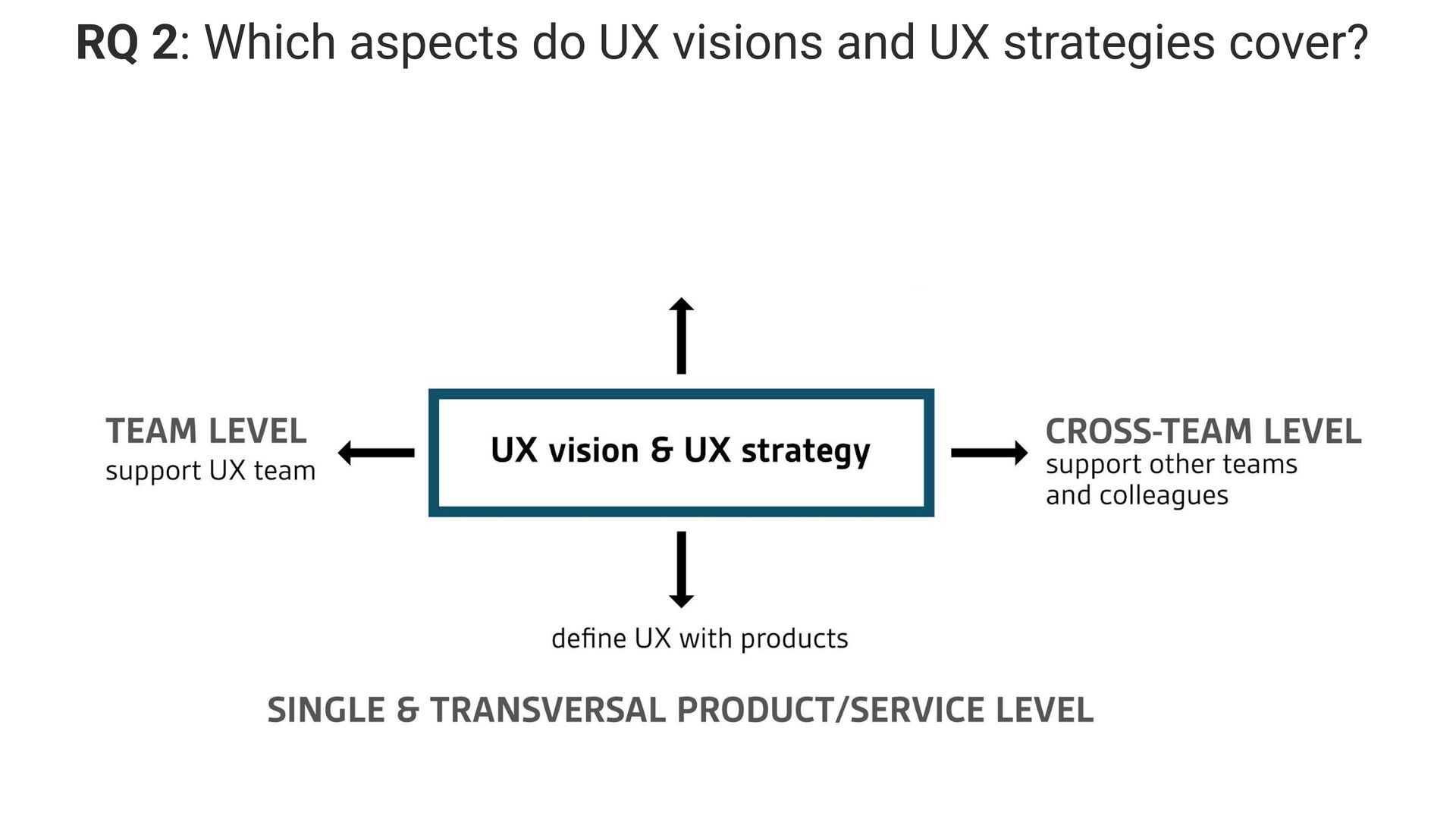
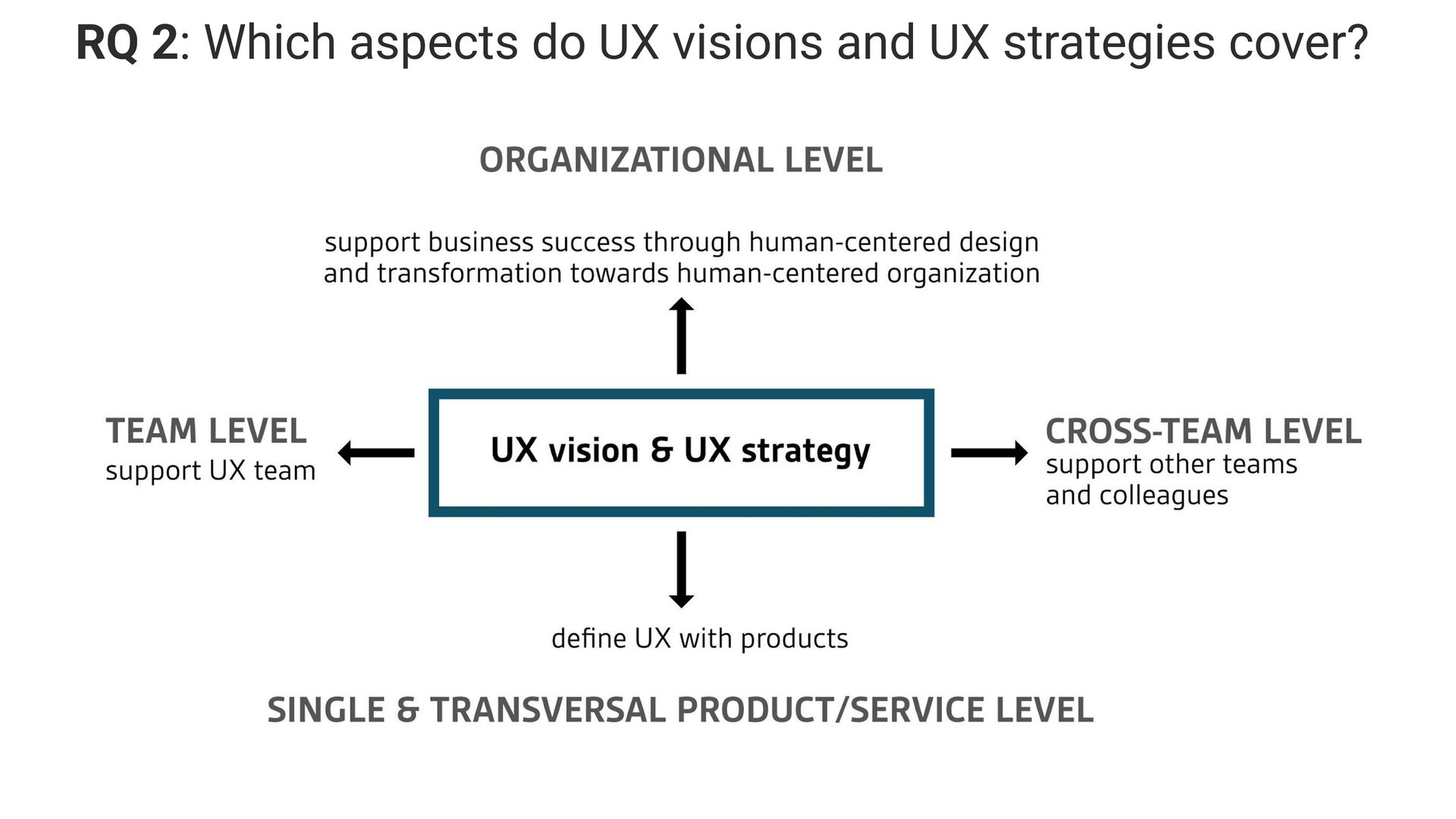
UX strategies How frequent are UX visions and UX strategies? 1 How are UX visions and UX strategies created, implemented, and measured? 3 Which aspects do UX visions and UX strategies cover? 2 -
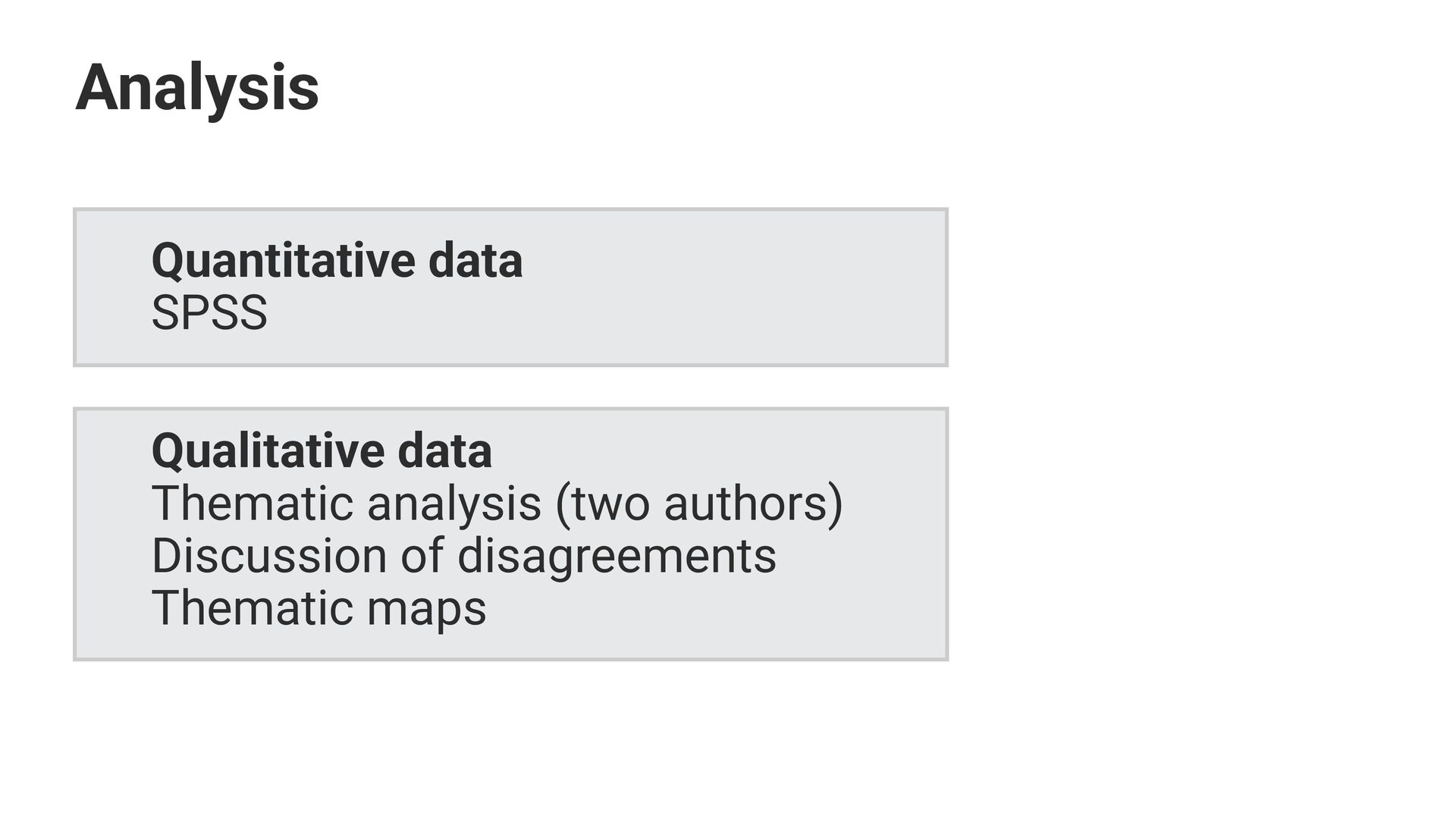
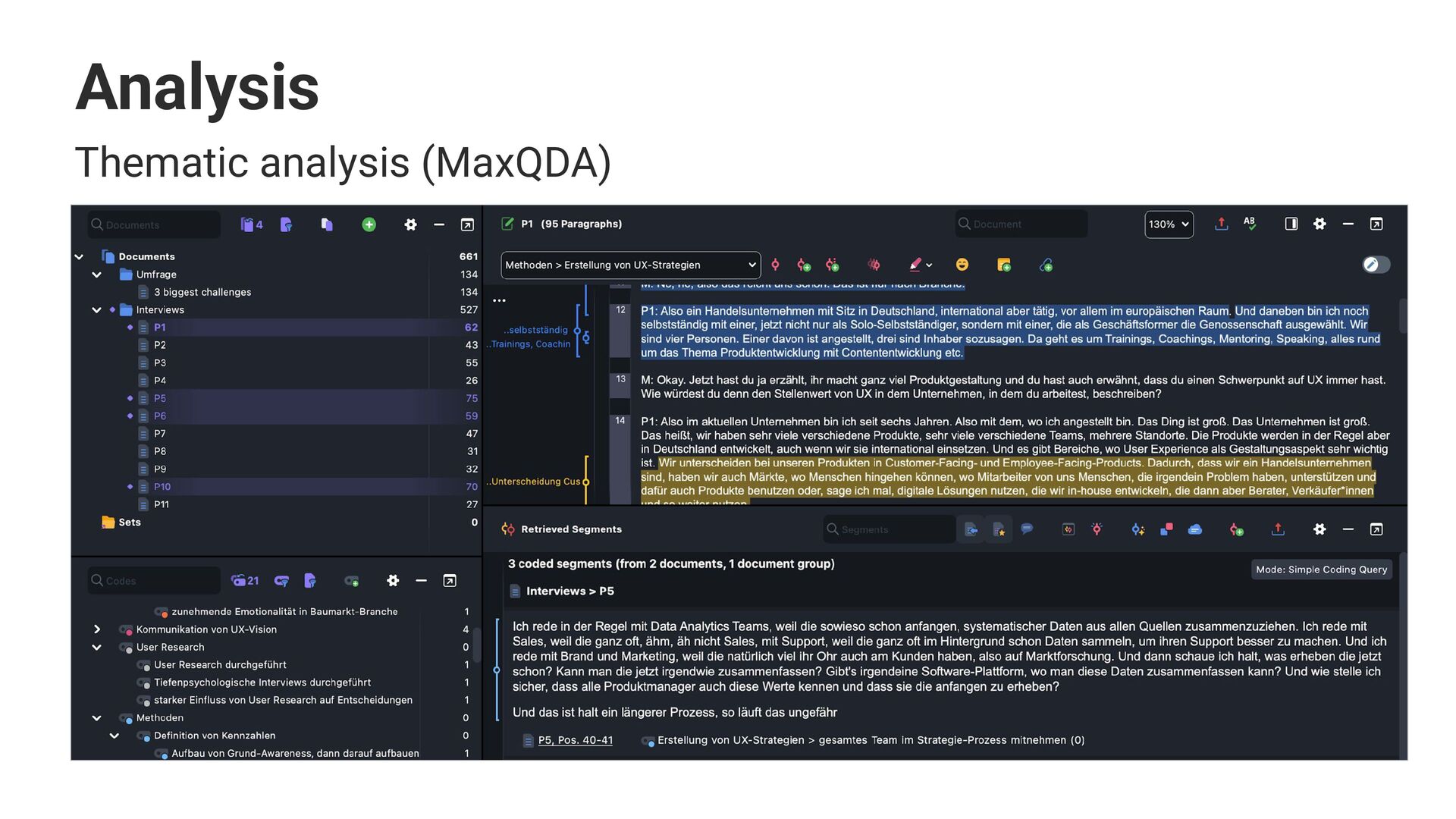
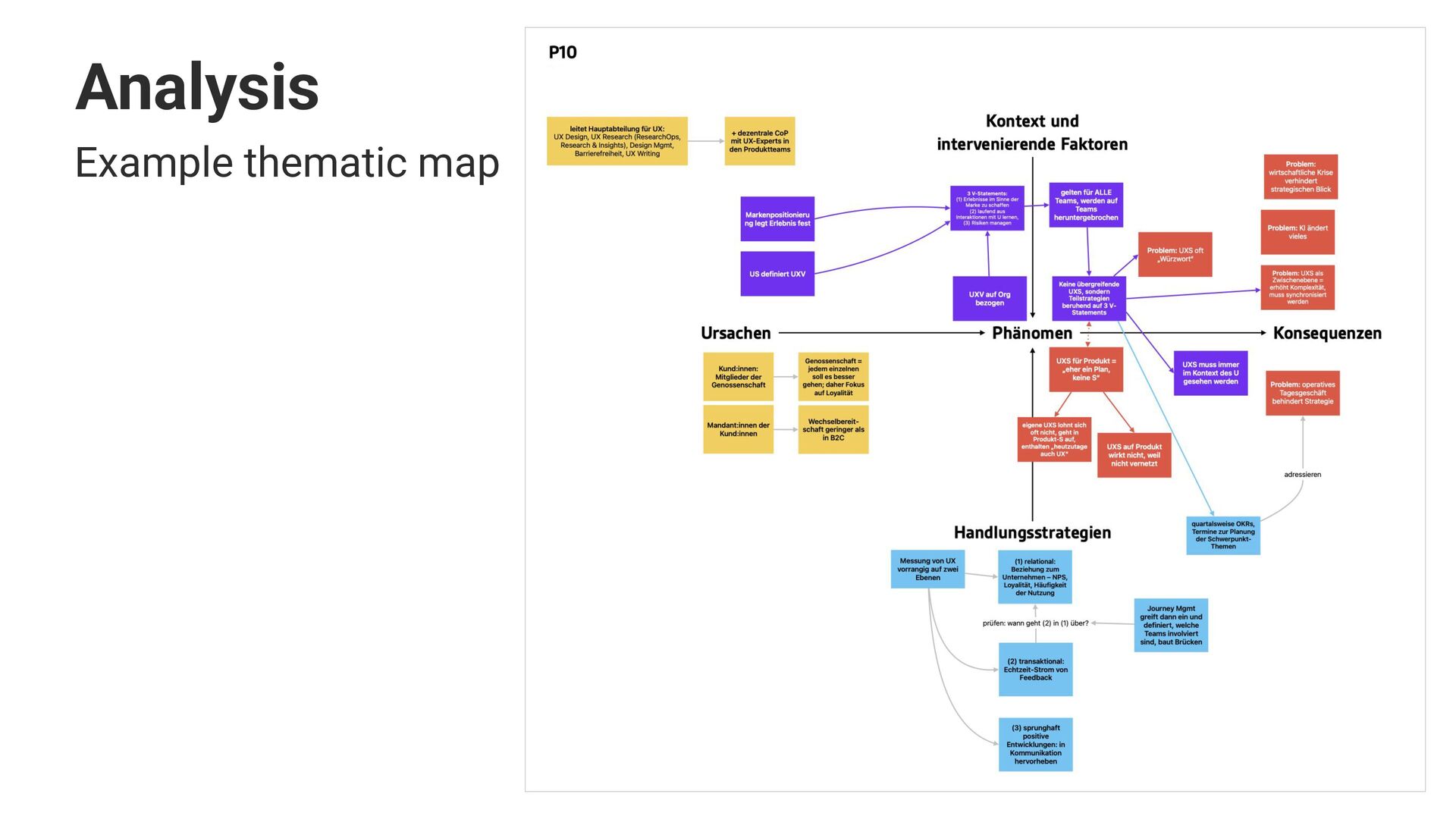
Analysis Quantitative data SPSS Qualitative data Thematic analysis (two authors)
Discussion of disagreements Thematic maps -
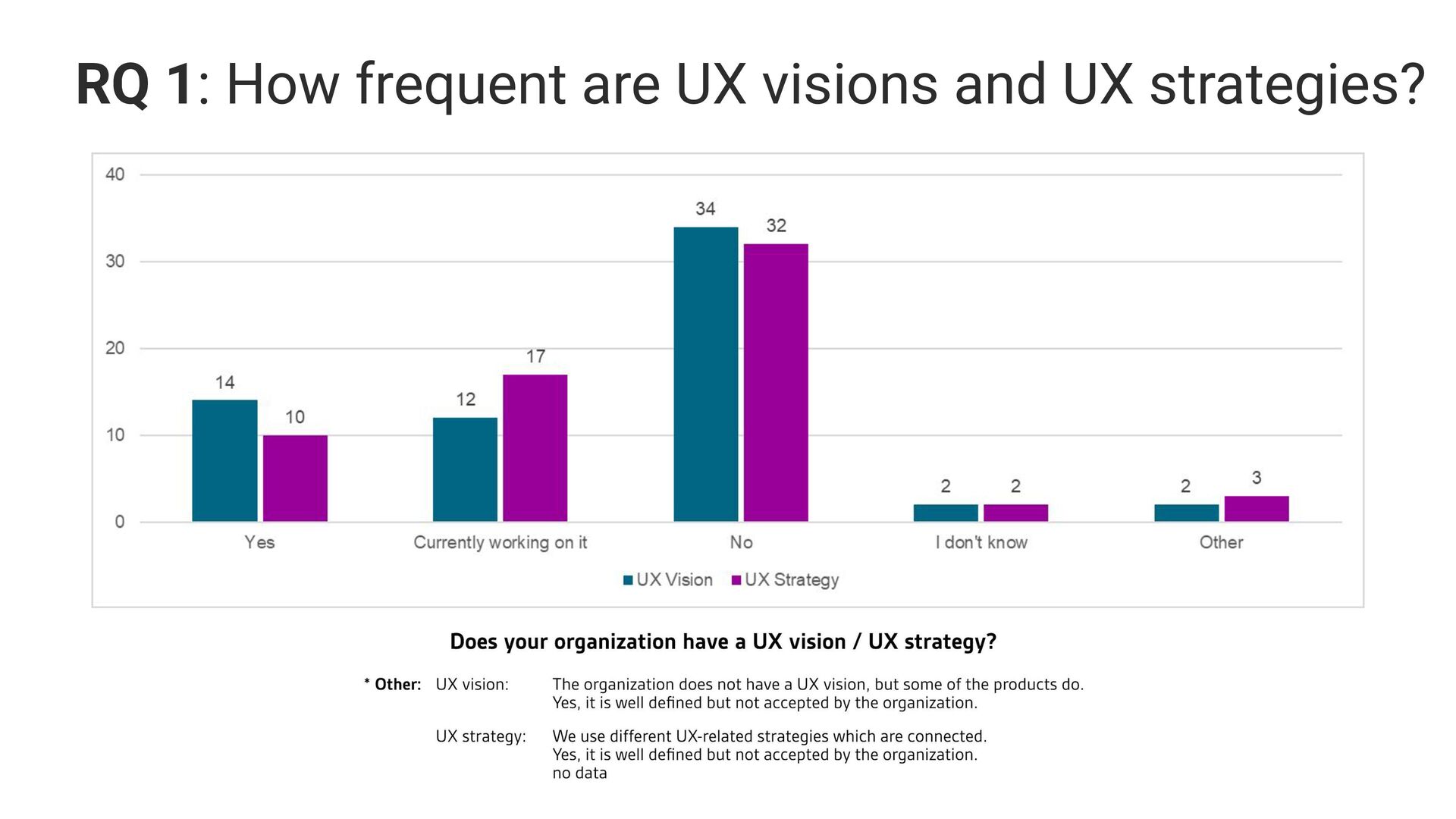
RQ 1: How frequent are UX visions and UX strategies?
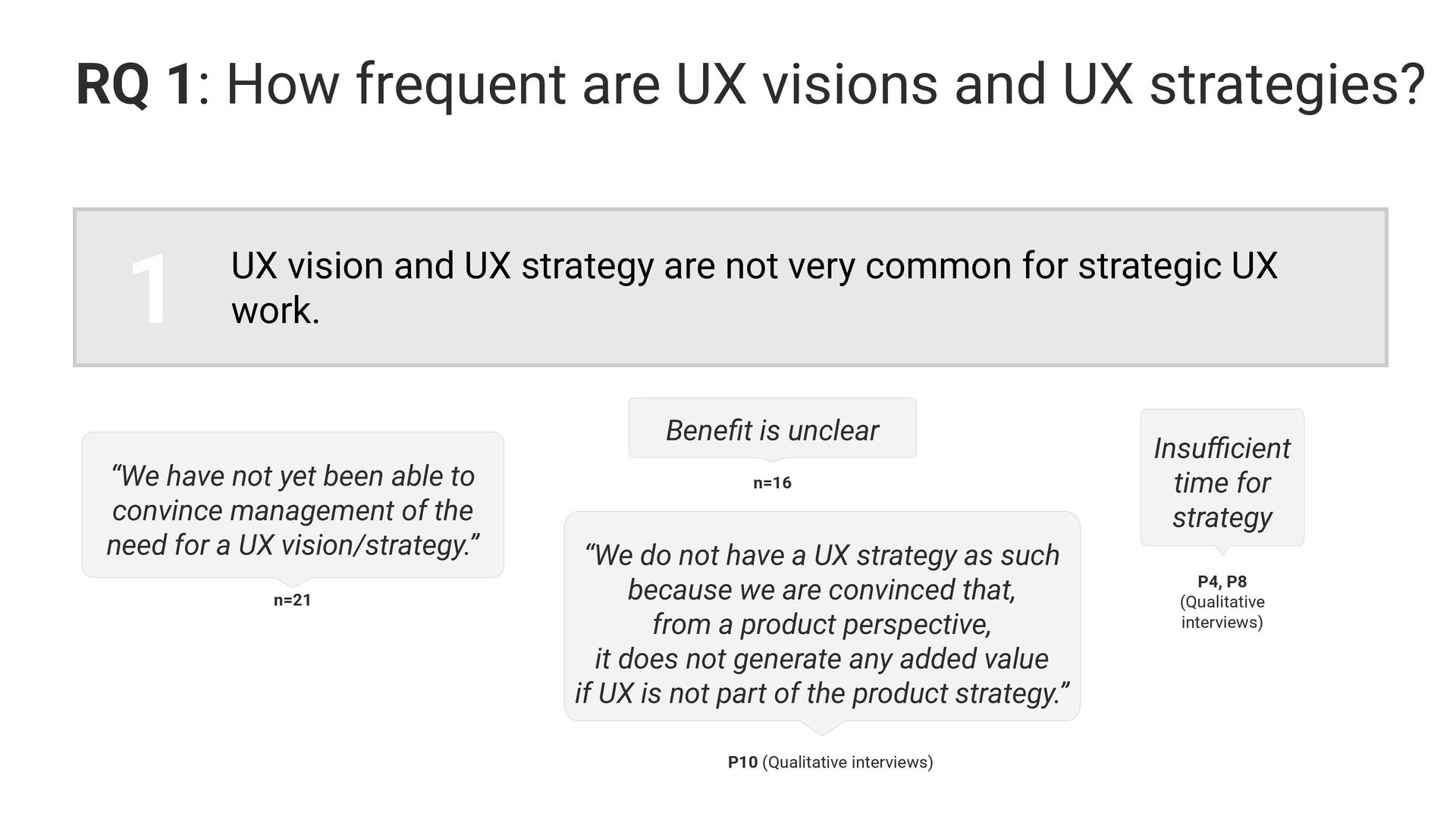
UX vision and UX strategy are not very common for strategic UX work. 1 “We have not yet been able to convince management of the need for a UX vision/strategy.” n=21 Benefit is unclear n=16 Insufficient time for strategy P4, P8 (Qualitative interviews) “We do not have a UX strategy as such because we are convinced that, from a product perspective, it does not generate any added value if UX is not part of the product strategy.” P10 (Qualitative interviews) -
RQ 3: How are UX visions and UX strategies created,
implemented, and measured? -
RQ 3: How are UX visions and UX strategies created,
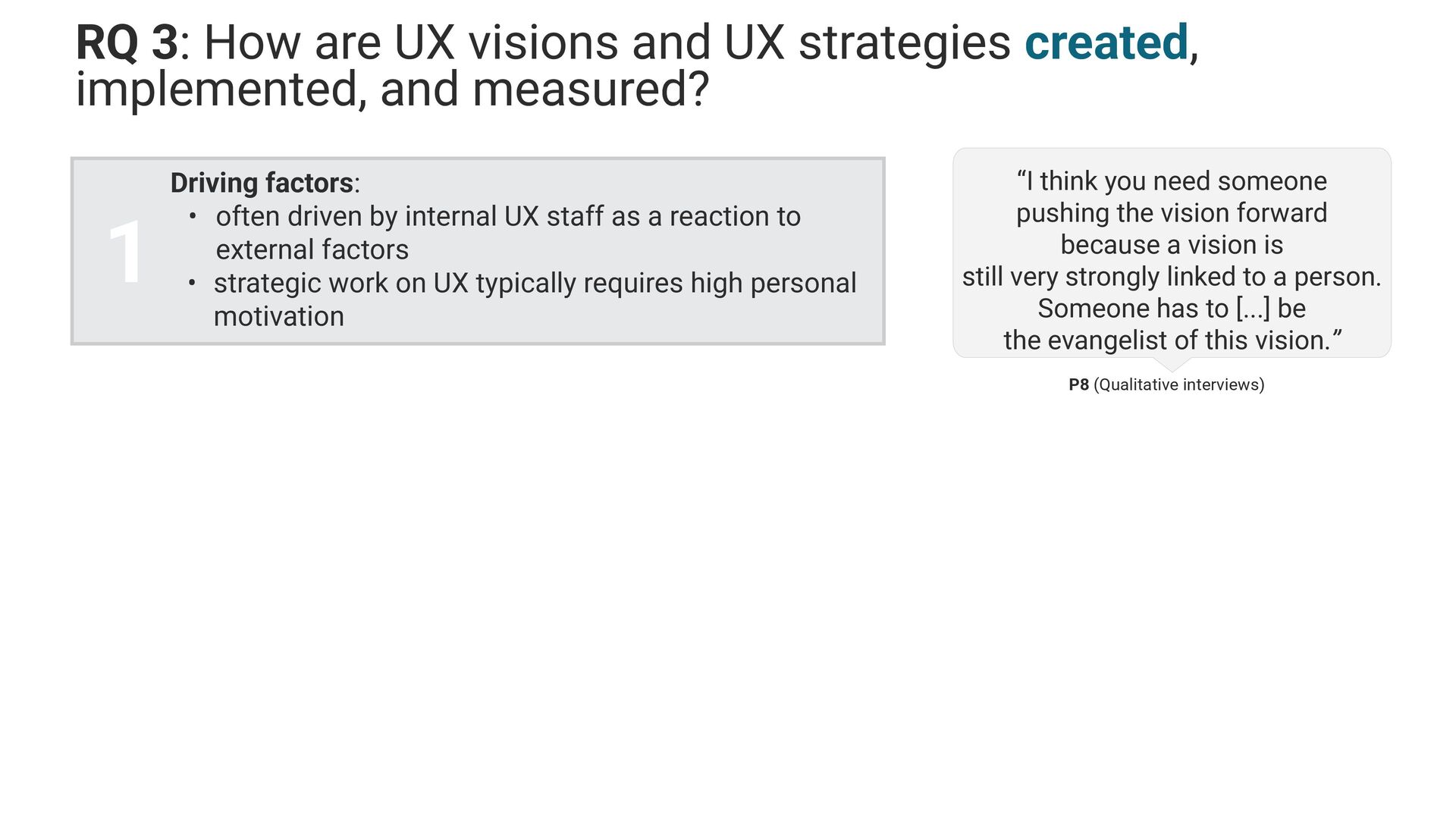
implemented, and measured? Driving factors: • often driven by internal UX staff as a reaction to external factors • strategic work on UX typically requires high personal motivation 1 “I think you need someone pushing the vision forward because a vision is still very strongly linked to a person. Someone has to [...] be the evangelist of this vision.” P8 (Qualitative interviews) -
RQ 3: How are UX visions and UX strategies created,
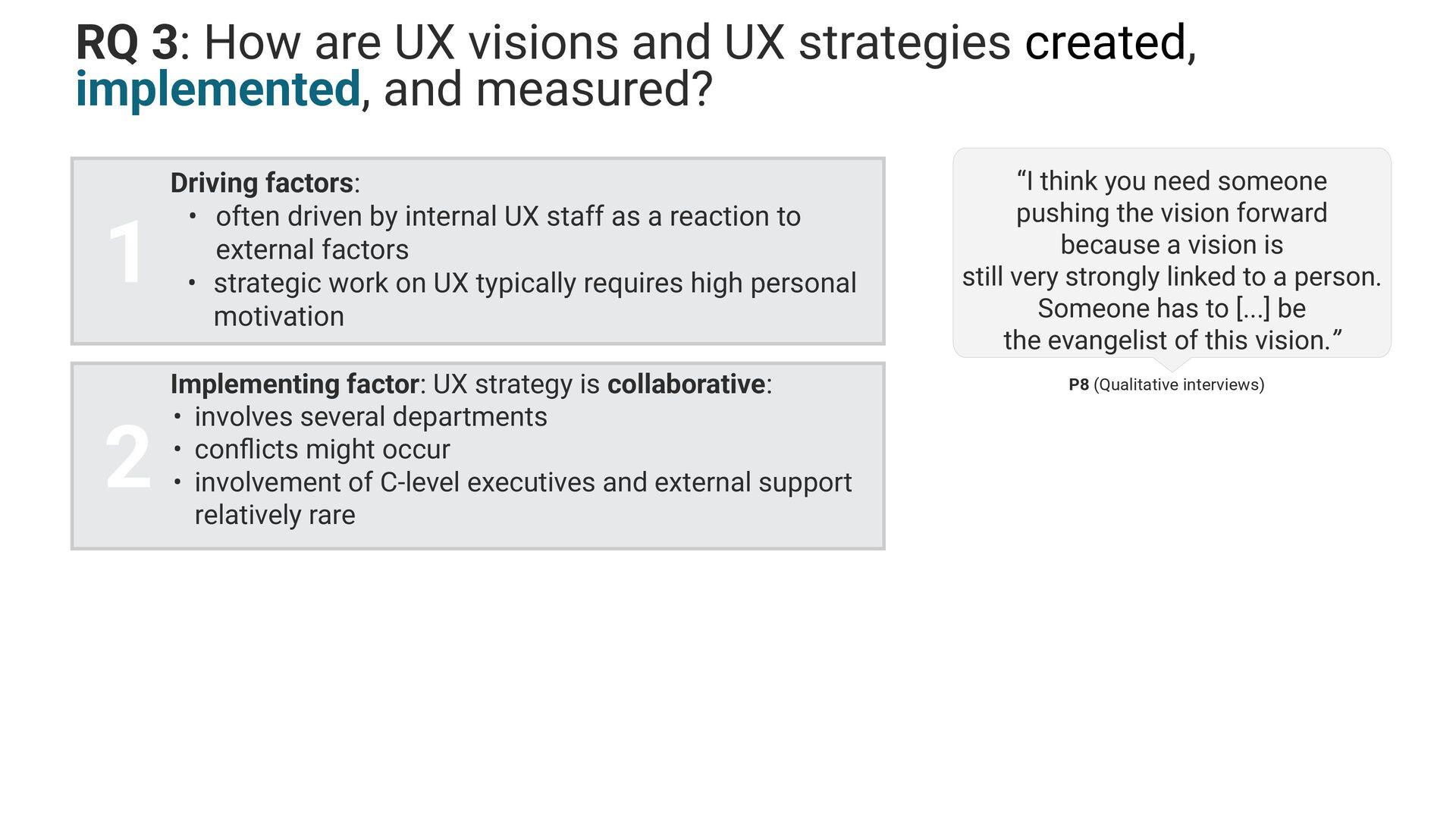
implemented, and measured? Driving factors: • often driven by internal UX staff as a reaction to external factors • strategic work on UX typically requires high personal motivation 1 “I think you need someone pushing the vision forward because a vision is still very strongly linked to a person. Someone has to [...] be the evangelist of this vision.” P8 (Qualitative interviews) Implementing factor: UX strategy is collaborative: • involves several departments • conflicts might occur • involvement of C-level executives and external support relatively rare 2 -
RQ 3: How are UX visions and UX strategies created,
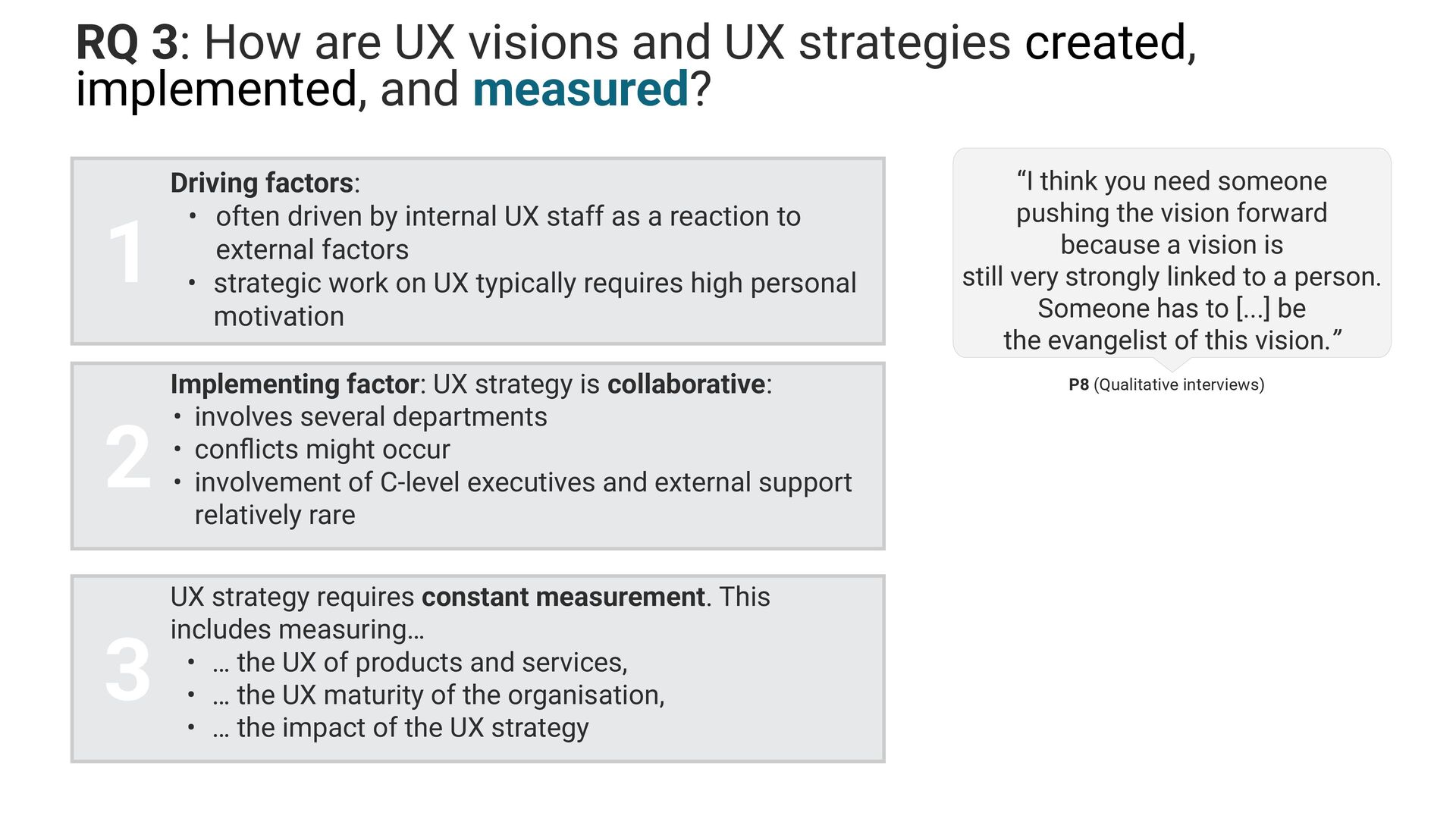
implemented, and measured? Driving factors: • often driven by internal UX staff as a reaction to external factors • strategic work on UX typically requires high personal motivation 1 “I think you need someone pushing the vision forward because a vision is still very strongly linked to a person. Someone has to [...] be the evangelist of this vision.” P8 (Qualitative interviews) Implementing factor: UX strategy is collaborative: • involves several departments • conflicts might occur • involvement of C-level executives and external support relatively rare 2 UX strategy requires constant measurement. This includes measuring… • … the UX of products and services, • … the UX maturity of the organisation, • … the impact of the UX strategy 3 -
Wrap Up & Future Work The Current State of UX
Vision & UX Strategy -
• focus on German-speaking UX community, might need replication in
other communities • longitudinal study useful • double entries from the same organization might be possible, but no evidence found • link between UX strategy and business outcomes worthwhile investigating Limitations Photo by Sigmund on Unsplash -
• UX professionals value UX strategy as guiding light for
their work • evidence of mismatch between strategic aspirations of UX staff and organizations' operational view of UX • UX professionals need to prove the value of UX on business objectives • alliances necessary to support strategic UX work Implications Photo by Glenn Carstens-Peters on Unsplash -
Thank you for your attention. Questions? Photo by Jon Tyson
on Unsplash Contacts and slides: -
References • Christian Homburg, Danijel Jozić, and Christina Kuehnl. 2017.
Customer experience management: toward implementing an evolving marketing concept. Journal of the Academy of Marketing Science 45, 3 (May 2017), 377–401. doi:10.1007/s11747-015-0460-7 • IAPUX (Association for the International Accreditation of UX Professionals and Quality Assurance in the Professional Field of UX, Usability and Human-centered Design). [n. d.]. Focus Areas. https://ux-accreditation.org/focus-areas/ • Anna Kaley and Sarah Gibbons. 2022. UX Strategy: Definition and Components. https://www.nngroup.com/articles/ux-strategy/ • Juliane Kristina Köninger and Matthias H.J. Gouthier. 2024. Successful i mentation of customer experience strategy: determinants and results. Journal of Service Management 35, 5 (Nov. 2024), 605–629. doi:10.1108/JOSM-10-2023-0431 • Sara Nielsen, Rodrigo Ordoñez, Mikael B. Skov, and Elizabeth Jochum. 2024. Strategies for strengthening UX competencies and cultivating corporate UX in a large organisation developing robots. Behaviour & Information Technology 43, 9 (July 2024), 1769–1797. doi:10.1080/0144929X.2023.2227284 • Michael E. Porter. 2011. What Is Strategy? In Harvard Business Review. HBR’s 10 must reads, Vol. HBR’s 10 Must Reads On Strategy. Harvard Business School Publishing Corporation, Boston, Massachusetts, 1–37. • Björn Rohles, Anjelika Votintseva, Patrick Schneider, and Marcus Stavrakakis. 2023. Let’s Talk About Strategy: Factors in establishing UX strategy. In Usability Professionals 2023 (UP23). Gesellschaft für Informatik e.V., Rapperswil, Switzerland. doi:10.18420/muc2023-up-467 • UXQB. 2022. CPUX-M Curriculum – Essentials in UX and HCD Management. UXQB, Cologne. https://uxqb.org/ • Dominique Winter, Carolin Hausmann, Andreas Hinderks, and Jörg Thomaschewski. 2023. Development of a Shared UX Vision Based on UX Factors Ascertained Through Attribution. International Journal of Interactive Multimedia and Artifcial Intelligence 8, 2 (2023), 247. doi:10.9781/ijimai.2023.04.001