Upgrade to Pro
— share decks privately, control downloads, hide ads and more …
Speaker Deck
Sign up for free
Menu
Search
Features
All features
Private URLs
Password Protection
Custom URLS
Scheduled publishing
Remove Branding
Restrict embedding
Deck Collections
Notes
Features
All features
Private URLs
Password Protection
Custom URLS
Scheduled publishing
Remove Branding
Restrict embedding
Deck Collections
Notes
Explore
Featured decks
Featured speakers
Programming
Technology
Storyboards
Explore
Featured decks
Featured speakers
Programming
Technology
Storyboards
Pricing
Search
Sign in
Sign up for free
Character Eyes: Seeing Language through Charact...
Search
katsutan
October 15, 2019
Technology
250
1
Share
Embed
Copy iframe code
Copy JS code
Copy link
Start on current slide
Character Eyes: Seeing Language through Character-Level Taggers
文献紹介
https://www.aclweb.org/anthology/W19-4811.pdf
長岡技術科学大学
自然言語処理研究室
勝田 哲弘
katsutan
October 15, 2019
More Decks by katsutan
See All by katsutan
What does BERT learn about the structure of language?
katsutan
0
280
Simple and Effective Paraphrastic Similarity from Parallel Translations
katsutan
0
240
Simple task-specific bilingual word embeddings
katsutan
0
250
Retrofitting Contextualized Word Embeddings with Paraphrases
katsutan
0
300
Improving Word Embeddings Using Kernel PCA
katsutan
0
250
Better Word Embeddings by Disentangling Contextual n-Gram Information
katsutan
0
370
Rotational Unit of Memory: A Novel Representation Unit for RNNs with Scalable Applications
katsutan
0
300
A robust self-learning method for fully unsupervised cross-lingual mappings of word embeddings
katsutan
0
320
DSGAN: Generative Adversarial Training for Distant Supervision Relation Extraction
katsutan
0
310
Other Decks in Technology
See All in Technology
JAWSUG TOHOKU 青森支部 「LoGoチャット」のAWS移行で 乗り越えたこと
taketakekaho
0
230
メルペイ 会計システム概要と歴史
mewuto
1
220
子育てエンジニアの可処分時間が減っても成長を諦めない戦い方
sudoakiy
6
4.5k
Kiro Crewをはじめよう
kizawa2020
1
150
事業活動を AI Ready にする攻めと守りのデータエンジニアリング / data-engineering-for-ai-ready-business
pei0804
7
2.7k
hackers_champloo_2026_tidb
makocchi
0
140
NDIでApple Vision Proにリアルタイム映像送信
jyouryuusui
0
110
「Docker Desktop不要の時代」は 来たのか?
ueponx
0
640
Classmethod Company Deck
satoshi7
0
190
宣言型部分更新は何を解決しどこへ向かうのか
shuta13
1
380
USB PDを使ってスマホを労わりたい
raspython3
0
170
事業成長とデータ活用を止めないためのマネジメントへ挑戦
hiracky16
0
340
Featured
See All Featured
Neural Spatial Audio Processing for Sound Field Analysis and Control
skoyamalab
0
560
Producing Creativity
orderedlist
PRO
348
41k
Lightning talk: Run Django tests with GitHub Actions
sabderemane
0
300
First, design no harm
axbom
PRO
2
1.3k
Put a Button on it: Removing Barriers to Going Fast.
kastner
60
4.6k
How to Get Subject Matter Experts Bought In and Actively Contributing to SEO & PR Initiatives.
livdayseo
0
220
SEO Brein meetup: CTRL+C is not how to scale international SEO
lindahogenes
2
2.9k
Embracing the Ebb and Flow
colly
88
5.2k
Testing 201, or: Great Expectations
jmmastey
46
8.3k
KATA
mclloyd
PRO
35
16k
Why Mistakes Are the Best Teachers: Turning Failure into a Pathway for Growth
auna
0
320
Navigating Team Friction
lara
192
16k
Transcript
Character Eyes: Seeing Language through Character-Level Taggers Proceedings of the
Second BlackboxNLP Workshop on Analyzing and Interpreting Neural Networks for NLP, pages 95–102 Florence, Italy, August 1, 2019. 長岡技術科学大学 自然言語処理研究室 勝田 哲弘 2019/10/15 文献紹介
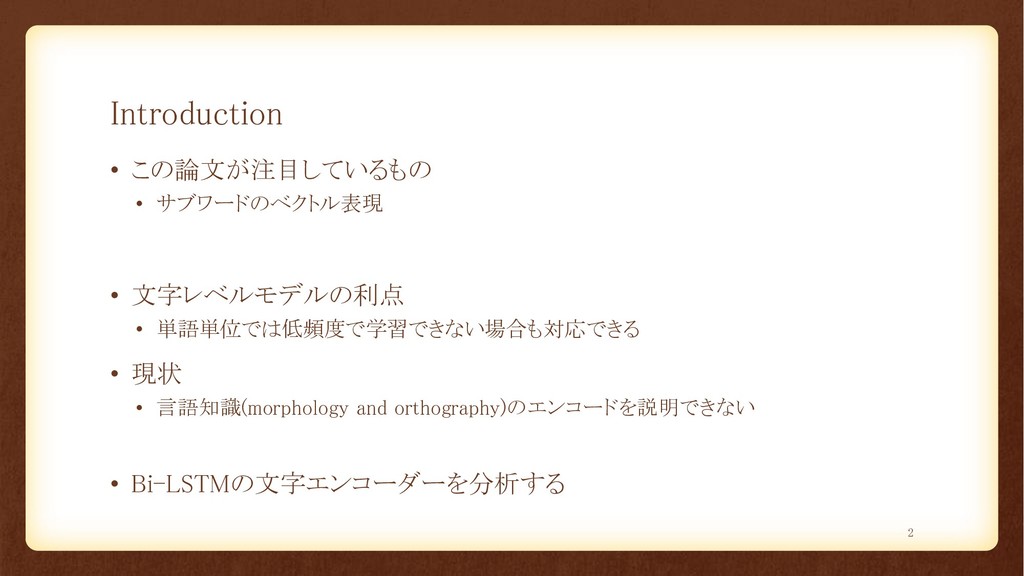
Introduction • この論文が注目しているもの • サブワードのベクトル表現 • 文字レベルモデルの利点 • 単語単位では低頻度で学習できない場合も対応できる •
現状 • 言語知識(morphology and orthography)のエンコードを説明できない • Bi-LSTMの文字エンコーダーを分析する 2
Tagging Task • 評価を行うモデルはLSTM tagging models Ling et al. (2015)
• Char-LSTM → Word-Bi-LSTM → two-layer perceptron → softmax • 各単語の隠れ層パーセプトロンに送られてタグスコアを生成 • morphosyntactic attribute tagging Pinter et al. (2017) • 独自のperceptron + softmax scaffoldingを使用 3
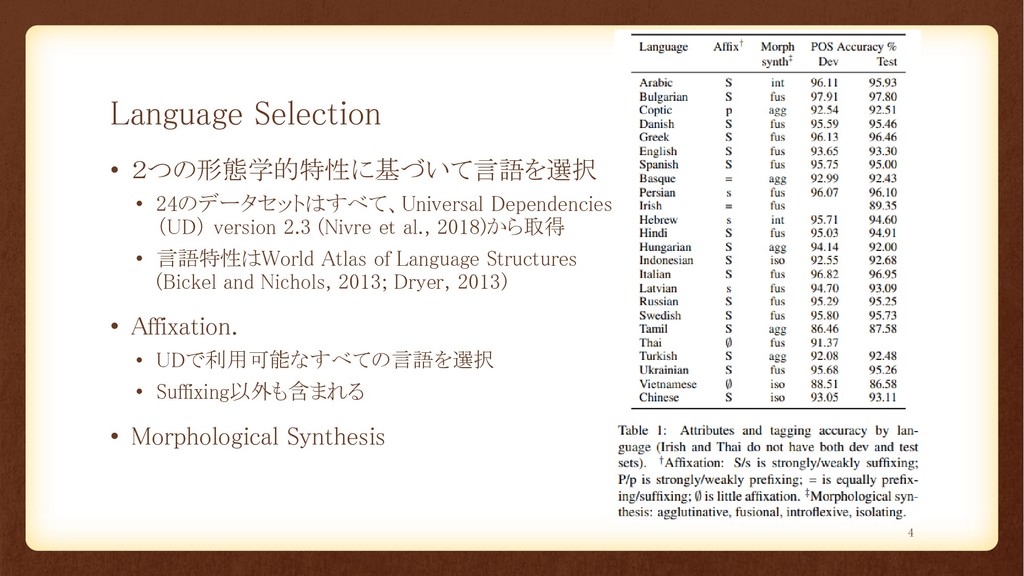
Language Selection • 2つの形態学的特性に基づいて言語を選択 • 24のデータセットはすべて、Universal Dependencies (UD) version 2.3
(Nivre et al., 2018)から取得 • 言語特性はWorld Atlas of Language Structures (Bickel and Nichols, 2013; Dryer, 2013) • Affixation. • UDで利用可能なすべての言語を選択 • Suffixing以外も含まれる • Morphological Synthesis 4
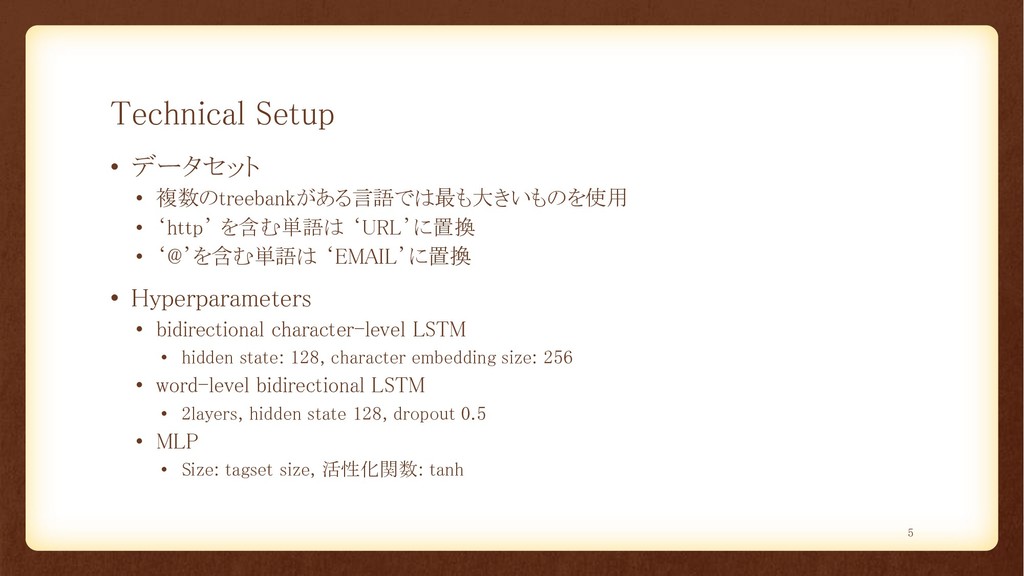
Technical Setup • データセット • 複数のtreebankがある言語では最も大きいものを使用 • ‘http’ を含む単語は ‘URL’に置換
• ‘@’を含む単語は ‘EMAIL’に置換 • Hyperparameters • bidirectional character-level LSTM • hidden state: 128, character embedding size: 256 • word-level bidirectional LSTM • 2layers, hidden state 128, dropout 0.5 • MLP • Size: tagset size, 活性化関数: tanh 5
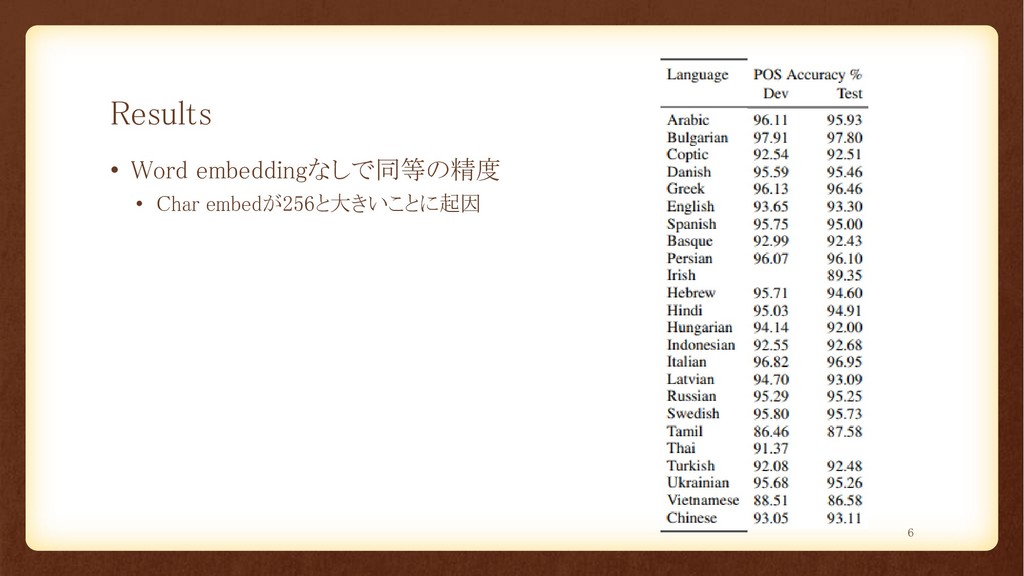
Results • Word embeddingなしで同等の精度 • Char embedが256と大きいことに起因 6
Analysis • モデルの分析 • 言語情報をどのようにエンコードしているのか? • Metrics • 各文字ごとの隠れ層の出力を観察 average
absolute, max absolute 7
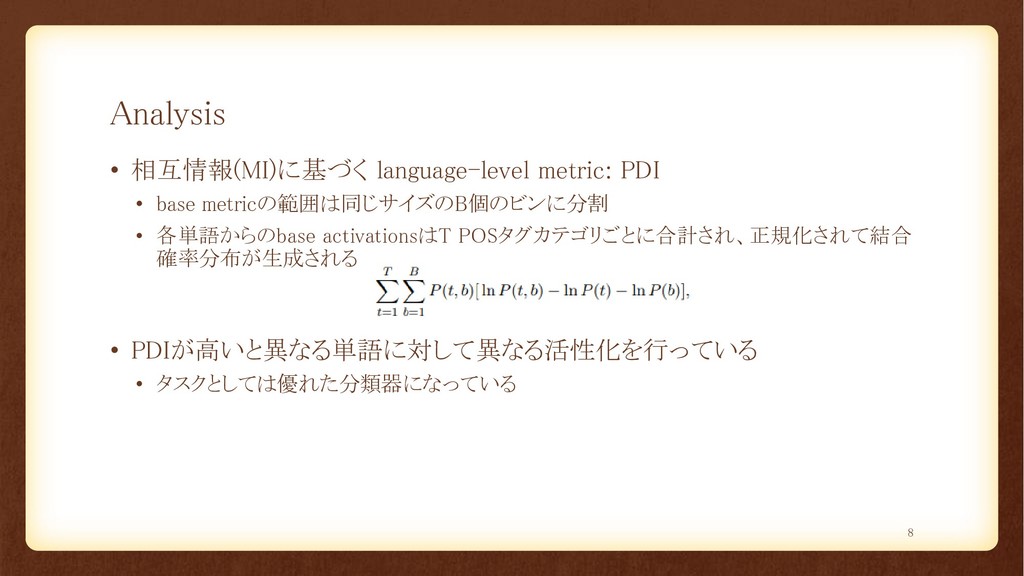
Analysis • 相互情報(MI)に基づく language-level metric: PDI • base metricの範囲は同じサイズのB個のビンに分割 •
各単語からのbase activationsはT POSタグカテゴリごとに合計され、正規化されて結合 確率分布が生成される • PDIが高いと異なる単語に対して異なる活性化を行っている • タスクとしては優れた分類器になっている 8
Analysis • 言語は各ユニットに1つずつ dhのPDI scoresを生成 • さらに2つの language-level metricsを定義 •
sum of PDI values: • the relative importance of forward and backward units: 9
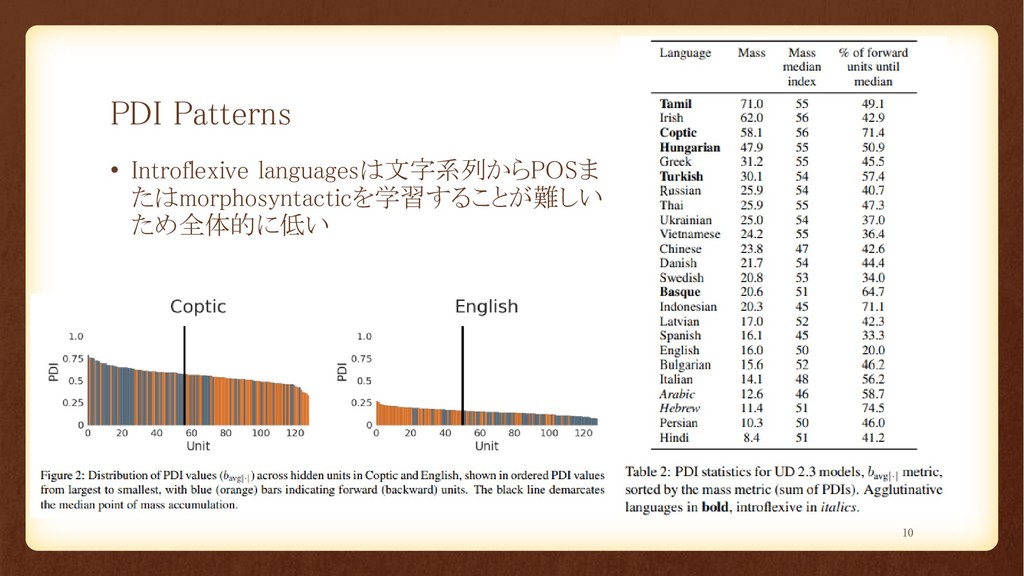
PDI Patterns • Introflexive languagesは文字系列からPOSま たはmorphosyntacticを学習することが難しい ため全体的に低い 10
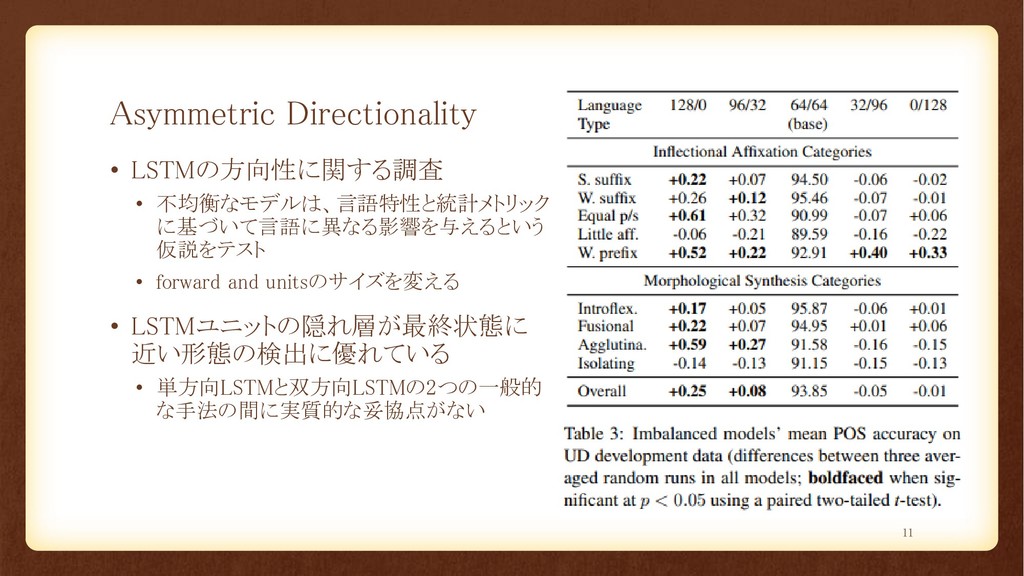
Asymmetric Directionality • LSTMの方向性に関する調査 • 不均衡なモデルは、言語特性と統計メトリック に基づいて言語に異なる影響を与えるという 仮説をテスト • forward
and unitsのサイズを変える • LSTMユニットの隠れ層が最終状態に 近い形態の検出に優れている • 単方向LSTMと双方向LSTMの2つの一般的 な手法の間に実質的な妥協点がない 11
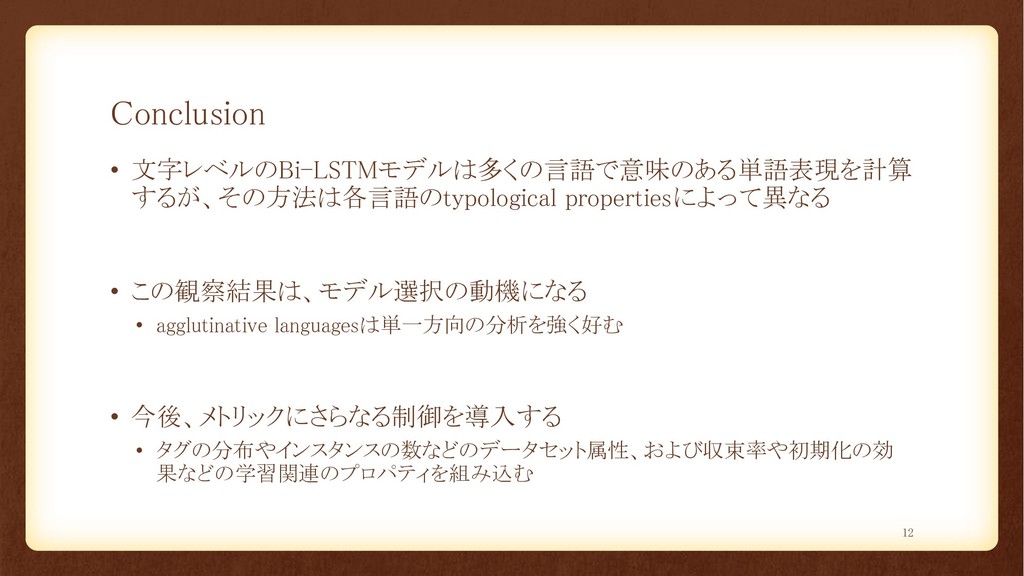
Conclusion • 文字レベルのBi-LSTMモデルは多くの言語で意味のある単語表現を計算 するが、その方法は各言語のtypological propertiesによって異なる • この観察結果は、モデル選択の動機になる • agglutinative languagesは単一方向の分析を強く好む
• 今後、メトリックにさらなる制御を導入する • タグの分布やインスタンスの数などのデータセット属性、および収束率や初期化の効 果などの学習関連のプロパティを組み込む 12


 katsutan
 taketakekaho
 mewuto
 sudoakiy
 kizawa2020
 pei0804
 makocchi
 jyouryuusui
 ueponx
 satoshi7
 shuta13
 raspython3
 hiracky16
 skoyamalab
 orderedlist
 sabderemane
 axbom
axbom
 kastner
 livdayseo
 lindahogenes
 colly
colly
 jmmastey
 mclloyd
 auna
auna
 lara
lara