Upgrade to Pro — share decks privately, control downloads, hide ads and more …

Software Developers Evolution in the Era of AI

Sponsored · Ship Features Fearlessly Turn features on and off without deploys. Used by thousands of Ruby developers. →

Software Developers Evolution in the Era of AI

Artificial Intelligence is fundamentally transforming software development. As AI becomes increasingly capable of generating code, software developers' roles are shifting from writing code to designing systems, defining requirements, making architectural decisions, and orchestrating AI agents.

In this presentation, Haim Michael explores the skills, mindsets, and professional capabilities developers need to remain relevant and thrive in the AI era.

The presentation covers several key topics:

English Proficiency and Specifications: Why clear communication, precise requirements, and specification-driven development are becoming essential.

T-Shaped Professionals: The growing importance of combining deep technical expertise with broader interdisciplinary skills.

AI as a Development Partner: Moving beyond traditional coding toward collaborative development with AI.

Mental Models: Prioritizing fundamental concepts such as state, flow, abstraction, composition, and trade-offs over memorizing syntax and APIs.

Writing and System Design: Developing the ability to translate human intent into clear requirements, design system architectures, and establish boundaries.

Debugging and Code Review: Understanding, evaluating, and verifying AI-generated code while maintaining responsibility for software quality.

Becoming System Builders: Expanding beyond programming to understand business requirements, product development, and UI/UX considerations.

Continuous Self-Learning: Navigating rapidly evolving technologies, prioritizing learning objectives, and using AI as a personal learning accelerator.

The central message is that the future of software development is not simply about writing code faster. It is about moving to a higher level of abstraction, where developers define what needs to be built, understand why it matters, and guide AI systems toward reliable outcomes.

As generating code becomes increasingly inexpensive, software developers' real value shifts toward critical thinking, architectural understanding, clear specifications, continuous learning, and the ability to orchestrate the software development process.

About the Speaker

Haim Michael is the Founder and CEO of Zindell Technologies, a software architect, author, lecturer, and technology trainer with more than 25 years of programming experience. He teaches advanced computer science topics at universities and actively contributes to the international software development community.

Website: https://blog.lifemichael.com
LinkedIn: https://linkedin.com/in/lifemichael
Blog Post: https://lifemichael.com/en/full-stack-conf-sofia-2026-sharing-my-perspective-on-software-developers-evolution-in-the-era-of-ai/

life michael

October 30, 2026

Transcript

55 slides
  1. Software Developers' Evolution in the Era of AI Haim Michael

    Founder & CEO @ Zindell Technologies www.zindell.com | blog.lifemichael.com life michael
  2. My name is Haim Michael. I live in Tel Aviv,

    and I am the CEO & founder of Zindell Technologies, Ltd. My passion lies in teaching and lifelong learning. I have been into programming since my childhood. I have extensive experience with Java (30+ yrs), JavaScript (30+ yrs), C++ (30+ yrs), C# (20+ yrs), TypeScript (12+ yrs), Python (15+ yrs), PHP (20+ yrs), Scala (16+ yrs), and Kotlin (12+ yrs). Teaching advanced computer science topics at the university. blog.lifemichael.com Tel-Aviv, Israel
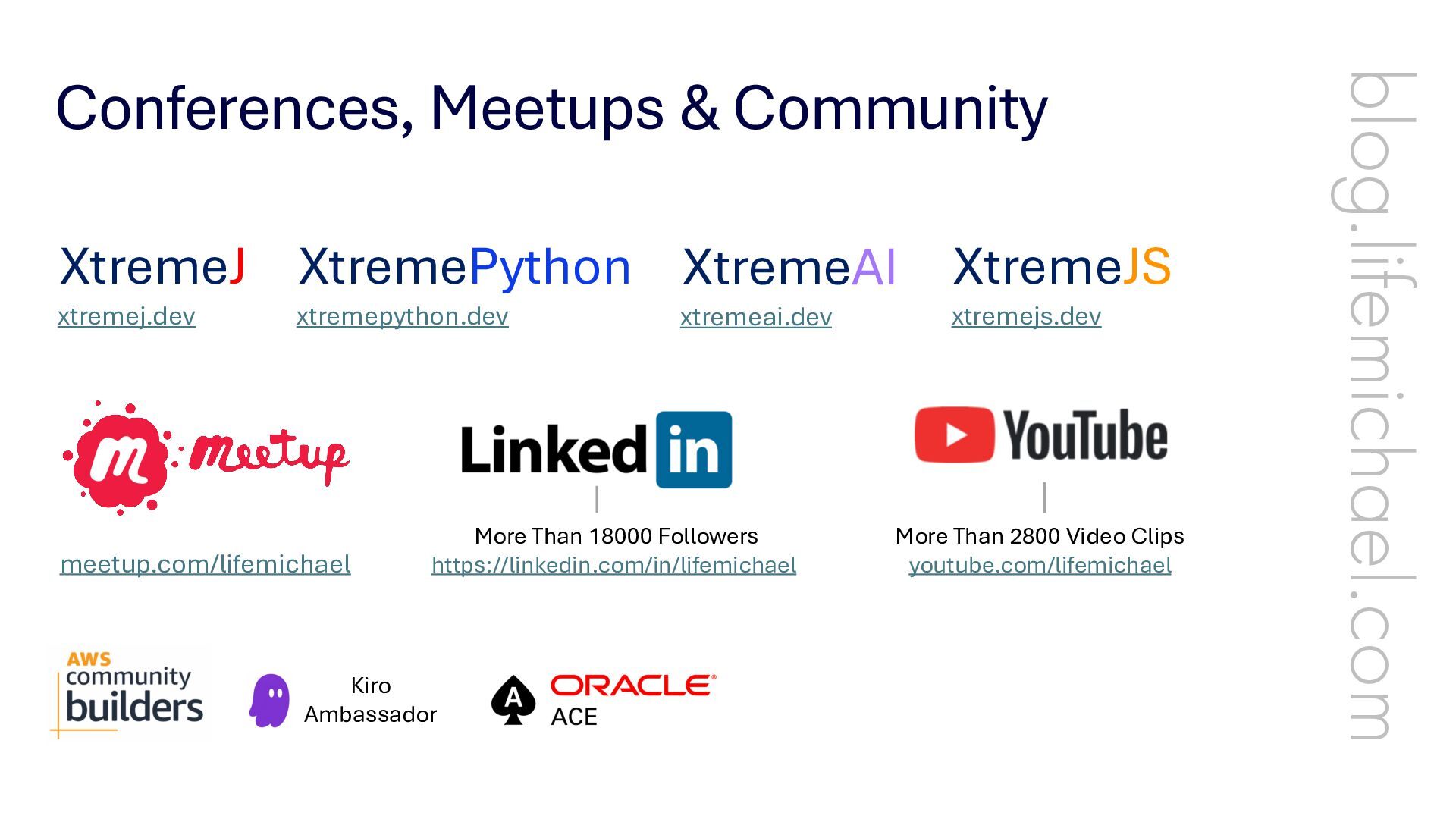
  3. XtremeJ XtremePython XtremeAI xtremej.dev xtremepython.dev meetup.com/lifemichael xtremeai.dev More Than 18000

    Followers https://linkedin.com/in/lifemichael Kiro Ambassador XtremeJS xtremejs.dev More Than 2800 Video Clips youtube.com/lifemichael blog.lifemichael.com Conferences, Meetups & Community
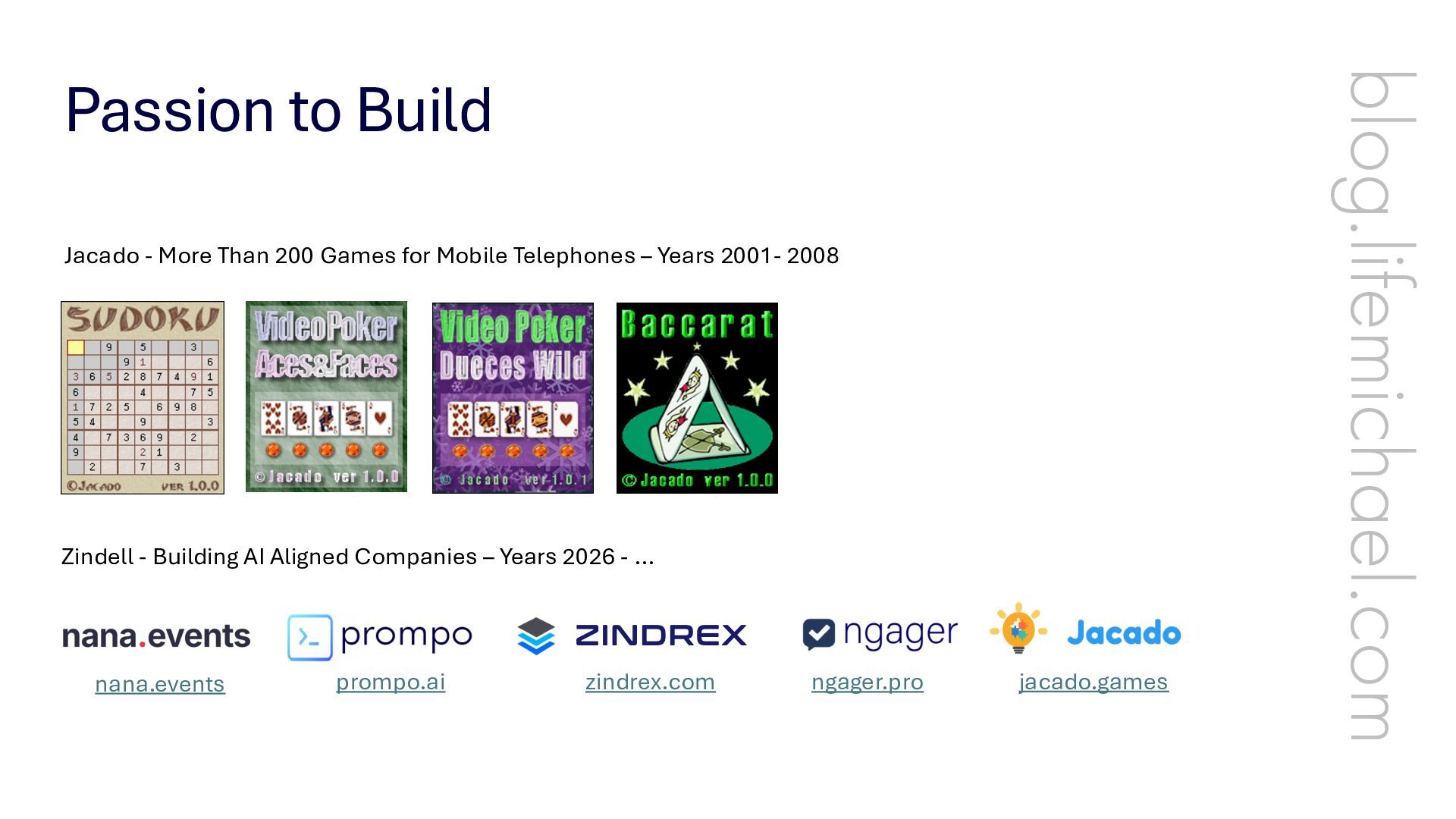
  4. Jacado - More Than 200 Games for Mobile Telephones –

    Years 2001- 2008 Zindell - Building AI Aligned Companies – Years 2026 - … nana.events prompo.ai zindrex.com ngager.pro jacado.games blog.lifemichael.com Passion to Build
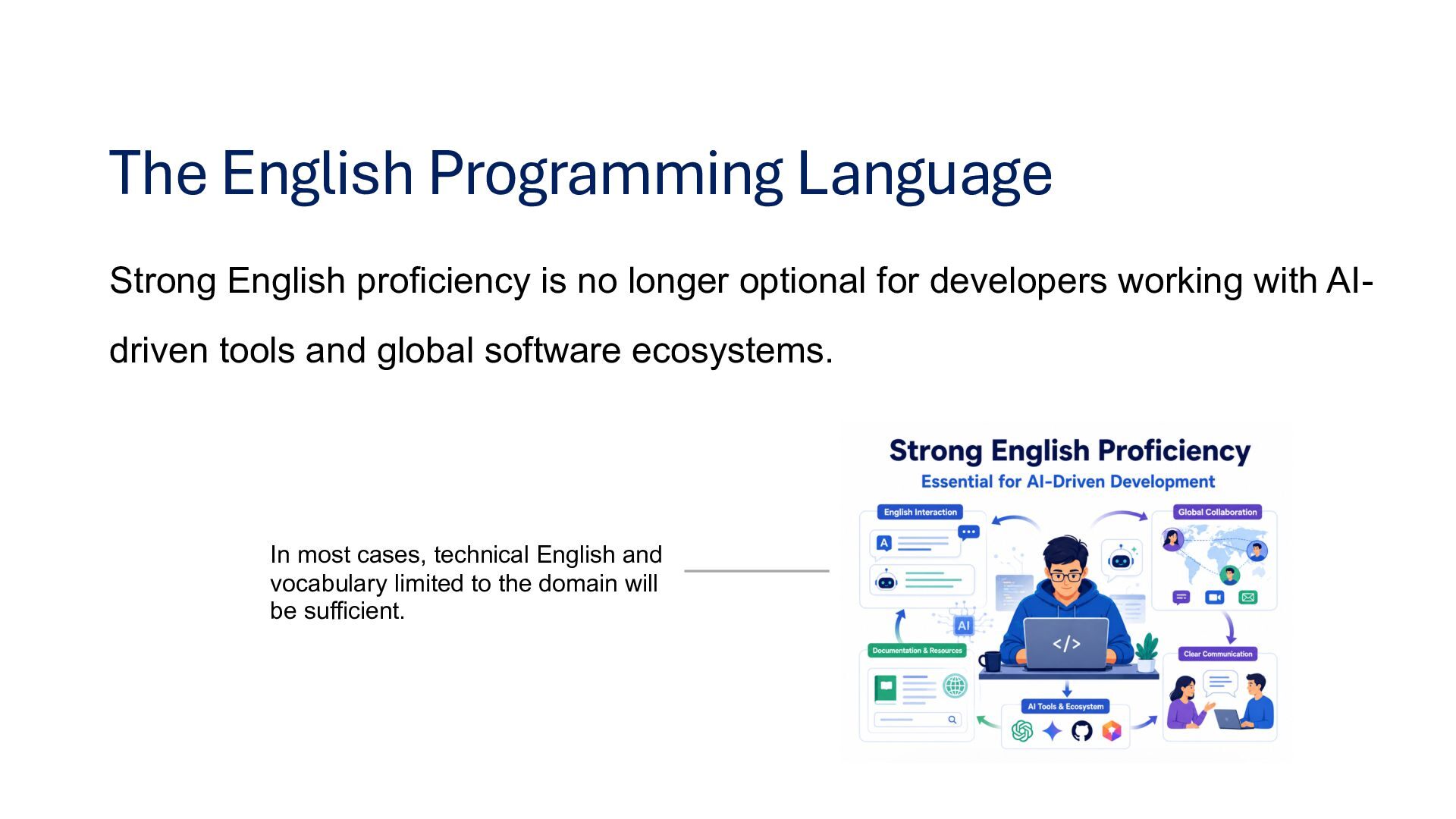
  5. The English Programming Language Strong English proficiency is no longer

    optional for developers working with AIdriven tools and global software ecosystems. In most cases, technical English and vocabulary limited to the domain will be sufficient.
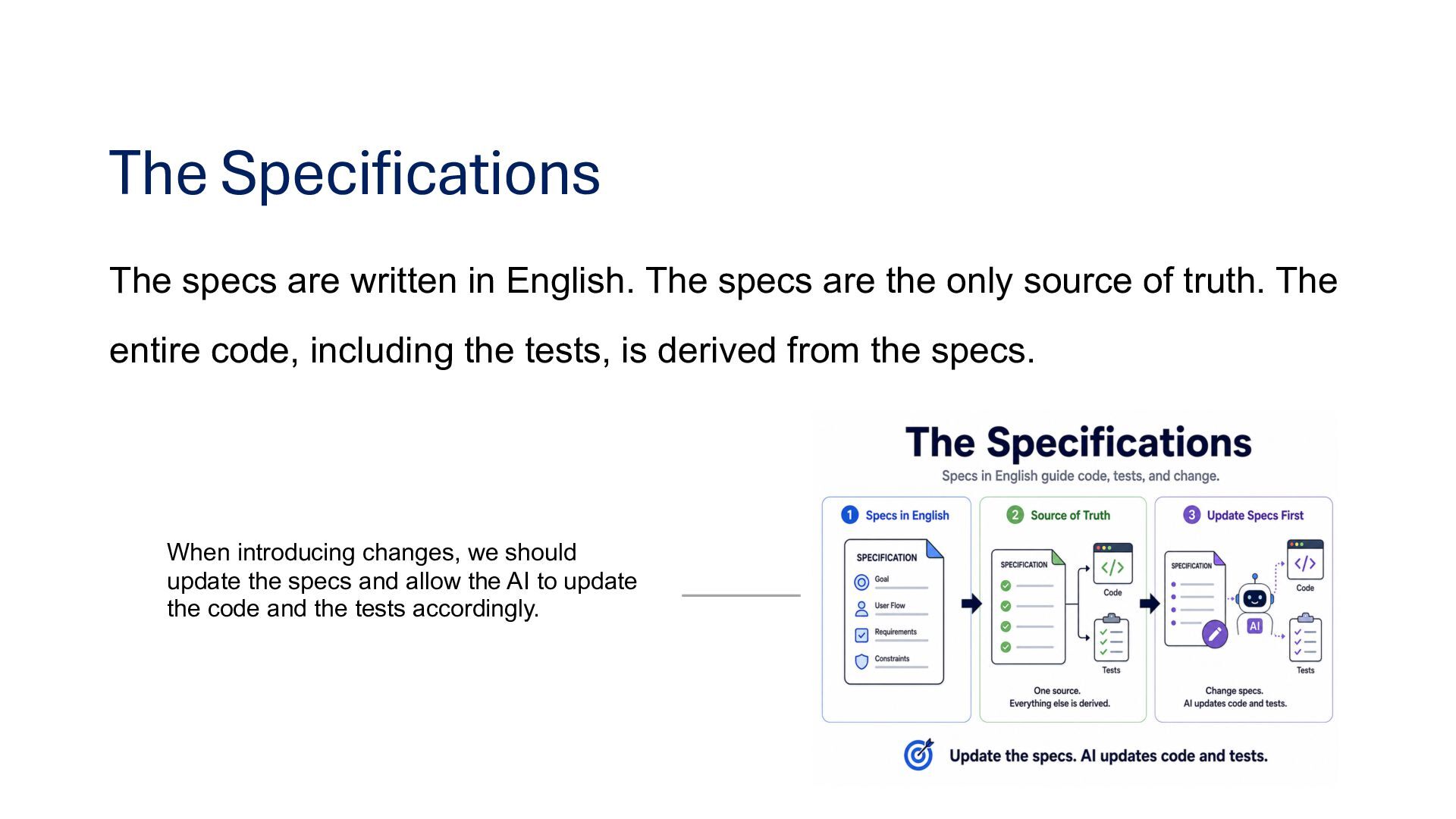
  6. The Specifications The specs are written in English. The specs

    are the only source of truth. The entire code, including the tests, is derived from the specs. When introducing changes, we should update the specs and allow the AI to update the code and the tests accordingly.
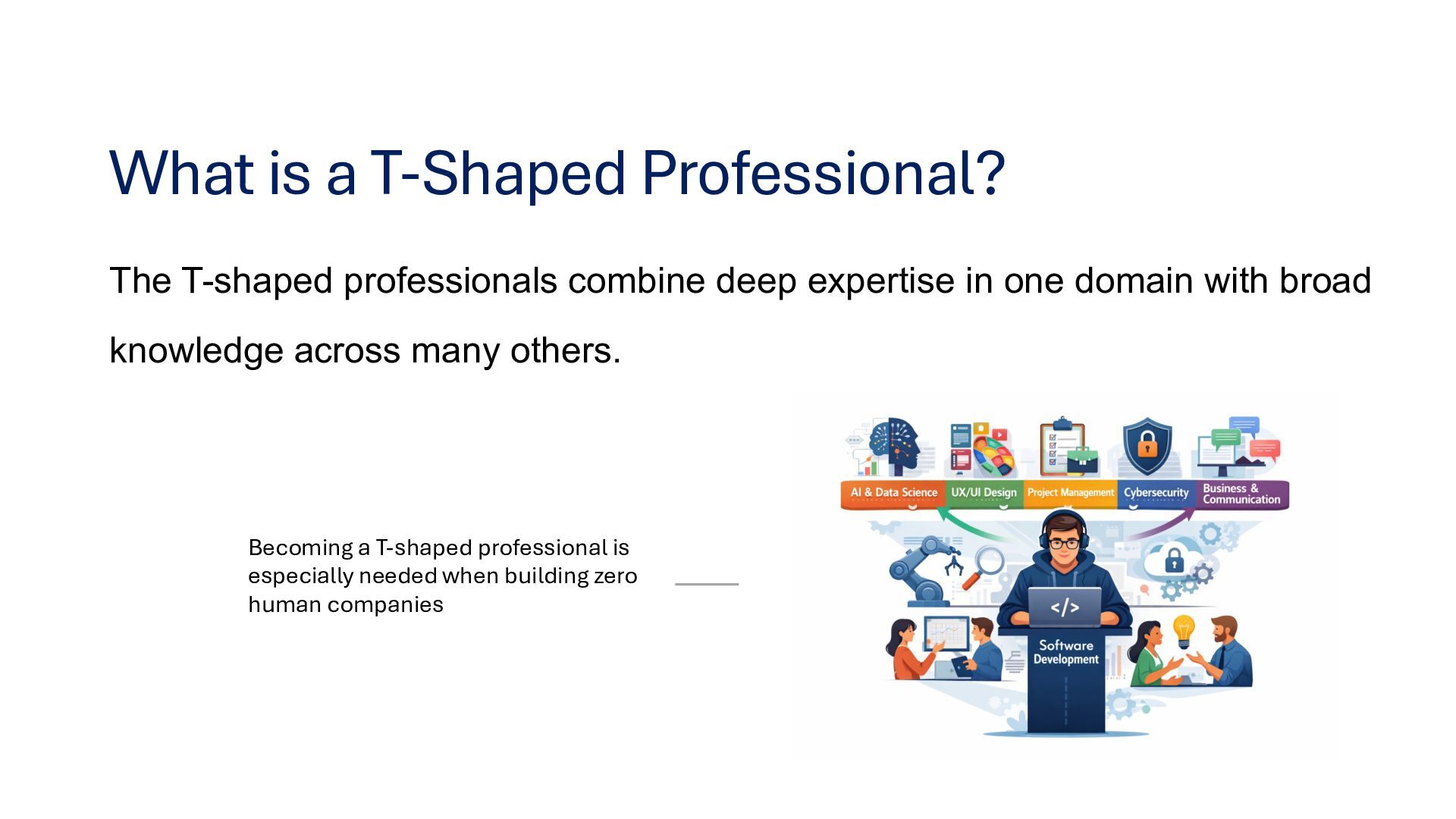
  7. What is a T-Shaped Professional? The T-shaped professionals combine deep

    expertise in one domain with broad knowledge across many others. Becoming a T-shaped professional is especially needed when building zero human companies
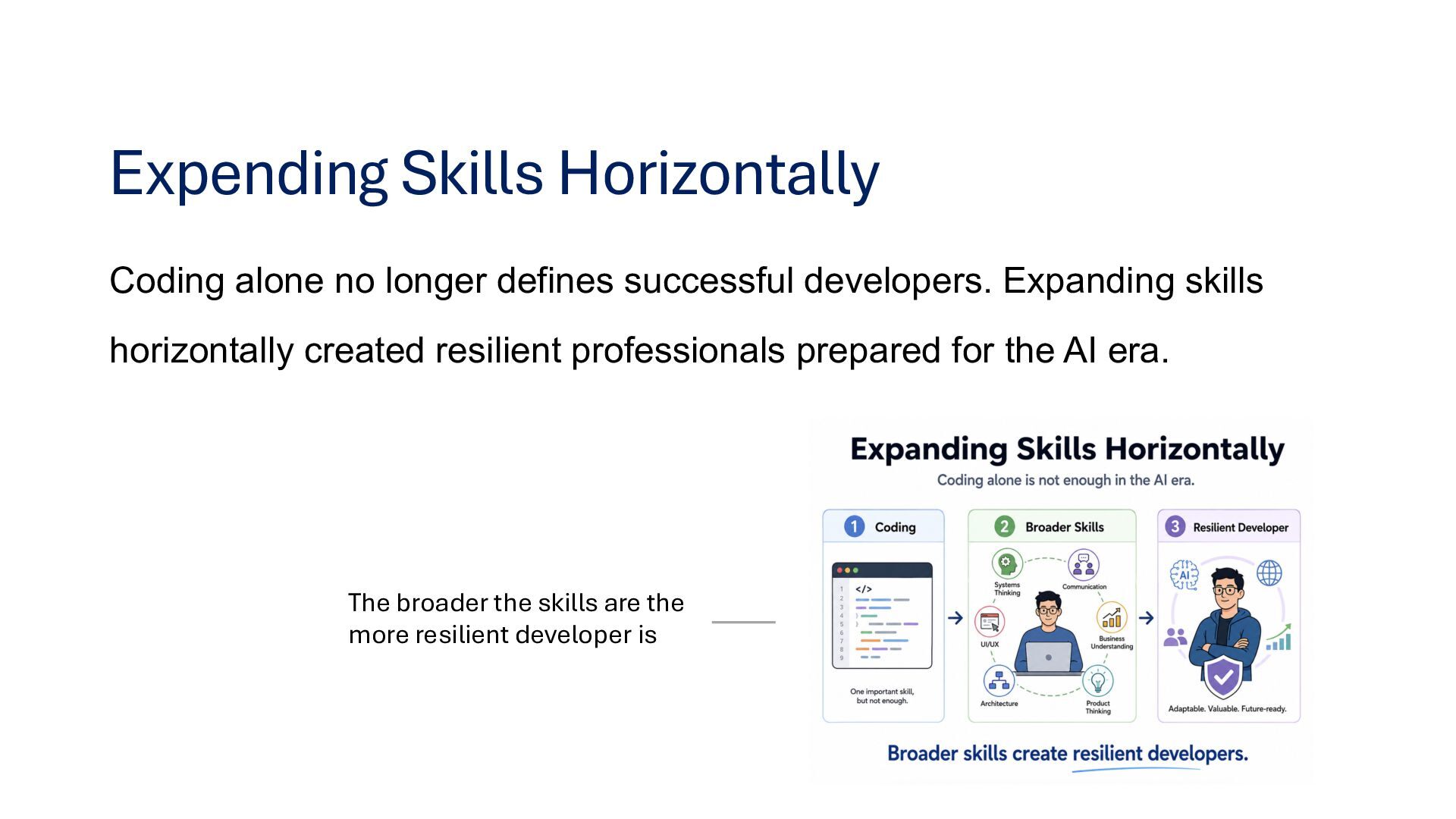
  8. Expending Skills Horizontally Coding alone no longer defines successful developers.

    Expanding skills horizontally created resilient professionals prepared for the AI era. The broader the skills are the more resilient developer is
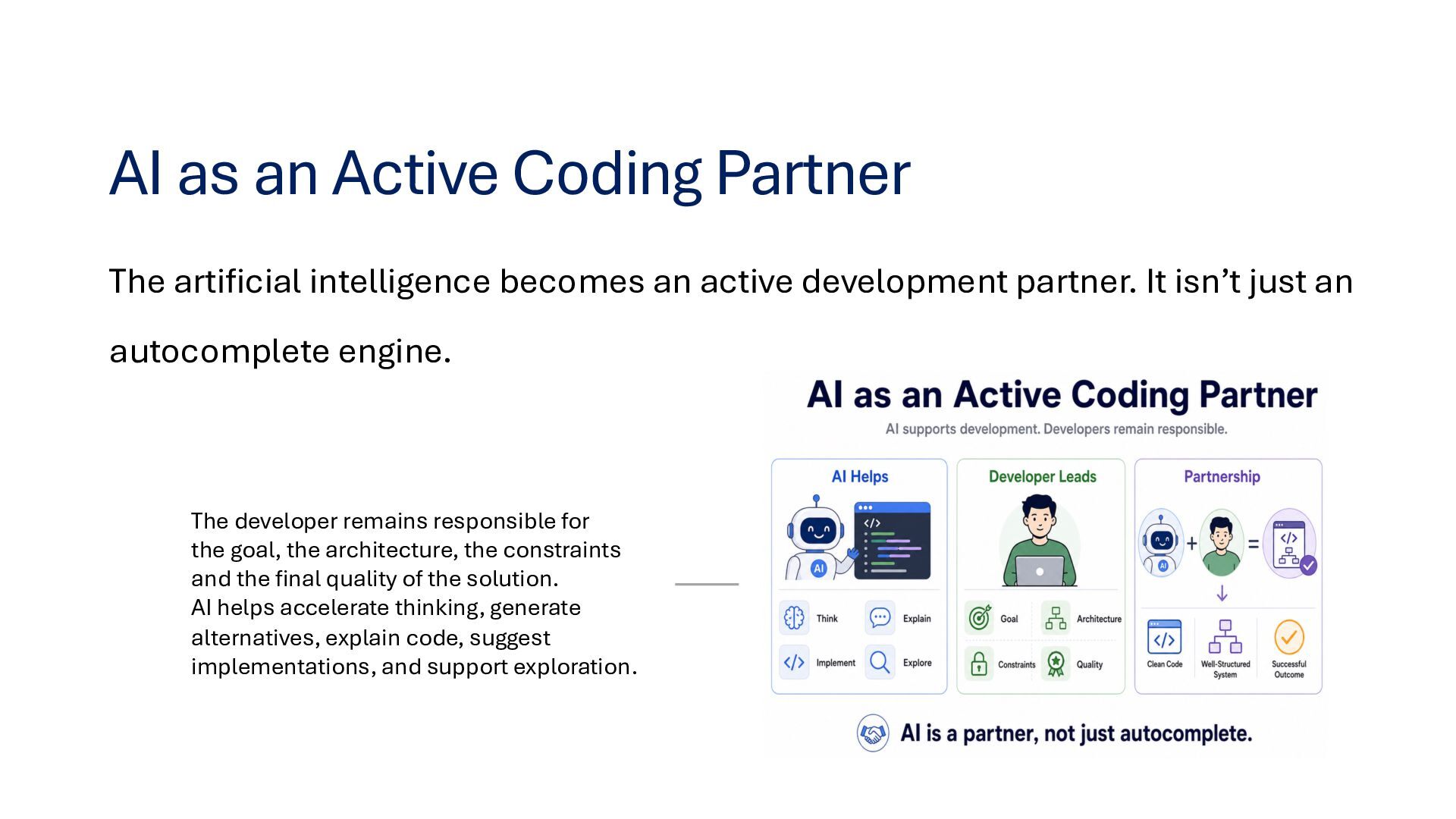
  9. AI as an Active Coding Partner The artificial intelligence becomes

    an active development partner. It isn’t just an autocomplete engine. The developer remains responsible for the goal, the architecture, the constraints and the final quality of the solution. AI helps accelerate thinking, generate alternatives, explain code, suggest implementations, and support exploration.
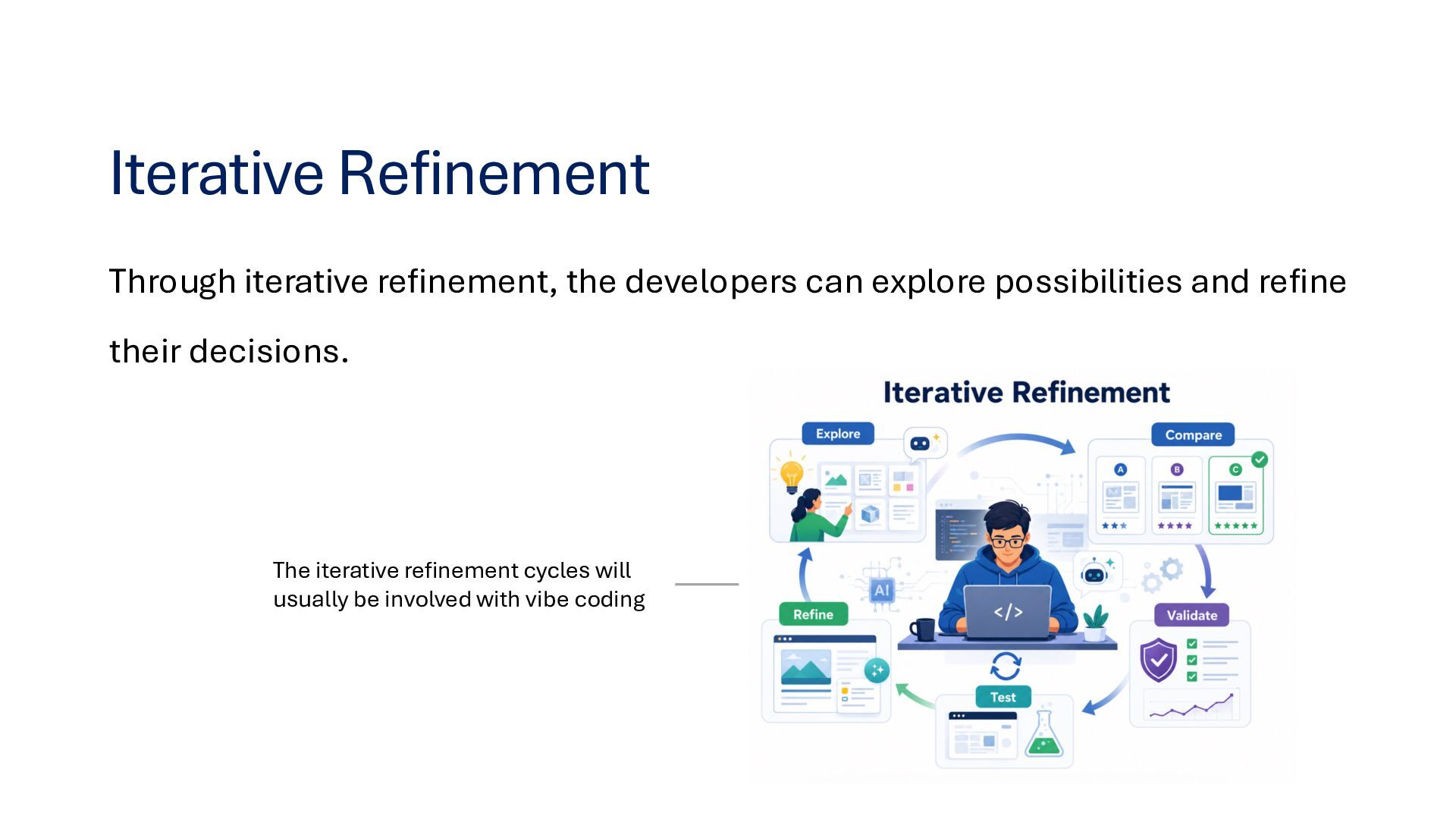
  10. Iterative Refinement Through iterative refinement, the developers can explore possibilities

    and refine their decisions. The iterative refinement cycles will usually be involved with vibe coding
  11. From Memorization to Mental Models In the past, developers had

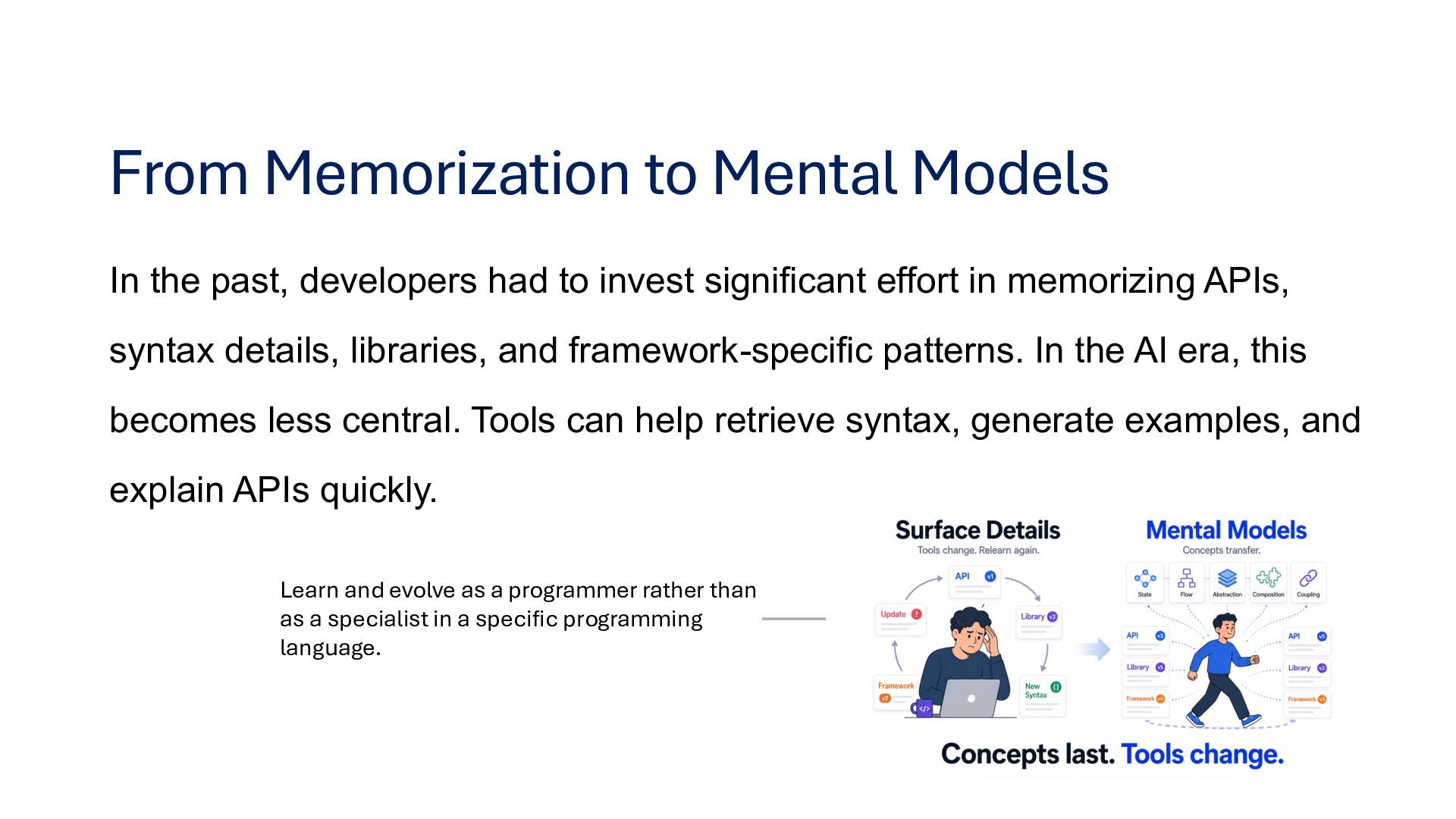
    to invest significant effort in memorizing APIs, syntax details, libraries, and framework-specific patterns. In the AI era, this becomes less central. Tools can help retrieve syntax, generate examples, and explain APIs quickly. Learn and evolve as a programmer rather than as a specialist in a specific programming language.
  12. APIs Change, Mental Models Travel The developer who depends mainly

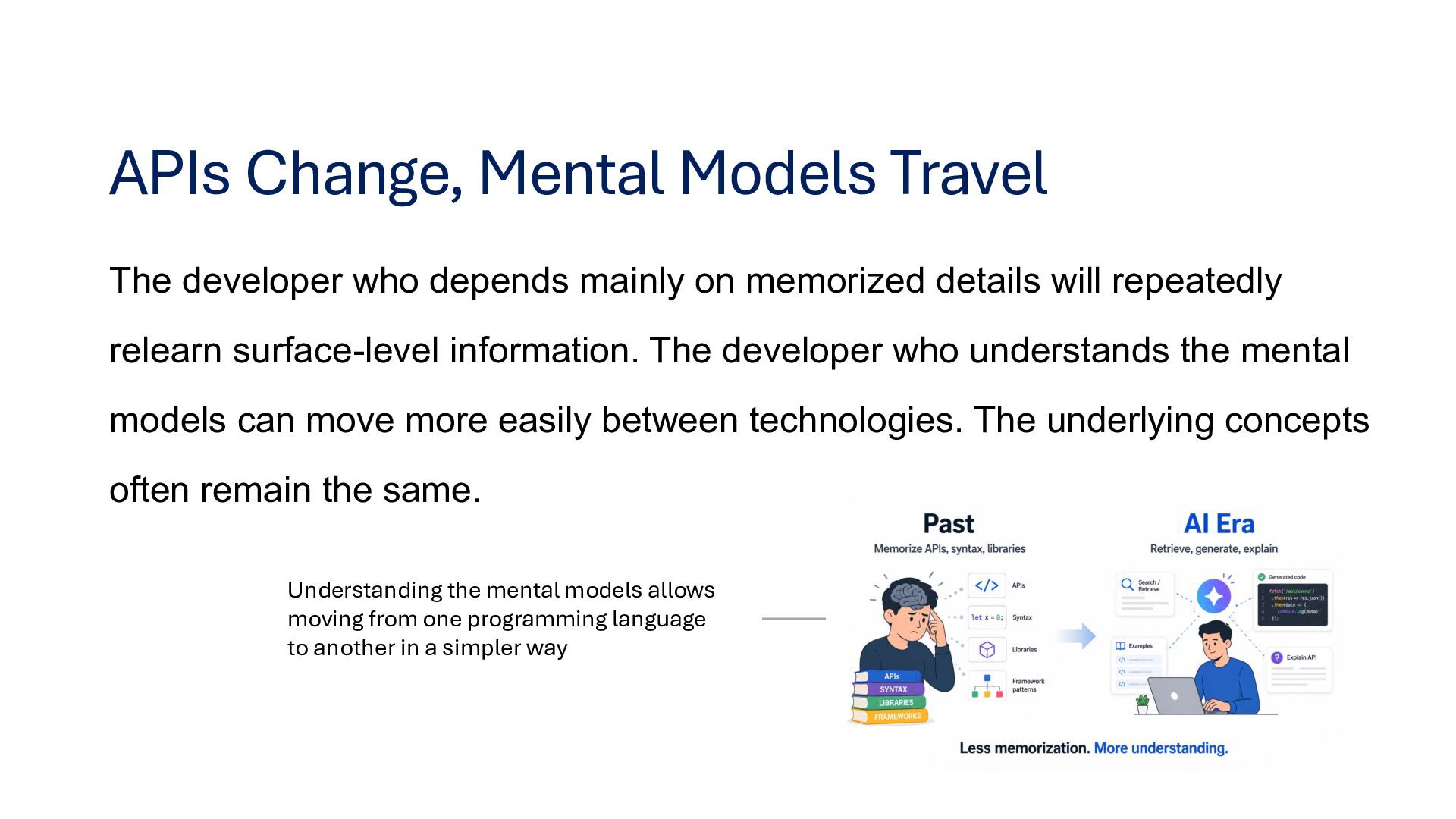
    on memorized details will repeatedly relearn surface-level information. The developer who understands the mental models can move more easily between technologies. The underlying concepts often remain the same. Understanding the mental models allows moving from one programming language to another in a simpler way
  13. Understanding The State State is one of the most important

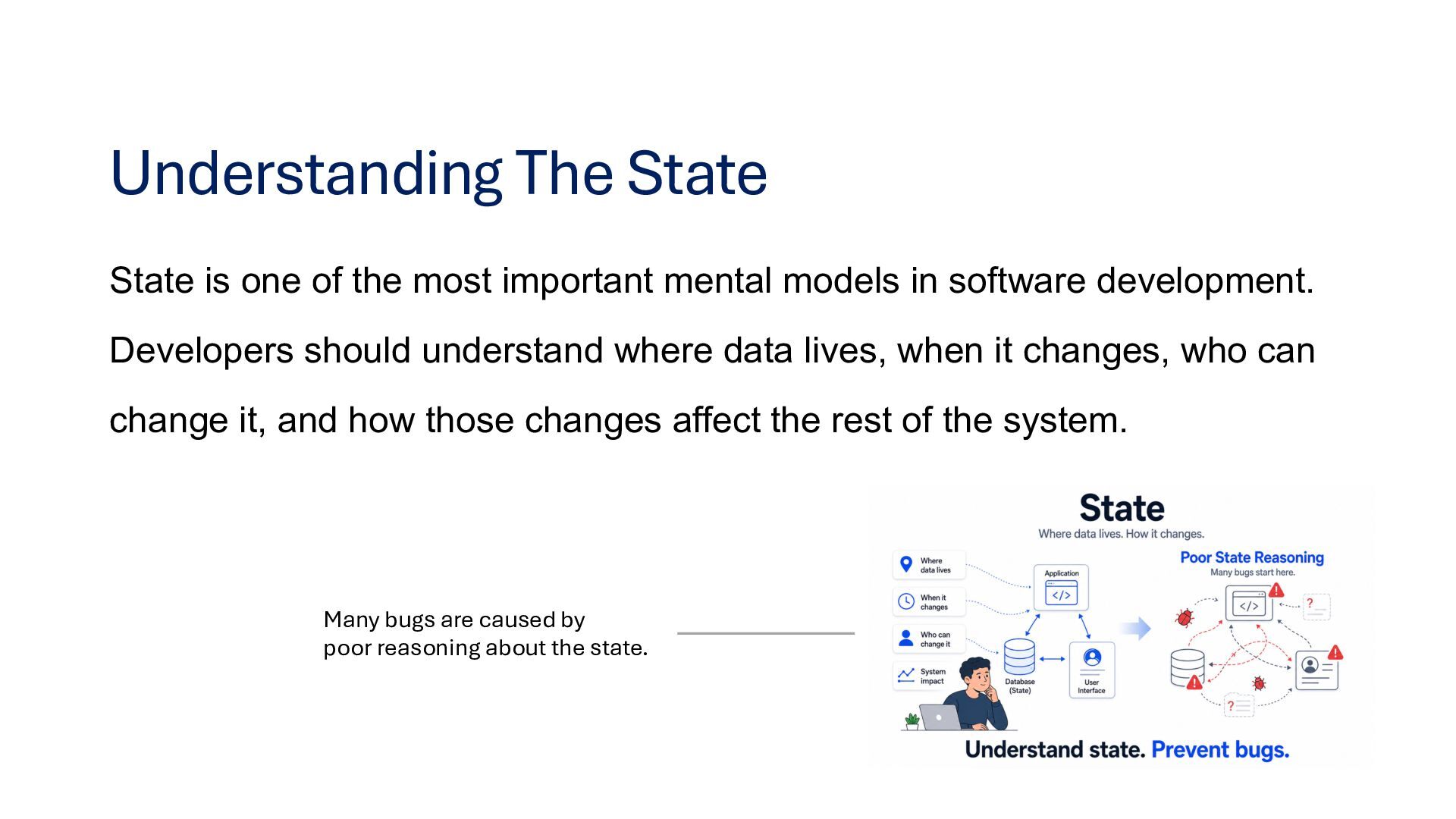
    mental models in software development. Developers should understand where data lives, when it changes, who can change it, and how those changes affect the rest of the system. Many bugs are caused by poor reasoning about the state.
  14. Understanding The Flow Flow describes how data, control, events, and

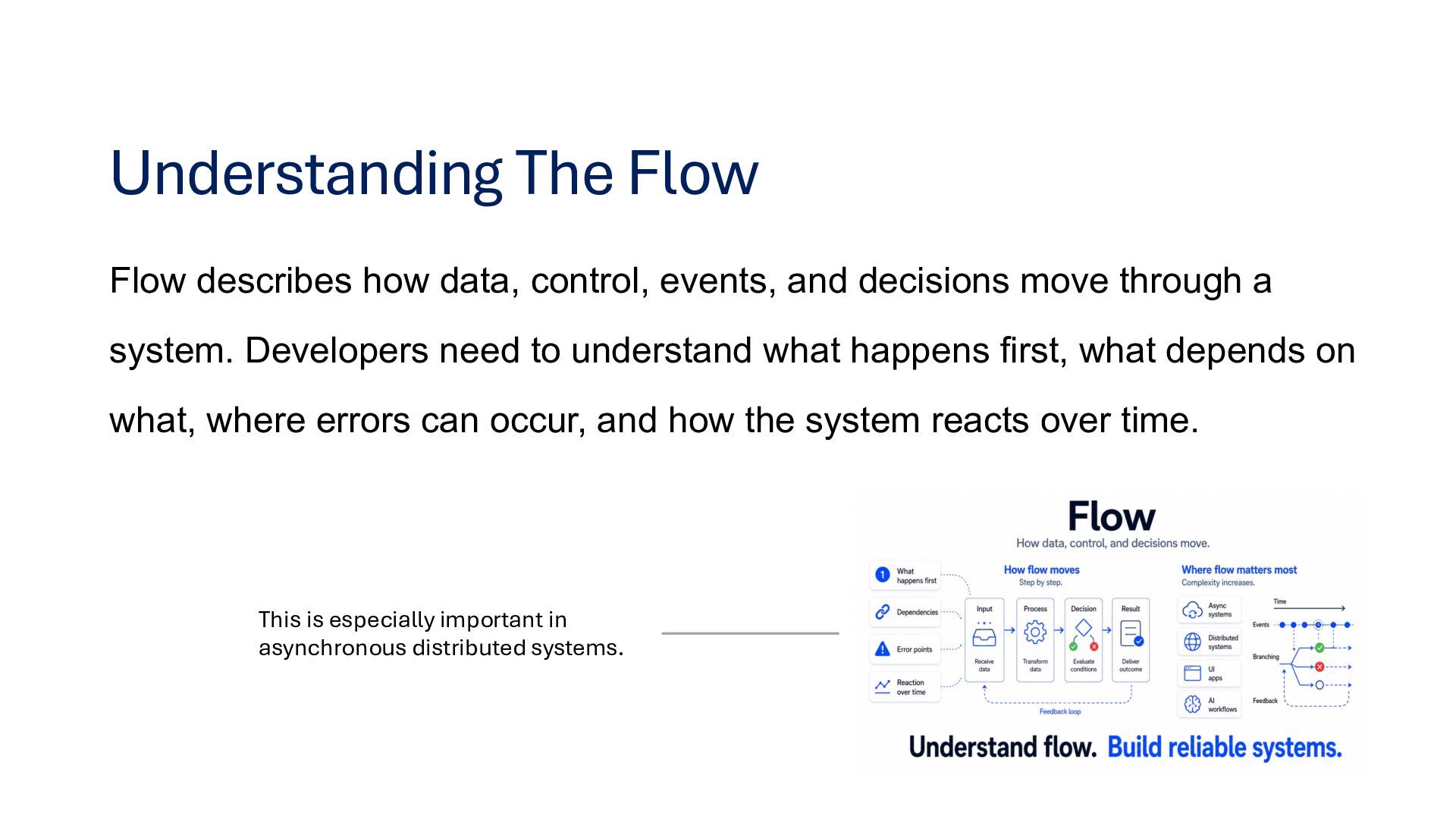
    decisions move through a system. Developers need to understand what happens first, what depends on what, where errors can occur, and how the system reacts over time. This is especially important in asynchronous distributed systems.
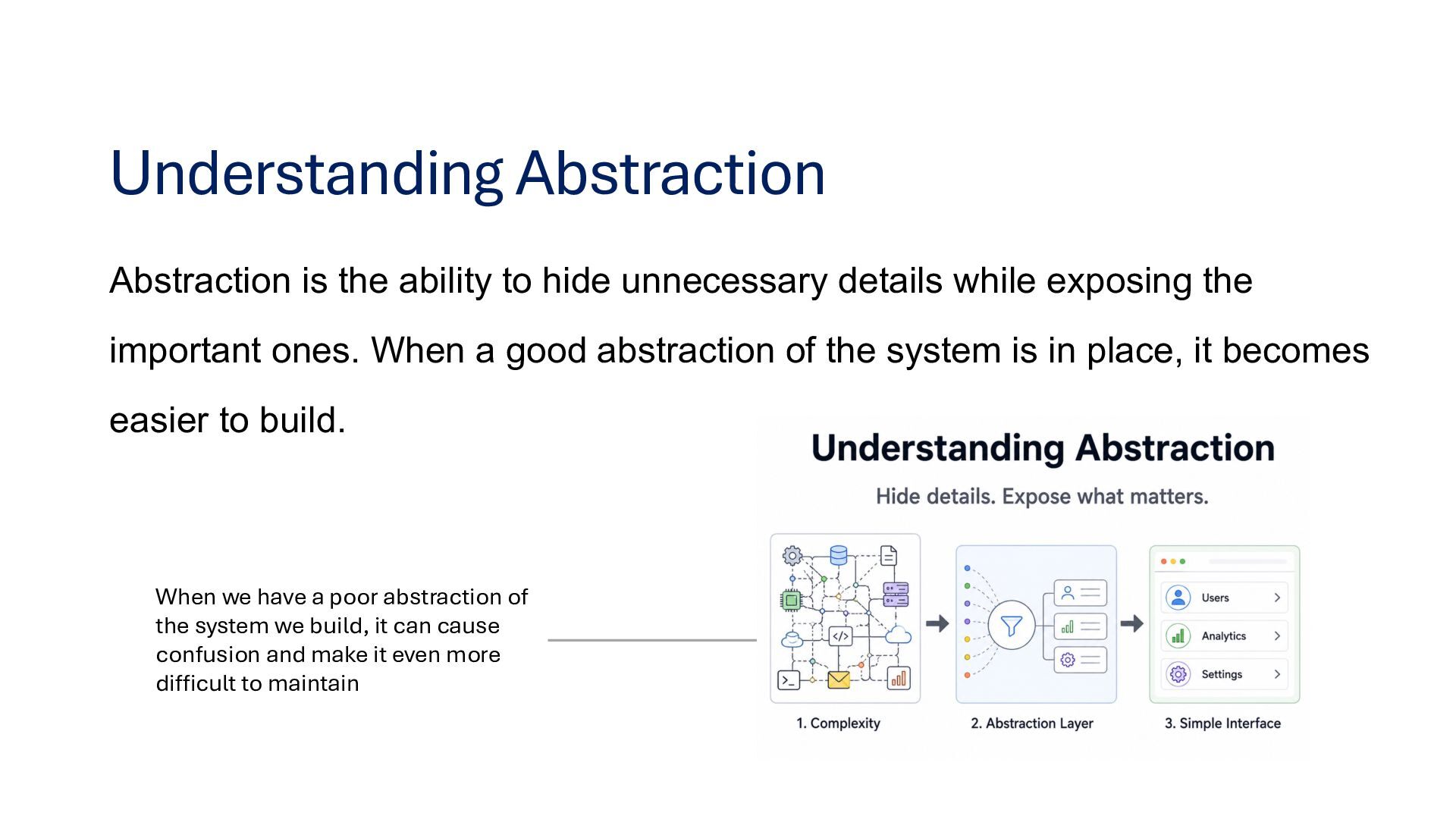
  15. Understanding Abstraction Abstraction is the ability to hide unnecessary details

    while exposing the important ones. When a good abstraction of the system is in place, it becomes easier to build. When we have a poor abstraction of the system we build, it can cause confusion and make it even more difficult to maintain
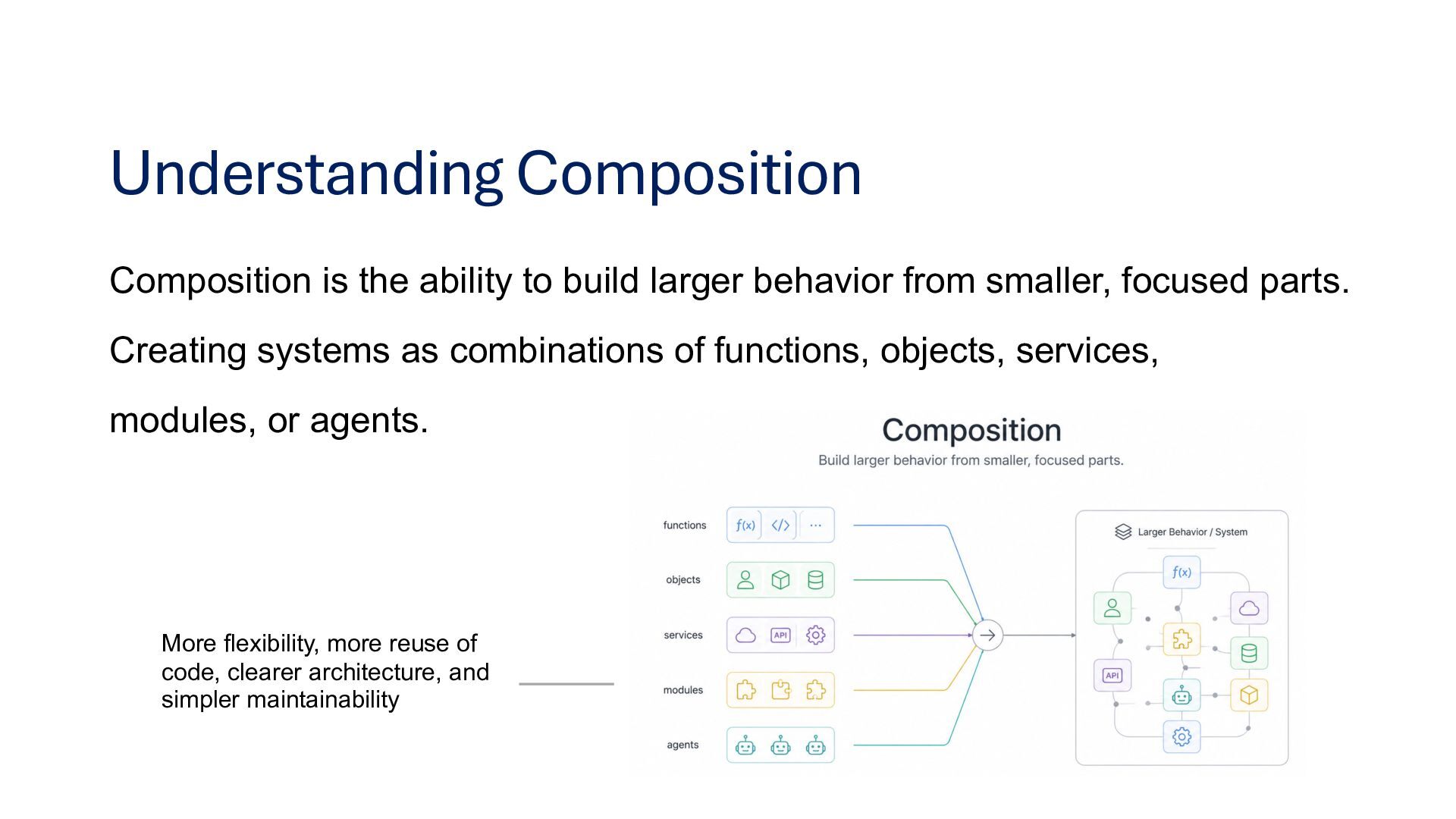
  16. Understanding Composition Composition is the ability to build larger behavior

    from smaller, focused parts. Creating systems as combinations of functions, objects, services, modules, or agents. More flexibility, more reuse of code, clearer architecture, and simpler maintainability
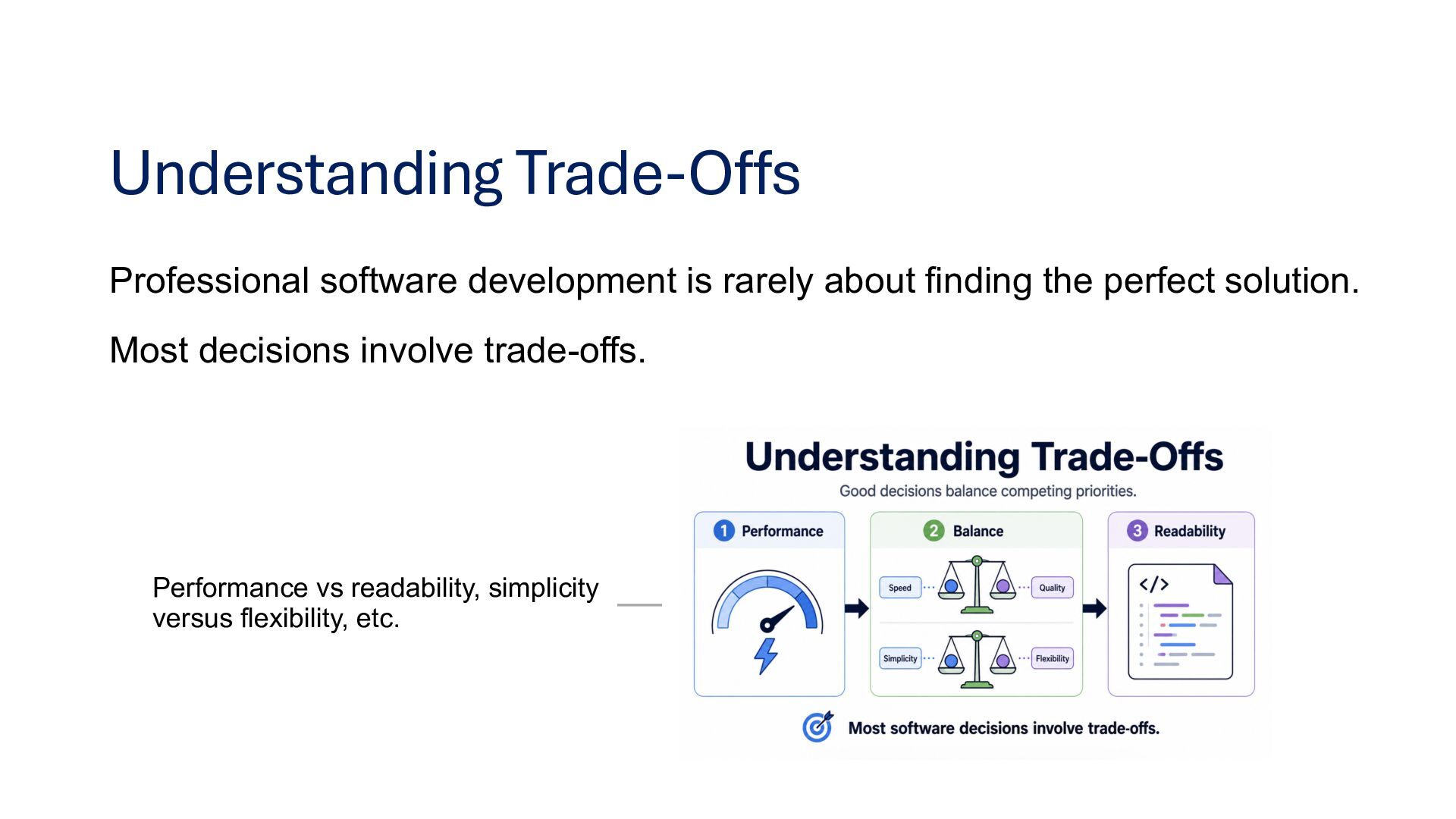
  17. Understanding Trade-Offs Professional software development is rarely about finding the

    perfect solution. Most decisions involve trade-offs. Performance vs readability, simplicity versus flexibility, etc.
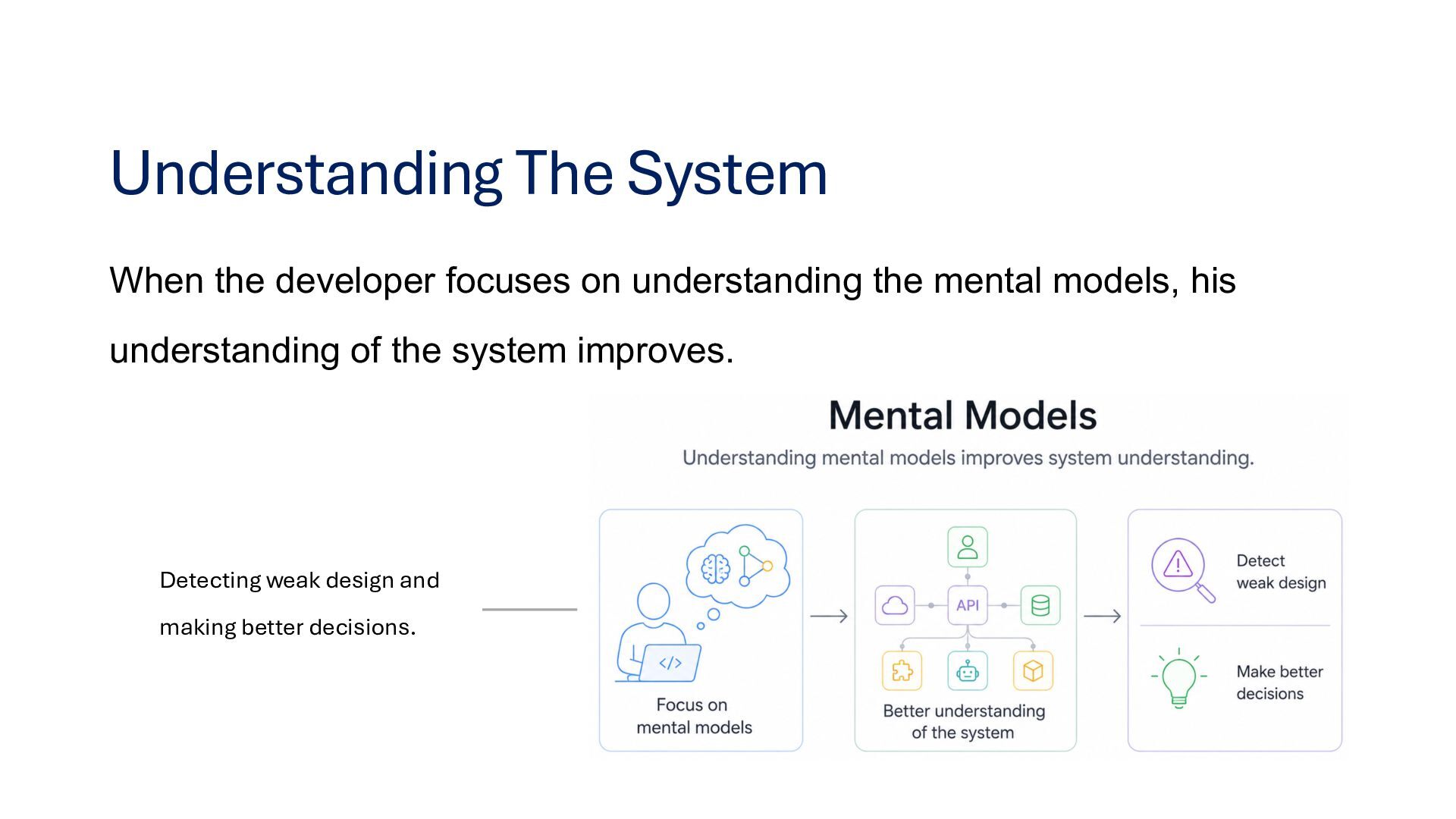
  18. Understanding The System When the developer focuses on understanding the

    mental models, his understanding of the system improves. Detecting weak design and making better decisions.
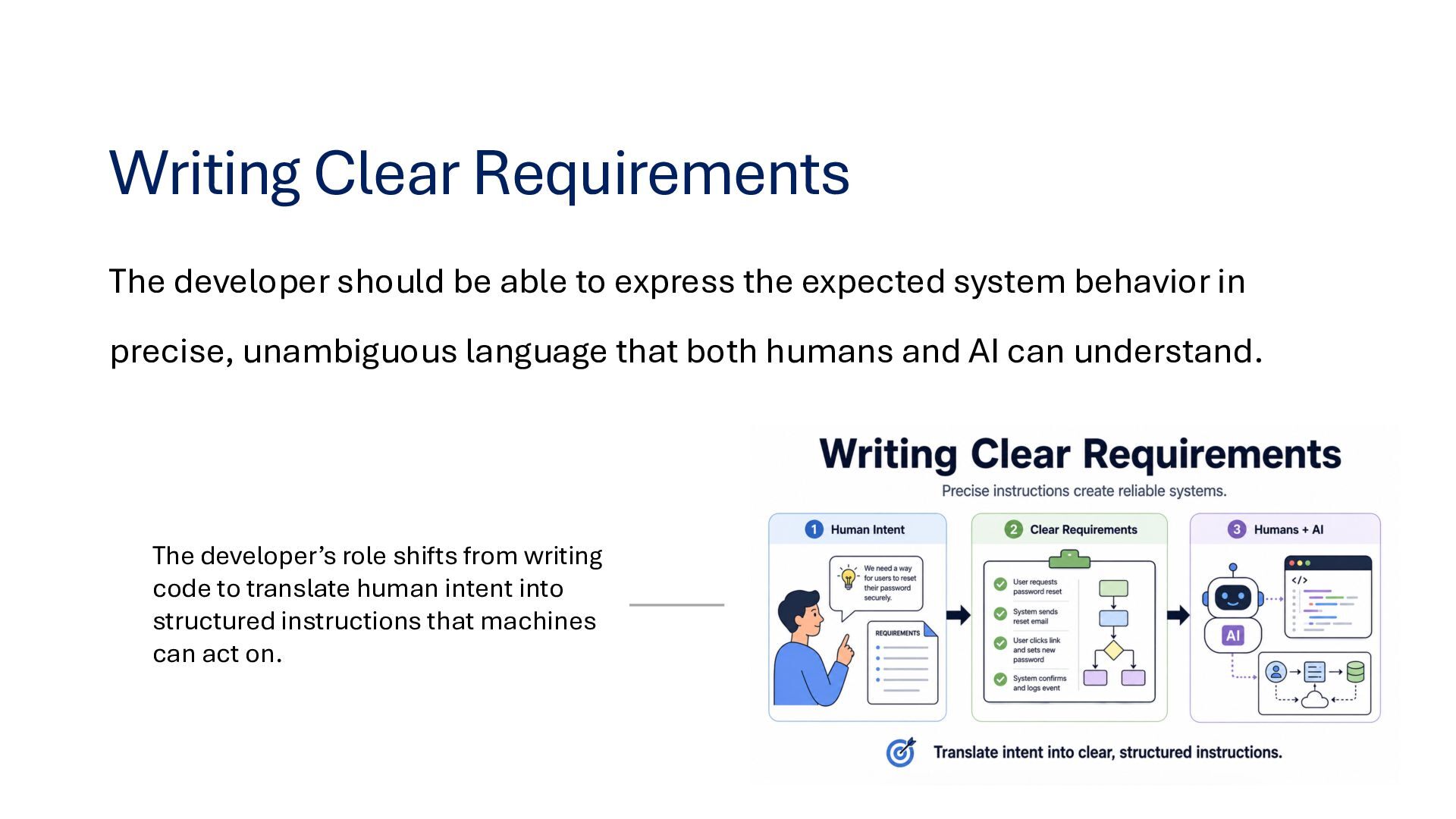
  19. Writing Clear Requirements The developer should be able to express

    the expected system behavior in precise, unambiguous language that both humans and AI can understand. The developer’s role shifts from writing code to translate human intent into structured instructions that machines can act on.
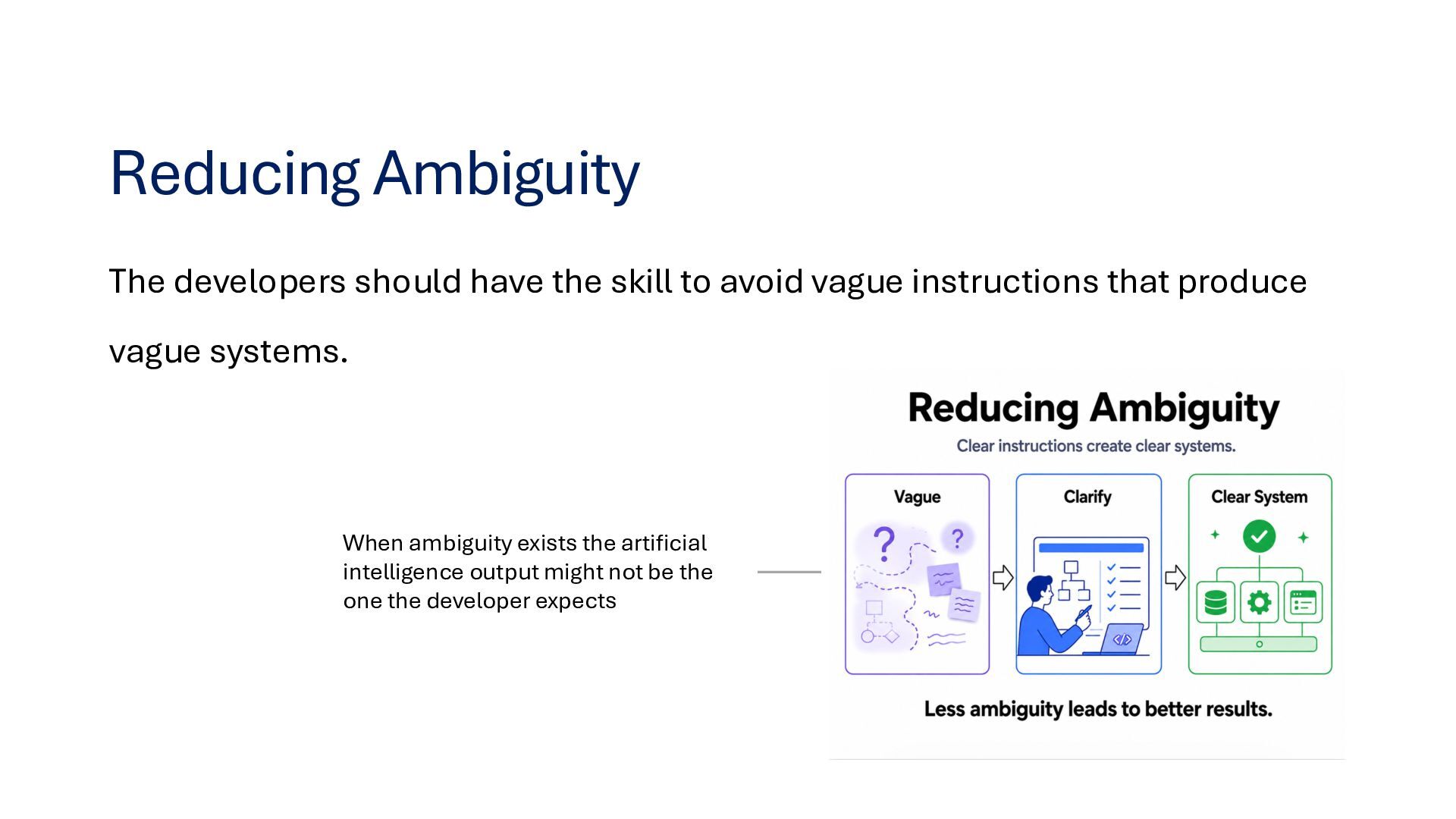
  20. Reducing Ambiguity The developers should have the skill to avoid

    vague instructions that produce vague systems. When ambiguity exists the artificial intelligence output might not be the one the developer expects
  21. Designing Systems In most cases, AI can easily generate the

    code that implements the requirements. The main responsibility left with the developer moves up to architecture, integration, and system design. The developers move to a higher level of abstraction.
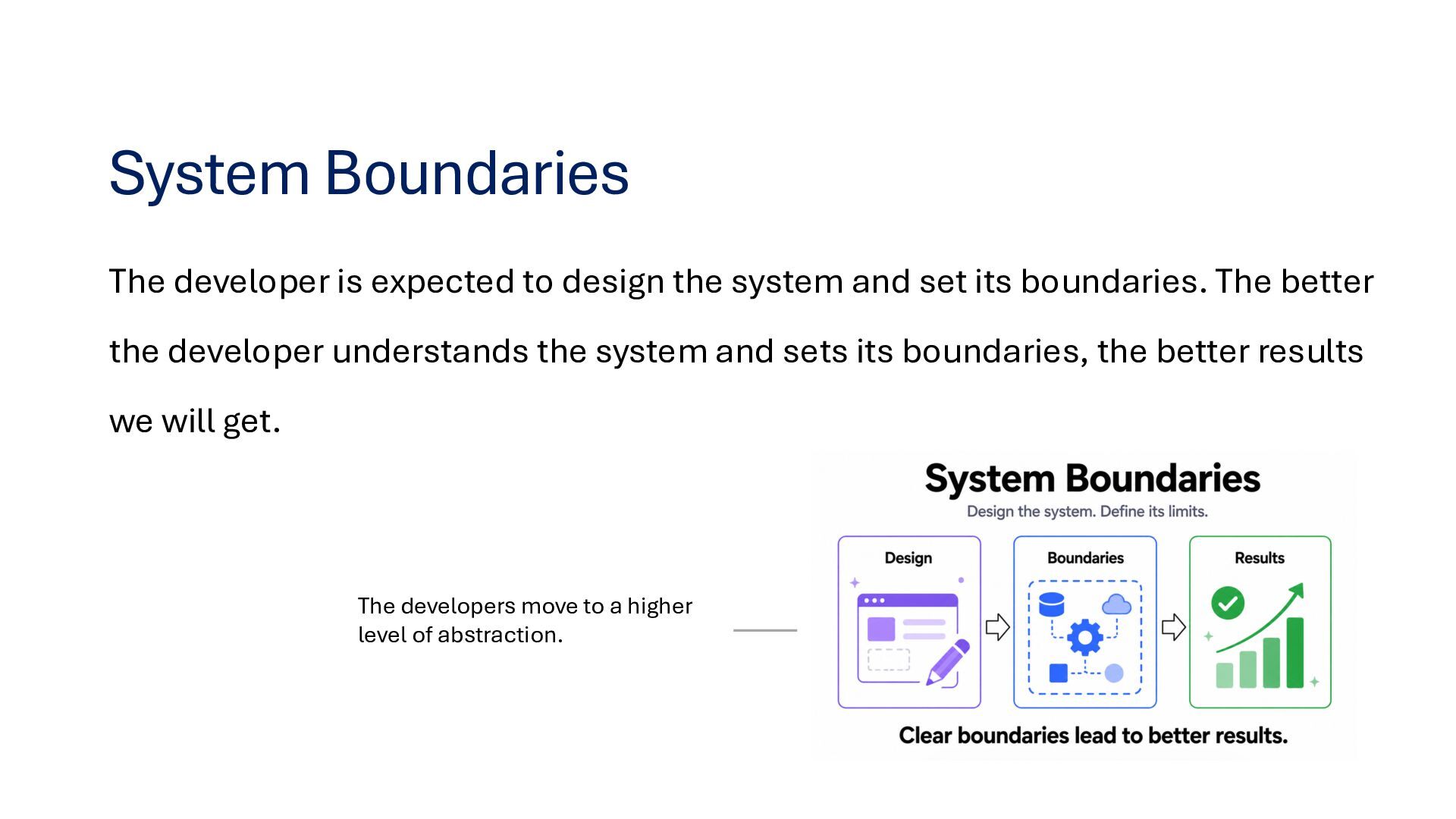
  22. System Boundaries The developer is expected to design the system

    and set its boundaries. The better the developer understands the system and sets its boundaries, the better results we will get. The developers move to a higher level of abstraction.
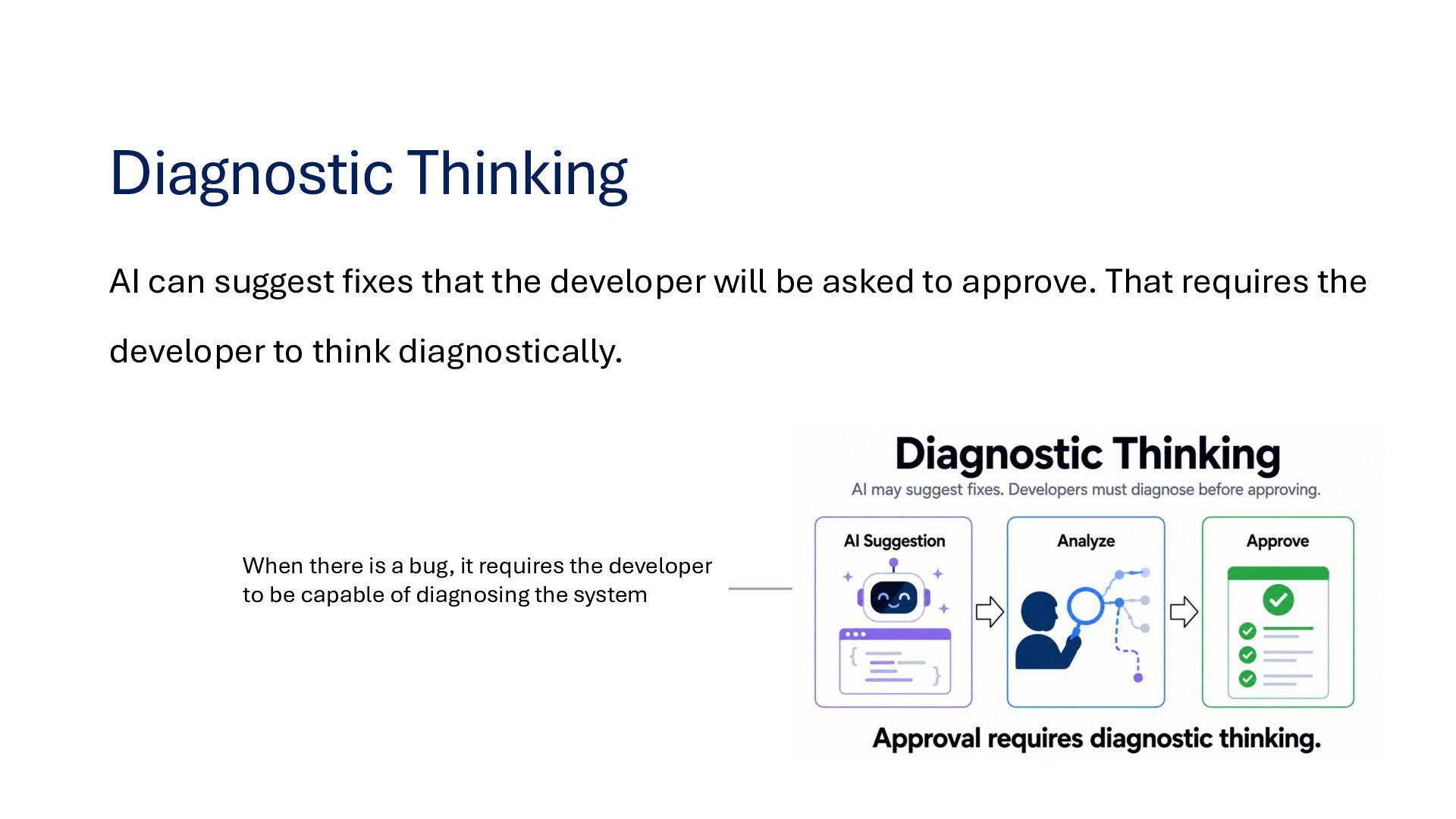
  23. Diagnostic Thinking AI can suggest fixes that the developer will

    be asked to approve. That requires the developer to think diagnostically. When there is a bug, it requires the developer to be capable of diagnosing the system
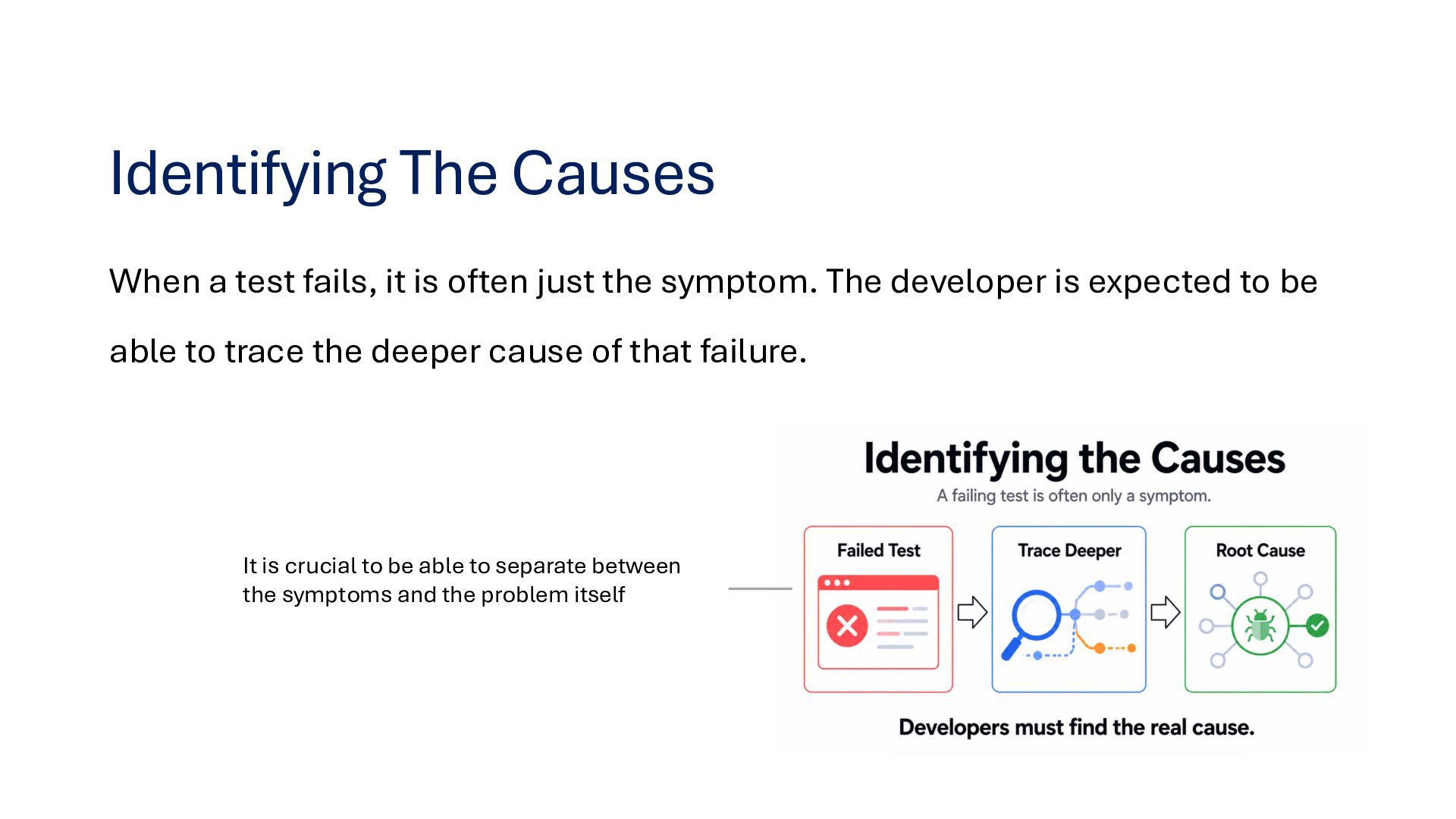
  24. Identifying The Causes When a test fails, it is often

    just the symptom. The developer is expected to be able to trace the deeper cause of that failure. It is crucial to be able to separate between the symptoms and the problem itself
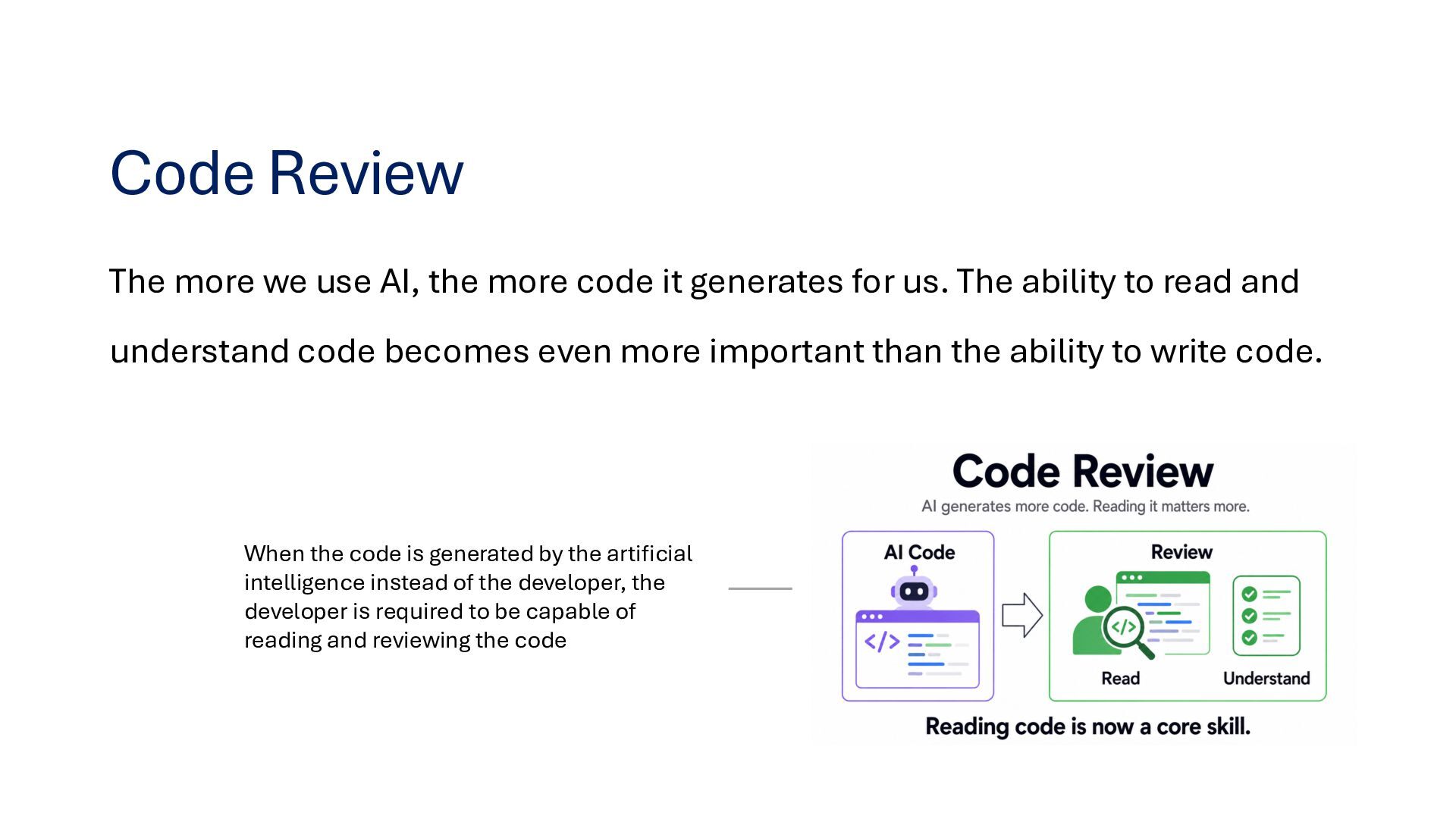
  25. Code Review The more we use AI, the more code

    it generates for us. The ability to read and understand code becomes even more important than the ability to write code. When the code is generated by the artificial intelligence instead of the developer, the developer is required to be capable of reading and reviewing the code
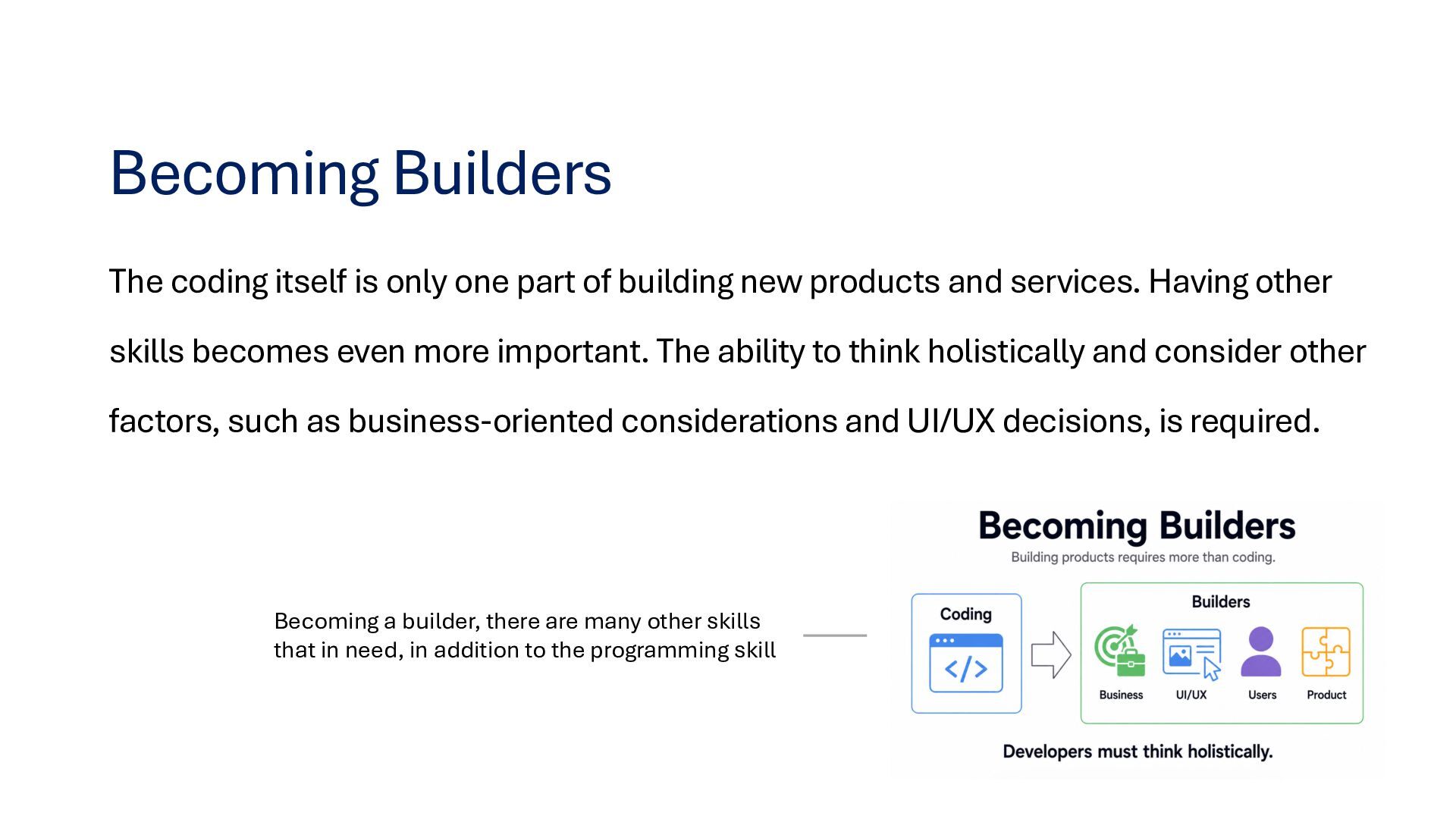
  26. Becoming Builders The coding itself is only one part of

    building new products and services. Having other skills becomes even more important. The ability to think holistically and consider other factors, such as business-oriented considerations and UI/UX decisions, is required. Becoming a builder, there are many other skills that in need, in addition to the programming skill
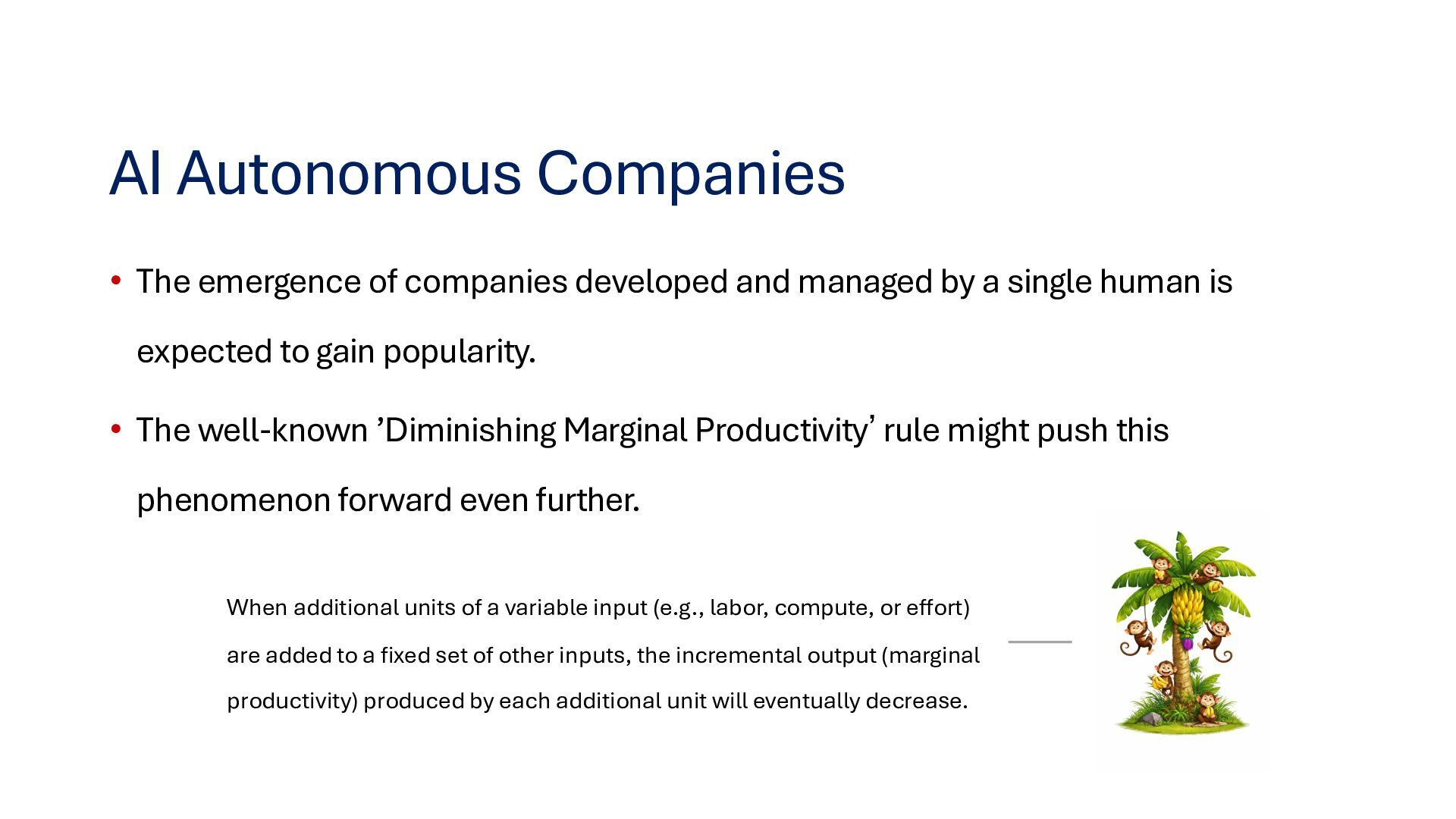
  27. AI Autonomous Companies • The emergence of companies developed and

    managed by a single human is expected to gain popularity. • The well-known ’Diminishing Marginal Productivity’ rule might push this phenomenon forward even further. When additional units of a variable input (e.g., labor, compute, or effort) are added to a fixed set of other inputs, the incremental output (marginal productivity) produced by each additional unit will eventually decrease.
  28. Time as a Design Constraint Every learning process has a

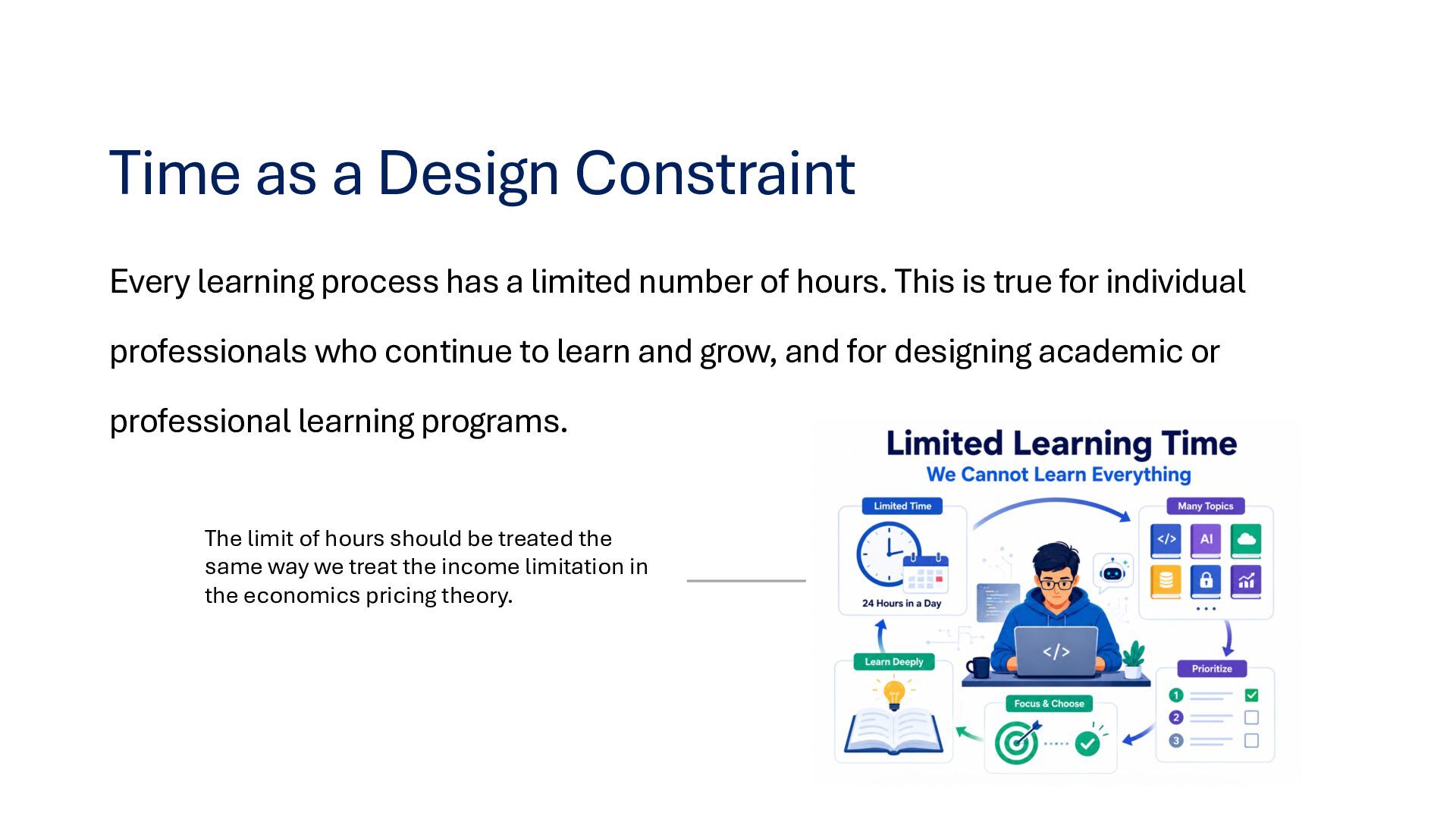
    limited number of hours. This is true for individual professionals who continue to learn and grow, and for designing academic or professional learning programs. The limit of hours should be treated the same way we treat the income limitation in the economics pricing theory.
  29. Topics Prioritization The challenge is to prioritize the topics that

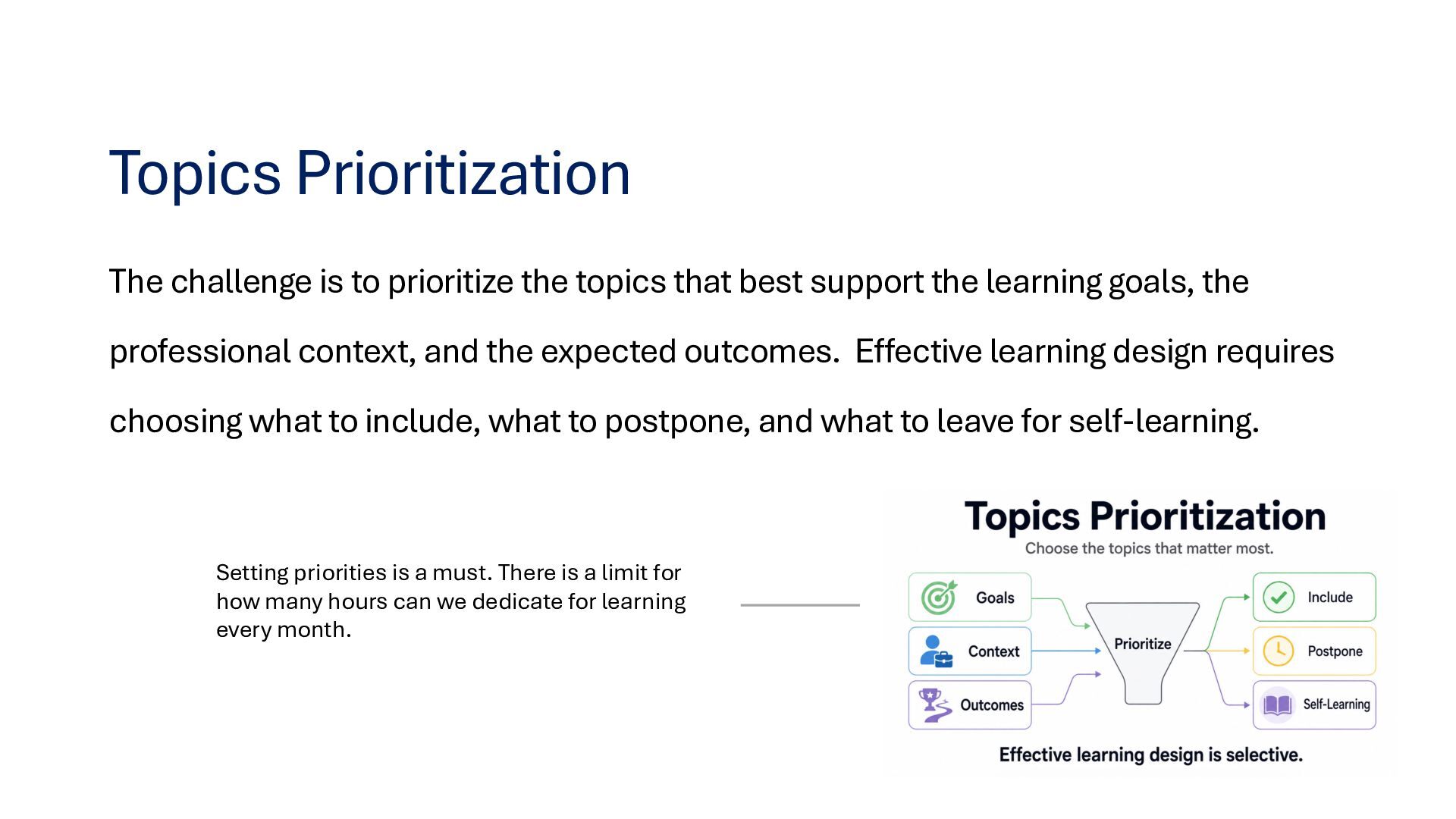
    best support the learning goals, the professional context, and the expected outcomes. Effective learning design requires choosing what to include, what to postpone, and what to leave for self-learning. Setting priorities is a must. There is a limit for how many hours can we dedicate for learning every month.
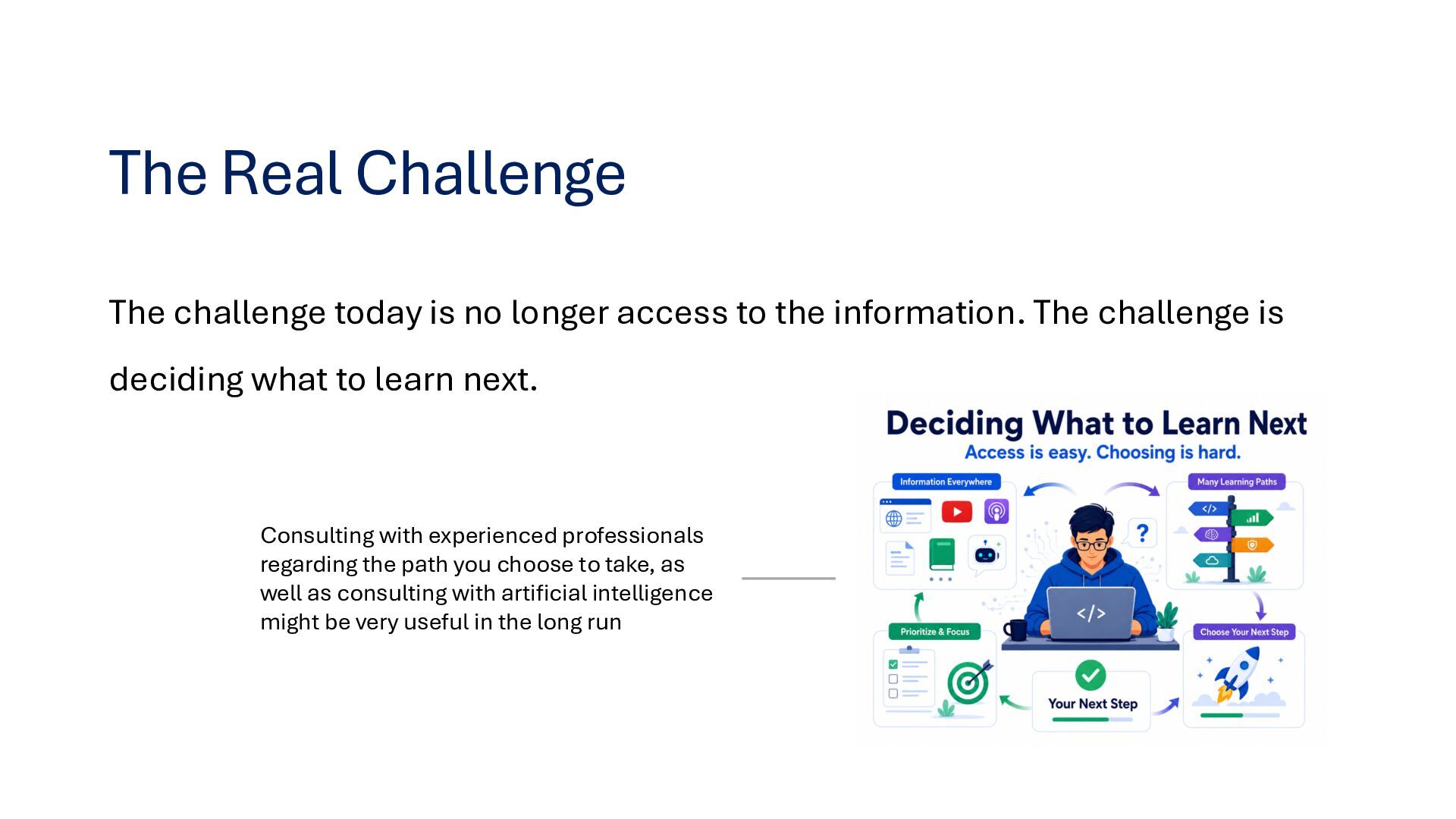
  30. The Real Challenge The challenge today is no longer access

    to the information. The challenge is deciding what to learn next. Consulting with experienced professionals regarding the path you choose to take, as well as consulting with artificial intelligence might be very useful in the long run
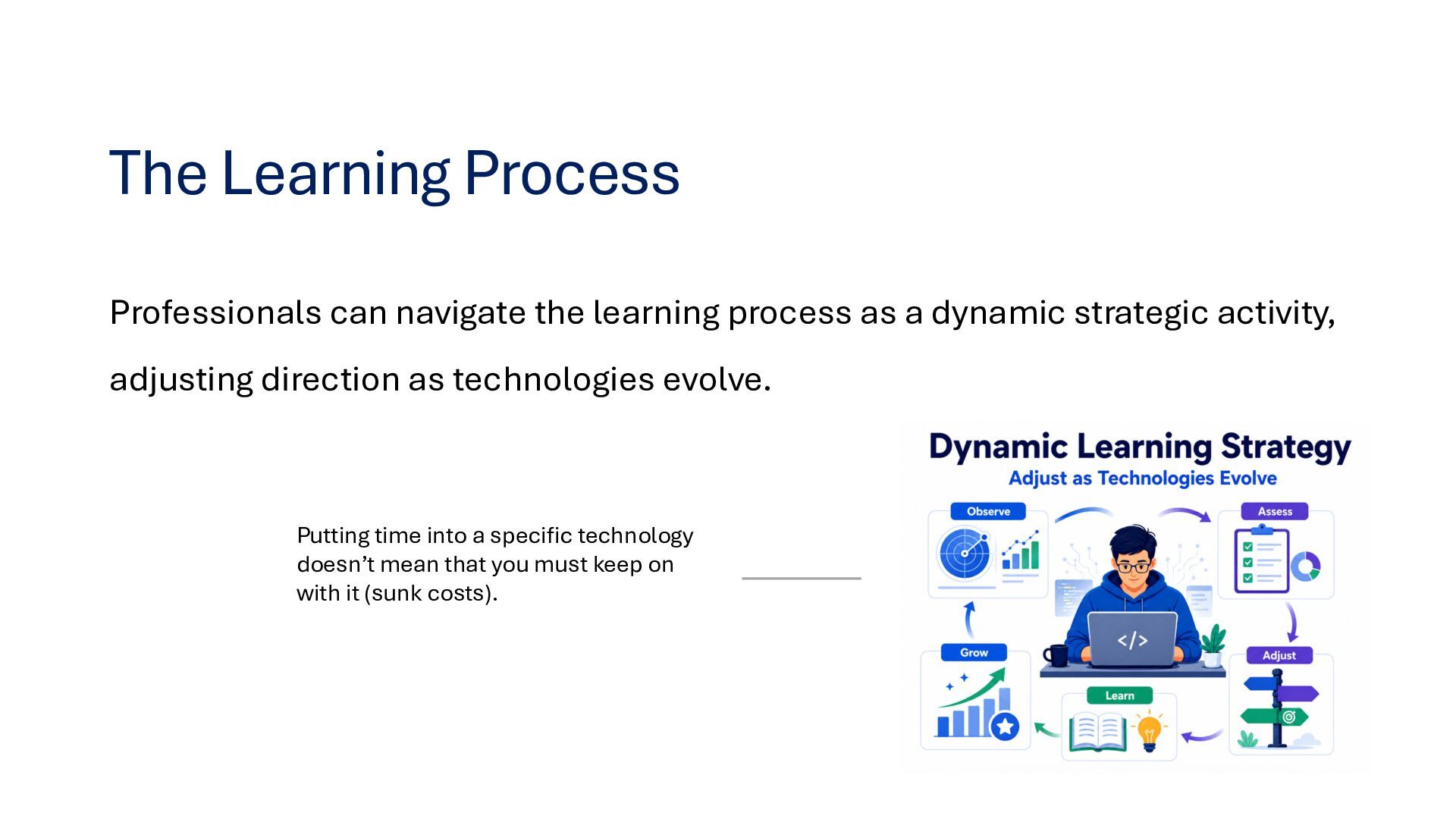
  31. The Learning Process Professionals can navigate the learning process as

    a dynamic strategic activity, adjusting direction as technologies evolve. Putting time into a specific technology doesn’t mean that you must keep on with it (sunk costs).
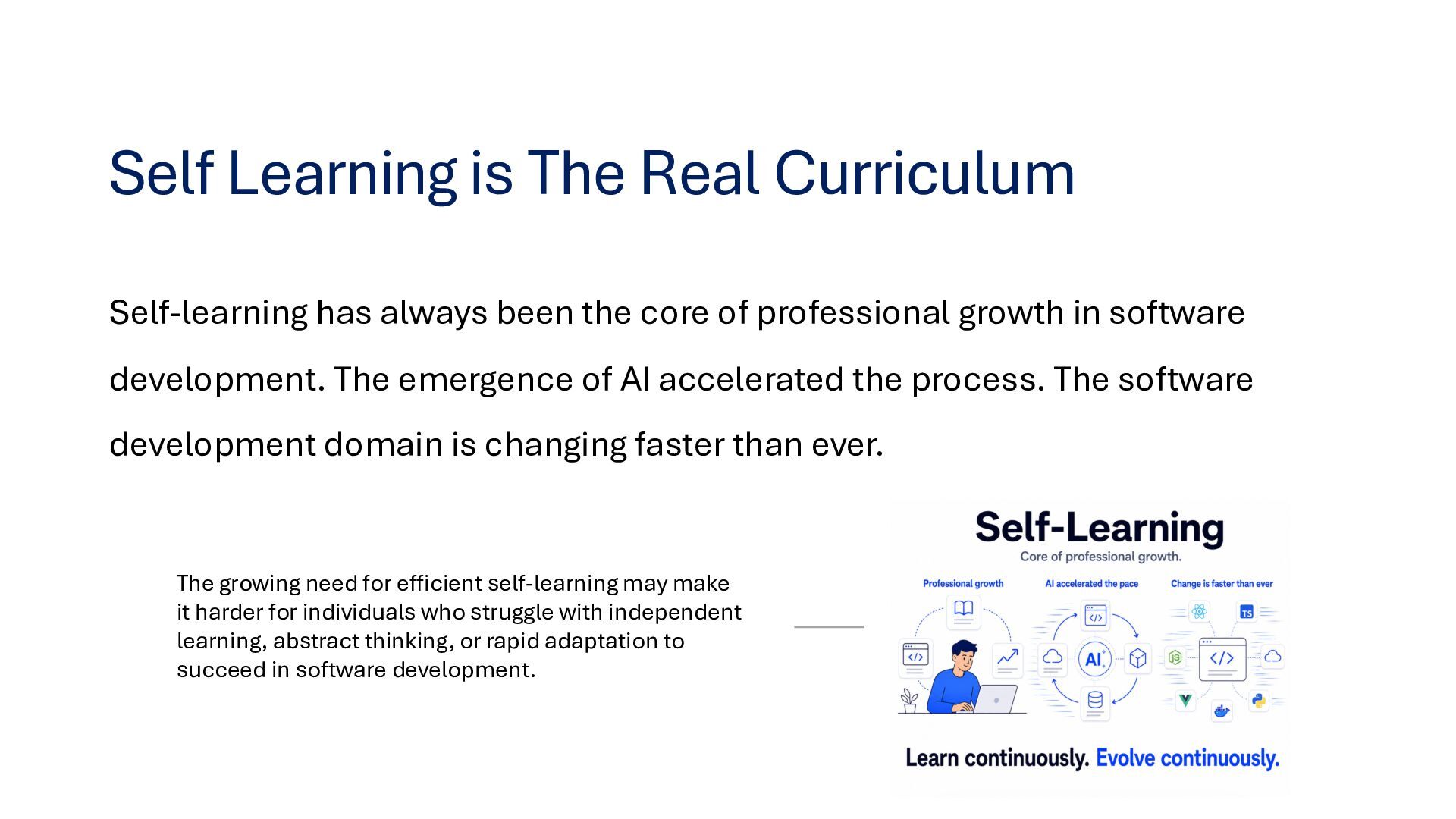
  32. Self Learning is The Real Curriculum Self-learning has always been

    the core of professional growth in software development. The emergence of AI accelerated the process. The software development domain is changing faster than ever. The growing need for efficient self-learning may make it harder for individuals who struggle with independent learning, abstract thinking, or rapid adaptation to succeed in software development.
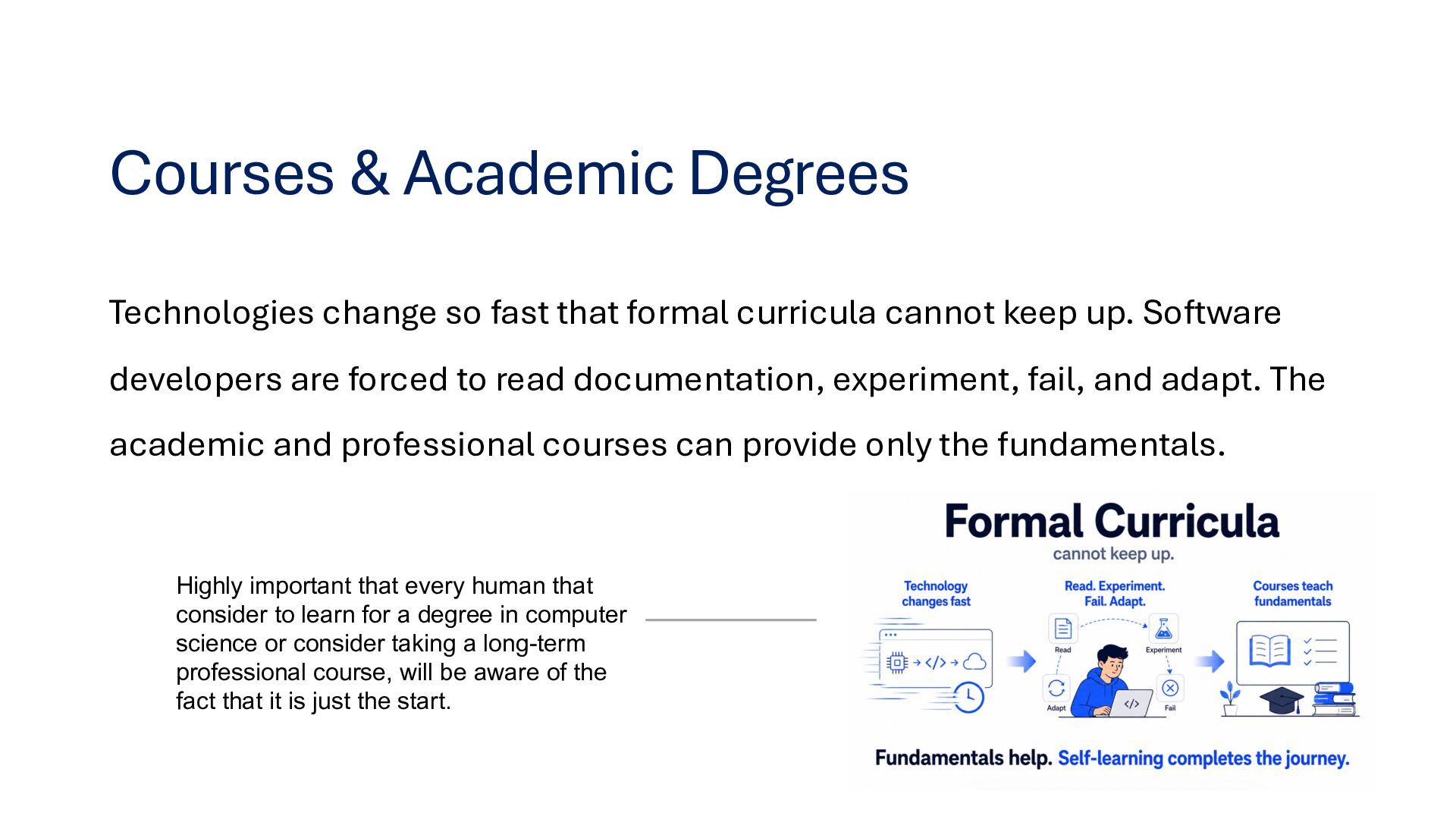
  33. Courses & Academic Degrees Technologies change so fast that formal

    curricula cannot keep up. Software developers are forced to read documentation, experiment, fail, and adapt. The academic and professional courses can provide only the fundamentals. Highly important that every human that consider to learn for a degree in computer science or consider taking a long-term professional course, will be aware of the fact that it is just the start.
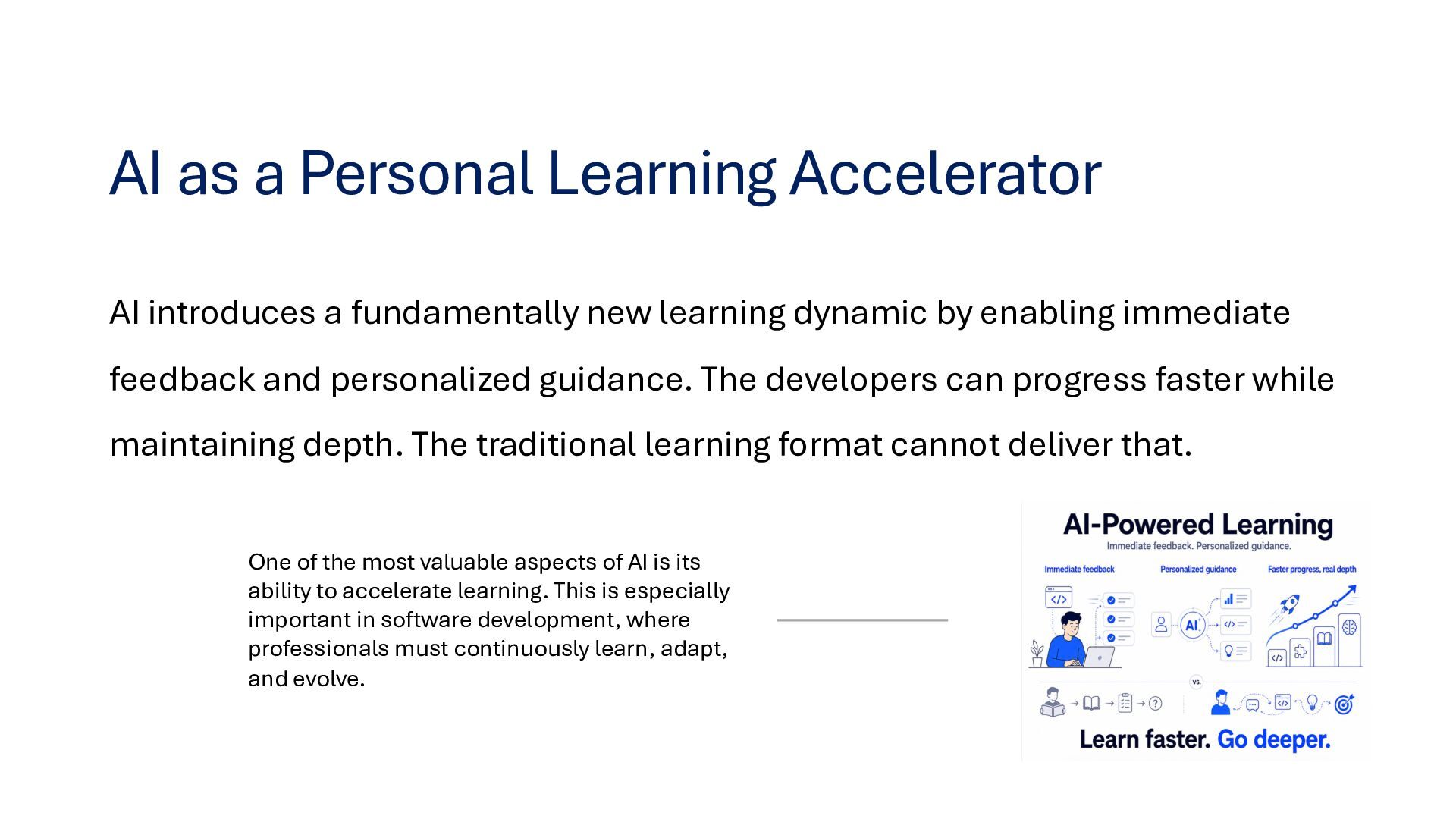
  34. AI as a Personal Learning Accelerator AI introduces a fundamentally

    new learning dynamic by enabling immediate feedback and personalized guidance. The developers can progress faster while maintaining depth. The traditional learning format cannot deliver that. One of the most valuable aspects of AI is its ability to accelerate learning. This is especially important in software development, where professionals must continuously learn, adapt, and evolve.
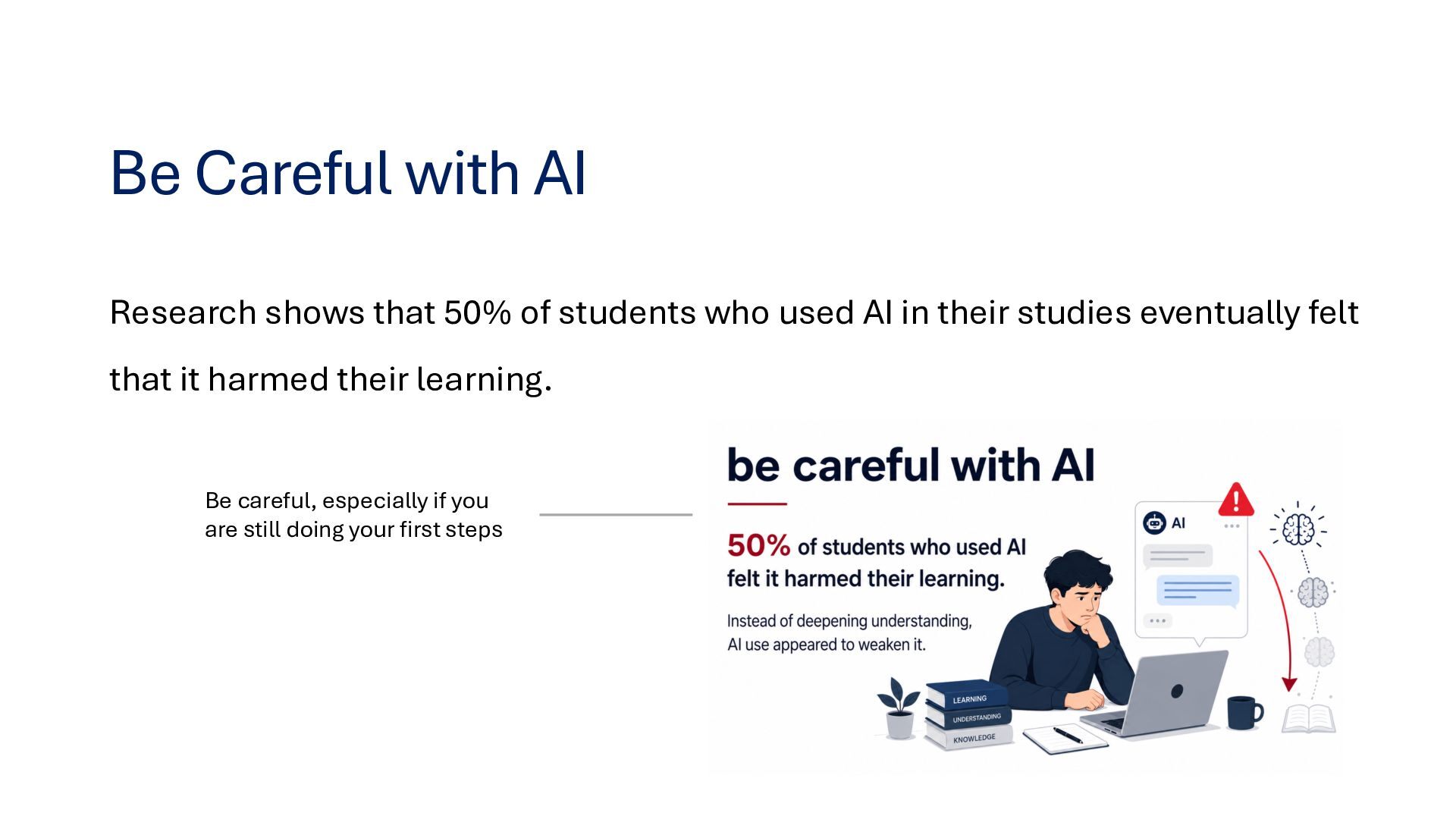
  35. Be Careful with AI Research shows that 50% of students

    who used AI in their studies eventually felt that it harmed their learning. Be careful, especially if you are still doing your first steps
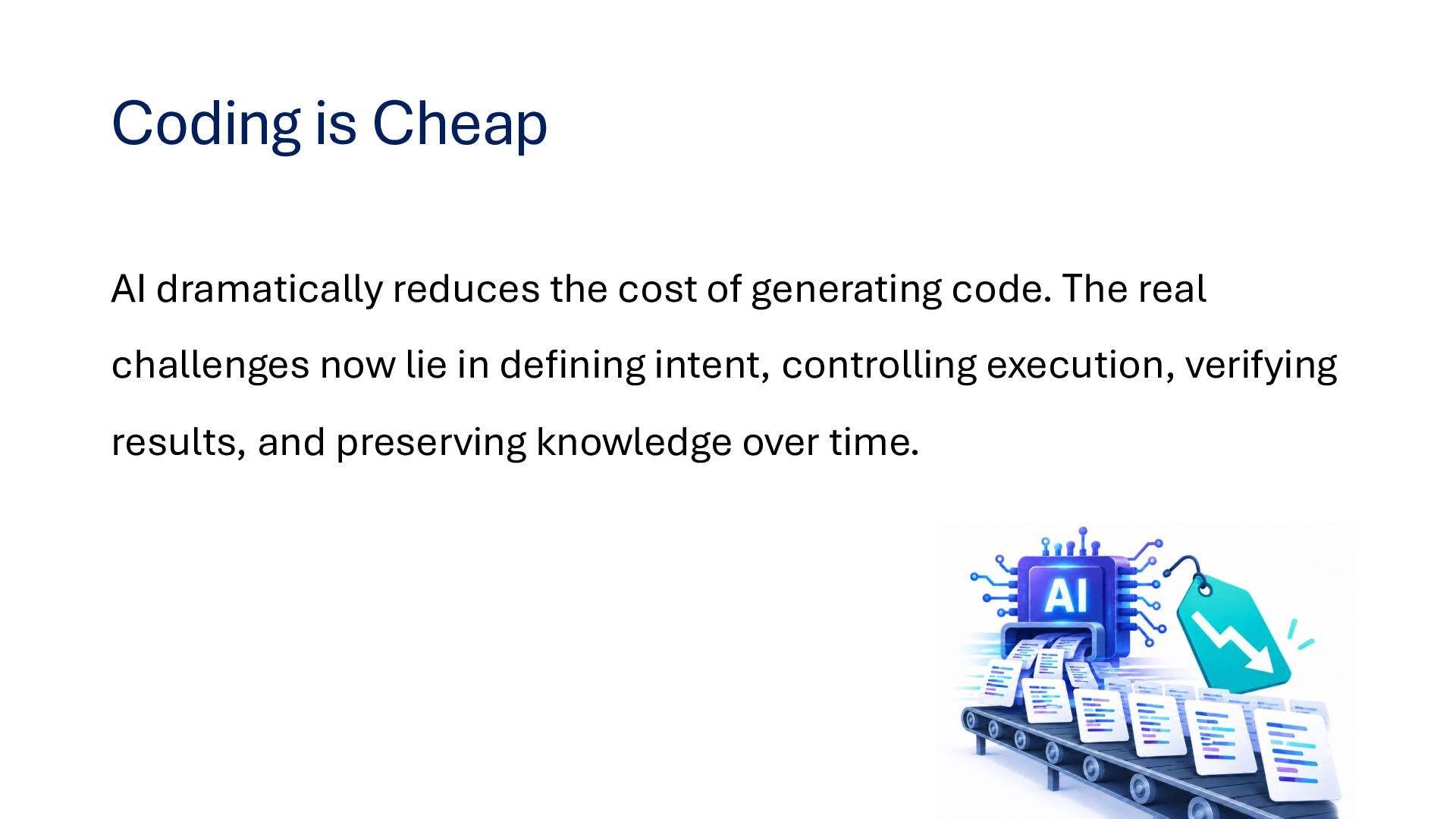
  36. Coding is Cheap AI dramatically reduces the cost of generating

    code. The real challenges now lie in defining intent, controlling execution, verifying results, and preserving knowledge over time.
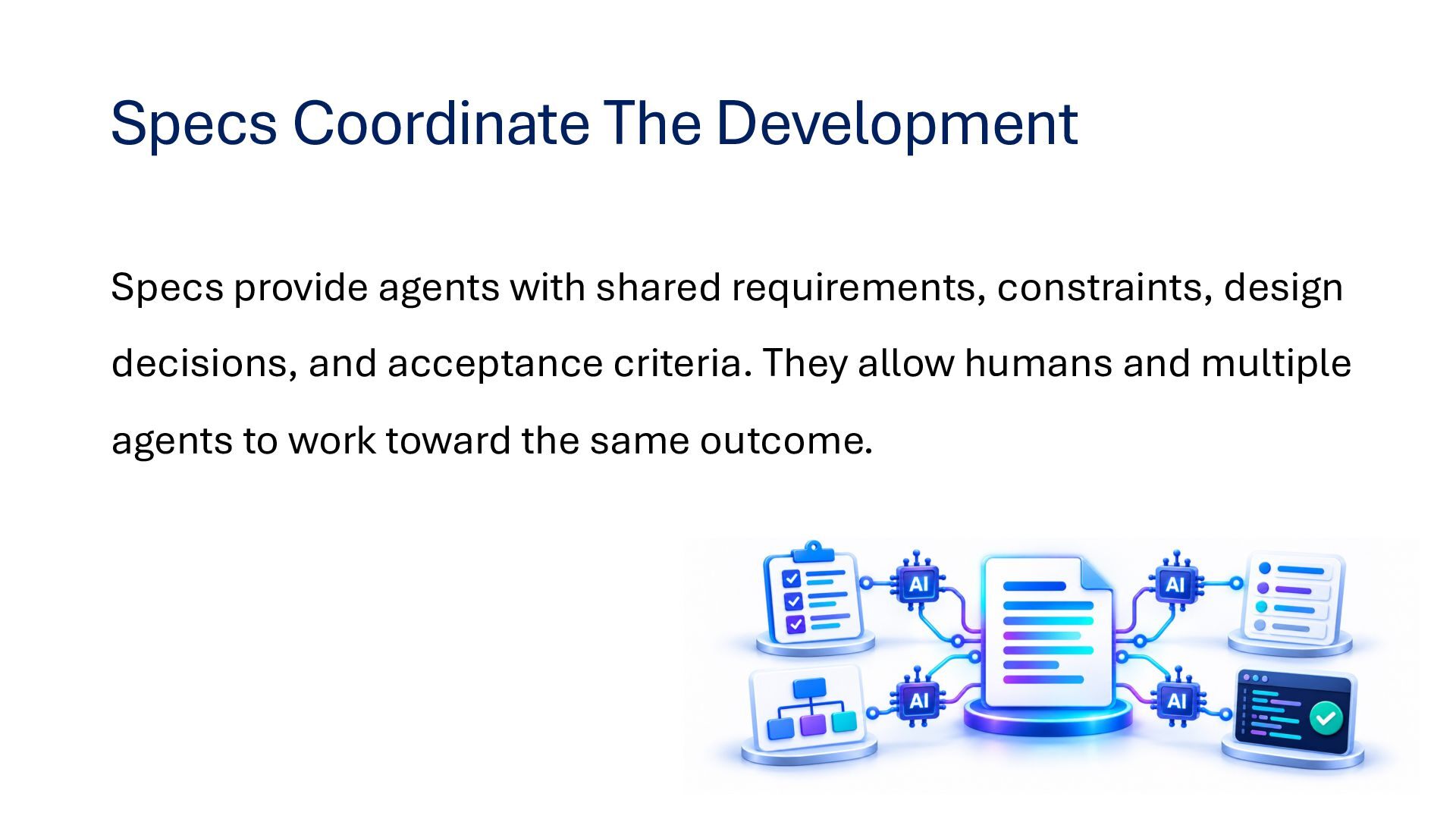
  37. Specs Coordinate The Development Specs provide agents with shared requirements,

    constraints, design decisions, and acceptance criteria. They allow humans and multiple agents to work toward the same outcome.
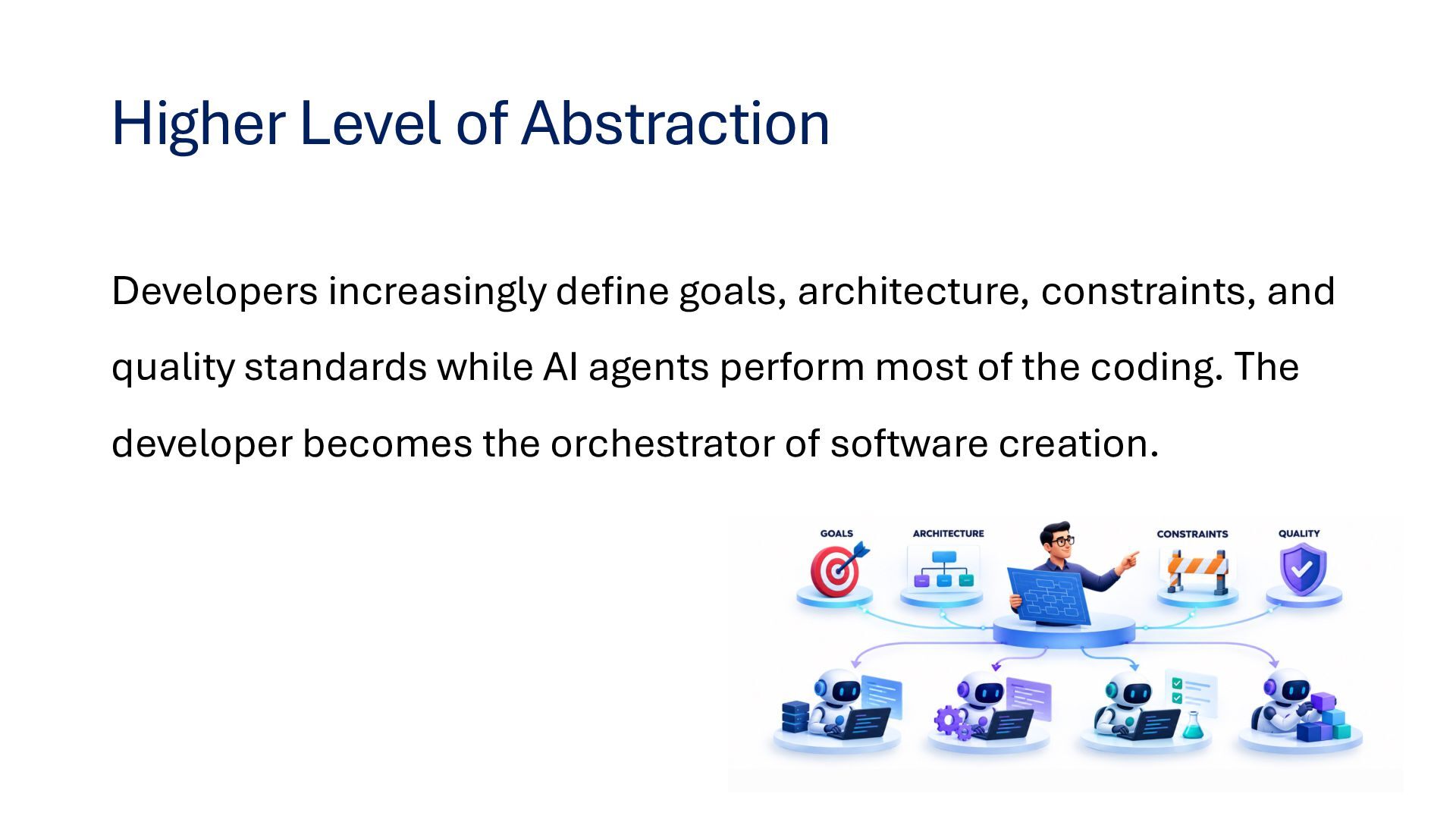
  38. Higher Level of Abstraction Developers increasingly define goals, architecture, constraints,

    and quality standards while AI agents perform most of the coding. The developer becomes the orchestrator of software creation.
  39. Q&A Thanks for attending my talk :) WhatsApp +972.54.6655837 [email protected]

    https://blog.lifemichael.com XtremeJ xtremej.dev life michael XtremeJS xtremejs.dev XtremePython xtremepython.dev XtremeAI xtremeai.dev meetup.com/lifemichael Monolith vs Microservices

More Decks by life michael

Other Decks in Technology