Share
Embed
Mash Enzymes & Grain Crush Interactions
This month, (November, 2026), one of our members, Steven Blackery lead a very detailed discussion on mash enzymes and grain interactions.
London Amateur Brewers
November 20, 2026
Transcript
28 slides
-
Mash Enzymes & Grain Crush Interactions Presented by Steven Blackery
to LAB online meeting 16/11/2026 -
What happened? Earlier this year, I had 3 brews with
massively reduced attenuation (~55% vs ~70% expected). The only thing that changed in my process was switching from buying my grain crushed to buying uncrushed and milling myself. A 4th brew, changing the crush gap from 1.3mm to 0.95mm resulted in expected attenuation (70%) This lead me on a path of scientific research to work out why. This is now presented to you in the reverse order, from science to cause, rather than cause to science, as it makes much more logical sense in that order. If nothing else, this may act as a ‘refresher’ on mashing and enzymes for those who already know this stuff! -
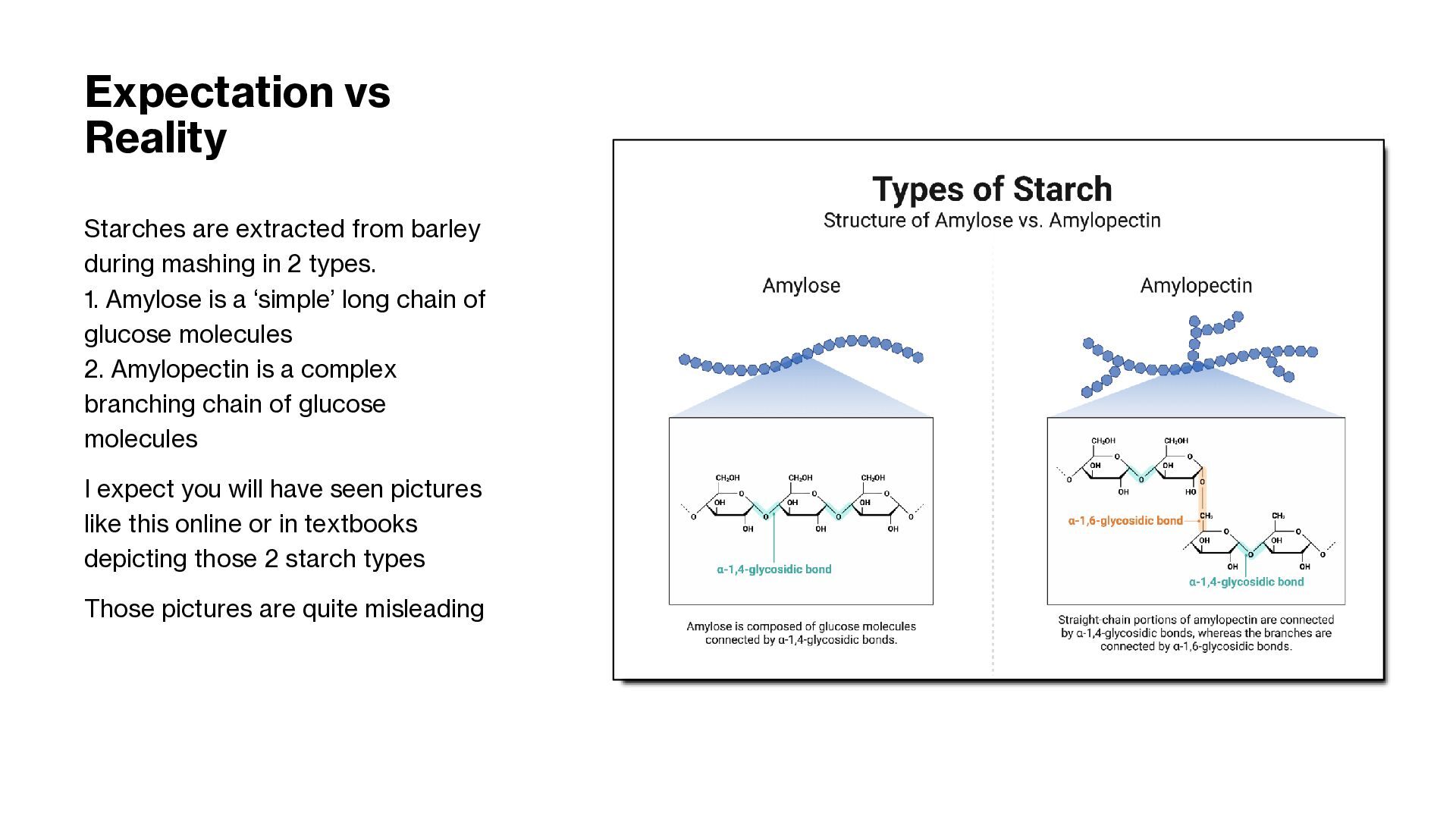
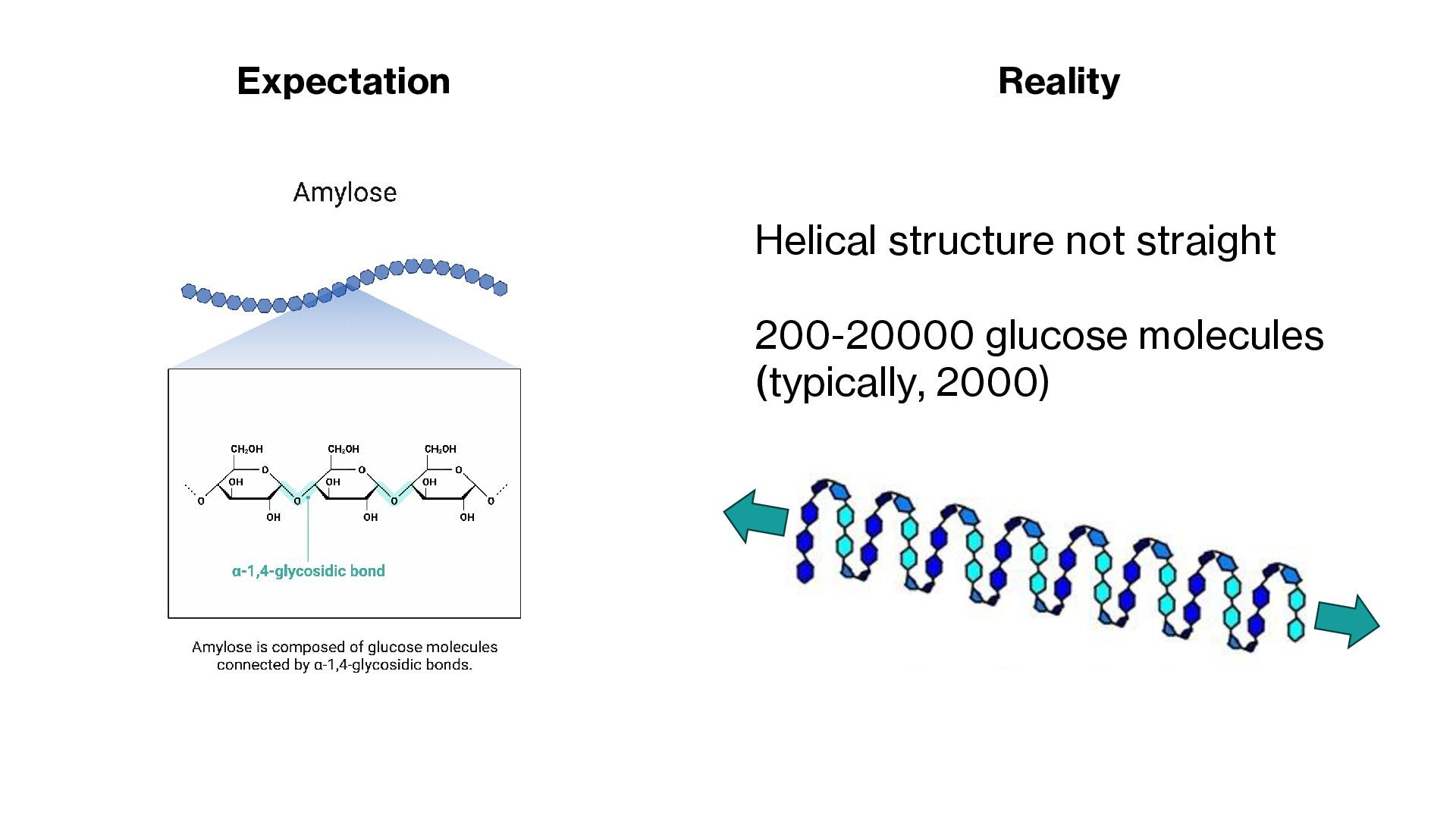
Expectation vs Reality Starches are extracted from barley during mashing
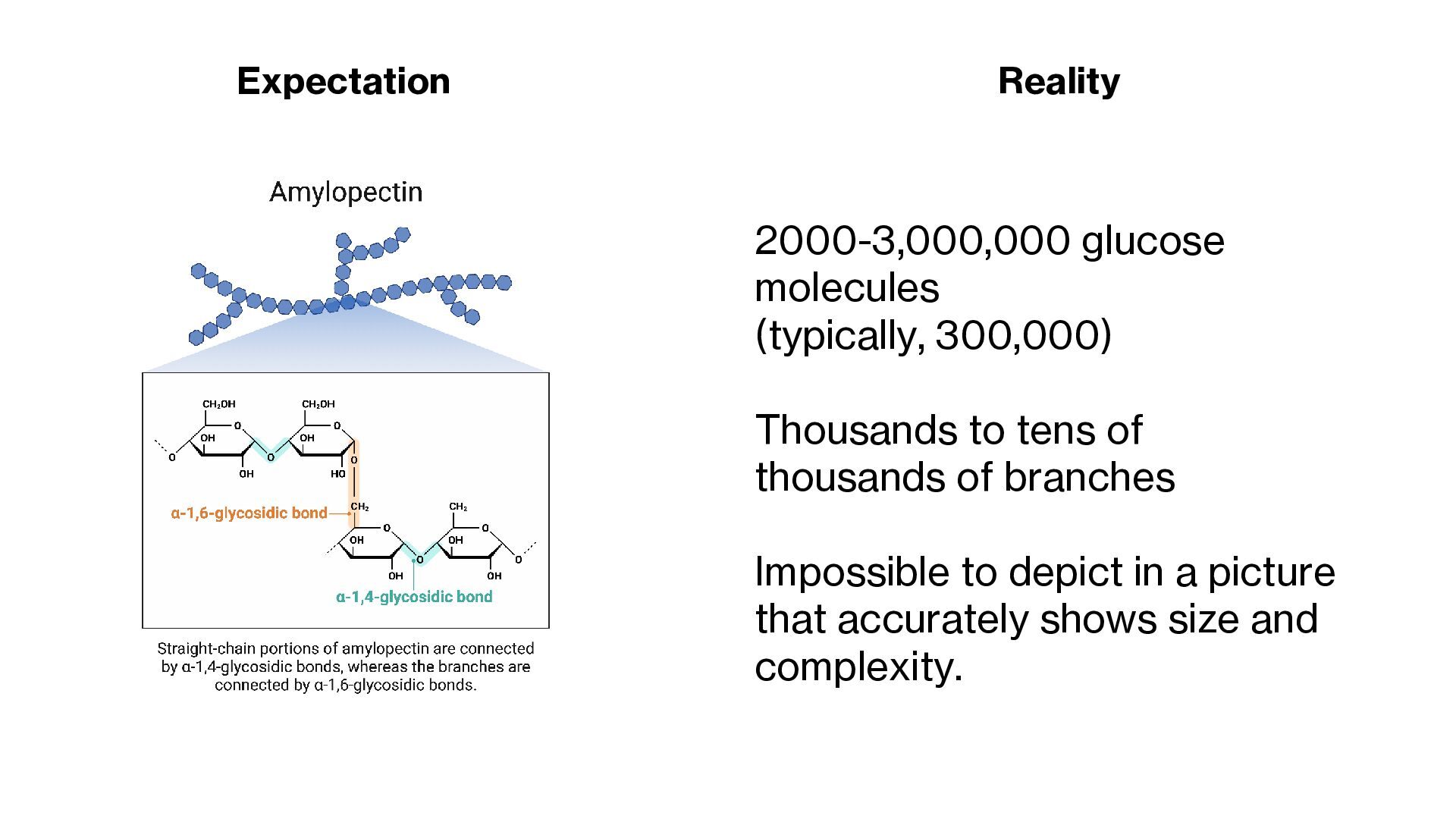
in 2 types. 1. Amylose is a ‘simple’ long chain of glucose molecules 2. Amylopectin is a complex branching chain of glucose molecules I expect you will have seen pictures like this online or in textbooks depicting those 2 starch types Those pictures are quite misleading -
Expectation Reality 2000-3,000,000 glucose molecules (typically, 300,000) Thousands to tens
of thousands of branches Impossible to depict in a picture that accurately shows size and complexity. -
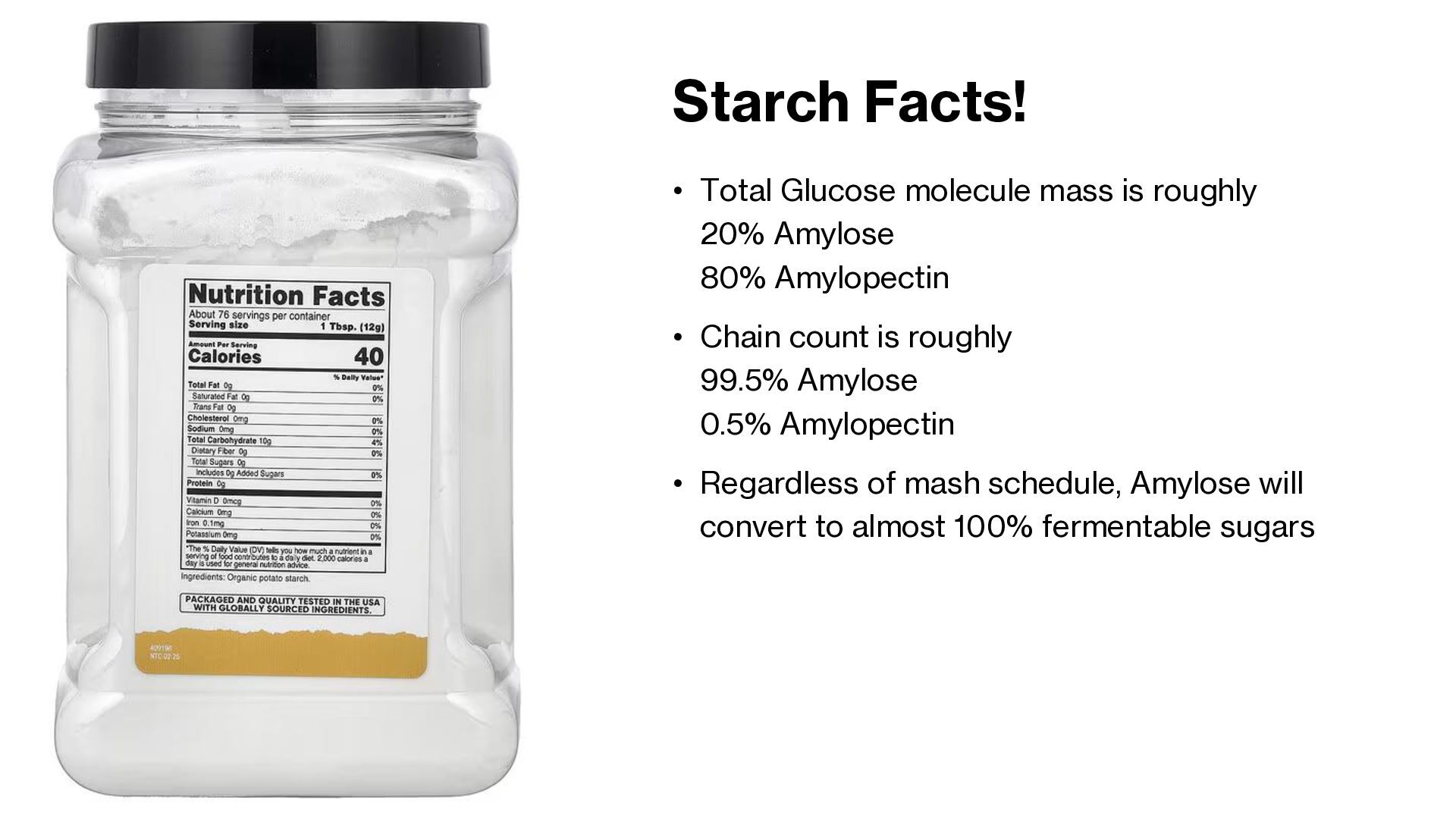
Starch Facts! • Total Glucose molecule mass is roughly 20%
Amylose 80% Amylopectin • Chain count is roughly 99.5% Amylose 0.5% Amylopectin • Regardless of mash schedule, Amylose will convert to almost 100% fermentable sugars -
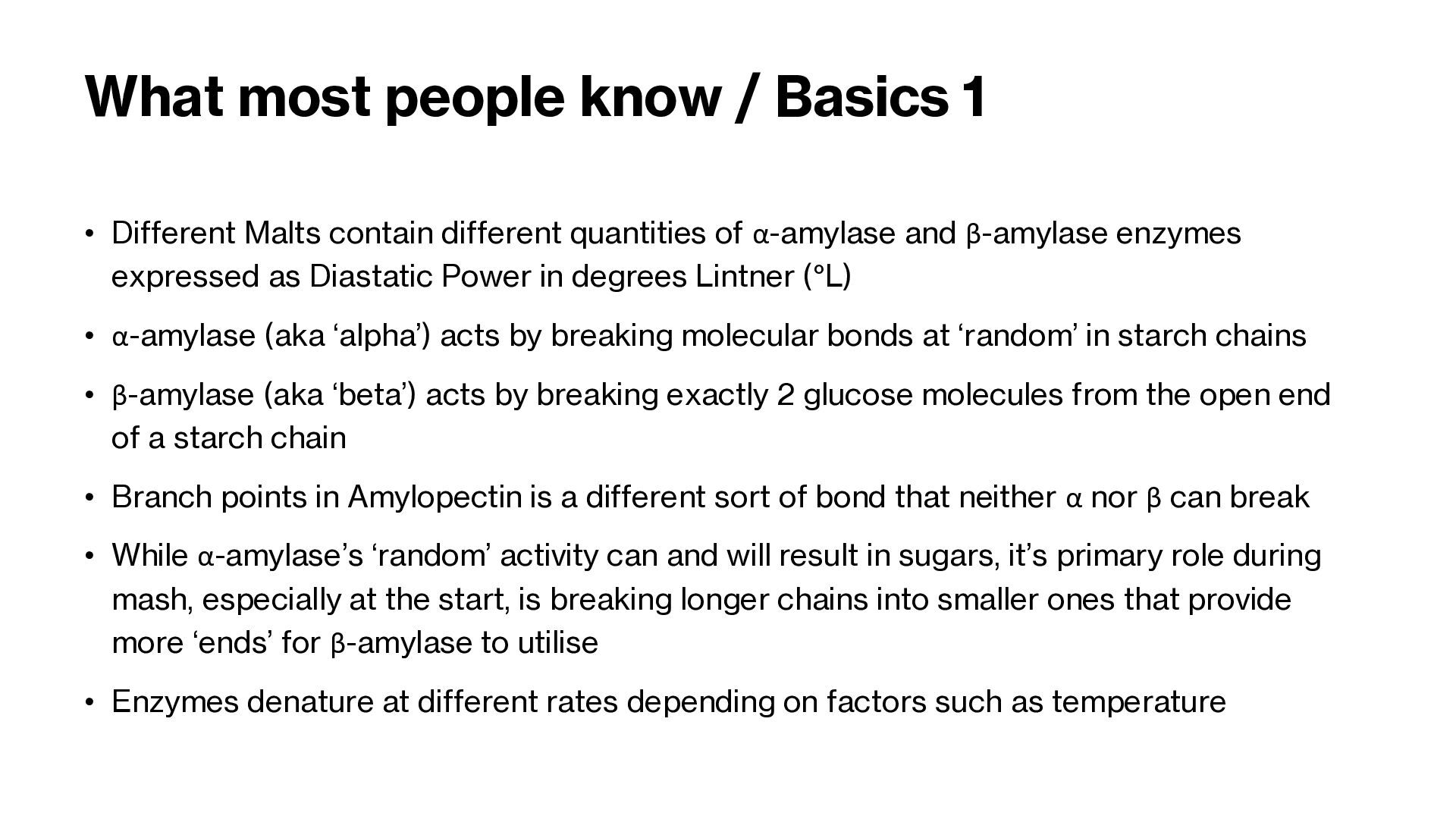
What most people know / Basics 1 • Different Malts
contain different quantities of α-amylase and β-amylase enzymes expressed as Diastatic Power in degrees Lintner (°L) • α-amylase (aka ‘alpha’) acts by breaking molecular bonds at ‘random’ in starch chains • β-amylase (aka ‘beta’) acts by breaking exactly 2 glucose molecules from the open end of a starch chain • Branch points in Amylopectin is a different sort of bond that neither α nor β can break • While α-amylase’s ‘random’ activity can and will result in sugars, it’s primary role during mash, especially at the start, is breaking longer chains into smaller ones that provide more ‘ends’ for β-amylase to utilise • Enzymes denature at different rates depending on factors such as temperature -
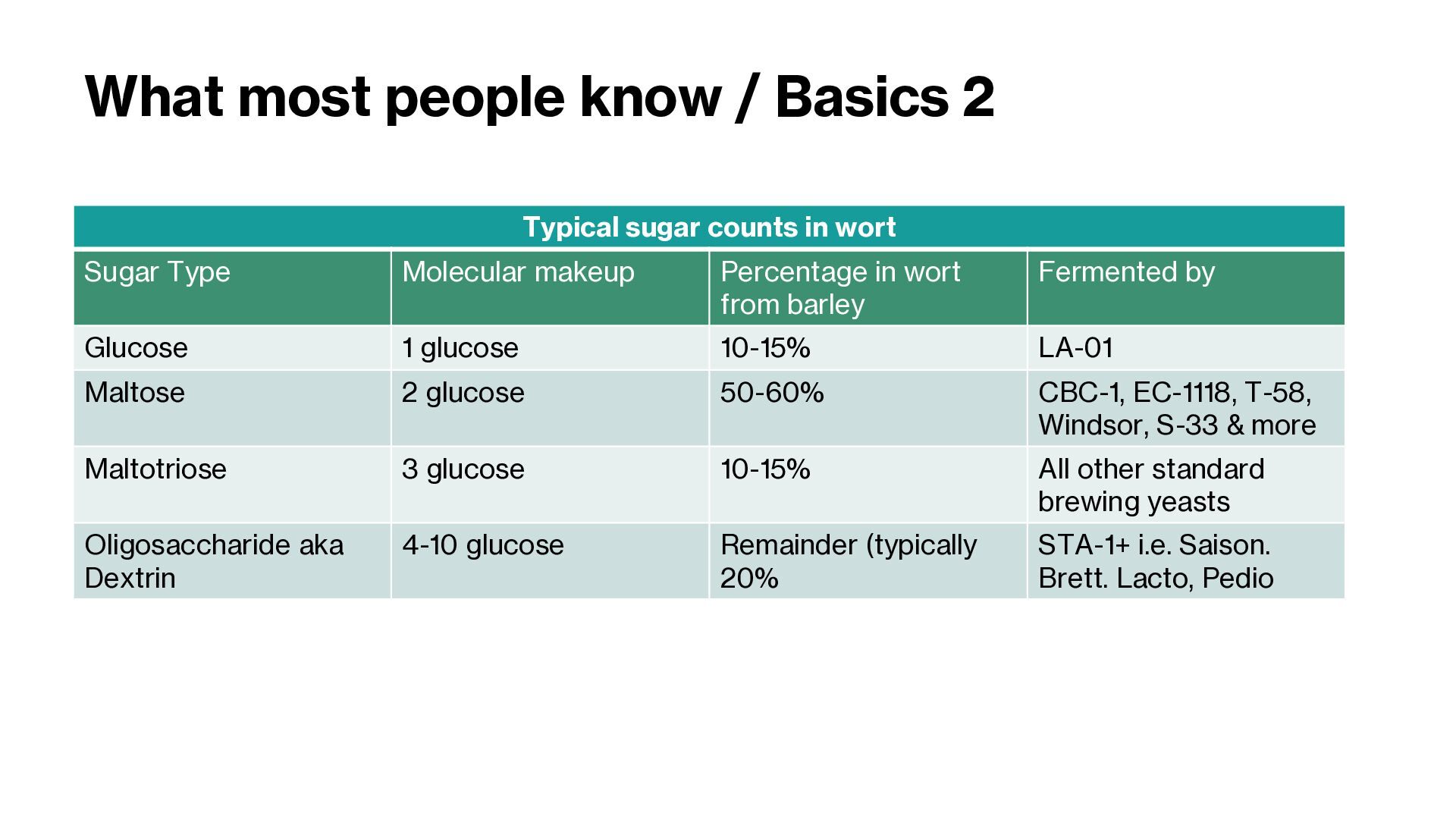
What most people know / Basics 2 Typical sugar counts
in wort Sugar Type Molecular makeup Percentage in wort from barley Fermented by Glucose 1 glucose 10-15% LA-01 Maltose 2 glucose 50-60% CBC-1, EC-1118, T-58, Windsor, S-33 & more Maltotriose 3 glucose 10-15% All other standard brewing yeasts Oligosaccharide aka Dextrin 4-10 glucose Remainder (typically 20% STA-1+ i.e. Saison. Brett. Lacto, Pedio -
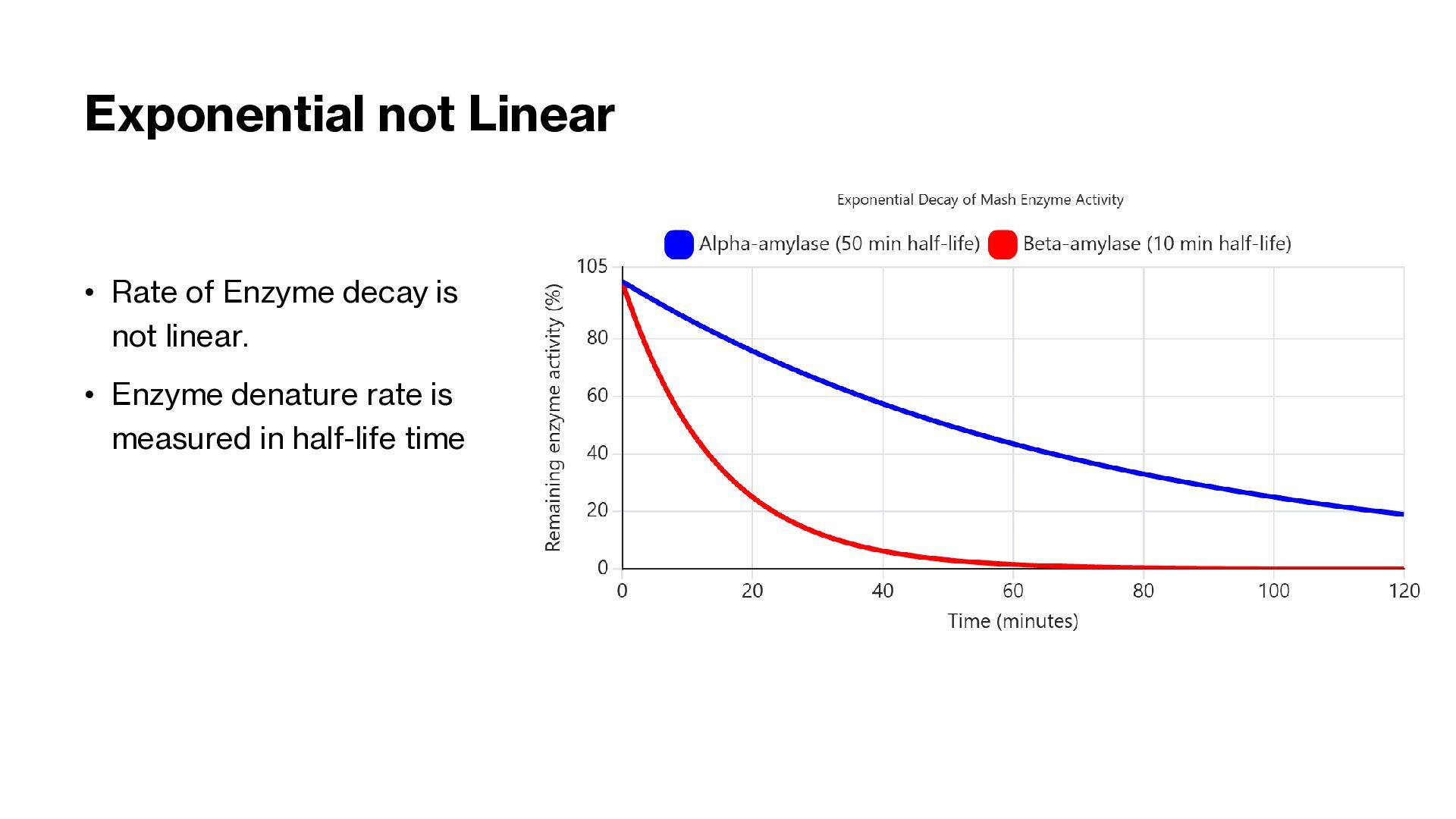
Exponential not Linear • Rate of Enzyme decay is not
linear. • Enzyme denature rate is measured in half-life time -
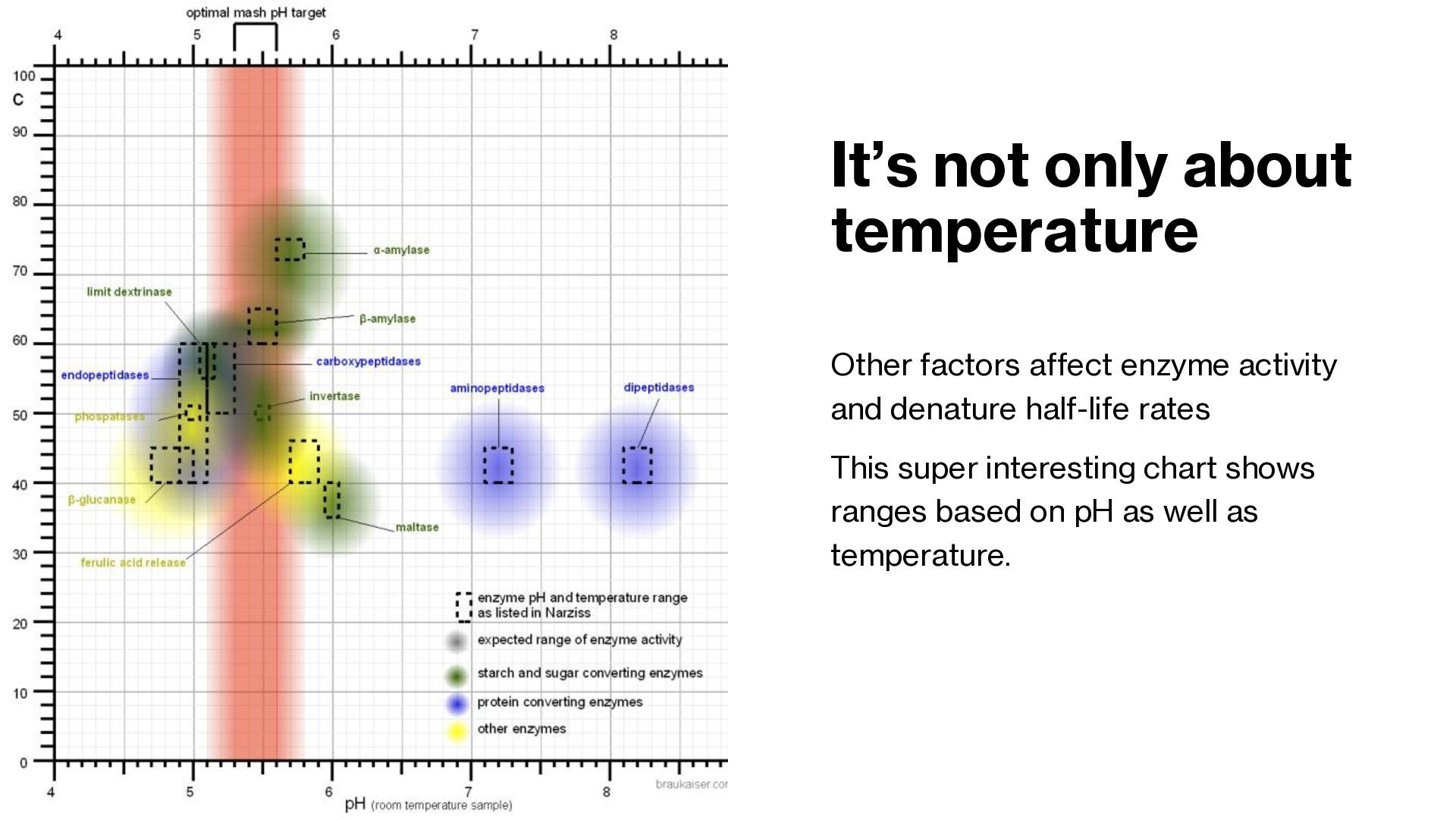
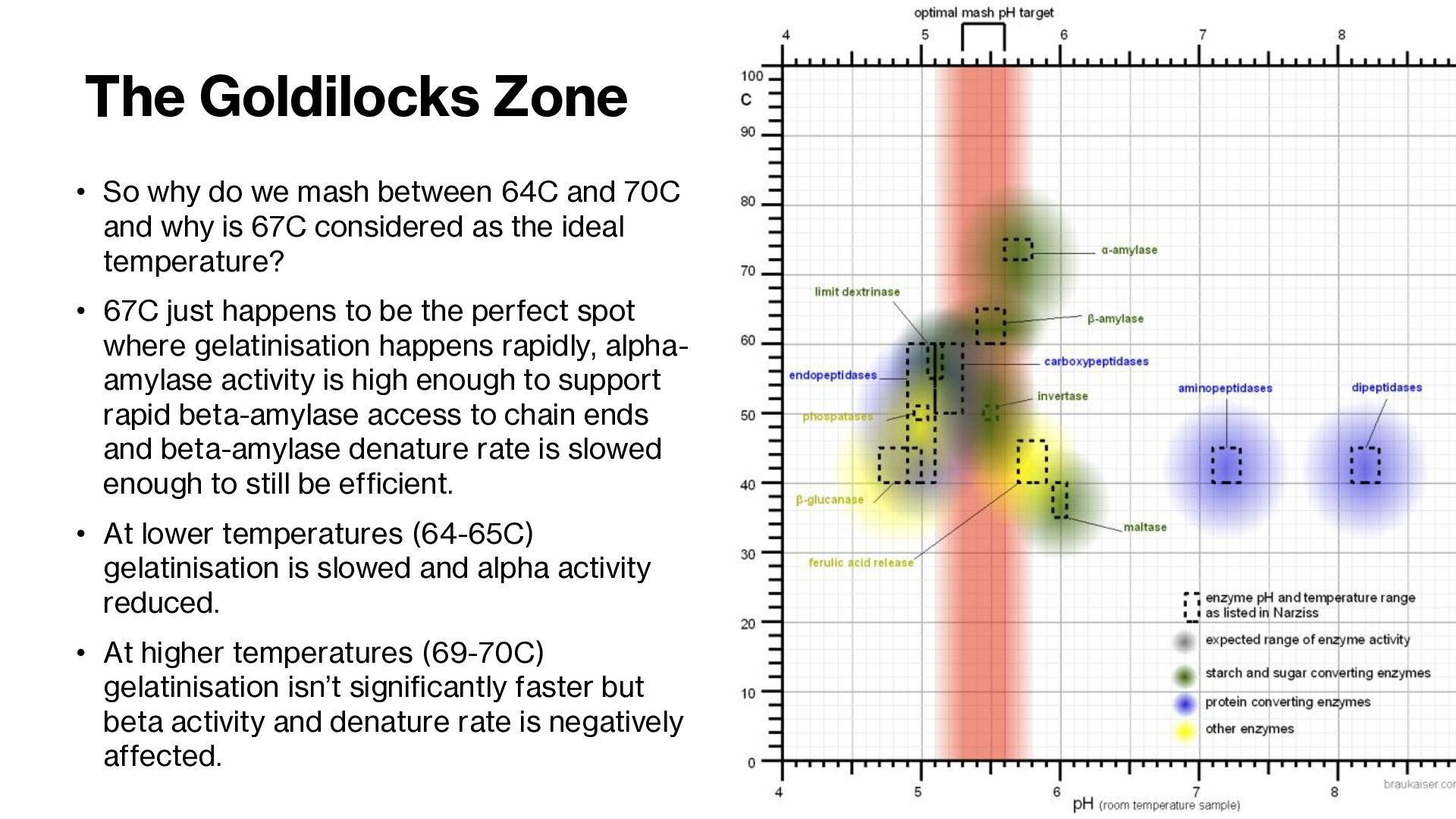
It’s not only about temperature Other factors affect enzyme activity
and denature half-life rates This super interesting chart shows ranges based on pH as well as temperature. -
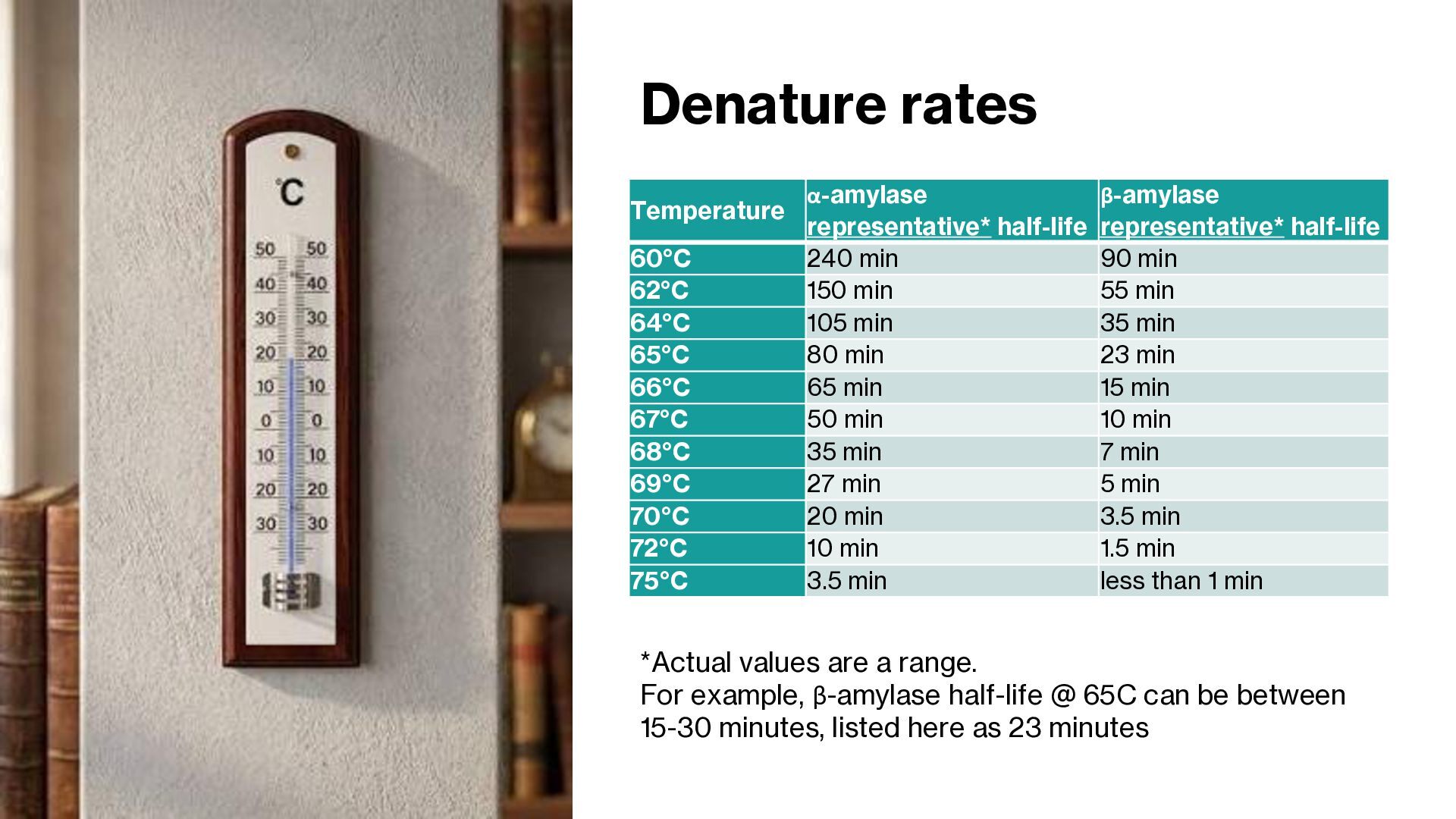
Denature rates Temperature 60°C 62°C 64°C 65°C 66°C 67°C 68°C
69°C 70°C 72°C 75°C α-amylase β-amylase representative* half-life representative* half-life 240 min 90 min 150 min 55 min 105 min 35 min 80 min 23 min 65 min 15 min 50 min 10 min 35 min 7 min 27 min 5 min 20 min 3.5 min 10 min 1.5 min 3.5 min less than 1 min *Actual values are a range. For example, β-amylase half-life @ 65C can be between 15-30 minutes, listed here as 23 minutes -
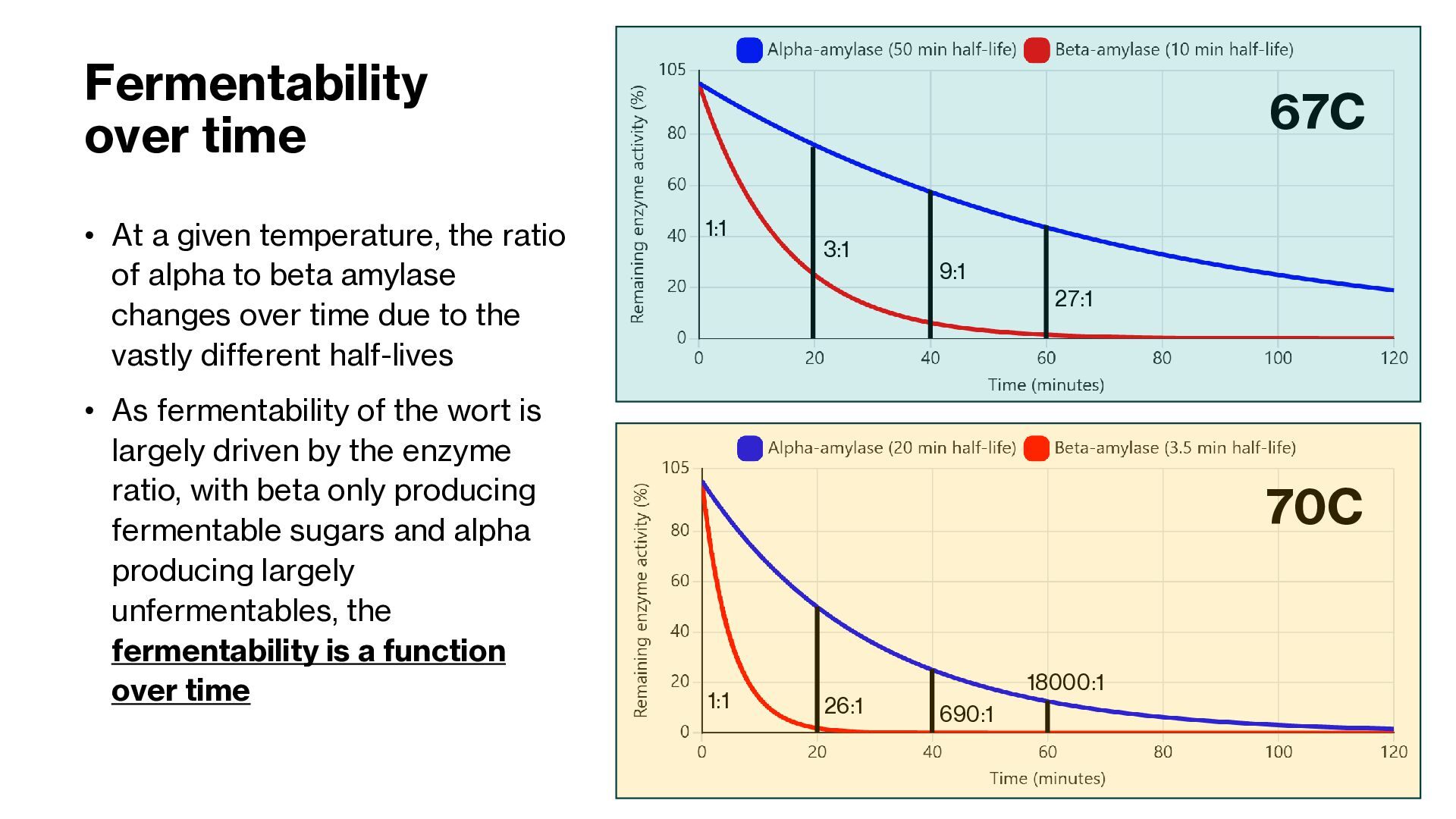
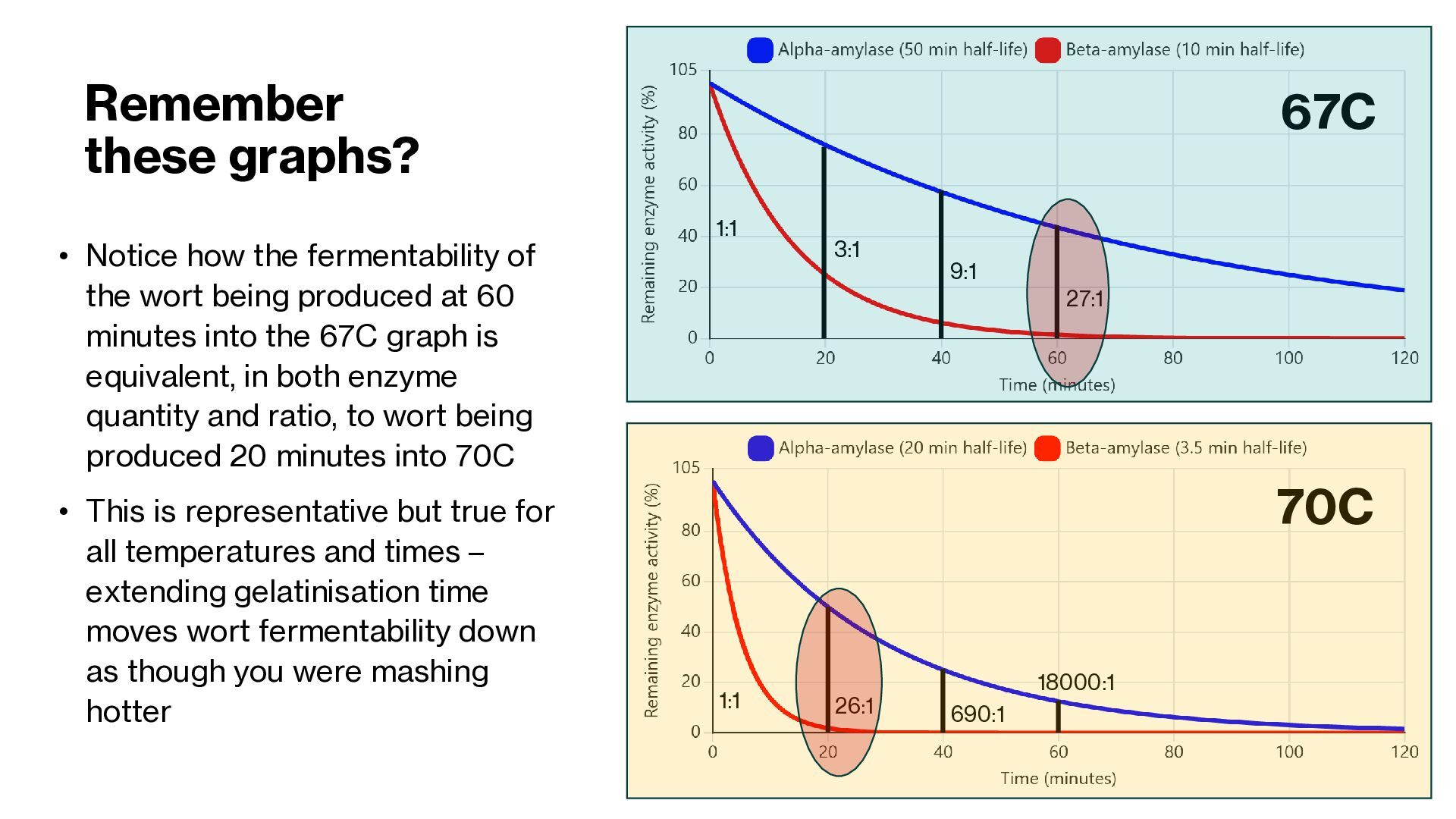
Fermentability over time • At a given temperature, the ratio
of alpha to beta amylase changes over time due to the vastly different half-lives • As fermentability of the wort is largely driven by the enzyme ratio, with beta only producing fermentable sugars and alpha producing largely unfermentables, the fermentability is a function over time 67C 1:1 3:1 9:1 27:1 70C 1:1 26:1 18000:1 690:1 -
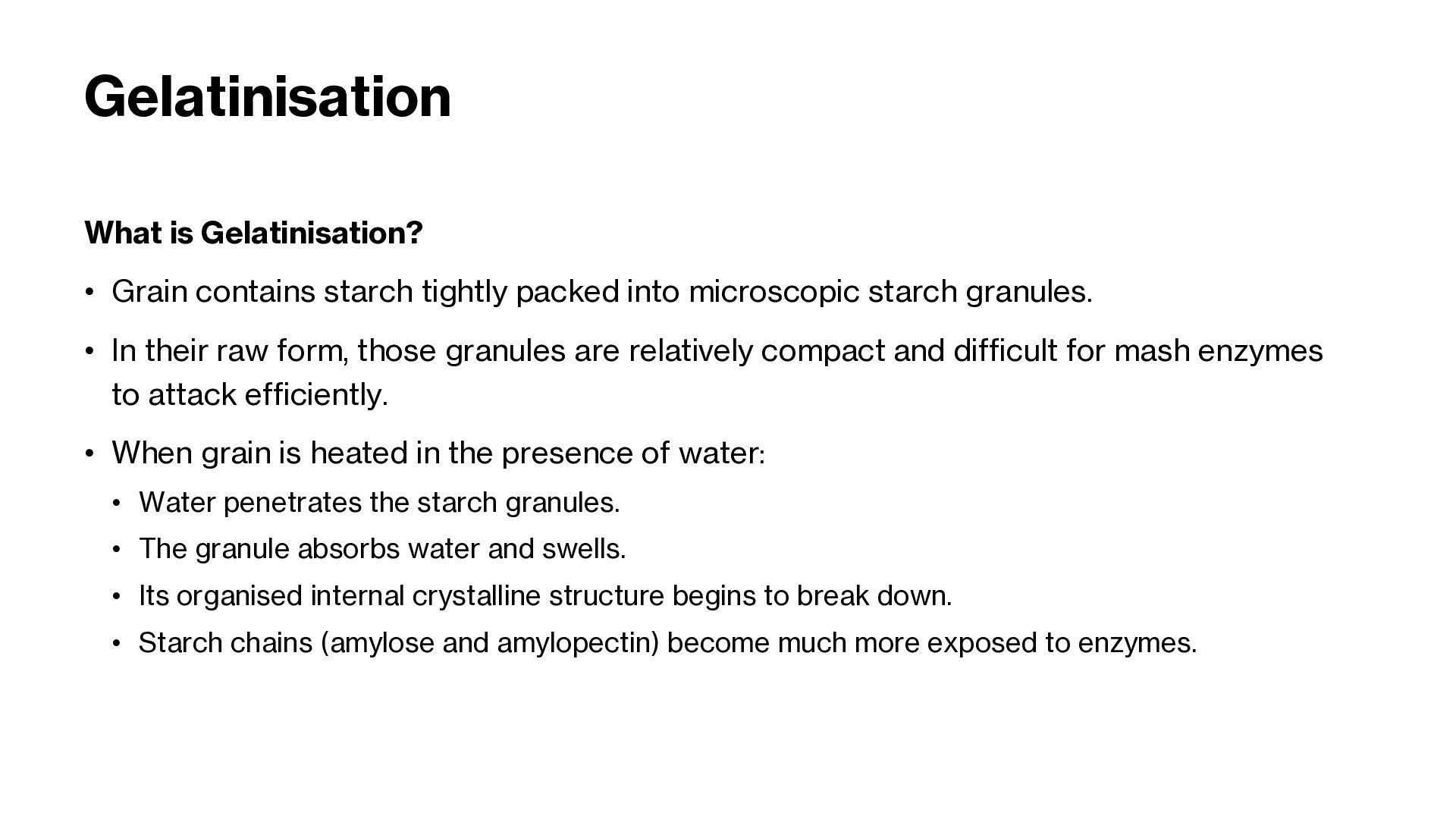
Gelatinisation What is Gelatinisation? • Grain contains starch tightly packed
into microscopic starch granules. • In their raw form, those granules are relatively compact and difficult for mash enzymes to attack efficiently. • When grain is heated in the presence of water: • Water penetrates the starch granules. • The granule absorbs water and swells. • Its organised internal crystalline structure begins to break down. • Starch chains (amylose and amylopectin) become much more exposed to enzymes. -
Gelatinisation Rates Temperature What's happening ~55–60°C Some barley granules begin
gelatinising, but a significant fraction remains resistant ~60–65°C Gelatinisation accelerates substantially ~65–69°C A very large proportion of accessible barley starch gelatinises rapidly >70°C Gelatinisation continues/completes readily. Adjuncts such as Rice, Corn need much higher temperatures to gelatinise which is why they require pre-cooking/cereal mash before being added. Flaked/Torrefied products are pre-gelatinised -
What does this have to do with Grain Crushing? •
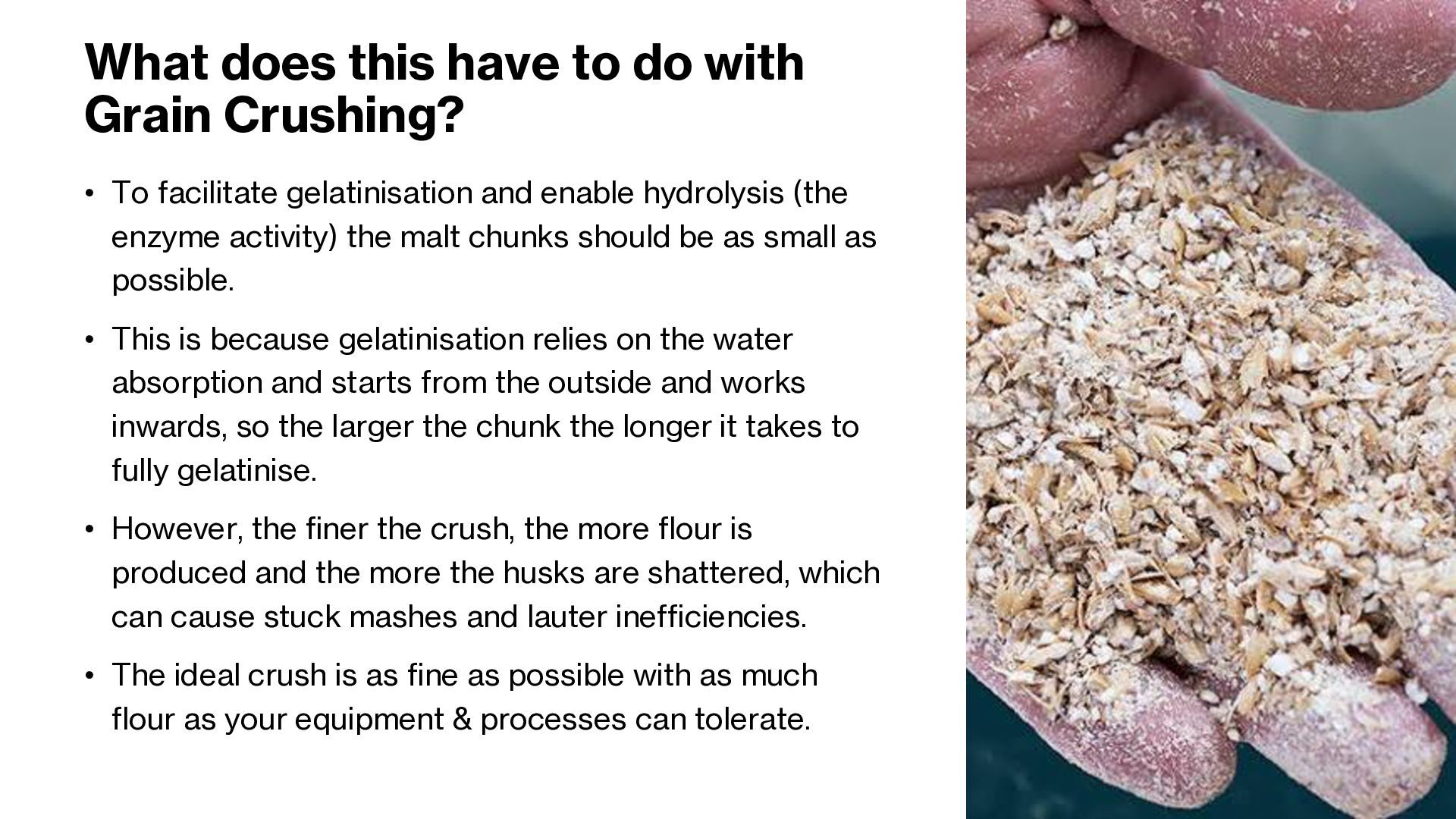
To facilitate gelatinisation and enable hydrolysis (the enzyme activity) the malt chunks should be as small as possible. • This is because gelatinisation relies on the water absorption and starts from the outside and works inwards, so the larger the chunk the longer it takes to fully gelatinise. • However, the finer the crush, the more flour is produced and the more the husks are shattered, which can cause stuck mashes and lauter inefficiencies. • The ideal crush is as fine as possible with as much flour as your equipment & processes can tolerate. -
The Goldilocks Zone • So why do we mash between
64C and 70C and why is 67C considered as the ideal temperature? • 67C just happens to be the perfect spot where gelatinisation happens rapidly, alphaamylase activity is high enough to support rapid beta-amylase access to chain ends and beta-amylase denature rate is slowed enough to still be efficient. • At lower temperatures (64-65C) gelatinisation is slowed and alpha activity reduced. • At higher temperatures (69-70C) gelatinisation isn’t significantly faster but beta activity and denature rate is negatively affected. -
Bad Attenuation • Over the summer this year, I had
3 brews in a row with significantly lower yeast attenuation than expected. • I had gotten very accurate (using brewfather) at calculating/predicting attenuation and for 10+ brews prior, had never been more than 0.001 FG out. -
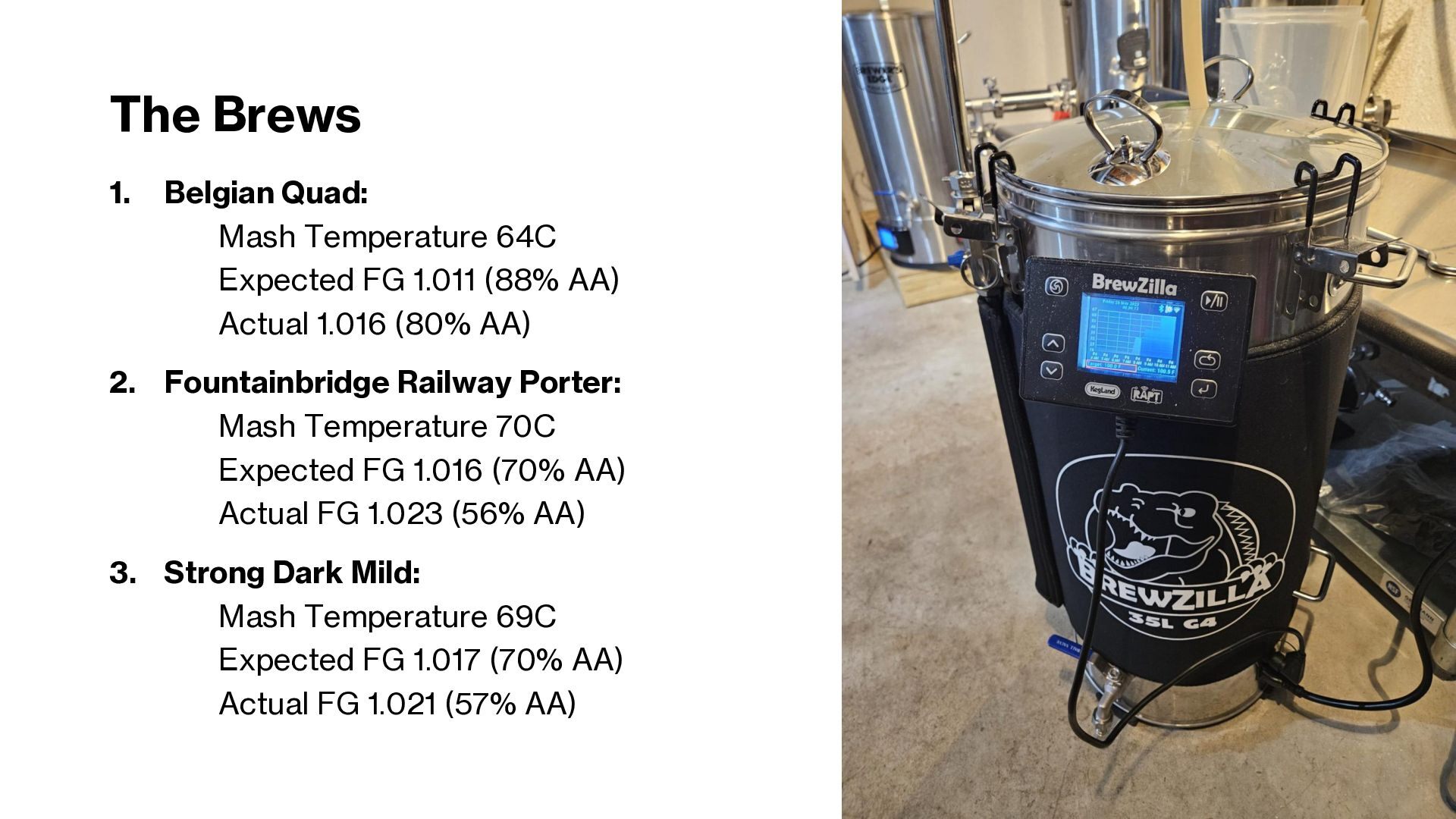
The Brews 1. Belgian Quad: Mash Temperature 64C Expected FG
1.011 (88% AA) Actual 1.016 (80% AA) 2. Fountainbridge Railway Porter: Mash Temperature 70C Expected FG 1.016 (70% AA) Actual FG 1.023 (56% AA) 3. Strong Dark Mild: Mash Temperature 69C Expected FG 1.017 (70% AA) Actual FG 1.021 (57% AA) -
Analysis • Prior to the 3rd Brew I had done
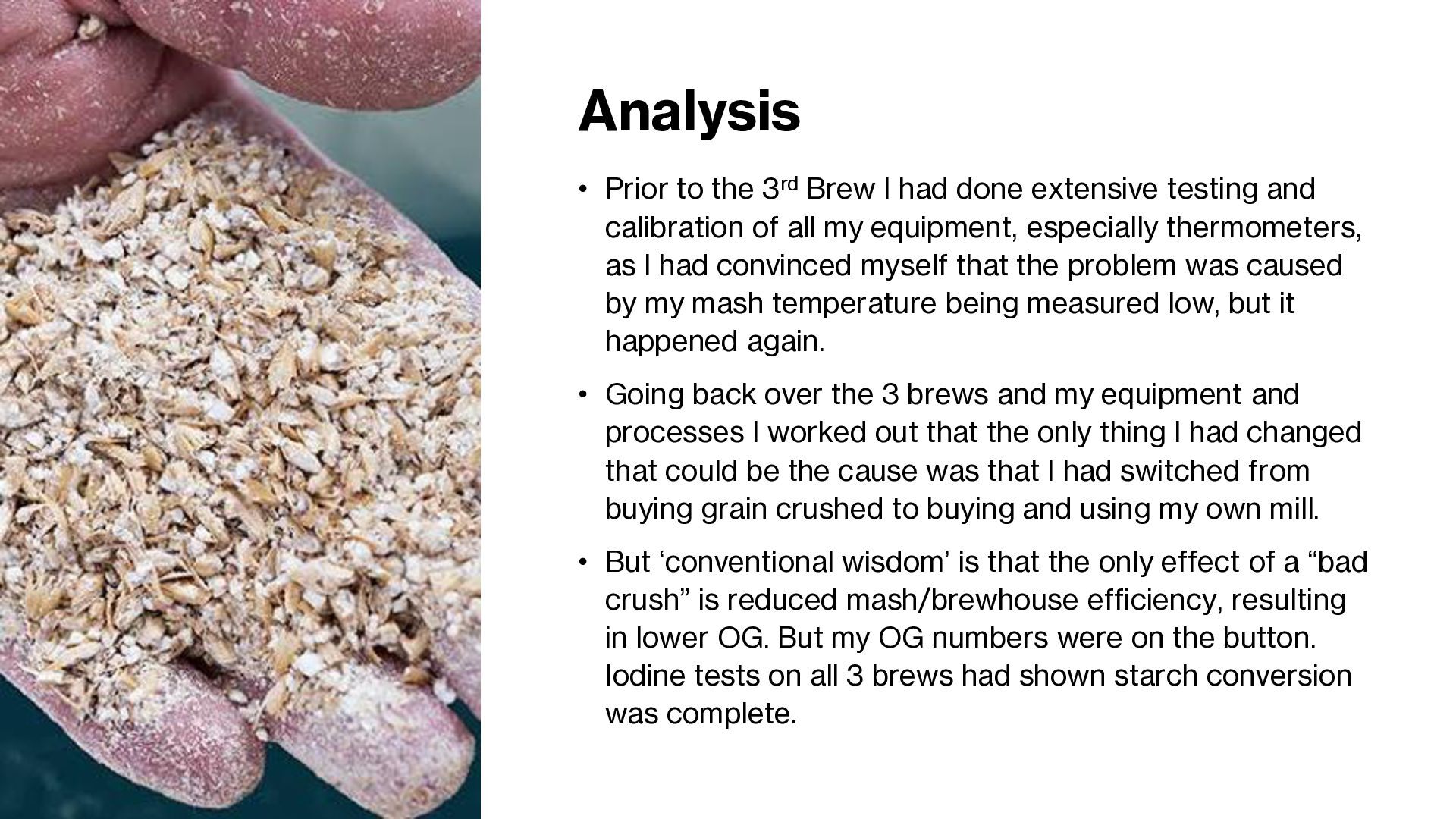
extensive testing and calibration of all my equipment, especially thermometers, as I had convinced myself that the problem was caused by my mash temperature being measured low, but it happened again. • Going back over the 3 brews and my equipment and processes I worked out that the only thing I had changed that could be the cause was that I had switched from buying grain crushed to buying and using my own mill. • But ‘conventional wisdom’ is that the only effect of a “bad crush” is reduced mash/brewhouse efficiency, resulting in lower OG. But my OG numbers were on the button. Iodine tests on all 3 brews had shown starch conversion was complete. -
Testing the theory • I had been crushing my grain
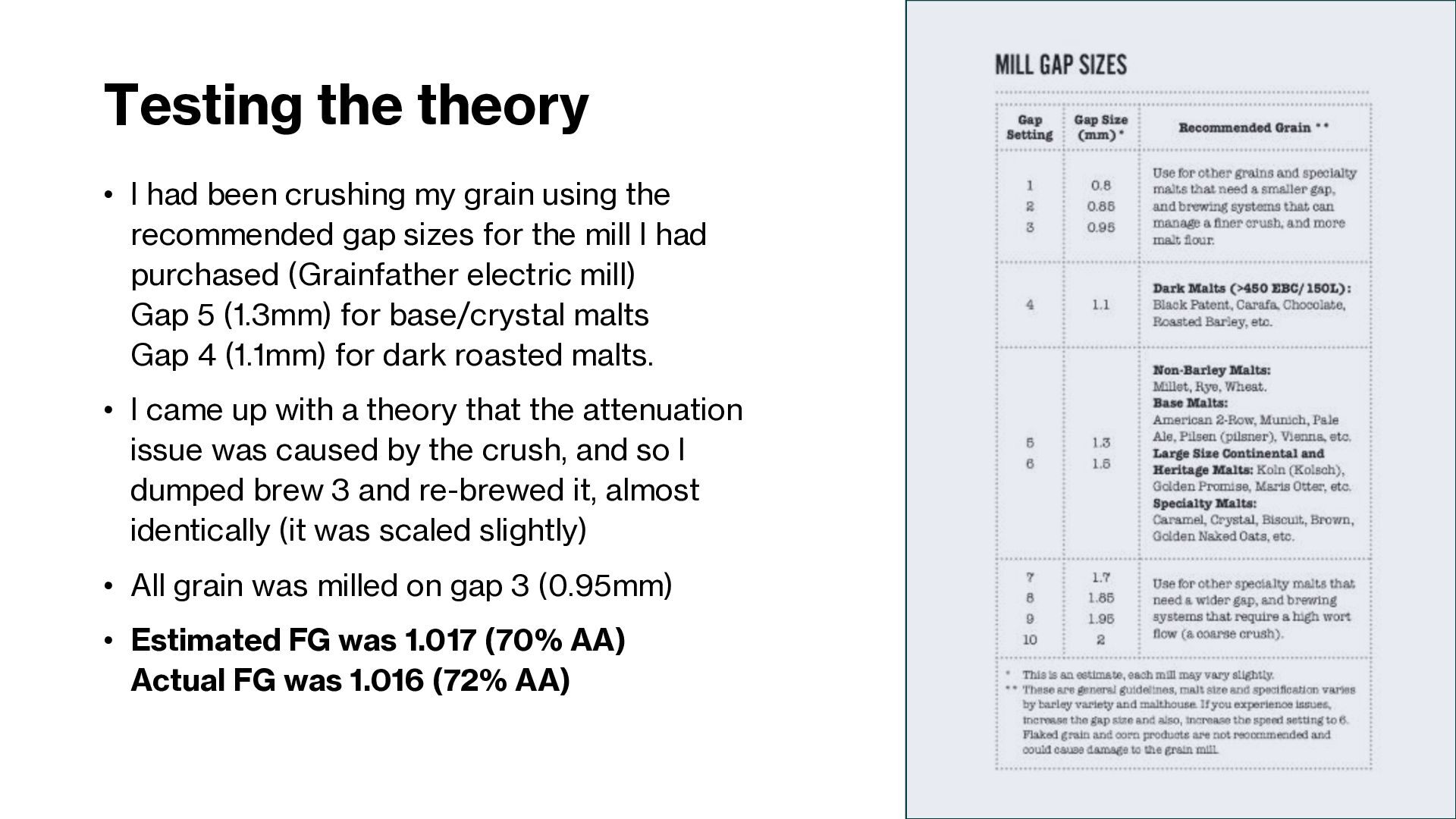
using the recommended gap sizes for the mill I had purchased (Grainfather electric mill) Gap 5 (1.3mm) for base/crystal malts Gap 4 (1.1mm) for dark roasted malts. • I came up with a theory that the attenuation issue was caused by the crush, and so I dumped brew 3 and re-brewed it, almost identically (it was scaled slightly) • All grain was milled on gap 3 (0.95mm) • Estimated FG was 1.017 (70% AA) Actual FG was 1.016 (72% AA) -
So why did the crush affect attenuation? I believe this
is an interaction between gelatinisation rate, enzyme denature rates & high/low mash temperatures. Slower gelatinisation (due to larger grain granules) means wort fermentability shifts along the time axis of the fermentability chart. -
Remember these graphs? • Notice how the fermentability of the
wort being produced at 60 minutes into the 67C graph is equivalent, in both enzyme quantity and ratio, to wort being produced 20 minutes into 70C • This is representative but true for all temperatures and times – extending gelatinisation time moves wort fermentability down as though you were mashing hotter 67C 1:1 3:1 9:1 27:1 70C 1:1 26:1 18000:1 690:1 -
Only a Theory Needs more testing I believe the reason
this isn’t a well-known phenomenon is because it only causes significant attenuation issues at the extreme ends of the mash temperature range. I think that at 66-68C the rapid gelatinisation combined with the more reasonable denature rates means the fermentability/attenuation isn’t significantly reduced and I might not have noticed it if I wasn’t mashing at 70C where the effect is more pronounced. So far, the only evidence I have is 3 brews with reduced attenuation and 4 brews (since changing crush gap) with close to expected attenuation. This is not statistically significant and within the possibility that it could be coincidental. I plan further split batch testing where the only difference is crush gap, which will serve as better proof, however this is difficult with my setup/space – so still working on a process for that.