Upgrade to Pro — share decks privately, control downloads, hide ads and more …

Startup Research : Challenges and solutions for...

Startup Research : Challenges and solutions for female startup founders in Japan

Avatar for MPower Partners

MPower Partners PRO

January 14, 2026
Tweet

More Decks by MPower Partners

Other Decks in Business

Transcript

  1. 0 Copyright © 2026 by MPower Partners. All rights reserved.

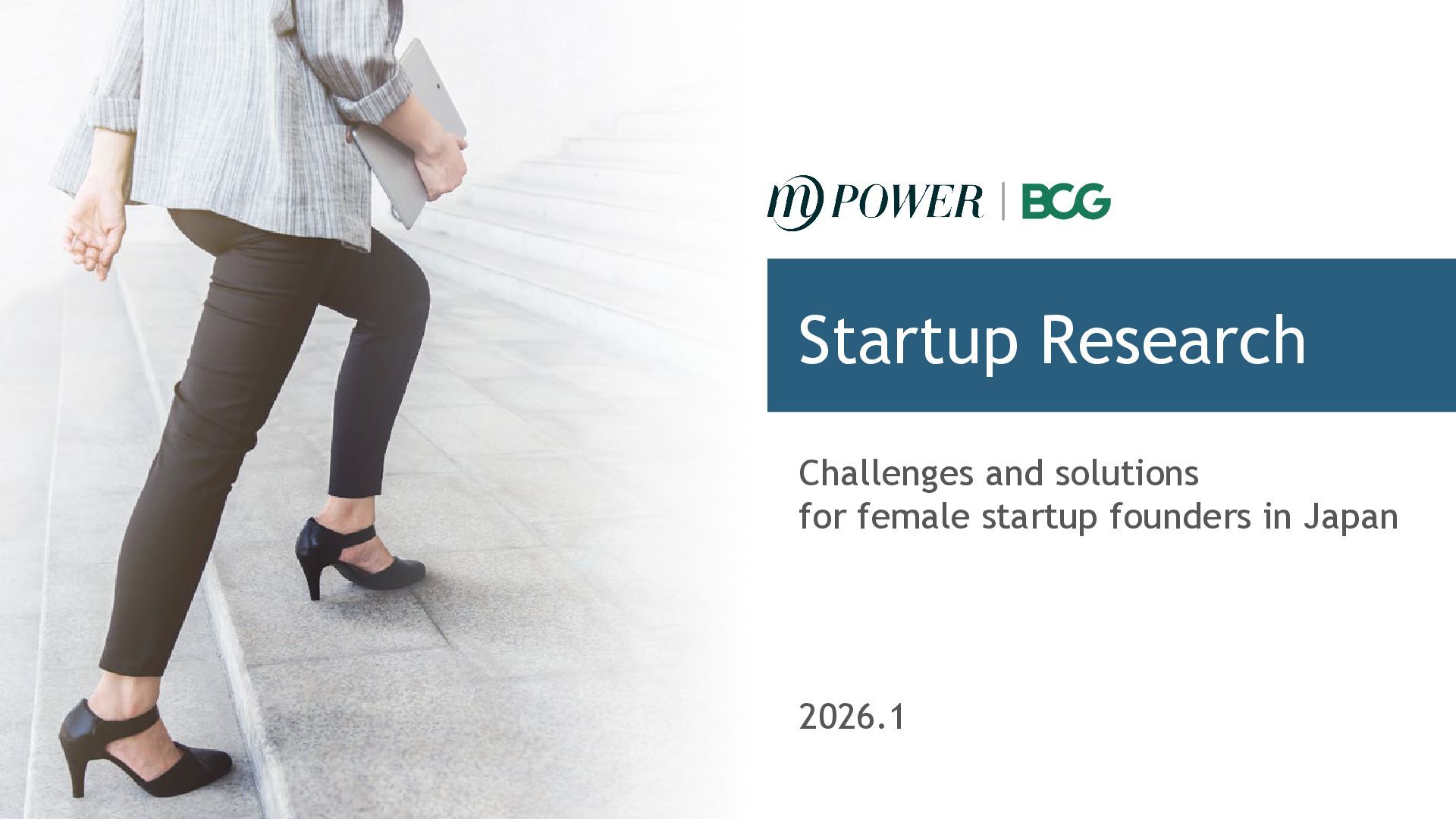
    Startup Research Challenges and solutions for female startup founders in Japan 2026.1
  2. Copyright © 2026 by MPower Partners. All rights reserved. 1

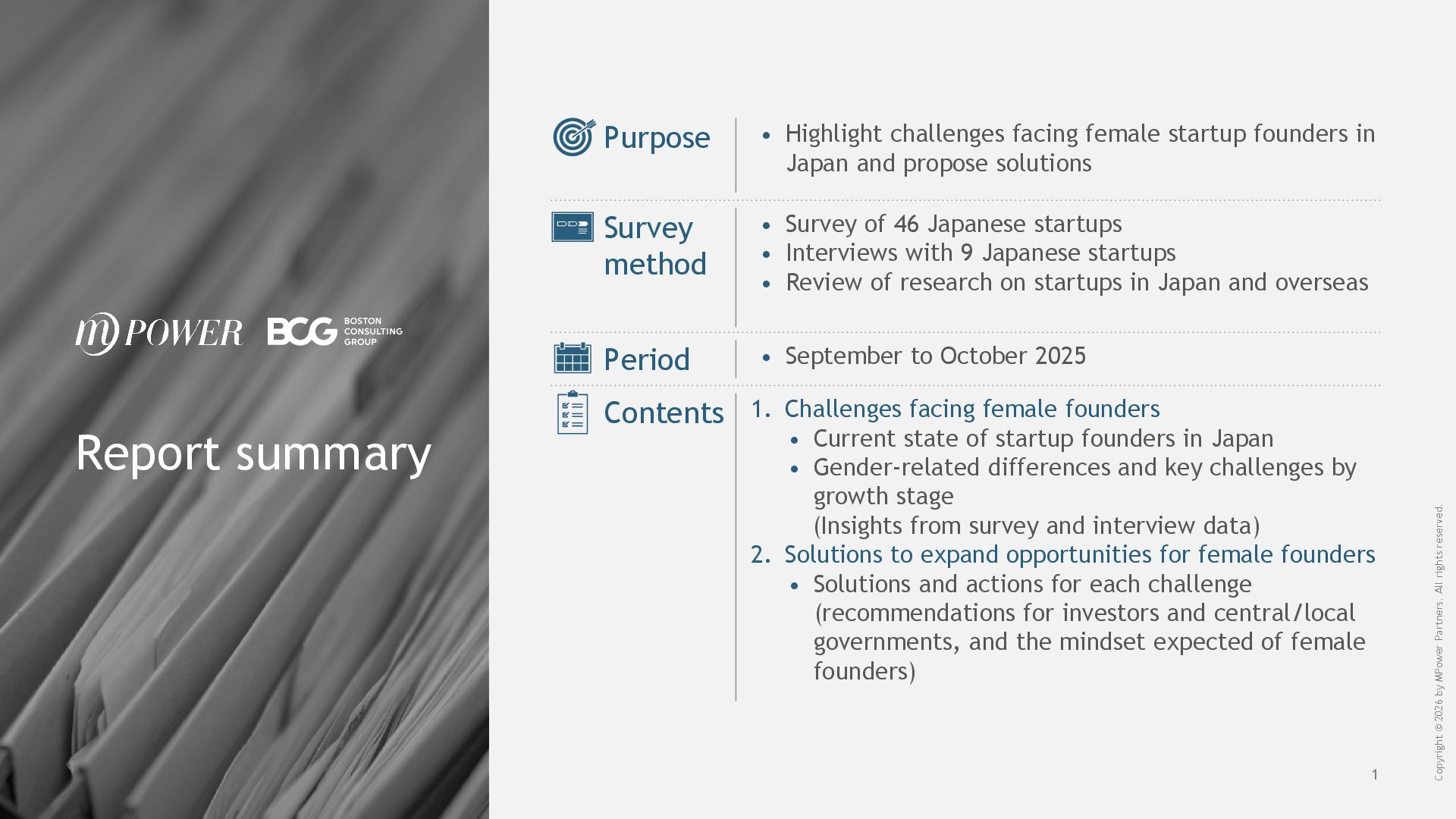
    Report summary Purpose • Highlight challenges facing female startup founders in Japan and propose solutions Survey method • Survey of 46 Japanese startups • Interviews with 9 Japanese startups • Review of research on startups in Japan and overseas Period • September to October 2025 1. Challenges facing female founders • Current state of startup founders in Japan • Gender-related differences and key challenges by growth stage (Insights from survey and interview data) 2. Solutions to expand opportunities for female founders • Solutions and actions for each challenge (recommendations for investors and central/local governments, and the mindset expected of female founders) Contents
  3. 2 Copyright © 2026 by MPower Partners. All rights reserved.

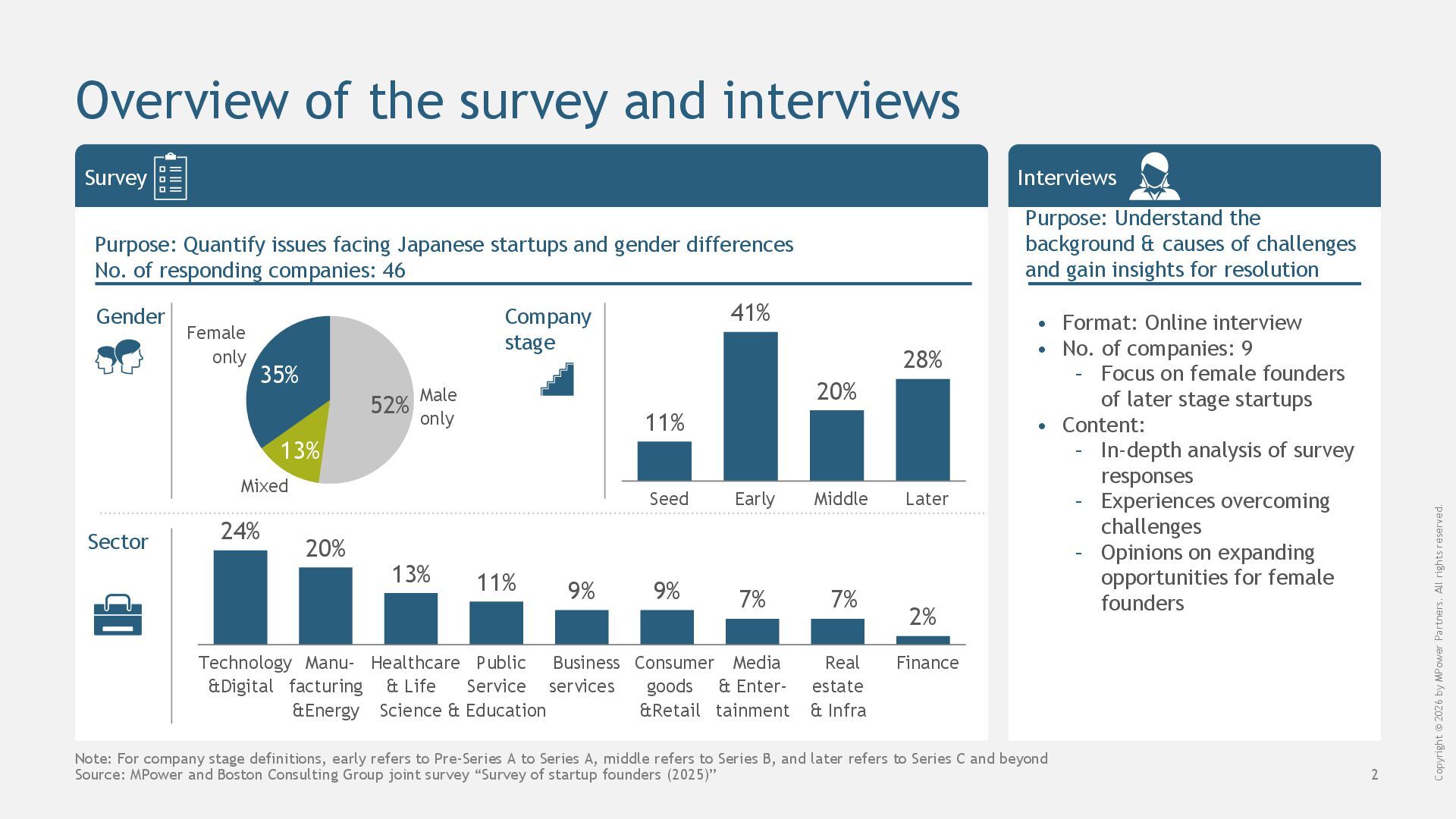
    Purpose: Quantify issues facing Japanese startups and gender differences No. of responding companies: 46 Purpose: Understand the background & causes of challenges and gain insights for resolution • Format: Online interview • No. of companies: 9 – Focus on female founders of later stage startups • Content: – In-depth analysis of survey responses – Experiences overcoming challenges – Opinions on expanding opportunities for female founders Technology &Digital Manu- facturing &Energy Healthcare & Life Science Public Service & Education Business services Consumer goods &Retail Media & Enter- tainment Real estate & Infra Finance 24% 20% 13% 11% 9% 9% 7% 7% 2% 52% 13% 35% Male only Mixed Female only Sector Gender Company stage Seed Early Middle Later 11% 41% 20% 28% Overview of the survey and interviews Note: For company stage definitions, early refers to Pre-Series A to Series A, middle refers to Series B, and later refers to Series C and beyond Source: MPower and Boston Consulting Group joint survey “Survey of startup founders (2025)” Survey Interviews
  4. Copyright © 2026 by MPower Partners. All rights reserved. 3

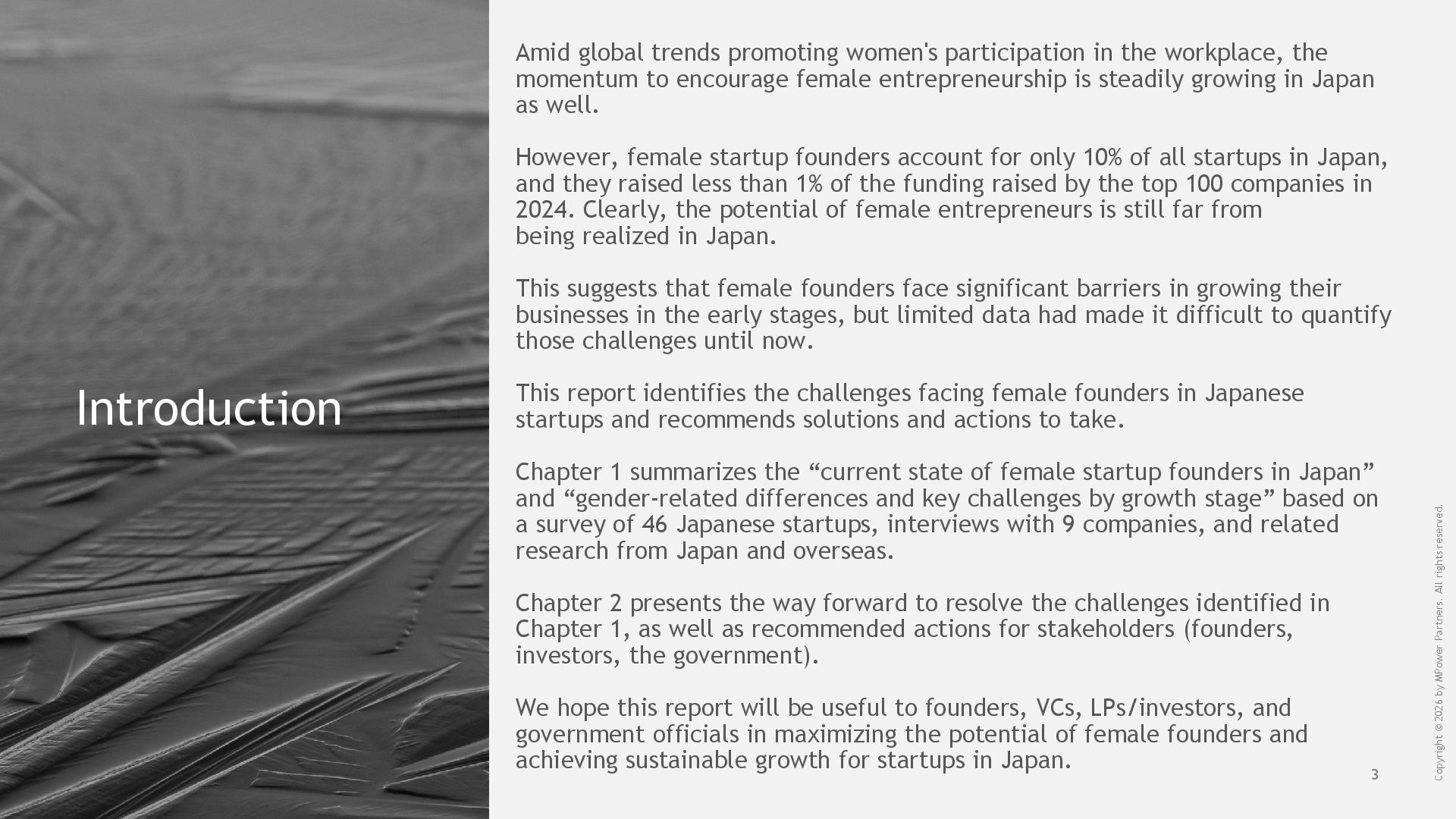
    Introduction Amid global trends promoting women's participation in the workplace, the momentum to encourage female entrepreneurship is steadily growing in Japan as well. However, female startup founders account for only 10% of all startups in Japan, and they raised less than 1% of the funding raised by the top 100 companies in 2024. Clearly, the potential of female entrepreneurs is still far from being realized in Japan. This suggests that female founders face significant barriers in growing their businesses in the early stages, but limited data had made it difficult to quantify those challenges until now. This report identifies the challenges facing female founders in Japanese startups and recommends solutions and actions to take. Chapter 1 summarizes the “current state of female startup founders in Japan” and “gender-related differences and key challenges by growth stage” based on a survey of 46 Japanese startups, interviews with 9 companies, and related research from Japan and overseas. Chapter 2 presents the way forward to resolve the challenges identified in Chapter 1, as well as recommended actions for stakeholders (founders, investors, the government). We hope this report will be useful to founders, VCs, LPs/investors, and government officials in maximizing the potential of female founders and achieving sustainable growth for startups in Japan.
  5. 4 Copyright © 2026 by MPower Partners. All rights reserved.

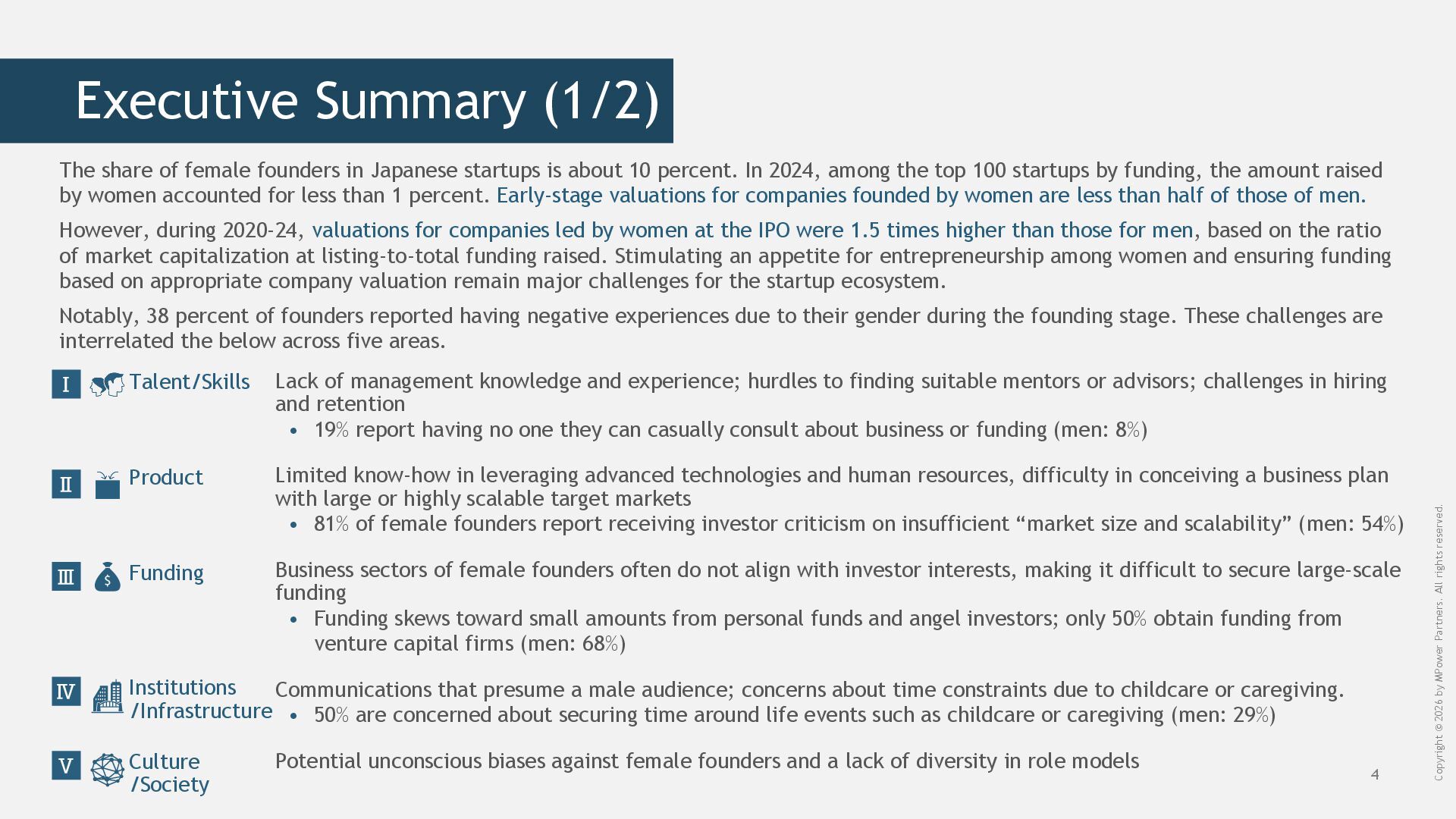
    Executive Summary (1/2) The share of female founders in Japanese startups is about 10 percent. In 2024, among the top 100 startups by funding, the amount raised by women accounted for less than 1 percent. Early-stage valuations for companies founded by women are less than half of those of men. However, during 2020-24, valuations for companies led by women at the IPO were 1.5 times higher than those for men, based on the ratio of market capitalization at listing-to-total funding raised. Stimulating an appetite for entrepreneurship among women and ensuring funding based on appropriate company valuation remain major challenges for the startup ecosystem. Notably, 38 percent of founders reported having negative experiences due to their gender during the founding stage. These challenges are interrelated the below across five areas. Ⅰ Ⅱ Ⅲ Ⅳ Ⅴ Lack of management knowledge and experience; hurdles to finding suitable mentors or advisors; challenges in hiring and retention • 19% report having no one they can casually consult about business or funding (men: 8%) Limited know-how in leveraging advanced technologies and human resources, difficulty in conceiving a business plan with large or highly scalable target markets • 81% of female founders report receiving investor criticism on insufficient “market size and scalability” (men: 54%) Business sectors of female founders often do not align with investor interests, making it difficult to secure large-scale funding • Funding skews toward small amounts from personal funds and angel investors; only 50% obtain funding from venture capital firms (men: 68%) Communications that presume a male audience; concerns about time constraints due to childcare or caregiving. • 50% are concerned about securing time around life events such as childcare or caregiving (men: 29%) Potential unconscious biases against female founders and a lack of diversity in role models Product Funding Institutions /Infrastructure Culture /Society Talent/Skills
  6. 5 Copyright © 2026 by MPower Partners. All rights reserved.

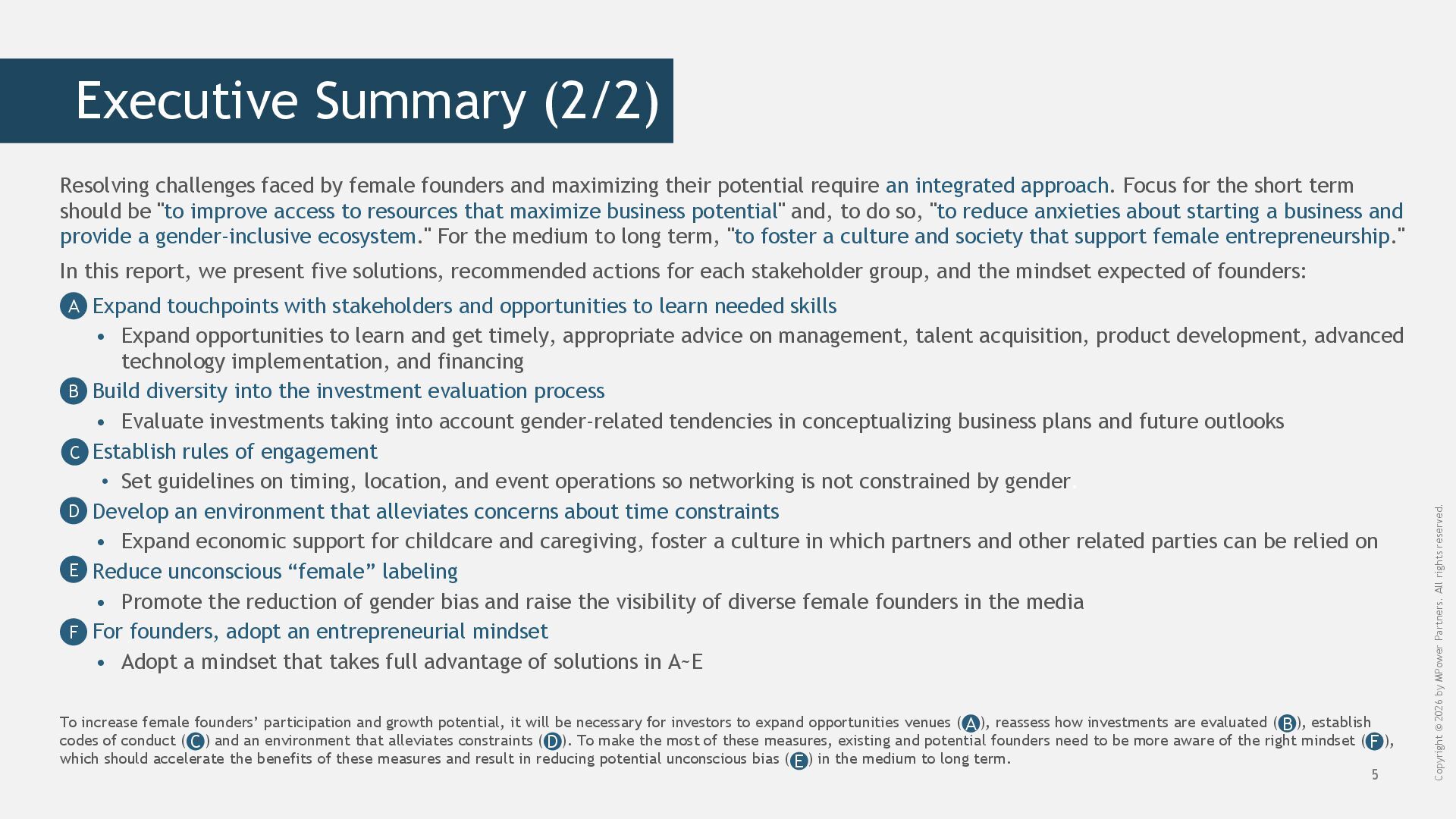
    Executive Summary (2/2) Resolving challenges faced by female founders and maximizing their potential require an integrated approach. Focus for the short term should be "to improve access to resources that maximize business potential" and, to do so, "to reduce anxieties about starting a business and provide a gender-inclusive ecosystem." For the medium to long term, "to foster a culture and society that support female entrepreneurship." In this report, we present five solutions, recommended actions for each stakeholder group, and the mindset expected of founders: Expand touchpoints with stakeholders and opportunities to learn needed skills • Expand opportunities to learn and get timely, appropriate advice on management, talent acquisition, product development, advanced technology implementation, and financing Build diversity into the investment evaluation process • Evaluate investments taking into account gender-related tendencies in conceptualizing business plans and future outlooks Establish rules of engagement • Set guidelines on timing, location, and event operations so networking is not constrained by gender. Develop an environment that alleviates concerns about time constraints • Expand economic support for childcare and caregiving, foster a culture in which partners and other related parties can be relied on Reduce unconscious “female” labeling • Promote the reduction of gender bias and raise the visibility of diverse female founders in the media For founders, adopt an entrepreneurial mindset • Adopt a mindset that takes full advantage of solutions in A~E To increase female founders’ participation and growth potential, it will be necessary for investors to expand opportunities venues ( ), reassess how investments are evaluated ( ), establish codes of conduct ( ) and an environment that alleviates constraints ( ). To make the most of these measures, existing and potential founders need to be more aware of the right mindset ( ), which should accelerate the benefits of these measures and result in reducing potential unconscious bias ( ) in the medium to long term. A B C D E F A B D E F C
  7. 6 Copyright © 2026 by MPower Partners. All rights reserved.

    Contents Challenges facing female founders 1 2 6 Solutions to expand opportunities for female founders • Current state of startup founders in Japan • Gender-related differences and key challenges by growth stage (Insights from survey and interview data) • Solutions and actions for each challenge (recommendations for investors and central/local governments, and the mindset expected of female founders) Copyright © 2026 by MPower Partners. All rights reserved.
  8. 7 Copyright © 2026 by MPower Partners. All rights reserved.

    Contents Challenges facing female founders 1 7 Solutions to expand opportunities for female founders • Current state of startup founders in Japan • Gender-related differences and key challenges by growth stage (Insights from survey and interview data) Copyright © 2026 by MPower Partners. All rights reserved. 2 • Solutions and actions for each challenge (recommendations for investors and central/local governments, and the mindset expected of female founders)
  9. 8 Copyright © 2026 by MPower Partners. All rights reserved.

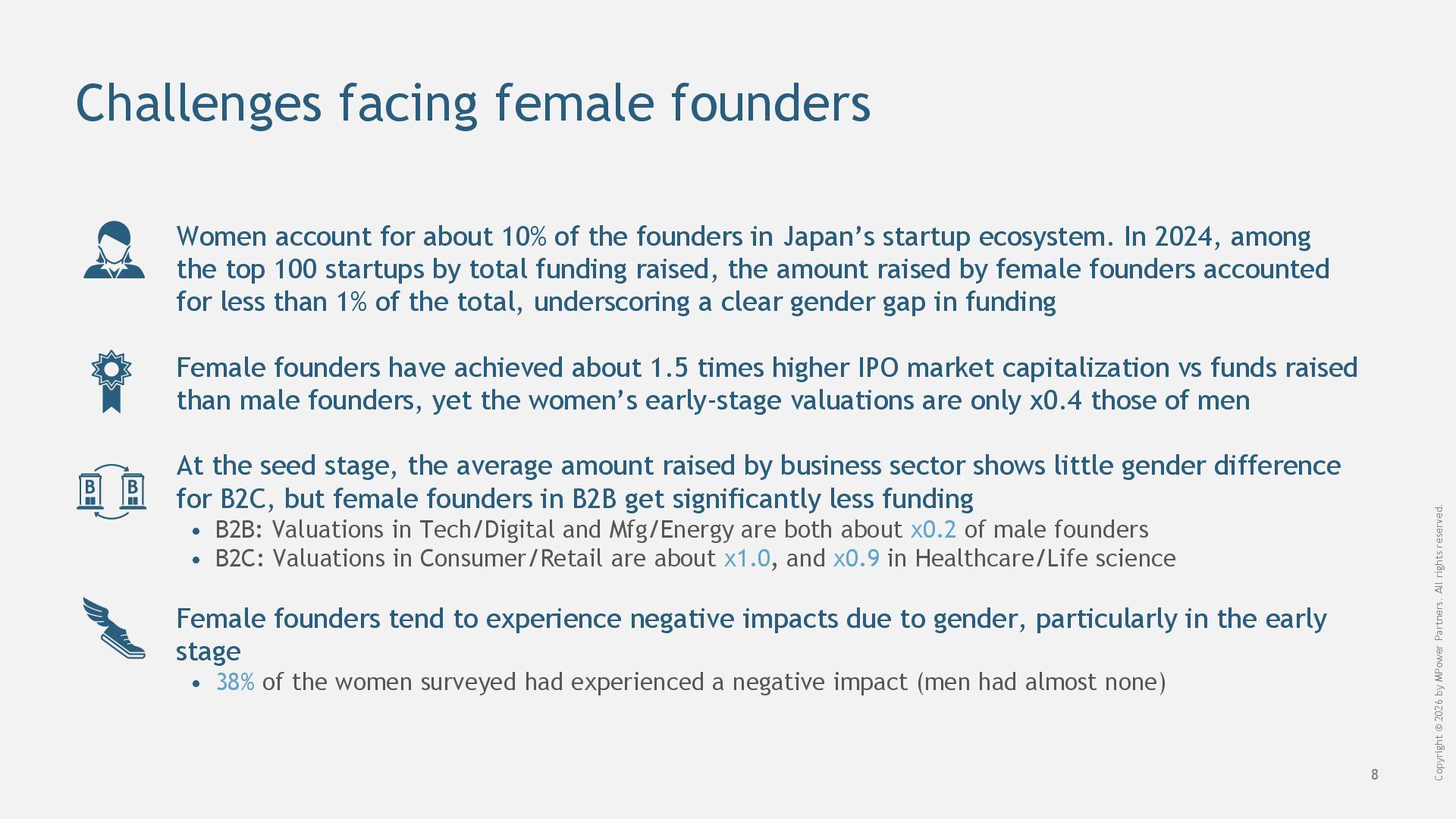
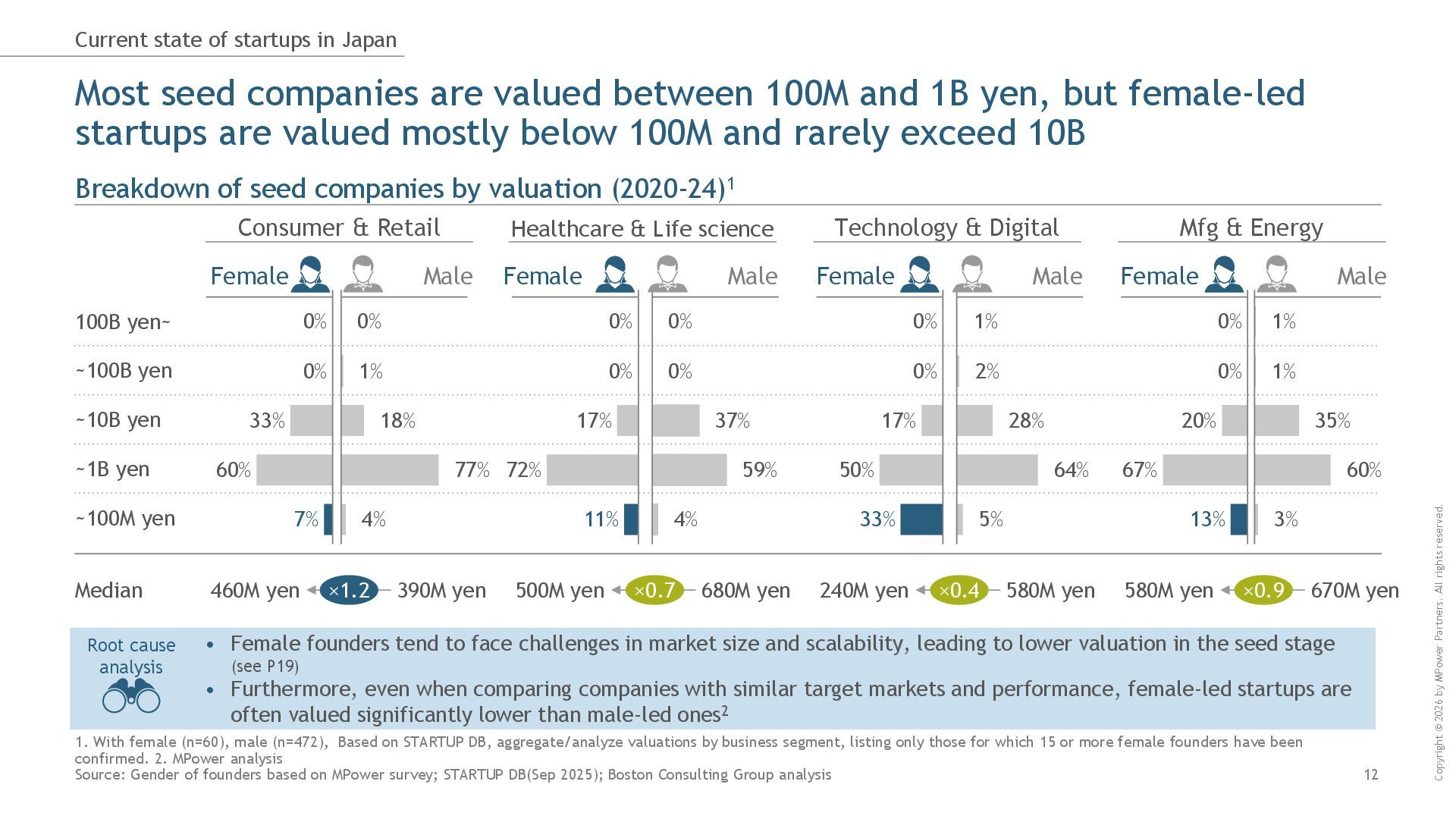
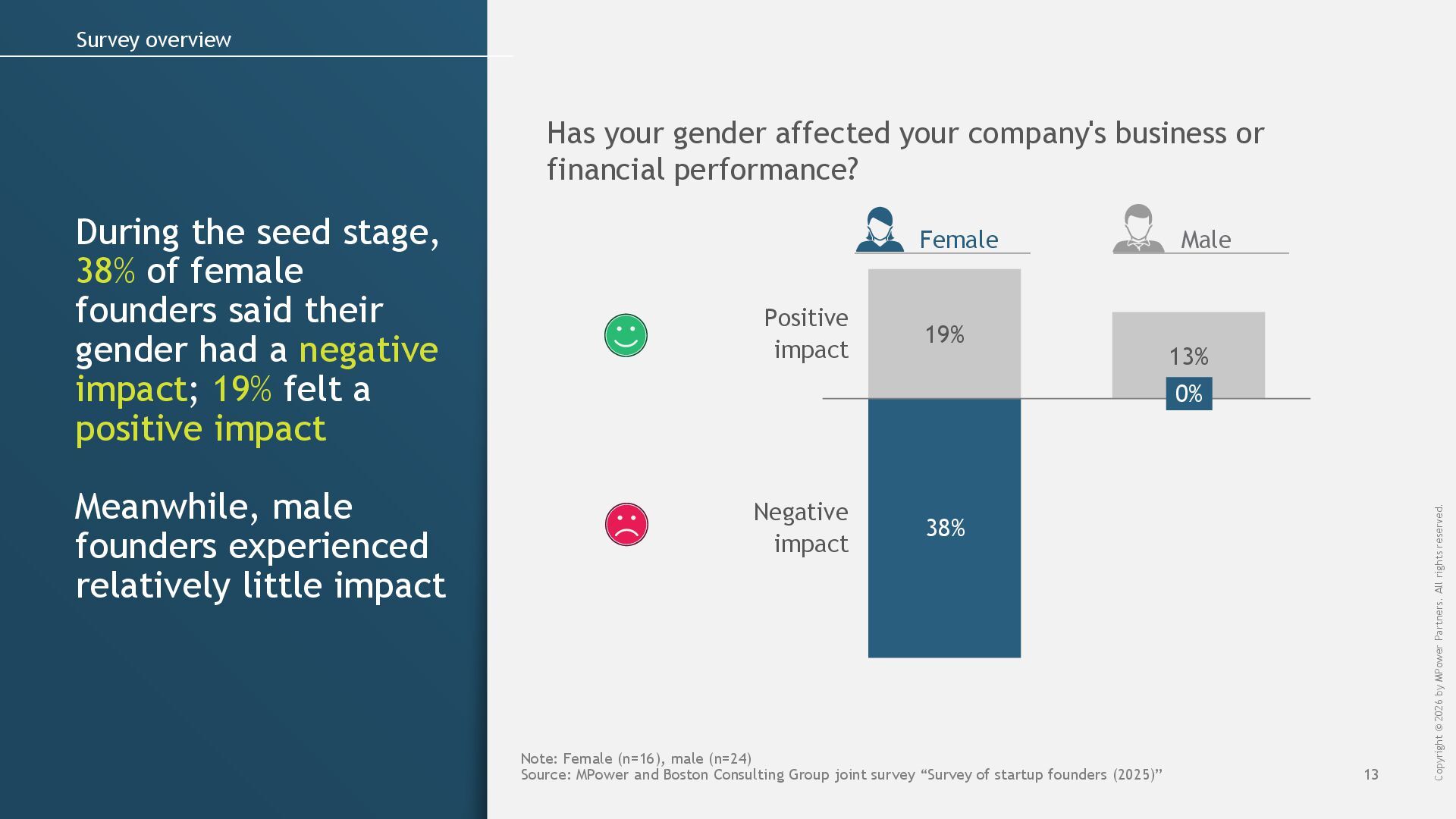
    Challenges facing female founders Women account for about 10% of the founders in Japan’s startup ecosystem. In 2024, among the top 100 startups by total funding raised, the amount raised by female founders accounted for less than 1% of the total, underscoring a clear gender gap in funding Female founders have achieved about 1.5 times higher IPO market capitalization vs funds raised than male founders, yet the women’s early-stage valuations are only x0.4 those of men At the seed stage, the average amount raised by business sector shows little gender difference for B2C, but female founders in B2B get significantly less funding • B2B: Valuations in Tech/Digital and Mfg/Energy are both about x0.2 of male founders • B2C: Valuations in Consumer/Retail are about x1.0, and x0.9 in Healthcare/Life science Female founders tend to experience negative impacts due to gender, particularly in the early stage • 38% of the women surveyed had experienced a negative impact (men had almost none)
  10. 9 Copyright © 2026 by MPower Partners. All rights reserved.

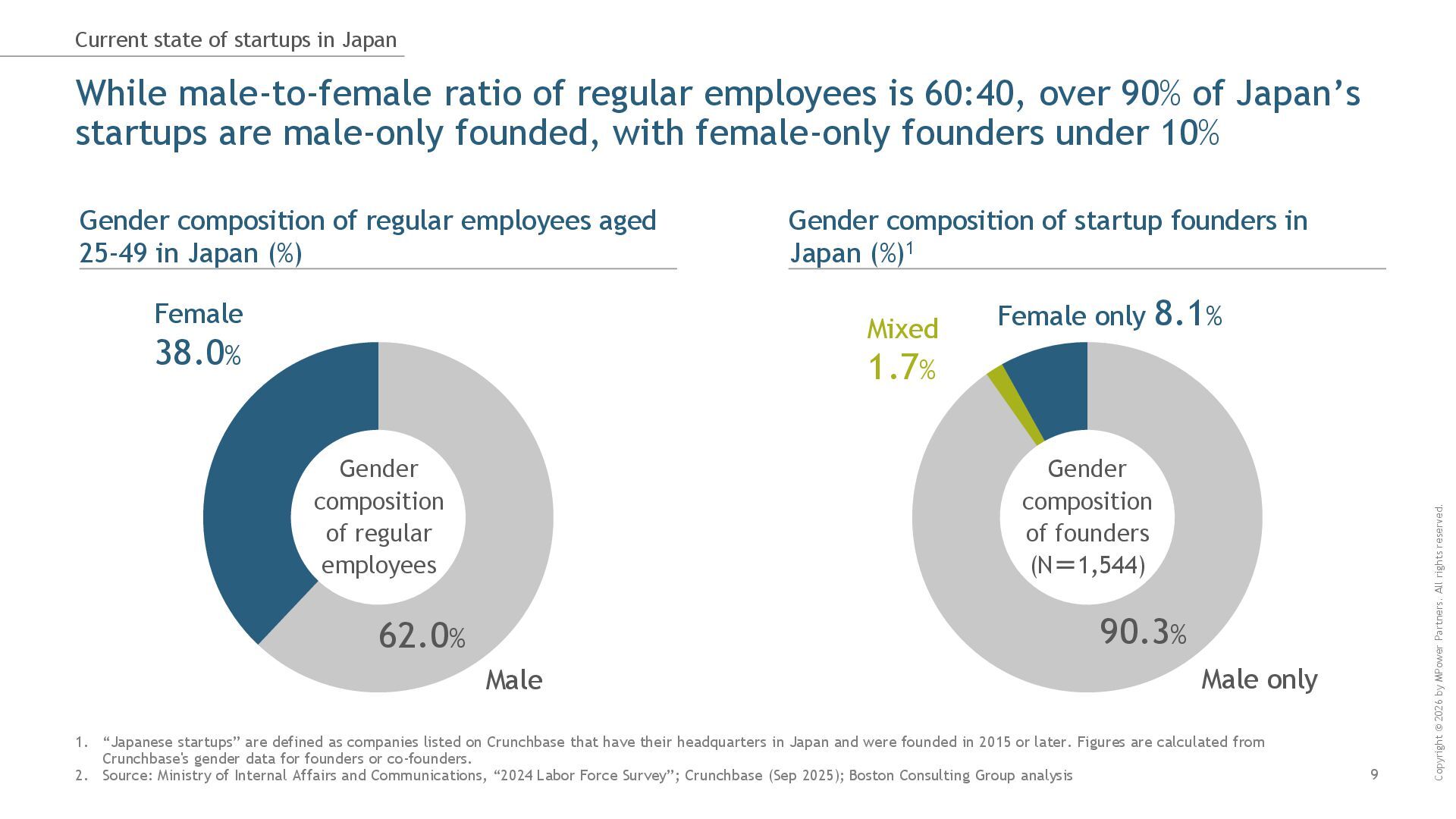
    While male-to-female ratio of regular employees is 60:40, over 90% of Japan’s startups are male-only founded, with female-only founders under 10% Current state of startups in Japan 1. “Japanese startups” are defined as companies listed on Crunchbase that have their headquarters in Japan and were founded in 2015 or later. Figures are calculated from Crunchbase's gender data for founders or co-founders. 2. Source: Ministry of Internal Affairs and Communications, “2024 Labor Force Survey”; Crunchbase (Sep 2025); Boston Consulting Group analysis 90.3% Male only Gender composition of regular employees aged 25-49 in Japan (%) Gender composition of startup founders in Japan (%)1 Female 38.0% Male 62.0% Female only 8.1% Mixed 1.7% Gender composition of regular employees Gender composition of founders (N=1,544)
  11. 10 Copyright © 2026 by MPower Partners. All rights reserved.

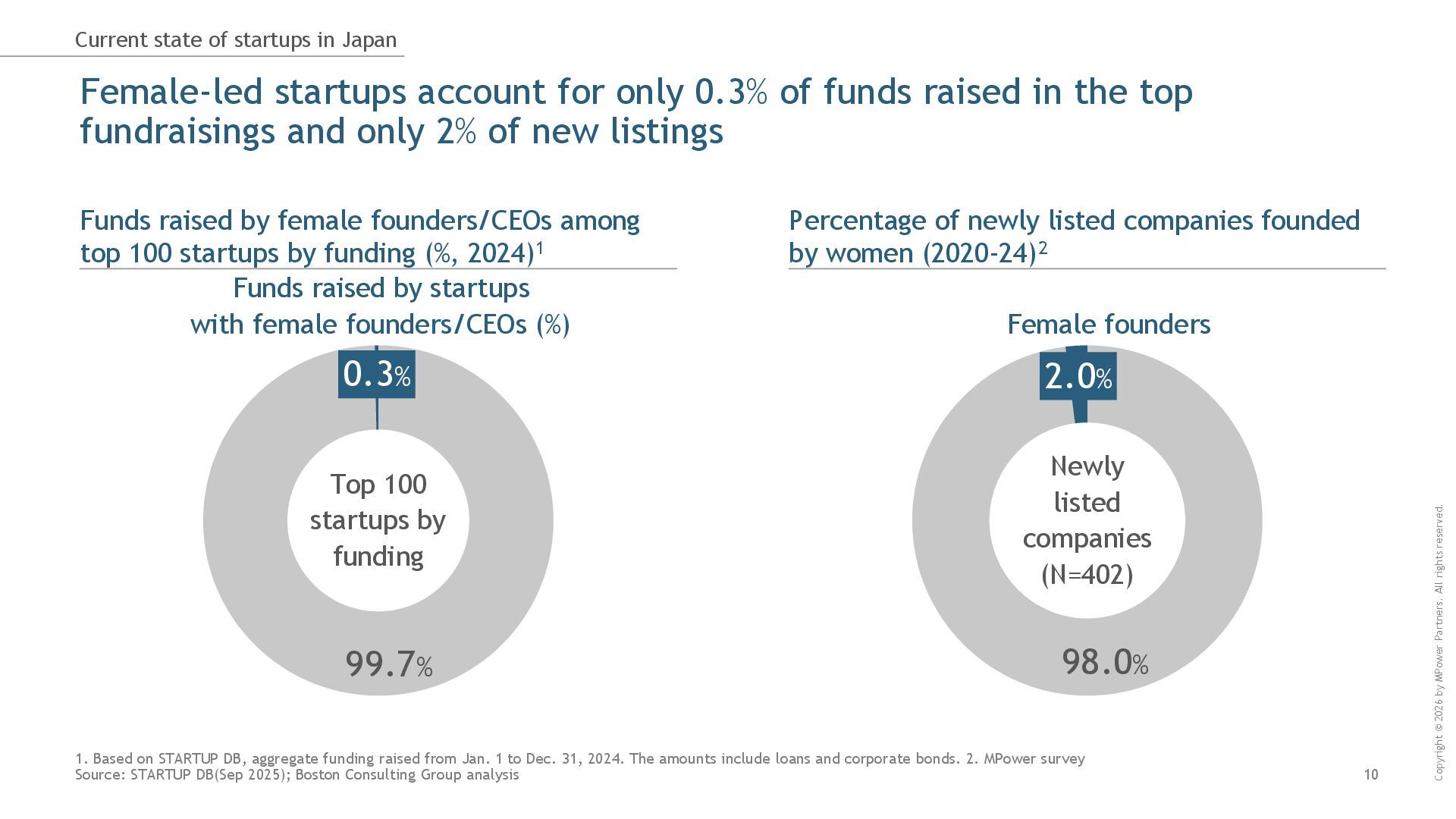
    1. Based on STARTUP DB, aggregate funding raised from Jan. 1 to Dec. 31, 2024. The amounts include loans and corporate bonds. 2. MPower survey Source: STARTUP DB(Sep 2025); Boston Consulting Group analysis Female-led startups account for only 0.3% of funds raised in the top fundraisings and only 2% of new listings Current state of startups in Japan 99.7% 0.3% Funds raised by startups with female founders/CEOs (%) Top 100 startups by funding 98.0% 2.0% Female founders Newly listed companies (N=402) Funds raised by female founders/CEOs among top 100 startups by funding (%, 2024)1 Percentage of newly listed companies founded by women (2020-24)2
  12. 11 Copyright © 2026 by MPower Partners. All rights reserved.

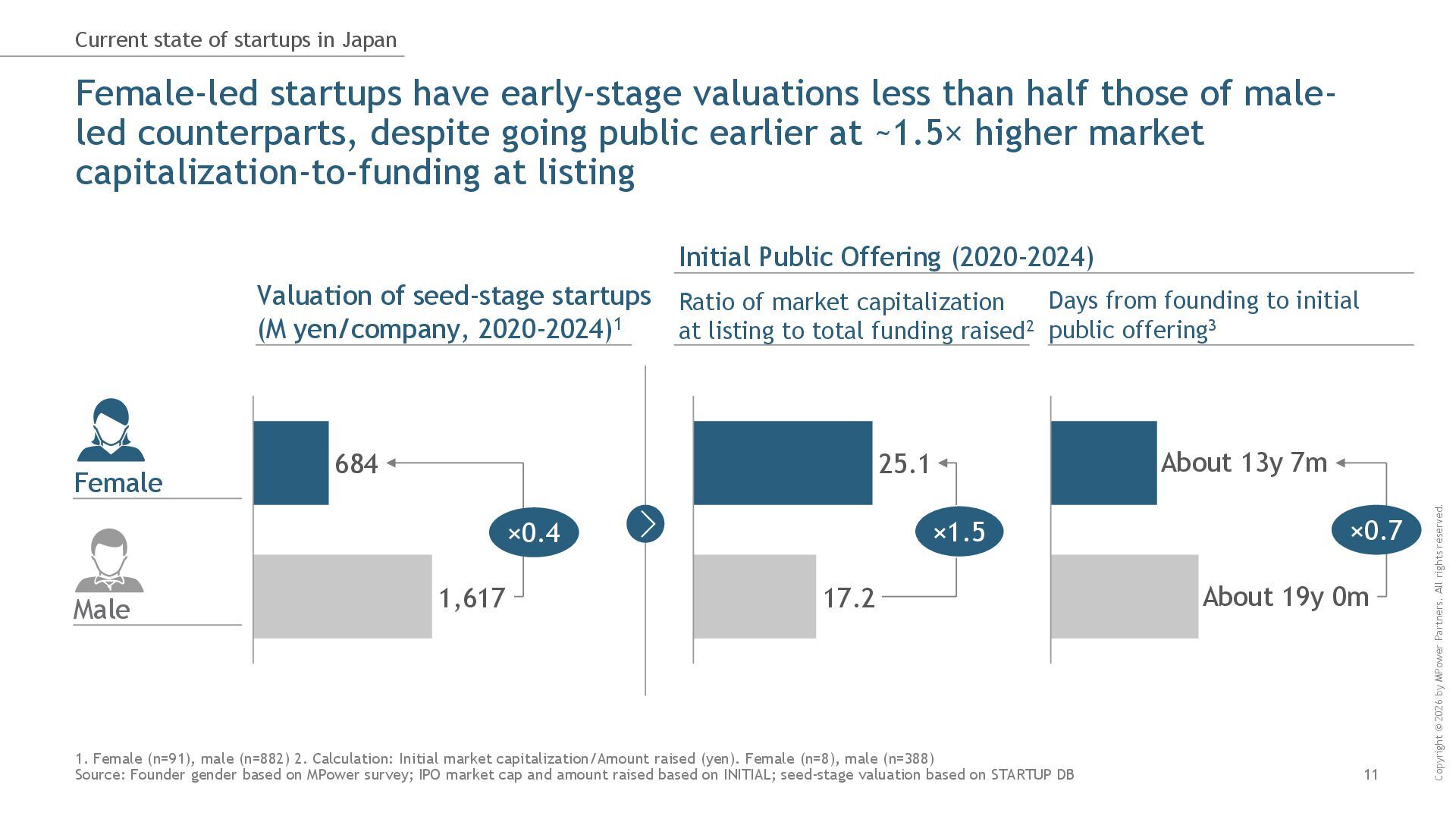
    Female-led startups have early-stage valuations less than half those of male- led counterparts, despite going public earlier at ~1.5× higher market capitalization-to-funding at listing 25.1 17.2 684 1,617 1. Female (n=91), male (n=882) 2. Calculation: Initial market capitalization/Amount raised (yen). Female (n=8), male (n=388) Source: Founder gender based on MPower survey; IPO market cap and amount raised based on INITIAL; seed-stage valuation based on STARTUP DB Current state of startups in Japan Female Male About 13y 7m About 19y 0m Valuation of seed-stage startups (M yen/company, 2020-2024)1 Initial Public Offering (2020-2024) Ratio of market capitalization at listing to total funding raised2 Days from founding to initial public offering3 ×0.4 ×1.5 ×0.7
  13. 12 Copyright © 2026 by MPower Partners. All rights reserved.

    0% 0% 33% 60% 7% 0% 1% 18% 77% 4% 0% 0% 17% 72% 11% 0% 0% 37% 59% 4% 0% 0% 17% 50% 33% 1% 2% 28% 64% 5% 0% 0% 20% 67% 13% 1% 1% 35% 60% 3% 100B yen~ ~100B yen ~10B yen ~1B yen ~100M yen 1. With female (n=60), male (n=472), Based on STARTUP DB, aggregate/analyze valuations by business segment, listing only those for which 15 or more female founders have been confirmed. 2. MPower analysis Source: Gender of founders based on MPower survey; STARTUP DB(Sep 2025); Boston Consulting Group analysis Most seed companies are valued between 100M and 1B yen, but female-led startups are valued mostly below 100M and rarely exceed 10B Current state of startups in Japan Median 460M yen 390M yen 500M yen 680M yen 240M yen 580M yen 580M yen 670M yen • Female founders tend to face challenges in market size and scalability, leading to lower valuation in the seed stage (see P19) • Furthermore, even when comparing companies with similar target markets and performance, female-led startups are often valued significantly lower than male-led ones2 ×1.2 Breakdown of seed companies by valuation (2020-24)1 Consumer & Retail Healthcare & Life science Technology & Digital Mfg & Energy Male Female ×0.7 ×0.4 ×0.9 Root cause analysis Male Female Male Female Male Female
  14. Copyright © 2026 by MPower Partners. All rights reserved. 13

    During the seed stage, 38% of female founders said their gender had a negative impact; 19% felt a positive impact Meanwhile, male founders experienced relatively little impact Has your gender affected your company's business or financial performance? 19% 13% 38% 0% Positive impact Negative impact Note: Female (n=16), male (n=24) Source: MPower and Boston Consulting Group joint survey “Survey of startup founders (2025)” Female Male Survey overview
  15. 14 Copyright © 2026 by MPower Partners. All rights reserved.

    Contents Challenges facing female founders 1 14 Solutions to expand opportunities for female founders • Current state of startup founders in Japan • Gender-related differences and key challenges by growth stage (Insights from survey and interview data) • Solutions and actions for each challenge (recommendations for investors and central/local governments, and the mindset expected of female founders) Copyright © 2026 by MPower Partners. All rights reserved. 2
  16. 15 Copyright © 2026 by MPower Partners. All rights reserved.

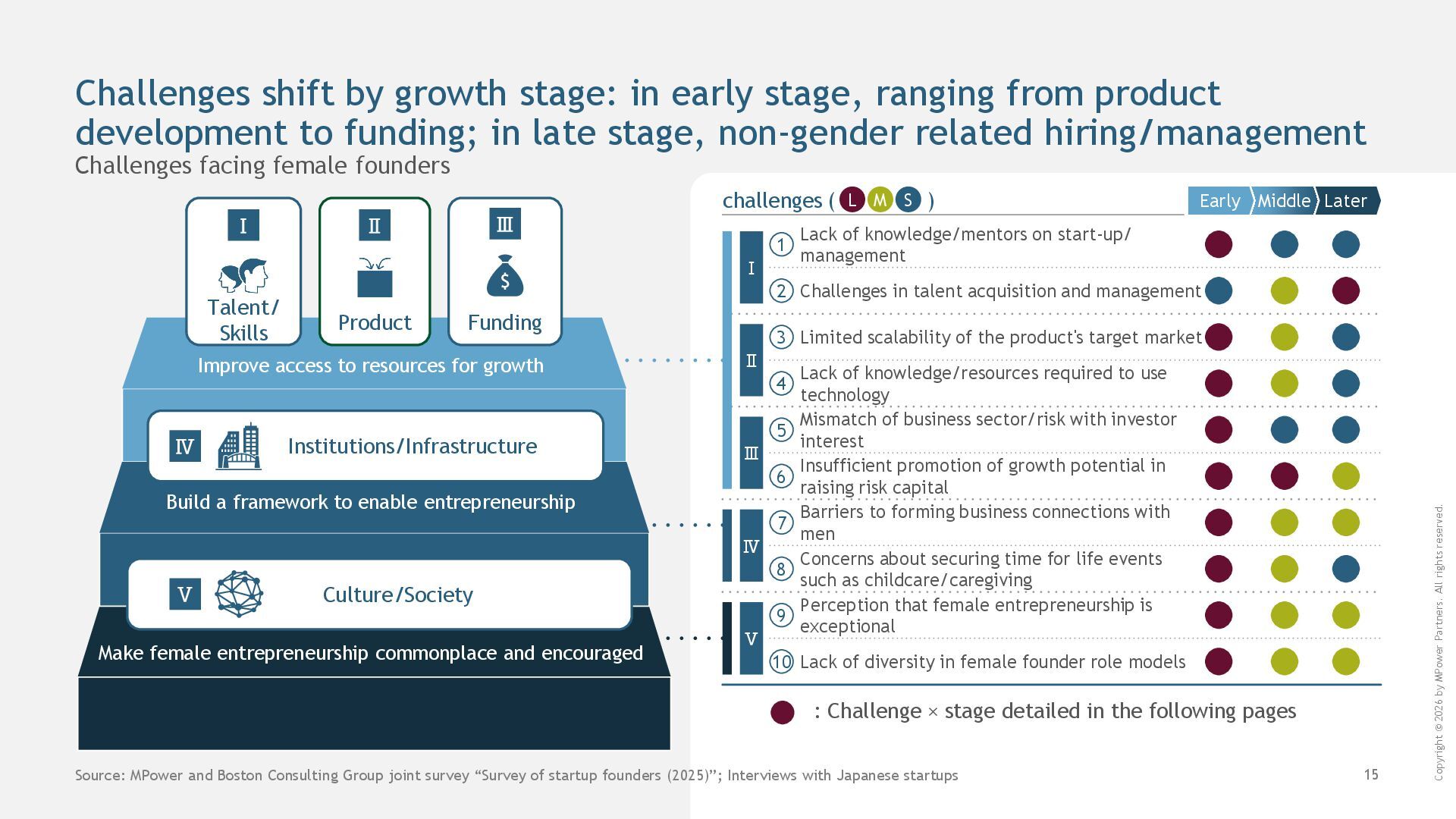
    Challenges shift by growth stage: in early stage, ranging from product development to funding; in late stage, non-gender related hiring/management Challenges facing female founders Copyright © 2026 by MPower Partners. All rights reserved. : Challenge × stage detailed in the following pages 15 Ⅰ Ⅱ Ⅲ Ⅳ Ⅴ Lack of knowledge/mentors on start-up/ management Challenges in talent acquisition and management Limited scalability of the product's target market Lack of knowledge/resources required to use technology Mismatch of business sector/risk with investor interest Insufficient promotion of growth potential in raising risk capital Barriers to forming business connections with men Concerns about securing time for life events such as childcare/caregiving Perception that female entrepreneurship is exceptional Lack of diversity in female founder role models 1 2 3 4 5 6 7 8 9 10 Early Middle Later challenges ( ) L M S Source: MPower and Boston Consulting Group joint survey “Survey of startup founders (2025)”; Interviews with Japanese startups Funding Ⅲ Ⅳ Ⅴ Build a framework to enable entrepreneurship Improve access to resources for growth Make female entrepreneurship commonplace and encouraged Institutions/Infrastructure Culture/Society Talent/ Skills Ⅰ Product Ⅱ
  17. 16 Copyright © 2026 by MPower Partners. All rights reserved.

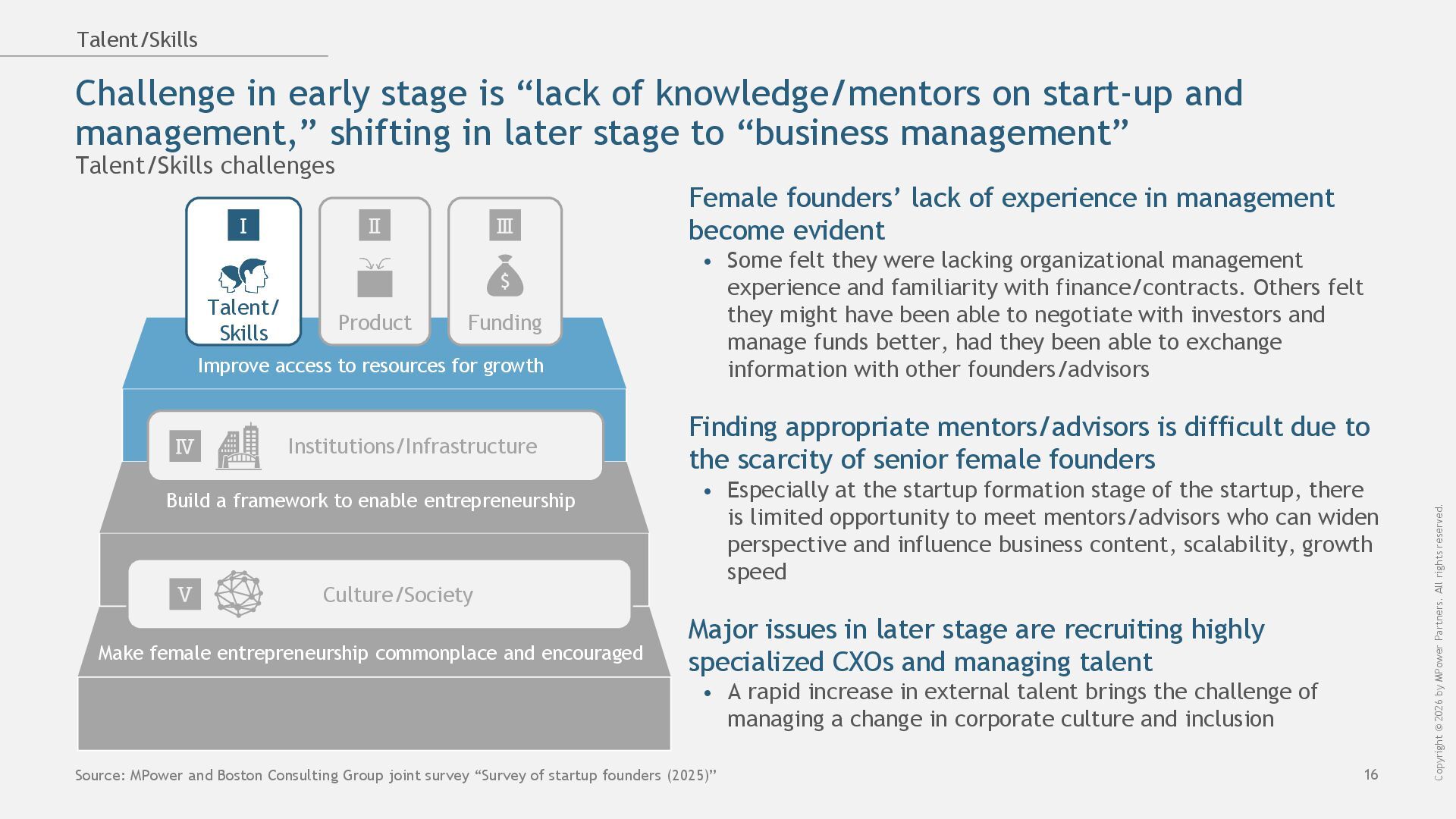
    Challenge in early stage is “lack of knowledge/mentors on start-up and management,” shifting in later stage to “business management” Talent/Skills challenges Female founders’ lack of experience in management become evident • Some felt they were lacking organizational management experience and familiarity with finance/contracts. Others felt they might have been able to negotiate with investors and manage funds better, had they been able to exchange information with other founders/advisors Finding appropriate mentors/advisors is difficult due to the scarcity of senior female founders • Especially at the startup formation stage of the startup, there is limited opportunity to meet mentors/advisors who can widen perspective and influence business content, scalability, growth speed Major issues in later stage are recruiting highly specialized CXOs and managing talent • A rapid increase in external talent brings the challenge of managing a change in corporate culture and inclusion Talent/Skills Funding Product Talent/ Skills Ⅰ Ⅱ Ⅲ Ⅳ Ⅴ Build a framework to enable entrepreneurship Improve access to resources for growth Make female entrepreneurship commonplace and encouraged Institutions/Infrastructure Culture/Society Source: MPower and Boston Consulting Group joint survey “Survey of startup founders (2025)”
  18. 17 Copyright © 2026 by MPower Partners. All rights reserved.

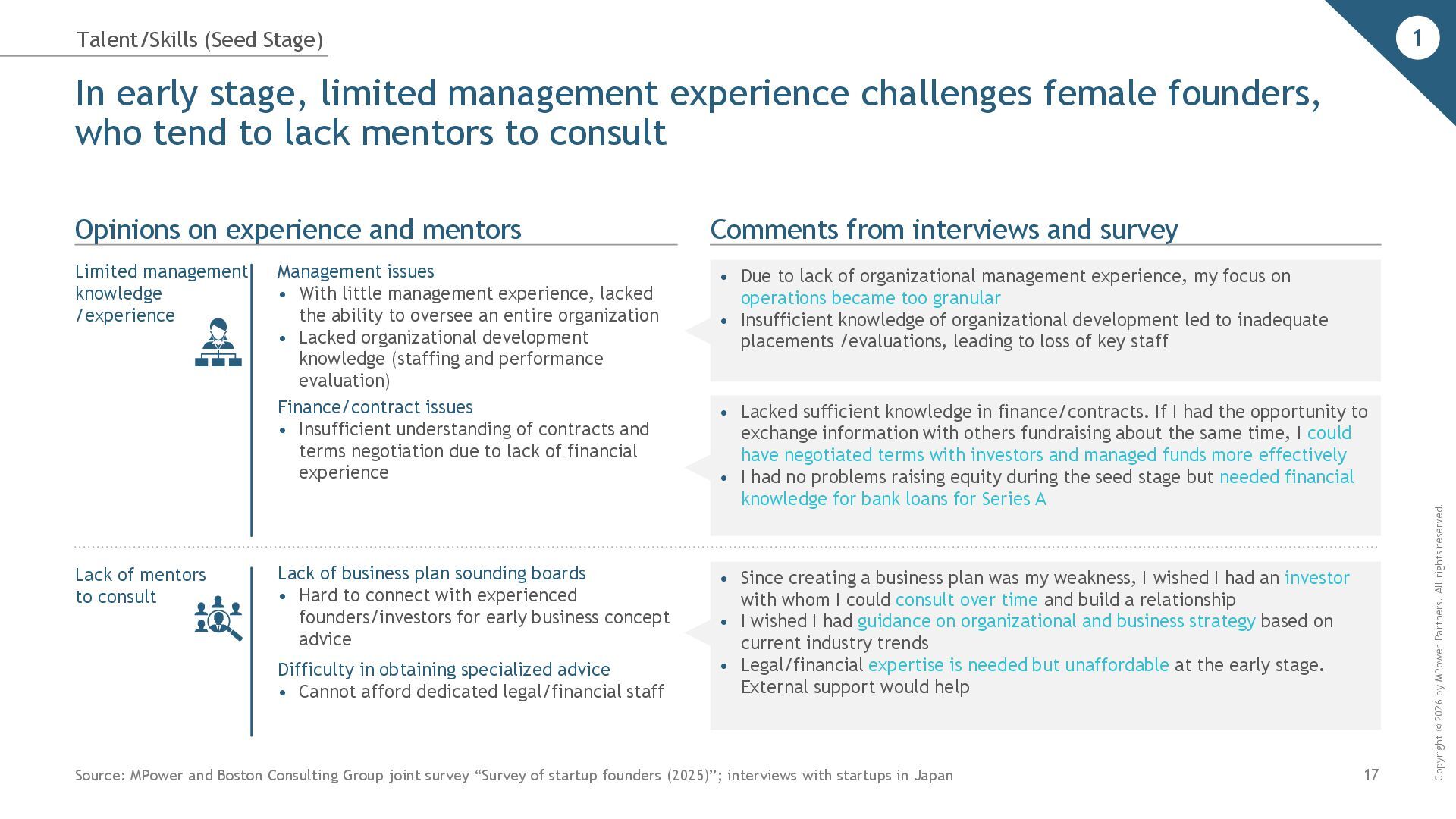
    In early stage, limited management experience challenges female founders, who tend to lack mentors to consult 1 Limited management knowledge /experience Lack of mentors to consult Lack of business plan sounding boards • Hard to connect with experienced founders/investors for early business concept advice Difficulty in obtaining specialized advice • Cannot afford dedicated legal/financial staff • Since creating a business plan was my weakness, I wished I had an investor with whom I could consult over time and build a relationship • I wished I had guidance on organizational and business strategy based on current industry trends • Legal/financial expertise is needed but unaffordable at the early stage. External support would help Finance/contract issues • Insufficient understanding of contracts and terms negotiation due to lack of financial experience • Lacked sufficient knowledge in finance/contracts. If I had the opportunity to exchange information with others fundraising about the same time, I could have negotiated terms with investors and managed funds more effectively • I had no problems raising equity during the seed stage but needed financial knowledge for bank loans for Series A Management issues • With little management experience, lacked the ability to oversee an entire organization • Lacked organizational development knowledge (staffing and performance evaluation) • Due to lack of organizational management experience, my focus on operations became too granular • Insufficient knowledge of organizational development led to inadequate placements /evaluations, leading to loss of key staff Source: MPower and Boston Consulting Group joint survey “Survey of startup founders (2025)”; interviews with startups in Japan Talent/Skills (Seed Stage) Comments from interviews and survey Opinions on experience and mentors
  19. 18 Copyright © 2026 by MPower Partners. All rights reserved.

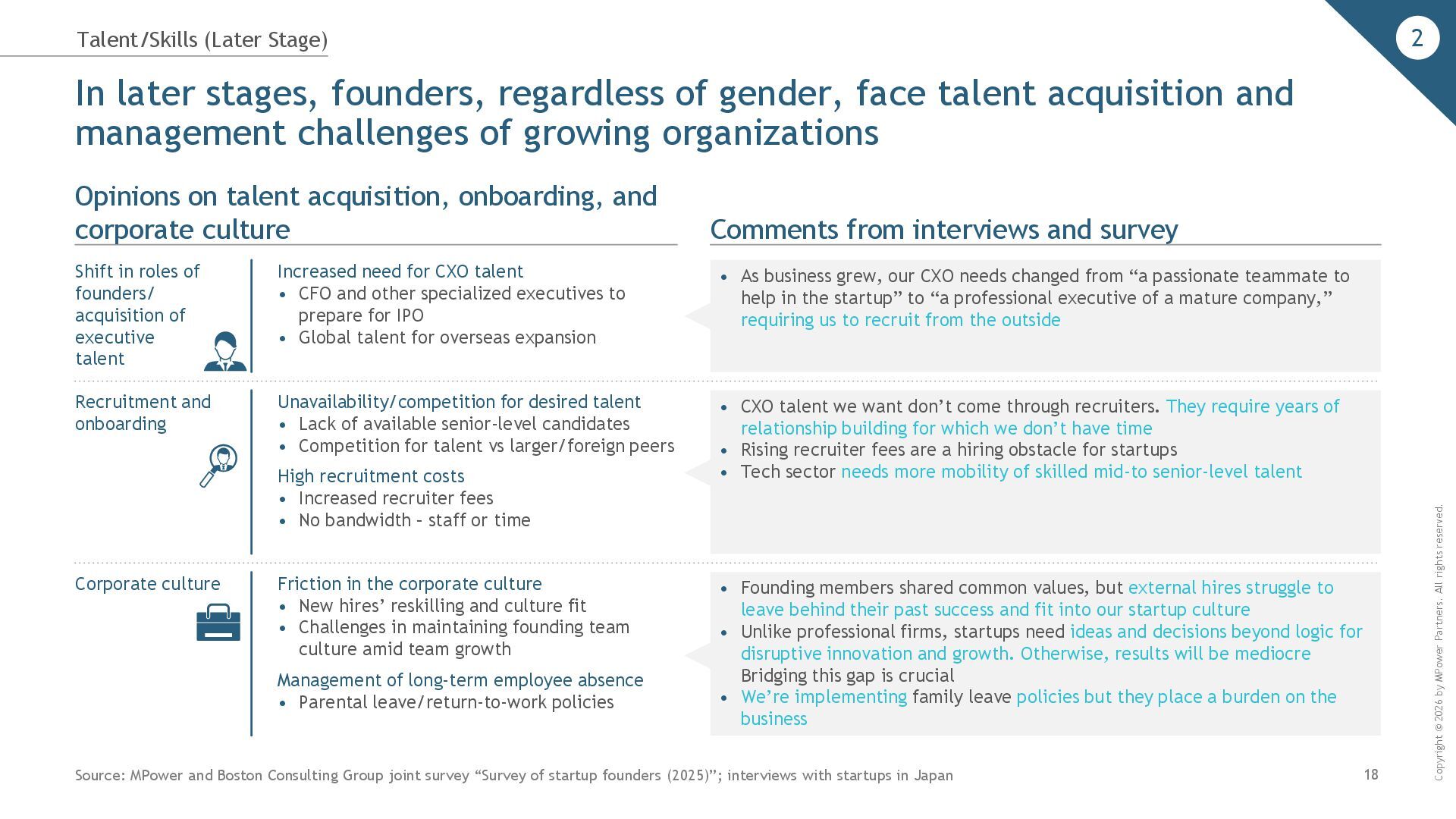
    In later stages, founders, regardless of gender, face talent acquisition and management challenges of growing organizations 2 • As business grew, our CXO needs changed from “a passionate teammate to help in the startup” to “a professional executive of a mature company,” requiring us to recruit from the outside Shift in roles of founders/ acquisition of executive talent Increased need for CXO talent • CFO and other specialized executives to prepare for IPO • Global talent for overseas expansion • CXO talent we want don’t come through recruiters. They require years of relationship building for which we don’t have time • Rising recruiter fees are a hiring obstacle for startups • Tech sector needs more mobility of skilled mid-to senior-level talent Recruitment and onboarding Unavailability/competition for desired talent • Lack of available senior-level candidates • Competition for talent vs larger/foreign peers High recruitment costs • Increased recruiter fees • No bandwidth – staff or time • Founding members shared common values, but external hires struggle to leave behind their past success and fit into our startup culture • Unlike professional firms, startups need ideas and decisions beyond logic for disruptive innovation and growth. Otherwise, results will be mediocre Bridging this gap is crucial • We’re implementing family leave policies but they place a burden on the business Corporate culture Friction in the corporate culture • New hires’ reskilling and culture fit • Challenges in maintaining founding team culture amid team growth Management of long-term employee absence • Parental leave/return-to-work policies Source: MPower and Boston Consulting Group joint survey “Survey of startup founders (2025)”; interviews with startups in Japan Comments from interviews and survey Opinions on talent acquisition, onboarding, and corporate culture Talent/Skills (Later Stage)
  20. 19 Copyright © 2026 by MPower Partners. All rights reserved.

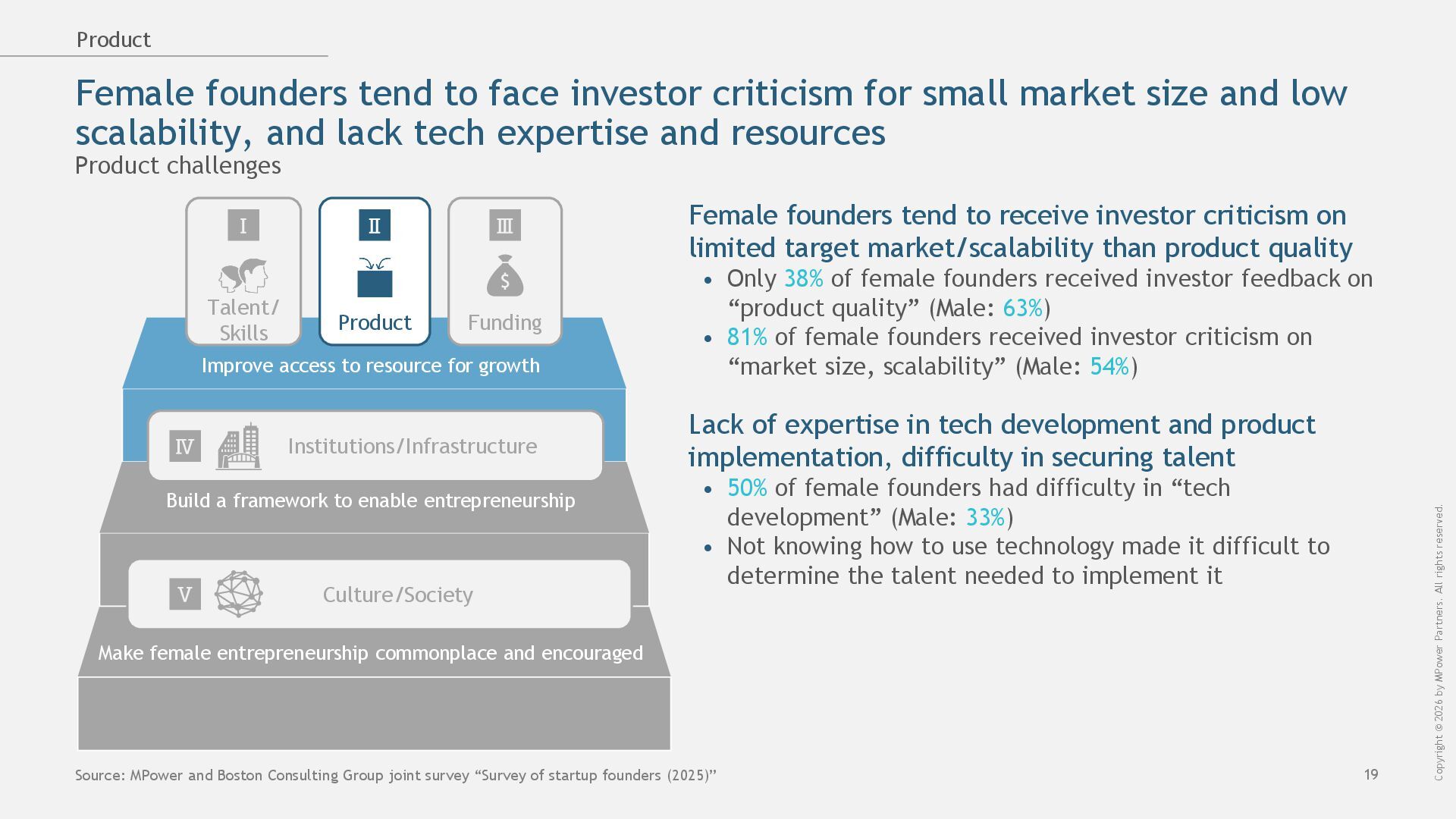
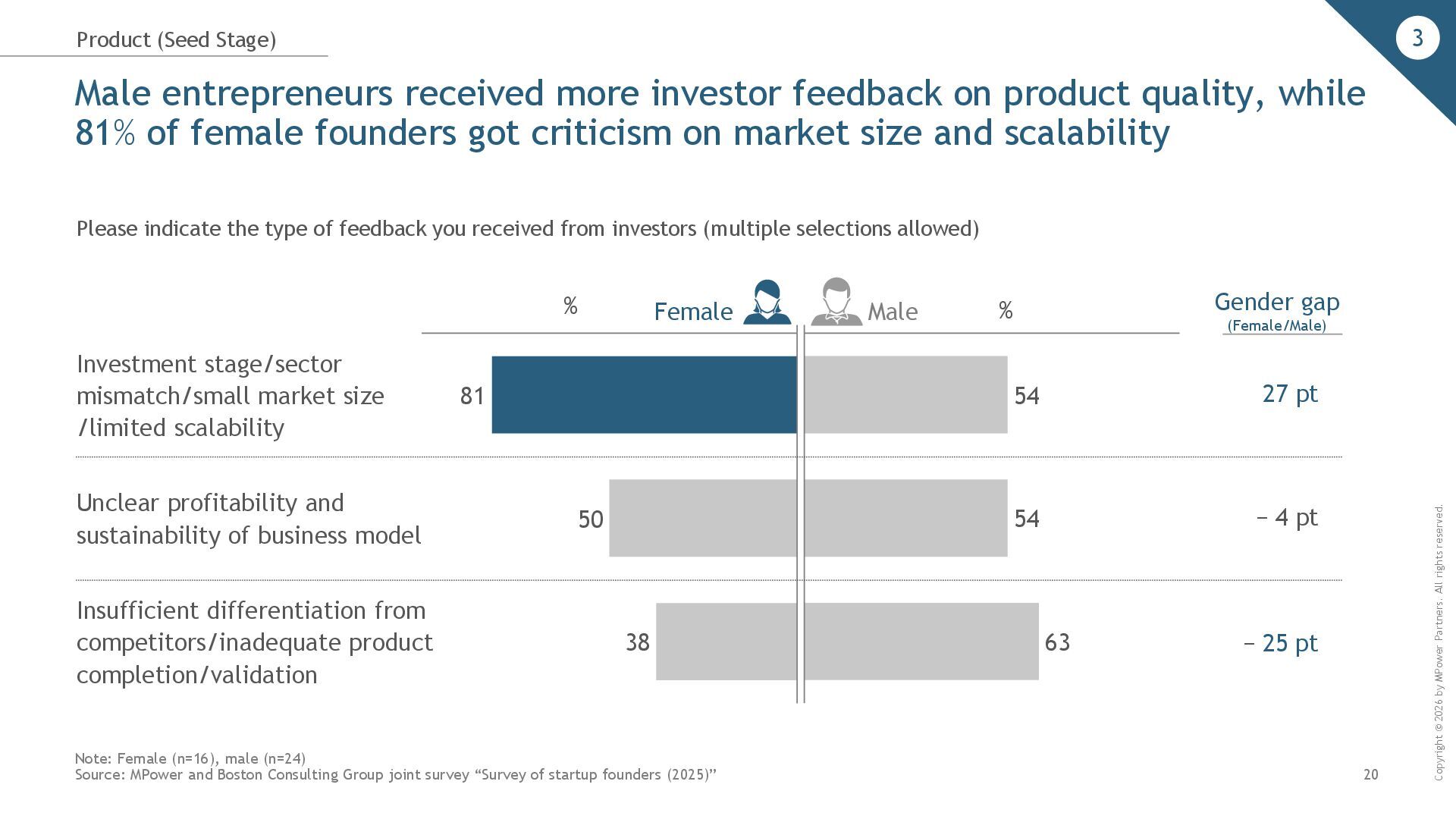
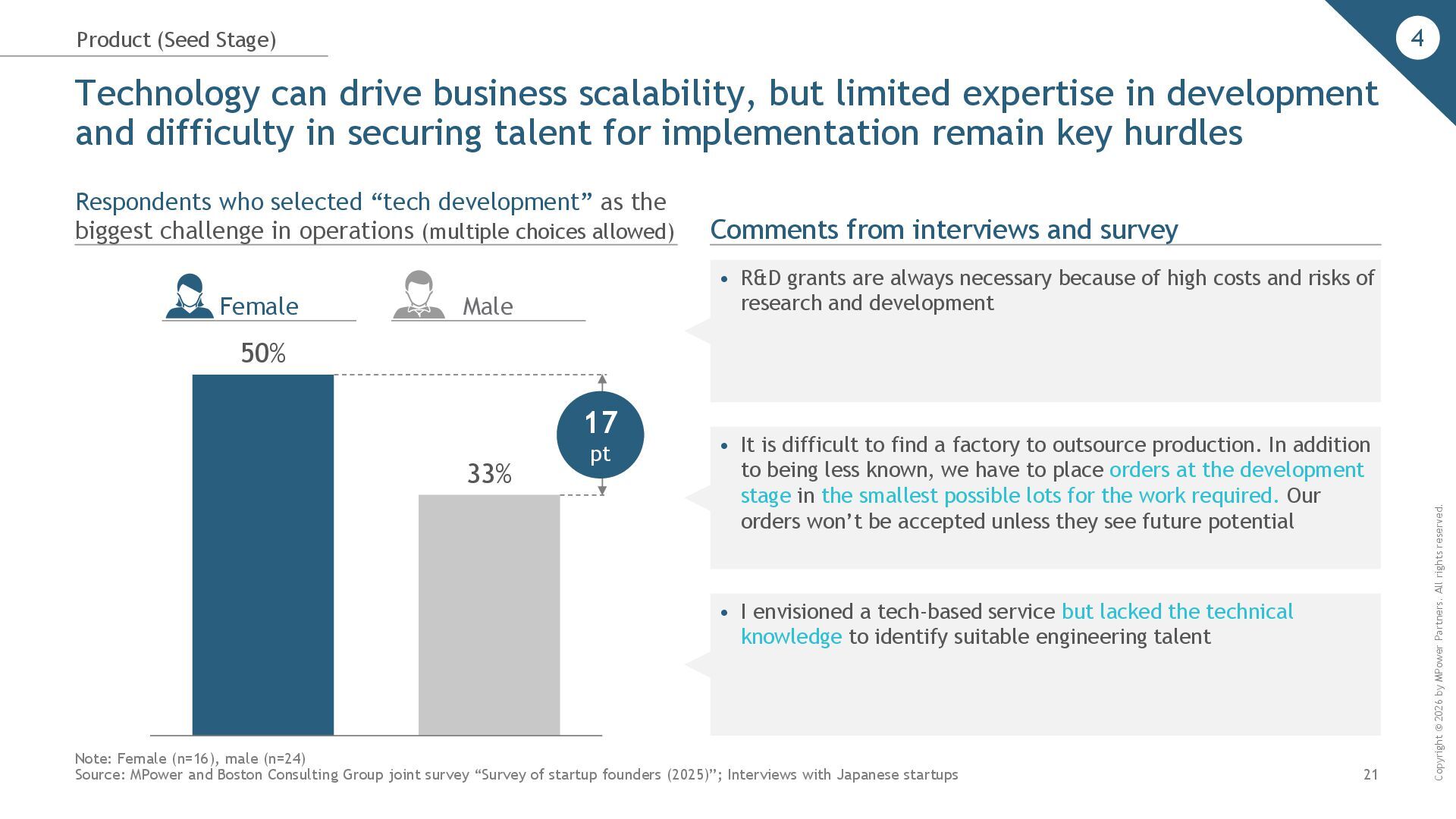
    Female founders tend to face investor criticism for small market size and low scalability, and lack tech expertise and resources Product challenges Female founders tend to receive investor criticism on limited target market/scalability than product quality • Only 38% of female founders received investor feedback on “product quality” (Male: 63%) • 81% of female founders received investor criticism on “market size, scalability” (Male: 54%) Lack of expertise in tech development and product implementation, difficulty in securing talent • 50% of female founders had difficulty in “tech development” (Male: 33%) • Not knowing how to use technology made it difficult to determine the talent needed to implement it Product Funding Product Talent/ Skills Ⅰ Ⅱ Ⅲ Ⅳ Ⅴ Build a framework to enable entrepreneurship Improve access to resource for growth Make female entrepreneurship commonplace and encouraged Institutions/Infrastructure Culture/Society Source: MPower and Boston Consulting Group joint survey “Survey of startup founders (2025)”
  21. 20 Copyright © 2026 by MPower Partners. All rights reserved.

    Male entrepreneurs received more investor feedback on product quality, while 81% of female founders got criticism on market size and scalability Please indicate the type of feedback you received from investors (multiple selections allowed) Investment stage/sector mismatch/small market size /limited scalability Unclear profitability and sustainability of business model Insufficient differentiation from competitors/inadequate product completion/validation 81 50 38 54 54 63 27 pt − 4 pt − 25 pt Gender gap (Female/Male) 3 Male Female Product (Seed Stage) % % Note: Female (n=16), male (n=24) Source: MPower and Boston Consulting Group joint survey “Survey of startup founders (2025)”
  22. 21 Copyright © 2026 by MPower Partners. All rights reserved.

    Technology can drive business scalability, but limited expertise in development and difficulty in securing talent for implementation remain key hurdles Note: Female (n=16), male (n=24) Source: MPower and Boston Consulting Group joint survey “Survey of startup founders (2025)”; Interviews with Japanese startups 4 50% 33% 17pt Respondents who selected “tech development” as the biggest challenge in operations (multiple choices allowed) • R&D grants are always necessary because of high costs and risks of research and development • It is difficult to find a factory to outsource production. In addition to being less known, we have to place orders at the development stage in the smallest possible lots for the work required. Our orders won’t be accepted unless they see future potential • I envisioned a tech-based service but lacked the technical knowledge to identify suitable engineering talent Product (Seed Stage) Female Male Comments from interviews and survey 17 pt
  23. 22 Copyright © 2026 by MPower Partners. All rights reserved.

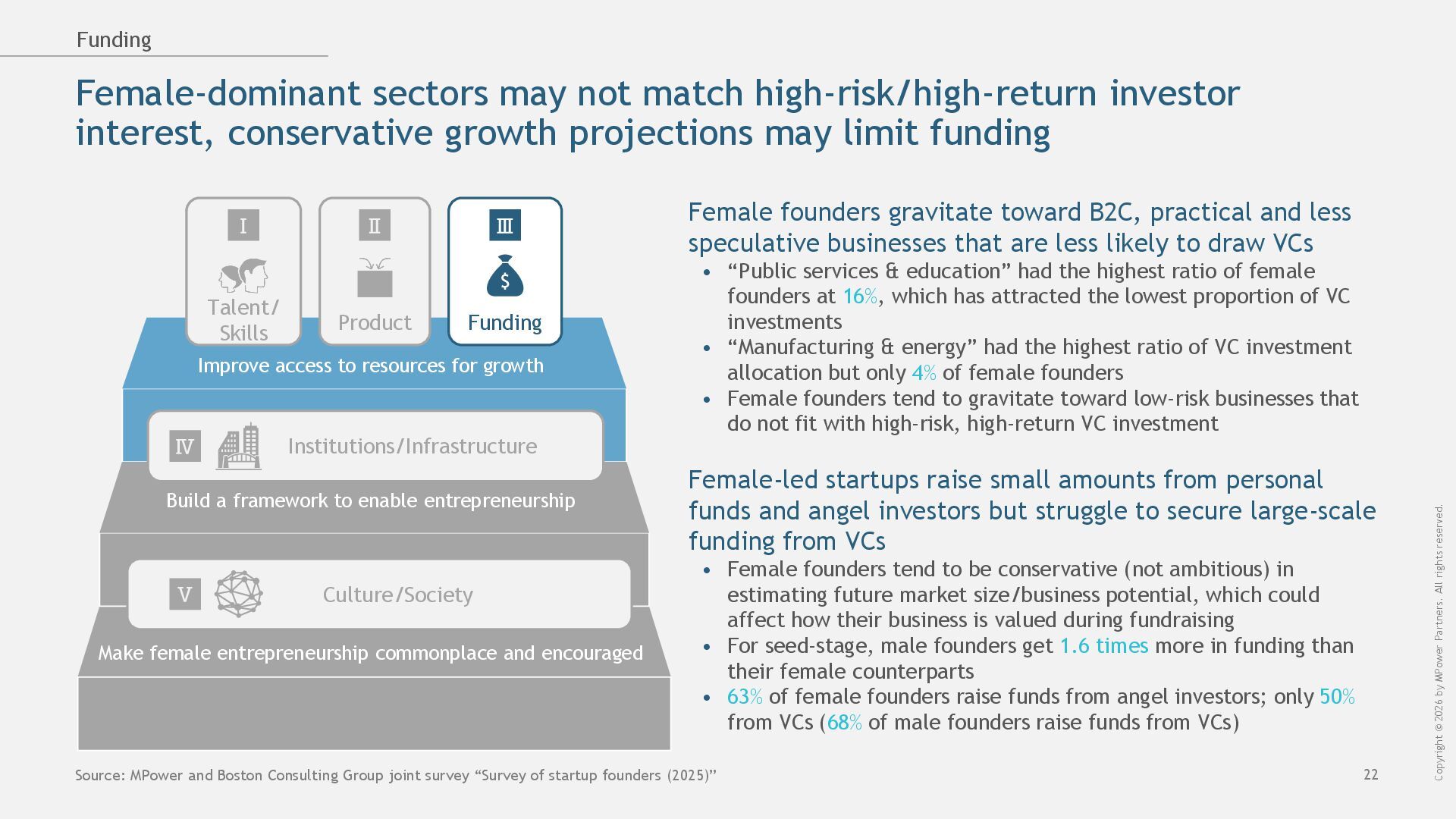
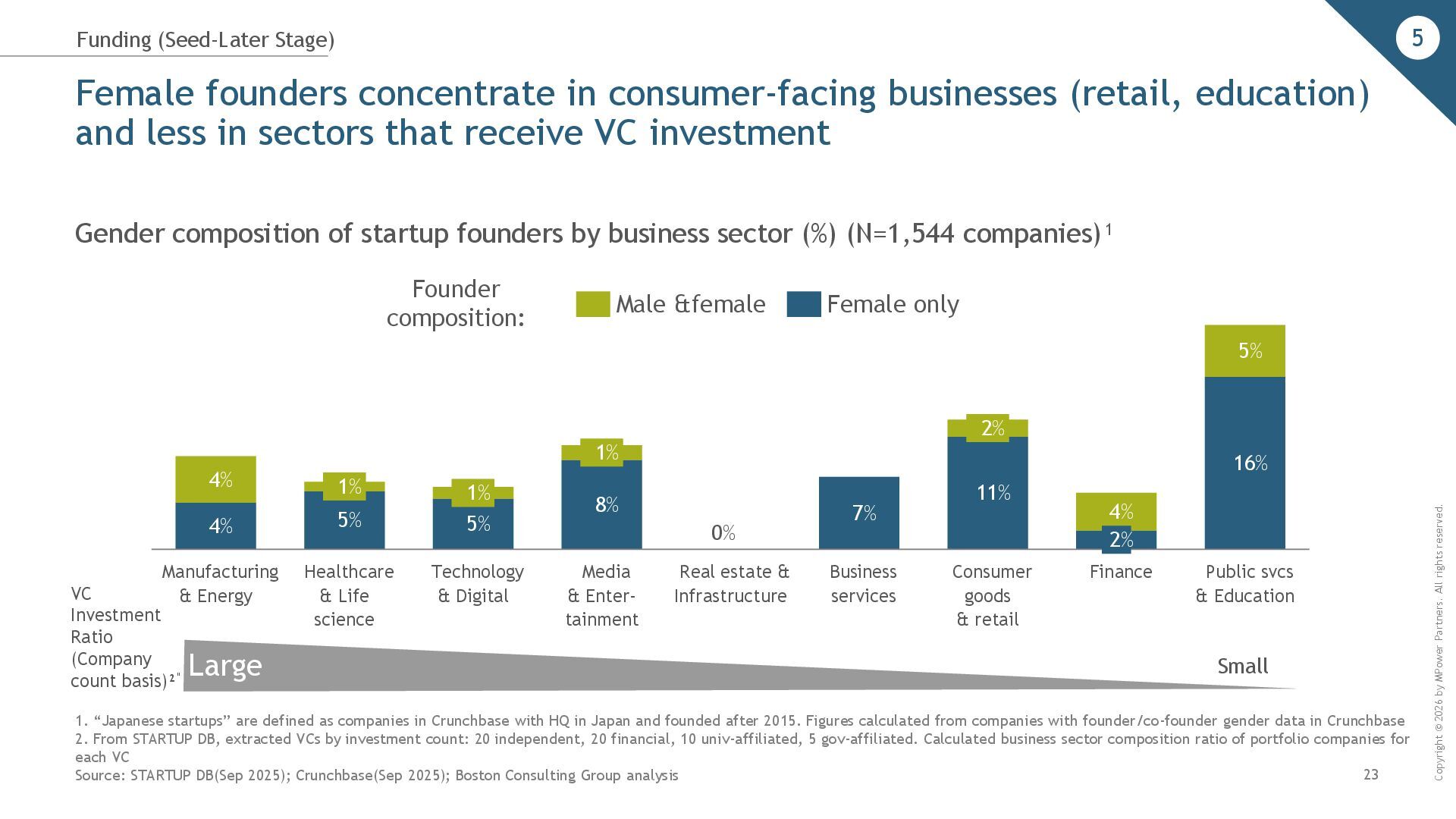
    Female-dominant sectors may not match high-risk/high-return investor interest, conservative growth projections may limit funding Female founders gravitate toward B2C, practical and less speculative businesses that are less likely to draw VCs • “Public services & education” had the highest ratio of female founders at 16%, which has attracted the lowest proportion of VC investments • “Manufacturing & energy” had the highest ratio of VC investment allocation but only 4% of female founders • Female founders tend to gravitate toward low-risk businesses that do not fit with high-risk, high-return VC investment Female-led startups raise small amounts from personal funds and angel investors but struggle to secure large-scale funding from VCs • Female founders tend to be conservative (not ambitious) in estimating future market size/business potential, which could affect how their business is valued during fundraising • For seed-stage, male founders get 1.6 times more in funding than their female counterparts • 63% of female founders raise funds from angel investors; only 50% from VCs (68% of male founders raise funds from VCs) Funding Funding Product Ⅱ Ⅲ Ⅳ Ⅴ Build a framework to enable entrepreneurship Improve access to resources for growth Make female entrepreneurship commonplace and encouraged Talent/ Skills Ⅰ Institutions/Infrastructure Culture/Society Source: MPower and Boston Consulting Group joint survey “Survey of startup founders (2025)”
  24. 23 Copyright © 2026 by MPower Partners. All rights reserved.

    Female founders concentrate in consumer-facing businesses (retail, education) and less in sectors that receive VC investment 1. “Japanese startups” are defined as companies in Crunchbase with HQ in Japan and founded after 2015. Figures calculated from companies with founder/co-founder gender data in Crunchbase 2. From STARTUP DB, extracted VCs by investment count: 20 independent, 20 financial, 10 univ-affiliated, 5 gov-affiliated. Calculated business sector composition ratio of portfolio companies for each VC Source: STARTUP DB(Sep 2025); Crunchbase(Sep 2025); Boston Consulting Group analysis 4% 4% Manufacturing & Energy 5% 1% Healthcare & Life science 5% 1% Technology & Digital 8% 1% Media & Enter- tainment Real estate & Infrastructure 7% Business services 11% 2% Consumer goods & retail 2% 4% Finance 16% 5% Public svcs & Education Male &female Female only Founder composition: Gender composition of startup founders by business sector (%) (N=1,544 companies)¹ Small Large VC Investment Ratio (Company count basis)²" 5 Funding (Seed-Later Stage) 0%
  25. 24 Copyright © 2026 by MPower Partners. All rights reserved.

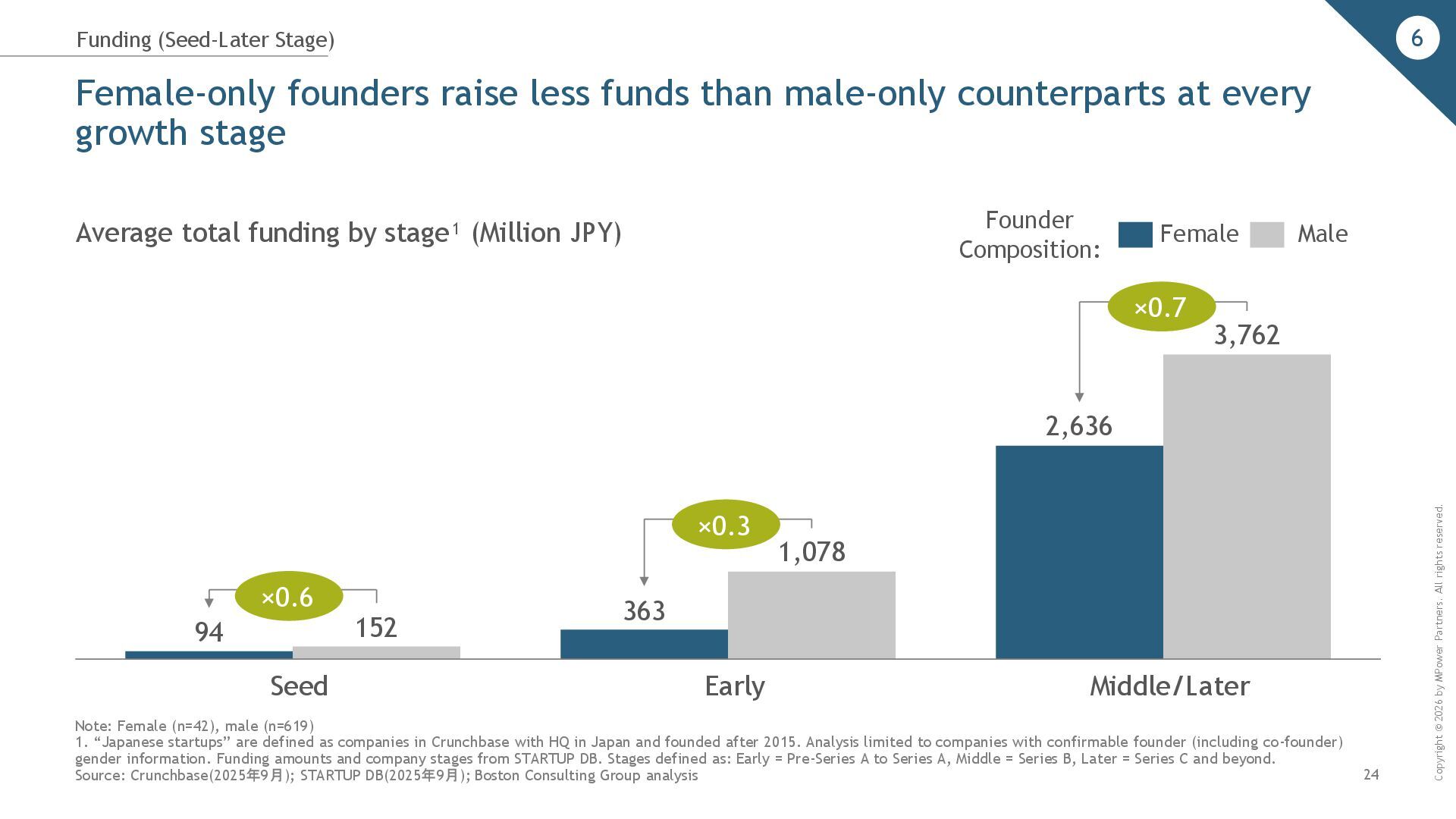
    Female-only founders raise less funds than male-only counterparts at every growth stage Note: Female (n=42), male (n=619) 1. “Japanese startups” are defined as companies in Crunchbase with HQ in Japan and founded after 2015. Analysis limited to companies with confirmable founder (including co-founder) gender information. Funding amounts and company stages from STARTUP DB. Stages defined as: Early = Pre-Series A to Series A, Middle = Series B, Later = Series C and beyond. Source: Crunchbase(2025年9月); STARTUP DB(2025年9月); Boston Consulting Group analysis Founder Composition: Average total funding by stage¹ (Million JPY) 6 94 363 2,636 152 1,078 3,762 Seed Early Middle/Later - 38 - 66 - 30 Female Male ×0.6 ×0.3 ×0.7 Funding (Seed-Later Stage)
  26. 25 Copyright © 2026 by MPower Partners. All rights reserved.

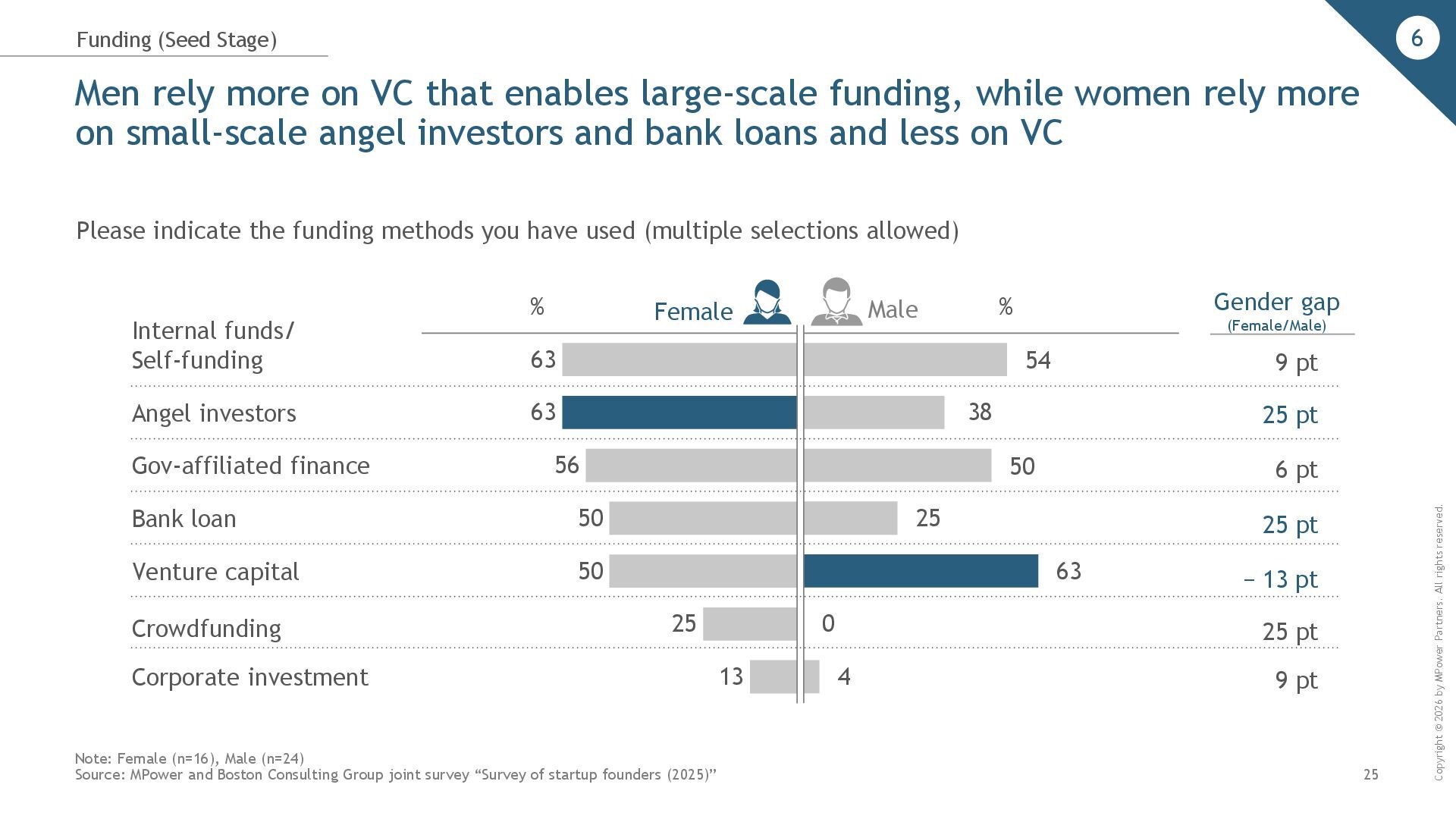
    Men rely more on VC that enables large-scale funding, while women rely more on small-scale angel investors and bank loans and less on VC Please indicate the funding methods you have used (multiple selections allowed) Note: Female (n=16), Male (n=24) Source: MPower and Boston Consulting Group joint survey “Survey of startup founders (2025)” Internal funds/ Self-funding Angel investors Gov-affiliated finance Bank loan Venture capital Crowdfunding Corporate investment 63 63 56 50 50 25 13 54 38 50 25 63 0 4 9 pt 25 pt 6 pt 25 pt − 13 pt 25 pt Gender gap (Female/Male) 9 pt 6 Funding (Seed Stage) Male Female % %
  27. 26 Copyright © 2026 by MPower Partners. All rights reserved.

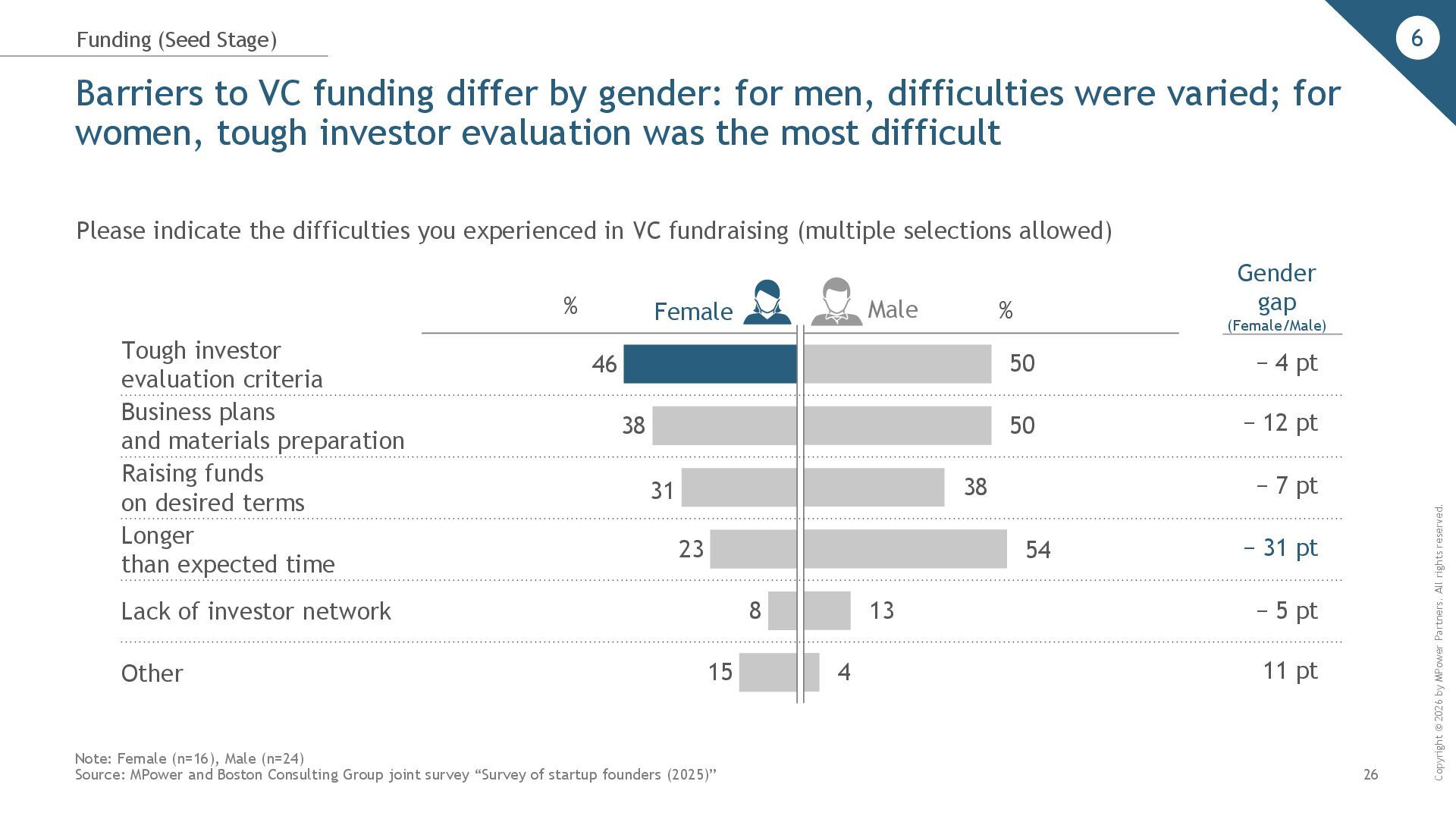
    Barriers to VC funding differ by gender: for men, difficulties were varied; for women, tough investor evaluation was the most difficult Please indicate the difficulties you experienced in VC fundraising (multiple selections allowed) Note: Female (n=16), Male (n=24) Source: MPower and Boston Consulting Group joint survey “Survey of startup founders (2025)” Tough investor evaluation criteria Business plans and materials preparation Raising funds on desired terms Longer than expected time Lack of investor network Other 46 38 31 23 8 15 50 50 38 54 13 4 − 4 pt − 12 pt − 7 pt − 31 pt − 5 pt 11 pt Gender gap (Female/Male) 6 Funding (Seed Stage) Male Female % %
  28. 27 Copyright © 2026 by MPower Partners. All rights reserved.

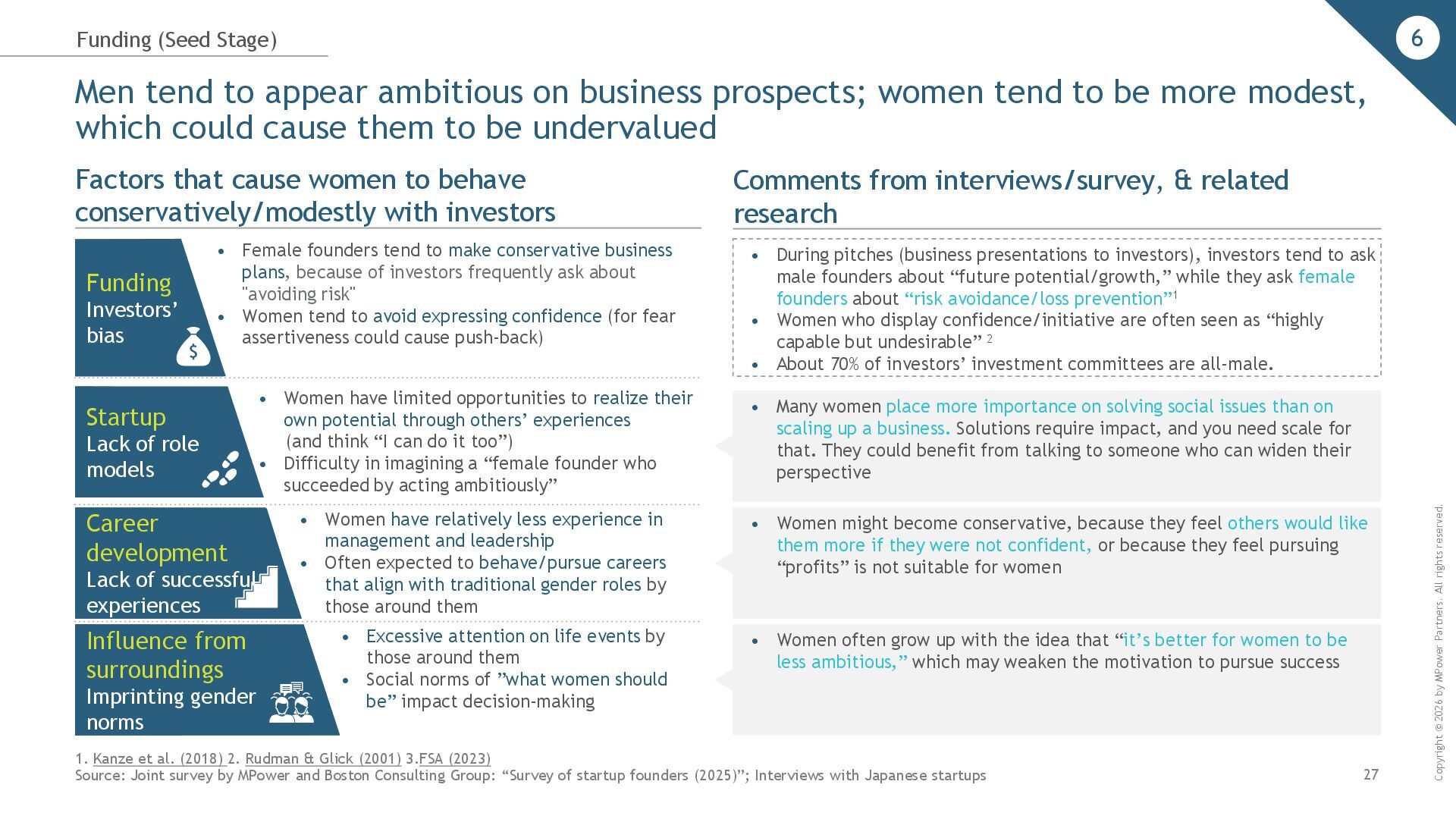
    Men tend to appear ambitious on business prospects; women tend to be more modest, which could cause them to be undervalued • Excessive attention on life events by those around them • Social norms of ”what women should be” impact decision-making • Women have relatively less experience in management and leadership • Often expected to behave/pursue careers that align with traditional gender roles by those around them • Women have limited opportunities to realize their own potential through others’ experiences (and think “I can do it too”) • Difficulty in imagining a “female founder who succeeded by acting ambitiously” • Female founders tend to make conservative business plans, because of investors frequently ask about "avoiding risk" • Women tend to avoid expressing confidence (for fear assertiveness could cause push-back) 1. Kanze et al. (2018) 2. Rudman & Glick (2001) 3.FSA (2023) Source: Joint survey by MPower and Boston Consulting Group: “Survey of startup founders (2025)”; Interviews with Japanese startups Startup Lack of role models Career development Lack of successful experiences Influence from surroundings Imprinting gender norms Funding Investors’ bias 6 Factors that cause women to behave conservatively/modestly with investors • Many women place more importance on solving social issues than on scaling up a business. Solutions require impact, and you need scale for that. They could benefit from talking to someone who can widen their perspective • Women might become conservative, because they feel others would like them more if they were not confident, or because they feel pursuing “profits” is not suitable for women • Women often grow up with the idea that “it’s better for women to be less ambitious,” which may weaken the motivation to pursue success Comments from interviews/survey, & related research • During pitches (business presentations to investors), investors tend to ask male founders about “future potential/growth,” while they ask female founders about “risk avoidance/loss prevention”1 • Women who display confidence/initiative are often seen as “highly capable but undesirable” 2 • About 70% of investors’ investment committees are all-male. Funding (Seed Stage)
  29. 28 Copyright © 2026 by MPower Partners. All rights reserved.

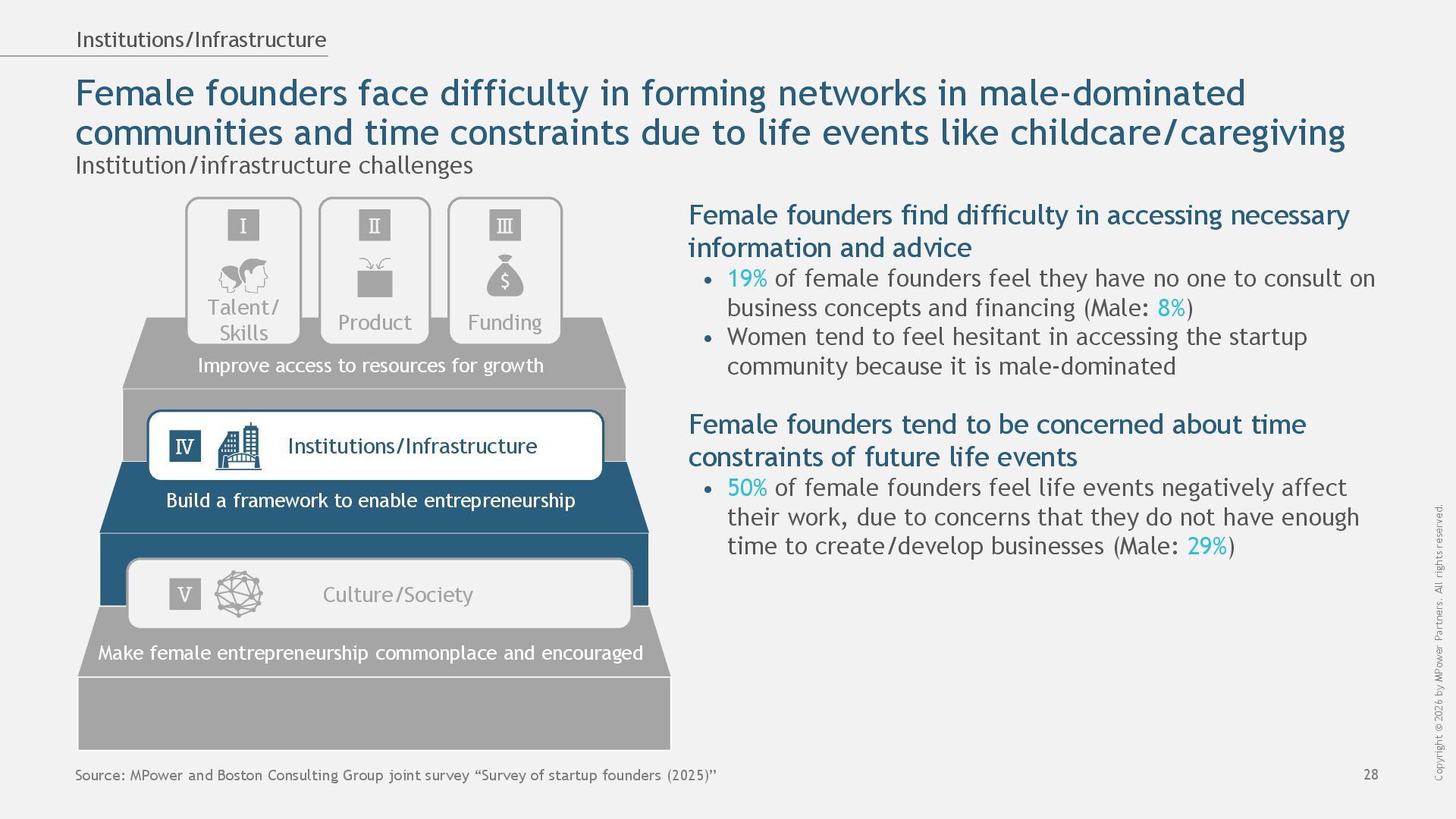
    Female founders face difficulty in forming networks in male-dominated communities and time constraints due to life events like childcare/caregiving Institution/infrastructure challenges Female founders find difficulty in accessing necessary information and advice • 19% of female founders feel they have no one to consult on business concepts and financing (Male: 8%) • Women tend to feel hesitant in accessing the startup community because it is male-dominated Female founders tend to be concerned about time constraints of future life events • 50% of female founders feel life events negatively affect their work, due to concerns that they do not have enough time to create/develop businesses (Male: 29%) Institutions/Infrastructure Ⅳ Build a framework to enable entrepreneurship Improve access to resources for growth Make female entrepreneurship commonplace and encouraged Product Ⅱ Talent/ Skills Ⅰ Funding Ⅲ Ⅴ Institutions/Infrastructure Culture/Society Source: MPower and Boston Consulting Group joint survey “Survey of startup founders (2025)”
  30. 29 Copyright © 2026 by MPower Partners. All rights reserved.

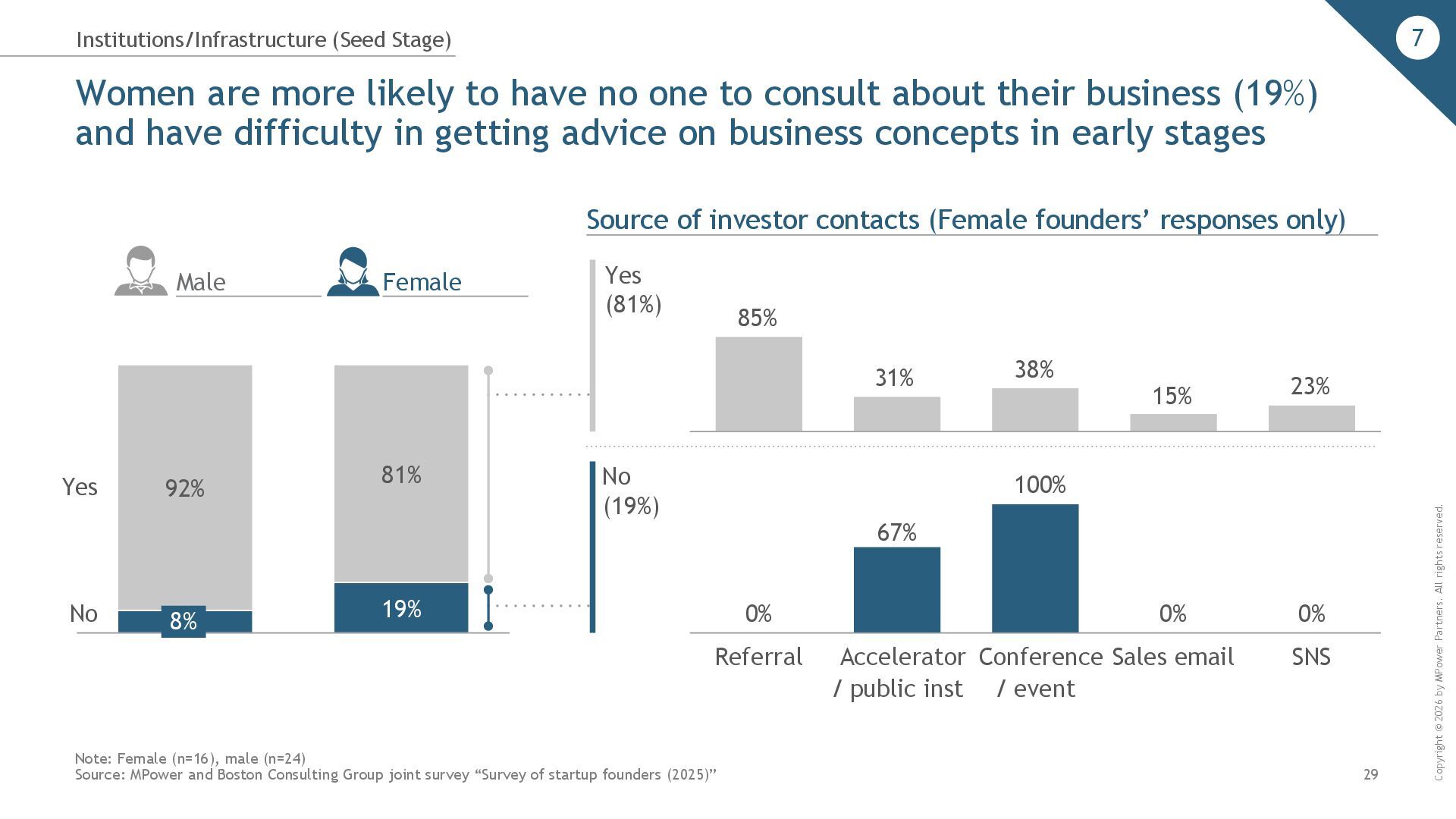
    Women are more likely to have no one to consult about their business (19%) and have difficulty in getting advice on business concepts in early stages 7 Note: Female (n=16), male (n=24) Source: MPower and Boston Consulting Group joint survey “Survey of startup founders (2025)” 19% 92% 81% 8% Yes No Referral Accelerator / public inst Conference / event Sales email SNS 0% 67% 100% 0% 0% Source of investor contacts (Female founders’ responses only) 85% 31% 38% 15% 23% Yes (81%) No (19%) Institutions/Infrastructure (Seed Stage) Female Male
  31. 30 Copyright © 2026 by MPower Partners. All rights reserved.

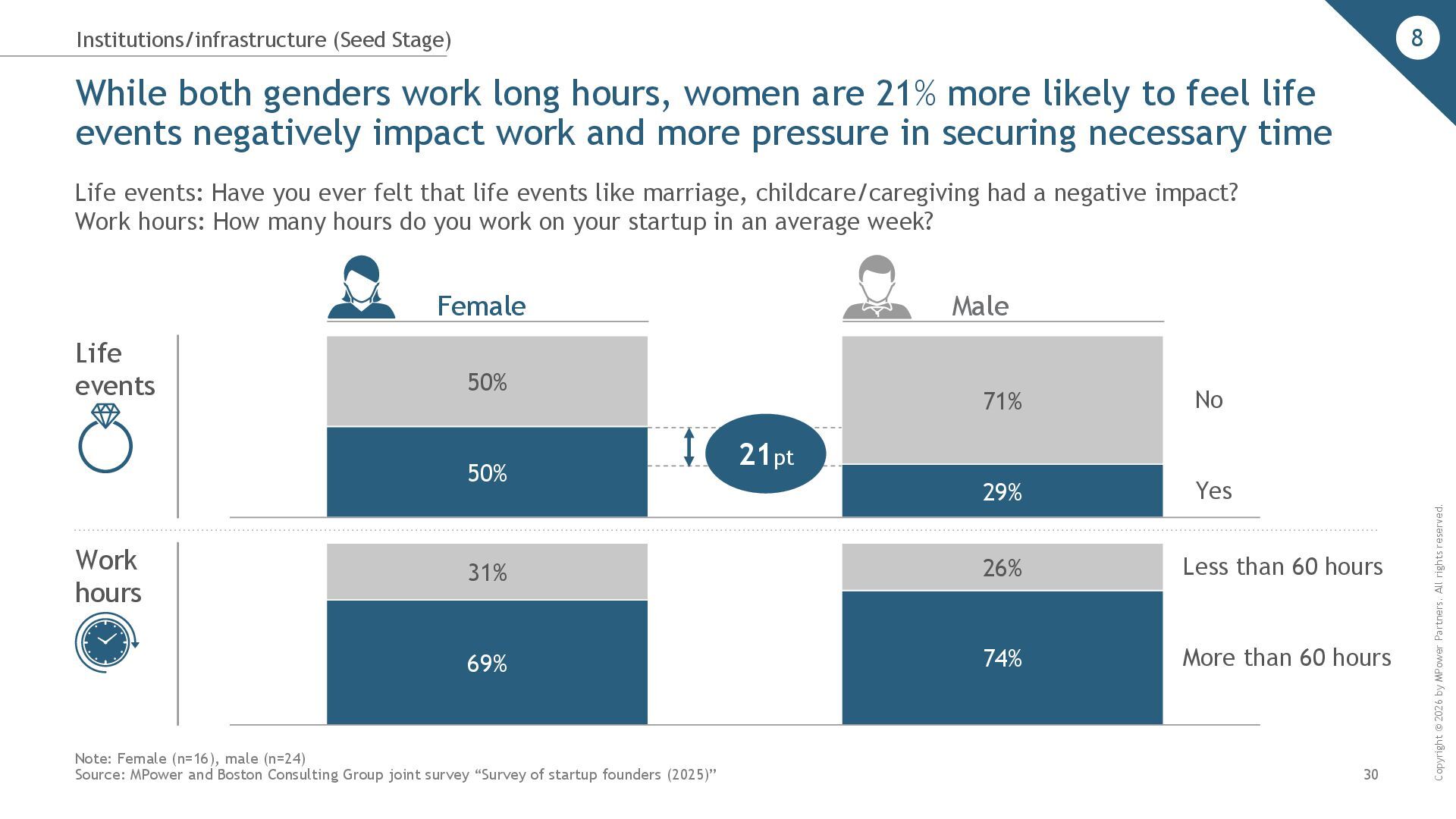
    While both genders work long hours, women are 21% more likely to feel life events negatively impact work and more pressure in securing necessary time Work hours 69% 74% 31% 26% More than 60 hours Less than 60 hours Life events 50% 29% 50% 71% No Yes Note: Female (n=16), male (n=24) Source: MPower and Boston Consulting Group joint survey “Survey of startup founders (2025)” 8 Female Male 21pt Institutions/infrastructure (Seed Stage) Life events: Have you ever felt that life events like marriage, childcare/caregiving had a negative impact? Work hours: How many hours do you work on your startup in an average week?
  32. 31 Copyright © 2026 by MPower Partners. All rights reserved.

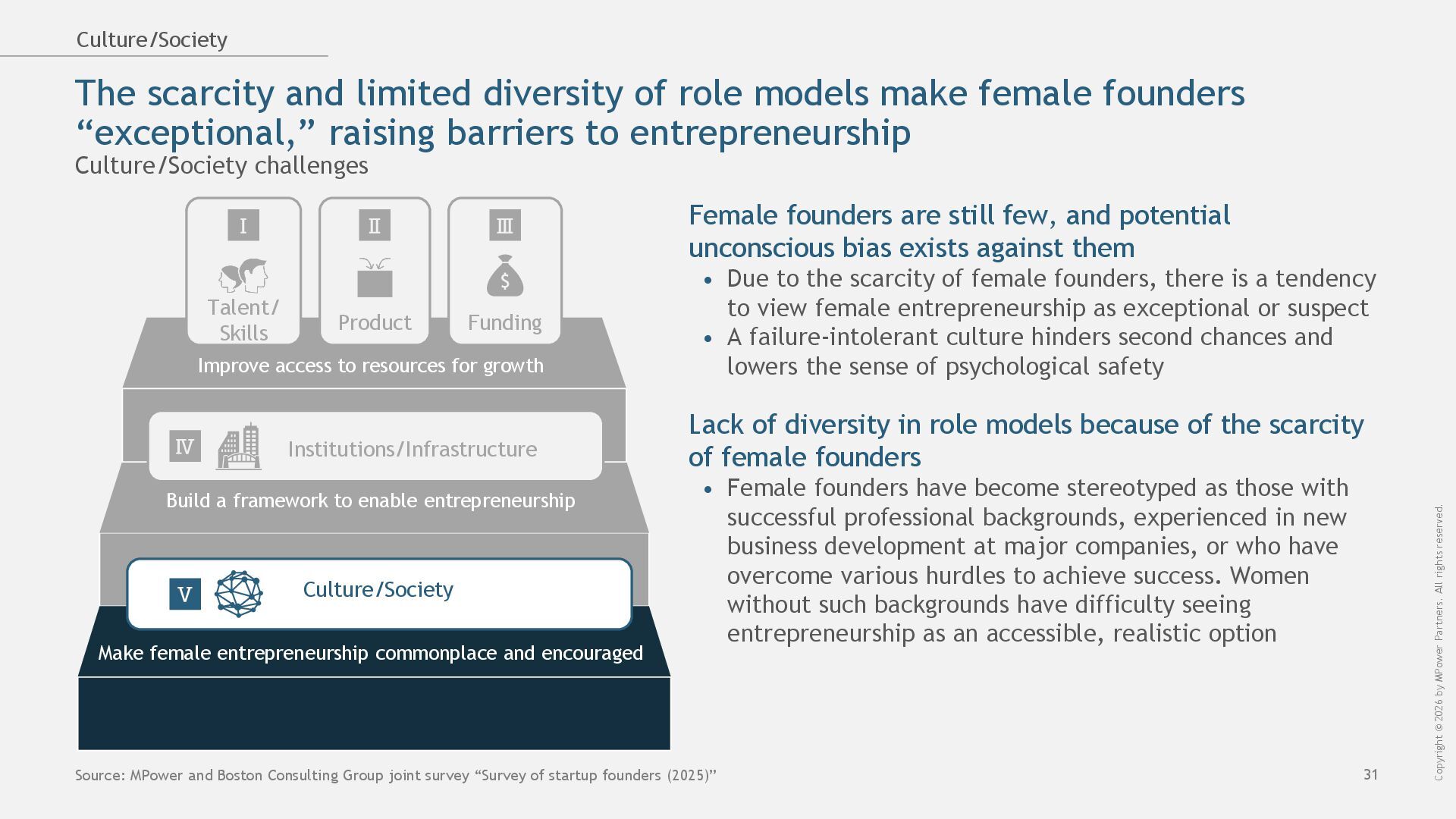
    The scarcity and limited diversity of role models make female founders “exceptional,” raising barriers to entrepreneurship Culture/Society challenges Female founders are still few, and potential unconscious bias exists against them • Due to the scarcity of female founders, there is a tendency to view female entrepreneurship as exceptional or suspect • A failure-intolerant culture hinders second chances and lowers the sense of psychological safety Lack of diversity in role models because of the scarcity of female founders • Female founders have become stereotyped as those with successful professional backgrounds, experienced in new business development at major companies, or who have overcome various hurdles to achieve success. Women without such backgrounds have difficulty seeing entrepreneurship as an accessible, realistic option Culture/Society Improve access to resources for growth Product Ⅱ Talent/ Skills Ⅰ Funding Ⅲ Ⅴ Make female entrepreneurship commonplace and encouraged Culture/Society Build a framework to enable entrepreneurship Ⅳ Institutions/Infrastructure Source: MPower and Boston Consulting Group joint survey “Survey of startup founders (2025)”
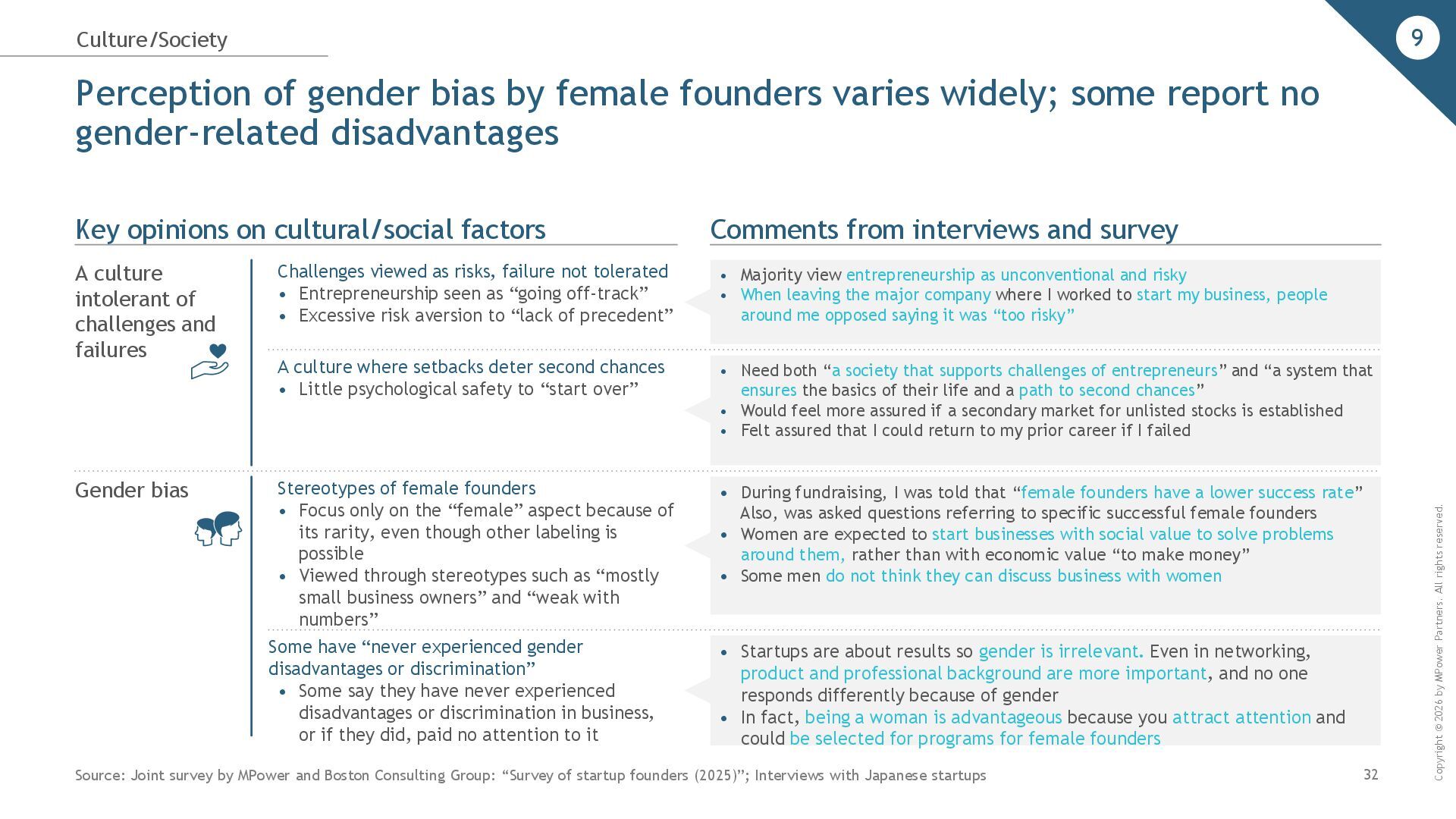
  33. 32 Copyright © 2026 by MPower Partners. All rights reserved.

    Perception of gender bias by female founders varies widely; some report no gender-related disadvantages 9 A culture intolerant of challenges and failures Gender bias • Majority view entrepreneurship as unconventional and risky • When leaving the major company where I worked to start my business, people around me opposed saying it was “too risky” Challenges viewed as risks, failure not tolerated • Entrepreneurship seen as “going off-track” • Excessive risk aversion to “lack of precedent” A culture where setbacks deter second chances • Little psychological safety to “start over” • Need both “a society that supports challenges of entrepreneurs” and “a system that ensures the basics of their life and a path to second chances” • Would feel more assured if a secondary market for unlisted stocks is established • Felt assured that I could return to my prior career if I failed Source: Joint survey by MPower and Boston Consulting Group: “Survey of startup founders (2025)”; Interviews with Japanese startups Comments from interviews and survey Key opinions on cultural/social factors • Startups are about results so gender is irrelevant. Even in networking, product and professional background are more important, and no one responds differently because of gender • In fact, being a woman is advantageous because you attract attention and could be selected for programs for female founders Stereotypes of female founders • Focus only on the “female” aspect because of its rarity, even though other labeling is possible • Viewed through stereotypes such as “mostly small business owners” and “weak with numbers” • During fundraising, I was told that “female founders have a lower success rate” Also, was asked questions referring to specific successful female founders • Women are expected to start businesses with social value to solve problems around them, rather than with economic value “to make money” • Some men do not think they can discuss business with women Culture/Society Some have “never experienced gender disadvantages or discrimination” • Some say they have never experienced disadvantages or discrimination in business, or if they did, paid no attention to it
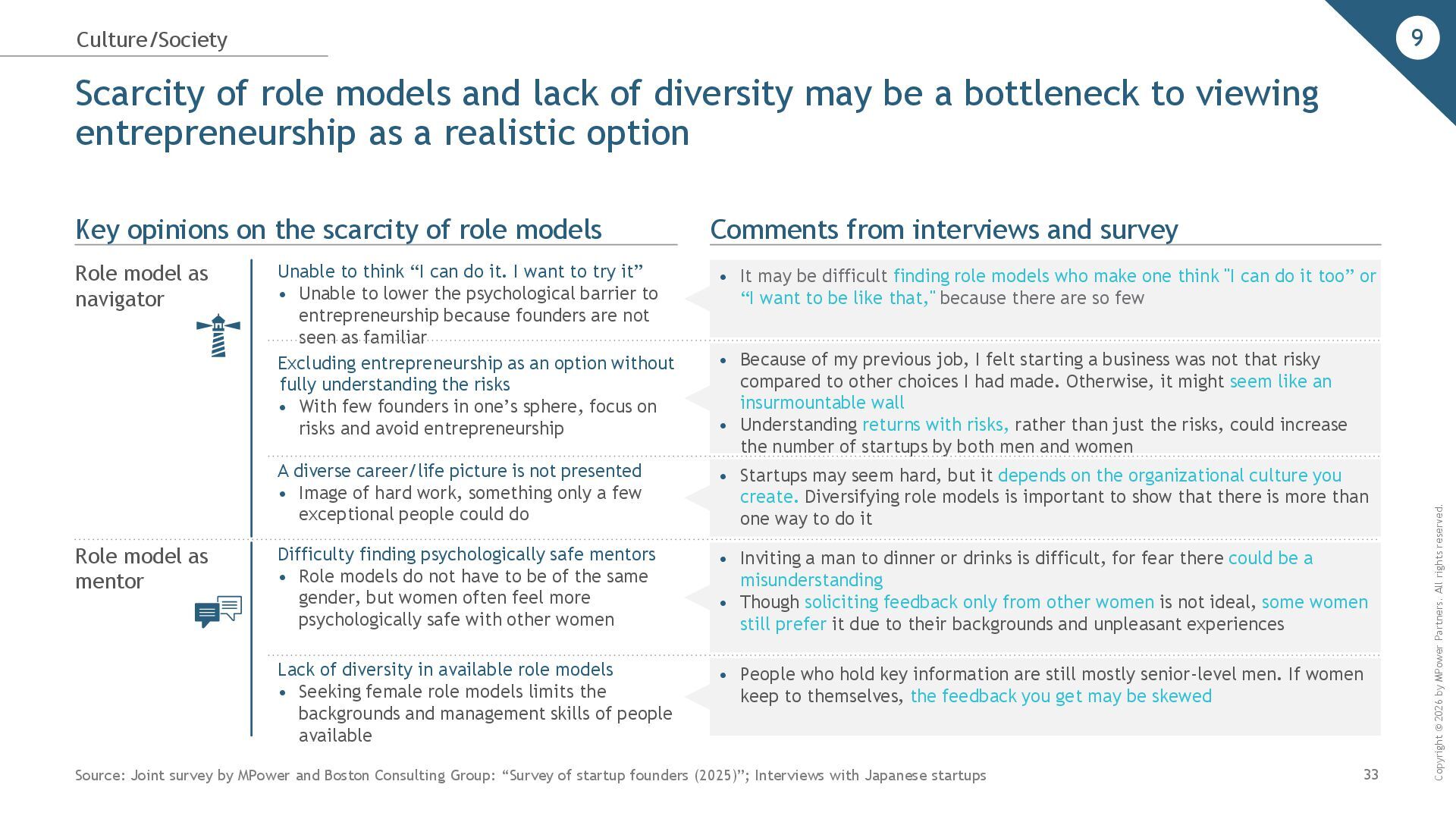
  34. 33 Copyright © 2026 by MPower Partners. All rights reserved.

    Scarcity of role models and lack of diversity may be a bottleneck to viewing entrepreneurship as a realistic option 9 Comments from interviews and survey Key opinions on the scarcity of role models Role model as navigator • It may be difficult finding role models who make one think "I can do it too” or “I want to be like that," because there are so few Unable to think “I can do it. I want to try it” • Unable to lower the psychological barrier to entrepreneurship because founders are not seen as familiar Role model as mentor Source: Joint survey by MPower and Boston Consulting Group: “Survey of startup founders (2025)”; Interviews with Japanese startups • Because of my previous job, I felt starting a business was not that risky compared to other choices I had made. Otherwise, it might seem like an insurmountable wall • Understanding returns with risks, rather than just the risks, could increase the number of startups by both men and women Excluding entrepreneurship as an option without fully understanding the risks • With few founders in one’s sphere, focus on risks and avoid entrepreneurship A diverse career/life picture is not presented • Image of hard work, something only a few exceptional people could do • Startups may seem hard, but it depends on the organizational culture you create. Diversifying role models is important to show that there is more than one way to do it Difficulty finding psychologically safe mentors • Role models do not have to be of the same gender, but women often feel more psychologically safe with other women • Inviting a man to dinner or drinks is difficult, for fear there could be a misunderstanding • Though soliciting feedback only from other women is not ideal, some women still prefer it due to their backgrounds and unpleasant experiences Lack of diversity in available role models • Seeking female role models limits the backgrounds and management skills of people available • People who hold key information are still mostly senior-level men. If women keep to themselves, the feedback you get may be skewed Culture/Society
  35. 34 Copyright © 2026 by MPower Partners. All rights reserved.

    Contents Challenges facing female founders 34 • Current state of startup founders in Japan • Gender-related differences and key challenges by growth stage (Insights from survey and interview data) Copyright © 2026 by MPower Partners. All rights reserved. 1 2 Solutions to expand opportunities for female founders • Solutions and actions for each challenge (recommendations for investors and central/local governments, and the mindset expected of female founders)
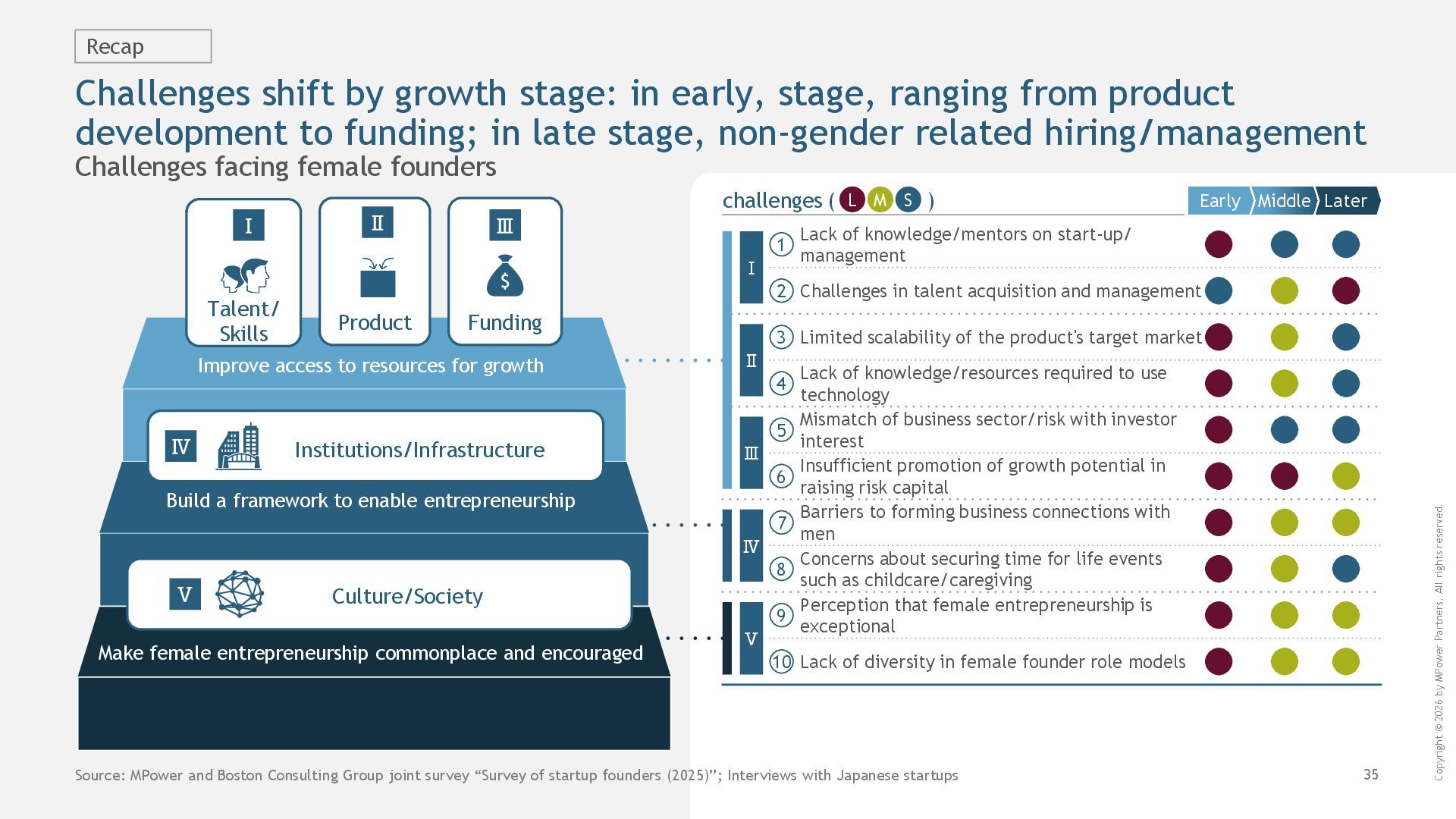
  36. 35 Copyright © 2026 by MPower Partners. All rights reserved.

    Challenges shift by growth stage: in early, stage, ranging from product development to funding; in late stage, non-gender related hiring/management Challenges facing female founders Copyright © 2026 by MPower Partners. All rights reserved. 35 Ⅰ Ⅱ Ⅲ Ⅳ Ⅴ 1 2 3 4 5 6 7 8 9 10 Early Middle Later challenges ( ) L M S Source: MPower and Boston Consulting Group joint survey “Survey of startup founders (2025)”; Interviews with Japanese startups Funding Product Talent/ Skills Ⅰ Ⅱ Ⅲ Ⅳ Ⅴ Build a framework to enable entrepreneurship Improve access to resources for growth Make female entrepreneurship commonplace and encouraged Institutions/Infrastructure Culture/Society Recap Lack of knowledge/mentors on start-up/ management Challenges in talent acquisition and management Limited scalability of the product's target market Lack of knowledge/resources required to use technology Mismatch of business sector/risk with investor interest Insufficient promotion of growth potential in raising risk capital Barriers to forming business connections with men Concerns about securing time for life events such as childcare/caregiving Perception that female entrepreneurship is exceptional Lack of diversity in female founder role models
  37. 36 Copyright © 2026 by MPower Partners. All rights reserved.

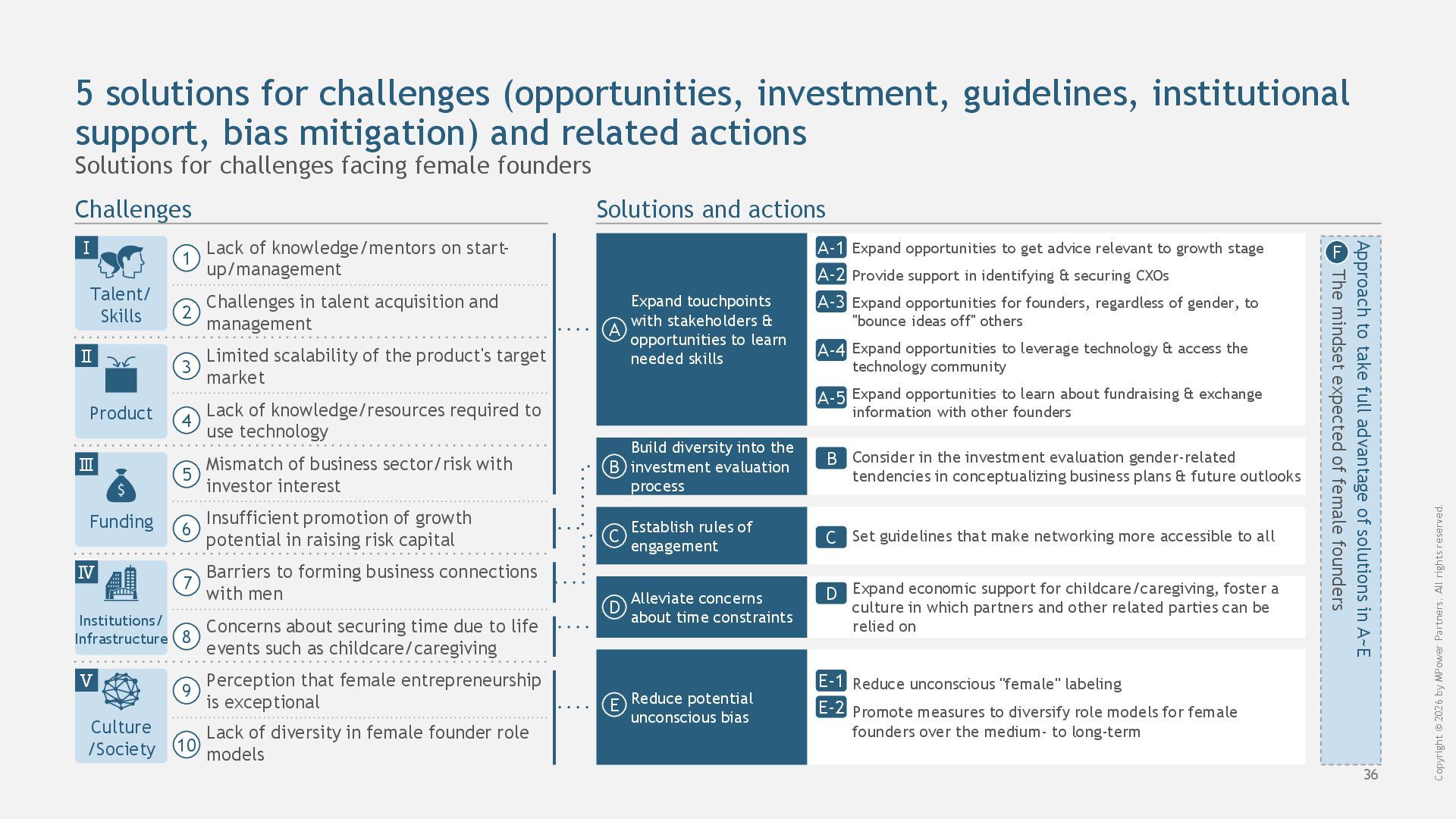
    5 solutions for challenges (opportunities, investment, guidelines, institutional support, bias mitigation) and related actions Solutions for challenges facing female founders 1 2 3 4 5 6 7 8 9 10 Lack of knowledge/mentors on start- up/management Challenges in talent acquisition and management Limited scalability of the product's target market Lack of knowledge/resources required to use technology Mismatch of business sector/risk with investor interest Insufficient promotion of growth potential in raising risk capital Barriers to forming business connections with men Concerns about securing time due to life events such as childcare/caregiving Perception that female entrepreneurship is exceptional Lack of diversity in female founder role models Challenges Talent/ Skills Product Funding Institutions/ Infrastructure Culture /Society Ⅰ Ⅱ Ⅲ Ⅳ Ⅴ Expand touchpoints with stakeholders & opportunities to learn needed skills • Expand opportunities to get advice relevant to growth stage • Provide support in identifying & securing CXOs • Expand opportunities for founders, regardless of gender, to "bounce ideas off" others • Expand opportunities to leverage technology & access the technology community • Expand opportunities to learn about fundraising & exchange information with other founders Build diversity into the investment evaluation process • Consider in the investment evaluation gender-related tendencies in conceptualizing business plans & future outlooks Establish rules of engagement • Set guidelines that make networking more accessible to all Alleviate concerns about time constraints • Expand economic support for childcare/caregiving, foster a culture in which partners and other related parties can be relied on Reduce potential unconscious bias • Reduce unconscious "female" labeling • Promote measures to diversify role models for female founders over the medium- to long-term Solutions and actions A A-1 A-2 A-3 A-4 A-5 B B C C D D E E-1 E-2 Approach to take full advantage of solutions in A~E The mindset expected of female founders F
  38. 37 Copyright © 2026 by MPower Partners. All rights reserved.

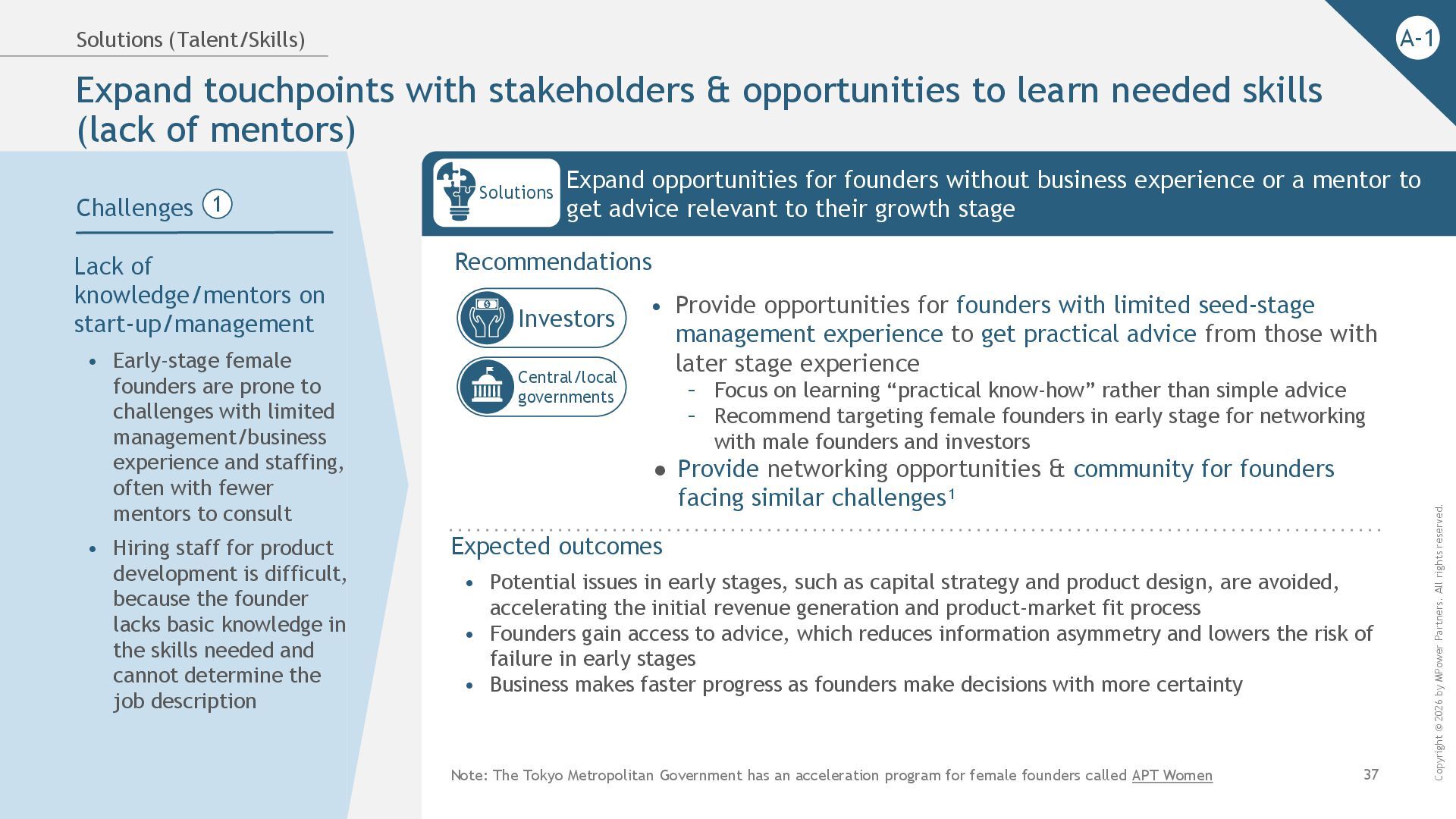
    Expand opportunities for founders without business experience or a mentor to get advice relevant to their growth stage Copyright © 2026 by MPower Partners. All rights reserved. 37 Expand touchpoints with stakeholders & opportunities to learn needed skills (lack of mentors) A-1 • Potential issues in early stages, such as capital strategy and product design, are avoided, accelerating the initial revenue generation and product-market fit process • Founders gain access to advice, which reduces information asymmetry and lowers the risk of failure in early stages • Business makes faster progress as founders make decisions with more certainty Expected outcomes Recommendations Central/local governments Lack of knowledge/mentors on start-up/management • Early-stage female founders are prone to challenges with limited management/business experience and staffing, often with fewer mentors to consult • Hiring staff for product development is difficult, because the founder lacks basic knowledge in the skills needed and cannot determine the job description Challenges 1 Investors • Provide opportunities for founders with limited seed-stage management experience to get practical advice from those with later stage experience – Focus on learning “practical know-how” rather than simple advice – Recommend targeting female founders in early stage for networking with male founders and investors • Provide networking opportunities & community for founders facing similar challenges¹ Solutions (Talent/Skills) Solutions Note: The Tokyo Metropolitan Government has an acceleration program for female founders called APT Women
  39. 38 Copyright © 2026 by MPower Partners. All rights reserved.

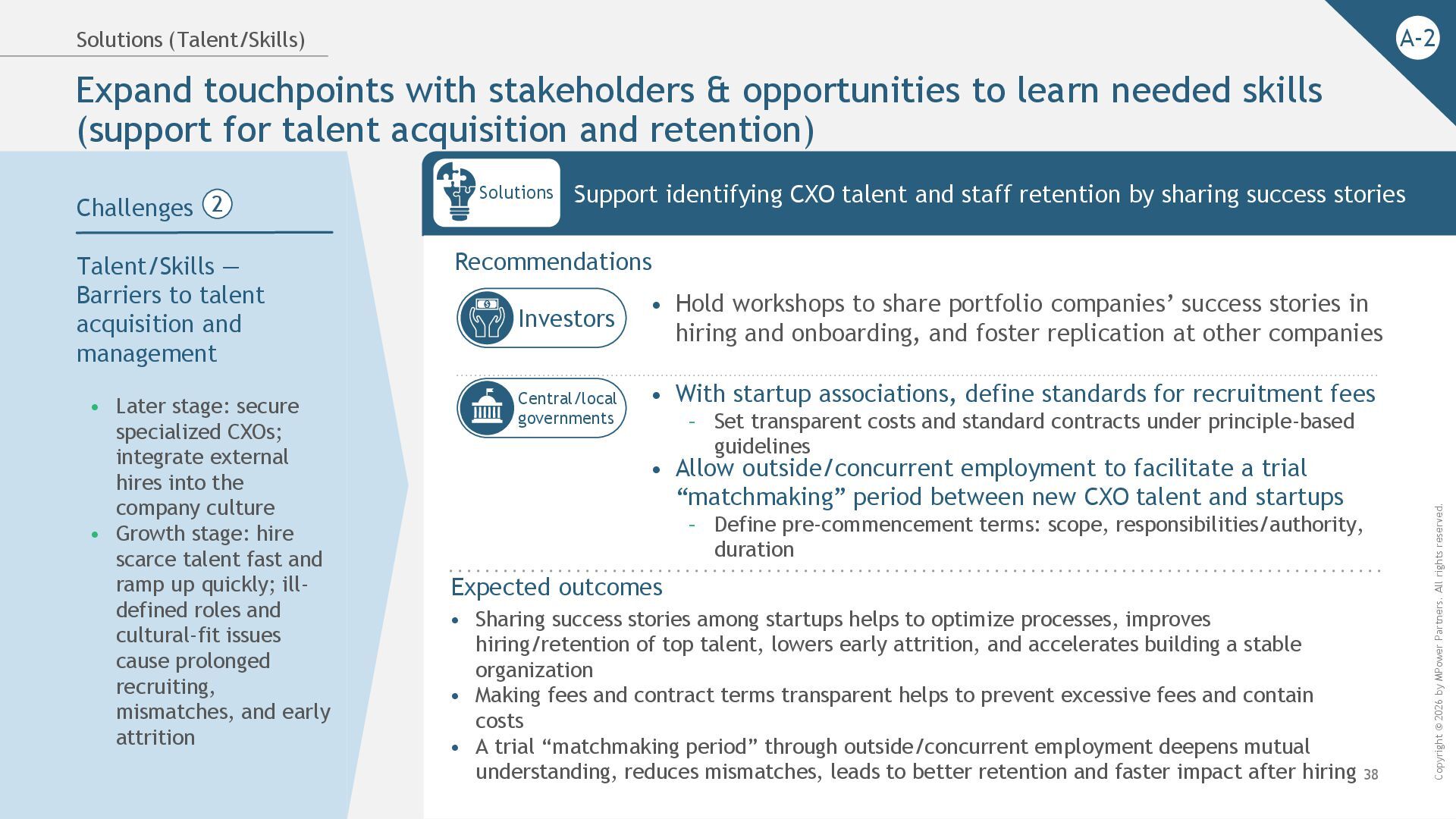
    Support identifying CXO talent and staff retention by sharing success stories Copyright © 2026 by MPower Partners. All rights reserved. 38 Expand touchpoints with stakeholders & opportunities to learn needed skills (support for talent acquisition and retention) A-2 • Sharing success stories among startups helps to optimize processes, improves hiring/retention of top talent, lowers early attrition, and accelerates building a stable organization • Making fees and contract terms transparent helps to prevent excessive fees and contain costs • A trial “matchmaking period” through outside/concurrent employment deepens mutual understanding, reduces mismatches, leads to better retention and faster impact after hiring Solutions Recommendations Talent/Skills — Barriers to talent acquisition and management • Later stage: secure specialized CXOs; integrate external hires into the company culture • Growth stage: hire scarce talent fast and ramp up quickly; ill- defined roles and cultural-fit issues cause prolonged recruiting, mismatches, and early attrition Central/local governments Investors • With startup associations, define standards for recruitment fees – Set transparent costs and standard contracts under principle-based guidelines • Allow outside/concurrent employment to facilitate a trial “matchmaking” period between new CXO talent and startups – Define pre-commencement terms: scope, responsibilities/authority, duration • Hold workshops to share portfolio companies’ success stories in hiring and onboarding, and foster replication at other companies Challenges 2 Solutions (Talent/Skills) Expected outcomes Solutions
  40. 39 Copyright © 2026 by MPower Partners. All rights reserved.

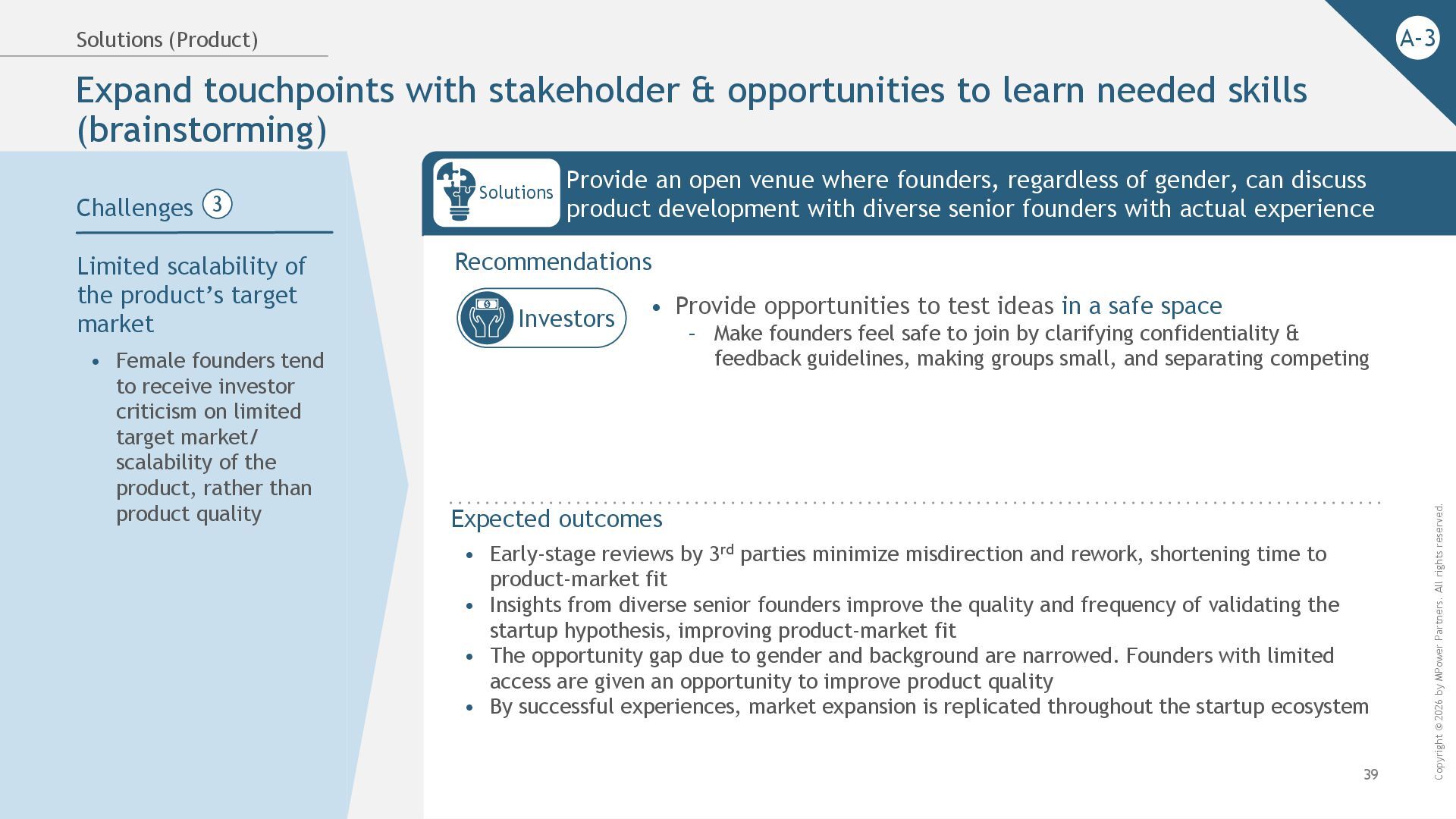
    Provide an open venue where founders, regardless of gender, can discuss product development with diverse senior founders with actual experience Expand touchpoints with stakeholder & opportunities to learn needed skills (brainstorming) A-3 Copyright © 2026 by MPower Partners. All rights reserved. 39 Solutions Limited scalability of the product’s target market • Female founders tend to receive investor criticism on limited target market/ scalability of the product, rather than product quality Recommendations • Early-stage reviews by 3rd parties minimize misdirection and rework, shortening time to product-market fit • Insights from diverse senior founders improve the quality and frequency of validating the startup hypothesis, improving product-market fit • The opportunity gap due to gender and background are narrowed. Founders with limited access are given an opportunity to improve product quality • By successful experiences, market expansion is replicated throughout the startup ecosystem • Provide opportunities to test ideas in a safe space – Make founders feel safe to join by clarifying confidentiality & feedback guidelines, making groups small, and separating competing Investors Challenges 3 Solutions (Product) Expected outcomes Solutions
  41. 40 Copyright © 2026 by MPower Partners. All rights reserved.

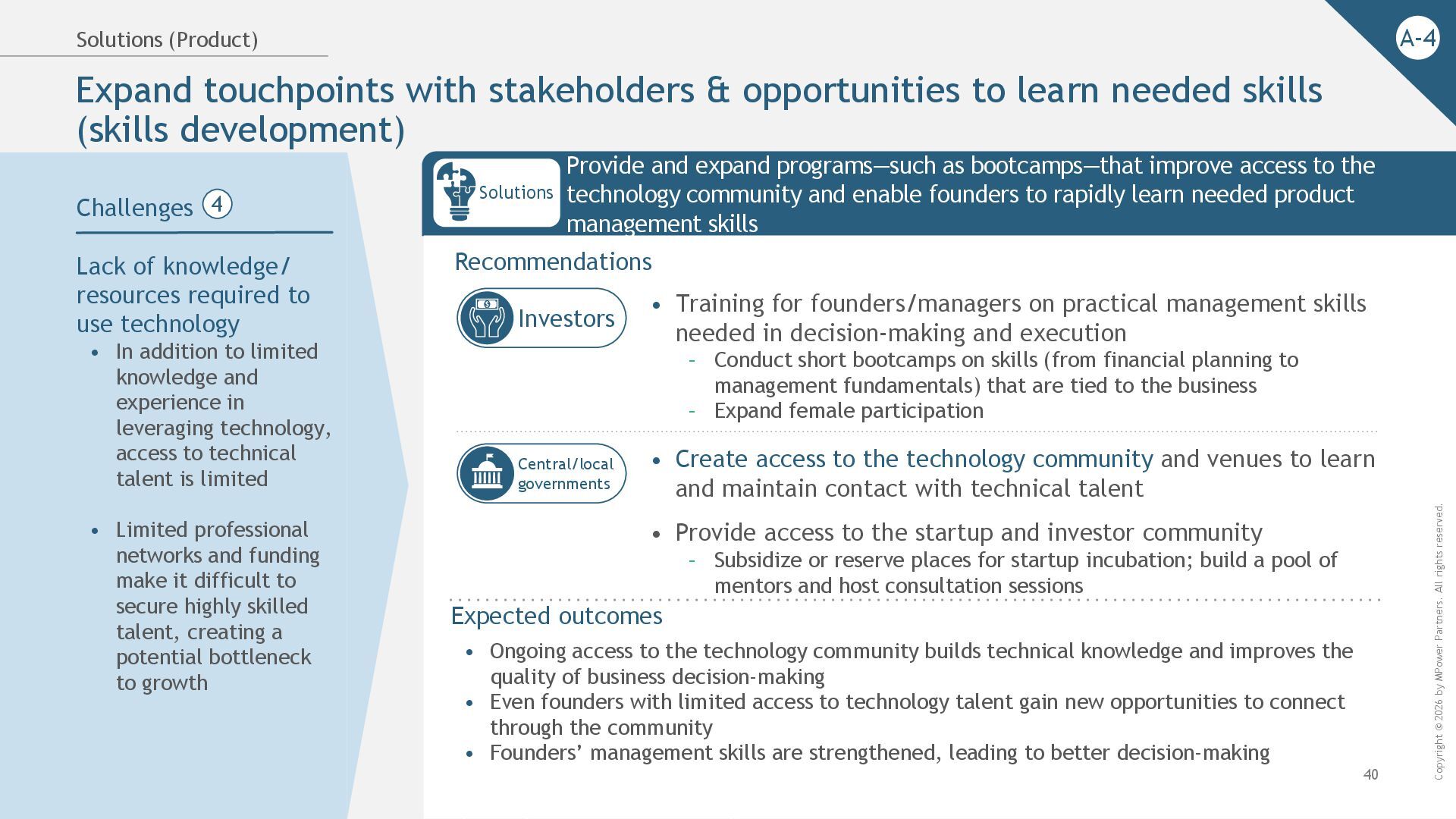
    Expand touchpoints with stakeholders & opportunities to learn needed skills (skills development) A-4 Provide and expand programs—such as bootcamps—that improve access to the technology community and enable founders to rapidly learn needed product management skills Copyright © 2026 by MPower Partners. All rights reserved. 40 解決策 Lack of knowledge/ resources required to use technology • In addition to limited knowledge and experience in leveraging technology, access to technical talent is limited • Limited professional networks and funding make it difficult to secure highly skilled talent, creating a potential bottleneck to growth Continuous access to expertise through communities builds technical knowledge and improves the quality of business decision-making. Entrepreneurs with limited access to technology talent gain new opportunities to connect via the community. Entrepreneurs’ management skills are strengthened, leading to higher- quality decision-making. • Training for founders/managers on practical management skills needed in decision-making and execution – Conduct short bootcamps on skills (from financial planning to management fundamentals) that are tied to the business – Expand female participation Recommendations Investors Central/local governments • Create access to the technology community and venues to learn and maintain contact with technical talent • Provide access to the startup and investor community – Subsidize or reserve places for startup incubation; build a pool of mentors and host consultation sessions • Ongoing access to the technology community builds technical knowledge and improves the quality of business decision-making • Even founders with limited access to technology talent gain new opportunities to connect through the community • Founders’ management skills are strengthened, leading to better decision-making Challenges 4 Solutions (Product) Expected outcomes Solutions
  42. 41 Copyright © 2026 by MPower Partners. All rights reserved.

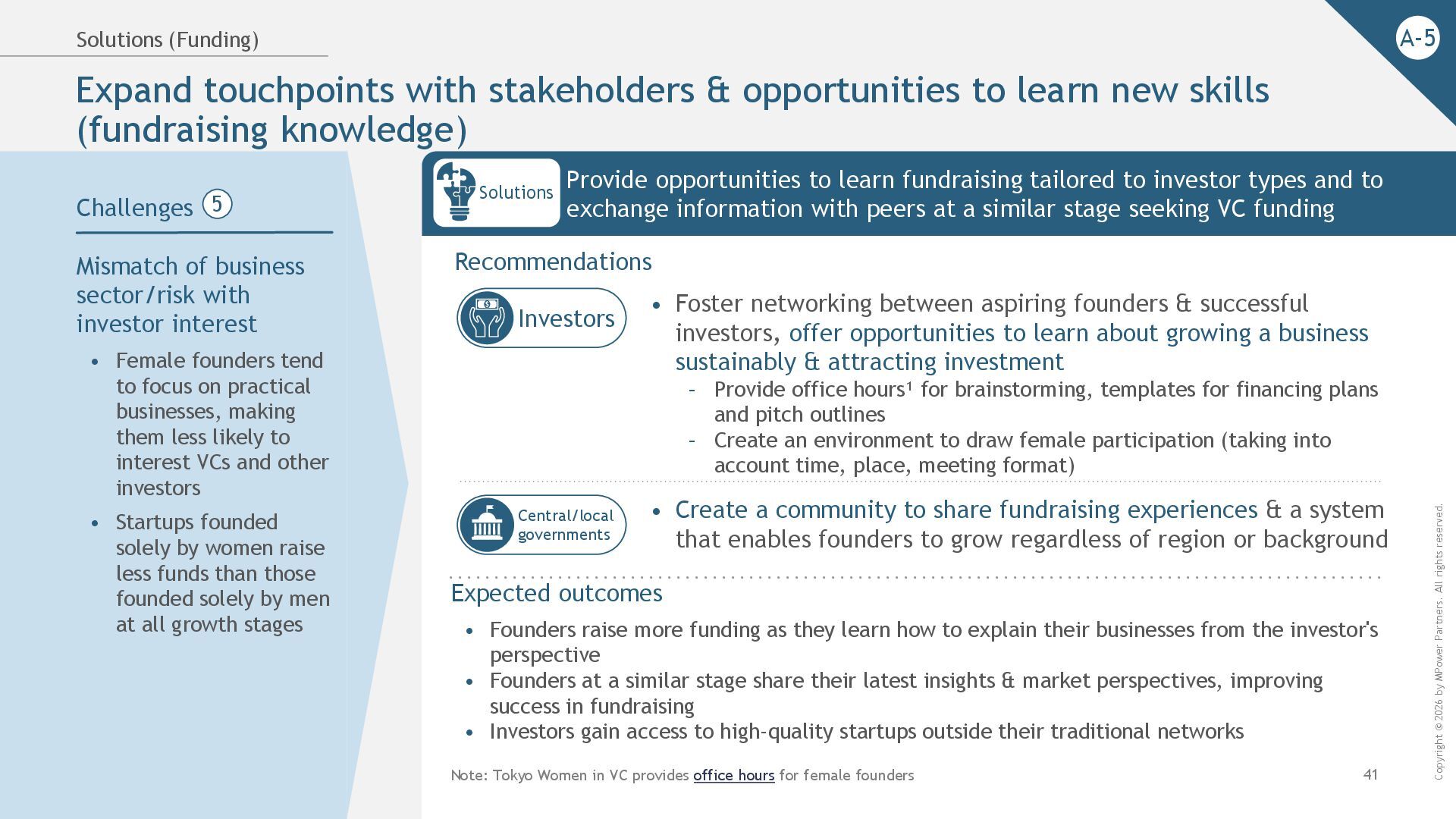
    Expand touchpoints with stakeholders & opportunities to learn new skills (fundraising knowledge) A-5 Provide opportunities to learn fundraising tailored to investor types and to exchange information with peers at a similar stage seeking VC funding Copyright © 2026 by MPower Partners. All rights reserved. 41 Solutions Mismatch of business sector/risk with investor interest • Female founders tend to focus on practical businesses, making them less likely to interest VCs and other investors • Startups founded solely by women raise less funds than those founded solely by men at all growth stages • Founders raise more funding as they learn how to explain their businesses from the investor's perspective • Founders at a similar stage share their latest insights & market perspectives, improving success in fundraising • Investors gain access to high-quality startups outside their traditional networks • Create a community to share fundraising experiences & a system that enables founders to grow regardless of region or background • Foster networking between aspiring founders & successful investors, offer opportunities to learn about growing a business sustainably & attracting investment – Provide office hours¹ for brainstorming, templates for financing plans and pitch outlines – Create an environment to draw female participation (taking into account time, place, meeting format) Recommendations Investors Central/local governments Solutions Challenges 5 Solutions (Funding) Expected outcomes Note: Tokyo Women in VC provides office hours for female founders
  43. 42 Copyright © 2026 by MPower Partners. All rights reserved.

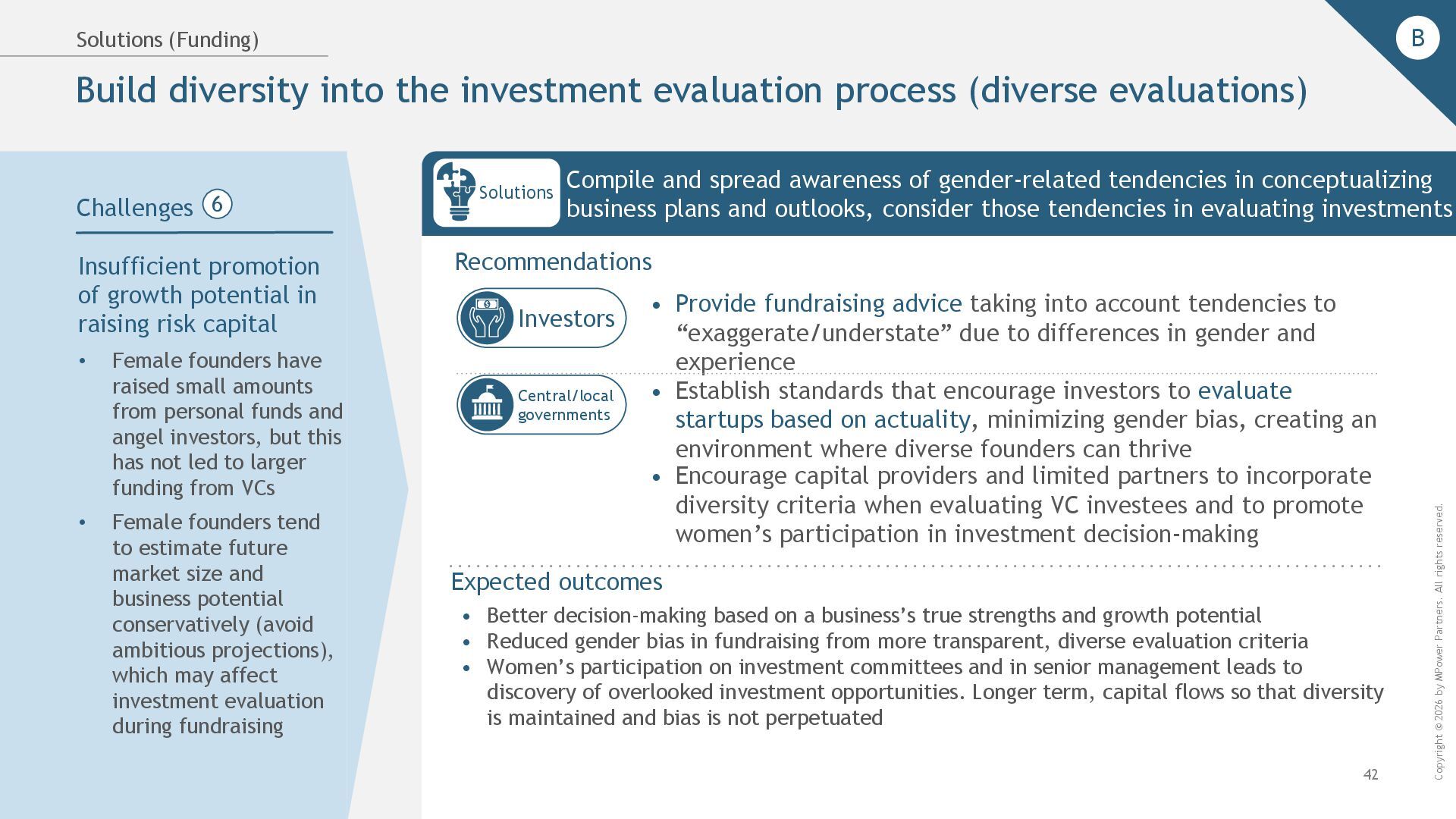
    Compile and spread awareness of gender-related tendencies in conceptualizing business plans and outlooks, consider those tendencies in evaluating investments Build diversity into the investment evaluation process (diverse evaluations) B Copyright © 2026 by MPower Partners. All rights reserved. 42 解決策 Insufficient promotion of growth potential in raising risk capital • Female founders have raised small amounts from personal funds and angel investors, but this has not led to larger funding from VCs • Female founders tend to estimate future market size and business potential conservatively (avoid ambitious projections), which may affect investment evaluation during fundraising • Establish standards that encourage investors to evaluate startups based on actuality, minimizing gender bias, creating an environment where diverse founders can thrive • Provide fundraising advice taking into account tendencies to “exaggerate/understate” due to differences in gender and experience Recommendations Solutions Central/local governments Investors • Better decision-making based on a business’s true strengths and growth potential • Reduced gender bias in fundraising from more transparent, diverse evaluation criteria • Women’s participation on investment committees and in senior management leads to discovery of overlooked investment opportunities. Longer term, capital flows so that diversity is maintained and bias is not perpetuated • Encourage capital providers and limited partners to incorporate diversity criteria when evaluating VC investees and to promote women’s participation in investment decision-making Challenges 6 Solutions (Funding) Expected outcomes
  44. 43 Copyright © 2026 by MPower Partners. All rights reserved.

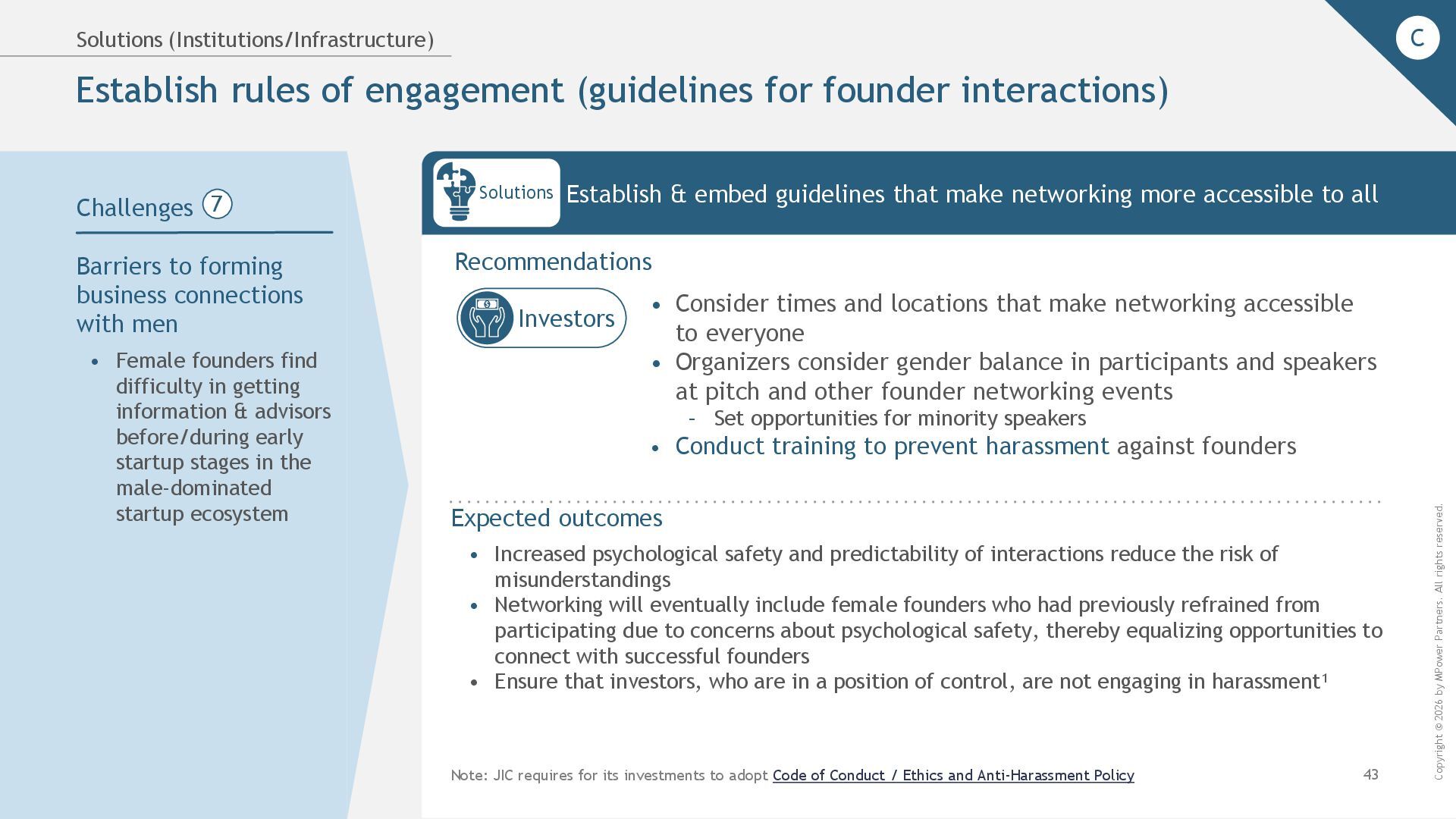
    Establish & embed guidelines that make networking more accessible to all Copyright © 2026 by MPower Partners. All rights reserved. 43 Establish rules of engagement (guidelines for founder interactions) C Solutions • Consider times and locations that make networking accessible to everyone • Organizers consider gender balance in participants and speakers at pitch and other founder networking events – Set opportunities for minority speakers • Conduct training to prevent harassment against founders Barriers to forming business connections with men • Female founders find difficulty in getting information & advisors before/during early startup stages in the male-dominated startup ecosystem • Increased psychological safety and predictability of interactions reduce the risk of misunderstandings • Networking will eventually include female founders who had previously refrained from participating due to concerns about psychological safety, thereby equalizing opportunities to connect with successful founders • Ensure that investors, who are in a position of control, are not engaging in harassment¹ Solutions Note: JIC requires for its investments to adopt Code of Conduct / Ethics and Anti-Harassment Policy Challenges 7 Solutions (Institutions/Infrastructure) Recommendations Investors Expected outcomes
  45. 44 Copyright © 2026 by MPower Partners. All rights reserved.

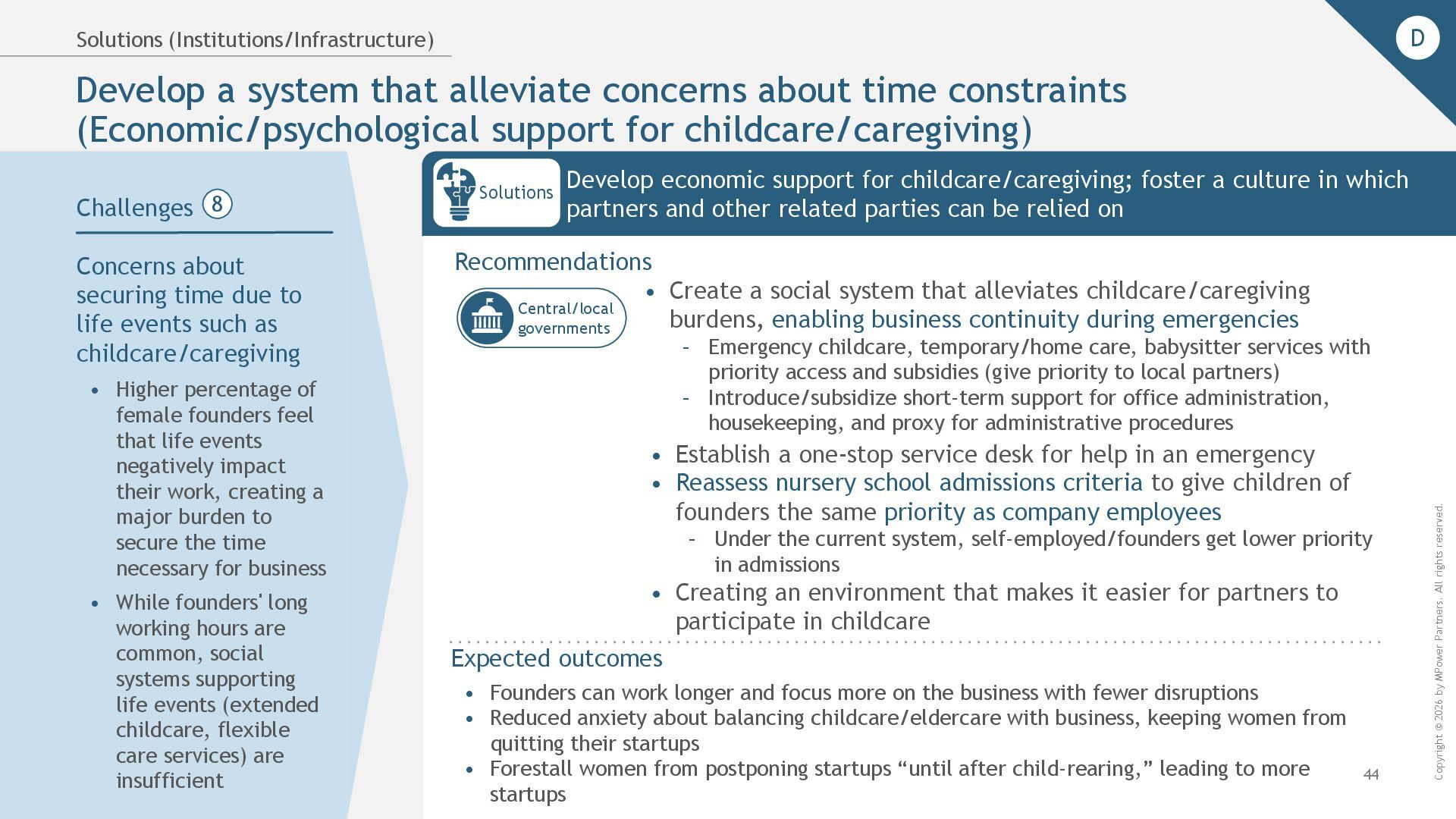
    Develop economic support for childcare/caregiving; foster a culture in which partners and other related parties can be relied on Copyright © 2026 by MPower Partners. All rights reserved. 44 Develop a system that alleviate concerns about time constraints (Economic/psychological support for childcare/caregiving) D Solutions • Establish a one-stop service desk for help in an emergency Concerns about securing time due to life events such as childcare/caregiving • Higher percentage of female founders feel that life events negatively impact their work, creating a major burden to secure the time necessary for business • While founders' long working hours are common, social systems supporting life events (extended childcare, flexible care services) are insufficient • Founders can work longer and focus more on the business with fewer disruptions • Reduced anxiety about balancing childcare/eldercare with business, keeping women from quitting their startups • Forestall women from postponing startups “until after child-rearing,” leading to more startups • Create a social system that alleviates childcare/caregiving burdens, enabling business continuity during emergencies – Emergency childcare, temporary/home care, babysitter services with priority access and subsidies (give priority to local partners) – Introduce/subsidize short-term support for office administration, housekeeping, and proxy for administrative procedures Recommendations • Reassess nursery school admissions criteria to give children of founders the same priority as company employees – Under the current system, self-employed/founders get lower priority in admissions Central/local governments Solutions • Creating an environment that makes it easier for partners to participate in childcare Challenges 8 Solutions (Institutions/Infrastructure) Expected outcomes
  46. 45 Copyright © 2026 by MPower Partners. All rights reserved.

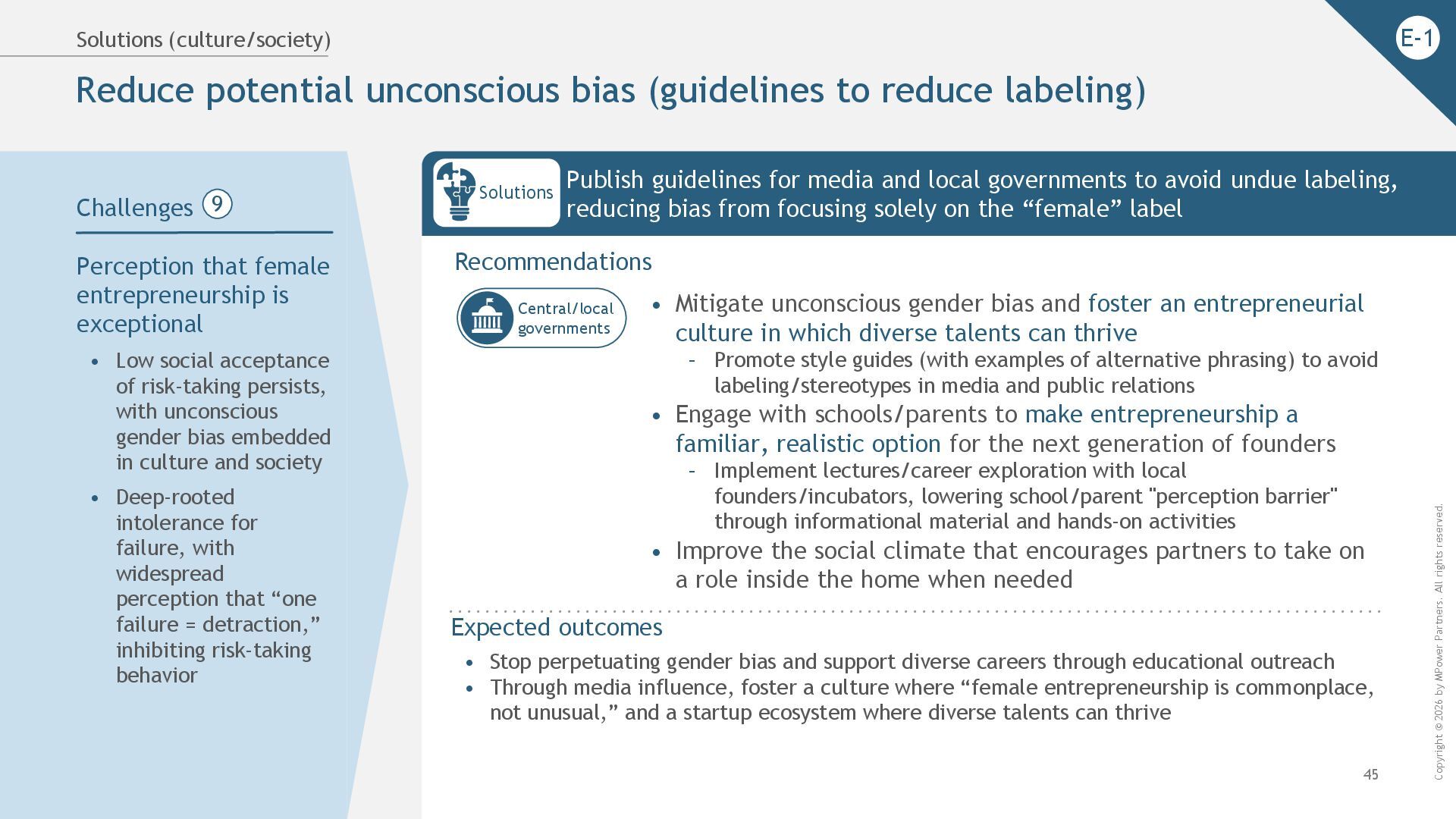
    Publish guidelines for media and local governments to avoid undue labeling, reducing bias from focusing solely on the “female” label Copyright © 2026 by MPower Partners. All rights reserved. 45 Reduce potential unconscious bias (guidelines to reduce labeling) E-1 Solutions • Engage with schools/parents to make entrepreneurship a familiar, realistic option for the next generation of founders – Implement lectures/career exploration with local founders/incubators, lowering school/parent "perception barrier" through informational material and hands-on activities Perception that female entrepreneurship is exceptional • Low social acceptance of risk-taking persists, with unconscious gender bias embedded in culture and society • Deep-rooted intolerance for failure, with widespread perception that “one failure = detraction,” inhibiting risk-taking behavior • Stop perpetuating gender bias and support diverse careers through educational outreach • Through media influence, foster a culture where “female entrepreneurship is commonplace, not unusual,” and a startup ecosystem where diverse talents can thrive • Mitigate unconscious gender bias and foster an entrepreneurial culture in which diverse talents can thrive – Promote style guides (with examples of alternative phrasing) to avoid labeling/stereotypes in media and public relations Recommendations Central/local governments Solutions • Improve the social climate that encourages partners to take on a role inside the home when needed Challenges 9 Solutions (culture/society) Expected outcomes
  47. 46 Copyright © 2026 by MPower Partners. All rights reserved.

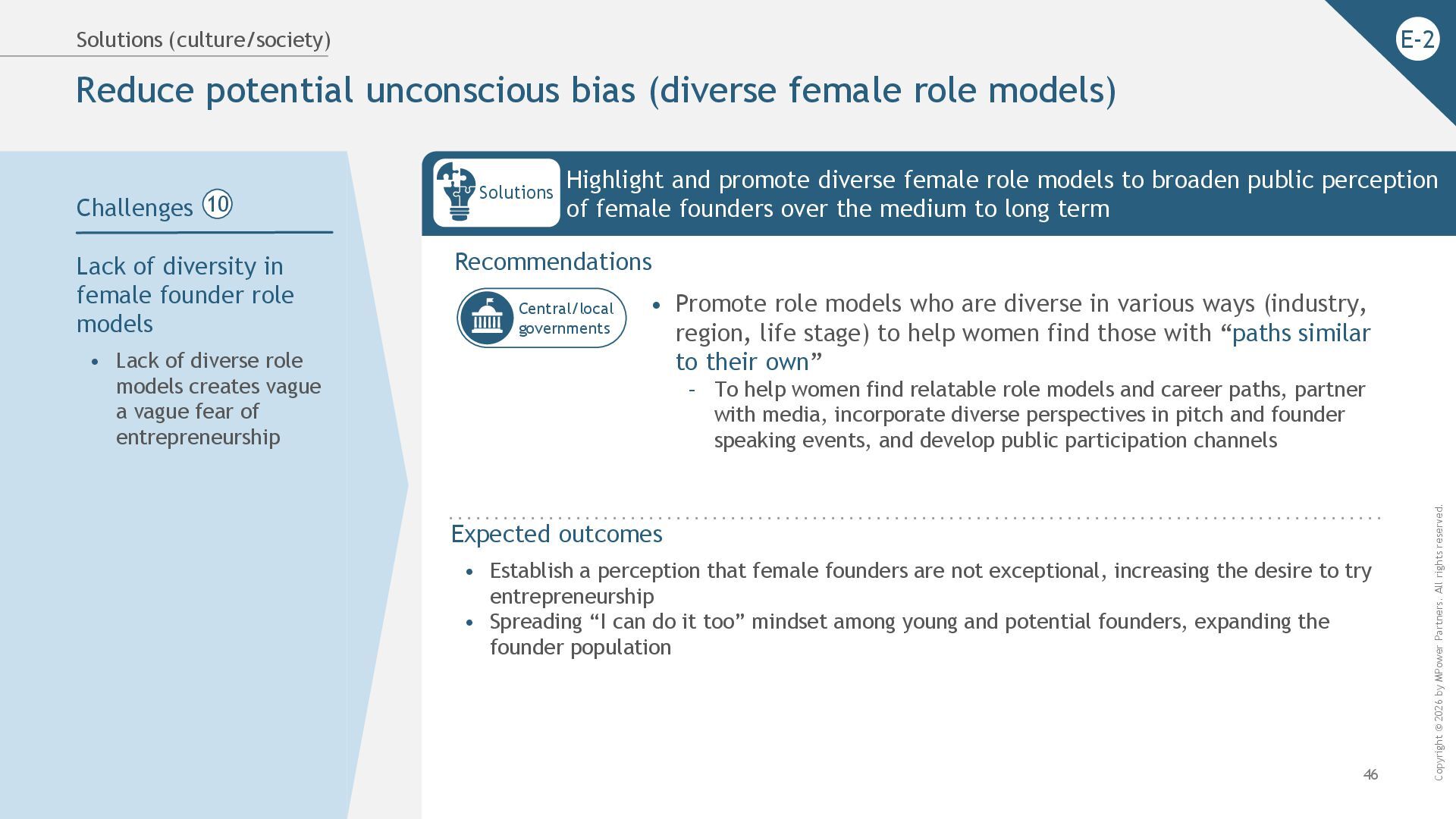
    Highlight and promote diverse female role models to broaden public perception of female founders over the medium to long term Copyright © 2026 by MPower Partners. All rights reserved. 46 Reduce potential unconscious bias (diverse female role models) E-2 • Promote role models who are diverse in various ways (industry, region, life stage) to help women find those with “paths similar to their own” – To help women find relatable role models and career paths, partner with media, incorporate diverse perspectives in pitch and founder speaking events, and develop public participation channels Central/local governments Lack of diversity in female founder role models • Lack of diverse role models creates vague a vague fear of entrepreneurship • Establish a perception that female founders are not exceptional, increasing the desire to try entrepreneurship • Spreading “I can do it too” mindset among young and potential founders, expanding the founder population Recommendations Solutions Challenges 10 Solutions (culture/society) Expected outcomes
  48. 47 Copyright © 2026 by MPower Partners. All rights reserved.

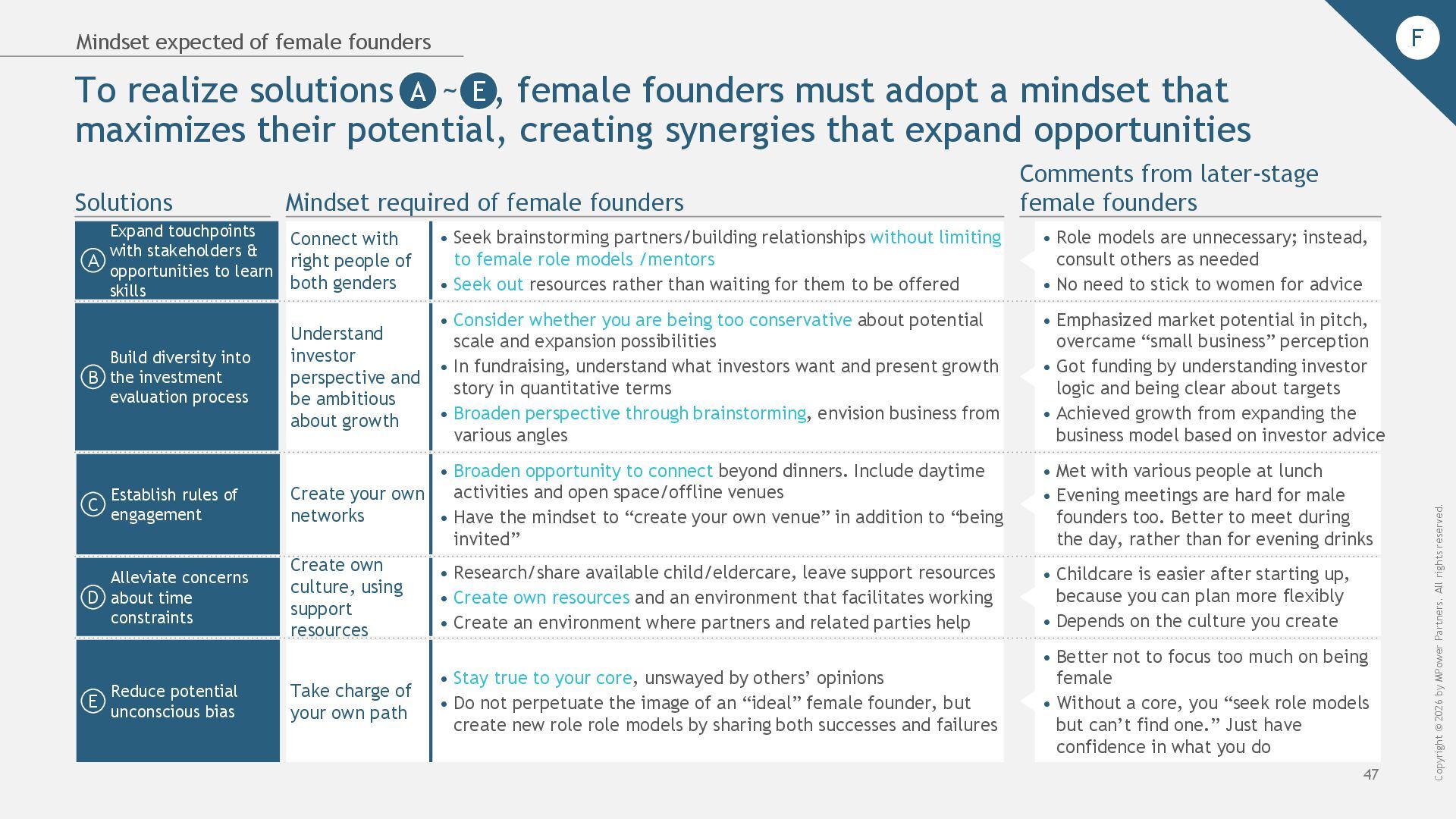
    To realize solutions ~ , female founders must adopt a mindset that maximizes their potential, creating synergies that expand opportunities Solutions Comments from later-stage female founders Mindset expected of female founders Reduce potential unconscious bias E Alleviate concerns about time constraints D Establish rules of engagement C Build diversity into the investment evaluation process B Expand touchpoints with stakeholders & opportunities to learn skills A • Better not to focus too much on being female • Without a core, you “seek role models but can’t find one.” Just have confidence in what you do • Childcare is easier after starting up, because you can plan more flexibly • Depends on the culture you create • Met with various people at lunch • Evening meetings are hard for male founders too. Better to meet during the day, rather than for evening drinks • Emphasized market potential in pitch, overcame “small business” perception • Got funding by understanding investor logic and being clear about targets • Achieved growth from expanding the business model based on investor advice • Role models are unnecessary; instead, consult others as needed • No need to stick to women for advice Mindset required of female founders Take charge of your own path • Stay true to your core, unswayed by others’ opinions • Do not perpetuate the image of an “ideal” female founder, but create new role role models by sharing both successes and failures Create own culture, using support resources • Research/share available child/eldercare, leave support resources • Create own resources and an environment that facilitates working • Create an environment where partners and related parties help Create your own networks • Broaden opportunity to connect beyond dinners. Include daytime activities and open space/offline venues • Have the mindset to “create your own venue” in addition to “being invited” Understand investor perspective and be ambitious about growth • Consider whether you are being too conservative about potential scale and expansion possibilities • In fundraising, understand what investors want and present growth story in quantitative terms • Broaden perspective through brainstorming, envision business from various angles Connect with right people of both genders • Seek brainstorming partners/building relationships without limiting to female role models /mentors • Seek out resources rather than waiting for them to be offered F A E
  49. 48 Copyright © 2026 by MPower Partners. All rights reserved.

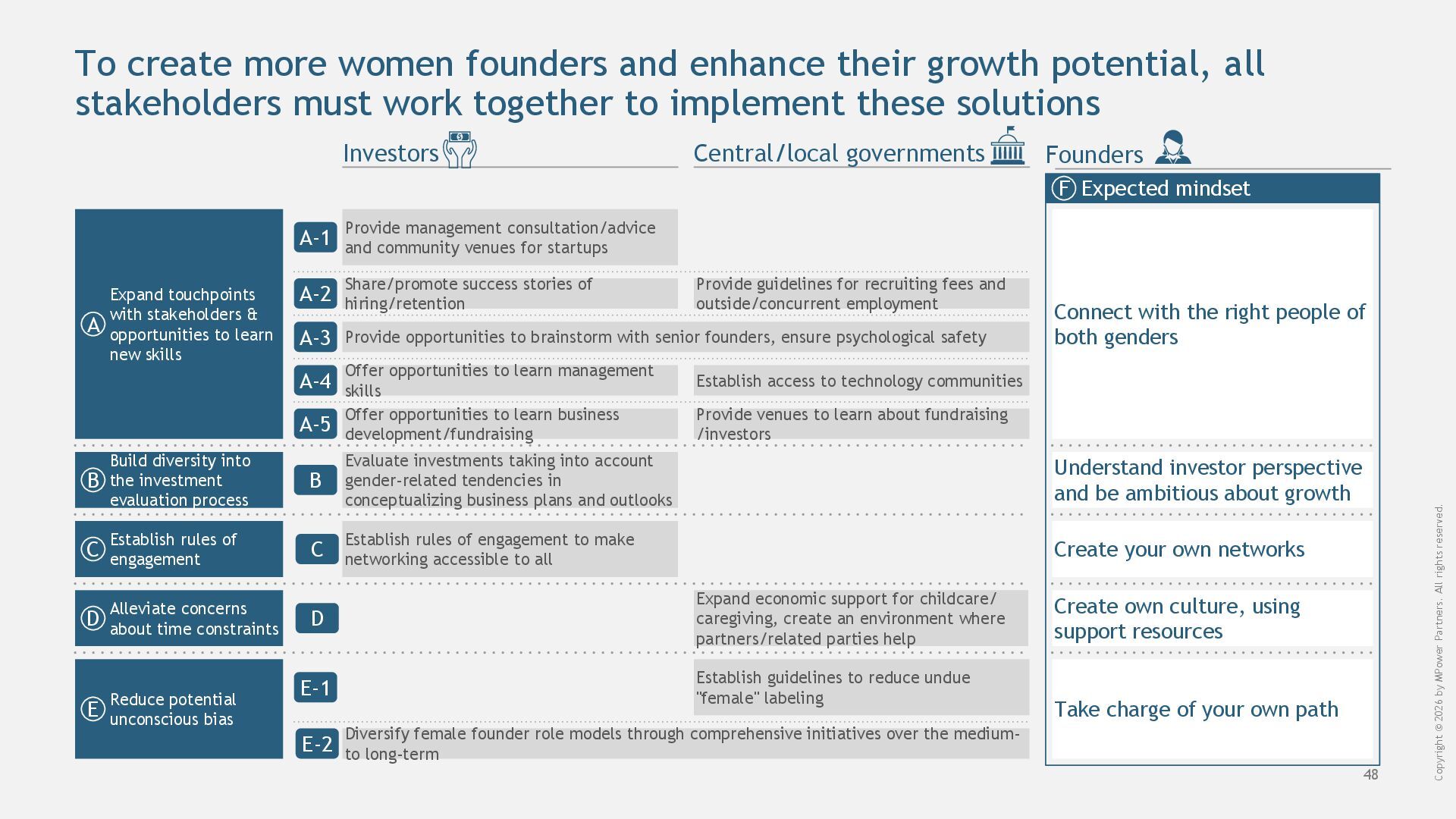
    To create more women founders and enhance their growth potential, all stakeholders must work together to implement these solutions Provide management consultation/advice and community venues for startups Diversify female founder role models through comprehensive initiatives over the medium- to long-term Evaluate investments taking into account gender-related tendencies in conceptualizing business plans and outlooks Share/promote success stories of hiring/retention Offer opportunities to learn management skills Offer opportunities to learn business development/fundraising Provide opportunities to brainstorm with senior founders, ensure psychological safety E-2 A-1 A-2 A-3 A-5 A-4 E-1 B C D Reduce potential unconscious bias E Alleviate concerns about time constraints D Establish rules of engagement C Build diversity into the investment evaluation process B Expand touchpoints with stakeholders & opportunities to learn new skills A Investors Connect with the right people of both genders Understand investor perspective and be ambitious about growth Create your own networks Create own culture, using support resources Take charge of your own path Expected mindset F Founders Establish guidelines to reduce undue "female" labeling Establish rules of engagement to make networking accessible to all Expand economic support for childcare/ caregiving, create an environment where partners/related parties help Provide guidelines for recruiting fees and outside/concurrent employment Establish access to technology communities Provide venues to learn about fundraising /investors Central/local governments
  50. 49 Copyright © 2026 by MPower Partners. All rights reserved.

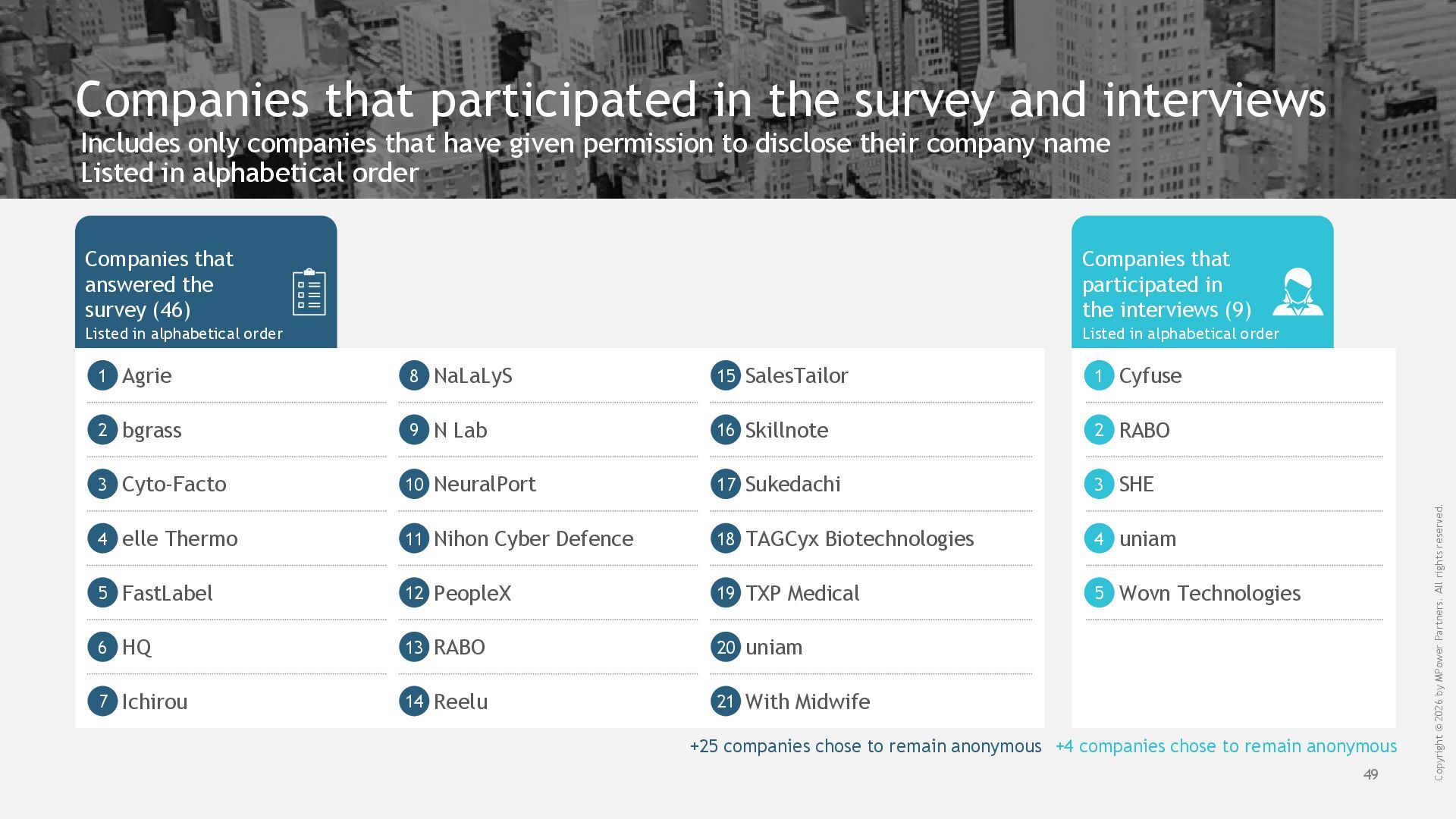
    Companies that participated in the survey and interviews Ichirou 7 Agrie 1 bgrass 2 Cyto-Facto 3 elle Thermo 4 FastLabel 5 HQ 6 Reelu 14 NaLaLyS 8 N Lab 9 NeuralPort 10 Nihon Cyber Defence 11 PeopleX 12 RABO 13 Cyfuse RABO SHE uniam Wovn Technologies 1 2 3 4 5 With Midwife 21 SalesTailor 15 Skillnote 16 Sukedachi 17 TAGCyx Biotechnologies 18 TXP Medical 19 uniam 20 +25 companies chose to remain anonymous +4 companies chose to remain anonymous Includes only companies that have given permission to disclose their company name Listed in alphabetical order Companies that participated in the interviews (9) Companies that answered the survey (46) Listed in alphabetical order Listed in alphabetical order
  51. 50 Copyright © 2026 by MPower Partners. All rights reserved.

    Contact Information Managing Director & Partner Katsuyoshi Kurihara Managing Director & Partner Miho Orimo General Partner Kathy Matsui General Partner Miwa Seki General Partner Yumiko Murakami Inquiries [email protected] Inquiries [email protected]
  52. 51 Copyright © 2026 by MPower Partners. All rights reserved.

    © MPower Partners. 2026. All Rights Reserved. This report was created based on joint research and study by MPower Partners and Boston Consulting Group (BCG). This document has been prepared in good faith on the basis of information available at the date of publication without any independent verification. MPower and BCG do not guarantee or make any representation or warranty as to the accuracy, reliability, completeness, or currency of the information in this document nor its usefulness in achieving any purpose. Readers are responsible for assessing the relevance and accuracy of the content of this document. It is unreasonable for any party to rely on this document for any purpose and MPower and BCG will not be liable for any loss, damage, cost, or expense incurred or arising by reason of any person using or relying on information in this document. To the fullest extent permitted by law (and except to the extent otherwise agreed in a signed writing by MPower and BCG), MPower and BCG shall have no liability whatsoever to any party, and any person using this document hereby waives any rights and claims it may have at any time against MPower and BCG with regard to the document. Receipt and review of this document shall be deemed agreement with and consideration for the foregoing. This document is based on a primary qualitative and quantitative research executed jointly by MPower and BCG. MPower and BCG do not provide legal, accounting, or tax advice. Readers are responsible for obtaining independent advice concerning these matters. This advice may affect the guidance in the document. Further, MPower and BCG have made no undertaking to update the document after the date hereof, notwithstanding that such information may become outdated or inaccurate. MPower and BCG do not provide fairness opinions or valuations of market transactions, and this document should not be relied on or construed as such. Further, any evaluations, projected market information, and conclusions contained in this document are based upon standard valuation methodologies, are not definitive forecasts, and are not guaranteed by MPower or BCG. MPower and BCG have used data from various sources and assumptions provided to MPower and BCG from other sources. MPower and BCG have not independently verified the data and assumptions from these sources used in these analyses. Changes in the underlying data or operating assumptions will clearly impact the analyses and conclusions. This document is not intended to make or influence any recommendation and should not be construed as such by the reader or any other entity. This document does not purport to represent the views of the companies mentioned in the document. Reference herein to any specific commercial product, process, or service by trade name, trademark, manufacturer, or otherwise, does not necessarily constitute or imply its endorsement, recommendation, or favoring by MPower or BCG. Apart from any use as permitted under the Copyright Act of Japan, no part may be reproduced in any form. Disclaimer