Upgrade to Pro
— share decks privately, control downloads, hide ads and more …
Speaker Deck
Sign up for free
Menu
Search
Features
All features
Private URLs
Password Protection
Custom URLS
Scheduled publishing
Remove Branding
Restrict embedding
Deck Collections
Notes
Features
All features
Private URLs
Password Protection
Custom URLS
Scheduled publishing
Remove Branding
Restrict embedding
Deck Collections
Notes
Explore
Featured decks
Featured speakers
Programming
Technology
Storyboards
Explore
Featured decks
Featured speakers
Programming
Technology
Storyboards
Pricing
Search
Sign in
Sign up for free
Finding the Longest Shared Subsequence: Finding...
Search
onouyek
February 04, 2022
Programming
310
0
Share
Embed
Copy iframe code
Copy JS code
Copy link
Start on current slide
Finding the Longest Shared Subsequence: Finding K-mers, Writing Functions, and Using Binary Search
【第10回】ゼロから始めるゲノム解析 (Python編)
onouyek
February 04, 2022
More Decks by onouyek
See All by onouyek
Finding Open Reading Frames
onouyek
0
410
Inferring mRNA from Protein: Products and Reductions of Lists
onouyek
0
390
Find a Motif in DNA: Exploring Sequence Similarity
onouyek
0
360
Finding the Hamming Distance: Counting Point Mutations
onouyek
0
480
Creating the Fibonacci Sequence: Writing, Testing, and Benchmarking Algorithms
onouyek
1
520
Transcribing DNA into mRNA: Mutating Strings, Reading and Writing Files
onouyek
0
570
DNA methylation analysis using bisulfite sequencing data
onouyek
0
930
Operations on Genomic Intervals and Genome Arithmetic
onouyek
0
370
Exploratory Data Analysis with Unsupervised Machine Learning
onouyek
0
330
Other Decks in Programming
See All in Programming
Atomic Design, Enforced: Scaling Mobile Design Systems (next.app devCon / droidCon Berlin 2026)
steliosf
PRO
0
170
AIで開発が速くなった先で、開発チームは何を目指すか
shihochan
1
1.7k
[Dev Group Paris Octobre 26] Agentforce, SIforce, Claudeforce, Slackbot… on s'y retrouve ?
nabondance
0
110
Performance Optimization With LLMs
xleitix
0
160
當我們開始不讀 Code - AI Agent 時代,Code Review 與 Clean Code 還剩下什麼?
jame2408
1
280
GemmaをJevのように使ってみる / Use Gemma like Jev
kishida
5
800
[2026-10-09]一枚の布で作らなくてもいい。 信頼性は「パッチワーク」で紡がれる~既存の運用と新しい可能性をつなぎ合わせてきたCREの話~
tosite
0
110
FactoryBotをやめればRSpecは速くなるのか?
yuta_onishi_97
0
880
自作Discord音声botをLambda MicroVMsに移行した話 / Migrating My Discord Voice Bot to Lambda MicroVMs
akihisaikeda
0
120
自サークルのIdPからログアウトできるようになるまで
taiseiue
1
140
【加筆修正版】Laravel のアプリケーションをどこにデプロイするか #phpcon_ehime
akase244
0
150
dotNET_vulnclicker_intro.pdf
deka_morita
0
150
Featured
See All Featured
CSS Pre-Processors: Stylus, Less & Sass
bermonpainter
360
31k
Navigating the Design Leadership Dip - Product Design Week Design Leaders+ Conference 2024
apolaine
2
480
How STYLIGHT went responsive
nonsquared
100
6.3k
sira's awesome portfolio website redesign presentation
elsirapls
0
460
Scaling GitHub
holman
464
140k
How to Talk to Developers About Accessibility
jct
2
580
Site-Speed That Sticks
csswizardry
13
1.6k
Easily Structure & Communicate Ideas using Wireframe
afnizarnur
194
17k
Documentation Writing (for coders)
carmenintech
77
5.6k
A brief & incomplete history of UX Design for the World Wide Web: 1989–2019
jct
2
540
Max Prin - Stacking Signals: How International SEO Comes Together (And Falls Apart)
techseoconnect
PRO
0
490
Lessons Learnt from Crawling 1000+ Websites
charlesmeaden
PRO
1
1.6k
Transcript
【第10回】ゼロから始めるゲノム解析 (Python編) Finding the Longest Shared Subsequence: Finding K-mers, Writing
Functions, and Using Binary Search @onouyek
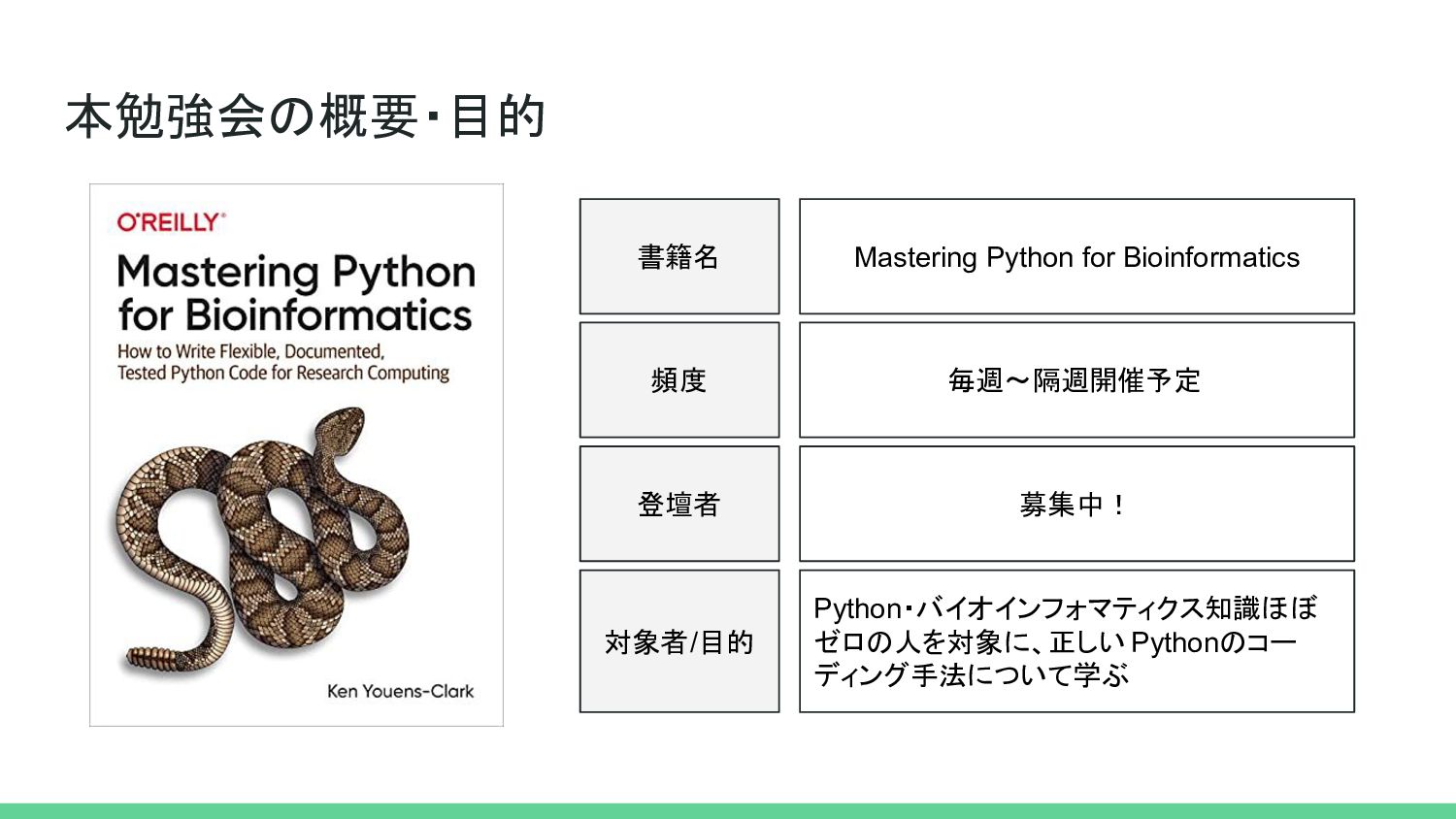
本勉強会の概要・目的 書籍名 対象者/目的 Mastering Python for Bioinformatics Python・バイオインフォマティクス知識ほぼ ゼロの人を対象に、正しい Pythonのコー
ディング手法について学ぶ 頻度 毎週〜隔週開催予定 登壇者 募集中!
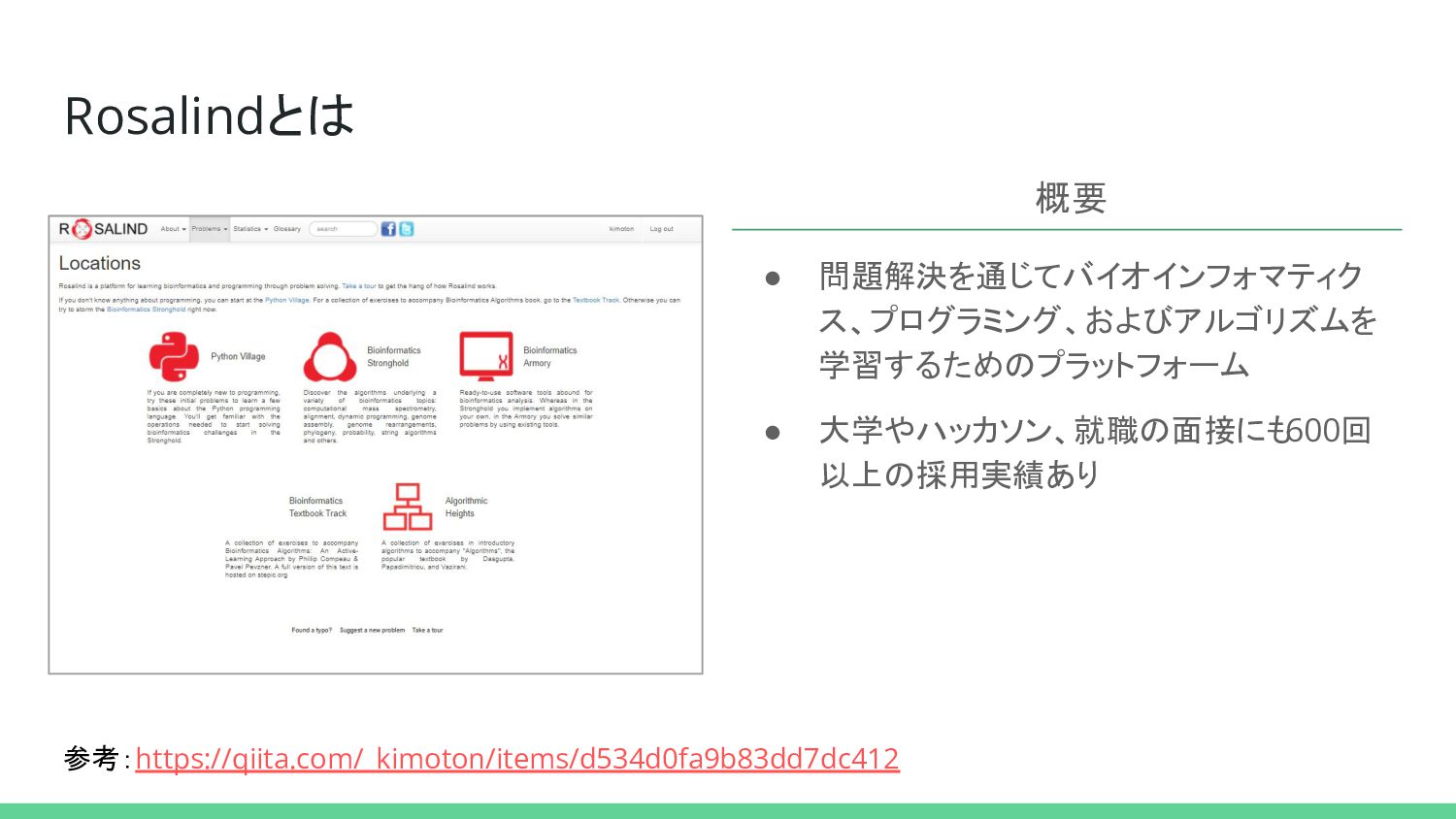
Rosalindとは • 問題解決を通じてバイオインフォマティク ス、プログラミング、およびアルゴリズムを 学習するためのプラットフォーム • 大学やハッカソン、就職の面接にも 600回 以上の採用実績あり 参考:https://qiita.com/_kimoton/items/d534d0fa9b83dd7dc412
概要
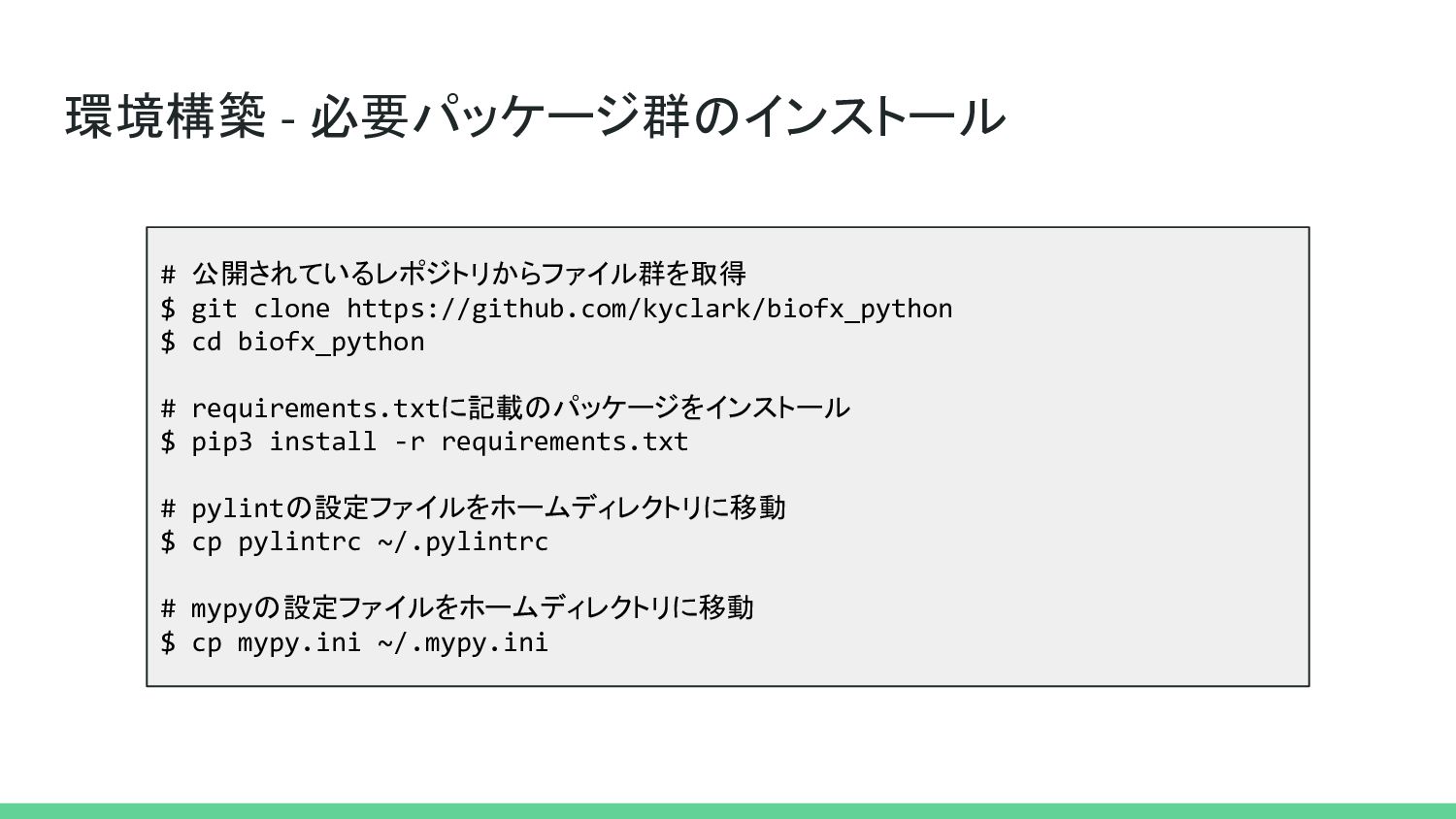
環境構築 - 必要パッケージ群のインストール # 公開されているレポジトリからファイル群を取得 $ git clone https://github.com/kyclark/biofx_python $
cd biofx_python # requirements.txtに記載のパッケージをインストール $ pip3 install -r requirements.txt # pylintの設定ファイルをホームディレクトリに移動 $ cp pylintrc ~/.pylintrc # mypyの設定ファイルをホームディレクトリに移動 $ cp mypy.ini ~/.mypy.ini
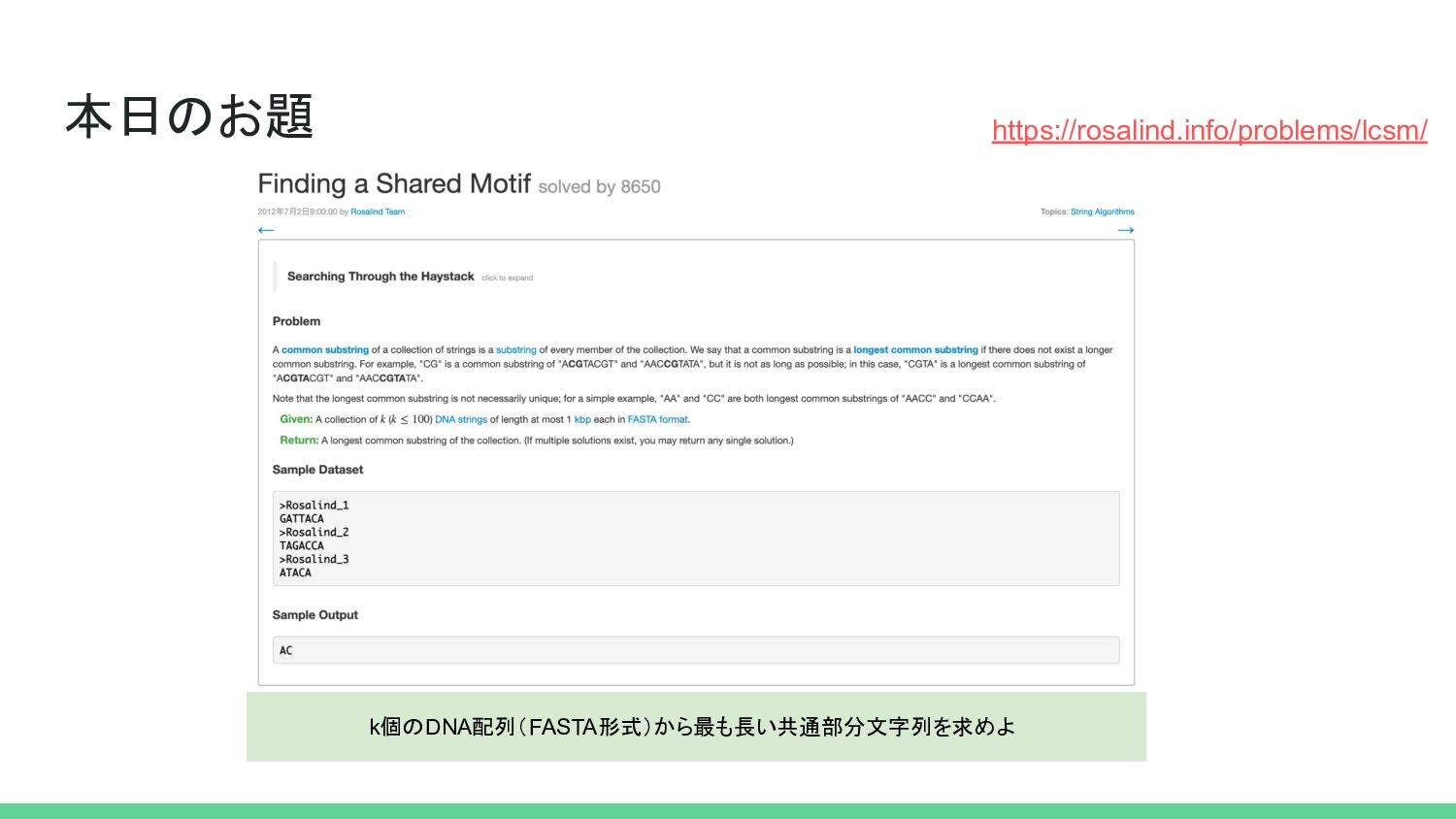
本日のお題 https://rosalind.info/problems/lcsm/ k個のDNA配列(FASTA形式)から最も長い共通部分文字列を求めよ
前提知識編
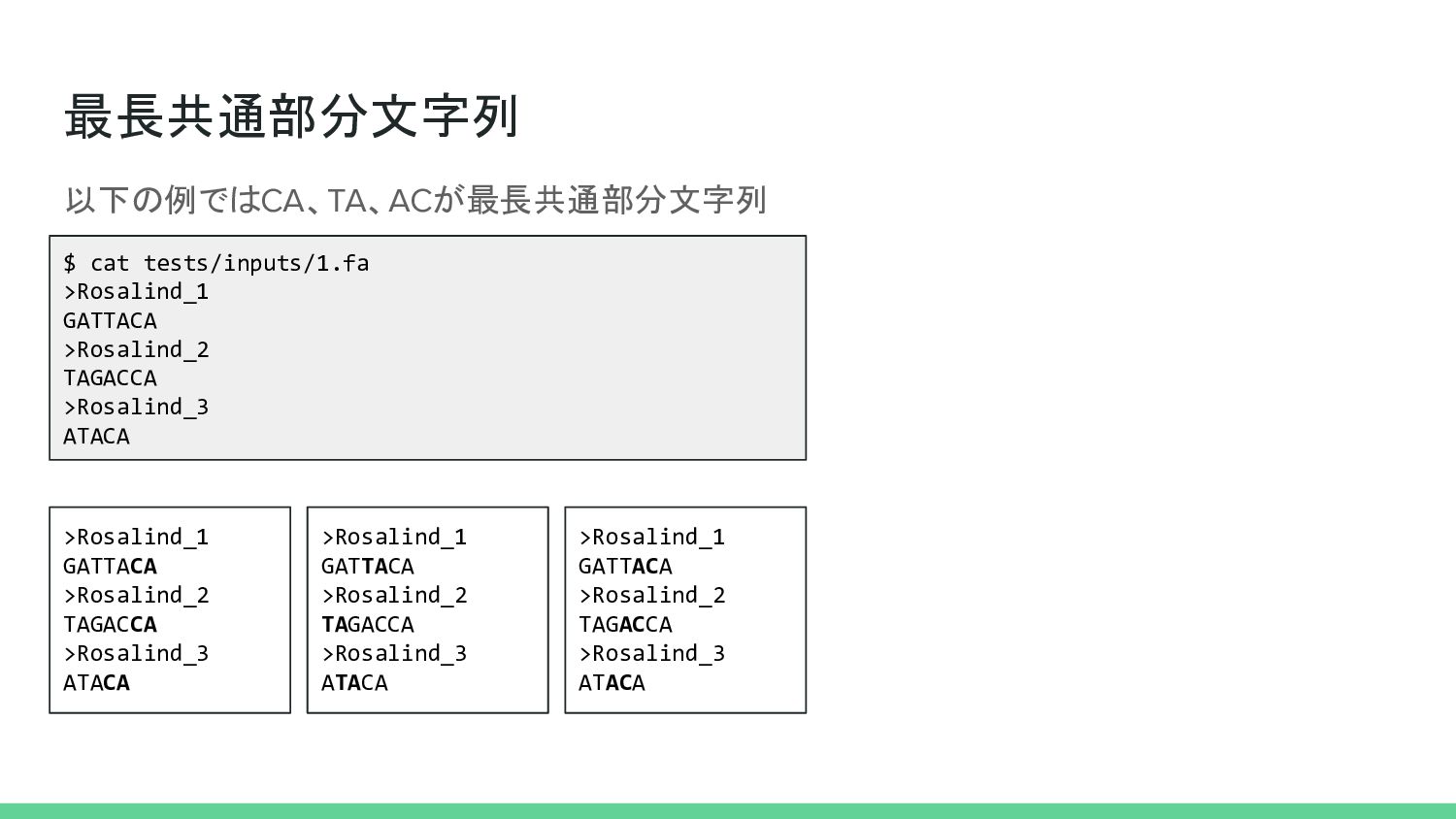
最長共通部分文字列 $ cat tests/inputs/1.fa >Rosalind_1 GATTACA >Rosalind_2 TAGACCA >Rosalind_3 ATACA
以下の例ではCA、TA、ACが最長共通部分文字列 >Rosalind_1 GATTACA >Rosalind_2 TAGACCA >Rosalind_3 ATACA >Rosalind_1 GATTACA >Rosalind_2 TAGACCA >Rosalind_3 ATACA >Rosalind_1 GATTACA >Rosalind_2 TAGACCA >Rosalind_3 ATACA
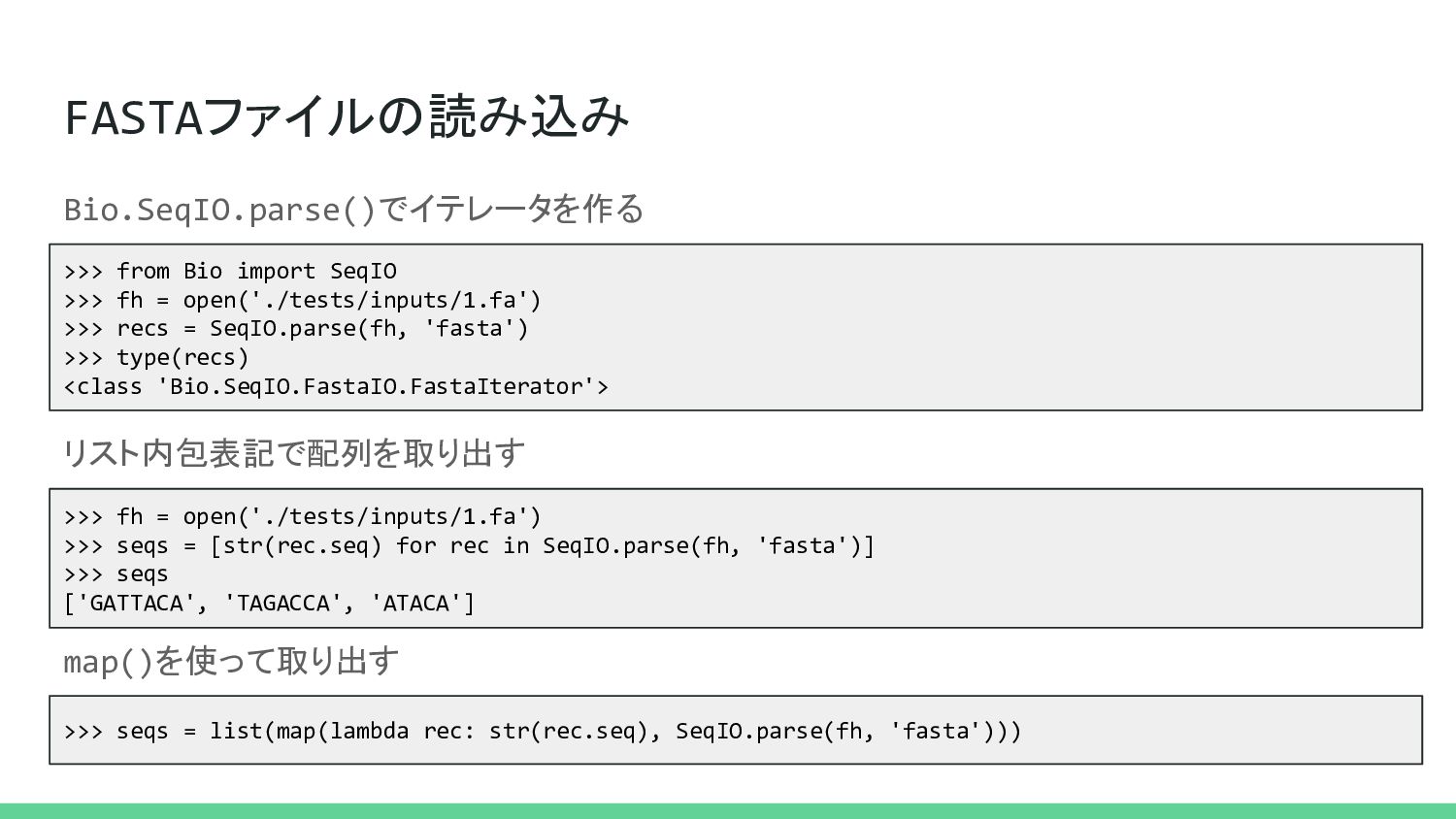
FASTAファイルの読み込み >>> from Bio import SeqIO >>> fh = open('./tests/inputs/1.fa')
>>> recs = SeqIO.parse(fh, 'fasta') >>> type(recs) <class 'Bio.SeqIO.FastaIO.FastaIterator'> Bio.SeqIO.parse()でイテレータを作る >>> fh = open('./tests/inputs/1.fa') >>> seqs = [str(rec.seq) for rec in SeqIO.parse(fh, 'fasta')] >>> seqs ['GATTACA', 'TAGACCA', 'ATACA'] リスト内包表記で配列を取り出す >>> seqs = list(map(lambda rec: str(rec.seq), SeqIO.parse(fh, 'fasta'))) map()を使って取り出す
K-mersの取得 第9回で作ったfind_kmers() def find_kmers(seq: str, k: int) -> List[str]: """
Find k-mers in string """ n = len(seq) - k + 1 return [] if n < 1 else [seq[i:i + k] for i in range(n)] def test_find_kmers() -> None: """ Test find_kmers """ assert find_kmers('', 1) == [] assert find_kmers('ACTG', 1) == ['A', 'C', 'T', 'G'] assert find_kmers('ACTG', 2) == ['AC', 'CT', 'TG'] assert find_kmers('ACTG', 3) == ['ACT', 'CTG'] assert find_kmers('ACTG', 4) == ['ACTG'] assert find_kmers('ACTG', 5) == []
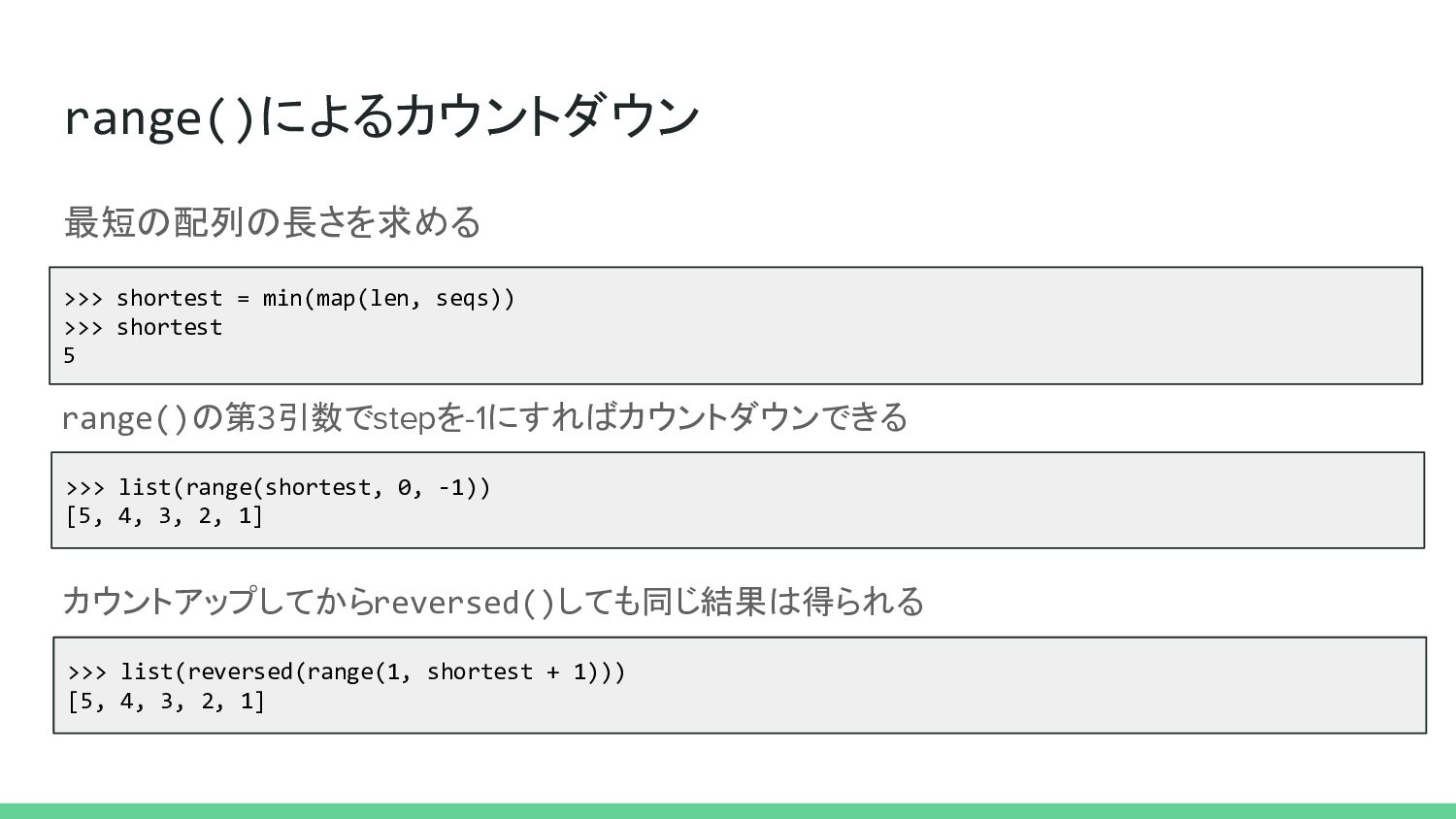
range()によるカウントダウン range()の第3引数でstepを-1にすればカウントダウンできる >>> shortest = min(map(len, seqs)) >>> shortest 5
最短の配列の長さを求める >>> list(range(shortest, 0, -1)) [5, 4, 3, 2, 1] カウントアップしてからreversed()しても同じ結果は得られる >>> list(reversed(range(1, shortest + 1))) [5, 4, 3, 2, 1]
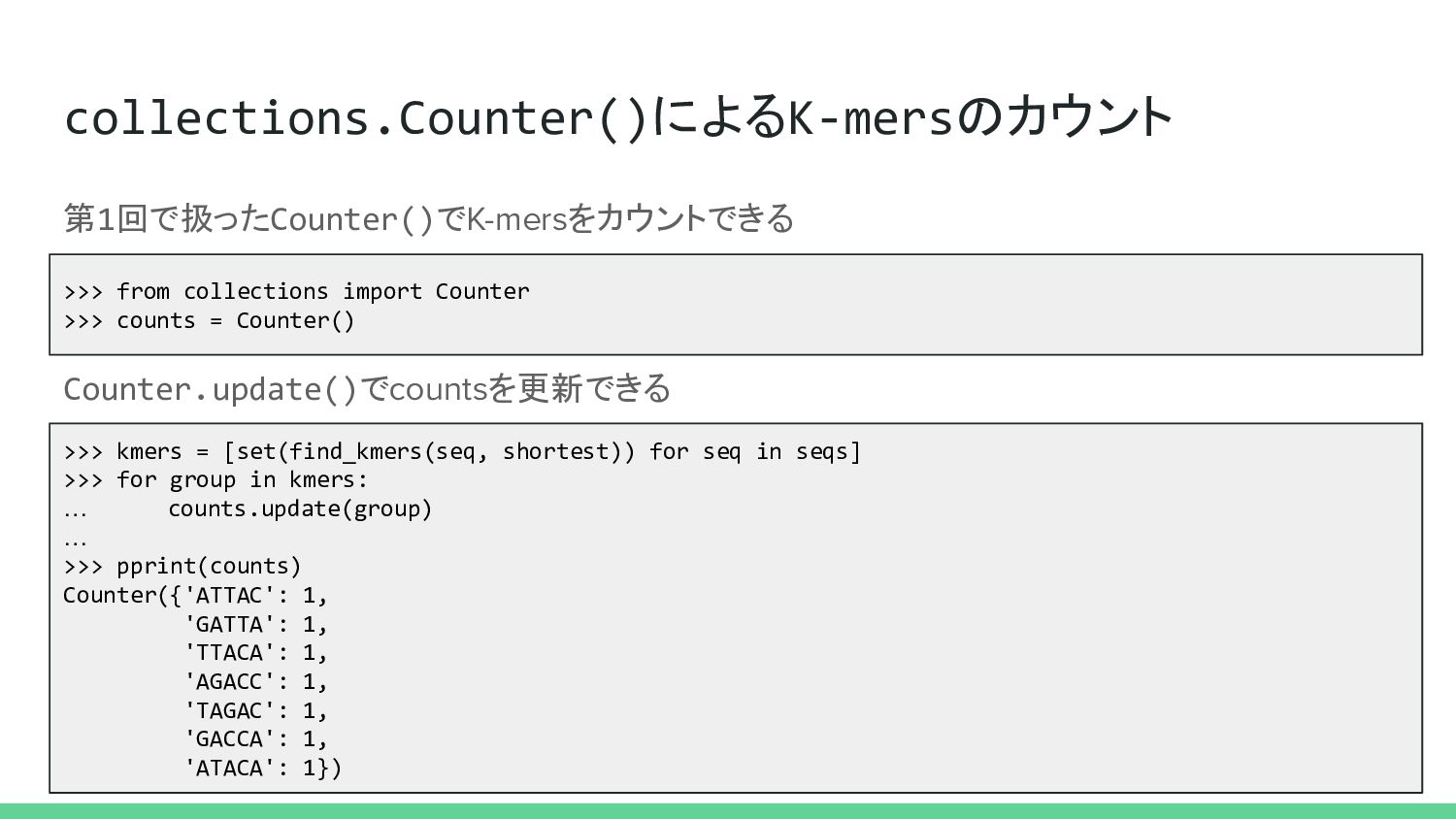
collections.Counter()によるK-mersのカウント >>> from collections import Counter >>> counts = Counter()
第1回で扱ったCounter()でK-mersをカウントできる >>> kmers = [set(find_kmers(seq, shortest)) for seq in seqs] >>> for group in kmers: … counts.update(group) … >>> pprint(counts) Counter({'ATTAC': 1, 'GATTA': 1, 'TTACA': 1, 'AGACC': 1, 'TAGAC': 1, 'GACCA': 1, 'ATACA': 1}) Counter.update()でcountsを更新できる
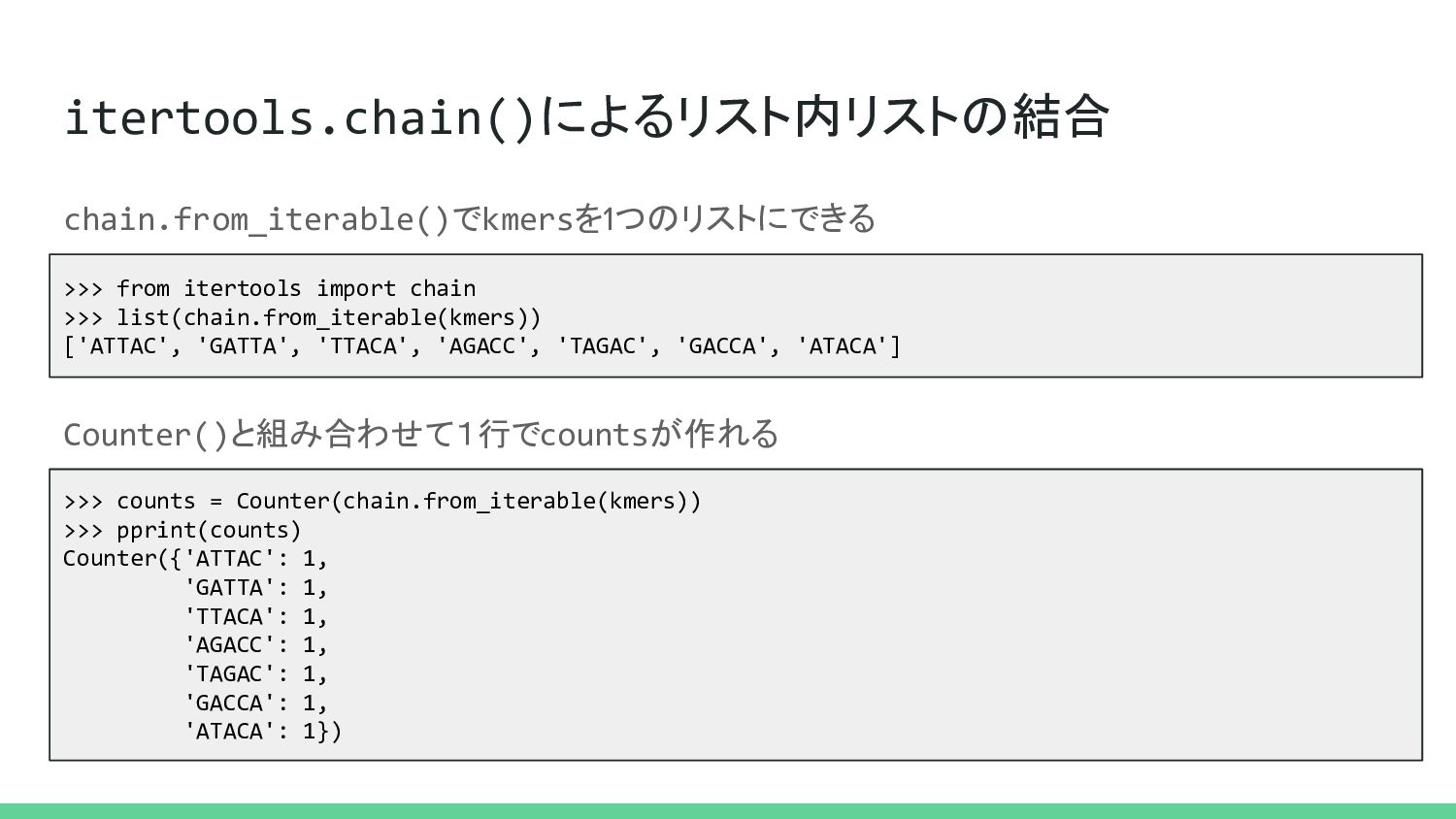
itertools.chain()によるリスト内リストの結合 >>> from itertools import chain >>> list(chain.from_iterable(kmers)) ['ATTAC', 'GATTA',
'TTACA', 'AGACC', 'TAGAC', 'GACCA', 'ATACA'] chain.from_iterable()でkmersを1つのリストにできる >>> counts = Counter(chain.from_iterable(kmers)) >>> pprint(counts) Counter({'ATTAC': 1, 'GATTA': 1, 'TTACA': 1, 'AGACC': 1, 'TAGAC': 1, 'GACCA': 1, 'ATACA': 1}) Counter()と組み合わせて1行でcountsが作れる
解法編
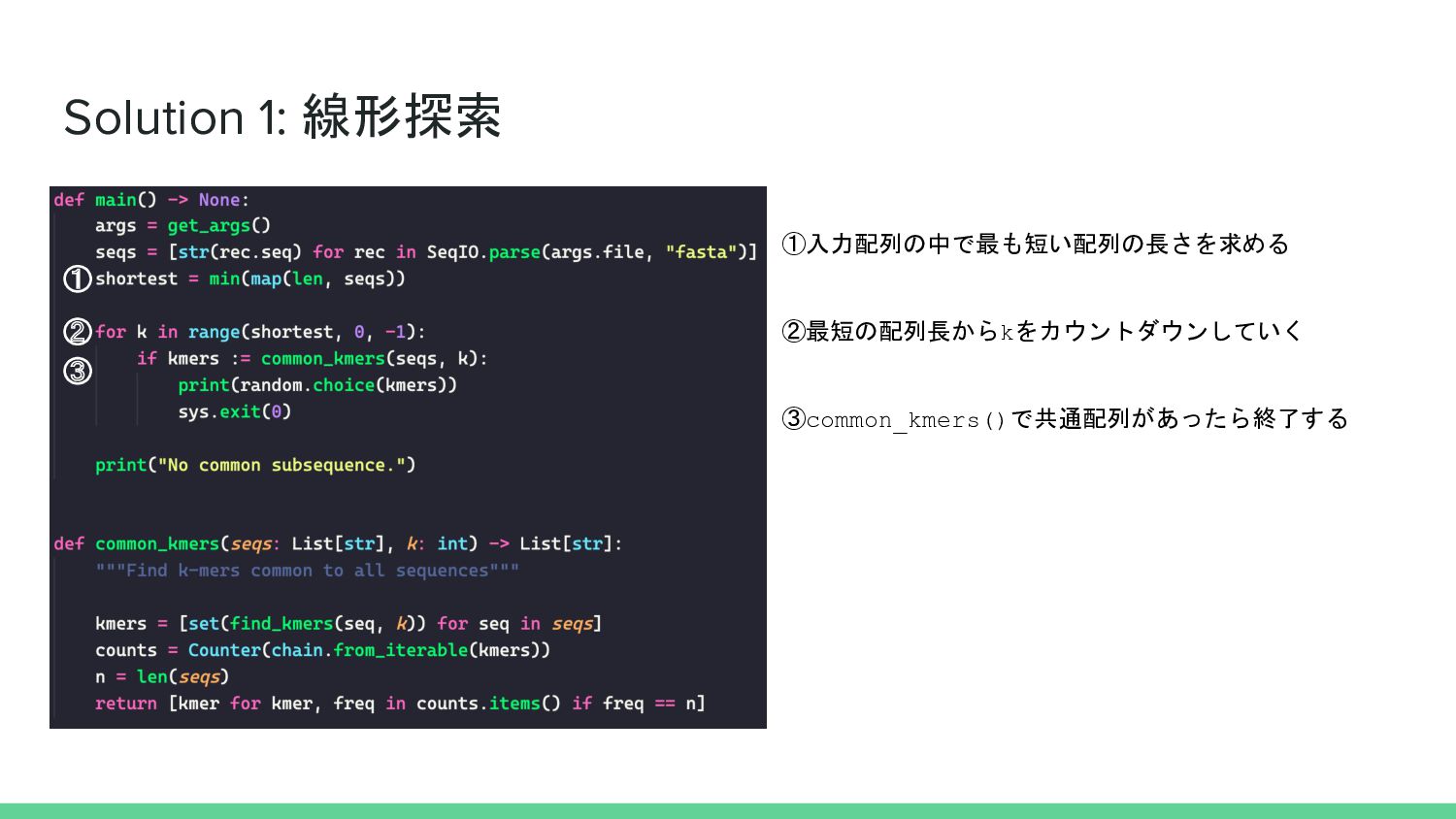
Solution 1: 線形探索 ①入力配列の中で最も短い配列の長さを求める ②最短の配列長からkをカウントダウンしていく ③common_kmers()で共通配列があったら終了する ① ② ③
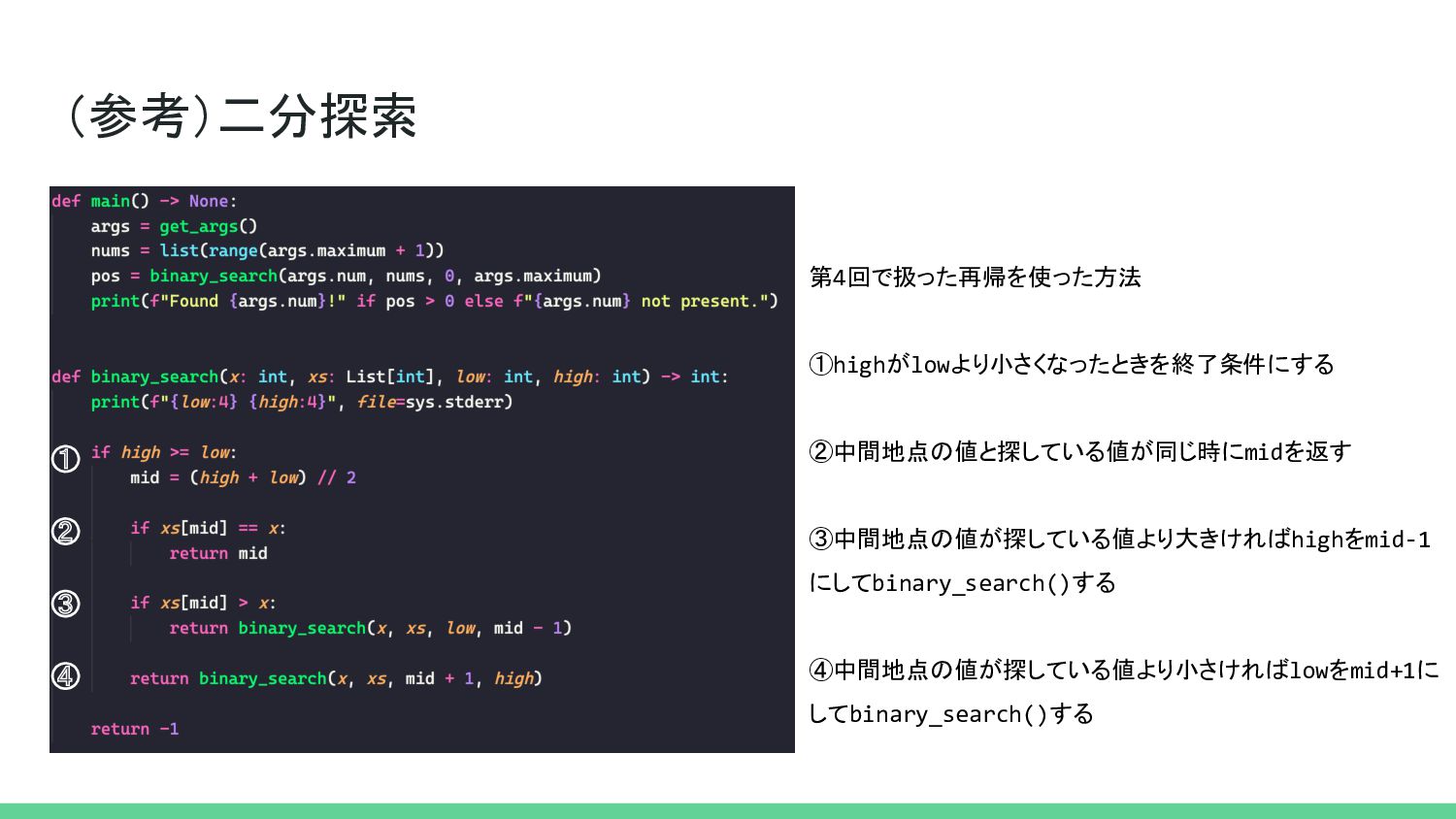
(参考)二分探索 第4回で扱った再帰を使った方法 ①highがlowより小さくなったときを終了条件にする ②中間地点の値と探している値が同じ時にmidを返す ③中間地点の値が探している値より大きければhighをmid-1 にしてbinary_search()する ④中間地点の値が探している値より小さければlowをmid+1に してbinary_search()する ① ②
③ ④
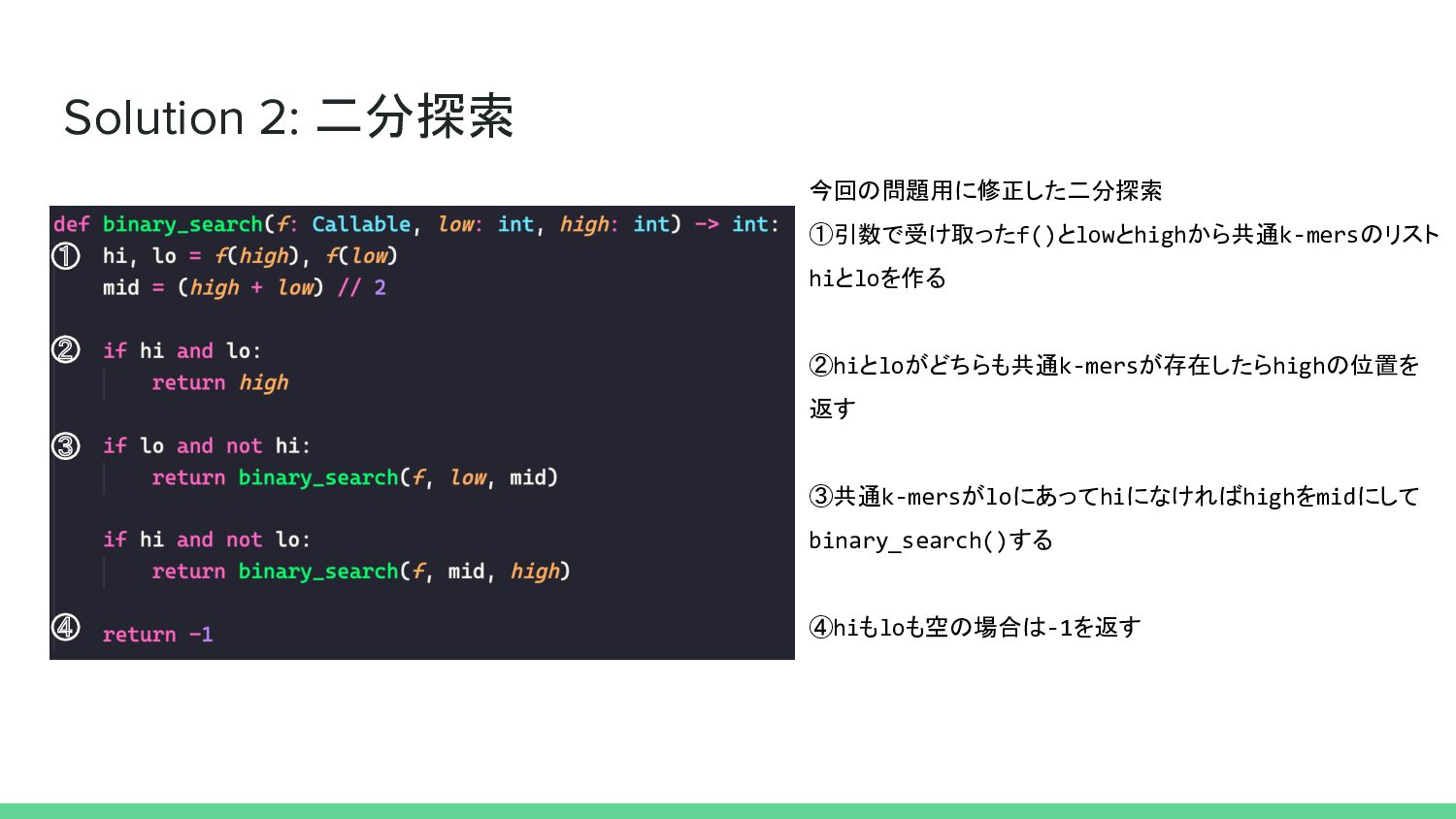
Solution 2: 二分探索 今回の問題用に修正した二分探索 ①引数で受け取ったf()とlowとhighから共通k-mersのリスト hiとloを作る ②hiとloがどちらも共通k-mersが存在したらhighの位置を 返す ③共通k-mersがloにあってhiになければhighをmidにして binary_search()する
④hiもloも空の場合は-1を返す ① ② ③ ④ ④
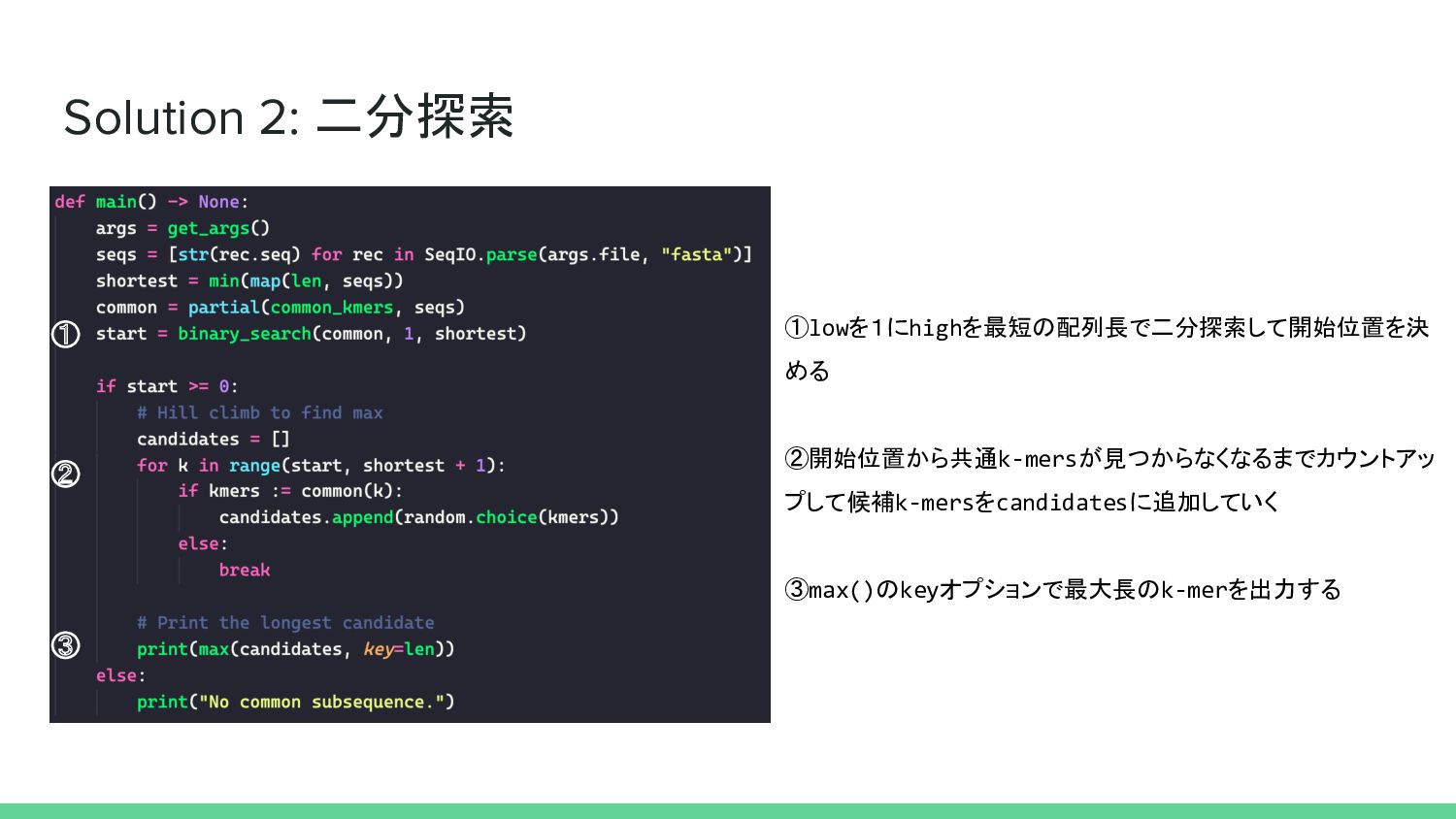
Solution 2: 二分探索 ①lowを1にhighを最短の配列長で二分探索して開始位置を決 める ②開始位置から共通k-mersが見つからなくなるまでカウントアッ プして候補k-mersをcandidatesに追加していく ③max()のkeyオプションで最大長のk-merを出力する ① ②
③
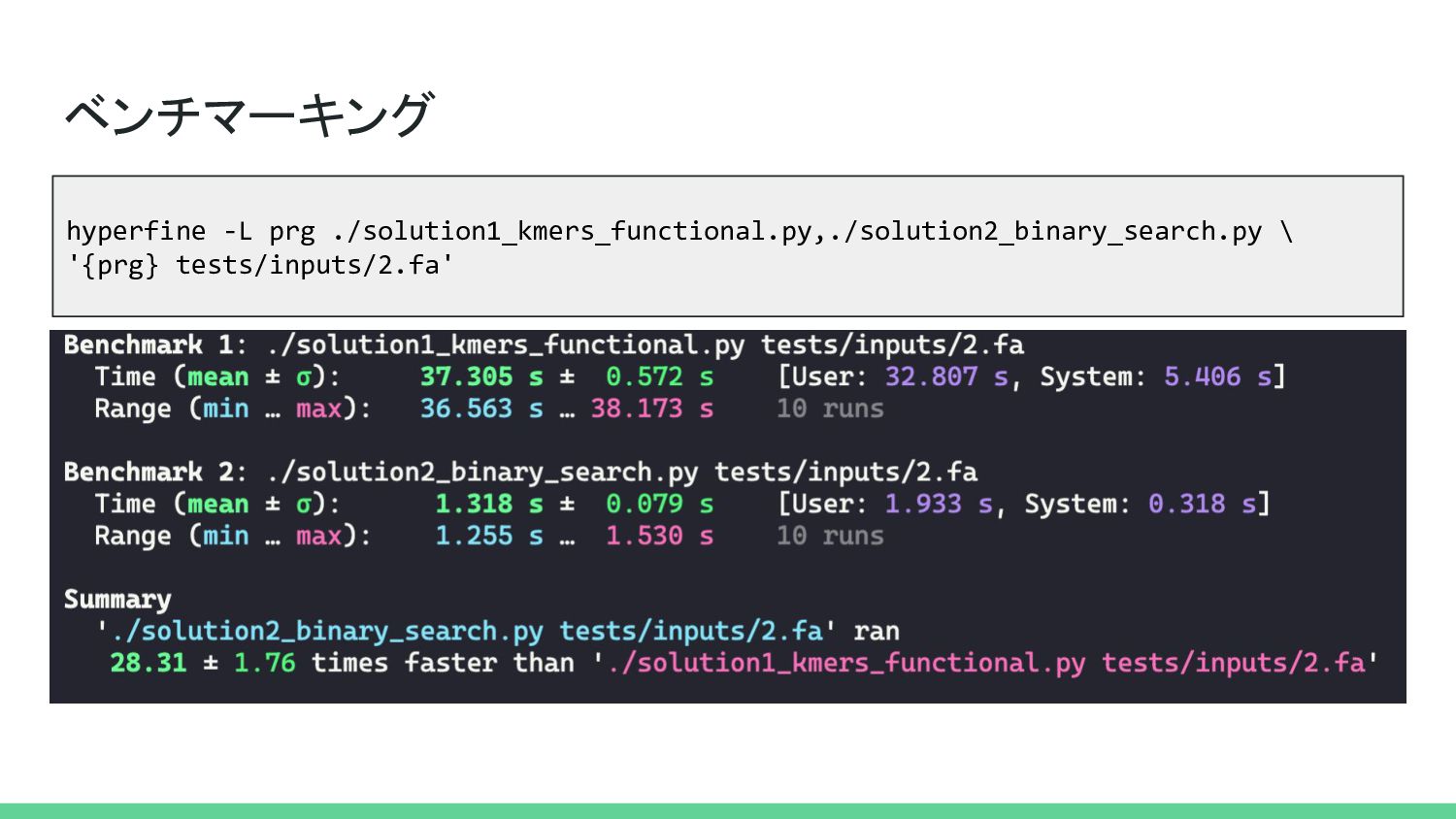
ベンチマーキング hyperfine -L prg ./solution1_kmers_functional.py,./solution2_binary_search.py \ '{prg} tests/inputs/2.fa'
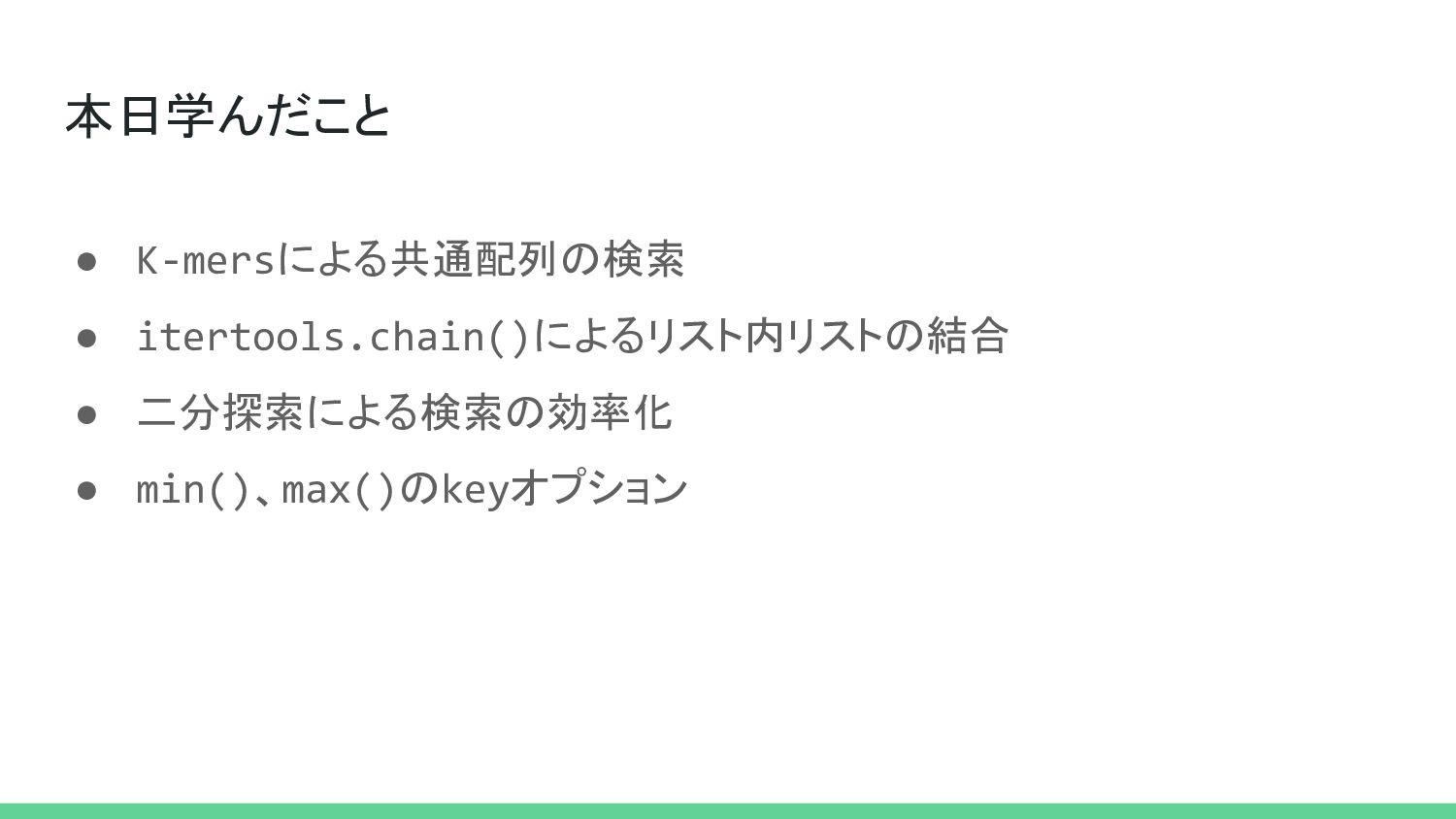
本日学んだこと • K-mersによる共通配列の検索 • itertools.chain()によるリスト内リストの結合 • 二分探索による検索の効率化 • min()、max()のkeyオプション


 onouyek
 steliosf
 shihochan
 nabondance
 xleitix
 jame2408
 kishida
 tosite
 yuta_onishi_97
 akihisaikeda
 taiseiue
 akase244
 deka_morita
 bermonpainter
 apolaine
 nonsquared
 elsirapls
 holman
 jct
jct
 csswizardry
 afnizarnur
 carmenintech
 techseoconnect
 charlesmeaden
![K-mersの取得 第9回で作ったfind_kmers() def find_kmers(seq: str, k: int) -> List[str]: """](https://files.speakerdeck.com/presentations/8829fa02a57b4c3a8bec87d379315a5c/slide_8.jpg)