McVitie’s factory was flooded, leading to a £50 million insurance payout by RSA. This significant payout contributed to a decline in RSA's share price. The shell garage in Carlisle is now a stranded asset. The floods in 2005 and 2015 caused consistent business disruption and irreparable damage. The business case for Nature :
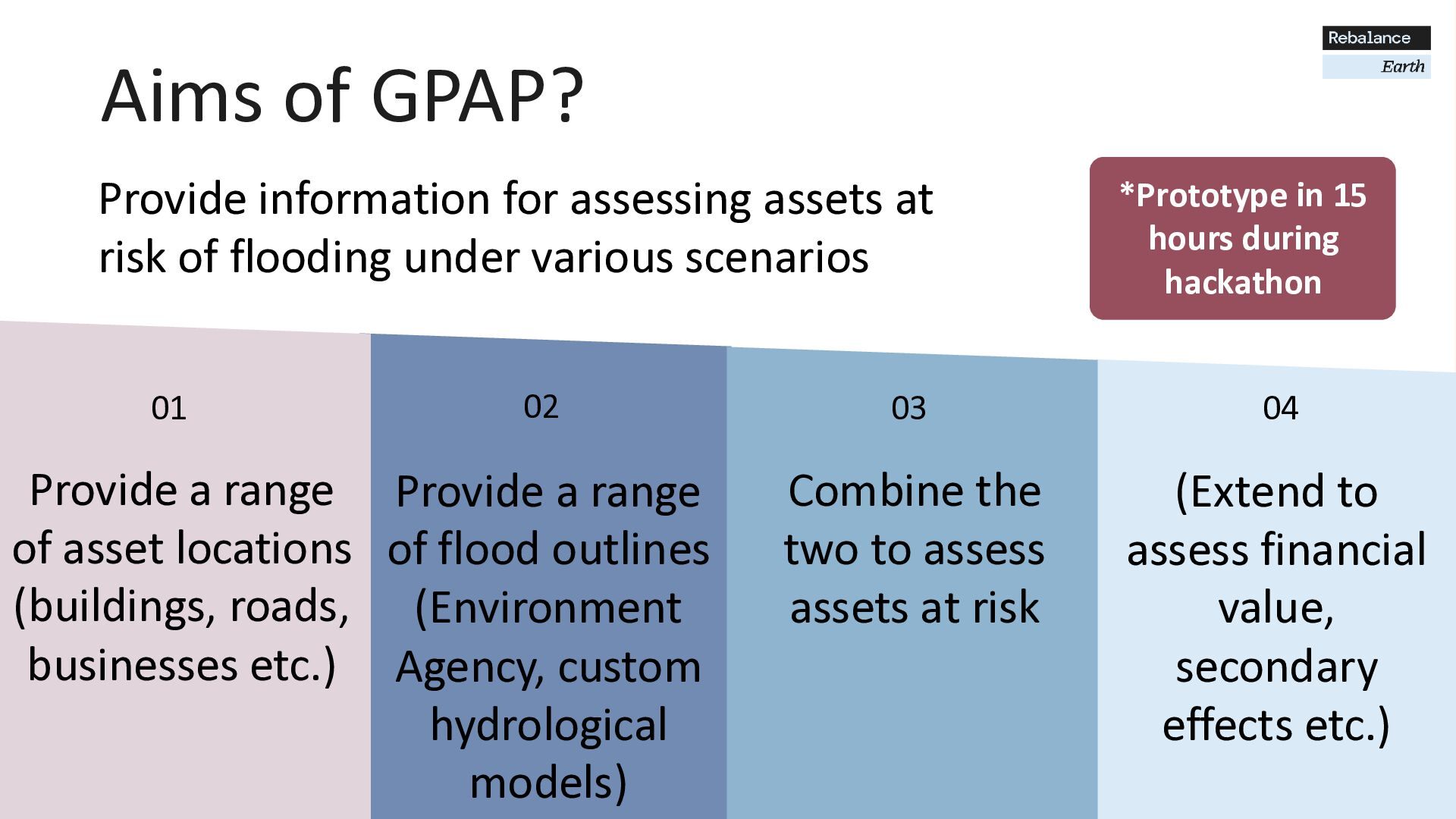
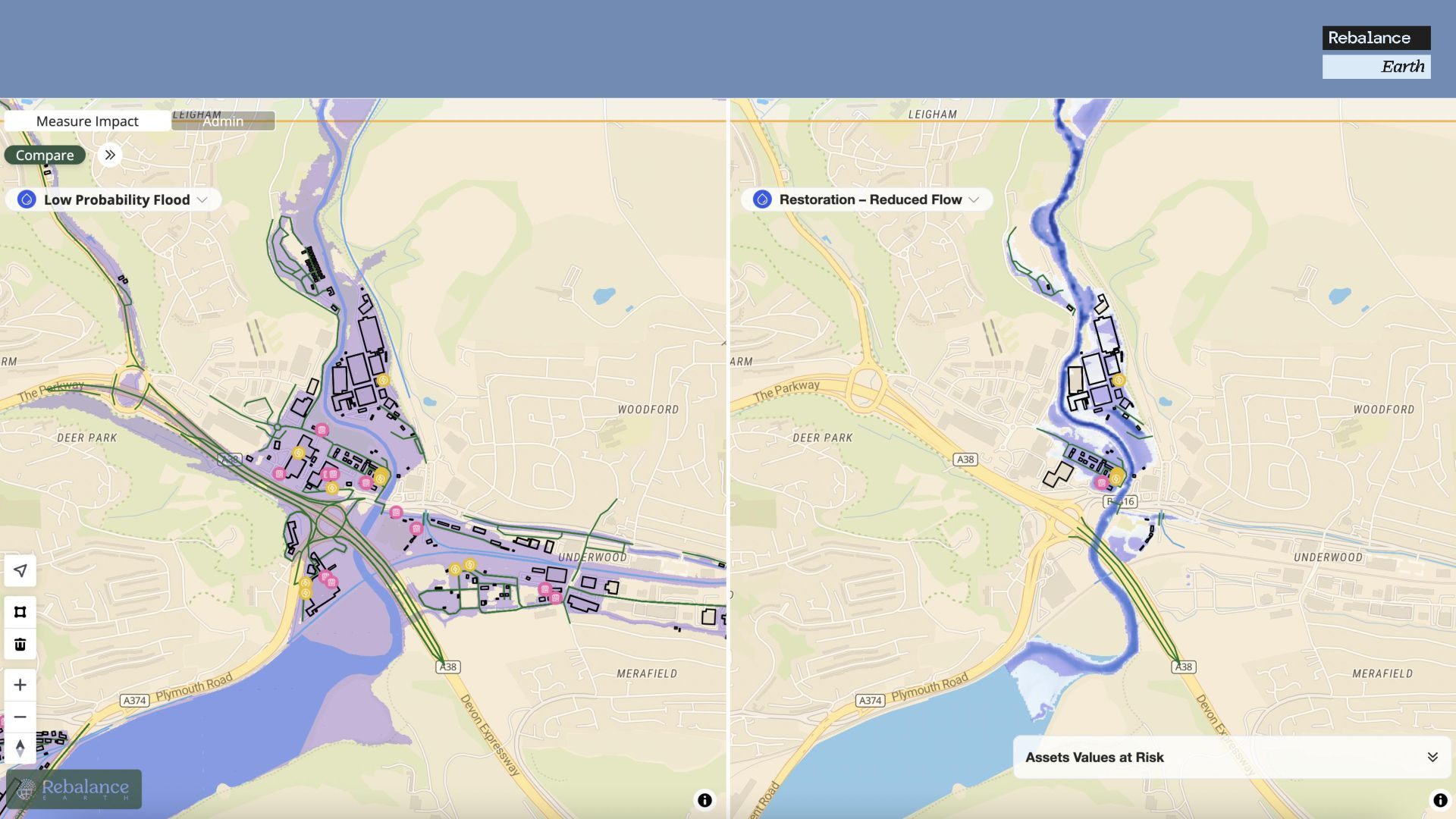
of flooding under various scenarios Provide a range of asset locations (buildings, roads, businesses etc.) Aims of GPAP? Provide a range of flood outlines (Environment Agency, custom hydrological models) Combine the two to assess assets at risk 04 (Extend to assess financial value, secondary effects etc.) *Prototype in 15 hours during hackathon
generate tiles on-the-fly • Vector: Database -> Mapbox Vector Tiles • Raster: File -> XYZ raster tiles • On-the-fly computation • Why? • Lots of options (different flood outlines, different categories, different depths) • Large data – most of it won’t be looked at • Can cache tiles (not implemented yet) • Still want it to be fast!
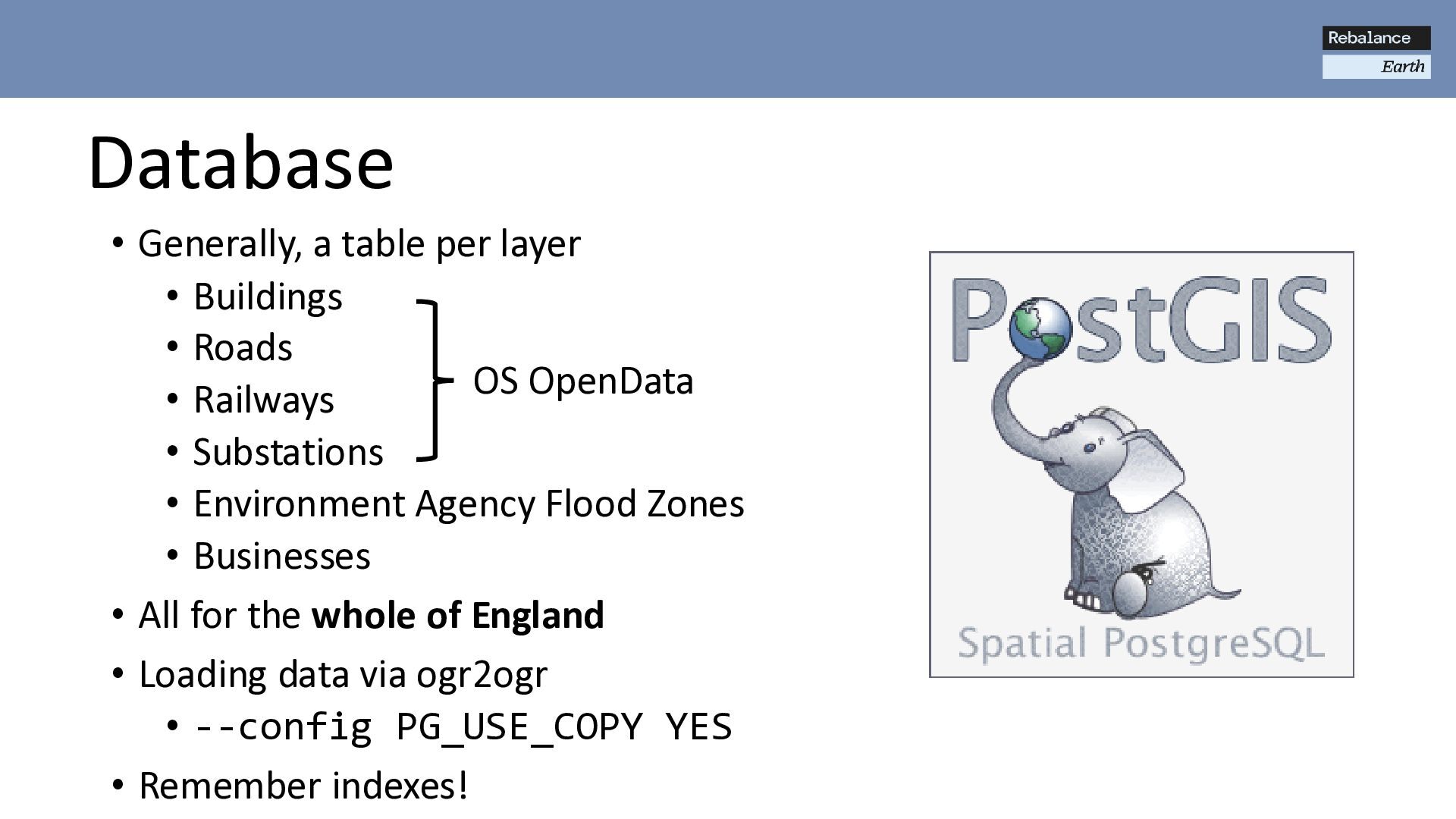
Roads • Railways • Substations • Environment Agency Flood Zones • Businesses • All for the whole of England • Loading data via ogr2ogr • --config PG_USE_COPY YES • Remember indexes! OS OpenData
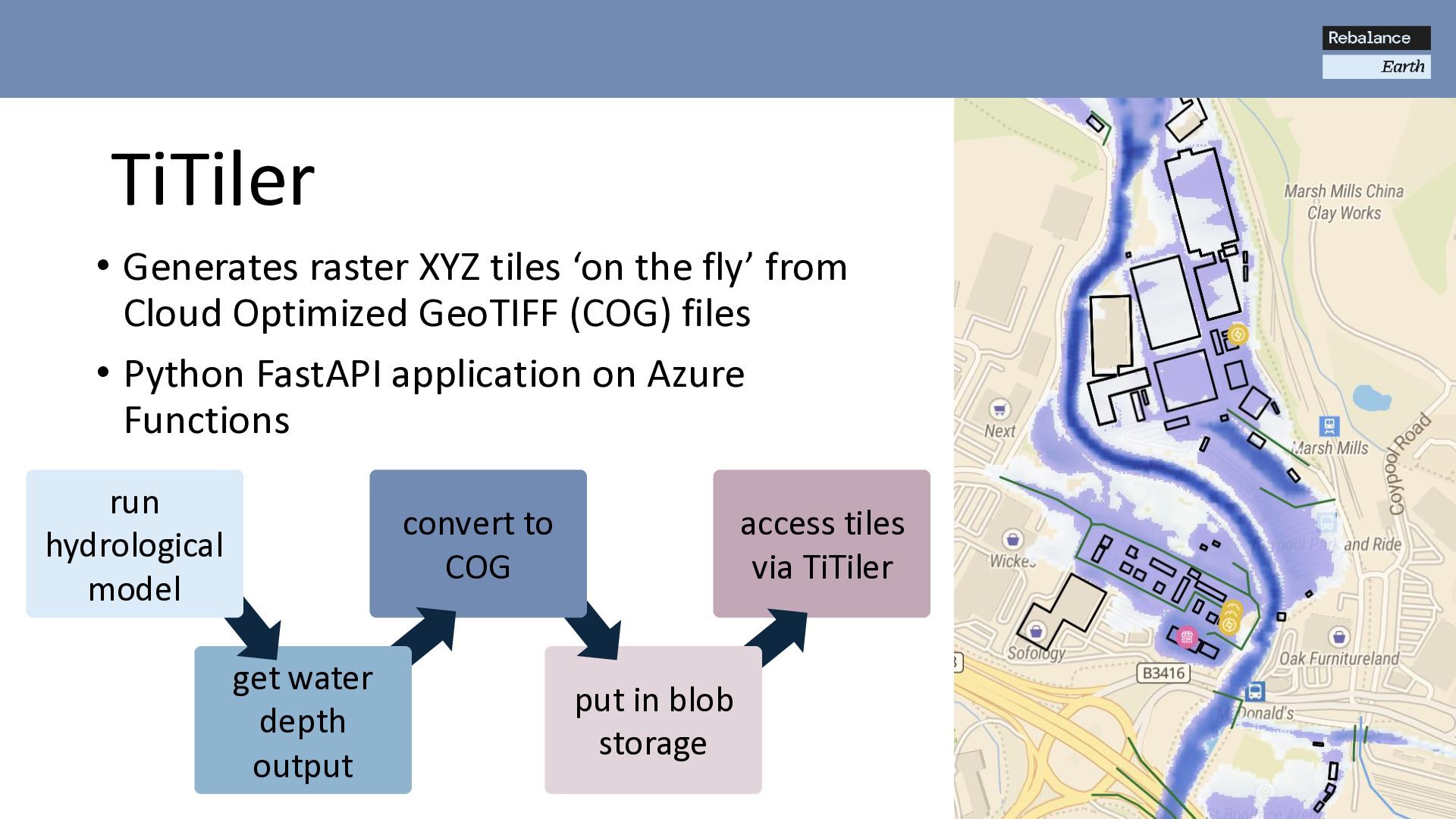
COG TiTiler • Generates raster XYZ tiles ‘on the fly’ from Cloud Optimized GeoTIFF (COG) files • Python FastAPI application on Azure Functions get water depth output run hydrological model
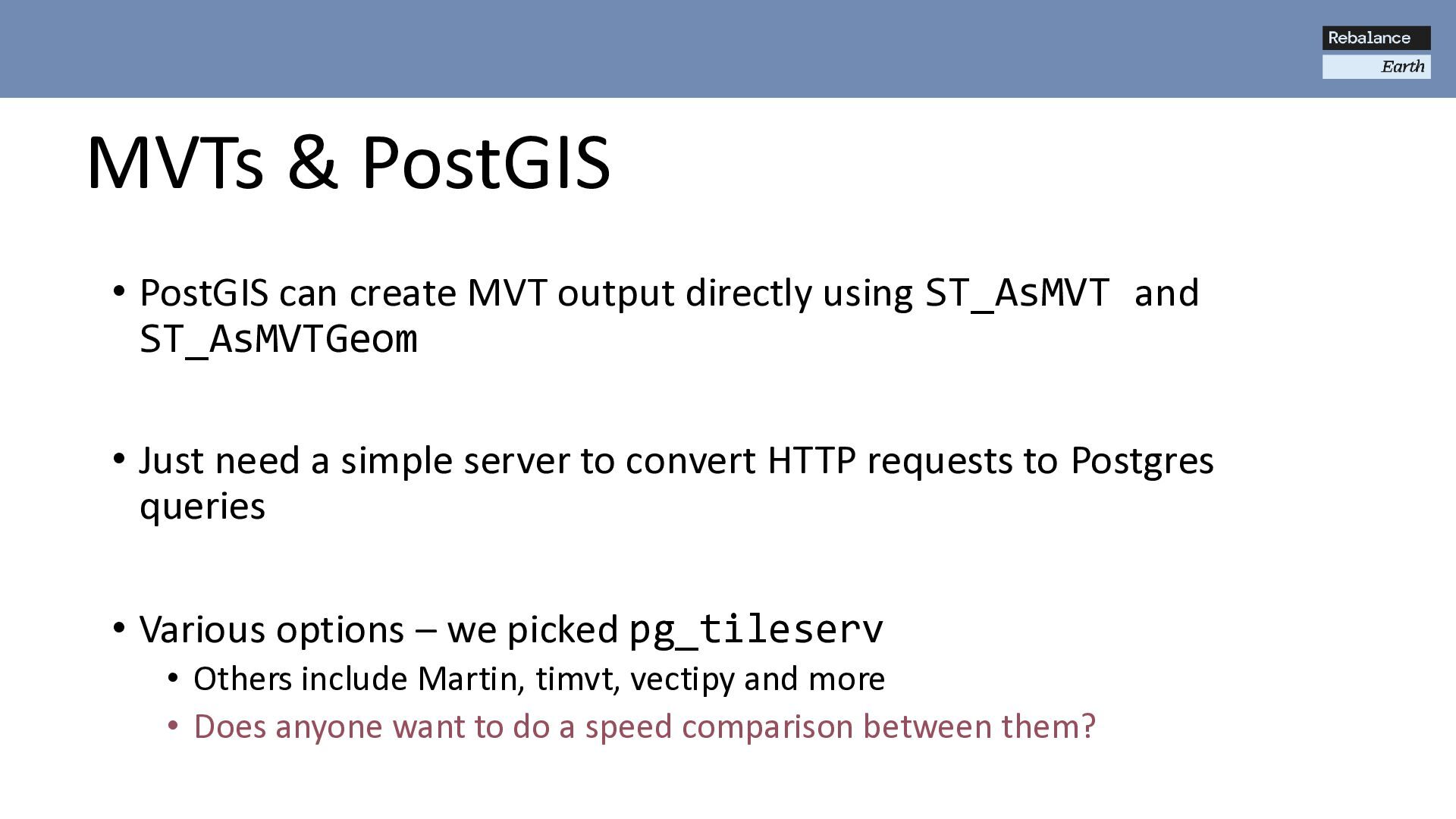
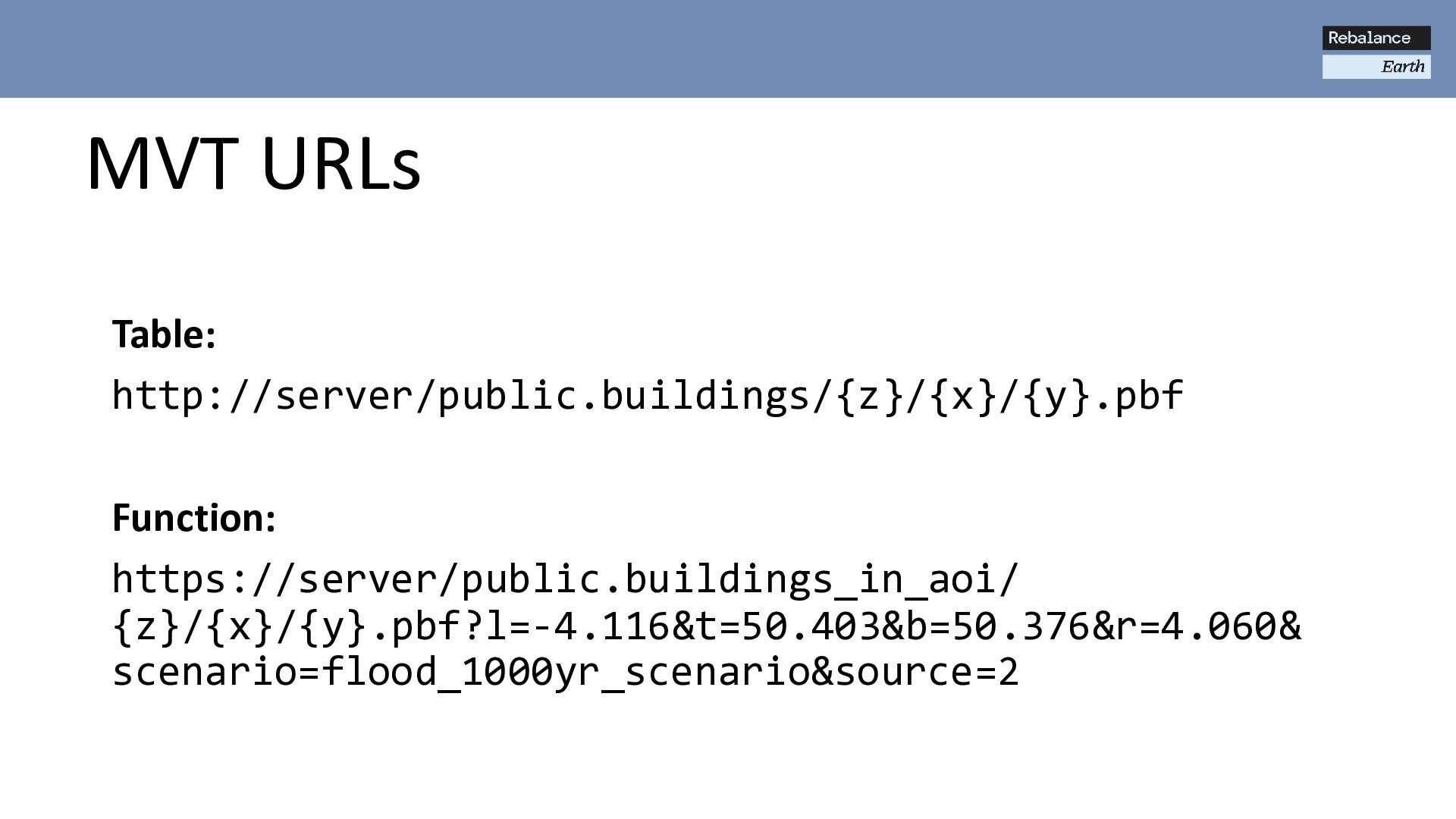
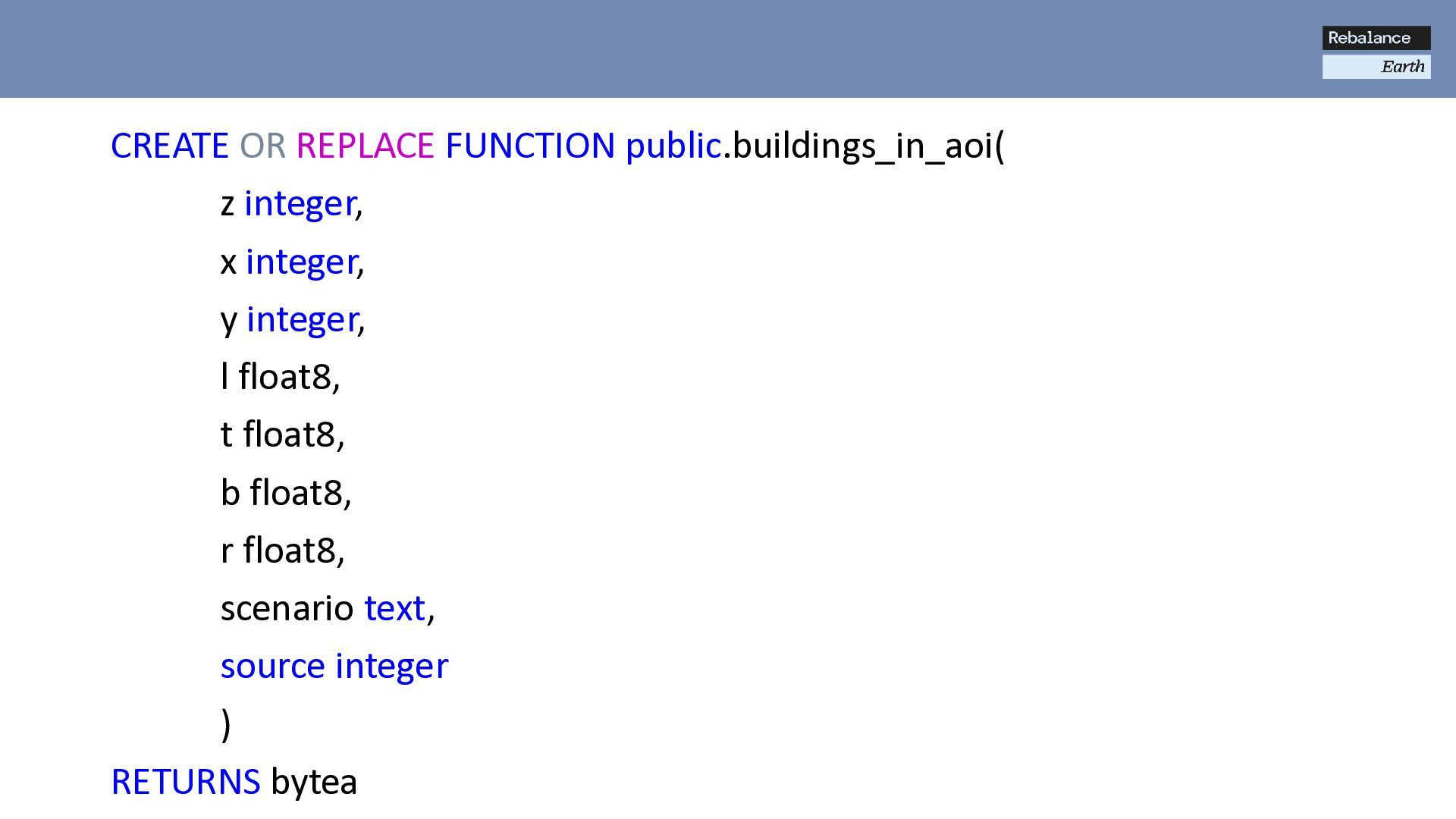
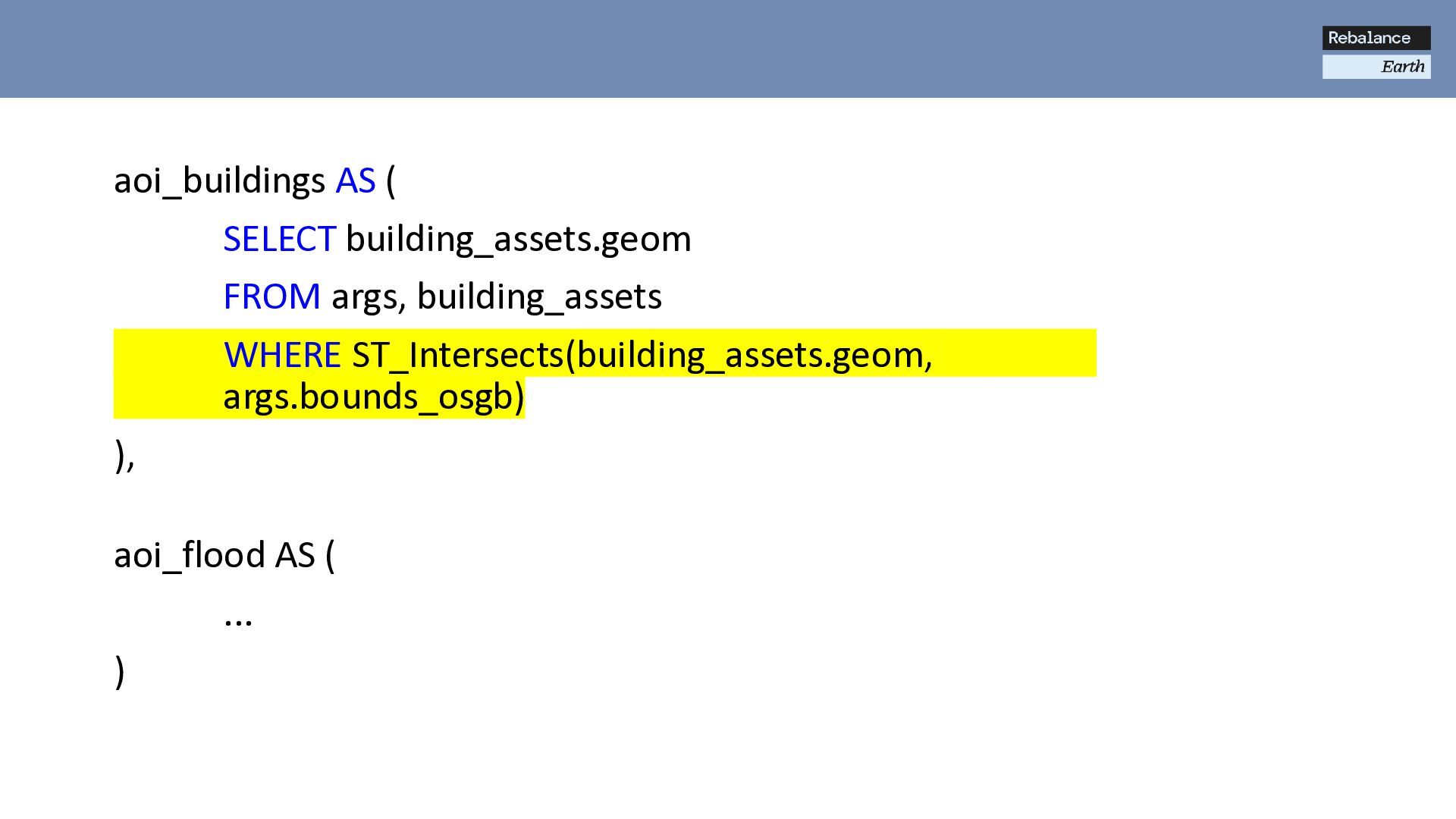
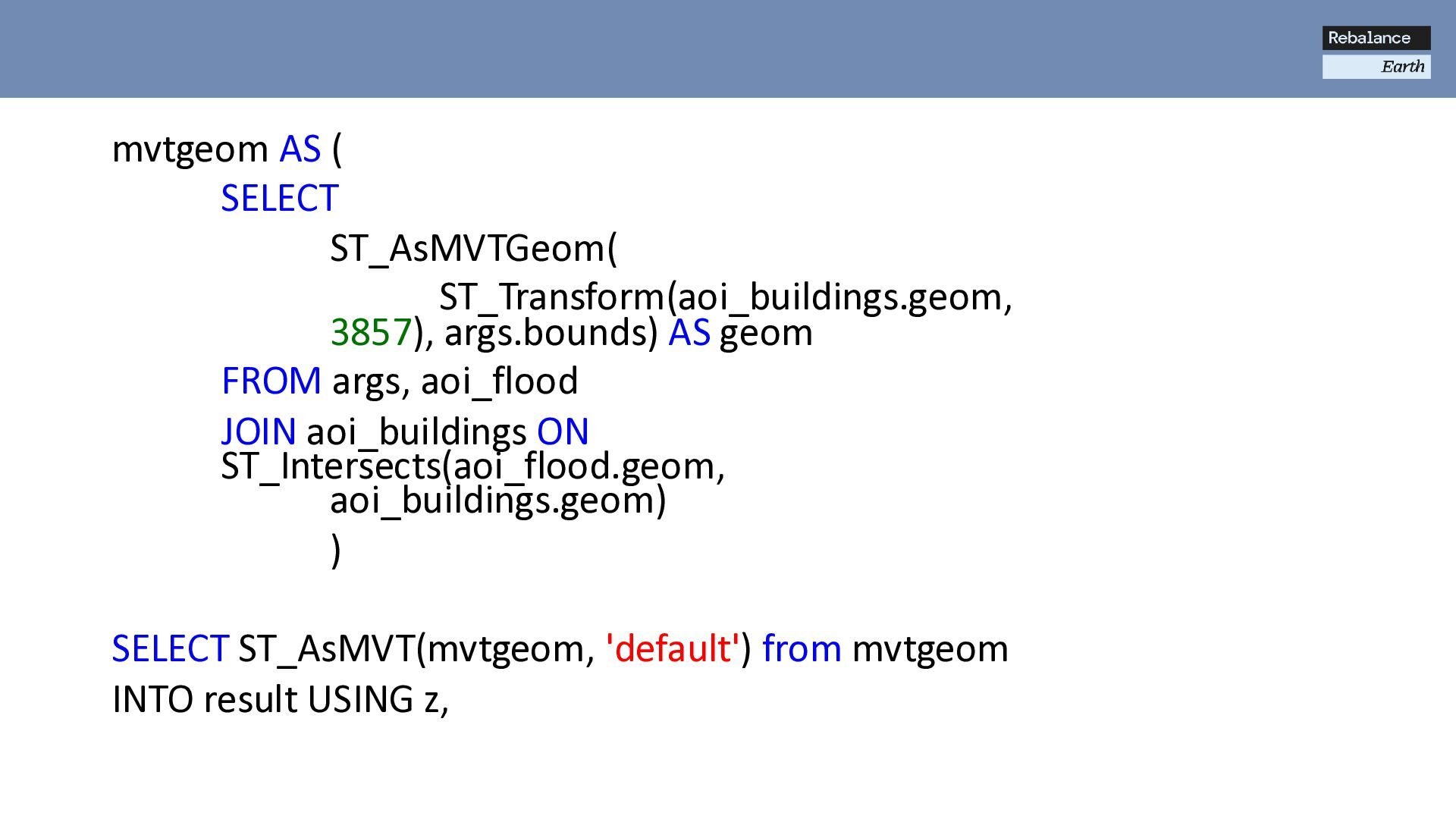
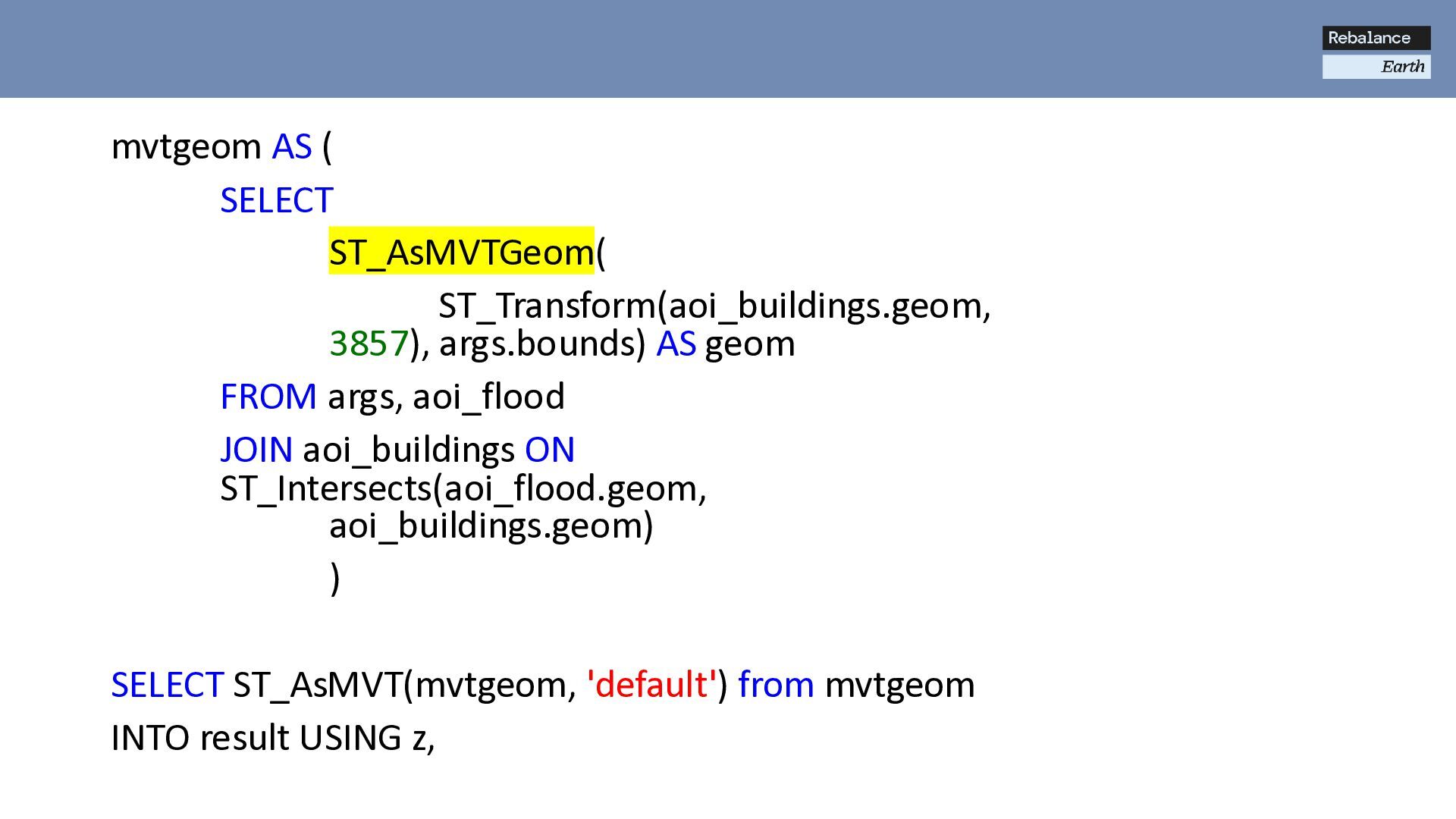
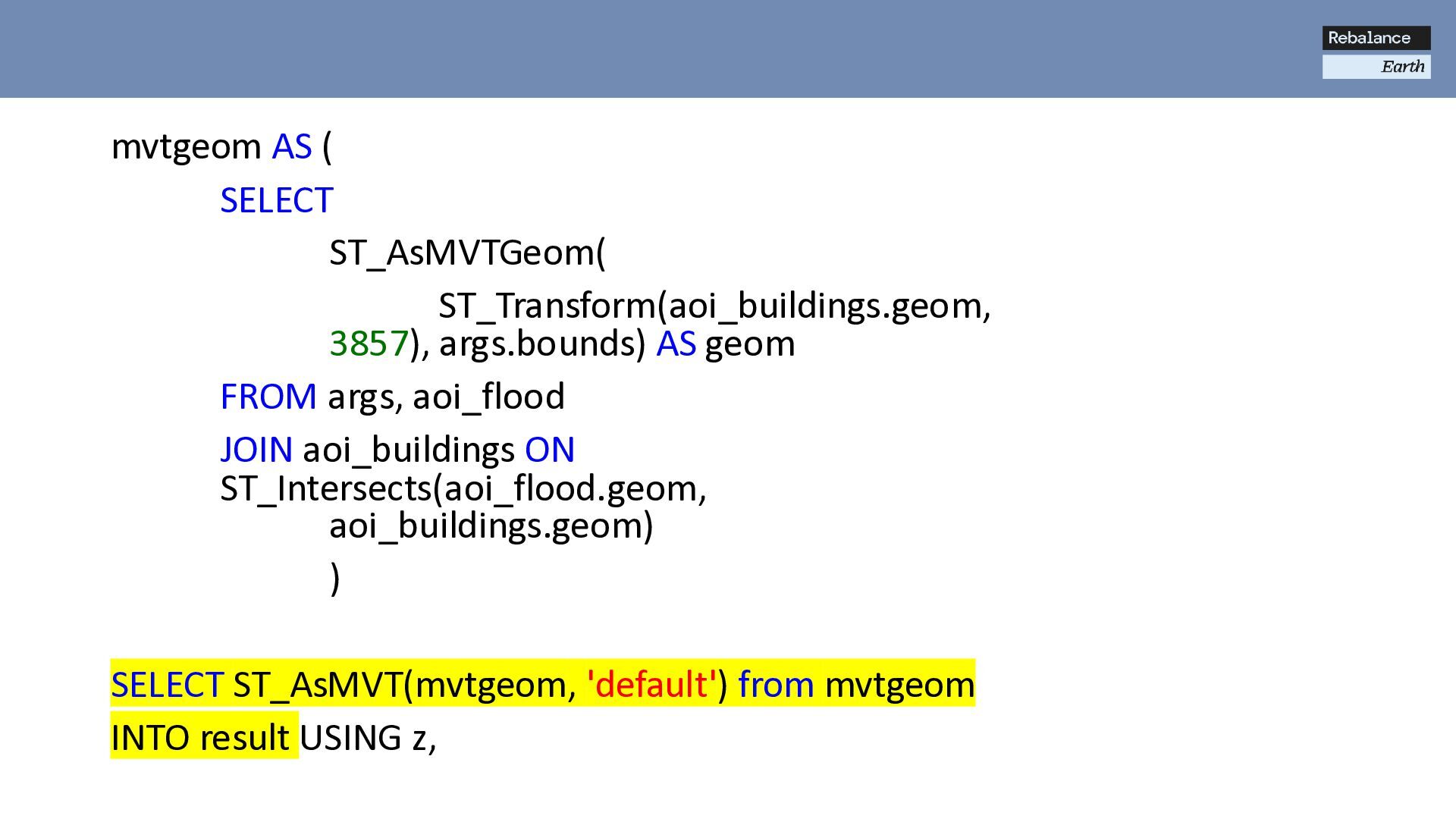
using ST_AsMVT and ST_AsMVTGeom • Just need a simple server to convert HTTP requests to Postgres queries • Various options – we picked pg_tileserv • Others include Martin, timvt, vectipy and more • Does anyone want to do a speed comparison between them?
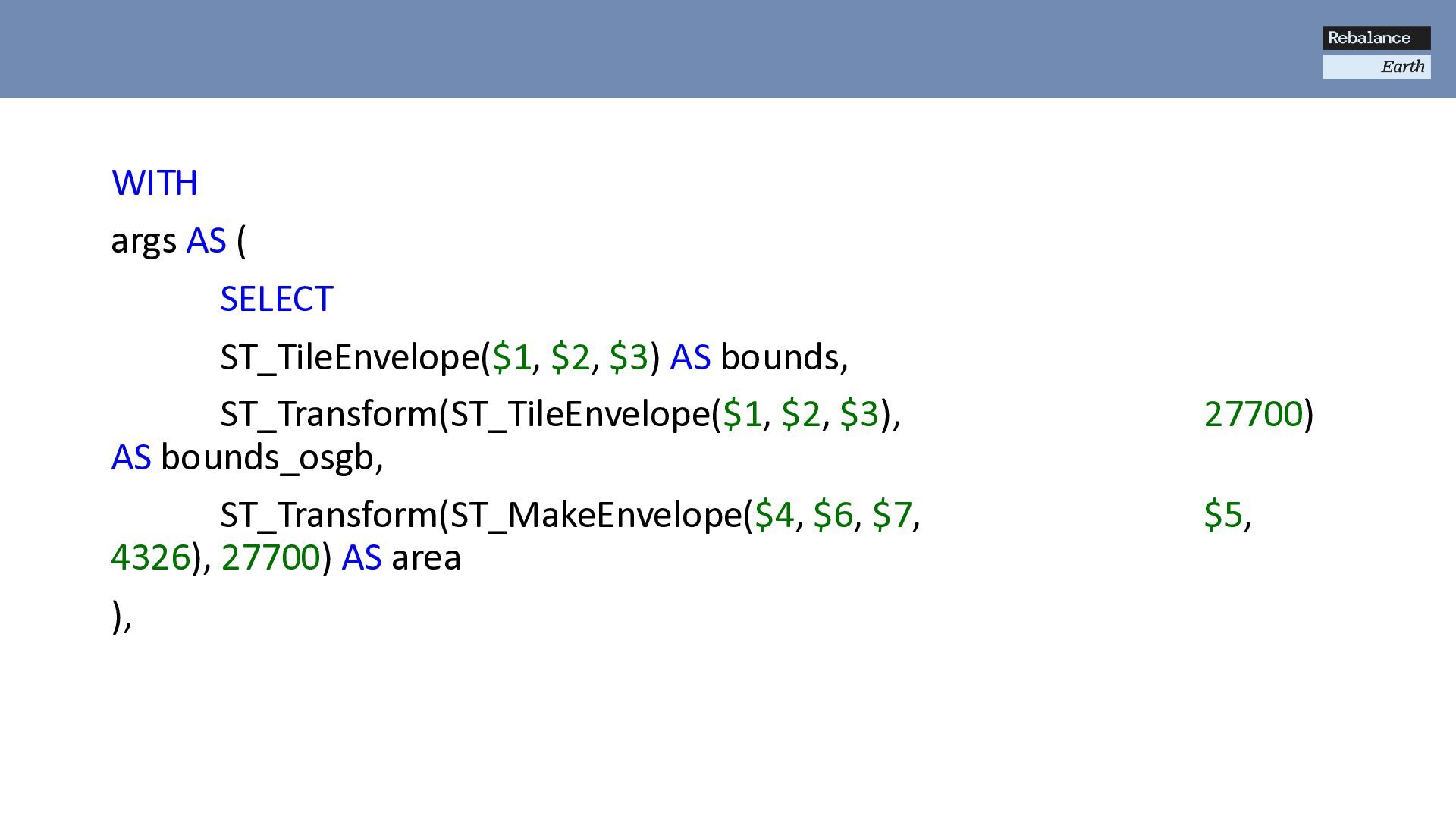
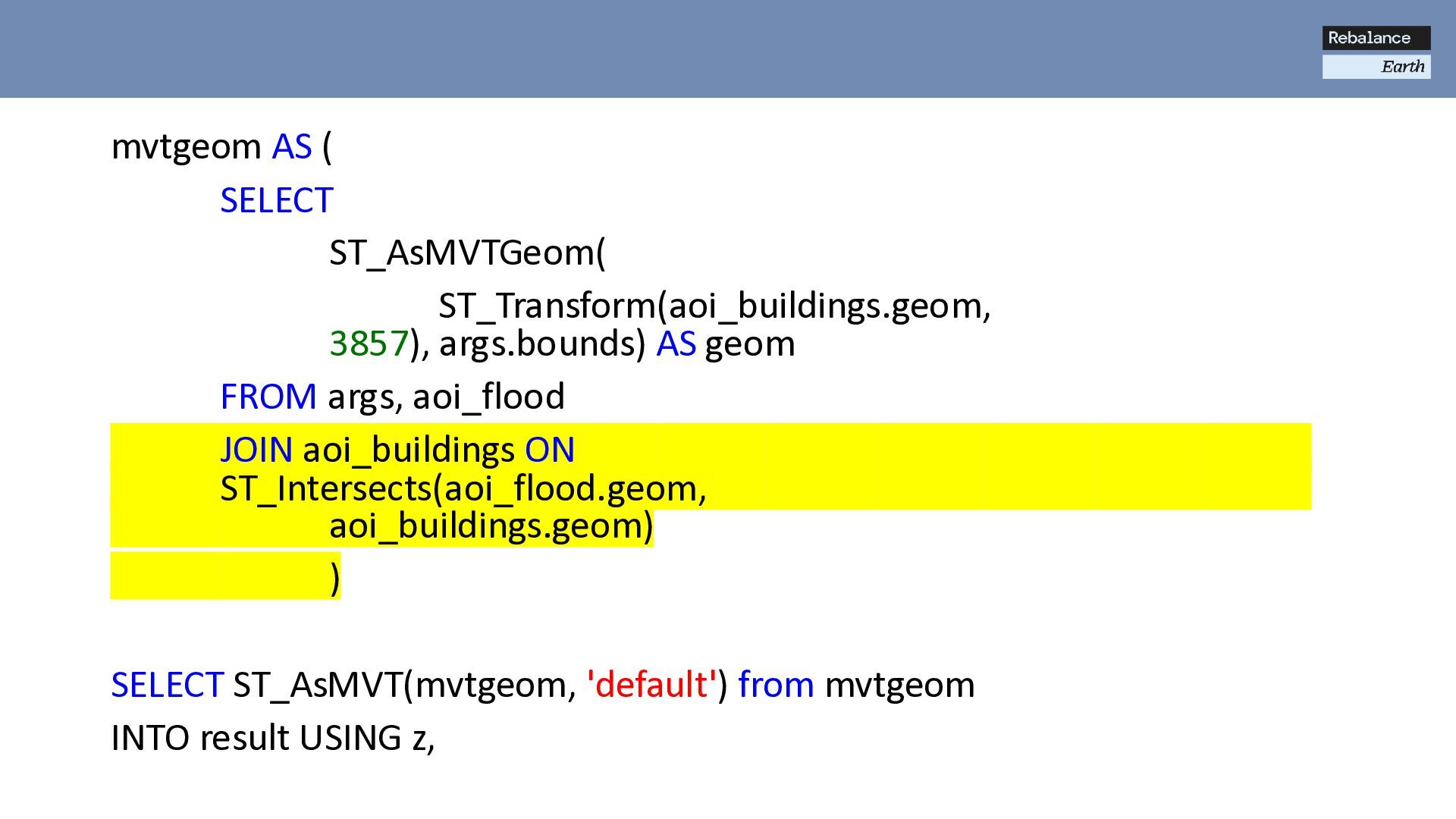
FROM args, aoi_flood JOIN aoi_buildings ON ST_Intersects(aoi_flood.geom, aoi_buildings.geom) ) SELECT ST_AsMVT(mvtgeom, 'default') from mvtgeom INTO result USING z,
FROM args, aoi_flood JOIN aoi_buildings ON ST_Intersects(aoi_flood.geom, aoi_buildings.geom) ) SELECT ST_AsMVT(mvtgeom, 'default') from mvtgeom INTO result USING z,
FROM args, aoi_flood JOIN aoi_buildings ON ST_Intersects(aoi_flood.geom, aoi_buildings.geom) ) SELECT ST_AsMVT(mvtgeom, 'default') from mvtgeom INTO result USING z,
FROM args, aoi_flood JOIN aoi_buildings ON ST_Intersects(aoi_flood.geom, aoi_buildings.geom) ) SELECT ST_AsMVT(mvtgeom, 'default') from mvtgeom INTO result USING z,
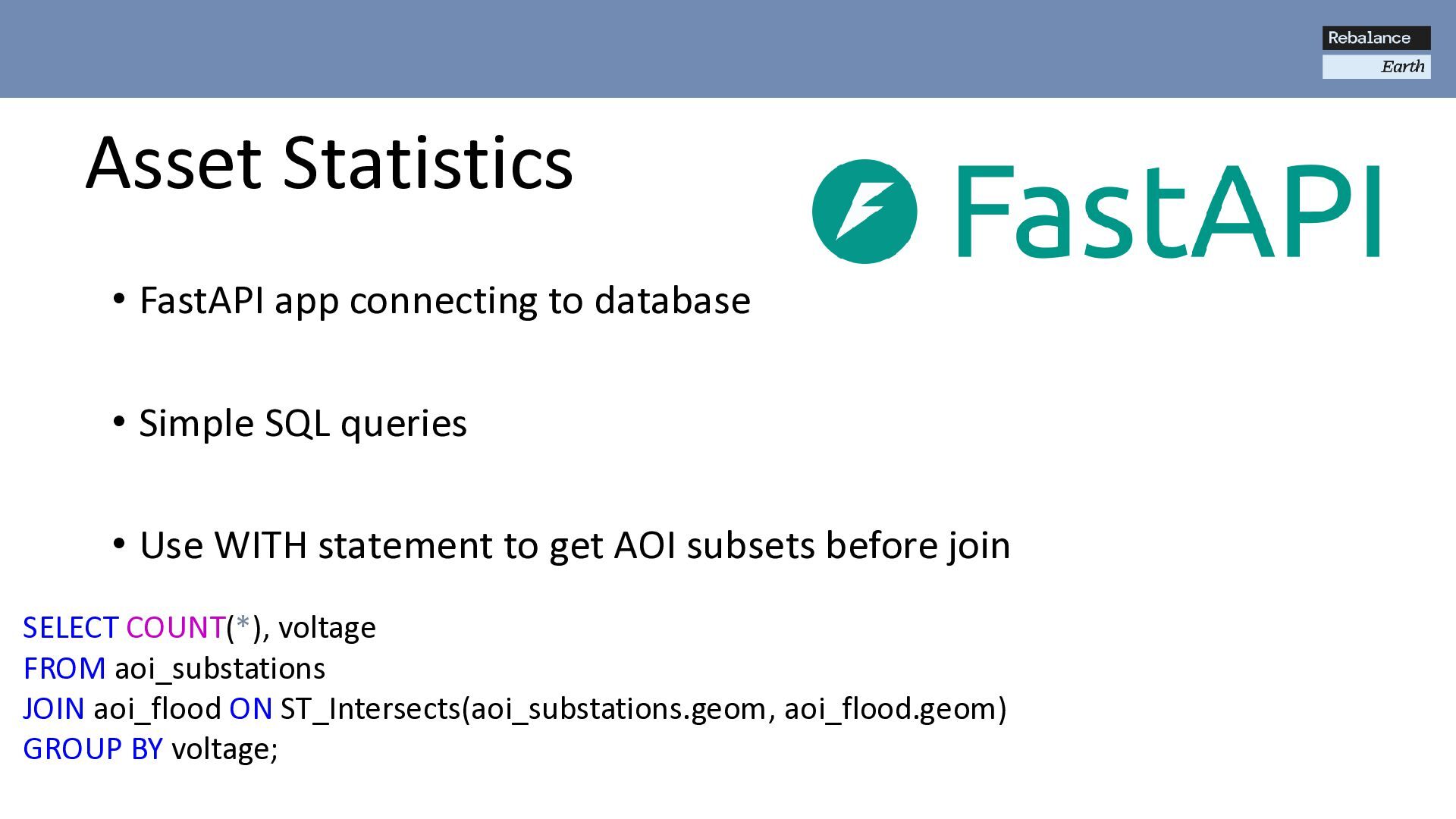
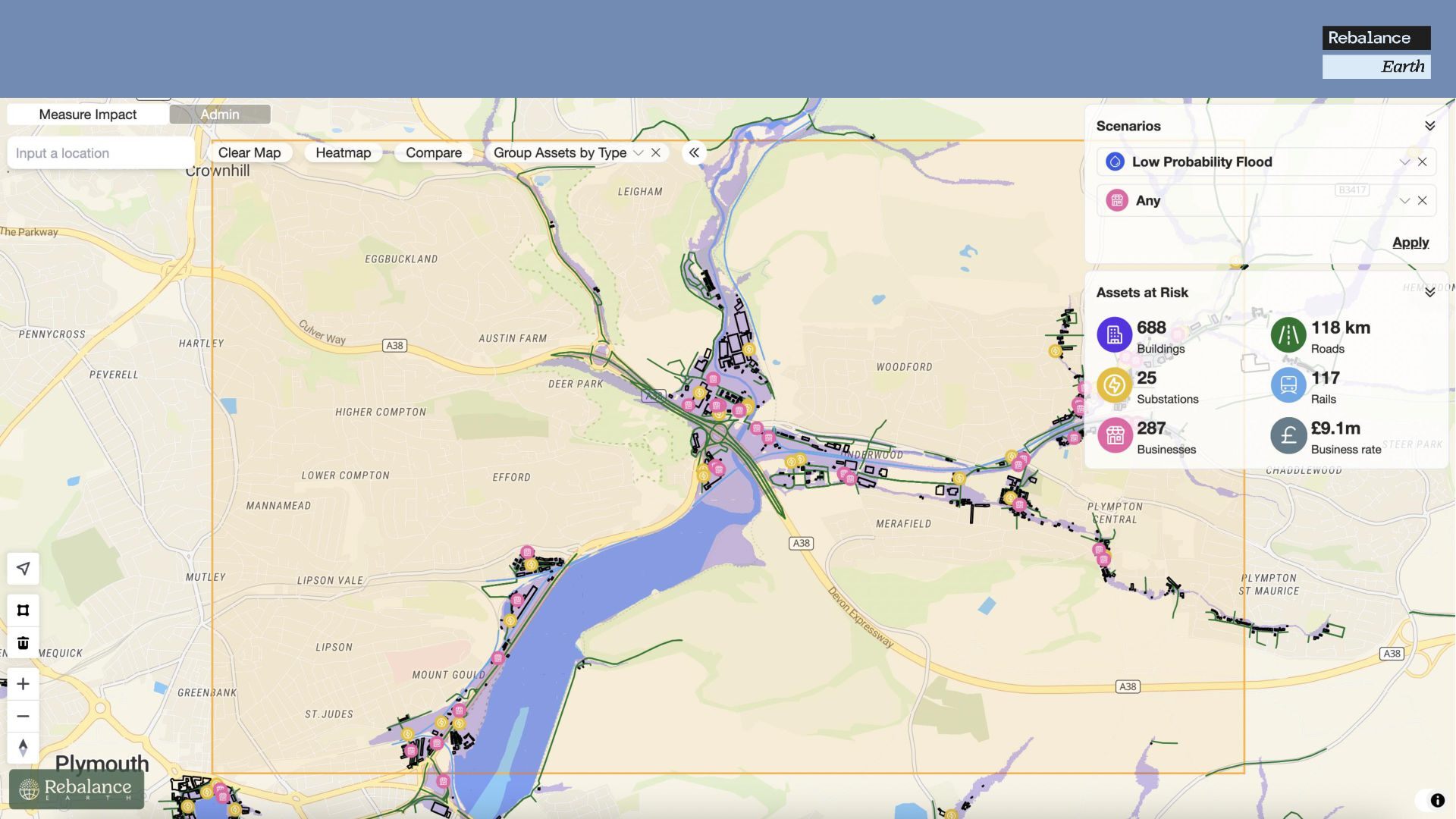
SQL queries • Use WITH statement to get AOI subsets before join SELECT COUNT(*), voltage FROM aoi_substations JOIN aoi_flood ON ST_Intersects(aoi_substations.geom, aoi_flood.geom) GROUP BY voltage;
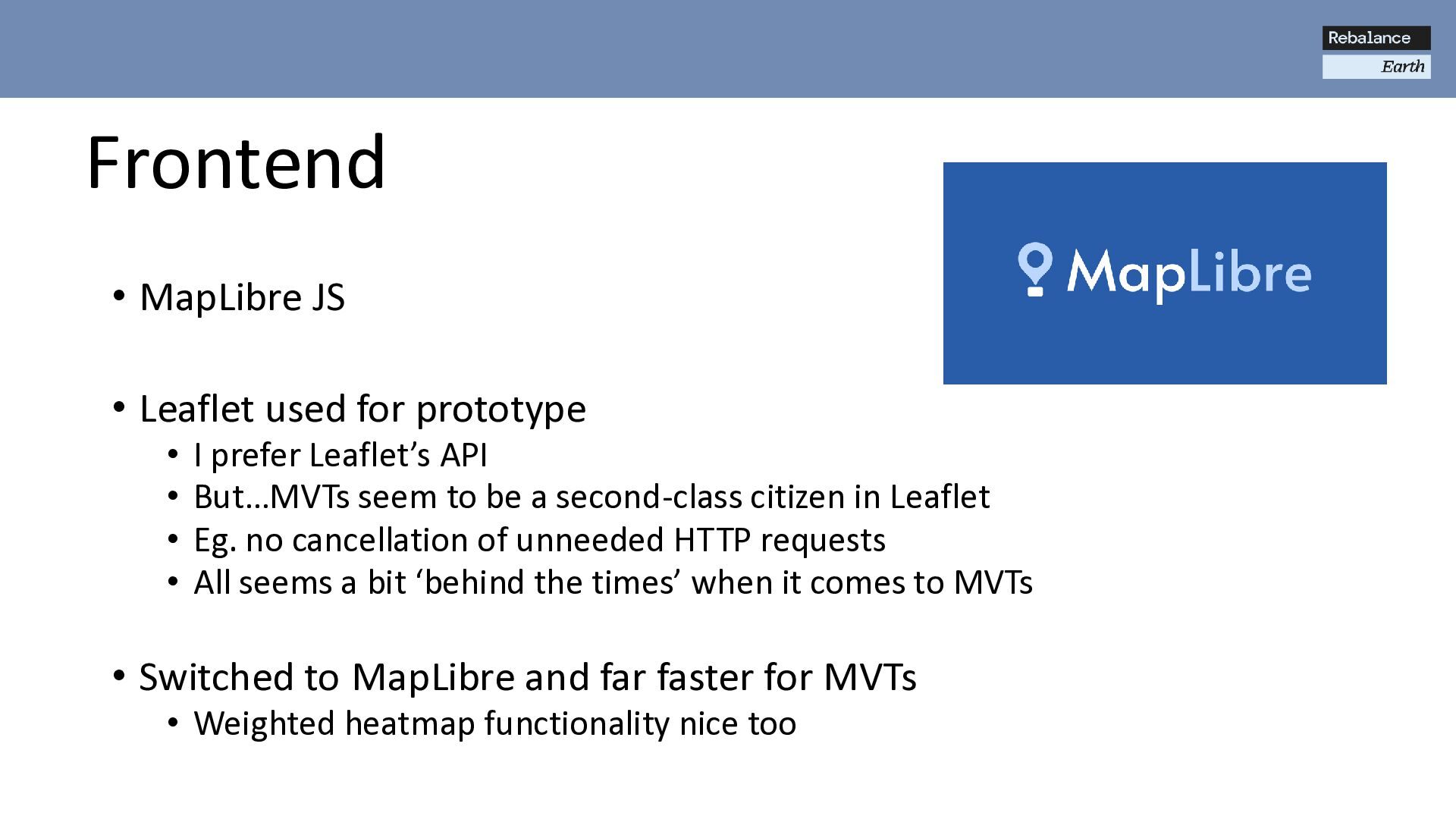
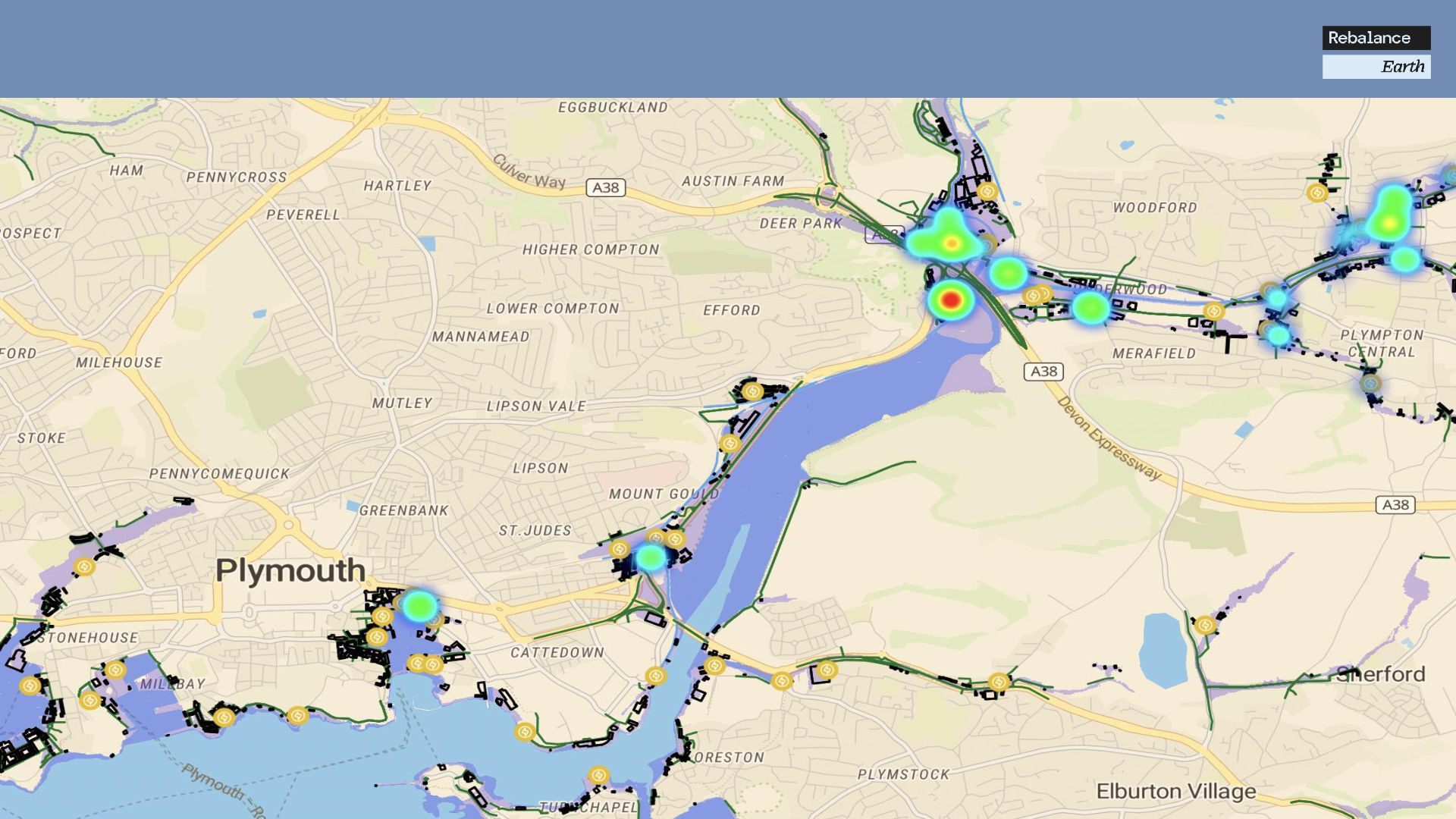
I prefer Leaflet’s API • But…MVTs seem to be a second-class citizen in Leaflet • Eg. no cancellation of unneeded HTTP requests • All seems a bit ‘behind the times’ when it comes to MVTs • Switched to MapLibre and far faster for MVTs • Weighted heatmap functionality nice too
Event Scan QR Code to learn more or visit: WWW.REBALANCE.EARTH/GEOTAM-CHALLENGE BRIEF: Develop an open-source proof of concept method to estimate business turnover at specific locations across the UK, with a retained focus on Manchester SUPPORT: Gain access to non-public datasets, expert mentorship, and a collaborative community via Discord PRIZES: Up to £2,000 in monetary awards, with the prospect to continue developing your work as part of a role at our fund GeoTAM Challenge


 robintw
 lynnswap
 kenjiyoneyama
 drumath2237
 marcoroth
 iwiwi
iwiwi
 artoy
artoy
 satoshi256kbyte
 gam0022
 uyuki234
 panda728
 neuecc
 rkaga
rkaga
 asonas
 codingconduct
 andyhume
 techseoconnect
 inesmontani
 raygrieselhuber
 dugsong
 twada
twada
 jdejongh
 matthewcrist
 frankvandijk
 pauljervisheath



![...&rescale=-1.5,1.5 ...&colormap=[ [[-100,-1], [215,48,39,255]], [[-1,-0.5],[244,109,67,255]], [[-0.5,-0.2],[253,174,97,255]], [[-0.2,0.2],[254,224,144,255]], [[0.2,0.5],[171,217,233,255]], [[0.5,1.0],[116,173,209,255]], [[1.0,100],[69,117,180,255]]](https://files.speakerdeck.com/presentations/8824305c2166491bb153c9479b3b60ac/slide_13.jpg)