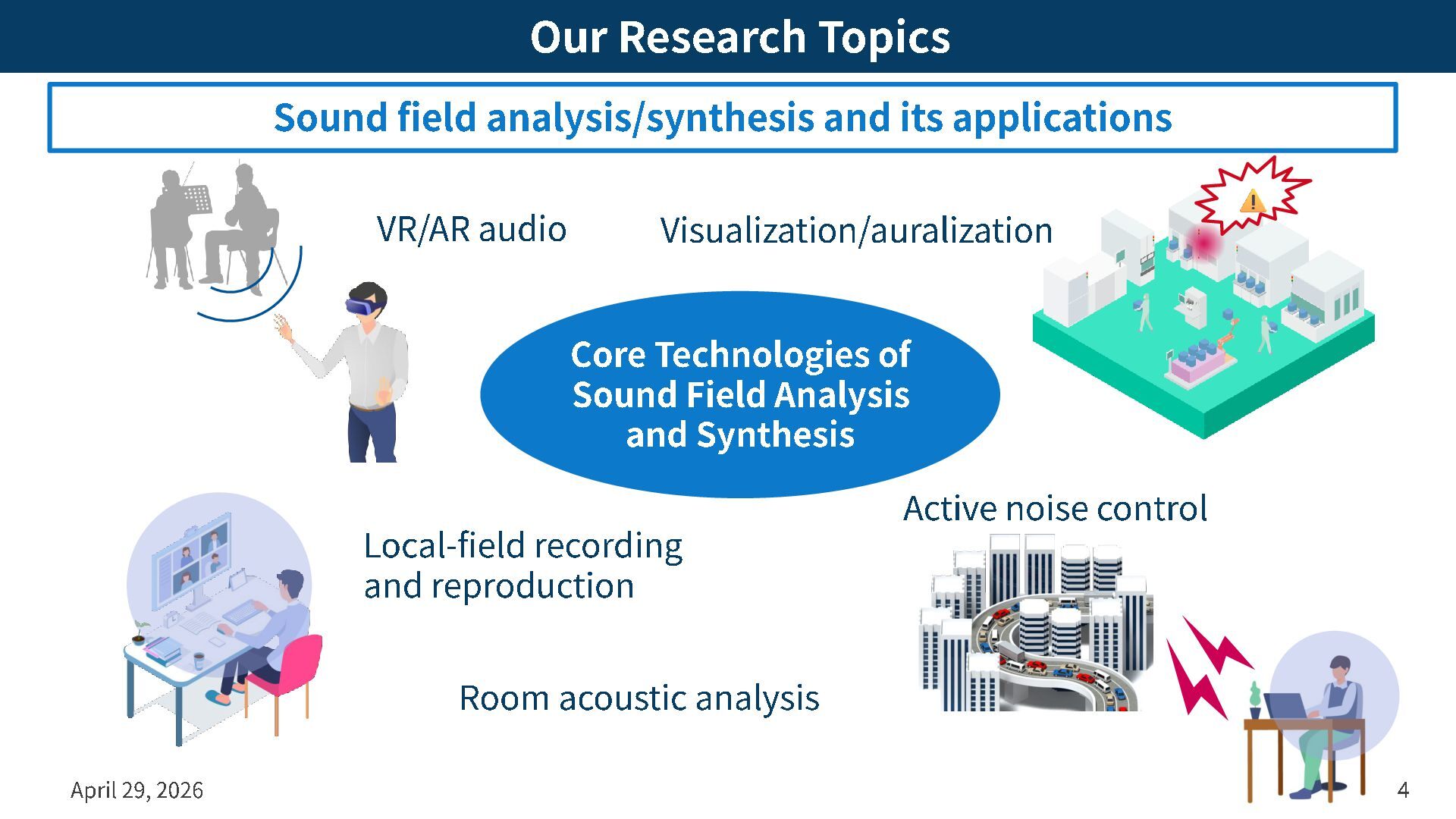
-field recording and reproduction Visualization/auralization Room acoustic analysis Our Research Topics Sound field analysis/synthesis and its applications Core Technologies of Sound Field Analysis and Synthesis
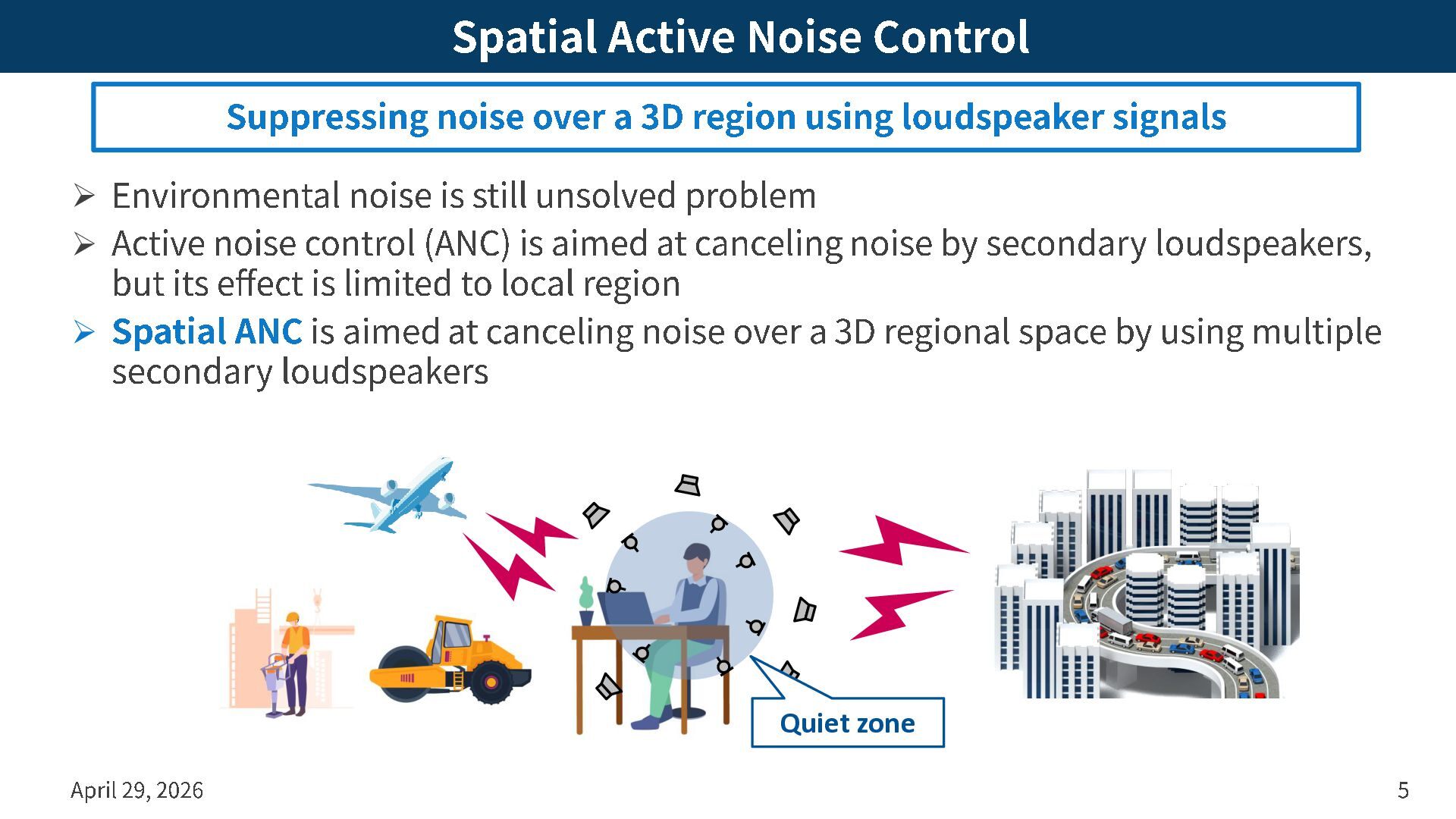
problem ➢ Active noise control (ANC) is aimed at canceling noise by secondary loudspeakers, but its effect is limited to local region ➢ Spatial ANC is aimed at canceling noise over a 3D regional space by using multiple secondary loudspeakers April 29, 2026 5 Suppressing noise over a 3D region using loudspeaker signals Quiet zone
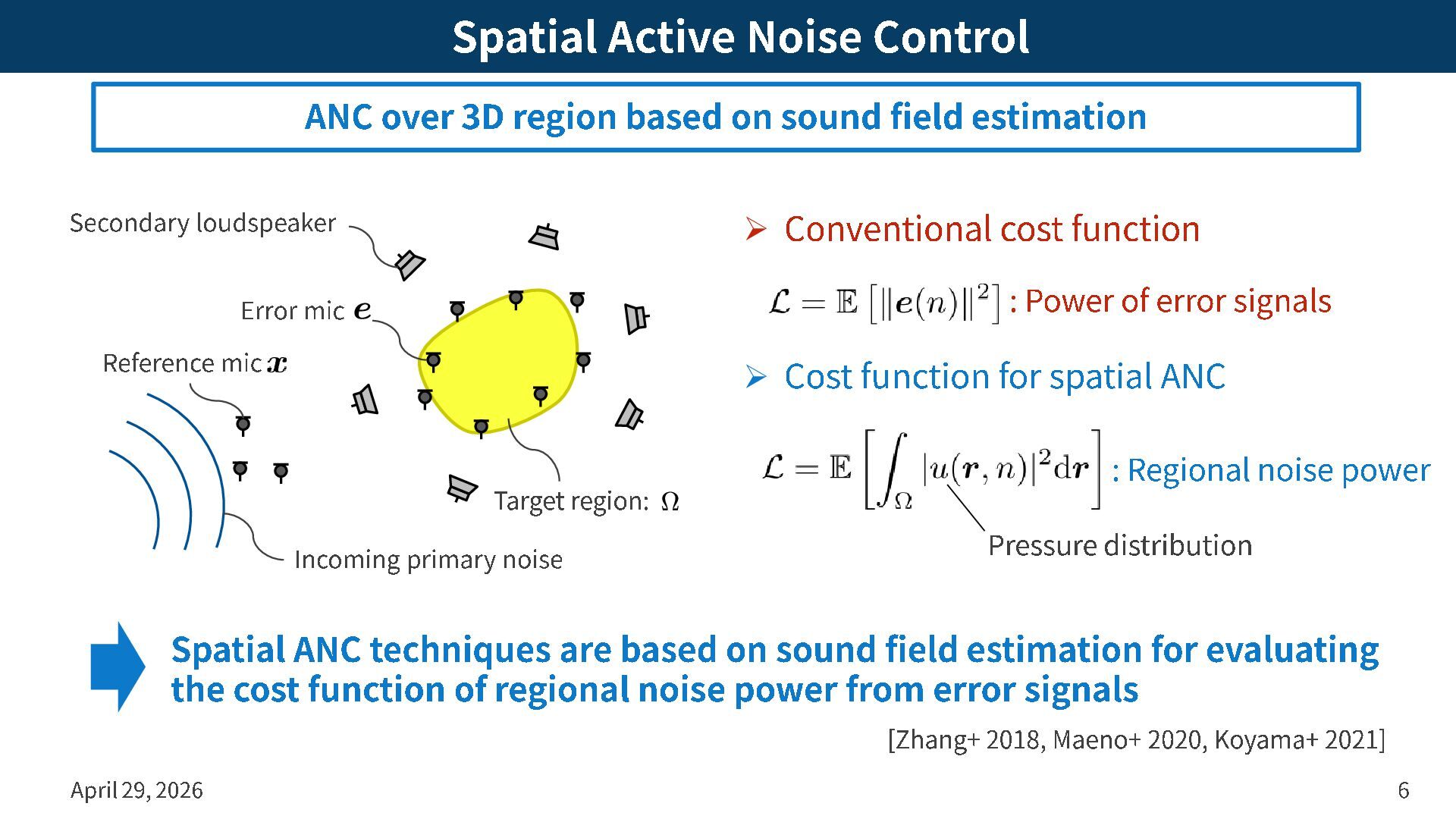
3D region based on sound field estimation ➢ Conventional cost function ➢ Cost function for spatial ANC : Power of error signals : Regional noise power Error mic Secondary loudspeaker Incoming primary noise Reference mic Target region: Spatial ANC techniques are based on sound field estimation for evaluating the cost function of regional noise power from error signals [Zhang+ 2018, Maeno+ 2020, Koyama+ 2021] Pressure distribution
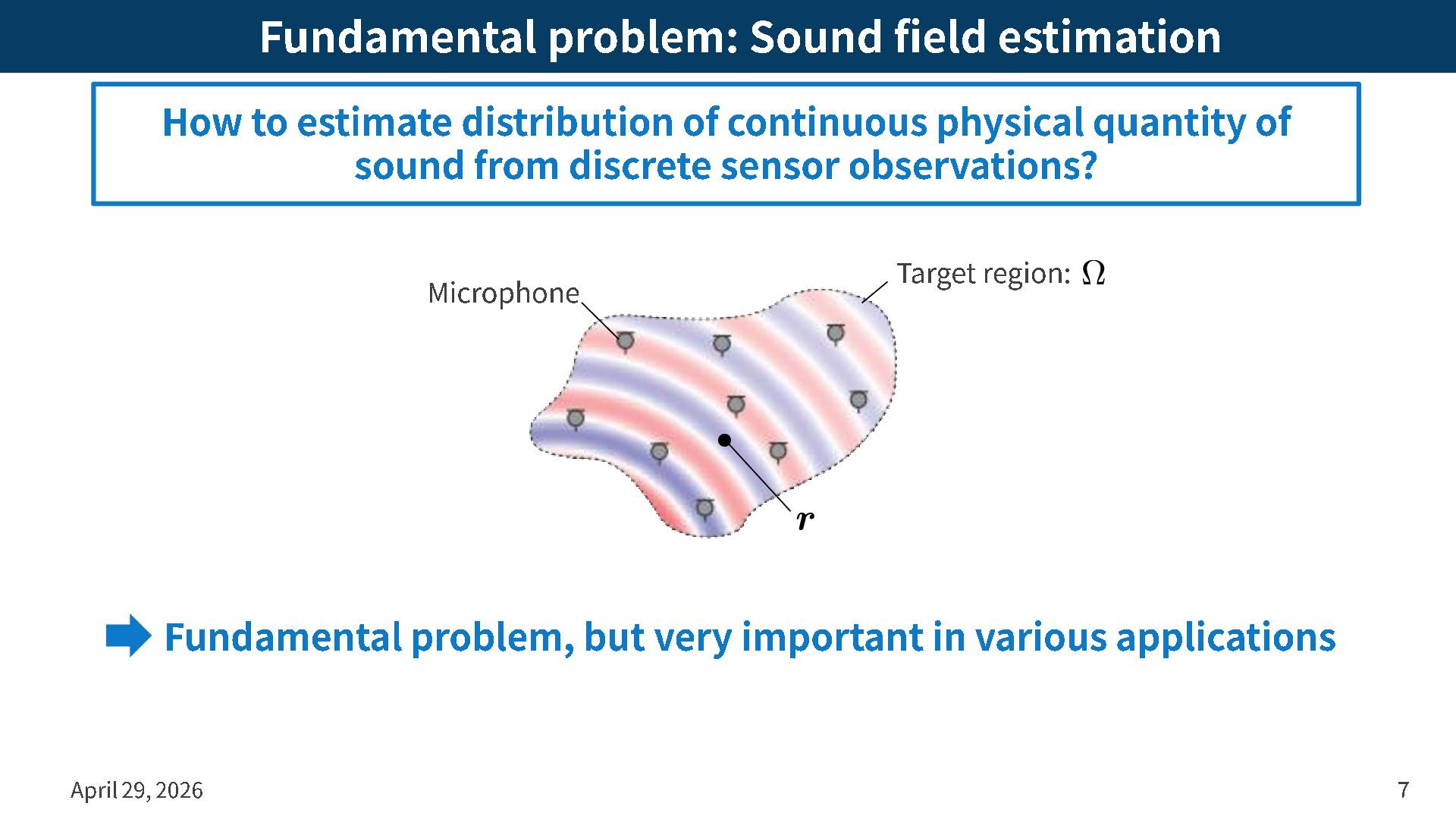
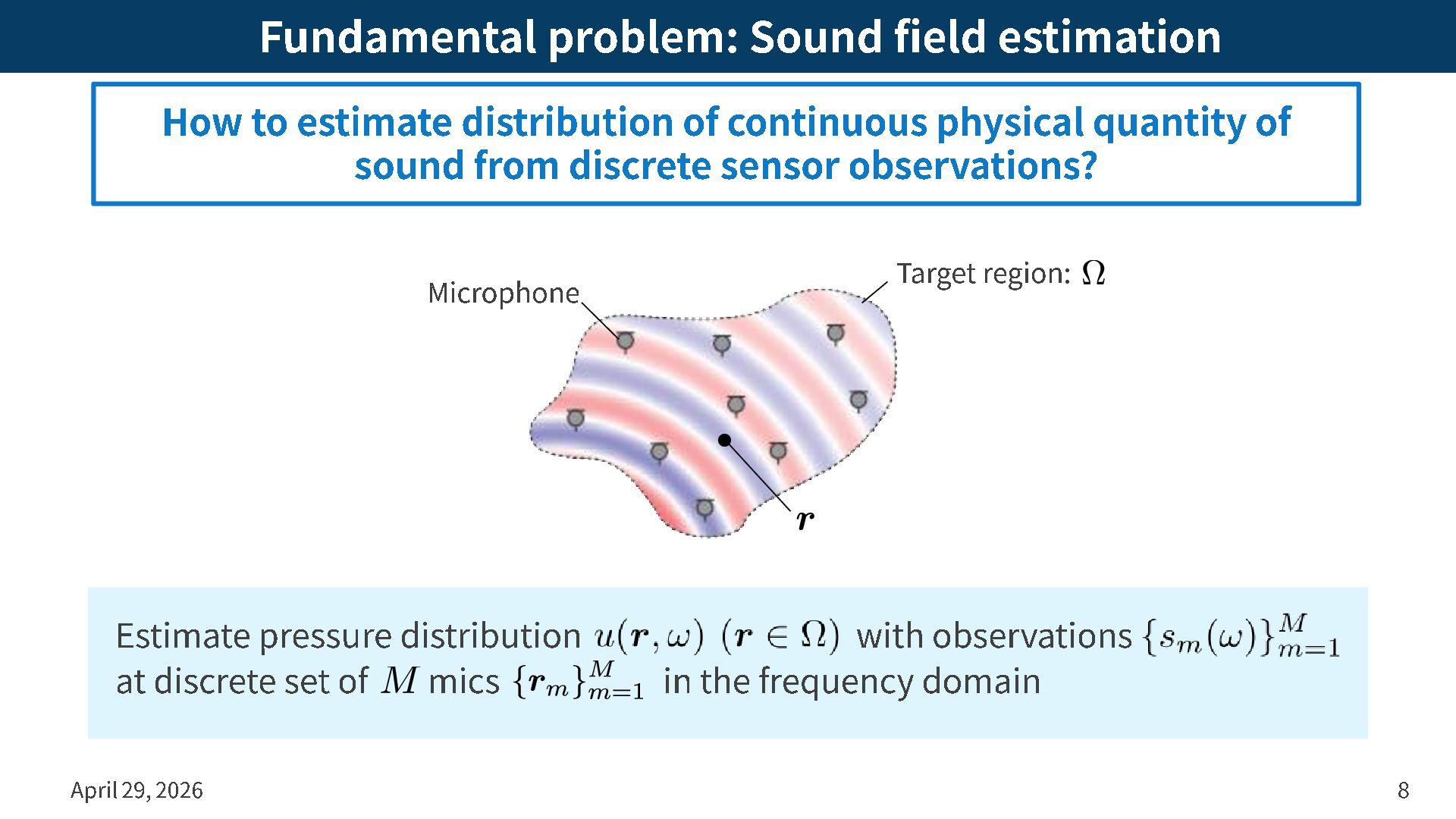
to estimate distribution of continuous physical quantity of sound from discrete sensor observations? Target region: Microphone Fundamental problem, but very important in various applications
to estimate distribution of continuous physical quantity of sound from discrete sensor observations? Estimate pressure distribution with observations at discrete set of mics in the frequency domain Target region: Microphone
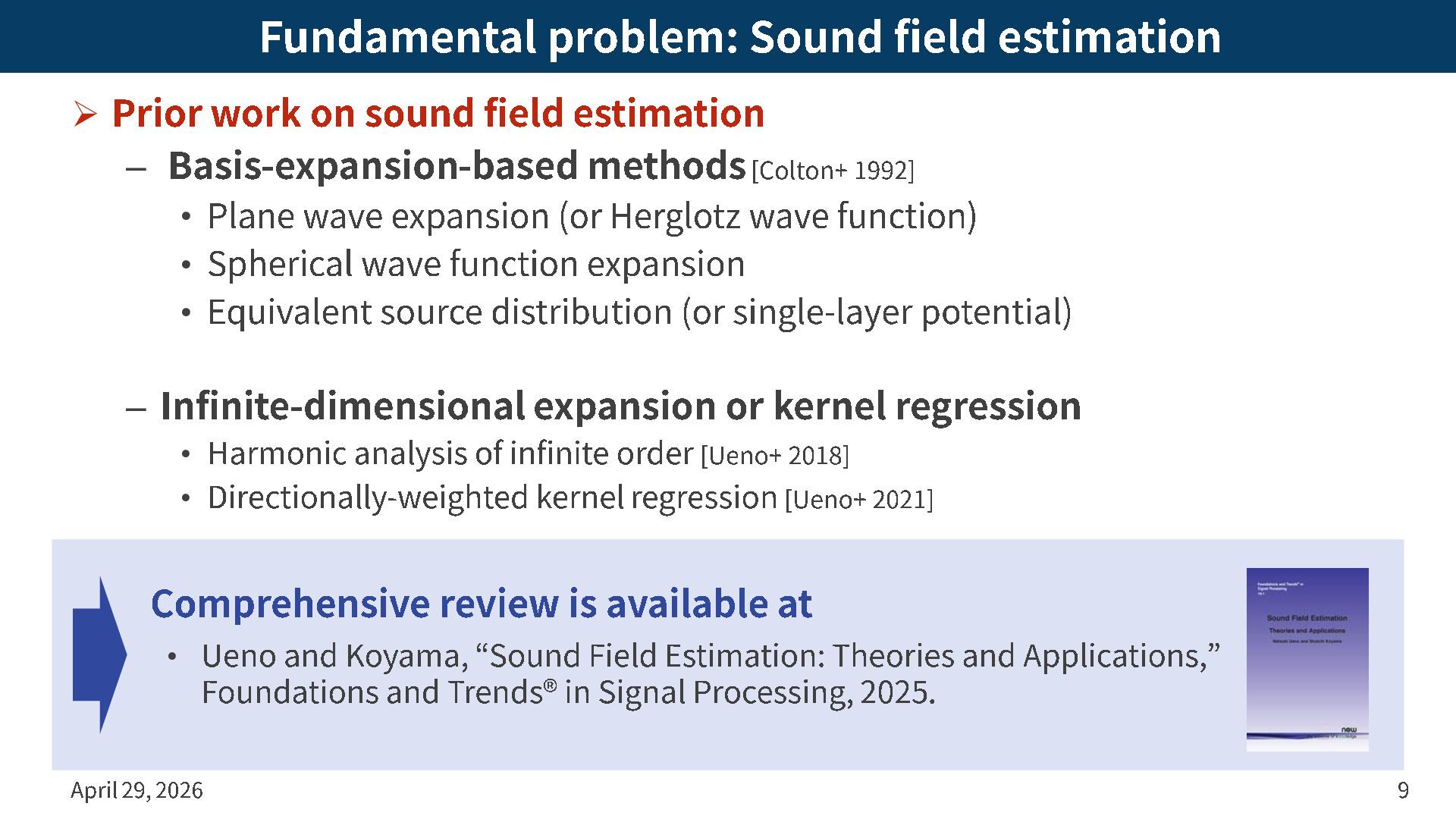
field estimation – Basis -expansion -based methods [Colton+ 1992] • Plane wave expansion (or Herglotz wave function) • Spherical wave function expansion • Equivalent source distribution (or single -layer potential) – Infinite -dimensional expansion or kernel regression • Harmonic analysis of infinite order [Ueno+ 2018] • Directionally -weighted kernel regression [Ueno+ 2021] April 29, 2026 9 Comprehensive review is available at • Ueno and Koyama, “Sound Field Estimation: Theories and Applications, ” Foundations and Trends ®️ in Signal Processing, 2025 .
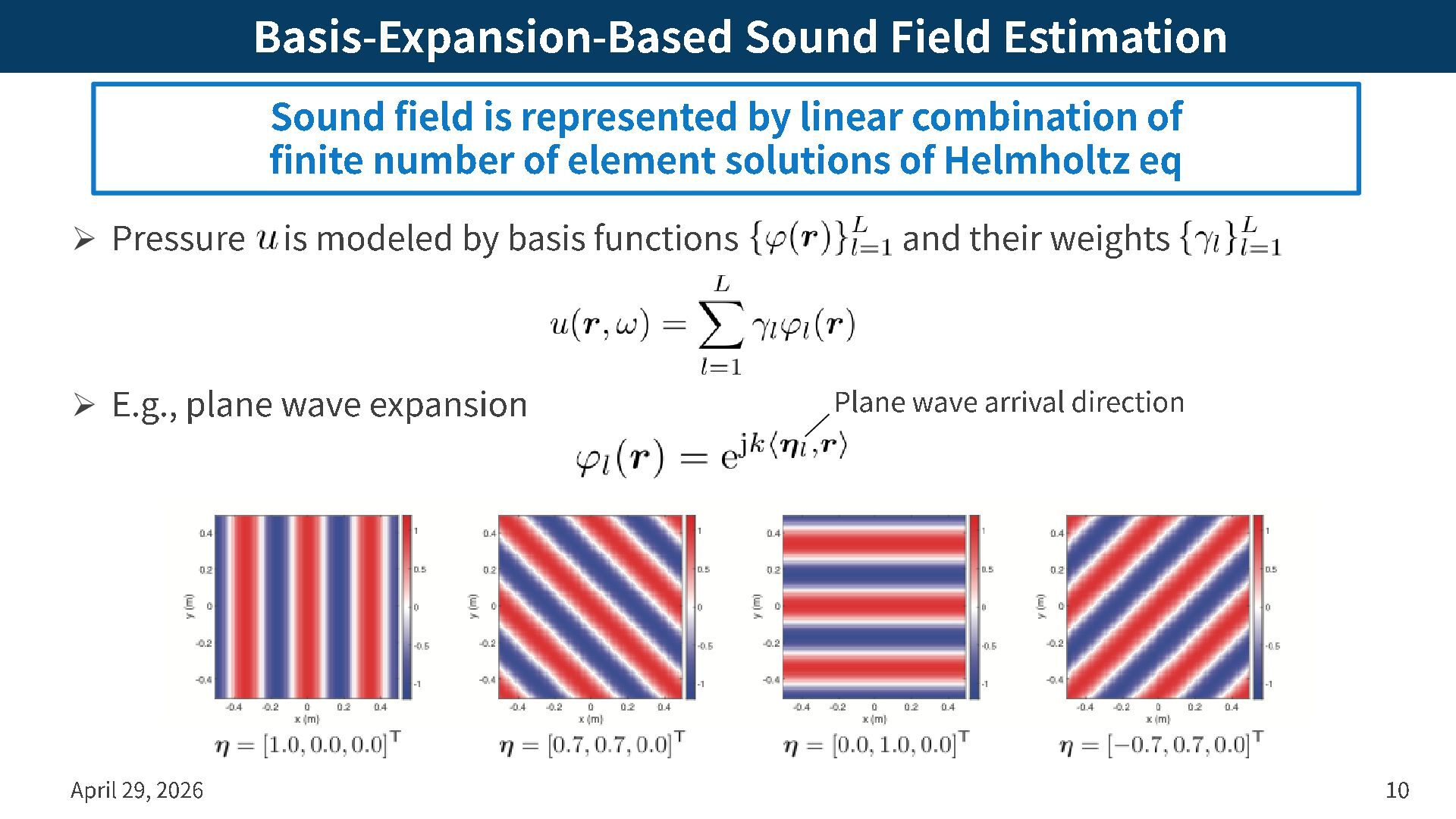
by basis functions and their weights ➢ E.g., plane wave expansion April 29, 2026 10 Sound field is represented by linear combination of finite number of element solutions of Helmholtz eq Plane wave arrival direction
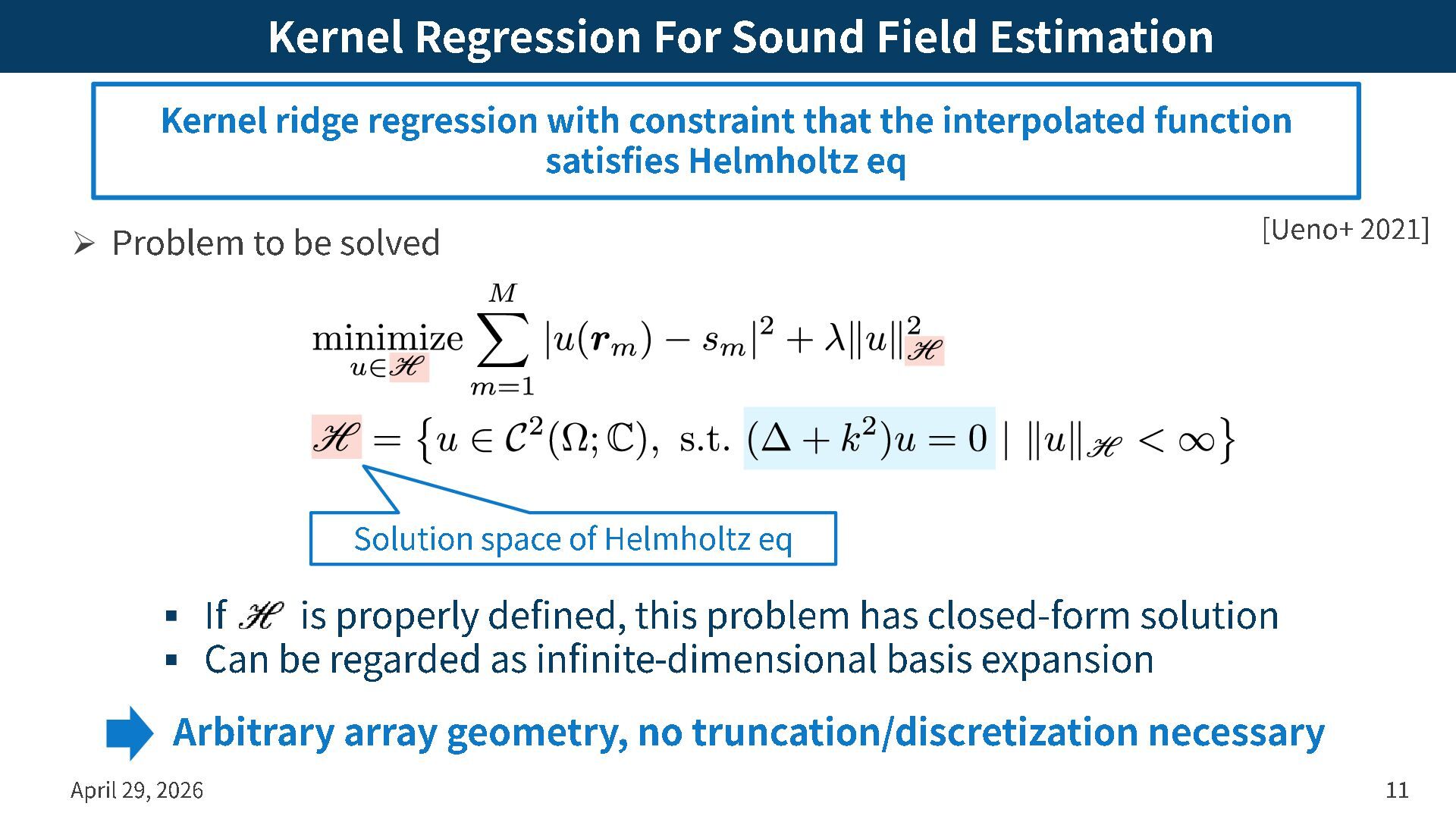
solved April 29, 2026 11 Kernel ridge regression with constraint that the interpolated function satisfies Helmholtz eq [Ueno+ 2021] Arbitrary array geometry, no truncation/discretization necessary ▪ If is properly defined, this problem has closed -form solution ▪ Can be regarded as infinite -dimensional basis expansion Solution space of Helmholtz eq
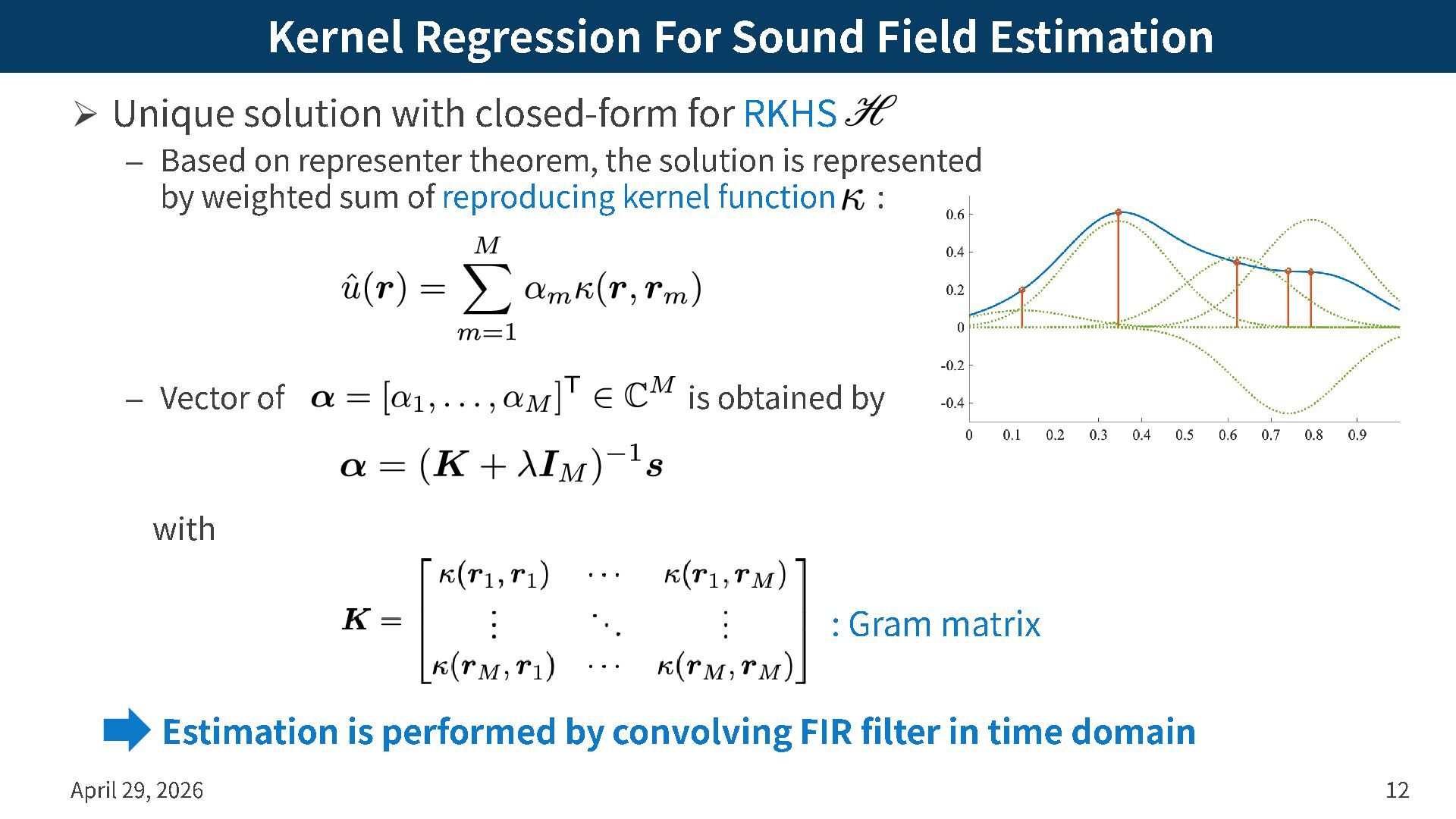
closed -form for RKHS – Based on representer theorem , the solution is represented by weighted sum of reproducing kernel function : – Vector of is obtained by with April 29, 2026 12 Estimation is performed by convolving FIR filter in time domain : Gram matrix
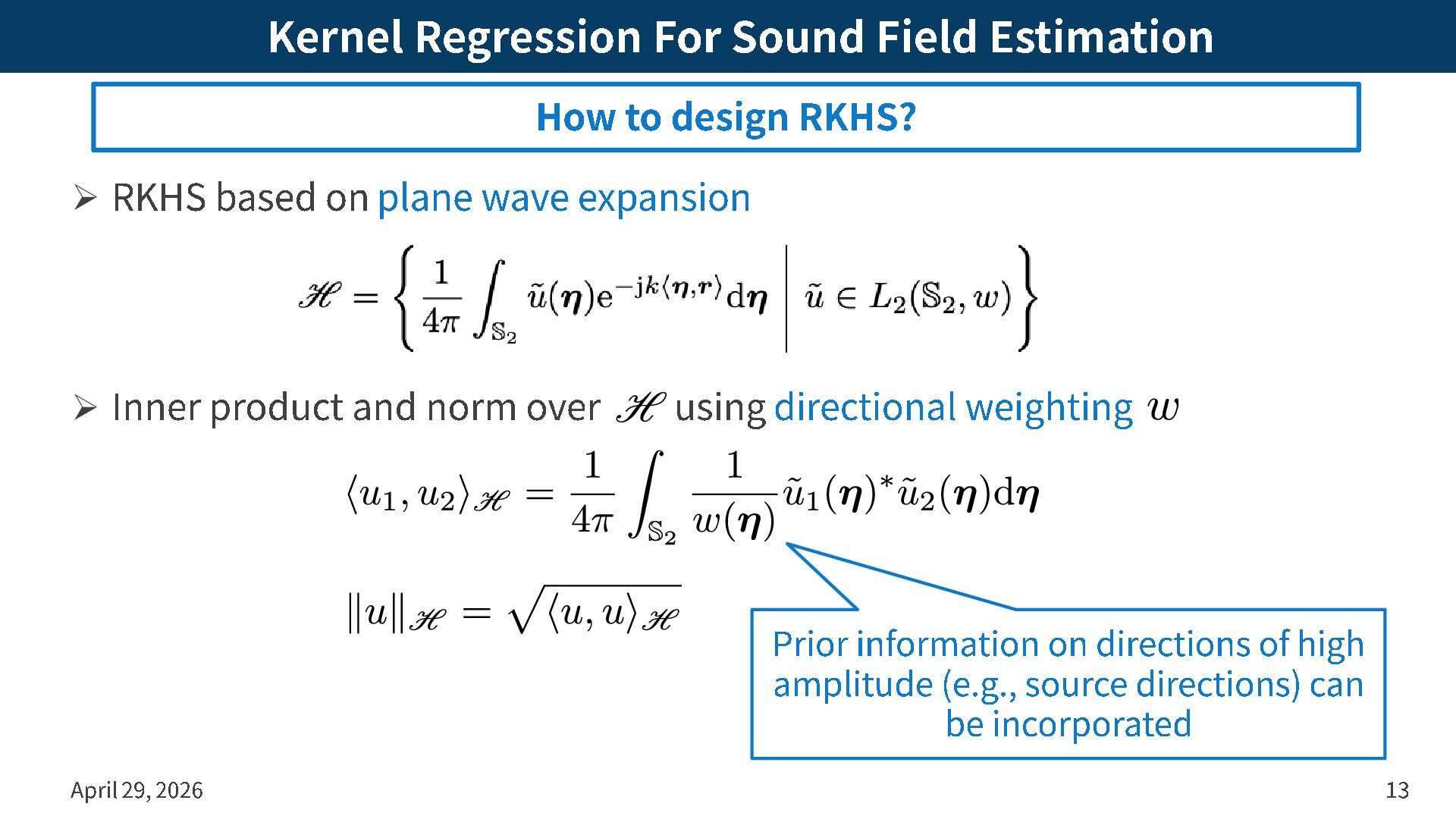
plane wave expansion ➢ Inner product and norm over using directional weighting April 29, 2026 13 How to design RKHS? Prior information on directions of high amplitude (e.g., source directions) can be incorporated
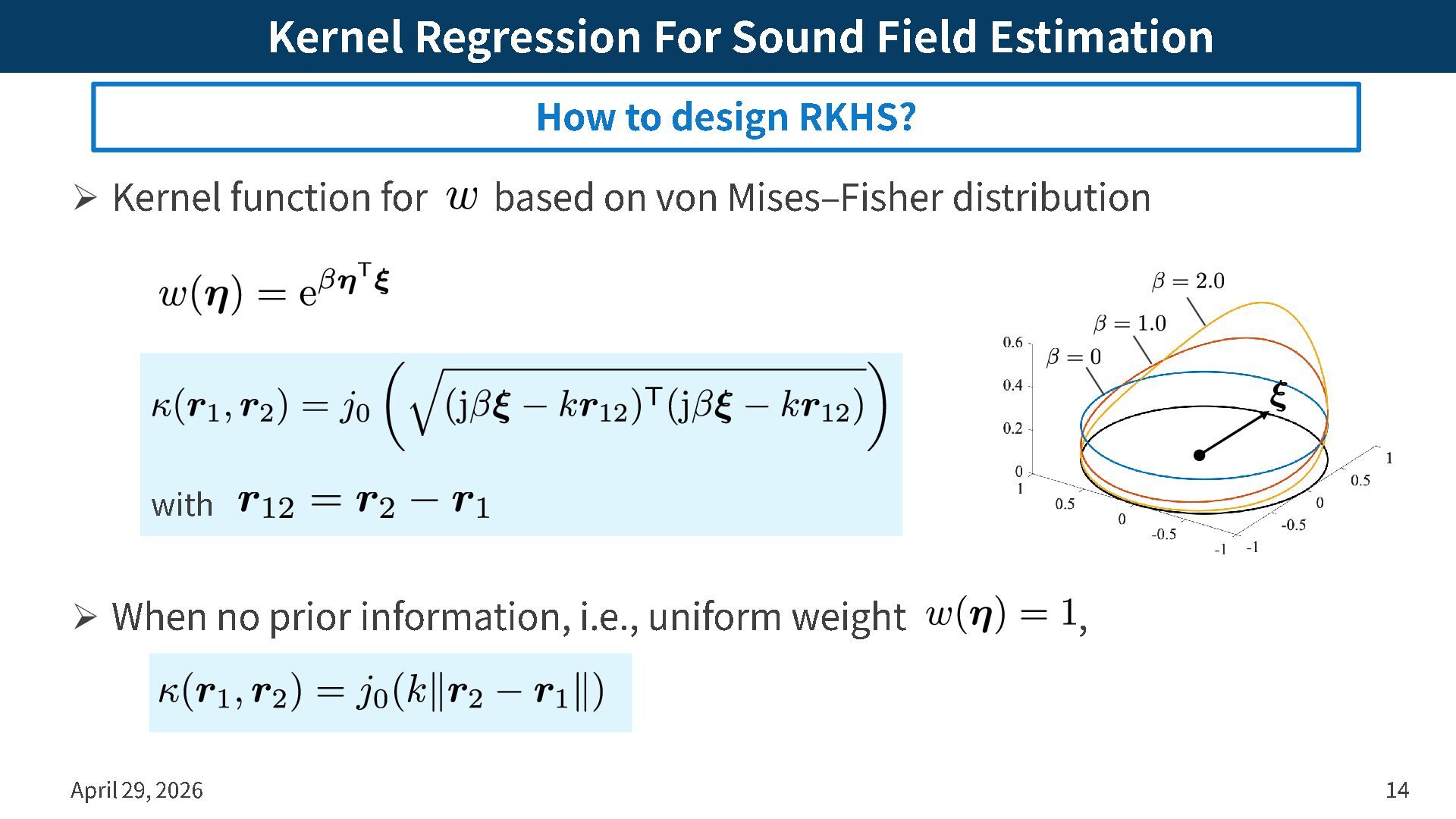
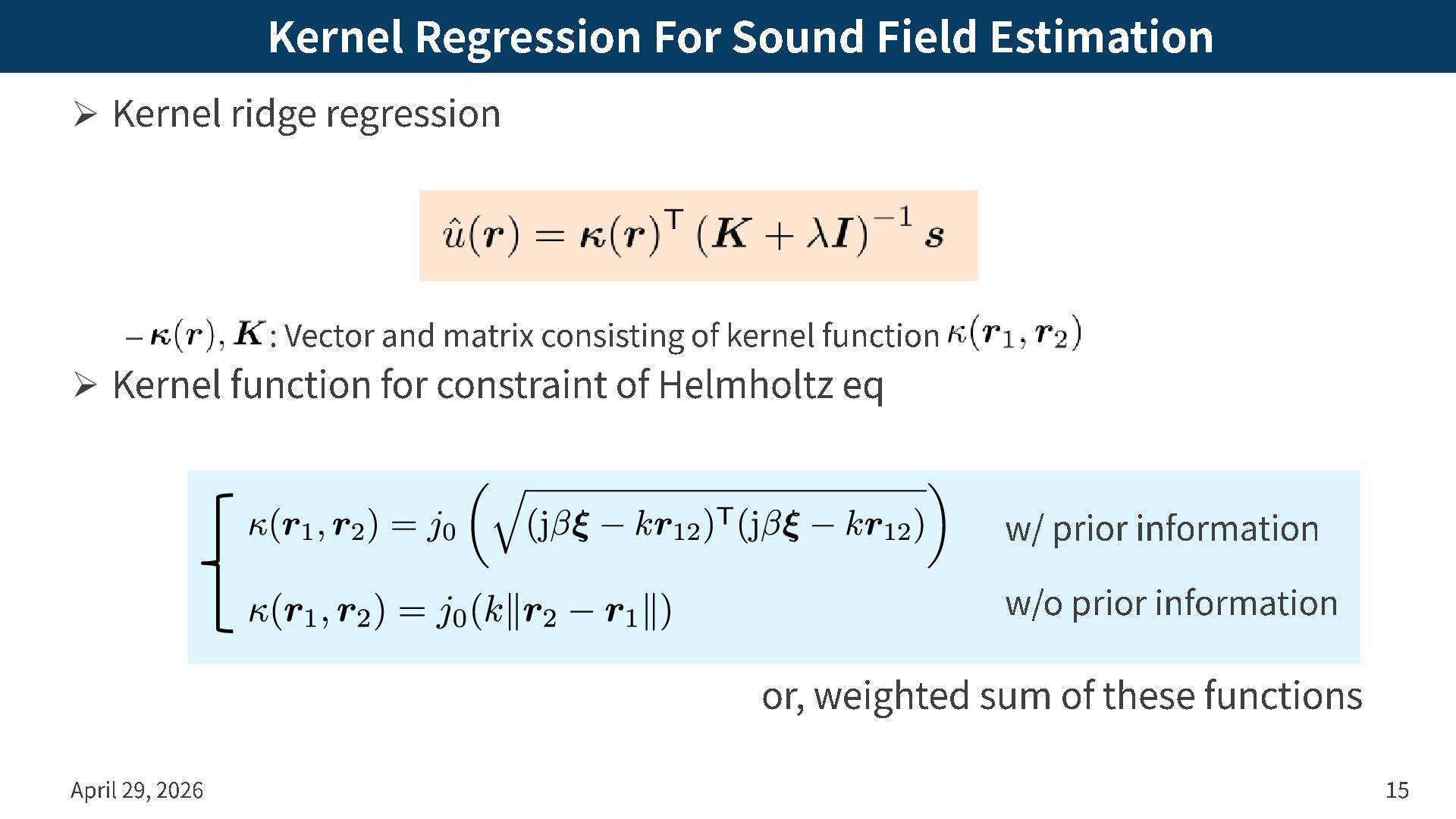
– : Vector and matrix consisting of kernel function ➢ Kernel function for constraint of Helmholtz eq April 29, 2026 15 w/ prior information w/o prior information or, weighted sum of these functions
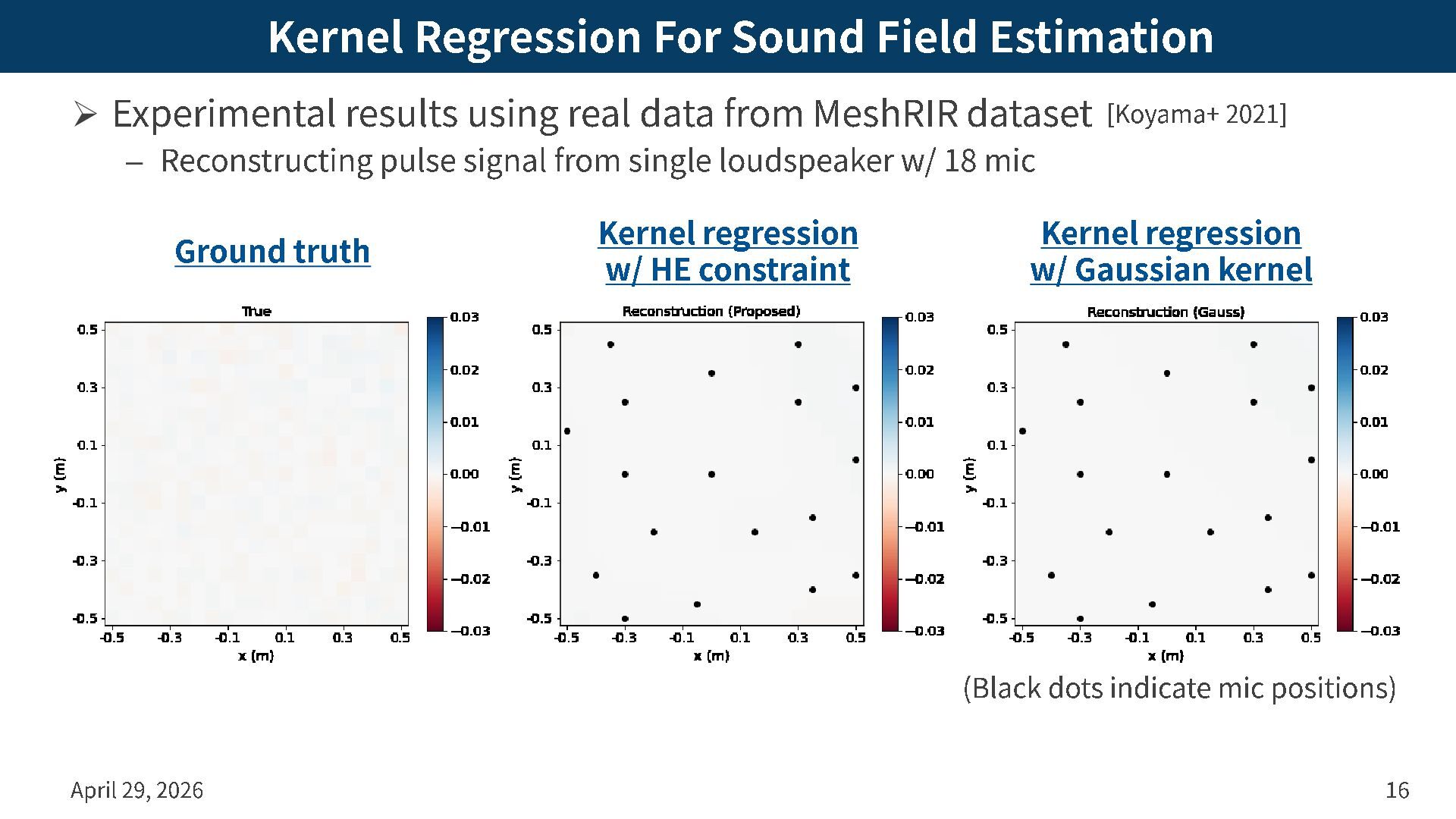
real data from MeshRIR dataset – Reconstructing pulse signal from single loudspeaker w/ 18 mic April 29, 2026 16 Ground truth Kernel regression w/ HE constraint Kernel regression w/ Gaussian kernel (Black dots indicate mic positions) [Koyama+ 2021]
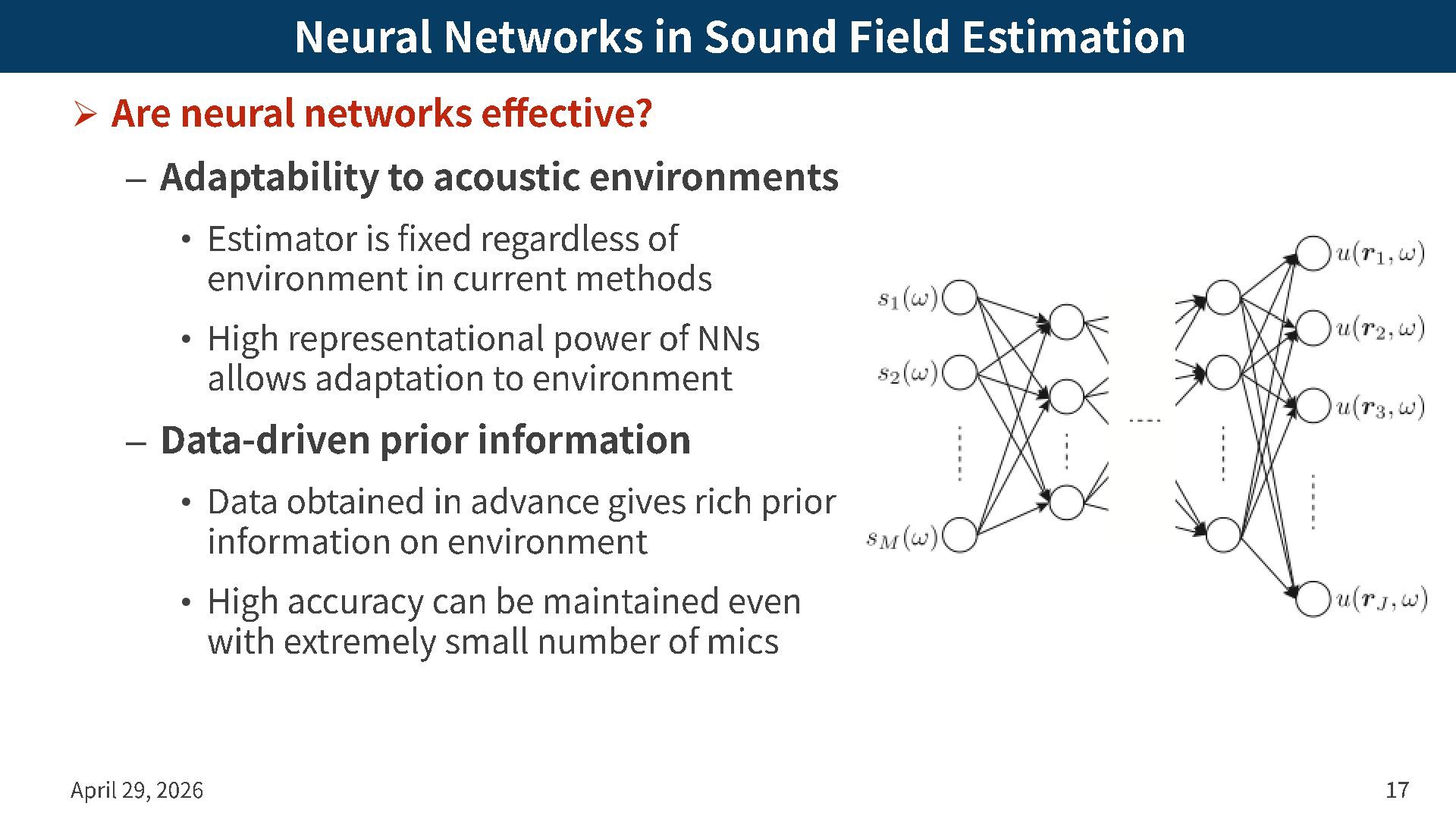
effective? – Adaptability to acoustic environments • Estimator is fixed regardless of environment in current methods • High representational power of NNs allows adaptation to environment – Data -driven prior information • Data obtained in advance gives rich prior information on environment • High accuracy can be maintained even with extremely small number of mics April 29, 2026 17
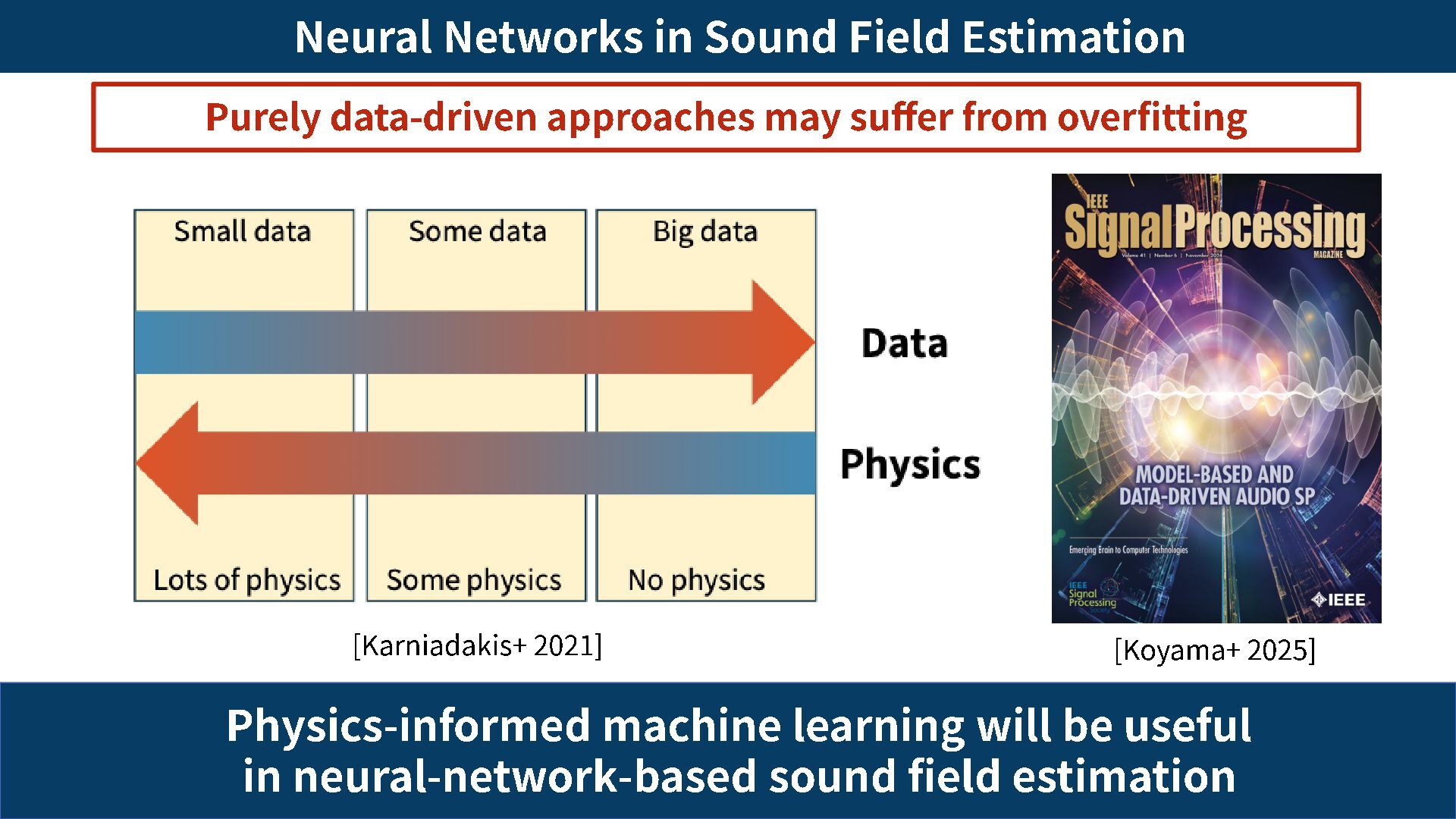
Purely data -driven approaches may suffer from overfitting [Karniadakis+ 2021] [Koyama+ 2025] Physics -informed machine learning will be useful in neural -network -based sound field estimation
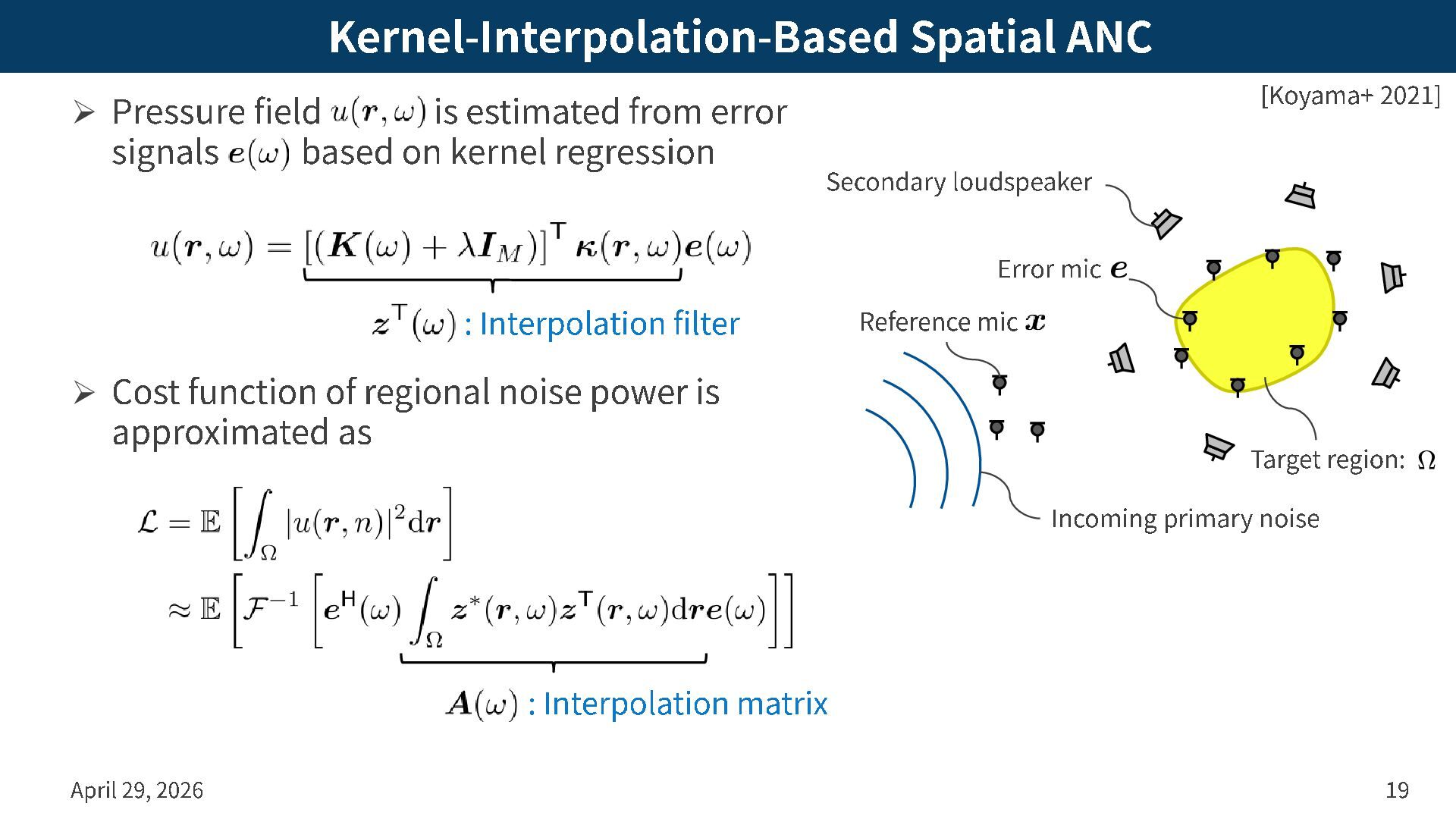
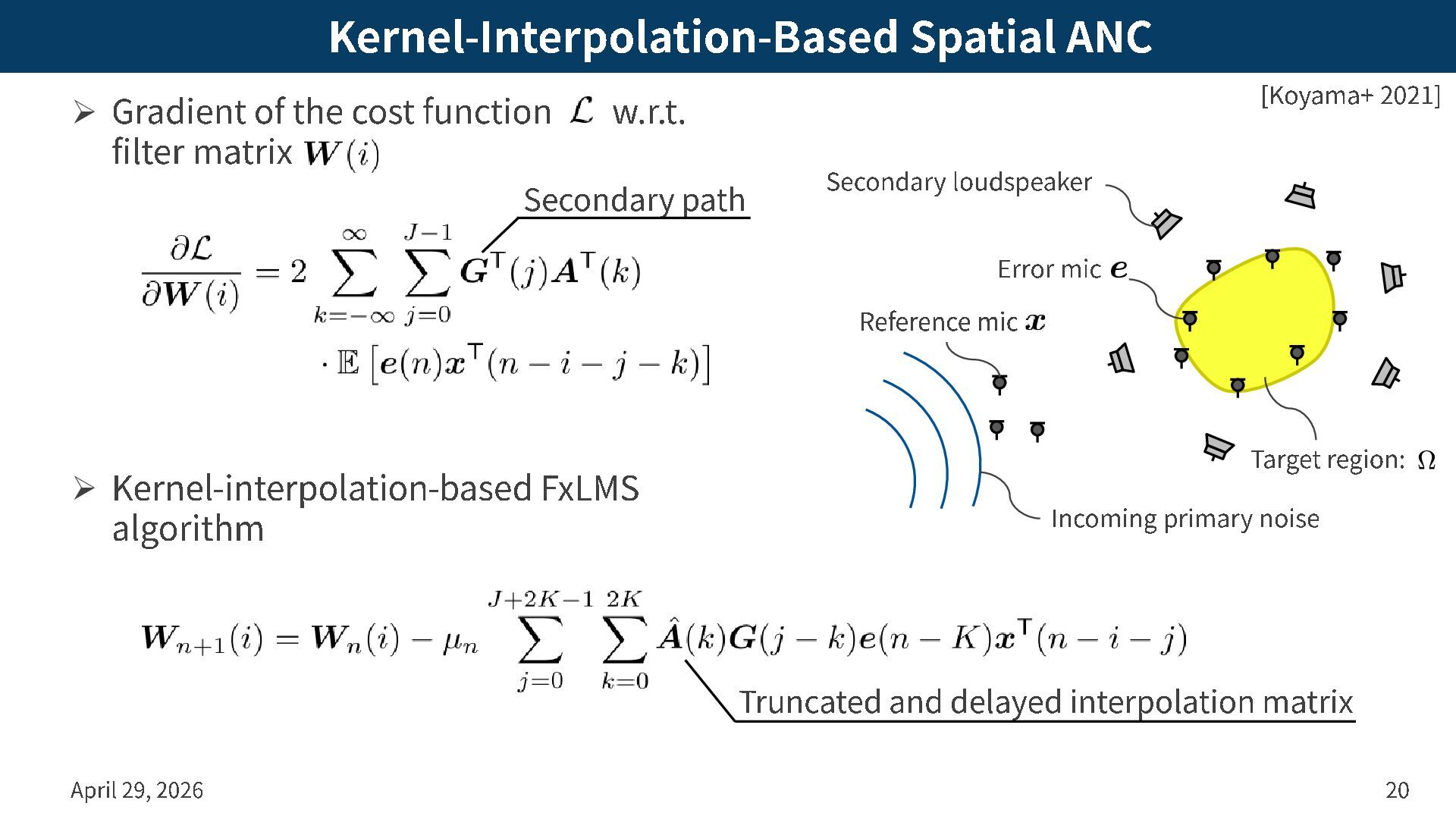
from error signals based on kernel regression ➢ Cost function of regional noise power is approximated as April 29, 2026 19 : Interpolation filter : Interpolation matrix [Koyama+ 2021] Error mic Secondary loudspeaker Incoming primary noise Reference mic Target region:
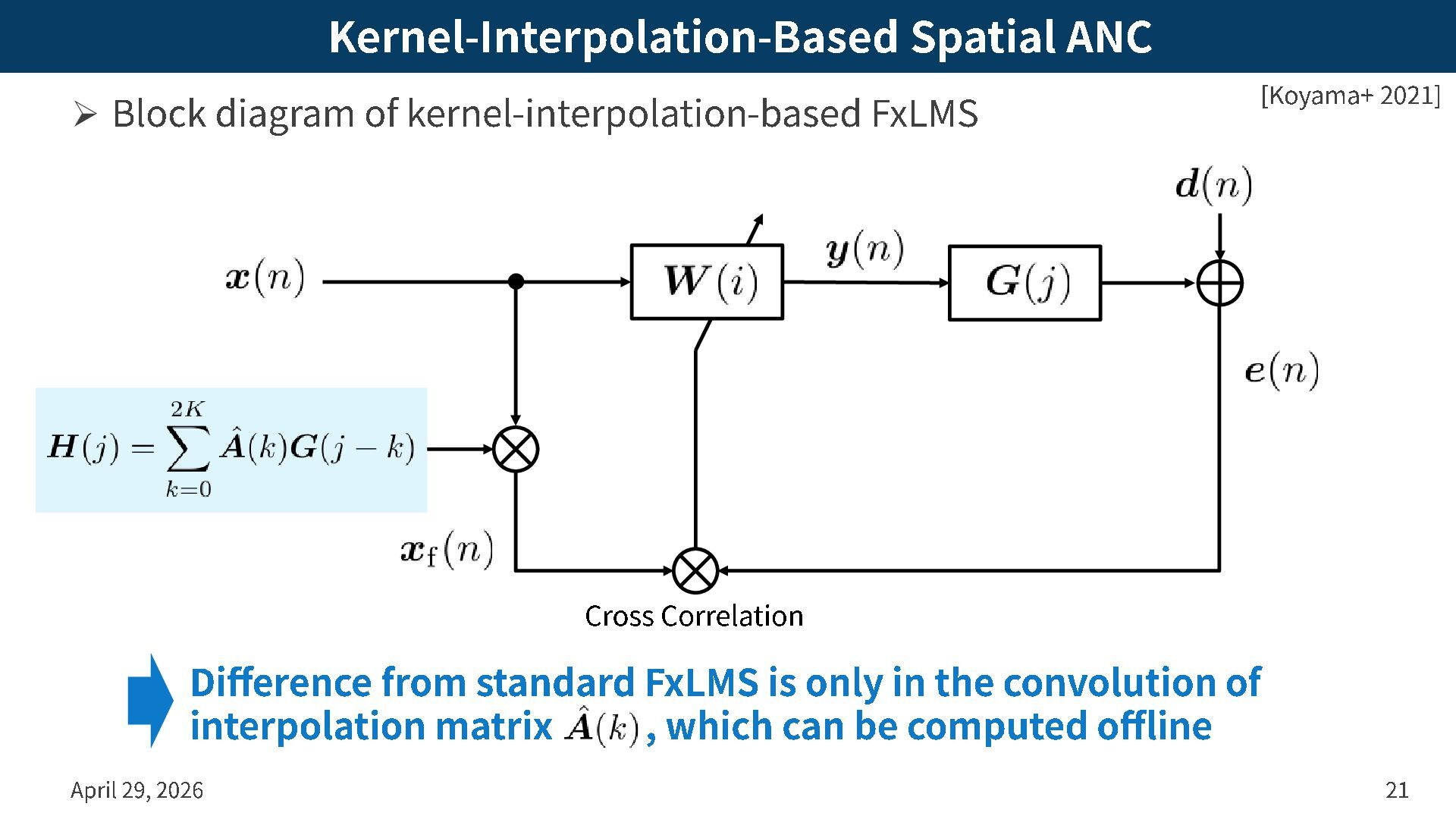
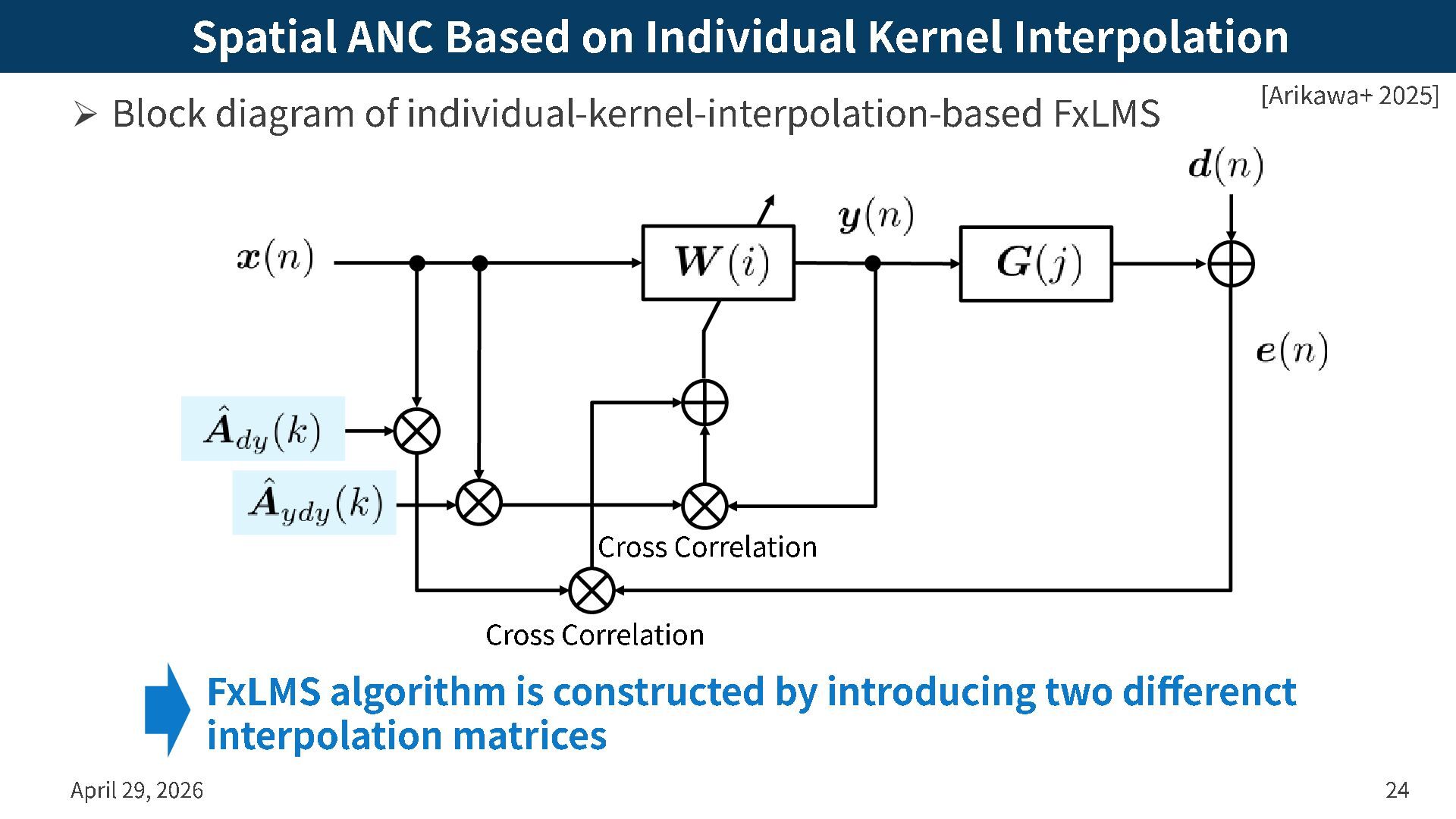
-interpolation -based FxLMS April 29, 2026 21 [Koyama+ 2021] Difference from standard FxLMS is only in the convolution of interpolation matrix , which can be computed offline Cross Correlation
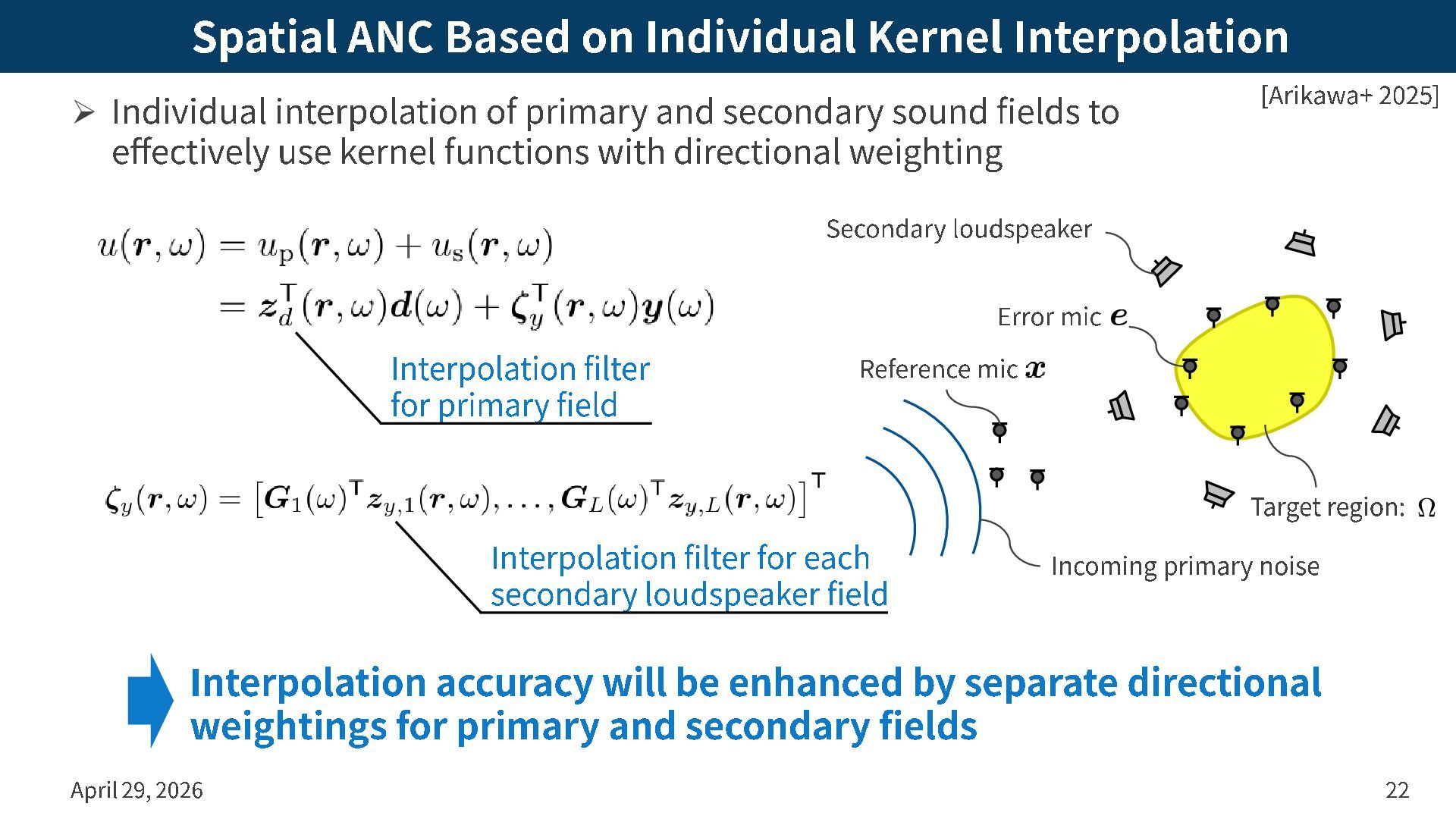
of primary and secondary sound fields to effectively use kernel functions with directional weighting April 29, 2026 22 [Arikawa+ 2025 ] Error mic Secondary loudspeaker Incoming primary noise Reference mic Target region: Interpolation accuracy will be enhanced by separate directional weightings for primary and secondary fields Interpolation filter for primary field Interpolation filter for each secondary loudspeaker field
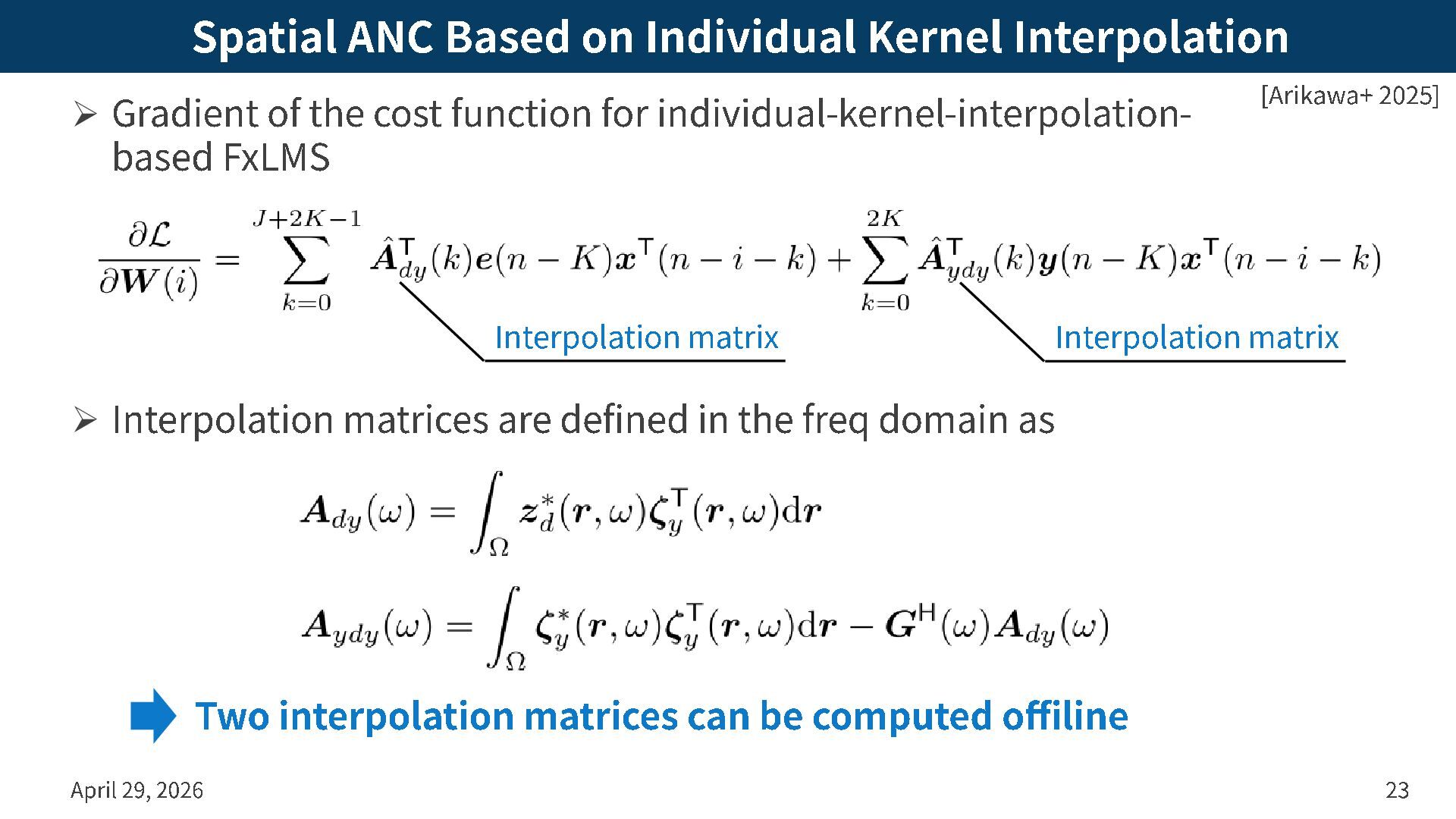
the cost function for individual -kernel -interpolation - based FxLMS ➢ Interpolation matrices are defined in the freq domain as April 29, 2026 23 [Arikawa+ 2025 ] Interpolation matrix Interpolation matrix Two interpolation matrices can be computed offiline
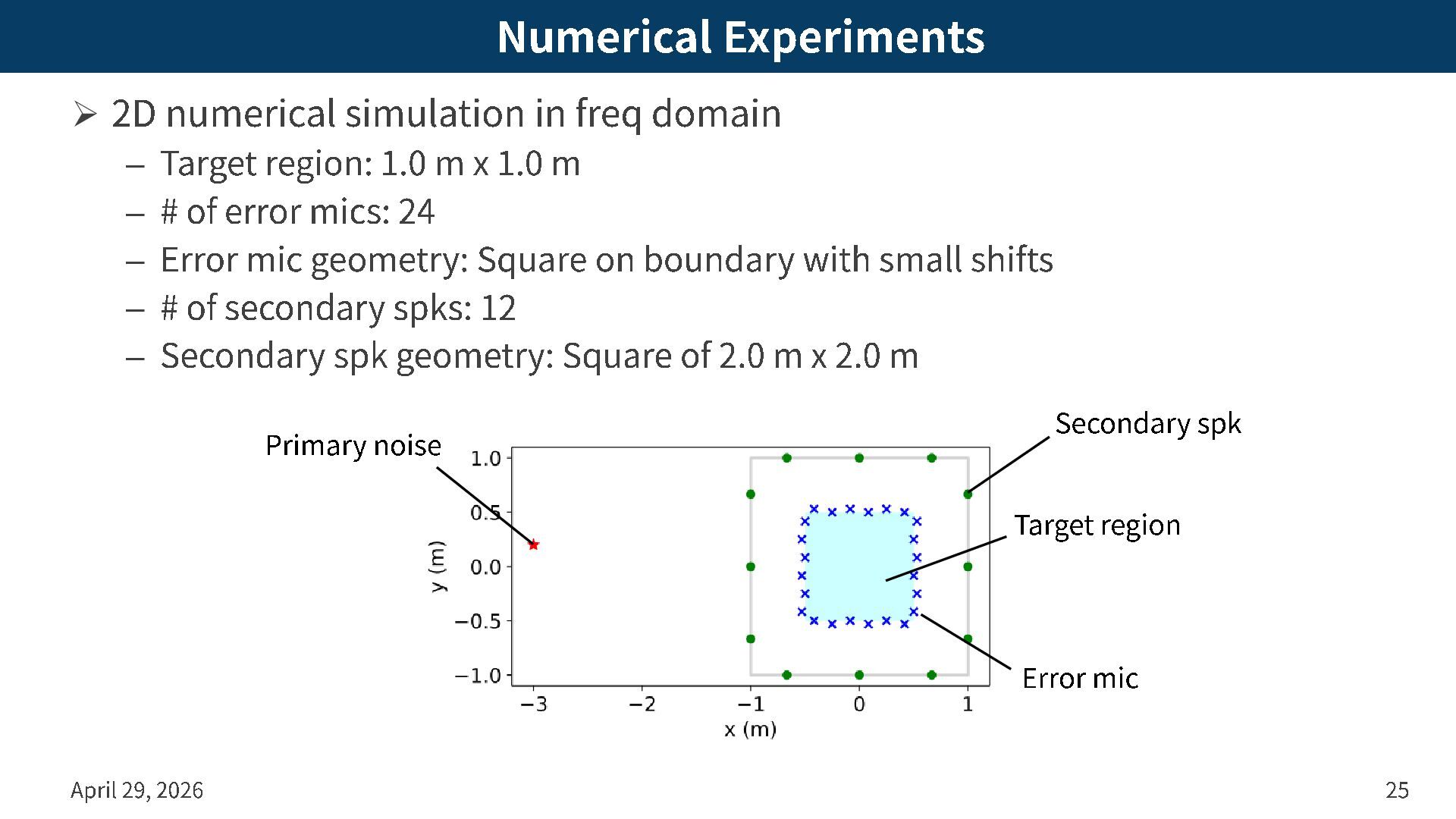
Target region: 1.0 m x 1.0 m – # of error mics: 24 – Error mic geometry: Square on boundary with small shifts – # of secondary spks: 12 – Secondary spk geometry: Square of 2.0 m x 2.0 m April 29, 2026 25 Primary noise Secondary spk Error mic Target region
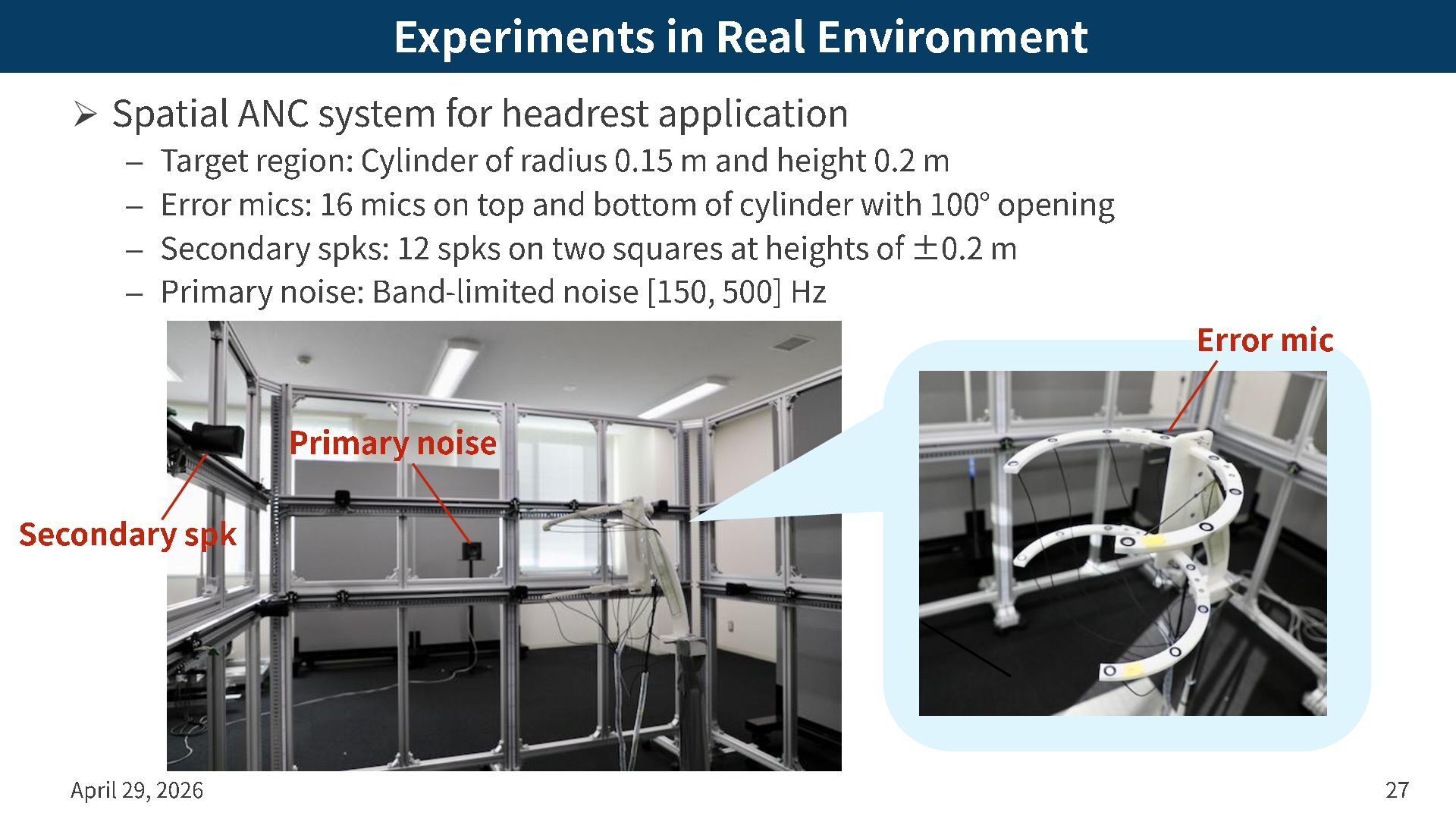
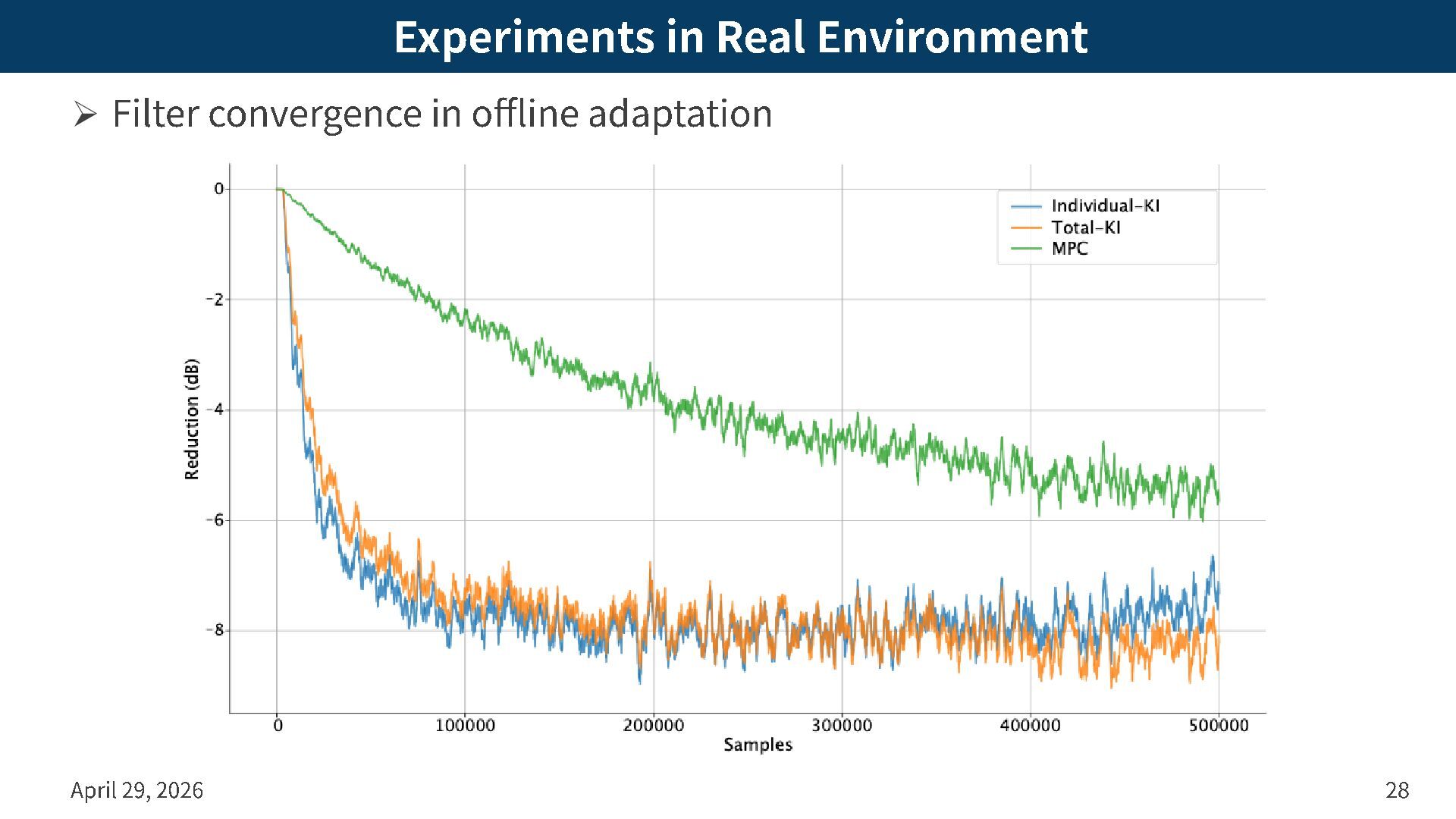
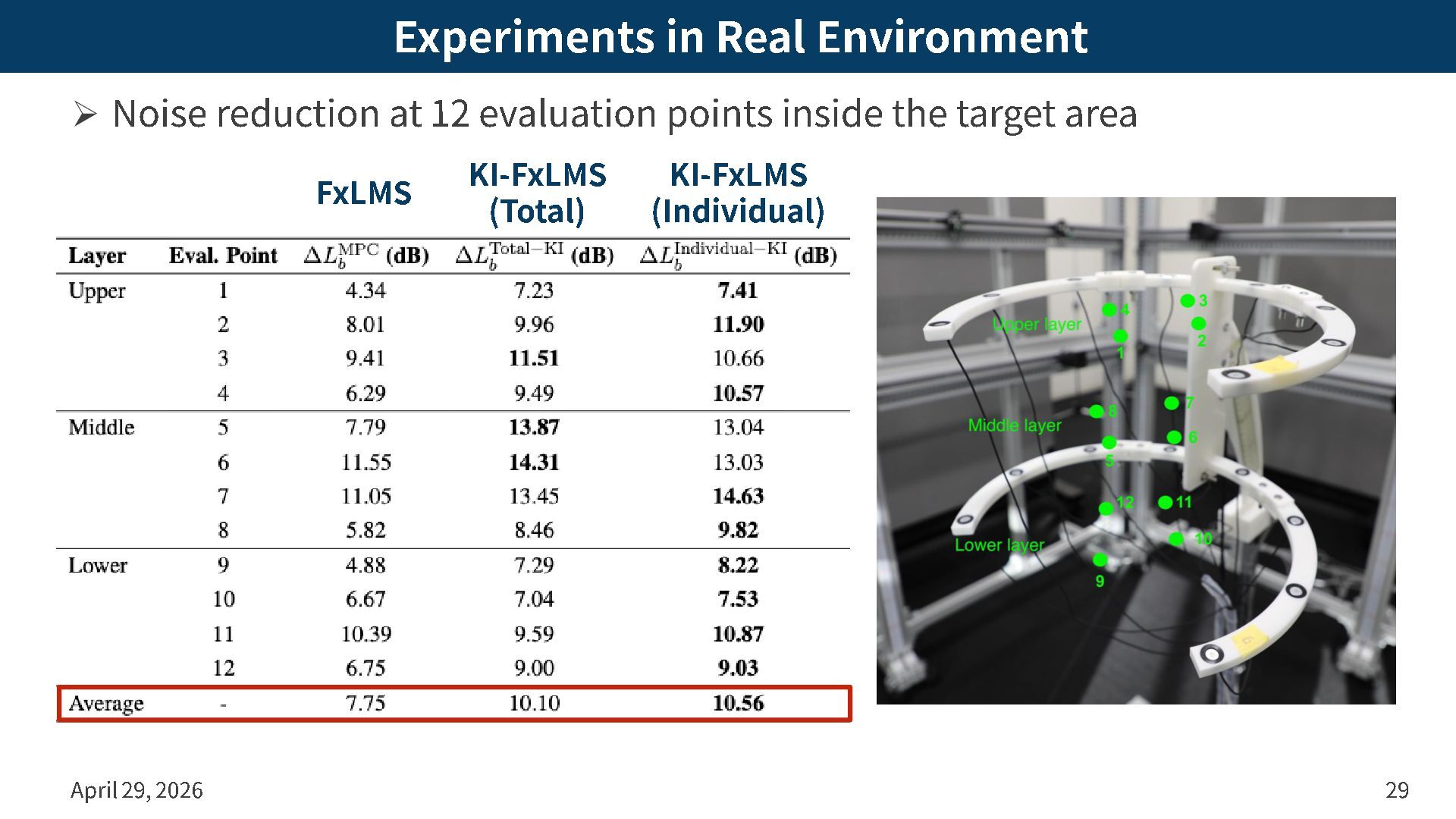
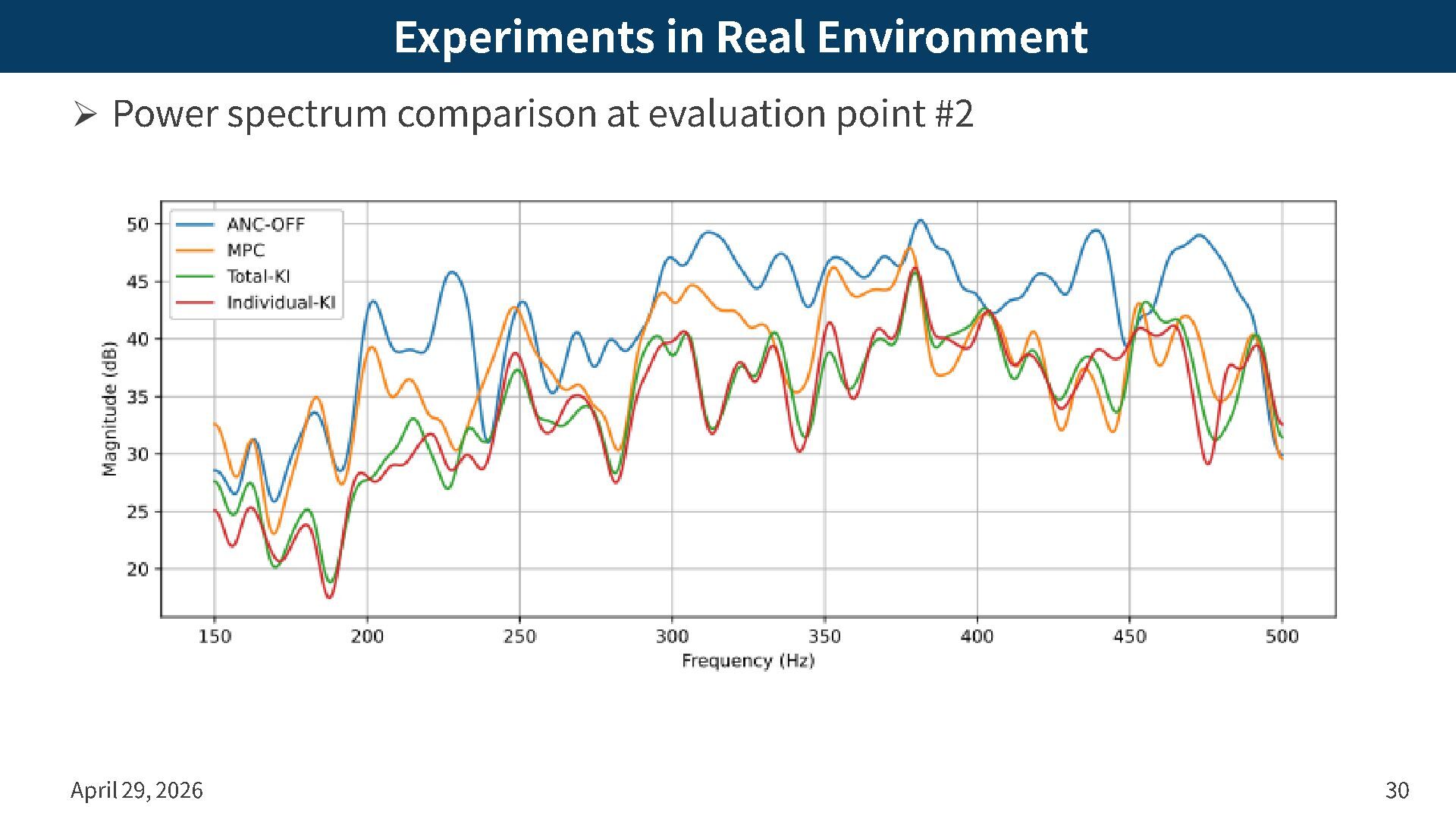
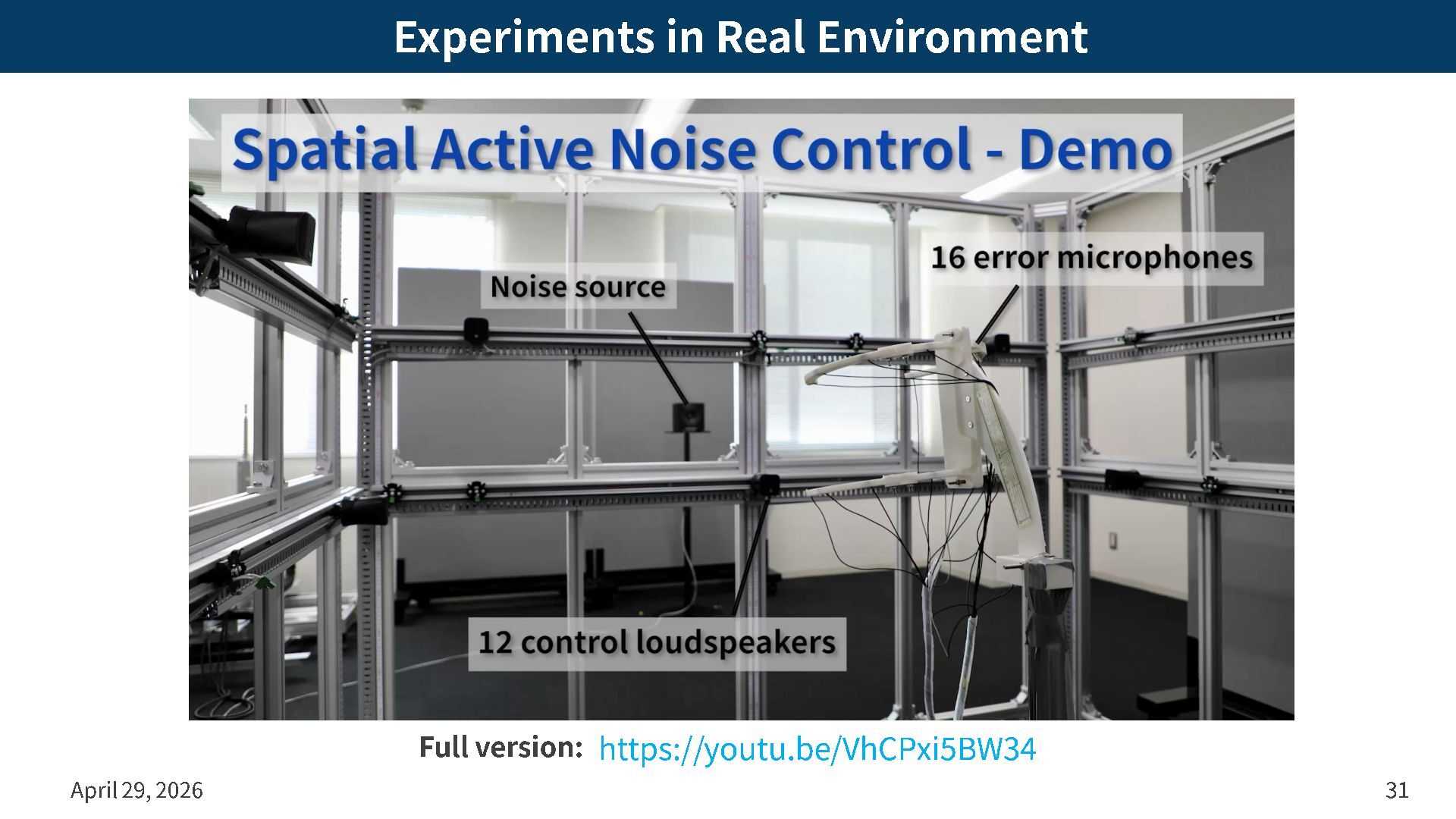
application – Target region: Cylinder of radius 0.15 m and height 0.2 m – Error mics: 16 mics on top and bottom of cylinder with 100 ° opening – Secondary spks: 12 spks on two squares at heights of ± 0.2 m – Primary noise: Band -limited noise [150, 500] Hz April 29, 2026 27 Primary noise Secondary spk Error mic
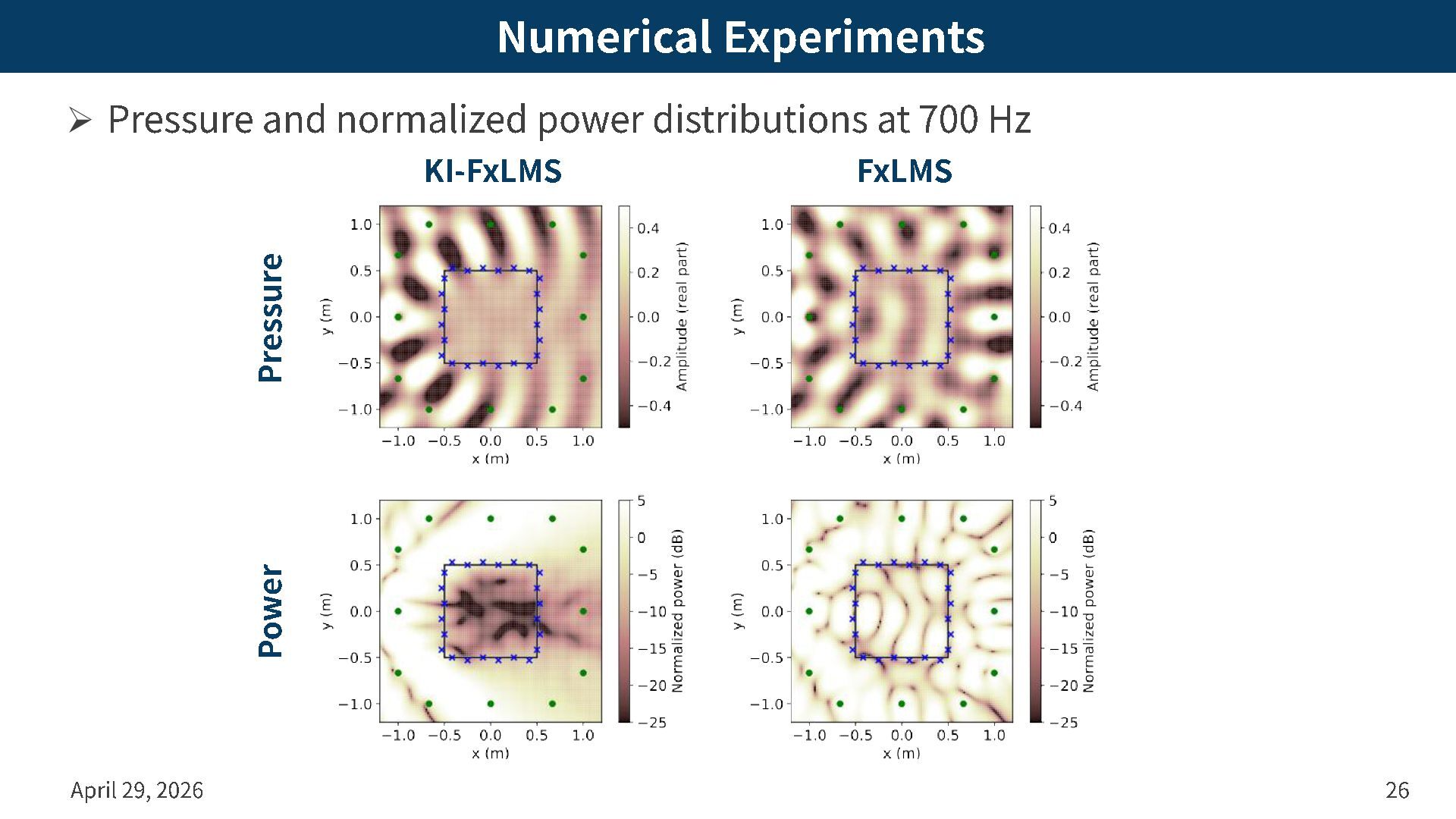
fields – Fundamental problem in spatial ANC is sound field estimation – Kernel regression with constraint of Helmholtz eq allows estimating continuous sound field from discrete mics by linear operation – Cost function defined as regional noise power within the target region can be approximated by error signals via kernel regression – FxLMS algorithm for kernel -interpolation -based spatial ANC is achieved by introducing additional interpolation matrix – Numerical and practical experiments indicated spatial ANC techniques can adequately suppress noise within a 3D target region April 29, 2026 32 Physics -informed machine learning will open up new applications for sound field analysis and control Thank you for your attention!


 skoyamalab
 analokmaus
 mikimhk
 koheishinden
 izumiyama_lab
 stktu
stktu
 yukiar
 kogoro
 eumesy
 fkske
fkske
 koide3
 takasehideki
 smashingmag
 oripsolob
 bkeepers
 productmarketing
 sarafernandez
 aleyda
 codingconduct
 baasie
 tessaabrams
 takai
takai
 tammielis