$30 off During Our Annual Pro Sale. View Details »

hksts2025

Avatar for SatokiMasuda SatokiMasuda
December 24, 2025

 hksts2025

Slides for Masuda, S.* & Hato, E. (Dec 8-9, 2025). Estimating Behavioral Urban Dynamics under Strategic Interaction: A Game-Theoretic Approach to Transport and Development Policy, The 29th International Conference of Hong Kong Society for Transporation Studies (HKSTS), Hong Kong.

Avatar for SatokiMasuda

SatokiMasuda

December 24, 2025
Tweet

More Decks by SatokiMasuda

Other Decks in Research

Transcript

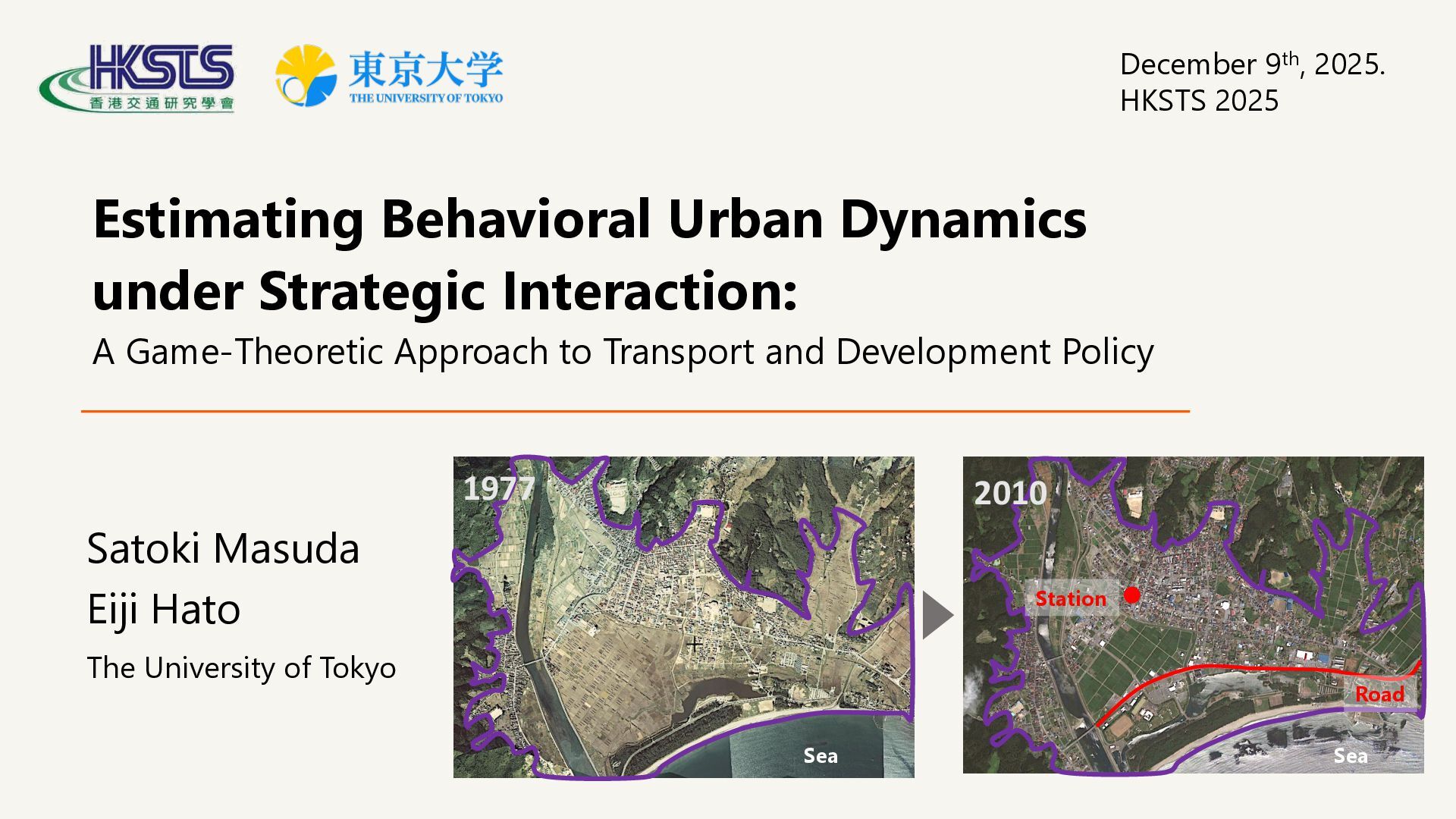
  1. Estimating Behavioral Urban Dynamics under Strategic Interaction: A Game-Theoretic Approach

    to Transport and Development Policy December 9th, 2025. HKSTS 2025 Satoki Masuda Eiji Hato The University of Tokyo 2010 1977 Road Station Sea Sea
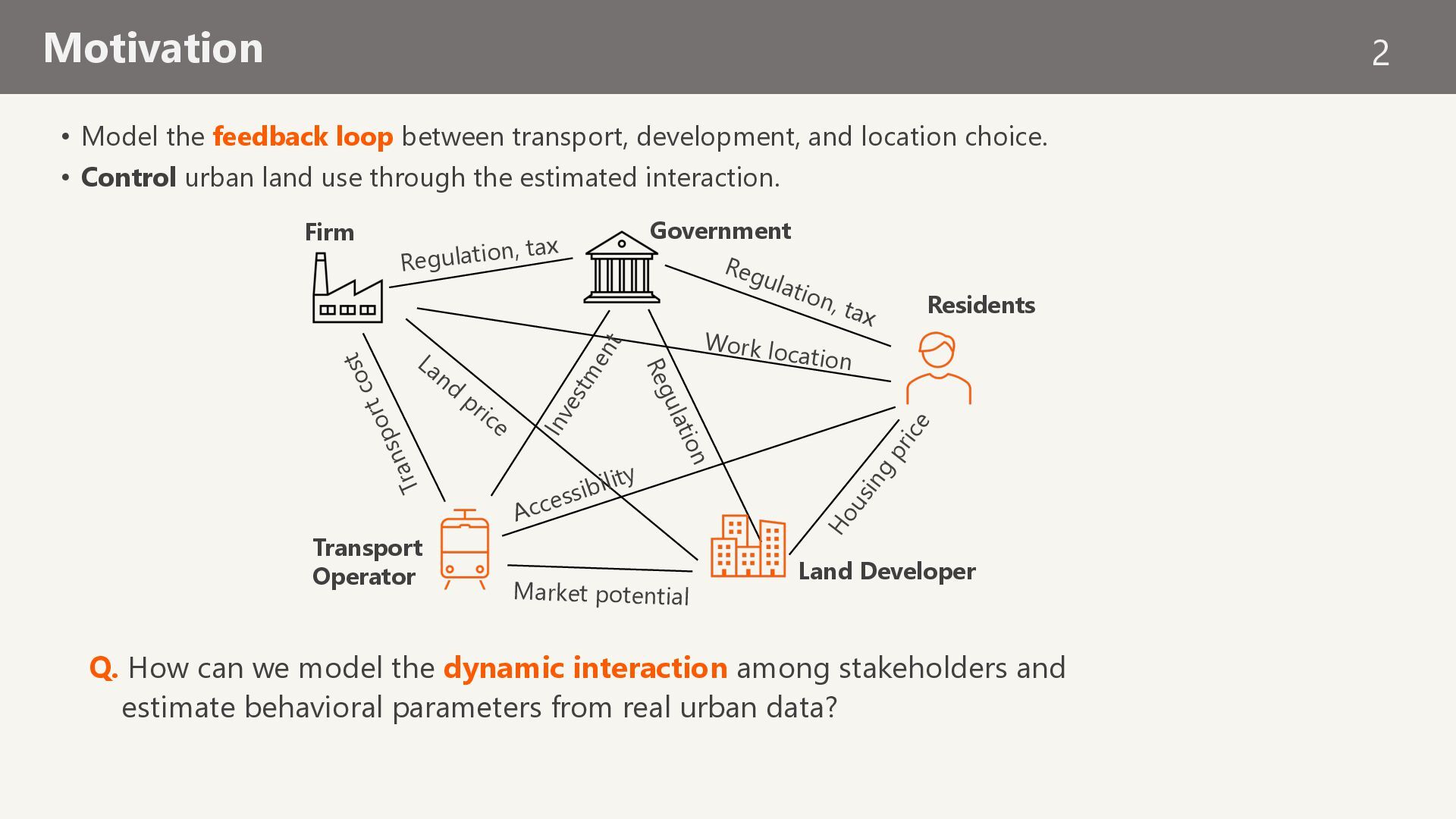
  2. • Model the feedback loop between transport, development, and location

    choice. • Control urban land use through the estimated interaction. 2 Motivation Government Residents Land Developer Transport Operator Firm Accessibility Regulation, tax Transport cost Market potential Work location Land price Housing price Regulation, tax Investment Regulation Q. How can we model the dynamic interaction among stakeholders and estimate behavioral parameters from real urban data?
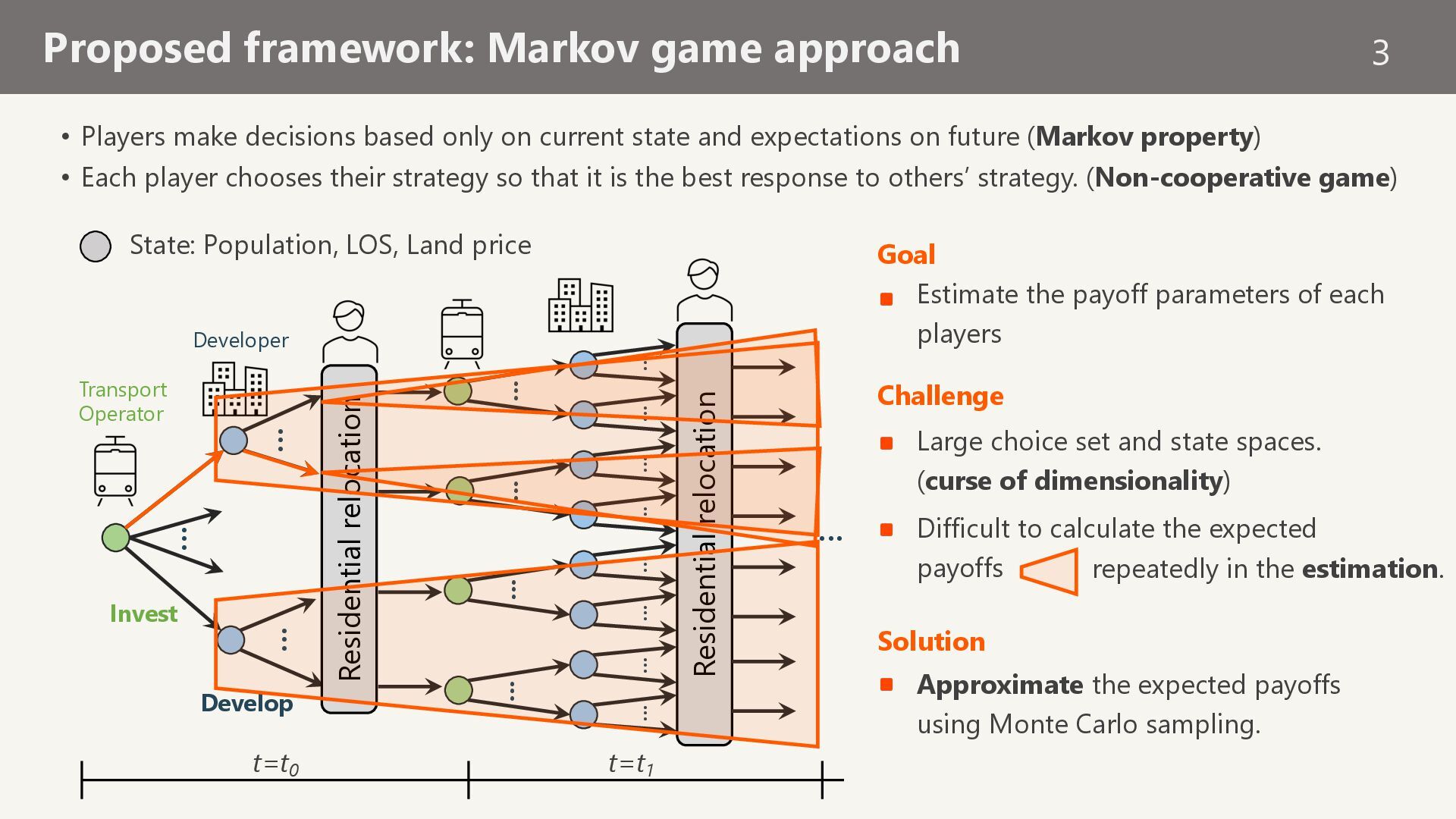
  3. • Players make decisions based only on current state and

    expectations on future (Markov property) • Each player chooses their strategy so that it is the best response to others’ strategy. (Non-cooperative game) 3 Proposed framework: Markov game approach … … … … … … … … … … … … … … … … Residential relocation Residential relocation Developer Transport Operator Invest Develop State: Population, LOS, Land price t=t0 t=t1 Challenge Large choice set and state spaces. (curse of dimensionality) Difficult to calculate the expected payoffs repeatedly in the estimation. Solution Approximate the expected payoffs using Monte Carlo sampling. Goal Estimate the payoff parameters of each players
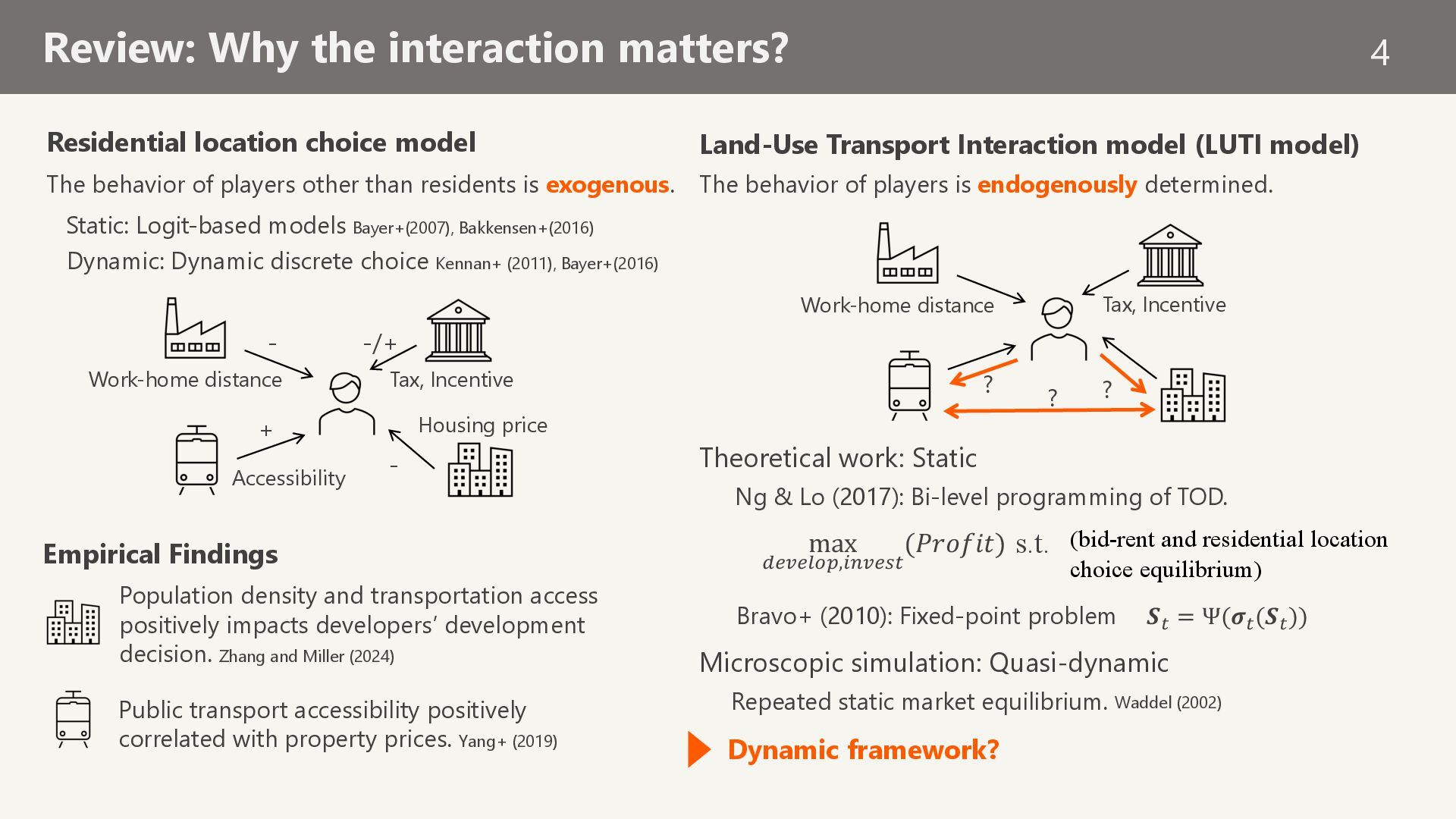
  4. 4 Review: Why the interaction matters? Residential location choice model

    Static: Logit-based models Bayer+(2007), Bakkensen+(2016) Dynamic: Dynamic discrete choice Kennan+ (2011), Bayer+(2016) The behavior of players other than residents is exogenous. Accessibility Work-home distance Tax, Incentive Housing price - -/+ + - Empirical Findings Population density and transportation access positively impacts developers’ development decision. Zhang and Miller (2024) Public transport accessibility positively correlated with property prices. Yang+ (2019) Theoretical work: Static Microscopic simulation: Quasi-dynamic Ng & Lo (2017): Bi-level programming of TOD. Waddel (2002) Bravo+ (2010): Fixed-point problem Repeated static market equilibrium. 𝑺! = Ψ(𝝈! (𝑺! )) max !"#"$%&,()#"*+ (𝑃𝑟𝑜𝑓𝑖𝑡) (bid-rent and residential location choice equilibrium) s.t. Dynamic framework? Land-Use Transport Interaction model (LUTI model) The behavior of players is endogenously determined. Work-home distance Tax, Incentive ? ? ?
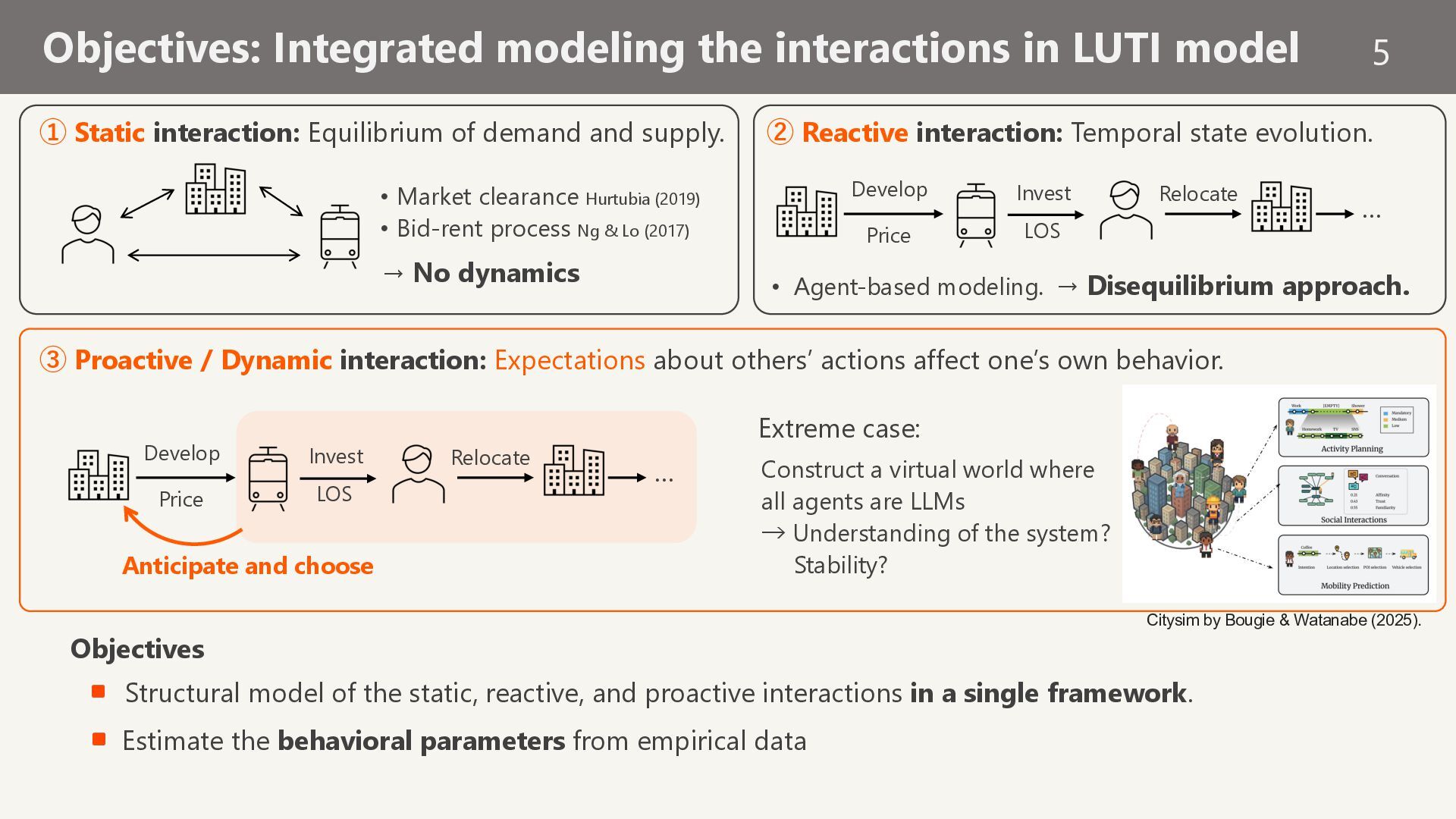
  5. 5 Objectives: Integrated modeling the interactions in LUTI model ①

    Static interaction: Equilibrium of demand and supply. • Market clearance Hurtubia (2019) • Bid-rent process Ng & Lo (2017) ③ Proactive / Dynamic interaction: Expectations about others’ actions affect one’s own behavior. Objectives Citysim by Bougie & Watanabe (2025). Extreme case: Construct a virtual world where all agents are LLMs → Understanding of the system? Stability? Structural model of the static, reactive, and proactive interactions in a single framework. Anticipate and choose Develop Price LOS Relocate … Invest Estimate the behavioral parameters from empirical data → No dynamics ② Reactive interaction: Temporal state evolution. Develop Price LOS Relocate … • Agent-based modeling. Invest → Disequilibrium approach.
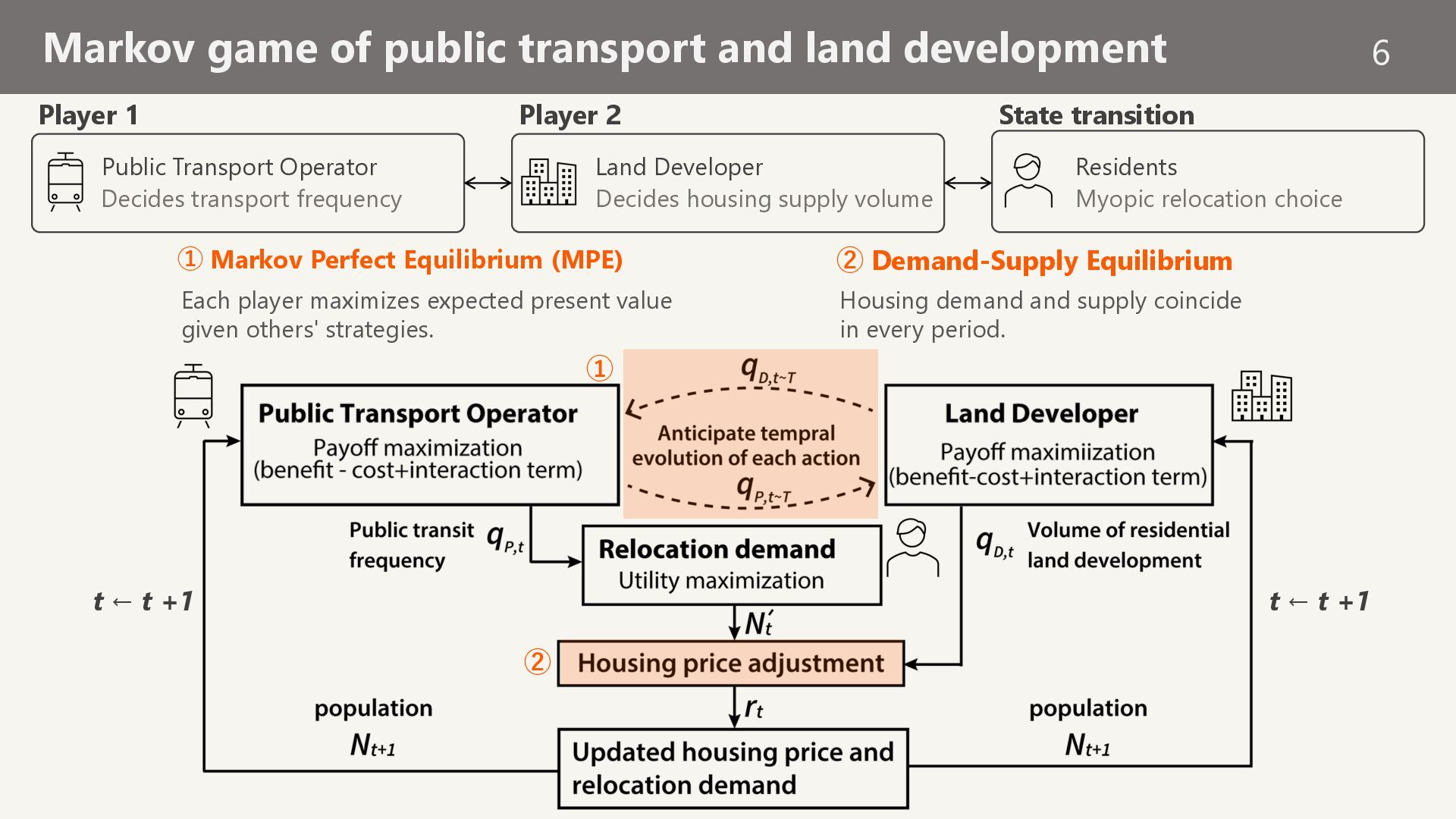
  6. 6 Markov game of public transport and land development Public

    Transport Operator Land Developer Residents Decides transport frequency Decides housing supply volume Myopic relocation choice ① Markov Perfect Equilibrium (MPE) Each player maximizes expected present value given others' strategies. ② Demand-Supply Equilibrium Housing demand and supply coincide in every period. Player 1 Player 2 State transition ① ② t ← t +1 t ← t +1
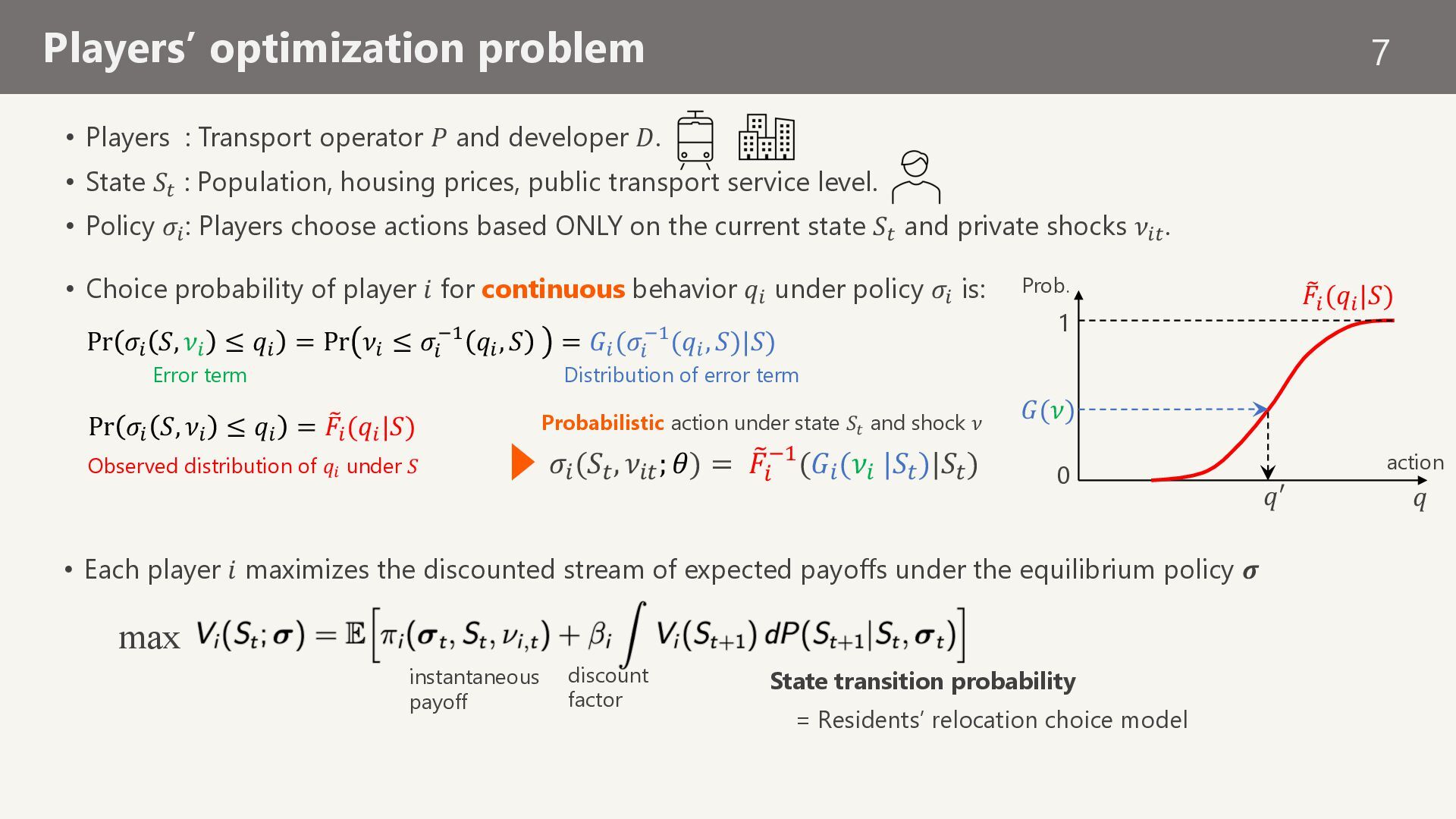
  7. • Each player 𝑖 maximizes the discounted stream of expected

    payoffs under the equilibrium policy 𝝈 7 Players’ optimization problem max instantaneous payoff discount factor State transition probability 𝜎!(𝑆", 𝜈!"; 𝜃) = + 𝐹! #$(𝐺!(𝜈! |𝑆")|𝑆") Probabilistic action under state 𝑆! and shock 𝜈 • Players : Transport operator 𝑃 and developer 𝐷. • State 𝑆! : Population, housing prices, public transport service level. • Policy 𝜎" : Players choose actions based ONLY on the current state 𝑆! and private shocks 𝜈"! . = Residents’ relocation choice model • Choice probability of player 𝑖 for continuous behavior 𝑞" under policy 𝜎" is: Error term Pr 𝜎" 𝑆, 𝜈" ≤ 𝑞" = Pr 𝜈" ≤ 𝜎" #$ 𝑞" , 𝑆 = 𝐺" (𝜎" #$(𝑞" , 𝑆)|𝑆) Observed distribution of 𝑞" under 𝑆 Pr 𝜎" 𝑆, 𝜈" ≤ 𝑞" = : 𝐹" (𝑞" |𝑆) Distribution of error term 𝑞 action Prob. 1 0 : 𝐹" (𝑞" |𝑆) 𝐺(𝜈) 𝑞′
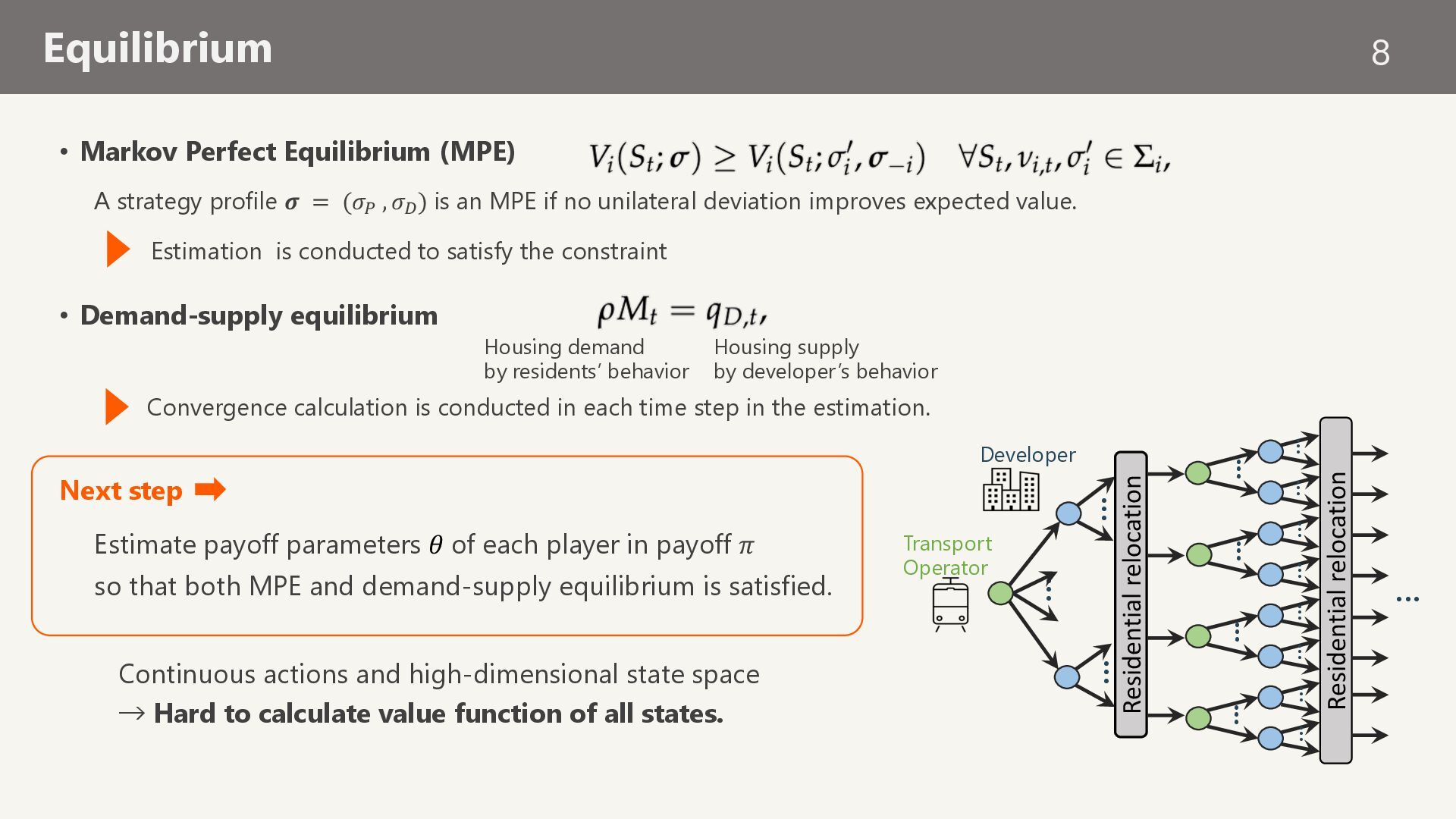
  8. 8 Equilibrium • Markov Perfect Equilibrium (MPE) A strategy profile

    𝝈 = (𝜎" , 𝜎#) is an MPE if no unilateral deviation improves expected value. • Demand-supply equilibrium Housing demand by residents’ behavior Housing supply by developer’s behavior Developer Transport Operator … … … … … … … … … … … … … … … … Residential relocation Residential relocation Continuous actions and high-dimensional state space → Hard to calculate value function of all states. Next step Estimate payoff parameters 𝜃 of each player in payoff 𝜋 so that both MPE and demand-supply equilibrium is satisfied. Estimation is conducted to satisfy the constraint Convergence calculation is conducted in each time step in the estimation.
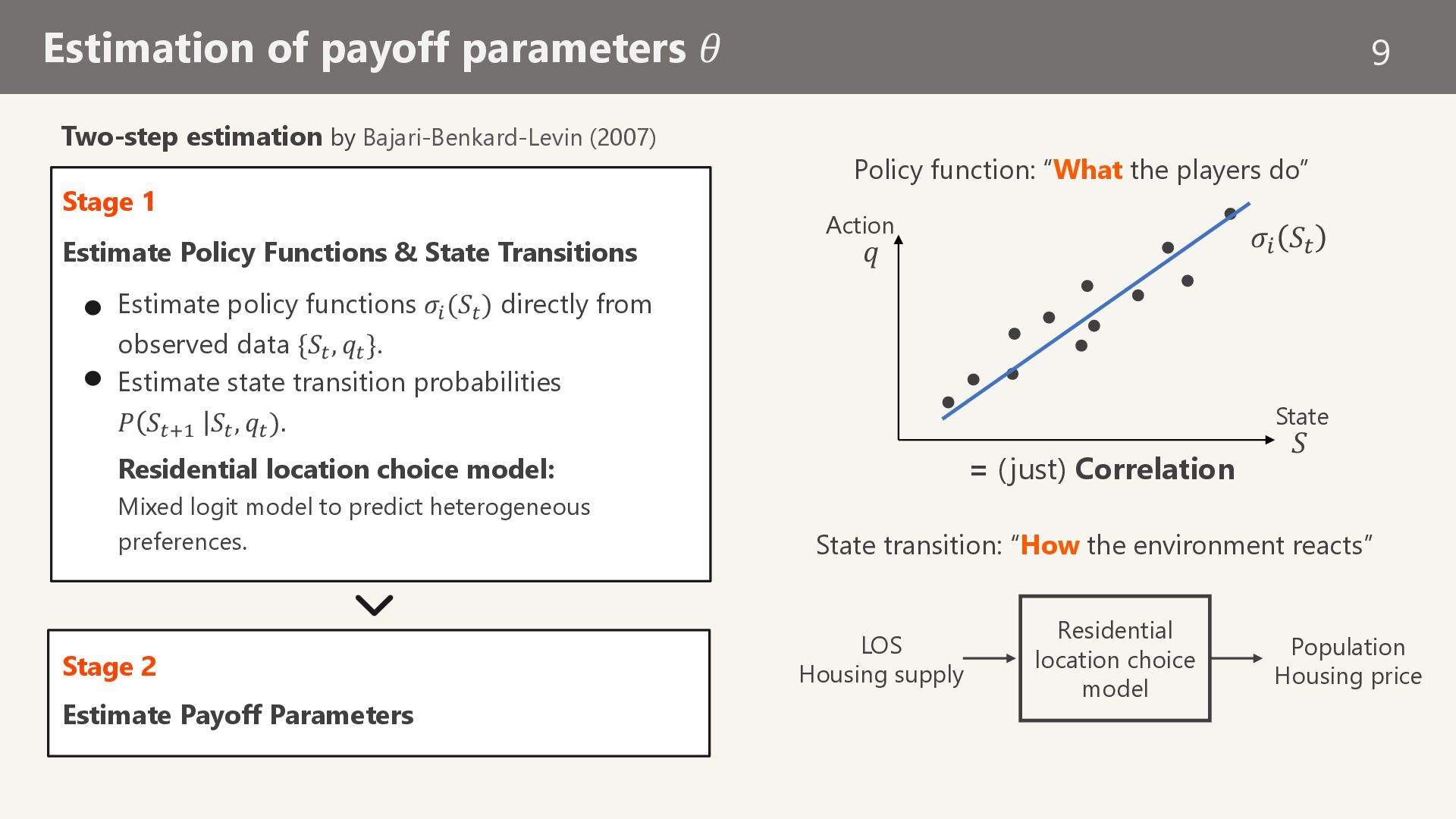
  9. Two-step estimation by Bajari-Benkard-Levin (2007) 9 Estimation of payoff parameters

    𝜃 Estimate policy functions 𝜎" (𝑆! ) directly from observed data {𝑆! , 𝑞! }. Estimate state transition probabilities 𝑃 𝑆!%$ 𝑆! , 𝑞! ). Residential location choice model: Mixed logit model to predict heterogeneous preferences. Stage 2 Estimate Payoff Parameters Stage 1 Estimate Policy Functions & State Transitions 𝑆 State 𝑞 Action 𝜎! 𝑆" = (just) Correlation Policy function: “What the players do” State transition: “How the environment reacts” Residential location choice model LOS Housing supply Population Housing price
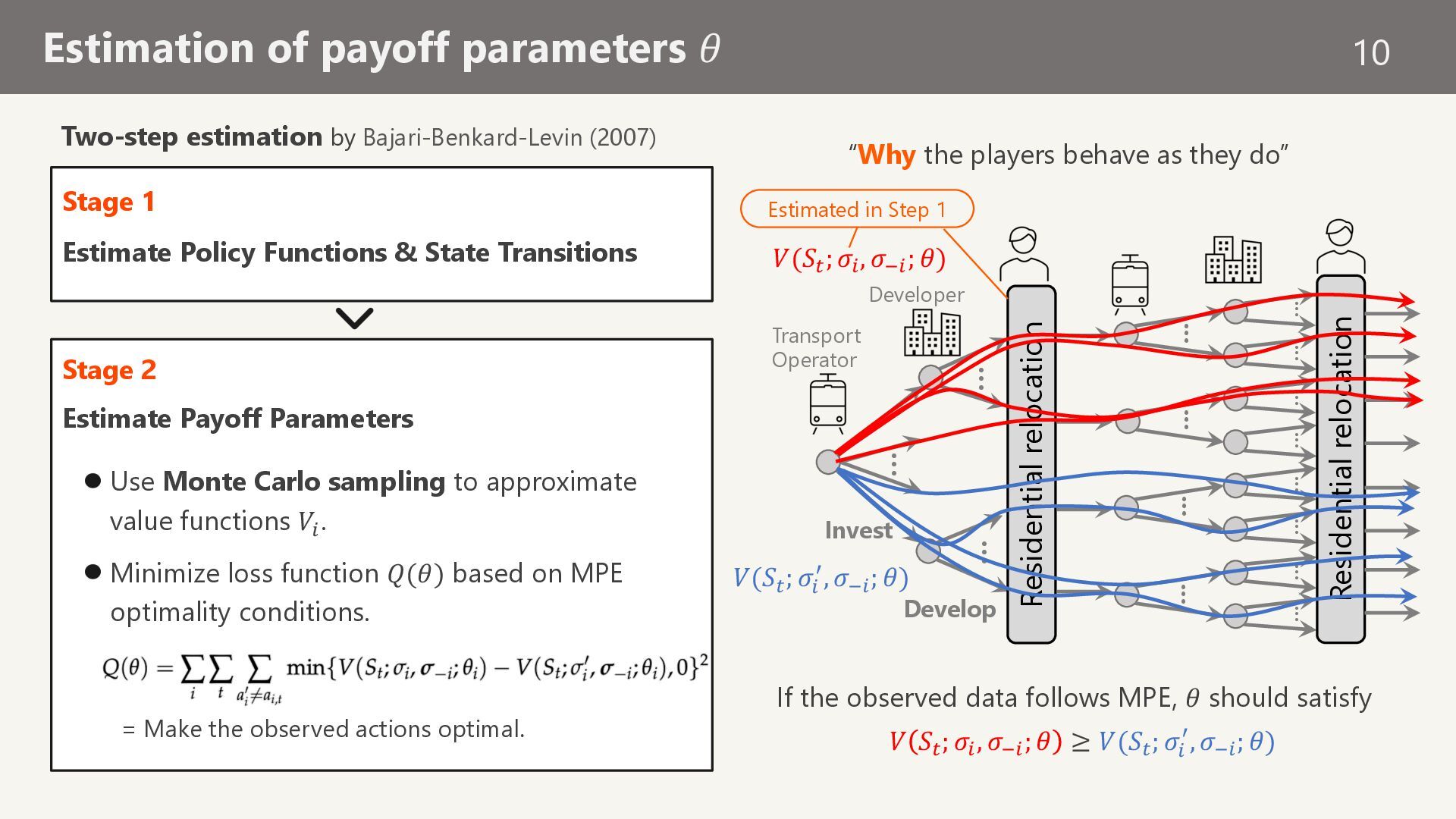
  10. … … … … … … … … … …

    … … 10 Estimation of payoff parameters 𝜃 Stage 1 Estimate Policy Functions & State Transitions Use Monte Carlo sampling to approximate value functions 𝑉" . Minimize loss function 𝑄(𝜃) based on MPE optimality conditions. “Why the players behave as they do” = Make the observed actions optimal. Stage 2 Estimate Payoff Parameters Two-step estimation by Bajari-Benkard-Levin (2007) … … … Residential relocation Residential relocation Developer Transport Operator Invest Develop 𝑉(𝑆! ; 𝜎" &, 𝜎#" ; 𝜃) 𝑉(𝑆! ; 𝜎" , 𝜎#" ; 𝜃) Estimated in Step 1 If the observed data follows MPE, 𝜃 should satisfy 𝑉 𝑆! ; 𝜎" , 𝜎#" ; 𝜃 ≥ 𝑉(𝑆! ; 𝜎" &, 𝜎#" ; 𝜃)
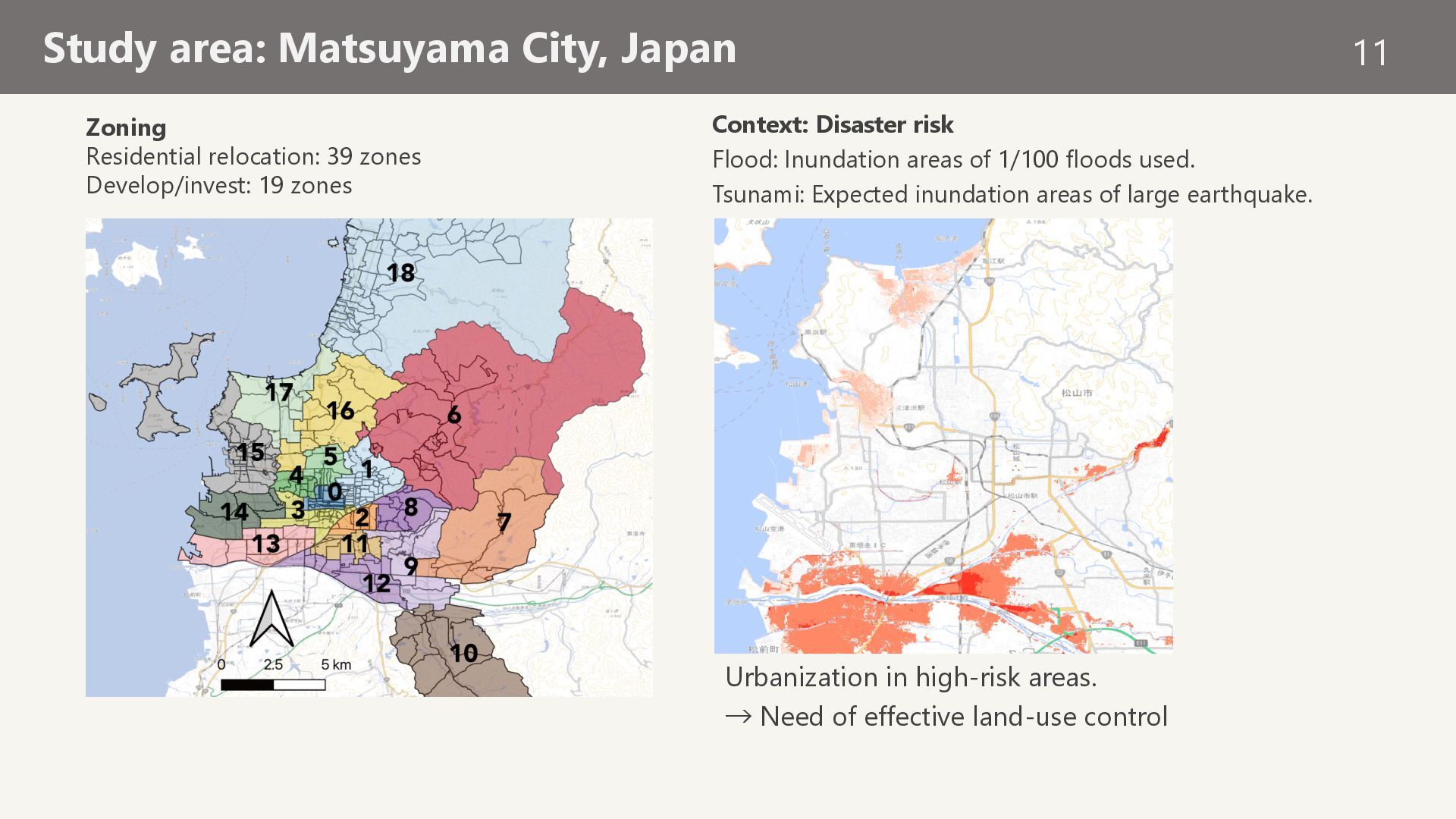
  11. Urbanization in high-risk areas. → Need of effective land-use control

    11 Study area: Matsuyama City, Japan Zoning Residential relocation: 39 zones Develop/invest: 19 zones Context: Disaster risk Flood: Inundation areas of 1/100 floods used. Tsunami: Expected inundation areas of large earthquake.
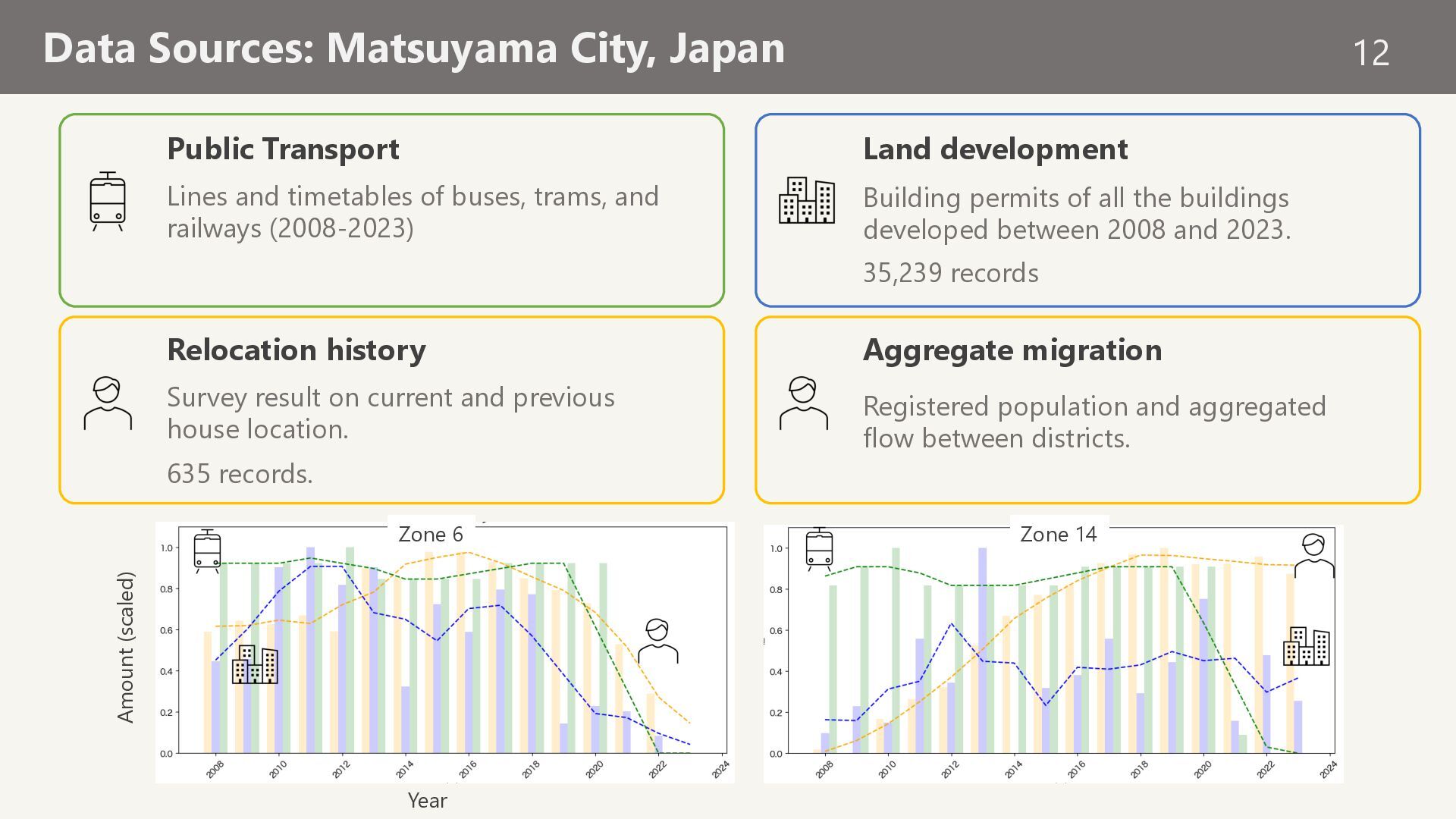
  12. 12 Data Sources: Matsuyama City, Japan Public Transport Lines and

    timetables of buses, trams, and railways (2008-2023) Land development Building permits of all the buildings developed between 2008 and 2023. Relocation history Survey result on current and previous house location. 35,239 records 635 records. Aggregate migration Registered population and aggregated flow between districts. Amount (scaled) Year Zone 6 Zone 14
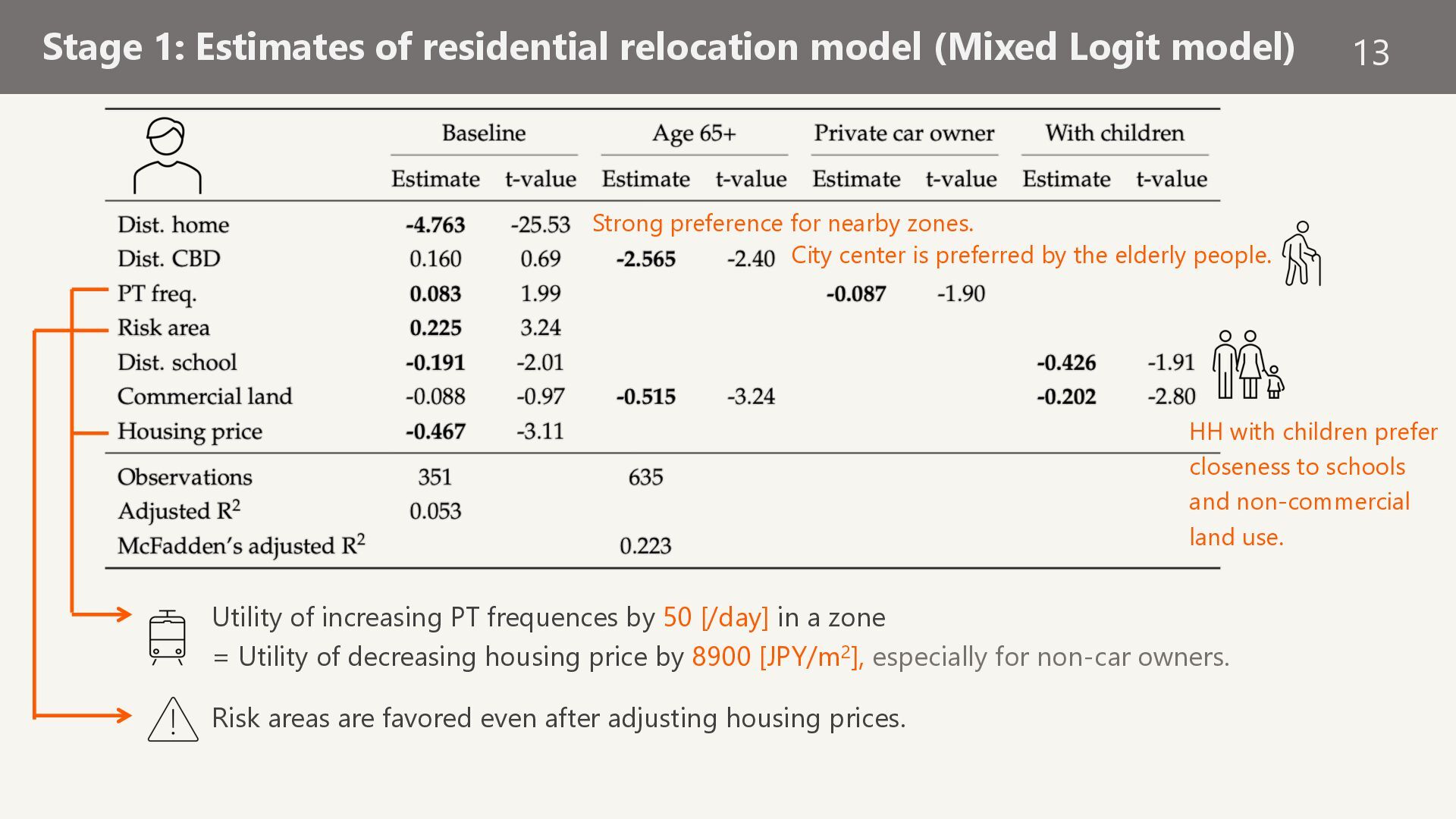
  13. 13 Stage 1: Estimates of residential relocation model (Mixed Logit

    model) Utility of increasing PT frequences by 50 [/day] in a zone = Utility of decreasing housing price by 8900 [JPY/m2], especially for non-car owners. Strong preference for nearby zones. City center is preferred by the elderly people. HH with children prefer closeness to schools and non-commercial land use. Risk areas are favored even after adjusting housing prices.
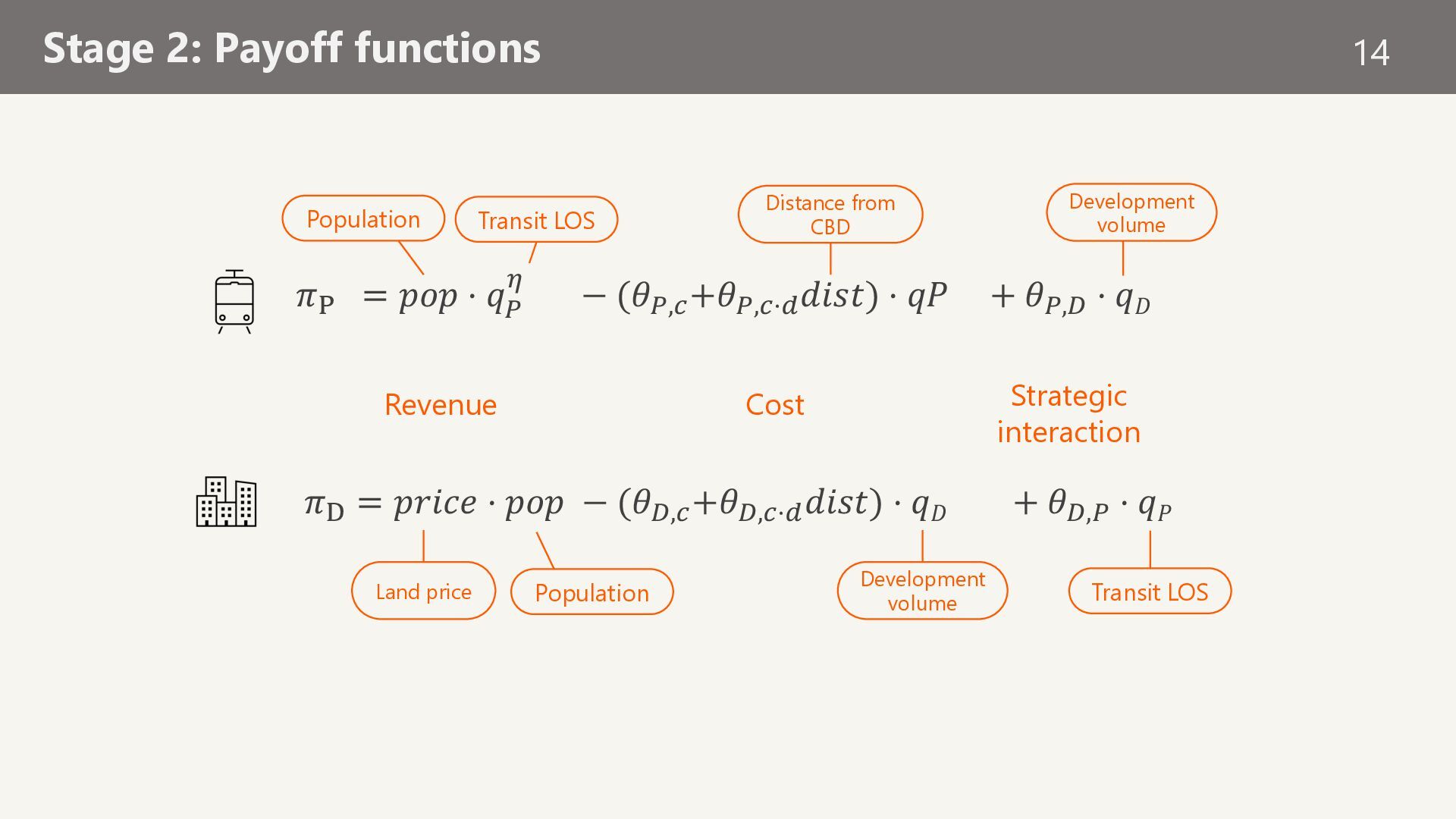
  14. 14 Stage 2: Payoff functions 𝜋F = 𝑝𝑜𝑝 ⋅ 𝑞G

    H − (𝜃G,I+𝜃G,I⋅K𝑑𝑖𝑠𝑡) ⋅ 𝑞𝑃 + 𝜃G,L ⋅ 𝑞𝐷 𝜋M = 𝑝𝑟𝑖𝑐𝑒 ⋅ 𝑝𝑜𝑝 − (𝜃L,I +𝜃L,I⋅K 𝑑𝑖𝑠𝑡) ⋅ 𝑞𝐷 + 𝜃L,G ⋅ 𝑞𝑃 Population Distance from CBD Land price Transit LOS Development volume Revenue Cost Strategic interaction Development volume Transit LOS Population
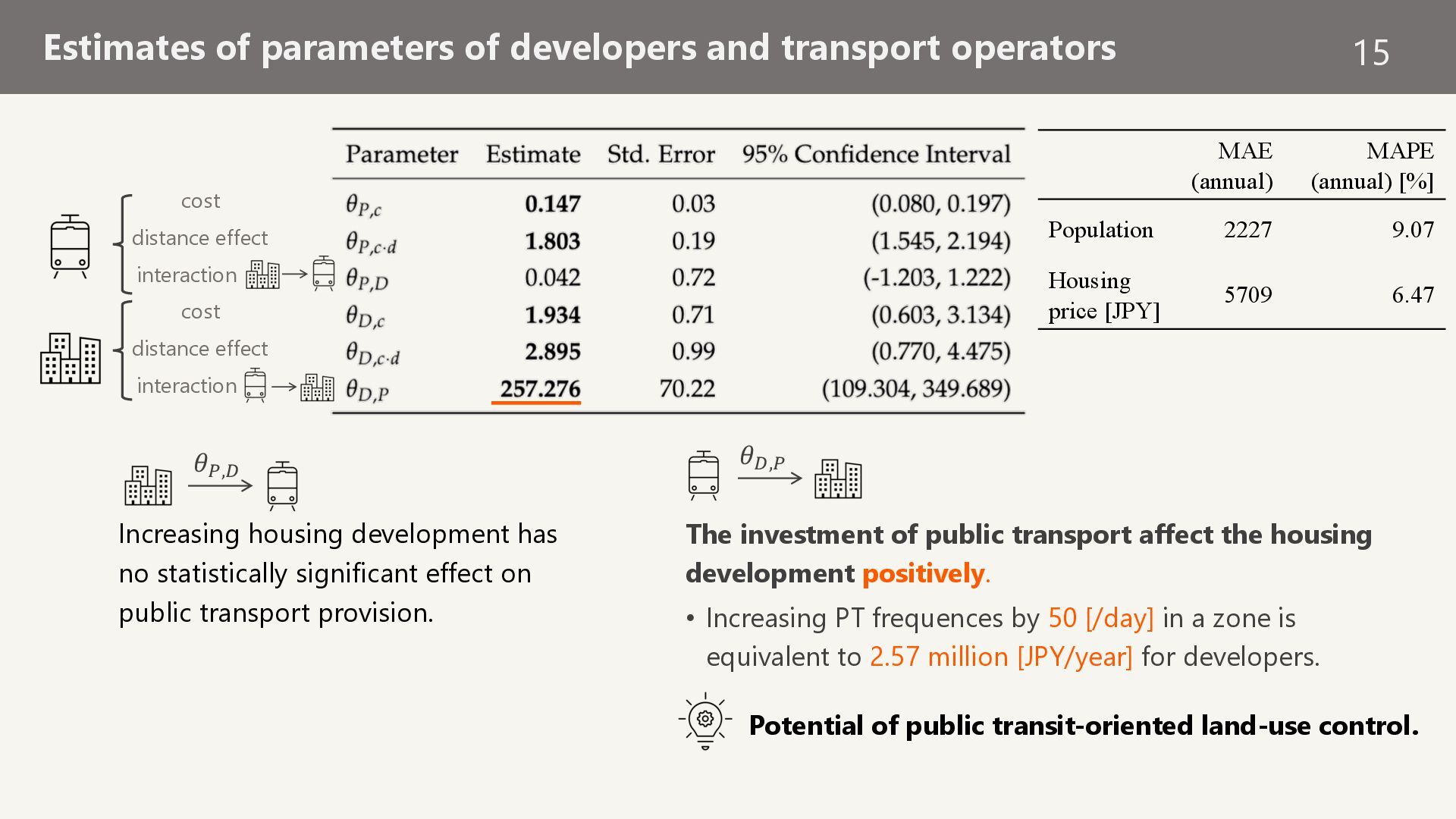
  15. 15 Estimates of parameters of developers and transport operators The

    investment of public transport affect the housing development positively. • Increasing PT frequences by 50 [/day] in a zone is equivalent to 2.57 million [JPY/year] for developers. cost Increasing housing development has no statistically significant effect on public transport provision. Potential of public transit-oriented land-use control. cost distance effect distance effect interaction interaction 𝜃',) 𝜃),' MAE (annual) MAPE (annual) [%] Population 2227 9.07 Housing price [JPY] 5709 6.47
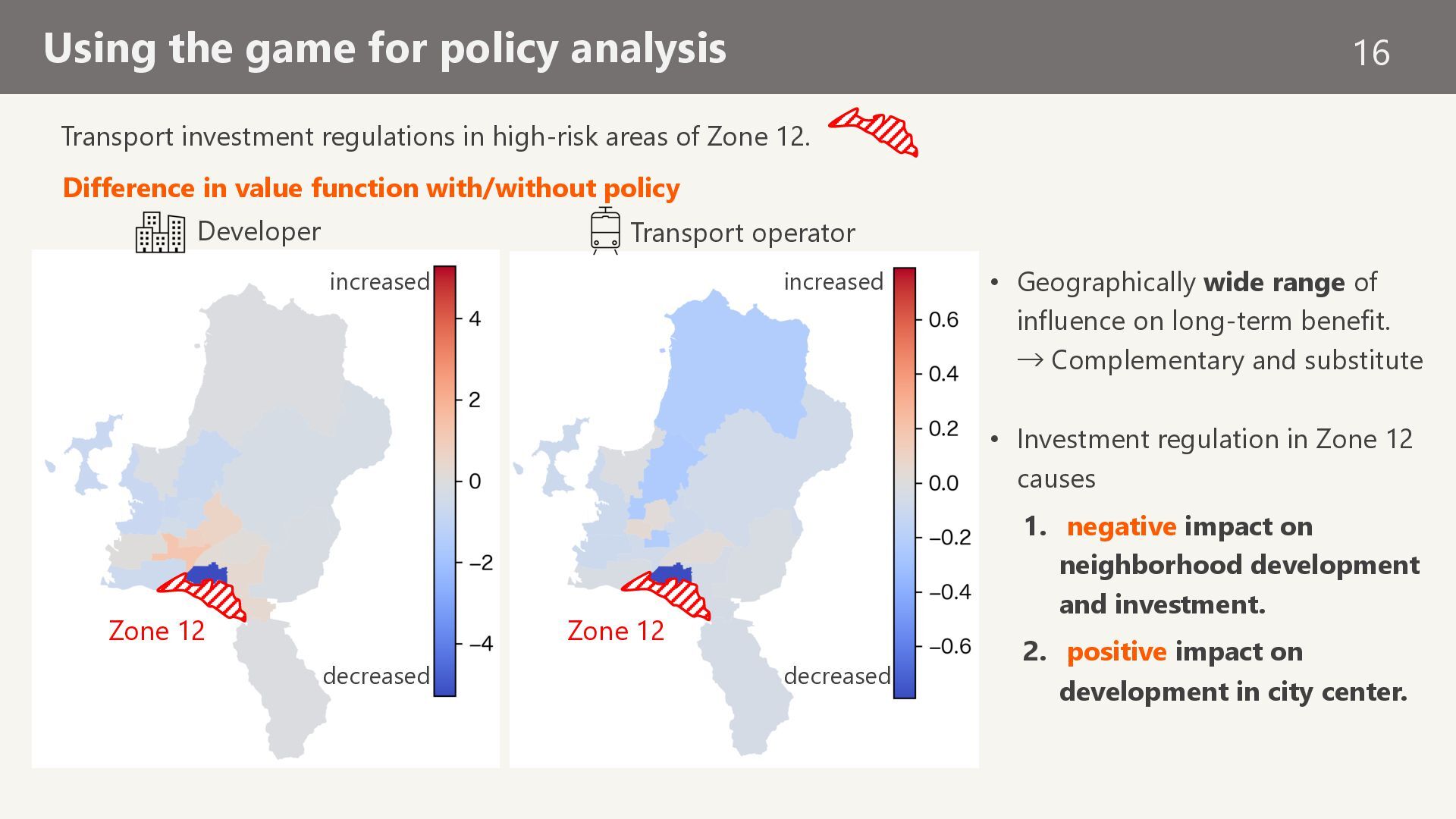
  16. Transport investment regulations in high-risk areas of Zone 12. 16

    Using the game for policy analysis Difference in value function with/without policy Developer Transport operator Zone 12 Zone 12 • Geographically wide range of influence on long-term benefit. → Complementary and substitute • Investment regulation in Zone 12 causes 1. negative impact on neighborhood development and investment. 2. positive impact on development in city center. increased decreased increased decreased
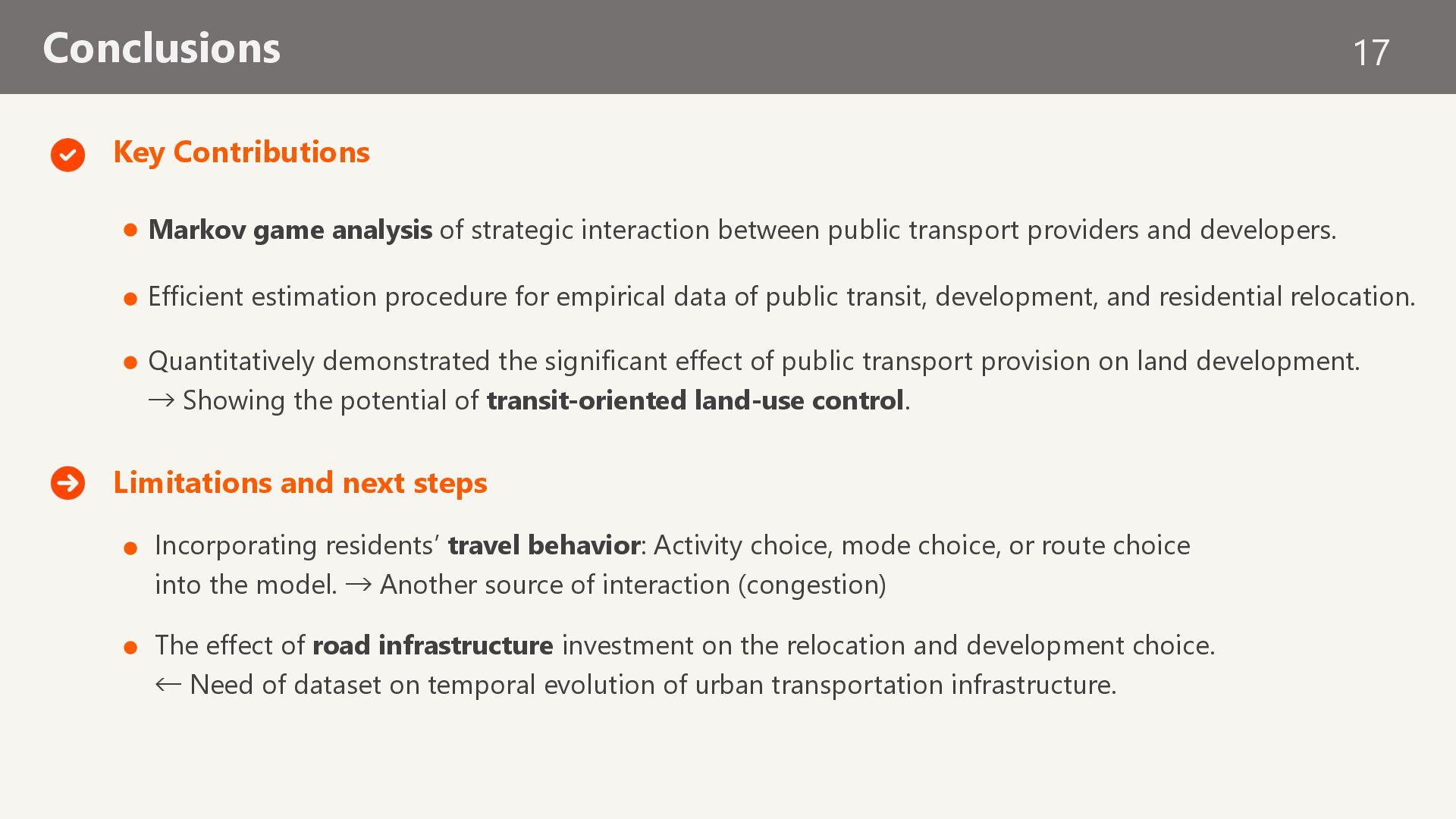
  17. Markov game analysis of strategic interaction between public transport providers

    and developers. 17 Conclusions Key Contributions Incorporating residents’ travel behavior: Activity choice, mode choice, or route choice into the model. → Another source of interaction (congestion) Limitations and next steps The effect of road infrastructure investment on the relocation and development choice. ← Need of dataset on temporal evolution of urban transportation infrastructure. Quantitatively demonstrated the significant effect of public transport provision on land development. → Showing the potential of transit-oriented land-use control. Efficient estimation procedure for empirical data of public transit, development, and residential relocation.