Virtual Vehicle Fleet in your Lab - A Use Case ...
Sponsored
·
 Ship Features Fearlessly
Turn features on and off without deploys. Used by thousands of Ruby developers.
→
Ship Features Fearlessly
Turn features on and off without deploys. Used by thousands of Ruby developers.
→

Share
Embed
Virtual Vehicle Fleet in your Lab - A Use Case of AGL as a High-Level R&D Testbed Component
I gave this talk at the AGL AMM Spring 2025.
The primary distribution site of this deck is at:
https://sched.co/1vePR

thatsdone
February 27, 2025
Transcript
24 slides
-
Masanori Itoh, Toyota Virtual Vehicle Fleet in your Lab –
A Use Case of AGL as a High-Level R&D Testbed Component -
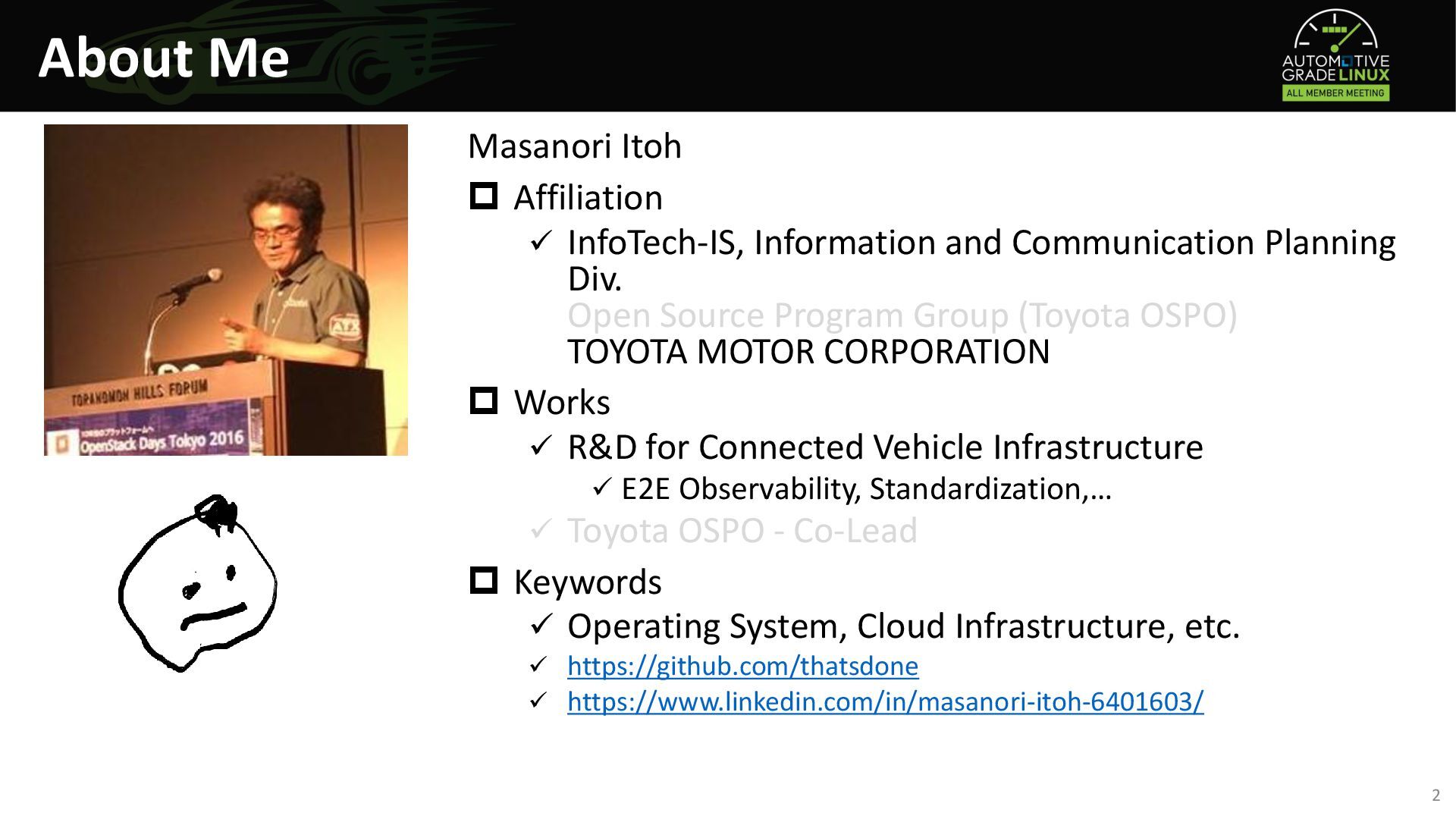
About Me Masanori Itoh Affiliation InfoTech-IS, Information and
Communication Planning Div. Open Source Program Group (Toyota OSPO) TOYOTA MOTOR CORPORATION Works R&D for Connected Vehicle Infrastructure E2E Observability, Standardization,… Toyota OSPO - Co-Lead Keywords Operating System, Cloud Infrastructure, etc. https://github.com/thatsdone https://www.linkedin.com/in/masanori-itoh-6401603/ 2 -
Copyright © 2025 TOYOTA MOTOR CORPORATION All rights reserved. Agenda
Background – A High-Level R&D POC (Low-Level) Motivation and Ideas System Design Evaluation Summary – Takeaways Possible Future Works Appendix : TIPs 3 -
Copyright © 2025 TOYOTA MOTOR CORPORATION All rights reserved. Background
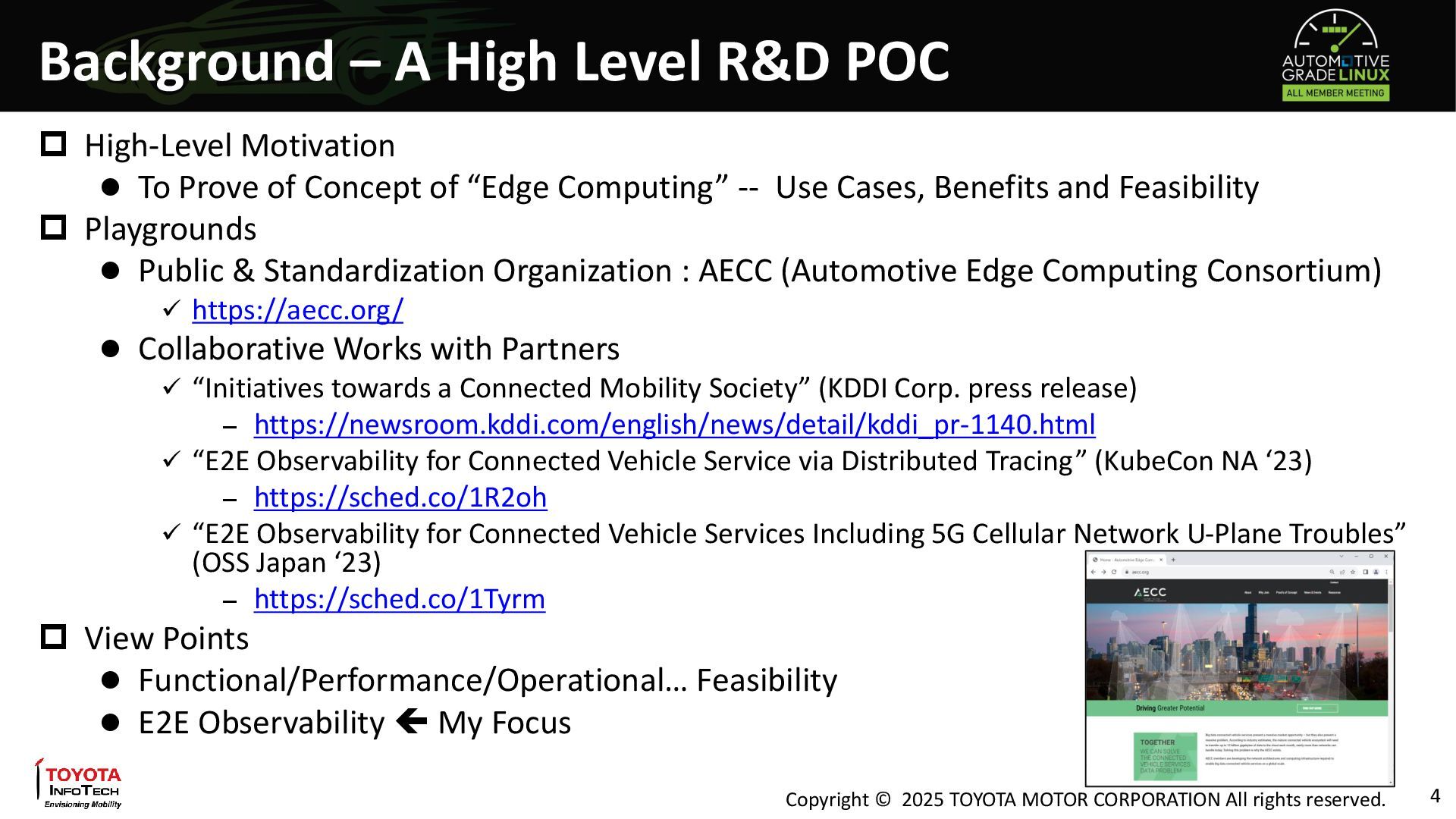
– A High Level R&D POC High-Level Motivation To Prove of Concept of “Edge Computing” -- Use Cases, Benefits and Feasibility Playgrounds Public & Standardization Organization : AECC (Automotive Edge Computing Consortium) https://aecc.org/ Collaborative Works with Partners “Initiatives towards a Connected Mobility Society” (KDDI Corp. press release) – https://newsroom.kddi.com/english/news/detail/kddi_pr-1140.html “E2E Observability for Connected Vehicle Service via Distributed Tracing” (KubeCon NA ‘23) – https://sched.co/1R2oh “E2E Observability for Connected Vehicle Services Including 5G Cellular Network U-Plane Troubles” (OSS Japan ‘23) – https://sched.co/1Tyrm View Points Functional/Performance/Operational… Feasibility E2E Observability My Focus 4 -
Copyright © 2025 TOYOTA MOTOR CORPORATION All rights reserved. Background
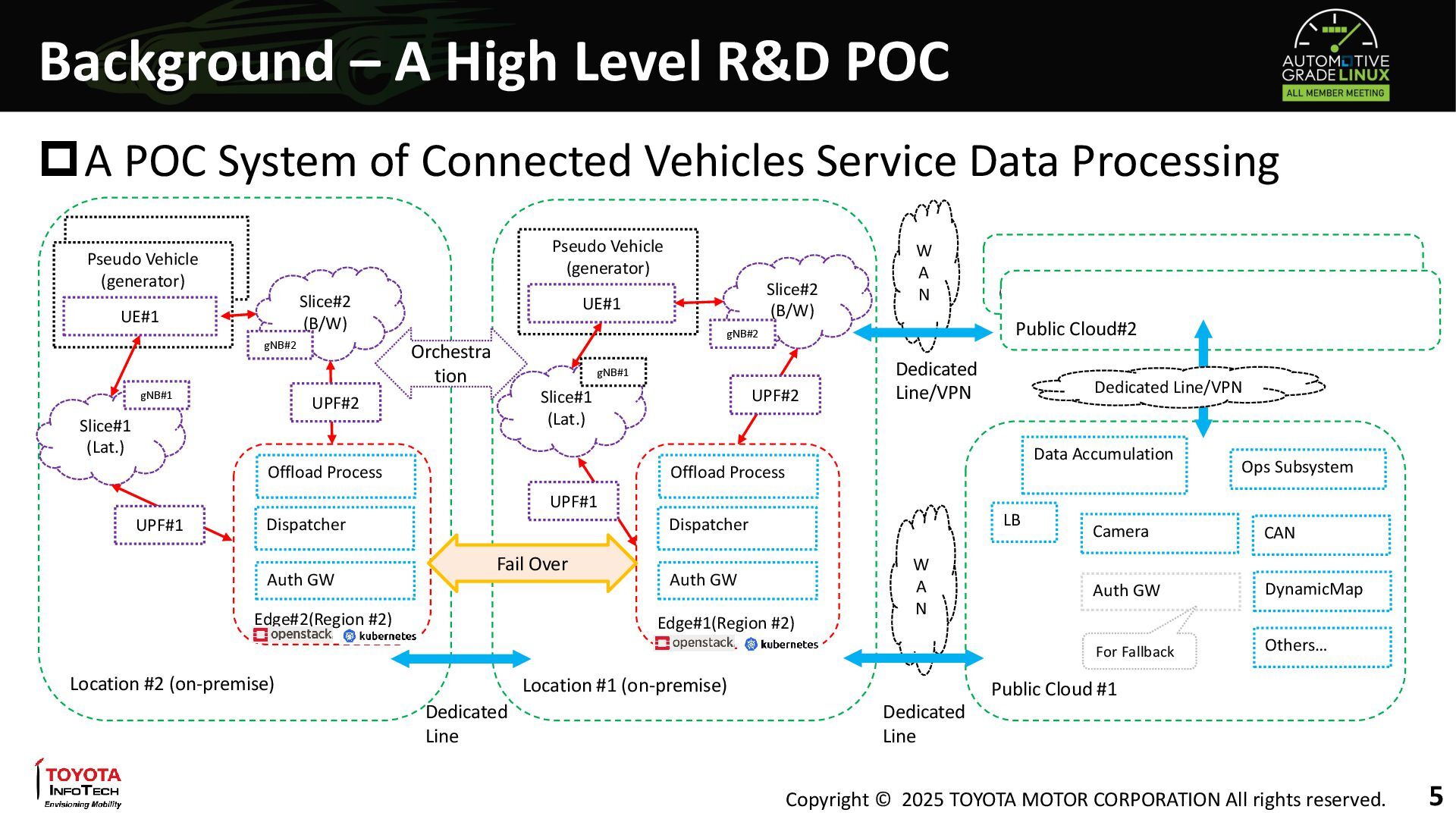
– A High Level R&D POC A POC System of Connected Vehicles Service Data Processing gNB#1 W A N Location #1 (on-premise) Location #2 (on-premise) Public Cloud #1 CAN Camera DynamicMap Others… LB Ops Subsystem Pseudo Vehicle Pseudo Vehicle (generator) Edge#1(Region #2) Auth GW Dispatcher Offload Process Slice#1 (Lat.) Auth GW For Fallback W A N Data Accumulation Edge#2(Region #2) Auth GW Dispatcher Offload Process UE#1 Slice#2 (B/W) UPF#2 UPF#1 Dedicated Line Pseudo Vehicle (generator) UE#1 Slice#1 (Lat.) Slice#2 (B/W) OCI /etc. Public Cloud#2 UPF#2 UPF#1 Fail Over gNB#2 gNB#2 gNB#1 Orchestra tion gNB#1 Dedicated Line/VPN Dedicated Line/VPN Dedicated Line 5 -
Copyright © 2025 TOYOTA MOTOR CORPORATION All rights reserved. Background
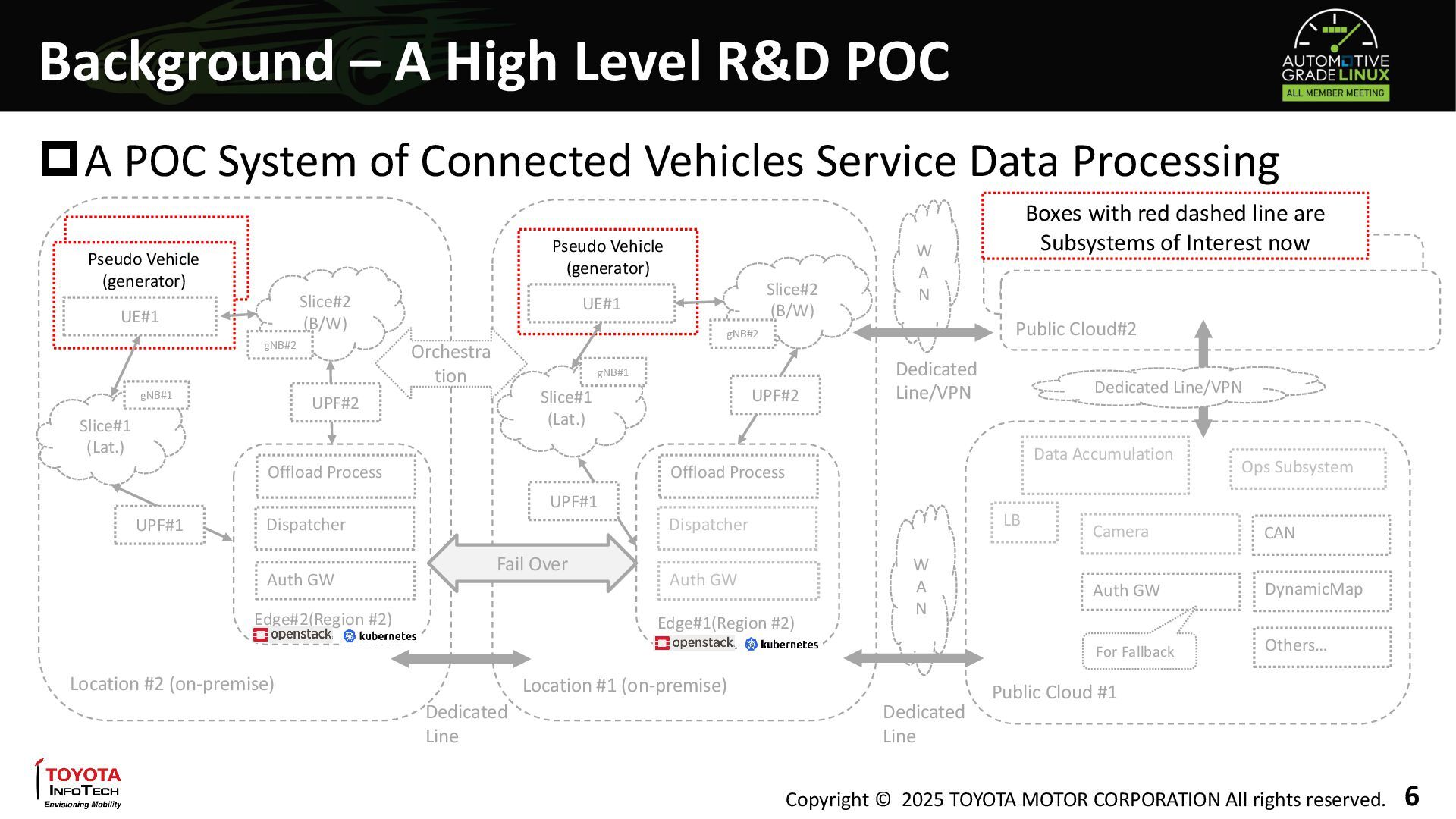
– A High Level R&D POC A POC System of Connected Vehicles Service Data Processing 6 gNB#1 W A N Location #1 (on-premise) Location #2 (on-premise) Public Cloud #1 CAN Camera DynamicMap Others… LB Ops Subsystem Peeudo Vehiclea Pseudo Vehicle (generator) Edge#1(Region #2) Auth GW Dispatcher Offload Process Slice#1 (Lat.) Auth GW For Fallback W A N Data Accumulation Edge#2(Region #2) Auth GW Dispatcher Offload Process UE#1 Slice#2 (B/W) UPF#2 UPF#1 Dedicated Line Pseudo Vehicle (generator) UE#1 Slice#1 (Lat.) Slice#2 (B/W) OCI /etc. Public Cloud#2 UPF#2 UPF#1 Fail Over gNB#2 gNB#2 gNB#1 Orchestra tion gNB#1 Dedicated Line/VPN Dedicated Line/VPN Dedicated Line Boxes with red dashed line are Subsystems of Interest now -
Copyright © 2025 TOYOTA MOTOR CORPORATION All rights reserved. (Low-Level)
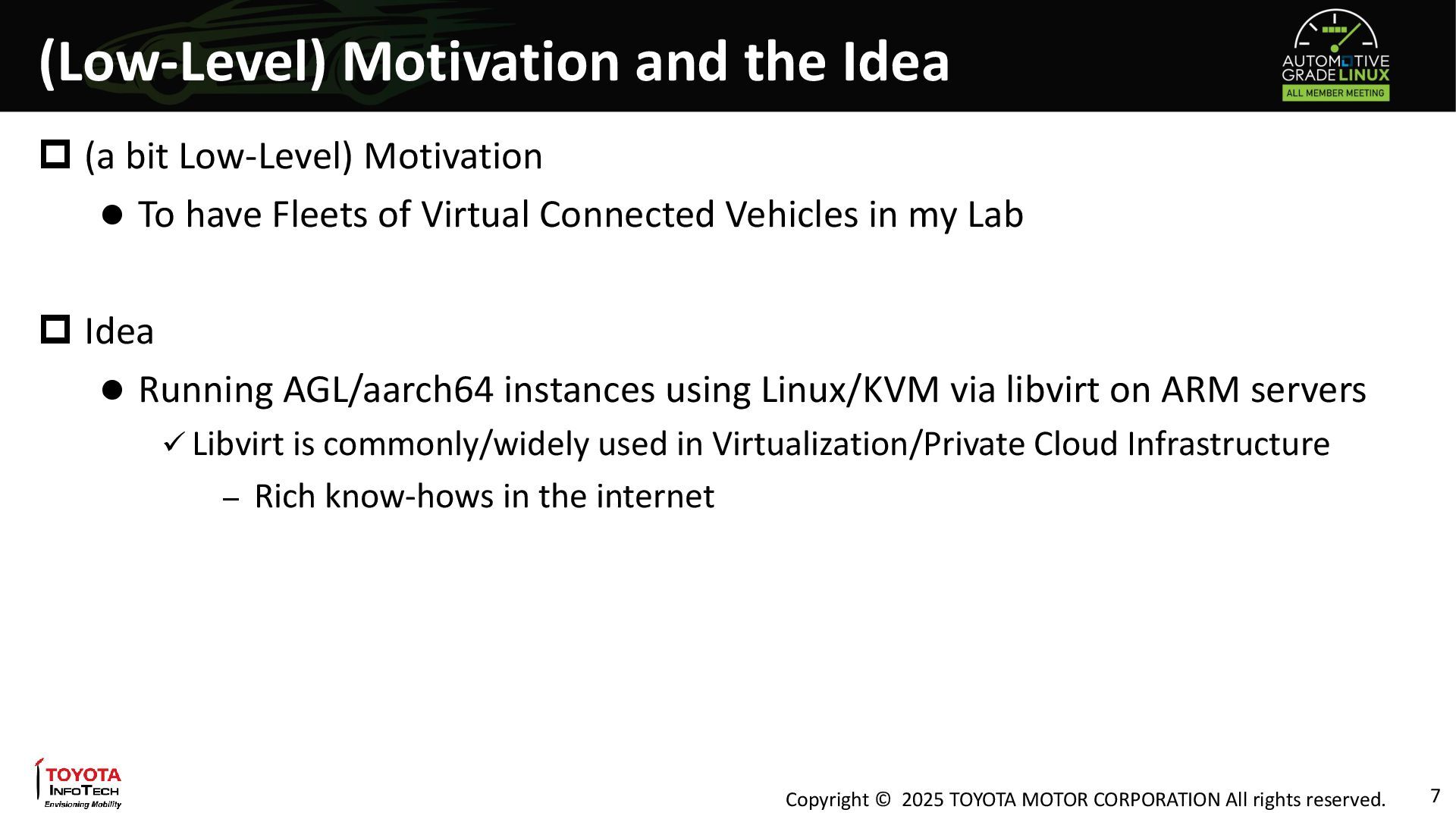
Motivation and the Idea (a bit Low-Level) Motivation To have Fleets of Virtual Connected Vehicles in my Lab Idea Running AGL/aarch64 instances using Linux/KVM via libvirt on ARM servers Libvirt is commonly/widely used in Virtualization/Private Cloud Infrastructure – Rich know-hows in the internet 7 -
Copyright © 2025 TOYOTA MOTOR CORPORATION All rights reserved. System
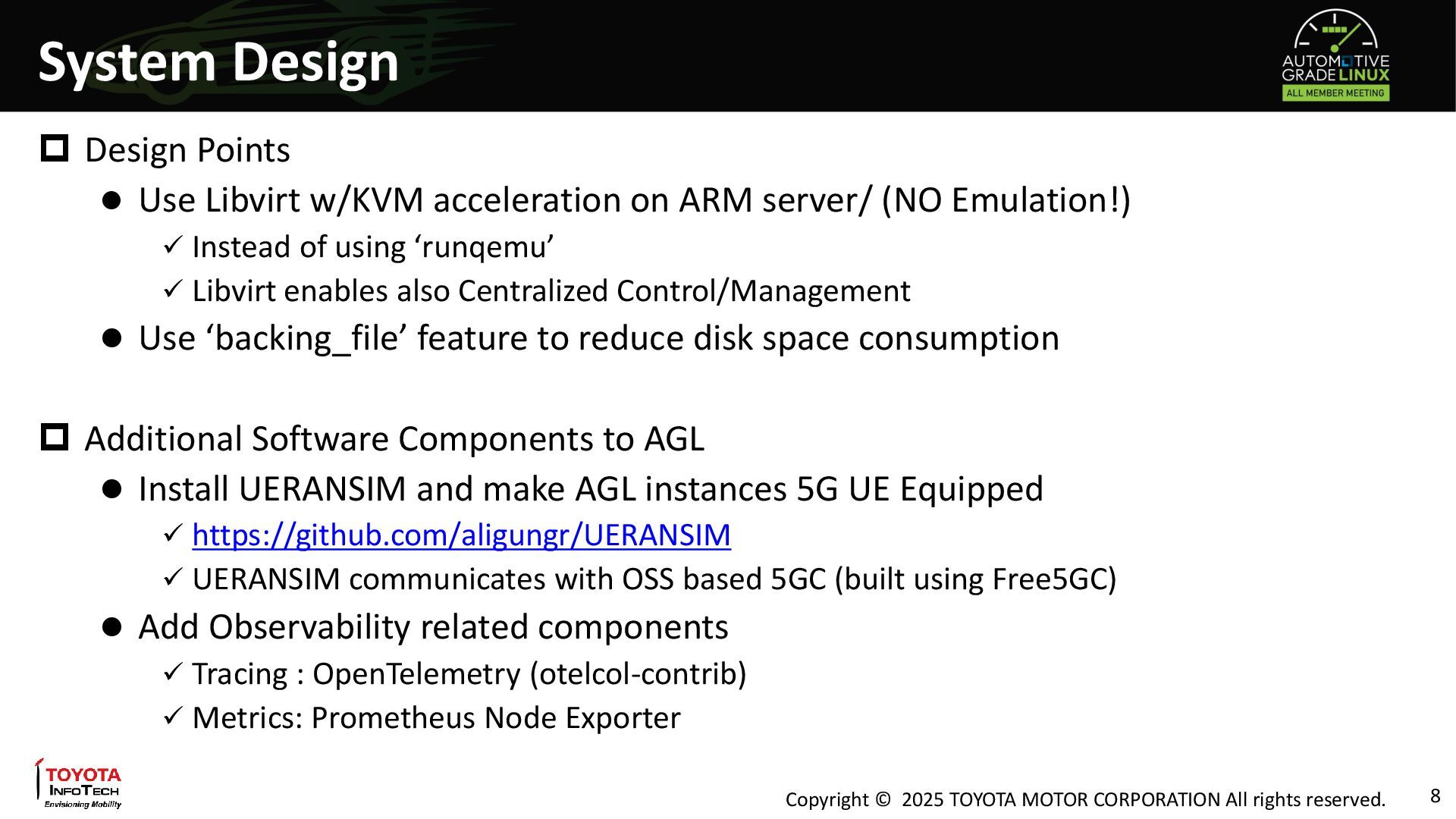
Design Design Points Use Libvirt w/KVM acceleration on ARM server/ (NO Emulation!) Instead of using ‘runqemu’ Libvirt enables also Centralized Control/Management Use ‘backing_file’ feature to reduce disk space consumption Additional Software Components to AGL Install UERANSIM and make AGL instances 5G UE Equipped https://github.com/aligungr/UERANSIM UERANSIM communicates with OSS based 5GC (built using Free5GC) Add Observability related components Tracing : OpenTelemetry (otelcol-contrib) Metrics: Prometheus Node Exporter 8 -
Copyright © 2025 TOYOTA MOTOR CORPORATION All rights reserved. Evaluation
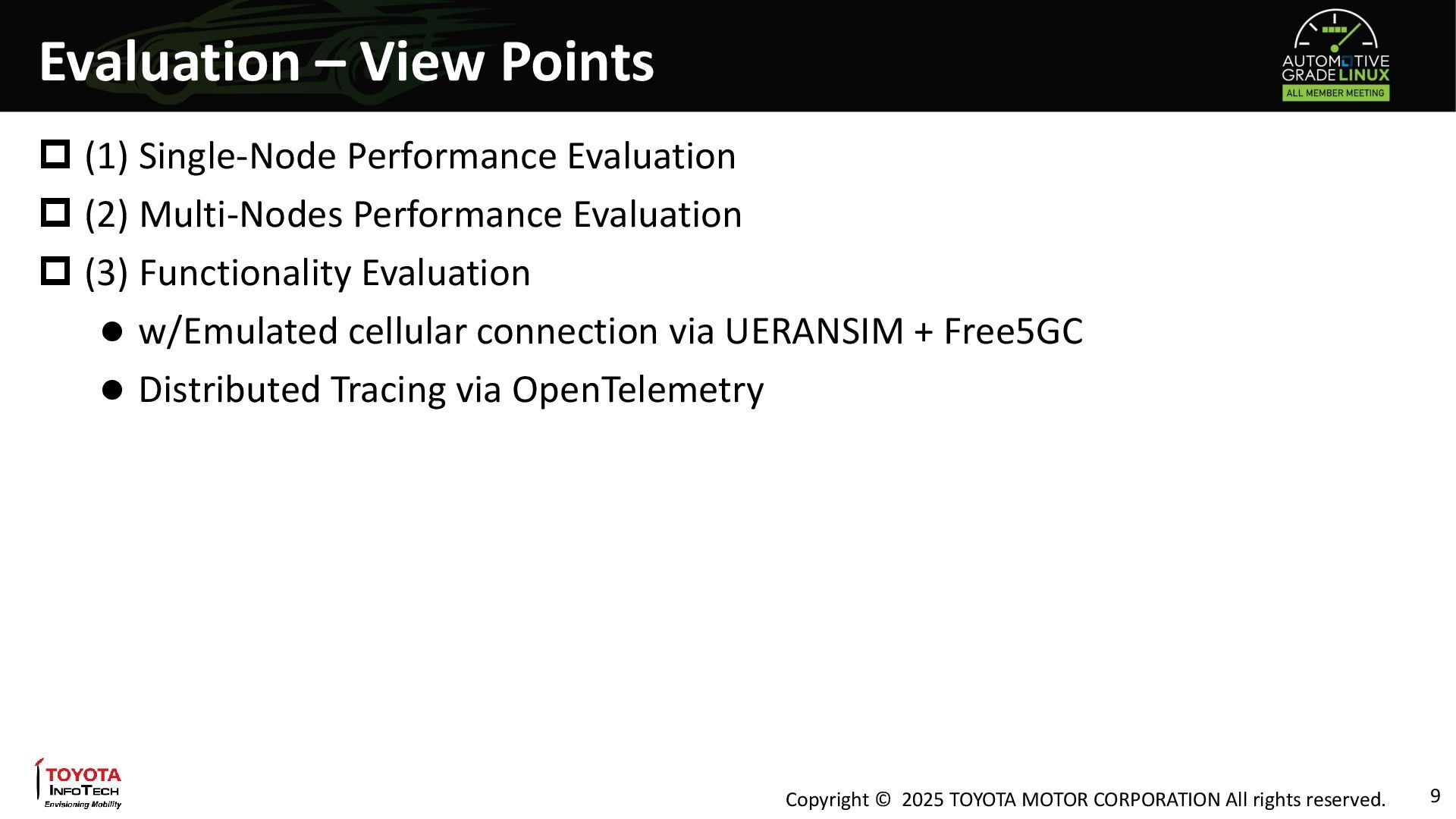
– View Points (1) Single-Node Performance Evaluation (2) Multi-Nodes Performance Evaluation (3) Functionality Evaluation w/Emulated cellular connection via UERANSIM + Free5GC Distributed Tracing via OpenTelemetry 9 -
Copyright © 2025 TOYOTA MOTOR CORPORATION All rights reserved. Evaluation
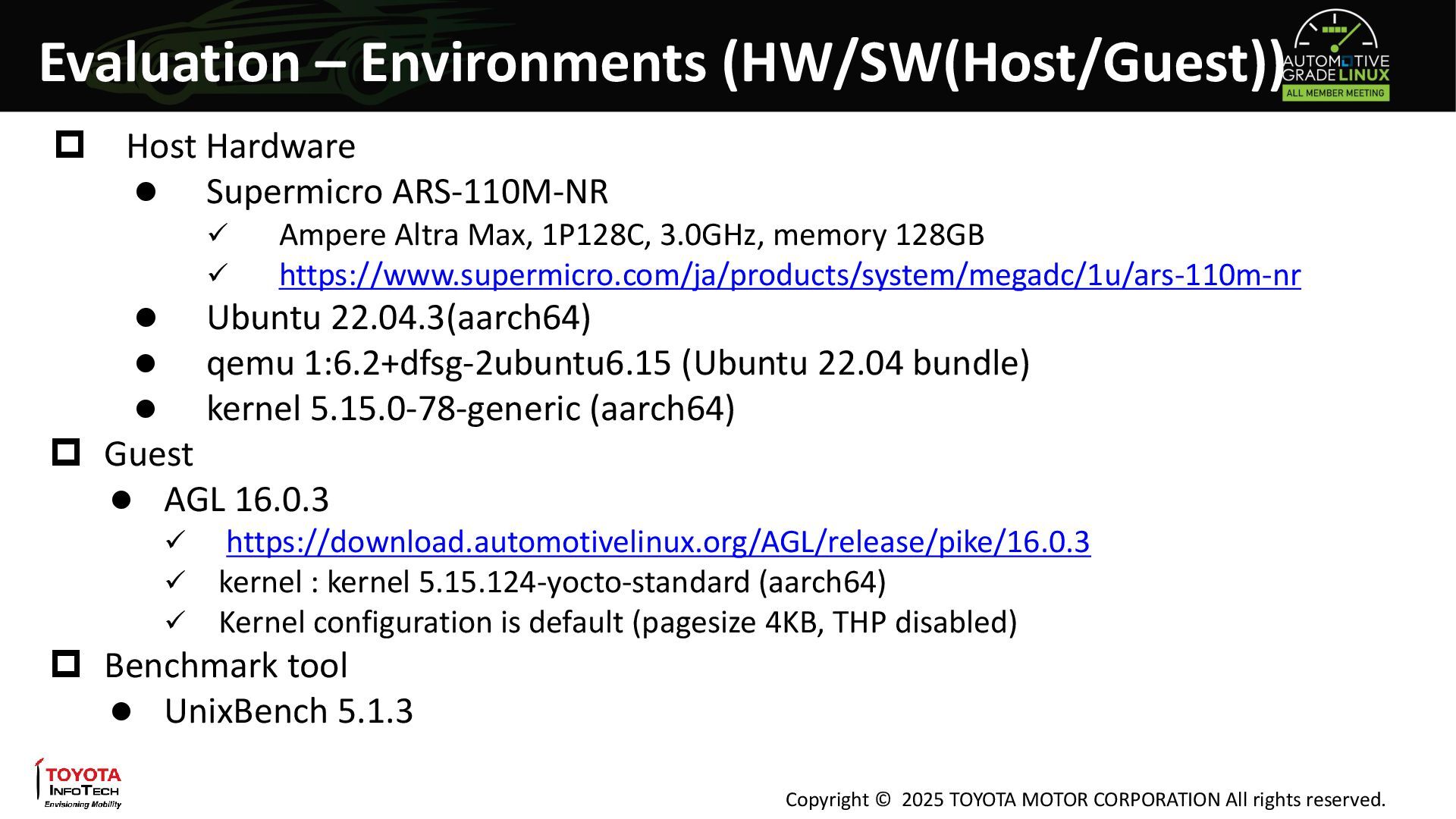
– Environments (HW/SW(Host/Guest)) Host Hardware Supermicro ARS-110M-NR Ampere Altra Max, 1P128C, 3.0GHz, memory 128GB https://www.supermicro.com/ja/products/system/megadc/1u/ars-110m-nr Ubuntu 22.04.3(aarch64) qemu 1:6.2+dfsg-2ubuntu6.15 (Ubuntu 22.04 bundle) kernel 5.15.0-78-generic (aarch64) Guest AGL 16.0.3 https://download.automotivelinux.org/AGL/release/pike/16.0.3 kernel : kernel 5.15.124-yocto-standard (aarch64) Kernel configuration is default (pagesize 4KB, THP disabled) Benchmark tool UnixBench 5.1.3 -
Copyright © 2025 TOYOTA MOTOR CORPORATION All rights reserved. Single-Node
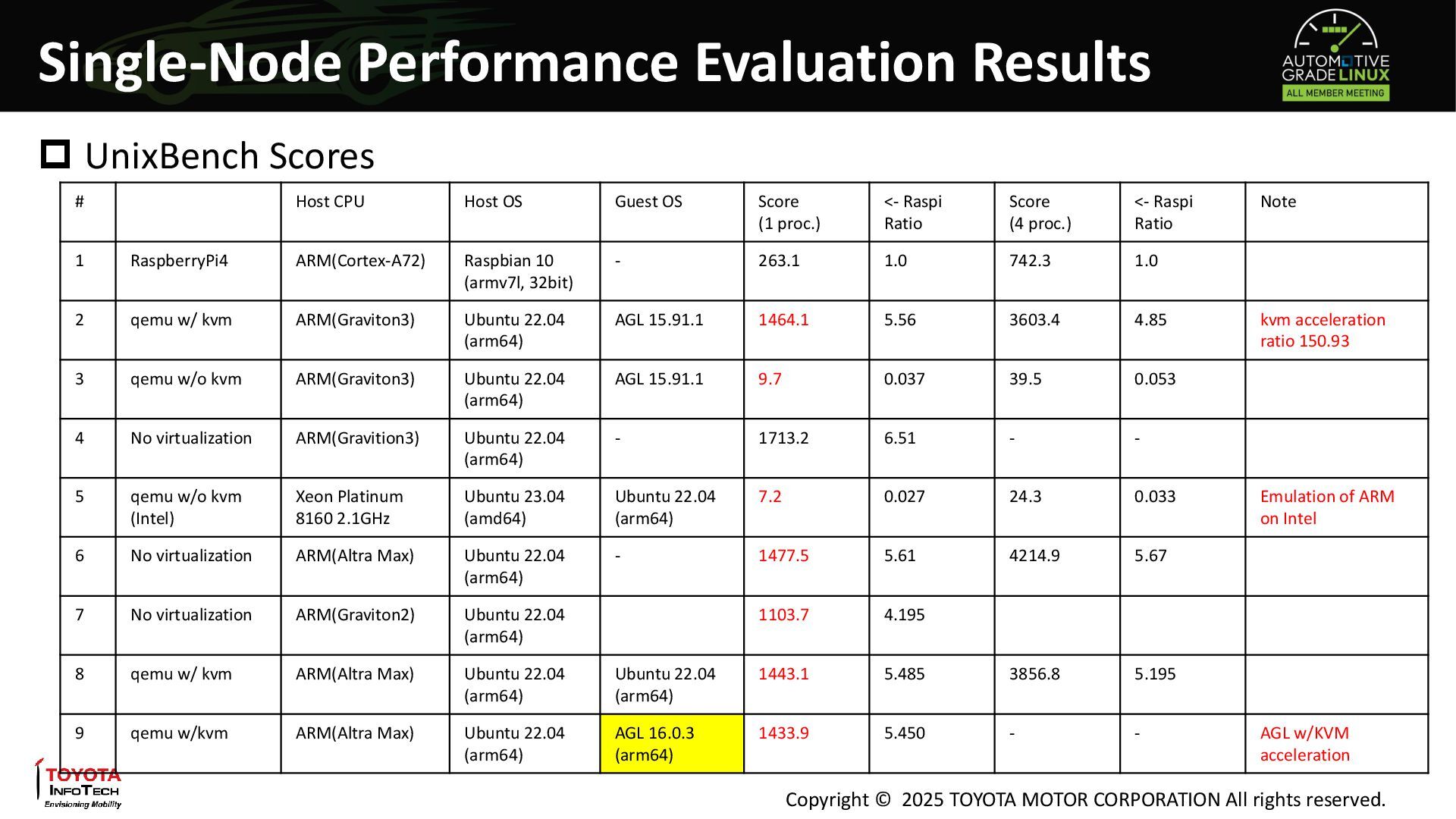
Performance Evaluation Results # Host CPU Host OS Guest OS Score (1 proc.) <- Raspi Ratio Score (4 proc.) <- Raspi Ratio Note 1 RaspberryPi4 ARM(Cortex-A72) Raspbian 10 (armv7l, 32bit) - 263.1 1.0 742.3 1.0 2 qemu w/ kvm ARM(Graviton3) Ubuntu 22.04 (arm64) AGL 15.91.1 1464.1 5.56 3603.4 4.85 kvm acceleration ratio 150.93 3 qemu w/o kvm ARM(Graviton3) Ubuntu 22.04 (arm64) AGL 15.91.1 9.7 0.037 39.5 0.053 4 No virtualization ARM(Gravition3) Ubuntu 22.04 (arm64) - 1713.2 6.51 - - 5 qemu w/o kvm (Intel) Xeon Platinum 8160 2.1GHz Ubuntu 23.04 (amd64) Ubuntu 22.04 (arm64) 7.2 0.027 24.3 0.033 Emulation of ARM on Intel 6 No virtualization ARM(Altra Max) Ubuntu 22.04 (arm64) - 1477.5 5.61 4214.9 5.67 7 No virtualization ARM(Graviton2) Ubuntu 22.04 (arm64) 1103.7 4.195 8 qemu w/ kvm ARM(Altra Max) Ubuntu 22.04 (arm64) Ubuntu 22.04 (arm64) 1443.1 5.485 3856.8 5.195 9 qemu w/kvm ARM(Altra Max) Ubuntu 22.04 (arm64) AGL 16.0.3 (arm64) 1433.9 5.450 - - AGL w/KVM acceleration UnixBench Scores -
Copyright © 2025 TOYOTA MOTOR CORPORATION All rights reserved. Single-Node
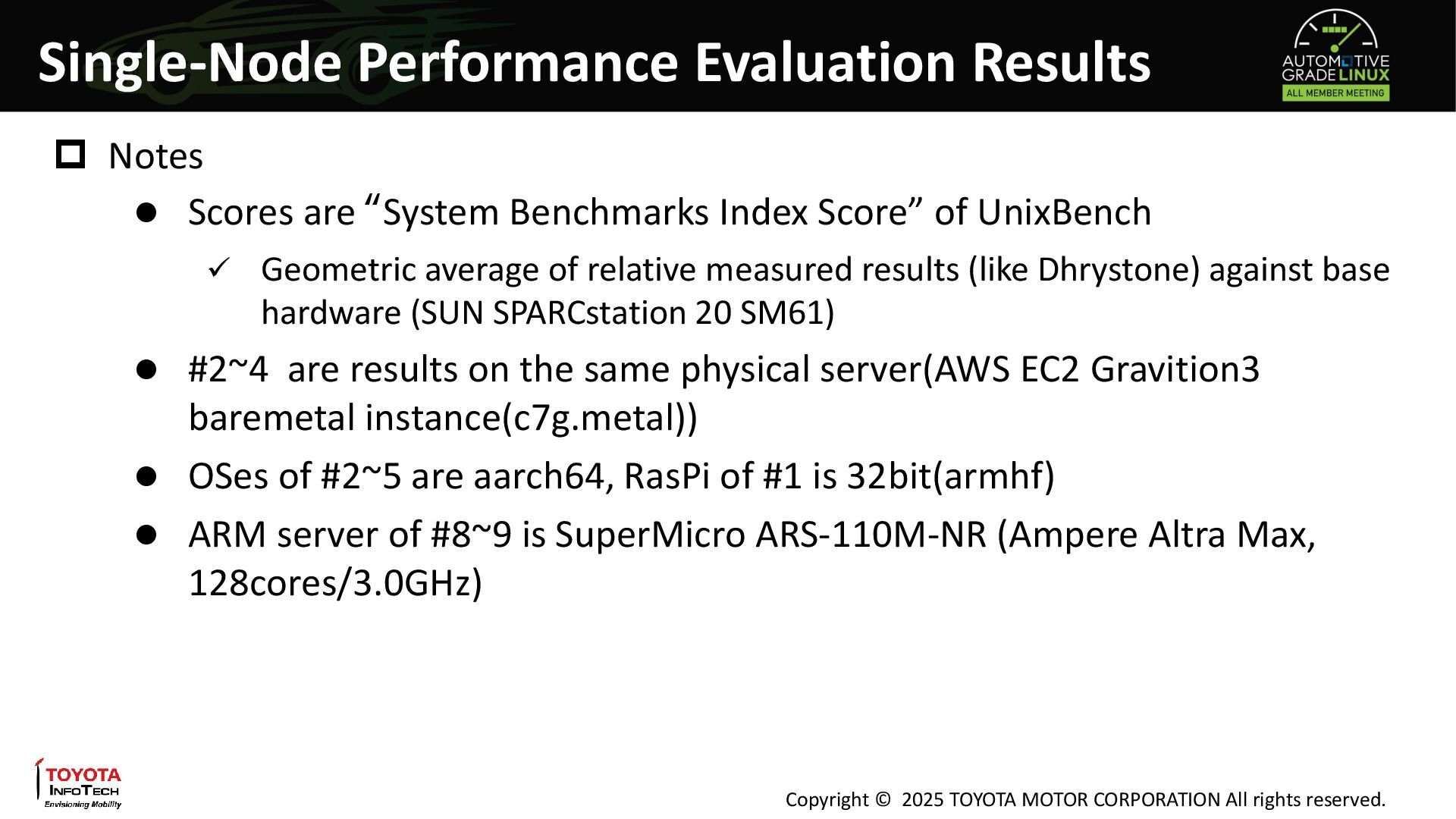
Performance Evaluation Results Notes Scores are “System Benchmarks Index Score” of UnixBench Geometric average of relative measured results (like Dhrystone) against base hardware (SUN SPARCstation 20 SM61) #2~4 are results on the same physical server(AWS EC2 Gravition3 baremetal instance(c7g.metal)) OSes of #2~5 are aarch64, RasPi of #1 is 32bit(armhf) ARM server of #8~9 is SuperMicro ARS-110M-NR (Ampere Altra Max, 128cores/3.0GHz) -
Copyright © 2025 TOYOTA MOTOR CORPORATION All rights reserved. Single-Node
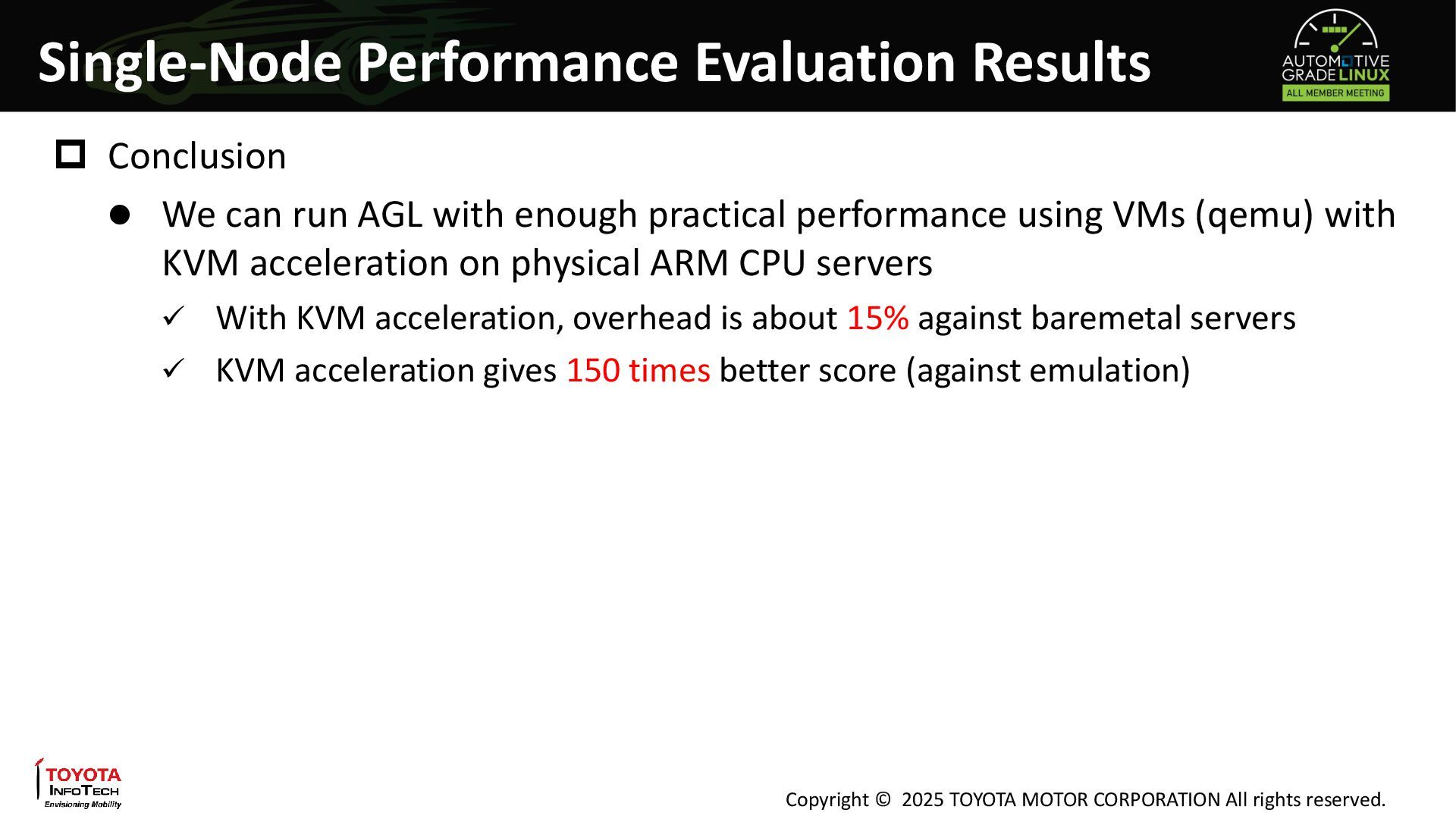
Performance Evaluation Results Conclusion We can run AGL with enough practical performance using VMs (qemu) with KVM acceleration on physical ARM CPU servers With KVM acceleration, overhead is about 15% against baremetal servers KVM acceleration gives 150 times better score (against emulation) -
Copyright © 2025 TOYOTA MOTOR CORPORATION All rights reserved. Multi-Nodes
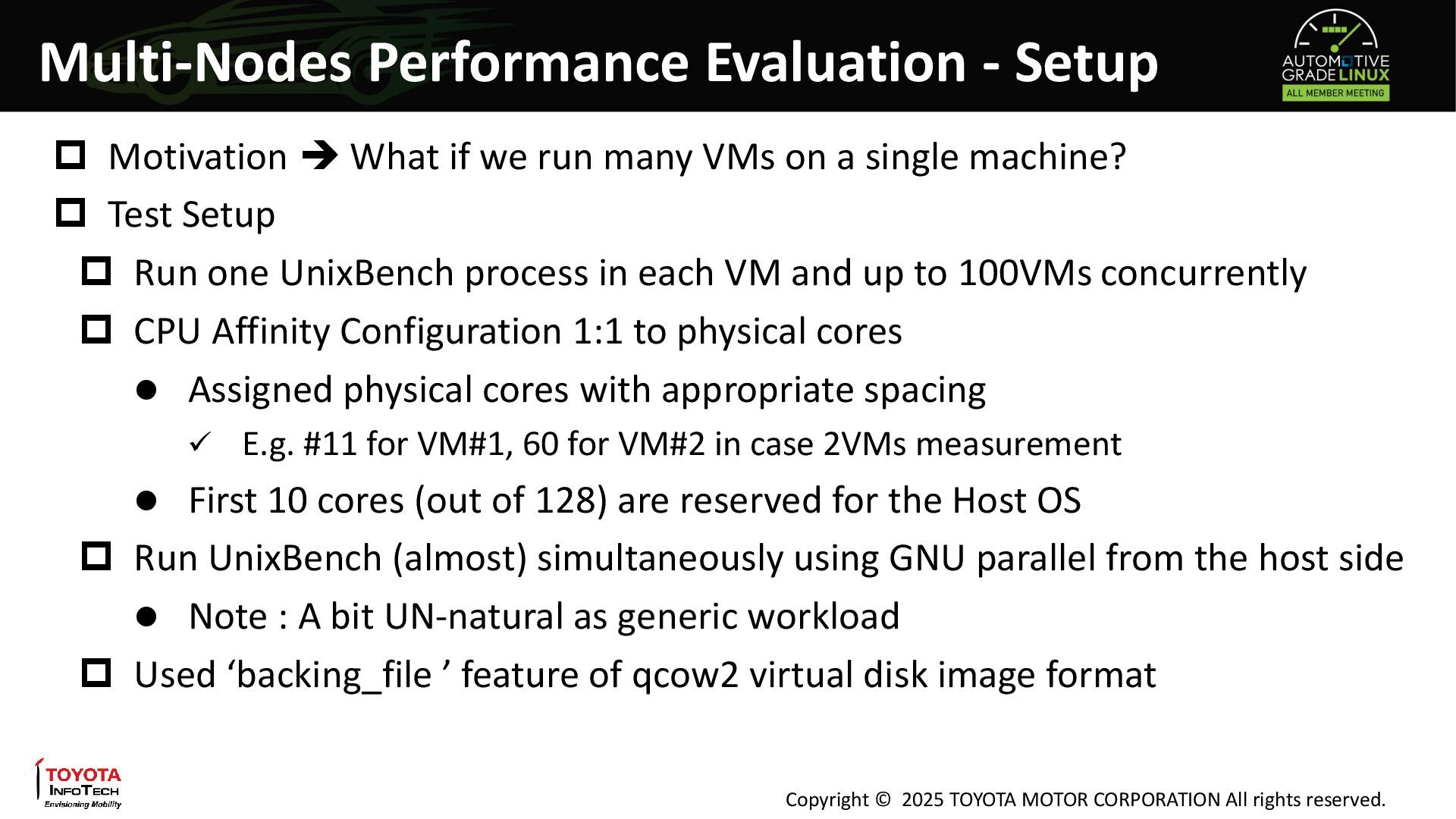
Performance Evaluation - Setup Motivation What if we run many VMs on a single machine? Test Setup Run one UnixBench process in each VM and up to 100VMs concurrently CPU Affinity Configuration 1:1 to physical cores Assigned physical cores with appropriate spacing E.g. #11 for VM#1, 60 for VM#2 in case 2VMs measurement First 10 cores (out of 128) are reserved for the Host OS Run UnixBench (almost) simultaneously using GNU parallel from the host side Note : A bit UN-natural as generic workload Used ‘backing_file ’ feature of qcow2 virtual disk image format -
Copyright © 2025 TOYOTA MOTOR CORPORATION All rights reserved. Multi-Nodes
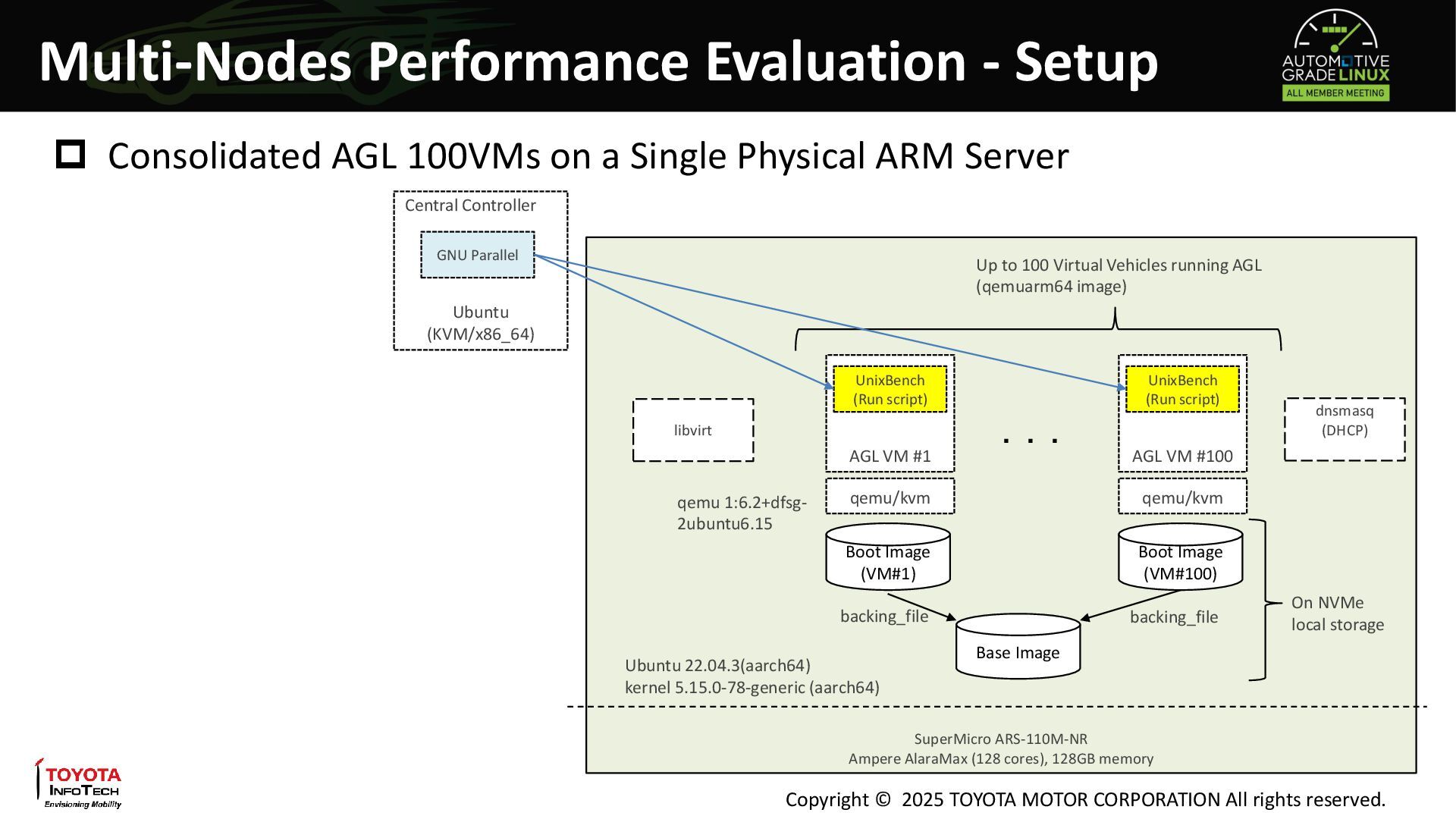
Performance Evaluation - Setup Consolidated AGL 100VMs on a Single Physical ARM Server SuperMicro ARS-110M-NR Ampere AlaraMax (128 cores), 128GB memory ・・・ Up to 100 Virtual Vehicles running AGL (qemuarm64 image) libvirt AGL VM #1 UnixBench (Run script) qemu/kvm Boot Image (VM#1) Base Image AGL VM #100 UnixBench (Run script) qemu/kvm backing_file Boot Image (VM#100) backing_file Ubuntu (KVM/x86_64) GNU Parallel On NVMe local storage Ubuntu 22.04.3(aarch64) kernel 5.15.0-78-generic (aarch64) qemu 1:6.2+dfsg- 2ubuntu6.15 Central Controller dnsmasq (DHCP) -
Copyright © 2025 TOYOTA MOTOR CORPORATION All rights reserved. Multi-Nodes
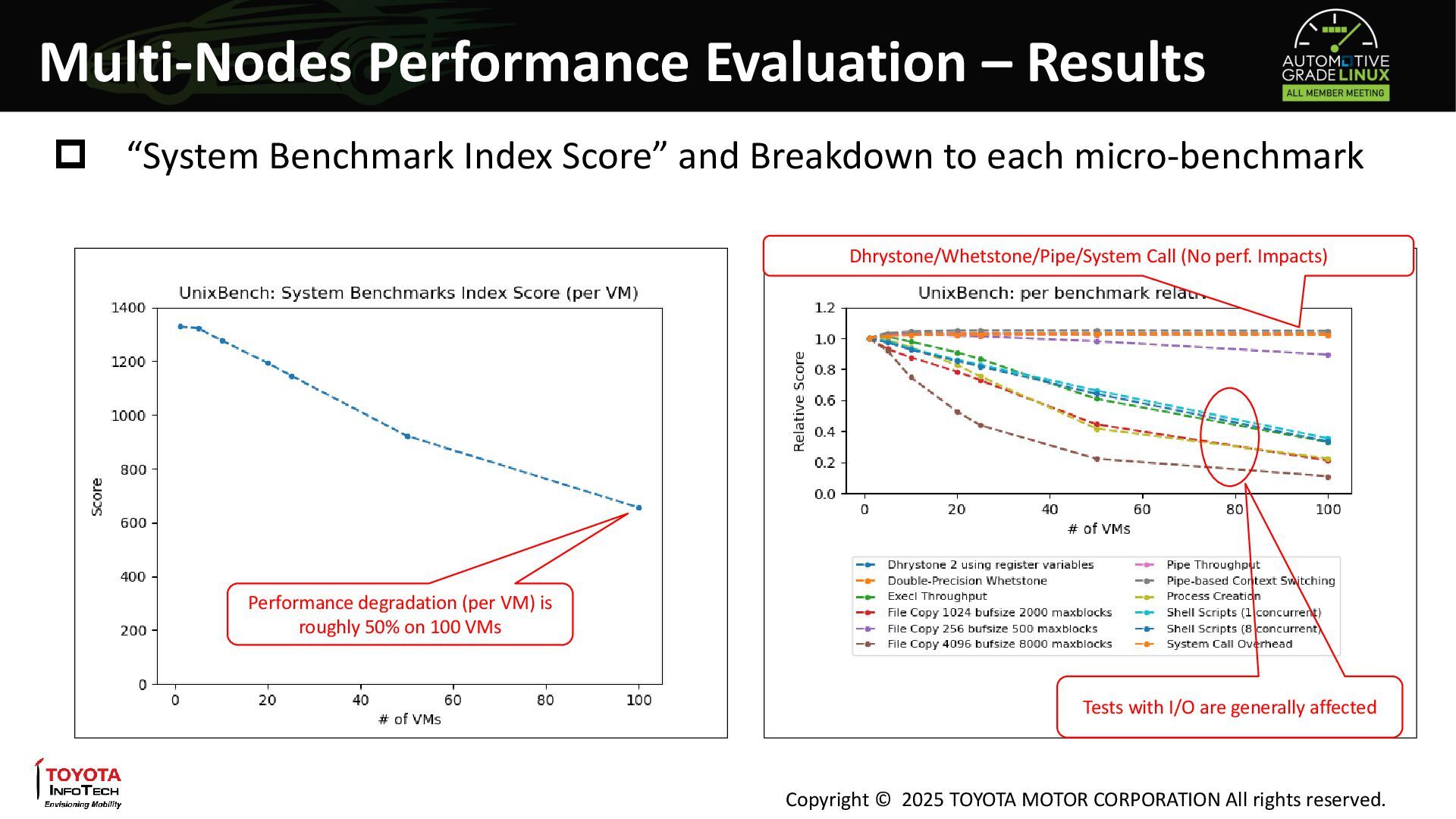
Performance Evaluation – Results “System Benchmark Index Score” and Breakdown to each micro-benchmark Dhrystone/Whetstone/Pipe/System Call (No perf. Impacts) Tests with I/O are generally affected Performance degradation (per VM) is roughly 50% on 100 VMs -
Copyright © 2025 TOYOTA MOTOR CORPORATION All rights reserved. Multi-Nodes
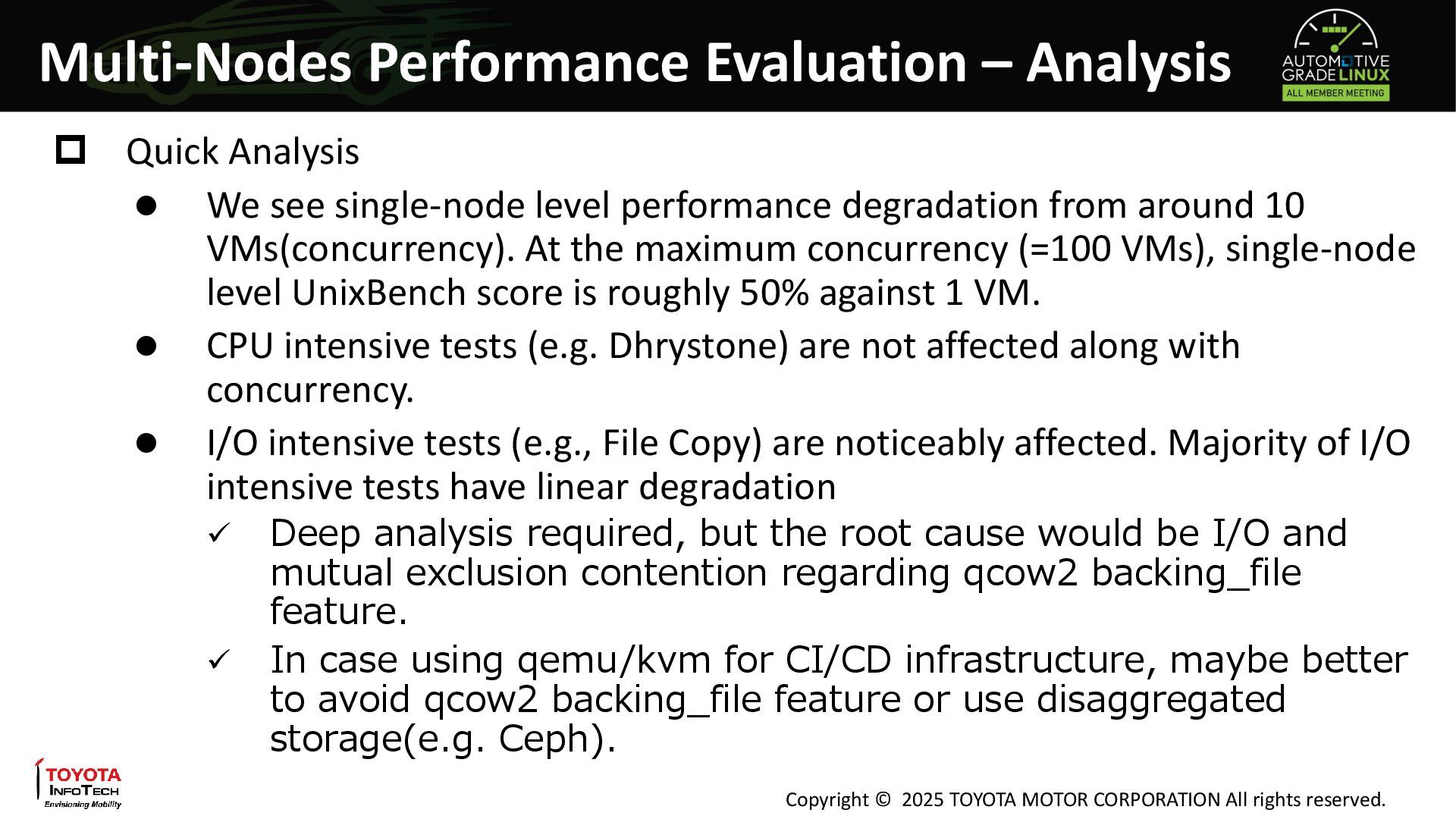
Performance Evaluation – Analysis Quick Analysis We see single-node level performance degradation from around 10 VMs(concurrency). At the maximum concurrency (=100 VMs), single-node level UnixBench score is roughly 50% against 1 VM. CPU intensive tests (e.g. Dhrystone) are not affected along with concurrency. I/O intensive tests (e.g., File Copy) are noticeably affected. Majority of I/O intensive tests have linear degradation Deep analysis required, but the root cause would be I/O and mutual exclusion contention regarding qcow2 backing_file feature. In case using qemu/kvm for CI/CD infrastructure, maybe better to avoid qcow2 backing_file feature or use disaggregated storage(e.g. Ceph). -
Copyright © 2025 TOYOTA MOTOR CORPORATION All rights reserved. Functionality
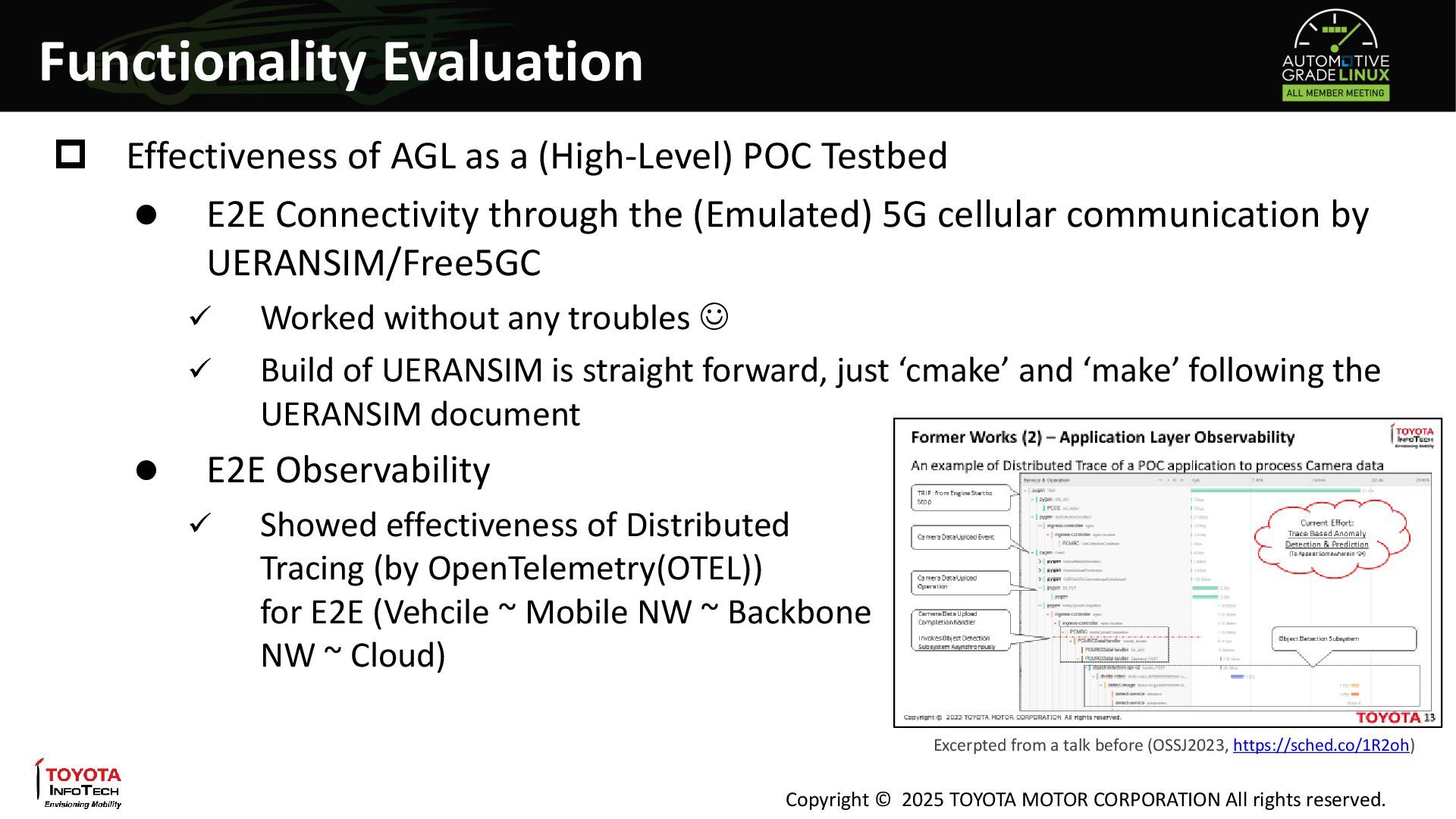
Evaluation Effectiveness of AGL as a (High-Level) POC Testbed E2E Connectivity through the (Emulated) 5G cellular communication by UERANSIM/Free5GC Worked without any troubles Build of UERANSIM is straight forward, just ‘cmake’ and ‘make’ following the UERANSIM document E2E Observability Showed effectiveness of Distributed Tracing (by OpenTelemetry(OTEL)) for E2E (Vehcile ~ Mobile NW ~ Backbone NW ~ Cloud) Excerpted from a talk before (OSSJ2023, https://sched.co/1R2oh) -
Copyright © 2025 TOYOTA MOTOR CORPORATION All rights reserved. Conclusion
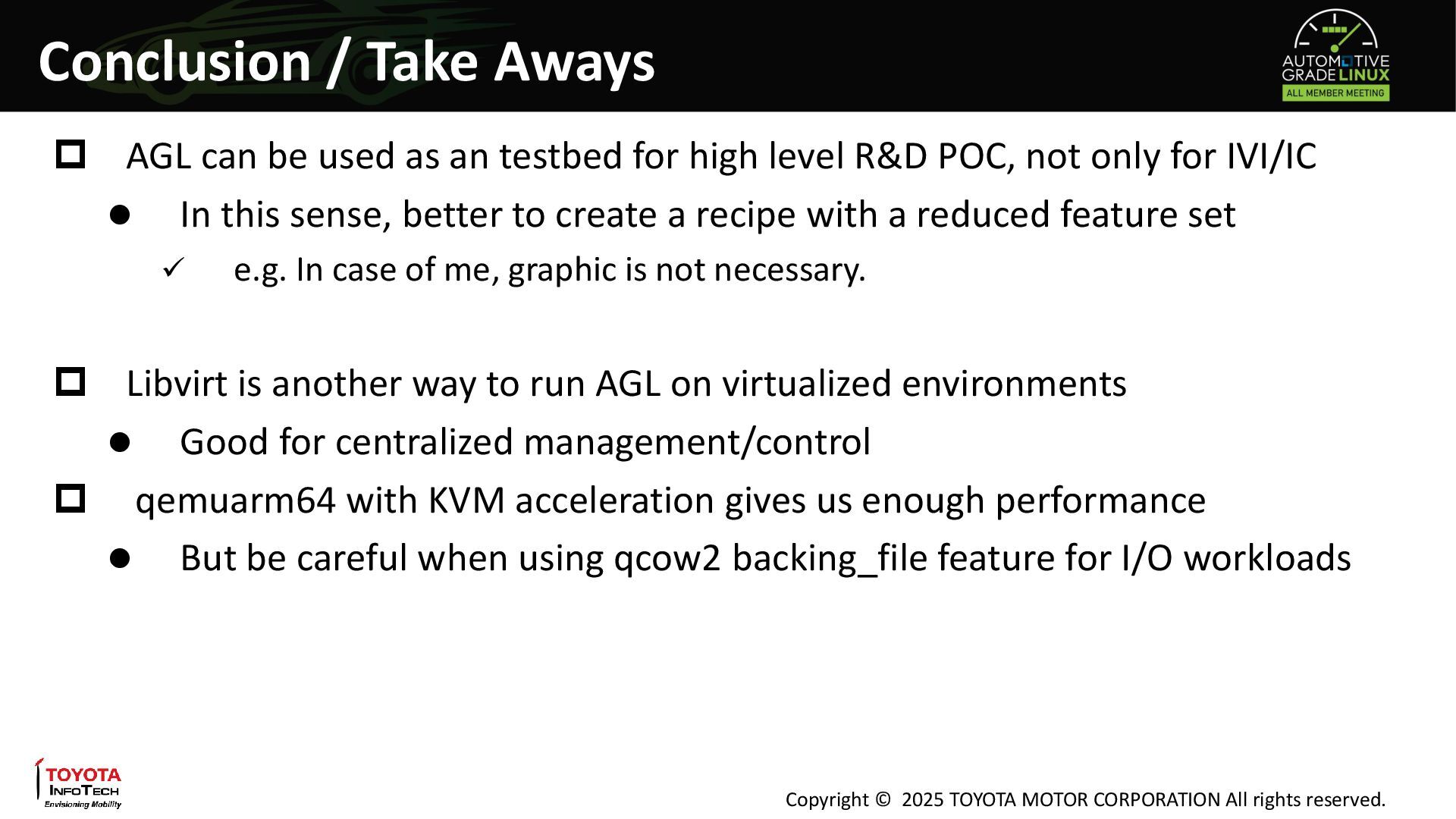
/ Take Aways AGL can be used as an testbed for high level R&D POC, not only for IVI/IC In this sense, better to create a recipe with a reduced feature set e.g. In case of me, graphic is not necessary. Libvirt is another way to run AGL on virtualized environments Good for centralized management/control qemuarm64 with KVM acceleration gives us enough performance But be careful when using qcow2 backing_file feature for I/O workloads -
Copyright © 2025 TOYOTA MOTOR CORPORATION All rights reserved. Future
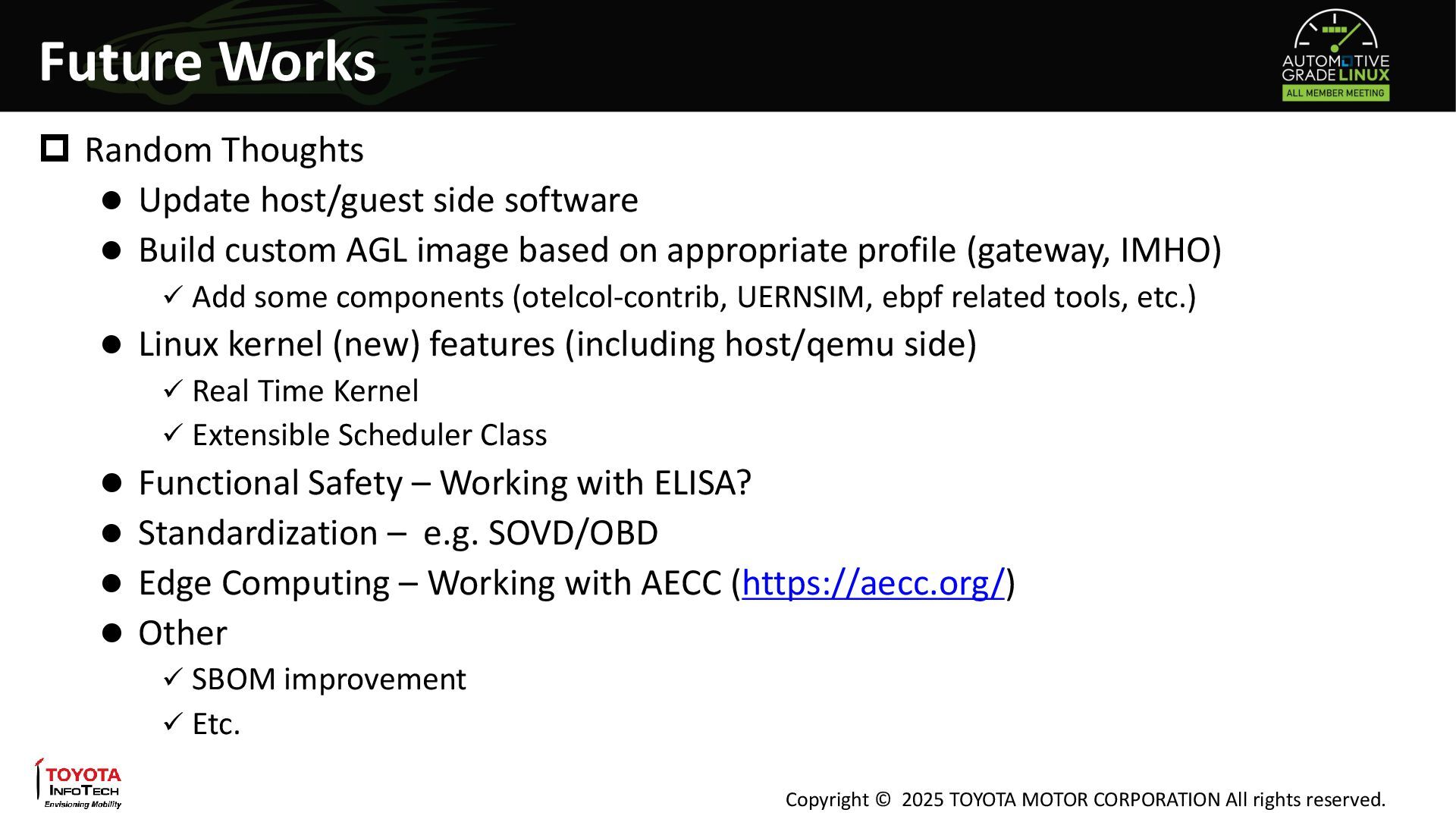
Works Random Thoughts Update host/guest side software Build custom AGL image based on appropriate profile (gateway, IMHO) Add some components (otelcol-contrib, UERNSIM, ebpf related tools, etc.) Linux kernel (new) features (including host/qemu side) Real Time Kernel Extensible Scheduler Class Functional Safety – Working with ELISA? Standardization – e.g. SOVD/OBD Edge Computing – Working with AECC (https://aecc.org/) Other SBOM improvement Etc. -
Copyright © 2025 TOYOTA MOTOR CORPORATION All rights reserved. TIP#1
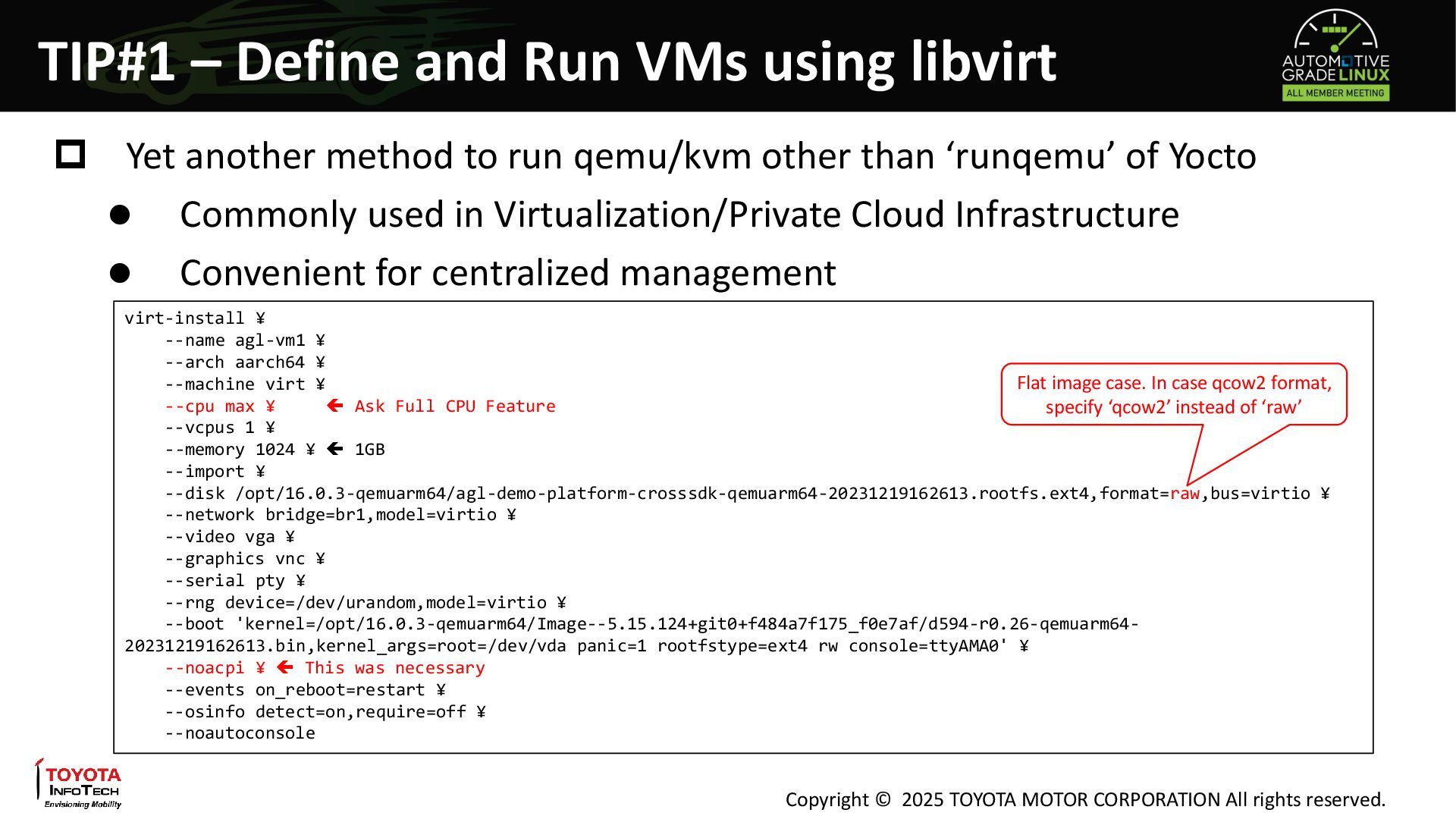
– Define and Run VMs using libvirt Yet another method to run qemu/kvm other than ‘runqemu’ of Yocto Commonly used in Virtualization/Private Cloud Infrastructure Convenient for centralized management virt-install ¥ --name agl-vm1 ¥ --arch aarch64 ¥ --machine virt ¥ --cpu max ¥ Ask Full CPU Feature --vcpus 1 ¥ --memory 1024 ¥ 1GB --import ¥ --disk /opt/16.0.3-qemuarm64/agl-demo-platform-crosssdk-qemuarm64-20231219162613.rootfs.ext4,format=raw,bus=virtio ¥ --network bridge=br1,model=virtio ¥ --video vga ¥ --graphics vnc ¥ --serial pty ¥ --rng device=/dev/urandom,model=virtio ¥ --boot 'kernel=/opt/16.0.3-qemuarm64/Image--5.15.124+git0+f484a7f175_f0e7af/d594-r0.26-qemuarm64- 20231219162613.bin,kernel_args=root=/dev/vda panic=1 rootfstype=ext4 rw console=ttyAMA0' ¥ --noacpi ¥ This was necessary --events on_reboot=restart ¥ --osinfo detect=on,require=off ¥ --noautoconsole Flat image case. In case qcow2 format, specify ‘qcow2’ instead of ‘raw’ -
Copyright © 2025 TOYOTA MOTOR CORPORATION All rights reserved. TIP#2
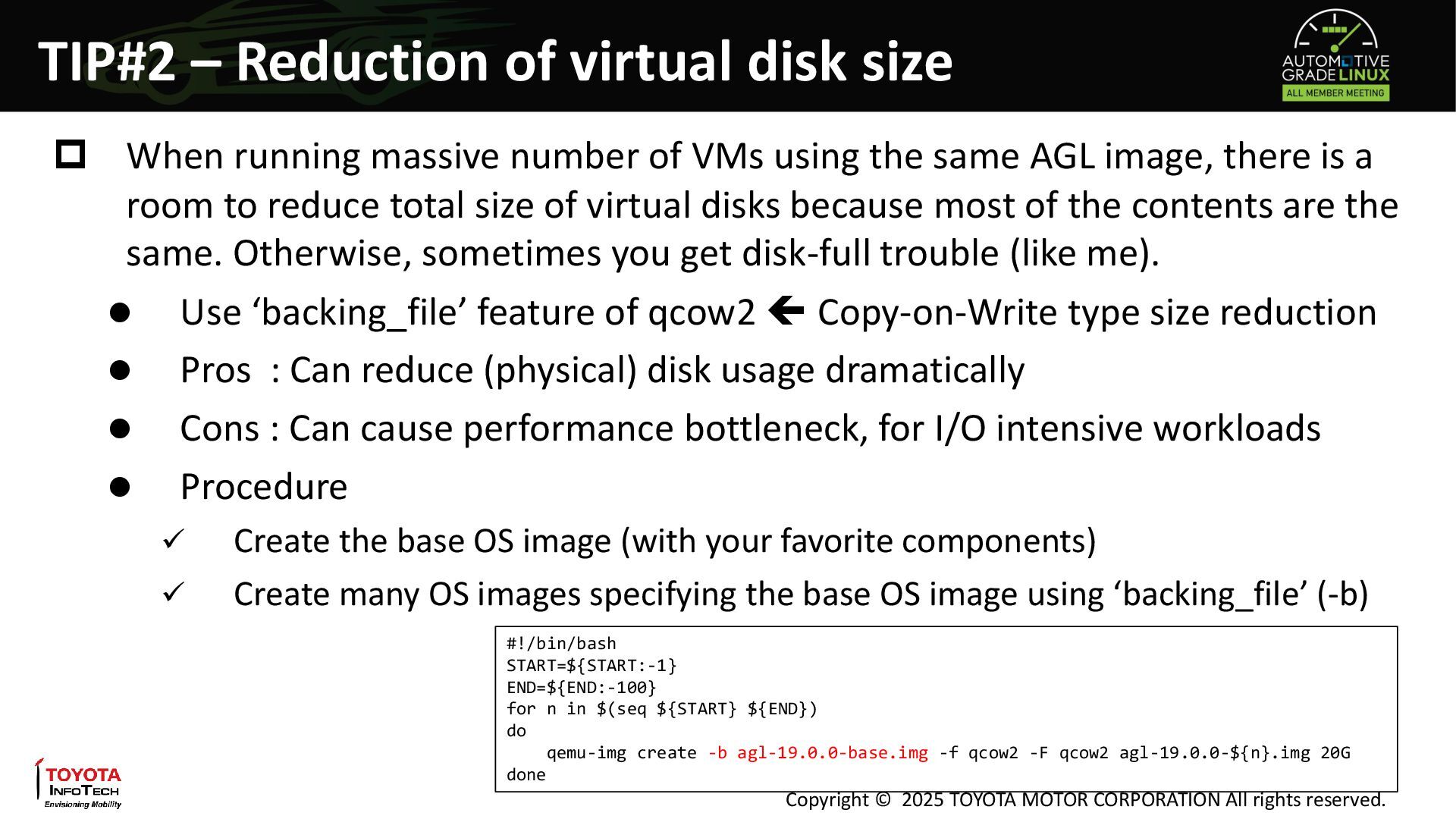
– Reduction of virtual disk size When running massive number of VMs using the same AGL image, there is a room to reduce total size of virtual disks because most of the contents are the same. Otherwise, sometimes you get disk-full trouble (like me). Use ‘backing_file’ feature of qcow2 Copy-on-Write type size reduction Pros : Can reduce (physical) disk usage dramatically Cons : Can cause performance bottleneck, for I/O intensive workloads Procedure Create the base OS image (with your favorite components) Create many OS images specifying the base OS image using ‘backing_file’ (-b) #!/bin/bash START=${START:-1} END=${END:-100} for n in $(seq ${START} ${END}) do qemu-img create -b agl-19.0.0-base.img -f qcow2 -F qcow2 agl-19.0.0-${n}.img 20G done -
Copyright © 2025 TOYOTA MOTOR CORPORATION All rights reserved. TIP#3
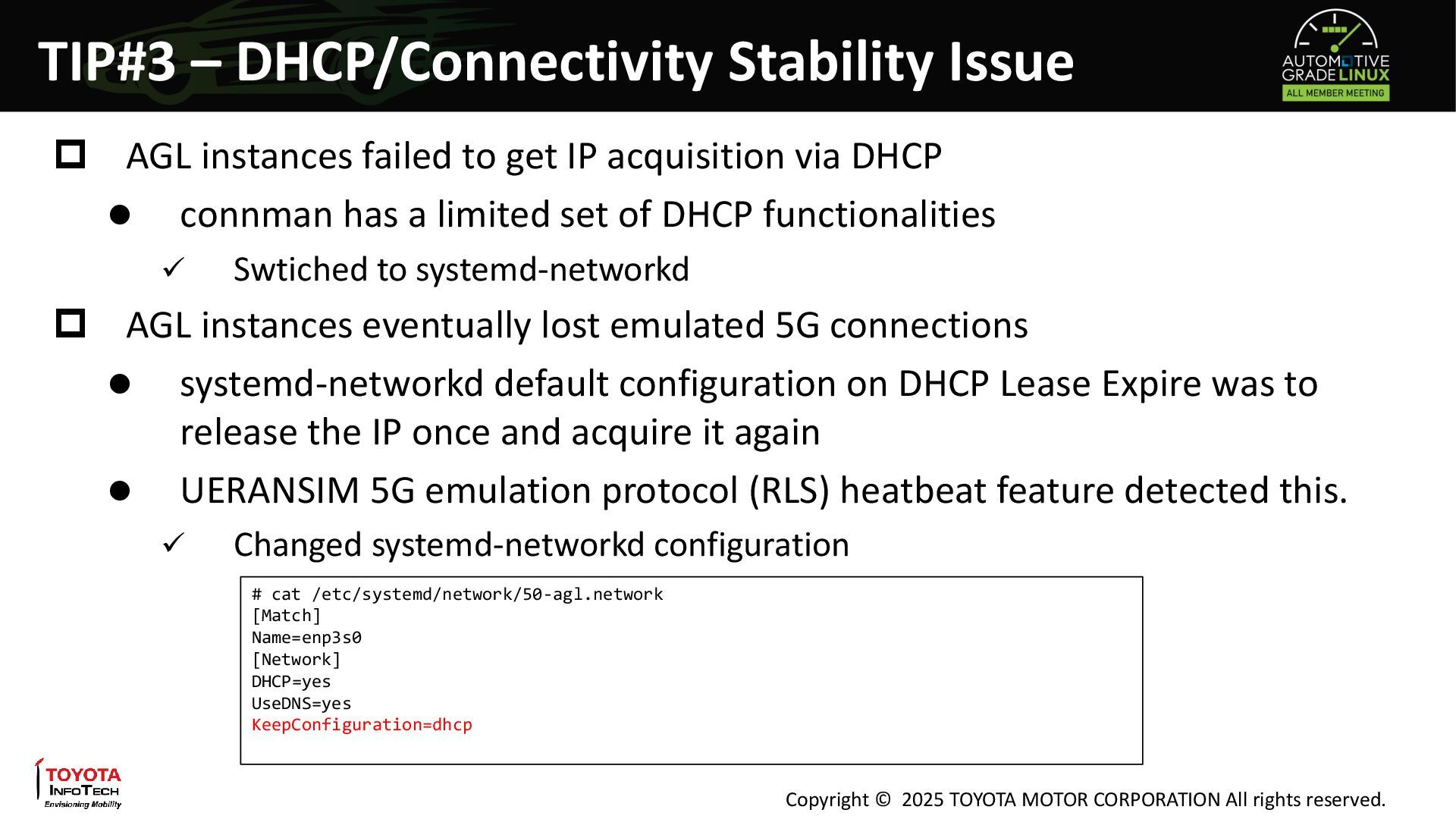
– DHCP/Connectivity Stability Issue AGL instances failed to get IP acquisition via DHCP connman has a limited set of DHCP functionalities Swtiched to systemd-networkd AGL instances eventually lost emulated 5G connections systemd-networkd default configuration on DHCP Lease Expire was to release the IP once and acquire it again UERANSIM 5G emulation protocol (RLS) heatbeat feature detected this. Changed systemd-networkd configuration # cat /etc/systemd/network/50-agl.network [Match] Name=enp3s0 [Network] DHCP=yes UseDNS=yes KeepConfiguration=dhcp
 thatsdone
 nejumi
 ren8k
 yuutosi
 smt7174
 staka121
 endonanana
 beli68
 torounit
 mikanichinose
 munakata
 butadora
 ykimi
 techseoconnect
 addyosmani
 jnunemaker
 brad_frost
 inesmontani
 katiecoart
 pedronauck
 productmarketing
 rmw
 csswizardry
 kristinabergwall1
 sabderemane