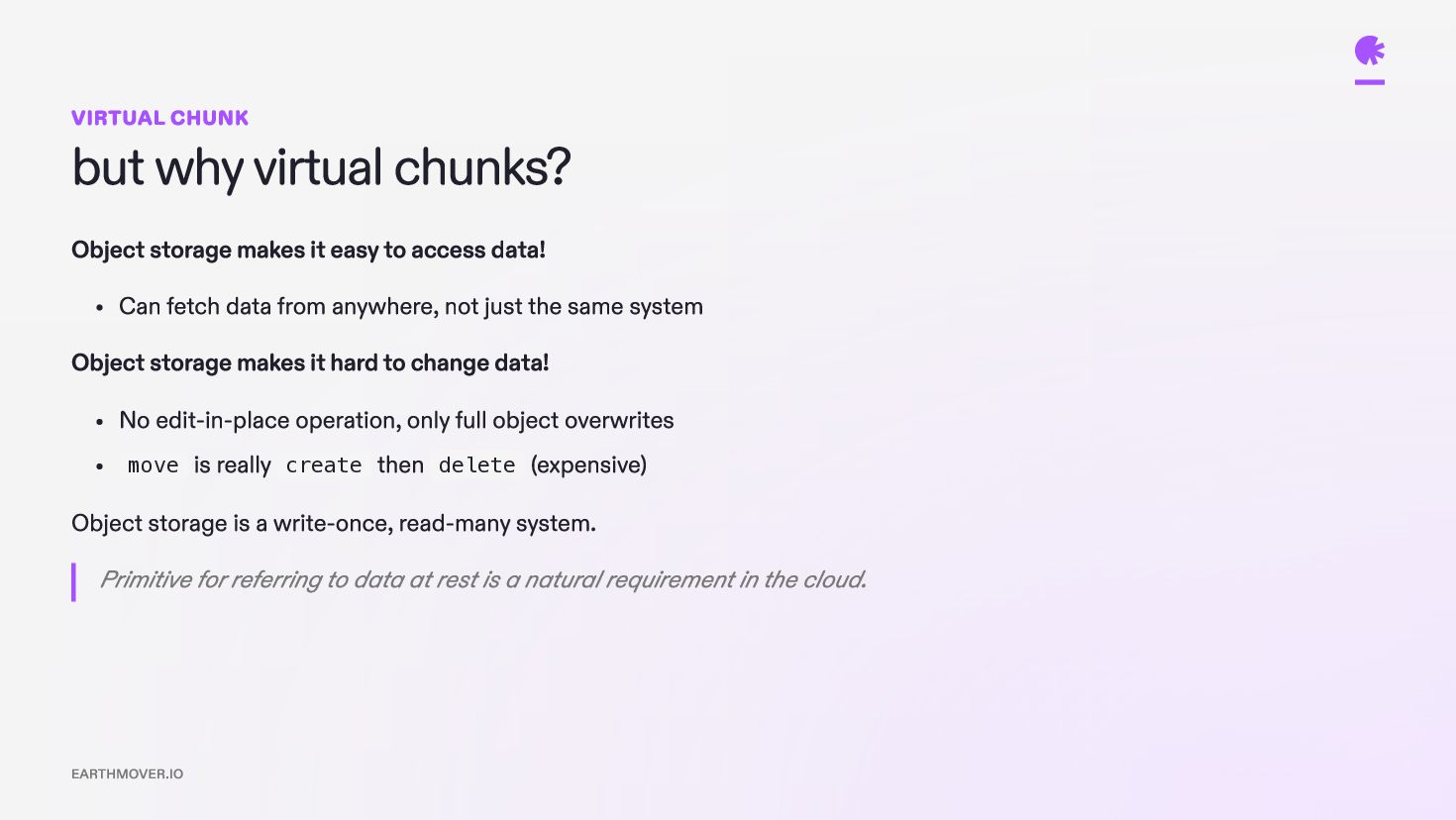
easy to access data! Can fetch data from anywhere, not just the same system Object storage makes it hard to change data! No edit-in-place operation, only full object overwrites move is really create then delete (expensive) Object storage is a write-once, read-many system. Primitive for referring to data at rest is a natural requirement in the cloud. EARTHMOVER.IO
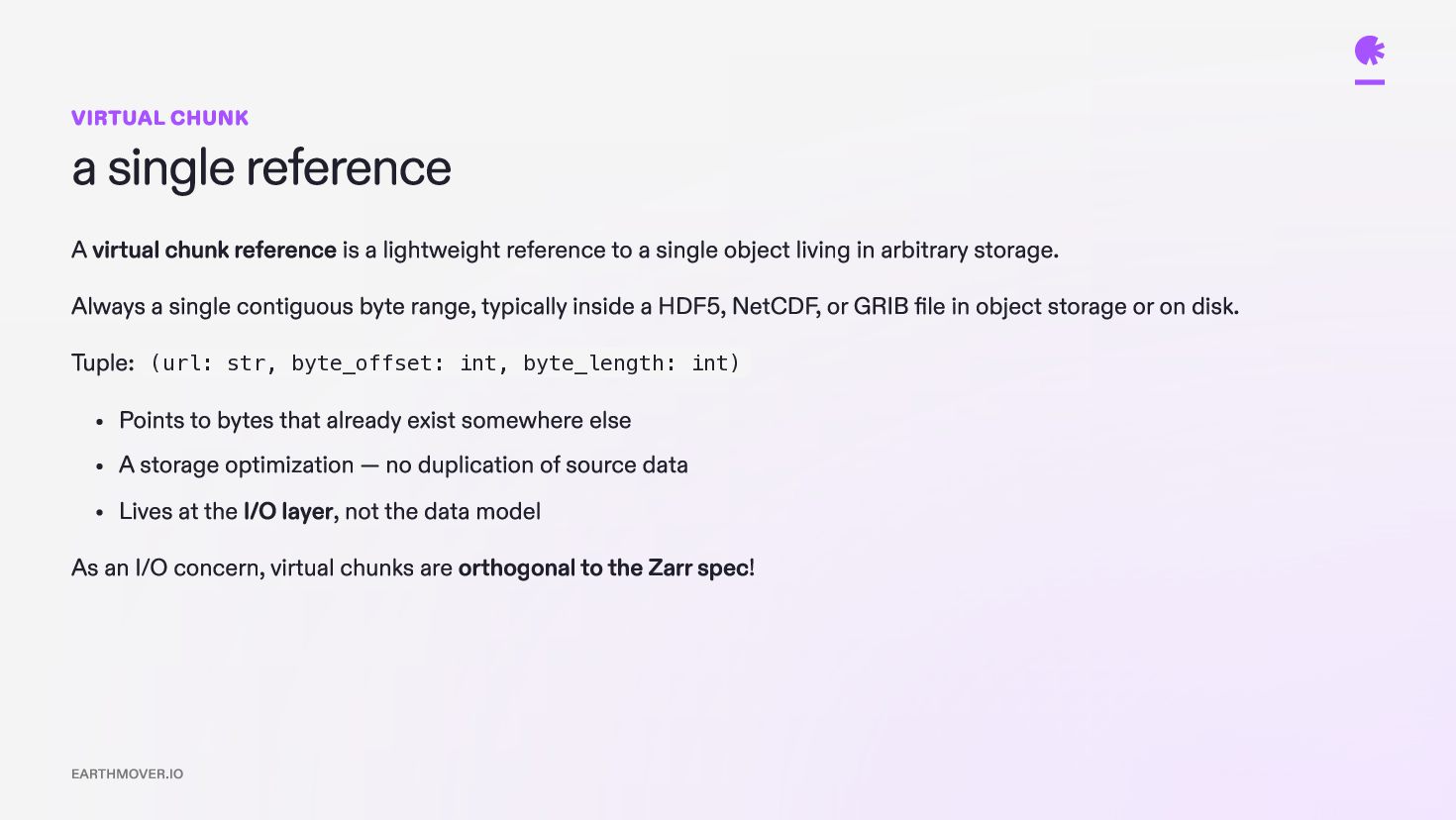
a lightweight reference to a single object living in arbitrary storage. Always a single contiguous byte range, typically inside a HDF5, NetCDF, or GRIB file in object storage or on disk. Tuple: (url: str, byte_offset: int, byte_length: int) Points to bytes that already exist somewhere else A storage optimization — no duplication of source data Lives at the I/O layer, not the data model As an I/O concern, virtual chunks are orthogonal to the Zarr spec! EARTHMOVER.IO
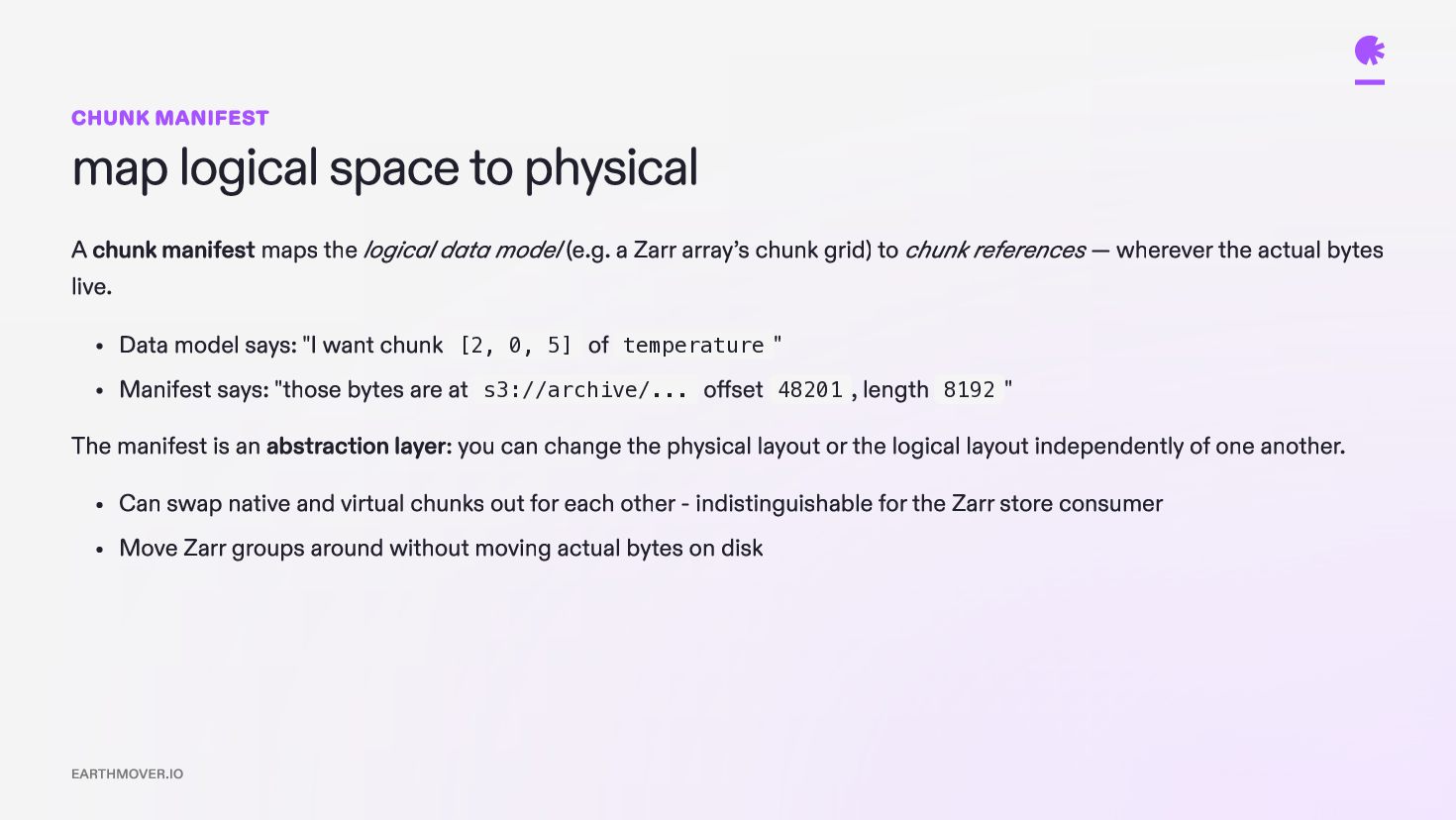
maps the logical data model (e.g. a Zarr array’s chunk grid) to chunk references — wherever the actual bytes live. Data model says: "I want chunk [2, 0, 5] of temperature " Manifest says: "those bytes are at s3://archive/... offset 48201 , length 8192 " The manifest is an abstraction layer: you can change the physical layout or the logical layout independently of one another. Can swap native and virtual chunks out for each other - indistinguishable for the Zarr store consumer Move Zarr groups around without moving actual bytes on disk EARTHMOVER.IO
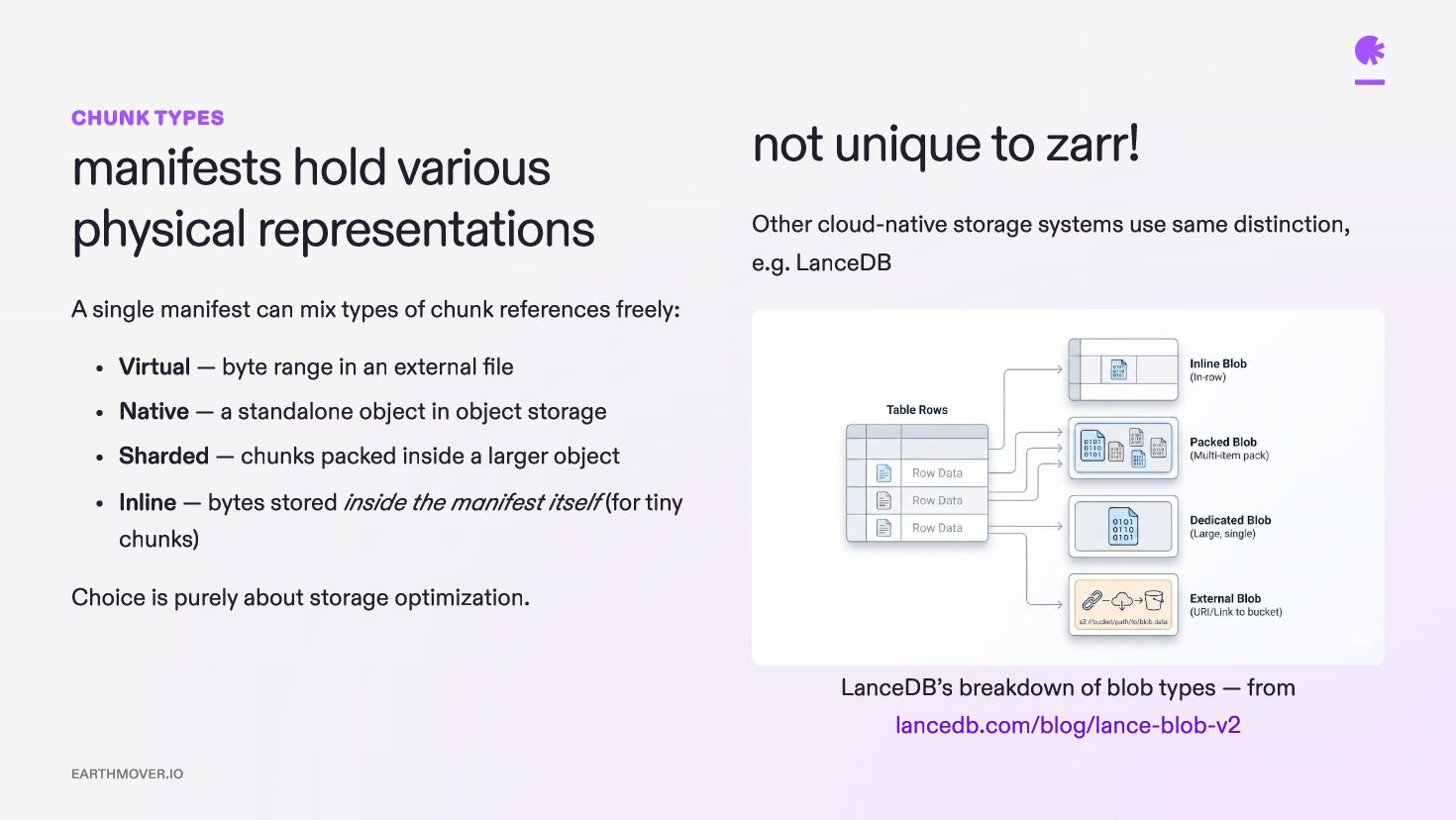
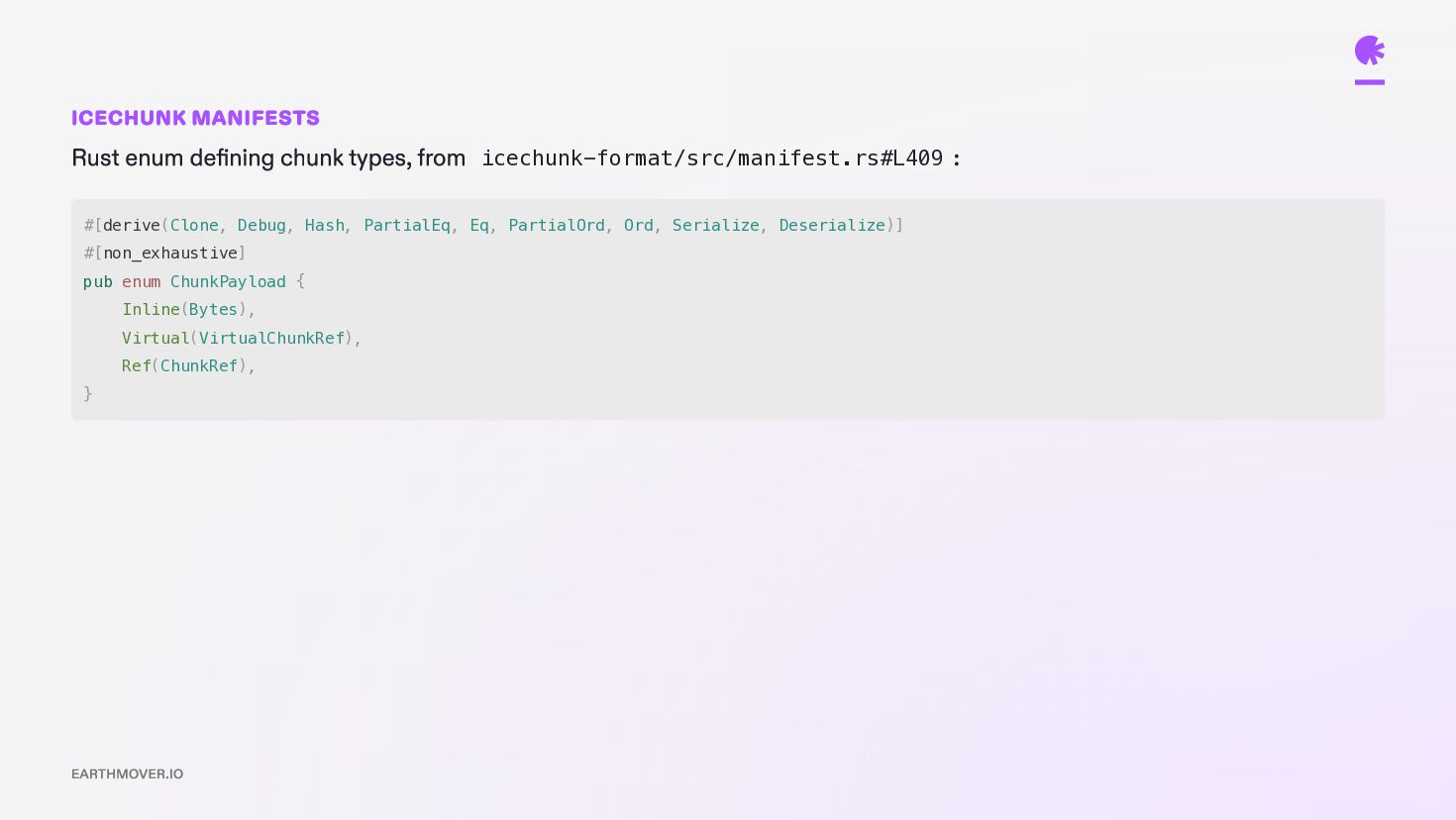
can mix types of chunk references freely: Virtual — byte range in an external file Native — a standalone object in object storage Sharded — chunks packed inside a larger object Inline — bytes stored inside the manifest itself (for tiny chunks) Choice is purely about storage optimization. not unique to zarr! Other cloud-native storage systems use same distinction, e.g. LanceDB LanceDB’s breakdown of blob types — from lancedb.com/blog/lance-blob-v2 EARTHMOVER.IO
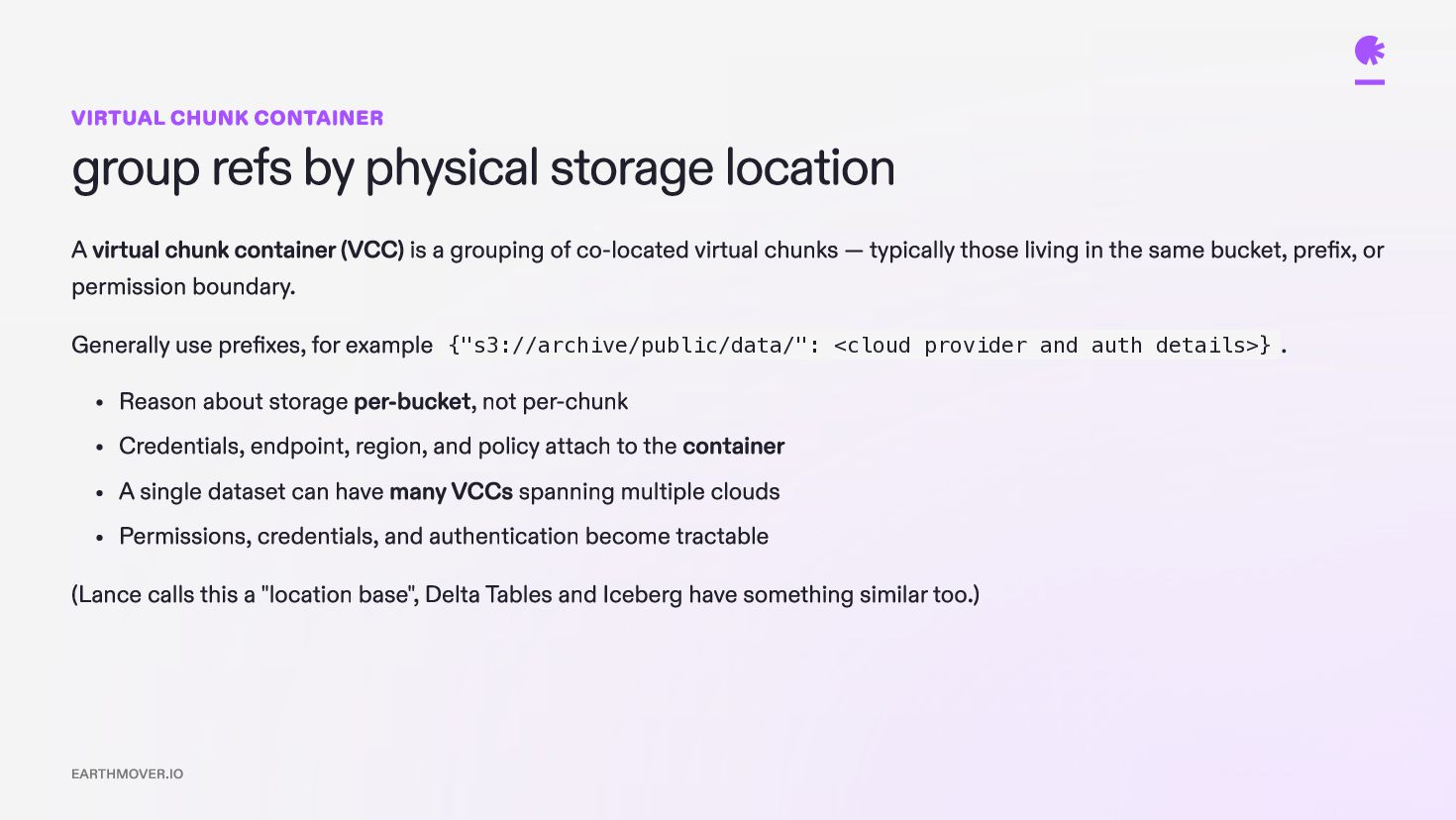
virtual chunk container (VCC) is a grouping of co-located virtual chunks — typically those living in the same bucket, prefix, or permission boundary. Generally use prefixes, for example {"s3://archive/public/data/": <cloud provider and auth details>} . Reason about storage per-bucket, not per-chunk Credentials, endpoint, region, and policy attach to the container A single dataset can have many VCCs spanning multiple clouds Permissions, credentials, and authentication become tractable (Lance calls this a "location base", Delta Tables and Iceberg have something similar too.) EARTHMOVER.IO
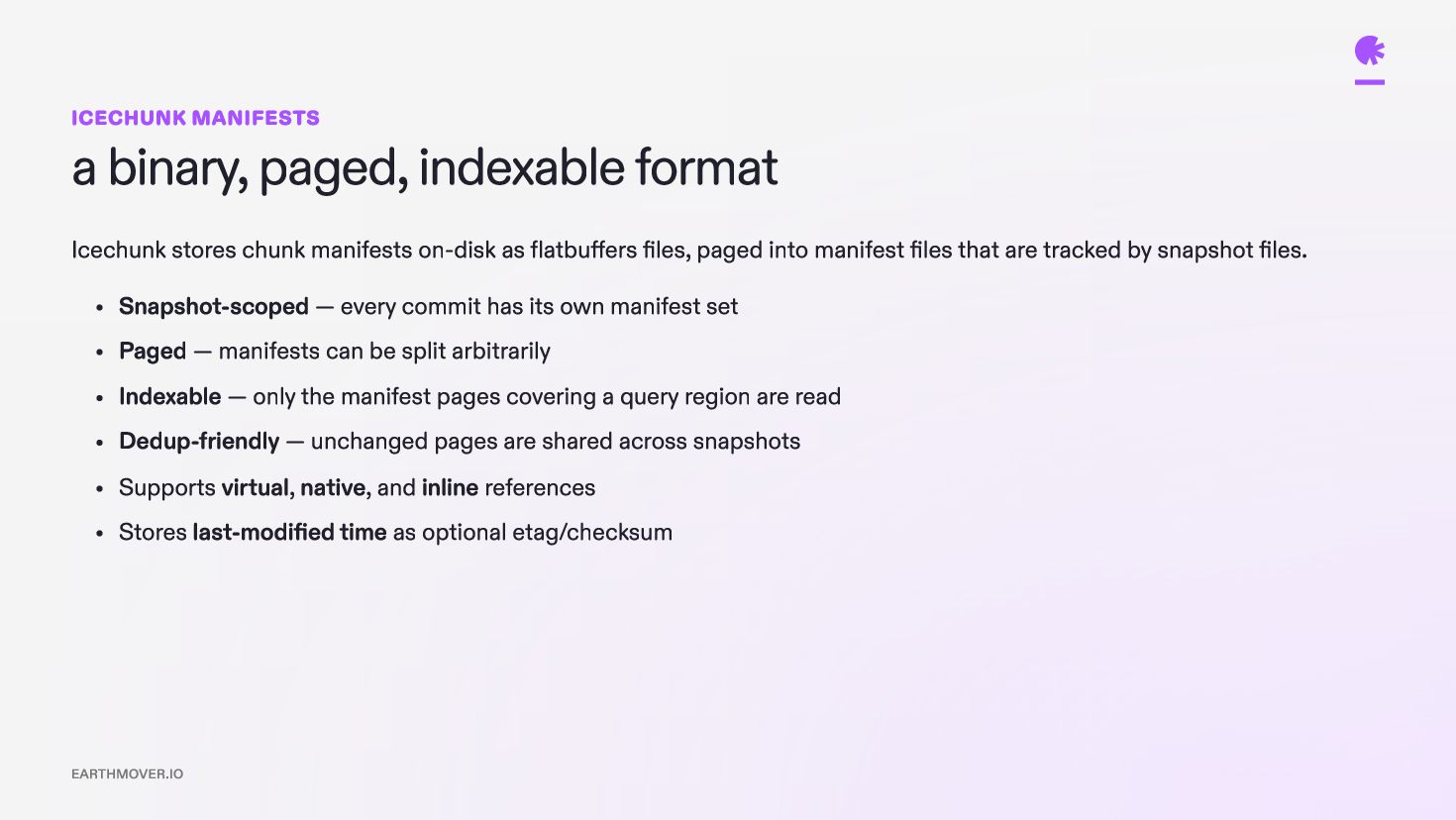
manifests on-disk as flatbuffers files, paged into manifest files that are tracked by snapshot files. Snapshot-scoped — every commit has its own manifest set Paged — manifests can be split arbitrarily Indexable — only the manifest pages covering a query region are read Dedup-friendly — unchanged pages are shared across snapshots Supports virtual, native, and inline references Stores last-modified time as optional etag/checksum EARTHMOVER.IO
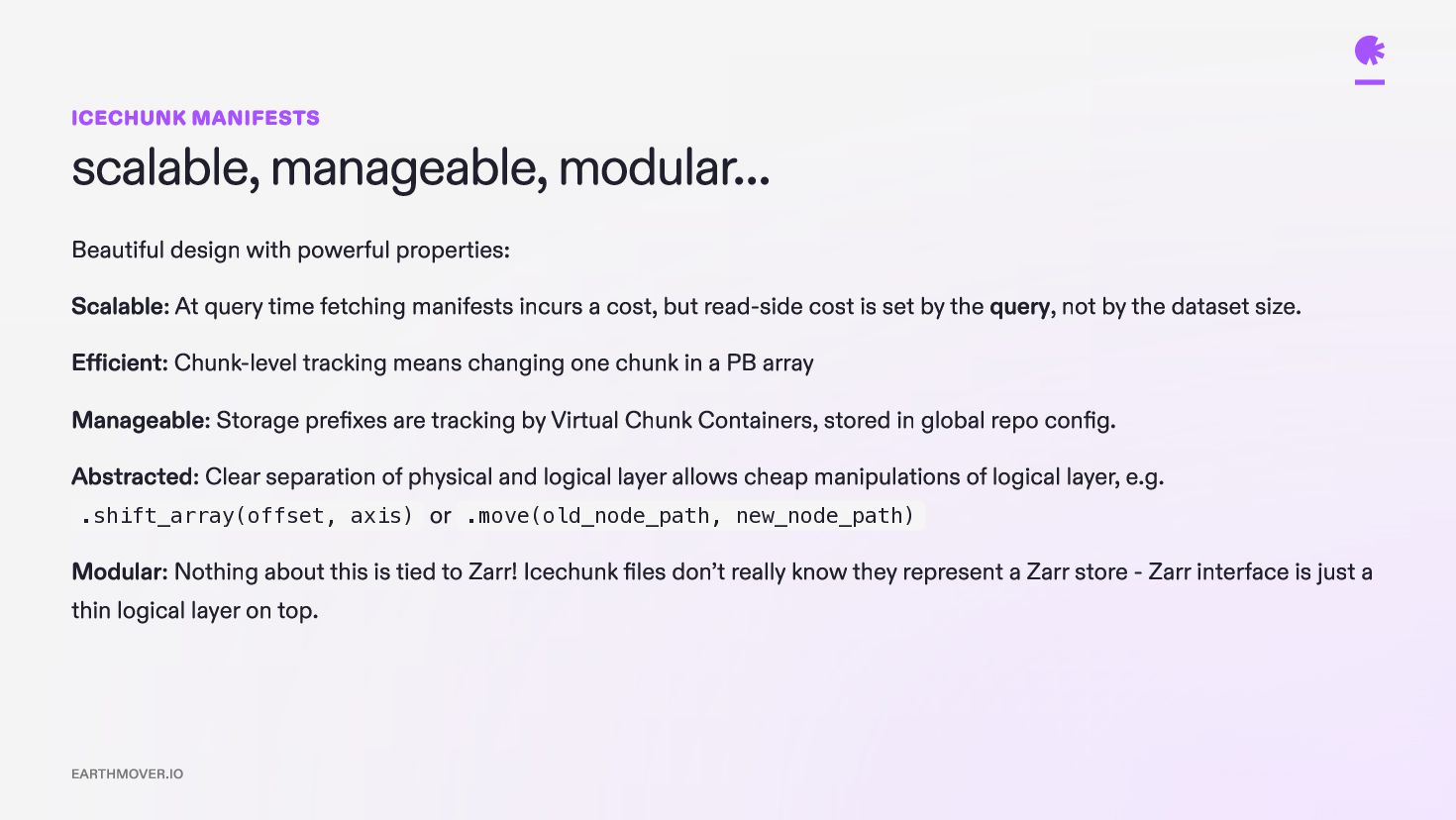
Scalable: At query time fetching manifests incurs a cost, but read-side cost is set by the query, not by the dataset size. Efficient: Chunk-level tracking means changing one chunk in a PB array Manageable: Storage prefixes are tracking by Virtual Chunk Containers, stored in global repo config. Abstracted: Clear separation of physical and logical layer allows cheap manipulations of logical layer, e.g. .shift_array(offset, axis) or .move(old_node_path, new_node_path) Modular: Nothing about this is tied to Zarr! Icechunk files don’t really know they represent a Zarr store - Zarr interface is just a thin logical layer on top. EARTHMOVER.IO
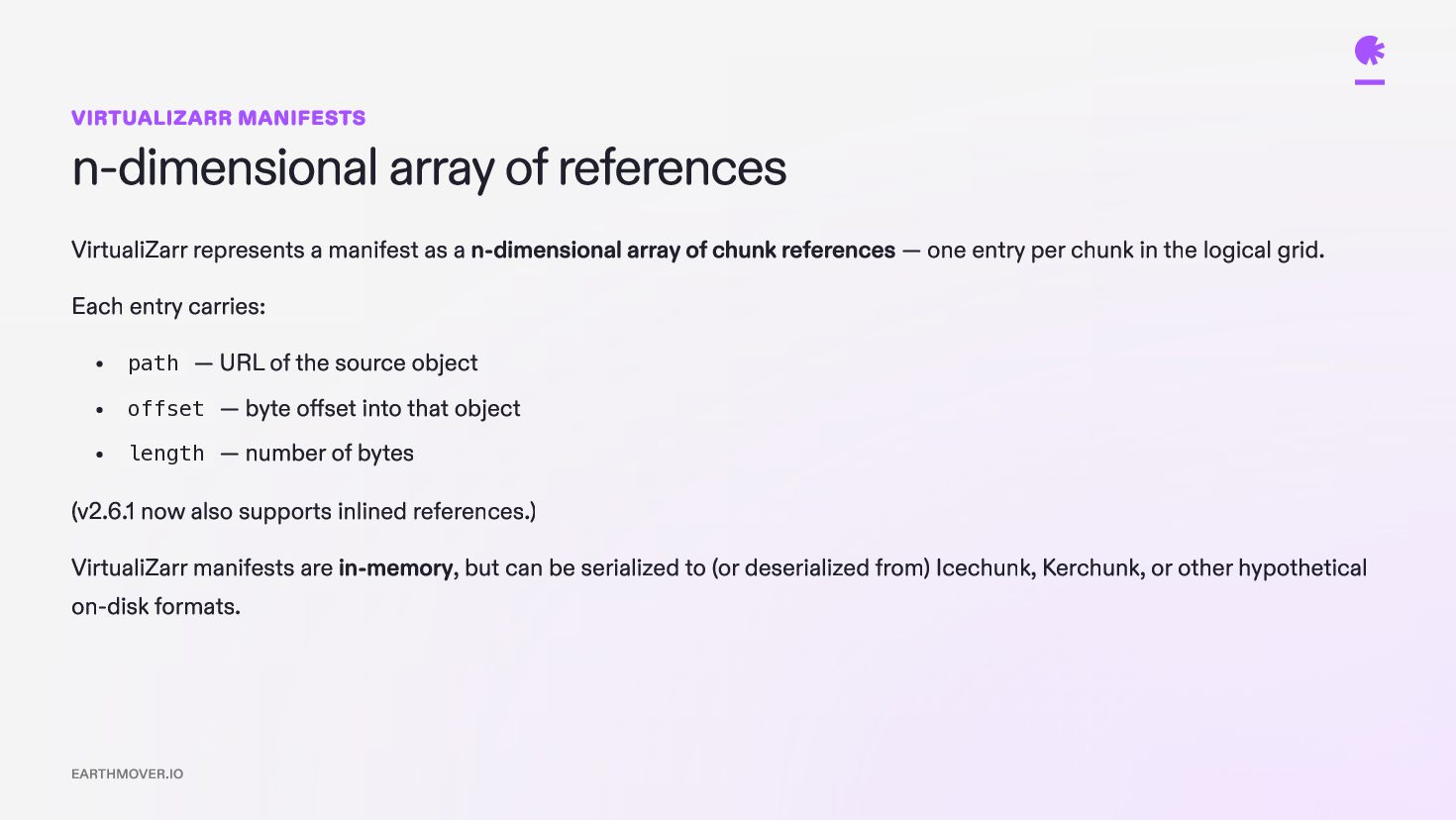
as a n-dimensional array of chunk references — one entry per chunk in the logical grid. Each entry carries: path — URL of the source object offset — byte offset into that object length — number of bytes (v2.6.1 now also supports inlined references.) VirtualiZarr manifests are in-memory, but can be serialized to (or deserialized from) Icechunk, Kerchunk, or other hypothetical on-disk formats. EARTHMOVER.IO
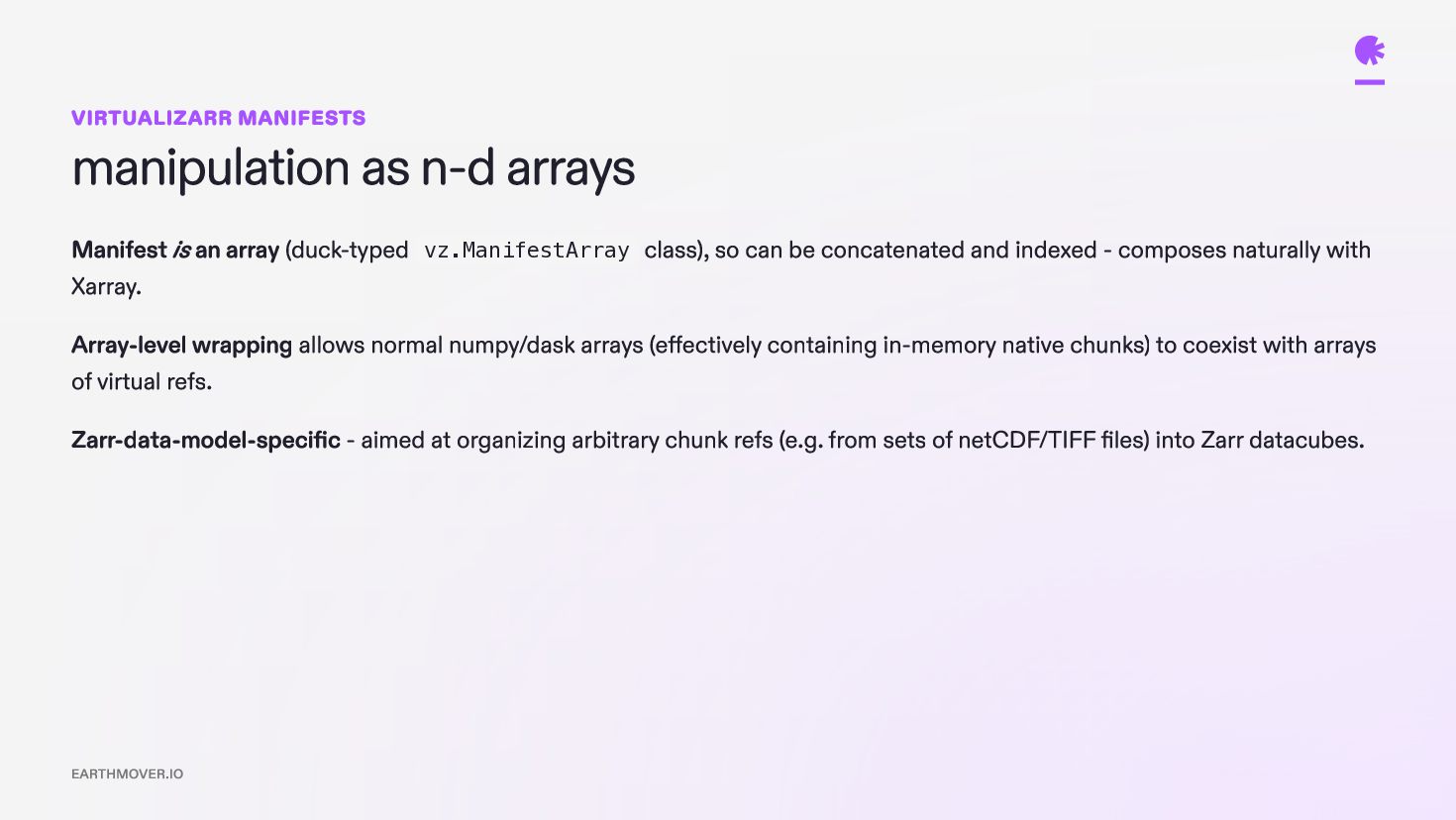
(duck-typed vz.ManifestArray class), so can be concatenated and indexed - composes naturally with Xarray. Array-level wrapping allows normal numpy/dask arrays (effectively containing in-memory native chunks) to coexist with arrays of virtual refs. Zarr-data-model-specific - aimed at organizing arbitrary chunk refs (e.g. from sets of netCDF/TIFF files) into Zarr datacubes. EARTHMOVER.IO
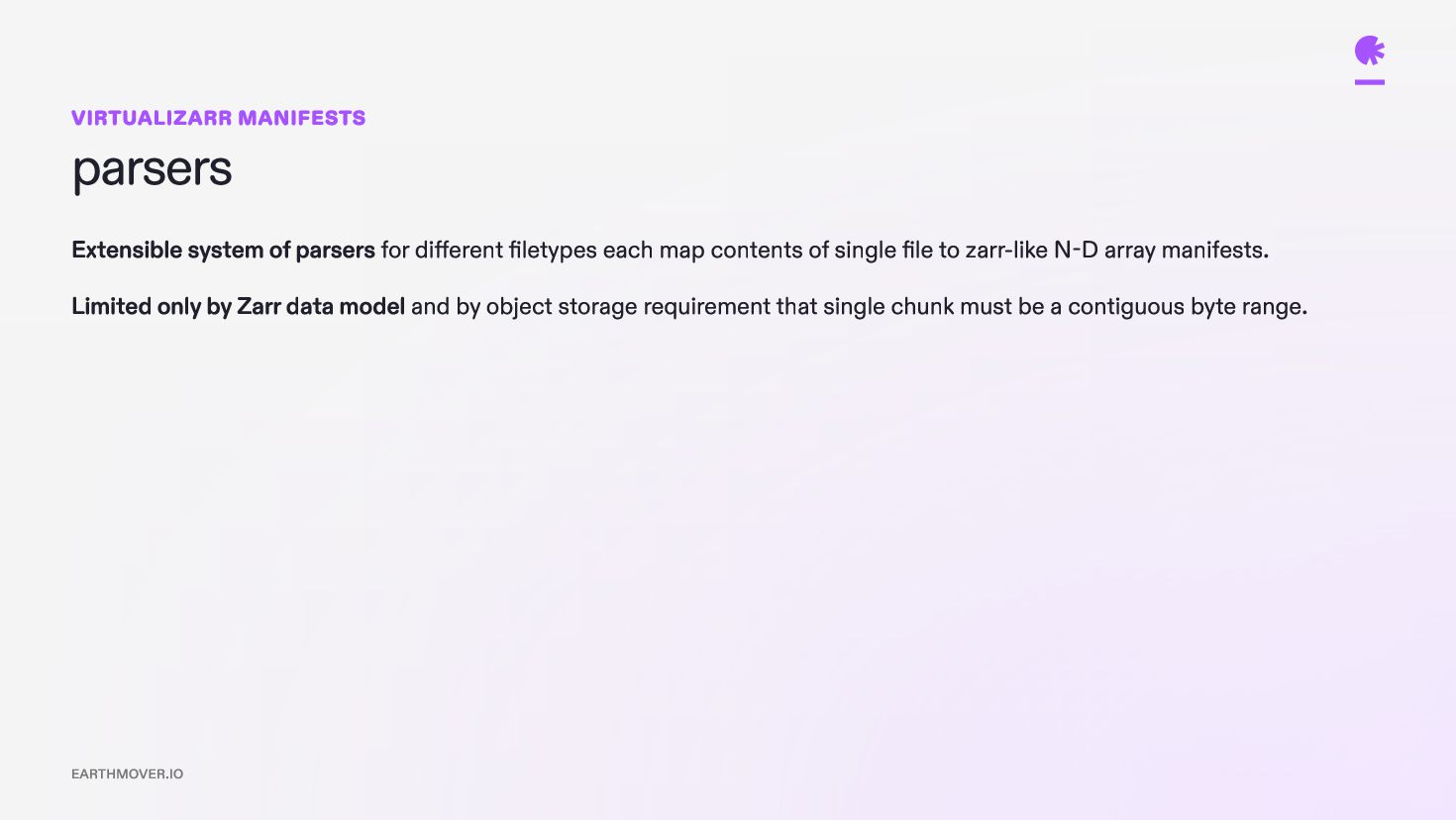
each map contents of single file to zarr-like N-D array manifests. Limited only by Zarr data model and by object storage requirement that single chunk must be a contiguous byte range. EARTHMOVER.IO
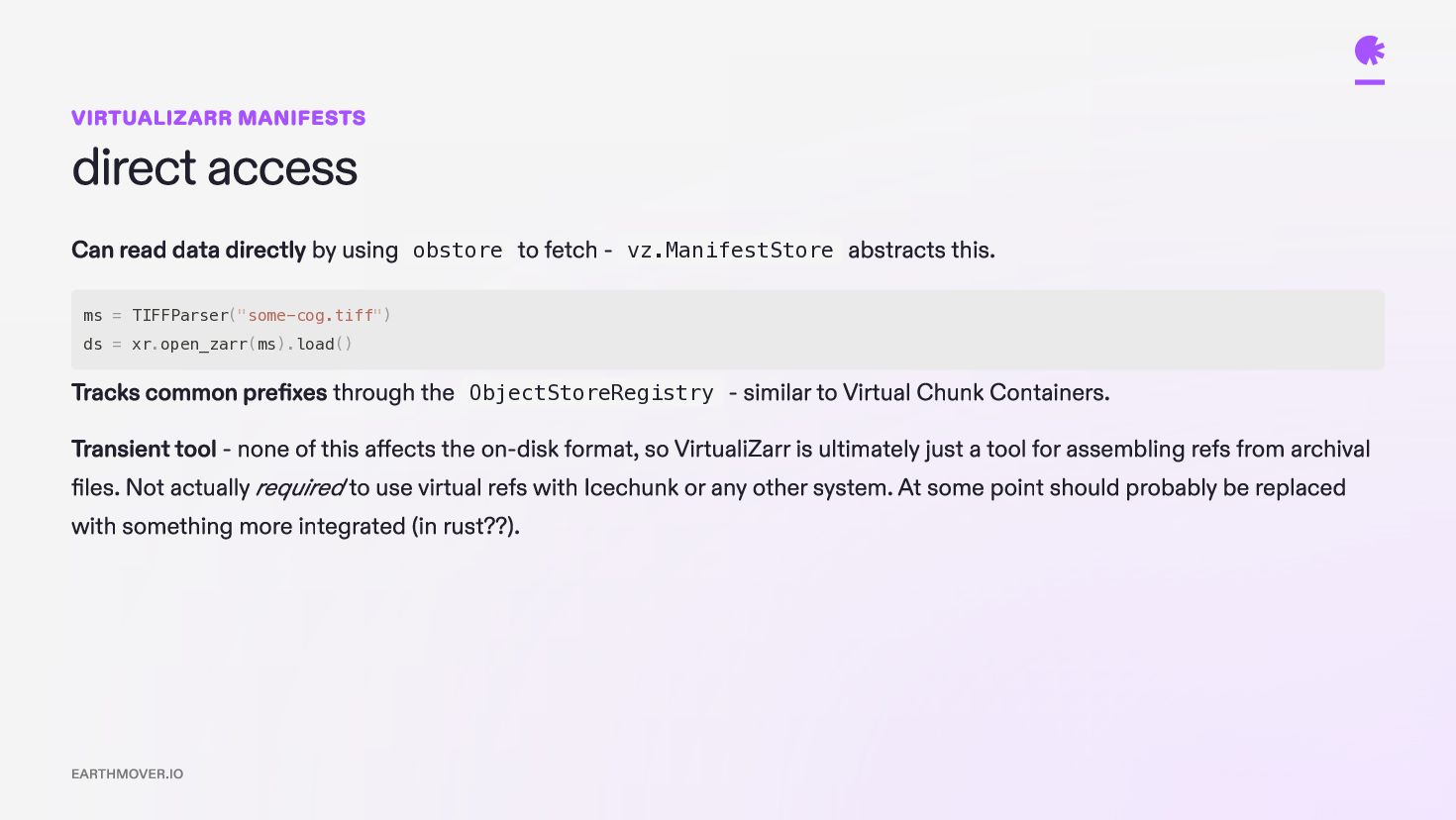
obstore to fetch - vz.ManifestStore abstracts this. Tracks common prefixes through the ObjectStoreRegistry - similar to Virtual Chunk Containers. Transient tool - none of this affects the on-disk format, so VirtualiZarr is ultimately just a tool for assembling refs from archival files. Not actually required to use virtual refs with Icechunk or any other system. At some point should probably be replaced with something more integrated (in rust??). ms = TIFFParser("some-cog.tiff") ds = xr.open_zarr(ms).load() EARTHMOVER.IO
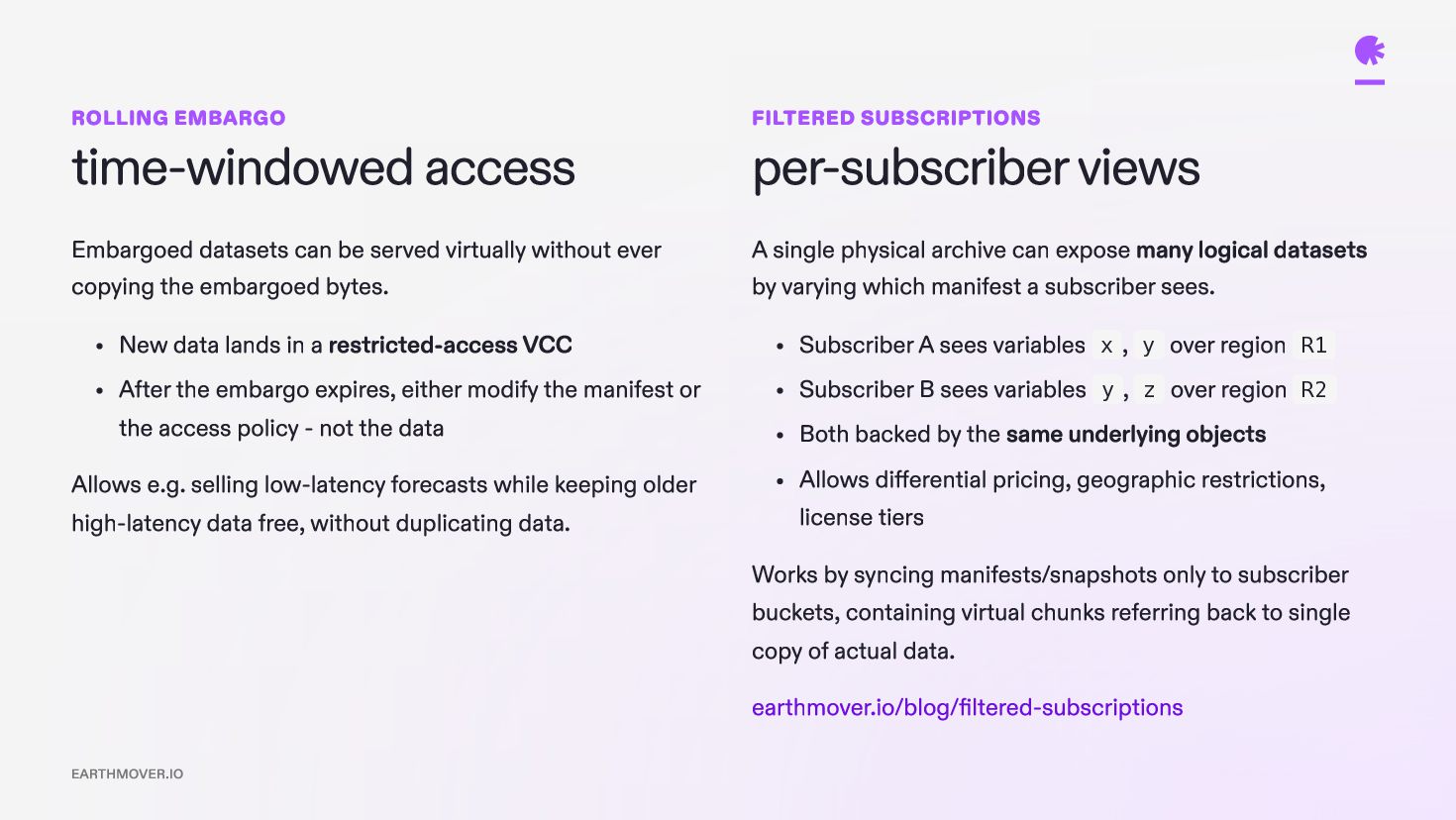
without ever copying the embargoed bytes. New data lands in a restricted-access VCC After the embargo expires, either modify the manifest or the access policy - not the data Allows e.g. selling low-latency forecasts while keeping older high-latency data free, without duplicating data. FILTERED SUBSCRIPTIONS per-subscriber views A single physical archive can expose many logical datasets by varying which manifest a subscriber sees. Subscriber A sees variables x , y over region R1 Subscriber B sees variables y , z over region R2 Both backed by the same underlying objects Allows differential pricing, geographic restrictions, license tiers Works by syncing manifests/snapshots only to subscriber buckets, containing virtual chunks referring back to single copy of actual data. earthmover.io/blog/filtered-subscriptions EARTHMOVER.IO
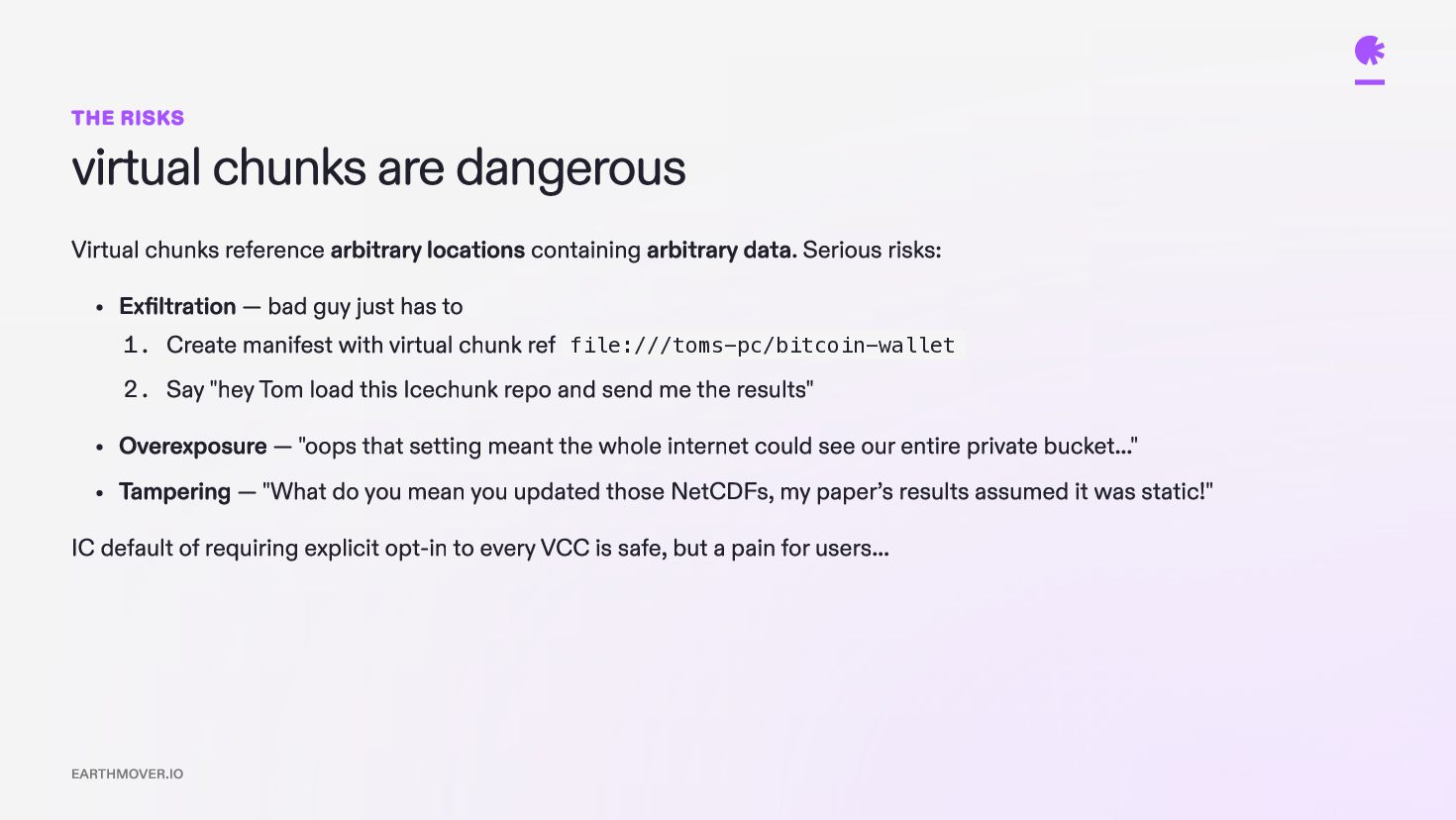
locations containing arbitrary data. Serious risks: Exfiltration — bad guy just has to 1. Create manifest with virtual chunk ref file:///toms-pc/bitcoin-wallet 2. Say "hey Tom load this Icechunk repo and send me the results" Overexposure — "oops that setting meant the whole internet could see our entire private bucket…" Tampering — "What do you mean you updated those NetCDFs, my paper’s results assumed it was static!" IC default of requiring explicit opt-in to every VCC is safe, but a pain for users… EARTHMOVER.IO
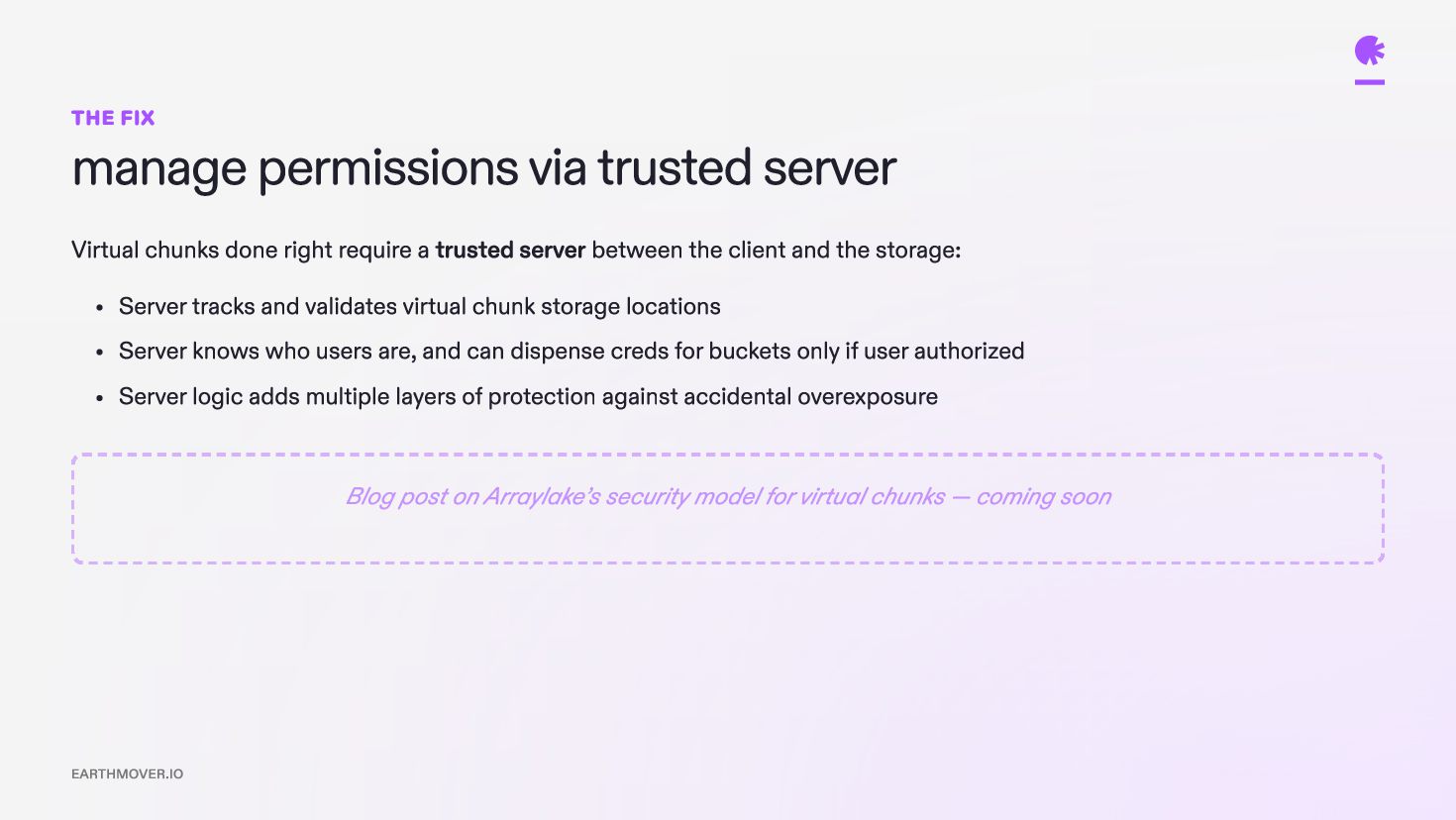
right require a trusted server between the client and the storage: Server tracks and validates virtual chunk storage locations Server knows who users are, and can dispense creds for buckets only if user authorized Server logic adds multiple layers of protection against accidental overexposure Blog post on Arraylake’s security model for virtual chunks — coming soon EARTHMOVER.IO
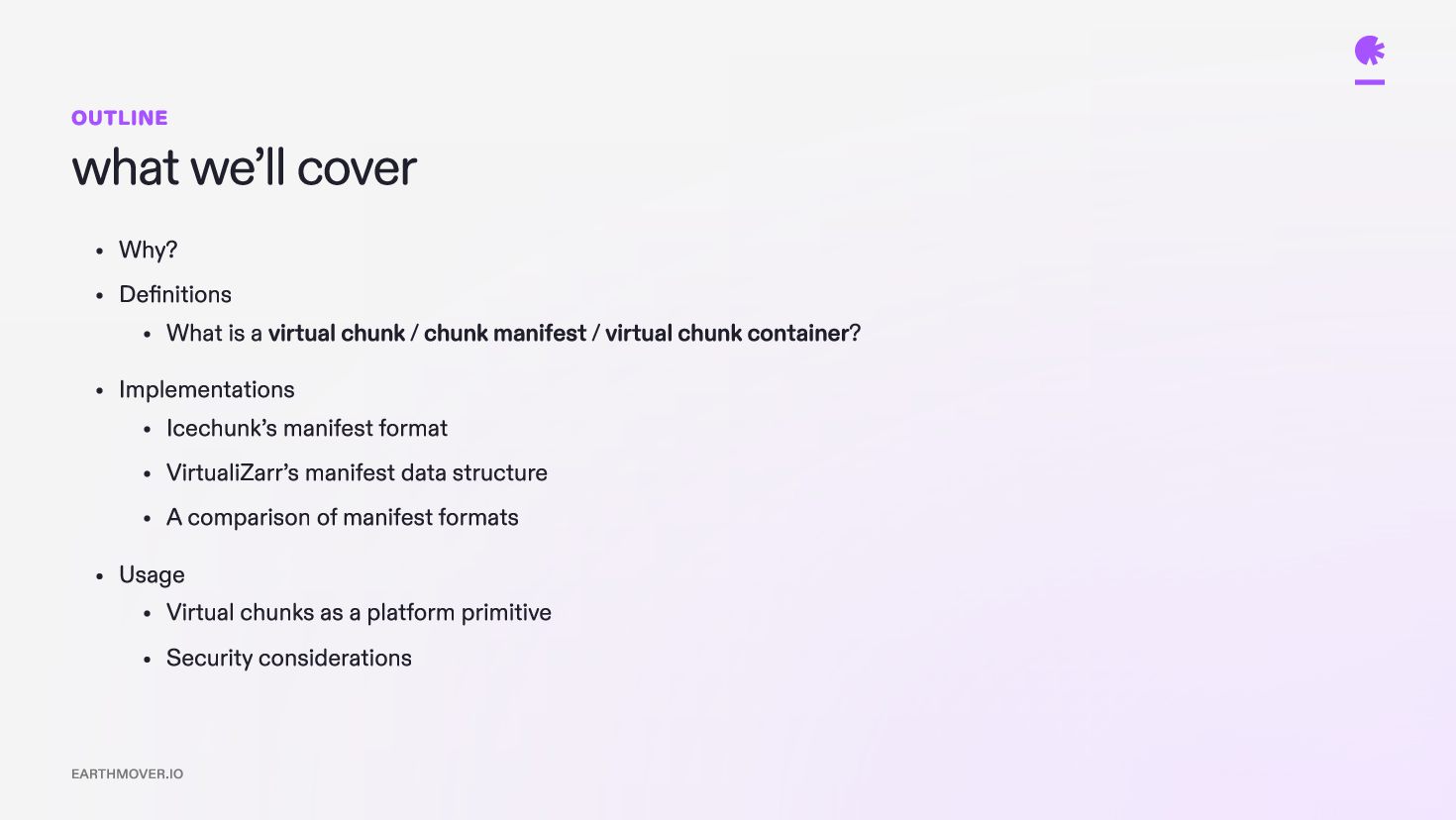
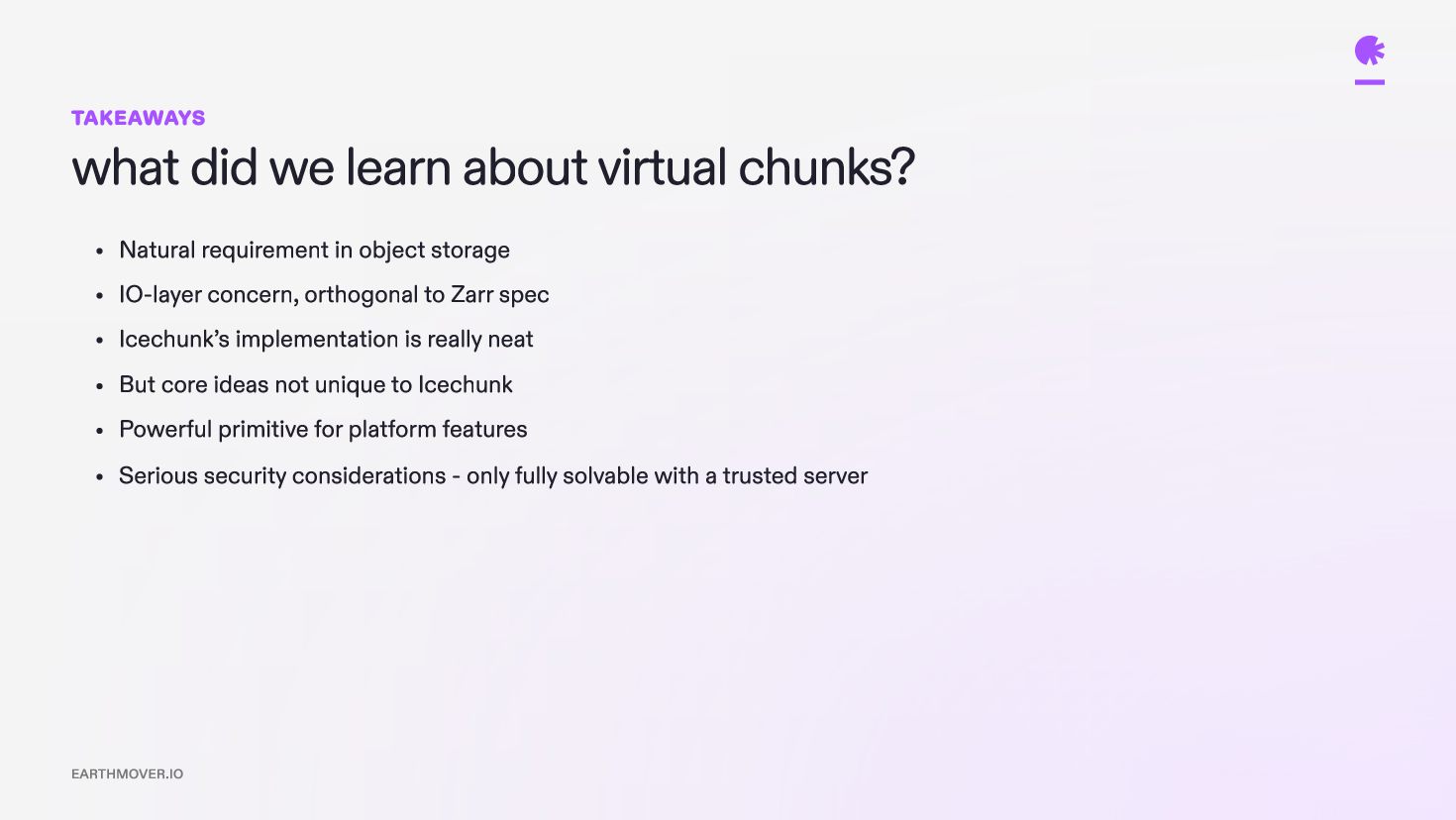
in object storage IO-layer concern, orthogonal to Zarr spec Icechunk’s implementation is really neat But core ideas not unique to Icechunk Powerful primitive for platform features Serious security considerations - only fully solvable with a trusted server EARTHMOVER.IO


 tomnicholas
 ichirokano2
 satoshi256kbyte
 morizo_1984
 skydoves
 syumai
 kishida
 monolithic_adam
 dske104
 econanringo
 texmeijin
 kinopeee
 bryan
bryan
 axbom
axbom
 varn
varn
 aleyda
 jct
jct
 nmsamuel
 mza
mza
 uxyall
 wjessup
 sergeychernyshev
 nikkihalliwell