Upgrade to Pro — share decks privately, control downloads, hide ads and more …

Position Fair Mechanisms Allocating Indivisible...

Position Fair Mechanisms Allocating Indivisible Goods (AAAI 2026)

Slides for our talk at AAAI 2026 on position fair mechanisms for allocating indivisible goods.

Authors: R. Mahara, R. Mizutani, T. Oki, and T. Yokoyama
Venue: The 40th AAAI Conference on Artificial Intelligence (AAAI 2026)
Oral presentation (top 5%)

Paper: https://dl.acm.org/doi/10.1609/aaai.v40i20.38763
Preprint: https://arxiv.org/abs/2409.06423

Avatar for Tomohiko Yokoyama

Tomohiko Yokoyama

February 01, 2026

More Decks by Tomohiko Yokoyama

Other Decks in Research

Transcript

  1. Position Fair Mechanisms Allocating Indivisible Goods AAAI 2026 at Singapore.

    24 Jan. Ryoga Mahara (The University of Tokyo) Ryuhei Mizutani (Keio University) Taihei Oki (Hokkaido University) Tomohiko Yokoyama (The University of Tokyo)
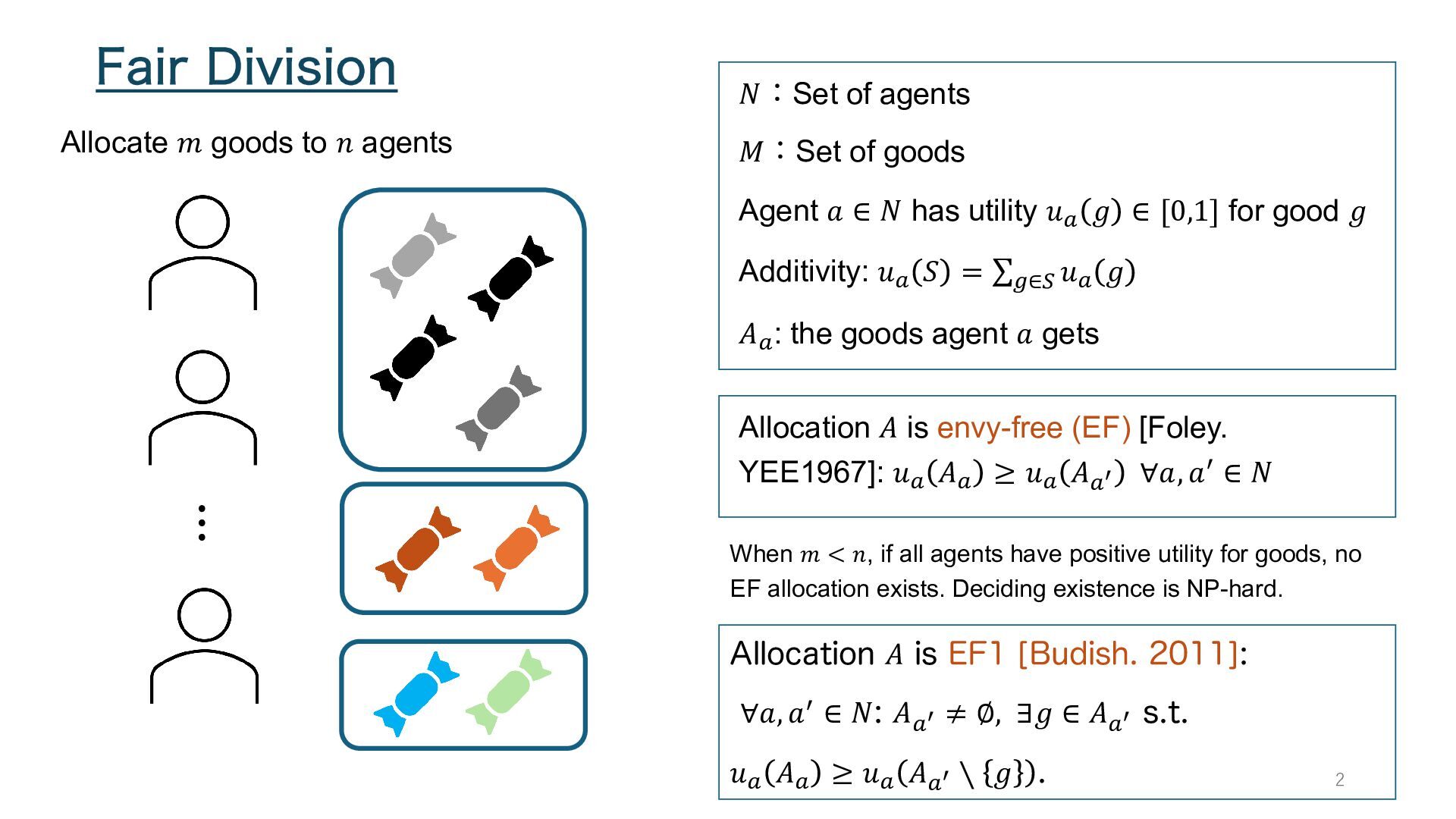
  2. Fair Division Allocate 𝑚 goods to 𝑛 agents 𝑁:Set of

    agents 𝑀:Set of goods Agent 𝑎 ∈ 𝑁 has utility 𝑢! 𝑔 ∈ [0,1] for good 𝑔 Additivity: 𝑢! 𝑆 = ∑"∈$ 𝑢! 𝑔 𝐴! : the goods agent 𝑎 gets ⋮ Allocation 𝐴 is envy-free (EF) [Foley. YEE1967]: 𝑢! 𝐴! ≥ 𝑢! 𝐴!! ∀𝑎, 𝑎% ∈ 𝑁 When 𝑚 < 𝑛, if all agents have positive utility for goods, no EF allocation exists. Deciding existence is NP-hard. Allocation 𝐴 is EF1 [Budish. 2011]: ∀𝑎, 𝑎% ∈ 𝑁: 𝐴!! ≠ ∅, ∃𝑔 ∈ 𝐴!! s.t. 𝑢! 𝐴! ≥ 𝑢! 𝐴!! ∖ 𝑔 . 2
  3. Round-Robin [Caragiannis, Kurokawa, Moulin, Procaccia, Shah and Wang. TEAC2019] Round-Robin

    satisfies EF1. Agents take turns picking their most preferred item from the remaining goods, in a fixed cyclic order (1 → 2 → ... → 𝑛 → 1 → 2 → ... → 𝑛 → 1 …) Agent Good 1 Good 2 Good 3 Alice 10 7 3 Bob 8 4 6 Carol 5 9 2 3
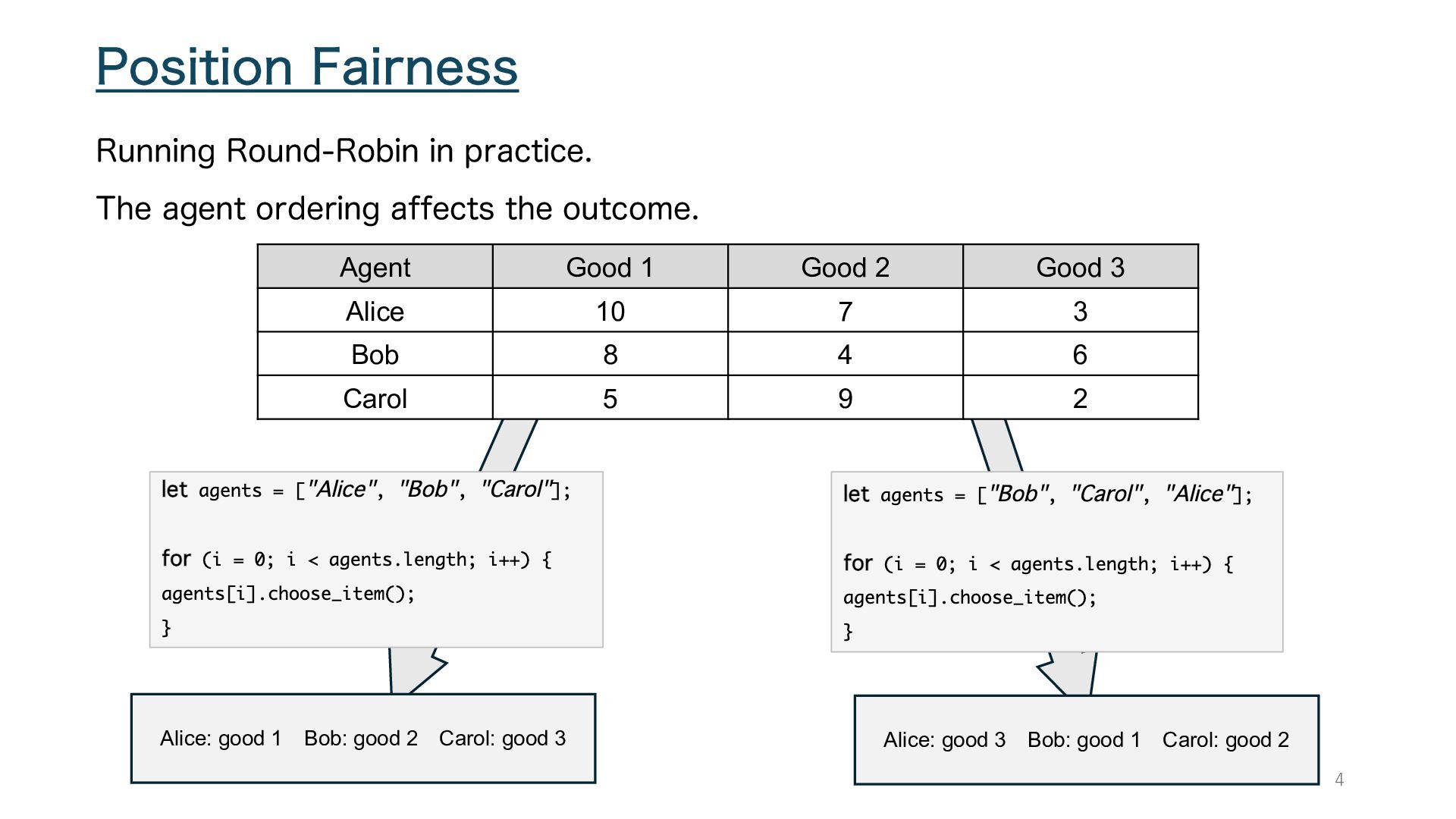
  4. Position Fairness Running Round-Robin in practice. The agent ordering affects

    the outcome. Agent Good 1 Good 2 Good 3 Alice 10 7 3 Bob 8 4 6 Carol 5 9 2 Alice: good 1 Bob: good 2 Carol: good 3 Alice: good 3 Bob: good 1 Carol: good 2 4
  5. Position Envy-Free Mechanism 𝑈: all profiles 𝜋: 𝑁 → [𝑛]:

    position mapping Π: all agent orderings Profile 𝑢 ∈ 𝑈 Good 1 Good 2 Good 3 1 10 7 3 2 8 4 6 3 5 9 2 Ordered Profile 𝑢& ∈ 𝑈 Good 1 Good 2 Good 3 Alice 10 7 3 Bob 8 4 6 Carol 5 9 2 𝜋% ∈ Π 𝜋∈Π Position Agent Ordered Profile 𝑢& ! ∈ 𝑈 Position Good 1 Good 2 Good 3 3 10 7 3 1 8 4 6 2 5 9 2 Mechanism ℳ outputs allocation ℳ(𝑢& ). [Def.] ([Manabe and Okamoto. JIP2012]) A mechanism ℳ satisfies position envy-free (PEF): ∀𝑢 ∈ 𝑈, ∀𝜋, 𝜋 % ∈ Π, ∀𝑎 ∈ 𝑁, 𝑢! ℳ 𝑢& &(!) ≥ 𝑢! ℳ 𝑢&! &! ! . For divisible goods, a PEF mechanism always exists: each agent can receive 1/𝑛 of each good, obtaining identical utilities. 5
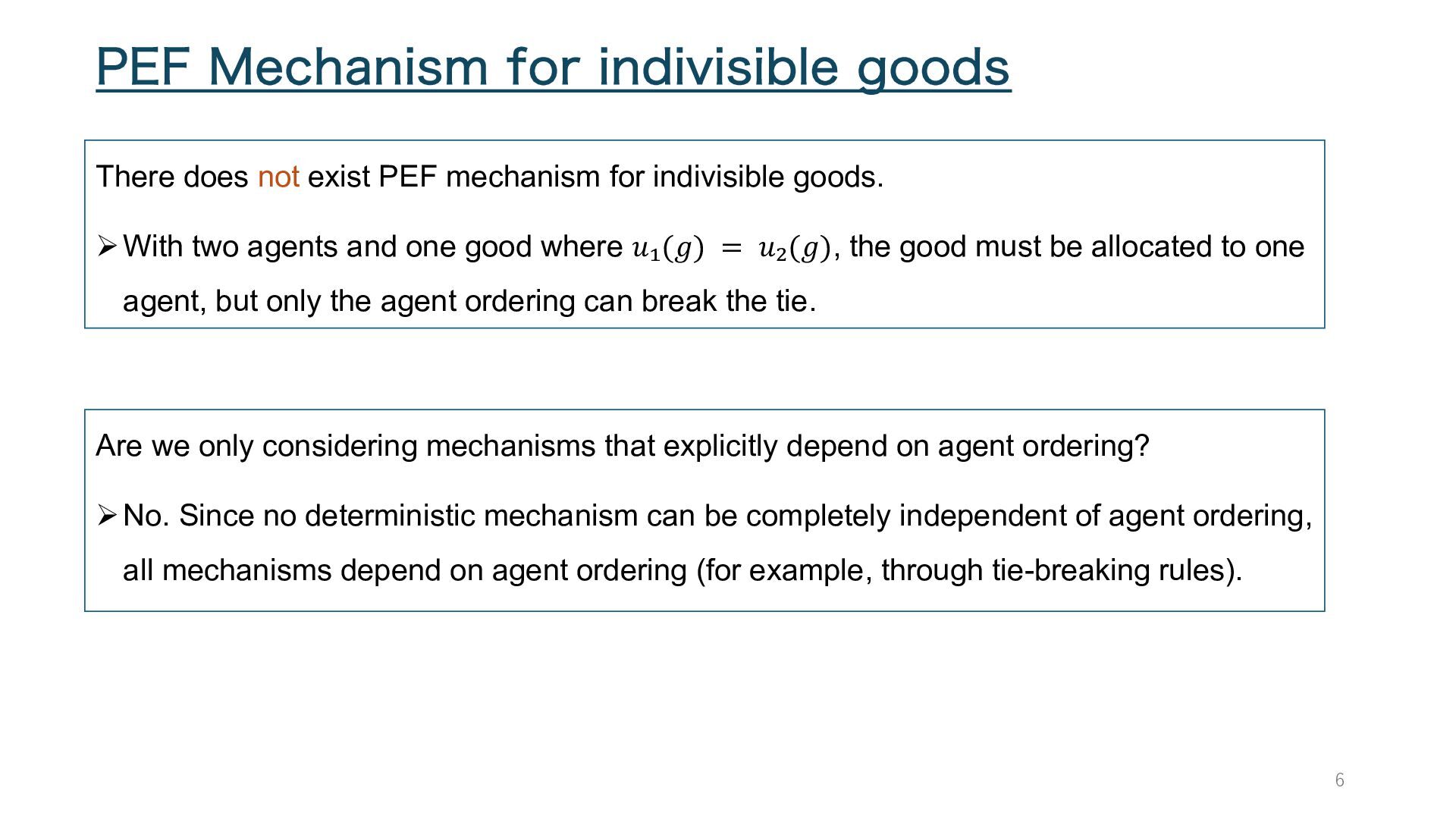
  6. PEF Mechanism for indivisible goods There does not exist PEF

    mechanism for indivisible goods. Ø With two agents and one good where 𝑢₁(𝑔) = 𝑢₂(𝑔), the good must be allocated to one agent, but only the agent ordering can break the tie. Are we only considering mechanisms that explicitly depend on agent ordering? Ø No. Since no deterministic mechanism can be completely independent of agent ordering, all mechanisms depend on agent ordering (for example, through tie-breaking rules). 6
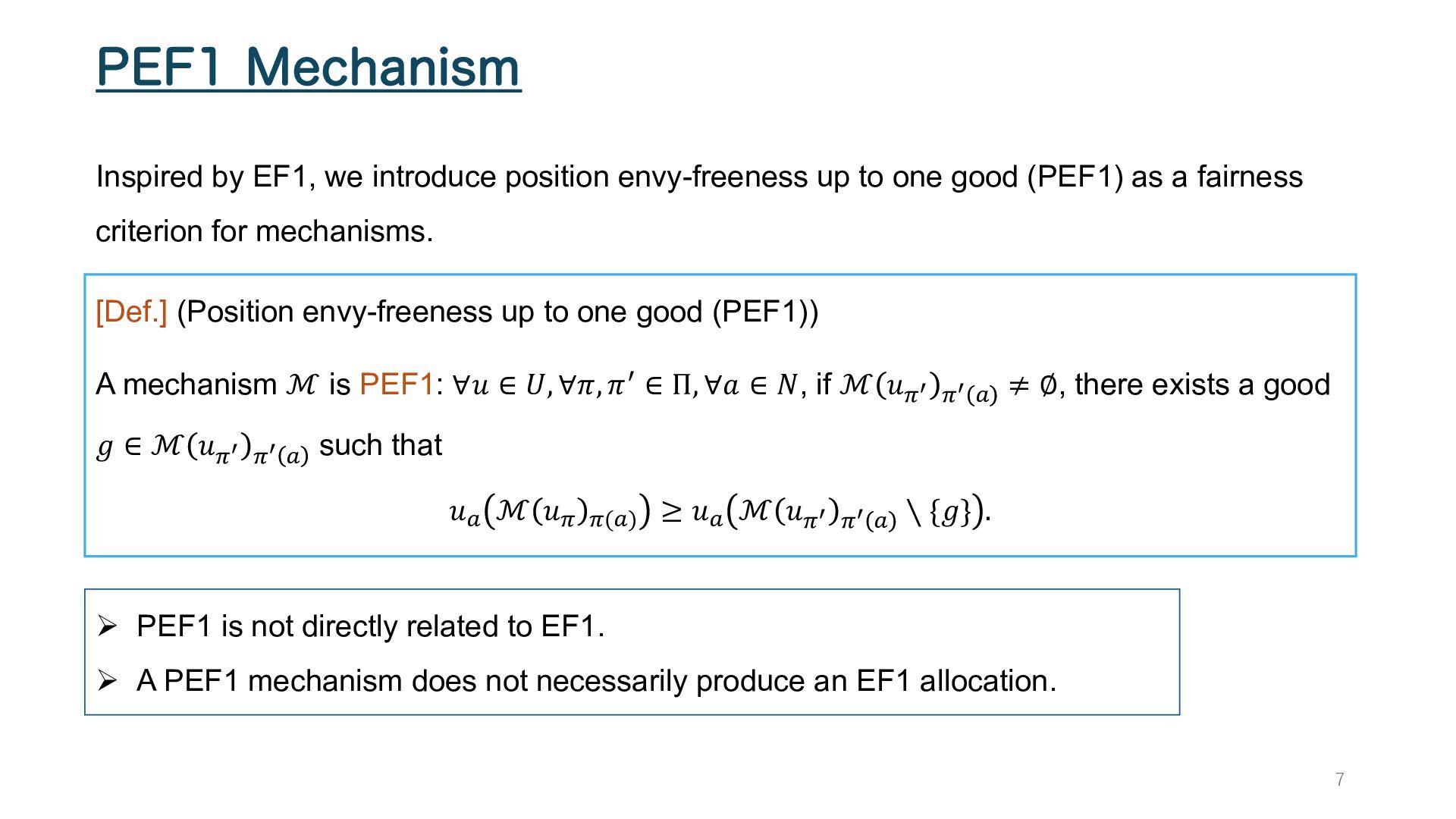
  7. PEF1 Mechanism Inspired by EF1, we introduce position envy-freeness up

    to one good (PEF1) as a fairness criterion for mechanisms. [Def.] (Position envy-freeness up to one good (PEF1)) A mechanism ℳ is PEF1: ∀𝑢 ∈ 𝑈, ∀𝜋, 𝜋 % ∈ Π, ∀𝑎 ∈ 𝑁, if ℳ 𝑢&! &! ! ≠ ∅, there exists a good 𝑔 ∈ ℳ 𝑢&! &! ! such that 𝑢! ℳ 𝑢& &(!) ≥ 𝑢! ℳ 𝑢&! &! ! ∖ {𝑔} . Ø PEF1 is not directly related to EF1. Ø A PEF1 mechanism does not necessarily produce an EF1 allocation. 7
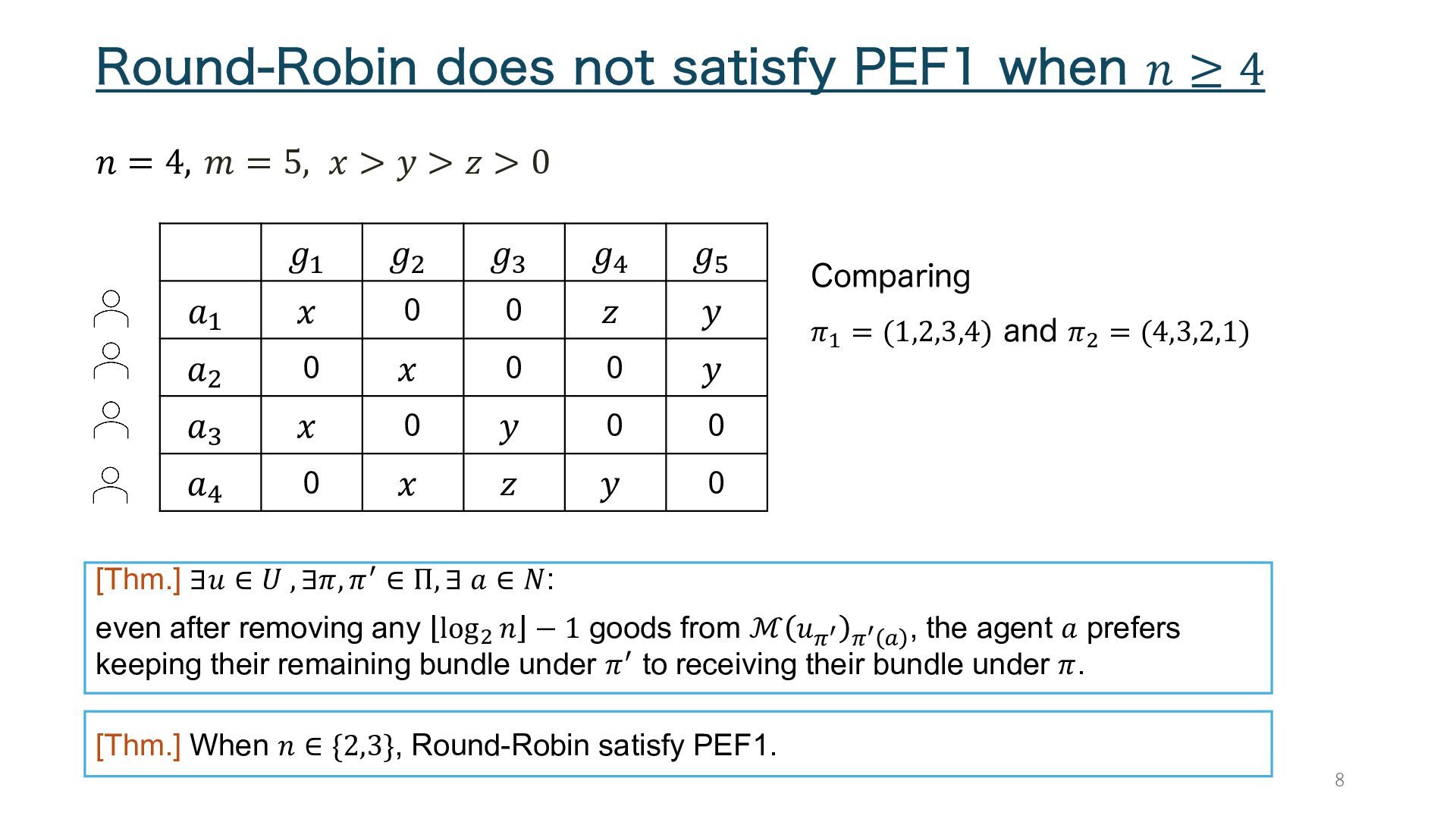
  8. Round-Robin does not satisfy PEF1 when 𝑛 ≥ 4 𝑛

    = 4, 𝑚 = 5, 𝑥 > 𝑦 > 𝑧 > 0 𝑔! 𝑔" 𝑔# 𝑔$ 𝑔% 𝑎! 𝑥 0 0 𝑧 𝑦 𝑎" 0 𝑥 0 0 𝑦 𝑎# 𝑥 0 𝑦 0 0 𝑎$ 0 𝑥 𝑧 𝑦 0 Comparing 𝜋) = (1,2,3,4) and 𝜋* = (4,3,2,1) [Thm.] ∃𝑢 ∈ 𝑈 , ∃𝜋, 𝜋 % ∈ Π, ∃ 𝑎 ∈ 𝑁: even after removing any log * 𝑛 − 1 goods from ℳ 𝑢&! &! ! , the agent 𝑎 prefers keeping their remaining bundle under 𝜋 % to receiving their bundle under 𝜋. [Thm.] When 𝑛 ∈ {2,3}, Round-Robin satisfy PEF1. 8
  9. Result 1: EF1 + PEF1 mechanism [Thm.] There exists a

    PEF1 mechanism that always produces an EF1 allocation in polynomial time. An algorithm that computes a maximum-weight matching in each round. we incorporate index-based tie-breaking rules into the weights 𝑁 Steps • Each round 𝑟: Compute max-weight matching 𝜇+& with respect to 𝑤 between agents and remaining goods • Allocate goods: Each agent 𝑎 gets good 𝜇&+ (𝑎). 𝑎 𝑀 𝜇&+ (𝑎) 9
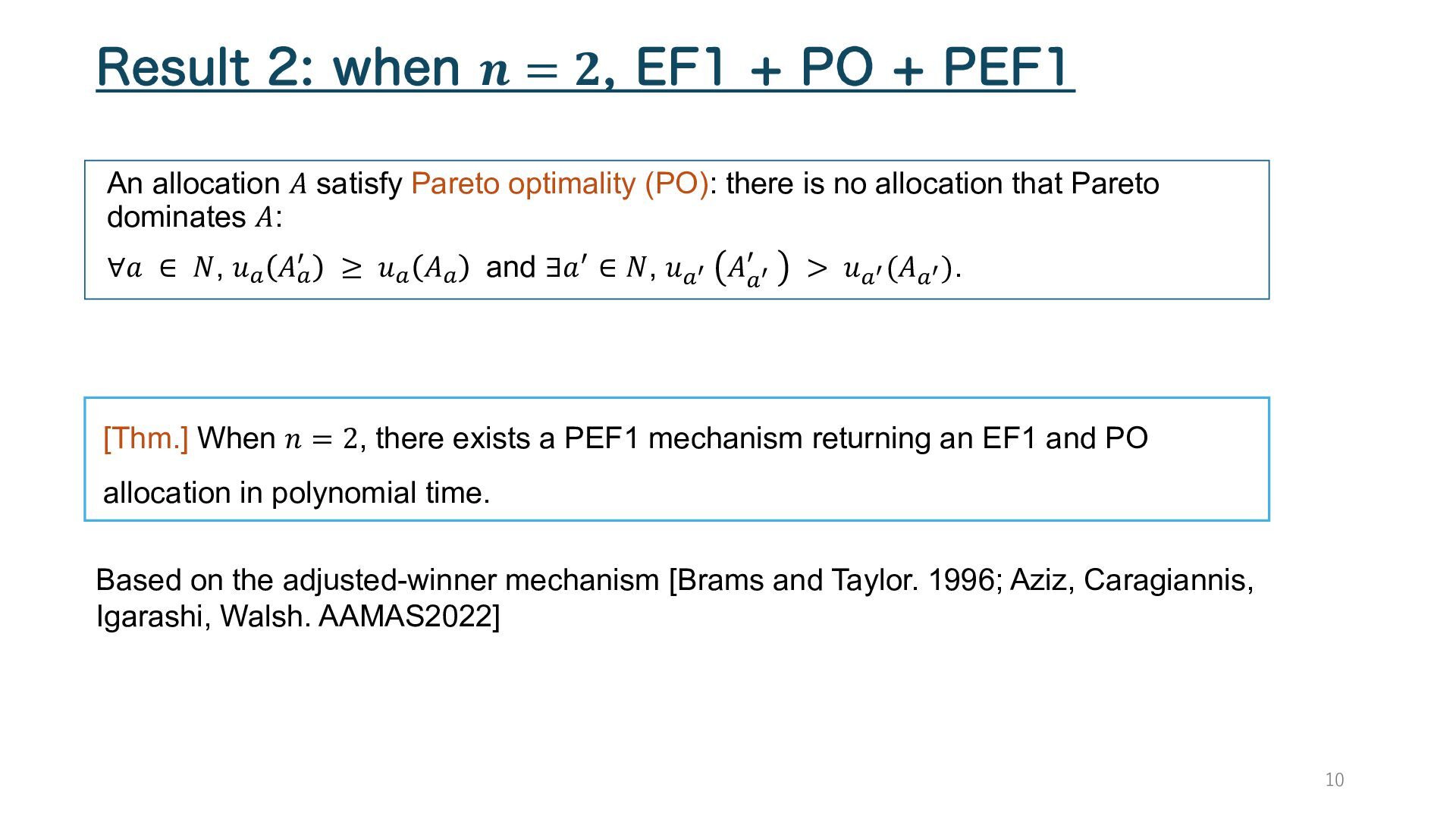
  10. Result 2: when 𝒏 = 𝟐, EF1 + PO +

    PEF1 An allocation 𝐴 satisfy Pareto optimality (PO): there is no allocation that Pareto dominates 𝐴: ∀𝑎 ∈ 𝑁, 𝑢! 𝐴%! ≥ 𝑢! 𝐴! and ∃𝑎% ∈ 𝑁, 𝑢!! 𝐴%!! > 𝑢!! (𝐴!! ). [Thm.] When 𝑛 = 2, there exists a PEF1 mechanism returning an EF1 and PO allocation in polynomial time. Based on the adjusted-winner mechanism [Brams and Taylor. 1996; Aziz, Caragiannis, Igarashi, Walsh. AAMAS2022] 10
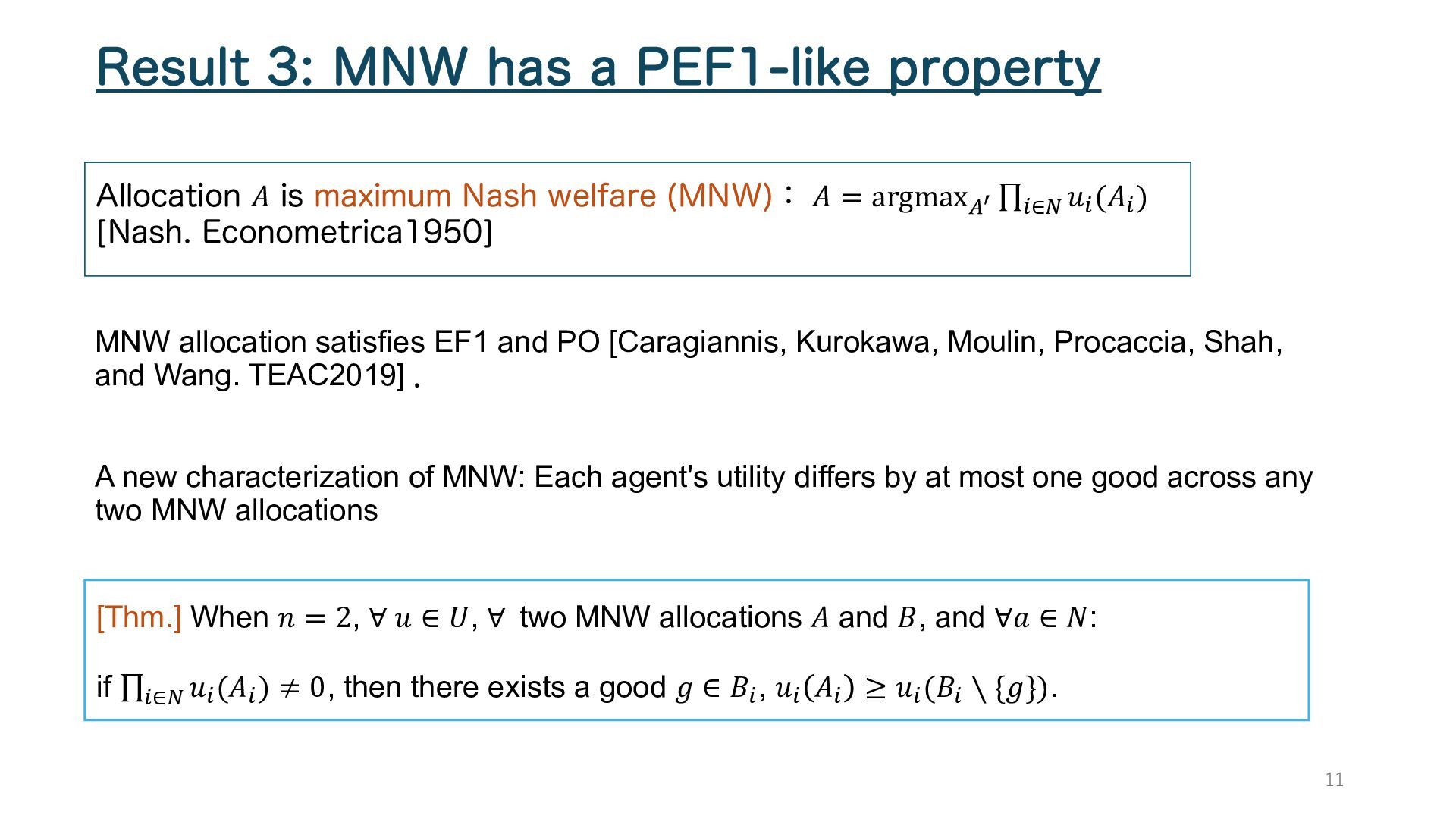
  11. Result 3: MNW has a PEF1-like property Allocation 𝐴 is

    maximum Nash welfare (MNW): 𝐴 = argmax.! ∏,∈- 𝑢, (𝐴, ) [Nash. Econometrica1950] MNW allocation satisfies EF1 and PO [Caragiannis, Kurokawa, Moulin, Procaccia, Shah, and Wang. TEAC2019] . A new characterization of MNW: Each agent's utility differs by at most one good across any two MNW allocations [Thm.] When 𝑛 = 2, ∀ 𝑢 ∈ 𝑈, ∀ two MNW allocations 𝐴 and 𝐵, and ∀𝑎 ∈ 𝑁: if ∏,∈- 𝑢, (𝐴, ) ≠ 0, then there exists a good 𝑔 ∈ 𝐵, , 𝑢, 𝐴, ≥ 𝑢, (𝐵, ∖ {𝑔}). 11
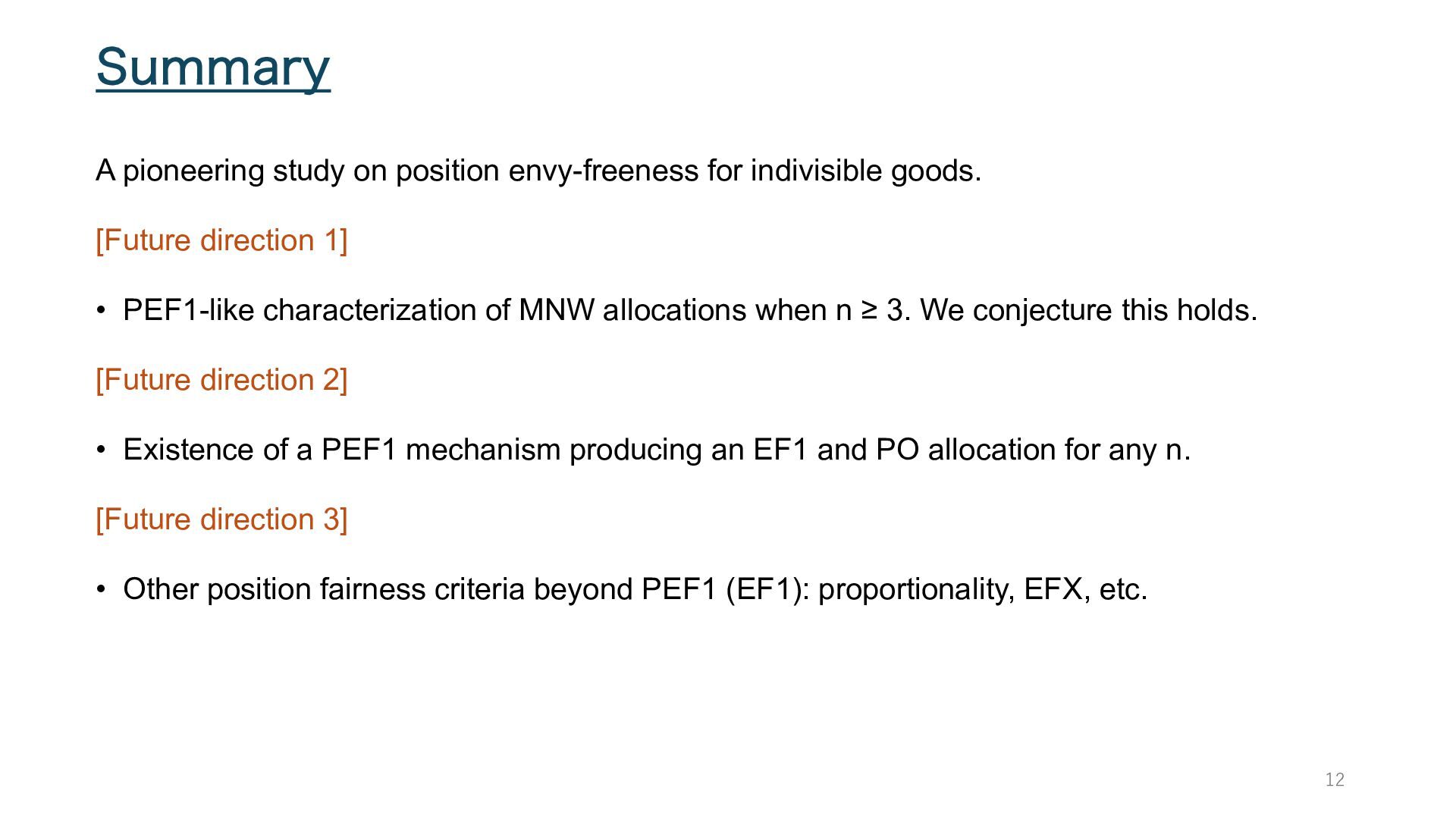
  12. Summary A pioneering study on position envy-freeness for indivisible goods.

    [Future direction 1] • PEF1-like characterization of MNW allocations when n ≥ 3. We conjecture this holds. [Future direction 2] • Existence of a PEF1 mechanism producing an EF1 and PO allocation for any n. [Future direction 3] • Other position fairness criteria beyond PEF1 (EF1): proportionality, EFX, etc. 12
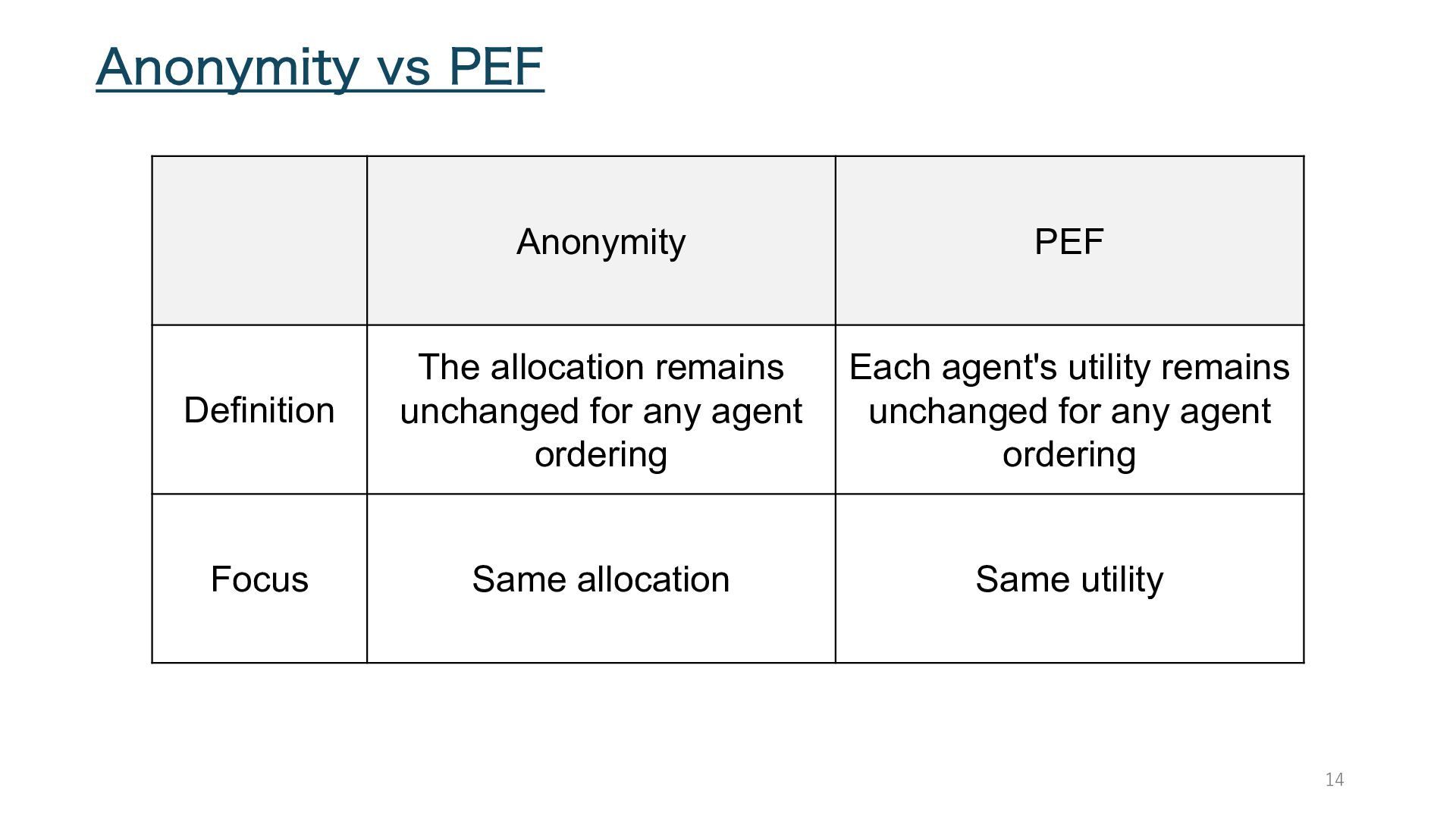
  13. Anonymity vs PEF Anonymity PEF Definition The allocation remains unchanged

    for any agent ordering Each agent's utility remains unchanged for any agent ordering Focus Same allocation Same utility 14