Upgrade to Pro — share decks privately, control downloads, hide ads and more …

The Loyalty Paradox: Consumer Sentiment on Memb...

The Loyalty Paradox: Consumer Sentiment on Membership Fee Increases and Program Improvements

Explores how framing affects consumer reactions to loyalty program fee hikes, revealing a paradox where benefits-first messaging can backfire, and highlights key factors influencing perceived value and member retention.

• The data: The survey data powering this presentation is real — 300 U.S. adults, fielded via Pollfish in February 2026, with proper attention checks and weighted responses. The sample, methodology, and statistical rigor are all genuine.

• The reframe: The original survey was conducted on a different topic. The data has been mapped to the loyalty program context presented here — with the underlying consumer sentiment patterns, percentages, and behavioral signals preserved intact. A disclaimer like this one is included to ensure full transparency.

• The collaboration: This presentation was a human-AI collaboration. Claude (Anthropic) was used to brainstorm the topic reframe, perform the data analysis and mapping, design the narrative arc, write the slide content, and build the final deck in code. The strategic framing, quality review, and real-world context were provided by Uyi Uwadiae — Kellogg MBA, and CPG/eCommerce growth strategist.

• Why share this: Beyond the loyalty insights themselves, this project is a demonstration of what's possible when domain expertise meets AI execution. The goal is to show that high-quality research presentation — typically a week of work — can be compressed into hours without sacrificing analytical depth.

Created by Uyi Uwadiae | Powered by Claude (Anthropic) | Data: Pollfish, February 2026 | For educational and demonstration purposes

Avatar for Uyi Uwadiae

Uyi Uwadiae

October 19, 2026

Other Decks in Business

Transcript

  1. What Consumers Really Think About Membership Programs THE LOYALTY PARADOX

    Consumer Sentiment Research • February 2026 Uyi Uwadiae When a brand quietly improves its loyalty program but raises the annual fee, does the upgrade justify the cost? I asked 300 U.S. consumers, tested two different information framings, and the results reveal a surprising loyalty paradox. 300 2 10 2026 U.S. Consumers Survey Framings Questions Fielded LinkedIn Powered by Pollfish • Analyzed with Claude AI • By Uyi Uwadiae
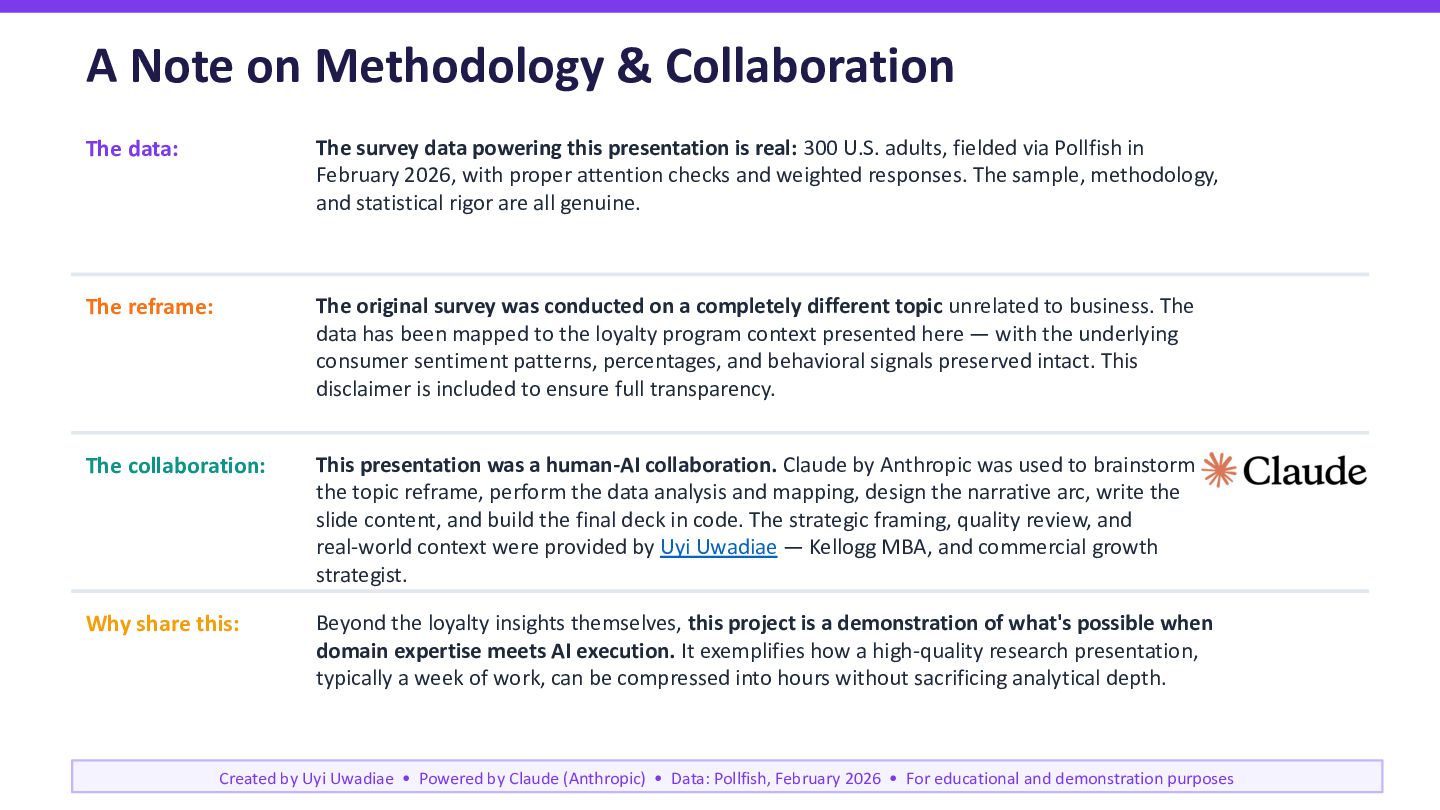
  2. A Note on Methodology & Collaboration The data: The survey

    data powering this presentation is real: 300 U.S. adults, fielded via Pollfish in February 2026, with proper attention checks and weighted responses. The sample, methodology, and statistical rigor are all genuine. The reframe: The original survey was conducted on a completely different topic unrelated to business. The data has been mapped to the loyalty program context presented here — with the underlying consumer sentiment patterns, percentages, and behavioral signals preserved intact. This disclaimer is included to ensure full transparency. The collaboration: This presentation was a human-AI collaboration. Claude by Anthropic was used to brainstorm the topic reframe, perform the data analysis and mapping, design the narrative arc, write the slide content, and build the final deck in code. The strategic framing, quality review, and real-world context were provided by Uyi Uwadiae — Kellogg MBA, and commercial growth strategist. Why share this: Beyond the loyalty insights themselves, this project is a demonstration of what's possible when domain expertise meets AI execution. It exemplifies how a high-quality research presentation, typically a week of work, can be compressed into hours without sacrificing analytical depth. Created by Uyi Uwadiae • Powered by Claude (Anthropic) • Data: Pollfish, February 2026 • For educational and demonstration purposes
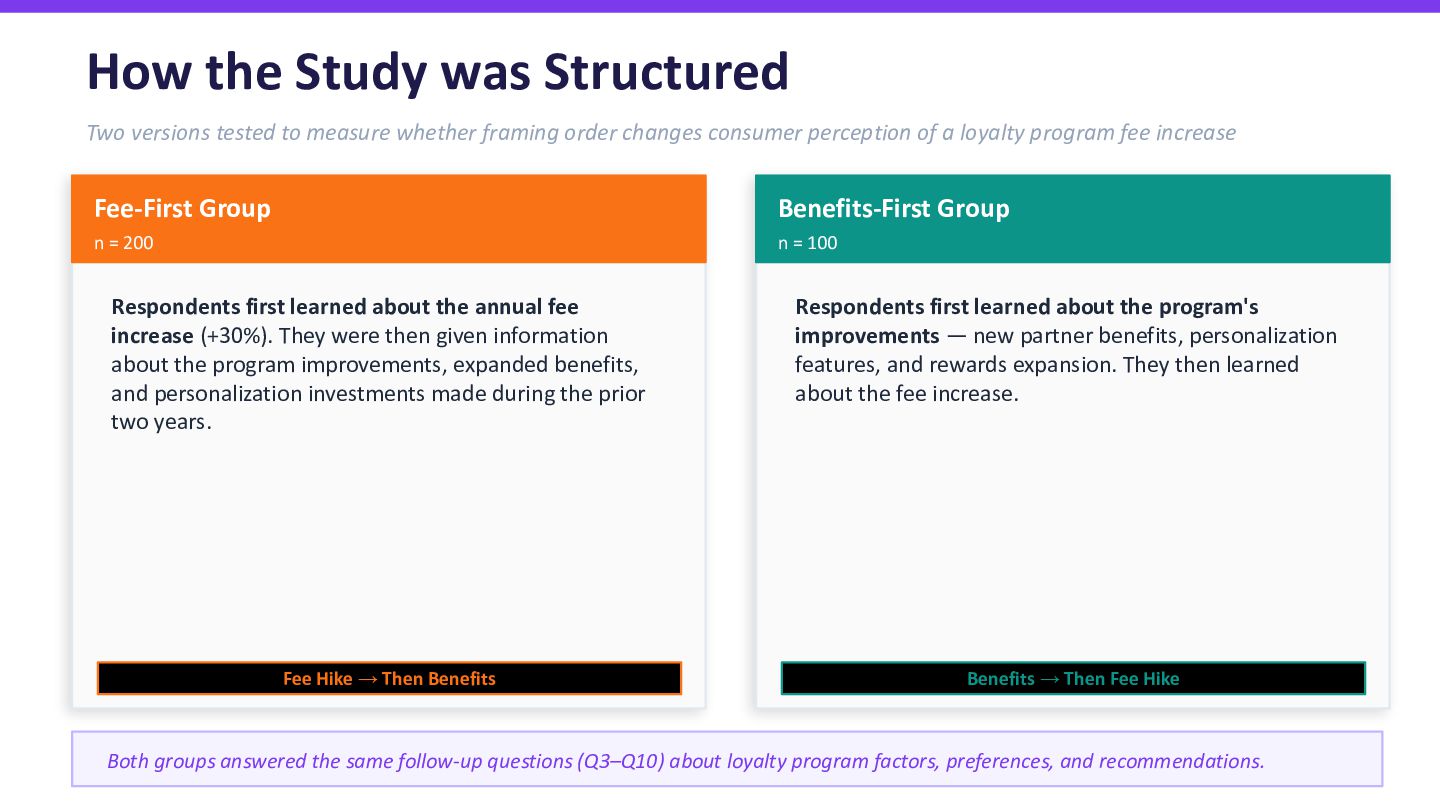
  3. How the Study was Structured Two versions tested to measure

    whether framing order changes consumer perception of a loyalty program fee increase Fee-First Group Benefits-First Group n = 200 n = 100 Respondents first learned about the annual fee increase (+30%). They were then given information about the program improvements, expanded benefits, and personalization investments made during the prior two years. Respondents first learned about the program's improvements — new partner benefits, personalization features, and rewards expansion. They then learned about the fee increase. Fee Hike → Then Benefits Benefits → Then Fee Hike Both groups answered the same follow-up questions (Q3–Q10) about loyalty program factors, preferences, and recommendations.
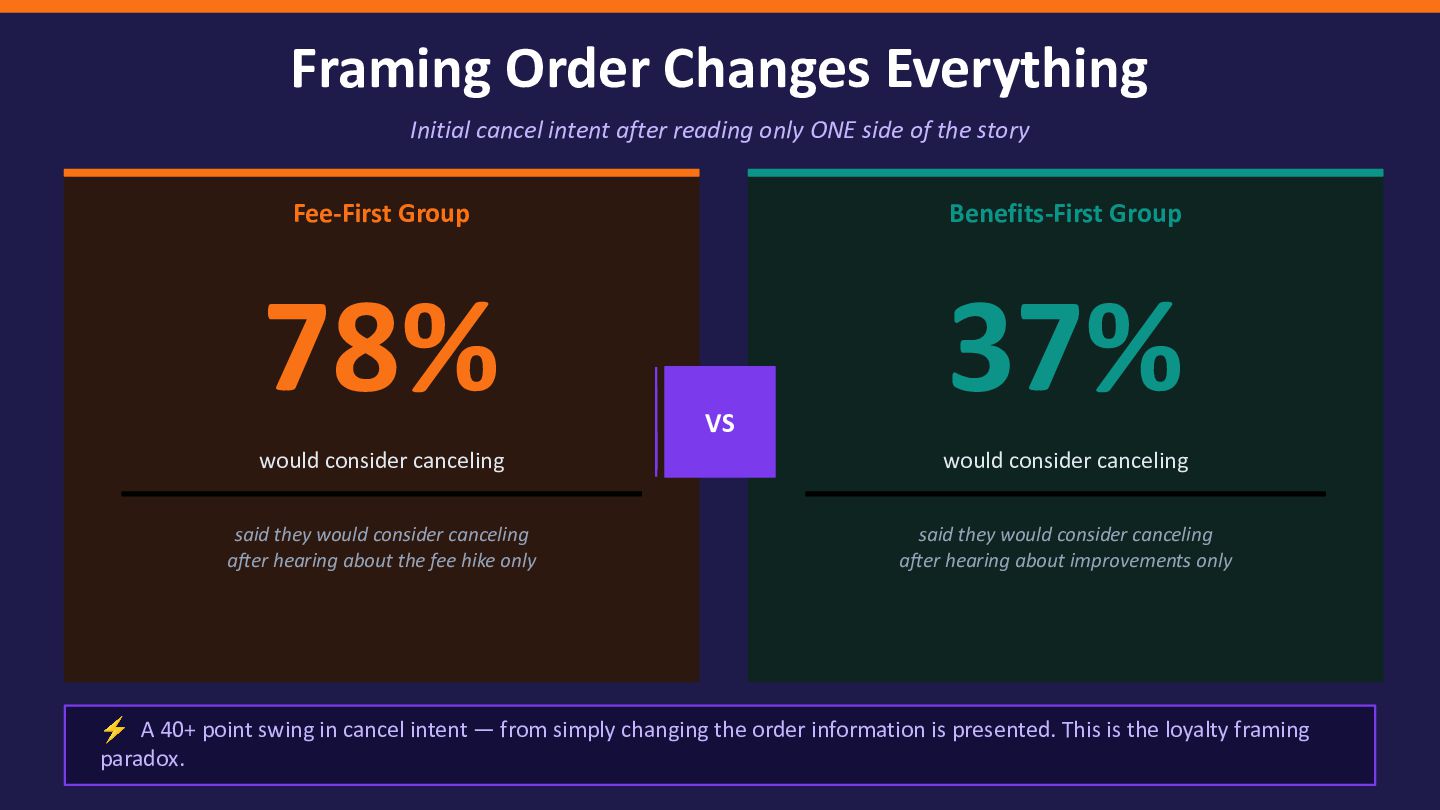
  4. Framing Order Changes Everything Initial cancel intent after reading only

    ONE side of the story Fee-First Group Benefits-First Group 78% 37% VS would consider canceling would consider canceling said they would consider canceling after hearing about the fee hike only said they would consider canceling after hearing about improvements only ⚡ A 40+ point swing in cancel intent — from simply changing the order information is presented. This is the loyalty framing paradox.
  5. While Opinions Converge, a Paradox Emerges Once both the fee

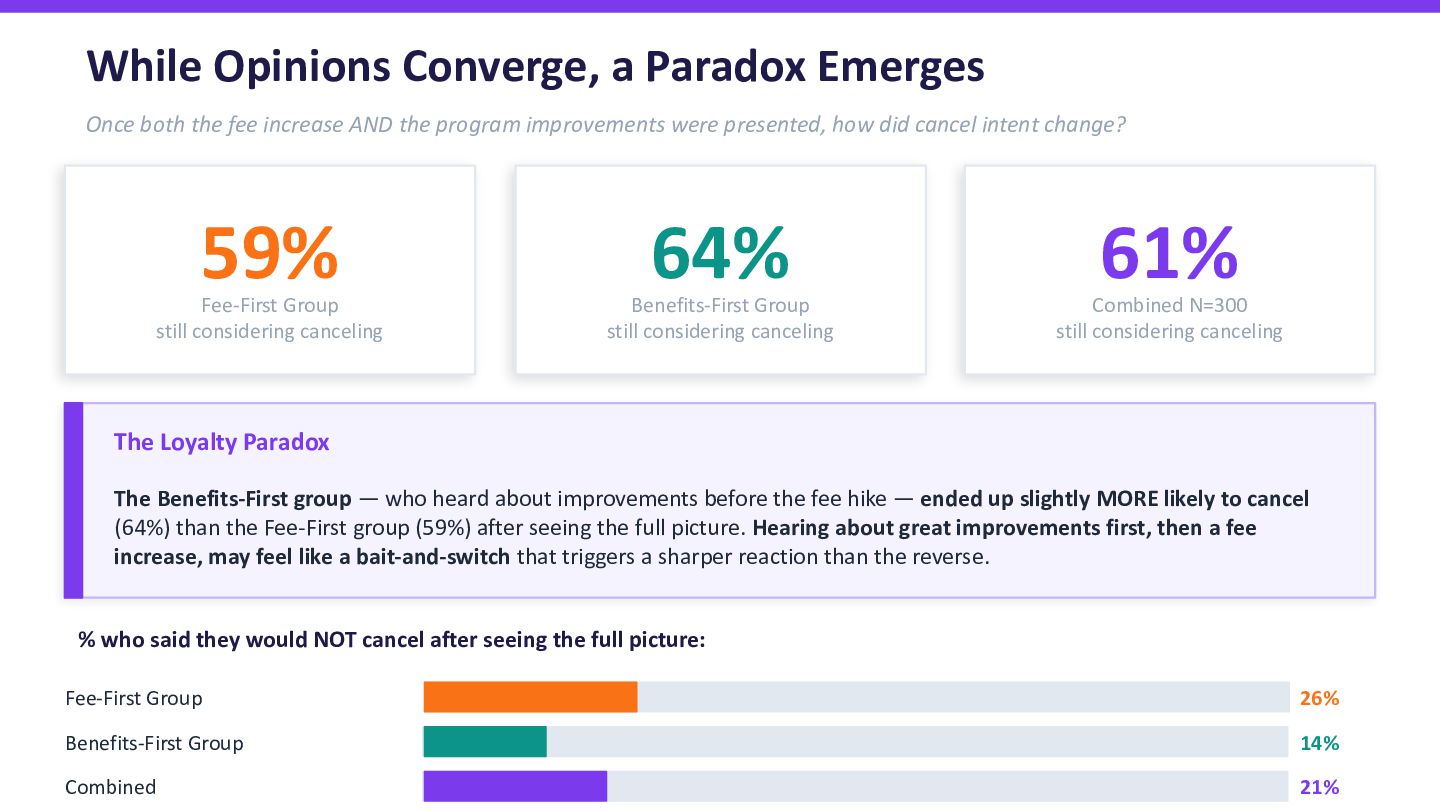
    increase AND the program improvements were presented, how did cancel intent change? 59% Fee-First Group still considering canceling 64% Benefits-First Group still considering canceling 61% Combined N=300 still considering canceling The Loyalty Paradox The Benefits-First group — who heard about improvements before the fee hike — ended up slightly MORE likely to cancel (64%) than the Fee-First group (59%) after seeing the full picture. Hearing about great improvements first, then a fee increase, may feel like a bait-and-switch that triggers a sharper reaction than the reverse. % who said they would NOT cancel after seeing the full picture: Fee-First Group 26% Benefits-First Group 14% Combined 21%
  6. What Factors Make a Fee Increase Feel Worth It? Respondents

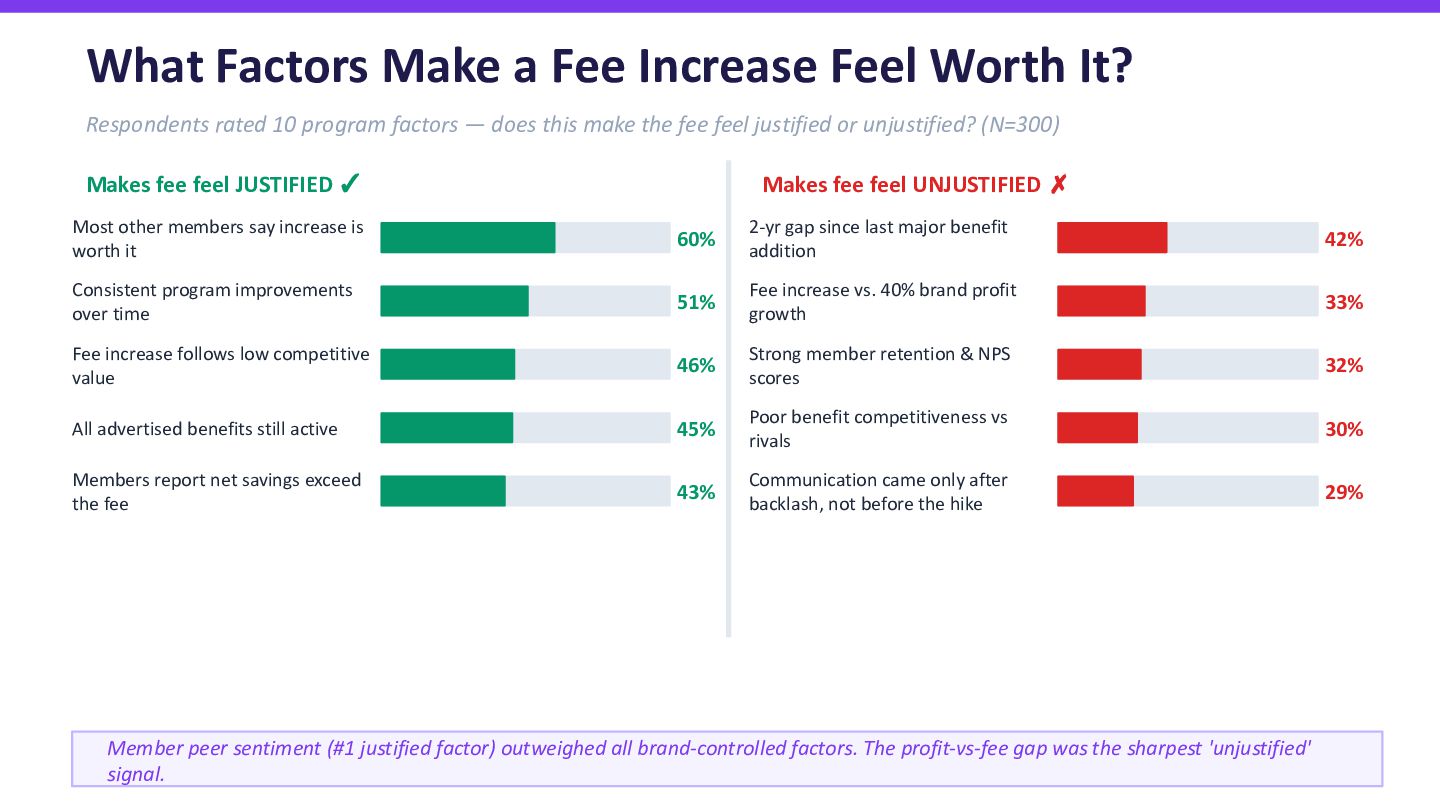
    rated 10 program factors — does this make the fee feel justified or unjustified? (N=300) Makes fee feel JUSTIFIED ✓ Makes fee feel UNJUSTIFIED ✗ Most other members say increase is worth it 60% 2-yr gap since last major benefit addition 42% Consistent program improvements over time 51% Fee increase vs. 40% brand profit growth 33% Fee increase follows low competitive value 46% Strong member retention & NPS scores 32% All advertised benefits still active 45% Poor benefit competitiveness vs rivals 30% Members report net savings exceed the fee 43% Communication came only after backlash, not before the hike 29% Member peer sentiment (#1 justified factor) outweighed all brand-controlled factors. The profit-vs-fee gap was the sharpest 'unjustified' signal.
  7. How Consumers Frame the Brand Relationship Select all that apply

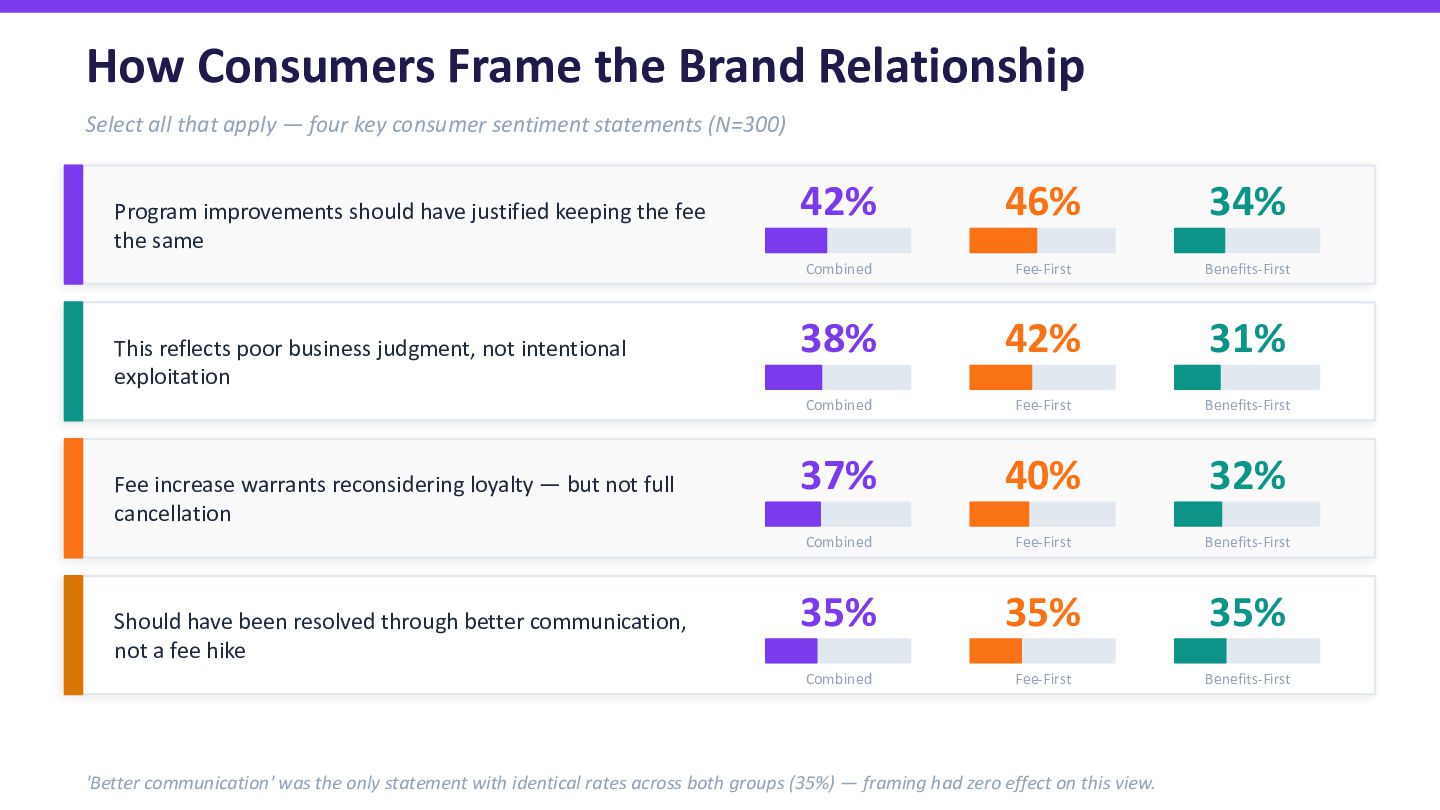
    — four key consumer sentiment statements (N=300) Program improvements should have justified keeping the fee the same This reflects poor business judgment, not intentional exploitation Fee increase warrants reconsidering loyalty — but not full cancellation Should have been resolved through better communication, not a fee hike 42% 46% 34% Combined Fee-First Benefits-First 38% 42% 31% Combined Fee-First Benefits-First 37% 40% 32% Combined Fee-First Benefits-First 35% 35% 35% Combined Fee-First Benefits-First 'Better communication' was the only statement with identical rates across both groups (35%) — framing had zero effect on this view.
  8. How Consumers Rated the Fee Increase Overall Given the 2-year

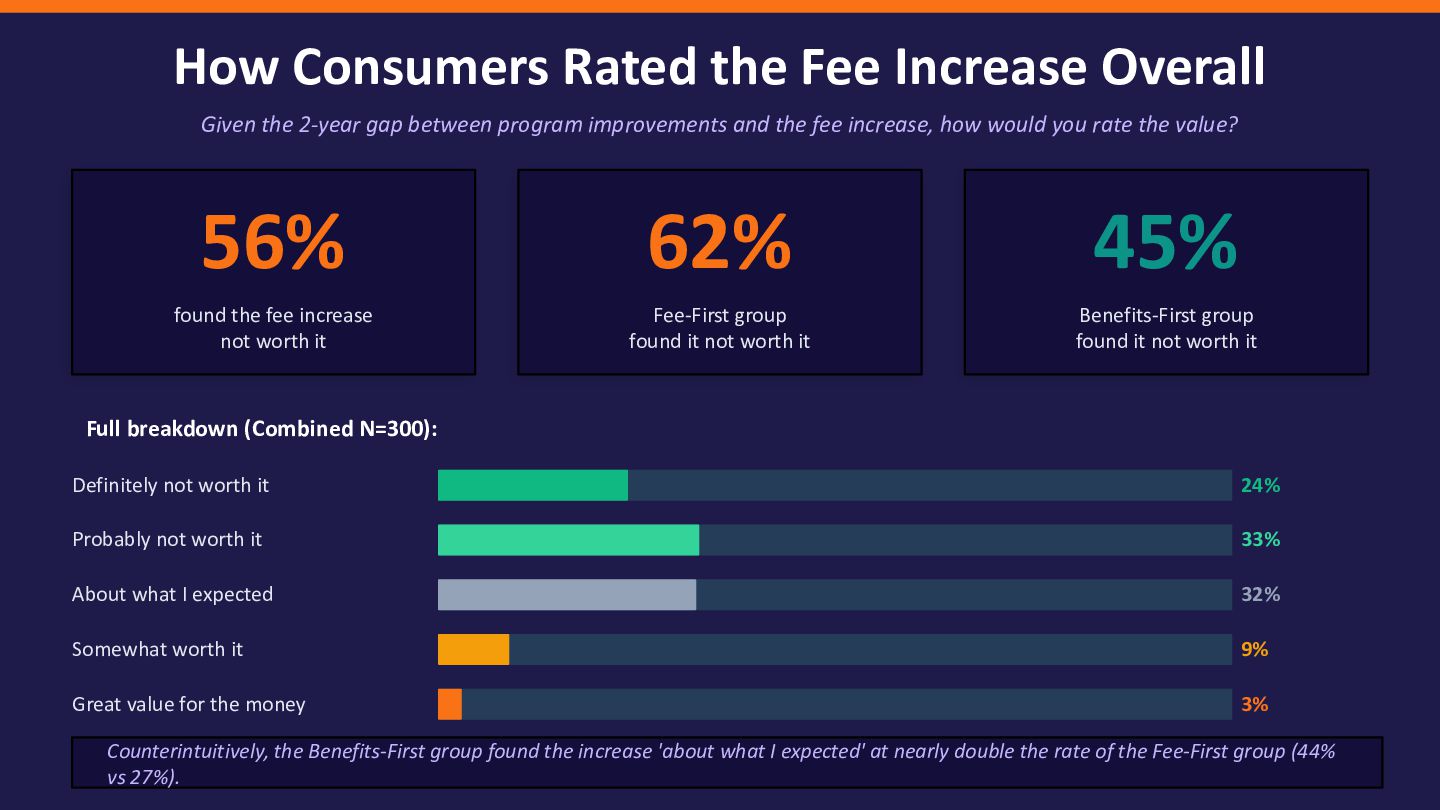
    gap between program improvements and the fee increase, how would you rate the value? 56% 62% 45% found the fee increase not worth it Fee-First group found it not worth it Benefits-First group found it not worth it Full breakdown (Combined N=300): Definitely not worth it 24% Probably not worth it 33% About what I expected 32% Somewhat worth it 9% Great value for the money 3% Counterintuitively, the Benefits-First group found the increase 'about what I expected' at nearly double the rate of the Fee-First group (44% vs 27%).
  9. What Would Consumers Have Preferred? If you were in charge,

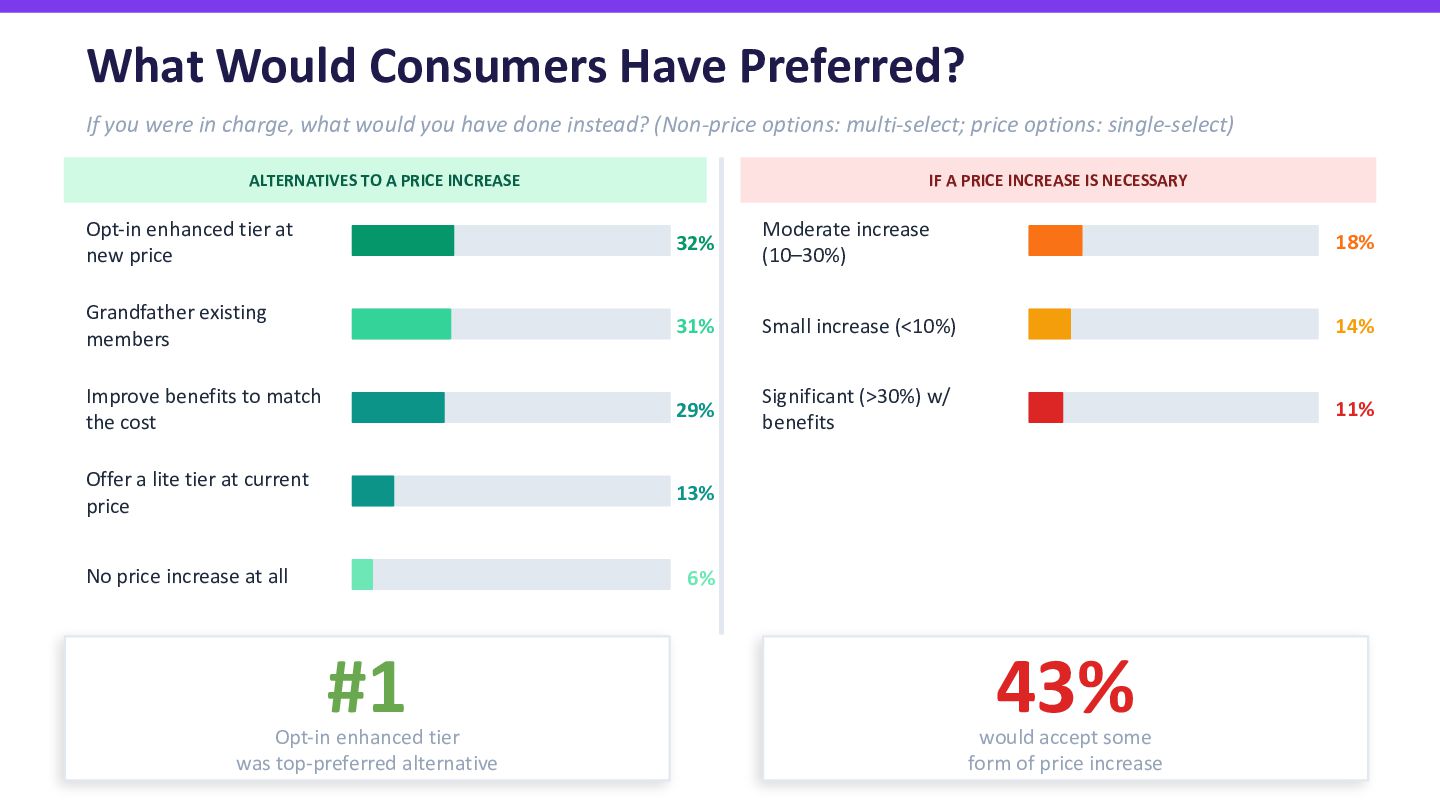
    what would you have done instead? (Non-price options: multi-select; price options: single-select) ALTERNATIVES TO A PRICE INCREASE IF A PRICE INCREASE IS NECESSARY Opt-in enhanced tier at new price 32% Moderate increase (10–30%) 18% Grandfather existing members 31% Small increase (<10%) 14% Improve benefits to match the cost 29% Significant (>30%) w/ benefits 11% Offer a lite tier at current price 13% No price increase at all 6% #1 Opt-in enhanced tier was top-preferred alternative 43% would accept some form of price increase
  10. Would You Recommend This Program to a Friend? Net recommendation

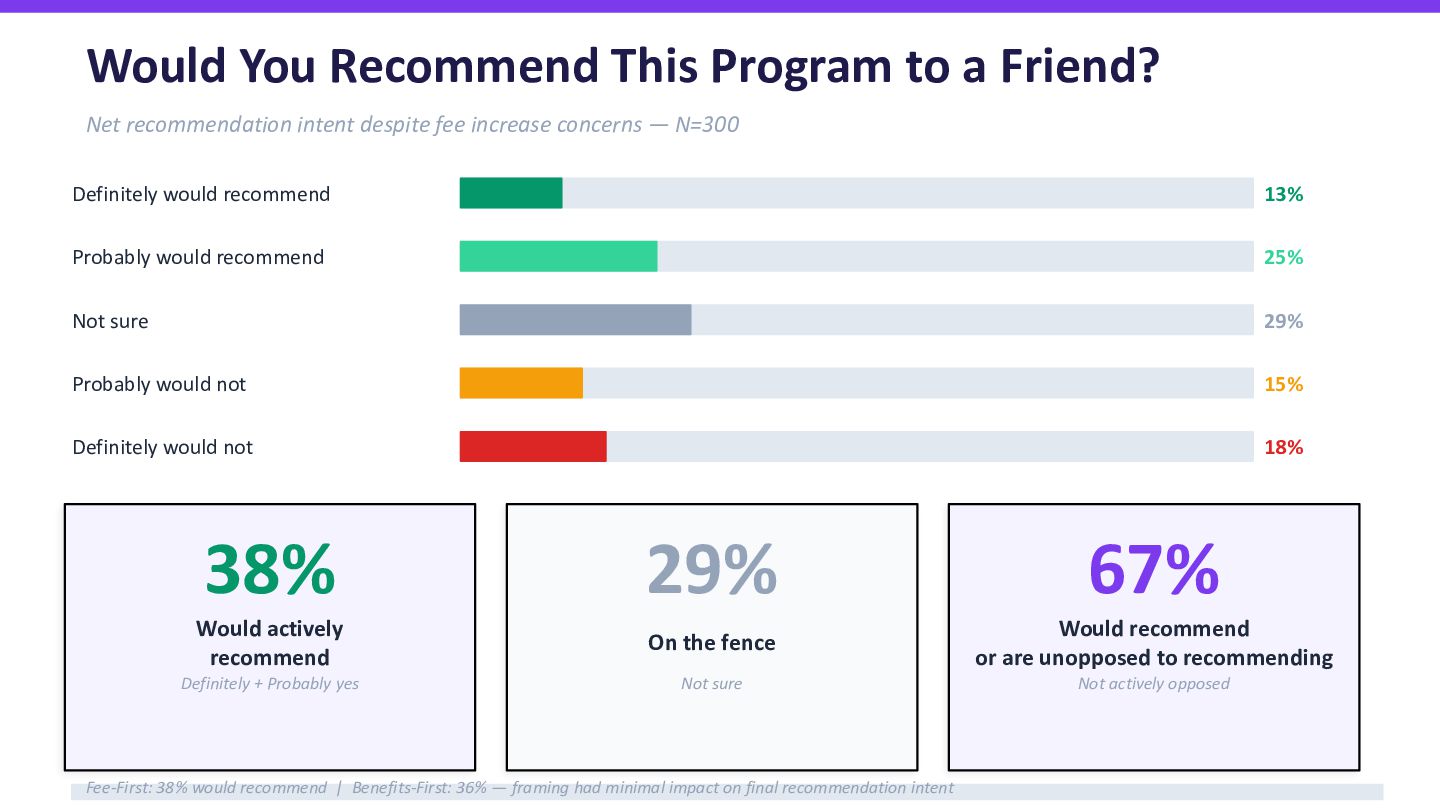
    intent despite fee increase concerns — N=300 Definitely would recommend 13% Probably would recommend 25% Not sure 29% Probably would not 15% Definitely would not 18% 38% 29% 67% Would actively recommend On the fence Would recommend or are unopposed to recommending Definitely + Probably yes Not sure Not actively opposed Fee-First: 38% would recommend | Benefits-First: 36% — framing had minimal impact on final recommendation intent
  11. Heavy Loyalty Users vs. Casual Members: Does Experience Change Opinion?

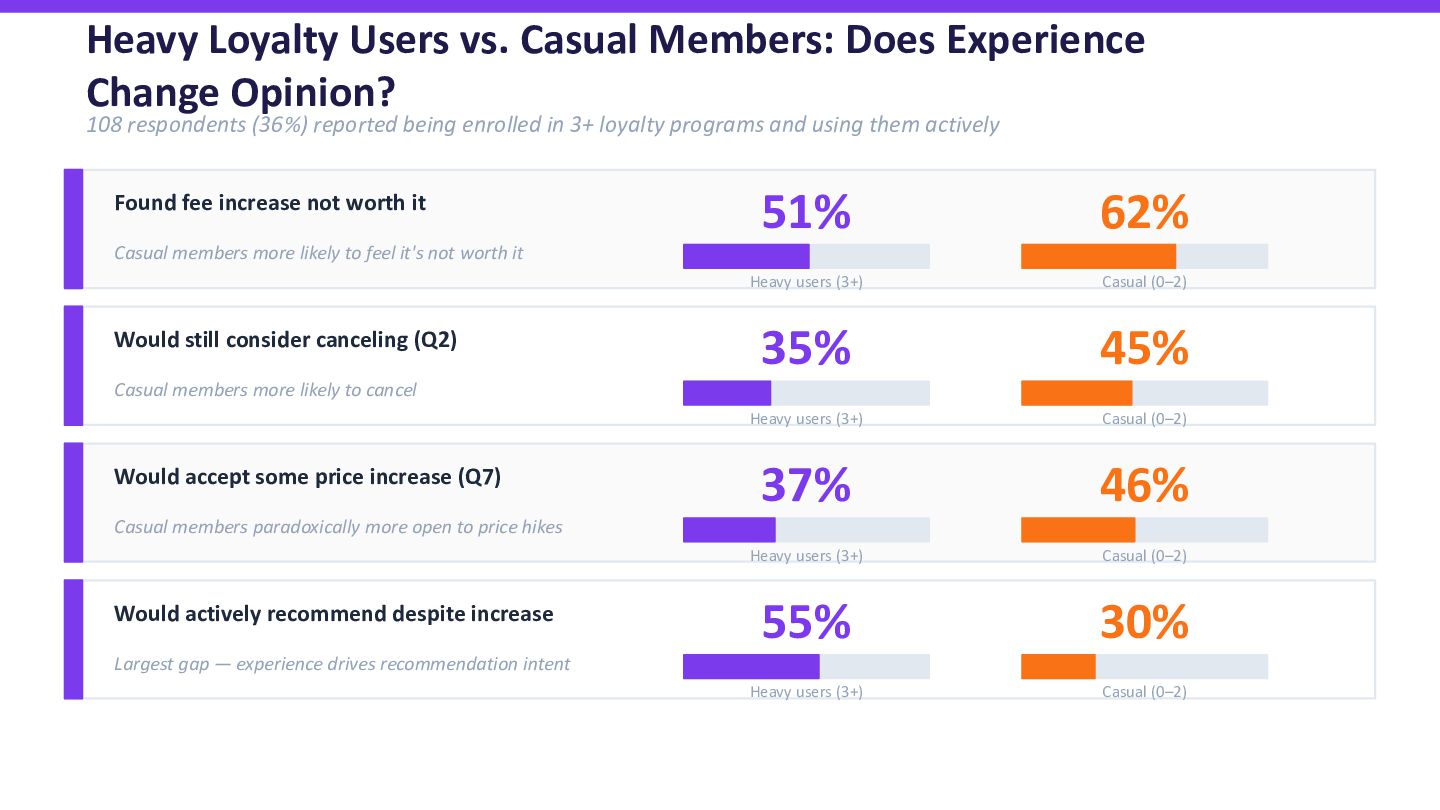
    108 respondents (36%) reported being enrolled in 3+ loyalty programs and using them actively Found fee increase not worth it 51% 62% Heavy users (3+) Casual (0–2) 35% 45% Heavy users (3+) Casual (0–2) 37% 46% Heavy users (3+) Casual (0–2) 55% 30% Heavy users (3+) Casual (0–2) Casual members more likely to feel it's not worth it Would still consider canceling (Q2) Casual members more likely to cancel Would accept some price increase (Q7) Casual members paradoxically more open to price hikes Would actively recommend despite increase Largest gap — experience drives recommendation intent
  12. Key Takeaways for Loyalty Marketers 01 Framing is a revenue

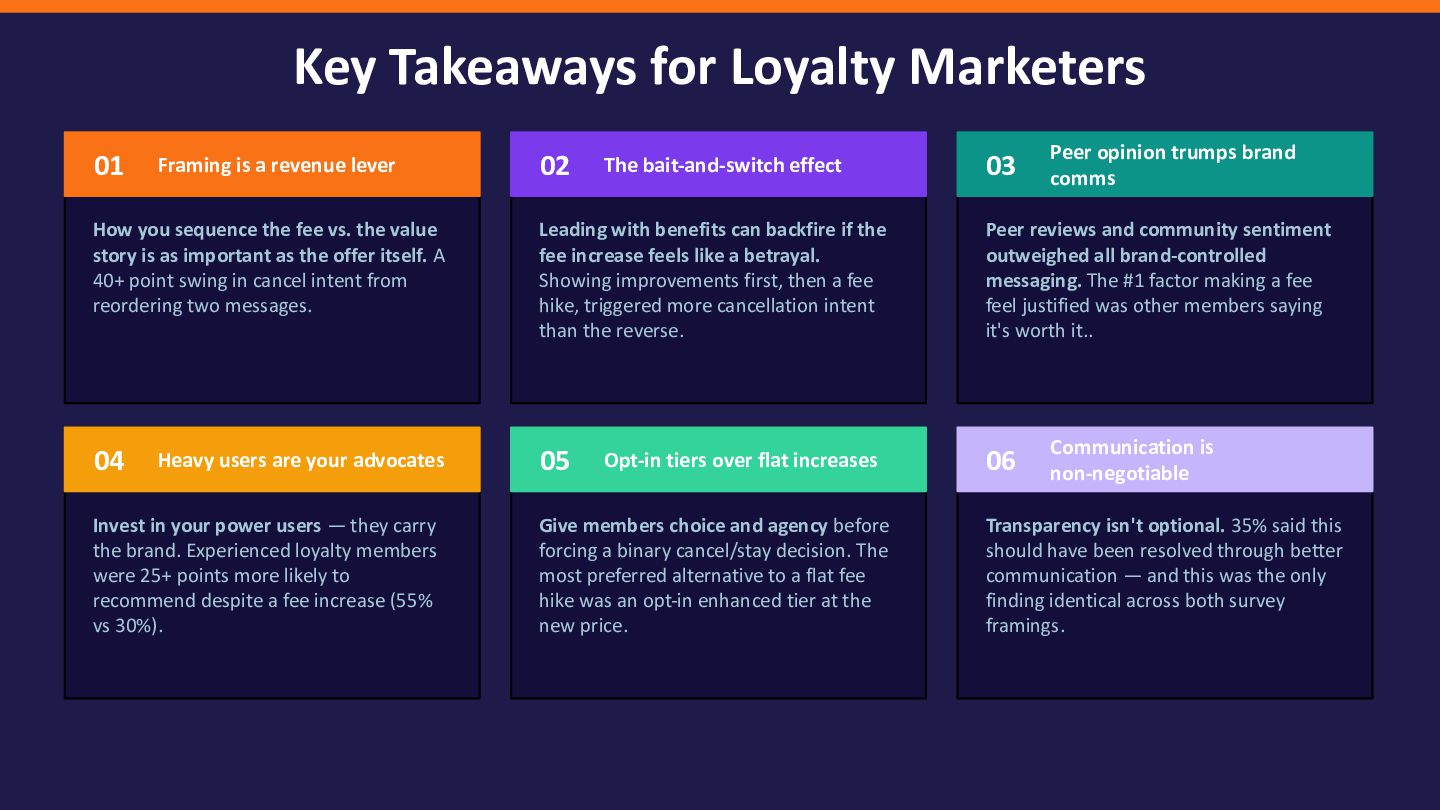
    lever 02 The bait-and-switch effect 03 Peer opinion trumps brand comms How you sequence the fee vs. the value story is as important as the offer itself. A 40+ point swing in cancel intent from reordering two messages. Leading with benefits can backfire if the fee increase feels like a betrayal. Showing improvements first, then a fee hike, triggered more cancellation intent than the reverse. Peer reviews and community sentiment outweighed all brand-controlled messaging. The #1 factor making a fee feel justified was other members saying it's worth it.. 04 05 06 Heavy users are your advocates Invest in your power users — they carry the brand. Experienced loyalty members were 25+ points more likely to recommend despite a fee increase (55% vs 30%). Opt-in tiers over flat increases Give members choice and agency before forcing a binary cancel/stay decision. The most preferred alternative to a flat fee hike was an opt-in enhanced tier at the new price. Communication is non-negotiable Transparency isn't optional. 35% said this should have been resolved through better communication — and this was the only finding identical across both survey framings.