Upgrade to Pro — share decks privately, control downloads, hide ads and more …

Wooden Conservatory Repairs & Restoration UK | WCR

Wooden Conservatory Repairs & Restoration UK | WCR

https://woodenconservatoryrepairs.co.uk/

WCR Wooden Conservatory Repairs restores timber-framed conservatories across the UK - rotten frame replacement, roof repairs, glass and roof lantern repairs, and glazing upgrades. Get a free quote at https://woodenconservatoryrepairs.co.uk/

Other Decks in How-to & DIY

Transcript

  1. WOODEN CONSERVATORY REPAIRS www.woodenconservatoryrepairs.co.uk A H O M E O

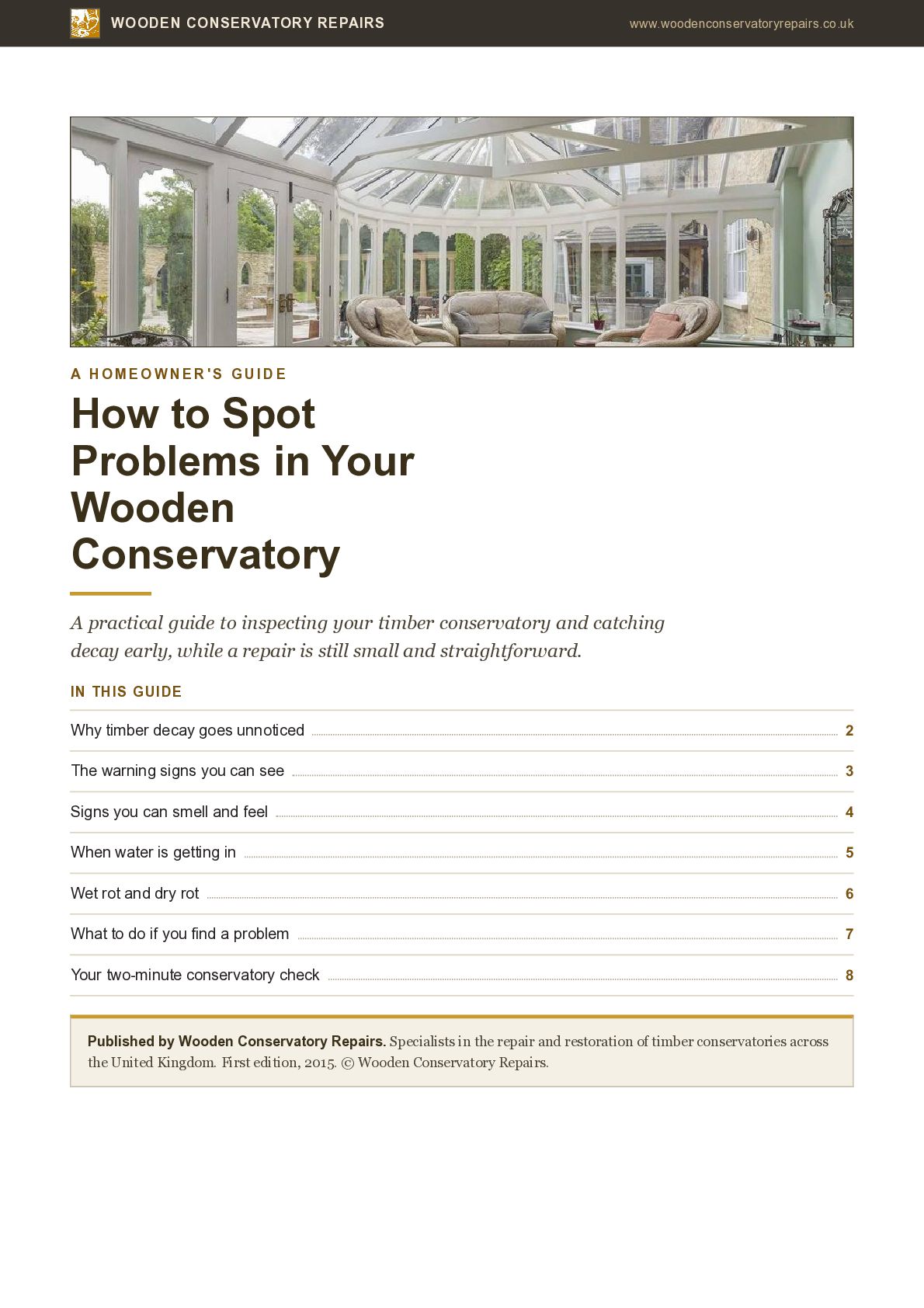
    W N E R ' S G U I D E How to Spot Problems in Your Wooden Conservatory A practical guide to inspecting your timber conservatory and catching decay early, while a repair is still small and straightforward. IN THIS GUIDE Why timber decay goes unnoticed 2 The warning signs you can see 3 Signs you can smell and feel 4 When water is getting in 5 Wet rot and dry rot 6 What to do if you find a problem 7 Your two-minute conservatory check 8 Published by Wooden Conservatory Repairs. Specialists in the repair and restoration of timber conservatories across the United Kingdom. First edition, 2015. © Wooden Conservatory Repairs.
  2. WOODEN CONSERVATORY REPAIRS www.woodenconservatoryrepairs.co.uk SECTION 1 Why Timber Decay Goes

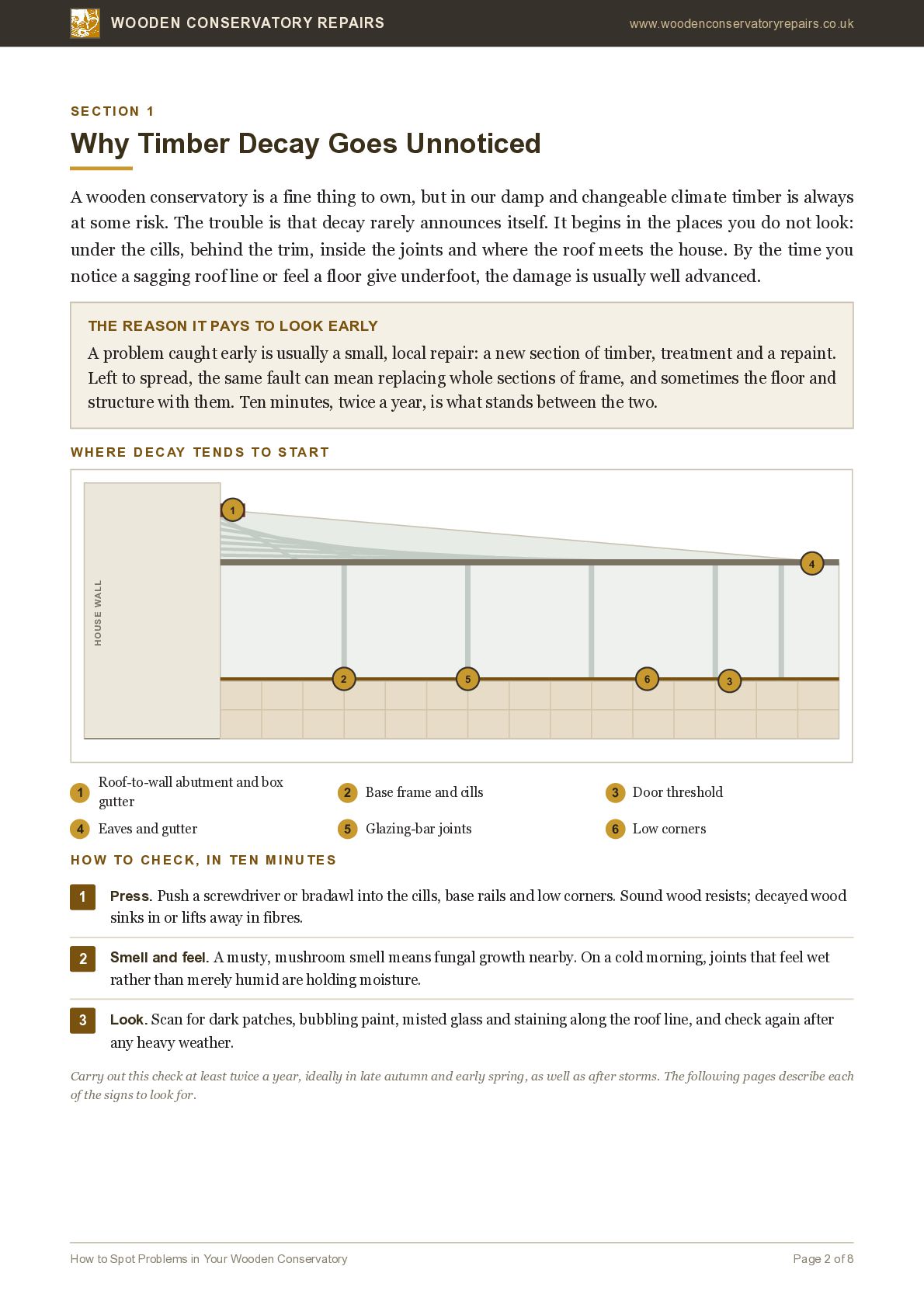
    Unnoticed A wooden conservatory is a fine thing to own, but in our damp and changeable climate timber is always at some risk. The trouble is that decay rarely announces itself. It begins in the places you do not look: under the cills, behind the trim, inside the joints and where the roof meets the house. By the time you notice a sagging roof line or feel a floor give underfoot, the damage is usually well advanced. THE REASON IT PAYS TO LOOK EARLY A problem caught early is usually a small, local repair: a new section of timber, treatment and a repaint. Left to spread, the same fault can mean replacing whole sections of frame, and sometimes the floor and structure with them. Ten minutes, twice a year, is what stands between the two. WHERE DECAY TENDS TO START HOUSE WALL 1 2 3 4 5 6 1 Roof-to-wall abutment and box gutter 2 Base frame and cills 3 Door threshold 4 Eaves and gutter 5 Glazing-bar joints 6 Low corners HOW TO CHECK, IN TEN MINUTES 1 Press. Push a screwdriver or bradawl into the cills, base rails and low corners. Sound wood resists; decayed wood sinks in or lifts away in fibres. 2 Smell and feel. A musty, mushroom smell means fungal growth nearby. On a cold morning, joints that feel wet rather than merely humid are holding moisture. 3 Look. Scan for dark patches, bubbling paint, misted glass and staining along the roof line, and check again after any heavy weather. Carry out this check at least twice a year, ideally in late autumn and early spring, as well as after storms. The following pages describe each of the signs to look for. How to Spot Problems in Your Wooden Conservatory Page 2 of 8
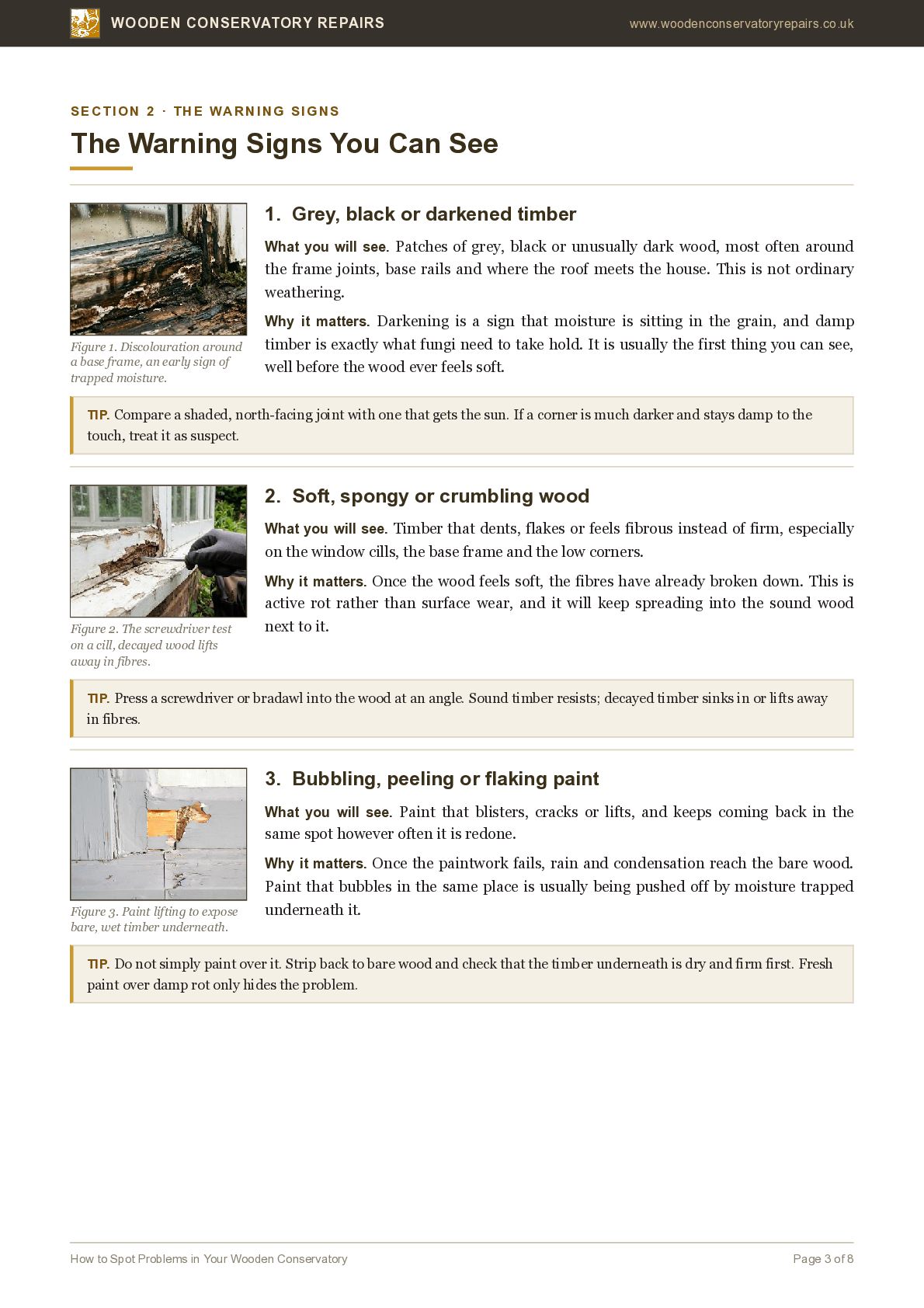
  3. Figure 1. Discolouration around a base frame, an early sign

    of trapped moisture. Figure 2. The screwdriver test on a cill, decayed wood lifts away in fibres. Figure 3. Paint lifting to expose bare, wet timber underneath. WOODEN CONSERVATORY REPAIRS www.woodenconservatoryrepairs.co.uk SECTION 2 · THE WARNING SIGNS The Warning Signs You Can See 1. Grey, black or darkened timber What you will see. Patches of grey, black or unusually dark wood, most often around the frame joints, base rails and where the roof meets the house. This is not ordinary weathering. Why it matters. Darkening is a sign that moisture is sitting in the grain, and damp timber is exactly what fungi need to take hold. It is usually the first thing you can see, well before the wood ever feels soft. TIP. Compare a shaded, north-facing joint with one that gets the sun. If a corner is much darker and stays damp to the touch, treat it as suspect. 2. Soft, spongy or crumbling wood What you will see. Timber that dents, flakes or feels fibrous instead of firm, especially on the window cills, the base frame and the low corners. Why it matters. Once the wood feels soft, the fibres have already broken down. This is active rot rather than surface wear, and it will keep spreading into the sound wood next to it. TIP. Press a screwdriver or bradawl into the wood at an angle. Sound timber resists; decayed timber sinks in or lifts away in fibres. 3. Bubbling, peeling or flaking paint What you will see. Paint that blisters, cracks or lifts, and keeps coming back in the same spot however often it is redone. Why it matters. Once the paintwork fails, rain and condensation reach the bare wood. Paint that bubbles in the same place is usually being pushed off by moisture trapped underneath it. TIP. Do not simply paint over it. Strip back to bare wood and check that the timber underneath is dry and firm first. Fresh paint over damp rot only hides the problem. How to Spot Problems in Your Wooden Conservatory Page 3 of 8
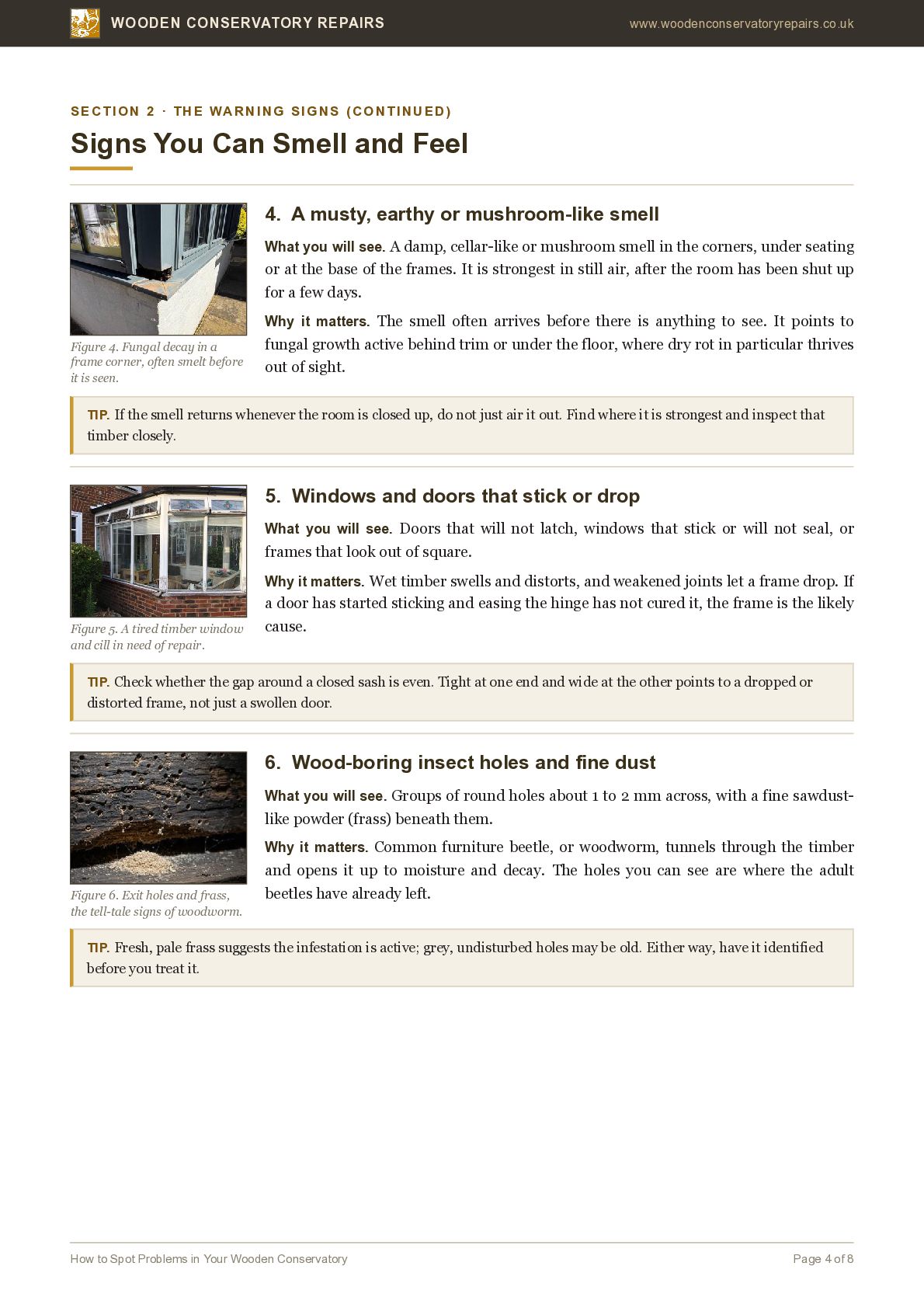
  4. Figure 4. Fungal decay in a frame corner, often smelt

    before it is seen. Figure 5. A tired timber window and cill in need of repair. Figure 6. Exit holes and frass, the tell-tale signs of woodworm. WOODEN CONSERVATORY REPAIRS www.woodenconservatoryrepairs.co.uk SECTION 2 · THE WARNING SIGNS (CONTINUED) Signs You Can Smell and Feel 4. A musty, earthy or mushroom-like smell What you will see. A damp, cellar-like or mushroom smell in the corners, under seating or at the base of the frames. It is strongest in still air, after the room has been shut up for a few days. Why it matters. The smell often arrives before there is anything to see. It points to fungal growth active behind trim or under the floor, where dry rot in particular thrives out of sight. TIP. If the smell returns whenever the room is closed up, do not just air it out. Find where it is strongest and inspect that timber closely. 5. Windows and doors that stick or drop What you will see. Doors that will not latch, windows that stick or will not seal, or frames that look out of square. Why it matters. Wet timber swells and distorts, and weakened joints let a frame drop. If a door has started sticking and easing the hinge has not cured it, the frame is the likely cause. TIP. Check whether the gap around a closed sash is even. Tight at one end and wide at the other points to a dropped or distorted frame, not just a swollen door. 6. Wood-boring insect holes and fine dust What you will see. Groups of round holes about 1 to 2 mm across, with a fine sawdust- like powder (frass) beneath them. Why it matters. Common furniture beetle, or woodworm, tunnels through the timber and opens it up to moisture and decay. The holes you can see are where the adult beetles have already left. TIP. Fresh, pale frass suggests the infestation is active; grey, undisturbed holes may be old. Either way, have it identified before you treat it. How to Spot Problems in Your Wooden Conservatory Page 4 of 8
  5. Figure 7. Persistent condensation keeps timber wet through the winter.

    Figure 8. A box gutter and flashing where leaks most often begin. WOODEN CONSERVATORY REPAIRS www.woodenconservatoryrepairs.co.uk SECTION 2 · THE WARNING SIGNS (CONTINUED) When Water Is Getting In 7. Condensation and misted glass What you will see. Glass that regularly streams or mists up, water pooling on the cills, or panes that have gone permanently cloudy between the layers. Why it matters. Standing condensation keeps the frames and cills wet all winter, which is enough to start wet rot even where there is no leak. Cloudy sealed units mean the glazing seal has failed. TIP. Run a hand along the joints and cills on a cold morning. If they feel cool and wet rather than just humid, moisture is being held there. Improve the ventilation before it soaks in. 8. Water getting in from the roof What you will see. Damp patches where the roof meets the house, drips after rain, sagging roof panels, or a box gutter holding water and debris. Why it matters. Failed abutment seals, cracked flashing and blocked box gutters are the most common way water reaches the hidden timber, and the damage is usually well underway before it shows indoors. TIP. After heavy rain, check the inside of the roof line and the wall abutment for fresh stains. Clear leaves from the valleys and box gutters twice a year so the water can drain. THE THREE MOST COMMON WAYS WATER GETS IN Where What happens Roof-to-wall abutment The seal or lead flashing where the glazed roof meets the house cracks with age and lets rain track in behind the timber. Box gutters and valleys Leaves and debris dam the water until it backs up and sits against the frame instead of draining away. Perished glazing seals Old putty and gaskets shrink and split, so rain creeps down the inside face of the frame unseen. REMEMBER Nearly all timber decay begins as trapped water. Deal with the source, a seal, a flashing or a blocked gutter, and you stop the decay at its root. Patch over it and you simply seal the moisture in, where it goes on working at the wood all winter. How to Spot Problems in Your Wooden Conservatory Page 5 of 8
  6. WOODEN CONSERVATORY REPAIRS www.woodenconservatoryrepairs.co.uk SECTION 3 Wet Rot and Dry

    Rot Both begin with the same thing, moisture in the wood. The difference is what happens next. Wet rot stays close to the damp that caused it, while dry rot can travel through the walls to attack timber some distance from the original leak. Telling them apart tells you how urgent the job is. Wet rot (the common, contained kind) Dry rot (Serpula lacrymans, the serious kind) Needs Timber above roughly 20% moisture: an ongoing leak, condensation or contact with the ground. Starts at around 28 to 35% moisture, then carries its own water and spreads into drier wood. Looks like Darkened, damp, softened wood that cracks along the grain and feels spongy. Brittle wood cracking into cube-like blocks, with white cotton-wool strands, then a grey skin with lilac or ochre patches. Spreads Stays local to the wet area. Serious, but it does not chase dry timber. Sends strands through masonry and plaster to reach timber well beyond the damp source. The remedy Stop the moisture, cut out and replace the decayed timber, then treat and redecorate. Prompt specialist treatment, traced back to every affected area rather than the visible patch alone. WHY OLDER CONSERVATORIES SUFFER MOST Many were built in untreated softwood, which has low natural durability (BS EN 350 Class 4). Combined with large single-glazed panels and blocked-up ventilation, that makes an ideal setting for decay, which is why period timber conservatories need the closest eye. HOW URGENT IS IT? If you find… What to do Keep an eye on it Light surface discolouration or the odd bout of condensation, with firm timber underneath. Improve the ventilation and check again next season. Repair soon Soft spots, paint flaking over damp wood, sticking frames or a steady leak. Arrange a repair before winter sets in and it spreads. Get advice now Spreading fungal growth, brittle cube-cracked timber, a mushroom smell or frame movement. This is likely dry rot and should be looked at quickly. How to Spot Problems in Your Wooden Conservatory Page 6 of 8
  7. WOODEN CONSERVATORY REPAIRS www.woodenconservatoryrepairs.co.uk SECTION 4 What to Do If

    You Find a Problem The most common mistake is to assume that decay will dry out over the summer. It will not. The fungus simply lies dormant and starts again the moment the damp returns, a little further into the frame each time. Acting promptly is what keeps a repair small and local. WORTH KNOWING The Property Care Association found that 28% of conservatory structural repairs in 2024 involved dry rot that had gone undetected for two to five years. Nearly all of it began as a small, unnoticed leak. Minor repairs and maintenance do not require Building Control approval. Permanent heating, converting the conservatory into a full room, or new glazing usually do, and Part F sets minimum ventilation (around 8,000 mm² of background ventilation per habitable room). If in doubt, ask your local authority. Find and stop the water Clear the gutters, valleys and box gutters, and check the seals and downpipes. Avoid smearing silicone over a gap, as that traps moisture in the wood rather than keeping it out. 1. Get some air moving Free off any painted-over trickle vents, open the roof vents, and run a dehumidifier through the winter. Dry timber does not rot, so ventilation is half the cure. 2. Have a timber survey done A specialist can probe the hidden areas, confirm whether it is wet rot or dry rot, and show how far it has spread before you commit to any repairs. 3. Repair and treat it properly Cut out the decayed wood, splice in new treated timber, treat the surrounding area and redecorate, so that the repair lasts rather than returning next winter. 4. How to Spot Problems in Your Wooden Conservatory Page 7 of 8
  8. WOODEN CONSERVATORY REPAIRS www.woodenconservatoryrepairs.co.uk SECTION 5 Your Two-Minute Conservatory Check

    Run through this list twice a year, and after any storm. Everything you can tick is a good sign that the timber is sound. Anything you cannot tick is worth a closer look before the winter sets in. ☐ The frames, cills and low corners feel firm; a screwdriver will not sink in ☐ There is no grey or black darkening around the joints and base rails ☐ The paintwork is sound, with no bubbling or flaking that keeps returning ☐ There is no musty or mushroom smell in the still corners ☐ The windows and doors open, close and latch cleanly ☐ There are no small (1 to 2 mm) holes or piles of fine dust ☐ The glass is clear, with no permanent misting or pooled condensation ☐ The roof line, wall abutment and box gutters stay dry and clear after rain IN SHORT Caught early, timber decay is one of the most straightforward problems a conservatory can have. Caught late, it is one of the most serious. The difference is almost always how soon someone looked. IF YOU WOULD LIKE IT LOOKED AT If any of these signs seem familiar, it is worth having them checked before the weather makes them worse. Wooden Conservatory Repairs specialises in the repair and restoration of timber conservatories throughout the United Kingdom, from a single rotten cill to a full structural overhaul. Send us a few photographs and we will tell you what you are looking at. Wooden Conservatory Repairs · www.woodenconservatoryrepairs.co.uk This guide offers general advice to help you inspect your own conservatory. It is not a substitute for a professional survey on site. © Wooden Conservatory Repairs, 2015. How to Spot Problems in Your Wooden Conservatory Page 8 of 8