Upgrade to Pro — share decks privately, control downloads, hide ads and more …

BUSINESS ADVISOR.pdf

Sponsored · Your Podcast. Everywhere. Effortlessly. Share. Educate. Inspire. Entertain. You do you. We'll handle the rest. →

BUSINESS ADVISOR.pdf

BUSINESS ADVISOR.pdf

Avatar for Aligncore strategies

Aligncore strategies

October 03, 2025

Other Decks in Education

Transcript

  1. BUSINESS ADVISOR UNDERSTANDING THE ROLE OF A BUSINESS ADVISOR Organizations

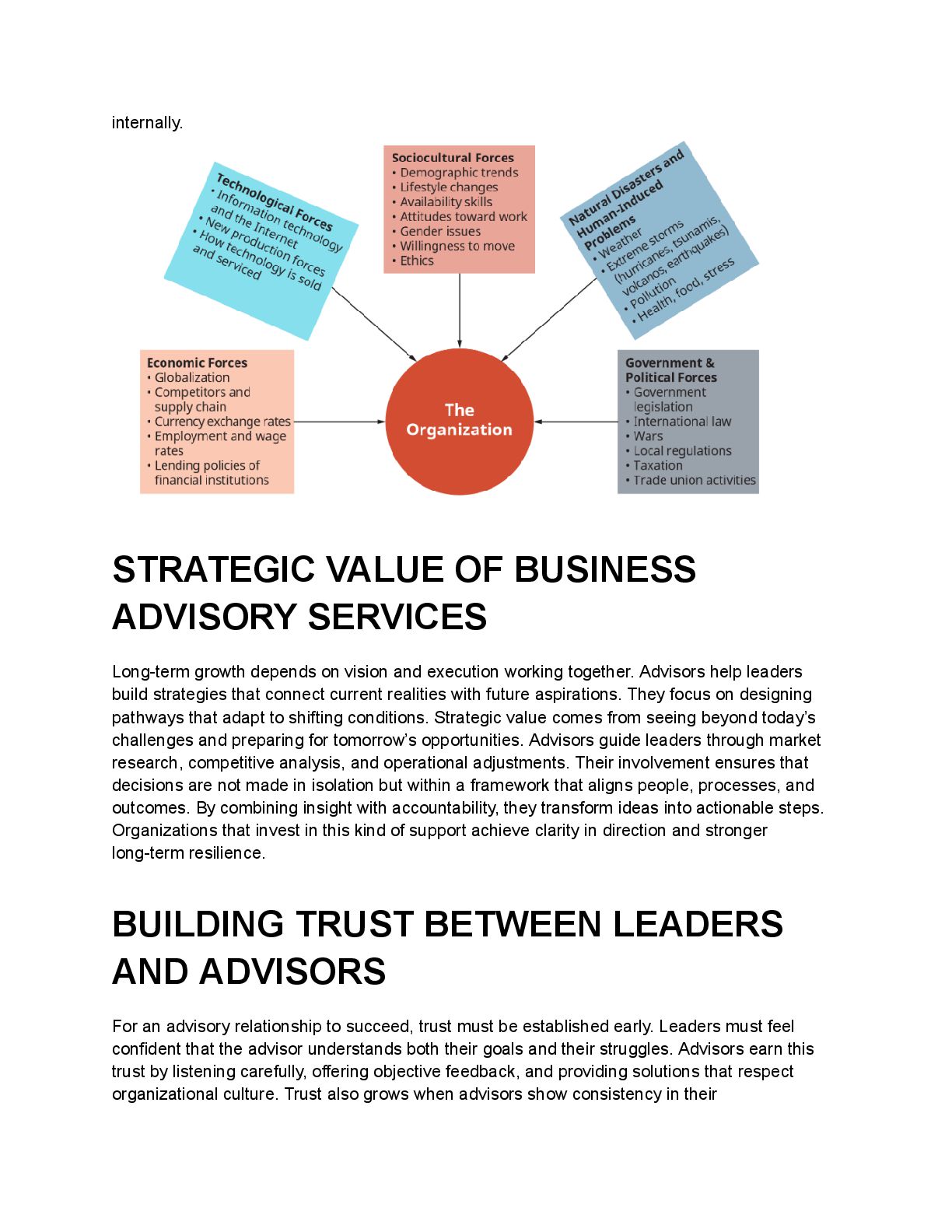
    succeed when they have clarity, structure, and the right support system. Leaders face constant challenges, and without guidance, they can lose focus and direction. An advisor provides experience and perspective to navigate uncertainty. Their role is not about replacing leadership but reinforcing it with tools, strategies, and actionable insights. The relationship between an advisor and a business extends beyond advice. It is about building trust, identifying blind spots, and guiding sustainable decisions. In an environment where competition is strong and resources limited, expert support often becomes the difference between stagnation and steady growth. WHY ORGANIZATIONS TURN TO EXTERNAL GUIDANCE Businesses of all sizes eventually recognize the need for specialized insight. Owners and executives carry heavy responsibilities, and constant demands can make them reactive instead of strategic. Seeking help from a trusted professional creates room to think clearly and prioritize effectively. A Business advisor becomes that external partner, helping leaders reduce uncertainty and gain direction. The advisor’s perspective is shaped by working with many industries, allowing them to recognize patterns and solutions quickly. This saves organizations from repeating costly mistakes and accelerates their progress toward defined goals. External guidance offers balance, structure, and accountability that many teams struggle to build
  2. internally. STRATEGIC VALUE OF BUSINESS ADVISORY SERVICES Long-term growth depends

    on vision and execution working together. Advisors help leaders build strategies that connect current realities with future aspirations. They focus on designing pathways that adapt to shifting conditions. Strategic value comes from seeing beyond today’s challenges and preparing for tomorrow’s opportunities. Advisors guide leaders through market research, competitive analysis, and operational adjustments. Their involvement ensures that decisions are not made in isolation but within a framework that aligns people, processes, and outcomes. By combining insight with accountability, they transform ideas into actionable steps. Organizations that invest in this kind of support achieve clarity in direction and stronger long-term resilience. BUILDING TRUST BETWEEN LEADERS AND ADVISORS For an advisory relationship to succeed, trust must be established early. Leaders must feel confident that the advisor understands both their goals and their struggles. Advisors earn this trust by listening carefully, offering objective feedback, and providing solutions that respect organizational culture. Trust also grows when advisors show consistency in their
  3. recommendations and remain transparent about potential risks. This honest partnership

    empowers leaders to make bold moves knowing they have reliable support. The advisor’s role becomes less about giving orders and more about serving as a sounding board for important decisions. When trust is present, the advisor’s influence extends deeper into the organization, driving meaningful change across multiple levels. NAVIGATING CHANGE WITH PROFESSIONAL SUPPORT Every company faces transitions, whether through leadership shifts, market disruptions, or expansion opportunities. Change often brings resistance and uncertainty, but a skilled advisor helps smooth these transitions. They provide structure to change initiatives and ensure alignment between leaders and employees. Advisors help articulate why the change is necessary, what benefits it will bring, and how the organization will adapt. This clarity reduces anxiety and improves cooperation. By guiding the process with measured steps, advisors prevent chaos and strengthen stability during turbulent times. The presence of professional support also demonstrates commitment from leadership, signaling to employees that the company is prepared for the future. CULTURE AND PERFORMANCE CONNECTION The health of workplace culture directly influences productivity and outcomes. Advisors often highlight this connection by assessing how values, communication, and leadership behaviors align with stated goals. They recognize that culture cannot be forced but must be nurtured through consistent actions. A strong culture inspires engagement, lowers turnover, and fuels innovation. Advisors introduce strategies for reinforcing positive behaviors and addressing toxic patterns. By aligning culture with organizational objectives, they unlock performance improvements that go beyond financial metrics. The transformation is felt in employee morale, customer satisfaction, and long-term loyalty. Leaders who embrace advisory input on culture often experience more sustainable success. DECISION-MAKING IN COMPLEX ENVIRONMENTS
  4. Modern businesses operate in environments filled with uncertainty and constant

    change. Making informed decisions requires balancing short-term pressures with long-term strategy. Advisors bring structure to this process by offering data, insight, and tested frameworks. They help leaders evaluate risks, explore scenarios, and choose paths that align with overall goals. In complex environments, decision fatigue can weaken judgment, but advisors reduce this burden by clarifying options. Their guidance ensures that choices are not rushed but carefully aligned with organizational strengths. The outcome is better risk management, stronger resilience, and higher confidence in leadership decisions. THE IMPACT ON SMALL AND MID-SIZED COMPANIES While large corporations often have access to internal experts, small and mid-sized companies face resource limitations. For them, the presence of an advisor is especially valuable. Advisors fill gaps in knowledge, provide affordable expertise, and bring an external view that supports growth. They help these companies compete with larger players by optimizing resources and implementing best practices. Smaller businesses often lack the luxury of trial and error, so having guidance minimizes costly mistakes. Advisors also connect them with networks, partners, and opportunities that would otherwise remain out of reach. The result is growth that is sustainable, efficient, and aligned with the company’s vision. LONG-TERM VALUE OF ADVISORY RELATIONSHIPS Advisory support is not a one-time solution but an evolving partnership. Over time, advisors learn the intricacies of the business, becoming more effective in their guidance. Leaders gain a trusted partner who understands their challenges and helps them adapt continuously. This ongoing relationship ensures that organizations remain agile, innovative, and prepared for new opportunities. Advisors help businesses remain competitive by constantly adjusting strategies to meet market demands. The long-term value lies not only in solving problems but in preventing them before they occur. A strong advisory relationship strengthens leadership, enhances culture, and builds a framework for lasting success. CONCLUSION: THE POWER OF WORKING WITH A BUSINESS ADVISOR
  5. The success of modern organizations often depends on their ability

    to adapt, strategize, and lead with clarity. Advisors provide the perspective, knowledge, and accountability required for this success. They are more than consultants; they are partners in growth, culture, and leadership. By offering strategic insights, reinforcing trust, and guiding decision-making, advisors shape organizations into resilient and future-ready enterprises. Leaders who embrace this partnership unlock opportunities that may otherwise remain hidden. Ultimately, the role of an advisor is not just about today’s results but about preparing organizations for tomorrow’s challenges. Success is built through collaboration, trust, and the steady guidance of a reliable Business advisor.