terms. • Identify the research type from a short example or case. • Give a clear justification using the purpose, data, method, or setting. • Distinguish between commonly confused research types. • Apply the identification method to exam-style questions. 2
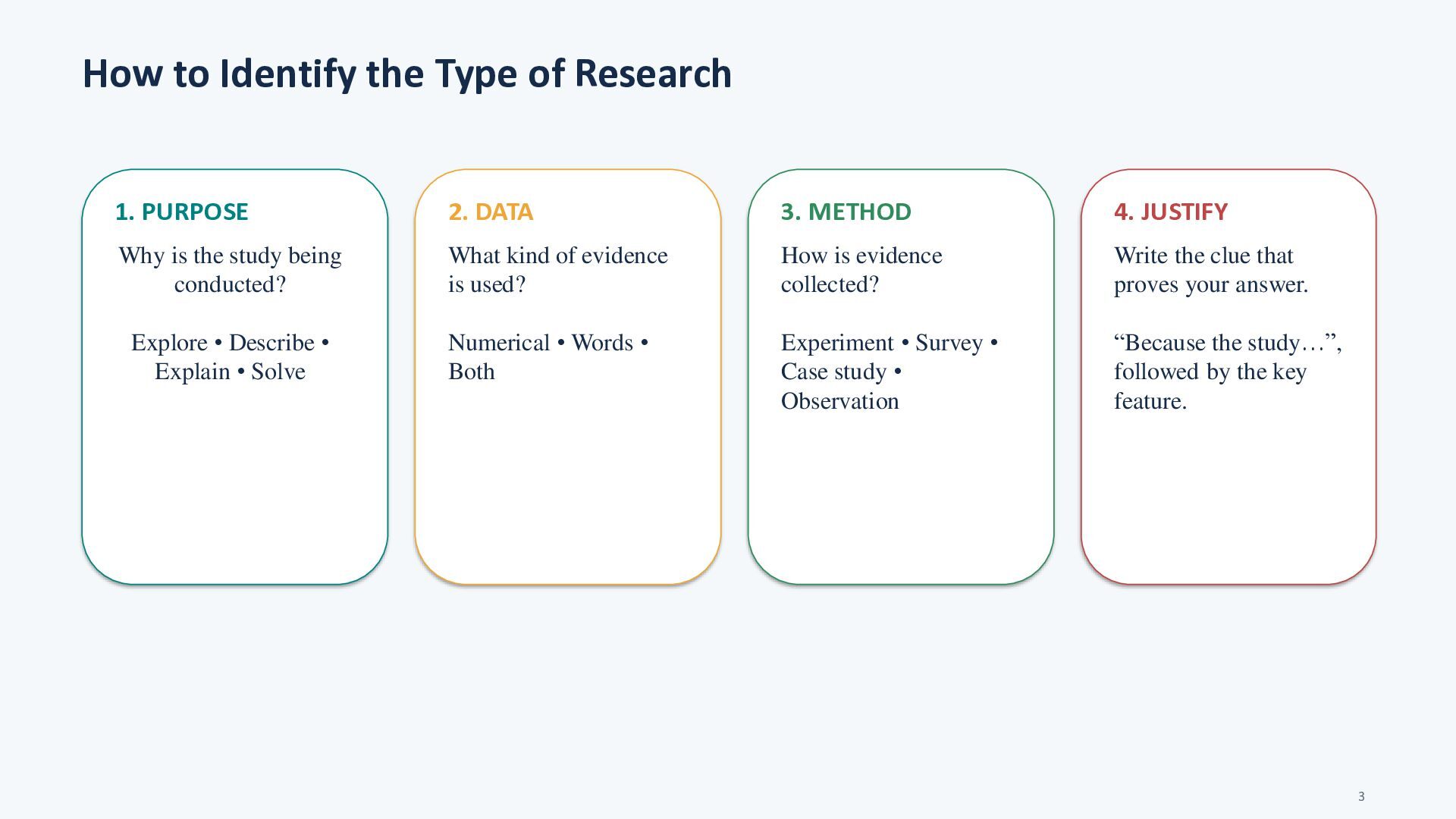
DATA 3. METHOD 4. JUSTIFY Why is the study being conducted? What kind of evidence is used? How is evidence collected? Write the clue that proves your answer. Explore • Describe • Explain • Solve Numerical • Words • Both Experiment • Survey • Case study • Observation “Because the study…”, followed by the key feature. 3
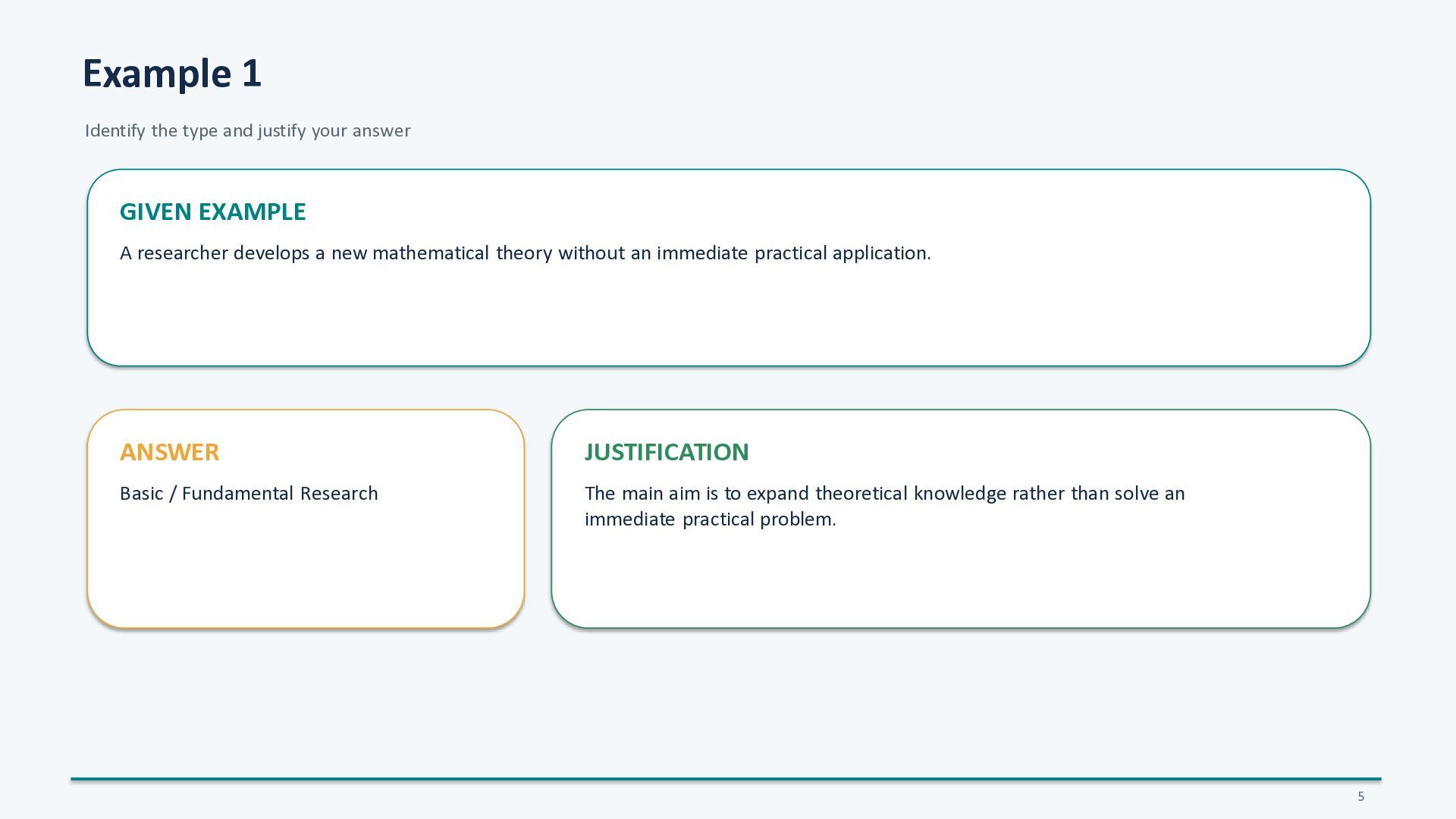
EXAMPLE A researcher develops a new mathematical theory without an immediate practical application. ANSWER JUSTIFICATION Basic / Fundamental Research The main aim is to expand theoretical knowledge rather than solve an immediate practical problem. 5
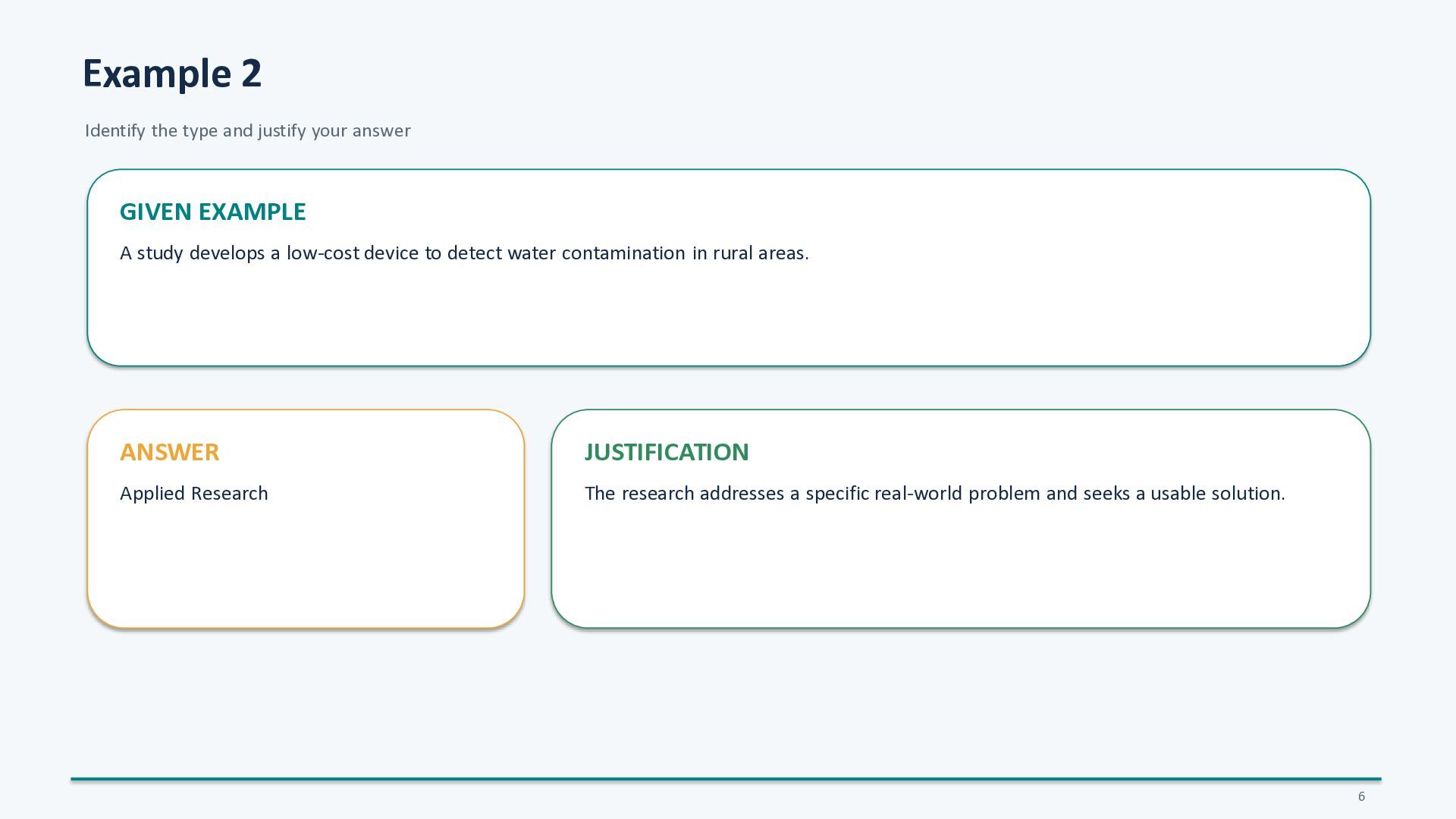
EXAMPLE A study develops a low-cost device to detect water contamination in rural areas. ANSWER JUSTIFICATION Applied Research The research addresses a specific real-world problem and seeks a usable solution. 6
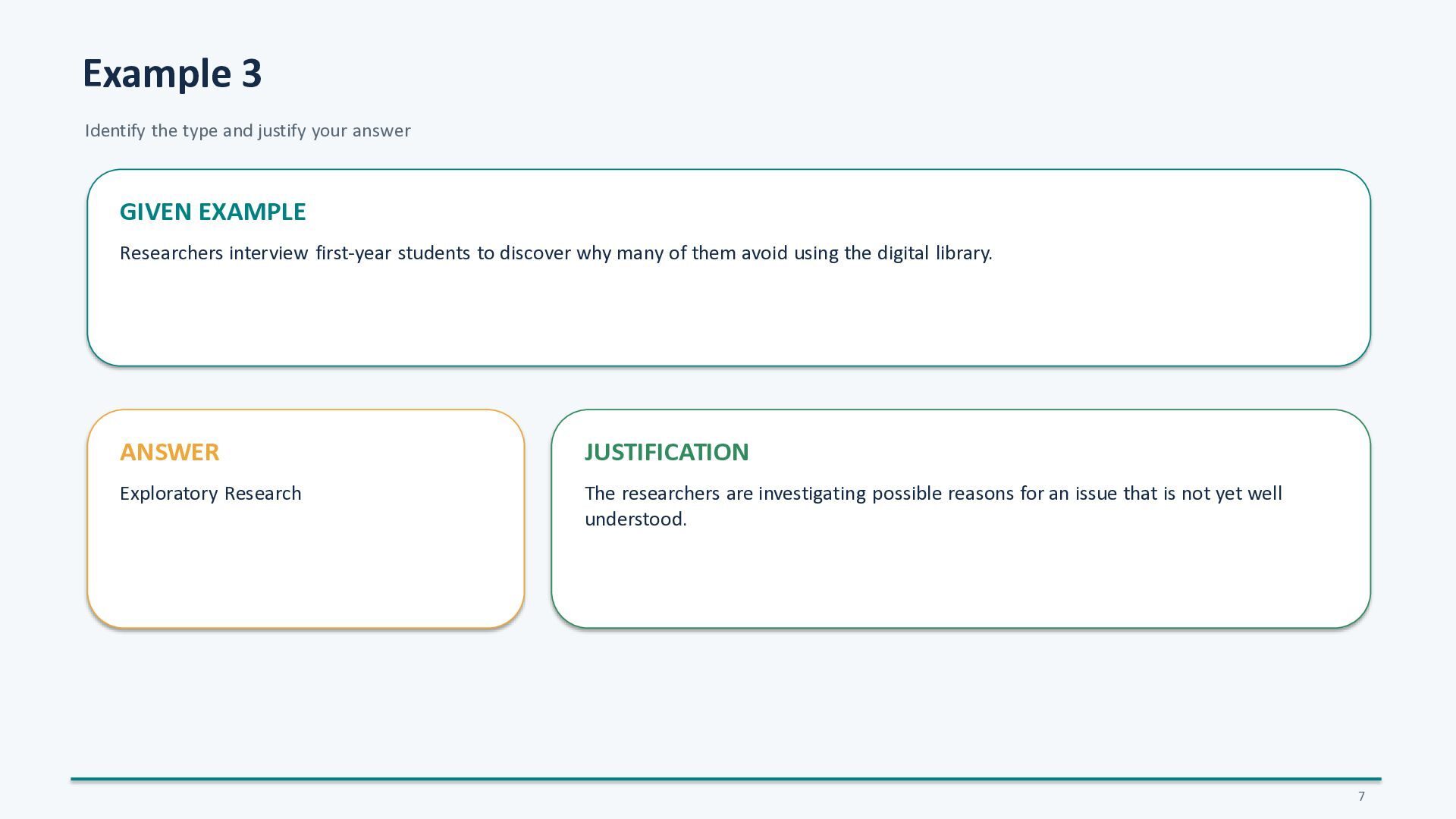
EXAMPLE Researchers interview first-year students to discover why many of them avoid using the digital library. ANSWER JUSTIFICATION Exploratory Research The researchers are investigating possible reasons for an issue that is not yet well understood. 7
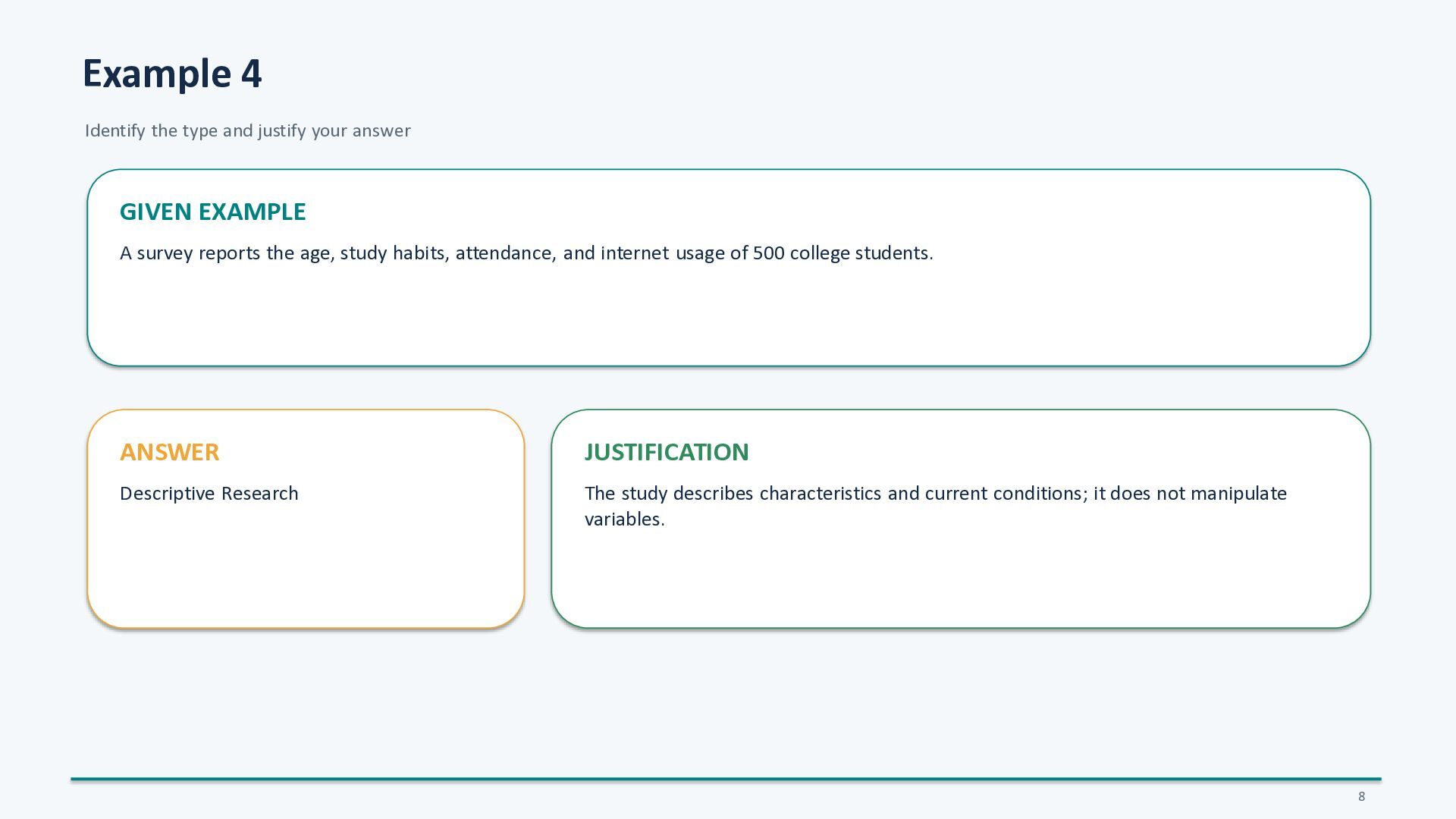
EXAMPLE A survey reports the age, study habits, attendance, and internet usage of 500 college students. ANSWER JUSTIFICATION Descriptive Research The study describes characteristics and current conditions; it does not manipulate variables. 8
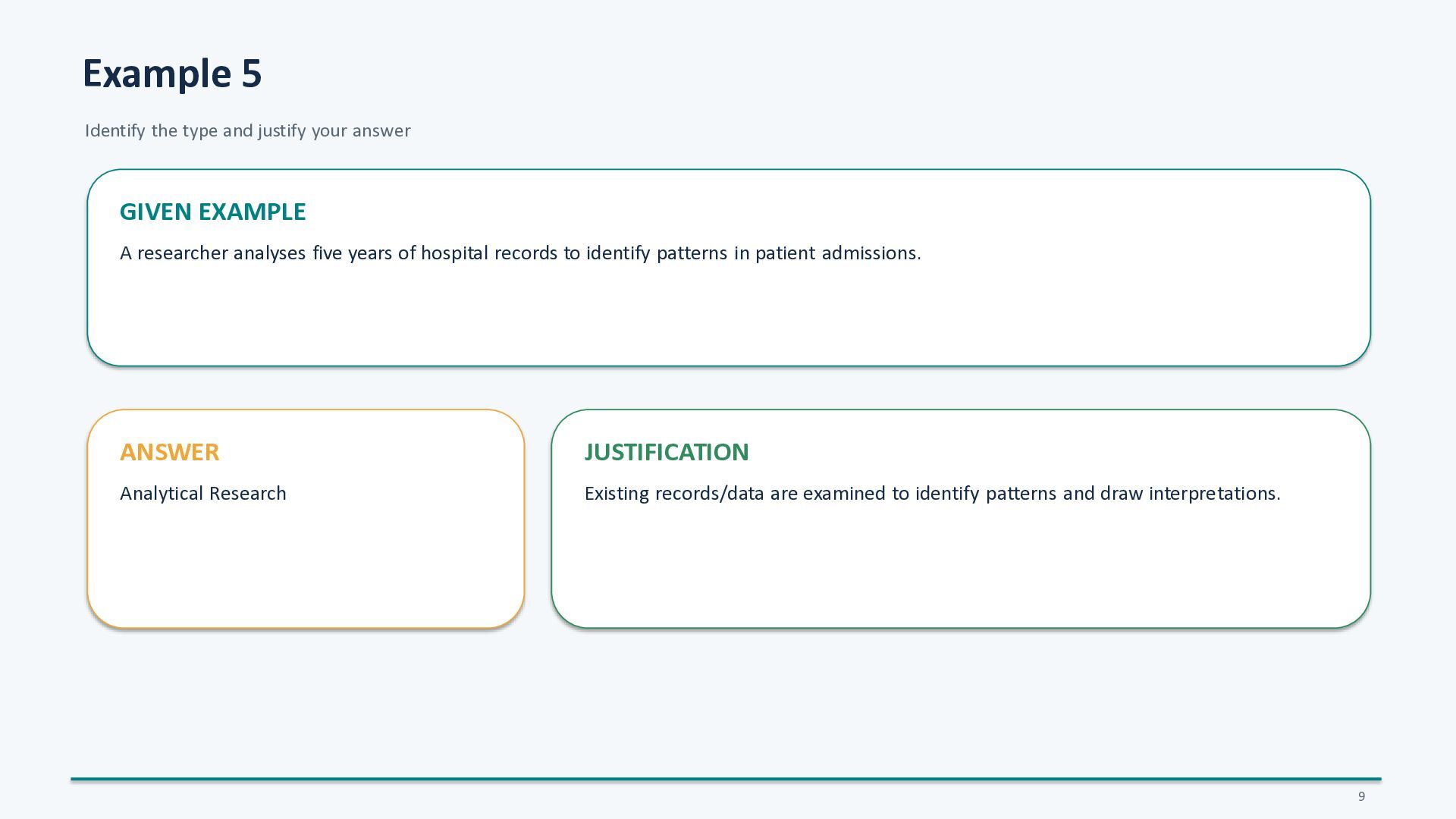
EXAMPLE A researcher analyses five years of hospital records to identify patterns in patient admissions. ANSWER JUSTIFICATION Analytical Research Existing records/data are examined to identify patterns and draw interpretations. 9
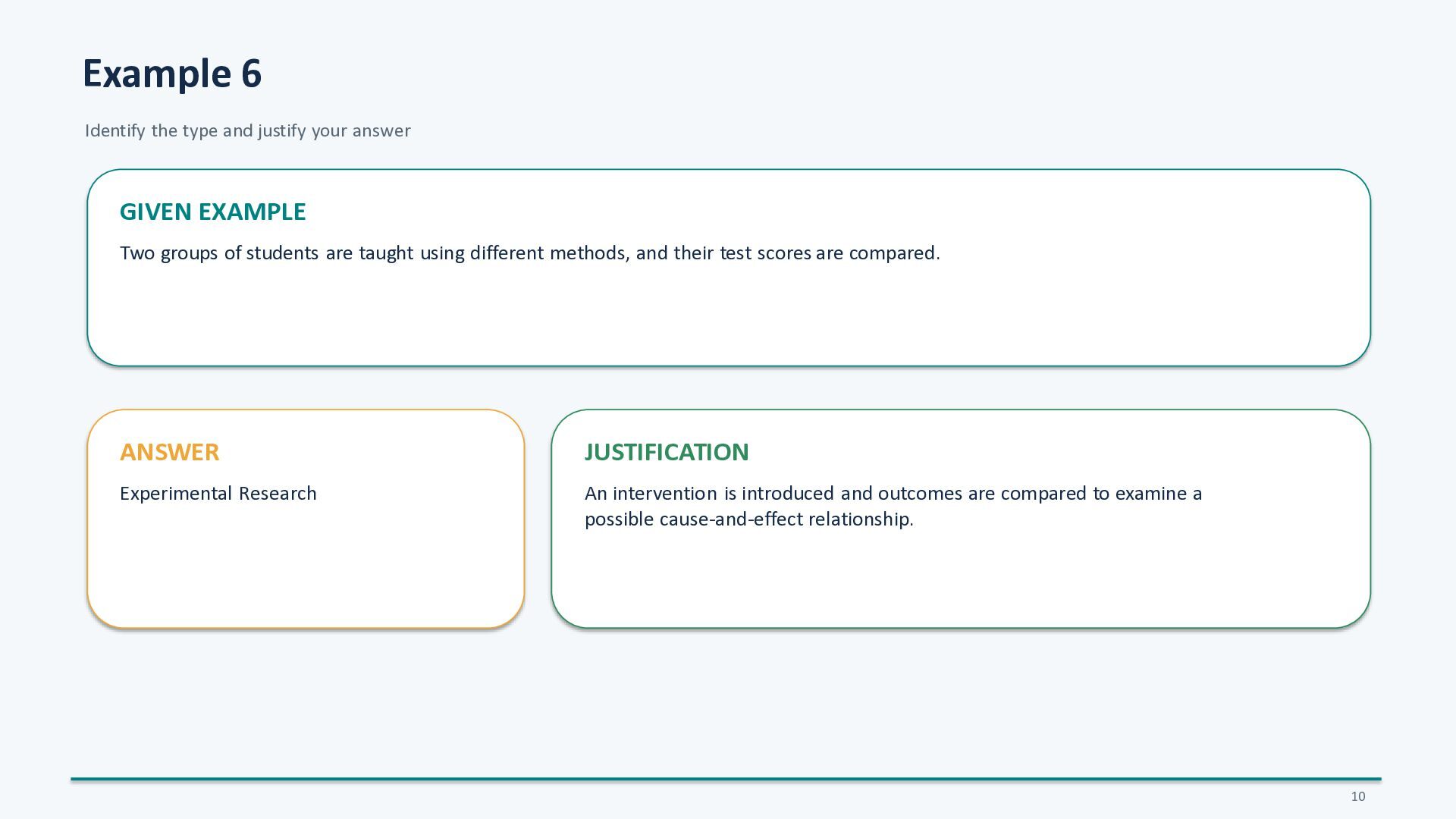
EXAMPLE Two groups of students are taught using different methods, and their test scores are compared. ANSWER JUSTIFICATION Experimental Research An intervention is introduced and outcomes are compared to examine a possible cause-and-effect relationship. 10
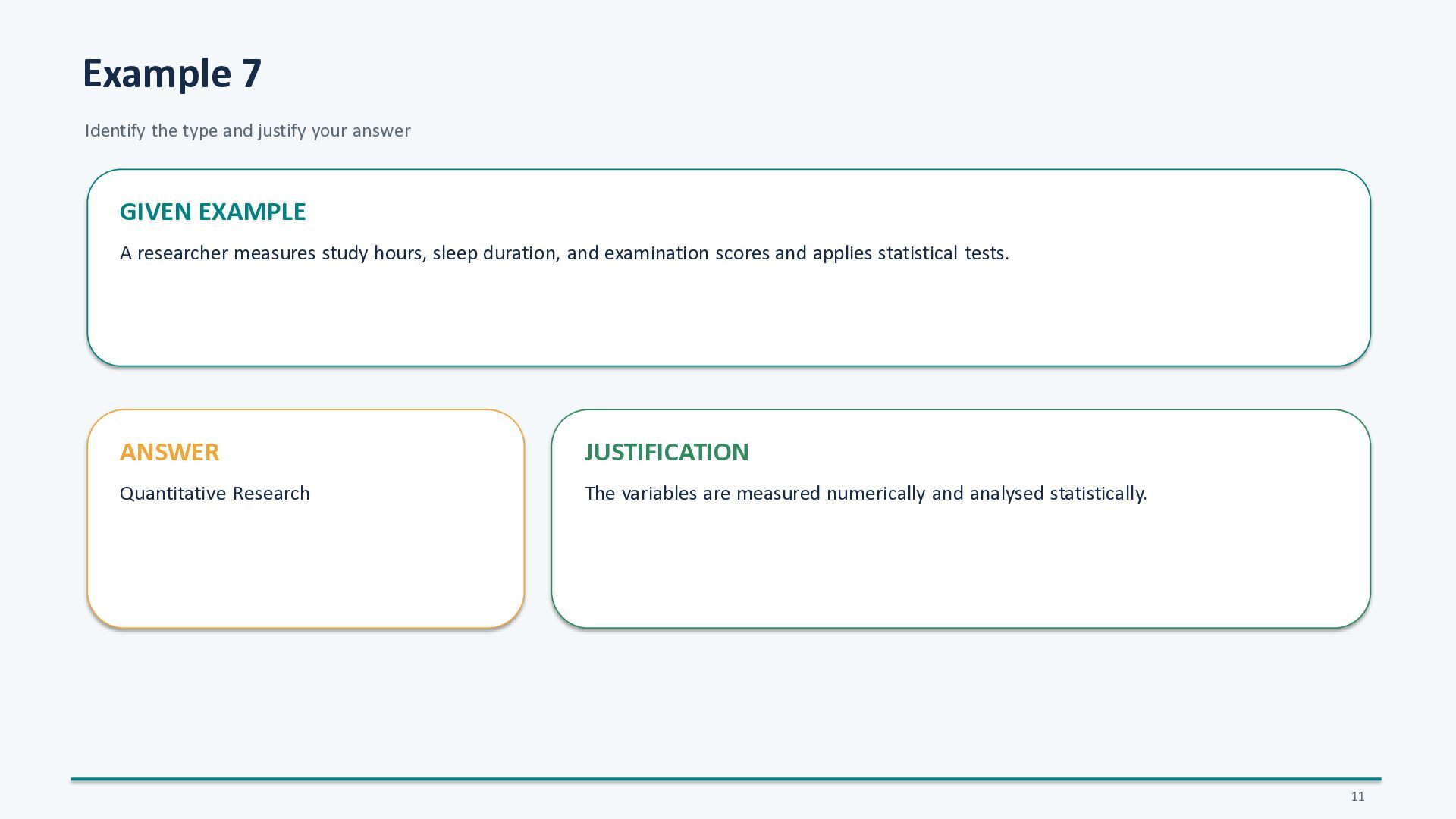
EXAMPLE A researcher measures study hours, sleep duration, and examination scores and applies statistical tests. ANSWER JUSTIFICATION Quantitative Research The variables are measured numerically and analysed statistically. 11
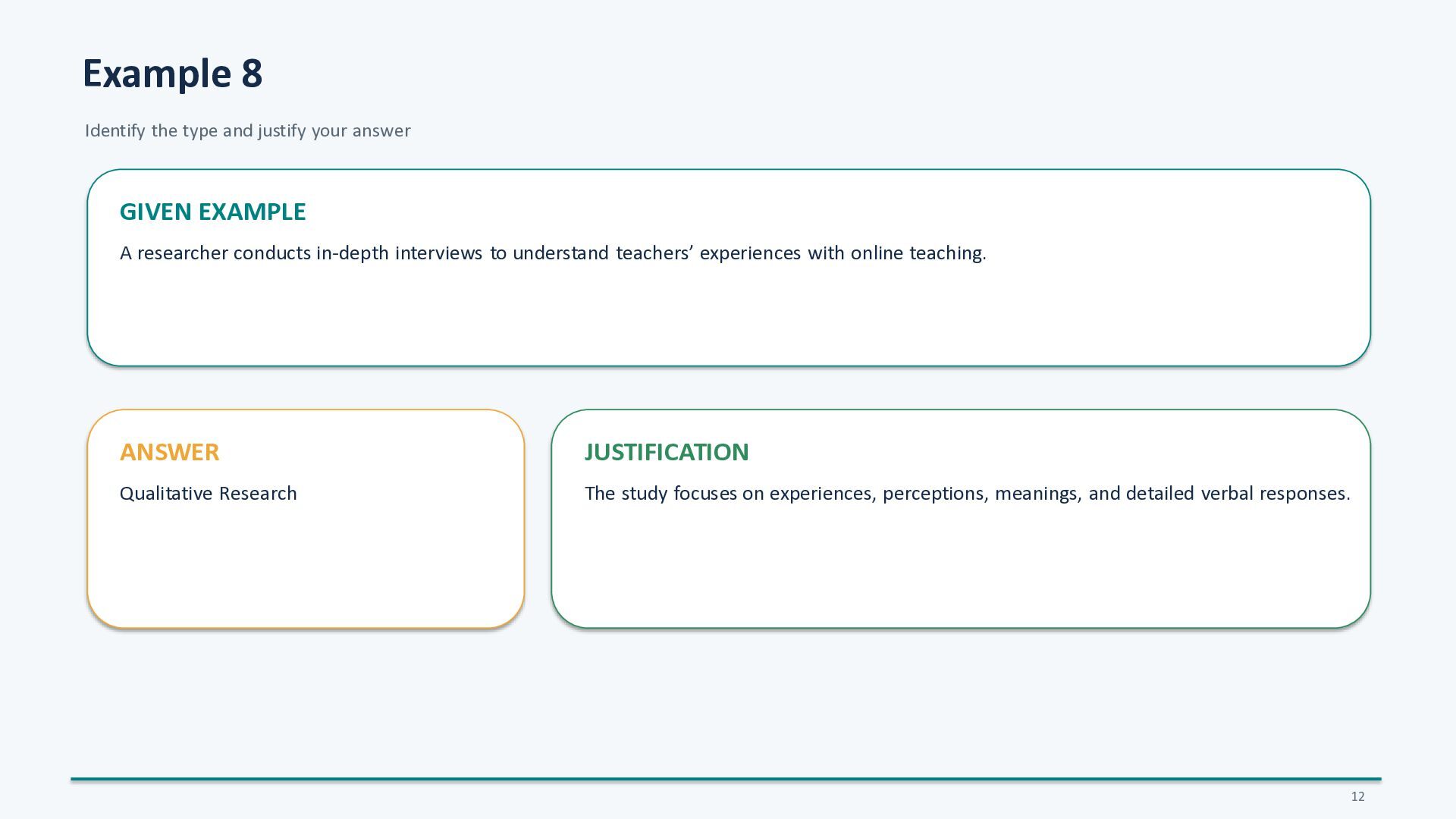
EXAMPLE A researcher conducts in-depth interviews to understand teachers’ experiences with online teaching. ANSWER JUSTIFICATION Qualitative Research The study focuses on experiences, perceptions, meanings, and detailed verbal responses. 12
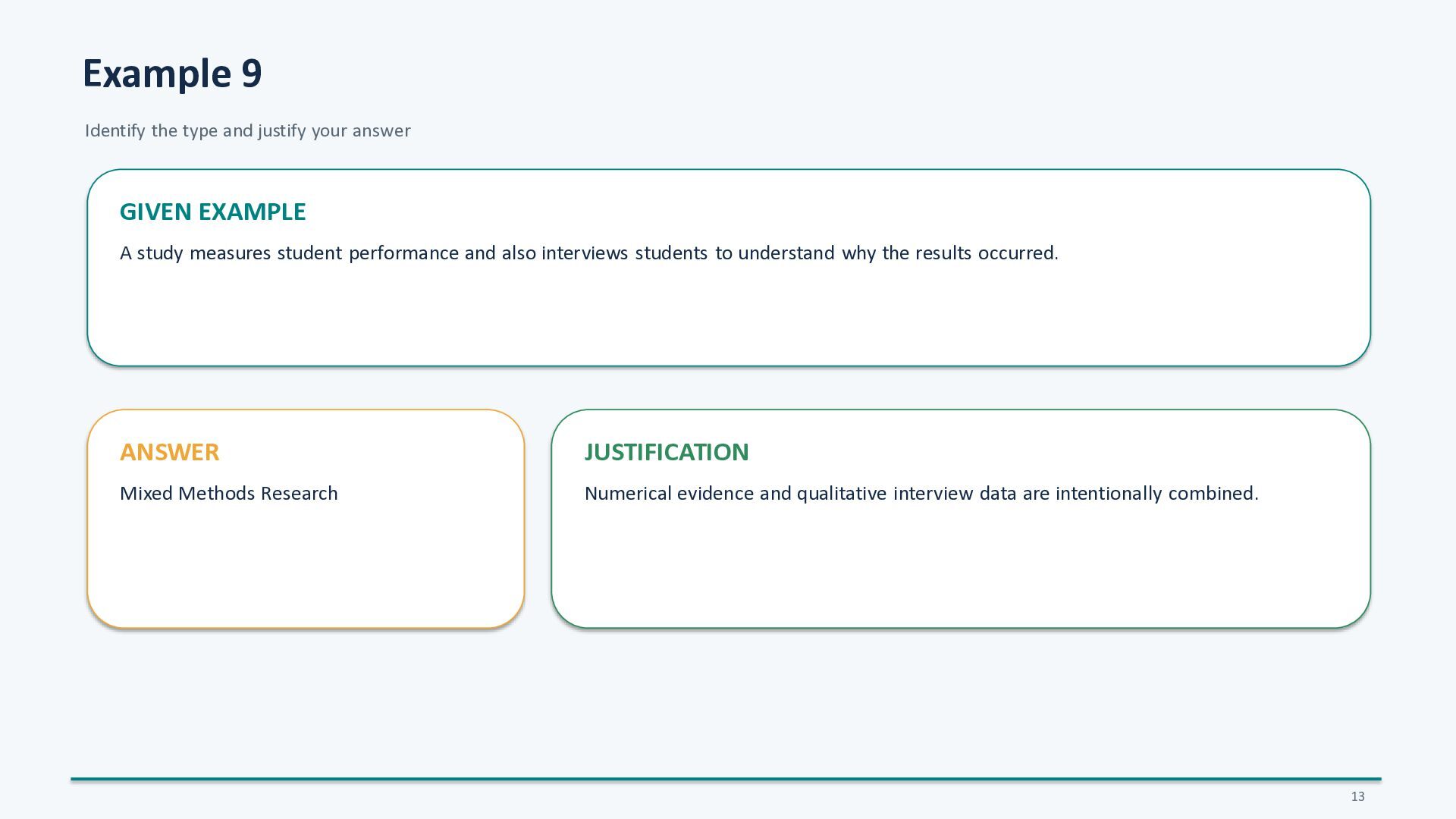
EXAMPLE A study measures student performance and also interviews students to understand why the results occurred. ANSWER JUSTIFICATION Mixed Methods Research Numerical evidence and qualitative interview data are intentionally combined. 13
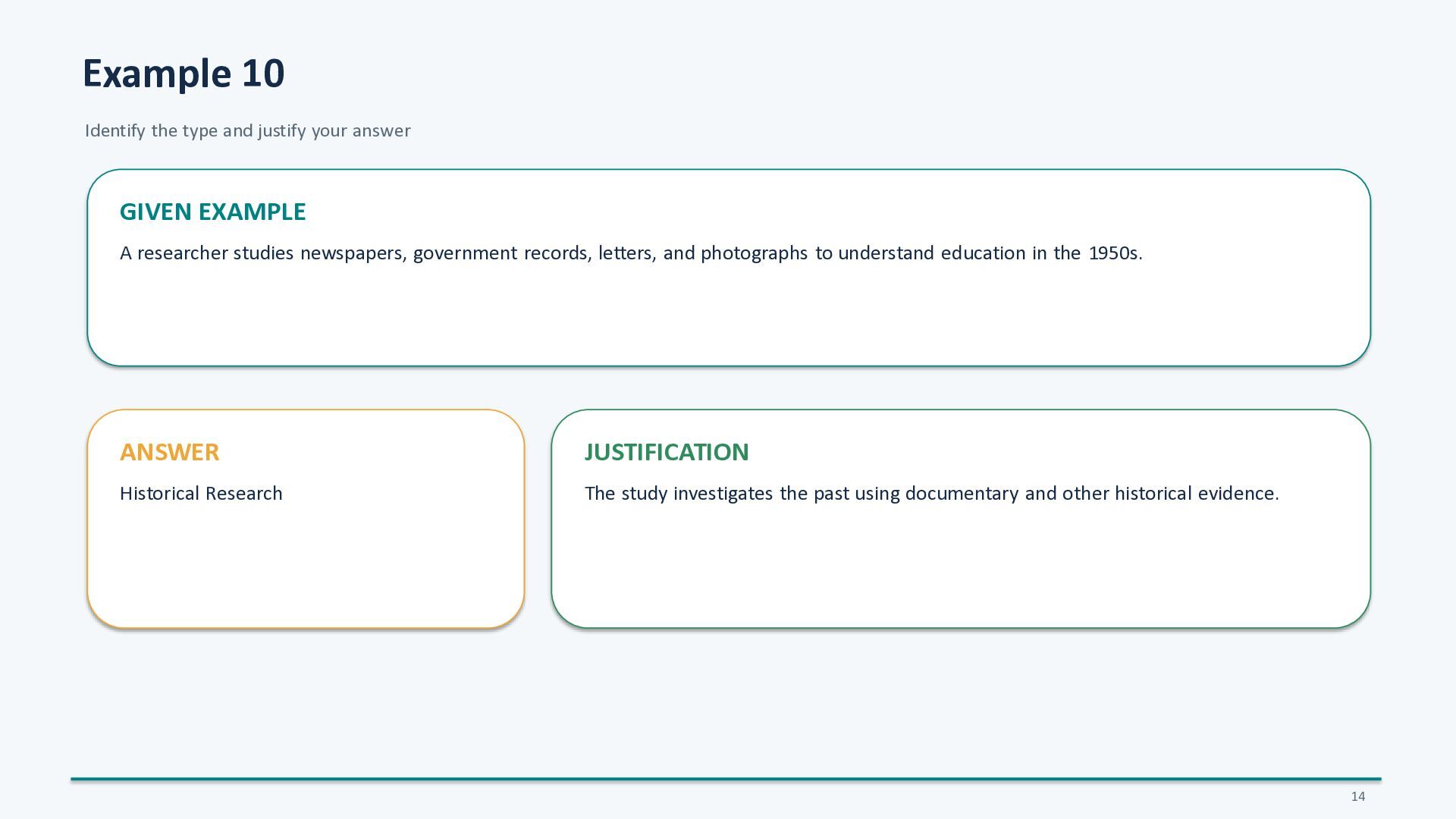
EXAMPLE A researcher studies newspapers, government records, letters, and photographs to understand education in the 1950s. ANSWER JUSTIFICATION Historical Research The study investigates the past using documentary and other historical evidence. 14
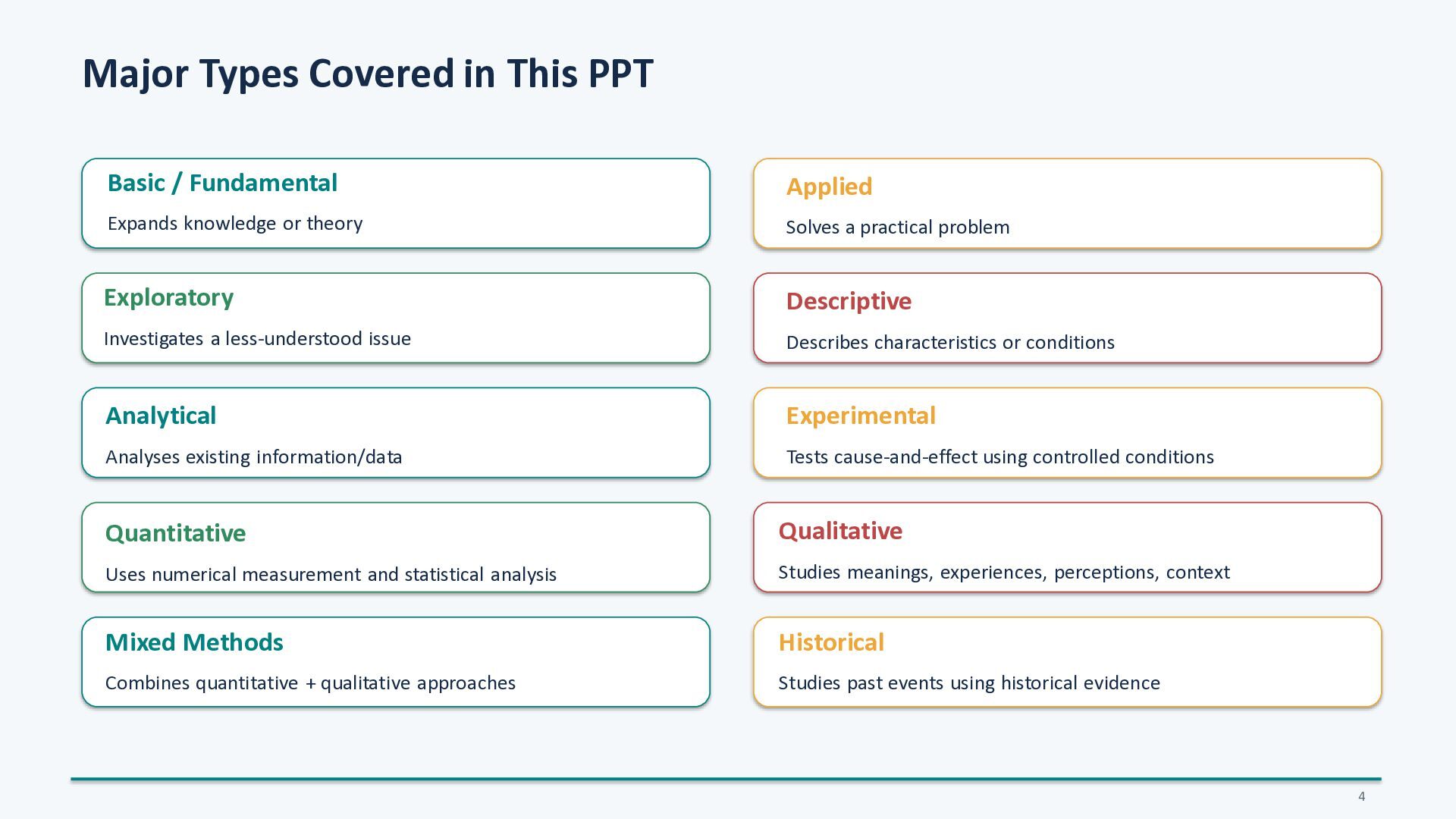
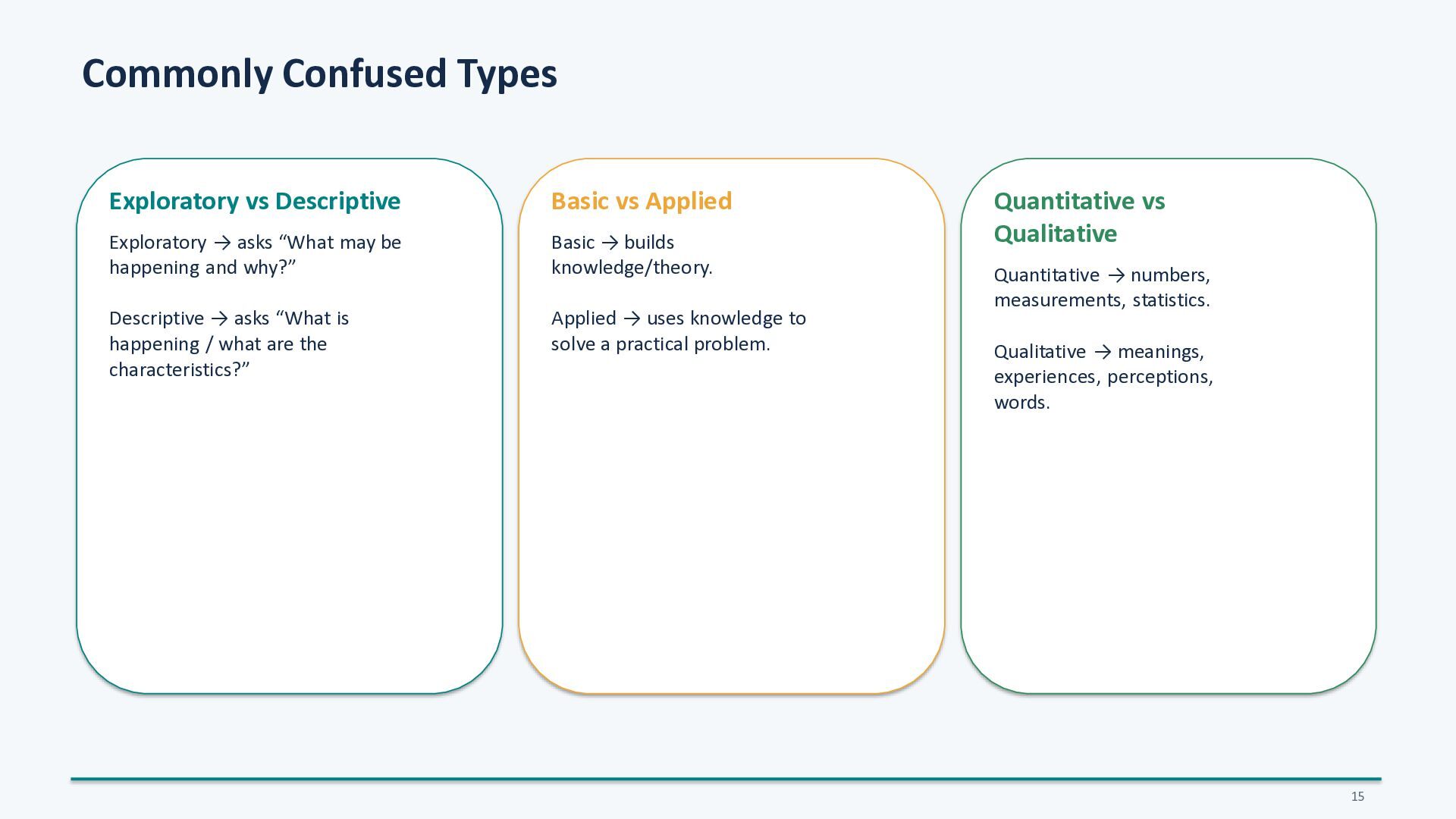
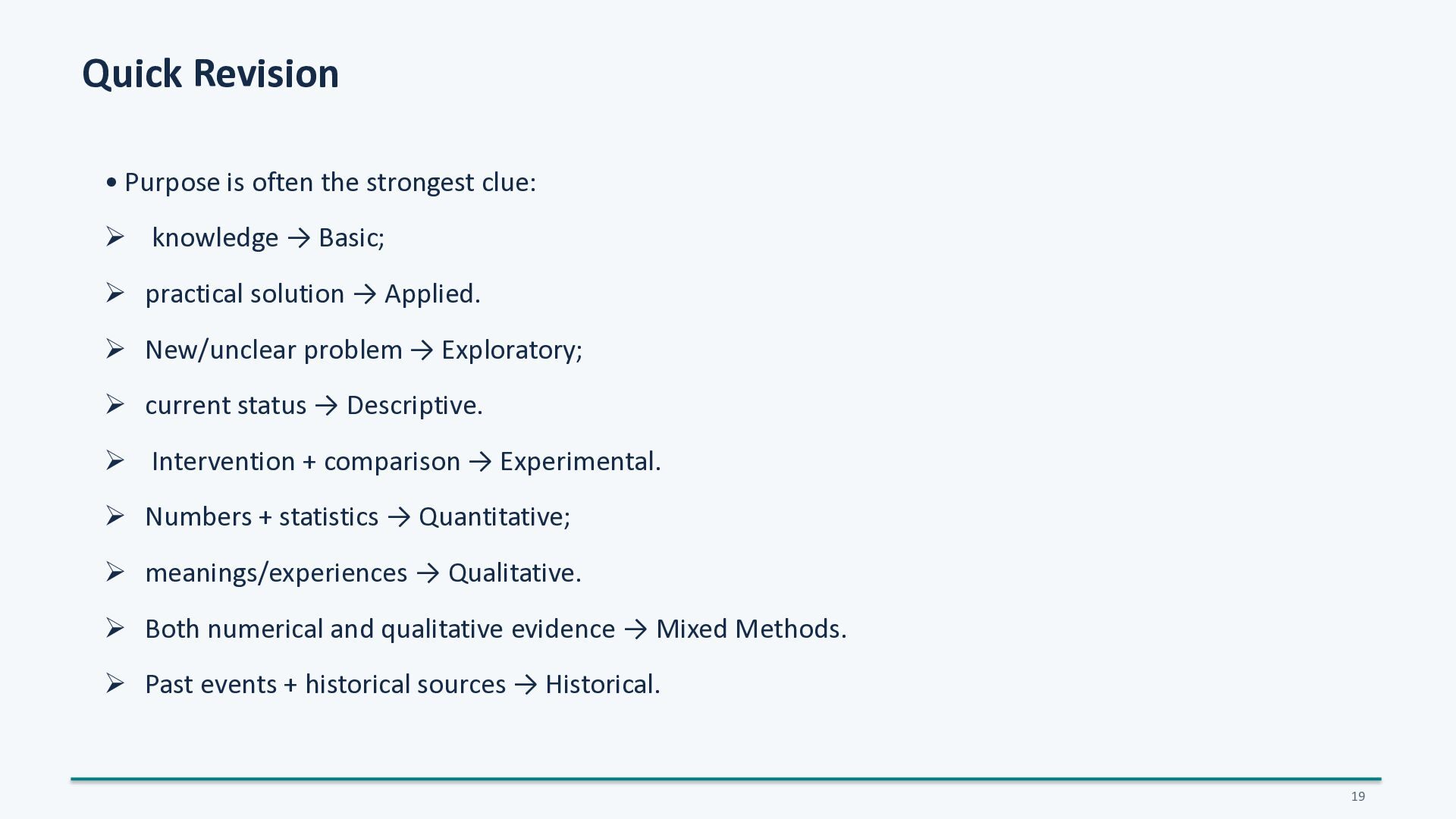
→ asks “What may be happening and why?” Basic → builds knowledge/theory. Descriptive → asks “What is happening / what are the characteristics?” Applied → uses knowledge to solve a practical problem. Quantitative vs Qualitative Quantitative → numbers, measurements, statistics. Qualitative → meanings, experiences, perceptions, words. 15
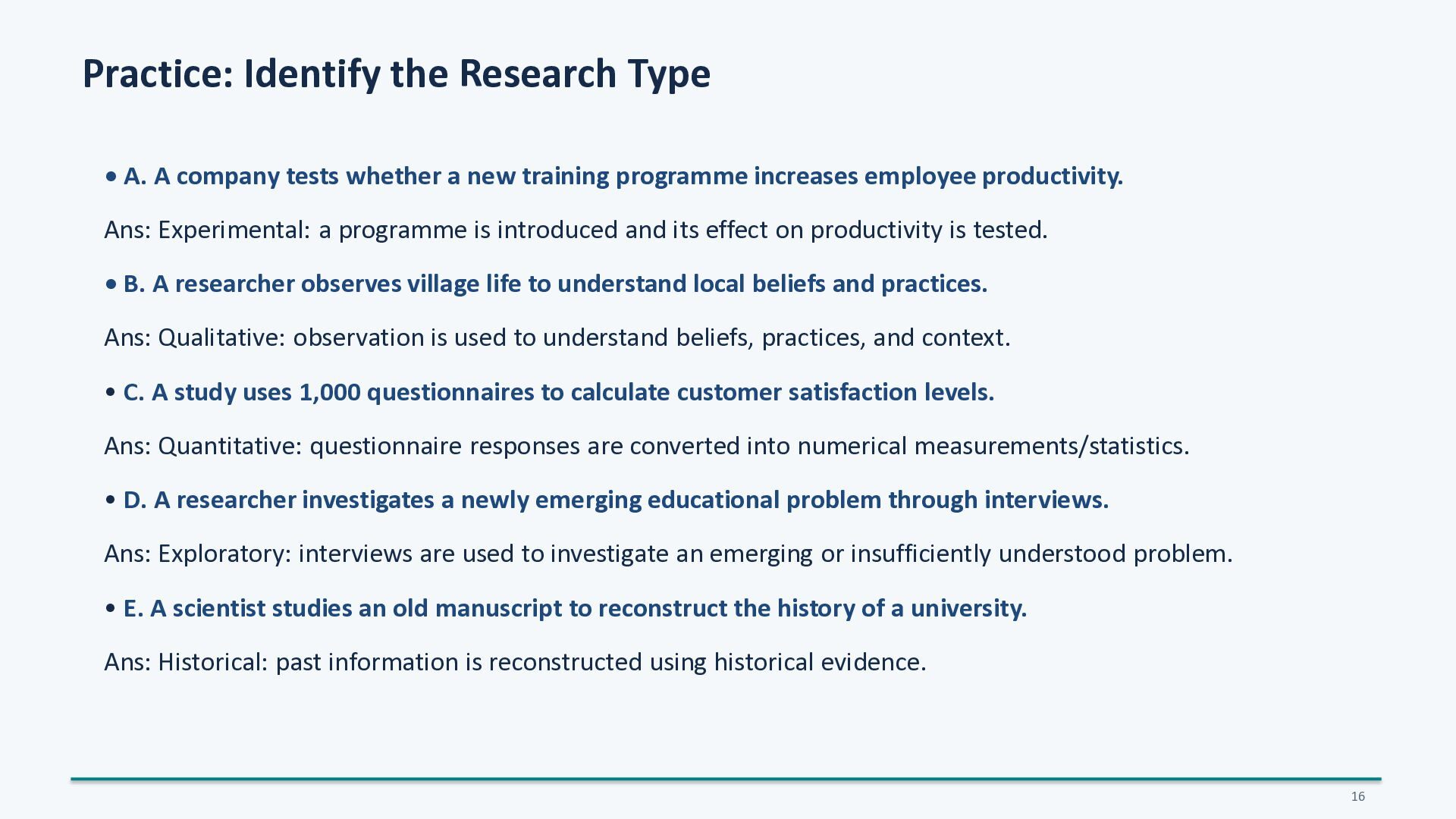
whether a new training programme increases employee productivity. Ans: Experimental: a programme is introduced and its effect on productivity is tested. • B. A researcher observes village life to understand local beliefs and practices. Ans: Qualitative: observation is used to understand beliefs, practices, and context. • C. A study uses 1,000 questionnaires to calculate customer satisfaction levels. Ans: Quantitative: questionnaire responses are converted into numerical measurements/statistics. • D. A researcher investigates a newly emerging educational problem through interviews. Ans: Exploratory: interviews are used to investigate an emerging or insufficiently understood problem. • E. A scientist studies an old manuscript to reconstruct the history of a university. Ans: Historical: past information is reconstructed using historical evidence. 16


 amrut9576
 bvr7352
 masakiokuda
 naochim2026
 spring_aki
 bunnchinn3
 hiola
 hiragahh
 sciencetokyo
 pawan_pharm
 kaityo256
 robintux
 rashwhitman
 tammyeverts
 aleyda
 paigeccino
 szymonslowik
 colly
 palkan
 3n
 pedronauck
 sachag
 jlugia