Upgrade to Pro — share decks privately, control downloads, hide ads and more …

Effective Teaching Methods: Teach Like the Pros Do

Avatar for blog blog
June 28, 2019

Effective Teaching Methods: Teach Like the Pros Do

Yesterday, a fourteen-year-old student in the tenth grade told me, “My favourite teacher knew how to teach what she was teaching. That made a difference to me and really stood out.” The thing is, she’s not the only student feeling this way. Most students out there (yours truly included) feel a special connect with teachers who use effective teaching methods.

Avatar for blog

blog

June 28, 2019
Tweet

More Decks by blog

Other Decks in Education

Transcript

  1. Overview • Yesterday, a fourteen-year-old student in the tenth grade

    told me, My favourite teacher knew how to teach what she was teaching. • That made a difference to me and really stood out. • The thing is, she’s not the only student feeling this way. • Most students out there (yours truly included) feel a special connect with teachers who use effective teaching methods.
  2. 1. Have a clear objective • In the world of

    education, your objectives for your students act as road signs to your destination. • Your plan and effective teaching methods are the map. • Simply, the act of ‘making a plan’ can imply that there is no real room for creativity your curriculum. • However, if your plan allows for creative elements (like plays, discussions, debates, etc.), then your plan will include engaging students’ creative faculties.
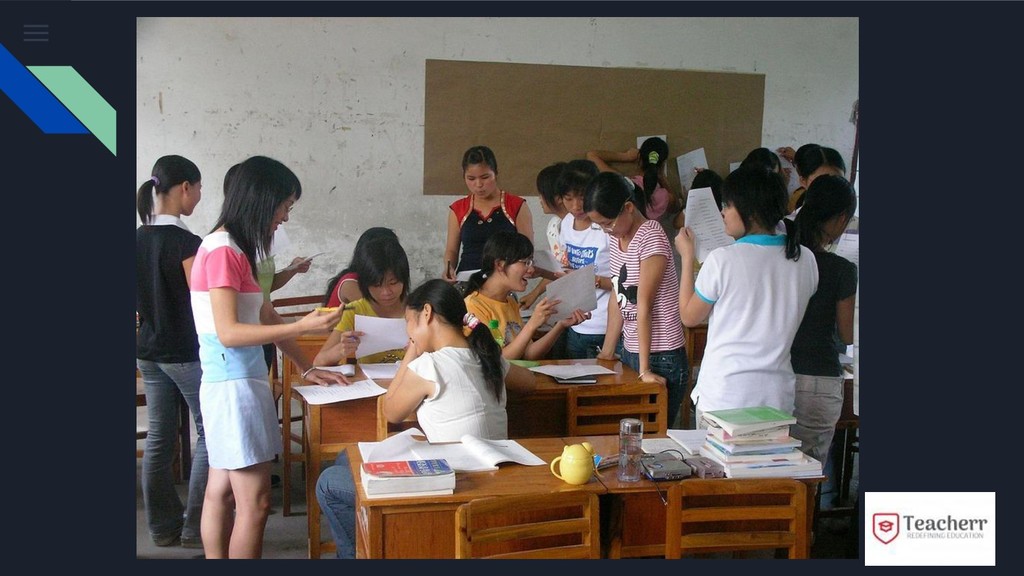
  3. 2. Classroom discussion • One of our effective teaching methods

    recommends that teachers step offstage every now and then to facilitate entire class discussion. • This allows students to learn from each other. • It’s also a great opportunity for teachers to formatively assess (through observation) how well students are grasping new content and concepts.
  4. 3. Visualisation • Bring dull academic concepts to life with

    visual and practical learning experiences, helping your students understand how their schooling applies in the real world. • You can display photos, audio clips and videos. • Additionally, you can encourage your students to think about what you teach them on a practical sense through classroom experiments and local field trips you organise.
  5. 4. Inquiry-based instruction • Pose thought-provoking questions which inspire your

    students to think for themselves and become more independent learners. • Encouraging students to ask questions and investigate their own ideas helps improve their problem-solving skills as well as gain a deeper understanding of academic concepts. • Both of which are important life skills.
  6. 5. Learn to live without immediate feedback • There is

    nothing worse than sweating over a lesson plan only to have your students walk out of class without so much as a smile. • It’s hard to give 100% and not see immediate results. • Teachers who rely on that instant gratification will get burned out and disillusioned. • Learning, relationships and education are a messy endeavour, much like nurturing a garden. • It takes time, and some dirt, to grow.
  7. 6. Know when to listen to students and when to

    ignore them • Right on the heels of the above tip is the concept of discernment with student feedback. • A teacher who never listens to their students will ultimately fail. • A teacher who always listens to their students will ultimately fail. • It is no simple endeavour to know when to listen and adapt, and when to gently put your foot down.
  8. 7. Use humour • You know why your students spend

    so much time on the internet? Because it’s a hilarious place to be. (Pro tip: ask them what a ‘meme’ is and you would have set off a lively and hysterical discussion)
  9. 8. Know how to take risks • Effective teaching methods

    include risk-taking, a crucial part of the success formula. • As a teacher, one of your primary duties is to be a good model for your students. • Demonstrating that you do take risks and are prepared for any possible outcome does influence your students.
  10. 9. Use praise authentically • Students need encouragement, yes, but

    real encouragement. • If you praise half-hearted work, your students are going to think that that is all they need to do to get your appreciation and a good grade. • At the same time, you don’t want to create an environment where there is no praise or recognition at all.
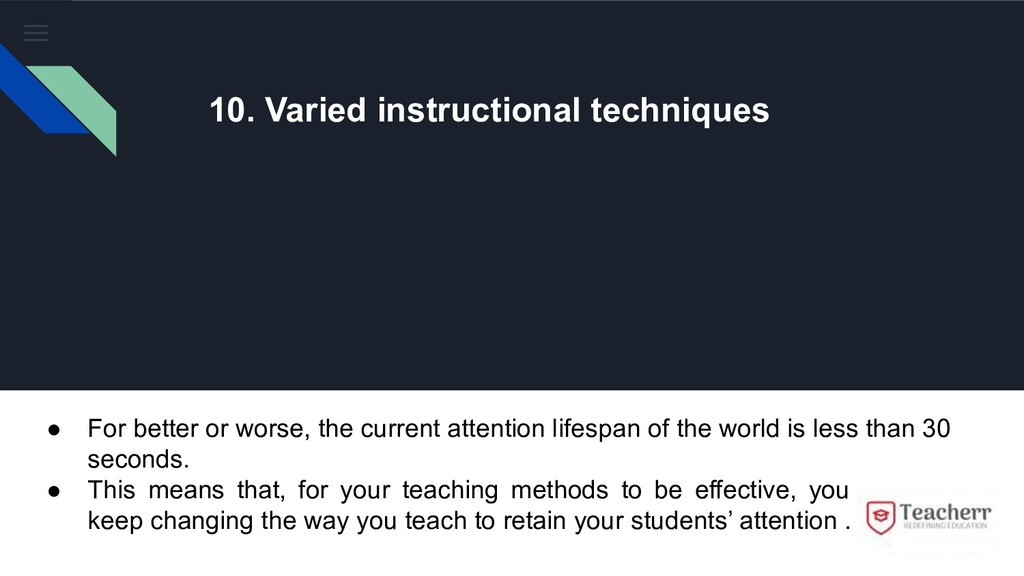
  11. 10. Varied instructional techniques • For better or worse, the

    current attention lifespan of the world is less than 30 seconds. • This means that, for your teaching methods to be effective, you have to keep changing the way you teach to retain your students’ attention .
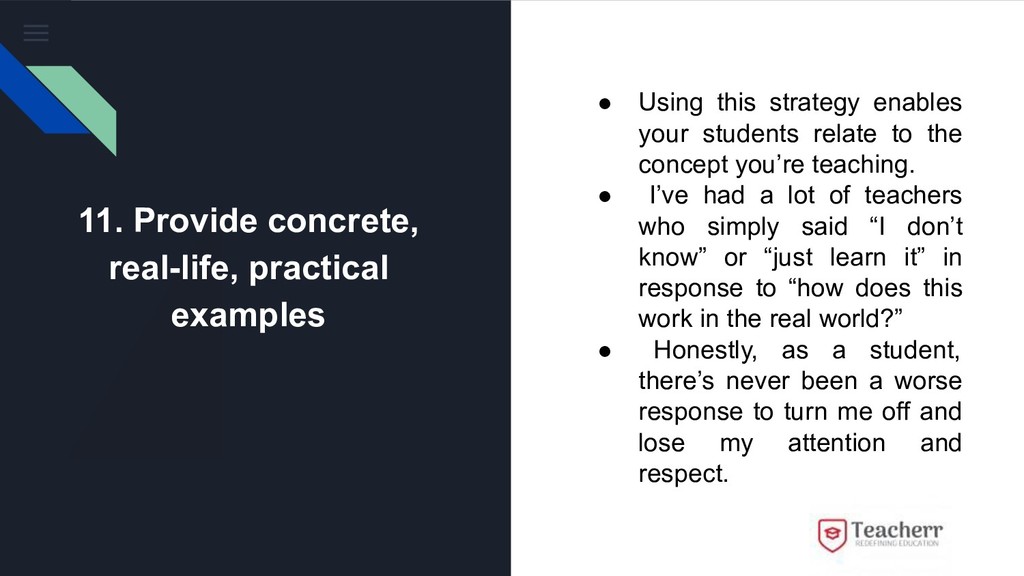
  12. 11. Provide concrete, real-life, practical examples • Using this strategy

    enables your students relate to the concept you’re teaching. • I’ve had a lot of teachers who simply said “I don’t know” or “just learn it” in response to “how does this work in the real world?” • Honestly, as a student, there’s never been a worse response to turn me off and lose my attention and respect.
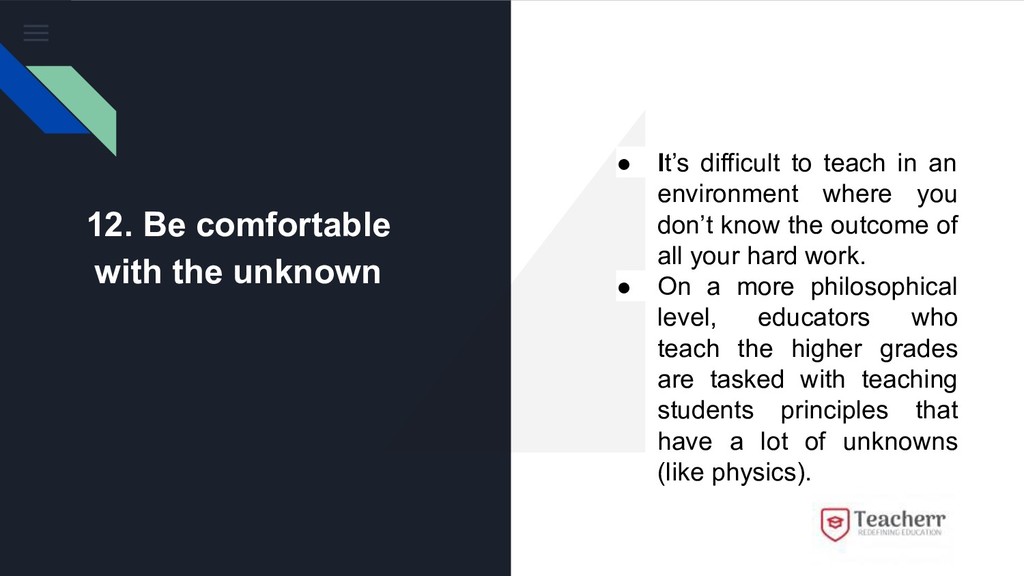
  13. 12. Be comfortable with the unknown • It’s difficult to

    teach in an environment where you don’t know the outcome of all your hard work. • On a more philosophical level, educators who teach the higher grades are tasked with teaching students principles that have a lot of unknowns (like physics).
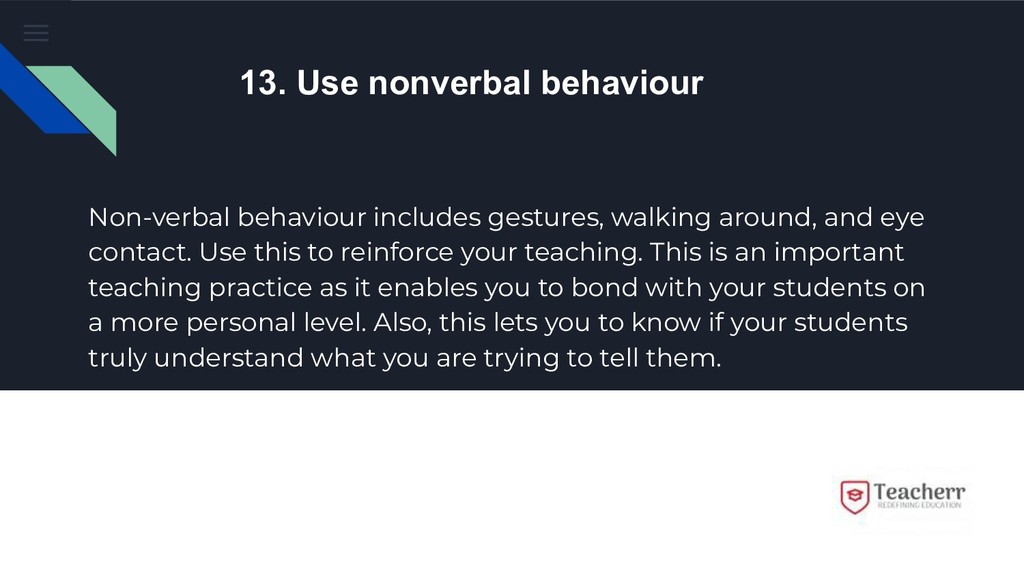
  14. 13. Use nonverbal behaviour Non-verbal behaviour includes gestures, walking around,

    and eye contact. Use this to reinforce your teaching. This is an important teaching practice as it enables you to bond with your students on a more personal level. Also, this lets you to know if your students truly understand what you are trying to tell them.
  15. 14. Reflect on your own teaching • No matter how

    experienced you may be, it’s a good habit to reflect on what you have taught that day and how. • This helps you, as a teacher, realise what you have done wrong and what you have done right. • This gives you a chance to consider where you could improve the quality of your teaching.
  16. 15. Behaviour management • Implementing an effective behaviour management strategy

    is one of our effective teaching methods. • It is crucial to gain your students’ respect and ensure students have an equal chance of reaching their full potential.
  17. 16. Use technology in the classroom • Incorporating technology into

    your teaching is a great way to actively engage your students, especially as digital media surrounds young people in the 21st century. • Interactive whiteboards or mobile devices can be used to display images and videos, which helps students visualise new academic concepts.
  18. 17. Be consistent • Do you have to be consistent

    with your teaching methods to be effective? Consistency is not to be confused with “stuck.” • Consistency means that you do what you say you will do, you don’t change your rules based on your mood, and your students can rely on you when they are in need. • Teachers who are stuck in their outdated methods may boast consistency, when in fact it is cleverly-masked stubbornness.
  19. 18. Enjoy your work • It is easy to spot

    a teacher who loves their work. They seem to emanate contagious energy. • Even a subject like advanced calculus (known for being dry and quite theoretical) comes alive when taught by a passionate teacher. • If you don’t love your work or your subject, it will come through in your teaching. Try to figure out why you feel so unmotivated and uninspired.
  20. 19. Never stop learning • I don’t have to tell

    you, dear teacher, that learning is a life-long process. • That would be like preaching to the choir! • Naturally, my next tactic on our list of effective teaching methods is to find time in your schedule to keep learning, yourselves.
  21. 20. Professional development Engaging in regular professional development programmes is

    a great way to enhance teaching and learning in your classroom.