Upgrade to Pro — share decks privately, control downloads, hide ads and more …

CeramForge Private Limited

Avatar for CeramForge CeramForge
December 09, 2025

CeramForge Private Limited

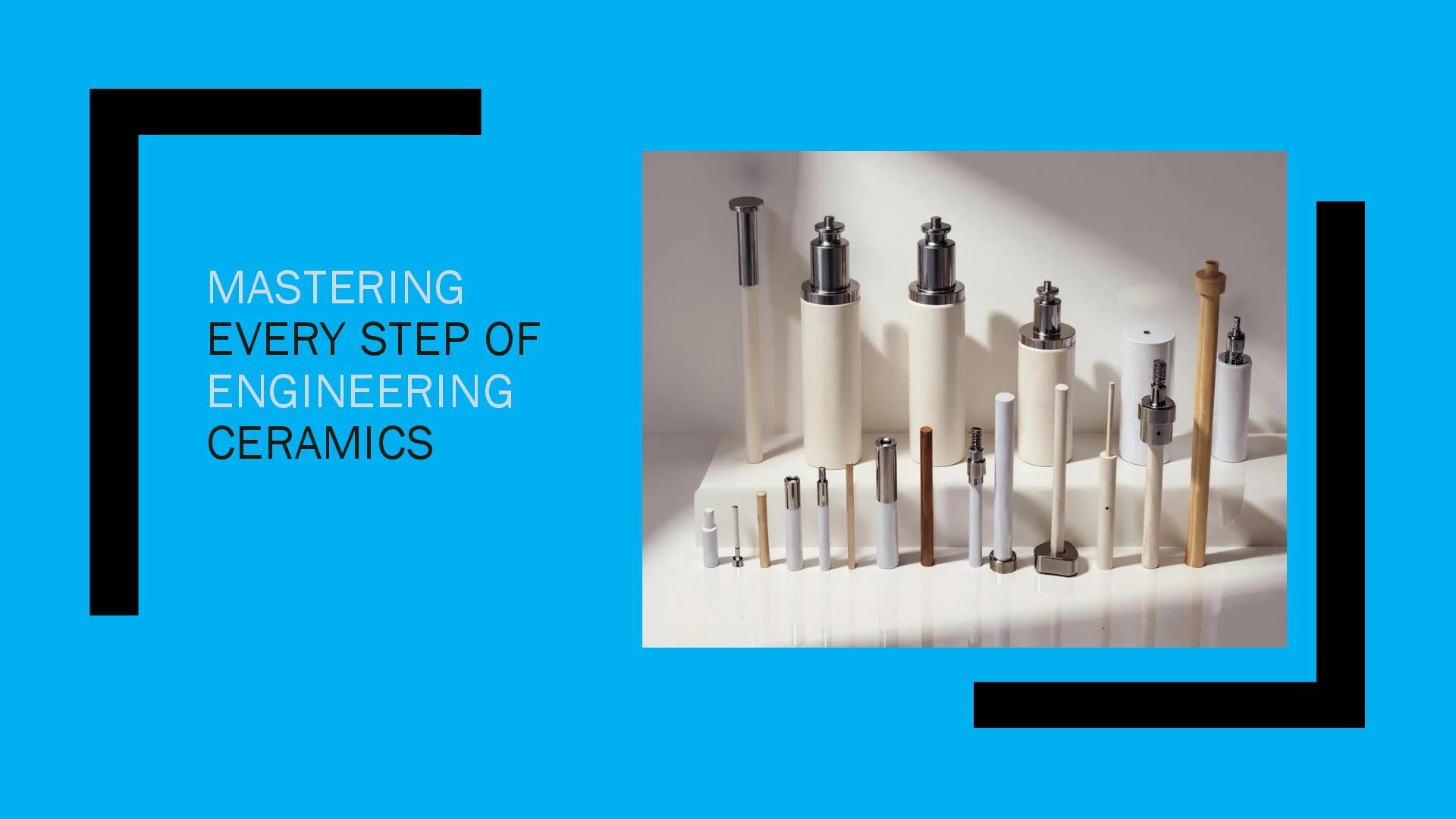
CeramForge excels in the development of high-performance engineered ceramics using advanced materials such as zirconia, alumina, silicon carbide, and its variations. Our success is built on a foundation of skilled experts, advanced manufacturing technologies, and strict adherence to the highest quality standards while keeping Health and safety our top priority. From raw material selection to final product inspection, we ensure precision, reliability, and durability in every component we produce.

Avatar for CeramForge

CeramForge

December 09, 2025

Other Decks in Business

Transcript

  1. INTRODUCTION CeramForge — Ceramics Built for Tomorrow Established: 1990 •

    Headquarters: Bengaluru, India About CeramForge (formerly Anoop Ceramics) is a leading manufacturer of engineered ceramic components, delivering precision, reliability, and durability for industries worldwide — from aerospace to electronics. Core Strengths ▪ Manufacturing Excellence - Advanced technologies and precision engineering ▪ High-Performance Materials - Alumina, Zirconia, Silicon Carbide, and more ▪ Sustainability Commitment - ISO 9001, 14001 & 45001 certified processes ▪ Innovation-Driven - Continuous R&D for custom ceramic solutions Vision To pioneer next-generation ceramic technologies that empower industries through durability, reliability, and excellence.
  2. COMPANY ETHOS Crafted with Precision. Committed to Performance CeramForge is

    a leading manufacturer of high-performance engineered ceramics, delivering solutions that endure the toughest industrial conditions - from extreme heat to corrosive environments. Driven by innovation, precision, and quality, we engineer ceramics that enhance efficiency, reliability, and longevity across global industries. Our Core Principles ▪ Manufacturing Excellence - Advanced technology, precise forming, sintering, and polishing processes ensure world-class quality. ▪ Tailored Solutions - Customized ceramic components designed to meet exact client specifications. ▪ Quality, Safety & Sustainability - Commitment to Accuracy, Consistency, and Excellence (ACE) under ISO- certified standards. ▪ Leadership & Innovation - Guided by decades of expertise to continuously push the boundaries of ceramic technology. ▪ Global Reach - Trusted partner for industries worldwide, offering local support with international standards. Vision To forge the future of advanced ceramics through technology, sustainability, and unwavering excellence.
  3. COMPANY POLICY Committed to People, Planet, and Performance At CeramForge,

    our commitment extends beyond ceramics - it’s about how we protect our people, preserve the planet, and pursue excellence in every operation. Our integrated Health, Safety, Environment, and Quality (HSEQ) policy guides everything we do, ensuring sustainable growth and global trust. Core Policy Pillars ▪ Health & Safety - We uphold a zero-incident workplace through proactive risk management, continuous training, and strict safety compliance. ▪ Environmental Responsibility - We minimize our ecological footprint via energy-efficient manufacturing, responsible sourcing, and waste reduction, promoting a greener future. ▪ Quality Assurance - Every component is engineered for precision and durability, backed by ISO-aligned quality systems, rigorous inspections, and continuous improvement. ▪ Corporate Ethics & Compliance - Integrity, fairness, and transparency define our culture. We maintain ethical partnerships, respect diversity, and comply with all legal and industrial standards. Our Commitment To advance industry with innovation, integrity, and responsibility, creating a lasting impact on people, customers, communities, and the planet.
  4. COMPANY CERTIFICATES Quality, Safety & Sustainability at Every Step At

    CeramForge, certifications aren’t just symbols - they are a promise of performance, responsibility, and reliability. Our integrated management systems ensure excellence in quality, environmental stewardship, and workplace safety, reinforcing our global leadership in engineered ceramics. Our Certified Standards ▪ ISO 9001 - Quality Management - Ensures consistency, precision, and continuous improvement through a robust Quality Management System (QMS). Every component is crafted to meet or exceed global industrial standards. ▪ ISO 14001 - Environmental Management - Demonstrates our dedication to sustainability through resource efficiency, waste reduction, and regulatory compliance. We protect the planet while powering industrial innovation. ▪ ISO 45001 - Occupational Health & Safety - Highlights our proactive safety culture built on risk assessment, employee well-being, and continuous training. Safety isn’t just a policy - it’s a shared responsibility. Our Assurance Through global certifications and continuous excellence, CeramForge remains committed to delivering quality, sustainability, and safety—every step of the way.
  5. Applications — Engineered Ceramic Components for Global Industries CeramForge delivers

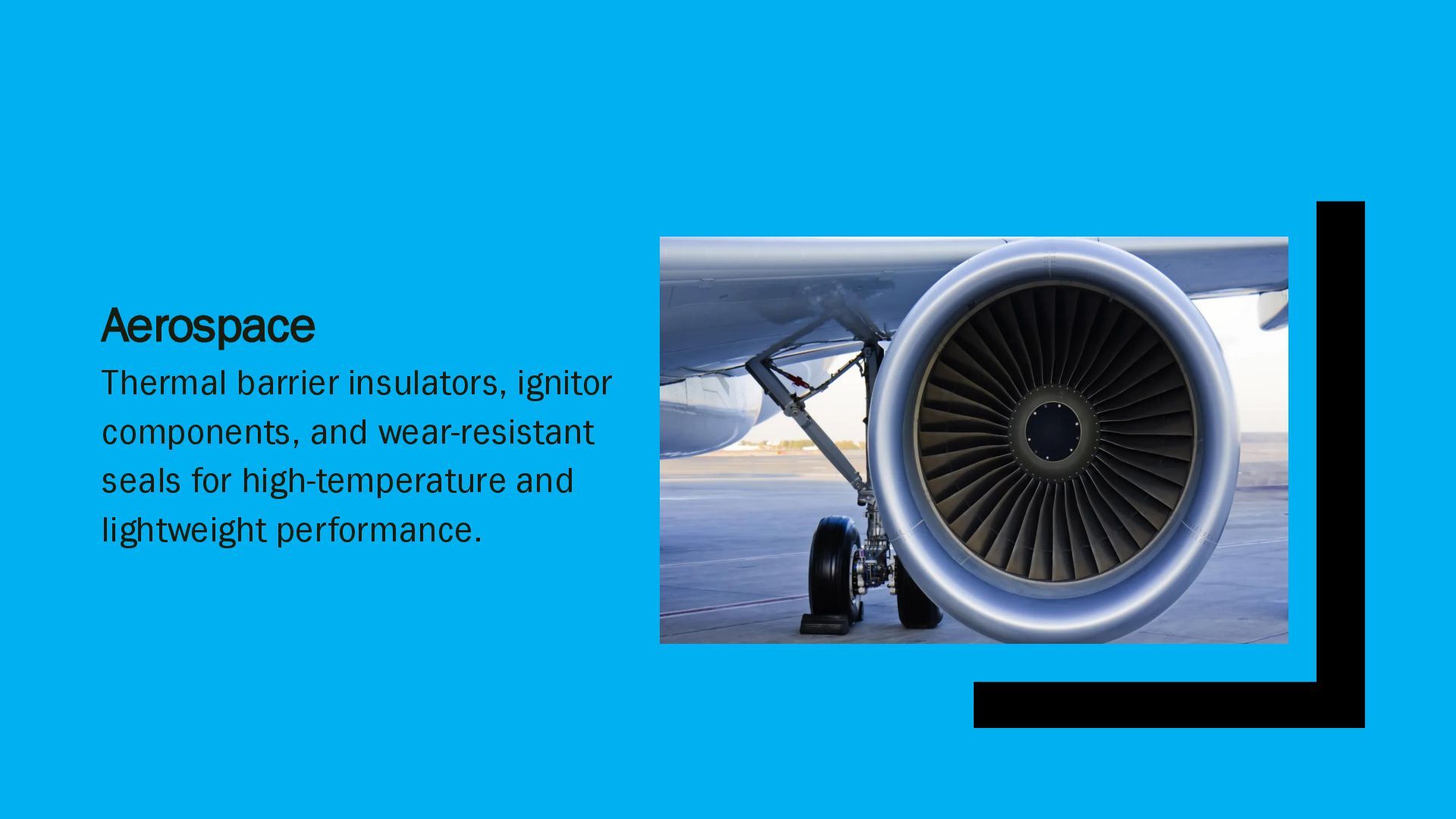
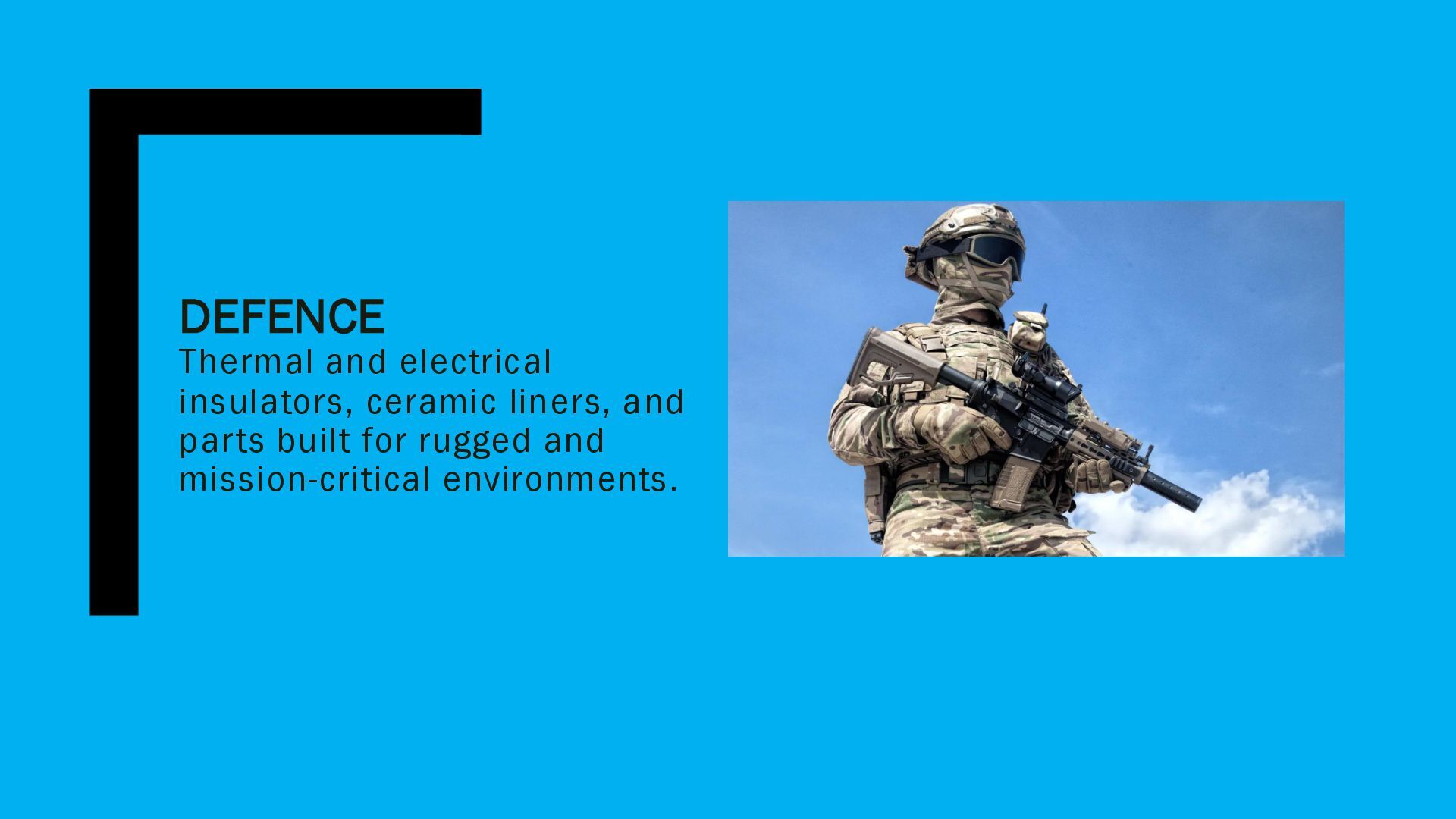
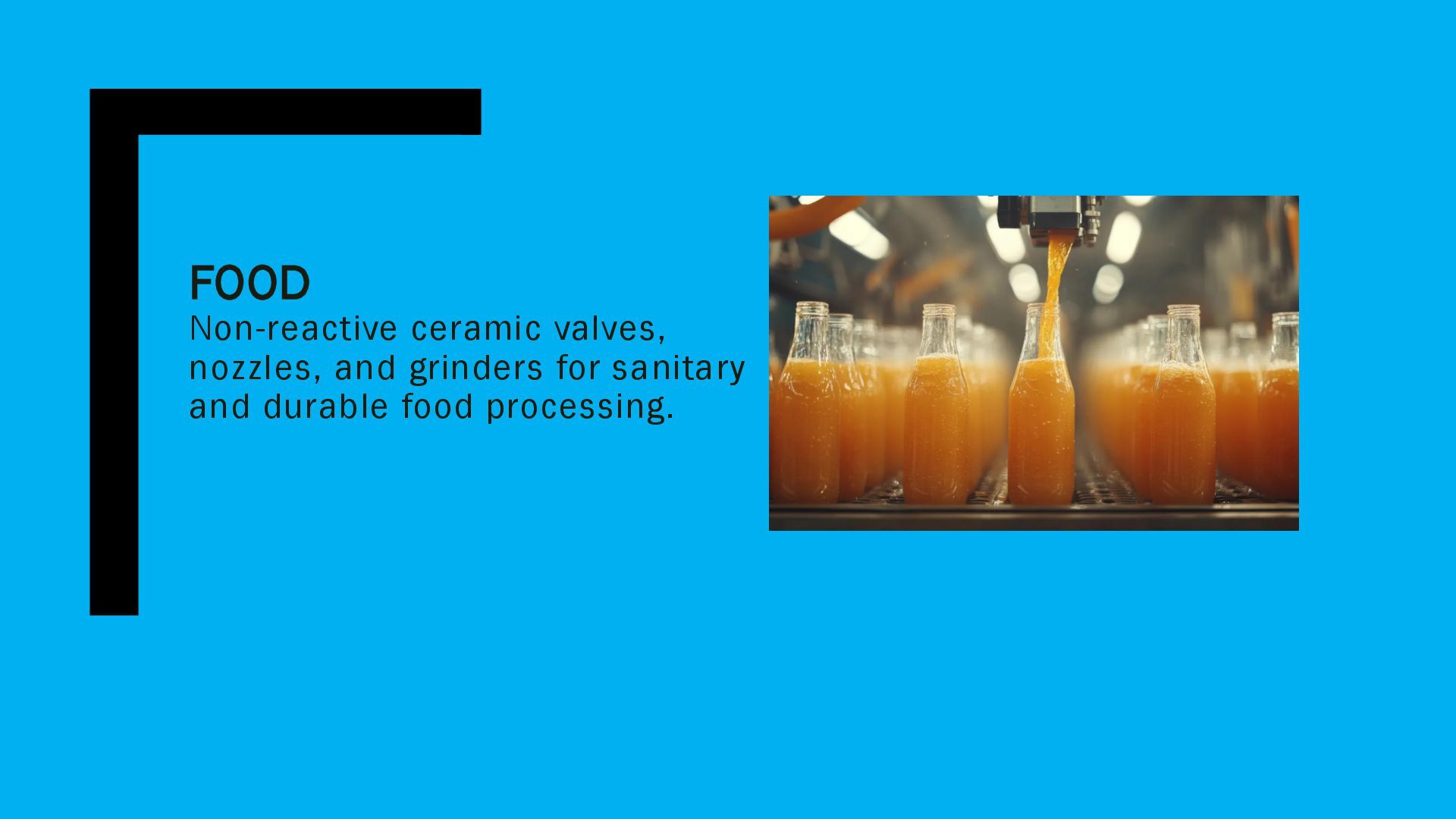
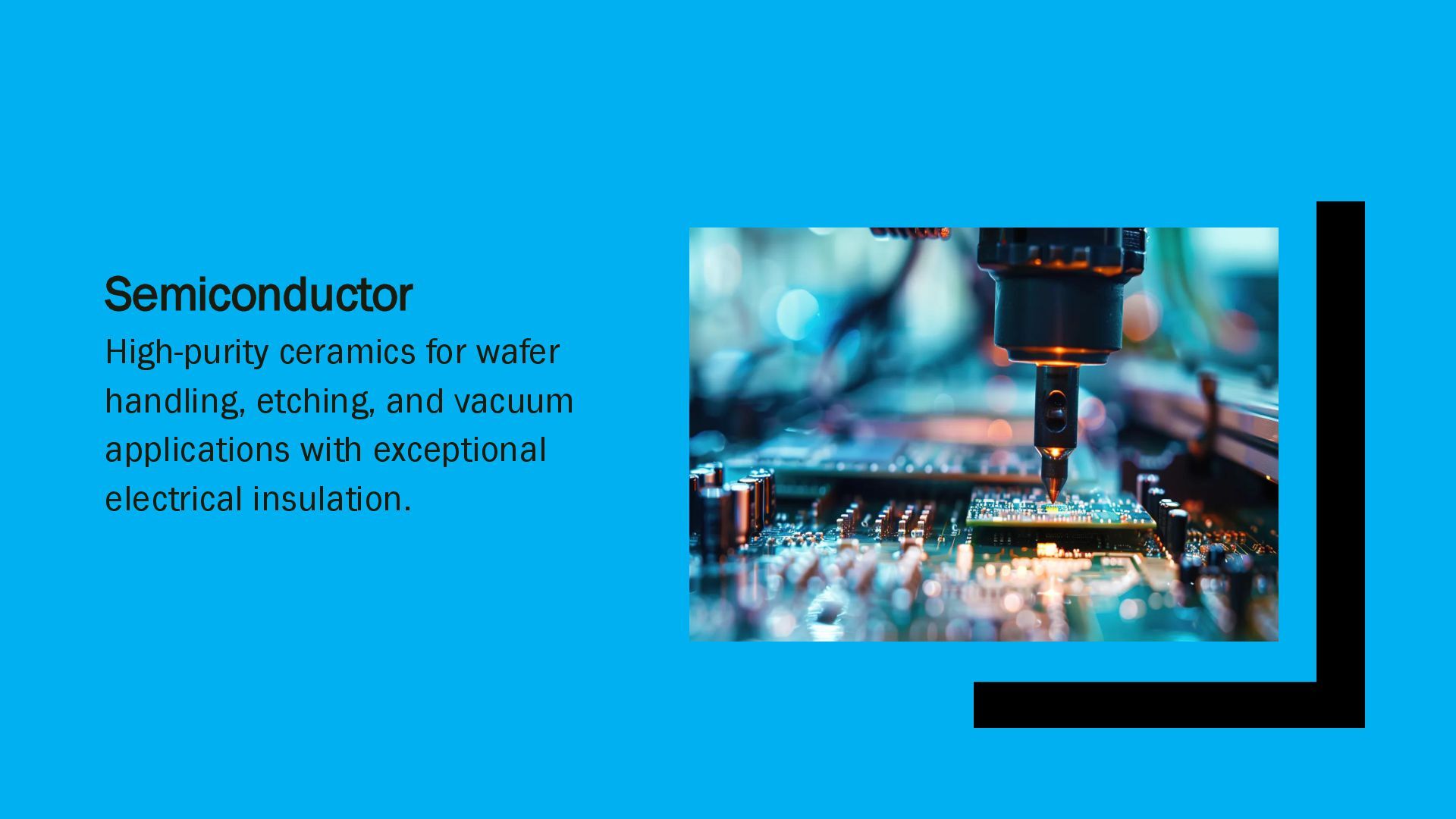
    high-performance ceramic solutions engineered for extreme mechanical, thermal, and chemical environments. Our precision ceramics ensure hardness, corrosion resistance, thermal stability, and long service life, meeting IMS-certified global standards across diverse sectors. Key Industry Applications ▪ Aerospace ▪ Defence ▪ Automotive ▪ Oil & Gas ▪ Pharmaceutical ▪ Food Industry ▪ Semiconductor Trusted Worldwide for ▪ Precision ▪ Reliability ▪ Durability ▪ Sustainability
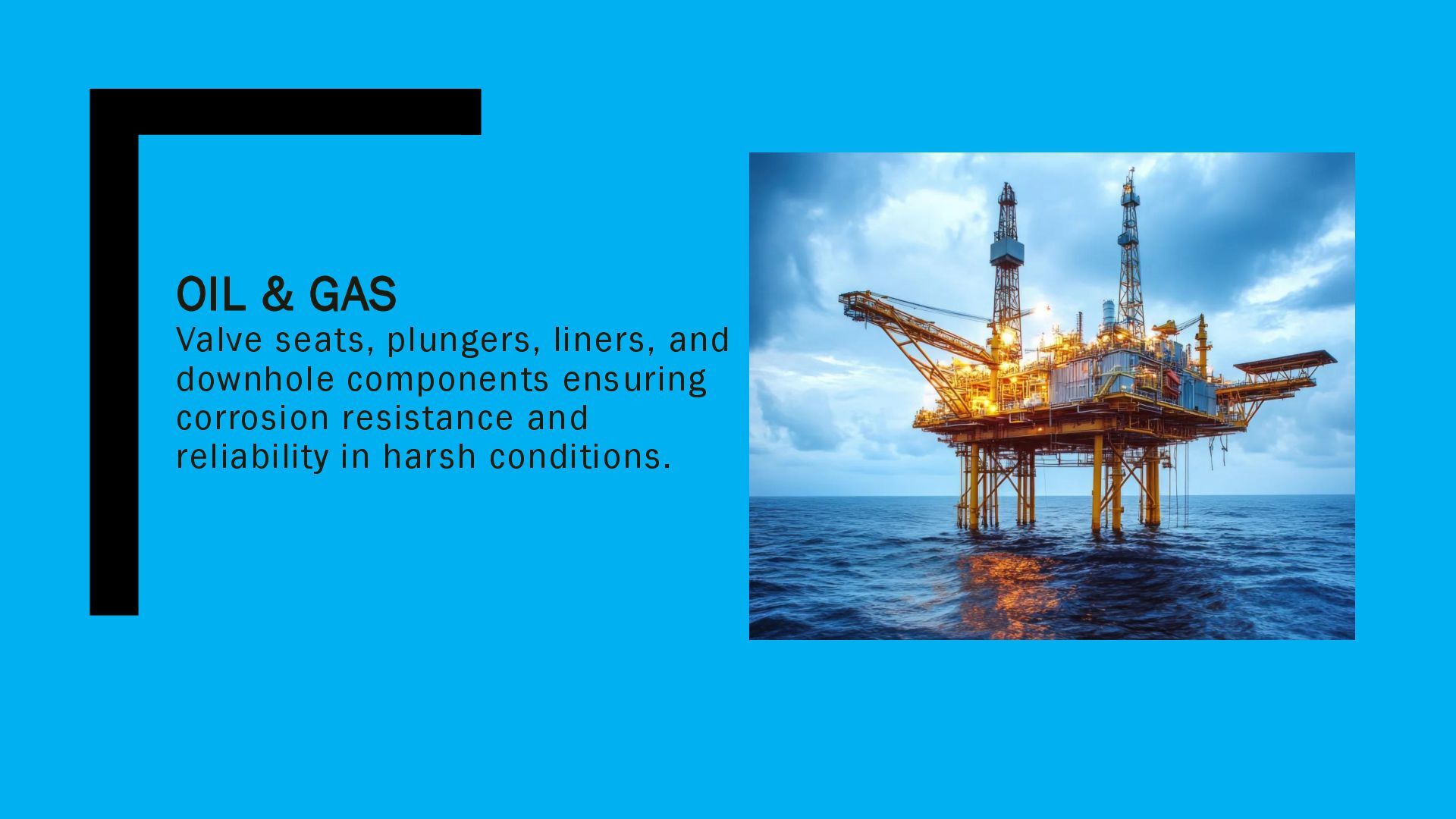
  6. OIL & GAS Valve seats, plungers, liners, and downhole components

    ensuring corrosion resistance and reliability in harsh conditions.
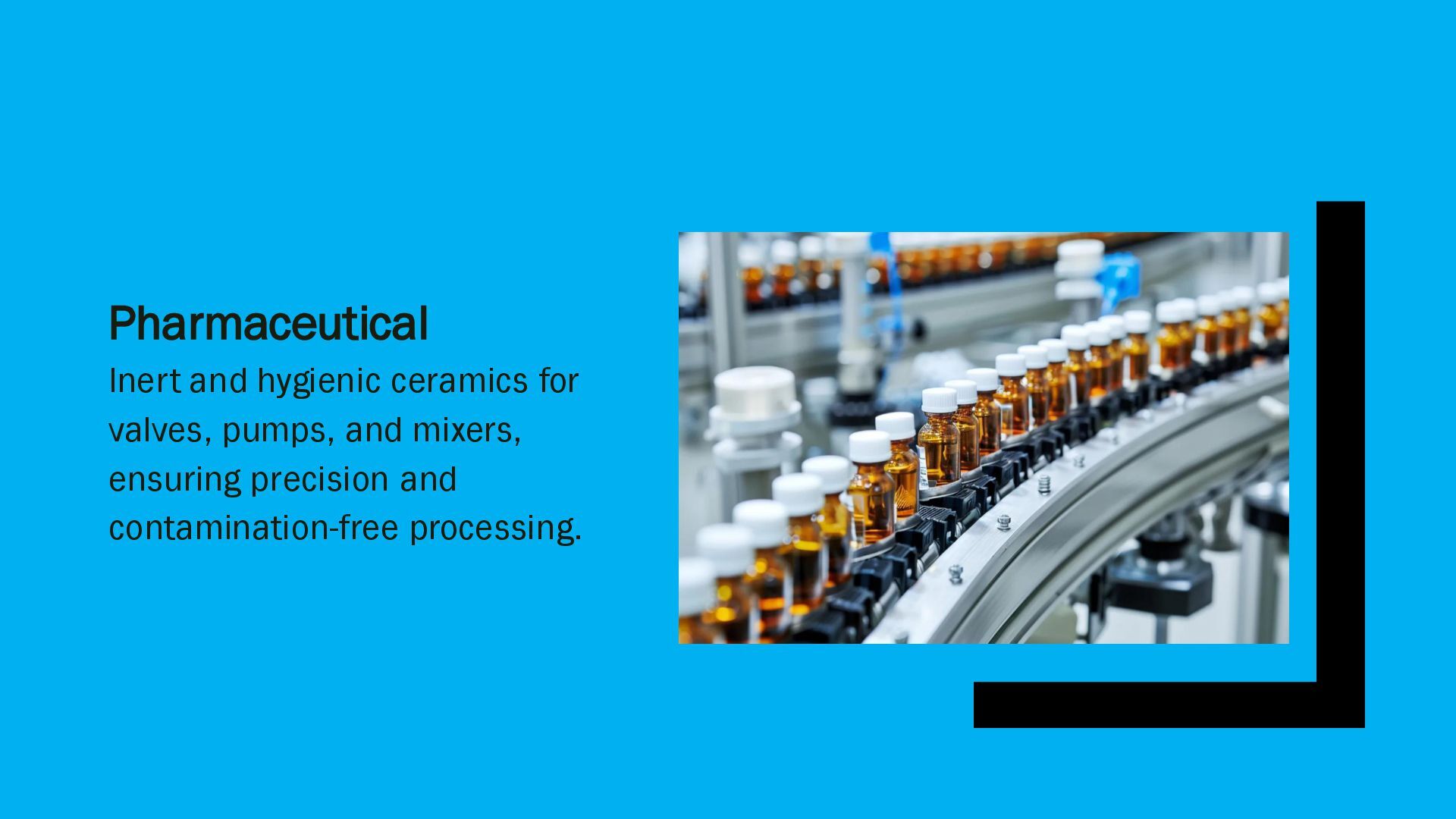
  7. Pharmaceutical Inert and hygienic ceramics for valves, pumps, and mixers,

    ensuring precision and contamination-free processing.
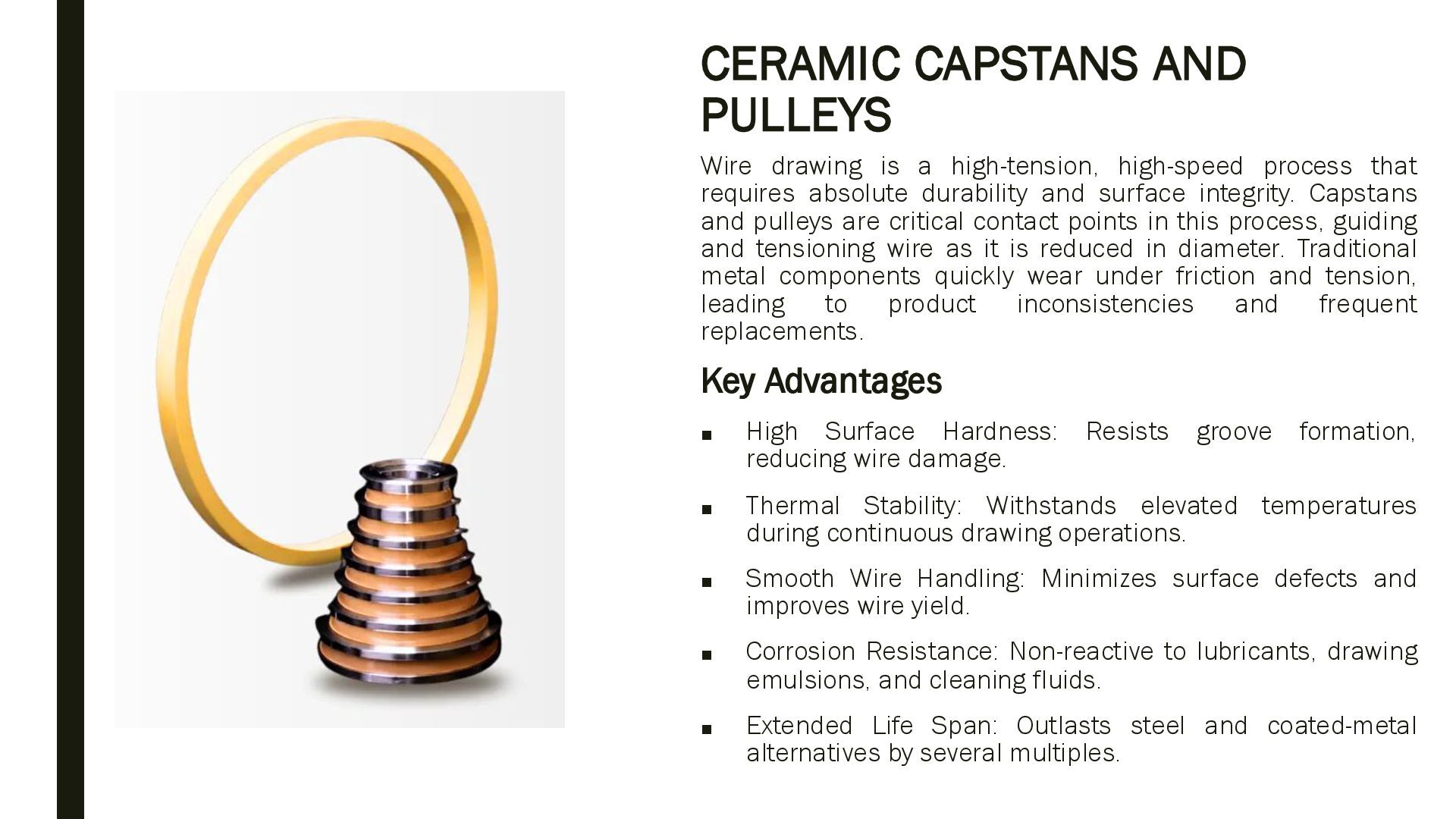
  8. CERAMIC CAPSTANS AND PULLEYS Wire drawing is a high-tension, high-speed

    process that requires absolute durability and surface integrity. Capstans and pulleys are critical contact points in this process, guiding and tensioning wire as it is reduced in diameter. Traditional metal components quickly wear under friction and tension, leading to product inconsistencies and frequent replacements. Key Advantages ▪ High Surface Hardness: Resists groove formation, reducing wire damage. ▪ Thermal Stability: Withstands elevated temperatures during continuous drawing operations. ▪ Smooth Wire Handling: Minimizes surface defects and improves wire yield. ▪ Corrosion Resistance: Non-reactive to lubricants, drawing emulsions, and cleaning fluids. ▪ Extended Life Span: Outlasts steel and coated-metal alternatives by several multiples.
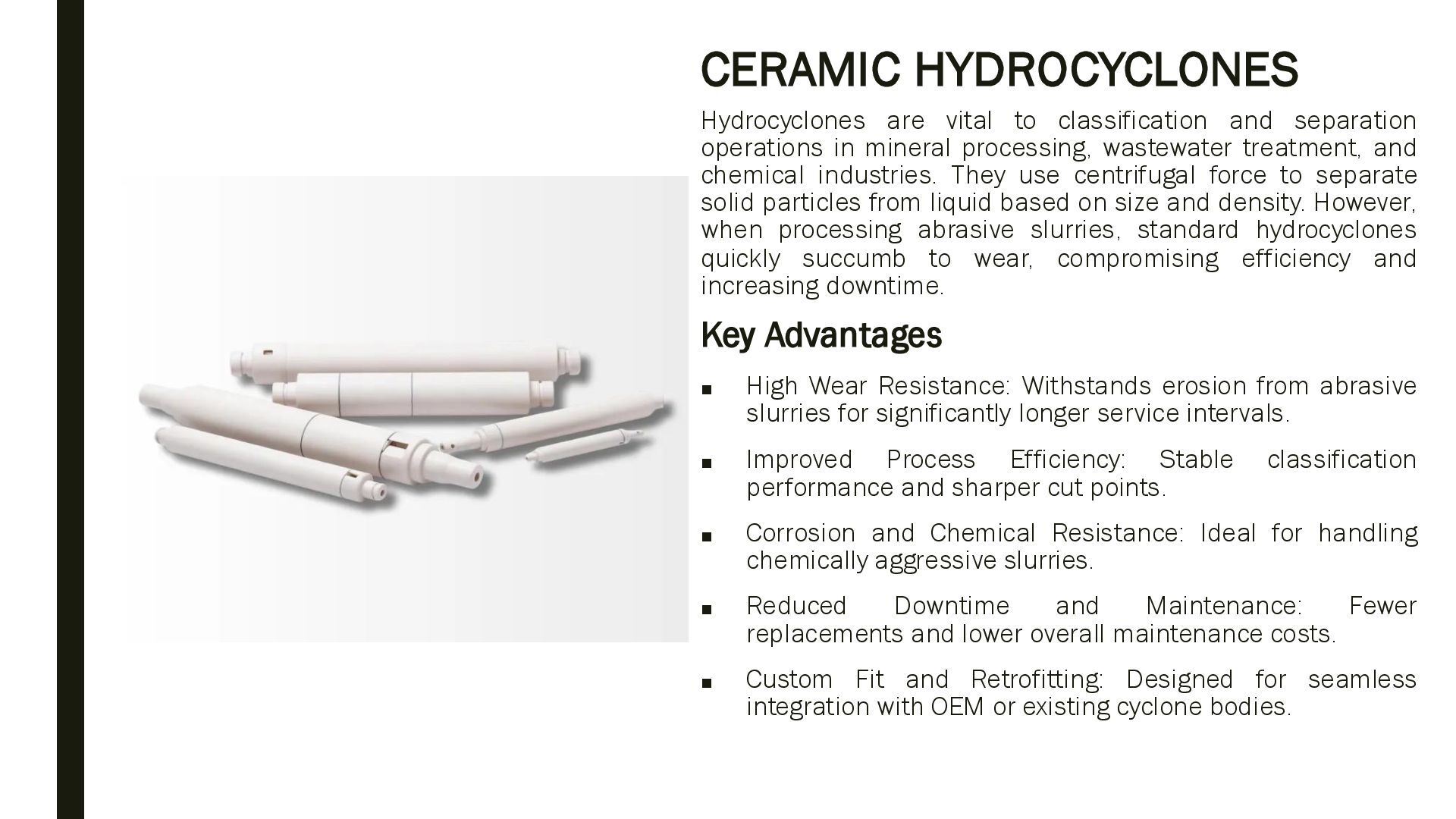
  9. CERAMIC HYDROCYCLONES Hydrocyclones are vital to classification and separation operations

    in mineral processing, wastewater treatment, and chemical industries. They use centrifugal force to separate solid particles from liquid based on size and density. However, when processing abrasive slurries, standard hydrocyclones quickly succumb to wear, compromising efficiency and increasing downtime. Key Advantages ▪ High Wear Resistance: Withstands erosion from abrasive slurries for significantly longer service intervals. ▪ Improved Process Efficiency: Stable classification performance and sharper cut points. ▪ Corrosion and Chemical Resistance: Ideal for handling chemically aggressive slurries. ▪ Reduced Downtime and Maintenance: Fewer replacements and lower overall maintenance costs. ▪ Custom Fit and Retrofitting: Designed for seamless integration with OEM or existing cyclone bodies.
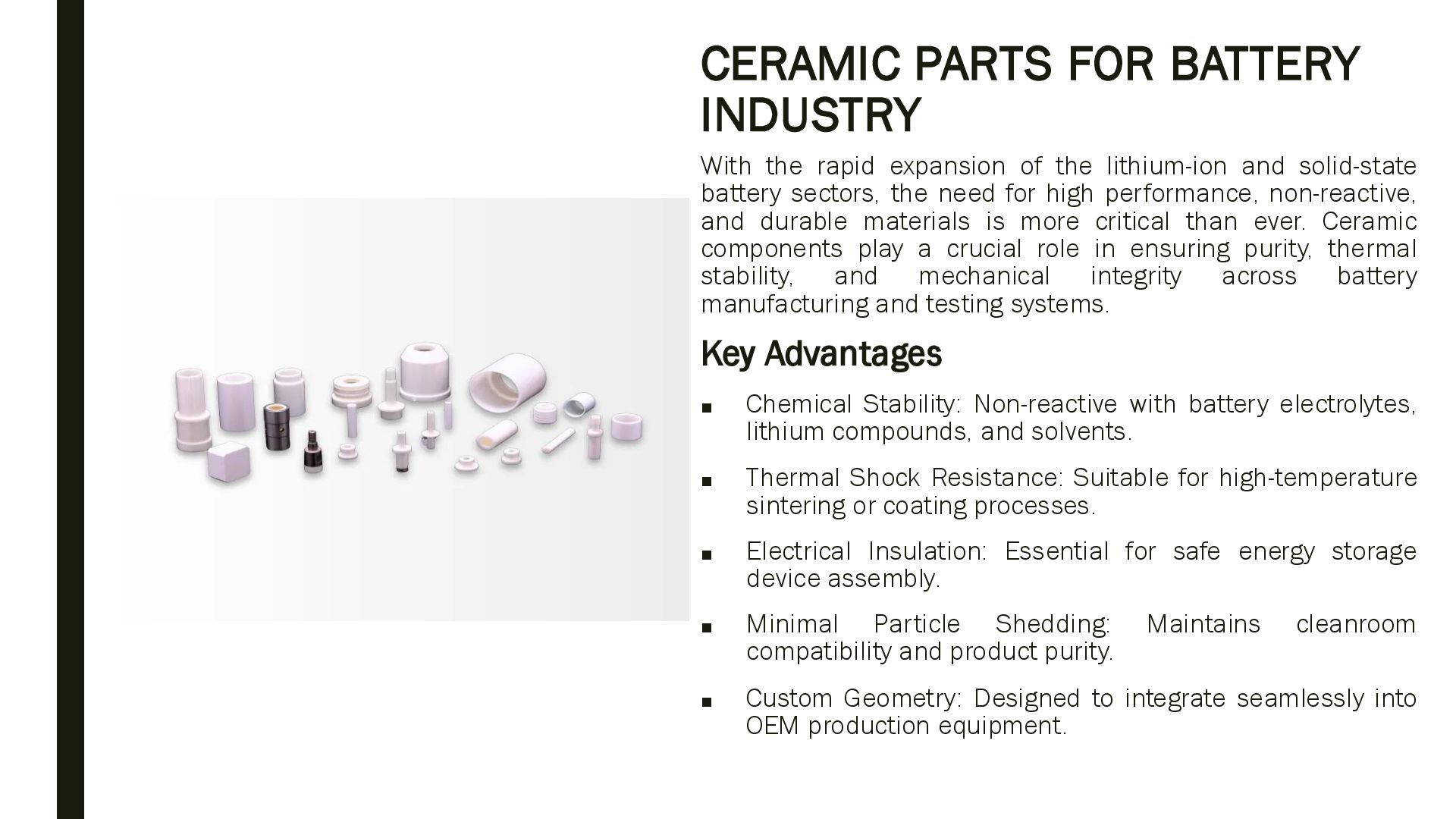
  10. CERAMIC PARTS FOR BATTERY INDUSTRY With the rapid expansion of

    the lithium-ion and solid-state battery sectors, the need for high performance, non-reactive, and durable materials is more critical than ever. Ceramic components play a crucial role in ensuring purity, thermal stability, and mechanical integrity across battery manufacturing and testing systems. Key Advantages ▪ Chemical Stability: Non-reactive with battery electrolytes, lithium compounds, and solvents. ▪ Thermal Shock Resistance: Suitable for high-temperature sintering or coating processes. ▪ Electrical Insulation: Essential for safe energy storage device assembly. ▪ Minimal Particle Shedding: Maintains cleanroom compatibility and product purity. ▪ Custom Geometry: Designed to integrate seamlessly into OEM production equipment.
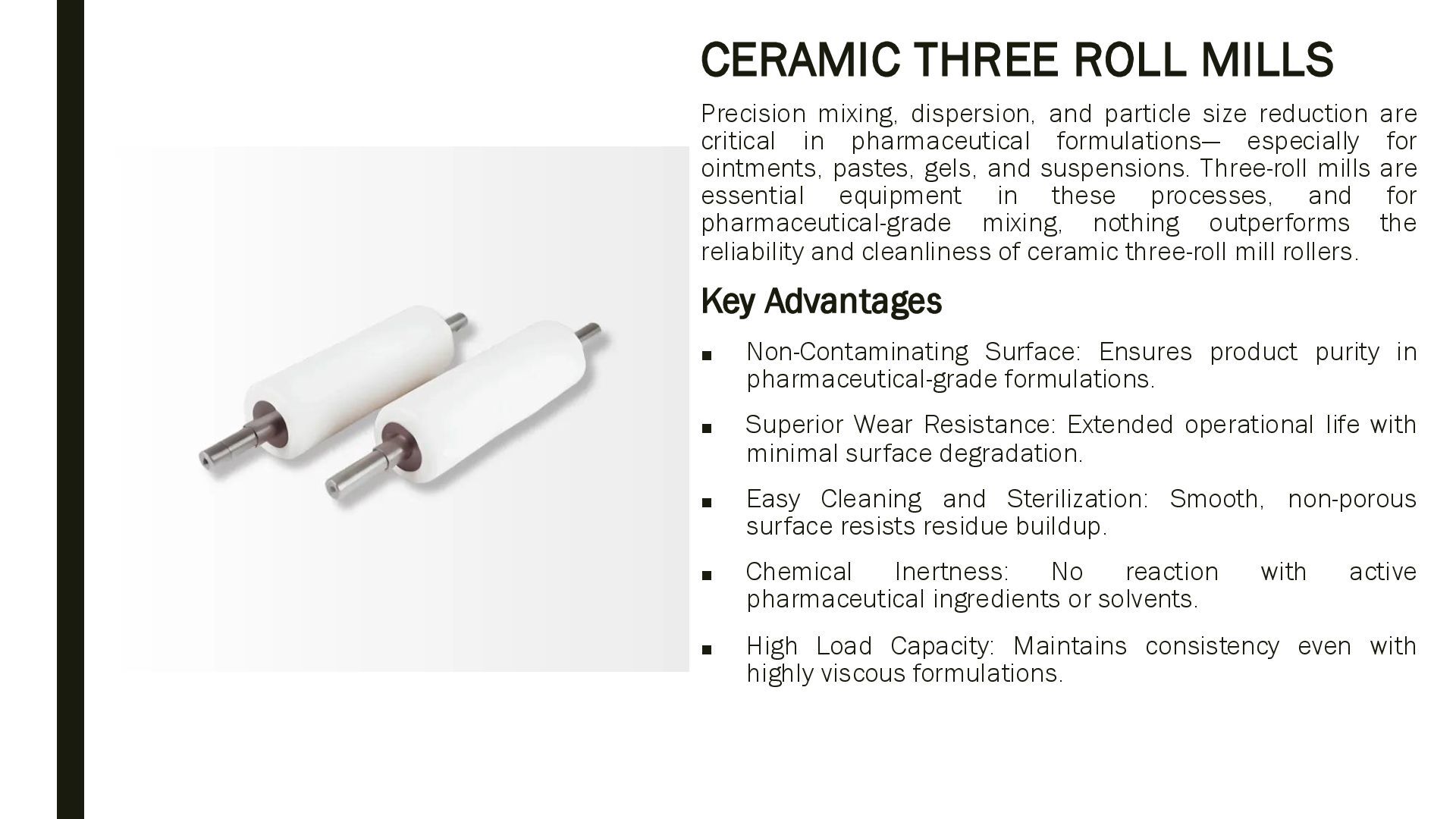
  11. CERAMIC THREE ROLL MILLS Precision mixing, dispersion, and particle size

    reduction are critical in pharmaceutical formulations— especially for ointments, pastes, gels, and suspensions. Three-roll mills are essential equipment in these processes, and for pharmaceutical-grade mixing, nothing outperforms the reliability and cleanliness of ceramic three-roll mill rollers. Key Advantages ▪ Non-Contaminating Surface: Ensures product purity in pharmaceutical-grade formulations. ▪ Superior Wear Resistance: Extended operational life with minimal surface degradation. ▪ Easy Cleaning and Sterilization: Smooth, non-porous surface resists residue buildup. ▪ Chemical Inertness: No reaction with active pharmaceutical ingredients or solvents. ▪ High Load Capacity: Maintains consistency even with highly viscous formulations.
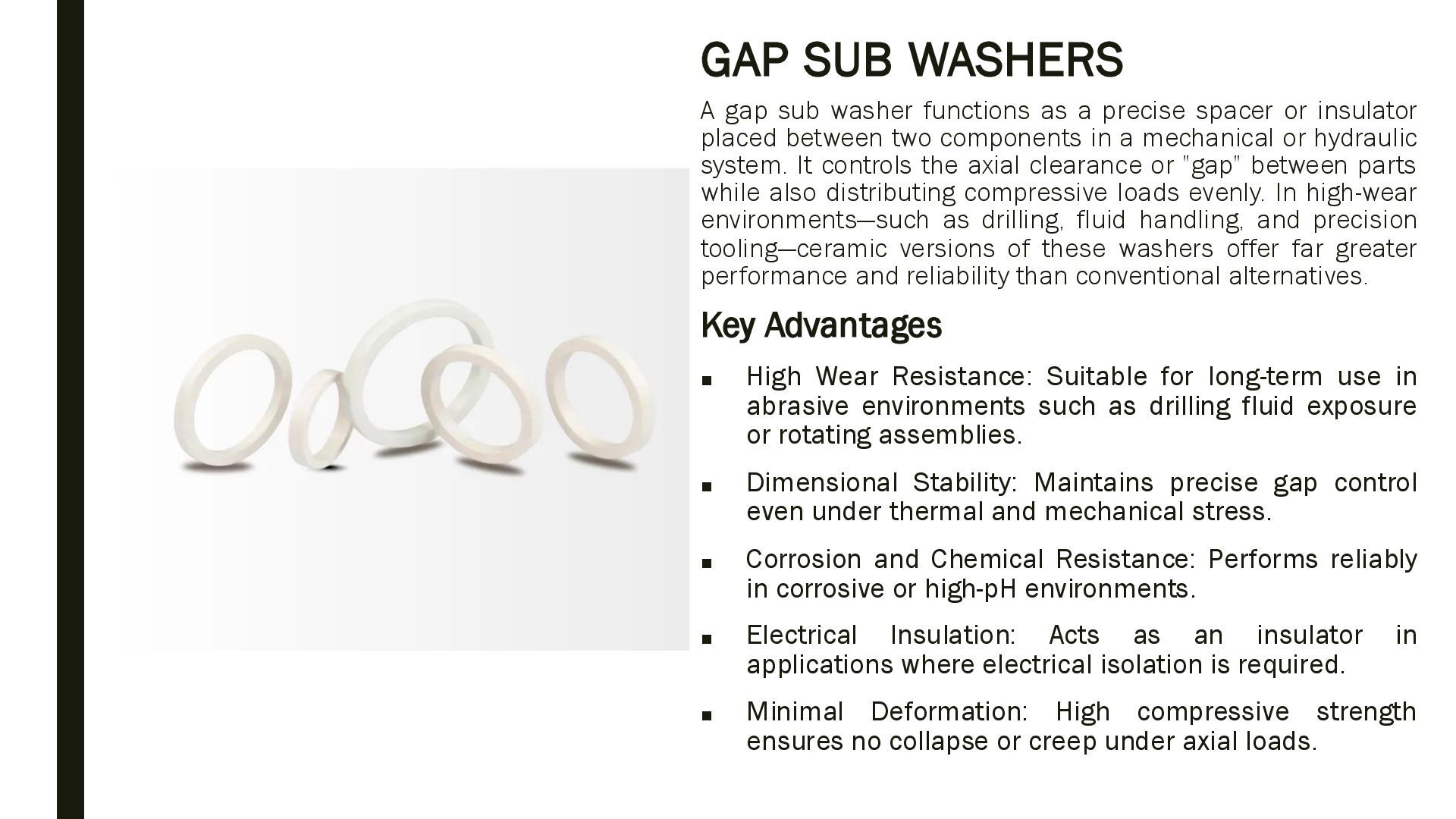
  12. GAP SUB WASHERS A gap sub washer functions as a

    precise spacer or insulator placed between two components in a mechanical or hydraulic system. It controls the axial clearance or "gap" between parts while also distributing compressive loads evenly. In high-wear environments—such as drilling, fluid handling, and precision tooling—ceramic versions of these washers offer far greater performance and reliability than conventional alternatives. Key Advantages ▪ High Wear Resistance: Suitable for long-term use in abrasive environments such as drilling fluid exposure or rotating assemblies. ▪ Dimensional Stability: Maintains precise gap control even under thermal and mechanical stress. ▪ Corrosion and Chemical Resistance: Performs reliably in corrosive or high-pH environments. ▪ Electrical Insulation: Acts as an insulator in applications where electrical isolation is required. ▪ Minimal Deformation: High compressive strength ensures no collapse or creep under axial loads.
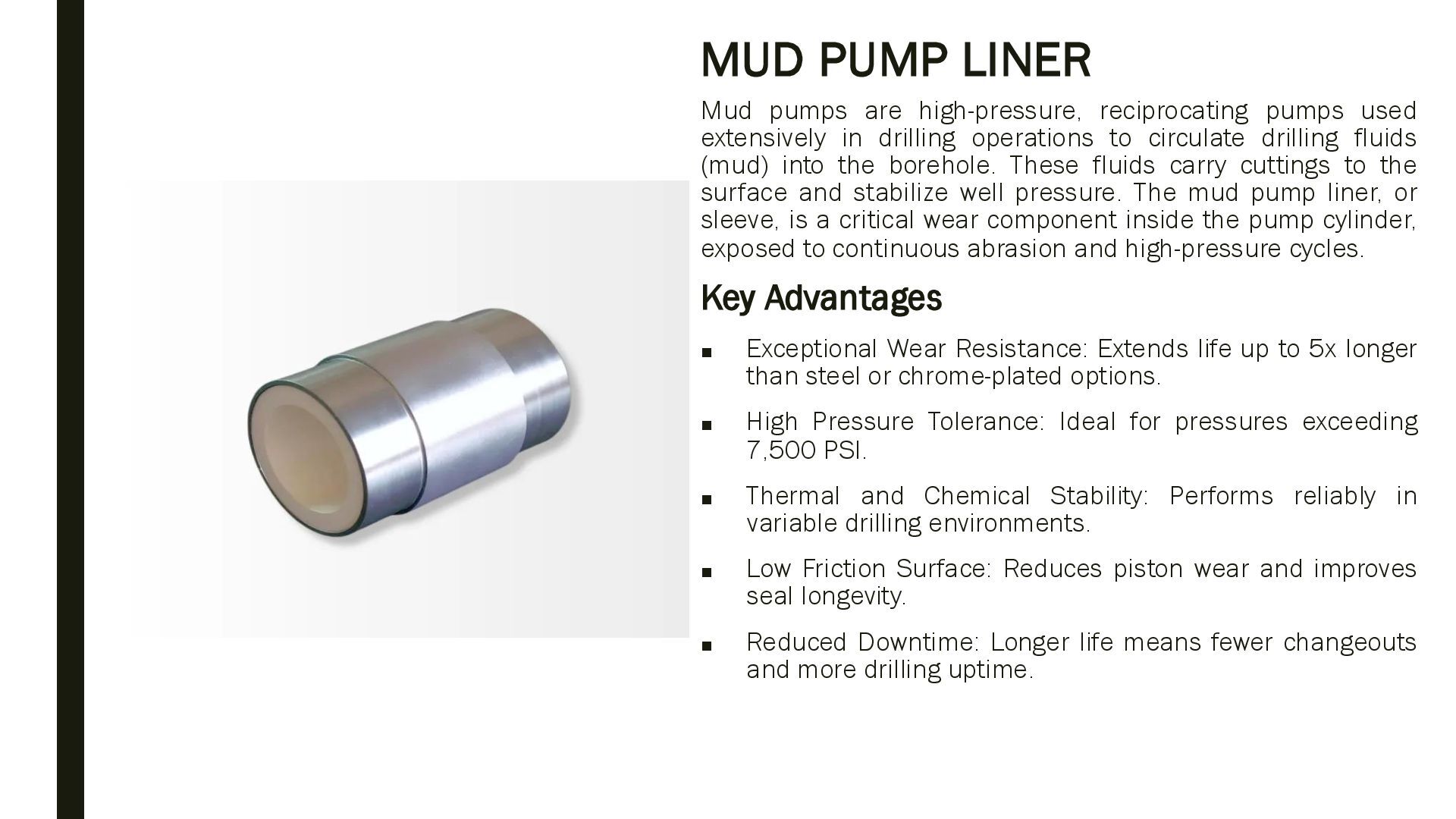
  13. MUD PUMP LINER Mud pumps are high-pressure, reciprocating pumps used

    extensively in drilling operations to circulate drilling fluids (mud) into the borehole. These fluids carry cuttings to the surface and stabilize well pressure. The mud pump liner, or sleeve, is a critical wear component inside the pump cylinder, exposed to continuous abrasion and high-pressure cycles. Key Advantages ▪ Exceptional Wear Resistance: Extends life up to 5x longer than steel or chrome-plated options. ▪ High Pressure Tolerance: Ideal for pressures exceeding 7,500 PSI. ▪ Thermal and Chemical Stability: Performs reliably in variable drilling environments. ▪ Low Friction Surface: Reduces piston wear and improves seal longevity. ▪ Reduced Downtime: Longer life means fewer changeouts and more drilling uptime.
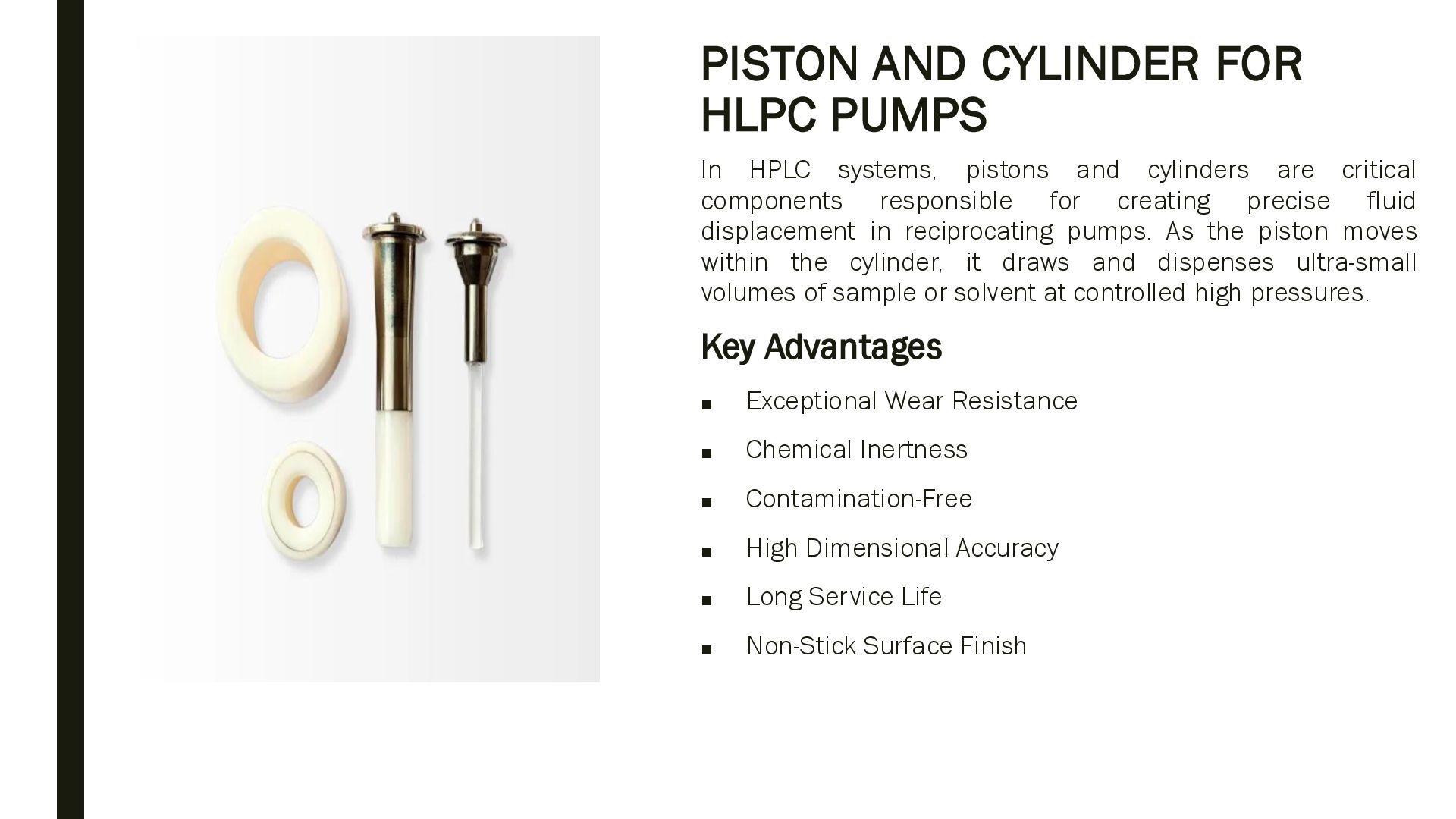
  14. PISTON AND CYLINDER FOR HLPC PUMPS In HPLC systems, pistons

    and cylinders are critical components responsible for creating precise fluid displacement in reciprocating pumps. As the piston moves within the cylinder, it draws and dispenses ultra-small volumes of sample or solvent at controlled high pressures. Key Advantages ▪ Exceptional Wear Resistance ▪ Chemical Inertness ▪ Contamination-Free ▪ High Dimensional Accuracy ▪ Long Service Life ▪ Non-Stick Surface Finish
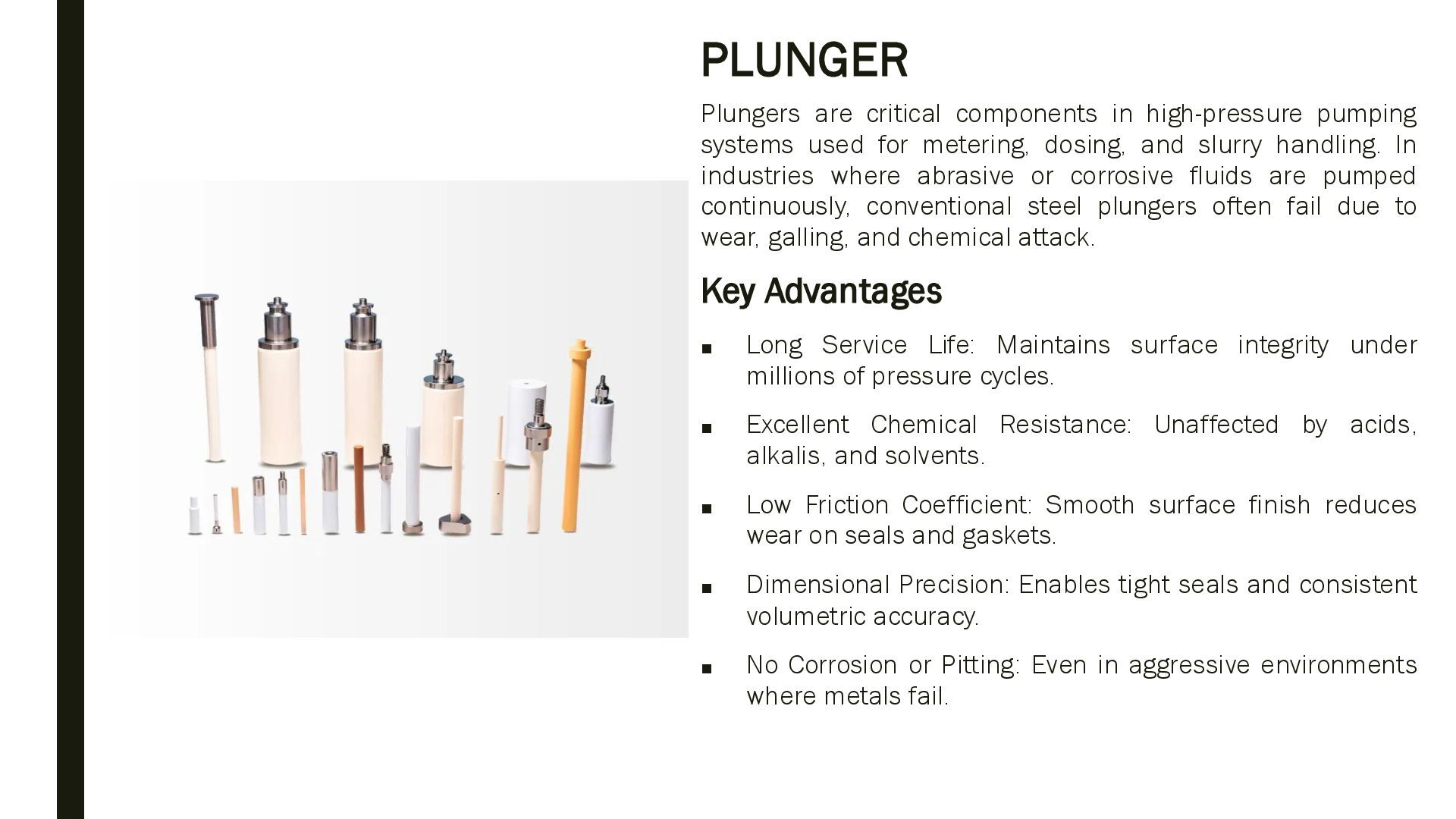
  15. PLUNGER Plungers are critical components in high-pressure pumping systems used

    for metering, dosing, and slurry handling. In industries where abrasive or corrosive fluids are pumped continuously, conventional steel plungers often fail due to wear, galling, and chemical attack. Key Advantages ▪ Long Service Life: Maintains surface integrity under millions of pressure cycles. ▪ Excellent Chemical Resistance: Unaffected by acids, alkalis, and solvents. ▪ Low Friction Coefficient: Smooth surface finish reduces wear on seals and gaskets. ▪ Dimensional Precision: Enables tight seals and consistent volumetric accuracy. ▪ No Corrosion or Pitting: Even in aggressive environments where metals fail.
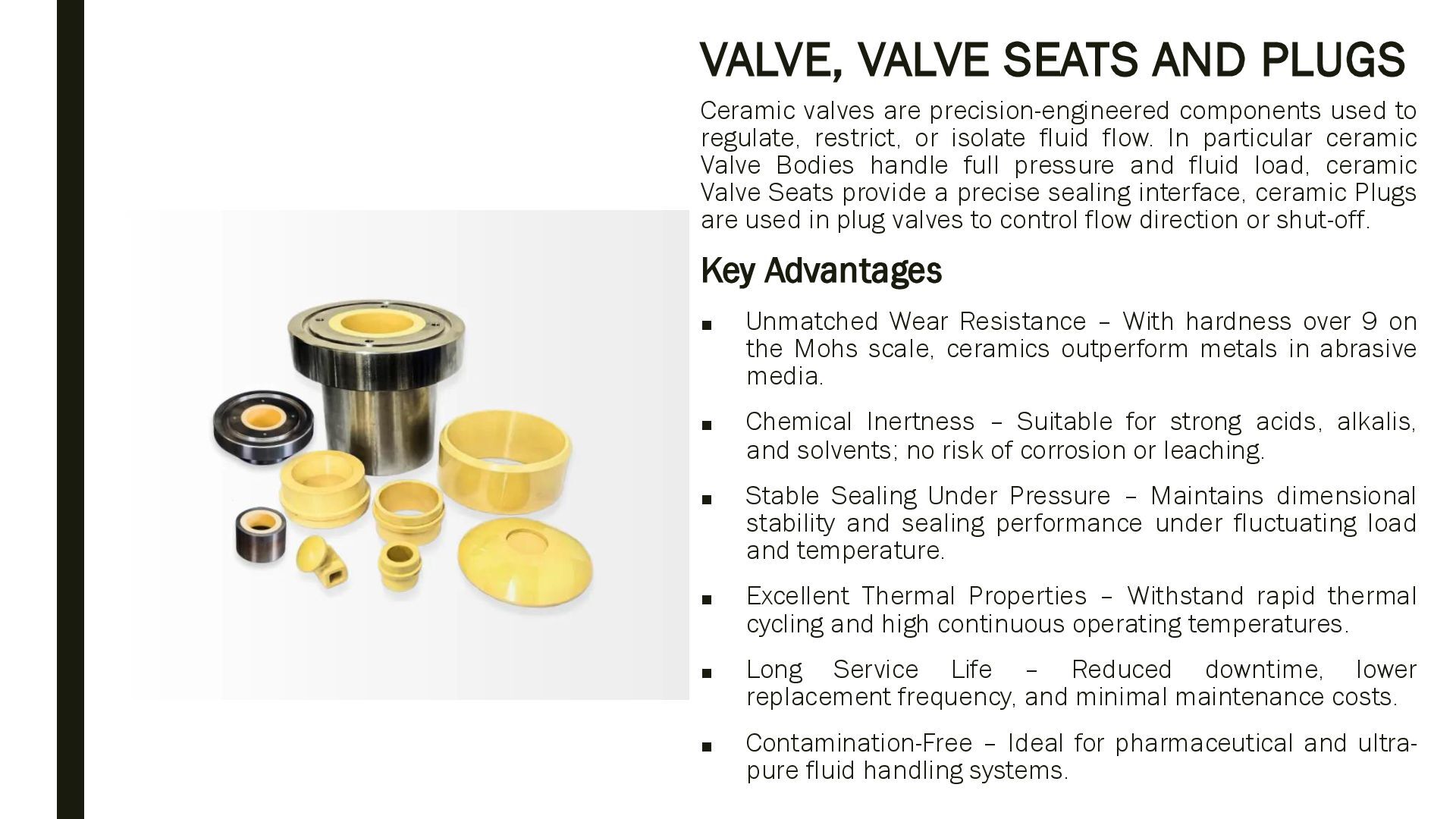
  16. VALVE, VALVE SEATS AND PLUGS Ceramic valves are precision-engineered components

    used to regulate, restrict, or isolate fluid flow. In particular ceramic Valve Bodies handle full pressure and fluid load, ceramic Valve Seats provide a precise sealing interface, ceramic Plugs are used in plug valves to control flow direction or shut-off. Key Advantages ▪ Unmatched Wear Resistance – With hardness over 9 on the Mohs scale, ceramics outperform metals in abrasive media. ▪ Chemical Inertness – Suitable for strong acids, alkalis, and solvents; no risk of corrosion or leaching. ▪ Stable Sealing Under Pressure – Maintains dimensional stability and sealing performance under fluctuating load and temperature. ▪ Excellent Thermal Properties – Withstand rapid thermal cycling and high continuous operating temperatures. ▪ Long Service Life – Reduced downtime, lower replacement frequency, and minimal maintenance costs. ▪ Contamination-Free – Ideal for pharmaceutical and ultra- pure fluid handling systems.
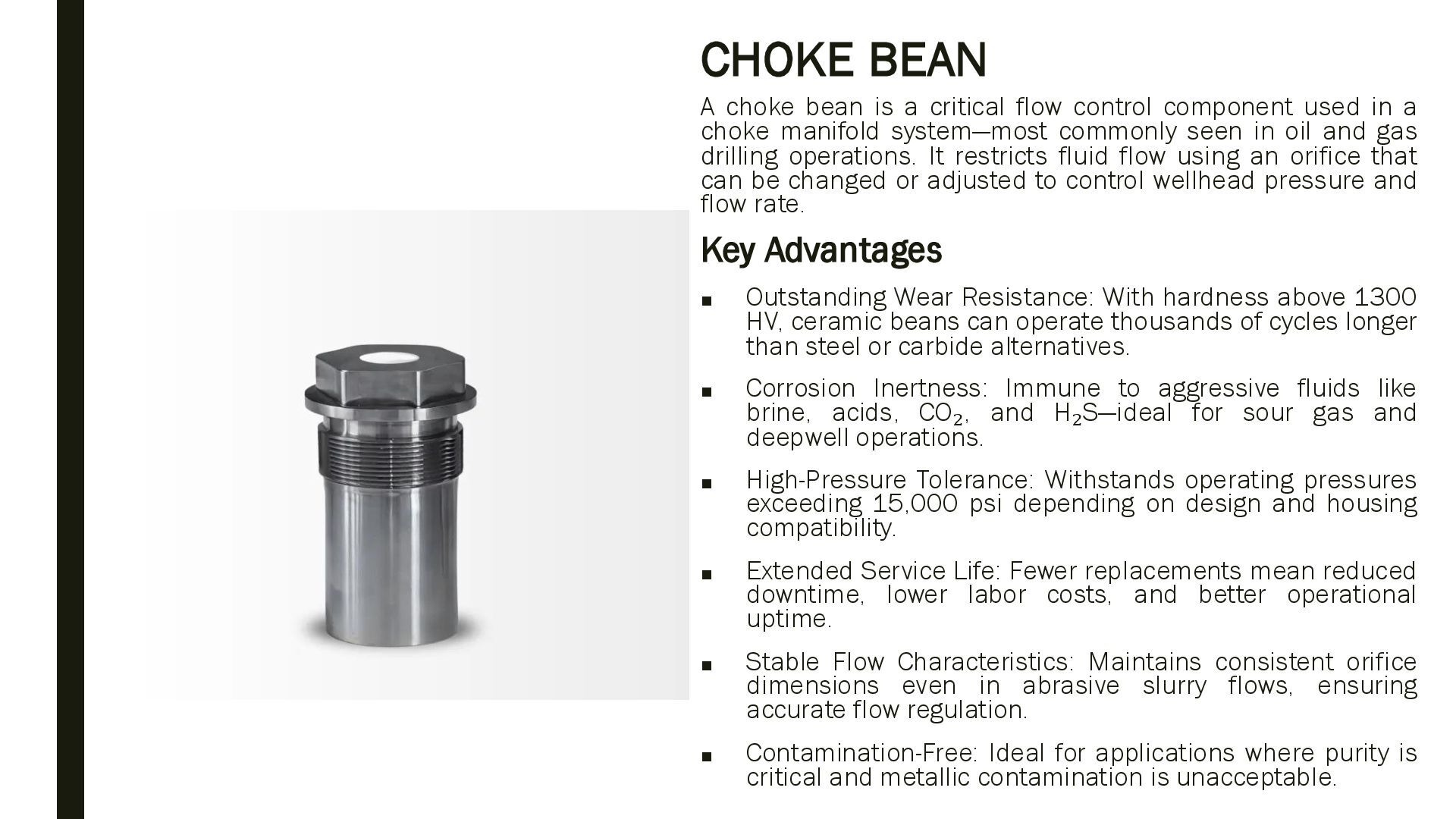
  17. CHOKE BEAN A choke bean is a critical flow control

    component used in a choke manifold system—most commonly seen in oil and gas drilling operations. It restricts fluid flow using an orifice that can be changed or adjusted to control wellhead pressure and flow rate. Key Advantages ▪ Outstanding Wear Resistance: With hardness above 1300 HV, ceramic beans can operate thousands of cycles longer than steel or carbide alternatives. ▪ Corrosion Inertness: Immune to aggressive fluids like brine, acids, CO₂, and H₂S—ideal for sour gas and deepwell operations. ▪ High-Pressure Tolerance: Withstands operating pressures exceeding 15,000 psi depending on design and housing compatibility. ▪ Extended Service Life: Fewer replacements mean reduced downtime, lower labor costs, and better operational uptime. ▪ Stable Flow Characteristics: Maintains consistent orifice dimensions even in abrasive slurry flows, ensuring accurate flow regulation. ▪ Contamination-Free: Ideal for applications where purity is critical and metallic contamination is unacceptable.
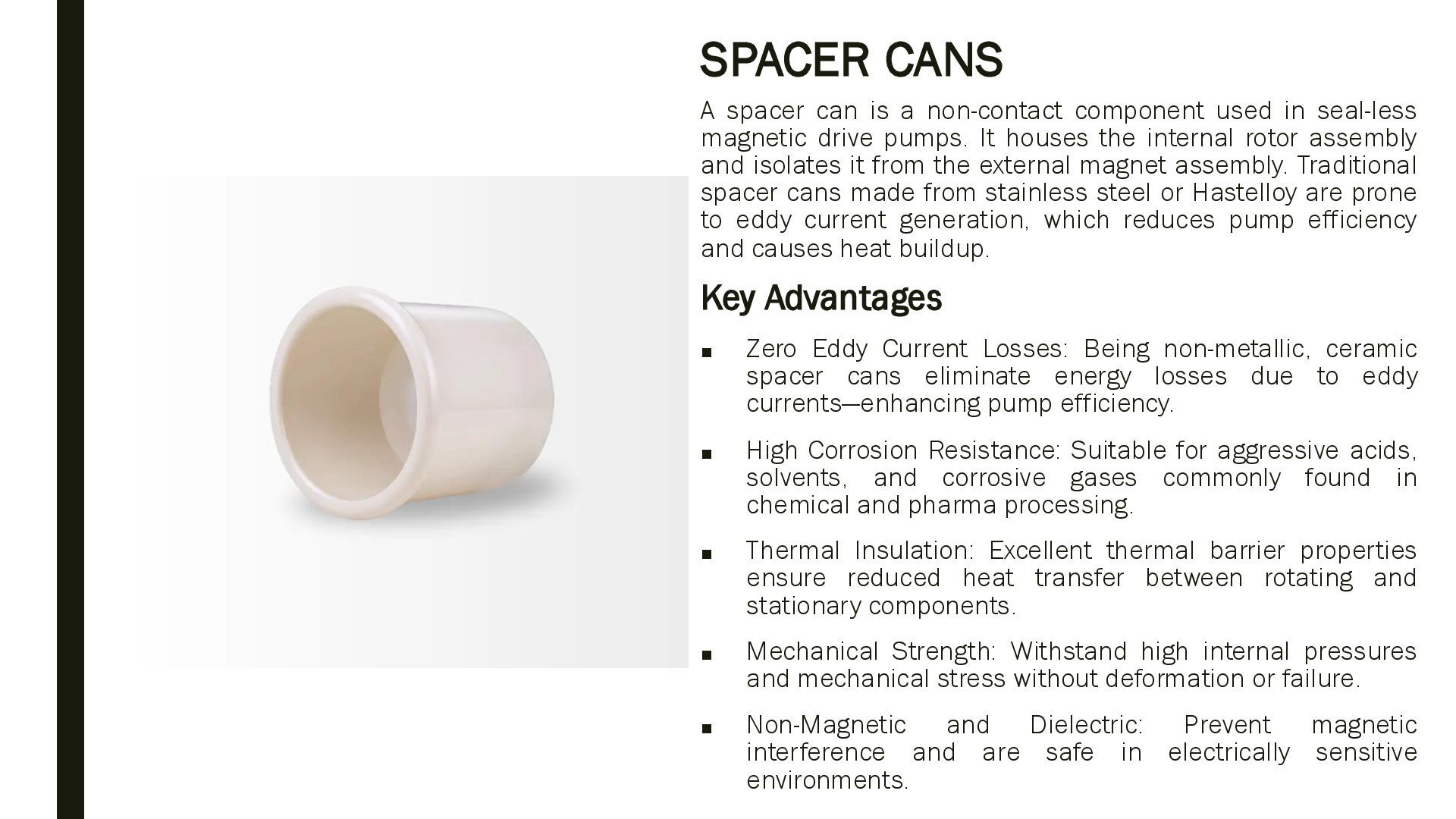
  18. SPACER CANS A spacer can is a non-contact component used

    in seal-less magnetic drive pumps. It houses the internal rotor assembly and isolates it from the external magnet assembly. Traditional spacer cans made from stainless steel or Hastelloy are prone to eddy current generation, which reduces pump efficiency and causes heat buildup. Key Advantages ▪ Zero Eddy Current Losses: Being non-metallic, ceramic spacer cans eliminate energy losses due to eddy currents—enhancing pump efficiency. ▪ High Corrosion Resistance: Suitable for aggressive acids, solvents, and corrosive gases commonly found in chemical and pharma processing. ▪ Thermal Insulation: Excellent thermal barrier properties ensure reduced heat transfer between rotating and stationary components. ▪ Mechanical Strength: Withstand high internal pressures and mechanical stress without deformation or failure. ▪ Non-Magnetic and Dielectric: Prevent magnetic interference and are safe in electrically sensitive environments.
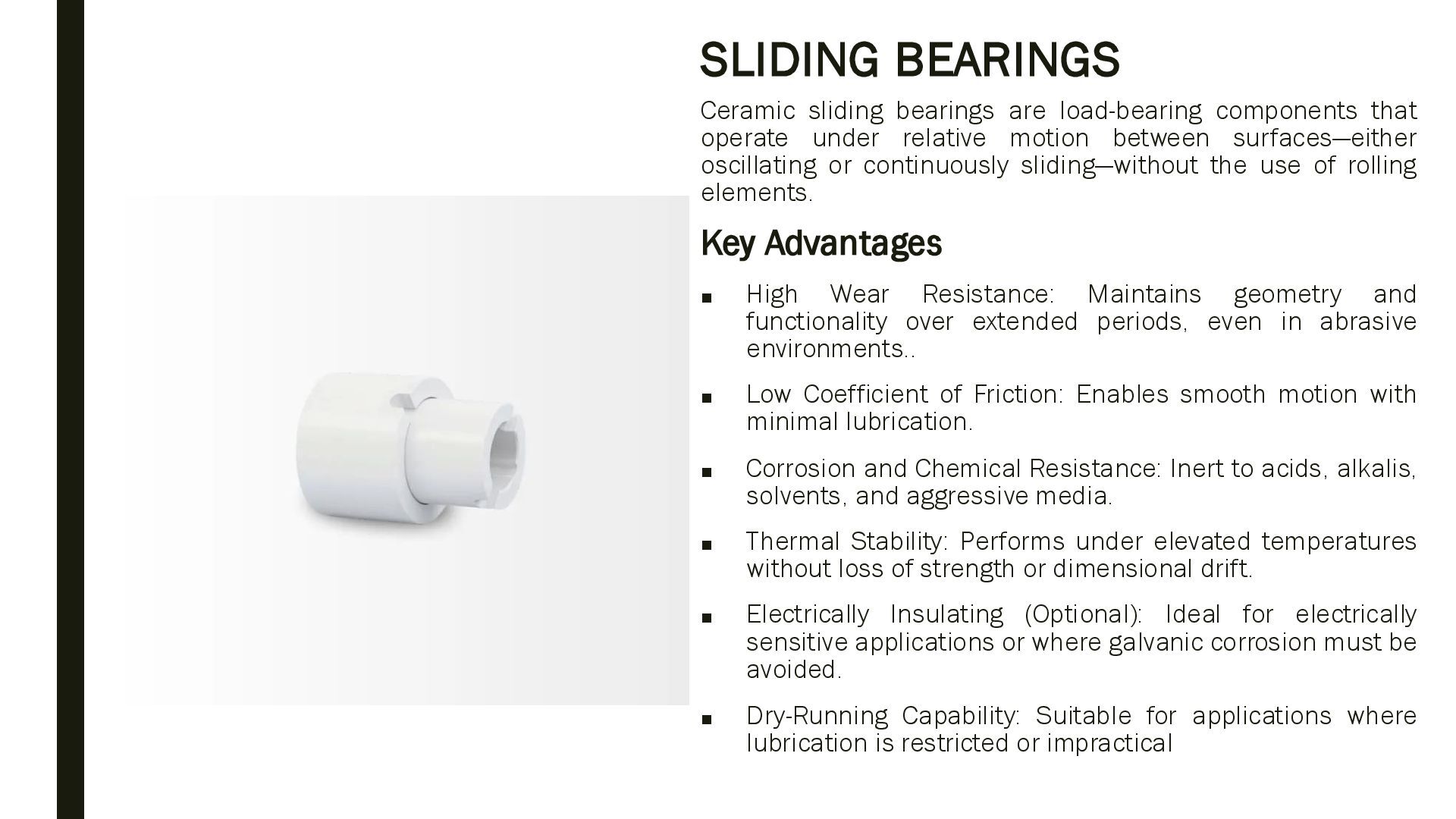
  19. SLIDING BEARINGS Ceramic sliding bearings are load-bearing components that operate

    under relative motion between surfaces—either oscillating or continuously sliding—without the use of rolling elements. Key Advantages ▪ High Wear Resistance: Maintains geometry and functionality over extended periods, even in abrasive environments.. ▪ Low Coefficient of Friction: Enables smooth motion with minimal lubrication. ▪ Corrosion and Chemical Resistance: Inert to acids, alkalis, solvents, and aggressive media. ▪ Thermal Stability: Performs under elevated temperatures without loss of strength or dimensional drift. ▪ Electrically Insulating (Optional): Ideal for electrically sensitive applications or where galvanic corrosion must be avoided. ▪ Dry-Running Capability: Suitable for applications where lubrication is restricted or impractical
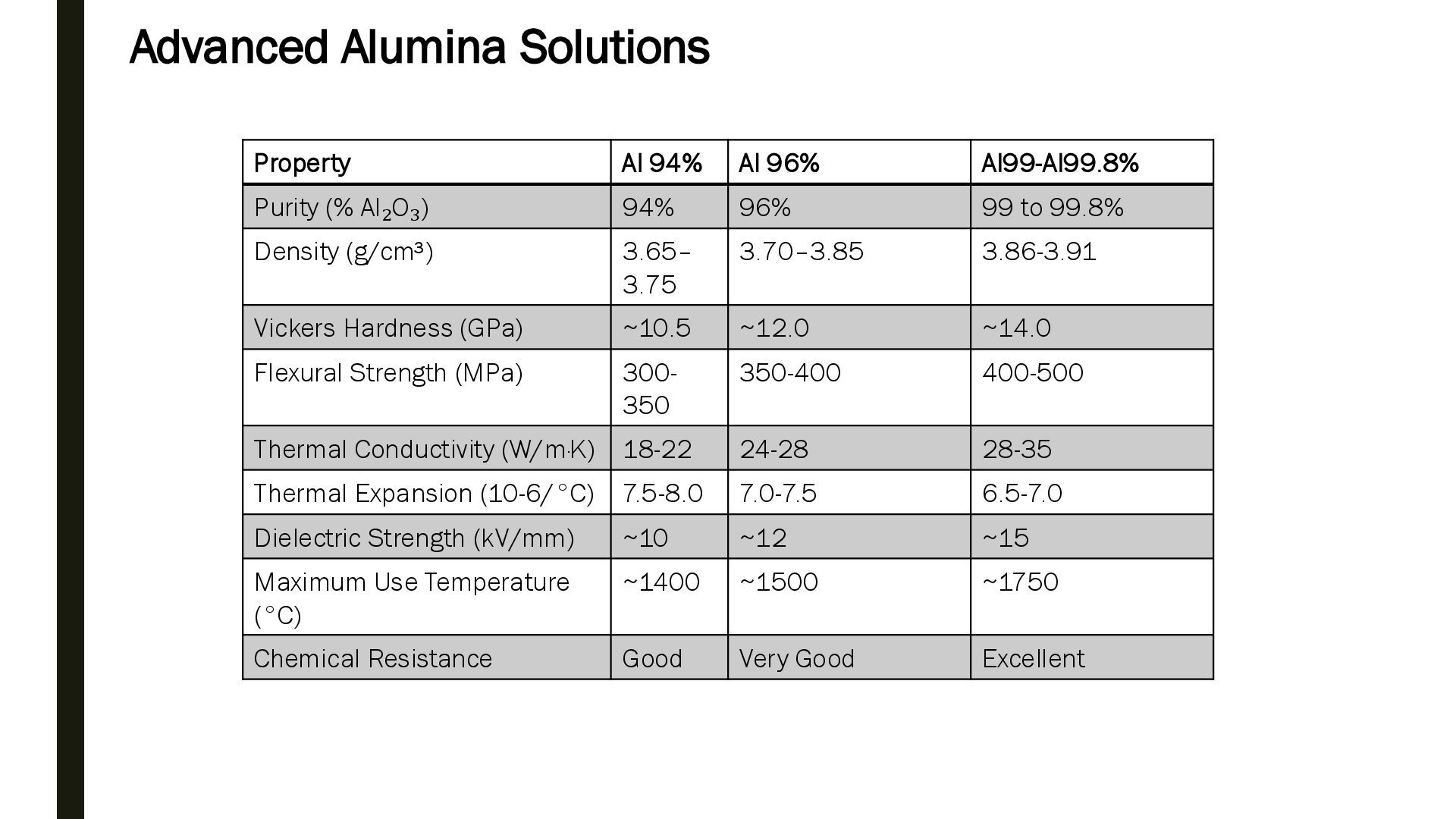
  20. Advanced Alumina Solutions Property Al 94% Al 96% Al99-Al99.8% Purity

    (% Al₂O₃) 94% 96% 99 to 99.8% Density (g/cm³) 3.65– 3.75 3.70–3.85 3.86-3.91 Vickers Hardness (GPa) ~10.5 ~12.0 ~14.0 Flexural Strength (MPa) 300- 350 350-400 400-500 Thermal Conductivity (W/m·K) 18-22 24-28 28-35 Thermal Expansion (10-6/°C) 7.5-8.0 7.0-7.5 6.5-7.0 Dielectric Strength (kV/mm) ~10 ~12 ~15 Maximum Use Temperature (°C) ~1400 ~1500 ~1750 Chemical Resistance Good Very Good Excellent
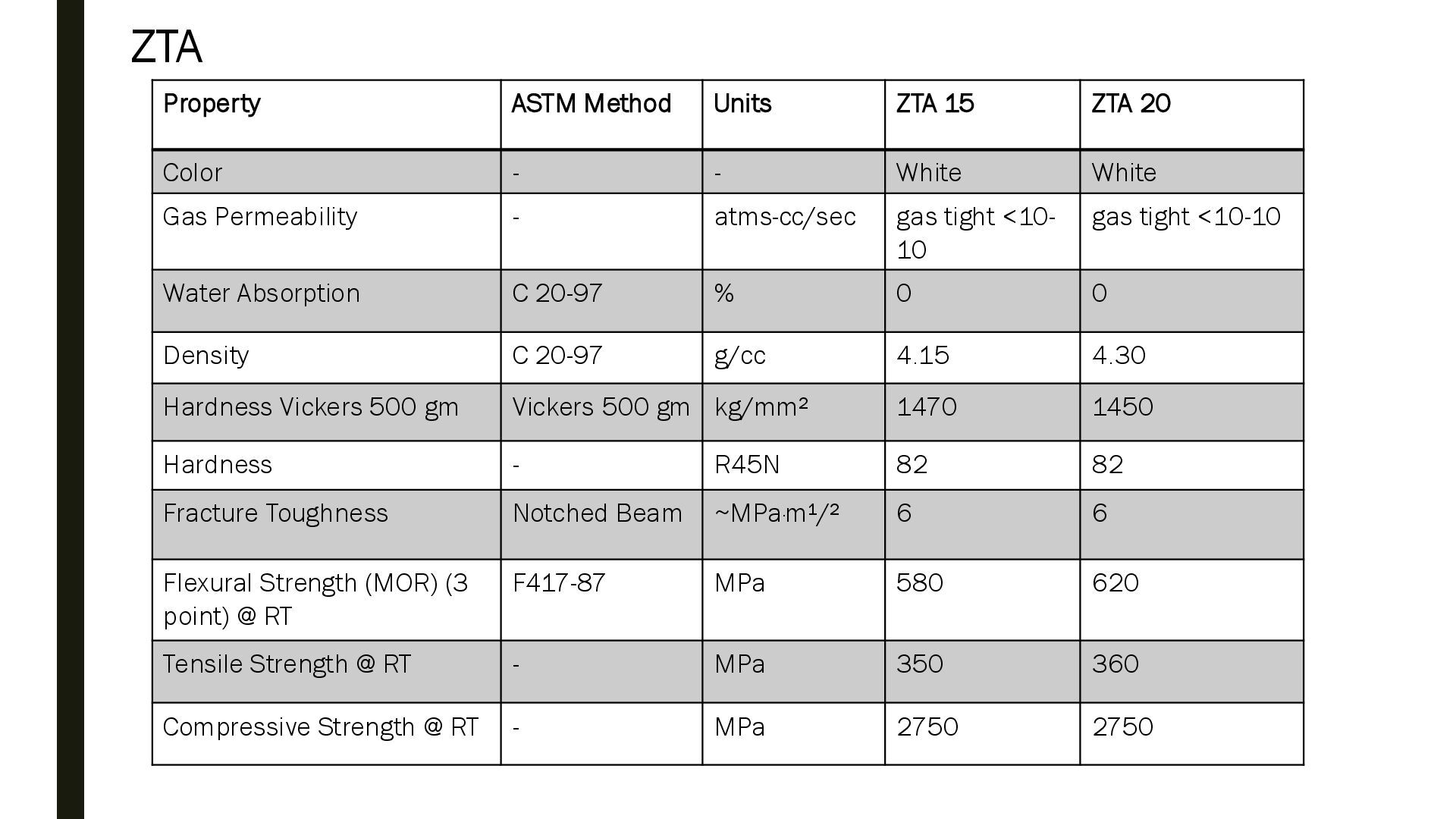
  21. ZTA Property ASTM Method Units ZTA 15 ZTA 20 Color

    - - White White Gas Permeability - atms-cc/sec gas tight <10- 10 gas tight <10-10 Water Absorption C 20-97 % 0 0 Density C 20-97 g/cc 4.15 4.30 Hardness Vickers 500 gm Vickers 500 gm kg/mm² 1470 1450 Hardness - R45N 82 82 Fracture Toughness Notched Beam ~MPa·m¹/² 6 6 Flexural Strength (MOR) (3 point) @ RT F417-87 MPa 580 620 Tensile Strength @ RT - MPa 350 360 Compressive Strength @ RT - MPa 2750 2750
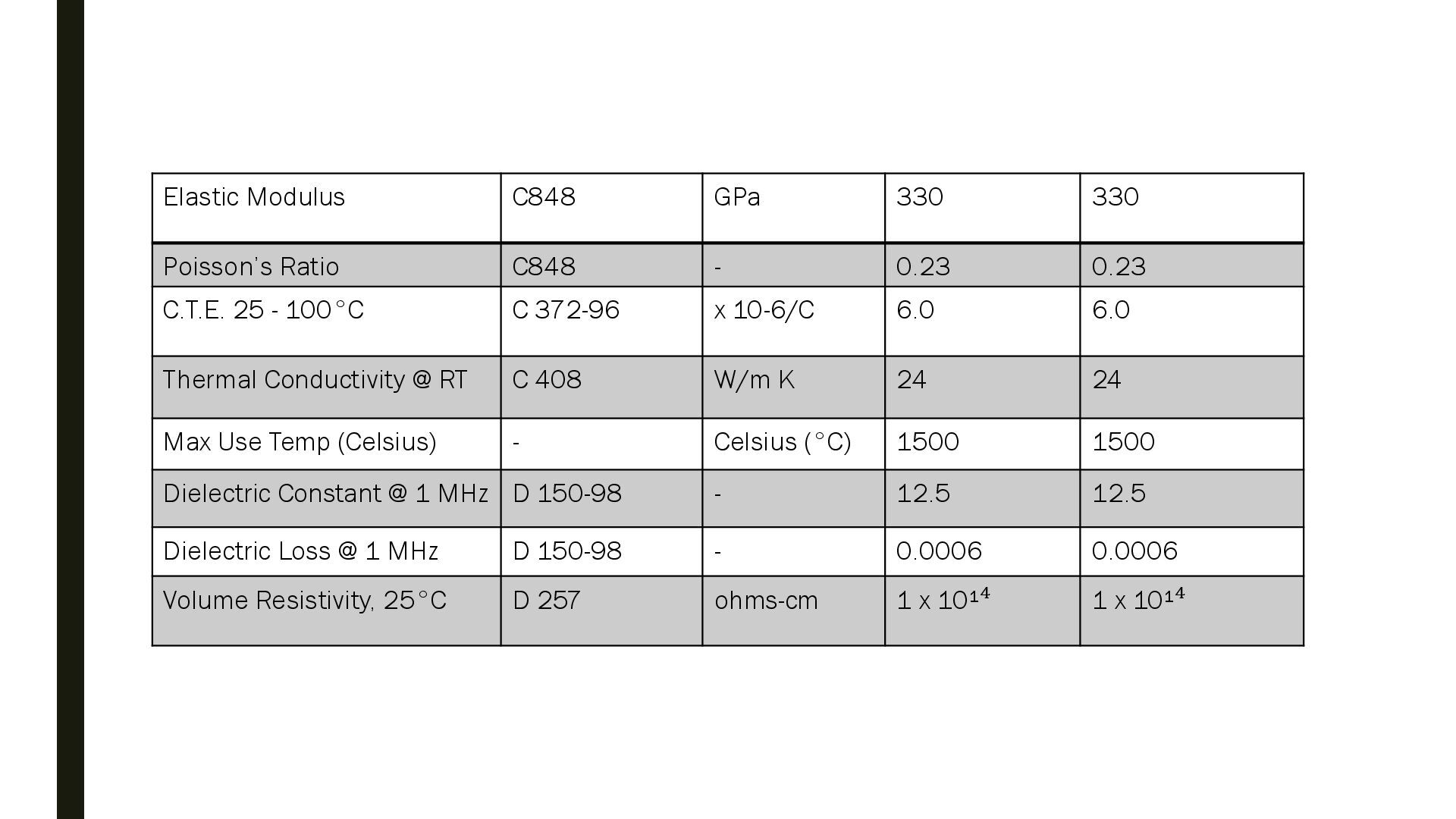
  22. Elastic Modulus C848 GPa 330 330 Poisson’s Ratio C848 -

    0.23 0.23 C.T.E. 25 - 100°C C 372-96 x 10-6/C 6.0 6.0 Thermal Conductivity @ RT C 408 W/m K 24 24 Max Use Temp (Celsius) - Celsius (°C) 1500 1500 Dielectric Constant @ 1 MHz D 150-98 - 12.5 12.5 Dielectric Loss @ 1 MHz D 150-98 - 0.0006 0.0006 Volume Resistivity, 25°C D 257 ohms-cm 1 x 10¹⁴ 1 x 10¹⁴
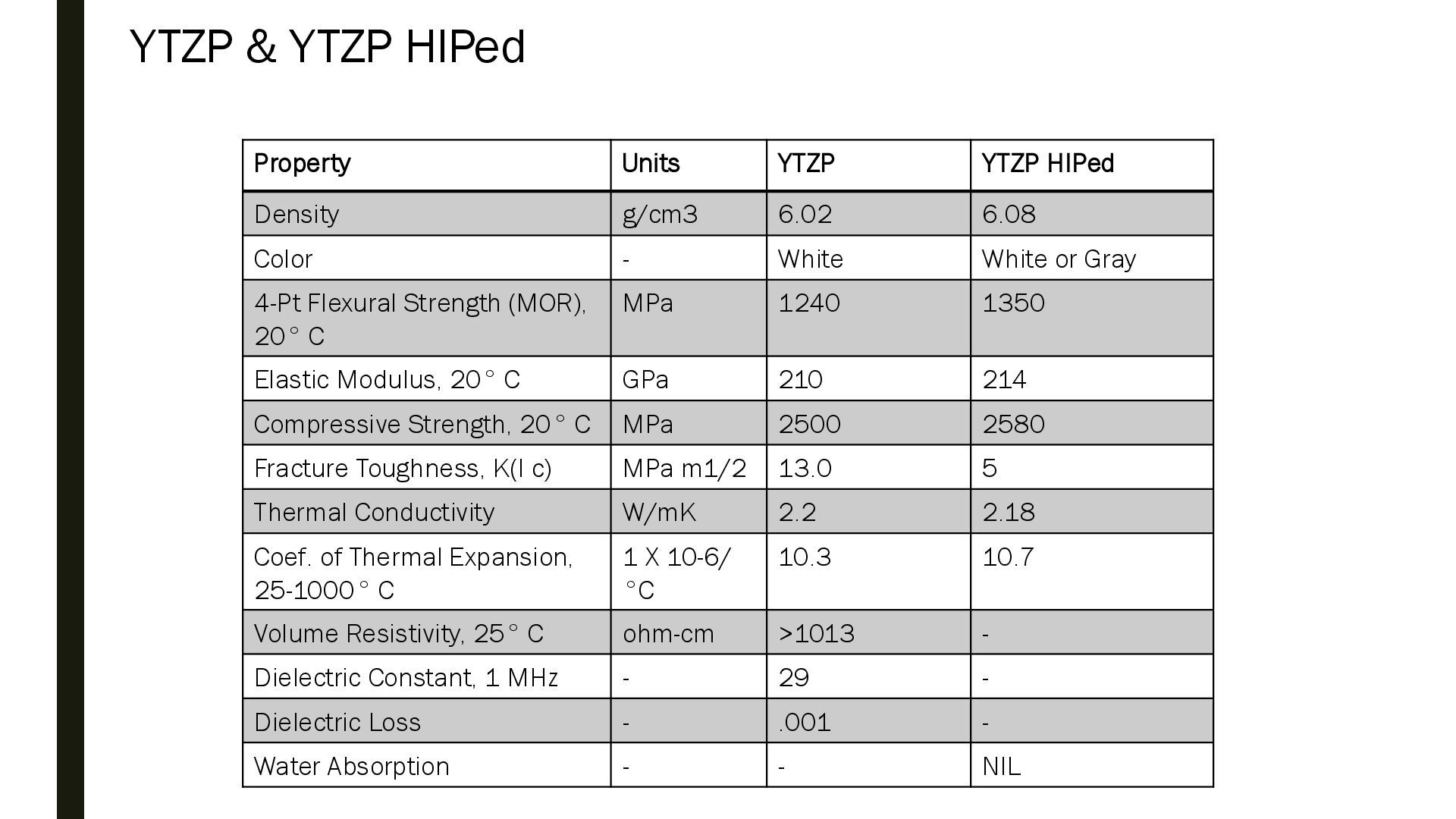
  23. YTZP & YTZP HIPed Property Units YTZP YTZP HIPed Density

    g/cm3 6.02 6.08 Color - White White or Gray 4-Pt Flexural Strength (MOR), 20° C MPa 1240 1350 Elastic Modulus, 20° C GPa 210 214 Compressive Strength, 20° C MPa 2500 2580 Fracture Toughness, K(I c) MPa m1/2 13.0 5 Thermal Conductivity W/mK 2.2 2.18 Coef. of Thermal Expansion, 25-1000° C 1 X 10⁻⁶/ °C 10.3 10.7 Volume Resistivity, 25° C ohm-cm >1013 - Dielectric Constant, 1 MHz - 29 - Dielectric Loss - .001 - Water Absorption - - NIL
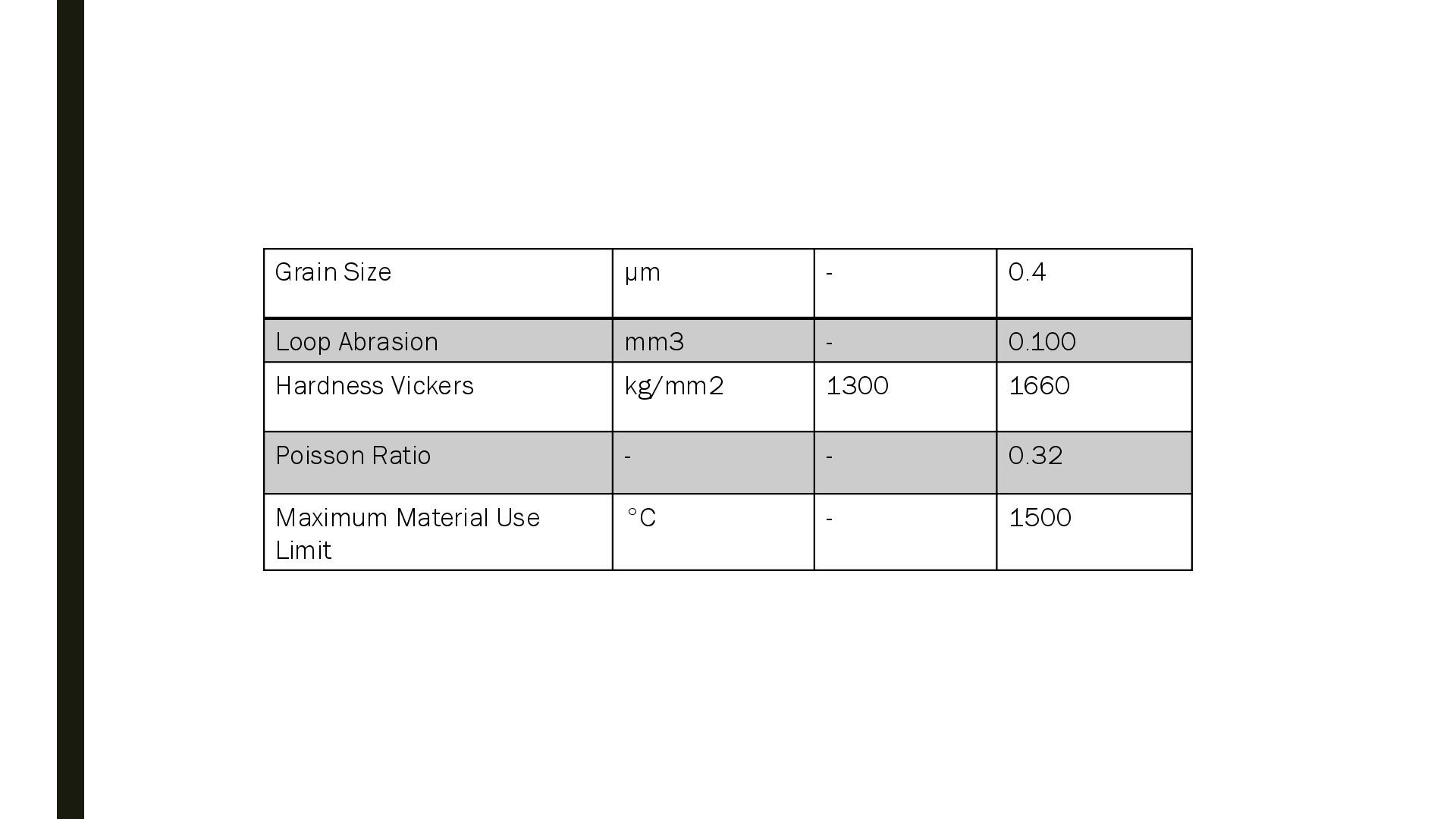
  24. Grain Size µm - 0.4 Loop Abrasion mm3 - 0.100

    Hardness Vickers kg/mm2 1300 1660 Poisson Ratio - - 0.32 Maximum Material Use Limit °C - 1500
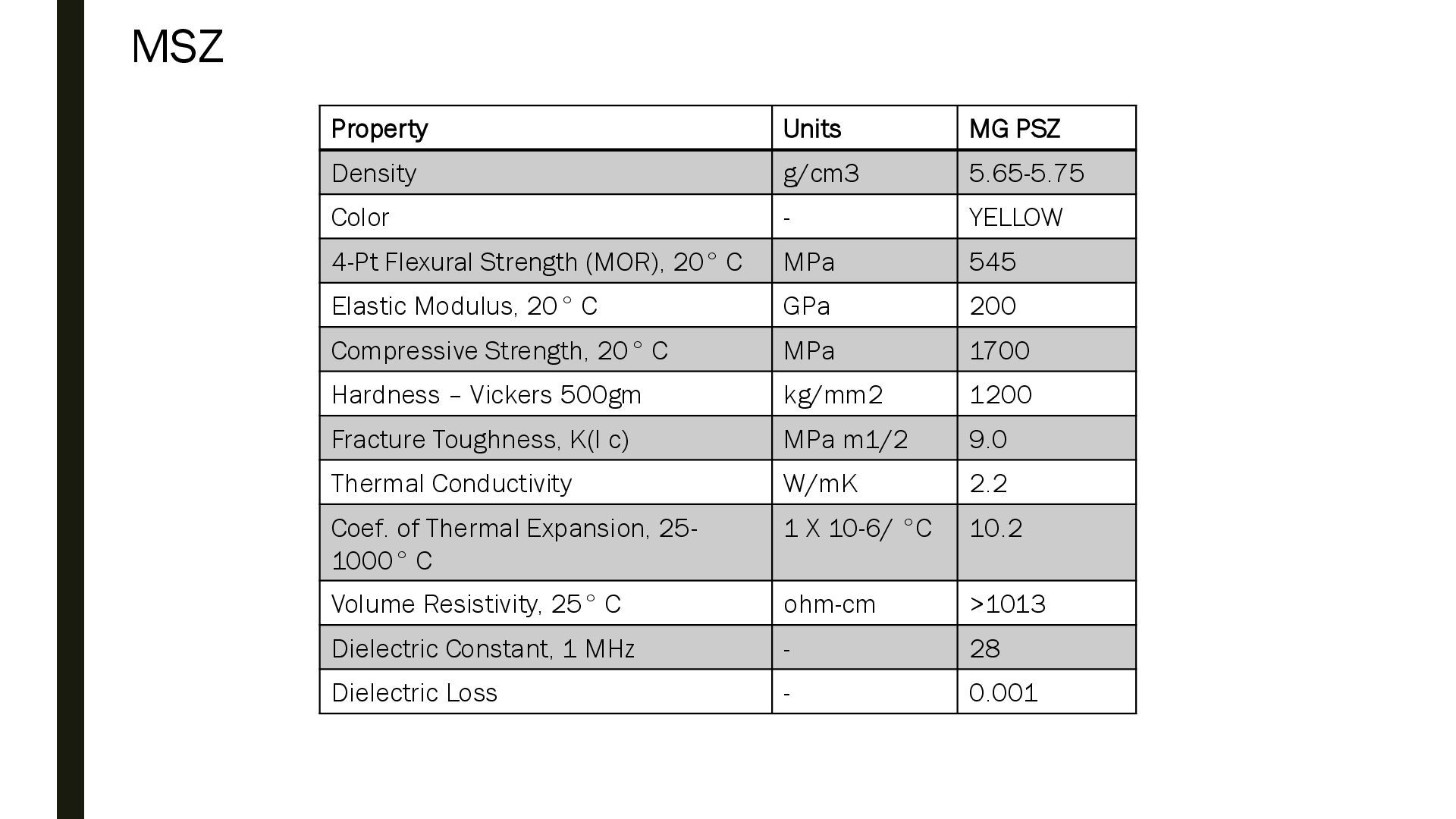
  25. MSZ Property Units MG PSZ Density g/cm3 5.65-5.75 Color -

    YELLOW 4-Pt Flexural Strength (MOR), 20° C MPa 545 Elastic Modulus, 20° C GPa 200 Compressive Strength, 20° C MPa 1700 Hardness – Vickers 500gm kg/mm2 1200 Fracture Toughness, K(I c) MPa m1/2 9.0 Thermal Conductivity W/mK 2.2 Coef. of Thermal Expansion, 25- 1000° C 1 X 10⁻⁶/ °C 10.2 Volume Resistivity, 25° C ohm-cm >1013 Dielectric Constant, 1 MHz - 28 Dielectric Loss - 0.001
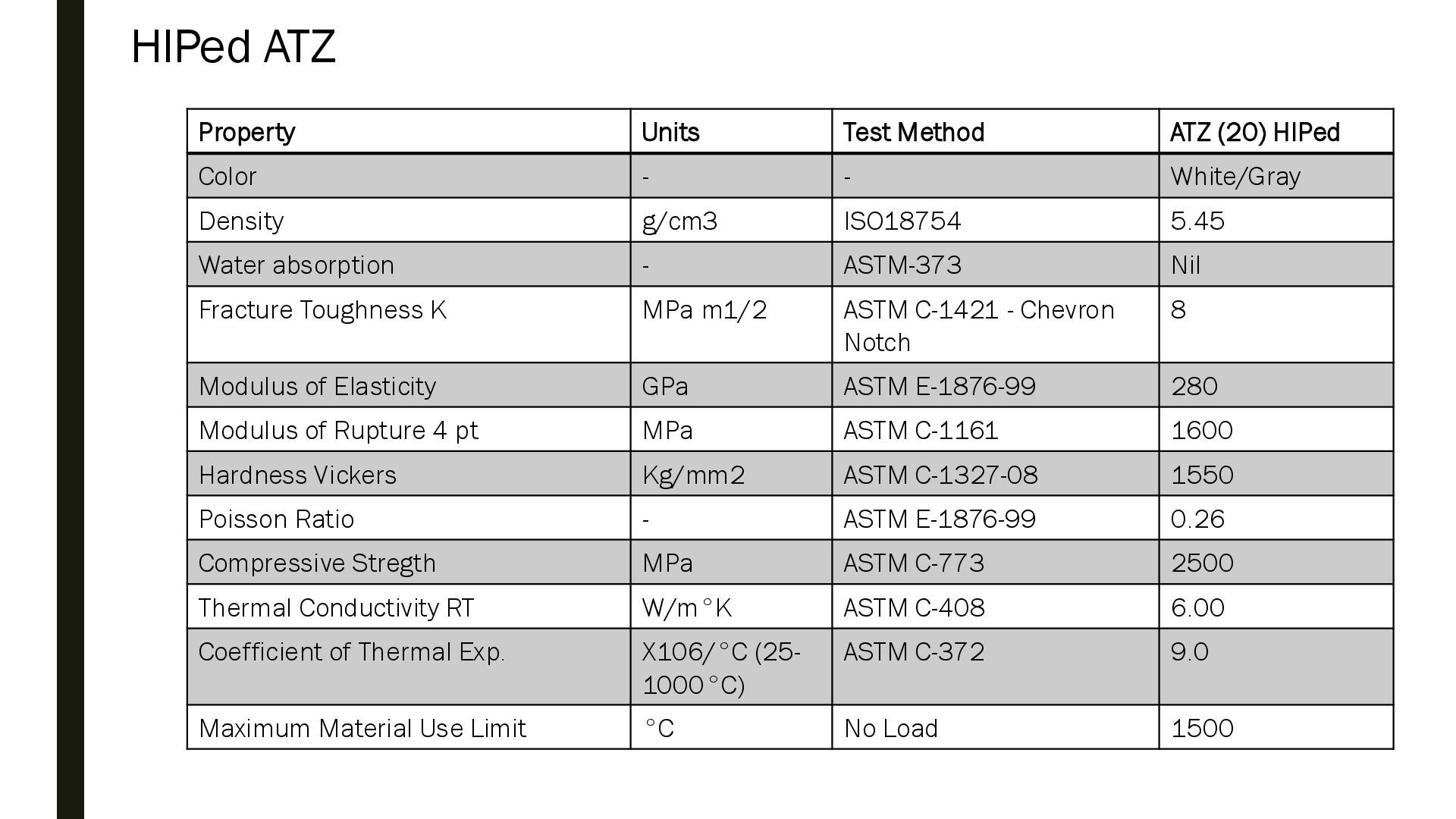
  26. HIPed ATZ Property Units Test Method ATZ (20) HIPed Color

    - - White/Gray Density g/cm3 ISO18754 5.45 Water absorption - ASTM-373 Nil Fracture Toughness K MPa m1/2 ASTM C-1421 - Chevron Notch 8 Modulus of Elasticity GPa ASTM E-1876-99 280 Modulus of Rupture 4 pt MPa ASTM C-1161 1600 Hardness Vickers Kg/mm2 ASTM C-1327-08 1550 Poisson Ratio - ASTM E-1876-99 0.26 Compressive Stregth MPa ASTM C-773 2500 Thermal Conductivity RT W/m°K ASTM C-408 6.00 Coefficient of Thermal Exp. X106/°C (25- 1000°C) ASTM C-372 9.0 Maximum Material Use Limit °C No Load 1500
  27. THANK YOU 88849 15180 | [email protected] www.ceramforge.com Copy of CeramForge

    Backlinks 1.xlsx Copy of CeramForge Backlinks 1.xlsx