Lock in $30 Savings on PRO—Offer Ends Soon! ⏳

The Implications of Cryptocurrencies

The Implications of Cryptocurrencies

A short talk about the nature of money and payment systems, what they're fundamentally designed to do, how existing systems work, how cryptocurrencies solve a database management problem with different protocols, and what this innovation implies for money services businesses and central banks.

Avatar for David Andolfatto

David Andolfatto

November 13, 2019
Tweet

More Decks by David Andolfatto

Other Decks in Education

Transcript

  1. 1 The Implications of Cryptocurrencies David Andolfatto, FRB St. Louis

    Washington University, St. Louis November 13, 2019 The views expressed here are my own and should not be attributed to the Federal Reserve Bank of St. Louis or the Federal Reserve System.
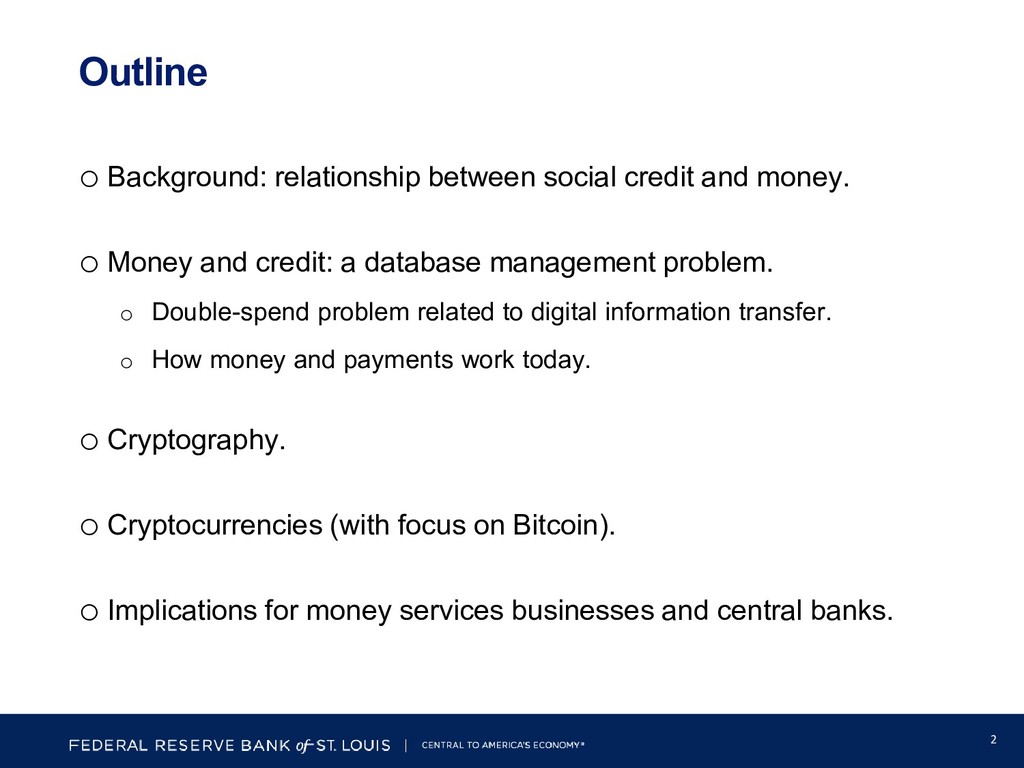
  2. 2 o Background: relationship between social credit and money. o

    Money and credit: a database management problem. o Double-spend problem related to digital information transfer. o How money and payments work today. o Cryptography. o Cryptocurrencies (with focus on Bitcoin). o Implications for money services businesses and central banks. Outline
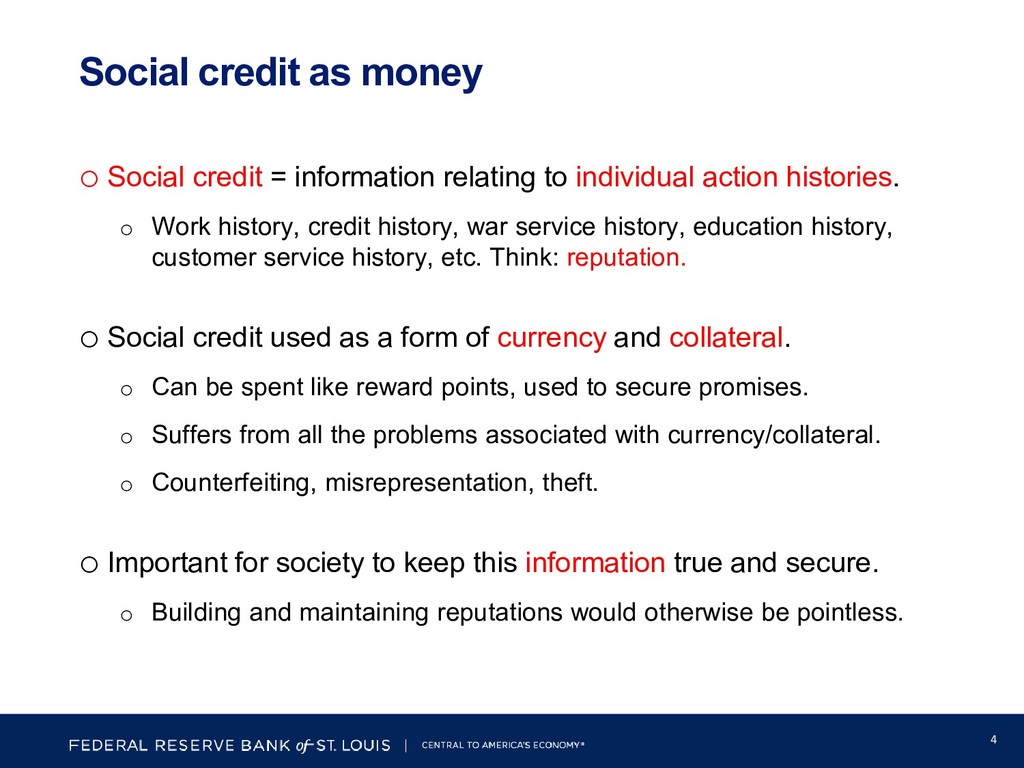
  3. 4 o Social credit = information relating to individual action

    histories. o Work history, credit history, war service history, education history, customer service history, etc. Think: reputation. o Social credit used as a form of currency and collateral. o Can be spent like reward points, used to secure promises. o Suffers from all the problems associated with currency/collateral. o Counterfeiting, misrepresentation, theft. o Important for society to keep this information true and secure. o Building and maintaining reputations would otherwise be pointless. Social credit as money
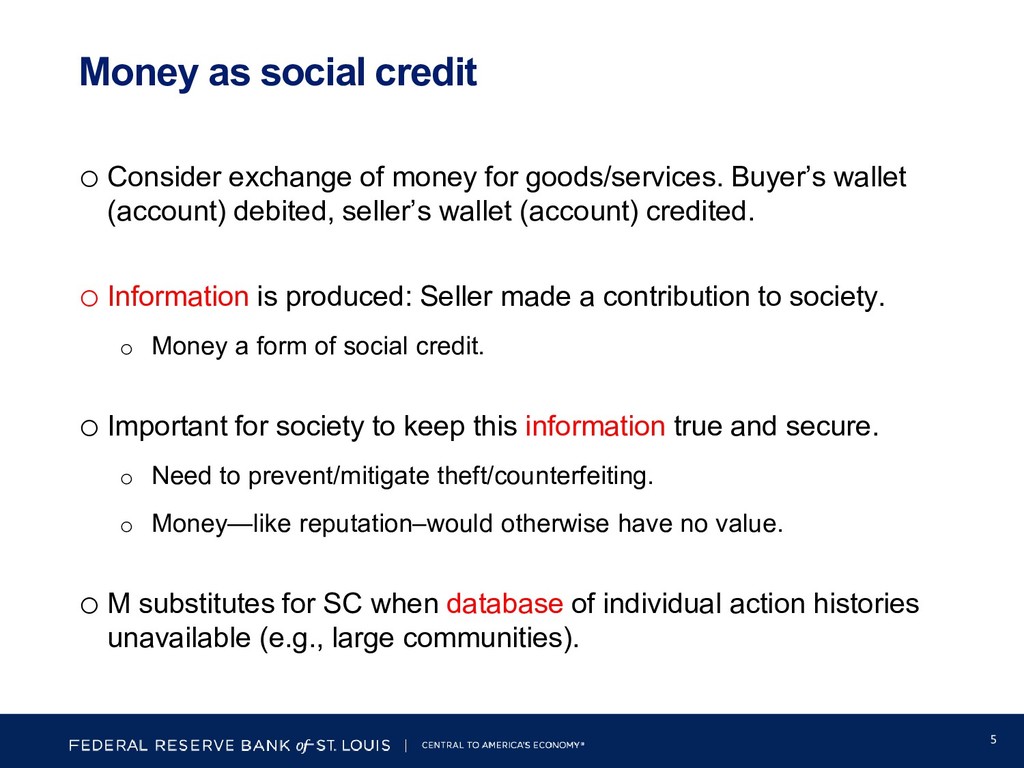
  4. 5 o Consider exchange of money for goods/services. Buyer’s wallet

    (account) debited, seller’s wallet (account) credited. o Information is produced: Seller made a contribution to society. o Money a form of social credit. o Important for society to keep this information true and secure. o Need to prevent/mitigate theft/counterfeiting. o Money—like reputation–would otherwise have no value. o M substitutes for SC when database of individual action histories unavailable (e.g., large communities). Money as social credit
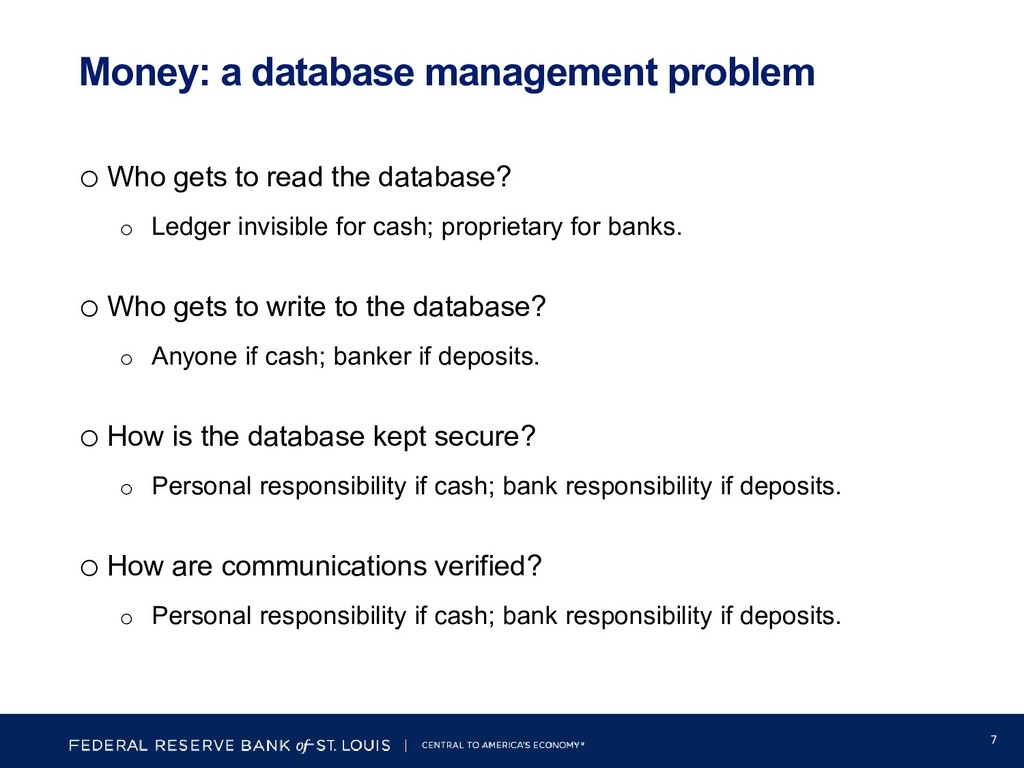
  5. 7 o Who gets to read the database? o Ledger

    invisible for cash; proprietary for banks. o Who gets to write to the database? o Anyone if cash; banker if deposits. o How is the database kept secure? o Personal responsibility if cash; bank responsibility if deposits. o How are communications verified? o Personal responsibility if cash; bank responsibility if deposits. Money: a database management problem
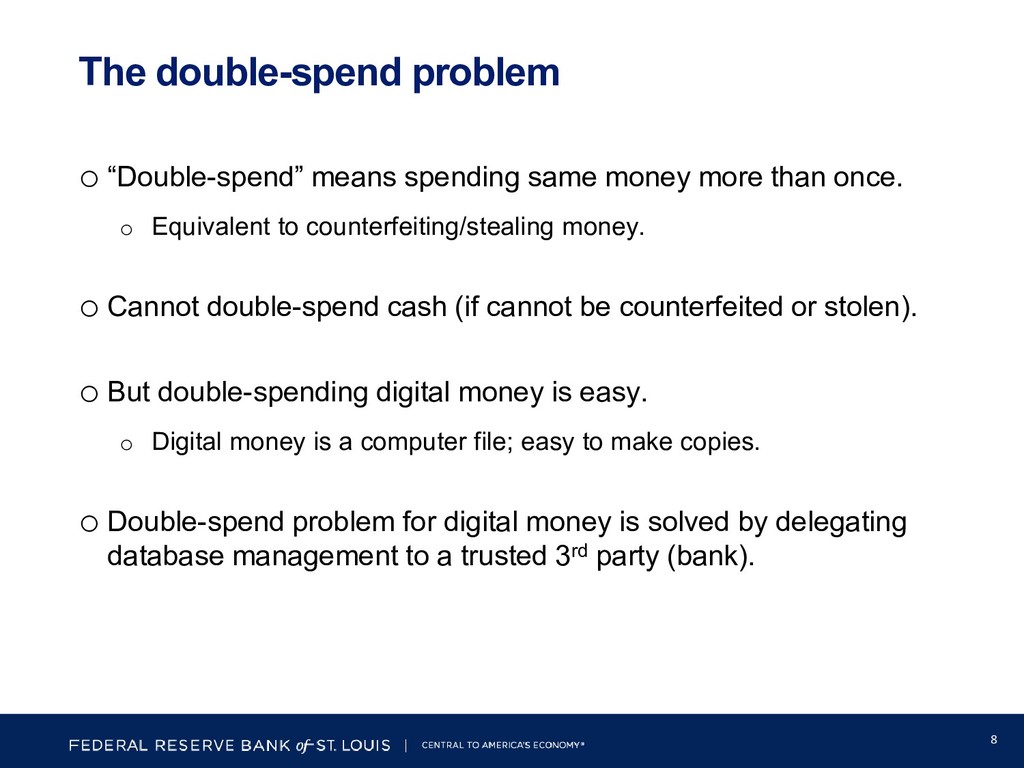
  6. 8 o “Double-spend” means spending same money more than once.

    o Equivalent to counterfeiting/stealing money. o Cannot double-spend cash (if cannot be counterfeited or stolen). o But double-spending digital money is easy. o Digital money is a computer file; easy to make copies. o Double-spend problem for digital money is solved by delegating database management to a trusted 3rd party (bank). The double-spend problem
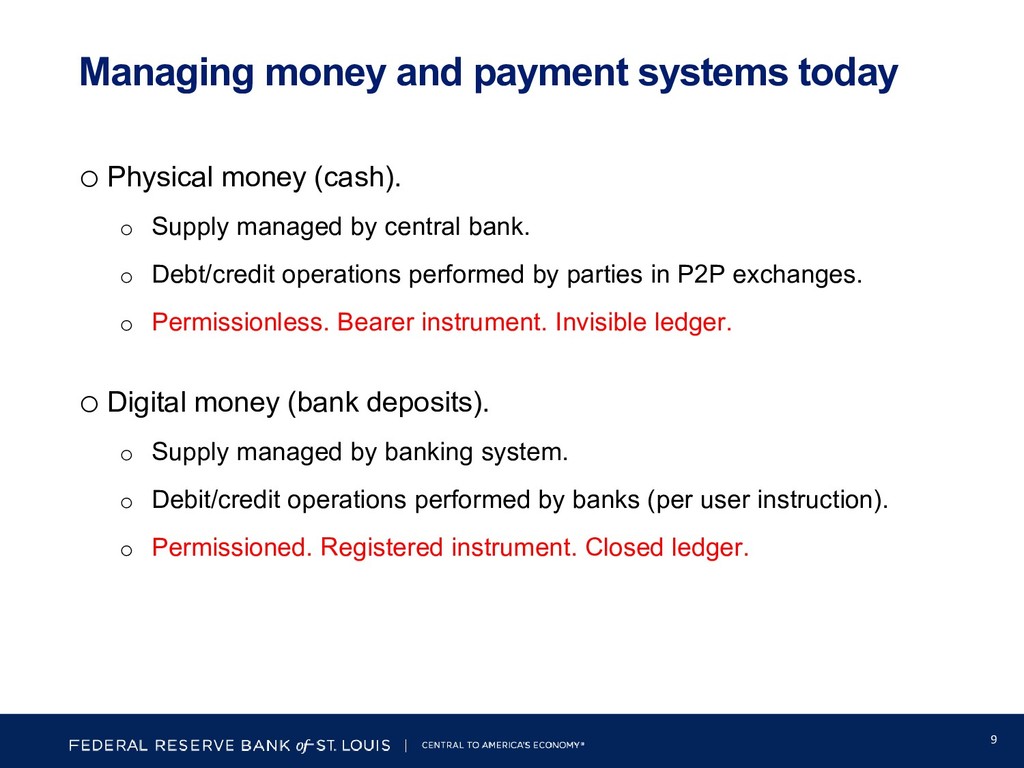
  7. 9 o Physical money (cash). o Supply managed by central

    bank. o Debt/credit operations performed by parties in P2P exchanges. o Permissionless. Bearer instrument. Invisible ledger. o Digital money (bank deposits). o Supply managed by banking system. o Debit/credit operations performed by banks (per user instruction). o Permissioned. Registered instrument. Closed ledger. Managing money and payment systems today
  8. 11

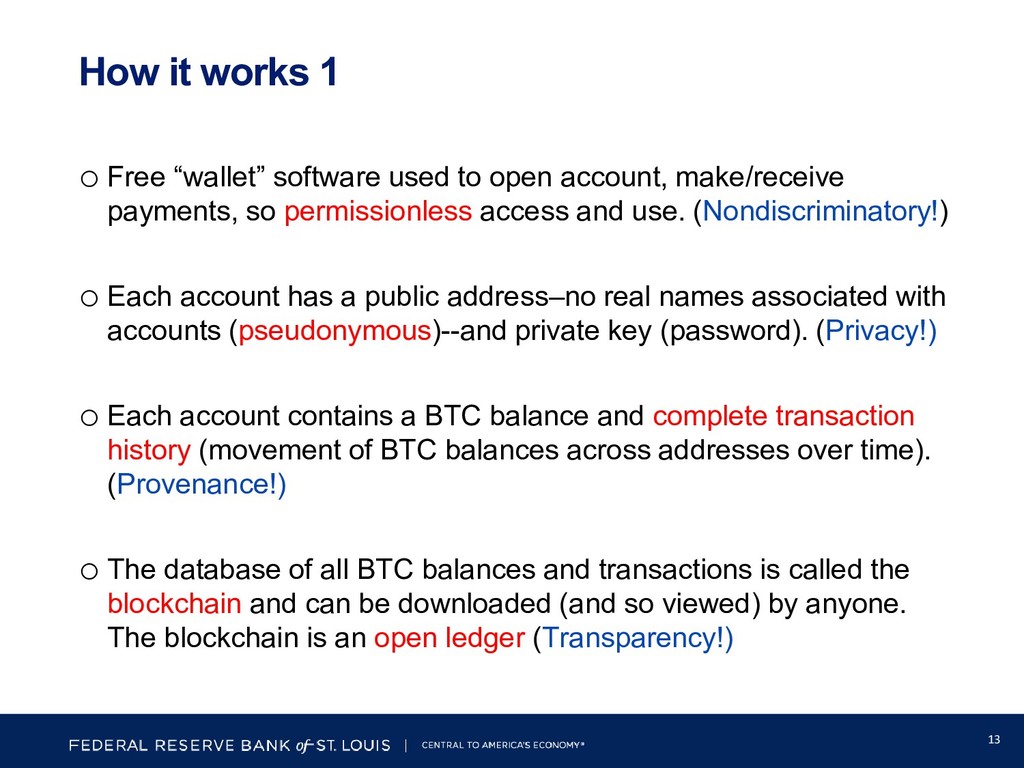
  9. 13 o Free “wallet” software used to open account, make/receive

    payments, so permissionless access and use. (Nondiscriminatory!) o Each account has a public address–no real names associated with accounts (pseudonymous)--and private key (password). (Privacy!) o Each account contains a BTC balance and complete transaction history (movement of BTC balances across addresses over time). (Provenance!) o The database of all BTC balances and transactions is called the blockchain and can be downloaded (and so viewed) by anyone. The blockchain is an open ledger (Transparency!) How it works 1
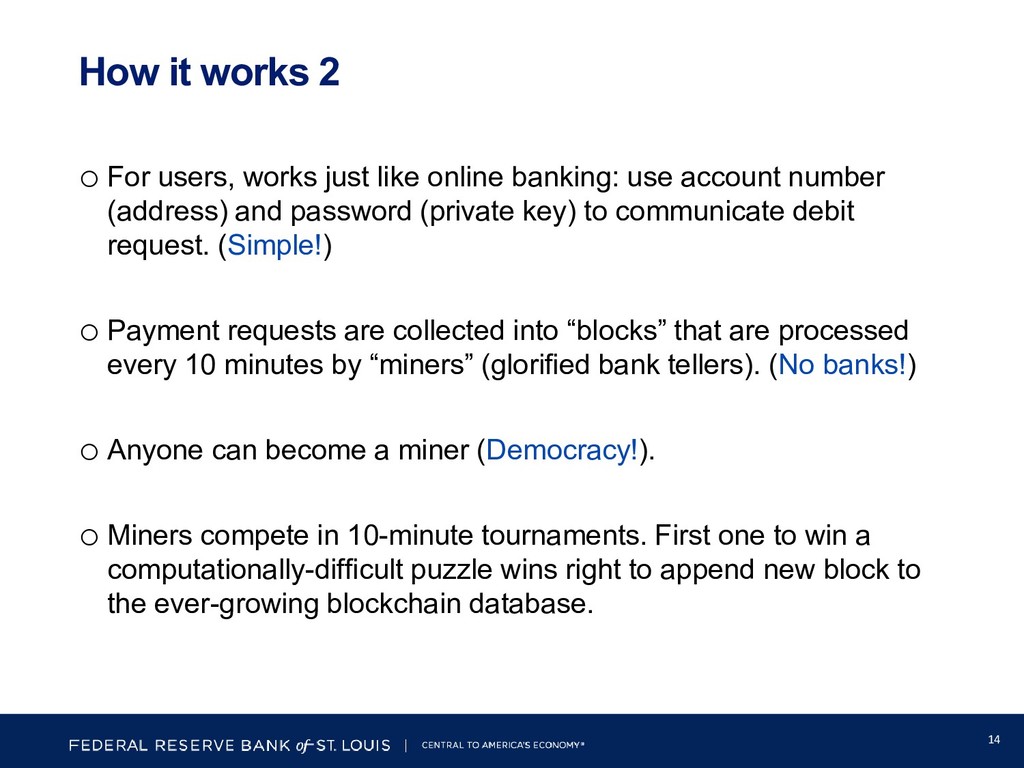
  10. 14 o For users, works just like online banking: use

    account number (address) and password (private key) to communicate debit request. (Simple!) o Payment requests are collected into “blocks” that are processed every 10 minutes by “miners” (glorified bank tellers). (No banks!) o Anyone can become a miner (Democracy!). o Miners compete in 10-minute tournaments. First one to win a computationally-difficult puzzle wins right to append new block to the ever-growing blockchain database. How it works 2
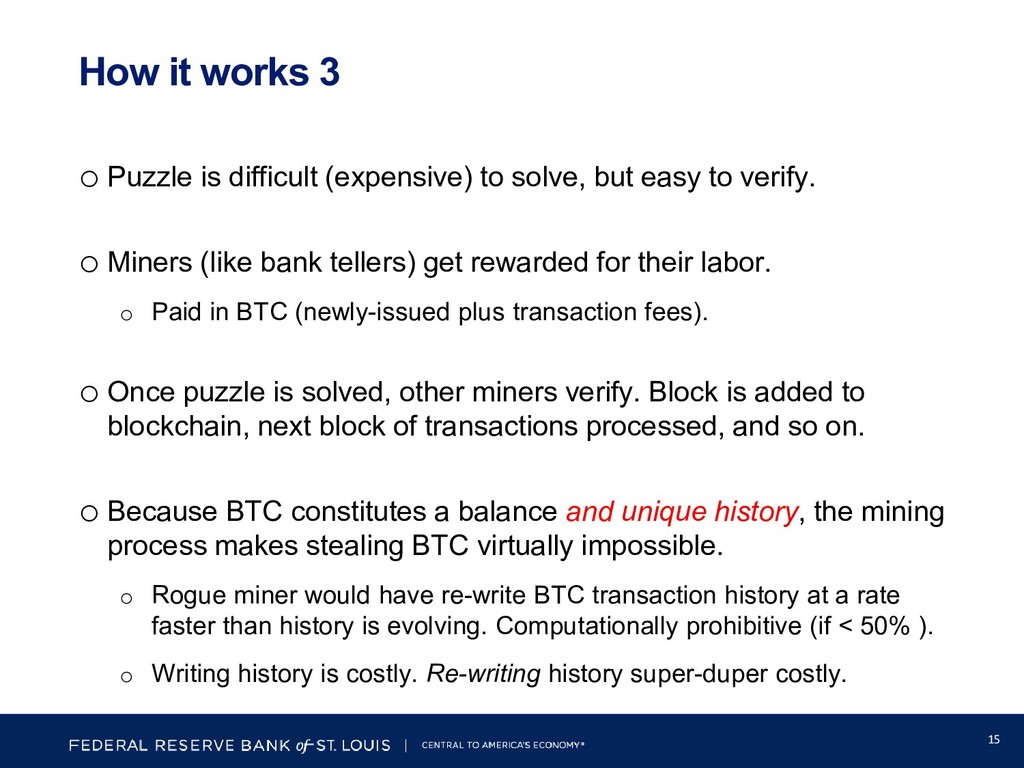
  11. 15 o Puzzle is difficult (expensive) to solve, but easy

    to verify. o Miners (like bank tellers) get rewarded for their labor. o Paid in BTC (newly-issued plus transaction fees). o Once puzzle is solved, other miners verify. Block is added to blockchain, next block of transactions processed, and so on. o Because BTC constitutes a balance and unique history, the mining process makes stealing BTC virtually impossible. o Rogue miner would have re-write BTC transaction history at a rate faster than history is evolving. Computationally prohibitive (if < 50% ). o Writing history is costly. Re-writing history super-duper costly. How it works 3
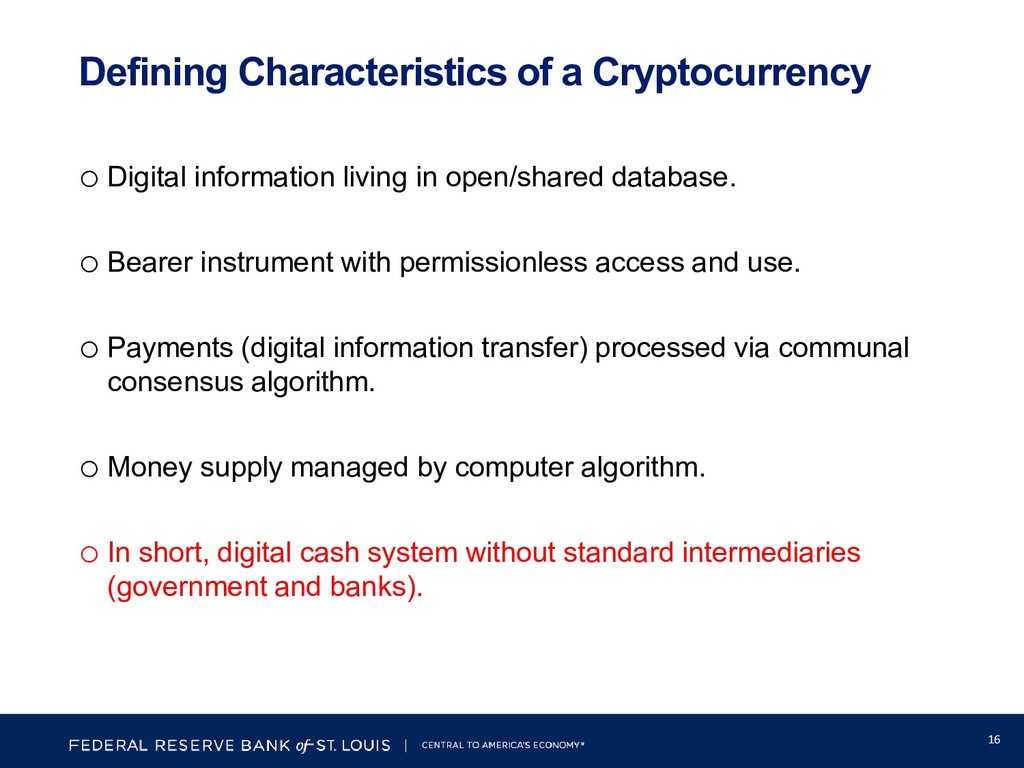
  12. 16 o Digital information living in open/shared database. o Bearer

    instrument with permissionless access and use. o Payments (digital information transfer) processed via communal consensus algorithm. o Money supply managed by computer algorithm. o In short, digital cash system without standard intermediaries (government and banks). Defining Characteristics of a Cryptocurrency
  13. 18 o Payment arm of banks and money services businesses

    face a potential threat, since sending/receiving crypto might one day be as easy and cheap as sending email. o Correspondent banking system. International money transfers slow and expensive. Western Union. o But because crypto is not a unit of account, suffer from exchange rate volatility. Undesirable. o Also, consensus-based database management systems are intrinsically more expensive to operate (e.g., Fedwire vs. Bitcoin). Implications for money services business
  14. 19 o To a central bank, a cryptocurrency looks like

    any other foreign currency. Currency competition familiar to central banks. o I do not see cryptocurrency competing with any central bank money that is managed responsibility. o Legal tender laws. Unit of account. Exchange rate risk. o However, cryptocurrencies may pose a threat to central banks operating in unstable economic/political environments. o Again, threat is familiar (e.g., gold, USD). o Only difference now is Internet. Implications for central banks
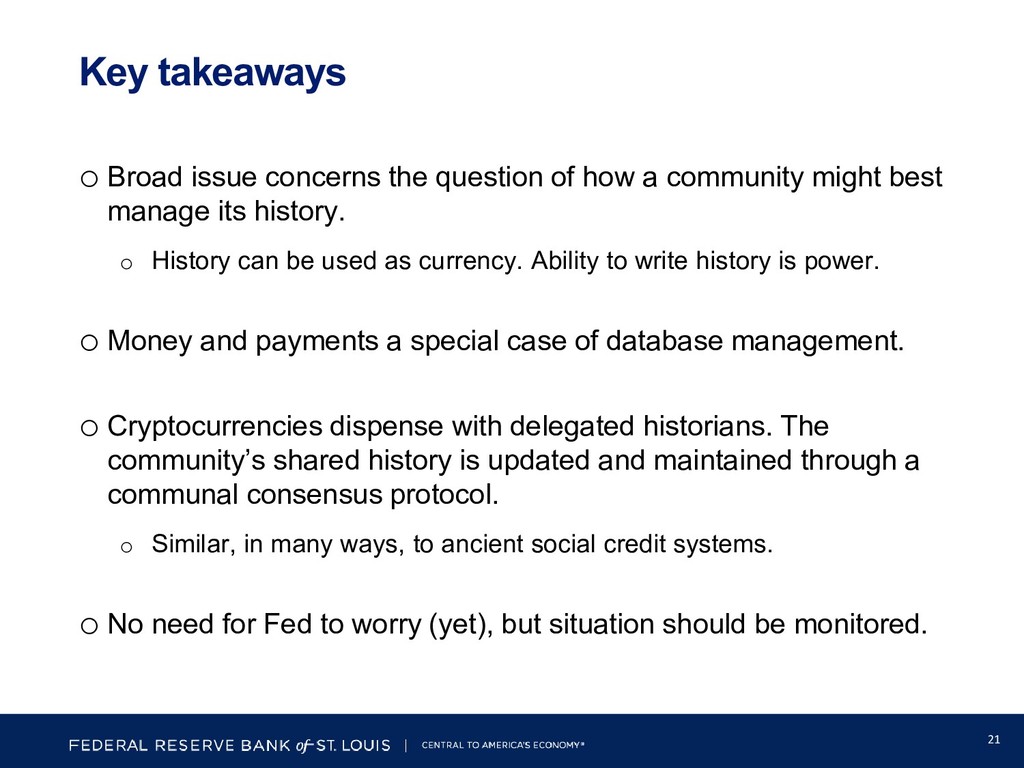
  15. 21 o Broad issue concerns the question of how a

    community might best manage its history. o History can be used as currency. Ability to write history is power. o Money and payments a special case of database management. o Cryptocurrencies dispense with delegated historians. The community’s shared history is updated and maintained through a communal consensus protocol. o Similar, in many ways, to ancient social credit systems. o No need for Fed to worry (yet), but situation should be monitored. Key takeaways